“Sponge City” Viability: Perspectives from Practitioners and Domain Experts in China


Abstract
1. Introduction
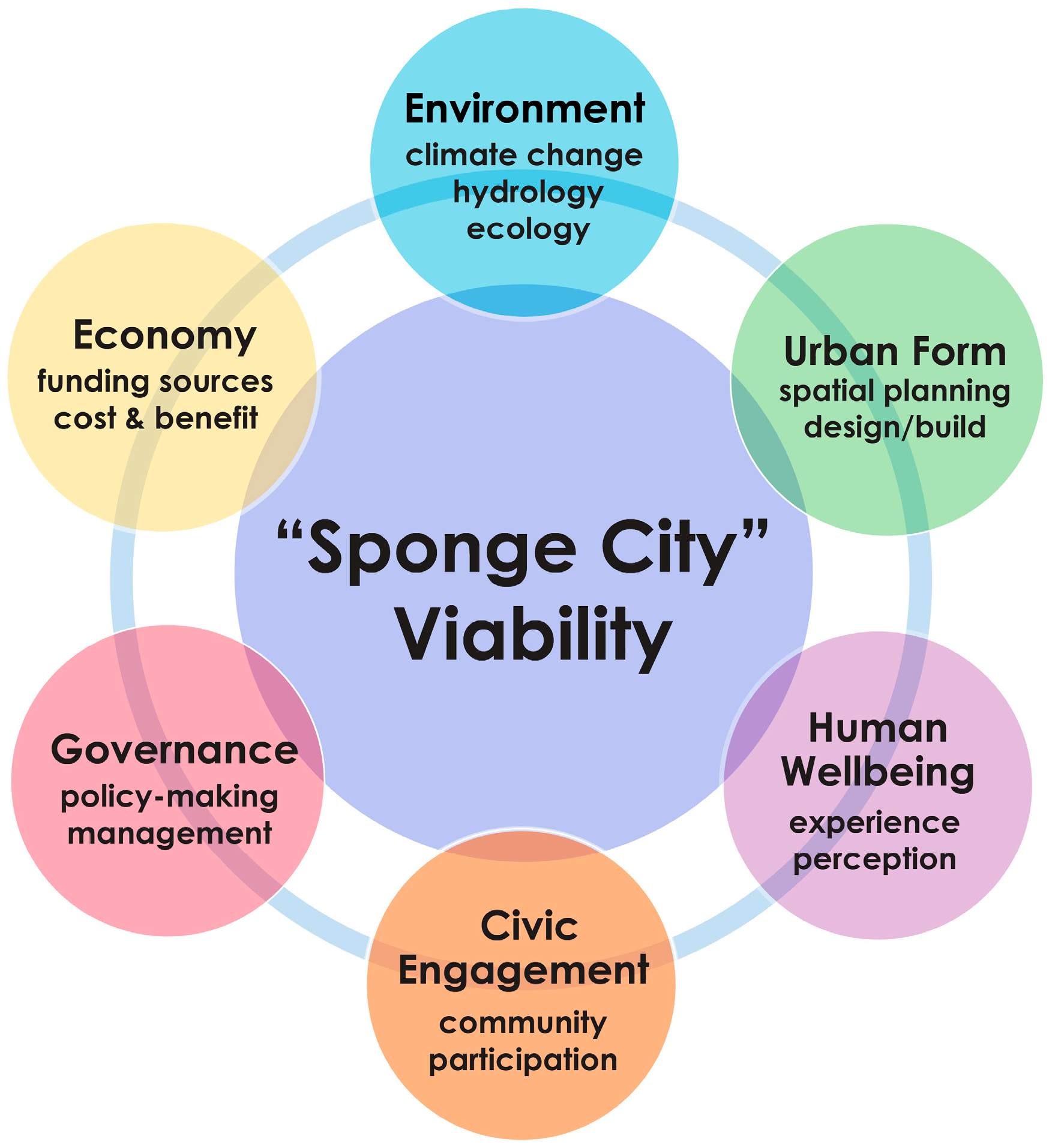
1.1. Key Definitions and Conceptual Framework
1.2. Literature Review
1.3. Study Cities
1.4. Research Questions
2. Materials and Methods
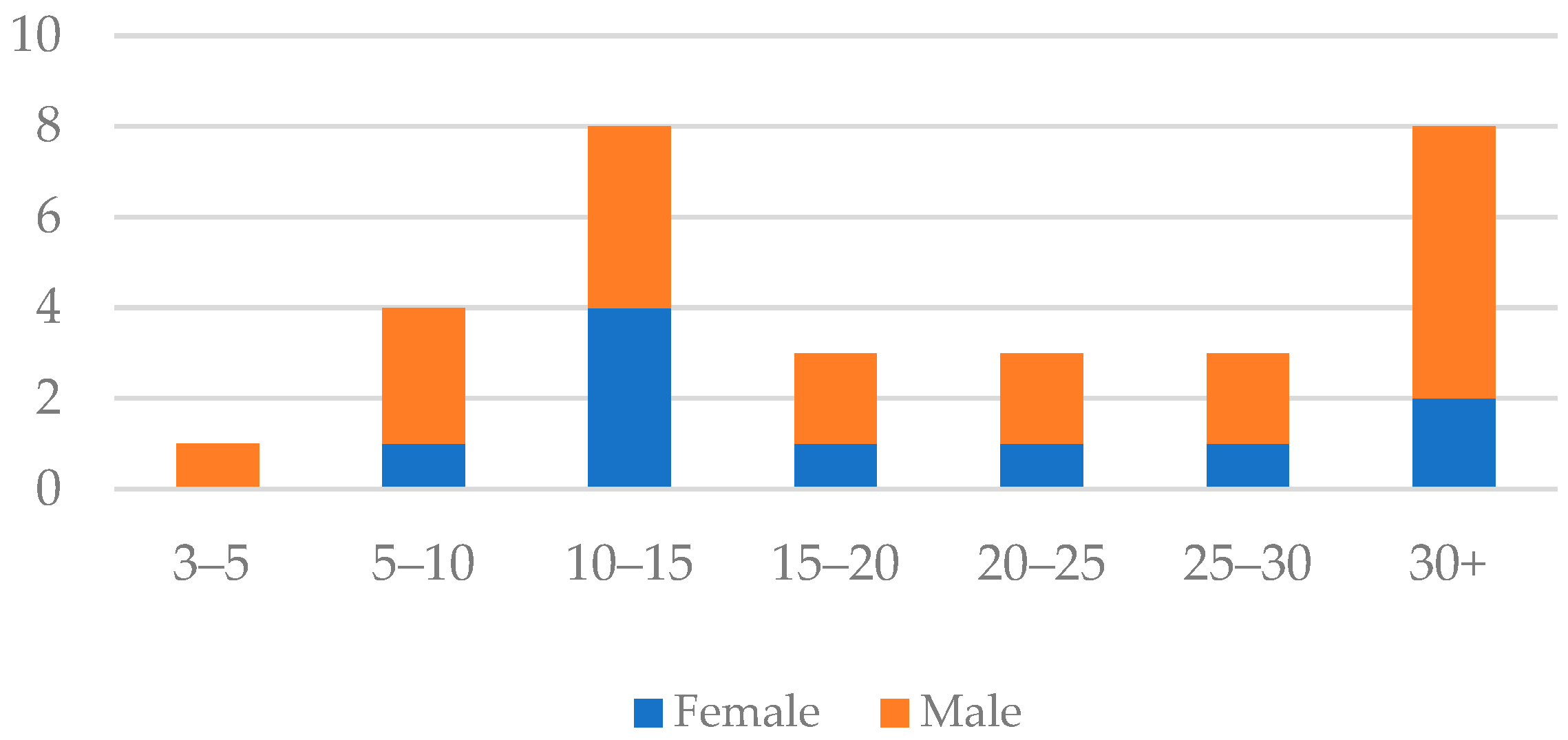
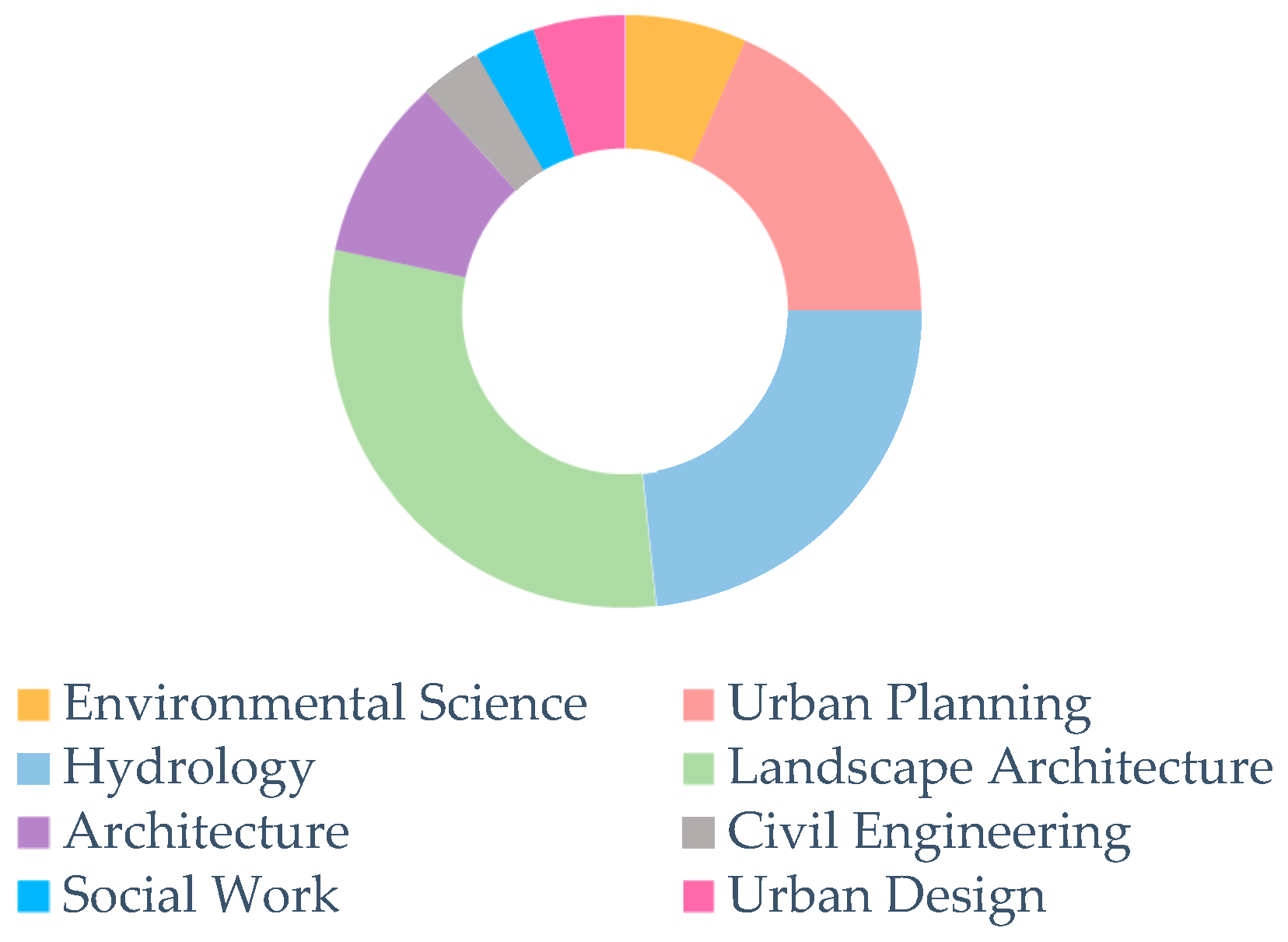
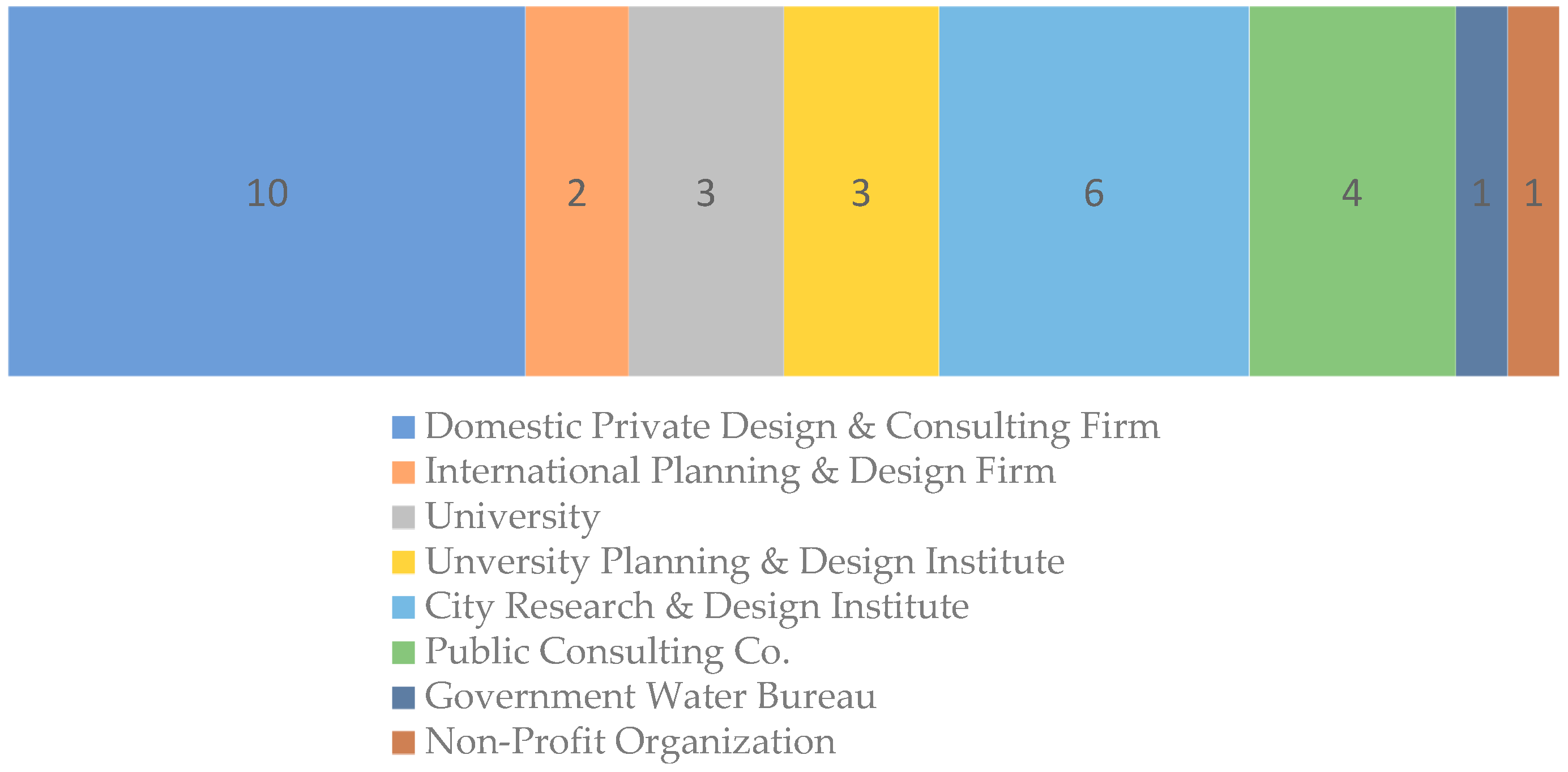
2.1. Study Participants
2.2. Interview Data Collection and Analysis Process
2.3. Field Studies
3. Results
3.1. RQ1: What Are the General Perspectives of Practitioners and Domain Experts on China’s Sponge City Concept and Implementation?
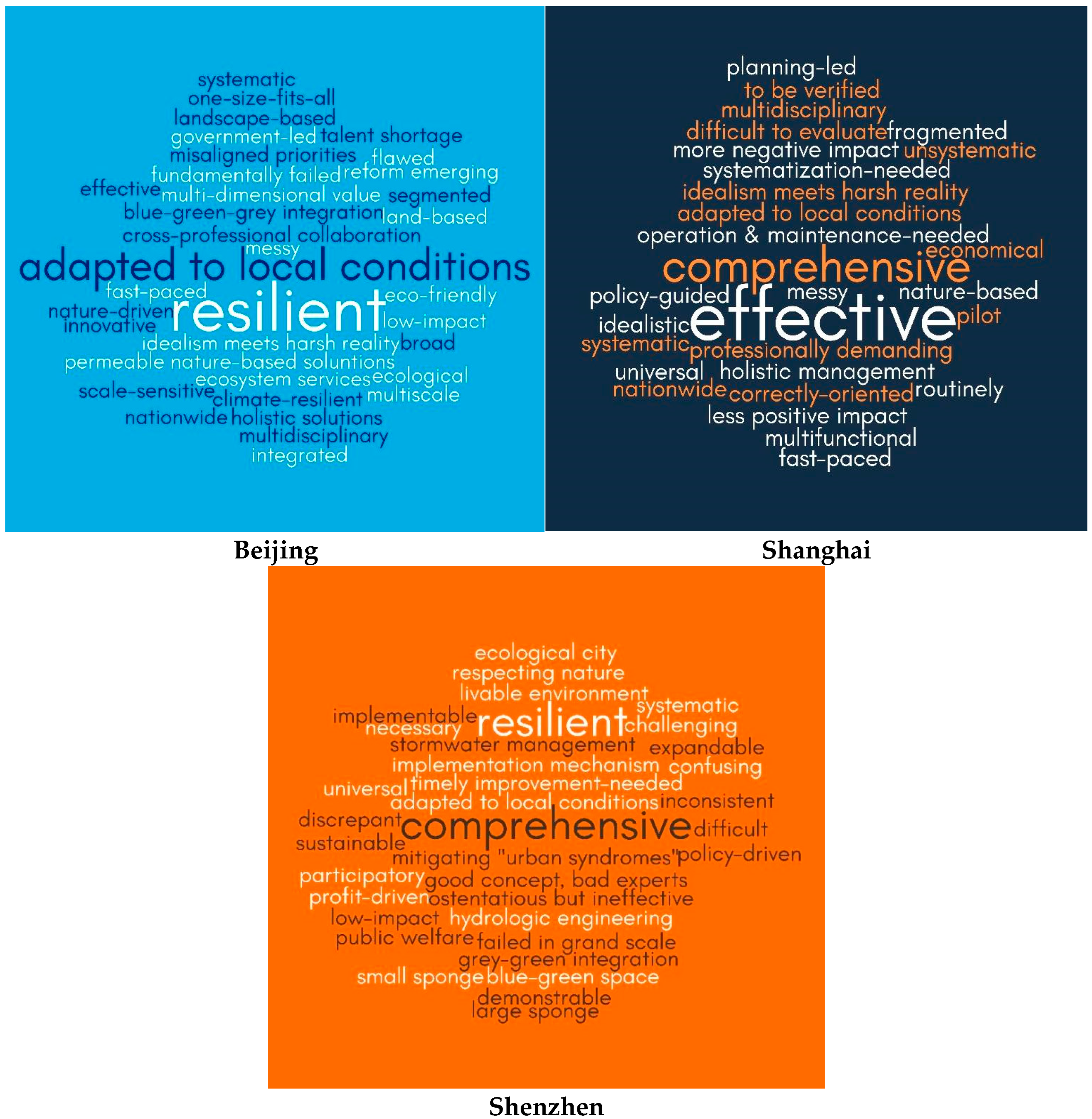
3.1.1. Keyword Analysis
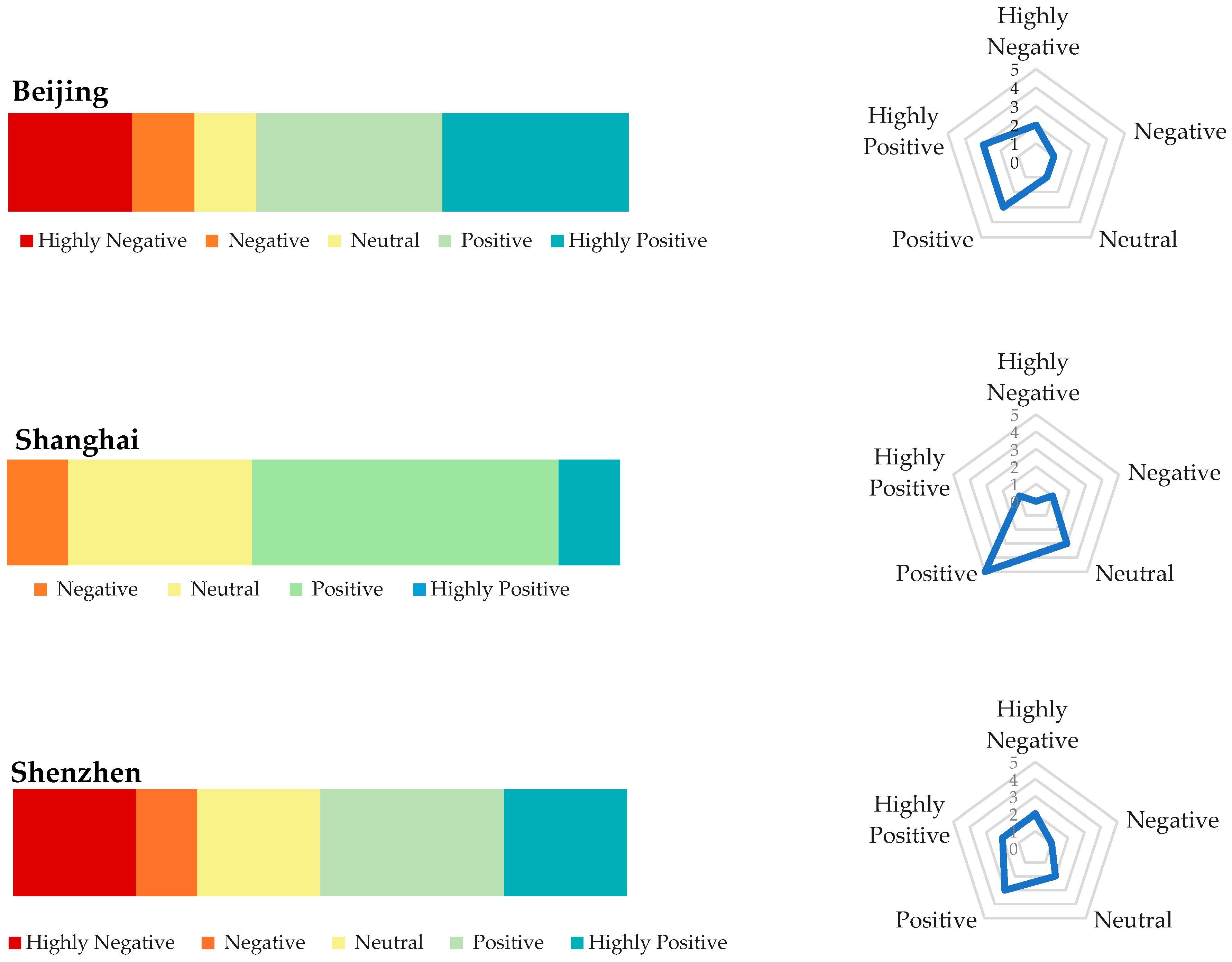
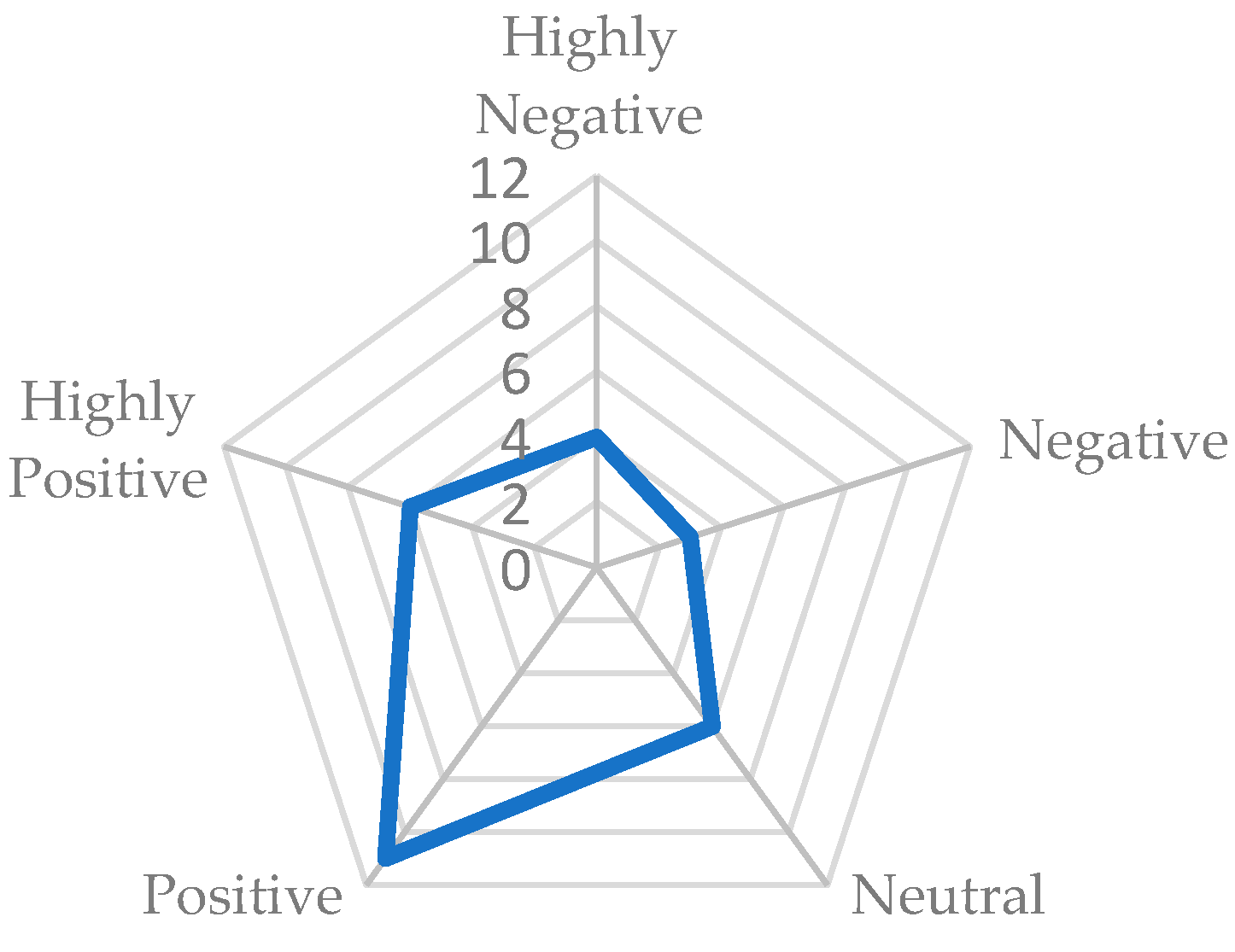
3.1.2. General Attitudes
3.2. RQ2: How Did Climate Change Considerations Influence the Planning and Design of Sponge Cities, and What Strategies Were Employed to Enhance Their Viability?
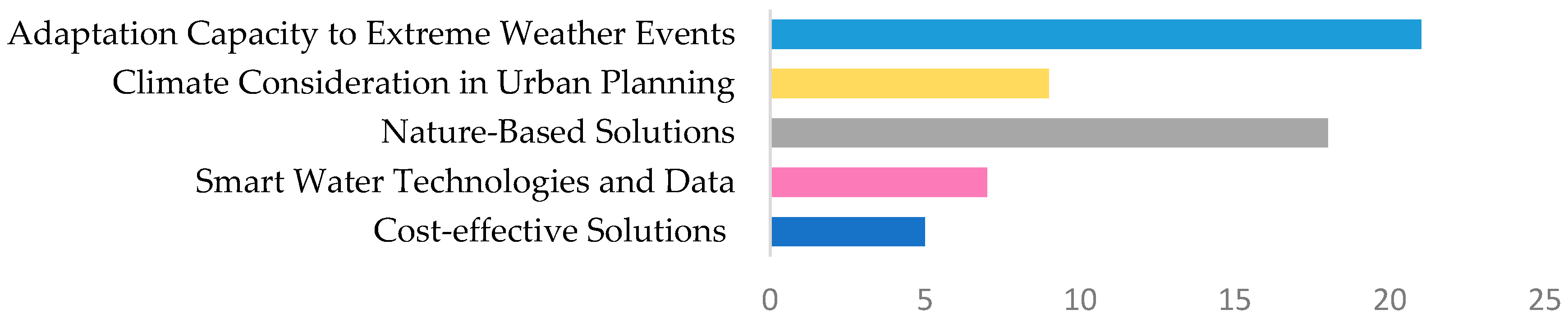
3.2.1. Common Themes in Climate Adaptation
- Adaptation Capacity to Extreme Weather Events
- Supportive Views
- Skeptical Views
- 2.
- Climate Considerations in Urban Planning
- 3.
- Nature-Based Solutions
- 4.
- Smart Water Technologies and Data
- 5.
- Cost-effective Practices
3.2.2. Climate Change Mitigation
- “Climate change factors are considered throughout the entire process according to the carbon principles. Design must be integrated with nature” (BJ5).
- “Mitigating climate change must go beyond a carbon-centric approach, considering broader ecological impacts, promoting biodiversity, and enhancing system resilience” (BJ8).
- “We strive to use green energy and natural materials as much as possible in all designs” (SH3).
- “We engage in low-carbon city planning and set requirements for urban low-carbon and green development indicators” (SZ1).
- “I think it’s difficult to change things like carbon emissions and the urban heat island effect through design alone. These are more about establishing values, environmental education, and adjusting our living style, which are hard to change from the bottom up through design. To address climate change challenges through design, we should focus on solving our water issues through planning, as I believe water is at the core of all our problems” (SZ5).
3.3. RQ3: What Are the Perceived Opportunities and Challenges Affecting Sponge City’s Viability Across Different Dimensions of the Conceptual Framework?
3.3.1. The Governance Dimension
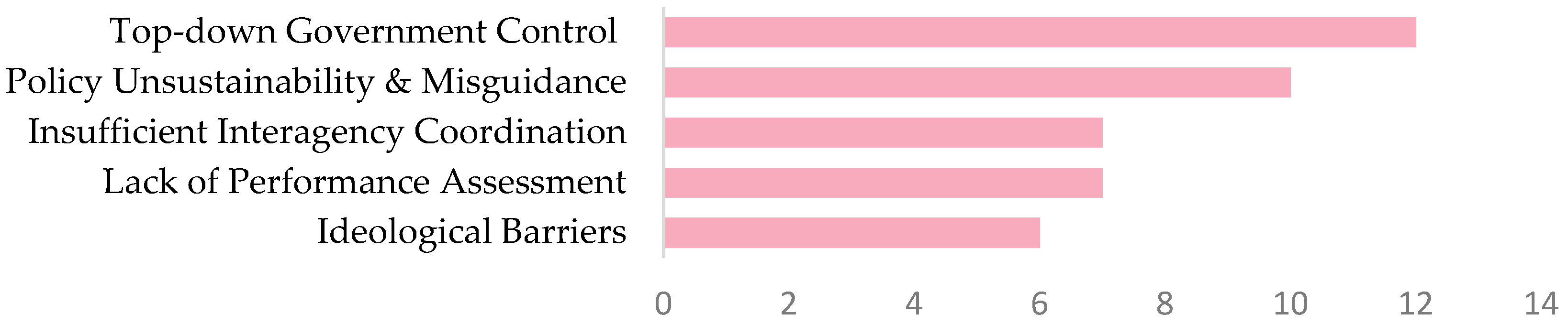
- Key Themes in Governance Challenges Affecting Sponge City Viability
- Top-down Government Control
- 2.
- Policy Unsustainability and Misguidance
- 3.
- Insufficient Interagency Coordination
- 4.
- Lack of Meaningful Performance Assessment
- 5.
- Ideological Barriers
- Key Themes in Governance Opportunities Supporting Sponge City Viability
- Policy Support
- 2.
- Long-term Goals and Continued Improvement
- 3.
- Government-led Outreach and Public Education
3.3.2. The Economic Dimension
- Key Themes in Economic Challenges Affecting Sponge City Viability
- High Upfront Cost and Funding Constraints
- 2.
- Lack of Economic Returns and Benefits
- 3.
- Private Sector Reluctance & Weak Market Incentives
- 4.
- Maintenance and Lifecycle Costs
- Key Themes in Economic Opportunities Supporting Sponge City Viability
- Cost-Saving Potential
- 2.
- Increasing Marketability and Property Values
- 3.
- Risk Reduction as Economic Justification
3.3.3. The Environmental Dimension
- Key Themes in Environmental Challenges Affecting Sponge City Viability
- Intensified Extreme Weather and Climate Change Impact
- 2.
- Complicated “Urban Syndrome” after 40 Years of Development
- 3.
- Systemic Water Problems
- 4.
- Disservice with Negative Environmental Impact by Sponge City Construction
- Key Themes in Environmental Opportunities Supporting Sponge City Viability
- Enhancing Climate Resilience
- 2.
- Offering Ecosystem Services and Environmental Benefits
- 3.
- Solving Systemic Water Problems Holistically
- 4.
- Treating “Urban Syndrome” with Nature-Based Solutions
3.3.4. The Urban Form Dimension
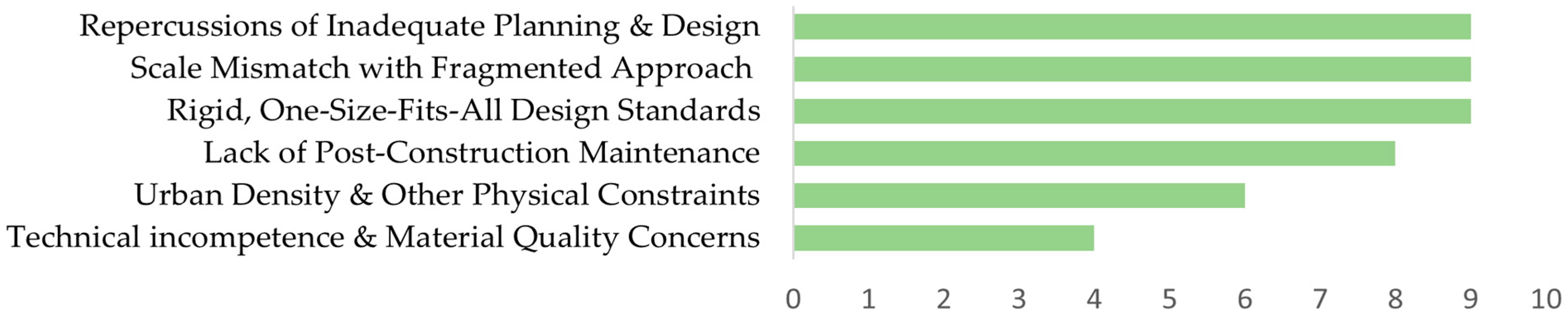
- Key Themes in Urban Form Challenges Affecting Sponge City Viability
- Repercussions of Inadequate Planning and Design
- 2.
- Scale Mismatch with Fragmented Approaches
- 3.
- Rigid, One-Size-Fits-All Design Standards
- 4.
- Lack of Post-Construction Maintenance
- 5.
- Urban Density and Other Physical Constraints
- 6.
- Technical Incompetence and Material Quality Concerns
- Key Themes in Urban Form Opportunities Supporting Sponge City Viability
- Systemic Thinking and Multidisciplinary Urban Planning
- 2.
- Multi-Scale Integration against Fragmentation
- 3.
- Adaptive, Context-Specific Design
- 4.
- Integrating O&M into Design and Implementation
3.3.5. The Civic Engagement Dimension
- Key Themes in Civic Engagement Challenges Affecting Sponge City Viability
- Top-Down Decision-Making with Limited Public Participation
- 2.
- Lack of Public Awareness and Environmental Education
- 3.
- Communication Issues and Outreach Gaps
- 4.
- Challenge in Cultural and Behavioral Change
- Key Themes in Civic Engagement Opportunities Supporting Sponge City Viability
- Promoting Participatory Mechanisms
- 2.
- Enhance Public Education and Awareness
- 3.
- Policy Support and Incentive Structures
- 4.
- Community-Led Co-Creation and Contextual Design
3.3.6. The Human Wellbeing Dimension
- Key Themes in Human Wellbeing Challenges Affecting Sponge City Viability
- Persistent Flood Risk and Public Safety Issues
- 2.
- Poor Human Experience and User Discomfort
- 3.
- Unhappiness due to Value Misalignment and Lack of Environmental Awareness
- Key Themes in Human Wellbeing Opportunities Supporting Sponge City Viability
- Enhancing Climate Resilience to Safeguard Human Wellbeing
- 2.
- Multifunctionality Promoting Mental and Physical Health
- 3.
- Fostering Understanding through Awareness
- 4.
- Promoting Cultural Enrichment and Community Pride
4. Discussion
4.1. Interview Findings Compared with Literature in Six Dimensions
4.1.1. Governance
4.1.2. Economy
4.1.3. Environment
4.1.4. Urban Form
4.1.5. Civic Engagement
4.1.6. Human Wellbeing
4.1.7. Time Horizon of Viability
4.2. Fieldwork Observations Compared with Interview Findings
4.3. Scale and Feasibility
4.4. Disciplinary Positionality
4.5. Limitations
5. Conclusions
Author Contributions
Funding
Data Availability Statement
Acknowledgments
Conflicts of Interest
Abbreviations
| BJ | Beijing |
| GSI | Green Stormwater Infrastructure |
| IRB | Institutional Review Board |
| LID | Low-impact Development |
| NBS | Nature-based Solution |
| O&M | Operations and Maintenance |
| PPP | Public–private Partnership |
| SH | Shanghai |
| SZ | Shenzhen |
Appendix A. Interview Questions
- Part 1. Your experience of “Sponge City.”
- What is your experience associated with the Sponge City theory and practice in China?
- Would you be willing to discuss some of your projects? What were the successes, challenges, and lessons learned?
- What were your “Sponge” strategies and techniques for stormwater management? Were these viable solutions in your opinion?
- Did climate change factor in your Sponge City’s planning and design? If yes, what were your strategies to deal with it?
- Part 2. Overall perspective of the Sponge City initiative and the conceptual framework
- What is your definition of Sponge City?
- What 3 to 5 words best describe the Sponge City initiative in China? Why do you choose these words?
- What are the opportunities and challenges that may affect Sponge City viability in each of the six dimensions as outlined in the conceptual framework?
- What is your feedback regarding the conceptual framework that I am developing?
- Part 3. Background
- What is your gender and professional background?
- How many years of working experience do you have, and specific Sponge City working experience as well?
- Are there other people you recommend to interview on Sponge City viability?
References
- Jia, H.; Yu, S. China’s Ambitious Sponge City Initiative: A Monumental Effort for Green/Gray Infrastructure Integration. EWRI Curr. 2015, 17, 8–9. [Google Scholar]
- Hermaputi, R.L.; Hua, C. Creating Urban Water Resilience: Review of China’s Development Strategies “Sponge City” Concept and Practices. Indones. J. Plan. Dev. 2017, 2, 1. [Google Scholar] [CrossRef]
- Cheng, T.; Huang, B.; Yang, Z.; Qiu, J.; Zhao, B.; Xu, Z. On the Effects of Flood Reduction for Green and Grey Sponge City Measures and Their Synergistic Relationship—Case Study in Jinan Sponge City Pilot Area. Urban Clim. 2022, 42, 101058. [Google Scholar] [CrossRef]
- Wang, H.; Mei, C.; Liu, J.H.; Shao, W.W. A New Strategy for Integrated Urban Water Management in China: Sponge City. Sci. China Technol. Sci. 2018, 61, 317–329. [Google Scholar] [CrossRef]
- Directive from China’s General Office of the State Council on Promoting Sponge City Construction. Available online: http://www.gov.cn/zhengce/content/2015-10/16/content_10228.htm (accessed on 4 June 2025).
- MOHURD Ministry of Housing and Urban-Rural Development. Releases List of Expert Committees for Sponge City Construction. Available online: https://www.h2o-china.com/news/252603.html (accessed on 14 November 2023).
- Sichuan Urban Water Supply and Drainage Association Public Announcement of the List of the First Expert Committee for Sponge City Implementation in Sichuan Province. Available online: https://www.gxzjxh.cn/news523935 (accessed on 20 December 2025).
- Chongqing Municipal Housing and Urban-Rural Development Commission. Notice from the Chongqing Municipal Housing and Urban-Rural Development Commission on the Announcement of the Chongqing Sponge City Construction Technical Guidance Specialist Council. Available online: https://www.cabee.org/site/content/23627.html (accessed on 14 November 2023).
- Wallenwein, F. The Sponge City Approach in China: Empty Metaphor or Promising Climate Change Adaptation Strategy? Available online: https://eh4s.eu/publication/the-sponge-city-approach-in-china-empty-metaphor-or-promising-climate-change-adaptation-strategy (accessed on 24 January 2026).
- Zeng, C.; Aboagye, E.M.; Li, H.; Che, S. Comments and Recommendations on Sponge City—China’s Solutions to Prevent Flooding Risks. Heliyon 2023, 9, e12745. [Google Scholar] [CrossRef]
- Jiang, Y.; Zevenbergen, C.; Fu, D. Understanding the Challenges for the Governance of China’s “Sponge Cities” Initiative to Sustainably Manage Urban Stormwater and Flooding. Nat. Hazards 2017, 89, 521–529. [Google Scholar] [CrossRef]
- Su, Y.; Qin, S.; Zhao, Y.; Trinkaus, S.; Dang, J. Operation and Maintenance Challenges in China’s “Sponge City” Program. J. Civ. Eng. Archit. 2020, 14, 532–536. [Google Scholar] [CrossRef]
- Nguyen, T.T.; Ngo, H.H.; Guo, W.; Wang, X.C.; Ren, N.; Li, G.; Ding, J.; Liang, H. Implementation of a Specific Urban Water Management-Sponge City. Sci. Total Environ. 2019, 652, 147–162. [Google Scholar] [CrossRef]
- Li, H.; Ding, L.; Ren, M.; Li, C.; Wang, H. Sponge City Construction in China: A Survey of the Challenges and Opportunities. Water 2017, 9, 594. [Google Scholar] [CrossRef]
- Wu, H.; Yang, Y.; Hu, J. Nurturing Nature in a Mega-City: A Decadal Assessment of the Beijing Olympic Forest Park. Socio-Ecol. Pract. Res. 2021, 3, 91–108. [Google Scholar] [CrossRef]
- Kates, R.; Parris, T.; Leiserowitz, A. What Is Sustainable Development? Goals, Indicators, Values, and Practice. Environ. Sci. Policy Sustain. Dev. 2005, 47, 8–21. [Google Scholar] [CrossRef]
- Zheng, S.; Tang, Y.; Chan, F.K.S.; Cao, L.; Song, R. The Demographic Implication for Promoting Sponge City Initiatives in the Chinese Megacities: A Case of Wuhan. Water 2022, 14, 883. [Google Scholar] [CrossRef]
- Jiang, Y.; Yuan, Y.; Piza, H. A Review of Applicability and Effectiveness of Low Impact Development/Green Infrastructure Practices in Arid/Semi-Arid United States. Environments 2015, 2, 221–249. [Google Scholar] [CrossRef]
- MOHURD Sponge City Construction Technical Guide-Low-Impact Development Rainwater System Construction (Trial). Available online: https://www.planning.org.cn/law/view?id=2117 (accessed on 14 July 2025).
- Yang, Z.; Li, J.; Wang, W.; Che, W.; Ju, C.; Zhao, Y. The Advanced Recognition of Low Impact Development and Sponge City Construction. Environ. Eng. 2020, 38, 10–15. [Google Scholar] [CrossRef]
- Che, W.; Yan, P.; Zhao, Y.; Tian, F. Development and Analysis of International Updated Stormwater Management Systems. China Water Wastewater 2014, 18, 45–50. [Google Scholar]
- Che, W.; Yan, P.; Li, J. Localization research and promotion of low-impact development. Constr. Sci. Technol. 2013, 23, 50–52. [Google Scholar]
- Jia, H.; Lu, Y.; Yu, S.; Chen, Y. Planning of LID–BMPs for Urban Runoff Control: The Case of Beijing Olympic Village. Sep. Purif. Technol. 2012, 84, 112–119. [Google Scholar] [CrossRef]
- Hamilton, L. Urbanism 101: What Is a Sponge City?—The Urbanist. Available online: https://www.theurbanist.org/2023/02/08/urbanism-101-what-is-a-sponge-city/ (accessed on 13 November 2023).
- Green, J. Kongjian Yu Defends His Sponge City Campaign. Available online: https://dirt.asla.org/2021/08/04/kongjian-yu-defends-his-sponge-city-campaign/ (accessed on 16 May 2022).
- Zhou, T.; Penning-Rowsell, E. China’s ‘Sponge Cities’: The Role of Constructed Wetlands in Alleviating Urban Pluvial Flooding. Water Environ. J. 2021, 35, 1133–1146. [Google Scholar] [CrossRef]
- Hawken, S.; Sepasgozar, S.M.E.; Prodanovic, V.; Jing, J.; Bakelmun, A.; Avazpour, B.; Che, S.; Zhang, K. What Makes a Successful Sponge City Project? Expert Perceptions of Critical Factors in Integrated Urban Water Management in the Asia-Pacific. Sustain. Cities Soc. 2021, 75, 103317. [Google Scholar] [CrossRef]
- She, N.; Xie, Y.; Li, D. Reflections and Suggestions on China’s Sponge City Construction. Landsc. Archit. Front. 2021, 9, 82–91. [Google Scholar] [CrossRef]
- Wang, R.; Wu, H.; Chiles, R. Ecosystem Benefits Provision of Green Stormwater Infrastructure in Chinese Sponge Cities. Environ. Manag. 2022, 69, 558–575. [Google Scholar] [CrossRef]
- Zhang, L.; Sun, X.; Xue, H. Identifying Critical Risks in Sponge City PPP Projects Using DEMATEL Method: A Case Study of China. J. Clean. Prod. 2019, 226, 949–958. [Google Scholar] [CrossRef]
- Yin, D.; Xu, C.; Jia, H.; Yang, Y.; Sun, C.; Wang, Q.; Liu, S. Sponge City Practices in China: From Pilot Exploration to Systemic Demonstration. Water 2022, 14, 1531. [Google Scholar] [CrossRef]
- China Meteorological News Agency. Beijing Climate Characteristics. Available online: https://www.cma.gov.cn/kppd/kppdqxsj/kppdtqqh/201810/t20181023_481516.html (accessed on 23 May 2025).
- Zhang, S.; Li, Y.; Ma, M.; Song, T.; Song, R. Storm Water Management and Flood Control in Sponge City Construction of Beijing. Water 2018, 10, 1040. [Google Scholar] [CrossRef]
- Shanghai Statistics Bureau Shanghai Climate. Available online: https://tjj.sh.gov.cn/zrdl/20180819/0014-216816.html (accessed on 23 May 2025).
- Shanghai Unveils Plan to Enhance Urban Resilience with Sponge City Initiatives. Available online: https://english.shanghai.gov.cn/en-Policies/20240914/c05cd150884a4ecdbf66b60dab5604fa.html (accessed on 23 May 2025).
- Tong, P.; Yin, H.; Wang, Z.; Trivers, I. Combining Stormwater Management and Park Services to Mitigate Climate Change and Improve Human Well-Being: A Case Study of Sponge City Parks in Shanghai. Land 2022, 11, 1589. [Google Scholar] [CrossRef]
- Whitwell, T. Inside Shenzhen: China’s Silicon Valley. Available online: https://www.theguardian.com/cities/2014/jun/13/inside-shenzen-china-silicon-valley-tech-nirvana-pearl-river (accessed on 28 May 2025).
- Shao, W.; Su, X.; Lu, J.; Liu, J.; Yang, Z.; Mei, C.; Liu, C.; Lu, J.; Shao, W.; Su, X.; et al. Urban Resilience of Shenzhen City under Climate Change. Atmosphere 2021, 12, 537. [Google Scholar] [CrossRef]
- White, E. Shenzhen, China: Sponge City. Available online: https://www.shiftcities.org/publication/shenzhen-china-sponge-city (accessed on 23 May 2025).
- Seidman, I. Interviewing as Qualitative Research: A Guide for Researchers in Education and the Social Sciences, 5th ed.; Teachers College Press: New York, NY, USA, 2019; ISBN 978-0-8077-6148-9. [Google Scholar]
- Naderifar, M.; Goli, H.; Ghaljaie, F. Snowball Sampling: A Purposeful Method of Sampling in Qualitative Research. Strides Dev. Med. Educ. 2017, 14, 1–6. [Google Scholar] [CrossRef]
- Planning for Climate Change: A Reader in Green Infrastructure and Sustainable Design for Resilient Cities; Infield, E.M., Abunnasr, Y., Ryan, R.L., Eds.; Routledge: New York, NY, USA, 2018; ISBN 978-1-351-20111-7. [Google Scholar]
- UNDP What Is Climate Change Mitigation and Why Is It Urgent?|UNDP Climate Promise. Available online: https://climatepromise.undp.org/news-and-stories/what-climate-change-mitigation-and-why-it-urgent (accessed on 12 March 2025).
- Silva, H.F.C.; Rincón-González, C.H.; Diez-Silva, H.M. Sustainability on Project Management: An Analysis of the Construction Industry in Colombia. Available online: https://www.igi-global.com/chapter/sustainability-on-project-management/247372 (accessed on 17 April 2023).
- Nie, L.; Jia, H. China’s Sponge City Construction: Ambition and Challenges. VANN Water Mag. Nor. 2018, 2, 159–167. [Google Scholar]
- Cambridge Dictionary Well-Being. Available online: https://dictionary.cambridge.org/dictionary/english/well-being (accessed on 25 November 2023).
- Notice on Carrying out the Demonstration Work of Systematically Promoting the Construction of Sponge City in the Whole Country. Available online: http://www.gov.cn/zhengce/zhengceku/2021-04/26/content_5602408.htm (accessed on 14 April 2023).
- Takacs, D. How Does Your Positionality Bias Your Epistemology? Thought Action 2003, 19, 27–38. [Google Scholar]
- Palazzo, E.; Wang, S. Landscape Design for Flood Adaptation from 20 Years of Constructed Ecologies in China. Sustainability 2022, 14, 4511. [Google Scholar] [CrossRef]
- Guo, Z.; Zhang, X.; Winston, R.; Smith, J.; Yang, Y.; Tao, S.; Liu, H. A Holistic Analysis of Chinese Sponge City Cases by Region: Using PLS-SEM Models to Understand Key Factors Impacting LID Performance. J. Hydrol. 2024, 637, 131405. [Google Scholar] [CrossRef]









| Project Name | Built Year | Project Size | Designer | Primary Sponge Strategies |
|---|---|---|---|---|
| Beijing Olympic Forest Park | 2008 | 1680 acres (680 ha.) | Beijing Tsinghua Tongheng Urban Planning & Design Institute, Beijing, China | man-made lake, constructed wetland, bio-swale, retention pond, underground cistern, infiltration well, permeable paving |
| Beijing Liang Ma River Revitalization Project | 2021 | 199.6 acres (80.8 ha.) | AECOM Chinese Mainland, Beijing, China | restored vegetated riverbank, constructed riparian wetland, sunken green space, permeable paving |
| Shanghai Houtan Park | 2010 | 34.6 acres (14 ha.) | Turenscape, Beijing, China | bio-swale, retention pond, constructed wetland, rain garden, permeable paving |
| Shanghai Xuhui Runway Park | 2020 | 36.2 acres (14.6 ha.) | Sasaki Shanghai Office, Shanghai, China | constructed wetland, bio-swale, rain garden, permeable paving, underground cistern |
| Shenzhen Vanke Yuncheng mixed-use development | 2019 | 97.4 acres (39.4 ha.) | Developer: China Vanke Co. Designers: Group design led by Urbanus, Shenzhen, China | green roof, rain garden, permeable paving, sunken green space, underground cistern |
| Shenzhen East Dike | 2019- ongoing | 130 km coastline 6 demo areas | KCAP Shanghai, Shanghai, China; and FELIXX, Rotterdam, Netherlands | rain garden, wave garden (beach vegetation and rock), green edge dike, coastal wetland |
| Highly Negative | Negative | Neutral | Positive | Highly Positive |
|---|---|---|---|---|
| 4 | 3 | 6 | 11 | 6 |
Disclaimer/Publisher’s Note: The statements, opinions and data contained in all publications are solely those of the individual author(s) and contributor(s) and not of MDPI and/or the editor(s). MDPI and/or the editor(s) disclaim responsibility for any injury to people or property resulting from any ideas, methods, instructions or products referred to in the content. |
© 2026 by the authors. Licensee MDPI, Basel, Switzerland. This article is an open access article distributed under the terms and conditions of the Creative Commons Attribution (CC BY) license.
Share and Cite
Tang, H.; Ryan, R.L.; Eisenman, T.S.; Yang, B. “Sponge City” Viability: Perspectives from Practitioners and Domain Experts in China. Land 2026, 15, 492. https://doi.org/10.3390/land15030492
Tang H, Ryan RL, Eisenman TS, Yang B. “Sponge City” Viability: Perspectives from Practitioners and Domain Experts in China. Land. 2026; 15(3):492. https://doi.org/10.3390/land15030492
Chicago/Turabian StyleTang, Hongbing, Robert L. Ryan, Theodore S. Eisenman, and Bo Yang. 2026. "“Sponge City” Viability: Perspectives from Practitioners and Domain Experts in China" Land 15, no. 3: 492. https://doi.org/10.3390/land15030492
APA StyleTang, H., Ryan, R. L., Eisenman, T. S., & Yang, B. (2026). “Sponge City” Viability: Perspectives from Practitioners and Domain Experts in China. Land, 15(3), 492. https://doi.org/10.3390/land15030492