Article

How the Reform of Rural Homesteads and Rural Revitalization Coupling Empowers the Rural Collective Economy

1
Research Center for Land Policy, School of Law and Humanities, China University of Mining and Technology-Beijing, Beijing 100083, China
2
State Key Laboratory of Resources and Environmental Information System, Institute of Geographical Sciences and Natural Resources Research, Chinese Academy of Sciences, Beijing 100101, China
*
Author to whom correspondence should be addressed.
Land 2026, 15(3), 493; https://doi.org/10.3390/land15030493
Submission received: 13 February 2026 / Revised: 12 March 2026 / Accepted: 16 March 2026 / Published: 18 March 2026
(This article belongs to the Section Land Socio-Economic and Political Issues)

Abstract

Rural homestead reform and rural revitalization policies support and influence each other, forming a coupled relationship. Based on the research data of 120 villages in four provinces of China in the pilot area of rural homestead reform, this paper empirically analyzes the effect and mechanism of the coupling and coordination of rural homestead reform and rural revitalization on the development of the rural collective economy by applying the coupling coordination model and the multiple chain intermediary effect model. The results show that the coupling and coordination of rural homestead reform and rural revitalization can significantly improve the level of rural collective economic development, in which the improvement of infrastructure and the optimization of industrial structure play an intermediary role. The intermediary effect of the optimization of industrial structure is higher than the intermediary effect of the improvement of infrastructure. In addition, the coupling and coordination of rural homestead reform and rural revitalization can also enhance the development level of the rural collective economy through the chain intermediary effect of improving rural infrastructure and then optimizing rural industrial structure. From the heterogeneity analysis, the mediation effect of infrastructure improvement and industrial structure optimization is stronger in the western region than in the central region. However, the central region can promote the development of the rural collective economy through the chain mediation effect.

1. Introduction

Developing the rural collective economy not only effectively promotes the steady growth of farmers’ income and narrows the urban–rural gap but also serves as a core benchmark for measuring the effectiveness of rural reforms and achieving common prosperity. To manifest the economic achievements of these reforms, it is essential to deeply integrate various policy dividends and continuously activate the endogenous impetus of rural development, thereby steadily enhancing the autonomous development capacity of the rural collective economy [1]. By orderly revitalizing idle rural homestead resources, the vitality of land property rights can be fully released, laying a solid foundation for the expansion of the collective economy; however, this process remains inseparable from the support of rural homestead reform and the Rural Revitalization Strategy [2]. Grounded in the “tripartite separation” of ownership, entitlement, and use rights, rural homestead reform aims to strictly implement collective ownership and protect farmers’ entitlement and housing property rights, while moderately relaxing use rights. This involves exploring diversified paths—such as leasing, shareholding, and cooperation—to awaken “dormant” idle assets. As a major strategic layout in China, the Rural Revitalization Strategy is not only pivotal for constructing a new development pattern and achieving common prosperity, but it is also a grand practice for China to fulfill international responsibilities, align with the UN Sustainable Development Goals (SDGs), and contribute “Chinese solutions” to global rural governance [3]. Guided by the general requirements of “industrial prosperity, ecological livability, rural civilization, effective governance, and affluent living,” this strategy comprehensively advances the modernization of agriculture and rural areas.
Under the framework of rural revitalization, industrial revitalization provides a fundamental guarantee for the rural collective economy by promoting large-scale operations and the deep integration of primary, secondary, and tertiary industries [4]. Organizational revitalization establishes an institutional barrier for the collective economy by standardizing collective business management, improving system construction, and ensuring developmental sustainability. As a source of momentum, talent revitalization provides human resource support through cultivating local talent and actively introducing external elites [5]. Furthermore, ecological and cultural revitalization broaden the income-generating paths of the collective economy by professionally developing natural landscapes and historical resources, giving rise to new economic sectors such as eco-tourism and cultural trekking [6]. Notably, the policy framework led by the Digital Rural Development Action Plan (2022–2025) has significantly accelerated the coupling and coordination process between rural homestead reform and rural revitalization. By constructing rural homestead databases and digital circulation supervision platforms, it has precisely clarified the stock of idle land and fostered emerging industries like “Cloud Homestays,” ultimately creating a positive closed-loop of resource activation, industrial introduction, and profit sharing.
While extensive research has confirmed that rural land system reforms [7] and the Rural Revitalization Strategy [8] play a significant role in promoting the collective economy, few studies have explored the relationship between rural homestead reform and rural revitalization from the perspective of coupling and coordination. Therefore, based on survey data from Hunan, Henan, Shaanxi, and Gansu provinces, this paper constructs an evaluation index system to investigate this issue. The innovations of this study include: (1) Systematically analyzing how the coupling and coordination of rural homestead reform and rural revitalization affect the development of the collective economy, specifically exploring the logical mechanism wherein this coupling influences the collective economy through infrastructure construction and industrial structure optimization. (2) Utilizing a chain mediation effect model to test the relationships between coupling coordination, infrastructure construction, industrial adjustment, and collective economic development, thereby deepening the exploration of mechanisms. (3) Classifying the research areas to analyze the heterogeneous impact of the coupling and coordination between rural homestead reform and rural revitalization on the development of the rural collective economy.

2. Theoretical Foundation and Literature Review

2.1. Theoretical Foundation

Coupling coordination is a concept that measures the interactive relationship between multiple systems. “Coupling” refers to the degree to which they influence and depend on each other, while “coordination” emphasizes that this interaction is benign, positive, and harmoniously symbiotic. In short, it is used to assess not only the close connection between systems but also whether this interaction promotes the orderly development of the whole. The Coupling Coordination Model is rooted in the theories of polycentric governance and collaborative governance. Polycentric Governance Theory emphasizes that when dealing with complex rural land system reforms, a single administrative command often struggles to address the diverse demands of multiple stakeholders. As Elinor Ostrom pointed out, the essence of coordination lies in reducing institutional attrition through rule design [9]. In the context of China’s rural homestead reform, the core of the coupling coordination model is to bridge the gap between land transfer, industry access, and social security through the systemic integration of “policy packages.” Collaborative Governance Theory provides a dynamic perspective for this study. The collaborative governance model proposed by Ansell and Gash emphasizes a closed loop of “starting conditions—institutional design—collaborative process—intermediate outcomes” [10]. This study localizes the coupling coordination model, focusing on how policy inputs are transformed into economic and social development outputs through a coupling coordination mechanism. This approach builds a theoretical fulcrum for the transition from “institutional fragmentation” to “policy integration.”

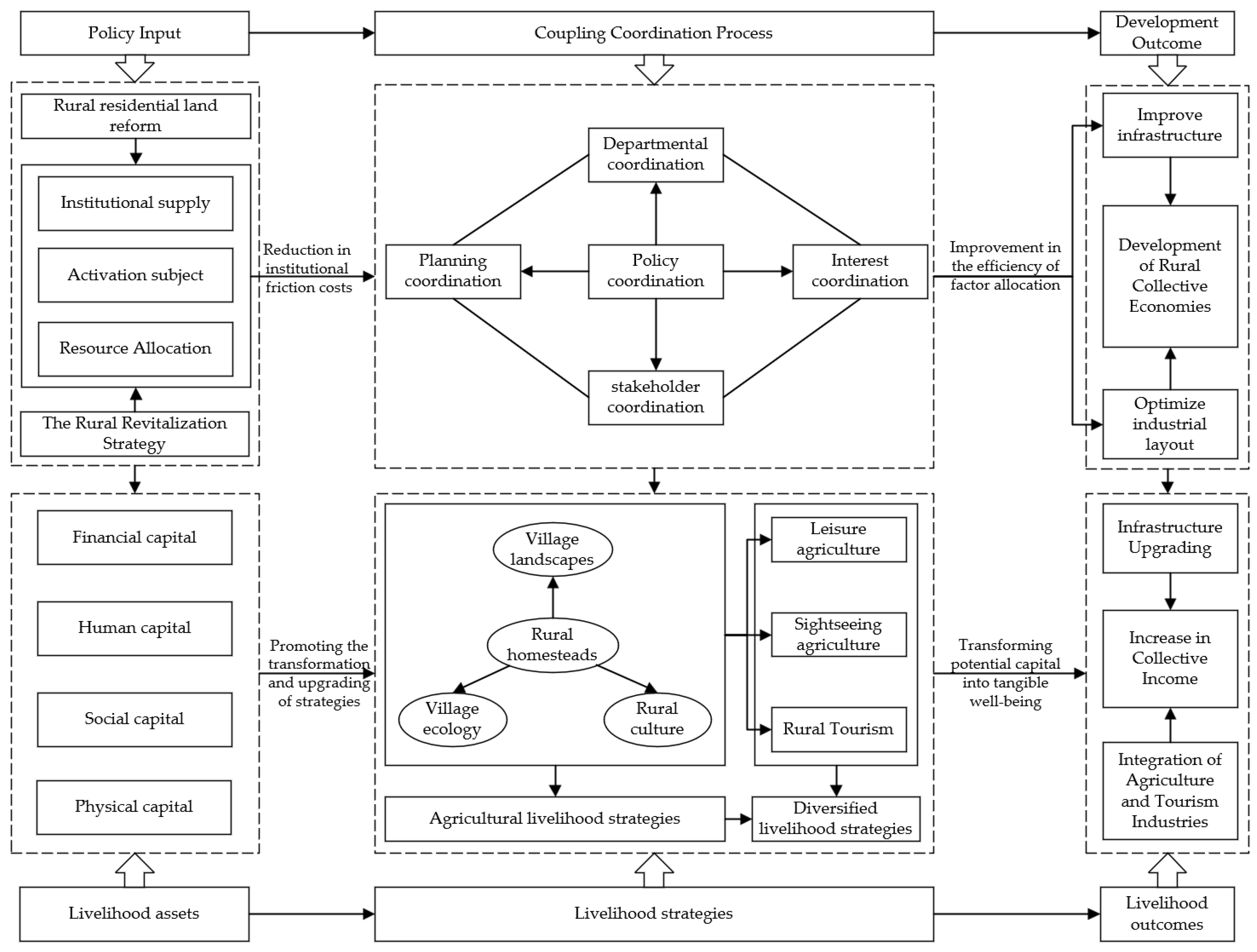
2.2. The Logic of Sustainable Livelihoods Driven by the Coupling Coordination of Rural Homestead Reform and Rural Revitalization

Current academic research on rural reform focuses predominantly on the effects of individual systems, often overlooking the coupling effects between them. The Coupling Coordination Model asserts that rural homestead reform is not an isolated administrative action but a systemic project involving planning, interests, and cross-departmental synergy. Its core lies in achieving a deep coupling between homestead reform and rural revitalization through the benign interaction of institutional innovation and resource allocation. Within the Sustainable Livelihoods Framework (SLF), this coupling essentially represents the re-empowerment of farmers’ livelihood assets by the external institutional environment. The former removes systemic barriers to factor mobility for the latter, while the latter provides application scenarios for the functional transformation of the former. The two are logically mutually supportive and aligned in their ultimate objectives [11].
First, the driving role of policy input in policy coupling and coordination lies in reconstructing existing governance structures and power relations while directly impacting livelihood assets. In the context of rural homestead system reform, institutional supply from the central level—such as rural revitalization policy pilots—guides functional departments that previously operated in isolation to move from fragmentation toward synergy by constructing an incentive-compatible institutional environment. This lays the structural foundation for subsequent governance [12]. Simultaneously, this process achieves a systematic integration of financial, human, social, and physical capital. Consequently, the “institutional supply” of policy resources can be effectively transformed into a “livelihood asset reserve” available to rural households [13].
Secondly, the coupling and coordination of policies effectively dissipate policy friction through a “policy mix,” strengthening planning guidance, benefit distribution, departmental synergy, and stakeholder collaboration [14], thereby reducing the systemic costs of transforming livelihood assets. Taking rural homestead reform as an example, a single-track reform is prone to stagnation if decoupled from industrial support and social security systems. However, by organically integrating homestead reform with industrial revitalization and security mechanisms via a policy mix, institutional friction costs can be minimized. This significantly enhances the allocation efficiency of factors such as land, capital, and technology [15], ensuring that formerly static livelihood assets can smoothly enter a productive circular trajectory under the aegis of coordinated planning and departmental linkage.
Simultaneously, at the level of livelihood strategies, the coupling coordination mechanism facilitates a critical transition for rural households from singular to diversified livelihood patterns by releasing “institutional dividends.” As reforms activate rural dormant capital, rural homesteads are no longer merely residential spaces; they evolve into strategic nodes connecting village landscapes, ecology, and rural culture. Under the dual protection of policy coordination and interest alignment, households can leverage optimized physical and social capital to upgrade traditional small-scale agricultural strategies into diversified ones, such as leisure agriculture, agritourism, and rural tourism [16]. The transformation of livelihood strategies not only enhances farmers’ resilience against market risks but also achieves a high degree of alignment between rural spatial resources and livelihood activities, providing the endogenous momentum for the iterative upgrading of rural industries.
Finally, by activating dormant capital, optimizing industrial layouts, and coordinating revenue distribution, coupled and coordinated policy resources can significantly enhance the economic output efficiency per unit of land. This process improves rural infrastructure and safeguards the long-term livelihoods of farmers, effectively transforming potential livelihood capital into tangible well-being and development outcomes. In essence, this represents a process where the relations of production adapt to the development of productive forces. This is manifested through the upgrading of infrastructure, the growth of collective income, and the deep integration of the agricultural and tourism industries [17]. Such a benign feedback loop ultimately provides a solid guarantee for the sustainable and inclusive growth of the rural collective economy, fortifying the foundation for rural social stability and livelihood prosperity (See Figure 1).

2.3. Hypothesis Formulation

2.3.1. The Economic Effects of the Coupling Coordination Between Rural Homestead Reform and Rural Revitalization

Existing studies often treat rural homestead reform as a means of resource revitalization, or interpret rural revitalization as a process of policy-driven investment [18], frequently overlooking the functional complementarity between the two in their underlying institutional logic. This study constructs an explanatory framework of “Factor-Institution” dual coupling. It elucidates that rural homestead reform, as a “breakthrough point” for rural land system reform, must rely on the industrial, talent, and organizational guarantees under the Rural Revitalization Strategy to transform released land dividends into sustainable economic momentum [19]. The coupling coordination between these two forces promotes a deep integration of spatial reshaping and the restructuring of collective economic organizations. Through this linkage, the rural collective economy no longer depends on fragmented or temporary resource liquidation. Instead, it achieves the optimal allocation of land, talent, and capital in terms of space and function through institutional integration [20], thereby providing systemic support for the growth of the collective economy.
H1: 
The coupling coordination between rural homestead reform and rural revitalization can promote the sustainable development of the rural collective economy.

2.3.2. The Chain-Mediating Mechanism of Infrastructure Improvement and Industrial Structure Optimization

The institutional coupling of rural homestead reform and rural revitalization relies on a rigorous spatio-temporal transmission sequence to realize economic value, evolving systematically from “spatial reconstruction” to “industrial reshaping” [21,22].
First, infrastructure improvement facilitates spatial reconstruction. Rural homestead reform supplies the core “physical carrier” through spatial exit and the consolidation of fragmented construction land, while the rural revitalization strategy injects “construction funds” via diversified social capital and innovative investment mechanisms [23]. This coordination elevates infrastructure from mere fiscal investment to an endogenously driven transmission hub. By alleviating geographical isolation and significantly reducing transaction costs, refined infrastructure establishes a critical “access threshold,” markedly enhancing the rural carrying capacity for high-quality external production factors [24].
Second, industrial structure optimization achieves functional reshaping. Building upon upgraded physical infrastructure, the optimized resource allocation environment subsequently dismantles institutional barriers to urban–rural factor mobility [25]. The accumulation of physical capital efficiently transitions into structural economic transformation. The synergy of newly released land assets, modern logistics networks, and entrepreneurial talent reflux drives rural industries beyond singular, low-value-added models. This triggers cross-border factor flows and functional agglomeration, fostering emerging formats like rural tourism and e-commerce, thereby achieving a deep integration of primary, secondary, and tertiary industries [26].
Ultimately, these elements form a dynamic chain feedback loop. Infrastructure improvement and industrial upgrading are not isolated mediators but a mutually constructed closed-loop mechanism. The initial leap in infrastructural carrying capacity acts as the prerequisite leverage point unlocking industrial optimization. Through this serialized linkage—where upgraded infrastructure systematically induces industrial advancement—the rural collective economy achieves a logical leap toward sustainable value creation.
H2: 
The coupling coordination between rural homestead reform and rural revitalization promotes collective economic development through a composite mediating mechanism: operating independently via infrastructure improvement and industrial structure optimization, and sequentially through a chain-mediation path wherein enhanced infrastructure fundamentally drives industrial upgrading.

3. Study Design

3.1. Construction of the Evaluation Indicator System

3.1.1. The Construction of an Index System for the Reform of Rural Homestead

Referring to the research results on the construction of the existing evaluation index system for rural homestead reform, and based on the principles of scientificity and feasibility, construct the evaluation index system of rural homestead reform consisting of 5 dimensions and 12 measurement indexes, including the production function, the living function, the ecological function, the asset function, and the security function. Among them, the productive and asset functions of homesteads are the core drivers for realizing rural industrial revitalization and increasing farmers’ property income. Based on Factor Mobility Theory and Incomplete Property Rights Theory, this study selects the “number of industries supported by reform” and “non-agricultural employment” to measure the evolution of productive functions. Meanwhile, drawing on Zhou Qiren’s (2017) analysis of the asset attributes of Chinese land [27], “land expropriation compensation standards” and “willingness to transfer” are introduced as evaluation indicators for asset functions. This aims to characterize the institutional performance of homesteads as they transition from “means of subsistence” to “capital factors.”
The residential and security functions constitute the welfare undertone of the homestead system and serve as the “ballast stone” for maintaining rural social stability. The residential attributes of homesteads follow the logic of the Sciences of Human Settlements (Wu Liangyong, 2001), reflecting the balance between spatial governance efficiency and farmers’ well-being through “vacancy rates” and “housing satisfaction” [28]. Regarding the security function dimension, this study is grounded in the Social Security Substitution Theory. Referencing Liu Shouying’s (2018) empirical framework on the security functions of land [29], “standard area” is selected as a physical security indicator. Specifically, the “standard area” of a rural homestead refers to the maximum allowable area per household formulated by local governments based on regional realities (typically ranging from 125 to 160 square meters). Inherently, this metric reflects the minimum spatial threshold requisite for fulfilling a rural household’s fundamental habitation and developmental needs. By evaluating the statutory area occupied by a household, one can accurately ascertain the baseline living security endowed by their physical land assets. Concurrently, to delineate the evolutionary trajectory of the systemic transition from land-bound physical reliance to socialized welfare, this study introduces the “confirmation rate of rural homestead rights” and the “participation rate in rural pension insurance” as external substitution security indicators. The core logic is that the improvement of social security levels is a prerequisite for promoting the smooth operation of the “Tripartite Entitlement System” reform (Chen Xiwen, 2014) [30].
The ecological function reflects the paradigm shift in homestead utilization from “extensive expansion” to “green and intensive use” within the context of ecological civilization construction. According to Sustainable Development Theory and Multifunctional Landscape Theory, the ecological function of homesteads is manifested not only in the improvement of village landscapes but also in the circular utilization of land resources. Referencing Xie Gaodi’s (2015) approach to quantifying ecosystem service values [31], this study selects “satisfaction with the ecological environment” to reflect farmers’ subjective evaluations of micro-ecological quality. Additionally, the “quantity of homestead reclamation” is used as an objective “hard indicator” to measure land ecological restoration and intensive utilization (Fu Bojie, 2011) [32], embodying the restrictive role of “man-land relationship coordination” in rural spatial reshaping.

3.1.2. Construction of Village Revitalisation Index System

Industrial Prosperity is the material foundation of rural revitalization. This study selects the “number of village industries” to reflect the degree of rural economic diversification, aligning with the logic of “endogenous growth” in rural industries proposed by He Xuefeng (2021) [33]. The “number of tourists received” is introduced based on the rural tourism-driven model to measure the outward orientation of the integration of primary, secondary, and tertiary industries. Furthermore, “types of agricultural products” refers to Schultz’s (1983) arguments on transforming traditional agriculture [34], embodying the logic of enhancing agricultural resilience against market risks through varietal diversification.
Ecological Livability is the defining aesthetic of rural revitalization. The selection of “dry latrine renovation rate” and “harmless waste treatment rate” aims to measure the coverage of basic rural public services, consistent with Lewis Mumford’s discourse on the healthiness of human settlements [35]. Meanwhile, “green coverage rate” refers to Fu Bojie’s (2011) research on the ecosystem service functions of rural landscapes [32], reflecting the self-repair and aesthetic level of village ecological spaces—a micro-level indicator of the “Two Mountains Theory”.
Rural Civilization is the soul of rural revitalization. This study selects “average years of education per capita” as a core indicator. Based on Amartya Sen (2002) Capability Approach [36], it is argued that educational attainment determines the possibility of social mobility for farmers. Additionally, “per capita area of public cultural facilities” reflects the construction of rural cultural capital carriers, drawing on the profound logic of spiritual civilization in Fei Xiaotong’s (2018) “Rural Reconstruction” [37], reflecting the modern reshaping of smallholder consciousness by public cultural services.
Effective Governance is the institutional guarantee for rural revitalization. The selection of “satisfaction with village affairs transparency” reflects the transparency and sense of trust in grassroots democratic construction, which are core elements of civic engagement in Putnam’s (1993) Social Capital Theory [38]. The “percentage of village committee members with bachelor’s degrees” is introduced based on the logic of governance subject professionalization, referencing Xu Yong’s (2007) research on the modernization of rural governance capacity [39], emphasizing the decisive role of “competency-based elites” in resource acquisition and conflict resolution.
Prosperous Living is the ultimate starting point of rural revitalization. This study selects “per capita disposable income” as an intuitive financial indicator, consistent with Keynes’ classic hypothesis that absolute income determines consumption. Furthermore, “private car ownership” is selected as a proxy variable, drawing on Consumption Upgrade Theory. This reflects the material results of the transition in farmers’ quality of life from “subsistence-oriented” to “enjoyment-oriented,” better capturing the dynamic characteristics of urban–rural equivalence development. The above indicators are set as shown in Table 1.

3.2. Selection of Variables

3.2.1. Explained Variable: Rural Collective Economic Development (LnRCE)

In view of the availability of research data, the article references the studies by Cheng, et al. (2024) and Zhang et al. (2021) [40,41] and measures the level of development of the village collective economy by village collective economic income, in which the data of village collective economic income comes from village collective accounting bookkeeping, which mainly includes collective operating income, contracting income, investment income, and subsidy income.

3.2.2. Explanatory Variables: Coupled Coordination Degree of Rural Homestead Reform and Rural Revitalisation (LnCD)

This paper employs the coupling coordination degree model to measure the degree of coupling coordination between rural homestead reform and rural revitalization in each village, using the evaluation index system of rural homestead reform and rural revitalization constructed in the previous section as the core explanatory variable.

3.2.3. Mediating Variables

(1)
Infrastructure development (LnINF). The studies by Yang and Meng (2024) [42]: three indicators, namely, road hardening rate, Internet coverage rate, and mobile phone penetration rate, are selected, and the entropy method is used to synthesise the three indicators into a comprehensive infrastructure indicator to measure the level of infrastructure construction.
(2)
Industrial structure optimisation (LnINS). The studies by Tian et al. (2022) [43]: a proportion of the non-agricultural labor force is taken as an indicator to measure the optimization of industrial structure.

3.2.4. Control Variables

In addition to the coupling coordination degree between rural homestead reform and rural revitalization, factors such as village geographic location, resource endowment, level of agricultural mechanization, agricultural innovation capacity, and other factors also affect the development of the rural collective economy. To minimise the omitted variable bias, the following control variables are added to the econometric model:
(1)
Labour supply (LnLAB). Since the ratio of the labour force to population in villages is relatively stable in the short term, this is consistent with the studies by Li et al. (2022) [44]. It uses the annual resident population as a proxy to measure labour supply.
(2)
Agricultural mechanisation (LnAML). Referring to Yan et al. (2024), the use rate of machinery for crop ploughing, planting, pest and disease control, and harvesting is used to measure agricultural mechanization [45].
(3)
Agricultural innovation level (LnACL). Referring to the studies by Xiao and Liu (2021) [46], the number of talents coming to the village from the city was used to measure the level of agricultural innovation.
(4)
Village geographic location (LnDIS). The distance from the village council to the nearest town was used to measure the geographic location characteristics of the village.
(5)
Marketability of agricultural products (LnAMR). Referring to the studies by Mbukanma (2025) [47], the ratio of the sales volume of agricultural products of village collective economic organisations to the total production of agricultural products is used to measure the degree of marketability of agricultural products.

3.3. Modelling

3.3.1. Coupling Coordination Degree Model

Rural homestead reform and rural revitalisation are two complex systems, and the coupled coordination degree model can reflect the degree of interdependence between the two systems based on the complex correlation within the system. Therefore, this paper employs the coupling coordination degree model to assess the level of synergistic development between the two systems. The specific process is as follows:
First, data standardisation. To unify the scale, the polar value method is used to standardise the raw data, and the positive and negative attribute indicators are calculated as follows:
Positive   indicators :   λ i j = x i j min x i j max x j min x j + α
Negative   indicators :   λ i j = max x j x i j max x j min x j + α
where λ i j represents the result of the j th indicator of the two systems after standardisation, and x i j is the original value of the j th indicator of the two systems; when i is taken as a , it indicates the rural homestead reform system, and when i is taken as b , it indicates the rural revitalisation system.
Secondly, the index weights are determined and the comprehensive evaluation index of each system is measured. In order to avoid the influence of human subjective factors, this paper adopts the entropy weight method to determine the weight of each indicator, and the formula for calculating the information entropy ( E j ) and indicator weight ( W j ) is as follows:
E j = 1 ln ( n ) i = 1 n P i j × ln ( P i j )
W j = D j / j = 1 m D j
where P i j = ( 1 + λ i j ) / i = 1 n ( 1 + λ i j ) , denotes the proportion of the j th indicator in system i ; n is the total number of sample i , D j = 1 E j denotes the information entropy redundancy, and m is the total number of indicators in each system. The obtained weights are
Revitalisation system ( U i ):
U i = j = 1 m W j   ×   λ i j
Finally, the coupling degree ( C ) and the coupling coordination degree ( D ) of the two systems are calculated:
C = 2 U a × U b / ( U a + U b )
D = C × T
Among them, T is the comprehensive evaluation index, α , β indicates the contribution rate of the two systems to the degree of coupling coordination T = α U a + β U b , this paper believes that the two contribution rate is equal, so take α = β = 0.5 ; coupling coordination degree ( D ) of the value of the range of [0, 1], the closer the value of 1, indicating that the higher the level of coupling coordination of the two systems.

3.3.2. Basic Regression Model

In this paper, considering the characteristics of the research object and combining the characteristics of the cross-sectional data used, the OLS model is selected for analysis, and the following cross-sectional regression model is constructed:
L n R C E i = α 0 + α 1 L n C D i + γ i C o n t r o l s i + ε i
where L n R C E i is the collective economic income of the i th village, L n C D i is the degree of coordination of the coupling of rural homestead reform and rural revitalisation of the i th village, C o n t r o l s i is a control variable for the i th village, ε i is a random perturbation term, and α 1 and γ are vectors of coefficient estimates for the model.

3.3.3. Chain Mediation Effect Model

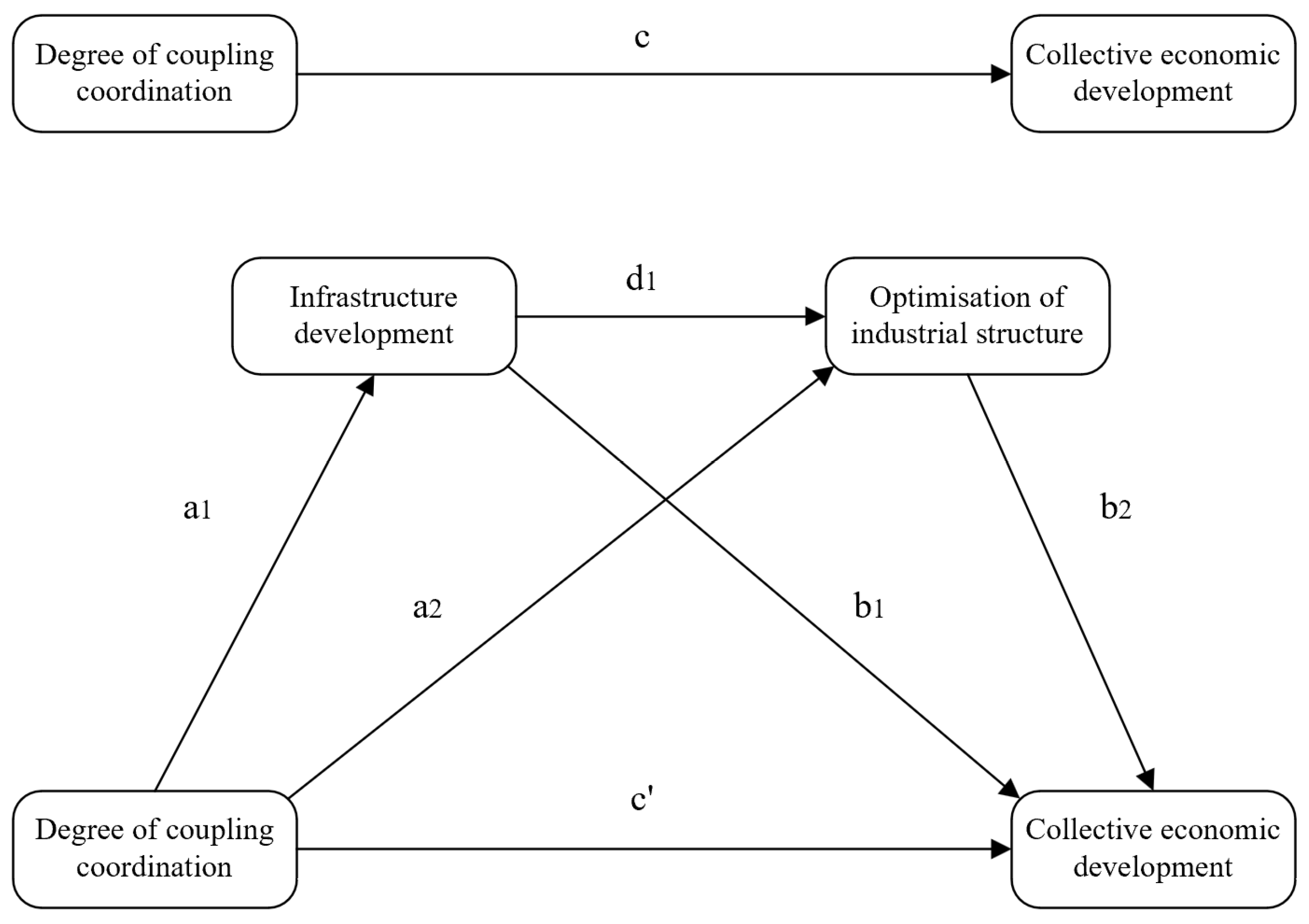
First, in order to examine whether the coupled coordination of rural homestead reform and rural revitalisation affects the village collective economy through infrastructure construction and industrial structure optimisation, and whether infrastructure construction can affect industrial structure optimisation, the following chain-mediated effects model is constructed.
L n I N F i = β 0 + β 1 L n C D i + γ i C o n t r o l s i + ε i
L n I N S i = ζ 0 + ζ 1 L n C D i + ζ 2 L n I N F i + γ i C o n t r o l s i + ε i
L n R C E i = τ 0 + τ 1 L n C D i + τ 2 L n I N F i + τ 3 L n I N S i + γ i C o n t r o l s i + ε i
where L n I N F i denotes the infrastructure construction in the i th village and L n I N S i denotes the industrial structure optimisation in the i th village, both of which are mediating variables. Equation (9) considers the effect of coupled coordination degree on infrastructure construction, Equation (10) tests the effect of coupled coordination degree on industrial structure optimisation under controlling infrastructure construction, and Equation (11) tests the effect of coupled coordination degree on village collective economy under controlling infrastructure construction and industrial structure optimisation. In the chain mediation effect, the mediation effect includes independent mediation effect and chain mediation effect, in which the independent mediation effect is: the degree of coupling coordination → infrastructure construction → village collective economic development, the degree of coupling coordination → industrial structure optimization → collective economic development, and the chain mediation effect is: the degree of coupling coordination → infrastructure construction → industrial structure optimisation → village collective economic development. “Infrastructure improvement (INF) was designated as the antecedent mediating variable (M1) in the chained path, while industrial structure optimization (INS) was designated as the subsequent mediating variable (M2). This specification was maintained throughout the entire mediation effect analysis and interpretation of the results.” The relationship between the variables is shown in Figure 2. If c is significant, it means that there is a total effect of the degree of coupling coordination on collective economic development; if a1 is significant, it means that the degree of coupling coordination affects infrastructure construction. If a2 is significant, it means that the degree of coupling coordination affects industrial structure optimisation. The indirect effects are a1b1, a2b2, and a1b2d1, and the direct effect is c’, which represents the direct impact of the independent variable on the dependent variable after the inclusion of the mediating variable.

3.4. Data Source

The data used in the paper come from a questionnaire survey of village cadres and villagers in the research villages on the implementation of rural homestead reform and rural revitalisation in 10 counties (cities/districts) of Miluo City, Liuyang City, Fenghuang County, Ningyuan City, Gongyi City, Baofeng City, Mengjin District, GaoLing District, Zhashui County, and Longxi County, which the group conducted in April 2023–March 2024. The selection of sample sites followed the systematic principles of “institutional coupling” and “gradient differentiation.” First, all sampled regions are designated as national or provincial pilot zones for rural homestead reform, ensuring that the research subjects are at the same frontier of institutional transformation. Second, the samples span across the Central region (e.g., Baofeng, Mengjin, and Ningyuan) and the Western region (e.g., Zhashui, Longxi, and Fenghuang), covering diverse topographical features such as plain agricultural areas and hilly mountainous regions, as well as varying levels of rural collective economic development. Finally, a stratified random sampling strategy was implemented within each county. Townships were first selected based on their economic development levels, followed by a random selection of administrative villages; ultimately, respondents were identified through systematic sampling from household registers. This multi-stage approach was designed to mitigate the potential bias inherent in the non-random selection of pilot sites.
A total of 126 village questionnaires and 1890 villagers’ questionnaires were distributed in this research, excluding the questionnaires with missing core data. One hundred twenty village questionnaires and 1715 villagers’ questionnaires were obtained, yielding a validity rate of 91.02%. The sample statistics are presented in Table 2. To unify the scale, all variables were logarithmized, and the descriptive statistics for each variable are presented in Table 3.

4. Analysis of Empirical Results

4.1. Benchmark Regression Results

In this paper, the least squares estimation method is employed for the benchmark model regression, and the resulting regression coefficients are presented in Table 4. Column (1) presents the OLS regression results for the coupled coordination of rural homestead reform and rural revitalization on the development of the rural collective economy. As can be seen from column (1), the coupling and coordination of rural homestead reform and rural revitalisation has a significant positive effect on the development of the rural collective economy, with a coefficient of 3.5016, without considering other influencing factors. Considering the omitted variable problem and robustness of the model, this paper gradually adds control variables (labour supply, agricultural mechanization, agricultural innovation level, village geographic location, and agricultural product marketability) into the regression model in columns (2) to (6). It can be seen that with the increase in control variables, the goodness of fit of the model gradually increases from 0.4947 to 0.7816, indicating that numerous factors influence the development of the rural collective economy. At the same time, with the increase in control variables, the impact of the coupled coordination of rural homestead reform and rural revitalization on the development of the rural collective economy remains at a significant level. However, the value of the coefficient decreases from 3.5016 to 1.5815, indicating that the promotional effect of the coupled coordination of the reform of rural homestead and rural revitalization on the development of the rural collective economy is more evident, as evidenced by the statistical significance, which verifies Hypothesis 1.
In terms of control variables, column (2) of Table 4 adds labour supply, and the results show that labour supply can significantly promote the development of the rural collective economy. This is because most of the rural collective economy is based on labour-intensive industries such as planting, breeding, and processing. Human resource-rich villages have more surplus labour, which can provide a quantitative and price advantage, supporting the development of the rural collective economy. The regression results of adding agricultural mechanisation in column (3) show that the level of agricultural mechanisation promotes the development of the rural collective economy. This is because agricultural mechanisation can reflect the degree of investment in modern science and technology material equipment, the level of large-scale agricultural production and the level of development of agricultural modernisation in a village [48,49], and the more the investment in machinery and equipment, the higher the level of agricultural mechanisation and the higher the productivity of the collective economy [50]. Column (4) includes the level of agricultural innovation, and the regression results indicate that this level promotes the development of the rural collective economy. This is mainly because the level of agricultural innovation can reflect the strength of the level of agricultural production specialisation, the higher the level of agricultural specialisation, the more conducive to the standardisation of agriculture, intensive management, but also conducive to the reduction in production costs and transaction costs, which is conducive to the promotion of the development of the rural collective economy [51]. It is worth noting that when the level of agricultural innovation is taken into account, the utility of agricultural mechanization is not significant, indicating that the level of agricultural innovation is highly correlated with agricultural mechanization and that the level of agricultural innovation explains collective economic development better than agricultural mechanization. Column (5) includes the geographical location of villages, and the regression results indicate that the distance of villages from towns hinders the development of the rural collective economy. This is because the further the villages are from the towns, the weaker the towns’ role in radiating the rural economy. Column (6) adds the marketisation of agricultural products, and the results show that the marketisation of agricultural products can effectively promote the development of the rural collective economy, because the increase in the degree of marketisation of agricultural products can increase the income of farmers, reduce the pressure on the agricultural economy, and contribute to the improvement of the comparative interests of agriculture [52], which is in turn conducive to the development of the rural collective economy.

4.2. Robustness Test

4.2.1. Adding Control Variables

To further address the problem of omitted variables, the following two control variables are added: (1) Physical capital input (LnFAI), referring the studies by Lavrina (2022) [53], which measures rural physical capital input by rural fixed asset investment. (2) Human capital skills (LnHCS), with reference the studies by Matache (2023) [54], which measures human capital skills by per capita education level. As can be seen from column (1) of Table 4, after adding new control variables, the impact of core explanatory variables on rural collective economic development is consistent with the results of the benchmark regression, and the foregoing conclusions are robust.

4.2.2. Replacement of Explanatory Variables

To enhance the credibility of the empirical results and considering that farmers’ professional cooperatives can reflect the development level of the rural collective economy, this paper re-runs the regression analysis with the number of registered village cooperatives as the explanatory variable. The estimation results are shown in column (2) of Table 4, and the sign and significance of the regression coefficients of the core explanatory variables do not change significantly, verifying the robustness of the previous conclusions.

4.2.3. Adjusting the Examination Sample

This paper also conducts robustness tests by reducing the total sample size. Ninety villages out of the original 120 sample villages are randomly selected for the empirical regression analysis. The results are shown in column (3) of Table 4. After reducing the sample size, the impact of the core explanatory variables on the development of the rural collective economy is basically consistent with the benchmark regression results, which verifies the robustness of the previous conclusions.

4.2.4. Endogeneity Test

To solve the endogeneity problem, the policy awareness of village cadres (LnPAD) is selected as an instrumental variable, and the model is re-estimated using the two-stage least squares method. The policy awareness of village cadres is represented by the correct rate of questions investigating policy awareness of rural homestead reform and rural revitalization, as these topics are closely related to the policy awareness of village cadres. However, the level of development of the village collective economy is not directly associated with it, which meets the condition of an instrumental variable. As shown in column (4) of Table 5, the regression coefficients are still significant at the 1% level when endogeneity is taken into account, and there is no substantial change from the results of the benchmark regression. The KPL statistic and the KPW statistic both pass the test, indicating that there is no under-identification or weak identification problem, which suggests that the selection of the instrumental variables is reasonable.

4.3. Analysis of Mechanisms of Action

4.3.1. Mediation Effect Test

(1)
Bootstrap test of the mediation effect
The mediating effects of infrastructure improvement and industrial structure optimisation between the coupled coordination of rural homestead reform and rural revitalisation and the rural collective economy are tested using the Bootstrap method at a 95% confidence interval, as shown in Table 6.
At the level of infrastructure improvement, the coupled coordination of rural homestead reform and rural revitalisation can significantly promote the improvement of rural infrastructure. At the same time, the improvement of infrastructure can also significantly promote the development of the rural collective economy. From the indirect effect, the mediation effect coefficient of infrastructure improvement on the development of rural collective economy is 0.4841, and it is statistically significant. From the direct impact, the utility coefficient of infrastructure improvement is 1.0975, which is also very substantial. It indicates that infrastructure improvement has a significant mediating effect in the coupled coordination of rural homestead reform and rural revitalisation to promote the development of the rural collective economy, and Hypothesis 2 is verified.
At the level of industrial structure optimisation, the coupled coordination of rural homestead reform and rural revitalisation can significantly improve the industrial structure of rural areas. At the same time, the optimisation of the industrial structure can also significantly promote the development of the rural collective economy. From the perspective of the indirect effect, the mediation effect coefficient of industrial structure optimisation on the development of the rural collective economy is 0.5523 and statistically significant. From the perspective of direct effect, the utility coefficient of industrial structure optimisation is 1.0293, which is statistically significant, indicating that industrial structure optimisation has a significant mediating effect on the coupling and coordination of rural homestead reform and rural revitalisation, thereby promoting the development of the rural collective economy. Hypothesis 2 can therefore be verified.
In summary, based on the Bootstrap test, the coupled coordination of rural homestead reform and rural revitalisation can promote the development of the rural collective economy through the improvement of infrastructure and the optimization of industrial structure. Among them, the mediating effect of infrastructure construction is 0.4841, and the mediating effect of industrial structure optimisation is 0.5523. Comparison shows that the mediating effect of industrial structure optimisation is significantly higher than the mediating effect of infrastructure improvement.
(2)
Sobel test for mediating effects
Table 7 presents the Sobel test results of the mediating effect. The results show that there are significant mediating effects of both infrastructure improvement and industrial structure optimization in the mechanism of coupled coordination between rural homestead reform and rural revitalization, promoting the development of the rural collective economy. Among them, the indirect effect coefficient of infrastructure improvement is 0.4840, the direct effect coefficient is 1.0974, and the mediation effect accounts for 30.60%. The indirect effect coefficient of industrial structure optimisation is 0.5522, the direct effect coefficient is 1.0292, and the mediation effect accounts for 34.91%, which again verifies that hypothesis 2 is established.

4.3.2. Chain Intermediary Effect Test

Based on the mediation effect analysis, further using the chain mediation effect model to examine the chain mediation effect formed by the improvement of infrastructure and optimization of industrial structure can clarify the path of coupled coordination between rural homestead reform and rural revitalization to promote the development of the rural collective economy. Firstly, as shown in column (1) of Table 7, the coefficient estimate of the coupled coordination of rural homestead reform and rural revitalisation on the development of rural collective economy is 1.5815 (p < 0.01), indicating that the coupled coordination of rural homestead reform and rural revitalisation contributes to the development of rural collective economy. Secondly, to verify the impact of the coupled coordination of rural homestead reform and rural revitalisation on the improvement of infrastructure and the optimisation of industrial structure, respectively, Table 8, columns (2) and (3) show that the impact coefficients of the coupled coordination of rural homestead reform and rural revitalization on the improvement of infrastructure and the optimization of industrial structure are 1.0409 and 0.9075, respectively, and are all statistically significant. Column (3) also shows that the impact coefficient of infrastructure improvement on the optimisation of industrial structure is 0.6349 and statistically significant, indicating that the better the rural infrastructure, the more conducive it is to the optimisation of rural industrial structure. Again, column (4), at the same time adding infrastructure improvement and industrial structure optimisation as mediating variables, found that the impact coefficient of the coupling and coordination of rural homestead reform and rural revitalisation is 0.8518 and statistically significant, the mediating effect coefficient of infrastructure improvement is 0.2896, but not substantial, and the mediating effect coefficient of industrial structure optimisation is 0.2707 and statistically significant. The above analysis shows that the total effect of the coupling and coordination of rural homestead reform and rural revitalisation on the development of the rural collective economy is 1.5815. The direct effect is 0.8518, which is smaller than the total effect, indicating that infrastructure construction and industrial structure optimisation play a part in the mediating effect in the coupling and coordination of rural homestead reform and rural revitalisation, promoting the development of the rural collective economy. According to the intermediary effect test process, from the perspective of the path of ‘coupling coordination degree → infrastructure construction → village collective economic development’, the intermediary effect of infrastructure construction is a part of the intermediary effect. The size of its indirect effect is 1.0490 × 0.2896 = 0.3038, and the intermediary effect accounts for 19.20% of the total effect, but it is not significant. The reason for this may be that when infrastructure construction and industrial structure optimization are considered simultaneously, infrastructure improvement must be conducive to industrial structure optimization in order to promote the development of the rural collective economy significantly. From the path of ‘coupling coordination degree → industrial structure optimization → collective economic development’, the mediation effect of industrial structure optimization is partial, and the size of its indirect effect is 0.9075 × 0.2707 = 0.2456, and the mediation effect accounts for 15.52%, which is statistically significant. From the path of ‘coupling coordination degree → infrastructure construction → industrial structure optimization → village collective economy development’, the chain indirect effect of infrastructure construction on industrial structure optimisation and thus rural collective economy development is 1.0490 × 0.6349 × 0.2707 = 0.1803. The chain mediation effect accounts for 11.40% of the total and is statistically significant, supporting hypothesis 2.
It is noteworthy that, in the chained mediation model, the direct effect of infrastructure improvement (LnINF) on the development of the rural collective economy (LnRCE) is not significant (see Column 4, Table 8). This result does not imply that infrastructure is unimportant; on the contrary, it reveals the underlying mechanism through which infrastructure exerts its influence: infrastructure improvement first lays the foundation for the optimization of industrial structure, which in turn promotes the realization of rural value through industrial upgrading. In other words, the value of infrastructure needs to be unleashed through the mediating path of “enabling industries,” while its direct effect, independent of industrial structure, is relatively limited. This finding underscores the importance of promoting the synergistic co-development of infrastructure and industrial advancement in the context of rural revitalization.

4.4. Heterogeneity Analysis

The sample villages are primarily distributed across the central and western regions of China. Due to variations in geographical characteristics across regions, the aforementioned analytical results may exhibit regional disparities. Consequently, the surveyed villages were categorized into the Central Region and the Western Region based on their locations. The results of the heterogeneity analysis are detailed in Table 9.
Single-factor mediation analysis reveals that in the Central Region, the mediating effect coefficient of infrastructure improvement is 0.3935, which does not reach statistical significance; however, the coefficient for industrial structure optimization is 0.5229 and is statistically significant. In the Western Region, the mediating effect coefficient for infrastructure improvement is 0.6273, while for industrial structure optimization, it is 0.9666, both of which are statistically significant. Exploring the profound underlying causes of this regional heterogeneity, the core issue lies in the fundamental differences in the coupling and coordination logic between rural homestead reform and rural revitalization across the Central and Western regions.
In the Central region, the practical logic manifests as a typical “institutionally activated” coupling and coordination. Within the macro-context of diminishing marginal returns on infrastructure investment, the Central region—functioning as a primary grain-producing area constrained by stringent land-use quotas—can no longer simply replicate a path of extensive scale expansion. Consequently, the endogenous impetus for economic growth must shift toward the profound optimization of factor allocation. On one hand, by deepening institutional reforms such as the “three-rights separation” of residential land, the Central region has effectively dismantled the institutional lock-in of land factors, providing a critical spatial carrier for the deep integration of rural industries. On the other hand, this trajectory drives a high-efficiency transition of agriculture toward high-value-added industries. Its coupling logic resides in the full release of institutional dividends, using land premiums stimulated by the fluid circulation of factors to systematically offset the downward pressure of traditional infrastructure returns.
In contrast to the Central region, the Western region exhibits a “factor-complementary” coupling and coordination profile. Capitalizing on significant latecomer advantages, the coupling mode in the West presents a dual-driven pattern of infrastructure construction and industrial structure optimization. On one hand, sustained infrastructure investment has effectively broken down geographical barriers and substantially reduced market transaction costs. On the other hand, the physical space vacated by residential land reform, superimposed upon a continuously improving infrastructure system, has rapidly guided the regional agglomeration of characteristic industrial factors, thereby achieving a systematic leap toward specialized industrial forms. From this, it is evident that the coupling characteristic of the Western region is essentially a complementarity between policy intervention and resource endowment. In this context, infrastructure exerts a critical “leveraging effect,” utilizing the spatial carriers released by institutional reform to profoundly amplify the multiplier effect of macro-policy investments.
Chain mediation analysis shows that in the Central Region, the mediating effect coefficient of the transmission path “Coupling Coordination Degree → Infrastructure Construction → Industrial Structure Optimization → Rural Collective Economic Revitalization” is 0.2432 and is statistically significant. In the Western Region, the mediating effect of this chain path is 0.1317, which does not reach a significant level. Exploring the profound underlying causes of this regional heterogeneity is, in essence, a further validation of the evolutionary logic underlying the two distinct coupling and coordination modes discussed previously.
Specifically, under the “institutionally activated” coupling and coordination mode, the improvement of infrastructure in the Central region does not function in isolation; rather, it serves as a foundational empowering mechanism, deeply integrated into the process of industrial structure optimization. With the dismantling of institutional barriers in factor markets—such as rural homesteads—the Central region has been able to rapidly transform infrastructure enhancements into developmental momentum for modern agriculture and digital new business forms. This has effectively unblocked the channels for the capitalization of rural resources, providing a reservoir of endogenous accumulation for the revitalization of the rural collective economy. Consequently, this chain transmission mechanism demonstrates high systemic coherence and statistical significance within the Central region.
In contrast, under the “factor-complementary” coupling and coordination mode in the Western region, although infrastructure construction and industrial structure optimization have both achieved periodic results, a tight causal chain between the two has yet to form at this stage. This suggests that, constrained by the relative lag in market mechanism development and the fragmentation of geographical space, the optimization and upgrading of industrial structures in the West still rely heavily on the injection of exogenous policy resources rather than a systemic evolution following infrastructural improvement. This has led to structural obstructions in the process of rural collective economic revitalization in the Western region, ultimately resulting in the failure of the mediated chain effect to pass the significance test.

5. Conclusions and Policy Recommendations

5.1. Main Findings

This paper conducts empirical tests based on cross-sectional data from 120 villages in rural homestead reform pilot areas across Central and Western China, spanning from April 2023 to March 2024. By employing a coupled coordination degree model and a multiple chain mediation effect model, the study profoundly analyzes the effects and underlying mechanisms of the coupling and coordination between rural homestead reform and rural revitalization on the development of the rural collective economy. The findings are as follows: First, from a holistic perspective, the coupling and coordination of rural homestead reform and rural revitalization significantly enhance the development level of the rural collective economy. Second, regarding the underlying mechanisms, the synergy between reform and revitalization drives collective economic growth primarily through two paths: the improvement of rural infrastructure and the optimization of rural industrial structures, with the latter exhibiting a more substantial mediating effect. Furthermore, the dual-reform synergy bolsters economic momentum via the compound path of “improving infrastructure to subsequently optimize industrial structures.” Third, the heterogeneity analysis reveals that the mediating effects of infrastructure improvement and industrial optimization are more pronounced in the Western region than in the Central region. Conversely, the chain mediation effect following the path of “Coupling Coordination → Infrastructure Construction → Industrial Structure Optimization → Collective Economic Development” is more statistically significant in the Central region.

5.2. Policy Recommendations

Based on the above research conclusions, the following policy recommendations are put forward:
First, deepen the coupling mechanism between rural homestead reform and rural revitalization, and construct a “full life-cycle” management system for resource allocation. Our baseline regression results indicate that the coupling coordination degree between these two elements has a significant positive effect on the development of the rural collective economy. This suggests that the impetus for rural development stems not from a single institutional breakthrough, but from the synergetic effects between systems. Therefore, policy-making should embed homestead reform within the macro-framework of rural revitalization. It is recommended to establish a “Reform-Revitalization” collaborative office mechanism coordinated by county-level governments. On the basis of strictly protecting farmers’ legal rural homestead rights, a collaborative governance model involving multiple stakeholders should be introduced to activate the latent value of land factors and accumulate capital for the collective economy. From an international perspective, this “systemic synergy” logic offers vital insights for countries like Vietnam and India, which face similar challenges of rural land fragmentation: the success of land reform lies not in simple privatization, but in how institutional coupling transforms static assets into liquid capital.
Second, focus on the core mediating role of industrial structure optimization and guide homestead resources toward high-value-added sectors. Empirical analysis shows that industrial structure optimization plays a more significant mediating role in the process of reform-driven economic growth than infrastructure improvement. This implies that the spatial resources released by homestead reform must be precisely matched with industrial upgrading to maximize dividends. The policy focus should shift from pure “land consolidation” to “industrial induction,” supporting rural collective economic organizations to utilize idle homesteads and abandoned industrial/mining land for developing secondary and tertiary industries, such as homestays, cultural and creative sectors, and deep processing of agricultural products. Furthermore, a robust value-sharing mechanism must be established to ensure that the premiums from land transfer effectively feed back to the collective and households. Drawing on the European experience of “rural diversification,” the positioning of rural areas should shift from “agricultural production zones” to “multifunctional living and value-creation zones,” enhancing endogenous growth momentum and market resilience through increased complexity in land use.
Third, implement differentiated regional governance strategies to precisely match the developmental ladder needs of central and western regions. Heterogeneity tests reveal that western regions rely more on the direct mediating effects of infrastructure and industrial optimization, while central regions exhibit stronger chain-mediated characteristics. This indicates that policy implementation should avoid a “one-size-fits-all” approach. For the western region, the focus should be on “revitalizing existing stock” through homestead exit compensation and ecological relocation to quickly accumulate original collective capital and stimulate economic vitality by addressing infrastructure gaps. For the central region, leveraging its better resource endowment, the focus should be on “functional empowerment,” using homestead reform to enhance the resource integration capabilities of village collectives. This localized precision logic also provides a reference for globally unbalanced economies: pursue “single-point breakthrough” spillover effects in underdeveloped areas, while emphasizing “systemic chain” integrity in regions in mid-transition.
Fourth, strengthen the “infrastructure-industry” chain-link synergy path to build a circular loop of rural economic resilience. The significance of the chain-mediated path in our study, particularly its statistical performance in the central region, proves the scientific logic of rural development. Infrastructure improvement is not merely a livelihood project but the foundation for industrial upgrading. In policy execution, rather than pursuing industrial investment in isolation, funds and space vacated through homestead reform should first be used to prioritize infrastructure that supports industrial functions, thereby lowering entry barriers and operating costs for external capital. Through a dynamic benign cycle of “reform-driven construction, construction-fueled industry, and industry-enriched people,” the systemic stability of the rural collective economy can be effectively enhanced. This conclusion offers a lesson for emerging economies in Southeast Asia: avoid pursuing high-end industrialization while skipping the infrastructure phase. Only “soft industry” optimization supported by a solid “hard environment” can ensure that land system reforms yield lasting economic fruit.

6. Research Prospects

Based on an empirical analysis of 120 villages across four provinces—Hunan, Hebei, Shaanxi, and Gansu—this study enhances the external validity of findings within the context of Central and Western China by covering a broad spectrum of geographical, economic, and social gradients. However, limitations remain regarding the generalizability of these results on a national scale. Given the unbalanced nature of regional development in China, the mechanisms through which policy coordination empowers the development of the rural collective economy may exhibit distinct logic in the more economically dynamic eastern and southern coastal regions.
In light of this, future research should transcend specific regional constraints and expand the analytical scope to include multi-sample comparisons at a national level. By incorporating more diverse regional samples, subsequent scholars can conduct cross-regional comparative analyses to identify the boundary conditions of policy coordination effects under varying resource endowments and policy environments. Such efforts would facilitate the construction of a more inclusive explanatory framework for the evolution of the rural collective economy.

Author Contributions

Conceptualization, L.Y. and A.Z.; methodology, Y.G.; software, Y.G.; validation, Y.G., Y.W. and L.Y.; formal analysis, L.Y.; investigation, L.Y.; resources, L.Y.; data curation, Y.G.; writing—original draft preparation, L.Y. and Y.W.; writing—review and editing, A.Z. and Y.G.; visualization, Y.W.; supervision, A.Z.; project administration, L.Y.; funding acquisition, L.Y. All authors have read and agreed to the published version of the manuscript.

Funding

This research was funded by the “Research on Diversified Housing Security Mechanism and Policy System for Farmers Based on Separation of Homestead Property Rights” (No. 24BGL244).

Data Availability Statement

The original contributions presented in this study are included in the article. Further inquiries can be directed to the corresponding author.

Conflicts of Interest

The authors declare no conflict of interest.

References

  1. Jiang, F.; Jiang, Y.; Peng, J.; Lv, Y.; Wang, W.; Zhou, Z. Effects of rural collective economy policy on the common prosperity in China: Based on the mediating effect of farmland transfer. Front. Environ. Sci. 2023, 11, 1302545. [Google Scholar] [CrossRef]
  2. Zhou, T.; Jiang, G.; Ma, W.; Zhang, R.; Yang, Y.; Tian, Y.; Zhao, Q. Revitalization of idle rural residential land: Coordinating the potential supply for land consolidation with the demand for rural revitalization. Habitat Int. 2023, 138, 102867. [Google Scholar] [CrossRef]
  3. Barot, B.K. The Role of Sustainable Development Goals (SDGs) in the Context of Rural Transformation. Int. J. Soc. Impact 2025, 3, 587–595. [Google Scholar]
  4. Jiang, T.; Shangguan, S.; Fang, Z.; Fang, X. Impact of Sichuan rural tourism cooperatives on local economy and employment. Transform. Bus. Econ. 2022, 21, 39–52. [Google Scholar]
  5. Bin, M.; Qiong, H. Research on the Rural Revitalization Process Driven by Human Capital: Based on Farmers’ Professionalization Perspective. Sage Open 2024, 14, 28–43. [Google Scholar] [CrossRef]
  6. Gao, S.W.; Zhou, C.C. Exploration of Poverty Alleviation Based on Ecotourism in Minority Areas of Yunnan Province. Ekoloji 2018, 27, 1105–1113. [Google Scholar]
  7. Onyewotu, L.; Stigter, C.J.; Abdullahi, Y.; Ariyo, J. Shelterbelts and farmers’ needs. Leisa 2003, 19, 28–29. [Google Scholar]
  8. Wen, L.; Liu, Z.; Gao, Z.; Khanjari, S. Evolutionary Path and Mechanism of Village Revitalization: A Case Study of Yuejin Village, Jiangsu, China. Sustainability 2022, 14, 8162. [Google Scholar] [CrossRef]
  9. Ostrom, E.; Ostrom, V. Governing the Commons: The Evolution of Institutions for Collective Action; Cambridge University Press: Cambridge, UK, 1990; p. 298. [Google Scholar]
  10. Gash, A.A. Collaborative Governance in Theory and Practice. J. Public Adm. Res. Theory 2008, 18, 543–571. [Google Scholar] [CrossRef]
  11. Natarajan, N.; Newsham, A.; Rigg, J.; Suhardiman, D. A sustainable livelihoods framework for the 21st century. World Dev. 2022, 155, 105898. [Google Scholar] [CrossRef]
  12. Di Santo, N.; Del Giudice, T.; Sisto, R. Policy mixes in rural areas: A scoping literature review. Ital. Rev. Agric. Econ. 2024, 79, 83–99. [Google Scholar] [CrossRef]
  13. Da Silva Cavalcante, D.F.; Da Silva Medina, G.; Cruz, J.E. Getting it right in rural development initiatives: The importance of livelihood assets in commercializing family farm production in Brazil. Hum. Ecol. 2022, 50, 49–59. [Google Scholar] [CrossRef]
  14. Carmen, E.; Fazey, I.; Bergseng, A.M.; Om, E.S. Building policy synergies: A case of community resilience, climate change and community empowerment policies in Scotland. Environ. Sci. Policy 2023, 150, 103579. [Google Scholar] [CrossRef]
  15. Mantino, F.; Vanni, F. Policy mixes as a strategy to provide more effective social and environmental benefits: Evidence from six rural areas in Europe. Sustainability 2019, 11, 6632. [Google Scholar] [CrossRef]
  16. Tom, T. Decades of land and agrarian reform in Zimbabwe: A review of transformative social policy lessons for other African countries. Afr. Rev. 2024, 1, 1–28. [Google Scholar] [CrossRef]
  17. Masakure, C.; Makombe, E. “To Serve Administrative Purposes and Native Interests?”: Road Infrastructural Investment in African Reserves in Colonial Zimbabwe, 1924–1948. Afr. Econ. Hist. 2023, 51, 24–51. [Google Scholar] [CrossRef]
  18. Mu, P.; Zhang, S. Role of homestead system reform in rural common prosperity. Financ. Res. Lett. 2024, 69, 106011. [Google Scholar] [CrossRef]
  19. Sun, X.; Wang, J.; Rao, F. Land Tenure Security and Sustainable Land Investment: Evidence from National Plot-Level Data in Rural China. Land 2025, 14, 191. [Google Scholar] [CrossRef]
  20. Yu, L.; Wang, Y.; Li, M. The emergence of counter-urbanisation in China: Can it be a pathway for rural revitalisation? Habitat Int. 2024, 144, 102998. [Google Scholar] [CrossRef]
  21. Foster, V.; Gorgulu, N.; Straub, S.; Vagliasindi, M. The Impact of Infrastructure on Development Outcomes; World Bank: Washington, DC, USA, 2023; Available online: https://documents1.worldbank.org/curated/en/099529203062342252/pdf/IDU0e42ae32f0048304f74086d102b6d7a900223.pdf (accessed on 17 January 2026).
  22. Wu, W.; Ji, Z.; Liang, H. The impact of new infrastructure construction on optimization and upgrading of industrial structure. Buildings 2023, 13, 2580. [Google Scholar] [CrossRef]
  23. Nagi, V.; Pandey, P.; Nagargoje, S. Infrastructure Financing through Land Value Capture Framework—A Case of Coastal Road Project in India. In Future Is Urban; Routledge: Abingdon-on-Thames, UK, 2024; pp. 211–220. [Google Scholar]
  24. Asaju, K. Infrastructural development and development administration: A retrospective. J. Foresight Thought Leadersh. 2023, 2, 22. [Google Scholar] [CrossRef]
  25. Zhou, J.; Chen, H.; Bai, Q.; Liu, L.; Li, G.; Shen, Q. Can the Integration of Rural Industries Help Strengthen China’s Agricultural Economic Resilience? Agriculture 2023, 13, 1813. [Google Scholar] [CrossRef]
  26. Behera, S.; Rakesh, R.; Kumar, P. Rural Economics and Extension Services for Livelihood Enhancement; Golden Leaf Publishers: Boston, MA, USA, 2024; pp. 101–127. [Google Scholar]
  27. Zhou, Q.R. Property Rights and China’s Transformation; Peking University Press: Beijing, China, 2017; pp. 42–108. [Google Scholar]
  28. Wu, L.Y. Introduction to the Sciences of Human Settlements; China Architecture & Building Press: Beijing, China, 2001; pp. 34–58. [Google Scholar]
  29. Liu, S.Y. Land System and China’s Development; China Renmin University Press: Beijing, China, 2018; pp. 125–148. [Google Scholar]
  30. Chen, X.W. Reflections on the Reform of the Rural Land System. Econ. Res. J. 2014, 49, 4–6. [Google Scholar]
  31. Xie, G.D.; Zhang, C.X.; Zhang, C.S.; Xiao, Y.; Lu, C.X. The Value of Ecosystem Services in China. Resour. Sci. 2015, 37, 1740–1746. [Google Scholar]
  32. Fu, B.J.; Chen, L.D.; Ma, K.M. Principles and Applications of Landscape Ecology; Science Press: Beijing, China, 2011; pp. 156–172. [Google Scholar]
  33. He, X.F. Risks in the Development of Rural Industries. Policy Decis.-Mak. 2021, 1, 9. [Google Scholar]
  34. Schultz, T.W. Transforming Traditional Agriculture; University of Chicago Press: Chicago, IL, USA, 1983; pp. 12–35. [Google Scholar]
  35. Lewis, W.A. The Theory of Binary Economy; Beijing College of Economics Press: Beijing, China, 1989; pp. 12–28. [Google Scholar]
  36. Sen, A. Development as Freedom; China Renmin University Press: Beijing, China, 2002; pp. 71–85. [Google Scholar]
  37. Fei, X.T. From the Soil: The Foundations of Chinese Society; Shanghai People’s Publishing House: Shanghai, China, 2018; pp. 1–15. [Google Scholar]
  38. Putnam, R.D.; Leonardi, R.; Nonetti, R.Y. Making Democracy Work: Civic Traditions in Modern Italy; Princeton University Press: Princeton, NJ, USA, 1993; pp. 195–214. [Google Scholar]
  39. Xu, Y.; Xiang, J.Q. Rural Governance in the Construction of Modern States. J. Cent. China Norm. Univ. (Humanit. Soc. Sci.) 2007, 5, 1. [Google Scholar]
  40. Cheng, L.; Yang, L.; Li, X.; Xu, S.; Cao, Y. Research on the evaluation and configuration path of China’s rural common Prosperity—NCA and fsQCA based on provincial panel data. Heliyon 2024, 10, e23888. [Google Scholar] [CrossRef] [PubMed]
  41. Zhang, L.; Wang, Y. How Collective Economy Affects Village Collective Actions—Taking Farmers’ Participation in Irrigation Facility Provision as an Example. China Rural Econ. 2021, 7, 44–64. [Google Scholar]
  42. Yang, Z.; Meng, S. An Empirical Test of the Impact of Digital Infrastructure Construction on the Innovation Performance of High-Tech Industries. Stat. Decis. Mak. 2024, 40, 73–78. [Google Scholar]
  43. Tian, Q.G.; Che, S.F.; Jiang, Y.; Liu, Y.H. Measurement and Evaluation of Rural Revitalization Development Level in Chongqing. J. Chongqing Inst. Technol. (Soc. Sci.) 2022, 36, 79–89. [Google Scholar]
  44. Li, X.; Li, Y. The impact of perceived air pollution on labour supply: Evidence from China. J. Environ. Manag. 2022, 306, 114455. [Google Scholar] [CrossRef]
  45. Yan, F.; Sun, X.; Chen, S.; Dai, G. Does agricultural mechanization improve agricultural environmental efficiency? Front. Environ. Sci. 2024, 11, 1344903. [Google Scholar] [CrossRef]
  46. Xiao, Y.; Liu, C. Evaluation of Agricultural Listed Enterprises’ Innovative Ability and Research on Their Regional Differences—Based on Panel Data of 56 Agricultural Listed Enterprises in China. Sci. Technol. Manag. Res. 2021, 41, 30–37. [Google Scholar]
  47. Mbukanma, I.; Sithole, V.L.; Hosu, Y.S. Exploring the factors enhancing marketability of coastal agricultural products in rural South Africa. Economies 2025, 13, 141. [Google Scholar] [CrossRef]
  48. Hua, J.; Li, J. Measurement of the development level of Chinese-style agricultural modernisation and analysis of regional differences—Taking Jilin Province as an example. China Agric. Resour. Delin. 2023, 45, 156–169. [Google Scholar]
  49. Zhou, Y.; Guo, Y.; Liu, Y. Chinese Rural Territory Types and Zoning Development Pathways. Geogr. Res. 2019, 38, 467–481. [Google Scholar]
  50. Jiang, Y.; Zeng, Y. Comprehensive Evaluation and Obstacle Factor Analysis of Rural Collective Property Rights System Reform. J. Hunan Agric. Univ. (Soc. Sci. Ed.) 2024, 25, 45–53. [Google Scholar]
  51. Zhou, B.; Zhang, Q. Research on Spatial Dependence and Influencing Factors of Agricultural Land Transfer Behaviour—Based on the Perspective of Learning Effect. Res. Financ. Econ. 2023, 11, 101–114. [Google Scholar]
  52. Xue, W.; Yang, X. Research on the Influencing Factors of Agricultural Capital Allocation Efficiency in China. Rural Econ. 2014, 1, 59–63. [Google Scholar]
  53. Lavrina, O.; Shirokova, E.; Shpagina, I.; Magera, V. Fixed assets as an element of the production potential of the agricultural sector in regions. Sci. Pap. Ser. Manag. Econ. Eng. Agric. Rural Dev. 2022, 22, 463–470. [Google Scholar]
  54. Matache, I. Human capital theory–one way of explaining higher education massification. J. Public Adm. Financ. Law 2023, 29, 363–371. [Google Scholar] [CrossRef]
Figure 1. Synergetic Economic Effects of Rural Homestead Reform and Revitalization under the SLF.
Land 15 00493 g001
Figure 2. Theoretical framework diagram of the coupled coordination of rural homestead reform and rural revitalization affecting the village collective economy.
Land 15 00493 g002
Table 1. Variable selection for the coupled coordination degree model of rural homestead reform and rural revitalisation.
SubsystemsDimensionMeasurement IndicatorsNature of the IndicatorNotation
Coupled Synergistic Development System for Rural Homestead Reform and Rural RevitalisationResource release layer: Rural Homestead Reform Production FunctionsNumber of the rural homestead reform to support industrial landings+Z1
Number of non-agricultural jobs provided by home conversion+Z2
Life FunctionsHomestead idleness rateZ3
Village Residence Satisfaction+Z4
Ecological FunctionsSatisfaction with the ecological environment+Z5
Number of homestead reclaimed+Z6
Asset FunctionsNumber of rural homestead sites revitalised.+Z7
Willingness to transfer rural homestead+Z8
Compensation standards for land requisition+Z9
Protection FunctionStandard area of homestead+Z10
Homestead right confirmation rate+Z11
Participation rate in cooperative medicine+Z12
Value Realization Layer: Rural Revitalisation Thriving IndustryNumber of secondary and tertiary industries+X1
Number of visitors received+X2
Types of agricultural products+X3
Ecologically LivableRate of conversion of dry pit latrines+X4
Greening coverage+X5
Non-hazardous waste disposal rate+X6
Civilised Rural CustomsArea of cultural facilities+X7
Years of schooling per capita+X8
Effective GovernanceSatisfaction with village affairs+X9
Bachelor’s degree rate for village committee members+X10
ProsperousDisposable income per capita+X11
Number of households with private cars+X12
Note: A ‘+’ indicates that the indicator is positive and a ‘−‘ indicates that the indicator is negative.
Table 2. Statistical results of the sample in the research area.
TimesResearch LocationNumber of Villages SurveyedNumber of Questionnaires
ProvincesCounty/City/DistrictVillage QuestionnairesVillage Questionnaire
April 2023HunanMiluo city1212176
Liuyang city1111162
Ningyuan county1010154
Phoenix county1010161
November 2023HebeiGongyi city1111163
Mengjin district1111161
Baofeng county1313179
March 2024ShanxiGaoleung district1616193
Zhashui county1515192
GansuLongxi county1212174
Total1201201715
Table 3. Results of descriptive statistics for each variable.
VariableMeanS.dMinMaxObs
LnRCE3.40590.66822.10414.8598120
LnCD−0.26060.1125−0.5626−0.0721120
LnINF4.40680.12293.95814.5527120
LnINS3.65490.55481.87534.6530120
LnLAB7.41630.61885.54128.6427120
LnDIS1.77470.59170.69313.3672120
LnAML4.17900.29952.99574.5849120
LnACL0.99300.86250.00003.0445120
LnAMR4.20120.32193.44204.6051120
Table 4. Benchmark regression results.
(1) LnRCE(2) LnRCE(3) LnRCE(4) LnRCE(5) LnRCE(6) LnRCE
LnCD3.5016 ***
(0.2783)
2.7757 ***
(0.3501)
2.2020 ***
(0.3763)
1.6936 ***
(0.3080)
1.6239 ***
(0.3021)
1.5815 ***
(0.2815)
LnLAB0.3564 ***
(0.1023)
0.3862 ***
(0.0842)
0.2156 ***
(0.0707)
0.1952 ***
(0.0695)
0.1412 **
(0.0659)
LnAML0.4982 ***
(0.1425)
0.1427
(0.1223)
0.1415
(0.1195)
0.0834
(0.1121)
LnACL0.4174 ***
(0.0515)
0.4124 ***
(0.0503)
0.3359 ***
(0.0501)
LnDIS−0.1296 **
(0.0506)
−0.1272 ***
(0.0471)
LnAMR0.4597 ***
(0.1071)
Constant4.3831 ***
(0.0835)
1.6339 **
(0.7919)
−0.7832
(0.9504)
1.2181
(0.8007)
1.5884 **
(0.7953)
0.3818
(0.7924)
Obs120120120120120120
Adj R20.49470.55720.58900.73610.74820.7816
Note: *** and ** denote 1 per cent and 5 per cent confidence levels, respectively, and numbers in parentheses are robust standard errors.
Table 5. Robustness test.
VariableLnRCELnPRNLnRCELnPAD
Stage 1: LnCDStage 2: LnRCE
LnPAD0.7352 ***
(0.0825)
LnCD1.2579 ***
(0.2494)
1.3663 **
(0.4236)
1.8048 ***
(0.3089)
1.2928 ***
(0.3670)
LnLAB0.1040 *
(0.0475)
0.2573 **
(0.0992)
0.0956
(0.0686)
0.0389 **
(0.0190)
0.1665 ***
(0.0625)
LnAML0.0777
(0.0975)
0.1214
(0.1687)
0.1038
(0.1271)
0.0290
(0.0310)
0.1199
(0.1294)
LnACL0.2407 ***
(0.0460)
0.1779 **
(0.0755)
0.3181 ***
(0.0630)
0.0120
(0.0118)
0.3448 ***
(0.0528)
LnDIS−0.0433
(0.0429)
−0.0990
(0.0709)
−0.2194 ***
(0.0587)
−0.0058
(0.0110)
−0.1316 ***
(0.0442)
LnAMR0.2329 **
(0.0991)
0.6651 ***
(0.1613)
0.3780 ***
(0.1284)
0.0168
(0.0221)
0.4636 ***
(0.0971)
LnFAI0.2094 ***
(0.0512)
LnHCS0.5173 ***
(0.1243)
Constant−1.0322 ***
(0.7194)
−3.5850 ***
(1.1922)
1.2198
(0.8775)
−3.8931 ***
(0.2466)
−0.0463
(0.8686)
KPL statistic30.00 ***
(0.0000)
KPW statistic79.26 ***
[16.38]
Sample12012090120120
Note: KPL is the Kleibergen–Paap rk LM test and KPW is the Kleibergen–Paap Wald rk F test; *** p < 0.01, ** p < 0.05, * p < 0.1; Standard errors in small brackets, critical values for the Stock–Yogo weak instrumental variable identification F-test at the 10% level in middle brackets, p-values in large brackets.
Table 6. Bootstrap test for the mediating effect.
ElementPathEffectEffect CoefficientConfidence Interval
Lower LimitLimit
Well-established infrastructureLnCD-LnINF1.0490 ***0.72401.3823
LnINF-LnRCE0.4614 ***0.16830.7740
LnCD-LnINF-LnRCEDirect effect1.0975 ***0.35601.7651
Indirect effect0.4841 ***0.17060.8775
Optimisation of industrial structureLnCD-LnINS1.5735 ***0.89382.1682
LnINS-LnRCE0.3510 ***0.17770.5815
LnCD-LnINS-LnRCEDirect effect1.0293 ***0.42111.6374
Indirect effect0.5523 ***0.19701.0597
*** p < 0.01.
Table 7. Sobel’s test for mediation effect.
Mediating VariablesIndirect EffectDirect EffectTotal EffectPercentage of Mediating Effect
Well-established infrastructure0.4840 ***
(0.1738)
1.0974 ***
(0.3120)
1.5815 ***
(0.2815)
30.60%
Optimisation of industrial structure0.5522 ***
(0.1767)
1.0292 **
(0.3069)
1.5815 ***
(0.2353)
34.91%
*** p < 0.01, ** p < 0.05.
Table 8. Results of the chained mediation effect test.
(1) LnRCE(2) LnINF(3) LnINS(4) LnRCE
LnCD1.5815 ***
(0.2815)
1.0490 ***
(0.1669)
0.9075 ***
(0.3298)
0.8518 ***
(0.3564)
LnINF0.6349 ***
(0.1361)
0.2458
(0.1764)
LnINS0.2707 ***
(0.1146)
ControlsYESYESYESYES
Contants3.8226 ***
(0.5199)
3.8226 ***
(0.5199)
−0.3858
(0.8362)
−1.2776
(0.9257)
Area fixed effYESYESYESYES
Adj R20.78160.60210.70230.8202
F28.6328.5037.7463.28
p Value0.00000.00000.00000.0000
Sample120120120120
*** p < 0.01.
Table 9. Tests of Heterogeneity in the Central and Western Regions.
ElementPathEffectCentral RegionWestern Region
Effect
Coefficient
Confidence IntervalEffect
Coefficient
Confidence Interval
Lower LimitLimitLower LimitLimit
Intermediary
effect
LnCD-LnINF1.1869 ***0.78201.63051.1825 ***0.30081.9988
LnINF-LnRCE0.3316−0.00810.73250.5304 ***0.15550.9383
LnCD-LnINF-LnRCEDirect effect1.2886 ***0.42542.15181.9624 ***1.20152.733
Indirect effect0.3935−0.00891.01070.6273 ***0.11811.2037
LnCD-LnINS1.7275 ***0.95762.47221.9446 ***1.10442.7304
LnINS-LnRCE0.3072 ***0.07850.61190.4971 ***0.07230.9066
LnCD-LnINS-LnRCEDirect effect1.1593 ***0.32101.99751.6231 ***0.61362.6325
Indirect effect0.5229 ***0.10731.20830.9666 ***0.14691.8439
LnCD-LnINF-LnINS-LnRCEchain broker0.2432 ***0.00140.66640.1317−0.16940.5272
*** p < 0.01.
Disclaimer/Publisher’s Note: The statements, opinions and data contained in all publications are solely those of the individual author(s) and contributor(s) and not of MDPI and/or the editor(s). MDPI and/or the editor(s) disclaim responsibility for any injury to people or property resulting from any ideas, methods, instructions or products referred to in the content.