1. Introduction
Recent studies underscore that Climate Change (CC) transcends environmental degradation to present profound socio-psychological challenges. As the Western lifestyle [
1] continues to drive ecological shifts, the resulting complexity acts as a significant psychological stressor, particularly for youth. For this demographic, coping mechanisms are not merely internal responses; they are pivotal drivers of both environmental engagement and subjective well-being [
2]. With the Intergovernmental Panel on Climate Change [
3] warning that critical temperature thresholds will likely be breached by the 2030s, the urgency for mitigation is clear. However, a persistent gap remains between institutional intentions and tangible climate action.
This action gap has fostered a unique psychological landscape among the youth: one defined by solastalgia—a sense of loss for one’s home environment—and eco-anxiety [
4]. Unlike traditional nostalgia, solastalgia in this context is often future-oriented, potentially galvanizing collective action and community-led solutions. Yet, while youth-led organizations have become vital platforms for advocacy, they frequently encounter indifference from older generations who hold the levers of political and institutional power. This generational divide leaves young people to navigate systemic threats with limited structural support, despite data showing that 59% of youth feel significant apprehension about the future [
5].
Addressing these disparities requires a shift from top-down narratives toward localized, participatory frameworks. This study proposes innovative communication and pedagogical tools tailored for youth and local officials in Necoclí, Antioquia (Colombia). By utilizing CMIP6 (Coupled Model Intercomparison Project Phase 6) climate change scenarios, we aim to enhance municipal decision-making and foster a social appropriation of knowledge. Central to this approach is thick mapping—a methodology that integrates geographic data with cultural and emotional narratives. By visualizing the intersections of place, climate, and well-being, thick maps empower Colombian youth in vulnerable coastal areas to move beyond helplessness. Through this integrative spatial development, youth can cultivate a sense of agency, transforming climate anxiety into hope and collective action.
3. Materials and Methods
3.1. Researcher Positioning and Study Context
This research is part of a Participatory Action Research (PAR) approach, adopting a co-design and facilitation stance. The research team, composed of academics from Universidad Pontificia Bolivariana and professionals in cultural management from the territory, accessed the territory of Necoclí, Antioquia, through a strategic alliance with the community organization La Maríapolis and local educational institutions. Our role was not that of external observers, but rather that of facilitators of processes of self-reflection and territorial agency. The choice of methods is based on the need to go beyond superficial description, seeking to activate the collective intelligence of the community to generate adaptive solutions to climate change.
The methodology is the result of the strategic interpolation of three lines of research: (a) Theoretical and descriptive research: the review of conceptual frameworks on the Anthropocene, cultural identity, and the climate crisis, and documentary analysis of territorial policies. (b) In-Depth Qualitative Research: the application of semi-structured interviews and thematic focus groups to collect narratives and social representations of the landscape. (c) Co-Design/Site-Specific Research (Thick Mapping): the use of social mapping tools and visual analysis for the co-creation of situated knowledge and the visualization of complex relationships.
3.2. Focus Groups and Thematic Sampling
The focus groups (FGs) were structured as semi-structured group interviews, with the aim of mapping the diversity of ways in which the community perceives and understands the landscape, territory, and cultural identity. The fundamental advantage of FGs over the individual approach lies in their ability to capture the intersection of personal and social information [
22], which is invaluable in the study of social representations and their structure, processes, and intrinsic relationship with cultural identity. In order to obtain a multifocal and in-depth view of the territory, the researchers chose to organize the FGs according to criteria of age, length of residence, and active role in the community. The groups were formed as follows:
FG 1: Childhood and Memory (n: 20 children, aged 8 to 12, 10 female and 10 males, Students of rural schools).
FG 2: Youth and Future (n: 15 young people, aged 16 to 22, 10 female and 5 males).
FG 3: Settlers and Their Narratives (n: 20 settlers, or inhabitants not born in the region, retired, 12 female and 8 males).
FG 4: Agency and Motherhood (n: 15 mothers who are heads of households, part of a grassroots organization).
While the primary analytical focus of this study remains centered on youth participation and their unique role as future territorial stewards, four distinct focus groups across varying age ranges and social positions were incorporated to provide a comprehensive cross-generational baseline. This multi-generational approach was essential for contextualizing youth-led ‘thick mapping’ within the broader community reality. By engaging older residents and different social actors, the researchers were able to triangulate the emerging data, comparing the contemporary climate perceptions of young people with the historical memory and ancestral knowledge of older generations. This comparative framework does not shift the primary focus away from youth; rather, it strengthens the analysis by revealing how youthful aspirations and perceived risks align with or diverge from the established socio-ecological trajectories of the entire municipality.
Participant selection was intentionally structured to ensure diverse geographical representation across the municipality’s varied ecosystems, addressing the need for regional stratification within the study. Although the primary criteria for the 15 youth participants focused on age and leadership roles, the cohort was purposively drawn from several climate-vulnerable zones, including coastal areas, riverbanks, and mangrove-adjacent settlements. This deliberate territorial sampling ensured that the thick mapping process captured a wide spectrum of spatial perceptions—ranging from the specific challenges of coastal erosion to the seasonal flooding patterns of the riverbanks. By incorporating youth from these distinct ecological niches, the study avoided data concentration in a single urban or rural nucleus, providing a holistic and geographically representative view of the municipality’s climate risks. This differentiation was crucial to gaining a deeper insight into the most relevant aspects of the landscape and identity, as well as existing power relations and land use, by drawing on the contextual knowledge of each subgroup.
3.3. Thick Mapping and Cartographies
Rather than a simple data collection process, the mapping component was conceived as a process of Community Co-Design and Thick Mapping. Thick mapping differs from traditional mental or subjective mapping in that it goes beyond geographical location or individual perception. Thick mapping is a participatory tool that seeks to make visible the invisible layers of the territory: historical narratives, emotional relationships, power flows, emotional threats, and ancestral knowledge associated with the landscape. In this way, the resulting map not only represents what is there, but also how the territory is lived, felt, and transformed in the context of climate change.
However, the depth of thick mapping introduces inherent limitations, as the high level of subjectivity and the sheer volume of qualitative data can make it difficult to generalize findings across larger, more diverse geographical scales. Also, the researchers remained mindful that the hyper-local nature of thick mapping can limit the scalability of the data, as the deeply specific emotional and ancestral narratives captured may not easily translate to broader policy frameworks without losing their essential nuance.
Five Thick Mapping workshops were held, led by researchers in collaboration with community leaders. The mapping workshops involved a purposive sample of 15 youth leaders (10 women and 5 men) between the ages of 15 and 22. These participants represented a vital demographic link within the community, balancing formal secondary or technical education with active labor roles in artisanal fishing, the restaurant industry, and local commerce. Selection criteria focused on their established influence as community protagonists; all participants are active members of local cultural or youth organizations. This ensured that the resulting ‘thick’ data was grounded in both the lived economic reality of the territory and a deep-seated commitment to its social and cultural preservation. The main motivation was to visualize critical climate change risk points, landscape changes and identity, and cultural connections with those changes. The workshop process was organized into three sequential phases:
Phase 1: Activation and Remembrance: participants initially drew a physical map of their territory.
Phase 2: Thickening: using thematic discussion guides (related to CC, identity, and the culture), participants overlaid layers of non-geographic information: fear, hope, knowledge routes, memory sites, and points of environmental conflict.
Phase 3: Discussion and Synthesis: the mapping results were immediately discussed by the groups themselves. Participants were asked what the maps revealed about their vulnerability to CC and what collective actions they suggested.
A total of five social cartographies were created through a participatory mapping process during the focus group sessions. These cartographies were visual representations constructed collaboratively with community members to illustrate their perceptions of the landscape, cultural identity, and significant landmarks within their environment. Participants were encouraged to mark important sites, share personal stories associated with these locations, and highlight areas of cultural significance, historical value, or environmental concern. The process involved using large sheets of paper or digital mapping tools, allowing participants to draw, annotate, and discuss various aspects of their landscape in real time.
At the end of the thick mapping process, the workshops incorporated social cartography and sensory mapping as concluding diagnostic tools. These specialized mapping techniques were employed to capture the visceral and emotional dimensions of territorial change. Through sensory mapping, participants identified specific affective nodes in the landscape, documenting the sounds, smells, and visual shifts—such as the receding coastline or the loss of specific flora—that trigger emotional distress or a sense of environmental loss. Simultaneously, social cartography allowed the youth to plastically represent power dynamics and community vulnerabilities on a collective scale. This dual approach moved beyond traditional data collection, providing a spatialized record of how climate change is not merely an external phenomenon, but a deeply felt disruption to the sensory and emotional wellbeing of the youth within their immediate surroundings.
The selection of the three locations—Playa El Turista, Playa del Pescador, and Playa El Totumo—was based on several criteria. Firstly, these beaches are prominent recreational and cultural sites within the municipality, frequently visited by locals and tourists alike. Secondly, each location acts as a hub for community activities, including fishing, leisure, and cultural events, making them central to the local lifestyle and identity. By focusing on these areas, we aimed to capture the unique interactions between the community and their environment, exploring how these landscapes contribute to their cultural identity and sense of belonging. Lastly, these sites have been identified as vulnerable to environmental changes, making them critical points for understanding the impacts of climate change on both natural resources and cultural heritage. Through this focused approach, the research seeks to illuminate the vital connections between landscape, community, and identity in the context of evolving environmental conditions.
3.4. Communication and Aftermath
The communication of results was inherently participatory. The original maps were photographed and digitized. Subsequently, the preliminary results were communicated to the entire community through a public exhibition and a community meeting in La Casa de Nuestras Culturas and La Mariápolis, both places recognized by locals and tourists as social and cultural hubs. As a result of this, three community-based adaptation (CBA) actions were identified, which served as a starting point for the second phase of the project, demonstrating that thick mapping is a data generation method that leads directly to planning and action.
3.5. Study Context: Necoclí, Antioquia
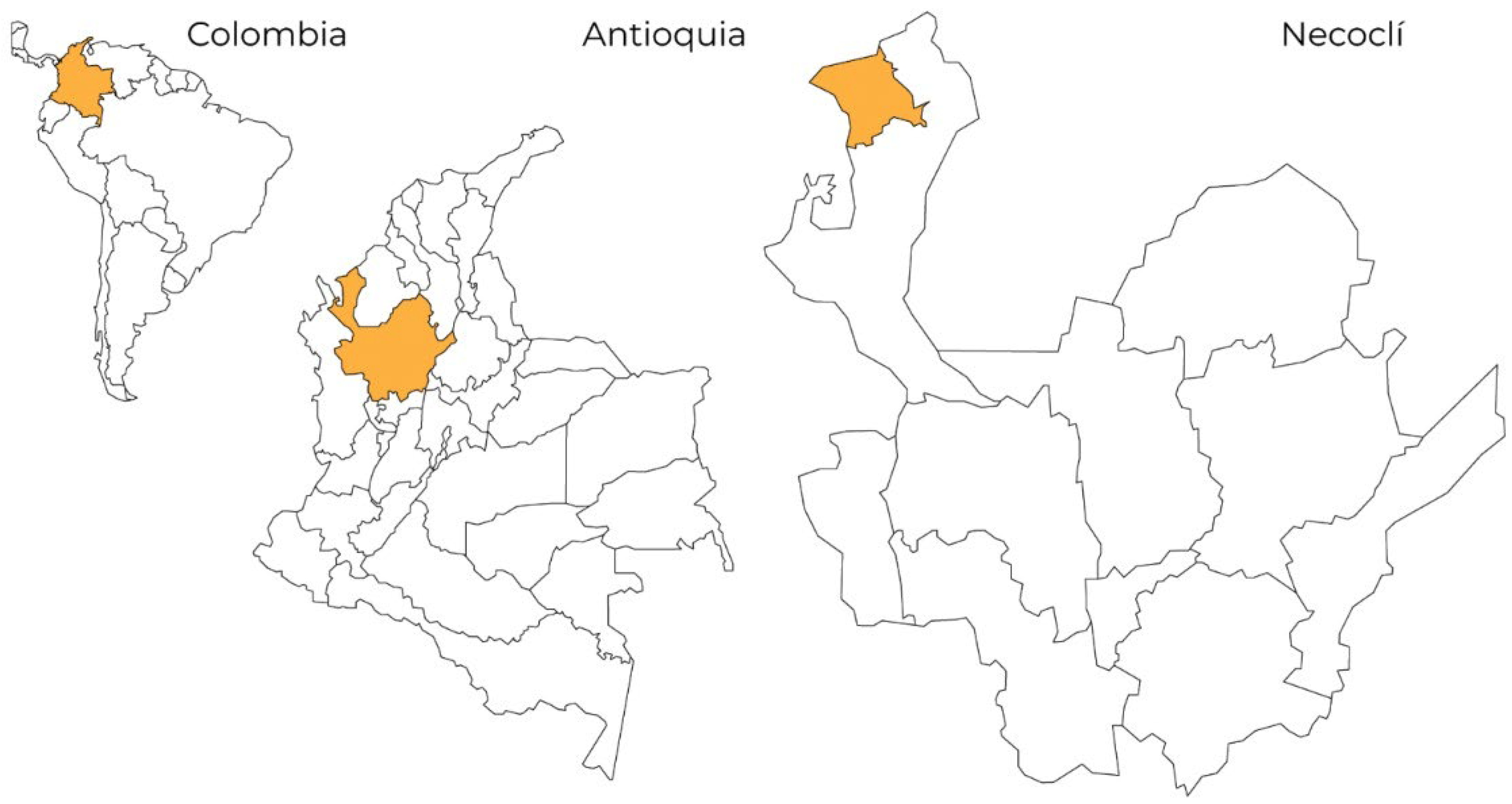
The municipality of Necoclí is located in the subregion of Urabá in the department of Antioquia, Colombia, as seen in
Figure 1. It is bordered on the north by the Caribbean Sea and the municipality of San Juan de Urabá, on the east by the municipality of Arboletes, on the south by the municipality of Turbo, and on the west by the Caribbean Sea. It has an area of 1361 square kilometers. It is located in the Gulf of Urabá, where the Fort of San Sebastián was, the first Spanish settlement in America. The Gulf of Urabá is a dynamic and multifaceted coastal landscape that extends over a length of 4.291 km
2, located in the southern Caribbean, bordering Panama. It is the largest sea inlet on the Colombian coast, being an elongated body of water, in a north–south direction, with a U-shaped morphology (80 km long and 25 km wide on average). It is the largest estuary in the Colombian Caribbean because the Atrato River (4155 m
3/s, the second largest flow after the Magdalena River) flows into the middle part of its western coast. This forms an extensive fingered delta that contrasts with the acuminate micro-deltas of the southeastern side at the mouth of several rivers of lesser flow, which constitutes a very dynamic landscape.
Necoclí, Antioquia, has a warm, tropical climate, characterized by constant temperatures between 25 °C and 31 °C throughout the year, rarely exceeding 33 °C. In the last five years, the municipality has experienced an oppressive, cloudy, and humid climate, with long winters and constant rainfall that have generated alerts for coastal erosion, with the sea penetrating up to five meters annually. Between 2020 and 2025, Necoclí faced significant climate challenges characterized by intense coastal erosion and rising temperatures. Strong meteo-marine phenomena have triggered powerful winds and waves reaching up to 2 m, rapidly accelerating the loss of the region’s beaches. This environmental pressure is compounded by a progressive warming trend, with average temperatures consistently hovering between 25 °C and 31 °C. Furthermore, the area deals with prolonged, humid winters marked by heavy rainfall that significantly increases the risk of flooding.
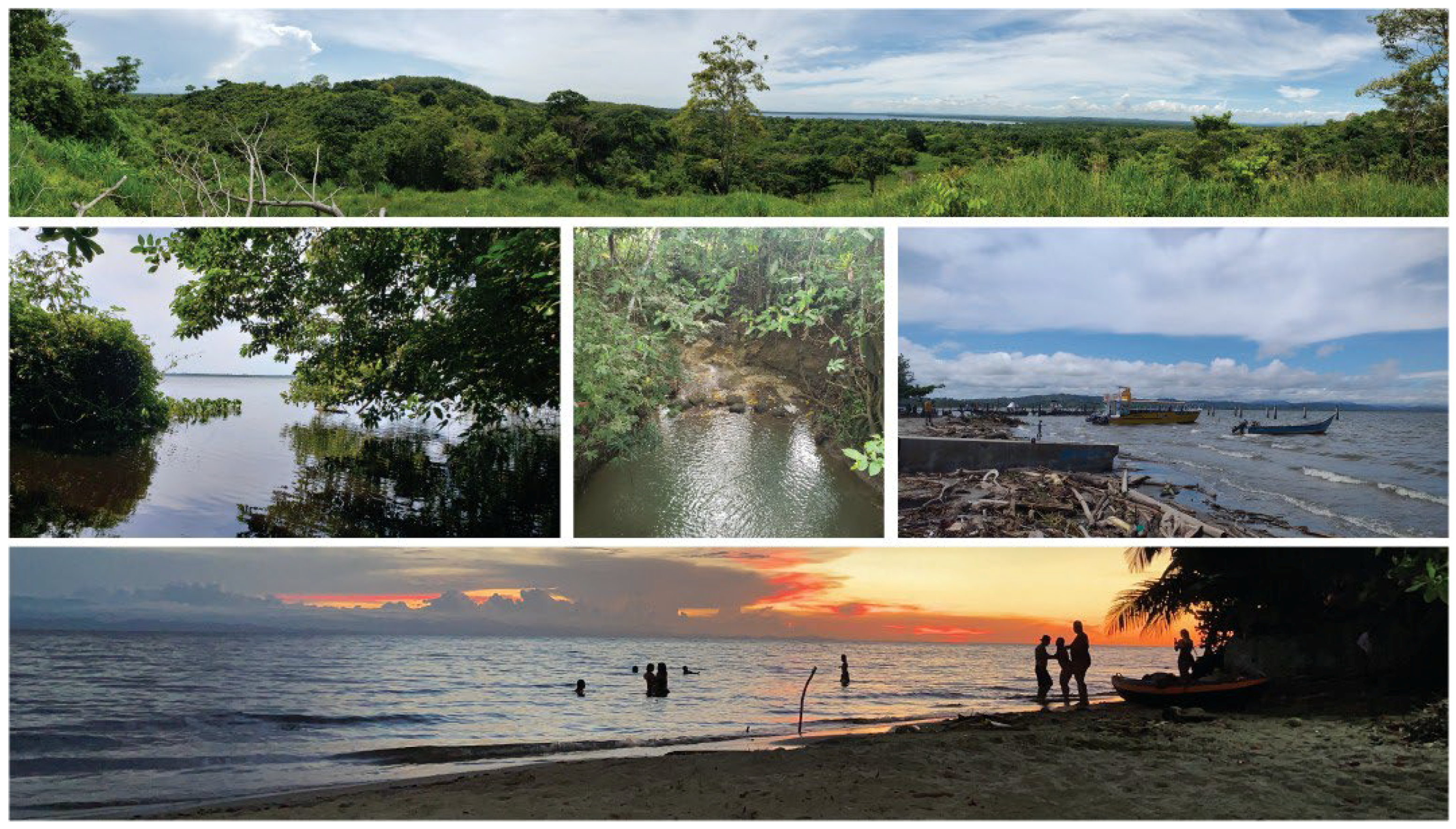
Necoclí’s landscape is quite diverse, as
Figure 2 shows. This landscape shows a contrast between the coastal and riverine landscape, mangroves, and tropical rainforests that favor diverse socio-cultural, environmental, and commercial activities based on flora and fauna. However, this rich mosaic is being physically reshaped by climate stressors. Intense coastal erosion is aggressively shrinking the beachfront, while rising sea levels increasingly threaten the delicate balance of the mangrove ecosystems through saltwater intrusion. Furthermore, the shift between extreme heat and torrential rainfall is altering the tropical rainforest’s edge, turning once-stable riverine banks into flood-prone zones and forcing a visible retreat of the natural landscape in the face of a rising Caribbean Sea.
4. Results
4.1. Analysis of Thick Mapping and Cartographies
Results show that when researchers engaged children and young people in mapping their daily routes, the resulting cartographies reflected not only their frequent locations but also the vital elements of the natural landscape they encountered, such as water bodies and vegetation, as well as the names of friends and family. This sensory mapping process provides a powerful tool for articulating the complexities of their lived experiences and perceptions. These representations reveal how young people construct their realities, highlighting relationships with their environment, particularly regarding climate change.
However, the images alone do not sufficiently illustrate the connections between these mapped elements and the broader themes of climate change, relational well-being, and young people’s perceptions. To address this, we must delve deeper into how these mapping exercises reshape communication around climate risk and contribute meaningfully to socio-ecological transition. For instance, by employing thick mapping as a participatory epistemological tool, we empower youth to articulate their spatial narratives and local ecological knowledge, which have often been overlooked in mainstream developmental discourse and climate governance [
24]. In the context of Necoclí, where structural marginalization intersected with environmental precarity, this participatory approach enabled young people to challenge their historically subaltern positions by repositioning themselves as active knowledge producers rather than passive recipients of top-down interventions [
25].
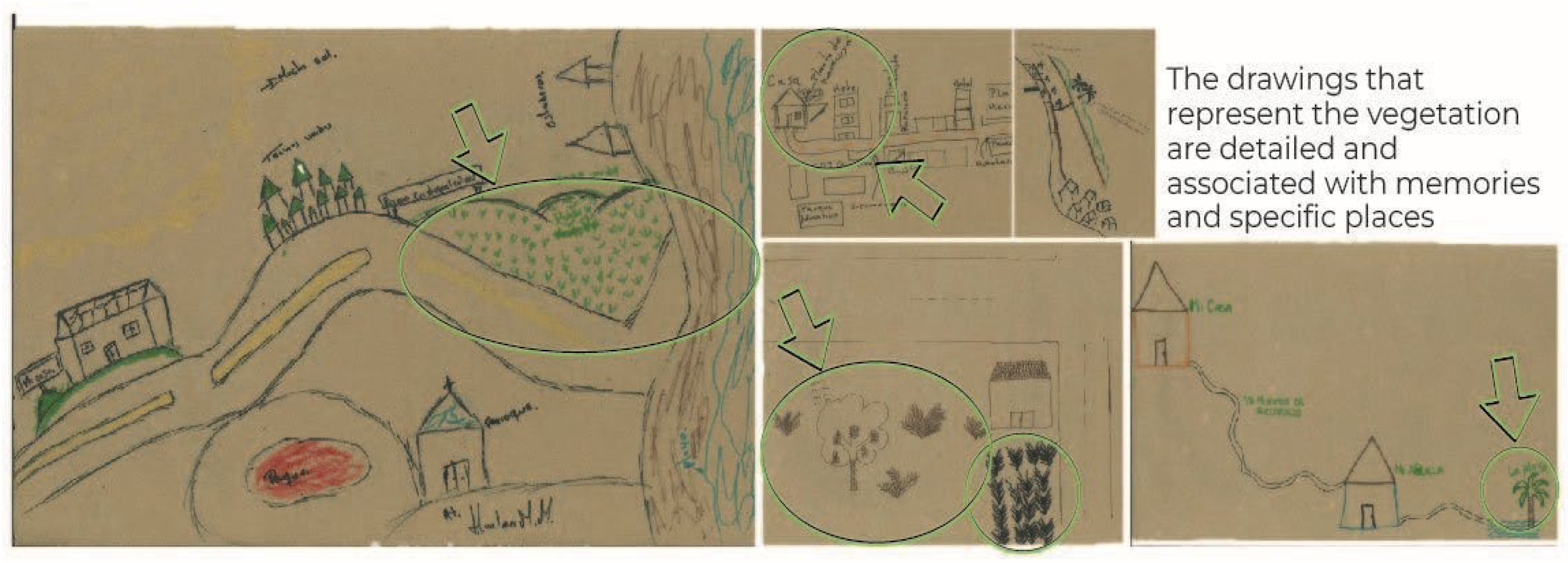
Through collaborative drawing, storytelling, and place-based conversations, the mapping process uncovered personal narratives tied to environmental change, as seen in
Figure 3, and community resilience strategies. These rich, layered maps serve not only as advocacy tools but also as mechanisms for young people to reconnect with their surroundings, fostering a sense of agency and collective responsibility. Rather than merely depicting conventional geographic features, these maps illustrate the emotions and meanings that shape their experiences in relation to the landscape. As noted by Wood (2015), traditional maps tend to present a static depiction of space; however, our approach encourages youth to intertwine their emotional landscapes with physical ones [
10].
The application of Thick Mapping as a participatory research methodology in Necoclí proved to be fundamental in reconfiguring communication about climate risk and contributing significantly to the local socio-ecological transition. As established, the images resulting from the daily routes of young people already suggest a vital interconnection between their lives and elements of the landscape, such as bodies of water and vegetation. However, in order to articulate the connections between these mapped elements and the central themes of Climate Change, Relational Well-being, and Youth Perceptions, it is imperative to analyze the process and nature of the information that Thick Mapping makes visible.
4.2. Analysis of Focus Groups
The focus groups in Necoclí revealed a profound divergence between institutional cartographies and the lived thick maps of the community, highlighting a deeply rooted decolonial perspective on territory. In FG1 (Childhood) and FG2 (Youth), participants identified the landscape not merely as a physical backdrop but as a repository of collective memory and future risk. While older settlers (FG3) emphasized the transformation of land use and the historical shifts in property boundaries, younger participants articulated a growing anxiety regarding climate change, viewing the receding coastline not just as an environmental metric but as a loss of cultural heritage. These sessions demonstrated that for the inhabitants of Necoclí, the territory is a fluid construct where the social representation of the sea acts as both a source of life and a looming threat to their ancestral and future stability.
Furthermore, the intersectional data from FG4 (Agency and Motherhood) underscored the role of participatory spatial development in reclaiming power relations. These women identified specific silenced spaces in traditional maps—areas of communal care, informal trade, and grassroots organization—that are often overlooked by top-down urban planning. By mapping these zones, the participants challenged the colonial legacy of land management that prioritizes extractive or purely aesthetic coastal use. The results suggest that spatial agency in Necoclí is intrinsically linked to gender and residency status; the act of thick mapping allowed marginalized groups to re-center their narratives, effectively transforming the landscape from a passive resource into an active participant in their struggle for territorial recognition and climate resilience.
4.3. Analysis of Children and Adolescent Drawings
The participatory mapping exercises and drawings from FG1 (Childhood) and FG2 (Youth) revealed a stark, internalized awareness of landscape transformation and climate vulnerability. In their depictions of Necoclí, a recurring and dominant motif was the dramatic encroachment of the shoreline, with the sea rendered in immediate, threatening proximity to residential structures. This visual compression suggests that for the younger generation, the landscape is no longer a stable entity but a shrinking space defined by coastal erosion. By placing the sea at the doorstep, these drawings function as a grassroots testimony to the lived reality of rising tides, effectively decolonizing the official climate discourse by replacing abstract data with the felt experience of spatial loss and domestic insecurity.
Additionally, the notable absence of arboreal elements in the drawings—specifically the lack of trees and native vegetation—points to a perceived ecological thinning of the territory. While older participants (FG3) often recalled a lush, forested past, the children and young people depicted a more barren, urbanized, or eroded environment. This disparity in visual representation highlights a shift in territorial identity; the youth of Necoclí perceive their landscape as a site of scarcity rather than abundance. This visual silence regarding the region’s flora suggests that the environmental baseline for the younger population has been significantly altered by deforestation and rapid development, framing their relationship with the territory as one of adaptation to a stripped-back, high-risk coastal reality.
The contrast between the visual outputs of the youth (FG1 and FG2) and the oral testimonies of the settlers (FG3) reveals a phenomenon of shifting environmental baselines within Necoclí. For the settlers, the territory is defined by a “narrative of loss”; their accounts are rich with descriptions of a dense, forested coastline and a distant, predictable sea. This group views the current landscape as a degraded version of a former ideal. In contrast, the children’s drawings—characterized by the absence of trees and the sea’s intrusion—represent a decolonized archive of the present. To them, the “scarcity” of vegetation and the “threat” of the water are not deviations from the norm, but the fundamental characteristics of the territory they inhabit. This suggests that participatory development must reconcile these two temporalities: the settlers’ memory of what was lost and the youth’s pragmatic, albeit anxious, acceptance of a high-risk environment.
Also, the visual silences regarding the flora in children’s drawings indicate a potential rupture in the intergenerational transmission of traditional ecological knowledge. While the thick mapping process allowed settlers to narrate a landscape of abundance, the youth’s focus on the sea’s proximity highlights a spatial identity forged in precarity. This disconnect suggests that climate change in Necoclí is not only a physical threat but a cognitive one, erasing the green memory of the landscape for younger generations. By comparing these results, it becomes clear that participatory spatial planning cannot rely on a single historical narrative; instead, it must integrate the settlers’ historical depth with the youth’s acute sensitivity to immediate environmental risks to create a more resilient, multifocal vision of the Colombian coast.
5. Discussion
The thick mapping workshops in Necoclí revealed that while all participants share a common vulnerability to climate change, their interpretation of the landscape is heavily stratified by age and social position, highlighting the necessity of multi-generational triangulation. The youth focus groups (FG1/FG2) demonstrated a strong inclination toward affective nodes—linking spatial perception directly to emotional distress, such as the fear associated with coastal erosion threatening their homes or the nostalgic loss of specific swimming areas [
25]. In contrast, the older participant groups tended to interpret these same shifts through a lens of historical memory and livelihood sustainability, focusing on long-term changes in fish migration patterns and river silting rather than immediate emotional impact.
This divergence aligns with literature suggesting that while youth are often agents of innovative, rapid adaptation, elders provide the crucial historical baseline necessary for understanding slow-onset environmental changes [
26]. By intentionally bridging these perspectives, the methodology resisted a monolithic view of the territory, demonstrating that “resilience” is constructed differently across generations: youth focus on social cohesion and future aspirations, while elders prioritize ancestral knowledge and economic continuity.
The ability of thick mapping to make visible the invisible layers of the territory aligns with and extends established participatory methodologies [
10]. Similar to studies in marginalized urban contexts, our results demonstrate that collaborative drawing and storytelling allow participants to translate abstract feelings of vulnerability into concrete spatial data [
26]. However, our findings diverge from studies that treat emotional mapping merely as a diagnostic tool; in Necoclí, the process itself served as a radical act of empowerment [
24]. By repositioning participants from passive recipients of climate solutions to active producers of knowledge, the thick mapping exercises disrupted conventional top-down adaptation narratives that frequently ignore local agency.
The transformation of these subjective maps into a digital and pedagogical format addresses a critical gap in territorial decentralization: the failure of administrative models to incorporate sub-local nuances. The proposed Interactive Digital Atlas bridges this gap by validating data types usually absent from official municipal maps—such as oral histories and emotional geographies—allowing for a more equitable spatial development that brings the priorities of marginalized areas to the forefront.
Furthermore, by coupling the Digital Atlas (for external lobbying) with a Pedagogical Booklet (for internal community action), the methodology ensures that youth agency translates directly into localized governance. This dual-tool approach demonstrates that true territorial cohesion is achieved not through technical mapping alone, but through the integration of lived experience with actionable policy frameworks, grounded in principles of social justice and shared care.
6. Conclusions
This study advances a critical understanding of participatory spatial planning by demonstrating that thick mapping is not merely a diagnostic tool, but an operational framework for spatial decentralization. By shifting the authority of territorial narrative from distant administrative centers to local agents, this methodology bridges the gap between abstract national climate mandates and sub-local realities. Empirically, the research highlights that while young people (ages 15–22) utilize thick mapping to articulate emotional distress and future-oriented aspirations, they require triangulation with older generations—who prioritize historical memory and livelihood sustainability—to create a holistic baseline for territorial risk.
Theoretically, this research contributes to the discourse on territorial epistemic justice. It validates invisible data types—emotional nodes, ancestral knowledge, and informal networks of care—as legitimate inputs for governance, challenging dominant top-down models that rely exclusively on technical, Cartesian cartography. Consequently, the study reframes climate adaptation not just as a structural challenge, but as a relational and socio-spatial process.
Practically, the findings necessitate a radical shift in local policy implementation. To achieve genuine territorial restructuring, we recommend that municipal authorities carry out the following: First, integrate the informal networks of trade and care identified by local women’s groups into official land-use plans (POT) to protect community-based resilience structures. Secondly, adapt the Interactive Digital Atlas as a mandatory participatory component in spatial planning, ensuring the dynamic superposition of emotional annotations over physical infrastructure data. And lastly, implement cross-generational planning, and utilize children’s visual representations of risk as a baseline for designing culturally relevant evacuation routes and infrastructure.
Centering lived experience in spatial policy transforms decentralization from a bureaucratic process into a structural mechanism for empowerment, solidarity, and just resilience in climate-vulnerable regions.