



Linking Urban Land Use Change and Tropospheric Ozone Dynamics in a Mid-Sized City

Abstract
1. Introduction
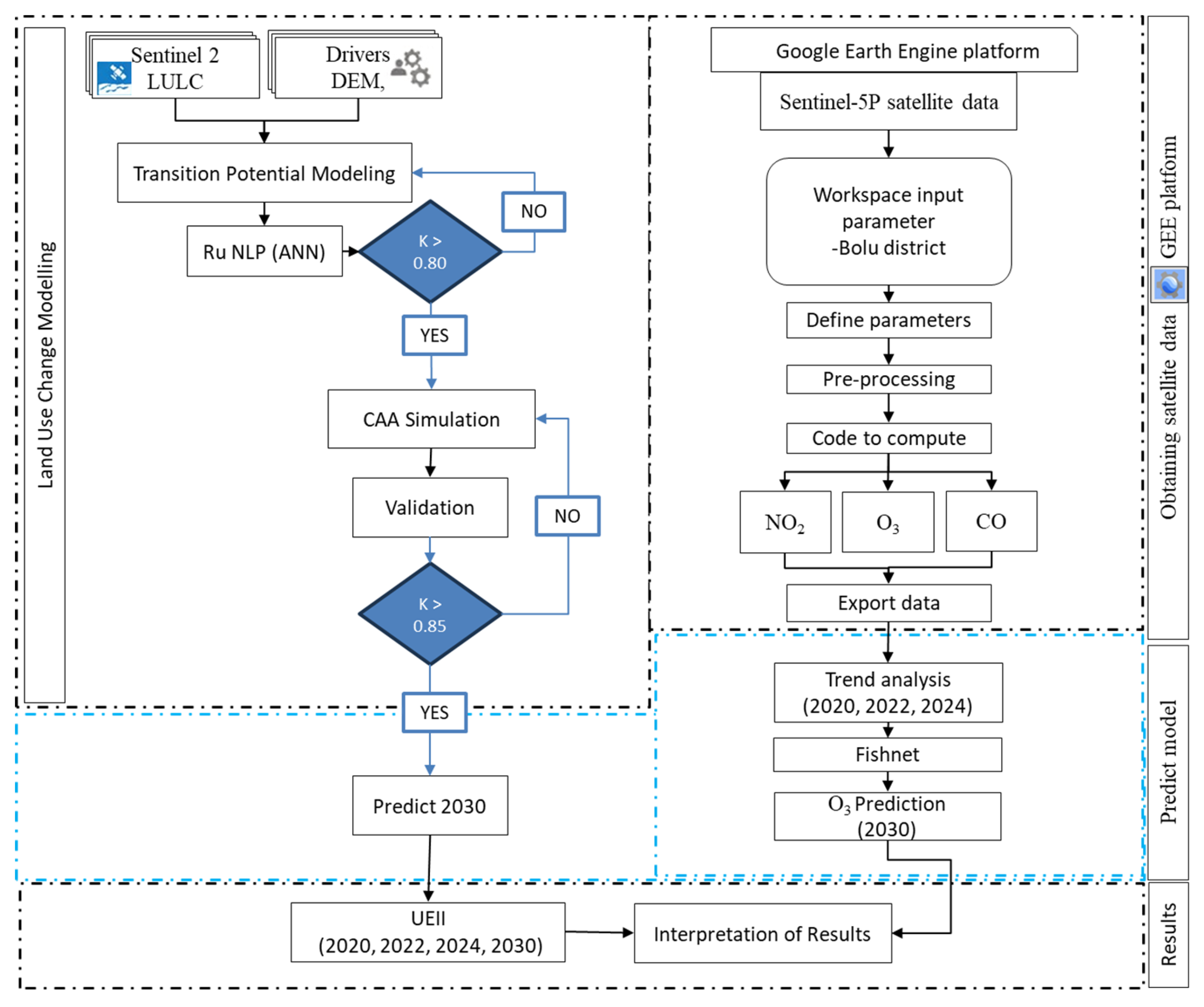
2. Materials and Methods
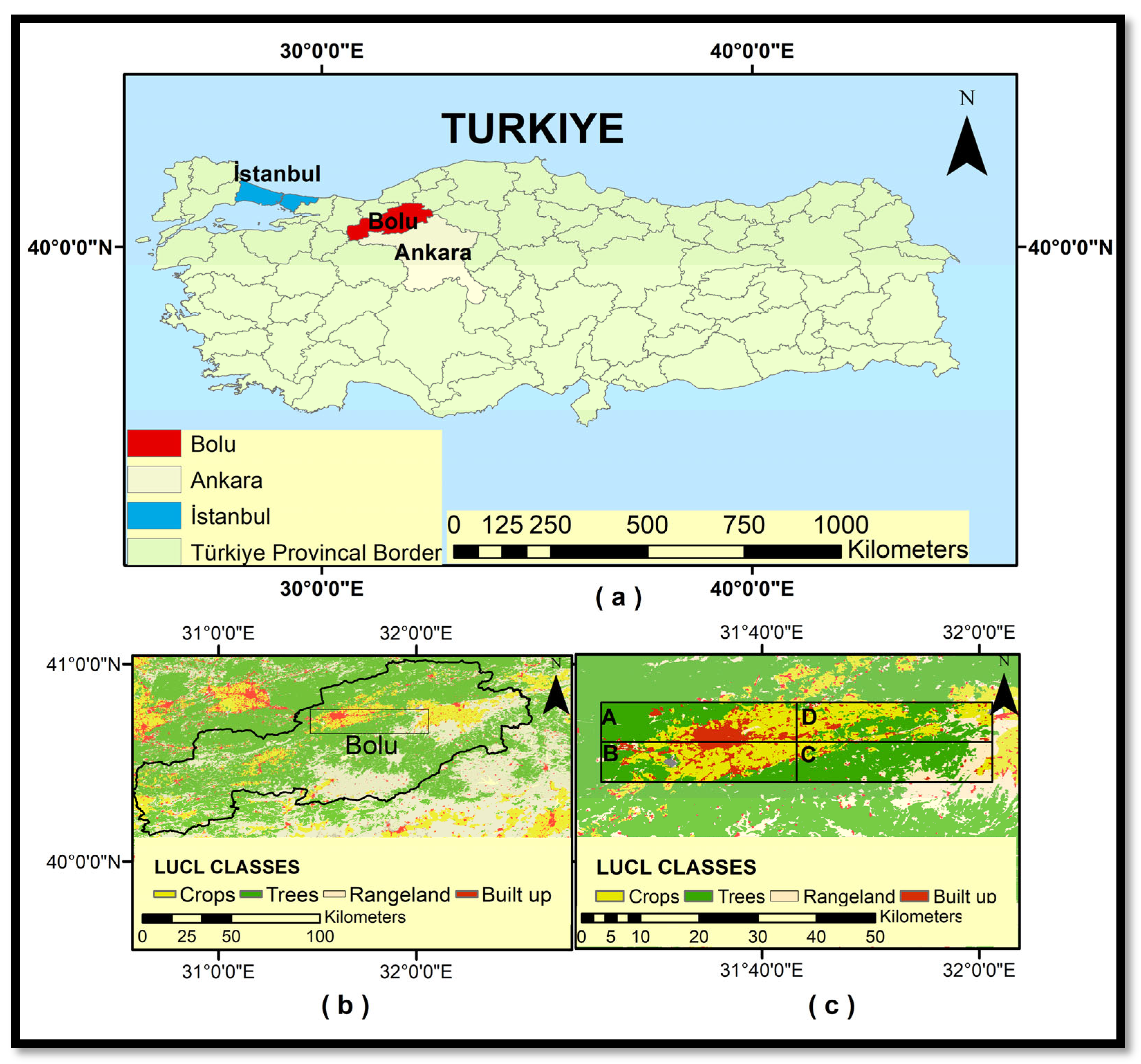
2.1. Study Area
2.2. Data Obtained and Pre-Processing
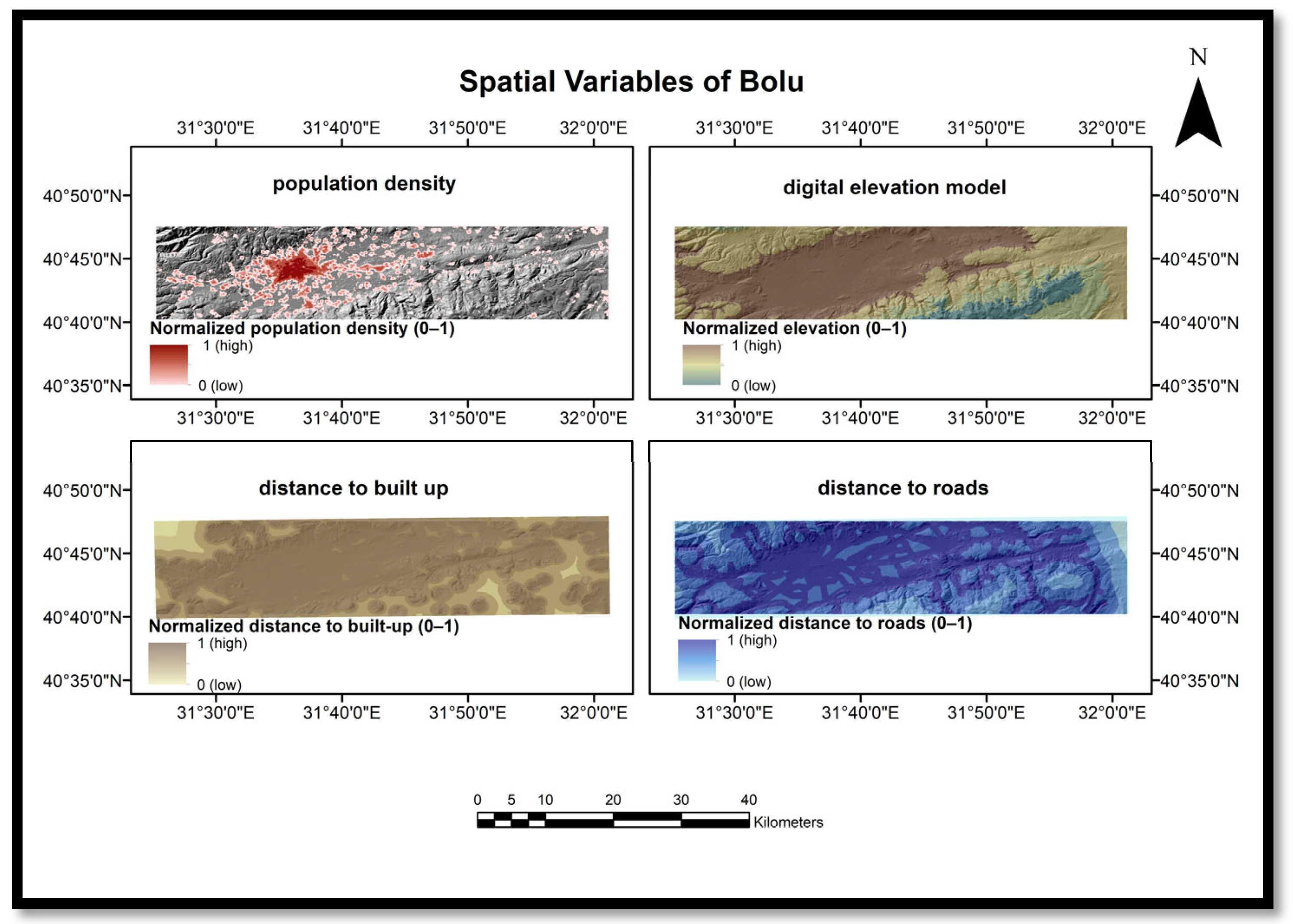
- Driving Factors
2.3. Air Quality Modeling (2020, 2022, 2024)
Fishnet-Based O3 Estimation
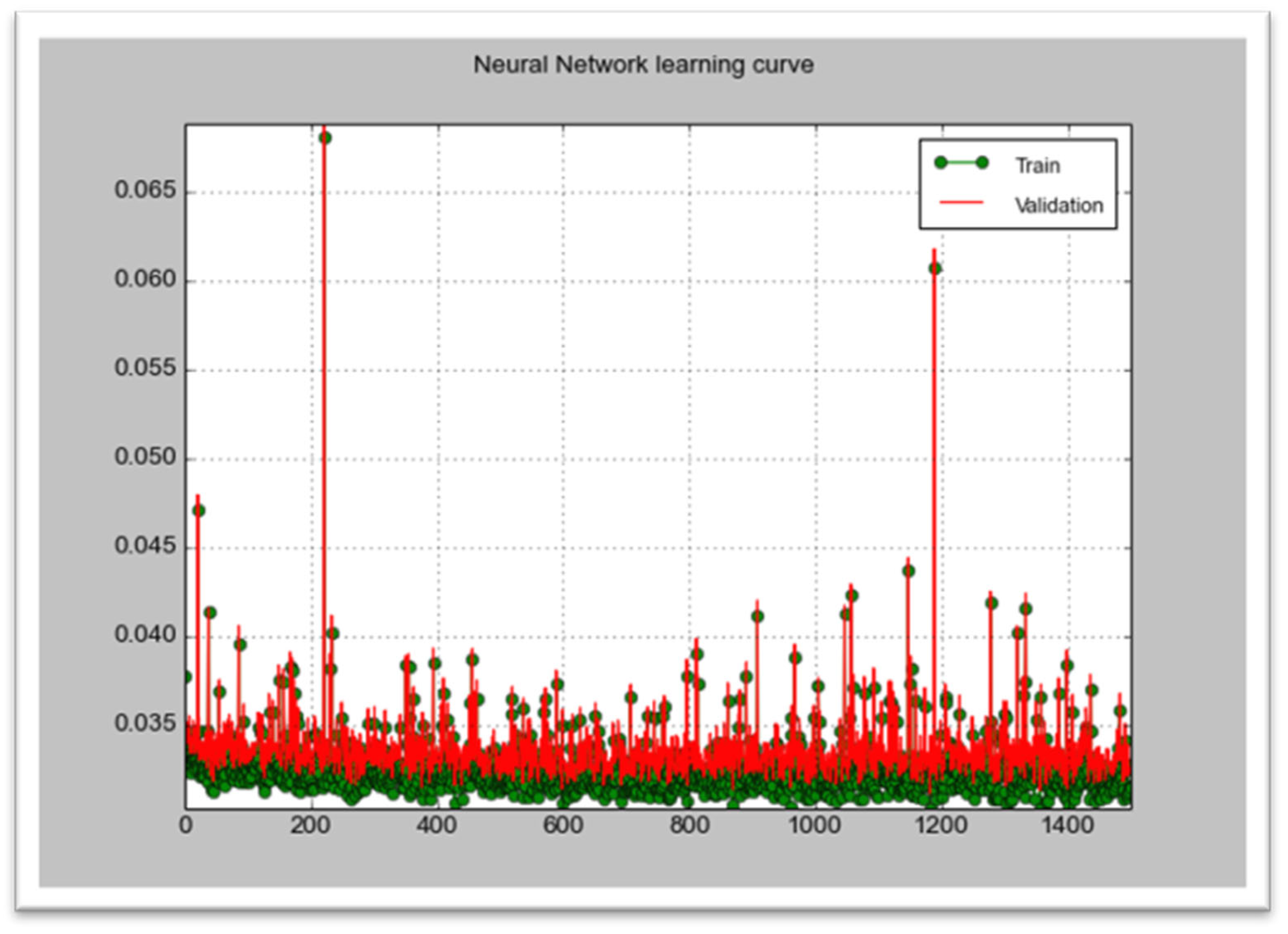
2.4. Urban Growth Simulation (MOLUSCE)
2.5. Urban Expansion Intensity Index (UEII)
3. Results
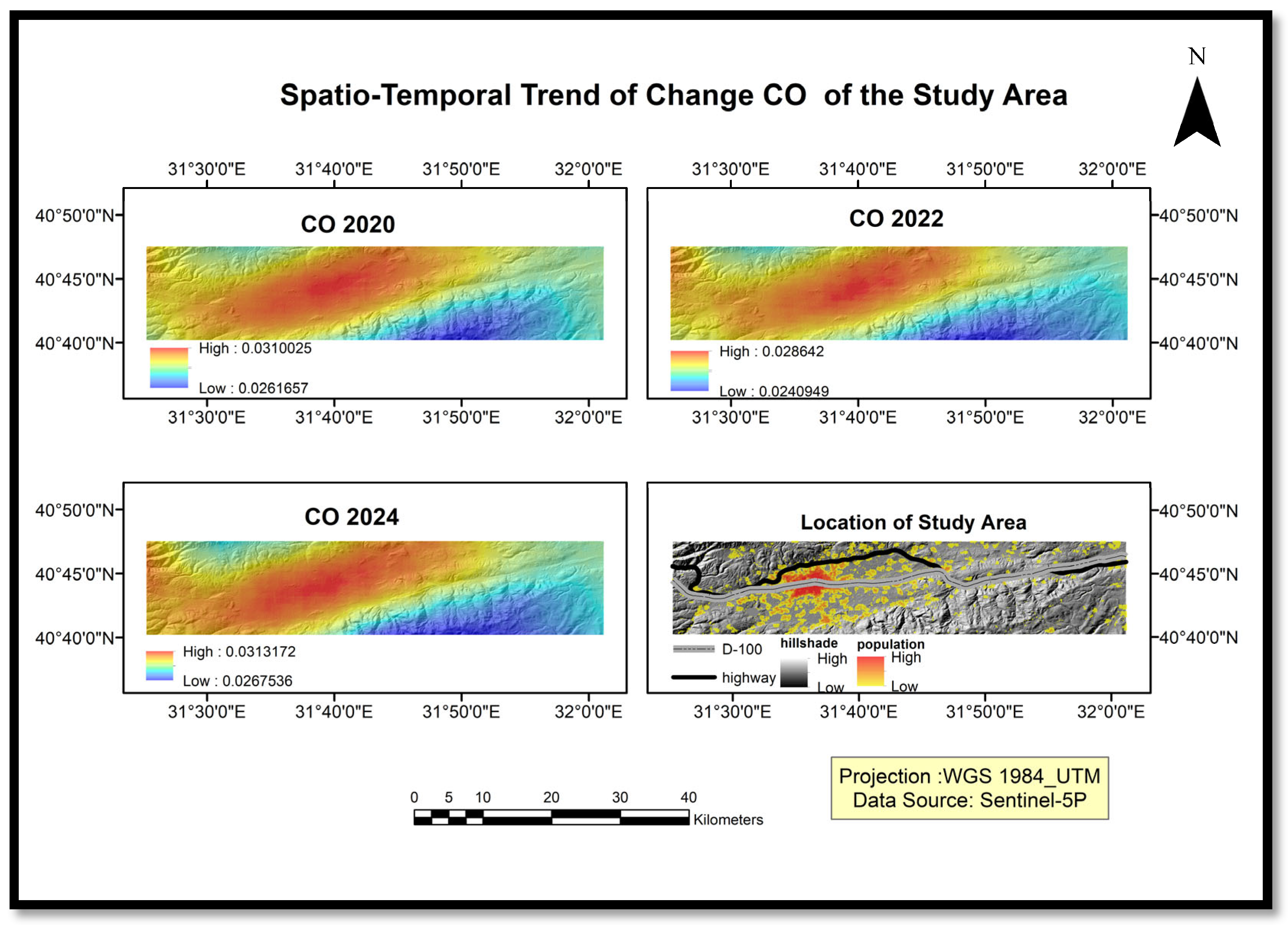
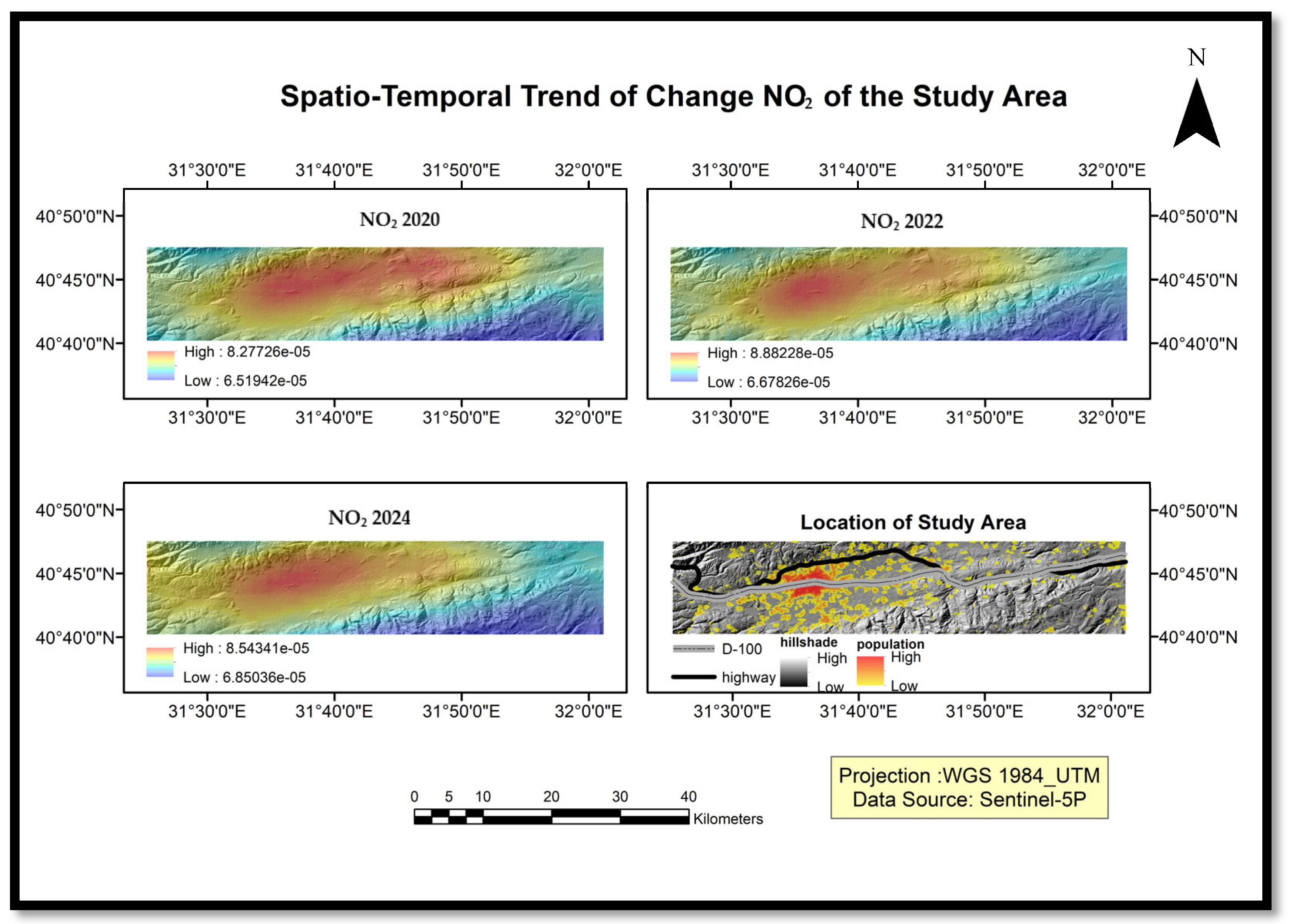
3.1. Spatial and Temporal Dynamics of CO and NO2 (2020–2024)
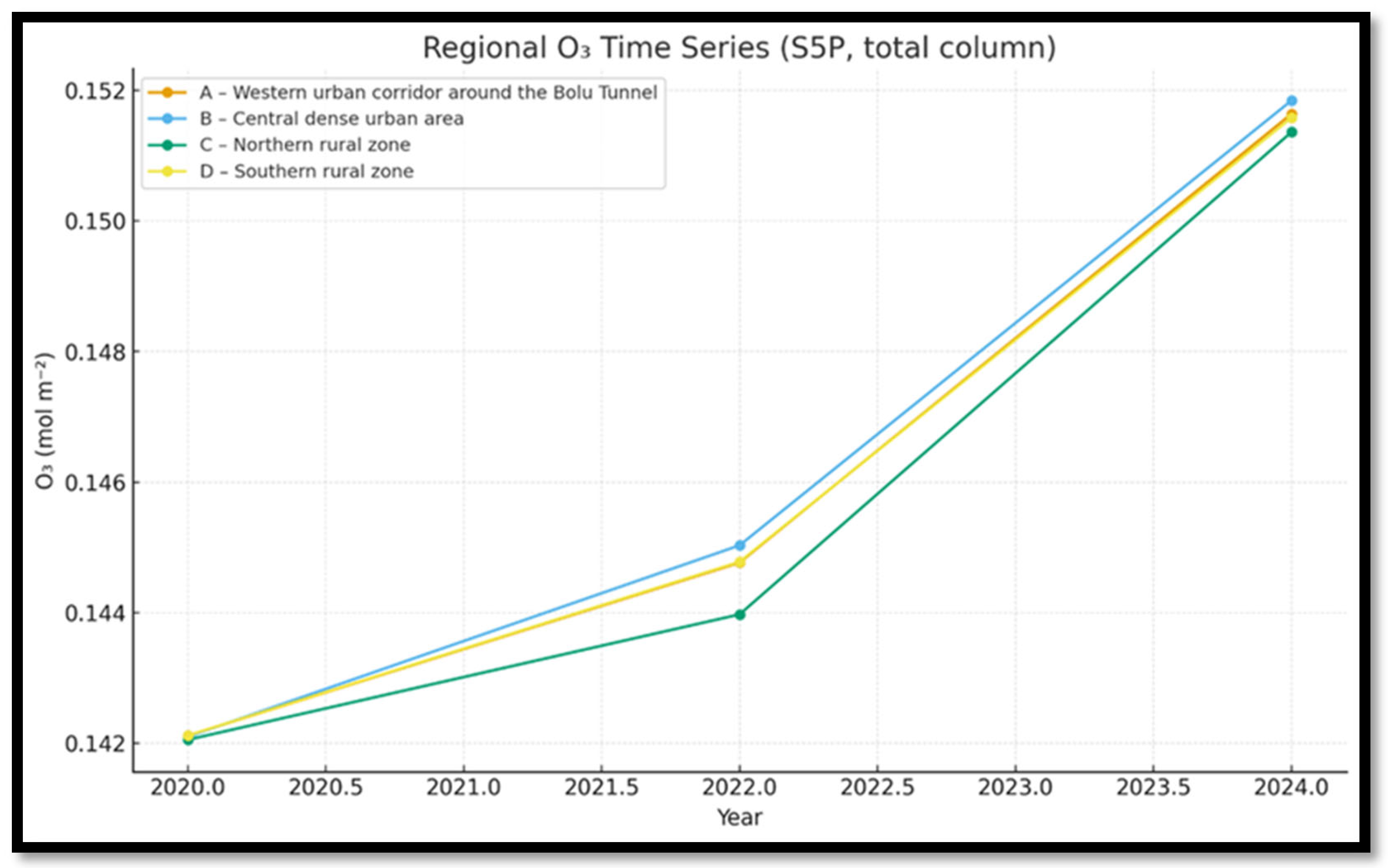
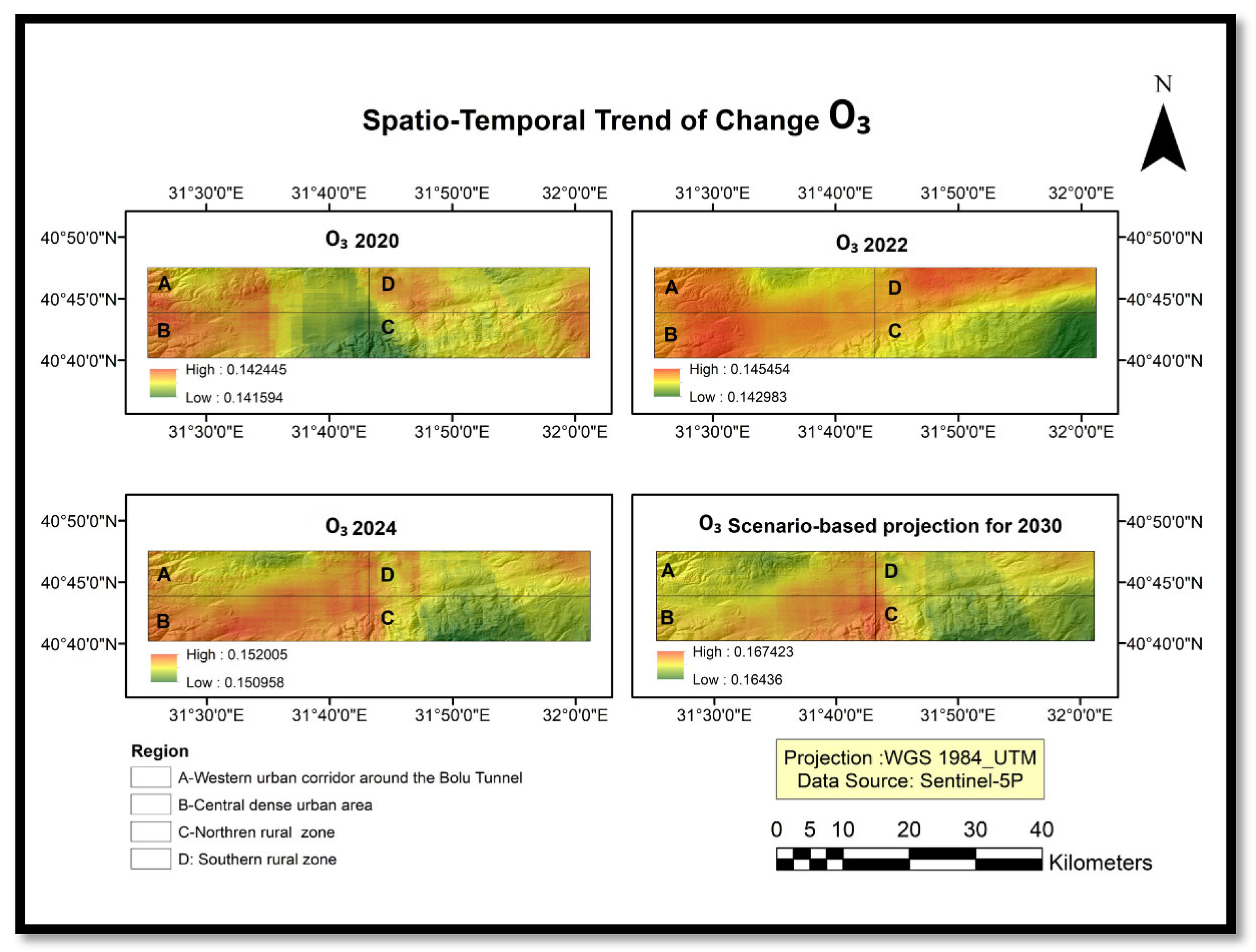
3.2. O3 Trends and 2030 Projections
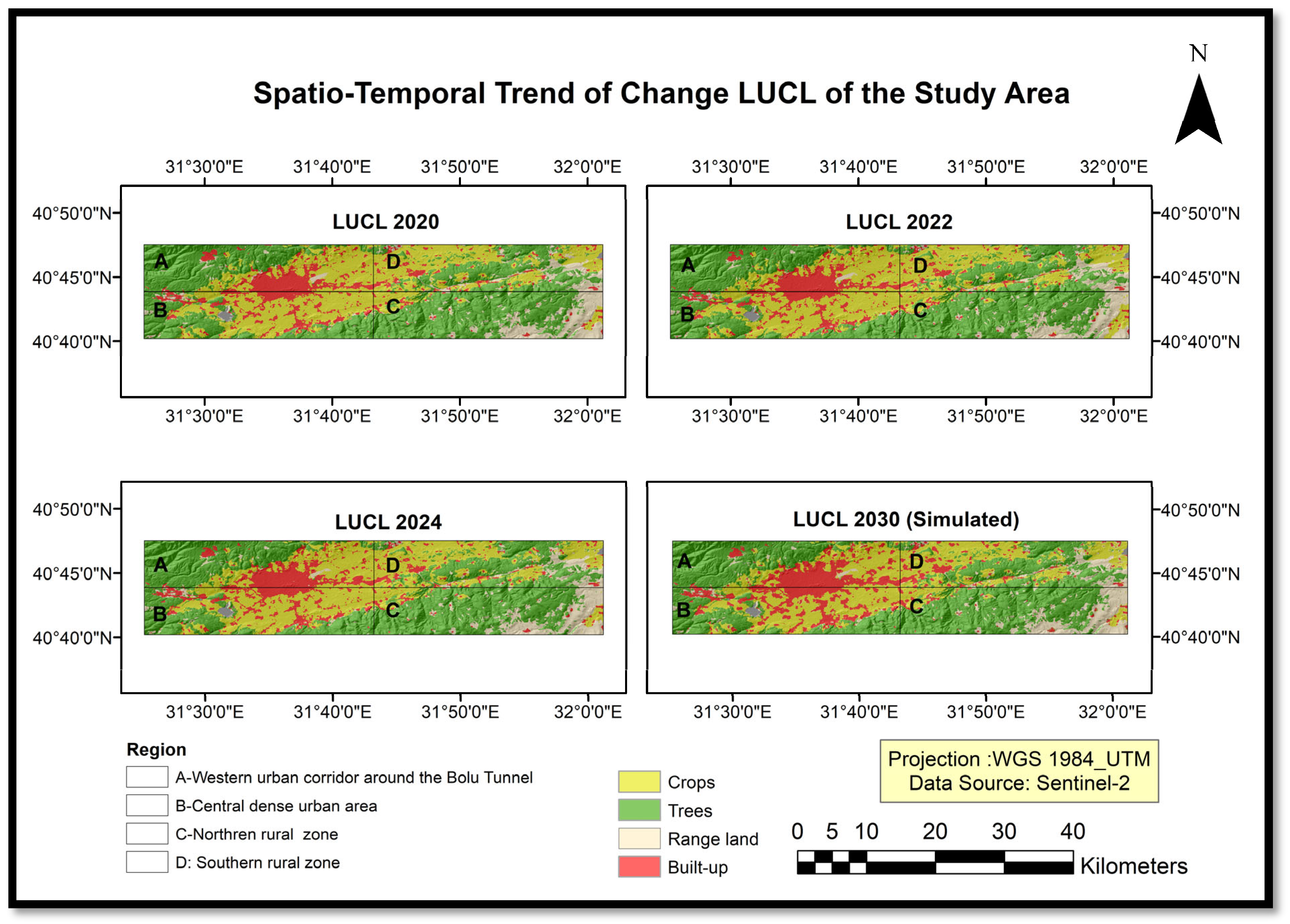
3.3. LULC Changes
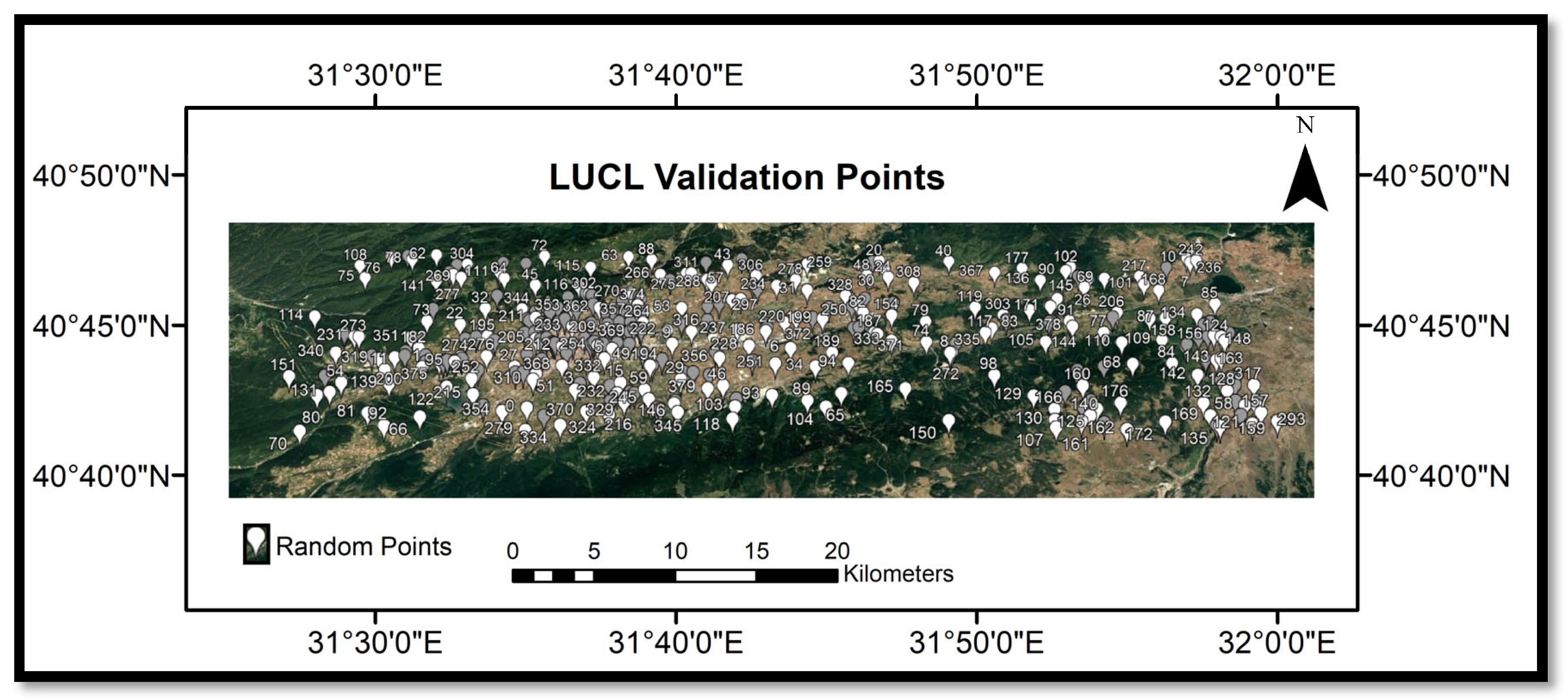
3.3.1. Accuracy Assessment
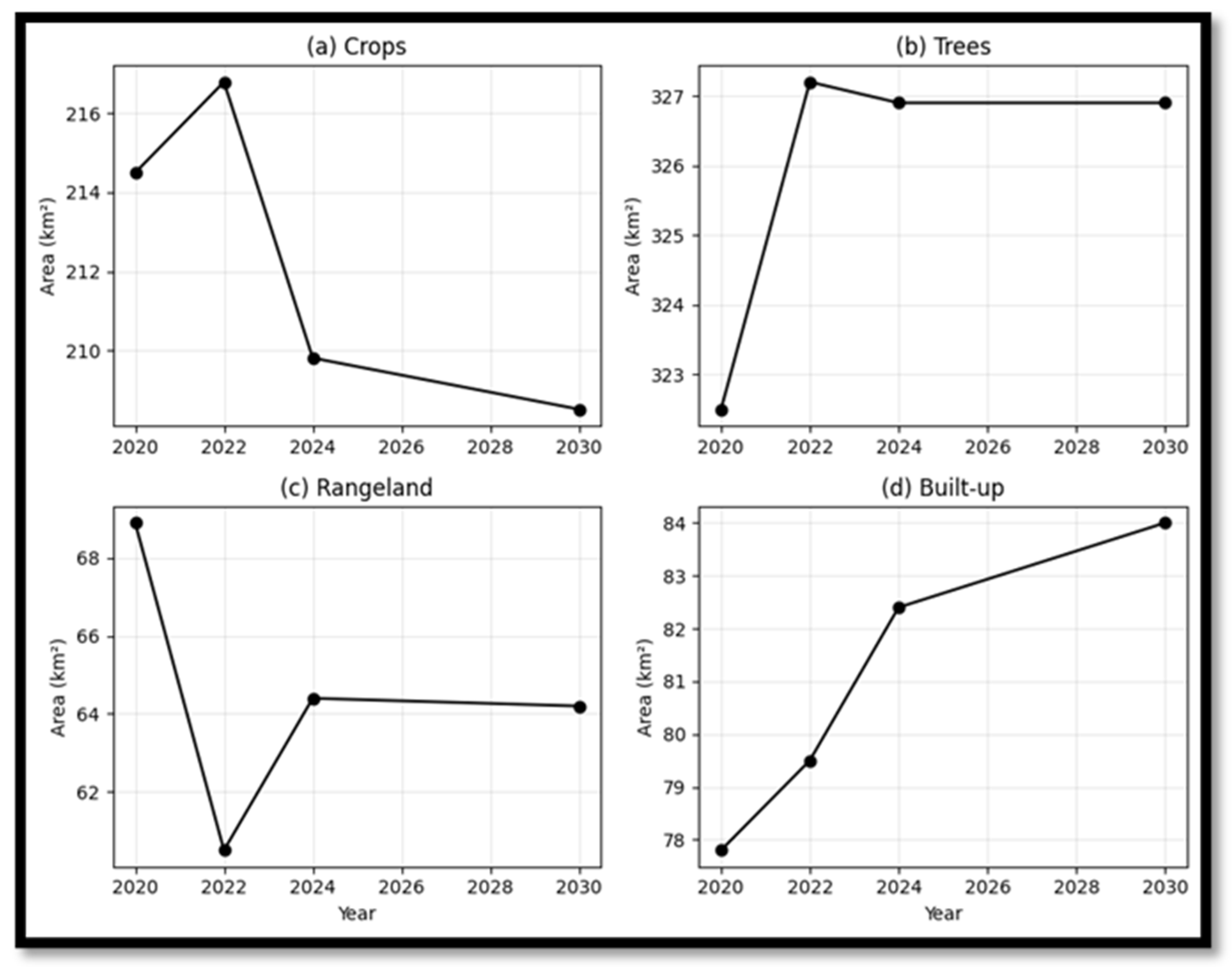
- Crops: 214.36 → 209.83 km2 (−4.53 km2; −0.66%)
- Trees: 322.46 → 326.92 km2 (+4.46 km2; +0.64%)
- Rangeland: 68.89 → 64.45 km2 (−4.44 km2; −0.65%)
- Built-up: 77.80 → 82.37 km2 (+4.57 km2; +0.66%)
3.3.2. Transition Matrix Area Consistency Analysis (2020–2024)
- Rangeland → Trees: 7.98%
- Crops → Built-up: 3.58%
- Rangeland → Built-up: 1.57%
- Built-up stability: 94.95%
3.4. LULC Projection (2020–2030)
3.4.1. Overall Projected Changes (2020–2030)
3.4.2. Spatial Patterns of Projected Change
3.4.3. Transition Dynamics Driving the 2030 Land-Use Prediction
3.4.4. Model–Projection Consistency
3.5. UEII (2020–2030)
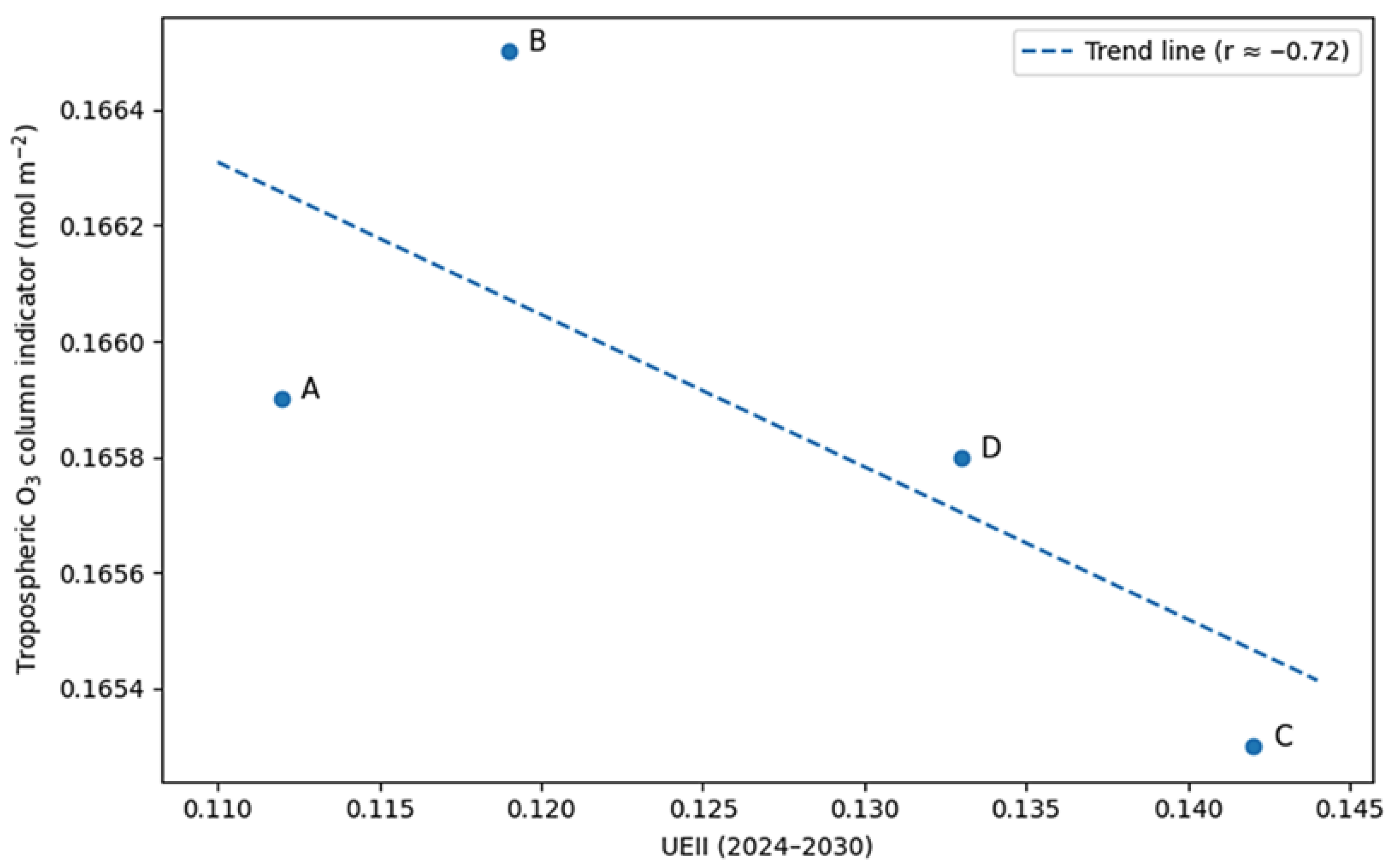
3.6. Relationship Between Urban Expansion Intensity and Tropospheric O3 Column Indicators
4. Discussion
5. Restrictions and Ambiguities
6. Conclusions
Funding
Data Availability Statement
Conflicts of Interest
Abbreviations
| Abbreviation | Definition |
| GIS | Geographic Information Systems |
| RS | Remote Sensing |
| LULC | Land-Use/Land Cover |
| O3 | Tropospheric Ozone |
| NO2 | Nitrogen Dioxide |
| CO | Carbon Monoxide |
| DEM | Digital Elevation Model |
| MSI | Multispectral Instrument |
| UEII | Urban Expansion Intensity Index |
| GEE | Google Earth Engine |
Appendix A. Confusion Matrices for LULC Classification (2020–2024)
Appendix A.1. Confusion Matrix for 2020

| Reference\Classified | Crops | Trees | Rangeland | Built-up | Row Total |
|---|---|---|---|---|---|
| Crops (60) | 48 | 4 | 4 | 4 | 60 |
| Trees (60) | 4 | 48 | 4 | 4 | 60 |
| Rangeland (60) | 4 | 4 | 48 | 4 | 60 |
| Built-up (200) | 10 | 10 | 20 | 160 | 200 |
| Column Total | 66 | 66 | 76 | 172 | 380 |
Appendix A.2. Confusion Matrix for 2022
| Reference\Classified | Crops | Trees | Rangeland | Built-Up | Row Total |
|---|---|---|---|---|---|
| Crops (60) | 46 | 5 | 4 | 5 | 60 |
| Trees (60) | 4 | 47 | 4 | 5 | 60 |
| Rangeland (60) | 5 | 5 | 44 | 6 | 60 |
| Built-up (200) | 15 | 12 | 17 | 156 | 200 |
| Column Total | 70 | 69 | 69 | 172 | 380 |
Appendix A.3. Confusion Matrix for 2024
| Reference\Classified | Crops | Trees | Rangeland | Built-Up | Row Total |
|---|---|---|---|---|---|
| Crops (60) | 47 | 4 | 4 | 5 | 60 |
| Trees (60) | 4 | 48 | 3 | 5 | 60 |
| Rangeland (60) | 5 | 5 | 45 | 5 | 60 |
| Built-up (200) | 14 | 13 | 16 | 157 | 200 |
| Column Total | 70 | 70 | 68 | 172 | 380 |
References
- Angel, S.; Parent, J.; Civco, D.L. The fragmentation of urban landscapes: Global evidence of a key attribute of the spatial structure of cities, 1990–2000. Environ. Urban. 2012, 24, 249–283. [Google Scholar] [CrossRef] [Scilit]
- Güneralp, B.; Seto, K.C. Futures of global urban expansion: Uncertainties and implications for biodiversity conservation. Environ. Res. Lett. 2013, 8, 014025. [Google Scholar] [CrossRef] [Scilit]
- Perveen, S.; Yigitcanlar, T.; Kamruzzaman, M.; Agdas, D. How can transport impacts of urban growth be modelled? An approach to consider spatial and temporal scales. Sustain. Cities Soc. 2020, 55, 102031. [Google Scholar] [CrossRef] [Scilit]
- Sun, Y.; Liu, C.; Palm, M.; Vigouroux, C.; Notholt, J.; Hu, Q.; Jones, N.; Wang, W.; Su, W.; Zhang, W.; et al. Ozone seasonal evolution and photochemical production regime in the polluted troposphere in eastern China derived from high-resolution Fourier transform spectrometry (FTS) observations. Atmos. Chem. Phys. 2018, 18, 14569–14583. [Google Scholar] [CrossRef] [Scilit]
- Monks, P.S.; Archibald, A.T.; Colette, A.; Cooper, O.; Coyle, M.; Derwent, R.; Fowler, D.; Granier, C.; Law, K.S.; Mills, G.E.; et al. Tropospheric ozone and its precursors from the urban to the global scale from air quality to short-lived climate forcer. Atmos. Chem. Phys. 2015, 15, 8889–8973. [Google Scholar] [CrossRef] [Scilit]
- World Health Organization. WHO Global Air Quality Guidelines; WHO: Geneva, Switzerland, 2021. [Google Scholar]
- Duranton, G.; Turner, M.A. The fundamental law of road congestion: Evidence from US cities. Am. Econ. Rev. 2011, 101, 2616–2652. [Google Scholar] [CrossRef] [Scilit]
- Cummings, L.E.; Stewart, J.D.; Reist, R.; Shakya, K.M.; Kremer, P. Mobile monitoring of air pollution reveals spatial and temporal variation in an urban landscape. Front. Built Environ. 2021, 7, 648620. [Google Scholar] [CrossRef] [Scilit]
- Gorelick, N.; Hancher, M.; Dixon, M.; Ilyushchenko, S.; Thau, D.; Moore, R. Google Earth Engine: Planetary-scale geospatial analysis for everyone. Remote Sens. Environ. 2017, 202, 18–27. [Google Scholar] [CrossRef] [Scilit]
- Veefkind, J.P.; Aben, I.; McMullan, K.; Förster, H.; de Vries, J.; Otter, G.; Claas, J.; Eskes, H.J.; de Haan, J.F.; Kleipool, Q.; et al. TROPOMI on the ESA Sentinel-5 Precursor: A GMES mission for global observations of the atmospheric composition for climate, air quality and ozone layer applications. Remote Sens. Environ. 2012, 120, 70–83. [Google Scholar] [CrossRef] [Scilit]
- Munthali, M.G.; Mustak, S.; Adeola, A. Modelling land use and land cover dynamics of Dedza district of Malawi using hybrid Cellular Automata and Markov model. Remote Sens. Appl. Soc. Environ. 2020, 17, 100276. [Google Scholar] [CrossRef] [Scilit]
- Erkek, D.; Yağcı, C.; İşcan, F. Urban growth predictions: Optimization of urbanization strategy for risk mitigation in medium-sized cities. Growth Change 2025, 56, e70054. [Google Scholar] [CrossRef] [Scilit]
- Theil, H. A rank-invariant method of regression analysis. Ned. Tijdschr. Natuurk. 1950, 3, 386–392. [Google Scholar]
- Sen, P.K. Estimates of the regression coefficient based on Kendall’s tau. J. Am. Stat. Assoc. 1968, 63, 1379–1389. [Google Scholar] [CrossRef]
- Fang, Y.; Zhao, L. Assessing the environmental benefits of urban ventilation corridors: A case study in Hefei, China. Build. Environ. 2022, 212, 108810. [Google Scholar] [CrossRef] [Scilit]
- Seto, K.C.; Güneralp, B.; Hutyra, L.R. Global forecasts of urban expansion to 2030 and direct impacts on biodiversity and carbon pools. Proc. Natl. Acad. Sci. USA 2012, 109, 16083–16088. [Google Scholar] [CrossRef] [Scilit]
- Dörter, M.; Mağat-Türk, E.; Döğeroğlu, T.; Özden-Üzmez, Ö.; Gaga, E.O.; Karakaş, D.; Yenisoy-Karakaş, S. An assessment of spatial distribution and atmospheric concentrations of ozone, nitrogen dioxide, sulfur dioxide, benzene, toluene, ethylbenzene, and xylenes: Ozone formation potential and health risk estimation in Bolu city of Turkey. Environ. Sci. Pollut. Res. 2022, 29, 53569–53583. [Google Scholar] [CrossRef] [Scilit]
- Karner, A.A.; Eisinger, D.S.; Niemeier, D.A. Near-roadway air quality: Synthesizing the findings from real-world data. Environ. Sci. Technol. 2010, 44, 5334–5344. [Google Scholar] [CrossRef] [Scilit]
- Taner, İ. Kent profili: Bolu. Bolu Abant İzzet Baysal Üniversitesi Sos. Bilim. Enstitüsü Derg. 2016, 16, 159–197. [Google Scholar] [CrossRef] [Scilit]
- Bolu Directorate of Environment and Urbanization (BDEU). Bolu Provincial Environmental Status Report 2018; BDEU: Bolu, Türkiye, 2018. [Google Scholar]
- Turkish State Meteorological Service. Genel İstatistik Verileri. Available online: https://www.mgm.gov.tr (accessed on 16 June 2025).
- Karra, K.; Kontgis, C.; Statman-Weil, Z.; Mazzariello, J.C.; Mathis, M.; Brumby, S.P. Global land use/land cover with Sentinel 2 and deep learning. In Proceedings of the 2021 IEEE International Geoscience and Remote Sensing Symposium IGARSS, Brussels, Belgium, 11–16 July 2021; IEEE: Piscataway, NJ, USA, 2021; Volume 8, pp. 4704–4707. [Google Scholar] [CrossRef] [Scilit]
- Hegazy, I.R.; Kaloop, M.R. Monitoring urban growth and land use change detection with GIS and remote sensing techniques in Daqahlia Governorate, Egypt. Int. J. Sustain. Built Environ. 2015, 4, 117–124. [Google Scholar] [CrossRef] [Scilit]
- NASA/METI/AIST/Japan Spacesystems; U.S./Japan ASTER Science Team. ASTER Global Digital Elevation Model Version 3; NASA EOSDIS Land Processes DAAC. 2019. [CrossRef]
- Earthdata Search. NASA Earthdata. Available online: https://search.earthdata.nasa.gov/ (accessed on 15 July 2025).
- WorldPop. WorldPop Global Population Data. Available online: https://www.worldpop.org/ (accessed on 15 July 2025).
- OpenStreetMap Contributors. OpenStreetMap. Available online: https://www.openstreetmap.org/ (accessed on 15 July 2025).
- Bolu Governorship. Bolu Province 2023 Environmental Status Report; Provincial Directorate of Environment, Urbanization and Climate Change: Bolu, Türkiye, 2024. [Google Scholar]
- Seinfeld, J.H.; Pandis, S.N. Atmospheric Chemistry and Physics: From Air Pollution to Climate Change, 3rd ed.; John Wiley & Sons: Hoboken, NJ, USA, 2016. [Google Scholar]
- Borsdorff, T.; Andrasec, J.; Hu, H.; Aben, I.; Landgraf, J. Detection of carbon monoxide pollution from cities and wildfires on regional and urban scales: The benefit of CO column retrievals from SCIAMACHY 2.3 µm measurements under cloudy conditions. Atmos. Meas. Tech. 2018, 11, 2553–2565. [Google Scholar] [CrossRef] [Scilit]
- Jin, X.; Fiore, A.M.; Boersma, K.F.; De Smedt, I.; Valin, L.C. Inferring changes in summertime surface ozone–NOx–VOC chemistry over U.S. Urban Areas from Two Decades of Satellite and Ground-Based Observations. Environ. Sci. Technol. 2020, 54, 6518–6529. [Google Scholar] [CrossRef] [Scilit]
- Çelik, M.A.; Bilik, A.; Akiner, M.E.; Gemeda, D.O. How do land use/cover changes influence air quality in Türkiye? A Satellite-Based Assessment. Land 2025, 14, 1945. [Google Scholar] [CrossRef] [Scilit]
- Sood, A.; Smakhtin, V. Global hydrological models: A review. Hydrol. Sci. J. 2015, 60, 549–565. [Google Scholar] [CrossRef] [Scilit]
- Alqadhi, S.; Mallick, J.; Balha, A.; Bindajam, A.; Singh, C.K.; Hoa, P.V. Spatial and decadal prediction of land use/land cover using multi-layer perceptron-neural network (MLP-NN) algorithm for a semi-arid region of Asir, Saudi Arabia. Earth Sci. Inform. 2021, 14, 1547–1562. [Google Scholar] [CrossRef] [Scilit]
- Kondum, F.A.; Rowshon, M.K.; Luqman, C.A.; Hasfalina, C.M.; Zakari, M.D. Change analyses and prediction of land use and land cover changes in the Bernam River Basin, Malaysia. Remote Sens. Appl. Soc. Environ. 2024, 36, 101281. [Google Scholar] [CrossRef] [Scilit]
- NextGIS. MOLUSCE—Modules for Land Use Change Evaluation. Available online: https://docs.nextgis.com/docs_ngqgis/source/molusce.html (accessed on 15 July 2025).
- Clarke, K.C.; Hoppen, S.; Gaydos, L. A self-modifying cellular automaton model of historical urbanization in the San Francisco Bay Area. Environ. Plan. B Plan. Des. 1997, 24, 247–261. [Google Scholar] [CrossRef] [Scilit]
- Li, X.; Yeh, A.G.O. Neural-network-based cellular automata for simulating multiple land use changes using GIS. Int. J. Geogr. Inf. Sci. 2002, 16, 323–343. [Google Scholar] [CrossRef] [Scilit]
- Yang, X.; Zheng, X.Q.; Lv, L.N. A spatiotemporal model of land use change based on ant colony optimization, Markov chain and cellular automata. Ecol. Model. 2012, 233, 11–19. [Google Scholar] [CrossRef] [Scilit]
- Liu, Y.; Hu, Y.; Long, S.; Liu, L.; Liu, X. Analysis of the effectiveness of urban land-use-change models based on the measurement of spatio-temporal, dynamic urban growth: A cellular automata case study. Sustainability 2017, 9, 796. [Google Scholar] [CrossRef] [Scilit]
- Ren, P.; Gan, S.; Yuan, X.; Zong, H.; Xie, X. Spatial expansion and sprawl quantitative analysis of mountain city built-up area. In Geo-Informatics in Resource Management and Sustainable Ecosystem (GRMSE 2013); Communications in Computer and Information Science; Springer: Berlin/Heidelberg, Germany, 2013; Volume 398, pp. 166–176. [Google Scholar] [CrossRef] [Scilit]
- Wei, G.; He, B.-J.; Sun, P.; Liu, Y.; Li, R.; Ouyang, X.; Luo, K.; Li, S. Evolutionary trends of urban expansion and its sustainable development: Evidence from 80 representative cities in the belt and road initiative region. Cities 2023, 138, 104353. [Google Scholar] [CrossRef] [Scilit]
- Yan, J.; Wang, J.; Su, F.; Liu, B. Morphology changes and expansion of major port cities in the Philippines from 1990 to 2020. Cities 2024, 147, 104818. [Google Scholar] [CrossRef] [Scilit]
- Al-Sharif, A.A.; Pradhan, B. Monitoring and predicting land use change in Tripoli using CA–Markov models. Arab. J. Geosci. 2014, 7, 4291–4301. [Google Scholar] [CrossRef] [Scilit]
- Gümüş, M.G. Performance analysis of water extraction indices with geospatial and statistical techniques using Google Earth Engine platform: A case study of Ramsar wetlands in Türkiye. J. Indian Soc. Remote Sens. 2025, 53, 2697–2721. [Google Scholar] [CrossRef] [Scilit]
- Shukla, V.; Parikh, K. The environmental consequences of urban growth: Cross-national perspectives on economic development, air pollution, and city size. Urban Geogr. 1992, 13, 422–449. [Google Scholar] [CrossRef] [Scilit]
- Wu, F.; Zhang, F. Rethinking China’s urban governance: The role of the state in neighbourhoods, cities and regions. Prog. Hum. Geogr. 2022, 46, 775–797. [Google Scholar] [CrossRef] [Scilit]
- Liang, L.; Gong, P. Urban and air pollution: A multi-city study of long-term effects of urban landscape patterns on air quality trends. Sci. Rep. 2020, 10, 18618. [Google Scholar] [CrossRef] [Scilit]
- Sillman, S. The relation between ozone, NOx and hydrocarbons in urban and polluted rural environments. Atmos. Environ. 1999, 33, 1821–1845. [Google Scholar] [CrossRef] [Scilit]
- Ren, J.; Guo, F.; Xie, S. Diagnosing ozone–NOx–VOC sensitivity and revealing causes of ozone increases in China based on 2013–2021 satellite retrievals. Atmos. Chem. Phys. 2022, 22, 15035–15047. [Google Scholar] [CrossRef] [Scilit]
- Dong, S.; Ma, P.; Yang, X.; Luo, N.; Chen, L.; Wang, L.; Song, H.; Zhao, S.; Zhao, W. Characteristics and source analysis of ozone pollution in Tianjin from 2013 to 2022. Remote Sens. 2024, 16, 3970. [Google Scholar] [CrossRef] [Scilit]


| Data Category | Dataset/Source | Temporal Coverage | Spatial Resolution | Main Variables/Classes | Purpose of the Study |
|---|---|---|---|---|---|
| LULC | Sentinel-2 MSI (ESA Copernicus) | 2020, 2022, 2024 | 10 m | Crops, trees, rangeland, and built-up | Baseline and transition maps for LULC change analysis and MOLUSCE simulations |
| Simulation | MOLUSCE (QGIS plugin) | 2020–2030 (projection) | 10 m (input-based) | Cellular automata–Markov transition probabilities | Simulation of future LULC urban expansion patterns |
| O3 | Sentinel-5P/TROPO-MI (ESA Copernicus) | 2020–2024 (observed); 2030 (projected) | ~7 × 3.5 km | Tropospheric ozone column indicator | Trend analysis and 2030 projection of ozone dynamics |
| NO2 | Sentinel-5P/TROPO-MI | 2020–2024 (observed only) | ~7 × 3.5 km | Tropospheric NO2 column indicator | Supporting observational analysis of traffic-related emissions |
| CO | Sentinel-5P/TROPO-MI | 2020–2024 (observed only) | ~7 × 3.5 km | Tropospheric CO column indicator | Supporting observational analysis of combustion-related emissions |
| Trend analysis (O3 only) | Theil–Sen slope estimator | 2020–2030 (projection) | ~7 × 3.5 km | Median-based non-parametric slope estimate (Theil–Sen) | Estimation and extrapolation of tropospheric ozone trends |
| Spatial aggregation | Regular fishnet grid | Static | Zone-based (custom) | Mean zonal statistics | Harmonization of multi-resolution datasets |
| Urban expansion metric | Urban Expansion Intensity Index (UEII) | 2020–2030 | Zone-based | Expansion intensity classes | Quantification of the spatial intensity of urban growth |
| Index | LULC | Description |
|---|---|---|
| 1 | Crops | Humans planted/plotted cereals, grasses, and crops not at tree height. |
| 2 | Trees | Any significant clustering of tall (~15 feet or higher) dense vegetation, typically with a closed or dense canopy. |
| 3 | Rangeland | Open areas covered in homogenous grasses with little to no taller vegetation; wild cereals and grasses with no obvious human plotting |
| 4 | Built-up | Human-made structures: major road and rail networks; large, homogenous, impervious surfaces |
| ID | MIN | MAX | MEAN | STD |
|---|---|---|---|---|
| A | 0.1649 | 0.1672 | 0.16592 | 0.00044 |
| B | 0.1656 | 0.1674 | 0.16646 | 0.00040 |
| C | 0.1643 | 0.1673 | 0.16532 | 0.00063 |
| D | 0.1648 | 0.1670 | 0.16577 | 0.00033 |
| Class | 2020 (km2) | 2022 (km2) | Change (km2) | 2020 (%) | 2022 (%) | Change (%) |
|---|---|---|---|---|---|---|
| Crops | 214.41 | 216.48 | +2.07 | 31.36 | 31.66 | +0.30 |
| Trees | 322.60 | 327.36 | +4.76 | 47.18 | 47.88 | +0.70 |
| Rangeland | 68.89 | 60.40 | −8.49 | 10.08 | 8.83 | −1.25 |
| Built Area | 77.82 | 79.47 | +1.65 | 11.38 | 11.62 | +0.24 |
| UEII Range | Class | Description |
|---|---|---|
| >1.92 | Very Fast | Intense urban expansion |
| 1.05–1.92 | Fast | High growth tendency |
| 0.59–1.05 | Moderate | Balanced development |
| 0.28–0.59 | Slow | Limited growth |
| 0.08–0.28 | Very Slow | Low-intensity expansion |
| <0.08 | Stable | No significant growth |
| Year | OA (%) | Kappa κ | Crops (PA/UA) | Trees (PA/UA) | Rangeland (PA/UA) | Built-Up (PA/UA) |
|---|---|---|---|---|---|---|
| 2020 | 80.0 | 0.73 | 80.0/72.7 | 80.0/72.7 | 80.0/63.2 | 80.0/93.0 |
| 2022 | 77.1 | 0.66 | 76.7/65.7 | 78.3/68.1 | 73.3/63.8 | 78.0/90.7 |
| 2024 | 78.2 | 0.67 | 78.3/67.1 | 80.0/68.6 | 75.0/66.2 | 78.5/91.3 |
| Region | UEII (2020–2022) | Class UEII (2022–2024) | Class UEII (2020–2024) | Class UEII (2024–2030) | Class Interpretation |
|---|---|---|---|---|---|
| A | 0.148 Very slow | 0.419 Very slow | 0.284 Slow | 0.112 Very slow | Western corridor—spatial intensification |
| B | 0.296 Very slow | 0.274 Slow | 0.285 Slow | 0.119 Very slow | Central area—stable, relatively intensive |
| C | −0.014 Stable | 0.046 Very slow | 0.031 Very slow | 0.142 Very slow | Northern rural zone—gradual increase |
| D | 0.055 Very slow | 0.112 Very slow | 0.083 Very slow | 0.133 Very slow | Southern belt—limited expansion |
Disclaimer/Publisher’s Note: The statements, opinions and data contained in all publications are solely those of the individual author(s) and contributor(s) and not of MDPI and/or the editor(s). MDPI and/or the editor(s) disclaim responsibility for any injury to people or property resulting from any ideas, methods, instructions or products referred to in the content. |
© 2026 by the author. Licensee MDPI, Basel, Switzerland. This article is an open access article distributed under the terms and conditions of the Creative Commons Attribution (CC BY) license.
Share and Cite
Yağcı, C. Linking Urban Land Use Change and Tropospheric Ozone Dynamics in a Mid-Sized City. Land 2026, 15, 456. https://doi.org/10.3390/land15030456
Yağcı C. Linking Urban Land Use Change and Tropospheric Ozone Dynamics in a Mid-Sized City. Land. 2026; 15(3):456. https://doi.org/10.3390/land15030456
Chicago/Turabian StyleYağcı, Ceren. 2026. "Linking Urban Land Use Change and Tropospheric Ozone Dynamics in a Mid-Sized City" Land 15, no. 3: 456. https://doi.org/10.3390/land15030456
APA StyleYağcı, C. (2026). Linking Urban Land Use Change and Tropospheric Ozone Dynamics in a Mid-Sized City. Land, 15(3), 456. https://doi.org/10.3390/land15030456