Land Evaluation Following Updated World Reference Base (WRB) Soil Mapping: A Tool for Sustainable Land Planning in Mediterranean Environments


Abstract
1. Introduction
2. Materials and Methods
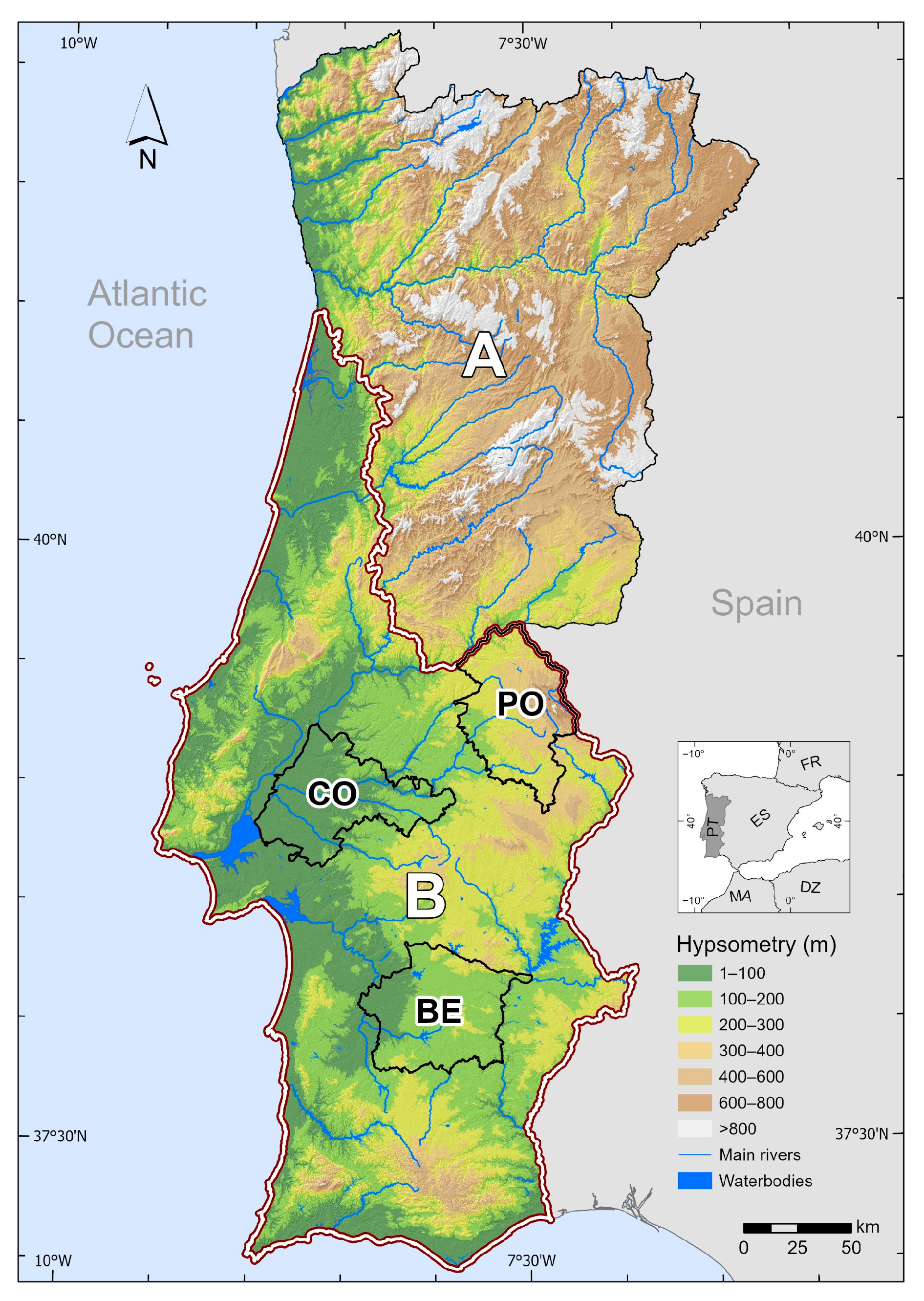
2.1. Study Areas
2.2. Methodological Framework
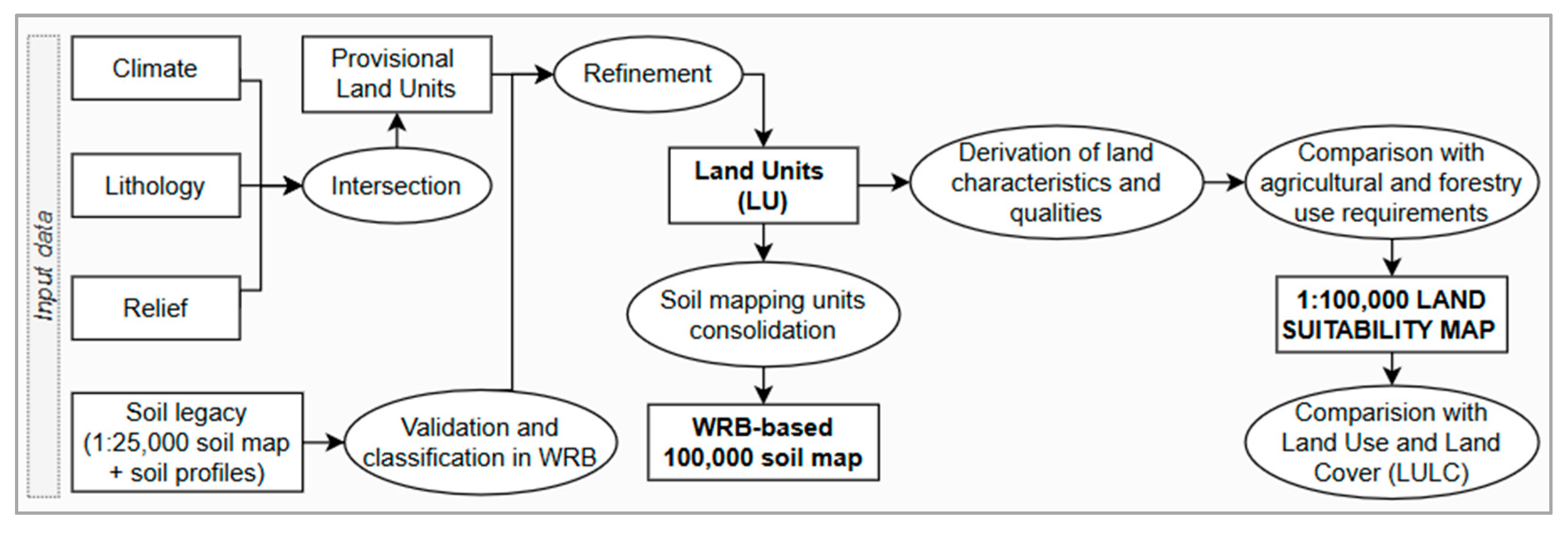
2.2.1. Overall Workflow
2.2.2. Legacy Soil Data
2.2.3. Updated and Harmonised WRB-Based Soil Map
2.2.4. Land Characteristics and Qualities: Limitation Levels
- Temperature regime (t). Mean annual temperature and frost days determined through data on climatological normals (1981–2010) [53].
- Rooting conditions (z). Based on the portion of the profile favourable for root growth and for water and nutrient uptake (effective soil depth). It integrates the A and B horizons and the portion of the C horizon that allows root penetration. For each land unit, the effective soil depth was calculated as the weighted average of the effective depth values of the soil units existing in that land unit. The effective depth for each soil unit was derived from legacy soil profiles by matching their classification to that of the soil unit. This procedure was applied to all land units in the study areas.
- Soil fertility (f). Based on chemical properties related to nutrient retention, particularly cation exchange capacity (CEC at pH 7) and base saturation (Eutric vs. Dystric). For each land unit, CEC and base saturation values were calculated as the weighted average of the values of the soil units existing in that land unit. Values for each soil unit were derived from legacy soil profiles by classification matching. Soil fertility is strongly controlled by the lithological groupings defined for the current project. Three levels of fertility were defined: (i) CEC < 5 cmol·kg−1, mostly Eutric; (ii) 5 ≤ CEC ≤ 10 cmol·kg−1, mostly Eutric; (iii) CEC > 10 cmol·kg−1, Eutric (except Alisols and Acrisols). These thresholds were adopted to maintain consistency with criteria previously established for other regions of Portugal [22,23,24], ensuring a harmonised, national-scale classification of soil fertility.
- Toxicity (x). Considered present only in soils developed on ultramafic rocks, due to high levels of potentially toxic elements (e.g., Ni, Cd) and associated nutrient imbalances. These soils are not representative in the study areas.
- Aeration (drainage) (a). Reflects the frequency and duration of soil water saturation, affecting aeration and plant growth. It was inferred from the WRB Reference Soil Groups and qualifiers and their proportion within each land unit, as well as on the topographic context. For example, Gleysols, Stagnosols, and Planosols show restrictions associated with extended waterlogging.
- Water deficit period (h). The period during which soil water availability is insufficient for plant growth was assessed through a monthly water balance by combining the climatic water balance and soil available water capacity. The climatic water balance was calculated as the difference between precipitation and reference evapotranspiration (ET0), using 1981–2010 climatological normals [53]. Soil available water capacity was estimated for each land unit from the mean effective soil depth and the mean unitary available water capacity (mm cm−1) of the dominant pedological units. In the absence of detailed soil hydraulic measurements, unitary available water capacity values were assigned according to dominant soil texture classes, adjusted for coarse fragments and organic matter content, following [66,67]. Total available water capacity (mm) was then calculated for each homogeneous zone and grouped into standard classes.
- Natural soil erosion risk (e). This limitation describes the potential land sensitivity to soil erosion by water, and its spatial pattern was achieved by using only natural driving forces, that is, climate, soil properties and topography. Then, the potential natural soil loss for each land unit was estimated assuming the absence of vegetation cover and erosion control practices [68,69]. Evaluation of natural soil erosion risk was based on the Revised Universal Soil Loss Equation (RUSLE) [70]:
- Topographic factor (LS): derived from slope inclination and slope length calculated from the DEM [74].
- Carbonate concentration (c). High total carbonate contents, particularly in Bk, BCk, and Ck horizons, can limit root development and reduce the availability of some micronutrients (Zn, Cu, Fe, Mn, B) and phosphorus, especially in soils with low organic matter. Data (up to 50 cm depth) were derived from the proportion of each soil unit within each land unit, being strongly associated with the defined lithological groupings.
- Salinity (s). Caused by soluble salts, it can strongly limit crop and forest growth. Based on available mapping and profile data (e.g., electrical conductivity of saturation extracts or NaCl content), limitation levels were defined for each land unit. Saline soils are mostly associated with estuarine and coastal areas, having negligible representation in the study areas.
- Rock outcrops (d). Proportion of each land unit covered by rock outcrops, which was derived from the 1:25,000 legacy soil map [33].
- Slope inclination (i). Considered as a limiting factor for agricultural and forestry use based on restrictions to machinery operation, livestock movement, field access, cultural practices, and crop transport. Assigned according to the relief unit associated with each land unit. Limitation levels were coded as follows: plains = 1, undulating = 2, strongly sloping = 3, steep = 4.
2.2.5. Land Suitability Assessment Framework
2.2.6. Correspondence with Land Use and Land Cover Map (LULC)
3. Results
3.1. Land Suitability and Study Areas
3.2. Land Suitability and Land Units
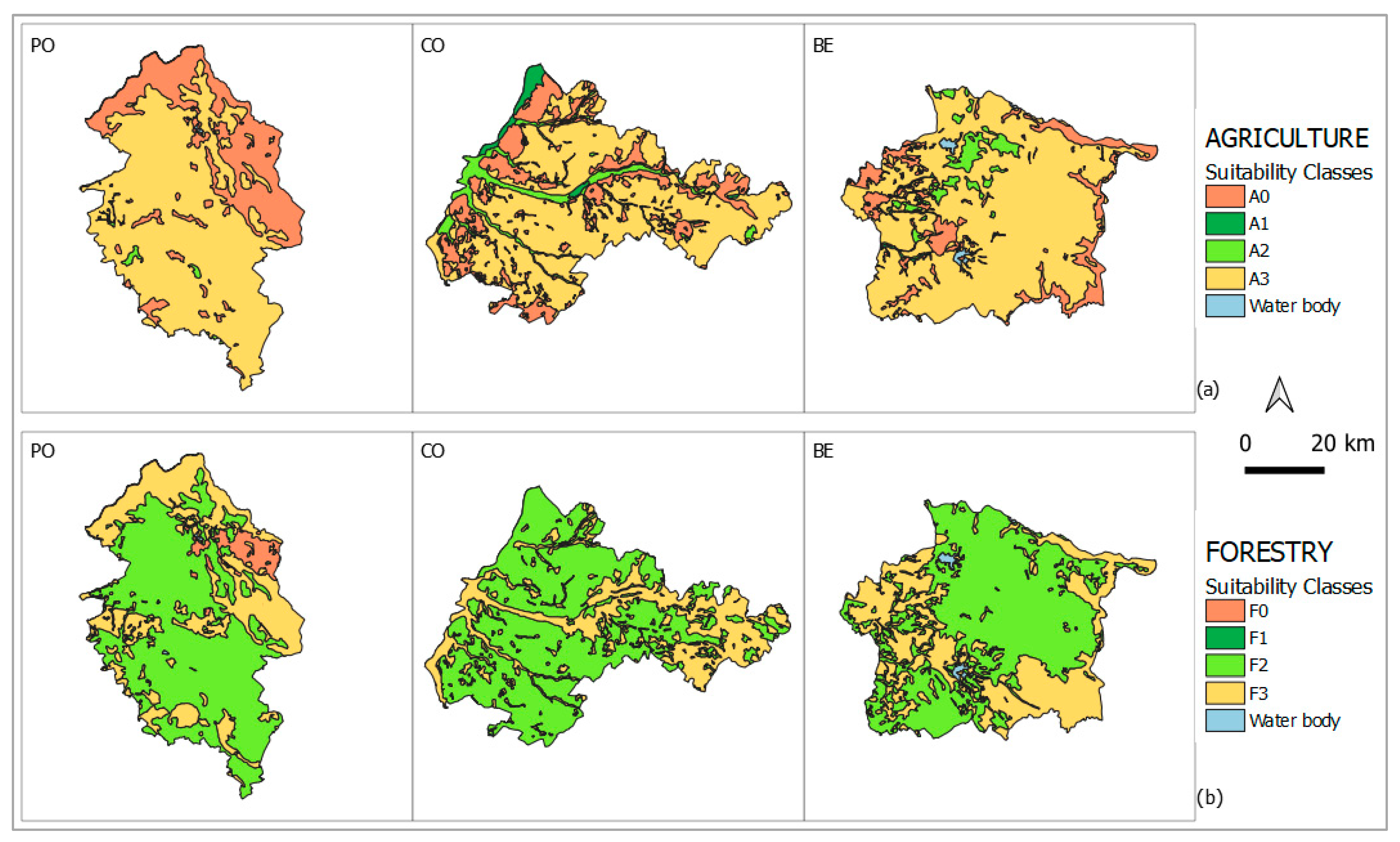
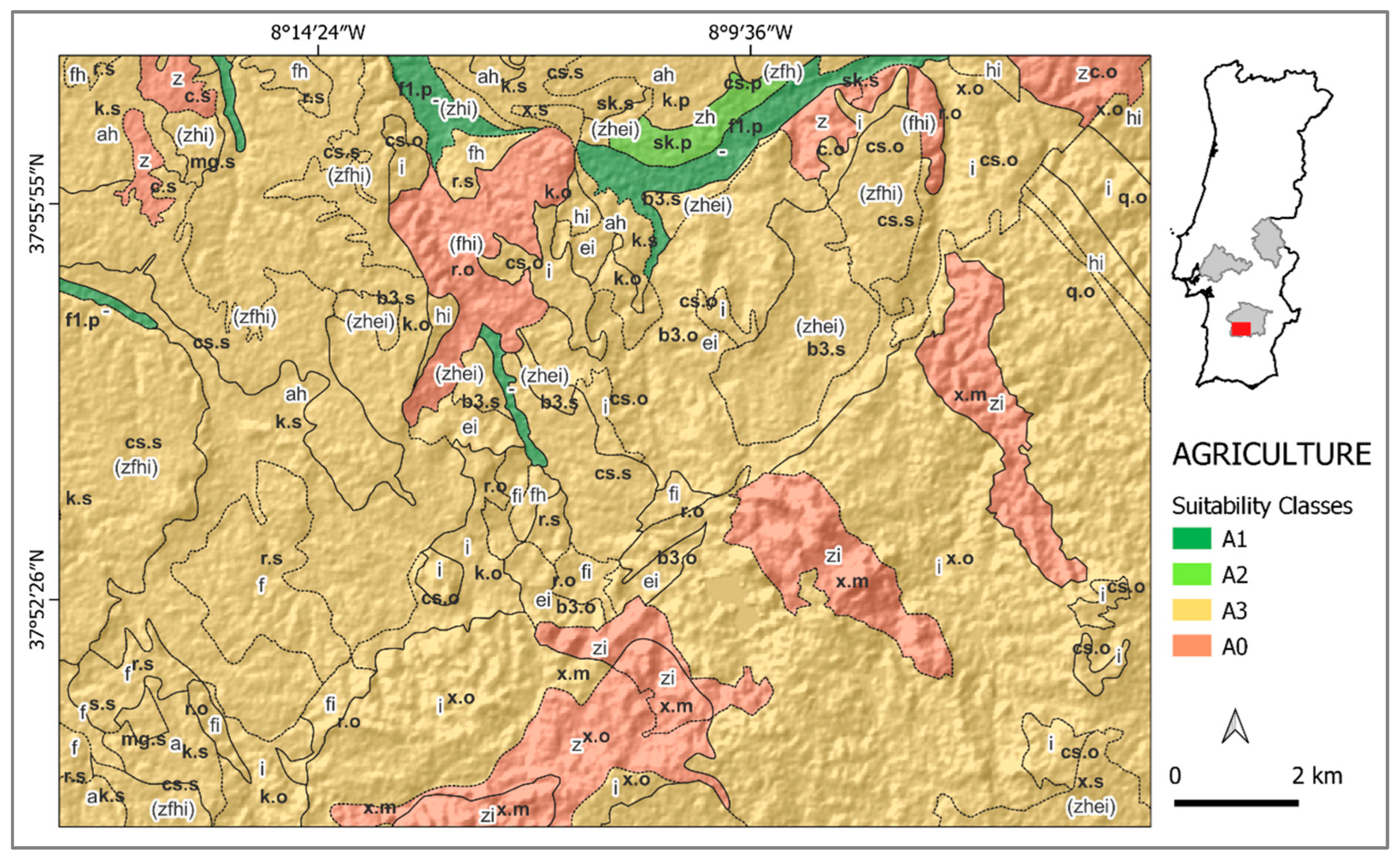
3.2.1. Qualitative Land Suitability Analysis in Each Study Area
3.2.2. Quantitative Land Suitability Analysis for the Combined Study Areas
3.3. Land Use/Land Cover (LULC) and Land Suitability
4. Discussion
4.1. Land Suitability Classes and Land Units
4.2. Land Suitability Subclasses and Land Units
4.3. Land Use/Cover Patterns and Land Suitability
4.4. Policy, Land-Use Planning and Management Implications
4.5. Limitations and Future Research
5. Conclusions
Author Contributions
Funding
Data Availability Statement
Conflicts of Interest
Appendix A

| Climatic Units | Code | MAT (°C) | MATcm (°C) | MATwm (°C) |
|---|---|---|---|---|
| Continental warm land | Q2 | >14 | <10 | >22 |
| Littoral warm land | QL | >16 | >10 | >22 |
| Temperate continental land | T2 | 12.5 ≤ ₸ ≤ 14 | <10 | <22 |
| Rock Type | Lithological Groups | Code | PO (%) | CO (%) a | BE (%) a |
|---|---|---|---|---|---|
| Magmatic | Granites and related rocks | g | 37.0 | 2.6 | 1.5 |
| Diorites and related rocks | d | 0.3 | 0.3 | 11.5 | |
| Mafic rocks | b | 1.9 | 0.1 | 14.5 | |
| Ultramafic rocks | u | 0.2 | <0.1 | 0.1 | |
| Metamorphic | Quartzites, schists and related rocks | q | 5.3 | <0.1 | 13.0 |
| Gneisses and related rocks | n | 7.6 | 0.8 | 1.6 | |
| Schists and related rocks | x | 30.1 | 0.7 | 13.6 | |
| Intermediate-mafic metamorphic rocks | t | 1.5 | 0.4 | 7.1 | |
| Marbles | m | 1.6 | <0.1 | 0.6 | |
| Sedimentary | Arenites | r | 0.4 | 34.6 | 2.8 |
| Conglomerates | l | <0.1 | <0.1 | 0.4 | |
| Sands | a | <0.1 | 14.2 | 2.5 | |
| Alluvium | f | 2.3 | 12.7 | 2.8 | |
| Colluvium and slope deposits | v | 1.8 | 0.5 | 0.4 | |
| Unconsolidated or poorly consolidated arenaceous materials | s | 1.4 | 6.3 | 2.1 | |
| Unconsolidated or poorly consolidated medium-textured materials | sk | <0.1 | 0.3 | 0.4 | |
| Clayey materials | k | 4.3 | 6.7 | 11.0 | |
| Arenaceous materials on sandstones or clayey materials | sr | 0.7 | 18.3 | 0.3 | |
| Gravelly and sandy and/or clayey materials | cs | 2.0 | 0.4 | 6.5 | |
| Non-compact limestones | c | 0.2 | 0.2 | 4.9 | |
| Marls and related rocks | mg | 1.1 | 1.0 | 2.5 |
| Relief Units | Code | MD (%) | IQR | PO (%) a | CO (%) | BE (%) |
|---|---|---|---|---|---|---|
| Steep | m | 10.84 | 2.71 | 25.3 | 5.8 | 8.3 |
| Strongly sloping | o | 7.53 | 2.47 | 41.9 | 37.4 | 35.4 |
| Undulating | s | 4.58 | 0.67 | 31.2 | 41.3 | 43.7 |
| Plains | p | 3.12 | 0.38 | 1.6 | 15.5 | 12.6 |
| Land Quality | Symbol | Units | Levels | |||
|---|---|---|---|---|---|---|
| 1 | 2 | 3 | 4 | |||
| Temperature regime | t | °C | >12.5 | 10.5–12.5 | <10.5 | - |
| Rooting conditions | z | cm | >100 | 100–50 | 50–25 | <25 |
| Soil fertility | f | cmolc kg−1 | >10 | 10–5 | <5 | - |
| Toxicity * | x | - | absent | present | - | - |
| Aeration (drainage) | a | month | <1 | 1–2 | 2–3 | >3 |
| Water deficit period | h | month | <5 | 5–6 | 6–7 | > 7 |
| Natural soil erosion risk—agriculture | ea | t ha−1 yr−1 | <10 | 10–25 | 25–50 | >50 |
| Natural soil erosion risk—forestry | ef | t ha−1 yr−1 | <50 | 50–100 | >100 | - |
| Carbonate concentration | c | % | <2 | 2–25 | 25–45 | >45 |
| Salinity | s | dS m−1 | <4 | 4–16 | >16 | - |
| Rock outcrops | d | % | <20 | 20–50 | 50–70 | >70 |
| Slope inclination | i | % | <5 | 5–10 | 10–25 | >25 |

References
- FAO; ITPS. Status of the World’s Soil Resources (SWSR)—Main Report; Food and Agriculture Organization of the United Nations; Intergovernmental Technical Panel on Soils: Rome, Italy, 2015; 650p, Available online: http://www.fao.org/3/a-i5199e.pdf (accessed on 3 November 2025).
- FAO. Land & Water: Land; FAO: Rome, Italy, 2025; Available online: https://www.fao.org/land-water/land/en/ (accessed on 3 November 2025).
- Stavi, I.; Lal, R. Achieving zero net land degradation: Challenges and opportunities. J. Arid Environ. 2015, 112, 44–51. [Google Scholar] [CrossRef]
- Intergovernmental Science-Policy Platform on Biodiversity and Ecosystem Services (IPBES). Summary for Policymakers of the Assessment Report on Land Degradation and Restoration; Scholes, R., Montanarella, L., Brainich, A., Barger, N., ten Brink, B., Cantele, M., Erasmus, B., Fisher, J., Gardner, T., Holland, T.G., et al., Eds.; IPBES Secretariat: Bonn, Germany, 2018; p. 44. [Google Scholar]
- FAO. Guidelines for Soil Description, 4th ed.; Jahn, R., Blume, H.-P., Asio, V.B., Spaargaren, O., Schad, P., Eds.; FAO: Rome, Italy, 2006. [Google Scholar]
- United Nations Environment Programme (UNEP). Land Degradation: Our Work with the Global Environment Facility; UNEP: Nairobi, Kenya, 2024; Available online: https://www.unep.org/gef/focal-areas/land-degradation (accessed on 3 November 2025).
- Mairota, P.; Thornes, J.B.; Geeson, N. (Eds.) Atlas of Mediterranean Environments in Europe: The Desertification Context; John Wiley & Sons: Chichester, UK, 1997. [Google Scholar]
- Ferreira, C.S.S.; Seifollahi-Aghmiuni, S.; Destouni, G.; Ghajarnia, N.; Kalantari, Z. Soil degradation in the European Mediterranean region: Processes, status and consequences. Sci. Total Environ. 2022, 805, 150106. [Google Scholar] [CrossRef] [PubMed]
- Miranda, P.; Santos, F.D. (Eds.) Alterações Climáticas em Portugal: Cenários, Impactos e Medidas de Adaptação—Projecto SIAM II; Gradiva: Lisbon, Portugal, 2006. [Google Scholar]
- Rubio, J.L.; Safriel, U.; Daussa, R.; Pedrazzini, F. Water Scarcity, Land Degradation and Desertification in the Mediterranean Region: Environmental and Security Aspects; NATO Science for Peace and Security Series C: Environmental Security; Springer: Dordrecht, The Netherlands, 2009. [Google Scholar] [CrossRef]
- Seager, R.; Osborn, T.J.; Kushnir, Y.; Simpson, I.R.; Nakamura, J.; Liu, H. Climate Variability and Change of Mediterranean-Type Climates. J. Clim. 2019, 32, 2887–2915. [Google Scholar] [CrossRef]
- Klingebiel, A.A.; Montgomery, P.H. Land Capability Classification; Agriculture Handbook No. 210; U.S. Department of Agriculture, Soil Conservation Service: Washington, DC, USA, 1961. [Google Scholar]
- FAO. A Framework for Land Evaluation; Soil Bulletin 32; FAO: Rome, Italy, 1976. [Google Scholar]
- FAO. Land Evaluation: Towards a Revised Framework; Land and Water Discussion Paper 6; FAO: Rome, Italy, 2007. [Google Scholar]
- Fischer, G.; Nachtergaele, F.O.; van Velthuizen, H.T.; Chiozza, F.; Franceschini, G.; Henry, M.; Muchoney, D.; Tramberend, S. Global Agro-Ecological Zones v4—Model Documentation; FAO: Rome, Italy, 2021. [Google Scholar]
- Panagopoulos, T.; González Duque, J.A.; Bostenaru Dan, M. Urban Planning with Respect to Environmental Quality and Human Well-Being. Environ. Pollut. 2016, 208, 137–144. Available online: http://hdl.handle.net/10400.1/9781 (accessed on 3 November 2025). [CrossRef]
- De Sousa Silva, C.; Viegas, I.; Panagopoulos, T.; Bell, S. Environmental justice in accessibility to green infrastructure in two European cities. Land 2018, 7, 134. [Google Scholar] [CrossRef]
- Rossiter, D.G. A Theoretical Framework for Land Evaluation. Geoderma 1996, 72, 165–190. [Google Scholar] [CrossRef]
- United Nations Convention to Combat Desertification (UNCCD). Zero Net Land Degradation: A Sustainable Development Goal for Rio+20; UNCCD: Bonn, Germany, 2012; Available online: https://digitallibrary.un.org/record/749649/files/UNCCDPolicyBriefZeroNetLandDegradation_9402.pdf (accessed on 3 November 2025).
- United Nations Convention to Combat Desertification (UNCCD). Land Degradation Neutrality: A Strategic Framework for No-Net-Loss of Healthy and Productive Land; UNCCD: Bonn, Germany, 2015; Available online: https://portals.iucn.org/library/sites/library/files/documents/Rep-2015-022.pdf (accessed on 3 November 2025).
- United Nations (UN). Transforming Our World: The 2030 Agenda for Sustainable Development; United Nations: New York, NY, USA, 2015; Available online: https://sdgs.un.org/2030agenda (accessed on 3 November 2025).
- Agroconsultores & Coba. Carta dos Solos, Carta do Uso Actual da Terra e Carta da Aptidão da Terra do Nordeste de Portugal, Escala 1:100,000 (Soil Map, Current Land Use Map and Land Suitability Map of Northeast Portugal, Scale 1:100,000); Projecto de Desenvolvimento Rural Integrado de Trás-os-Montes; Universidade de Trás-os-Montes e Alto Douro: Vila Real, Portugal, 1991; 311p. [Google Scholar]
- Agroconsultores & Geometral. Carta dos Solos e Carta de Aptidão para a Agricultura em Entre Douro e Minho, Escala 1:100 000. Memórias (Soil Map and Land Suitability Map for Agriculture in Entre Douro e Minho, Scale 1:100,000. Report); Direção Regional da Agricultura de Entre Douro e Minho: Porto, Portugal, 1995; 304p. [Google Scholar]
- Agroconsultores & Geometral. Elaboração da Carta dos Solos e de Aptidão das Terras da Zona Interior Centro—Memória (Development of the Soil and Land Suitability Maps of the Interior Centre Region—Report); Ministério da Agricultura, Pescas e Florestas, Instituto de Desenvolvimento Rural e Hidráulica: Lisboa, Portugal, 2004. [Google Scholar]
- FAO. FAO–UNESCO Soil Map of the World: Revised Legend; World Soil Resources Reports; FAO: Rome, Italy, 1988. [Google Scholar]
- FAO. World Reference Base for Soil Resources; World Soil Resources Reports No. 84; Food and Agriculture Organization of the United Nations: Rome, Italy, 1998. [Google Scholar]
- Zonneveld, I.S. The land unit: A fundamental concept in landscape ecology, and its applications. Land Ecol. 1989, 3, 67–86. [Google Scholar] [CrossRef]
- Zonneveld, I.S. Land Ecology: An Introduction to Landscape Ecology as a Base for Land Evaluation, Land Management and Conservation; SPB Academic Publishing: Amsterdam, The Netherlands, 1995. [Google Scholar]
- Blasi, C.; Zavattero, L.; Marignani, M.; Smiraglia, D.; Copiz, R.; Rosati, L.; Del Vico, E. The concept of land ecological network and its design using land unit approach. Plant Biosyst. 2008, 142, 540–549. [Google Scholar] [CrossRef]
- FAO. Guidelines: Land Evaluation for Rainfed Agriculture; FAO Soils Bulletin No. 52; FAO: Rome, Italy, 1983. [Google Scholar]
- Ministry of Agriculture and the Sea. Decree-Law No. 199/2015 of 16 September, Introducing the First Amendment to Decree-Law No. 73/2009 of 31 March, Which Establishes the Legal Framework of the National Agricultural Reserve. Diário da República, No. 181/2015, Series I, pp. 8123–8140. Available online: https://dre.pt/dre/detalhe/decreto-lei/199-2015-612437 (accessed on 13 January 2026).
- Serviço de Reconhecimento e Ordenamento Agrário (SROA). Carta de Capacidade de Uso do Solo de Portugal: Bases e Normas Adoptadas na Sua Elaboração. Boletim de Solos do SROA 1972, Volume 12, pp. 1–195. Available online: https://www.dgadr.gov.pt/pt/mediateca/category/48-solos-e-cartografia (accessed on 26 January 2026).
- Serviço de Reconhecimento e Ordenamento Agrário (SROA). Carta dos Solos de Portugal. Classificação e Caracterização dos Solos de Portugal: Dados Analíticos das Unidades Pedológicas, 6th ed.; Serviço de Reconhecimento e Ordenamento Agrário: Lisboa, Portugal, 1973; Volume 2. Available online: https://www.dgadr.gov.pt/pt/mediateca/category/48-solos-e-cartografia (accessed on 26 January 2026).
- Arrouays, D.; McBratney, A.B.; Bouma, J.; Libohova, Z.; Richer-de-Forges, A.C.; Morgan, C.; Roudier, P.; Poggio, L.; Mulder, V.L. Impressions of digital soil maps: The good, the not so good, and making them ever better. Geoderma Reg. 2020, 20, e00255. [Google Scholar] [CrossRef]
- IDRHa; SPCS. Bases Para a Revisão e Atualização da Classificação dos Solos de Portugal; Sociedade Portuguesa da Ciência do Solo: Lisbon, Portugal, 2004. [Google Scholar]
- Guerreiro, S.; Arsénio, P.; Florentino, V.; Madeira, M. Operational Harmonisation of Soil Maps in Portugal Using Legacy Data and WRB Classification. Geoderma Reg. 2026. submitted. [Google Scholar]
- IUSS Working Group WRB. World Reference Base for Soil Resources: International Soil Classification System for Naming Soils and Creating Legends for Soil Maps, 4th ed.; International Union of Soil Sciences (IUSS): Vienna, Austria, 2022. [Google Scholar]
- FAO. Guidelines: Land Evaluation for Irrigated Agriculture; FAO Soils Bulletin No. 55; FAO: Rome, Italy, 1985. [Google Scholar]
- Lopes, R.P.; Madeira, M.; Arsénio, P. Mapping of Land Units and Land Capability Classification in Portugal: The Case of the Municipality of Lourinhã. Finisterra 2018, 52, 103–127. [Google Scholar] [CrossRef]
- Dornik, A.; Cheţan, M.A.; Crișan, T.E.; Heciko, R.; Gora, A.; Drăguţ, L.; Panagos, P. Geospatial evaluation of the agricultural suitability and land use compatibility in Europe’s temperate continental climate region. Int. Soil Water Conserv. Res. 2024, 12, 908–919. [Google Scholar] [CrossRef]
- Abd-Elmabod, S.K.; Bakr, N.; Muñoz-Rojas, M.; Pereira, P.; Zhang, Z.; Cerdà, A.; Jordán, A.; Mansour, H.; De la Rosa, D.; Jones, L. Assessment of Soil Suitability for Improvement of Soil Factors and Agricultural Management. Sustainability 2019, 11, 1588. [Google Scholar] [CrossRef]
- AbdelRahman, M.A.E.; Saleh, A.M.; Arafat, S.M. Assessment of land suitability using a soil-indicator-based approach in a geomatics environment. Sci. Rep. 2022, 12, 18113. [Google Scholar] [CrossRef]
- Bilas, G.; Karapetsas, N.; Gobin, A.; Mesdanitis, K.; Tóth, G.; Hermann, T.; Wang, Y.; Luo, L.; Koutsos, T.M.; Moshou, D.; et al. Land Suitability Analysis as a Tool for Evaluating Soil-Improving Cropping Systems. Land 2022, 11, 2200. [Google Scholar] [CrossRef]
- Zhu, X.; Xiao, G.; Wang, S. Suitability Evaluation of Potential Arable Land in the Mediterranean Region. J. Environ. Manag. 2022, 313, 115011. [Google Scholar] [CrossRef]
- Karapetsas, N.; Gobin, A.; Bilas, G.; Koutsos, T.M.; Pavlidis, V.; Katragkou, E.; Alexandridis, T.K. Analysis of Land Suitability for Maize Production under Climate Change and Its Mitigation Potential through Crop Residue Management. Land 2024, 13, 63. [Google Scholar] [CrossRef]
- Nabiollahi, K.; Kebonye, N.M.; Molani, F.; Tahari-Mehrjardi, M.H.; Taghizadeh-Mehrjardi, R.; Shokati, H.; Scholten, T. Assessment of Land Suitability Potential Using Ensemble Approaches of Advanced Multi-Criteria Decision Models and Machine Learning for Wheat Cultivation. Remote Sens. 2024, 16, 2566. [Google Scholar] [CrossRef]
- Patriche, C.V.; Roșca, B.; Pîrnău, R.G.; Vasiliniuc, I.; Irimia, L.M. Digital Mapping of Land Suitability for Main Agricultural Crops in Romania. Agronomy 2024, 14, 2828. [Google Scholar] [CrossRef]
- Directorate-General for the Territory (DGT). Land Use and Land Cover Map of Mainland Portugal (COS 2023); DGT: Lisbon, Portugal, 2025. Available online: https://snig.dgterritorio.gov.pt (accessed on 3 November 2025).
- Lotze, F. Zur Gliederung der Varisziden der Iberischen Meseta. In Geotektonische Forschungen; Schweizerbart’sche Verlagsbuchhandlung: Stuttgart, Germany, 1945; Volume 6, pp. 78–92. [Google Scholar]
- Quesada, C. Geología de la Zona Suroeste de la Península Ibérica: Geodinámica y Evolución de la Corteza en la Orogenia Varisca; Ediciones de la Universidad Autónoma de Madrid: Madrid, Spain, 1992. [Google Scholar]
- Feio, M. O Relevo de Portugal: Grandes Unidades Regionais. In Geomorfologia de Portugal; Feio, M., Daveau, S., Eds.; Associação Portuguesa de Geomorfólogos: Coimbra, Portugal, 2004; Volume 2, pp. 21–32. [Google Scholar]
- Ferreira, B. Geomorfologia do Maciço Antigo. In Geografia de Portugal; Chapter 2; Medeiros, C.A., Ed.; Círculo de Leitores: Lisboa, Portugal, 2005; pp. 82–83. [Google Scholar]
- Instituto Português do Mar e da Atmosfera (IPMA). Portuguese Institute for Sea and Atmosphere. Available online: https://www.ipma.pt/en (accessed on 26 September 2024).
- Guerreiro, S.; Arsénio, P.; Florentino, V.; Madeira, M. Updating legacy soil maps through digital delineation of homogeneous land units based on soil formation factors: Experiences from Portugal. Catena 2025, 258, 109275. [Google Scholar] [CrossRef]
- QGIS Development Team. QGIS Geographic Information System, Version 3.22.16; Open-Source Geospatial Foundation: Beaverton, OR, USA, 2024. Available online: https://qgis.org (accessed on 17 November 2025).
- Dent, D.; Young, A. Soil Survey and Land Evaluation; George Allen & Unwin: London, UK, 1981. [Google Scholar]
- McKenzie, N.; Grundy, M.; Webster, R.; Ringrose-Voase, A. Guidelines for Surveying Soil and Land Resources; CSIRO Publishing: Collingwood, Australia, 2008. [Google Scholar] [CrossRef]
- FAO. The State of the World’s Land and Water Resources for Food and Agriculture—Systems at Breaking Point; Main Report; FAO: Rome, Italy, 2022. [Google Scholar] [CrossRef]
- Engelen, V.W.P.; Dijshoorn, J.A. (Eds.) Procedures Manual; Version 2.0; ISRIC—World Soil Information: Wageningen, The Netherlands, 2013. [Google Scholar]
- Gray, J.M.; Bishop, T.F.A.; Wilford, J.R. Lithology and soil relationships for soil modelling and mapping. Catena 2016, 147, 429–440. [Google Scholar] [CrossRef]
- Hammond, E.H. Small-scale continental landform maps. Ann. Assoc. Am. Geogr. 1954, 44, 33–42. [Google Scholar] [CrossRef]
- Hammond, E.H. Analysis of properties in landform geography: An application to broad-scale landform mapping. Ann. Assoc. Am. Geogr. 1964, 54, 11–19. [Google Scholar] [CrossRef]
- Hammond, E.H. Classes of land-surface form in the forty-eight states, U.S.A. Ann. Assoc. Am. Geogr. 1964, 54. [Google Scholar]
- Morgan, J.M.; Lesh, A.M. Developing Landform Maps Using ESRI’s ModelBuilder; ESRI: Redlands, CA, USA, 2005. [Google Scholar]
- Madeira, M.; Guerreiro, S.; Arsénio, P.; Florentino, V. Converting the Genetic-Based National Soil Classification into WRB: A Challenge for Updating Soil Mapping in Portugal. SSRN 2025. [Google Scholar] [CrossRef]
- FAO. Soil Survey Investigations for Irrigation; FAO Soils Bulletin No. 42; FAO: Rome, Italy, 1979. [Google Scholar]
- Allen, R.G.; Pereira, L.S.; Raes, D.; Smith, M. Crop Evapotranspiration (Guidelines for Computing Crop Water Requirements); FAO Irrigation and Drainage Paper 56; FAO: Rome, Italy, 1998. [Google Scholar]
- Grimm, M.; Jones, R.J.A.; Montanarella, L. Soil Erosion Risk in Europe; European Soil Bureau, Institute for Environment and Sustainability, JRC: Ispra, Italy, 2002. [Google Scholar]
- Bueno, C.R.P.; Stein, D.P. Potencial natural e antrópico de erosão na região de Brotas, Estado de São Paulo. Acta Sci. 2005, 26, 1–5. [Google Scholar] [CrossRef]
- Renard, K.G.; Foster, G.R.; Weesies, G.A.; Porter, J. RUSLE: Revised universal soil loss equation. J. Soil Water Conserv. 1991, 46, 30–33. [Google Scholar] [CrossRef]
- Tomás, P.P.; Coutinho, M.A. Estudo da erosão hídrica em solos agrícolas: Comparação da perda de solo observada e calculada pela Equação Universal de Perda de Solo. Recur. Hídricos 1994, 15, 3–17. [Google Scholar]
- Ferreira, L.M.C.A. Avaliação da Erosão Hídrica Potencial dos Solos à Escala da Unidade de Produção Florestal com Utilização de um Sistema de Informação Geográfica. Master’s Thesis, Universidade de Évora, Évora, Portugal, 2014. [Google Scholar]
- Panagos, P.; Meusburger, K.; Ballabio, C.; Borrelli, P.; Alewell, C. Soil erodibility in Europe: A high-resolution dataset based on LUCAS. Sci. Total Environ. 2014, 479–480, 189–200. [Google Scholar] [CrossRef]
- Reis, E.; Pena, S.; DGT; APA. Áreas de Elevado Risco de Erosão Hídrica do Solo: Cálculo do Factor Topográfico (LS); Guias de Apoio à Delimitação da REN; Comissão Nacional do Ambiente, Direção-Geral do Território: Lisbon, Portugal, 2020. [Google Scholar]
- Merchán, L.; Martínez-Graña, A.M.; Rojo, P.A.; Criado, M. Water erosion risk analysis in the Arribes del Duero Natural Park (Spain) using RUSLE and GIS techniques. Sustainability 2023, 15, 1627. [Google Scholar] [CrossRef]
- Arnoldus, H.J. Predicting soil losses due to sheet and rill erosion. In Guidelines for Watershed Management; FAO, Ed.; FAO: Rome, Italy, 1977; pp. 99–124. [Google Scholar]
- Weil, R.; Brady, N.C. The Nature and Properties of Soils, 15th ed.; Pearson Education: London, UK, 2017. [Google Scholar]
- Vacca, A.; Loddo, S.; Melis, M.T.; Funedda, A.; Puddu, R.; Verona, M.; Fanni, S.; Fantola, F.; Madrau, S.; Marrone, V.A.; et al. A GIS based method for soil mapping in Sardinia, Italy: A geomatic approach. J. Environ. Manag. 2014, 138, 87–96. [Google Scholar] [CrossRef]
- Irawan, L.Y.; Prasetyo, W.E.; Devy, M.M.R.; Ditian, D. Geomorphological mapping for land suitability evaluation. KnE Soc. Sci. 2022, 7, 259–274. [Google Scholar] [CrossRef]
- Zhong, F.; Xu, X.; Li, Z.; Zeng, X.; Yi, R.; Luo, W.; Zhang, Y.; Xu, C. Relationships between Lithology, Topography, Soil, and Vegetation, and Their Implications for Karst Vegetation Restoration. Catena 2022, 209, 105831. [Google Scholar] [CrossRef]
- Quinta-Nova, L.C. GIS-Based Approach to Analyse the Relationship between Land Units and Land Use in the Central Region of Portugal. Inżynieria Miner. 2024, 53, 621–628. [Google Scholar] [CrossRef]
- Trenti, W.; De Feudis, M.; Gherardi, M.; Vianello, G.; Vittori Antisari, L. Land Unit Delineation Based on Soil-Forming Factors: A Tool for Soil Survey in Mountainous Protected Areas. Land 2025, 14, 1683. [Google Scholar] [CrossRef]
- Sala, M. Mediterranean Landscapes. In Geomorphology and Global Environmental Change; Slaymaker, O., Spencer, T., Embleton-Hamann, C., Eds.; Cambridge University Press: Cambridge, UK, 2009; pp. 297–320. [Google Scholar]
- Terres, J.-M.; Tóth, T.; Wania, A.; Hagyó, A.; Koeble, R.; Nisini, L. Updated Guidelines for Applying Common Criteria to Identify Agricultural Areas with Natural Constraints. European Commission, Joint Research Centre. 2016. Available online: https://publications.jrc.ec.europa.eu/repository/handle/JRC101711 (accessed on 13 January 2026).
- Driessen, P.; Deckers, J.; Spaargaren, O.; Nachtergaele, F. (Eds.) Lecture Notes on the Major Soils of the World; World Soil Resources Reports No. 94; FAO: Rome, Italy, 2001. [Google Scholar]
- Portuguese Government. Decree-Law No. 166/2008 of 22 August Approving the Legal Framework of the National Ecological Reserve and Repealing Decree-Law No. 93/90 of 19 March. Diário da República, 1st Series, No. 161, Portugal. 2008. Available online: https://files.dre.pt/1s/2008/08/16200/0586505884.pdf (accessed on 3 November 2025).
- Binkley, D.; Fisher, R.F. Ecology and Management of Forest Soils; Wiley-Blackwell: Oxford, UK, 2013. [Google Scholar]
- Robl, J.; Dremel, F.; Stüwe, K.; Hergarten, S.; von Hagke, C.; Fabel, D. Old orogen–young topography: Lithological contrasts controlling erosion and relief formation in the Bohemian Massif. Earth Surf. Dyn. 2025, 13, 745–770. [Google Scholar] [CrossRef]
- Costa, A.; Madeira, M.; Oliveira, A. Influence of Soil Types, Slope and Drainage on Tree Density and Cork Yield in a Cork Woodland in Southern Portugal. For. Ecol. Manag. 2008, 255, 591–597. [Google Scholar] [CrossRef][Green Version]
- Madeira, M.; Raimundo, F.; Rodrigues, A.R.; Martins, A.; Fabião, A.; Soares, P. Soil Health in Forest and Agroforestry Systems in Portugal. In Soil Health and Sustainability in Spain and Portugal; Soil Health Series; Virto, I., Antón, R., Eds.; Soil Science Society of America, Inc.: Madison, WI, USA; John Wiley & Sons, Inc.: Hoboken, NJ, USA, 2025; Volume 5, pp. 257–300. [Google Scholar] [CrossRef]
- Taghizadeh-Mehrjardi, R.; Nabiollahi, K.; Rasoli, L.; Kerry, R.; Scholten, T. Land Suitability Assessment and Agricultural Production Sustainability Using Machine Learning Models. Agronomy 2020, 10, 573. [Google Scholar] [CrossRef]
- Seneviratne, S.I.; Corti, T.; Davin, E.L.; Hirschi, M.; Jaeger, E.B.; Lehner, I.; Orlowsky, B.; Teuling, A.J. Investigating soil moisture–climate interactions in a changing climate: A review. Earth-Sci. Rev. 2010, 99, 125–161. [Google Scholar] [CrossRef]
- Costa, J.M.; Egipto, R.; Aguiar, F.C.; Marques, P.; Nogales, A.; Madeira, M. The role of soil temperature in Mediterranean vineyards in a climate change context. Front. Plant Sci. 2023, 14, 1145137. [Google Scholar] [CrossRef]
- Soares, D.; Paredes, P.; Paço, T.A.; Rolim, J. Projected Bioclimatic Changes in Portugal: Assessing Maize Future Suitability. Agronomy 2025, 15, 592. [Google Scholar] [CrossRef]
- Vizinho, A.; Avelar, D.; Branquinho, C.; Capela Lourenço, T.; Carvalho, S.; Nunes, A.; Sucena-Paiva, L.; Oliveira, H.; Fonseca, A.L.; Duarte Santos, F.; et al. Framework for Climate Change Adaptation of Agriculture and Forestry in Mediterranean Climate Regions. Land 2021, 10, 161. [Google Scholar] [CrossRef]
- Mauri, A.; Girardello, M.; Strona, G.; San-Miguel-Ayanz, J. EU-Trees4F, a dataset on the future distribution of European tree species. Sci. Data 2022, 9, 37. [Google Scholar] [CrossRef]
- Adão, F.; Campos, J.C.; Santos, J.A.; Malheiro, A.C.; Fraga, H. Relocation of bioclimatic suitability of Portuguese grapevine varieties under climate change scenarios. Front. Plant Sci. 2023, 14, 974020. [Google Scholar] [CrossRef] [PubMed]
- Garzón, M.B.; Sánchez de Ríos, R.; Sainz Ollero, H. Effects of climate change on the distribution of Iberian tree species. Appl. Veg. Sci. 2008, 11, 169–178. [Google Scholar] [CrossRef]
- Santos, J.A.; Fraga, H.; Malheiro, A.C.; Moutinho-Pereira, J.; Dinis, L.-T.; Correia, C.; Moriondo, M.; Leolini, L.; Dibari, C.; Costafreda-Aumedes, S.; et al. A Review of the Potential Climate Change Impacts and Adaptation Options for European Viticulture. Appl. Sci. 2020, 10, 3092. [Google Scholar] [CrossRef]
- Mechergui, K.; Altamimi, A.S.; Jaouadi, W.; Naghmouchi, S.; Ammari, Y. Effect of Climate Change on the Spatial Distribution and Cork Production of Quercus suber L., the Risk of Exclusion by the Aleppo Pine Expansion, and Management Practices to Protect Q. suber Habitat: A Review. Not. Bot. Horti Agrobo. 2021, 49, 12218. [Google Scholar] [CrossRef]
- Morán-Alonso, N.; Viedma-Guiard, A.; Simón-Rojo, M.; Córdoba-Hernández, R. Agricultural Land Suitability Analysis for Land Use Planning: The Case of the Madrid Region. Land 2025, 14, 134. [Google Scholar] [CrossRef]
- Bastin, G.; Deann, N.; Keith, B. Land evaluation: Towards a review of the concept and an integrated framework. Soil Tillage Res. 1993, 27, 428–429. [Google Scholar] [CrossRef]
- Burrough, P.A.; McDonnell, R.A. Principles of Geographical Information Systems; Oxford University Press: Oxford, UK, 1998. [Google Scholar]
- Schneider, J.M.; Zabel, F.; Mauser, W. Global inventory of suitable, cultivable and available cropland under different scenarios and policies. Sci. Data 2022, 9, 527. [Google Scholar] [CrossRef]
- Lambin, E.F.; Turner, B.L.; Geist, H.J.; Agbola, S.B.; Angelsen, A.; Bruce, J.W.; Coomes, O.T.; Dirzo, R.; Fischer, G.; Folke, C.; et al. The Causes of Land-Use and Land-Cover Change: Moving beyond the Myths. Glob. Environ. Change 2001, 11, 261–269. [Google Scholar] [CrossRef]
- Gómez-Rey, M.X.; Garcês, A.; Madeira, M. Soil Organic Carbon Accumulation and N Availability Determined by Improved Pastures in Oak Woodlands in Southern Portugal. Soil Use Manag. 2013, 29, 15–23. [Google Scholar] [CrossRef]
- Lisec, U.; Prevolnik Povše, M.; Gselman, A.; Kramberger, B. Sustainable grassland-management systems and their effects on the physicochemical properties of soil. Plants 2024, 13, 838. [Google Scholar] [CrossRef] [PubMed]
- Carrascosa, A.; Moreno, G.; Cotrufo, M.F.; Frade, C.; Rodrigo, S.; Rolo, V. Improved management increases soil mineral-protected organic carbon storage via plant-microbial-nutrient mediation in semi-arid grasslands. Soil 2025, 11, 911–937. [Google Scholar] [CrossRef]
- Costa, A.; Madeira, M.; Lima-Santos, J. Is Cork Oak (Quercus suber L.) Woodland Loss Driven by Eucalyptus Plantation? A Case-Study in Southwestern Portugal. Iforest-Biogeosciences For. 2014, 7, 193–203. [Google Scholar] [CrossRef]
- FAO. Montado Agrosilvopastoral System of the Serpa Hills, Portugal. Globally Important Agricultural Heritage Systems (GIAHS); FAO: Rome, Italy, 2025; Available online: https://www.fao.org/giahs/giahs-around-the-world/portugal-montado-serpa (accessed on 9 January 2026).
- Maraseni, T.N.; Cockfield, G. Crops, cows or timber? Including carbon values in land use choices. Agric. Ecosyst. Environ. 2011, 140, 280–288. [Google Scholar] [CrossRef]
- Bilande, K.; Veipane, U.D.; Nipers, A.; Pilvere, I. A Framework for Profitability-Focused Land Use Transitions Between Agriculture and Forestry: A Case Study of Latvia. Land 2026, 15, 204. [Google Scholar] [CrossRef]
- Xie, Q.; Han, Y.; Zhang, L.; Han, Z. Dynamic Evolution of Land Use/Land Cover and Its Socioeconomic Driving Forces in Wuhan, China. Int. J. Environ. Res. Public Health 2023, 20, 3316. [Google Scholar] [CrossRef]
- Chiriacò, M.V.; Dămătîrcă, C.; Abd Alla, S.; Barilari, S.; Aleu, R.B.; Brazzini, T.; Lourenço, T.C.; de Carolis Villars, C.A.; Durand, S.; Di Lallo, G. A catalogue of land-based adaptation and mitigation solutions to tackle climate change. Sci. Data 2025, 12, 166. [Google Scholar] [CrossRef]
- Paul, M.; Negahban-Azar, M.; Shirmohammadi, A.; Montas, H. Assessment of Agricultural Land Suitability for Irrigation with Reclaimed Water Using Geospatial Multi-Criteria Decision Analysis. Agric. Water Manag. 2020, 231, 105987. [Google Scholar] [CrossRef]
- European Union. Regulation (EU) 2021/2115 of the European Parliament and of the Council of 2 December 2021 establishing rules on support for strategic plans to be drawn up by Member States under the Common Agricultural Policy (CAP Strategic Plans) and financed by the European Agricultural Guarantee Fund (EAGF) and by the European Agricultural Fund for Rural Development (EAFRD). Off. J. Eur. Union 2021, L435, 1–186. Available online: https://eur-lex.europa.eu/eli/reg/2021/2115/oj/eng (accessed on 3 November 2025).
- Chasek, P.; Safriel, U.; Shikongo, S.; Fuhrman, V.F. Operationalizing Zero Net Land Degradation: The next stage in international efforts to combat desertification? J. Arid Environ. 2015, 112, 5–13. [Google Scholar] [CrossRef]
- European Union. Directive (EU) 2025/2360 of the European Parliament and of the Council of 12 November 2025 on soil monitoring and resilience (Soil Monitoring Directive). Off. J. Eur. Union 2025, L2360. Available online: https://eur-lex.europa.eu/eli/dir/2025/2360/oj (accessed on 3 November 2025).
- Briassoulis, H. Factors influencing land-use and land-cover change. In Land Use, Land Cover and Soil Sciences; Briassoulis, H., Ed.; Encyclopedia of Life Support Systems (EOLSS); UNESCO–EOLSS Publishers: Oxford, UK, 2009; p. 9. [Google Scholar]
- Wu, L.; Yang, Y.; Yang, H.; Xie, B.; Luo, W. A Comparative Study on Land Use/Land Cover Change and Topographic Gradient Effect between Mountains and Flatlands of Southwest China. Land 2023, 12, 1242. [Google Scholar] [CrossRef]
- Dobarco, M.; McBratney, A.B.; Cornu, S.; Yuste, J. Digital Soil Health Assessment: Pedogenon Mapping and Unit-Specific Thresholds for Basque Country Forest Plantations. Soil Use Manag. 2025, 41, e70133. [Google Scholar] [CrossRef]


| Study Areas | Area (ha) | Alt (m) | MAR (mm) | MAT (°C) | Climatic Units (%) c | Relief Units (%) c | |||||
|---|---|---|---|---|---|---|---|---|---|---|---|
| Q2 | QL | T2 | p | s | o | m | |||||
| PO | 287,161 | 46–945 | 591–825 | 12.4–17.0 | 99.7 | - | 0.3 | 1.6 | 31.2 | 41.8 | 25.3 |
| CO | 283,885 | 0–257 | 542–696 | 16.1–16.9 | 81.4 | 18.6 | - | 15.5 | 41.3 | 37.4 | 5.8 |
| BE | 300,671 | 11–391 | 491–722 | 16.9–17.6 | 100 | - | - | 12.6 | 43.7 | 35.4 | 8.3 |
| General Uses | Classes | Land Qualities | ||||||||||
|---|---|---|---|---|---|---|---|---|---|---|---|---|
| t | z | f | x | a | h | e | c | s | d | i | ||
| Agriculture | A1 (S1) | 1 | 1 | 1 | 1 | 2 | 1 | 1 | 2 | 1 | 1 | 1 |
| A2 (S2) | 2 | 2 | 2 | 1 | 3 | 2 | 2 | 3 | 2 | 2 | 2 | |
| A3 (S3) | 2 | 2 | 3 | 1 | 4 | 3 | 3 | 4 | 3 | 2 | 3 | |
| A0 (N) | 3 | 3, 4 | - | 2 | - | 4 | 4 | - | - | 3 | 4 | |
| Forestry | F1 (S1) | 1 | 2 | - | 1 | 1 | 1 | 1 | 1 | 1 | 2 | 2 |
| F2 (S2) | 2 | 3 | - | 1 | 2 | 2 | 2 | 2 | 2 | 2 | 3 | |
| F3 (S3) | 3 | 4 | - | 1 | 3, 4 | 3, 4 | 3 | 3, 4 | 3 | 3 | 4 | |
| F0 (N) | - | - | - | 2 | - | - | 4 | - | - | 4 | - | |
| Study Area | Agriculture | Forestry | ||||||||
|---|---|---|---|---|---|---|---|---|---|---|
| A1 | A2 | A3 | A0 | WB | F1 | F2 | F3 | F0 | WB | |
| PO | <0.1 | 0.8 | 70.6 | 28.3 | 0.3 | <0.1 | 61.9 | 32.9 | 4.9 | 0.3 |
| CO | 2.5 | 8.1 | 65.1 | 24.3 | <0.1 | - | 69.4 | 30.6 | - | <0.1 |
| BE | 0.8 | 5.4 | 78.0 | 14.8 | 1.0 | - | 61.5 | 37.4 | 0.1 | 1.0 |
| LU | RSG | Agriculture (%) | Forestry (%) | ||||||
|---|---|---|---|---|---|---|---|---|---|
| A1 | A2 | A3 | A0 | F1 | F2 | F3 | F0 | ||
| g.m | RG | - | - | - | 100 | - | - | 100 | - |
| g.s | RG | - | - | 100 | - | - | 69.2 | 30.8 | - |
| d.m | LV | - | - | - | 100 | - | - | 100 | - |
| d.s | LV | - | 1.6 | 98.4 | - | - | 100 | - | - |
| b3.o | VR | - | - | 95.1 | 4.9 | - | - | 100 | - |
| b3.p | VR | - | 83.3 | 16.7 | - | - | - | 100 | - |
| x.m | LP | - | - | - | 100 | - | - | 100 | - |
| x.s | CM/LV | - | - | 100 | - | - | 96.0 | 4.0 | - |
| k.o | ST/PL | - | - | 87.4 | 12.6 | - | - | 100 | - |
| k.p | ST/PL | - | - | 100 | - | - | - | 100 | - |
| r.o | RG | - | - | 76.7 | 23.3 | - | 83.4 | 16.6 | - |
| r.p | RG | - | - | 100 | - | - | 40.5 | 59.5 | - |
| c.o | RG | - | - | - | 100 | - | - | 100 | - |
| c.p | RG | - | - | 100 | - | - | - | 100 | - |
| a1.o | AR | - | - | - | 100 | - | 100 | - | - |
| a1.p | AR | - | - | - | 100 | - | 100 | - | - |
| f1.p | FL-eu | 100 | - | - | - | - | 100 | - | - |
| f2.p | FL-gl | - | 100 | - | - | - | - | 100 | - |
| Land Limitations | ||||||||||
|---|---|---|---|---|---|---|---|---|---|---|
| LU | RSG | z | f | a | h | ea | ef | c | i | Sum |
| g.m | RG | 2 | 2 | 1 | 2.9 | 1.9 | 1.0 | 1 | 4 | 15.8 |
| g.s | RG | 2 | 2 | 1 | 2.3 | 1.2 | 1.0 | 1 | 2 | 12.5 |
| d.m | LV | 2 | 1 | 1 | 2.0 | 2.4 | 1.0 | 1 | 4 | 14.4 |
| d.s | LV | 2 | 1 | 2 | 1.4 | 2.0 | 1.0 | 1 | 2 | 12.4 |
| b3.o | VR | 2 | 1 | 1 | 1.8 | 2.8 | 1.1 | 1 | 3 | 13.7 |
| b3.p | VR | 2 | 1 | 2 | 1.9 | 1.2 | 1.0 | 2 | 1 | 12.1 |
| x.m | LP | 3 | 1 | 1 | 3.0 | 3.1 | 1.1 | 1 | 4 | 17.2 |
| x.s | CM/LV | 2 | 1 | 1 | 2.0 | 1.9 | 1.0 | 1 | 2 | 11.9 |
| k.o | ST/PL | 2 | 1 | 3 | 2.3 | 2.6 | 1.0 | 1 | 3 | 15.9 |
| k.p | ST/PL | 2 | 1 | 4 | 2.2 | 1.0 | 1.0 | 1 | 1 | 13.2 |
| r.o | RG | 2 | 3 | 1 | 2.2 | 2.0 | 1.0 | 1 | 3 | 15.2 |
| r.p | RG | 2 | 3 | 1 | 2.5 | 1.0 | 1.0 | 1 | 1 | 12.5 |
| c.o | RG | 3 | 1 | 1 | 2.0 | 3.1 | 1.1 | 4 | 3 | 18.2 |
| c.p | RG | 2 | 1 | 1 | 2.0 | 1.2 | 1.0 | 4 | 1 | 13.2 |
| a1.0 | AR | 3 | 3 | 1 | 2.4 | 1.0 | 1.0 | 1 | 3 | 15.4 |
| a1.p | AR | 3 | 3 | 1 | 2.0 | 1.0 | 1.0 | 1 | 1 | 13.0 |
| f1.p | FL-eu | 1 | 1 | 2 | 1.0 | 1.0 | 1.0 | 1 | 1 | 9.0 |
| f2.p | FL-gl | 1 | 1 | 3 | 1.0 | 1.0 | 1.0 | 1 | 1 | 10.0 |
Disclaimer/Publisher’s Note: The statements, opinions and data contained in all publications are solely those of the individual author(s) and contributor(s) and not of MDPI and/or the editor(s). MDPI and/or the editor(s) disclaim responsibility for any injury to people or property resulting from any ideas, methods, instructions or products referred to in the content. |
© 2026 by the authors. Licensee MDPI, Basel, Switzerland. This article is an open access article distributed under the terms and conditions of the Creative Commons Attribution (CC BY) license.
Share and Cite
Guerreiro, S.; Arsénio, P.; Florentino, V.; Madeira, M. Land Evaluation Following Updated World Reference Base (WRB) Soil Mapping: A Tool for Sustainable Land Planning in Mediterranean Environments. Land 2026, 15, 383. https://doi.org/10.3390/land15030383
Guerreiro S, Arsénio P, Florentino V, Madeira M. Land Evaluation Following Updated World Reference Base (WRB) Soil Mapping: A Tool for Sustainable Land Planning in Mediterranean Environments. Land. 2026; 15(3):383. https://doi.org/10.3390/land15030383
Chicago/Turabian StyleGuerreiro, Samuel, Pedro Arsénio, Vasco Florentino, and Manuel Madeira. 2026. "Land Evaluation Following Updated World Reference Base (WRB) Soil Mapping: A Tool for Sustainable Land Planning in Mediterranean Environments" Land 15, no. 3: 383. https://doi.org/10.3390/land15030383
APA StyleGuerreiro, S., Arsénio, P., Florentino, V., & Madeira, M. (2026). Land Evaluation Following Updated World Reference Base (WRB) Soil Mapping: A Tool for Sustainable Land Planning in Mediterranean Environments. Land, 15(3), 383. https://doi.org/10.3390/land15030383