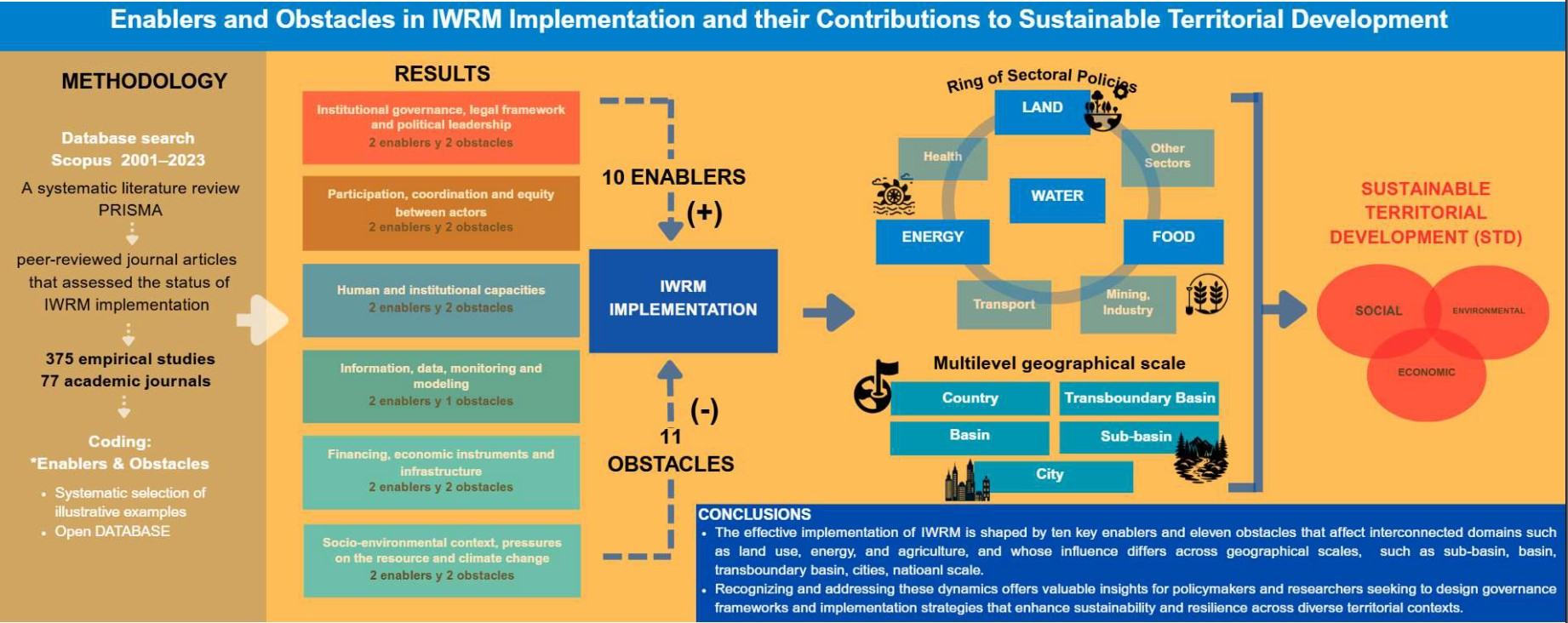
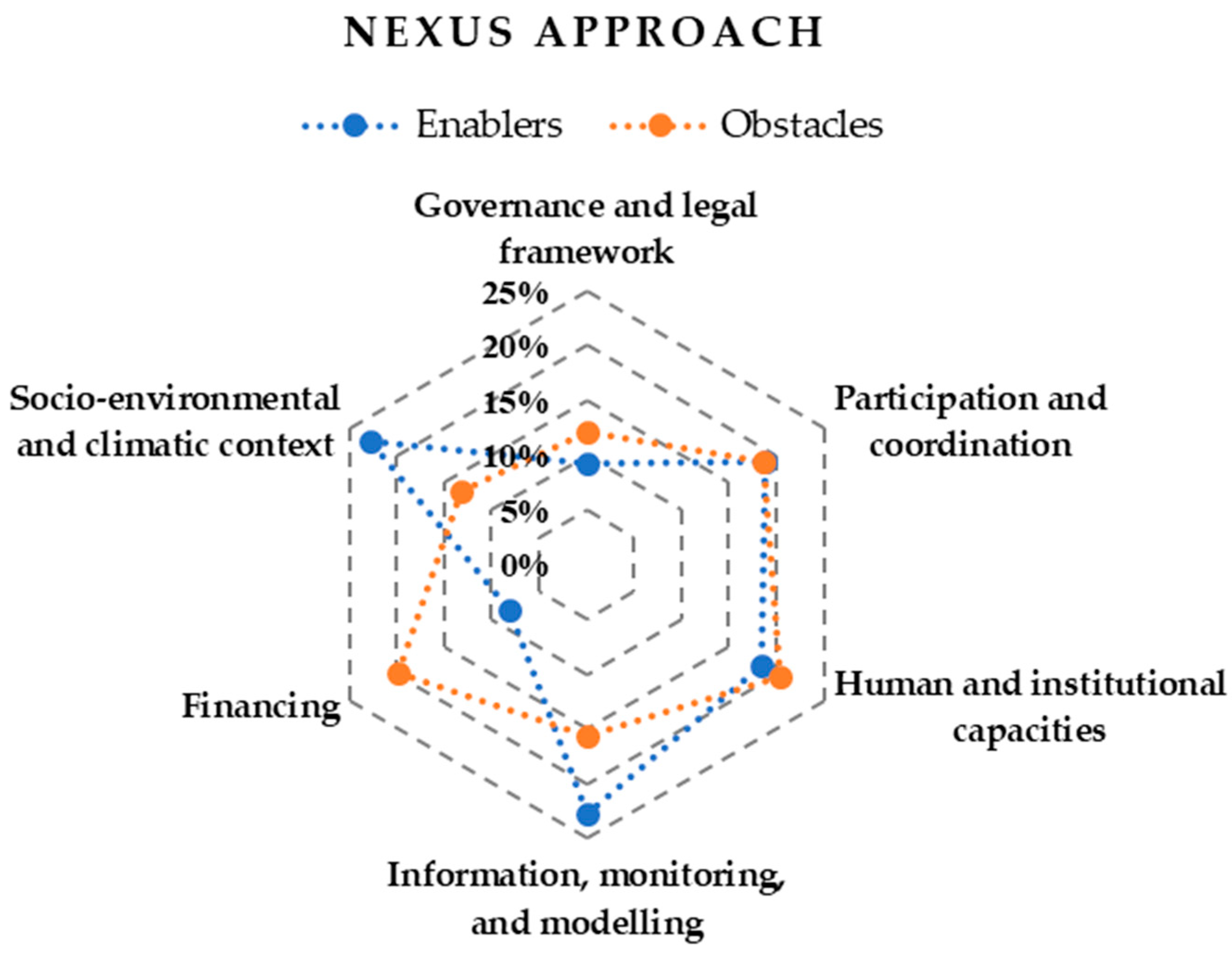
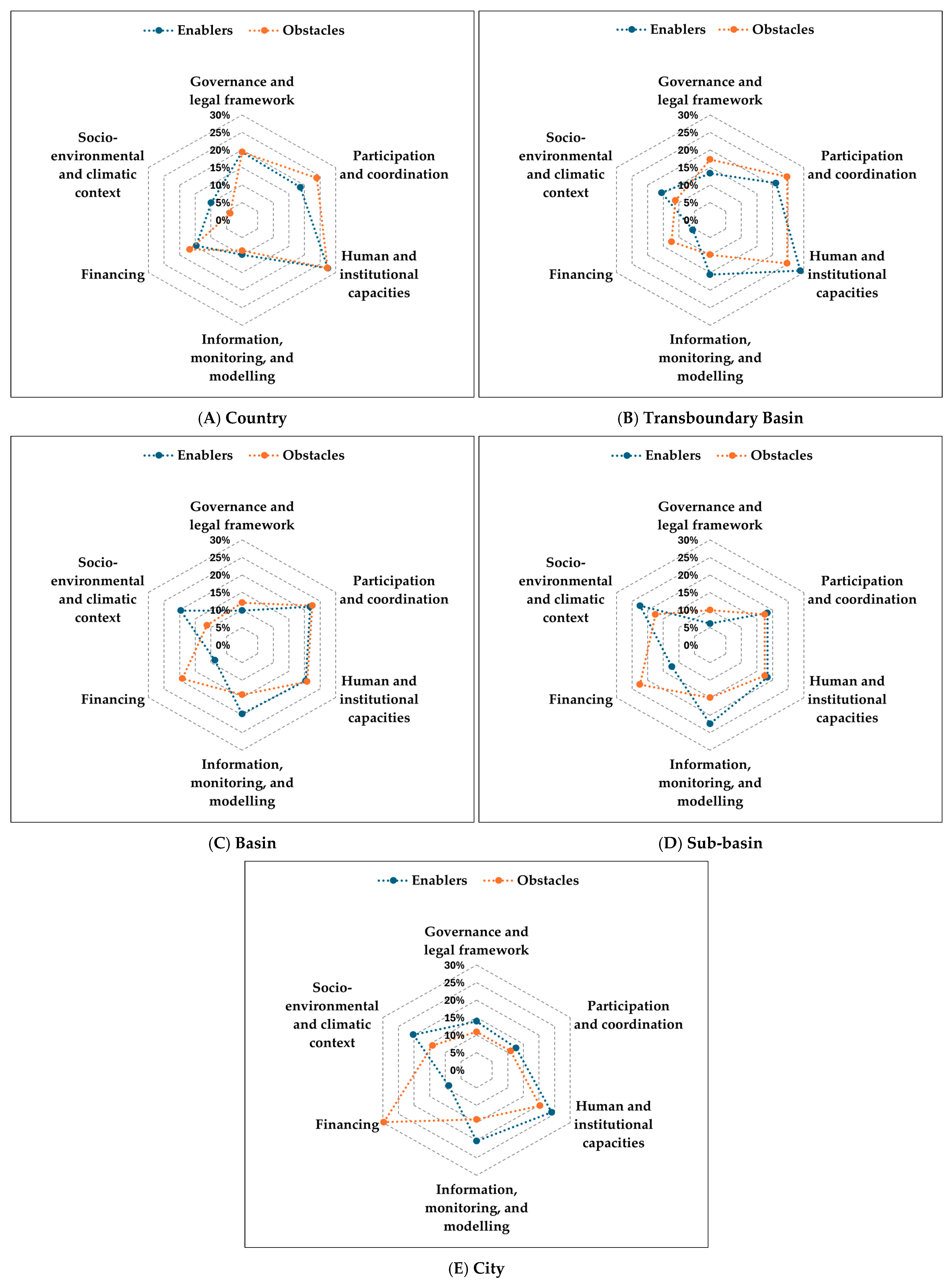
This section presents the findings of the systematic review in three stages. First, the enablers of IWRM implementation are identified and categorized. Second, the obstacles that hinder implementation are examined. Finally, both sets of categories are synthesized into six thematic blocks, which provide a structured lens to contrast enablers and obstacles and to highlight systemic dynamics across different territorial contexts.
4.1. Enablers of IWRM Implementation
As explained, the term enabler as used here refers to a factor, condition, resource, or tool that facilitates or promotes the effective and sustainable implementation of IWRM. Enablers can be institutional, such as legal frameworks and governance arrangements. They can focus on economic aspects, such as funding and multisectoral participation. Technological enablers would focus on tools, devices, and system operation, and procedural enablers would involve planning and implementation methodologies. Other enablers are oriented toward knowledge and capacity building, such as workforce training and public awareness.
Table 1 presents the main enablers identified in the implementation of IWRM as derived from the analysis of empirical evaluations included in the systematic review. Ten recurring categories were identified, reflecting institutional, technological, social, financial, and regulatory factors present across diverse geographic contexts. The frequency with which these enablers appear, along with the diversity of examples and approaches associated with each, reveals patterns and key dynamics for understanding the elements that facilitate the operationalization of IWRM in practice. A concise analysis of each enabler is presented below, highlighting its core features, empirical evidence, and the main challenges observed.
- 1.
Strengthening institutional structures and capacities for IWRM implementation
This enabler, present in 55% of the evaluations reviewed, is the most prevalent in the implementation of IWRM. It encompasses the strengthening of water management institutions, the creation and restructuring of agencies, effective decentralization, and coordination across levels of government and sectors (including transboundary cooperation). It also includes long-term planning and the promotion of adaptive management in response to socio-environmental changes.
The evaluations show that institutional robustness is a determining factor for the functionality and sustainability of IWRM. In the Rhine Basin, for example, strong institutions have enabled effective management, in contrast to the Congo Basin, where weak institutional structures have hindered progress [
21]. In South Africa, the strengthening of institutional capacities in the Letaba River Basin has improved water management adaptation and resilience to climate change [
22]. In Mongolia, the formation of river basin councils has proven effective in enhancing water governance [
23]. In Singapore, consolidating water management under a single government agency has led to improved planning and urban water management [
24]. Comparisons between countries illustrate the importance of institutional structures; indeed, in China efficient institutional structure support IWRM implementation in transboundary contexts, whereas in India, fragmentation and lack of inter-institutional coordination pose persistent challenges [
25].
These cases demonstrate that institutional capacity to coordinate, adapt, and sustain processes is fundamental. While widely promoted in theory, institutional capacities often face structural and political challenges in many contexts. As such, this enabler plays a cross-cutting role in consolidating effective water governance.
- 2.
Strengthening diverse and inclusive stakeholder participation
This enabler was identified in 47% of the evaluations reviewed, establishing itself as a key element in the implementation of IWRM. It refers to the active collaboration of the multiple actors involved in water management—governments, local communities, the private sector, and water users, including women, youth, and Indigenous peoples—by integrating local and traditional knowledge into participatory processes and social learning.
Participation enhances the legitimacy and sustainability of water-related decisions by balancing diverse perspectives and fostering trust among stakeholders. Cases such as the Arno River in Italy [
26] highlight the use of social mapping to identify water management priorities aligned with local needs and values. In the Guadiana River Basin (Spain), the co-creation of participatory Bayesian network models enabled the integration of community knowledge by involving farmers and managers in water scenario simulations [
27]. In Central Asia and Kenya, governance through water user associations facilitated self-management, equitable access, and conflict resolution at the local level [
28,
29]. Likewise, in the Danube and Brahmaputra basins, participatory workshops effectively contributed to flood risk adaptation strategies [
30].
In contrast, several challenges were identified, such as the disproportionate influence of powerful actors, limited representation of marginalized groups, and the weak institutionalization of participatory processes. In some contexts, participation is reduced to consultations without meaningful influence on decision-making. Overall, the empirical evidence shows that inclusive participation—when deliberative and well structured—strengthens water governance, improves equity, and enhances community resilience in the face of challenges such as climate change and ecosystem degradation.
- 3.
Strengthening technological innovation and the use of advanced modeling and simulation
This enabler was identified in 31% of the evaluations reviewed. It focuses on the development and adoption of cutting-edge technological solutions, such as smart irrigation, water treatment systems, digital monitoring platforms, and the use of modeling and simulation methodologies to support decision-making, optimize resources, and enhance adaptability across different scenarios.
These tools not only increase efficiency and reduce costs but also facilitate evidence-based planning. Notable cases include the optimization of water use under scarcity conditions [
31], the quantification of multiple demands to expose inequalities [
32,
33], and the projection of impacts from climate change and population growth [
34,
35]. In addition, the integration of advanced analytical techniques and interdisciplinary collaboration has been essential in improving water management [
27,
36].
However, it is worth noting that several engineering-focused studies tend to prioritize physical and economic modeling while overlooking social and governance dimensions. This suggests that incorporating social sciences could enrich these technological applications, improving both their acceptance and effectiveness. In summary, technological innovation and advanced modeling play a highly prevalent role in IWRM implementation. Their ability to integrate data, anticipate scenarios, and promote informed decisions makes them fundamental pillars for sustainable and adaptive water management.
- 4.
Consolidating policies and legal and regulatory frameworks
This enabler was identified in 25% of the evaluations analyzed. It refers to the existence of clear regulatory frameworks, coherent legislation, and enforcement mechanisms that guide IWRM implementation. It includes alignment with international principles—such as equity, sustainability, and gender perspective—as well as reforms aimed at strengthening collaborative governance and efficient water use.
The evaluations reviewed show that legal frameworks provide legitimacy and structure to water management; however, their effectiveness depends on inter-institutional coordination, funding availability, and coherence across sectors and levels of government. Illustrative cases include the EU Water Framework Directive, which harmonized legislation across member state [
37,
38]; South Africa’s National Water Act, which introduced progressive IWRM principles such as equitable water access and basin-level integrated management (although implementation is challenged by historical inequalities and limited institutional capacity [
39]); and regional groundwater policies in Southern Africa, which have promoted key regulations for water governance in transboundary basins, though lack of cooperation and disparities in monitoring capacity have limited their effectiveness [
40]. Other cases, such as those in Eastern Europe, show that regulatory harmonization is critical for transboundary river governance, although weak international cooperation and institutional asymmetries have undermined regulatory outcomes [
41].
In summary, while legal frameworks are structural pillars of IWRM, their impact depends on their articulation with governance mechanisms, adequate resources, and political will. This enabler is essential to regulate conflicting water uses, ensure equitable access, and strengthen climate change adaptation.
- 5.
Developing human resources and enhancing public awareness for water management
This enabler was identified in 20% of the evaluations reviewed. It focuses on knowledge transfer programs and the strengthening of human resources with technical and multidisciplinary capacities for water management, as well as education, awareness, and public mobilization, encouraging civic engagement in sustainable water use. Its objective is to empower both institutional and community actors, promoting social ownership of water and more informed and equitable decision-making.
Various cases illustrate its impact. In Uzbekistan, farmer training and the establishment of water user associations facilitated participatory management and improved equity and efficiency in water distribution [
42]. In Brazil and the United States, training of water managers and decision-makers in the interpretation and application of climate data enhanced planning and resilience to extreme weather events [
43]. In Zimbabwe, education on sanitation and groundwater pollution helped reduce health risks and empowered local communities [
44]. Conversely, in South Africa, the lack of equitable access to technical information has led to inequalities, although education and mobilization programs have contributed to greater representation of marginalized groups [
45].
The findings underscore that this enabler is essential for advancing toward more inclusive, resilient, and transparent water management. However, its implementation faces barriers such as insufficient funding, limited access to information, and institutional resistance. Strengthening human capacity development and public awareness is crucial for consolidating effective and socially legitimate water governance.
- 6.
Consolidating data management and monitoring systems
Identified in 20% of the evaluations reviewed, this enabler aims to ensure the availability, quality, and accessibility of information for evidence-based water management. It promotes the development of databases, continuous monitoring systems, and decision-support tools, thus encouraging transparency, inter-institutional coordination, and adaptation to climate variability.
Several evaluations highlight its impact. In Benin, data collection and monitoring of over 4000 wells, combined with the application of the HBV hydrological model, enabled the assessment of groundwater availability and sustainability [
46]. In Japan, the development of a decision-support system based on genetic algorithms optimized reservoir management during droughts [
47]. In China, long-term time series analysis and advanced statistical tools enabled the evaluation of the relationship between water quality and quantity, supporting evidence-based policymaking [
48]. At the urban level, the City Blueprint approach was applied in 200 cities to assess and compare water management efficiency across localities [
49]. In the Indus Basin, emphasis was placed on improving glacier, snow, and surface water monitoring systems to enhance climate change adaptation strategies [
50].
Although this enabler strengthens adaptive planning and informed decision-making, persistent challenges remain, such as data fragmentation, lack of technological infrastructure, and limited integration of monitoring systems into public policy. The findings highlight that access to reliable information is essential for improving governance, anticipating risks, and promoting sustainable and resilient water management.
- 7.
Consolidating a shared vision and interdisciplinary approaches
This enabler was identified in 17% of the evaluations reviewed. It refers to the construction of a common vision among the various actors involved in water management, thus promoting social cohesion, trust, and collaboration. It also involves adopting holistic, interdisciplinary, and strategic approaches that integrate social, environmental, and economic dimensions to facilitate collective action and the coordinated implementation of water policies and programs.
Empirical evidence shows that this enabler has been key in complex contexts. In Bolivia, participation by local actors and inter-institutional platforms made it possible to develop a shared vision for managing the Rocha River Basin [
51]. In the Brahmaputra Basin, cooperative approaches between India and Bangladesh supported the establishment of joint management agreements [
52]. In South Africa, the implementation of an integrative decision-making framework strengthened stakeholder cohesion in the Letaba Basin [
53]. In Ghana, vulnerability assessments in the White Volta and Pra basins were achieved through integrated planning approaches [
54]. In Israel, cooperation among institutional actors enabled a shift in the water governance model [
55].
This enabler enhances the effectiveness of IWRM implementation by aligning interests, facilitating cross-sectoral dialogue, and promoting consensus-based strategies. However, it faces challenges such as lack of trust, resistance to change, and political tensions. Overcoming these barriers requires mechanisms that foster collective learning, awareness, and the political will to build shared agendas.
- 8.
Strengthening political commitment and institutional and governmental support
This enabler was identified in 15% of the evaluations reviewed. It refers to strong political commitment, firm institutional backing, and active government support to drive the implementation of IWRM. It includes the willingness of leaders and decision-makers to allocate resources, set priorities, and ensure compliance with IWRM-aligned policies. It also requires government institutions with the capacity and political will to support processes at the local, regional, or national level, as well as a stable political framework that legitimizes actions and encourages stakeholder participation.
The evidence shows that this enabler is, in several cases, a determining factor for ensuring the sustainability and viability of water strategies. In Mongolia, political reforms and institutional support enabled more effective water management through the establishment of River Basin Councils, although challenges persist due to incomplete decentralization [
56]. In Jordan, support from the Ministry of Water and Irrigation facilitated the implementation of advanced planning models [
57]. In Crete, the commitment of local authorities was key to implementing a prioritization system for water management under scarcity conditions [
58]. In South Africa, political and institutional support was essential for establishing equity-oriented policies and promoting women’s participation in water user associations, although cultural and capacity-related barriers remain [
59]. In Lithuania, national institutional support and EU policies enabled the industrial sector to adapt its practices to water efficiency regulations [
60].
While political and institutional support is a fundamental catalyst for IWRM implementation, its effectiveness depends on institutions that are capable, autonomous, and well resourced. This enabler stands out for its potential to align interests, scale up policies, and ensure continuity in IWRM implementation processes.
- 9.
Consolidating financing, economic instruments, and investment in infrastructure
This enabler was identified in 15% of the evaluations reviewed. It refers to the availability of sustainable financial resources to implement strategic water infrastructure and economic mechanisms that promote efficiency, equity, and sustainability in water management. It includes the creation of dedicated funds, investment in storage systems, distribution networks, treatment facilities, and monitoring systems, as well as the use of market instruments such as water rights or cost internalization.
Various cases illustrate its relevance. In the United Arab Emirates, investments in desalination plants and recharge dams have been key to addressing water scarcity and ensuring the sustainability of IWRM [
61]. In Afghanistan, investment in reservoirs has improved food security and the sustainability of irrigation [
62]. In South Africa, a sustainable financing approach has supported the development of wastewater treatment infrastructure and long-term IWRM projects [
63]. In Bangladesh, a reform of the water tariff model has been proposed to include social and environmental costs, thereby enhancing economic efficiency and social equity in water use [
64]. In the EU, compliance with the Water Framework Directive has largely depended on investments in hydraulic infrastructure to achieve the ecological status required for river basins [
65].
Although this enabler appears less frequently, it has significant impact in contexts where managing water scarcity, improving infrastructure, or ensuring compliance with environmental regulations is critical. However, its effectiveness depends on the creation of specific funds and the use of market mechanisms that ensure long-term operation and maintenance, as well as institutional coordination to avoid fragmentation and optimize investments.
- 10.
Strengthening international cooperation through technical and financial support
This enabler was identified in 14% of the studies analyzed. It refers to the support provided by international organizations, development agencies, and donor entities that offer technical, scientific, and financial assistance to strengthen local capacities, promote technology transfer, and facilitate the implementation of IWRM-related policies and projects.
Such support has been crucial in contexts where national resources are limited and local capacities need reinforcement. In Burkina Faso, the support of the World Bank and GWP helped drive reforms that positioned the country as a regional leader in IWRM implementation [
66]. In Morocco, international cooperation played a key role in implementing sustainable aquifer contracts and reforming groundwater policy [
67]. In Jordan, this assistance contributed to the protection of groundwater resources, the strengthening of legal frameworks, the development of monitoring systems, and the training of local stakeholders [
68]. Turkey has benefited from EU support in adapting local policies for the adoption of the Water Framework Directive [
49], while in Asia, international cooperation initiatives under GEOSS have promoted the use of satellite data to improve disaster resilience and climate change adaptation [
69].
While international cooperation can facilitate significant progress, it also poses challenges. Overreliance on external support may undermine local autonomy and long-term sustainability. Therefore, this enabler should complement domestic efforts by contributing to the strengthening of national capacities and the consolidation of water governance in the medium and long term.
4.2. Obstacles of IWRM Implementation
As explained earlier, and in contrast to enablers, obstacles refer to those factors, conditions, or deficiencies that hinder, complicate, or delay the adoption and implementation of IWRM.
Table 2 presents the list of identified obstacles, along with the frequency with which they were mentioned in the reviewed studies. These findings highlight the breadth of challenges that can impede the implementation of IWRM, while also emphasizing the importance of designing strategies aimed at addressing these limitations in various socio-environmental contexts.
- 1.
Fragmentation, overlap, and institutional weakness in water resources management
This obstacle was identified in 46% of the reviewed studies. It refers to fragmented institutional structures, institutional barriers, overlapping mandates, operational centralism, weak governance, and limited institutional capacities. It also includes the absence of functional institutions in key territories, which hinders adaptive and effective water management.
Several case studies illustrate its impact. In Central Asia, for instance, the state-led initiative to create Water User Associations (WUAs) in the Fergana Valley [
28] resulted in structures lacking legitimacy and operational capacity. These coexisted with informal associations that achieved results, albeit with no articulation with formal institutions. In Mongolia, water management is fragmented across six ministries, and the proliferation of basin-level agencies with vague mandates and a lack of horizontal and vertical coordination has resulted in fragile governance with no effective decision-making authority [
23,
56]. In China, WUAs established in arid regions such as Minqin suffer from structural ambiguity and are perceived as imposed bureaucratic entities with overlapping functions and no operational leadership, severely limiting their functionality [
70]. Comparative studies further show how the adoption of international IWRM models in South Africa, Peru, and Mongolia has been significantly weakened by the failure to account for pre-existing local institutional realities, leading to governance vacuums and conflicts across government levels [
71].
These cases underscore that institutional weakness is a structural constraint undermining water governance and perpetuating administrative inertia. Decentralization, when not accompanied by adequate resources, normative clarity, and local leadership, fails to strengthen IWRM and can even render it dysfunctional. This obstacle stands in direct contrast with institutional enablers and highlights the urgent need to consider pre-existing conditions, build genuine capacities, clarify institutional roles, and ensure effective inter-institutional coordination mechanisms to move toward integrated and sustainable water management.
- 2.
Challenges in coordination, communication, and participation
This obstacle was identified in 36% of the reviewed studies. It refers to the lack of effective coordination and communication among institutions across different levels of government and sectors, as well as among stakeholders involved in water management. It also includes weak public participation and the limited engagement of key stakeholders (such as women, local communities, and civil society), which hinder the adoption of inclusive and socially accepted solutions and reduce trust and shared responsibility in water governance.
Various case studies illustrate this issue. In the Brahmaputra River Basin [
52], the absence of multilateral coordination among riparian countries (China, India, Bhutan, and Bangladesh) and the lack of effective public participation have impeded joint planning and the basin’s development potential, fueling water conflicts, political tensions, and unilateral actions. In Burkina Faso, although a legal framework aligned with IWRM was implemented, it encountered serious institutional coordination problems and a lack of horizontal communication between actors from the water, health, agriculture, and environmental sectors. Public participation remained symbolic, reinforcing the gap between the state and local communities [
66]. Similarly, in Ukraine, river basin councils operate with minimal real coordination between local, regional, and national actors. Local actors are largely excluded from decision-making, which remains concentrated in higher authorities [
72]. In India, within the context of wastewater treatment and reuse, poor collaboration between central and state-level governmental agencies and a lack of consultation with farmers, local users, and affected communities have limited the adoption and scalability of sustainable technologies [
73]. Lastly, in Mongolia, Peru, and South Africa, institutional bricolage has emerged as a response to deficiencies in coordination, communication, and participation, with local actors relying on existing social arrangements to fill gaps left by ineffective formal processes [
74].
These cases demonstrate that institutional discoordination and limited participation not only reduce IWRM’s operational efficiency but also erode trust among stakeholders, generate conflicts, and hinder the adoption of integrated solutions. Successful IWRM implementation requires not only legal and technical frameworks, but also functional multilevel governance, effective communication mechanisms, and genuinely participatory processes.
- 3.
Financial limitations and dependence on external funds
This obstacle was identified in 29% of the reviewed studies. It is characterized by insufficient economic resources, lack of sustainable financing, and a high dependence on international funds to support water-related plans, institutions, and actions. Additionally, the limited use of market-based instruments—such as cost internalization mechanisms like payment for ecosystem services—undermines the economic valuation of water and discourages investment and efficient use.
Several case studies demonstrate its impact. In the Inner Niger Delta of Mali, the implementation and maintenance of investments depend almost entirely on international donations, with municipalities contributing only 10% of co-financing. Furthermore, there is a lack of economic valuation of the ecosystem services provided by wetlands—an untapped source of financing [
75]. In Burkina Faso, the early adoption of IWRM was promoted as a model case by international organizations, but its sustainability relies entirely on external cooperation (GWP, SIWI, among others), as local and rural institutions lack their own budgetary base [
66]. In the Guadiana Basin, Spain, the adoption of a participatory water management model, implementation of more efficient irrigation technologies, and compliance with the Water Framework Directive have been severely constrained by local funding shortages, making institutional and external (European and national) financial support essential [
27]. In China, irrigation reform initiatives faced drastic reductions in state investment in irrigation infrastructure and maintenance, leading to system degradation. As a result, farmers increasingly rely on private wells and informal systems, undermining integrated management [
76]. In Mongolia, basin councils operate solely with external support due to insufficient technical capacity and the absence of sustainable national or local government funding [
23].
These cases show that inadequate financing not only hinders the implementation of investments but also weakens institutional capacity, fosters external dependency, and limits social ownership of water management processes. The contrast with contexts where sustained investment exists highlights that financial resources are a structural prerequisite for making IWRM viable, effective, and durable.
- 4.
Limitations in data, monitoring, and modeling of water resources
This obstacle was identified in 28% of the reviewed studies. It concerns the lack of sufficient and high-quality data, poor data integration, inadequate technical tools and capacity for continuous monitoring, and the complexity of modeling (e.g., integrating climate scenarios, socioeconomic variables, and spatial-temporal variability). Collectively, these deficiencies hinder strategic planning and IWRM implementation based on reliable information and robust projections.
Several assessments illustrate this impact. In the Brahmaputra Basin [
52], the absence of an integrated system for data collection and exchange among riparian countries has impeded efficient water resource management. In Mongolia, the lack of infrastructure to monitor groundwater quality in the Kharaa River Basin has made it difficult to accurately assess contaminants and their impact on local water resources [
77]. In Mexico, the use of treated wastewater in Baja California has been hampered by data fragmentation and inadequate monitoring, creating uncertainty in resource management [
78]. In Burkina Faso, integrating economic and ecological models for small reservoir management highlights the modeling challenges in local contexts due to data scarcity and limited simulation tools [
79]. In India, the management of wastewater treatment and reuse is undermined by the limited availability of reliable water quality data, complicating both evaluation and decision-making [
73].
This obstacle underscores the need for quality data, robust modeling capacity, and effective monitoring systems to enable informed and effective decision-making in water resource management. Deficiencies in these areas not only constrain the ability to respond to extreme situations but also hinder successful IWRM implementation, as decision-makers are forced to operate in contexts of uncertainty and information gaps.
- 5.
Resistance to change and complexity in the implementation of IWRM
This obstacle was identified in 24% of the reviewed studies. It refers to cultural, institutional, and political resistance to adopting innovative approaches, the conceptual complexity of IWRM, the difficulty of translating its principles into operational language, and the gap between strategies developed in the planning stage and their effective implementation on the ground.
This obstacle is evident across various contexts. In Ethiopia, the lack of coordination between water resource management policies and economic priorities in the Awash Basin illustrates how institutional resistance to new approaches and the disconnect between theory and practice hinder IWRM implementation [
33]. In South Africa, legal reforms have faced significant setbacks due to political resistance and the challenges of implementing equitable water distribution, particularly in a post-apartheid context where historical inequalities still influence water governance [
80]. In Nepal, IWRM was adopted as a guiding framework but failed to materialize due to unclear institutional responsibilities and resistance to decentralization [
81]. In the uMngeni River Basin in South Africa, informal structures inherited from the past continue to influence water governance practices decades after IWRM adoption, creating resistance to new formal structures. Ignoring the interplay between formal and informal institutions has led to poor policy adaptation to local realities [
74]. In Australia, efforts to develop basin-scale models have encountered resistance to incorporating more complex economic models, and challenges in defining suitable variables and linking them with hydrological models [
82].
Although IWRM remains a robust management framework, these case studies show that successful implementation depends on overcoming cultural and institutional barriers, clarifying concepts, and adapting policies to local contexts while taking into account existing conditions.
- 6.
Limitations in human capital capacities and weak social awareness
This obstacle was identified in 23% of the reviewed studies. It is manifested in the shortage of qualified personnel, lack of adequate technical training, high staff turnover, and limitations in knowledge transfer. It also includes weak local awareness regarding the importance of water resources and their sustainable management.
Multiple studies underscore the significance of this obstacle [
51], analyzing the practical implementation of IWRM in Sudan, Bolivia, Indonesia, and Iran, found that weak local training and low public awareness were key challenges to the successful implementation of appropriate management systems. In Mongolia, the lack of technically trained professionals to design and implement efficient water resource management policies, coupled with low public awareness about the impacts of water overexploitation, has hindered progress toward a more integrated and sustainable approach [
23]. In Thailand, cross-border data exchange challenges in the Mekong River Basin have been exacerbated by a lack of trained personnel and local reluctance to share critical information for joint resource management [
83]. In Ethiopia, insufficient awareness of environmental flows and limited training of local actors have caused conflicts between irrigation interests and the need to preserve aquatic ecosystems in the Awash River Basin [
84]. In South Africa, the constant turnover of staff within the Department of Water Affairs and Forestry (DWAF), the shortage of qualified personnel, and local resistance to newly proposed practices have impaired the ability to make informed decisions and implement effective water management policies [
85].
These examples highlight that this obstacle is fundamental to IWRM effectiveness, as technical capacity limitations and weak social awareness directly affect the implementation of sustainable approaches. Addressing this challenge requires strengthening human capacities and fostering public awareness of the importance of sustainable water management, thereby promoting a more participatory and collaborative approach at both local and institutional levels.
- 7.
Inequalities and conflicts in water access and management
This obstacle was identified in 22% of the reviewed studies. It refers to socioeconomic, territorial, gender, or institutional inequalities that limit equitable access to water resources and exclude certain groups from decision-making processes. These power and representation asymmetries reinforce inequity, generate conflicts between sectors or regions, and hinder the consensual and sustainable implementation of IWRM.
In various contexts, this obstacle has been a decisive factor in the failure or fragility of IWRM processes. In Tanzania, [
86] shows how power imbalances between investors and smallholder farmers led to the exclusion of the latter from formal water access through permits; although Water User Associations were created, they lacked real power, deepening inequities. In South Africa, [
45] documents how rural Black communities were systematically excluded from participatory processes, despite an inclusive legal framework, thereby reinforcing the historical privileges of large water users. In Burkina Faso, [
79] describes how a sugar company monopolized control over reservoir water within the formal IWRM framework, while local committees were dominated by powerful actors, failing to represent small-scale producers. In Tanzania’s Pangani Basin, Msuya and [
87] identifies a fragmented water management system where downstream communities suffer from water scarcity and lack representation, while upstream communities have greater access and control, generating conflicts between formal and informal institutions. Finally, in Israel, [
88] analyzes how a technically integrated structure without balanced institutional representation was captured by agricultural interests, blocking sustainable decisions and excluding urban, environmental, and community actors.
These cases reveal how structural inequalities and institutional capture seriously undermine the principles of equity, inclusion, and sustainability promoted by IWRM. Addressing these structural inequalities requires deeper transformations in governance, power relations, and institutional design. It involves not only broadening formal representation but also ensuring real mechanisms for the redistribution of power, access, and voice in decision-making.
- 8.
Inadequate, obsolete and underfunded water infrastructure
This obstacle was identified in 20% of the reviewed studies. It refers to the lack, deterioration, or insufficient maintenance of water infrastructure, as well as the scarcity of financial resources allocated to its improvement, expansion, or modernization. This includes inefficient irrigation canals, collapsed treatment plants, nonexistent monitoring networks, and halted projects due to high costs.
Various studies clearly illustrate the active manifestation of this obstacle. In Afghanistan’s Helmand Basin, the hydraulic infrastructure is obsolete and deteriorated, with canals built over 50 years ago lacking maintenance and the capacity to adapt to droughts due to insecurity and a lack of funding [
89]. In the same region, the Balkh River Basin exemplifies the complete absence of water storage infrastructure, making it impossible to ensure irrigation during dry years, thus affecting food security. Although the study models scenarios involving reservoirs, their costs render them unviable without external investment [
62].
In Eastern Europe, efforts to comply with the EU Water Framework Directive in the Western Bug River are hindered by wastewater treatment plants that fail to meet minimum standards, low coverage in rural areas, and insufficient funding for rehabilitation and maintenance, which undermines cross-border cooperation [
41]. In Pixian, a peri-urban district in China, 100% of wastewater was discharged untreated at the time of study, and although expansion plans exist, construction and operational costs are prohibitively high [
90]. Finally, in Mongolia’s Kharaa River Basin, groundwater monitoring infrastructure is nearly nonexistent, despite groundwater being the main source of drinking water. Local capacities for wastewater treatment and chemical analysis are also limited. The lack of investment in these key areas prevents the establishment of effective integrated management of this critical resource [
77].
The presence of this obstacle in one in five reviewed cases shows that even when legal frameworks or plans to implement IWRM exist, the absence of functional infrastructure and sustained investment prevents these objectives from being realized. Its impact is particularly significant in rural, post-conflict, or rapidly urbanizing contexts where inherited infrastructure is inadequate for new demands. Overcoming this obstacle requires not only financial resources but also political will, cross-sectoral planning, and robust institutional mechanisms to ensure the long-term technical and economic sustainability of infrastructure.
- 9.
Lack of clarity, weakness, and fragmentation in the legal and regulatory framework
This obstacle was identified in 19% of the reviewed cases. It refers to the absence of a clear, robust, and coordinated legal framework to effectively regulate water resource management. This includes overlapping mandates, lack of defined institutional authority, weak enforcement of regulations, and fragmentation and lack of coordination among policies and levels of government.
Several studies highlight its impact in different contexts. Ref. [
71] describes how, in South Africa, Mongolia, and Peru, water laws aligned with IWRM exist but are not implemented due to institutional voids, regulatory fragmentation, or lack of funding, weakening local governance. In India, [
73] notes the absence of an integrated national legal framework for wastewater management, accompanied by weak enforcement and poor coordination across government levels. Ref. [
91] documents in multiple river basins with complex water systems that legal frameworks intended to integrate environmental flows and ecosystem-based approaches are insufficient, with unclear objectives and institutional fragmentation hindering implementation. In Mexico, [
78] shows that wastewater management for agricultural irrigation lacks a comprehensive and coordinated legal framework, making effective oversight and water governance difficult. Lastly, [
62] reports that in Afghanistan, a traditional and hierarchical community-based water management system exists, but the absence of formal regulation limits institutional capacity and infrastructure development, undermining sustainability and equity in the basin.
These cases illustrate that legal ambiguity and fragmentation affect not only technical or administrative capacity but also undermine the legitimacy and political will needed to drive reforms and ensure equitable and sustainable water access and use. This is a critical barrier to IWRM, especially in contexts where sectoral interests, multiple government levels, and complex socioeconomic dynamics converge. Overcoming this obstacle requires not only legislative reforms, but also institutional strengthening, robust enforcement mechanisms, and effective coordination across actors and government levels.
- 10.
Growing demand, overexploitation, and pollution
This obstacle was identified in 12% of the reviewed studies. It refers to the increasing pressure on water resources driven by demographic, agricultural, industrial, and tourism expansion, along with the overexploitation of surface and groundwater sources and the degradation of water quality due to anthropogenic pollution.
In several contexts, this obstacle has been a determining factor in the failure or fragility of IWRM processes. In Mongolia’s Kharaa River Basin, mining activities, urban and industrial expansion, the lack of wastewater treatment, and severe aquifer contamination by heavy metals directly obstruct the implementation of IWRM [
77]. In Jordan, [
68] reports aquifer overexploitation at 150–200% of sustainable yield, with water quality severely compromised by agricultural and industrial activities, including salinization, nitrates, and heavy metals, rendering sustainable management unfeasible. Another study in the same region, in the Amman-Zarqa Basin, reveals how the combined pressures of urbanization, intensive agriculture, and wastewater reuse create a structural imbalance that limits the effective implementation of IWRM [
57]. In Oman, the collapse of traditional water systems in Al Jabal Al Akhdar due to population and tourism growth has caused aquifer overexploitation and dramatic reductions in ancestral canal flows [
92]. Finally, in Iran’s Zayandehrud Basin, chronic groundwater overexploitation, environmental degradation, and climate change, compounded by institutional fragmentation, have led to an unsustainable trajectory where IWRM cannot be effectively applied without structural transformations [
93].
This obstacle undermines the effectiveness of IWRM by creating conditions of scarcity and environmental degradation that exceed technical and institutional response capacities, weakening water governance. Addressing it requires decisive actions to balance supply and demand, integrate water quality protection into management strategies, and develop monitoring and control tools suited to high-pressure water contexts.
- 11.
Climatic variability and uncertainty
This obstacle was identified in 11% of the reviewed studies. It concerns the variability of hydrological conditions and the uncertainty in climate projections, intensified by climate change and the recurrence of extreme events such as droughts and floods. This situation complicates medium- and long-term water availability predictions, hinders water planning, delays the adoption of preventive measures, and reduces the effectiveness of resilience strategies.
Various studies reflect the impact of this challenge. In the United States and Brazil, [
43] documents how uncertainty in climate data and the perception of its low utility hinder the use of such information in water management—even in institutionally developed contexts. In Canada, [
94] shows that uncertain and complex climatic conditions, along with human intervention, undermine non-stochastic planning models and demand more adaptive and robust approaches to envision scenarios and assess vulnerabilities for IWRM implementation. In Iran, [
34] demonstrates how differences among climate scenarios lead to contrasting projections for irrigation, agricultural production, and hydropower, complicating sustainable decision-making. In the mountainous region of Oman, [
92] reports how critically reduced rainfall and streamflow have compromised traditional water management systems, while institutional responses have lagged. Finally, in the Danube and Brahmaputra river basins, [
30] identifies that uncertainty related to projected increases in extreme rainfall and prolonged droughts, combined with limited institutional capacity, diminishes the ability to implement IWRM plans.
These cases show that, in diverse contexts, climate uncertainty is not only a physical risk but also an institutional and cognitive barrier. Insufficient confidence in projections, weak monitoring systems, and limited science–policy integration prevent the proactive and effective implementation of IWRM. Overcoming this obstacle requires shifting water management from prediction-and-control paradigms to adaptation and resilience frameworks, where uncertainty motivates rather than hinders informed, inclusive, and robust decision-making.
4.3. Thematic Grouping of Enablers and Obstacles
To capture recurrent patterns and substantive relationships among the identified enablers and obstacles, their elements were grouped into thematic blocks. This exercise organized the results around key dimensions of IWRM implementation, making explicit the mechanisms through which such factors influence management processes and providing a clearer basis for cross-study comparison and policy implications.
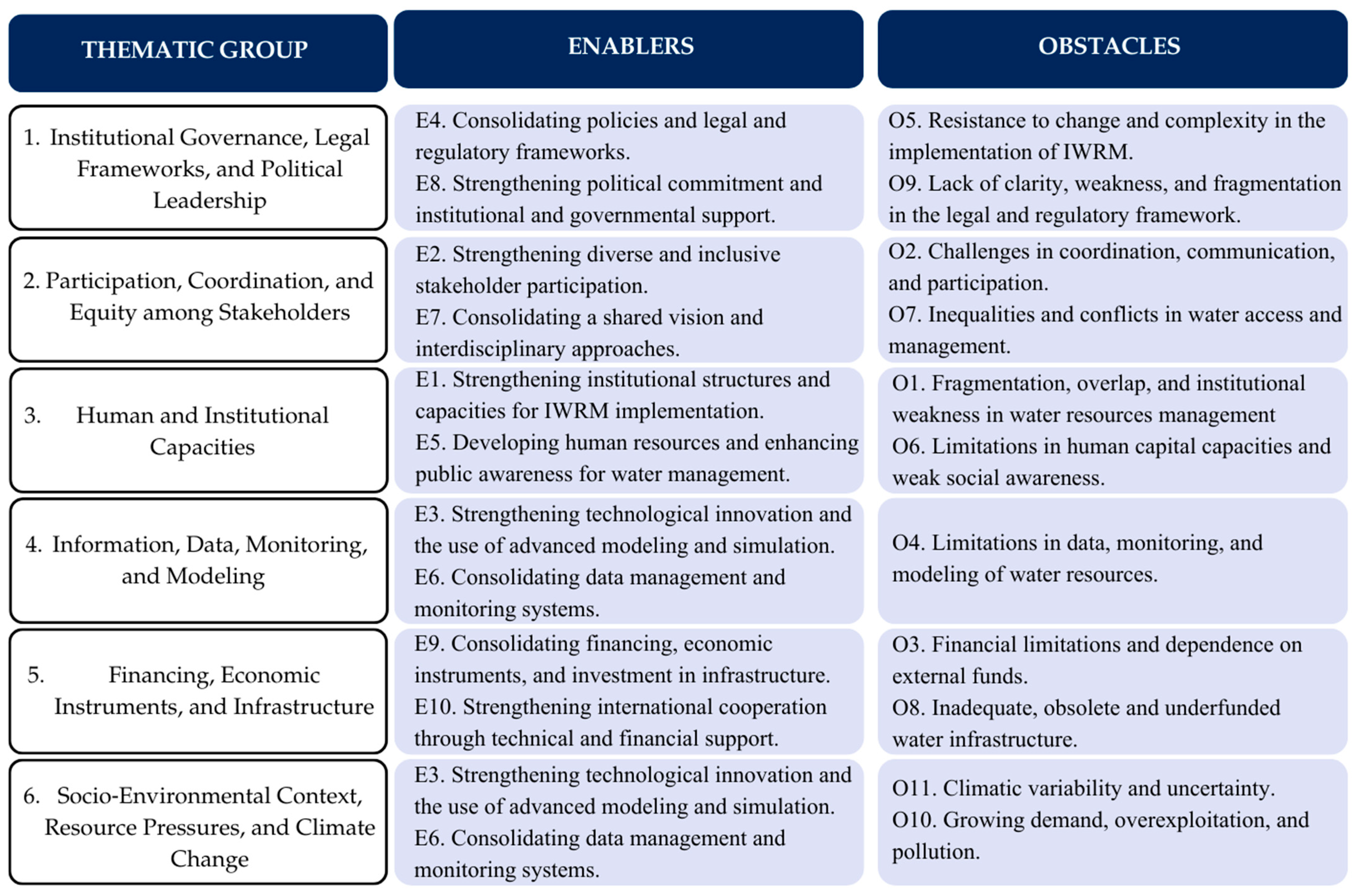
The grouping was guided by three criteria: (i) internal thematic coherence between enablers and obstacles, ensuring that each block reflects a recognizable conceptual logic; (ii) differentiation across blocks, avoiding overlaps between dimensions; (iii) consistency with the literature on water governance and IWRM approaches. The resulting grouping is illustrated in
Figure 3.
Block 1. Institutional Governance, Legal Frameworks, and Political Leadership
This block encompasses enablers and obstacles linked to the design and performance of institutional and regulatory arrangements. Enablers include the consolidation of coherent policies and legal frameworks (E4) and the political commitment and institutional support required to sustain reforms and investments (E8). Obstacles include resistance to change and the complexity of IWRM when not translated into clear instruments (O5), as well as weak or fragmented legal frameworks (O9). This block captures the “political-institutional architecture” upon which integrated management is built.
Block 2. Participation, Coordination, and Equity among Stakeholders
This block focuses on actor relationships and decision-making processes. Enablers include diverse and inclusive stakeholder participation (E2) and the development of shared visions and interdisciplinary approaches (E7), which facilitate dialogue, consensus, and conflict resolution. Obstacles (O2 and O7) reflect coordination and communication problems, as well as inequalities and conflicts in water access and management. This block underscores that IWRM is not only a technical challenge but also a political and social process where inclusion and equity are decisive.
Block 3. Human and Institutional Capacities
This block refers to the human and organizational resources available to operationalize IWRM. Enablers include the strengthening of institutional structures and capacities (E1) and the development of human resources and social awareness (E5). Obstacles (O1 and O6) emphasize institutional fragmentation and weakness, limitations in human capital, and insufficient training or water culture. This block highlights that even with adequate legal frameworks and political will, implementation may be severely constrained if institutions and individuals lack the necessary capacities.
Block 4. Information, Data, Monitoring, and Modeling
This block addresses the evidence base for decision-making in IWRM. Enablers include technological innovation and the use of advanced modeling and simulation (E3), as well as the consolidation of data and monitoring systems (E6). The main obstacle (O4) is the limited availability and quality of data and modeling capacities. This block synthesizes the cognitive dimension of IWRM: the quality of diagnoses, the ability to anticipate scenarios, and the evaluation of alternatives depending on robust information systems and analytical tools.
Block 5. Financing, Economic Instruments, and Infrastructure
This block brings together factors related to financial resources, economic instruments, and water infrastructure. Enablers include the consolidation of financing mechanisms, economic instruments, and investment in infrastructure (E9), as well as technical and financial support from international cooperation (E10). Obstacles (O3 and O8) refer to resource scarcity, dependence on external funds, and insufficient or obsolete infrastructure. This block emphasizes that IWRM requires not only institutional frameworks and relevant information but also sustained investments and physical structures to materialize adopted strategies.
Block 6. Socio-Environmental Context, Resource Pressures, and Climate Change
This block includes external conditions affecting IWRM implementation. Enablers such as technological innovation, modeling, and consolidated monitoring systems (E3 and E10) are emphasized in their adaptive function, enabling analysis of climatic variability, uncertainty, growing demand, and pressures from overexploitation and pollution. Obstacles (O11 and O10) reflect these climatic and anthropogenic pressures, which increase the vulnerability of water systems.
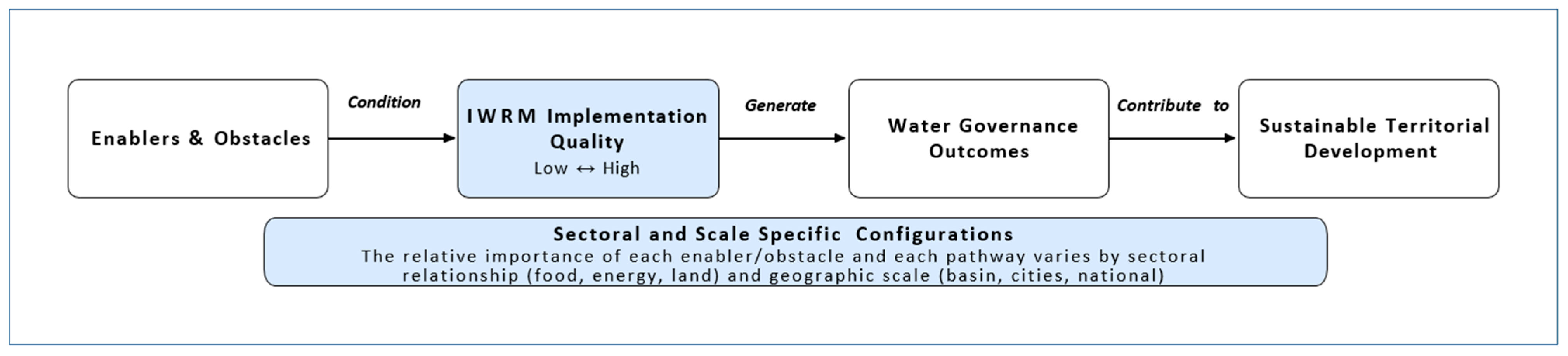
Taken together, the thematic grouping of enablers and obstacles synthesizes the evidence from the systematic review into six clearly differentiated yet interrelated analytical dimensions. This framework facilitates comparison across studies and contexts and provides a structured basis for the subsequent discussion. This grouping also illustrates how the same dimension can represent a strength under certain conditions but a weakness when limited or dysfunctional. It reinforces the notion that effective IWRM implementation requires both the promotion of enabling factors and the reduction in obstacles operating within the same domains. While identifying specific pairs of enablers and obstacles is useful, maintaining a systemic perspective is equally important. Case studies reveal that enablers often reinforce one another, whereas obstacles tend to accumulate and interact negatively. Consequently, IWRM implementation demands an integrated and simultaneous approach across multiple dimensions, generating potential multiplier effects. Moreover, successful cases do not rely on one or two isolated factors, but rather on a coherent combination of interdependent enablers adapted to the specific territorial context.
This thematic grouping also enables a comparative analysis of the most frequent enablers and obstacles. Institutional strengthening (E1), stakeholder participation (E2), and technological innovation (E3) emerge as the most recurrent enablers, while institutional fragmentation (O1), coordination challenges (O2), and financial limitations (O3) are the most persistent obstacles. These patterns reveal systemic tensions within IWRM implementation: efforts to strengthen institutions are often undermined by fragmentation and overlapping mandates; inclusive participation is constrained when coordination mechanisms are weak; and technological innovation depends on financial resources that are frequently limited or externally sourced. These comparative insights highlight that reinforcing enablers requires simultaneously addressing obstacles, recognizing that their interplay shapes the territorial effectiveness of IWRM strategies.
Beyond the internal dynamics of each block, the analysis reveals important interconnections across thematic dimensions. For instance, institutional governance (Block 1) and stakeholder participation (Block 2) are closely linked: strong legal frameworks and political leadership facilitate inclusive participation, yet fragmentation and weak coordination undermine both domains simultaneously. Similarly, human and institutional capacities (Block 3) are directly conditioned by the availability of financial resources and infrastructure (Block 5), showing that investments in training and organizational structures require sustained funding and adequate facilities. Information and monitoring systems (Block 4) also interact with the socio-environmental context (Block 6). Technological innovation and robust data systems enhance adaptive responses to climate variability and resource pressures, but their effectiveness is limited when financial constraints (Block 5) prevent long-term maintenance or when institutional fragmentation (Block 1) hinders data integration. These cross-block interactions highlight that enablers often reinforce one another, while obstacles tend to accumulate and interact negatively, creating systemic bottlenecks. Addressing IWRM implementation therefore requires integrated strategies that simultaneously strengthen enablers and reduce obstacles across multiple dimensions.