A Risky and Potentially Costly Future: Implications of Climate-Induced Changes in Groundwater and Flooding for Coastal Dairy Farming in New Zealand

Abstract
1. Introduction
2. Materials and Methods
2.1. Define a Stylized New Zealand-Based, Low-Lying, Coastal Dairy Farm as a Case Study
- A rain-fed (i.e., non-irrigated) pastoral dairy farm at the national average size of 162 hectares, with the national average stock rate of 2.76 dairy cows/ha [42,43] and an average operating profit of NZD$3300/ha. This is based on average national operating profits reported over the previous seven years [44].
- A farm located in an area already at risk of periodic river flooding and where the local/regional council already operates some form of flood protection (e.g., stop banks) or drainage system from which people benefit.
- Generally flat land such that the distance from groundwater to the surface of the land is similar across the farm.
- A farm operating on land that initially responds well to drainage interventions. Our cost and operating profit assumptions are based on this.
2.2. Consider Slow Onset Threats—Rising Groundwater
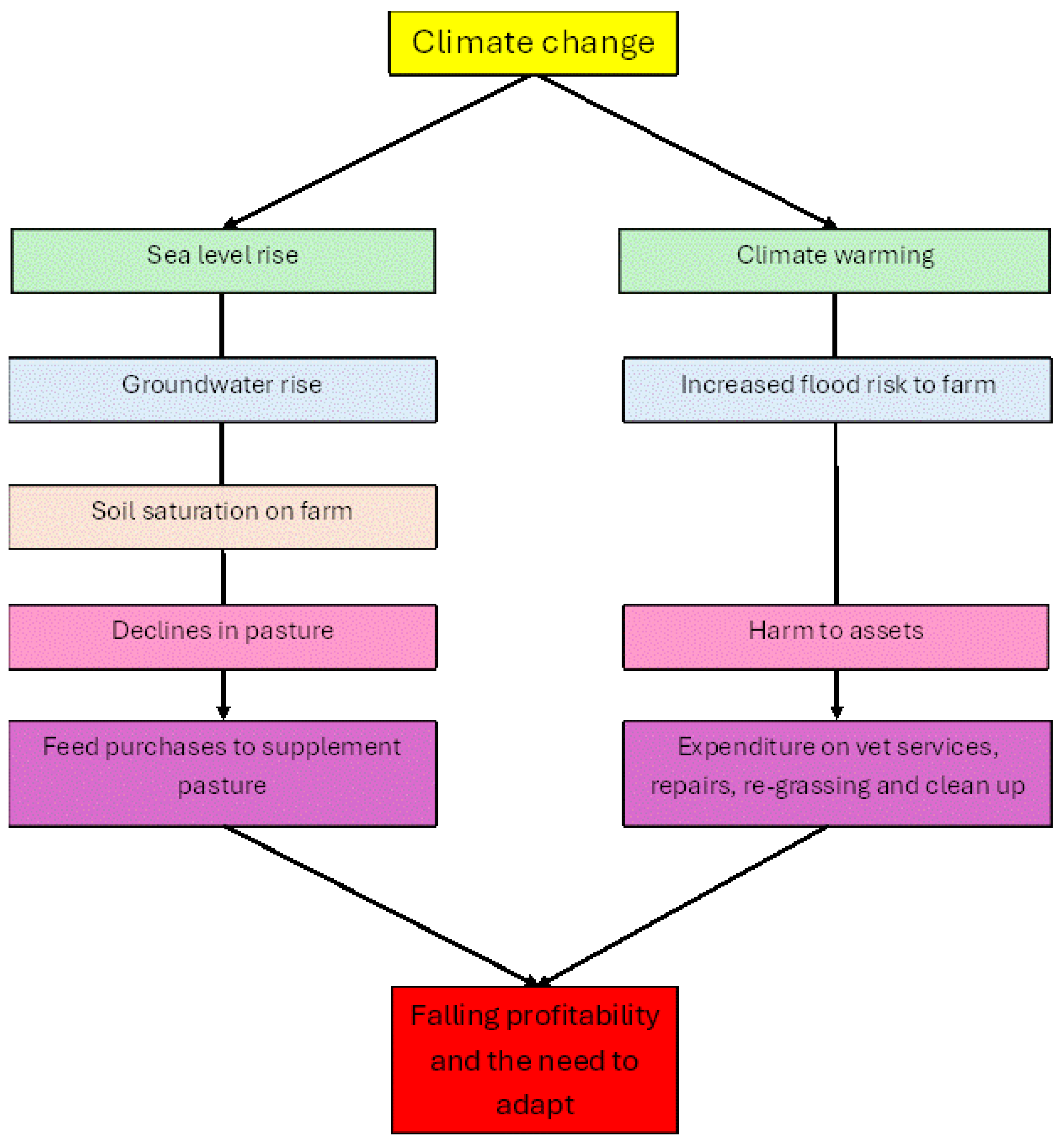
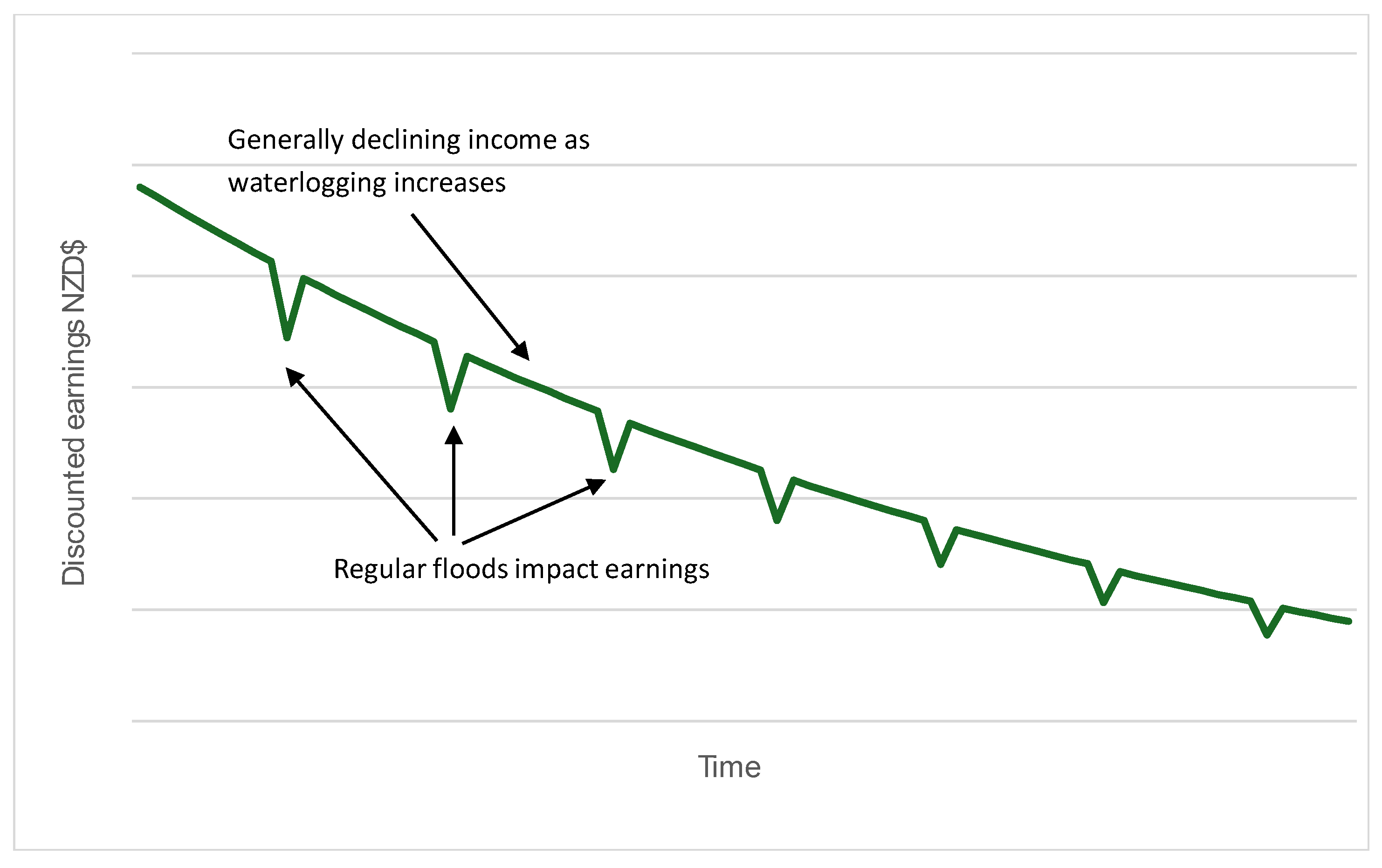
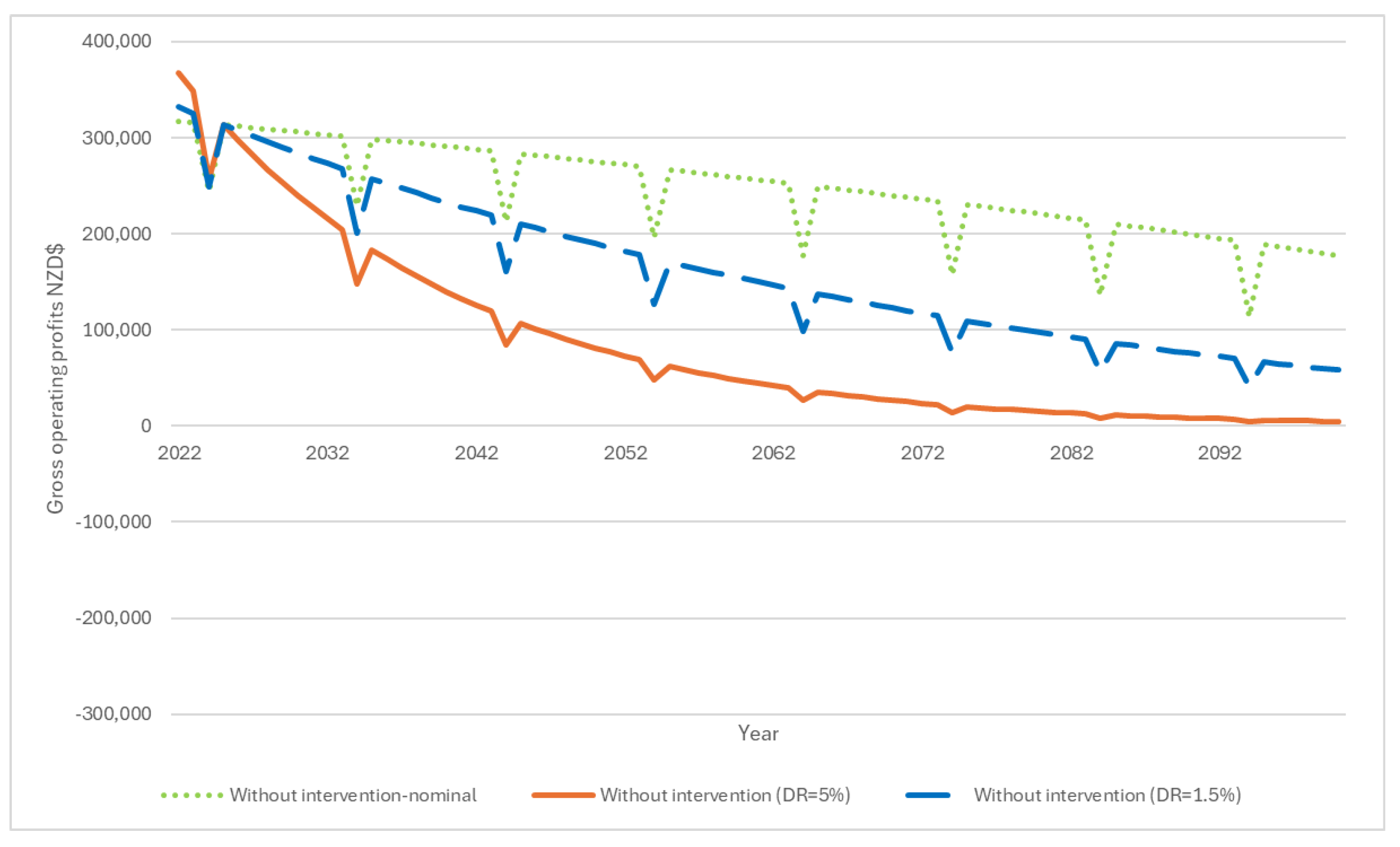
- Groundwater starting at 1 m (GW1) below the ground surface of coastal land and rising at 4.5 mm per year to sit at around 0.7 metres from the surface by year 2100, without intervention.
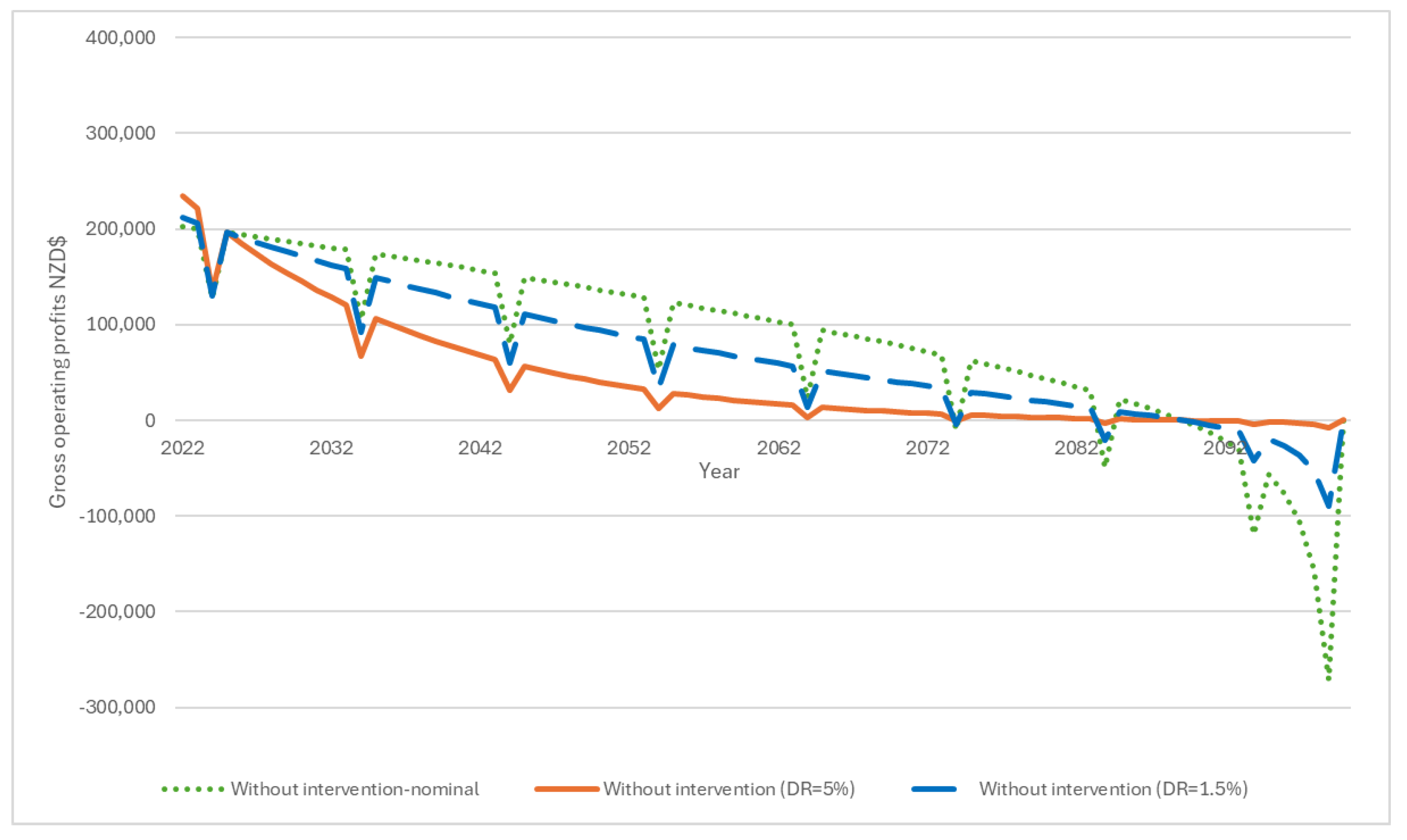
- Groundwater starting at 0.7 m below the ground surface of the coastal land rising at 4.5 mm per year, to sit around 0.4 metres from the surface by year 2100, without intervention.
Potential Impact on Operational Profits
2.3. Consider Sudden-Onset Threats—River Flooding
2.4. Consider Adaptation Actions
- Approaches that enhance the absorptive capacity of systems to manage negative events using predetermined coping responses in order to preserve and restore essential structures and functions. Actions under this approach enable farming systems to cope with the impacts of a shock in the short run.
- Approaches that enhance the adaptive capacity of systems to adjust or modify so they can moderate harm and/or benefit from opportunities, in order to continue functioning without major qualitative changes. Actions under this approach enable farming systems to better cope with climate change over the medium run through incremental change.
- Approaches that fundamentally change systems (transformational capacity). Actions under this approach involve long-term structural or systematic change, such as developing new production systems or investing in institutional change [67].
2.4.1. Absorptive Capacity Responses
Wintering Off
2.4.2. Adaptive Capacity Responses
‘Holding the Line’ Through Drainage
- Over time, sea level rise exacerbates fluvial flood risk, so land may require higher drainage services (Class A drainage) to prevent overflow.
- Ongoing sea level rise can potentially increase river stage such that Class A does not prevent overflow, so pumping is required as well. In such cases, we assume pump services are required for 25 per cent of land every year to help recover from regular flooding.
Establishing Drainage Ditches
- Research conducted on farms to manage diffuse pollution [72], which applies to a generic earth excavation value of NZD$10/m3 inclusive for earth moving, equipment transport and labour.
- The Waikato River Authority’s estimates of fencing at NZD$9.20 per metre for 3-wire electric fencing in the Waikato in 2022 [73] and adjust for inflation to assume a cost of $10 per metre. We assume fencing is established on both sides of the drainage ditch and lasts 20 years (this is a general assumption as in some areas, fencing may only be needed on one side of paddocks and some areas may need it on both sides).
- Data from the Waikato River Authority [73] indicates fence installation costs (e.g., labour, land preparation, and transportation) to be in the order of NZD$5815.38/km in 2022. We update these costs to 2024 values (Appendix D) although values will vary according to landscape, any pre-existing access to equipment and availability of ‘free’ labour (e.g., farmer labour).
Establishing Water-Tolerant Pasture
- Tall fescue is planted as part of standard pasture renewal today.
- Tall fescue is planted as part of standard pasture renewal in 20 years’ time.
- Ryegrass is actively removed and replaced at cost by tall fescue.
Retiring Part of the Land to Restore Wetland Vegetation
- Today: 15% of land is converted.
- Yr 20: 30% of land is converted.
- Yr 40: 45% of land is converted.
- Yr 60: 60% of land is converted.
- Consultations conducted by NIWA to assess the costs of wetland construction in New Zealand [72] revealed landscaping (vegetating) for constructed wetlands for farm management purposes to be around NZD$48,000/ha (personal communication).
- Salt marsh restoration in the Bay of Plenty is reported to be between NZD$20,000 and NZD$190,000/ha, with an average cost of NZD$30,000/ha, not including the cost of the land [84], citing personal communication with the Bay of Plenty Regional Council. These costs are indicative prices estimated based on common approaches for planting (e.g., average speed of planting), labour conditions (e.g., volunteer or paid workers (hourly rates generated using New Zealand’s minimum wage).
- More recently theestimated average cost of mangrove restoration in New Zealand has been estimated to be around USD$52,000/ha [85].
Potential Benefits of Restored Non-Tidal or Coastal Wetland
- Cumulative carbon sequestration rates of 0.64 tC/ha/y for restored salt marsh and 0.89 tC/ha/y for mangrove [84].
2.4.3. Transformative Capacity Responses
Sale of Land for Lifestyle Blocks
Lease of Land for Photovoltaic Power
- Today: 15% of land is converted.
- Yr 20: 30% of land is converted.
- Yr 40: 45% of land is converted.
- Yr 60: 60% of land is converted.
- An agrivoltaic system would be expected to lower financial returns to the dairy farmer compared to conventional farming.
2.5. Estimating Economic Impacts
3. Results
3.1. Gross Values Without Change in Management
3.2. Gross Values with Change
3.3. Net Benefits of Change
3.4. Sensitivity Analysis
4. Discussion
5. Limitations of This Study
6. Conclusions
Author Contributions
Funding
Data Availability Statement
Acknowledgments
Conflicts of Interest
Appendix A. Examples of Responses to Climate Change and Sea Level Rise

| Hazard | General Impact to Farm | Examples of Responses |
|---|---|---|
| Rising water tables, seawater intrusion | Increasing waterlogging of soil over time, reducing pasture productivity. Potential soil salinisation. | Drainage ditches, tile drains, pumps, salt-tolerant species, land conversion, raised pasture beds, seasonal cut-and-carry pasture production systems, controlled water table systems, alternative land use. |
| Greater storm surges | Periodic intense saturation of land, including saltwater, affecting pasture and damaging infrastructure. | Higher stop banks, pumps, coastal barriers, relocation of vulnerable infrastructure, salt-tolerant species, improved early warning systems. |
| Flooding | Periodic inundation from rainfall or swollen rivers, reducing productivity and damaging farm assets. | Higher stop banks, pumps, floodplain zoning, elevated buildings/infrastructure, pasture rotation, flood-compatible land use. |
Appendix B. Dry Matter Production for Perennial Ryegrass and the Distance of Groundwater from the Land Surface Equation
Appendix C. Ratable Land Class Categories
- Land drainage Class A—Gravity drainage services for land within the drainage catchment that is located in a floodplain.
- Land pumping drainage Class A—Pumped drainage services for land within the drainage catchment that is located in a floodplain.
- Farmland drainage Class B—Drainage services where land is within the drainage catchment but not in a floodplain (e.g., [131]).
| Level of Service | Annual Drainage Cost | Annual Pumping Cost | |
|---|---|---|---|
| Higher ↕ Lower | Land Class A drainage and Land Class A pumping | 68.17/ha | 289.43/ha pumped * |
| Land Class A drainage | 68.17/ha | ||
| Land Class B drainage | 42.26/ha | ||
| Normal | [not targeted] | [not targeted] | |
Appendix D. Costs to Install Fenced Drainage Ditches
| Item | Cost NZD$ | Total Cost Per 1000 m of Watercourse | Comment |
|---|---|---|---|
| 3-wire electric fence | 10/m | 10,000 | |
| Digger | 180.95/h | 2533.3 | $166.75 per hour, adjusted for inflation Assumes 1 day (7 h) per side of the river—a total of 2 days |
| Transportation | 399.34 | 399.34 | $368, adjusted for inflation |
| Labour | 74.88/h for contractor; 131.03/h for driver | 2882.74 | $69 per hour for contractor, plus $120.75 per hour for driver, adjusted for inflation Assumes 1 day (7 h) per side of the river—a total of 2 days |
| TOTAL (2022 values) | 5815.38 | ||
| TOTAL (2024 values) | 6221.44 | Adjusted for inflation. |
Appendix E. Water-Tolerant Grasses Species—Tall Fescue (Festuca arundinacea)
| Operating Profit NZD$ | Perennial Ryegrass Monoculture | Fall Fescue Monoculture | Reduction in Profit with Tall Fescue % |
|---|---|---|---|
| At milk price $4.10/kg MS | 707 | 643 | −9.95 |
| At milk price $6.40/kg MS | 3781 | 3611 | −4.71 |
| At milk price $8.50/kg MS | 6588 | 6321 | −4.22 |
Appendix F. Scenarios and Responses Explored
- Scenario 1: Groundwater today is 1000 mm from the surface; discount rate is 5 per cent.
- Scenario 2: Groundwater today is 700 mm from the surface; discount rate is 5 per cent.
- Scenario 3: Groundwater today is 1000 mm from the surface; discount rate is 1.5 per cent.
- Scenario 4: Groundwater today is 700 mm from the surface; discount rate is 1.5 per cent.
| Response | Absorptive, Adaptive or Transformative Actions | |
|---|---|---|
| 1. | No action | Absorptive |
| 2. | Farmers maintain production by wintering off livestock for 4 months every year? | Absorptive |
| 3. | Farmers hold the line by upgrading the council level of flood control and drainage service from none to Land Class A? | Adaptive |
| 4. | Farmers hold the line by upgrading the council level of flood control and drainage service and paying to pump 15% more land every 25 years? | Adaptive |
| 5. | Farmers could hold the line through council upgrades to level of service alone, pumping 25% of land each year and increasing the pumped area by 15% every 25 years? | Adaptive |
| 6. | Farmers hold the line through 1 km of vegetated, fenced drainage ditches? | Adaptive |
| 7. | Farmers plant water-tolerant grass as part of standard pasture renewal today to cope with future rising groundwater? | Adaptive |
| 8. | Farmers overhaul (replant at cost) existing pasture and plant water-tolerant grass? | Adaptive |
| 9. | Farmers plant water-tolerant grass in 20 years’ time as part of standard pasture renewal? | Adaptive |
| 10. | 15% of highest water table/most flood-prone land is converted to salt marsh every 25 yrs and farming elsewhere continues unchanged? | Transformative |
| 11. | 15% of highest water table/most flood-prone land is converted to mangrove every 25 yrs and farming elsewhere continues unchanged? | Transformative |
| 12. | 15% of highest water table/most flood-prone land is converted to wetlands every 25 yrs and water-tolerant grass is planted as well? | Transformative |
| 13. | 15% of land is sold to developers and farming elsewhere continues unchanged? | Transformative |
| 14. | 15% of highest water table/most flood-prone land is leased for PV power at $4 k/ha every 25 yrs and farming elsewhere continues unchanged? | Transformative |
| Impact of Flood Hazard | Impact on Groundwater Rise Hazard (Waterlogging) | Other Impacts | Assumption Related to Operating Profits | |
|---|---|---|---|---|
| Adaptation 1: Wintering off | reduced losses (stock protected) | no change | basic operating profit remains but waterlogged pasture losses remain | |
| Adaptation 2: Council upgrades from none/Class B to Land Class A | no flooding now | no change | basic operating profit remains but waterlogged pasture losses remain | |
| Adaptation 3: Council upgrades and pumping | no flooding now | no change | basic operating profit remains but waterlogged pasture losses remain | |
| Adaptation 4: Council upgrades and progressively higher pumping | no flooding now | no change | basic operating profit remains but waterlogged pasture losses remain | |
| Adaptation 5: Vegetated, fenced drainage ditches | no change | no waterlogging | basic operating profits remains at same level as Year 1 | |
| Adaptation 6: Water-tolerant grass today | no change | reduced waterlogging | productivity reduced by less preferred pasture but mitigated by lower waterlogging losses | |
| Adaptation 7: Water-tolerant grass in 20 years’ time | no change | reduced waterlogging | productivity reduced by less preferred pasture but mitigated by lower waterlogging losses | |
| Adaptation 8: Water-tolerant grass replanted at cost | no change | reduced waterlogging | productivity reduced by less preferred pasture but mitigated by lower waterlogging losses | |
| Adaptation 9: Conversion of some land to salt marsh over time | no change | no change | environmental benefits | basic operating profit/ha remains the same as without action |
| Adaptation 10: Conversion of some land to mangroves over time | no change | no change | environmental benefits | basic operating profit/ha remains the same as without action |
| Adaptation 11: Conversion of some land to mangroves over time + water-tolerant grass | no change | no waterlogging | environmental benefits | productivity in remaining farm reduced by less preferred pasture but mitigated by lower waterlogging losses |
| Adaptation 12: Sale of some land to developers | no change | no change | basic operating profit/ha for remaining farm remains the same as without action | |
| Adaptation 13: Lease of some land for PV power | no change | no change | basic operating profit/ha for remaining farm remains the same as without action |
Appendix G. Net Present Value
Appendix H. Gross and Net Responses Assuming Sea Level Rise and Groundwater Rise Occur at the Same Rate (Sea Level Rise: Groundwater Rise Ratio Is 1:1)
| Gross Present Value Earnings @ 75 Years | Rank Gross Benefits | NPV | NPV Rank | ||
|---|---|---|---|---|---|
| 1. | Without intervention | 5,717,885 | 6 | ||
| 2. | Wintering off | 4,362,463 | 14 | −1,355,422 | 13 |
| 3. | Council upgrades from none/Class B to Land Class A | 5,608,498 | 8 | −109,387 | 7 |
| 4. | Council upgrades and pumping | 5,368,375 | 10 | −349,510 | 9 |
| 5. | Council upgrades and increasing extent of pumping | 5,318,944 | 11 | −349,510 | 9 |
| 6. | Vegetated, fenced drainage ditches | 6,232,614 | 5 | 514,729 | 5 |
| 7. | Water-tolerant grass planted today as part of standard pasture renewal | 5,427,662 | 9 | −290,223 | 8 |
| 8. | Water-tolerant grass planted in 20 years’ time as part of standard pasture renewal | 5,618,528 | 7 | −99,357 | 6 |
| 9. | Replacing pasture with water-tolerant grass at cost | 5,148,212 | 12 | −569,673 | 11 |
| 10. | Progressive conversion to salt marsh | 4,465,110 | 13 | −1,252,775 | 12 |
| 11. | Progressive conversion to mangroves | 38,316,957 | 1 | 32,599,072 | 1 |
| 12. | Progressive conversion to mangroves plus water-tolerant grass | 38,052,304 | 2 | 32,334,419 | 2 |
| 13. | Sale of land to developers | 26,079,681 | 3 | 23,197,766 | 3 |
| 14. | Lease of land for PV power | 7,494,274 | 4 | 1,776,389 | 4 |
| Alternative wetland options with non-monetised ecosystem service benefits: | |||||
| 10a | Progressive conversion to salt marsh | 2,680,800 | 12 | −3,037,085 | 11 |
| 11a | Progressive conversion to mangroves | −476,185 | 13 | −6,194,069 | 12 |
| 12a | Progressive conversion to mangroves plus water-tolerant grass | −740,837 | 14 | −6,458,722 | 13 |
| Gross Present Value Earnings @ 75 Years | Rank Gross Benefits | NPV | NPV Rank | ||
|---|---|---|---|---|---|
| 1. | Without intervention | 2,953,884 | 6 | ||
| 2. | Wintering off | 1,598,462 | 14 | −1,355,422 | 13 |
| 3. | Council upgrades from none/Class B to Land Class A | 2,844,497 | 8 | −109,387 | 7 |
| 4. | Council upgrades and pumping | 2,604,374 | 10 | −349,510 | 9 |
| 5. | Council upgrades and increasing extent of pumping | 2,554,943 | 11 | −349,510 | 9 |
| 6. | Vegetated, fenced drainage ditches | 3,833,860 | 5 | 879,976 | 5 |
| 7. | Water-tolerant grass planted today as part of standard pasture renewal | 2,802,650 | 9 | −151,234 | 8 |
| 8. | Water-tolerant grass planted in 20 years’ time as part of standard pasture renewal | 2,914,876 | 7 | −39,008 | 6 |
| 9. | Replacing pasture with water-tolerant grass at cost | 2,523,198 | 12 | −430,686 | 11 |
| 10. | Progressive conversion to salt marsh | 2,376,144 | 13 | −577,740 | 12 |
| 11. | Progressive conversion to mangroves | 36,227,992 | 1 | 33,274,108 | 1 |
| 12. | Progressive conversion to mangroves plus water-tolerant grass | 36,068,387 | 2 | 33,114,503 | 2 |
| 13. | Sale of land to developers | 26,566,250 | 3 | 23,612,366 | 3 |
| 14. | Lease of land for PV power | 5,405,309 | 4 | 2,451,425 | 4 |
| Alternative wetland options with non-monetised ecosystem service benefits: | |||||
| 10a | Progressive conversion to salt marsh | 591,834 | 12 | −2,362,050 | 11 |
| 11a | Progressive conversion to mangroves | −2,565,150 | 13 | −5,519,034 | 12 |
| 12a | Progressive conversion to mangroves plus water-tolerant grass | −2,724,753 | 14 | −5,678,638 | 13 |
| Gross Present Value Earnings @ 75 Years | Rank Gross Benefits | NPV | NPV Rank | ||
|---|---|---|---|---|---|
| 1. | Without intervention | 11,772,004 | 6 | ||
| 2. | Wintering off | 8,748,402 | 14 | −3,023,602 | 13 |
| 3. | Council upgrades from none/Class B to Land Class A | 11,566,366 | 7 | −205,638 | 6 |
| 4. | Council upgrades and pumping | 11,029,015 | 11 | −742,989 | 10 |
| 5. | Council upgrades and increasing extent of pumping | 10,779,651 | 13 | −742,989 | 10 |
| 6. | Vegetated, fenced drainage ditches | 13,977,163 | 5 | 2,205,159 | 5 |
| 7. | Water-tolerant grass planted today as part of standard pasture renewal | 11,172,048 | 10 | −599,956 | 9 |
| 8. | Water-tolerant grass planted in 20 years’ time as part of standard pasture renewal | 11,421,582 | 9 | −350,421 | 8 |
| 9. | Replacing pasture with water-tolerant grass at cost | 10,892,598 | 12 | −879,406 | 12 |
| 10. | Progressive conversion to salt marsh | 11,460,710 | 8 | −311,294 | 7 |
| 11. | Progressive conversion to mangroves | 251,988,764 | 1 | 240,216,760 | 1 |
| 12. | Progressive conversion to mangroves plus water-tolerant grass | 251,511,343 | 2 | 239,739,339 | 2 |
| 13. | Sale of land to developers | 63,837,880 | 3 | 52,065,876 | 3 |
| 14. | Lease of land for PV power | 17,640,932 | 4 | 5,868,928 | 4 |
| Alternative wetland options with non-monetised ecosystem service benefits: | |||||
| 10a | Progressive conversion to salt marsh | 5,197,574 | 12 | −6,574,430 | 11 |
| 11a | Progressive conversion to mangroves | −315,946 | 13 | −12,087,950 | 12 |
| 12a | Progressive conversion to mangroves plus water-tolerant grass | −793,368 | 14 | −12,565,371 | 13 |
| Gross Present Value Earnings @ 75 Years | Rank Gross Benefits | NPV | NPV Rank | ||
|---|---|---|---|---|---|
| 1. | Without intervention | 4,756,297 | 7 | ||
| 2. | Wintering off | 1,732,695 | 14 | −3,023,602 | 13 |
| 3. | Council upgrades from none/Class B to Land Class A | 4,550,659 | 9 | −205,638 | 8 |
| 4. | Council upgrades and pumping | 4,013,308 | 12 | −742,989 | 11 |
| 5. | Council upgrades and increasing extent of pumping | 3,763,944 | 13 | −992,353 | 12 |
| 6. | Vegetated, fenced drainage ditches | 8,609,193 | 5 | 3,852,896 | 5 |
| 7. | Water-tolerant grass planted today as part of standard pasture renewal | 4,509,017 | 10 | −247,280 | 9 |
| 8. | Water-tolerant grass planted in 20 years’ time as part of standard pasture renewal | 4,654,534 | 8 | −101,763 | 7 |
| 9. | Replacing pasture with water-tolerant grass at cost | 4,229,567 | 11 | −526,730 | 10 |
| 10. | Progressive conversion to salt marsh | 6,882,212 | 6 | 2,125,916 | 6 |
| 11. | Progressive conversion to mangroves | 247,410,267 | 1 | 242,653,970 | 1 |
| 12. | Progressive conversion to mangroves plus water-tolerant grass | 247,163,038 | 2 | 242,406,741 | 2 |
| 13. | Sale of land to developers | 57,874,529 | 3 | 53,118,232 | 3 |
| 14. | Lease of land for PV power | 13,062,435 | 4 | 8,306,138 | 4 |
| Alternative wetland options with non-monetised ecosystem service benefits: | |||||
| 10a | Progressive conversion to salt marsh | 619,077 | 12 | −4,137,220 | 11 |
| 11a | Progressive conversion to mangroves | −4,894,444 | 13 | −9,650,741 | 12 |
| 12a | Progressive conversion to mangroves plus water-tolerant grass | −5,141,673 | 14 | −9,897,970 | 13 |
Appendix I. Gross and Net Responses When Groundwater Rise Occurs at Half the Rate of Sea Level Rise Rate (Sea Level Rise: Groundwater Rise Ratio Is 1:0.5)
| Gross Present Value Earnings @ 75 Years | Rank Gross Benefits | NPV | NPV Rank | ||
|---|---|---|---|---|---|
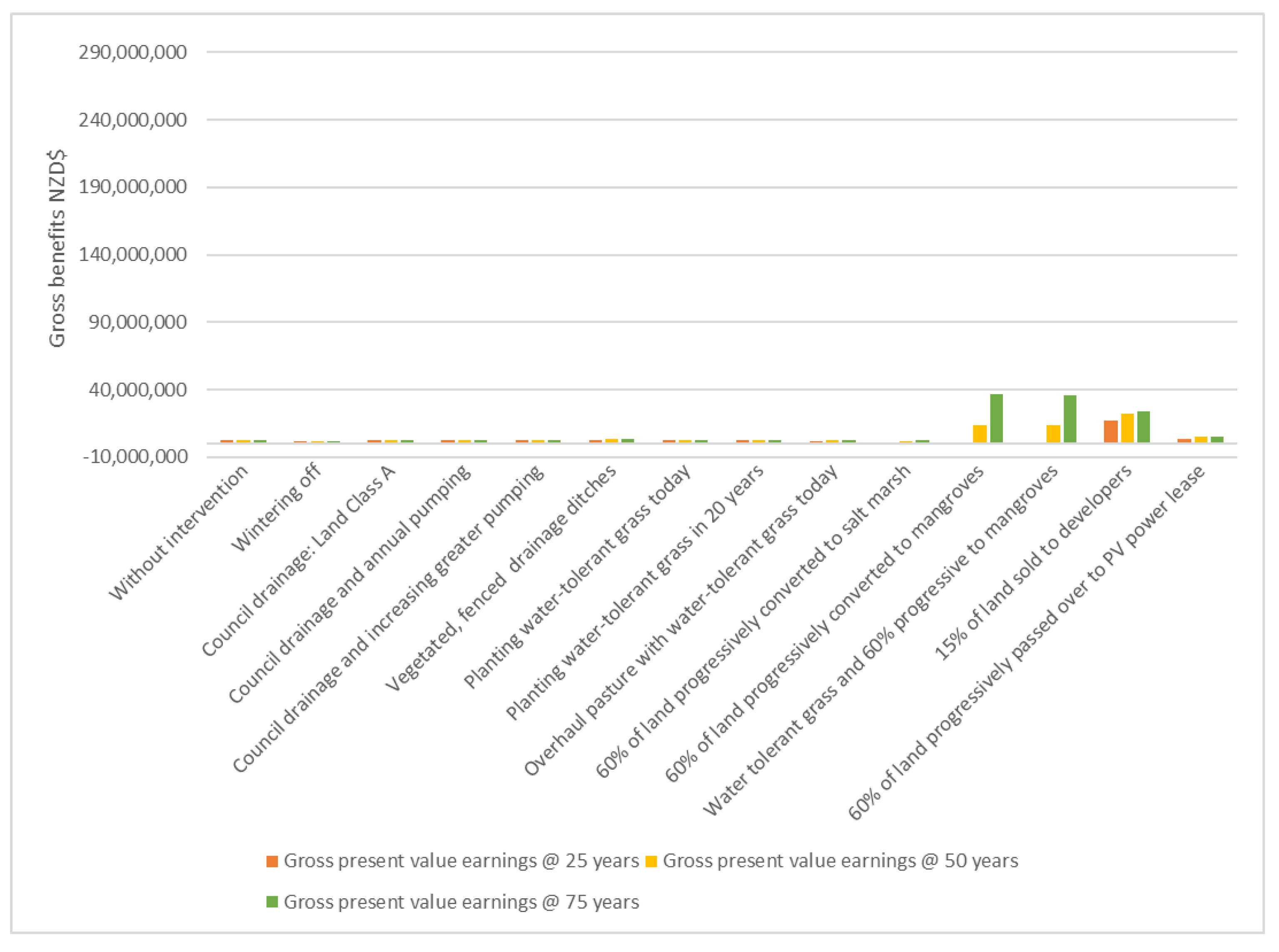
| 1. | Without intervention | 6,044,116 | 6 | ||
| 2. | Wintering off | 4,688,694 | 13 | −1,355,422 | 12 |
| 3. | Council drainage: Land Class A | 5,934,729 | 7 | −109,387 | 6 |
| 4. | Council drainage and annual pumping | 5,694,606 | 10 | −349,510 | 9 |
| 5. | Council drainage and increased pumping | 5,645,175 | 11 | −349,510 | 9 |
| 6. | Vegetated, fenced drainage ditches | 6,250,201 | 5 | 206,085 | 5 |
| 7. | Planting water-tolerant grass today | 5,736,781 | 9 | −307,335 | 8 |
| 8. | Planting water-tolerant grass in 20 years | 5,932,214 | 8 | −111,901 | 7 |
| 9. | Overhauling pasture with water-tolerant grass today | 5,457,331 | 12 | −586,785 | 11 |
| 10. | 60% of land progressively converted to salt marsh | 4,682,490 | 14 | −1,361,625 | 13 |
| 11. | 60% of land progressively converted to mangroves | 38,534,338 | 1 | 32,490,222 | 1 |
| 12. | Water-tolerant grass and 60% of land progressively converted to mangroves | 38,258,211 | 2 | 32,214,095 | 2 |
| 13. | 15% of land sold to developers | 26,356,977 | 3 | 20,312,861 | 3 |
| 14. | 60% of land progressively passed over to PV power lease | 7,711,655 | 4 | 1,667,539 | 4 |
| Alternative wetland options with non-monetised ecosystem service benefits: | |||||
| 10a | Progressive conversion to salt marsh | 2,898,180 | 12 | −3,145,935 | 11 |
| 11a | Progressive conversion to mangroves | −258,804 | 13 | −6,302,920 | 12 |
| 12a | Progressive conversion to mangroves plus water-tolerant grass | −534,930 | 14 | −6,579,046 | 13 |
| Gross Present Value Earnings @ 75 Years | Rank Gross Benefits | NPV | NPV Rank | ||
|---|---|---|---|---|---|
| 1. | Without intervention | 3,521,826 | 6 | ||
| 2. | Wintering off | 2,166,404 | 14 | −1,355,422 | 13 |
| 3. | Council drainage: Land Class A | 3,412,439 | 8 | −109,387 | 7 |
| 4. | Council drainage and annual pumping | 3,172,316 | 10 | −349,510 | 9 |
| 5. | Council drainage and increased pumping | 3,122,885 | 11 | −349,510 | 9 |
| 6. | Vegetated, fenced drainage ditches | 3,875,591 | 5 | 353,765 | 5 |
| 7. | Planting water-tolerant grass today | 3,340,978 | 9 | −180,848 | 8 |
| 8. | Planting water-tolerant grass in 20 years | 3,460,808 | 7 | −61,018 | 6 |
| 9. | Overhauling pasture with water-tolerant grass today | 3,061,528 | 12 | −460,298 | 11 |
| 10. | 60% of land progressively converted to salt marsh | 2,747,582 | 13 | −774,244 | 12 |
| 11. | 60% of land progressively converted to mangroves | 36,599,429 | 1 | 33,077,603 | 1 |
| 12. | Water-tolerant grass and 60% of land progressively converted to mangroves | 36,420,334 | 2 | 32,898,508 | 2 |
| 13. | 15% of land sold to developers | 24,213,031 | 3 | 20,691,205 | 3 |
| 14. | 60% of land progressively passed over to PV power lease | 5,776,746 | 4 | 2,254,920 | 4 |
| Alternative wetland options with non-monetised ecosystem service benefits: | |||||
| 10a | Progressive conversion to salt marsh | 963,272 | 12 | −2,558,554 | 11 |
| 11a | Progressive conversion to mangroves | −2,193,712 | 13 | −5,715,538 | 12 |
| 12a | Progressive conversion to mangroves plus water-tolerant grass | −2,372,808 | 14 | −5,894,633 | 13 |
| Gross Present Value Earnings @ 75 Years | Rank Gross Benefits | NPV | NPV Rank | ||
|---|---|---|---|---|---|
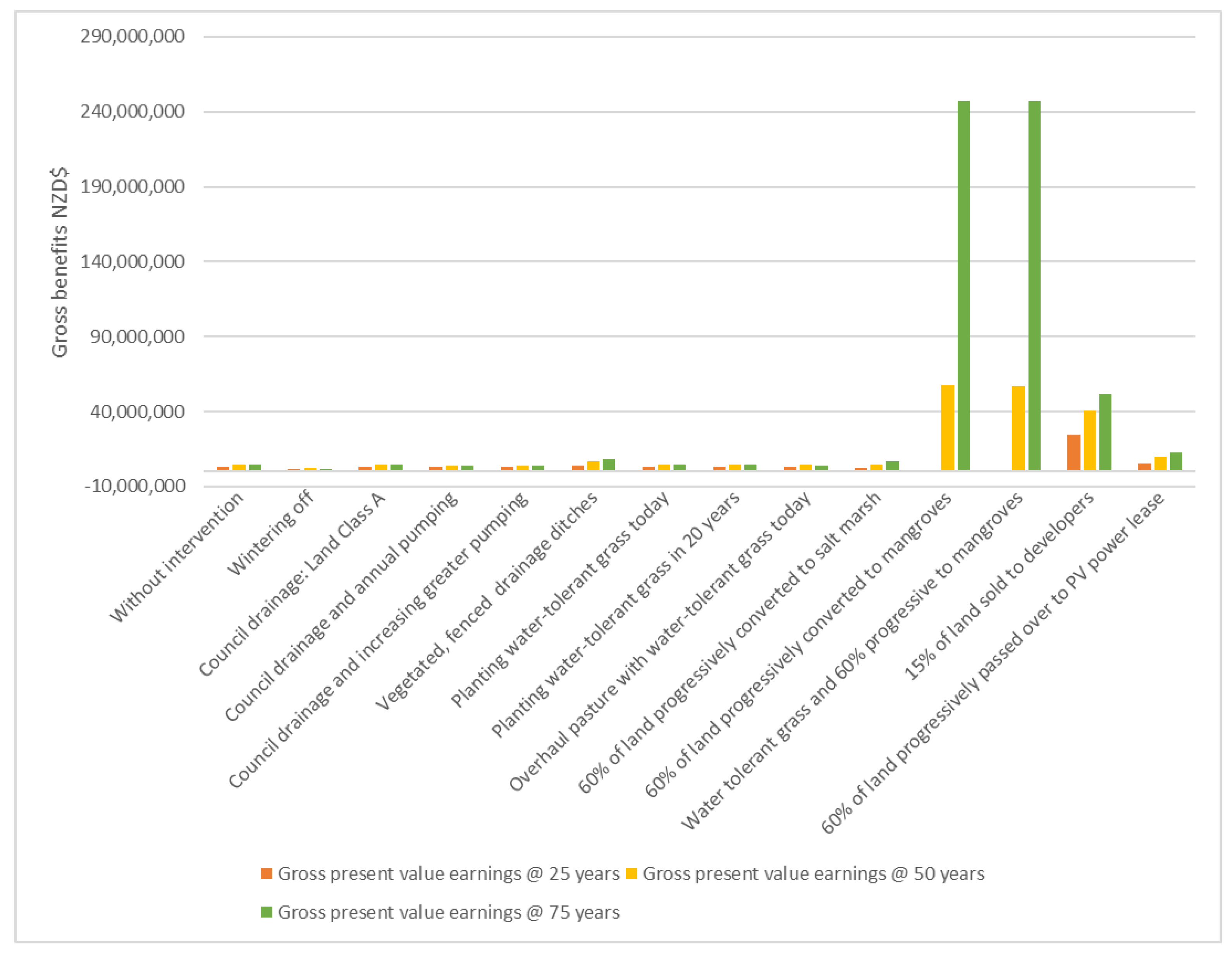
| 1. | Without intervention | 13,047,975 | 6 | ||
| 2. | Wintering off | 10,024,373 | 14 | −3,023,602 | 13 |
| 3. | Council drainage: Land Class A | 12,842,337 | 7 | −205,638 | 6 |
| 4. | Council drainage and annual pumping | 12,304,986 | 10 | −742,989 | 9 |
| 5. | Council drainage and increased pumping | 12,055,622 | 13 | −742,989 | 9 |
| 6. | Vegetated, fenced drainage ditches | 14,016,520 | 5 | 968,545 | 5 |
| 7. | Planting water-tolerant grass today | 12,382,206 | 9 | −665,769 | 8 |
| 8. | Planting water-tolerant grass in 20 years | 12,638,385 | 8 | −409,590 | 7 |
| 9. | Overhauling pasture with water-tolerant grass today | 12,102,756 | 12 | −945,219 | 12 |
| 10. | 60% of land progressively converted to salt marsh | 12,191,002 | 11 | −856,973 | 11 |
| 11. | 60% of land progressively converted to mangroves | 252,719,056 | 1 | 239,671,081 | 1 |
| 12. | Water-tolerant grass and 60% of land progressively converted to mangroves | 252,203,796 | 2 | 239,155,820 | 2 |
| 13. | 15% of land sold to developers | 58,576,075 | 3 | 45,528,100 | 3 |
| 14. | 60% of land progressively passed over to PV power lease | 18,371,224 | 4 | 5,323,249 | 4 |
| Alternative wetland options with non-monetised ecosystem service benefits: | |||||
| 10a | Progressive conversion to salt marsh | 5,927,866 | 12 | −7,120,109 | 11 |
| 11a | Progressive conversion to mangroves | 414,346 | 13 | −12,633,629 | 12 |
| 12a | Progressive conversion to mangroves plus water-tolerant grass | −100,915 | 14 | −13,148,890 | 13 |
| Gross Present Value Earnings @ 75 Years | Rank Gross Benefits | NPV | NPV Rank | ||
|---|---|---|---|---|---|
| 1. | Without intervention | 7,164,053 | 7 | ||
| 2. | Wintering off | 4,140,451 | 14 | −3,023,602 | 13 |
| 3. | Council drainage: Land Class A | 6,958,415 | 8 | −205,638 | 7 |
| 4. | Council drainage and annual pumping | 6,421,064 | 12 | −742,989 | 11 |
| 5. | Council drainage and increased pumping | 6,171,700 | 13 | −742,989 | 11 |
| 6. | Vegetated, fenced drainage ditches | 8,702,578 | 5 | 1,538,524 | 5 |
| 7. | Planting water-tolerant grass today | 6,793,347 | 10 | −370,706 | 9 |
| 8. | Planting water-tolerant grass in 20 years | 6,949,871 | 9 | −214,182 | 8 |
| 9. | Overhauling pasture with water-tolerant grass today | 6,513,897 | 11 | −650,156 | 10 |
| 10. | 60% of land progressively converted to salt marsh | 8,210,750 | 6 | 1,046,697 | 6 |
| 11. | 60% of land progressively converted to mangroves | 248,738,805 | 1 | 241,574,752 | 1 |
| 12. | Water-tolerant grass and 60% of land progressively converted to mangroves | 248,423,143 | 2 | 241,259,090 | 2 |
| 13. | 15% of land sold to developers | 53,574,741 | 3 | 46,410,688 | 3 |
| 14. | 60% of land progressively passed over to PV power lease | 14,390,972 | 4 | 7,226,919 | 4 |
| Alternative wetland options with non-monetised ecosystem service benefits: | |||||
| 10a | Progressive conversion to salt marsh | 1,947,615 | 12 | −5,216,439 | 11 |
| 11a | Progressive conversion to mangroves | −3,565,906 | 13 | −10,729,959 | 12 |
| 12a | Progressive conversion to mangroves plus water-tolerant grass | −3,881,567 | 14 | −11,045,620 | 13 |
Appendix J. Gross and Net Responses When Groundwater Rise Occurs at 150% of the Rate of Sea Level Rise Rate (Sea Level Rise: Groundwater Rise Ratio Is 1:1.5)
| Gross Present Value Earnings @ 75 Years | Rank Gross Benefits | NPV | NPV Rank | ||
|---|---|---|---|---|---|
| 1. | Without intervention | 5,345,848 | 6 | ||
| 2. | Wintering off | 3,990,426 | 14 | −1,355,422 | 13 |
| 3. | Council drainage: Land Class A | 5,236,461 | 8 | −109,387 | 7 |
| 4. | Council drainage and annual pumping | 4,996,338 | 10 | −349,510 | 9 |
| 5. | Council drainage and increased pumping | 4,946,907 | 11 | −349,510 | 9 |
| 6. | Vegetated, fenced drainage ditches | 6,215,158 | 5 | 869,310 | 5 |
| 7. | Planting water-tolerant grass today | 5,075,131 | 9 | −270,717 | 8 |
| 8. | Planting water-tolerant grass in 20 years | 5,261,227 | 7 | −84,621 | 6 |
| 9. | Overhauling pasture with water-tolerant grass today | 4,795,681 | 12 | −550,167 | 11 |
| 10. | 60% of land progressively converted to salt marsh | 4,221,196 | 13 | −1,124,651 | 12 |
| 11. | 60% of land progressively converted to mangroves | 38,073,043 | 1 | 32,727,196 | 1 |
| 12. | Water-tolerant grass and 60% of land progressively converted to mangroves | 37,821,258 | 2 | 32,475,410 | 2 |
| 13. | 15% of land sold to developers | 25,763,449 | 3 | 20,417,602 | 3 |
| 14. | 60% of land progressively passed over to PV power lease | 7,250,361 | 4 | 1,904,513 | 4 |
| Alternative wetland options with non-monetised ecosystem service benefits: | |||||
| 10a | Progressive conversion to salt marsh | 2,436,886 | 12 | −2,908,961 | 11 |
| 11a | Progressive conversion to mangroves | −720,098 | 13 | −6,065,946 | 12 |
| 12a | Progressive conversion to mangroves plus water-tolerant grass | −971,883 | 14 | −6,317,731 | 13 |
| Gross Present Value Earnings @ 75 Years | Rank Gross Benefits | NPV | NPV Rank | ||
|---|---|---|---|---|---|
| 1. | Without intervention | 2,396,719 | 6 | ||
| 2. | Wintering off | 1,041,297 | 14 | −1,355,422 | 13 |
| 3. | Council drainage: Land Class A | 2,287,332 | 8 | −109,387 | 7 |
| 4. | Council drainage and annual pumping | 2,047,209 | 10 | −349,510 | 9 |
| 5. | Council drainage and increased pumping | 1,997,777 | 11 | −349,510 | 9 |
| 6. | Vegetated, fenced drainage ditches | 3,792,690 | 5 | 1,395,971 | 5 |
| 7. | Planting water-tolerant grass today | 2,274,386 | 9 | −122,332 | 8 |
| 8. | Planting water-tolerant grass in 20 years | 2,378,531 | 7 | −18,188 | 6 |
| 9. | Overhauling pasture with water-tolerant grass today | 1,994,936 | 12 | −401,782 | 11 |
| 10. | 60% of land progressively converted to salt marsh | 1,984,499 | 13 | −412,219 | 12 |
| 11. | 60% of land progressively converted to mangroves | 35,836,346 | 1 | 33,439,628 | 1 |
| 12. | Water-tolerant grass and 60% of land progressively converted to mangroves | 35,697,190 | 2 | 33,300,471 | 2 |
| 13. | 15% of land sold to developers | 23,256,689 | 3 | 20,859,971 | 3 |
| 14. | 60% of land progressively passed over to PV power lease | 5,013,664 | 4 | 2,616,945 | 4 |
| Alternative wetland options with non-monetised ecosystem service benefits: | |||||
| 10a | Progressive conversion to salt marsh | 200,189 | 12 | −2,196,529 | 11 |
| 11a | Progressive conversion to mangroves | −2,956,795 | 13 | −5,353,513 | 12 |
| 12a | Progressive conversion to mangroves plus water-tolerant grass | −3,095,952 | 14 | −5,492,670 | 13 |
| Gross Present Value Earnings @ 75 Years | Rank Gross Benefits | NPV | NPV Rank | ||
|---|---|---|---|---|---|
| 1. | Without intervention | 10,240,296 | 7 | ||
| 2. | Wintering off | 7,216,694 | 14 | −3,023,602 | 13 |
| 3. | Council drainage: Land Class A | 10,034,658 | 8 | −205,638 | 7 |
| 4. | Council drainage and annual pumping | 9,497,307 | 11 | −742,989 | 10 |
| 5. | Council drainage and increased pumping | 9,247,943 | 13 | −742,989 | 10 |
| 6. | Vegetated, fenced drainage ditches | 13,938,100 | 5 | 3,697,804 | 5 |
| 7. | Planting water-tolerant grass today | 9,719,380 | 10 | −520,916 | 9 |
| 8. | Planting water-tolerant grass in 20 years | 9,961,954 | 9 | −278,342 | 8 |
| 9. | Overhauling pasture with water-tolerant grass today | 9,439,930 | 12 | −800,366 | 12 |
| 10. | 60% of land progressively converted to salt marsh | 10,600,716 | 6 | 360,420 | 6 |
| 11. | 60% of land progressively converted to mangroves | 251,128,770 | 1 | 240,888,474 | 1 |
| 12. | Water-tolerant grass and 60% of land progressively converted to mangroves | 250,695,918 | 2 | 240,455,622 | 2 |
| 13. | 15% of land sold to developers | 56,189,547 | 3 | 45,949,252 | 3 |
| 14. | 60% of land progressively passed over to PV power lease | 16,780,938 | 4 | 6,540,642 | 4 |
| Alternative wetland options with non-monetised ecosystem service benefits: | |||||
| 10a | Progressive conversion to salt marsh | 4,337,580 | 12 | −5,902,716 | 11 |
| 11a | Progressive conversion to mangroves | −1,175,941 | 13 | −11,416,236 | 12 |
| 12a | Progressive conversion to mangroves plus water-tolerant grass | −1,608,793 | 14 | −11,849,088 | 13 |
| Gross Present Value Earnings @ 75 Years | Rank Gross Benefits | NPV Years | NPV Rank | ||
|---|---|---|---|---|---|
| 1. | Without intervention | 3,196,038 | 7 | ||
| 2. | Wintering off | 172,436 | 14 | −3,023,602 | 13 |
| 3. | Council drainage: Land Class A | 2,990,401 | 10 | −205,638 | 9 |
| 4. | Council drainage and annual pumping | 2,453,049 | 12 | −742,989 | 11 |
| 5. | Council drainage and increased pumping | 2,203,686 | 13 | −742,989 | 11 |
| 6. | Vegetated, fenced drainage ditches | 8,517,060 | 5 | 5,321,022 | 5 |
| 7. | Planting water-tolerant grass today | 3,027,838 | 9 | −168,200 | 8 |
| 8. | Planting water-tolerant grass in 20 years | 3,161,603 | 8 | −34,436 | 7 |
| 9. | Overhauling pasture with water-tolerant grass today | 2,748,388 | 11 | −447,650 | 10 |
| 10. | 60% of land progressively converted to salt marsh | 5,820,485 | 6 | 2,624,446 | 6 |
| 11. | 60% of land progressively converted to mangroves | 246,348,539 | 1 | 243,152,501 | 1 |
| 12. | Water-tolerant grass and 60% of land progressively converted to mangroves | 246,155,562 | 2 | 242,959,524 | 2 |
| 13. | 15% of land sold to developers | 50,201,928 | 3 | 47,005,890 | 3 |
| 14. | 60% of land progressively passed over to PV power lease | 12,000,707 | 4 | 8,804,668 | 4 |
| Alternative wetland options with non-monetised ecosystem service benefits: | |||||
| 10a | Progressive conversion to salt marsh | −442,651 | 12 | −3,638,689 | 11 |
| 11a | Progressive conversion to mangroves | −5,956,172 | 13 | −9,152,210 | 12 |
| 12a | Progressive conversion to mangroves plus water-tolerant grass | −6,149,148 | 14 | −9,345,187 | 13 |
References
- Bandh, S.A.; Shafi, S.; Peerzada, M.; Rehman, T.; Bashir, S.; Wani, S.A.; Dar, R. Multidimensional analysis of global climate change: A review. Environ. Sci. Pollut. Res. 2021, 28, 24872–24888. [Google Scholar] [CrossRef]
- Wahl, T.; Jain, S.; Bender, J.; Meyers, S.D.; Luther, M.E. Increasing risk of compound flooding from storm surge and rainfall for major US cities. Nat. Clim. Chang. 2015, 5, 1093–1097. [Google Scholar] [CrossRef]
- Nicholls, R.J.; Cazenave, A. Sea-level rise and its impact on coastal zones. Science 2010, 328, 1517–1520. [Google Scholar] [CrossRef]
- Nicholls, R.; Wong, P.; Burkett, V.; Codignotto, J.; Hay, J.; McLean, R.; Ragoonaden, S.; Woodroffe, C. Coastal Systems and Low-lying Areas. Climate Change 2007: Impacts, Adaptation and Vulnerability. Contribution of Working Group II to the Fourth Assessment Report of the Intergovernmental Panel on Climate Change; Cambridge University Press: Cambridge, UK, 2007; pp. 315–356. [Google Scholar]
- Hennessy, K.; Fitzharris, B.; Bates, B.C.; Harvey, N.; Howden, S.; Hughes, L.; Salinger, J.; Warrick, R.A. Australia and New Zealand. In Impacts, Adaptation and Vulnerability: Working Group II Contribution to the Fourth Assessment Report of the Intergovernmental Panel on Climate Change; Parry, M.L., Canziani, O.F., Palutikof, J.P., van der Linden, P.J., Hanson, C.E., Eds.; Cambridge University Press: Cambridge, UK, 2007; pp. 507–540. [Google Scholar]
- Hamlington, B.; Bellas-Manley, A.; Willis, J.; Fournier, S.; Vinogradova, N.; Nerem, R.; Piecuch, C.; Thompson, P.; Kopp, R. The rate of global sea level rise doubled during the past three decades. Commun. Earth Environ. 2024, 5, 601. [Google Scholar] [CrossRef]
- Intergovernmental Panel on Climate Change. Climate Change 2022: Impacts, Adaptation and Vulnerability. Contribution of Working Group II to the Sixth Assessment Report of the Intergovernmental Panel on Climate Change; Cambridge University Press: Cambridge, UK; New York, NY, USA, 2022; 3056p. [Google Scholar] [CrossRef]
- Pfeffer, W.T.; Harper, J.T.; O’Neel, S. Kinematic constraints on glacier contributions to 21st-century sea-level rise. Science 2008, 321, 1340–1343. [Google Scholar] [CrossRef]
- Lowe, J.; Howard, T.; Pardaens, A.; Tinker, J.; Holt, J.; Wakelin, S.; Milne, G.; Leake, J.; Wolf, J.; Horsburgh, K.; et al. UK Climate Projections Science Report: Marine and Coastal Projections. (UK Climate Projections); Met Office Hadley Centre: Exeter, UK, 2009. [Google Scholar]
- Carleton, T.A.; Hsiang, S.M. Social and economic impacts of climate. Science 2016, 353, aad9837. [Google Scholar] [CrossRef]
- Bilal, A.; Känzig, D.R. The Macroeconomic Impact of Climate Change: Global vs. Local Temperature; National Bureau of Economic Research: Cambridge, MA, USA, 2024. [Google Scholar]
- Bosserelle, A.L.; Morgan, L.K.; Hughes, M.W. Groundwater rise and associated flooding in coastal settlements due to sea-level rise: A review of processes and methods. Earth’s Future 2022, 10, e2021EF002580. [Google Scholar] [CrossRef]
- Manda, A.K.; Klein, W.A. Chapter 17: Adaptation strategies to address rising water tables in coastal environments under future climate and sea-level rise scenarios. In Coastal Zone Management; Elsevier: Amsterdam, The Netherlands, 2019; pp. 403–409. [Google Scholar]
- Ministry for Primary Industries. Climate Issues Facing Farmers Sustainable Land Management and Climate Change Research Programme; Ministry for Primary Industries: Wellington, New Zealand, 2019. [Google Scholar]
- Craig, H.; Wild, A.; Paulik, R. Dairy farming exposure and impacts from coastal flooding and sea level rise in Aotearoa-New Zealand. Int. J. Disaster Risk Reduct. 2023, 98, 104079. [Google Scholar] [CrossRef]
- Lan, C.; Wild, A.; Paulik, R.; Wotherspoon, L.; Zorn, C. Assessing indirect impacts of extreme sea level flooding on critical infrastructure. J. Mar. Sci. Eng. 2023, 11, 1420. [Google Scholar] [CrossRef]
- Eaves, A.; Kench, P.; McDonald, G.; Dickson, M.; Storey, B. Modelling economic risk to sea-level rise and storms at the coastal margin. J. Flood Risk Manag. 2025, 18, e12903. [Google Scholar] [CrossRef]
- Nguyen, Q.; Thorsnes, P.; Diaz-Rainey, I.; Moore, A.; Cox, S.; Stirk-Wang, L. Price recovery after the flood: Risk to residential property values from climate change-related flooding. Aust. J. Agric. Resour. Econ. 2022, 66, 532–560. [Google Scholar] [CrossRef]
- Stephens, S.A.; Paulik, R.; Reeve, G.; Wadhwa, S.; Popovich, B.; Shand, T.; Haughey, R. Future changes in built environment risk to coastal flooding, permanent inundation and coastal erosion hazards. J. Mar. Sci. Eng. 2021, 9, 1011. [Google Scholar] [CrossRef]
- Kool, R.; Lawrence, J.; Drews, M.; Bell, R. Preparing for sea-level rise through adaptive managed retreat of a New Zealand stormwater and wastewater network. Infrastructures 2020, 5, 92. [Google Scholar] [CrossRef]
- Storey, B.; Owen, S.; Zammit, C.; Noy, I. Insurance retreat in residential properties from future sea level rise in Aotearoa New Zealand. Clim. Chang. 2024, 177, 44. [Google Scholar] [CrossRef]
- Setiawan, I.; Morgan, L.; Doscher, C.; Ng, K.; Bosserelle, A. Mapping shallow groundwater salinity in a coastal urban setting to assess exposure of municipal assets. J. Hydrol. Reg. Stud. 2022, 40, 100999. [Google Scholar] [CrossRef]
- Setiawan, I. Riparian Saltwater Intrusion: Implications, Dynamics, and Vulnerability Under Sea Level Rise. Ph.D. Thesis, Lincoln University, Lincoln, New Zealand, 2023. [Google Scholar]
- Chambers, L.A.; Hemmings, B.; Cox, S.C.; Moore, C.; Knowling, M.J.; Hayley, K.; Rekker, J.; Mourot, F.M.; Glassey, P.; Levy, R. Quantifying uncertainty in the temporal disposition of groundwater inundation under sea level rise projections. Front. Earth Sci. 2023, 11, 1111065. [Google Scholar] [CrossRef]
- Harker, J. Housing built upon sand: Advancing managed retreat in New Zealand. Aust. J. Environ. Law 2016, 3, 66–85. [Google Scholar]
- Cuendet, J.; Hunt, A.; Kring, N.; Taurich, N. Adapting to Rising Sea Levels in Seaview Gracefield, New Zealand: Developing the Seaview Sea-Level “Sea-Narios” Climate Game; Worcester Polytechnic Institute: Worcester, MA, USA, 2020. [Google Scholar]
- Mourot, F.M.; Westerhoff, R.S.; White, P.A.; Cameron, S.G. Climate change and New Zealand’s groundwater resources: A methodology to support adaptation. J. Hydrol. Reg. Stud. 2022, 40, 101053. [Google Scholar] [CrossRef]
- United Nations Framework Convention on Climate Change. Slow Onset Events; Technical Paper. FCCC/TP/2012/7; United Nations Framework Convention on Climate Change: Bonn, Germany, 2012. [Google Scholar]
- Caretta, M.A.; Mukherji, A.; Arfanuzzaman, M.; Betts, R.A.; Gelfan, A.; Hirabayashi, Y.; Lissner, T.K.; Liu, J.; Lopez, E.; Gunn, R.; et al. Water. In Climate Change 2022: Impacts, Adaptation and Vulnerability. Contribution of Working Group II to the Sixth Assessment Report of the Intergovernmental Panel on Climate Change; Pörtner, H.O., Roberts, D.C., Tignor, M., Poloczanska, E.S., Mintenbeck, K., Alegría, A., Craig, M., Langsdorf, S., Löschke, S., Möller, V., et al., Eds.; Cambridge University Press: Cambridge, UK; New York, NY, USA, 2022; pp. 551–712. [Google Scholar]
- Amanambu, A.; Obarein, A.; Mossa, J.; Li, L.; Ayeni, S.; Balogun, O.; Oyebamiji, A.; Ochege, F. Groundwater system and climate change: Present status and future considerations. J. Hydrol. 2020, 589, 125163. [Google Scholar] [CrossRef]
- Kumar, C. Climate Change and Its Impact on Groundwater Resources. Res. Inven. 2012, 1, 43–60. [Google Scholar]
- Dao, P.; Heuzard, A.; Le, T.; Zhao, J.; Yin, R.; Shang, C.; Fan, C. The impacts of climate change on groundwater quality: A review. Sci. Total Environ. 2024, 912, 169241. [Google Scholar] [CrossRef] [PubMed]
- Karri, R.R.; Ravindran, G.; Pingili, V.; Mubarak, N.M.; Ruslan, K.N.; Tan, Y.H. Integrating the Food-Energy-Water Nexus: Strategies for climate change mitigation with SDG alignment. Environ. Impact Assess. Rev. 2026, 116, 108070. [Google Scholar] [CrossRef]
- Gaffney, P.P.; Tang, Q.; Wang, J.; Zhang, C.; Xu, X.; Zhang, R.; Yin, T.; Yuan, L.; Ge, M.; Xu, F.; et al. Ecohydrological resilience to short-term warming in a high-altitude peatland under different water table levels. Environ. Impact Assess. Rev. 2026, 116, 108065. [Google Scholar] [CrossRef]
- Cobourn, K. Climate Change Adaptation Policies to Foster Resilience in Agriculture: Analysis and Stocktake Based on UNFCCC Reporting Documents; OECD Food, Agriculture and Fisheries Papers 202; OECD Publishing: Paris, France, 2023. [Google Scholar]
- Naish, T.; Levy, R.; Hamling, J.; Hreinsdottir, S.; Kumar, P.; Garner, G.; Kopp, R.; Golledge, N.; Bell, R.; Paulik, R.; et al. The Significance of Interseismic Vertical Land Movement at Convergent Plate Boundaries in Probabilistic Sea-Level Projections for AR6 Scenarios: The New Zealand Case. Earth’s Future 2024, 12, e2023EF004165. [Google Scholar] [CrossRef]
- Turner, E.R. Coastal wetland subsidence arising from local hydrologic manipulations. Estuaries 2004, 27, 265–272. [Google Scholar] [CrossRef]
- Bosserelle, A.L.; Hughes, M.W. Practitioner perspectives on sea-level rise impacts on shallow groundwater: Implications for infrastructure asset management and climate adaptation. Urban Clim. 2024, 58, 102195. [Google Scholar] [CrossRef]
- Gornitz, V. Global coastal hazards from future sea level rise. Glob. Planet. Chang. 1991, 89, 379–398. [Google Scholar] [CrossRef]
- Naish, T.; Lawrence, J.; Levy, R.; Bell, R.; van Uitregt, V.B.; Hayward, B.; Priestley, R.; Renwick, J.; Boston, J. A Sea Change is Needed For Adapting to Sea-Level Rise in Aotearoa New Zealand. Policy Q. 2024, 20, 83–93. [Google Scholar] [CrossRef]
- Rouse, H.; Bell, R.; Lundquist, C.; Blackett, P.; Hicks, D.M.; King, D.N. Coastal adaptation to climate change in Aotearoa-New Zealand. N. Z. J. Mar. Freshw. Res. 2017, 51, 183–222. [Google Scholar] [CrossRef]
- Statistica. Average Area of Dairy Farms in New Zealand from 2013 to 2024 (In Hectares). 2025. Available online: https://www.statista.com/statistics/1102345/new-zealand-dairy-farm-size/#:~:text=In%20the%202024%20dairy%20season,effective%20hectares%20in%20New%20Zealand (accessed on 14 November 2025).
- Statistica. Average Number of Cows Per Hectare in New Zealand from 2013 to 2024. 2025. Available online: https://www.statista.com/statistics/1416424/new-zealand-average-number-of-cows-per-hectare/#:~:text=In%202024%2C%20the%20average%20stocking,cows%20per%20hectare%20was%202.82 (accessed on 14 November 2025).
- DairyNZ. Farm Economics; DairyNZ: Hamilton, New Zealand, 2025. [Google Scholar]
- Cox, S.C.; Ettema, M.H.J.; Chambers, L.A.; Easterbrook-Clarke, L.H.; Stevenson, N.I. Dunedin Groundwater Monitoring, Spatial Observations and Forecast Conditions Under Sea-Level Rise; GNS Science Report 2023/43; GNS Science: Auckland, New Zealand, 2023. [Google Scholar]
- Morgan, L. Sea-level rise impacts on groundwater: Exploring some misconceptions with simple analytic solutions. Hydrogeol. J. 2024, 32, 1287–1294. [Google Scholar] [CrossRef]
- Maliva, R. Sea Level Rise and Groundwater. In Climate Change and Groundwater: Planning and Adaptations for a Changing and Uncertain Future. WSP Methods in Water Resources Evaluation Series No. 6; Maliva, R., Ed.; Springer Nature: Cham, Switzerland, 2021; pp. 113–153. [Google Scholar]
- Ferguson, G.; Gleeson, T. Vulnerability of coastal aquifers to groundwater use and climate change. Nat. Clim. Chang. 2012, 2, 342–345. [Google Scholar] [CrossRef]
- Richardson, C.M.; Davis, K.L.; Ruiz-González, C.; Guimond, J.A.; Michael, H.A.; Paldor, A.; Moosdorf, N.; Paytan, A. The impacts of climate change on coastal groundwater. Nat. Rev. Earth Environ. 2024, 5, 100–119. [Google Scholar] [CrossRef]
- Frisk, C.A.; Xistris-Songpanya, G.; Osborne, M.; Biswas, Y.; Melzer, R.; Yearsley, J.M. Phenotypic variation from waterlogging in multiple perennial ryegrass varieties under climate change conditions. Front. Plant Sci. 2022, 13, 954478. [Google Scholar] [CrossRef] [PubMed]
- DairyNZ. Ryegrass; DairyNZ: Hamilton, New Zealand, 2024. [Google Scholar]
- Snow, V.; Dodd, M.; Nichols, S. Impact of Waterlogging on Harvestable Pasture; NIWA: Auckland, New Zealand, 2025. [Google Scholar]
- Dairy NZ. Economic Survey 2021–2022; DairyNZ: Hamilton, New Zealand, 2023. [Google Scholar]
- Te Ara Encyclopaedia of New Zealand. Story: Floods; New Zealand Government: Wellington, New Zealand, 2009. [Google Scholar]
- Befus, K.; Barnard, P.L.; Hoover, D.J.; Finzi Hart, J.; Voss, C.I. Increasing threat of coastal groundwater hazards from sea-level rise in California. Nat. Clim. Chang. 2020, 10, 946–952. [Google Scholar] [CrossRef]
- Newton, K. New National Flood Data Reveals the Areas Most at Risk—Now and in Future. 2025. Available online: https://www.rnz.co.nz/news/national/577238/new-national-flood-data-reveals-the-areas-most-at-risk-now-and-in-future (accessed on 10 January 2026).
- Nicholls, R.J.; Hoozemans, F.M.; Marchand, M. Increasing flood risk and wetland losses due to global sea-level rise: Regional and global analyses. Glob. Environ. Chang. 1999, 9, S69–S87. [Google Scholar] [CrossRef]
- Paulik, R.; Crowley, K.; Cradock-Henry, N.; Wilson, T.; McSporran, A. Flood Impacts on Dairy Farms in the Bay of Plenty Region, New Zealand. Climate 2021, 9, 30. [Google Scholar] [CrossRef]
- United Nations Economic and Social Commission for Asia and the Pacific. The Disaster RiskScape Across Asia-Pacific. Pathways for Resilience, Inclusion and Development. Asia Pacific Report 2019; United Nations Economic and Social Commission for Asia and the Pacific: Bangkok, Thailand, 2019. [Google Scholar]
- Earthquake Commission. Natural Hazard Risk Tolerance Literature Review. A Companion Document to Toka Tū Ake EQC’s Risk Tolerance Methodology; New Zealand Government: Wellington, New Zealand, 2023. [Google Scholar]
- Federal Emergency Management Agency. Expected Annual Loss. 2025. Available online: https://hazards.fema.gov/nri/expected-annual-loss (accessed on 10 October 2025).
- Gibson, P.; Lewis, H.; Campbell, I.; Rampal, N.; Fauchereau, N.; Harrington, L. Downscaled Climate Projections of Tropical and Ex-Tropical Cyclones Over the Southwest Pacific. J. Geophys. Res. Atmos. 2025, 130, e2025JD043833. [Google Scholar] [CrossRef]
- Pittock, B.; Wratt, D. Chapter 12. Australia and New Zealand. IPCC. 2001. Available online: https://www.ipcc.ch/site/assets/uploads/2018/03/wg2TARchap12.pdf (accessed on 12 November 2025).
- Hack, K. Chapter II.6—Hot isostatic pressing of Al–Ni alloys. In The SGTE Casebook. Thermodynamics at Work, 2nd ed.; Hack, K., Ed.; Woodhead Publishing: Cambridge, UK, 2008; pp. 118–122. [Google Scholar]
- Liu, M.; Vecchi, G.; Smith, J.; Knutson, T. Causes of large projected increases in hurricane precipitation rates with global warming. Clim. Atmos. Sci. 2019, 2, 38. [Google Scholar] [CrossRef]
- Martinkova, M.; Kysely, J. Overview of Observed Clausius-Clapeyron Scaling of Extreme Precipitation in Midlatitudes. Atmosphere 2020, 11, 786. [Google Scholar] [CrossRef]
- Food and Agriculture Organization. The Future of Food and Agriculture—Alternative Pathways to 2050; Food and Agriculture Organization of the United Nations: Rome, Italy, 2018. [Google Scholar]
- Morris, J.; Beedell, J.; Hess, T. Mobilising flood risk management services from rural land: Principles and practice. J. Flood Risk Manag. 2016, 9, 50–68. [Google Scholar] [CrossRef]
- Vlotman, W.F.; Wong, T.; Schultz, B. Integration of drainage, water quality and flood management in rural, urban and lowland areas. Irrig. Drain. 2007, 56, S161–S177. [Google Scholar] [CrossRef]
- Wilby, R.L.; Keenan, R. 2012 Adapting to flood risk under climate change. Prog. Phys. Geogr. 2012, 36, 348–378. [Google Scholar] [CrossRef]
- DairyNZ. Waterway Technote: Drains; DairyNZ: Hamilton, New Zealand, 2015. [Google Scholar]
- Matthews, Y.; Holland, P.; Matheson, F.; Craggs, R.; Tanner, C. Evaluating the Cost-Effectiveness of Green Infrastructure for Mitigating Diffuse Agricultural Contaminant Losses. Land 2024, 13, 748. [Google Scholar] [CrossRef]
- Waikato River Authority. Standard Costs and Assumptions; Waikato River Authority: Hamilton, New Zealand, 2022. [Google Scholar]
- DairyNZ. Tall Fescue; DairyNZ: Hamilton, New Zealand, 2024. [Google Scholar]
- Milne, G.; Fraser, T. Establishment of 1600 hectares in dryland species around Oamaru/Timaru. Proc. New Zealand Grassl. Assoc. 1990, 52, 133–137. [Google Scholar] [CrossRef]
- Kerrisk, J.; Thomson, N. Effect of intensity and frequency of defoliation on growth of ryegrass, tall fescue and phalaris. Proc. New Zealand Grassl. Assoc. 1990, 51, 135–138. [Google Scholar] [CrossRef]
- Easton, H.; Fitzgerald, R. Tall fescue in Australia and New Zealand. N. Z. J. Agric. Res. 1994, 37, 405–417. [Google Scholar] [CrossRef]
- Dairy Australia. Pasture Options; Dairy Australia Limited: Southbank, Australia, 2025. [Google Scholar]
- Braun, R.; Patton, A. Growth responses to waterlogging stress among cool-season grass species. Grass Forage Sci. 2024, 79, 464–475. [Google Scholar] [CrossRef]
- Nguyen, T.M. Morphological Responses of Cocksfoot (Dactylis glomerata L.) and Tall Fescue (Lolium arundinaceum Schreb.) to Waterlogging Stress. Master’s Thesis, University of Tasmania, Dynnyrne, Australia, 2022. [Google Scholar]
- Mui, N.T.; Zhou, M.; Parsons, D.; Smith, R.W. Aerenchyma formation in adventitious roots of tall fescue and cocksfoot under waterlogged condition. Agronomy 2021, 11, 2487. [Google Scholar] [CrossRef]
- Garrett, L. Potential for Paludiculture in New Zealand. Considerations for the Lower Waikato; Report Prepared for NIWA: Future Coasts Aotearoa; NIWA: Auckland, New Zealand, 2023. [Google Scholar]
- Johnson, B.A. Ecological Restoration of the Wairio Wetland, Lake Wairarapa: Water Table Relationships and Cost-Benefit Analysis of Restoration Strategies. Master’s Thesis, Te Herenga Waka-Victoria University of Wellington, Wellington, New Zealand, 2012. [Google Scholar]
- Bayraktarov, E.; Saunders, M.I.; Abdullah, S.; Mills, M.; Beher, J.; Possingham, H.P.; Mumby, P.J.; Lovelock, C.E. The cost and feasibility of marine coastal restoration. Ecol. Appl. 2016, 26, 1055–1074. [Google Scholar] [CrossRef]
- Bulmer, R.H.; Stewart-Sinclair, P.J.; Lam-Gordillo, O.; Mangan, S.; Schwendenmann, L.; Lundquist, C.J. Blue carbon habitats in Aotearoa New Zealand—Opportunities for conservation, restoration, and carbon sequestration. Restor. Ecol. 2024, 32, e14225. [Google Scholar] [CrossRef]
- International Carbon Action Partnership. New Zealand Emissions Trading Scheme; International Carbon Action Partnership: Berlin, Germany, 2025. [Google Scholar]
- Parker, K.; Mainelli, M. What happens if we ‘burn all the carbon’? Carbon reserves, carbon budgets, and policy options for governments. Environ. Sci. Atmos. 2024, 4, 435–454. [Google Scholar] [CrossRef]
- Brasell, R. New Zealand’s Net Carbon Dioxide Emission Stabilisation Target. Agenda 1996, 3, 329–340. [Google Scholar] [CrossRef]
- Malerba, M.E.; Friess, D.A.; Peacock, M.; Grinham, A.; Taillardat, P.; Rosentreter, J.A.; Webb, J.; Iram, N.; Al-Haj, A.N.; Macreadie, P.I. Methane and nitrous oxide emissions complicate the climate benefits of teal and blue carbon wetlands. One Earth 2022, 5, 1336–1341. [Google Scholar] [CrossRef]
- Xu, X.; Chen, M.; Yang, G.; Jiang, B.; Zhang, J. Wetland ecosystem services research: A critical review. Glob. Ecol. Conserv. 2020, 22, e01027. [Google Scholar] [CrossRef]
- Foundation for Sustainable Development. Ecosystem Services Valuation Database; Foundation for Sustainable Development: Oakland, CA, USA, 2021. [Google Scholar]
- Department of Conservation. The Economic Values of Whangamarino Wetland; New Zealand Government: Wellington, New Zealand, 2007. [Google Scholar]
- Kirkland, W.T. Preserving the Whangamarino Wetland: An Application of the Contingent Valuation Method; Massey University: Auckland, New Zealand, 1988. [Google Scholar]
- Patterson, M.; Cole, A. ‘Total economic value’ of New Zealand’s land-based ecosystems and their services. In Ecosystem Services in New Zealand—Conditions and Trends; Dymond, J., Ed.; Manaaki Whenua Press: Lincoln, New Zealand, 2013; pp. 496–510. [Google Scholar]
- Stewart-Sinclair, P.; Qu, Z.; Lam-Gordillo, O.; Bulmer, R. Beyond Blue Carbon: Valuing Ecosystem Services of Coastal Wetlands in Aotearoa New Zealand. N. Z. J. Mar. Freshw. Res. 2025; Submitted. [Google Scholar]
- Yang, W.; Tanner, C.; Holland, P.; Qu, Z. Dynamic Economic Valuation of coastal wetland restoration: A nature-based solution for climate and biodiversity. Environ. Chall. 2024, 20, 101182. [Google Scholar] [CrossRef]
- Xie, H.; Pearson, D.; McLaren, S.J.; Horne, D. Expansion of Lifestyle Blocks in Peri-Urban New Zealand: A Review of the Implications for Environmental Management and Landscape Design. Land 2025, 14, 1447. [Google Scholar] [CrossRef]
- Real Estate Institute of New Zealand. Dairy and Arable Farms Drive Growth as Farm Sales Rise Across New Zealand. 2024. Available online: https://www.reinz.co.nz/Web/Web/News/News-Articles/Market-updates/Oct_2024_rural_data_Dairy_and_Arable_Farms_Drive_Growth_as_Farm_Sales_Rise_Across_New_Zealand.aspx (accessed on 30 October 2025).
- DairyNZ. New Zealand Dairy Statistics; DairyNZ: Hamilton, New Zealand, 2024. [Google Scholar]
- Vaughan, A.; Brent, A.; Fitzgerald, M.; Kueppers, J. Agrivoltaics: Integrating Solar Energy Generation with Livestock Farming in Canterbury; Our Land and Water Rural Professionals Fund: Otago, New Zealand, 2023. [Google Scholar]
- Brent, A.; Iorns, C. Solar Farms Can Eat Up Farmland—But ‘Agrivoltaics’ Could Mean the Best of Both Worlds. Using Agricultural Land for Both Renewable Electricity Generation and Farming Can Bring Economic Benefits for Farmers. 2024. Available online: https://www.wgtn.ac.nz/news/2024/06/solar-farms-can-eat-up-farmlandbut-agrivoltaics-could-mean-the-best-of-both-worlds (accessed on 10 November 2025).
- MacKenzie, D.; Brent, A.; Hinkley, J.; Burmester, D. AgriPV Systems: Potential Opportunities for Aotearoa–New Zealand. A GIS Suitability Analysis. In Proceedings of the AgriVoltaics World Conference 2022, Piacenza, Italy, 15–17 June 2022. [Google Scholar] [CrossRef]
- Brent, A.; Vaughan, A.; Fitzgerald, M.; Wright, E.; Kueppers, J. Agrivoltaics: Integrating Solar Energy Generation with Livestock Farming in the Canterbury Region of Aotearoa New Zealand. In Proceedings of the 2023 International Conference on Sustainable Technology and Engineering (i-COSTE), Nadi, Fiji, 4–6 December 2023. [Google Scholar]
- Miller, A. Economics of Utility-Scale Solar in Aotearoa New Zealand: Forecasting Transmission and Distribution Network Connected 1 MW to 200 MW Utility-Scale Photovoltaic Solar to 2060; Ministry of Business, Innovation and Employment: Wellington, New Zealand, 2020. [Google Scholar]
- Rennie, R. Light and Shade of Signing on with Solar. Technology Farmers Weekly. 29 September 2022. Available online: https://www.farmersweekly.co.nz/technology/light-and-shade-of-signing-on-with-solar/#:~:text=Most%20projects%20aim%20to%20lease%20land%2C%20at,keen%20to%20get%20projects%20over%20the%20line (accessed on 6 October 2025).
- New Zealand Dairy Exporter. Solar Leasing: Making Money While the Sun Shines. 2023. Available online: https://dairyexporter.co.nz/solar-leasing-making-money-while-the-sun-shines/#:~:text=Under%20a%20lease%20agreement%20the,to%20take%20the%20extra%20load (accessed on 7 September 2025).
- Anon. Solar Farming. The Whole Story. 2023. Available online: https://www.thewholestory.co.nz/wp-content/uploads/2023/03/Solar-farming-final.pdf (accessed on 5 October 2025).
- The Treasury. Discount Rates; New Zealand Government: Wellington, New Zealand, 2025. [Google Scholar]
- Bank ANZ. Agribusiness Rates, Fees and Agreements; Australia and New Zealand Banking Group Limited: Auckland, New Zealand, 2025. [Google Scholar]
- ASB Bank. Business and Rural Loan Interest Rates and Fees; Australia and New Zealand Banking Group Limited: Auckland, New Zealand, 2025. [Google Scholar]
- Rakkasagi, S.; Goyal, M.K. Protecting wetlands for future generations: A comprehensive approach to the water-climate-society nexus in South Asia. Environ. Impact Assess. Rev. 2025, 115, 107988. [Google Scholar] [CrossRef]
- Horstman, E.M.; Lundquist, C.J.; Bryan, K.R.; Bulmer, R.H.; Mullarney, J.C.; Stokes, D.J. The Dynamics of Expanding Mangroves in New Zealand. In Threats to Mangrove Forests; Makowski, C., Finkl, C., Eds.; Springer: New York, NY, USA, 2018; pp. 23–52. [Google Scholar]
- Purandare, J.; de Sousa de Saboya, R.; Bayraktarov, E.; Boström-Einarsson, L.; Carnell, P.E.; Eger, A.M.; Le Port, A.; Macreadie, P.I.; Reeves, S.E.; van Kampen, P. Database for marine and coastal restoration projects in Australia and New Zealand. Ecol. Manag. Restor. 2024, 25, 14–20. [Google Scholar] [CrossRef]
- Bakker, J.P. Restoration of salt marshes. In Restoration Ecology: The New Frontier; van Andel, J., Aronson, J., Eds.; Blackwell Publishing Ltd.: Oxford, UK, 2012; pp. 248–262. [Google Scholar]
- Rankin, C.; Gaston, T.; Sadat-Noori, M.; Glamore, W.; Morton, J.; Chalmers, A. Innovative tidal control successfully promotes saltmarsh restoration. Restor. Ecol. 2023, 31, e13774. [Google Scholar] [CrossRef]
- Walker, G. Environmental justice, impact assessment and the politics of knowledge: The implications of assessing the social distribution of environmental outcomes. Environ. Impact Assess. Rev. 2010, 30, 312–318. [Google Scholar] [CrossRef]
- Ministry for the Environment. Managing Our Wetlands a Discussion Document on Proposed Changes to the Wetland Regulations; New Zealand Government: Wellington, New Zealand, 2021. [Google Scholar]
- Forest and Bird. Bring back Wetlands; Forest and Bird: Wellington, New Zealand, 2023. [Google Scholar]
- Landcare Research—Manaaki Whenua. Wetland Restoration: A Handbook for New Zealand Freshwater Systems; Manaaki Whenua Press: Lincoln, New Zealand, 2010. [Google Scholar]
- New Zealand Landcare Trust. Fonterra Announces $250,000 in Grants for Wetland Restoration. 2024. Available online: https://landcare.org.nz/fonterra-announces-250000-in-grants-for-wetland-restoration/ (accessed on 8 November 2025).
- Sairinen, R.; Barrow, C.; Karjalainen, T.P. Environmental conflict mediation and social impact assessment: Approaches for enhanced environmental governance? Environ. Impact Assess. Rev. 2010, 30, 289–292. [Google Scholar] [CrossRef]
- Ketabchi, H.; Mahmoodzadeh, D.; Ataie-Ashtiani, B.; Simmons, C.T. Sea-level rise impacts on seawater intrusion in coastal aquifers: Review and integration. J. Hydrol. 2016, 535, 235–255. [Google Scholar] [CrossRef]
- Parliamentary Commissioner for the Environment. Preparing New Zealand for Rising Seas: Certainty and Uncertainty; Government of New Zealand: Wellington, New Zealand, 2015. [Google Scholar]
- Wunderling, N.; von der Heydt, A.S.; Aksenov, Y.; Barker, S.; Bastiaansen, R.; Brovkin, V.; Brunetti, M.; Couplet, V.; Kleinen, T.; Lear, C.H.; et al. Climate tipping point interactions and cascades: A review. Earth Syst. Dynam. 2024, 15, 41–74. [Google Scholar] [CrossRef]
- New Zealand Herald. Elderly Woman Dies in Flood Waters on West Coast. 2019. Available online: https://www.nzherald.co.nz/nz/elderly-woman-dies-in-flood-waters-on-west-coast/3DM2IEDN7EYE6SRRGOHKCHXJUA/ (accessed on 9 November 2025).
- New Zealand Herald. Auckland Flood Victims: The Four People Killed in Extreme and Unprecedented Weather Event. 2023. Available online: https://www.nzherald.co.nz/nz/faces-of-the-flood-four-killed-across-auckland-and-waikato-in-extreme-and-unprecedented-weather-event/Z7VR72Z3YJAILCOAVOG4B72DXQ/ (accessed on 8 October 2025).
- Quinn, R. More Than 3000 Injury Claims from This Year’s Storms. 2023. Available online: https://www.rnz.co.nz/news/national/487589/more-than-3000-injury-claims-from-this-year-s-storms-acc-data (accessed on 3 September 2025).
- Weekes, J.; Ryan, S. Floods Shut Down Wellington, One Dead. 2015. Available online: https://www.nzherald.co.nz/nz/floods-shut-down-wellington-one-dead/U2NLENPALUNI7P3RZ7UAGJNWHQ/ (accessed on 5 October 2025).
- Ministry for the Environment. Preparing for Future Flooding: A Guide for Local Government in New Zealand; New Zealand Government: Wellington, New Zealand, 2010. [Google Scholar]
- Mimura, N.; Pulwarty, R.; Duc, D.; Elshinnawy, I.; Redsteer, M.; Huang, H.; Nkem, J.; Sanchez Rodriguez, R. Adaptation planning and implementation. In Climate Change 2014: Impacts, Adaptation, and Vulnerability. Part A: Global and Sectoral Aspects. Contribution of Working Group II to the Fifth Assessment Report of the Intergovernmental Panel on Climate Change; Field, C.B., Barros, V.R., Dokken, D.J., Mach, K.J., Mastrandrea, M.D., Bilir, T.E., Chatterjee, M., Ebi, K.L., Estrada, Y.O., Genova, R.C., et al., Eds.; Cambridge University Press: Cambridge, UK; New York, NY, USA, 2014; pp. 869–898. [Google Scholar]
- Auckland Council. Map of Te Arai Drainage District Land Classification—Rodney Drainage Districts Land Classification. Auckland Council. 2023. Available online: https://www.aucklandcouncil.govt.nz/content/dam/ac/docs/project-updates/te-arai-rating-classes-map.pdf (accessed on 15 June 2025).
- Western Bay of Plenty District Council. Property and Rates Search Website. 2025. Available online: https://www.westernbay.govt.nz/property-rates-and-building/property-and-rates-search (accessed on 10 July 2025).
- Lee, J.; Clark, D.; Clark, C.; Waugh, C.; Roach, C.; Minnée, E.; Glassey, C.; Woodward, S.; Woodfield, D.; Chapman, D. A comparison of perennial ryegrass- and tall fescue-based swards with or without a cropping component for dairy production: Animal production, herbage characteristics and financial performance from a 3-year farmlet trial. Grass Forage Sci. 2017, 73, 340–354. [Google Scholar] [CrossRef]
- Asian Development Bank. Guidelines for the Economic Analysis of Projects; ADB: Mandaluyong, Philippines, 2017. [Google Scholar]




| Stock Size | Transport Costs | Grazing Off-Farm Costs |
|---|---|---|
| 114–642 | 6000–60,000 | 9000–112,000 |
| Service | Reported Economic Estimate | Source |
|---|---|---|
| Replacement cost for flood management | NZD$16,000,000 | [92] |
| Gamebird hunting | NZD$60,000 p.a. | [92] |
| Existence/intrinsic value | NZD$55,291,671 p.a. 1 | [93] |
| GW = 1000 DR = 5% | GW = 700 DR = 5% | GW = 1000 DR = 1.5% | GW = 700 DR = 1.5% | ||
|---|---|---|---|---|---|
| 1 | Without intervention | 5,717,885 | 2,953,884 | 11,772,004 | 4,756,297 |
| 2 | Wintering off | 4,362,463 | 1,598,462 | 8,748,402 | 1,732,695 |
| 3 | Council upgrades from none/Class B to Land Class A | 5,608,498 | 2,844,497 | 11,566,366 | 4,550,659 |
| 4 | Council upgrades and pumping | 5,368,375 | 2,604,374 | 11,029,015 | 4,013,308 |
| 5 | Council upgrades and increasing extents of pumping | 5,318,944 | 2,554,943 | 10,779,651 | 3,763,944 |
| 6 | Vegetated, fenced drainage ditches, etc. | 6,232,614 | 3,833,860 | 13,977,163 | 8,609,193 |
| 7 | Water-tolerant grass planted today as part of standard pasture renewal | 5,427,662 | 2,802,650 | 11,172,048 | 4,509,017 |
| 8 | Water-tolerant grass planted in 20 years’ time as part of standard pasture renewal | 5,618,528 | 2,914,876 | 11,421,582 | 4,654,534 |
| 9 | Replacing pasture with water-tolerant grass at cost | 5,148,212 | 2,523,198 | 10,892,598 | 4,229,567 |
| 10 | Progressive conversion to salt marsh | 4,465,110 | 2,376,144 | 11,460,710 | 6,882,212 |
| 11 | Progressive conversion to mangroves | 38,316,957 | 36,227,992 | 251,988,764 | 247,410,267 |
| 12 | Progressive conversion to mangroves plus water-tolerant grass | 38,052,304 | 36,068,387 | 251,511,343 | 247,163,038 |
| 13 | Sale of land to developers | 26,079,681 | 23,730,280 | 57,491,499 | 51,528,148 |
| 14 | Lease of land for PV power | 7,494,274 | 5,405,309 | 17,640,932 | 13,062,435 |
| Adaptation Option | Total Value over Time |
|---|---|
| Salt marsh | 1,784,310 |
| Mangrove | 38,793,141 |
| GW = 1000 DR = 5% | GW = 700 DR = 5% | GW = 1000 DR = 1.5% | GW = 700 DR = 1.5% | ||
|---|---|---|---|---|---|
| 10 | Progressive conversion to salt marsh | 2,680,800 | 591,834 | 5,197,574 | 619,077 |
| 11 | Progressive conversion to mangroves | −476,185 | −2,565,150 | −315,946 | −4,894,444 |
| 12 | Progressive conversion to mangroves plus water-tolerant grass | −740,837 | −2,724,753 | −793,368 | −5,141,673 |
| GW = 1000 DR = 5% | GW = 700 DR = 5% | GW = 1000 DR = 1.5% | GW = 700 DR = 1.5% | ||
|---|---|---|---|---|---|
| 10 | Progressive conversion to salt marsh | −3,037,085 | −2,362,050 | −6,574,430 | −4,137,220 |
| 11 | Progressive conversion to mangroves | −6,194,069 | −5,519,034 | −12,087,950 | −9,650,741 |
| 12 | Progressive conversion to mangroves plus water-tolerant grass | −6,458,722 | −5,678,638 | −12,565,371 | −9,897,970 |
| GW = 1000 DR = 5 | GW = 700 DR = 5 | GW = 1000 DR = 1.5 | GW = 700 DR = 1.5 | ||
|---|---|---|---|---|---|
| 1 | Without intervention | 6,044,116 | 3,521,826 | 13,047,975 | 7,164,053 |
| 2 | Wintering off | 4,688,694 | 2,166,404 | 10,024,373 | 4,140,451 |
| 3 | Council upgrades from none/Class B to Land Class A | 5,934,729 | 3,412,439 | 12,842,337 | 6,958,415 |
| 4 | Council upgrades and pumping | 5,694,606 | 3,172,316 | 12,304,986 | 6,421,064 |
| 5 | Council upgrades and increasing extents of pumping | 5,645,175 | 3,122,885 | 12,055,622 | 6,171,700 |
| 6 | Vegetated, fenced drainage ditches, etc. | 6,250,201 | 3,875,591 | 14,016,520 | 8,702,578 |
| 7 | Water-tolerant grass planted today as part of standard pasture renewal | 5,736,781 | 3,340,978 | 12,382,206 | 6,793,347 |
| 8 | Water-tolerant grass planted in 20 years’ time as part of standard pasture renewal | 5,932,214 | 3,460,808 | 12,638,385 | 6,949,871 |
| 9 | Replacing pasture with water-tolerant grass at cost | 5,457,331 | 3,061,528 | 12,102,756 | 6,513,897 |
| 10 | Progressive conversion to salt marsh | 4,682,490 | 2,747,582 | 12,191,002 | 8,210,750 |
| 11 | Progressive conversion to mangroves | 38,534,338 | 36,599,429 | 252,719,056 | 248,738,805 |
| 12 | Progressive conversion to mangroves plus water-tolerant grass | 38,258,211 | 36,420,334 | 252,203,796 | 248,423,143 |
| 13 | Sale of land to developers | 26,356,977 | 24,213,031 | 58,576,075 | 53,574,741 |
| 14 | Lease of land for PV power | 7,711,655 | 5,776,746 | 18,371,224 | 14,390,972 |
| Alternative wetland options with non-monetised ecosystem service benefits: | |||||
| 10a | Progressive conversion to salt marsh | 2,898,180 | 963,272 | 5,927,866 | 1,947,615 |
| 11a | Progressive conversion to mangroves | −258,804 | −2,193,712 | 414,346 | −3,565,906 |
| 12a | Progressive conversion to mangroves plus water-tolerant grass | −534,930 | −2,372,808 | −100,915 | −3,881,567 |
| GW = 1000 DR = 5 | GW = 700 DR = 5 | GW = 1000 DR = 1.5 | GW = 700 DR = 1.5 | ||
|---|---|---|---|---|---|
| 1 | Without intervention | −1,355,422 | −1,355,422 | −3,023,602 | −3,023,602 |
| 2 | Wintering off | −109,387 | −109,387 | −205,638 | −205,638 |
| 3 | Council upgrades from none/Class B to Land Class A | −349,510 | −349,510 | −742,989 | −742,989 |
| 4 | Council upgrades and pumping | −349,510 | −349,510 | −742,989 | −742,989 |
| 5 | Council upgrades and increasing extents of pumping | 206,085 | 353,765 | 968,545 | 1,538,524 |
| 6 | Vegetated, fenced drainage ditches, etc. | −307,335 | −180,848 | −665,769 | −370,706 |
| 7 | Water-tolerant grass planted today as part of standard pasture renewal | −111,901 | −61,018 | −409,590 | −214,182 |
| 8 | Water-tolerant grass planted in 20 years’ time as part of standard pasture renewal | −586,785 | −460,298 | −945,219 | −650,156 |
| 9 | Replacing pasture with water-tolerant grass at cost | −1,361,625 | −774,244 | −856,973 | 1,046,697 |
| 10 | Progressive conversion to salt marsh | 32,490,222 | 33,077,603 | 239,671,081 | 241,574,752 |
| 11 | Progressive conversion to mangroves | 32,214,095 | 32,898,508 | 239,155,820 | 241,259,090 |
| 12 | Progressive conversion to mangroves plus water-tolerant grass | 20,312,861 | 20,691,205 | 45,528,100 | 46,410,688 |
| 13 | Sale of land to developers | 1,667,539 | 2,254,920 | 5,323,249 | 7,226,919 |
| 14 | Lease of land for PV power | −1,355,422 | −1,355,422 | −3,023,602 | −3,023,602 |
| Alternative wetland options with non-monetised ecosystem service benefits: | |||||
| 10a | Progressive conversion to salt marsh | −3,145,935 | −2,558,554 | −7,120,109 | −5,216,439 |
| 11a | Progressive conversion to mangroves | −6,302,920 | −5,715,538 | −12,633,629 | −10,729,959 |
| 12a | Progressive conversion to mangroves plus water-tolerant grass | −6,579,046 | −5,894,633 | −13,148,890 | −11,045,620 |
Disclaimer/Publisher’s Note: The statements, opinions and data contained in all publications are solely those of the individual author(s) and contributor(s) and not of MDPI and/or the editor(s). MDPI and/or the editor(s) disclaim responsibility for any injury to people or property resulting from any ideas, methods, instructions or products referred to in the content. |
© 2026 by the authors. Licensee MDPI, Basel, Switzerland. This article is an open access article distributed under the terms and conditions of the Creative Commons Attribution (CC BY) license.
Share and Cite
Holland, P.; Qu, Z.; Etheridge, Z.; Rautenbach, C.; Tanner, C.C. A Risky and Potentially Costly Future: Implications of Climate-Induced Changes in Groundwater and Flooding for Coastal Dairy Farming in New Zealand. Land 2026, 15, 341. https://doi.org/10.3390/land15020341
Holland P, Qu Z, Etheridge Z, Rautenbach C, Tanner CC. A Risky and Potentially Costly Future: Implications of Climate-Induced Changes in Groundwater and Flooding for Coastal Dairy Farming in New Zealand. Land. 2026; 15(2):341. https://doi.org/10.3390/land15020341
Chicago/Turabian StyleHolland, Paula, Zoe Qu, Zeb Etheridge, Christo Rautenbach, and Chris C. Tanner. 2026. "A Risky and Potentially Costly Future: Implications of Climate-Induced Changes in Groundwater and Flooding for Coastal Dairy Farming in New Zealand" Land 15, no. 2: 341. https://doi.org/10.3390/land15020341
APA StyleHolland, P., Qu, Z., Etheridge, Z., Rautenbach, C., & Tanner, C. C. (2026). A Risky and Potentially Costly Future: Implications of Climate-Induced Changes in Groundwater and Flooding for Coastal Dairy Farming in New Zealand. Land, 15(2), 341. https://doi.org/10.3390/land15020341