Participatory Budgeting for the Management of Children’s Green Areas in Valencia: DecidimVLC and Its Impact on Citizen Participation

Abstract
1. Introduction
- Evaluate the use of the platform. Analyse the citizen participation process through the DecidimVLC participatory budgets.
- Identify and categorise the types of initiatives promoted through the platform.
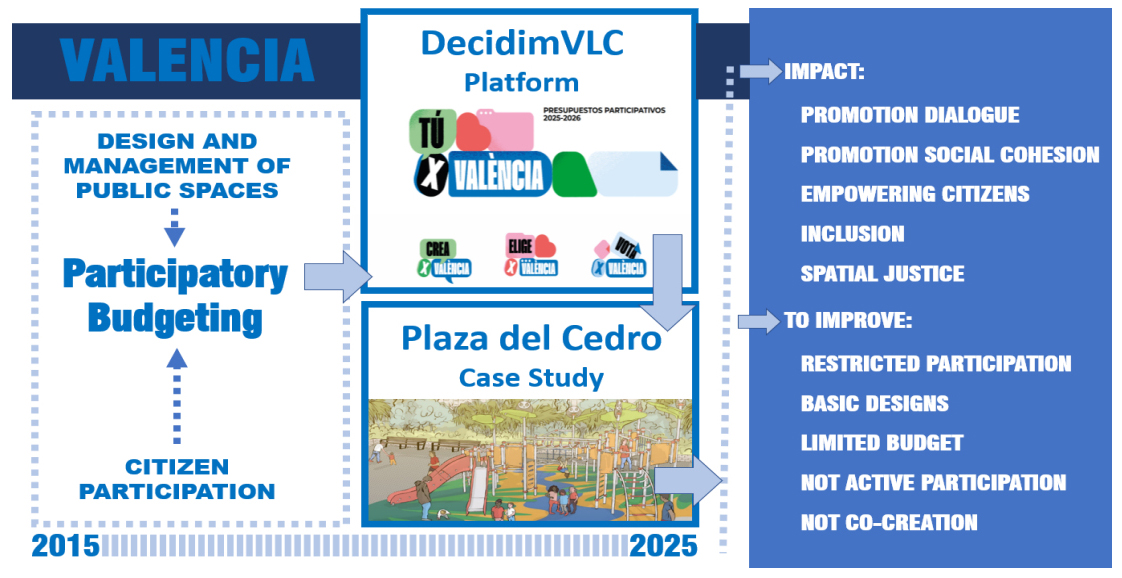
- Study the selected case. Conduct a detailed analysis of the participatory process in the urban environment of Plaza del Cedro.
- Assess the effectiveness of the objectives stated by the DecidimVLC platform with regard to spatial justice and social cohesion.
2. Materials and Methods
2.1. Methodology and Data Sources Used
- Total number of proposals submitted by citizens in each participatory budgeting call.
- Classification of the thematic categories of the projects to identify citizens’ priorities.
- Participation rates per call for proposals, in order to measure the evolution of citizen involvement over time.
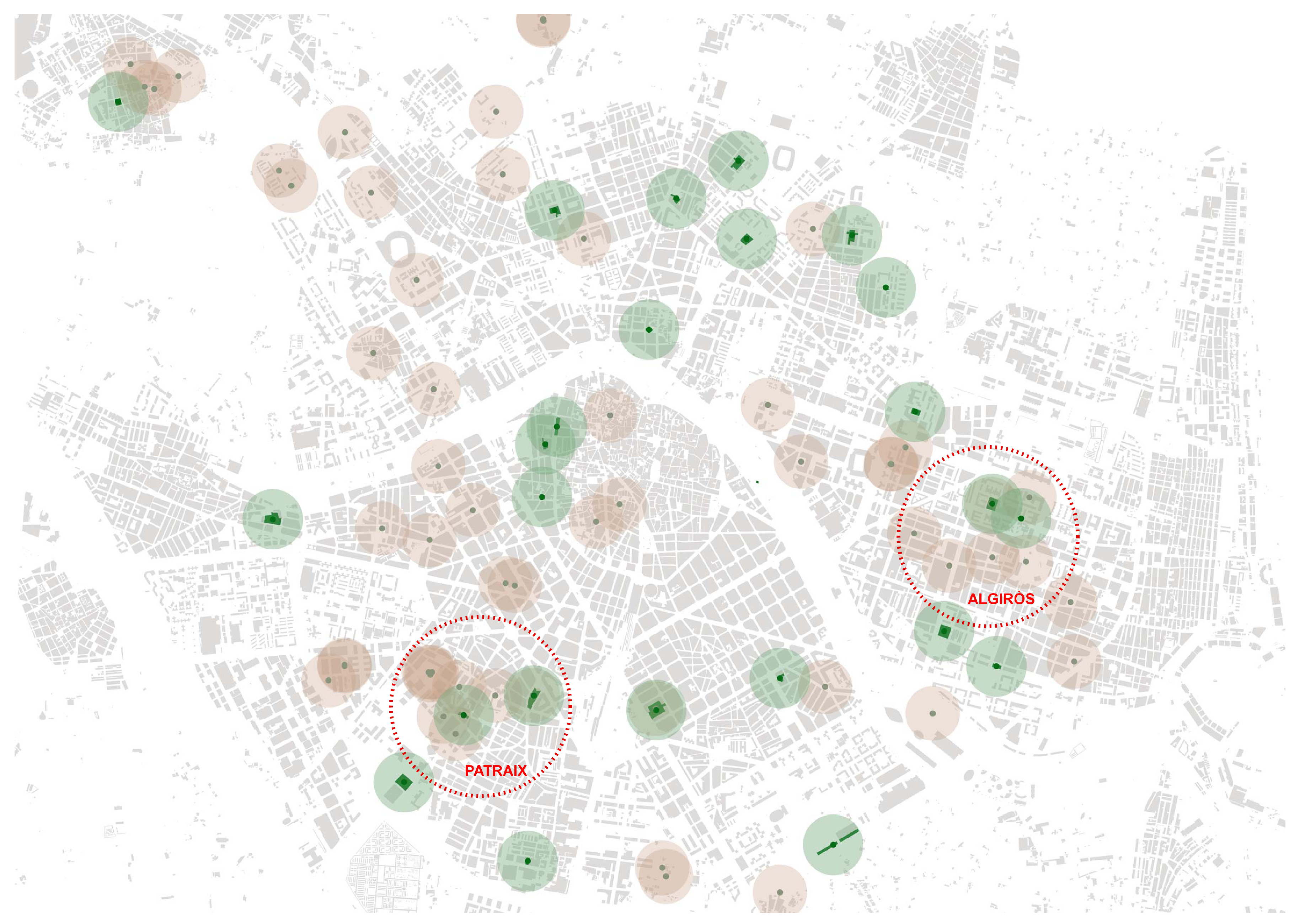
- Geographical distribution of proposals and votes to identify the intensity of participation in the different neighbourhoods of the city.
- Data extraction from the DecidimVLC platform: All content from 2015 to 2023 was extracted, taking into account all calls for proposals.
- Documentary analysis of various sources: The content of press publications, relevant municipal records and information available on the DecidimVLC website has been reviewed and analysed. In addition, data analysis from the valenciaparcsdebarri.es website has been incorporated.
- Field study: Photographic field studies have been carried out to directly and objectively document the current state of the park after the intervention (2 November 2025). The findings of this study have been compared with the data collected by the team in 2016.
- Interviews and consultations with neighbourhood associations: Semi-structured interviews were conducted with representatives of neighbourhood associations and direct users of the renovated spaces. Specifically, the neighbourhood association ‘Veïns de Ciutat Jardí’ was contacted in order to gather their opinions and qualitative assessments of the final result and their perception of the interaction with the administration.
2.2. Analysis Materials
2.2.1. DecidimVLC Platform
- Description
- 2.
- The DecidimVLC participatory process
- 3.
- Structure of the data contained on the platform
- 4.
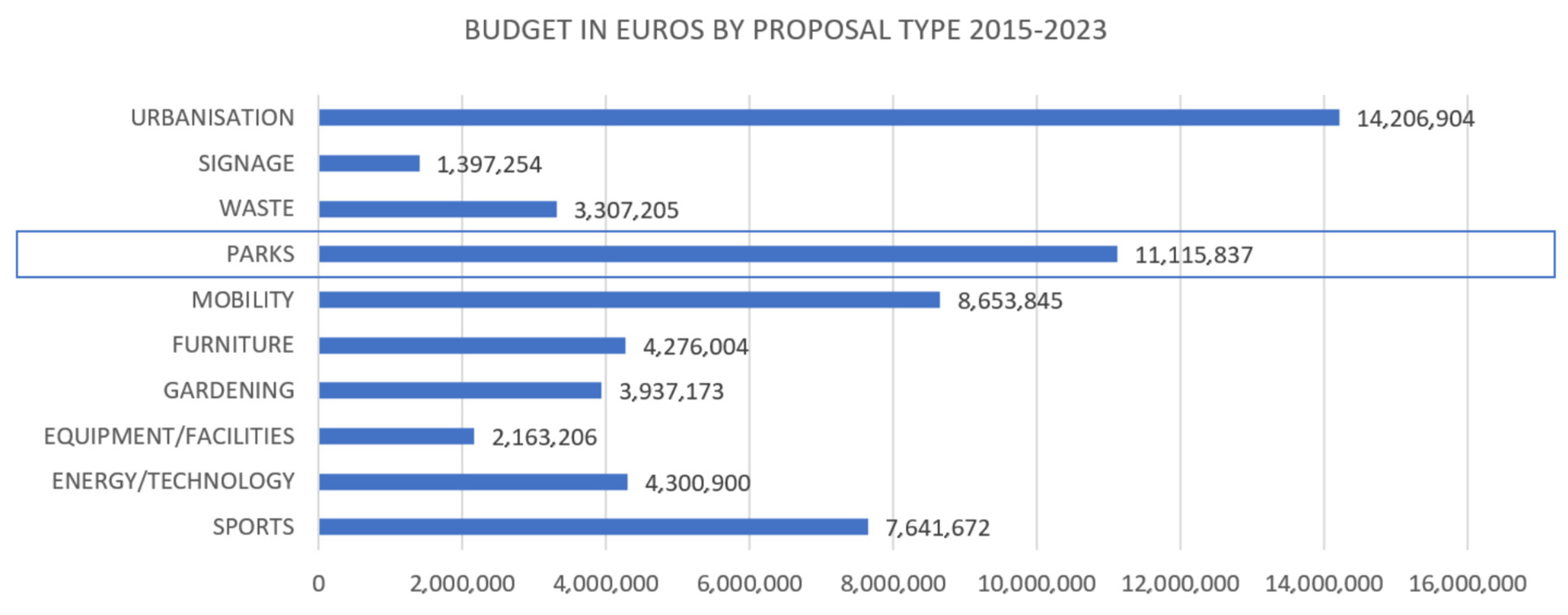
- Types of investment proposals
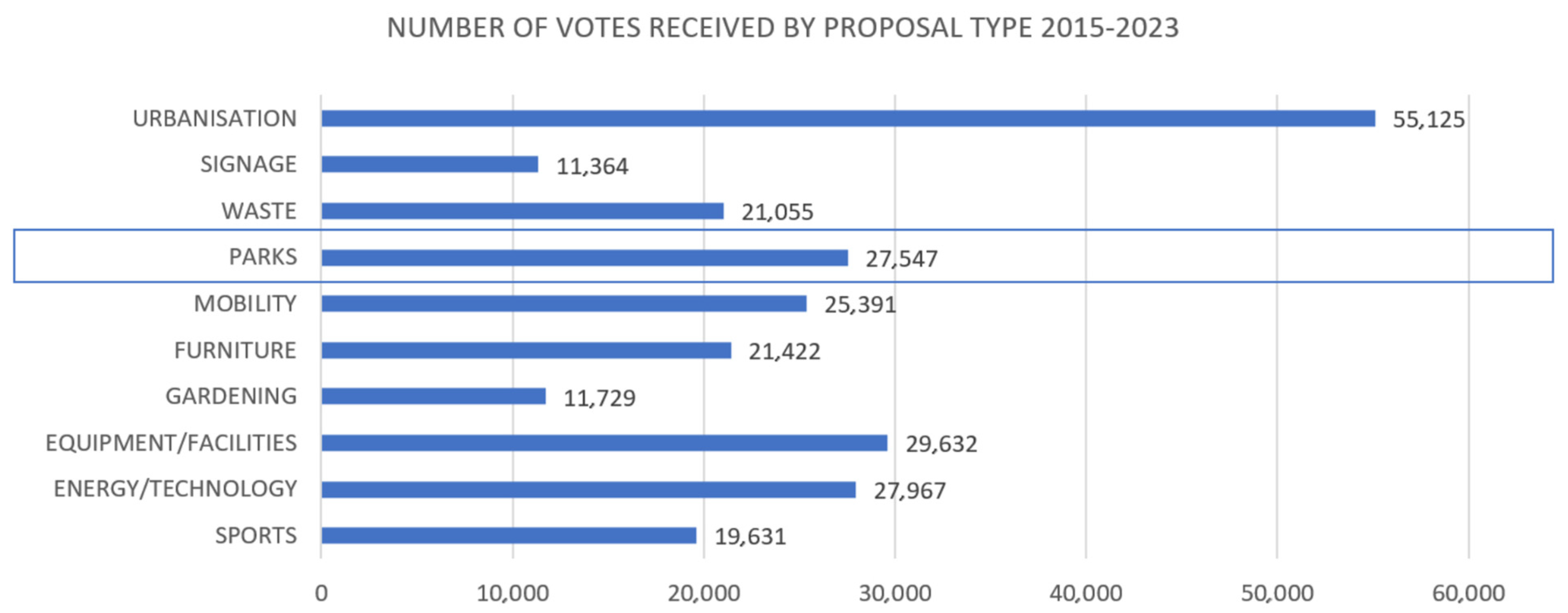
- Urbanisation—Repaving, resurfacing, sidewalk repairs, dog parks, etc.
- Parks—Partial or complete renovation of neighborhood parks.
- Mobility—Cycling, public transportation.
- Sports facilities—Basic sports facilities, sports areas or courts, swimming pools, etc.
- Energy/technology—Photovoltaic energy, solar energy, environmental information, public Wi-Fi, etc.
- Street furniture/lighting—Streetlights, benches, fountains, trash cans, pergolas, etc.
- Gardening—Reforestation, trees, landscaping.
- Waste—Containers, underground waste collection, recycling.
- Equipment/Facilities—Building installations and renovations, vegetable gardens, equipment, cat colonies, etc.
- Signage—Pedestrian crossings, road safety, information posts and panels, routes, etc.
2.2.2. Case Study of the DecidimVLC Platform
- High community involvement: The project has been supported by neighbourhood associations, generating significant social mobilisation.
- Comprehensive use of DecidimVLC: The project has used the participatory budgeting platform in all its phases and throughout different calls for proposals.
- Public dissemination and visibility: The media coverage and public debate generated around its design and implementation confirm its wide visibility.
- Nature of the project: This is a project to remodel a public space that is heavily used by local residents.
- Implementation phase completed: The project has been implemented or is at a very advanced stage of implementation, allowing for a specific assessment of tangible results and their social impact.
3. Results
3.1. Results Extracted from the DecidimVLC Platform
3.1.1. General Analysis: 2015–2023 Period
3.1.2. Proposals for Interventions to Improve Neighbourhood Parks
3.2. Case Study: Plaza del Cedro
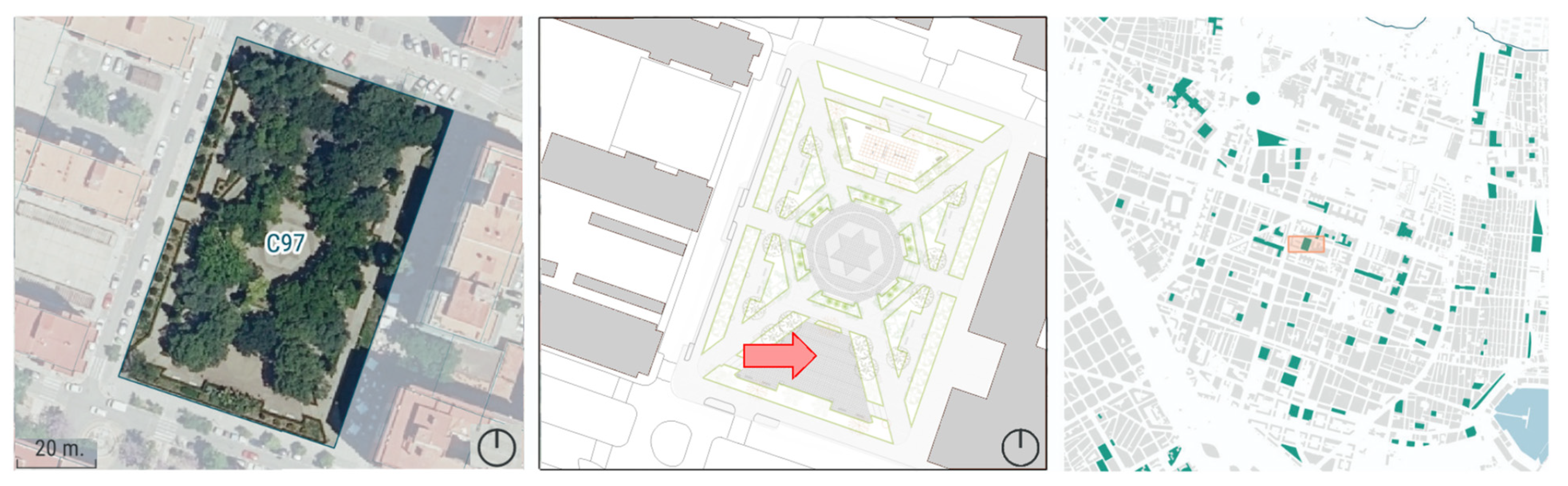
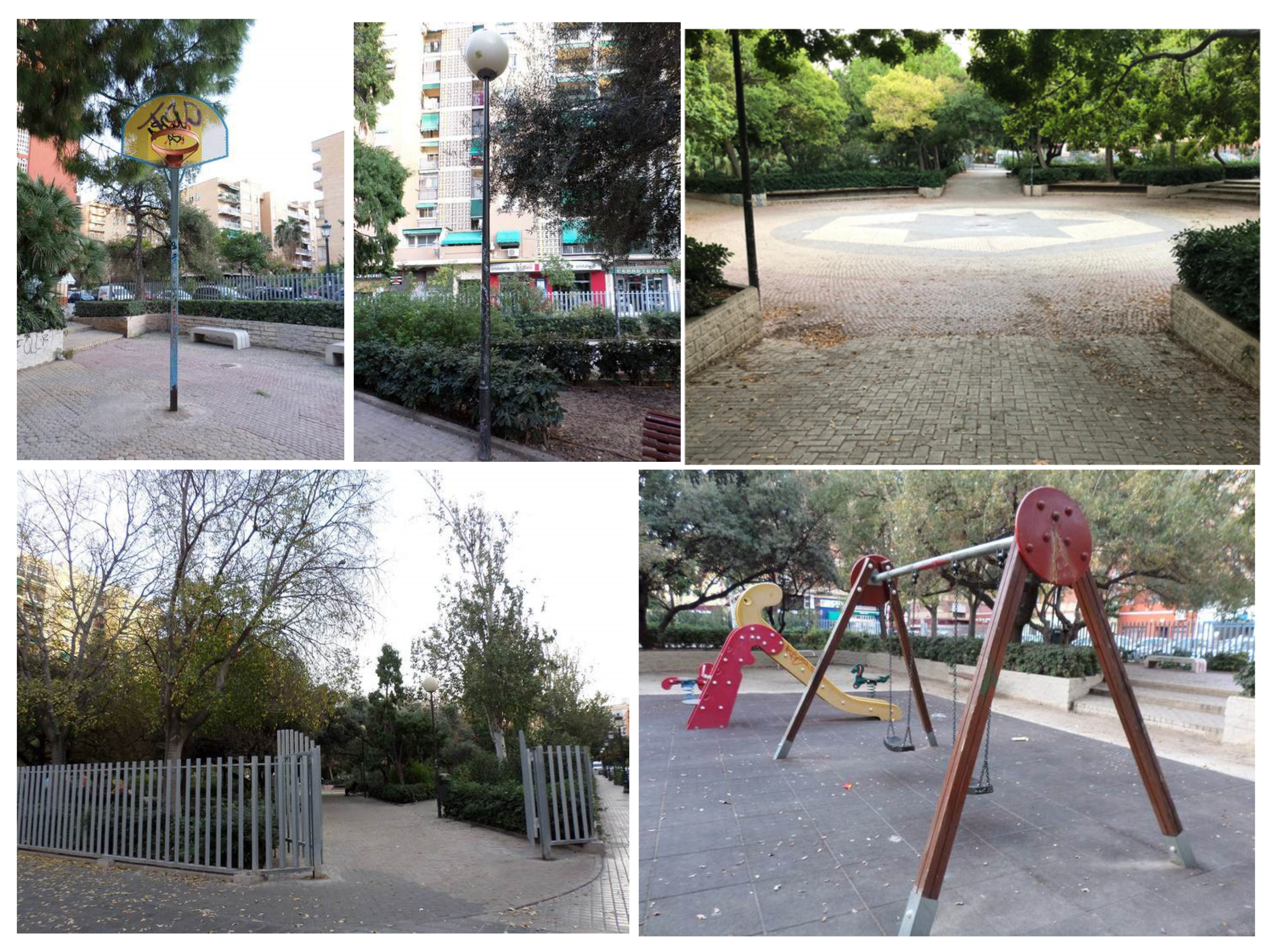
3.2.1. Situation Prior to the Intervention of the DecidimVLC Platform (2016)
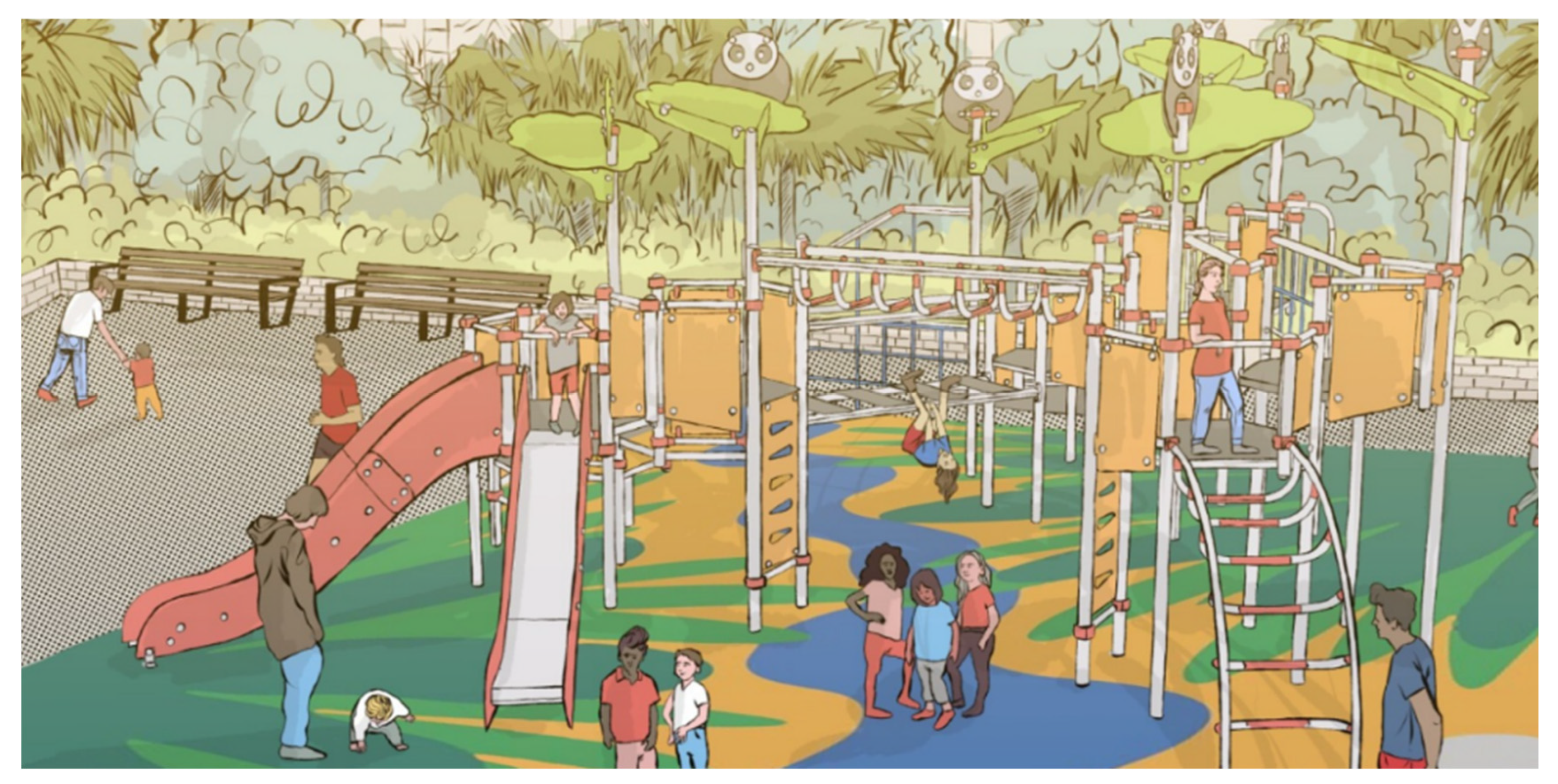
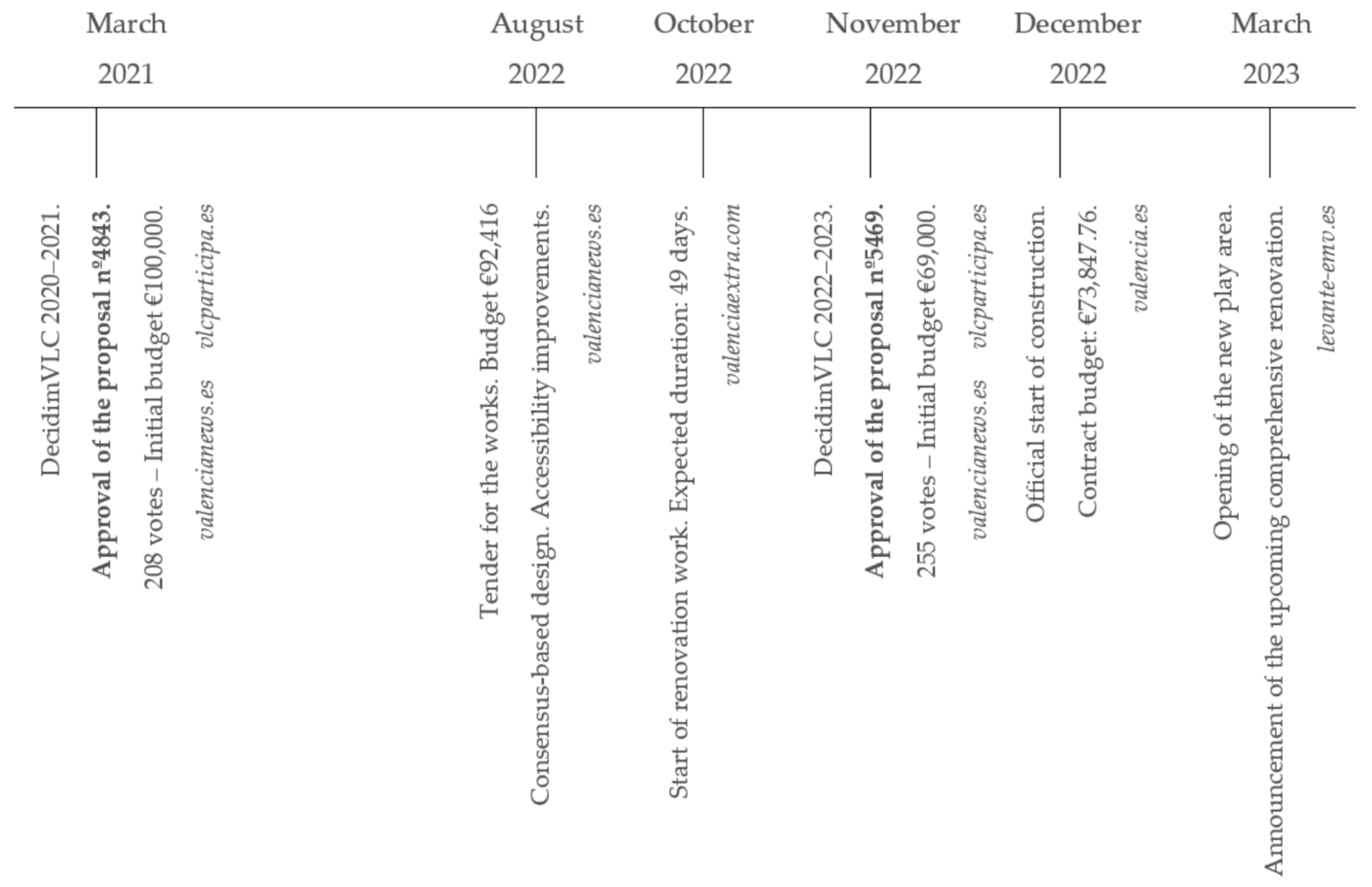
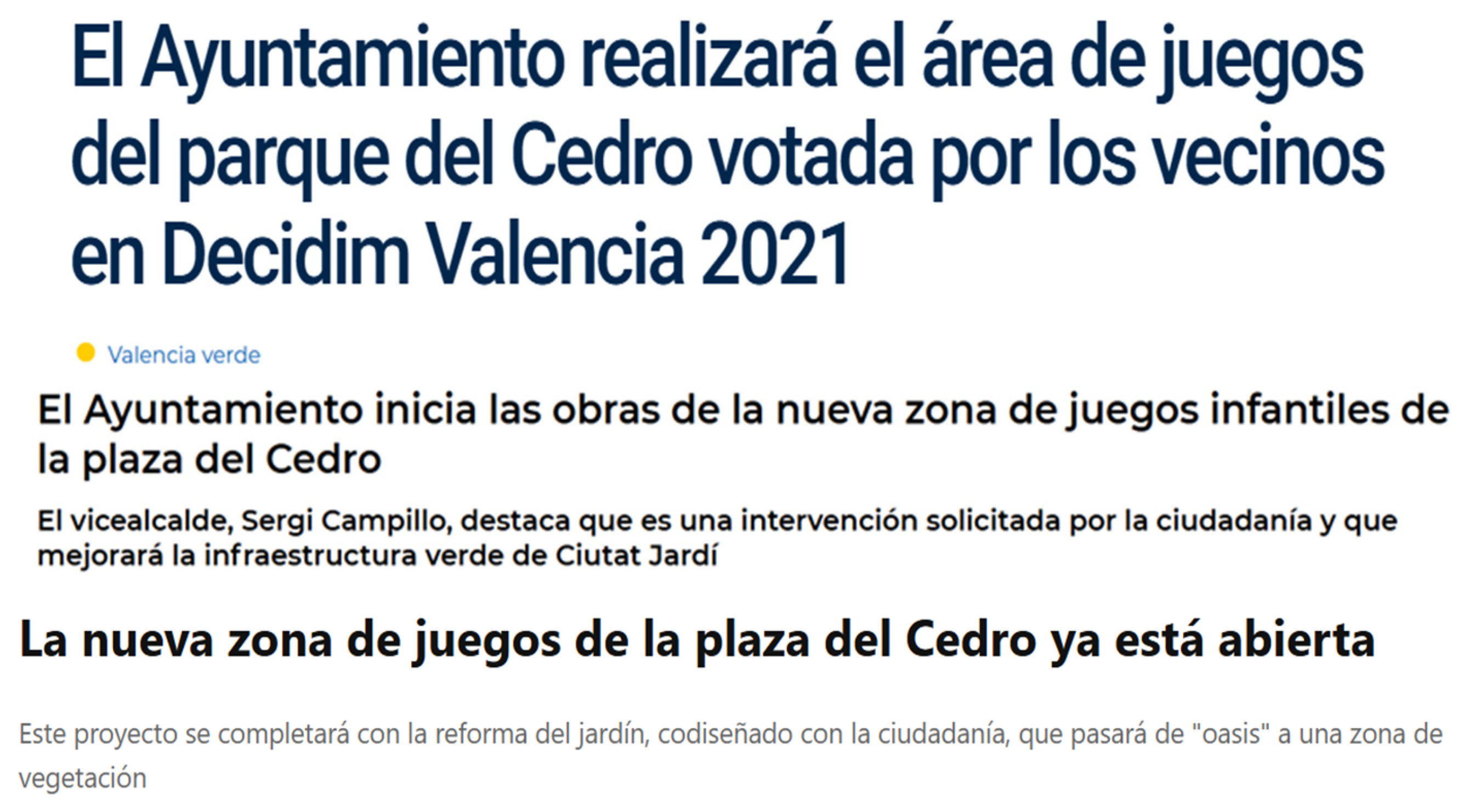
3.2.2. Plaza del Cedro: The Participation Process Through DecidimVLC
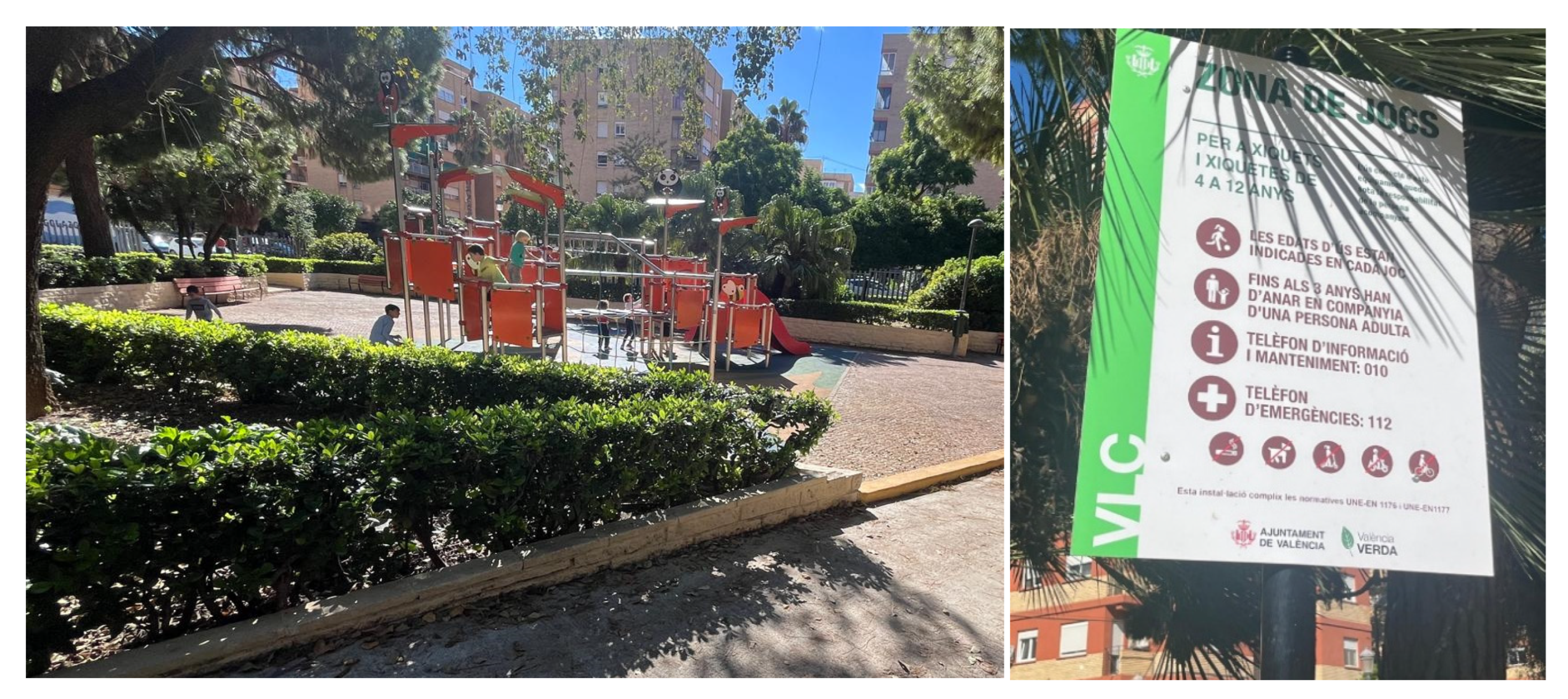
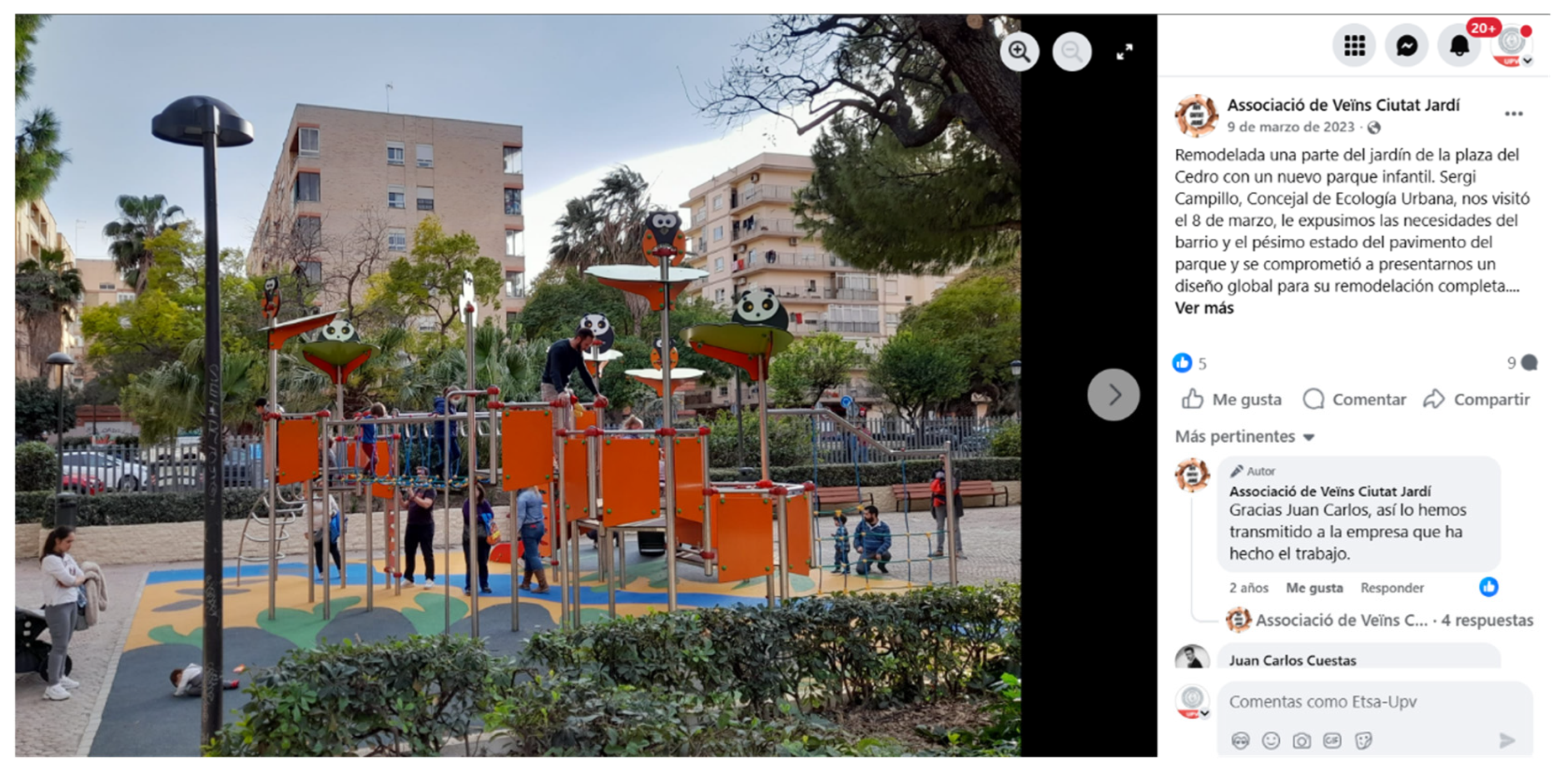
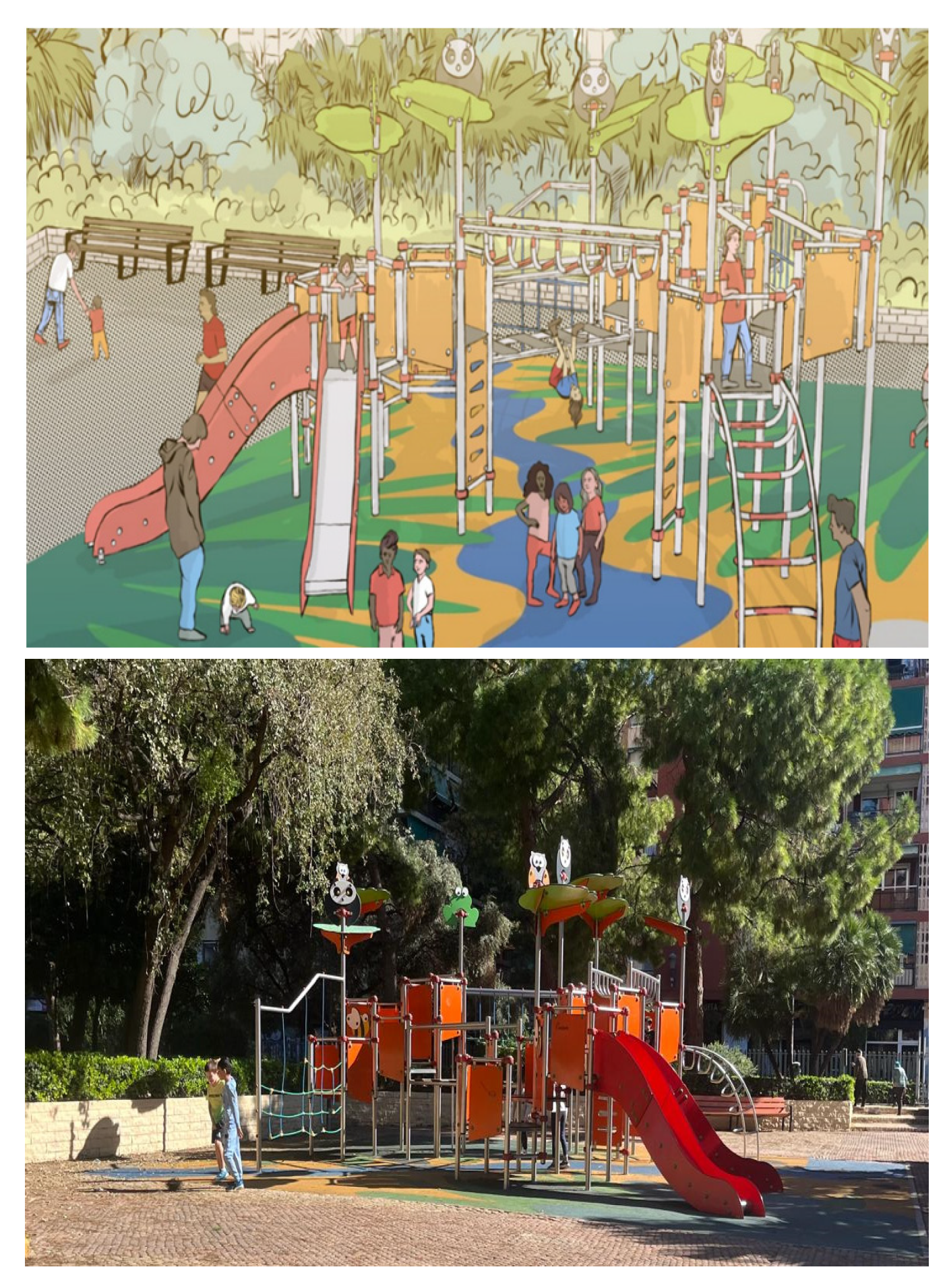
3.2.3. Condition of the Park After the DecidimVLC Proposal (2025)
- (a)
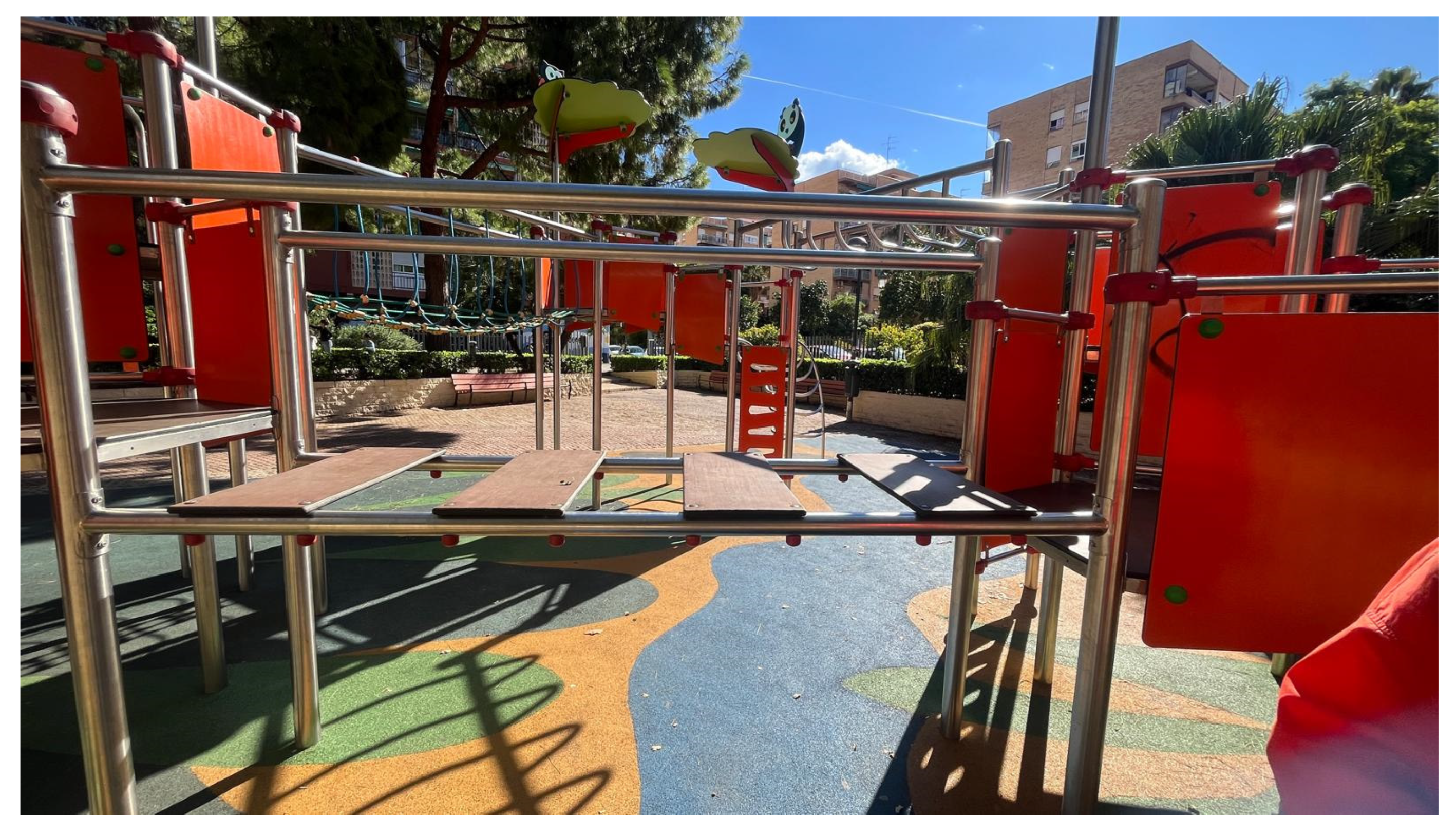
- Analysis of recent field visit (2 November 2025)
- (b)
- Assessments by users and neighbourhood associations
- With regard to the use and operation of DecidimVLC, two major challenges stand out: the existence of a significant digital divide and access barriers for users over the age of 60, and the need for the association to carry out intensive promotion and dissemination work to ensure that residents are informed and participate in voting on proposals.
- ‘The platform requires computer skills that the older population does not possess. In our neighbourhood of Ciudad Jardín, many people over the age of 60 use WhatsApp but are unable to register on the platform to vote.’ (MEB)
- ‘Right now, the projects that go ahead are those that are well promoted by those who suggest them and have a population with the computer skills to vote for them.’ (MEB)
- ‘The action was correct, in line with the allocated budget. But of course, the residents need the park to be completely remodelled, and this is what we requested in the 2022 participatory budgets. And so it was approved, with a total of €69,000 being approved in said budget for the study.’ (MEB)
4. Discussion: Interpretation of the Findings
4.1. Democracy, Citizen Empowerment and Social Cohesion
4.2. Interconnection Between Procedural Justice and Spatial Justice in DecidimVLC
4.3. Propagandistic Use of Participatory Budgeting
- Strengthening local democracy: They promote deliberation and direct decision-making.
- Improving transparency: They make the process of allocating and using public expenditure visible.
- Aligning expenditure: They ensure that part of public investment responds to the needs perceived by residents.
4.4. Limitations of Actions Through Participatory Budgeting on the DecidimVLC Platform
- Digital inclusion and participation gaps: Dependence on digital platforms hinders the effective participation of certain sectors of the population, such as older people, groups with lower digital literacy or those with limited access to technology. Since the tools are intended for all citizens, they must be easy to understand, otherwise ‘the existing digital divide, which is often economic, cultural and also age-related, will grow’ [31]. It is important to mention that online participatory budgeting suffers from the same problems as traditional or face-to-face budgeting. Lack of political will, lack of a participatory culture and inappropriate institutional design can negatively affect the processes, condemning them to failure, according to Enriquez León [32].
- Defining the scope and scale of the projects being managed: There is no clear approach to the type and scale of projects most appropriate for funding through participatory budgeting, which can lead to proposals that are unfeasible, have little impact, or compete with the regular responsibilities of the administration. In this regard, the way in which the participatory budgeting process and its regulations are designed plays a fundamental role in achieving this objective, as referenced in Enríquez León [32] since ‘the aim is to have the capacity to better redistribute public resources to benefit the most disadvantaged individuals and groups’ [33].
- Participation restricted to initial phases: Citizen involvement is usually limited to the proposal submission and voting stages. This excludes citizens from critical later phases, such as:
- ○
- Detailed co-design of projects.
- ○
- Implementation and monitoring of their execution.
- ○
- Post-hoc assessment of their impact and performance.
5. Conclusions
5.1. Impact of the DecidimVLC Platform on Local Governance and Social Cohesion
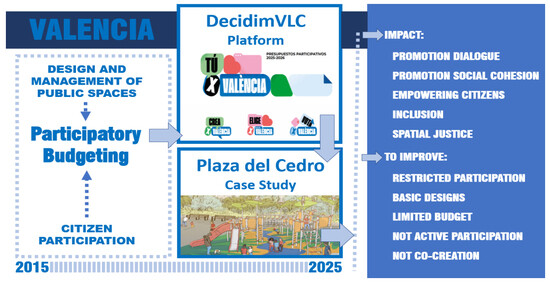
- Promotion of dialogue and social cohesion: DecidimVLC promotes online debate on specific proposals. This exchange, complemented by face-to-face interaction at municipal meetings, strengthens social networks and generates a sense of collective identity (‘we’) as residents work together for the common good of the district.
- Reducing disaffection and empowering citizens: The real impact of the most voted and viable proposals (which decide the allocation of part of the budget) demonstrates to citizens the tangible impact of their participation. This empowerment reverses political apathy and reinforces trust in democratic institutions, which is a key element for social cohesion. The proximity of the issues addressed at the local level facilitates direct collaboration and makes social dynamics more tangible.
- Inclusion and spatial justice: The platform acts as an accessible channel for less visible groups (such as young people or migrants) to present their needs. The geolocation of proposals makes the shortcomings of specific neighbourhoods visible, which actively contributes to spatial justice and prevents locational discrimination in the allocation of resources.
5.2. Final Assessment and Evaluation of the Case Study: Plaza del Cedro
Author Contributions
Funding
Data Availability Statement
Acknowledgments
Conflicts of Interest
| 1 | The name DecidimVLC comes from the left-wing government (Compromís) in Valencia City Council. The DecidimVLC platform operated from 2015 until the 2022–2023 edition. The 2025–2026 edition is the first under the name VLCParticipa, promoted by the right-wing municipal government of the Popular Party (PP). |
| 2 | Except for the 2017–18 and 2019–20 editions, where it was the city council that presented the proposals, the initiative for the proposals may come from working groups of the Municipal District Councils, formed as collectives rooted in the city’s districts that promote the diagnosis, debate and collective design of investment project proposals for their districts, or directly from individual initiatives, based on their own interests and concerns. |
| 3 | In the first phase, proposals are accepted or rejected based on whether or not they meet the requirements set by the council for this type of proposal, including that their approximate cost does not exceed the allocated budget. In the technical feasibility phase, valid proposals are studied by the council’s technical services, which report on their legal, technical and/or budgetary feasibility. Those that receive a favourable report are put to the vote in the next phase. |
| 4 | Local and regional digital press in the Valencian Community, such as Levante-EMV, Valencia News and Valencia Extra, which cover news and current affairs in the city. The list also includes institutional platforms run by the City Council and thematic or associative web portals that are not traditional media outlets. (included in bibliographic sources). |
| 5 | U_01 is a male aged between 40 and 50 with children, a regular user and resident of the neighbourhood, and U_02 is a female aged between 40 and 50 with children, a regular user and resident of the neighbourhood. |
| 6 | Among the main free software infrastructures are Consul Democracy, Decidim, and iParticipo. Available online: https://consuldemocracy.org/ (accessed on 25 November 2025) has been adapted by the city councils of Madrid and Valencia, among others, to develop their own participatory budgeting platforms, Decide Madrid and DecidimVLC, respectively. Available online: https://decidim.org/ (accessed on 25 November 2025) has supported initiatives in this area in Barcelona, Helsinki, and elsewhere. Available online: https://www.iparticipo.es/ (accessed on 25 November 2025) has been developed in mobile application format, which facilitates quick and easy consultations, and has already been used in participatory processes by the city councils of Quart de Poblet and Onda, among others. |
| 7 | In Valencia, the criteria for budget allocation prioritise proposals in districts with lower income levels and in dependant villages. This ensures that digital participation not only benefits those with greater access to technology, but also balances territorial inequalities (balanced distribution of investment). |
References
- UN Habitat. New Urban Agenda. In Proceedings of the United Nations Conference on Housing and Sustainable Urban Development (Habitat III), Quito, Ecuador, 17–20 October 2016. [Google Scholar]
- SDG 11: Sustainable Cities and Communities; SDG 3: Good Health and Well-Being. AUE OE 5: Promote Social Cohesion and Seek Equity. Available online: https://www.cambridge.org/core/books/health-for-all-policies/sdg11-sustainable-cities-and-communities-making-cities-healthy-sustainable-inclusive-and-resilient-through-strong-health-governance/EA50D2C621E9F46A405BC0F5A02C961E (accessed on 25 November 2025).
- Harvey, D. Justice, Nature and the Geography of Difference; Blackwell Publishers: Malden, MA, USA, 1996. [Google Scholar]
- Navarro Ardoy, L. Democracia y procesos participativos. Rev. Int. Sociol. 2003, 34, 221–225. [Google Scholar]
- Ganuza, E.; Álvarez de Sotomayor, C. (Eds.) Democracia y Procesos Participativos; Icaria: Barcelona, Spain, 2023; p. 222. [Google Scholar]
- Payà, P.; Sintomer, Y.; Ganuza, Y.E. Democracia participativa y modernización de los servicios públicos. Investigación sobre las experiencias de presupuesto participativo en Europa. E-Books, 2011. Rev. Int. Sociol. 2012, 70, 225–229. Available online: https://revintsociologia.revistas.csic.es/index.php/revintsociologia/article/view/499 (accessed on 25 November 2025).
- García Bátiz, M.L.; Téllez Arana, L. El presupuesto participativo: Un balance de su estudio y evolución en México. Rev. Perfiles Latinoam. 2018, 26, 52. [Google Scholar] [CrossRef]
- Cabannes, Y.; Mayor Balsas, J.M.; Molina Molina, J. Presupuestos Participativos: Aportes y Límites para Radicalizar la Democracia; Tirant lo Blanch: Valencia, Spain, 2020. [Google Scholar]
- Pineda-Nebot, P.; Alarcón-Segura, P. Los Presupuestos Participativos en España: Un Balance de su Evolución y Situación Actual. (Analyzes Data from Madrid, Barcelona, and Valencia). 2020. Available online: https://revistasonline.inap.es/index.php/REALA/article/view/9692/9782 (accessed on 25 November 2025).
- Available online: https://www.montpellier.fr/es/campagnes/participacion-ciudadana-actuar-por-tu-ciudad-construir-juntos (accessed on 25 November 2025).
- Gómez Gutiérrez, J.J.; Abdelnour Nocera, J. Modelos digitales de participación ciudadana en España a nivel municipal. In Diseño para la Igualdad y la Justicia; Bramwell-Dicks, A., Evans, A., Winckler, M., Petrie, H., Abdelnour-Nocera, J., Eds.; INTERACT 2023; Lecture Notes in Computer Science; Springer: Cham, Switzerland, 2024; Volume 14536, pp. 72–79. [Google Scholar] [CrossRef]
- Lloret Gual, P.; Farinós Dasí, J. La dimensión participativa en el diseño de políticas urbanas. El caso valenciano. Gestión y Análisis de Políticas Públicas 2018, 36–52. [Google Scholar] [CrossRef]
- Pardo Beneyto, G.; Abellán López, M.Á. El Uso de las Políticas de Participación Ciudadana Como Medio para la Mejora de la Eficiencia y de la Legitimidad: El Caso de DecidimVLC 2018–2019; Tirant lo Blanch: Valencia, Spain, 2020; p. 160. [Google Scholar]
- Gamón, A. Presupuestos Municipales: Presupuestos participativos, Datos Abiertos y Agenda 2030; TFG Inédito; Facultad de ADE, UPV: Valencia, Spain, 2021. [Google Scholar]
- Pretty, J.; Griffin, M.; Peacock, J.; Hine, R.; Sellens, M.; South, N. Un Campo Para la Salud y el Bienestar: Los Beneficios Para la Salud Física y Mental del Ejercicio Verde; Red de Recreación de Campo; Universidad Sheffield Hallum: Sheffield, UK, 2005. [Google Scholar]
- Fariña, J.; Higueras, E.; Román, E.; Pozo, E. Guía Para Planificar Ciudades Saludables; Ministerio de Sanidad, FEMP: Madrid, Spain, 2022. [Google Scholar]
- Obando Cabezas, L.; Salcedo Serna, M.A. Los parques: Sus usuarios y su sentido social en la vida urbana. Una mirada desde los usuarios típicos de dos parques de la ciudad de Cali. Virajes. Rev. Antropol. Sociol. 2015, 17, 37–54. Available online: https://revistasojs.ucaldas.edu.co/index.php/virajes/article/view/3566 (accessed on 25 November 2025).
- Molina Aguilar, J. Reflexiones sobre psicología ambiental y salud mental aplicadas al espacio público. Psykhé Vanguard. 2021, 8, 29–32. [Google Scholar]
- Colomer-Sendra, V.; Portales-Mañanos, A.; Urios-Mondéjar, D.; Colomer-Alcácer, J. Una segunda oportunidad para el espacio público en las periferias consolidadas: Valencia y los parques de barrio. ZARCH J. Interdiscip. Stud. Archit. Urban. 2017, 8, 62–77. [Google Scholar]
- Available online: www.valenciaparcsdebarri.es (accessed on 25 November 2025).
- Available online: https://www.valencia.es/cas/actualidad/-/content/inicio-obras-remodelaci%C3%B3n-zona-juegos-plaza-cedre (accessed on 25 November 2025).
- Available online: https://www.missionsvalencia.eu/cpivalencia/wp-content/uploads/2021/10/Early-Demand-Map-Valencia-2030-%E2%80%93-Shared-Valencia-%E2%80%93-Social-Cohesion.pdf (accessed on 25 November 2025).
- Barandiaran, X.E. Cómo Usar Decidim. Guía para Administraciones Públicas y Grandes Organizaciones. 2023. Available online: https://xabier.barandiaran.net/?p=2843 (accessed on 25 November 2025).
- Estudio sobre la situación y realidad de los ayuntamientos españoles ante el cambio de paradigma en la interacción entre Administración Local y Ciudadanía. In Participa Inteligente; novaGob Foundation: Madrid, Spain, 2016; p. 7. Available online: https://novagob.org/wp-content/uploads/2019/04/Informe_Kaleidos_vFinal_20160704_compressed.pdf (accessed on 25 November 2025).
- Available online: https://www.valencia.es/documents/20142/618951/III+PLAN+DE+INCLUSI%C3%93N+Y+COHESI%C3%93N+2021-2025+23-11-2021-2.pdf/2c22f520-0dd8-1982-787d-81a9e53b551b?t=1642754868788 (accessed on 25 November 2025).
- Barandiaran, X.E.; Calleja-López, A.; Monterde, A.; Romero, C. Decidim, una Red Tecnopolítica para la Democracia Participativa. Filosofía, Práctica y Autonomía de una Plataforma Colectiva en la era de la Inteligencia Digital; SpringereBriefs in Political Science; Springer: Berlin/Heidelberg, Germany, 2024; Available online: https://link.springer.com/book/10.1007/978-3-031-50784-7 (accessed on 25 November 2025).
- Peña López, I. Convirtiendo Participación en Soberanía: El Caso de Decidim; Huygens, C., Ed.; Editorial Comte Barcelona: Barcelona, Spain, 2019. [Google Scholar]
- Available online: https://www.levante-emv.com/valencia/2023/03/09/nueva-zona-juegos-plaza-cedro-84363718.html (accessed on 25 November 2025).
- Available online: https://valencianews.es/valencia/el-ayuntamiento-realizara-el-area-de-juegos-del-parque-del-cedro-votada-por-los-vecinos-en-decidim-valencia-2021/ (accessed on 25 November 2025).
- Available online: https://www.valenciaextra.com/es/valencia/sera-nuevo-parque-infantil-plaza-cedro_518178_102.html (accessed on 25 November 2025).
- Nebot, C.P.; Pires, V. ¿A qué llaman hoy presupuesto participativo? GIGAPP Estud. Work. Pap. 2017, 4, 435–449. [Google Scholar]
- Enríquez León, S. El Presupuesto Participativo Como Herramienta de Innovación Política en la Gestión Administrativa a Escala local: La Experiencia de Hernani Erabaki. Ph.D. Thesis, Universidad del País Vasco, Leioa, Spain, 2022. [Google Scholar]
- Allegretti, G.; García-Leiva, P.; Paño, P.Y. Viajando por los Presupuestos Participativos; Centro de Ediciones de la Diputación de Málaga: Málaga, Spain, 2011. [Google Scholar]
- Available online: https://vlcparticipa.valencia.es/budgets/8/investments?heading_id=145 (accessed on 25 November 2025).
- Available online: https://www.coam.org/convocatorias/servicios-concursos-convocatorias-convocatoria-concursos-nacional-vs16-1730938291/ (accessed on 25 November 2025).










| City | Plataform | Year Established/ Operating Since | Link |
|---|---|---|---|
| Barcelona | Decidim Barcelona | 2016/operational | https://www.decidim.barcelona/ (URL accessed on 25 November 2025) |
| Madrid | Decide Madrid | 2016/operational | https://decide.madrid.es/ (URL accessed on 25 November 2025) |
| Valencia | DecidimVLC | 2015/operational | https://decidimvlc.valencia.es/ (URL accessed on 25 November 2025) |
| A Coruña | A Porta Aberta | 2016/operational | https://coruna.gal/movilidad/es/planes-y-programas/presupuestos-participativos?argIdioma=es (URL accessed on 25 November 2025) |
| Sevilla | Decide Sevilla | 2017/operational | https://www.sevilla.org/DecideSevilla/ (URL accessed on 25 November 2025) |
| Zaragoza | ideaZaragoza | 2017/operational | https://www.zaragoza.es/sede/ (URL accessed on 25 November 2025) |
| Edition | Budget Allocation | Number of Proposals | Geographical Scope | Votes Cast |
|---|---|---|---|---|
| 2015–2016 | €7,000,000 | 110 | By district | N.A. |
| 2016–2017 | €7,000,000 | 71 | By district | 19,647 |
| 2017–2018 | €7,000,000 | 11 | The whole city | 34,306 |
| 2018–2019 | €8,000,000 | 103 | By district | 26,830 |
| 2019–2020 | €8,000,000 | 21 | The whole city | 75,387 |
| 2020–2021 | €8,000,000 | 139 | By district | 44,090 |
| 2022–2023 | €16,000,000 | 161 | By district | 50,892 |
| 2025–2026 | €16,000,000 | 458 | By district | 110,402 |
| 2015–2023 | €61,000,000 | 616 | 250,863 |
| Period 2015–2023 | Number of Initiatives Approved | % |
|---|---|---|
| Urbanisation | 164 | 26.62% |
| Signage | 52 | 8.44% |
| Waste | 18 | 2.92% |
| Parks | 93 | 15.10% |
| Mobility | 54 | 8.77% |
| Street furniture/lighting | 69 | 11.20% |
| Gardening | 13 | 2.11% |
| Equipment/Facilities | 62 | 10.06% |
| Energy/technology | 29 | 4.71% |
| Sports facilities | 62 | 10.06% |
| TOTAL | 616 | 100% |
| Period 2015–2023 | |||
|---|---|---|---|
| PARKS | 93 proposals | €11,115,837 | 27,547 votes |
| 15.10% | 18.22% | 10.98% | |
| Partial renovations | |||
| 68 proposals | €5,873,011 | 20,543 votes | |
| 11.04% | 9.63% | 8.19% | |
| Comprehensive renovations | |||
| 25 proposals | €5,242,826 | 7004 votes | |
| 4.06% | 8.59% | 2.79% | |
| Park Name | District | Number of Proposals | Comprehensive Renovation | Partial Renovation | 2025–2026 |
|---|---|---|---|---|---|
| Parque Enrique Granados | Patraix | 4 | - | 3 | 1 |
| Plaza del Cedro | Algiròs | 2 | 1 | 1 | - |
| Plaza Manuel Granero | Eixample | 2 | 1 | 1 | - |
| Parque de la Estacioneta | Jesús | 2 | 1 | 1 | - |
| Plaza Emilio Lluch | Patraix | 2 | - | 2 | - |
| Calle Polo y Peyrolón | Algiròs | 2 | - | 2 | - |
| Plaza Edifici Alcaldia | Poble Nou | 2 | - | 2 | - |
| Plaza Centenar de la Ploma | Ciutat Vella | 2 | - | 1 | 1 |
| Plaza de Roma | Olivereta | 2 | - | 1 | 1 |
| Parque calle Pío XI | Patraix | 2 | - | 1 | 1 |
| Concept | Data | Source/Context |
|---|---|---|
| Proposal No. 4843 2020–2021 Edition-Creation of a Playground in Plaza del Cedro | ||
| Votes obtained by the proposal | 208 votes | Participatory budgeting DecidimVLC |
| Initial budget for the proposal | €100,000.00 | Initial allocation for the proposal voted on. |
| Tender budget (August 2022) | €92,416.00 | Tender for the works. |
| Award budget (December 2022/March 2023) | €73,847.76 | Budget for the award of the works. |
| Final overall budget (March 2023) | More than €100,000.00 | Includes the play area, benches, ischial supports and ramp. |
| Works completion period | 49 days | Estimated time for the remodelling of the play area. |
| Capacity of the new playground | 74 children | Maximum capacity for children of different ages. |
| Accessibility improvements | 1 of 4 staircases converted into a ramp | To improve access to the space. |
| Comfort facilities | 5 double-length benches with backrests and armrests, 2 ischial supports. | For accompanying persons. |
| Concept | Data | Source/Context |
|---|---|---|
| Proposal No. 5469 2022–2023 Edition- Renovation of Plaza del Cedro | ||
| Votes obtained by the proposal | 255 votes | Participatory budgeting DecidimVLC |
| Initial budget for the proposal | €69,000.00 | Initial allocation for the proposal voted on. |
Disclaimer/Publisher’s Note: The statements, opinions and data contained in all publications are solely those of the individual author(s) and contributor(s) and not of MDPI and/or the editor(s). MDPI and/or the editor(s) disclaim responsibility for any injury to people or property resulting from any ideas, methods, instructions or products referred to in the content. |
© 2026 by the authors. Licensee MDPI, Basel, Switzerland. This article is an open access article distributed under the terms and conditions of the Creative Commons Attribution (CC BY) license.
Share and Cite
Portalés-Mañanós, A.; Urios-Mondéjar, D.; Casar-Furió, M.E. Participatory Budgeting for the Management of Children’s Green Areas in Valencia: DecidimVLC and Its Impact on Citizen Participation. Land 2026, 15, 311. https://doi.org/10.3390/land15020311
Portalés-Mañanós A, Urios-Mondéjar D, Casar-Furió ME. Participatory Budgeting for the Management of Children’s Green Areas in Valencia: DecidimVLC and Its Impact on Citizen Participation. Land. 2026; 15(2):311. https://doi.org/10.3390/land15020311
Chicago/Turabian StylePortalés-Mañanós, Ana, David Urios-Mondéjar, and Maria Emilia Casar-Furió. 2026. "Participatory Budgeting for the Management of Children’s Green Areas in Valencia: DecidimVLC and Its Impact on Citizen Participation" Land 15, no. 2: 311. https://doi.org/10.3390/land15020311
APA StylePortalés-Mañanós, A., Urios-Mondéjar, D., & Casar-Furió, M. E. (2026). Participatory Budgeting for the Management of Children’s Green Areas in Valencia: DecidimVLC and Its Impact on Citizen Participation. Land, 15(2), 311. https://doi.org/10.3390/land15020311