1. Introduction
China continues to confront severe and persistent challenges, including elevated aggregate energy consumption and carbon emissions, alongside an energy consumption structure that remains dominated by conventional fossil fuels and has yet to undergo a fundamental transformation. According to BP’s Statistical Review of World Energy (2023), China ranked first globally in both energy consumption and carbon emission indicators in 2022. Specifically, China’s primary energy consumption reached 5.44 billion tons of standard coal equivalent, accompanied by 11.877 billion tons of carbon dioxide emissions. Further analysis indicates that energy use constitutes the predominant source of national carbon emissions, accounting for approximately 88.83%. Enhancing Energy-Embedded Green Utilization Efficiency of Urban Land (E-GUEUL) is a primary task for accelerating the construction of a modernized energy industry system and for advancing coordinated improvements in carbon mitigation, pollution control, ecological enhancement, and economic growth. Energy-embedded efficiency treats energy use as a binding component of the urban land-use production system. Urban land generates desirable economic output while simultaneously requiring energy inputs and producing environmentally undesirable by-products. E-GUEUL therefore evaluates land-use performance under joint energy and environmental constraints, rather than under a purely desirable output framework. It also represents a necessary avenue for addressing the intertwined constraints of resource scarcity and environmental pressures while advancing the dual carbon goals and high-quality development [
1]. As a critical driving force, the deep integration of the digital economy and the real economy, namely the Integration of the Digital–Real Economy (IDRE), can effectively improve E-GUEUL and, by leveraging regional endowments, foster the targeted development of new, high-quality productive forces in the energy sector [
2]. Accordingly, IDRE has become a key pathway for accelerating supply-side structural reform in the energy sector, promoting the transformation of energy consumption patterns, enhancing E-GUEUL, and advancing the development of a modernized energy industry system [
3].
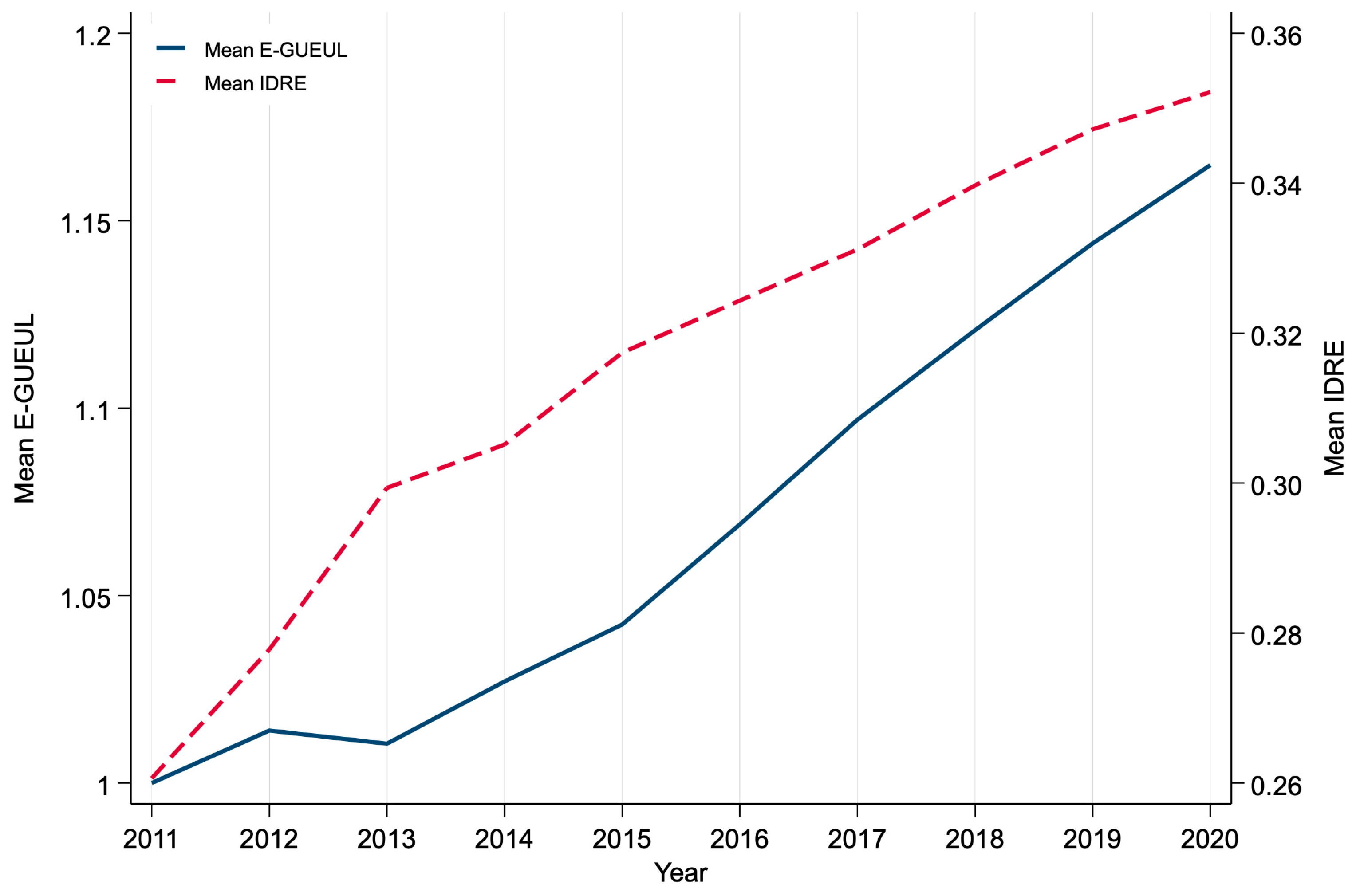
Figure 1 shows that, over the period of 2011 to 2020, the national mean of E-GUEUL and the level of IDRE exhibited a concurrent upward trajectory. This pattern is consistent with a pathway through which IDRE facilitates the realization of green value and supports economic momentum in the context of the ongoing energy transition. This study is motivated by the need to identify whether deeper IDRE improves city-level E-GUEUL and to clarify the channels and institutional conditions through which such effects may arise. While the growing literature associates digitalization or the digital economy with greener performance, existing evidence is largely correlational and provides limited causal identification for the IDRE–E-GUEUL relationship at the city level. Reverse causality, policy selection, and unobserved city characteristics may jointly influence both IDRE and E-GUEUL, leaving a clear identification gap. From the perspective of thematic relatedness, the literature most closely aligned with this study can be grouped into two categories. In contrast to single-indicator measures, total factor energy efficiency is not confined to energy inputs alone; it evaluates the overall effectiveness with which all production inputs, including energy, capital, and labor, are utilized to achieve a given level of desirable output. A key advantage of this metric is that it incorporates the complex interdependencies among multiple inputs within a unified analytical framework, thereby providing a more complete characterization of actual energy-use performance. As an extension of conventional total factor energy efficiency, E-GUEUL introduces energy consumption and environmentally undesirable outputs as binding constraints in the accounting system, thereby establishing a more comprehensive framework for assessing the sustainability of economic activity. This framework captures not only improvements in production performance but also the contributions of technological progress and environmental management to green growth [
4]. From the perspective of thematic relatedness, the literature most closely aligned with this study can be grouped into two categories. The first concerns the measurement of E-GUEUL [
5]. Among these, DEA-based models [
6] and the SBM framework, which explicitly incorporate undesirable outputs, have increasingly become mainstream [
7]. The second category examines the determinants of E-GUEUL. Early work suggests that environmental regulation of different types and environmental information disclosure constitute effective channels for improving total factor energy efficiency [
8]. Policy instruments, such as emissions trading schemes, dual-pilot programs for low-carbon and smart cities, and pilot schemes for energy-use rights trading, also contribute to improvements in total factor energy efficiency [
9]. With the iterative upgrading of digital technologies, an expanding body of research emphasizes that the utilization of data factors, digital technology innovation, and digital economy development provides enabling support for improvements in E-GUEUL [
10].
IDRE emphasizes the complementarity between digital capabilities and real-economy production processes, and thus provides a structural perspective beyond digitalization in isolation [
11]. The literature most relevant to this study can be traced to three main strands. First, a broad set of studies focuses on conceptualizing IDRE and developing its theoretical framework. In this view, digital technologies and data as a production factor jointly form a dual driving force behind deeper integration, and the theoretical content of the transformation and upgrading of the real economy exhibits a substantial affinity with the practical features of industrial digitalization [
12]. Other contributions emphasize that the expansion and upgrading of the real economy can, in turn, create extensive market space and diversified application scenarios for the digital economy, thereby supporting rapid growth in the latter. Accordingly, IDRE is more appropriately characterized as an innovation-centered form of integrative economic activity, in which the digital economy and the real economy are connected and interact through digital technologies and data factors, exhibiting bidirectional reinforcement and synergistic co-development [
13]. Second, with respect to measurement approaches and evolutionary patterns, constructing an indicator system and applying methods such as the entropy-weight method and the coupling coordination degree model have become the mainstream strategies for quantifying the level of IDRE [
14]. Although the overall level of IDRE remains at a relatively early stage and interregional disparities in integration have shown a widening tendency, the depth of integration has strengthened over time, with a spatial evolution characterized by multi-nodal expansion and a progression from points to corridors and then to broader regional surfaces. Third, empirical research on the green effects of IDRE has focused on outcomes such as green total factor productivity, the green transformation of development patterns, and coordinated improvements in industrial pollution control and carbon mitigation, providing evidence on the effects of IDRE and the underlying mechanisms [
15].
In summary, the existing literature on IDRE and E-GUEUL has become increasingly substantial, providing a solid theoretical foundation for further inquiry, yet meaningful scope for additional research remains. Although some studies have recognized that deeper IDRE can generate green effects, the influence of IDRE on E-GUEUL has not received commensurate attention. Prior work has largely emphasized the enabling role of digital technologies and the digital economy in improving E-GUEUL. However, as the concept of IDRE has been invoked with growing frequency, relatively few studies have focused on the extent to which deeper IDRE serves as a driver of improvements in E-GUEUL and systematically respond to this practical concern. Against this background, to provide comprehensive and reliable empirical evidence regarding the relationship between the two, this study employs a balanced city-level panel of 273 cities over the period 2011 to 2020. From a multidimensional perspective, it constructs an indicator system to measure the level of IDRE. Building on this measurement, the study employs a double machine learning framework to estimate the effect of IDRE on E-GUEUL, document its multidimensional heterogeneity, identify three core pathways through which IDRE operates, and extend the analysis by examining moderating effects. This design directly targets the causal identification gap by flexibly controlling for high-dimensional confounders and reducing specification-driven biases that commonly arise in conventional parametric regressions.
The marginal contributions of this study are threefold. First, building on prior research, the measurement of IDRE is implemented at the prefecture-level city scale. This focus helps move beyond the limitations inherent in province-level measurement and facilitates a more comprehensive assessment of the current state of IDRE across Chinese cities [
16]. Second, the study develops a unified analytical framework that jointly examines IDRE and E-GUEUL, providing a systematic discussion of their underlying logic and operating mechanisms [
17]. Using a double machine learning approach, the analysis estimates the effect of IDRE on E-GUEUL, thereby mitigating estimation biases that may arise from complex nonlinearities and model misspecification in conventional econometric specifications. These efforts establish a more systematic and reliable empirical basis for subsequent work that seeks further to uncover the internal linkages between IDRE and E-GUEUL. Third, the study proposes and empirically validates the mechanisms of green technological innovation, energy consumption intensity, and environmental regulation [
18]. It also examines the moderating role of marketization in the relationship through which IDRE contributes to improvements in E-GUEUL. Together, these analyses clarify the internal mechanisms connecting IDRE to E-GUEUL, enrich and extend the literature on IDRE in the domain of green development, and provide theoretical and practice-relevant insights for advancing deeper IDRE.
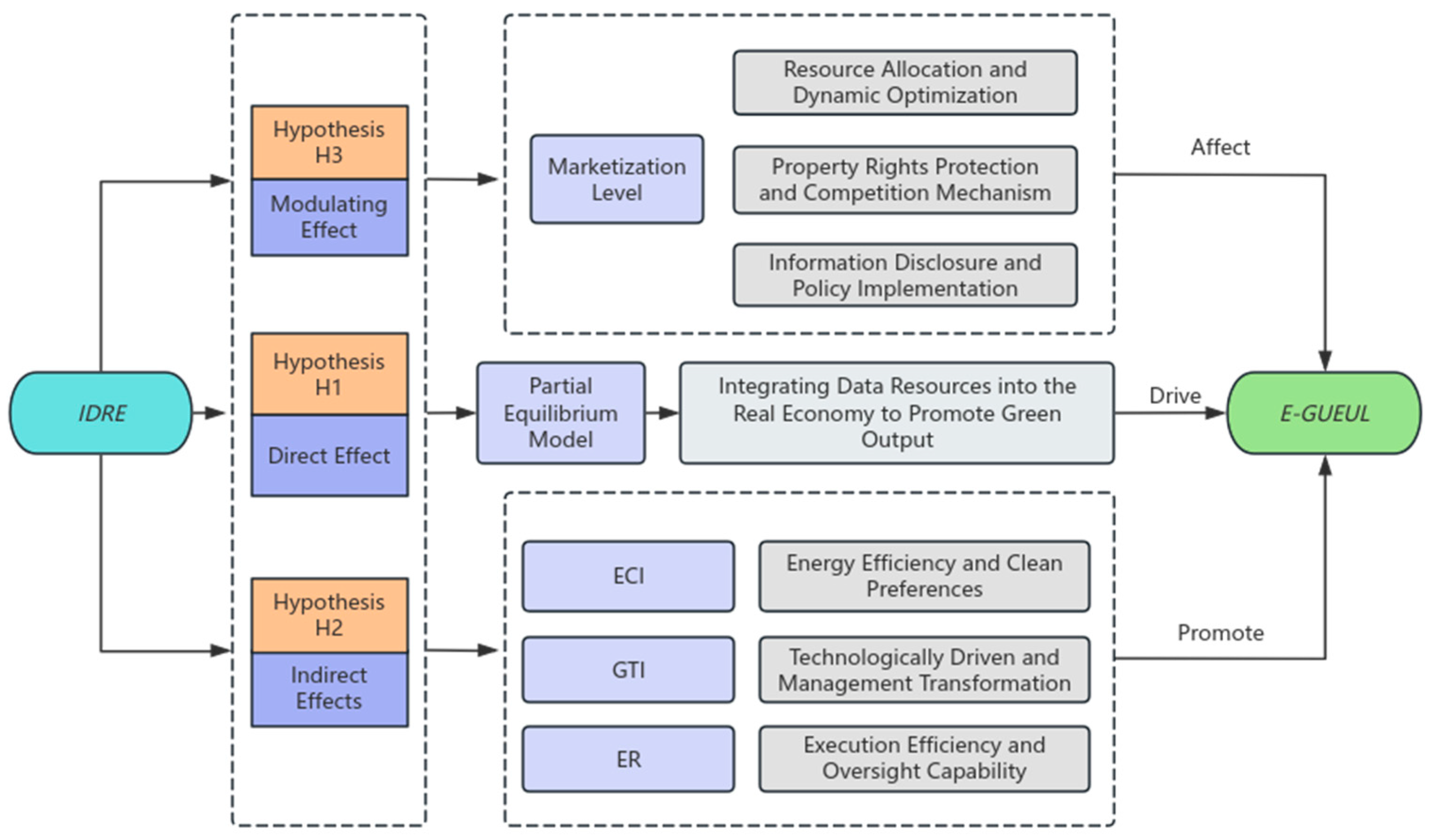
The primary objective of this study is to identify and quantify, at the city level, the aggregate effect of IDRE on E-GUEUL and to provide robust empirical evidence regarding their relationship. As secondary objectives, the study systematically examines heterogeneity in the IDRE–E-GUEUL relationship with respect to resource endowments, digital foundations, and regional location; it also offers an in-depth and up-to-date analysis of the principal transmission pathways involving green technological innovation, energy consumption intensity, and environmental regulation. In addition, the extension analysis evaluates whether marketization strengthens the baseline effect estimated in the benchmark regressions. The remainder of the paper is organized as follows.
Section 2 develops the theoretical framework and research hypotheses.
Section 3 describes the research design, including the empirical specification, data sources, and variable construction.
Section 4 presents the empirical results, including descriptive statistics, baseline estimates, robustness checks, endogeneity considerations, heterogeneity analysis, and mechanism tests.
Section 5 reports the extension analysis on moderating effects.
Section 6 concludes with the main findings and policy implications.
5. Discussion
5.1. Interpretation of Regional Heterogeneity
Our findings in
Section 4.3.3 reveal a gradient from East to West. This aligns with the structural barriers described by Morán et al., regarding the Heihe–Tengchong Line [
54], and Glaeser and Xiong, regarding structural imbalances in urbanization and population distribution [
55]. A plausible explanation is the existence of a “critical scale” in the empowerment of digitalization on the real economy. Although national strategies such as “East Data and West Computing” have accelerated the digitalization process in the western region, the phenomenon of “computing power produced in the west, but the application is in the east” may lead to the dislocation of value spillover and energy consumption costs, such that the digital infrastructure investment (such as data centers) in the western region has not been converted into local energy efficiency improvement and therefore has not yet triggered the critical point of E-GUEUL’s leap, with high input cost and benefits that have not yet appeared. In addition, despite decades of policies aimed at achieving regional equilibrium, population density and urban development patterns have been consistent with the Heihe–Tengchong line, suggesting that regional differences between the eastern, central and western regions are not only due to inadequate technological or digital infrastructure, but also to structural mismatches between population and industrial agglomeration. Digitalization empowers the real economy, and the population density needs to reach a certain threshold, while many cities in the west are limited by the Heihe–Tengchong line and have not reached this critical point.
5.2. Mechanism Pathways
The mechanism analysis indicates distinct temporal characteristics. Energy consumption intensity acts as a short-term driver, while green technology innovation and environmental regulation require longer cycles. Clearly, distinguishing between short-term and long-term mechanisms will enhance the internal logical consistency of the argumentation. It will also help further clarify the prioritization and hierarchical classification of policy proposals, facilitating the subsequent formulation of corresponding short-term, medium-term, and long-term policies.
5.3. Limitations and Future Prospects
This study remains subject to several limitations that merit careful scrutiny, while also identifying clear directions for subsequent inquiry. First, the results may, to a certain extent, be shaped by indicator construction and sample specification. Although E-GUEUL is assessed using a super-efficiency SBM–Malmquist framework to capture green land-use efficiency under energy and environmental constraints, its estimation necessarily depends on the selection of input–output variables, the specification of undesirable outputs, and the harmonization of statistical calibers; accordingly, potential measurement error stemming from index construction and data linkage cannot be entirely excluded. As a composite construct, IDRE is operationalized through a multidimensional indicator system; however, given constraints on data availability, it may not fully reflect deeper elements such as platform ecosystems, market-oriented mechanisms for data-factor allocation, industrial-chain coordination, and organizational restructuring, and thus may provide only an approximate representation of the intensity of digital–real integration. Second, data timeliness and the characteristics of city-level statistics may constrain the generalizability of the conclusions: the sample covers only 2011–2020 and therefore does not incorporate structural shifts since 2021 associated with the accelerated evolution of digital technologies, progress in foundational data institutions, and the further consolidation of the “dual-carbon” policy framework, while cross-city heterogeneity in statistical practices, the handling of missing observations, and potential spatial dependence may also influence the robustness of the empirical estimates. Third, methodological application warrants transparency and prudence. Although double/debiased machine learning offers advantages in alleviating model-specification bias and accommodating high-dimensional confounding, the estimates may be sensitive to the choice of algorithms, hyperparameter configurations, sample-splitting procedures, and cross-fitting strategies, and identification continues to rely on key assumptions, including the sufficiency of controlling for observable confounders. In light of these limitations, future research could extend the analysis to more recent periods and reinforce causal identification by exploiting quasi-natural experiments, such as exogenous policy shocks; it could also integrate firm-level microdata, high-frequency energy consumption and carbon emissions records, or remote sensing information to refine the measurement of IDRE and E-GUEUL and to systematically examine spatial spillovers and transmission pathways. Additionally, cross-regional or cross-national comparative analyses could be undertaken to evaluate the applicability of these findings across institutional contexts, thereby contributing to a more broadly generalizable theoretical framework and more policy-relevant implications.
6. Conclusions and Policy Recommendations
6.1. Research Conclusions
This study employs a balanced panel of 273 prefecture-level cities in China from 2011 to 2020 and proceeds with empirical analysis using the following methodological framework. First, it applies the entropy-weight method in conjunction with the coupling coordination degree model to construct a multidimensional composite evaluation system for IDRE and to quantify its development level. Second, it employs the super-efficiency SBM–Malmquist index model to systematically measure city-level E-GUEUL. Building on these measurements, the study employs a double machine learning framework to estimate the effect of IDRE on E-GUEUL, document heterogeneous patterns, and examine the underlying mechanisms. The main findings are as follows. First, IDRE is associated with statistically significant improvements in E-GUEUL, and this result remains robust after applying seven robustness strategies and treating for endogeneity. Second, heterogeneity analyses along dimensions of resource endowments, digital-economy development, and spatial location indicate that the association between IDRE and improvements in E-GUEUL is more pronounced in non-resource-based cities, cities with more advanced digital-economy development, and cities in the eastern and central regions. Third, mechanism analyses indicate that IDRE contributes to improvements in E-GUEUL through three channels: strengthening green technological innovation, improving energy consumption intensity, and strengthening environmental regulation intensity. Fourth, marketization exhibits a statistically significant positive moderating effect, implying that more complete market mechanisms can amplify the green benefits of IDRE. This provides empirical support for institutional innovation as a foundation for achieving the joint benefits of digital transformation and green development.
6.2. Policy Recommendations
Based on these findings, the study distills the following policy implications.
First, implement differentiated policy packages to reinforce targeted supply. In light of the heterogeneity findings—showing more salient effects in non-resource-based cities and in the eastern region—policy instruments should be calibrated to local factor endowments and governance capacity. In the eastern region and in non-resource-based cities, priority should be given to strengthening data-factor institutions and expanding advanced application scenarios by clarifying the boundaries of data rights, standardizing circulation rules, enhancing cross-department interoperability, and scaling full-chain platforms that integrate R&D, production, supply chains, and energy as well as carbon management. These measures can enhance data operability and business-process coordination, thereby improving allocative efficiency and energy-use performance. In central and western regions, a sequenced pathway—strengthening digital foundations before upgrading capabilities—should be adopted by accelerating 5G and industrial-internet coverage, clustering data centers and computing nodes around key industrial parks, and constructing shared platforms that reduce participation thresholds for SMEs. Building on this foundation, projects and anchor firms should be leveraged to attract and cultivate talent by embedding fiscal subsidies, housing support, and school–enterprise joint training into application pilots and job-creation initiatives, thereby establishing stable mechanisms for talent supply and retention. In parallel, adoption incentives should be reinforced through coordination with green finance instruments and appropriately calibrated environmental regulation.
Second, advance policies through a parallel long–short combination. In the short term, efforts should concentrate on rules and foundational capacity by harmonizing statistical calibers for energy consumption and carbon emissions, issuing interoperable technical standards, and expanding cross-department data-sharing and compliance pilots to reduce institutional transaction costs and enhance policy predictability. In the medium term, emphasis should shift to platform diffusion and coordinated governance by extending full-chain digital platforms to key industries and critical links, linking green credit, tax incentives, and targeted subsidies to verifiable energy-saving and emission-reduction outcomes, and improving talent systems that integrate training, recruitment, and career development to strengthen sustained human-capital supply. In the long term, policy should orient toward innovation and institutional maturity by improving market-based allocation mechanisms for data as a factor of production, developing standardized solutions for AI-enabled energy-efficiency optimization, blockchain-based carbon traceability, and IoT-enabled dispatching, and refining evaluation systems that align digital performance with improvements in E-GUEUL. The central government should concentrate on top-level design, nationwide standards, and cross-regional interconnection rules, whereas local governments should prioritize site selection and implementation, scenario pilots, and performance-based policy delivery supported by public disclosure and regular assessments.
Third, optimize spatial deployment along an urbanization gradient. Urbanization levels and population agglomeration influence infrastructure utilization, scenario density, and the robustness of human-capital supply, thereby shaping the effectiveness with which digital investment translates into energy-saving and emission-reduction performance. In areas with higher population concentration, platform-based upgrading should be accelerated around manufacturing clusters and key industrial parks, and integrated solutions for equipment connectivity, process coordination, and carbon accounting should be promoted to amplify scale economies and diffusion effects. In areas with more dispersed settlement patterns, coordinated deployment between regional hubs and edge nodes should be pursued by concentrating data centers and computing platforms in regional cores while placing edge nodes in counties and industrial parks to support production monitoring and energy management; concurrently, shared access to general-purpose algorithms, industrial software, and carbon-management tools should be provided to reduce usage thresholds. At the same time, cross-regional coordination in data circulation, green finance, and technology transfer should be strengthened, and metropolitan areas should be encouraged to share standards, platforms, and training resources with surrounding cities to realize corridor-based spillovers and jointly enhanced innovation capacity.






 and
and