Influence of Urban Landscape Patterns on PM2.5 Concentrations from the LCZ Perspective in Shanghai City


Abstract
1. Introduction
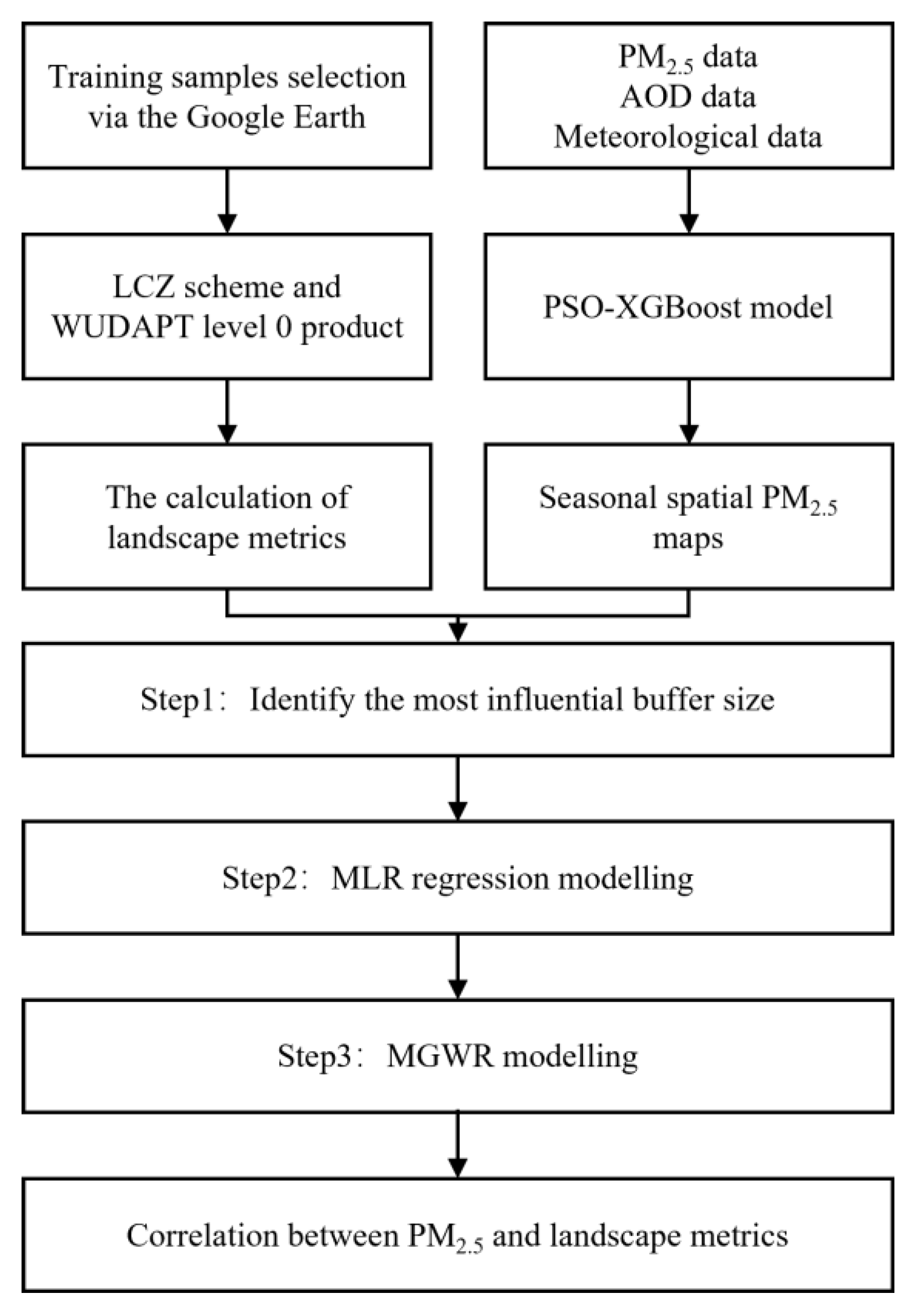
2. Materials and Methods
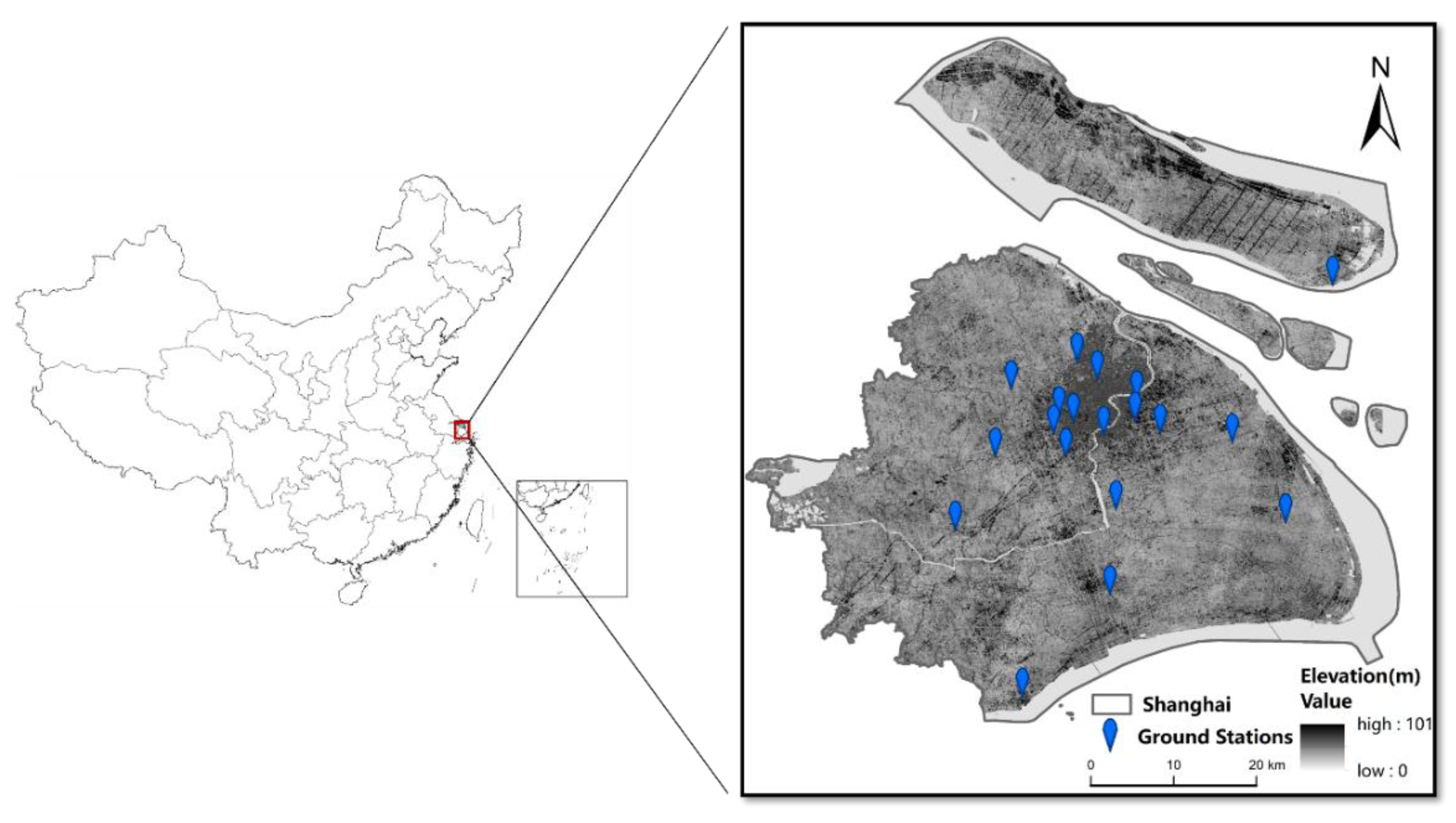
2.1. Study Area
2.2. Seasonal Spatial PM2.5 Concentration Estimation
2.2.1. PM2.5 Estimation Data
2.2.2. Construction of Inversion Models
2.3. Quantifying the Land Use and Landscape Spatial Pattern
2.3.1. Construction of LCZ Classification Map
2.3.2. Calculation of Landscape Metrics
3. Results
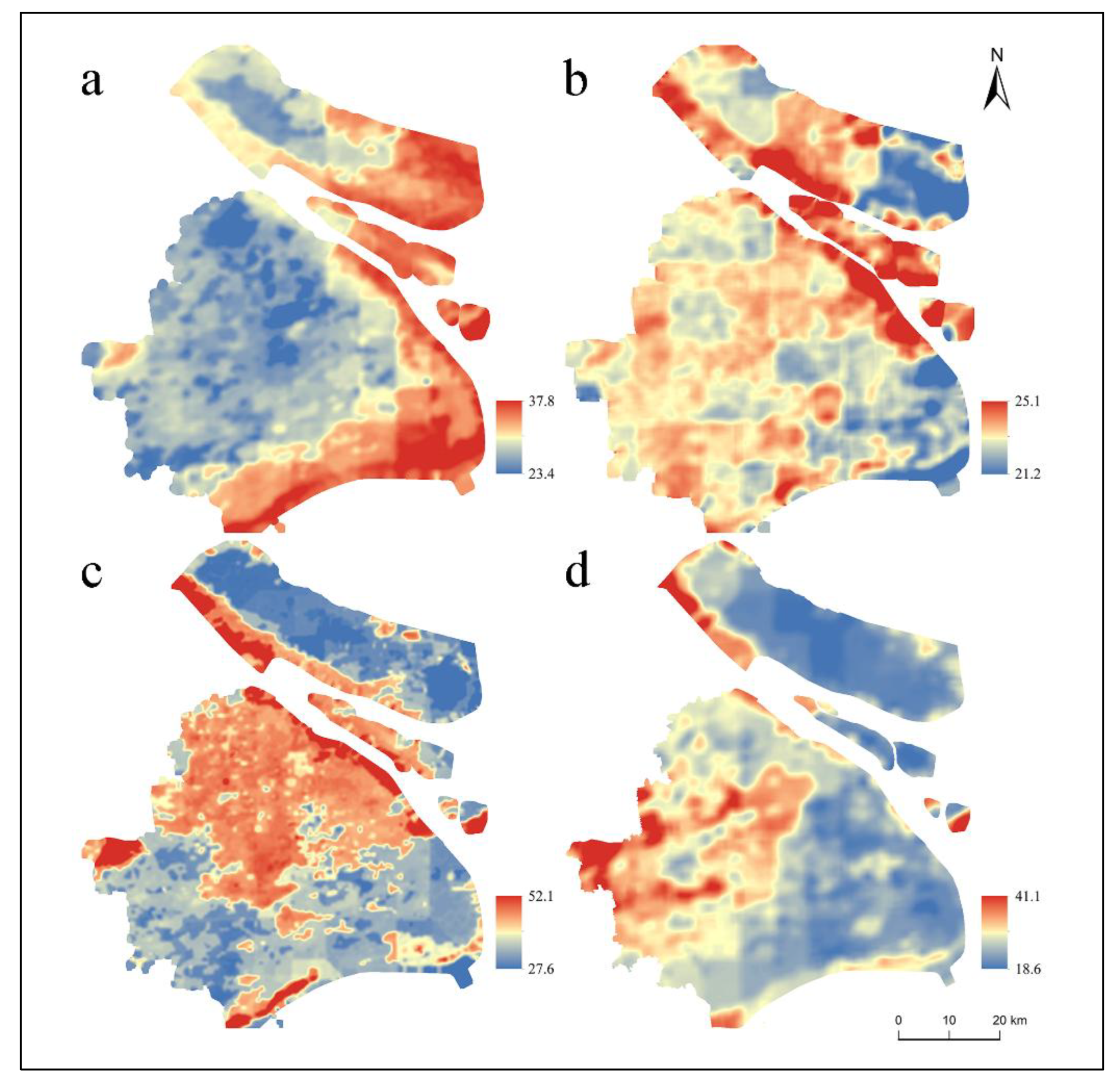
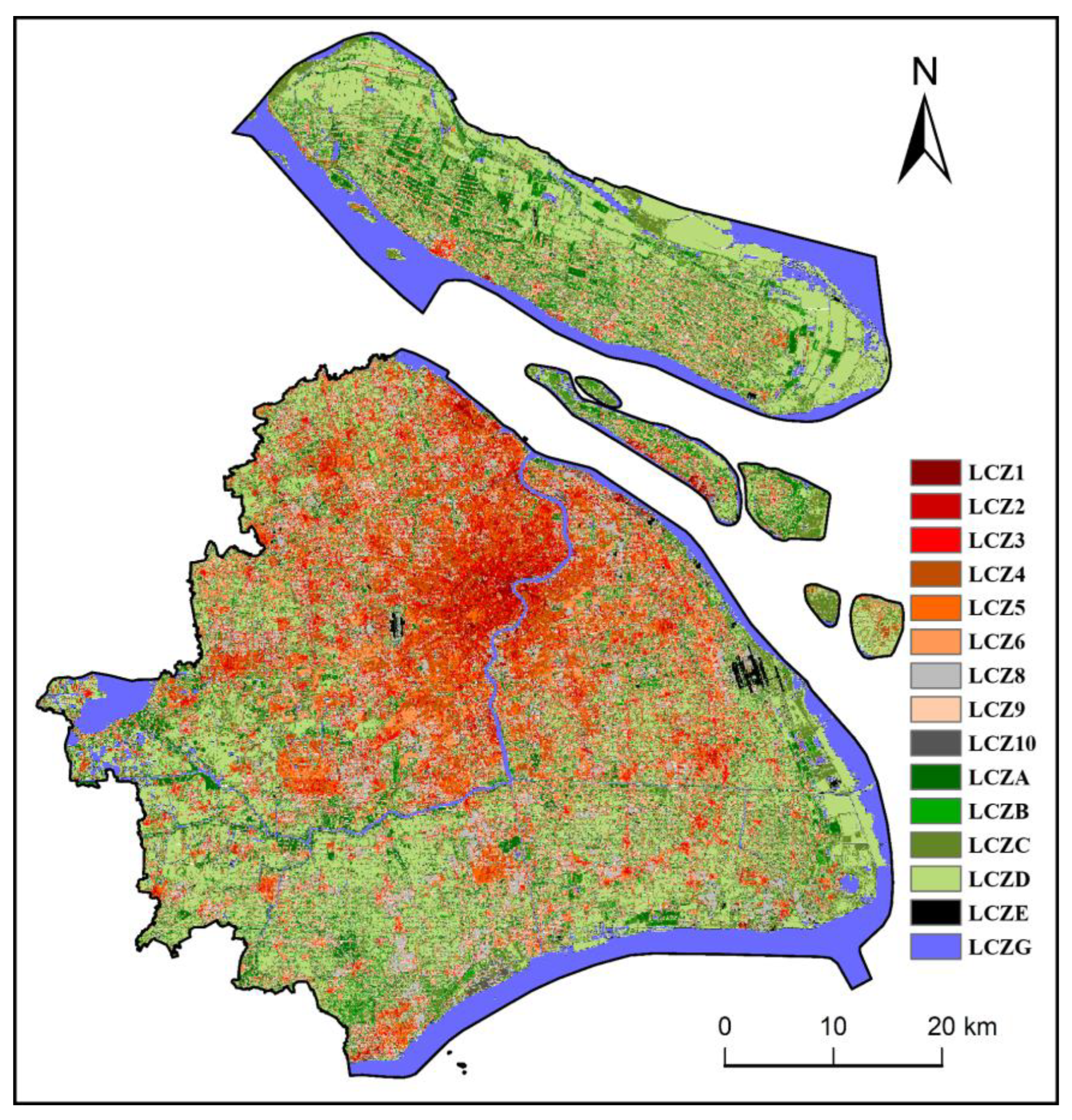
3.1. The Seasonal Spatial Characteristic of PM2.5 and LCZ Classification
3.2. The Relationship Between PM2.5 and Landscape
4. Discussion
5. Conclusions
- (1)
- The regression analyses of landscape metrics and PM2.5 showed that LCZ3 and LCZ6 entered the regression equations in both spring and summer with different buffer sizes, indicating that dispersed low-rise open buildings can effectively mitigate PM2.5 pollution. In the winter model, LCZ1 and LCZ4 exhibited negative correlations with PM2.5, while the aggregation index of LCZ3 was positively correlated, suggesting that compact mid-/high-rise buildings and intensified human activities contribute to elevated PM2.5 levels. The LCZB factor appeared repeatedly in the models with larger buffer ranges and substantial effects, confirming the effectiveness of vegetation in reducing air pollution.
- (2)
- Factors selected through multiple linear regression were subsequently included in the MGWR model, where they collectively explained on average over 69% of the spatial variation in PM2.5, highlighting the significant impact of urban landscape configuration on the spatial distribution of pollution, as well as the utility of the LCZ framework in elucidating urban PM2.5 variation.
Author Contributions
Funding
Data Availability Statement
Acknowledgments
Conflicts of Interest
References
- Yeh, A.G.-O.; Chen, Z. From cities to super mega city regions in China in a new wave of urbanisation and economic transition: Issues and challenges. Urban Stud. 2020, 57, 636–654. [Google Scholar] [CrossRef]
- Guan, X.; Wei, H.; Lu, S.; Dai, Q.; Su, H. Assessment on the urbanization strategy in China: Achievements, challenges and reflections. Habitat Int. 2018, 71, 97–109. [Google Scholar] [CrossRef]
- Zhang, X.; Han, L.; Wei, H.; Tan, X.; Zhou, W.; Li, W.; Qian, Y. Linking urbanization and air quality together: A review and a perspective on the future sustainable urban development. J. Clean. Prod. 2022, 346, 130988. [Google Scholar] [CrossRef]
- Khan, M.F.; Shirasuna, Y.; Hirano, K.; Masunaga, S. Characterization of PM2.5, PM2.5–10 and PM> 10 in ambient air, Yokohama, Japan. Atmos. Res. 2010, 96, 159–172. [Google Scholar]
- Lim, C.-H.; Ryu, J.; Choi, Y.; Jeon, S.W.; Lee, W.-K. Understanding global PM2.5 concentrations and their drivers in recent decades (1998–2016). Environ. Int. 2020, 144, 106011. [Google Scholar] [PubMed]
- Xing, Y.-F.; Xu, Y.-H.; Shi, M.-H.; Lian, Y.-X. The impact of PM2.5 on the human respiratory system. J. Thorac. Dis. 2016, 8, E69. [Google Scholar]
- Zhou, W.; Wu, X.; Ding, S.; Ji, X.; Pan, W. Predictions and mitigation strategies of PM2.5 concentration in the Yangtze River Delta of China based on a novel nonlinear seasonal grey model. Environ. Pollut. 2021, 276, 116614. [Google Scholar]
- Yang, D.; Wang, X.; Xu, J.; Xu, C.; Lu, D.; Ye, C.; Wang, Z.; Bai, L. Quantifying the influence of natural and socioeconomic factors and their interactive impact on PM2.5 pollution in China. Environ. Pollut. 2018, 241, 475–483. [Google Scholar]
- Gregory, J.; AzariJafari, H.; Vahidi, E.; Guo, F.; Ulm, F.-J.; Kirchain, R. The role of concrete in life cycle greenhouse gas emissions of US buildings and pavements. Proc. Natl. Acad. Sci. USA 2021, 118, e2021936118. [Google Scholar]
- Li, K.; Li, C.; Liu, M.; Hu, Y.; Wang, H.; Wu, W. Multiscale analysis of the effects of urban green infrastructure landscape patterns on PM2.5 concentrations in an area of rapid urbanization. J. Clean. Prod. 2021, 325, 129324. [Google Scholar] [CrossRef]
- Feng, H.; Zou, B.; Tang, Y. Scale-and region-dependence in landscape-PM2.5 correlation: Implications for urban planning. Remote Sens. 2017, 9, 918. [Google Scholar] [CrossRef]
- Lu, D.; Mao, W.; Yang, D.; Zhao, J.; Xu, J. Effects of land use and landscape pattern on PM2.5 in Yangtze River Delta, China. Atmos. Pollut. Res. 2018, 9, 705–713. [Google Scholar]
- Wu, J.; Xie, W.; Li, W.; Li, J. Effects of urban landscape pattern on PM2.5 pollution—A Beijing case study. PLoS ONE 2015, 10, e0142449. [Google Scholar] [CrossRef]
- Shi, Y.; Ren, C.; Lau, K.K.-L.; Ng, E. Investigating the influence of urban land use and landscape pattern on PM2.5 spatial variation using mobile monitoring and WUDAPT. Landsc. Urban Plan. 2019, 189, 15–26. [Google Scholar]
- Stewart, I.D.; Oke, T.R. Local climate zones for urban temperature studies. Bull. Am. Meteorol. Soc. 2012, 93, 1879–1900. [Google Scholar] [CrossRef]
- Jiang, R.; Xie, C.; Man, Z.; Afshari, A.; Che, S. LCZ method is more effective than traditional LUCC method in interpreting the relationship between urban landscape and atmospheric particles. Sci. Total Environ. 2023, 869, 161677. [Google Scholar] [CrossRef]
- Lehnert, M.; Savić, S.; Milošević, D.; Dunjić, J.; Geletič, J. Mapping local climate zones and their applications in European urban environments: A systematic literature review and future development trends. ISPRS Int. J. Geo-Inf. 2021, 10, 260. [Google Scholar]
- Huang, F.; Jiang, S.; Zhan, W.; Bechtel, B.; Liu, Z.; Demuzere, M.; Huang, Y.; Xu, Y.; Ma, L.; Xia, W. Mapping local climate zones for cities: A large review. Remote Sens. Environ. 2023, 292, 113573. [Google Scholar]
- Bechtel, B.; Alexander, P.J.; Böhner, J.; Ching, J.; Conrad, O.; Feddema, J.; Mills, G.; See, L.; Stewart, I. Mapping local climate zones for a worldwide database of the form and function of cities. ISPRS Int. J. Geo-Inf. 2015, 4, 199–219. [Google Scholar] [CrossRef]
- Demuzere, M.; Kittner, J.; Bechtel, B. LCZ Generator: A web application to create Local Climate Zone maps. Front. Environ. Sci. 2021, 9, 637455. [Google Scholar] [CrossRef]
- Zhao, J.; Chen, G.; Yu, L.; Ren, C.; Xie, J.; Chung, L.; Ni, H.; Gong, P. Mapping urban morphology changes in the last two decades based on local climate zone scheme: A case study of three major urban agglomerations in China. Urban Clim. 2023, 47, 101391. [Google Scholar]
- Yang, H.; Leng, Q.; Xiao, Y.; Chen, W. Investigating the impact of urban landscape composition and configuration on PM2.5 concentration under the LCZ scheme: A case study in Nanchang, China. Sustain. Cities Soc. 2022, 84, 104006. [Google Scholar]
- Zhao, L.; Xie, Y.; Wang, J.; Xu, X. A performance assessment and adjustment program for air quality monitoring networks in Shanghai. Atmos. Environ. 2015, 122, 382–392. [Google Scholar]
- Ranjan, A.K.; Patra, A.; Gorai, A. Effect of lockdown due to SARS COVID-19 on aerosol optical depth (AOD) over urban and mining regions in India. Sci. Total Environ. 2020, 745, 141024. [Google Scholar] [CrossRef]
- Hersbach, H.; Bell, B.; Berrisford, P.; Hirahara, S.; Horányi, A.; Muñoz-Sabater, J.; Nicolas, J.; Peubey, C.; Radu, R.; Schepers, D. The ERA5 global reanalysis. Q. J. R. Meteorol. Soc. 2020, 146, 1999–2049. [Google Scholar] [CrossRef]
- Pan, B. Application of XGBoost algorithm in hourly PM2.5 concentration prediction. Proc. IOP Conf. Ser. Earth Environ. Sci. 2018, 113, 012127. [Google Scholar]
- Ma, J.; Yu, Z.; Qu, Y.; Xu, J.; Cao, Y. Application of the XGBoost machine learning method in PM2.5 prediction: A case study of Shanghai. Aerosol Air Qual. Res. 2020, 20, 128–138. [Google Scholar]
- Jiang, H.; He, Z.; Ye, G.; Zhang, H. Network intrusion detection based on PSO-XGBoost model. IEEE Access 2020, 8, 58392–58401. [Google Scholar] [CrossRef]
- Abougendia, S.M. Investigating surface UHI using local climate zones (LCZs), the case study of Cairo’s River Islands. Alex. Eng. J. 2023, 77, 293–307. [Google Scholar] [CrossRef]
- Zhao, L.; Li, T.; Przybysz, A.; Guan, Y.; Ji, P.; Ren, B.; Zhu, C. Effect of urban lake wetlands and neighboring urban greenery on air PM10 and PM2.5 mitigation. Build. Environ. 2021, 206, 108291. [Google Scholar]
- Xu, G.; Ren, X.; Xiong, K.; Li, L.; Bi, X.; Wu, Q. Analysis of the driving factors of PM2.5 concentration in the air: A case study of the Yangtze River Delta, China. Ecol. Indic. 2020, 110, 105889. [Google Scholar] [CrossRef]
- Yue, H.; Duan, L.; Lu, M.; Huang, H.; Zhang, X.; Liu, H. Modeling the determinants of PM2.5 in china considering the localized spatiotemporal effects: A multiscale geographically weighted regression method. Atmosphere 2022, 13, 627. [Google Scholar] [CrossRef]
- Fotheringham, A.S.; Yang, W.; Kang, W. Multiscale geographically weighted regression (MGWR). Ann. Am. Assoc. Geogr. 2017, 107, 1247–1265. [Google Scholar] [CrossRef]
- Pan, J.; Ji, J. Influence of building height variation on air pollution dispersion in different wind directions: A numerical simulation study. Appl. Sci. 2024, 14, 979. [Google Scholar] [CrossRef]
- Gheorghe, I.F.; Ion, B. The effects of air pollutants on vegetation and the role of vegetation in reducing atmospheric pollution. Impact Air Pollut. Health Econ. Environ. Agric. Sources 2011, 29, 241–280. [Google Scholar]
- Zhai, H.; Yao, J.; Wang, G.; Tang, X. Study of the effect of vegetation on reducing atmospheric pollution particles. Remote Sens. 2022, 14, 1255. [Google Scholar] [CrossRef]




| Predictor Variables | Predictor Variables | Predictor Variables | Beta | VIF | R2 |
|---|---|---|---|---|---|
| Spring regression model | Intercept | 20.838 | 0.999 | ||
| LCZ3_LPI_1000 | −0.044 | −0.111 | 1.062 | ||
| LCZ6_AI_5000 | −0.0159 | −0.617 | 1.033 | ||
| LCZB_LSI_3000 | 0.803 | 0.663 | 1.043 | ||
| SHEI_3000 | 8.415 | 0.338 | 1.039 | ||
| Summer regression model | Intercept | 22.953 | 0.999 | ||
| LCZ3_LSI_500 | 0.195 | 0.583 | 1.244 | ||
| LCZ6_PLAND_5000 | 0.004 | 0.046 | 1.124 | ||
| LCZ8_PLAND_500 | 0.007 | 0.194 | 1.076 | ||
| LCZB_LPI_3000 | 0.545 | 0.63 | 1.119 | ||
| SHEI_3000 | −0.739 | −0.117 | 1.016 | ||
| Autumn regression mode | Intercept | 7.524 | 0.993 | ||
| LCZ8_LSI_1000 | 2.436 | 0.373 | 1.029 | ||
| LCZ9_PLAND_3000 | −0.981 | −0.58 | 1.038 | ||
| LCZ15_LSI_5000 | −0.125 | −0.023 | 1.111 | ||
| SHEI_3000 | 30.978 | 0.647 | 1.101 | ||
| Winter regression model | Intercept | 63.725 | - | - | 0.995 |
| LCZ1_AI_5000 | −0.051 | −0.372 | 1.156 | ||
| LCZ3_AI_5000 | 0.201 | 0.355 | 1.322 | ||
| LCZ4_AI_5000 | −0.228 | −0.303 | 1.095 | ||
| SHEI_3000 | −45.941 | −0.986 | 1.274 |
| Spring regression model | R2 | 0.804 | ||||
| Adj. R2 | 0.729 | |||||
| n | 32.872 | |||||
| AICc | 80.664 | |||||
| Predictor Variables | Mean | STD | Min | Median | Max | |
| Intercept | −0.029 | 0.77 | −1.053 | −0.118 | 2.009 | |
| LCZ3_LPI_1000 | −0.007 | 0 | −0.008 | −0.007 | −0.007 | |
| LCZ6_AI_5000 | −0.07 | 0.017 | −0.095 | −0.072 | −0.032 | |
| LCZB_LSI_3000 | −0.357 | 0.204 | −0.821 | −0.368 | 0.09 | |
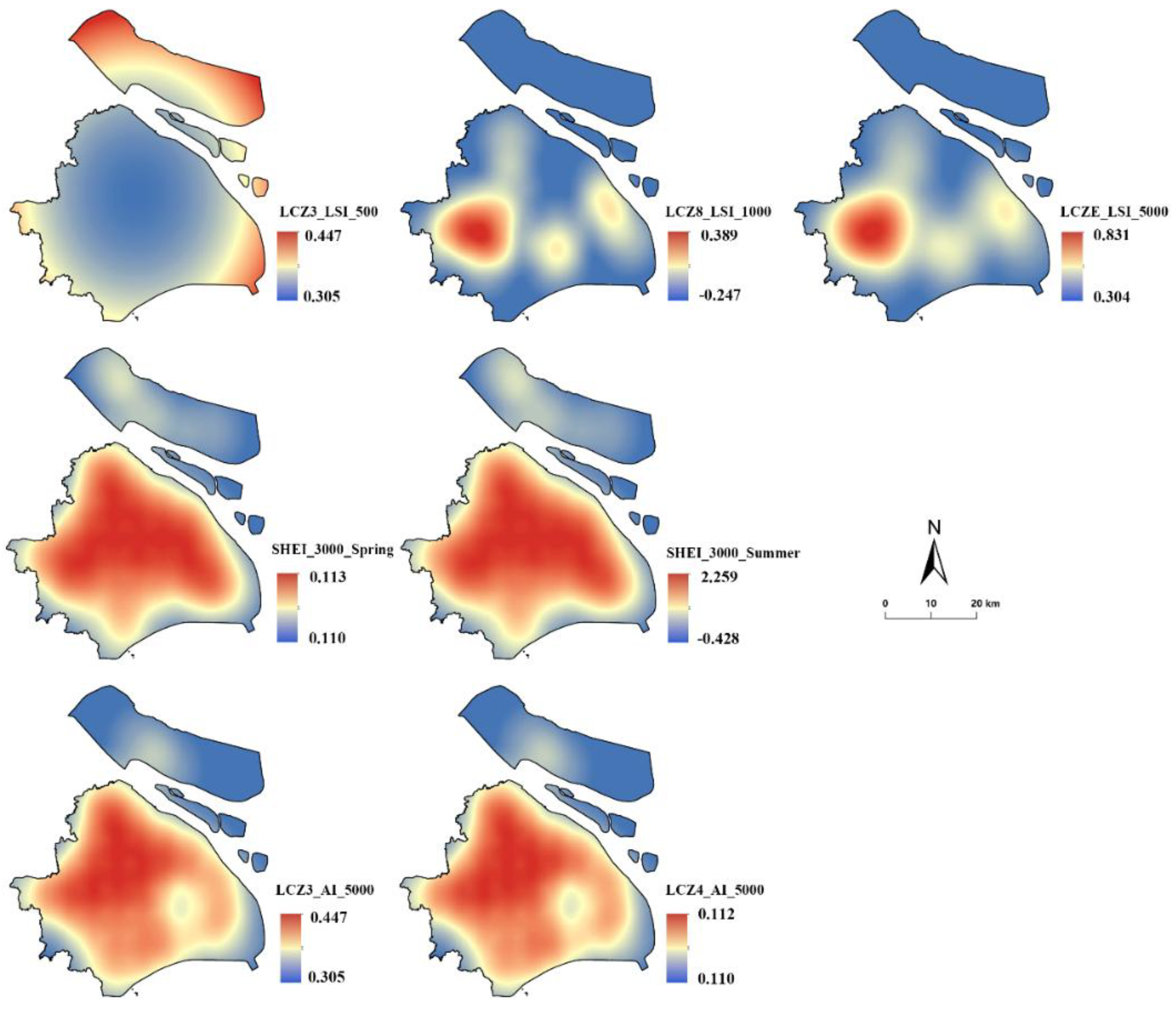
| SHEI_3000 | 0.112 | 0.001 | 0.11 | 0.112 | 0.113 | |
| Summer regression model | R2 | 0.745 | ||||
| Adj. R2 | 0.562 | |||||
| n | 19.086 | |||||
| AICc | 99.240 | |||||
| Predictor Variables | Mean | STD | Min | Median | Max | |
| Intercept | −0.102 | 0.13 | −0.515 | −0.075 | 0.078 | |
| LCZ3_LSI_500 | 0.374 | 0.034 | 0.305 | 0.372 | 0.447 | |
| LCZ6_PLAND_5000 | 0.069 | 0.001 | 0.066 | 0.069 | 0.071 | |
| LCZ8_PLAND_500 | 0.207 | 0.001 | 0.205 | 0.206 | 0.209 | |
| LCZB_LPI_3000 | 0.198 | 0.001 | 0.196 | 0.198 | 0.199 | |
| SHEI_3000 | 0.208 | 0.722 | −0.428 | −0.106 | 2.259 | |
| Autumn regression mode | R2 | 0.863 | ||||
| Adj. R2 | 0.774 | |||||
| n | 38.031 | |||||
| AICc | 138.652 | |||||
| Predictor Variables | Mean | STD | Min | Median | Max | |
| Intercept | −0.039 | 0.548 | −0.905 | −0.158 | 0.819 | |
| LCZ8_LSI_1000 | 0.065 | 0.145 | −0.247 | 0.083 | 0.389 | |
| LCZ9_PLAND_3000 | 0.046 | 0.001 | 0.044 | 0.046 | 0.047 | |
| LCZE_LSI_5000 | 0.019 | 0.304 | −0.344 | −0.057 | 0.831 | |
| SHEI_3000 | 0.209 | 0 | 0.209 | 0.209 | 0.21 | |
| Winter regression model | R2 | 0.804 | ||||
| Adj. R2 | 0.729 | |||||
| n | 32.872 | |||||
| AICc | 92.680 | |||||
| Predictor Variables | Mean | STD | Min | Median | Max | |
| Intercept | 0.013 | 0.699 | −1.131 | 0.031 | 1.683 | |
| LCZ1_AI_5000 | 0.015 | 0.001 | 0.013 | 0.015 | 0.017 | |
| LCZ3_AI_5000 | 0.097 | 0.001 | 0.095 | 0.097 | 0.098 | |
| LCZ4_AI_5000 | 0.111 | 0.001 | 0.11 | 0.111 | 0.112 | |
| SHEI_3000 | −0.076 | 0.001 | −0.078 | −0.076 | −0.074 | |
Disclaimer/Publisher’s Note: The statements, opinions and data contained in all publications are solely those of the individual author(s) and contributor(s) and not of MDPI and/or the editor(s). MDPI and/or the editor(s) disclaim responsibility for any injury to people or property resulting from any ideas, methods, instructions or products referred to in the content. |
© 2026 by the authors. Licensee MDPI, Basel, Switzerland. This article is an open access article distributed under the terms and conditions of the Creative Commons Attribution (CC BY) license.
Share and Cite
Yang, Q.; Chen, W.; Jia, S.; Li, C.; Chen, Y. Influence of Urban Landscape Patterns on PM2.5 Concentrations from the LCZ Perspective in Shanghai City. Land 2026, 15, 252. https://doi.org/10.3390/land15020252
Yang Q, Chen W, Jia S, Li C, Chen Y. Influence of Urban Landscape Patterns on PM2.5 Concentrations from the LCZ Perspective in Shanghai City. Land. 2026; 15(2):252. https://doi.org/10.3390/land15020252
Chicago/Turabian StyleYang, Qiang, Wenkai Chen, Shaokun Jia, Chang Li, and Yuanyuan Chen. 2026. "Influence of Urban Landscape Patterns on PM2.5 Concentrations from the LCZ Perspective in Shanghai City" Land 15, no. 2: 252. https://doi.org/10.3390/land15020252
APA StyleYang, Q., Chen, W., Jia, S., Li, C., & Chen, Y. (2026). Influence of Urban Landscape Patterns on PM2.5 Concentrations from the LCZ Perspective in Shanghai City. Land, 15(2), 252. https://doi.org/10.3390/land15020252