Article

Spatial and Temporal Variation of Vegetation NPP in a Typical Area of China Based on the CASA Model

1
State Key Laboratory for Fine Exploration and Intelligent Development of Coal Resources, China University of Mining and Technology-Beijing, Beijing 100083, China
2
College of Geoscience and Surveying Engineering, China University of Mining and Technology-Beijing, Beijing 100083, China
*
Author to whom correspondence should be addressed.
Land 2026, 15(2), 237; https://doi.org/10.3390/land15020237
Submission received: 4 December 2025 / Revised: 20 January 2026 / Accepted: 26 January 2026 / Published: 30 January 2026

Abstract

To host the 2022 Winter Olympics, Beijing and Zhangjiakou implemented extensive ecological restoration projects, improving the ecological quality of the region. However, detailed evidence of long-term spatiotemporal dynamics in vegetation productivity remains limited. This study employed the Carnegie–Ames–Stanford Approach (CASA) to estimate the vegetation Net Primary Productivity (NPP) in the Beijing–Zhangjiakou region from 2004 to 2023, utilizing 250 m monthly NDVI data. The 30 m resolution China Land Cover Dataset (CLCD) was incorporated to mask non-vegetated pixels and refine the vegetation mask, reducing mixed-pixel effects. Spatiotemporal variations, seasonal change-point detection, interannual stability, and trend persistence were analyzed across administrative regions and land cover types. Results indicate pronounced spatial heterogeneity in NPP, with persistently high values in forest-dominated western and northern Beijing and northeastern Zhangjiakou, and lower values concentrated in Beijing’s built-up and cropland-dominated southeastern plain. Pixel-level boxplots suggest stronger intra-regional variability in Beijing than in Zhangjiakou. Across landcover types, forests generally maintain the highest NPP, while grasslands are relatively lower. Boxplots further show that shrubs exhibit the highest variability, with all types showing right-skewed distributions. Annual mean NPP increased significantly for the entire region, Beijing, and Zhangjiakou, with interannual increase rates of 3.57, 1.56, and 4.53 gC·m−2·yr−2, respectively; the lowest values occurred in 2007 and the highest in 2022. Trend maps and category statistics consistently suggest that positive trends dominate most of the region and expanded slightly during 2014–2023. BEAST analysis suggests a stable seasonal NPP cycle with no significant seasonal change points. CV-based assessment indicates generally high to extremely high stability, whereas low-stability zones are mainly associated with urban expansion areas, surrounding croplands, and parts of Zhangjiakou grasslands. Hurst results suggest that persistently increasing trends cover more than 90% of the study area, while persistently decreasing trends account for about 5.25% and are primarily linked to Beijing’s expansion zones.

1. Introduction

As a fundamental component of the terrestrial ecosystem, vegetation serves as a primary indicator of environmental quality, playing an irreplaceable role in maintaining ecological security and regulating the global carbon cycle [1,2]. To investigate the ecological quality evolution within the Beijing–Zhangjiakou region over the past two decades, this study adopts Net Primary Productivity (NPP) as a core indicator to characterize vegetation growth dynamics from 2004 to 2023. Conceptually, NPP is defined as the net accumulation of organic matter fixed by vegetation per unit area and unit time [3], calculated by subtracting the amount of organic material consumed through autotrophic respiration from the total amount produced through photosynthesis [4]. The spatiotemporal heterogeneity of NPP is primarily governed by a complex interplay of regional determinants, including climatic variables, geographical setting, vegetation characteristics (e.g., type and growth status), land cover dynamics, and anthropogenic footprints [5,6]. As NPP serves as a critical indicator reflecting land cover status, carbon sequestration capacity, and overall ecological condition [7], revealing the dynamic characteristics and potential sustainability of NPP is imperative for assessing regional ecosystem quality and guiding ecological management [8].
Currently, methods for estimating vegetation NPP fall into three main categories [9]: field sampling [10], eddy covariance [11] and remote sensing-based estimation [12]. Among these methods, remote sensing approaches are widely employed to estimate vegetation NPP due to their distinct advantages, such as superior temporal continuity and extensive spatial coverage. Consequently, these estimates are frequently utilized to assess regional ecosystem status. For example, George et al. [13] assessed the ecological status of Europe using remotely sensed NPP and other data, predicting future droughts and drought-induced impacts. Zhou et al. [14] adopted NPP as a primary indicator to quantify the dual effects of climatic fluctuations and anthropogenic activities on the ecological status of Northwest China. Liu et al. [15] performed a global-scale assessment of NPP across multiple cities and examined how urban expansion affects regional vegetation productivity, carbon sinks, and ecosystem dynamics. With the rapid advancement of remote sensing, the Carnegie–Ames–Stanford Approach (CASA) has been widely adopted to estimate vegetation NPP in different geographic settings [16], offering a useful basis for tracking changes in terrestrial ecosystems. For example, Sun et al. [17] applied CASA to derive long-term NPP for Sanjiangyuan National Park and, together with NDVI, used linear regression to investigate the combined effects of ecological quality and climatic factors. Likewise, Yang et al. [18] used CASA to estimate NPP in Anhui Province and quantified its responses to both climatic variability and human activities. Cao et al. [19] further employed CASA to assess ecosystem conditions in the tropical dry forests (TDFs) of Santa Rosa National Park, Costa Rica.
Beijing and Zhangjiakou share a long history and common culture, and the ecological and environmental conditions of this area are receiving increasing attention with the Winter Olympics and Paralympics. In addition, the ecological quality of Beijing, as a world-class metropolis, is of crucial importance, whereas Zhangjiakou serves as a key water conservation and ecological support area for Beijing. An in-depth understanding of the historical changes and current status of the ecological environment in the area is significant for promoting Beijing–Tianjin–Hebei synergistic development and the sustainable development of the area after the Winter Olympics. Therefore, many scholars have studied the vegetation and ecological changes in Beijing and Zhangjiakou. Gong and Wang [20] evaluated the effectiveness of Beijing’s green space policy by integrating NDVI data with meteorological variables (surface temperature and precipitation), confirming a substantial improvement in urban vegetation coverage. Liu et al. [21] analyzed the interplay between daily Evapotranspiration (ET), urban greenery, and thermal conditions in Beijing. By leveraging NDVI and Land Surface Temperature (LST) datasets, they identified that daily ET maintains a positive correlation with NDVI, whereas it exhibits an inverse relationship with LST. Employing the Enhanced Vegetation Index (EVI) and NDVI datasets spanning 2000 to 2020, Zhang et al. [22] documented a sustained increase in vegetation coverage in Zhangjiakou. The upward trend became more apparent after Beijing won the right to host the Winter Olympics. Regarding NPP investigations, Yin et al. [23] employed the CASA model to quantify vegetation productivity in Beijing. Their results showed that relatively high NPP mainly occurs in the mountainous areas to the west and north.
However, few prior studies have treated Beijing and Zhangjiakou as a unified ecological entity or utilized long-term NPP as a metric to evaluate regional ecological integrity and forecast future trends. Specifically, there is a scarcity of detailed investigations into the temporal dynamics of NPP within this combined area. Therefore, this study employed the CASA model to estimate NPP in the Beijing–Zhangjiakou region from 2004 to 2023, utilizing 250 m monthly NDVI datasets. The 30 m resolution China Land Cover Dataset (CLCD) was used to mask non-vegetated pixels and refine the vegetation mask, reducing mixed-pixel effects in NPP estimation. Building on these estimates, we systematically analyzed the spatiotemporal variations, seasonal abrupt changes, stability, and trend persistence of NPP across different administrative regions and land cover types. These analyses provide a comprehensive assessment of regional ecosystem condition and offer a scientific basis for future ecological restoration efforts in the study area.

2. Materials and Methods

2.1. Study Area

The Beijing–Zhangjiakou region (Figure 1a) is located between 113°49′–117°31′ E and 39°26′–42°09′ N, covering approximately 53,200 km2. The terrain exhibits a distinct elevation gradient, characterized by higher elevations in the west and lower elevations in the east, with a maximum altitude exceeding 2800 m. Specifically, Beijing features plains in the southeast and mountainous terrain in the west and north, whereas Zhangjiakou is characterized by a generally higher average elevation. Climatically, the region lies in a transition zone between temperate monsoon and temperate continental regimes, featuring hot summers with relatively concentrated rainfall and cold, dry winters; annual precipitation is typically about 330–500 mm. Impervious surfaces are primarily distributed in the southeastern part of Beijing, forests are mainly located in western Beijing and eastern Zhangjiakou, and grasslands are predominantly found in Zhangjiakou (Figure 1b,c). Statistically, the proportion of impervious surfaces in the study area increased from 3.04% to 4.87% between 2004 and 2023, while the proportion of forest area rose from 30.72% to 32.39%.

2.2. Data Sources

This study used NDVI data [24], meteorological variables (temperature, precipitation, and solar radiation), land-cover data [25], and a Digital Elevation Model (DEM) (Table 1). Continuous meteorological surfaces were generated with ANUSPLIN version 4.4 (Australian National University, Canberra, Australia) based on thin-plate smoothing splines, with elevation (DEM) included as an auxiliary covariate to enhance interpolation accuracy. For consistency among datasets, all layers were resampled to a common 250 m grid and reprojected into a unified coordinate system before subsequent analyses.

2.3. Methods

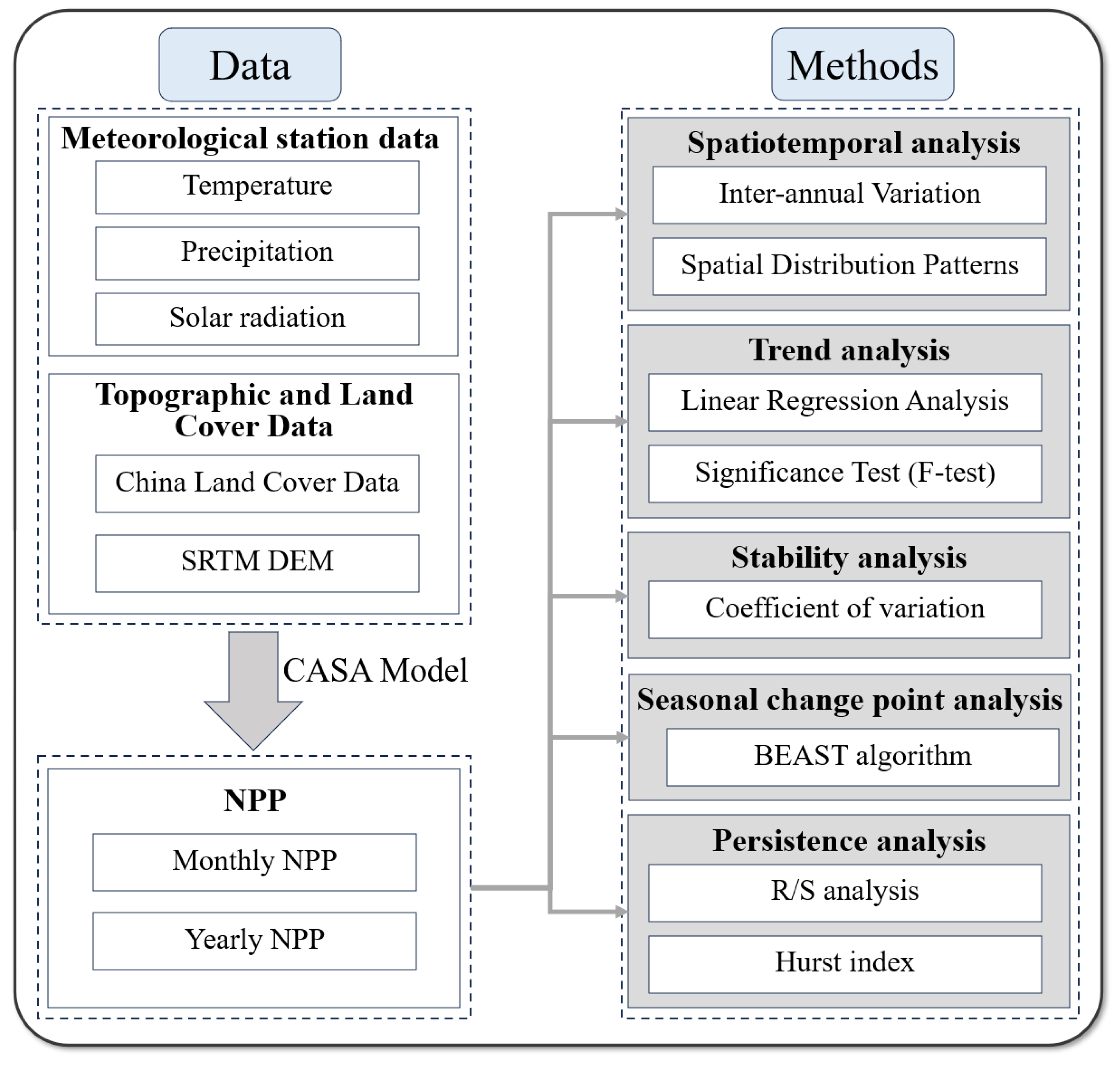
An overview of the methodological route is shown in Figure 2. It integrates multi-source data acquisition, NPP estimation using the CASA model, and comprehensive spatiotemporal analysis methods.

2.3.1. The CASA Model

In this study, monthly NPP was estimated with the CASA model, which follows light-use efficiency theory [26,27,28]. NPP for pixel x in month t is computed as the product of absorbed photosynthetically active radiation (APAR) and realized light-use efficiency ε [29,30]:
N P P ( x , t ) = A P A R ( x , t ) × ε ( x , t )
In this equation, x denotes the pixel and t the month, respectively. NPP(x,t) is net primary productivity (gC·m−2), APAR(x,t) represents the monthly absorbed PAR (MJ·m−2), and ε(x,t) is the realized light-use efficiency (gC·MJ−1).
The APAR is calculated based on total solar radiation (SOL) and the fraction of photosynthetically active radiation (FPAR), as calculated below:
A P A R ( x , t ) = S O L ( x , t ) × F P A R ( x , t ) × 0.5
Here, SOL(x,t) refers to the total solar radiation, and the factor 0.5 converts total shortwave radiation to its photosynthetically active component [31]. FPAR(x,t) quantifies the fraction of PAR absorbed by the vegetation canopy. According to existing studies [32], we obtained FPAR from NDVI using an approximately linear relationship; therefore, it was estimated directly from NDVI data.
Finally, the actual light-use efficiency ε(x,t) is calculated by scaling the maximum light-use efficiency (εmax) using environmental stress factors [33,34] as follows:
ε ( x , t ) = T ε 1 ( x , t ) × T ε 2 ( x , t ) × W ε ( x , t ) × ε max
In this equation, Tε1(x,t) and Tε2(x,t) are temperature stress scalars, whereas Wε(x,t) is the moisture stress scalar that captures the constraint of water availability on photosynthesis. The parameter εmax denotes the maximum attainable light-use efficiency under optimal conditions.
Since εmax varies significantly among vegetation types, the CLCD dataset was incorporated to identify vegetation categories. Specifically, non-vegetation pixels (e.g., water bodies and impervious surfaces) were masked out, and specific εmax values were assigned to each vegetation pixel based on established values from previous studies [35].

2.3.2. The BEAST Detection

Seasonal change points in the NPP series were identified using the Bayesian Estimator of Abrupt Change, Seasonality, and Trend (BEAST) [36,37]. In BEAST, the observed series is represented as the sum of a slowly varying trend, a seasonal signal, and an irregular remainder as follows:
Y ( t ) = T ( t ) + S ( t ) + ε ( t )
We focused on the seasonal component (S(t)) to identify seasonal change points (SCPs), which indicate significant shifts in seasonal behavior over time [38,39]. To facilitate the interpretation of seasonal dynamics, seasons were defined based on local vegetation phenology: spring (March–May), summer (June–August), autumn (September–November), and winter (December–February).

2.3.3. Trend Analysis

To characterize the long-term temporal trajectory of vegetation dynamics, we applied pixel-based linear regression analysis to the annual NPP time series [40]. The interannual change rate was represented by the regression slope (Kslope), which was computed as follows [41,42]:
K s l o p e = n × i = 1 n ( i × N P P i ) i = 1 n i i = 1 n N P P i n × i = 1 n i 2 ( i = 1 n i ) 2
In this equation, n is the length of the monitoring period (i.e., the number of years), and NPPi denotes the annual NPP in year i (n = 20 in this study). A positive Kslope indicates an upward trend, whereas a negative value suggests a downward trend. To test whether the fitted trend is statistically significant, we applied an F-test for the linear relationship between NPP and time; the corresponding F statistic is computed as follows [43]:
F = U × n 2 Q
Here, U = i = 1 n ( N P P ^ i N P P ¯ ) 2 represents the regression sum of squares (SSR), capturing the explained variation, while Q = i = 1 n ( N P P i N P P ^ i ) 2 denotes the residual sum of squares (SSE), representing the unexplained error. N P P i is the observed annual NPP, N P P ^ i is the corresponding fitted value, and N P P ¯ is the multi-year mean. In this study, a confidence level of 95% (p < 0.05) was selected as the threshold for significance. Consequently, based on the slope (Kslope) and the p-value, NPP trends were categorized as significant increase (Kslope > 0, p < 0.05), significant decrease (Kslope < 0, p < 0.05), and no significant change (p ≥ 0.05) [44].

2.3.4. Coefficient of Variation

To quantify the interannual fluctuations and stability of NPP during 2004–2023, the Coefficient of Variation (CV) was calculated [45]. As a dimensionless index, CV facilitates the comparison of data variability regardless of measurement scales or mean values [46]. The CV was calculated as follows:
C V = 1 N P P ¯ i = 1 n ( N P P i N P P ¯ ) 2 n 1
In this equation, NPPi denotes the annual NPP in year i, and N P P ¯ represents the multi-year mean NPP over the study period. n is the number of years (n = 20). The CV value reflects the volatility of vegetation dynamics; a higher CV indicates greater instability (stronger fluctuation) in the ecosystem, whereas a lower value suggests a more stable vegetation growth pattern. To facilitate the interpretation of NPP stability, we grouped CV values into four levels (Table 2).

2.3.5. Hurst Index

Rescaled range (R/S) analysis was used to compute the Hurst index for the 2004–2023 NPP series, providing a measure of long-term persistence [47,48]. The formulation is given as follows:
N P ¯ P τ = 1 τ t = 1 τ N P P τ ,   τ = 1 , 2 ,  
X ( t , τ ) = t = 1 τ ( N P P i N P ¯ P τ ) ,   1 t τ
R ( τ ) = max X 1 t τ ( t , τ ) min 1 t τ X ( t , τ ) ,   τ = 1 , 2  
S ( τ ) = [ 1 τ t = 1 τ ( N P P t N P ¯ P τ ) 2 ] ,   τ = 1 , 2 ,  
When a power–law relationship between R/S and the time scale τ is observed, the Hurst index (H) is derived from the slope of the fitted log–log relationship using the least-squares method as follows [49,50]:
log ( R / S ) τ = a + H × l o g τ
The H values range from 0 to 1 and characterize the persistence of the NPP time series. Values of H > 0.5 indicate persistent behavior, suggesting that future NPP trends are likely to follow historical variations. Values of H < 0.5 imply anti-persistent behavior, indicating that future NPP dynamics may deviate from past trends, whereas H = 0.5 represents a random process with no long-term dependence. To further characterize the persistence of NPP trends, the Hurst index was combined with the interannual trend (Kslope) to classify NPP change patterns. Kslope indicates the direction of NPP change, while the Hurst index reflects the persistence of the observed trend. The detailed classification criteria are summarized in Table 3.

3. Results

3.1. Spatiotemporal Variations in NPP

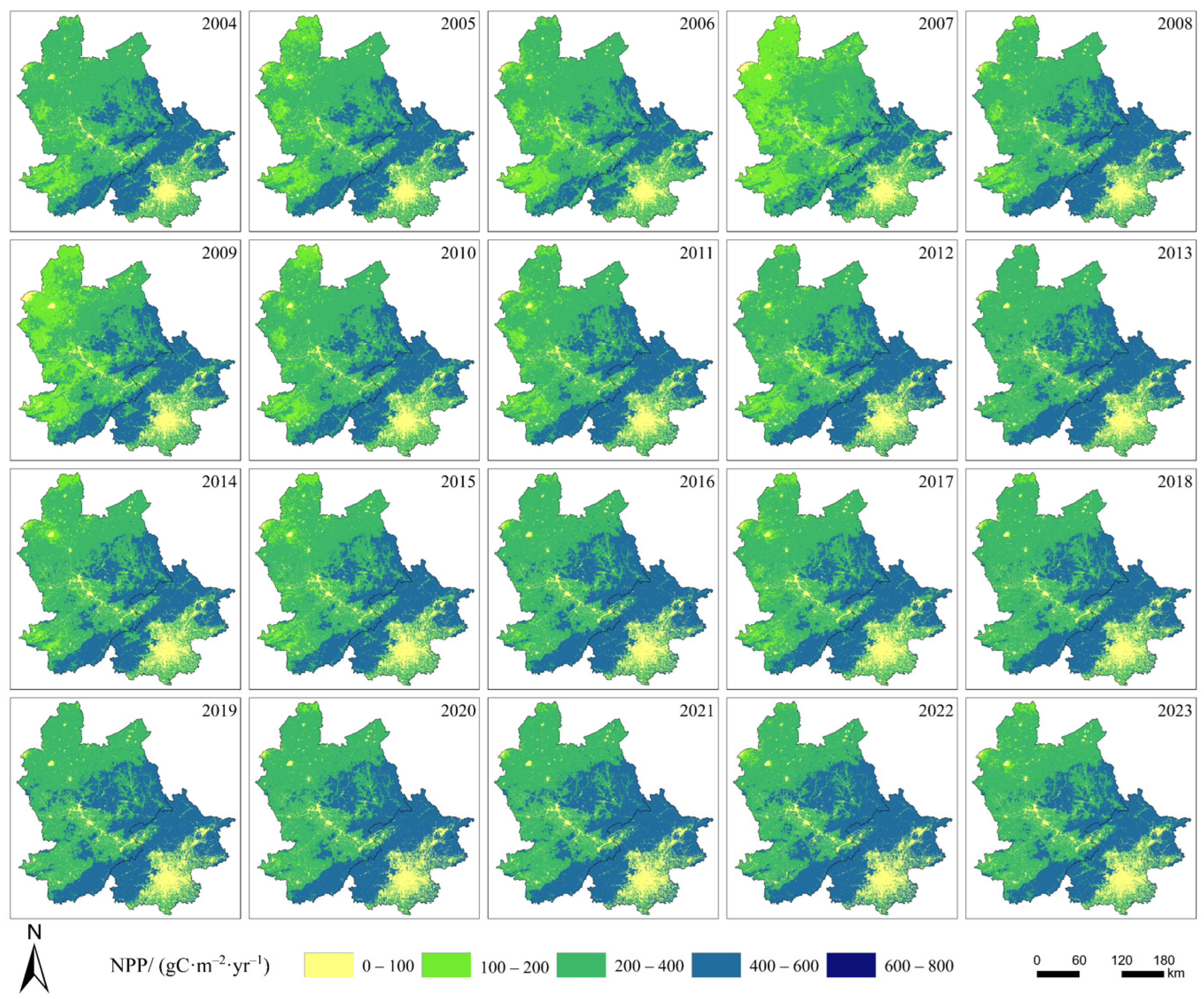
Figure 3 illustrates the spatiotemporal patterns of annual vegetation NPP in the Beijing–Zhangjiakou region during 2004–2023. Overall, the spatial pattern of NPP exhibits pronounced heterogeneity, with relatively stable high- and low-value regions throughout the study period. Higher NPP values are primarily found in forest-dominated areas, particularly in the western and northern parts of Beijing and the northeastern and southeastern regions of Zhangjiakou. In these areas, NPP typically ranges between 400 and 600 gC·m−2·yr−1. Conversely, lower NPP values are concentrated in the southeastern part of Beijing, where urbanization and agricultural activities are widespread, with NPP mainly ranging from 200 to 400 gC·m−2·yr−1.
Grassland-dominated areas in the western part of Zhangjiakou exhibit comparatively low NPP values during the early study period, with large areas characterized by NPP levels of 100–200 gC·m−2·yr−1 from 2004 to 2013. Notably, after 2014, the spatial extent of these low-NPP grassland areas in western Zhangjiakou shows a marked reduction, indicating a general increase in NPP levels over time. This reduction suggests an overall improvement in vegetation productivity in this region during the later years of the study period, although the broad spatial configuration of high- and low-NPP regions remained largely consistent.
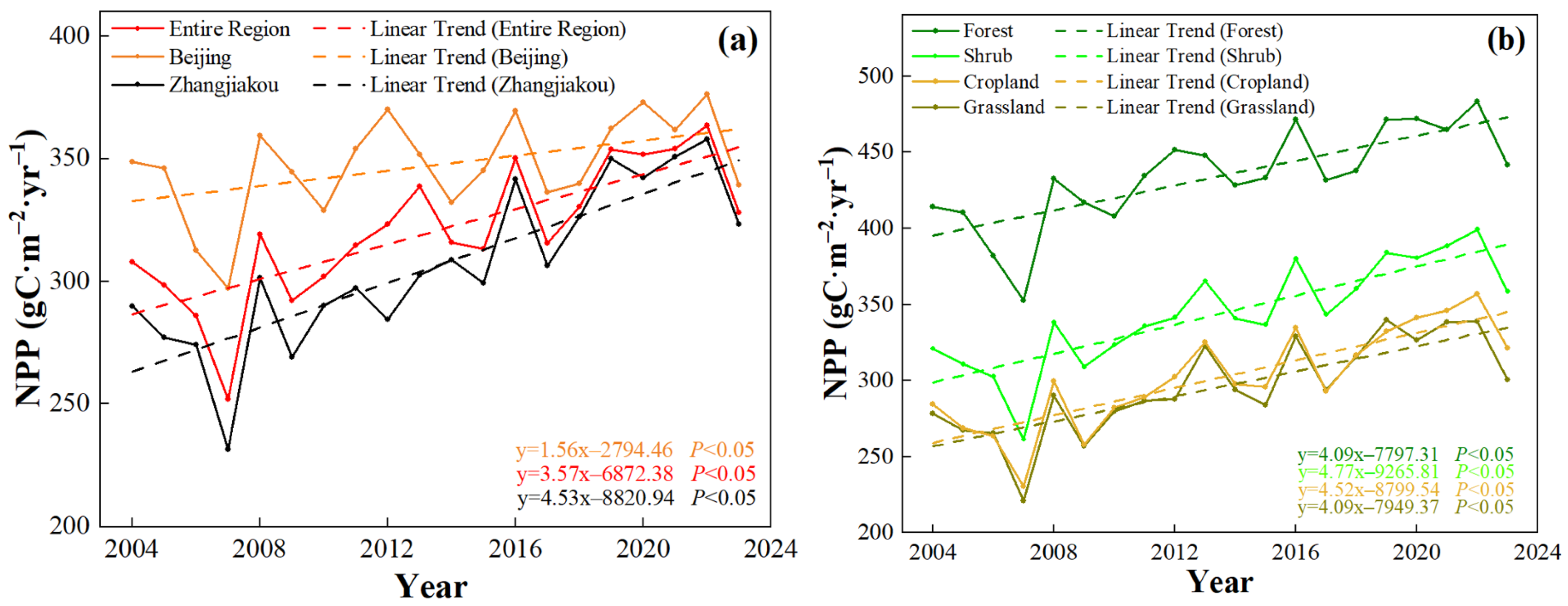
Figure 4 illustrates the interannual variations in annual mean NPP across different administrative regions and land cover types from 2004 to 2023. At the administrative region scale, annual mean NPP exhibits significant increasing trends for the entire study area, Beijing, and Zhangjiakou during 2004–2023 (p < 0.05; Figure 4a). The interannual rate of increase for the entire region is estimated at 3.57 gC·m−2·yr−2, while Beijing shows a relatively lower increasing rate of 1.56 gC·m−2·yr−2. In contrast, Zhangjiakou presents a more pronounced upward trend, with an interannual increase rate of 4.53 gC·m−2·yr−2. Despite the overall increasing trends, annual mean NPP displays evident interannual fluctuations across all three regions. The lowest NPP values are consistently observed in 2007, reaching 251.89, 297.42 and 231.63 gC·m−2·yr−1 for the entire region, Beijing, and Zhangjiakou, respectively. Conversely, the highest NPP values occur in 2022, with corresponding values of 328.06, 339.13, and 323.16 gC·m−2·yr−1, respectively. In terms of overall levels, Beijing maintains higher mean NPP values throughout the study period, whereas Zhangjiakou exhibits relatively lower mean NPP levels, despite its stronger interannual increasing trend.
Across different land cover types, annual mean NPP exhibits significant increasing trends for all vegetation categories during 2004–2023 (p < 0.05; Figure 4b). The interannual rates of increase are estimated at 4.09 gC·m−2·yr−2 for forest, 4.77 gC·m−2·yr−2 for shrub, 4.52 gC·m−2·yr−2 for cropland, and 4.09 gC·m−2·yr−2 for grassland, indicating broadly consistent upward trends with varying magnitudes among land cover types. For all vegetation categories, minimum NPP values occur in 2007, while maximum values are consistently observed in 2022. In terms of overall levels, forest ecosystems maintain the highest mean NPP throughout the study period, whereas cropland and grassland exhibit comparable mean NPP levels that are notably lower than those of forest and shrub.
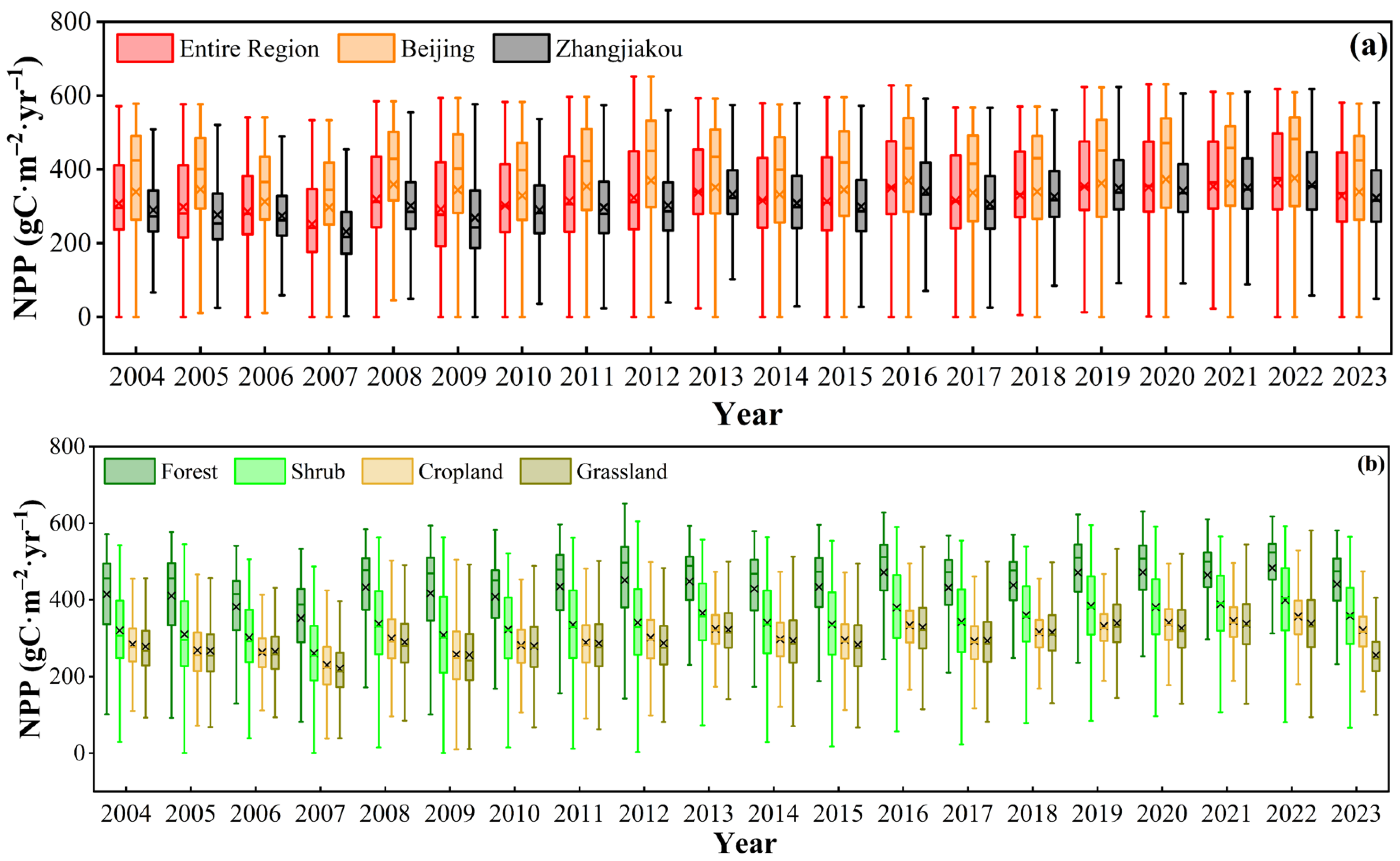
Figure 5 presents boxplots of pixel-level vegetation NPP across different administrative regions and land cover types from 2004 to 2023. At the administrative region scale, the boxplots reveal pronounced differences in the dispersion of pixel-level NPP among regions (Figure 5a). Beijing consistently exhibits the widest interquartile range (IQR), indicating the strongest spatial heterogeneity of NPP within the region. This reflects the coexistence of high-productivity forested areas and relatively low-productivity urban and agricultural landscapes. The entire study area shows a moderate IQR, while Zhangjiakou displays a comparatively narrower IQR, suggesting a more homogeneous spatial distribution of vegetation productivity. In terms of central tendency, median NPP values in Beijing are generally higher than those in Zhangjiakou across most years, consistent with the mean-level patterns. However, the separation between median and mean values, together with the asymmetric extension of the upper whiskers, indicates right-skewed distributions in all regions, implying the presence of localized high-NPP regions. Overall, the boxplot analysis highlights substantial intra-regional variability in vegetation productivity, particularly in Beijing, beyond what is reflected by mean-based trends.
Across different land cover types, the boxplots reveal clear contrasts in the distribution of pixel-level NPP (Figure 5b). Shrubs generally exhibit the largest IQRs, indicating pronounced pixel-level heterogeneity in NPP. Forests exhibit comparatively high median NPP values but slightly more concentrated distributions, whereas cropland and grassland display relatively narrower IQRs. In addition, all land cover types exhibit right-skewed distributions, as indicated by the separation between median and mean values and the extension of upper whiskers, suggesting the presence of localized high-NPP areas across vegetation types.

3.2. Seasonal Change-Point Detection of NPP Time Series

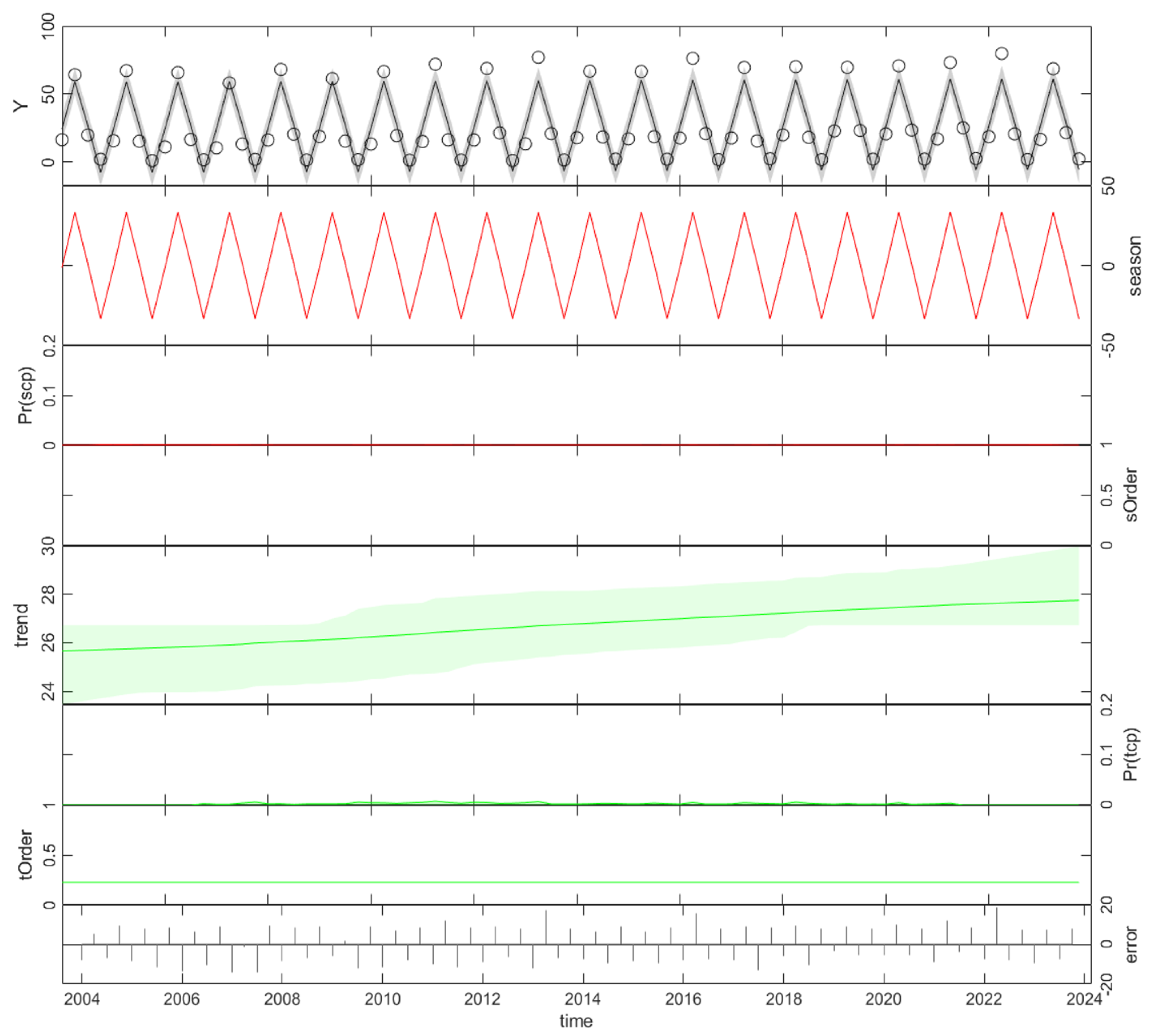
Figure 6 presents the BEAST-based seasonal change-point detection results for the regional mean NPP time series during 2004–2023 in the study area. No significant seasonal change points were detected, as the posterior probability of seasonal change points (Pr(scp)) remained consistently close to zero throughout the period. The seasonal component exhibits a clear and regular intra-annual cycle that is stable over time, characterized by peaks in summer and troughs in winter, consistent with local vegetation phenology. Meanwhile, the extracted trend component shows a gradual upward trajectory with relatively narrow uncertainty bounds, indicating a persistent increase in overall vegetation productivity over the study period. In summary, these results imply that the observed NPP variability is primarily driven by long-term trend changes rather than structural shifts in the seasonal cycle.

3.3. Spatiotemporal Trends in NPP

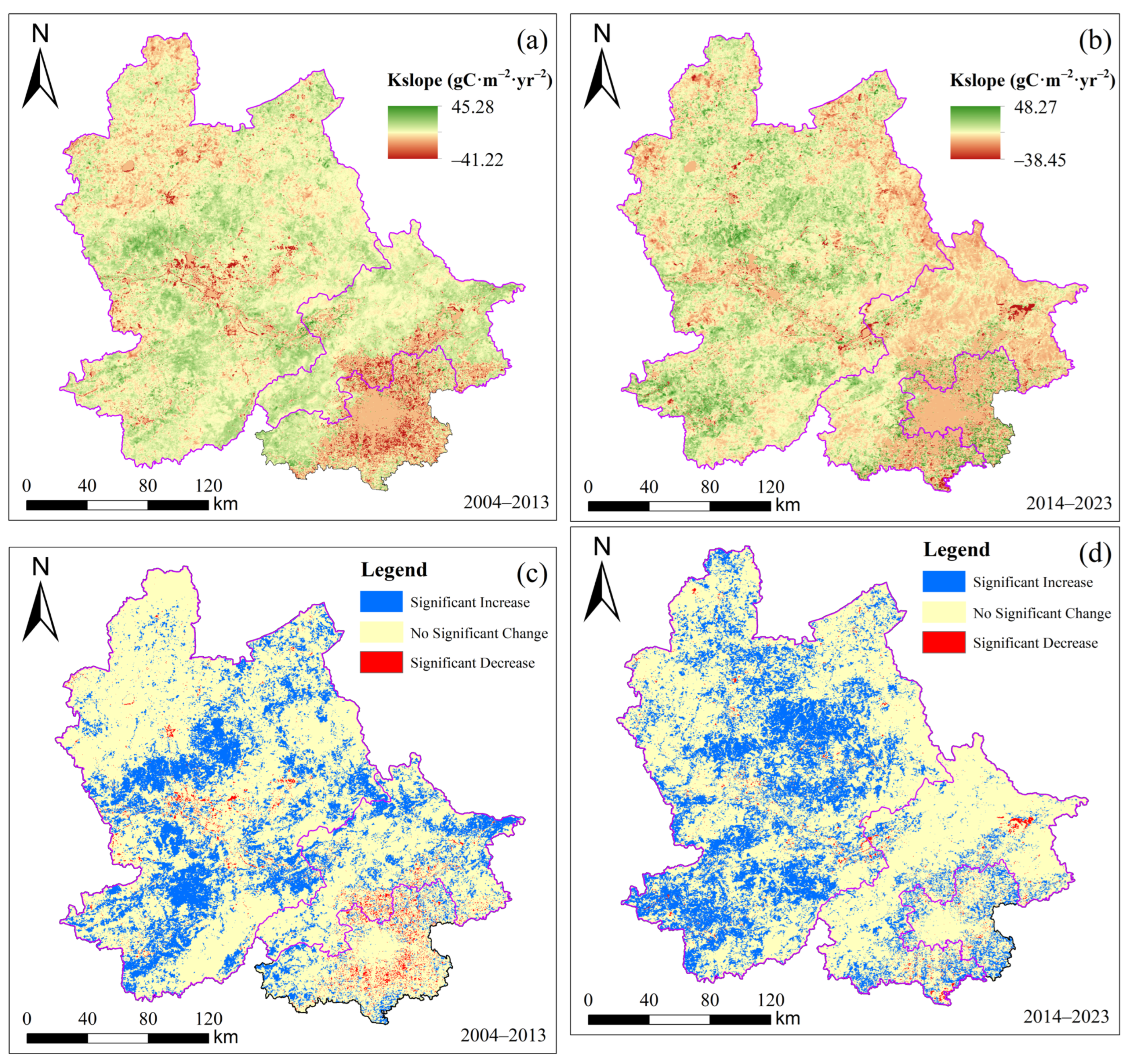
Figure 7 presents the spatial patterns of NPP trends (Kslope; Figure 7a,b) and their statistical significance based on the F-test (Figure 7c,d) for two sub-periods (2004–2013 and 2014–2023). Figure 7a,b illustrate that positive Kslope values dominate much of the study area in both periods, indicating a dominant increasing tendency of NPP. Areas with negative Kslope values are more spatially clustered than widespread, occurring mainly in the southeastern Beijing Plain (especially along the urban–rural interface), in the northwestern part of the study area, and in Zhangjiakou’s urban expansion zones. Compared with 2004–2013, the areal extent of positive Kslope values expands slightly during 2014–2023, suggesting a continued expansion of areas with increasing NPP in recent years.
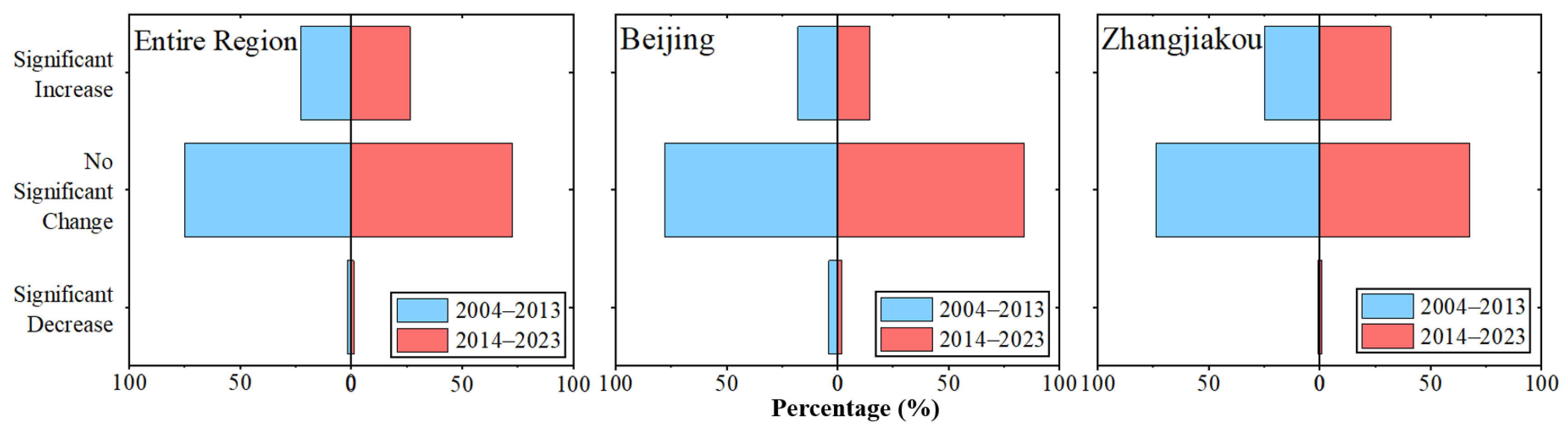
Figure 7c,d depict the statistical significance of NPP trends based on the F-test for the two sub-periods. During 2004–2013, areas exhibiting a statistically significant increase in NPP account for 22.93% of the study area, while regions with no significant change dominate (75.06%), and only a small fraction shows significant decreases (2.01%). In the subsequent period (2014–2023), the proportion of areas with significant NPP increases to 26.44%, accompanied by a reduction in areas with no significant change (72.50%) and a further decline in significantly decreasing areas (1.06%). Spatially, areas with statistically significant increases in NPP are mainly distributed in the central and western parts of the study area in both sub-periods. In contrast, significantly decreasing trends are limited in extent and primarily occur in the southern Beijing Plain and the urban expansion areas of Zhangjiakou, with such decreases being more pronounced during 2004–2013. Comparisons between the two periods further indicate an expansion of areas exhibiting significant NPP increases, suggesting that vegetation productivity in the study area has shown a sustained improvement in recent years. Notably, based on the overlay of the ecological engineering project boundaries, areas with significant NPP increasing trends generally align with the implementation regions of the Beijing–Tianjin Sandstorm Source Control Project (both Phase I and Phase II). This spatial consistency, validated by statistical comparison (p < 0.05), strongly supports the positive impact of ecological restoration policies on vegetation recovery.
Figure 8 illustrates the area percentages of NPP trend categories across different administrative regions for the two sub-periods. In Beijing, areas with no significant change dominate in both periods and further increase during 2014–2023, accompanied by a decline in the proportion of significantly increasing NPP. In contrast, Zhangjiakou exhibits an expansion of areas with significantly increasing NPP, rising from 25.10% to 31.86%, while the corresponding proportion in Beijing decreases from 18.06% to 14.24%. Meanwhile, the area proportion of significantly decreasing NPP exhibits a continuous decline in both regions, indicating an overall improvement in vegetation growth conditions over time.
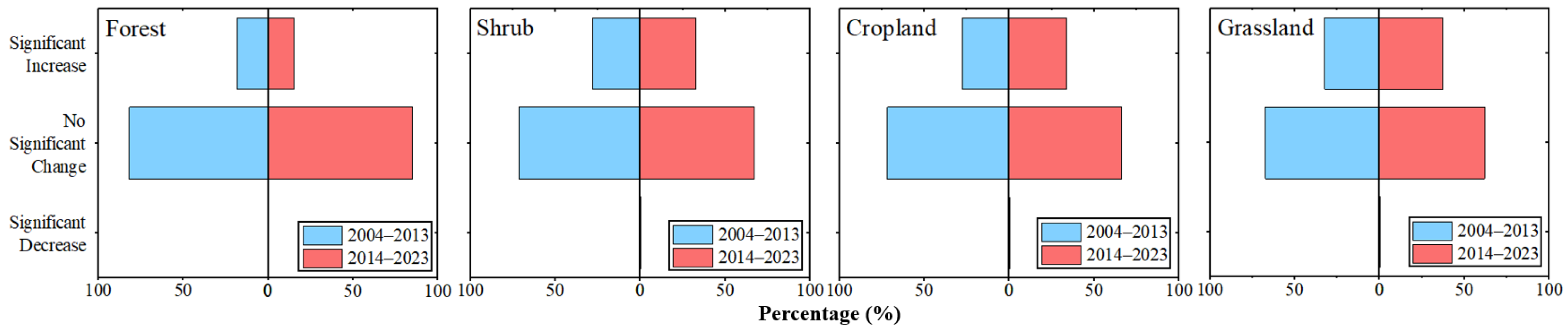
Figure 9 illustrates the area proportions of NPP trend categories across different landcover types for the two sub-periods. Across all vegetation types, areas with no significant change remain dominant. However, their shares decrease for shrub, cropland, and grassland, while forest areas show a slight increase in the proportion of no significant change from 2004–2013 to 2014–2023. Areas with significantly increasing NPP expand for shrub, cropland, and grassland, rising from 28.22% to 32.47% for shrub, from 27.69% to 33.54% for cropland, and from 32.39% to 37.47% for grassland. In contrast, forest areas exhibit a more stable pattern, characterized by a persistently high share of no significant change (exceeding 80%) and a modest decline in significantly increasing NPP (from 18.00% to 14.97%). Meanwhile, areas with significantly decreasing NPP remain negligible across all land cover types and continue to decline over time, suggesting an overall improvement in vegetation growth conditions.

3.4. Spatiotemporal Stability of NPP

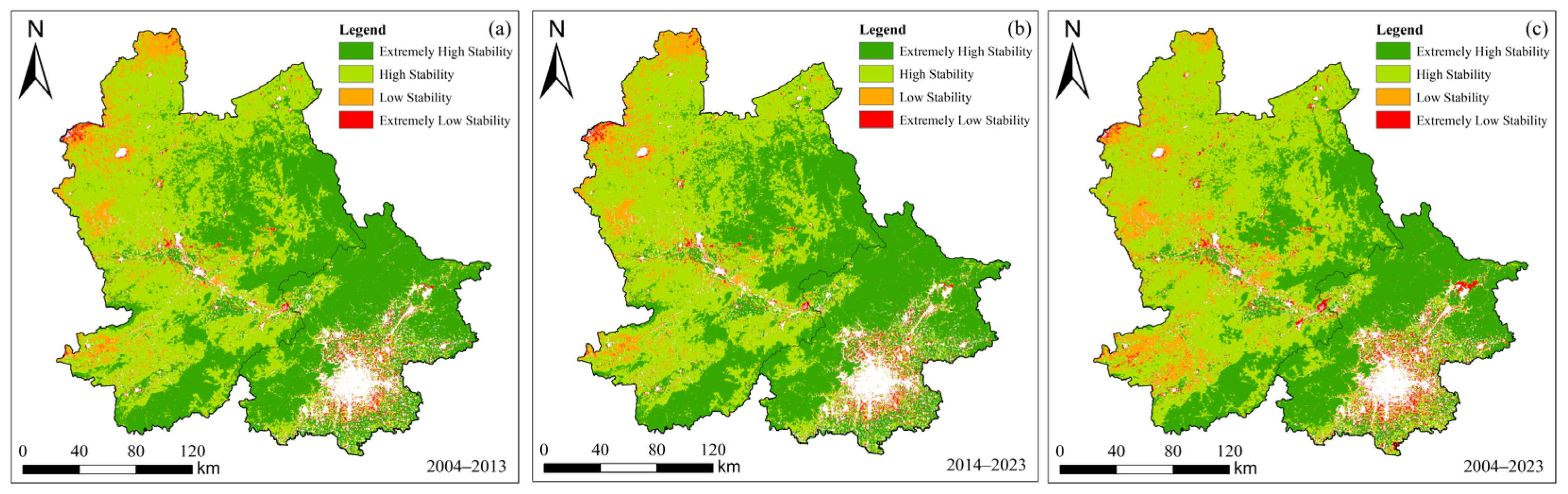
Figure 10 maps NPP stability (CV-based) for each study period. Overall, high and extremely high stability classes occupy most of the study area, indicating relatively steady interannual NPP variability. In contrast, low and extremely low stability areas are mainly confined to the southeastern plains—especially urban built-up areas and adjacent croplands—and to grassland-dominated zones in western Zhangjiakou.
Comparisons between the two sub-periods indicate that NPP stability was relatively higher during 2014–2023 than during 2004–2013, as reflected by an increase in the proportion of areas with extremely high stability and a corresponding decline in areas with low stability. When considering the entire period from 2004 to 2023, low stability areas remain mainly concentrated in regions undergoing urban expansion. Overall, these results suggest that vegetation NPP in the Beijing–Zhangjiakou region has maintained a relatively high level of stability over the study period.
Table 4 presents the mean CV values of vegetation NPP across different administrative regions and land-cover types during 2004–2023. The results indicate that vegetation NPP in Beijing is characterized by relatively lower stability (higher CV) over the study period, whereas Zhangjiakou exhibits higher overall NPP stability (lower CV). With respect to land cover types, forest areas show extremely high stability, while shrub, cropland, and grassland generally maintain high stability levels. The spatial heterogeneity of CV is closely related to differences in disturbance regimes and ecosystem buffering capacity. Specifically, urban expansion areas and surrounding croplands in Beijing are subject to frequent land conversion, management activities (e.g., cropping/harvest), and fragmented vegetation cover, which can amplify interannual NPP fluctuations (resulting in higher CV). Conversely, the relatively continuous vegetation cover in less disturbed areas tends to stabilize NPP dynamics (lower CV). While Zhangjiakou shows higher overall stability, its grassland-dominated areas are more sensitive to hydroclimatic variability and potential grazing disturbance, which may contribute to elevated CV and lower stability, compared to forest ecosystems.

3.5. Persistence Analysis of NPP Trends

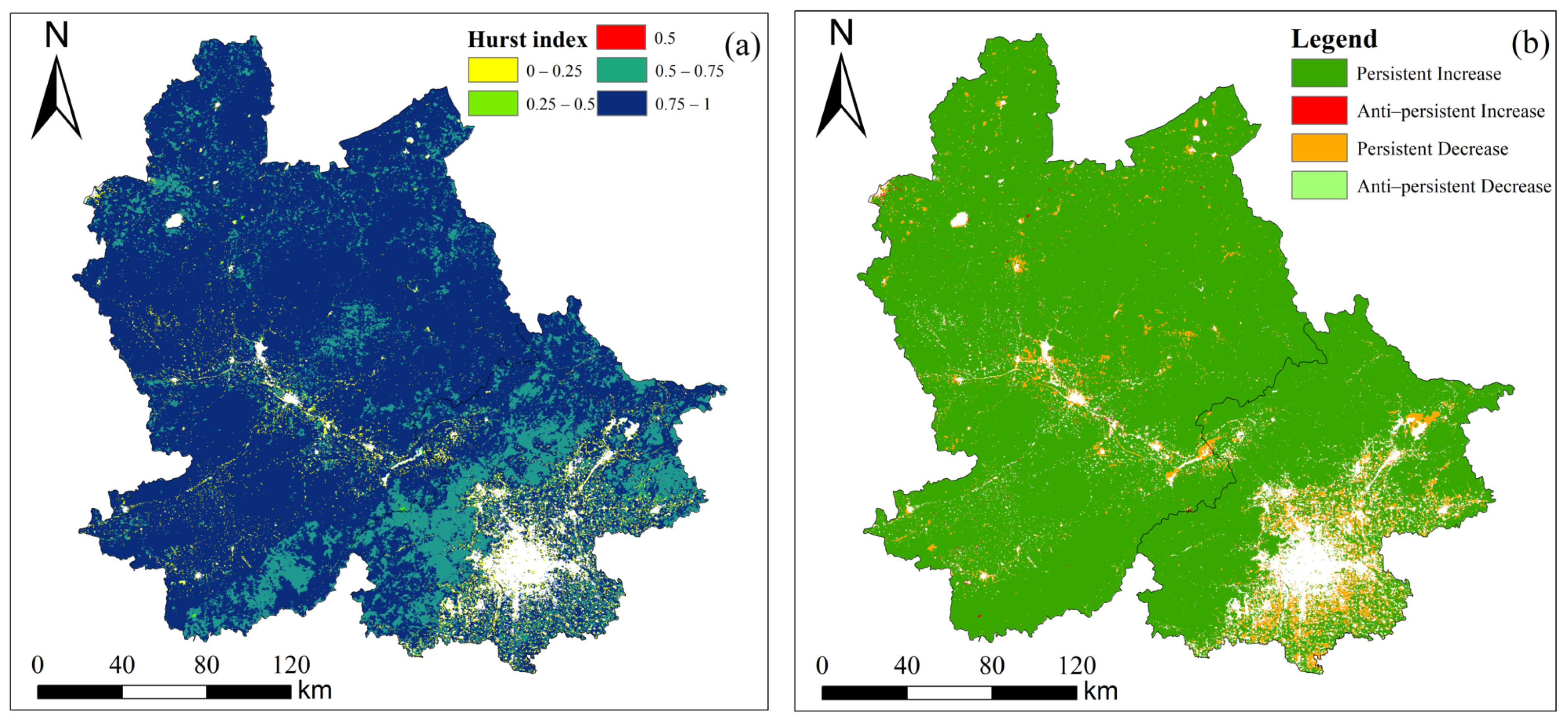
Figure 11 presents the Hurst index (H) derived from the 2004–2023 vegetation NPP series, which is used to characterize the persistence of NPP trends. The Hurst index map (Figure 11a) indicates that most areas of Zhangjiakou are characterized by H values mainly ranging from 0.75 to 1.0, reflecting strong persistence in vegetation NPP dynamics. In contrast, the northwestern part of Beijing is dominated by intermediate to high H values (0.5–0.75 and 0.75–1.0), whereas areas with H < 0.5 are concentrated in urban expansion zones, particularly across the southeastern plain.
Figure 11b combines the Hurst index and Kslope classifications and shows that persistently increasing NPP is the predominant trend type, occupying more than 90% of the total area, reflecting the strong persistence of the observed increasing NPP trends. By contrast, areas with persistently decreasing NPP occupy only 5.25% of the study area and are mainly distributed in urban expansion zones of Beijing.
Table 5 further summarizes the mean Hurst index (H) for 2004–2023 across administrative regions and land cover types. Zhangjiakou exhibits a higher mean H value (0.84) than Beijing (0.65), echoing the spatial pattern in Figure 11b in which a persistent increase dominates most of the study area. Among land cover types, grassland exhibits the highest mean H value (0.87), followed by shrub (0.85) and cropland (0.85), all of which are relatively higher than forest (0.78). This implies a stronger persistence of the observed NPP tendency in these land covers, although all categories indicate strong persistent behavior. When considered together with the area statistics in Figure 11b, the results suggest that the increasing NPP tendency is more likely to be maintained over large parts of the region, whereas persistently decreasing areas are mainly associated with Beijing’s urban expansion zones. Overall, the Hurst index reflects long-term memory in the NPP series, and the inferred persistence indicates the tendency of the observed trend to be maintained under similar driving conditions.

4. Discussion

4.1. Accuracy Assessment of NPP Estimation and Uncertainty Analysis

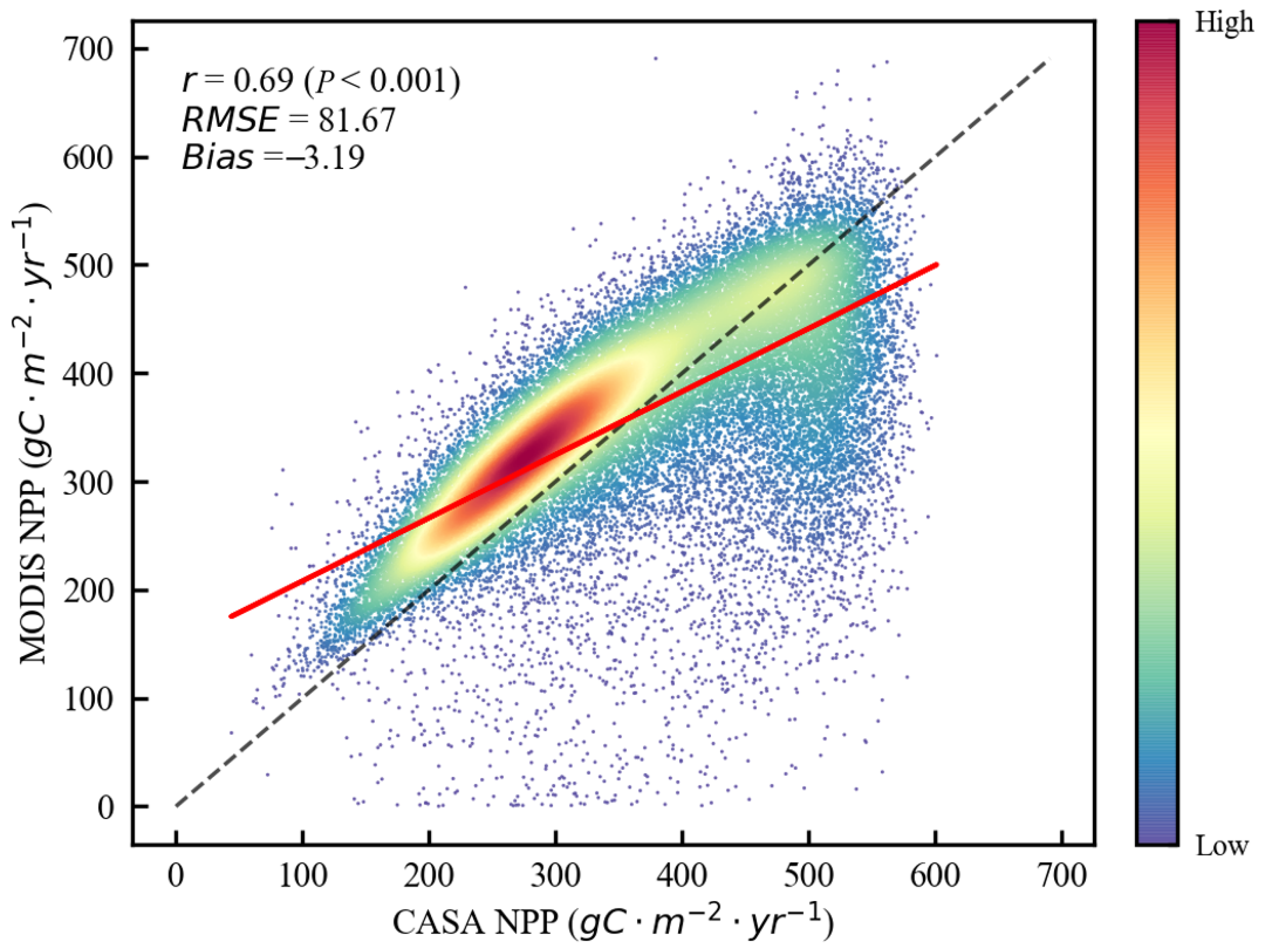
Although field biomass measurements provide the most direct reference for validation, obtaining spatially continuous and temporally consistent data over a 20-year period (2004–2023) remains a significant challenge, particularly given the complex terrain and large area of the Beijing–Zhangjiakou region. Therefore, to evaluate the reliability of the NPP estimates, the results were cross-compared with the widely applied MODIS NPP product (MOD17A3HGF). While MODIS NPP products are model-based estimates with inherent uncertainties and do not constitute independent ground-truth data, they serve as a widely accepted reference for assessing regional spatiotemporal trends, particularly in areas lacking dense flux tower networks. As illustrated in Figure 12, the comparison reveals a strong positive correlation (r = 0.69, p < 0.001) with a low bias (−3.19 gC·m−2·yr−1), indicating a significant consistency between the estimated NPP and the MODIS product.
Notwithstanding the significant correlation observed, uncertainties inevitably exist in the NPP estimation. First, the spatial resolution of the data sources introduces deviations. The use of 250 m resolution NDVI, while suitable for regional-scale analysis, may not fully capture the fine-scale heterogeneity of vegetation in fragmented landscapes. However, given the large extent of the study area and the challenges in acquiring consistent, high-spatiotemporal-resolution imagery over a long-term sequence (2004–2023), the 250 m resolution represents a reasonable trade-off between spatial detail and temporal continuity. Additionally, complex terrain increases the difficulty of interpolating meteorological data in space, which can propagate uncertainty into the temperature and water stress coefficients. Furthermore, while vegetation classification was implemented, the use of fixed maximum light use efficiency (εmax) values simplifies the detailed physiological variations within specific species, which may introduce biases in transition zones [51].

4.2. Impact of Ecological Restoration Projects on NPP

The observed spatial pattern and upward trend of NPP in the Beijing–Zhangjiakou region coincide with the rollout of major ecological restoration programs, including the “Beijing–Tianjin Sandstorm Source Control Project” and the “Grain for Green Project”. Since the early 2000s, these anthropogenic interventions have promoted the conversion of degraded croplands and barren lands into forests and shrubs, substantially altering the regional vegetation landscape. This finding is consistent with recent assessments of ecological environmental quality (EEQ) in the region, which have independently documented significant improvements in ecosystem service functions and vegetation coverage during parallel timeframes [52,53], providing further corroboration for the positive NPP trends observed in this study.
In the process of afforestation and vegetation recovery, specific species were selected or protected based on the local terrain. According to regional vegetation surveys [54], recovery strategies involved both artificial afforestation dominated by Pinus tabuliformis (Chinese Pine) and Larix spp. (Larch) in high-altitude zones, and the facilitation of secondary natural broadleaf forests primarily comprising Populus (Poplar) and Betula (Birch). The expansion of these vegetation types directly influences the physiological relationship between Gross Primary Productivity (GPP) and NPP. Notably, the broadleaf species (Populus, Betula) are characterized by high photosynthetic rates and rapid biomass accumulation compared to the original sparse vegetation. Theoretically, NPP represents the organic matter remaining after deducting autotrophic respiration (Ra) from GPP. Although the restored woody vegetation typically incurs higher maintenance respiration costs compared to the original sparse vegetation, its developed canopy structure and higher photosynthetic efficiency result in a substantial increase in GPP. Consequently, the net carbon accumulation remains elevated. This suggests that the “species selection” strategy in ecological engineering—favoring species with high photosynthetic potential—serves as a significant factor contributing to the observed NPP enhancement in the study region.

5. Conclusions

This study applied the CASA model to estimate vegetation NPP in the Beijing–Zhangjiakou region from 2004 to 2023, utilizing a 250 m monthly NDVI dataset. To improve the reliability of pixel-level NPP estimates, the 30 m CLCD was integrated to refine the vegetation mask and exclude non-vegetated areas, thereby mitigating mixed-pixel effects. Based on NPP estimates, spatiotemporal variations were analyzed, and seasonal change-point detection (BEAST), interannual stability assessment (CV), and trend persistence analysis (Hurst index) were conducted. The results can be summarized as follows:
  • Vegetation NPP exhibits pronounced spatial heterogeneity, with relatively stable high- and low- value zones during the study period. High NPP values are mainly concentrated in forest-dominated areas (e.g., western and northern Beijing and the northeastern part of Zhangjiakou), whereas lower values are primarily observed in Beijing’s southeastern plain, characterized by extensive built-up and agricultural landscapes. Pixel-level boxplots further indicate stronger intra-regional variability in Beijing than in Zhangjiakou, reflecting the coexistence of high-productivity forests and relatively low-productivity built-up/cropland areas.
  • Annual mean NPP demonstrates significant increasing trends for the entire study area as well as for Beijing and Zhangjiakou during 2004–2023, with interannual increase rates of 3.57, 1.56, and 4.53 gC·m−2·yr−2, respectively. Despite the overall upward tendency, evident interannual fluctuations occur, with minimum values in 2007 and maximum values in 2022. Trend maps and category statistics indicate that positive trends dominate most of the study area, with a slight expansion of increasing areas in the later sub-period. BEAST results further suggest a stable NPP seasonal cycle during 2004–2023, with no significant seasonal change points.
  • CV-based stability analysis indicates that most areas exhibit high to extremely high stability, whereas low-stability zones are mainly associated with urban expansion areas and surrounding croplands, as well as some grassland regions. Hurst-index results indicate that persistently increasing NPP trends account for more than 90% of the study area, while persistently decreasing trends occupy approximately 5.25%, mainly linked to Beijing’s urban expansion zones. Mean H values are higher in Zhangjiakou than in Beijing, and higher in grassland and cropland than in forest, supporting stronger persistence in these areas.
This study provides an integrated, long-term assessment of vegetation productivity dynamics in the Beijing–Zhangjiakou region using NPP as an indicator, offering evidence to support regional ecological-quality evaluation and to inform ecological restoration planning and management.

Author Contributions

Conceptualization, K.C., F.Y. and Q.D.; methodology, K.C.; software, K.C. and Q.D.; validation, F.Y. and Z.W. (Zhe Wang); formal analysis, K.C.; investigation, T.D.; resources, F.Y.; data curation, K.C., Q.D. and Z.W. (Zhe Wang); writing—original draft preparation, K.C.; writing—review and editing, F.Y. and Z.W. (Zehui Wang); visualization, Q.D. and T.D.; supervision, F.Y. and Z.W. (Zehui Wang); funding acquisition, Z.W. (Zehui Wang). All authors have read and agreed to the published version of the manuscript.

Funding

This research was funded by the Open Fund of State Key Laboratory for Fine Exploration and Intelligent Development of Coal Resources (SKLCRSM24KFA13), Fundamental Research Funds for the Central Universities under Grant (2024ZKPYDC02), and China University of Mining and Technology-Beijing Innovation Training Program for College Students under Grant (202502006, 202502011).

Data Availability Statement

The data presented in this study are available from the corresponding author upon reasonable request.

Acknowledgments

The first author and corresponding author are grateful for the valuable feedback from everyone, which has greatly assisted in the enhancement of our manuscript.

Conflicts of Interest

The authors declare no conflicts of interest or personal relationships that could have appeared to influence the work reported in this paper.

References

  1. Xue, H.; Chen, Y.; Dong, G.; Li, J. Quantitative analysis of spatiotemporal changes and driving forces of vegetation net primary productivity (NPP) in the Qimeng region of Inner Mongolia. Ecol. Indic. 2023, 154, 110610. [Google Scholar] [CrossRef]
  2. Negi, V.S.; Pathak, R.; Rawal, R.S.; Bhatt, I.D.; Sharma, S. Long-term ecological monitoring on forestland ecosystems in Indian Himalayan Region: Criteria and indicator approach. Ecol. Indic. 2019, 102, 374–381. [Google Scholar] [CrossRef]
  3. Kumar, S.; Kumar, R.; Kumar, M.; Pandey, A.K.; Srivastava, P.K.; Kumar, S.; Arya, V.S. Spatio-temporal variability analysis of evapotranspiration, water use efficiency and net primary productivity in the semi-arid region of Aravalli and Siwalik range, India. Environ. Dev. Sustain. 2025, 27, 7897–7918. [Google Scholar] [CrossRef]
  4. Field, C.B.; Behrenfeld, M.J.; Randerson, J.T.; Falkowski, P. Primary production of the biosphere: Integrating terrestrial and oceanic components. Science 1998, 281, 237–240. [Google Scholar] [CrossRef]
  5. Zhao, W.; Wu, J.; Shen, Q.; Liu, L.; Lin, J.; Yang, J. Estimation of the net primary productivity of winter wheat based on the near-infrared radiance of vegetation. Sci. Total Environ. 2022, 838, 156090. [Google Scholar] [CrossRef] [PubMed]
  6. Cui, J.; Wang, Y.; Zhou, T.; Jiang, L.; Qi, Q. Temperature Mediates the Dynamic of MODIS NPP in Alpine Grassland on the Tibetan Plateau, 2001–2019. Remote Sens. 2022, 14, 2401. [Google Scholar] [CrossRef]
  7. Liu, Y.; Zhang, Z.; Tong, L.; Wang, Q.; Zhou, W.; Wang, Z.; Li, J. Spatiotemporal dynamics of China’s grassland NPP and its driving factors. Chin. J. Ecol. 2020, 39, 349–363. [Google Scholar]
  8. Qi, X.; Jia, J.; Liu, H.; Lin, Z. Relative importance of climate change and human activities for vegetation changes on China’s silk road economic belt over multiple timescales. Catena 2019, 180, 224–237. [Google Scholar] [CrossRef]
  9. Wang, J.; Cui, K.; Yang, F.; Li, J.; Zhang, C.; Du, T.; Zhang, H. Evaluation of spatiotemporal variation and impact factors for vegetation net primary productivity in a typical open-pit mining ecosystem in northwestern China. Land. Degrad. Dev. 2024, 35, 3756–3770. [Google Scholar] [CrossRef]
  10. Jenkins, J.C.; Birdsey, R.A.; Pan, Y. Biomass and NPP estimation for the mid-Atlantic region (USA) using plot-level Forestland inventory data. Ecol. Appl. 2001, 11, 1174–1193. [Google Scholar] [CrossRef]
  11. Baldocchi, D.D. Assessing the eddy covariance technique for evaluating carbon dioxide exchange rates of ecosystems: Past, present and future. Glob. Change Biol. 2003, 9, 479–492. [Google Scholar] [CrossRef]
  12. Field, C.B.; Randerson, J.T.; Malmström, C.M. Global net primary production: Combining ecology and remote sensing. Remote Sens. Environ. 1995, 51, 74–88. [Google Scholar] [CrossRef]
  13. George, J.P.; Neumann, M.; Vogt, J.; Cammalleri, C.; Lang, M. Assessing effects of drought on tree mortality and productivity in European forestlands across two decades: A conceptual framework and preliminary results. In IOP Conference Series: Earth and Environmental Science; IOP Publishing: Bristol, UK, 2021; Volume 932, p. 012009. [Google Scholar]
  14. Zhou, W.; Gang, C.; Zhou, F.; Li, J.; Dong, X.; Zhao, C. Quantitative assessment of the individual contribution of climate and human factors to desertification in northwest China using net primary productivity as an indicator. Ecol. Indic. 2015, 48, 560–569. [Google Scholar] [CrossRef]
  15. Liu, X.; Pei, F.; Wen, Y.; Li, X.; Wang, S.; Wu, C.; Liu, Z. Global urban expansion offsets climate-driven increases in terrestrial net primary productivity. Nat. Commun. 2019, 10, 5558. [Google Scholar] [CrossRef] [PubMed]
  16. Li, J.; Wang, Z.; Lai, C.; Wu, X.; Zeng, Z.; Chen, X.; Lian, Y. Response of net primary production to land use and land cover change in mainland China since the late 1980s. Sci. Total Environ. 2018, 639, 237–247. [Google Scholar] [CrossRef]
  17. Sun, Q.; Liu, W.; Gao, Y.; Li, J.; Yang, C. Spatiotemporal Variation and Climate Influence Factors of Vegetation Ecological Quality in the Sanjiangyuan National Park. Sustainability 2020, 12, 6634. [Google Scholar] [CrossRef]
  18. Yang, H.; Hu, D.; Xu, H.; Zhong, X. Assessing the spatiotemporal variation of NPP and its response to driving factors in Anhui province, China. Environ. Sci. Pollut. Res. 2020, 27, 14915–14932. [Google Scholar] [CrossRef] [PubMed]
  19. Cao, S.; Sanchez-Azofeifa, G.A.; Duran, S.M.; Calvo-Rodriguez, S. Estimation of aboveground net primary productivity in secondary tropical dry forestlands using the Carnegie–Ames–Stanford approach (CASA) model. Environ. Res. Lett. 2016, 11, 075004. [Google Scholar] [CrossRef]
  20. Gong, F.; Wang, C. Evaluating the Performance of the Greenbelt Policy in Beijing Using Multi-Source Long-Term Satellite Observations from 2000 to 2020. Remote Sens. 2023, 15, 4766. [Google Scholar] [CrossRef]
  21. Liu, R.; Jiao, L.; Liu, Y.; Wang, Y. Multi-scale spatial analysis of satellite-retrieved surface evapotranspiration in Beijing, a rapidly urbanizing region under continental monsoon climate. Environ. Sci. Pollut. Res. 2023, 30, 20402–20414. [Google Scholar] [CrossRef]
  22. Zhang, Y.; Xu, Z.; Wu, J. Influence of Beijing Winter Olympic Games Construction on Vegetation Coverage around Zhangjiakou Competition Zone. Int. J. Environ. Res. Public Health 2021, 18, 12777. [Google Scholar] [CrossRef]
  23. Yin, K.; Tian, Y.; Yuan, C.; Zhang, F.; Yuan, Q.; Hua, L. NPP spatial and temporal pattern of vegetation in Beijing and its factor explanation based on CASA model. Remote Sens. Land Resour. 2015, 27, 133–139. [Google Scholar]
  24. Gao, J.; Shi, Y.; Zhang, H.; Chen, X.; Zhang, W.; Shen, W.; Xiao, T.; Zhang, Y. China Regional 250m Normalized Difference Vegetation Index Data Set (2000–2024); National Tibetan Plateau/Third Pole Environment Data Center: Beijing, China, 2023. [Google Scholar]
  25. Yang, J.; Huang, X. 30 m annual land cover and its dynamics in China from 1990 to 2019. Earth Syst. Sci. Data Discuss. 2021, 2021, 3907–3925. [Google Scholar]
  26. Amantai, N.; Meng, Y.; Song, S.; Li, Z.; Hou, B.; Tang, Z. Spatial–Temporal Patterns of Interannual Variability in Planted Forestlands: NPP Time-Series Analysis on the Loess Plateau. Remote Sens. 2023, 15, 3380. [Google Scholar] [CrossRef]
  27. Berberoglu, S.; Donmez, C.; Click, A. Modelling climate change impacts on regional net primary productivity in Turkey. Environ. Monit. Assess. 2021, 193, 242. [Google Scholar] [CrossRef]
  28. Wang, C.; Wang, S.; Fu, B.; Yang, L.; Li, Z. Soil Moisture Variations with Land Use along the Precipitation Gradient in the North–South Transect of the Loess Plateau. Land Degrad. Dev. 2017, 28, 926–935. [Google Scholar] [CrossRef]
  29. Liu, L.; Guan, J.; Zheng, J.; Wang, Y.; Han, W.; Liu, Y. Cumulative effects of drought have an impact on net primary productivity stability in Central Asian grasslands. J. Environ. Manag. 2023, 344, 118734. [Google Scholar] [CrossRef] [PubMed]
  30. Yang, F.; Wang, J.; Zhang, C.; Li, J.; Xie, H.; Zhuoge, Z. The Impact of Human Activities on Net Primary Productivity in a Grassland Open-Pit Mine: The Case Study of the Shengli Mining Area in Inner Mongolia, China. Land 2022, 11, 743. [Google Scholar] [CrossRef]
  31. Yang, F.; Cui, K.; Zhang, C.; Li, J.; Wang, J.; Du, T.; Zhang, H. Construction and analysis of a method for grading long-term vegetation carbon sink in waste dumps of an open-pit coal mine. Coal Geol. Explor. 2024, 52, 15. [Google Scholar]
  32. Zhang, J.; Wang, J.; Huang, S.; Liang, B. Spatiotemporal variation and prediction of NPP in Beijing–Tianjin-Hebei region by coupling PLUS and CASA models. Ecol. Inform. 2024, 81, 102620. [Google Scholar] [CrossRef]
  33. Potter, C.S.; Randerson, J.T.; Field, C.B.; Maston, P.A.; Vitousek, P.M.; Mooney, H.A.; Klooster, S.A. Terrestrial ecosystem production: A process model based on global satellite and surface data. Glob. Biogeochem. Cycles 1993, 7, 811–841. [Google Scholar] [CrossRef]
  34. Wang, J.; Shao, Z.; Fu, P.; Zhuang, Q.; Chang, J.; Jing, P.; Zhao, Z.; Xu, Z.; Wang, S.; Yang, F. Unraveling the impact of urban expansion on vegetation carbon sequestration capacity: A case study of the Yangtze River Economic Belt. Sustain. Cities Soc. 2025, 120, 106157. [Google Scholar] [CrossRef]
  35. Zhu, W.; Pan, Y.; Zhang, J. Estimation of net primary productivity of Chinese terrestrial vegetation based on remote sensing. Chin. J. Plant Ecol. 2007, 31, 413–424. [Google Scholar]
  36. Zhao, K.G.; Wulder, M.A.; Hu, T.; Bright, R.; Wu, Q.; Qin, H.; Li, Y.; Toman, E.; Zhang, X.; Brown, M. Detecting change-point, trend, and seasonality in satellite time series data to track abrupt changes and nonlinear dynamics: A Bayesian ensemble algorithm. Remote Sens. Environ. 2019, 232, 111181. [Google Scholar] [CrossRef]
  37. Kong, L.; Ma, L.; Li, Y.; Abuduwaili, J.; Zhang, J. Assessing the intensity of the water cycle utilizing a Bayesian estimator algorithm and wavelet coherence analysis in the Issyk-Kul Basin of Central Asia. J. Hydrol. Reg. Stud. 2024, 52, 101680. [Google Scholar] [CrossRef]
  38. Hu, T.; Toman, E.M.; Chen, G.; Shao, G.; Zhou, Y.; Li, Y.; Zhao, K.; Feng, Y. Mapping fine-scale human disturbances in a working landscape with Landsat time series on Google Earth Engine. ISPRS J. Photogramm. Remote Sens. 2021, 176, 250–261. [Google Scholar] [CrossRef]
  39. Niazmardi, S.; Sadrykia, M.; Rezazadeh, M. Analysis of spatiotemporal household water consumption patterns and their relationship with meteorological variables. Urban Clim. 2023, 52, 101707. [Google Scholar] [CrossRef]
  40. He, Y.; Yan, W.; Cai, Y.; Deng, F.; Qu, X.; Cui, X. How does the Net primary productivity respond to the extreme climate under elevation constraints in mountainous areas of Yunnan, China? Ecol. Indic. 2022, 138, 108817. [Google Scholar] [CrossRef]
  41. Wu, L.; Ma, X.; Dou, X.; Zhu, J.; Zhao, C. Impacts of climate change on vegetation phenology and net primary productivity in arid Central Asia. Sci. Total Environ. 2021, 796, 149055. [Google Scholar] [CrossRef]
  42. Chen, X.; Zhang, Y. Impacts of climate, phenology, elevation and their interactions on the net primary productivity of vegetation in Yunnan, China under global warming. Ecol. Indic. 2023, 154, 110533. [Google Scholar] [CrossRef]
  43. Li, Z.; Sun, R.; Zhang, J.; Zhang, C. Temporal-spatial analysis of vegetation coverage dynamics in Beijing–Tianjin-Hebei metropolitan regions. Acta Ecol. Sin. 2017, 37, 7418–7426. [Google Scholar]
  44. Ouma, Y.O.; Cheruyot, R.; Wachera, A.N. Rainfall and runoff time-series trend analysis using LSTM recurrent neural network and wavelet neural network with satellite-based meteorological data: Case study of Nzoia hydrologic basin. Complex Intell. Syst. 2022, 8, 213–236. [Google Scholar] [CrossRef]
  45. Chew, X.; Khaw, K.W.; Lee, M. The efficiency of run rules schemes for the multivariate coefficient of variation in short runs process. Commun. Stat. Simul. Comput. 2022, 51, 2942–2962. [Google Scholar] [CrossRef]
  46. Puggard, W.; Niwitpong, S.A.; Niwitpong, S. Confidence Intervals for Common Coefficient of Variation of Several Birnbaum–Saunders Distributions. Symmetry 2022, 14, 2101. [Google Scholar] [CrossRef]
  47. Bui, Q.; Ślepaczuk, R. Applying Hurst Exponent in pair trading strategies on Nasdaq 100 index. Phys. A Stat. Mech. Appl. 2022, 592, 126784. [Google Scholar] [CrossRef]
  48. Cho, P.; Lee, M. Forecasting the Volatility of the Stock Index with Deep Learning Using Asymmetric Hurst Exponents. Fractal Fract. 2022, 6, 394. [Google Scholar] [CrossRef]
  49. Xi, Z.; Chen, G.; Xing, Y.; Xu, H.; Tian, Z.; Ma, Y.; Cui, J.; Li, D. Spatial and temporal variation of vegetation NPP and analysis of influencing factors in Heilongjiang Province, China. Ecol. Indic. 2023, 154, 110798. [Google Scholar] [CrossRef]
  50. Du, T.; Yang, F.; Li, J.; Zhang, C.; Cui, K.; Zheng, J. Long time series spatiotemporal variations in NPP based on the CASA model in the eco-urban agglomeration around Poyang lake, China. Remote Sens. 2024, 17, 80. [Google Scholar] [CrossRef]
  51. Piao, S.; Friedlingstein, P.; Ciais, P.; Sönke, Z. Changes in climate and land use have a larger direct impact than rising CO2 on global river runoff trends. Proc. Natl. Acad. Sci. USA 2007, 104, 15242–15247. [Google Scholar] [CrossRef]
  52. Xin, H.; Guo, W.; Wang, H. Times series dynamic assessment of ecological environment quality in Beijing–Tianjin-Hebei region based on GEE and RSEI. J. Northwest For. Univ. 2024, 39, 103–114. [Google Scholar]
  53. Meng, Q.; Wu, Z.; Du, Z.; Zhang, H. Variation in fractional vegetation cover and its attribution analysis of different regions of Beijing–Tianjin Sand Source Region, China. Chin. J. Appl. Ecol. 2021, 32, 2895–2905. [Google Scholar]
  54. Zhang, B.; Wang, S.; Li, Q.; Xie, G. Spatio-temporal changes of water conservation service in the Beijing–Tianjin sandstorm source control project area. Acta Ecol. Sin. 2021, 41, 7530–7541. [Google Scholar]
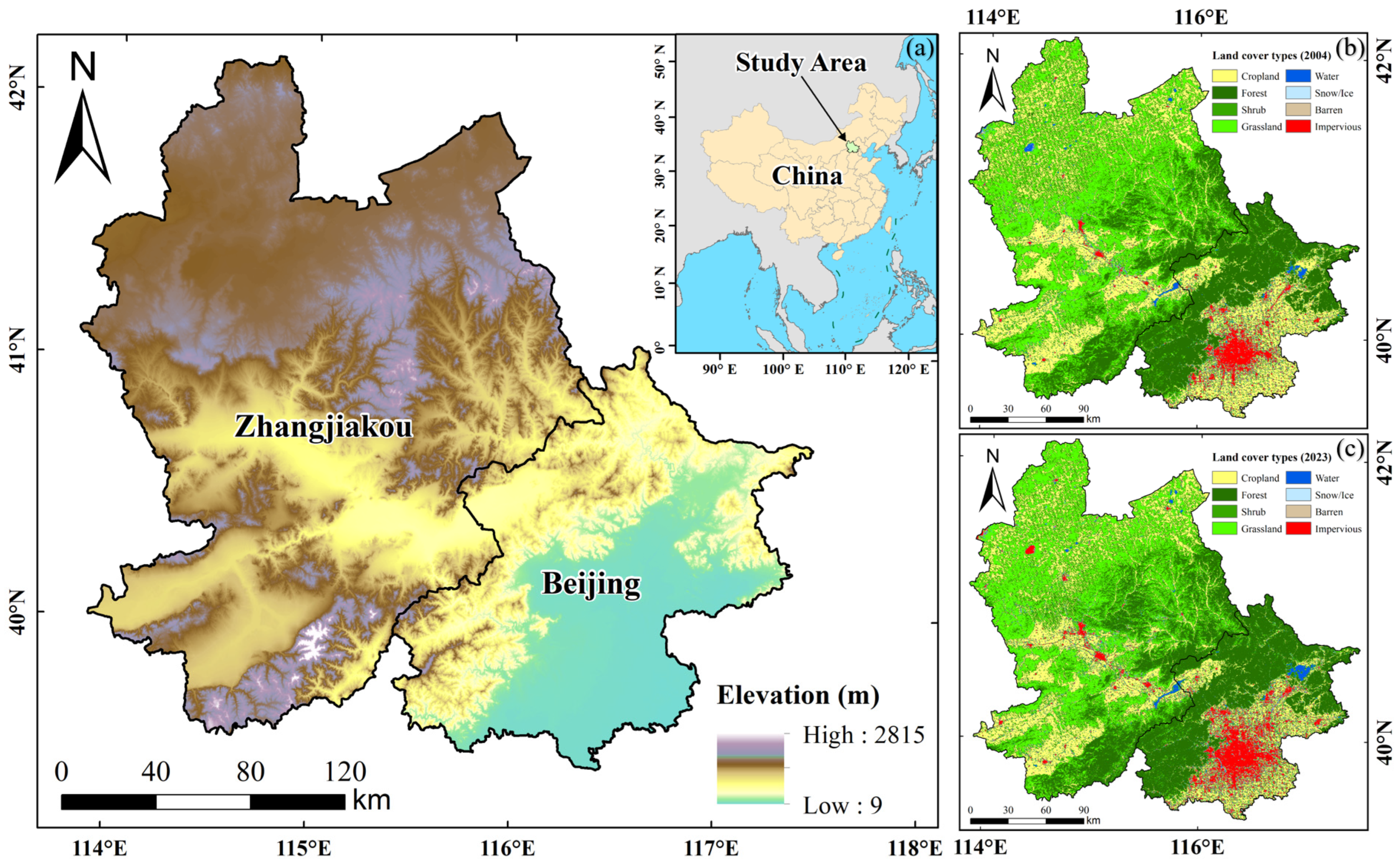
Figure 1. Beijing–Zhangjiakou region and land cover: (a) location and elevation, (b) land-cover pattern in 2004, (c) land-cover pattern in 2023.
Land 15 00237 g001
Figure 2. The methodological framework of this study.
Land 15 00237 g002
Figure 3. Spatiotemporal patterns of annual vegetation NPP across the Beijing–Zhangjiakou region during 2004–2023.
Land 15 00237 g003
Figure 4. Interannual variations and linear trends of annual mean vegetation NPP across (a) administrative regions, and (b) land cover types from 2004 to 2023.
Land 15 00237 g004
Figure 5. Boxplots of interannual pixel-level vegetation NPP across (a) different administrative regions and (b) land cover types from 2004 to 2023. (The ‘–’ and ‘×’ within each box represent the median and mean values, respectively).
Land 15 00237 g005
Figure 6. Seasonal change-point detection and trend decomposition of the regional mean NPP series from 2004 to 2023 using the BEAST algorithm.
Land 15 00237 g006
Figure 7. Spatiotemporal trends of vegetation NPP during 2004–2023: (a,b) spatial distribution of the trend slope (Kslope) for 2004–2013 and 2014–2023, respectively; (c,d) spatial distribution of NPP trend categories (based on F-test) for 2004–2013 and 2014–2023, respectively. The amethyst hollow outlines represent the boundaries of the Beijing–Tianjin Sandstorm Source Control Project. Specifically, maps (a,c) display the boundary of Phase I (2000–2012), while maps (b,d) show the boundary of Phase II (2013–2022).
Land 15 00237 g007
Figure 8. Percentages of NPP trend classes (based on Kslope and the F-test) across different administrative regions for the sub-periods 2004–2013 and 2014–2023.
Land 15 00237 g008
Figure 9. Percentages of NPP trend classes (based on Kslope and the F-test) across land cover types for the sub-periods 2004–2013 and 2014–2023.
Land 15 00237 g009
Figure 10. Spatial patterns of NPP stability based on the CV index for different study periods: (a) 2004–2013; (b) 2014–2023; (c) 2004–2023.
Land 15 00237 g010
Figure 11. Vegetation NPP persistence from 2004 to 2023 derived using the Hurst index: (a) Hurst index values and (b) NPP trend–persistence categories.
Land 15 00237 g011
Figure 12. Scatter plots of NPP comparison between the CASA model estimates and MODIS products. The black dashed line represents the 1:1 line, and the red solid line indicates the linear regression fit.
Land 15 00237 g012
Table 1. Summary of the datasets used in this study.
Data TypeNameTime SpanSpatial ResolutionTemporal ResolutionSource
NDVI datasetChina regional 250 m normalized difference vegetation index data set2004–2023250 mmonthlyhttps://data.tpdc.ac.cn/ (accessed on 29 December 2025)
Climate datasettemperature, precipitation, and solar
radiation
2004–2023Interpolated to 250 mmonthlyhttp://data.cma.cn/ (accessed on 24 March 2025)
Land cover datasetChina Land Cover Dataset2004–202330 myearlyhttps://zenodo.org/ (accessed on 30 December 2025)
ElevationSRTM DEM2004–202330 m-https://earthengine.google.com/ (accessed on 30 December 2025)
Table 2. Classification criteria for vegetation NPP stability levels based on CV.
CV-ValueStability Level
CV ≤ 0.1extremely high stability
0.1 < CV ≤ 0.2high stability
0.2 < CV ≤ 0.3low stability
CV > 0.3extremely low stability
Table 3. Classification of NPP trend–persistence categories based on Kslope and the Hurst index.
KslopeH ValueNPP Trend–Persistence Category
Kslope > 00.5 < H < 1Persistent increase
Kslope > 00 < H < 0.5Anti-persistent increase
Kslope < 00.5 < H < 1Persistent decrease
Kslope < 00 < H < 0.5Anti-persistent decrease
AnyH = 0.5Uncertain
Table 4. Mean CV values of vegetation NPP across different administrative regions and land-cover types during 2004–2023.
CategoryMean CV
Administrative regionsBeijing0.22
Zhangjiakou0.17
Land cover typesForest0.08
Shrub0.11
Cropland0.14
Grassland0.14
Table 5. Mean Hurst index of vegetation NPP across administrative regions and land cover types during 2004–2023.
CategoryMean Value
Administrative regionsBeijing0.65
Zhangjiakou0.84
Land cover typesForest0.78
Shrub0.85
Grassland0.87
Cropland0.85
Disclaimer/Publisher’s Note: The statements, opinions and data contained in all publications are solely those of the individual author(s) and contributor(s) and not of MDPI and/or the editor(s). MDPI and/or the editor(s) disclaim responsibility for any injury to people or property resulting from any ideas, methods, instructions or products referred to in the content.