
Article

Tiered Risk Assessment for Petroleum Hydrocarbons C6–C9: A Case Study at a Typical Decommissioned Petroleum Refinery Site in Gansu Province


Technical Centre for Soil, Agriculture and Rural Ecology and Environment, Ministry of Ecology and Environment, Beijing 100012, China
*
Author to whom correspondence should be addressed.
Land 2026, 15(1), 86; https://doi.org/10.3390/land15010086
Submission received: 14 November 2025 / Revised: 15 December 2025 / Accepted: 27 December 2025 / Published: 31 December 2025
(This article belongs to the Section Land, Soil and Water)

Abstract

No method to assess the risks of petroleum hydrocarbon pollutants C6–C9 in soils on construction land in China has been established. At one decommissioned petroleum refinery site in northwestern China, we performed an innovative tier 3 risk assessment method using carbon fraction proportions. Using HJ 25.3 guidelines, the risk-screening value for soil contamination of land by petroleum hydrocarbons was 192 mg kg−1 for industrial land use. However, based on site-specific parameters, this value was 226 mg kg−1, with a corresponding contaminated soil volume of 381,904 m3. A tier 3 risk assessment incorporating carbon fraction proportions and site-specific parameters yielded a risk control value of 2370 mg kg−1 and reduced the soil volume requiring decontamination to 87,047 m3, potentially saving CNY 324 million (~USD 45.5 million as of November 2025) in remediation costs. Therefore, implementing a tier 3 risk assessment for C6–C9 pollutants can optimize remediation strategies and enhance the precision and scientific rigor of petroleum hydrocarbon-contaminated soil remediation.

1. Introduction

China is the world’s largest oil-refining producer [1]. Because petroleum hydrocarbon (PHC) contamination of soils and groundwater (from emissions, seepage, and accidents during petroleum refining) can have serious implications [2,3,4,5], an understanding of the distribution and environmental risks posed by PHCs in soil at petrochemical-contaminated sites is important [5,6].
PHCs are a complex mix of compounds that primarily comprise alkanes (e.g., linear and branched alkanes, cycloalkanes, alkenes, and alkynes), aromatics (e.g., mono- and polycyclic aromatic hydrocarbons), asphaltenes (e.g., phenols, fatty acids, ketones, and porphyrins), and resins (e.g., pyridine, quinoline, carbazoles, sulfonates, and amides) [3,7]. Compared with analyses of single pollutants, the pronounced differences in toxicity and physicochemical properties of PHC constituents, along with practical challenges in laboratory-based quantification of individual components [8], complicate the risk assessment process [9,10]. Currently, human health risk assessment methods for PHCs can be classified into indicator, total petroleum hydrocarbon, and/or fractionation approaches.
In practice, these methods are often implemented in combination based on specific assessment requirements [9]. For example, in the United States (US), a combination of each method is used [11], whereas in Australia [12] and Canada [13], a combination of two of them (indicator and fractionation) is used. The Chinese standard “Soil environmental quality risk control standard for soil contamination of development land” (GB36600-2018) [14] uses a method that integrates indicator and fractionation methods. The indicator method analyzes five benzene homologs and eight polycyclic aromatic hydrocarbons, and the fractionation method analyzes PHCs C10–C40 (but not C6–C9). Despite the promulgation of standard analytical methods for PHCs C6–C9 and C10–C40 in soils and sediments in 2019 [8], no established assessment criteria and risk assessment studies have targeted hydrocarbons C6–C9 in China.
Short-chain PHCs present non-negligible environmental risks because of constituents beyond typically monitored indicators such as benzene, toluene, ethylbenzene, and xylene (BTEX). In the US Environmental Protection Agency (USEPA) Office of Underground Storage Tanks “Petroleum Hydrocarbon Vapor Intrusion” database, the total PHC-to-benzene ratio exceeds 900:1 in 33% of samples, suggesting that the vapor intrusion risk is primarily attributable to aliphatic hydrocarbons. Controlling benzene concentrations below screening levels alone cannot sufficiently manage the non-carcinogenic risks posed by volatile PHCs [15]. Industries using petroleum products as raw materials (e.g., those producing coatings, fragrances, rubber, and plastics) primarily emit low-carbon-chain aromatic hydrocarbons as major pollutants [16]. In the Pearl River Delta, short-chain volatile PHCs are the dominant soil contaminants, and USEPA risk assessment methods have been used to characterize their non-carcinogenic health risks [17]. From the perspectives of screening values and land-use types, Jiang et al. demonstrated the need to perform refined risk assessments for complex multi-component contaminants [18]. Implementing a tier 3 risk assessment at large volatile organic compound (VOC)-contaminated sites can also substantially reduce remediation costs, yielding significant economic benefits [19].
We characterize the distribution and risk of PHCs C6–C9 in soils at a former petroleum refinery site in northwestern China. Based on systematic sampling and analysis, we describe the spatial distribution and human health risks posed by these PHCs and evaluate the feasibility and benefits of a tiered risk assessment framework. In doing so, we provide a scientific foundation for the risk-based management and remediation of petrochemical-contaminated sites.

2. Materials and Methods

2.1. Study Area

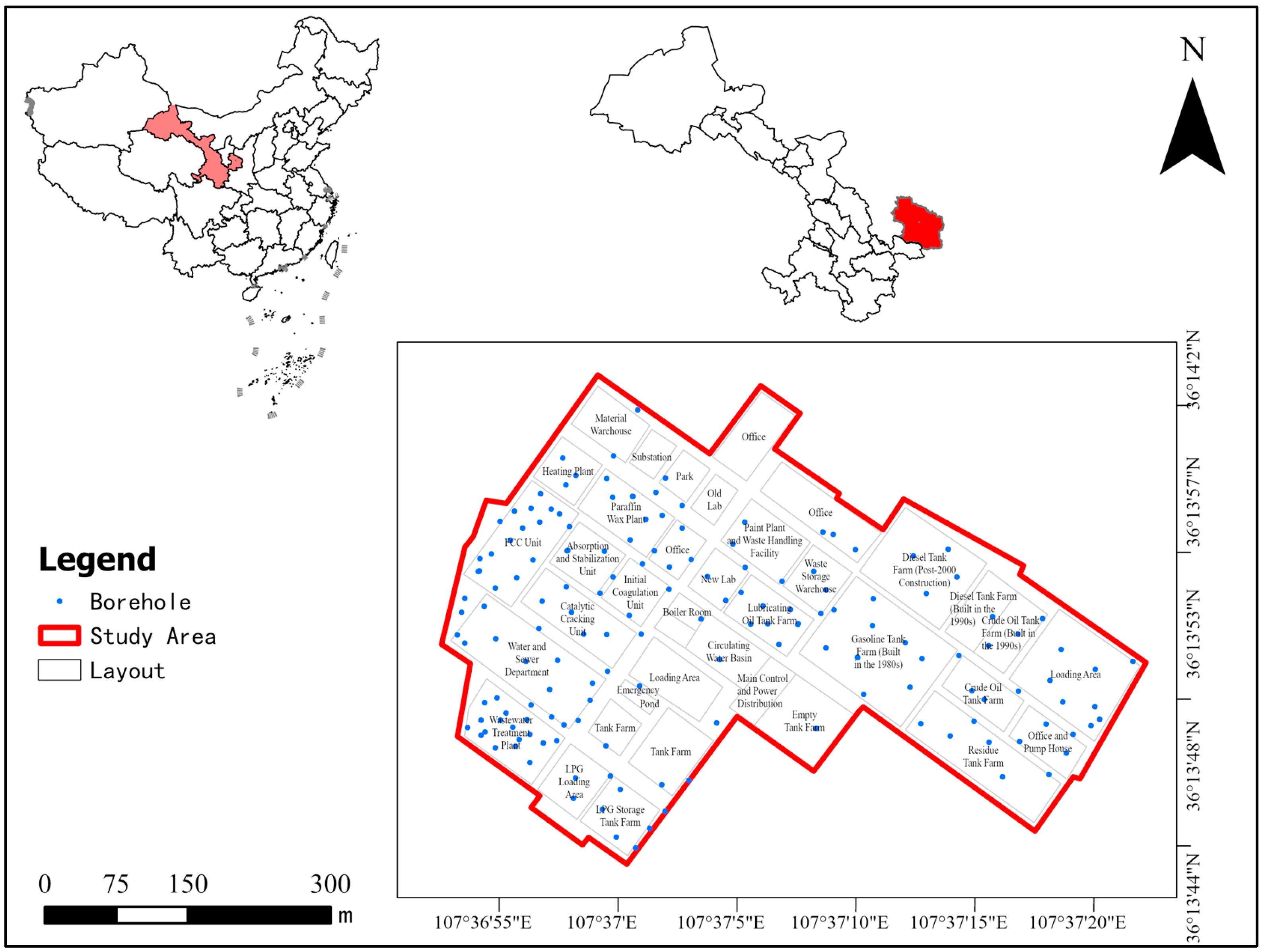
The study area, formerly occupied by a decommissioned refinery on the Longdong Loess Plateau, Qingyang City, Gansu Province, covers a total area of ~21,060 m2 (Figure 1). The refinery was operational from 1970 until 2004 and produced various petroleum products (civilian liquefied petroleum gas, gasoline, kerosene, diesel, and solvent oil). The site was functionally divided into refining and chemical zones; an eastern section contained storage tanks for fuels such as gasoline and diesel; the central area was dedicated to technology development and laboratory facilities; a northwestern zone housed crude oil storage tanks and catalytic cracking units; and a southwestern area contained wastewater treatment facilities and loading/unloading stations for petroleum products.
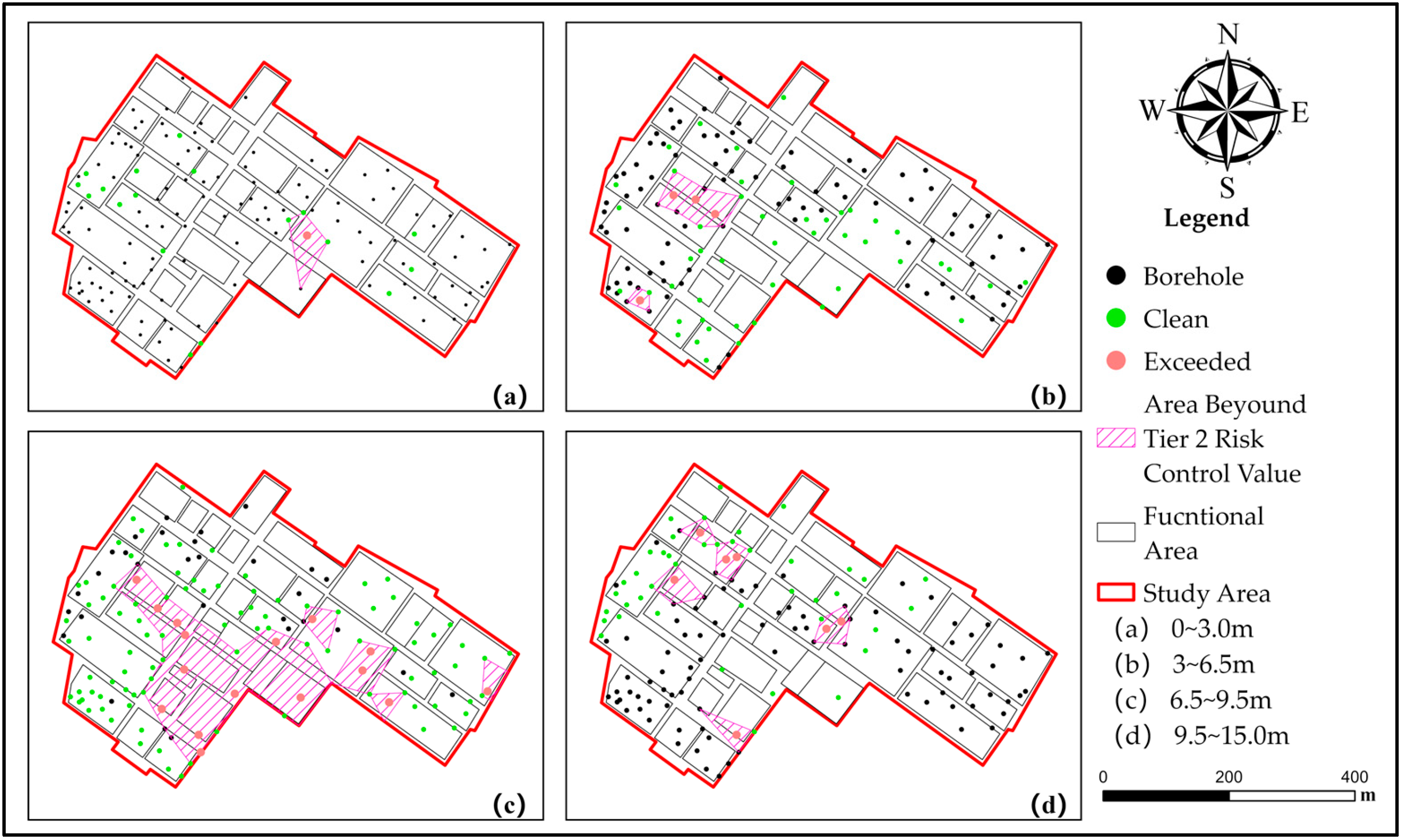
Based on soil stratigraphic structure and hydrogeological characteristics, we divided the soil profile into four layers for sampling. Layer (a), 0–3.0 m: miscellaneous fill from the Holocene series of the Quaternary period (Q4ml); layer (b), 3.0–6.5 m: silty soil of alluvial–pluvial origin from the Holocene series of the Quaternary period (Q4al + pl); layer (c), 6.5–9.5 m: rounded gravel of alluvial–pluvial origin from the Holocene series of the Quaternary period (Q4al + pl); and layer (d), 9.5–15 m: Neogene mudstone (N). The maximum depth of the miscellaneous fill layer was 3.0 m, and the average depth to the groundwater table was ~8.5 m.

2.2. Sample Collection and Testing

Following the Technical Guidelines for Soil Pollution Status Investigation of Land for Construction (HJ 25.1-2019) [20] and Technical Guidelines for Monitoring of Soil Pollution Risk Control and Remediation for Land for Construction (HJ 25.2-2019) [21], a grid-based sampling method was used to identify potential migration and dispersion pathways across the study area, combined with a judgmental source-tracking approach based on reconnaissance survey data to pinpoint potential contamination sources. Soils were sampled in 20 m × 20 m grids, with one sampling point per grid, with additional sampling points then concentrated in areas of high contamination potential (e.g., the wastewater treatment zone, production workshops, and storage tank areas). During field sampling, a photoionization detector was used for rapid on-site screening at each potential sampling location. Sampling decisions were guided by these real-time screening results combined with professional assessment of field conditions. A total of 139 sampling points (Figure 1) were established, and 259 soil samples were collected.

2.2.1. Soil Sample Collection and Preservation

Soil samples were collected using an SH-30 drill rig. (Wuxi Tongda Geoligical Prospecting Machinery Factory, Jiangsu Province, China) Undisturbed soil samples were obtained with a stainless-steel shovel. After removing the surface soil with a scraper, samples from target depths were collected and immediately transferred into 250 mL wide-mouth sampling bottles. Bottles were filled completely, sealed without headspace, and stored at 4 °C in darkness.

2.2.2. Sample Testing and Laboratory Quality Control

PHCs C6–C9 in soil samples were analyzed according to guidelines in Soil and Sediment—Determination of Petroleum Hydrocarbons (C6–C9)—Purge and Trap/Gas Chromatography (HJ 1020-2019) [22]. Benzene homologs were determined according to guidelines in Soil and Sediment—Determination of Volatile Organic Compounds—Purge and Trap/Gas Chromatography–Mass Spectrometry (HJ 605-2011) [23]. The testing methods and equipment are detailed in Table 1.

2.3. Risk Assessment Models and Parameters

Conceptual exposure model layering incorporates multiple factors, including geological stratification and future development depth. Taking into consideration both the stratigraphic conditions revealed during the investigation and potential future groundwater development scenarios, we characterized soils into surface (0–6.5 m) and subsurface (6.5–15.0 m) soils when calculating risk-screening values of contamination in development land.
We focused on assessing the non-carcinogenic risks of PHCs C6–C9 via six exposure pathways: (1) oral ingestion of soil (ois); (2) dermal contact with soil (dcs); inhalation of (3) soil particles (pis); (4) outdoor air containing gaseous contaminants derived from surface soil (iov1); (5) outdoor air containing gaseous contaminants derived from subsurface soil (iov2); and (6) indoor air containing gaseous contaminants derived from subsurface soil (iiv).
The human health risk assessment model is represented by Equations (1)–(21) [24].
(1)
Soil risk control value (SRCV) based on non-carcinogenic effects via oral ingestion, H C V S o i s
H C V S o i s = R f D o × S A F × A H Q × B W a × A T n c O I S E R a × E D a × E F a × A B S o × 10 6
(2)
SRCV based on non-carcinogenic effects via dermal contact, H C V S d c s
H C V S d c s = R f D o × A B S g i × S A F × A H Q × B W a × A T n c 239 × H a 0.417 × B W a 0.517 × S E R a × S S A R a × E F a × E D a × E v × A B S d × 10 6
(3)
SRCV based on non-carcinogenic effects via inhalation of soil particles, H C V S p i s
H C V S p i s = R f C × D A I R a B W a × R f D i × S A F × A H Q × B W a × A T n c P M 10 × D A I R a × E D a × P I A F × ( f s p o × E F O a + f s p i × E F I a ) × 10 6
(4)
SRCV based on non-carcinogenic effects via inhaling outdoor air containing gaseous contaminants derived from surface soil, H C V S i o v 1
H C V S i o v 1 = R f C × D A I R a B W a × S A F × A H Q × B W a × A T n c V F s u r o a × D A I R a × E F O a × E D a
(5)
SRCV based on non-carcinogenic effects via inhaling outdoor air containing gaseous contaminants derived from subsurface soil, H C V S i o v 2
H C V S i o v 2 = R f C × D A I R a B W a × S A F × A H Q × B W a × A T n c V F s u b o a × D A I R a × E F O a × E D a
(6)
SRCV based on non-carcinogenic effects via inhaling indoor air containing gaseous contaminants derived from subsurface soil, H C V S i i v
H C V S i i v = R f C × D A I R a B W a × S A F × A H Q × B W a × A T n c V F s u b i a × D A I R a × E F I a × E D a
(7)
Formulae for the volatilization factor of contaminant diffusion (FVFCD) from surface soil to outdoor air:
V F s u r o a = M I N ( V F s u r o a 1 , V F s u r o a 2 )
V F s u r o a 1 = ρ b D F o a × 4 × D s e f f × H π × τ × 3,153,600 × K s w × ρ b × 1000
D F o a = U a i r × W × δ a i r A
D s e f f = D a × ( 1 ρ b ρ s ρ b   ×   ρ w s ρ w ) 3.33 ( 1 ρ b ρ s ) 2 + D w × ( ρ b   ×   ρ w s ρ w ) 3.33 H × ( 1 ρ b ρ s ) 2
K s w = ρ w s ρ w + K o c × f o m 1700 + H × ( 1 ρ b 1 ρ s ρ w s ρ w )
V F s u r o a 2 = d × ρ b D F o a × τ × 3,153,600 × 10 3
(8)
FVFCD from subsurface soil to outdoor air:
V F s u b o a = M I N ( V F s u b o a 1 , V F s u b o a 2 )
V F s u b o a 1 = 1000 ( 1 + D F o a × L s D s e f f ) × K s w H
V F s u r o a 2 = d s u b × ρ b D F o a × τ × 3,153,600 × 10 3
(9)
FVFCD from subsurface soil to indoor air:
V F s u b i a = M I N ( V F s u b i a 1 , V F s u b i a 2 )
V F s u b o a 1 = 1000 ( 1 + D s e f f D F i a × L s + D s e f f × L c r a c k D c r a c k e f f × L s × η ) × K s w H
D F i a = L B × E R × 1 86,400
D c r a c l e f f = D a × θ a c r a c k 3.33 ( θ a c r a c k + θ w c r a c k ) 2 + D w × θ w c r a c k 3.33 H × ( θ a c r a c k + θ w c r a c k ) 2
V F s u r i a 2 = d s u b × ρ b D F i a × τ × 3,153,600 × 10 3
(10)
SRCV based on the integrated non-carcinogenic effects of all six exposure pathways, H C V S n :
H Q n = 1 1 H C V S o i s + 1 H C V S d c s + 1 H C V S p i s + 1 H C V S i o v 1 + 1 H C V S i o v 2 + 1 H C V S i i v
The parameters in the assessment model and their corresponding values are presented in Table 2.

2.4. Tiered Risk Assessment

Because there is always an element of uncertainty in risk assessment [29], the USEPA introduced a three-tiered risk assessment approach in its 1992 exposure assessment guidelines. This methodology aims to derive more scientific and accurate risk assessment conclusions by constructing realistic exposure scenarios, optimizing exposure assessment models, and refining the selection of assessment parameters [30,31,32].
Tier 1 entails developing a conceptual site model based on conservative principles and using default parameters for assessment. This tier carries relatively high uncertainty and is typically used for preliminary risk screening. Tier 2 builds upon this by incorporating site-specific parameters (e.g., soil physicochemical properties and hydrogeological conditions) and substituting measured data into the assessment model to enhance reliability. Tier 3 further refines the assessment by integrating the transport and transformation behavior of contaminants in the environment; by making detailed adjustments to assessment models and toxicity parameters, it improves the scientific validity and accuracy of risk assessment conclusions.
We performed a tier 1 risk assessment with reference to the Technical Guidelines for Risk Assessment of Soil Contamination in Construction Land (HJ 25.3-2019) [24], using recommended values for short-chain aliphatic hydrocarbons from the USEPA Regional Screening Level Summary Table (2024.11) [27,28]. For Tier 2 risk assessment, certain assessment parameters were refined using site-specific measured values (Table 1). For the Tier 3 risk assessment, toxicity parameters for contaminants were referenced from the Canada-wide standard for PHCs in soil user guidance [13], specifically the recommended values for the F1 (C6–C10) fraction. A weighted calculation based on the proportional composition of each sub-fraction was performed to further optimize risk assessment results.
H C V S i = 1 M F s u b f r a c t i o n _ j H C V S s u b f r a c t i o n _ j
where i represents different exposure pathways (ois, dcs, pis, iov1, iov2, and iiv);   M F s u b f r a c t i o n _ j represents the mass fraction of each subfraction within F1 (Table 3); and s u b f r a c t i o n _ j represents aliphatic hydrocarbons C6–C8, aliphatic hydrocarbons C > 8 to C10, and aromatic hydrocarbons C > 8 to C10.

3. Results

3.1. Characteristics of PHCs C6–C9 Contamination in Soil

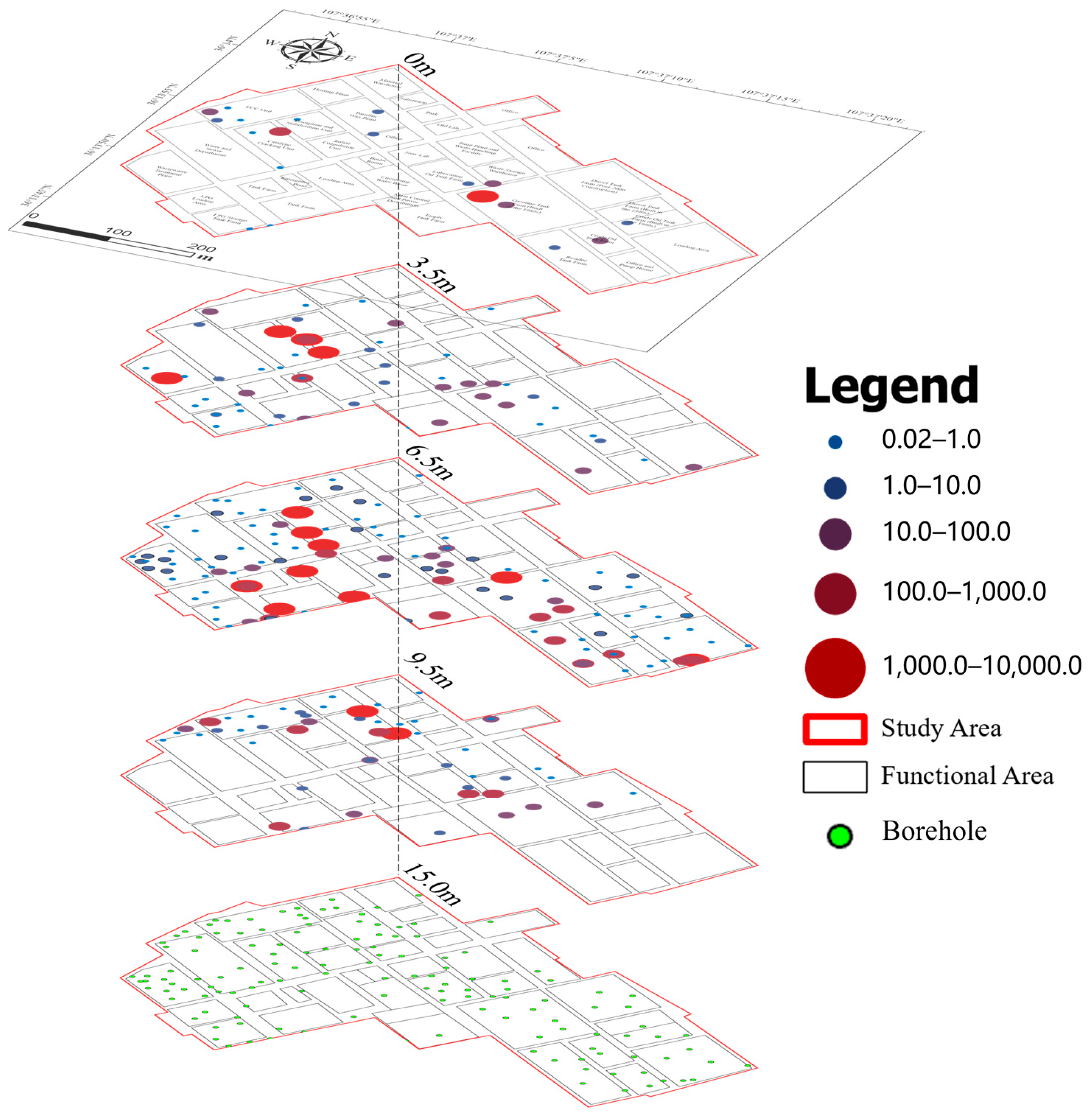
Of the 259 soil samples, 171 were contaminated with PHCs C6–C9 (a detection rate of 66.0%). The peak concentration was 5870 mg kg−1, with percentile values of 17.45 mg kg−1 (75th), 301.8 mg/kg (90th), and 3757 mg kg−1 (99th). Based on analytical results and stratigraphic structure, contamination distribution maps of PHCs C6–C9 were generated for soil layers (Figure 2).
The distribution of PHCs C6–C9 in soils is closely related to the historical production layout of the industrial facility. Highly contaminated areas were primarily concentrated in the former paraffin production area, catalytic cracking unit, storage tank zone, wastewater treatment plant, and loading/unloading platforms. This distribution pattern aligns with findings from other petroleum refinery sites, where VOC contamination is typically focused in tank farms, wastewater treatment areas, production units, and loading platforms [35]. This consistency suggests a commonality in the spatial distribution of contamination at petroleum refinery sites, which can inform the identification of key areas and the design of sampling strategies for similar sites.
Vertically, contaminant migration is influenced by multiple factors, such as adsorption, soil moisture content, temperature, and the physicochemical properties of the contaminants [36,37]. Only one high-concentration point was detected in surface soils (0–3.0 m). This differs from some other studies [38,39], possibly because of the extended idle period following site shutdown and accelerated volatilization and degradation of PHCs C6–C9 in surface soils caused by anthropogenic disturbances (e.g., removal of facilities and equipment). Notably, over 50% of the high-concentration points for PHCs C6–C9 occurred within 6.5–9.5 m depth, near where groundwater levels fluctuate between high- and low-water periods. This accumulation is likely because of the physicochemical properties of PHCs C6–C9, which facilitate their accumulation at the capillary fringe and potential formation of a light non-aqueous phase liquid (LNAPL) [40]. This makes this depth interval a high-risk zone for contaminant accumulation.
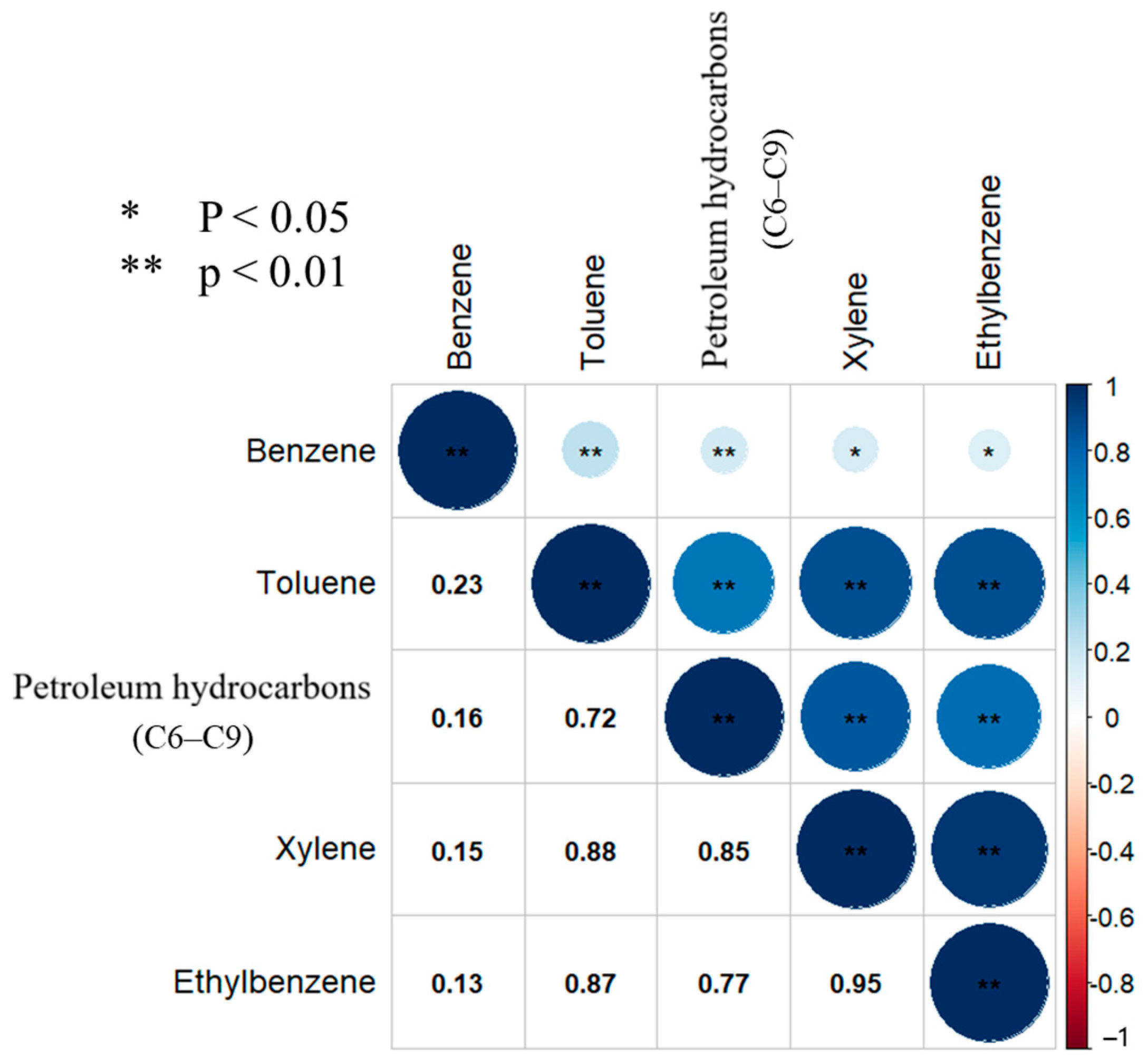
Correlation analysis was performed using 259 datasets. A significant positive correlation existed between PHCs C6–C9 and m&p-xylene (R = 0.85; p < 0.01), suggesting potential common sources or similar environmental behaviors (Figure 3). Areas with elevated m&p-xylene concentrations in petroleum-refining sites may warrant attention for potential co-contamination by PHCs C6–C9. Correlations between PHCs C6–C9 and benzene, while statistically significant, were extremely weak (R = 0.16; p < 0.01), indicating that these contaminants have distinct sources or differing migration and transformation processes.

3.2. Risk Assessment Results

3.2.1. Tier 1

Based on the recommended parameters from the “Technical Guidelines for Risk Assessment of Soil Contamination on Land for Construction” (HJ 25.3-2019), we performed a tier 1 risk assessment, deriving a tier 2 land-use screening value of 192 mg kg−1 for PHCs C6–C9. To evaluate the reasonableness of this screening value, we compared it against standards for PHCs C6–C9 under similar land-use scenarios for various countries (Table 4). Significant disparities existed. New Zealand’s soil-screening standard (120 mg kg−1) was the most stringent, applicable to sandy-gravel surface soils from a 0 to 4.0 m depth. In contrast, Australia’s health-screening value (26,000 mg kg−1) was the most lenient, applicable to scenarios involving direct contact but excluding the vapor intrusion pathway. These differences primarily stem from variations in the risk assessment models used, the depth of toxicological understanding of PHCs C6–C9, and the regional characteristics of key exposure parameters. The screening value derived using China’s current HJ 25.3 risk assessment model falls within a relatively stringent range, reflecting a precautionary principle in risk management that aims to protect human health to the greatest possible extent.
Sun et al. demonstrated that toxicity assessment and risk characterization can lead to significant differences in soil-screening values [43]. Variations in toxicity assessment among fractions largely explain differences in PHCs C6–C9 soil-screening values between countries or regions. Additionally, the risk characterization methods used in Canada differ from those in the US, Hong Kong, and elsewhere, possibly further contributing to the divergence between Canada’s soil-screening values and those elsewhere.

3.2.2. Tier 2 vs. 3

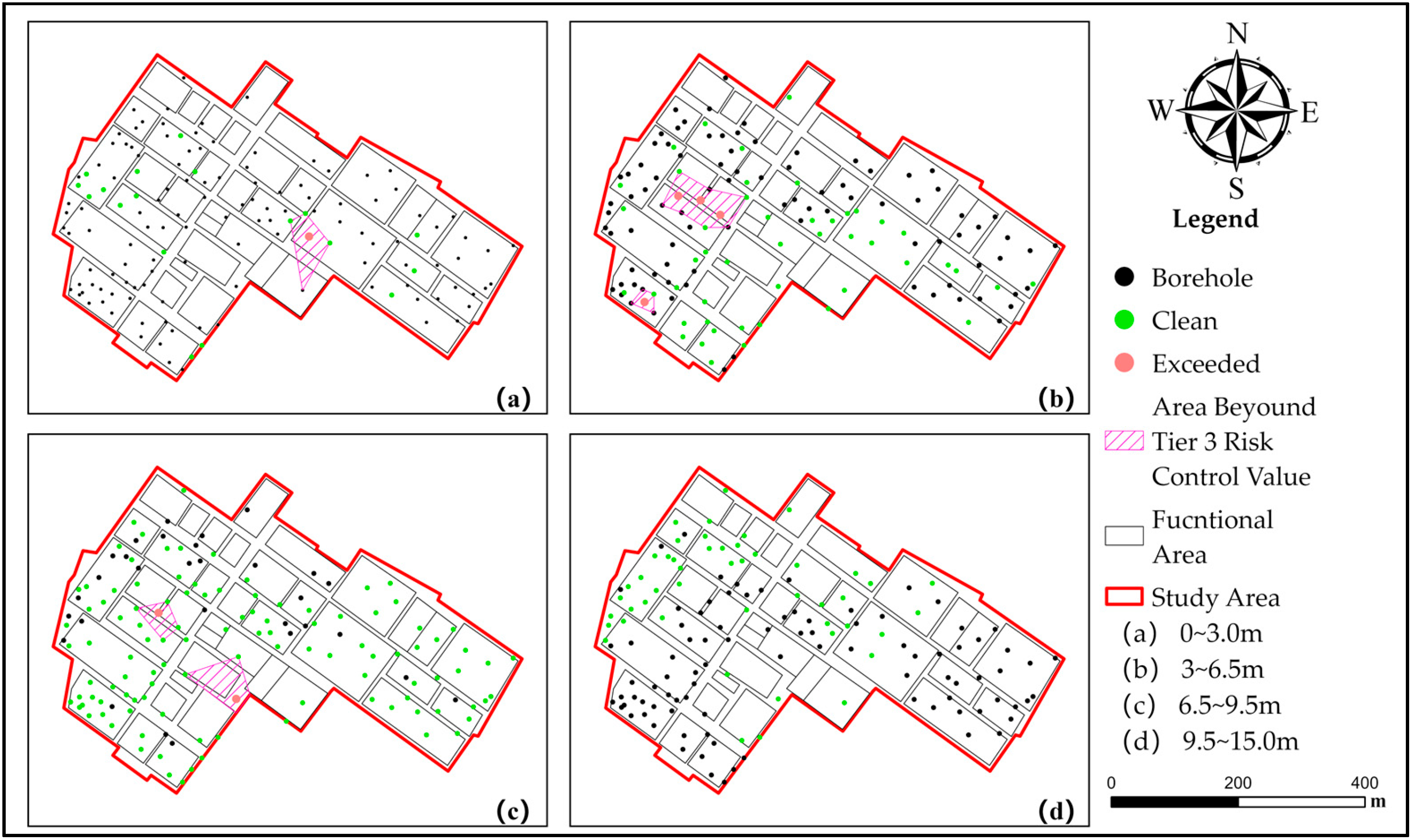
Based on site-specific parameters, the Tier 2 risk assessment derived a risk control value of 226 mg kg−1 for PHCs C6–C9. Further incorporating the proportional contributions of sub-fractions through weighted calculation, the tier 3 risk assessment established a significantly higher (2370 mg kg−1) risk control value. Using these two values as benchmarks and integrating analytical data with field conditions, the spatial distribution of contamination was characterized using ArcGIS 10.4. This process delineated areas that exceeded calculated risk control values, calculated their areal extent, and quantified corresponding soil volumes (Figure 4 and Figure 5). The key point of the risk control value derived from the tier 3 risk assessment lies in adoption of Canada’s MFsubfraction values. This is also the main source of uncertainty in this method. For specific contaminated sites, the MFsubfraction should be tested where feasible to reduce the uncertainty associated with this approach.
Contaminated soil volumes corresponding to each risk assessment tier are summarized in Table 5. For the Tier 2 assessment, the total contaminated soil volume (381,904 m3) was mostly concentrated from a 6.5 to 9.5 m depth (238,096 m3). In contrast, the total contaminated soil volume identified by the tier 3 assessment was significantly reduced to 87,047 m3, with the majority located in shallower (0–6.5 m depth) soils.
Performing a tier 3 risk assessment can significantly optimize the remediation scope. Within 0–3.0 m and 3.0–6.5 m depth ranges, the volume of contaminated soil was unchanged. However, from 6.5 to 9.5 m and 9.5 to 15.0 m, the contaminated soil volume decreased by 87.0% and 100.0%, respectively. This resulted in a total reduction of ~295,000 m3, representing a 77.2% decrease, which signifies substantial environmental and economic benefits.
Significant differences exist in the content and toxicity of alkane and aromatic fractions of PHCs [44]. Current Chinese standards for risk control of PHCs C10–C40 are based on toxicity parameters of the relatively more toxic aromatic fraction (C10–C16). This leads to conservative risk assessment results with considerable uncertainty when using a single fraction approach [8]. While refined risk assessment methods based on carbon fraction hypotheses for PHCs C10–C40 have been established in Shanghai and Guangdong [45], nothing comparable exists for PHCs C6–C9 elsewhere in China. Drawing on relevant studies from Canada and the Total Petroleum Hydrocarbon Criteria Working Group, we pioneer a refined, fraction-based risk assessment for PHCs C6–C9. This provides methodological support for precise risk management of similarly contaminated sites and aligns with the risk-based “strict-before-lenient” screening principle [46].

3.3. Economic Benefits

For shallow areas (depths of 0–6.5 m) where excavation is feasible, ex situ remediation technology is used. Given the physical properties of PHCs C6–C9, ambient temperature desorption technology could be considered. For deeper areas (depths of 6.5–15.0 m) where excavation is less feasible, in situ remediation technology could be used. Given that PHCs C6–C9 do not contain benzene series components, which reduces the difficulty of ring-opening reactions, in situ chemical oxidation technology could be considered. The unit costs of these two technologies are 500 CNY m−3 and 1100 CNY m−3, respectively. Based on feasible technologies and their cost analysis, combined with contaminated soil volumes determined by tiered risk assessment, we estimated the corresponding direct remediation costs (Table 6). Costs corresponding to tier 2 risk assessment amount to CNY 386 million (~USD 54.2 million as of November 2025), whereas those for tier 3 risk assessment are reduced to CNY 62 million (~USD 8.7 million as of Nov 2025) (an ~84% decrease of CNY 324 million (~USD 45.5 million as of November 2025)).
Our results demonstrate that performing a tier 3 risk assessment with higher precision for PHCs C6–C9-contaminated sites can accurately delineate the actual risk area and optimize the volume of soil requiring remediation, thereby yielding significant economic benefits. This approach provides a valuable reference for risk management and remediation decision making at similar contaminated sites.

4. Discussion

4.1. Tiered Risk Assessment Enhances Precision and Aligns with Green, Low-Carbon Principles

The complexity of PHC composition underscores the need for conducting refined risk assessments. Park et al. demonstrated that detailed quantitative risk assessment was needed to determine scientifically and economically appropriate cleanup target levels [47]. We established a method to assess the risks of PHCs C6–C9 in soils on construction land in China. Tier 3 risk assessment for PHCs C6–C9 can significantly reduce the remediation cost (an ~84% decrease of CNY 324 million (~USD 45.5 million as of November 2025)), aligning with China’s green and low-carbon requirements for soil remediation (Table 6). Tiered risk assessment enables more accurate assessment, increases remediation goals by up to 80%, and substantially reduces remediation volume [7,48]. Both existing studies and our work confirm the feasibility of implementing tiered risk assessment for PHCs. In China, PHCs account for nearly 50% of organic-contaminated sites [49], further demonstrating the significant potential of this approach in practical applications.

4.2. Localized Studies Are Needed to Establish Additional Parameters for PHC Risk Assessment

To implement the risk-based soil environmental management strategy grounded in the three core elements of “source–pathway–receptor,” Chinese researchers have performed localization studies on exposure parameters related to the receptor element [25,50]. While the properties of most contaminants in the source element are relatively stable, PHCs exhibit compositional diversity, structural heterogeneity, varied origins, and divergent environmental behaviors. Accordingly, an investigation into the localized characteristics of PHC pollution sources is required. Currently, technical guidelines for Guangzhou, China, provide risk assessment parameters for PHCs C10–C40 [45]. However, as in our study, these parameters are also derived from sources such as the US and Canada. Therefore, investigating compositional characteristic parameters of PHCs in contaminated sites across China represents a key direction for future work and a prerequisite for advancing tiered risk assessment of PHCs.

5. Conclusions

In petroleum refinery-contaminated sites, monoaromatic hydrocarbons do not fully indicate the contamination risks of short-chain PHCs. We recommend that PHCs C6–C9 be included as key characteristic contaminants in contamination identification and incorporated into soil contamination status investigations and risk assessment procedures.
At our study site, a tier 3 risk assessment based on carbon fraction assumptions for PHCs C6–C9 determined a required remediation volume of 87,047 m3, with corresponding remediation costs of CNY ~62 million (~USD 8.7 million as of November 2025). Compared with a tier 2 risk assessment using a single fraction approach, this reduced the required remediation volume by 294,857 m3 and saved ~324 million CNY (~USD 45.5 million as of November 2025) in costs.
Our carbon fraction proportion parameters for PHCs were primarily referenced from international research. We recommend further research on the compositional characteristics of PHCs in typical contamination types and regional contexts in China to refine risk assessments for PHC-contaminated sites.
We acknowledge several study limitations. First, our samples were primarily collected from a specific type of petrochemical site. Therefore, caution should be exercised if extrapolating these results to other industrial contexts or environmental media. Second, the mass fractions of sub-fractions used in the analysis were based on standards from Canada. Their direct application in regulatory frameworks of other regions requires careful consideration of applicability and potential need for localization. Despite these limitations, our findings provide decision support for the environmental regulation of PHCs C6–C9. The identified correlations can inform more efficient monitoring strategies and risk-based site management.

Author Contributions

Conceptualization, G.G.; methodology, R.Y.; software, K.Z.; validation, K.Z.; formal analysis, K.Z.; investigation, K.Z.; resources, C.Z.; data curation, K.Z.; writing—original draft preparation, K.Z.; writing—review and editing, C.Z. and G.G.; visualization, K.Z.; supervision, G.G.; project administration, R.Y.; funding acquisition, G.G. All authors have read and agreed to the published version of the manuscript.

Funding

This research was funded by the National Natural Science Foundation of China, grant number 52270161; the APC was funded by the Jing–Jin–Ji Regional Integrated Environmental Improvement–National Science and Technology Major Project, grant number 2025ZD1205800.

Data Availability Statement

The original contributions presented in this study are included in the article. Further inquiries can be directed to the corresponding author.

Conflicts of Interest

The authors declare no conflicts of interest.

Abbreviations

The following abbreviations were used in this manuscript:
PHCPetroleum Hydrocarbon
TPHTotal Petroleum Hydrocarbon
BTEXBenzene, Toluene, Ethylbenzene, and Xylene
USEPAThe United States Environmental Protection Agency
VOCVolatile Organic Compound

References

  1. Fei, H.W.; Wang, J.; Gao, Z.Y. Review and near-term outlook of China’s refining industry in 2022. Int. Pet. Econ. 2023, 31, 53–58. [Google Scholar]
  2. Brown, D.M.; Okoro, S.; van Gils, J.; van Spanning, R.; Bonte, M.; Hutchings, T.; Linden, O.; Egbuche, U.; Bruun, K.B.; Smith, J.W. Comparison of landfarming amendments to improve bioremediation of petroleum hydrocarbons in Niger Delta soils. Sci. Total Environ. 2017, 596–597, 284–292. [Google Scholar] [CrossRef]
  3. Ossai, I.C.; Ahmed, A.; Hassan, A.; Hamid, F.S. Remediation of soil and water contaminated with petroleum hydrocarbon: A review. Environ. Technol. Innov. 2020, 17, 100526. [Google Scholar] [CrossRef]
  4. Sammarco, P.W.; Kolian, S.R.; Warby, R.A.F.; Bouldin, J.L.; Subra, W.A.; Porter, S.A. Concentrations in human blood of petroleum hydrocarbons associated with the BP/Deepwater Horizon oil spill, Gulf of Mexico. Arch. Toxicol. 2016, 90, 829–837. [Google Scholar] [CrossRef] [PubMed]
  5. Peng, S.Q.; Li, J.; Han, L.; Zhang, W.Y.; Chen, M.F.L.; Chen, X.Y.; Gu, H.Y.; Zhou, Y.; Hou, S.L. Analysis of characteristic pollutants and health risks in the petroleum refining industry in China. Chin. J. Environ. Eng. 2024, 18, 3071–3080. [Google Scholar]
  6. Li, Y.; Xu, D.; Li, J.; Li, Y.; Go, F. Establishment and verification of the recognition method of the priority pollutants in groundwater of the typical petroleum refining enterprise. Chin. J. Environ. Eng. 2019, 13, 2770–2780. [Google Scholar]
  7. Zhu, K.X. Study on Refined Risk Assessment of Petroleum Hydrocarbon in Contaminated Sites. Master’s Thesis, Chinese Research Academy of Environmental Sciences, Beijing, China, 2022; pp. 1–2. [Google Scholar]
  8. Liu, D.Q. Current situation and trend of petroleum hydrocarbon related standard system in contaminated site soils of China. Environ. Monit. China 2020, 36, 138–146. [Google Scholar] [CrossRef]
  9. Yang, L.; Shi, J.; Chen, Q.; Long, T. Human health risk assessment of petroleum hydrocarbons in contaminated sites from the perspective of components and propertie. Asian J. Ecotoxicol. 2021, 16, 56–65. [Google Scholar]
  10. Sahoo, A.K.; Madgaonkar, S.R.; Chivukula, N.; Karthikeyan, P.; Ramesh, K.; Marigoudar, S.R.; Sharma, K.V.; Samal, A. Network-based investigation of petroleum hydrocarbons-induced ecotoxicological effects and their risk assessment. Environ. Int. 2024, 194, 109163. [Google Scholar] [CrossRef]
  11. TPH Risk Evaluation Team. TPH Risk Evaluation at Petroleum-Contaminated Sites; Interstate Technology & Regulatory Council: Washington, DC, USA, 2018. [Google Scholar]
  12. Friebel, E.; Nadebaum, P. Health Screening Levels for Petroleum Hydrocarbons in Soil and Groundwater Summary; Cooperative Research Centre for Contamination Assessment and Remediation of the Environment: Adelaide, Australia, 2011. [Google Scholar]
  13. Canadian Council of Ministers of the Environment. Canada-Wide Standards for Petroleum Hydrocarbons (PHC) in Soil; Canadian Council of Ministers of the Environment: Winnipeg, MB, Canada, 2008.
  14. GB36600-2018; Soil Environmental Quality Risk Control Standard for Soil Contamination of Development Land. China Environment Publishing Group: Beijing, China, 2018.
  15. Brewer, R.; Nagashima, J.; Kelley, M.; Heskett, M.; Rigby, M. Risk-based evaluation of total petroleum hydrocarbons in vapor intrusion studies. Int. J. Environ. Res. Public Health 2013, 10, 2441–2467. [Google Scholar] [CrossRef]
  16. Ji, M.; Yang, J.; Zhang, S.Y.; Li, X.M.; Li, Q.Q. Characteristics and risk assessment of carbon chain components of petroleum hydrocarbon contamination in soil and groundwater of typical enterprise retired sites in Shanghai. Res. Environ. Sci. 2024, 37, 2547–2556. [Google Scholar]
  17. Zhang, Z.; Yan, X.; Gao, F.; Thai, P.; Wang, H.; Chen, D.; Zhou, L.; Gong, D.; Li, Q.; Morawska, L.; et al. Emission and health risk assessment of volatile organic compounds in various processes of a petroleum refinery in the Pearl River Delta, China. Environ. Pollut. 2018, 238, 452–461. [Google Scholar] [CrossRef] [PubMed]
  18. Jiang, H.; Wu, Q.T. Discussion on potential issues of risk controlling standards of contaminated sites in China from perspectives of screening values and land uses. Asian J. Ecotoxicol. 2023, 18, 79–90. [Google Scholar]
  19. Jiang, L.; Zhong, M.-S.; Liang, J.; Yao, J.-J.; Xia, T.-X.; Fan, Y.-L.; Li, J.-D.; Tang, Z.-Q. Application and benefit evaluation of tiered health risk assessment approach on site contaminated by benzene. Environ. Sci. 2013, 34, 1034–1043. [Google Scholar]
  20. HJ 25.1-2019; Technical Guidelines for Investigation on Soil Contamination of Land for Construction. China Environment Publishing Group: Beijing, China, 2019.
  21. HJ 25.2-2019; Technical Guidelines for Monitoring During Risk Control and Remediation of Soil Contamination of Land for Construction. China Environment Publishing Group: Beijing, China, 2019.
  22. HJ 1020-2019; Soil and Sediment-Determination of Petroleum Hydrocarbons (C6–C9)-Purge and Trap/Gas Chromatography. China Environment Publishing Group: Beijing, China, 2019.
  23. HJ 605-2011; Soil and Sediment-Determination of Volatile Organic Compounds Purge and Trap Gas Chromatography/Mass Spectrometry Method. China Environmental Press: Beijing, China, 2011.
  24. HJ 25.3-2019; Technical Guidelines for Risk Assessment of Soil Contamination of Land for Constructor. China Environment Publishing Group: Beijing, China, 2019.
  25. Ministry of Environmental Protection of the People’s Republic of China. Exposure Factors Handbook of Chinese Population (Adults); China Environment Publishing Group: Beijing, China, 2013; pp. 29–30. [Google Scholar]
  26. Department of Ecology and Environment of Gansu Province. Official Report on the State of Ecology and Environment in Gansu Province (2024); Gansu Department of Ecology and Environment of Gansu Province: Lanzhou, China, 2025; Available online: https://125.74.7.101:50625/info/1198/42535.htm (accessed on 19 October 2025).
  27. United States Environmental Protection Agency. Regional Screening Level (RSL) Chemical-Specific Parameters Supporting Table November 2024; Regional Screening Levels (RSLs)-Generic Tables US EPA; United States Environmental Protection Agency: Washington, DC, USA, 2025.
  28. United States Environmental Protection Agency. Regional Screening Level (RSL) Summary Table (TR=1E-06, HQ=1) November 2024 [EB/OL]; Regional Screening Levels (RSLs)-Generic Tables|US EPA; United States Environmental Protection Agency: Washington, DC, USA, 2025.
  29. Mahammedi, C.; Mahdjoubi, L.; Booth, C.; Butt, T. Framework for preliminary risk assessment of brownfield sites. Sci. Total Environ. 2022, 807, 151069. [Google Scholar] [CrossRef]
  30. Jiang, L.; Liang, J.; Zhong, M.S.; Zhang, R.H.; Xia, T.X.; Zhao, Y. Challenges and response to risk management of complex contaminated sites. Res. Environ. Sci. 2021, 34, 458–467. [Google Scholar]
  31. Yuan, B.; Du, P.; Li, A.Y.; Zhang, H.; Chen, J.; Zhang, Y.H.; Wang, H.Y. Development and research progress of tiered risk assessment of contaminated sites. Res. Environ. Sci. 2023, 36, 19–29. [Google Scholar]
  32. Jiao, W.; Fang, Y.; Li, S.; Yue, Y.; Ding, N.; Qin, Z.; Zhang, H. Risk management and control of contaminated sites in the United States: Development process, evolution characteristics and enlightenment. Chin. J. Environ. Eng. 2021, 15, 1821–1830. [Google Scholar]
  33. Vorhees, D.J.; Weisman, W.H.; Gustafson, J.B. Total Petroleum Hydrocarbon Criteria Working Group Volume 5: Human Health Risk Based Evaluation of Petroleum Release Sites: Implementing the Working Group Approach; Amherst Scientific Publishers: Amherst, MA, USA, 1999. [Google Scholar]
  34. Canade-Wide Standard for Petroleum Hydrocarbons (PHC) in Soil User Guidance; The Canadian Council of Ministers of the Environment: Winnipeg, MB, Canada, 2001.
  35. Li, T. Study on Distribution and Migration Characteristics of Typical Pollutant in Petroleum Refining Sites. Master’s Thesis, China University of Petroleum, Dongying, China, 2020; pp. 24–53. [Google Scholar]
  36. Luo, S. Study on the Pollution Characteristics and Migration Behavior of Benzene Series in the Soil of Typical Petrochemical Industrial Sites; Chongqing University: Chongqing, China, 2021; pp. 25–66. [Google Scholar]
  37. Pei, F.; Luo, Z.J.; Peng, J.J.; Qi, S.H. Phenols pollutants in soil and shallow groundwater of a retired refinery site. Environ. Sci. 2012, 33, 4251–4255. [Google Scholar]
  38. Li, X. Study on Pollution Characteristics, Influencing Factors, and Risk Assessment of Oil Refining Industry Sites. Master’s Thesis, Xiangtan University, Xiangtan, China, 2022; pp. 1–2. [Google Scholar]
  39. Yuan, L.; Wu, Y.; Fan, Q.; Li, P.; Liang, J.; Wang, Z.; Li, R.; Shi, L. Spatial distribution, composition, and source analysis of petroleum pollutants in soil from the Changqing Oilfield, northwest China. Mar. Pollut. Bull. 2022, 185, 114338. [Google Scholar] [CrossRef]
  40. Ma, J. Suggestion for setting upper limit values of groundwater remediation targe values. Chin. J. Environ. Eng. 2023, 17, 3474–3477. [Google Scholar]
  41. The Government of the Hong Kong Special Administrative Region Environmental Protection Department. Risk-Based Remediation Goals; The Government of the Hong Kong Special Administrative Region Environmental Protection Department: Hong Kong, China, 2007.
  42. The Ministry for the Environment. Guidelines for Assessing and Managing Petroleum Hydrocarbon Contaminated Sites in New Zealand Module 4 Tier 1 Soil Acceptance Criteria, 2nd ed.; The Ministry for the Environment: Wellington, New Zealand, 2011; pp. 50–71.
  43. Sun, Y.; Wang, J.; Guo, G.; Li, H.; Jones, K. A comprehensive comparison and analysis of soil screening values derived and used in China and the UK. Environ. Pollut. 2020, 256, 113404. [Google Scholar] [CrossRef] [PubMed]
  44. Gou, N.N.; Liu, Z.L.; Wu, M.L.; Tang, S.W.; Hu, S.Y.; Y, Y.; Ke, S.J. The toxicological risks and combined toxic effects of equivalent alkanes and polycyclic aromatic hydrocarbon components in total petroleum hydrocarbons. Asian J. Ecotoxicol. 2025, 20, 156–169. [Google Scholar]
  45. DB4401/T 102.7—2023; Soil Pollution Prevention and Control of Land for Construction—Part 7: Technical Specifications for Risk Assessment of Soil Contamination. Guangzhou Municipal Administration for Market Regulation: Guangzhou, China, 2023.
  46. Jiang, H.; Wu, Q.T. Probabilistic analysis of the health risk screening errors in a petroleum hydrocarbon contaminated sensitive site. Ecol. Environ. 2024, 33, 645–654. [Google Scholar]
  47. Park, I.S.; Park, J.W. Determination of a risk management primer at petroleum-contaminated sites: Developing new human health risk assessment strategy. J. Hazard. Mater. 2011, 185, 1374–1380. [Google Scholar] [CrossRef]
  48. Li, W.; Li, J.; Chen, A.; Zhong, M.; Song, L. Health risk assessment of a lubricant contaminated site. Asian J. Ecotoxicol. 2021, 16, 137–146. [Google Scholar]
  49. Ge, F.; Zhang, Z.X.; Fu, H.; Tang, S.; Xu, K.; Song, X.; Wang, Q.; Luo, Y. Distribution of organic contaminated sites in China: Status quo and prospect. Soils 2021, 53, 1132–1141. [Google Scholar]
  50. Duan, X.; Cao, S.; Guan, J.; Hu, L.; Sun, C.; Yan, C.; Zhao, X.; Wu, F. A more scientific blood lead reference value urgently needs to be updated in China: From a national and international insight. Eco-Environ. Health 2025, 4, 100127. [Google Scholar] [CrossRef]
Figure 1. Location of the study area.
Land 15 00086 g001
Figure 2. Distribution of petroleum hydrocarbons (PHCs) C6–C9 in soil by depth.
Land 15 00086 g002
Figure 3. Correlation of PHCs C6–C9 and benzene, toluene, ethylbenzene, and xylene (BTEX) concentrations in soil.
Land 15 00086 g003
Figure 4. Spatial extent of contaminated soil under a tier 2 risk assessment. (a) 0–3.0 m area beyound Tier 2 risk control value; (b) 3.0–6.5 m area beyound Tier 2 risk control value; (c) 6.5–9.5 m area beyound Tier 2 risk control value; (d) 9.5–15.0 m area beyound Tier 2 risk control value.
Land 15 00086 g004
Figure 5. Spatial extent of contaminated soil area under a tier 3 risk assessment. (a) 0–3.0 m area beyound Tier 2 risk control value; (b) 3.0–6.5 m area beyound Tier 2 risk control value; (c) 6.5–9.5 m area beyound Tier 2 risk control value; (d) 9.5–15.0 m area beyound Tier 2 risk control value.
Land 15 00086 g005
Table 1. Testing methods and equipment.
ParameterAnalytical MethodLimit of Detection InstrumentationRelative Percent Difference/(%)
Petroleum hydrocarbons C6–C9HJ 1020-20190.04 mg·kg−1Purge and trap gas Chromatography–mass spectrometry
Amoxt 7890/5977B
0.7–11.3
BenzeneHJ 605-20111.9 μgkg−10.3–14.0
Toluene1.3 μgkg−11.1–19.8
Ethylbenzene1.2 μgkg−10.4–9.7
Xylene1.2 μgkg−10.7–13.4
Table 2. Exposure parameters and assigned values.
ParameterDefinitionData
Tier 1SourceTier 2Source
O I S E R a Daily oral ingestion rate of soils of adults, mg·d−1100[24]100[24]
E D a Exposure duration of adults, a25[24]25[24]
E F a Exposure frequency of adults, d·a−1250[24]250[24]
A B S o Absorption factor of oral ingestion (unitless)1[24]1[24]
B W a Average body weight of adults, kg61.8[24]58.4[25]
A T n c Average time for non-carcinogenic effect, d9125[24]9125[24]
S A F Soil allocation factor (unitless)0.33[24]0.33[24]
A H Q Acceptable hazard quotient for individual contaminant (unitless)1[24]1[24]
H a Average height of adults, cm161.5[24]161.5[24]
S E R a Skin exposure ratio of adults (unitless)0.18[24]0.18[24]
S S A R a Adherence rate of soil on skin for adults, mg·cm−20.2[24]0.2[24]
E v Daily exposure frequency of dermal contact event, once·d−11[24]1[24]
P M 10 Content of inhalable particulates in ambient air, mg·m−3119[24]52[26]
D A I R a Daily air inhalation rate of adults, m3·d−114.5[24]14.6[25]
P I A F Retention fraction of inhaled particulates in body (unitless)0.75[24]0.75[24]
f s p o Fraction of soil-borne particulates in outdoor air (unitless)0.5[24]0.5[24]
E F O a Outdoor exposure frequency of adults, d·a−162.5[24]62.5[24]
f s p i Fraction of soil-borne particulates in indoor air (unitless)0.8[24]0.8[24]
E F I a Indoor exposure frequency of adults, d·a−1187.5[24]187.5[24]
ρ b Soil bulk density, kg·dm−31.5[24]1.71Measured
τ Averaging time for vapor flux, a25[24]25[24]
U a i r Ambient air velocity in mixing zone, cm·s−1200[24]200[24]
WWidth of source zone area, cm4000[24]55,827Measured
δ a i r Mixing zone height, cm200[24]200[24]
ASource zone area, cm216,000,000[24]982,160,000Measured
ρ s Density of soil particulates, kg·dm−32.65[24]2.71Measured
ρ w s Soil water content, kg·kg−10.2[24]0.162Measured
ρ w Density of water, kg·dm−31[24]1[24]
f o m Organic matter content in soils, g·kg−115[24]15[24]
dConcentrations of contaminants in surface soil, cm50[24]650Measured
L s Concentrations of contaminants in subsurface soil, cm50[24]650Measured
d s u b Thickness of subsurface soil, cm100[24]850Measured
L B Volume/infiltration area ratio of enclosed space, cm300[24]300[24]
E R Air exchange rate of enclosed space, once·d−120[24]20[24]
η Areal fraction of cracks in foundations/walls (unitless)0.005[24]0.005[24]
L c r a c k Thickness of enclosed-space foundation or wall, cm35[24]35[24]
θ a c r a c k Soil air content—soil-filled foundation cracks (unitless)0.26[24]0.26[24]
θ w c r a c k Soil water content—soil-filled foundation cracks (unitless)0.12[24]0.12[24]
H Henry’s law constant (unitless)1.86[27]1.86[27]
D a Diffusivity in air, cm2·s−17.35 × 10⁻²[27]7.35 × 10⁻²[27]
D w Diffusivity in water, cm2·s−18.38 × 10⁻⁶[27]8.38 × 10⁻⁶[27]
K o c Organic carbon partition coefficient, cm3·g−11.72 × 10²[27]1.72 × 10²[27]
R f D o Chronic oral reference dose, mg·kg−1·d−1; 0.005[28]0.005[28]
R f C Chronic inhalation reference concentration, mg·cm−30.4[28]0.4[28]
A B S g i Fraction of contaminant absorbed in gastrointestinal tract (unitless)1[28]1[28]
A B S d Fraction of contaminant absorbed dermally from soil (unitless)/[28]/[28]
Note: “/” denotes “not applicable”.
Table 3. Subfraction and parameter values of F1 in Canada.
ParameterDefinitionData
Aliphatic Hydrocarbons
C6–C8
Aliphatic Hydrocarbons
C > 8 to C10
Aromatic Hydrocarbons
C > 8 to C10
Source
H Henry’s law constant (unitless)50800.48[33]
D a Diffusivity in air, cm2·s−10.10.10.1[33]
D w Diffusivity in water, cm2·s−11.00 × 10−51.00 × 10−51.00 × 10⁻⁵[33]
K o c Organic carbon partition coefficient, cm3·g−13.98 × 1033.16 × 1041.58 × 103[33]
R f D o Chronic oral reference dose, mg·kg−1·d−1;50.10.04[33]
R f C Chronic inhalation reference concentration, mg·cm−318.410.2[33]
A B S g i Fraction of contaminant absorbed in gastrointestinal tract (unitless)111[34]
A B S d Fraction of contaminant absorbed dermally from soil0.20.20.2[34]
M F s u b f r a c t i o n Mass fraction of each subfraction within the F1 (unitless)0.550.360.09[34]
Table 4. Screening values for PHCs C6–C9 in soils by country.
No.Country/RegionStandard NameTarget Compound/FractionValue (mg kg−1)Source
1Hong Kong, ChinaRisk-Based Remediation GoalsC6–C8Industry/park 10,000[41]
2USARegional Screening LevelTotal PHCs (aliphatic low)Industry 1900[28]
3CanadaCanada-Wide Standard for PHC in Soil User GuidanceF1Commercial/industry 170–240
Soil texture-specific
[34]
4New ZealandGuidelines for Assessing and Managing PHC-Contaminated Sites in New Zealand Module 4 Tier 1 Soil Acceptance CriteriaC7–C9Commercial/industry 120–16,000
Soil texture- and depth-specific
[42]
5AustraliaHealth Screening Levels for PHC in Soil and Groundwater SummaryC6–C10Commercial/industry 310–26,000
Soil texture, depth, and land-use specific
[12]
Table 5. Comparison of contaminated soil volumes for different tiers of risk assessment.
Depth (m)Tier 2 (m3)Tier 3 (m3)Reduction in Volume (m3)Reduction Rate (%)
0–3.017,73417,73400
3.0–6.538,40738,40700
6.5–9.5238,09630,906207,19087.0
9.5–15.087,668087,668100.0
Total381,90487,047294,85777.2
Table 6. Estimation of remediation costs under different tiers of risk assessment.
Tiered Risk AssessmentRemediation TechnologyCost USD m−3
(CNY as of November 2025)
Remediation Volume m3Total Cost million (CNY as of November 2025)
Tier 2Ambient temperature desorption (0–6.5 m)70.2 (500)56,14154.2 (386)
In situ chemical oxidation (6.5–15.0 m)154.47 (1100)325,763
Tier 3Ambient temperature desorption (0–6.5 m)70.2 (500)56,1418.7 (62)
In situ chemical oxidation (6.5–15.0 m)154.47 (1100)30,906
Disclaimer/Publisher’s Note: The statements, opinions and data contained in all publications are solely those of the individual author(s) and contributor(s) and not of MDPI and/or the editor(s). MDPI and/or the editor(s) disclaim responsibility for any injury to people or property resulting from any ideas, methods, instructions or products referred to in the content.