Spatiotemporal Variations and Driving Factors of Ecosystem Health in the Pinglu Canal Economic Zone

Abstract
1. Introduction
2. Materials and Methods
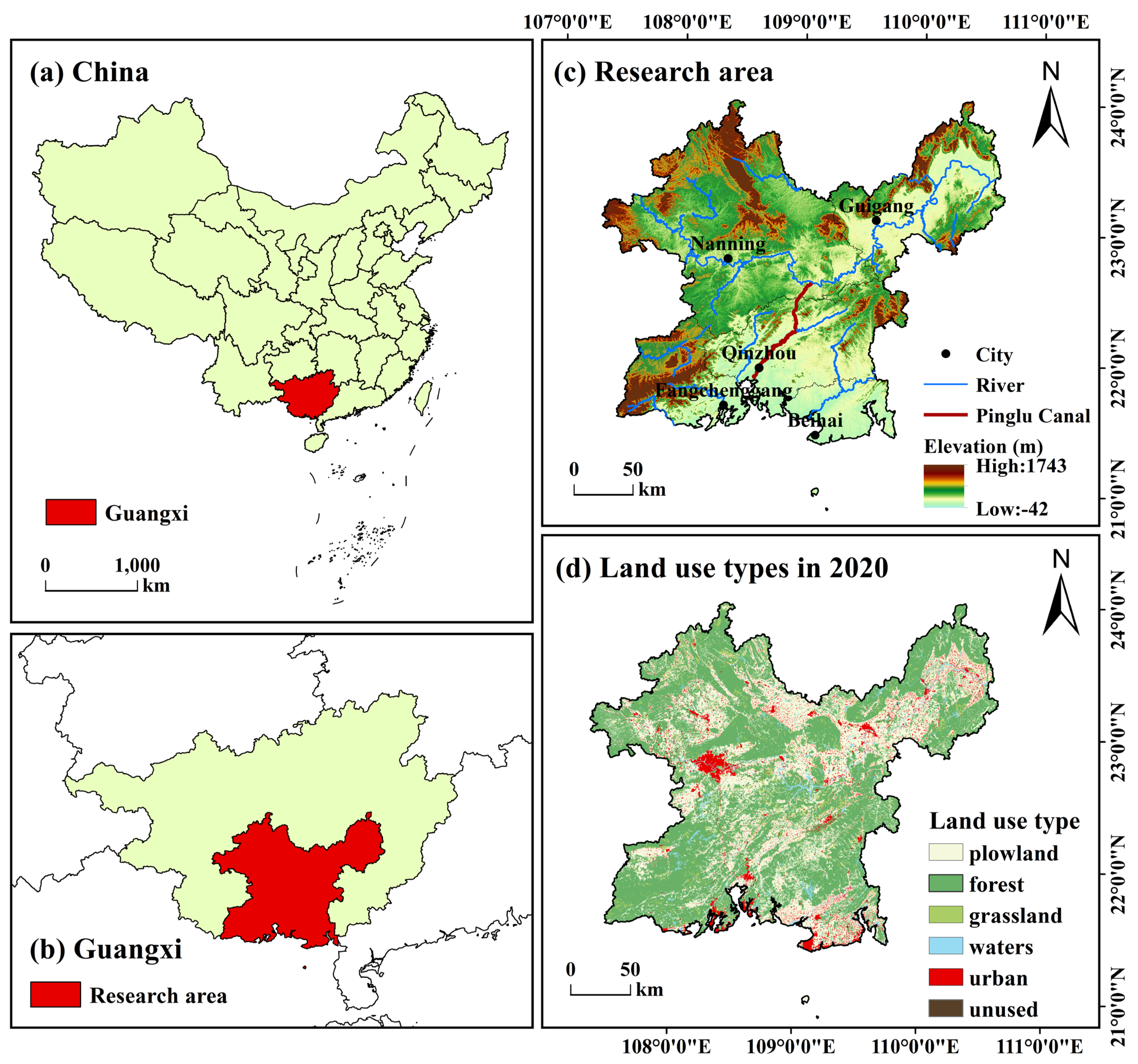
2.1. Study Area
2.2. Data Sources
2.3. Methodology
2.3.1. EHA Framework
- (1)
- Ecosystem vigor
- (2)
- Ecosystem organization
- (3)
- Ecosystem resilience
- (4)
- Ecosystem service
- (5)
- Human disturbance
2.3.2. Ecosystem Health Index
2.3.3. Ecosystem Health Trends
2.3.4. Driving Factor Analysis
3. Results
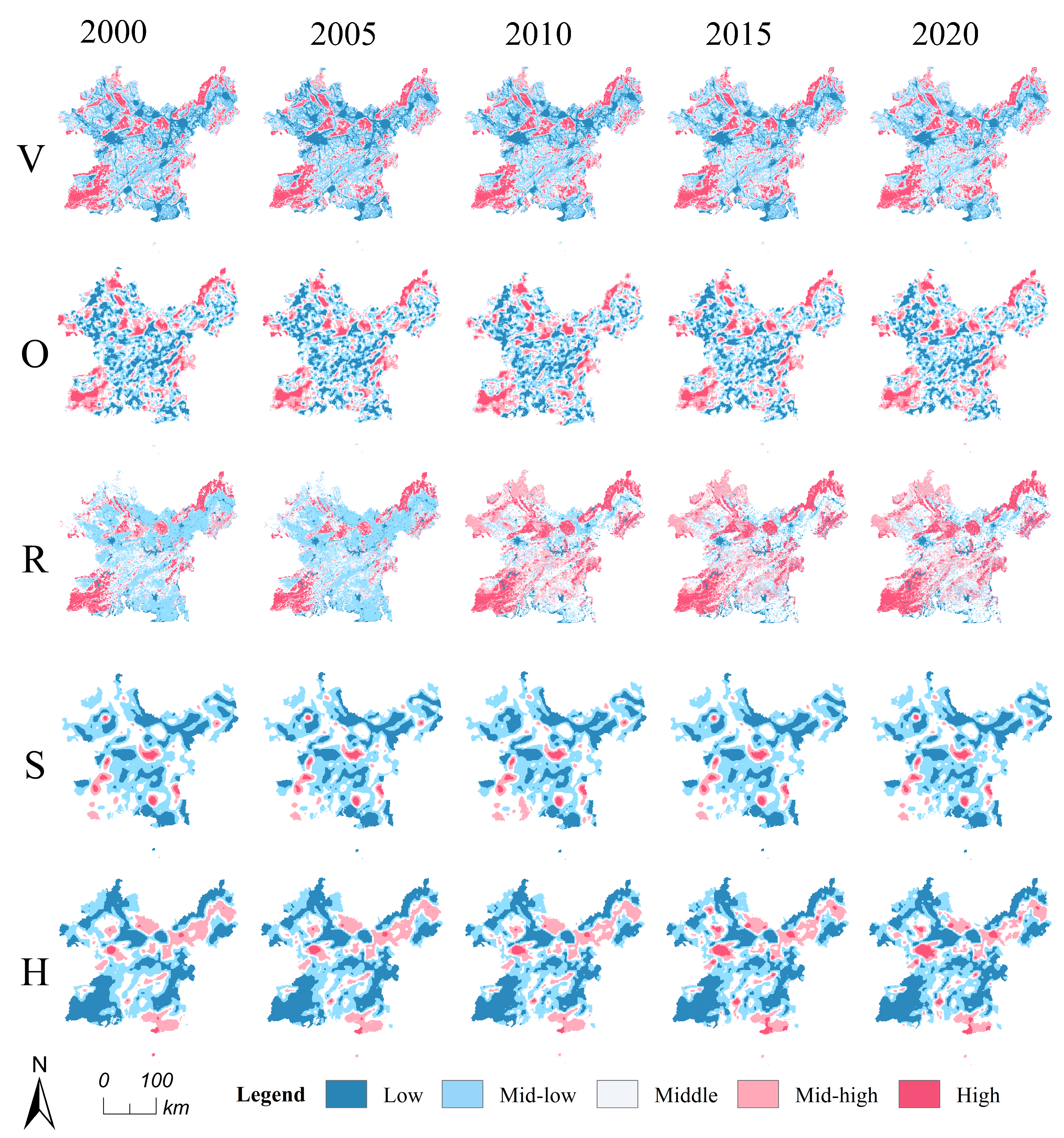
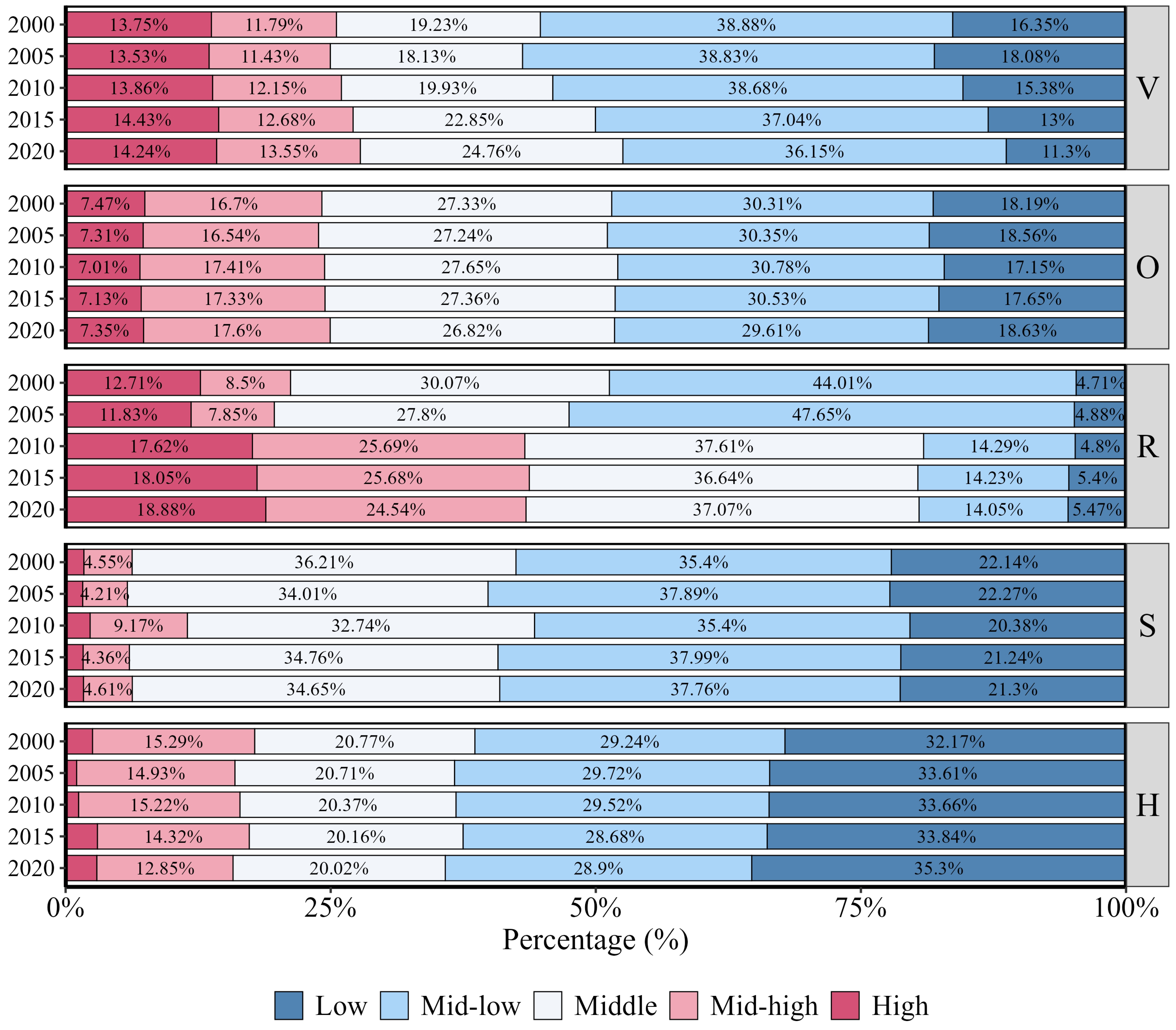
3.1. Spatiotemporal Evolution Analysis of V, O, R, S, and H
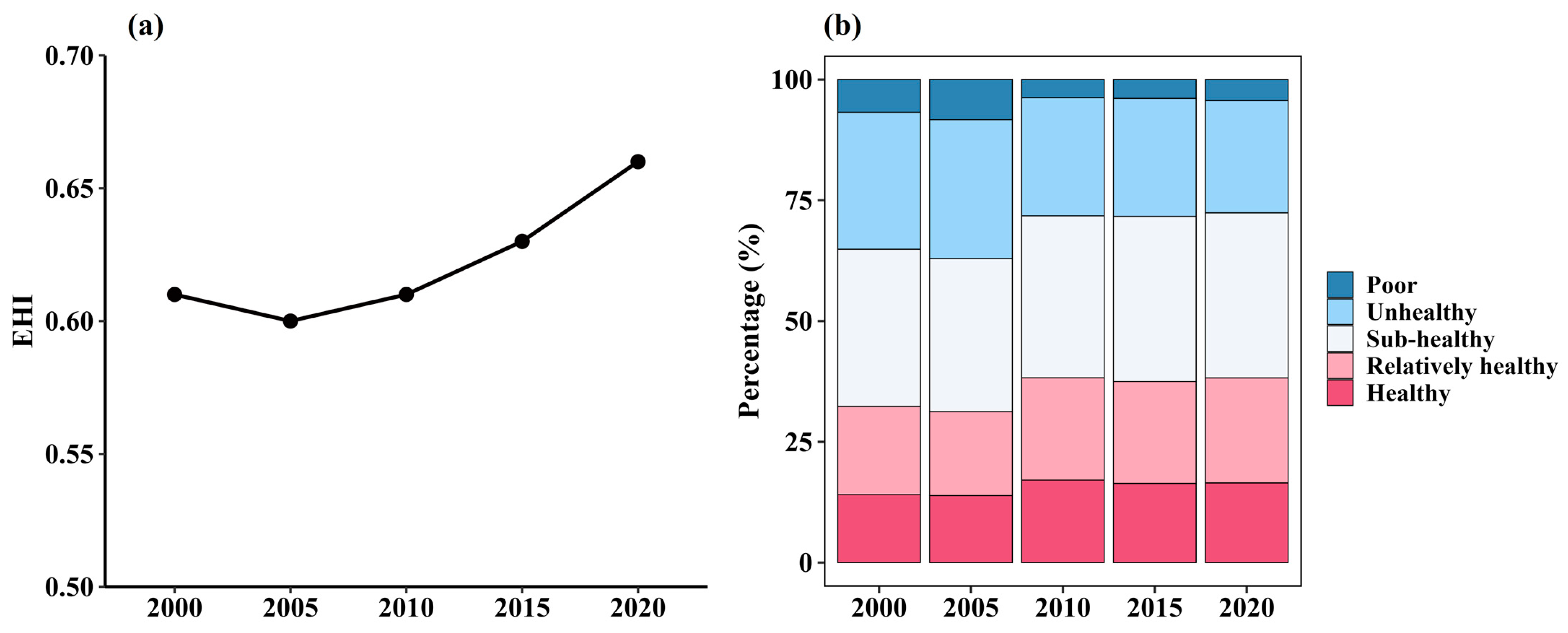
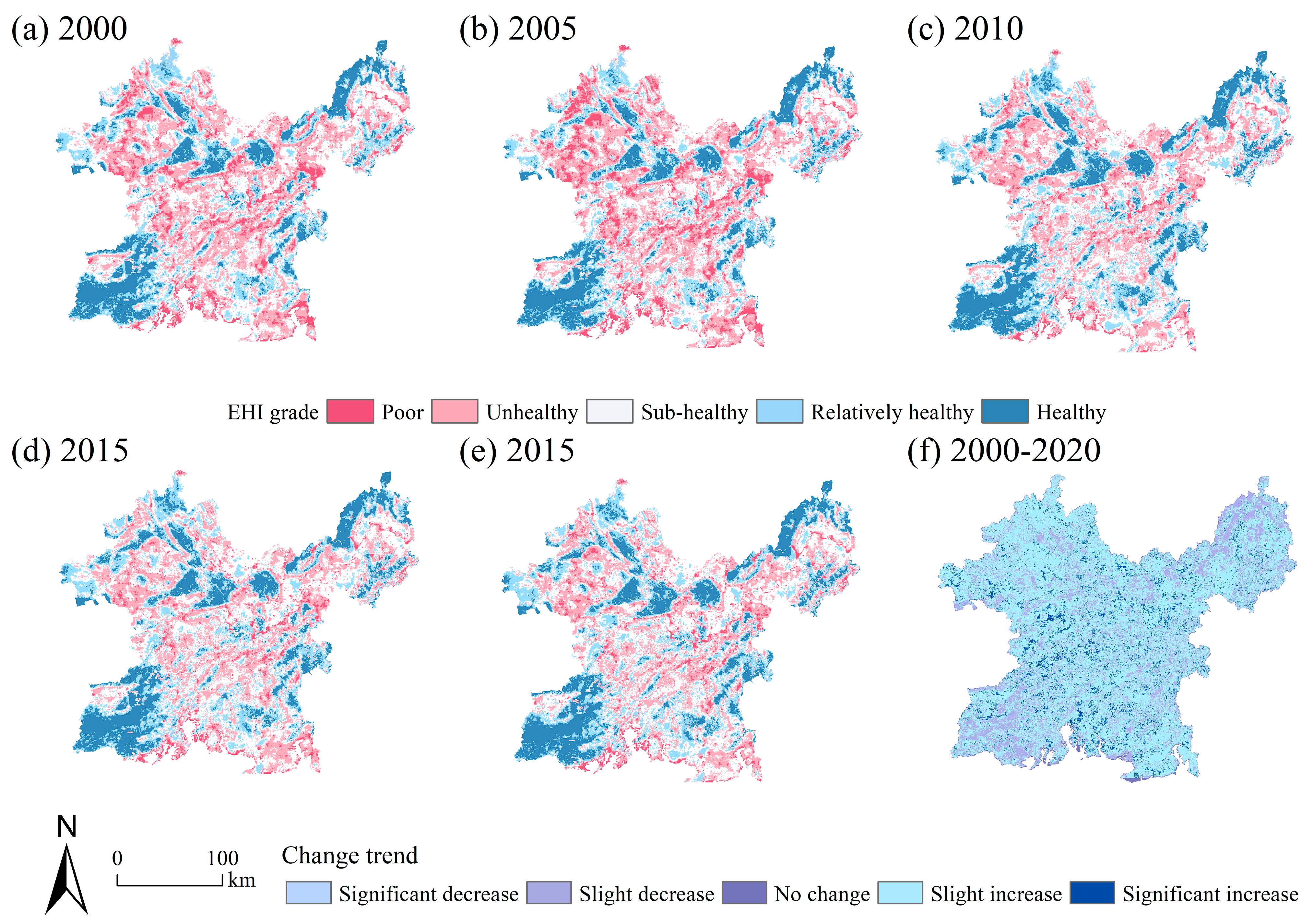
3.2. Spatiotemporal Dynamics of the EHI
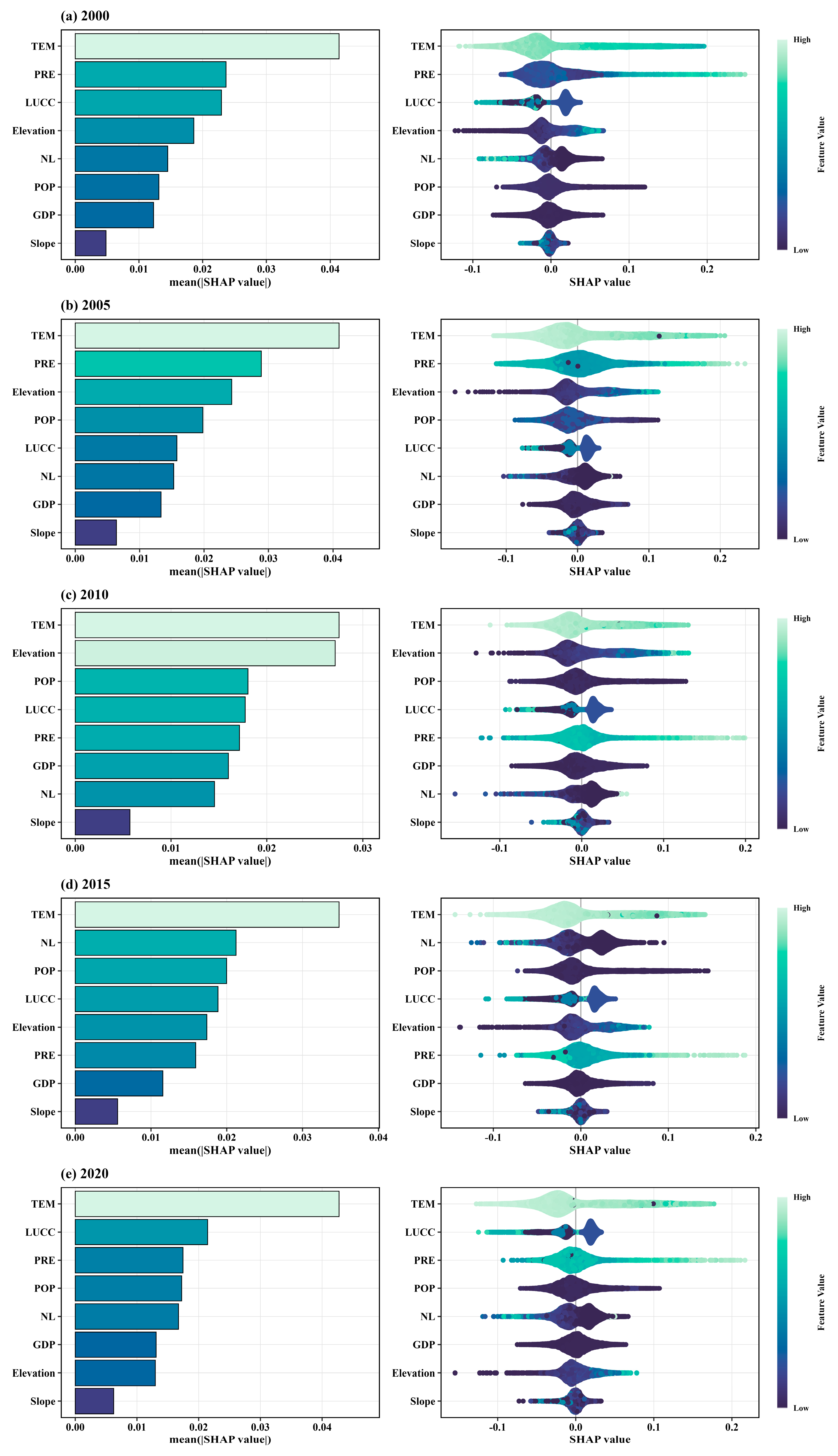
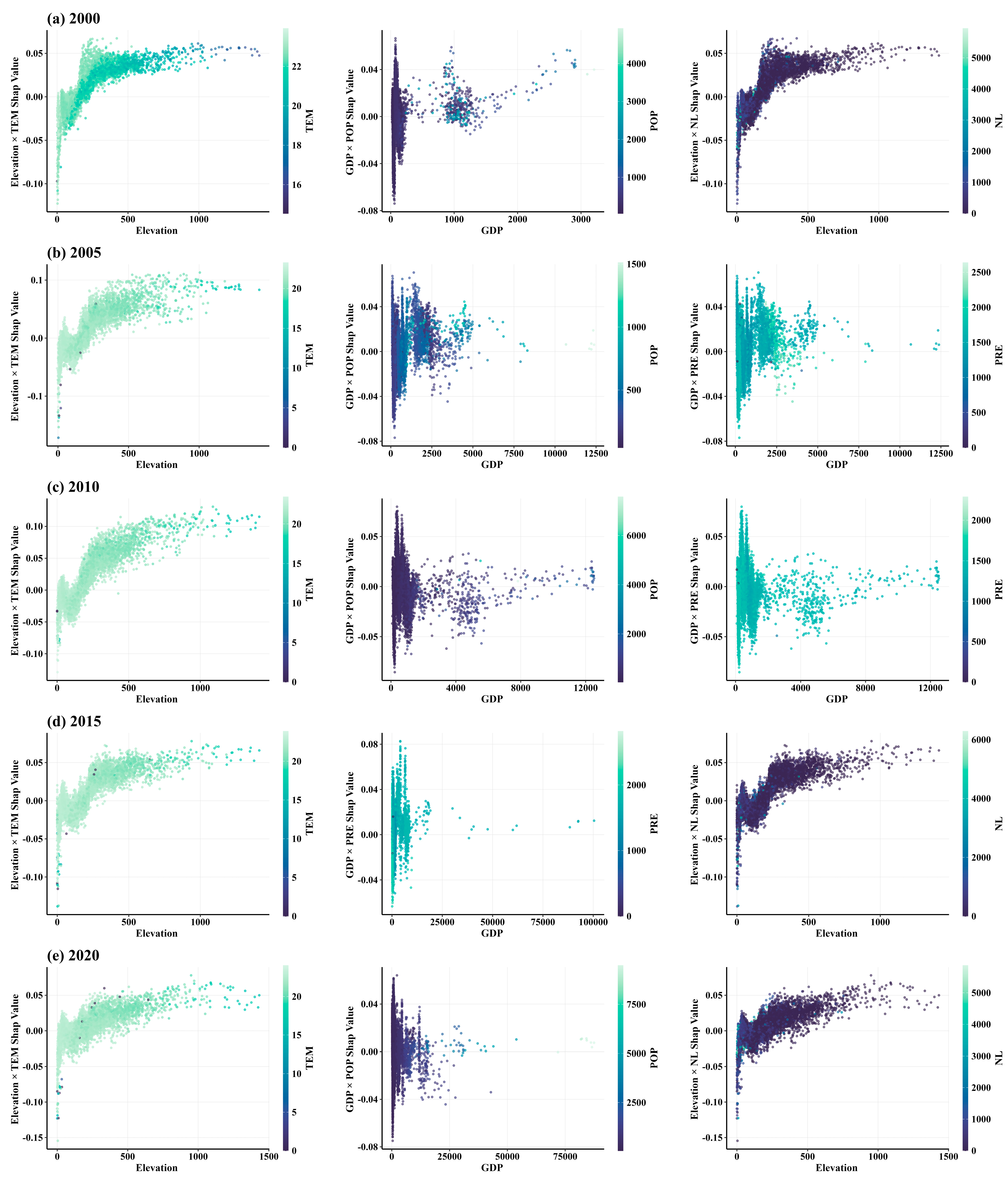
3.3. Driving Factors Analysis
4. Discussion
4.1. Spatiotemporal Analysis of Ecosystem Health in the Pinglu Canal Economic Zone
4.2. Impact of Natural and Social Factors on Ecosystem Health
4.3. Implications and Recommendations for Ecological Conservation and Management
4.4. Limitations and Prospects
5. Conclusions
Author Contributions
Funding
Data Availability Statement
Conflicts of Interest
Abbreviations
| EHI | Ecosystem Health Index |
| EH | Ecosystem Health |
| V | Ecosystem vigor |
| O | Ecosystem organization |
| R | Ecosystem resilience |
| S | Ecosystem services |
| H | Human disturbance |
References
- Costanza, R.; Norton, B.G.; Haskell, B.D. Ecosystem Health: New Goals for Environmental Management. In Ecosystem Health New Goals for Environmental Management; Island Press: Washington, DC, USA, 1992. [Google Scholar]
- Mallee, H. The Evolution of Health as an Ecological Concept. Curr. Opin. Environ. Sustain. 2017, 25, 28–32. [Google Scholar] [CrossRef]
- Ogwu, M.C.; Ojo, A.O.; Alaka, A.C. Biodiversity and Human Health: The Interconnections of Species Loss and Ecosystem Services. In Innovative Approaches in Environmental Health Management: Processes, Technologies, and Strategies for a Sustainable Future; Chibueze Izah, S., Chidozie Ogwu, M., Eds.; Springer Nature: Cham, Switzerland, 2025; pp. 113–141. [Google Scholar]
- Ramanathan, J. Global Warming and Climate Change. In Pathogens and Environmental Impact on Life Forms: Multi-faceted Pathogen Society Interactome; Sethuraman, R., Pandey, R., Eds.; Springer Nature: Cham, Switzerland, 2025; pp. 175–234. ISBN 978-3-031-80029-0. [Google Scholar]
- Habibullah, M.S.; Din, B.H.; Tan, S.-H.; Zahid, H. Impact of Climate Change on Biodiversity Loss: Global Evidence. Environ. Sci. Pollut. Res. 2022, 29, 1073–1086. [Google Scholar] [CrossRef] [PubMed]
- Deng, S.; Luo, M.; Wang, W.; Lan, S.; Xu, W.; Mai, X.; Zhang, W. Assessment of Biodiversity and Landscape Changes during the Pinglu Canal Construction and the Benefits of Ecological Restoration Based on Rao’s Q Index. Ecol. Eng. 2025, 219, 107709. [Google Scholar] [CrossRef]
- Cheng, Y.; Liu, J.; Xu, H.; Zhu, G. Impacts of Pinglu Canal Construction and Its Ecological Route Selection on Landscape Pattern and Suggestions on Environmental Protection. In Proceedings of the 3rd International Conference on Green Energy, Environment and Sustainable Development (GEESD2022), Beijing, China, 29–30 June 2022; IOS Press: Amsterdam, The Netherlands, 2022; pp. 616–627. [Google Scholar]
- Han, Z.; Yin, D.; Zhao, R.; Liu, Z.; Cheng, R.; Lin, G.; Jia, H. The Ecological Effect of Ship Canals on Wetlands. Water 2024, 16, 3324. [Google Scholar] [CrossRef]
- Xie, Y.; Zhang, Y.; Luo, J.; Bi, L.; Tong, K. Spatiotemporal Heterogeneity and Influencing Factors of Human Activity Intensity in the Guangxi Beibu Gulf Zone, China. Environ. Sustain. Indic. 2024, 22, 100372. [Google Scholar] [CrossRef]
- Guo, Y.; Yang, L.; Wang, L.; Li, H.; Ge, Q. Assessment of Ecological Civilization Construction from the Perspective of Environment and Health in China. Eco-Environ. Health 2024, 3, 281–289. [Google Scholar] [CrossRef]
- Lei, J.; Li, C.; Yang, W. Ecosystem Health Assessment and Approaches to Improve Sichuan Province Based on an Improved Vigor Organization Resilience Model. Ecol. Indic. 2023, 155, 110925. [Google Scholar] [CrossRef]
- Du, W.; Tong, S.; Zhang, M.; Xin, Y.; Zhang, D.; Xing, X.; An, Y.; Cui, G.; Liu, G. Revealing the Spatiotemporal Dynamics and Nonlinear Interaction-Driven Mechanisms of Wetland Ecosystem Health in Northeast China Using Interpretable Machine Learning. Ecol. Indic. 2025, 178, 113878. [Google Scholar] [CrossRef]
- Zihui, L.; Kangwen, Z.; Yong, B.; Ya, Z.; Wantao, Y.; Jie, W.; Weizhi, C.; Chunfeng, D.; Kun, Q.; Kaixuan, Z. Rigidity and Resilience Framework-Based Health Diagnosis of Mountain Forest Ecosystems: A Case Study of Yiliang County in Yunnan Province. J. Clean. Prod. 2025, 507, 145569. [Google Scholar] [CrossRef]
- Zhou, X.; Liu, G.; Wu, Y.; Wang, G.; Xu, Y.; Liu, T. XGBoost-SHAP Based Multi-Scale Evaluation and Nonlinear Response of River Health in Guangdong Province. Ecol. Indic. 2025, 178, 114138. [Google Scholar] [CrossRef]
- Xu, K.; Fan, Y.; Hou, Y.; Ma, S.; Wang, J.; Wang, S. Uncovering the Impact Mechanism and Spatiotemporal Evolution between Farmland Ecosystem Health and Optimal Crop Patterns. J. Clean. Prod. 2025, 494, 144959. [Google Scholar] [CrossRef]
- Pang, D.; Zhao, M.; Hu, Y.; Cai, L.; Liu, X.; Zhao, W. Ecosystem Health Assessment and Driver Analysis in the Otindag Sandy Land, China. Ecol. Front. 2025, 45, 1397–1406. [Google Scholar] [CrossRef]
- Wang, Y.; Xue, H.; Li, A.; Ma, X.; Sun, A.; Zhang, J. Spatial-Temporal Differentiation and Influencing Factors of Ecosystem Health in Three-River-Source National Park. Ecol. Indic. 2025, 171, 113183. [Google Scholar] [CrossRef]
- Zhao, Z.; Wei, F.; Wu, H.; Yang, M.; Jin, X.; Wang, P.; Wang, Q. A Framework to Comprehensively Assess Lake Health from a Perspective of Ecosystem Integrity and Services. Ecol. Indic. 2025, 171, 113169. [Google Scholar] [CrossRef]
- Chen, Y.; Yu, X.; Xu, D.; Peng, J. A Spatial Machine Learning Approach to Exploring the Impacts of Coal Mining and Ecological Restoration on Regional Ecosystem Health. Environ. Res. 2025, 264, 120379. [Google Scholar] [CrossRef] [PubMed]
- Wu, K.; Han, L. Assessing Urban Ecosystem Health Using Emergy and Set Pair Analysis: A Comparative Study of Typical Chinese Cities. Ecol. Indic. 2025, 178, 114102. [Google Scholar] [CrossRef]
- Zhao, C.; Shao, N.; Yang, S.; Ren, H.; Ge, Y.; Zhang, Z.; Zhao, Y.; Yin, X. Integrated Assessment of Ecosystem Health Using Multiple Indicator Species. Ecol. Eng. 2019, 130, 157–168. [Google Scholar] [CrossRef]
- Costanza, R. Ecosystem Health and Ecological Engineering. Ecol. Eng. 2012, 45, 24–29. [Google Scholar] [CrossRef]
- Khatun, R.; Das, S. Assessment of Wetland Ecosystem Health in Rarh Region, India through P-S-R (Pressure-State-Response) Model. Sci. Total Environ. 2024, 951, 175700. [Google Scholar] [CrossRef]
- Sahana, M.; Saini, M.; Areendran, G.; Imdad, K.; Sarma, K.; Sajjad, H. Assessing Wetland Ecosystem Health in Sundarban Biosphere Reserve Using Pressure-State-Response Model and Geospatial Techniques. Remote Sens. Appl. Soc. Environ. 2022, 26, 100754. [Google Scholar] [CrossRef]
- Liu, L.; Li, J.; Wang, J.; Liu, F.; Cole, J.; Sha, J.; Jiao, Y.; Zhou, J. The Establishment of an Eco-Environmental Evaluation Model for Southwest China and Eastern South Africa Based on the DPSIR Framework. Ecol. Indic. 2022, 145, 109687. [Google Scholar] [CrossRef]
- Rapport, D.J. What Constitutes Ecosystem Health? Perspect. Biol. Med. 1989, 33, 120–132. [Google Scholar] [CrossRef]
- Lin, X.; Wang, Z.; Bao, Y. Integrating Ecosystem Stress into the Assessment of Ecosystem Health in Karst Areas and Exploring Its Driving Factors. Ecol. Indic. 2024, 167, 112662. [Google Scholar] [CrossRef]
- Das, M.; Das, A.; Mandal, A. Research Note: Ecosystem Health (EH) Assessment of a Rapidly Urbanizing Metropolitan City Region of Eastern India—A Study on Kolkata Metropolitan Area. Landsc. Urban Plan. 2020, 204, 103938. [Google Scholar] [CrossRef]
- Han, P.; Hu, H.; Zhou, J.; Wang, M.; Zhou, Z. Integrating Key Ecosystem Services to Study the Spatio-Temporal Dynamics and Determinants of Ecosystem Health in Wuhan’s Central Urban Area. Ecol. Indic. 2024, 166, 112352. [Google Scholar] [CrossRef]
- Daily, G.C. Nature’s Services: Societal Dependence on Natural Ecosystems (1997). In The Future of Nature: Documents of Global Change; Robin, L., Sörlin, S., Warde, P., Eds.; Yale University Press: New Haven, CT, USA, 2013; pp. 454–464. ISBN 978-0-300-18847-9. [Google Scholar]
- Zang, C.; Liu, J.; Wang, X.; Liu, Q.; Zhang, X. Evaluating Water Ecological Health in Dam-Impacted River: A New Approach Framework. Ecol. Indic. 2024, 161, 111998. [Google Scholar] [CrossRef]
- Xiao, Z.; Liu, R.; Gao, Y.; Yang, Q.; Chen, J. Spatiotemporal Variation Characteristics of Ecosystem Health and Its Driving Mechanism in the Mountains of Southwest China. J. Clean. Prod. 2022, 345, 131138. [Google Scholar] [CrossRef]
- Liu, B.; Ding, M.; Shaham, S.; Rahayu, W.; Farokhi, F.; Lin, Z. When Machine Learning Meets Privacy: A Survey and Outlook. ACM Comput. Surv. 2021, 54, 31. [Google Scholar] [CrossRef]
- Zhou, B.; Chen, G.; Yu, H.; Zhao, J.; Yin, Y. Revealing the Nonlinear Impact of Human Activities and Climate Change on Ecosystem Services in the Karst Region of Southeastern Yunnan Using the XGBoost–SHAP Model. Forests 2024, 15, 1420. [Google Scholar] [CrossRef]
- Liu, X.; Liu, Y.; Wang, S.; Dong, G. New Canal Construction and Marine Emissions Strategy: A Case of Pinglu. Front. Mar. Sci. 2024, 10, 1303879. [Google Scholar] [CrossRef]
- Yin, N.; Qiao, R.; Liang, Z.; Lu, W.; Liu, L.; Ji, J.; Zhong, R.; Yang, F.; Li, J. Identification of Spatial Pathways for Aquatic Ecological Risk Spread under Multi-Stressor Synergies: A Case Study of the Pinglu Canal. Ecol. Indic. 2025, 178, 113915. [Google Scholar] [CrossRef]
- Dang, Z.; Hu, B.; Gao, C.; Wen, S.; Ren, J.; Liang, Y. Construction and Optimization of the Ecological Security Pattern of Pinglu Canal Economic Zone Based on the InVEST-Circuit Theory Model. Land 2025, 14, 1103. [Google Scholar] [CrossRef]
- Wen, S.; Hu, B.; Xie, W.; Gao, C. Land Use Scenario Simulation and Habitat Quality Change in Pinglu River Economic Belt Based on PLUS-InVEST Model. Environ. Sci. 2025, 46, 5122–5133. [Google Scholar] [CrossRef]
- Peng, J.; Liu, Y.; Wu, J.; Lv, H.; Hu, X. Linking Ecosystem Services and Landscape Patterns to Assess Urban Ecosystem Health: A Case Study in Shenzhen City, China. Landsc. Urban Plan. 2015, 143, 56–68. [Google Scholar] [CrossRef]
- Colding, J. ‘Ecological Land-Use Complementation’ for Building Resilience in Urban Ecosystems. Landsc. Urban Plan. 2007, 81, 46–55. [Google Scholar] [CrossRef]
- Li, F.; Zhou, W.; Shao, Z.; Zhou, X.; Fu, X. Landscape Pattern Changes and Ecosystem Health Assessment in the Western Qinling Mountains from 2000 to 2018. Acta Ecol. Sin. 2023, 43, 1338–1352. [Google Scholar] [CrossRef]
- Xie, G.; Zhang, C.; Zhen, L.; Zhang, L. Dynamic Changes in the Value of China’s Ecosystem Services. Ecosyst. Serv. 2017, 26, 146–154. [Google Scholar] [CrossRef]
- Costanza, R.; d’Arge, R.; de Groot, R.; Farber, S.; Grasso, M.; Hannon, B.; Limburg, K.; Naeem, S.; O’Neill, R.V.; Paruelo, J.; et al. The Value of the World’s Ecosystem Services and Natural Capital. Ecol. Econ. 1998, 25, 3–15. [Google Scholar] [CrossRef]
- Zhao, L.; Fan, X.; Xiao, S. Remote-Sensing Indicators and Methods for Coastal-Ecosystem Health Assessment: A Review of Progress, Challenges, and Future Directions. Water 2025, 17, 1971. [Google Scholar] [CrossRef]
- Zhuang Dafang, L.J. Study on the Model of Regional Differentiationof Land Use Degree in China. J. Nat. Resour. 1997, 12, 105–111. [Google Scholar] [CrossRef]
- Saad, R.; Portnov, B.A. Investigating the Relationship Between Nighttime Light Emissions and Economic Growth in European NUTS-3 Regions, 2001–2021. Sustainability 2025, 17, 10287. [Google Scholar] [CrossRef]
- Ye, D.; Yang, L.; Zhou, M. Spatiotemporal Variation in Ecosystem Health and Its Driving Factors in Guizhou Province. Land 2023, 12, 1439. [Google Scholar] [CrossRef]
- Lu, D.; Xu, J.; Yue, W.; Mao, W.; Yang, D.; Wang, J. Response of PM2.5 Pollution to Land Use in China. J. Clean. Prod. 2020, 244, 118741. [Google Scholar] [CrossRef]
- Sen, P.K. Estimates of the Regression Coefficient Based on Kendall’s Tau. J. Am. Stat. Assoc. 1968, 63, 1379–1389. [Google Scholar] [CrossRef]
- Chen, T.; Guestrin, C. XGBoost: A Scalable Tree Boosting System. In Proceedings of the 22nd ACM SIGKDD International Conference on Knowledge Discovery and Data Mining, San Francisco, CA, USA, 13–17 August 2016; pp. 785–794. [Google Scholar] [CrossRef]
- Lundberg, S.; Lee, S.-I. A Unified Approach to Interpreting Model Predictions. Adv. Neural Inf. Process. Syst. 2017, 51, 4768–4777. [Google Scholar]
- Yang, Y.; Chen, J.; Lan, Y.; Zhou, G.; You, H.; Han, X.; Wang, Y.; Shi, X. Landscape Pattern and Ecological Risk Assessment in Guangxi Based on Land Use Change. Int. J. Environ. Res. Public Health 2022, 19, 1595. [Google Scholar] [CrossRef]
- Dou, S.; Zhang, N.; Liu, D.; Jing, J.; Xu, Y.; Gao, H. Exploration of Spatiotemporal Changes of Ecosystem Health in Guangxi BeibuGulf Economic Zone by Coupling of VOR and InVEST Models. Guangxi Sci. 2024, 31, 581–592. [Google Scholar] [CrossRef]
- Hu, Y.; Batunacun; Zhen, L.; Zhuang, D. Assessment of Land-Use and Land-Cover Change in Guangxi, China. Sci. Rep. 2019, 9, 2189. [Google Scholar] [CrossRef]
- Zhang, N.; Dou, S.; Xu, Y.; Jing, J.; Zhang, H. Temporalspatial Changes of Ecosystem Health in Guangxi in the Past 14 Years. J. Guilin Univ. Technol. 2021, 41, 370–378. [Google Scholar]
- Qin, X.; Liu, S.; Ye, Z.; Deng, Y.; Huang, Y. Multifunctional Conflict Identification and Zoning Regulation in Territorial Space of Pinglu Canal Economic Belt. Res. Soil Water Conserv. 2026, 33, 317–329+350. [Google Scholar] [CrossRef]
- Wen, S.; Hu, B.; Bao, T.; Xie, W.; Lao, Y.; Gao, J. Research on the Synergistic Path of Optimisation of Territorial Spatial Functions and Carbon Emissions Reduction: Analysis of Decoupling Effect Based on Pinglu Canal Economic Belt. Ecol. Environ. Sci. 2025, 1–17. [Google Scholar]
- Wang, Z.; Cai, Q.; Zhao, B.; Xu, Y.; Tang, T. Quantification of Spatial Structure for Watershed Ecosystem and the Corresponding Index Systems. J. Earth Sci. Environ. 2021, 1, 135–149. [Google Scholar]
- Álvarez Martínez, J.-M.; Suárez-Seoane, S.; De Luis Calabuig, E. Modelling the Risk of Land Cover Change from Environmental and Socio-Economic Drivers in Heterogeneous and Changing Landscapes: The Role of Uncertainty. Landsc. Urban Plan. 2011, 101, 108–119. [Google Scholar] [CrossRef]
- Sun, F.; Miao, Y.; Xiong, Z. Spatiotemporal Variations and Driving Factors of Ecosystem Health in Anhui Province, China. Environ. Sustain. Indic. 2025, 28, 100935. [Google Scholar] [CrossRef]
- Parmesan, C.; Morecroft, M.D.; Trisurat, Y.; Adrian, R.; Anshari, G.Z.; Arneth, A.; Gao, Q.; Gonzalez, P.; Harris, R.; Price, J.; et al. Terrestrial and Freshwater Ecosystems and Their Services. In Climate Change 2022: Impacts, Adaptation and Vulnerability. Contribution of Working Group II to the Sixth Assessment Report of the Intergovernmental Panel on Climate Change; Pörtner, H.-O., Roberts, D.C., Tignor, M.M.B., Poloczanska, E.S., Mintenbeck, K., Alegría, A., Craig, M., Langsdorf, S., Löschke, S., Möller, V., et al., Eds.; Cambridge University Press: Cambridge, UK; New York, NY, USA, 2022. [Google Scholar]
- Bi, X.; Shi, K.; Fu, Y.; Zhou, W.; Zhao, R.; Bao, H. Influence Mechanism of Natural Factors and Human Socio-Economic Activities on Ecosystem Health in Arid Regions of Central Asia: A Case Study of Fuyun Area, Northwest China. Ecol. Indic. 2025, 173, 113356. [Google Scholar] [CrossRef]
- de Lima, G.T.N.P.; dos Santos Hackbart, V.C.; Bertolo, L.S.; dos Santos, R.F. Identifying Driving Forces of Landscape Changes: Historical Relationships and the Availability of Ecosystem Services in the Atlantic Forest. Ecosyst. Serv. 2016, 22, 11–17. [Google Scholar] [CrossRef]
- Hu, S.; Tang, X. Spatial Polarisation of Extreme Temperature Responses and Its Future Persistence in Guangxi, China: A Multiscale Analysis over 1940–2023. Atmosphere 2025, 16, 1046. [Google Scholar] [CrossRef]




| Data Type | Spatial Resolution | Data Source |
|---|---|---|
| Land Use | 30 m | Resource and Environmental Science and Data Center (https://www.resdc.cn/) (accessed on 24 June 2024) |
| Population Distribution | 1 km | |
| GDP | 1 km | |
| NEP | 500 m | |
| DEM | 30 m | Geospatial Data Cloud (https://www.gscloud.cn/) (accessed on 25 June 2024) |
| Habitat Quality | 30 m | Calculated using the InVEST Habitat Quality model |
| Nighttime Light Data | 1 km | LuoJia-01 website (http://59.175.109.173:8888/app/login.html) (accessed on 24 June 2024) |
| NDVI | MOD13Q1 product, NASA (https://www.earthdata.nasa.gov/) (accessed on 20 March 2024) | |
| Annual Mean Temperature | National Tibetan Plateau Data Center (https://data.tpdc.ac.cn/) (accessed on 15 January 2025) | |
| Annual Precipitation |
| Items | Indicators | Attribute | Descriptions |
|---|---|---|---|
| Vigor | Habitat Quality | + | Higher habitat quality indicates greater ecosystem vitality. |
| NDVI | + | A higher NDVI value suggests stronger ecosystem vitality. | |
| Organization | Shannon’s Diversity Index (SHDI) | + | A higher SHDI value indicates greater heterogeneity and stronger landscape organization. |
| Contagion Index (CONTAG) | + | A high CONTAG value represents good connectivity of a dominant patch type in the landscape, signifying stronger landscape organization. | |
| Patch Cohesion Index (COHESION) | + | A high COHESION index reflects a high aggregation degree of a specific patch type, indicating better connectivity and stronger landscape organization. | |
| Resilience | Resilience Coefficient (RC) | The resilience coefficient is assigned based on the recovery difficulty associated with different land use types. | |
| NEP | + | An NEP > 0 indicates the ecosystem acts as a carbon sink, reflecting better ecosystem resilience, whereas an NEP < 0 denotes a carbon source and suggests poorer resilience. | |
| Ecosystem service | Ecosystem Service Value (ESV) | + | This value measures the capacity of the ecosystem to provide products and services. |
| Human disturbance | Comprehensive Land Use Degree | This index reflects the intensity and extent of human land use. A higher comprehensive land use intensity indicates a greater human disturbance index. | |
| Nighttime Light Index | − | A higher nighttime light index indicates greater intensity of human activities. |
| Types | Cropland | Forest | Grassland | Water | Construction Land | Unused Land |
|---|---|---|---|---|---|---|
| Food Production | 2845.64 | 678.15 | 600.89 | 2060.19 | 0 | 25.75 |
| Raw Materials | 630.93 | 1545.15 | 884.17 | 592.31 | 0 | 77.26 |
| Gas Regulation | 2291.97 | 5090.40 | 8215.03 | 1982.94 | 0 | 51.50 |
| Climate Regulation | 1197.49 | 15,245.44 | 6017.49 | 5897.31 | 0 | 0.00 |
| Hydrological Regulation | 3849.99 | 9725.84 | 6017.49 | 263,292.89 | 0 | 77.26 |
| Environmental Purification | 347.66 | 4463.76 | 2712.59 | 14,292.60 | 0 | 257.52 |
| Soil Retention | 1339.13 | 6206.34 | 3785.61 | 2394.98 | 0 | 180.27 |
| Nutrient Cycling | 399.16 | 472.13 | 291.86 | 180.27 | 0 | 0.00 |
| Biodiversity | 437.79 | 5648.37 | 3442.24 | 6566.87 | 0 | 51.50 |
| Aesthetic Landscape | 193.14 | 2480.82 | 1519.39 | 4867.21 | 0 | 25.75 |
| Type | Unused Land Grade | Forest, Grassland, Waterbody Grade | Agricultural Land Grade | Urban Settlement Land Grade |
|---|---|---|---|---|
| Land Use Type | Unused land or difficult-to-use land | Forest land, grassland, water bodies | Cropland, garden land, artificial grassland | Urban residential land, transportation land |
| Land Use Degree Grade Index | 1 | 2 | 3 | 4 |
| β | Z | Trend Category | Trend Description |
|---|---|---|---|
| β > 0 | 2.58 < Z | 3 | Highly Significant Increase |
| 1.96 < Z ≤ 2.58 | 2 | Significant Increase | |
| Z ≤ 1.96 | 1 | Slight Increase | |
| β = 0 | 0 | No Change | |
| β < 0 | Z ≤ 1.96 | −1 | Slight Decrease |
| 1.96 < Z ≤ 2.58 | −2 | Significant Decrease | |
| 2.58 < Z | −3 | Highly Significant Decrease |
Disclaimer/Publisher’s Note: The statements, opinions and data contained in all publications are solely those of the individual author(s) and contributor(s) and not of MDPI and/or the editor(s). MDPI and/or the editor(s) disclaim responsibility for any injury to people or property resulting from any ideas, methods, instructions or products referred to in the content. |
© 2025 by the authors. Licensee MDPI, Basel, Switzerland. This article is an open access article distributed under the terms and conditions of the Creative Commons Attribution (CC BY) license.
Share and Cite
Huang, Q.; Hu, B.; Xie, Y.; Ruan, R.; Lai, J. Spatiotemporal Variations and Driving Factors of Ecosystem Health in the Pinglu Canal Economic Zone. Land 2026, 15, 85. https://doi.org/10.3390/land15010085
Huang Q, Hu B, Xie Y, Ruan R, Lai J. Spatiotemporal Variations and Driving Factors of Ecosystem Health in the Pinglu Canal Economic Zone. Land. 2026; 15(1):85. https://doi.org/10.3390/land15010085
Chicago/Turabian StyleHuang, Qiuyi, Baoqing Hu, Yuchu Xie, Rujia Ruan, and Jiayang Lai. 2026. "Spatiotemporal Variations and Driving Factors of Ecosystem Health in the Pinglu Canal Economic Zone" Land 15, no. 1: 85. https://doi.org/10.3390/land15010085
APA StyleHuang, Q., Hu, B., Xie, Y., Ruan, R., & Lai, J. (2026). Spatiotemporal Variations and Driving Factors of Ecosystem Health in the Pinglu Canal Economic Zone. Land, 15(1), 85. https://doi.org/10.3390/land15010085