A Novel Dual Comprehensive Study of the Economic and Environmental Effectiveness of Urban Stormwater Management Strategies: A Case Study of Xi’an, China

 ,
,  ,
, 
Abstract
1. Introduction
2. Study Area, Data, and Research Methodology
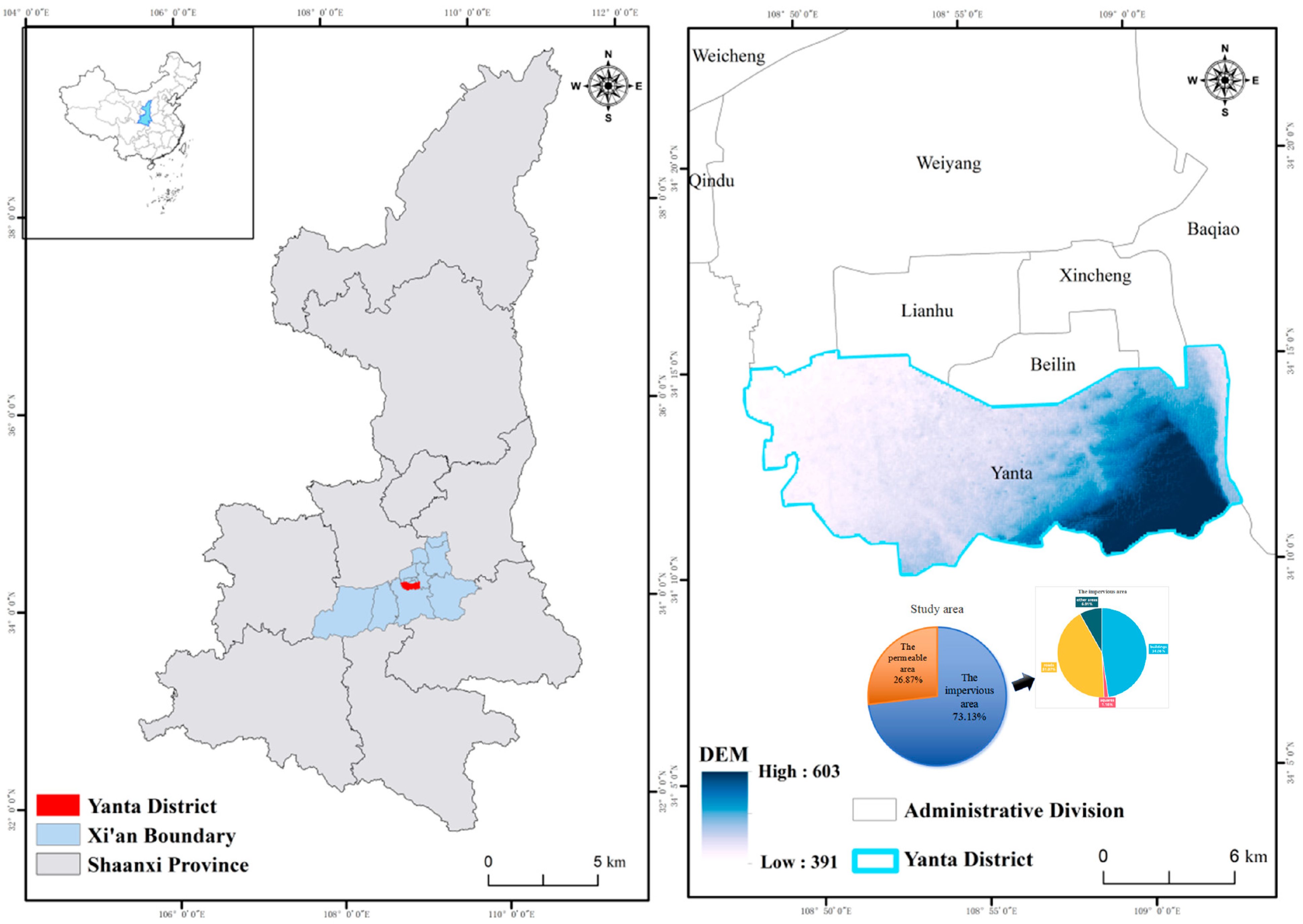
2.1. Study Area
2.2. Analysis of Basic Information in the Study Area
2.2.1. Characterization of Terrain Conditions
2.2.2. Data Sources
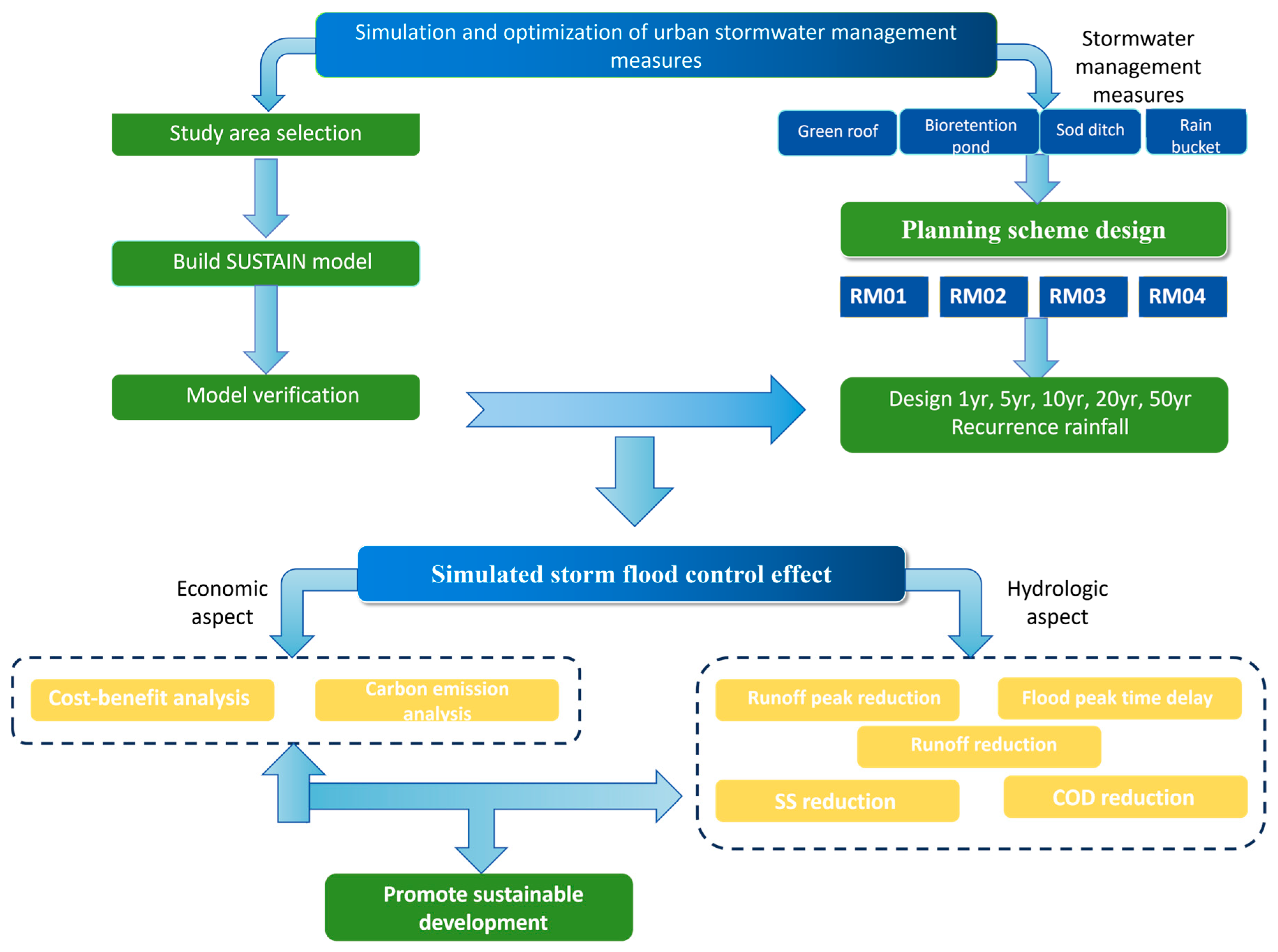
2.3. Research Methodology
2.3.1. Analytic Hierarchy Process
2.3.2. Construction of the SUSTAIN Model
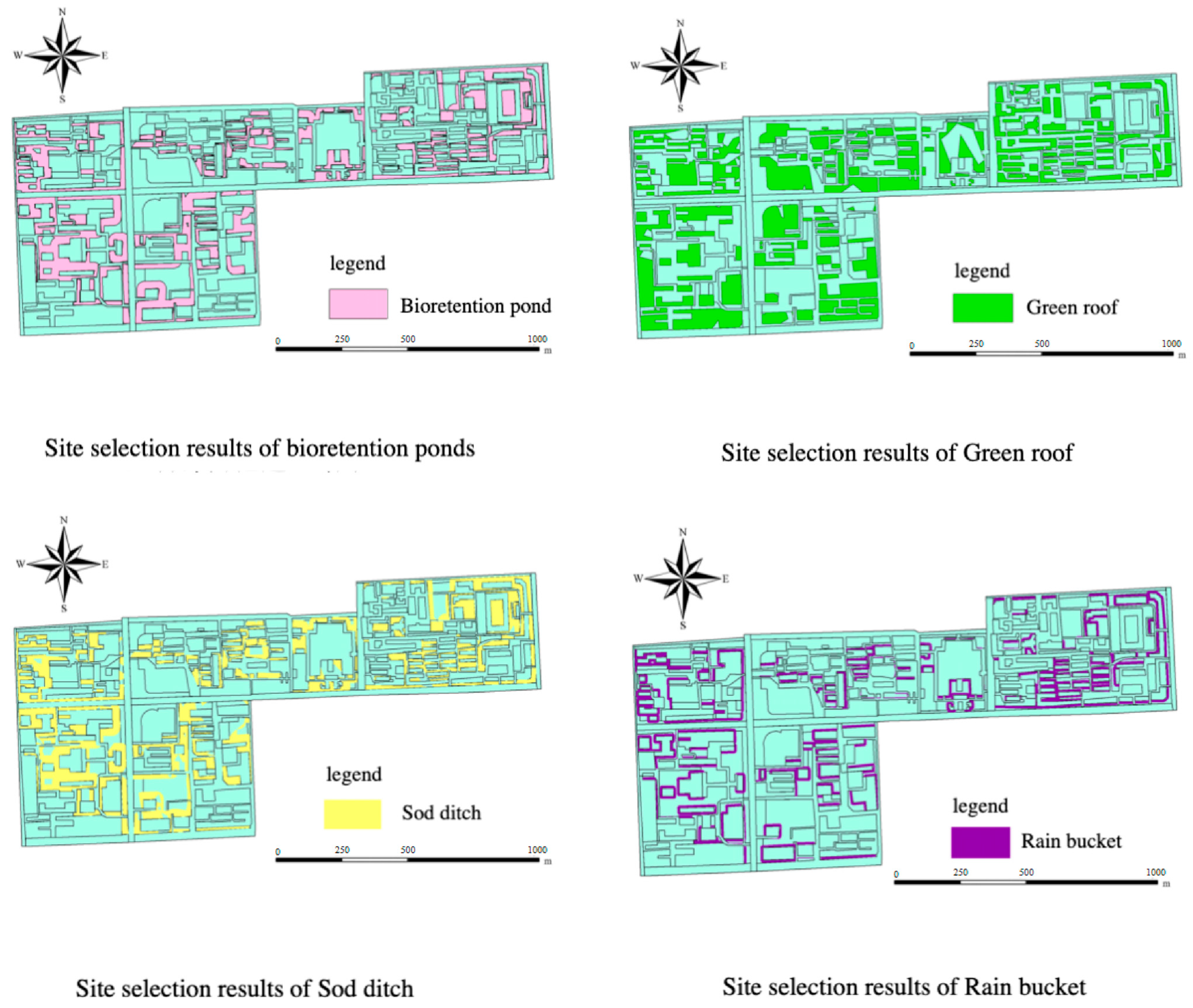
2.3.3. Scenario Construction for Stormwater Management Measures
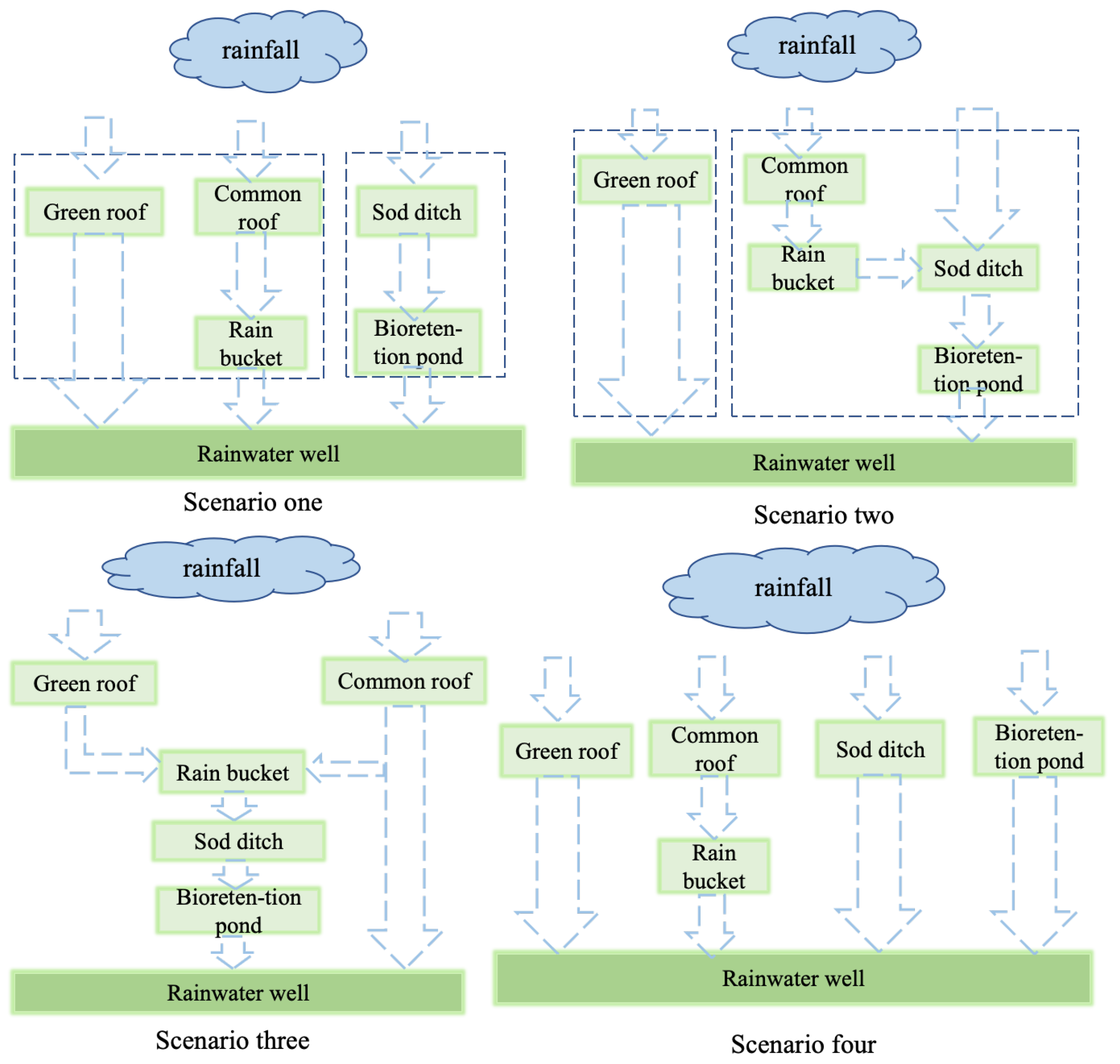
2.3.4. Stormwater Scenario Design
2.3.5. Analysis of Carbon Emission Reductions of the Optimal Scenario
- (1)
- Greenfield carbon sequestration
- (2)
- Building energy efficiency and carbon sequestration
- (3)
- Runoff reduction and sequestration
- (4)
- Rainwater purification and carbon sequestration
3. Results
3.1. Model Validation
3.2. Analysis of Stormwater Control Effectiveness for Different Planning Scenarios
3.3. Analysis of Water Quality Under Different Scenarios
3.4. Cost–Benefit Analysis of Different Planning Options
3.5. Analysis of Carbon Emission Reductions of the Optimal Scenario
4. Discussion
5. Conclusions
Author Contributions
Funding
Data Availability Statement
Conflicts of Interest
References
- Ertan, S.; Çelik, R.N. The Assessment of Urbanization Effect and Sustainable Drainage Solutions on Flood Hazard by GIS. Sustainability 2021, 13, 2293. [Google Scholar] [CrossRef]
- Khan, M.P.; Hubacek, K.; Brubaker, K.L.; Sun, L.; Moglen, G.E. Stormwater Management Adaptation Pathways under Climate Change and Urbanization. J. Sustain. Water Built Environ. 2022, 8, 04022009. [Google Scholar] [CrossRef]
- Jiang, R.; Lu, H.; Yang, K.; Chen, D.; Zhou, J.; Yamazaki, D.; Pan, M.; Li, W.; Xu, N.; Yang, Y.; et al. Substantial increase in future fluvial flood risk projected in China’s major urban agglomerations. Commun. Earth Environ. 2023, 4, 389. [Google Scholar] [CrossRef]
- Qin, X.; Wang, S.; Meng, M.; Long, H.; Zhang, H.; Shi, H. Enhancing urban resilience through machine learning-supported flood risk assessment: Integrating flood susceptibility with building function vulnerability. npj Urban Sustain. 2025, 5, 19. [Google Scholar] [CrossRef]
- Liu, Y.; Zhao, W.; Wei, Y.; Sebastian, F.S.M.; Wang, M. Urban waterlogging control: A novel method to urban drainage pipes reconstruction, systematic and automated. J. Clean. Prod. 2023, 418, 137950. [Google Scholar] [CrossRef]
- Ayzel, G.; Heistermann, M. Brief communication: Training of AI-based nowcasting models for rainfall early warning should take into account user requirements. Nat. Hazards Earth Syst. Sci. 2025, 25, 41–47. [Google Scholar] [CrossRef]
- Chang, L.C.; Yang, M.T.; Chang, F.J. Flood resilience through hybrid deep learning: Advanced forecasting for Taipei’s urban drainage system. J. Environ. Manag. 2025, 379, 124835. [Google Scholar] [CrossRef]
- Cortes, C.E.; Saez, D.; Milla, F.; Nunez, A.; Riquelme, M. Hybrid predictive control for real-time optimization of public transport systems’ operations based on evolutionary multi-objective optimization. Transp. Res. Part C 2010, 18, 757–769. [Google Scholar] [CrossRef]
- Roozbahani, A.; Roghani, B.; Nilsen, V.; Paus, K.A.H.; Rydningen, U. Optimization of urban stormwater systems: A multi-criteria approach to sustainable and cost-effective LID implementation. Water Sci. Technol. 2025, 91, 654–668. [Google Scholar] [CrossRef] [PubMed]
- Park, K.; Lee, M.H. The development and application of the urban flood risk assessment model for reflecting upon urban planning elements. Water 2019, 11, 920. [Google Scholar] [CrossRef]
- Tan, Y.; Cheng, Q.; Lyu, F.; Liu, F.; Liu, L.; Su, Y.; Yuan, S.; Xiao, W.; Liu, Z.; Chen, Y. Hydrological reduction and control effect evaluation of sponge city construction based on one-way coupling model of swmm-fvcom: A case in university campus. J. Environ. Manag. 2024, 349, 119599. [Google Scholar] [CrossRef]
- Jiang, Y.; Zevenbergen, C.; Ma, Y. Urban pluvial flooding and stormwater management: A contemporary review of China’s challenges and “sponge cities” strategy. Environ. Sci. Policy 2018, 80, 132–143. [Google Scholar] [CrossRef]
- Jun, X.; Yongyong, Z.; Lihua, X.; Shan, H.E.; Longfeng, W.; Zhongbo, Y.U. Opportunities and challenges of the sponge city construction related to urban water issues in china. Sci. China Earth Sci. 2017, 60, 652–658. [Google Scholar] [CrossRef]
- Sun, L.; Xia, J.; She, D.; Ding, W.; Jiang, J.; Liu, B.; Zhao, F. A predictive fuzzy logic and rule-based control approach for practical real-time operation of urban stormwater storage system. Water Res. 2024, 266, 122437. [Google Scholar] [CrossRef] [PubMed]
- Matthews, T.; Lo, A.; Byrne, J. Reconceptualizing green infrastructure for climate change adaptation: Barriers to adoption and drivers for uptake by spatial planners. Landsc. Urban Plan. 2015, 138, 155–163. [Google Scholar] [CrossRef]
- Balado, J.; Solla, M. Multi-criteria GIS for sponge city planning with open data sources in Vigo (Spain). ISPRS Ann. Photogramm. Remote Sens. Spat. Inf. Sci. 2024, 10, 41–48. [Google Scholar] [CrossRef]
- Villari, A.; Hamed, M.M.M. Landscape Architects’ Role in Mitigating Coastal Climate Change. In Networks, Markets & People; International Symposium: New Metropolitan Perspectives; Springer Nature: Cham, Switzerland, 2024; pp. 356–367. [Google Scholar]
- Li, L.; Chan, F.; Cheshmehzangi, A. Nature-based solutions and sponge city for urban water management. In Adapting the Built Environment for Climate Change; Woodhead Publishing: Sawston, UK, 2023; pp. 371–402. [Google Scholar]
- Li, Q.; Wang, F.; Yu, Y.; Huang, Z.; Li, M.; Guan, Y. Comprehensive performance evaluation of LID practices for the sponge city construction: A case study in Guangxi, China. J. Environ. Manag. 2019, 231, 10–20. [Google Scholar] [CrossRef]
- Baidu Baike. Available online: https://www.baidu.com/?tn=40020637_25_oem_dg (accessed on 20 November 2025).
- Li, Z.; Wang, X.; Zhao, H.; Xu, X. Spatiotemporal Patterns of the Evolution of the Urban Heat Island Effect and Population Heat Exposure Risks in Xi’an, One of China’s Megacities, from 2003 to 2023. Land 2025, 14, 2021. [Google Scholar] [CrossRef]
- Yang, K.; Zhang, Q.; Liang, B.; Lin, Q.; Wang, W. Combination of multivariate statistical analysis and inverse mixing modeling to unravel the solute sources and hydrological processes in a typical small urbanized watershed. Stoch. Environ. Res. Risk Assess. 2025, 39, 3045–3062. [Google Scholar] [CrossRef]
- Lin, W. Research on the Planning of Campus Stormwater Management Measures Based on SUSTAIN Model. Master’s Thesis, Fujian Agriculture and Forestry University, Fuzhou, China, 2016. (In Chinese) [Google Scholar]
- Hu, J. Geotechnical engineering evaluation of an engineering survey in Guanzhong area, Shaanxi. Shanxi Constr. 2013, 39, 64–66. (In Chinese) [Google Scholar]
- Available online: https://dfz.shaanxi.gov.cn/zslm/fzzlk/sxnj/ (accessed on 18 November 2025).
- Available online: https://www.gscloud.cn/ (accessed on 18 November 2025).
- Dadrasajirlou, Y.; Karami, H.; Mirjalili, S. Using ahp-promothee for selection of best low-impact development designs for urban flood mitigation. Water Resour. Manag. 2023, 37, 375–402. [Google Scholar] [CrossRef]
- Awasthi, A.; Chauhan, S.S. A hybrid approach integrating affinity diagram, ahp and fuzzy topsis for sustainable city logistics planning. Appl. Math. Model. 2012, 36, 573–584. [Google Scholar] [CrossRef]
- Yang, S.H.; Rhee, J.S. A study on evaluating national regulations on automated deci-sion-making and profiling using mcdm and ahp techniques. Asia Pac. J. Converg. Res. Interchange 2025, 11, 531–546. [Google Scholar] [CrossRef]
- Charchousi, D.; Papadopoulou, M. An uncertainty analysis approach for ecosystem sustainability based on groundwater footprint. In E-Proceedings of the 38th IAHR World Congress, September; IAHR: Madrid, Spain, 2019; pp. 1–6. [Google Scholar]
- Rabbaniha, H.; Ebrahimian, H. Developing a simple method for estimating soil infiltration in furrow and border irrigation using advance, recession and runoff data. Irrig. Drain. 2024, 73, 50–63. [Google Scholar] [CrossRef]
- Shaban, A.; Hage, M.E.; Farhat, N. Gis-based multifactor analysis for positioning water harvesting sites integrated with managed aquifer recharge. Acta Geophys. 2025, 73, 2935–2954. [Google Scholar] [CrossRef]
- Farina, A.; Di Nardo, A.; Gargano, R.; van der Werf, J.A.; Greco, R. A simplified approach for the hydrological simulation of urban drainage systems with SWMM. J. Hydrol. 2023, 623, 129757. [Google Scholar] [CrossRef]
- Su, H. Research on Urban Rainwater Flood Simulation Based on SWMM Model. Master’s Thesis, Xi’an University of Technology, Xi’an, China, 2018. (In Chinese) [Google Scholar]
- Chen, M.; Li, W.; Dong, Z.; Zhang, D. Characterization of silica sand-based pervious bricks and their performance under stormwater treatment. Water 2024, 16, 2625. [Google Scholar] [CrossRef]
- Lu, Q. Analysis on the Effect of LID Stormwater Regulation and Optimization of Sponge Campus Under Different Rainfall Patterns. Master’s Thesis, Chang’an University, Xi’an, China, 2021. (In Chinese) [Google Scholar]
- Notaro, V.; Fontanazza, C.M.; La Loggia, G.; Freni, G. Flood frequency analysis for an urban watershed: Comparison between several statistical methodologies simulating synthetic rainfall events. J. Flood Risk Manag. 2018, 11, S559–S574. [Google Scholar] [CrossRef]
- Zhao, Z.; Huo, A.; Liu, Q.; Yang, L.; Luo, C.; Ahmed, A.; Elbeltagi, A. Assessment of urban inundation and prediction of combined flood disaster in the middle reaches of Yellow river basin under extreme precipitation. J. Hydrol. 2024, 640, 131707. [Google Scholar] [CrossRef]
- Zhang, X.; Chen, P.; Dai, S.; Han, Y.; Chang, X. Urban HydroConnect: Harnessing SWMM for Dynamic Waterway Management Assessment. Water Resour. Manag. 2024, 38, 4473–4498. [Google Scholar] [CrossRef]
- Anderson, M.; Lambrinos, J.; Schroll, E. The potential value of mosses for stormwater management in urban environments. Urban. Ecosyst. 2010, 13, 319–332. [Google Scholar] [CrossRef]
- Rastelli, E.; Corinaldesi, C.; Dell’anno, A.; Tangherlini, M.; Martorelli, E.; Ingrassia, M.; Chiocci, F.; Martire, M.; Danovaro, R. High potential for temperate viruses to drive carbon cycling in chemoautotrophy-dominated shallow-water hydrothermal vents. Environ. Microbiol. 2017, 19, 4432–4446. [Google Scholar] [CrossRef]
- Su, J.; Li, J.; Gao, X.; Yao, Y.; Jiang, C. Comprehensive analysis of waterlogging control and carbon emission reduction for optimal lid layout: A case study in campus. Environ. Sci. Pollut. Res. 2022, 29, 87802–87816. [Google Scholar] [CrossRef]
- Kamali, M.; Delkash, M.; Tajrishy, M. Evaluation of permeable pavement responses to urban surface runoff. J. Environ. Manag. 2017, 187, 43–53. [Google Scholar] [CrossRef] [PubMed]
- Lin, X.; Ren, J.; Xu, J.; Zheng, T.; Cheng, W.; Qiao, J.; Ju, H.; Li, G. Prediction of life cycle carbon emissions of sponge city projects: A case study in Shanghai, China. Sustainability 2018, 10, 3978. [Google Scholar] [CrossRef]
- Gao, K.; Yang, H.; Zhao, Q.; Liu, H. Identification of key basic parameters involved in carbon emissions in full-scale wastewater treatment plants. Sustainability 2023, 15, 7225. [Google Scholar] [CrossRef]
- Gupta, H.V.; Kling, H.; Yilmaz, K.K.; Martinez, G.F. Decomposition of the mean squared error and NSE performance criteria: Implications for improving hydrological modelling. J. Hydrol. 2009, 377, 80–91. [Google Scholar] [CrossRef]
- Hoyle, M.; Crathorne, L.; Peters, J.; Jones-Hughes, T.; Hyde, C. The clinical effectiveness and cost-effectiveness of cetuximab (mono- or combination chemotherapy), bevacizumab (combination with non-oxaliplatin chemotherapy) and panitumumab (monotherapy) for the treatment of metastatic colorectal cancer after first-line. Health Technol. Assess. 2013, 17, 1–237. [Google Scholar] [CrossRef]
- Verma, S.; Pant, M.; Snasel, V. A comprehensive review on NSGA-II for multi-objective combinatorial optimization problems. IEEE access 2021, 9, 57757–57791. [Google Scholar] [CrossRef]
- Kwak, N.; Smith, V.; Good, K.D. Assessing the influence of green stormwater infrastructure implemented for combined sewer overflow control on urban streamflows. J. Hydrol. 2024, 640, 14. [Google Scholar] [CrossRef]
- Al-Zubaidi, E.D.A.; Ismael, H.A.A.; Abdulrahman, M.M.; Tawfeq, J.F.; Sutar, P.; Bandyopadhyay, D.; Kshirsagar, M.; Shah, P.; Sekhar, R. Revolutionizing urban water management: A green-aware study based on innovative approach. Int. J. Sustain. Dev. Plan. 2024, 19, 4563–4572. [Google Scholar] [CrossRef]
- Sapkale, H.C.; Sonawane, M.A. The role of urban agriculture in food security: A study on entrepreneurial strategies for sustainable food systems. Int. J. Adv. Res. Commerce. Manag. Social. Sci. 2024, 7, 158–162. [Google Scholar] [CrossRef]
- Muschalla, D. Optimization of integrated urban wastewater systems using multi-objective evolution strategies. Urban Water J. 2008, 5, 59–67. [Google Scholar] [CrossRef]
- Choudhary, M.; Ray, S. Sustainable wastewater management: Exploring nature-based treatment. Int. J. Environ. Sci. 2024, 15, 63–69. [Google Scholar] [CrossRef]
- Abduljaleel, Y. Evaluate the use of wetland performance includes multi-scale tests to emphasize the runoff control volume based on climate change adaptation strategy. In EGU General Assembly Conference Abstracts; European Geosciences Union: Munich, Germany, 2021; p. EGU21–8143. [Google Scholar]
- Ambily, P.; Chithra, N.R.; Mohammed, F.C. A novel framework for prioritization and spatial suitability assessment of blue-green infrastructure for urban pluvial flood resilience. J. Hydrol. 2025, 655, 132976. [Google Scholar] [CrossRef]
- Thaler, T.; Slavikova, L.; Hartmann, T. Nature-based solutions in flood risk management. Wiley Interdiscip. Rev Water 2025, 12, e70006. [Google Scholar] [CrossRef]
- Maulana, P.D.; Koestoer, R.H.S.; Karuniasa, M. Public policies on sustainable flood risk management: Study cases of the netherlands and malawi. ASEAN Nat. Disaster Mitig. Educ. J. 2024, 2, 1–23. [Google Scholar] [CrossRef]







| No. | Parameter Name | Optimal Value |
|---|---|---|
| 1 | Manning’s coefficient of impervious area | 0.015 |
| 2 | Manning’s coefficient for previous areas | 0.15 |
| 3 | Impervious Zone Pit Storage Depth | 0.6 |
| 4 | Deposit depth in the permeable area | 1.2 |
| 5 | Maximum infiltration rate (mm/h) | 66.04 |
| 6 | Minimum infiltration rate (mm/h) | 31.5 |
| 7 | Osmotic decay constant (1/hr) | 7 |
| 8 | Days to complete drying | 6 |
| 9 | Maximum infiltration (mm) | 304.8 |
| Pollutants | Plan | 1 yr | 5 yr | 10 yr | 20 yr | 50 yr |
|---|---|---|---|---|---|---|
| SS | Scenario 1 | 82.49 | 63.34 | 55.13 | 49.04 | 45.92 |
| Scenario 2 | 84.23 | 65.30 | 56.42 | 49.88 | 46.81 | |
| Scenario 3 | 87.11 | 67.02 | 59.54 | 51.71 | 48.36 | |
| Scenario 4 | 81.51 | 62.58 | 53.79 | 48.66 | 44.24 | |
| COD | Scenario 1 | 83.17 | 60.89 | 52.03 | 44.89 | 42.15 |
| Scenario 2 | 83.59 | 61.05 | 52.55 | 45.76 | 42.36 | |
| Scenario 3 | 85.46 | 63.85 | 54.42 | 48.33 | 43.78 | |
| Scenario 4 | 81.16 | 58.77 | 51.48 | 42.53 | 41.85 |
| Stormwater Management Measures | Decision Variables | Scope of Change |
|---|---|---|
| Rainwater tank | Caliber | 0~1.8 m |
| High degree | 0.6~1.8 m | |
| Green roof | Soil substrate thickness | 0.1–1 m |
| Bioretention pond | Lengths | 0~Maximum Length |
| Total depth | 0.3~1.5 m | |
| Soil substrate depth | 0.1~1 m | |
| Sod ditch | Lengths | 0~Maximum Length |
| Allocation Ratio (%) | Construction Area (km2) | Cost (CNY 10,000) | Cost Share (%) | |
|---|---|---|---|---|
| green roof | 36.29 | 0.131 | 1965 | 29.20 |
| bioretention pond | 30.19 | 0.109 | 3488 | 51.84 |
| sod ditch | 23.27 | 0.084 | 924 | 13.73 |
| rain bucket | 10.25 | 0.037 | 351.5 | 5.23 |
| Greenfield Carbon Sequestration | Building Energy Efficiency and Carbon Sequestration | Runoff Reduction Sequestration | Rainwater Purification and Carbon Sequestration | (Grand) Total | |
|---|---|---|---|---|---|
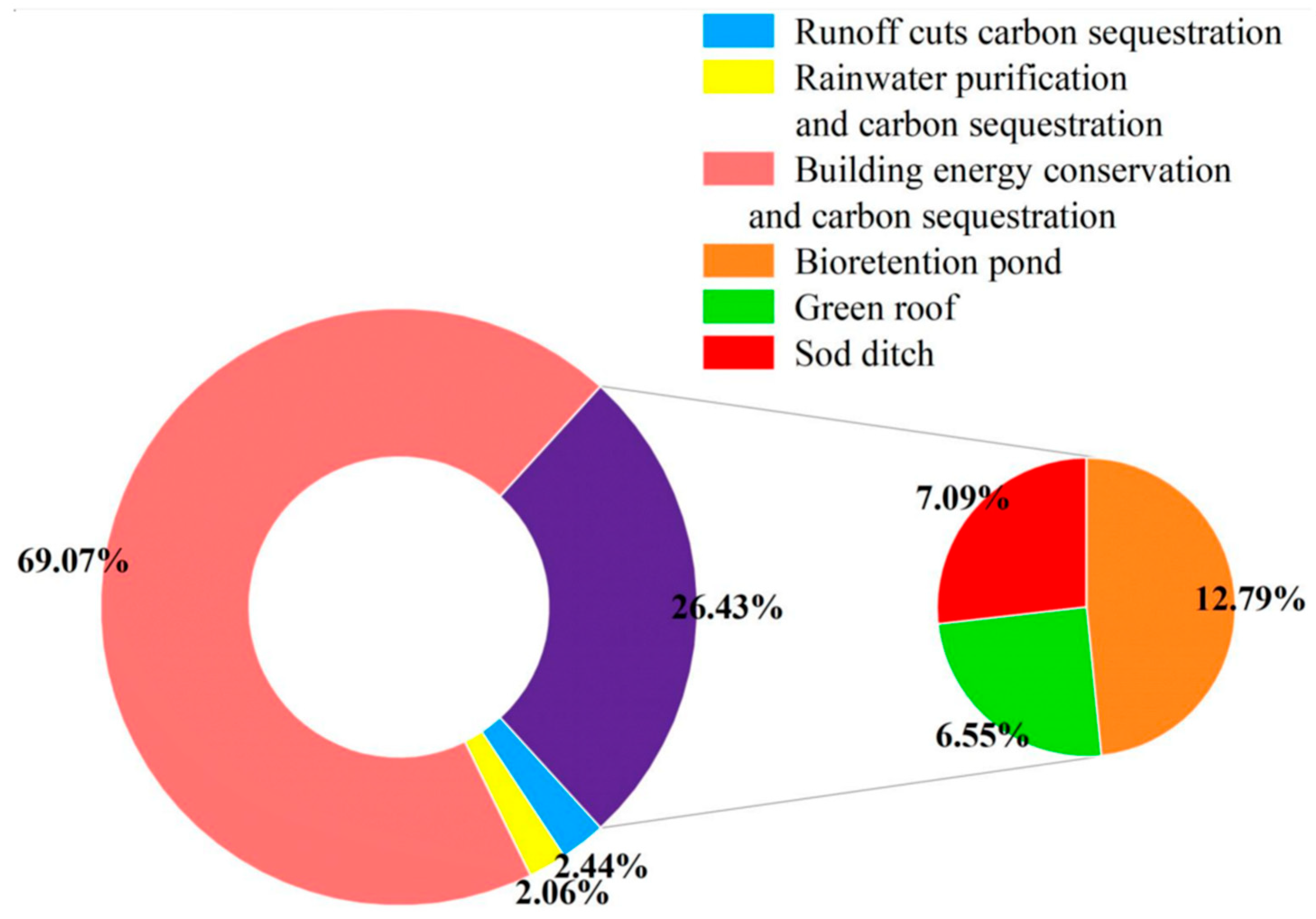
| Carbon emission reduction (t/yr) | 50.13 | 131.03 | 4.63 | 3.91 | 189.70 |
Disclaimer/Publisher’s Note: The statements, opinions and data contained in all publications are solely those of the individual author(s) and contributor(s) and not of MDPI and/or the editor(s). MDPI and/or the editor(s) disclaim responsibility for any injury to people or property resulting from any ideas, methods, instructions or products referred to in the content. |
© 2025 by the authors. Licensee MDPI, Basel, Switzerland. This article is an open access article distributed under the terms and conditions of the Creative Commons Attribution (CC BY) license.
Share and Cite
Luo, P.; Hou, Y.; Niu, Y.; Hu, M.; He, B.; Subehi, L.; Fida, F. A Novel Dual Comprehensive Study of the Economic and Environmental Effectiveness of Urban Stormwater Management Strategies: A Case Study of Xi’an, China. Land 2026, 15, 75. https://doi.org/10.3390/land15010075
Luo P, Hou Y, Niu Y, Hu M, He B, Subehi L, Fida F. A Novel Dual Comprehensive Study of the Economic and Environmental Effectiveness of Urban Stormwater Management Strategies: A Case Study of Xi’an, China. Land. 2026; 15(1):75. https://doi.org/10.3390/land15010075
Chicago/Turabian StyleLuo, Pingping, Yaqiong Hou, Yachao Niu, Maochuan Hu, Bin He, Luki Subehi, and Fatima Fida. 2026. "A Novel Dual Comprehensive Study of the Economic and Environmental Effectiveness of Urban Stormwater Management Strategies: A Case Study of Xi’an, China" Land 15, no. 1: 75. https://doi.org/10.3390/land15010075
APA StyleLuo, P., Hou, Y., Niu, Y., Hu, M., He, B., Subehi, L., & Fida, F. (2026). A Novel Dual Comprehensive Study of the Economic and Environmental Effectiveness of Urban Stormwater Management Strategies: A Case Study of Xi’an, China. Land, 15(1), 75. https://doi.org/10.3390/land15010075