Article

Spatiotemporal Evolution and the Impact of Changing Political–Economic Systems on Tourism Spatial Planning and Land Use: The Case of Kupari, Dubrovnik, Croatia

1
Temedica, Bayerstraße 69, 80335 Munich, Germany
2
Institute for Tourism, Vrhovec 5, 10000 Zagreb, Croatia
3
Department for Urbanism, Spatial Planning and Environmental Protection in Dubrovnik, Pred Dvorom 1, 20000 Dubrovnik, Croatia
*
Author to whom correspondence should be addressed.
Land 2026, 15(1), 41; https://doi.org/10.3390/land15010041
Submission received: 29 August 2025 / Revised: 9 December 2025 / Accepted: 19 December 2025 / Published: 24 December 2025
(This article belongs to the Special Issue Spatial-Temporal Evolution Analysis of Land Use)

Abstract

Existing research on tourism spatial planning primarily focuses on different political and economic systems (PESs)—but most often within capitalist democracies. However, there is a lack of research examining how frequent changes in PESs (capitalism, socialism and recapitalism) act as critical points, as they affect tourism spatial planning legislation, land use and spatial management. By analysing the spatiotemporal evolution of the Kupari tourist zone in Croatia (1880–2024), we investigate how PES changes act as critical turning points that shape tourism spatial planning and administrative practices. Key results reveal that tourism recovery and resilience are closely linked to the stability of PESs. Frequent PES changes (1) reduce the overall resilience of tourism and its institutions, (2) lead to recurring changes in tourism spatial planning legislation (e.g., ownership and land use) and (3) disrupt the positive correlation between space and tourism development. Frequent changes in PESs are reflected in legislation, as well as in challenges of compromise for issues closely related to tourism and spatial management. Only a stable PES can enable continuous monitoring of legislation and its spatial consequences in real time. An integrated methodology for monitoring legislation, together with a framework for spatial management, offers practical solutions for the sustainable management of tourist areas. These findings provide both scientific evidence and practical strategies for better harmonization of legislation with the resilience of tourism spatial planning on the eastern coast of the Adriatic Sea.

1. Introduction

The relationship between spatial planning and tourism in capitalist democracies has been widely researched, with increasing emphasis on achieving spatial resilience through optimal use of land (as a limited resource) while simultaneously ensuring economic growth and job creation through the tourism industry [1,2]. However, much less research has been done on how this relationship looks in other types of political and economic systems (PESs), such as socialist one-party or monarchical autocracies. As a result, there is limited research that tracks changes in PESs—in terms of transitions from one economic, political and social system to another and how these affect spatial planning and land use in relation to tourism [3,4,5]. Existing research has, so far, failed to provide a coherent theoretical framework for studying changes in PESs.
Our analysis has far-reaching implications because it aims to show how changes in a PES represent structural breaks in the framework of spatial planning and land use that divert the development of economic sectors such as tourism from the path set in the past. While this opens opportunities for policy makers, investors and local communities to effect change, we also show that any transition presents significant challenges for key actors involved in implementation. Changes in a PES disrupt existing balances—political systems, territorial–administrative organization and laws change, which is a problem for public administration, investors and policy makers, as they must implement projects following the new rules of the game [6,7]. The closer the relationship between the new PES and political, economic and organizational institutions, the larger and more comprehensive the interruptions in the spatial planning system and the more they affect overall development.
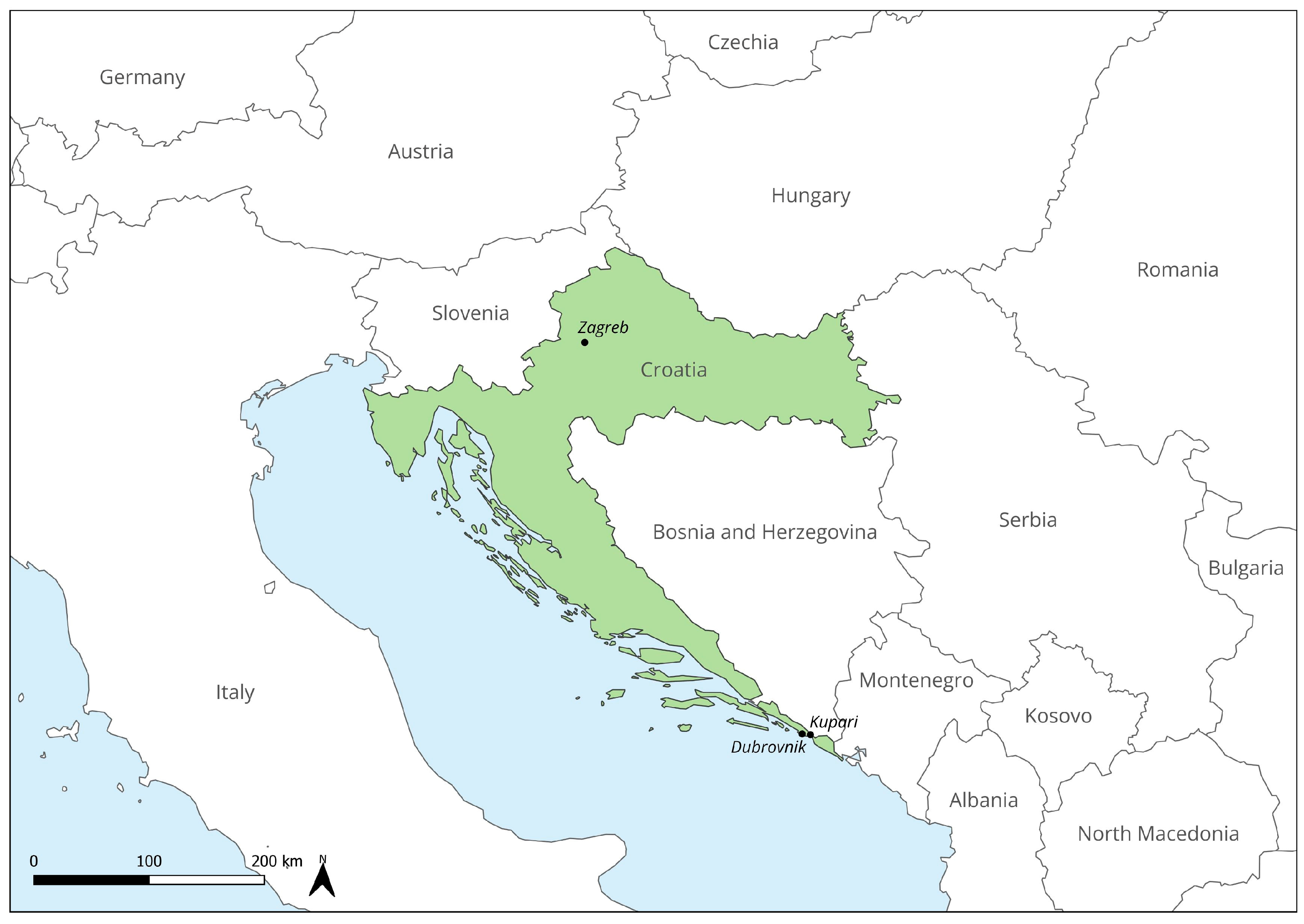
For empirical data on the effects changes in a PES on spatial planning, we turn to contemporary Croatia—specifically, the Kupari tourist resort in the Dubrovnik region, located in Central and Southeastern Europe. The Kupari resort was conceived in the 1880s and, therefore, has a history spanning more than a century. During the 20th century, Central and Southeastern Europe witnessed several changes in the PES—the collapse of multinational empires; the formation of new monarchies and nation states; the rise of Nazism and socialism; and, finally, the introduction of capitalist democracies. These changes in the PES led to the transformation of socioeconomic and political paradigms, opening new paths of development and enacting new laws. Moreover, tourism had already become an important branch of the economy in modern Croatia during the period of Yugoslav socialism, and its importance increased further after Croatia became an independent democracy. The Dubrovnik area is world-famous for its UNESCO-protected medieval walls, and tourists from all over the world flock to visit it, ensuring that tourism receives priority treatment from politicians but also putting pressure on spatial planning and land use. Therefore, the case study of the Kupari resort in Southeastern Europe offers a suitable case to test how and why spatial planning in the tourism sector adapts to changes in the PES.
The aim of this paper is to investigate whether frequent changes in the PES affect the recovery and resilience of spatial planning for tourism and its institutions, as well as legislation, and whether such changes can disrupt the quality of the relationship between space and tourism.
Therefore, the article is structured as follows. Section 1 presents an introduction to the research. Section 2 refers to the theoretical framework and relevant literature. Section 3 refers to the methodology and data. Section 4 refers to the impact of the PES on the development of the tourist resort of Kupari divided according to socioeconomic systems. Section 5 presents a discussion, and Section 6 draws conclusions and outlines directions for future research.

2. Theoretical Framework and Literature Review

In academic literature, spatial planning and land use are most often considered through their applications in practice [8]. Certain researchers consider land use planning and land use from the economic perspective, i.e., through a transaction-cost theory [9]. Given that land is a limited resource, the system of land use (policy, planning and use), in addition to being related to the economy and society (social justice, public goods and interest, personal integrity, etc.), is also related to environmental sustainability.
Although the comparison of spatial planning and land use concepts and systems of different countries is possible using planning decisions (planning concept, evaluation of the implementation, evaluation of the administration, etc.), it is not an easy process due to differences in historical, political, social and economic circumstances and a lack of multi-layered criteria for evaluation of land use implementation [10]. Even when a political system changes (but the economic system is kept—for example, capitalism), land use evaluation comparison is difficult because of a lack of multi-layered criteria [11]. This indicates that a rational yet flexible and fair implementation of spatial and land use planning requires, in practice, an understanding of the essence and purpose of the two [12].
Against this background, we research how spatial planning legislation and implementation change through time within the same geographical space. In doing so, we analyse legislation and its implementation. We rely on the theoretical framework of historical institutionalism, which suggests that, once established, institutional patterns tend to persist [13,14,15]. Once the PES changes, institutions tend to reproduce themselves, even when the intention of policy makers is to change them. Abrupt reforms occur as a result of so-called critical moments or shocks that destabilize the existing equilibrium. Reforms that occur between periods of critical moments can be characterized as gradual and incremental changes. According to historical institutionalism, reforms of spatial planning and land use policies depend on the historical path that led to the current state.
This approach has already been employed to study the intersection of politics, economy, spatial planning and land use policy across longer periods of time in various contexts. Petursson and Vedeld [16] showed that protected-area regimes represent the most enduring, path-dependent institutions, exemplifying continuity throughout major societal transformations while being conducive to the interest of political elites. Also focusing on nature conservation, Yakusheva [17] showed it was the legacy of pre-socialism, strengthened during the socialist period, that affected the management capacities of national parks in Poland and Slovakia. Land reforms and management approaches have been also found to be strongly embedded in structural conditions and global processes, driven by technological and economic drivers [10,18].
Building on this literature, we argue that PES changes represent important critical junctures, punctuating the establishing equilibria [14]. In the aftermath of a critical juncture, a PES is built on existing formal and informal institutions as institutional patterns continue their reproduction. We expect that spatial planning, land use and tourism institutions, once established, will exhibit a tendency to reproduce themselves. Our theoretical contribution focuses on the measurement of the effects of PES change. We hypothesize that PES changes result in opportunities for dramatic changes—the more drastic a PES change, the larger the changes in the systems of spatial planning and land use. However, despite even the most drastic PES changes, certain ideas and structures from earlier PESs will tend to reproduce, albeit adapted to the new conditions.

3. Methodology and Data

There is no research on the evolution of the Kupari resort across spatiotemporal evolution. To understand how PES changes affect this specific resort case, we collected data through archival research and the sources made available online by the Croatian Government on Kupari-related decisions and processes (Figure 1 and Figure 2).
We fill this gap by researching how spatial planning and land use frameworks change across different PES types while focusing on the tourism sector. More specifically, we examine three different PES types—capitalist monarchical and socialist one-party autocracies and capitalist democracies. We do this to analyse spatial planning and changes in its implementation under a transition to a new political, social and economic system. In doing so, we rely on historical institutionalism as a theoretical framework, which allows us to analyse not just how spatial planning and land use were developed and implemented across different PESs but also how changes were implemented. We demonstrate that, as pathbreaking as they are, new institutions are never adopted in a vacuum—existing laws prevail until new laws can be made. New laws inevitably build on the existing laws and structural conditions (such as the level of economic development or education), which tend to persist through PES changes.
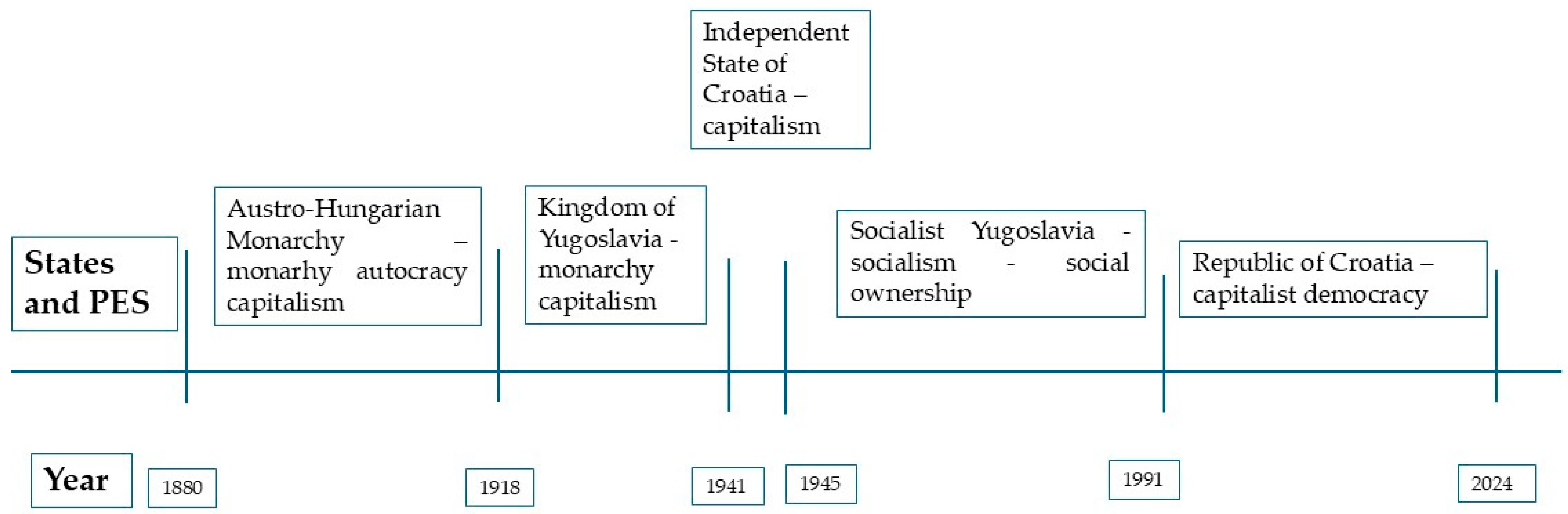
This article analyses three PES changes that occurred in the territory of modern-day Croatia—(1) the transition from the Austro-Hungarian Monarchy (capitalist monarchical autocracy) to the Kingdom of Yugoslavia (capitalist monarchical autocracy), (2) then to Yugoslavia (socialist one-party autocracy) and, finally, (3) to an independent Croatia (capitalist democracy). Our analysis covers the period between the end of the 19th century and the beginning of the 21st century—more specifically, 1880–2020. We track spatial planning and land use legislation in each of these four PESs and observe its implementation through a tourism prism across the three PES changes. We focus on the case study of Kupari, a tourism resort located in the southernmost part of modern-day Croatia. The Kupari resort is selected due to its long history, which allows us to trace how legislation and its implementation looked in practice across three PES changes.
For the earliest analysed PES (between the end of the 19th century and the end of the Second World War), to the best of our best knowledge, there are no existing studies on spatial planning and land use focusing on the territory of the Dubrovnik region or even modern-day Croatia. Therefore, our efforts to understand spatial planning and land use in that period represent pioneering efforts and are based on the analysis of the relevant laws and their implementation, as chronicled in the few existing publications depicting the era. For data, we relied mostly on archival materials—more specifically, on laws, different types of plans, blueprints and local newspapers.
In comparison, spatial planning in the tourism sector during the second PES change that we looked into, i.e., the transition to Yugoslav socialism, has received more academic attention [19,20]. There is scholarly agreement that Yugoslav planning efforts resulted in rather sustainable socialist tourism [21]. Socialist planning and tourism [22,23], as well as the transition from state socialism to capitalism [3,24,25,26], have also been increasingly studied. We rely on the extant secondary literature, as well as on legislation, to understand how the framework changed and was implemented.
The disintegration of Yugoslavia in 1991 marked the third PES change that we studied. In this era, a capitalist economic system and democracy as a political regime were established. The literature on spatial planning and tourism in Croatia largely focuses on efforts to ensure sustainable, long-term development, along with local community engagement, as contrasted by pressures for evermore tourism growth and profit [27,28]
However, very few papers have analysed how PES changes affect spatial planning in the tourism sector [3]. An exception is the literature on the transition from socialist one-party autocracies to capitalist democracies. This literature suggests a lack of clear rules of the game for private-sector initiatives in the tourism industry resulted in a rather chaotic so-called “wild” tourism, as evident in all formerly socialist European countries [4,5,29]. In addition, for earlier periods, sources are scarcer, making it harder to glean the effects of PES changes. Archaic language used in the earlier periods represents another distinct obstacle in assessing the effects of PES changes on spatial planning in tourism.
Our analytical approach is described as follows. For each of the three above-outlined PES changes, we investigate political, economic and territorial–administrative aspects. We then study what kind of legislative solutions marked each PES and investigate their implementation. To understand path dependency, we pay attention to issues inherited from the previous PESs that continued to permeate spatial planning, land use and tourism development after the change took place. Finally, we investigate how Kupari resort, specifically, was affected throughout these four PESs.

4. The Impact of PESs on the Development of the Tourist Resort of Kupari

4.1. Croatia in the Austro-Hungarian Monarchy

In the second half of the 19th century, modern-day Croatia was a part of the Austro-Hungarian Monarchy. More specifically, the Dubrovnik area, where Kupari is located, was then a part of the Kingdom of Dalmatia, the southernmost crownland of the Monarchy. Being on the border with the Ottoman Empire, Dalmatia was administratively mishandled and economically underdeveloped.1 Towards the end of the 19th century, the Dalmatian economy suffered blows in two important sectors: winemaking and shipbuilding. Unemployment and emigration to overseas countries were high, and land prices were low—suitable conditions for speculation, investment and construction [31].
It was also a period in which important structural and organizational changes took place in the entire Monarchy. Serfdom was abolished in 1848, and administrative preconditions for the functioning of a capitalist economy were put in place. By the end of the 19th century, the land register and cadastre were modernized (1881 for the area of modern-day Croatia); the civil engineering administration was reorganized; and new regulations with respect to land use, civil engineering titles, jurisdiction over the organization of new construction areas and the construction of public and private buildings were introduced [32]. Despite modernization, already in this period, there was a mismatch between the cadastre and land registries, as some land plots were not entered in the land registries. However, as few land transactions took place, the administration was sufficiently equipped to handle transactions within legally defined deadlines [33].
By the second half of the 19th century, tourism had already been well developed in the broader region of Central Europe. However, in the kingdom of Dalmatia, tourism was still in its infancy, and hotels existed only in the larger towns of Zadar, Split and Dubrovnik. It was at the end of the 19th century that interest in economic development of the southern Adriatic increased. Beyond existing and established destinations, investors looked for new, attractive and cheap locations [34,35].
These efforts were hindered by local governments; they were unprepared for investments and could not provide all the necessary technical infrastructure (water supply, drainage, electricity supply, etc.), and investors complained about difficulties accompanying their investments. There were not enough skilled construction or tourism workers in the area2, and equipment had to be imported from more developed parts of the Monarchy [37].
Land use and construction in the Kingdom of Dalmatia were regulated through the Construction Act Construction Act 1886 [38]. The Act recognized residential, commercial (tourism would fall in this category) and public land use (roads, squares, parks, etc.). Sectoral plans for railways and roads were already being made, but regional spatial plans (with multisectoral planning in mind) did not exist yet. Land- and district-level political authorities oversaw the formation of new bathing sites in the maritime domain and the approval of new construction areas based on site plans that could be described as precursors of spatial plans.
Concentrated (vs. dispersed) construction represented a legal requirement with the purpose of saving land as a valuable resource. Each building plot needed access to a public road, rainwater drainage and water supply. Park and green areas were proscribed both on building plots and in public areas. If a larger cluster of new buildings was planned, a blueprint would have to accompany the project outline. The importance of public health was already recognized—exhaust gases and smoke could not be emitted directly towards an adjacent building.
Zooming in on Kupari, at the end of the 19th century, the area was an industrial site—more specifically, one of the largest brick factories in Dalmatia. However, in 1912, as the factory faced financial difficulties, Count Bernhard Caboga-Cerva, the factory owner, joined forces with Czech investors Jaroslav Fencl and Jan Máša, who bought neighbouring plots in Srebreno Bay and devised a new spa project [34,39]. In 1912, they founded the Dubrovnik Bathing and Hotels Company [40] and started preparing the necessary documentation for the development of a tourism resort in Kupari [39].
Following Article 15 of the Construction Act [38] and the site plans (which included a sketch of the geographical position of the area, as well as all land parcels and buildings and borders between parcels), the investors obtained approval from the district-level authorities for the development of a new tourist resort at the location of the existing brick exploitation field and a construction permit from the civil engineering administration, as well as a permit for the development of a bathing site from land-level authorities. However, WW I started, and investments in Kupari had to be postponed.

4.2. Between the World Wars

After the end of WW I, the Austro-Hungarian Monarchy disintegrated, and most of modern-day Croatia, including large parts of Dalmatia, became part of a newly formed Kingdom of Serbs, Croats and Slovenes soon renamed the Kingdom of Yugoslavia.3 The new state encompassed areas that were previously parts of two empires (the Austro-Hungarian Monarchy and the Ottoman Empire), while the centre of power switched from Vienna to Belgrade. Three rounds of administrative reorganization took place in the following three decades,4 affecting policy-making and implementation capacities [41]. These reorganizations affected spatial planning legislation and its implementation.
More precisely, it took 13 years for a new Construction Act [42] to come into force. Compared to legislation of the Austro-Hungarian era, which was specifically designed with Dalmatia in mind, this Act represented the norm for the entire territory of the Kingdom of Yugoslavia. It was more detailed and recognized more land use purposes, including streets, roads, squares, gardens, parks, playgrounds, cemeteries, fairs, infrastructure and airports.
However, the implications of this law for the case of Kupari could not be observed, as the construction of the resort preceded legislative efforts of the new PES. The plan to convert the factory into a tourist resort could not wait for the establishment of a new state apparatus and the adoption of new legislation. The investors pressured the local-level political authorities to allow them to continue developing the project based on the pre-WW I permits, so construction activities began immediately after the war ended, using the Austro-Hungarian legal framework from 1886 [39].
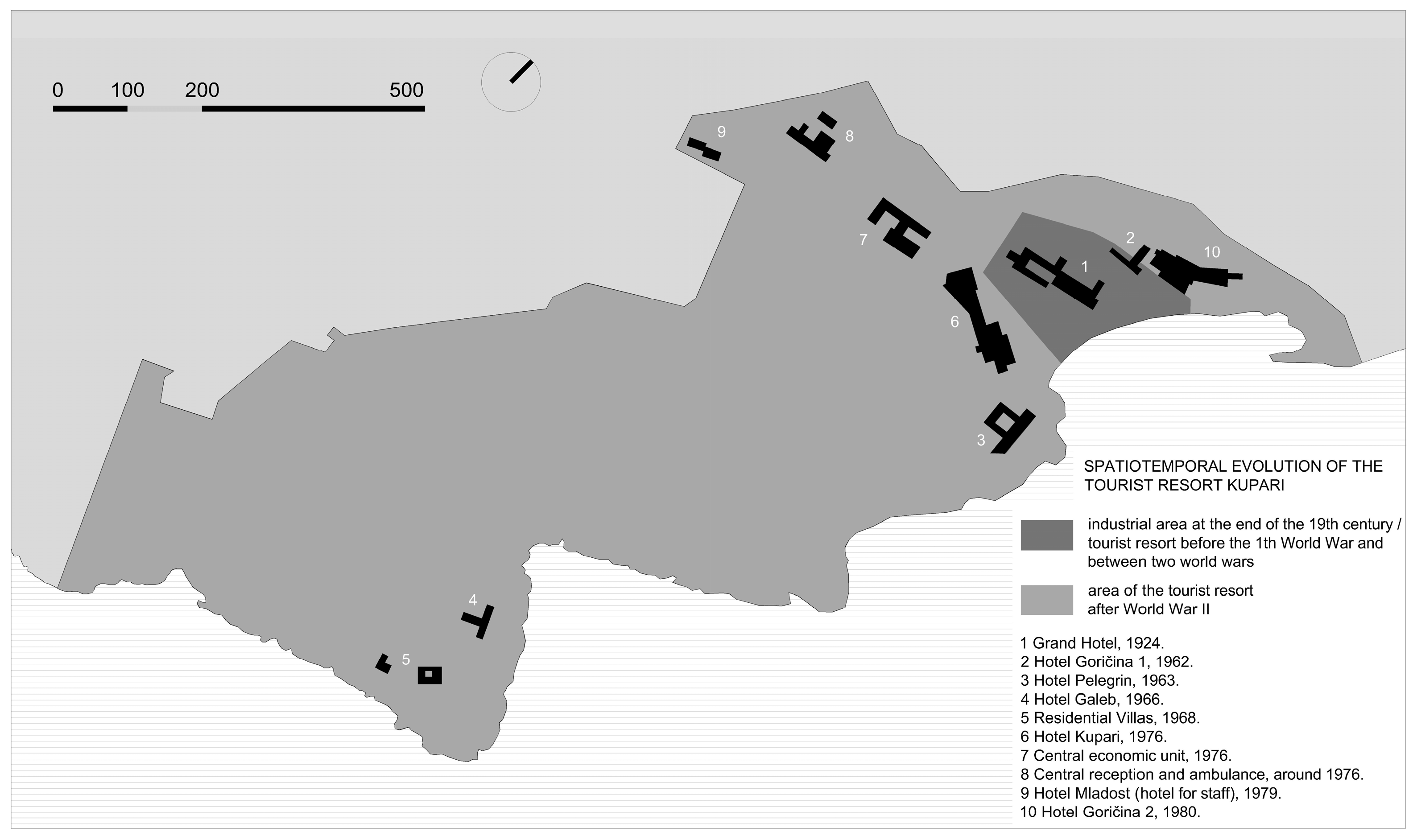
The former brick factory in Kupari immediately saw radical change in land use. In a short period of time, the space was transformed from a factory to an exclusive tourism resort. Specifically, main construction works included the demolition of some of the factory buildings and of a chimney, which were unsuitable for tourism purposes. The building once used for the baking of Mediterranean tiles was preserved as the core of the hotel complex and converted into the Grand Hotel (Figure 3). In 1921, a bathing cabin was built in the adjacent Srebreno Bay. Following the 1886 legislation, landscaping of green/park areas, as well as the construction of roads, a power plant, water supply, sewerage network and sports grounds, also took place. The resort was luxuriously equipped, and an air route for seaplanes from Prague to Dubrovnik via Zagreb was introduced in 1935/1936 to ameliorate the long journey of Czech tourists from Central Europe [43].
WW II interrupted the continuity of interwar tourism development in the whole territory of modern-day Croatia, deteriorating nearly all technical conditions and destroying the overall network of tourism organizations and institutions [44]. During the war years, most hotels were either closed or used for non-assigned purposes, due to which they were in a neglected, damaged and destroyed state at the end of the war [45]. Tourism activities at Kupari were also halted, while tourism contacts with foreign countries were severed.

4.3. From a Capitalist Monarchical Autocracy to a Socialist One-Party Autocracy

In this section, we analyse how the transition from a capitalist monarchical to a socialist one-party autocracy affected spatial planning, focusing particularly on tourism and the case study of Kupari. We divide this period into three sub-periods: first, the period in the immediate aftermath of WW II, where war damage and a lack of socialist legislation led to the hasty reconstruction of existing tourism capacities and the development of new ones to satisfy the vacationing needs of the working class; second, the period between the 1960s and 1970s, where continuously growing tourism demand resulted in increasingly more sophisticated spatial planning (data-driven and taking a broader, regional perspective into account) but also beset by the need to build ever more accommodation units; and, third, the decade of 1980s, where planning already considered health, the environment and public participation while the expansionist plans of the earlier periods started to be re-evaluated.

4.3.1. Early Post-War Period

The aftermath of WW II saw a drastic PES change—the monarchical regime was replaced by a single-party regime, private ownership was replaced by social ownership and central planning replaced a market-driven economy. Territorially, Yugoslavia was divided into six republics and two autonomous regions. As this organization significantly differed from the pre-WW II organization, the policymaking and implementation capacities were initially insufficient [46].
Numerical cadastral measurements were completed for larger towns, but land registries did not follow suit, which increased the mismatch between the cadastre and land registries [33]. In addition, updating of the land registries for the purpose of registering private property was neglected, as social ownership largely replaced private ownership [47].
Following the ideology of state socialism, newly founded hospitality companies were owned by the state, which ensured a steady flow of funds [48]. In these first post-war years, the tourism industry was established on ideological foundations based on the vacationing needs of the Yugoslav working class and guests from the so-called Eastern Bloc countries. To provide means of vacationing for the working class, the post-war construction restoration of the tourist industry in the territory of Croatia was carried out incompletely and unsystematically, and only the most necessary construction repairs were performed as part of the renovation itself. Construction renovation of hospitality facilities was mostly limited to hotels, boarding houses, holiday homes and resorts. The main goal was to set up as many accommodation units as possible—as soon as possible and with as few resources as possible—to meet the requirements of rapidly growing domestic tourism [44].
In the early post-WW II period, formal legislation adapted to the socialist principles of preparation and arrangement of construction land still did not exist, while the remediation of consequences of the ravages of war, as well as rapid modernization, led to intense and often uncoordinated construction throughout the country. Therefore, in 1947, the Institute of Urban Planning (IUP) of the Social Republic of Croatia was founded with the task of continuously studying and resolving the urban-planning issues of towns and settlements. The Institute would become an important and invaluable source of expertise, imbuing Yugoslav legislation with sophisticated spatial planning procedures [49].
For the Kupari case, it was the Czech owners who renovated their hotels. In 1947, the first post-war tourists arrived in Kupari. However, following the Yugoslav break with the Soviet Union, political relations between Yugoslavia and other socialist countries were severed. As a result, Czechs withdrew from Kupari in 1948 [45]. In the same year, the Law on the Nationalization of Rental Buildings and Construction Land 1958 [50] was passed, which resulted in the liquidation of the private sector throughout the country, including the hospitality industry of the Dubrovnik Riviera. As a result, Kupari was declared a company of general national importance and fell under the administrative operational management of the Yugoslav People’s Army (JNA) [48].
The Yugoslav break with the Soviet Union led to a period of transition to a new economic system of so-called socialist self-management. The main goal was to move the management of companies into the hands of workers and to separate management from the state. In the first half of 1950, the hospitality sector started maintaining itself by independently supplying necessary products through the free market [48].
At the same time, the country was swept by rapid processes of urbanisation, while tourism took on unexpected proportions, as manifested in a spontaneous albeit sharp surge in the number of tourist accommodation units, strong increases in domestic and foreign tourism trade and the growth of investment operations in tourism. It proved necessary to coordinate and plan the development of tourism and to develop plans that would consider the projection of long-term tourism development onto space [44]. However, spatial planning, as a discipline, had still not been systematized professionally or legally. The continuous efforts of urban planners to draft spatial plans and consider more professional and complex spatial-planning problematics, as well as considering specific questions from wider socio-political, economical, technical and design perspectives, prompted the IUP, in 1954–1956, to develop the Methodology of Regional Spatial Planning, a multi-disciplinary approach to drafting spatial plans [51].
However, the drafting of spatial plans and tourism development plans required the collection of data on the existing state of the coast from different perspectives. Therefore, in 1959, the development of the Methodology and Directions for Drafting a Long-Term Tourism Development Program 1959 [52] was initiated. This methodology provided an analysis of the existing spatial and technical tourism conditions and was supposed to “recognize” tourist areas to define the type and character of tourism, as well as the necessary tourism construction with the application of a spatial criterium. For the first time, the spatial-receptive conditions of tourism supply were analysed to determine the prospective potentials of tourism demand [21].
In the meantime, global tourism trends were rapidly changing. The abrupt development of the automotive industry and the construction of campsites influenced tourist mobility and spatial planning (indirectly). The guest structure was also changing; tourists were no longer only members of the working class, who were now joined by other domestic and foreign guests, who chose locations with more comfortable accommodation that offered contemporary content.
Since the accommodation units at Kupari no longer met such tourist needs and demands, the military management recognized the need not only for thorough reconstruction of existing hotels but also for overall spatial reconstruction of the tourist complex, with the aim of achieving better categorization, expanding the tourism offer and increasing in the number of arrivals.
Already in 1948, the first post-war urban-planning design was produced for Kupari, which planned thorough renovation and comprehensive spatial reconstruction of the existing tourist complex. However, this design never saw implementation. In 1958, a first large-scale post-WW II modernization program for Kupari was drafted, including accompanying urban-planning and architectural designs for as many as seven new edifices [53]. These would then be implemented in the following period.

4.3.2. Spatial Planning and Tourism Boom in the 1960s and 1970s

The year 1961 was crucial for the drafting of municipal spatial plans aimed at enabling the connection of spatial and socio-economic plans at the level of local communities. The Urban Planning and Regional Spatial Planning Act [54] prescribed that towns, settlements, special-purpose areas and wider areas be built and arranged in accordance with the guidelines of regional and urban-planning spatial plans. The plans were supposed to be drafted in relation to the projected development of regions and settlements for an extended period of time (for a period of at least twenty years) based on the analysis of the current state and the possibilities of development of a settlement and its gravitational area and in accordance with the regional spatial plan and the principles of social and other plans influencing the spatial development of a particular settlement.5
The passing of the Act in question occurred when construction was already underway at Kupari. Several edifices were demolished; most remaining buildings were renovated, and new accommodation units were also built—Gorica Hotel (Goričina I), with a café and lounge bar, in 1962 and Pelegrin Hotel in 1963 (Figure 3). In 1964, directly alongside the entrance to the military resort, the construction of a third hotel began; however, construction was halted soon after the foundation had been laid and was never resumed [53]. Along with the struggle for better hotel categorization came the struggle to operate longer and to host guests year-round; in terms of the length of occupancy of the accommodation units, record holders were higher-category hotels, whose clientele were more serious and affluent [48].
On a small cape northwest of Kupari Valley, in the second half of the 1960s, a separate residential zone was formed for high-ranking government and military officials. Here, in 1966, the most luxurious hotel at Kupari was built—Galeb Hotel—near which two more meticulously planned residential villas of the highest category were built in 1988. Documentation of the hotel and the villas has been lost, and it remains unknown whether the construction of the zone was preceded by the drafting of an urban-planning design [53].
In the 1960s, a spatial database was gradually created, covering the area of the Croatian Adriatic. Tourism became a strategic development goal (on republic and federal levels) and began to be viewed as part of overall development at the local, regional, republic and federal levels [44]. Initiatives for the regulation of construction on the coast and coastal islands, prompted by the intense building of hotels and secondary accommodation facilities, the non-planned expansion of urban settlements, etc., enabled the drafting of a series of important studies and spatial plans. Head of production of all plans was the previously mentioned IUP. The key projects that were created in this period were part of a joint development programme of the United Nations and the Socialist Federal Republic of Yugoslavia (SFRJ) Government—the South Adriatic Regional Plan (1969) [55], the Upper Adriatic Regional Plan [56]6 and the Project of Protection of Human Environment of Yugoslavia’s Adriatic Region [57]. The main guiding principle of these activities, alongside economic effects, was a desire to find a way to permanently preserve the values and attractions on which the tourism offer was based. Therefore, wherever space allowed, tourist accommodation capacities were planned and, in some places, implemented based on the principle of acceptable spatially decentralized concentrations alongside maximum preservation of the coastline [58].
Despite significant positive results achieved by the first spatial plans, the analysis of spatial and urban development from 1971 and beyond showed that the mastery over processes was falling significantly behind the country’s socio-economic development, especially regarding the concentration and distribution of the population and the workforce [49]. In 1973, the new Physical Planning and Land Use Act was passed [59]. In accordance with its provisions, spatial plans had to be based on the starting principles of social and economic development and on the data and analyses of the natural, historic, demographic, social, economic and technical components of space. The planning and arrangement of space was defined as a continuous activity and obligation of socio-political communities, which were obliged to monitor the process of urbanization and implementation of spatial arrangement plans and to conform them with the achieved degree and projected development dynamics, as well as newly emerging needs, possibilities and technical accomplishments.
A distinctive feature of the 1973 Act [59] was the introduction of the new term “spatial developmental plans”. Specifically, while the implementation plans specified urbanist–technical and other prerequisites for the development, construction, reconstruction and recovery of areas encompassed by the urban plan, the developmental plans encompassed spatial plans of socio-political communities (municipalities, municipalities and republics). These plans had long-term directions and were drafted based on developmental assessment over the next 20 to 30 years. The Act also put emphasis on the drafting of a detailed plan for the use and purpose of the area and introduced an obligation to develop guidelines of protection and enhancement of the human environment, as well as public consultation and public discussion [49].
After the new constitutions of the SFRJ and Socialist Republic of Croatia had been passed in 1974, self-governing interest communities were established as new forms of social organization and planning.7 This was a period of expansion, the growth of towns and grand ambitions. The plans were drafted multi-disciplinarily, while sectoral collaborations and projections, analyticity and the application of standards and models were intensified [45,53].
It is exactly these newly emerged circumstances that set up the framework of the second large-scale modernization of the military resort at Kupari.8 Global tourism trends changed yet again, and the structure of accommodation capacities became unfavourable once more. Since the demand grew continuously, already in 1972, a decision was made on new construction, i.e., the enhancement of accommodation capacities and modernization [53]. What followed was a series of spatial-planning endeavours that were supposed to define an overall arrangement of the resort; however, it was not until the Implementation Urban Plan of the Sports, Recreation and Tourism Zone of Župa Dubrovačka—Kupari from 1976 [60] that clear urban-planning criteria and detailed guidelines of land arrangement and use were established.9 The construction works—which also included the enhancement of the resort’s technical equipment, as well as the arrangement of the beach, sports and recreational areas, children’s playgrounds, parks and other horticultural areas—began in 197510 and proceeded in several stages until 1980 [62] (Arsenić 1989). The organization of the space of the Kupari Valley was conducted so that the construction of larger edifices was inhibited in intensely green areas, i.e., only the interpolation of smaller volumes for hospitality and entertainment purposes was permitted. The limitations on new construction especially referred to the areas of Goričina Hill in the northeast and Pelegrin Hill in the southwest, and the urban-planning concept positioned the new volumes peripherally in relation to the valley so that they followed the terrain’s gradient, with account was taken of orientation, panoramas and traffic [62]. Only Kupari Hotel, constructed in 1975, deviated from this concept [53].
In the period of the second large-scale modernization, the previous manner of service provision at the resort also changed. Štrand Hotel, Grand’s dependence and Villa Kisela were demolished, while Pelegrin Hotel was renovated and connected to the newly built Kupari Hotel with a connecting tract. The renovation of Grand Hotel was completed in 1979, and the reconstruction of Gorica (Goričina I) began immediately after, as well as the construction of the new Goričina II Hotel in place of a demolished café and lounge bar.

4.3.3. Protection of Nature and Deflation of Expansionist Tourism Plans

The 1980s saw the reconsideration of earlier (more ambitious) planning concepts, the harmonizing of interests and the resolution of conflicts with progress towards the rational and real. After the passing of the Associated Labour Act 1976 [63], the Social Planning Act 1978 [64] and the Spatial Planning and Physical Planning Act (1980, 1986) [65], spatial planning became a constituent part of a unified system of social planning, i.e., a continuous activity that was based—at least in theory—on the results of scientific research and the monitoring of the state of development in space [53]. The spatial plans that were made based on the provisions of the 1980 Act—which was subsequently supplemented with the Regulation on the Content and Manner of Drafting Spatial Plans from 1985 and 1987—were made on the basis of topographic–cadastral backgrounds in two phases—as a basic concept and as a planned proposal. Both phases were subject to public consultation and discussion; prior to the municipal assembly, the implementation of the urban plan was also passed by the local community to which the plan refers. At the same time, tourism began to be increasingly associated with human well-being, as well as with care for the environment. In 1980, the Construction Land Act was passed [66], and the following year saw the passage of the new Law on Construction of Buildings [67].
However, neither of these acts reflected the system of arrangement and use of land at Kupari, where nothing had been constructed for a full decade at that point, save for the maintenance of the existing state. This leads us to the next phase of our analysis—the introduction of democracy and capitalism as Croatia proclaimed its independence from Yugoslavia.

4.4. From Socialism to Democracy and Capitalism

The Croatian war for independence began in March 1991. As armed conflicts started, the Croatian Parliament proclaimed the independence of Croatia from Yugoslavia in July 1991. In parallel with war events, a PES change—from a one-party autocracy to democracy and from socialism to capitalism—took place. War plunged a hole in tourism sector, but the PES change had more far-reaching consequences on political and economic structures and on spatial planning.
The transition from socialism, a system in which the means of production are owned by either the state or workers’ associations, to a market economy meant that market logic would replace socially oriented planning efforts and that socially owned and managed tourism companies would largely have to be privatized. In fact, some of the hotel companies were privatized early on [68,69], but a significant portion, including former military bases and lavish tourism resorts, were left to decay and never put back to tourism use [30].
The success and the timing of tourism privatization can be explained by the damage tourism infrastructure suffered as a result of armed conflicts. In the conflict areas, some hotels were shelled. Elsewhere, resorts were used as temporary residences for refugees fleeing areas of intense conflict and, as a result, slowly decayed over the years [70]. Kupari belongs to the first group of tourism properties damaged during the war. Immediately after the Republic of Croatia proclaimed independence in 1991, the naval forces of the Yugoslav People’s Army (JNA) began looting the Kupari property. This was the start of the destruction of the military resort, which continued in late 1991 and early 1992, when the resort was severely damaged by direct shelling.
In some cases, the putting of tourism infrastructure back to use was further complicated by transfers of control from the Yugoslav military to the civil state administration. Kupari resort, under the control of JNA during the period of socialism, illustrates this well—the resort was officially ceded to the Croatian state only in 2001 following the signing of the Yugoslav Agreement of Succession Issues. This meant that the changes to the PES delayed the development of the tourism sector as legal successors needed to be identified.
The functioning of the administrative apparatus changed as well. Primarily for political and ideological reasons, a new system of territorial organization was put in place. Tiny newly introduced municipalities became the lowest organizational units. Due to this organizational fragmentation, municipalities often lacked administrative capacities for self-management, making policy implementation difficult. The existing spatial planning system was merely transplanted to the new territorial and administrative organization, making it compulsory for each of the small municipalities to develop spatial plans. Individual tourism projects often required interventions in both county- and municipal-level plans, and detailed, project-level urbanistic plans were frequently required. Therefore, the new administrative organization led to a multiplication of required planning documents, with reduced administrative capacities.
The transition to democracy and a market economy necessitated the adoption of new legislation in the field of spatial planning and tourism. A new law defining land use [71], considering the war and changes in the PES, was adopted very quickly. This was followed by laws prohibiting privatization in 1996 [72], encouraging tourist activities in 1996 [73] and taking care of the environment in 1994 [74]. In addition to hasty adoption, relevant legislation suffered from a lack of intersectoral cooperation and sometimes provided contradictory solutions. It was not always clear which office had what duties, obligations and roles, and as a result, competences and coordination mechanisms between different policy sectors remained vaguely defined, if at all [75].
Legislation was also subjected to frequent changes. The 1994 Physical Planning Act was amended four times in the first ten years of its implementation. In 2007, it was substituted with the Physical Planning and Building Act 2007 [76], which similarly went through six rounds of changes before it was replaced with a new piece of legislation. The Physical Planning Act of 2014 [77] went through five rounds of changes until 2023. These laws attempted to guard the spatial planning legacy inherited from Yugoslavia—carefully analysing where tourism development could take place to save land as a valuable resource—with a new market-oriented push for more urbanization as close as possible to the seaside and at the lowest possible cost.
A lack of clarity in the laws about who was in charge of which aspect of the policy and frequent amendments also affected efforts to get the Kupari resort back into operation. The project required a multi-sectoral approach for its implementation, including four ministries—the State Office for Management of State Property and the municipality Župa Dubrovačka (where Kupari resort is located)—that were to jointly oversee the realization of the project. Despite their best intentions, the lack of intersectoral cooperation (a direct consequence of PES change as the administrative bodies kept changing) represented an obstacle to project implementation.
Relevant legislation was also fragmentated between spatial planning, regional development and strategic planning. As each of these fields required separate documentation, fragmentation led to a multiplication of strategies, programs and plans at state, regional and local levels, creating additional tasks and administrative hurdles [75]. The type and number of planning documents needed for tourism projects varied depending on the type of project and its location, introducing another layer of complexity for public administration, political officials and investors to deal with.
Compared to the period of socialism, there was also a lack of long term-oriented planning, which further complicated the investment process. Rather than analysing how certain areas could best be used for economic and human development and developing spatial plans reflecting these ideas, the planning phase often became a formality to be completed after an investment was already conceptualized. Investors could come up with their ideas, and spatial plans would then be prepared to reflect these ideas. As a result, at times, the plans at the regional level would need to be changed to accommodate newly planned investments at the local level, while at several lower levels, operational plans had to be made from scratch, leading to lengthy and complex political and bureaucratic procedures [78].
The case of Kupari illustrates these issues well. The Kupari redevelopment project required the development of county and municipal spatial plans, as well as a more specific, detailed urbanistic plan. The process of adopting these plans was marred by difficulties—the development of the plan started in 2016 but also required conservation entry data, the collection of which was completed in 2019. In addition, in 2018, the municipality of Župa Dubrovačka [79] acknowledged a procedural error in setting up a public discussion. The process included securing a location permit and subsequent contracts for the use of state-owned real estate and maritime property.
The introduction of a new PES led to significant legislative and structural changes. However, the established system allowed for a combination of change and continuity. The newly established system took over basic elements of the socialist spatial planning system—spatial plans were developed based on existent spatial planning solutions inherited from the socialist period [75]. In some cases, spatial plans adopted during socialism were in power even a decade after the PES change took place [80].
Some issues already present in the previous periods continued to affect spatial planning and tourism after capitalism and democracy were introduced. One such important issue was a lack of a unified cadastre and land registers in which data on land parcels and buildings permanently present on the land or beneath its surface, as well as the special legal status of the land surface, would be interlinked with data on legal real property status. In practice, this meant that legal transactions pertaining to real property were often not recorded in land registers—only in the cadastre—causing legal insecurity, as the land registers did not display the accurate legal status of properties [81].
This was another issue reflected in the case of Kupari. In 2011, following a tourism boom in Croatia, Kupari emerged in political discourse during the 2011 electoral campaign. However, concession rights over Kupari could not be established as, according to Darko Lorencin 2015 [82], the minister in charge of the tourism portfolio, the geodetic data necessary for the formation of cadastre records and land registry entries were missing. The lack of up-to-date information on property rights over the cadastral parcels resulted in legal insecurity and prevented the offering of a concession covering the resort.
For tourism-related spatial planning, other important issues that required regulation included the possibility of the sale of tourism units within tourism zones; the use of forest and agricultural land, as well as cultural and maritime domains, for tourism purposes; the setting of criteria regarding the locations of tourism zones; and the multi-level nature of spatial planning. All these issues were a result of the transition from social to private ownership and efforts to protect land, as well as cultural and maritime domains, as valuable resources.
The Kupari project required solutions to multiple such issues stemming from legislative inconsistencies associated with the adoption of a new political and economic system based on existent socialist institutions. These included three types of inconsistencies in concession allocation and regarding conservation issues. First, the legislation regarding property rights over the land on which the resort is located (including the maritime domain) was lacking clarity. Staničić and Bogović [83] suggested the specific law defining concessions over the maritime domain remined unharmonized with the core Concessions Act 2017 [84], which led to case-by-case adjudications of which of the two laws should be applied. In the case of Kupari, a compromise solution was adopted, establishing property rights to the land in the state and municipal ownership through the right to build and the right of use for a period of 99 years. Second, Kupari resort includes the so-called maritime domain—including both a coastal part and a part on the sea. The Maritime Domain and Seaports Act 2003 [85] allowed for the allocation of concessions of national interest in the maritime domain for a period longer than 50 years only with the approval of the Croatian Parliament. Before offering a maritime domain for a concession for a period of 99 years, which that would ensure investors could get a return on their investment and be synchronized with the concession over Hotel Grand, it was necessary to ensure the approval of the Parliament. Third, issues related to the conservation of cultural domains arose. Hotel Grand, unlike other Kupari hotels, was under partial protection as a protected cultural heritage site. Therefore, any concession for the resort had to ensure its protection. In 2019, the Government of the Republic Croatia [86] decided it would be offered a 99-year-long concession under the condition of having the building renovated in the original style.
As a result of these issues, economic use of Kupari resort was “paused” in progress for over two decades. Once the conditions for allocation of concession were satisfied, a conceptual solution for a luxurious five-star resort was devised, showing that initial solutions devised by Czech investors at the beginning of the 20th century, reinforced by monarchical and socialist Yugoslav modernizations of the resort, would persist through the latest PES change.
In summary, the war resulted in significant damage to the resort, and military control over the resort complicated the ownership status. Once tourism took off again, the interest in putting it back into function also remerged. However, since 2011, Kupari has faced many issues resulting from the PES change. As a result of fragmented legislation, a lack of clear lines of responsibility and a lack of long-term planning before investment, a decade has passed, and the resort has neither been put in function nor has all documentation necessary for it been ensured. The following section summarizes the main arguments and outlines venues for future research.

5. Discussion

We analysed how PES changes affect spatial planning and land use in reference to the tourism sector. We focused on the territory of modern-day Croatia, using the case study of the Kupari tourism resort across four different PESs. Supporting the existing literature on path dependency [16,17], our analysis shows that formal and informal norms partially endure through PES changes. More specifically, the territory of modern-day Croatia has historically been characterized by an improvisational approach to spatial planning—plans follow investments rather than the other way around, as reflected in the case of the Kupari resort across all observed periods and PES changes. We also note that land use and planning have long-lasting effects—Kupari was conceptualized as an elite resort more than one hundred years ago and has, after four PES changes, maintained this same developmental vision. Most importantly, we show that the more drastic the PES change is, the more encompassing the changes in legislation and initial difficulties in implementation are.
Our contribution to the literature is a systematic analysis of the political, economic and territorial–administrative aspects of PES changes, followed by an overview of the aspects of path dependency—despite the changes, some important institutions and structural conditions tend to persist. We pay attention to how the adapted legislation reflected PES changes and path dependency. Finally, we describe how the case of Kupari exemplifies the patterns of change and continuity over a period of more than one hundred years.
Our analysis also delivers the following period specific findings. In the period of the Austro-Hungarian Monarchy, spatial planning and land use policies were just starting to develop. Tourism was also in its infancy. The first PES change we observed, from the Austro-Hungarian Monarchy to the Kingdom of Yugoslavia, led to slow and piecemeal changes in spatial planning—construction-related legislation persisted for a decade after the PES change, but once adapted, represented a step towards more detailed and better-defined spatial planning legislation.
With respect to socialism, our analysis showed a dramatic change. In the immediate aftermath of WW II, tourism spatial planning was marred by hasty repairs and the development of new capacities with the socialist ideology in mind—particularly the vacationing needs of the new working class. This was followed by an increase in demand for tourism-sector capacities, but better quality of tourism units became a relevant factor. As more data was collected to support the needs of better-quality spatial planning, mid-term regional plans were made, and local-level plans needed to follow these plans. In the last decade of socialism, planners started to slowly re-evaluate inflated tourism plans and showed a definite orientation to human health and environmental protection.
The Kupari development followed spatial planning and tourism trends in socialist Yugoslavia; initially, more hotels were built to host more visitors while keeping its status as a luxurious military resort; but then, a modernization phase transformed it into an area that demonstrated protection and smart use of the natural environment.
For the capitalist democracy PES, we focused on the effect the change in ownership of the means of production (from social to private ownership) had on spatial planning and tourism. We then emphasized how the need to adopt a new set of laws amidst a PES change led to a lack of intersectoral cooperation, frequent legislative changes, a lack of harmonization across policy fields and a lack of clear-cut borders in policy implementation competencies. Finally, we showed how some issues, such as the discord between land registers and the cadastre, which were inherited from the previous PESs, continued to affect spatial planning and tourism.
The results of the research on frequent changes in political–economic systems through spatiotemporal evolution are presented in Appendix A. For the example of the Kupari resort, continuity in the administration is visible, as well as how each regime change entailed new legislation (multiple sectors), as reflected in the tourist area. The results were analysed through the lens of continuity across regime changes, legislation and its application across PES changes, legislation and its effect, and the impact of PES changes on the Kupari tourist zone itself.

6. Conclusions

Focusing on the case of Kupari, we have shown how changes in the PES led to the cessation of the economic use of the resort despite its favourable geographical conditions and tourism heritage. Ownership problems, a lack of cross-sectoral cooperation and fragmented legislation, as well as insufficient administrative capacity at all levels of government, were direct consequences of changes in the PES and prevented the re-use of Kupari. However, some aspects of path dependence of use can still be observed, as luxury tourism remains the preferred development model for Kupari.
Key findings reveal that the recovery and resilience of tourism are closely tied to the stability of political and economic systems. Frequent changes in the PES (1) reduce the overall resilience of tourism and its institutions, (2) lead to recurring changes in legislation related to tourism spatial planning (e.g., ownership and land use) and (3) disrupt the positive correlation between space and tourism development. These frequent transitions are reflected in legislation, as well as in the challenges of negotiating compromises on issues closely linked to tourism and spatial management. We advocate for a stable political–economic system and the continuous, real-time monitoring of legislation and its spatial consequences. An integrated methodology for legislative monitoring, along with a spatial management framework, offers practical solutions for the sustainable management of tourist areas. These findings provide both scientific evidence and actionable strategies to better align legislation with tourism spatial planning resilience on the eastern coast of the Adriatic Sea.

Author Contributions

S.H.: data curation, formal analysis, investigation and writing—original draft. J.K.: data curation, formal analysis, investigation and writing—original draft. B.B.: data curation, formal analysis, investigation and writing—original draft. S.H.: conceptualization, methodology and writing—review and editing. J.K.: conceptualization, methodology, resources, supervision and writing—review and editing. B.B.: conceptualization, methodology and writing—review and editing. S.H. investigation. J.K.: investigation. B.B.: investigation. All authors have read and agreed to the published version of the manuscript.

Funding

This work was produced as part of the scientific project titled Activating Cultural Heritage in Croatian Tourism—ACULTUR, which is being implemented at the Institute of Tourism (Nr. 93104), Zagreb, Croatia and funded by the EU Next Generation, National Recovery and Resilience Plan, 2024–2027.

Data Availability Statement

Croatian State Archives Zagreb; Croatian State Archives Dubrovnik; National and University Library Zagreb, Library of the Institute of Tourism.

Acknowledgments

During the preparation of this manuscript/study, the authors used projects and drafts from the Croatian State Archives in Dubrovnik, the Croatian State Archives in Zagreb and Library of the Institute of Tourism. The authors reviewed and edited the results and take full responsibility for the content of this publication.

Conflicts of Interest

Author Sanja Hajdinjak was employed by the company Temedica GmBh. This company operates in a field distinct from and unrelated to the topic of the present research, and the employment did not give rise to any conflict of interest. The remaining authors declare that the research was conducted in the absence of any commercial or financial relationships that could be construed as a potential conflict of interest.

Abbreviations

The following abbreviations are used in this manuscript:
PESPolitical and economic system
WW IWorld War I
WW IIWorld War II
JNAJugoslavenska narodna armija/Yugoslav People’s Army
SIZSelf-governing interest community (so-called SIZ)
AHAustro-Hungarian Monarchy
IUPInstitute of Urban Planning/Urbanistički institut
SFRJSocialist Federal Republic of Yugoslavia (SFRJ)

Appendix A

Table A1. Challenges of political and economic system change.
PES ChangeFrom AH Monarchy to Kingdom of YugoslaviaTo SocialismTo a Capitalist Democracy
Political changeSame type—from one monarchical autocracy to another.New type of a political system—still an authoritarian regime, with monarchy as a ruler is replaced by single-party rule.New type of a political system—single-party rule was replaced by a multi-party system with the introduction of democracy.
Economic changeSame type—capitalism.New type of economic system—state and social ownership replaced private ownership, with a planned economy.New type of economic system—private ownership dominates over social ownership and private interest towers over social interest in a market economy.
Administrative changeNew territorial organization, as the centre of power shifted from Vienna to Belgrade. There were three administrative-territorial reforms.Territorially largely the same but a new administrative organization.New territorial organization, with much smaller local-level units.
Table A2. Continuity across regime changes.
PES ChangeFrom AH Monarchy to Kingdom of YugoslaviaTo Socialist One-Party AutocracyTo a Capitalist Democracy
Path dependencyIssues regarding lack of suitable equipment and a qualified workforce persisted, and public administration still faced issues in providing infrastructure for tourism projects. Legislation took time to be adopted, and laws from the previous PES were in use a decade after the PES change. Investors pushed for informal solutions, permits from the AH Monarchy were used until administration could be reorganized. Legislation formally provided a relatively high level of consciousness regarding the need to save land as a valuable resource. Initial discord between the cadastre and land registries emerged.Implementation capacities and education were initially poor, with equipment missing, but improvements occurred during the 1960s.
Protection of land as a resource persisted among experts and in legislation, but implementation was haphazard—illegal construction spread.
Protection mechanisms aimed at preserving land as a valuable resource lapsed, but illegal construction persisted. Unharmonized cadastre and land registry books were inherited from the previous PES.
ChangeAs a result of administrative changes, an initial loss of implementation capacities occurred.As a result of administrative changes, an initial loss of implementation capacities occurred. As a result of the new system of ownership, discord between the cadastre and land registries increased.As a result of administrative changes, an initial loss of implementation capacities occurred.
Table A3. Legislation and its implementation across PES changes.
PES ChangeFrom AH Monarchy to Kingdom of YugoslaviaTo SocialismTo a Capitalist Democracy
Legislation and its effectOne new, more sophisticated law adopted 13 years after the regime change referred to the whole territory of the Kingdom of Yugoslavia, not just the Dalmatia area. It recognized tourism as land use and spatial planning categories. Territorial and administrative shifts slowed down the adoption and implementation of legislation—administrative centres changed, slowing down the ability of the administration to provide infrastructure and permits.Legislation referred specifically to Croatia as one of the socialist states within Yugoslavia. A plethora of carefully planned laws and regulations aimed at social interest was introduced: 1960s—sophisticated guidelines for the development of spatial plans and increasingly data-driven long-term planning; 1970s—spatial planning became all-encompassing, looking into broader, cross-regional territory and planning how the best use for the social interest; 1980s—orientation toward natural protection and care for the environment. Spatial planners imposed expertise over politics and played a decisive role in defining legislation allowing for the protection of land. This was because tourism was used to demonstrate the success of socialism. Due to a lack of importance of private ownership, mismatches between land registries and the cadastre increased.Frequent changes in legislation and fragmentation across policy fields occurred in an attempt to simultaneously keep protection mechanisms established during the earlier period and to ensure the functioning of the market economy.
Table A4. The tourist resort of Kupari through different political regimes.
PES ChangeFrom AH Monarchy to Kingdom of YugoslaviaTo SocialismTo a Capitalist Democracy
KupariKupari was transformed from an industrial zone to a luxurious tourism resort. Permits and legislation from a previous PES were used for project implementation.The resort was initially renovated by Czech owners but then nationalized and handed over to the Yugoslav military. Following the trends of the 1960s, the number and quality of capacities were increased, while attention was dedicated to careful integration of the natural environment and sparing use of land as a valuable resource. Kupari remained a luxury resort.War damage, property rights issues, mismatches between land registries and the cadastre, legislative fragmentation and a lack of intersectoral cooperation put the resort out of use. Plans were made to redevelop Kupari as a luxury resort.

Notes

1.
At the beginning of the twentieth century, the Habsburg public administration was quite inefficient (e.g., the costs of collecting taxes in the Kingdom of Dalmatia exceeded the taxes collected) [30].
2.
As documented by Leček [36], illiteracy rates in the Kingdom of Dalmatia were very high, and an educated workforce was lacking for all sectors of the economy.
3.
After WW I, the Kingdom of Dalmatia initially joined the State of Slovenes, Croats and Serbs, later called the Kingdom of Yugoslavia.
4.
From 1918 to 1922, the Kingdom kept the subdivisions of predecessor states. In 1922, a new territorial organization divided the country into thirty-three provinces. In 1929, a system of nine regions was implemented. In 1939, a single Region of Croatia was formed from two existing regions (and from sections of others) [41].
5.
The Act prescribed the content of spatial plans, as well as the method and manner of their adoption.
6.
The South Adriatic Regional Plan (1964–1968) covered the territory of several now former republics, from Croatia and Bosnia and Herzegovina to Montenegro to the Yugoslav–Albanian border. The General Urban Plan for the Dubrovnik area was adopted in 1969 on the basis of a series of studies and expert reports on the historical factors of development, as well as the natural and socio-economic characteristics of the Dubrovnik region [53].
7.
After a certain spatial-planning document was passed, the self-governing interest communities (so-called SIZs) financed the equipment and arrangement of land.
8.
Unlike other sectors, the army was very well organized, including for the entire army’s vacation.
9.
This plan was authored by the Town Planning Institute and foresaw the construction of another hotel in Srebreno Bay, as well as the construction of a third villa in the separate residential zone.
10.
The Facilities Construction Act 1975 [61] was passed in the same year; however, its provisions were not applied to the construction of facilities within the military compound for the purposes of JNA.

References

  1. Kytzia, S.; Walz, A.; Wegmann, M. How Can Tourism Use Land More Efficiently? A Model-Based Approach to Land-Use Efficiency for Tourist Destinations. Tour. Manag. 2011, 32, 629–640. [Google Scholar] [CrossRef]
  2. Risteskia, M.; Kocevskia, J.; Arnaudov, K. Spatial Planning and Sustainable Tourism as Basis for Developing Competitive Tourist Destinations. Procedia-Soc. Behav. Sci. 2012, 44, 375–386. [Google Scholar] [CrossRef]
  3. Bramwell, B.; Meyer, D. Power and Tourism Policy Relations in Transition. Ann. Tour. Res. 2007, 34, 766–788. [Google Scholar] [CrossRef]
  4. Elliott, C.; Udovč, A. Nature Conservation and Spatial Planning in Slovenia: Continuity in Transition. Land Use Policy 2005, 22, 265–276. [Google Scholar] [CrossRef]
  5. Williams, A.M.; Vladimir, B. Tourism in Transition: Economic Change in Central Europe; IBTauris: London, UK; New York, NY, USA, 2000. [Google Scholar]
  6. Brooker, P. Authoritarian Regimes. In Comparative Politics; Oxford University Press: Oxford, UK, 2017; Available online: https://www.oxfordpoliticstrove.com/10.1093/hepl/9780198737421.001.0001/hepl-9780198737421-chapter-6 (accessed on 1 August 2025).
  7. North, D. Institutions, Institutional Change and Economic Performance; Cambridge University Press: Cambridge, UK, 1990. [Google Scholar]
  8. Hillier, J. Shadows of Power: An Allegory of Prudence in Land-Use Planning; Routledge: Oxfordshire, UK, 2002. [Google Scholar]
  9. Alexander, E.R. Transaction-Cost Theory of Land Use Planning and Development Control. Town Plan. Rev. 2001, 72, 45–75. [Google Scholar] [CrossRef]
  10. Rudbeck Jepsen, M.; Kuemmerle, T.; Müller, D.; Erb, K.; Verburg, P.H.; Haberl, H.; Vesterager, J.P.; Andrič, M.; Antrop, M.; Austrheim, G.; et al. Transitions in European Land-Management Regimes between 1800 and 2010. Land Use Policy 2015, 49, 53–64. [Google Scholar] [CrossRef]
  11. Alexander, E.R.; Faludi, A. Planning and Plan Implementation: Notes on Evaluation Criteria. Environ. Plan. B Plan. Des. 1989, 16, 127–140. [Google Scholar] [CrossRef]
  12. Thomas, D.; Minett, J.; Hopkins, S.; Hamnett, S.; Faludi, A.; Barrell, D. A Comparative Study of Local Planning and Development in the Netherlands and England. In Flexibility and Commitment in Planning, 1st ed.; Springer: Dordrecht, The Netherlands, 1983. [Google Scholar]
  13. Capoccia, G.; Kelemen, R.D. The Study of Critical Junctures: Theory, Narrative, and Counterfactuals in Historical Institutionalism. World Politics 2007, 59, 341–369. [Google Scholar] [CrossRef]
  14. Mahoney, J.; Thleen, K. Theory of Gradual Institutional Change. In Explaining Institutional Change: Ambiguity, Agency, and Power; Cambridge University Press: Cambridge, UK, 2010. [Google Scholar] [CrossRef]
  15. Pierson, P. Increasing Returns, Path Dependence, and the Study of Politics. Am. Political Sci. Rev. 2000, 94, 251–267. [Google Scholar] [CrossRef]
  16. Petursson, J.G.; Vedeld, P. The ‘Nine Lives’ of Protected Areas. A Historical-Institutional Analysis from the Transboundary Mt Elgon, Uganda and Kenya. Land Use Policy 2015, 42, 251–263. [Google Scholar] [CrossRef]
  17. Yakusheva, N. Managing Protected Areas in Central Eastern Europe: Between Path-Dependence and Europeanisation. Land Use Policy 2019, 87, 104036. [Google Scholar] [CrossRef]
  18. Coral, C.; Bokelmann, W.; Bonatti, M.; Carcamo, R.; Sieber, S. Understanding Institutional Change Mechanisms for Land Use: Lessons from Ecuador’s History. Land Use Policy 2021, 108, 105530. [Google Scholar] [CrossRef]
  19. Andrić, N. Regionalni aspekti planiranja turizma. Turizam 1962, 10, 18–26. [Google Scholar]
  20. Milić, B. Izrada prostornih planova za turistička područja. Turizam 1963, 11, 10–13. [Google Scholar]
  21. Kranjčević, J.; Hajdinjak, S. Tourism Urbanization in Croatia. The Cases of Poreč in Istria and Makarska in Dalmatia. Sudosteuropa 2019, 67, 393–420. [Google Scholar] [CrossRef]
  22. Bernhardt, C. Planning Urbanization and Urban Growth in the Socialist Period: The Case of East German New Towns, 1945–1989. J. Urban Hist. 2005, 32, 104–119. [Google Scholar] [CrossRef]
  23. Drzewiecki, H.; French, R.A.; Ian Hamilton, F.E. (Eds.) The Socialist City: Spatial Structure and Urban Policy. Town Plan. Rev. 1980, 51, 3. [Google Scholar] [CrossRef]
  24. Hall, D.R. Tourism Change in Central and Eastern Europe. In European Tourism: Regions, Spaces and Restructuring; Montanari, A., Williams, A.M., Eds.; Wiley: Hoboken, NJ, USA, 1995; pp. 221–244. [Google Scholar]
  25. Hall, D.R. Tourism Development and Sustainability Issues in Central and South-Eastern Europe. Tour. Manag. 1998, 19, 423–431. [Google Scholar] [CrossRef]
  26. Hall, D. From ‘bricklaying’ to ‘Bricolage’: Transition and Tourism Development in Central and Eastern Europe. Tour. Geogr. 2008, 10, 410–428. [Google Scholar] [CrossRef]
  27. Krtalić, V. Uređenje Građevnog Zemljišta: Analiza Inozemnih Propisa: Prilozi za Moguće Oblikovanje Hrvatskih Propisa/Arrangement of Construction Land: Analysis of Foreign Regulations: Contributions to the Possible Design of Croatian Regulations/; Ministarstvo Zaštite Okoliša i Prostornog Uređenja: Zagreb, Croatia, 2000.
  28. Krtalić, V. Planiranje Korištenja Zemljišta—Usporedba Načina i Sustava Planiranja u Nekim Državama Članicama EU i Republike Hrvatske/Land Use Planning—A Comparison of Planning Methods and Systems in Some EU Member States and the Republic of Croatia; Novi Informator: Zagreb, Croatia, 2009. [Google Scholar]
  29. Bachvarov, M. End of the Model? Tourism in Post-Communist Bulgaria. Tour. Manag. 1997, 18, 43–50. [Google Scholar] [CrossRef]
  30. MacMillan, M. The War That Ended Peace: How Europe Abandoned Peace for the First World War; Profile Books: London, UK, 2013. [Google Scholar]
  31. Kranjčević, J. Transformation of Space for Tourism—Between Desire and Reality. In Myths of Tourism; Čavlek, N., Ed.; Department of Tourism and Communication Studies, University of Zadar: Zadar, Croatia, 2013; pp. 199–214. [Google Scholar]
  32. Smrekar, M. Priručnik za Političku Upravnu Službu u Kraljevinah Hrvatskoj i Slavoniji; Knjiga Treća: Zagreb, Croatia, 1902. [Google Scholar]
  33. Butorac, D. Jedinstvena Evidencija o Nekretninama—Objedinjavanje Podataka Katastra Zemljišta i Podataka Zemljišne Knjige—Da ili ne? Geod. List. 2017, 71, 143–162. [Google Scholar]
  34. Kranjčević, J. Tourism on the Croatian Adriatic Coast and World War I. Acad. Tur. 2019, 12, 41–53. [Google Scholar]
  35. Piplović, S. Rad na gospodarskom unaprjeđenju Dalmacije na prijelazu 19. u 20. stoljeće. Godišnjak Njemačke Narodnos. Zajed. 2011, 18, 199–228. [Google Scholar]
  36. Leček, S. Pokušaji smanjivanja nepismenosti u Banskoj Hrvatskoj početkom 20. stoljeća. Rad. Zavoda Za Hrvat. Povij. Filoz. Fak. Sveučilišta U Zagreb. 1993, 26, 123–150. [Google Scholar]
  37. Kranjčević, J. Zanemarena Baštine—Prostorne Strukture Sela; Srednja Europa: Zagreb, Croatia, 2018. [Google Scholar]
  38. Gradjevni Pravilnik. Regional Parliament of the Kingdom of Dalmatia. 1886. Available online: https://alex.onb.ac.at/cgi-content/alex?aid=lda&datum=1886&page=33&size=45 (accessed on 1 August 2025).
  39. Rudolf, P. Dobro Došli Na Českom Jadranu. MCP Vestn. 2004, 7, 2–24. [Google Scholar]
  40. Perić, I. Razvitak Turizma u Dubrovniku i Okolici od Pojave Parobrodarstva do 1941. Godine; Zavod za Povijesne Znanosti Istraživačkog Centra Jugoslavenske Akademije Znanosti i Umjetnosti u Dubrovniku: Dubrovnik, Croatia, 1983. [Google Scholar]
  41. Hrženjak, J. Napomene o lokalnoj i regionalnoj samoupravi u Hrvatskoj. Hrvat. I Komparat. Javna Uprava Časopis Za Teor. I Praksu Javne Uprave 2009, 9, 999–1010. [Google Scholar]
  42. Građevinski Zakonik. Službene Novine Kraljevina Jugoslavija; Službene Novine: Beograd, Serbia, 1931.
  43. Barić, N. Railway Lines in the Coastal Belt of the Independent State of Croatia until the Fall of Kindom of Italy. Časopis Za Suvremenu Povij. 2019, 51, 879–908. [Google Scholar] [CrossRef]
  44. Kranjčević, J. Turizam u prostornim planovima makarskog primorja. In Zbornik Makarsko Primorje Danas; Mustapić, M., Hrstić, I., Eds.; Institut Ivo Pilar: Makarska, Croatia, 2012; pp. 211–230. [Google Scholar]
  45. Kobašić, A. Osamdeset godina organiziranog turizma u Župi dubrovačkoj. In Zbornik Župe Dubrovačke; Ćosić, S., Ed.; Svezak III: Općina Župa Dubrovačka, Croatia, 2000; pp. 160–187. [Google Scholar]
  46. Kranjčević, J. Turističko i prostorno planiranje u Hrvatskoj i Jugoslaviji 1960-ih. Časopis Za Suvremenu Povij. 2021, 53, 1183–1207. [Google Scholar] [CrossRef]
  47. Ivković, M.; Džapo, M.; Lasić, Z. Jedan od načina obnove evidencija vlasništva i nekretnina. In Treći Hrvatski Kongres o Katastru s Međunarodnim Sudjelovanjem; Nikolić, P., Ed.; Hrvatsko Geodetsko Društvo: Zagreb, Croatia, 2005; pp. 137–145. [Google Scholar]
  48. Mihić Lj, J. Kupari Kod Dubrovnika—More, Klima, Vegetacija i Njihov Uticaj na Ljudski Organizam; Vojno-Ugostiteljska Ustanova za Odmor i Rekreaciju “Kupari”: Dubrovnik, Croatia, 1973. [Google Scholar]
  49. Urbanistički Institut SR Hrvatske. Urbanistički Institut SR Hrvatske 1947–1987; Salaj, B., Ed.; Monografija; Urbanistički Institut SR Hrvatske: Zagreb, Croatia, 1988.
  50. Narodne Novine (NN). Zakon o Nacionalizaciji Najamnih Zgrada i Građevinskog Zemljišta (Sl 51/1958, 52/1958, 3/1959, 24/1959, 24/1961, 1/1963) [Nationalisation of Private Companies Act, Official Gazette 51/1958, 52/1958, 3/1959, 24/1959, 24/1961, 1/1963]; Narodne Novine (NN): Zagreb, Croatia, 1958.
  51. Petrović, B.; Žuljić, S. Metodologija Regionalnog Planiranja Methodology of Regional Spatial Planning; Urbanistički Institut Narodne Republike Hrvatske: Zagreb, Croatia, 1956. [Google Scholar]
  52. Metodologija i Uputstva za Izradu Dugoročnog Programa Razvitka Turizma. Primorska Turistička Područja; Komisija za Turizam Odbora za Privredu Izvršnog Vijeća Sabora Narodne Republike Hrvatske: Zagreb, Croatia, 1959.
  53. Benić, B.; Žunić, A. Turistički sklop nekadašnjega vojnog odmarališta u Kuparima. Prostor 2019, 27, 284–297. [Google Scholar] [CrossRef]
  54. Narodne Novine (NN). Zakon o Urbanističkom i Regionalnom Prostornom Planiranju, (Narodne Novine 21/1961) [Urban Planning and Regional Spatial Planning Act]; Narodne Novine (NN): Zagreb, Croatia, 1961.
  55. United Nations Development Programme. Regionalni Plan Južnog Jadrana/The South Adriatic Regional Plan. Vlada SFRJ Jugoslavije, Urbanistički Institut Sr Hrvatske, Republički Zavod za Urbanizam SR Crne Gore, Urbanistički Zavod SR Bosne i Hercegovine, Institut za Ekonomiku Turizma, Međunarodni Konzultativni Konzorcij Tekne Milano i Cekop Warszawa. Available online: https://books.google.co.jp/books/about/Regionalni_prostorni_plan_Ju%C5%BEnog_Jadran.html?id=0D9mnQAACAAJ&redir_esc=y (accessed on 1 August 2025).
  56. United Nations Development Programme. Koordinacioni Regionalni Prostorni Plan Gornjeg Jadran: Koordinacijski Regionalni Prostorski Načrt Gornjega Jadrana; Projekt Gornji Jadran: Čiovo, Croatia, 1972. [Google Scholar]
  57. Yugoslavia; UN; UNDP. Project of Protection of Human Environment of Yugoslavia’s Adriatic Region: Project Findings and Recommendations; United Nations: New York, NY, USA, 1979; Available online: https://digitallibrary.un.org/record/17932?ln=en (accessed on 1 August 2025).
  58. Petrović, B. Pojmovni okvir projekta Zaštita čovjekove sredine Jugoslavenske jadranske regije. Turizam 1973, 21, 2–4. [Google Scholar]
  59. Narodne Novine (NN). Zakon o Prostornom Uređenju I Korištenju Zemljišta (NN 14/1973) [Physical Planning and Land Use Act, Official Gazette 14/73]; Narodne Novine (NN): Zagreb, Croatia, 1973.
  60. Narodne Novine (NN). Urbanistički Plan Sportsko Rekreacijske i Turističke Zone Župe Dubrovačke—Kupari. Dubrovnik, 1976 [Urban Plan of the Sports, Recreation and Tourism Zone of Župa Dubrovačka—Kupari, Dubrovnik, 1976]; Narodne Novine (NN): Zagreb, Croatia, 1976.
  61. Narodne Novine (NN). Zakon o Izgradnji Objekata (NN 20/1975) [The Facilities Construction Act]; Narodne Novine (NN): Zagreb, Croatia, 1975.
  62. Arsenić, T. Aspekti Programiranja Centra za Odmor i Rekreaciju Aktivnih Vojnih Lica; Magistarski Rad, Sveučilište u Zagrebu: Zagreb, Croatia, 1989.
  63. Ustava Socijalističke Republike Hrvatske. Social Planning Act, Official Gazette, Official Gazette 40/1978 [Social Planning Act, Official Gazette, Official Gazette 40/1978]; Predsjednik Predsjedništva SR Hrvatske: Zagreb, Croatia, 1990.
  64. Narodne Novine (NN). Zakon o Udruženom Radu (Službeni List SFRJ 53/1976) [Associated Labour Act, Official Gazette SFRJ 53/1976]; Narodne Novine (NN): Zagreb, Croatia, 1976.
  65. Narodne Novine (NN). Zakon o Prostornom Planiranju i Uređivanju Prostora (NN 54/80, 16/86) [Spatial Planning and Physical Planning Act]; Narodne Novine (NN): Zagreb, Croatia, 1980.
  66. Narodne Novine (NN). Zakon o Građevinskom Zemljištu (NN 54/1980) [Construction Land Act]; Narodne Novine (NN): Zagreb, Croatia, 1980.
  67. Narodne Novine (NN). Zakon o Izgradnji Objekata (Official Gazette NN 52/1981) [Law on Construction of Buildings]; Narodne Novine (NN): Zagreb, Croatia, 1981.
  68. Bičanić, I. Privatization in Croatia. East Eur. Politics Soc. 1993, 7, 422–439. [Google Scholar] [CrossRef]
  69. Franičević, V. Privatization in Croatia: Legacies and Context. East. Eur. Econ. 1999, 37, 5–54. [Google Scholar] [CrossRef]
  70. Borić Poljanec, S. Privatizacija Hrvatske Hotelske Industrije: Reforma i Anomija. Društvena Istraživanja 2004, 13, 27–48. [Google Scholar]
  71. Narodne Novine (NN). Zakon o Prostornom Planiranju (NN 30/1994) [Physical Planning Act, Official Gazette 30/1994]; Narodne Novine (NN): Zagreb, Croatia, 1994.
  72. Narodne Novine (NN). Zakon o Privatizaciji (NN 21/1996) [Laws, proscribing privatization Official Gazette 21/1996]; Narodne Novine (NN): Zagreb, Croatia, 1996.
  73. Narodne Novine (NN). Zakon o Turističkoj Djelatnosti (NN 8/1986) [Law on Tourism Activities Official Gazette 8/1986]; Narodne Novine (NN): Zagreb, Croatia, 1986.
  74. Narodne Novine (NN). Zakon o Zaštiti Okoliša (NN 82/1994) [Environmental Protection Act, Official Gazette 82/1994]; Narodne Novine (NN): Zagreb, Croatia, 1994.
  75. Krtalić, V. Planiranje razvoja države, regionalno i lokalno planiranje. Pravo I Porezi 2019, 28, 18–27. [Google Scholar]
  76. Narodne Novine (NN). Zakon o Prostornom Planiranju i Izgradnji Objekata (NN 76/07) [Physical Planning and Building Act, Official Gazette NN 76/07]; Narodne Novine (NN): Zagreb, Croatia, 2007.
  77. Narodne Novine (NN). Zakon o Prostornom Uređenju 2013 (NN 153/13, 65/17, 114/18, 39/19, 98/19, 67/23) [Physical Planning Act, Official Gazette 153/13, 65/17, 114/18, 39/19, 98/19, 67/23]; Narodne Novine (NN): Zagreb, Croatia, 2013.
  78. Hajdinjak, S. When Bureaucrats Constrain the Grabbing Hand; Central European University: Vienna, Austria, 2017. [Google Scholar]
  79. Župa Dubrovačka Zaključak o Ispravci Tehničke Pogreške u Odluci o Donošenju Izmjena i dopuna Prostornog Plana Uređenja Općine Župa Dubrovačka 2018 (Službeni Glasnik 2/2018). Available online: https://zupa-dubrovacka.hr/Dokumenti/SluzbeniGlasnik/SG_2018/Sluzbeni%20glasnik%2018-02.pdf (accessed on 1 August 2025).
  80. Radeljak, P. Spatial Planning in the Area of Šibenik-Knin County Since the Second Half of the 20th Century. Sociol. I Prost. 2012, 50, 345–377. [Google Scholar] [CrossRef][Green Version]
  81. Kontrec, D. Land Registration System of the Republic of Croatia. 2010. Available online: https://www.elra.eu/land-registration-system-of-the-republic-of-croatia/ (accessed on 1 August 2025).
  82. Lorencin, D. Kreće Zadnja Faza Velikog Projekta Kupari Upotpunjenog u Privlačan Investicijski Paket. 2015. Available online: https://vlada.gov.hr/vijesti/ministar-lorencin-krece-zadnja-faza-velikog-projekta-kupari-upotpunjenog-u-privlacan-investicijski-paket/16708 (accessed on 1 August 2025).
  83. Staničić, F.; Bogović, M. koncesije na pomorskom dobru—Odnos zakona o koncesijama i zakona o pomorskom dobru i morskim lukama. Prav. Vjesn. 2017, 33, 73–104. [Google Scholar] [CrossRef][Green Version]
  84. Narodne Novine (NN). Zakon o Koncesijama (NN 69/2017) [Concessions Act, Official Gazette 69/2017]; Narodne Novine (NN): Zagreb, Croatia, 2017.
  85. Narodne Novine (NN). Zakon o Pomorskom Dobru i Morskim Lukama (NN 158/03) [The Maritime Domain and Seaports Act, Official Gazette 158/2003]; Narodne Novine (NN): Zagreb, Croatia, 2003.
  86. Odluka o Namjeri Davanja Koncesije za Realizaciju Turističkog Projekta Kupari. Vlada Republike Hrvatske Zagreb. 2019. Available online: https://mmpi.gov.hr/more/vijesti-337/vlada-rh-usvojena-odluka-o-namjeri-davanja-koncesije-za-realizaciju-turistickog-projekta-kupari/17492 (accessed on 1 August 2025).
Figure 1. Spatiotemporal evolution and changes in political–economic systems that influenced the Kupari tourist resort.
Land 15 00041 g001
Figure 2. Position of the Kupari tourist zone in Croatia near Dubrovnik and the eastern coast of the Adriatic Sea.
Land 15 00041 g002
Figure 3. Kupari tourist resort through spatiotemporal evolution and the impact of PES changes on tourist spatial development (1880–2024).
Land 15 00041 g003
Disclaimer/Publisher’s Note: The statements, opinions and data contained in all publications are solely those of the individual author(s) and contributor(s) and not of MDPI and/or the editor(s). MDPI and/or the editor(s) disclaim responsibility for any injury to people or property resulting from any ideas, methods, instructions or products referred to in the content.