Article

Monitoring Forest Restoration in Berenty Reserve, Southern Madagascar

by
Ariadna Mondragon-Botero
1 and
Vanessa Winchester
2,*
1
College of Biological Sciences, University of Minnesota, Saint Paul, MM 55108, USA
2
School of Geography and the Environment, University of Oxford, Oxford OX1 3QY, UK
*
Author to whom correspondence should be addressed.
Land 2026, 15(1), 30; https://doi.org/10.3390/land15010030
Submission received: 6 November 2025 / Revised: 8 December 2025 / Accepted: 13 December 2025 / Published: 23 December 2025
(This article belongs to the Special Issue Forest Ecosystems: Protection and Restoration II)

Abstract

Conservation of the gallery forest in Berenty Reserve is becoming increasingly urgent. Any deterioration threatens its increasingly rare lemur species. Following a trial planting programme started in 2016 on three plots, with measurement of seedling growth in 2017 and 2018, we returned in 2025 to measure the changes in height, canopy cover and stem diameter. Key insights were that growth had accelerated markedly after 2018. Trees in the forest can be divided into three main species groups—upper canopy, lower canopy and dryland species—but we found scant relationship between species growth and their eventual canopy height, which could have consequences for future planting schemes and management. The plots in the mid-forest showed the highest growth rates. Mortality of seedlings was highest on the riverside plot, but there was also wild recruitment from the forest. The plots by the river and in the mid-forest received the largest number of recruits. The chief problem for the study was that we were only in Berenty for short periods and could not oversee ongoing activities in the plant nursery and in the forest. Consequently, there were problems arising from nursery treatment, unrecorded replanting and difficulties tracking the growth of individuals across years. Future work, based on our results, will focus on identifying and planting species best suited for recovery on the varied sites. Overall, temporal depth is essential for making appropriate restoration decisions based on long-term ecological functioning.

1. Introduction

The importance of ecological restoration in degraded dry tropical forests is drawing increasing attention [1,2,3]. However, many studies only focus on the first 2–3 years of growth, whereas monitoring over 10–20 years has received less attention [4,5]. Although early data are useful for understanding initial survival, they often fail to capture longer-term dynamics such as delayed mortality, growth trajectories, recruitment or shifts in species dominance. As a result, the absence of longer-term data constrains the ability to evaluate the persistence of planted individuals, the recovery of restored forests and the suitability of different species for restoration under varying site conditions. This gap is particularly pronounced in southern Madagascar, where studies on growth-rate data on dry-forest species are lacking [6]. This underscores the broader significance of the present study, making it of particular importance.
The forest at Berenty, a private reserve in southern Madagascar famous for its lemurs, is a prime subject for a long-term study: it exemplifies both the urgency and the challenges of ecological restoration [7,8]. The reserve, lying on the south bank of the Mandrare River, has been conserved by the de Heaulme family since 1936 (Figure 1). The central part of the reserve, Malaza, is a dry forest of about 100 hectares with tamarind trees (Tamarindus indica) up to 400 years old [7] forming a gallery forest, with an upper canopy 25–30 m tall, at its densest towards the riverside. As early as 1980 it was noticed that these trees were dying and not being replaced by new seedlings [9]. Today only around half the Malaza riverbank is populated by tamarinds extending at most 150 m into the forest, where the trees gradually become more spaced with a mixture of species, including tamarinds 15–20 m high, forming a lower canopy. The rest of the forest is covered with dryland species up to 15 m, including occasional taller trees. There are a couple of ancient channel beds where trees are more densely packed: one defines the forest’s southern edge below an old river terrace, and the other runs north up the centre of Malaza.
The decline of Tamarindus indica—a keystone canopy species providing food and habitat for lemurs—has raised concerns at Berenty for long-term forest stability [10,11]. Since tamarinds are keystone species for the six species of lemurs in the forest, a reforestation programme is clearly needed to support their populations. In addition to the decline of centuries-old tamarinds (whose new seedlings do not survive under their canopies), the regeneration of seedlings is hindered by the Africa vine, Cissus quadrangularis, which has invaded gaps in the canopy left by dying tamarinds [12]. Management has initiated regular clearance. Being a privately owned reserve, Berenty represents a special case for research, with this specifically focused on species identification, growth performance and how chosen species interact with soil and moisture conditions within the forest [8].
A forest restoration programme, established in 2016 across three plots, included native and endemic species [13]. Such multi-species plantings provide a rare opportunity to evaluate species performance in a longer-term framework. In 2025, nearly a decade after establishment, we remeasured these plots to assess outcomes based on the following research questions:
(1)
What are the growth patterns, height, canopy widths and basal stem diameter of the planted species?
(2)
How does growth vary between species, and what might this indicate concerning site-specific conditions or management history?
(3)
What were the mortality rates, and what species were recruited from the forest (2017–2018)?
(4)
What insights are provided by longer-term monitoring that could be missed in short-term studies?
By integrating the initial establishment data with remeasurements after nearly a decade, this study provides a longer-term evaluation of dry-forest restoration in Madagascar. Our findings contribute to the growing body of evidence that longer-term monitoring is indispensable for accurately assessing restoration outcomes and informing adaptive management in threatened ecosystems.

2. Methods

2.1. Experimental Design and Planting Protocol

The three restoration plots (Plots 1, 2 and 3), including differing vegetation and soil conditions, were established across the forest in 2016. Plot 1 along the riverbank was sandy and low in moisture; Plot 2A, in the mid-forest, was higher in both silt and moisture content; and Plot 3 was dryland, with sand dominating silt and variable moisture conditions [7,13].
A total of 22 native and endemic species were planted, with these including upper canopy, lower canopy and dryland species (referred to as species groups) (a non-native species, Cordia caffra, was also planted inadvertently). For comparison, two planting distances were trialled, 1 m and 1.5 m. A total of 1297 seedlings were planted. During the first three years, plantings were watered, protected with small shelters and cleared of invasive vines where necessary. These interventions aimed to reduce transplant shock and improve early establishment. An additional plot 2B in the mid-forest was planted in 2017 with different seedling spacing (1.3 m) and low species numbers, but because initial measurements were neglected (we were not present during planting), it was excluded from longer-term survival and mortality analyses but retained for analyses of the 2025 data to see if planting distance could be important. On all 4 plots in 2025, individual seedling height was measured from the base to the highest live foliage, stem diameters were measured at the base or root collar (if visible) and canopy width (cm) was measured as the widest crown span. There were 9 upper canopy, 5 lower canopy and 10 dryland species planted and measured in 2016 and remeasured in 2017 and 2018.

2.2. Data Handling and Analysis

Individuals with missing species identity were excluded from species-level analyses. For comparisons across years (2016–2025), only Plots 1–3 were included. Plot 2B was analysed separately as a 2025 snapshot. Growth metrics were divided by species groups: upper canopy and lower canopy trees growing, respectively, by the river and mid-forest, and smaller species prevailing in the dryland where vegetation is less dense, and there are many shrubs. Survival was calculated as the proportion of individuals alive in 2025 relative to the 2016 planting. Statistical analyses included ANOVA or Kruskal–Wallis tests. Generalised linear models were used for growth comparisons between plots, species and survival. Because the same plots contained repeated measurements of multiple species, plots were included as a random intercept in all models to account for shared environmental conditions within plots. Species was treated as a fixed effect. For example, for models testing the effect of species group on growth in 2025, we used the following structure in the R formulas: lmer(Height_cm ~ spgroup + (1|Plot)), or for planting distance analyses, we used formulas such as lmer(Height_cm ~ Planting_distance_m + (1|Plot)). Analyses were conducted in R version 4.3.1 [14].

3. Results

3.1. Growth Variations

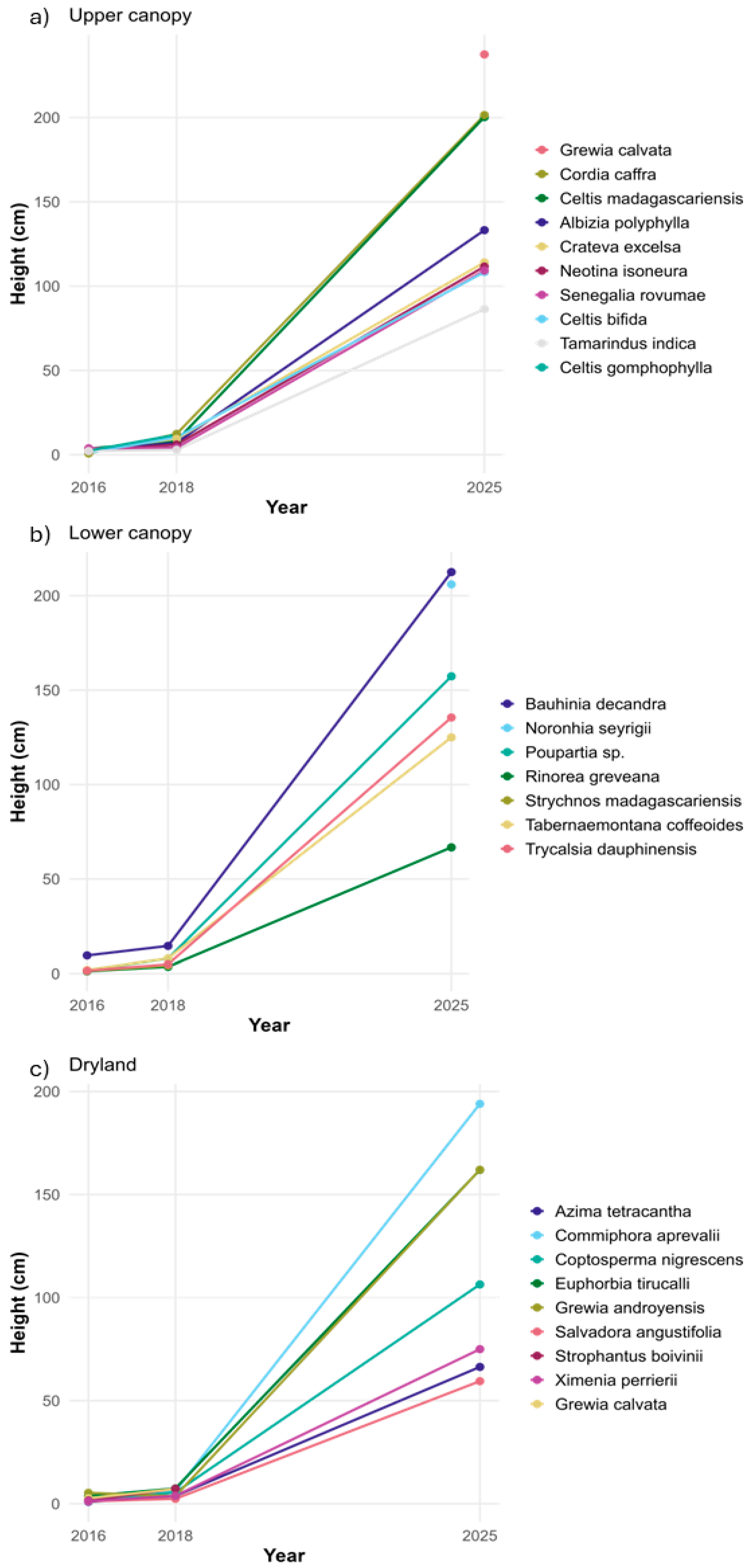
A visual inspection of the mean trajectories shows that across all species, tree height (Figure 2) and canopy width (Supplementary Figure S2) increased substantially between 2016 and 2025, with marked acceleration after 2018. The sharp increase suggests a lag phase during the first 2 years, likely due to transplant shock and adjustment to field conditions. During this early period, species differences in height were minimal, possibly reflecting uniform initial care (watering and shading), followed by accelerated growth once roots were established and competition began to shape the community structure. Basal stem diameter tells a more mixed story (Supplementary Figure S2). Five of the upper canopy trees, three of the lower canopy, and two stems of the dryland species grow more slowly after 2018.
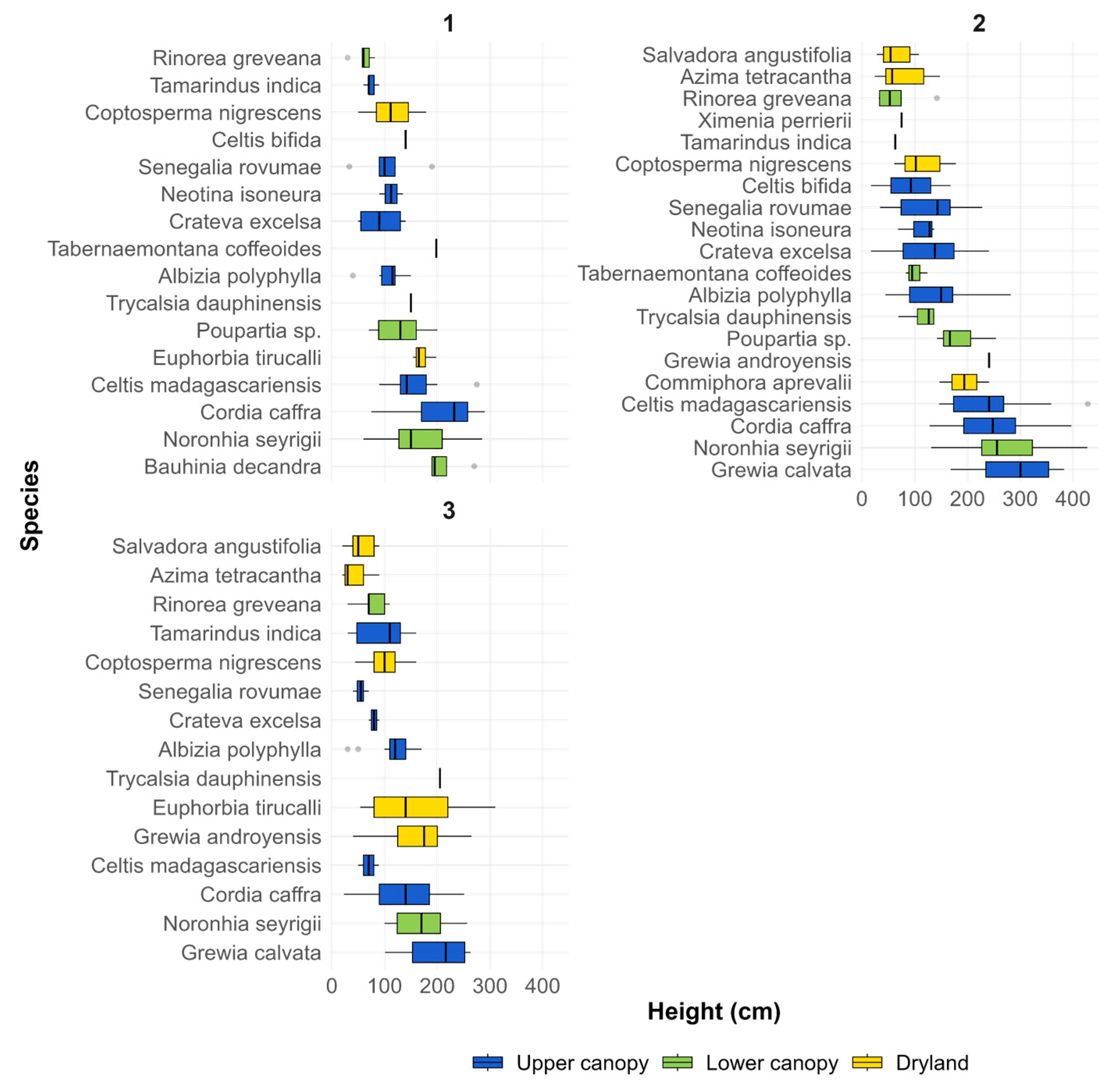
A linear mixed-effects model, including plot as a random factor, showed that species group was a significant influence (F2,433 = 8.75, p < 0.001). Both lower canopy species (estimate = +43.8 cm, p < 0.001) and upper canopy species (estimate = +23.4 cm, p = 0.008) attained greater heights than dryland species. This effect remained even after accounting for environmental differences between plots, including soil, moisture levels, organic matter and light. Growth performance varied markedly among species, reflecting, by 2025, strong interspecific differences in height (Figure 3), canopy width and stem diameter (Supplementary Figures S3 and S4).
Some species such as Noronhia seyrigii and Cordia caffra achieved consistently tall and broad canopies across all plots, while others (e.g., Celtis madagascariensis) showed pronounced variation between sites. This indicates that growth performance varied not only among species but also across plots, highlighting strong site-specific effects (Appendix A Table A1).
However, plot-level variance explained only a small proportion of overall variability, indicating that species identity was a much stronger predictor for canopy type or plot. Linear mixed-effects models confirmed that species identity was the dominant predictor of growth (F21,423 = 15.15, p < 0.001), with this far exceeding the variance explained by species group (F2,433 = 8.75, p < 0.001), while plot accounted for only a modest portion of total variability. Canopy expansion and basal diameter patterns closely followed height trends, reinforcing the combined influence of species traits and local site conditions on restoration outcomes. Patterns of canopy expansion closely mirrored those of height, with upper canopy species achieving both the tallest growth and the widest canopies (LMM species group effect: F2,439 = 7.88, p = 0.0004). By contrast, stem diameter showed weaker differences between groups: F2,446 = 9.59, p < 0.001 (Supplementary Figures S3 and S4).
By 2025, species composition also varied markedly between plots. Plot 1 and Plot 3 had the lowest numbers of surviving species (18 each), while Plot 2A showed the highest number of species (26). In 2016 all the plots were planted with Tamarindus indica seedlings, important for the restoration of the gallery forest. By 2025 T. indica is still present, with low mortality, growing slowly but a little faster on Plot 3 (Figure 3).
To analyse the effects of planting distance, we included Plot 2B, established at 1.3 m, with the original plots planted at 1.0 m and 1.5 m (Supplementary Figures S5 and S6). By 2025, growth was highest at the 1.3 m spacing. Average height reached 143 cm at 1.0 m spacing, 183 cm at 1.3 m and 135 cm at 1.5 m. A non-parametric Kruskal–Wallis test detected significant differences among spacing treatments (χ2 = 67.34, df = 2, p < 0.001), reflecting higher median growth at 1.3 m spacing. Although this analysis suggests that tree seedlings at 1.3 m spacing showed a tendency for greater height, site effects, particularly the favourable conditions on 2B with mid-forest soils and moisture but more light than its neighbour 2A, dominated the response, indicating that planting distance had a limited long-term influence on tree growth compared with underlying environmental plot variations.

3.2. Survival and Mortality

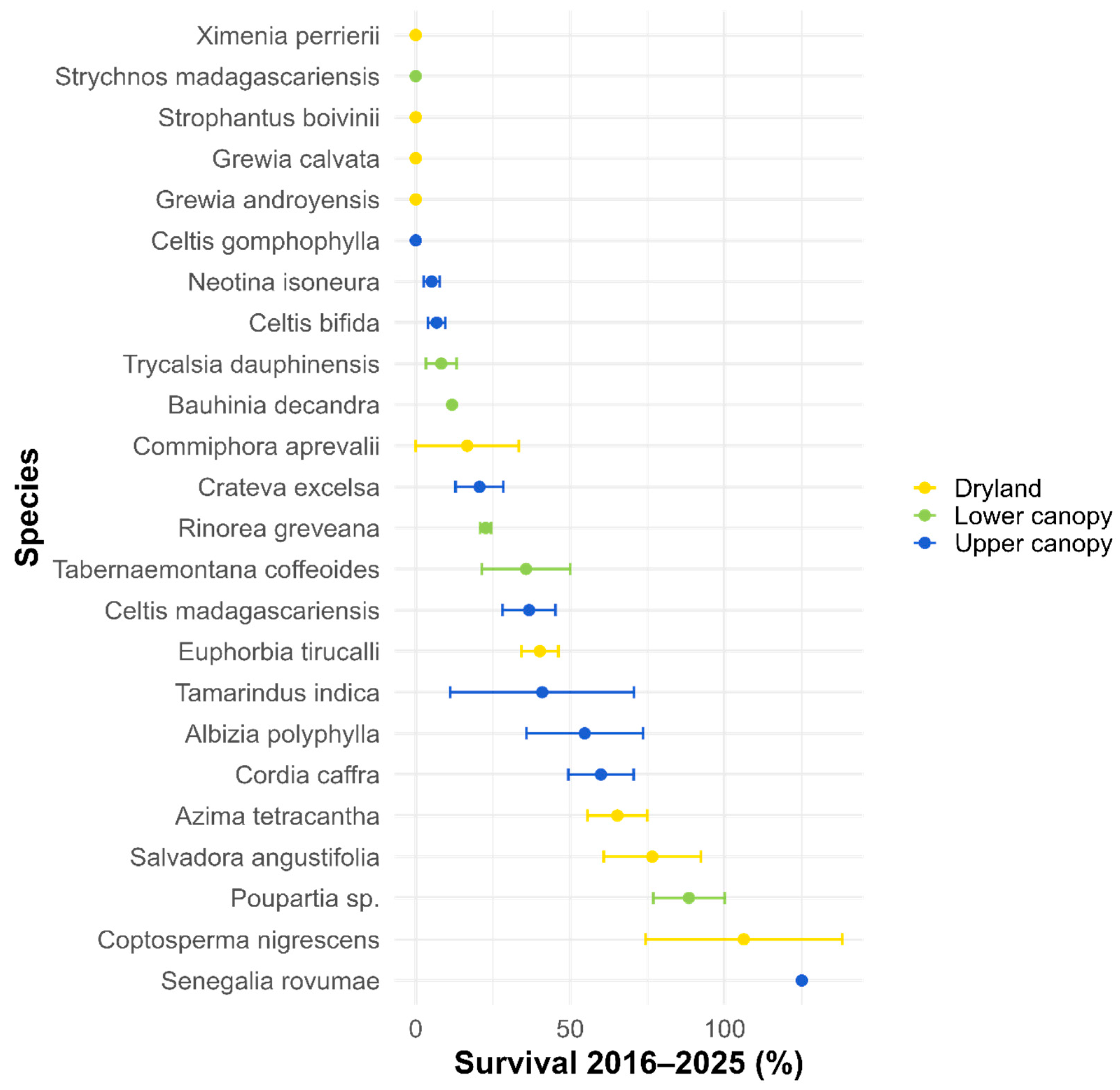
Survival rates varied widely among species (LMM: F23,25.3 = 4.20, p = 0.00035) but did not differ between species groups (F2,48 = 0.66, p = 0.523) (Figure 4). Species such as Senegalia rovumae, Coptosperma nigrescens or Poupartia sp. showed the highest survival, whereas Celtis gomphophylla, Grewia calvata, Neotina isoneura and Trycalsia dauphinensis exhibited low survival. To evaluate longer-term persistence, we calculated strict survival rates, considering only those individuals planted in 2016 and still alive in 2025 (equivalent values are provided in Supplementary Figure S7). The rates calculated for 2018 were not considered since these could have been strongly affected by transplant shock.
Survival and mortality also did not differ significantly between plots overall (F2,26.9 = 1.96, p = 0.16), although Plot 2A showed a tendency toward higher survival, especially of dryland species, compared with Plots 1 and 3, whereas low canopy species on Plot 3 showed particularly low survival (Supplementary Figure S8). These results indicate that survival outcomes in Malaza were more strongly influenced by site-specific conditions than by species group identity.

3.3. Recruitment from the Forest 2017–18

The upper canopy species Crateva excelsa supplied the largest number of recruits (15 on Plots 1 and 2A, with slightly more on the 1.5 m sides), while the dryland species Ximenia perrieri on Plot 3, with only one planted seedling surviving, supplied 12 recruits (8 on the 1 m side with less shade), suggesting that either watering over the first 2 years and/or sheltering of new seedlings could have been be responsible for mortality. Eight other species colonised in lower numbers. Interestingly, Tamaridus indica, the key gallery forest species, provided recruits on Plot 1 (3 on the 1 m, 2 on the 1.5 m side and one on Plot 2A at 1 m).

3.4. Monitoring

The 9-year record initially revealed growth patterns that were not evident in the first 2–3 years (Figure 2). We observed very modest growth from 2016 to 2018, followed by a sharp acceleration through 2025. These contrasting trajectories indicate that early performance alone was a poor predictor of medium-term success and highlighted the need to evaluate both initial establishment and subsequent persistence.
By 2018, most species appeared to perform similarly, suggesting an equivalent restoration effect. However, extended monitoring revealed clear differentiation: Noronhia seyrigii, Celtis madagascariensis and Bauhinia decandra emerged as strong candidates for canopy replacement, while Tamarindus indica persisted with consistently slow growth. Some species also shifted their relative growth rates over time, depending on plot conditions. For example, Celtis madagascariensis, an upper canopy species, grows faster on Plots 1 and 2 and slower on Plot 3 (Appendix A Table A1).
Mortality patterns followed a similar trend. Seedlings dead by 2018 are shown in the plot maps published in our Supplementary data published in 2021 [13]. There were some species that survived the establishment phase but declined in later years compared with others. Together, these results demonstrate that longer-term monitoring provides critical information on species’ trajectories and their restoration value that short-term assessments would have missed.

4. Discussion

Nine-year monitoring demonstrated that both species identity and group structure governed the growth outcomes in Berenty’s mixed forest, with species-level differences appearing more important than broad species group classifications [15,16]. This underscores the need for diverse species planting and ongoing monitoring to identify both high-performing and vulnerable species.
Growth and survival varied across the three initial plots, reflecting the influence of local conditions such as soil texture, moisture and shading. Plot 1 generally underperformed, with smaller median heights and diameters, suggesting that its sandier soils, lower moisture availability and increased shading may have constrained growth. By contrast, Plot 2A, located in the mid-forest, benefited from denser organic soils and more consistent moisture, with these providing conditions that favoured the establishment of both upper and lower canopy species. Plot 3 was intermediate, with several species showing moderate success in terms of survival but not matching their growth performance on Plot 2A. These differences suggest that local site conditions and management history, such as soil texture, moisture availability, shade levels and possibly initial watering and sheltering treatments, played an important role in shaping longer-term restoration outcomes [17]. Understanding these local influences is therefore essential when planning species selection and site locations in dry-forest restoration projects and underscores the need to replicate plantings across varied sites to identify where particular species are most likely to thrive [18].
Although seedlings planted at 1.3 m spacing (Plot 2B) exhibited greater average height and basal diameter than those at 1.0 m or 1.5 m, the difference was not significant after accounting for plot variation. The 2B height increase likely reflects the favourable soil and microclimatic conditions of that site rather than a true spacing effect, since environment—particularly soil fertility, moisture and prior land use—can override the influence of initial planting density [19,20,21]. While temporal and spatial dynamics can affect species interactions [22], our results emphasise that, in semi-arid forests like Berenty, small-scale environmental variation can overshadow experimental treatments, emphasising the need to consider microenvironmental conditions as part of restoration design.
Species survival patterns revealed a similar trend. While species groups did not differ significantly, individual species varied widely in their ability to persist. Species such as Coptosperma nigrescens, Senegalia rovumae and Poupartia sp. maintained relatively high survival rates and could represent strong candidates for future restoration efforts. Others, including Celtis gomphophylla and Grewia calvata, showed poor survival and may require either (a) assisted management interventions (e.g., irrigation, shading, soil amendments) or (b) alternative restoration strategies, such as enrichment planting in later successional stages [18,21,23]. Much has been written about how restoration programmes should be conducted [3,24], including considerations of planting distance, species selection and adaptive management. Our results highlight the importance of selecting species not only for their ecological roles but also for their establishment success across different environments.
Notably, survival rates highlight a common challenge in long-term restoration monitoring: inconsistencies arising from replanting or difficulties tracking individuals across years. Apparent data integrity issues are more than mere errors—they reflect the realities of restoration management performed remotely, where local staff may respond to mortality by reintroducing or losing identity tags of individuals. Many of the limitations we encountered stemmed from the fact that the research team was only present at Berenty for short field seasons. Consequently, nursery practices (e.g., roots growing through plastic bags and breaking during transplanting), label losses between 2016 and 2025 and unrecorded replacements all introduced uncertainty into our dataset and made it difficult to quantify precise mortality trajectories. Such methodological problems are common in long-term tropical restoration and should be explicitly recognised in reporting [1,25]. Successful long-term restoration is exemplified by Patricia Wright’s continuous engagement in tropical Ranomafana National Park, where scientific monitoring and community partnerships go hand in hand [26].
A further ongoing challenge in Berenty, as in other restoration programmes, is the removal of exotic, non-native species [27]. This is illustrated by Cordia caffra, whose growth outpaced that of most native and endemic species. Another species, Pithecellobium dulce, is already dominant in the adjoining Ankoba forest, and it could possibly expand into Malaza [18]. Although it provides food for lemurs, its spread would fundamentally alter the structure of the gallery forest if left unchecked. Managing such species requires balancing ecological integrity with faunal needs, a trade-off familiar to many restoration programmes.
Shortly before our 2025 fieldwork, a tropical cyclone caused extensive damage to the gallery forest, uprooting and destroying many mature trees. Climate change poses an escalating threat to Berenty Reserve, intensifying droughts and tropical storms may directly endanger this dry/gallery forest and its distinctive lemur populations. These combined pressures jeopardise the long-term stability of the entire forest ecosystem, making conservation both essential and increasingly complex. Expanding the upper canopy gallery forest along the riverside, where it once flourished and further into the mid-forest, will require careful selection of species that thrive under specific site conditions, supported by natural recruitment from the surrounding forest.

5. Conclusions

Extended studies can provide not only ecological insight but also practical guidance for carrying out restoration across Madagascar’s dry-forest ecosystems that remain among the most threatened yet least studied worldwide.
This study demonstrates the importance of long-term monitoring for understanding restoration dynamics. Had the study ended at the 2-year mark in 2018, most species would have appeared to perform similarly, and significant divergences in growth trajectories after 2018 would have been missed. Early results from 2016 to 2018 suggested similar growth among species, but only with 9 years of data did clear differences emerge in survival and growth patterns. Without this temporal depth, restoration success could have been overestimated.
Taken together the combination of average height and overall growth distribution provides a robust picture of species performance, with longer-term data allowing practitioners to identify species best suited for recovery on appropriate sites so that restoration decisions can be based on extended ecological functioning. Our results highlight the importance of selecting species for their establishment success in different environments and their survival and mortality, together with recruitment from the forest.
Research showed that slow-growing species should not be placed together but separated by numbers of fast and intermediate growth species. To help gallery forest regeneration in the future, plantings in the reserve should take place wherever the strangling vine Cissus quadrangularis has been removed, and there are gaps on the edge of the old gallery forest and along the open riverbank. Specifically, our findings show that tamarind, the chief gallery forest species, should do well since it is self-seeding in its natural habitat on Plot 1, where it is not overhung by progenitors. Shading by other species was found to be unharmful.
Our findings underscore the value of longer-term monitoring for reforestation, with this increasingly recognised as essential for guiding adaptive management in restoration ecology [4,26,28]. Continued monitoring at Berenty should be most useful to determine whether the current trends persist, stabilise, or shift in response to climate and management pressures.

Supplementary Materials

The following supporting information can be downloaded at: https://www.mdpi.com/article/10.3390/land15010030/s1, Figure S1: Average canopy width by species and group in 2025. Canopy expansion patterns closely mirrored height results (Figure 2). Upper canopy species achieved wider crowns than dryland species (F2,439 = 7.88, p < 0.001). Figure S2: Mean basal diameter (cm) by species and species group in 2025. Lower canopy species developed thicker stems than dryland species (F2,446 = 9.59, p < 0.001), while upper canopy species showed intermediate growth. Figure S3: Species-level canopy width distributions by plot in 2025, coloured by species group (upper canopy, lower canopy, dryland). Boxes show medians and interquartile ranges. Species are ordered by their overall mean height across plots (see Figure 3 for comparison). Mixed-effects models indicated that canopy differed significantly among species groups, with upper canopy species attaining wider crowns, while variation among lower-canopy and dryland species was less pronounced. Differences among species were also highly significant. Figure S4: Species-level basal diameter distributions by plot in 2025, coloured by species group (upper canopy, lower canopy, dryland). Boxes show medians and interquartile ranges. Species are ordered by their overall mean height across plots (see Figure 3). Diameter varied significantly among species but not among species group. This pattern indicates that stem thickening is more strongly linked to species-specific traits than to group. Figure S5: Effects of planting distance (1 m, 1,3 m, 1,5 m) on tree height in 2025. Boxplots show the median (bold line), interquartile range (boxes), and range of values (whiskers). Outliers are represented as black points. Figure S6: (a) Mean basal diameter (± SE), and (b) mean canopy width by planting distance. Although individuals at 1.3 m spacing showed slightly larger diameters or wider canopies, neither the mixed model nor non-parametric tests indicated a significant spacing effect. Figure S7: Mortality by species and species group (2016–2025). Points show strict mortality (%), calculated only from individuals originally planted in 2016 and still present in 2025. Bars show standard errors. Figure S8: Strict survival (%) by species group and plot (2016–2025). Bars represent the mean survival rate per group within each plot, including only individuals planted in 2016. Although Plot 2A exhibited higher average survival than Plots 1 and 3, these differences were not statistically significant (LMM, F2,26.9 = 1.96, p = 0.16). No significant main effect of species group or interaction was detected (F2,19.67 = 0.12, p = 0.89; Strata × Plot, F4,25.5 = 0.83, p = 0.52).

Author Contributions

Writing—original draft, A.M.-B. and V.W.; Writing—review & editing, A.M.-B. and V.W. All authors have read and agreed to the published version of the manuscript.

Funding

This research was funded by The Gilchrist Educational Trust (London).

Data Availability Statement

The raw data supporting the conclusions of this article will be made available by the authors on request.

Acknowledgments

We are both most extremely grateful to Mme Claire Foulon, owner and manager of the reserve, provided our accommodation, and her staff and forest guides helped us with the field work. Throughout our stay, we were kept company by Prof. Simon Bearder, who came to study nocturnal lemurs, and Ian Temby, an amazing photographer interested in anything that moved. Our companions and the kindness of all the reserve’s personnel made our stay most enjoyable. We should also like to thank our three referees for their most helpful comments.

Conflicts of Interest

The authors declare no conflict of interest.

Appendix A

Table A1. Height of average species growth on the three plots over 9 years with their species group: U = Upper canopy, L = Lower canopy, D = Dryland. Cordia caffra * is a non-natives and should, in future, be removed, both from the nursery and the forest. Senegalia rovumae ** was previously named Acacia rovumae [8].
FAST GROWERS
Plot1 2A3
Cordia caffra *UGrewia calvataDGrewia calvataD
Bauhinia decandraLCommiphora sp.DCommiphora sp.D
Euphorbia sp.DNoronhia seyrigiiLNoronhia seyrigiiL
Nhronhia seyrigiiLCordia caffra *UCordia caffra *U
Celtis madagascariensisUCeltis madagascariensisU
SLOW GROWERS
Coptosperma nigrescensDTamarindus indicaUCeltis madagascariensisU
Senegalia rovumae **UAzima tetracanthaDCrateva excelsaU
Tamarindus indicaURinorea greveanaLSenegalia rovumae **U
Rinorea greveanaLSalvadora angustifoliaDSalvadora angustifoliaD

References

  1. Mesa-Sierra, N.; De La Peña-Domene, M.; Campo, J.; Giardina, C.P. Restoration of Tropical Dry Forest: An Analysis of Constraints and Successes across a Highly Threatened Biome. Front. Environ. Sci. 2025, 12, 1458613. [Google Scholar] [CrossRef]
  2. Viani, R.A.G.; Barreto, T.E.; Farah, F.T.; Rodrigues, R.R.; Brancalion, P.H.S. Monitoring Young Tropical Forest Restoration Sites: How Much to Measure? Trop. Conserv. Sci. 2018, 11, 1940082918780916. [Google Scholar] [CrossRef]
  3. Gatica-Saavedra, P.; Echeverría, C.; Nelson, C.R. Ecological Indicators for Assessing Ecological Success of Forest Restoration: A World Review. Restor. Ecol. 2017, 25, 850–857. [Google Scholar] [CrossRef]
  4. Evangelista De Oliveira, R.; Lex Engel, V.; De Paula Loiola, P.; Fernando Duarte De Moraes, L.; De Souza Vismara, E. Top 10 Indicators for Evaluating Restoration Trajectories in the Brazilian Atlantic Forest. Ecol. Indic. 2021, 127, 107652. [Google Scholar] [CrossRef]
  5. Díaz-Triana, J.E.; Torres-Rodríguez, S.; Muñoz-P, L.; Avella-M, A. Monitoreo de La Restauración Ecológica En Un Bosque Seco Tropical Interandino (Huila, Colombia): Programa y Resultados Preliminares. Caldasia 2019, 41, 60–77. [Google Scholar] [CrossRef]
  6. Culbertson, K.A.; Treuer, T.L.H.; Mondragon-Botero, A.; Ramiadantsoa, T.; Reid, J.L. The Eco-Evolutionary History of Madagascar Presents Unique Challenges to Tropical Forest Restoration. Biotropica 2022, 54, 1081–1102. [Google Scholar] [CrossRef]
  7. Winchester, V.; Hardwick, K.; Rasamimanana, H.; Raharison, S.; Mertl-Millhollen, A.; Gärtner, H.; McCrae, J. Berenty Reserve—A Gallery Forest in Decline in Dry Southern Madagascar—Towards Forest Restoration. Land 2018, 7, 8. [Google Scholar] [CrossRef]
  8. Mondragón-Botero, A.; Riera, B.; Rasamimanana, H.; Razafindrakoto, S.; Warme, E.; Powers, J.S. Structural and Compositional Differences in Gallery and Spiny Forests of Southern Madagascar: Implications for Conservation of Lemur and Tree Species. PLoS ONE 2024, 19, e0307907. [Google Scholar] [CrossRef] [PubMed]
  9. Blumenfeld-Jones, K.; Randriamboavonjy, T.M.; Williams, G.; Mertl-Millhollen, A.S.; Pinkus, S.; Rasamimanana, H. Tamarind Recruitment and Long-Term Stability in the Gallery Forest at Berenty, Madagascar. In Ringtailed Lemur Biology. Developments in Primatology: Progress and Prospect; Jolly, A., Sussman, R.W., Rasamimanana, H., Eds.; Springer: Boston, MA, USA, 2006; pp. 69–85. [Google Scholar]
  10. Rambeloarivony, H.; Jolly, A. Berenty Reserve: Past, Present and Future. In Leaping Ahead: Advances in Prosimian Biology; Masters, J., Gamba, M., Génin, F., Eds.; Springer: New York, NY, USA, 2013; pp. 353–359. ISBN 978-1-4614-4511-1. [Google Scholar]
  11. Jolly, A. Berenty Reserve, Madagascar: A Long Time in a Small Space. In Long-Term Field Studies of Primates; Kappeler, P.M., Watts, D.P., Eds.; Springer: Berlin/Heidelberg, Germany, 2012; pp. 21–44. ISBN 978-3-642-22514-7. [Google Scholar]
  12. Mondragón-Botero, A.; Powers, J.S. How Dry Is Dead? Evaluating the Impact of Desiccation on the Viability of the Invasive Species Cissus quadrangularis. Plant-Environ. Interact. 2024, 5, e70011. [Google Scholar] [CrossRef]
  13. Sagar, R.; Mondragon-Botero, A.; Dolins, F.; Morgan, B.; Vu, T.P.; McCrae, J.; Winchester, V. Forest Restoration at Berenty Reserve, Southern Madagascar: A Pilot Study of Tree Growth Following the Framework Species Method. Land 2021, 10, 1041. [Google Scholar] [CrossRef]
  14. R Core Team. R: A Language and Environment for Statistical Computing; R Core Team: Vienna, Austria, 2023; Available online: https://www.R-project.org/ (accessed on 8 December 2025).
  15. Werden, L.K.; Alvarado, J.P.; Zarges, S.; Calderón, M.E.; Schilling, E.M.; Gutiérrez, L.M.; Powers, J.S. Using Soil Amendments and Plant Functional Traits to Select Native Tropical Dry Forest Species for the Restoration of Degraded Vertisols. J. Appl. Ecol. 2018, 55, 1019–1028. [Google Scholar] [CrossRef]
  16. Laughlin, D.C. Applying Trait-Based Models to Achieve Functional Targets for Theory-Driven Ecological Restoration. Ecol. Lett. 2014, 17, 771–784. [Google Scholar] [CrossRef]
  17. Brouwer, R.; Peña-Claros, M.; Bongers, F.; Poorter, L.; Guillemot, J.; Almeida, D.R.A.; De Almeida, C.T.; Resende, A.F.; Simões, L.H.P.; Ivanauskas, N.M.; et al. Functional Recovery of Tropical Forests: The Role of Restoration Methods and Environmental Conditions. Biol. Conserv. 2025, 309, 111269. [Google Scholar] [CrossRef]
  18. Brancalion, P.H.S.; Holl, K.D. Guidance for Successful Tree Planting Initiatives. J. Appl. Ecol. 2020, 57, 2349–2361. [Google Scholar] [CrossRef]
  19. Kremer, K.; Jonsson, B.; Tavares, M.F.; Bauhus, J. Effects of Planting Density on the Performance of Reforestation and Afforestation Plantings in Temperate and Boreal Forests: A Systematic Review. Restor. Ecol. 2025, 33, e70103. [Google Scholar] [CrossRef]
  20. Xu, Z.; Fan, F.; Lin, Q.; Guo, S.; Li, S.; Zhang, Y.; Feng, Z.; Wang, X.; Rensing, C.; Cao, G.; et al. Effects of Different Stand Densities on the Composition and Diversity of Soil Microbiota in a Cunninghamia Lanceolata Plantation. Plants 2025, 14, 98. [Google Scholar] [CrossRef]
  21. Elliott, S.; Navakitbumrung, P.; Kuarak, C.; Zangkum, S.; Anusarnsunthorn, V.; Blakesley, D. Selecting Framework Tree Species for Restoring Seasonally Dry Tropical Forests in Northern Thailand Based on Field Performance. For. Ecol. Manag. 2003, 184, 177–191. [Google Scholar] [CrossRef]
  22. Forrester, D.I. The Spatial and Temporal Dynamics of Species Interactions in Mixed-Species Forests: From Pattern to Process. For. Ecol. Manag. 2014, 312, 282–292. [Google Scholar] [CrossRef]
  23. Elliott, S.D.; Blakesley, D.; Hardwick, K. Restoring Tropical Forests: A Practical Guide; Kew Publishing, Royal Botanic Gardens: London, UK, 2013; ISBN 978-1-84246-442-7. [Google Scholar]
  24. Chazdon, R.; Brancalion, P. Restoring Forests as a Means to Many Ends. Science 2019, 365, 24–25. [Google Scholar] [CrossRef] [PubMed]
  25. Pennington, R.T.; Baker, T.R. Plants, People and Long-term Ecological Monitoring in the Tropics. Plants People Planet 2021, 3, 222–228. [Google Scholar] [CrossRef]
  26. Wright, P.C. For the Love of Lemurs: My Life in the Wilds of Madagascar; Lantern Books, a Division of Booklight Inc.: New York, NY, USA, 2014; ISBN 978-1-59056-445-5. [Google Scholar]
  27. D’Antonio, C.M.; August-Schmidt, E.; Fernandez-Going, B. Invasive Species and Restoration Challenges. In Foundations of Restoration Ecology; Palmer, M.A., Zedler, J.B., Falk, D.A., Eds.; Island Press/Center for Resource Economics: Washington, DC, USA, 2016; pp. 216–244. ISBN 978-1-61091-828-2. [Google Scholar]
  28. Chazdon, R.L.; Norden, N.; Colwell, R.K.; Chao, A. Monitoring Recovery of Tree Diversity during Tropical Forest Restoration: Lessons from Long-Term Trajectories of Natural Regeneration. Phil. Trans. R. Soc. B 2023, 378, 20210069. [Google Scholar] [CrossRef] [PubMed]
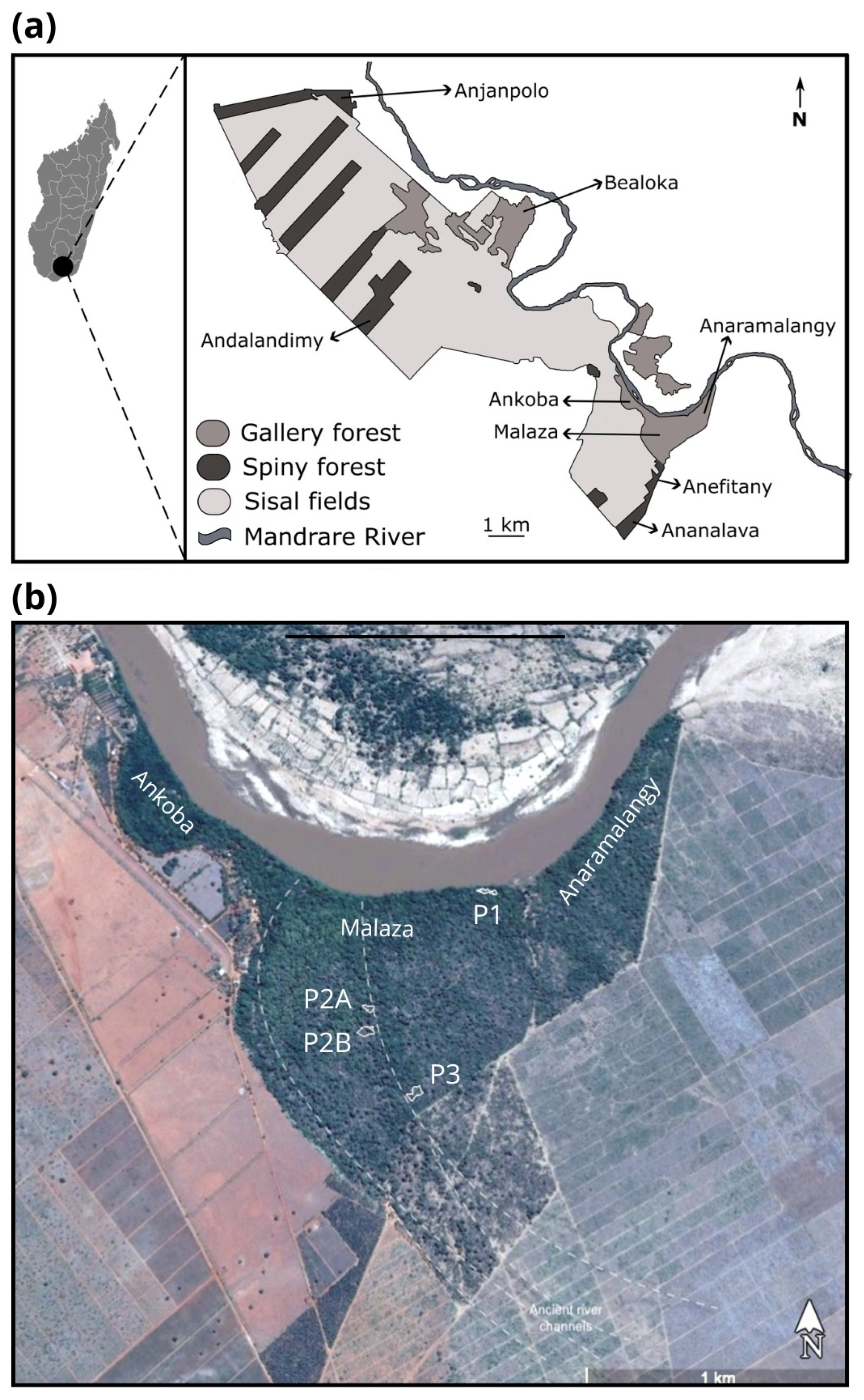
Figure 1. Gallery and spiny forests at Berenty Reserve, Madagascar. (a) All the different forest locations in Berenty Reserve (Modified from [10]). (b) Aerial photograph of Berenty Reserve showing forest plot locations established in 2016–17. Latitude and longitude of Plot 2A Malaza: 25°00′38″ S 46°18′29″ E. Dashed lines indicate ancient river channels (Modified image: Copernicus Sentinel data 2024).
Land 15 00030 g001
Figure 2. Changes in mean height of upper canopy (a), lower canopy (b) and dryland (c) species between 2016, 2018 and 2025. Points represent average height per species. Lines represent species with measurements in at least two census years. Some lines end in 2018 because those species were no longer present in 2025. Conversely, isolated 2025 points (e.g., Noronhia seyrigii) reflect species that were planted after the 2018 census and therefore have no earlier measurements. Species whose lines are lacking: (a) Celtis gomphophylla. (b) Pouparti sp. and Strichnos madagascariensis. (c) Strophantus bovinii and Ximenia perrieri.
Land 15 00030 g002
Figure 3. Species-level height distributions by plot in 2025, coloured by species group (upper canopy, lower canopy, dryland). Boxes show median and interquartile range (IQR), with grey points being outliers. Species are ordered by their overall mean height across plots to aid comparison. Numbers above each graph indicate the plot.
Land 15 00030 g003
Figure 4. Mean ± SE survival for each species across plots, grouped by vegetation type. Points represent species-level mean survival rates (%) calculated as the proportion of individuals alive in 2025 relative to those planted in 2016 (strict survival). Error bars indicate standard error across plots. Some species lack SE bars because they occurred in only one plot.
Land 15 00030 g004
Disclaimer/Publisher’s Note: The statements, opinions and data contained in all publications are solely those of the individual author(s) and contributor(s) and not of MDPI and/or the editor(s). MDPI and/or the editor(s) disclaim responsibility for any injury to people or property resulting from any ideas, methods, instructions or products referred to in the content.