Article

Land Prices and Determinants of Socio-Economic Development in Pleiku, Central Highlands, Vietnam


1
Faculty of Natural Resources and Environment, Vietnam National University of Agriculture, Ha Noi 10000, Vietnam
2
Research Group Regional Development and Risk Management, Department of Spatial Planning, TU Dortmund University, 44221 Dortmund, Germany
*
Author to whom correspondence should be addressed.
Land 2026, 15(1), 190; https://doi.org/10.3390/land15010190
Submission received: 10 November 2025 / Revised: 30 December 2025 / Accepted: 13 January 2026 / Published: 21 January 2026
(This article belongs to the Special Issue Recent Progress in Land Cadastre)

Abstract

The rapid urbanization of Pleiku City, Vietnam, has led to a sharp increase in the demand for and prices of residential land, creating challenges for urban management and land valuation. This study aims to identify and quantify the key factors influencing residential land prices in Pleiku to provide a scientific basis for land use planning and smart urban development. Data were collected through surveys of 30 state officials involved in land valuation and 250 households living along major streets in Pleiku. Cronbach’s alpha was used to test the reliability of the collected data, and exploratory factor analysis (EFA) was used to identify influencing factor groups. The results show that residential land prices are strongly influenced by multiple factors, with location and infrastructure playing the most decisive roles. Market land prices were found to be approximately 1.5–2 times higher than state-regulated prices. Among the identified factor groups, location and infrastructure had the strongest influence, followed by economic, social, legal, and specific land use factors. Price differences between land plots mainly reflect variations in location, street characteristics, accessibility, and commercial potential. The study concludes that location and infrastructure development are the dominant drivers of residential land prices in Pleiku. These findings have important implications for land valuation, urban planning, and the implementation of smart urban construction policies in rapidly developing cities in Vietnam.

1. Introduction

Land is natural; humans did not create it, and it existed before people did. From an economic standpoint, the initial quality of land is established by nature due to its distribution across various locations and types of land [1]. These differences lead to variations in land value [2]. However, as humans use land for various purposes, such as production, business, and socioeconomic development, the value of human labor and land use planning has become apparent [3]. These impacts increase the value of land. Researchers of land economic theory assume that various factors, including the economic and social environment [4], infrastructure [5], and land use plans [6], determine the complex and ambiguous category of land prices. However, there is a consensus on how to apply land rent theory to analyze changes in urban land values [7].
Some urban researchers argue that land value is the result of discounting the future net income that urban land generates due to its properties [8,9]. Meanwhile, other researchers contend that demand for space to develop urban land uses determines land value [10,11]. Accessibility to economic activities, utility levels, land use purposes, and historical aspects of the land all contribute to its evaluation [12]. Urban economists, meanwhile, support the view that competition is fundamental to determining land and real estate prices, assuming that investors and land developers are key players in the land and real estate market [13]. Additionally, Lorenz (2017) argued that the perception and assessment of urban land value as a component of real estate and construction value depends on the nature and characteristics of the real estate [14]. Consequently, urban land value determination can vary depending on physical, economic, political, cultural, and social factors [15].
Land pricing is a crucial indicator in the real estate market and plays a vital role in land allocation, especially in megacities of emerging nations where infrastructure is evolving quickly [16,17]. Socioeconomic level influences land price [18]. Land prices function as intermediaries among land, the market, and state control [19]. The government uses land use planning and annual land use planning to manage land for social and economic development [20]. Effective management of land prices is a crucial instrument in land finance policy, ensuring a stable and sustainable revenue stream for the state budget [21]. Effective management of land prices also fosters the healthy advancement of the real estate market, addresses deficiencies in land management and utilization, and guarantees efficient and economical land usage.
In Vietnam, determining land prices in certain localities is still a challenging process [22]. Compensation and site clearance for each project depend on the state-regulated land price list. Therefore, to avoid conflicts over land prices between projects in an area, it is necessary to determine the price of the land for each project right from the start. For example, in the Thu Thiem Urban Area project in Ho Chi Minh City, the government and farmers implemented the compensation land price. More than 20 years have passed since the implementation of the Thu Thiem Urban Area project, yet the site clearance work remains incomplete. People have been filing collective lawsuits for a long time because they were compensated 18 million VND/m2, but the real estate company sold the land for 350 million VND/m2 [23]. This phenomenon is also evident in numerous projects in Hanoi [24], Da Nang [25] and Nghe An [26]. Pleiku city is a Class I urban area within Gia Lai Province and the center of tourism services and urban development in the Central Highlands provinces. Land prices in Pleiku city are increasing, leading to more investment projects. However, to ensure socioeconomic stability, the state land price does not increase significantly. This creates a large difference compared to market land prices and has led to inadequacies in land management and use. Understanding the current and future conditions of land prices in Pleiku city is significant for the socio-economic development of the area.
This study aims to analyze the fluctuation of residential land prices in Pleiku city from 2021 to 2023 and identify the key factors influencing these changes. Specifically, the study aims to: (i) investigate recent trends in residential land prices and (ii) determine the relative influence of location, infrastructure, economic, social, legal, and land use factors on residential land prices. This study was motivated by the growing discrepancy between state-regulated and market land prices in Pleiku, which directly affects land compensation, urban planning, investment efficiency, and social stability. Therefore, a better understanding of land price formation is essential for evidence-based land governance. This study’s findings are expected to contribute in three key ways. First, the findings provide empirical evidence on residential land price dynamics in a rapidly growing secondary city in Vietnam. Second, the findings will support local authorities in improving land price determination and compensation policies. Third, the findings offer scientific input for sustainable urban planning and the implementation of smart urban development strategies in Pleiku and other emerging urban areas.

2. Overview of Documents on Some Factors Affecting Land Prices

2.1. Some New Regulations on Factors Affecting Land Prices in Vietnam

Land valuation remains a hot topic that attracts public attention, with interest especially growing since the 2024 Land Law was promulgated. Therefore, land valuation for each project is an important factor in avoiding conflicts when many projects are implemented in the same area at the same time. Ensuring harmony among the interests of the state, investors, and the people when implementing a project is the core issue that needs to be addressed. The government issued Decree 71/2024/ND-CP [27], which outlines specific regulations on factors influencing land prices. This is the first time that a Vietnamese legal document has officially addressed this issue. The decree also identifies factors affecting different types of land use, including non-agricultural and agricultural land (Table 1).
The decree specifies the factors affecting land prices for both agricultural and non-agricultural land. These factors are relatively stable and change little over time. Considering these criteria ensures steady land pricing near the market value. It also helps prevent abrupt surges in land values, or “virtual fever,” which threaten the stability of the real estate and capital markets. However, the elements listed in Article 8 of this order do not solely influence land prices. Land prices are affected by various other factors, including economic conditions, supply and demand, and regulations.

2.2. Residential Land Prices and Factors Affecting Them: A Literature Review

Researchers often analyze and evaluate groups of factors related to land/real estate when considering the factors determining land prices in particular and real estate prices in general (including urban land). They generally divide these factors into two basic groups: (i) factors related to the land plot and (ii) factors outside the land plot [28]. The grouping of these factors also varies depending on the purpose of the research and the capabilities of the data collection [29]. Many researchers support an approach that divides the factors determining land prices into three specific groups: location factors, factors related to land characteristics, and factors surrounding the land. One such approach is the division into three specific groups of factors (location factors, land characteristics, and surrounding land factors) proposed by Chau & Chin [30]. Subsequently, the hedonic analysis technique was developed to identify factors influencing land and real estate prices, particularly housing [31,32]. This approach focuses specifically on land and real estate factors, which makes data collection feasible. Additionally, researchers can develop or add other relevant attributes.
Based on their research review and factor classification, the authors categorize the causes influencing fluctuations in urban land prices into two primary groupings. The first category comprises internal elements associated with land. These include characteristics of the land plot itself, location-related factors, and factors associated with different areas. The second category consists of variables that are extrinsic to the land. Market-related elements are affected by government interventions, land use planning policies, and land users. We further subdivide these two major categories.
The group of factors associated with the land plot correlates directly with the land itself. Specifically, these factors affect the land area, size, shape, and use capacity (related to land use policies and planning) [33,34]. However, in the current context, constructions often link these factors because real estate encompasses the land and the constructions on it [35]. Therefore, when building on land plots, various factors must be taken into account, such as construction time, area, number of floors, and structure [36,37]. Location reflects accessibility and distance to centers, traffic infrastructure, entertainment areas, public utilities, commercial areas, and environmental factors such as pollution, natural beauty, and social impacts [38]. Accordingly, land plots in favorable locations have higher value. However, because land has fixed characteristics, location factors are affected by regional and area factors [39]. These factors include natural conditions, socioeconomic conditions, and environment [40]. Therefore, changes in regional and area factors lead to changes in land location factors, which affect the land’s value [41].
The area encompasses a group of factors closely linked to the surrounding environment of the land [42]. Broadly speaking, it is a synthesis of factors belonging to the land’s natural environment [43], economy [44], culture [45], society [46], and ecological landscape [47]. Specifically, socio-economic and legal factors are decisive in changes to land use trends and values [48]. Meanwhile, external factors influence the relationship between supply and demand, land developments, and real estate markets. These factors influence the market value of land in urban regions. Additionally, we consider factors related to economic development, land market conditions, and the rate of urbanization [49]. From the perspective of land supply and demand in specific transactions, factors related to supply and demand can be considered [50]. Furthermore, the land market changes due to factors associated with investment and land use processes [51]. This group of factors is determined by public investments and the state’s influence through changes in land-related policies or land investment activities [52]. These activities impact and change the components that make up land value, as well as the relationships and developments in the land and real estate market.
Studies worldwide consistently show that land values can increase in anticipation of new infrastructure or rezoning, often generating substantial windfall gains or losses for landowners well before projects are completed. In transitional and emerging economies, where land institutions are evolving and land markets are not yet transparent or competitive, these effects can be especially significant, sometimes resulting in sharp discrepancies between administrative and market prices.
Evidence from Vietnam and other Asian countries broadly supports these international findings. Hedonic analyses of cities such as Hanoi and Ho Chi Minh City, as well as other provincial centers, highlight the dominant role of accessibility, plot size, building characteristics, planning information, and infrastructure in explaining property price variation. Several recent Vietnamese studies reveal that location and infrastructure-related variables are the most influential determinants of residential land prices. Socioeconomic conditions and legal/planning information also significantly impact market expectations and perceived risk. These results align with the factors emphasized in Vietnam’s new legal framework (e.g., Decree 71/2024/ND-CP) and confirm the necessity of a multidimensional approach to land valuation, integrating physical, locational, market, and institutional factors for accurate land price determination.
Against this background, the present study of Pleiku city makes three contributions to the literature. First, it provides empirical evidence from a rapidly growing Class I urban area in the Central Highlands, a region underrepresented in existing land price research in Vietnam. Second, the study links international hedonic and land rent theories with the factor classification embedded in the 2024 Land Law and Decree 71/2024/ND-CP by explicitly grouping determinants into internal (plot- and location-related) and external (market and institutional) factor groups. Third, the findings offer insights relevant to policy for improving project-level land valuation, aligning state and market land prices, and designing smart, transparent, and socially equitable land management in Pleiku and other emerging urban centers.

3. Methodology

3.1. Data Collection and Analysis

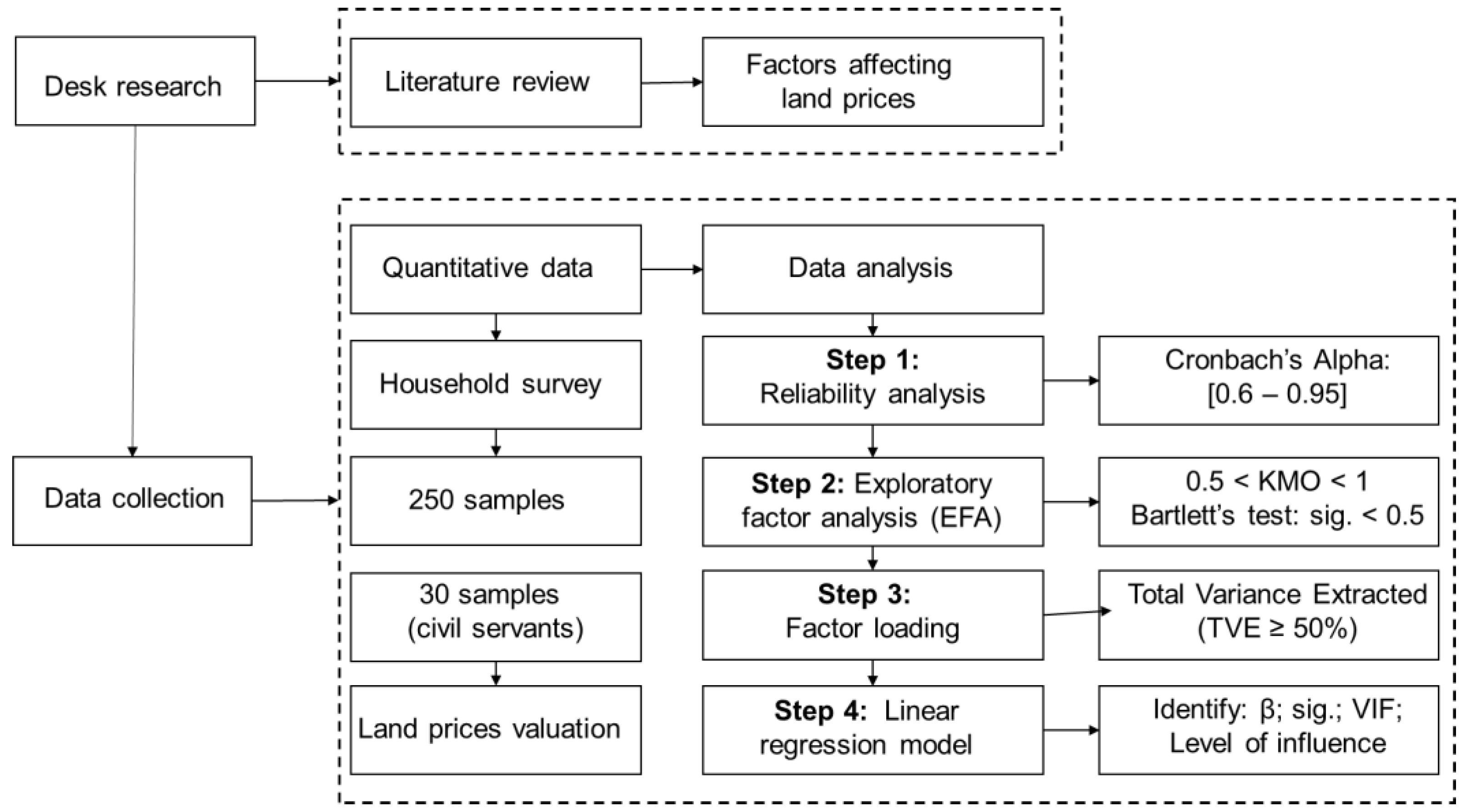
Both primary and secondary data were collected and used to achieve the research objectives (Figure 1).

3.1.1. Secondary Data Collection

These data were obtained from official statistical reports and specialized documents provided by state agencies in Pleiku City and Gia Lai Province. These agencies include the Gia Lai Provincial People’s Committee, the Department of Natural Resources and Environment, and the Land Registration Office. The data consist of annual state-regulated residential land prices, land use plans, socioeconomic development indicators, and land management records from 2021 to 2023. The data were used to analyze land price fluctuations and compare state-regulated prices with actual market prices.

3.1.2. Questionnaire Design

Two structured questionnaires were developed: (i) one for land administration officials and (ii) one for households living along major urban streets.
An open-ended questionnaire was used to collect qualitative information from civil servants on:
(i)
current procedures for residential land valuation;
(ii)
the key factors that influence land prices in Pleiku city;
(iii)
existing difficulties, institutional constraints, and conflicts in land valuation;
(iv)
the consistency between state-regulated and market-based land prices.
This questionnaire was designed in consultation with three Department of Natural Resources and Environment officers and four Land Registration Office officers to ensure content validity and practical relevance. The questionnaire was then distributed to 30 respondents: three Department of Natural Resources and Environment officers, four Branch of the Land Registration Office officers, and 23 cadastral officers from 23 wards and communes.
A structured questionnaire using a 5-point Likert scale (1 = very low influence; 5 = very high influence) was designed to quantitatively assess the perceived influence of different factors on residential land prices for households. The questionnaire included six main groups of variables:
(i)
location factors;
(ii)
infrastructure factors;
(iii)
economic factors;
(iv)
social factors;
(v)
legal and planning factors;
(vi)
specific land plot characteristics.
Each group consists of multiple observable indicators that reflect accessibility, road conditions, public utilities, income level, population density, land use, legal status, and development planning.

3.1.3. Study Area Selection

A stratified sampling approach was used to select representative study areas based on urbanization level and land price fluctuation intensity. Three typical functional zones in Pleiku city were selected to reflect spatial heterogeneity in residential land prices.
Central Urban Zone: The Phu Dong, Tay Son, Dien Hong, and Hoi Thuong wards were selected, with the main streets being Tran Phu and Dinh Tien Hoang. This area is the commercial and administrative core of the city and is characterized by high land prices and strong market activity.
The inner suburban zone (the outskirts of the center) includes Tra Da commune and the Tra Ba and Hoa Lu wards, along Hung Vuong and Tran Quoc Toan streets. This zone is experiencing rapid urban expansion, infrastructure upgrades, and mixed residential and commercial development.
The outer suburban zone (areas far from the city center) includes the communes of Gao, An Phu, Dien Phu, Bien Ho, Tan Son, and Chu A, as well as the streets of Le Thi Rieng and Le Van Huu. The Gao, An Phu, Dien Phu, Bien Ho, Tan Son, and Chu A communes, as well as the Le Thi Rieng and Le Van Huu streets, are located in this zone. This zone consists of newly urbanized or peri-urban areas with relatively lower land prices and greater price volatility.
This zoning approach ensures that the study captures spatial and functional differences in residential land pricing across Pleiku.

3.1.4. Sampling Method and Sample Size

After defining the study areas, simple random sampling was used to select households living along the selected streets. The survey respondents were household heads, who are primarily responsible for housing- and land-related decisions.
The minimum sample size required for exploratory factor analysis (EFA) was determined based on the principle that the sample size should be at least five times the number of observed variables. Additionally, the formula n = 50 + 8 m, where m is the number of observed variables, was used to determine the minimum sample size for multivariate regression analysis. Based on these criteria, 250 household surveys were conducted to ensure statistical robustness.

3.1.5. Survey Implementation and Data Processing

The household survey was conducted from December 2023 to February 2024. Completed questionnaires were screened for consistency and completeness before being entered into Microsoft Excel for coding and processing. The official land price data obtained from the Gia Lai Provincial People’s Committee were standardized for subsequent analysis.

3.1.6. Analytical Approach for Price Comparison

The comparative method was applied to analyze:
(i)
fluctuations in state-regulated residential land prices between 2021 and 2023,
(ii)
differences between state-regulated and market-based land prices over the same period.

3.2. Regression Analysis

The authors applied linear regression analysis to determine the influence of various factors on land prices in Pleiku city. The research model was derived from the factors influencing land prices in the city as follows (Equation (1)):
Yi = β0 + β1X1 + … + βnXn + Ei.
Here, Yi is the dependent variable representing the cost of the land plot.
X1 and Xn are independent variables representing factors that affect land prices.
β0 is a constant representing the value of Y when all X values are 0.
β1 and βn are regression coefficients. Ei is the standard error.
After testing the EFA factor, we incorporate the eligible factors into the regression analysis to establish the regression equation and coefficient. This allows us to evaluate the level of influence of the required factors through the regression coefficient. Thus, the larger the regression coefficient, the greater the factor’s influence on land prices. Variable descriptions are shown in the Table 2.

4. Results

4.1. Residential Land Prices in Pleiku City from 2021 to 2023

Table 3 shows the comparison of state and market prices for different types of residential land on the studied routes. In the central area, the market price of land on Tran Phu Street is 146.2–152.7% higher than the state price. For location 4, it is 139.2–149.0%. On Dinh Tien Hoang Street, the market price for Location 1 is 145.0–153.0% higher than the state price. For location 3, it is 124.6–154.4%. The primary reason for the disparity in land prices is that these routes have the most advanced natural and socioeconomic conditions in the city. Furthermore, convenient transportation and the concentration of numerous restaurants, markets, and business stores create ideal conditions for combining residential land with production and business land, thereby increasing the land plot’s profitability.
The state land price ranges from $77.90 to $457.60 USD/m2 for the suburban residential land area. On Hung Vuong Street, the actual land price is 146.6–159.5% higher than the state price at location 1. Location 3 is 148.1–166.7% higher, and Location 4 is 130.4–165.2%. On Tran Quoc Toan Street, the actual land price is 149.5–161.9% higher than the state price at location 3. Location 3 is 150.0–175.0% higher, and Location 4 is 131.6–152.6%. These streets boast robust infrastructure, numerous grocery stores, and a large number of companies that draw in a large workforce, leading to a highly developed service sector. This area has also developed commercial services that are convenient for individuals, businesses, and trade in their daily lives. The market price for similar plots of land varies. Differences in the factors affecting the price of each plot of land explain this variation.
The roads in remote areas are local rural residential roads in communes, which are not favorable for business and trade. This results in low profitability. This is why the market price for land in these areas is lower. Locations 1 and 2 have a higher difference coefficient than the other locations. This is because the infrastructure conditions at locations 1 and 2 are better and more favorable for production and business. This leads to land prices much higher than the regulated price. Consequently, the difference coefficient is higher at locations 1 and 2 than at the remaining locations. Land value on the same street in a commercially advantageous area exceeds that in less advantageous places. The regulated land price is often lower than the market price, with the disparity ranging from 1.5 to 2 times. This price gap diminishes progressively based on the area and street type.

4.2. Factors Affecting Residential Land Prices in Pleiku City

4.2.1. Analyze the Reliability of Survey Data

Through a survey of 30 civil servants and public employees in Pleiku Ward, we identified six categories of characteristics encompassing 24 independent variables that influence land prices. We incorporated these categories into the research model. Using the survey findings from 250 households, we calculated Cronbach’s alpha coefficient and the corrected item–total correlation, as presented in Table 4.
The results of the reliability analysis indicate that the Cronbach’s alpha test for the 24 independent variables in the research model is satisfactory. However, one observed variable, level of education (SF2), does not satisfy the criteria. It has a total correlation coefficient of less than 0.3. This indicates insufficient reliability, necessitating its removal from the research model. Therefore, the research model includes 23 reliable observed variables.

4.2.2. Exploratory Factor Analysis

Instead of focusing on the 23 individual factors influencing land prices, this study examined six broad clusters of factors, each of which includes smaller elements that exhibit correlations. The initial EFA results eliminated two variables, LOF2 and PF5, because they loaded on two factors simultaneously. Table A1 presents the outcomes of the factor analysis suitability assessment and reveals that the Kaiser–Meyer–Olkin (KMO) coefficient equals 0.832. EFA is appropriate for empirical data. Furthermore, Bartlett’s test yielded a significance value of 0.000, indicating that the data align perfectly with the EFA and that the observed variables exhibit linear correlation with the representative factor.
Table A3 presents the explanatory power assessment results of the observed variables in the model, along with the outcome factor. The data show that the total variance extracted from the independent variable is 66.646%, which is greater than 50%. This indicates that the EFA satisfies the requirements. Additionally, the data shows that 66.646% of the variation in the outcome variable is attributable to the components included in the model. In this study, the observed variables accounted for 66.646% of the variance in land prices in Pleiku city.
The rotation matrix determined the loading weights by arranging the 23 observed variables from six groups of factors in a different order than in the original matrix (Table 5). The matrix’s loading weights revealed that LOF2 and PF5 were loaded onto both factors, leading to their elimination. The loading factors of the variables all have values greater than 0. A loading factor greater than 0.3 is considered to be at the minimum level, greater than 0.4 is considered important, and greater than 0.5 is considered to have practical significance. Therefore, it can be affirmed that each factor correlates with the factor of which it is a component. EFA has practical significance.
As a result of the extensive EFA investigation, six corresponding groupings of components comprising geographical, economic, social, legal, specific, and infrastructural elements have been created. These factors will be incorporated into the regression analysis.

4.2.3. Regression Analysis and Determination of the Level of Influence of Factors on Urban Land Prices in Pleiku City

After testing and factor analysis, we used the eligible factors in the regression analysis to find the linear regression equation between land price and the factors affecting it, as well as to determine the extent to which these factors influence land price. The results showed that the independent variables in the model explained 71.5% of the variation in land price, with an adjusted R2 value of 0.715 (see Table A3). The Durbin–Watson coefficient value of 1.915 is close to 2, indicating that there is no correlation between the variables in the model. This confirms the acceptability of the correlation analysis results once more. Table 6 displays the regression coefficient results.
Based on the results of the regression coefficient analysis, we can estimate the standard regression model as follows: Y = 0.137X1 + 0.212X2 + 0.156X3 + 0.135X4 + 0.271X5 + 0.301X6 + ei. Table 6 shows that all of the variables in the regression model have a significance level (Sig) less than the maximum value of 0.05, indicating that they impact land prices. The VIF values are all greater than 1, indicating no multicollinearity in this analysis.
We conducted an ANOVA to re-test the reliability of the regression analysis, and Appendix A Table A4 displays the results. The results show that the F value varies with the significance level Sig = 0.000, indicating that the regression analysis is reliable.
The standardized RC determines the influence of the independent variables in the model. Based on this coefficient, the authors arranged the factors affecting land prices in Pleiku city from highest to lowest priority. Variable X6 (location) has the greatest influence, contributing 24.88%, followed by variable X5 (infrastructure) with 22.39%. Meanwhile, variable X2 (the economy) contributes 17.5%, and variable X3 (society) contributes 12.85%. The two groups with the least impact on land prices in Pleiku city are variables X1 (particular) and X4 (legal), which contribute 11.28% and 11.11%, respectively (Table 6). Thus, location will play the largest role in affecting land prices, followed by infrastructure. This result is consistent with local reality.
The tests confirm that the six groups of factors, ranked by their influence on land prices, are strengths that are statistically significant in Pleiku city. Specifically, location factors are highly influential. Infrastructure factors are also influential. Economic factors have a significant influence. Social, individual, and legal factors have relatively similar levels of influence.

5. Discussion

Land is a unique resource and a significant asset for national development. It is also a unique means of production that contributes to all aspects of economic development and social life. The price of land is a crucial component of financial policy, serving as an economic instrument that balances the interests of the state, the owner, and the land user [53]. Historically, the methodology for assessing land values exhibited numerous deficiencies that impeded the robust growth of the real estate market. Therefore, identifying the factors that influence land prices is crucial for achieving the most accurate results. This study used Pleiku city as its research site and identified several critical factors that influence land prices in the region.
The 2013 Land Law, preceding the 2024 Property Law, established a land pricing framework that delineated the maximum and minimum prices for each property category. This framework was released annually over a span of five years [54]. The implementation of the land price framework aims to regulate market land prices and provide state management agencies with a system to oversee local land price lists and ascertain the financial obligations of land users during the usage period. However, the land pricing structure has not yet fulfilled all of its original objectives. It has even established a two-tier pricing system, creating challenges in managing and implementing land-based projects. According to the state-issued framework, land prices serve as the basis for calculating taxes or compensation for site clearance. The market price, also known as the second land price, often exceeds the state-regulated price several times [55]. Survey results on urban land prices in Pleiku Ward demonstrate this clearly, as the market price for land is 1.5–2 times higher than the state-regulated price. Therefore, the 2024 Land Law removed the government’s land price framework and replaced it with an annual land price list. Under this new regulation, individuals must declare a real estate transfer price that is accurate or close to the market price. This will help limit the loss of state budget revenue and resolve the issue of conflicting prices when trading and transferring land.
The analysis confirms that location is the dominant factor influencing residential land prices in Pleiku city, followed by infrastructure. This finding aligns with studies in Nghe An, Bac Ninh [56], and Can Tho [57]. It also clarifies why the land price framework prior to the 2024 Land Law and Decree 74/2024/ND-CP stipulated location as the primary factor in determining building land prices. In these areas, infrastructure factors have the strongest impact on land prices. This is due to the gradual completion of infrastructure in these developing areas. Additionally, the trend of smart urban development in large cities affects planning factors and land prices due to investment in smart infrastructure. In these areas, completed and upgraded infrastructure significantly increases land prices.
A survey of 30 civil servants in Pleiku city indicates that land speculation and profit-driven land transfers are the main reasons for rising land prices on several streets. To address this issue, it is essential to introduce financial regulations, particularly land taxation, to curb speculative activities. Land users who hold residential land exceeding the state’s prescribed quota should be subject to a higher tax rate that increases progressively based on the duration of land ownership.
Meanwhile, the Provincial People’s Committee should review and adjust land prices in areas farther from the city center. This will ensure a fair balance of interests between the state and land users. Since Gia Lai Province is planning to allocate more land in this area, effective land valuation will require sufficient state investment. Priority should also be given to strengthening the capacity of organizations involved in land and real estate valuation. This includes investing in specialized equipment and modern technologies to support the development of land value maps and zoning. Additionally, the state should work towards creating an integrated, synchronized land database with multiple functions to enhance transparency and efficiency in land management.
Despite the robustness of the statistical results, this study has several limitations. First, the household survey was limited to 250 observations, which is statistically adequate for EFA but may not fully capture the heterogeneity of land market behavior across all socioeconomic groups. Second, the factor assessment partly relied on Likert-scale perceptions, which may introduce subjective bias. Third, although land price changes were examined over the 2021–2023 period, the regression model itself is cross-sectional and does not capture long-term dynamic price adjustments. Finally, informal transactions and unreported market prices could not be fully observed, potentially leading to some degree of measurement error.

6. Conclusions

Land valuation is the process of determining the monetary value of land for a specific intended use at a given time. It plays a critical role in economic development and state land management. Valuation outcomes provide a foundation for land use rights transactions, contribute to land market regulation, support compensation during state land acquisition, and improve land use efficiency. Furthermore, land valuation is fundamental to social justice, especially in resolving land disputes and formulating and implementing land legislation.
This study examined the perceived determinants influencing residential land prices based on a survey of 30 state officials and civil servants involved in land valuation activities and 250 households in Pleiku city. It is important to note that the results reflect stakeholder perceptions and assessments of price formation rather than direct evidence from actual market transactions. Therefore, the findings capture only one important dimension of the land price formation process: how land users and administrators understand and interpret price drivers.
Within this scope, the study addressed the proposed research questions, identified key perceived influencing factors, and developed policy recommendations to improve land price management in Pleiku. However, future studies should integrate transaction-based market data to obtain a more comprehensive and objective understanding of residential land price dynamics.

Author Contributions

Conceptualization, T.T.P.; methodology, T.T.P. and W.S.; software, P.V.K. and N.D.L.; validation, P.V.K. and N.D.T.; formal analysis, T.T.P.; investigation, T.T.P. and T.D.V.; resources, T.T.P. and W.S.; data curation, T.D.V. and N.D.L.; writing-original draft preparation, T.T.P.; writing-review and editing, W.S. and T.T.P.; visualization, T.D.V. and N.D.T.; supervision, T.T.P. and W.S.; project administration, T.T.P.; funding acquisition, T.T.P. All authors have read and agreed to the published version of the manuscript.

Funding

Financial support was provided by the project entitled: “Research on solutions and mechanisms to increase the added value from land use planning, change land use purposes, and investment of socio-economic infrastructure on the Gia Lai province”. KHGL 06-21.

Institutional Review Board Statement

Data were collected through face-to-face structured interviews using a Likert-scale questionnaire, conducted with household heads.

Data Availability Statement

The original contributions presented in this study are included in the article. Further inquiries can be directed to the corresponding author.

Acknowledgments

To complete this research, the authors would like to thank the Gia Lai Department of Science and Technology, along with the households that supported the authors in collecting research data.

Conflicts of Interest

The authors declare no conflict of interest.

Appendix A

Table A1. KMO and Bartlett’s Test Results.
NoCategoriesValue
1Kaiser–Meyer–Olkin Measure of Sampling Adequacy0.832
2Bartlett’s Test of SphericityApprox. Chi-Square1588.531
df276
Sig.0.000
Source: Survey data, 2024.
Table A2. Total Explained Variance and Rotation Matrix Loading Weights for Independent Variables.
FactorsEigenvaluesTVE
Total% of VarianceCumulative (%)Total% of VarianceCumulative (%)
17.10429.35331.8857.10429.35331.885
22.1568.90841.2292.1568.90841.229
31.747.18948.6821.747.18948.682
41.5156.26055.1161.5156.26055.116
51.4125.83461.0791.4125.83461.079
61.3255.47566.6461.3255.47566.646
70.8943.69470.256
80.8593.54973.706
90.7543.11576.676
100.7162.95879.476
110.6582.71982.013
120.6092.51684.328
130.5812.40186.513
140.5422.23988.522
150.5182.14090.424
160.4932.03792.21
170.4821.99293.947
180.431.77795.446
190.4141.71196.872
200.3851.59198.166
210.3531.45999.314
220.2621.083100.05
Table A3. Summary of Regression Results.
RAdjusted R SquareStd. Error of the EstimateFDurbin–Watson
0.845 a0.7150.72555.2821.915
Note: a indicates the multiple correlation coefficient (R) between the observed values of the dependent variable and the values predicted by the regression model.
Table A4. Analysis of Variance ANOVA.
Sum of SquaresdfMean SquareFSig.
Regression41.16866.86255.2750.000 b
Residual15.2711230.125
Total56.439149
Note: b indicates that the regression model is statistically significant at the 1% level (Sig. = 0.000 < 0.01).

References

  1. An, Y.; Zhang, L.; Wang, Q.; Han, Y. Soil Quality Assessment of Different Land Use Types Based on TOPSIS Method in Hilly Sandy Area of Loess Plateau, Northern China. Int. J. Environ. Res. Public Health 2022, 19, 17059. [Google Scholar] [CrossRef]
  2. Trong, P.T.; Duc, V.T.; Truong, S.C.; Thanh, T.D.; Huu, D.N.; Scholz, W. Analysing Factors Influencing Land Use Planning for Sustainable Land Resource Management in Vietnam: A Case Study of Dan Phuong District in Hanoi City. Sustainability 2023, 15, 16557. [Google Scholar] [CrossRef]
  3. Liu, S.; Li, X.; Chen, D.; Duan, Y.; Ji, H.; Zhang, L.; Chai, Q.; Hu, X. Understanding Land Use/Land Cover Dynamics and Impacts of Human Activities in the Mekong Delta over the Last 40 Years. Glob. Ecol. Conserv. 2020, 22, e00991. [Google Scholar] [CrossRef]
  4. Li, J.; Fang, W.; Shi, Y.; Ren, C. Assessing Economic, Social and Environmental Impacts on Housing Prices in Hong Kong: A Time-Series Study of 2006, 2011 and 2016. J. Hous. Built Environ. 2022, 37, 1433–1457. [Google Scholar] [CrossRef]
  5. Bohman, H.; Nilsson, D. The Impact of Regional Commuter Trains on Property Values: Price Segments and Income. J. Transp. Geogr. 2016, 56, 102–109. [Google Scholar] [CrossRef]
  6. Ha, P.T.; Tuan, N.T.; Van Quan, N.; Van Trung, N. Land Price Regression Model and Land Value Region Map to Support Residential Land Price Management: A Study in Nghe an Province, Vietnam. Real Estate Manag. Valuat. 2022, 30, 71–83. [Google Scholar] [CrossRef]
  7. Clapp, J.M.; Lindenthal, T. Urban Land Valuation with Bundled Good and Land Residual Assumptions. J. Hous. Econ. 2022, 58, 101872. [Google Scholar] [CrossRef]
  8. Kim, M. Infrastructure Investments and Land Value Capture: Variations and Uncertainties at the Frontiers of Urban Expansion. Town Plan. Rev. 2023, 94, 271–292. [Google Scholar] [CrossRef]
  9. Phuong, T.T.; Vien, T.D.; Tuan, N.T. Building Smart Urban Areas: Case Study in Pleiku City, Vietnam. Urban Sci. 2024, 8, 232. [Google Scholar] [CrossRef]
  10. Rakhmatulloh, A.R.; Buchori, I.; Pradoto, W.; Riyanto, B.; Winarendri, J. What Is the Role of Land Value in the Urban Corridor? IOP Conf. Ser. Earth Environ. Sci. 2018, 123, 012033. [Google Scholar] [CrossRef]
  11. Abdulla, H.M.; Ibrahim, M.A. The Impact of Urban Spatial Plan on Land Value: An Approach System to Relating Space Syntax Premises to the Land Price. Sustainability 2023, 15, 7239. [Google Scholar] [CrossRef]
  12. Clapp, J.M.; Cohen, J.P.; Lindenthal, T. Are Estimates of Rapid Growth in Urban Land Values an Artifact of the Land Residual Model? J. Real Estate Finan. Econ. 2023, 66, 373–421. [Google Scholar] [CrossRef]
  13. Agboola, A.O. Neoclassical Economics and New Institutional Economics: An Assessment of Their Methodological Implication for Property Market Analysis. Prop. Manag. 2015, 33, 412–429. [Google Scholar] [CrossRef]
  14. Lorenz, D.; Dent, P.; Kauko, T. Value in a Changing Built Environment; Wiley-Blackwell: Hoboken, NJ, USA, 2017; p. 234. [Google Scholar]
  15. Topcu, M.; Kubat, A. The Analysis of Urban Features That Affect Land Values in Residential Areas. In Proceedings of the 7th International Space Syntax Symposium; KTH: Stockholm, Sweden, 2009. [Google Scholar]
  16. An, P.; Li, C.; Duan, Y.; Ge, J.; Feng, X. Inter-Metropolitan Land Price Characteristics and Pattern in the Beijing-Tianjin-Hebei Urban Agglomeration, China. PLoS ONE 2021, 16, e0256710. [Google Scholar] [CrossRef] [PubMed]
  17. Hartwig, T.; Nguyen, T.T. Local Infrastructure, Rural Households’ Resilience Capacity and Poverty: Evidence from Panel Data for Southeast Asia. J. Econ. Dev. 2022, 25, 2–21. [Google Scholar] [CrossRef]
  18. Mirkatouli, J.; Samadi, R.; Hosseini, A. Evaluating and Analysis of Socio-Economic Variables on Land and Housing Prices in Mashhad, Iran. Sustain. Cities Soc. 2018, 41, 695–705. [Google Scholar] [CrossRef]
  19. Xia, F.; Lu, P. Can Centralized Land Supply Reduce the Excessive Land Premium Rate? Evidence from China Cities. Cities 2024, 155, 105429. [Google Scholar] [CrossRef]
  20. Bhatt, V.; Liao, M.; Zhao, M.Q. Government Policy and Land Price Dynamics: A Quantitative Assessment of China’s Factor Market Reforms. Reg. Sci. Urban Econ. 2023, 98, 103854. [Google Scholar] [CrossRef]
  21. Chen, M.; Chen, T.; Ruan, D.; Wang, X. Land Finance, Real Estate Market, and Local Government Debt Risk: Evidence from China. Land 2023, 12, 1597. [Google Scholar] [CrossRef]
  22. Tuyet, T.T.A.; Quy, L.N.P.; Van, M.T.K.; Viet, P.H. Thực trạng xác định giá đất cụ thể để bồi thường khi nhà nước thu hồi đất tại một số dự án ở Thị xã Phú Mỹ, Tỉnh Bà Rịa-Vũng Tàu (Circumstances of determining land price for compensation for acquisition at projects in Phu My town, Ba Ria—Vung Tau province). Hue Univ. J. Sci. Agric. Rural Dev. 2022, 131, 185–198. [Google Scholar] [CrossRef]
  23. Dang Cong San. Article 2: Land Prices and the “Bottlenecks” That Need to Be Removed. Communist Party of Vietnam Online Newspaper, 26 September 2023. [Google Scholar]
  24. Tuan, N.T. Land Tenure and Land Acquisition Enforcement in Vietnam. SAGE Open 2023, 13, 21582440231163102. [Google Scholar] [CrossRef]
  25. Tuan, N.T. The Consequences of Expropriation of Agricultural Land and Loss of Livelihoods on Those Households Who Lost Land in Da Nang, Vietnam. Environ. Socio-Econ. Stud. 2021, 9, 26–38. [Google Scholar] [CrossRef]
  26. Nguyen, T.T. Conversion of Land Use and Household Livelihoods in Vietnam: A Study in Nghe An. Open Agric. 2021, 6, 82–92. [Google Scholar] [CrossRef]
  27. Decree 71/2024/ND-CP on Prescribing Land Prices Signed by Prime Minister of the Government on June 27, 2024. Available online: https://thuvienphapluat.vn/van-ban/Bat-dong-san/Decree-71-2024-ND-CP-Land-price-625823.aspx (accessed on 2 December 2025).
  28. Dziauddin, M.F.; Idris, Z. Assessing the Relative Importance of Structural and Locational Effects on Residential Property Values in Metropolitan Kuala Lumpur. Pac. Rim Prop. Res. J. 2018, 24, 49–70. [Google Scholar] [CrossRef]
  29. Abidoye, R.B.; Chan, A.P.C. Critical Determinants of Residential Property Value: Professionals’ Perspective. J. Facil. Manag. 2016, 14, 283–300. [Google Scholar] [CrossRef]
  30. Chau, K.W.; Chin, T.L. A Critical Review of Literature on the Hedonic Price Model. Int. J. Hous. Sci. Its Appl. 2003, 27, 145–165. [Google Scholar]
  31. Kanno, Y.; Shiohama, T. Land Price Polarization and Dispersion in Tokyo: A Spatial Model Approach. Asia-Pac. J. Reg. Sci. 2022, 6, 807–835. [Google Scholar] [CrossRef]
  32. Thanh, L.H.N.; Ngu, N.H. Application of Hedonic Model to Determine Residential Land Valuation in Suburban Areas: The Case of Hue City, Vietnam. Real Estate Manag. Valuat. 2024, 32, 70–79. [Google Scholar] [CrossRef]
  33. Ihlanfeldt, K.R. The Effect of Land Use Regulation on Housing and Land Prices. J. Urban Econ. 2007, 61, 420–435. [Google Scholar] [CrossRef]
  34. Lu, S.; Zhang, Z.; Crabbe, M.J.C.; Suntichaikul, P. Effects of Urban Land-Use Planning on Housing Prices in Chiang Mai, Thailand. Land 2024, 13, 1136. [Google Scholar] [CrossRef]
  35. Mariš, M. The Importance of Location Factors in Determining Land Prices: The Evidence from Bratislava Hinterland. REGION 2021, 8, 181–198. [Google Scholar] [CrossRef]
  36. Moon, B. The Effect of FAR (Floor Area Ratio) Regulations on Land Values: The Case of New York. Pap. Reg. Sci. 2019, 98, 2343–2355. [Google Scholar] [CrossRef]
  37. Guan, Y.; Cheung, K.-S. The Costs of Construction and Housing Prices: A Full-Cost Pricing or Tendering Theory? Buildings 2023, 13, 1877. [Google Scholar] [CrossRef]
  38. Arum, S.P.; Fukuda, D. The Impact of Railway Networks on Residential Land Values within Transit-Oriented Development Areas. Asian Transp. Stud. 2020, 6, 100009. [Google Scholar] [CrossRef]
  39. Liang, X.; Liu, Y.; Qiu, T.; Jing, Y.; Fang, F. The Effects of Locational Factors on the Housing Prices of Residential Communities: The Case of Ningbo, China. Habitat Int. 2018, 81, 1–11. [Google Scholar] [CrossRef]
  40. Carmona, M. Place Value: Place Quality and Its Impact on Health, Social, Economic and Environmental Outcomes. J. Urban Des. 2019, 24, 1–48. [Google Scholar] [CrossRef]
  41. Reiner, C.; Musil, R. The Regional Variation of a Housing Boom. Disparities of Land Prices in Austria, 2000–2018. Rev. Reg. Res. 2023, 43, 125–146. [Google Scholar] [CrossRef] [PubMed]
  42. Qu, S.; Hu, S.; Li, W.; Zhang, C.; Li, Q.; Wang, H. Temporal Variation in the Effects of Impact Factors on Residential Land Prices. Appl. Geogr. 2020, 114, 102124. [Google Scholar] [CrossRef]
  43. Farhaoui, M.; Slimani, C. Effects of Climate Change on Real Estate Value. Lond. J. Res. Sci. Nat. Form. 2022, 22, 19–26. [Google Scholar]
  44. Sun, Q.; Feng, Y.; Tang, Y.; Kuang, W.; Javeed, S.A. The Relationship amid Land Finance and Economic Growth with the Mediating Role of Housing Prices in China. Front. Psychol. 2022, 13, 976236. [Google Scholar] [CrossRef]
  45. Andersson, M.; Kopsch, F.; Palm, P. How Cultural Values Are Reflected on the Housing Market—Direct Effects and the Cultural Spillover. Int. J. Hous. Mark. Anal. 2019, 12, 405–423. [Google Scholar] [CrossRef]
  46. Warisman, A.; Achmad, A.; Fadhly, N. The Influence of Physical and Social Aspects on Land Prices in Banda Aceh City. AIP Conf. Proc. 2022, 2489, 020004. [Google Scholar] [CrossRef]
  47. Shi, D.; Zhang, Y.; Liang, Z. The Effects of Park and Sea Landscape on Property Value in a Tourist City. Front. Environ. Sci. 2022, 10, 967094. [Google Scholar] [CrossRef]
  48. Fukui, H. Land Plots with Unknown Owners: Causes and Legal Measures-The Necessity for a Thorough Reduction of Transaction Costs. In Frontiers of Real Estate Science in Japan; Asami, Y., Higano, Y., Fukui, H., Eds.; Springer Nature: Singapore, 2021; pp. 31–62. ISBN 9789811588488. [Google Scholar]
  49. Liu, Y.; Gao, H.; Cai, J.; Lu, Y.; Fan, Z. Urbanization Path, Housing Price and Land Finance: International Experience and China’s Facts. Land Use Policy 2022, 113, 105866. [Google Scholar] [CrossRef]
  50. Kim, E.; Kim, A.; Nam, K.-M. Impacts of Demand and Supply-Side Interventions on South Korea’s Housing Markets: A Dynamic Housing-CGE Analysis. Ann. Reg. Sci. 2024, 73, 397–429. [Google Scholar] [CrossRef]
  51. Wang, R.; Hou, J. Land Finance, Land Attracting Investment and Housing Price Fluctuations in China. Int. Rev. Econ. Financ. 2021, 72, 690–699. [Google Scholar] [CrossRef]
  52. Du, H.; Ma, Y.; An, Y. The Impact of Land Policy on the Relation between Housing and Land Prices: Evidence from China. Q. Rev. Econ. Financ. 2011, 51, 19–27. [Google Scholar] [CrossRef]
  53. Korthals Altes, W.K. Valuing Public Land in Land Policy: The Role of Accountancy Regulations. Land Use Policy 2024, 144, 107243. [Google Scholar] [CrossRef]
  54. Nguyen, T.T.; Gábor, H. Land Acquisition Under Land Law 2013: A Case Study of Vinh City, Nghe An Province. Adv. Southeast Asian Stud. 2022, 15, 103–123. [Google Scholar] [CrossRef]
  55. Thien Thu, T.; Perera, R. Consequences of the Two-Price System for Land in the Land and Housing Market in Ho Chi Minh City, Vietnam. Habitat Int. 2011, 35, 30–39. [Google Scholar] [CrossRef]
  56. Phuong, T.T.; Hien, N.T.T.; Khue, P.V.; Loc, N.D.; Trung, N.D.; Son, N.T. Nghiên cứu các yếu tố ảnh hưởng đến giá đất ở trên địa bàn Thành phố Từ Sơn, tỉnh Bắc Ninh (Study on factors affecting land price in Tu Son city, Bac Ninh province). Tạp Chí Khoa Học Và Công Nghệ Nông Nghiệp Việt Nam (J. Vietnam. Agric. Sci. Technol.) 2022, 6, 95–104. [Google Scholar]
  57. Thao, P.T.; Hien, P.T. Xác định nhân tố ảnh hưởng đến giá đất trên địa bàn thành phố Cần Thơ (Determination of factors affecting land price in Can Tho city). Tạp Chí Khoa Học Trường Đại Học Cần Thơ. Phần A: Khoa Học Tự Nhiên Công Nghệ Và Môi Trường 2021, 57, 8–15. [Google Scholar] [CrossRef]
Figure 1. Research model. Notes: β: Standardized regression coefficient; VIF: Variance inflation factor; Sig.: Significance level; KMO: Kaiser–Meyer–Olkin. Source: Authors’ compilation, 2024.
Land 15 00190 g001
Table 1. Classifying some factors affecting land prices.
Non-Agricultural LandAgricultural Land
The location and land area:
-
Traffic conditions include factors such as road width, surface structure, and proximity to one or more roads.
-
Conditions related to the water supply, drainage, and electricity supply are also important factors to consider.
-
The size, shape, and area of the land plot are important factors to consider.
-
Land use compensation rate, coverage, and floor space ratio; construction boundaries; height limits of construction works; and limitations on the number of basements built in accordance with detailed construction plans approved by competent state agencies (if applicable).
-
Current environmental and security status.
-
Land use for residential or commercial purposes.
-
Other factors influencing land prices include the actual conditions, cultural traditions, customs, and practices of the locality.
Crop and Livestock Productivity:
-
Location and land area: The distance to the production and consumption locations of products.
-
Traffic conditions that serve production and consumption of products, such as width, road grade, and road surface structure, as well as terrain conditions.
-
The state allocates agricultural land to households and individuals in accordance with the agricultural land allocation limit. However, the land use term does not apply to agricultural land within the transfer limit.
-
Other factors affecting land prices are in accordance with reality, cultural traditions, customs, and practices of the locality.
Source: Article 8, Decree 71/2024/ND-CP [27].
Table 2. Variables of factors.
VariablesCodeVariablesCode
I. Particular factors (PF)-X1 IV. Legal factors (LEF)-X4
ShapePF1Legal status of the land parcelLEF1
AreaPF2Restrictions on land use rightsLEF2
Frontage widthPF3Planning restrictionsLEF3
Depth of the land plotPF4V. Infrastructure factors (IF)-X5
Slope of the land plotPF5Transportation systemIFI1
II. Economic factors (EF)-X2 Communication systemIFI2
Economic growth rate in the regionEF1Water and electricity systemIFI3
Bank interest ratesEF2Education and healthcare facilities system)IFI4
Income-generating potential of the landEF3VI. Location factors (LOF)-X6
III. Social factors (SF)-X3 Distance to the centerLOF1
Urbanization rateSF 1Distance to schoolLOF2
Education levelSF 2Distance to the marketLOF3
Population densitySF 3Distance to the hospitalLOF4
Culture-healthSF 4
Social securitySF 5
I. Particular factors (PF) refer to the intrinsic physical characteristics of the land parcel, including shape, area, frontage width, depth, and slope. These attributes determine the usability, construction feasibility, and development potential of the land and directly influence its market attractiveness. II. Economic factors (EF) represent macro- and micro-economic conditions that affect land value formation, such as regional economic growth, bank interest rates, and the income-generating potential of the land. These factors reflect broader market conditions and investors’ expectations. III. Social factors (SF) capture demographic and socio-cultural characteristics of the surrounding area, including urbanization level, education attainment, population density, cultural and health conditions, and social security. These factors influence residential demand, perceived living quality, and long-term land value. IV. Legal factors (LEF) relate to the legal and regulatory framework governing land use, including legal status, land-use rights restrictions, and planning regulations. These factors affect ownership security, development rights, transaction feasibility, and perceived risk in land markets. V. Infrastructure factors (IF) describe the availability and quality of technical and social infrastructure systems, such as transportation, communication, water and electricity supply, and education and healthcare facilities. Well-developed infrastructure enhances accessibility, functionality, and overall land value. VI. Location factors (LOF) represents distance to the center, school, market and hospital.
Table 3. Residential land prices in some areas in Pleiku city.
AreaStreetLocationState Price (USD/m2)Market Land Price (USD/m2)Ratio (%)
2021202220232021/
State Price
2022/
State Price
2023/
State Price
CenterTran Phu11517.002237.582316.502218.22147.5152.7146.2
2393.60635.50680.60621.15161.5172.9157.8
3303.40488.52467.40419.02161.0154.1138.1
4209.10307.50311.60291.10147.1149.0139.2
Dinh Tien Hoang11230.001804.001881.901783.50146.7153.0145.0
2332.10471.50512.50467.40142.0154.3140.7
3233.70336.20360.80291.10143.9154.4124.6
4159.90237.80241.90200.90148.7151.3125.6
Central edgeHung Vuong1475.60758.50717.50697.00159.5150.9146.6
2143.50266.50254.20246.00185.7177.1171.4
3110.70184.50172.20164.00166.7155.6148.1
494.30155.80139.40123.00165.2147.8130.4
Tran Quoc Toan1397.70643.70606.80594.50161.9152.6149.5
2118.90217.30200.90184.50182.8169.0155.2
382.00143.50131.20123.00175.0160.0150.0
477.90118.90110.70102.50152.6142.1131.6
Far from centerLe Thi Rieng1114.80184.50176.30172.20160.7153.6150.0
237.7269.7061.5061.50184.8163.0163.0
327.4745.1041.0041.00164.2149.3149.3
424.1941.0036.9032.80169.5152.5135.6
Le Van Huu173.80131.20123.00118.90177.8166.7161.1
222.1441.0038.9538.95185.2175.9175.9
321.3236.9032.8030.75173.1153.8144.2
420.5034.8530.7526.65170.0150.0130.0
Table 4. Reliability analysis results—Cronbach’s Alpha.
NoCodeTotal CorrelationCronbach’s AlphaNoCodeTotal CorrelationCronbach’s Alpha
I. ParticularPF10.6890.866III. SocietySF10.9180.867
PF20.8100.841SF20.2680.877
PF30.7810.846SF30.8830.873
PF40.8030.839SF40.8590.879
PF50.5730.902SF50.4070.962
II. EconomyEF10.8160.794IV. LegalLEF10.8420.706
EF20.6570.928LEF20.5940.932
EF30.8600.751LEF30.7890.754
V. InfrastructureIF10.9050.813VI. LocationLOF10.5570.832
IF20.9010.817LOF20.7490.744
IF30.5490.952LOF30.7060.746
IF40.7660.863LOF40.6260.783
Table 5. Rotation matrix loading weight results.
NoVariablesComponents
123456
1EF30.818
2EF10.779
3EF20.761
4IF3 0.837
5IF4 0.783
6IF1 0.723
7IF2 0.717
8SF5 0.82
9SF4 0.811
10SF3 0.729
11SF1 0.668
12PF2 0.788
13PF1 0.746
14PF3 0.746
15PF4 0.738
16LEF2 0.836
17LEF1 0.793
18LEF3 0.787
19LOF4 0.821
20LOF1 0.789
21LOF3 0.772
Table 6. Regression coefficients (RC) and the influence of factors on residential land prices.
ModelUnstandardized CoefficientsStandardized CoefficientsRatio (%)OrderSig.Multicollinearity Statistics
ToleranceVIF
(Constant)−0.361
X2_EF0.2410.21217.4930.0010.6561.679
X3_SF0.1980.15612.8740.0000.7751.411
X6_LOF0.3150.30124.8310.0000.7861.393
X1_PF0.1710.13711.3050.0100.8091.351
X4_LEF0.1590.13511.1460.0090.7351.491
X5_IF0.2790.27122.3620.0000.6111.805
Source: Survey data, 2024.
Disclaimer/Publisher’s Note: The statements, opinions and data contained in all publications are solely those of the individual author(s) and contributor(s) and not of MDPI and/or the editor(s). MDPI and/or the editor(s) disclaim responsibility for any injury to people or property resulting from any ideas, methods, instructions or products referred to in the content.