


Spatial–Temporal Evolution and Driving Mechanism of Territorial Space Conflicts in Rapid Urbanization Areas from the Perspective of Suitability: An Empirical Study of Jinan City, China
Abstract
1. Introduction
2. Study Area and Research Framework
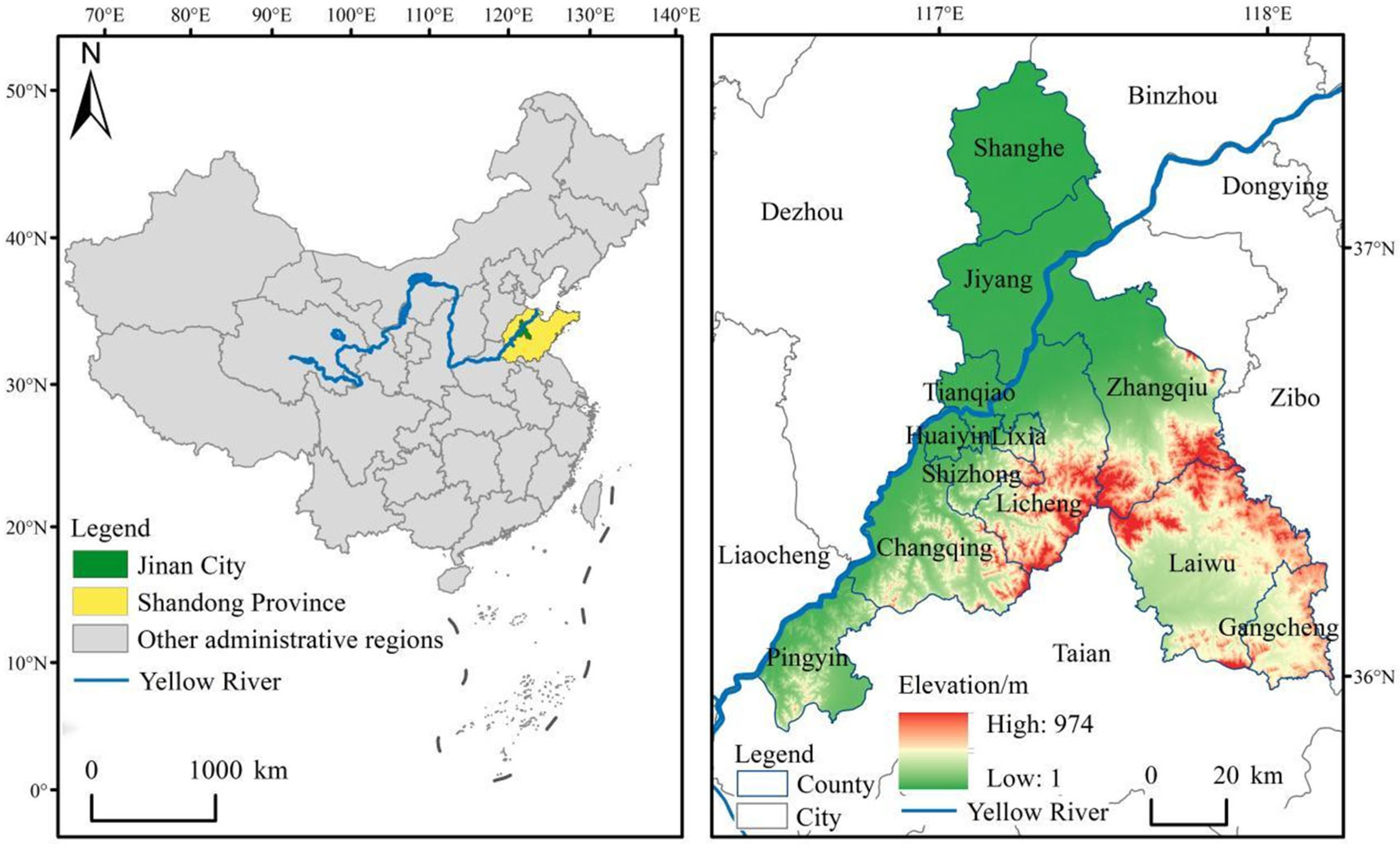
2.1. Study Area
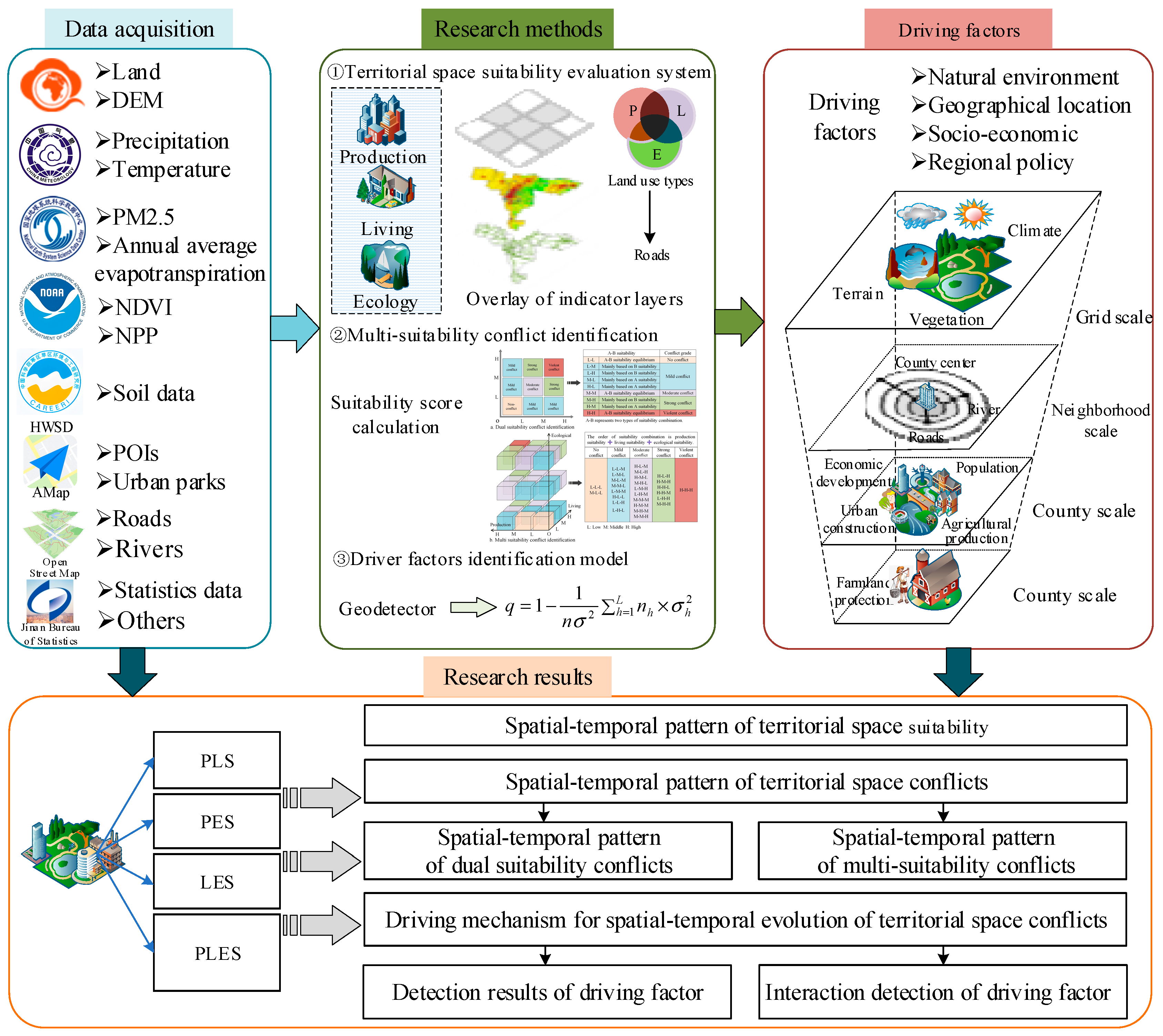
2.2. Research Framework
3. Data Sources and Methods
3.1. Data Sources and Processing
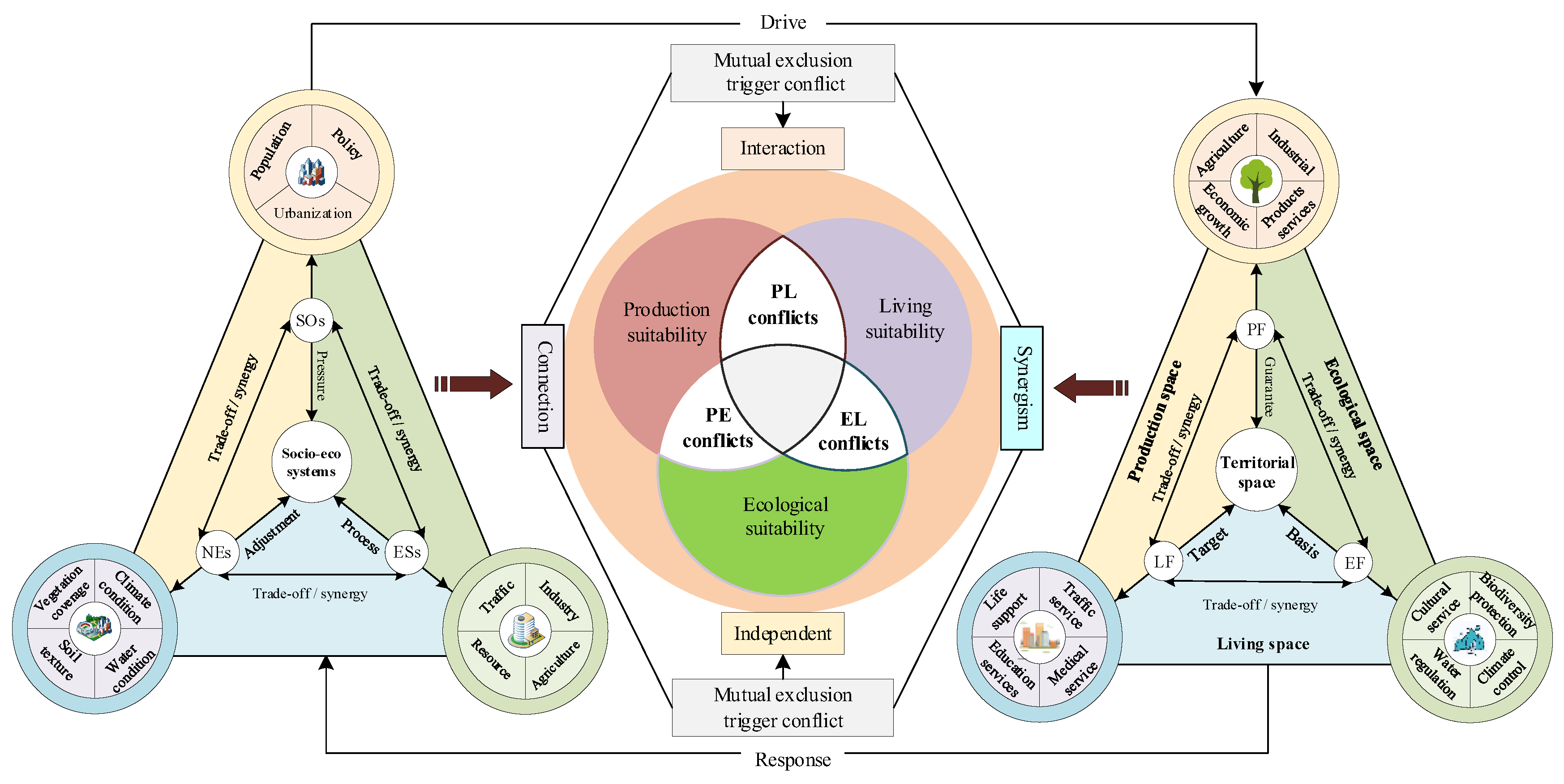
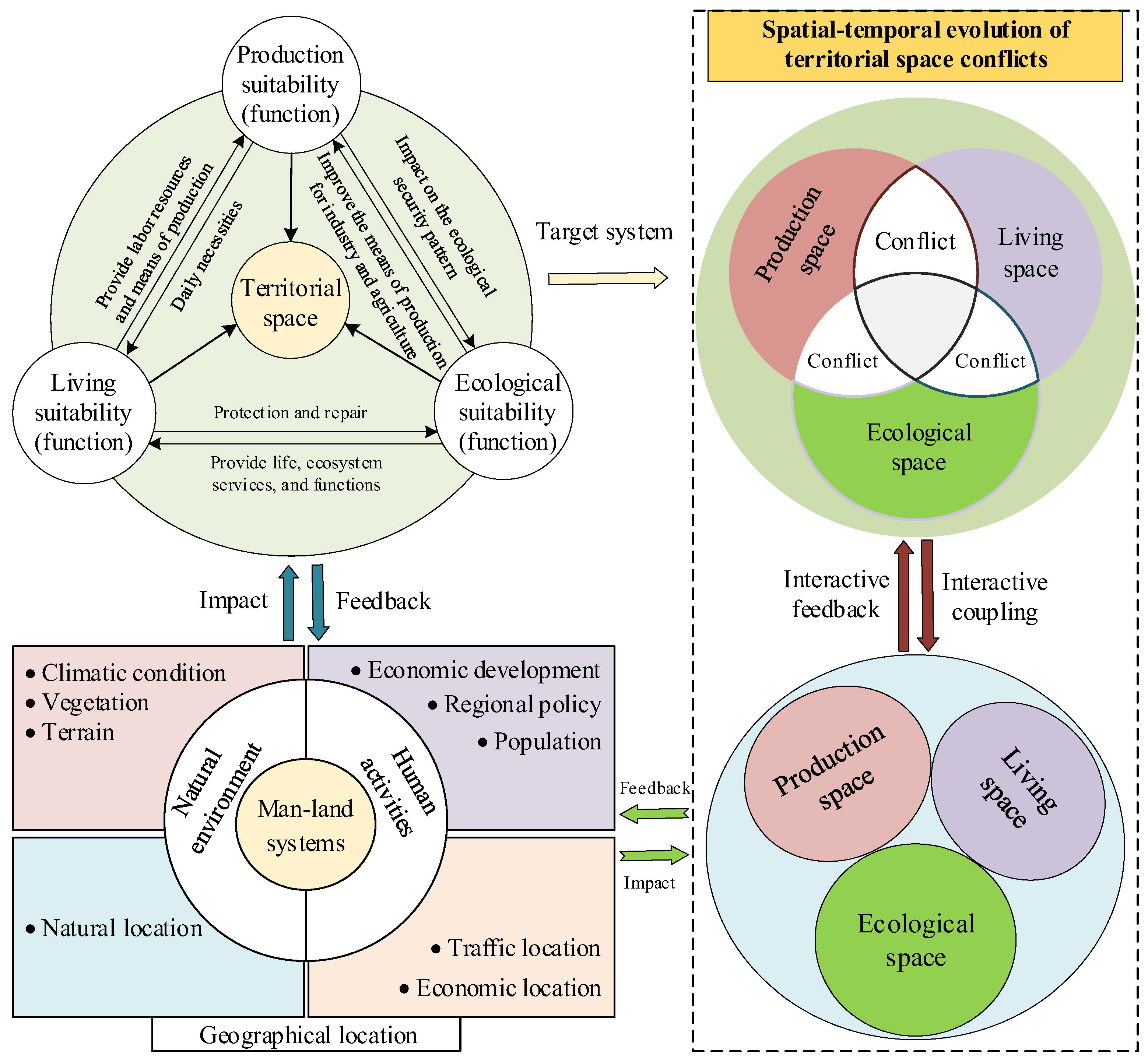
3.2. Conceptual Connotation of Territorial Space Conflicts
3.3. Methods
3.3.1. Construction of Suitability Evaluation Model for Territorial Space
- (1)
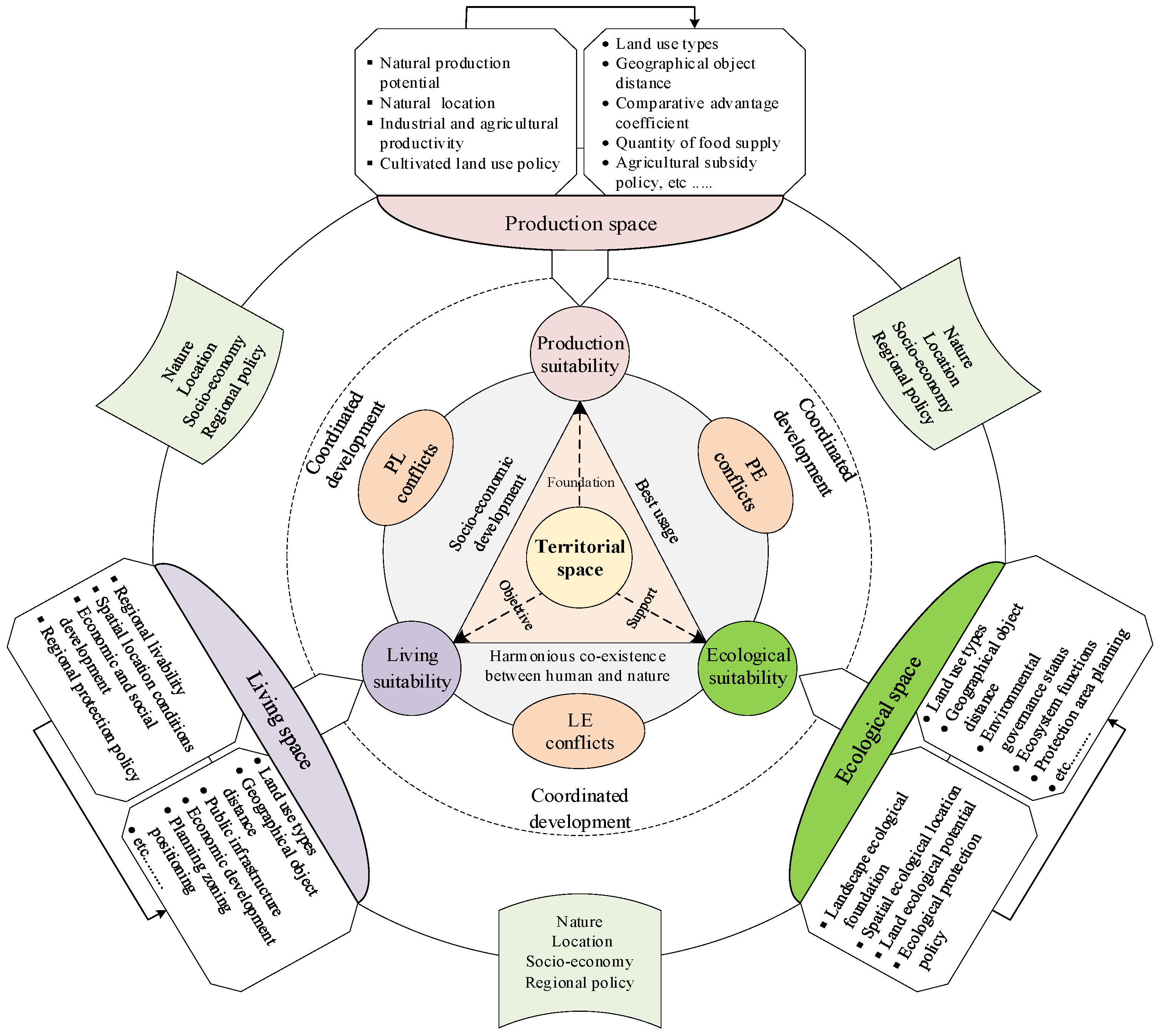
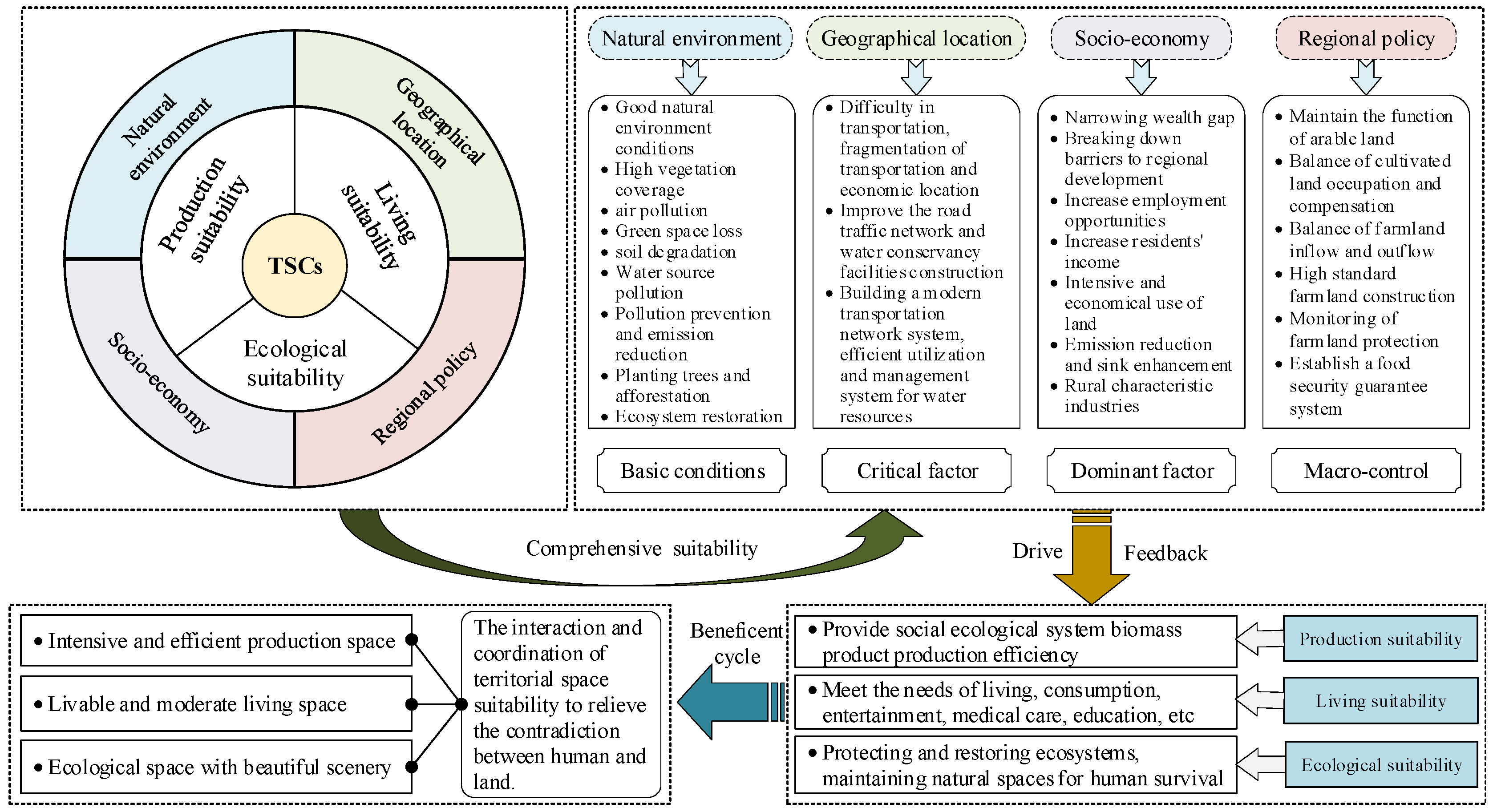
- Theoretical framework for suitability evaluation of production–living–ecological space
- (2)
- Evaluation index systems of production–living–ecological space suitability
- Land resources determine the scope of land utilization, reflecting regional soil fertility, cultivated land quality, and overall production capacity. Therefore, the dynamic intensity of land conversion for industrial and agricultural production is characterized by land use type (LUP), soil organic carbon content (SOCC), surface soil texture (SST), and topographic index (TI) [26].
- Spatial location indicates the frequency and efficiency of information and material circulation between regions and proximity to essential production factors, such as water bodies, roads, and cultivated land facilitates industrial and agricultural production. To quantify this, we selected indicators including distance from water bodies (DFW), distance from county and township roads (DFCR), distance from villages (DFV), and cultivation distance (CT) [42,43].
- Population size is characterized by urbanization rate (UR) and labor resources (LR) [40]. Higher values in these metrics suggest a more substantial role for population in supporting employment and a stronger influence on production suitability.
- Economic scale and non-agricultural production relate to the impact of regional production efficiency on the industrial and agricultural economy, primarily evaluating levels of economic and social development as well as food security. This is characterized by four indicators, including comparative advantage index (CAI), gross domestic product (GDP), total power of agricultural machinery (TPAM), and grain supply (GS) [21,44].
- Agricultural policies are evaluated based on their effects on land use suitability, with agricultural subsidies (AS) and basic farmland protection areas (BFPAs) serving as critical indicators.
- Land resources measure the suitability of land for residential and construction purposes, quantified using indicators such as land use planning (LUP) and topographic index (TI).
- Hydro-meteorological resources reflect the capacity of regional water availability, temperature, and humidity to support human habitation, evaluated through total water resources (TWRs) and annual average temperature (AAT) [7].
- Leisure environment is a fundamental component of urban ecosystems related to the quality of urban living. It serves as a crucial indicator of human–land harmony and residents’ well-being, evaluated by per capita green space area (PCGSA) and tourism service facility density (TSFD).
- Living convenience refers to the spatial carrying capacity, accessibility of public services, and daily living security provided by urban infrastructure. This dimension includes indicators such as population density (PD), road network density (RND), public infrastructure density (PID), and living carrying capacity (LCC) [14,18,45].
- Economic development level reflects residents’ material living standards, typically represented by per capita gross domestic product (PGDP).
- Policies of ecological protection guide regional governmental efforts to convert land into ecological reserves or preserve existing ecological areas, measured by indicators including forest area, wetland park areas (FWP), and water source protection areas (WSPAs).
- Land resources are characterized by indicators such as LUP, landscape stability (LS), landscape fragmentation (LF), and soil erosion sensitivity (SES). These metrics quantify the potential of ecological and environmental disturbances in the region [15,34], thereby reflecting the sensitivity of the local ecological environment.
- Spatial location is evaluated using metrics such as distance from water areas (DFW), distance from roads (DFR), distance from construction land (DFCL), and distance from ecological sources (DFES). These indicators assess how natural and anthropogenic spatial patterns influence land ecological suitability [12,13,17].
- Environmental comfort is represented by indicators including mean PM2.5 (MPM2.5), per capita green space area (PCGSA), and Normalized Difference Vegetation Index (NDVI). These metrics characterize the environmental conditions that shape livable habitats and support high-quality human settlement.
- Ecosystem service functions are evaluated by indicators such as habitat quality (HQ), water yield (WY), soil conservation (SC), and carbon storage (CS). These metrics assess the adaptive capacity and regulatory functions of terrestrial ecosystems, as well as the positive externalities derived from their structural and operational attributes [7].
- Policies of ecological protection are reflected in indicators such as ecological compensation (EC) and nature reserve (NR). These metrics indicate governmental commitments to environmental conservation and enhancement, ecological equilibrium maintenance, and regional ecological security assurance.
- (3)
- Scores of production–living–ecological space suitability
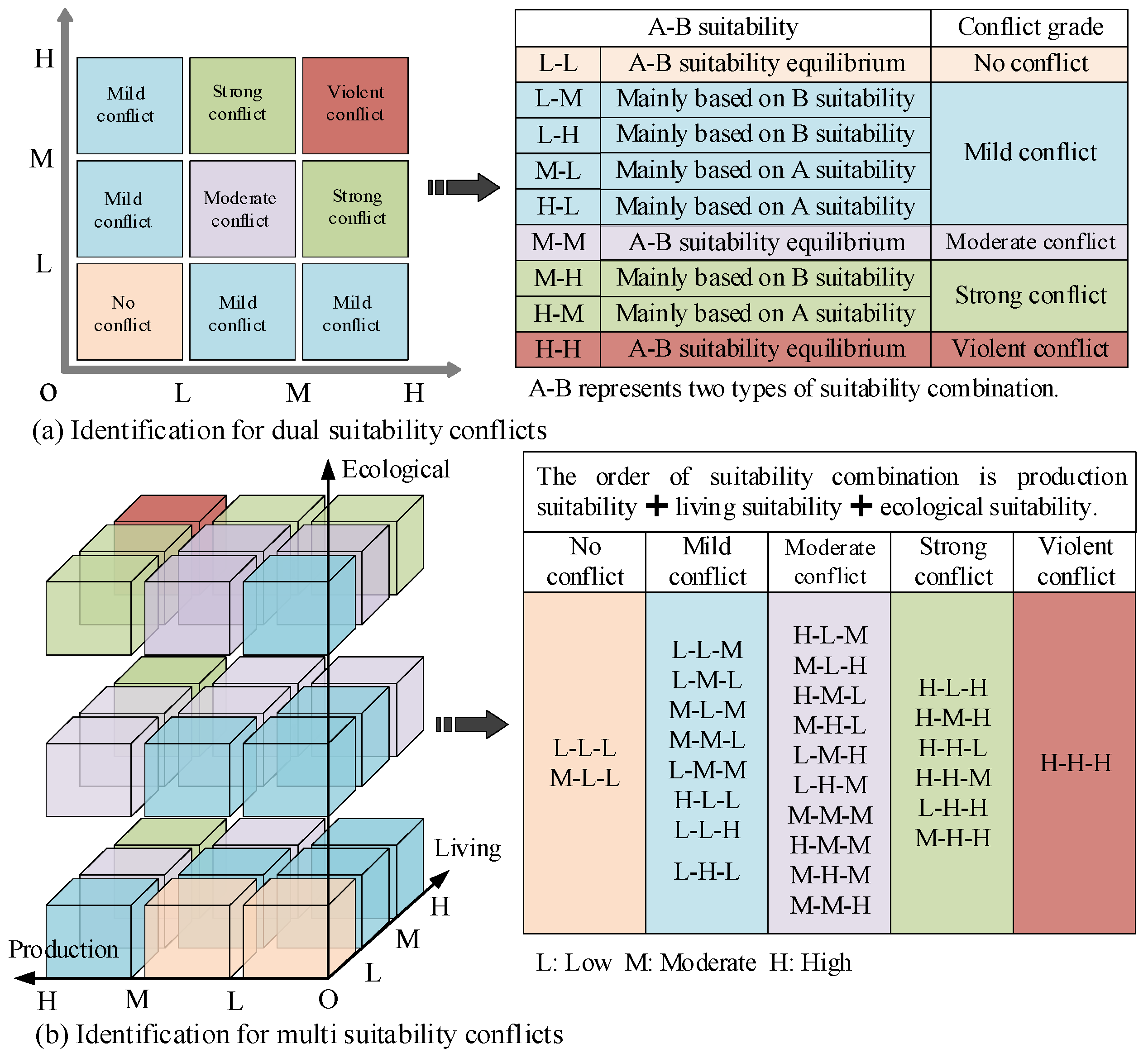
3.3.2. Identification and Diagnosis of Territorial Space Suitability Conflicts
3.3.3. Identification of Driving Factors for Spatial–Temporal Evolution of TSCs
- (1)
- Driving factors of spatial–temporal evolution of TSCs
- (2)
- GeoDetector model
4. Results and Analysis
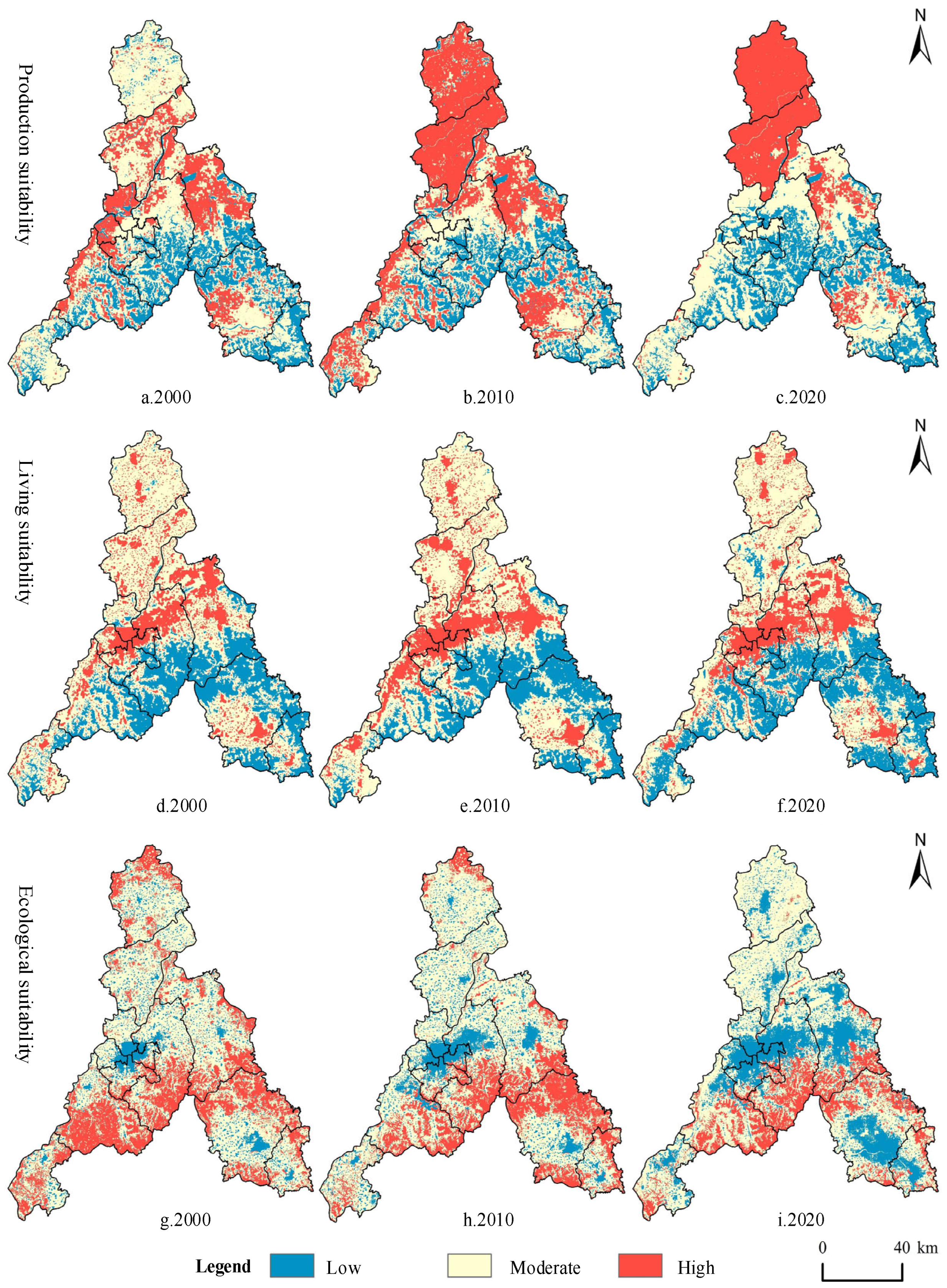
4.1. Spatial–Temporal Evolution of Territorial Space Suitability
4.2. Spatial–Temporal Evolution of Territorial Space Conflicts
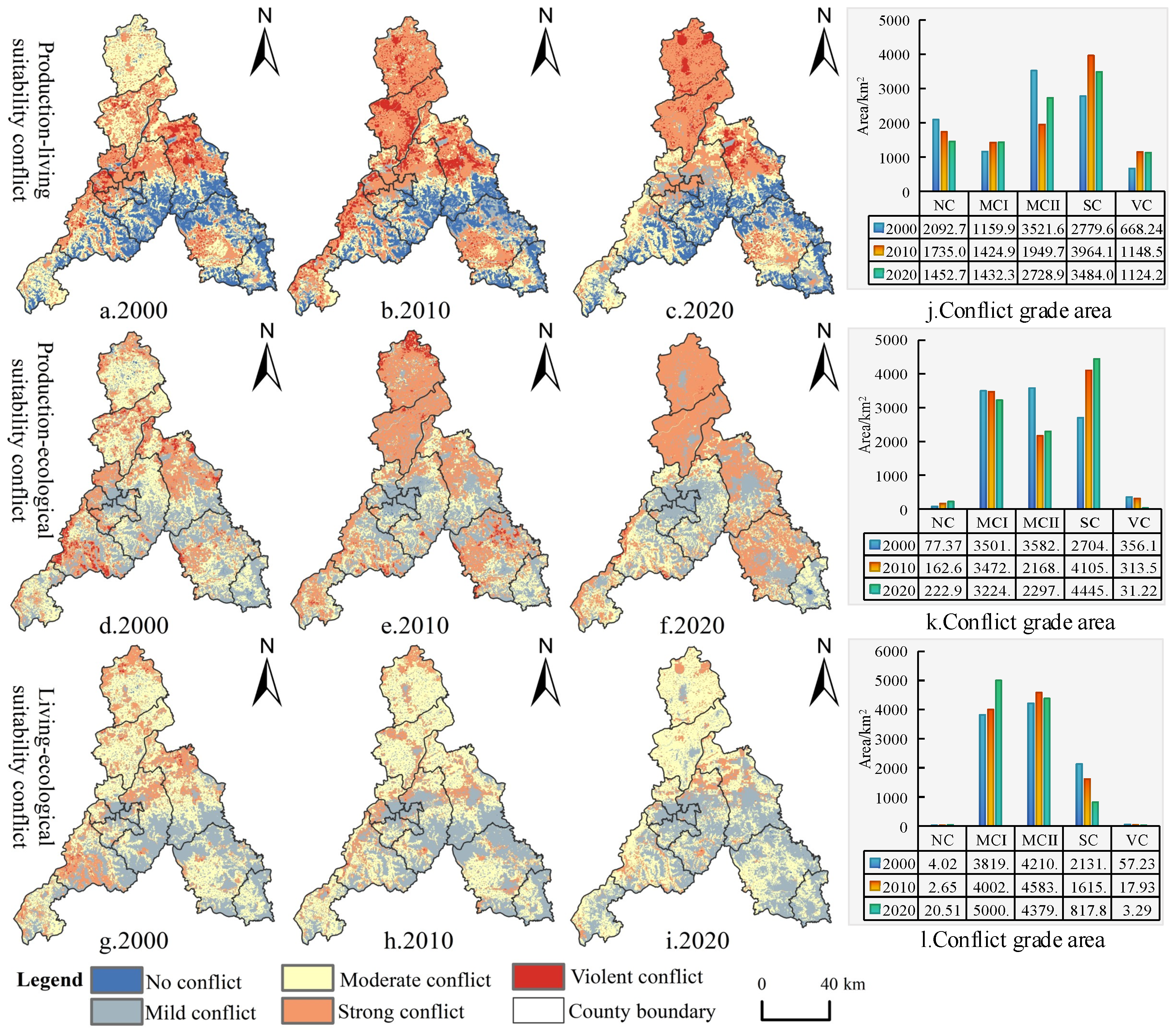
4.2.1. Spatial–Temporal Evolution of Territorial Space Dual Suitability Conflicts
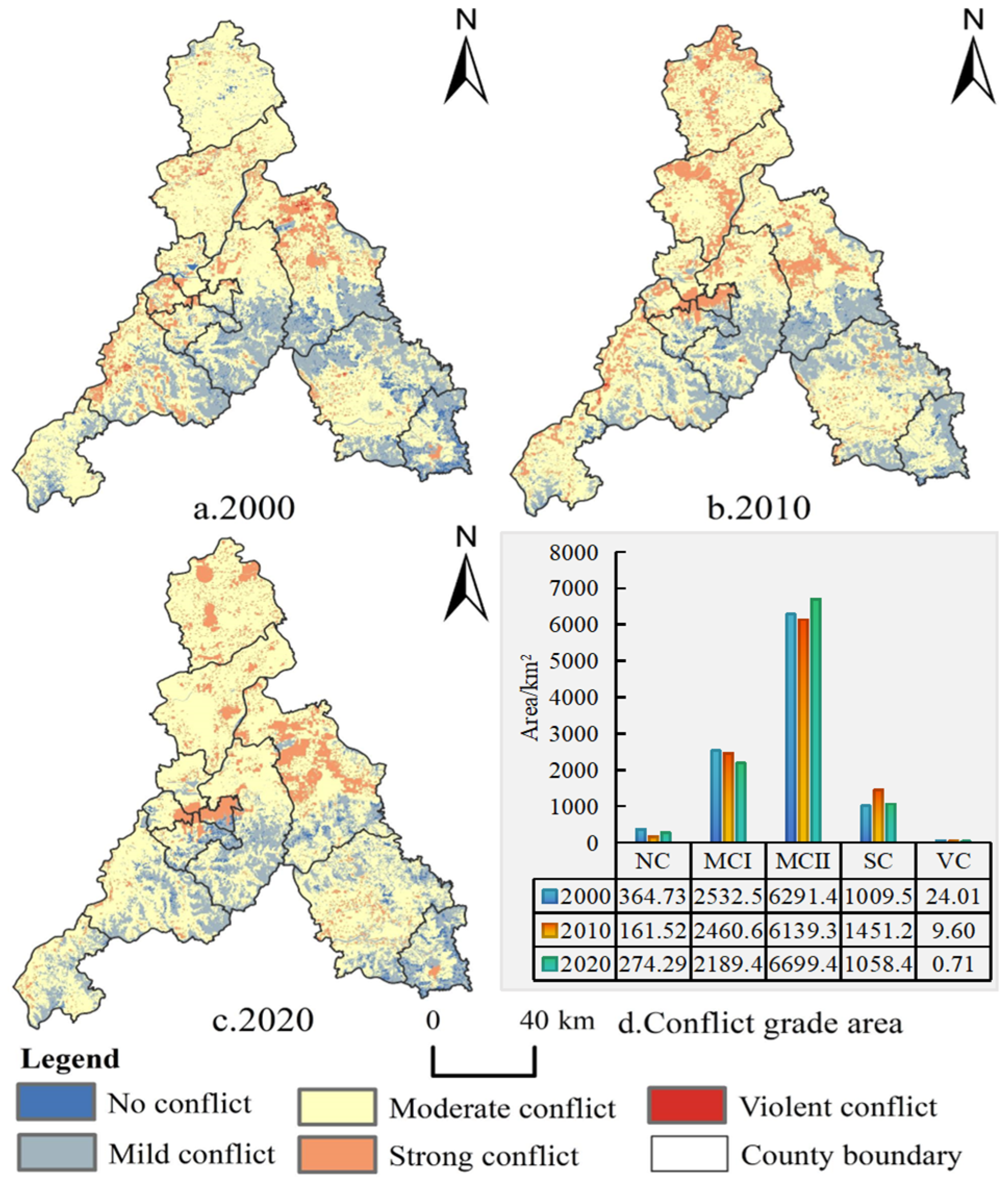
4.2.2. Spatial–Temporal Evolution of Territorial Space Multi-Suitability Conflicts
4.3. Driving Mechanism of Spatial–Temporal Evolution of Territorial Space Conflicts
4.3.1. Detection Result of Driving Factors
- (1)
- Natural environmental factors
- (2)
- Geographical location factors
- (3)
- Socioeconomic factors
- (4)
- Regional policy factors
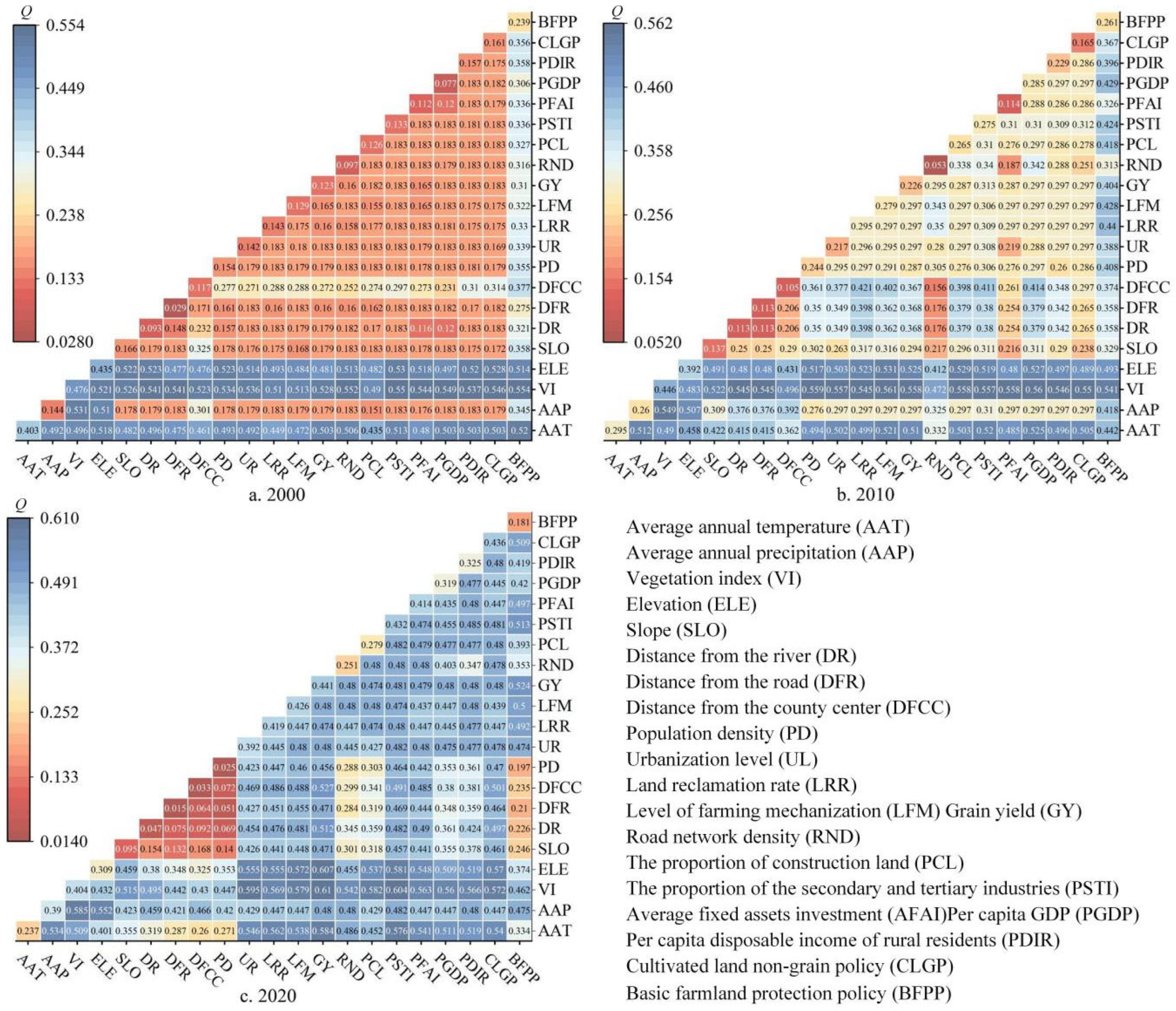
4.3.2. Interaction Detection of Driving Factors
4.3.3. Driving Mechanism of Spatial–Temporal Evolution for the TSCs
5. Discussion
5.1. Evolution Characteristics of Territorial Space Conflicts
5.2. Driving Factors of Territorial Space Conflicts Evolution
5.3. Limitations and Future Research Prospect
6. Conclusions
- (1)
- Significant spatial heterogeneity characterized the suitability of production–living– ecological space in Jinan City from 2000 to 2020. High suitability zones of production and living space expanded in the northern plain along the Yellow River and central piedmont plain, respectively, while high suitability zones of ecological space contracted in the southern mountainous and hilly areas.
- (2)
- Significant spatial–temporal variations in territorial space conflicts (TSCs) were observed in Jinan City over the past two decades. Intense conflicts dominated production–living and production–ecological space interactions, while moderate conflicts were prevalent in living–ecological and production–living–ecological space interactions. Production–living space conflict zones expanded in the northern plain along the Yellow River, while living–ecological space conflict zones contracted in the northern plain along the Yellow River and central piedmont plain. Moreover, production–ecological and production–living–ecological space conflict zones showed consistent expansion trends.
- (3)
- The spatial–temporal evolution of territorial space conflicts is jointly driven by natural environment, geographical location, social economy, and regional policies. The influence of natural environmental factors gradually weakened, while the driving force of socioeconomic factors significantly strengthened. The interaction of driving factors exhibited significant dual-factor and nonlinear enhancement effects.
Author Contributions
Funding
Institutional Review Board Statement
Informed Consent Statement
Data Availability Statement
Conflicts of Interest
References
- Liu, J.; Liu, Y.; Li, Y. Classification evaluation and spatial-temporal analysis of production-living-ecological spaces in China. Acta Geogr. Sin. 2017, 72, 1290–1304. [Google Scholar] [CrossRef]
- Zou, L.; Liu, Y.; Wang, J.; Yang, Y.; Wang, Y. Land use conflict identification and sustainable development scenario simulation on China’s southeast coast. J. Clean. Prod. 2019, 238, 117899. [Google Scholar] [CrossRef]
- Liu, X.Z.; Li, X.S.; Li, P.P.; Geng, Y.W.; Chen, J.Q.; Hu, G.H. Delineation of and conflict coordination in municipal territorial space functional zones: A case study of Xuzhou, China. Land 2025, 14, 761. [Google Scholar] [CrossRef]
- Jin, T.L.; Zhang, P.X.; Liu, S.; Zhou, N.; Guo, H.L.; Zhu, A.J. A novel integrated modelling framework to uncover spatial and temporal evolutionary patterns and influence mechanisms of land use conflicts. J. Environ. Manag. 2025, 391, 126574. [Google Scholar] [CrossRef]
- Sun, A.; Zhang, S.; Gong, Y.; Hou, H. Research on Trade-off decision method of territorial spatial use. China Land Sci. 2019, 33, 13–21. (In Chinese) [Google Scholar] [CrossRef]
- Wang, Y.; Li, W.; Zeng, X.; Li, P.; Xue, B. The spatial multi-scale mechanism of land use elemental conflicts in Shenyang Economic Zone. Econ. Geogr. 2022, 42, 231–239. (In Chinese) [Google Scholar] [CrossRef]
- Qu, Y.; Wang, S.; Li, Y.; Zhu, W.; Wang, S. Characteristics of potential conflicts of territorial space and optimization pattern in the Yellow River Delta based on multi-functional suitability. Geogr. Sin. 2023, 43, 301–312. (In Chinese) [Google Scholar] [CrossRef]
- Zhang, L.F.; Zhu, M.R.; Zhang, X.L.; Li, J.G.; Zhai, J.H. Identifying potential territorial spatial conflicts in land-sea interaction zones in Yancheng City, China: A multidimensional suitability evaluation. Environ. Dev. Sustain. 2025, 10, s10668. [Google Scholar] [CrossRef]
- Zhang, L.; Hou, Q.; Duan, Y. A literature review on production-living-ecological spaces in the context of ecological civilization: Connotation, problems and countermeasure. Acta Ecol. Sin. 2024, 44, 47–59. (In Chinese) [Google Scholar] [CrossRef]
- Li, G.; Fang, C. Quantitative function identification and analysis of urban ecological-production-living spaces. Acta Geogr. Sin. 2016, 71, 49–65. (In Chinese) [Google Scholar] [CrossRef]
- Pan, F.; Wan, Q.; Zeng, J.; Wang, H.; Huang, Q. Evolution characteristics and influence factors of spatial conflicts between production-living-ecological space in the rapid urbanization process of Hubei Province, China. Econ. Geogr. 2024, 43, 80–92. (In Chinese) [Google Scholar] [CrossRef]
- Zheng, Y.; Cheng, L.; Wang, Y. Measuring the spatial conflict of resource-based cities and its coupling coordination relationship with land use. Land 2024, 11, 1460. [Google Scholar] [CrossRef]
- Lu, Q.; Sun, J.; Xiao, Y.; Zhu, S.; Zhu, G.; Liu, J.; Li, X.; Liu, H. The progression traits of spatial conflicts within the production-living-ecological space among varying geomorphological types of mountain-basin areas in karst regions, China. Ecol. Indic. 2024, 166, 112324. [Google Scholar] [CrossRef]
- Xi, F.; Wang, R.; Shi, J.; Zhang, J.; Yu, Y.; Wang, N.; Wang, Z. Spatio-temporal pattern and conflict identification of production-living-ecological space in the Yellow River Basin. Land 2022, 11, 744. [Google Scholar] [CrossRef]
- Qu, Y.; Wang, S.; Tian, Y.; Jiang, G.; Zhou, T.; Meng, L. Territorial spatial planning for regional high-quality development—An analytical framework for the identification, mediation and transmission of potential land utilization conflicts in the Yellow River Delta. Land Use Policy 2023, 125, 106462. [Google Scholar] [CrossRef]
- Li, Y.P.; Ma, X.G.; Zhao, J.S.; Zhang, S.Q.; Liu, C. Spatio-temporal evolution and conflict diagnosis of territorial space in Mountainous-Flatland Areas from a multi-scale perspective: A case study of the Central Yunnan Urban Agglomeration. Land 2025, 14, 703. [Google Scholar] [CrossRef]
- Zhou, D.; Zhao, X.; Li, P.; Jin, F.; Li, S.; Li, H.; Wang, J. Assessing territorial space conflicts in the coastal zone of Wenzhou, China: A land-sea interaction perspective. Sci. Total Environ. 2024, 926, 171826. [Google Scholar] [CrossRef]
- Chen, Z.; Feng, X.; Hong, Z.; Ma, B.; Li, Y. Research on spatial conflict calculation and zoning optimization of land use in Nanchang City from the perspective of three living spaces. World Reg. Stud. 2021, 30, 533–545. [Google Scholar] [CrossRef]
- Wang, Y.S.; Wei, C.B.; Ju, Z.S.; Xu, Y. Cascading governance of national territorial space use conflicts in arid inland river basins: An integrated Assessment-Optimization-Adaptation framework. Land Degrad. Dev. 2025, 7, 70047. [Google Scholar] [CrossRef]
- Wang, M.M.; Jiang, Z.Z.; Li, T.B.; Yang, Y.C.; Jia, Z. Analysis on absolute conflict and relative conflict of land use in Xining metropolitan area under different scenarios in 2030 by PLUS and PFCI. Cities 2023, 137, 104314. [Google Scholar] [CrossRef]
- Zou, L.; Liu, Y.; Wang, Y. Research progress and prospect of land-use conflicts in China. Prog. Geogr. 2020, 39, 298–309. (In Chinese) [Google Scholar] [CrossRef]
- Wang, D.Y.; Wang, M.S.; Zheng, W.; Song, Y.Y.; Huang, X.J. A multi-level spatial assessment framework for identifying land use conflict zones. Land Use Policy 2025, 148, 107382. [Google Scholar] [CrossRef]
- Wang, A.; Chen, S.; Wei, Y.; Tang, X.; Dai, J. Land use conflict based on F-H method in the Lijiang River Basin, China. Mt. Res. 2021, 39, 506–514. [Google Scholar] [CrossRef]
- Fienitz, M.; Siebert, R. Latent, collaborative, or escalated conflict? Determining causal pathways for land use conflicts. Land Use Policy 2023, 134, 106918. [Google Scholar] [CrossRef]
- Kim, J.; Park, E.; Song, C.; Hong, M.; Jo, H.W.; Lee, W.K. How to manage land use conflict between ecosystem and sustainable energy for low carbon transition?: Net present value analysis for ecosystem service and energy supply. Front. Environ. Sci. 2022, 10, 1044928. [Google Scholar] [CrossRef]
- Wang, J.; Zou, L.; Li, M. Identification and governance of potential land use conflicts in tourism resort based on ecological-production-living suitability. Trans. CSAE 2019, 35, 279–288. (In Chinese) [Google Scholar] [CrossRef]
- Zhang, X.; Gu, R. Spatiotemporal pattern and multi-scenario simulation of land use conflict: A case study of the Yangtze River Delta urban agglomeration. Geogr. Res. 2022, 41, 1311–1326. (In Chinese) [Google Scholar] [CrossRef]
- Tian, J.; Wang, B.; Wang, S. The paradigms and main content of land use conflict research. Resour. Sci. 2023, 45, 465–479. (In Chinese) [Google Scholar] [CrossRef]
- Zheng, Y.; Cheng, L.; Wang, Y.; Wang, J. Spatial conflict measurement in resource-based cities and spatial responses. Prog. Geogr. 2023, 42, 275–286. (In Chinese) [Google Scholar] [CrossRef]
- Zhu, Z.; Peng, S.; Ma, X.; Lin, Z.; Ma, D.; Shi, S.; Gong, L.; Huang, B. Identification of potential conflicts in the production-living-ecological spaces of the Central Yunnan Urban Agglomeration from a multi-scale perspective. Ecol. Indic. 2024, 165, 112206. [Google Scholar] [CrossRef]
- Milczarek-Andrzejewska, D.; Zawalińska, K.; Czarnecki, A. Land-use conflicts and the common agricultural policy: Evidence from Poland. Land Use Policy 2018, 73, 423–433. [Google Scholar] [CrossRef]
- Puustinen, T.; Krigsholm, P.; Falkenbach, H. Land policy conflict profiles for different densification types: A literature-based approach. Land Use Policy 2022, 123, 106405. [Google Scholar] [CrossRef]
- Hjalager, A.M. Land-use conflicts in coastal tourism and the quest for governance innovations. Land Use Policy 2020, 94, 104566. [Google Scholar] [CrossRef]
- Liu, C.; Deng, C.; Li, Z.; Liu, Y. Response characteristics of soil erosion to spatial conflict in the production-living-ecological space and their driving mechanism: A Case Study of Dongting Lake Basin in China. Land 2022, 11, 1794. [Google Scholar] [CrossRef]
- Bircol, G.A.C.; de Souza, M.P.; Fontes, A.T.; Chiarello, A.G.; Ranieri, V.E.L. Planning by the rules: A fair chance for the environment in a land-use conflict area. Land Use Policy 2018, 76, 103–112. [Google Scholar] [CrossRef]
- Hong, W.; Guo, R.; Wang, W. A diagrammatic method for the identification and resolution of urban spatial conflicts. J. Environ. Manag. 2022, 316, 115297. [Google Scholar] [CrossRef] [PubMed]
- Li, L.; Huang, X.; Yang, H. Scenario-based urban growth simulation by incorporating ecological-agricultural-urban suitability into a Future Land Use Simulation model. Cities 2023, 137, 104334. [Google Scholar] [CrossRef]
- Ostrom, E. A general framework for analyzing sustainability of social-ecological systems. Science 2009, 325, 419–422. [Google Scholar] [CrossRef]
- Walker, B.; Holling, C.S.; Carpenter, S.R.; Kinzig, A.P. Resilience, adaptability and transformability in social-ecological systems. Ecol. Soc. 2004, 9, 5. [Google Scholar] [CrossRef]
- Wang, C.; Wu, J.; Li, M.; Huang, X.; Lei, C.; Wang, H. Evaluation of spatial conflicts of land use and its driving factors in arid and semiarid regions: A case study of Xinjiang, China. Ecol. Indic. 2024, 166, 112483. [Google Scholar] [CrossRef]
- Gao, Y.; Shen, Z.; Zhang, Z.; Xiong, J. Advance in simulation of social-ecological system coupling under the perspective of ecosystem services. Acta Geogr. Sin. 2024, 79, 134–146. (In Chinese) [Google Scholar] [CrossRef]
- Zou, L.; Li, Y.; Liu, Y.; Wang, J. Theory building and empirical research of production-living-ecological function of cultivated land based on the elements. Geogr. Res. 2021, 40, 839–855. (In Chinese) [Google Scholar] [CrossRef]
- Niu, H.; Wang, J.; Jing, Z.; Liu, B. Identification and management of land use conflicts in mining cities: A case study of Shuozhou in China. Resour. Policy 2023, 81, 103301. [Google Scholar] [CrossRef]
- Liu, C.; Xu, Y.; Lu, X.; Han, J. Trade-offs and driving forces of land use functions in ecologically fragile areas of northern Hebei Province: Spatiotemporal analysis. Land Use Policy 2021, 104, 105387. [Google Scholar] [CrossRef]
- Zhang, B.; Zhai, J.; Zhai, B.; Qu, Y. Understanding the “conflict-coordination” theoretical model of regional land use transitions: Empirical evidence from the interconversion between cropland and rural settlements in the lower yellow river, China. Habitat Int. 2024, 148, 103072. [Google Scholar] [CrossRef]
- Bao, W.; Yang, Y.; Zou, L. How to reconcile land use conflicts in mega urban agglomeration? A scenario-based study in the Beijng-Tianjin-Hebei region, China. J. Environ. Manag. 2021, 296, 113168. [Google Scholar] [CrossRef]
- Chen, L.; Zhang, A. Identification of land use conflicts and dynamic response analysis of Natural-Social factors in rapidly urbanizing areas−a case study of urban agglomeration in the middle reaches of Yangtze River. Ecol. Indic. 2024, 161, 112009. [Google Scholar] [CrossRef]
- Yang, L.; Fang, C.; Chen, W.; Zeng, J. Urban-rural land structural conflicts in China: A land use transition perspective. Habitat Int. 2023, 138, 102877. [Google Scholar] [CrossRef]
- Mijailoff, J.D.; Giessen, L.; Burns, S.L. Local to global escalation of land use conflicts: Long-term dynamics on social movements protests against pulp mills and plantation forests in Argentina and Uruguay. Land Use Policy 2023, 134, 106884. [Google Scholar] [CrossRef]
- Cui, J.; Kong, X.; Chen, J.; Sun, J.; Zhu, Y. Spatially explicit evaluation and driving factor identification of land use conflict in Yangtze river economic belt. Land 2021, 10, 43. [Google Scholar] [CrossRef]
- Chen, Q.; Zheng, L.; Wang, Y.; Wu, D.; Li, J. A comparative study on urban land use eco-efficiency of Yangtze and Yellow rivers in China: From the perspective of spatiotemporal heterogeneity, spatial transition and driving factors. Ecol. Indic. 2023, 151, 110331. [Google Scholar] [CrossRef]
- Li, S.; Zhu, C.; Lin, Y.; Dong, B.; Chen, B.; Si, B.; Wang, K. Conflicts between agricultural and ecological functions and their driving mechanisms in agroforestry ecotone areas from the perspective of land use functions. J. Clean. Prod. 2021, 317, 128453. [Google Scholar] [CrossRef]
- Liu, X.; Zhang, Z.; Li, M.; Fu, Y.; Hui, Y. Spatial conflict simulation of land-use based on human-land-landscape elements intercoordination: A case study in Tianjin, China. Environ. Monit. Assess. 2022, 194, 317. [Google Scholar] [CrossRef]
- Huang, X.; Han, L.; Zhao, Y.; Huang, X. Theoretical foundations and analytical frameworks for urban socio-ecological system. Acta Ecol. Sin. 2024, 44, 6892–6905. (In Chinese) [Google Scholar] [CrossRef]
- Fienitz, M.; Siebert, R. It is a total drama: Land use conflicts in local land use actors experience. Land 2022, 11, 602. [Google Scholar] [CrossRef]
- Jiang, S.; Meng, J.; Zhu, L.; Cheng, H. Spatial-temporal pattern of land use conflict in China and its multilevel driving mechanisms. Sci. Total Environ. 2021, 801, 149697. [Google Scholar] [CrossRef]
- Abubakari, M.; Twum, K.O.; Asokwah, G.A. From conflict to cooperation: The trajectories of large scale land investments on land conflict reversal in Ghana. Land Use Policy 2020, 94, 104543. [Google Scholar] [CrossRef]



| Type | From | Source and Description | |
|---|---|---|---|
| Remote sensing data | Landsat-TM imaging | 30 m | Geospatial data cloud (http://www.gscloud.cn) (accessed on 2 March 2025) |
| Landsat-OLI imaging | 15 m | ||
| Terrain data | DEM | 30 m | The Resource and Environmental Science and Data Center (http://www.resdc.cn/) (accessed on 2 March 2025) |
| Meteorological data | Mean annual temperature, average annual precipitation | 1 km | The China Meteorological Data Network (http://data.cma.gov.cn/) (accessed on 20 March 2024) |
| Environmental data | PM2.5 | 1 km | The National Data Center for Earth System Sciences (https://www.geodata.cn/main/) (accessed on 20 March 2024) |
| Soil data | Soil texture, soil organic carbon content | 500 m | The Chinese dataset in the World Soil Database (http://www.cgiar-csi.org) (accessed on 20 May 2024) |
| Vegetation data | Rain erosion force factor | 1 km | The European Soil Data Centre (https://esdac.jrc.ec.europa.eu/) (accessed on 1 April 2025) |
| NDVI, NPP | 250 m | The US National Geophysical Data Center (https://www.ngdc.noaa.gov/) (accessed on 20 April 2024) | |
| Traffic data | Railway, expressway, national road, provincial road, county road, township road | - | Shandong Province basic geographic information database, network data vectoring |
| Water system data | River surface, rural settlements | - | 1:1 million national basic geographic database |
| Amap POI | POI data | - | Amap API interface query and download (including hotels, hospitals, banks, gas stations, schools, libraries, bus stations, parks, amusement parks, and natural scenic spots) |
| Socioeconomic statistics | Population, labor force quantity, GDP, etc. | - | statistical yearbook of Jinan City in 2001–2021 |
| Standard Layer | Index Layer | Factor Classification and Score | Weight | |||||
|---|---|---|---|---|---|---|---|---|
| 9 | 7 | 5 | 3 | 1 | ||||
| Natural environment | Land resources | LUP | Construction land | Cultivated land | Forest, grassland | Unused land | Water area | 0.187 |
| SOCC | ≥1.30 | 0.86–1.30 | 0.65–0.86 | 0.49–0.65 | <0.49 | 0.052 | ||
| SST | Ball clay | – | Sandy soil | – | No soil | 0.037 | ||
| TI | <0.28 | 0.28–0.55 | 0.55–0.82 | 0.82–1.11 | >1.11 | 0.049 | ||
| Geographical location | Spatial location | DFW/km | <1.2 | 1.2–2.5 | 2.5–4.0 | 4.0–6.0 | >6.0 | 0.058 |
| DFCVR/km | <0.5 | 0.5–1.5 | 1.50–3.0 | 3.0–4.5 | >4.5 | 0.041 | ||
| DFV/km | <0.5 | 0.5–1.0 | 1.0–1.5 | 1.5–2.1 | >2.1 | 0.050 | ||
| CT/km | <0.15 | 0.15–0.5 | 0.5–1.0 | 1.0–2.2 | >2.2 | 0.045 | ||
| Socioeconomy | Population size | UR/% | <25 | 25–40 | 40–55 | 60–70 | >70 | 0.079 |
| LR (person/km2) | >600 | 300–500 | 200–300 | 100–200 | <100 | 0.040 | ||
| Economic scale | CAI/% | >10 | 7–10 | 4–7 | 2–4 | <2 | 0.052 | |
| GDP/100 million | >1200 | 900–1200 | 400–800 | 200–400 | <200 | 0.075 | ||
| Agricultural production | TPAM/104 kW | >65 | 50–65 | 25–50 | 15–25 | <15 | 0.049 | |
| GS/t | >1 | 0.88–1 | 0.7–0.88 | 0.5–0.7 | <0.5 | 0.083 | ||
| Regional policy | Agricultural policy | AS/100 million | >1300 | 800–1300 | 250–800 | 100–250 | <100 | 0.050 |
| BFPA | From 2000 to 2020, the stable cultivated land value is high suitability; otherwise, it is not appropriate | 0.053 | ||||||
| Standard Layer | Index Layer | Factor Classification and Score | Weight | |||||
|---|---|---|---|---|---|---|---|---|
| 9 | 7 | 5 | 3 | 1 | ||||
| Natural environment | Land resources | LUP | Construction land | Cultivated land | Unused land | Forest, grassland | Water area | 0.111 |
| TI | <0.28 | 0.28–0.55 | 0.55–0.82 | 0.82–1.11 | >1.11 | 0.048 | ||
| Geological hazards | BBC | ≥250 | 180–250 | 120–180 | 60–120 | <60 | 0.053 | |
| GHR | ≥0.35 | 0.35–0.46 | 0.46–0.54 | 0.54–0.62 | <0.62 | 0.053 | ||
| Hydro- meteorological resource | AAT/°C | >13.7 | 13.3–13.7 | 12.8–13.3 | 12.3–12.8 | <12.3 | 0.035 | |
| TWR/104 m3 | ≥250 | 180–250 | 120–180 | 60–120 | <60 | 0.053 | ||
| Geographical location | Spatial location | DFYR/km | <5 | 5–9 | 9–12 | 12–15 | >15 | 0.034 |
| DFR/km | <1.0 | 1.0–2.4 | 2.4–4.0 | 4.0–6.5 | >6.5 | 0.054 | ||
| DFVT/km | <0.3 | 0.3–0.8 | 0.8–1.4 | 1.4–2.3 | >2.3 | 0.065 | ||
| Socio- economy | Leisure environment | PCGSA/m2 | >15 | 13–15 | 11–13 | 9–11 | <9 | 0.053 |
| TSFD | High | Higher | Medium | Lower | Low | 0.035 | ||
| Living convenience | PD/(person·km2) | >609 | 235–609 | 81–235 | 22–81 | <22 | 0.065 | |
| RND | >0.9 | 0.6–0.9 | 0.3–0.6 | 0.1–0.3 | <0.1 | 0.036 | ||
| PID | High | Higher | Medium | Lower | Low | 0.081 | ||
| LCC | High | Higher | Medium | Lower | Low | 0.069 | ||
| Economic development level | PGDP/yuan | >2.3 | 1.4–2.3 | 0.8–1.4 | 0.3–0.8 | <0.3 | 0.076 | |
| Regional policy | Policies of ecological protection | FWPA | With 500 m as the bandwidth, outward buffer has 5 levels, respectively, assigned to 9, 7, 5, 3, 1, divided into core area, protected area, buffer area, edge area, and no protected area | 0.055 | ||||
| WSPA | According to the land use data from 2000 to 2020, it is divided into primary water source and secondary water source | 0.045 | ||||||
| Standard Layer | Index Layer | Factor Classification and Score | Weight | |||||
|---|---|---|---|---|---|---|---|---|
| 9 | 7 | 5 | 3 | 1 | ||||
| Natural environment | Land resources | LUP | Forest land | Grassland | Cultivated land, water area | Unused land | Construction land | 0.174 |
| LS | >1.1 | 1.05–1.1 | 1.02–1.03 | 1.0–1.02 | <1.0 | 0.051 | ||
| LF | <9 | 9–18 | 18–27 | 27–45 | >45 | 0.056 | ||
| SES | <0.11 | 0.11–0.27 | 0.27–0.38 | 0.38–0.51 | >40.51 | 0.045 | ||
| Geographical location | Spatial location | DFW/km | <1.2 | 1.2–2.4 | 2.4–4.0 | 4.0–6.0 | >6.0 | 0.042 |
| DFR/km | >6.5 | 4.5–6.5 | 2.4–4.0 | 1.0–2.4 | <1.0 | 0.037 | ||
| DFCL/km | >3.0 | 2.0–3.0 | 1.0–2.0 | 0.5–1.0 | <0.5 | 0.045 | ||
| DFES/km | <0.8 | 0.8–2.2 | 2.2–4.0 | 4.0–6.5 | >6.5 | 0.048 | ||
| Socioeconomy | Environmental comfort | MPM2.5 | Low | Lower | Medium | Higher | High | 0.045 |
| PCGSA/m2 | >15 | 13–15 | 11–13 | 9–11 | <9 | 0.056 | ||
| NDVI | >0.72 | 0.66–0.72 | 0.58–0.66 | 0.45–0.58 | <0.45 | 0.036 | ||
| Ecosystem service functions | HQ | The model of InVEST 3.16.1 is employed to perform calculations based on the set parameters | 0.076 | |||||
| WY | 0.056 | |||||||
| CS | 0.065 | |||||||
| SC | 0.066 | |||||||
| Regional policy | Policies of ecological protection | EC | Ecological compensation will be implemented in the ecological engineering area of Jinan City. A value of 9 is assigned to areas with ecological compensation, while a value of 1 is assigned to areas without. | 0.034 | ||||
| ER | The nature reserve is buffered outward with a bandwidth of 500 m for 5 levels, which are assigned 9, 7, 5, 3, and 1, respectively, and divided into core area, protected area, buffer area, marginal area, and no protected area | 0.068 | ||||||
| Suitability Grade | Production Space Suitability | Living Space Suitability | Ecological Space Suitability |
|---|---|---|---|
| Low suitability | [0, 0.48] | (0.48, 0.69] | (0.69, 1] |
| Moderate suitability | [0, 0.36] | (0.36, 0.56] | (0.56, 1] |
| High suitability | [0, 0.37] | (0.37, 0.59] | (0.59, 1] |
| Driving Factors | Variables | Variable Interpretation (Units) | |
|---|---|---|---|
| Natural environment factors | Climatic condition | Average annual temperature (AAT) | Average annual air temperature of the grid units (°C) |
| Average annual precipitation (AAP) | Average annual precipitation of the grid units (mm) | ||
| Vegetation condition | Vegetation index (VI) | Vegetation index of the grid cell | |
| Terrain condition | Elevation (ELE) | Average elevation of the grid cell (m) | |
| Slope (SLO) | Average slope of the grid cell (°) | ||
| Geographical location factors | Natural location | Distance from the river (DR) | Geometric center of the grid cell is the closest distance to the river (km) |
| Traffic location | Distance from the road (DFR) | The geometric center of the grid unit is the nearest distance from the expressway, railway, national road, provincial road, and other main roads (km) | |
| Economic location | Distance from the county center (DFCC) | The shortest distance between the geometric center of the grid unit and the county center (km) | |
| Socioeconomic factors | Population size | Population density (PD) | Total population/total land area, statistical yearbook data (person/km2) |
| Urbanization level (UL) | Urban population/rural population, statistical yearbook data (%) | ||
| Agricultural production | Land reclamation rate (LRR) | Farmland area/total land area, statistical yearbook data (%) | |
| Level of farming mechanization (LFM) | Using agricultural mechanization, statistical yearbook data (10,000 kW) | ||
| Grain yield (GY) | Total amount of grain produced by cultivated land, statistical yearbook data (kg) | ||
| Urban construction | Road network density (RND) | Road traffic mileage/total land area, statistical yearbook data (km/km2) | |
| Proportion of construction land (PCL) | Construction land/total land area, statistical yearbook data (%) | ||
| Economic development | Proportion of secondary and tertiary industries (PSTI) | Output value of the second and third industries/GDP, statistical yearbook data (%) | |
| Average fixed assets investment (AFAI) | Investment in fixed assets of the whole society/total land area, statistical book data/(10,000 yuan/km2) | ||
| Per capita GDP (PGDP) | Regional GDP/total population, statistical yearbook data (RMB) | ||
| Per capita disposable income of rural residents (PDIR) | Per capita net income of rural residents, statistical yearbook data (yuan) | ||
| Regional policy factors | Cultivated land non-grain policy (CLGP) | The sum of the various protected areas in the county area (hm2) | |
| Basic farmland protection policy (BFPP) | The stable cultivated land value from 2000 to 2020 is 1, otherwise it is 0 | ||
| Production Suitability | 2000 | 2010 | 2020 | 2000–2020 | ||||
| Area/km2 | Proportion/% | Area/km2 | Proportion/% | Area/km2 | Proportion/% | Change Area/km2 | Change Rate/% | |
| Low | 2587.21 | 25.31 | 2342.29 | 22.91 | 2878.53 | 28.16 | 291.32 | 11.26 |
| Moderate | 5362.44 | 52.46 | 3555.51 | 34.79 | 3429.42 | 33.54 | −1933.02 | −36.05 |
| High | 2272.70 | 22.23 | 4324.55 | 42.30 | 3914.40 | 38.30 | 1641.7 | 72.23 |
| Living Suitability | 2000 | 2010 | 2020 | 2000–2020 | ||||
| Area/km2 | Proportion/% | Area/km2 | Proportion/% | Area/km2 | Proportion/% | Change Area/km2 | Change Rate/% | |
| Low | 2758.31 | 26.98 | 2552.81 | 24.97 | 2459.34 | 24.06 | −298.96 | −10.84 |
| Moderate | 5531.17 | 54.11 | 5484.58 | 53.66 | 5483.69 | 53.64 | −47.48 | −0.86 |
| High | 1932.88 | 18.91 | 2184.96 | 21.37 | 2279.32 | 22.30 | 346.45 | 17.92 |
| Ecological Suitability | 2000 | 2010 | 2020 | 2000–2020 | ||||
| Area/km2 | Proportion/% | Area/km2 | Proportion/% | Area/km2 | Proportion/% | Change Area/km2 | Change Rate/% | |
| Low | 1069.02 | 10.46 | 1455.38 | 14.24 | 2582.65 | 25.26 | 1513.63 | 141.59 |
| Moderate | 5881.73 | 57.54 | 6065.46 | 59.34 | 5757.04 | 56.32 | −124.70 | −2.12 |
| High | 3271.60 | 32.00 | 2701.51 | 26.43 | 1882.67 | 18.42 | −1388.93 | −42.45 |
| Driving Factors | Index | 2000 | 2010 | 2020 | ||||
|---|---|---|---|---|---|---|---|---|
| q-Value | Rank | q-Value | Rank | q-Value | Rank | |||
| Natural environmental factors | Climatic condition | AAT | 0.403 *** | 3 | 0.295 ** | 3 | 0.237 *** | 15 |
| AAP | 0.144 *** | 9 | 0.260 *** | 10 | 0.390 *** | 9 | ||
| Vegetation condition | VI | 0.476 *** | 1 | 0.446 *** | 1 | 0.404 *** | 7 | |
| Terrain condition | ELE | 0.435 *** | 2 | 0.392 *** | 2 | 0.309 *** | 12 | |
| SLO | 0.166 *** | 5 | 0.137 *** | 16 | 0.095 *** | 17 | ||
| Geographical location factors | Natural location | DR | 0.093 *** | 19 | 0.113 ** | 18 | 0.047 *** | 18 |
| Traffic location | DFR | 0.029 * | 21 | 0.113 *** | 19 | 0.015 *** | 21 | |
| Economic location | DFCC | 0.117 *** | 16 | 0.105 *** | 20 | 0.033 ** | 19 | |
| Socioeconomic factors | Population size | PD | 0.154 *** | 8 | 0.244 *** | 11 | 0.025 *** | 20 |
| UR | 0.142 *** | 11 | 0.217 *** | 14 | 0.392 *** | 8 | ||
| Agricultural production | LRR | 0.143 *** | 10 | 0.295 ** | 4 | 0.419 *** | 5 | |
| LFM | 0.129 *** | 13 | 0.279 *** | 6 | 0.426 *** | 4 | ||
| GY | 0.123 *** | 15 | 0.226 ** | 13 | 0.441 *** | 1 | ||
| Urban construction | RND | 0.097 ** | 18 | 0.053 *** | 21 | 0.251 *** | 14 | |
| PCL | 0.126 *** | 14 | 0.265 *** | 8 | 0.279 ** | 13 | ||
| Economic development | PSTI | 0.133 *** | 12 | 0.275 *** | 7 | 0.432 *** | 3 | |
| PFAI | 0.112 *** | 17 | 0.114 *** | 17 | 0.414 *** | 6 | ||
| PGDP | 0.077 *** | 20 | 0.285 *** | 5 | 0.319 *** | 11 | ||
| PDIR | 0.157 *** | 7 | 0.229 *** | 12 | 0.325 *** | 10 | ||
| Regional policy factors | CLGP | 0.161 *** | 6 | 0.165 *** | 15 | 0.436 *** | 2 | |
| BFPP | 0.239 *** | 4 | 0.261 *** | 9 | 0.181 *** | 16 | ||
Disclaimer/Publisher’s Note: The statements, opinions and data contained in all publications are solely those of the individual author(s) and contributor(s) and not of MDPI and/or the editor(s). MDPI and/or the editor(s) disclaim responsibility for any injury to people or property resulting from any ideas, methods, instructions or products referred to in the content. |
© 2026 by the authors. Licensee MDPI, Basel, Switzerland. This article is an open access article distributed under the terms and conditions of the Creative Commons Attribution (CC BY) license.
Share and Cite
Sun, P.; Mo, J.; Li, N.; Hou, D.; Liu, Q. Spatial–Temporal Evolution and Driving Mechanism of Territorial Space Conflicts in Rapid Urbanization Areas from the Perspective of Suitability: An Empirical Study of Jinan City, China. Land 2026, 15, 191. https://doi.org/10.3390/land15010191
Sun P, Mo J, Li N, Hou D, Liu Q. Spatial–Temporal Evolution and Driving Mechanism of Territorial Space Conflicts in Rapid Urbanization Areas from the Perspective of Suitability: An Empirical Study of Jinan City, China. Land. 2026; 15(1):191. https://doi.org/10.3390/land15010191
Chicago/Turabian StyleSun, Piling, Junxiong Mo, Nan Li, Dengdeng Hou, and Qingguo Liu. 2026. "Spatial–Temporal Evolution and Driving Mechanism of Territorial Space Conflicts in Rapid Urbanization Areas from the Perspective of Suitability: An Empirical Study of Jinan City, China" Land 15, no. 1: 191. https://doi.org/10.3390/land15010191
APA StyleSun, P., Mo, J., Li, N., Hou, D., & Liu, Q. (2026). Spatial–Temporal Evolution and Driving Mechanism of Territorial Space Conflicts in Rapid Urbanization Areas from the Perspective of Suitability: An Empirical Study of Jinan City, China. Land, 15(1), 191. https://doi.org/10.3390/land15010191