Article

Legal Easements as Enablers of Sustainable Land Use and Infrastructure Development in Smart Cities


by
Tomáš Peráček
* and
Michal Kaššaj
*
Faculty of Management, Comenius University Bratislava, Odbojárov 10, 820 05 Bratislava, Slovakia
*
Authors to whom correspondence should be addressed.
Land 2025, 14(4), 681; https://doi.org/10.3390/land14040681
Submission received: 16 February 2025 / Revised: 19 March 2025 / Accepted: 21 March 2025 / Published: 23 March 2025
(This article belongs to the Special Issue Innovative Strategies for Sustainable Smart Cities and Territories)

Abstract

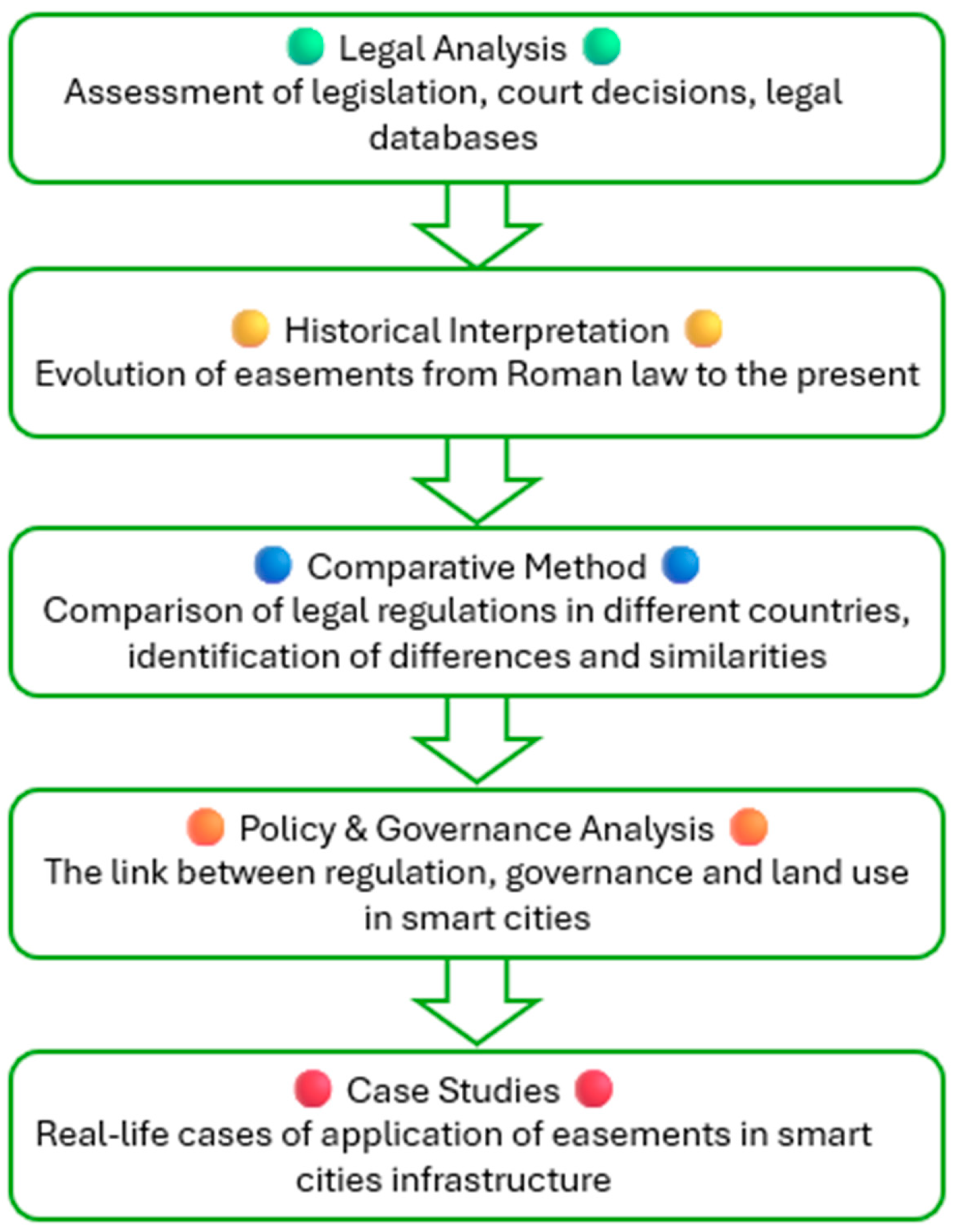
The issue of legal easements is a relatively rarely discussed topic among the professional public, and yet, even today, legal easements create space for the development of smart cities. Legal easements are restrictions on property rights that arise directly from the law, which means that the possible disagreement of the owner of the property concerned is irrelevant. The aim of this scientific study is to provide, based on a study of legislation, case law, and professional and scientific articles, sufficient information on this legal institution, which has its basis in the Civil Code. The scientific study also examines in detail the issue of legal easements and their role in the context of sustainable land use and infrastructure development in smart cities. In the study, we test the stated hypothesis that “Legal easements, as a legal instrument, effectively promote sustainable land use and infrastructure development in smart cities by enabling the integration of renewable energy, eco-mobility and green infrastructure without negatively impacting property rights, thus contributing to reducing conflicts between private property and public interest”. We use a number of scientific methods of research to analyse the current legal situation and the possibilities for the application of legal easements in the context of smart cities, including legal analysis, the comparative method, the method of synthesis, deduction, and historical interpretation. In particular, the methods in question were used to examine, historically describe and compare the current legislation on easements and their use in the management of urban space and infrastructure. The main results of the research include a detailed overview of the current legal status of easements and their limitations, which affect the possibilities of their application in the conditions of smart cities. The results suggest that if easements are effectively implemented they can make a significant contribution to optimising space, regulating access to public services, and protecting natural resources. This tool has the potential to enhance the quality of life in cities and promote sustainable urbanism through adaptive planning and management of urban space.
Keywords: Civil Code; land; legal easements; limitation of property rights; rights in rem; smart cities Civil Code; land; legal easements; limitation of property rights; rights in rem; smart cities