Lagged Vegetation Responses to Diurnal Asymmetric Warming and Precipitation During the Growing Season in the Yellow River Basin: Patterns and Driving Mechanisms


Abstract
1. Introduction
2. Materials and Methods
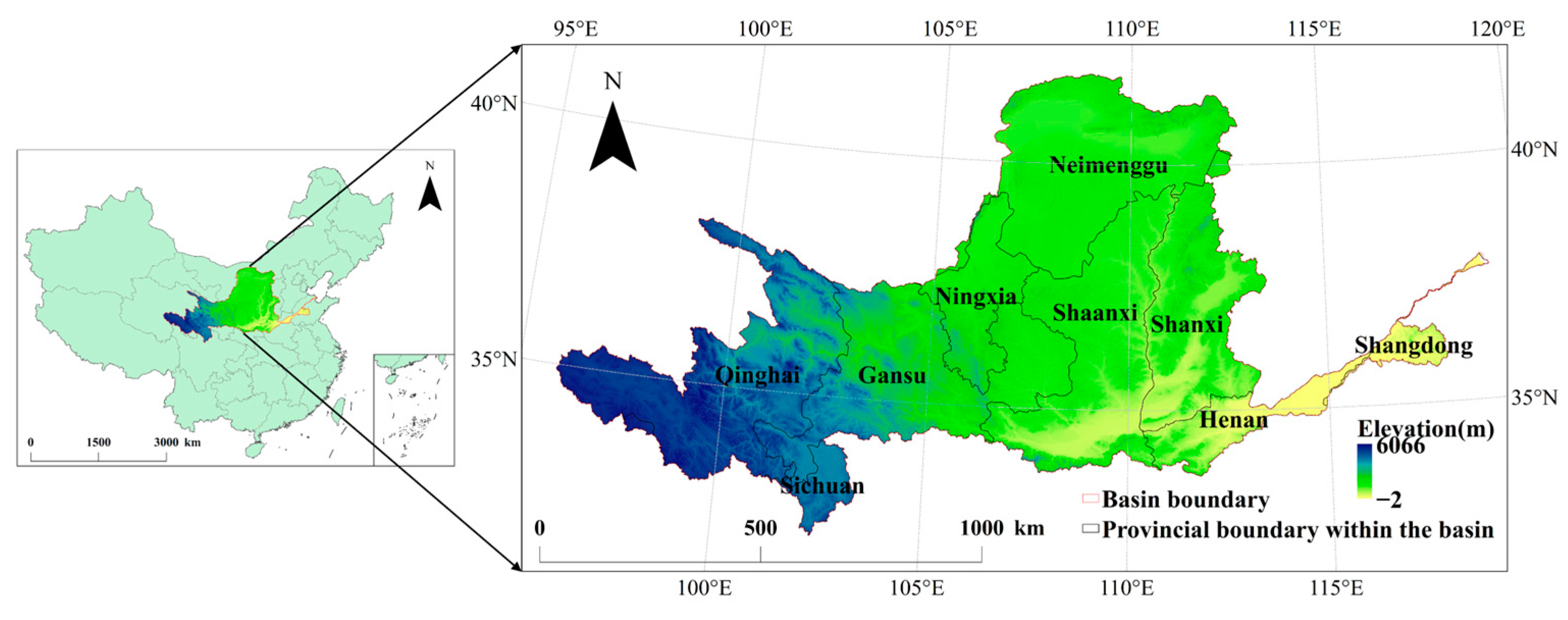
2.1. Study Area
2.2. Data Sources and Processing
2.2.1. NDVI Data
2.2.2. Temperature and Precipitation Data
2.2.3. Other Data
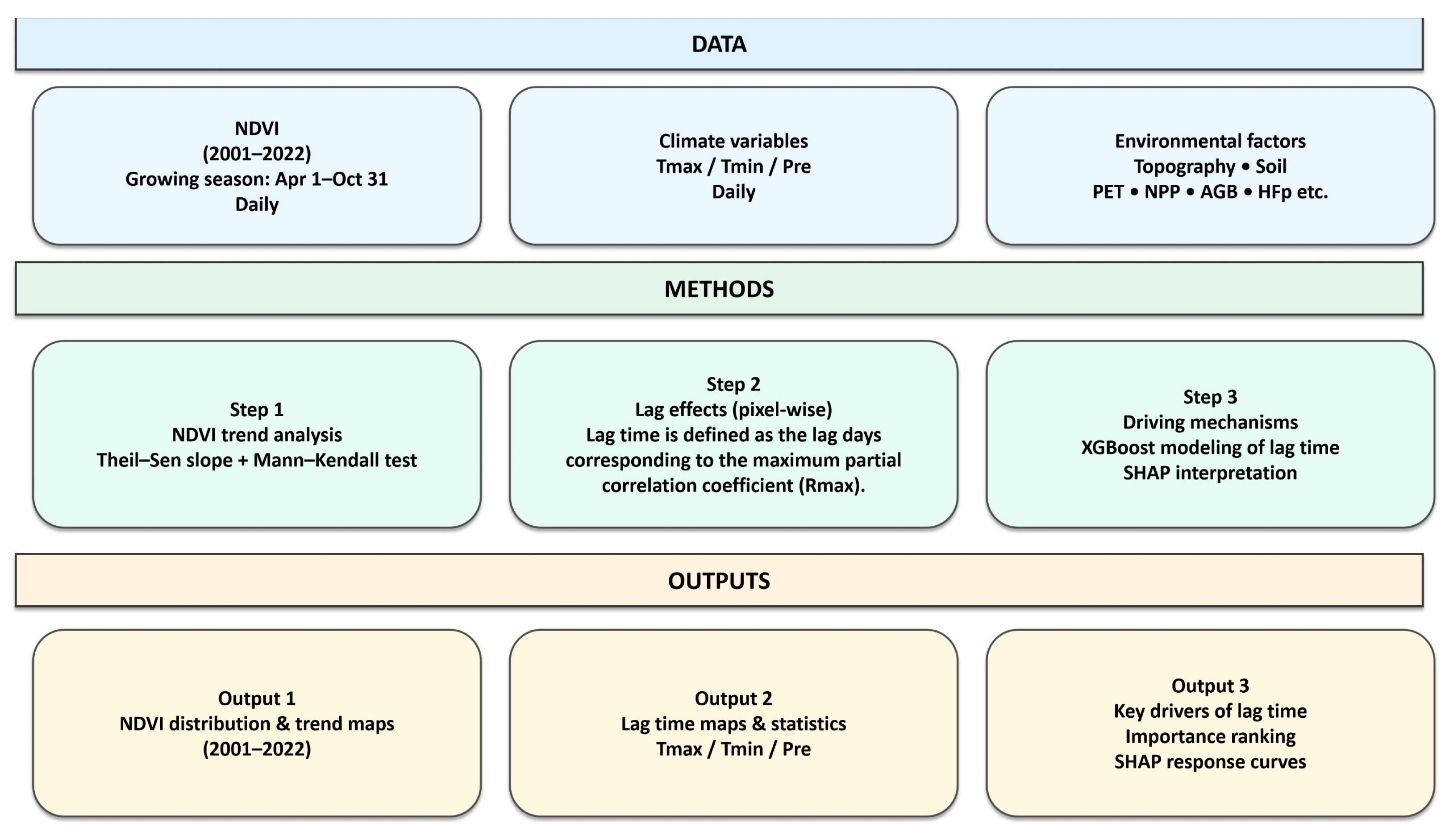
2.3. Methods
2.3.1. Trend Analysis
2.3.2. De-Trended
2.3.3. Lag Effects
2.3.4. XGBoost
2.3.5. SHAP Algorithm
3. Results
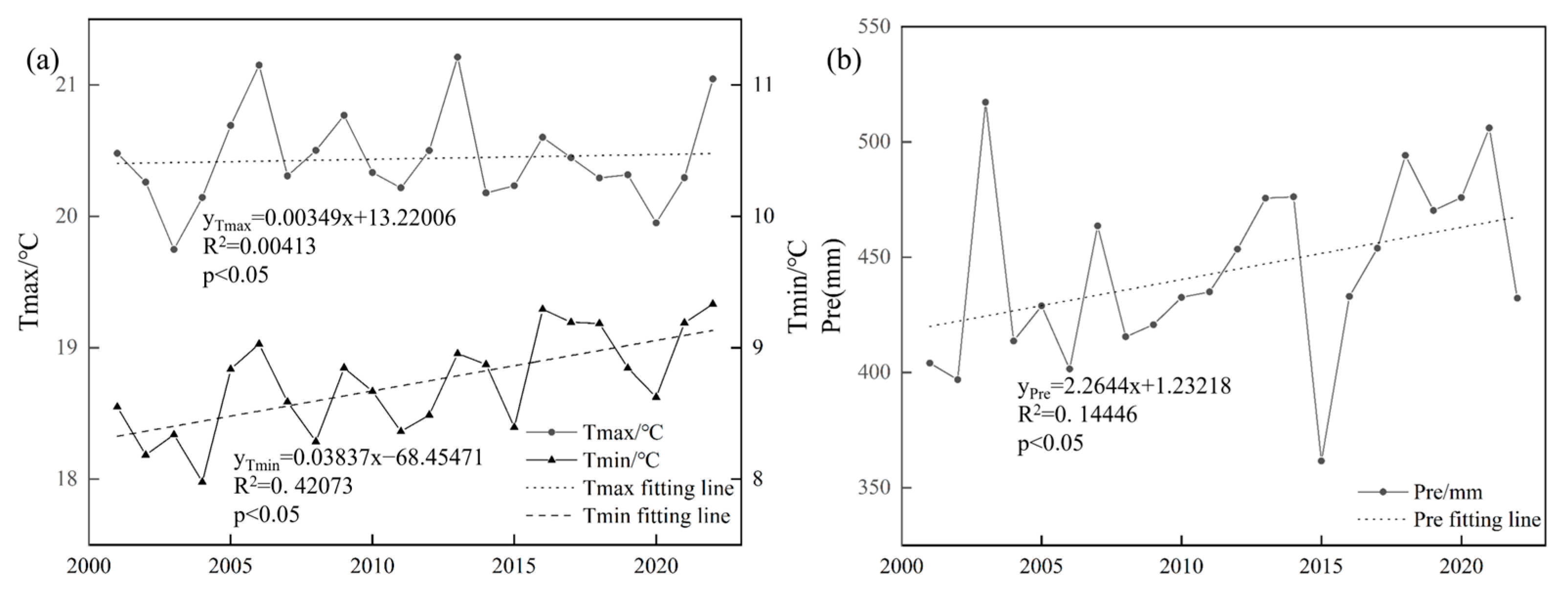
3.1. Changes in Tmax, Tmin, and Precipitation During the Growing Season
3.2. Spatial Distribution and Trend of NDVI During the Growing Season
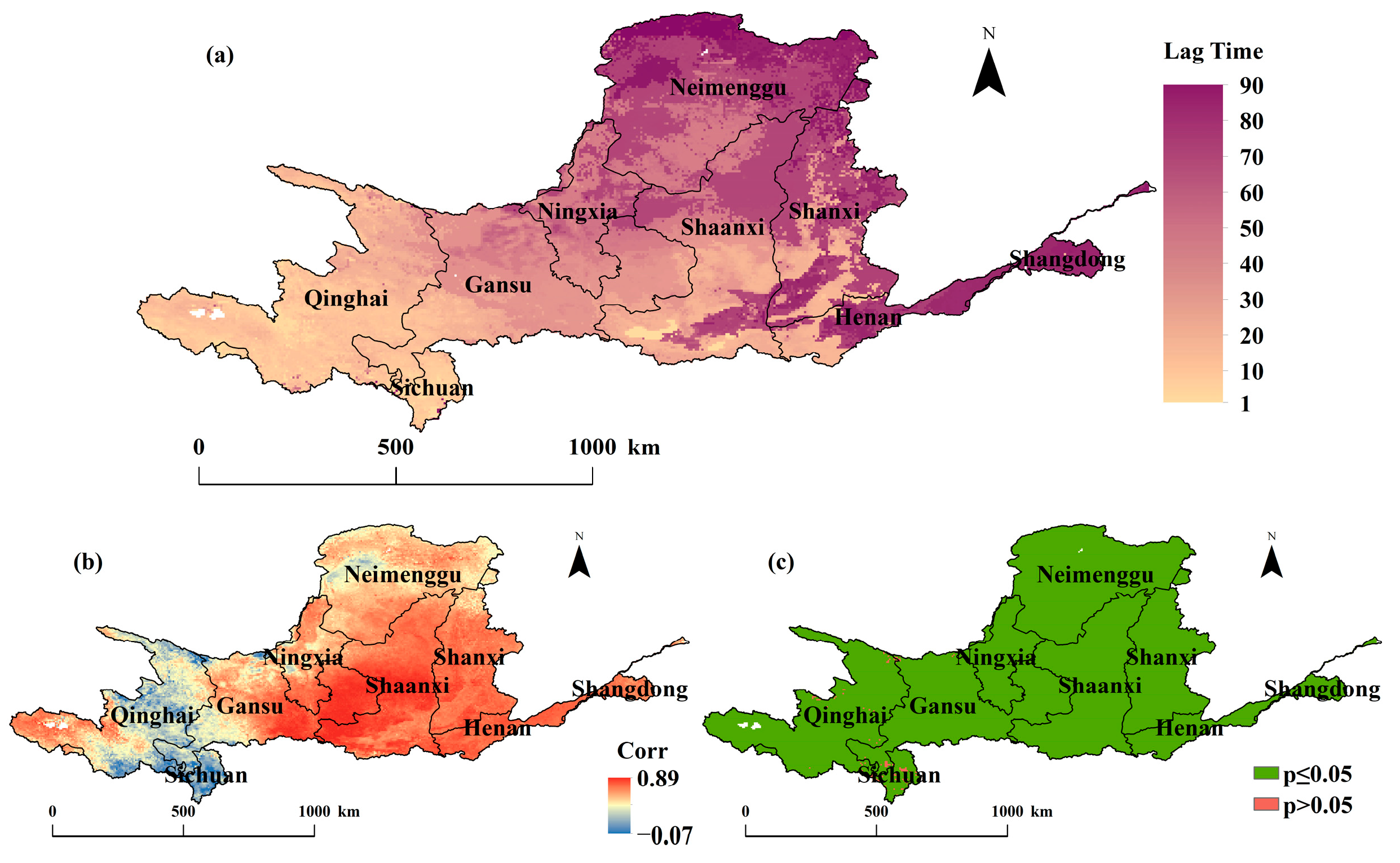
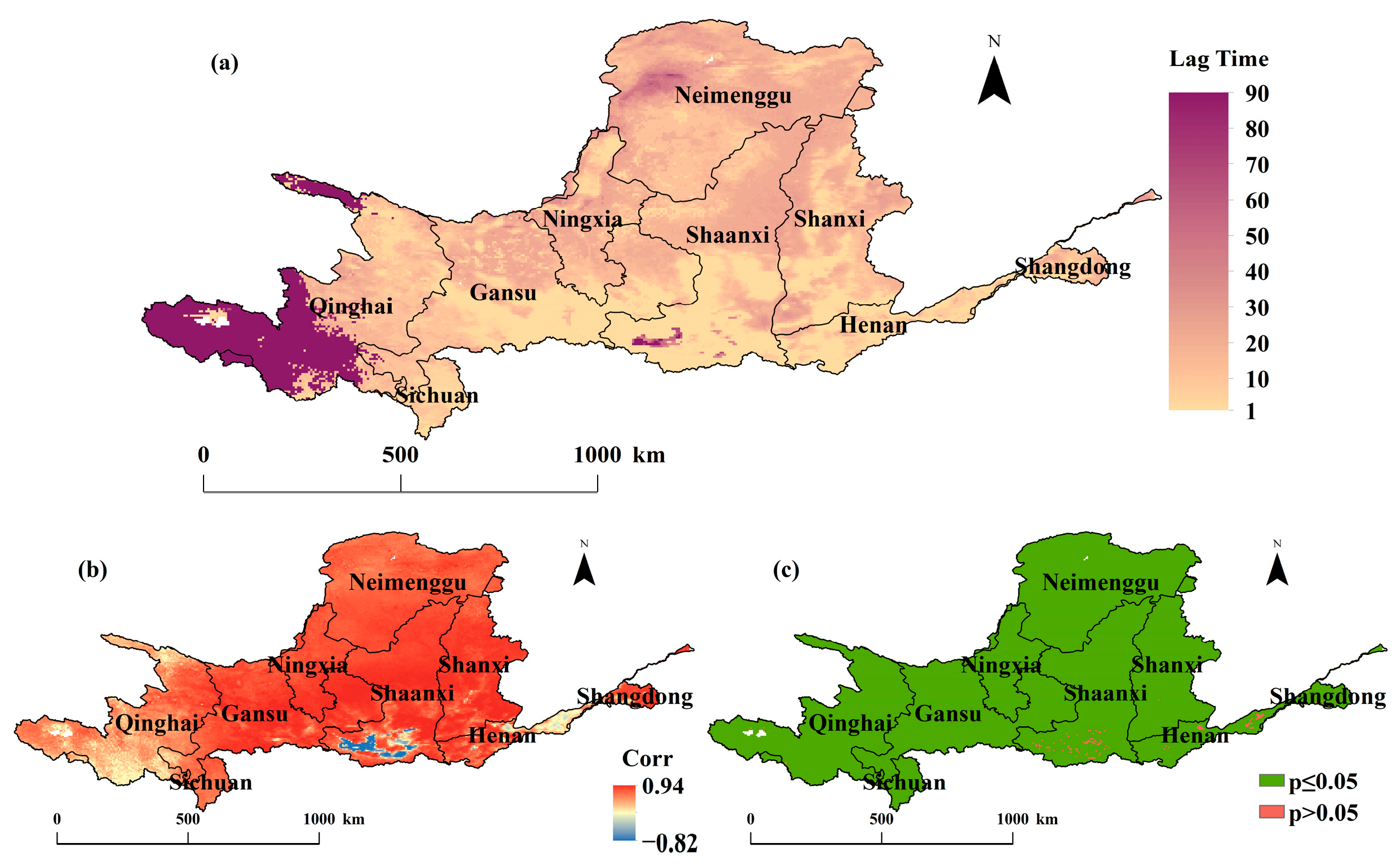
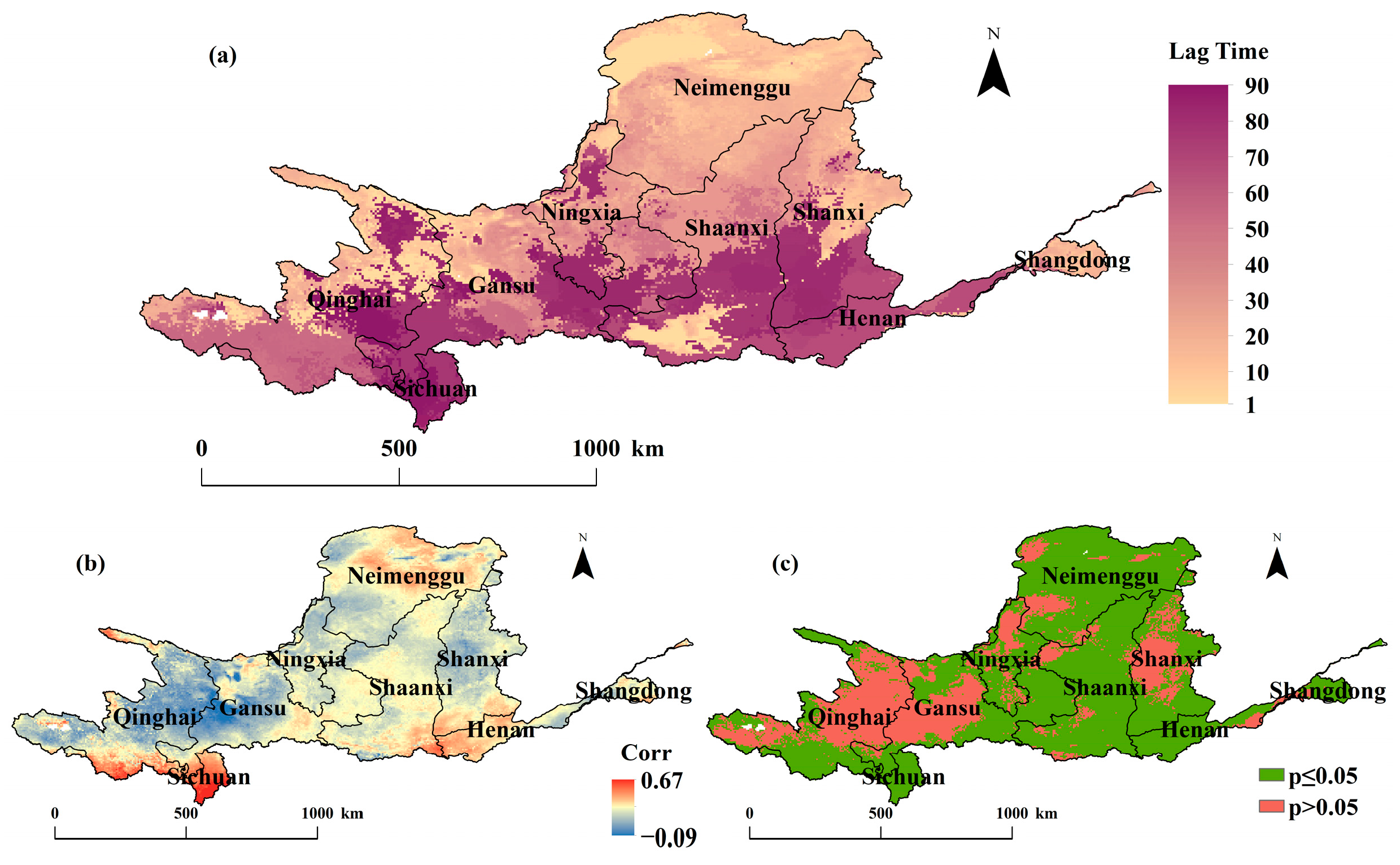
3.3. Lag Effects of Tmax, Tmin, and Precipitation on NDVI During the Growing Season
3.3.1. Lag Effects of Tmax and Tmin on NDVI
3.3.2. Lag Effects of Precipitation on NDVI During the Growing Season
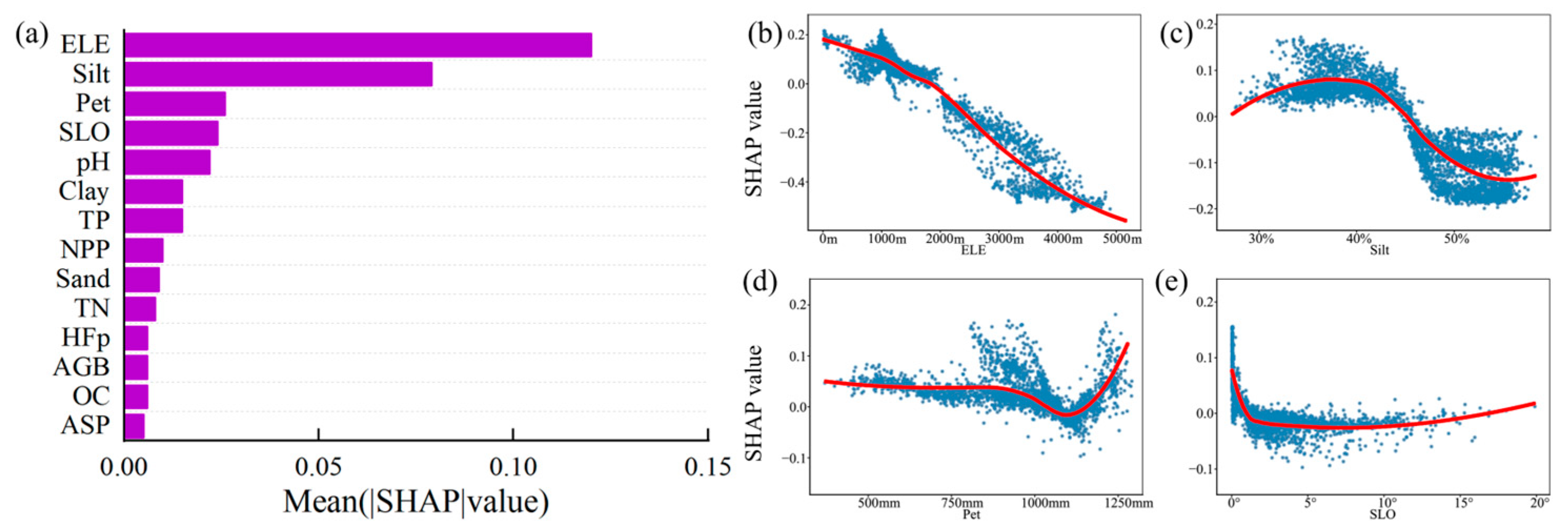
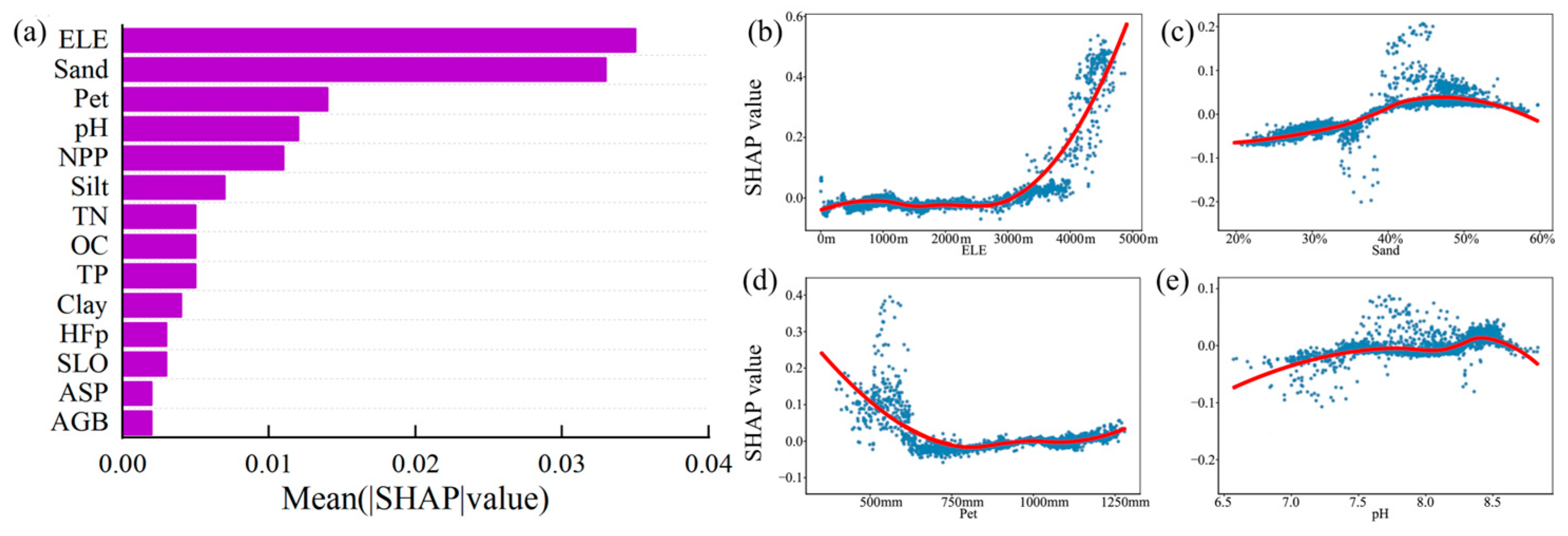
3.4. Factors Contributing to Differences in Lag Effect Patterns
4. Discussion
4.1. Spatiotemporal Evolution of NDVI During the Growing Season
4.2. Promoting Effects of Tmax, Tmin, and Precipitation on NDVI in the Yellow River Basin During the Growing Season
4.3. Lag Time Differences Analysis
4.3.1. Analysis of the Driving Factors of Tmax Lag Time Differences
4.3.2. Analysis of the Driving Factors of Tmin Lag Time Differences
4.3.3. Analysis of the Driving Factors of Precipitation Lag Time Differences
4.4. Limitations
5. Conclusions
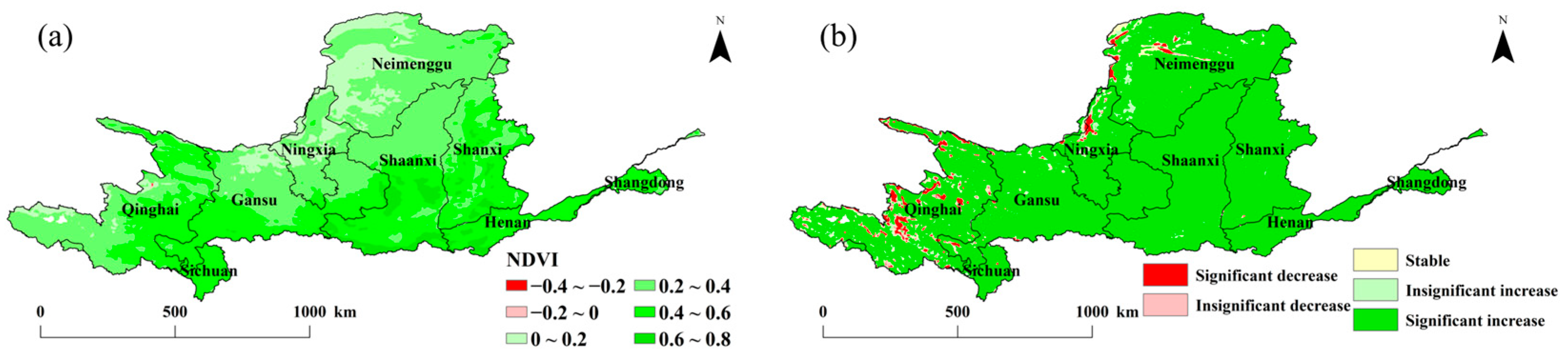
- From 2001 to 2022, NDVI in the Yellow River Basin exhibited a spatial distribution characterized by higher values in the south and lower values in the northwest, with an overall improving trend;
- In the Yellow River Basin, due to the influences of terrain, climate, and soil, there are differences in the lag response times of NDVI to Tmax, Tmin, and precipitation. In the eastern and northern regions of the basin, the lag response time of NDVI to Tmax is longer, while in the western region, the lag response time to Tmin is longer, and in the southern region, the lag response time to precipitation is longer. Specifically, the average lag time for NDVI in response to Tmax is 43 days, to Tmin is 16 days, and to precipitation is 42 days;
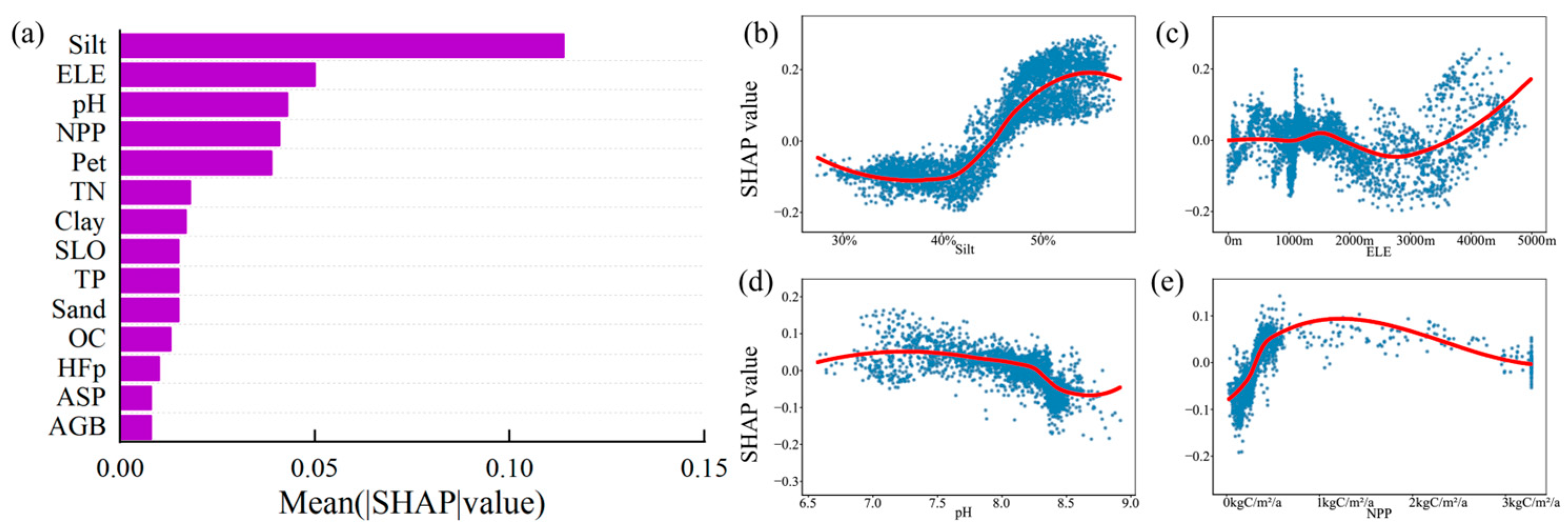
- Elevation, soil silt content, potential evapotranspiration, and slope are important factors influencing the lag time of NDVI’s response to Tmax. The lag time shortens with increases in elevation, soil silt content, and slope, and it first decreases and then increases as potential evapotranspiration rises. Key drivers influencing the lag time of NDVI to Tmin include elevation, soil sand content, potential evapotranspiration, and soil pH. The lag time lengthens with increases in elevation, soil sand content, and soil pH, but decreases as potential evapotranspiration increases. Regarding precipitation, soil silt content, elevation, soil pH, and NPP notably impact the lag time. The lag time lengthens with increasing soil silt content and NPP but decreases with higher soil pH. Additionally, the lag time shows a trend of first decreasing and then increasing with the rise in elevation.
Author Contributions
Funding
Data Availability Statement
Conflicts of Interest
References
- Piao, S.; Wang, X.; Park, T.; Chen, C.; Lian, X.; He, Y.; Bjerke, J.W.; Chen, A.; Ciais, P.; Tømmervik, H.; et al. Characteristics, drivers and feedbacks of global greening. Nat. Rev. Earth Environ. 2020, 1, 14–27. [Google Scholar] [CrossRef]
- Sha, Z.; Bai, Y.; Li, R.; Lan, H.; Zhang, X.; Li, J.; Liu, X.; Chang, S.; Xie, Y. The global carbon sink potential of terrestrial vegetation can be increased substantially by optimal land management. Commun. Earth Environ. 2022, 3, 8. [Google Scholar] [CrossRef]
- Yin, C.; Zhao, W.; Ye, J.; Muroki, M.; Pereira, P. Ecosystem carbon sequestration service supports the Sustainable Development Goals progress. J. Environ. Manag. 2023, 330, 117155. [Google Scholar] [CrossRef]
- Cui, L.; Wang, Z.; Deng, L.; Qu, S. Vegetation dynamics and their relations with climate change at seasonal scales in the Yangtze River Basin, China. Appl. Ecol. Environ. Res. 2020, 18, 3543–3556. [Google Scholar] [CrossRef]
- Han, J.; Huang, Y.; Zhang, H.; Wu, X. Characterization of elevation and land cover dependent trends of NDVI variations in the Hexi region, northwest China. J. Environ. Manag. 2019, 232, 1037–1048. [Google Scholar] [CrossRef] [PubMed]
- IPCC. Climate Change 2021: The Physical Science Basis; Contribution of Working Group I to the Sixth Assessment Report of the Intergovernmental Panel on Climate Change; Cambridge University Press: Cambridge, UK; New York, NY, USA, 2021; p. 2391. [Google Scholar] [CrossRef]
- Friedlingstein, P.; Jones, M.W.; O’Sullivan, M.; Andrew, R.M.; Bakker, D.C.E.; Hauck, J.; Le Quéré, C.; Peters, G.P.; Peters, W.; Pongratz, J.; et al. Global Carbon Budget 2021. Earth Syst. Sci. Data 2022, 14, 1917–2005. [Google Scholar] [CrossRef]
- Li, X.; Li, P.; Gao, M.; Mu, D.; Han, D. Impacts of human activities on vegetation dynamics amid climate change: A case study of the Hanjiang River Basin (China). J. Environ. Manag. 2025, 391, 126581. [Google Scholar] [CrossRef]
- Zhong, Z.; Chen, H.; Dai, A.; Zhou, T.; He, B.; Su, B. Sub-diurnal asymmetric warming has amplified atmospheric dryness since the 1980s. Nat. Commun. 2025, 16, 8247. [Google Scholar] [CrossRef] [PubMed]
- Zhong, Z.; He, B.; Chen, H.; Chen, D.; Zhou, T.; Dong, W.; Xiao, C.; Xie, S.; Song, X.; Guo, L.; et al. Reversed asymmetric warming of sub-diurnal temperature over land during recent decades. Nat. Commun. 2023, 14, 7189. [Google Scholar] [CrossRef] [PubMed]
- Peng, S.; Piao, S.; Ciais, P.; Myneni, R.B.; Chen, A.; Chevallier, F.; Dolman, A.J.; Janssens, I.A.; Peñuelas, J.; Zhang, G.; et al. Asymmetric effects of daytime and night-time warming on northern hemisphere vegetation. Nature 2013, 501, 88–94. [Google Scholar] [CrossRef]
- Xu, B.; Li, J.; Pei, X.; Yang, H. Decoupling the response of vegetation dynamics to asymmetric warming over the Qinghai-Tibet plateau from 2001 to 2020. J. Environ. Manag. 2023, 347, 119131. [Google Scholar] [CrossRef]
- Liu, G.; Guo, Y.; Xia, H.; Liu, X.; Song, H.; Yang, J.; Zhang, Y. Increase asymmetric warming rates between daytime and nighttime temperatures over global land during recent decades. Geophys. Res. Lett. 2024, 51, e2024GL112832. [Google Scholar] [CrossRef]
- Liu, Y.; Wu, C.; Wang, X.; Zhang, Y. Contrasting responses of peak vegetation growth to asymmetric warming: Evidences from FLUXNET and satellite observations. Glob. Change Biol. 2023, 29, 2363–2379. [Google Scholar] [CrossRef]
- Wu, L.; Shen, X.; Lu, X.; Jiang, M. Asymmetric effects of diurnal warming on carbon allocation to leaves of marsh wetlands on the Tibetan Plateau. Int. J. Digit. Earth 2024, 17, 2419936. [Google Scholar] [CrossRef]
- Wang, Y.; Shen, X.; Jiang, M.; Tong, S.; Lu, X. Daytime and nighttime temperatures exert different effects on vegetation net primary productivity of marshes in the western Songnen plain. Ecol. Indic. 2022, 137, 108789. [Google Scholar] [CrossRef]
- Wen, Y.; Liu, X.; Yang, J.; Lin, K.; Du, G. NDVI indicated inter-seasonal non-uniform time-lag responses of terrestrial vegetation growth to daily maximum and minimum temperature. Glob. Planet. Change 2019, 177, 27–38. [Google Scholar] [CrossRef]
- Liang, J.; Liu, X.; AghaKouchak, A.; Ciais, P.; Fu, B. Asymmetrical precipitation sensitivity to temperature across global dry and wet regions. Earth’s Future 2023, 11, e2023EF003617. [Google Scholar] [CrossRef]
- Li, T.; He, B.; Chen, D.; Chen, H.W.; Guo, L.; Yuan, W.; Fang, K.; Shi, F.; Liu, L.; Zheng, H.; et al. Increasing sensitivity of tree radial growth to precipitation. Geophys. Res. Lett. 2024, 51, e2024GL110003. [Google Scholar] [CrossRef]
- Jia, Q.; Gao, X.; Jiang, Z.; Li, H.; Guo, J.; Lu, X.; Li, F.Y. Sensitivity of temperate vegetation to precipitation is higher in steppes than in deserts and forests. Ecol. Indic. 2024, 166, 112317. [Google Scholar] [CrossRef]
- Wang, L.; Yue, Y.; Cui, J.; Liu, H.; Shi, L.; Liang, B.; Li, Q.; Wang, K. Precipitation sensitivity of vegetation growth in southern China depends on geological settings. J. Hydrol. 2024, 643, 131916. [Google Scholar] [CrossRef]
- Lin, M.; Biswas, A.; Bennett, E.M. Spatio-temporal dynamics of groundwater storage changes in the Yellow River Basin. J. Environ. Manag. 2019, 235, 84–95. [Google Scholar] [CrossRef]
- Ren, M.; Liu, Y.; Li, Q.; Song, H.; Cai, Q.; Sun, C. Responses of tree growth and intrinsic water use efficiency to environmental factors in Central and Northern China in the context of global warming. Forests 2022, 13, 1209. [Google Scholar] [CrossRef]
- Song, M.; Jiang, X.; Lei, Y.; Zhao, Y.; Cai, W. Spatial and temporal variation characteristics of extreme hydrometeorological events in the Yellow River Basin and their effects on vegetation. Nat. Hazard. 2023, 116, 1863–1878. [Google Scholar] [CrossRef]
- Zhang, S.; Gu, X.; Zhao, X.; Zhu, J.; Zhao, Y. Influences of climatic factors and human activities on Forest–Shrub–Grass suitability in the Yellow River Basin, China. Forests 2023, 14, 1198. [Google Scholar] [CrossRef]
- Li, H.; Cao, Y.; Xiao, J.; Yuan, Z.; Hao, Z.; Bai, X.; Wu, Y.; Liu, Y. A daily gap-free normalized difference vegetation index dataset from 1981 to 2023 in China. Sci. Data 2024, 11, 527. [Google Scholar] [CrossRef] [PubMed]
- Zhang, L.; Li, X.; Zheng, D.; Zhang, K.; Ma, Q.; Zhao, Y.; Ge, Y. Merging multiple satellite-based precipitation products and gauge observations using a novel double machine learning approach. J. Hydrol. 2021, 594, 125969. [Google Scholar] [CrossRef]
- Nan, L.; Yang, M.; Wang, H.; Miao, P.; Ma, H.; Wang, H.; Zhang, X. Assessment of Spatio-Temporal Dynamic Vegetation Evolution and Its Driving Mechanism on the Kubuqi Desert Using Multi-Source Satellite Remote Sensing. Remote Sens. 2024, 16, 4769. [Google Scholar] [CrossRef]
- Yan, Y.; Hong, S.; Chen, A.; Peñuelas, J.; Allen, C.D.; Hammond, W.M.; Munson, S.M.; Myneni, R.B.; Piao, S. Satellite-based evidence of recent decline in global forest recovery rate from tree mortality events. Nat. Plants 2025, 11, 731–742. [Google Scholar] [CrossRef] [PubMed]
- Song, Y.; Gao, M.; Xu, Z.; Wang, J.; Bi, M. Temporal and spatial characteristics of soil salinization and its impact on cultivated land productivity in the BOHAI Rim region. Water 2023, 15, 2368. [Google Scholar] [CrossRef]
- Wang, Y.; Kong, X.; Guo, K.; Zhao, C.; Zhao, J. Spatiotemporal change in vegetation cover in the Yellow River Basin between 2000 and 2022 and driving forces analysis. Front. Ecol. Evol. 2023, 11, 1261210. [Google Scholar] [CrossRef]
- He, X.; Gao, M.; Wang, X.; Yang, Z.; Hu, Y. Assessment about wind erosion prevention effectiveness by ecological projects in the agro-pastoral zone of northern China. J. Arid Environ. 2025, 231, 105448. [Google Scholar] [CrossRef]
- Li, H.; Xu, F.; Li, Z.; You, N.; Zhou, H.; Zhou, Y.; Chen, B.; Qin, Y.; Xiao, X.; Dong, J. Forest changes by precipitation zones in northern China after the Three-North Shelterbelt Forest Program in China. Remote Sens. 2021, 13, 543. [Google Scholar] [CrossRef]
- Wei, S.; Li, X.; Wang, K.; Wang, T.; Piao, S. Two decades of persistent greening in China despite 2023 climate extremes. Sci. China Earth Sci. 2025, 68, 1064–1073. [Google Scholar] [CrossRef]
- Yang, M.; Xue, L.; Liu, Y.; Liu, S.; Han, Q.; Yang, L.; Chi, Y. Asymmetric response of vegetation GPP to impervious surface expansion: Case studies in the Yellow and Yangtze River Basins. Environ. Res. 2024, 243, 117813. [Google Scholar] [CrossRef]
- Shi, J.; Gao, Y.J.; Zou, Y.Y. Dynamic changes and driving factors of ecosystem service value (ESV) in the Northeast Forest Belt of China. J. For. Res. 2024, 36, 18. [Google Scholar] [CrossRef]
- Chen, J.; Zhou, X.; Hruska, T.; Cao, J.; Zhang, B.; Liu, C.; Liu, M.; Shelton, S.; Guo, L.; Wei, Y.; et al. Asymmetric diurnal and monthly responses of ecosystem carbon fluxes to experimental warming. Clean—Soil Air Water 2017, 45, 1600557. [Google Scholar] [CrossRef]
- Guo, J.; Liao, W.; Qimuge, H.; Xu, Y.; Wang, J. Seasonal analysis of spatial and temporal variations in NDVI and its driving factors in Inner Mongolia during the vegetation growing season (1999–2019). Front. For. Glob. Change 2025, 8, 1555385. [Google Scholar] [CrossRef]
- Tan, J.; Piao, S.; Chen, A.; Zeng, Z.; Ciais, P.; Janssens, I.A.; Mao, J.; Myneni, R.B.; Peng, S.; Peñuelas, J.; et al. Seasonally different response of photosynthetic activity to daytime and night-time warming in the Northern Hemisphere. Glob. Change Biol. 2015, 21, 377–387. [Google Scholar] [CrossRef] [PubMed]
- Xia, H.; Li, A.; Feng, G.; Li, Y.; Qin, Y.; Lei, G.; Cui, Y. The effects of asymmetric diurnal warming on vegetation growth of the Tibetan Plateau over the past three decades. Sustainability 2018, 10, 1103. [Google Scholar] [CrossRef]
- Wan, S.; Xia, J.; Liu, W.; Niu, S. Photosynthetic overcompensation under nocturnal warming enhances grassland carbon sequestration. Ecology 2009, 90, 2700–2710. [Google Scholar] [CrossRef] [PubMed]
- Shen, M.; Piao, S.; Chen, X.; An, S.; Fu, Y.; Wang, S.; Cong, N.; Janssens, I.A. Strong impacts of daily minimum temperature on the green-up date and summer greenness of the Tibetan Plateau. Glob. Change Biol. 2016, 22, 3057–3066. [Google Scholar] [CrossRef] [PubMed]
- Piao, S.; Tan, J.; Chen, A.; Fu, Y.; Ciais, P.; Liu, Q.; Janssens, I.A.; Vicca, S.; Zeng, Z.; Jeong, S.J.; et al. Leaf onset in the northern hemisphere triggered by daytime temperature. Nat. Commun. 2015, 6, 6911. [Google Scholar] [CrossRef]
- Li, W.; Zhang, Y.; Wang, N.; Liang, C.; Xie, B.; Qin, Z.; Yuan, Y.; Cao, J. Nocturnal water use partitioning and its environmental and stomatal control mechanism in Caragana korshinskii Kom in a semi-arid region of northern China. Forests 2023, 14, 2154. [Google Scholar] [CrossRef]
- Zhao, L.; Chen, H.; Chen, B.; Wang, Y.; Sun, H. Drought shapes photosynthetic production traits and water use traits along with their relationships with leaves of typical desert shrubs in Qaidam. Forests 2022, 13, 1652. [Google Scholar] [CrossRef]
- Nan, G.; Wang, J.; Han, L.; He, X.; Jiang, W.; Ma, J. Does slope cropland to natural and artificial conversion change patterns of soil moisture–carbon trade-offs in time and depth on the water-scarce Loess Plateau, China? AGR Ecosyst. Environ. 2025, 385, 109583. [Google Scholar] [CrossRef]
- Zhou, M.; Wang, J.; Bai, W.; Zhang, Y.; Zhang, W. The response of root traits to precipitation change of herbaceous species in temperate steppes. Funct. Ecol. 2019, 33, 2030–2041. [Google Scholar] [CrossRef]
- Xu, M.; Li, X.; Liu, M.; Shi, Y.; Zhou, H.; Zhang, B.; Yan, J. Spatial variation patterns of plant herbaceous community response to warming along latitudinal and altitudinal gradients in mountainous forests of the Loess Plateau, China. Environ. Exp. Bot. 2020, 172, 103983. [Google Scholar] [CrossRef]
- White, A.B.; Kumar, P.; Tcheng, D. A data mining approach for understanding topographic control on climate-induced inter-annual vegetation variability over the United States. Remote Sens. Environ. 2005, 98, 1–20. [Google Scholar] [CrossRef]
- Wei, B.; Peng, Y.; Lin, L.; Zhang, D.; Ma, L.; Jiang, L.; Li, Y.; He, T.; Wang, Z. Drivers of biochar-mediated improvement of soil water retention capacity based on soil texture: A meta-analysis. Geoderma 2023, 437, 116591. [Google Scholar] [CrossRef]
- Yu, K.; Liu, J.; Zhang, X.; Li, P.; Li, Z.; Zhang, X.; Zhao, Y. Evapotranspiration fusion and attribution analysis in the upper and middle reaches of the Yellow River Basin. J. Hydrol. Reg. Stud. 2024, 53, 101773. [Google Scholar] [CrossRef]
- Sun, S.; Bi, Z.; Mu, M.; Liu, Y.; Zhang, Y.; Li, J.; Liu, Y.; Zhou, Y.; Zhou, B.; Chen, H. Quantifying impacts of vegetation greenness change on drought over global vegetation zones. Geophys. Res. Lett. 2025, 52, e2024GL111634. [Google Scholar] [CrossRef]
- Bai, Y.; Yu, P.; Wan, Y.; Wang, Y.; Liu, B.; Liu, Z. Promotion of tree transpiration by soil moisture replenishment along a larch hillslope in the Liupan Mountains, Northwest China. J. Hydrol. 2025, 662, 134041. [Google Scholar] [CrossRef]
- Nehemy, M.F.; Mattos, C.R.C.; Oliveira, R.S.; Hirota, M.; Fan, Y.; Schlickmann, M.B.; Penha, D.; Giacomin, L.L.; Silva, J.S.G.M.; Rocha, M.; et al. Embolism resistance supports the contribution of dry-season precipitation to transpiration in eastern Amazon forests. Proc. Natl. Acad. Sci. USA 2025, 122, e2501585122. [Google Scholar] [CrossRef] [PubMed]
- Wang, Y.; Wang, X.; Wang, Q. Temporal and spatial changes of vegetation phenology and their response to climate in the Yellow River Basin. IEEE Access 2023, 11, 141776–141788. [Google Scholar] [CrossRef]
- Xiao, H.; Liu, Z.; Wan, J.; Chen, J.; Shi, Y. Experimental study of the soil water dissipation law of vegetated slopes under natural evaporation conditions. Appl. Sci. 2024, 14, 1105. [Google Scholar] [CrossRef]
- Yang, K.; Guo, D.; Hua, W.; Pepin, N.; Yang, K.; Li, D. Tibetan Plateau temperature extreme changes and their elevation dependency from ground-based observations. J. Geophys. Res. Atmos. 2022, 127, e2021JD035734. [Google Scholar] [CrossRef]
- Yang, C.; Tian, F.; Jin, H.; Fensholt, R.; Feng, L.; Tagesson, T. Assessing the elevational synchronization in vegetation phenology across Northern Hemisphere mountain ecosystems under global warming. Glob. Planet. Change 2025, 252, 104903. [Google Scholar] [CrossRef]
- Zhao, C.; Wang, Y.; Qiu, Y.; Xie, Z.; Zhang, Y. Response of soil respiration to hydrothermal effects of gravel–sand mulch in arid regions of the Loess Plateau, China. Soil Tillage Res. 2023, 231, 105733. [Google Scholar] [CrossRef]
- Kong, R.; Chu, Y.; Hu, Y.; Zhang, H.; Wang, Q.; Li, C. Diurnal Variation Reveals the Characteristics and Influencing Factors of Cool Island Effects in Urban Blue-Green Spaces. Forests 2024, 15, 2115. [Google Scholar] [CrossRef]
- Bao, Z.; Zhang, J.; Wang, G.; Guan, T.; Jin, J.; Liu, Y.; Li, M.; Ma, T. The sensitivity of vegetation cover to climate change in multiple climatic zones using machine learning algorithms. Ecol. Indic. 2021, 124, 107443. [Google Scholar] [CrossRef]
- Lan, X.; Li, R.; Wang, X.; Zhou, T.; Li, Y.; Duo, J.; Sun, J. Vegetation dynamics and sensitivity responds to climate change in the upstream of Yellow River, China. Ecosyst. Health Sustain. 2025, 11, 0292. [Google Scholar] [CrossRef]
- Guo, B.; Liu, Y.; Fan, J.; Lu, M.; Zang, W.; Liu, C.; Wang, B.; Huang, X.; Lai, J.; Wu, H. The salinization process and its response to the combined processes of climate change–human activity in the Yellow River Delta between 1984 and 2022. Catena 2023, 231, 107301. [Google Scholar] [CrossRef]
- Singh, A. Soil salinization management for sustainable development: A review. J. Environ. Manag. 2021, 277, 111383. [Google Scholar] [CrossRef]
- Marra, F.; Armon, M.; Morin, E. Coastal and orographic effects on extreme precipitation revealed by weather radar observations. Hydrol. Earth Syst. Sci. 2022, 26, 1439–1458. [Google Scholar] [CrossRef]
- Dallan, E.; Marra, F.; Fosser, G.; Marani, M.; Formetta, G.; Schar, C.; Borga, M. How well does a convection-permitting regional climate model represent the reverse orographic effect of extreme hourly precipitation? Hydrol. Earth Syst. Sci. 2023, 27, 1133–1149. [Google Scholar] [CrossRef]
- National Standardization Administration; State Administration for Market Regulation. Soil Mapping—Specifications for the Symbols, Colors and Legends of Soil Texture, pH and Salinization Maps at the Scale of 1:25,000~1:500,000; State Administration for Market Regulation: Beijing, China, 2025.
- Zhang, X.; Li, Y.; Li, F. Spatial distribution characteristics of soil water–salt gradients in the ecological buffer zone of arid zone lakes and their influencing factors. J. Clean. Prod. 2024, 444, 141299. [Google Scholar] [CrossRef]
- Wu, H.; Yu, M.; Sun, Y.; Tan, G.; Ji, Z. Prediction of net primary productivity in the middle-to-high latitudes of Eurasia based on snow and soil temperature. Atmos. Ocean. Sci. Lett. 2024, 18, 100535. [Google Scholar] [CrossRef]
- Dong, G.; Fan, L.; Fensholt, R.; Frappart, F.; Ciais, P.; Xiao, X.; Sitch, S.; Xing, Z.; Yu, L.; Zhou, Z.; et al. Asymmetric response of primary productivity to precipitation anomalies in Southwest China. Agric. For. Meteorol. 2023, 331, 109350. [Google Scholar] [CrossRef]
- Jin, X.; Lu, S.; Ji, Y.; Qin, Y.; He, G. Assessing the Ecosystem Service Value of Small-Scale Landscapes in Rural Tourism Destinations in the Yangtze River Delta. Sustainability 2025, 17, 9410. [Google Scholar] [CrossRef]
- Liu, C.; Liu, J.; Zhang, L.; Shrestha, U.B.; Luo, D.; Wei, Y.; Wang, J. Assessing Climate and Land Use Change Impacts on Ecosystem Services in the Upper Minjiang River Basin. Remote Sens. 2025, 17, 1884. [Google Scholar] [CrossRef]





| Data | Source |
|---|---|
| Digital elevation model data | https://www.gscloud.cn (accessed on 3 September 2025) |
| Potential evapotranspiration data | https://data.tpdc.ac.cn (accessed on 10 September 2025) |
| Soil property data | https://www.earth-system-science-data.net (accessed on 11 September 2025) |
| Net primary productivity data | https://lpdaac.usgs.gov (accessed on 11 September 2025) |
| The human footprint dataset | https://www.x-mol.com/groups/li_xuecao (accessed on 12 September 2025) |
| The biomass dataset | https://code.earthengine.google.com (accessed on 12 September 2025) |
Disclaimer/Publisher’s Note: The statements, opinions and data contained in all publications are solely those of the individual author(s) and contributor(s) and not of MDPI and/or the editor(s). MDPI and/or the editor(s) disclaim responsibility for any injury to people or property resulting from any ideas, methods, instructions or products referred to in the content. |
© 2026 by the authors. Licensee MDPI, Basel, Switzerland. This article is an open access article distributed under the terms and conditions of the Creative Commons Attribution (CC BY) license.
Share and Cite
Zhang, Z.; Fang, F.; Zhang, Z. Lagged Vegetation Responses to Diurnal Asymmetric Warming and Precipitation During the Growing Season in the Yellow River Basin: Patterns and Driving Mechanisms. Land 2026, 15, 146. https://doi.org/10.3390/land15010146
Zhang Z, Fang F, Zhang Z. Lagged Vegetation Responses to Diurnal Asymmetric Warming and Precipitation During the Growing Season in the Yellow River Basin: Patterns and Driving Mechanisms. Land. 2026; 15(1):146. https://doi.org/10.3390/land15010146
Chicago/Turabian StyleZhang, Zeyu, Fengman Fang, and Zhiming Zhang. 2026. "Lagged Vegetation Responses to Diurnal Asymmetric Warming and Precipitation During the Growing Season in the Yellow River Basin: Patterns and Driving Mechanisms" Land 15, no. 1: 146. https://doi.org/10.3390/land15010146
APA StyleZhang, Z., Fang, F., & Zhang, Z. (2026). Lagged Vegetation Responses to Diurnal Asymmetric Warming and Precipitation During the Growing Season in the Yellow River Basin: Patterns and Driving Mechanisms. Land, 15(1), 146. https://doi.org/10.3390/land15010146