


Abstract
Rapid urbanization and increasingly frequent extreme rainfall events have intensified stormwater challenges, underscoring the need for watershed-scale strategies that integrate blue-green infrastructure (BGI). This study evaluates the stormwater control performance of combined initial reservoir storage level regulation, river water level adjustment, and green infrastructure (GI) implementation in the 42.4 km2 Baihuayong watershed of Guangzhou, China. A coupled stormwater model (SWMM) was developed, calibrated, and coupled with TELEMAC-2D to simulate schemes varying initial reservoir storage levels (30.6 m to 27.6 m), river water levels (11 m to 8 m), and GI proportions (0–45%) under 2- to 100-year rainfall events. Results show that lowering initial reservoir storage levels from 30.6 m to 27.6 m enhanced runoff reduction by ~40% and reduced discharged water volume by ~30%, though overflow mitigation remained limited. Decreasing river water levels from 11 m to 8 m reduced flooded areas by up to 8.3%, with diminishing benefits below 9 m. Increasing GI coverage from 0% to 45% reduced overflow nodes from 236 to 192 and flood extent from 10.76 ha to 9.20 ha under moderate storms, but improvements were modest during extreme events. A synergistic configuration, combining a low initial reservoir storage level (27.6 m), low river water level (8 m), and a high GI proportion (35–45%), yielded the most comprehensive improvements. These findings demonstrate the strong potential of integrated BGI for watershed-scale flood resilience and provide quantitative guidance for sponge city planning.
1. Introduction
Rapid urban expansion and increased imperviousness have significantly reduced the capacity of conventional drainage systems, which rely solely on rapid conveyance. Consequently, these systems are increasingly unable to manage extreme rainfall and compound flooding [1,2,3,4,5]. Traditional gray drainage systems, such as pipes and concrete channels, are typically designed according to the principle of rapid discharge, with the primary goal of efficiently conveying stormwater away from urban areas [6,7,8]. However, this approach has proven inadequate for addressing increasingly frequent extreme rainfall events. Not only does it fail to effectively mitigate urban flooding, but it also exacerbates issues such as runoff pollution, insufficient groundwater recharge, and the degradation of urban ecological functions [9,10]. Moreover, traditional drainage systems are often overloaded during heavy rainfall, resulting in significant water loss and a failure to fully utilize rainwater as a valuable resource [11,12,13]. Urban water cycles and the ecological balance are, in turn, adversely affected. Under the combined pressures of global climate change and urbanization, conventional single-structure engineering approaches have become increasingly inadequate to meet the requirements of sustainable urban development [14,15]. Therefore, there is an urgent need to explore integrated, nature-based solutions that can enhance urban resilience and ecological sustainability. Blue-Green Infrastructure (BGI) has emerged as a key strategy for sustainable urban development. It integrates both natural and engineered systems to mitigate the challenges posed by rapid global urbanization, increasingly frequent extreme rainfall events, and the limitations of traditional drainage systems [16,17,18]. By integrating green spaces (such as vegetation, green areas, and wetlands) with blue water bodies (such as rain gardens, artificial lakes, and infiltration ponds), BGI establishes multifunctional ecological networks across urban landscapes. This approach not only effectively mitigates stormwater runoff and improves water quality but also strengthens the resilience and biodiversity of urban ecosystems [19,20,21,22]. Compared to traditional gray infrastructure, BGI emphasizes the utilization of natural processes. By mimicking natural hydrological cycles, it facilitates rainwater retention, infiltration, and reuse are facilitated, thereby effectively addressing urban flooding, reducing environmental pollution, and enhancing the quality of urban living environments [23,24,25]. Under the complex background, BGI has emerged as a key strategy for sustainable urban water management, offering integrated ecological, social, and economic benefits [26,27].
Hydrological models are commonly utilized to simulate stormwater processes [28,29,30]. Widely used models include SWMM, SWAT, MIKE SHE, and HEC-HMS [31,32,33,34,35,36]. Among these, SWMM has been extensively applied in urban stormwater management and sponge city development owing to its comprehensive functionality and high flexibility. The Low Impact Development (LID) modules within SWMM, including bio-retention cells, permeable pavements, and green roofs, are capable of accurately simulating the physical characteristics and hydrological processes of green infrastructure (GI) [37,38]. Essamlali et al. [39] conducted simulations of various LID facility configurations using the SWMM and found that combined LID schemes achieved higher runoff reduction and pollutant removal rates. Similarly, Suresh et al. [40] utilized the SWMM to compare the hydrological effects of LID facilities on runoff depth and peak runoff, thereby supporting urban policymakers in identifying optimal LID measures for flood risk mitigation. It was concluded by Zhuang et al. [5] that when LID measures are implemented across the entirety of the study area, total runoff and peak runoff can be reduced by 35% to 45% during rainfall events with return periods of 2, 10, and 50 years. Blue Infrastructure (BI) is primarily composed of large-scale water conservancy projects and natural water systems, which play a vital role in urban stormwater regulation and storage. These facilities are typically located upstream or along the periphery of urban areas and operate synergistically with GI to establish an integrated urban stormwater management system.
Research on BGI has been progressively expanded from the evaluation of individual facilities to the analysis of integrated effects across multiple scales and processes. In terms of stormwater management performance, previous studies have primarily focused on runoff reduction, peak flow delay, and water quality improvement. Field monitoring and hydrological modeling have been widely employed in quantifying the water storage, infiltration, and purification capacities of BGI systems. Li et al. [41] found that centralized BGI facilities can effectively regulate the number of drainage units and the total runoff volume in the study area. For instance, under the scenario of extreme rainfall and increased impervious surfaces in the future, the centralized BGI can regulate 25.7% of the total runoff. The hydrological benefits of BGI were assessed by Mugume et al. [42] through one-dimensional and two-dimensional hydrological modeling. This assessment indicated that, considering the initial state of a failing urban drainage system, the average flood duration could be reduced by over 13% through the implementation of rainwater harvesting, infiltration trenches, and bio-retention cells. Additionally, research on the role of BGI in urban resilience assessments is growing, with a primary focus on the development of indicator systems to evaluate their contributions to urban resilience, such as flood risk reduction, ecological restoration, and community adaptation. Thorsson et al. [43] demonstrated that integrated BGI combinations can simultaneously support urban stormwater management, heat stress mitigation, and recreational functions while accounting for construction and maintenance costs. Battemarco et al. [44] proposed an alternative future land-use strategy based on BGI implementation, and their simulations demonstrated that BGI approaches were capable of reducing flooding risk while enhancing watershed environmental quality and offering strategic guidance for the spatial layout of BGI.
Urban stormwater management is no longer considered to be confined within city boundaries but must instead be integrated into larger-scale watershed water resource and water security systems. The interplay between urban flooding and waterlogging presents a key challenge in stormwater management, which necessitates a systematic approach to address urban water issues from a watershed perspective. The sponge city concept necessitates the coordinated planning of BGI and the investigation of the hydrological effects of integrated blue-green systems at the watershed scale. However, few studies have examined the hydrological impacts of such integrated systems from a whole-watershed perspective. Existing research has been primarily focused on the analysis of localized areas or site-scale components (e.g., individual facilities, communities, or small plots). Xu et al. [45] evaluated the effectiveness of LID facilities in stormwater management and microclimate improvement at the residential scale under varying weather conditions. The study demonstrated that LID facilities have greater benefits than conventional residential green spaces lacking such installations. Zhuang et al. [5] developed SWMM for a high-density built-up area in Hong Kong to investigate the effects of LID facilities on runoff control. Do Lago et al. [46] integrated the SWMM with the Non-dominated Sorting Genetic Algorithm II (NSGA-II) to identify optimal placement of LID facilities in small urban watersheds. The watershed-scale perspective encompasses the interactions among upstream and downstream areas, spatial heterogeneity, and hydrodynamic connectivity [47]. The effectiveness of LID measures is strongly influenced by the geology, topography, climate, land cover, and anthropogenic factors of the study area. Flooding in the upper reaches of urban river basins exerts a significant influence on downstream urban flooding. However, few studies have examined the effects of floodwater originating from upstream catchment areas on stormwater management in downstream urban drainage zones. Hu et al. [48] evaluate the flood control and disaster reduction effects of BGI networks with different spatial configurations and structural layouts. The results show that the small decentralized regulating and storage tanks upstream significantly reduce the peak water depth and alleviate the drainage pressure of the main channel. Existing studies [49,50] have largely been confined to the scales of individual construction projects or neighborhoods, without considering the integrated layout of BGI at the basin scale and its implications for stormwater control in sponge city development. Meanwhile, existing research has shown that GI effectively regulates stormwater during high-frequency, low-intensity rainfall events. However, it is less effective when operating independently under extreme rainfall conditions and large-scale flood events. Therefore, a holistic watershed systems perspective must be adopted to investigate the hydrological effects of integrated BGI layouts and combined applications under extreme rainfall and upstream river backflow conditions. This approach provides new insights and methodological frameworks for urban flood prevention and disaster mitigation.
Although numerous studies [51,52,53] have examined the hydrological benefits of GI or BI individually, the synergistic effects of integrated reservoir operation, river water level regulation, and GI at the watershed scale remain insufficiently quantified. This study employs the Baihuayong creek watershed in Zengcheng District, Guangzhou, China, as a representative case study. A watershed and urban stormwater model were constructed based on the SWMM and TELEMAC-2D, using the entire watershed as the foundation and BGI as the research subject. The study evaluates the stormwater control performance of BGI under six rainfall events, varying initial reservoir storage levels, river water levels, and proportions of GI construction. Based on the quantitative results of this study, a scientific basis can be provided for urban watersheds in the Pearl River Delta region or other cities with similar natural geographical conditions and urbanization development patterns.
2. Materials and Methods
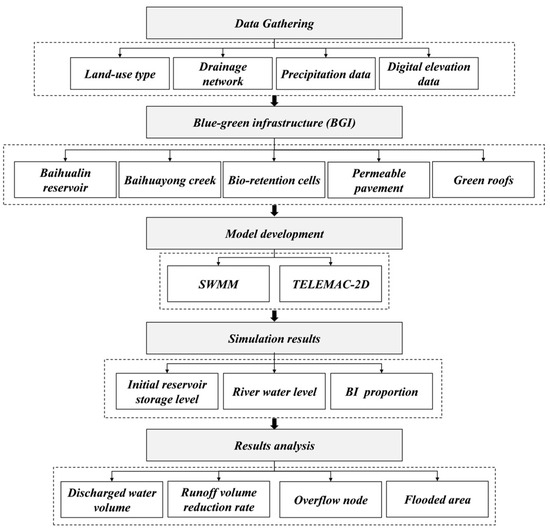
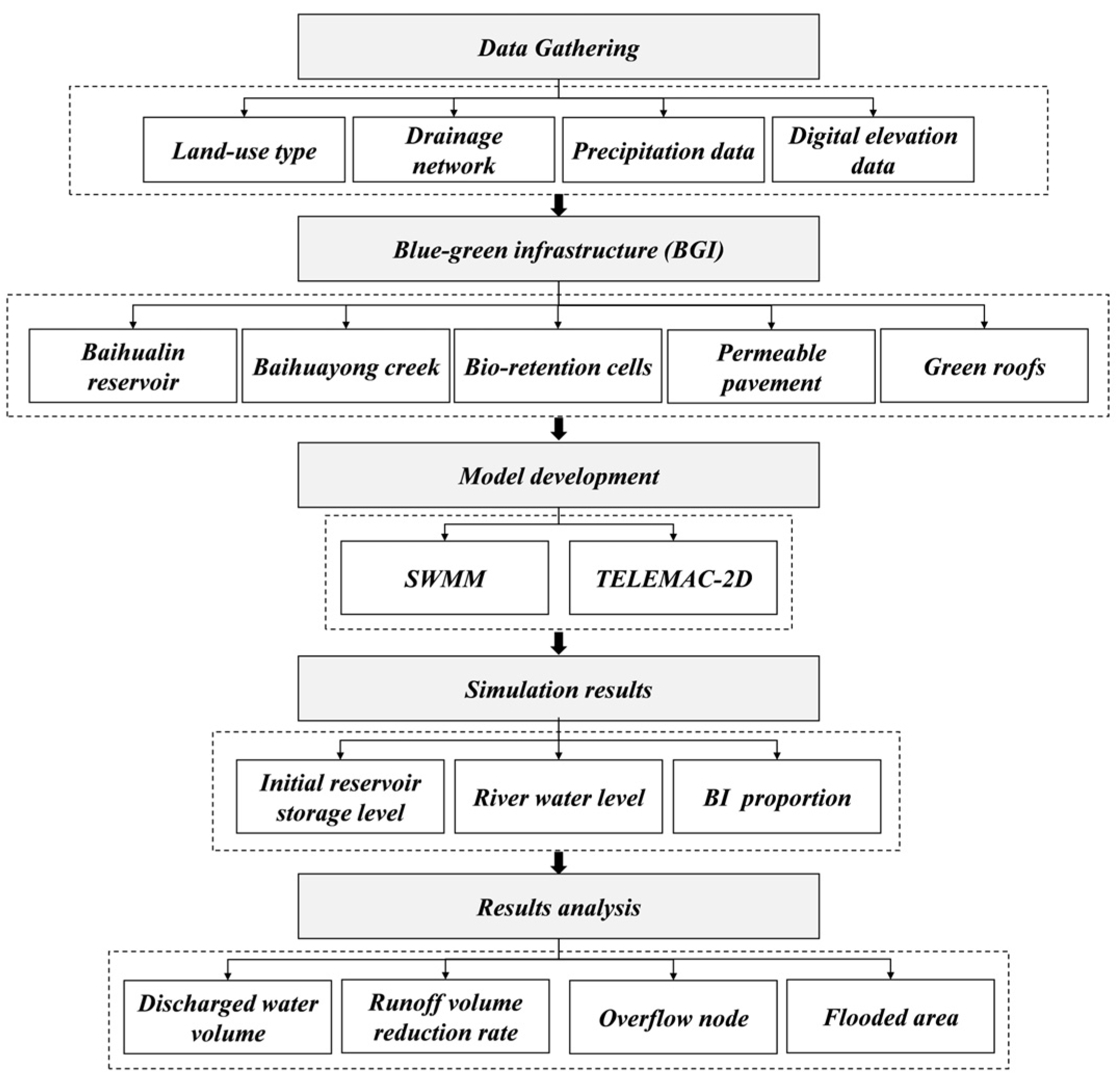
Figure 1 shows the methodological workflow, including data preparation, SWMM hydrological-hydraulic simulation, TELEMAC-2D flood propagation modeling, and scheme analysis.
Figure 1.
The flowchart of this article.
2.1. Study Area
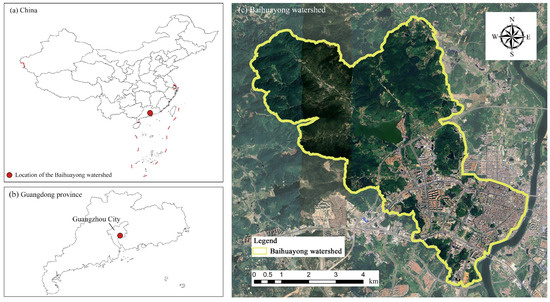
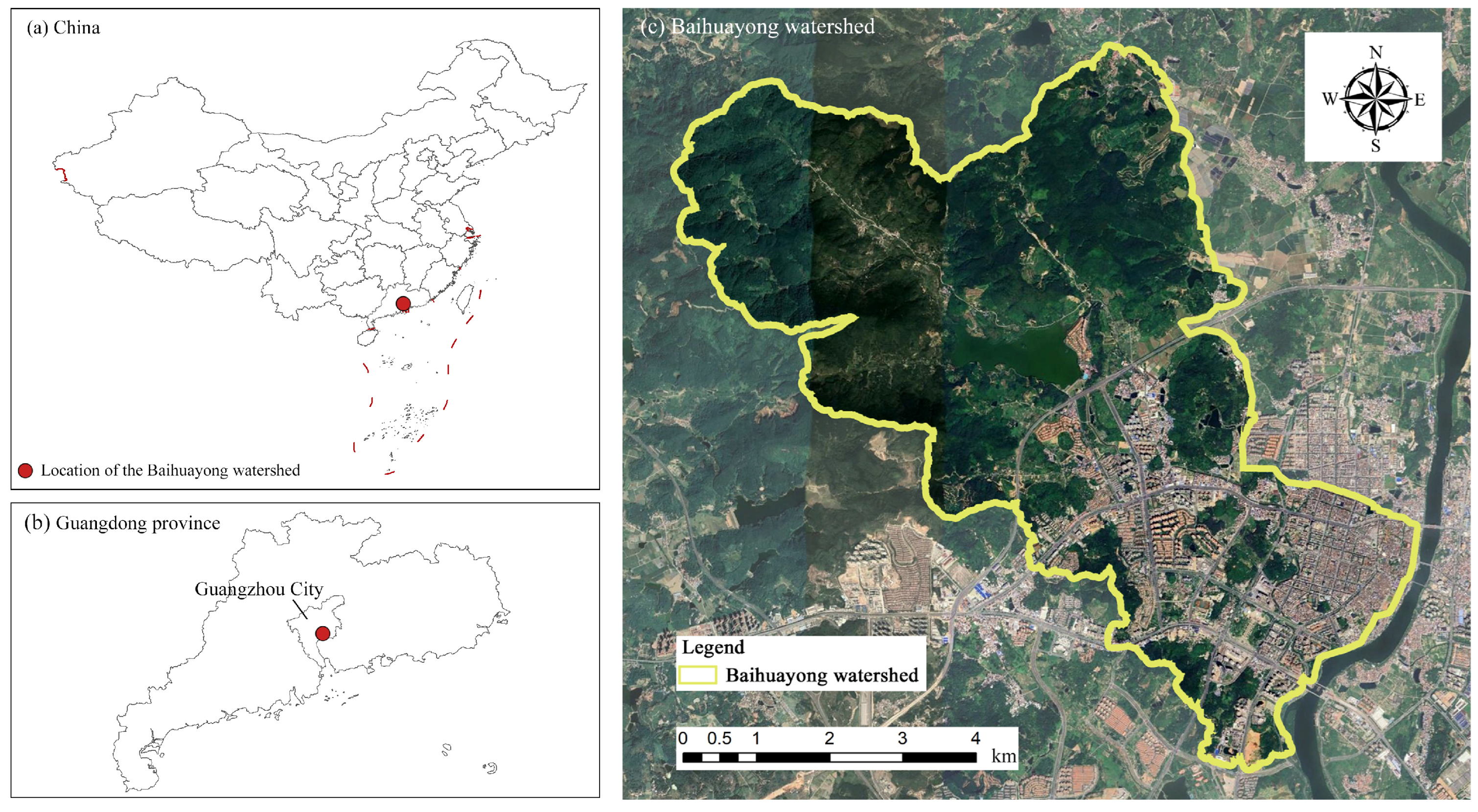
The Baihuayong watershed (42.4 km2), located in Zengcheng District, Guangzhou, represents a rapidly urbanizing subtropical basin, with built-up areas accounting for approximately 76.71% of the total watershed area. Urban development has intensified markedly over the past decade, particularly along major road corridors. From 2009 to 2024, the expansion amplitude of the building-covered area within the built-up areas reached approximately 83%, reflecting a trend of rapid urban expansion. The watershed is further characterized by strong topographic gradients, with areas having slopes greater than 15° accounting for 51.04% of the total area, and pronounced upstream-downstream hydrological connectivity. These combined features contribute to rapid runoff generation and the amplification of flood risks under intense rainfall events. This watershed was selected as the study area due to its high exposure to frequent extreme rainfall events (defined as daily precipitation ≥ 50 mm, the 95th percentile of Guangzhou’s 1991–2020 rainfall dataset, with an annual average of 8.3 events and a notable rise to 14.2 events in 2024), its markedly heterogeneous land-use distribution, and pronounced conflicts between rapid urban development and existing drainage capacity. These characteristics collectively make it a representative and suitable case for assessing the stormwater management performance of BGI at the watershed scale. Study area is shown in Figure 2.
Figure 2.
Geographic location of the Baihuayong watershed. (a) Location of the Baihuayong watershed within China; (b) Location of the study area in Guangdong Province, showing its position in Guangzhou City; (c) Satellite image of the Baihuayong watershed, with the watershed boundary highlighted.
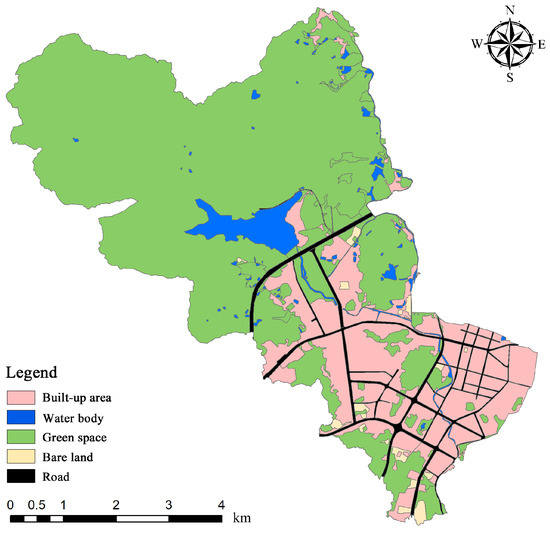
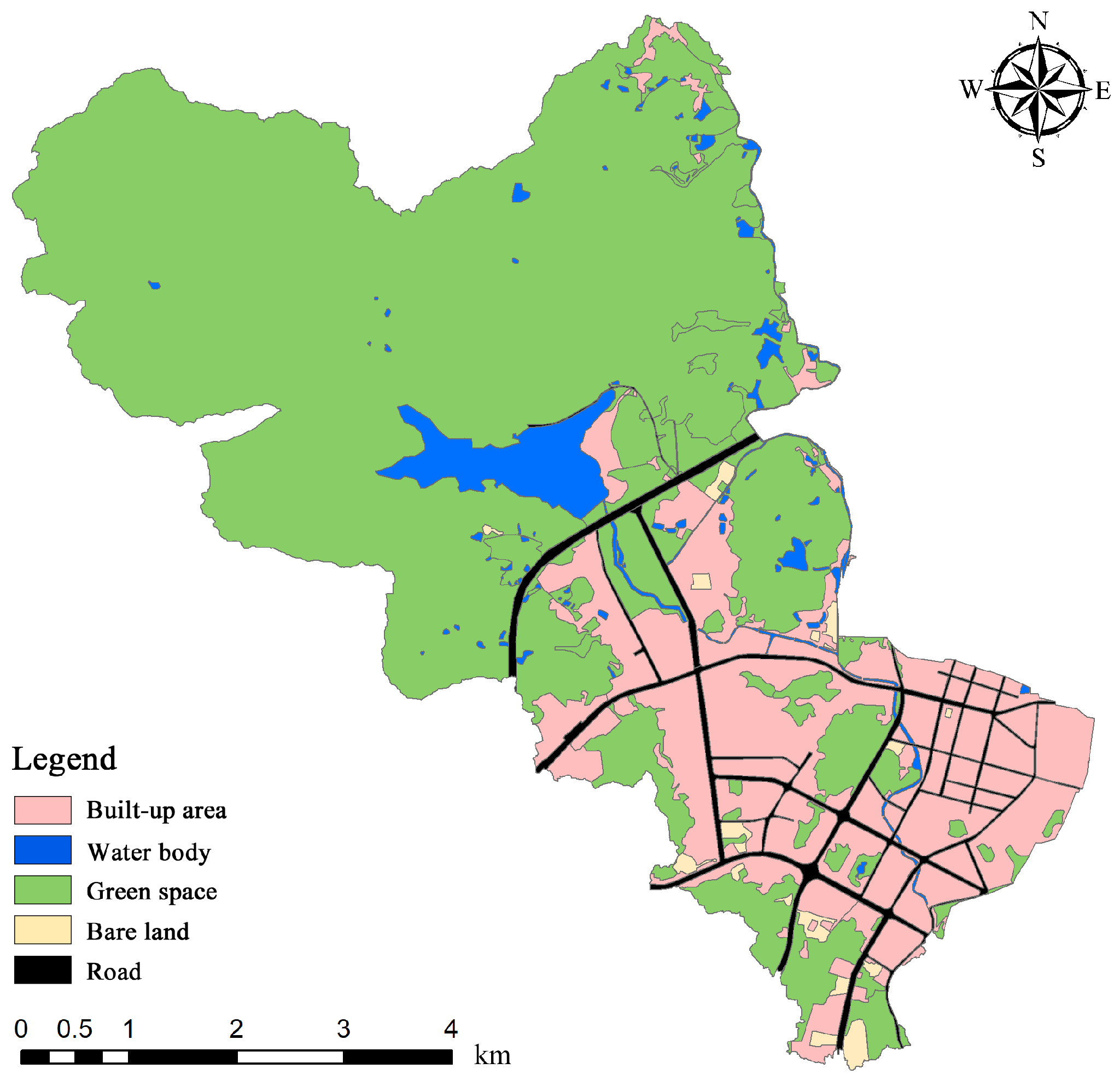
The DEM (with a spatial resolution of 1 m × 1 m), land-use data, and drainage pipe network information were provided by the Zengcheng District Water Affairs Bureau, Guangzhou, China. These datasets were generated through official surveying, municipal planning records, and drainage system inventories. Rainfall and pipe network flow data were obtained from hydrological monitoring stations managed by the local water authority. BGI parameters were determined based on regional design standards and values reported in previous studies. This information serves as the basis for model construction and calibration. Based on the analysis of collected stormwater pipe network data, the Baihuayong watershed contains 4064 stormwater inspection chambers, 55 stormwater outfalls, and 4188 stormwater pipes and channels, totaling length of 118 km. The primary land use types in the study area comprise built-up area, water bodies, green spaces, bare land, and roads. In this study, green spaces mainly consist of urban park green areas, agricultural land, and forested areas. The distribution of land-use types is shown in Figure 3, and the areas of each land-use type in the study area are listed in Table 1.
Figure 3.
The distribution of land-use types in the study area.
Table 1.
The areas of each land-use type in the study area.
2.2. SWMM Set Up
The Storm Water Management Model (SWMM), developed by the U.S. Environmental Protection Agency (EPA), is a dynamic rainfall-runoff simulation model widely used for planning, analysis, and design of urban stormwater drainage systems [52,54]. It is capable of simulating single-event or continuous runoff hydrology as well as hydraulic routing through drainage networks of pipes, channels, storage units, and pumps. One of its significant advantages is its support for modeling LID facilities, including green roofs, permeable pavement and bio-retention cells, which enables detailed evaluation of sustainable urban drainage strategies. SWMM supports user-defined catchment zones with flexible input, covering parameters such as land use type, slope, soil properties, and impermeability. Its modular design also facilitates integration with other tools and two-dimensional hydrodynamic models. Due to its balance between modeling precision and computational efficiency, SWMM has become one of the most widely applied tools in sponge city planning, urban flood risk assessment, and BGI performance evaluation.
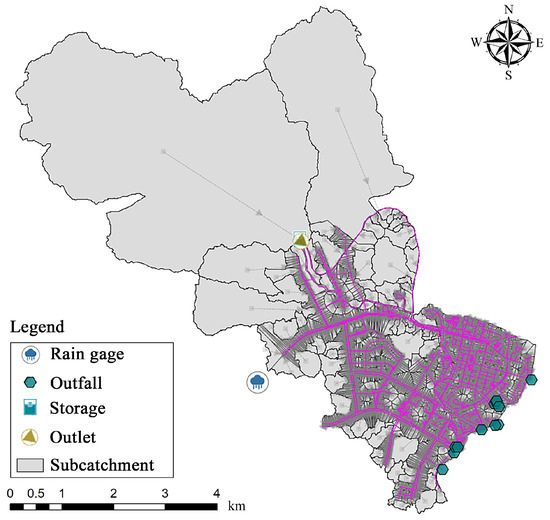
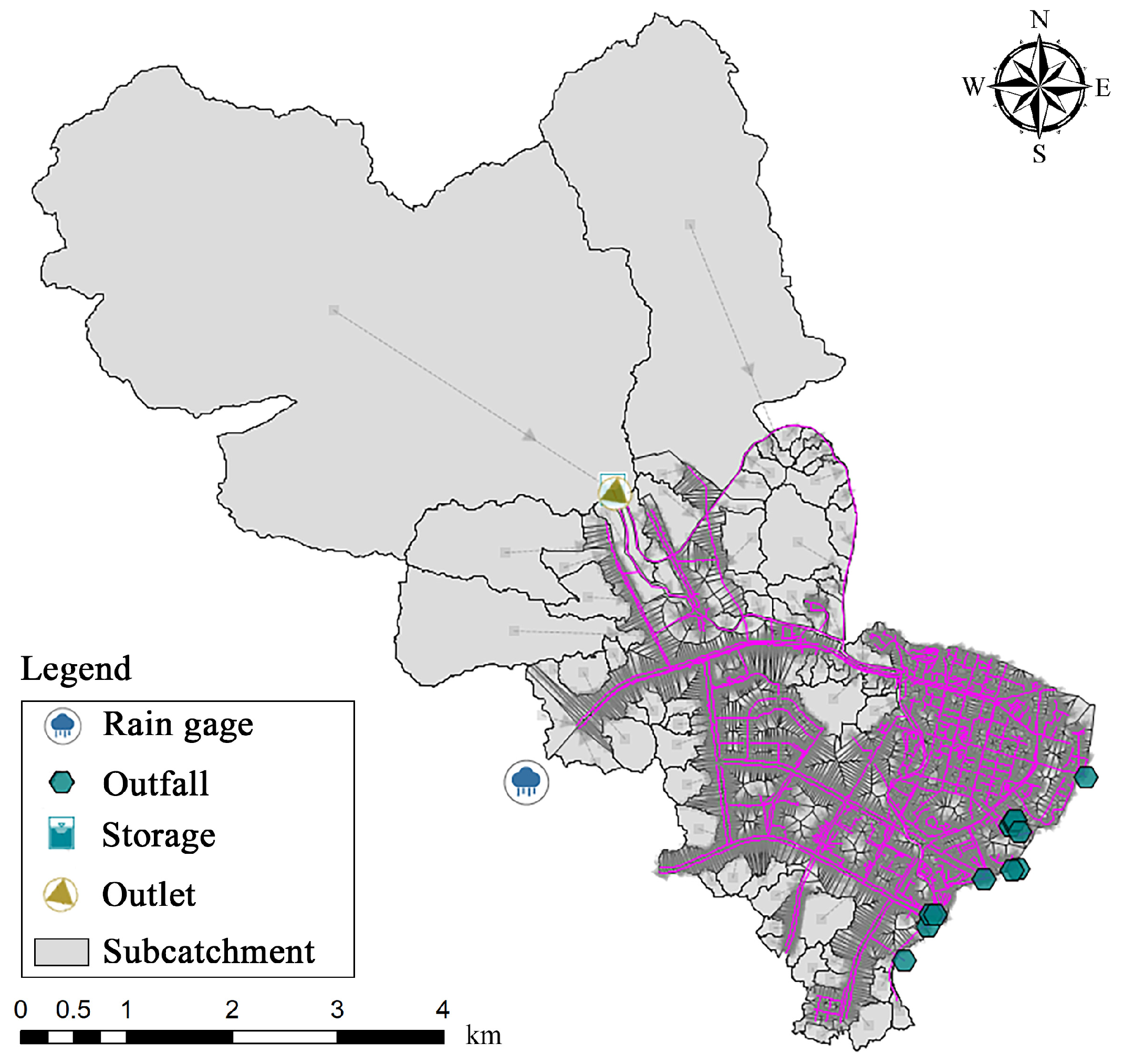
SWMM version 5.2 was used to simulate rainfall–runoff processes and pipe-network hydraulics. The watershed was discretized into 4074 subcatchments, generated using a combination of DEM-derived flow direction and land-use boundaries. The resulting SWMM configuration of the study area is shown in Figure 4. Deterministic parameters (e.g., pipe length, slope, invert elevation) were extracted directly from the drainage survey. Uncertain parameters (e.g., infiltration rates, Manning’s n, depression storage) were calibrated using observed flow data. The Baihualin reservoir was conceptualized as a storage unit, and the Baihuayong/Fucheng rivers were modeled as natural channels using dynamic wave routing. All outfalls were assigned stage-discharge relationships synchronized with initial river water levels.
Figure 4.
SWMM configuration of the study area, where the purple lines represent the stormwater pipe network.
2.3. SWMM Calibration and Validation
The parameters required for input in the SWMM are classified as either deterministic or uncertain. Deterministic parameters of the drainage pipe network, such as pipe length, slope, and pipe bottom elevation, were based on the actual collected network data. Similarly, deterministic parameters of subcatchment areas, including area, impermeability coefficient, slope, and characteristic width, were directly calculated from the collected baseline data. The characteristic width of subcatchment areas was determined using the square root-of-area method. Uncertain parameters were grouped into several categories. These included surface parameters (Manning’s n for permeable and impermeable zones, depression storage for permeable and impermeable zones, percentage of impervious area without depression storage), infiltration parameters (maximum rate, minimum rate, and decay coefficient), antecedent conditions (antecedent dry days), and conduit parameters (pipe Manning’s n). The initial parameter settings were determined based on the calibrated SWMM of the Tianhe Smart City Software Park area developed in the previous study [55]. These parameters were subsequently adjusted using rainfall and streamflow data measured on-site in the current study area. Rainfall data were collected using installed rain gauges, while streamflow data were obtained from field-deployed flow meters, ensuring the applicability of the model to local hydrological conditions.
Given that rainfall data were recorded at hourly resolution, peak flow matching was infeasible, so cumulative discharge was adopted as the primary metric. Therefore, the relative error (Re) (Equation (1)) of cumulative flow was selected to evaluate the calibration and validation of model parameters, thereby assessing the model reliability and accuracy [5,56,57].
where is the rainfall intensity (L/s · ha), is the return period (years), and is the rainfall duration (min).
Four rainfall events (1 June 2021, 4 June 2021, 6 June 2022, and 13 June 2022) were selected to calibrate the model’s hydrological and hydraulic parameters for the study area. Parameters were iteratively adjusted until the absolute value of the relative error between the simulated and measured cumulative flow remained within 20% during the calibration period [58,59]. Four additional rainfall events were subsequently selected to validate the calibrated model parameters. The evaluation results for model parameter calibration and validation were summarized in Table 2. The final hydrological and hydraulic parameters for the study area model were listed in Table S1. The SWMM demonstrated satisfactory performance for both calibration and validation events. As shown in Table 2, the absolute value of the relative error between the simulated and measured cumulative flow values was less than 12% for both the calibration and validation periods, meeting the recommended accuracy thresholds.
Table 2.
Calibration and validation results of hydrologic and hydraulic parameters of the model.
2.4. TELEMAC-2D Model Setup
TELEMAC-2D is a robust two-dimensional hydrodynamic model developed by EDF R&D (Paris, France) as part of the TELEMAC-MASCARET modeling system. It solves the shallow water equations (Saint-Venant equations) using the finite element method and supports unstructured mesh generation, which allows high flexibility in representing complex topographies such as urban terrains [60,61]. TELEMAC-2D is widely used for simulating free-surface flow phenomena, including river hydraulics, floodplain inundation, tidal propagation, and dam-break waves [62]. With its high computational accuracy and open-source nature, TELEMAC-2D has become an important modeling tool in flood risk assessment, urban resilience planning, and hydrodynamic decision support. TELEMAC-2D is based on the following governing equations:
where is the water depth, and are the depth-averaged velocity components in the -and -directions, is the time, and denote the horizontal coordinates, is the free-surface elevation, is the gravitational acceleration, and represent the external forcing terms acting on the flow, is the eddy viscosity coefficient, is the gradient operator, and denotes the divergence operator.
2.5. SWMM-TELEMAC Coupling Method
To quantify the flooded area, this study employed a coupled modeling approach integrating SWMM and TELEMAC-2D. By coupling SWMM and TELEMAC-2D, the complete water cycle process, which involves the surface, pipe network, and river channel, can be simulated in watershed-scale stormwater flood analysis. SWMM is highly effective for simulating internal pipe network processes, while TELEMAC-2D specializes in modeling two-dimensional surface hydrodynamic processes. Through this coupling, the limitations of each model are overcome. Results with higher spatiotemporal resolution regarding inundation depth, inundation extent, and flood evolution are thereby produced, significantly improving the accuracy of flood simulation. The coupling process can be summarized as the following steps:
- (1)
- The SWMM output time interval was aligned with the TELEMAC-2D simulation time step to ensure the synchronized exchange of flow data.
- (2)
- Node overflows were converted into point source files readable by TELEMAC-2D.
- (3)
- The SWMM outlet discharge hydrograph was applied as a boundary condition in TELEMAC-2D, simulating the hydrodynamic exchange from the drainage network to the external river.
- (4)
- TELEMAC-2D used SWMM-derived inflow inputs (overflow nodes and outfall discharges) to simulate flood-wave propagation across the area. The model computed spatially distributed water depths, velocities, and inundation extents throughout the rainfall event.
This coupling allowed accurate simulation of flood propagation and water accumulation on the urban surface, enabling detailed mapping and statistical assessment of flooded areas. These results formed the basis for the statistical analysis of flooded areas under different BGI schemes.
2.6. Layout Schemes and Parameter Selection for BGI
This study examines the stormwater control effectiveness of BGI under extreme conditions. These conditions include initial reservoir storage level drawdown, lowered river levels, and varying proportions of GI. The Baihualin reservoir and the Baihuayong creek were utilized as representative BI, while bio-retention cells, permeable pavement, and green roofs were selected as representative GI. Based on the constructed SWMM, this study simulates and analyzes runoff reduction, overflow node, and flooded areas under six rainfall events ranging from 2a1h to 100a1h across different operational conditions within the study area. The analysis reveals the efficacy of the combined application of BGI in addressing extreme conditions.
2.6.1. Layout Scheme for BGI
To evaluate watershed-scale stormwater regulation under extreme rainfall, three key BGI components were considered: upstream initial reservoir storage level operation, downstream river water level control, and distributed GI implementation. These components represent the dominant hydrological controls across the Baihuayong watershed, influencing upstream storage capacity, hydraulic boundary conditions, and source-area runoff generation, respectively. The characteristic parameters of the reinforced Baihualin reservoir are shown in Table S2.
Based on the operational characteristics of the Baihualin reservoir and the hydraulic conditions of the Baihuayong creek, four initial reservoir storage levels (27.6 m, 28.6 m, 29.6 m, and 30.6 m) and four downstream river water levels (8 m, 9 m, 10 m, and 11 m) were selected to represent typical dry-season, normal, and flood-state conditions. To assess the effect of GI, five implementation ratios (0%, 15%, 25%, 35%, and 45%) were allocated within built-up areas, using a fixed area ratio of 1:3:6 for bio-retention cells, permeable pavement, and green roofs, respectively. The selected design storms were 1 h rainfall events with 2-year, 5-year, 10-year, 20-year, and 100-year return periods. The design rainfall for each return period was calculated using the Guangzhou heavy rainfall intensity formula (Equation (5)) and the Chicago rainfall pattern, with a rainfall peak coefficient of 0.4.
The combinations of initial reservoir storage levels, river water levels, and GI proportions were integrated into the SWMM configuration, and the resulting runoff and overflow outputs were subsequently used as boundary inputs for TELEMAC-2D. All simulation schemes are summarized in Table 3.
where is the total number of time steps, and are the observed and simulated flow rates at time step , respectively.
Table 3.
BGI layout schemes except for rainfall return period.
2.6.2. Parameter Selection and Spatial Configuration of GI
In this study, the parameter values for BI (bio-retention cells, permeable pavements, and green roofs) are shown in Table 4. Neither drainage layers nor underdrains from these facilities are considered. SWMM provides two configurations for implementing GI. The first configuration involves adding one or more BI within a single subcatchment area. However, under this configuration, these facilities can only treat runoff originating from impervious surfaces within that specific subcatchment. Furthermore, GI within a subcatchment operate in parallel and cannot be connected in series. This configuration is generally suitable for larger study areas. The second layout approach requires establishing a new subcatchment area and dedicated to installing only one type of green facility, this method permits runoff from upstream subcatchments to flow into this area for treatment. This method is typically suitable for smaller study areas. Given the large scale of the study area in this chapter, the first layout approach was selected for this analysis.
Table 4.
Parameters of LID practices in the SWMM.
3. Results
To evaluate the stormwater response under extreme rainfall, all schemes were simulated using the calibrated SWMM to obtain runoff, discharge, and overflow conditions. These outputs were subsequently transferred into TELEMAC-2D for flood propagation and inundation analysis. Six 1 h design storms (2-, 5-, 10-, 20-, 50-, and 100-year return periods) were applied consistently across all scheme groups. The following subsections present the comparative results for different initial reservoir storage levels, river water levels, and GI implementation proportions.
Although the hydrological simulation includes the entire Baihuayong watershed, the resulting flooding analysis primarily focused on the built-up areas. This is because rural and upstream green-space regions typically possess higher infiltration capacities, natural drainage, and are less vulnerable to surface ponding. Moreover, flooding in non-urban areas often does not result in significant economic loss or infrastructure damage. Therefore, the focus of this study on analyzing the inundation extent of built-up areas is considered more relevant and can better guide the improvement of urban flood resilience and the optimization of infrastructure deployment.
3.1. The Influence of Different Initial Reservoir Storage Level on Stormwater Control Effect
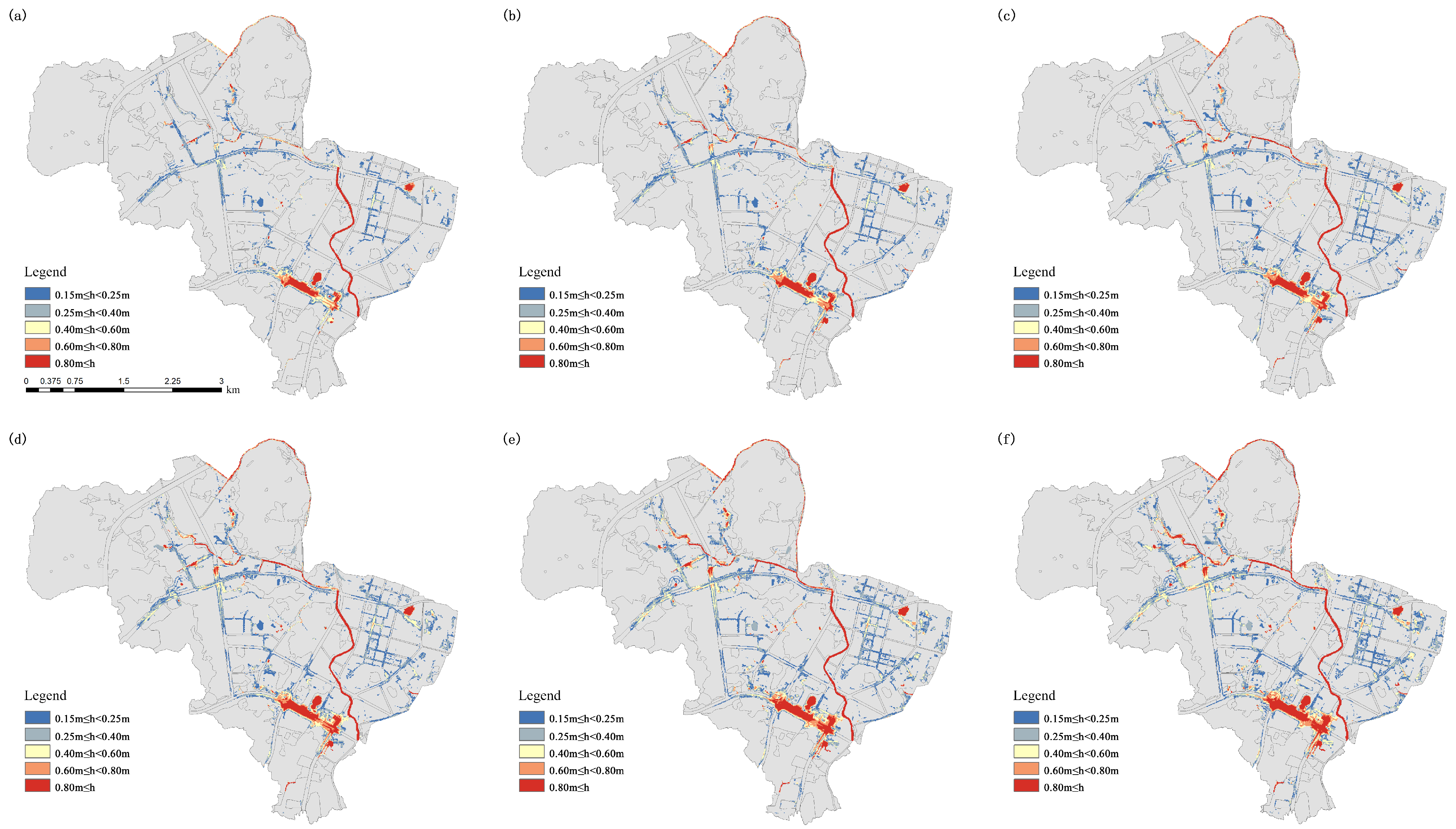
Based on the constructed SWMM, runoff reduction and node overflow conditions in the study area were simulated under various rainfall events and different initial reservoir storage levels (Schemes 1–4). The river water level was set at 11 m based on historical flood records. Based on these results, we calculated and analyzed the flood control effectiveness of Schemes 2–4. The drainage capacity of Scheme 1 was utilized as the baseline representing the current situation. The results were summarized in Table 5. The flood inundation conditions in the downstream built-up area under different initial reservoir storage levels during the 1 h rainfall events with six return periods in Scheme 4 are presented in Figure 5.
Table 5.
The effect of rainfall flood control under different rainfall events and initial reservoir storage levels.
Figure 5.
Flooded area under different initial reservoir storage levels for six rainfall return periods (Scheme 4). (a) 2a1h, (b) 5a1h, (c) 10a1h, (d) 20a1h, (e) 50a1h, (f) 100a1h.
As shown in Table 5, under identical rainfall return periods, the runoff reduction in the study area gradually decreases with increasing rainfall duration and return period, regardless of the initial reservoir storage level. Taking Scheme 1 as the baseline, under the 2-year rainfall event, the runoff reduction rates for Scheme 2 to 4 were 21.3%, 38.7%, and 54.8%, respectively. A comparison among Schemes 1–4 indicates that each 1 m decrease in the initial reservoir storage level increases the runoff reduction rate by an average of 16.7%. Under the 100-year 1 h rainfall event, the runoff reduction rates for Schemes 2 to 4 were 14.4%, 29.1%, and 43.3%, respectively. These results demonstrate that, under high-intensity rainfall conditions, the marginal improvement in runoff reduction achieved by lowering the initial reservoir storage level becomes less pronounced.
The initial reservoir storage level is inversely correlated with the discharged water volume. The absolute reduction in discharge becomes more pronounced under higher cumulative rainfall. For instance, under the 2-year, 1 h rainfall event, the outfall volume decreased by approximately 1.077 × 10⁹ L from Scheme 1 to Scheme 4. This reduction in discharged volume reflects the enhanced buffering capacity of the reservoir associated with lower initial storage levels during prolonged or intense rainfall events. However, the relative effectiveness slightly decreases with increasing rainfall return periods, while the rate of decline moderates under higher-intensity events.
The number of overflow nodes increases with increasing rainfall return periods. For instance, under a 2-year rainfall event, the numbers of overflow nodes for Schemes 1–4 were 259, 255, 252, and 250, respectively. Based on the comparison among schemes, each 1 m reduction in the initial reservoir storage level corresponds to an average decrease of approximately 1.5 overflow nodes. Flooded area increases monotonically with the rainfall return period and decreases significantly with lower initial reservoir storage levels. For instance, under the 2-year rainfall event, the flooded areas for Schemes 1–4 were 12.41, 12.04, 11.89, and 11.88 ha, respectively. Under low-return-period rainfall conditions, this comparison indicates that each 1 m reduction in the initial reservoir storage level reduces the flooded area by approximately 0.2 ha.
In summary, lowering the initial reservoir storage level can effectively reduce the discharged water volume, the number of overflow nodes, and the flooded area, while enhancing the runoff reduction rate. Specifically, a reduction in the level from 30.6 m to 27.6 m resulted in an average reduction of approximately 30% in discharged water volume, an average increase of approximately 40% in the runoff reduction rate, an average decrease of roughly 5% in the number of overflow nodes, and an average reduction of approximately 5% in the area of urban flooding. Under intense rainfall events, the reduced marginal benefits observed in runoff reduction and flooded area indicate that reservoir regulation alone is insufficient once the drainage network approaches or exceeds its hydraulic capacity. Consequently, the combined results on runoff, overflow, and flooding suggest that reservoir management should be coordinated with drainage network upgrades and GI implementation.
3.2. The Influence of Different River Water Levels on Storm Flood Control Effect
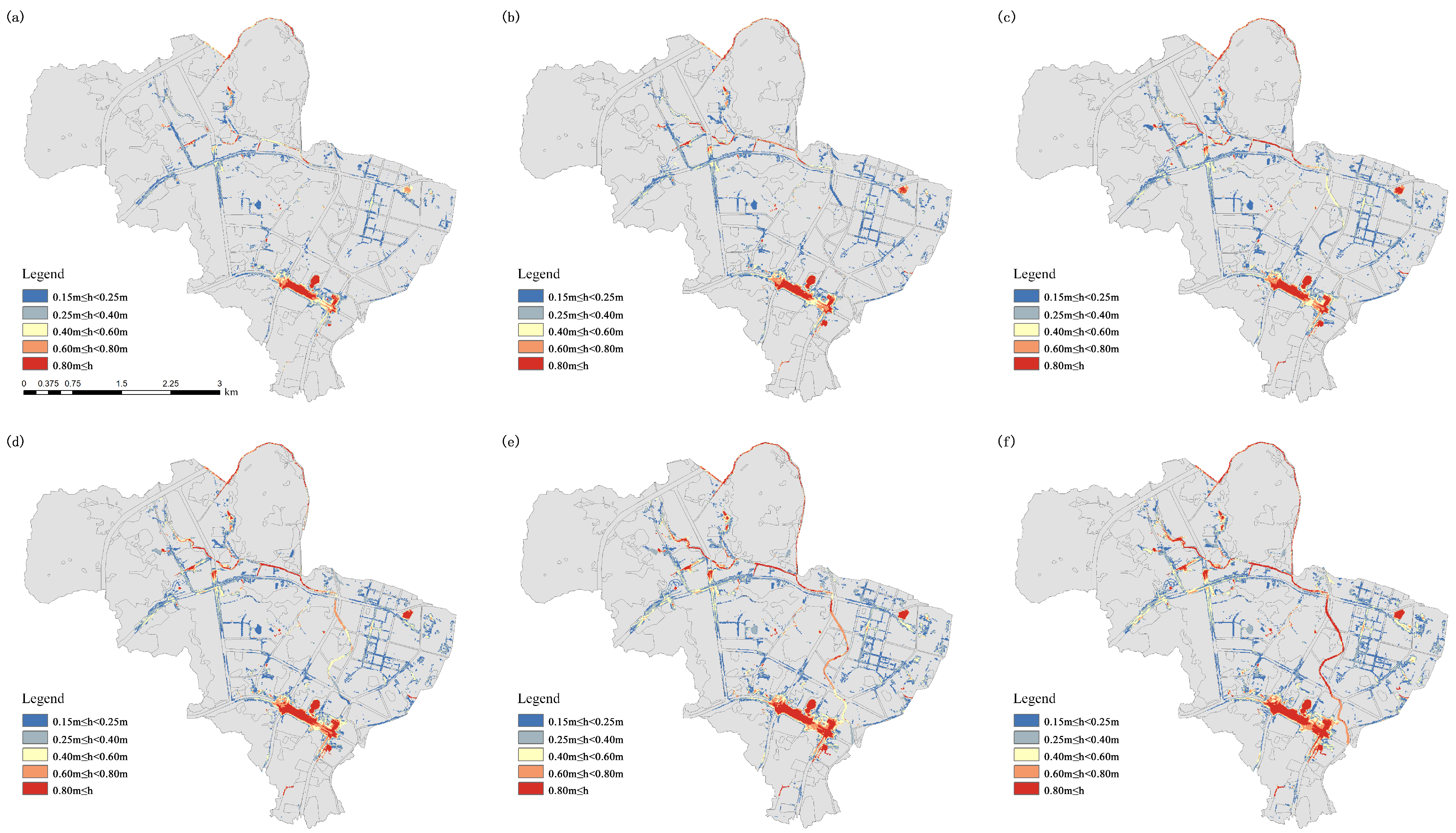
Based on the constructed SWMM, runoff reduction and overflow node were simulated under various rainfall events and different river water levels (Schemes 4–7). The river water level was set at 8 m based on historical flood records. Based on these simulation results, we calculated and analyzed the stormwater control effectiveness of Schemes 4–7, as shown in Table 6. The flooded area in the downstream built-up area under different river water levels during the 1 h rainfall events with six return periods in Scheme 4 are presented in Figure 6.
Table 6.
Effects of different rainfall events and river water levels on rainfall flood control.
Figure 6.
Flooded area under different water levels for six rainfall return periods (Scheme 7). (a) 2a1h, (b) 5a1h, (c) 10a1h, (d) 20a1h, (e) 50a1h, (f) 100a1h.
As shown in Table 6, under the same rainfall return period, the runoff reduction in the study area gradually decreases with increasing rainfall duration across varying river water levels. Under the 2-year rainfall event, the runoff reduction rates for Schemes 4–7 were 54.8%, 49.0%, 49.7%, and 50.6%, respectively. A comparison among Schemes 4–7 shows that lower river water levels are associated with reduced runoff reduction rates; however, this decline tends to stabilize once the river water level falls below a certain threshold. Under the 100-year, 1 h heavy rainfall event, the runoff reduction rates for Schemes 4–7 were 43.3%, 38.0%, 37.7%, and 38.6%, respectively. These results demonstrate that, under high-intensity rainfall conditions, variations in river water levels exert a more pronounced influence on runoff reduction performance. Compared with Scheme 4, lower river water levels (Schemes 5–7) increase the discharged water volume by approximately 5–15% on average. Among these schemes, Scheme 5 exhibited the largest increase (approximately 1.13 × 10⁸ L under the 2-year, 1 h rainfall event), followed by slight decreases in Schemes 6 and 7, although discharged volumes in both cases remained higher than that of Scheme 4. The observed increase in discharged volume suggests that lowering river water levels enhances drainage gradients, thereby accelerating outflow and shortening upstream retention time.
The number of overflow nodes under each scheme increases with longer rainfall return periods and gradually decreases as river water levels decline. For example, under the 2-year rainfall event, the number of overflow nodes for Schemes 4–7 were 250, 241, 236, and 236, respectively. Based on this comparison, lowering the river water level effectively reduces the number of overflow nodes, although the magnitude of reduction stabilizes once the water level falls below a threshold. Flooded area increases monotonically with the rainfall return period and decreases significantly with lower river water levels. For instance, under the 2-year rainfall event, the flooded areas for Schemes 4–7 were 11.88, 10.91, 10.80, and 10.76 ha, respectively, indicating that reduced river water levels contribute to a measurable decrease in flooded area under low-return-period rainfall conditions. Under the 100-year, 1 h rainfall event, the flooded areas for Schemes 4–7 were 23.19, 22.89, 22.81, and 22.82 ha, respectively, suggesting that the effect of river water level reduction on flood mitigation becomes more evident during prolonged heavy rainfall events.
In summary, adjustments in river water levels significantly influence flood control performance. Lowering river water levels effectively reduces discharged outflow volume, the number of overflow nodes, and the flooded area. However, this effect diminishes once river water level drop below a certain threshold. Under identical rainfall events, a river water level of 11 m results in a higher number of overflow nodes than lower external water levels, whereas overflow node counts remain relatively consistent when river water levels range between 8 m and 10 m. The combined results on runoff reduction, overflow nodes, and flooded area indicate that regulating river water levels is particularly effective during intense rainfall events, highlighting the importance of river-level control as a component of integrated stormwater management strategies.
3.3. The Influence of Different GI Proportion on Stormwater Control Effect
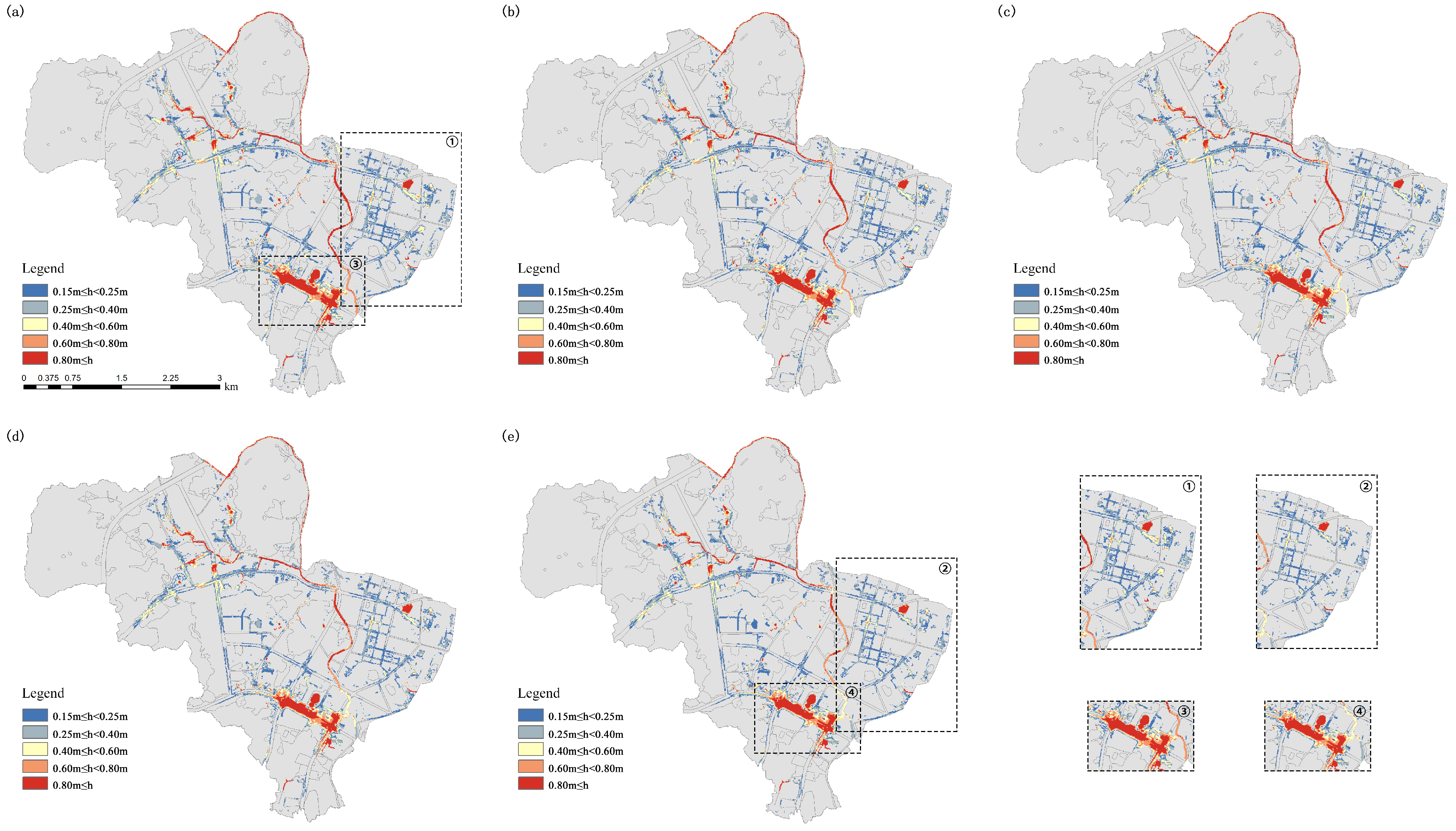
Based on the constructed SWMM, runoff reduction and node overflow conditions in the study area were simulated under various rainfall events and different proportions of GI (Schemes 7–11). The river water level was set at 8 m, based on historical flood records. Based on these simulation results, we calculated and analyzed the stormwater control effectiveness of Schemes 7–11, as shown in Table 7. Figure 7 shows flooded area under the 100-year, 1 h rainfall event for different GI implementation proportions.
Table 7.
Effects of different rainfall events and GI proportions on rainfall flood control.
Figure 7.
Flooded area under different GI proportions during 100a1h rainfall in built-up area of the Baihuayong watershed. (a) Scheme 7, (b) Scheme 8, (c) Scheme 9, (d) Scheme 10, (e) Scheme 11.
As shown in Table 7, under identical rainfall events, runoff reduction in the study area gradually decreases with increasing rainfall intensity, regardless of the proportion of GI implemented. This observed trend is consistent with findings reported by Essamlali et al. and Fei et al. [39,63]. For instance, the 100-year, 1 h heavy rainfall event, runoff reduction rates for Schemes 7–11 were 38.6%, 41.5%, 41.5%, 39.8%, and 40.2%, respectively. A comparison among Schemes 7–11 indicates that, under high-intensity rainfall conditions, increasing the proportion of GI yields diminishing improvements in runoff reduction rates. Discharged water volume increases with longer return periods and decreases significantly with higher proportions of GI. For example, in Scheme 7 (0% GI proportion), the discharged water volume increases from 9.71 × 10⁸ L under a 2-year rainfall event to 1.60 × 10⁹ L under a 100-year, 1 h rainfall event, representing a 64.3% increase.
The number of overflow nodes increases monotonically with the rainfall return period and decreases significantly with higher proportions of GI. Under Scheme 7, the number of overflow nodes increased from 236 during a 2-year rainfall event to 519 during a 100-year, 1 h rainfall event. Under the 2-year rainfall event, increasing the GI proportion markedly reduces the number of overflow nodes, decreasing the count from 236 (Scheme 7) to 192 (Scheme 11). In contrast, under extreme rainfall conditions, the limited changes in overflow-node counts across Schemes 7–11 demonstrate that the storage and retention capacity of GI becomes insufficient to substantially improve system-wide flooding conditions. Nevertheless, GI facilities can still provide localized mitigation by reducing overflow occurrence at specific nodes. Flooded area increases with longer rainfall return periods but decreases with higher proportions of GI. Under Scheme 7, the flooded area increased from 10.76 ha during a 2-year rainfall event to 22.82 ha during a 100-year rainfall event. Under the 2-year rainfall event, the flooded area decreased from 10.76 ha in Plan 7 to 9.20 ha in Scheme 11.
In summary, based on the combined results on runoff reduction, discharged water volume, overflow nodes, and flooded area, increasing the proportion of GI effectively improves stormwater control under low and moderate intensity rainfall events. However, under intense rainfall conditions, the marginal benefits of further increasing GI proportion diminish, particularly in terms of runoff reduction and flood mitigation.
4. Discussion
4.1. Influence of Initial Reservoir Storage Levels on Watershed-Scale Stormwater Regulation
The simulation results highlight the critical role of initial reservoir storage levels in regulating stormwater processes. Lowering the initial reservoir level effectively increased upstream storage capacity, improving runoff reduction under moderate rainfall. This enhancement reflects the reservoir’s capacity to buffer inflow and delay peak discharge, thereby reducing the hydraulic load transmitted to downstream urban drainage systems. Under extreme rainfall, upstream storage efficiency becomes constrained by the limited transport capacity of the drainage network. Under extreme rainfall, the main bottleneck of the system often shifts from the source storage capacity to the transport capacity of the gray pipeline network [64,65,66].
Importantly, the limited reduction in overflow nodes indicates that pipe network hydraulic capacity, rather than upstream storage, is the dominant constraint during peak rainfall. This finding highlights the need to integrate reservoir operation with drainage network upgrading to achieve comprehensive system improvement [67,68,69].
4.2. Influence and Mechanism of River Water Level Regulation
The significant sensitivity of flooded area to river water level confirms the critical role of downstream boundary conditions in shaping urban drainage performance. Lower river water levels increased the hydraulic head difference between the pipe network and the receiving river, thereby reducing surcharging and enhancing conveyance [70].
The river water level of approximately 9 m represents a critical threshold. This is because the flood response mechanism of urban drainage systems is significantly influenced by downstream boundary conditions. Under different boundary conditions, the dominant driving factors of floods shift. Below this level, the diminishing flood mitigation benefits from further water level lowering indicate a transition from a downstream-controlled to an internally-controlled state, where flooding is subsequently dictated by internal pipe capacity and local topography [64,71,72].
4.3. Effectiveness and Limitations of GI
GI implementation effectively reduced total runoff and overflow nodes under low- and medium-intensity storms, demonstrating its capacity for distributed source control. Under intense rainfall, GI storage and infiltration capacities rapidly saturate, which limits their ability to attenuate large runoff volumes. This pattern aligns with findings from other watershed-scale studies, which also observed that GI is highly effective for frequent, low intensity events, but contributes relatively little to flood mitigation during short duration extreme storms [73,74].
Nevertheless, the notable reductions in overflow nodes under moderate rainfall demonstrate that GI plays a valuable complementary role in source control, distributing peak runoff generation spatially and temporally [75,76]. Therefore, GI should not be viewed as a standalone flood mitigation measure but as a component of a broader integrated blue-green-gray strategy.
4.4. Synergistic Interactions Among Reservoir Regulation, River Water Level Control, and GI Implementation
A key aspect of the synergistic interaction between upstream reservoir regulation and GI lies in their temporal complementarity and coordinated timing. GI facilities respond rapidly during the early and middle stages of rainfall events, intercepting initial local runoff, slowing the convergence of residual surface flow, and prolonging the runoff peak [77,78]. This early-stage source control effectively creates a critical temporal buffer for upstream reservoir operation. Taking advantage of this buffer, upstream reservoirs can strategically manage storage and releases by reserving capacity prior to rainfall onset and implementing peak-shaving discharges after local runoff peaks have passed or GI facilities approach saturation. By carefully regulating the timing and magnitude of reservoir outflows, the overlap between upstream releases and residual local runoff after GI retention can be largely avoided, thereby reducing hydraulic stress on the downstream drainage system.
During extreme rainfall events, although the interception capacity of GI facilities is limited, their short-term, high-intensity retention function still secures valuable response time for reservoirs to adjust discharge strategies. Following rainfall cessation, reservoirs typically adopt a prolonged and phased release mode, while GI facilities continue to provide auxiliary retention and infiltration, further moderating downstream flow conditions. Overall, this temporal coordination, where GI reduces local runoff loads in the front-end and reservoirs regulate discharge processes in the back-end, minimizes the temporal overlap between upstream releases and downstream runoff generation, thereby enhancing the efficiency and robustness of rainfall-runoff regulation at the watershed scale.
In addition, river water level control plays a critical hydraulic coupling role by governing downstream boundary conditions of the urban drainage system. Lower river water levels increase the hydraulic gradient at drainage outfalls, thereby enhancing pipe discharge capacity and facilitating efficient conveyance of stormwater. Under such conditions, the flood mitigation benefits of upstream reservoir regulation and GI implementation are amplified. Conversely, elevated river water levels constrain drainage efficiency by inducing backwater effects, which limit outflow capacity and reduce the effectiveness of upstream interventions [79]. This hydraulic coupling mechanism accounts for the threshold behavior observed in overflow node reduction, whereby further lowering of river water levels yields diminishing marginal benefits beyond a critical level.
Collectively, the continuous interaction of reservoir regulation, mid-to-late-stage GI retention, and dynamically controlled river water levels forms a coherent BGI system that enhances watershed-scale flood resilience. These synergistic mechanisms highlight the necessity of integrated operation strategies that simultaneously consider temporal runoff processes and downstream hydraulic constraints, rather than relying on isolated flood control measures.
4.5. Limitations and Future Research Needs
Although this study provides valuable insights into the synergistic effects of BGI at the watershed scale, several limitations remain. First, the deployment of GI was based on a proportional allocation method according to land-use types rather than on a spatially optimized layout. In practice, hydrological responses differ markedly among industrial, residential, and commercial zones due to variations in imperviousness and drainage connectivity. Future studies could further improve BGI performance by aligning GI layouts with land use patterns and quantifying hydrological connectivity between upstream reservoirs and downstream developed areas to better capture spatial heterogeneity at the watershed scale. Second, the model adopted prescribed external river water levels as static boundary conditions. Consequently, it did not account for dynamic river-rainfall interactions or compound flooding processes, which could intensify backwater effects during typhoon-driven events. Third, this study focuses primarily on flood mitigation performance, the assessment framework can be further expanded to incorporate additional dimensions, including water quality improvement, ecological benefits, and economic considerations. Integrating water quality indicators into future simulations would enable a more comprehensive evaluation of multi-functional BGI performance.
5. Conclusions
This study assessed the watershed-scale stormwater regulation performance of integrated BGI under six extreme rainfall events in the Baihuayong watershed of Guangzhou by coupling SWMM with TELEMAC-2D. Scheme simulations were designed with varying initial reservoir storage levels, external river water levels, and proportions of GI to systematically investigate the stormwater control effectiveness of BGI under the specified rainfall events. The quantitative findings provide a scientific basis and decision support for formulating watershed-scale flood mitigation strategies and optimizing sponge city construction layouts designs in the Pearl River Delta and similar urban areas. Research conclusions are as follows:
- (1)
- Under the same rainfall return period, a reduction in the initial reservoir storage level substantially increases the runoff reduction rate, and the discharged water volume is inversely proportional to the initial water level. However, we found that this measure limitedly reduced the number of overflow nodes. For a consistent reduction in external water level, the number of overflow nodes decreases by only approximately 5%. Moreover, under high-intensity rainfall events, the effectiveness of river water level reduction in enhancing the runoff reduction rate progressively diminishes.
- (2)
- When the river water level was lowered from 11 m to 8 m, the flooded area was substantially reduced. Simultaneously, the number of overflow nodes exhibited a decreasing trend with declining external river water levels. However, when the water level dropped below 9 m, further reductions in flooded area and overflow nodes became negligible.
- (3)
- When the proportion of GI was increased from 0% to 45%, the runoff reduction rate under the 2-year, 1 h rainfall event rose from 50.6% to 52.2%. The number of overflow nodes decreased from 236 to 192, while the flooded area was reduced from 10.76 ha to 9.20 ha. However, under extreme rainfall events, increasing the construction proportion improves the runoff reduction rate by less than 2% and yields only marginal reductions in flooded area.
- (4)
- The application of a single facility alone is unable to achieve optimal performance. However, a synergistic configuration, comprising a low initial reservoir storage level (27.6 m), a lowered river water level (8 m), and an increased GI proportion (35–45%) yielded comprehensive improvements in runoff reduction, the number of overflow nodes, and flooded area.
Supplementary Materials
The following supporting information can be downloaded at: https://www.mdpi.com/article/10.3390/land15010144/s1, Table S1: Hydrologic and hydraulic parameter values of the SWMM for the study area; Table S2: Characteristics of the Baihualin reservoir.
Author Contributions
Data analysis, Writing-Reviewing and Editing and Funding acquisition, Y.M.; Writing—original draft and Formal analysis, X.M.; Writing—original draft and Investigation, Z.D.; Investigation and Conceptualization, B.Z.; Methodology, H.X. All authors have read and agreed to the published version of the manuscript.
Funding
This research was funded by the National Natural Science Foundation of China Regional Science Foundation Project (52569001), the Guangdong Basic and Applied Basic Research Foundation (2023A1515010754) and the Hainan University Research Start-up Fund Project (KYQD(ZR)23131).
Data Availability Statement
Data will be made available on request.
Acknowledgments
We gratefully acknowledge the Zengcheng District Water Affairs Bureau, Guangzhou, China, for providing data support. We also sincerely thank the editors and reviewers for their constructive comments and editorial suggestions.
Conflicts of Interest
The authors declare no conflicts of interest.
Abbreviations
The following abbreviations are used in this manuscript:
| BGI | Blue-green Infrastructure |
| GI | Green Infrastructure |
| BI | Blue Infrastructure |
| DEM | Digital Elevation Model |
References
- Boongaling, C.G.K.; Sevilla-Nastor, J.B.; Espaldon, M.V.O.; Sanchez, P.A.J.; Villanueva-Peyraube, J.D.; Jago-on, K.A.B. Assessment of low impact development (LID) strategies under different land uses in an urban sub-catchment in the Philippines. J. Environ. Manag. 2024, 369, 122328. [Google Scholar] [CrossRef] [Scilit]
- Liu, Y.; Zhang, X.; Liu, J.; Wang, Y.; Jia, H.; Tao, S. A flood resilience assessment method of green-grey-blue coupled urban drainage system considering backwater effects. Ecol. Indic. 2025, 170, 113032. [Google Scholar] [CrossRef] [Scilit]
- Samadi, A.; Jafarzadegan, K.; Moradkhani, H. DEM-based pluvial flood inundation modeling at a metropolitan scale. Environ. Model. Softw. 2025, 183, 106226. [Google Scholar] [CrossRef] [Scilit]
- Wu, J.; Xu, J.; Lu, M.; Ming, H. An integrated modelling framework for optimization of the placement of grey-green-blue infrastructure to mitigate and adapt flood risk: An application to the Upper Ting River China. J. Hydrol.-Reg. Stud. 2025, 57, 102156. [Google Scholar] [CrossRef] [Scilit]
- Zhuang, Q.; Li, M.; Lu, Z. Assessing runoff control of low impact development in Hong Kong’s dense community with reliable SWMM setup and calibration. J. Environ. Manag. 2023, 345, 118599. [Google Scholar] [CrossRef] [Scilit]
- Bakhshipour, A.E.; Dittmer, U.; Haghighi, A.; Nowak, W. Hybrid green-blue-gray decentralized urban drainage systems design, a simulation-optimization framework. J. Environ. Manag. 2019, 249, 109364. [Google Scholar] [CrossRef] [Scilit]
- Casal-Campos, A.; Sadr, S.M.K.; Fu, G.; Butler, D. Reliable, Resilient and Sustainable Urban Drainage Systems: An Analysis of Robustness under Deep Uncertainty. Environ. Sci. Technol. 2018, 52, 9008–9021. [Google Scholar] [CrossRef] [Scilit] [PubMed]
- Yu, Y.; Yao, Y.; Li, C.; Li, D. Effects of Green-Gray-Blue Infrastructure Adjustments on Urban Drainage Performance: Time Lag and H-Q Curve Regulation. Land 2025, 14, 419. [Google Scholar] [CrossRef] [Scilit]
- Scharer, L.A.; Busklein, J.O.; Sivertsen, E.; Muthanna, T.M. Limitations in using runoff coefficients for green and gray roof design. Hydrol. Res. 2020, 51, 339–350. [Google Scholar] [CrossRef] [Scilit]
- Zhang, C.; Wang, J.; Liu, J.; Lv, Y.; Chen, J.; Yang, Z.; Zhang, N. Performance assessment for the integrated green-gray-blue infrastructure under extreme rainfall scenarios. Front. Ecol. Evol. 2023, 11, 1242492. [Google Scholar] [CrossRef] [Scilit]
- Funke, F.; Reinstaller, S.; Kleidorfer, M. Impact of urban drainage system malfunctions on pluvial flooding—Peri-urban study site in Austria. J. Hydrol.-Reg. Stud. 2025, 60, 102592. [Google Scholar] [CrossRef] [Scilit]
- Hou, Q.; Xu, H.; Xie, M.; Luo, P.; Cheng, Y. A cellular automata coupled multi-objective optimization framework for blue-green infrastructure spatial allocation. Water Res. X 2025, 28, 100387. [Google Scholar] [CrossRef] [Scilit]
- van Oorschot, J.; Slootweg, M.; Remme, R.P.; Sprecher, B.; van der Voet, E. Optimizing green and gray infrastructure planning for sustainable urban development. Npj Urban Sustain. 2024, 4, 41. [Google Scholar] [CrossRef] [Scilit]
- Wang, J.; O’Brien, E.; Holloway, P.; Nolan, P.; Stewart, M.G.; Ryan, P.C. Climate change impact and adaptation assessment for road drainage systems. J. Environ. Manag. 2024, 364, 121209. [Google Scholar] [CrossRef] [Scilit] [PubMed]
- Kumar, S.; Agarwal, A.; Ganapathy, A.; Villuri, V.G.K.; Pasupuleti, S.; Kumar, D.; Kaushal, D.R.; Gosain, A.K.; Sivakumar, B. Impact of climate change on stormwater drainage in urban areas. Stoch. Environ. Res. Risk Assess. 2022, 36, 77–96. [Google Scholar] [CrossRef] [Scilit]
- Ambily, P.; Chithra, N.R.; Firoz, C.M. A framework for urban pluvial flood resilient spatial planning through blue-green infrastructure. Int. J. Disaster Risk Reduct. 2024, 103, 104342. [Google Scholar] [CrossRef] [Scilit]
- Krishnan, G.; Shanthi Priya, R. Blue Green Infrastructure: A panacea for urban environmental challenges. Case study: Thiruvananthapuram city, Kerala, India. Mater. Today Proc. 2022, 68, 2646–2652. [Google Scholar] [CrossRef] [Scilit]
- Wang, J.; Foley, K. Promoting climate-resilient cities: Developing an attitudinal analytical framework for understanding the relationship between humans and blue-green infrastructure. Environ. Sci. Policy 2023, 146, 133–143. [Google Scholar] [CrossRef] [Scilit]
- Islam, M.R.; Shahfahad; Talukdar, S.; Rihan, M.; Rahman, A. Evaluating cooling effect of blue-green infrastructure on urban thermal environment in a metropolitan city: Using geospatial and machine learning techniques. Sustain. Cities Soc. 2024, 113, 105666. [Google Scholar] [CrossRef] [Scilit]
- Liu, Y.; Chen, H.; Wu, J.; Wang, Y.; Ni, Z.; Chen, S. Impact of urban spatial dynamics and blue-green infrastructure on urban heat islands: A case study of Guangzhou using Local Climate Zones and predictive modeling. Sustain. Cities Soc. 2024, 115, 105819. [Google Scholar] [CrossRef] [Scilit]
- Perrelet, K.; Moretti, M.; Dietzel, A.; Altermatt, F.; Cook, L.M. Engineering blue-green infrastructure for and with biodiversity in cities. Npj Urban Sustain. 2024, 4, 27. [Google Scholar] [CrossRef] [Scilit]
- Gupta, A.; De, B. A systematic review on urban blue-green infrastructure in the south Asian region: Recent advancements, applications, and challenges. Water Sci. Technol. 2024, 89, 382–403. [Google Scholar] [CrossRef] [Scilit]
- Boguniewicz-Zablocka, J.; Lukasiewicz, E. Blue-Green Infrastructure Effectiveness for Urban Stormwater Management: A Multi-Scale Residential Case Study. Land 2025, 14, 1340. [Google Scholar] [CrossRef] [Scilit]
- Chen, X.; Wang, X. Blue-Green Infrastructure Network Planning in Urban Small Watersheds Based on Water Balance. Land 2025, 14, 1652. [Google Scholar] [CrossRef] [Scilit]
- McNabb, T.; Charters, F.; Dionisio, R.; Challies, E. Design and implementation of blue-green infrastructure for socio-cultural benefits at community scales: The case of Wigram Basin in Ōtautahi Christchurch. Nat.-Based Solut. 2024, 6, 100192. [Google Scholar] [CrossRef] [Scilit]
- Wilbers, G.-J.; de Bruin, K.; Seifert-Daehnn, I.; Lekkerkerk, W.; Li, H.; Budding-Polo Ballinas, M. Investing in Urban Blue-Green Infrastructure-Assessing the Costs and Benefits of Stormwater Management in a Peri-Urban Catchment in Oslo, Norway. Sustainability 2022, 14, 1934. [Google Scholar] [CrossRef] [Scilit]
- Demir, S.; Gokkaya, M.D.; Ersoz, N.D. Prioritization Blue-Green Infrastructure Strategies: Developing a Hybrid Quantitative Approach Model for Sustainable Urban Water Management. Water Resour. Manag. 2025, 39, 3901–3919. [Google Scholar] [CrossRef] [Scilit]
- Behrouz, M.S.; Zhu, Z.; Matott, L.S.; Rabideau, A.J. A new tool for automatic calibration of the Storm Water Management Model (SWMM). J. Hydrol. 2020, 581, 124436. [Google Scholar] [CrossRef] [Scilit]
- Szelag, B.; Lagod, G.; Musz-Pomorska, A.; Widomski, M.K.; Stransky, D.; Sokac, M.; Pokryvkova, J.; Babko, R. Development of Rainfall-Runoff Models for Sustainable Stormwater Management in Urbanized Catchments. Water 2022, 14, 1997. [Google Scholar] [CrossRef] [Scilit]
- Zhao, C.; Liu, C.; Li, W.; Tang, Y.; Yang, F.; Xu, Y.; Quan, L.; Hu, C. Simulation of Urban Flood Process Based on a Hybrid LSTM-SWMM Model. Water Resour. Manag. 2023, 37, 5171–5187. [Google Scholar] [CrossRef] [Scilit]
- Bragg, M.A.; Poudel, A.; Vasconcelos, J.G. Comparing SWMM and HEC-RAS Hydrological Modeling Performance in Semi-Urbanized Watershed. Water 2025, 17, 1331. [Google Scholar] [CrossRef] [Scilit]
- Guduru, J.U.; Mohammed, A.S. Hydrological modeling using HEC-HMS model, case of Tikur Wuha River Basin, Rift Valley River Basin, Ethiopia. Environ. Chall. 2024, 17, 101017. [Google Scholar] [CrossRef] [Scilit]
- Lai, G.; Sun, J.; Xiao, J.; Li, Z.; Du, J.; Wen, X.; Xu, X.; Meng, L.; Li, X.; Zhong, K. Assessing the effect of human activity on sediment load in the Second Songhua River Basin, Northeast China, based on the SWAT model. Reg. Stud. Mar. Sci. 2025, 91, 104491. [Google Scholar] [CrossRef] [Scilit]
- Peng, K.; Li, J.; Zhou, X.; Li, H.; Xie, W.; Zhang, K.; Ullah, Z. Simulation and control of non-point source pollution based on MIKE model: A case study of Danjiang river basin, China. Ecohydrol. Hydrobiol. 2023, 23, 554–568. [Google Scholar] [CrossRef] [Scilit]
- Sehrawat, S.; Shekhar, S. Integrating low impact development practices with GIS and SWMM for enhanced urban drainage and flood mitigation: A case study of Gurugram, India. Urban Gov. 2025, 5, 240–255. [Google Scholar] [CrossRef] [Scilit]
- Barreto Rosa, D.W. Assessing the Benefits of Green and Blue Infrastructure in Peri-Urban Areas; University of Technology Sydney: Sydney, Australia, 2023. [Google Scholar]
- Naeini, A.M.; Tabesh, M.; Soltaninia, S. Modeling the effect of land use change to design a suitable low impact development (LID) system to control surface water pollutants. Sci. Total Environ. 2024, 932, 172756. [Google Scholar] [CrossRef] [Scilit]
- Zhao, L.; Li, J.; Zhang, T.; Feng, P.; Wang, X.; Shen, J. Multi-method combined analysis of urban flood risks and its influencing factors under low impact development. J. Hydrol. 2024, 632, 130927. [Google Scholar] [CrossRef] [Scilit]
- Essamlali, I.; Nhaila, H.; El Khaili, M. Optimizing runoff and pollution mitigation through strategic low-impact development (LID) integration in the Bouznika city development plan. Case Stud. Chem. Environ. Eng. 2024, 10, 100838. [Google Scholar] [CrossRef] [Scilit]
- Suresh, A.; Pekkat, S.; Subbiah, S. Quantifying the efficacy of Low Impact Developments (LIDs) for flood reduction in micro-urban watersheds incorporating climate change. Sustain. Cities Soc. 2023, 95, 104601. [Google Scholar] [CrossRef] [Scilit]
- Li, W.; Fu, X.; Gao, T.; Wang, X. Assessing the performance of centralized blue-green infrastructure in dynamic stormwater storage and runoff assignment. Urban For. Urban Green. 2025, 104, 128631. [Google Scholar] [CrossRef] [Scilit]
- Mugume, S.N.; Kibibi, H.; Sorensen, J.; Butler, D. Can Blue-Green Infrastructure enhance resilience in urban drainage systems during failure conditions? Water Sci. Technol. 2024, 89, 915–944. [Google Scholar] [CrossRef] [Scilit]
- Thorsson, S.; Backlin, O.; Friberg, J.; Eriksson, S.F.; Haghighatafshar, S.; Konarska, J.; Kotze, S.; Lindberg, F.; Malmberg, C.-A.; Rayner, D.; et al. A framework for integrated assessment of blue-green infrastructure: A decision support tool for evaluating climate adaptation and social benefits in relation to construction and maintenance costs. Cities 2025, 166, 106239. [Google Scholar] [CrossRef] [Scilit]
- Battemarco, B.P.; Tardin-Coelho, R.; Verol, A.P.; de Sousa, M.M.; Tarrisse da Fontoura, C.V.; Figueiredo-Cunha, J.; Ribeiro Barbedo, J.M.; Miguez, M.G. Water dynamics and blue-green infrastructure (BGI): Towards risk management and strategic spatial planning guidelines. J. Clean. Prod. 2022, 333, 129993. [Google Scholar] [CrossRef] [Scilit]
- Xu, H.; Sheng, K.; Zhang, M.; Zhang, J. Co-benefits balancing of low-impact development facilities on stormwater management and microclimate improvement on the high-rise residential area in Nanjing. Urban Clim. 2024, 55, 101904. [Google Scholar] [CrossRef] [Scilit]
- Ambrogi Ferreira do Lago, C.; Shahrokh Hamedani, A.; Mendiondo, E.M.; Hofheinz Giacomoni, M. Simulation and optimization framework for evaluating the robustness of low-impact development placement solutions under climate change in a small urban catchment. Hydrol. Sci. J. 2023, 68, 2057–2074. [Google Scholar] [CrossRef] [Scilit]
- Subrahmanian, S.; Sankarbalaji, A.R.; Bhallamudi, S.M.; Narasimhan, B. A new simulation—Optimization framework based on multi-layer Green-Ampt infiltration model and genetic algorithm for developing planning guidelines of low impact development measures at river basin scales. J. Hydrol. 2025, 658, 133139. [Google Scholar] [CrossRef] [Scilit]
- Hu, G.; Zhang, Y.; Chen, C.; Shen, Z.; Hu, Y.; Yin, H.; Shao, Z.; Zheng, H.; Chen, F. Exploring the decentralized blue-green infrastructure network layouts for urban flood risk management. Landsc. Ecol. Eng. 2025, 21, 757–771. [Google Scholar] [CrossRef] [Scilit]
- Xiao, J.; Zhou, Z.; Yang, Z.; Li, Z.; Li, X.; Zhou, J.; Wang, H. Runoff Control Performance of Three Typical Low-Impact Development Facilities: A Case Study of a Community in Beijing. Water 2024, 16, 2373. [Google Scholar] [CrossRef] [Scilit]
- Hasankhan, A.; Ghaeini-Hessaroeyeh, M.; Fadaei-Kermani, E. Enhancing Stormwater Management through Hydromodification Measures and Low Impact Development Strategies in Urban Areas: A Neighborhood-Scale Study. Water Resour. Manag. 2025, 39, 291–309. [Google Scholar] [CrossRef] [Scilit]
- Mao, Y.; Li, Y.; Bai, X.; Yang, X.; Han, Y.; Fu, X. Scenario-Based Green Infrastructure Installations for Building Urban Stormwater Resilience-A Case Study of Fengxi New City, China. Sustainability 2024, 16, 3990. [Google Scholar] [CrossRef] [Scilit]
- Arya, S.; Kumar, A. Green Infrastructure for Sustainable Stormwater Management in an Urban Setting Using SWMM-Based Multicriteria Decision-Making Approach. J. Hydrol. Eng. 2024, 29, 04023044. [Google Scholar] [CrossRef] [Scilit]
- Tran, H.; Do, N.; Trinh, L.; Nguyen, V.T.; Nguyen, T.; Tran, A.; Ercan, A.; Dang, H.; Pokhrel, Y. Assessing the impact of upstream reservoirs on streamflow in the Mekong River Basin. J. Water Clim. Change 2025, 16, 1404–1421. [Google Scholar] [CrossRef] [Scilit]
- Wang, T.; Zhang, L.; Zhai, J.; Wang, L.; Zhao, Y.; Liu, K. Automatic calibration of SWMM parameters based on multi-objective optimisation model. J. Hydroinform. 2024, 26, 683–706. [Google Scholar] [CrossRef] [Scilit]
- Mai, Y.; Ma, X.; Cheng, F.; Mai, Y.; Huang, G. Comparative Analysis and Optimization of LID Practices for Urban Rainwater Management: Insights from SWMM Modeling and RSM Analysis. Sustainability 2025, 17, 2015. [Google Scholar] [CrossRef] [Scilit]
- Moriasi, D.N.; Gitau, M.W.; Pai, N.; Daggupati, P. Hydrologic and Water Quality Models: Performance Measures and Evaluation Criteria. Trans. Asabe 2015, 58, 1763–1785. [Google Scholar]
- Wang, E.; Li, G.; Li, Y.; Chen, P.; Meng, G.; Gong, Y. Optimization of Low-Impact Development (LID) Parameters Using SWMM and Response Surface Methodology at the Community Scale. Water 2025, 17, 1165. [Google Scholar] [CrossRef] [Scilit]
- Daide, F.; Afgane, R.; Lahrach, A.; Chaouni, A.A.; Msaddek, M.; Elhasnaoui, I. Application of the HEC-HMS hydrological model in the Beht watershed (Morocco). E3S Web Conf. 2021, 314, 05003. [Google Scholar] [CrossRef] [Scilit]
- Gu, Y.; Peng, D.; Deng, C.; Zhao, K.; Pang, B.; Zuo, D. Atmospheric-hydrological modeling for Beijing’s sub-center based on WRF and SWMM. Urban Clim. 2022, 41, 101066. [Google Scholar] [CrossRef] [Scilit]
- Wang, Z.; Chen, Y.; Zeng, Z.; Chen, X.; Li, X.; Jiang, X.; Lai, C. A tight coupling model for urban flood simulation based on SWMM and TELEMAC-2D and the uncertainty analysis. Sustain. Cities Soc. 2024, 114, 105794. [Google Scholar] [CrossRef] [Scilit]
- Yan, L.; Rong, H.; Yang, W.; Lin, J.; Zheng, C. A novel integrated urban flood risk assessment approach based on one-two dimensional coupled hydrodynamic model and improved projection pursuit method. J. Environ. Manag. 2024, 366, 121910. [Google Scholar] [CrossRef] [Scilit]
- Liu, J.; Song, T.; Mei, C.; Wang, H.; Zhang, D.; Nazli, S. Flood risk zoning of cascade reservoir dam break based on a 1D-2D coupled hydrodynamic model: A case study on the Jinsha-Yalong River. J. Hydrol. 2024, 639, 131555. [Google Scholar] [CrossRef] [Scilit]
- Fei, Y.; Rene, E.R.; Shang, Q.; Singh, R.P. Comprehensive effect evaluation of LID facilities implemented in sponge campuses: A case study. Ecol. Indic. 2023, 155, 110912. [Google Scholar] [CrossRef] [Scilit]
- Chen, J.; Shang, F.; Fu, H.; Yu, Y.; Wang, H.; Qin, H.; Ping, Y. Inundation Modeling and Bottleneck Identification of Pipe-River Systems in a Highly Urbanized Area. Sustainability 2025, 17, 7056. [Google Scholar] [CrossRef] [Scilit]
- Liu, W.; Wang, S.; Sang, Y.-F.; Ran, L.; Ma, Y. Effects of large upstream reservoir operations on cross-sectional changes in the channel of the lower Yellow River reach. Geomorphology 2021, 387, 107768. [Google Scholar] [CrossRef] [Scilit]
- Mohammadiun, S.; Yazdi, J.; Hager, J.; Neyshabouri, S.A.A.S.; Sadiq, R.; Hewage, K.; Gharahbagh, A.A. Effects of bottleneck blockage on the resilience of an urban stormwater drainage system. Hydrol. Sci. J.-J. Des Sci. Hydrol. 2020, 65, 281–295. [Google Scholar] [CrossRef] [Scilit]
- Li, X.; Hou, J.; Chai, J.; Du, Y.e.; Han, H.; Fan, C.; Qiao, M. Multisurrogate Assisted Evolutionary Algorithm-Based Optimal Operation of Drainage Facilities in Urban Storm Drainage Systems for Flood Mitigation. J. Hydrol. Eng. 2022, 27, 04022025. [Google Scholar] [CrossRef] [Scilit]
- Nguyen, T.H.; Gourbesville, P.; Vo, N.D.; Vo, N.D.P. Optimization of Spillway Operation for Flood Mitigation in Multi-reservoirs River System. In Proceedings of the Conference on Advances in Hydroinformatics: Models for Extreme Situations and Crisis Management (SimHydro), Polytech Nice Sophia, Nice, France, 12–14 June 2020; pp. 417–426. [Google Scholar]
- Thi Thuy, N.; Yoo, D.G.; Lee, Y.S.; Kim, J.H. Optimization of Upstream Detention Reservoir Facilities for Downstream Flood Mitigation in Urban Areas. Water 2016, 8, 290. [Google Scholar] [CrossRef] [Scilit]
- Kim, G.-B.; Cha, E.-J. Assessment of riverside groundwater flood risk induced by high river water levels using a numerical model and monitoring data. Water Sci. Technol.-Water Supply 2016, 16, 388–401. [Google Scholar] [CrossRef] [Scilit]
- Haesung, J.; Moon, C.Y. A Study on The Operation of Drainage Pump Station Considering The Water Level of Urban River to Reduce Flooding. J. Korea Acad.-Ind. Coop. Soc. 2022, 23, 14–21. [Google Scholar] [CrossRef] [Scilit]
- Zheng, Z.; Zheng, F.; Ma, Y.; Zhu, Y.; Deng, Z.; Duan, H.-F.; Wang, H.; Zhu, D. Exploring Hydraulic Impacts of Downstream Water Levels on the Drainage Capacity of a Stormwater Pipe. J. Hydraul. Eng. 2024, 150, 04024028. [Google Scholar] [CrossRef] [Scilit]
- Benoit, T.; Martel, J.-L.; Bilodeau, E.; Brissette, F.; Charron, A.; Brule, D.; Rivard, G.; Deslauriers, S. Limits of Blue and Green Infrastructures to Adapt Actual Urban Drainage Systems to the Impact of Climate Change. J. Irrig. Drain. Eng. 2025, 151, 04025003. [Google Scholar] [CrossRef] [Scilit]
- Chen, X.; Davitt-Liu, I.; Erickson, A.J.; Feng, X. Integrating the Spatial Configurations of Green and Gray Infrastructure in Urban Stormwater Networks. Water Resour. Res. 2023, 59, e2023WR034796. [Google Scholar] [CrossRef] [Scilit]
- Feng, M.; Jung, K.; Li, F.; Li, H.; Kim, J.-C. Evaluation of the Main Function of Low Impact Development Based on Rainfall Events. Water 2020, 12, 2231. [Google Scholar] [CrossRef] [Scilit]
- Wen, F.; Rong, Q.; Gu, Z.; Xie, Y.; Su, M. Urban flooding risk assessment and mitigation strategies based on optimal allocation of low impact development facilities. Sustain. Cities Soc. 2025, 130, 106652. [Google Scholar] [CrossRef] [Scilit]
- Fletcher, T.D.; Shuster, W.; Hunt, W.F.; Ashley, R.; Butler, D.; Arthur, S.; Trowsdale, S.; Barraud, S.; Semadeni-Davies, A.; Bertrand-Krajewski, J.-L.; et al. SUDS, LID, BMPs, WSUD and more—The evolution and application of terminology surrounding urban drainage. Urban Water J. 2015, 12, 525–542. [Google Scholar] [CrossRef] [Scilit]
- Ahiablame, L.M.; Engel, B.A.; Chaubey, I. Effectiveness of Low Impact Development Practices: Literature Review and Suggestions for Future Research. Water Air Soil Pollut. 2012, 223, 4253–4273. [Google Scholar] [CrossRef] [Scilit]
- Zhang, H.; Liu, J.; Mei, C.; Wang, J.; Song, T. Quantifying the Impact of River Levels on Urban Drainage Capacity. Water Resour. Manag. 2025, 39, 7593–7621. [Google Scholar] [CrossRef] [Scilit]

Disclaimer/Publisher’s Note: The statements, opinions and data contained in all publications are solely those of the individual author(s) and contributor(s) and not of MDPI and/or the editor(s). MDPI and/or the editor(s) disclaim responsibility for any injury to people or property resulting from any ideas, methods, instructions or products referred to in the content. |
© 2026 by the authors. Licensee MDPI, Basel, Switzerland. This article is an open access article distributed under the terms and conditions of the Creative Commons Attribution (CC BY) license.