Article

Effects of Stratified Vegetation Volume on Understory Erosion and Soil Coarsening in the Red Soil Region of Southern China


1
The Research Center of Soil and Water Conservation and Ecological Environment, Chinese Academy of Sciences and Ministry of Education, Yangling 712100, China
2
Pearl River Water Resources Research Institute, Pearl River Water Resources Commission, Guangzhou 510610, China
3
Key Laboratory of Water Security Guarantee in Guangdong-Hong Kong-Marco Greater Bay Area of Ministry of Water Resources, Guangzhou 510611, China
4
Soil and Water Conservation Center of Changting County, Longyan 366300, China
5
Soil and Water Conservation Station in Changting, Longyan 366300, China
6
State Key Laboratory of Soil and Water Conservation and Desertification Control, College of Soil and Water Conservation Science and Engineering, Northwest A&F University, Yangling 712100, China
7
Institute of Soil and Water Conservation, Chinese Academy of Sciences and Ministry of Water Resources, Yangling 712100, China
*
Authors to whom correspondence should be addressed.
Land 2026, 15(1), 143; https://doi.org/10.3390/land15010143
Submission received: 27 November 2025 / Revised: 8 January 2026 / Accepted: 8 January 2026 / Published: 10 January 2026

Abstract

Severe erosion persists in the red soil region of southern China despite dense vegetation. Stratified vegetation volume (SVV), which integrates horizontal and vertical vegetation density, better captures understory structure than fractional cover. Here, we established and surveyed 75 forest stands (10 m × 10 m) spanning an erosion-intensity gradient in Changting County, Fujian Province, China. Within each stand, soil was sampled by depth (0–20 cm), and living and dead vegetation volumes in the canopy, shrub–herb, and litter layers were quantified to derive SVV. Relative to slightly eroded soils, moderate and severe erosion reduced the soil water content by 38–41% and soil organic matter by 19–34%, while increasing bulk density by 25–30% and pH by 6–8%. Severe erosion increased the sand content by 20–31% and decreased the gravel content by ≤15%. SVV declined sharply with erosion, with the largest loss in the shrub–herb layer (66–97%). Erosion was most strongly associated with shrub–herb SVV, soil water content, organic matter, and bulk density (r = 0.5–0.6, p < 0.05). The shrub–herb layer was the key component resisting surface erosion. Overall, understory degradation accelerates erosion and soil coarsening, reinforcing a constrained vegetation–soil system; restoring native shrubs and grasses, coupled with targeted canopy thinning, may improve soil and water conservation.

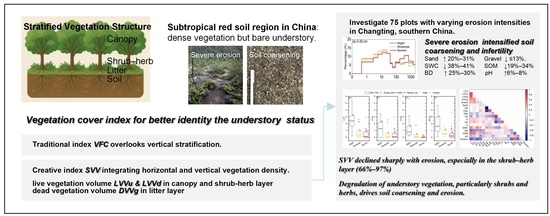
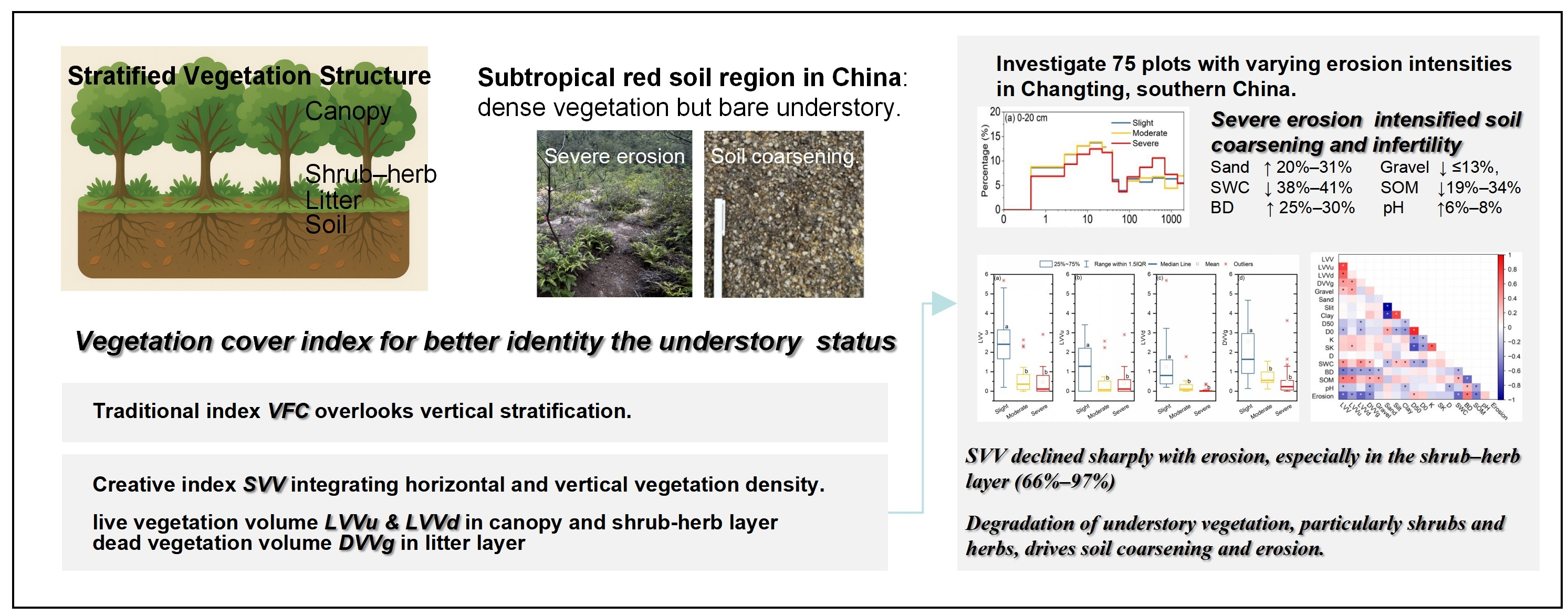
Graphical Abstract

1. Introduction

Soil erosion represents a pervasive form of land degradation worldwide, posing serious threats to food security, ecological stability, and sustainable development [1,2,3]. The red soil hilly region of southern China is severely affected by soil and water loss, owing to abundant rainfall, highly weathered granite- and sandstone-derived parent materials, and undulating topography [4,5]. Although decades of soil and water conservation projects have significantly reduced erosion, a concealed yet highly destructive form of understory erosion persists even in forests with high canopy cover. This suggests that traditional strategies have overemphasized increasing vegetation cover while overlooking the interactive mechanisms linking vegetation, erosion, and soil, particularly in woodland ecosystems [6,7,8]. There is therefore an urgent need to shift from simply “restoring vegetation” to “optimizing vegetation structure to control key subsurface erosion processes,” as such an approach is essential for addressing persistent soil and water loss in the southern red soil region.
Vegetation restoration is widely recognized as a cornerstone of erosion control [6,9]. Plants mitigate surface runoff and soil loss by intercepting rainfall through the canopy, dissipating raindrop kinetic energy, and enhancing soil infiltration and structure via surface litter and root systems, thereby improving resistance to scouring [10,11]. The protective effect of vegetation cover is both significant and quantifiable. For example, long-term (>30-year) observational studies in Changting County, Fujian Province, a representative erosion-prone area in southern China, reported a strong inverse relationship between vegetation fractional cover (VFC) and soil erosion, with each 1% increase in VFC corresponding to a reduction of 37.5 thousand tons of soil erosion across the region [7]. VFC has long been used as a key indicator for evaluating the soil and water conservation function of vegetation. Numerous studies have attempted to identify a critical “threshold” at which this conservation effect becomes pronounced. Based on prior research findings, the erosion-control capacity of vegetation becomes significant and stabilizes when VFC reaches 60–70%; beyond 70–80%, additional increases yield diminishing marginal reductions in erosion [12,13]. Nevertheless, as noted above, VFC in many plantations and secondary forests in the southern red soil region already exceeds 30%, and often approaches or surpasses the 60% threshold, yet subsurface flow erosion remains severe [14,15].
This paradox indicates that the prevailing evaluation framework prioritizes two-dimensional areal vegetation cover at the expense of clarifying the vertical, volumetric stratification inherent to plant communities. Forests function as multi-layered systems comprising trees, shrubs, and herbaceous/litter layers, each contributing distinct and irreplaceable functions to soil and water conservation. The tree canopy serves as the first line of defense by intercepting and redistributing rainfall; the shrub layer effectively dissipates throughfall energy and further slows surface runoff; and the ground-level herbaceous and litter layers are often important for preventing raindrop splash, enhancing infiltration, and reducing overland-flow velocity [8,16]. There is a lack of consensus on the relative contributions of these vegetation strata to soil and water conservation [17,18], as published findings are contradictory. Some comparative studies suggest that the shrub layer contributes most strongly to reducing runoff and soil erosion, followed by the herbaceous layer, with the tree layer exhibiting the weakest effect [19]. However, other studies report that the shrub layer is less effective than the herbaceous layer [17]. Moreover, canopy rainfall interception tends to be greater under low-intensity rainfall than under high-intensity rainfall [15]. Such functional differences, along with potential synergistic or antagonistic interactions among strata, complicate efforts to quantify how stratified vegetation structure regulates soil erosion, particularly in forest stands with high overall cover.
Soil coarsening is another major manifestation of erosion-driven land degradation. It refers to the selective removal of fine soil particles by hydraulic erosion, which leaves behind a coarser soil matrix. This process is especially common in soils derived from gravel-rich red soil parent materials [20]. Soil coarsening is not merely a shift in the particle size distribution (PSD); it can initiate a cascade of adverse effects on soil functioning. First, it markedly alters soil hydrophysical properties: increasing the coarse-particle content generally leads to higher bulk density; reduces total porosity, especially capillary porosity responsible for water retention; and ultimately diminishes the soil water storage capacity [20]. Second, it can alter soil hydraulic conductivity in ways that can reduce effective infiltration and promote the rapid generation of pronounced surface runoff [21]. This physical degradation can restrict root growth, impair soil nutrient cycling, and accelerate declines in land productivity [22,23,24].
Traditional VFC characterizes vegetation coverage from a two-dimensional planar perspective. Although it can capture broad-scale relationships between surface runoff and soil erosion [25], it does not adequately represent how understory vertical structure regulates erosion processes [15]. Previous work suggests that forest sediment yield in granite mountainous areas can be substantially reduced only when understory cover is maintained above 60% [26]. To address this limitation, we propose a stratified vegetation volume (SVV) metric that integrates horizontal vegetation cover with vertical spatial density, enabling more accurate quantification of the three-dimensional structure of the canopy, shrub–herb, and litter layers. Other studies have shown that explicitly incorporating the vertical stratification of vegetation improves interpretation of vegetation–erosion relationships [17,18]. Compared with VFC, the key advantage of SVV is its ability to elucidate coupling mechanisms among understory strata (particularly the shrub–herb layer), soil erosion, and soil coarsening, thereby providing a novel technical approach for the prevention and control of soil and water loss in high-coverage forest stands. Here, we conducted field investigations in the southern red soil region of Fujian Province, China, to (1) analyze differences in soil physical and chemical properties (texture, PSD, moisture, organic matter, bulk density, and pH) and SVV components (canopy, shrub–herb, and litter layers) under slight, moderate, and severe erosion classes; (2) identify the key vegetation strata most critical for soil and water conservation; and (3) examine how soil coarsening evolves under understory erosion.

2. Materials and Methods

2.1. Study Area

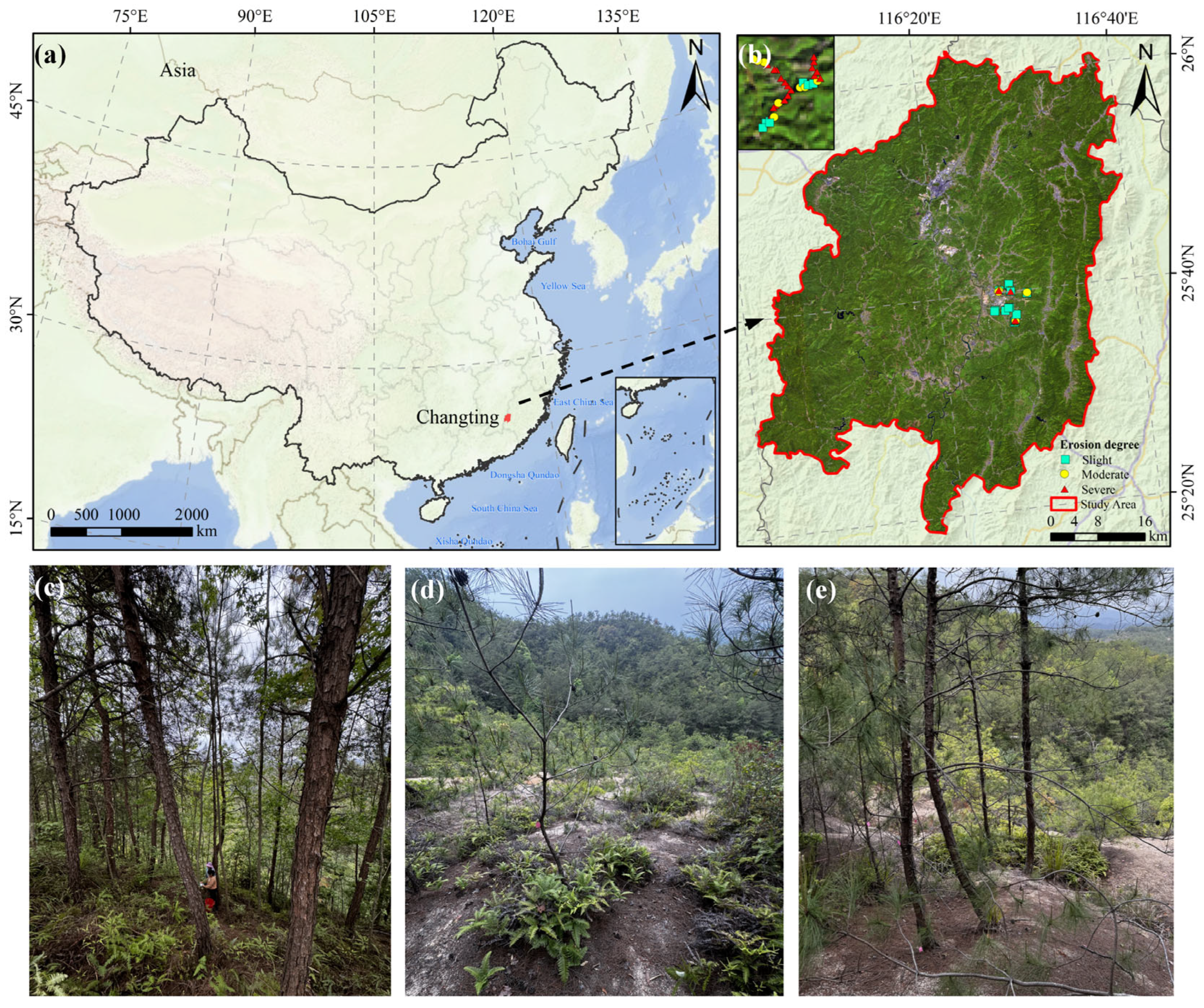
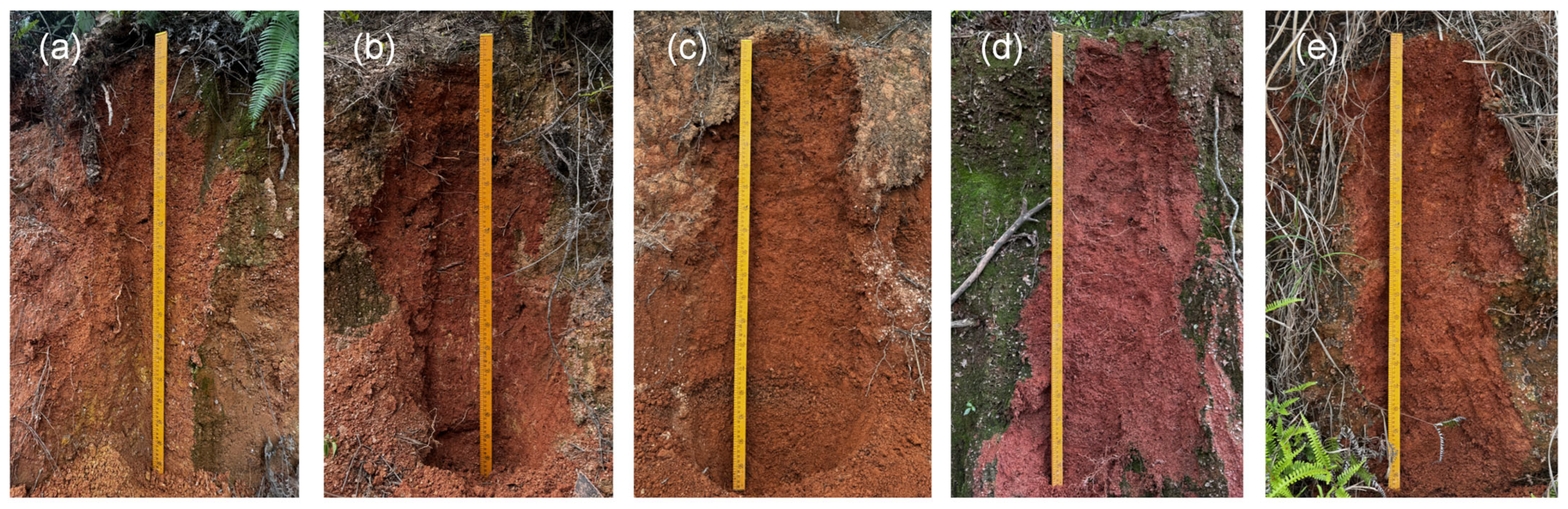
The study area is located in Changting County (25°18′–26°02′ N, 115°59′–116°39′ E), Fujian Province, China, in the hilly red soil region of southern China (Figure 1a). The landscape is characterized by low mountains and hills, with elevations ranging from 200 to 400 m.a.s.l. The region has a subtropical monsoon climate, with a mean annual air temperature of 18.5 °C and annual precipitation of 1737 mm/year. More than 60% of the annual rainfall occurs from March to June. The parent material is primarily granite, and the dominant soil type is Acrisols (WRB-FAO) [8]. We also investigated the vertical soil segment to a depth of 1 m (Figure A1). The soils have a pH of 4.30 ± 0.67, an organic matter content of 13.74 ± 9.65 g·kg−1, and a bulk density of 1.23 ± 0.10 g·cm−3. Gravel (particle size > 2 mm) accounts for 38.91 ± 12.32% of the soil mass. The fine earth fraction (<2 mm) is classified as silty loam, with sand, silt, and clay contents of 25.18 ± 20.69%, 65.48 ± 17.55%, and 9.35 ± 4.03%, respectively. The dominant trees include Pinus massoniana Lamb., Liquidambar formosana Hance, and Schima superba Gardner & Champ. The dominant shrubs include Lespedeza bicolor Turcz. Common herb types include Trifolium repens L., Paspalum dilatatum Poir., Imperata cylindrica (L.) Raeusch., and Dicranopteris pedata (Houtt.) Nakaike. The litter layer is dominated by pine needles. Changting County has long been among the most severely eroded regions in China. In the 1980s, soil and water loss affected approximately one-third of the country’s land area. It has since served as a national demonstration area for soil and water conservation and ecological restoration in the red-soil hilly area of southern China under an administrative program referred to as the “Changting Model”. Field investigations for this study were conducted from 15 to 25 April 2025. The workflow consisted of three steps: (1) identifying the locations of sampling sites; (2) classifying erosion intensity based on expert field assessments (primarily vegetation cover, supplemented by observations of surface exposure and gully development); and (3) conducting unmanned aerial vehicle (UAV) aerial photography, followed by soil sampling and vegetation surveys.

2.2. Site Selection

Sampling sites were selected based on erosion intensity. Erosion classes were primarily determined from vegetation cover, supplemented by verification of surface exposure and observations of gully development. The classification criteria were as follows: Slight erosion: canopy cover ≥ 50% (considered sufficient when ≥80%); where the canopy was absent, shrub and herb cover ≥ 80%. Moderate erosion: canopy cover 25–80%, with shrub and herb cover 20–70%; where the canopy was not established, shrub and herb cover 20–40%. Severe erosion: canopy and shrub–herb cover ≤ 15%, or canopy cover 20–60% with sparse understory growth (<5%).
A total of 75 forest stands (10 m × 10 m) were surveyed across multiple land use types, including forest land, shrubland, grassland, and orchard, spanning various erosion levels. Approximately 60% of sites had slopes of 15–25° (a key slope range for soil erosion), with aspect primarily to the south, west, and northwest (Table A1). Canopy height was generally 6–12 m, and diameter at breast height (DBH) was typically 8–15 cm, although some trees reached 20 m in height and 30 cm DBH. The litter layer, primarily comprising pine needles, was 2–5 cm thick.
Overall, slightly eroded sites were dominated by relatively intact coniferous–broadleaved forest communities. Moderately eroded sites retained a tree layer but had patchy shrub and herb cover. Severely eroded sites exhibited sparse surface vegetation, extensive bare ground, and gully development. The number of sampling points classified as slight, moderate, and severe erosion was 32, 19, and 24, respectively (Figure 1c–e). Detailed site information is provided in Table A1, and the spatial distribution of sampling sites is shown in Figure 1b.

2.3. Soil Sampling and Determination of Soil Properties

Soil bulk density (BD, g·cm−3) was measured using the cutting ring method, with two replicate cores collected at each sampling point and oven-dried in the laboratory. Vertical soil samples were collected at 5 cm intervals to a depth of 20 cm using a 5 cm diameter hand auger, with two replicates per sampling point. Rather than stratifying samples by soil genetic horizons, we used fixed-depth interval sampling to enable direct comparisons of soil properties at the same depths across sites. One limitation of this approach is that soils sampled at the same depth may correspond to different genetic horizons among sites. In the red soil region, the 0–20 cm soil layer generally corresponds to the A horizon, although the deeper portion may partially overlap the B horizon.
Soil water content (SWC, %) was measured using the oven-drying method. Samples were then sieved to separate gravel >2 mm, which was weighed to calculate the gravel content (gravel, %). The <2 mm fine-earth fraction was used for subsequent physical and chemical analyses.
Soil organic matter (SOM, g·kg−1) was measured using the potassium dichromate oxidation method. Soil pH (active acidity) was measured using a pH meter at a soil/water ratio of 1:2.5 (Shanghai Oustor Industrial Co., Rp, Shanghai, China). The soil PSD was measured using a laser particle-size analyzer (LT2800 0.01–2800 μm, linkoptik instruments Co., Ltd, Zhuhai, China). Primary size bins were set at 2, 4, 8, 16, 31, 50, 62, 125, 250, 500, 1000, and 2000 μm. Based on these measurements, the sand (0.05–2 mm, %), silt (0.002–0.05 mm, %), and clay (<0.002 mm, %) contents were calculated. Additional PSD descriptors included the median particle size (D50, μm), mean particle size (D0, μm), kurtosis (K), skewness (SK), and fractal dimension (D):
D50 = Φ50
D0 = (Φ16 + Φ50 + Φ84)/3
K = (Φ95Φ5)/[2.44(Φ75Φ5)]
SK = (Φ16 + Φ84 − 2Φ50)/[2(Φ84Φ16)] + (Φ5 + Φ95 − 2Φ50)/[2(Φ95Φ5)]
V(r < Ri)/Vt = (Ri/Rmax)^(3 − D)
Here, Φx denotes the particle diameter (μm) corresponding to a cumulative volume fraction of x%; r is the soil particle diameter (μm); Ri is the diameter of soil particles in a specific size class (μm); V(r < Ri) is the volume percentage of particles smaller than Ri(%); Vt is the total volume percentage of particles across all size classes (%); and Rmax is the maximum particle diameter (μm).

2.4. Investigation and Measurement of the Stratified Vegetation Volume (SVV)

SVV was used as an integrated indicator of vegetation spatial density in both horizontal and vertical dimensions across the canopy, shrub–herb, and litter layers [23]. The litter layer considered here corresponds exclusively to the Ol horizon (i.e., the undecomposed organic layer) in the soil horizon classification system. The canopy and shrub–herb layers (representing living vegetation) were quantified as living vegetation volume (LVV). The litter layer (non-living surface cover) was quantified as dead vegetation volume (DVV), calculated from litter cover (VFCg) and litter cover height (Hg). The SVV metrics included total LVVt (total of canopy and shrub–herb), canopy LVV (LVVu), shrub–herb LVV (LVVd), and litter DVV (DVVg), with LVVt = LVVu + LVVd.
LVV = VFC × LAI
Here, VFC is vegetation fractional cover, and LAI is the leaf area index.
VFC was measured using vertical photography [27], and Hg was measured with a steel ruler. At each plot, five sets of photographs were taken (upward-facing, canopy; downward-facing, shrub–herb; groundward, litter). Images were processed in ImageJ, and all images were preprocessed using an HSB stack and Gaussian blur. For upward-facing images, non-sky pixels were extracted to calculate canopy VFC (VFCu). For downward-facing images, vegetation pixels were isolated by thresholding the Hue channel (targeting green vegetation), followed by noise removal to obtain shrub–herb VFC (VFCd). For litter cover, the Brightness channel (effective for distinguishing yellow–brown litter) was used to identify and quantify litter VFC (VFCg). Canopy overlap is a key indicator for investigating the vertical structure of vegetation. Accordingly, two metrics, VFCud and the product VFCu × VFCd, were used to characterize overlap between the canopy and the shrub–herb layer [27]. Here, VFCt refers to total VFC, and it was derived from images acquired by UAV at an altitude of 80 m, using the same identification method as that applied for VFCd.
VFCud = VFCu + VFCdVFCt
LAI, defined as one-sided green leaf area per unit ground area [28], was estimated using the Beer–Lambert law under the assumption of a random leaf distribution. The LAI was calculated as follows:
LAI = COS(θ)ln(P(θ))/G(θ)
Here, P(θ) denotes the angular porosity derived from voxelization of sliced point-cloud data at zenith angle θ. G(θ) represents the mean projection of a unit leaf area onto a plane perpendicular to the measurement direction, as determined by the canopy leaf-angle distribution. A commonly adopted value of G(θ) = 0.5 was used in this study [29]. The formula was applied as follows:
LAI = −COS(0)ln(1 − VFC/100)/0.5

2.5. Statistical Analysis

All data were compiled in MS Excel. One-way ANOVA followed by least significant difference (LSD) tests (SPSS 22.0, p < 0.05) were used to assess differences in soil properties at depths of 5, 10, 15, and 20 cm and in SVV indices among erosion levels. Correlation analysis was conducted to examine relationships among soil properties, SVV, and erosion (Origin 2025b). Figures were prepared using Origin 2025b and ArcGIS 10.2.2.

3. Results

3.1. Basic Soil Physical and Chemical Properties Under Different Erosion Degrees

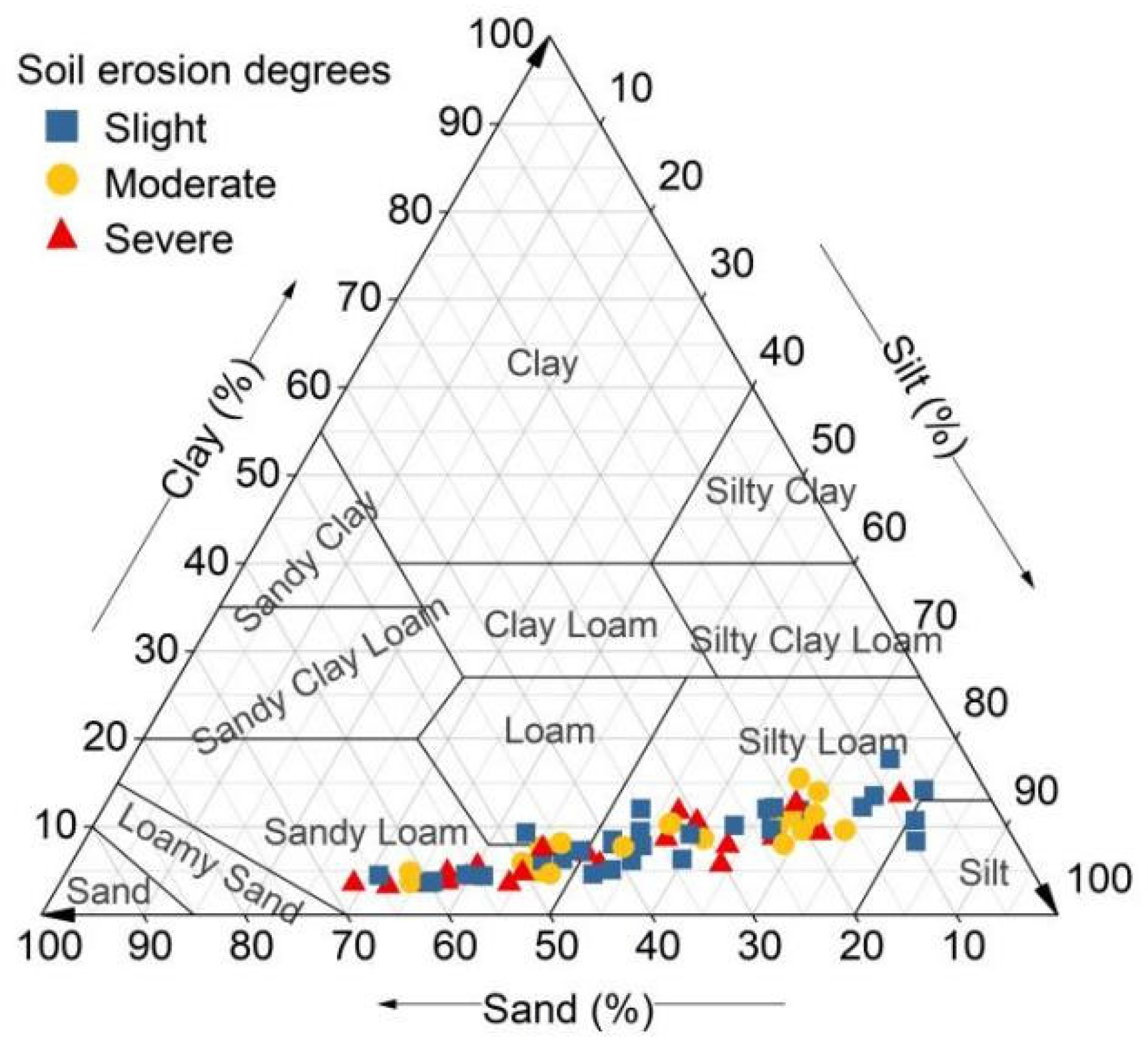
Soil texture is a fundamental indicator of soil physical and chemical properties. In this study, soils from the 0–20 cm layer were segregated into fine particles (<2 mm) and gravel (≥2 mm). The fine–particle fraction was primarily classified as sandy loam or silt loam, and no significant differences in texture were found between the erosion degrees (Figure 2).
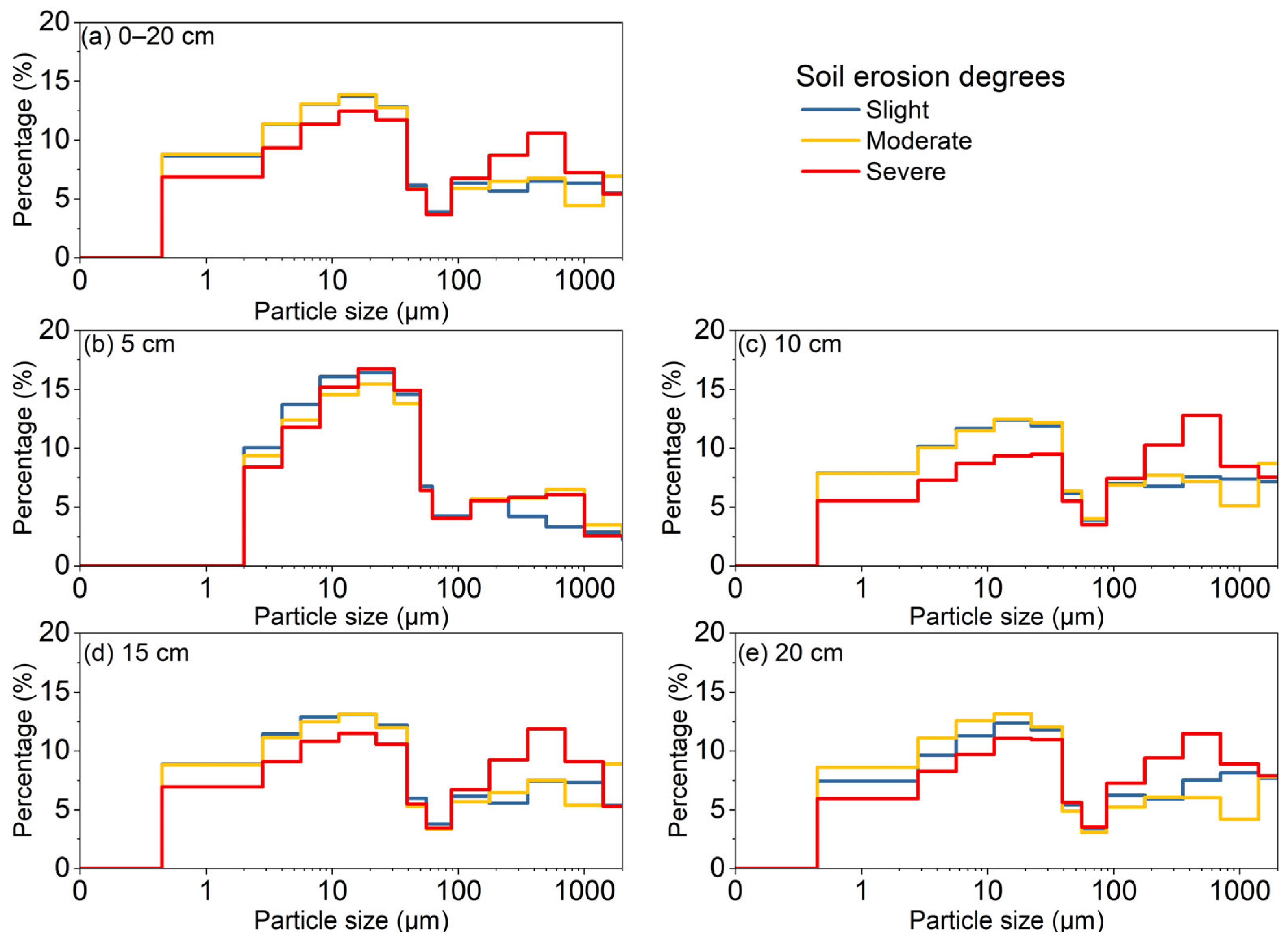
Analysis of the graded particle size distribution (PSD) within the 0–20 cm layer showed that soils in severely eroded sites contained the lowest proportion of particles <31 μm and the highest proportion of particles > 250 μm (Figure 3a). The most evident differences between slight and moderate erosion appeared in the >250 μm fraction: compared with slight erosion, moderate erosion showed higher proportions in the 250–500 μm and 1000–2000 μm classes but a lower content in the 500–1000 μm class, whereas slight erosion showed the opposite pattern.
Similar variations in PSD across erosion degrees were observed at different soil depths (Figure 3b–e). Severe erosion consistently resulted in coarser textures, with the largest differences occurring at depths of 10 cm and 15 cm. Within the >250 μm fraction at these depths, the distribution patterns between slight and moderate erosion were consistent with those in the 0–20 cm layer. At a depth of 5 cm, differences were relatively minor: the content of particles < 16 μm decreased with increasing erosion severity, while the 16–250 μm fraction showed no clear trend. For particles > 250 μm, soils under slight erosion contained a lower proportion than those under moderate and severe erosion. At a depth of 20 cm, soils with slight erosion had fewer particles < 31 μm but more particles > 125 μm compared to moderate erosion.
Overall, textural differences below 5 cm depth were relatively small, but the 5–20 cm layer was coarser than the 0–5 cm layer. Severe erosion produced the coarsest texture throughout the vertical soil segment.
Key parameters are presented in Table 1: sand content, D50, and D0 increased with erosion severity, whereas clay content decreased, indicating pronounced coarsening. Similarly, K, SK, and D declined, reflecting enhanced sorting and more uniform PSD. Vertically, coarsening was more apparent in the 5–20 cm layer, where sand content and D50 were higher, and clay content was lower than in the surface layer (0–5 cm). Compared with slight erosion, severe erosion increased sand content in the 0–20 cm layer by 20.09–31.11%. Moderate erosion showed a 24.48% increase only in the 0–5 cm layer, with slight decreases in deeper layers.
Gravel content accounted for about 40% of the soil mass in the study area, classifying the soil as slightly gravelly according to the USDA (U.S. Department of Agriculture) classification system (30–50% gravel content). As a coarse fraction, gravel content showed similar vertical patterns as sand content but responded inversely to erosion. Other properties—bulk density (BD), soil water content (SWC), soil organic matter (SOM), and pH—were also analyzed. With increasing erosion, BD rose significantly in the 0–5 cm surface layer, while SWC and SOM declined throughout the soil segment, and soil acidity (as indicated by pH) showed a slight decrease. Vertically, SWC increased with depth, SOM decreased, and pH decreased slightly. Under slight erosion, marked changes in SWC and SOM occurred below 10 cm, whereas under moderate and severe erosion, such changes were observed already below 5 cm.

3.2. Stratified Vegetation Volume Under Different Erosion Degrees

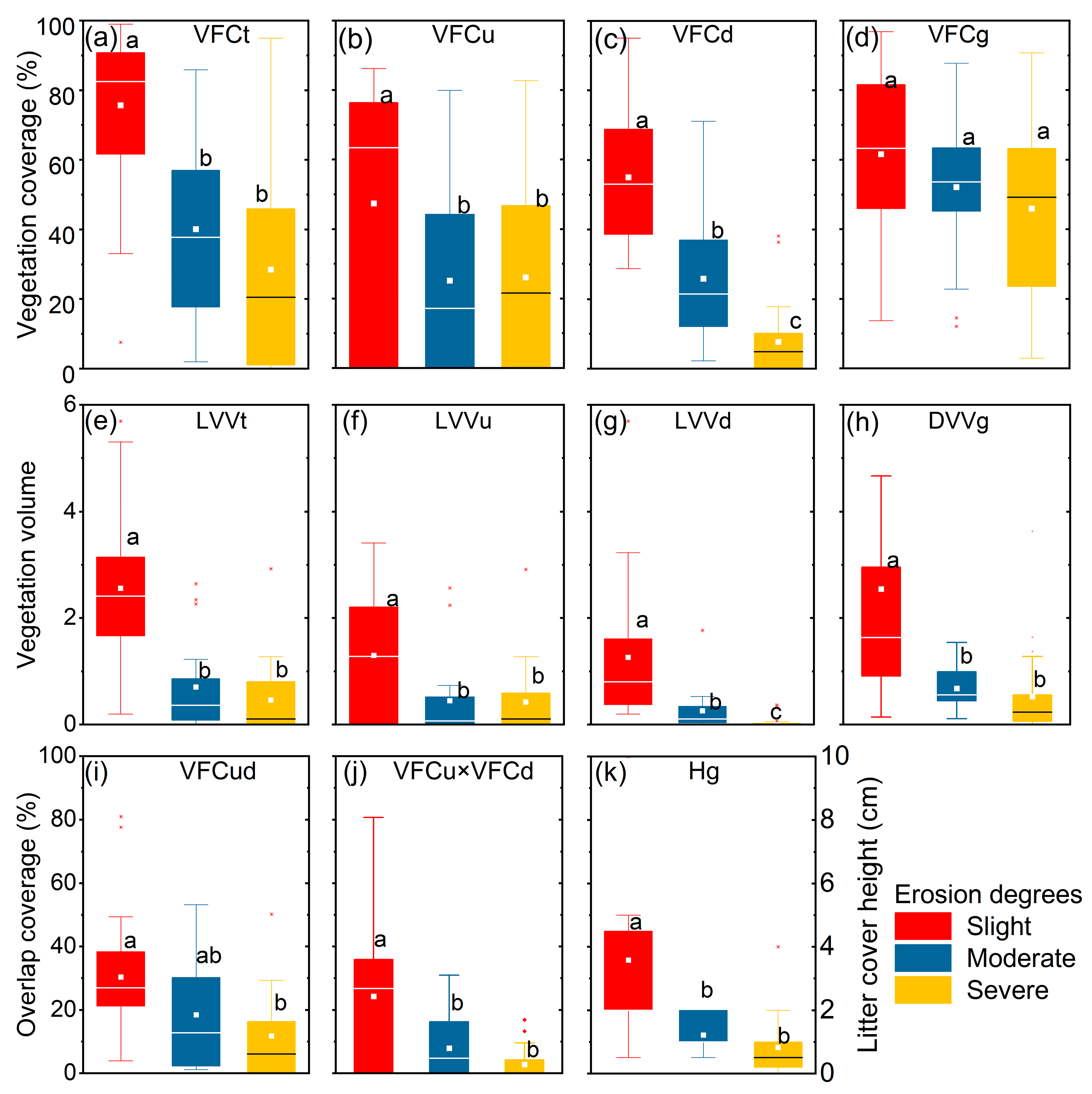
The distribution of stratified vegetation indices (coverage, volume, and thickness) across different erosion grades is presented in Figure 4. All indices in areas of slight erosion were significantly higher than those in areas of moderate and severe erosion (p < 0.05), whereas no significant difference was observed between the latter two (p > 0.05). Based on the vegetation fractional coverage (VFCt) index measured by vertical UAV photography, the values gradually decreased with increasing erosion severity, reaching 75.70 ± 21.37%, 40.04 ± 26.35%, and 28.44 ± 29.00%, respectively (Figure 4a).
Regarding stratified vegetation in forestlands: Canopy coverage (VFCu) was similarly low in moderate and severe erosion areas, both below 26%, representing only 54.91% of the value in the slight erosion area (47.35 ± 34.86%) (Figure 4b). In contrast, shrub–herb layer coverage (VFCd) differed markedly, with values of 25.88 ± 15.96% and 7.72 ± 10.76% in moderate and severe erosion areas, respectively, corresponding to 47.04% and 14.02% of the value in slight erosion areas (55.02 ± 18.68%) (Figure 4c). While no significant difference was observed in litter layer coverage (VFCg) among erosion degrees, litter cover height (Hg) decreased significantly with increasing erosion, measuring 3.58 ± 3.30 cm, 1.21 ± 0.51 cm, and 0.82 ± 0.93 cm, respectively (Figure 4d,k).
Compared to vegetation coverage alone, vegetation volume better reflects its three-dimensional distribution. The living vegetation volume in both the canopy layer (LVVu) and the shrub–herb layer (LVVd) was highest in slight erosion sites (p < 0.05), with values of 1.30 ± 1.19 and 1.26 ± 1.37, respectively (Figure 4f,g). Conversely, moderate and severe erosion sites generally had low values, with significant differences observed only in the shrub–herb layer (p < 0.05). The LVVd in severe erosion sites (0.04 ± 0.10) was only 15.76% of that in moderate erosion sites (0.26 ± 0.40). Regarding the total living vegetation volume (LVVt), slight erosion sites exhibited the highest values (2.56 ± 1.71), which were significantly greater than those in moderate (0.71 ± 0.84) and severe (0.46 ± 0.68) erosion sites (p < 0.05). Dead vegetation volume (DVVg) was also significantly higher in slight erosion sites (2.55 ± 2.93, p < 0.05) compared with other erosion degrees. DVVg in moderate erosion sites was slightly higher than that in severe erosion sites (0.68 ± 0.44 vs. 0.52 ± 0.80, p > 0.05). Notably, litter in severe erosion sites consisted primarily of pine needles shed from the surrounding Masson pine forests.
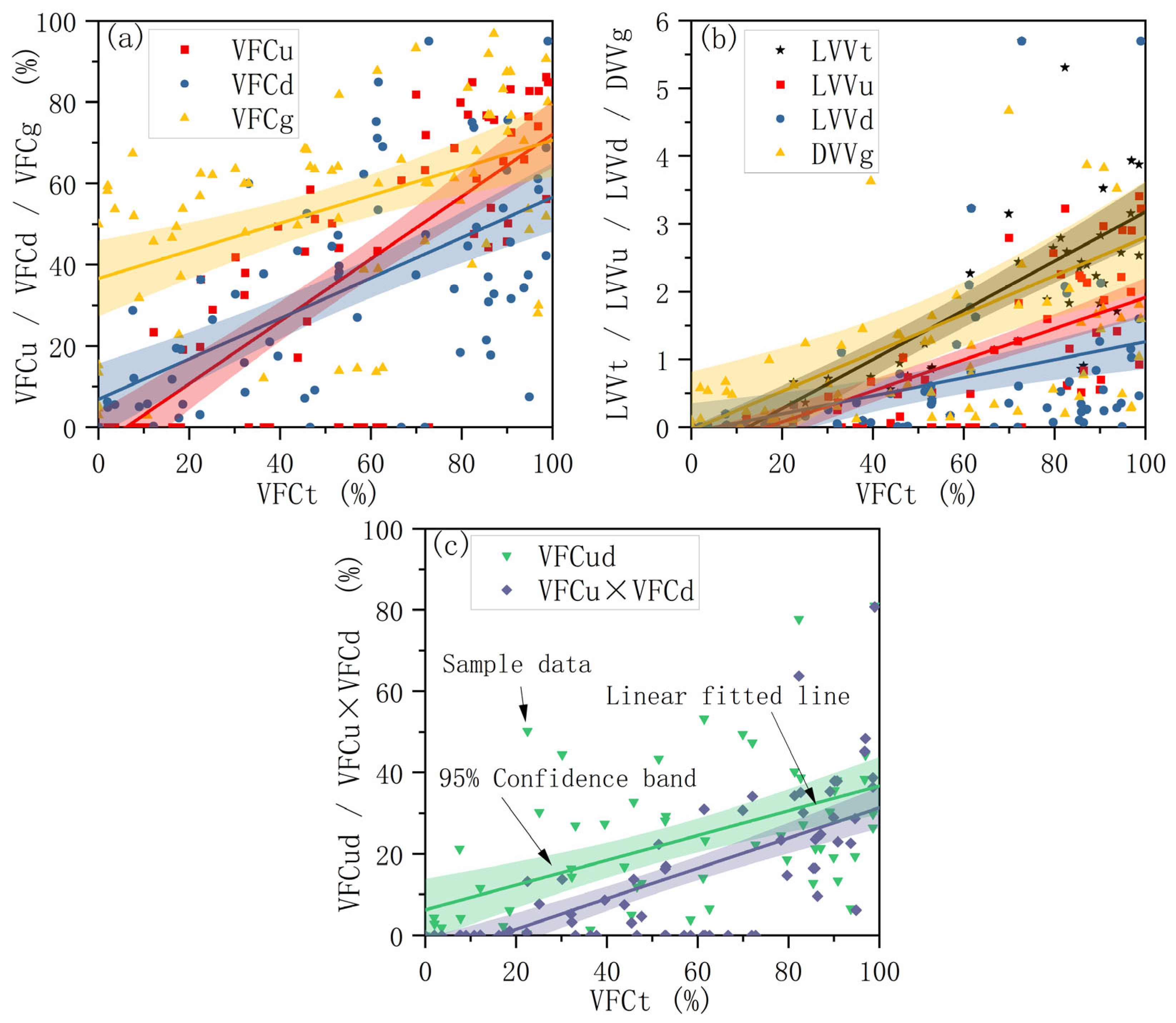
Vegetation overlap degree in forestlands reflects stratification status. Based on two indicators, VFCud and VFCu × VFCd, the degree of vegetation overlap decreased significantly with erosion intensification, by 61.52% and 88.7%, respectively (Figure 4i,j). Given that UAV-based VFCt is a general vegetation survey indicator, linear fitting was performed between the stratified vegetation indicators and VFCt (Figure 5 and Table 2). Correlation analysis revealed that VFCt exhibited a significant positive correlation with all indicators (p < 0.01). However, the correlation coefficients between VFCt and indicators such as VFCg, LVVd, DVVg, and VFCud were below 0.547, whereas those with other indicators exceeded 0.626 (Table 2). VFCt demonstrated good predictive performance for canopy-related coverage indicators, such as VFCu, LVVt, LVVu, and VFCu × VFCd, with prediction accuracy exceeding 0.543. In contrast, its predictive power for the shrub–herb and litter layers was poor, with an accuracy below 0.392. According to the slopes of the linear fitting equations, VFCu has a larger slope than VFCd and VFCg, indicating greater sensitivity of the canopy to VFCt. Regarding vegetation volume, LVVt and DVVg exhibited larger slopes. Furthermore, VFCu × VFCd better reflected vegetation overlap compared to VFCud. In summary, VFCt can effectively predict three indicator types—VFCu, LVVt, and VFCu × VFCd—which primarily reflect the forest canopy and its overlap with understory vegetation, but it is a weak indicator for the shrub–herb and litter layers. Overall, a defining characteristic of soil erosion in the study area is the lack of vegetation in the shrub–herb layer, which facilitates subsurface flow. Therefore, understory vegetation surveys are crucial.

3.3. Correlation Between SVV and Soil Properties

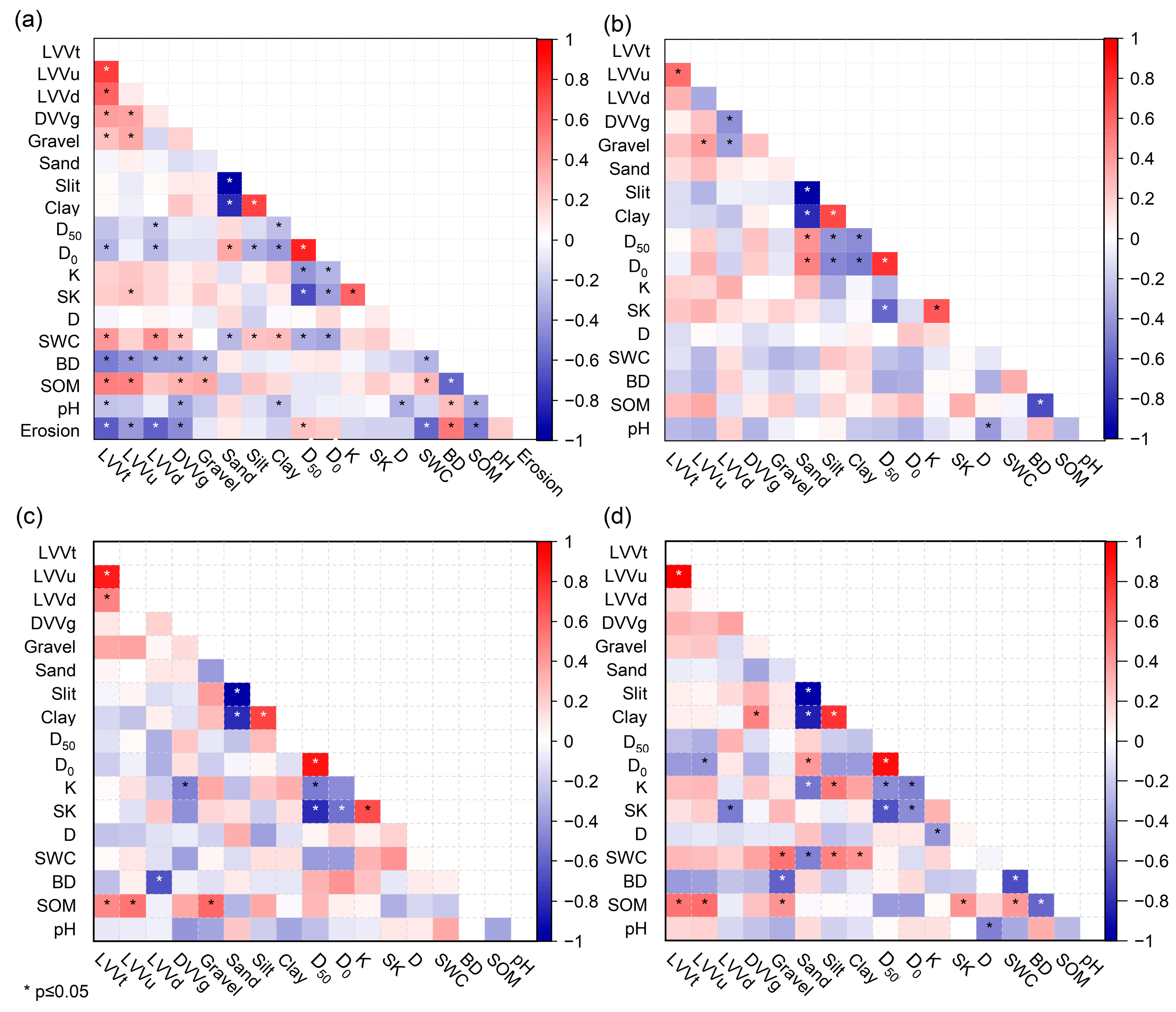
Figure 6 shows the correlations among SVV metrics, soil properties, and erosion degree. Analysis of all samples (Figure 6a) revealed significant positive correlations among most SVV indicators, except for LVVu vs. LVVd and LVVd vs. DVVg, suggesting differentiated contributions across vegetation layers. All SVV metrics were significantly negatively correlated with erosion degree, indicating that greater vegetation volume corresponds to lower erosion intensity. LVVt and LVVd exhibited the strongest negative correlations with erosion, highlighting the crucial role of the shrub–herb layer. Among soil properties, sand content was negatively correlated with silt and clay content, positively correlated with D0, and negatively correlated with SWC. Clay content showed negative correlations with D50 and pH. Both D50 and D0 were negatively correlated with K, SK, and SWC, indicating that larger particle sizes were associated with better sorting, a more uniform composition, and lower moisture. D was significantly negatively correlated only with pH. Gravel content was significantly correlated with BD and SOM but showed weak relationships with other indicators. Significant correlations were also found among SWC, BD, SOM, and pH, though the association between pH and SWC was relatively weak. Among soil indicators, D50, SWC, BD, and SOM were most strongly correlated with erosion. Aside from sand, silt, and clay content, as well as K and D, most soil indicators showed significant correlations with SVV metrics.
Correlations varied across erosion degrees (Figure 6b–d). In slight erosion sites (Figure 6b), LVVt and LVVu were significantly positively correlated, but vegetation–soil relationships were generally weak. Only LVVu and LVVd showed significant correlations with gravel content (positive and negative, respectively). Soil texture indicators were strongly interrelated, while among other properties, only SOM and BD were significantly correlated. In moderate erosion sites (Figure 6c), LVVt was significantly correlated with both LVVu and LVVd. Some SVV metrics also correlated with K, SOM, and BD. Significant correlations were observed between gravel content and SOM; sand, silt, and clay content; and D50, D0, K, and SK. In severe erosion sites (Figure 6d), LVVt was significantly correlated only with LVVu. Several SVV metrics showed significant correlations with clay content, D0, SK, and SOM. Most soil indicators were highly intercorrelated, with stronger coefficients than those observed across all samples—for example, among soil texture indicators and between soil texture and SWC, BD, SOM, and pH.

4. Discussion

4.1. Coupling Mechanism Between SVV and Soil Erosion

Based on field surveys of vegetation and soils in a representative red soil region of southern China, this study revealed strong coupling between SVV and soil erosion. Sites with slight erosion had significantly higher SVV values than moderately and severely eroded sites, and the greatest differences were observed in the shrub–herb and litter layers, indicating that understory vegetation is a critical determinant of erosion control in this region. A remote sensing study in Jiangxi Province reported a similar vertical pattern, with forest vegetation cover mainly concentrated at 5–10 m height, whereas cover in the 0–5 m layer decreased with increasing canopy height [30]. These findings indicate that sparse understory vegetation is common in southern red soil regions.
Declines in understory cover weaken the protective function of vegetation against erosion. Severe soil and water loss beneath forest canopies has been documented in this region, especially in pure Masson pine plantations with a simple stand structure [22,31]. In such stands, the canopy mainly intercepts rainfall and reduces raindrop kinetic energy but contributes little to reducing runoff and sediment export. Consistent with this mechanism, an experimental study in China’s subtropical region found that broad-leaved forests with dense canopies but sparse understories generate more soil erosion than coniferous forests with more open canopies but dense understories [32]. For example, under simulated rainfall, the canopy accounted for only 7.34% of sediment reduction, whereas litter and roots contributed 31.94% and 23.21%, respectively [16]. Similarly, in a rubber plantation in southwestern China, removal of understory vegetation increased soil loss by 8.5-fold [33]. These cross-regional observations are consistent with our results from the southern red soil region, suggesting that understory degradation is a widespread driver of enhanced erosion in subtropical forest ecosystems. More generally, numerous studies indicate that a complete vertical vegetation structure, including canopy, shrubs, herbs, litter, and roots, has both direct and indirect effects on runoff and sediment by altering hydrological processes, soil properties, and the redistribution of rainfall [34,35,36]. For example, sediment reduction on slopes with complete cover, surface cover, and elevated cover reached 98.71%, 96.10%, and 64.69%, respectively, compared with bare slopes with roots [37], highlighting the role of near-surface cover in soil and water conservation.
The shrub–herb and litter layers constitute the primary near-surface cover, with litter often playing a particularly important role in erosion control [19,38,39]. Litter directly protects the soil surface by shielding it from raindrop impact, intercepting rainfall, and reducing erosive force. Furthermore, as the humus layer (Ol horizon) of the soil profile, it varies seasonally. Its effectiveness depends on the litter type, biomass, cover, and thickness [40,41,42]. Among these factors, litter cover has been shown to explain most of the variation in soil loss, exceeding the influence of litter shape [43]. In our study area, litter mainly consisted of pine needles, dried fronds of Dicranopteris pedata, and a small proportion of broadleaf litter. Reported sediment reduction rates are 85.1% for broadleaf litter and 79.9% for coniferous litter [36]. Here, DVVg reflected litter cover by integrating surface coverage and thickness. DVVg averaged 2.55 ± 2.93, 0.68 ± 0.44, and 0.52 ± 0.80 in slight, moderate, and severe erosion sites, respectively, indicating substantially thicker litter in slightly eroded sites. Consistent with this pattern, previous studies reported that litter addition increased slope resistance to erosion by 1.82–12.47-fold [44], and that litter cover alone, both on its own and within shrubland, reduced erosion by 59.41% and 80.76%, respectively [45]. Litter can contribute as much as 31.94% of sediment interception. In our study area, even bare soil surfaces were typically covered by litter; however, correlation and variance analyses suggest that the net contribution of litter was relatively limited, whereas shrub and herb cover played a more decisive role. Field observations further indicated that in slightly eroded sites, thick litter layers often comprised withered stems and leaves from herbaceous plants, such as Dicranopteris pedata. The shrub–herb layer provides additional protection by trapping fine particles; experimental studies report 67.62–79.99% reductions in soil loss following shrub–herb planting [16]. In our study, LVV represented vegetation coverage as the product of VFC and LAI. Notably, LVVd in severely eroded sites was only 15.76% and 3.17% of that in moderately and slightly eroded sites, respectively. These results emphasize the importance of restoring near-surface shrubs and grasses to mitigate understory erosion in the red soil region.
Optimizing vertical vegetation structure has become a central focus in erosion control because vegetation configuration alters surface hydrological responses to rainfall [46]. In our study, slightly eroded sites exhibited relatively complete, well-developed canopy, shrub–herb, and litter layers, whereas these strata were markedly reduced in moderately and severely eroded sites, especially within the shrub–herb layer. The stratified vegetation cover index (Cs), a structure-based metric, has been proposed to better estimate soil and water loss [17]. Defined as the product of layer cover and its contribution to soil conservation, Cs has been shown to outperform simple cover-based measures. Wen et al. [17] reported that vegetation combinations lacking shrubs or trees exhibited similar overall cover (60–65%), yet differ substantially in Cs; shrub–herb–litter combinations yielded Cs values 41% higher than canopy–grass–litter combinations. Subsequent work further confirmed that shrub communities delay runoff and reduce sediment yield [18]. Under a complete vegetation structure, the relative contributions of shrubs, herbs, litter, and canopy to soil conservation were estimated as 0.060614, 0.54616, 0.281468, and 0.111559, respectively, indicating that shrubs and herbs were the dominant factors, followed by litter and canopy [17].
This study did not distinguish between shrubs and herbs. Using the TGL and SGL formulas reported by Wen et al. [17], Cs in this study was calculated, excluding vegetation types consisting only of canopy + litter or only litter. Cs values for slight, moderate, and severe erosion sites were 56.12 ± 10.77, 33.61 ± 11.38, and 29.37 ± 13.46, respectively, indicating that vegetation coverage was significantly higher in slightly eroded sites (1.67–1.91 times, p < 0.05). Total LVV (LVVt), integrating canopy and shrub–herb layers, was also substantially higher at slightly eroded sites (3.67–5.57 times, p < 0.05). However, differences between moderate and severe erosion sites were not statistically significant, likely because severe erosion sites, despite having much reduced shrub–herb cover, exhibited slightly higher canopy cover, which partly offset the loss of understory vegetation.
It should be noted that this study focused on the typical red soil erosion region in Changting County, and conclusions regarding the dominant role of the shrub–herb layer may not apply to other regions. Vegetation structure and erosion exist in a dynamic equilibrium, in which specific erosion regimes shape corresponding vegetation structures that in turn result in distinct erosion characteristics [47,48]. From a longer-term perspective, the erosion-control effects of vegetation restoration tend to stabilize after approximately 25–33 years, although these effects may persist for up to a century [49,50]. Comparisons with other major erosion-prone areas in China (e.g., the Loess Plateau and karst regions of southwestern China) further illustrate regional differences in dominant erosion drivers and vegetation adaptations. The Loess Plateau is characterized by intense water erosion and favors shrub species capable of forming elongated soil pores [46], whereas karst regions are dominated by rocky desertification and require deep-rooted herbs to stabilize shallow soils [51]. In contrast, the red soils of Changting County are highly acidic and low in organic matter, favoring native species such as Dicranopteris pedata and Lespedeza bicolor, which are well adapted to infertile conditions [8]. These regional differences highlight the need to tailor vegetation restoration strategies for erosion control to local edaphic and climatic conditions.
A limitation of this study is that LVVt and DVVg, because they are derived using different calculation methods, cannot be directly combined to represent a unified SVV. As a result, the litter layer is not fully incorporated into the comprehensive vegetation coverage index, which currently emphasizes living (green) components. Consequently, the contribution of the litter layer, despite its proximity to the soil surface and its critical protective function, may be underrepresented. Future work should conceptually align the DVVg metric with LVVt to enable a unified representation of vertical vegetation stratification from the canopy to the ground surface. In addition, although the current Cs index partially integrates the full vertical vegetation structure, it does not explicitly account for certain vegetation types, such as litter cover or monoculture plantations. Moreover, the weighting coefficients assigned to different vegetation strata in Cs are derived from sediment monitoring results, and their broader applicability requires further evaluation. Explicit incorporation of the litter layer into vegetation surveys in future studies will be essential for deeper investigation of understory soil and water loss processes. Overall, further methodological refinement is needed to more accurately characterize vertical vegetation structure in red soil regions.

4.2. Characteristics of Soil Coarsening Driven by Understory Erosion

Soil erosion selectively removes finer particles, leading to soil coarsening [52,53]. In this study, the sand content in the subsurface 0–20 cm layer of severely eroded land increased by 20–31%, with the greatest increase occurring at 5–10 cm depth and the smallest increase in the surface 0–5 cm layer. Consistent with this pattern, particle-size indices based on D50 and D0 showed pronounced coarsening in the 0–5 cm layer, with increases of 2.9- and 3.9-fold, respectively, whereas much smaller changes were observed in deeper layers (1.4–2.0- and −0.3–1.6-fold, respectively). Similar trends have been reported in other studies. For example, during the transition from potentially desertified to highly desertified agricultural land, the sand content in the subsurface 0–15 cm soil layer increased from 69% to 93% [54]. Likewise, sediment coarsening has been documented at the Yangtze River Delta front following a shift from depositional to erosional conditions induced by upstream dam construction [55].
The widespread occurrence of concentrated seepage throughout the soil segment suggests that localized coarsening can accelerate particle loss and degrade soil structure. In particular, coarsening in intermediate soil layers may create additional pathways for particle export, facilitating loss from overlying layers. This process can accelerate sediment transport, intensify erosion, and promote the development of preferential flow paths, ultimately reducing soil stability and increasing the risk of structural collapse [56]. In our study, the greater increase in sand content in subsurface layers relative to surface soils may indicate the presence of such preferential flow pathways. Across the southern red soil region, the frequent development of choking gully erosion has been linked to the leaching of fine particles via preferential flow through macropores, further supporting this interpretation [57].
Vegetative cover can slow the progression of soil coarsening. For example, a study examining how different forest structures affect the vertical soil PSD on China’s Loess Plateau found that grassland soils were finer than those in plantation forests [58]. Eroded particles from intact grassy slopes contained more sand than those from other slope types [59], suggesting that herbaceous cover is more effective at intercepting fine particles and thereby limiting soil coarsening [60]. It has also been shown that with increasing rainfall duration, the clay and fine silt contents increase in eroded particles from herb-covered slopes, but decrease in eroded particles from root-covered and bare slopes. This pattern indicates that intensified erosion progressively removes fine particles accumulated on herb-covered slopes, whereas the reduced fine-particle supply from root-covered and bare slopes leads to lower fine-particle contents in eroded sediments [61].
K and SK denote particle sorting coefficients. Highly eroded sites exhibited lower values of these parameters (decreases of approximately −25% to −3% to −14% to −2%, respectively), indicating better sorting and a more homogeneous PSD. In studies of cropland desertification, the D value, which typically ranges from 2.179 to 2.611, has been shown to be significantly negatively correlated with the sand content [54]. Decreases in D reflect the loss of fine particles and the accumulation of coarse particles, a process characteristic of soil desertification. Numerous studies report that lower D values are associated with looser soil structure and reduced water- and nutrient-retention capacity [61]. These findings are consistent with the results of our study, indicating that highly eroded sites had lower D values that declined with increasing depth. Specifically, D decreased in the 0–10 cm layer (−2.2%), declined further in the 10–15 cm layer (−1.1%), and showed a negligible change in the 15–20 cm layer (0%), indicating that coarsening was concentrated primarily in the upper soil layers. In our study area, D values ranged from approximately 2.61 to 2.75, which is higher than those reported in the above studies; this likely reflects differences in land cover types. On the Loess Plateau, long-term observations indicate that the conversion of cropland to shrubland, forest, or grassland over approximately 35 years significantly enhanced soil structure, as evidenced by significantly increased multifractal dimensions (e.g., entropy and correlation dimensions), particularly in the 10–50 cm layer [62]. Similarly, a study near Funiu Mountain in Henan Province, China, found that cropland exhibited the lowest fractal dimension (both single and generalized metrics) compared with level terraces, Robinia pseudoacacia L. forests, and Quercus spp. forests [63].
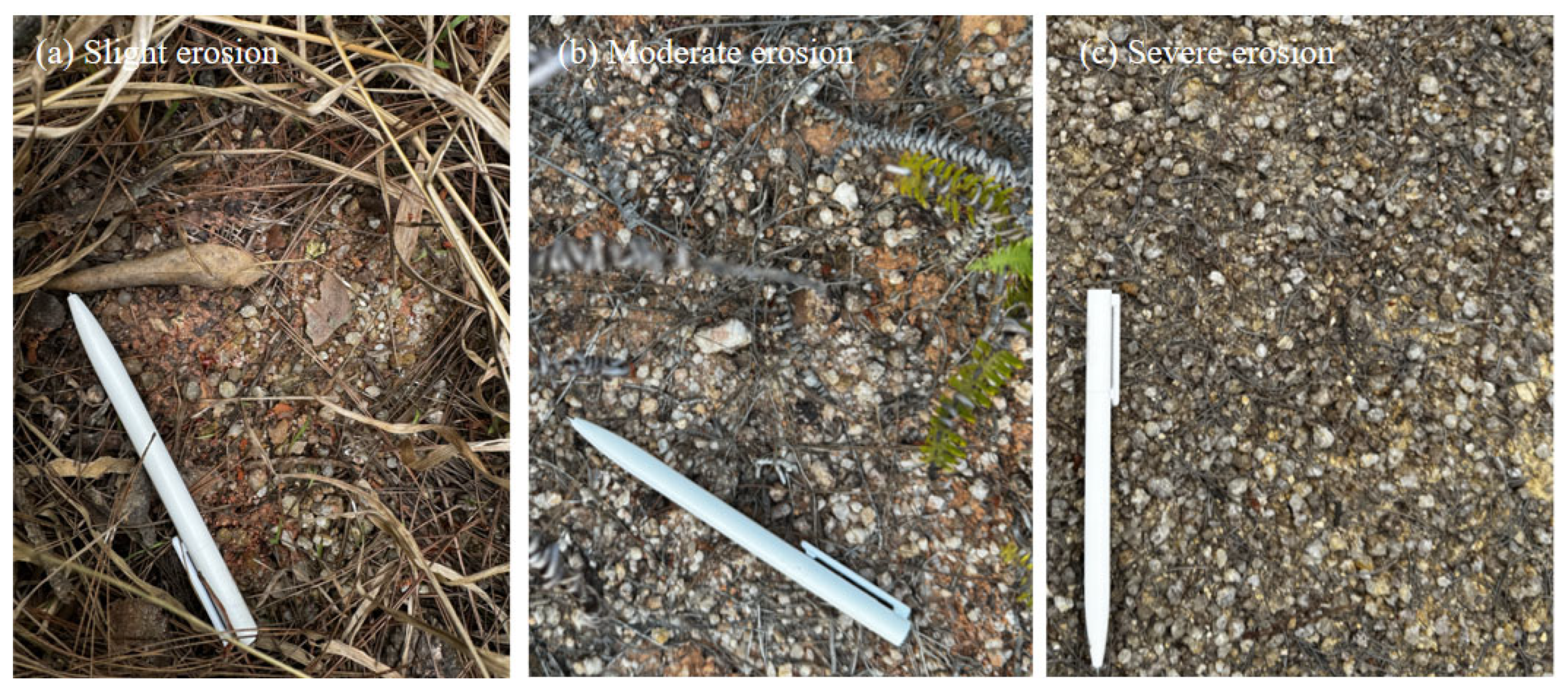
Field surveys revealed widespread gravel cover on the ground surface across the study area (Figure A2). Soil analyses indicated a high gravel content, with soils classified as slightly to moderately gravelly. The gravel content was strongly negatively correlated with erosion severity and positively correlated with SVV metrics. Similar studies have reported that red soils in southern China commonly contain substantial gravel fractions, with average contents of approximately 18% [64,65,66,67]. Gravel plays a significant role in controlling surface hydrology and erosion processes [68]. It can enhance infiltration and redistribute water by promoting macropore flow pathways [69,70], yet it may also impede infiltration by increasing flow tortuosity [71]. Experimental studies further show that adding gravel to soils or covering the soil surface with gravel can reduce both runoff and sediment yield [20]. The restraining effect of gravel on runoff is more pronounced under low-intensity rainfall but diminishes under high-intensity rainfall or on steep slopes. In our study, the gravel content in the 0–5 cm and 10–20 cm layers of severely eroded sites was significantly lower than that in slightly eroded sites (−9% to −13%), whereas the reduction in the 5–10 cm layer was smaller (−2%). This pattern suggests that areas with understory degradation may lack sufficient gravel protection against erosion.
In summary, under slight erosion, vegetation–soil relationships were weak, and soil structure remained largely intact. Under moderate erosion, vegetation–soil interactions were strongest, particularly between the shrub–herb layer and SOM/BD, highlighting the key role of understory vegetation in improving soil conditions. Under severe erosion, internal correlations among soil properties were stronger, vegetation became increasingly constrained by soil conditions, and synergistic interactions among vegetation layers weakened. This suggests that severe erosion leads to a tightly coupled yet constrained vegetation–soil system that limits natural vegetation recovery. For such severely eroded areas, restoration efforts should prioritize reconstruction of the shrub–herb layer using native species such as Lespedeza bicolor, Trifolium repens, Paspalum wettsteinii, and Dicranopteris pedata [11]. Because understory growth is significantly affected by overstory density, selective stand thinning in densely canopied areas may be necessary to increase light availability [72], which is crucial for facilitating the establishment and expansion of shrub–herb communities.

4.3. Limitations and Prospects

This study focused on basic soil properties and PSD and revealed the relationships among erosion, vegetation structure, and soil coarsening. However, important questions remain unresolved. For example, how do surface soil coarsening characteristics induced by erosion respond when additional factors, such as rainfall intensity and slope gradient, are considered? How might soil PSD, aggregate composition, and soil micro-pore structure be comprehensively characterized under these conditions? Furthermore, the erosion classification in this study was based primarily on subjective judgment rather than quantitative criteria (e.g., rill density or measured soil loss rates), and this limitation should be addressed in future investigations. As shown in Figure A2, surface gravel coverage appeared to vary across erosion classes in the field, yet quantitative analyses of gravel cover (e.g., areal coverage and PSD) were not conducted. Although the gravel content in the 0–5 cm soil layer decreased with increasing erosion severity, consistent with our general understanding that gravel protects soil surfaces. Field observations revealed an apparent contradiction: severely eroded bare surfaces were often covered by abundant coarse gravel, whereas herb-covered surfaces exhibited little visible gravel. This discrepancy highlights the need for explicit, quantitative analysis of surface gravel coverage when investigating soil coarsening processes. Temporally, the observed SVV structure is a rapid response of the plant community to recent conditions, whereas the evolution of underlying soil texture occurs over a much longer historical period. Given this discrepancy, future research must adopt a time-successional perspective. This requires long-term, fixed-site observations to concurrently monitor SVV dynamics and the long-term evolution of key soil properties—an approach critical for clarifying their cross-scale interaction mechanisms.

5. Conclusions

This study applied the stratified vegetation volume index to investigate vegetation structure–soil erosion coupling and understory erosion-driven soil coarsening in the red soil region of southern China. The results confirm the reliability of stratified vegetation volume for erosion assessment and identify the shrub–herb layer as a critical component for soil conservation, as its degradation accelerates the loss of fine soil particles. Gravel cover and a complete vertical vegetation structure enhance ecosystem resilience, highlighting the value of native shrub–herb restoration. Key limitations include our subjective assessment of erosion and the exclusion of the litter layer from the stratified vegetation volume index. Future research should refine objective erosion indicators, incorporate litter into the index, and develop quantitative predictive models to improve the assessment and management of soil erosion.

Author Contributions

Conceptualization: Y.H., Z.G. and F.W.; Data curation: J.W. and G.L. (Guanghui Liao); Funding acquisition: Z.G. and F.W.; Investigation: Y.H., Z.G., H.Y. and G.L. (Gengen Lin); Methodology: Y.H., Z.G. and F.W.; Project administration: Q.F. and Z.G.; Resources: Z.G.; Software (support/development): Y.H. and J.W.; Supervision: Q.F.; Validation: Z.G.; Writing—original draft: Y.H.; Writing review and editing: Y.H. and Z.G. All authors have read and agreed to the published version of the manuscript.

Funding

This research was funded by the National Natural Science Foundation of China, grant numbers 32371966 & No.42177344; Fujian Province Water Conservancy Technology Project, grant number MSK202405.

Data Availability Statement

The raw data supporting the conclusions of this article will be made available by the authors upon request.

Acknowledgments

We thank Yisi Liu, Simin Li, Yuying Liang, Yongtong Zhang, Xianzhi Mai, and Peiming Li for helping with labwork, and Quanman Lin and Huolin Qiu for helping with fieldwork.

Conflicts of Interest

Authors Zhujun Gu, Qinghua Fu, Jiasheng Wu and Guanghui Liao were employed by the Pearl River Water Resources Research Institute, Pearl River Water Resources Commission. Author Hui Yue was employed by the Soil and Water Conservation Center of Changting County. Author Gengen Lin was employed by the Soil and Water Conservation Station in Changting. The remaining authors declare that the research was conducted in the absence of any commercial or financial relationships that could be construed as a potential conflict of interest.

Abbreviations

The following abbreviations are used in this manuscript:
SVVStratified vegetation volume
LVVtLiving vegetation volume in canopy and shrub–herb layer
LVVuLiving vegetation volume in canopy layer
LVVdLiving vegetation volume in shrub–herb layer
DVVgDead vegetation volume in litter layer
VFCVegetation fractional cover
VFCtVFC in total
VFCuVFC in canopy layer
VFCdVFC in shrub–herb layer
VFCgVFC in litter layer
Hglitter cover height
LAILeaf area index

Appendix A

Table A1. Vegetation survey of sample plots.
No.Erosion DegreesSlope (°)AspectCanopy 1Plants 2
1Severe40South
2Slight40Northeast10, 5P. massoniana, L. bicolor, P. serratifolia, D. pedata
3Slight35Southwest18, 10P. massoniana, L. formosana, L. bicolor, P. serratifolia, D. pedata
4Slight40East18, 10P. massoniana, L. formosana, L. bicolor, P. serratifolia, D. pedata
5Moderate40Southeast7, 5P. massoniana, D. pedata
6Slight40North7, 15P. massoniana, D. pedata
7Slight40Southeast20, 20P. massoniana, L. bicolor, P. serratifolia
8Severe10East5, 15P. massoniana
9Severe10North5, 15P. massoniana
10Severe10Northwest5, 15P. massoniana
11Severe10Northwest P. massoniana, D. pedata
12Moderate40Northwest P. massoniana
13Severe40Northwest4, 5P. massoniana, L. bicolor, P. serratifolia, D. pedata
14Severe40West5, 10P. massoniana, D. pedata
15Severe40West5, 10P. massoniana
16Severe30Southwest5, 10P. massoniana, D. pedata
17Severe45Northwest
18Severe20North
19Severe10Southwest
20Severe15West
21Severe15Southwest
22Moderate20West5, 10P. massoniana, D. pedata
23Moderate40West5, 10P. massoniana, D. pedata
24Moderate30Northwest D. pedata
25Moderate35Northwest4, 10P. massoniana, L. bicolor, P. serratifolia, D. pedata
26Slight40Southeast20, 15P. massoniana, S. superba, L. bicolor, P. serratifolia, D. pedata
27Slight40South18, 10P. massoniana, S. superba, L. bicolor, P. serratifolia, D. pedata
28Moderate45North3, 10P. massoniana, D. pedata
29Slight40North3, 10P. massoniana, L. formosana, L. bicolor, P. serratifolia, D. pedata
30Moderate40South P. massoniana, L. bicolor, P. serratifolia, D. pedata
31Slight40North6, 15P. massoniana, L. formosana, L. bicolor, P. serratifolia, D. pedata
32Slight35West5, 3P. massoniana, L. bicolor, P. serratifolia, D. pedata
33Moderate45West P. massoniana, L. bicolor, P. serratifolia, D. pedata
34Severe30West2.5, 5P. massoniana, D. pedata
35Severe40Southwest P. massoniana, D. pedata
36Severe45West P. massoniana, D. pedata
37Severe45South P. massoniana, D. pedata
38Severe45South P. massoniana, D. pedata
39Severe45South P. massoniana, D. pedata
40Slight30West C. sinensis, C. dactylon
41Slight30East C. sinensis, C. dactylon
42Slight30South C. sinensis, T. repens
43Slight30Northwest C. sinensis, T. repens
44Moderate30Northwest C. sinensis, D. pedata
45Slight25West3, 5P. massoniana, D. pedata
46Slight20West D. pedata
47Slight10Southwest D. pedata
48Slight20Northeast20, 10P. massoniana, L. bicolor, P. serratifolia, D. pedata
49Moderate3South P. maximum
50Severe10South P. maximum
51Moderate10South P. maximum
52Severe10South
53Severe5Northeast15, 40P. massoniana,
54Slight3Northeast L. bicolor, P. serratifolia, P. maximum
55Moderate3Northeast P. maximum
56Moderate5Northeast P. maximum
57Moderate10Southeast4, 10C. mollissima, G. jasminoides, P. maximum
58Moderate10South4, 10C. mollissima, G. jasminoides, P. maximum
59Slight15Northwest4, 10C. mollissima, R. corchorifolius, P. maximum
60Severe15Northwest4, 10C. mollissima, P. maximum
61Slight10Southeast20, 100C. camphora, E. urophylla, L. bicolor, P. serratifolia, R. simsii, P. wettsteinii, D. pedata
62Slight15Southwest4, 10C. mollissima, L. japonica, F. hirta, T. repens
63Moderate3West P. maximum
64Slight5Southwest4, 10C. mollissima, L. japonica, F. hirta, T. repens
65Slight5Southeast D. pedata
66Slight5Southeast5, 5P. massoniana, L. bicolor, D. pedata
67Slight2South L. bicolor, D. pedata
68Slight2South8, 10S. superba, L. bicolor, P. maximum
69Slight5East P. maximum
70Moderate5Northwest L. bicolor, P. wettsteinii
71Moderate5Northwest P. maximum
72Slight5East18, 10P. massoniana, L. bicolor, P. wettsteinii
73Slight5East18, 10P. massoniana, L. bicolor, P. wettsteinii
74Slight5South18, 10P. massoniana, L. bicolor, P. wettsteinii
75Slight5South18, 10P. massoniana, L. bicolor, P. wettsteinii
1 The height(m) and diameter at breast height/cm of trees in the canopy. 2 The full scientific names of the plant species are as follows: Pinus massoniana Lamb (P. massoniana), Lespedeza bicolor Turcz. (L. bicolor), Photinia serratifolia (Desf.) Kalkman (P. serratifolia), Dicranopteris pedata (Houtt.) Nakaike (D. pedata), Schima superba Gardner & Champ. (S. superba), Trifolium repens L. (T. repens), Citrus sinensis (L.) Osbeck ‘Navel’ (C. sinensis), Cynodon dactylon (L.) Pers. (C. dactylon), Panicum maximum Jacq. (P. maximum), Liquidambar formosana Hance (L. formosana), Castanea mollissima Blume (C. mollissima), Gardenia jasminoides J.Ellis (G. jasminoides), Ru bus corchorifolius L.f. (R. corchorifolius), Cinnamomum camphora (L.) J.Presl (C. camphora), Eucalyptus urophylla S.T.Blake (E. urophylla), Rhododendron simsii Planch. (R. simsii), Paspalum wettsteinii Hackel (P. wettsteinii), Lonicera japonica Thunb. (L. japonica), Ficus hirta Vahl (F. hirta), Trifolium repens L. (T. repens).
Figure A1. Representative vertical soil segments observed in the field. Notes: The yellow ruler indicates a 1 m scale. Panels (ae) show the vertical soil segments at sampling points 65–69, respectively.
Land 15 00143 g0a1
Figure A2. Field photographs illustrating surface soil coarsening across erosion classes. Panels (ac) show representative surfaces under slight, moderate, and severe erosion, respectively. The white marker pen (14.5 cm long) provides scale.
Land 15 00143 g0a2

References

  1. Pimentel, D. Soil erosion: A food and environmental threat. Environ. Dev. Sustain. 2006, 8, 119–137. [Google Scholar] [CrossRef]
  2. Montgomery, D.R. Dirt: The Erosion of Civilizations; University of California Press: Oakland, CA, USA, 2007. [Google Scholar]
  3. Guerra, C.A.; Maes, J.; Geijzendorffer, I.; Metzger, M.J. An assessment of soil erosion prevention by vegetation in Mediterranean Europe: Current trends of ecosystem service provision. Ecol. Indic. 2016, 60, 213–221. [Google Scholar] [CrossRef]
  4. Chen, J.; Li, Z.W.; Xiao, H.B.; Ning, K.; Tang, C.J. Effects of land use and land cover on soil erosion control in southern China: Implications from a systematic quantitative review. J. Environ. Manag. 2021, 282, 111924. [Google Scholar] [CrossRef]
  5. Liang, Y.; Li, D.C.; Lu, X.X.; Yang, X.; Pan, X.Z.; Mu, H.; Shi, D.M.; Zhang, B. Soil erosion changes over the past five decades in the red soil region of Southern China. J. Mt. Sci. 2010, 7, 92–99. [Google Scholar] [CrossRef]
  6. Du, X.; Jian, J.S.; Du, C.; Stewart, R.D. Conservation management decreases surface runoff and soil erosion. Int. Soil Water Conserv. Res. 2022, 10, 188–196. [Google Scholar] [CrossRef]
  7. Chen, M.; Wang, X.Q.; Lin, J.L.; Yue, H.; Zhou, W.D.; Jiang, H. Quantitative effects of land use and vegetation cover changes on soil erosion in Changting County in recent 30 years. J. Soil Water Conserv. 2023, 37, 168~177. [Google Scholar]
  8. Wu, J.L.; Zha, R.B.; Zha, X.; Wang, Y.T. Regulatory mechanism of soil and water conservation measures on understorey erosion in a subtropical hilly region. Catena 2024, 246, 108427. [Google Scholar] [CrossRef]
  9. Savari, M.; Yazdanpanah, M.; Rouzaneh, D. Applying conservation agriculture practices as a strategy to control soil erosion and carbon sequestration. Results Eng. 2025, 26, 104854. [Google Scholar] [CrossRef]
  10. Chen, J.; Xiao, H.B.; Li, Z.W.; Liu, C.; Wang, D.Y.; Wang, L.X.; Tang, C.J. Threshold effects of vegetation coverage on soil erosion control in small watersheds of the red soil hilly region in China. Ecol. Eng. 2019, 132, 109–114. [Google Scholar] [CrossRef]
  11. He, Y.Z.; Tian, Z.Y.; Gu, Z.J.; Wu, B.X.; Liang, Y. Controlling soil erosion of tailings from rare earth mines with Paspalum wettsteinii and soil amendments. Land Degrad. Dev. 2024, 35, 5533–5548. [Google Scholar] [CrossRef]
  12. Shui, J.G.; Ye, Y.L.; Wang, J.H.; Liu, C.C. Regularity of erosion and soil loss tolerance in hilly red-earth region of China. Sci. Agric. Sineca 2003, 36, 179–183. [Google Scholar]
  13. Yin, Z.; Chang, J.; Huang, Y. Multiscale spatiotemporal characteristics of soil erosion and its influencing factors in the Yellow River Basin. Water 2022, 14, 2658. [Google Scholar] [CrossRef]
  14. Ding, X.D.; Xu, H.W.; Gao, Y.R.; Zhu, J.X.; Wang, K. Soil erosion evaluation of lower hilly red soil regions in Zhejiang province. Chin. J. Soil Sci. 2008, 39, 1045–1048. [Google Scholar]
  15. Li, G.J.; Wan, L.; Cui, M.; Wu, B.; Zhou, J.X. Influence of canopy interception and rainfall kinetic energy on soil erosion under forests. Forests 2019, 10, 509. [Google Scholar] [CrossRef]
  16. Wei, S.; Zhang, K.D.; Liu, C.L.; Cen, Y.D.; Xia, J.Q. Effects of different vegetation components on soil erosion and response to rainfall intensity under simulated rainfall. Catena 2024, 235, 107652. [Google Scholar] [CrossRef]
  17. Wen, Z.M.; Lees, B.G.; Jiao, F.; Lei, W.N.; Shi, H.J. Stratified vegetation cover index: A new way to assess vegetation impact on soil erosion. Catena 2010, 83, 87–93. [Google Scholar] [CrossRef]
  18. Wen, B.J.; Duan, G.H.; Lu, J.X.; Zhou, R.L.; Ren, H.Y.; Wen, Z.M. Response relationship between vegetation structure and runoff-sediment yield in the hilly and gully area of the Loess Plateau, China. Catena 2023, 227, 107107. [Google Scholar] [CrossRef]
  19. Zhao, H.B.; Liu, G.B.; Cao, Q.Y. Influence of different vegetation on soil erosion in Loess Hilly Region. Res. Soil Water Conserv. 2004, 11, 153–155. [Google Scholar]
  20. Wang, H.; Lu, D.B.; Wang, Q.; Shan, C.J. Effects of embedded gravel or gravel mulching in southern red soil on slope sediment yield and runoff. Pol. J. Environ. Stud. 2021, 30, 401–408. [Google Scholar] [CrossRef]
  21. Yang, Z.Q.; Qin, F.C.; Li, L.; Guo, J.Y.; Wang, Y. Relationship between soil particle multifractals and water holding capacity under different erosion degrees in feldspathic sandstone region. Soils 2021, 53, 620–627. [Google Scholar]
  22. Wang, B.W.; Zhang, G.H.; Duan, J. Relationship between topography and the distribution of understory vegetation in a Pinus massoniana forest in Southern China. Int. Soil Water Conserv. Res. 2015, 3, 291–304. [Google Scholar] [CrossRef]
  23. Liang, L.B.; Wu, L.; Liu, H.Y.; He, W.Q.; Shi, L.; Xu, C.Y.; Xiang, C.L. Coarsened soil reduces drought resistance of fibrous-rooted species on degraded steppe. Ecol. Indic. 2022, 145, 109644. [Google Scholar]
  24. Hartmann, A.; Semenova, E.; Weiler, M.; Blume, T. Field observations of soil hydrological flow path evolution over 10 millennia. Hydrol. Earth Syst. Sci. 2020, 24, 3271–3288. [Google Scholar] [CrossRef]
  25. Guo, W.Z.; Kang, H.L.; Wang, W.L.; Guo, M.M.; Chen, Z.X. Erosion-reducing effects of revegetation and fish-scale pits on steep spoil heaps under concentrated runoff on the Chinese Loess Plateau. Land Degrad. Dev. 2020, 31, 2846–2857. [Google Scholar] [CrossRef]
  26. Mizuno, T.; Kojima, N.; Asano, S. The risk reduction effect of sediment production rate by understory coverage rate in granite area mountain forest. Sci. Rep. 2021, 11, 14415. [Google Scholar] [CrossRef] [PubMed]
  27. Gu, Z.J.; Zeng, Z.Y.; Shi, X.Z.; Li, L.; Weindorf, D.C.; Zha, Y.; Yu, D.S.; Liu, Y.M. A model for estimating total forest coverage with ground-based digital photography. Pedosphere 2010, 20, 318–325. [Google Scholar] [CrossRef]
  28. Chen, J.M.; Black, T.A. Defining leaf area index for nonflat leaves. Plant Cell Environ. 1992, 15, 421. [Google Scholar] [CrossRef]
  29. Gu, Z.J.; Yue, H.; Wang, X.G.; Zeng, M.M.; Meng, X.M.; Wu, J.S.; Wu, B.X.; Lin, D.D. Study on the vertical distribution of tridimensional green biomass of vegetation in water erosion areas based on TLS. Subtrop. Soil Water Conserv. 2021, 33, 16–20. [Google Scholar]
  30. Wang, Z.W.; Cai, H.Y.; Yang, X.H. A new method for mapping vegetation structure parameters in forested areas using GEDI data. Ecol. Indic. 2024, 164, 112157. [Google Scholar] [CrossRef]
  31. Cao, L.X.; Liang, Y.; Wang, Y.; Lu, H.Z. Runoff and soil loss from Pinus massoniana forest in southern China after simulated rainfall. Catena 2015, 129, 1–8. [Google Scholar] [CrossRef]
  32. Wang, W.W.; Xu, C.; Lin, T.C.; Yang, Z.J.; Liu, X.; Xiong, D.; Chen, S.; Chen, G.; Yang, Y. Forest structure regulates response of erosion-induced carbon loss to rainfall characteristics. Forests 2024, 15, 1269. [Google Scholar] [CrossRef]
  33. Liu, H.; Blagodatsky, S.; Giese, M.; Liu, F.; Xu, J.; Cadisch, G. Impact of herbicide application on soil erosion and induced carbon loss in a rubber plantation of Southwest China. Catena 2016, 145, 180–192. [Google Scholar] [CrossRef]
  34. Quinton, J.N.; Edwards, G.M.; Morgan, R.P.C. The influence of vegetation species and plant properties on runoff and soil erosion: Results from a rainfall simulation study in south east Spain. Soil Use Manag. 1997, 13, 143–148. [Google Scholar] [CrossRef]
  35. Crockford, R.H.; Richardson, D.P. Partitioning of rainfall into throughfall, stemflow and interception: Effect of forest type, ground cover and climate. Hydrol. Process. 2000, 14, 2903–2920. [Google Scholar] [CrossRef]
  36. Li, X.; Niu, J.Z.; Xie, B.Y. The effect of leaf litter cover on surface runoff and soil erosion in northern China. PLoS ONE 2014, 9, e107789. [Google Scholar] [CrossRef]
  37. Yang, C.X.; Yao, W.Y.; Xiao, P.Q.; Qin, D.Y. Analysis of the influence of vegetation cover structure on slope runoff and sediment yield and its regulation mechanism. J. Hydraul. Eng. 2019, 50, 1078–1085. [Google Scholar]
  38. Sun, J.M.; Fan, D.X.; Yu, X.X.; Li, H.Z. Hydraulic characteristics of varying slope gradients, rainfall intensities and litter cover on vegetated slopes. Hydrol. Res. 2018, 49, 506–516. [Google Scholar] [CrossRef]
  39. Xia, L.; Song, X.Y.; Fu, N.; Cui, S.Y.; Li, L.J.; Li, H.Y.; Li, Y.L. Effects of forest litter cover on hydrological response of hillslopes in the Loess Plateau of China. Catena 2019, 181, 104076. [Google Scholar] [CrossRef]
  40. Findeling, A.; Ruy, S.; Scopel, E. Modeling the effects of a partial residue mulch on runoff using a physically based approach. J. Hydrol. 2003, 275, 49–66. [Google Scholar] [CrossRef]
  41. Li, X.; Niu, J.Z.; Xie, B.Y. Study on hydrological functions of litter layers in North China. PLoS ONE 2013, 8, e79926. [Google Scholar] [CrossRef] [PubMed]
  42. Smets, T.; Poesen, J.; Knapen, A. Spatial scale effects on the effectiveness of organic mulches in reducing soil erosion by water. Earth Sci. Rev. 2008, 89, 1–12. [Google Scholar] [CrossRef]
  43. Wang, L.J.; Zhang, G.H.; Zhu, P.Z.; Wang, X. Comparison of the effects of litter covering and incorporation on infiltration and soil erosion under simulated rainfall. Hydrol. Process. 2020, 34, 2911–2922. [Google Scholar] [CrossRef]
  44. Yang, C.X.; Sun, X.M.; Yang, Q.J.; Cen, Y.D.; Liu, C.L.; Wei, S.; Zhang, K.D. Effects of grass-shrub vegetation and litter on overland flow resistance coefficients. Phys. Fluids 2024, 36, 103606. [Google Scholar] [CrossRef]
  45. Liu, W.; Luo, Q.; Lu, H.; Wu, J.; Duan, W. The effect of litter layer on controlling surface runoff and erosion in rubber plantations on tropical mountain slopes, SW China. Catena 2017, 149, 167–175. [Google Scholar] [CrossRef]
  46. Zhou, J.; Fu, B.J.; Gao, G.Y.; Lü, Y.H.; Liu, Y.; Lü, N.; Wang, S. Effects of precipitation and restoration vegetation on soil erosion in a semi-arid environment in the Loess Plateau, China. Catena 2016, 137, 1–11. [Google Scholar] [CrossRef]
  47. Francke, A.; Dosseto, A.; Forbes, M.; Cadd, H.; Short, J.; Sherborne-Higgins, B.; Constantine, M.; Tyler, J.; Tibby, J.; Marx, S.K.; et al. Catchment vegetation and erosion controlled soil carbon cycling in south-eastern Australia during the last two glacial-interglacial cycles. Glob. Planet. Change 2022, 217, 103922. [Google Scholar] [CrossRef]
  48. Huang, T.S.; Zhang, H.Y.; Zhu, X.Q.; Zhao, L.; Han, L. A study of dynamical model on the competitive relationship between soil erosion and vegetation growth in humid regions. In Proceedings of the ASME International Mechanical Engineering Congress and Exposition-2010, PTS A and B, Vancouver, BC, Canada, 12–18 November 2010; ASME: New York, NY, USA, 2012; Volume 8, pp. 383–389. [Google Scholar]
  49. Liu, Y.; Liu, G.; Gu, J.; Shi, H.Q.; Li, H.R.; Han, Y.Q.; Liu, D.D.; Xia, X.L.; Guo, Z. Soil erodibility and hillslope erosion processes affected by vegetation restoration duration. Soil Tillage Res. 2025, 245, 106305. [Google Scholar] [CrossRef]
  50. Zhang, Y.; Pang, Z.L.; Zhu, Q.; Liu, S.; Wang, X.T.; Chen, X.W.; Wang, E.H. Time-sensitive effects of vegetation restoration on slowing down soil erosion: Evidence from Northeastern China with Mollisols. Catena 2024, 246, 108406. [Google Scholar] [CrossRef]
  51. Yan, Y.J.; Dai, Q.H.; Hu, G.; Jiao, Q.; Mei, L.N.; Fu, W.B. Effects of vegetation type on the microbial characteristics of the fissure soil-plant systems in karst rocky desertification regions of SW China. Sci. Total Environ. 2020, 712, 136543. [Google Scholar] [CrossRef]
  52. Xiao, J.; Shen, Y.; Tateishi, R.; Bayaer, W. Development of topsoil grain size index for monitoring desertification in arid land using remote sensing. Int. J. Remote Sens. 2006, 27, 2411–2422. [Google Scholar] [CrossRef]
  53. Chen, Z.Y.; Gu, Z.J. Study on the fractal dimension of soil particle size distribution in areas with different water-erosion degrees in southern China. Res. Soil Water Conserv. 2013, 20, 13–17. [Google Scholar]
  54. Su, Y.Z.; Zhao, H.L.; Zhao, W.Z.; Zhang, T.H. Fractal features of soil particle size distribution and the implication for indicating desertification. Geoderma 2004, 122, 43–49. [Google Scholar] [CrossRef]
  55. Yang, H.F.; Yang, S.L.; Meng, Y.; Xu, K.H.; Luo, X.X.; Wu, C.S.; Shi, B.W. Recent coarsening of sediments on the southern Yangtze subaqueous delta front: A response to river damming. Cont. Shelf Res. 2018, 155, 45–51. [Google Scholar] [CrossRef]
  56. Huang, Z.; Bai, Y.C.; Xu, H.J. Impacts of intensive seepage flow on suffusion development in cohesionless soil: Insight from a theoretical model. Geomech. Energy Environ. 2022, 31, 100382. [Google Scholar] [CrossRef]
  57. Tao, Y.; Zou, Z.Q.; Guo, L.; He, Y.B.; Lin, L.R.; Lin, H.; Chen, J.Z. Linking soil macropores, subsurface flow and its hydrodynamic characteristics to the development of Benggang erosion. J. Hydrol. 2020, 586, 124829. [Google Scholar] [CrossRef]
  58. Ru, H.; Zhang, J.J.; Li, Y.T.; Yang, Z.R.; Feng, H.C. Fractal features of soil particle size distributions and its effect on soil erosion of Loess Plateau. Trans. Chin. Soc. Agric. Mach. 2015, 46, 176–182. [Google Scholar]
  59. Liu, X.N.; Fan, D.X.; Jia, G.D.; Yu, X.X. Quantitative simulation of the particle size distribution of eroded sediment on grass slopes with intact plants and root slopes with the aboveground parts removed. Soil Sci. Soc. Am. J. 2021, 85, 396–411. [Google Scholar] [CrossRef]
  60. Liu, X.N.; Yu, X.X.; Fan, D.X.; Jia, G.D. Effects of ryegrass canopy and roots on the distribution characteristics of eroded sediment particles during heavy rainfall events on steep loess-cinnamon slopes in Zhangjiakou, China. Land Degrad. Dev. 2021, 32, 1643–1655. [Google Scholar] [CrossRef]
  61. Luo, Y.X.; Liu, R.T.; Zhang, J.; Chang, H.T. Soil particle composition, fractal dimension and their effects on soil properties following sand-binding revegetation within straw checkerboard in Tengger Desert, China. Chin. J. Appl. Ecol. 2019, 30, 525–535. [Google Scholar]
  62. Sun, C.L.; Liu, G.B.; Xue, S. land-use conversion changes the multifractal features of particle-size distribution on the Loess Plateau of China. Int. J. Environ. Res. Public Health 2016, 13, 785. [Google Scholar] [CrossRef]
  63. Qi, F.; Zhang, R.H.; Liu, X.; Niu, Y.; Zhang, H.D.; Li, H.; Li, J.Z.; Wang, B.Y.; Zhang, G.C. Soil particle size distribution characteristics of different land-use types in the Funiu mountainous region. Soil Tillage Res. 2018, 184, 45–51. [Google Scholar] [CrossRef]
  64. Lei, Z.D.; Hu, H.P.; Yang, S.X. A review of soil water research. Adv. Water Sci. 1999, 10, 311–318. [Google Scholar]
  65. Wang, H.; Lu, D.B.; Xu, M.Z. Response of Subsurface Flow to Rainfall Intensity in the Red Soil Slope with Embedded Gravel. J. Soil Water Conserv. 2019, 33, 1–7. [Google Scholar]
  66. Luo, Z.T.; Niu, J.Z.; Meng, C.; Zhang, Y.H.; Du, X.Q.; Lin, X.N.; Jia, J.W. Effects of distribution of rock fragment on macropores and saturated water conductivity in forest soil in rocky mountain area of Northern China. J. Soil Water Conserv. 2016, 30, 305–311. [Google Scholar]
  67. Kang, H.L.; Wang, W.L.; Xue, Z.D.; Guo, M.M.; Li, J.M.; Bai, Y.; Deng, L.Q.; Li, Y.F.; Li, Y.L. Effect of gravel on runoff and erosion characteristics on engineering accumulation slope in windy and sandy area, northern China. Trans. Chin. Soc. Agric. Eng. 2016, 32, 125–134. [Google Scholar]
  68. He, Y.Z.; Du, J.; Gu, Z.J.; Li, Y.H.; Ni, J.; Wu, J.S.; Liao, G.H.; Zeng, M.M. Study of the hydrological and erosion characteristics of typical spoil heaps in the Yangtze River Delta of China. Water 2025, 17, 1220. [Google Scholar] [CrossRef]
  69. Zhu, Y.J.; Shao, M.A. Processes of rainfall infiltration and sediment yield in soils containing different rock fragment contents. Trans. Chin. Soc. Agric. Eng. 2006, 22, 64–67. [Google Scholar]
  70. Li, Y.; Liu, J.Z.; Wei, C.F.; Gong, J.P.; Hong, Y.J.; Yi, Z.J.; Gao, J. Effect of rock fragment content on water infiltration (diffusion) in purple soils. Acta Pedol. Sin. 2011, 48, 435–439. [Google Scholar]
  71. Shi, Z.J.; Wang, Y.H.; Yu, P.T.; Xu, L.H.; Xiong, W.; Guo, H. Effect of rock fragments on the percolation and evaporation of forest soil in Liupan Mountains, China. Acta Ecol. Sin. 2008, 28, 6090–6098. [Google Scholar]
  72. Du, Z.; Cai, X.H.; Bao, W.K.; Chen, H.; Pan, H.L. Understory effects on overstory trees: A review. Chin. J. Appl. Ecol. 2016, 27, 963–972. [Google Scholar]
Figure 1. (a) Location of Changting County within China. (b) Spatial distribution of the sampling sites across the study area (red boundary), classified by erosion intensity (slight, moderate, severe); the inset shows an enlarged view of the cluster of sites. (ce) Representative field photographs, showing sites with slight, moderate, and severe erosion.
Land 15 00143 g001
Figure 2. Soil texture distribution at three soil erosion degrees.
Land 15 00143 g002
Figure 3. Soil particle size distribution at three soil erosion degrees. The grades of particle size are 2, 4, 8, 16, 31, 50, 62, 125, 250, 500, 1000, and 2000 μm: (ae) soil depth of 0–20 cm, 5 cm, 10 cm, 15 cm, and 20 cm.
Land 15 00143 g003
Figure 4. Stratified vegetation indices: (ad) vegetation fractional coverage (VFC). (a) Overall VFC (VFCt), and stratified coverage for (b) canopy (VFCu), (c) shrub–herb (VFCd), and (d) litter (VFCg) layers. (eh) Living (LVV) or dead (DVV) vegetation volume; (e) total LVV (LVVt), and stratified volume for (f) canopy (LVVu), (g) shrub–herb (LVVd), and (h) litter (DVV) layers. (i,j) Vegetation overlap degree (VFCud & VFCu × VFCd). (k) Litter cover height (Hg). The different letters mean a significant difference among the three erosion degrees at the level of p < 0.05.
Land 15 00143 g004
Figure 5. The linear fitted lines between vegetation indices and overall vegetation fractional coverage (VFCt): (a) Relationship of stratified VFC in canopy (VFCu), shrub–herb (VFCd), and litter (VFCg) layers with VFCt. (b) Relationship of living (LVV) or dead (DVV) vegetation volume with VFCt; the volume indices are total LVV (LVVt) and stratified volume for canopy (LVVu), shrub–herb (LVVd), and litter (DVV) layers. (c) Relationship of vegetation overlap degree (VFCud & VFCu × VFCd) with VFCt.
Land 15 00143 g005
Figure 6. Correlation analysis among indices of stratified vegetation volume (SVV), soil properties, and soil erosion degrees. The SVV is living (LVV) or dead vegetation volume (DVV); the volume indices are total LVV (LVVt) and stratified volume for canopy (LVVu), shrub–herb (LVVd), and litter (DVV) layers. Soil properties were analyzed using data from the 5 cm depth under different erosion conditions: (a) all degrees combined; (b) slight; (c) moderate; and (d) severe erosion. D50, D0, K, SK, D, SWC, BD, and SOM are median, average, kurtosis, skewness, fractal dimension of particle size, soil water content, bulk density, and soil organic matter. The color bar on the right represents the correlation coefficient.
Land 15 00143 g006
Table 1. Soil basic physical and chemical properties at three soil erosion degrees.
Soil ErosionGravel (%)Sand (%)Slit (%)Clay (%)D50 (μm) 1D0 (μm) 1K 1SK 1D 1SWC (%) 1SOM (g·kg−1) 1pHBD (g·cm−3)
Soil depth at 5 cm
Slight39.45 ±
14.83 a 2
20.37 ±
18.65 a
68.93 ±
15.62 a
9.94 ±
3.53 a
18.39 ±
17.48 b
33.41 ±
35.87 b
1.34 ±
0.39 a
0.64 ±
0.15 a
2.71 ±
0.15 a
15.43 ±
5.42 a
11.07 ±
8.03 ab
4.12 ±
0.61 a
0.95 ±
0.47 b
Moderate39.11 ±
14.16 a
25.36 ±
18.52 a
64.90 ±
15.67 a
9.27 ±
3.47 a
54.75 ±
50.18 a
135.86 ±
88.89 a
1.22 ±
0.28 a
0.62 ±
0.14 a
2.70 ±
0.13 a
9.57 ±
4.08 b
13.12 ±
6.36 a
4.36 ±
0.69 a
1.19 ±
0.29 ab
Severe34.93 ±
14.72 a
24.46 ±
18.58 a
68.42 ±
14.08 a
8.71 ±
3.62 a
71.30 ±
61.73 a
164.47 ±
103.69 a
1.11 ±
0.17 a
0.59 ±
0.10 a
2.65 ±
0.13 a
9.19 ±
2.67 b
7.26 ±
4.00 b
4.44 ±
0.62 a
1.24 ±
0.27 a
Soil depth at 10 cm
Slight41.90 ±
11.57 a
39.77 ±
23.89 ab
52.34 ±
19.99 ab
7.89 ±
4.49 a
29.92 ±
20.79 b
68.68 ±
49.02 b
1.09 ±
0.25 a
0.70 ±
0.15 a
2.75 ±
0.18 a
17.20 ±
4.08 a
11.05 ±
6.23 a
3.85 ±
0.28 a
/ 3
Moderate40.05 ±
14.49 a
37.06 ±
16.56 b
54.69 ±
13.88 a
7.87 ±
3.51 a
64.55 ±
62.58 ab
182.25 ±
166.46 a
1.22 ±
0.40 a
0.60 ±
0.20 a
2.74 ±
0.15 a
13.80 ±
3.67 b
9.45 ±
3.81 a
3.95 ±
0.10 a
/
Severe41.07 ±
6.25 a
52.15 ±
18.87 a
42.09 ±
15.57 b
5.22 ±
3.04 a
91.78 ±
60.66 a
177.55 ±
85.30 a
1.06 ±
0.24 a
0.64 ±
0.15 a
2.69 ±
0.16 a
11.22 ±
2.53 c
5.03 ±
0.13 a
4.01 ±
0.29 a
/
Soil depth at 15 cm
Slight46.16 ±
8.73 a
36.79 ±
23.85 a
55.54 ±
19.75 a
7.41 ±
3.54 ab
38.64 ±
34.41 b
101.76 ±
91.38 a
1.16 ±
0.24 a
0.68 ±
0.15 a
2.69 ±
0.16 a
16.71 ±
4.38 a
7.18 ±
2.18 a
4.00 ±
0.30 a
/
Moderate41.57 ±
14.75 a
37.22 ±
25.24 a
53.99 ±
20.79 a
8.79 ±
4.73 a
12.04 ±
5.38 b
172.49 ±
185.74 a
1.08 ±
0.18 a
0.61 ±
0.15 a
2.64 ±
0.17 a
14.22 ±
3.5 ab
7.89 ±
4.86 a
3.84 ±
0.10 a
/
Severe42.02 ±
2.06 a
45.63 ±
21.27 a
47.43 ±
17.17 a
5.51 ±
2.85 b
105.23 ±
90.57 a
178.14 ±
115.29 a
1.10 ±
0.32 a
0.63 ±
0.12 a
2.66 ±
0.17 a
12.00 ±
2.90 b
3.75 ±
0.95 a
4.08 ±
0.25 a
/
Soil depth at 20 cm
Slight44.93 ±
12.84 a
40.19 ±
25.87 a
52.14 ±
21.70 a
7.68 ±
4.60 ab
35.93 ±
34.47 b
223.89 ±
228.11 a
1.46 ±
1.03 a
0.63 ±
0.19 a
2.69 ±
0.20 a
17.05 ±
4.11 a
8.17 ±
4.33 a
3.95 ±
0.25 a
/
Moderate44.59 ±
15.03 a
34.19 ±
21.94 a
56.72 ±
18.80 a
9.10 ±
4.11 a
30.08 ±
32.07 b
64.79 ±
54.25 b
1.18 ±
0.49 a
0.56 ±
0.21 a
2.61 ±
0.18 a
14.18 ±
3.94 b
7.11 ±
4.20 a
4.15 ±
0.16 a
/
Severe38.98 ±
11.34 a
48.46 ±
23.24 a
45.59 ±
20.05 a
5.23 ±
2.78 b
85.88 ±
65.03 a
164.93 ±
108.65 ab
1.10 ±
0.26 a
0.62 ±
0.15 a
2.69 ±
0.17 a
10.68 ±
2.88 c
2.75 ±
0.74 a
4.30 ±
0.02 a
/
1 D50, D0, K, SK, D, SWC, and SOM are median, average, kurtosis, skewness, fractal dimension of particle size, soil water content, and soil organic matter, respectively. 2 The different letters mean the significant difference among the three erosion degrees at the level of p < 0.05. 3 “/” means that the bulk density was not tested at the soil depths of 10 cm, 15 cm, and 20 cm.
Table 2. The fitted relationship between vegetation indices and overall vegetation fractional coverage (VFCt).
Indices (y 1~x)Number of PointsCorrelation Coefficients 2Equation 3R2
VFCu~VFCt750.786 **y = 0.768 x − 4.6590.617
VFCd~VFCt750.626 **y = 0.497 x + 6.8650.392
VFCg~VFCt750.460 **y = 0.340 x + 36.6160.211
LVVt~VFCt750.749 **y = 0.036 x − 0.4510.561
LVVu~VFCt750.737 **y = 0.023 x − 0.3800.543
LVVd~VFCt750.409 **y = 0.013 x − 0.0700.167
DVVg~VFCt750.426 **y = 0.028 x − 0.0390.182
VFCud~VFCt600.547 **y = 0.305 x + 6.2110.299
VFCu × VFCd~VFCt750.707 **y = 0.373 x − 5.9320.500
1 Indices of y mean stratified VFC in canopy (VFCu), shrub–herb (VFCd), and litter (VFCg) layers, living (LVV) or dead vegetation volume (DVV), and vegetation overlap degree (VFCud & VFCu × VFCd); the volume indices are total LVV (LVVt) and stratified volume for canopy (LVVu), shrub–herb (LVVd), and litter (DVV) layers; 2 ** means a significant correlation at the 0.01 significance level between vegetation indices and VFCt. 3 At the 0.05 level, the slope in all fitted lines is significantly different from zero.
Disclaimer/Publisher’s Note: The statements, opinions and data contained in all publications are solely those of the individual author(s) and contributor(s) and not of MDPI and/or the editor(s). MDPI and/or the editor(s) disclaim responsibility for any injury to people or property resulting from any ideas, methods, instructions or products referred to in the content.