


Abstract
The Three-North Shelterbelt Forest Program (TNSFP) region in northern China, a critical ecological zone, has experienced significant changes in vegetation coverage and water availability under climate change. However, a comprehensive understanding of how vegetation growth responds to both water deficit and surplus remains limited. This study systematically assessed the spatiotemporal dynamics of vegetation responses to atmospheric water constraints (represented by the Standardized Precipitation Evapotranspiration Index (SPEI)) and soil moisture constraints (represented by the Standardized Soil Moisture Index (SSMI)) across the TNSFP region from 2001 to 2022. Our results revealed a compound water constraint pattern: soil moisture deficit dominated vegetation limitation across 46.41–67.88% of the region, particularly in the middle (28–100 cm) and deep (100–289 cm) layers, while atmospheric water surplus also substantially affected 37.35% of the area. From 2001 to 2022, vegetation has shown weakening correlations with atmospheric and shallow-soil moisture, but strengthening coupling with middle- and deep-soil moisture, indicating a growing dependence on deep water resources. Furthermore, the response times of vegetation to water deficit and water surplus have been reduced, indicating that vegetation growth was increasingly restricted by water deficit while being less constrained by water surplus during the period. Attribution analysis identified that air temperature exerted a stronger influence than precipitation on vegetation–water relationships over the study period. This study improved the understanding of vegetation–water interactions under combined climate and land use change, providing critical scientific support for land use-targeted adaptive management in arid and semi-arid regions.
1. Introduction
Water is an indispensable limiting factor for vegetation growth, and its availability—whether deficit or surplus—directly dictates ecosystem productivity and stability, especially in ecologically vulnerable regions [1]. The responses of vegetation to water availability play a pivotal role in land–atmospheric interactions involving water, carbon, and energy exchange [2]. Water constraints affect not only ecosystem structure and function, including shifts in plant functional traits, drought-induced productivity loss, and waterlogging-related stress, but also have profound implications for global carbon cycling and ecological security [3]. Under a warming climate, rising atmospheric vapor pressure deficit (VPD) and widespread soil moisture changes have profoundly altered the spatiotemporal patterns of water availability, with increasingly complex impacts on vegetation dynamics [4,5]. Therefore, understanding how vegetation responds to different forms of water constraints is essential within the context of climate change.
The relationship between vegetation and water availability has attracted growing research interest in recent years, particularly the effects of water constraint on vegetation growth [6,7]. Water constraint can be categorized into water deficit and surplus, which affect vegetation growth in distinct ways, leading to different responses in terms of greenness and productivity [8]. Generally, water deficit induces stomatal closure, reduces photosynthesis, and thus limits vegetation productivity [9]. On the other hand, water surplus can lead to root hypoxia, impair nutrient absorption, and damage plant health [10]. In addition, water availability represents an integrated system involving precipitation, runoff, and soil moisture processes [11]. Precipitation directly supplies water for vegetation, while vapor pressure deficit affects the rate of transpiration and thus the water balance of plants [12]. Although soil moisture directly reflects the availability of water for plants, the soil moisture in different soil layers exhibits various effects [13]. For instance, shallow-soil moisture is primarily replenished by precipitation with high temporal variability, and its immediate impact on vegetation growth stems from its overlap with the dense root zones of shallow-rooted vegetation (e.g., grasslands and croplands) for direct water uptake [14]; in contrast, deep-soil moisture has a slow recharge rate and strong stability, serving as a long-term water reserve that is critical for deep-rooted vegetation (e.g., forests) to cope with prolonged droughts by accessing water beyond the shallow root zone [15]. However, previous studies have primarily focused on the impact of either atmospheric water deficit or soil moisture variations on vegetation dynamics [16]. A comprehensive evaluation of the spatiotemporal vegetation responses to diverse available water resources remains lacking. Furthermore, different vegetation types exhibit varying degrees of resistance and resilience to water constraint due to differences in physiological traits and root architecture [17]. It is necessary to understand these type-specific responses, which is crucial for predicting the impacts of climate change and implementing effective vegetation management strategies.
The relationship between plant growth and water supply Is not instantaneous but exhibits lagged response, reflecting the cumulative influence of climatic conditions on vegetation dynamics [18,19]. The timescale over which water availability most strongly correlates with vegetation status serves as a key indicator of ecosystem sensitivity to water constraints [20]. This response timescale effectively captures vegetation resistance and resilience to water stress [19]. Generally, shorter response timescales indicate higher sensitivity and faster reaction of vegetation to moisture variations, while longer timescales suggest greater buffering capacity [6]. However, research focusing on the spatiotemporal dynamics of vegetation response time to water constraints and their long-term trends at the regional scale under climate change remains relatively scarce.
To combat desertification and control dust storms in the Three North (northwest, North, and northeast) regions of China, the Three-North Shelterbelt Forest program (TNSFP), the globally largest afforestation and reforestation project, was launched in 1978. With a goal of increasing the forest coverage to 14.95% in 2050, the project had already achieved 13.84% by 2020 [21]. Although arid and semi-arid regions such as the North American Great Plains and Central Asian deserts are commonly constrained by water scarcity [22], their vegetation–water relationships diverge significantly from those in the TNSFP region, which represents a human-engineered landscape. The vegetation structure in this region is largely determined by large-scale afforestation policies. Large-scale vegetation greening in the regions has yielded numerous ecological benefits, such as reduced wind erosion, soil conservation, and increased carbon sequestration [23]. However, while vegetation cover has significantly increased, it has also triggered unintended consequences, including excessive soil moisture consumption, degradation of planted forests, and declining ecological and economic benefits [24]. In some regions, introduced vegetation rehabilitation did not fully consider the relationship between vegetation water consumption and soil water carrying capacity for vegetation [25]. Taking the Loess Plateau as a case study, certain introduced vegetation species characterized by high water consumption and high planting density have consumed water in quantities exceeding the local soil water carrying capacity for vegetation [26]. As a result, the introduced vegetation has encountered more severe water stress, and the water absorption strategy of vegetation roots has shifted from the shallow-soil layer to deeper layers, leading to the formation of persistent “soil dry layers” [25]. Therefore, in the context of climate change, examining the dynamic effects of atmospheric and soil water constraints on vegetation is critical for ensuring the ecological security and sustainable development of the TNSFP region.
The standardized Precipitation Evapotranspiration Index (SPEI) and Standardized Soil Moisture Index (SSMI) serve as effective indicators for quantifying atmospheric and soil water constraints, respectively [27]. By analyzing the vegetation greenness (Normalized Difference Vegetation Index, NDVI) and production (Gross Primary Productivity, GPP) in relation to these water availability indices, we can gain insights into how vegetation adapts and responds to varying water conditions from 2001 to 2022 in the TNSFP region. The major objectives of this study were to (1) reveal the spatiotemporal variations in correlations between vegetation and water availability; (2) assess the vegetation response time to water constraints and its trends; and (3) examine the influence of meteorological factors (air temperature and precipitation) on the correlation between vegetation and water availability.
2. Materials and Methods
2.1. Study Area
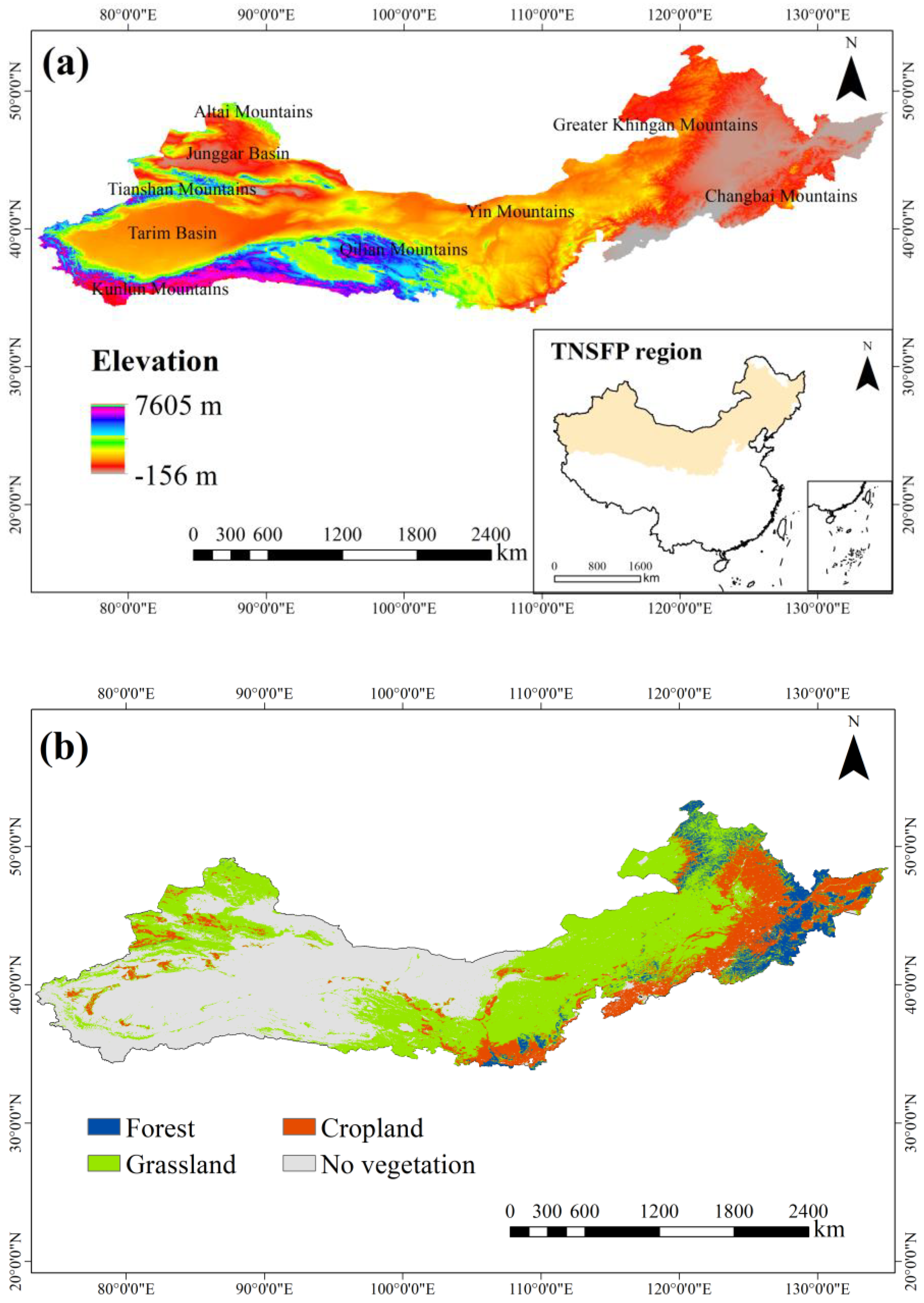
The TNSFP region spans 33°30′ N–50°12′ N and 73°26′ E–127°50′ E and is located in North China, with an area of approximately 4.069 × 10⁶ km2 (Figure 1a). The region’s terrain is complex, including plateaus, mountains, and hills in the west and plains in the east. This region is characterized predominantly by an arid and semi-arid monsoon climate, with annual mean air temperature ranging from 2 °C to 11 °C and annual precipitation ranging from 50 mm to 800 mm. The main land use types consist of desert and grassland (Figure 1b). Croplands are mainly found in the eastern area of the region, and scarcely in the Tianshan Mountains and Jungar Basin in the western part. The forests are mainly distributed in east and south temperate zone and almost all are artificially planted forests.
Figure 1.
The digital elevation model (DEM) and location of the TNSFP region (a) and the land use types within the region (b).
Vegetation in this region is tailored to local habitats, integrating sand control, soil conservation, and livelihood improvement to fulfill the program’s core goals. The dominant trees [24] include drought-tolerant Haloxylon ammodendron (3–5 m roots) for sand fixation, cold-resistant Pinus sylvestris var. mongolica (1–2 m roots) in temperate areas, and soil-conserving Robinia pseudoacacia (2–3 m roots), as well as shrubs like Hippophae rhamnoides (sea buckthorn), Tamarix chinensis (Chinese tamarisk), and Caragana korshinskii for enhancing soil fertility and salt tolerance. Herbs are mainly the local grasses for stabilizing topsoil. Main crops include grain (wheat, corn, soybean), cash crops (goji berry, yellowhorn, cotton), and understory herbs.
2.2. Data Collection
Monthly Standardized Precipitation Evapotranspiration Index (SPEI) data (version 2.9) were retrieved from the Global SPEI database (https://spei.csic.es/spei_database/) (accessed on 15 September 2025). This database offers dependable information regarding drought conditions on a global scale with a spatial resolution of 0.5°. The soil moisture data (2001–2022) was derived from the fifth generation European Center for Medium-Range Weather Forecast (ECMWF) atmospheric reanalysis of global climate (ERA5-Land Averaged data) (https://apps.ecmwf.int/datasets/) (accessed on 15 September 2025). The ERA5 data has a 0.1° spatial resolution and an hourly temporal resolution. The soil moisture data includes four soil layers through the soil profiles: 0–7 cm, 7–28 cm, 28–100 cm, and 100–289 cm. It has been extensively applied, and its reliability in China has been verified [15,28]. This study divided the soil profiles into three layers in investigating soil moisture droughts, including the shallow-soil layer (0–28 cm), the middle-soil layer (28–100 cm), and the deep-soil layer (100–289 cm).
This study uses the NDVI (MOD13C2) dataset and GPP dataset, which are available from the US Geological Survey (https://ladsweb.modaps.eosdis.nasa.gov/) (accessed on 15 September 2025). The NDVI and GPP data were aggregated to a spatial resolution of 0.05° and a monthly temporal resolution from 2001 to 2022. The MODIS Land Cover Type Product (MCD12Q1) with a spatial resolution of 500 m was employed as a source of land use information, which were available from Earth data website (http://urs.earthdata.nasa.gov/) (accessed on 15 September 2025). The urban and built-up lands, permanent snow and ice, barrens, and water bodies were excluded, and the land use types in TNSFP were reclassified into forest, grassland, and cropland (Figure 1b).
2.3. Method
2.3.1. Drought Indices
In this study, the SPEI and SSMI with multiple months scale are used to represent meteorological water availability and soil moisture availability from 2001 to 2022, respectively. The SPEI is derived through the computation of a normalized probability distribution function of the cumulative difference between precipitation and potential evapotranspiration (PET) on a monthly timescale. The detailed calculation procedure is given from the website (https://spei.csic.es/home.html#p7) (accessed on 15 September 2025) and previous studies [15,16]. The SSMI at three soil depths including SSMI-S (shallow layer, 0–28 cm), SSMI-M (middle layer, 28–100 cm), and SSMI-D (deep layer, 100–200 cm) are calculated as follow:
where SMij is the monthly soil moisture value for the ith month in j year, and is the mean soil moisture value for ith month of a multiyear from 2001 to 2022.
2.3.2. Standardized Vegetation Indices
This study employed the standardized NDVI and GPP to present vegetation greenness and production, respectively, which are calculated as follow:
where SA is the standardized deviation of the NDVI or GPP, vegi is the NDVI or GPP value for ith month, μi is the mean NDVI or GPP for ith month during 2001–2022, Si is the standard deviation of NDVI or GPP for the ith month, and n is the number of years.
2.3.3. Correlation, Trend, and Attribution Analysis
The water availability indices at the 1-month scale exhibited high sensitivity to short-term fluctuations in precipitation and evaporation [29]. In contrast, the 3-month scale represents the cumulative moisture deficit between the current month and the previous 2 months, which were more appropriate for capturing seasonal water availability patterns and cumulative water deficits. In addition, previous studies confirmed that the relationship between vegetation and water availability at the 3-month time scale was optimal due to its alignment with the vegetation growth cycle [6,9,11]. Thus, we chose the water availability indices at 3-month scales to assess the relationships between vegetation and water availability indices. The Spearman correlation analysis was employed to explore the spatial and temporal relationship for each grid cell. Based on the correlation coefficient between the four water availability indices (SPEI, SSMI-S, SSMI-M, and SSMI-D) and two vegetation indices (NDVI and GPP), the grid cells with two distinct scenarios including water deficit and water surplus were identified. According to Jiao et al. [6], grid cells with significant positive correlation (R > 0, p < 0.05) between the two variables are termed “vegetation water deficit regions”, while areas with significant negative correlation (R < 0, p < 0.05) between the two variables are termed “vegetation water surplus regions”. In addition, grid cells with no significant correlation (p > 0.05) indicted that vegetation growth in these areas was not constrained by meteorological water or soil water.
To analyze the temporal changes in areas associated with water deficit and water surplus, the trends in the relationship between water availability indices and vegetation from 2001 to 2022 and their significance were estimated using the Mann–Kendall test. The Mann–Kendall test is a continuous non-parametric method, which does not require any prior assumptions about the distribution of variables [30]. A 5-year moving window was employed to mitigate fluctuations in the time series and accentuate trends. This approach maximized the quantity of time series points while consistently emphasizing any emerging long-term trends within the data [8].
To quantify the relative contributions of temperature and precipitation to the correlation between vegetation and water availability indices, we employ a partial regression model [6]. For each pixel, we calculate the absolute values of the partial correlation coefficients for both temperature and precipitation. The relative importance of each factor is then determined by dividing its absolute value by the sum of the absolute values of all factors. The factor with the greatest absolute value is identified as the dominant factor.
2.3.4. Water Deficit Response Time and Water Surplus Period
To identify the response time of vegetation to water availability, we first conducted the correlations between water availability indices at multiple time scales and vegetation indicators. Take SPEI and NDVI for example: the correlation coefficient between NDVI and the corresponding 1–24 month SPEI series was calculated as follow:
where Ri,j corr is the Pearson correlation of NDVIi and SPEIi,j, i represents the ith month ranging from 1 to 12 months, j represents the cumulative effect timescale ranging from 1 to 24 months, NDVIi is the ith month NDVI series, and SPEIi,j is the ith month water availability index with a timescale of j months. The minimum water availability indices’ timescale (1–24 month range) associated with significant positive correlation to vegetation was defined as the minimum water deficit response time. At the same time, the maximum water availability indices’ timescale (1–24 month range) associated with significant negative correlation to vegetation was the maximum water surplus period. The abbreviations used across studies are summarized in Table 1.
Ri,j = corr(NDVIi, SPEIi,j) 1 ≤ i ≤ 12, 1 ≤ j ≤ 24
Table 1.
Overview of abbreviations in this study.
3. Results
3.1. Spatial Correlations Between Vegetation and Water Availability
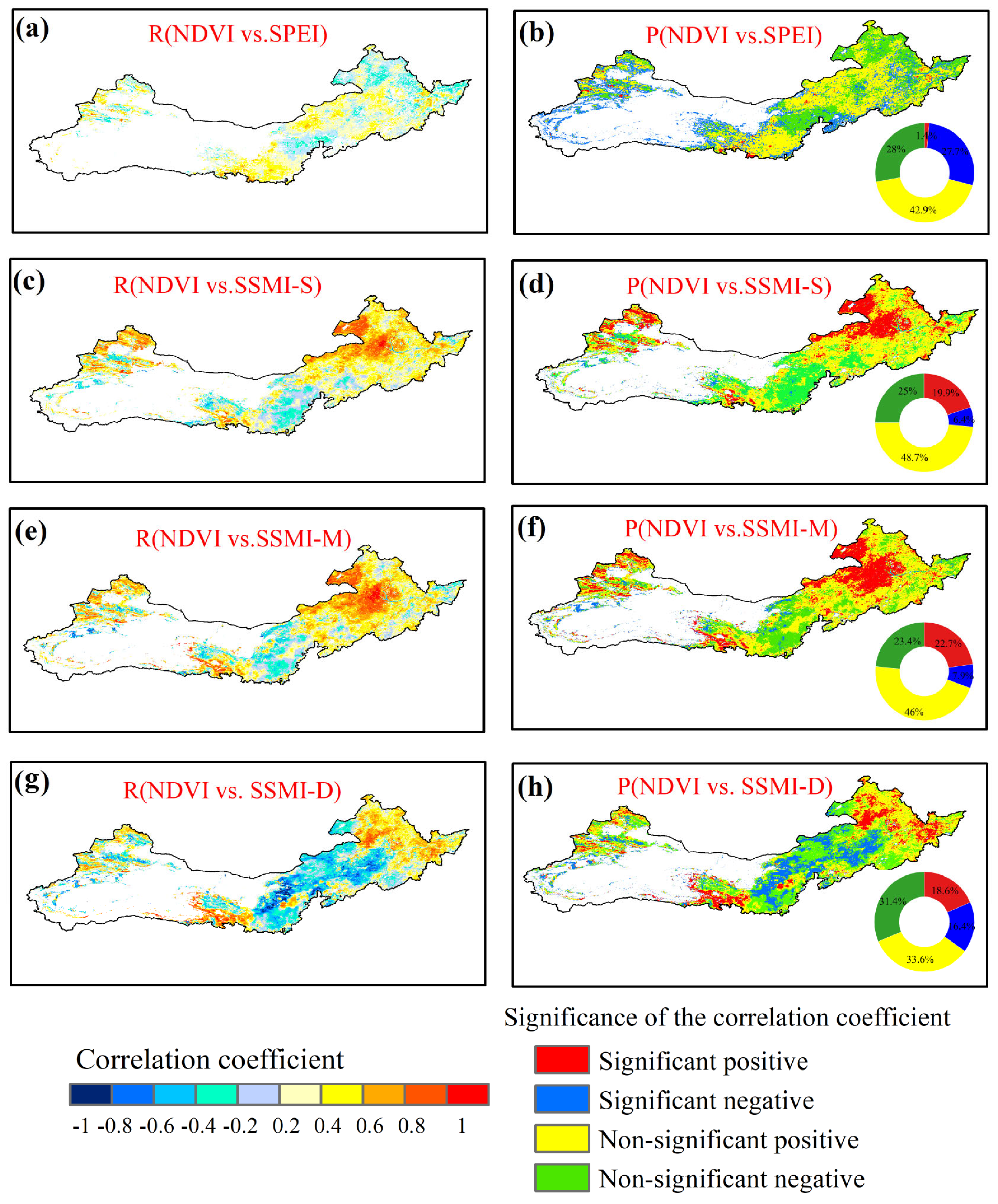
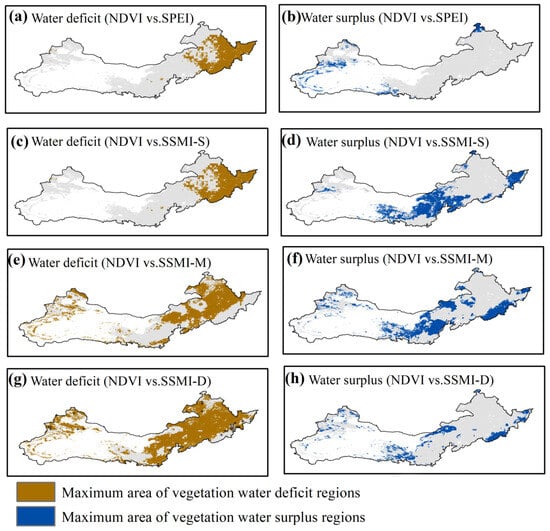
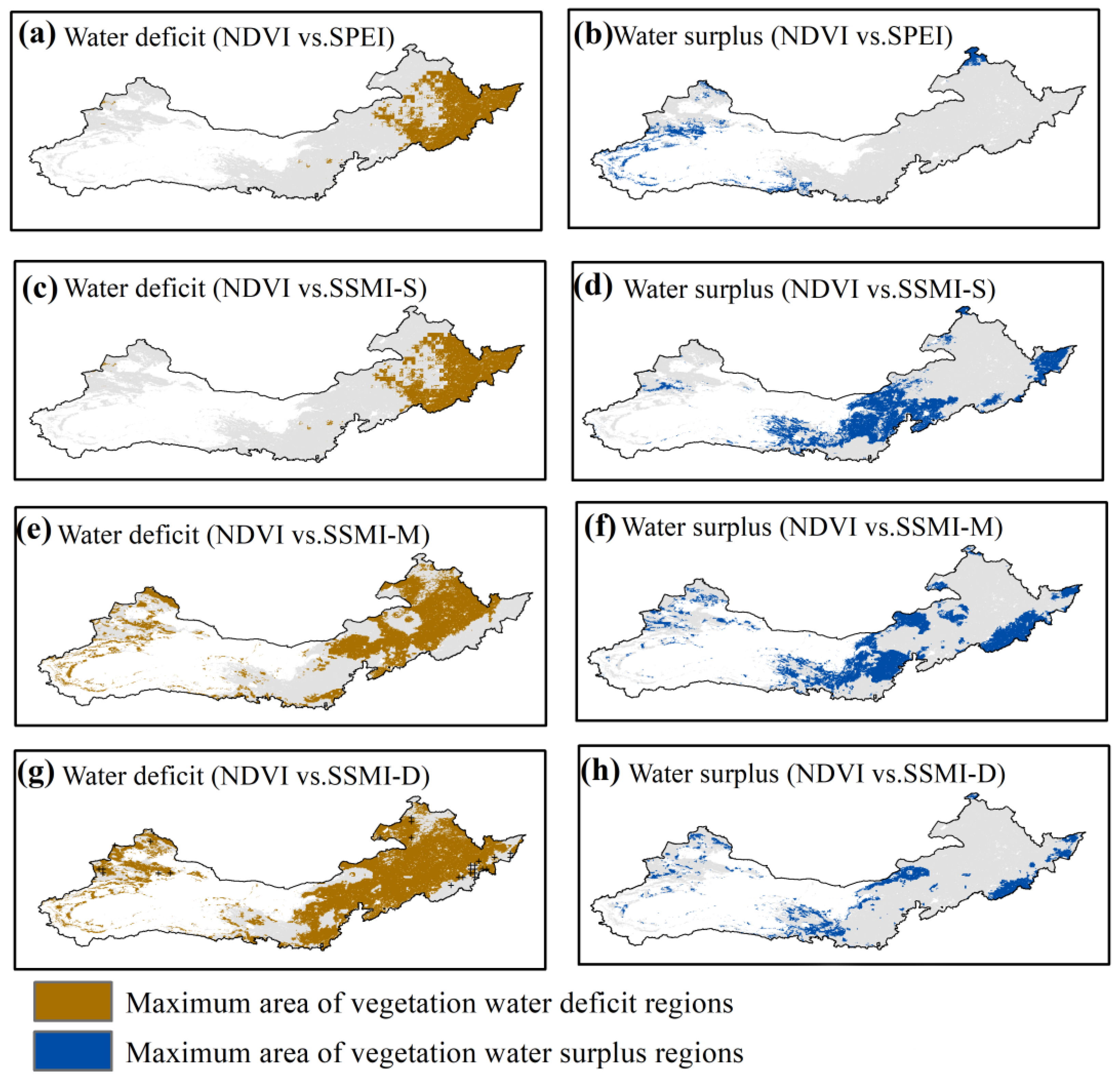
The average spatial correlations between the standard NDVI and water availability indices with 3-month scales from 2001 to 2022 were quantified and are presented in Figure 2. Figure 3 shows the maximum areas associated with the vegetation water deficit response and water surplus response at least one timescale of the four water availability indices at a 1–24-month timescale. Generally, NDVI exhibited more significant positive correlations with SSMI-S, SSMI-M, and SSMI-D, while showing more significant negative correlations with SPEI. This indicates that vegetation growth tended to be limited by soil water deficit in three soil layers and meteorological water surplus.
Figure 2.
Spatial distribution of correlation coefficients between standard NDVI and water availability indices (a,c,e,g) and the significance (b,d,f,h) during 2001–2022 in TNSFP region.
Figure 3.
Maximum area composite of significant positive correlation (water deficit response, (a,c,e,g), brown color) and significant negative correlation (water surplus response, (b,d,f,h), blue color) between NDVI and water availability indices from 1- to 24-month timescales.
The areas with significant positive correlations between NDVI and SSMI-S, SSMI-M, and SSMI-D were observed in the eastern and northwestern regions, including the Great Khingan, Hunshadake Sandy Land, Khorchin Sandy Land, and Altai Mountains—referred to as “vegetation water deficit regions”. The maximum area of vegetation water deficit regions associated with SSMI-S, SSMI-M, and SSMI-D covered 33.34%, 46.41%, and 67.88% of the TNSFP region, respectively, which were greater than the maximum areas associated with water surplus of 12.82%, 11.52%, and 10.81%. The significant negative correlations of R(NDVI vs. SPEI) were mainly patchy, distributed in Hulun Buir sandy land, the western Changbai Mountains, which are referred to as “vegetation water surplus regions”. From 2001 to 2022, the maximum area of the TNSFP region that experienced a water surplus response to SPEI reached 37.35%, which was greater than the experienced water deficit of 26.24%.
The correlation coefficients among the three land use types were roughly the same, but the area percentages of significant correlation were quite different (Figure S1). For the correlation between NDVI and SPEI, forest had the largest area of significant positive correlation at 2.47%, and cropland had the largest area of significant negative correlation at 34.26%. For the correlations between NDVI and both SSMI-S and SSMI-M, the largest areas of significant positive correlation were observed in grassland at 23.31% and 27.03%, respectively. Also, the areas of significant negative correlation for grassland were 6.96% and 8.59%, respectively, which were the largest. The largest area percentages of significant positive and negative correlation for NDVI and SSMI-D were found in forest and grassland at 19.03% and 26.08%, respectively.
In addition, we also employed the standard GPP as a vegetation index to analyze the correlations between vegetation and water availability. The spatial distribution of correlations between GPP and water availability indices displayed similar patterns as the NDVI (Figure S3), except that more significant positive and negative correlations were observed (Figure S4). Meanwhile, among the different land use types, the greatest areas of significant positive correlation between NDVI and SSMI-S, SSMI-M, and SSMI-D were observed in cropland at 21.90%, 29.18%, and 25.29%, respectively.
3.2. Temporal Variations in Correlations Between Vegetation and Water Availability
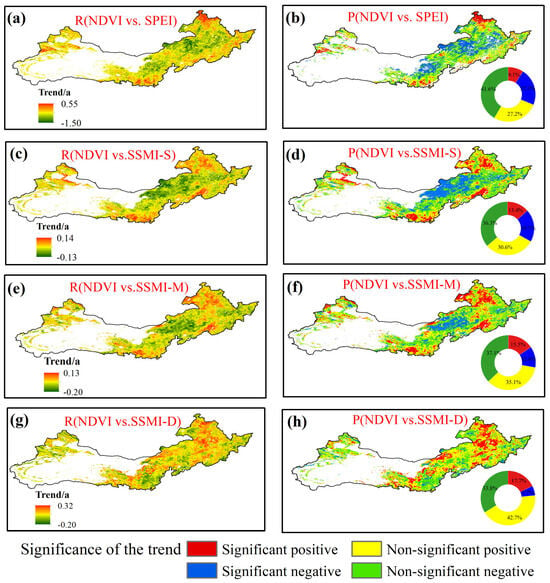
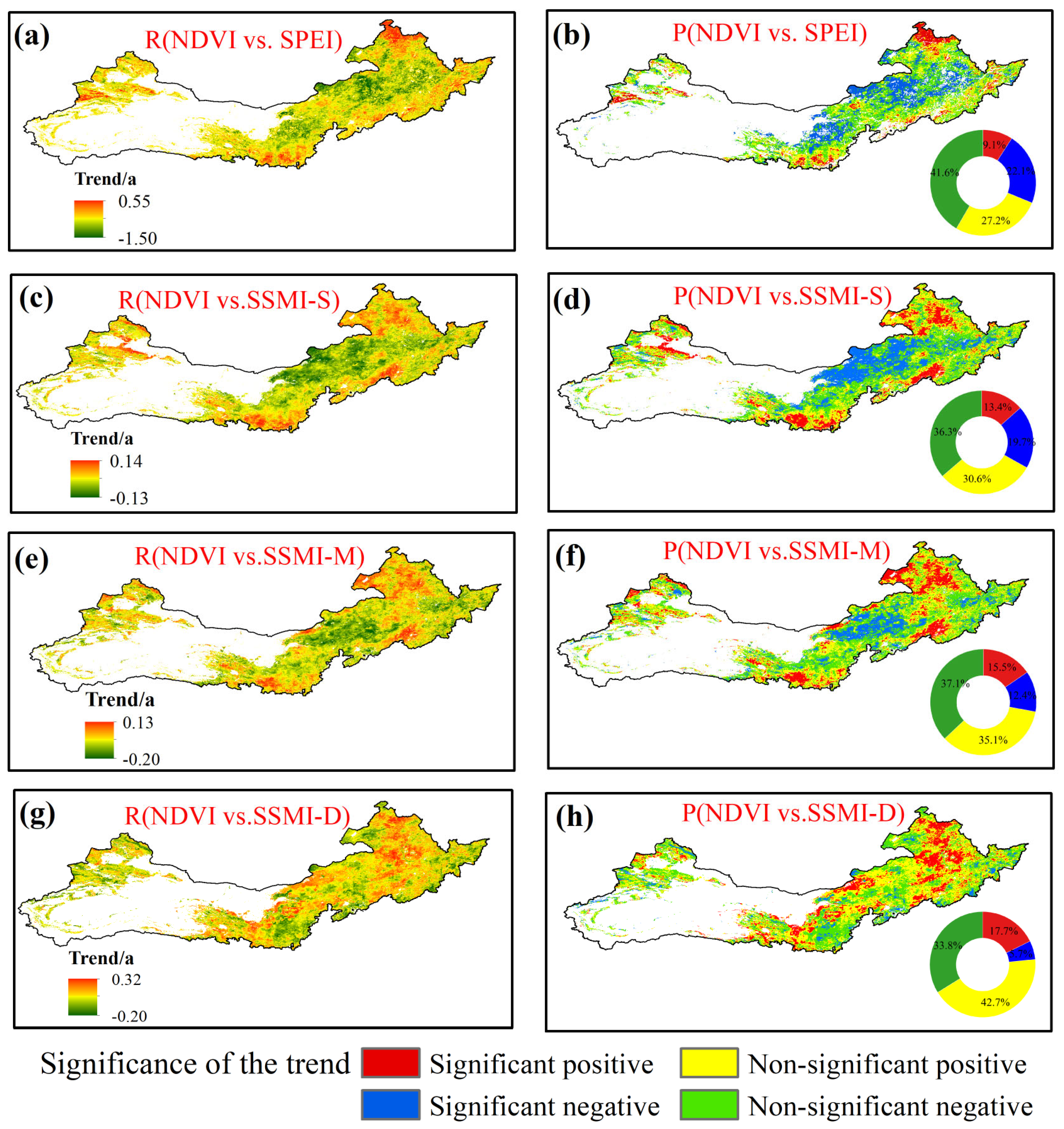
Generally, the TNSFP region displayed weak downward trends in the correlation coefficients of R(NDVI vs. SPEI) and R(NDVI vs. SSMI-S), whereas R(NDVI vs. SSMI-M) and R(NDVI vs. SSMI-D) exhibited weak upward trends (Figure 4). This indicated that the influence of water constraint from meteorology and soil moisture at shallow depth was weakened, but from soil moisture at middle and deep depths was intensified. Specifically, significant decreasing trends in the correlations of R(NDVI vs. SPEI) and R(NDVI vs. SSMI-S) covered 22.05% and 19.71% of the TNSFP region, which were observed in the Khorchin sandy land, Hunshadake sandy land, and Mu Us sandy land. Among these, 5.16% and 6.24%, 25.82% and 24.47%, and 19.12% and 11.41% of forest, grassland, and cropland, respectively, showed the decreasing trends for R(NDVI vs. SPEI) and R(NDVI vs. SSMI-S). Significant increasing trends in the correlations of R(NDVI vs. SSMI-M) and R(NDVI vs. SSMI-D) were identified in eastern areas, covering 15.46% and 17.70% of the region, respectively. Among these, 16.90% and 12.63%, 7.33% and 11.76%, and 10.72% and 18.45% of forest, grassland, and cropland, respectively, showed the increasing trends for R(NDVI vs. SSMI-M) and R(NDVI vs. SSMI-D). The trends in correlation between GPP and water availability indices showed similar pattern as NDVI (Figure S5), while the areas of trend significance among land use types were different.
Figure 4.
Trends in correlation coefficients between NDVI and water availability indices (a,c,e,g) and the significance of the trends (b,d,f,h) from 2001 to 2022 in the TNSFP region.
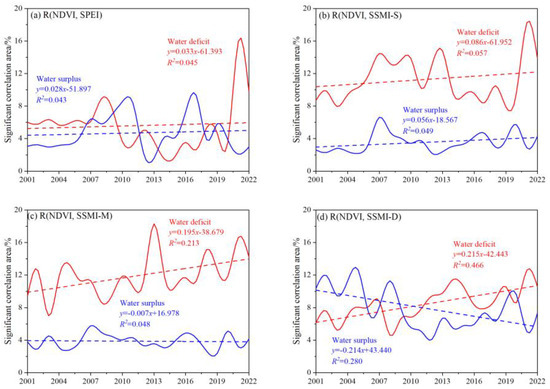
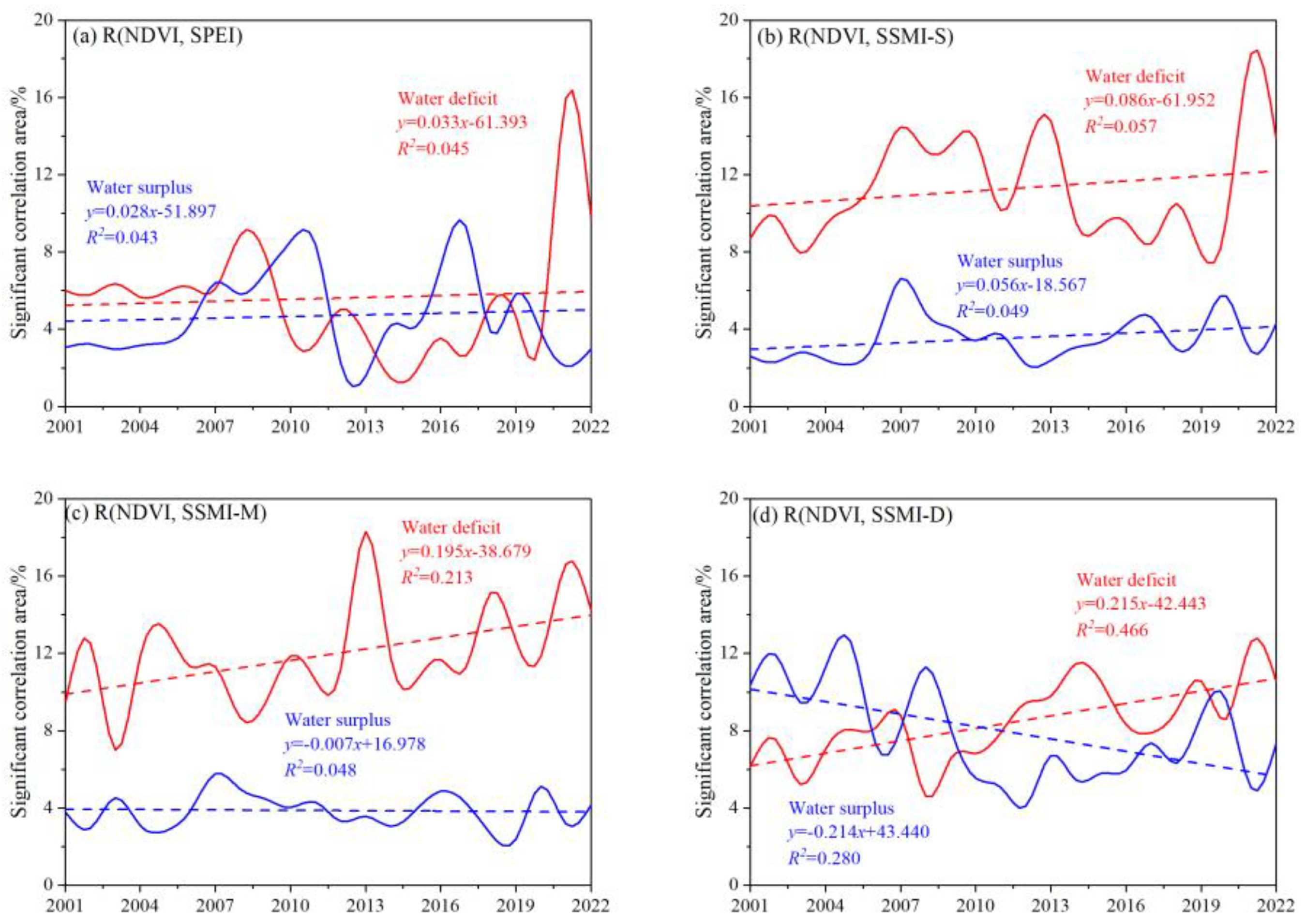
Figure 5 shows the temporal trends of significant changes in percentage areas associated with water deficit and water surplus responses based on different correlations between NDVI and four water availability indices from 2001 to 2022. It is found that areas associated with water deficit in the R(NDVI vs. SPEI) and R(NDVI vs. SSMI-S) showed a downward trend, with annual rates of 0.11% and 0.12%, respectively. However, the area associated with water deficit in R(NDVI vs. SSMI-M) and R(NDVI vs. SSMI-D) increased by 0.11% and 0.19% per year, respectively. The water deficit area based on correlations between GPP and four drought indices exhibited upward trends at an annual rate of 0.03%, 0.09%, 0.20%, and 0.22%, respectively (Figure S6). For both NDVI and GPP, the areas restricted by excess precipitation and soil water at shallow depth exhibited upward trends, whereas there were downward trends by excess soil water at middle- and deep-soil layers.
Figure 5.
Temporal trends of significant correlation areas associated with water deficit and water surplus responses between NDVI and water availability indices from 2001 to 2022.
3.3. Vegetation Response Time to Water Availability
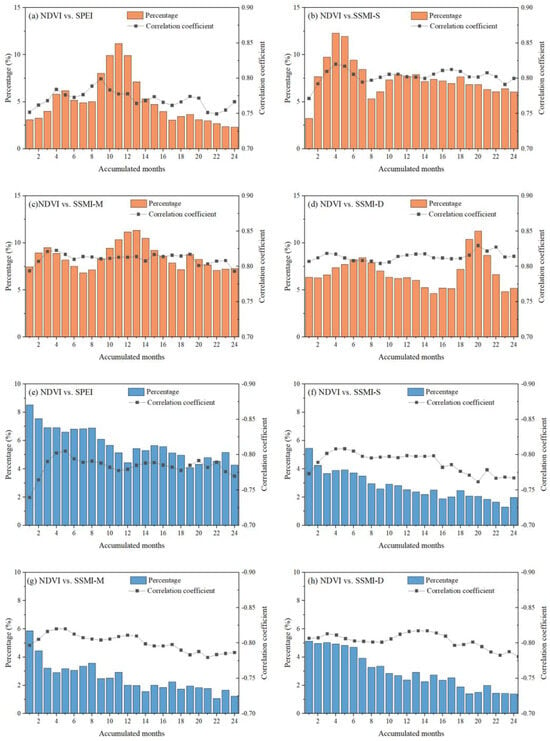
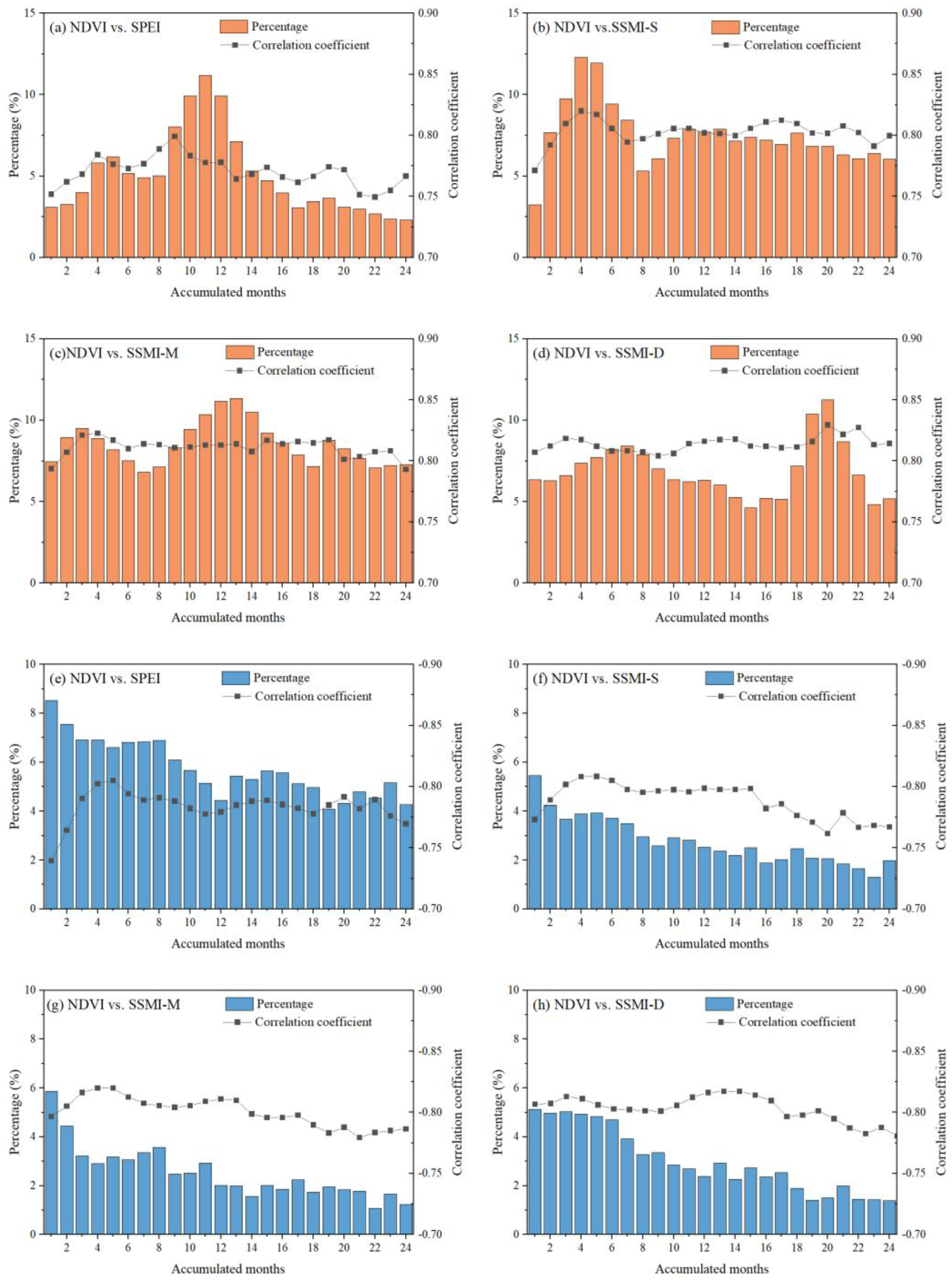
The water deficit response time and water surplus period based on the statistically significant correlations between NDVI and water availability indices at the 1–24 month timescales were evaluated, as shown in Figure 6. The correlation coefficient for both the water deficit and water surplus regions initially exhibited upward trends and then remained essentially unchanged. The peak of water deficit area percentage associated with correlations between NDVI and SPEI, SSMI-S, SSMI-M, and SSMI-D was reached at the 11th month, 4th month, 13th month, and 20th month, respectively. The area percentage of water surplus for all four correlations occurred at 1 month and then decreased gradually.
Figure 6.
The area percentage of NDVI response to water availability indices and the maximum value of correlation coefficients at the 1–24 cumulative months timescale.
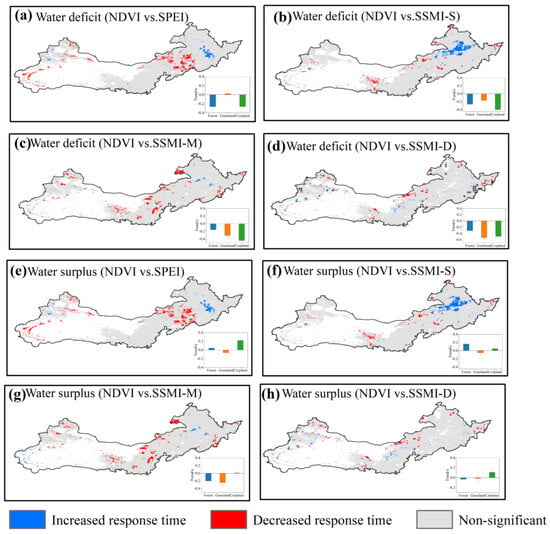
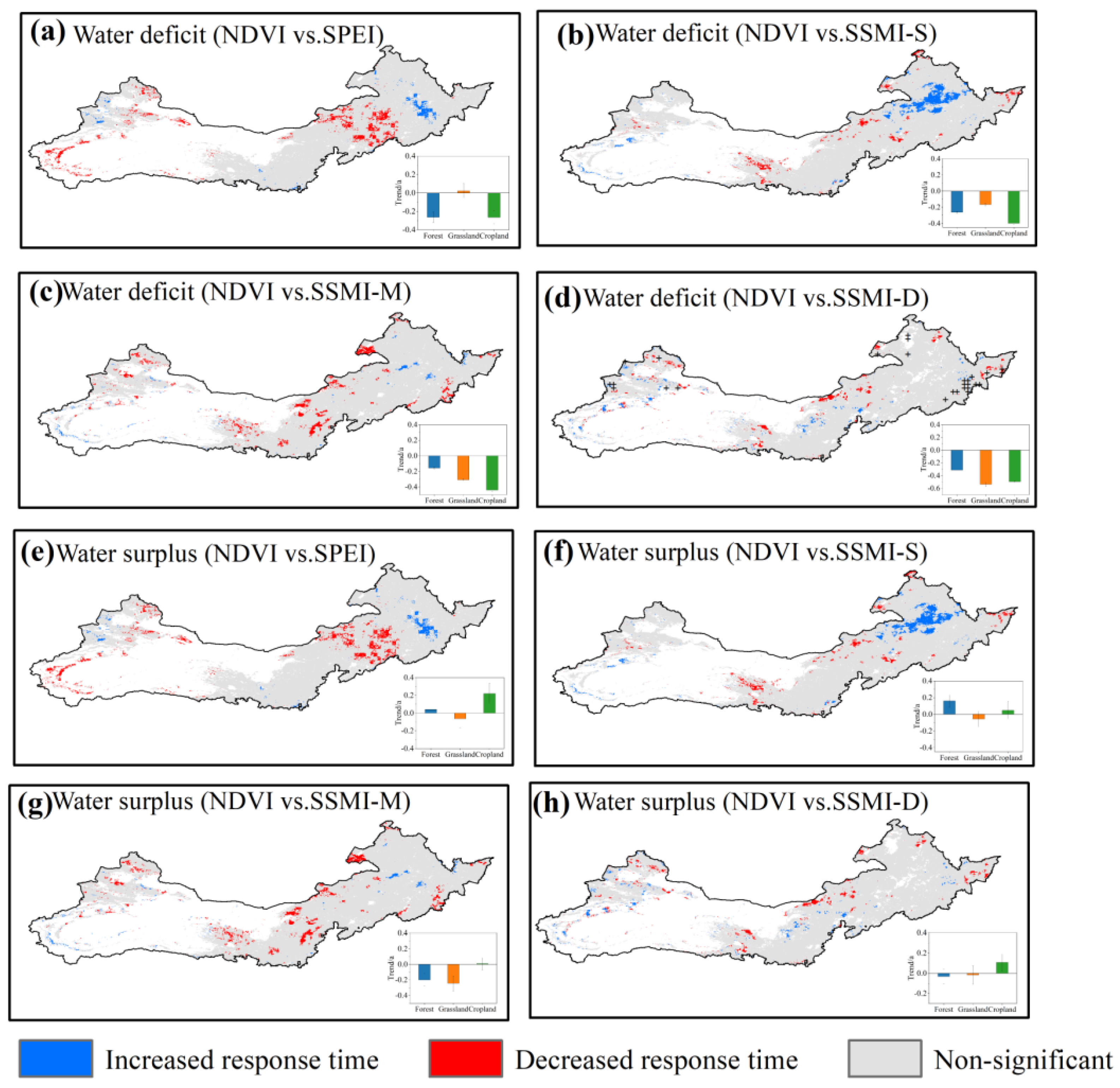
Figure 7 shows the area associated with change of vegetation response time to water deficit and surplus. It is found that about 1.59%, 0.69%, 1.11%, and 0.49% of the TNSFP region showed a significant increase in minimum water deficit response time to SPEI, SSMI-S, SSMI-M, and SSMI-D, respectively, and more areas of about 2.87%, 5.64%, 4.80%, and 13.85% showed a significant decrease. This indicated an overall expansion of regions with decreased water deficit response time. Similarly, more areas with 5.42%, 4.56%, 5.09%, and 2.89% showed a significant decreased water surplus period to SPEI, SSMI-S, SSMI-M, and SSMI-D, respectively, while only 1.74%, 2.54%, 1.05%, and 1.71% of the region showed a significant increased period, indicating an expansion of regions with decreased water surplus periods.
Figure 7.
The area associate with changed response time to water deficit (a–d) and water surplus (e–h) based on correlations between NDVI and water availability indices from 2001 to 2022.
Except for the response time to SPEI in grassland, the minimum water deficit response time to all four indices including SPEI, SSMI-S, SSMI-M, and SSMI-D for three land use types showed decreasing trends. Cropland exhibited decreasing trends in the maximum water surplus period to all four water availability indices, while grassland showed increasing trends. Forest showed upward trends in the water surplus period to SPEI and SSMI-S, but it showed downward trends to SSMI-M and SSMI-D.
3.4. Attribution of Meteorological Factors to Vegetation–Water Availability Relationship
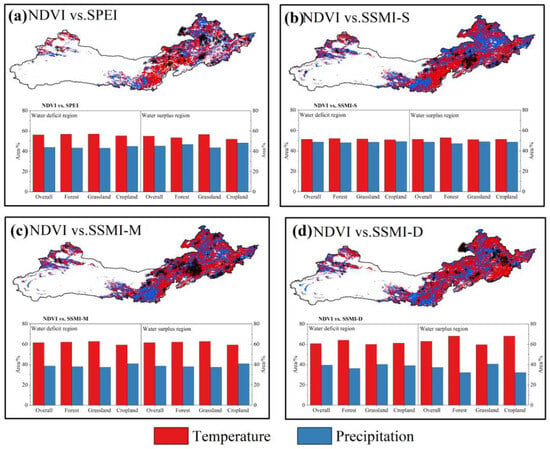
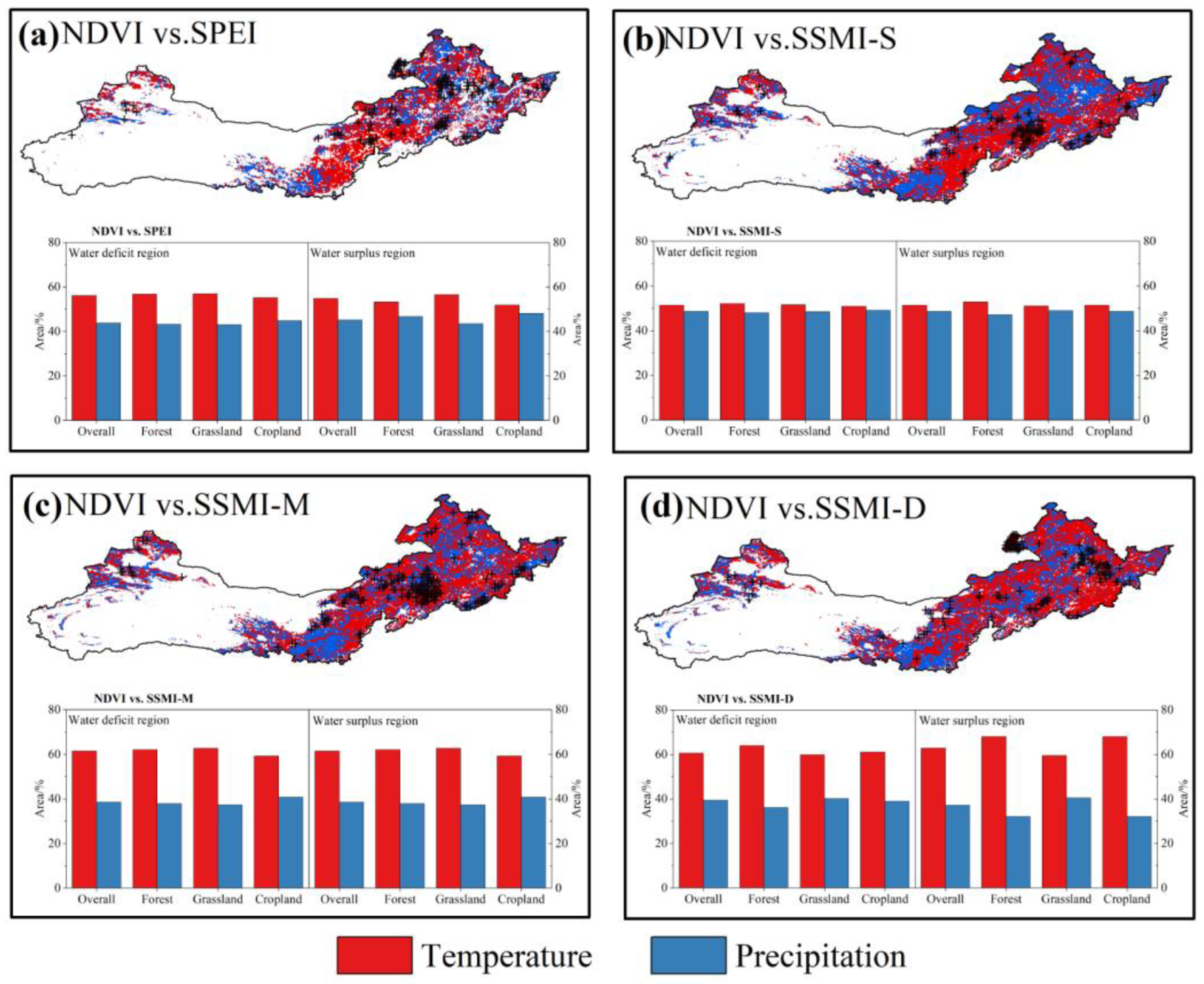
Figure 8 illustrates the spatial distribution of the dominant meteorological factor (air temperature or precipitation) for the correlation between NDVI and water availability indices in both water deficit and water surplus regions. For both water deficit and water surplus regions across different land use types, the contribution of air temperature to the correlation between NDVI and water availability indices was generally higher than that of precipitation. The air temperature played a dominant role in about 65–75% of the areas across different land use types, while precipitation was dominant in only 25–35% of the areas. Compared with SSMI-S, the differences between temperature and precipitation were greater for response of NDVI to SSMI-M and SSMI-D, indicating the precipitation became less important with increase in soil depth. Similarly, the dominant influencing factor was temperature for the most correlation between GPP and water availability in water constraint regions, expect for the GPP–SPEI relationship in water surplus regions (Figure S8).
Figure 8.
The spatial distribution of the dominant meteorological factor influencing the correlation between NDVI and water availability indices and the areas associated with water deficit and water surplus can be explained by temperature and precipitation. Note: the cross presents the grid value past a significance of less than 0.05.
4. Discussion
4.1. Spatial Patterns and Temporal Trends of Vegetation Response to Water Constraints
This study revealed the differential responses of vegetation to atmospheric water (represented by SPEI) and soil moisture constraints in three soil layers (represented by SSMI-S, SSMI-M, and SSMI-D) in the TNSFP region. Our results demonstrated that vegetation growth in this region was not governed by a single type of water constraint but was predominantly constrained by soil moisture deficit across all three soil layers and meteorological water surplus in specific regions. The maximum area with a significant negative correlation between NDVI and SPEI (water surplus response) accounted for 37.35% of the region, surpassing the area of 26.24% with significant positive correlations (water deficit response). This finding aligned with Lai et al. [8], who emphasized the significance of water surplus in the Northern Hemisphere. Excessive atmospheric moisture can induce soil waterlogging, which inhibits vegetation growth due to oxygen deficiency caused by water saturation [10,31].
In natural dryland ecosystems, vegetation adapts primarily to atmospheric aridity and shallow-soil moisture dynamics, and the deep-soil water (if accessible) serves as a critical buffer during prolonged droughts [22]. In contrast, the significant positive correlation between vegetation and soil water availability (water deficit response) strengthened as soil depth increased (Figure 3). This pattern was consistent with previous studies, highlighting that extensive afforestation in the TNSFP region consumed substantial deep-soil moisture [32]. Although shallow-soil moisture served as an immediate water source for plant growth, it was highly susceptible to being replenished by precipitation. In contrast, deep-soil water is relatively insensitive to environmental changes and functions as a “soil reservoir” [33]. Following the implementation of revegetation, the introduced forest species, such as Robinia pseudoacacia or Pinus tabuliformis, and shrub species, including Caragana microphylla, have developed extensive root systems, which reached depths exceeding 1000 cm and consume a significant amount of water [34].
Response to water constraints largely depended on difference in the types of vegetation [17]. Grasslands exhibited the largest areas of significant positive and negative correlation with shallow- and middle-soil moisture (represented by SSMI-S and SSMI-M) (Figure 2). The root systems of grassland are concentrated in the shallow-soil layer, responding to soil moisture fluctuations in the shallow layers faster than forests, so water deficit/surplus has the greatest impact on biomass accumulation [35]. In contrast, forests showed the highest proportion of significant positive correlation with deep-soil moisture (SSMI-D, 19.03%), consistent with their deep root systems. However, forests also displayed a relatively large area of significant negative correlation with SPEI, suggesting greater vulnerability to atmospheric water surplus [36]. Croplands exhibited the strongest negative correlation with SPEI (34.26%), which might be attributed to concentrated summer precipitation combined with irrigation, resulting in crop root rot diseases and decrease in GPP [9].
From 2001 to 2022, correlations between vegetation and both SPEI and SSMI-S, as well as the extent of water deficit areas, showed decreasing trends, particularly in eastern sandy lands (Figure 4 and Figure 5). This suggested reduced sensitivity to meteorological and shallow-soil drought in these regions. It was reported that the annual precipitation in the eastern sandy lands had increased [37]. For example, the average annual precipitation displayed an upward trend of 4.73 mm/year in Mu Us sandy land during the past 20 years [38]. Liu et al. [39] found that the surface SM in Hulunbuir, Otindag, Horqin, and Mu Us sandy land generally increased from 2003 to 2016, which increased significantly in Horqin sandy land (84% anomaly > 1.4 × 10⁻² cm3/cm3). Moreover, the improvement of vegetation quality was found in approximately 80% of the area of the TNSF region, at a rate of 0–52 g C m−2/year between 2000 and 2021. In general, vegetation improvement has lower surface albedo than barren land, primarily because vegetation absorbs solar radiation and provides diffuse reflection [40]. For example, the surface albedo showed a downward trend of −0.0004 yr−1 on the Loess Plateau during 2003–2018 due to vegetation restoration [41]. This reduced albedo and elevated canopy roughness promoted vegetation transpiration through increasing root water uptake capacity and leaf stomatal conductance, leading to higher evapotranspiration [42]. In turn, increases in evapotranspiration enhance water vapor content of the atmosphere and contribute to the formation of more precipitation [43].
Among vegetation types, grasslands showed the largest decreasing trend areas for SPEI and SSMI-S (25.82% and 24.47%), reflecting their high adaptability to improved shallow moisture [8]. Conversely, correlations with middle- and deep-soil water constraints (represented by SSMI-M and SSMI-D) strengthened, indicating tighter coupling between vegetation growth and deeper-soil water under persistent water stress. This pattern was particularly evident in the Loess Plateau, where artificial forests exhibited annual evapotranspiration exceeding precipitation, leading to deep moisture depletion since 2001 [44]. Climate warming generally intensified the atmospheric vapor pressure deficit (VPD), enhancing vegetation water uptake from deep layers [45]. It is noteworthy that GPP showed similar patterns of the relationship with water availability but more significant correlations than NDVI (Figure S3), and all water deficit areas increased from 2001 to 2022 (Figures S4 and S5). This reflected the combined effects of vegetation greenness and light utilization efficiency on photosynthesis capacity, with GPP being more responsive to water stress than greenness alone [9].
4.2. Vegetation Response Time to Water Constraints
Vegetation responded to water constraints with significant time lags, reflecting the cumulative nature of hydrological processes and plant physiological adaptation [19]. As shown in Figure 6, vegetation response time to water deficit increased with soil depth. Shallow-soil moisture, recharged by seasonal precipitation, supported rapid responses aligned with herbaceous growing seasons [35], while deep-soil moisture induced lagged and prolonged responses critical for artificial forest survival during droughts [46]. For water surplus, all indices peaked in response at 1 month. This was because most vegetation in the TNSFP region that was intolerant to waterlogging experienced a significant decline in photosynthetic capacity within 1–2 months after waterlogging occurred [26].
From 2001 to 2022, the area showing a decrease in the minimum water deficit response time for all four indices (SPEI, SSMI-S, SSMI-M, SSMI-D) exceeded the area showing an increase (Figure 7). This acceleration indicated enhancement of vegetation sensitivity to water shortage and a narrowing tolerance window [6,9]. Rising temperature induced increased transpiration, water demand, and productivity loss, triggering a more rapid response to water deficit [47]. Similarly, the arid grassland ecosystems of Central Asia are expected to release more water as the climate warms, leading to greater water scarcity and more severe droughts [48]. On the other hand, as historical water scarcity in some areas and development of drought-adapted characteristics appeared, the response time of vegetation to water deficit was extended [49]. Yu et al. [50] found that absorbing excess water during water surplus periods and releasing it during water scarcity periods may be a key manifestation of the resilience mechanisms evolved by vegetation, soil, and geological conditions in endorheic basins of Central Asia under long-term climate changes. Concurrently, the maximum water surplus period decreases by 2.89–5.42% across the four water availability indices, which is greater than the area with increasing trends (Figure 7). The shortened surplus period can reduce the duration of waterlogging stress, improve soil aeration, and thereby enhance productivity [9]. This pattern of shorter water deficit response time and water surplus suggests that vegetation growth in the TNSFP region became increasingly limited by water deficit but decreasingly constrained by water surplus in 2001–2022 [6].
4.3. Attribution of Climatic Factors
Temperature played a more dominant role than precipitation in driving the vegetation–water availability relationship (Figure 8). Under global warming, rising temperatures accelerated soil moisture depletion and boosted vegetation water demand by elevating VPD [47]. Temperature also modulated plant physiology [51]. Increasing temperature under water deficit conditions reduced stomatal conductance and further limited photosynthesis [52]. In addition, increases in temperature could extend the growing season, resulting in an increase in total vegetation water consumption [53]. The influence of precipitation further diminished with increasing soil depth. This explained 30–35% of the correlation between the NDVI and SSMI-S, primarily through direct precipitation infiltration and shallow-soil recharge. In contrast, precipitation explained only 25–30% of the correlation between NDVI and SSMI-D, as deep-soil moisture replenishment relies more on indirect pathways such as groundwater recharge or lateral subsurface flow [54].
4.4. Implications and Limitations
Our findings enhance the understanding of vegetation–water coupling in the TNSFP region and support sustainable ecological management strategies under climate change. Ecological restoration should transition from a singular focus on vegetation greening toward water-adaptive management [55]. In areas dominated by water deficit, priority should be given to drought-resistant plant species with high water use efficiency, and the planting density should be arranged according to the local water carrying capacity. Soil management should focus on enhancing infiltration (e.g., contour terracing) and reducing evaporation (e.g., straw mulching) to maximize limited precipitation recharge. Especially for areas with a soil moisture deficit (e.g., Loess Plateau, eastern sandy lands), to prevent the formation and exacerbation of the soil dry layer [25], it is critical to conserve shallow- and middle-soil water while monitoring the dynamics of deep-soil water consumption. In water surplus areas, improving drainage and selecting waterlogging-tolerant species are essential. In addition, improved soil permeability and soil aeration could alleviate hypoxic stress on plant. Moreover, the observed shortening of vegetation response times indicated that climate change was compressing the response and recovery windows of ecosystems. Future ecological project planning and management requires enhanced dynamic adaptability to address the water stress risks.
While this study provides a comprehensive assessment of vegetation responses to water constraints in the TNSFP region, several limitations should be acknowledged. Firstly, this study employed SPEI and SSMI as water availability indicators. However, water availability for vegetation is also influenced by factors not fully captured by these indices, such as groundwater depth, topographic redistribution of water, and plant-specific hydraulic traits. Secondly, the interactive effects of multiple factors (e.g., climate warming, CO2 fertilization, and land use change) on vegetation–water dynamics are not fully disentangled, limiting the understanding of comprehensive driving mechanisms. Correspondingly, future research could focus on combining high-resolution remote sensing and ground-based observation networks to build a multi-scale, long-term dataset, improving the spatial–temporal precision of vegetation and water dynamic monitoring.
5. Conclusions
This study systematically explored the spatiotemporal dynamics and mechanisms underlying vegetation responses to water constraints in China’s TNSFP region from 2001 to 2022. Based on four key water availability indices (SPEI, SSMI-S, SSMI-M, SSMI-D) and vegetation indicators (NDVI and GPP), the main findings are summarized as follow: (1) Vegetation growth in the TNSFP region was constrained by a compound water limitation pattern, characterized by the coexistence of soil moisture deficit and atmospheric water surplus. Specifically, atmospheric water surplus affects 37.35% of the region, exceeding the 26.24% of area impacted by water deficit, particularly in cropland. Concurrently, soil moisture deficit in the middle and deep layers (28–289 cm) emerged as the primary constraint. (2) Temporal trends from 2001 to 2022 revealed that the correlation between vegetation and atmospheric and shallow-soil moisture significantly weakened, while the coupling with middle- and deep-soil moisture intensified. (3) Vegetation response times to water deficit and water surplus tended to be shortened, indicating vegetation growth in the TNSFP region became increasingly limited by water deficit, yet decreasingly constrained by a water surplus from 2001 to 2022. (4) Between the two key climatic factors, air temperature has exerted a stronger influence than precipitation on vegetation–water relationships over the study period.
Supplementary Materials
The following supporting information can be downloaded at: https://www.mdpi.com/article/10.3390/land15010122/s1. Figure S1. The correlation coefficients and significant area percentage between standard NDVI with SPEI (a,c), SSMI-S (b,f), SSMI-M (c,g), and SSMI-D (d,h) during 2001–2022 in the TNSFP region; Figure S2. Spatial distribution of correlation coefficients between standard GPP and water availability indices (a–d) and the significance (e–h) during 2001–2022 in the TNSFP region; Figure S3. Maximum area composite of significant positive correlation (water deficit response, (a–d), brown color) and significant negative correlation (water surplus response, (e–h), blue color) between GPP and water availability indices from 1- to 24-month timescales; Figure S4. Trends in correlation coefficients between GPP and water availability indices (a–d) and the significance of the trends (e–h) from 2001 to 2022 in the TNSFP region; Figure S5. Temporal trends of significant correlation areas associated with water deficit and water surplus responses between GPP and water availability indices from 2001 to 2022; Figure S6. The area percentage of GPP response to water availability indices and the maximum value of correlation coefficients at the 1–24 cumulative months timescale; Figure S7. The areas associated with changed response time to water deficit (a–d) and water surplus (e–h) based on correlations between GPP and water availability indices from 2001 to 2022; Figure S8. The spatial distribution of the dominant meteorological factor influencing the correlation between GPP and water availability indices and the areas associated with water deficit and water surplus can be explained by temperature and precipitation. Note: the cross presents the grid value past the significance of less than 0.05.
Author Contributions
Conceptualization, methodology, R.W.; methodology, H.Z.; software, E.H.; writing—original draft preparation, L.Y.; writing—review and editing, R.W. All authors have read and agreed to the published version of the manuscript.
Funding
This study was funded by the Inner Mongolia Academy of Forestry Sciences Open Research Project, Hohhot 010010, China (Project No. KF2024ZD04, KF2025ZD07), National Natural Science Foundation of China (No. 41807061), Natural Science Basic Research Program of Shaanxi (Program No. 2023-JC-QN-0301), and Inner Mongolia Autonomous Region Natural Science Foundation Project (No. 2024LHMS03026).
Data Availability Statement
The original contributions presented in the study are included in the article/Supplementary Materials; further inquiries can be directed to the corresponding author.
Conflicts of Interest
The authors declare no conflicts of interest.
References
- Porporato, A.; D’odorico, P.; Laio, F.; Ridolfi, L.; Rodriguez-Iturbe, I. Ecohydrology of water-controlled ecosystems. Adv. Water Resour. 2002, 25, 1335–1348. [Google Scholar] [CrossRef] [Scilit]
- Novick, K.A.; Ficklin, D.L.; Stoy, P.C.; Williams, C.A.; Bohrer, G.; Oishi, A.C.; Papuga, S.A.; Blanken, P.D.; Noormets, A.; Sulman, B.N.; et al. The increasing importance of atmospheric demand for ecosystem water and carbon fluxes. Nat. Clim. Change 2016, 6, 1023–1027. [Google Scholar] [CrossRef] [Scilit]
- Huang, J.; Yu, H.; Guan, X.; Wang, G.; Guo, R. Accelerated dryland expansion under climate change. Nat. Clim. Change 2016, 6, 166–171. [Google Scholar] [CrossRef] [Scilit]
- Zhou, S.; Williams, A.P.; Lintner, B.R.; Berg, A.M.; Zhang, Y.; Keenan, T.F.; Cook, B.I.; Hagemann, S.; Seneviratne, S.I.; Gentine, P. Soil moisture–atmosphere feedbacks mitigate declining water availability in drylands. Nat. Clim. Change 2021, 11, 38–44. [Google Scholar] [CrossRef] [Scilit]
- Wu, D.; Zhao, X.; Liang, S.; Zhou, T.; Huang, K.; Tang, B.; Zhao, W. Time-lag effects of global vegetation responses to climate change. Glob. Change Biol. 2015, 21, 3520–3531. [Google Scholar] [CrossRef] [Scilit]
- Jiao, W.; Wang, L.; Smith, W.K.; Chang, Q.; Wang, H.; D’Odorico, P. Observed increasing water constraint on vegetation growth over the last three decades. Nat. Commun. 2021, 12, 3777. [Google Scholar] [CrossRef] [Scilit]
- Konapala, G.; Mishra, A.K.; Wada, Y.; Mann, M.E. Climate change will affect global water availability through compounding changes in seasonal precipitation and evaporation. Nat. Commun. 2020, 11, 3044. [Google Scholar] [CrossRef] [Scilit]
- Lai, C.; Sun, H.; Wu, X.; Li, J.; Wang, Z.; Tong, H.; Feng, J. Water availability may not constrain vegetation growth in northern hemisphere. Agric. Water Manag. 2024, 291, 108649. [Google Scholar] [CrossRef] [Scilit]
- Sun, H.; Cheng, Y.; Liu, L.; An, Q.; Zhang, H. Water deficit is increasingly limiting vegetation productivity in China. Ecol. Indic. 2025, 177, 113775. [Google Scholar] [CrossRef] [Scilit]
- Rajendran, A.; Ramlal, A.; Harika, A.; Subramaniam, S.; Raju, D.; Lal, S.K. Waterlogging stress mechanism and membrane transporters in soybean (Glycine max (L.) Merr.). Plant Physiol. Biochem. 2025, 220, 109579. [Google Scholar] [CrossRef] [Scilit]
- Cui, S.; Gao, J.; Sun, F.; Li, G.; Che, Y. Comparison of Vegetation Responses to Diverse Water Sources in the Yangtze River Basin: Insights from Meteorological, Hydrological, and Agricultural Drought. Ecol. Indic. 2025, 175, 113524. [Google Scholar] [CrossRef] [Scilit]
- Smith, T.; Boers, N. Global vegetation resilience linked to water availability and variability. Nat. Commun. 2023, 14, 498. [Google Scholar] [CrossRef] [Scilit]
- Das, P.K.; Chandra, S.; Das, D.K.; Midya, S.K.; Dadhwal, V.K. Understanding the Interactions between Meteorological and Soil Moisture Drought over Indian Region. J. Earth Syst. Sci. 2020, 129, 197. [Google Scholar] [CrossRef] [Scilit]
- Zhang, Y.; Wang, T. Soil moisture drives the spatiotemporal patterns of asymmetry in vegetation productivity responses across China. Sci. Total Environ. 2023, 855, 158819. [Google Scholar]
- He, L.; Guo, J.; Liu, X.; Yang, W.; Chen, L.; Jiang, Q. Exploring the multifaceted reason for deficits in soil water within different soil layers in China’s drylands. J. Environ. Manag. 2025, 373, 123634. [Google Scholar] [CrossRef] [Scilit]
- Afshar, M.H.; Bulut, B.; Duzenli, E.; Amjad, M.; Yilmaz, M.T. Global spatiotemporal consistency between meteorological and soil moisture drought indices. Agric. For. Meteorol. 2022, 316, 108848. [Google Scholar] [CrossRef] [Scilit]
- Li, Y.; Zhuang, Q.; Zhao, H.; Zhang, W.; Cai, P.; Zhang, Y.; Lv, J. Evaluation of the Resistance and Resilience of Terrestrial Ecosystems to Drought in Southwest China. J. Hydrol. 2025, 646, 132318. [Google Scholar] [CrossRef] [Scilit]
- Wen, Y.; Liu, X.; Xin, Q.; Wu, J.; Xu, X.; Pei, F. Cumulative effects of climatic factors on terrestrial vegetation growth. J. Geophys. Res. Biogeosci. 2019, 124, 789–806. [Google Scholar] [CrossRef] [Scilit]
- Yan, Y.; Wang, G.; An, Y.; Zhang, X.; Xue, B.; Wu, J. Spatiotemporal evolution of time-lagged vegetation responses to moisture conditions and the influencing factors in a highly human-impacted area in China. Ecol. Inform. 2025, 90, 103335. [Google Scholar] [CrossRef] [Scilit]
- Vicente-Serrano, S.M.; Beguería, S.; López-Moreno, J.I. A multiscalar drought index sensitive to global warming: The standardized precipitation evapotranspiration index. J. Clim. 2010, 23, 1696–1718. [Google Scholar] [CrossRef] [Scilit]
- Li, M.; Qin, Y.; Zhang, T.; Zhou, X.; Yi, G.; Bie, X. Climate change and anthropogenic activity co-driven vegetation coverage increase in the three-north shelter forest region of China. Remote Sens. 2023, 15, 6. [Google Scholar] [CrossRef] [Scilit]
- Chen, M.; Parton, W.; Hartman, M.; Del Grosso, S.; Smith, W.; Knapp, A.; Lutz, S.; Derner, J. Assessing precipitation, evapotranspiration, and NDVI as controls of US Great Plains plant production. Ecosphere 2019, 10, e02889. [Google Scholar] [CrossRef] [Scilit]
- Zhai, J.; Wang, L.; Liu, Y.; Wang, C.; Mao, X. Assessing the effects of China’s Three-North Shelter Forest Program over 40 years. Sci. Total Environ. 2023, 857, 159354. [Google Scholar] [CrossRef] [Scilit] [PubMed]
- Pang, J.; Xu, H.; Zhang, Q.; Zhang, Y.; Zhang, Z. Stand Characteristics Regulate Forest Water Use Efficiency in the Three-North Shelterbelt Forest Program Region of China. Environ. Res. Lett. 2024, 19, 114028. [Google Scholar] [CrossRef] [Scilit]
- Jia, X.; Luo, Y.; Shao, M. Soil moisture decline due to afforestation across the Loess Plateau, China. J. Hydrol. 2017, 546, 113–122. [Google Scholar] [CrossRef] [Scilit]
- Chen, H.S.; Shao, M.A.; Li, Y.Y. Soil desiccation in the Loess Plateau of China. Geoderma 2008, 143, 91–100. [Google Scholar] [CrossRef] [Scilit]
- Wei, X.; Huang, S.; Huang, Q.; Liu, D.; Leng, G. Analysis of Vegetation Vulnerability Dynamics and Driving Forces to Multiple Drought Stresses in a Changing Environment. Remote Sens. 2022, 14, 4231. [Google Scholar] [CrossRef] [Scilit]
- Tian, R.; Li, J.; Zheng, J.; Liu, L.; Han, W.; Liu, Y. Changes in vegetation phenology and its response to different layers of soil moisture in the dry zone of Central Asia, 1982–2022. J. Hydrol. 2025, 646, 132314. [Google Scholar] [CrossRef] [Scilit]
- Xu, H.; Shi, X.; Cheng, J.; Li, M. Sensitivity and vulnerability of vegetation to meteorological drought in Yunnan Province, southwest China. J. Environ. Manag. 2025, 382, 125444. [Google Scholar] [CrossRef] [Scilit]
- Kendall, M.G. Rank Correlation Measure; Charles Griffin: London, UK, 1975. [Google Scholar]
- Kreuzwieser, J.; Rennenberg, H. Molecular and physiological responses of trees to waterlogging stress. Plant Cell Environ. 2015, 37, 2245–2259. [Google Scholar] [CrossRef] [Scilit]
- Liang, H.; Xue, Y.; Li, Z.; Gao, G.; Liu, G. Afforestation may accelerate the depletion of deep soil moisture on the loess plateau: Evidence from a meta-analysis. Land Degrad. Dev. 2022, 33, 3829–3840. [Google Scholar] [CrossRef] [Scilit]
- Li, B.; Zhang, W.; Li, S. Severe depletion of available deep soil water induced by revegetation on the arid and semiarid Loess Plateau. For. Ecol. Manag. 2021, 491, 119156. [Google Scholar] [CrossRef] [Scilit]
- Gao, X.D.; Li, H.C.; Zhao, X.N.; Ma, W.; Wu, P.T. Identifying a suitable revegetation technique for soil restoration on water-limited and degraded land: Considering both deep soil moisture deficit and soil organic carbon sequestration. Geoderma 2018, 319, 61–69. [Google Scholar] [CrossRef] [Scilit]
- Wei, X.; He, W.; Zhou, Y.; Ju, W.; Xiao, J.; Li, X.; Liu, Y.; Xu, S.; Bi, W.; Zhang, X.; et al. Global assessment of lagged and cumulative effects of drought on grassland gross primary production. Ecol. Indic. 2022, 136, 108646. [Google Scholar] [CrossRef] [Scilit]
- Su, Y.; Yang, X.; Gentine, P. Observed strong atmospheric water constraints on forest photosynthesis using eddy covariance and satellite-based data across the Northern Hemisphere. Int. J. Appl. Earth Obs. Geoinform. 2022, 110, 102808. [Google Scholar] [CrossRef] [Scilit]
- Zhu, Y.; Li, J.; Xia, X. Spatial and temporal characteristics of drought in the Mu Us Sandy Land based on the Standardized Precipitation Index. Front. Environ. Sci. 2024, 12, 1349228. [Google Scholar] [CrossRef] [Scilit]
- Wang, X.; Song, J.; Xiao, Z.; Wang, J.; Hu, F. Desertification in the Mu Us Sandy Land in China: Response to climate change and human activity from 2000 to 2020. Geogr. Sustain. 2022, 3, 177–189. [Google Scholar] [CrossRef] [Scilit]
- Liu, X.; Lai, Q.; Yin, S.; Bao, Y.; Qing, S.; Mei, L.; Bu, L. Exploring sandy vegetation sensitivities to water storage in China’s arid and semi-arid regions. Ecol. Indic. 2022, 136, 108711. [Google Scholar] [CrossRef] [Scilit]
- Sterling, S.; Ducharne, A.; Polcher, J. The impact of global land-cover change on the terrestrial water cycle. Nat. Clim. Change 2013, 3, 385–390. [Google Scholar] [CrossRef] [Scilit]
- Jiang, F.; Xie, X.; Liang, S.; Wang, Y.; Zhu, B.; Zhang, X.; Chen, Y. Loess Plateau evapotranspiration intensified by land surface radiative forcing associated with ecological restoration. Agric. For. Meteorol. 2021, 311, 108669. [Google Scholar] [CrossRef] [Scilit]
- Donohue, R.J.; McVicar, T.R.; Roderick, M.L. Assessing the ability of potential evaporation formulations to capture the dynamics in evaporative demand within a changing climate. J. Hydrol. 2010, 386, 186–197. [Google Scholar] [CrossRef] [Scilit]
- Bai, Y.; Liu, M.; Zhou, J.; Guo, Q.; Wu, G.; Li, S. Diverse responses of surface biogeophysical parameters to accelerated development and senescence of vegetation on the Mongolian Plateau. Sci. Total Environ. 2024, 943, 173727. [Google Scholar] [CrossRef] [Scilit]
- Liu, X.; Cai, L.; Li, M.; Yan, Y.; Chen, H.; Wang, F. Why does afforestation policy lead to a drying trend in soil moisture on the loess plateau? Sci. Total Environ. 2024, 953, 175912. [Google Scholar] [CrossRef] [Scilit] [PubMed]
- Yuan, W.; Zheng, Y.; Piao, S.; Ciais, P.; Lombardozzi, D.; Wang, Y.; Ryu, Y.; Chen, G.; Dong, W.; Hu, Z. Increased atmospheric vapor pressure deficit reduces global vegetation growth. Sci. Adv. 2019, 5, eaax1396. [Google Scholar] [CrossRef] [Scilit] [PubMed]
- Huang, L.M.; Shao, M.A. Advances and perspectives on soil water research in China’s Loess Plateau. Earth Sci. Rev. 2019, 199, 22. [Google Scholar] [CrossRef] [Scilit]
- Yuan, W.; Cai, W.; Chen, Y.; Liu, S.; Dong, W.; Zhang, H.; Yu, G.; Chen, Z.; He, H.; Guo, W.; et al. Severe summer heatwave and drought strongly reduced carbon uptake in Southern China. Sci. Rep. 2016, 6, 18813. [Google Scholar] [CrossRef] [Scilit] [PubMed]
- Fan, B.; Peng, H.; Yao, H.; Li, K.; Hong, B. Seasonal and inter-annual dynamics of water vapor flux based on five-year eddy covariance measurements over an alpine grassland in arid Central Asia. J. Hydrol. 2025, 663, 134259. [Google Scholar] [CrossRef] [Scilit]
- Zhang, Q.; Yi, C.; Destouni, G.; Wohlfahrt, G.; Kuzyakov, Y.; Li, R.; Kutter, E.; Chen, D.; Rietkerk, M.; Manzoni, S.; et al. Water limitation regulates positive feedback of increased ecosystem respiration. Nat. Ecol. Evol. 2024, 8, 1870–1876. [Google Scholar] [CrossRef] [Scilit]
- Yu, Z.; Wang, P.; Yu, J.; Wang, T. Subsurface storage of previous year’s precipitation contributes to mitigating water deficit and surplus in dryland woody basin. J. Hydrol. 2025, 661, 133754. [Google Scholar] [CrossRef] [Scilit]
- Hammond, W.M.; Yu, K.; Wilson, L.A.; Will, R.E.; Anderegg, W.R.L.; Adams, H.D. Dead or dying? quantifying the point of no return from hydraulic failure in drought-induced tree mortality. New Phytol. 2019, 223, 1834–1843. [Google Scholar] [CrossRef] [Scilit]
- Marchin, R.M.; Medlyn, B.E.; Tjoelker, M.G. Decoupling between stomatal conductance and photosynthesis occurs under extreme heat in broadleaf tree species regardless of water access. Glob. Change Biol. 2023, 29, 6319–6335. [Google Scholar] [CrossRef] [Scilit]
- Xu, P.; Sun, W.; Mu, X.; Gao, P. The greening of vegetation on the loess plateau has resulted in a northward shift of the vegetation greenness line. Glob. Planet. Change 2024, 237, 104440. [Google Scholar]
- Verma, K.; Manisha, M.; Santrupt, R.M.; Anirudha, T.P.; Goswami, S.; Sekhar, M. Assessing groundwater recharge rates, water quality changes, and agricultural impacts of large-scale water recycling. Sci. Total Environ. 2023, 877, 17. [Google Scholar] [CrossRef] [Scilit]
- Tsakiris, G.P.; Loucks, D.P.; Tsakiris, G. Adaptive water resources management under climate change: An introduction. Water Resour. Manag. 2023, 37, 2221–2233. [Google Scholar] [CrossRef] [Scilit]

Disclaimer/Publisher’s Note: The statements, opinions and data contained in all publications are solely those of the individual author(s) and contributor(s) and not of MDPI and/or the editor(s). MDPI and/or the editor(s) disclaim responsibility for any injury to people or property resulting from any ideas, methods, instructions or products referred to in the content. |
© 2026 by the authors. Licensee MDPI, Basel, Switzerland. This article is an open access article distributed under the terms and conditions of the Creative Commons Attribution (CC BY) license.