Article

Stage-Dependent Evolution of Floodplain Landscapes in the Lower Yellow River Under Dam Regulation

1
State Key Laboratory of Regional Environment and Sustainability, School of Environment, Beijing Normal University, Beijing 100875, China
2
College of Geographical Sciences, Faculty of Geographical Science and Engineering, Henan University, Zhengzhou 450046, China
*
Authors to whom correspondence should be addressed.
Land 2026, 15(1), 121; https://doi.org/10.3390/land15010121
Submission received: 9 December 2025 / Revised: 2 January 2026 / Accepted: 5 January 2026 / Published: 7 January 2026

Abstract

The floodplain landscape of the lower Yellow River is jointly shaped by natural water-sediment processes and human activities. With intensified regulation by large reservoirs and increasing human development intensity, the landscape pattern of the floodplain has undergone significant changes. Clarifying the relative contributions of natural and anthropogenic factors, as well as their interactive mechanisms, is crucial for ecological management of the floodplain. Based on 40-year long-term land-use data and hydrological and meteorological observations, this study integrates landscape metrics, the human interference index (HI), grey relational analysis, and partial least squares regression to quantify the spatiotemporal dynamics of landscape pattern in the floodplain of the lower Yellow River and to elucidate the driving mechanisms underlying landscape-pattern evolution. The results indicate that (1) during the study period, the areas of cultivated land and built-up land in the floodplain continuously increased, whereas natural wetlands and grassland decreased accordingly. Taking 2000 as a breakpoint, the rate and direction of landscape change exhibited stage-dependent differences. (2) Landscape pattern metrics changed nonlinearly: the number of patches decreased first and then increased; the patch cohesion index increased first and then declined; and Shannon’s diversity index showed an overall downward trend. These changes suggest a process of landscape consolidation induced by agricultural cultivation, followed by re-fragmentation driven by the expansion of built-up land. (3) Driving-mechanism analysis shows that the HI is the primary driver of the current changes in floodplain landscape pattern. After the operation of the Xiaolangdi Dam, water-sediment conditions tended to stabilize and flood risk in the floodplain decreased, thereby creating favourable conditions for human activities. This study highlights the stage-dependent influences of natural and anthropogenic factors on floodplain landscape evolution under dam regulation and suggests that management strategies should be adapted to the current re-fragmentation phase, prioritizing the strict control of agricultural expansion and the restoration of ecological corridors to mitigate anthropogenic interference under stable dam regulation.

1. Introduction

Rivers are among the most biodiverse and active ecosystem on earth in terms of material and energy exchange [1]. However, under the Anthropocene context, more than 70% of the world’s major rivers are profoundly impacted by dam construction, levee projects, and high-intensity land development [2]. The operation of dams not only alters the natural water-sediment flux and flood pulse of the river but also reshapes the land use and landscape patterns of downstream floodplains [3,4,5]. Dams, by changing upstream flow conditions, indirectly affect key hydrological parameters downstream, altering river erosion and sedimentation patterns, which significantly influence river morphology [6,7,8]. They are a key driver in shaping river landscapes [9].
In recent years, studies on the mechanisms of river-floodplain landscape evolution under regulation by dams have mainly focused on two aspects. The first concerns the effects of altered hydrological regimes on the geomorphic and ecological patterns of the river channel-floodplain system [10]. A relatively mature theoretical framework of hydrological regime change-floodplain connectivity-landscape response has been established, emphasizing that dams, by modifying discharge, flood pulse, and lateral connectivity, act as key external forces driving floodplain wetland degradation, shifts in vegetation patterns, and landscape fragmentation [11,12,13]. The second line of research evaluates how human land-use activities drive floodplain landscape structure, function, and long-term successional trajectories [14,15,16]. With continued advances, scholars increasingly highlight the coupled dynamics of landscape systems under the dual influences of natural processes–human interference, advocating multi-scale and multi-process approaches to reveal the evolution of river channel-floodplain systems [17,18,19]. Methodologically, landscape-ecological approaches have been widely introduced into river studies. Metrics such as the number of patches (NP), patch cohesion index (COHESION), and Shannon’s diversity index (SHDI) are used to quantitatively characterize changes in floodplain ecological patterns [13,20], and research has gradually shifted toward deeper ecological mechanisms, including connectivity loss and landscape resilience [21,22]. In addition, the use of multi-source remote-sensing indicators—such as the remote sensing ecological index (RSEI), landscape metrics, and ecosystem service value—have enhanced the capacity to monitor floodplain landscape dynamics [23]. Nevertheless, current research remains limited in capturing the complexity of these regulated systems. While the dual influence of natural and anthropogenic factors is widely recognized, the varying relative contributions of natural versus human drivers, and the non-linear, stage-dependent response of landscape configuration (beyond simple area metrics) to mega-dam operations, remain inadequately quantified [24,25]. Consequently, a comprehensive attribution framework that spans multiple evolutionary stages is urgently needed.
The lower Yellow River is renowned for its distinctive “hanging river” geomorphology and intense human-land conflicts [26]. The floodplain serves both as a critical barrier for flood conveyance and detention, and as an agricultural production base sustaining several million people. For a long time, it has been constrained by the dual pressures of flood hazards and livelihood needs [27,28,29]. The operation of the Xiaolangdi Dam (XLD), together with the subsequent normalized implementation of the Water-Sediment Regulation Scheme (WSRS), has reversed the water-sediment environment in the lower Yellow River [30]. Such human regulation has substantially altered the frequency of hydrological inundation and the process of sediment supply in the floodplain [31], effectively curbing riverbed aggradation. Meanwhile, it has also modified flow shear stress and sediment deposition conditions in the downstream channel, thereby exerting profound impacts on land cover in the floodplain [32,33]. Existing studies suggest that changes in water-sediment conditions and engineering measures have promoted wetland expansion, land-use transformation, and overall improvement in ecological quality in the downstream floodplain, demonstrating clear ecological restoration effects in some areas [34]. In contrast, population growth, built-up land expansion, and increasing agricultural intensity have intensified local landscape fragmentation and ecological pressure [35].
On this basis, this study selects the floodplain in the wandering reach of the lower Yellow River that is directly influenced by the XLD as the study area. The objective is to reveal the stage-dependent characteristics of floodplain landscape evolution and its driving mechanisms under regulation by dams. Using long-term data from 1980 to 2020, this study incorporates the human interference index (HI) and multidimensional landscape pattern metrics, and specifically addresses the following aspects: (1) quantifying the spatiotemporal trajectories of floodplain landscape pattern (fragmentation, connectivity, and diversity) over the past 40 years, with particular emphasis on differences before and after the operation of the XLD; (2) elucidating the coupled relationships between HI and water-sediment factors as well as climatic factors; and (3) disentangling and identifying the dominant factors driving landscape evolution. This study is expected to deepen understanding of river-ecosystem evolution under strong human interference, and to provide a scientific basis for floodplain spatial governance within the strategy of ecological protection and high-quality development in the Yellow River Basin.

2. Materials and Methods

2.1. Study Area

The XLD was completed in 1999. It is the second-largest dam in China, with a controlled drainage area of 6.94 × 10⁵ km2. The storage capacity of the XLD reservoir is 126.5 × 10⁸ m3, and it regulates 91.5% of the river’s runoff and 98% of its sediment load [7]. The primary functions of the XLD include reducing sedimentation in the downstream channel, controlling downstream flooding, alleviating water shortages downstream, and generating hydropower [6,36]. The WSRS of the XLD was initiated in 2002. WSRS has markedly altered hydrodynamic processes in the downstream reaches and has changed hydrological processes and connectivity between the river channel and the floodplain [37]. WSRS consists of two phases—water regulation and sediment regulation—and is jointly operated by the Wanjiazhai, Sanmenxia, and XLD. Each WSRS event typically lasts about 20 days [38]. In the first phase, water is released from the reservoirs to scour the downstream channel; in the second phase, sediment deposited in the reservoirs is discharged through density currents. The volumes of water and sediment delivered to the sea during WSRS account for approximately 28% and 54% of the annual totals, respectively [39]. Since the implementation of WSRS, the lower Yellow River has shifted from net deposition to net erosion, effectively mitigating the “hanging river” problem [7].
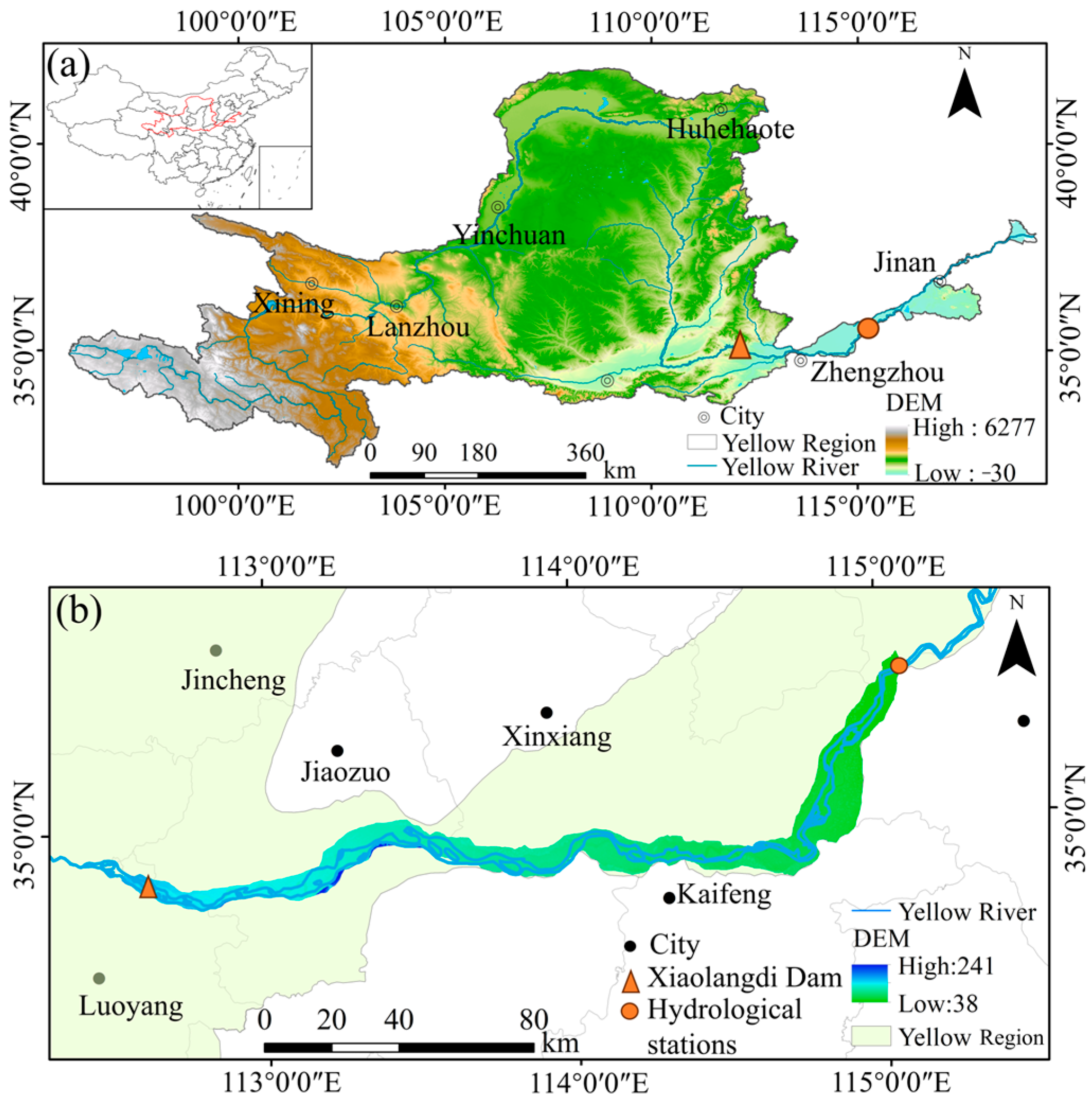
The study area extends from XLD to the Gaocun hydrological station (Figure 1). The region is located in a typical alluvial plain, with terrain gradually descending from southwest to northeast [40]. Situated in a transitional zone between northern and southern climates, the area is characterized by a warm-temperate to subtropical humid-semi-humid monsoon climate. The annual mean temperature ranges from 12.4–14.3 °C, with pronounced temperature differences between mountainous areas and the plains [37]. Mean annual precipitation is 500–800 mm [27], concentrated mainly in summer, and the mean annual relative humidity is approximately 62% [36]. This region has a long history of agricultural development, and agricultural landscapes dominate the overall landscape types. The soils are primarily fluvo-aquic soils and cinnamon soils, which are suitable for cultivating temperate crops such as winter wheat and maize [41]. In this reach, the Yellow River has a relatively gentle flow, a wide and shallow channel, and severe sediment deposition. As a result, the riverbed has been continuously aggrading, standing 7–13 m above the surrounding alluvial plain [26], forming the named hanging river. The study area is generally at low elevation and is strongly influenced by the Yellow River.
The study area is located in a wandering-type reach of the lower Yellow River, where the floodplain is wide, providing ample space for lateral channel migration [8]. The bank soils in this region exhibit a vertically stratified structure with weak resistance to scouring, making them prone to lateral erosion and floodplain collapse [42]. This, in turn, affects the overall stability of the floodplain and changes in planform morphology.
In terms of channel morphology, this reach not only shows the typical characteristics of being wide, shallow, and multi-threaded [43], but is also marked by strong lateral dynamic adjustments as its dominant evolutionary feature [42]. The channel planform is highly sinuous and variable, with low stability, and intense bank erosion and deposition processes directly lead to frequent channel shifting [44]. Such bank-line changes not only reshape the channel planform but also deliver large amounts of sediment into the main channel, thereby further influencing longitudinal erosion-deposition processes and sediment-transport characteristics of the riverbed [42]. Since the operation of the XLD, owing to clear-water releases and water-sediment regulation, the bed material in the wandering reach has undergone pronounced coarsening, with an increase in the mean median grain size. Meanwhile, the geomorphic coefficient has shown a continuous downward trend [8,43].

2.2. Data Sources and Processing

In this study, a multi-source spatiotemporal database was established, integrating remote-sensing imagery, hydrological observations, and meteorological records. The main data sources and their descriptions are summarized in Table 1. Specifically, land-use data were derived from the multi-period Land Use/Land Cover remote-sensing monitoring dataset of China (CNLUCC), provided by the Resource and Environment Science Data Center of the Chinese Academy of Sciences (RESDC). This dataset was developed based on the Landsat series imagery with a spatial resolution of 30 m [45]. After years of development and validation, the CNLUCC dataset has achieved an overall accuracy exceeding 80% across China and has been widely applied in long-term analyses of national territorial spatial pattern dynamics, demonstrating high reliability and authority [46]. Hydrological data, obtained from fixed-site monitoring conducted by the Yellow River Conservancy Commission, include water level (WL), discharge (Q), and suspended sediment concentration (SSC). Meteorological data consist of air temperature (T), precipitation (P), and evapotranspiration (ET), sourced from the National Tibetan Plateau Science Data Center. These meteorological records have been standardized, ensuring good consistency and comparability across time and space.
To better address the research objectives, this study followed the principles of habitat similarity and consistency in ecological function. With reference to the national standard current land use classification and classification schemes adopted in previous studies for the lower Yellow River region [47,48,49], the original Level-II CNLUCC categories were reclassified into nine core landscape types as shown in Table 2 using ArcGIS (v10.8, ESRI, Redlands, CA, USA). Sub-categories of forest and grassland were aggregated to minimize seasonal noise and simplify the ecological interpretation, focusing on their collective function as semi-natural buffers against anthropogenic interference.

2.3. Calculation of Landscape Pattern Metrics

To quantitatively reveal the spatiotemporal responses of floodplain landscape spatial structure in the lower Yellow River under the combined influences of human activities and natural water-sediment processes, this study employed landscape pattern metrics for analysis. Considering potential correlations and redundancy among landscape metrics, three representative indices were selected from the key dimensions of fragmentation, connectivity, and diversity: the NP, COHESION, and SHDI [50,51]. NP is a direct indicator of landscape fragmentation; higher NP values indicate a more fragmented landscape. With intensified human activities, natural landscapes in the floodplain have been replaced by cultivated land and built-up land, leading to an increase in patch numbers and aggravated fragmentation [47]. COHESION reflects the spatial connectedness of landscape patches and is a key metric for characterizing landscape connectivity [52]. SHDI describes the richness and evenness of landscape components, indicating the heterogeneity and complexity of the landscape ecosystem. As cultivated land and built-up land expand and natural land-cover types decline, SHDI tends to decrease [53]. All metrics were calculated using Fragstats (v4.3, University of Massachusetts, Amherst, MA, USA) [54].

2.4. Assessment of Human Interference Index

This study constructed the HI [55] to quantitatively assess the pressure of human activities on the floodplain ecosystem. Drawing on the conceptual framework of hemeroby [56], which characterizes the degree of human influence on ecosystems, and combining it with the actual human activity patterns in the study area [57], we assigned interference weights to each landscape type (Table 3) [58]. Built-up land, representing the most intensive artificial surface, was assigned a value of 9.8. Agricultural land (paddy fields and dry cropland), which is subject to frequent cultivation disturbances, was assigned a value of 8.8. In contrast, ecological land types such as forest, grassland, and natural water bodies were assigned relatively lower interference weights.
Moreover, given that a single 30 m pixel can only represent the categorical attribute of land use, a 600 m × 600 m grid was adopted as the basic assessment unit in this study [59,60]. This spatial scale effectively integrates the local composition and configuration of multiple land-cover types, smooths classification errors, and mitigates the salt-and-pepper effect, thereby enabling a more accurate representation of regional integrated interference intensity [61]. This 600 m scale was selected based on methodologies from previous studies [59] to effectively capture the regional human disturbance patterns while mitigating the salt-and-pepper effect of individual pixels.
Accordingly, the following model was used to calculate the HI value for each grid cell. Within each grid cell, an area-weighted approach was applied to derive the integrated HI [58], as expressed by
H I = i = 1 m   P i × W i
where HI is the human interference index of a given grid cell; Pi denotes the area percentage of the i-th land-use type within the grid cell and Wi is the interference weight assigned to that land-use type (Table 3). Using this method, a long-term (1980–2020) spatial dataset of human interference intensity was generated. The calculation of HI values and dataset generation were implemented using Python (v3.9, Python Software Foundation, Wilmington, DE, USA).

2.5. Grey Relational Analysis (GRA)

Given that landscape-pattern evolution in the Yellow River floodplain is jointly influenced by multiple coupled factors (e.g., natural hydrological conditions, climate change, and human activities), and long-term monitoring data often exhibit “grey” characteristics [62], this study employed grey relational analysis (GRA) to quantitatively identify the relative contributions of driving factors to landscape pattern evolution. GRA requires only a small sample size and effectively measures the geometric similarity between sequence curves; a higher relational grade indicates a more consistent trend between two sequences [63].
(1)
Selection of variables and construction of sequences
In this study, the NP, COHESION, and SHDI, which represent the core characteristics of landscape patterns, were defined as the system characteristic (reference) sequences X0. Q, WL, SSC, P, ET, and HI were defined as the related-factor (comparison) sequences Xi.
(2)
Dimensionless normalization of data [58]
Given that the evaluation indicators differ in units and physical meanings, the original data were normalized prior to analysis using the range method, mapping values to [0, 1]:
x i ( k )   =   X i ( k )     m i n X i m a x X i     m i n X i
where xi(k) is the normalized value, and Xi(k) is the original value of the i-th indicator in year k.
(3)
Calculation of grey relational coefficients [62]
The absolute differences between each comparison sequence and the reference sequence at each time point were calculated, and the grey relational coefficient ξi(k) was obtained as follows:
ξ i ( k )   =   m i n i   m i n k   | x 0 ( k )     x i ( k ) |   +   ρ m a x i   m a x k   | x 0 ( k )     x i ( k ) | | x 0 ( k )     x i ( k ) |   +   ρ m i n x i   m a x k   | x 0 ( k )     x i ( k ) |
where ξi(k) is the correlation coefficient between reference sequence x0(k) and several comparison sequences x1, x2, K, and xn at each moment; ρ is the distinguishing coefficient; usually ρ = 0.5.
(4)
Derivation of grey relational grades [62]
The grey relational grade ri, which quantitatively expresses the correlation between the reference sequence and each comparison sequence, is calculated as follows:
r i   =   1 n k = 1 n   ξ i ( k )
The value of ri ranges within [0, 1]. A larger ri indicates a closer correspondence between the driving factor and the landscape-metric trends, implying a stronger influence on landscape-pattern evolution. All GRA calculations were implemented using Python v3.9.

2.6. Partial Least Squares (PLS) Regression Analysis

Because driving factors affecting landscape patterns often exhibit strong multicollinearity, this study employed partial least squares (PLS) regression to identify dominant drivers [64,65]. PLS is well suited for situations with highly correlated predictors and relatively small sample sizes [66].
(1)
Model construction
To comprehensively evaluate the coupled natural processes–human interference driving mechanisms of floodplain landscape evolution in the lower Yellow River, driving factors were selected from three major processes: hydrodynamics, climatic background, and human activities [15]. The rationale is as follows:
 (1)
Hydrological factors: Q, WL, and SSC
Hydrological processes represent the fundamental controlling force of floodplain landscape evolution in the lower Yellow River, directly influencing inundation frequency, channel morphological adjustments, and floodplain sedimentation. Especially under the regulation of dams, Q, WL, and SSC significantly affect the spatial patterns of wetlands, water bodies, and agricultural landscapes [67,68].
 (2)
Climatic factors: T, P, and ET
Regional hydrothermal conditions determine vegetation growth potential and ecosystem water balance, serving as key background factors that control successional transitions among landscape types. Rising T and intensified ET tend to increase water stress, whereas P regulates soil moisture recharge and wetland maintenance, thereby imposing long-term constraints on landscape heterogeneity [67,69].
 (3)
Human interference factor (HI)
The floodplain of the lower Yellow River is a typical area subject to high-intensity human interference. Agricultural reclamation, built-up land expansion, and engineering management activities have profoundly altered land-cover patterns and are important contributors to landscape fragmentation. Therefore, HI was selected as the core indicator reflecting the intensity of human activities [70].
Based on the above considerations, the PLS model was constructed as follows. The independent variable matrix (X) includes seven driving factors: HI, Q, WL, SSC, T, P, and ET. The dependent variable matrix (Y) selects three core landscape indices: NP, COHESION, and SHDI.
(2)
Key Discriminant Indicators
To quantitatively analyze the strength and direction of each factor’s influence, two main indicators were used. Variable Importance in Projection (VIP): The VIP value reflects the contribution of each independent variable to explaining the dependent variable; factors with VIP > 1.0 have significant explanatory power and are considered key driving factors; variables with 0.8 < VIP < 1.0 are secondary driving factors, while those with VIP < 0.8 have weaker explanatory power [71]. Standardized coefficients: The sign (positive or negative) of the coefficients indicates the direction of the driving factor’s influence on the landscape metric (positive promotion or negative suppression), while the absolute value reflects the direct strength of the effect after eliminating unit impacts [72]. This study employed Python 3.9 software to construct and compute the PLS model, and cross-validation (Q2) was used to ensure the model’s predictive ability and robustness. This study employed Smart PLS (v4.0, Smart PLS GmbH, Bönningstedt, Germany) to construct and compute the PLS model, and cross-validation (Q2) was used to ensure the model’s predictive ability and robustness.

3. Results

3.1. Spatiotemporal Evolution of the Floodplain Landscape Pattern

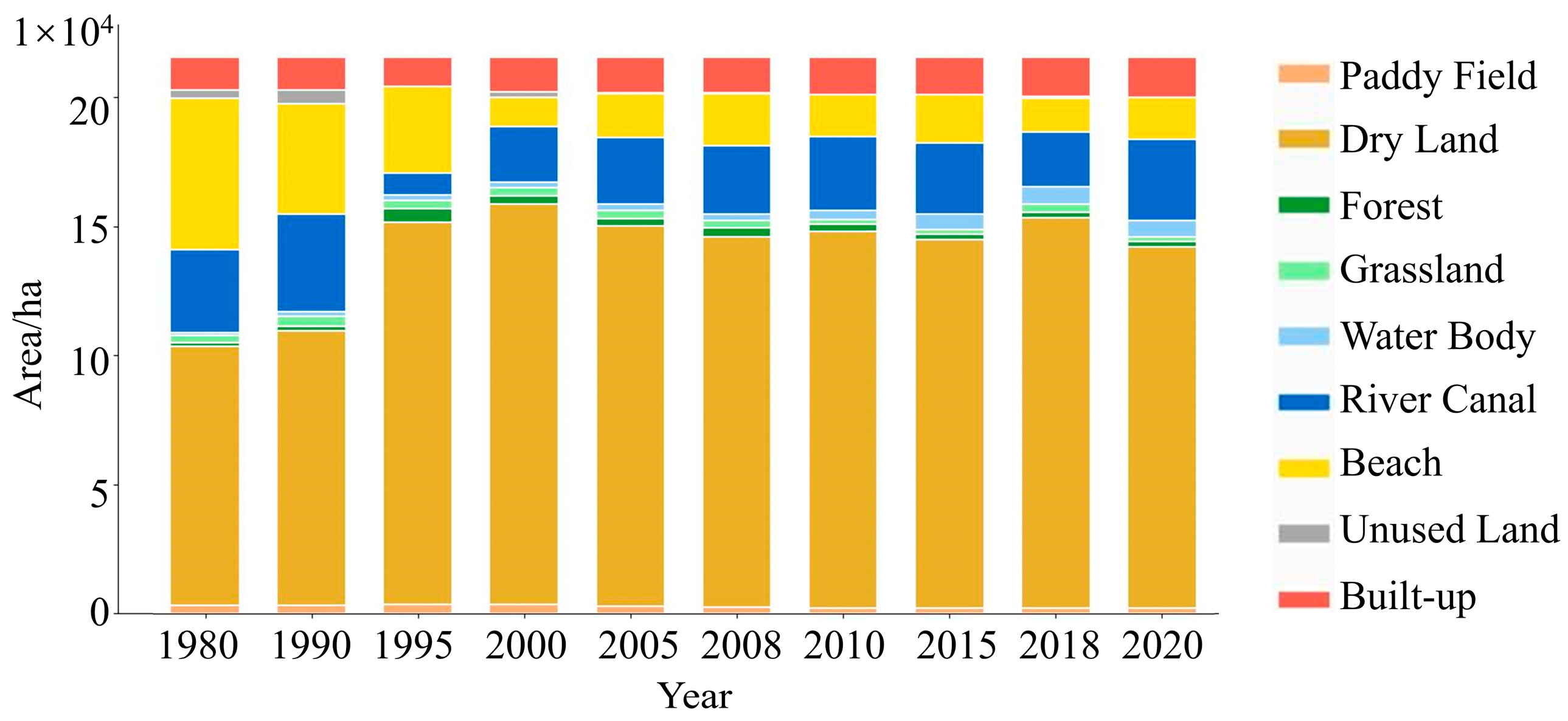
Figure 2 shows the area changes of nine land-use types in the floodplain from 1980 to 2020. The floodplain land-use pattern over the past 40 years exhibited a general trend characterized by cropland dominance, contraction of natural land types, and a gradual expansion of built-up land, although the magnitude of change varied markedly among land-use categories. Agricultural landscapes remained stable and strongly dominant. Cropland occupied an absolute majority, with dry cropland far exceeding other land types in area. Paddy fields were relatively limited in extent and changed only slightly, showing a slow decline. Natural and semi-natural land types decreased continuously, indicating a persistent shrinkage of ecological space, especially for grassland and floodplain shoals, both of which contracted throughout the study period. Water bodies increased notably between 1990 and 2000, likely attributed to the rapid expansion of aquaculture ponds driven by agricultural structure adjustment in the floodplain, and then remained relatively stable thereafter. Forest area was consistently small. Built-up land expanded steadily, reflecting a pronounced intensification of human activities, whereas unused land showed a slight decrease. These changes indicate that dam construction and the subsequent evolution of water-sediment conditions, together with human activities, have reshaped the landscape pattern of the lower Yellow River floodplain, shifting it from a nature-dominated system toward an agriculture-human-dominated one.
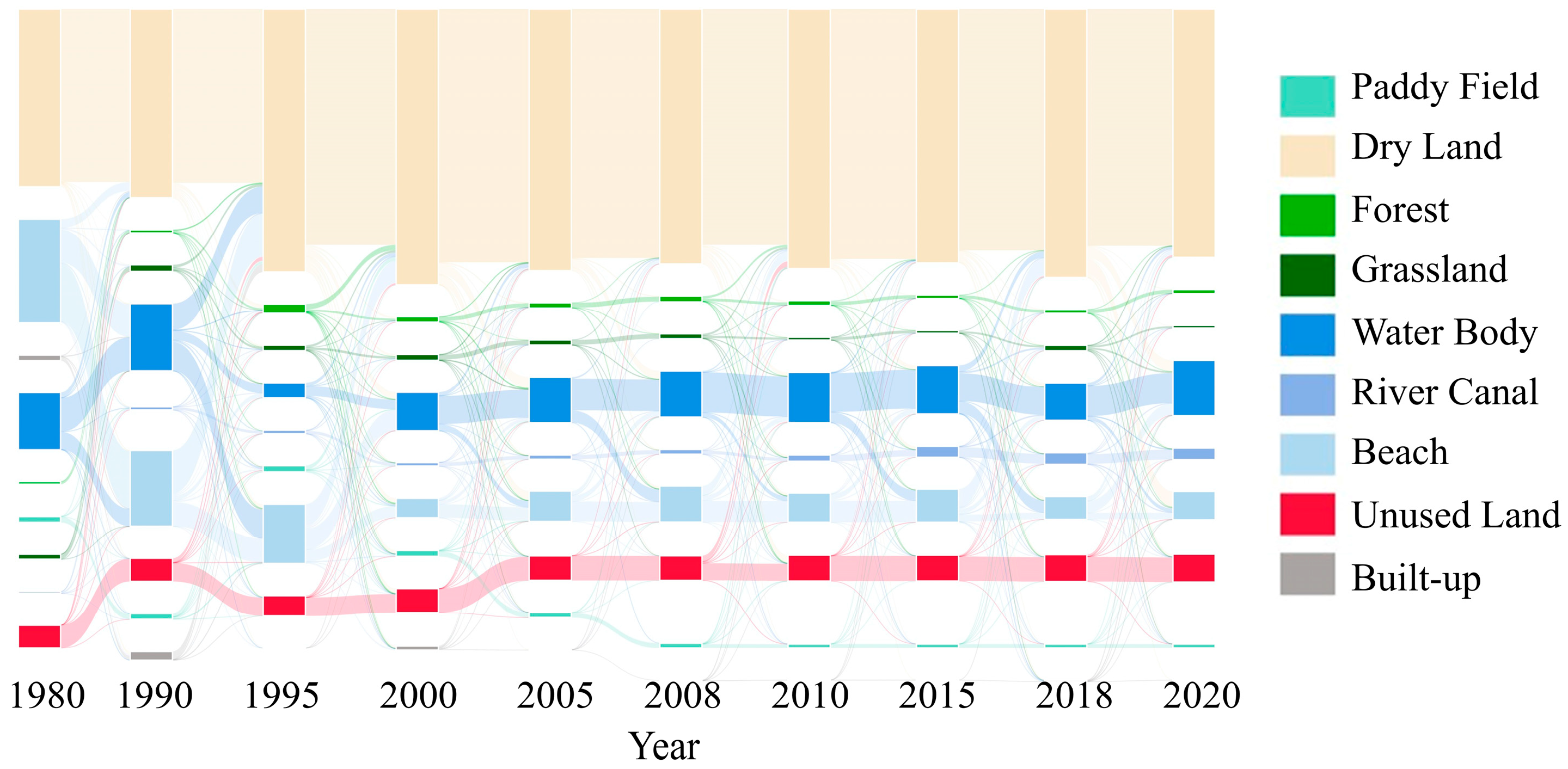
Figure 3 illustrates the major land-type evolution pathways and mutual conversions in the floodplain of the lower Yellow River over the last 40 years, revealing a pronounced reconfiguration of the floodplain landscape pattern under dam operation and HI. The conversion of floodplain shoals to other land-use types was the most prominent. Specifically, floodplain shoals showed a continuous decline throughout the study period and consistently transferred area to multiple land categories. Cropland (especially dry cropland) exhibited an expanding trend and has remained the most stable and increasingly dominant land type in the floodplain. The area of dry cropland increased continuously over the entire period, gaining area mainly from floodplain shoals, grassland, and other land types. Built-up land grew steadily, with its spatial pattern gradually shifting from localized expansion to point-axis agglomeration. A relatively evident bidirectional conversion was observed between forest and grassland. Overall, the landscape evolution was dominated by a restructuring process characterized by wetland contraction-agricultural expansion-built-up land encroachment.

3.2. Changes in the Spatial Structure of Floodplain Landscapes

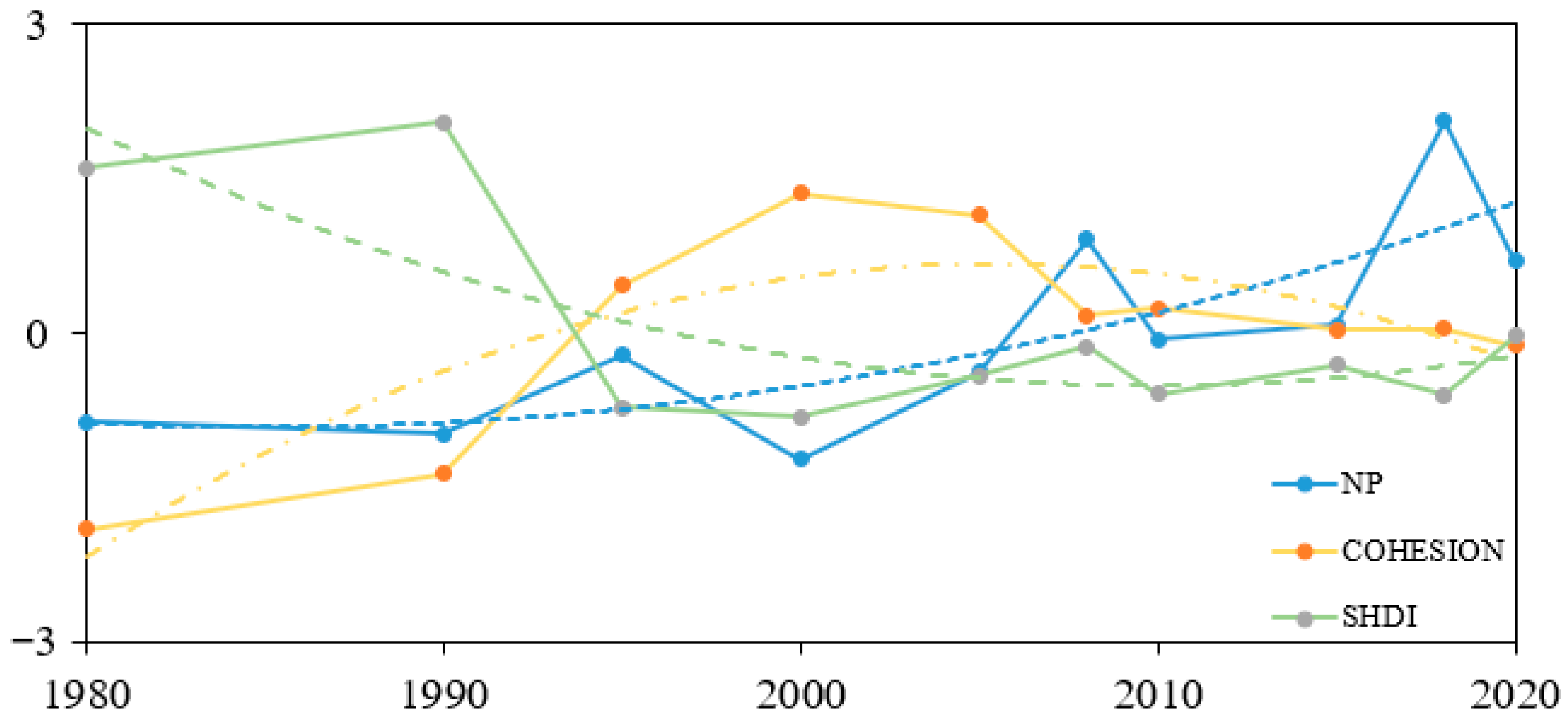
From 1980 to 2020, the evolution of landscape patterns in the study area (Figure 4) exhibited clear stage-dependent differentiation. Fragmentation exhibited a nonlinear, first-decreasing-then-increasing trend (R2 = 0.54). After reaching its minimum around 2000, it shifted to a rapid upward trajectory, indicating that the landscape matrix transitioned from early-stage consolidation and homogenization to persistent late-stage dissection, with markedly intensified fragmentation. Connectivity increased during 1980–2000 but declined after 2000, forming a typical inverted U-shaped trajectory (R2 = 0.73). The turning point in connectivity closely coincides with the timing of the XLD’s initiation of the WSRS around 2000. Landscape diversity overall shifted from a cliff-like decline to low-level fluctuations with a slight recovery, suggesting that after dominant landscapes encroached upon natural habitats, the pattern gradually approached a new dynamic equilibrium (R2 = 0.6). Taken together, the operation of the XLD altered the natural water-sediment regime and constituted a critical node in floodplain landscape evolution.

3.3. Changes in Water-Sediment Processes

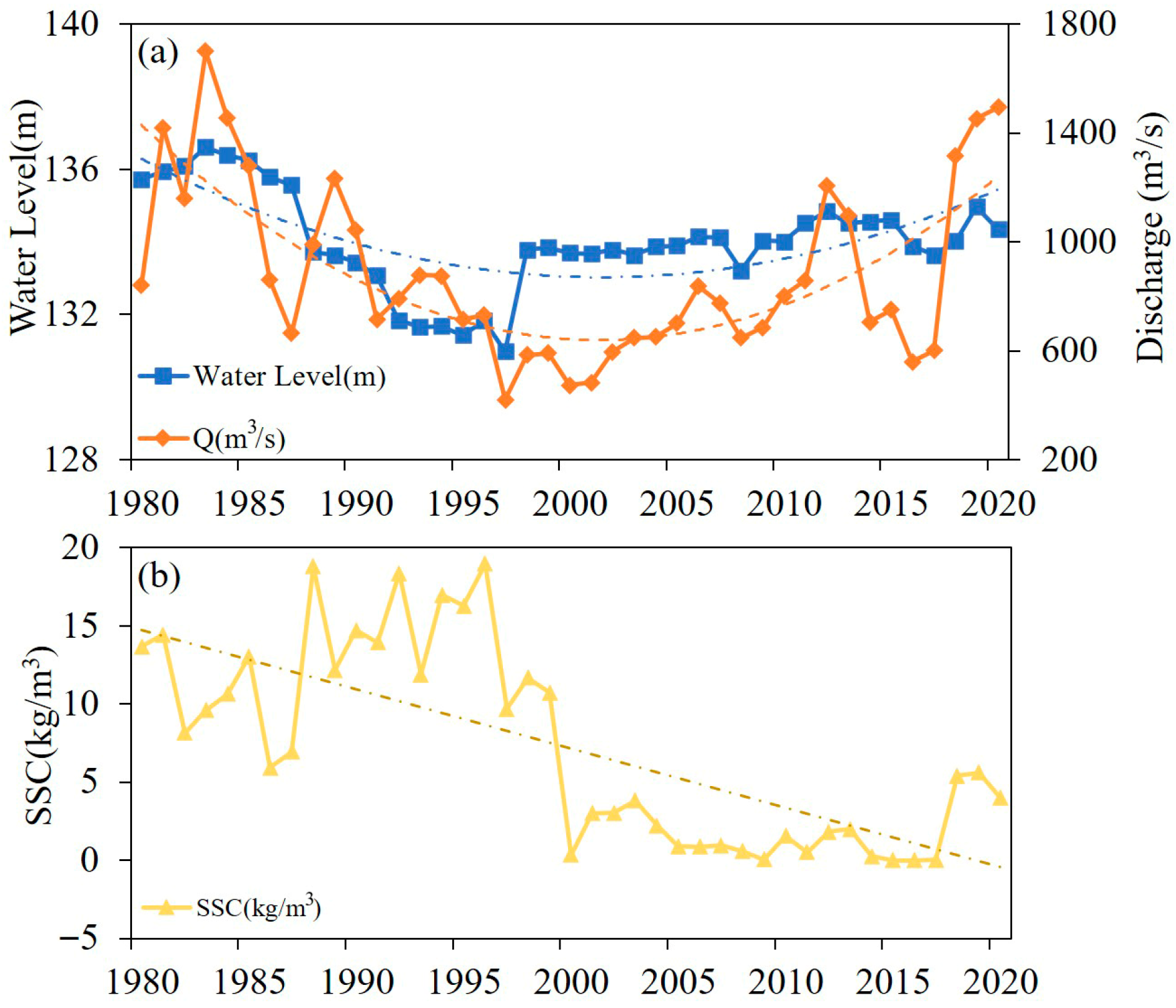
The water-sediment evolution during 1980–2020 can be divided into two stages (Figure 5). During 1980–1999, water level declined from approximately 136 m to 132 m, while discharge remained relatively high, with frequent high-flow years. SSC was stable at 6–19 kg/m3, with a multi-year mean of about 13 kg/m3, indicating a high water-high sediment regime. After the dam began implementing the WSRS in 2000, water level was largely maintained at around 134 m, discharge slightly decreased to ~830 m3/s, whereas SSC dropped sharply to 0–4 kg/m3, with a multi-year mean of only ~2 kg/m3. This represents a reduction of more than 80% compared with the pre-regulation period, demonstrating a strong sediment-reduction effect. During 2018–2020, runoff increased again (Q > 1300 m3/s), and SSC rose to 4–5.6 kg/m3, but it remained far below the pre-regulation level.

3.4. Trends in Meteorological Factors

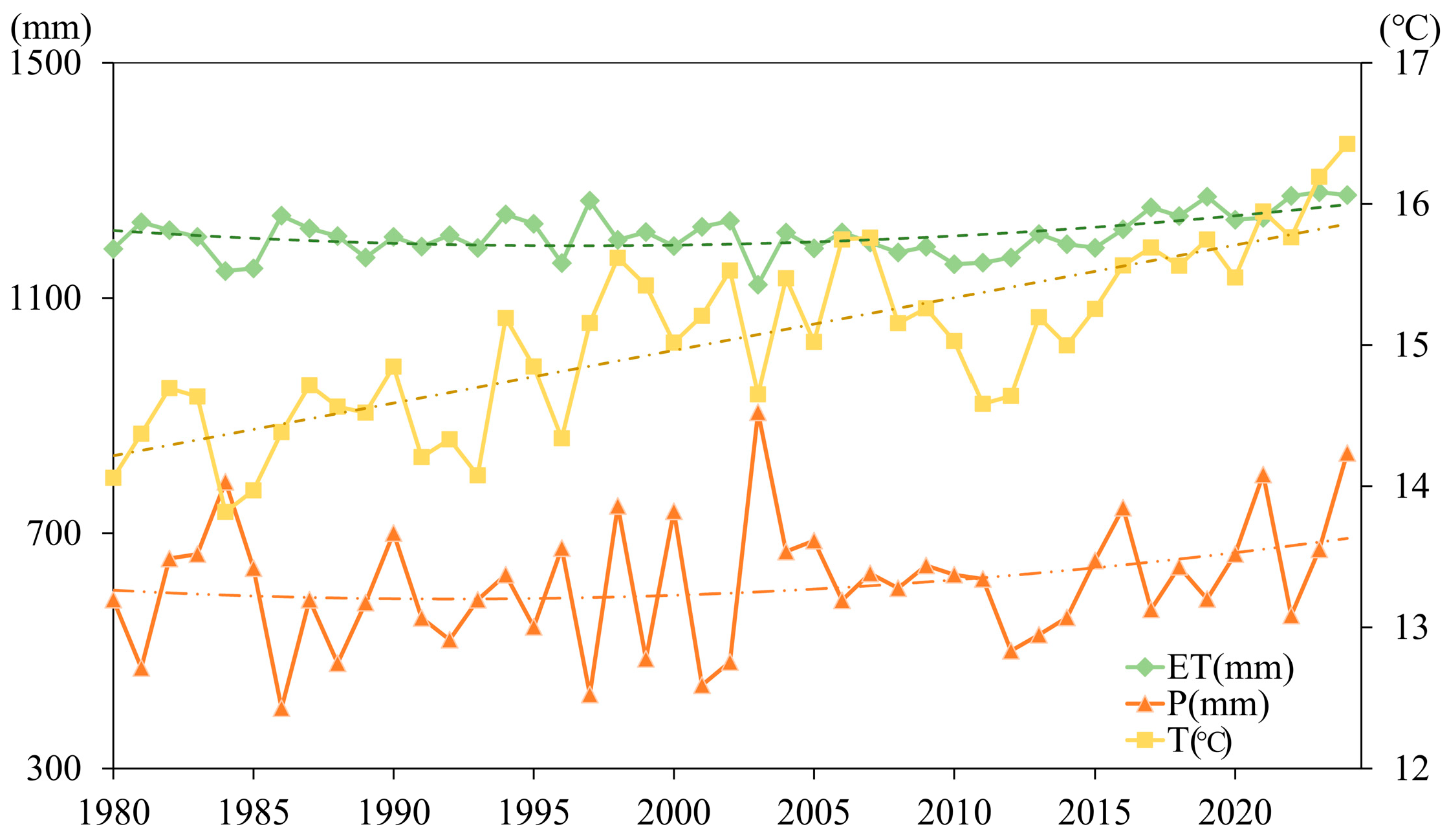
Figure 6 reflects the long-term trends of annual precipitation, mean annual temperature, and annual evapotranspiration in the study area from 1980 to 2020. All meteorological factors exhibited varying degrees of increase, but the intensity of the trends differed significantly. The trend of increasing mean annual temperature was the most pronounced, with a high coefficient of determination for the linear fit (R2 = 0.62), indicating a clear regional warming trend. The rate of warming has been stable and continuous, making temperature the most significantly changing factor among the three meteorological variables. Annual evapotranspiration also showed a slow upward trend (R2 = 0.28), with a relatively steady increase, likely driven by higher temperatures and changes in vegetation, which together contributed to increased evapotranspiration demand. In contrast, the long-term trend of annual precipitation was not significant (R2 = 0.08). Although there were notable interannual fluctuations, the overall change was limited and did not display a stable increasing or decreasing pattern. Overall, the study area exhibited a climatic trend of significant warming, slow increase in evapotranspiration demand, and no significant change in precipitation over the past 40 years.

3.5. Evolution of Human Interference Index and Spatial Distribution Characteristics

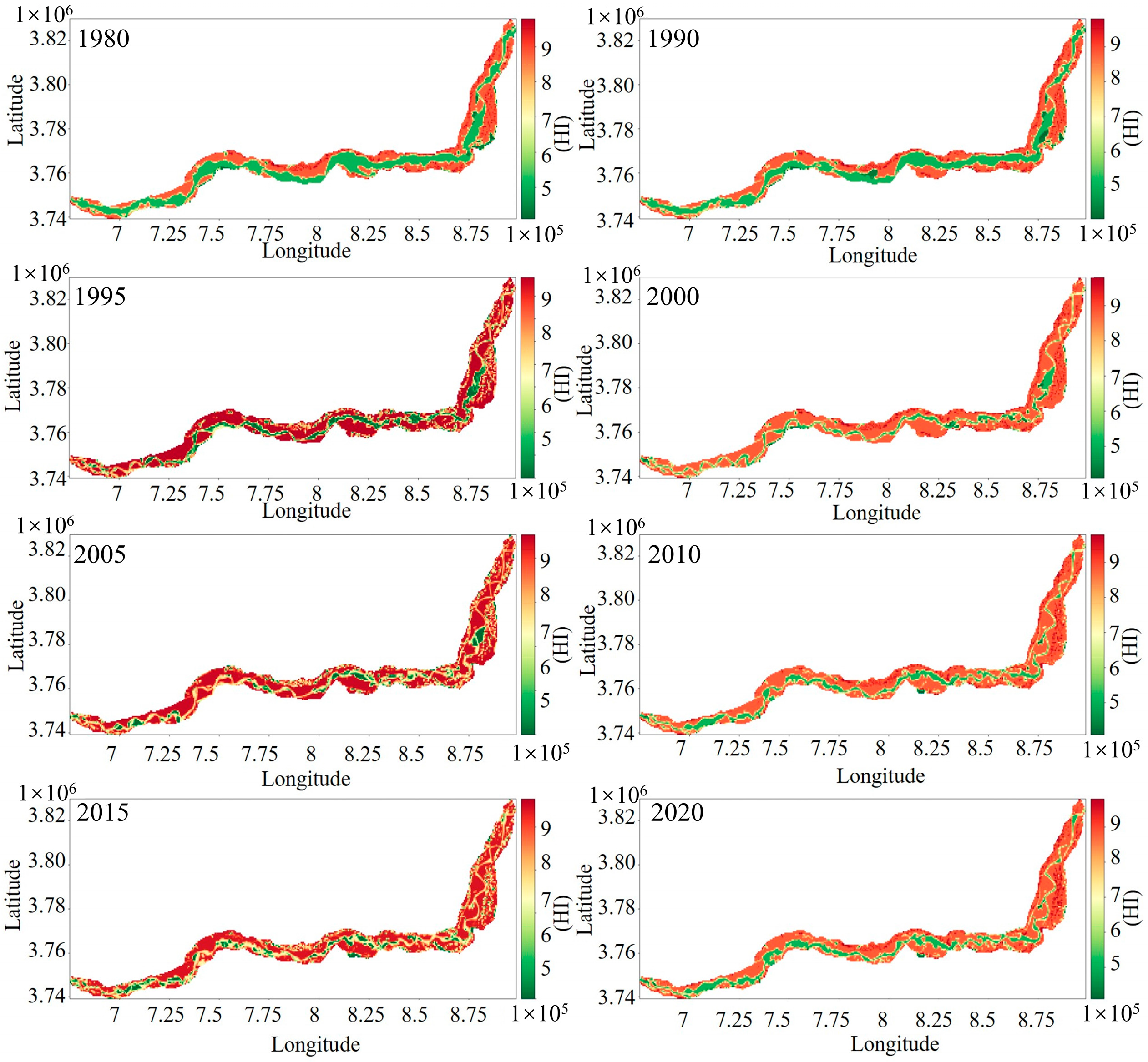
The spatial distribution evolution of HI in the lower Yellow River floodplain from 1980 to 2020 showed a continuous expansion from low to moderate-high interference areas (Figure 7). In 1980, the floodplain still contained many low-value areas (green), mainly distributed in floodplain shoals and some natural grassland areas near the river channel. However, continuous moderate-high interference patches appeared along the levees and in clustered village areas. From 1990 to 2000, moderate-high interference areas (orange-red) expanded significantly, further eroding low-interference patches. Artificial disturbance zones along the floodplain margins and transportation corridors began to merge into contiguous regions. After 2005, high-interference areas occupied most of the floodplain space, with low-value areas only sparsely remaining in local floodplain shoals and some microtopographic regions that were difficult to utilize.
By 2015–2020, the high-interference pattern had further consolidated and stabilized, while the spatial proportion of low- and medium-interference areas in the floodplain continued to shrink. This reflects a marked intensification of HI, evolving from isolated points to contiguous patches. Overall, during the 40-year period, the HI intensity in the floodplain steadily increased, with high-interference areas continuously expanding and becoming more interconnected. This trend reflects the combined driving factors of deeper agricultural use, the spillover of construction activities, and the increase in available land following the operation of the dam, all contributing to the significant intensification of artificialization in the floodplain landscape.
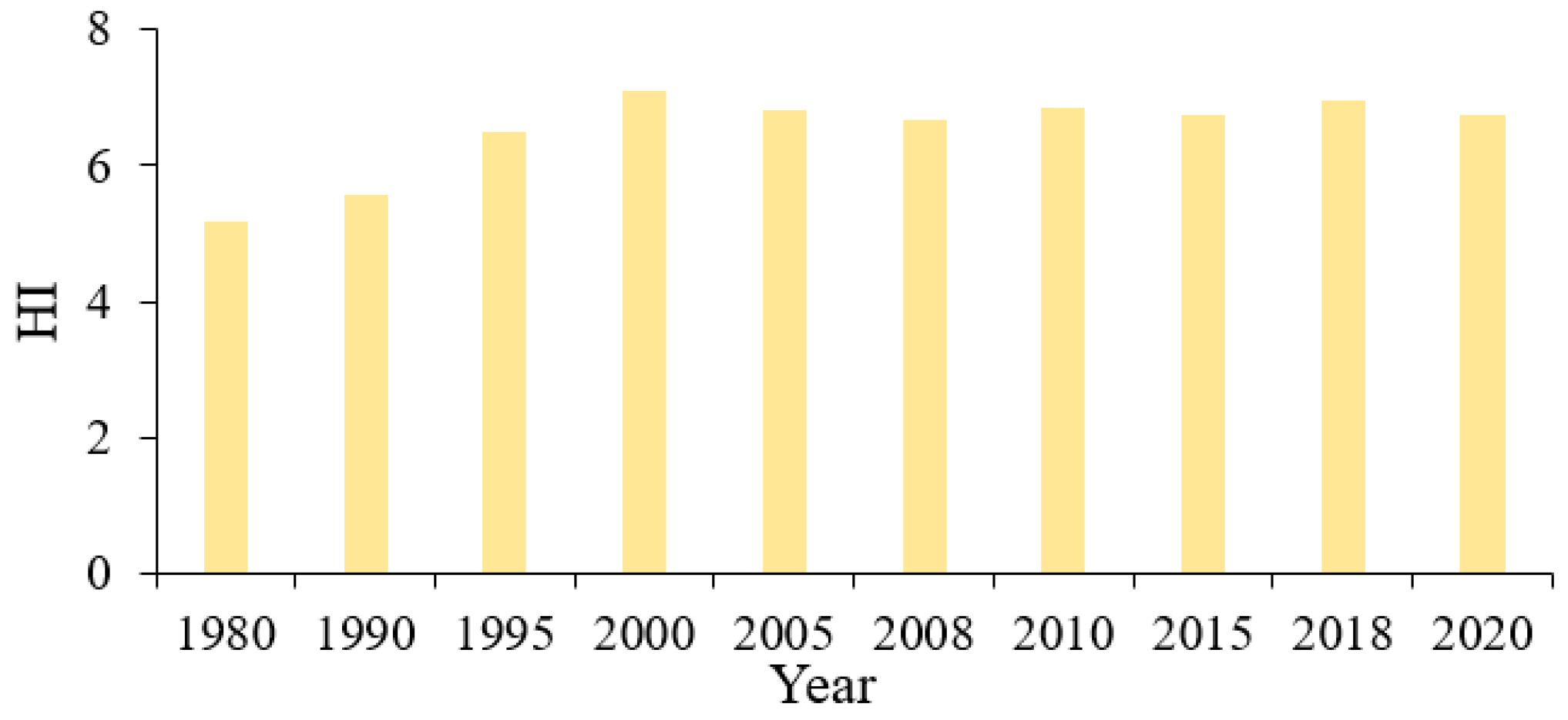
Figure 8 shows that the HI in the lower Yellow River floodplain exhibited a trend of first increasing and then decreasing between 1980 and 2020, reaching its peak in 2000 and subsequently declining. In 1980, the average HI was 5.19, indicating a relatively low level; by 1990, it had increased to 5.59, showing limited growth. From 1990 to 2000, the increase in HI was significant, peaking at 7.09 in 2000, marking a rapid shift from a moderate to a high level of human interference in the floodplain. After 2000, although HI fluctuated slightly, it remained generally stable within the high range of 6.7–7.0, indicating that human interference intensity in the floodplain stabilized at a high level.
From 1980 to 2020, HI in the floodplain underwent a phase of slow increase–rapid rise–stable high level, reflecting the ongoing cumulative impacts of agricultural expansion, built-up land increase, and related development activities on the floodplain landscape pattern. The changes in HI were far more pronounced than those in water-sediment conditions and meteorological factors, showing more directional and staged evolution.

3.6. Drivers of Landscape Pattern Change in the Floodplain

3.6.1. Linear Response Characteristics of Multiple Factors on Landscape Pattern Change

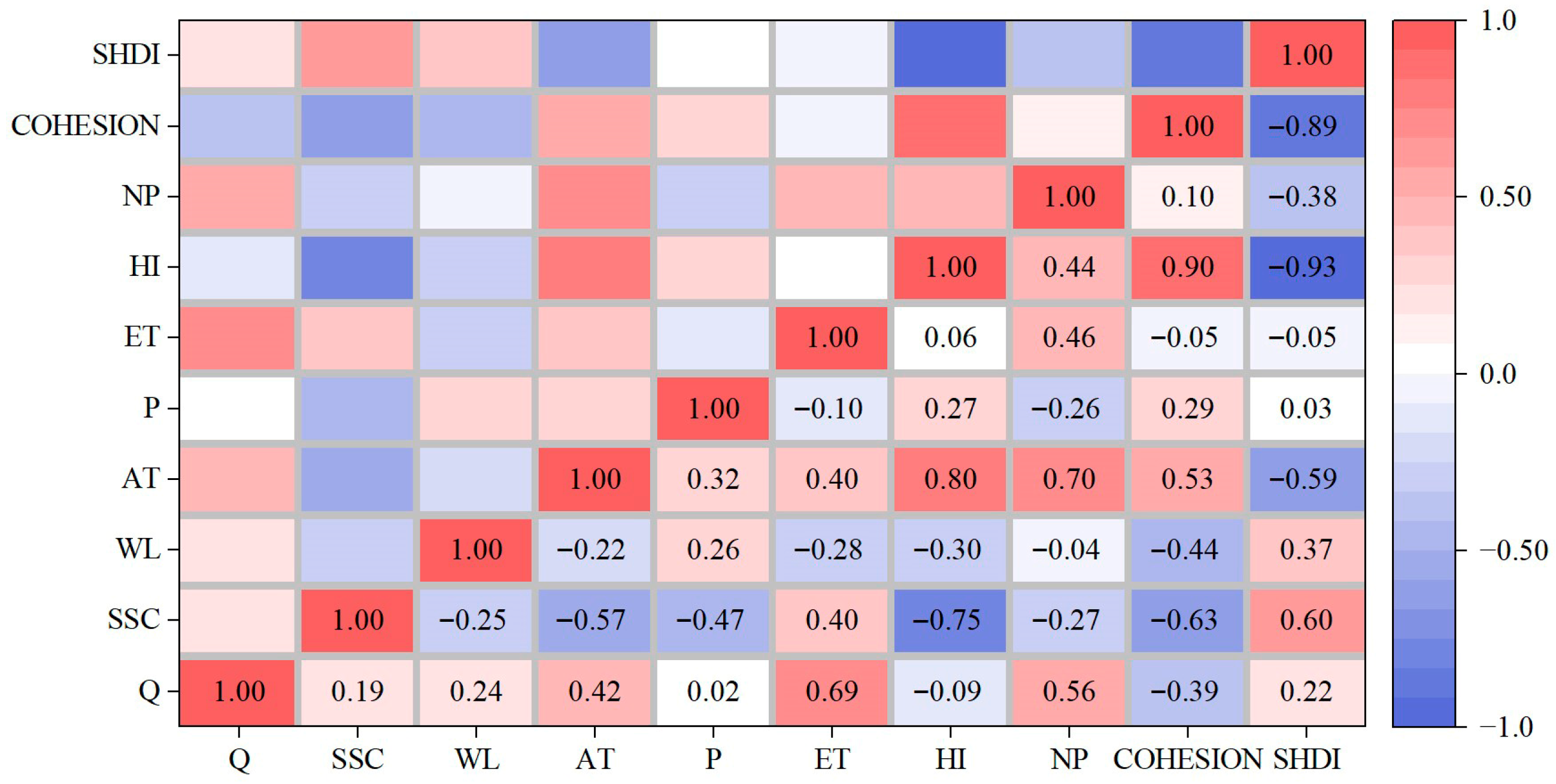
The correlation results (Figure 9) show that the landscape pattern change in the study area is influenced by multiple factors, but the strength of the influence varies significantly across different factors. Among the hydrological factors, Q was positively correlated with NP (r = 0.56) and negatively correlated with COHESION (r = −0.39), suggesting that high flow may exacerbate landscape fragmentation. SSC showed strong correlations with COHESION (r = −0.63) and SHDI (r = 0.60), indicating that sediment processes play a significant role in wetland connectivity and structural stability. Among the climatic factors, T acted as a key controlling variable, showing a positive correlation with both NP (r = 0.70) and COHESION (r = 0.53), and a negative correlation with SHDI (r = −0.59), reflecting the sensitivity of regional landscape structure to warming. The impacts of P and ET were relatively limited, showing only moderate to weak correlations with some hydrological or landscape indices. Among the human factors, the HI exhibited the strongest response relationship with landscape patterns: it was highly correlated with COHESION (r = 0.90), negatively correlated with SHDI (r = −0.93), and positively correlated with NP (r = 0.44).

3.6.2. Relative Contribution Ranking of Multiple Driving Factors to Landscape Pattern Evolution

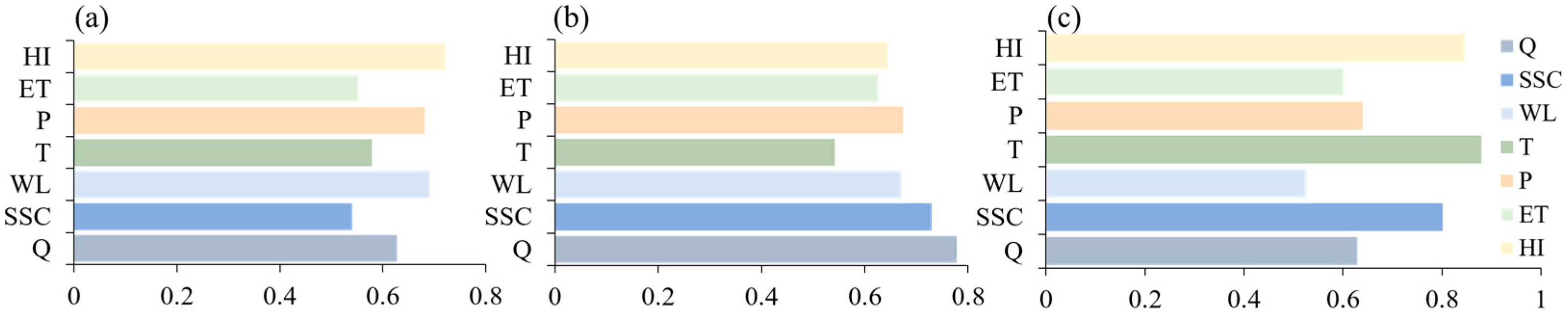
The results of the GRA (Figure 10) reveal differences in the response characteristics between landscape pattern indices and multiple driving factors. NP exhibited a high correlation with WL (0.69). Although P showed a relatively high correlation, its long-term trend was not significant, and its low VIP value in the PLS analysis indicates that it is not a core driving factor. However, NP was most strongly correlated with the HI (0.72), suggesting that NP is influenced by both hydrological processes and human activities, with HI being the primary driver. COHESION overall exhibited a relatively high degree of correlation, with the strongest relationships observed with Q (0.78) and SSC (0.73), reflecting that landscape connectivity is most sensitive to changes in hydrodynamic processes. Although its correlation with HI (0.64) was somewhat lower, it remained at a moderately high level, indicating that connectivity is controlled by both natural and anthropogenic factors. In contrast, SHDI was most sensitive to multiple driving factors. It showed a very strong correlation with T (0.88) and HI (0.85), indicating that changes in thermal conditions and human disturbance are the key driving forces influencing landscape diversity. SHDI also showed a high correlation with SSC (0.8). Overall, HI emerged as the core driving factor across all indicators, with T and hydrodynamic factors playing differentiated roles in various landscape dimensions. This suggests that the evolution of the floodplain landscape pattern follows a human-dominated model of integrated control, in which natural processes provide secondary regulation.

3.6.3. Identification of Dominant Driving Factors and Quantitative Attribution of Their Effects

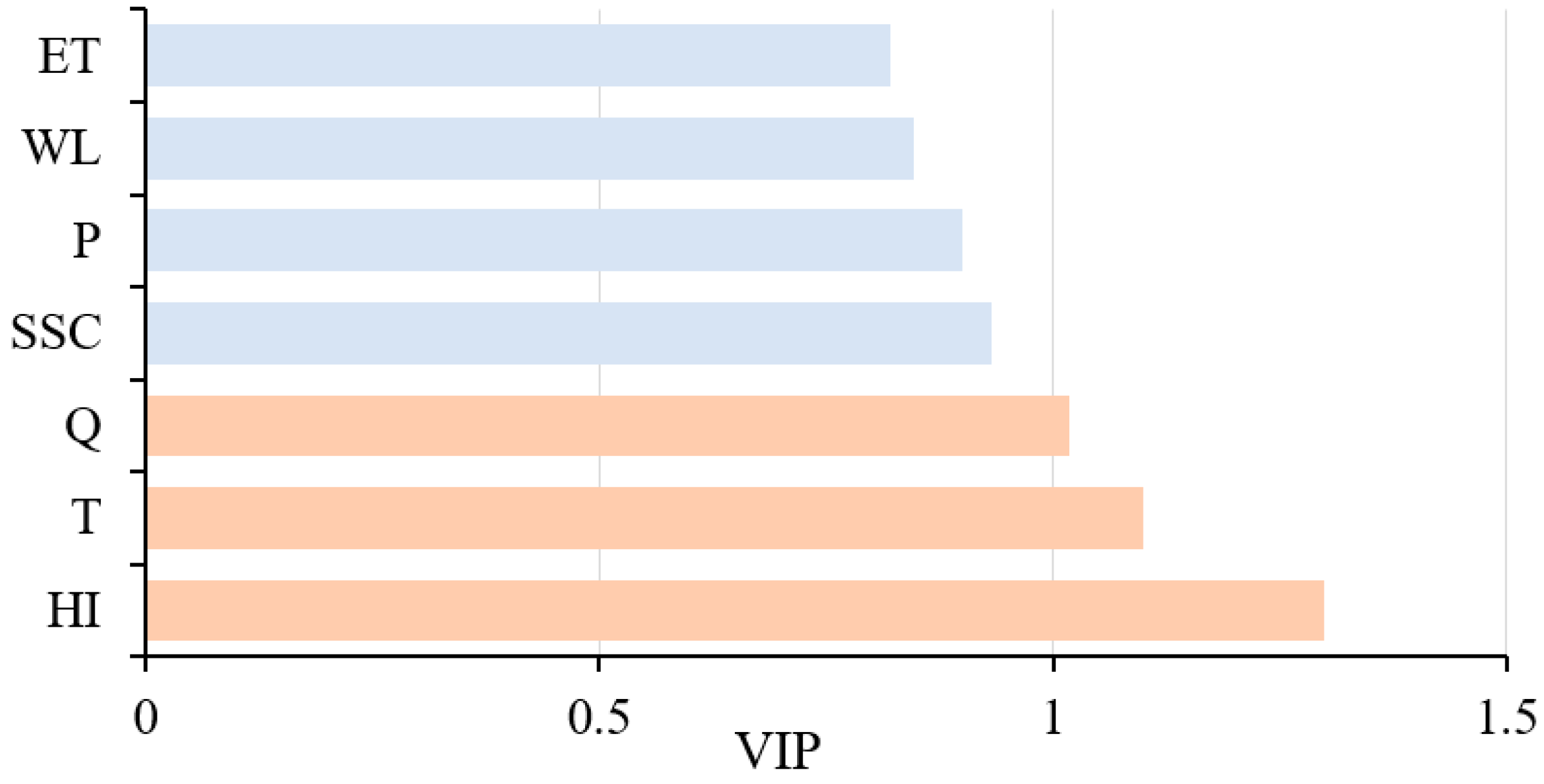
Figure 11 shows the VIP values for each driving factor. Human interference (HI, VIP = 1.3) is the primary driver of landscape pattern evolution, followed by temperature (VIP = 1.1) and discharge (VIP = 1.0), all of which exceed the importance threshold of VIP > 1.0. The remaining natural factors have VIP values below 1, indicating that their explanatory power for landscape patterns is relatively weak. This suggests that, from 1980 to 2020, the evolution of landscape patterns in the study area was primarily driven by the combined pressures of human activities and water-thermal climate conditions.
The standardized coefficients from the PLS regression model further reveal differences in the direction and strength of the effects of each factor (Table 4). As the core driving factor, HI was positively correlated with COHESION (standardized coefficient = 0.44), indicating that, as the intensity of human activities increases, the spatial cohesion of landscape patches generally increases. However, HI showed a negative suppression effect on SHDI (coefficient = −0.44), meaning that high-intensity human interference led to the simplification of landscape components and a reduction in diversity. Among the natural factors, T had the strongest positive explanatory power for NP (coefficient = 0.33). WL and Q, on the other hand, exhibited a negative regulatory effect on COHESION (coefficient ≈ −0.28), suggesting that strong hydrodynamic conditions tend to weaken overall landscape connectivity.
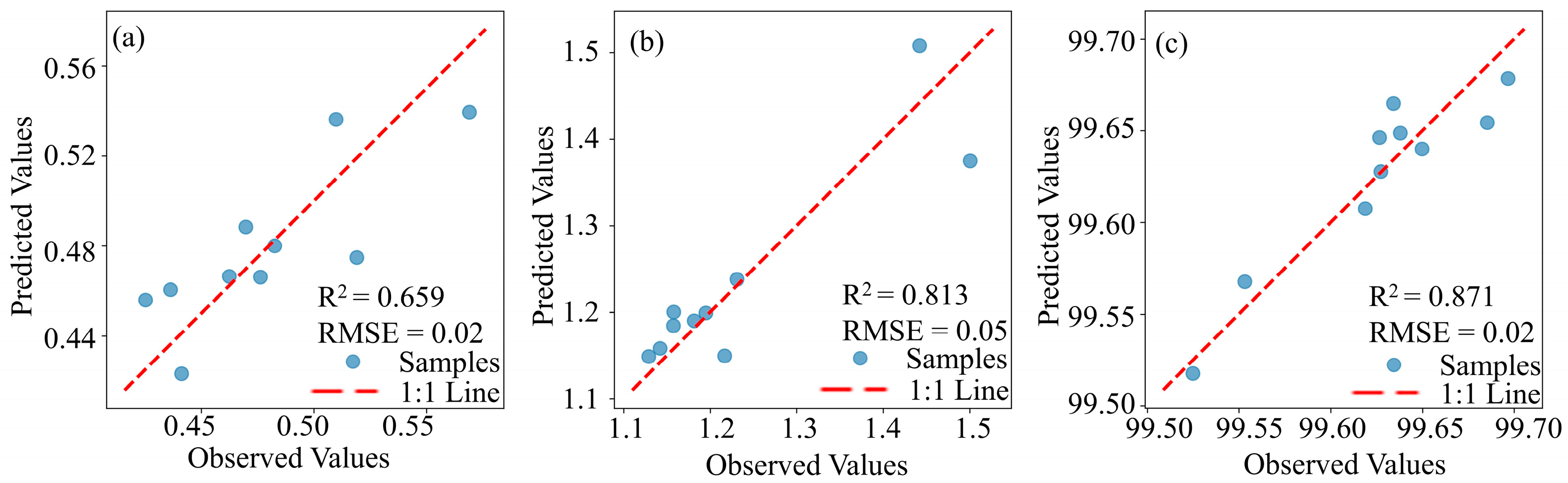
The model performed best in fitting COHESION and SHDI (Figure 12), with R2 values exceeding 0.8 for both and positive leave-one-out Q2 (LOO-Q2) values, indicating good model stability and generalization ability. COHESION showed the strongest performance (R2 = 0.87), suggesting that the model accurately captured the spatial distribution of landscape patch connectivity, and effectively reflected the influence of changing water-sediment conditions on COHESION. SHDI also exhibited a high goodness of fit (R2 = 0.87), indicating that the model reasonably represented the changing patterns of compositional evenness among landscape types. In contrast, the fit for NP was moderate, and its predictive performance was less stable than that of COHESION and SHDI.

4. Discussion

4.1. The Dam Driving Floodplain Landscape Evolution

Our results show that human interference has the highest explanatory power for key landscape metrics—fragmentation, connectivity, and diversity—indicating that landscape pattern changes in the floodplain are primarily dominated by human interference [52]. The operation of the XLD played a critical effect in this process [73]. By reducing incoming sediment, altering discharge pulses, and modifying erosion-deposition processes [74], the dam substantially weakened the historically strong flood disturbances in the floodplain, alleviating siltation and lowering the probability of overbank flooding, thereby continuously relaxing natural hydrodynamic constraints [25]. As environmental disturbances became more predictable, human activities accelerated their expansion into the floodplain interior; cultivated land and built-up land increasingly encroached upon natural floodplain grassland, further intensifying anthropogenic reshaping of the landscape [75]. However, the influence of human interference is not unidirectional in terms of fragmentation but instead exhibits a typical dual effect. On the one hand, cropland consolidation associated with the scaling-up of agricultural operations has enabled large, contiguous cropland tracts to replace small, fragmented, and heterogeneous natural patches, thereby enhancing the physical connectivity of the landscape from a geometric perspective. On the other hand, this artificial homogeneous connectivity dominated by a single cropland matrix has markedly reduced landscape compositional diversity and ecotone (landscape interface) complexity, producing an overall decline in diversity and implying weakened ecological functions and reduced regional resilience [76,77]. Specifically, this connectivity differs fundamentally from functional ecological corridors [11,17]. Regarding biodiversity, the homogenization of habitats filters out niche, specialized species (e.g., wetland birds), favouring synanthropic generalists and leading to biotic homogenization [21,77]. For species movement, although the landscape appears geometrically connected, the uniform agricultural matrix often lacks the necessary cover and resources for wildlife dispersal, effectively functioning as a barrier rather than a conduit for sensitive fauna [24,26]. Consequently, ecosystem resilience is compromised; the simplified food webs and lack of functional redundancy reduce the floodplain’s capacity to buffer against disturbances such as pest outbreaks or extreme hydrological events [1,33]. The core mechanism lies in the dam-induced alteration of the water-sediment foundation, which has continuously intensified the compression, replacement, and displacement of natural ecological space by human activities.

4.2. Natural Factors as Auxiliary Regulators of Floodplain Landscape Patterns

Although human interference dominates the landscape indices, natural factors still play an indispensable regulatory role in landscape evolution. On the one hand, water-sediment processes remain key to maintaining the ecological foundation [78]. Grey relational analysis shows that discharge and suspended sediment concentration continue to exhibit strong correlations with landscape connectivity and diversity. This suggests that, although the frequency of floodplain inundation has decreased, changes in hydrodynamic conditions still directly affect the patch continuity in the riverbed and the floodplain regions [13]. At the same time, suspended sediment concentration, by altering sedimentation environments, indirectly constrains the distribution and successional trajectory of wetland vegetation in the floodplain [26]. On the other hand, climatic factors have a multiplying effect on fragmentation. In the structural equation model, temperature shows a relatively high importance value and is significantly positively correlated with fragmentation. This indicates that, under the context of ongoing warming, intensified evapotranspiration may lead to the risk of seasonal wetland shrinkage, thereby increasing the landscape’s sensitivity to human disturbance [79]. Thus, natural factors have shifted from being shapers to regulators [11], constraining the boundaries and rate of landscape evolution at local scales and within broader environmental contexts. Synthesizing these anthropogenic drivers and natural regulators, we propose a stage-dependent landscape transformation cycle’ for the regulated floodplain. The evolution process can be distinctly categorized into two phases: (1) the Consolidation Phase (pre-2000), characterized by agricultural intensification, where scattered natural patches were merged into contiguous croplands, leading to homogenized connectivity [24,29]; and (2) the Re-fragmentation Phase (post-2000), driven by the expansion of built-up land and linear infrastructure, which physically dissected the previously consolidated agricultural matrix, triggering a new wave of landscape fragmentation [15,32]. This cyclic evolution underscores the non-linear complexity of human-nature interactions in mega-dam downstream systems.
Furthermore, the PLS model attribution allows for a critical decoupling of climatic impacts from anthropogenic restructuring. Unlike precipitation, which exhibited no significant long-term trend in our study area, the continuous regional warming operates as a cumulative background stressor that amplifies landscape instability [69]. While human interference acts as the dominant driver determining the macro-structure of the landscape (e.g., connectivity and diversity), our model identifies temperature as a significant secondary force specifically exacerbating physical fragmentation. The strong positive contribution of temperature to patch number (NP) suggests that intensified evapotranspiration accelerates the shrinkage and breakup of marginal, seasonal wetland patches [78,79]. This finding aligns with observations in other semi-arid river basins, where climate change functions not as a creator of new land-use types, but as a ‘catalyst’ that increases the ecological vulnerability of the floodplain system already stressed by human activities [33,62].

4.3. Nonlinear Shaping of Landscape Spatial Configuration by Human Land-Use Mode Transformation

The nonlinear evolution trajectories of landscape pattern metrics reflect the differential shaping mechanisms of human land-use practices on the spatial configuration of the floodplain at different periods. This study identifies a significant turning point around the year 2000, after which landscape fragmentation and connectivity exhibited entirely opposite trends [47]. Before 2000, despite the continuous increase in overall human interference intensity, landscape fragmentation decreased and connectivity increased. This phenomenon can primarily be attributed to the landscape matrix integration effect under early agricultural development. During this phase, high-intensity agricultural reclamation activities tended to encroach upon and consolidate scattered natural wetland and grassland patches, creating a more continuous and homogeneous agricultural landscape matrix through land levelling and intensive cultivation [80]. However, after the operation of the XLD in 2000, and with stabilized water-sediment boundary conditions, the land-use structure in the floodplain underwent a transformation. Although cropland continued to form the landscape matrix, the expansion rate of built-up land patches and associated transportation networks significantly accelerated. Previous landscape ecology studies have confirmed that the expansion of road networks and built-up areas are key drivers of decreased physical connectivity and habitat fragmentation [34,47]. These point-like and linear artificial features generated a strong spatial fragmentation effect on the originally continuous agricultural matrix, disrupting landscape connectivity and inducing a re-fragmentation process [13,68]. Therefore, the evolution of landscape patterns in the lower Yellow River floodplain is not a linear accumulation of human interference intensity in a single dimension. Rather, its essence lies in the spatial projection of the transformation from an early agricultural-matrix integration mode to a later construction-transportation fragmentation mode [29,70]. Compared to simple changes in land-use type areas, this deep structural shift in spatial configuration could have more far-reaching ecological impacts on regional connectivity and material-energy flow processes [35,79].
Consequently, addressing this structural shift requires a strategic transition from passive impact assessment to active spatial governance. Aligning with the national strategy of ecological protection and high-quality development, future management must move beyond simple area metrics to focus on the optimization of spatial configurations [14,20]. Given the re-fragmentation trend identified post-2000, a differentiated governance framework is essential: stabilizing the agricultural matrix to prevent biotic homogenization while rigorously enforcing ecological boundaries in transitional zones to curb the disorderly sprawl of linear infrastructure [16,52]. This spatial governance approach ensures that human development intensity remains within the carrying capacity of the floodplain’s evolving landscape pattern [57,60].

4.4. Limitations and Perspectives

This study primarily relies on annual-scale hydrological-sediment and meteorological datasets, as well as multi-period remote-sensing-derived land-use maps [45,46]. As a result, it remains difficult to fully capture the instantaneous impacts of extreme events and short-duration flood processes on landscape patterns [31]. Meanwhile, although the human interference index effectively represents overall development intensity in space, it does not differentiate the heterogeneous effects of various types of human activities [55,61]. Future research may incorporate higher-temporal-resolution water-sediment process data, more refined information on human activities, and scenario-based simulation approaches to further analyze the evolutionary trajectories of floodplain landscape patterns under different management and climate scenarios [14,66]. Such efforts would provide more targeted decision support for ecological restoration and spatial optimization of the floodplain in the lower Yellow River [4].

5. Conclusions

Based on land-use, landscape-pattern, and water-sediment process data for the floodplain of the lower Yellow River from 1980 to 2020, this study quantified the spatiotemporal evolution of landscape patterns and used grey relational analysis and partial least squares structural equation modelling to determine the relative contributions of multiple factors (i.e., water-sediment processes, climate, and human activities) to landscape evolution. The main conclusions are as follows: The landscape matrix of the floodplain exhibited a succession trend characterized by wetland shrinkage, agricultural expansion, and built-up land agglomeration. Over the past 40 years, cropland area has increased continuously, becoming the overwhelmingly dominant landscape component of the floodplain. In contrast, ecologically important land types—such as paddy fields, natural water bodies, and floodplain wetlands—have persistently contracted, leading to a gradual simplification of landscape composition. Landscape patterns showed a complex state of increasing fragmentation coexisting with reconfigured physical connectivity. Rising fragmentation indicates that the physical structure of the landscape has become increasingly dissected. Notably, after 2000, cropland consolidation helped maintain relatively high physical connectivity among patches; however, this cropland-based connectivity masks the loss of habitat heterogeneity, resulting in substantial weakening of ecological functional networks and a pronounced decline in landscape diversity. Human interference exerts an overriding control on landscape patterns, exhibiting a strong positive correlation with connectivity (reflecting cropland agglomeration) and a significant negative correlation with diversity (reflecting homogenization). In comparison, natural factors play a secondary regulatory role. Although water-sediment factors have lower explanatory power than human interference, the sharp decline in suspended sediment concentration fundamentally altered the sedimentary environment and is closely linked to ecological degradation. Among climatic factors, rising temperature by accelerating wetland evapotranspiration shows a significant positive driving effect on landscape fragmentation.
Based on these findings and aligning with the national strategy of ecological protection and high-quality development, we propose a differentiated spatial governance framework for the regulated floodplain. First, to mitigate the ecological risks of artificial homogeneous connectivity, we recommend establishing semi-natural habitat corridors (e.g., vegetated field margins and ecological ditches) within the extensive cropland matrix to restore functional biodiversity and species movement pathways. Second, to address the re-fragmentation phase driven by infrastructure and the catalytic impact of warming, strict ecological redlines should be enforced to limit further linear construction (roads and canals) in sensitive wetland areas, accompanied by adaptive ecological water replenishment during high-temperature periods to buffer against intensified evaporative loss.

Author Contributions

Conceptualization, X.W. and S.D.; methodology, X.W.; software, X.W.; validation, Z.W., S.D. and S.L.; formal analysis, X.W.; investigation, Z.W.; resources, S.D.; data curation, S.L.; writing—original draft preparation, X.W.; writing—review and editing, S.L.; visualization, Z.W.; supervision, S.D.; project administration, S.L.; funding acquisition, S.L. All authors have read and agreed to the published version of the manuscript.

Funding

This research was funded by the National Natural Science Foundation of China, grant numbers 42371111 and 42271097.

Data Availability Statement

The original contributions presented in the study are included in the article, further inquiries can be directed to the corresponding authors.

Conflicts of Interest

The authors declare no conflicts of interest.

References

  1. Zheng, P.; Jiang, X.; Shu, F.; Li, Z.; Zhang, S.; Alahuhta, J.; Heino, J. Loss of lateral hydrological connectivity impacts multiple facets of molluscan biodiversity in floodplain lakes. J. Environ. Manag. 2022, 320, 115885. [Google Scholar] [CrossRef]
  2. He, D.; Wang, W.; Yi, Y.; Zhong, J.; Mostofa, K.M.G.; Hu, X.; Shi, W.; He, D.; Li, S.-L. Cascading river damming amplifies photosynthetic organic matter production and DOC transport. Water Res. 2025, 284, 124036. [Google Scholar] [CrossRef] [PubMed]
  3. Zhou, X.; Wu, S.; Ding, C.; Wen, Z. How does hydropower station construction reshape the geomorphology of downstream mid-channel bars? Geomorphology 2025, 479, 109729. [Google Scholar] [CrossRef]
  4. Li, P.; Li, D.; Sun, X.; Chu, Z.; Xia, T.; Zheng, B. Application of Ecological Restoration Technologies for the Improvement of Biodiversity and Ecosystem in the River. Water 2022, 14, 1402. [Google Scholar] [CrossRef]
  5. Li, Y.; Zhang, J.; Huang, Z.; Xu, H.; Bai, Y.; Song, X. Sediment deficit and morphological changes of alluvial floodplain in wandering reach of the lower Yellow River after Xiaolangdi Reservoir operation. Environ. Earth Sci. 2023, 82, 535. [Google Scholar] [CrossRef]
  6. Lu, M.; Zhao, Q.; Ding, S.; Wang, S.; Hong, Z.; Jing, Y.; Wang, A. Hydro-geomorphological characteristics in response to the water-sediment regulation scheme of the Xiaolangdi Dam in the lower Yellow River. J. Clean. Prod. 2022, 335, 130324. [Google Scholar] [CrossRef]
  7. Kong, D.X.; Latrubesse, E.M.; Miao, C.Y.; Zhou, R. Morphological response of the Lower Yellow River to the operation of Xiaolangdi Dam, China. Geomorphology 2020, 350, 106931. [Google Scholar] [CrossRef]
  8. Liu, W.; Wang, S.; Sang, Y.-F.; Ran, L.; Ma, Y. Effects of large upstream reservoir operations on cross-sectional changes in the channel of the lower Yellow River reach. Geomorphology 2021, 387, 107768. [Google Scholar] [CrossRef]
  9. Monsef, H.A.-E.; Smith, S.E.; Darwish, K. Impacts of the Aswan High Dam after 50 years. Water Resour. Manag. 2015, 29, 1873–1885. [Google Scholar] [CrossRef]
  10. Liu, L.; Wang, Q.; Li, Y.; Shao, J.a.; Huang, Y. Mountain ecosystem health response to landscape pattern in the Three Gorges Reservoir Area, China. Catena 2025, 260, 109477. [Google Scholar] [CrossRef]
  11. Fuller, M.R.; Doyle, M.W.; Strayer, D.L. Causes and consequences of habitat fragmentation in river networks. Ann. N. Y. Acad. Sci. 2015, 1355, 31–51. [Google Scholar] [CrossRef]
  12. Zeiringer, B.S.; Seliger, C.; Greimel, F.; Schmutz, S. River hydrology, flow alteration, and environmental flow. In Riverine Ecosystem Management; Sendzimir, S.S.J., Ed.; Aquatic Ecology Series; Springer: Cham, Switzerland, 2018; Volume 8. [Google Scholar]
  13. Zhang, C.; Peng, Z.; Tang, C.; Zhang, S. Evaluation of river longitudinal connectivity based on landscape pattern and its application in the middle and lower reaches of the Yellow River, China. Environ. Sci. Pollut. Res. 2022, 30, 30779–30792. [Google Scholar] [CrossRef]
  14. Chen, D.; Chen, W.; Zhu, X.; Xie, S.; Du, P.; Chen, X.; Lv, D. Multi-Scenario Simulation and Restoration Strategy of Ecological Security Pattern in the Yellow River Delta. Sustainability 2025, 17, 9061. [Google Scholar] [CrossRef]
  15. Lin, Y.; Zhou, J.; Wang, J.; Xu, H.; Li, Y.; Chen, F.; Liu, Y. Spatiotemporal evolution and driving forces of landscape ecological risk in the lower reaches of the Yellow River from 2000 to 2020. Sci. Rep. 2025, 15, 21375. [Google Scholar] [CrossRef] [PubMed]
  16. Cheng, Y.; Xia, J.; Fang, H.; Zhou, M.; Zhou, Z.; Lu, J.; Li, D.; Falconer, R.A.; Bai, Y. Modelling of Flood Risks to People’s Life and Property in the Lower Yellow River Under Different Floodplain Management Modes. Engineering 2025, 51, 240–253. [Google Scholar] [CrossRef]
  17. Tonkin, J.D.; Merritt, D.M.; Olden, J.D.; Reynolds, L.V.; Lytle, D.A. Flow regime alteration degrades ecological networks in riparian ecosystems. Nat. Ecol. Evol. 2018, 2, 86–93. [Google Scholar] [CrossRef]
  18. Wu, H.P.; Chen, J.; Xu, J.J.; Zeng, G.M.; Sang, L.H.; Liu, Q.; Yin, Z.J.; Dai, J.; Yin, D.C.; Lang, J.; et al. Effects of dam construction on biodiversity: A review. J. Clean. Prod. 2019, 221, 480–489. [Google Scholar] [CrossRef]
  19. De, N.R.; Rohweder, J.J.; Yin, Y.; Hoy, E.; Goslee, S. The Upper Mississippi River floodscape: Spatial patterns of flood inundation and associated plant community distributions. Appl. Veg. Sci. 2015, 19, 164–172. [Google Scholar] [CrossRef]
  20. Chi, Y.; Sun, J.; Fu, Z.; Zhang, X.; Hu, R.; Zhang, Y. Landscape changes have driven the coordination of human-land relationships in coastal wetlands under ecological restoration in a short term. Ecol. Indic. 2025, 176, 113721. [Google Scholar] [CrossRef]
  21. Poff, N.L.; Olden, J.D.; Merritt, D.M.; Pepin, D.M. Homogenization of regional river dynamics by dams and global biodiversity implications. Proc. Natl. Acad. Sci. USA 2007, 104, 5732–5737. [Google Scholar] [CrossRef]
  22. Schmutz, S.; Moog, O. Dams: Ecological impacts and management. In Riverine Ecosystem Management: Science for Governing Towards a Sustainable Future; Schmutz, S., Sendzimir, J., Eds.; Aquatic Ecology Series; Springer: Cham, Switzerland, 2018; pp. 111–127. [Google Scholar]
  23. Cai, Z.; Zhang, Z.; Zhao, F.; Guo, X.; Zhao, J.; Xu, Y.; Liu, X. Assessment of eco-environmental quality changes and spatial heterogeneity in the Yellow River Delta based on the remote sensing ecological index and geo-detector model. Ecol. Inf. 2023, 77, 102203. [Google Scholar] [CrossRef]
  24. Sun, C.; Yue, Z.; Wu, Y.; Wang, J. Evolution Characteristics and Driving Factors of Cultivated Land Landscape Fragmentation in the Henan Section of the Yellow River Basin. Sustainability 2025, 17, 7761. [Google Scholar] [CrossRef]
  25. Lu, M.; Zhao, Q.; Ding, S.; Lu, X.; Jing, Y.; Wang, S.; Hong, Z.; Wang, A. Lag response of groundwater to changes in water and sediment characteristics in the lower Yellow River, China. J. Hydrol. 2022, 612, 128048. [Google Scholar] [CrossRef]
  26. Hong, Z.; Ding, S.; Zhao, Q.; Qiu, P.; Chang, J.; Peng, L.; Wang, S.; Hong, Y.; Liu, G.J. Plant trait-environment trends and their conservation implications for riparian wetlands in the Yellow River. Sci. Total Environ. 2021, 767, 144867. [Google Scholar] [CrossRef]
  27. Wang, H.; Wu, X.; Bi, N.; Li, S.; Yuan, P.; Wang, A.; Syvitski, J.P.M.; Saito, Y.; Yang, Z.; Liu, S.; et al. Impacts of the dam-orientated water-sediment regulation scheme on the lower reaches and delta of the Yellow River (Huanghe): A review. Glob. Planet. Change 2017, 157, 93–113. [Google Scholar] [CrossRef]
  28. Ding, Y.; Zhao, Q.; Ding, S.; Lu, X.; Wei, X. Effects of Land Reclamation on the Stability of Soil Organic Carbon Pool in Floodplains. In Land Degradation & Development; John Wiley & Sons: Hoboken, NJ, USA, 2025. [Google Scholar] [CrossRef]
  29. Jiao, C.; Wu, X.; Song, S.; Wang, S.; Xiang, B.; Fu, B. River stabilization reshaped human-nature interactions in the Lower Yellow River Floodplain. J. Environ. Manag. 2024, 371, 122957. [Google Scholar] [CrossRef]
  30. Kong, D.; Miao, C.; Wu, J.; Duan, Q.; Sun, Q.; Ye, A.; Di, Z.; Gong, W. The hydro-environmental response on the lower Yellow River to the water–sediment regulation scheme. Ecol. Eng. 2015, 79, 69–79. [Google Scholar] [CrossRef]
  31. Zhang, X.; Zhang, M.; Zhang, C.; Sun, Z.; Zhao, B. Impact of the Xiaolangdi Reservoir Operation on Water–Sediment Transport and Aquatic Organisms in the Lower Yellow River During Flood Events. Sustainability 2025, 17, 8136. [Google Scholar] [CrossRef]
  32. Rufin, P.; Gollnow, F.; Müller, D.; Hostert, P. Synthesizing dam-induced land system change. Ambio 2019, 48, 1183–1194. [Google Scholar] [CrossRef] [PubMed]
  33. Sandi, S.G.; Saco, P.M.; Rodriguez, J.F.; Saintilan, N.; Wen, L.; Kuczera, G.; Riccardi, G.; Willgoose, G. Patch organization and resilience of dryland wetlands. Sci. Total Environ. 2020, 726, 138581. [Google Scholar] [CrossRef]
  34. Song, Y.; Wang, M.; Sun, X.; Fan, Z. Quantitative assessment of the habitat quality dynamics in Yellow River Basin, China. Environ. Monit. Assess. 2021, 193, 614. [Google Scholar] [CrossRef]
  35. Xiao, J.; Zhang, Y.; Xu, H. Response of ecosystem service values to land use change, 2002–2021. Ecol. Indic. 2024, 160, 111947. [Google Scholar] [CrossRef]
  36. Zhao, Q.; Ding, S.; Geng, Z.; Lu, X.; Hong, Z.; Liu, Y.; Yu, J. Concentration, Health Risk, and Hydrological Forcing of Heavy Metals in Surface Water Following Water-Sediment Regulation of the Xiaolangdi Dam in the Yellow River. Int. J. Environ. Res. Public Health 2022, 19, 5713. [Google Scholar] [CrossRef]
  37. Hong, Z.; Qiu, P.; Xi, Y.; Zhao, Q.; Ding, S. Tracking nitrate sources and transport pathways in riparian wetlands using a multi-tracer approach combined with a Bayesian mixing model. Catena 2025, 257, 109201. [Google Scholar] [CrossRef]
  38. Qiao, S.; Yang, Y.; Xu, B.; Yang, Y.; Zhu, M.; Li, F.; Yu, H. How the Water-Sediment Regulation Scheme in the Yellow River affected the estuary ecosystem in the last 10 years? Sci. Total Environ. 2024, 927, 172002. [Google Scholar] [CrossRef]
  39. Li, X.; Chen, H.; Jiang, X.; Yu, Z.; Yao, Q. Impacts of human activities on nutrient transport in the Yellow River: The role of the Water-Sediment Regulation Scheme. Sci. Total Environ. 2017, 592, 161–170. [Google Scholar] [CrossRef]
  40. Hong, Z.; Ding, S.; Zhao, Q.; Geng, Z.; Qiu, P.; Zhang, J.; Wang, A.; Zhang, P. Relative contribution of multi-source water recharge to riparian wetlands along the lower Yellow River. J. Environ. Manag. 2022, 321, 115804. [Google Scholar] [CrossRef] [PubMed]
  41. Zhao, Q.; Ding, S.; Hong, Z.; Ji, X.; Wang, S.; Lu, M.; Jing, Y. Impacts of water-sediment regulation on spatial-temporal variations of heavy metals in riparian sediments along the middle and lower reaches of the Yellow River. Ecotoxicol. Environ. Saf. 2021, 227, 112943. [Google Scholar] [CrossRef] [PubMed]
  42. Wang, Y.; Xia, J.; Deng, S.; Zhou, M.; Wang, Z.; Xu, X. Numerical simulation of bank erosion and accretion in a braided reach of the Lower Yellow river. Catena 2022, 217, 106456. [Google Scholar] [CrossRef]
  43. Cheng, Y.; Xia, J.; Zhou, M.; Deng, S.; Li, D.; Li, Z.; Wan, Z. Recent variation in channel erosion efficiency of the Lower Yellow river with different channel patterns. J. Hydrol. 2022, 610, 127962. [Google Scholar] [CrossRef]
  44. Xia, J.; Jiang, Q.; Deng, S.; Zhou, M.; Cheng, Y.; Li, Z.; Wang, Z. Morphological characteristics and evolution processes of sharp bends in the Lower Yellow River. Catena 2022, 210, 105936. [Google Scholar] [CrossRef]
  45. Yang, J.; Huang, X. The 30 m annual land cover dataset and its dynamics in China from 1990 to 2019. Earth Syst. Sci. Data 2021, 13, 3907–3925. [Google Scholar] [CrossRef]
  46. Liu, B.; Zhang, Z.; Pan, L.; Sun, Y.; Ji, S.; Guan, X.; Li, J.; Xu, M. Comparison of Various Annual Land Cover Datasets in the Yellow River Basin. Remote Sens. 2023, 15, 2539. [Google Scholar] [CrossRef]
  47. Zhang, X.; Wang, G.; Xue, B.; Zhang, M.; Tan, Z. Dynamic landscapes and the driving forces in the Yellow River Delta wetland region in the past four decades. Sci. Total Environ. 2021, 787, 147644. [Google Scholar] [CrossRef] [PubMed]
  48. Macarringue, L.S.; Bolfe, É.L.; Pereira, P.R.M. Developments in Land Use and Land Cover Classification Techniques in Remote Sensing: A Review. J. Geogr. Inf. Syst. 2022, 14, 1–28. [Google Scholar] [CrossRef]
  49. Brander, L.M.; de Groot, R.; Schägner, J.P.; Guisado-Goñi, V.; van’t Hoff, V.; Solomonides, S.; McVittie, A.; Eppink, F.; Sposato, M.; Do, L.; et al. Economic values for ecosystem services: A global synthesis and way forward. Ecosyst. Serv. 2024, 66, 101606. [Google Scholar] [CrossRef]
  50. Bryam, M.-A.; Díaz-Salazar, A.F.; Andrade-Rivas, F.; Batista, N.M.; Cárdenas-Navarrete, A.; Arenas, A.D.; Hernandez, K.V.; Herrera-R, G.A.; Langhans, K.E.; Levey, D.R.; et al. Assessing Biocultural Diversity Across Scales Using Ecological Indicators. Ecol. Indic. 2025, 176, 113616. [Google Scholar] [CrossRef]
  51. Sinha, P.; Kumar, L.; Reid, N. Rank-Based Methods for Selection of Landscape Metrics for Land Cover Pattern Change Detection. Remote Sens. 2016, 8, 107. [Google Scholar] [CrossRef]
  52. Shen, S.; Pu, J.; Xu, C.; Wang, Y.; Luo, W.; Wen, B. Effects of Human Disturbance on Riparian Wetland Landscape Pattern in a Coastal Region. Remote Sens. 2022, 14, 5160. [Google Scholar] [CrossRef]
  53. Toosi, N.B.; Soffianian, A.R.; Fakheran, S.; Waser, L.T. Mapping disturbance in mangrove ecosystems: Incorporating landscape metrics and PCA-based spatial analysis. Ecol. Indic. 2022, 136, 108718. [Google Scholar] [CrossRef]
  54. McGarigal, K. FRAGSTATS Help; University of Massachusetts: Amherst, MA, USA, 2015. [Google Scholar]
  55. Fehrenbach, H.; Grahl, B.; Giegrich, J.; Busch, M. Hemeroby as an impact category indicator for the integration of land use into life cycle (impact) assessment. Int. J. Life Cycle Assess. 2015, 20, 1511–1527. [Google Scholar] [CrossRef]
  56. Walz, U.; Stein, C. Indicators of hemeroby for the monitoring of landscapes in Germany. J. Nat. Conserv. 2014, 22, 279–289. [Google Scholar] [CrossRef]
  57. Zhang, X.; Wang, X.; Zhou, Z.; Li, M.; Jing, C. Spatial Quantitative Model of Human Activity Disturbance Intensity and Land Use Intensity Based on GF-6 Image, Empirical Study in Southwest Mountainous County, China. Remote Sens. 2022, 14, 4574. [Google Scholar] [CrossRef]
  58. Zhou, Y.; Ning, L.; Bai, X. Spatial and temporal changes of human disturbances and their effects on landscape patterns in the Jiangsu coastal zone, China. Ecol. Indic. 2018, 93, 111–122. [Google Scholar] [CrossRef]
  59. Wang, H.; Wang, K.; Zhou, Y.; Bai, X. Effects of human disturbance on the landscape pattern in the mountainous area of western Henan, China. J. Environ. Manag. 2025, 380, 124959. [Google Scholar] [CrossRef]
  60. Wu, J.; Gao, W.; Zheng, Z.; Zhao, D.; Zeng, Y. Study of Human Activity Intensity from 2015 to 2020 Based on Remote Sensing in Anhui Province, China. Remote Sens. 2023, 15, 2029. [Google Scholar] [CrossRef]
  61. Tian, Y.; Liu, B.; Hu, Y.; Xu, Q.; Qu, M.; Xu, D. Spatio-Temporal Land-Use Changes and the Response in Landscape Pattern to Hemeroby in a Resource-Based City. ISPRS Int. J. Geo-Inf. 2020, 9, 20. [Google Scholar] [CrossRef]
  62. Bai, J.; Zhou, Z.; Zou, Y.; Pulatov, B.; Siddique, K.H.M. Watershed Drought and Ecosystem Services: Spatiotemporal Characteristics and Gray Relational Analysis. ISPRS Int. J. Geo-Inf. 2021, 10, 43. [Google Scholar] [CrossRef]
  63. Guo, M.; Zhou, N.; Cai, Y.; Zhao, W.; Lu, S.; Liu, K. Monitoring the Landscape Pattern Dynamics and Driving Forces in Dongting Lake Wetland in China Based on Landsat Images. Water 2024, 16, 1273. [Google Scholar] [CrossRef]
  64. Liu, Y.; Peng, J.; Wang, Y. Application of partial least squares regression in detecting the important landscape indicators determining urban land surface temperature variation. Landsc. Ecol. 2018, 33, 1133–1145. [Google Scholar] [CrossRef]
  65. Ma, B.; Wu, C.; Jia, X.; Zhang, Y.; Zhou, Z. Predicting water quality using partial least squares regression of land use and morphology (Danjiangkou Reservoir, China). J. Hydrol. 2023, 624, 129828. [Google Scholar] [CrossRef]
  66. Shi, J.; Zhang, P.; Liu, Y.; Tian, L.; Cao, Y.; Guo, Y.; Li, J.; Wang, Y.; Huang, J.; Jin, R.; et al. Study on spatiotemporal changes of wetlands based on PLS-SEM and PLUS model: The case of the Sanjiang Plain. Ecol. Indic. 2024, 169, 112812. [Google Scholar] [CrossRef]
  67. Riazi, M.; Bateni, S.M.; Jun, C.; Farooque, A.A.; Khosravi, K.; Abolfathi, S. Enhancing Rainfall-Runoff Simulation in Data-Poor Watersheds: Integrating Remote Sensing and Hybrid Decomposition for Hydrologic Modelling. Water Resour. Manag. 2025, 39, 5529–5554. [Google Scholar] [CrossRef]
  68. Qiu, M.; Liu, Y.; Chen, P.; He, N.; Wang, S.; Huang, X.; Fu, B. Spatio-temporal changes and hydrological forces of wetland landscape pattern in the Yellow River Delta during 1986–2022. Landsc. Ecol. 2024, 39, 51. [Google Scholar] [CrossRef]
  69. Shao, R.; Zhang, B.; Su, T.; Long, B.; Cheng, L.; Xue, Y.; Yang, W. Estimating the Increase in Regional Evaporative Water Consumption as a Result of Vegetation Restoration over the Loess Plateau, China. J. Geophys. Res. Atmos. 2019, 124, 11783–11802. [Google Scholar] [CrossRef]
  70. Zheng, H.; Ziyan, L.; Li, D.; Aizhu, Z.; Cheng, J.; Xinyan, L. Heterogeneity Effect of Human Disturbances on Landscape Patterns in the Yellow River Delta Wetland, China. J. Geod. Geoinf. Sci. 2024, 7, 75–93. [Google Scholar] [CrossRef]
  71. Mahieu, B.; Qannari, E.M.; Jaillais, B. Extension and significance testing of Variable Importance in Projection (VIP) indices in Partial Least Squares regression and Principal Components Analysis. Chemom. Intell. Lab. Syst. 2023, 242, 104986. [Google Scholar] [CrossRef]
  72. Mehmood, T.; Sæbø, S.; Liland, K.H. Comparison of variable selection methods in partial least squares regression. J. Chemom. 2020, 34, e3226. [Google Scholar] [CrossRef]
  73. Zhou, S.; Chang, J.; Luo, P.; Kang, Y.; Li, S. Landscape dynamics and human disturbance processes in wetlands in a mining city: A case study in Huaibei, China. Environ. Monit. Assess. 2022, 195, 192. [Google Scholar] [CrossRef]
  74. Zhao, Q.; Ding, S.; Ji, X.; Hong, Z.; Lu, M.; Wang, P. Relative Contribution of the Xiaolangdi Dam to Runoff Changes in the Lower Yellow River. Land 2021, 10, 521. [Google Scholar] [CrossRef]
  75. Rajib, A.; Zheng, Q.; Lane, C.R.; Golden, H.E.; Christensen, J.R.; Isibor, I.I.; Johnson, K. Human alterations of the global floodplains 1992–2019. Sci. Data 2023, 10, 499. [Google Scholar] [CrossRef] [PubMed]
  76. Cui, L.; Li, G.; Chen, Y.; Li, L. Response of Landscape Evolution to Human Disturbances in the Coastal Wetlands in Northern Jiangsu Province, China. Remote Sens. 2021, 13, 2030. [Google Scholar] [CrossRef]
  77. Gámez-Virués, S.; Perović, D.J.; Gossner, M.M.; Börschig, C.; Blüthgen, N.; de Jong, H.; Simons, N.K.; Klein, A.-M.; Krauss, J.; Maier, G.; et al. Landscape simplification filters species traits and drives biotic homogenization. Nat. Commun. 2015, 6, 8568. [Google Scholar] [CrossRef] [PubMed]
  78. Jing, L.; Zeng, Q.; He, K.; Liu, P.; Fan, R.; Lu, W.; Lei, G.; Lu, C.; Wen, L. Vegetation Dynamic in a Large Floodplain Wetland: The Effects of Hydroclimatic Regime. Remote Sens. 2023, 15, 2614. [Google Scholar] [CrossRef]
  79. Zhai, G.; Du, J.; Li, L.; Zhu, X.; Song, Z.; Wu, L.; Chong, F.; Chen, X. Spatiotemporal Dynamics and Driving Factors of Small and Micro Wetlands in the Yellow River Basin from 1990 to 2020. Remote Sens. 2024, 16, 567. [Google Scholar] [CrossRef]
  80. Li, S.; Yang, H.; Lacayo, M.; Liu, J.; Lei, G. Impacts of Land-Use and Land-Cover Changes on Water Yield: A Case Study in Jing-Jin-Ji, China. Sustainability 2018, 10, 960. [Google Scholar] [CrossRef]
Figure 1. Diagram of the Yellow River Basin (a) and location of the study area (b).
Land 15 00121 g001
Figure 2. Changes in area of different land use type (1980–2020).
Land 15 00121 g002
Figure 3. Sankey diagram of land use transfer matrix (1980–2020).
Land 15 00121 g003
Figure 4. Temporal changes in landscape pattern of floodplain (1980–2020). NP (Number of Patches), COHESION (Patch Cohesion Index), and SHDI (Shannon’s Diversity Index) are shown with fitted trend lines (blue, yellow, and green dashed lines; R2 = 0.54, 0.73, and 0.60, respectively). The data has been standardized using Z-scores.
Land 15 00121 g004
Figure 5. Temporal variations in water-sediment characteristics. (a) Annual variations in water level (WL)and discharge (Q) from 1980 to 2020. The blue and orange dashed lines represent the fitted trends of WL (R2 = 0.46) and Q (R2 = 0.46). (b) Annual variations in suspended sediment concentration (SSC) from 1980 to 2020. The yellow dashed line denotes the fitted trend of SSC (R2 = 0.52).
Land 15 00121 g005
Figure 6. Changes and fitting trends of climatic factors, including evapotranspiration (ET), precipitation (P), and mean annual temperature (MAT), from 1980 to 2020. The green, orange, and yellow dashed lines represent the linear trends of ET, P, and MAT, with goodness-of-fit values of R2 = 0.28, 0.08, and 0.62, respectively.
Land 15 00121 g006
Figure 7. Spatial changes in human interference index (HI).
Land 15 00121 g007
Figure 8. Time series variation in human interference index (HI).
Land 15 00121 g008
Figure 9. Linear correlation matrix between floodplain landscape pattern metrics and water-sediment, climatic, and human interference factors (1980–2020). Q, SSC, WL, T, P, ET, and HI represent discharge, suspended sediment concentration, water level, air temperature, precipitation, evapotranspiration, and the human interference index, respectively.
Land 15 00121 g009
Figure 10. Grey relational grades between landscape metrics and driving factors. (a) NP (landscape fragmentation index); (b) COHESION (landscape connectivity index); (c) SHDI (landscape diversity index). Q, SSC, WL, T, P, ET, and HI represent discharge, suspended sediment concentration, water level, air temperature, precipitation, evapotranspiration, and the human interference index, respectively.
Land 15 00121 g010
Figure 11. Distribution diagram of variable importance in projection (VIP) values for driving factors. Q, SSC, WL, T, P, ET, and HI represent discharge, suspended sediment concentration, water level, air temperature, precipitation, evapotranspiration, and the human interference index, respectively.
Land 15 00121 g011
Figure 12. Comparison between predicted and observed values of landscape pattern metrics, including landscape fragmentation index (a), landscape connectivity index (b), and landscape diversity index (c).
Land 15 00121 g012
Table 1. Sources and descriptions of research data.
Data TypeData ContentTime SpanSpatial Resolution/StationData Source
Land-use dataCNLUCC1980–202030 mResource and Environment Science Data Center, Chinese Academy of Sciences (RESDC)
Hydrological dataWL, Q, SSC1980–2020Xiaolangdi Hydrological StationYellow River Conservancy Commission
Meteorological dataT, P, ET1980–2020Surrounding national-level meteorological stationsNational Tibetan Plateau Science Data Center
Note: CNLUCC, China National Land Use/Cover Change dataset; WL, water level; Q, discharge; SSC, suspended sediment concentration; T, air temperature; P, precipitation; ET, evapotranspiration.
Table 2. Reclassification of land-use types.
Reclassified TypeOriginal CNLUCC CodesMerged ClassesEcological Implications
Paddy fields11Paddy fieldsWater-demanding agricultural landscape
Dry cropland12Dry croplandDry-farming agricultural landscape
Forest21, 22, 23, 24Woodland, shrubland, sparse woodland, other forest typesShelter forests and semi-natural forest patches
Grassland31, 32, 33High-/medium-/low-coverage grasslandPioneer vegetation in floodplains
Water bodies42, 43Lakes; reservoirs and pondsPond wetlands and lentic habitats
Rivers/Canals41Rivers/CanalsWater-conveyance corridors and lotic habitats
Floodplain shoals46Floodplain shoalsTypical floodplain wetland
Built-up land51, 52, 53Urban land; rural settlements; other construction landArtificial impervious surfaces
Unused land61, 63, 64, 65Sandy land; saline-alkali land; marshland; bare landExposed surfaces with low vegetation cover
Note: CNLUCC, China National Land Use/Cover Change dataset.
Table 3. Human interference weights (Wi) assigned to different land-use types.
Landscape TypePaddy FieldsDry CroplandForestlandGrasslandRivers/CanalsWater BodyFloodplain ShoalsBuilt-Up LandUnused Land
Human interference weights8.88.84.14.15.15.15.19.84.3
Table 4. Standardized regression coefficients of partial least squares (PLS) regression.
COHESIONSHDINP
Discharge (Q)−0.290.190.31
Suspended sediment concentration (SSC)−0.240.19−0.07
Water level (WL)−0.280.30−0.03
Air temperature (T)0.17−0.210.33
Precipitation (P)0.0030.09−0.16
Evapotranspiration (ET)−0.03−0.070.26
Human interference index (HI)0.44−0.440.17
Note: NP, number of patches; COHESION, patch cohesion index; SHDI, Shannon’s diversity index.
Disclaimer/Publisher’s Note: The statements, opinions and data contained in all publications are solely those of the individual author(s) and contributor(s) and not of MDPI and/or the editor(s). MDPI and/or the editor(s) disclaim responsibility for any injury to people or property resulting from any ideas, methods, instructions or products referred to in the content.