Article

The Dual Constraints of Ecological Regulation: How Opportunity Loss and Psychological Distance Entrap Coastal Farmers’ Livelihoods

1
School of Public Policy and Management, Guangxi University, Nanning 530004, China
2
China-ASEAN School of Economics, Guangxi University, Nanning 530004, China
*
Author to whom correspondence should be addressed.
Land 2026, 15(1), 123; https://doi.org/10.3390/land15010123
Submission received: 29 November 2025 / Revised: 1 January 2026 / Accepted: 6 January 2026 / Published: 8 January 2026

Abstract

Coastal ecological regulation plays a crucial role in coordinating the human–environment system and promotes sustainable development, yet it often imposes constraints on the livelihoods of local farmers. Drawing on questionnaire survey data from Chinese coastal farmers, this study quantifies farmers’ opportunity loss through the expectation function and entropy method. Subsequently, a Multinomial Logit model and Generalized Structural Equation Modeling (GSEM) are employed to systematically investigate the mechanisms through which ecological regulation-induced opportunity loss influences coastal farmers’ livelihood transition between 2013 and 2023. The findings reveal that greater opportunity loss significantly inhibits the fishing households’ livelihood transition, exhibiting a ‘livelihood stickiness’ effect. This inhibitory effect is partially mediated by a narrowing of farmers’ psychological distance from environmental issues. Specifically, social distance, reflecting community attachment and identity, plays a dominant mediating role. Furthermore, regulation intensity significantly amplifies this inhibitory effect. Notably, in the absence of substantive compensation or alternative livelihood support, greater policy publicity further reinforces this inhibitory impact. These findings underscore the need for policy interventions that provide compensation and alternative livelihood support commensurate with farmers’ opportunity loss. Enhancing community participation is also crucial to better reconcile coastal conservation objectives with the sustainable livelihoods of local communities.

1. Introduction

Coastal zones, the critical interface between land and sea, harbor high concentrations of biodiversity and provide essential ecosystem services while supporting dense human populations and economic activities [1]. Approximately 60% of the world’s population resides in these coastal areas [2]. With accelerating urbanization, these zones are increasingly exposed to pressures such as global climate change, sea-level rise, regional ecological degradation, and biodiversity loss, all of which severely constrain their sustainable development [3,4]. In response, many countries and regions have strengthened coastal and nearshore wetland protection through ecological protection policies, spatial planning, and the establishment of nature reserves and national parks to enforce stringent ecological regulations [5,6]. Although these measures have improved coastal ecological functions, they restrict traditional livelihoods and impose household-level economic burdens—specifically, opportunity costs (foregone development benefits resulting from regulation)—which intensify the tension between conservation objectives and livelihood security [7,8]. Facing the loss of rights to use and manage land, rural households are compelled to adjust their production and livelihood strategies [9]. This context gives rise to a critical yet underexplored research question: how does opportunity loss induced by ecological regulation influence the livelihood transition pathways of coastal rural households?
In the context of the global sustainable development agenda, livelihood transitions among rural households are both a prerequisite for regional economic transformation and a critical step toward achieving sustainability in ecologically fragile areas [10]. Existing studies on ecological regulation and rural livelihoods have primarily focused on assessing livelihood capital, vulnerability, and resilience, and on identifying their key determinants [11,12,13,14]. Although these studies provide valuable insights, most empirical research employs cross-sectional designs [15]. However, livelihoods are inherently dynamic [16] and involve shifts across different livelihood strategies [17]. Current research largely overlooks how ecological regulation policies influence livelihood transitions among rural households. Furthermore, studies examining livelihood outcomes from the more nuanced perspective of opportunity loss—defined here as income losses directly induced by specific environmental policies—remain scarce [18]. Under ecological regulation, restrictions on particular livelihood activities and on access to natural resources reduce household income, imposing economic costs on households and creating development-related opportunity loss [19]. Theoretically, deteriorating economic conditions or rising opportunity loss alters households’ relative benefit–cost structure and, from the standpoint of economic rationality, should incentivize farmers to exit low-profit or constrained livelihoods and adopt more viable alternatives [20,21]. Nonetheless, substantial empirical evidence indicates that fishers often display strong occupational inertia, continuing to engage in fishing even when it is no longer economically rational [22,23]. Moreover, alternative livelihoods frequently fail to provide non-economic dimensions of job satisfaction, making livelihood transition highly prone to failure [24]. Consequently, explanations relying solely on economic factors are insufficient to fully account for the heterogeneity and path dependence that characterize household responses to ecological regulation.
Relational values and the psychological bonds between people and their environment are key determinants of how individuals perceive and respond to environmental change [25,26]. In environmental psychology, livelihood transitions are conceptualized as behavioral responses shaped by households’ perceptions of environmental risks. These perceptions are not determined solely by objective exposure but are moderated by cognitive constructs, notably psychological distance [27]. Psychological distance influences individuals’ mental representations across multiple dimensions, including temporal and spatial proximity, social relations between self and others, and hypotheticality involving certainty versus uncertainty. These representations, in turn, shape information-seeking processes and risk assessments, ultimately affecting individuals’ intentions and behaviors [28,29]. Compared with objective environmental or economic indicators, psychological distance more directly captures individuals’ subjective constructions and interpretations of risk and therefore better explains their coping behaviors [30]. Integrating psychological distance and its subdimensions into research on ecological regulation and livelihood transitions—alongside economic constraints and socio-psychological factors—thus enables a more effective account of why households experiencing similar levels of opportunity losses pursue markedly different transition pathways.
In light of the foregoing, this study aims to systematically examine how changes in opportunity losses induced by coastal ecological regulation between 2013 and 2023 have shaped livelihood transitions among coastal fishers and whether psychological distance mediates this relationship. We focus on fishers because their livelihoods are often the most directly affected by ecological regulations in coastal zones. Drawing on original household survey data collected in the environmentally sensitive Beibu Gulf region of China, this study makes several contributions to the literature. First, we quantify the dynamic changes in opportunity losses over a ten-year period (2013–2023), complementing existing livelihood assessments that primarily emphasize assets and vulnerability. Second, by introducing variation in opportunity losses as a dynamic indicator, we deepen understanding of the economic implications of ecological regulation and reveal a potential “stickiness effect” in livelihood transitions, thereby enriching scholarship on livelihood change. Third, this study is the first to apply psychological distance theory to explain the mechanisms underpinning livelihood transitions under ecological regulation. Specifically, we identify a pathway whereby opportunity loss-induced reductions in psychological distance suppress—rather than facilitate—livelihood transitions, extending the application of psychological distance theory to environmental behavior. Finally, by examining the moderating roles of regulation intensity and policy publicity, we highlight the heterogeneous effects of institutional and informational contexts on household livelihood responses, offering nuanced insights for more targeted and adaptive policy design.
The structure of the paper is as follows. Section 2 reviews the policy background and presents the theoretical framework and hypotheses. Section 3 describes the data, variables, and empirical strategy. Section 4 reports the empirical results. Section 5 discusses the policy implications and research limitations. The final section concludes the paper and provides policy recommendations.

2. Background and Framework

2.1. Policy Background

China’s coastline extends approximately 18,000 km and is home to over 40% of the national population and more than 60% of its GDP [31]. As China’s last relatively pristine coastal waters, the Beibu Gulf coastal zone is also a core region for the development of the “New Western Land–Sea Corridor,” and thus faces dual pressures of development and conservation. The Beibu Gulf spans the Guangxi Zhuang Autonomous Region, Guangdong Province, and Hainan Province. Among these, Guangxi serves as the core area, with the cities of Beihai, Qinzhou, and Fangchenggang functioning as major ports and trade hubs and also containing extensive mangrove and wetland resources.
Guangxi’s coastal ecological protection efforts began relatively early and have been progressively strengthened in recent years. As early as 1983, Guangxi enacted the Regulations on the Administration of Wildlife and Forest Watershed Nature Reserves of the Guangxi Zhuang Autonomous Region, which established the legal foundation for initial conservation efforts. Entering the twenty-first century, and in line with the national emphasis on ecological civilization, Guangxi has continuously improved its policy framework for coastal ecological protection. In particular, since 2014, a series of landmark policies and regulations have been intensively introduced and implemented. The Marine Environmental Protection Regulations of the Guangxi Zhuang Autonomous Region, enacted in 2014, strengthened the integrated management and protection of the marine environment. In 2015, the Wetland Protection Regulations of the Guangxi Zhuang Autonomous Region were adopted, providing a legal basis for the protection and management of coastal wetlands. In 2018, the implementation of the Mangrove Resource Protection Regulations of the Guangxi Zhuang Autonomous Region further reinforced the dedicated protection of mangroves, a critical coastal ecosystem. At the end of 2019, the Measures for the Administration of Marine Ecological Compensation of the Guangxi Zhuang Autonomous Region came into effect, specifying the legal basis for restrictions on coastal households’ production and livelihood activities, the mechanisms for compensation, and the responsible administrative departments.
Importantly, these policies were implemented through increasingly rigorous on-the-ground enforcement during the study period (2013–2023). Local governments strengthened enforcement in and around marine nature reserves through regular patrols, grid-based monitoring systems, and synergistic governance frameworks (e.g., forest–bay co-management arrangements). Concrete regulatory measures included the decommissioning and removal of aquaculture ponds within protected areas, strict limits on nearshore capture fishing, bans on mangrove cutting and transplantation, and prohibitions on intertidal harvesting activities such as sandworm digging and shellfish collection. These measures have catalyzed marked ecological recovery, evidenced by the significant expansion and restoration of mangrove habitats and a comprehensive enhancement of coastal environmental quality. Currently, the mangrove area in Guangxi has reached 10,800 hectares (ranking second in China), and the region has established the nation’s inaugural mangrove germplasm repository. Moreover, the proportion of excellent water quality in estuaries has stabilized at 90.9%, currently sustaining the biodiversity of over 1400 marine species.
At the same time, the intensified implementation of coastal ecological regulation significantly constrained the scope of livelihood activities available to local households. Restrictions on traditional fishing, aquaculture, and intertidal resource use directly reduced households’ income-generating opportunities and increased opportunity losses. Empirical studies have documented that such regulatory tightening led many fishing households to experience a pronounced adjustment period characterized by declining income stability and subjective well-being [32,33]. Although the 2019 compensation measures provided a legal basis for mitigation, the actual disbursement has frequently been insufficient to cover the high opportunity costs incurred by households, primarily due to the lack of granular implementation guidelines and chronic funding shortfalls.
This study uses 2013 as the baseline year preceding the concentrated introduction of ecological regulation policies and compares it with 2023 to examine how opportunity losses variations induced by coastal ecological regulation over the past decade—spanning the pre-intensive period and the subsequent phase of policy strengthening—have influenced livelihood transitions among rural households.

2.2. Theoretical Framework and Research Hypotheses

Ecological regulation modifies resource-access rules, delineates use boundaries, and strengthens enforcement, thereby generating institutional shocks to households’ access to natural capital and producing direct economic costs or opportunity losses at the micro level [34]. Theoretically, opportunity loss functions as a push factor that intensifies economic pressure, prompting households to seek more stable income sources and promoting livelihood diversification [35]. However, adverse shocks increase risk aversion. In highly specialized and resource-dependent communities, livelihood transitions often entail substantial switching costs and risks [36], including skill deficits, limited financial capital, and restricted market access. When combined with entrenched production practices, these constraints may heighten livelihood vulnerability and even trap households in a ‘poverty trap’ [1], making individuals more inclined to maintain their existing livelihoods when losses intensify. Therefore, we propose the following hypothesis.
H1. 
Opportunity losses variations have a negative effect on fishers’ livelihood transitions, such that increasing loss suppresses households’ exit from fishery-based livelihoods.
The theory of Psychological Distance posits that individuals’ perceived distance from an event—spatial, temporal, social, or hypothetical—shapes whether they construe it in abstract or concrete terms, thereby influencing information processing, risk assessment, and behavioral choices [37]. When farmers directly experience ecological regulations and the associated losses, environmental protection shifts from an abstract policy goal to a concrete and personal reality, thus reducing psychological distance. The perception of environmental problems influences farmers’ sense of place attachment [38]. In other words, the reduction in psychological distance—particularly in the social dimension—can strengthen place attachment, occupational identity, and community attachment. Although these social bonds enhance risk sharing and short-term resilience, under environmental changes that threaten livelihood survival, they may hinder livelihood transition by reinforcing conformity, shared norms, and collective expectations [39]. Therefore, we propose the following hypothesis.
H2a. 
Opportunity losses variations inhibit livelihood transitions by shortening psychological distance.
H2b. 
Among the four dimensions of psychological distance, social distance plays a primary mediating role in the relationship between differences in opportunity loss and livelihood transition.
The intensity of policy publicity affects the extent to which rural households access policy information and understand policy intentions. In principle, effective policy publicity can reduce uncertainty and facilitate transformation by clarifying policy objectives and existing support mechanisms [40]. However, excessively modest positive incentives may instead produce an overall negative effect [41]. When policy publicity focuses solely on restrictive measures without offering feasible alternatives or adequate compensation, it may reinforce feelings of constraint and defensive adherence to the status quo, thereby exacerbating livelihood rigidity. Therefore, we propose the following hypothesis.
H3. 
Policy publicity positively moderates the adverse impact of opportunity losses variations on livelihood transition, indicating that the greater the policy publicity, the stronger the inhibitory effect of opportunity losses variations on livelihood transition.
Regulation intensity reflects the strictness of policy enforcement and the extent to which livelihood activities are constrained [9]. Stronger regulation amplifies opportunity loss through strict quotas or bans, whereas weaker regulation allows for adaptive buffering. Given regional differences in regulation intensity, the influence of opportunity losses variations on livelihood transitions is likely to exhibit heterogeneity. Therefore, we propose the following hypotheses.
H4. 
Regulation intensity positively moderates the negative impact of opportunity losses variations on livelihood transition, meaning that within strongly regulated areas, greater opportunity losses variations exert a stronger suppressive effect on livelihood transition.
H5. 
The effect of opportunity losses variations on livelihood transitions exhibits regional heterogeneity.

3. Materials and Methods

3.1. Study Area and Data Collection

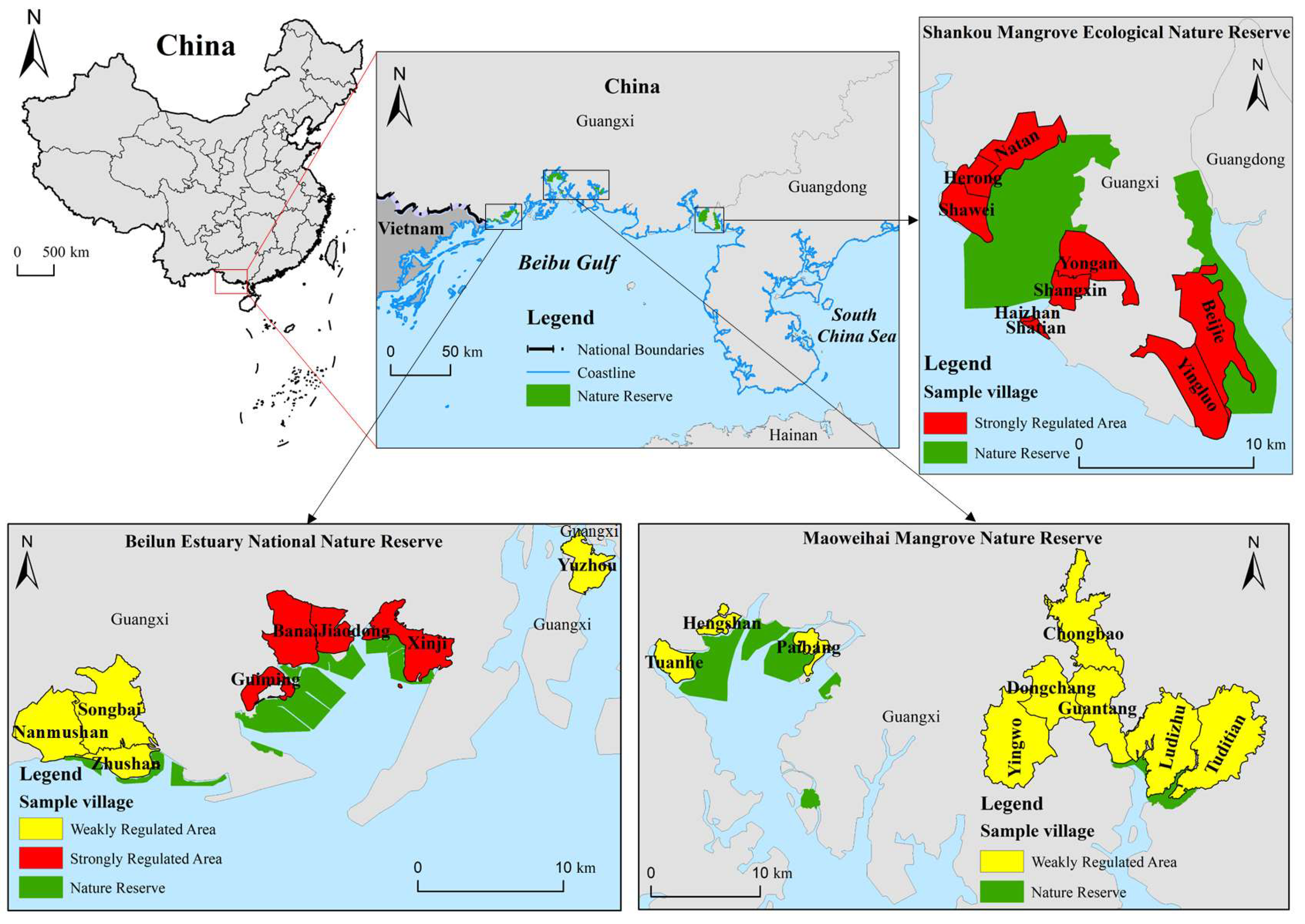
This study focuses on the Beibu Gulf coastal zone in China and targets households residing in communities adjacent to the Shankou Mangrove Ecological Nature Reserve, the Maoweihai Mangrove Nature Reserve, and the Beilun River Estuary National Nature Reserve. These three reserves—located, respectively, in the cities of Beihai, Qinzhou, and Fangchenggang—represent the areas with the largest wetland coverage within their jurisdictions. Specifically, (1) The Shankou Mangrove Ecological Nature Reserve in Beihai City, established in 1990 and covering 8003 hectares, focuses on the protection of mangrove wetlands and is among the earliest marine-type nature reserves approved in China. (2) The Maoweihai Mangrove Nature Reserve in Qinzhou City, established in 2005 and covering 5010.05 hectares, protects wetland ecosystems including estuaries, bays, tidal flats, and key habitats for migratory birds. (3) The Beilun River Estuary National Nature Reserve in Fangchenggang City, designated as a national nature reserve in 2000, covers 3000 hectares.
The Beibu Gulf coastal zone is not only a major marine economic region—often referred to as a “golden coastline” for regional development—but also a key area for marine ecological protection. In recent years, this region, particularly the three reserves, has experienced increasingly stringent coastal ecological regulation and conservation measures, including restrictive policies on nearshore fishing, aquaculture, and wetland use. These measures have created significant challenges for households engaged in traditional fishing and farming livelihoods. Therefore, conducting research in this area not only contributes to advancing coastal conservation but also provides valuable insights for coordinating ecological protection and livelihood development in other ecologically fragile regions. The study area is shown in Figure 1.
Data for this study were collected through household surveys conducted in the study area from August to September 2024. The questionnaire captured households’ basic demographic and socioeconomic characteristics, livelihood activities and income composition, perceptions of coastal policies and environmental change, psychological distance scale items, and annual assessments of opportunity losses associated with various potential livelihood activities. Since 2014, legislation and policies related to coastal ecological protection in the study area have advanced rapidly. To evaluate the long-term effects of ecological regulation on opportunity losses and livelihood choices, the 2024 survey additionally collected objective information on households’ characteristics and livelihood activities for 2013—the period preceding intensified ecological regulation. To maximize the reliability of retrospective data, the 2013 baseline focused on objective and structural indicators that are typically salient in rural households’ memories, such as household demographics (age, education, household size), migrant labor, and intertidal-flat operational areas. For the calculation of opportunity losses in 2013, we provided respondents with regional average return standards for various coastal activities as reference benchmarks to minimize estimation bias. Furthermore, the probability of engagement was operationalized as the specific proportion of time spent on this activity throughout the year in 2013, ensuring a more granular and objective recall.
To ensure sample representativeness and comparability of the sample, a multi-stage sampling strategy was employed. The first stage combined stratified and purposive sampling to select representative coastal villages. Initially, villages were preliminarily screened based on their distance from the coastline to ensure relevance to coastal resource utilization. Subsequently, based on sample village information, interviews with village officials, and local regulatory documents, the villages were categorized into strongly regulated and weakly regulated types. Strongly regulated villages are those in which livelihood activities—such as fishing, intertidal harvesting, and aquaculture—are restricted, whereas weakly regulated villages are those in which such activities remain largely unrestricted. Based on this classification, 13 strongly regulated villages and 13 weakly controlled villages were ultimately selected to ensure a balanced comparison. In the second stage, households were randomly selected within each selected village. Within each selected village, 6 to 60 households were randomly chosen for face-to-face interviews according to village population size. A total of 522 questionnaires were collected, of which 501 were valid, yielding a validity rate of 95.98%.
It is worth noting that among the 501 valid questionnaires, we observed multiple livelihood-transition pathways between 2013 and 2023. However, some transition types involving non-fishing or non-farming households contained very few observations, making it difficult to conduct robust econometric analysis. Moreover, fishers are the group most directly and substantially affected by coastal ecological regulation—such as fishing restrictions and aquaculture zoning—and their livelihood transitions provide a critical lens for assessing the social impacts of ecological regulation. Therefore, to focus on the core research question and ensure analytical robustness, this study uses the full sample only in Section 4.1 (which examines changes in opportunity losses from 2013 to 2023). All other sections concentrate on the sample of 239 fishing households, including 108 stable fishermen, 54 fishing households that transitioned to non-fishing farming households, and 77 fishing households that transitioned to non-agricultural households.

3.2. Main Variables and Summary Statistics

Livelihood transition. Livelihood transition refers to shifts in a household’s livelihood strategies [42]. Livelihood strategies represent the portfolio of activities undertaken by households, based on their livelihood assets, to achieve livelihood goals. Following the classification methods of Yang et al. [43] and Xie et al. [44], we categorize household livelihood types according to income structure and the dominant income source. The specific criteria are as follows: households for which agricultural income exceeds 10% of total income and whose primary income derives from fishing-related activities (e.g., nearshore capture fishing, shore-based harvesting, mangrove harvesting, intertidal collection, or aquaculture) are classified as fishing households; households with agricultural income exceeding 10% but whose primary income source is not fishing are classified as non-fishing agricultural households; households with agricultural income below 10% are classified as non-agricultural households. Because self-reported income for the year 2013 may be subject to recall bias, we construct a simplified livelihood classification for 2013 based solely on households’ primary income sources. Based on the farmer livelihood types identified for 2013 and 2023, nine transformation pathways were recognized. Given that this study focuses on the transition pressures faced by fishing households under ecological regulation, the dependent variable in our regression models is a three-category unordered variable constructed from the subsample of 239 fishing households:
0 = stable fishing households (fishing households in both 2013 and 2023);
1 = fishing households transformed into non-fishing farming households;
2 = fishing households transformed into non-agricultural households.
Opportunity losses variations. Our core independent variable is the longitudinal change in regulation-induced opportunity costs. Conceptually, opportunity losses refer to the potential economic benefits forgone as a direct result of specific environmental policies, calculated through the expectation function [8]. Opportunity losses variations are defined as the difference between a household’s opportunity losses in 2023 and that in 2013, reflecting the net change in opportunity losses over the study period. To intuitively grasp the concept of opportunity losses variations, suppose a household has two potentially profitable activities: nearshore fishing and intertidal oyster aquaculture. Under an unregulated scenario in 2013, the household’s potential income from fishing was 60,000 yuan per year, with a participation probability of 0.7, resulting in an expected income of 42,000 yuan. The potential income from oyster farming was 40,000 yuan per year, with a participation probability of 0.5, corresponding to an expected income of 20,000 yuan. If oyster farming was completely prohibited by policy in 2013 while nearshore fishing remained permitted, the opportunity loss would primarily stem from the loss of oyster farming income (approximately 20,000 yuan). By 2023, if regulations were tightened and nearshore fishing was significantly restricted (for example, through reduced allowable fishing days or smaller fishing areas), the probability of participation in fishing might decline (for instance, to 0.35), resulting in an additional fishing loss of 60,000 × 0.35 = 21,000 yuan. When combined with the continuing loss from oyster farming, the total opportunity loss would increase from 2013 to 2023.
To facilitate interpretation of the regression results, all regression analyses were conducted using opportunity losses variation scaled by dividing by 1000, with the resulting unit expressed as thousand yuan/household/year. In Section 4.1, to present the overall status of the raw data, the 2013 opportunity losses, the 2023 opportunity losses, and the opportunity losses variations are all expressed in units of yuan/household/year.
Mediating variable. We examined the mediating role of psychological distance and its four subdimensions—spatial, temporal, social, and hypothetical distance. Drawing on psychological distance theory, we measure farmers’ psychological perceptions of coastal environmental issues following the validated scales developed by Spence et al. [45] and Jones et al. [46]. The scale comprises four dimensions—spatial distance, temporal distance, social distance, and hypothetical distance—with all items rated on a five-point Likert scale (1 = strongly disagree, 5 = strongly agree).
Spatial distance measures the perceived geographic proximity of environmental impacts. It is measured using two items: ‘Only those living near wetlands are affected by wetland conditions’ (reverse scored) and ‘Wetland degradation has a greater impact on people living close to wetlands’ (reverse scored).
Temporal distance captures the perceived urgency and timing of the threat. It is measured using three items: ‘Wetland degradation will immediately affect your life’ (reverse scored); ‘The rapid disappearance of wetlands means that protection is needed now’ (reverse scored); and ‘Future generations are more likely to be affected by wetland degradation’.
Social distance reflects the closeness of relationships between households and community members. It is measured using three items: ‘People you know are unlikely to be affected by wetland degradation’; ‘Wetland degradation will affect you and your family’ (reverse scored); and ‘Wetland degradation will affect your coworkers and neighbors’ (reverse scored).
Hypothetical distance assesses the perceived certainty and authenticity of the issue. It is measured using three items: ‘The severity of wetland degradation is largely exaggerated’; ‘The true impacts of wetland degradation on human well-being are uncertain’; and ‘It is difficult to judge the severity of wetland degradation’s impacts on daily life due to interference from other factors’.
We first recoded all items within each dimension so that lower scores indicate a shorter psychological distance (i.e., greater perceived immediacy and authenticity of the issue). We then conducted reliability tests for each dimension. The Cronbach’s alpha coefficients for spatial distance, temporal distance, social distance, and hypothetical distance were 0.67, 0.77, 0.70, and 0.69, respectively, indicating good internal consistency of the scale. To assess construct validity, we examined the internal structure of the scale. Exploratory Factor Analysis (EFA) was conducted to assess construct validity. The Kaiser–Meyer–Olkin (KMO) value was 0.76, and Bartlett’s test of sphericity was highly significant (χ2 = 2101.09, p < 0.001), confirming that the data were suitable for factor analysis. Three major factors with eigenvalues greater than 1 were extracted, cumulatively explaining 63.42% of the total variance. After Varimax rotation, the analysis showed that items for spatial and hypothetical distance loaded clearly onto distinct factors (with loadings ranging from 0.82 to 0.92). Items for temporal and social distance loaded onto a single combined factor (loadings > 0.72), reflecting the high perceived correlation between social relevance and temporal urgency in the context of coastal livelihoods. These results confirm that the scale captures the multi-dimensional structure of psychological distance accurately.
Subsequently, we averaged the item scores within each dimension to obtain the raw dimension-level scores and standardized all raw scores using z-score normalization. In addition, we constructed an overall psychological distance index by aggregating all items and standardizing the composite score. This index achieved a Cronbach’s alpha of 0.77 and was used to assess the mediating role of overall psychological distance.
Moderating variables. Two policy-context variables—regulation intensity and policy publicity—are used as moderating variables. Regulation intensity is categorized into strongly regulated and weakly regulated areas based on the degree of livelihood restrictions reported in the surveyed villages. Policy publicity is categorized into weak, moderate, and strong levels according to respondents’ assessments of “the extent to which government agencies disseminate coastal ecological protection policies.”
Other control variables. To account for additional factors that may influence livelihood transitions, we include a set of demographic and socioeconomic characteristics commonly used in related studies, including gender, age, education level, household size, number of migrant workers in the household, distance to the coast, and area of intertidal-flat use. Definitions of variables and descriptive statistics are presented in Table 1. All continuous control variables were standardized using z-score normalization prior to the regression analysis.

3.3. Empirical Strategy

This study uses an expectation function combined with entropy weighting to calculate the annual opportunity loss incurred by rural households as a result of coastal-zone regulation. Then we investigate the mechanism through which opportunity losses variations induced by coastal ecological regulation affects households’ livelihood transition, employing an integrated strategy that combines multinomial logit models (MNLs), instrumental variables, and Generalized Structural Equation Modeling (GSEM). All regressions are estimated using clustered robust standard errors at the village level to correct for potential correlations among observations within the same village.

3.3.1. Measurement of Opportunity Losses

(1) Calculating opportunity losses:
Based on the potential annual income that households could obtain from each restricted activity in the absence of coastal ecological regulation, as well as the probability of engaging in that activity, the amount of opportunity loss is calculated using the mathematical expectation formula.
L i j = R i j × P i j
where L i j represents the opportunity loss for household j associated with activity i , R i j denotes the expected annual income from the activity in the absence of restrictions, and P i j is the probability of engaging in that activity when it is not restricted.
(2) Calculating the total weighted opportunity losses:
Given that different activities have varying levels of importance to a household’s total livelihood, we use the entropy weight method to determine the weight ( w i ) of each activity; the detailed entropy weight method is provided in Appendix A.1. This objective weighting method reduces subjective bias by calculating the informational redundancy of each activity’s loss across the sample. The total weighted opportunity loss for household A j is
A j = m = 1 n ( L i j × w i ) = m = 1 n ( R i j × P i j × w i )
where A j represents the weighted sum of opportunity loss for household j , w i ( 0 w i 1 , i = 1 m w i = 1 ) represents the weight of each regulated activity, and m denotes the total number of regulated activities.
(3) Calculating opportunity losses variations:
The core independent variable, opportunity losses variations, captures the dynamic change in regulation-induced constraints over a decade. It is calculated as the difference between the weighted opportunity loss in 2023 and the baseline in 2013:
A j = A j , 2023 A j , 2013
where A j represents opportunity losses variations, A j , 2023 represents the 2023 opportunity losses of household j   ,   A j , 2013 represents the 2013 opportunity losses of household j .

3.3.2. Multinomial Logit Model (MNL)

Since the dependent variable is characterized by unordered categorical variables, this study employs a multinomial logit model to examine the impact of opportunity losses variations on households’ livelihood transition. The model is specified as follows:
log ( P ( y i = j ) P ( y i = 0 ) ) = α j + β j X i + γ j C i + ε i j
where P ( y i = j ) represents the probability that household i selects livelihood transition path j , j { 0,1 , 2 } ; X i denotes the core independent variable, opportunity losses variations, which capture the changes in opportunity losses for each household i between 2013 and 2023, calculated as the opportunity losses in 2023 minus that in 2013; C i represents the control variable vector; α j , β j , γ j signify the parameters to be estimated; and ε i j indicates the error term. The model parameters are estimated using maximum likelihood estimation, and the results are reported as log-odds coefficients relative to the base category (stable fishermen, j = 0 ). To facilitate the interpretation of policy implications, we further convert the effect of opportunity losses variations on the probability of selecting each category into the probability scale using the average marginal effect (AME).

3.3.3. Instrument Variable Estimation

There may be potential causal endogeneity between opportunity losses variations and households’ livelihood transition. An increase in opportunity losses could drive households’ livelihood transition, while conversely, livelihood transition might mitigate opportunity losses for farmers. To address the endogeneity issue, this study employs the instrumental variable method. Specifically, the area of nature reserves of marine type near farmers’ households is selected as an instrumental variable for opportunity losses variations. This variable is closely related to opportunity losses variations: the area of nature reserves significantly affects farmers’ opportunity losses variations by influencing the scope and intensity of ecological regulations. Admittedly, the spatial designation and scale of nature reserves may not be entirely random and could correlate with latent regional development trajectories. To safeguard the exclusion restriction, we adopted a multi-layered strategy. First, our instrumental variable (IV) is anchored to the reserve area predating 2013, effectively purging potential reverse causality stemming from recent livelihood shifts. While long-term regional paths might influence structural livelihood strategies, the sudden intensification of coastal regulation post-2014 serves as an exogenous policy shock; its impact on household transitions operates primarily through the immediate escalation of opportunity costs. Second, the macro-level nature of reserve planning precludes individual households from influencing reserve boundaries to suit their livelihood intentions. Furthermore, we explicitly controlled for key geographic proxies—distance to the coast and allocated intertidal-flat area. These variables account for spatial confounding and a household’s baseline dependence on natural capital, both of which are common drivers of both reserve placement and regional economic trends. Finally, our use of village-level clustered robust standard errors further ensures that statistical inferences remain resilient to unobserved intra-village correlations.
We employ a Generalized Structural Equation Model (GSEM) to implement the IV-MNL. The GSEM provides a unified framework for the joint estimation of endogenous variables and the multiclass dependent variable, effectively avoiding the estimation bias and efficiency loss that may arise in nonlinear models when using the traditional two-stage least squares method. Specifically, this model performs simultaneous estimation through a system of structural equations consisting of two equations:
{ X i = φ 0 + φ 1 Z i + k = 2 n φ k C i + μ i log ( P ( y i = j ) P ( y i = 0 ) ) = α j + β j X i + γ j C i + ε i j
where Z i serves as the instrumental variable, φ represents the coefficient to be estimated, and μ i denotes the error term, and the rest is the same as above.

3.3.4. Mediating Effect Model

To further explore the mechanism through which opportunity losses variations influence households’ livelihood transition, this study employs the GSEM and incorporates psychological distance as a mediating variable to construct a mediation model. The model is specified as follows:
M e i = λ 0 + λ 1 X i + k = 2 n λ k C k i + e 1 i
log ( P ( y i = j ) P ( y i = 0 ) ) = γ j 0 + γ j 1 X i + γ j 2 M e i + k = 3 n γ j k C k i   +   e 2 i j
where M e i represents the mediator variable, denoting psychological distance. The coefficient λ 1 corresponds to the estimated coefficient of X i , reflecting the effect of opportunity losses variations on psychological distance. λ k denotes the coefficient of the control variable. γ j 1 represents the estimated coefficient of the core independent variable X after the inclusion of the mediator variable. The coefficient γ j 2 pertains to the mediator variable, while γ j k corresponds to the coefficient of the control variable. Lastly, e 1 i , e 2 i j signifies the error term.

3.3.5. Moderating Effect Model

To investigate whether policy publicity and regulation intensity moderate the impact of opportunity losses variations on households’ livelihood transition, we incorporated interaction terms between the core independent variable and the moderating variables into the multinomial logit model. The model is specified as follows:
log ( P ( y i = j ) P ( y i = 0 ) ) = δ j 0 + δ j 1 X i + δ j 2 M O i + δ j 3 ( X i × M O i ) + k = 4 n δ j k C i + ξ i j
where M O i represents the moderating variable, while X i × M O i denotes the interaction term between opportunity losses variations and the factors of policy publicity or regulation intensity; δ j k signifies the parameters to be estimated; and ξ i j indicates the error term.

4. Results

4.1. Changes in Opportunity Losses from 2013 to 2023

To analyze the trends and group differences in regional opportunity losses, this study first conducted a detailed examination of the opportunity losses across the full sample in the study area before and after the tightening of regulatory policies. Table 2 shows that in 2013, the average opportunity loss in the study area was 4449.32 yuan/household/year, which decreased to 3223.01 yuan by 2023. The average change in opportunity loss was −1226.31 yuan. This indicates an overall declining trend in opportunity loss for farmers due to restricted activities during the study period, which may reflect their adaptive adjustment under long-term regulatory constraints.
However, there is significant heterogeneity in opportunity loss across different categories. Farmers in areas with varying regulation intensity exhibit heterogeneity in both the level of opportunity loss and the opportunity losses variations between 2013 and 2023. Before the policy tightening in 2013, the average opportunity loss for farmers in strongly regulated areas was 5706.65 yuan/household/year, significantly higher than the 3424.32 yuan/household/year in weakly regulated areas. By 2023, the average opportunity loss for farmers in strongly regulated areas had decreased to 3846.72 yuan/household/year, still significantly higher than the 2714.55 yuan/household/year in weakly regulated areas. Moreover, the average opportunity losses variation in strongly regulated regions was −1859.93 yuan, with losses significantly greater than those in weakly regulated regions (−709.77 yuan).
Categorized by livelihood type, fishing households bear a significantly higher opportunity loss compared to non-fishing farming households and non-agricultural households, with the gap continuing to widen over time (2013: fishing households = CNY 7498.10, non-fishing farming households = CNY 1047.21, non-agricultural households = CNY 1773.53; 2023: fishing households remain the highest at CNY 8215.79, non-fishing farming households = CNY 3441.19, non-agricultural households = CNY 905.51). This starkly highlights the vulnerability and adjustment pressure faced by the fishery sector under coastal ecological regulation. It also strongly justifies the rationale and necessity of focusing this study on fishing households, as they are the primary bearers of the opportunity costs associated with coastal ecological regulation. Their livelihood transition decisions most directly reflect the socio-economic impact of regulatory policies.

4.2. Baseline Results Analysis

The results of the multinomial Logit regression (Table 3, Columns 1, 2) indicate that the opportunity losses variations have a significant negative impact on the two livelihood transition paths for fishing households (fishing households to non-fishing farming households: coef = −0.246, p = 0.016; fishing households to non-agricultural households: coef = −0.275, p = 0.004). The average marginal effect (Table 3, Columns 3–5) further reveals that for every increase of 1000 yuan/household/year in the opportunity losses variations, the probability of households maintaining a fishery livelihood increases by an average of 5.20 percentage points (p = 0.003), while the probabilities of transitioning to non-fishing farming households and non-agricultural households decrease by approximately 2.00 percentage points (p = 0.041) and 3.20 percentage points (p = 0.002), respectively. These findings suggest that the increase in opportunity loss caused by ecological regulations does not drive direct exit and transition; instead, it statistically suppresses the occurrence of livelihood transition away from fishery.
Regarding control variables, age has a significant positive effect on the transition to non-agricultural households (coef = 0.045, p = 0.055), indicating that older fishing households may be more inclined to completely exit fishery activities. The logarithm of distance from the coast (ln_distance_coast) shows a positive and significant impact on the probability of households’ livelihood transition, suggesting that geographic proximity remains a determining factor in fishery dependence, with households farther from the coast being more likely to undergo transition. The logarithm of managed intertidal-flat area (ln_intertidal-flat_area) exhibits a significant negative effect on both transition paths. This implies that households with greater marine resource endowments have a lower willingness to transition their livelihoods, tending instead to maintain or optimize their existing fishery-based livelihoods. In summary, empirical evidence supports hypothesis H1: Opportunity losses variations have a negative impact on the livelihood transition of fishing households.

4.3. Instrument Variable Test

As shown in Columns (6) and (7) of Table 3, the first-stage regression indicates that the instrumental variable (area of nature reserves) is significantly correlated with the opportunity losses variations (coef = −0.001, SE = 0.000, p < 0.001), satisfying the relevance condition of the instrumental variable. Meanwhile, the first-stage F-statistic of the instrumental variable exceeds 10 and is statistically significant at the 1% level, thereby enhancing the reliability of the estimation results. The second-stage regression results remain consistent with the baseline regression in both the sign and significance of the coefficients, further supporting the robustness of the baseline findings.

4.4. Robustness Check

This study conducts robustness tests by replacing the core independent variable, substituting the dependent variable and applying the winsorization technique to the dataset. First, redefine the measurement method for opportunity loss by not assigning weights to each restricted activity. Calculate the unweighted opportunity loss for farmers by multiplying the expected returns of each restrictive activity under no restrictions by the probability of the activity occurring, thereby deriving the new opportunity losses variations. Columns (1) and (2) of Table 4 present the results based on this new measure of opportunity losses variations. Second, the dependent variable, livelihood transition, is redefined as a binary variable (0 = no transition; 1 = transition), and a Logit model is employed for re-estimation. Column (3) of Table 4 reports the estimation results of the Logit model, which examines the impact of opportunity losses variations on livelihood transition. To mitigate the impact of extreme outliers on the research results, this study conducts a further inspection based on winsorization. All continuous variables are winsorized at the 1% level, and regression analysis is performed on the winsorized sample. The results are presented in Columns (4) and (5) of Table 4. When alternative variable definitions or winsorization treatments are applied, the direction and significance of the coefficients remain consistent with the baseline regression results, indicating that the estimation results are robust.

4.5. Mechanism Analysis

The mediation analysis based on GSEM (Table 5) indicates that opportunity losses variations have a significant negative effect on psychological distance (Coef. = −0.065, p < 0.01). In other words, an increase in opportunity loss does not make farmers feel more detached; instead, by activating their risk perception, it significantly reduces their psychological distance, leading them to pay closer psychological attention to fishery-related issues. Furthermore, psychological distance exerts a significant positive effect on farmers’ decisions to shift toward non-agricultural households, while its effect on transitioning to other non-fishing agricultural households is not significant. The resulting indirect effect is approximately −0.047 (−0.065 × 0.729, in log-odds scale), suggesting that psychological distance plays a partial mediating role in the pathway through which opportunity loss influences fishing households’ transition to non-agricultural households (the indirect effect is significant but smaller than the direct effect). This finding supports Hypothesis H2a, which posits that opportunity loss reduces farmers’ inclination toward fully non-agricultural livelihoods by shortening their psychological distance.
The dimension-specific tests further clarify the key pathways. The mediating role of social distance proves to be the most prominent. An increase in opportunity loss exerts a significant negative effect on social distance. In other words, greater opportunity loss leads households to rely more closely on traditional fishery communities within their social networks. Social distance, in turn, has a significant positive effect on both types of livelihood transition, with indirect effects of −0.017 (−0.043 × 0.395, log-odds scale) for the transition to non-fishing farming households and −0.025 (−0.043 × 0.580, log-odds scale) for the transition to non-agricultural households.
Furthermore, Table A1 in Appendix A.2 indicates that although spatial distance, temporal distance, and hypothetical distance themselves exert important influences on livelihood transition, they do not constitute the key pathways through which opportunity loss is transmitted to livelihood transition. These further support our theoretical assertion that social distance serves as the most critical mediating pathway through which opportunity loss influences livelihood transition. It indicates that an increase in opportunity loss leads households to rely more heavily on traditional fishery networks, thereby discouraging withdrawal or complete transformation.

4.6. Moderating Effect Analysis

Table 6 shows that both policy publicity and regulation intensity significantly moderate the relationship between opportunity losses variations and livelihood transition. Specifically, policy publicity exerts a significant moderating effect on the relationship between opportunity losses variations and both transition pathways. The interaction terms are significantly negative at the 1% level, and the coefficient directions are consistent with that of the opportunity loss variable. This indicates that policy publicity plays a positive moderating role in both transition pathways. In other words, as policy publicity increases, the inhibitory effect of the opportunity losses variations on households’ livelihood transition is significantly strengthened.
In strongly regulated areas, the interaction term between regulation intensity and opportunity losses variations is significantly negative in the pathway of fishing households transitioning to non-fishing farming households, indicating that opportunity losses variations exert a significant inhibitory effect on the shift toward non-fishing farming households. Therefore, regulation intensity positively reinforces the perceived inhibitory effect of opportunity losses variations on households’ livelihood transition from fishing to non-fishing farming households, partially supporting Hypothesis H4.

4.7. Heterogeneity Analysis

The results of the heterogeneity analysis are presented in Table 6. Column (3) indicates that in the strongly regulated area, opportunity losses variations are significantly and negatively correlated with both livelihood transition pathways. This confirms that under a strongly regulated environment, opportunity losses variations exert a generally suppressive effect on households’ livelihood transition. In contrast, in the weakly regulated area (Column (4) of Table 6), opportunity losses variations show no significant impact on the path toward non-fishing farming households, but has a significant negative effect on the path toward non-agricultural activities. This suggests that in the weakly regulated area, opportunity losses variations primarily inhibit households from completely exiting fishery and engaging in non-agricultural sectors, while their impact on the shift toward non-fishing farming households is not significant. Therefore, these findings support Hypothesis H5, which posits that the impact of opportunity losses variations on livelihood transition exhibits regional heterogeneity.

5. Discussion

This study employs empirical analysis to examine how differences in opportunity losses induced by coastal ecological regulation affect the livelihood transition of fishery households, and further explores the psychological and institutional mechanisms underlying these effects. Our core findings provide new insights into the complex relationship between ecological protection and rural households’ livelihoods.
Our study indicates that under coastal ecological regulation, opportunity loss suppresses rather than promotes fishermen’s livelihood transition. This loss-induced “livelihood stickiness effect” challenges the conventional expectation that economic pressure drives livelihood diversification [47], aligning instead with the concepts of path dependence and traditional inertia in behavioral economics [48,49]. This behavioral pattern is highly consistent with the findings of Yin et al. [50] on herders under the Grassland Ecological Protection Award Policy (GEPAP). In both coastal and grassland environments, traditional livelihoods remain the dominant source of income because non-agricultural opportunities are often merely “supplementary” and cannot fully offset the increasing opportunity costs. In addition, China’s green agricultural development (GAD) exhibits a “core–edge” spatial pattern. Peripheral regions, constrained by the lack of factor spillovers and institutional support, struggle to achieve a green transition [51]. The coastal fishers in this study are situated at the margins of the GAD network. Unlike inland agricultural communities, they have neither received financial support from digital finance for livelihood transition [52] nor benefited from technological and industrial spillovers from core regions [51]. Consequently, they respond to opportunity losses through a “defensive persistence” in traditional livelihoods rather than proactively shifting toward GAD-compatible livelihoods such as ecological aquaculture or advanced fishery processing.
Although traditional inertia is widespread in rural communities, its driving forces exhibit significant heterogeneity. For herders, stickiness arises from policy dependence, as stable ecological compensation weakens the incentive for diversified development. In contrast, tea farmers are anchored by market mechanisms, where high and stable tea prices reduce the urgency to seek alternative livelihoods [53]. By comparison, fishermen’s livelihood stickiness is driven by psychological and social embeddedness formed under conditions of loss rather than stability. Unlike the herders observed by Yin et al. [50], who increased livestock numbers to compensate for insufficient subsidies, coastal fishermen often respond to regulatory shocks through “defensive persistence.” This persistence stems from the non-monetary satisfaction derived from Fishery livelihoods, a trait also found among fishermen on the U.S. West Coast, who tend to prioritize occupational identity over other, higher-paying livelihood options [22].
The psychological mechanism underlying this livelihood stickiness can be partly attributed to the reduction in psychological distance, particularly in its social dimension. The shortening of social distance reflects a stronger reliance on community networks, shared identity, and collective norms. In the fishery sector, livelihood functions not only as an economic activity but also as a socially embedded way of life [54,55,56]. As opportunity loss accumulates, close social ties may enhance mutual assistance and risk sharing, yet they also reinforce conformity and hinder farmers from pursuing more proactive and transformative changes [39,57]. Moreover, this livelihood stickiness is intensified by structural barriers, including limited skills and capital, as well as chronic health problems resulting from long-term physical labor [58,59,60]. When the costs of transformation—such as acquiring new skills, capital, or access to information—are high and alternative livelihood options are limited, farmers are either unwilling or unable to change their existing livelihood strategies even in the face of sustained losses [61,62]. Instead, they tend to adapt within the fishery itself, for example by modifying fishing gear, adjusting seasonal activities, or engaging in covert operations.
In addition, the policy environment significantly moderates the effect of opportunity losses variations on livelihood transitions. Specifically, we find that regulation intensity substantially amplifies the inhibitory effect of opportunity losses variations on fishers’ livelihood transitions. This is consistent with existing studies indicating that strong regulation exacerbates development-related opportunity loss and influences households’ production decisions [63]. Notably, our results also reveal that greater policy publicity does not mitigate the inhibitory effect of opportunity loss; instead, it statistically reinforces this negative impact. A plausible explanation is that the content and delivery of policy publicity in the study area emphasize regulation and long-term restrictions without providing feasible alternative options or adequate economic compensation. Fieldwork conducted by our research team in the Beibu Gulf in 2024 provides empirical support for this mechanism. Most surveyed villages had not established systematic coastal ecological compensation schemes. For instance, in Natan Village, although a compensation policy was introduced for the withdrawal of aquaculture ponds, the compensation standard—800 yuan per mu per year—was far below the cost of pond construction and the expected returns. As a result, many aquaculture households refused to withdraw their ponds or continued operating covertly; some explicitly stated that they would exit fishing-based livelihoods only if compensation covered construction costs. This illustrates that low-level compensation neither offsets the opportunity costs imposed by regulation nor meets households’ livelihood expectations, leading them to comply with regulation while waiting for more substantial institutional support or viable alternative pathways [64]. Under such conditions, intensified policy publicity can heighten the salience and certainty of constraints, reinforcing normative pressure and a sense of surveillance within the community. This, in turn, may trigger defensive persistence, reluctant compliance, or a wait-and-see strategy. Heterogeneity analysis provides additional evidence for the differentiated effects of regulation intensity on transition decisions.
Finally, this study has several limitations. First, while we focused on salient structural variables (e.g., intertidal-flat area, migrant labor) and utilized regional productivity benchmarks to anchor respondents’ memories, the reliance on 10-year recall data remains an inherent limitation. Recollection bias may attenuate estimated effects or obscure short-term dynamic shifts. Future research should prioritize constructing or utilizing panel data to more accurately capture the dynamic causal pathways through which opportunity losses variations influence livelihood transitions. Second, due to data constraints, this study considers only two transition paths among fishing households—transition to non-fishing agricultural livelihoods or to non-agricultural livelihoods. Future studies should adopt more refined classifications to reflect the more complex livelihood transitions observed in practice. In addition, the measurement of psychological distance in this study is based on survey responses and may be subject to subjective bias; future research could incorporate behavioral experiments to more precisely capture households’ psychological states.

6. Conclusions and Implications

6.1. Conclusions

This study systematically examines the complex relationship between opportunity losses variations induced by coastal ecological regulation and livelihood transitions among fishing households from 2013 to 2023, and further identifies the underlying psychological mechanisms and policy-context moderators. The findings aim to inform policies that alleviate livelihood pressures on fishers and promote sustainable livelihood transitions among rural households. The main conclusions are as follows. (1) Increases in opportunity loss do not promote fishing households’ transitions toward non-fishing farming households or non-agricultural households. Instead, rising opportunity loss generates a pronounced “livelihood stickiness” effect, whereby households become more inclined to maintain traditional fishery livelihoods. (2) Psychological distance partially mediates the effect of opportunity loss on fishers’ transitions to non-agricultural livelihoods, indicating that both economic constraints and psychosocial channels jointly shape household decisions. Among the four dimensions, reductions in social distance—reflected in strengthened community bonds and occupational identity—constitute the key mediating pathway. (3) The policy environment plays a critical moderating role. In strongly regulated areas, the inhibitory effect of opportunity losses variations on livelihood transitions is considerably stronger. Moreover, in the absence of effective compensation or viable alternatives, intensified policy publicity further reinforces this inhibitory effect rather than alleviating it. (4) Heterogeneity analysis shows that the inhibitory effect of opportunity losses variations is substantially more pronounced in strongly regulated areas than in weakly regulated areas. This underscores the differentiated impacts of protection policies across enforcement contexts and highlights the necessity of region-specific interventions.

6.2. Implications

Based on the findings of this study, several policy recommendations are proposed. First, ecological compensation and policy publicity should be jointly designed as an integrated policy instrument. The compensation mechanism should be explicitly anchored to the sunk investments and expected returns of fishing households, with subsidy amounts aligned with the amount of opportunity cost. Multi-year payments or compensation schemes linked to the progress of livelihood transition should be adopted to ensure that households do not fall into livelihood difficulties during ecological conservation, thereby promoting sustainable livelihoods. At the same time, policy publicity should shift from emphasizing restrictions to clearly presenting compensation arrangements, transitional support, and alternative livelihood pathways. Second, livelihood transition policies should reduce the social costs of exiting the fishery through community embeddedness. The key mediating role of social distance indicates that the decision-making of fishing households is deeply embedded in community relationships, occupational identity, and collective norms. Policy interventions should align with and leverage this characteristic by promoting cooperative-style transformation programs, village-level alternative livelihood pilots, or collective and phased transition arrangements that enable fishing households to pursue transformation collectively rather than individually. In addition, peer demonstration and case-based learning should be used to reduce uncertainty associated with the transformation process. Finally, differentiated intervention measures should be implemented across regions with varying levels of regulation intensity. In areas where ecological regulations are stringent, the government should provide stronger, more stable, and sustained policy support, including targeted financial subsidies, systematic skills training, and non-fishery employment opportunities. In contrast, in regions with relatively lower regulation intensity, more flexible incentive mechanisms and gradual institutional arrangements can be explored to guide households in progressively adjusting their livelihood structures.

Author Contributions

Conceptualization, H.W. and F.L.; methodology, F.L.; software, F.L.; validation, F.L., H.W. and D.C.; formal analysis, F.L., L.Q., H.W. and D.C.; investigation, F.L., L.Q. and D.C.; resources, H.W. and X.N.; data curation, F.L. and L.Q.; writing—original draft preparation, F.L.; writing—review and editing, F.L., L.Q., H.W., X.N. and D.C.; visualization, F.L.; supervision, H.W. and X.N.; project administration, H.W. and X.N.; funding acquisition, H.W., X.N. and F.L. All authors have read and agreed to the published version of the manuscript.

Funding

This research was funded by the National Natural Science Foundation of China (Nos. 72363002, 72473033, 72433001), Key Research Base of Humanities and Social Science for Guangxi University Institute for Frontier Economics of China, Innovation Project of Guangxi Graduate Education (YCBZ2024028).

Data Availability Statement

The raw data supporting the conclusions of this article will be made available by the authors on request.

Conflicts of Interest

The authors declare no conflicts of interest.

Appendix A

Appendix A.1. The Weights of Regulated Activities

Given that the importance and uncertainty of different regulated activities vary across households’ livelihoods, we use the entropy method to determine the weights of each activity w i .
(1) Data Normalization:
First, normalize the individual opportunity loss L i j .
r i j = L i j m i n j { L i j } m a x j { L i j } m i n j { L i j }
(2) Calculation of Weight and Entropy Values:
The weight f i j of opportunity loss for household j in activity i is first calculated, after which the entropy value e i for activity i is obtained.
f i j = r i j j = 1 q r i j
e i = ( 1 ln q ) j = 1 q f i j ln f i j
where q denotes the total number of households.
(3) Determining Activity Weights:
We calculate the redundancy d i = 1 e i of activity i and then normalize it to obtain the final weight.
w i = 1 e i i = 1 m ( 1 e i )
where w i ( 0 w i 1 , i = 1 m w i = 1 ) represents the weight of each regulated activity, and m denotes the total number of regulated activities.

Appendix A.2. Mechanism Analysis Results: The Roles of Spatial, Temporal, and Hypothetical Distances in Livelihood Transition

Table A1. Mechanism analysis results: the roles of spatial, temporal, and hypothetical distances in livelihood transition.
Variable(5) Spatial Distance(6) Livelihood Transition(7) Temporal Distance(8) Livelihood Transition(9) Hypothetical Distance(10) Livelihood Transition
yi = 1yi = 2yi = 1yi = 2yi = 1yi = 2
Opportunity losses variations−0.055 ***
(0.015)
−0.254 ***
(0.095)
−0.251 ***
(0.084)
−0.061 ***
(0.021)
−0.250 **
(0.098)
−0.264 ***
(0.092)
−0.017
(0.010)
−0.234 **
(0.101)
−0.264 ***
(0.095)
Spatial distance −0.304
(0.238)
0.330
(0.251)
Temporal distance −0.098
(0.239)
0.168
(0.223)
Hypothetical distance 0.456 **
(0.160)
0.635 ***
(0.196)
Control variablescontrolcontrolcontrolcontrolcontrolcontrolcontrolcontrolcontrol
Constant−1.112 **
(0.522)
−2.951 **
(0.095)
−4.290 ***
(1.638)
−0.932 **
(0.392)
−2.616 **
(1.291)
−4.417 ***
(1.651)
0.167
(0.580)
2.873 **
(1.389)
−5.018 ***
(1.907)
Observations239239239239239239239239239
Note: (1) Cluster-robust standard errors in parentheses; (2) ** p < 0.05, *** p < 0.01.

References

  1. Crossland, C.J.; Baird, D.; Ducrotoy, J.-P.; Lindeboom, H.; Buddemeier, R.W.; Dennison, W.C.; Maxwell, B.A.; Smith, S.V.; Swaney, D.P. The coastal zone—A domain of global interactions. In Coastal Fluxes in the Anthropocene: The Land-Ocean Interactions in the Coastal Zone Project of the International Geosphere-Biosphere Programme; Springer: Berlin/Heidelberg, Germany, 2005; pp. 1–37. [Google Scholar]
  2. Zheng, Z.; Wu, Z.; Chen, Y.; Yang, Z.; Marinello, F. Exploration of Eco-Environment and Urbanization Changes in Coastal Zones: A Case Study in China over the Past 20 Years. Ecol. Indic. 2020, 119, 106847. [Google Scholar] [CrossRef]
  3. Halpern, B.S.; Longo, C.; Hardy, D.; McLeod, K.L.; Samhouri, J.F.; Katona, S.K.; Kleisner, K.; Lester, S.E.; O’Leary, J.; Ranelletti, M.; et al. An Index to Assess the Health and Benefits of the Global Ocean. Nature 2012, 488, 615–620. [Google Scholar] [CrossRef]
  4. Cheng, P.; Dong, Y.; Wang, Z.; Tang, H.; Jiang, P.; Liu, Y. What Are the Impacts of Livelihood Capital and Distance Effect on Farmers’ Willingness to Pay for Coastal Zone Ecological Protection? Empirical Analysis from the Beibu Gulf of China. Ecol. Indic. 2022, 140, 109053. [Google Scholar] [CrossRef]
  5. Economou, A.; Kotsev, I.; Peev, P.; Kathijotes, N. Coastal and Marine Spatial Planning in Europe. Case Studies for Greece and Bulgaria. Reg. Stud. Mar. Sci. 2020, 38, 101353. [Google Scholar] [CrossRef]
  6. Zheng, J.; Xu, W.; Tao, A.; Fan, J.; Xing, J.; Wang, G. Synergy Between Coastal Ecology and Disaster Mitigation in China: Policies, Practices, and Prospects. Ocean Coast. Manag. 2023, 245, 106866. [Google Scholar] [CrossRef]
  7. Cheng, P.; Wang, H.; Nie, X.; Zhu, S.; Chen, Z.; Wu, X.; Zhang, A.; Wang, J. What Are the Impacts of a Coastal Zone Protection Policy on Farmers’ Livelihood Capital? Empirical Analysis from the Perspective of Farmer Participation. Front. Mar. Sci. 2021, 8, 689182. [Google Scholar] [CrossRef]
  8. Nie, X.; He, L.; Chen, Z.; Yang, M.; Li, Y.; He, X.; Wang, H.; Gao, W. Study on Ecological Compensation Quotas in Different Confined Areas of Coastal Zone—A Case Study of Mangrove Reserve in Shankou, Guangxi, China. Ocean Coast. Manag. 2023, 246, 106865. [Google Scholar] [CrossRef]
  9. Lin, C.; Gao, L. Reserve regulation and multidimensional relative poverty of farmers: Evidence from the Panda Nature Reserves in China. Nat. Resour. Model. 2023, 36, e12358. [Google Scholar] [CrossRef]
  10. Zhong, F.; Liu, Y.; Ma, Y.; Li, Y.; He, M. The Government’s Impact on the Transformation of Rural Livelihoods in Agropastoral Regions: A Quantitative Analysis of Farmers’ Perceptions of Public Services in Inner Mongolia, China. Land Use Policy 2025, 157, 107642. [Google Scholar] [CrossRef]
  11. Li, Z.; Rao, D.; Liu, M. The Impact of China’s Grassland Ecological Compensation Policy on the Income Gap between Herder Households? A Case Study from a Typical Pilot Area. Land 2021, 10, 1405. [Google Scholar] [CrossRef]
  12. Lan, X.; Zhang, Q.; Xue, H.; Liang, H.; Wang, B.; Wang, W. Linking Sustainable Livelihoods with Sustainable Grassland Use and Conservation: A Case Study from Rural Households in a Semi-Arid Grassland Area, China. Land Use Policy 2021, 101, 105186. [Google Scholar] [CrossRef]
  13. Yang, Q.; Chen, Y.; Li, X.; Yang, J.; Gao, Y. Livelihood Vulnerability and Adaptation for Households Engaged in Forestry in Ecological Restoration Areas of the Chinese Loess Plateau. Chin. Geogr. Sci. 2024, 34, 849–868. [Google Scholar] [CrossRef]
  14. Zhao, X.; Chen, H.; Zhao, H.; Xue, B. Farmer Households’ Livelihood Resilience in Ecological-Function Areas: Case of the Yellow River Water Source Area of China. Environ. Dev. Sustain. 2022, 24, 9665–9686. [Google Scholar] [CrossRef]
  15. Liu, Z.; Liu, L. Characteristics and Driving Factors of Rural Livelihood Transition in the East Coastal Region of China: A Case Study of Suburban Shanghai. J. Rural Stud. 2016, 43, 145–158. [Google Scholar] [CrossRef]
  16. Scoones, I. Livelihoods Perspectives and Rural Development. J. Peasant Stud. 2009, 36, 171–196. [Google Scholar] [CrossRef]
  17. Mushongah, J.; Scoones, I. Livelihood Change in Rural Zimbabwe over 20 Years. J. Dev. Stud. 2012, 48, 1241–1257. [Google Scholar] [CrossRef]
  18. Duan, W.; Wen, Y. Impacts of Protected Areas on Local Livelihoods: Evidence of Giant Panda Biosphere Reserves in Sichuan Province, China. Land Use Policy 2017, 68, 168–178. [Google Scholar] [CrossRef]
  19. Ding, C.; Cai, F.; Liu, F.; Baiyinbaoligao; Xu, F. Assessing Development Opportunity Loss in River Source Area Based on Comparison of Cumulative Growth Rates of Per Capita GDP. Sustainability 2025, 17, 8723. [Google Scholar] [CrossRef]
  20. Kubitza, C.; Krishna, V.V.; Alamsyah, Z.; Qaim, M. The Economics Behind an Ecological Crisis: Livelihood Effects of Oil Palm Expansion in Sumatra, Indonesia. Hum. Ecol. 2018, 46, 107–116. [Google Scholar] [CrossRef]
  21. Lowder, S.K.; Skoet, J.; Raney, T. The Number, Size, and Distribution of Farms, Smallholder Farms and Family Farms Worldwide. World Dev. 2016, 87, 16–26. [Google Scholar] [CrossRef]
  22. Holland, D.S.; Abbott, J.K.; Norman, K.E. Fishing to Live or Living to Fish: Job Satisfaction and Identity of West Coast Fishermen. Ambio 2020, 49, 628–639. [Google Scholar] [CrossRef]
  23. Marshall, N.A.; Fenton, D.M.; Marshall, P.A.; Sutton, S.G. How Resource Dependency Can Influence Social Resilience within a Primary Resource Industry. Rural Sociol. 2007, 72, 359–390. [Google Scholar] [CrossRef]
  24. Lemoine, H.; Michaelis, A.; Lester, S. Fishing to Farming Livelihood Diversification: Perceptions from Commercial Fishers and Shellfish Farmers in the United States. People Nat. 2025, 7, 2038–2050. [Google Scholar] [CrossRef]
  25. Barnett, J.; Tschakert, P.; Head, L.; Adger, W.N. A science of loss. Nat. Clim. Change 2016, 6, 976–978. [Google Scholar] [CrossRef]
  26. Masterson, V.A.; Enqvist, J.P.; Stedman, R.C.; Tengö, M. Sense of place in social-ecological systems: From theory to empirics. Sustain. Sci. 2019, 14, 555–564. [Google Scholar] [CrossRef]
  27. Liberman, N.; Trope, Y. The Psychology of Transcending the Here and Now. Science 2008, 322, 1201–1205. [Google Scholar] [CrossRef]
  28. Fujita, K.; Sasota, J. The Effects of Construal Levels on Asymmetric Temptation-Goal Cognitive Associations. Soc. Cogn. 2011, 29, 125–146. [Google Scholar] [CrossRef]
  29. Hong, J.; Lee, A. Feeling Mixed but Not Torn: The Moderating Role of Construal Level in Mixed Emotions Appeals. J. Consum. Res. 2010, 37, 456–472. [Google Scholar] [CrossRef]
  30. Nie, X.; Wu, X.; Wang, H.; Kang, Q.; Li, F.; Li, L.; Qiao, H. What Psychological Factors Lead to the Abandonment of Cultivated Land by Coastal Farmers? An Interpretation Based on the Psychological Distance. J. Risk Res. 2023, 26, 947–968. [Google Scholar] [CrossRef]
  31. Luo, Y. Sustainability Associated Coastal Eco-Environmental Problems and Coastal Science Development in China. Bull. Chin. Acad. Sci. 2016, 31, 1133–1142. [Google Scholar] [CrossRef]
  32. Wang, H.; Yao, Y.; Dai, X.; Chen, Z.; Wu, J.; Qiu, G.; Feng, T. How Do Ecological Protection Policies Affect the Restriction of Coastal Development Rights? Analysis of Choice Preference Based on Choice Experiment. Mar. Policy 2022, 136, 104905. [Google Scholar] [CrossRef]
  33. Nie, X.; Su, Y.L.; Wang, H.; Lyu, C.; Wu, X.Y.; Li, X.J.; Li, F.Q.; Gao, W. Will short-term constraints affect long-term growth? Empirical analysis from the Beibu Gulf Mangrove National Natural Reserve of China. Ocean Coast Manag. 2023, 239, 106616. [Google Scholar] [CrossRef]
  34. Feng, J.; Wen, Y.; Zhang, H.; Duan, W.; Hao, H. Wetland Restoration, Household Income, and Livelihood Structure of Farmers. Front. Sustain. Food Syst. 2024, 8, 1256115. [Google Scholar] [CrossRef]
  35. Rahman, M.M.; Begum, A. Implication of Livelihood Diversification on Wetland Resources Conservation: A Case from Bangladesh. J. Wetl. Ecol. 2011, 5, 59–65. [Google Scholar] [CrossRef]
  36. Fabinyi, M.; Belton, B.; Dressler, W.H.; Knudsen, M.; Adhuri, D.S.; Aziz, A.A.; Akber, M.A.; Kittitornkool, J.; Kongkaew, C.; Marschke, M.; et al. Coastal Transitions: Small-Scale Fisheries, Livelihoods, and Maritime Zone Developments in Southeast Asia. J. Rural Stud. 2022, 91, 184–194. [Google Scholar] [CrossRef]
  37. Trope, Y.; Liberman, N. Construal-Level Theory of Psychological Distance. Psychol. Rev. 2010, 117, 440–463. [Google Scholar] [CrossRef]
  38. Guo, Y.; Wang, B.; Li, W.; Xu, H. Deciphering the Impacts of Environmental Perceptions on Place Attachment from the Perspective of Place of Origin: A Case Study of Rural China. Appl. Geogr. 2024, 162, 103165. [Google Scholar] [CrossRef]
  39. Eakin, H.; Shelton, R.; Siqueiros-Garcia, J.; Charli-Joseph, L.; Manuel-Navarrete, D. Loss and Social-Ecological Transformation: Pathways of Change in Xochimilco, Mexico. Ecol. Soc. 2019, 24, 15. [Google Scholar] [CrossRef]
  40. Li, L.Y.; Fan, F.M.; Liu, X.D. Determinants of rural household clean energy adoption willingness: Evidence from 72 typical villages in ecologically fragile regions of western China. J. Clean. Prod. 2022, 347, 131296. [Google Scholar] [CrossRef]
  41. Kerr, J.; Vardhan, M.; Jindal, R. Prosocial behavior and incentives: Evidence from field experiments in rural Mexico and Tanzania. Ecol. Econ. 2012, 73, 220–227. [Google Scholar] [CrossRef]
  42. Bhandari, P.B. Rural Livelihood Change? Household Capital, Community Resources and Livelihood Transition. J. Rural Stud. 2013, 32, 126–136. [Google Scholar] [CrossRef] [PubMed]
  43. Yang, H.; Yuan, K.; Chen, Y.; Mei, Y.; Wang, Z. Effect of Farmer Differentiation and Generational Differences on Their Willingness to Exit Rural Residential Land: Analysis of Intermediary Effect Based on the Cognition of the Homestead Value. Resour. Sci. 2020, 42, 1680–1691. [Google Scholar] [CrossRef]
  44. Xie, H.; Ouyang, Z.; Liu, W.; He, Y. Impact of Farmer Differentiation on Farmland Abandonment: Evidence from Fujian’s Hilly Mountains, China. J. Rural Stud. 2025, 113, 103494. [Google Scholar] [CrossRef]
  45. Spence, A.; Poortinga, W.; Pidgeon, N. The psychological distance of climate change. Risk Anal. 2012, 32, 957–972. [Google Scholar] [CrossRef]
  46. Jones, C.; Hine, D.W.; Marks, A.D.G. The future is now: Reducing psychological distance to increase public engagement with climate change. Risk Anal. 2017, 37, 331–341. [Google Scholar] [CrossRef]
  47. Pede, V.; Mohammed, S.; Valera, H.; Ibrahim, M.; Antonio, R.J. Livelihood Diversification and Household Welfare among Farm Households in the Philippines. Agric. Econ. 2024, 55, 1040–1056. [Google Scholar] [CrossRef]
  48. Li, D.; Browne, G.; Wetherbe, J. Why Do Internet Users Stick with a Specific Web Site? A Relationship Perspective. Int. J. Electron. Commer. 2006, 10, 105–141. [Google Scholar] [CrossRef]
  49. Li, Y.; Li, X.; Cai, J. How Attachment Affects User Stickiness on Live Streaming Platforms: A Socio-Technical Approach Perspective. J. Retail. Consum. Serv. 2021, 60, 102478. [Google Scholar] [CrossRef]
  50. Yin, Y.; Hou, Y.; Langford, C.; Bai, H.; Hou, X. Herder Stocking Rate and Household Income under the Grassland Ecological Protection Award Policy in Northern China. Land Use Policy 2019, 82, 120–129. [Google Scholar] [CrossRef]
  51. Chen, Z.; Sarkar, A.; Rahman, A.; Li, X.J.; Xia, X.L. Exploring the drivers of green agricultural development (GAD) in China: A spatial association network structure approaches. Land Use Policy 2022, 112, 105827. [Google Scholar] [CrossRef]
  52. Sun, H.; Li, W.; Guo, X.; Wu, Z.; Mao, Z.; Feng, J. How Does Digital Inclusive Finance Affect Agricultural Green Development? Evidence from Thirty Provinces in China. Sustainability 2025, 17, 1449. [Google Scholar] [CrossRef]
  53. He, S.; Wang, B. Traditional Livelihood Risks and Adaptation within a Conservation Context: Insights from Two National Parks in China. Conserv. Sci. Pract. 2025, 7, e70134. [Google Scholar] [CrossRef]
  54. Johnson, D.S. Category, Narrative, and Value in the Governance of Small-Scale Fisheries. Mar. Policy 2006, 30, 747–756. [Google Scholar] [CrossRef]
  55. Ward, C.; Stringer, L.C.; Holmes, G. Protected Area Co-Management and Perceived Livelihood Impacts. J. Environ. Manag. 2018, 228, 1–12. [Google Scholar] [CrossRef]
  56. McWilliam, A.; Wianti, N.; Taufik, Y. Poverty and Prosperity among Sama Bajo Fishing Communities (Southeast Sulawesi, Indonesia). Singap. J. Trop. Geogr. 2021, 42, 132–148. [Google Scholar] [CrossRef]
  57. Marshall, N.; Park, S.; Adger, W.; Brown, K.; Howden, S. Transformational Capacity and the Influence of Place and Identity. Environ. Res. Lett. 2012, 7, 034022. [Google Scholar] [CrossRef]
  58. Knudsen, M. Poverty and Beyond: Small-Scale Fishing in Overexploited Marine Environments. Hum. Ecol. 2016, 44, 341–352. [Google Scholar] [CrossRef]
  59. Thanh, H.; Tschakert, P.; Hipsey, M. Moving Up or Going Under? Differential Livelihood Trajectories in Coastal Communities in Vietnam. World Dev. 2021, 138, 105219. [Google Scholar] [CrossRef]
  60. Zhai, J.; Yao, J.; Hu, X.; Tian, J.; Yang, R.; Lv, F.; Huang, Z.; Wang, L. Integrating Ecological Cognition and Compensation Strategies for Livelihood Transitions: Insights from the Poyang Lake Fishing Ban Policy. Sustainability 2025, 17, 2539. [Google Scholar] [CrossRef]
  61. Warren, C.; Steenbergen, D. Fisheries Decline, Local Livelihoods and Conflicted Governance: An Indonesian Case. Ocean Coast. Manag. 2021, 202, 105498. [Google Scholar] [CrossRef]
  62. Andriesse, E. Persistent Fishing Amidst Depletion, Environmental and Socioeconomic Vulnerability in Iloilo Province, the Philippines. Ocean Coast. Manag. 2018, 157, 130–137. [Google Scholar] [CrossRef]
  63. Lin, C.; Gao, L. Regulation Intensity, Freedom of Production Decision and the Poverty of Farmers: Evidence from the Panda Nature Reserves in China. Forests 2021, 12, 1528. [Google Scholar] [CrossRef]
  64. Chang, Y.; Zhang, Z.; Yoshino, K.; Zhou, S. Farmers’ tea and nation’s trees: A framework for eco-compensation assessment based on a subjective-objective combination analysis. J. Environ. Manag. 2020, 269, 110775. [Google Scholar] [CrossRef] [PubMed]
Figure 1. Location of the study area.
Land 15 00123 g001
Table 1. Descriptive statistical analysis of the variables.
VariableDescription and DefinitionMeanS.D.
Livelihood transition0 = Stable fishers (fishing households in both 2013 and 2023);
1 = Fishers transitioning to non-fishing agricultural livelihoods;
2 = Fishers transitioning to non-agricultural livelihoods.
0.870.87
Opportunity losses variations(Opportunity losses in 2023—Opportunity losses in 2013)/1000 (thousand yuan per household per year).−1.954.03
Psychological distanceComposite index of the four dimensions below (spatial, temporal, social, and hypothetical distance).1.970.57
Spatial distance [45]Mean of 2 items: Only those living near wetlands are affected by wetland conditions;2.160.89
Wetland degradation has a greater impact on people living close to wetlands. (5-point Likert).
Temporal distance [46]Mean of 3 items: Wetland degradation will immediately affect your life;0.410.86
The rapid disappearance of wetlands means that protection is needed now;
Future generations are more likely to be affected by wetland degradation. (5-point Likert).
Social distance
[45,46]
Mean of 3 items: People you know are unlikely to be affected by wetland degradation;2.550.87
Wetland degradation will affect you and your family;
Wetland degradation will affect your coworkers and neighbors. (5-point Likert).
Hypothetical distance
[45,46]
Mean of 3 items: The severity of wetland degradation is largely exaggerated;2.840.74
The true impacts of wetland degradation on human well-being are uncertain;
It is difficult to judge the severity of wetland degradation’s impacts on daily life due to interference from other factors. (5-point Likert).
Regulation intensity0 = Weakly regulated area; 1 = Strongly regulated area.0.570.50
Policy publicity−1 = Weak; 0 = Moderate; 1 = Strong.0.310.80
Gender0 = Female; 1 = Male.0.670.47
AgeAge of household head (year).53.6412.63
Education level0 = primary or below; 1 = junior secondary/vocational; 2 = senior secondary or above.0.660.75
Household sizeHousehold size (person).6.402.93
Number of migrant workersNon-agricultural laborers (person).1.271.59
Distance to the coastlineDistance from household residence to the coastal zone (km).1.961.45
Area of intertidal-flat useIntertidal-flat use area (mu 1).2.0311.30
1 1 mu ≈ 667 m2 or 0.067 ha.
Table 2. Amount of opportunity loss for households under coastal ecological regulation.
TypeSample SizeOpportunity Losses
in 2013
Opportunity Losses
in 2023
Opportunity Losses
Variations
Weakly regulated areas2763424.322714.55−709.77
Strongly regulated areas2255706.653846.72−1859.93
Fishing households2397498.108215.79−986.65
Non-fishing farming households381047.213441.19−1501.63
Non-agricultural households2241773.53905.51−1185.65
Average opportunity loss5014449.323223.01−1226.31
Note: (1) The opportunity losses for 2013 and 2023 represent the arithmetic mean of the opportunity loss for farmers in the study area for the respective years. The opportunity losses variations are the sample mean of the difference in opportunity loss per household (i.e., first calculating the difference in opportunity losses for each individual farmer between 2023 and 2013, then averaging these individual differences across all farmers within a specific group). (2) The unit of opportunity loss is yuan/household/year.
Table 3. Results of the baseline regression and instrumental variable tests.
Variable(1)(2)(3)(4)(5)(6) First-Stage Regression(7) Second-Stage
MNLdy/dxOpportunity Losses VariationsIV-MNL
yi = 1yi = 2yi = 0yi = 1yi = 2yi = 1yi = 2
Opportunity losses variations−0.246 **
(0.102)
−0.275 ***
(0.095)
0.052 ***
(0.017)
−0.020 **
(0.010)
−0.032 ***
(0.011)
−0.246 **
(0.102)
−0.275 ***
(0.095)
Instrumental variable −0.001 ***
(0.000)
Male−0.635
(0.466)
−0.630
(0.411)
0.123 *
(0.069)
−0.057
(0.071)
−0.066
(0.069)
0.258
(0.391)
−0.635
(0.466)
−0.630
(0.411)
Age0.012
(0.021)
0.045 *
(0.023)
−0.006
(0.004)
−0.001
(0.003)
0.007 **
(0.003)
−0.029
(0.024)
0.012
(0.021)
0.045 *
(0.023)
Education level (1)0.762 **
(0.361)
0.366
(0.453)
−0.109
(0.069)
0.102 *
(0.055)
−0.007
(0.071)
−0.816
(0.707)
0.762 **
(0.361)
0.366
(0.453)
Education level (2)0.500
(0.446)
0.588
(0.546)
−0.108
(0.080)
0.034
(0.065)
0.073
(0.092)
−0.632
(0.740)
0.500
(0.446)
0.588
(0.546)
Household size0.030
(0.071)
0.054
(0.065)
−0.009
(0.011)
0.001
(0.011)
0.008
(0.011)
−0.081
(0.114)
0.030
(0.071)
0.054
(0.065)
Number of migrant workers0.077
(0.120)
−0.099
(0.164)
0.004
(0.025)
0.020
(0.016)
−0.024
(0.025)
0.272
(0.165)
0.077
(0.120)
−0.099
(0.164)
ln_distance_coast0.901 **
(0.439)
1.686 ***
(0.591)
−0.265 ***
(0.084)
0.021
(0.058)
0.243 ***
(0.088)
−1.007 *
(0.575)
0.901 **
(0.439)
1.686 ***
(0.591) ***
ln_intertidal-flat_area−0.965 ***
(0.346)
−2.072 ***
(0.450)
0.313 ***
(0.057)
−0.003
(0.054)
−0.310 ***
(0.071)
−0.571
(0.354)
−0.969 ***
(0.346)
−2.072 ***
(0.450)
Constant−2.509 **
(1.254)
−4.536 ***
(1.699)
3.848 **
(1.515)
−2.509 **
(1.254)
−4.536
(1.699)
Observations239239239239239239239239
First-stage F statistic 16.143 ***
Log pseudo-likelihood value−219.450−219.450 −876.326−876.326
Prob > chi2 0.0000.000
Pseudo R20.1340.134
Note: (1) Columns (1) and (2) present the mlogit log-odds coefficients (relative to the base category, ( y i = 0 ); Columns (3)–(5) report the average marginal effects on the probability scale, representing the average change in category probabilities for each additional 1000 yuan of opportunity loss; Columns (6) and (7) report the results of the instrumental variable tests. (2) Cluster-robust standard errors in parentheses; (3) * p < 0.1, ** p < 0.05, *** p < 0.01; (4) the unit of opportunity loss is 1000 yuan/household/year; (5) ln_distance_coast denotes the logarithm of distance from the coast, and ln_intertidal-flat_area denotes the logarithm of intertidal-flat area.
Table 4. Results of the robustness check.
VariableReplacing the
Core Independent Variable
Substituting the Dependent VariableApplying
Winsorization Technique
(1)(2)(3)(4)(5)
yi = 1yi = 2 yi = 1yi = 2
New Opportunity losses variations−0.021 **
(0.009)
−0.024 ***
(0.008)
Opportunity losses variations −0.260 ***
(0.096)
−0.245 **
(0.100)
−0.273 ***
(0.092)
Control variablescontrolcontrolcontrolcontrolcontrol
Constant−2.435 **
(1.175)
−4.441 ***
(1.612)
−2.805 **
(1.281)
−2.715 **
(1.213)
−4.675 ***
(1.678)
Pseudo R20.1330.1330.1650.1340.134
Observations239239239239239
Note: (1) Cluster-robust standard errors in parentheses; (2) ** p < 0.05, *** p < 0.01; (3) the unit of opportunity loss is 1000 yuan/household/year.
Table 5. Mechanism analysis results: the roles of psychological distance and social distance in livelihood transition.
Variable(1) Psychological Distance(2) Livelihood Transitions(3) Social Distance(4) Livelihood Transitions
yi = 1yi = 2yi = 1yi = 2
Opportunity losses variations−0.065 ***
(0.017)
−0.225 **
(0.090)
−0.231 ***
(0.084)
−0.043 **
(0.016)
−0.234 **
(0.095)
−0.257 ***
(0.088)
Psychological distance 0.265
(0.223)
0.729 ***
(0.268)
Social distance 0.395 **
(0.173)
0.580 ***
(0.221)
Control variablescontrolcontrolcontrolcontrolcontrolcontrol
Constant−0.858 *
(0.448)
−2.665 *
(1.399)
−4.486 **
(1.828)
−0.530
(0.365)
−2.617 *
(1.349)
−4.596 **
(1.837)
Observations239239239239239239
Note: (1) Cluster-robust standard errors in parentheses; (2) * p < 0.1, ** p < 0.05, *** p < 0.01; (3) the unit of opportunity loss is 1000 yuan/household/year.
Table 6. The results of moderating effect analysis and heterogeneity analysis regression.
Variable(1) Policy Publicity(2) Regulation Intensity(3) Strongly
Regulated Area
(4) Weakly Regulated Area
yi = 1yi = 2yi = 1yi = 2yi = 1yi = 2yi = 1yi = 2
Opportunity losses variations−0.153 *
(0.088)
−0.211 ***
(0.081)
0.008
(0.172)
−0.213 *
(0.113)
−0.444 ***
(0.112)
−0.433 ***
(0.130)
0.087
(0.178)
−0.230 **
(0.112)
Policy publicity−0.499 **
(0.215)
−0.207
(0.285)
Regulation intensity −0.604
(0.425)
0.359
(0.670)
Opportunity losses variations × Policy publicity−0.257 ***
(0.058)
−0.201 ***
(0.067)
Opportunity losses variations × Regulation intensity −0.368 *
(0.198)
−0.139
(0.140)
Control variablescontrolcontrolcontrolcontrolcontrolcontrolcontrolcontrol
Constant−2.308 *
(1.230)
−4.487 **
(1.817)
−2.039
(1.253)
−4.882 ***
(1.809)
−2.923
(2.170)
−4.202 *
(2.337)
−2.510
(1.754)
−6.163 **
(3.128)
Pseudo R20.1500.1500.1490.1490.2050.2050.1420.142
Observations239239239239136136103103
Note: (1) Cluster-robust standard errors in parentheses; (2) * p < 0.1, ** p < 0.05, *** p < 0.01; (3) the unit of opportunity loss is 1000 yuan/household/year.
Disclaimer/Publisher’s Note: The statements, opinions and data contained in all publications are solely those of the individual author(s) and contributor(s) and not of MDPI and/or the editor(s). MDPI and/or the editor(s) disclaim responsibility for any injury to people or property resulting from any ideas, methods, instructions or products referred to in the content.