Managing Boreal Birch Forests for Climate Change Mitigation

 , ,
, ,  ,
, 
Abstract
1. Introduction
2. Materials and Methods
3. Results and Discussion
3.1. A Bibliometric Review
3.2. Key Findings from the Literature on Birch Boreal Forest Management
3.2.1. Management Challenges in Boreal Birch Forests
3.2.2. Abiotic and Biotic Drivers Shaping Birch Boreal Forest Dynamics and Their Implications for Management
3.2.3. Incorporating Climate Change Impacts into Birch Boreal Forest Management Planning
3.2.4. Current Management Practices for Birch Boreal Forests
3.2.5. Gaps in Our Research and Directions for Future Research and Management Practices
4. Conclusions
Author Contributions
Funding
Conflicts of Interest
References
- Ķēniņa, L.; Elferts, D.; Jaunslaviete, I.; Bāders, E.; Šņepsts, G.; Jansons, Ā. Tree biomass—A fragile carbon storage in old-growth birch and aspen stands in hemiboreal Latvia. Balt. For. 2022, 28, 156–165. [Google Scholar] [CrossRef] [Scilit]
- Araminienė, V.; Varnagirytė-Kabašinskienė, I. Research on Birch Species in Lithuania: A Review Study. Res. Rural Dev. 2014, 2, 50–56. [Google Scholar]
- Oksanen, E. Birch as a Model Species for the Acclimation and Adaptation of Northern Forest Ecosystem to Changing Environment. Front. For. Glob. Change 2021, 4, 682512. [Google Scholar] [CrossRef] [Scilit]
- Dubois, H.; Verkasalo, E.; Claessens, H. Potential of birch (Betula pendula Roth and B. pubescens Ehrh.) for forestry and forest-based industry sector within the changing climatic and socio-economic context of Western Europe. Forests 2020, 11, 336. [Google Scholar] [CrossRef] [Scilit]
- Hynynen, J.; Niemistö, P.; Viherä-Aarnio, A.; Brunner, A.; Hein, S.; Velling, P. Silviculture of birch (Betula pendula Roth and Betula pubescens Ehrh.) in northern Europe. Forestry 2010, 83, 103–119. [Google Scholar] [CrossRef] [Scilit]
- Liepiņš, K.; Baumanis, I.; Gailis, A.; Aļļis, J. Management and Stand Dynamics of Birch Forests: A Reflection on Shifting Silvicultural Concepts in Latvia. In Proceedings of the Rural Development 2011: The Fifth International Scientific Conference, Akademija, Lithuania, 24–25 November 2011; pp. 1–5. [Google Scholar] [CrossRef] [Scilit]
- Bareika, V. Lithuanian birch stands and their growth perspectives. In Forestry and Landscape Management; Lygis, V., Ed.; Relevant Issues of Environment Management 2019; Kaunas Forestry and Environmental Engineering University of Applied Sciences: Kaunas, Lithuania, 2019; pp. 42–64. [Google Scholar]
- Triviño, M.; Potterf, M.; Tijerín, J.; Ruiz-Benito, P.; Burgas, D.; Eyvindson, K.; Duflot, R. Enhancing resilience of boreal forests through management under global change: A review. Curr. Landsc. Ecol. Rep. 2023, 8, 103–118. [Google Scholar] [CrossRef] [Scilit]
- Murariu, G.; Dincă, L.; Tudose, N.; Crișan, V.; Georgescu, L.; Munteanu, D.; Mocanu, G.D. Structural characteristics of the main resinous stands from Southern Carpathians, Romania. Forests 2021, 12, 1029. [Google Scholar] [CrossRef] [Scilit]
- Dincă, L.; Achim, F. The management of forests situated on fields susceptible to landslides and erosion from the Southern Carpathians. Sci. Pap. Ser. Manag. Econ. Eng. Agric. Rural Dev. 2019, 19, 183–188. [Google Scholar]
- Vlad, R.; Constandache, C.; Dincă, L.; Tudose, N.C.; Sidor, C.G.; Popovici, L.; Ispravnic, A. Influence of climatic, site and stand characteristics on some structural parameters of Scots pine (Pinus sylvestris) forests situated on degraded lands from east Romania. Range Manag. Agrofor. 2019, 40, 40–48. [Google Scholar]
- Silvestru-Grigore, C.V.; Dinulică, F.; Spârchez, G.; Hălălișan, A.F.; Dincă, L.C.; Enescu, R.E.; Crișan, V.E. Radial growth behavior of pines on Romanian degraded lands. Forests 2018, 9, 213. [Google Scholar] [CrossRef] [Scilit]
- Dincă, L.; Murariu, G.; Enescu, C.M.; Achim, F.; Georgescu, L.; Murariu, A.; Holonec, L. Productivity differences between southern and northern slopes of Southern Carpathians (Romania) for Norway spruce, silver fir, birch and black alder. Not. Bot. Horti Agrobot. 2020, 48, 1070–1084. [Google Scholar] [CrossRef] [Scilit]
- Kayes, I.; Mallik, A. Boreal Forests: Distributions, Biodiversity, and Management. In Life on Land; Encyclopedia of the UN Sustainable Development Goals; Springer: Cham, Switzerland, 2020; pp. 1–13. [Google Scholar] [CrossRef] [Scilit]
- Kjønaas, O.J.; Bàrcena, T.G.; Hylen, G.; Nordbakken, J.-F.; Økland, T. Boreal tree species change as a climate mitigation strategy: Impact on ecosystem C and N stocks and soil nutrient levels. Ecosphere 2021, 12, e03826. [Google Scholar] [CrossRef] [Scilit]
- Felton, A.; Nilsson, U.; Sonesson, J.; Felton, A.M.; Roberge, J.-M.; Ranius, T.; Ahlström, M.; Bergh, J.; Björkman, C.; Boberg, J.; et al. Replacing monocultures with mixed-species stands: Ecosystem service implications of two production forest alternatives in Sweden. Ambio 2016, 45, 124–139. [Google Scholar] [CrossRef] [Scilit]
- Topa, C.; Murariu, G.; Calmuc, V.; Calmuc, M.; Arseni, M.; Serban, C.; Chitescu, C.; Georgescu, L. A Spatial–Seasonal Study on the Danube River in the Adjacent Danube Delta Area: Case Study—Monitored Heavy Metals. Water 2024, 16, 2490. [Google Scholar] [CrossRef] [Scilit]
- Mäkelä, A.; Minunno, F.; Kujala, H.; Kosenius, A.-K.; Heikkinen, R.K.; Junttila, V.; Peltoniemi, M.; Forsius, M. Effect of forest management choices on carbon sequestration and biodiversity at national scale. Ambio 2023, 52, 1737–1756. [Google Scholar] [CrossRef] [Scilit]
- UNECE. Boreal Forests and Climate Change from Impacts to Adaptation; Policy Brief; UNECE: Geneva, Switzerland, 2023; 22p, Available online: https://unece.org/sites/default/files/2023-03/Boreal%20forests%20policy%20brief_%20ENG_final0.pdf (accessed on 7 May 2025).
- FAO. Managing Forests for Climate Change; FAO: Rome, Italy, 2010; 20p, Available online: https://www.fao.org/4/i1960e/i1960e00.pdf (accessed on 7 May 2025).
- Araminiene, V.; Dinca, L.; Varnagiryte-Kabasinskiene, I.; Enescu, R.; Crisan, V.; Stakenas, V. Growth and chemical composition of silver birch: Comparative study between Lithuania and Romania. J. For. Res. 2020, 32, 2111–2120. [Google Scholar] [CrossRef] [Scilit]
- Bratu, I.; Dinca, L.; Schiteanu, I.; Mocanu, G.; Murariu, G.; Stanciu, M.; Zhiyanski, M. Sports in Natural Forests: A Systematic Review of Environmental Impact and Compatibility for Readability. Sports 2025, 13, 250. [Google Scholar] [CrossRef] [Scilit] [PubMed]
- Dinca, L.; Crisan, V.; Murariu, G.; Hahuie, V. The economic value of forest fruits. A bibliometric analysis researched during the period of 1978 to 2023. Sci. Pap. Ser. Manag. Econ. Eng. Agric. Rural. Dev. 2025, 25, 273–283. [Google Scholar]
- Bratu, I.; Dinca, L.; Constandache, C.; Murariu, G. Resilience and decline: The impact of climatic variability on temperate oak forests. Climate 2025, 13, 119. [Google Scholar] [CrossRef] [Scilit]
- Yardibi, F.; Kang, K.S.; Özbey, A.A.; Bilir, N. Bibliometric Analysis of Trends and Future Directions of Research and Development of Seed Orchards. Forests 2024, 15, 953. [Google Scholar] [CrossRef] [Scilit]
- Dinca, L.; Crisan, V.; Ienasoiu, G.; Murariu, G.; Drasovean, R. Environmental Indicator Plants in Mountain Forests: A Review. Plants 2024, 13, 3358. [Google Scholar] [CrossRef] [Scilit]
- Gambella, F.; Sistu, L.; Piccirilli, D.; Corposanto, S.; Caria, M.; Arcangeletti, E.; Proto, A.R.; Chessa, G.; Pazzona, A. Forest and UAV: A bibliometric review. Contemp. Eng. Sci. 2016, 9, 1359–1370. [Google Scholar] [CrossRef] [Scilit]
- Dinca, L.; Murariu, G.; Lupoae, M. Understanding the ecosystem services of riparian forests: Patterns, gaps, and global trends. Forests 2025, 16, 947. [Google Scholar] [CrossRef] [Scilit]
- Enescu, C.M.; Mihalache, M.; Ilie, L.; Dinca, L.; Constandache, C.; Murariu, G. Agricultural benefits of shelterbelts and windbreaks: A bibliometric analysis. Agriculture 2025, 15, 1204. [Google Scholar] [CrossRef] [Scilit]
- McCarthy, J. Gap dynamics of forest trees: A review with particular attention to boreal forests. Environ. Rev. 2001, 9, 1–59. [Google Scholar] [CrossRef]
- Venäläinen, A.; Lehtonen, I.; Laapas, M.; Ruosteenoja, K.; Tikkanen, O.; Viiri, H.; Ikonen, V.; Peltola, H. Climate change induces multiple risks to boreal forests and forestry in Finland: A literature review. Glob. Change Biol. 2020, 26, 4178–4196. [Google Scholar] [CrossRef] [Scilit] [PubMed]
- Anyomi, K.A.; Neary, B.; Chen, J.; Mayor, S.J. A critical review of successional dynamics in boreal forests of North America. Environ. Rev. 2022, 30, 563–594. [Google Scholar] [CrossRef] [Scilit]
- Garfield, E. The Agony and the Ecstasy: The History and Meaning of the Journal Impact Factor. International Congress on Peer Review and Biomedical Publication: Chicago, IL, USA, 2005; Available online: http://garfield.library.upenn.edu/papers/jifchicago2005.pdf (accessed on 4 July 2025).
- Gonzalez-Pereira, B.; Guerrero-Bote, V.P.; Moya-Anegon, F. A new approach to the metric of journal scientific prestige: The SJR indicator. J. Informetr. 2010, 4, 379–391. [Google Scholar] [CrossRef] [Scilit]
- Page, M.J.; McKenzie, J.E.; Bossuyt, P.M.; Boutron, I.; Hoffmann, T.C.; Mulrow, C.D.; Shamseer, L.; Tetzlaff, J.M.; Akl, E.A.; Brennan, S.E.; et al. The PRISMA 2020 Statement: An Updated Guideline for Reporting Systematic Reviews. BMJ 2021, 372, n71. [Google Scholar] [CrossRef] [Scilit]
- Clarivate.com. Web of Science Core Collection. 2024. Available online: https://clarivate.com/products/scientific-and-academic-research/research-discovery-and-workflow-solutions/webofscience-platform/web-of-science-core-collection/ (accessed on 21 March 2025).
- Microsoft.com. Microsoft Excel. 2024. Available online: https://www.microsoft.com/en-us/microsoft-365/excel (accessed on 2 April 2025).
- Geochart. Available online: https://developers.google.com/chart/interactive/docs/gallery/geochart (accessed on 12 April 2025).
- VOS Viewer. Available online: https://www.vosviewer.com/ (accessed on 5 April 2025).
- Dincă, L.; Constandache, C.; Postolache, R.; Murariu, G.; Tupu, E. Timber harvesting in mountainous regions: A comprehensive review. Forests 2025, 16, 495. [Google Scholar] [CrossRef] [Scilit]
- Budău, R.; Timofte, C.S.C.; Mirisan, L.V.; Bei, M.; Dincă, L.; Murariu, G.; Racz, K.A. Living landmarks: A review of monumental trees and their role in ecosystems. Plants 2025, 14, 2075. [Google Scholar] [CrossRef] [Scilit]
- Timis-Gansac, V.; Dincă, L.; Constandache, C.; Murariu, G.; Cheregi, G.; Timofte, C.S.C. Conservation biodiversity in arid areas: A review. Sustainability 2025, 17, 2422. [Google Scholar] [CrossRef] [Scilit]
- Dincă, L.; Coca, A.; Tudose, N.C.; Marin, M.; Murariu, G.; Munteanu, D. The role of trees in sand dune rehabilitation: Insights from global experiences. Appl. Sci. 2025, 15, 7358. [Google Scholar] [CrossRef] [Scilit]
- Hawkins, C.D.; Dhar, A. Birch (Betula papyrifera) × white spruce (Picea glauca) interactions in mixedwood stands: Implications for management. J. For. Sci. 2013, 59, 137–149. [Google Scholar] [CrossRef] [Scilit]
- Duchesne, L.; Prévost, M. Canopy disturbance and intertree competition: Implications for tree growth and recruitment in two yellow birch–conifer stands in Quebec, Canada. J. For. Res. 2013, 18, 168–178. [Google Scholar] [CrossRef] [Scilit]
- Barrette, M.; Dumais, D.; Auger, I.; Boucher, Y. Clear-cutting of temperate forests in late successional stages triggers successional setbacks extending compositional recovery by an additional century. For. Ecol. Manag. 2024, 566, 122084. [Google Scholar] [CrossRef] [Scilit]
- Hébert, R. Are clearcuts appropriate for the mixed forest of Québec? For. Chron. 2003, 79, 664–671. [Google Scholar] [CrossRef] [Scilit]
- Bloin, P.; Mazerolle, M.J.; Hebert, C. Effects of the seasonal availability of freshly cut logs and tree species on the early response of saproxylic insects in boreal forest. For. Ecol. Manag. 2022, 511, 120114. [Google Scholar] [CrossRef] [Scilit]
- Bauhus, J.; Pare, D. Effects of tree species, stand age and soil type on soil microbial biomass and its activity in a southern boreal forest. Soil Biol. Biochem. 1998, 30, 1077–1089. [Google Scholar] [CrossRef] [Scilit]
- Hall, J.P. Forest health monitoring in Canada: How healthy is the boreal forest? Water Air Soil Pollut. 1995, 82, 77–85. [Google Scholar] [CrossRef] [Scilit]
- Ameray, A.; Bergeron, Y.; Cavard, X. Modelling the potential of forest management to mitigate climate change in Eastern Canadian forests. Sci. Rep. 2023, 13, 14506. [Google Scholar] [CrossRef] [Scilit]
- Gagnon, V.; Rodrigue-Morin, M.; Tardif, A.; Beaudin, J.; Greer, C.W.; Shipley, B.; Bellenger, J.-P.; Roy, S. Differences in elemental composition of tailings, soils, and plant tissues following five decades of native plant colonization on a gold mine site in Northwestern Québec. Chemosphere 2020, 250, 126243. [Google Scholar] [CrossRef] [Scilit]
- Baleshta, K.E.; Simard, S.W.; Guy, R.D.; Chanway, C.P. Reducing paper birch density increases Douglas-fir growth rate and Armillaria root disease incidence in southern interior British Columbia. For. Ecol. Manag. 2005, 208, 1–13. [Google Scholar] [CrossRef] [Scilit]
- Giroud, G.; Bégin, J.; Defo, M.; Ung, C.H. Regional variation in wood density and modulus of elasticity of Quebec’s main boreal tree species. For. Ecol. Manag. 2017, 400, 289–299. [Google Scholar] [CrossRef] [Scilit]
- Chen, H.; Hu, Y.; Chang, Y.; Bu, R.; Li, Y.; Liu, M. Changes of forest fire regime and landscape pattern under different harvesting modes in a boreal forest of Northeast China. J. Arid Land 2015, 7, 841–851. [Google Scholar] [CrossRef] [Scilit]
- He, H.S.; Hao, Z.; Larsen, D.R.; Dai, L.; Hu, Y.; Chang, Y. A simulation study of landscape scale forest succession in northeastern China. Ecol. Model. 2002, 156, 153–166. [Google Scholar] [CrossRef] [Scilit]
- Dong, L.; Bettinger, P.; Liu, Z. Optimizing neighborhood-based stand spatial structure: Four cases of boreal forests. For. Ecol. Manag. 2022, 506, 119965. [Google Scholar] [CrossRef] [Scilit]
- Garcia-Gonzalo, J.; Peltola, H.; Briceno-Elizondo, E.; Kellomäki, S. Changed thinning regimes may increase carbon stock under climate change: A case study from a Finnish boreal forest. Clim. Change 2007, 81, 431–454. [Google Scholar] [CrossRef] [Scilit]
- Garcia-Gonzalo, J.; Peltola, H.; Briceño-Elizondo, E.; Kellomäki, S. Effects of climate change and management on timber yield in boreal forests, with economic implications: A case study. Ecol. Model. 2007, 209, 220–234. [Google Scholar] [CrossRef] [Scilit]
- Campos, M.B.; Valve, V.; Shcherbacheva, A.; Echriti, R.; Wang, Y.; Puttonen, E. Detection of silver birch growth dynamics and timing with dense spatio-temporal lidar time-series. Int. Arch. Photogramm. Remote Sens. Spat. Inf. Sci. 2023, 48, 1715–1722. [Google Scholar] [CrossRef] [Scilit]
- Kaila, L.; Martikainen, P.; Punttila, P. Dead trees left in clear-cuts benefit saproxylic Coleoptera adapted to natural disturbances in boreal forest. Biodivers. Conserv. 1997, 6, 1–18. [Google Scholar] [CrossRef] [Scilit]
- Männistö, L.; Miina, J.; Huuskonen, S. How to utilize natural regeneration of birch to establish mixed spruce-birch forests in Finland? Silva Fenn. 2024, 58, 23075. [Google Scholar] [CrossRef] [Scilit]
- Mäkinen, H.; Hynynen, J.; Siitonen, J.; Sievänen, R. Predicting the decomposition of Scots pine, Norway spruce, and birch stems in Finland. Ecol. Appl. 2006, 16, 1865–1879. [Google Scholar] [CrossRef] [Scilit]
- Alrahahleh, L.; Kilpeläinen, A.; Ikonen, V.-P.; Strandman, H.; Asikainen, A.; Venäläinen, A.; Kaurola, J.; Kangas, J.; Peltola, H. Effects of using certain tree species in forest regeneration on volume growth, timber yield, and carbon stock of boreal forests in Finland under different CMIP5 projections. Eur. J. For. Res. 2018, 137, 573–591. [Google Scholar] [CrossRef] [Scilit]
- Ozolinčius, R.E.M.; Bareika, V.; Rubinskienė, M.A.; Viškelis, P.R.; Mažeika, R.O.; Staugaitis, G. Chemical composition of silver birch (Betula pendula Roth.) and downy birch (Betula pubescens Ehrh.) sap. Balt. For. 2016, 22, 222–229. [Google Scholar]
- Juknys, R.; Sujetoviene, G.; Zeimavicius, K.; Sveikauskaite, I. Comparison of climate warming induced changes in silver birch (Betula pendula Roth) and lime (Tilia cordata Mill.) phenology. Balt. For. 2012, 18, 25–32. [Google Scholar]
- Gudynaitė-Franckevičienė, V.; Araminienė, V.; Varnagirytė-Kabašinskienė, I. Effects of different climatic conditions on birch and poplar seedlings. In Proceedings of the 9th International Scientific Conference “Rural Development 2019: Research and Innovation for Bioeconomy”, Kaunas, Lithuania, 26–28 September 2019; pp. 237–243. [Google Scholar] [CrossRef] [Scilit]
- Augustaitis, A.; Augustaitiene, I.; Sidabriene, D.; Koike, T.; Marozas, V. Integrated effect of environmental changes on forest ecosystems in Lithuania: Strategies for adaptation to and mitigation of the main threats of global climate change. Eur. J. For. Res. 2022, 22, 45–48. [Google Scholar]
- Juodvalkis, A.; Kairiukstis, L.; Vasiliauskas, R. Effects of thinning on growth of six tree species in north-temperate forests of Lithuania. Eur. J. For. Res. 2005, 124, 187–192. [Google Scholar] [CrossRef] [Scilit]
- Sirgedaitė-Šėžienė, V.; Čėsnienė, I.; Vaitiekūnaitė, D. Temporal variations in enzymatic and non-enzymatic antioxidant activity in silver birch (Betula pendula Roth.): The genetic component. Forests 2024, 15, 1262. [Google Scholar] [CrossRef] [Scilit]
- Kund, M.; Vares, A.; Sims, A.; Tullus, H.; Uri, V. Early growth and development of silver birch (Betula pendula Roth.) plantations on abandoned agricultural land. Eur. J. For. Res. 2010, 129, 679–688. [Google Scholar] [CrossRef] [Scilit]
- Aldea, J.; Dahlgren, J.; Holmström, E.; Löf, M. Current and future drought vulnerability for three dominant boreal tree species. Glob. Change Biol. 2024, 30, e17079. [Google Scholar] [CrossRef] [Scilit] [PubMed]
- Aldea, J.; Bianchi, S.; Nilsson, U.; Hynynen, J.; Lee, D.; Holmström, E.; Huuskonen, S. Evaluation of growth models for mixed forests used in Swedish and Finnish decision support systems. For. Ecol. Manag. 2023, 529, 120721. [Google Scholar] [CrossRef] [Scilit]
- Hallinger, M.; Johansson, V.; Schmalholz, M.; Sjöberg, S.; Ranius, T. Factors driving tree mortality in retained forest fragments. For. Ecol. Manag. 2016, 368, 163–172. [Google Scholar] [CrossRef] [Scilit]
- Ball, J.P.; Danell, K.; Sunesson, P. Response of a herbivore community to increased food quality and quantity: An experiment with nitrogen fertilizer in a boreal forest. J. Appl. Ecol. 2000, 37, 247–255. [Google Scholar] [CrossRef] [Scilit]
- Felton, A.; Belyazid, S.; Eggers, J.; Nordström, E.-M.; Öhman, K. Climate change adaptation and mitigation strategies for production forests: Trade-offs, sinergines, and uncertainties in biodiversity and ecosystem services delivery in Northern Europe. Ambio 2024, 53, 1–16. [Google Scholar] [CrossRef] [Scilit]
- Donis, J.; Kitenberga, M.; Šņepsts, G.; Dubrovskis, E.; Jansons, Ā. Factors affecting windstorm damage at the stand level in hemiboreal forests in Latvia: Case study of 2005 winter storm. Silva Fenn. 2018, 52, 10009. [Google Scholar] [CrossRef] [Scilit]
- Dūmiņš, K.; Žīgure, S.; Celma, S.; Štāls, T.A.; Vendiņa, V.; Zuševica, A.; Lazdiņa, D. Impact of soil preparation method and stock type on root architecture of Scots pine, Norway spruce, silver birch and black alder. Forests 2025, 16, 830. [Google Scholar] [CrossRef] [Scilit]
- Krišāns, O.; Matisons, R.; Vuguls, J.; Seipulis, A.; Samariks, V.; Saleniece, R.; Jansons, Ā. The Destructive Static Tree-Pulling Test Provides Reliable Estimates of the Soil–Root Plate of Eastern Baltic Silver Birch (Betula pendula Roth.). Plants 2022, 11, 1509. [Google Scholar] [CrossRef] [Scilit] [PubMed]
- Kitenberga, M.; Šņepsts, G.; Vuguls, J.; Elferts, D.; Jaunslaviete, I.; Jansons, Ā. Tree-and stand-scale factors shape the probability of wind damage to birch in hemiboreal forests. Silva Fenn. 2021, 55, 10483. [Google Scholar] [CrossRef] [Scilit]
- Allaby, A.C.; Juday, G.P.; Young, B.D. Early white spruce regeneration treatments increase birch and reduce aspen after 28 years: Toward an integrated management of boreal post-fire salvaged stands. For. Ecol. Manag. 2017, 403, 79–95. [Google Scholar] [CrossRef] [Scilit]
- Condés, S.; Bielak, K.; Brazaitis, G.; Brunner, A.; Löf, M.; Pach, M.; del Río, M. Influence of species interactions and climate on tree mortality in mixed stands of Pinus sylvestris, Betula spp., and Picea abies. Eur. J. For. Res. 2025, 144, 909–924. [Google Scholar] [CrossRef] [Scilit]
- Blauw, L.G.; van Logtestijn, R.S.; Broekman, R.; Aerts, R.; Cornelissen, J.H.C. Tree species identity in high-latitude forests determines fire spread through fuel ladders from branches to soil and vice versa. For. Ecol. Manag. 2017, 400, 475–484. [Google Scholar] [CrossRef] [Scilit]
- González de Andrés, E.; Colangelo, M.; Luelmo-Lautenschlaeger, R.; López-Sáez, J.A.; Camarero, J.J. Sensitivity of Eurasian Rear-Edge Birch Populations to Regional Climate and Local Hydrological Conditions. Forests 2023, 14, 1360. [Google Scholar] [CrossRef] [Scilit]
- Davidescu, S.O.; Clinciu, I.; Tudose, N.C.; Ungurean, C. An evaluating methodology for hydrotechnical torrent-control structures condition. Ann. For. Res. 2012, 55, 125–143. [Google Scholar]
- Marin, M.; Clinciu, I.; Tudose, N.C.; Ungurean, C.; Mihalache, A.L.; Mărțoiu, N.E.; Tudose, O.N. Assessment of seasonal surface runoff under climate and land use change scenarios for a small forested watershed: Upper Tarlung watershed (Romania). Water 2022, 14, 2860. [Google Scholar] [CrossRef] [Scilit]
- Marin, M.; Tudose, N.C.; Ungurean, C.; Mihalache, A.L. Application of Life Cycle Assessment for torrent control structures: A review. Land 2024, 13, 1956. [Google Scholar] [CrossRef] [Scilit]
- Pojar, J.; Stewart, A.C. Spruce-willow-birch zone. In Ecosystems of British Columbia; Special Report Series; Research Branch, BC Ministry of Forests: Victoria, BC, Canada, 1991; pp. 251–262. [Google Scholar]
- Štraus, D.; Redondo, M.Á.; Castaño, C.; Juhanson, J.; Clemmensen, K.E.; Hallin, S.; Oliva, J. Plant–soil feedbacks among boreal forest species. J. Ecol. 2024, 112, 138–151. [Google Scholar] [CrossRef] [Scilit]
- Araminienė, V.; Varnagirytė-Kabašinskienė, I.; Stakėnas, V. Forest site influence on birch growth and health: Lithuanian case study. In Proceedings of the International Scientific Conference Rural Development, Kaunas, Lithuania, 19–20 November 2015. [Google Scholar] [CrossRef] [Scilit]
- Mienna, I.M.; Klanderud, K.; Næsset, E.; Gobakken, T.; Bollandsås, O.M. Quantifying the roles of climate, herbivory, topography, and vegetation on tree establishment in the treeline ecotone. Ecosphere 2024, 15, e4845. [Google Scholar] [CrossRef] [Scilit]
- Petter, F.; Orlinski, A.; Suffert, M.; Roy, A.S.; Ward, M. EPPO perspective on Agrilus planipennis (emerald ash borer) and Agrilus anxius (bronze birch borer). For. Int. J. For. Res. 2020, 93, 220–224. [Google Scholar] [CrossRef] [Scilit]
- Albert, C.; Taylor, A.R.; D’Orangeville, L. Integrating the effects of climate change into long-term strategic forest management planning using a process-based stand model. Can. J. For. Res. 2024, 55, 1–17. [Google Scholar] [CrossRef] [Scilit]
- Emil, C.V.; Lucian, D.; Diana, V.; Gabriel, M.; Romana, D.; Dănuț, M.G.; Lucian, G.; Andrei, A. Characteristics of oak (Quercus petraea (Matt.) Liebl), hornbeam (Carpinus betulus L.) and ash (Fraxinus excelsior L.) in a plain-low hills-mountains-plateau sequence. Heliyon 2024, 10, e39297. [Google Scholar] [CrossRef] [Scilit]
- Vasile, D.; Petritan, A.-M.; Tudose, N.C.; Toiu, F.L.; Scarlatescu, V.; Petritan, I.C. Structure and spatial distribution of dead wood in two temperate old-growth mixed European beech forests. Not. Bot. Horti Agrobot. 2017, 45, 639–645. [Google Scholar] [CrossRef] [Scilit]
- Mustățea, M.; Clius, M.; Tudose, N.C.; Cheval, S. An enhanced Machado Index of naturalness. Catena 2022, 212, 106091. [Google Scholar] [CrossRef] [Scilit]
- Kellomäki, S.; Peltola, H.; Nuutinen, T.; Korhonen, K.T.; Strandman, H. Sensitivity of managed boreal forests in Finland to climate change, with implications for adaptive management. Philos. Trans. R. Soc. B Biol. Sci. 2008, 363, 2339–2349. [Google Scholar] [CrossRef] [Scilit] [PubMed]
- Briceño-Elizondo, E.; Garcia-Gonzalo, J.; Peltola, H.; Matala, J.; Kellomäki, S. Sensitivity of growth of Scots pine, Norway spruce and silver birch to climate change and forest management in boreal conditions. For. Ecol. Manag. 2006, 232, 152–167. [Google Scholar] [CrossRef] [Scilit]
- Taylor, A.R.; MacLean, D.A.; Neily, P.D.; Stewart, B.; Quigley, E.; Basquill, S.P.; Boone, C.K.; Gilby, D.; Pulsifer, M. A review of natural disturbances to inform implementation of ecological forestry in Nova Scotia, Canada. Environ. Rev. 2020, 28, 387–414. [Google Scholar] [CrossRef] [Scilit]
- Brecka, A.F.; Boulanger, Y.; Searle, E.B.; Taylor, A.R.; Price, D.T.; Zhu, Y.; Shahi, C.; Chen, H.Y. Sustainability of Canada’s forestry sector may be compromised by impending climate change. For. Ecol. Manag. 2020, 474, 118352. [Google Scholar] [CrossRef] [Scilit]
- Albert, C.; Taylor, A.R.; Logan, T.; D’Orangeville, L. The Acadian Forest of New Brunswick in the 21st century: What shifting heat and water balance imply for future stand dynamics and management. Environ. Rev. 2023, 31, 690–707. [Google Scholar] [CrossRef] [Scilit]
- D’Orangeville, L.; Houle, D.; Duchesne, L.; Phillips, R.P.; Bergeron, Y.; Kneeshaw, D. Beneficial effects of climate warming on boreal tree growth may be transitory. Nat. Commun. 2018, 9, 10. [Google Scholar] [CrossRef] [Scilit]
- Boulanger, Y.; Pascual, J.; Bouchard, M.; D’Orangeville, L.; Périé, C.; Girardin, M.P. Multi-model projections of tree species performance in Quebec, Canada under future climate change. Glob. Change Biol. 2022, 28, 1884–1902. [Google Scholar] [CrossRef] [Scilit] [PubMed]
- Subramanian, N.; Bergh, J.; Johansson, U.; Nilsson, U.; Sallnäs, O. Adaptation of forest management regimes in southern Sweden to increased risks associated with climate change. Forests 2015, 7, 8. [Google Scholar] [CrossRef] [Scilit]
- Şesan, T.E.; Oancea, F.; Toma, C.; Matei, G.-M.; Matei, S.; Chira, F.; Chira, D.; Fodor, E.; Mocan, C.; Ene, M.; et al. Approaches to the study of mycorrhizas in Romania. Symbiosis 2010, 52, 75–85. [Google Scholar] [CrossRef] [Scilit]
- Lutter, R.; Riit, T.; Agan, A.; Rähn, E.; Tullus, A.; Sopp, R.; Ots, K.; Kaivapalu, M.; Täll, K.; Tullus, T.; et al. Soil fungal diversity of birch plantations on former agricultural land resembles naturally regenerated birch stands on agricultural and forest land. For. Ecol. Manag. 2023, 542, 121100. [Google Scholar] [CrossRef] [Scilit]
- Ayturan, Z.C.; Kongoli, C.; Kunt, F. Investigation of the effects of tree species on air quality using i-Tree software: A case study in California. Ann. For. Res. 2024, 67, 201–213. [Google Scholar] [CrossRef] [Scilit]
- Mundra, S.; Loganathachetti, D.S.; Kauserud, H.; Fiore-Donno, A.M.; Økland, T.; Nordbakken, J.F.; Kjønaas, O.J. Tree species replacement from birch to spruce affects eukaryome in boreal forest soil. Eur. J. Soil Biol. 2024, 120, 103593. [Google Scholar] [CrossRef] [Scilit]
- Rezapour, A.; Truu, M.; Maddison, M.; Rohula-Okunev, G.; Tullus, A.; Uri, V.; Mander, Ü.; Ostonen, I. Morphological variation in absorptive roots in downy birch (Betula pubescens) and Norway spruce (Picea abies) forests growing on drained peat soils. Forests 2022, 13, 112. [Google Scholar] [CrossRef] [Scilit]
- Tērauds, A.; Brūmelis, G.; Nikodemus, O. Seventy-year changes in tree species composition and tree ages in state-owned forests in Latvia. Scand. J. For. Res. 2011, 26, 446–456. [Google Scholar] [CrossRef] [Scilit]
- Budeanu, M.; Şofletea, N.; Petriţan, I.C. Among-population variation in quality traits in two Romanian provenance trials with Picea abies L. Balt. For. 2014, 20, 37–47. [Google Scholar]
- Apostol, E.N.; Stuparu, E.; Scarlatescu, V.; Budeanu, M. Testing Hungarian oak (Quercus frainetto Ten.) provenances in Romania. iForest 2020, 13, 9–15. [Google Scholar] [CrossRef] [Scilit]
- Marcu, N.; Budeanu, M.; Apostol, E.N.; Radu, G.R. Valuation of the economic benefits from using genetically improved forest reproductive materials in afforestation. Forests 2020, 11, 382. [Google Scholar] [CrossRef] [Scilit]
- Šilinskas, B.; Varnagirytė-Kabašinskienė, I.; Beniušienė, L.; Aleinikovas, M.; Škėma, M.; Baliuckas, V. Evaluation of mechanical wood properties of silver birch (Betula pendula L. Roth.) of half-sib genetic families. Forests 2024, 15, 845. [Google Scholar] [CrossRef] [Scilit]
- Budeanu, M.; Besliu, E.; Pepelea, D. Testing the radial increment and climate–growth relationship between Swiss stone pine European provenances in the Romanian Carpathians. Forests 2025, 16, 391. [Google Scholar] [CrossRef] [Scilit]
- Baliuckienė, A.; Baliuckas, V. Genetic variability of silver birch (Betula pendula L.) wood hardness in progeny testing at juvenile age. Balt. For. 2006, 12, 134–140. [Google Scholar]
- Şofletea, N.; Curtu, A.L.; Daia, M.L.; Budeanu, M. The dynamics and variability of radial growth in provenance trials of Norway spruce (Picea abies (L.) Karst.) within and beyond the hot margins of its natural range. Not. Bot. Horti Agrobot. 2015, 43, 265–271. [Google Scholar] [CrossRef] [Scilit]
- Besliu, E.; Curtu, A.L.; Apostol, E.N.; Budeanu, M. Using Adapted and Productive European Beech (Fagus sylvatica L.) Provenances as Future Solutions for Sustainable Forest Management in Romania. Land 2024, 13, 183. [Google Scholar] [CrossRef] [Scilit]
- Mihalache, A.L.; Marin, M.; Davidescu, Ș.O.; Ungurean, C.; Adorjani, A.; Tudose, N.C.; Davidescu, A.A.; Clinciu, I. Physical status of torrent control structures in Romania. Environ. Eng. Manag. J. 2020, 19, 861–872. [Google Scholar] [CrossRef] [Scilit]
- Oprică, R.; Tudose, N.C.; Davidescu, S.O.; Zup, M.; Marin, M.; Comanici, A.N.; Crit, M.N.; Pitar, D. Gender inequalities in Transylvania’s largest peri-urban forest usage. Ann. For. Res. 2022, 65, 57–69. [Google Scholar] [CrossRef] [Scilit]
- Tudose, N.C.; Petritan, I.C.; Toiu, F.L.; Petritan, A.-M.; Marin, M. Relation between topography and gap characteristics in a mixed sessile oak–beech old-growth forest. Forests 2023, 14, 188. [Google Scholar] [CrossRef] [Scilit]

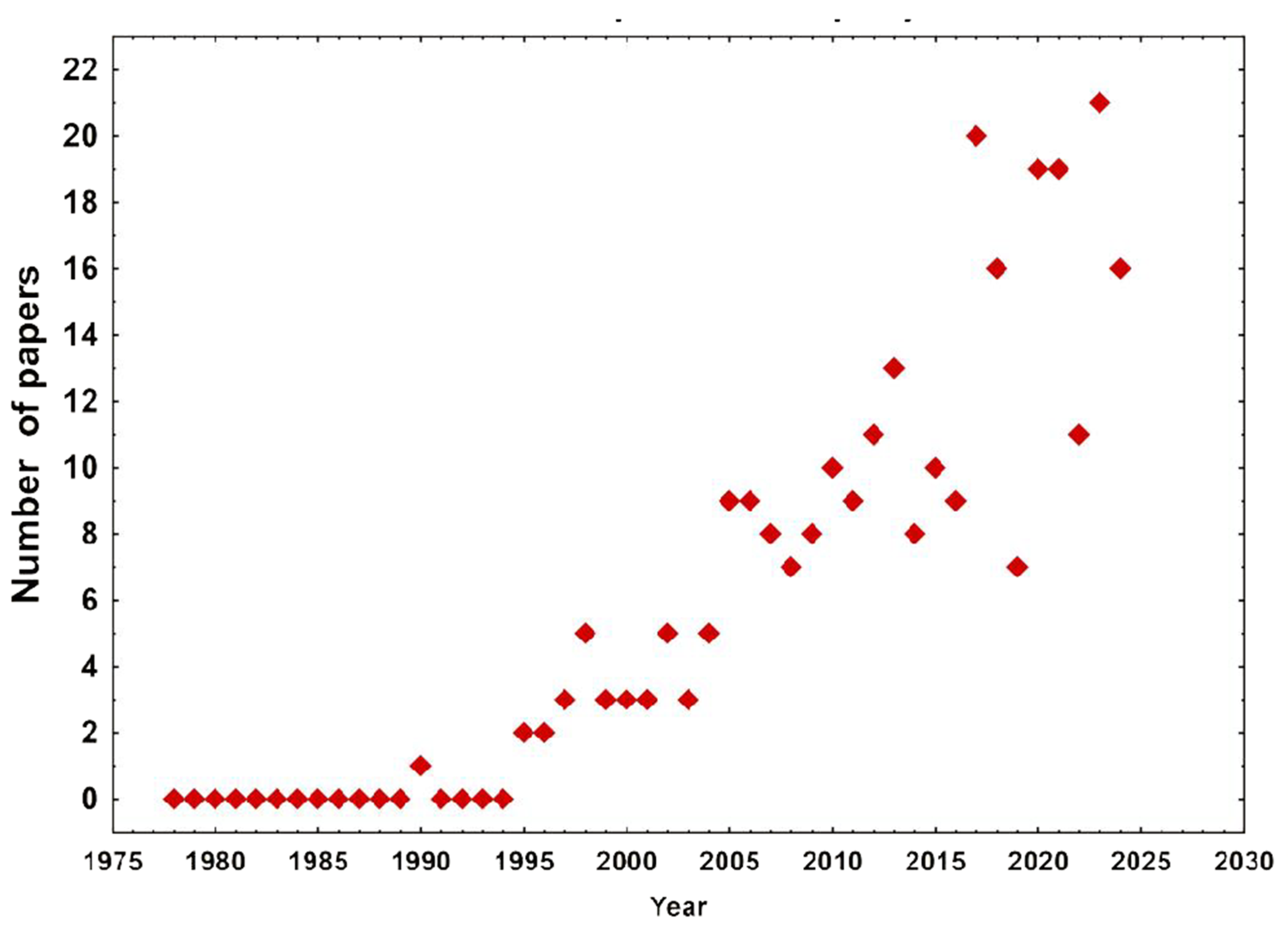
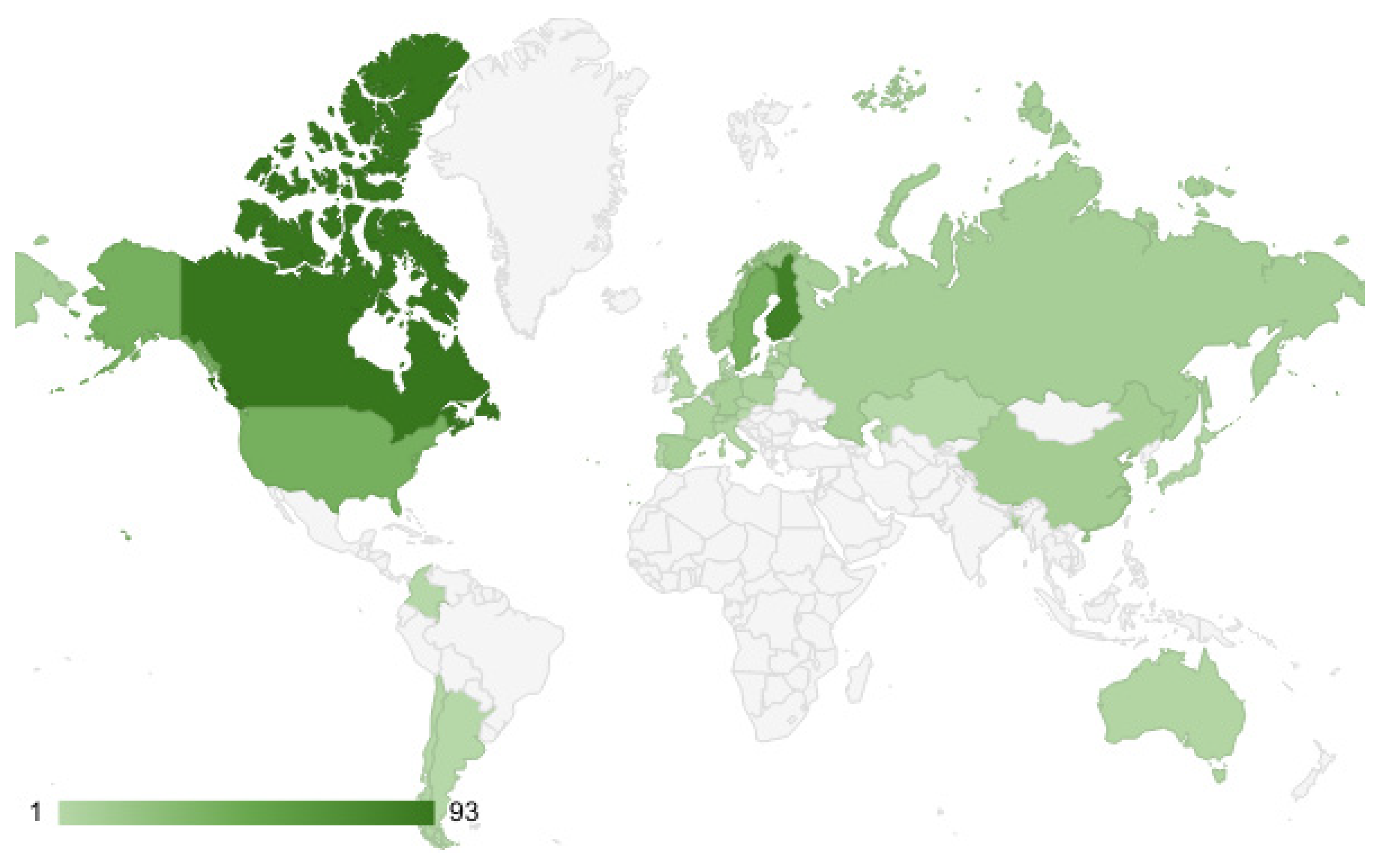

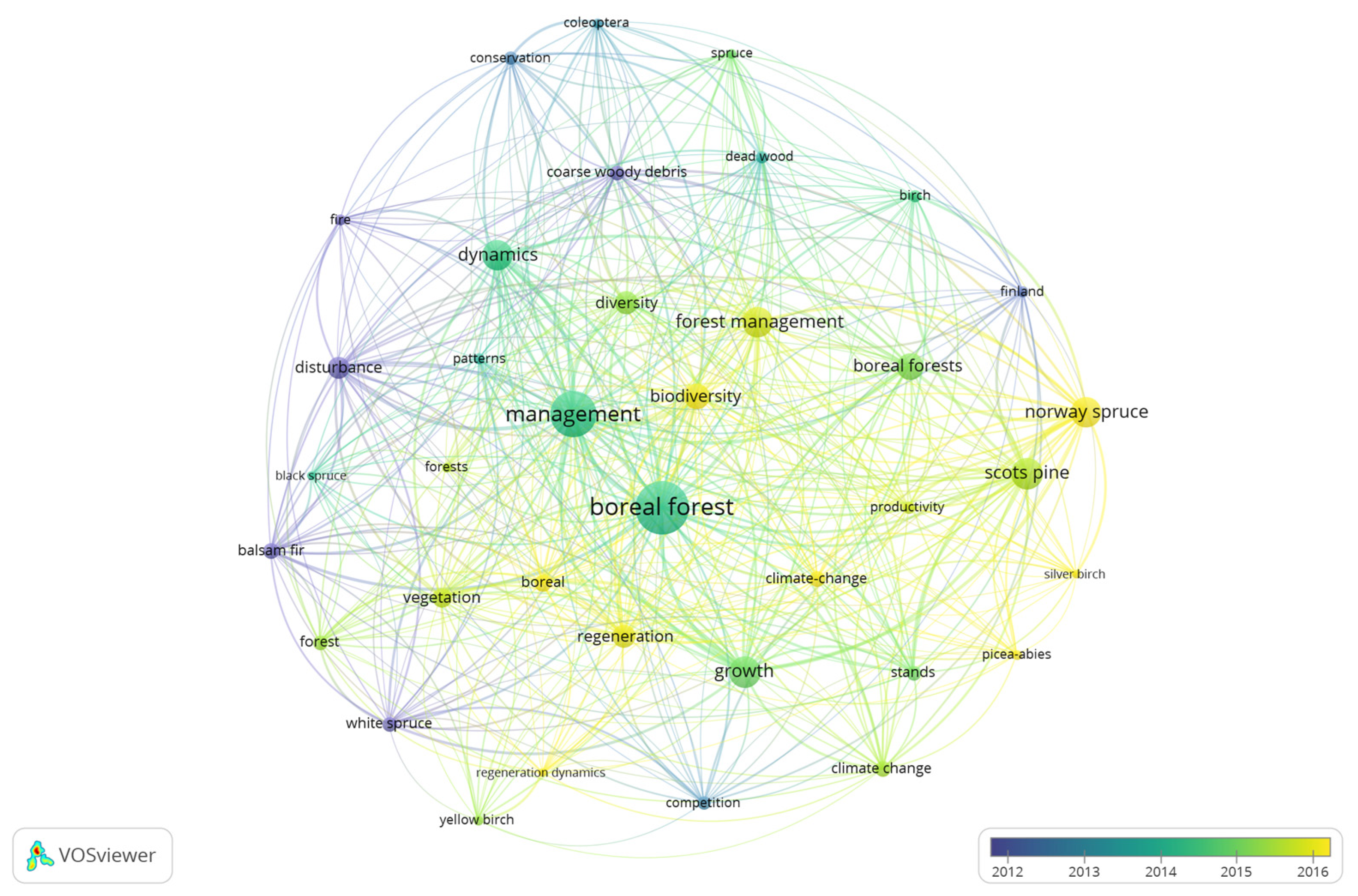


| Country no. | Country/Region | Management Problems | Cited by |
|---|---|---|---|
| 1 | Canada | 1. Birch–white spruce interactions in mixed stands; 2. Canopy disturbance, inter-tree competition, and density management; 3. Clear-cutting effects in mixed and late successional forests; 4. Soil and microbial activity influenced by stand age and tree species; 5. Forest health monitoring and modeling for climate mitigation; 6. Native plant colonization and wood property variation | Hawkins and Dhar, 2013 [44]; Duchesne and Prévost, 2013 [45]; Barrette et al., 2024 [46]; Hebert, 2003 [47]; Bloin et al., 2022 [48]; Bauhus et al., 1998 [49]; Hall, 1995 [50]; Ameray et al., 2023 [51]; Gagnon et al., 2020 [52]; Baleshta et al., 2005 [53]; Giroud et al., 2017 [54] |
| 2 | China | 1. Forest fire regime and landscape changes under harvesting; 2. Landscape—scale forest succession; 3. Optimization of neighborhood-based stand spatial structure | Chen et al., 2015 [55]; He et al., 2002 [56]; Dong et al., 2022 [57] |
| 3 | Finland | 1. Carbon stock management under climate change; 2. Detection of growth dynamics and timber yield prediction; 3. Dead wood retention and decomposition; 4. Natural regeneration of birch; 5. Effects of climate change on forest productivity | Garcia-Gonzalo et al., 2007 [58,59]; Campos et al., 2023 [60]; Kaila et al., 1997 [61]; Mannisto et al., 2024 [62]; Makinen et al., 2006 [63]; AlRahahleh et al., 2018 [64] |
| 4 | Lithuania | 1. Growth and chemical composition under climate change; 2. Effects of thinning and plantations; 3. Seedling responses to environmental changes; 4. Antioxidant activity and forest ecosystem responses | Ozolinčius et al., 2016 [65]; Juknys et al., 2012 [66]; Gudynaitė-Franckevičienė et al., 2019 [67]; Augustaitis et al., 2022 [68]; Juodvalkis et al., 2005 [69]; Sirgedaitė-Šėžienė et al., 2024 [70]; Kund et al., 2010 [71] |
| 5 | Sweden | 1. Drought vulnerability; 2. Tree mortality drivers; 3. Evaluation of growth models; 4. Nitrogen fertilization; 5. Transition from monocultures to mixed-species stands | Aldea et al., 2024 [72]; Aldea et al., 2023 [73]; Hallinger et al., 2016 [74]; Ball et al., 2000 [75]; Felton et al., 2016 [76] |
| 6 | Latvia | 1. Windstorm damage and stand-level risk factors; 2. Soil preparation and root architecture; 3. Tree- and stand-scale factors influencing wind damage | Donis et al., 2005 [77]; Dumins et al., 2025 [78]; Krisans et al., 2022 [79]; Kitenberga et al., 2021 [80] |
| 7 | USA | 1. Tree regeneration | Allaby et al., 2017 [81] |
| 8 | Central and Northern Europe | 1. Species interactions and climate effects on tree mortality | Condes et al., 2025 [82] |
| 9 | General (high-latitude forests) | 1. Tree species identity determines fire spread | Blauw et al., 2017 [83] |
Disclaimer/Publisher’s Note: The statements, opinions and data contained in all publications are solely those of the individual author(s) and contributor(s) and not of MDPI and/or the editor(s). MDPI and/or the editor(s) disclaim responsibility for any injury to people or property resulting from any ideas, methods, instructions or products referred to in the content. |
© 2025 by the authors. Licensee MDPI, Basel, Switzerland. This article is an open access article distributed under the terms and conditions of the Creative Commons Attribution (CC BY) license (https://creativecommons.org/licenses/by/4.0/).
Share and Cite
Slepetiene, A.; Belova, O.; Fastovetska, K.; Dinca, L.; Murariu, G. Managing Boreal Birch Forests for Climate Change Mitigation. Land 2025, 14, 1909. https://doi.org/10.3390/land14091909
Slepetiene A, Belova O, Fastovetska K, Dinca L, Murariu G. Managing Boreal Birch Forests for Climate Change Mitigation. Land. 2025; 14(9):1909. https://doi.org/10.3390/land14091909
Chicago/Turabian StyleSlepetiene, Alvyra, Olgirda Belova, Kateryna Fastovetska, Lucian Dinca, and Gabriel Murariu. 2025. "Managing Boreal Birch Forests for Climate Change Mitigation" Land 14, no. 9: 1909. https://doi.org/10.3390/land14091909
APA StyleSlepetiene, A., Belova, O., Fastovetska, K., Dinca, L., & Murariu, G. (2025). Managing Boreal Birch Forests for Climate Change Mitigation. Land, 14(9), 1909. https://doi.org/10.3390/land14091909