The Importance of Railway Lines for the Composition of Vegetation in Agricultural Landscapes: A Case Study

 , , and
Abstract
1. Introduction
2. Materials and Methods
2.1. Study Area
2.2. Selected Sites and Habitats
2.3. Vegetation Assessment Methodology
2.4. Statistical Analysis
3. Results
4. Discussion
5. Conclusions
- (i)
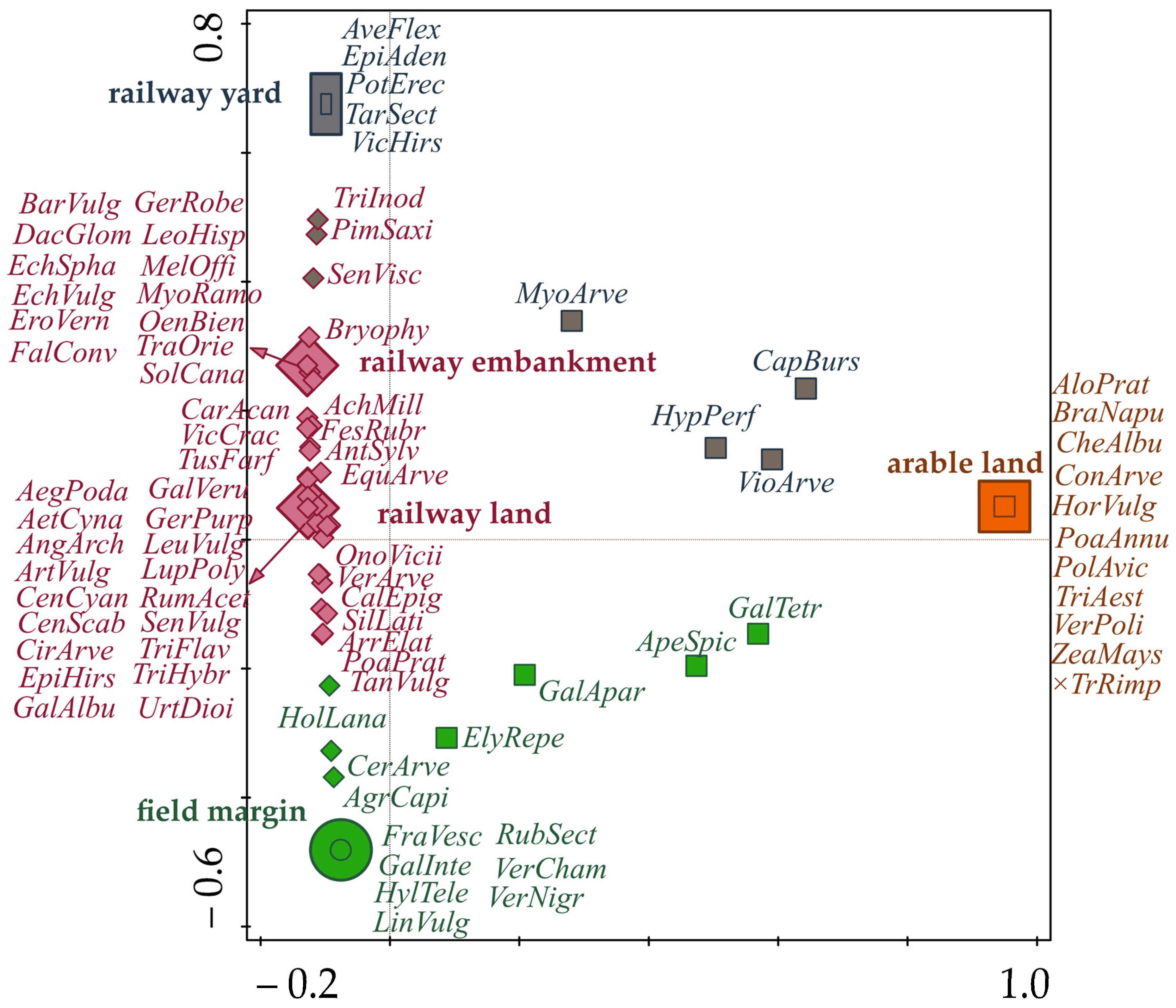
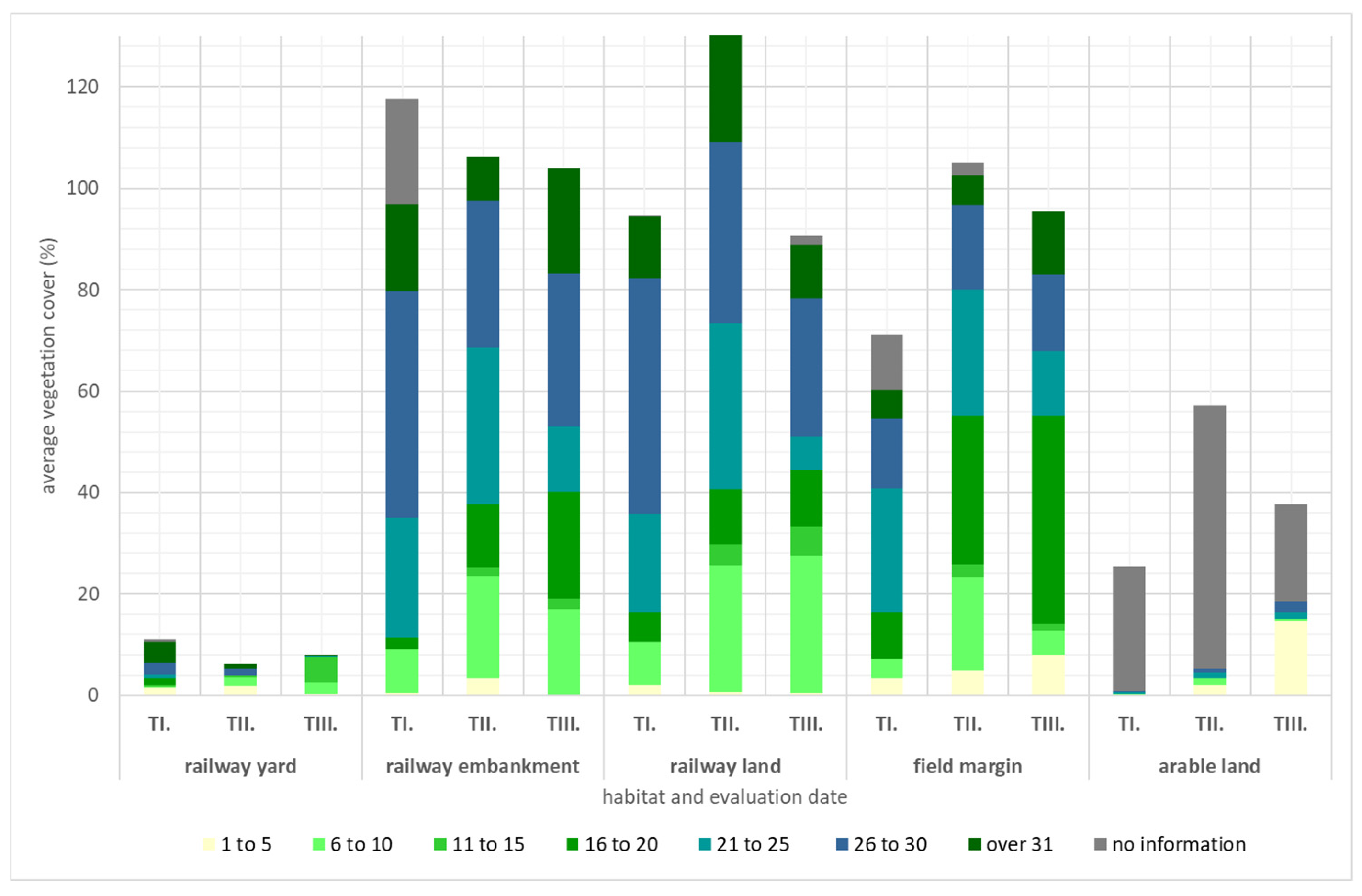
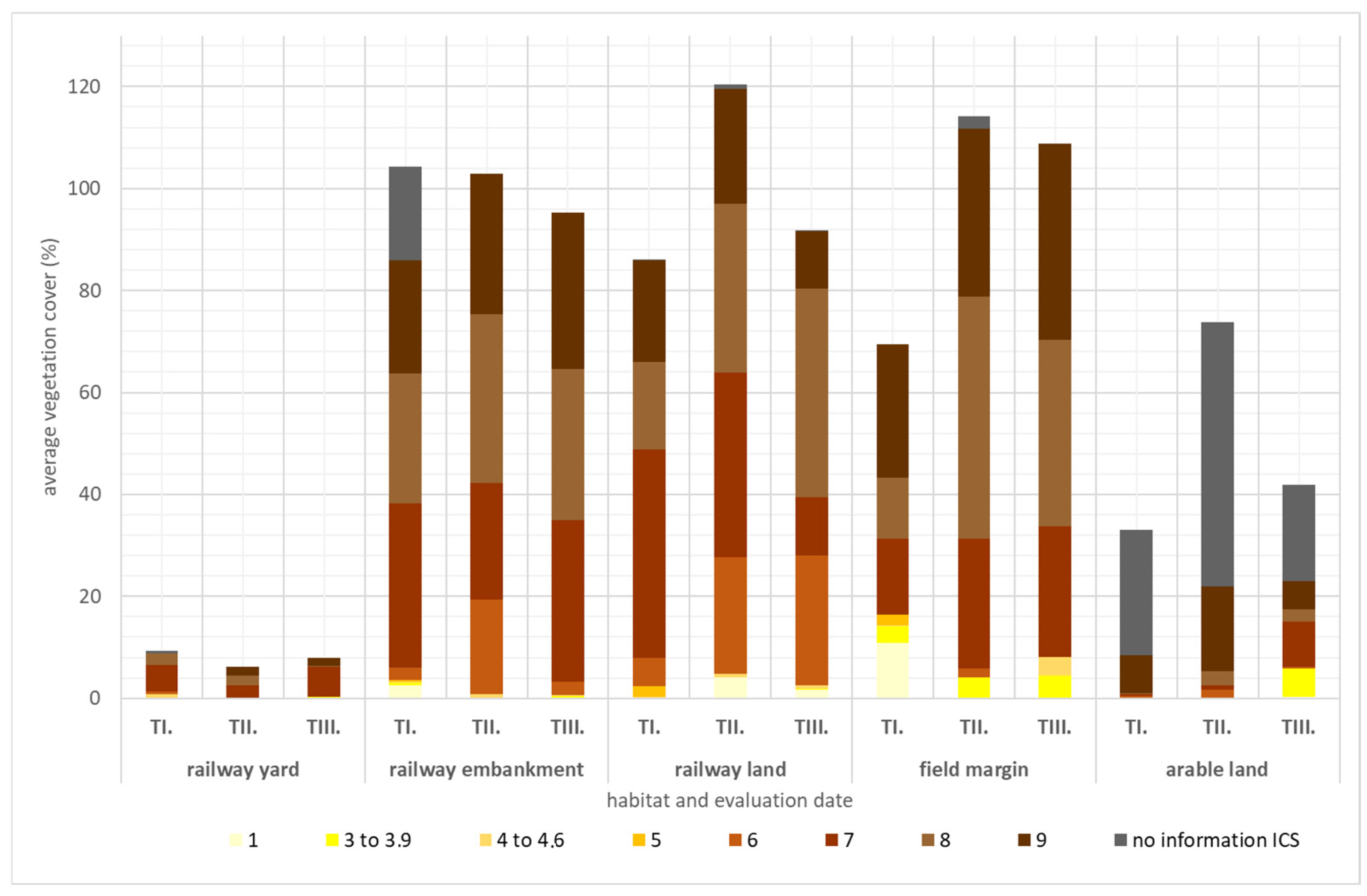
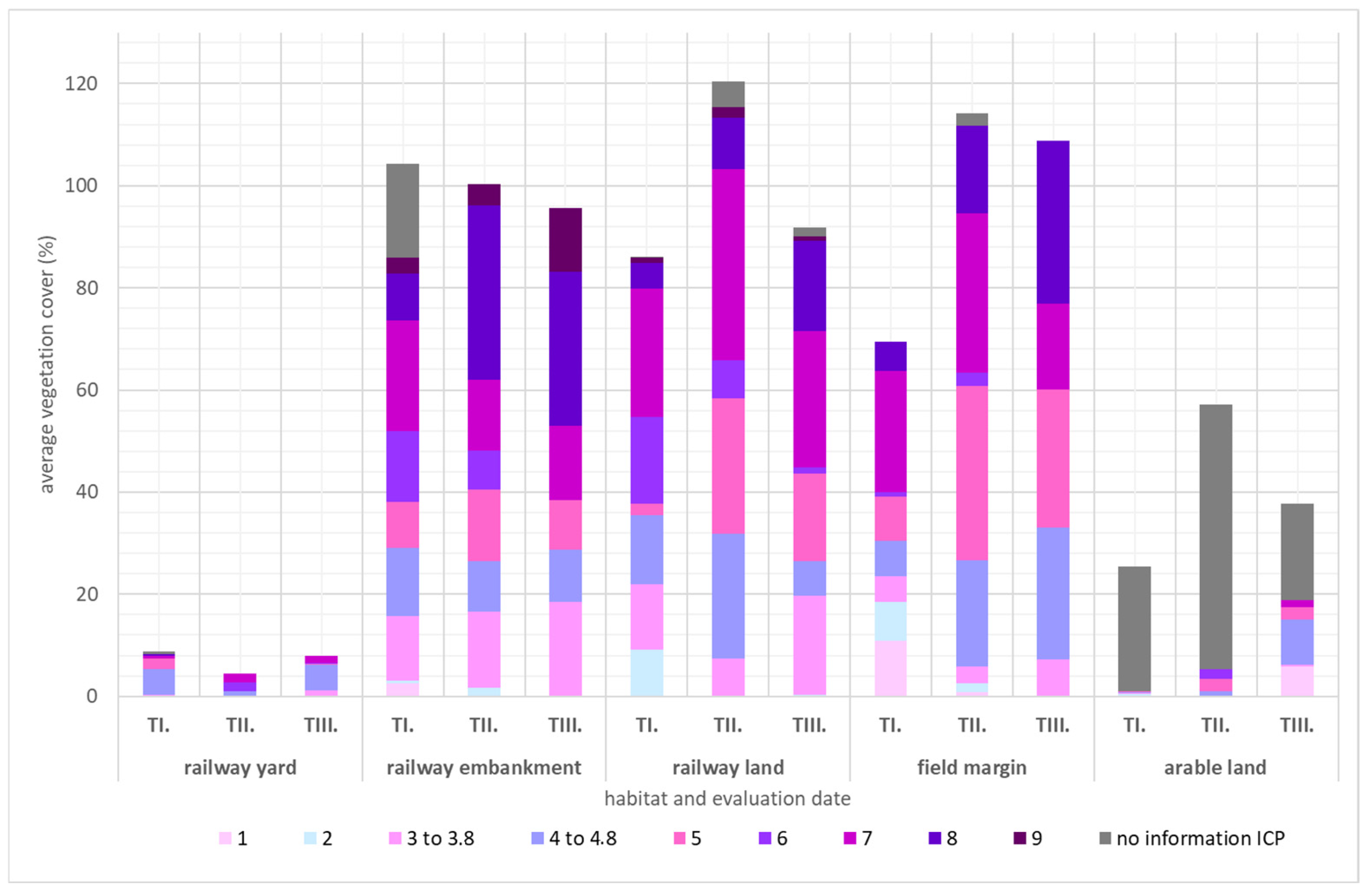
- Vegetation composition and structure differed markedly among habitat types, reflecting variation in substrate properties and disturbance regimes. Species richness was highest in the railway embankment and railway land habitats, which exhibited highly similar species composition, whereas the lowest richness occurred in the railway yard and arable land habitats.
- (ii)
- Most taxa were restricted to a single habitat type, and only a limited number of species were able to establish and persist across multiple habitats, indicating strong habitat filtering along the railway–agriculture gradient.
- (iii)
- Vegetation associated with railway corridors displayed characteristics consistent with mid- to late-successional communities under moderate disturbance and introduced structurally and functionally diverse elements into otherwise homogeneous agricultural landscapes, thereby enhancing ecosystem-level heterogeneity.
- (iv)
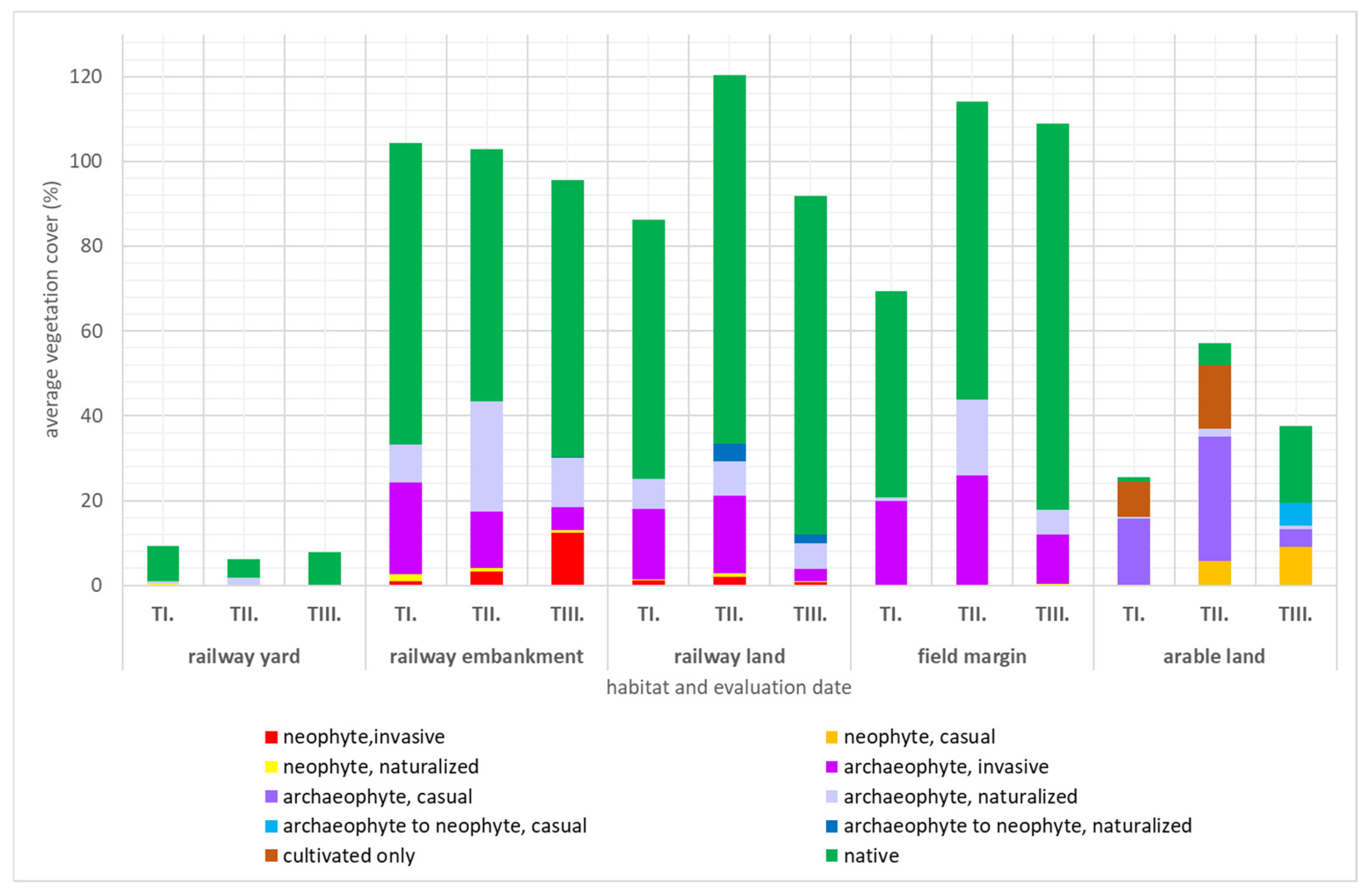
- Railway embankment, railway land, and field margin habitats supported a higher representation of nonnative and invasive taxa, including Arrhenatherum elatius, Cirsium arvense, Echinops sphaerocephalus, Geranium purpureum, Lupinus polyphyllus, and Solidago canadensis.
Supplementary Materials
Author Contributions
Funding
Data Availability Statement
Conflicts of Interest
References
- Mohajan, H.K. The First Industrial Revolution: Creation of a New Global Human Era; Munich Personal RePEc Archive: Munich, Germany, 2019; MPRA Paper No. 96644; Available online: https://mpra.ub.uni-muenchen.de/96644/ (accessed on 8 November 2025).
- Van Leeuwen, B.; Didenko, D.; Calabrese, M.; Wang, M. The spread of the Industrial Revolution, c. 1760–present. In Innovation and Economic Development in Eurasia, 500 BCE–Present: The Roots of Divergence; Springer Nature: Cham, Switzerland, 2025; pp. 173–201. [Google Scholar] [CrossRef] [Scilit]
- Tostes, B.; Henriques, S.T.; Brockway, P.E.; Heun, M.K.; Domingos, T.; Sousa, T. On the right track? Energy use, carbon emissions, and intensities of world rail transportation, 1840–2020. Appl. Energy 2024, 367, 123344. [Google Scholar] [CrossRef] [Scilit]
- Gholamizadeh, K.; Zarei, E.; Yazdi, M. Railway transport and its role in the supply chains: Overview, concerns, and future direction. In The Palgrave Handbook of Supply Chain Management; Springer: Berlin/Heidelberg, Germany, 2024; pp. 769–796. [Google Scholar] [CrossRef] [Scilit]
- Kvizda, M. Railways in Prague: Tying and cutting the Gordian knot. In The City and the Railway in the World from the Nineteenth Century to the Present; Routledge: Oxfordshire, UK, 2022; pp. 186–200. [Google Scholar] [CrossRef] [Scilit]
- Krejčí, J.; Münzberger, J. Mapping Czech railways: History and development of the railways in the Czech lands. Abstr. ICA 2025, 10, 156. [Google Scholar] [CrossRef] [Scilit]
- Cork, N.A.; Fisher, R.S.; Strong, N.; Ferranti, E.J.; Quinn, A.D. A systematic review of factors influencing habitat connectivity and biodiversity along road and rail routes in temperate zones. Front. Environ. Sci. 2024, 12, 1369072. [Google Scholar] [CrossRef] [Scilit] [PubMed]
- Borda-de-Água, L.; Barrientos, R.; Beja, P.; Pereira, H.M. Railway Ecology; Springer International Publishing: Cham, Switzerland; Springer Nature: Berlin/Heidelberg, Germany, 2017; 320p. [Google Scholar]
- Borda-de-Água, L.; Ascensão, F.; Sapage, M.; Barrientos, R.; Pereira, H.M. On the identification of mortality hotspots in linear infrastructures. Basic Appl. Ecol. 2019, 34, 25–35. [Google Scholar] [CrossRef] [Scilit]
- Rakotoson, T.; Valantin-Morison, M.; Meynard, J.M.; Mediene, S. Plant community responses and effects in railway environments. Weed Res. 2025, 65, e70025. [Google Scholar] [CrossRef] [Scilit]
- Götzenberger, L.; de Bello, F.; Bråthen, K.A.; Davison, J.; Dubuis, A.; Guisan, A.; Lepš, J.; Lindborg, R.; Moora, M.; Pärtel, M.; et al. Ecological assembly rules in plant communities—Approaches, patterns and prospects. Biol. Rev. 2012, 87, 111–127. [Google Scholar] [CrossRef] [Scilit]
- Wittig, R.; Lienenbecker, H. Sandtrockenrasen auf Bahnhöfen in Ostwestfalen. Ber. Naturwiss. Ver. Bielef. Umgeg. 2003, 43, 259–284. [Google Scholar]
- Wiłkomirski, B.; Galera, H.; Sudnik-Wójcikowska, B.; Staszewski, T.; Malawska, M. Railway tracks-habitat conditions, contamination, floristic settlement—A review. Environ. Nat. Resour. Res. 2012, 2, 86. [Google Scholar] [CrossRef] [Scilit]
- Kalusová, V.; Chytrý, M.; van Kleunen, M.; Mucina, L.; Dawson, W.; Essl, F.; Kreft, H.; Pergl, J.; Weigelt, P.; Winter, M.; et al. Naturalization of European plants on other continents: The role of donor habitats. Proc. Natl. Acad. Sci. USA 2017, 114, 13756–13761. [Google Scholar] [CrossRef] [Scilit]
- Hutniczak, A.; Urbisz, A.; Urbisz, A.; Strzeleczek, Ł. Factors Affecting Plant Composition in Abandoned Railway Areas with Particular Emphasis on Forest Proximity. Diversity 2022, 14, 1141. [Google Scholar] [CrossRef] [Scilit]
- Rutkovska, S.; Pučka, I.; Evarts-Bundersanta, P.; Paidere, J. The role of railway lines in the distribution of alien plant species in the territory of Daugavpils City (Latvia). Est. J. Ecol. 2013, 62, 212–225. [Google Scholar] [CrossRef] [Scilit]
- Torstensson, L. Use of herbicides on railway tracks in Sweden. Pestic. Outlook 2001, 12, 16–21. [Google Scholar] [CrossRef] [Scilit]
- Haddad, N.M.; Brudvig, L.A.; Clobert, J.; Davies, K.F.; Gonzalez, A.; Holt, R.D.; Lovejoy, T.E.; Sexton, J.O.; Austin, M.P.; Collins, C.D.; et al. Habitat fragmentation and its lasting impact on Earth’s ecosystems. Sci. Adv. 2015, 1, e1500052. [Google Scholar] [CrossRef] [Scilit] [PubMed]
- Fahrig, L. Ecological Responses to Habitat Fragmentation Per Se. Annu. Rev. Ecol. Evol. Syst. 2017, 48, 1–23. [Google Scholar] [CrossRef] [Scilit]
- Körner, K.; Jeltsch, F. Detecting general plant functional type responses in fragmented landscapes using spatially-explicit simulations. Ecol. Model. 2008, 210, 287–300. [Google Scholar] [CrossRef] [Scilit]
- May, A.A.; Presto, A.A.; Hennigan, C.J.; Nguyen, N.T.; Gordon, T.D.; Robinson, A.L. Gas-particle partitioning of primary organic aerosol emissions: (1) Gasoline vehicle exhaust. Atmos. Environ. 2013, 77, 128–139. [Google Scholar] [CrossRef] [Scilit]
- Spence, A.R.; Tingley, M.W. The challenge of novel abiotic conditions for species undergoing climate-induced range shifts. Ecography 2020, 43, 1571–1590. [Google Scholar] [CrossRef] [Scilit]
- Faillace, C.A.; Sentis, A.; Montoya, J.M. Eco-evolutionary consequences of habitat warming and fragmentation in communities. Biol. Rev. 2021, 96, 1933–1950. [Google Scholar] [CrossRef] [Scilit]
- Li, Y.; Yang, X.; Qi, H.; Zhang, J.; Shao, J.; Zhou, J.; Zhang, M. Characterization of the spatial and temporal evolution of land use and the quality of the habitat in the region along the construction line of the railway. Ecol. Indic. 2025, 173, 113368. [Google Scholar] [CrossRef] [Scilit]
- Legrand, A.; Cornez, L.; Samkari, W.; Mazzella, J.-M.; Venisse, A.; Boccio, V.; Auribault, K.; Keren, B.; Benistan, K.; Germain, D.P.; et al. Mutation spectrum in the ABCC6 gene and genotype-phenotype correlations in a French cohort with pseudoxanthoma elasticum. Genet. Med. 2017, 19, 909–917. [Google Scholar] [CrossRef] [Scilit]
- Winkler, J.; Koda, E.; Červenová, J.; Napieraj, K.; Żółtowski, M.; Jakimiuk, A.; Podlasek, A.; Vaverková, M.D. Fragmentation and biodiversity change in urban vegetation: A case study of tram lines. Land Degrad. Dev. 2024, 35, 1734–1747. [Google Scholar] [CrossRef] [Scilit]
- Hansen, M.J.; Clevenger, A.P. The influence of disturbance and habitat on the presence of non-native plant species along transport corridors. Biol. Conserv. 2005, 125, 249–259. [Google Scholar] [CrossRef] [Scilit]
- Galera, H.; Sudnik-Wójcikowska, B.; Wierzbicka, M.; Wiłkomirski, B. Encroachment of forest species into operating and abandoned railway areas in north-eastern Poland. Plant Biosyst. 2011, 145, 23–36. [Google Scholar] [CrossRef] [Scilit]
- von der Lippe, M.; Kowarik, I. Do cities export biodiversity? Traffic as dispersal vector across urban–rural gradients. Divers. Distrib. 2008, 14, 18–25. [Google Scholar] [CrossRef] [Scilit]
- Wang, G.; Gillespie, A.R.; Liang, S.; Mushkin, A.; Wu, Q. Effect of the Qinghai-Tibet Railway on vegetation abundance. Int. J. Remote Sens. 2015, 36, 5222–5238. [Google Scholar] [CrossRef] [Scilit]
- Rashid, I.; Haq, S.M.; Lembrechts, J.J.; Khuroo, A.A.; Pauchard, A.; Dukes, J.S. Railways redistribute plant species in mountain landscapes. J. Appl. Ecol. 2021, 58, 1967–1980. [Google Scholar] [CrossRef] [Scilit]
- Culek, M. Biogeographical Division of the Czech Republic, 1st ed.; Enigma: Prague, Czech Republic, 1996; 347p. (In Czech) [Google Scholar]
- CGS. Map of Soil Types of the Czech Republic, 1:50 000; Czech Geological Society: Prague, Czech Republic, 2017; Available online: https://mapy.geology.cz/pudy (accessed on 8 November 2025).
- CGS. Geological Map of the Czech Republic, 1:50 000; Czech Geological Society: Prague, Czech Republic, 2018; Available online: https://mapy.geology.cz/geocr50 (accessed on 8 November 2025).
- Czech Ministry of Transport. Railway Transit Corridors of the Czech Republic; Ministry of Transport of the Czech Republic: Prague, Czechia, 2023. Available online: https://md.gov.cz/ (accessed on 8 November 2025).
- Chytrý, M.; Danihelka, J.; Kaplan, Z.; Wild, J.; Holubová, D.; Novotný, P.; Řezníčková, M.; Rohn, M.; Dřevojan, P.; Grulich, V.; et al. Pladias Database of the Czech Flora and Vegetation. Preslia 2021, 93, 1–87. [Google Scholar] [CrossRef] [Scilit]
- Pladias. Database of the Czech Flora and Vegetation; Department of Botany and Zoology Faculty of Science Masaryk University: Brno, Czech Republic, 2025; Available online: https://pladias.cz/en/ (accessed on 8 November 2025).
- Pyšek, P.; Sádlo, J.; Chrtek, J., Jr.; Chytrý, M.; Kaplan, Z.; Pergl, J.; Pokorná, A.; Axmanová, I.; Čuda, J.; Doležal, J.; et al. Catalogue of alien plants of the Czech Republic (3rd edition): Species richness, status, distributions, habitats, regional invasion levels, introduction pathways and impacts. Preslia 2022, 94, 447–577. [Google Scholar] [CrossRef] [Scilit]
- Prach, K.; Tichý, L.; Vítovcová, K.; Řehounková, K. Participation of the Czech flora in succession at disturbed sites: Quantifying species’ colonization ability. Preslia 2017, 89, 87–100. [Google Scholar] [CrossRef] [Scilit]
- Braak, C.J.F.; Šmilauer, P. Canoco Reference Manual and User’s Guide: Software for Ordination, Version 5.0; Microcomputer Power: Ithaca, NY, USA, 2012. [Google Scholar]
- Heneidy, S.Z.; Halmy, M.W.; Toto, S.M.; Hamouda, S.K.; Fakhry, A.M.; Bidak, L.M.; Eid, E.M.; Al-Sodany, Y.M. Pattern of urban flora in intra-city railway habitats (Alexandria, Egypt): A conservation perspective. Biology 2021, 10, 698. [Google Scholar] [CrossRef] [Scilit]
- Májeková, J.; Jehlík, V.; Zaliberová, M. Railway stations vs. thermophilous species (example from eastern Slovakia). Thaiszia—J. Bot. 2016, 26, 173–188. [Google Scholar]
- Rendeková, A.; Mičieta, K.; Randáková, Z.; Ballová, D.; Eliašová, M.; Miškovic, J. Flora of the tram tracks of Bratislava. Urban Ecosyst. 2020, 23, 875–891. [Google Scholar] [CrossRef] [Scilit]
- Ellis, E. The planet of no return: Human resilience on an artificial earth. Breakthr. J. 2011, 2, 37–44. [Google Scholar]
- Vega, K.A.; Küffer, C. Promoting wildflower biodiversity in dense and green cities: The important role of small vegetation patches. Urban For. Urban Green. 2021, 62, 127165. [Google Scholar] [CrossRef] [Scilit]
- Dylewski, Ł.; Maćkowiak, Ł.; Dyderski, M.K. Abandoned Railways Support Greater Functional and Phylogenetic Plant Diversity Than Adjacent Grassy Meadows in Agricultural Landscape. Land Degrad. Dev. 2025, 36, 614–629. [Google Scholar] [CrossRef] [Scilit]
- Lososová, Z.; Chytrý, M.; Kühn, I.; Hájek, O.; Horáková, V.; Pyšek, P.; Tichý, L. Patterns of plant traits in annual vegetation of man-made habitats in central Europe. Perspect. Plant Ecol. Evol. Syst. 2006, 8, 69–81. [Google Scholar] [CrossRef] [Scilit]
- Woźnica, P.; Urbisz, A.; Urbisz, A.; Franiel, I. Tram tracks as specific anthropogenic habitats for the growth of plants. PeerJ Prepr. 2016, 4, e2606v1. [Google Scholar] [CrossRef] [Scilit]
- Andersson, F.; Barthelemy, S.; Cederlund, H. An investigation of spray drift deposition of glyphosate from an herbicide spraying train and its potential impact on non-target vegetation and railway ditches. Sci. Total Environ. 2024, 956, 177208. [Google Scholar] [CrossRef] [Scilit]
- Winkler, J.; Kotlánová, B.; Děkanovský, I.; Pluháčková, H. Weed resistance issue and Conviso smart sugar Beet technology. ListyCukrov. AReparske 2025, 141, 299–304. Available online: http://www.cukr-listy.cz/on_line/2025/PDF/299-304.pdf (accessed on 8 November 2025).
- Ouédraogo, D.Y.; Villemey, A.; Vanpeene, S.; Coulon, A.; Azambourg, V.; Hulard, M.; Sordello, R. Can linear transportation infrastructure verges constitute a habitat and/or a corridor for vertebrates in temperate ecosystems? A systematic review. Environ. Evid. 2020, 9, 13. [Google Scholar] [CrossRef] [Scilit]
- Winkler, J.; Hotárek, M.; Mugutdinov, A. Seasonal vegetation changes on a selected section of a railway line in the South Moravian region (Czech Republic)—A case study. Acta Sci. Pol. Archit. 2025, 24, 451–461. [Google Scholar] [CrossRef] [Scilit]
- Büscher, D.; Keil, P.; Loos, G. Neue Ausbreitungstendenzen von primär als Eisenbahnwanderer aufgetretenen Pflanzenarten im Ruhrgebiet: Die Beispiele Eragrostis minor, Geranium purpureum und Saxifraga tridactylites. In Dynamik der Synanthropen Vegetation: Festschrift für Prof. Dr. Dietmar Brandes; Technische Uni Braunschweig Universitätsbibl: Braunschweig, Germany, 2008; pp. 97–106. [Google Scholar]
- Eliáš, P. Geranium purpureum Vill.—New alien species to the Slovak flora. Thaiszia J. Bot. 2011, 21, 21–28. [Google Scholar]
- Májeková, J.; Čiliak, M.; Dudáš, M.; Eliáš, P.; Hrivnák, R.; Svitková, I.; Hegedüšová Vantarová, K.; Slezák, M. Climate and traffic volume control plant species richness in railway areas. Flora 2025, 330, 152780. [Google Scholar] [CrossRef] [Scilit]
- Ibanez, I.; Katz, D.S.W.; Peltier, D.; Wolf, S.M.; Barrie, B.T.C. Assessing the integrated effects of landscape fragmentation on plants and plant communities: The challenge of multiprocess-multiresponse dynamics. J. Ecol. 2014, 102, 882–895. [Google Scholar] [CrossRef] [Scilit]
- Dener, E.; Ovadia, O.; Shemesh, H.; Altman, A.; Chen, S.C.; Giladi, I. Direct and indirect effects of fragmentation on seed dispersal traits in a fragmented agricultural landscape. Agric. Ecosyst. Environ. 2021, 309, 107273. [Google Scholar] [CrossRef] [Scilit]
- Hurajová, E.; Martínez Barroso, P.; Děkanovský, I.; Lumbantobing, Y.R.; Jiroušek, M.; Mugutdinov, A.; Havel, L.; Winkler, J. Biodiversity and Vegetation Succession in Vineyards, Moravia (Czech Republic). Agriculture 2024, 14, 1036. [Google Scholar] [CrossRef] [Scilit]
- Qian, J.; Li, L.; Wu, S.; Liu, J.; Zhang, Y. Improving Railway Alignment Selection in Mountainous Areas with Complex Vegetation: A Multisource Data Landslide Identification Approach for Assisted Decision-Making Research. Sustainability 2023, 15, 11388. [Google Scholar] [CrossRef] [Scilit]
- Symmank, L.; Mohammadzadeh, S.; Szymczak, S. Embankment Fires on Railways—Where and How to Mitigate? Infrastructures 2025, 10, 337. [Google Scholar] [CrossRef] [Scilit]
- Xu, B.; Li, J.; Luo, Z.; Wu, J.; Liu, Y.; Yang, H.; Pei, X. Analyzing the Spatiotemporal Vegetation Dynamics and Their Responses to Climate Change along the Ya’an–Linzhi Section of the Sichuan–Tibet Railway. Remote Sens. 2022, 14, 3584. [Google Scholar] [CrossRef] [Scilit]
- Yu, G.; He, Z.; Wu, K.; Zhang, J.; Zhang, Y. Moisture Change of Modified Soil and Spatial–Temporal Evolution of Vegetation Cover for Bio-Slope Engineering in a Plateau Railway. Water 2025, 17, 778. [Google Scholar] [CrossRef] [Scilit]
- Reif, J.; Kreß, C. Blackbox Gardening—Mit Versamenden Pflanzen Garten Gestalten; Verlag Eugen Ulmer: Stuttgart, Germany, 2014. [Google Scholar]
- Winkler, J.; Martinová, L.; Kotlánová, B.; Děkanovský, I.; Vaverková, M.D. Biological Relevance and Ecosystem Functions of Sugar Beet Weeds. ListyCukrov. AReparske 2025, 141, 98–103. Available online: http://www.cukr-listy.cz/on_line/2025/PDF/98-103.pdf (accessed on 20 August 2025).
- Winkler, J.; Zámečník, V.; Mugutdinov, A.; Martínez Barroso, P.; Vaverková, M.D. The Potential of Vegetation for Assessing the Benefits and Risks of Protective Measures for the Northern Lapwing (Vanellus vanellus L.) on Arable Land. Ecologies 2026, 7, 5. [Google Scholar] [CrossRef] [Scilit]
- Vymyslický, T.; Jiroušek, M.; Frei, I.; Smetanová, S.; Winkler, J.; Zdražílková, M.; Fabšičová, M. Will small-scale ploughing increase the plant diversity of species-poor grasslands? Folia Geobot. 2024, 59, 1–16. [Google Scholar] [CrossRef] [Scilit]
- Hurajová, E.; Martínez Barroco, P.; Havel, L.; Děkanovský, I.; Winkler, J. Relationship Between Vegetation Succession and Earthworm Population in Vineyards. J. Ecol. Eng. 2024, 25, 134–144. [Google Scholar] [CrossRef] [Scilit]
- Winkler, J.; Tomaník, M.; Martínez Barroso, P.; Děkanovský, I.; Sitek, W.; Vaverková, M.D. The Importance of Municipal Waste Landfill Vegetation for Biological Relevance: A Case Study. Environments 2025, 12, 401. [Google Scholar] [CrossRef] [Scilit]
- Kueffer, C.; Kaiser-Bunbury, C.N. Reconciling conflicting perspectives for biodiversity conservation in the Anthropocene. Front. Ecol. Environ. 2014, 12, 131–137. [Google Scholar] [CrossRef] [Scilit]
- Burney, D.A.; Burney, L.P. Paleoecology and “inter-situ” restoration on Kaua’i, Hawai’i. Front. Ecol. Environ. 2007, 5, 483–490. [Google Scholar] [CrossRef]
- Winkler, J.; Koda, E.; Skutnik, Z.; Černý, M.; Adamcová, D.; Podlasek, A.; Vaverková, M.D. Trends in the succession of synanthropic vegetation on a reclaimed landfill in Poland. Anthropocene 2021, 35, 100299. [Google Scholar] [CrossRef] [Scilit]
- Winkler, J.; Vaverková, M.D.; Havel, L. Anthropogenic life strategy of plants. Anthr. Rev. 2023, 10, 455–462. [Google Scholar] [CrossRef] [Scilit]



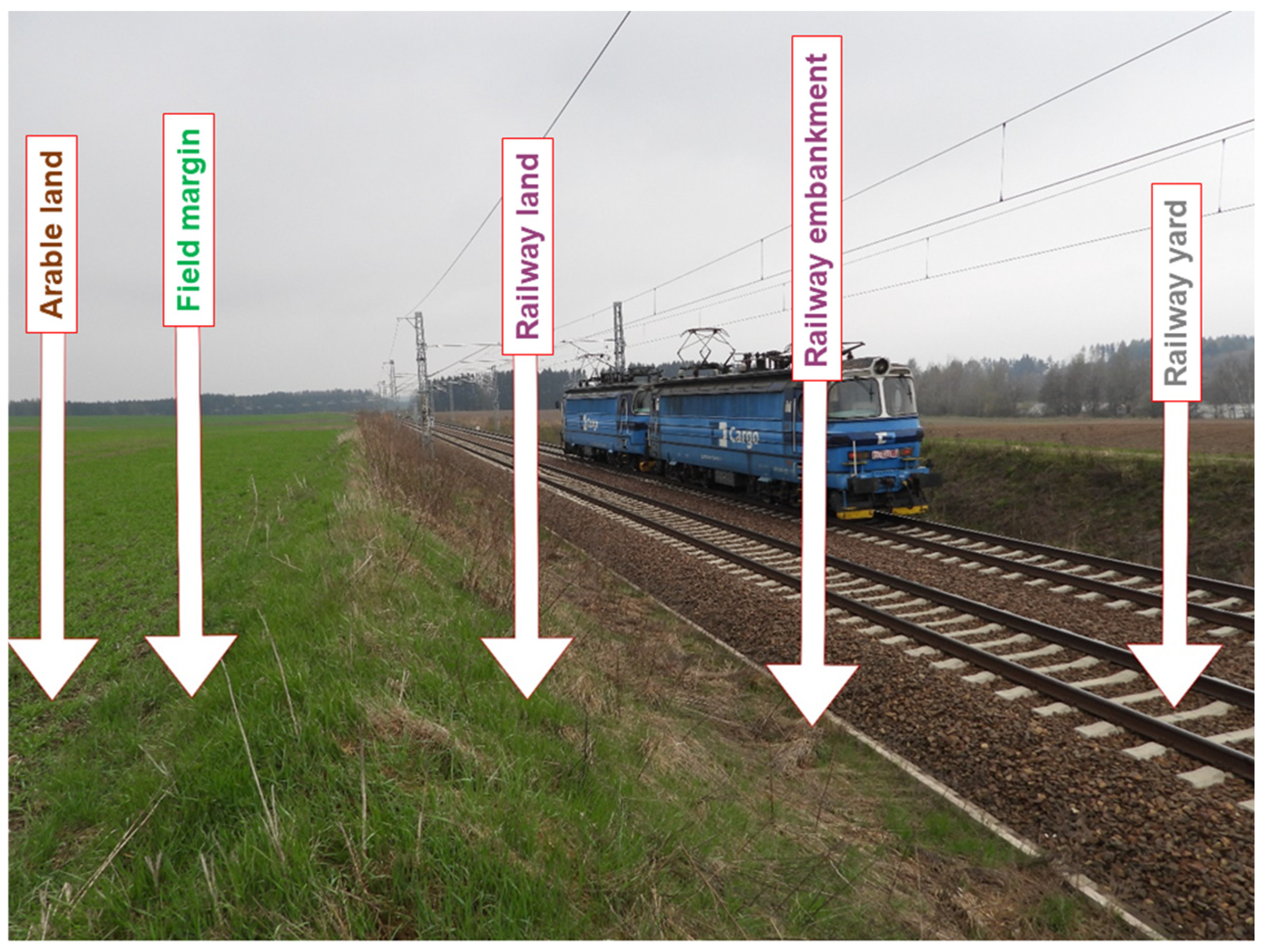
| Habitat | Influence of Railway | Vegetation Disturbance | Conditions for Vegetation |
|---|---|---|---|
| Railway yard | Strong influence during railway construction and operation | Herbicide application | Unfavorable conditions and strong disturbance pressure |
| Railway embankment | Strong influence during construction and limited influence during operation | Occasional and localized removal of woody vegetation | Moderately unfavorable conditions and limited disturbance pressure |
| Railway land | Limited influence during construction and operation | No regular vegetation management | Favorable conditions without significant disturbance pressure |
| Field margin | No direct influence | Limited influence of soil cultivation and herbicide application | Favorable conditions under low disturbance pressure |
| Arable land | No direct influence | Soil cultivation and herbicide application | Favorable conditions under strong disturbance pressure |
| Preferred Habitat | Plant Taxa (Abbreviations) |
|---|---|
| Railway yard | Avenella flexuosa (AveFlex), Epilobium adenocaulon (EpiAden), Potentilla erecta (PotErec), Taraxacum sect. Taraxacum (TarSect), Vicia hirsuta (VicHirs) |
| Railway yard and railway embankment, railway land | Pimpinella saxifraga (PimSaxi), Senecio viscosus (SenVisc), Tripleurospermum inodorum (TriInod) |
| Railway embankment, railway land | Aegopodium podagraria (AegPoda), Aethusa cynapium (AetCyna), Achillea millefolium (AchMill), Angelica archangelica (AngArch), Anthriscus sylvestris (AntSylv), Arrhenatherum elatius (ArrElat), Artemisia vulgaris (ArtVulg), Barbarea vulgaris (BarVulg), Bryophyta (Bryophy), Calamagrostis epigejos (CalEpig), Carduus acanthoides (CarAcan), Centaurea cyanus (CenCyan), Centaurea scabiosa (CenScab), Cirsium arvense (CirArve), Dactylis glomerata (DacGlom), Echinops sphaerocephalus (EchSpha), Echium vulgare (EchVulg), Epilobium hirsutum (EpiHirs), Equisetum arvense (EquArve), Erophila verna (EroVern), Fallopia convolvulus (FalConv), Festuca rubra (FesRubr), Galium album (GalAlbu), Galium verum (GalVeru), Geranium purpureum (GerPurp), Geranium robertianum (GerRobe), Leontodon hispidus (LeoHisp), Leucanthemum vulgare (LeuVulg), Lupinus polyphyllus (LupPoly), Melilotus officinalis (MelOffi), Myosotis ramosissima (MyoRamo), Oenothera biennis (OenBien), Onobrychis viciifolia (OnoVicii), Poa pratensis (PoaPrat), Rumex acetosa (RumAcet), Senecio vulgaris (SenVulg), Silene latifolia (SilLati), Solidago canadensis (SolCana), Tanacetum vulgare (TanVulg), Tragopogon orientalis (TraOrie), Trifolium hybridum (TriHybr), Trisetum flavescens (TriFlav), Tussilago farfara (TusFarf), Urtica dioica (UrtDioi), Veronica arvensis (VerArve), Vicia cracca (VicCrac) |
| Railway embankment, railway land and field margin | Agrostis capillaris (AgrCapi), Cerastium arvense (CerArve), Holcus lanatus (HolLana) |
| Field margin | Fragaria vesca (FraVesc), Galium intermedium (GalInte), Hylotelephium telephium (HylTele), Linaria vulgaris (LinVulg), Rubus sect. Rubus (RubSect), Verbascum nigrum (VerNigr), Veronica chamaedrys (VerCham) |
| Field margin and arable land | Apera spica-venti (ApeSpic), Galeopsis tetrahit (GalTetr), Galium aparine (GalApar), Elymus repens (ElyRepe) |
| Arable land | Alopecurus pratensis (AloPrat), Brassica napus (BraNapu), Chenopodium album (CheAlbu), Convolvulus arvensis (ConArve), Hordeum vulgare (HorVulg), Poa annua (PoaAnnu), Polygonum aviculare (PolAvic), Triticum aestivum (TriAest), Veronica polita (VerPoli), Zea mays (ZeaMays), ×Triticosecale rimpaui (×TrRimp) |
| Arable land, railway yard | Capsella bursa-pastoris (CapBurs), Hypericum perforatum (HypPerf), Myosotis arvensis (MyoArve), Viola arvensis (VioArve) |
Disclaimer/Publisher’s Note: The statements, opinions and data contained in all publications are solely those of the individual author(s) and contributor(s) and not of MDPI and/or the editor(s). MDPI and/or the editor(s) disclaim responsibility for any injury to people or property resulting from any ideas, methods, instructions or products referred to in the content. |
© 2026 by the authors. Licensee MDPI, Basel, Switzerland. This article is an open access article distributed under the terms and conditions of the Creative Commons Attribution (CC BY) license.
Share and Cite
Winkler, J.; Smékalová, M.; Lumbantobing, Y.R.; Červenková, J.; Sitek, W.; Vaverková, M.D. The Importance of Railway Lines for the Composition of Vegetation in Agricultural Landscapes: A Case Study. Land 2026, 15, 523. https://doi.org/10.3390/land15040523
Winkler J, Smékalová M, Lumbantobing YR, Červenková J, Sitek W, Vaverková MD. The Importance of Railway Lines for the Composition of Vegetation in Agricultural Landscapes: A Case Study. Land. 2026; 15(4):523. https://doi.org/10.3390/land15040523
Chicago/Turabian StyleWinkler, Jan, Marta Smékalová, Yentriani Rumeta Lumbantobing, Jana Červenková, Wiktor Sitek, and Magdalena Daria Vaverková. 2026. "The Importance of Railway Lines for the Composition of Vegetation in Agricultural Landscapes: A Case Study" Land 15, no. 4: 523. https://doi.org/10.3390/land15040523
APA StyleWinkler, J., Smékalová, M., Lumbantobing, Y. R., Červenková, J., Sitek, W., & Vaverková, M. D. (2026). The Importance of Railway Lines for the Composition of Vegetation in Agricultural Landscapes: A Case Study. Land, 15(4), 523. https://doi.org/10.3390/land15040523