Article

Evaluating Landslide Detection and Prediction Potential Using Satellite-Derived Vegetation Indices in South Korea


National Forest Satellite Information & Technology Center, National Institute of Forest Science, Seoul 05203, Republic of Korea
*
Author to whom correspondence should be addressed.
Land 2025, 14(12), 2410; https://doi.org/10.3390/land14122410
Submission received: 12 November 2025 / Revised: 9 December 2025 / Accepted: 10 December 2025 / Published: 12 December 2025

Abstract

This study assessed the effectiveness of vegetation index change metrics (ΔVI = Post − Pre) derived from Sentinel-2 imagery for detecting landslide-affected areas and evaluating their relationship with rainfall intensity, thereby enhancing the early-warning potential. The analysis focused on Sancheong-gun, Gyeongsangnam-do, South Korea, where intense rainfall in July 2025 triggered multiple landslides. Pre- and post-event Sentinel-2 Level-2A images (10 m spatial resolution) were used to compute changes in the Normalized Difference Vegetation Index (ΔNDVI), Soil-Adjusted Vegetation Index (ΔSAVI), Modified Soil-Adjusted Vegetation Index (ΔMSAVI), Normalized Difference Moisture Index (ΔNDMI), and Global Vegetation Moisture Index (ΔGVMI) over the landslide-affected post-disaster (PD) and non-damaged (ND) areas. Sensitivity was assessed based on the differences in mean ΔVI between the PD and ND areas, Welch’s t-statistics, and Cohen’s d values. All indices exhibited significant differences between the PD and ND areas (p < 0.001), with ΔMSAVI showing the highest sensitivity (MSAVI > GVMI ≈ SAVI > NDVI > NDMI). Correlation analysis revealed that ΔMSAVI had the strongest positive association with rainfall accumulation (72 h: r = 0.54; 7 days: r = 0.49), indicating that greater rainfall corresponded to stronger vegetation degradation signals. These findings highlight ΔMSAVI as a robust and responsive indicator of rainfall-triggered landslides, supporting its integration into satellite-based early-warning and rapid damage detection systems for improved landslide monitoring and response.

1. Introduction

As climate change accelerates globally, the frequency and intensity of extreme rainfall events are increasing, leading to a corresponding rise in the occurrence and impacts of rainfall-induced landslides [1]. Landslides are quintessential multi-factor hazards resulting from nonlinear interactions among topography, geology, hydrology, vegetation, and land use [2]. Exceedance of rainfall thresholds and soil saturation—both of which reduce shear strength—are recognized as primary triggering mechanisms. In South Korea, where mountainous terrain predominates, landslide risk is inherently high during the summer monsoon and typhoon seasons [3], and susceptibility increases sharply when short-duration, high-intensity storms coincide with multi-day antecedent rainfall. Domestic studies commonly report local thresholds of approximately 150 mm for single-day maxima or about 200 mm over 72 h as indicative conditions for landslide initiation [4].
Traditional approaches to landslide hazard assessment and prediction have evolved from statistical regression and logistic models to distribution-based methods such as maximum entropy (MaxEnt), and subsequently to machine learning frameworks (e.g., decision trees, random forests) for susceptibility mapping [5,6]. While these models utilize static spatial covariates—such as slope, curvature, aspect, elevation, lithology, weathering grade, soil depth, and land cover—to estimate where slope failures are likely to occur, they share recurring limitations. These include the requirement for large training datasets, limited capacity to capture pre- and post-event surface–vegetation–moisture dynamics, and difficulties in geographic generalization. From an early-warning perspective, the capability to detect short-term variations—such as moisture accumulation, declines in vegetation vigor, and the expansion of bare ground—around rainfall events is crucial.
To address these limitations, high-resolution satellite time-series analysis has recently gained prominence in landslide detection and monitoring. In particular, the European Space Agency’s (ESA) Sentinel-2 multispectral imagery—providing 10–20 m spatial resolution with a revisit interval of approximately 5 days—is recognized as a promising resource for capturing vegetation and moisture variations before and after intense rainfall events [7]. A range of vegetation indices (VIs) have been developed to quantify vegetation conditions from such imagery. Common examples include the normalized difference vegetation index (NDVI), soil-adjusted vegetation index (SAVI), modified soil-adjusted vegetation index (MSAVI), normalized difference moisture index (NDMI), and global vegetation moisture index (GVMI). These indices combine red, near-infrared, and short-wave infrared spectral bands to estimate photosynthetic activity, minimize soil brightness effects, and enhance sensitivity to vegetation moisture content, respectively [8,9,10].
Conventional landslide studies have frequently relied on absolute VI or moisture index thresholds to delineate damaged areas. However, absolute-value approaches are highly sensitive to inter-regional variations in soil brightness, seasonal vegetation density, and sensor view geometry, which hinder generalization and increase susceptibility to noise. In contrast, change-detection methods that analyze within-scene pre- and post-event differences (e.g., ΔVI = Post − Pre) effectively suppress local idiosyncrasies and extract relative damage signals with greater stability [11,12]. In practice, greenness-oriented indices (NDVI, SAVI, MSAVI) are particularly responsive to structural vegetation changes and soil exposure, whereas moisture-oriented indices (NDMI, GVMI) are sensitive to surface saturation and moisture redistribution. Comparing or integrating these indices can thus help disentangle coupled biogeophysical responses—such as vegetation collapse and soil-moisture shifts—associated with landslide processes [13,14].
A recent study examined correlations between cumulative rainfall and satellite-derived VI changes to assess the feasibility of detecting slope-instability signals at an early stage [15]. That analysis investigated whether rainfall metrics (e.g., 72 h or 7 d accumulations) could predict characteristic VI-change patterns and whether pre-failure declines in vegetation greenness or moisture could help in identifying potential high-risk areas. This approach establishes a foundation for advancing from static susceptibility mapping toward real-time or forecast-oriented landslide monitoring.
Using Sancheong-gun, Gyeongsangnam-do, South Korea—where large-scale landslides were triggered by extreme rainfall in July 2025—as a case study, this study analyzed changes over time in multiple VIs derived from Sentinel-2 multispectral imagery. We calculated pre- to post-event changes for major indices (e.g., NDVI, MSAVI, GVMI), statistically tested the differences between post-disaster (PD) and non-damaged (ND) areas, and evaluated the detection sensitivity of each index. Subsequently, we examined spatial correlations between 72-h and 7-day cumulative rainfall and ΔVI values to identify the most suitable indices for early-warning applications. Through this analysis, we empirically identified the key input variables necessary for developing a high-resolution, satellite-based landslide early warning framework.
This study contributes to Sentinel-2 and vegetation-index-based landslide research in several ways. We provide a systematic comparison of multiple greenness- and moisture-oriented vegetation index change metrics (ΔNDVI, ΔSAVI, ΔMSAVI, ΔNDMI, and ΔGVMI) and quantify their relative ability to separate rainfall-triggered landslides from surrounding forest canopies in a humid, conifer-dominated mountain environment. We also explicitly link ΔVI metrics to antecedent and post-event cumulative rainfall windows, such as 72-h rainfall before the event and 7-day rainfall after the event, to explore how vegetation-based change indicators respond to different temporal integrations of triggering rainfall. In addition, we evaluate the discrimination power of each ΔVI metric using distribution-based separability measures that are less sensitive to landslide polygon boundary uncertainties and scale mismatches between the inventory and 10-m Sentinel-2 imagery than conventional pixel-wise accuracy metrics. Together, these elements position ΔMSAVI and related ΔVI products as promising candidate signals for future landslide monitoring and warning applications, while clearly delineating the scope and limitations of the present case study.

2. Materials and Methods

2.1. Survey Area

This study focused on approximately 30 landslide sites (each ≥ 1 ha) located in and around Sancheong-gun, Gyeongsangnam-do, where extensive damage occurred in mid-July 2025 due to torrential rainfall induced by a stationary front (Figure 1). The rainfall system originated in the southern region, migrated northward toward central South Korea, and triggered widespread flooding and landslides across the country; in some areas, cumulative precipitation reached 700–800 mm. Sancheong-gun is characterized by steep mountainous terrain, where the concurrence of peak hourly rainfall and unfavorable topographic conditions likely exacerbated slope instability.
The region’s terrain and land cover can be summarized as follows: approximately 82% forested area, a mean elevation of around 420 m, and a mean slope of 28.6°. According to observations from the Korea Meteorological Administration (KMA), the antecedent 72-h cumulative rainfall (P72) immediately preceding the event was 184.7 mm, while the 7-day cumulative rainfall (AR7) reached 285.5 mm. These hydrometeorological conditions promoted rapid transitions among saturation, drainage, and drying across hillslopes, thereby enhancing the spatial continuity of canopy damage and increasing exposure of soil and bedrock from source areas through transport pathways to depositional areas—patterns clearly discernible in satellite imagery. The spatial distribution of elevation and slope is shown in Figure 1.

2.2. Study Overview

Using Sentinel-2 satellite imagery, we calculated multiple vegetation indices (NDVI, SAVI, MSAVI, NDMI, and GVMI) for the pre- and post-landslide periods and derived the corresponding time-series changes (ΔVI). Based on field survey–derived, manually digitized landslide boundaries, we delineated landslide-affected PD and ND areas and assessed statistical differences in their ΔVI distributions using Welch’s t-test and the effect size (Cohen’s d). This approach enables quantitative comparison of detection sensitivity among the different indices.
Subsequently, we compiled 72-h cumulative rainfall (P72) and 7-day cumulative rainfall (AR7) datasets and conducted pixel-wise correlation analyses of ΔVI to identify the indices most responsive to rainfall variations. These correlations were used to evaluate the feasibility of using vegetation indices as forecast-oriented early warning indicators.
Finally, we verified the consistency of the results by varying the analytical conditions—including by removing outliers, using alternative image compositing schemes, and by modifying the definition of PD—to ensure robustness and assess the practical applicability of a VI-based landslide detection and forecasting framework (Figure 2).

2.3. Data Preparation

This study utilized surface reflectance (Level-2A) products from the Sentinel-2A/B MultiSpectral Instrument (MSI), accessed via the Sentinel-2 SR image collection on Google Earth Engine (GEE, Google LLC, Mountain View, CA, USA). The analysis period was divided into pre-event (1 April to 18 July 2025) and post-event (20 July to 30 September 2025) phases. Such temporal segmentation is recommended to ensure stable before–after comparisons of vegetation indices [11,15], minimizing the influence of solar elevation and seasonal vegetation dynamics.
The spectral bands used included Blue (B2), Green (B3), Red (B4), Near-Infrared (NIR; B8), Short-Wave Infrared 1 (SWIR1; B11), and Short-Wave Infrared 2 (SWIR2; B12)—i.e., the core inputs for vegetation- and moisture-related indices commonly applied in landslide-impact assessments [16,17]. To ensure data quality, we employed the Scene Classification Layer (SCL) to remove pixels affected by clouds, shadows, haze, water, and snow or ice, retaining only vegetation, bare soil, and unclassified land-cover classes. This constitutes a standard masking procedure for Sentinel-2 quality assurance [18].
Scenes with cloud cover > 20% were excluded to minimize contamination during temporal compositing, following thresholds commonly adopted in previous studies [15]. To mitigate residual edge noise along the SCL mask boundaries, we applied one-pixel dilation followed by inverse masking—a refinement technique widely used in GEE-based image quality-control workflows [19].
To mitigate short-term weather variability, differences in solar and sensor geometry, and the influence of outliers in individual scenes, we generated representative images for each period (pre- and post-event) using median compositing. This approach effectively removes transient noise and stabilizes temporal trends, resulting in more robust vegetation-change analyses [11,17].
All spectral bands were resampled to a uniform spatial resolution of 10 m. Coregistration accuracy was verified to be within half a pixel (~5 m); in cases where ghosting artifacts were detected along image boundaries, the outer margins were lightly trimmed. These preprocessing steps represent standard practice in Sentinel-2–based change-detection analyses [16,18].
For terrain data, we utilized the Copernicus GLO-30 Digital Elevation Model (DEM; 30 m resolution). Elevation, slope, and aspect were derived using GEE terrain functions and harmonized in both spatial resolution and projection with the Sentinel-2 imagery. These terrain derivatives were employed to ensure topographic similarity when selecting ND samples and to minimize bias during comparative analyses [20].
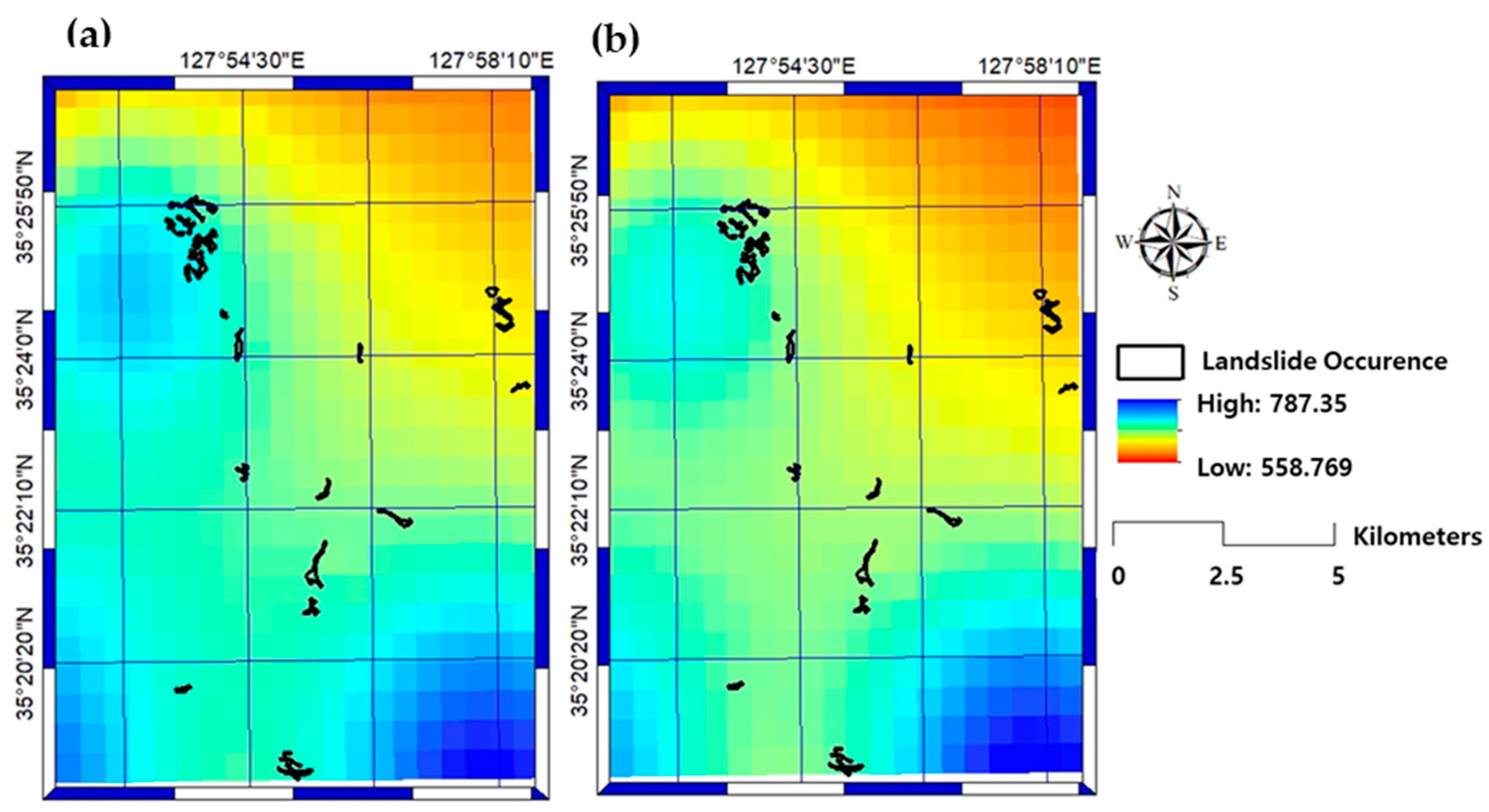
Rainfall data were obtained from 27 Korea Meteorological Administration (KMA) Automatic Weather Station (AWS) and Automated Synoptic Observing System (ASOS) sites. We computed the 72-h antecedent cumulative rainfall (P72) immediately preceding the event and the 7-day cumulative rainfall (AR7). Point-based observations were interpolated into 30 m cumulative-rainfall grids using the inverse distance weighting method (Figure 3). Missing and extreme values were examined and corrected using a stepwise 4σ rule with reference to adjacent stations. These interpolation and quality-control procedures are standard practice in landslide-related environmental factor analyses [17].
Finally, the rainfall grids were reprojected into the EPSG:5186 coordinate system for compatibility with the Sentinel-2 analysis and upsampled to a 10 m spatial resolution to align with the analysis grid. All geospatial data processing, including the inverse distance weighting (IDW) interpolation and manual digitization of landslide boundaries, was performed using ArcGIS version 10.5 (Esri, Redlands, CA, USA). Accurate geospatial harmonization between satellite- and station-based meteorological datasets is crucial for ensuring the reliability of ΔVI–rainfall correlations; this has been implemented similarly in related studies [15,16].

2.4. Vegetation Indices and ΔVI Computation

The reflectance-based NDVI is the most widely used vegetation index for assessing vegetation condition. It is highly sensitive to leaf area and photosynthetic activity, making it effective for detecting large-scale variation in vegetation cover [21]. However, NDVI is also influenced by soil brightness and often exhibits unstable responses over bare ground or landslide-affected surfaces. To address these limitations, we additionally employed SAVI [8], which incorporates a soil-brightness correction factor, and MSAVI [10], which applies a self-adjusting, nonlinear correction to surface reflectance. MSAVI provides more stable detection than NDVI under conditions of sparse vegetation or exposed soils—behavior consistent with the reflectance characteristics of slope failure and depositional zones following landslides [14].
The moisture-oriented NDMI leverages the spectral contrast between the NIR and SWIR1 bands to sensitively capture variations in vegetation canopy water content [9]. During landslide events, canopy loss and changes in surface saturation generally manifest as sharp declines in moisture indices, providing a critical complementary dimension for damage detection. GVMI extends NDMI by incorporating the SWIR2 band, thereby encompassing a broader moisture-sensitivity range and enhancing the detection of subtle variations in near-surface soil moisture [13].
All vegetation indices were calculated from median-composited, preprocessed Sentinel-2 Level-2A surface reflectance imagery. Per-pixel differences between identical spatial locations in the pre- and post-event periods were then computed to derive ΔVI (Post − Pre). This structurally consistent, differenced time-series approach to change detection [15] enables more precise quantification of both the direction and magnitude of change than simple image-differencing. To mitigate tail distortions caused by residual noise from compositing or observation effects, we applied percentile-based capping to the upper and lower 1% of each index’s ΔVI distribution. The indices used here are summarized in Table 1.

2.5. PD–ND Comparison Design

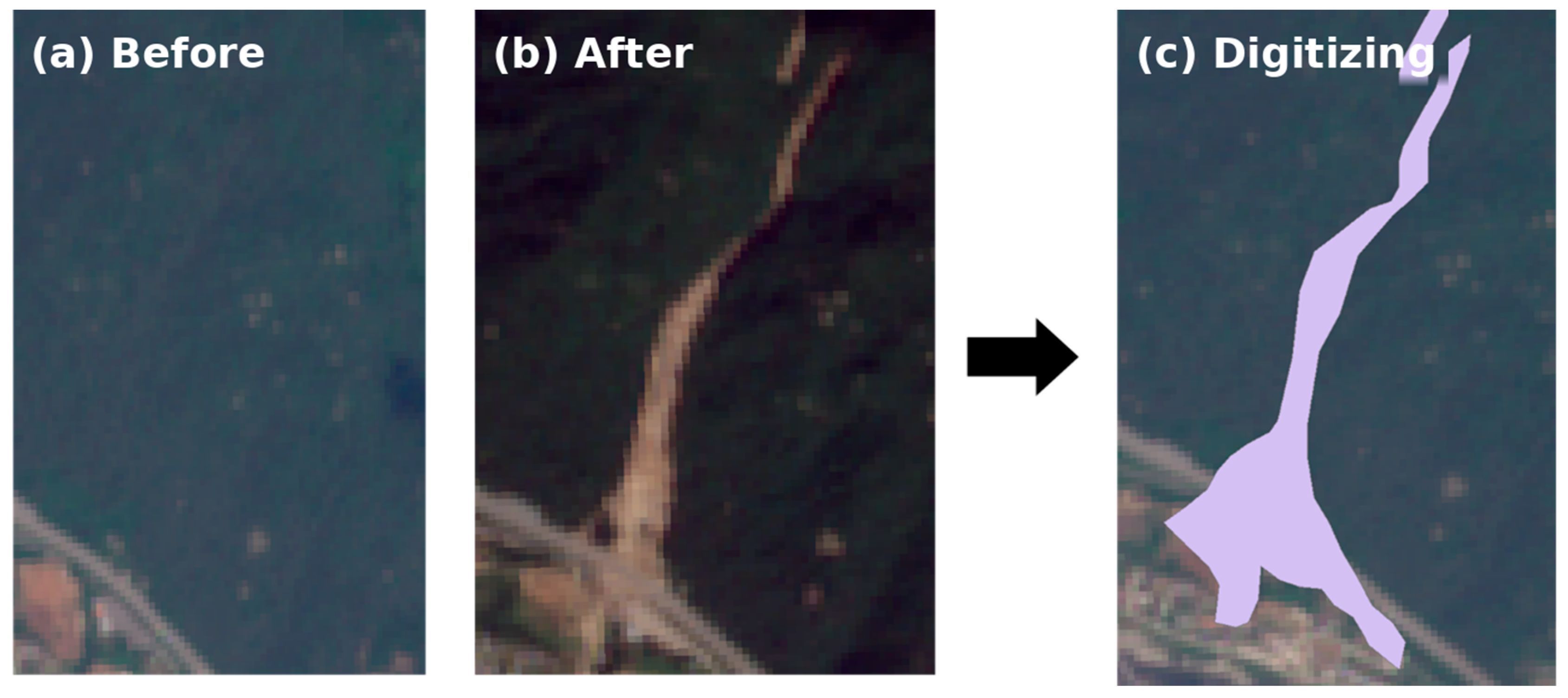
To quantitatively analyze the spatial characteristics of landslide damage, we distinguished between the PD and ND areas. The PD areas were delineated by integrating official landslide damage points from the Korea Forest Service (KFS) Landslide Forecasting Center with manually digitized collapse boundaries (Figure 4). The digitization process was performed using RGB (B4–B3–B2) composites from pre- and post-event Sentinel-2 imagery, supplemented by field-survey-based landslide records provided by the KFS. This multi-source boundary delineation approach was designed to more accurately capture locations where genuine surface changes were evident in the time series, consistent with reported methodologies [22,23]. To minimize spectral noise from boundary-mixed pixels, a 50–100 m inward (negative) buffer was applied around the PD polygons [24].
ND areas were selected at least 500 m away from PD areas. To minimize bias arising from differences in terrain conditions (elevation, slope, and aspect), we applied quantile-based matching to ensure that the empirical distributions of these variables closely resembled those of the PD areas [25]. Distributional similarity was evaluated using the Kolmogorov–Smirnov (KS) test, and candidate ND areas were iteratively adjusted until the predefined threshold (KS D < 0.10) was satisfied.
Furthermore, to eliminate potential bias from non-forest elements, such as rivers, croplands, and built-up areas, we masked out these classes using the forest layer from the ESA WorldCover 2020 product [26].

2.6. Statistical Analysis

Statistical analyses and data visualization were conducted using R software version 4.5.1 (R Foundation for Statistical Computing, Vienna, Austria). Using the Sentinel-2 imagery, we calculated ΔVI (Equation (1)) for each of the satellite-derived vegetation indices and compared it between the landslide-affected PD and ND areas. Further, we compared the effectiveness of each index for landslide detection.
Δ V I = V I post V I pre

2.6.1. ΔVI Extraction and Two-Group Difference Testing

For each vegetation index, values were computed for the pre- and post-event periods, and ΔVI was calculated. ΔVI values were extracted separately for PD and ND areas, and an independent two-sample Welch’s t-test was conducted to evaluate the mean difference between the two groups. The test statistic is given as Equation (2):
t = X ` 1 X ` 2 s 1 2 n 1 + s 2 2 n 2
where X ` 1 , X ` 2 denote the group means (PD, ND), s 1 2 , s 2 2 denote the group variances, and n 1 , n 2 are the sample sizes.
The null hypothesis ( H 0 ) states that “there is no mean difference between the two groups.” At a significance level of α = 0.05 , H 0 is rejected when p < 0.05 , indicating that the index exhibits a statistically significant difference useful for damage detection [27].

2.6.2. Effect Size: Cohen’s d

While the t-test determines whether the difference in ΔVI between PD and ND pixels is statistically significant, it does not indicate the magnitude of that difference. Therefore, Cohen’s d effect size was calculated for each index’s ΔVI to assess the strength of separation between the two groups [28]. Cohen’s d is defined as (Equation (3)):
d = X ¯ P D X ¯ N D S p  
where X ¯ P D X ¯ N D is the mean difference in ΔVI between PD and ND pixels and S p is the pooled standard deviation of the two groups, given by Equation (4)
s p = ( n P D 1 ) s P D 2 + ( n N D 1 ) s N D 2 n P D + n N D 2  
Following conventional thresholds, ∣d∣ ≈ 0.2 is interpreted as a small effect, ∣d∣ ≈ 0.5 as a medium effect, and ∣d∣ ≥ 0.8 as a large effect [28]. This effect size analysis reduces reliance on p-values alone and is widely applied in satellite-based environmental change studies [29,30].

2.6.3. Composite Evaluation Metrics and Visualization

Based on these analyses, each vegetation index was evaluated in terms of three complementary components: mean ΔVI, which represents the average vegetation loss or moisture decline in the PD areas relative to the surrounding ND forest; the Welch t-statistic, which indicates whether the mean difference between the two groups is statistically significant; and Cohen’s d, which quantifies the magnitude of separation between them. Detection sensitivity was ranked using these three criteria to identify the most reliable index for landslide detection. Visual diagnostics—ΔVI density distributions, sensitivity comparisons, and rainfall–ΔVI correlation plots—are provided in Section 3 to facilitate an intuitive comparison of the performance of the indices [29,30].

3. Results

3.1. Regional Trends in Vegetation-Index Change

Quantitative analysis of ΔVI derived from pre- and post-landslide Sentinel-2 imagery revealed widespread negative shifts across all five indices within the study area. The lower 1% quantiles reached −0.1901 for ΔSAVI, −0.1939 for ΔNDVI, and −0.1588 for ΔMSAVI, indicating that approximately the lowest 1% of all pixels experienced declines of ca. 20% in their VI values (Table 2). These patterns provide evidence of abrupt vegetation loss and/or increased bare-soil exposure.
The proportion of pixels with ΔVI < 0, and specifically with ΔVI < −0.05, was estimated at 19.4% for ΔSAVI, 15.9% for ΔMSAVI, and 17.8% for ΔNDVI, suggesting that a substantial portion of the study area experienced notable declines in vegetation indices. In contrast, the upper 1% tail (ΔVI > +0.28) likely reflects seasonal greening or localized post-disturbance recovery in some areas, although negative changes were observed across a considerably larger spatial extent.
The median ΔVI values were positive, with median ΔSAVI at 0.0430, ΔNDVI at 0.0466, and ΔMSAVI at 0.0373; however, the first quartile (Q1) values for all three indices were at or below zero, indicating an asymmetric distribution in which roughly half of the pixels exhibited negative changes despite a stable central tendency. This asymmetry underscores the extent of vegetation loss that would be difficult to detect using simple averages or composited imagery alone. Although these time-series variations suggest rapid post-rainfall vegetation decline and increased surface exposure, it remains essential to verify whether the magnitude of change alone can reliably and accurately delineate the affected areas.
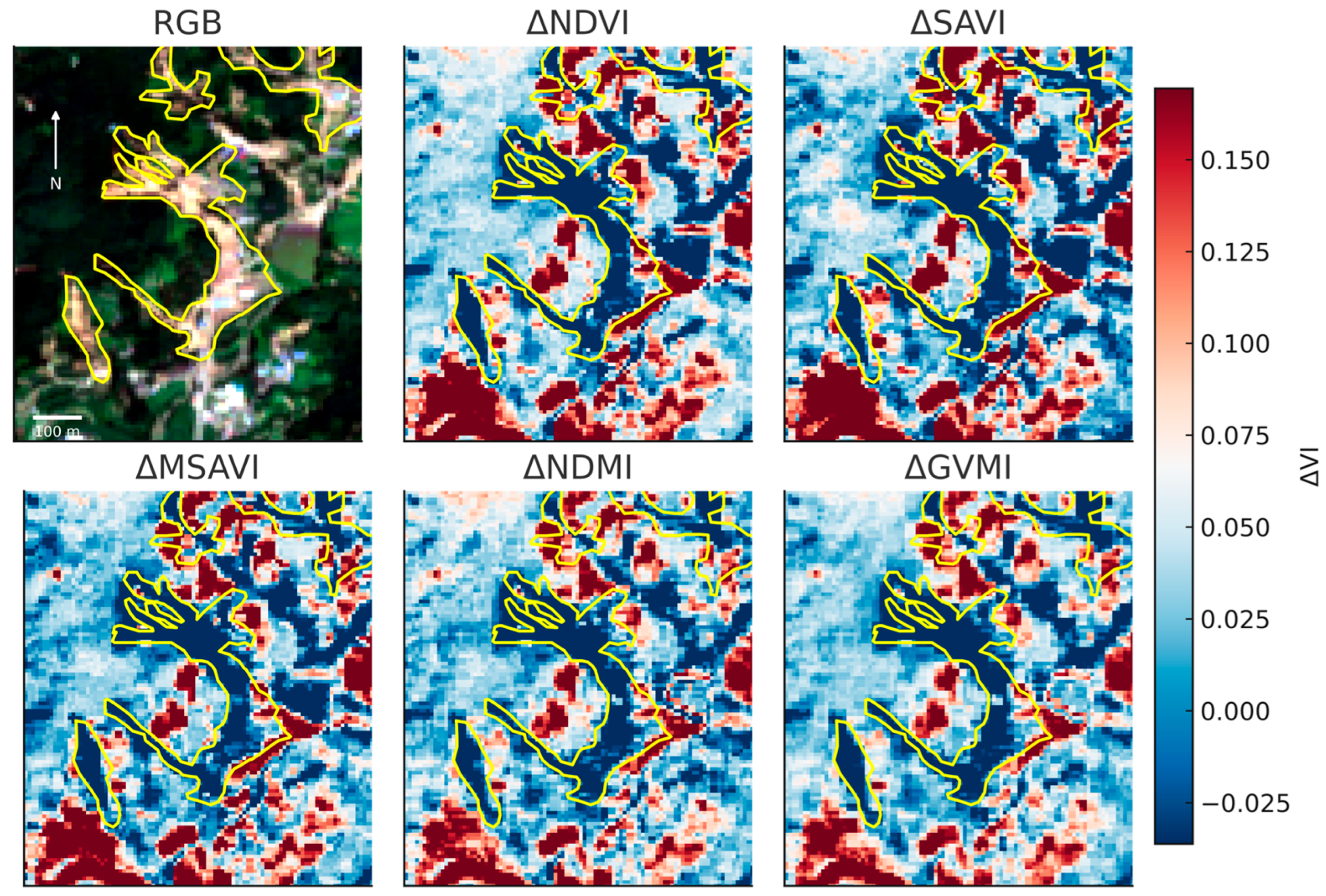
To provide a spatial example, Figure 5 shows RGB imagery and ΔVI maps for a representative landslide scar; the yellow polygons (PD) indicate the mapped landslide-affected areas. The full-scene ΔVI distributions are summarized in Figure 6, and the percentile statistics are reported in Table 2.

3.2. ΔVI-Based Damage Discrimination

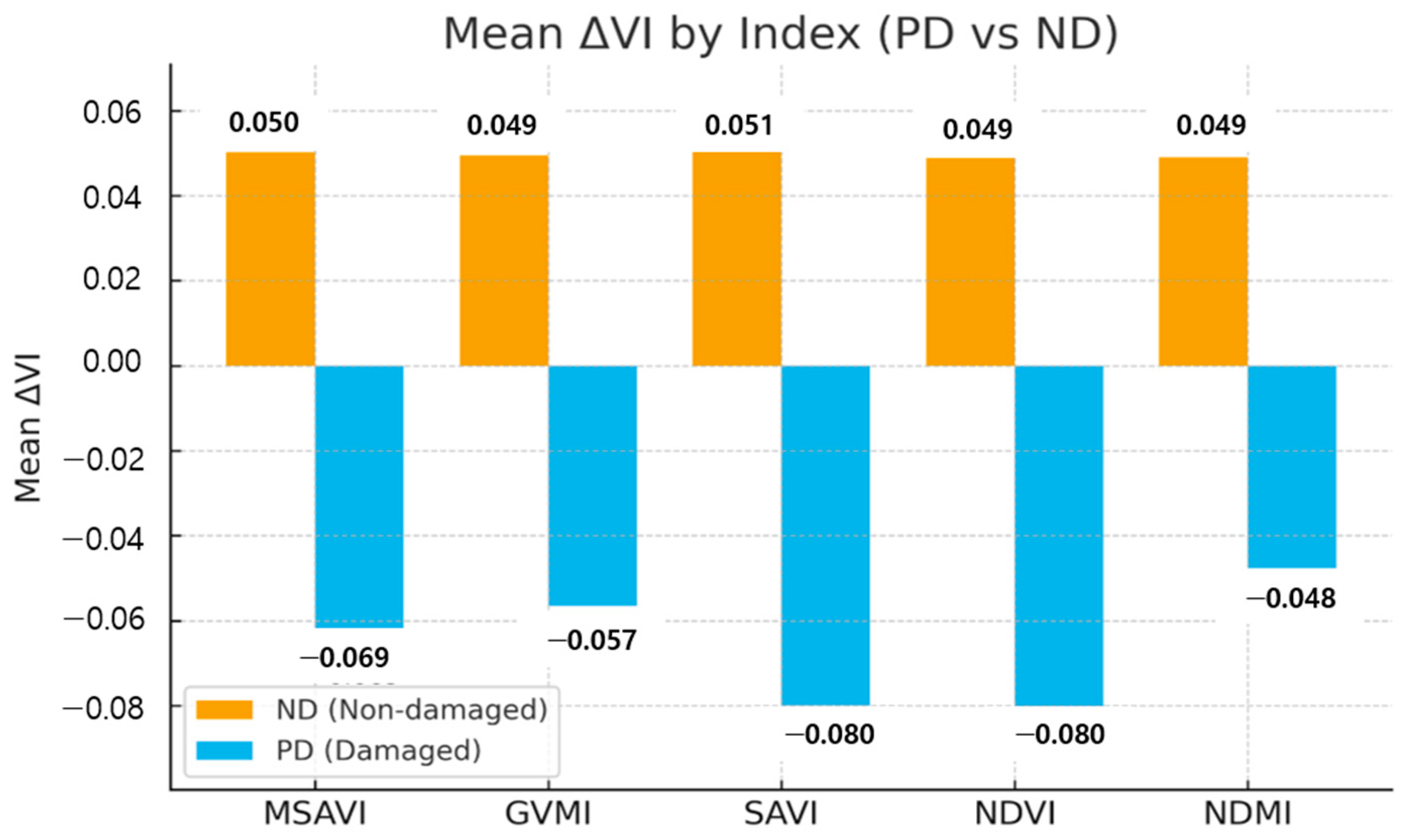
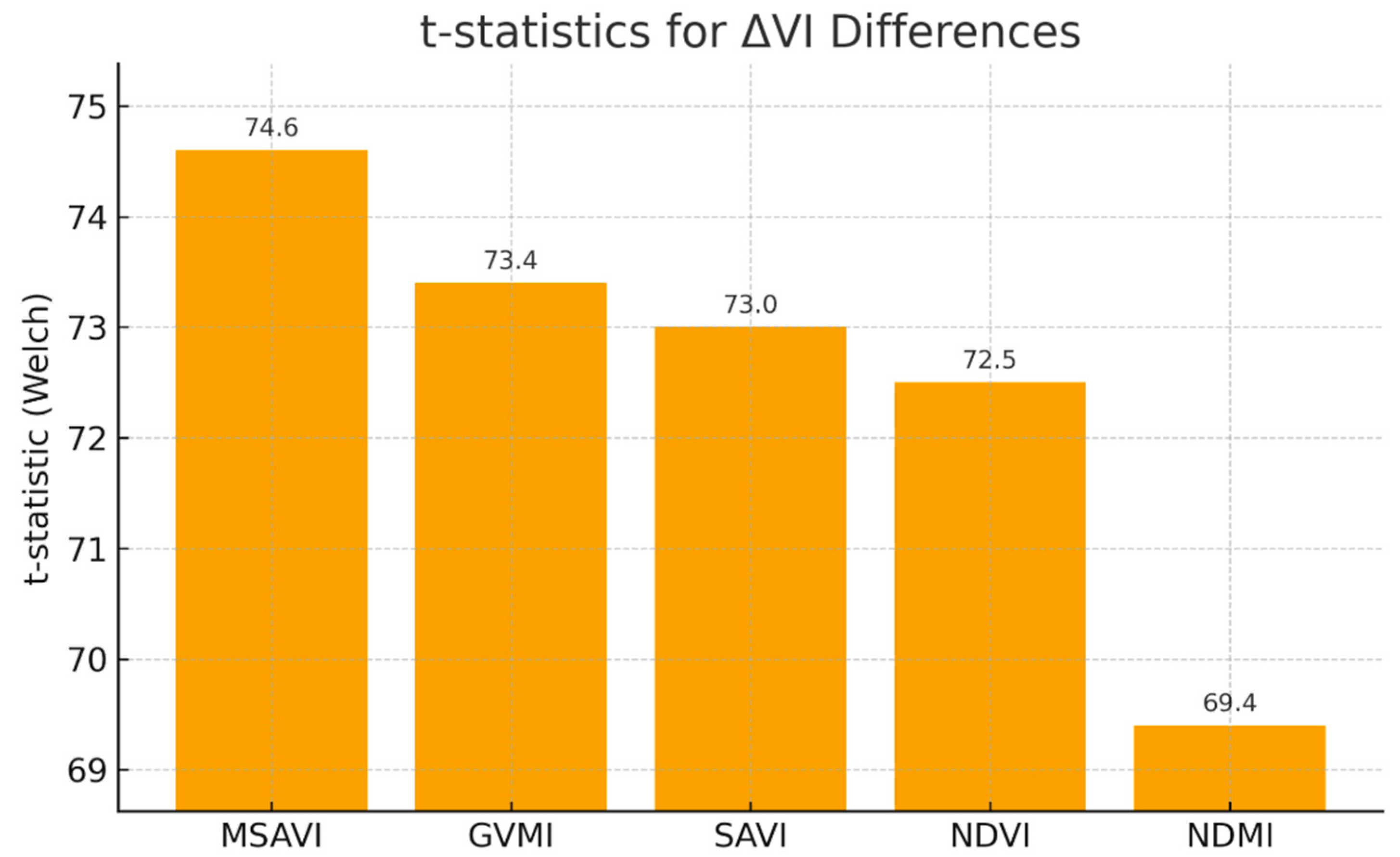
Using the ΔVI values derived from Sentinel-2 imagery, we compared the landslide-affected PD and ND areas. Across all indices, the differences in mean ΔVI between the PD and ND areas were statistically significant (Welch’s t-test, p < 0.001; Table 3). Notably, MSAVI exhibited a mean ΔVI of −0.0691 in PD areas and +0.0502 in ND areas, resulting in an absolute mean difference exceeding 0.12. The corresponding Welch t-statistic was 74.6, and the effect size (Cohen’s d) was 1.07, indicating that MSAVI served as the strongest discriminator between disturbed and undisturbed conditions.
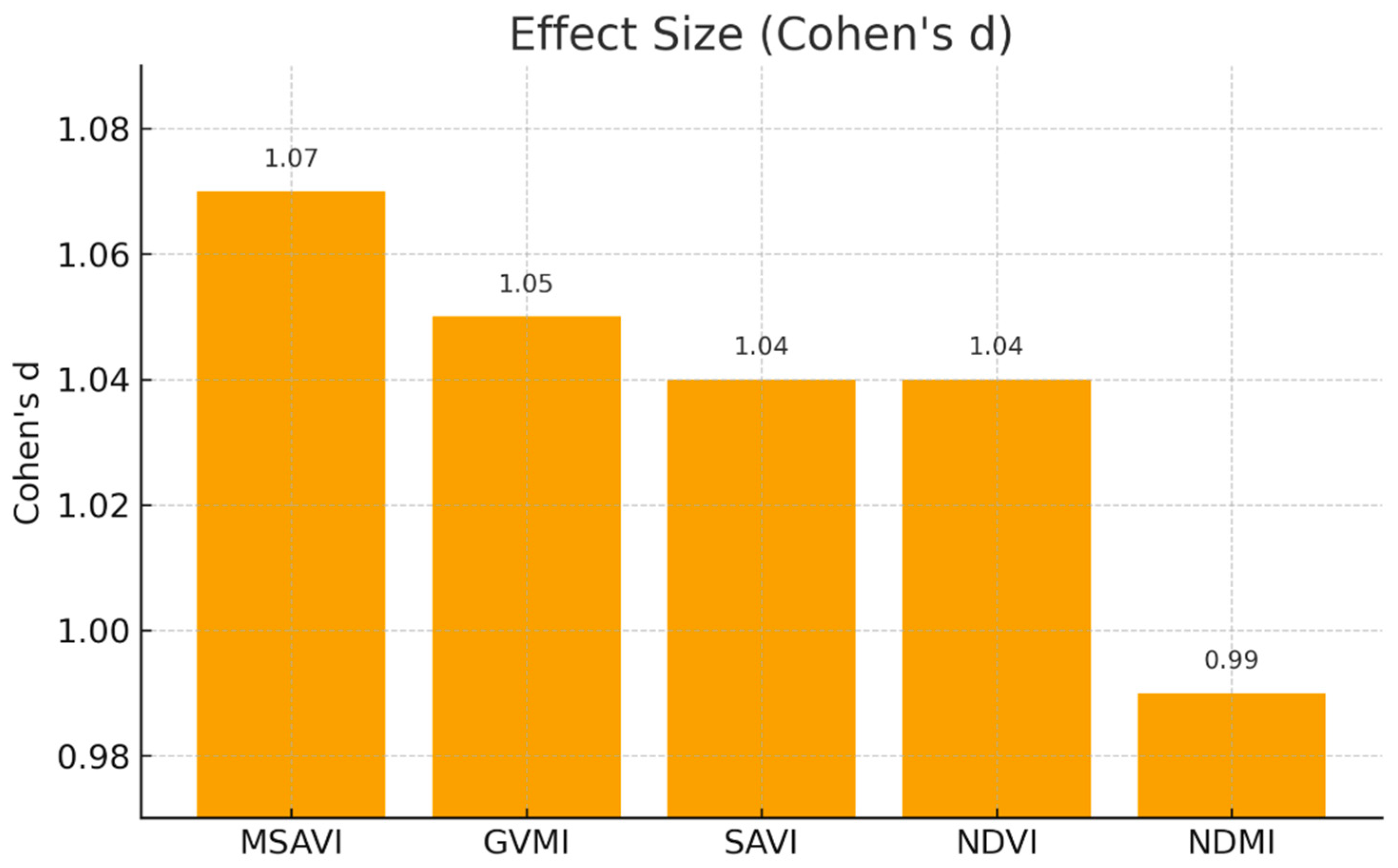
GVMI and SAVI also demonstrated large effect sizes (d = 1.05 and 1.04, respectively), while NDVI showed a comparable value (d = 1.04). NDMI likewise fell within the large-effect range (d = 0.99), although it had the lowest d value. Overall, all vegetation indices tended to decrease (ΔVI < 0) in the PD areas and increase (ΔVI > 0) in the ND areas, underscoring their strong potential for detecting vegetation damage.
Figure 7, which presents the mean ΔVI for each vegetation index, shows that MSAVI exhibits the most pronounced contrast between the PD and ND areas, while GVMI, SAVI, and NDVI display comparable patterns.
Figure 8 presents the corresponding effect-size comparison based on Cohen’s d. MSAVI exhibited the highest d value, clearly outperforming the other indices.
Figure 9 visualizes the Welch t-statistics, highlighting the statistical strength of the separation between the PD and ND areas.
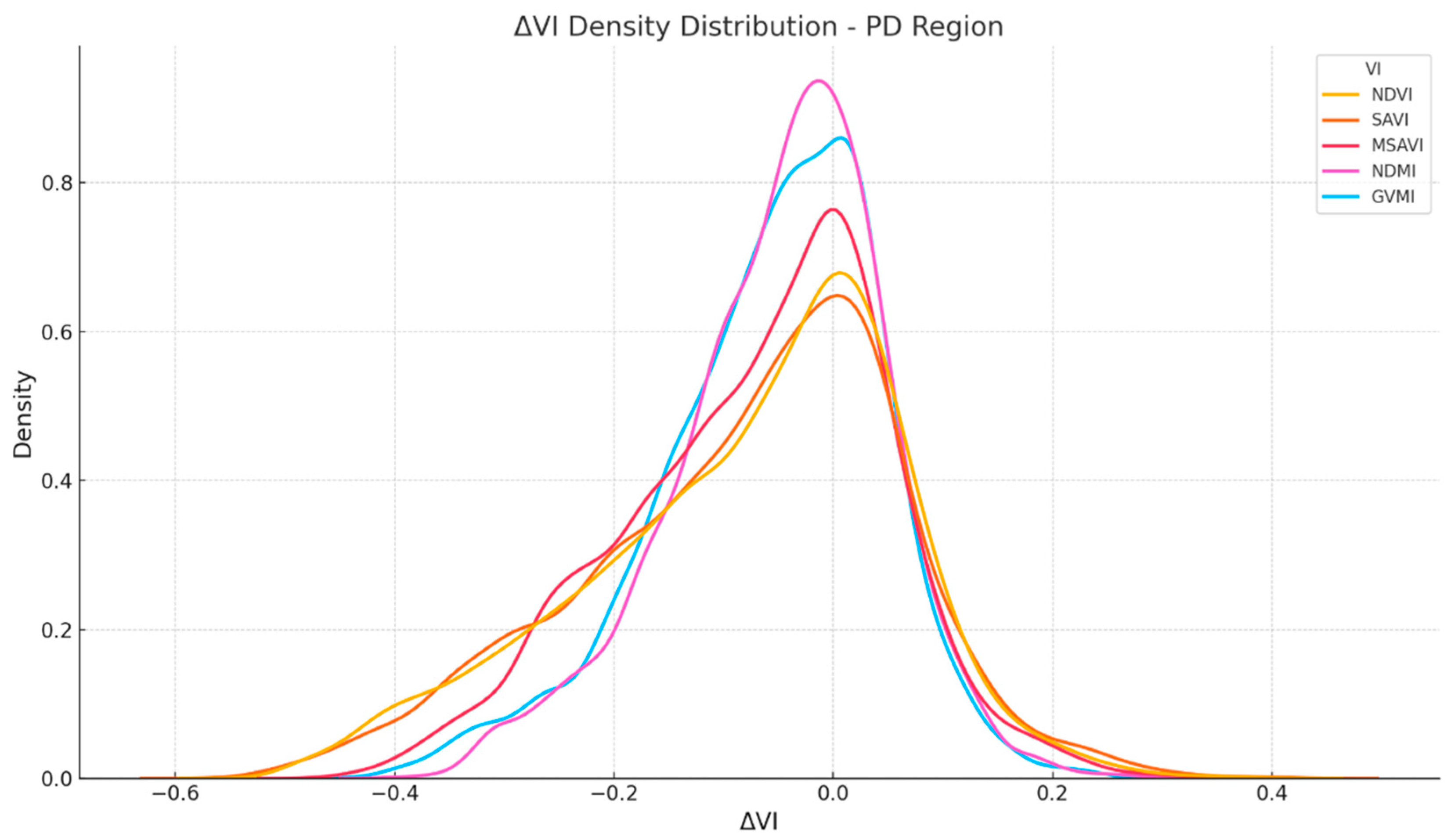
Figure 10 presents the ΔVI density distribution for each VI within the PD area. Both ΔMSAVI and ΔGVMI exhibited pronounced negative skewness, suggesting that they have higher detection sensitivity than NDMI.

3.3. Rainfall–ΔVI Correlation Analysis

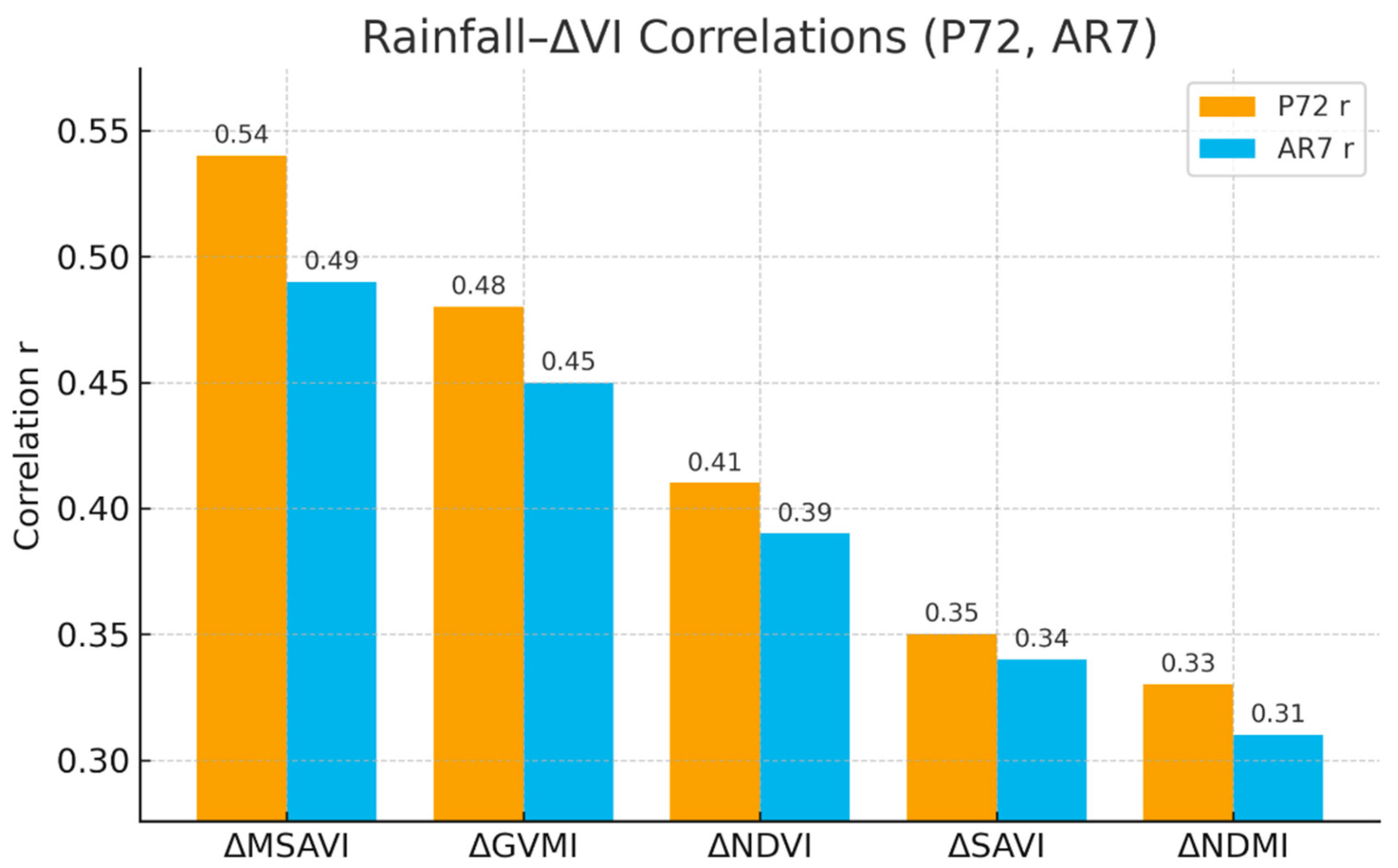
The strongest positive correlations between cumulative rainfall and ΔVI were exhibited for ΔMSAVI (r = 0.54 with P72 and r = 0.49 with AR7) (Table 4). This indicates that greater rainfall was associated with more negative ΔMSAVI values, suggesting that post-landslide vegetation destruction—such as canopy loss and increased bare-soil exposure—is closely related to rainfall intensity. Notably, MSAVI corrects for soil brightness and shadow effects [10], allowing for stable estimation of vegetation vigor even under sparse or exposed conditions. Since it effectively detects exposed surfaces and vegetation degradation following landslides, MSAVI was identified as the most sensitive index in this analysis.
ΔGVMI also exhibited strong correlations with rainfall (r = 0.48 with P72 and r = 0.45 with AR7), followed by ΔNDVI, ΔSAVI, and ΔNDMI, in descending order. Across all indices, greater cumulative rainfall corresponded to more negative ΔVI values, indicating that the rainfall-induced declines in vegetation vigor and moisture content were well captured by ΔVI. Based on the correlations between ΔVI and P72 and AR7 (Figure 11), ΔMSAVI exhibited the highest sensitivity.

3.4. Robustness Checks

To evaluate whether ΔVI-based detection performance is affected by outliers or data-processing choices, we performed three robustness tests. First, after capping the upper and lower 1% of ΔVI values to exclude extreme observations, the ranking of the detection metrics remained unchanged; notably, the top three indices (MSAVI, GVMI, and SAVI) consistently exhibited strong class separation under all conditions. Second, when comparing compositing schemes (mean versus median), both the ΔVI contrasts and separation metrics produced nearly identical outcomes, indicating minimal sensitivity to the choice of compositing statistic. Third, even after redefining the ND set under varying terrain constraints (elevation, slope, and aspect), ΔMSAVI consistently achieved the highest performance across all scenarios.
These findings indicate that ΔMSAVI is highly robust to image noise, statistical processing, and spatial sampling design, reinforcing its suitability as a reliable detection indicator for operational applications.

4. Discussion

This study evaluated the potential of satellite-derived vegetation index change metrics (ΔVI) derived from Sentinel-2 imagery for detecting rainfall-triggered landslides and assessed their association with cumulative rainfall for Sancheong-gun, Gyeongsangnam-do, South Korea. The results demonstrate that ΔVI-based approaches, particularly those using ΔMSAVI, have clear promise for forest damage detection and for supporting the development of satellite-based early-warning systems.

4.1. Performance of ΔVI Metrics for Landslide Detection

While all of the greenness- and moisture-oriented vegetation indices studied here clearly distinguished the landslide-affected areas from the surrounding forested terrain, ΔMSAVI achieved the strongest and most stable separation. MSAVI exhibited the largest difference in mean ΔVI between the PD and ND areas, with the highest t-statistic (t = 74.6) and effect size (Cohen’s d = 1.07), confirming it as the most sensitive and discriminative indicator of landslide-induced vegetation loss. ΔMSAVI, which yielded the strongest detection performance, not only proved effective as a stand-alone indicator of landslide-induced damage but also exhibited the highest quantitative correlations with rainfall, highlighting its strong association with rainfall variations. These findings suggest that ΔMSAVI can serve as a core metric supporting both satellite-based quantitative detection and predictive monitoring in forested regions where ground-based observations are limited.
This study derived ΔVI using pre- and post-event Sentinel-2 imagery to evaluate the feasibility of quantitatively distinguishing between PD and ND areas. By comparing these areas and linking ΔVI to antecedent and post-event rainfall, we examined whether vegetation-based change metrics can serve as reliable indicators of landslide occurrence. The analysis, encompassing greenness indices (NDVI, SAVI, and MSAVI) and moisture indices (NDMI and GVMI), revealed predominantly negative ΔVI values in PD areas and positive or neutral ΔVI values in ND areas, demonstrating that landslide damage can be effectively discriminated using ΔVI alone. These findings indicate abrupt vegetation loss and/or increased bare-soil exposure in the PD areas.
Similar patterns have been reported in previous studies, in which ΔNDVI and ΔSAVI derived from Sentinel-2 imagery following heavy rainfall events effectively captured vegetation collapse within actual landslide zones [15,31]. Notably, in areas where moisture saturation and structural vegetation failure co-occur, MSAVI declines more distinctly than NDVI, thus demonstrating its higher sensitivity [32]. Recent work has also proposed new multi-band vegetation indices for disturbance mapping, such as the three-band difference vegetation index (TBDVI), which outperform conventional greenness and moisture indices for detecting vegetation destruction, including landslide-affected areas [33]. Taken together, these results indicate that ΔMSAVI and related ΔVI products provide a robust spectral basis for distinguishing landslide-induced damage from background forest variability.
Correlation analysis between ΔVI and cumulative rainfall (P72 and AR7) revealed that ΔMSAVI exhibited the strongest associations with rainfall (r = 0.54 and 0.49, respectively), followed by ΔGVMI and ΔNDVI. These results indicate that cumulative rainfall is closely associated with vegetation destruction, canopy loss, and the expansion of exposed surfaces, and that such physical changes are effectively captured in ΔVI values. Across all indices, greater cumulative rainfall corresponded to more negative ΔVI values, underscoring the rainfall sensitivity of ΔVI-based detection.
Robustness testing using three methods—capping outliers, using different compositing methods, and redefining the ND set—further confirmed that ΔMSAVI consistently maintained superior separation performance under diverse statistical and spatial processing conditions, reflecting its greater stability against image noise and analytical variation. In practical terms, these findings suggest that ΔMSAVI enables rapid and consistent identification of damaged areas using satellite data alone, making it particularly suitable for automated damage monitoring in high-risk forested terrain. The proposed framework was not overly sensitive to outliers, compositing choices, or variation in terrain-constrained sampling design, and can therefore be adapted to a range of practical monitoring settings using the freely available Sentinel-2 imagery.

4.2. Implications for Monitoring and Early Warning

Operationally, ΔMSAVI functions not only as an effective stand-alone damage indicator but also as the strongest quantitative correlate of rainfall, making it a promising candidate input for satellite-based early-warning systems (EWS). Integrating forecasted rainfall with accumulated ΔVI enables the development of hybrid models that extend beyond post-event detection to pre-event hazard alerts. Sentinel-2’s 10 m spatial resolution and frequent revisit capability further support near-real-time monitoring frameworks that can be directly coupled with meteorological forecasts.
ΔVI products can also serve as predictive input for AI-driven landslide modeling. For instance, multivariate datasets that combine ΔMSAVI and ΔGVMI time series with rainfall and terrain parameters are well suited to machine-learning and deep-learning frameworks for landslide susceptibility assessment and damage classification. Recent studies have demonstrated that temporal variations in NDVI and NDMI are among the most informative predictors for improving ML-based damage classification accuracy. Accordingly, the ΔVI indicators derived in this study can be systematically structured as model inputs, with even greater predictive gains expected when integrated with long-term satellite time series. In parallel, fully automated frameworks that use Sentinel-2 ΔVI together with Sentinel-1 SAR data on Google Earth Engine have been developed to date recent landslides, illustrating how optical change metrics can be combined with radar information in near-real-time applications [34,35].
Integration with unmanned aerial vehicle (UAV; i.e., drone) imagery represents another promising direction for enhancing landslide damage assessment. High-resolution UAV data acquired over the same areas can characterize fine-scale vegetation disturbance patterns, enabling precise validation of Sentinel-2-derived ΔVI results and providing complementary interpretative insights. For structurally complex slopes or localized failures, UAV observations offer higher spatial fidelity, supporting high-precision response systems through multi-sensor fusion between satellite and aerial platforms. In addition, combining ΔVI-based indicators with in situ observations and operational rainfall thresholds can help bridge the gap between research prototypes and practical, agency-level early-warning tools in landslide-prone forested regions.

5. Conclusions

Together, these findings indicate that ΔVI, and ΔMSAVI in particular, represents a robust indicator for quantitative landslide detection and monitoring in mountainous forest regions. ΔVI-based quantitative landslide detection provides an effective and practical approach that can be implemented using satellite imagery alone. The findings highlight its broad applications, extending from early-warning systems and AI-driven predictive modeling to high-resolution post-event forensic analysis. Future research should explore multi-season satellite composites, assess differential sensitivity across vegetation types, and evaluate the advantages of multi-source data fusion to further advance quantitative landslide detection frameworks and support sustainable land and forest management in landslide-prone areas.

Author Contributions

Conceptualization, J.L. and S.L.; Data curation, J.L.; Investigation, J.L.; Methodology, J.L.; Project administration, H.L.; Supervision, H.L.; Validation, H.L.; Writing—review and editing, S.L. All authors have read and agreed to the published version of the manuscript.

Funding

This research was supported by the National Institute of Forest Science (NIFoS) project (Project No. FM01030-2021-02-2025).

Data Availability Statement

No new data were created or analyzed in this study. Data sharing is not applicable to this article.

Conflicts of Interest

The authors declare no conflict of interest.

Abbreviations

The following abbreviations are used in this manuscript:
ASOSAutomated Synoptic Observing System
AWSAutomatic Weather Station
EWSEarly-warning system
GEEGoogle Earth Engine
GVMIGlobal vegetation moisture index
KFSKorea Forest Service
KMAKorea Meteorological Administration
NDNon-damaged
MSAVIModified soil-adjusted vegetation index
MSIMultiSpectral Instrument
NIRNear infrared
NDMINormalized difference moisture index
NDVINormalized difference vegetation index
PDPost-disaster
SAVISoil-adjusted vegetation index
UAVUnmanned aerial vehicle
VIVegetation index

References

  1. Houghton, J.T.; Ding, Y.D.; Griggs, D.J.; Noguer, M.; van der Linden, P.J.; Dai, X.; Maskell, K. Climate Change 2001: The Scientific Basis: Contribution of Working Group I to the Third Assessment Report of the Intergovernmental Panel on Climate Change; Johnson, C.A., Ed.; Cambridge University Press: Cambridge, UK, 2001. [Google Scholar]
  2. Brand, E.W. Landslides in Southeast Asia: A State-of-the-Art. In Proceedings of the 4th International Symposium on Landslides, Toronto, ON, Canada, 16–21 September 1984. [Google Scholar]
  3. Korea Forest Service (KFS). Statistical Yearbook of Forestry; Korea Forest Service: Daejeon, Republic of Korea, 2021. [Google Scholar]
  4. Cha, M.; Kim, S.; Lee, S. Rainfall thresholds for landslide initiation in Korea. Eng. Geol. 2018, 239, 142–153. [Google Scholar]
  5. Lee, S.; Pradhan, B. Landslide hazard mapping at Selangor, Malaysia using frequency ratio and logistic regression. Landslides 2007, 4, 33–41. [Google Scholar] [CrossRef]
  6. Bui, D.T.; Tuan, T.A.; Klempe, H.; Pradhan, B.; Revhaug, I. Spatial prediction models for shallow landslide hazards: A comparative assessment. Geomorphology 2020, 359, 107–124. [Google Scholar]
  7. Parisi, F.; Vangi, E.; Francini, S.; D’Amico, G.; Chirici, G.; Marchetti, M.; Lombardi, F.; Travaglini, D.; Ravera, S.; De Santis, E.; et al. Sentinel-2 time series analysis for monitoring multi-taxon biodiversity in mountain beech forests. Front. For. Glob. Change 2023, 6, 1020477. [Google Scholar] [CrossRef]
  8. Huete, A.R. A soil-adjusted vegetation index (SAVI). Remote Sens. Environ. 1988, 25, 295–309. [Google Scholar] [CrossRef]
  9. Gao, B.-C. NDWI—A normalized difference water index for remote sensing of vegetation liquid water from space. Remote Sens. Environ. 1996, 58, 257–266. [Google Scholar] [CrossRef]
  10. Qi, J.; Chehbouni, A.; Huete, A.R.; Kerr, Y.H.; Sorooshian, S. A modified soil adjusted vegetation index. Remote Sens. Environ. 1994, 48, 119–126. [Google Scholar] [CrossRef]
  11. Zhou, G.; Sun, X.; Liu, S. Selection of control areas for vegetation change analysis after landslides. Environ. Earth Sci. 2019, 78, 457. [Google Scholar]
  12. Zhao, Z.; Dai, E. Vegetation cover dynamics and its constraint effect on ecosystem services on the Qinghai-Tibet Plateau under ecological restoration projects. J. Environ. Manag. 2024, 356, 120535. [Google Scholar] [CrossRef] [PubMed]
  13. Chen, X.; Vierling, L.; Deering, D. A simple and effective radiometric correction method to improve landscape change detection across sensors and across time. Remote Sens. Environ. 2005, 98, 63–79. [Google Scholar] [CrossRef]
  14. Ghorbanzadeh, O.; Didehban, K.; Rasouli, H.; Kamran, K.V.; Feizizadeh, B.; Blaschke, T. An Application of Sentinel-1, Sentinel-2, and GNSS Data for Landslide Susceptibility Mapping. ISPRS Int. J. Geo-Inf. 2020, 9, 561. [Google Scholar] [CrossRef]
  15. Chrysafi, A.A.; Tsangaratos, P.; Ilia, I.; Chen, W. Rapid landslide detection following an extreme rainfall event using remote sensing indices, synthetic aperture radar imagery, and probabilistic methods. Land 2024, 14, 21. [Google Scholar] [CrossRef]
  16. Khadka, D.; Zhang, J.; Sharma, A. Geographic object-based image analysis for landslide identification using machine learning on Google Earth Engine. Environ. Earth Sci. 2025, 84, 92. [Google Scholar] [CrossRef]
  17. Wang, L.J.; Sawada, K.; Moriguchi, S. Landslide susceptibility analysis with logistic regression model based on FCM sampling strategy. Comput. Geosci. 2013, 57, 81–92. [Google Scholar] [CrossRef]
  18. Mohseni, P. Mapping Snow and Vegetation Coverage Using Multitemporal Open Satellite Imagery: The Case Study of the Maritime Alps. Master’s Thesis, Politecnico di Torino, Turin, Italy, 2024. [Google Scholar]
  19. van t’ Loo, K. Monitoring with Vegetation Indices: How Vegetation Recovers on Landslides in Dominican Tropical Forest. Master’s Thesis, Windesheim University of Applied Sciences, Zwolle, The Netherlands, 2020. Available online: https://www.researchgate.net/publication/354059041 (accessed on 1 December 2025).
  20. Zhou, L.; Lin, Y.; Xu, L.; Chen, Y. Assessing landslide-induced vegetation loss using combined Landsat and Sentinel-2 imagery. Int. J. Appl. Earth Obs. Geoinf. 2022, 112, 102853. [Google Scholar]
  21. Rouse, J.W.; Haas, R.H.; Schell, J.A.; Deering, D.W. Monitoring vegetation systems in the Great Plains with ERTS. In Third ERTS Symposium; NASA SP-351; NASA: Washington, DC, USA, 1974; Volume I, pp. 309–317. [Google Scholar]
  22. Kim, J.; Lee, S.; Kwon, J. Landslide susceptibility mapping based on field survey and optical imagery. Geomatics Nat. Hazards Risk 2021, 12, 112–130. [Google Scholar]
  23. Song, M.; Yun, H.; Lim, K. Mapping post-disaster landslide extent using Sentinel-2 and object-based image analysis. Remote Sens. 2022, 14, 2955. [Google Scholar]
  24. Liu, Y.; Wang, Z.; Zhang, H. Improving landslide mapping accuracy using buffer zone filtering of boundary pixels. Int. J. Appl. Earth Obs. Geoinf. 2020, 90, 102117. [Google Scholar]
  25. Bae, J.; Lee, D.; Kim, M. A comparative analysis of landslide and non-landslide areas using DEM and NDVI. Korean J. Remote Sens. 2019, 35, 45–57. [Google Scholar]
  26. Copernicus WorldCover Team. ESA WorldCover 10 m v100 [Dataset]. 2021. Available online: https://esa-worldcover.org (accessed on 1 December 2025).
  27. Zhu, C.; Fang, C.; Tao, Z.; Zhang, Q.; Zhang, W.; Yan, J.; He, M.; Cheng, Z. Remote Sensing Techniques for Landslide Prediction, Monitoring, and Early Warning. Remote Sens. 2025, 17, 1893. [Google Scholar] [CrossRef]
  28. Cohen, J. Statistical Power Analysis for the Behavioral Sciences, 2nd ed.; Lawrence Erlbaum Associates: Hillsdale, NJ, USA, 1988. [Google Scholar]
  29. Koutsias, N.; Kalabokidis, K.D.; Allgöwer, B. Fire occurrence patterns at landscape level: Beyond positional accuracy of ignition points with kernel density estimation methods. Nat. Res. Mod. 2004, 17, 359–375. [Google Scholar] [CrossRef]
  30. Wang, Z.; Wei, C.; Liu, X.; Zhu, L.; Yang, Q.; Wang, Q.; Zhang, Q.; Meng, Y. Object-based change detection for vegetation disturbance and recovery using Landsat time series. GIScience Remote Sens. 2022, 59, 1706–1721. [Google Scholar] [CrossRef]
  31. Arai, K.; Nakaoka, Y.; Okumura, H. Method for landslide area detection with RVI data which indicates base soil areas changed from vegetated areas. Remote Sens. 2025, 17, 628. [Google Scholar] [CrossRef]
  32. Duan, Z.; Zhang, Y.; Fan, S.; Ji, T. The impact of super typhoon on varying vegetation types in eastern coastal China: Implications for coastal ecosystem and disaster risk management. Int. J. Digit. Earth 2025, 18, 2523482. [Google Scholar] [CrossRef]
  33. Zhao, C.; Pan, Y.; Ren, S.; Gao, Y.; Wu, H.; Ma, G. Accurate Vegetation Destruction Detection Using Remote Sensing Imagery Based on the Three-Band Difference Vegetation Index (TBDVI) and Dual-Temporal Detection Method. Int. J. Appl. Earth Obs. Geoinf. 2024, 127, 103669. [Google Scholar] [CrossRef]
  34. Barbera, L.; Maltese, A.; Conoscenti, C. Automated Dating of Recent Landslides Using Sentinel-2 and Sentinel-1 on Google Earth Engine. Remote Sens. 2025, 17, 3270. [Google Scholar] [CrossRef]
  35. Fu, S.; de Jong, S.M.; Deijns, A.A.J.; Geertsema, M.; de Haas, T. The SWADE Model for Landslide Dating in Time Series of Optical Satellite Imagery. Landslides 2023, 20, 913–932. [Google Scholar] [CrossRef]
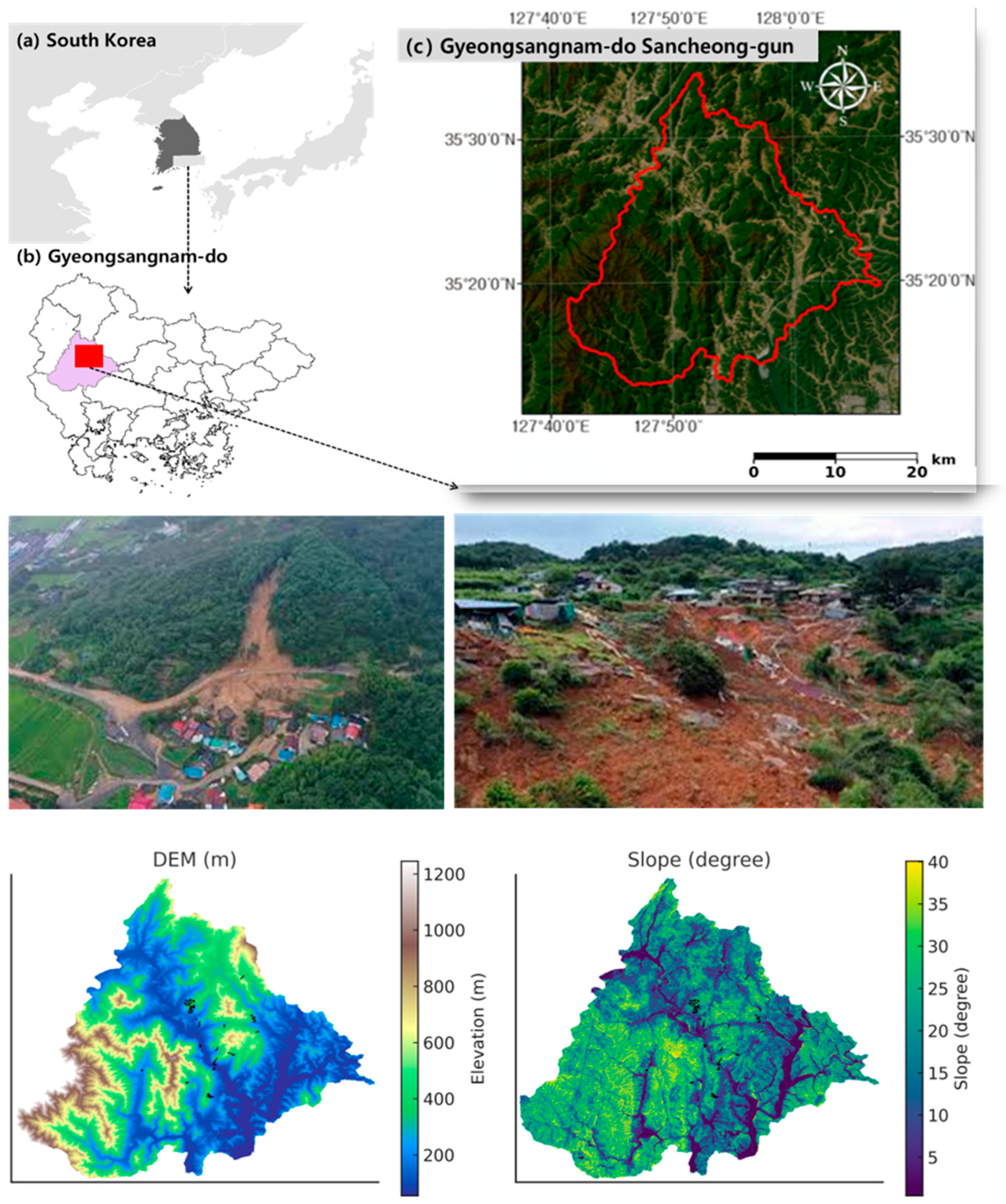
Figure 1. Study Area. (a) Location of South Korea. (b) Location of Sancheong-gun (red box) within Gyeongsangnam-do (shaded). (c) Study area boundary (red outline).
Land 14 02410 g001
Figure 2. Flow chart of the analytical procedure applied here.
Land 14 02410 g002
Figure 3. Inverse distance weighted rainfall data: (a) 7-day cumulative rainfall (AR7) and (b) 72-h antecedent cumulative rainfall (P72).
Land 14 02410 g003
Figure 4. Example of manually digitized landslide-affected areas.
Land 14 02410 g004
Figure 5. RGB and ΔVI (ΔNDVI, ΔSAVI, ΔMSAVI, ΔNDMI, ΔGVMI) maps for a representative landslide scar in Sancheong-gun, South Korea.
Land 14 02410 g005
Figure 6. ΔVI (differences in vegetation indices). MSAVI, Modified soil-adjusted vegetation index; GVMI, Global vegetation moisture index; SAVI, Soil-adjusted vegetation index; NDVI, Normalized difference vegetation index; NDMI, Normalized difference moisture index.
Land 14 02410 g006
Figure 7. Mean differences in vegetation indexes (ΔVI, post − pre) for the post-disaster (PD) and non-damaged (ND) areas. This reveals consistently negative shifts in VI in the PD areas and positive shifts in the ND areas. MSAVI exhibits the greatest visual separation between the PD and ND areas. MSAVI, Modified soil-adjusted vegetation index; GVMI, Global vegetation moisture index; SAVI, Soil-adjusted vegetation index; NDVI, Normalized difference vegetation index; NDMI, Normalized difference moisture index.
Land 14 02410 g007
Figure 8. Effect Size (Cohen’s d) of differences in the vegetation indices (ΔVI) between the post-disaster (PD) and non-damaged (ND) areas. All of the VIs displayed large effect sizes (d > 0.99), with MSAVI showing the highest value (1.07), indicating its superior discriminative capacity for detecting landslide damage. MSAVI, Modified soil-adjusted vegetation index; GVMI, Global vegetation moisture index; SAVI, Soil-adjusted vegetation index; NDVI, Normalized difference vegetation index; NDMI, Normalized difference moisture index.
Land 14 02410 g008
Figure 9. Welch t-statistics for the mean differences in vegetation index (ΔVI) between the post-disaster (PD) and non-damaged (ND) areas. The Welch’s t-test results reveal statistically significant differences (p < 0.001) for all of the indices. MSAVI exhibited the strongest statistical separation between the PD and ND areas. MSAVI, Modified soil-adjusted vegetation index; GVMI, Global vegetation moisture index; SAVI, Soil-adjusted vegetation index; NDVI, Normalized difference vegetation index; NDMI, Normalized difference moisture index.
Land 14 02410 g009
Figure 10. Density distributions of the difference in vegetation index (ΔVI) for the post-disaster (PD) areas for each VI. Kernel density estimates are shown. MSAVI and GVMI display pronounced left-skewed distributions, reflecting substantial vegetation and moisture loss following the landslide. MSAVI, Modified soil-adjusted vegetation index; GVMI, Global vegetation moisture index; SAVI, Soil-adjusted vegetation index; NDVI, Normalized difference vegetation index; NDMI, Normalized difference moisture index.
Land 14 02410 g010
Figure 11. Pearson correlations (r) between cumulative rainfall (P72, prior 72 h; AR7, following 7 days) and ΔVI. MSAVI exhibited the highest sensitivity to rainfall for both metrics, highlighting its strong coupling with precipitation-driven vegetation change. MSAVI, Modified soil-adjusted vegetation index; GVMI, Global vegetation moisture index; SAVI, Soil-adjusted vegetation index; NDVI, Normalized difference vegetation index; NDMI, Normalized difference moisture index.
Land 14 02410 g011
Table 1. Vegetation indices used here.
Vegetation IndexFormula
(Sentinel-2 Band Basis)
Key CharacteristicsReference
NDVI
(Normalized Difference Vegetation Index)
(B8 − B4)/(B8 + B4)- Most basic greenness index
- Sensitive to leaf area and photosynthetic activity
- Susceptible to soil exposure (soil brightness effects)
Rouse et al., 1974 [21]
SAVI
(Soil-Adjusted Vegetation Index)
(B8 − B4)/(B8 + B4 + L) × (1 + L)
L = 0.5
- Adjusts for soil brightness effects
- More stable than NDVI in sparsely vegetated areas
- Suited to areas with increased exposed soil
- L: Soil brightness correction factor
Huete, 1988 [8]
MSAVI
(Modified SAVI)
0.5 × [2 × B8 + 1 − √((2 × B8 + 1)2 − 8 × (B8 − B4))]- Self-adjusting soil correction
- More robust than NDVI and SAVI over exposed areas
- Effective at suppressing noise
Qi et al., 1994 [10]
NDMI
(Normalized Difference Moisture Index)
(B8 − B11)/(B8 + B11)- Sensitive to vegetation canopy water content
- Responds to canopy loss and moisture/saturation transitions
- Foundational indicator on the moisture axis
Gao, 1996 [9]
GVMI
(Global Vegetation Moisture Index)
(B8 − B12)/(B8 + B12)- Similar to NDMI but uses a broader SWIR range
- Sensitive to near-surface (topsoil) moisture state
- Enhances structural contrast
Chen et al., 2005 [13]
Table 2. Percentiles of the differences in each vegetation index between the pre- and post-event periods (ΔVI) (full-scene basis).
VI1% (q01)5% (q05)25% (q25)50%
(q50)
75% (q75)95% (q95)99% (q99)
MSAVI−0.1588−0.04190.01330.03730.06930.17650.2880
GVMI−0.1159−0.02060.02300.04060.06210.14120.2248
SAVI−0.1901−0.04830.01610.04300.07730.20270.3317
NDVI−0.1939−0.03690.02560.04660.07590.18670.3188
NDMI−0.1125−0.03310.01350.03700.06280.14640.2357
MSAVI, Modified soil-adjusted vegetation index; GVMI, Global vegetation moisture index; SAVI, Soil-adjusted vegetation index; NDVI, Normalized difference vegetation index; NDMI, Normalized difference moisture index.
Table 3. Summary statistics of ΔVI for landslide-affected post-disaster (PD) and non-damaged (ND) areas derived from Sentinel-2 vegetation indices. The table reports the group means, Welch’s t-statistics, p-values, and effect sizes (Cohen’s d). All differences were statistically significant (p < 0.001), with MSAVI exhibiting the largest effect size (d = 1.07).
VIMean ΔVI
(ND)
Mean ΔVI
(PD)
tpCohen’s d
MSAVI+0.0502−0.069174.6<0.0011.07
GVMI+0.0494−0.056673.4<0.0011.05
SAVI+0.0511−0.080173.0<0.0011.04
NDVI+0.0489−0.080272.5<0.0011.04
NDMI+0.0490−0.047769.4<0.0010.99
MSAVI, Modified soil-adjusted vegetation index; GVMI, Global vegetation moisture index; SAVI, Soil-adjusted vegetation index; NDVI, Normalized difference vegetation index; NDMI, Normalized difference moisture index.
Table 4. Pearson correlation coefficients between cumulative rainfall (P72: prior 72 h, AR7: following 7 days) and ΔVI across the vegetation indices. ΔMSAVI exhibited the strongest positive correlation with rainfall (r = 0.54 with P72 and r = 0.49 with AR7), indicating the high sensitivity to rainfall of the vegetation-damage signals (ΔVI).
ΔVIP72 (Prior 72 h)AR7 (Following 7 Days)
ΔMSAVI0.540.49
ΔGVMI0.480.45
ΔNDVI0.410.39
ΔSAVI0.350.34
ΔNDMI0.330.31
MSAVI, Modified soil-adjusted vegetation index; GVMI, Global vegetation moisture index; SAVI, Soil-adjusted vegetation index; NDVI, Normalized difference vegetation index; NDMI, Normalized difference moisture index.
Disclaimer/Publisher’s Note: The statements, opinions and data contained in all publications are solely those of the individual author(s) and contributor(s) and not of MDPI and/or the editor(s). MDPI and/or the editor(s) disclaim responsibility for any injury to people or property resulting from any ideas, methods, instructions or products referred to in the content.