You are currently viewing a new version of our website. To view the old version click .
Land
  • Article
  • Open Access

8 December 2025

Explication of Urban Park Narratives: From Land to the La Villette

and
1
Department of Architecture, Faculty of Architecture, Yıldız Technical University, 34349 Istanbul, Turkey
2
Department of Architecture, Faculty of Art, Design and Architecture, Fatih Sultan Mehmet Waqf University, 34025 Istanbul, Turkey
*
Author to whom correspondence should be addressed.
This article belongs to the Special Issue Urban Morphology: A Perspective from Space (3rd Edition)

Abstract

The ongoing ontological tension between architecture, art, and science is analyzed using semantic tools. This line of analysis addresses the gap in the literature caused by the lack of a systematic and traceable framework for defining the theatrical meaning of the relationship between multiple coding and performative space. The study examines Bernard Tschumi’s Parc de la Villette design from Architecture and Disjunction within the critical framework of Roland Barthes and Bertolt Brecht, and is conducted in the MAXQDA environment. Adopting a qualitative structural narrative analysis methodology and structured around three analytical operations (segmentation–inventory–structuring), the study is validated through interdisciplinary triangulation. At the segmentation phase, Tschumi’s text is divided into 19 meaning units under theoretical nodes based on Brecht’s principles of epic theater. These units were analyzed using closed (deductive) coding with a coding table derived from the literature and developed iteratively to ensure reliability through consensus between the two researchers. During the inventory phase, these meaning units were reinterpreted through open (inductive) coding using Barthes’ five codes, yielding 62 productive terms. During the structuring phase, the distribution and relationships between codes were thematized within the park’s 4 spatial configurations, based on evaluative and inferential layers of meaning.

1. Introduction

1.1. Scope of the Research

The urban park is analyzed as an intersection of literary, architectural and theatrical theories within the framework of deconstructivism1. For Tschumi, the relationship between architecture and theatre is foregrounded through the following question: “Was it a play or was it a piece of architecture [2] (p. 252), [3]”? Although Bernard Tschumi’s architectural approach—an exploration in search of meaning—appears to be primarily influenced by Jacques Derrida’s texts, underlying figures also play a significant role: Roland Barthes and Bertolt Brecht [2] (pp. 33–83), [4,5,6]. In this study, Roland Barthes’ theory of plural texts, known as the “five narrative codes,” and Bertolt Brecht’s nine principles of “Alienation effect (Verfremdungseffekt)2,” which form the foundation of epic theatre, are examined in relation to their significance in the design of La Villette [2] (pp. 108–253]. This study, developed for the deconstruction of La Villette through the intellectual contributions of multidisciplinary theorists, will provide a systematic model of reading for future research.

1.2. Research Objectives and Inquiries

The aim of this study is to reveal the spatial dimension of the textual and theatrical nature embedded in performative spatial narratives. Addressing this gap in the literature provides an opportunity to open a critical discussion on the collaborative works carried out by postmodern theorists and architects. The framework constructed through the systematization of seemingly fragmented ideas within the deconstructivist discourse of architecture—an interdisciplinary field that connects science and art—may also serve as a foundation for further studies. Otherwise, the proliferation of symbolic works in postmodern architectural thought and practice may increase, leading to dilemmas in the transformation of meaning into form, thereby confining interpretation to esoteric readings.
The central research question of this study concerns the various theoretical phases underlying the formation of La Villette: When examined in conjunction with Barthes’s “five codes” and Brecht’s nine principles that constitute the “Alienation effect (Verfremdungseffekt),” can the ideological sources that nourish its creation be identified [7,8,9,10,11,12]?
Another aim is to pave the way for the application of this deconstructivist-based analytical method—developed through La Villette—not only to architecture but also to texts from different disciplines such as art, philosophy, and literature. The instrumentalization of such an analysis will support the development of theory on a more constructive level by transforming prejudices related to practical-world dilemmas. The specific objective of the study is to examine, from a broader perspective, the theoretical approaches of architects who shaped postmodern and post-avant-garde3 architecture, and to demonstrate the representation of an interdisciplinary process [14,15]. What highlights the importance of the topic discussed in the article is that it proposes a new epistemological approach to architectural theory. By pointing to the existence of narrative-based production sources in architecture, it offers a unique model for spatial production forms, supported by the influence of theatricality. Thanks to the new intellectual common ground it establishes with other disciplines, the model developed in this study can be further developed in future research to ensure its sustainability.

1.3. Thesis of the Research

The hypothesis of this study is that architectural narrative has an actional and textual character and can be read as a “staged text” at the same time. Tschumi, who reveals the plural layers of meaning in texts through both theater and literature, considers architecture as a part of narratology. Similar to the discourse that precedes his architecture, in theatrical performances as well, “a text is brought to the stage.” In the same context, following his engagement with Derrida, Peter Eisenman also began to textualize architecture and interpreted deconstruction accordingly [5,6,16].

1.4. Literature Review

1.4.1. Literature Review on Parc de la Villette

Parc de la Villette, which is considered one of the representative spaces of the 21st century and a symbolic site of public culture, was built in Paris in 1989 as the result of a competition held in 1982 with 470 participants [4]. The park design submitted by Bernard Tschumi—known for his collaboration with Jacques Derrida—covers an area of 55 hectares. Of this, 23 hectares were developed, while the remaining 32 hectares were preserved as green space [4]. Such large-scale park designs can be classified as regional-scale designs.
From a morphological perspective, the grid-like spatial configuration of a park becomes possible through a geometric equivalent of a rational architectural approach suitable for a park of this scale. The spatial organization shaped by Tschumi’s interpretation of design inputs reveals that the park was conceptualized not merely to imitate nature but to emphasize cultural significance [17]. According to Bailly [18,19] spatial representations and perceptions of the park are related to the forms it creates experientially [20], to the collective memory of the past [21], and the social presence of urban culture in the region [22]. Upon close examination, it becomes evident that the physical and socio-cultural layers aligning with the natural character of the landscape were produced through urban-scale decisions [23,24] (p. 197), [25] (p. 240). In this context, Canter’s visual metaphor of the nature of places [26] can be read through the social layers in Tschumi’s design and the mental mapping formed by the user. The theoretical framework of the park also constitutes a visual metaphor of a flexible “place” on an urban scale. The park and its harmony with the environment are defined through various recreational areas that continuously create scenes of experience [27]. A key element in developing this flexible urban framework is the inclusion of educational spaces alongside recreational areas [4,28]. The emphasis on color in the Folies—prominent recreational structures—along with their spatial scale and perception of meaning, is seen by some as one of the park’s strengths [29,30,31,32]. However, others have criticized the Folies for having a mix of fixed, temporarily functional, and deliberately functionless units, arguing that this reflects a failure in the park’s programmatic approach [33,34]. The abstract, geometric, and cultural dimensions embedded in the design parameters allow for a textual reading of the design process [35]. Chen and Li’s study interprets La Villette’s landscape design through Kandinsky’s compositional principles of “point, line, and plane [36,37]”. The authors examine the spatial manifestations of the theoretical background of deconstructivism in the park’s design. In this study, which frames the park as a system of meaning production, terms such as “accidental,” “coincidental,” “inconsistent,” and “discontinuous” emerge as prominent. However, the emphasis shifted not to the structures supporting the roof but to the inclusivity of the buffer zone created by the events inside [38]. The dating of this multi-layered spatial and cultural reading of the park to a postmodernist approach following modernism has laid the groundwork for multiple interpretations. Elizabeth Meyer argued that Tschumi’s conceptual strategy was not particularly innovative and did not merit avant-garde status. In contrast, Tschumi’s design, she maintained that Adolphe Alphand’s 19th-century Buttes-Chaumont Park achieved what La Villette had, and even more, due to its sensitivity to urban context and its reflection of landscape history [39]. Defining itself as the “urban park of the 21st century,” this park includes Europe’s largest science museum, the Cité des Sciences et de l’Industrie; the geodesic cinema La Géode, where 3D and IMAX films are screened; the renowned concert hall Zénith; the central campus of the Paris Conservatory; the Cité de la Musique, which houses the Paris Museum of Music; the Philharmonie de Paris; and many other structures [25]. This designation as the “urban park of the 21st century,” representing the view of the previous century, has also been referred to as a response to current and multidimensional debates—termed “complex structures” [2,40,41,42,43,44]. The park’s continued relevance today is made possible by its emphasis on constructing a multidimensional identity (cultural, social, conceptual, etc.) [45].
It is well known that the contemporary questioning of the modernist model was displaced by post-avant-garde theorists and postmodern (deconstructivist) thinking after the events of 1968. Before addressing the post-avant-garde perspective, it is necessary to examine the impasses of modernism. Regarding universal modernity, Thomas McEvilley states: “An extremely useful flashlight in a blackberry thicket, an open call to draw attention to meaning in art” [46]. Modernism tends to impose its criteria and nature as a model. In contrast, Derrida’s deconstructivism has subverted Western traditions. Having originated within the discipline of philosophy in France, this intellectual movement has since spread across the globe and into other disciplines [47]. This school of thought, which unifies the autonomous individual of modernity on both social and linguistic levels, is also known as postmodernism [48]. When examining the etymology of the term, it is revealed that it stems from the semantic merger of Martin Heidegger’s concepts Destruktion and Abbau. According to Derrida, Destruktion does not inherently carry a destructive or negative connotation, but instead refers to the representation of the historical passage of the components that constitute a system within a whole. Abbau can be defined as “the disassembly of a structure into its necessary parts to observe its destruction or formation [49].” As Baudrillard puts it, Derrida developed the concept of deconstruction with the aim of “questioning the idea of creation and disregarding all (…) essences” [50]. In doing so, while deeply examining the structural elements of deconstructivism, the concept of “reality” itself was brought into question. Deconstructivism, seen as a structure open to exploration due to its elusive and reality-revealing nature, has “pushed the boundaries.” This metaphorical notion of “pushing boundaries” in fact aims to identify the limits of a structure, expose its hidden aspects, and make it more discernible from the inside out. While structuralism emphasizes the epistemological pursuit of truth, Derrida declared the inaccessibility and instability of the structure itself. His statement from De la grammatologie in 1967—“Il n’y a pas de hors-texte.” (“There is nothing outside the text.”)—which opposes the idea of fixed meaning, has become one of the cornerstones of deconstruction [51] (p. 227). In a similar vein, Tošić noted that Derrida’s deconstructivism was associated with the Tower of Babel myth, representing incompleteness [52]. This is because Derrida advocated deconstructivism as a symbol of unfinishedness and as a way of revealing the hidden layers of something [53]. Initiated by Derrida within the field of philosophy in France, deconstructivism began to be recognized by other disciplines in the early 1970s and emerged in its interaction with architects by the mid-1980s [54,55]. As the architect who first sparked deconstructivism in architecture, Frank Gehry shared his aesthetic concerns with contemporaries such as Bernard Tschumi, Daniel Libeskind, Zaha Hadid, Rem Koolhaas, and Peter Eisenman—transcending the technology and Euclidean geometry of the time to embrace fractal geometry [56,57]. By 1988, with the MoMA exhibition, deconstructivism had left a lasting mark on architecture to such an extent that it remains a subject of discussion even today [54].
Moreover, Derrida’s theory of deconstruction, as proposed, is comparable to a theatrical stage. While the chasm between audience and actor is performed, there simultaneously exists a state of constant observation and analysis, maintaining the boundaries of postmodernist thought. Modern universality gives way to postmodern relativity. Sovereignty now results in resistance, freedom, and alienation. Since the Enlightenment, these concepts have exemplified the social and intellectual archetypes of contemporary art. Postmodernism transforms the notion of order in modernism—what it calls hybridization—into motion, multiple focal points, and otherness, as in “the point where glass meets mold” [2,58]. Rather than triggering the disruption of the experience of signs, postmodernism surrenders itself to the flow of “desire,” activating that point of contact where glass meets mold.
In a manner similar to Tschumi, who defines architecture through Space, Event, and Movement [2], Nigel Coates describes space as a form of “communication” between the built environment and people [59]. Postmodernism establishes itself through this tension by means of performativity. The artwork, discourses, social and current events, and architecture begin to gain a performative dimension. Deconstruction—implying dismantling, disassembling, and resolving—is also a fundamental component of Brecht’s “Alienation effect (Verfremdungseffekt),” a staging technique that opposes traditional theater and aims to educate the actor [7,60]. This concept deconstructs identification in theater, such as the integration between actor and audience. Although meanings emerge and are presented through the actor-character duality, they ultimately exist within the responses of the audience. Thus, this bridge—the process of communication—emerges in a post-structuralist manner with each social realization [61]. Indeed, this concept first breaks the text into parts and then reproduces the play—and consequently the stage—through the actions of the actor as directed by the director. This production may sometimes occur through words, gestures, sounds, music, or text (written or unwritten) [62]. The park constructs its theoretical framework through post-structuralist Derridean discourses, Barthes’ multiple codes, and Brecht’s notion of alienation, which begins “in the shadows4” and continues “in the open5.” Many of Bernard Tschumi’s ideas for the “Manhattan Transcripts” project stem from RoseLee Goldberg’s thoughts on the spatial nature of performance art and the body in space [64]. Between 1976 and 1981, Bernard Tschumi created “The Manhattan Transcripts,” a theoretical visual study. These pages, as Tschumi himself notes, combine drawings and photographs to reflect an attempt to incorporate into architectural representation the connections between space and use, “set and script,” “type” and “program,” and “objects” and “events.” Thus, Eisenstein’s scenarios, Moholy-Nagy’s stage directions, and Jacques Derrida’s writings directly inform the Transcripts. Previous studies had also addressed the notion of the body constructed by ideological paradigms that analyze La Villette as a spatial text [65]. In Tschumi’s La Villette design, the performative space between thematic areas was used to articulate the discourse of the “event” [66]. The main sources of this study are texts that explain the relationship between the theoretical framework and the form of Parc de la Villette. The primary sources of these texts include researchers such as Michael Syring, Bernard Tschumi, Patrice Gullet, Louis Martin, Jean Nouvel, Rem Koolhaas, and Rebecca Henry. These authors are architects, urban planners, architectural historians, landscape architects, and scholars from other disciplines [67]. They generally discuss the relationship between park design and architectural competition. It is notable that other architects participating in the competition also wrote texts on the subject in connection with their designs. Among the examples addressing textual architectural practice, the works of Peter Eisenman and Tschumi—such as La Villette and Chora L—stand out [2,60]. Beyond an architectural discourse that defines space as an aesthetic dialogue, this body of work integrates Derrida’s implicit discussions of space with a typographic practice [15,68]. Giuseppe Terragani transferred Danteum’s Divine Comedy from text to architecture in the same way, thus demonstrating that the search for textual and spatial relations dates back nearly a century (1938), [2] (p. 164).

1.4.2. Epistemological and Methodological Approaches in Parc de la Villette Studies

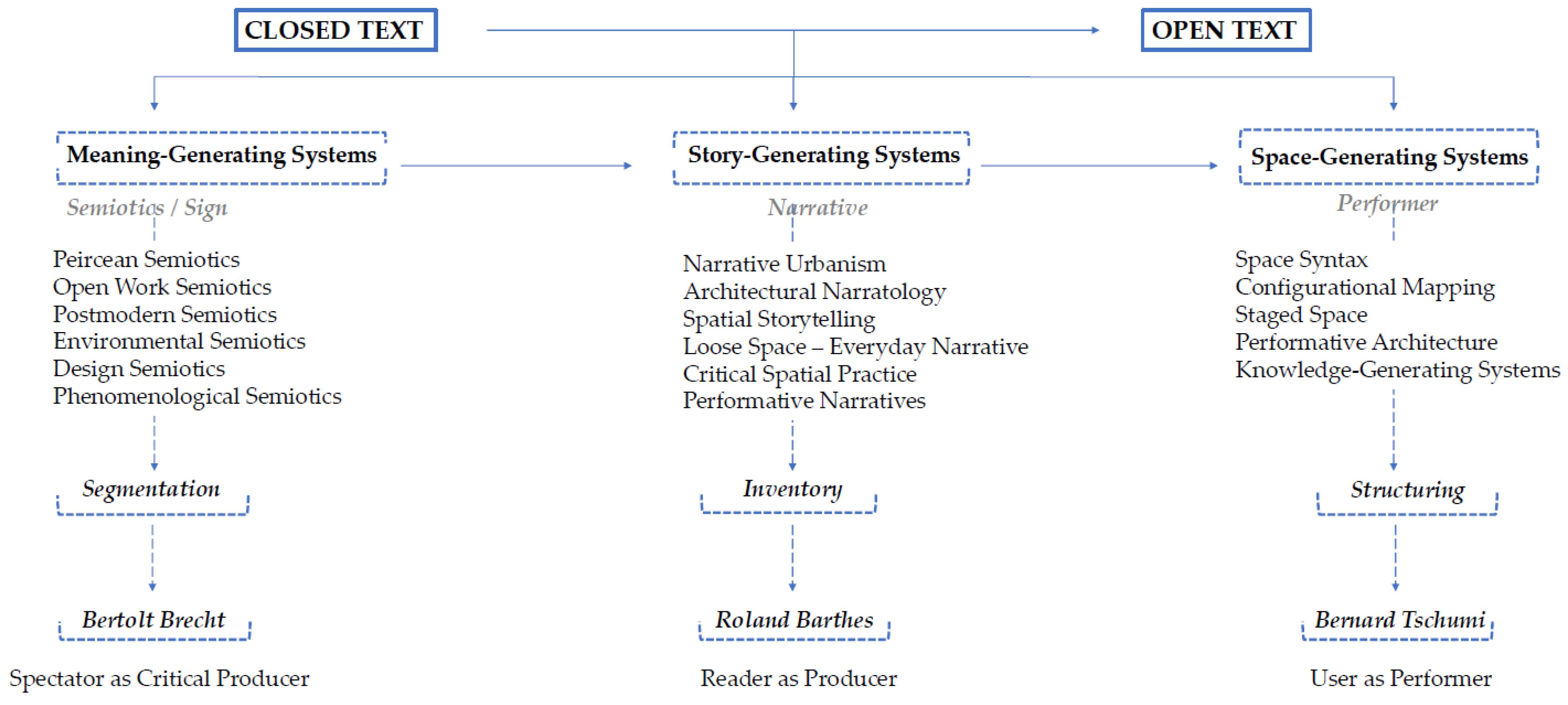
In addition to the general approach of the literature review, this study established an epistemological and ontological framework structured through three systems and three semantic operations, following the trajectory from a “closed text” to an “open text”:
Meaning-Generating Systems: This is the first analytical stage that begins with reading a closed sign system, where meaning is segmented into constitutive parts. This operation is realized through Brecht. It is the site where the “spectator as critical producer” initiates meaning production by fragmenting the structure into components.
Story-Generating Systems: This is the second analytical stage in which the sign system passes through a second filter, using Barthes’ codes to enable the proliferation and layering of signification. Barthes’ seminal 1967 essay “The Death of the Author” conveys its detailed propositions by positioning the reader. In this system, the “reader as producer” is both the epistemic nucleus of spatial narrative interpretation and the methodological core.
Space-Generating Systems: The spatial production systems constitute the third analytical stage, where the layers of the text are fully unfolded, and the production logics of programmatic relations and spatial construction converge. Tschumi’s event architecture and the concept of “user as performer” function as the spatial counterpart of the “open-text” ontology as shown in Figure 1.
Figure 1. Epistemological and Ontological Framework.
The concepts of “Meaning-Generating System”, “Story-Generating System”, and “Space-Generating System” are not pre-established models that appear in the literature under these exact labels. Instead, they were formulated as a comprehensive theoretical synthesis integrating semiotics, narrative theory, and performative spatial production.
The “Meaning-Generating Systems” table provides a comparative framework that reveals how different semiotic traditions define architectural space epistemologically and position it ontologically. Peircean, Open Work, Postmodern, Design, Phenomenological, and Deleuzian approaches conceptualize space respectively as: a field of meaning constructed through inter-sign relations; a text open to interpretation; an ideological system of codes; a design language operating through objects; a phenomenon structured by embodied experience; and a diagrammatic flow in a state of continuous becoming. Each approach generates knowledge that is contextual, pluralistic, critical, object-centered, sensory, or process-based, depending on its epistemological origins, while also determining the derivation of meaning, as represented in the “core statements” column. As demonstrated in the final column, these semiotic traditions establish connections with Brecht through critical distance, myth analysis, gestus, body awareness, or anti-illusionist principles, collectively supporting a foundation of critical spatial meaning production as shown in Table 1.
Table 1. Explication of “Meaning-Generating Systems”.
The theory of “Story-Generating Systems” offers a comparative overview of theoretical approaches, which explain how architectural space is generated through narrative processes. These theories define space ontologically as a field of spatial narrative formed through event sequences, textual structures, embodied actions, political interventions, or everyday acts of rewriting. This ontological positioning leads to diverse methodological inferences, including episodic segmentation, structural coding, performative tracing, and everyday behavior mapping. The approaches intersect with Barthes’ principles of “reader as producer” and narrative code-based interpretation, collectively positioning architecture as a reproducible system of spatial narrative production as shown in Table 2.
Table 2. Explication of “Story-Generating Systems”.
The theory of “Space-Generating Systems” provides a methodological framework which compares different theoretical approaches that explain how architectural space is produced. These approaches conceptualize space respectively as relational topologies, diagrammatic matrices, dramaturgical fields of action, event-based performative structures, and computational knowledge processes, each generating its own specific set of spatial analysis techniques (e.g., configuration analysis, diagram production, staging analysis, scenario testing, algorithmic modeling). All systems intersect with Tschumi’s principles of diagram, event-space, and “process over form” logic, collectively demonstrating—on a methodological level—that spatial meaning does not derive from a fixed form, but from continuously operating spatial production processes, where process takes precedence over form as shown in Table 3.
Table 3. Explication of “Space-Generating Systems”.

1.4.3. Recent Parc de la Villette Studies

Based on recent studies surveyed between 2000 and 2025, it is observed that research focusing on Parc de la Villette predominantly employs qualitative, descriptive, and interpretive methodologies. A table organized chronologically by year, including methodological information for recent English-language studies retrieved from Web of Science (WoS) and Scopus using the query “Parc de la Villette,” has been compiled as shown in Table 4. In these studies, landscape-oriented comparative approaches are relatively adopted, drawing on theoretical, geometric transformation theories, and postmodern urban design frameworks. It is noted that these studies prioritize theoretical insights, yet do not provide a reproducible analytical procedure. Conversely, there is also an empirical study that includes La Villette in its sample among broader park typologies and evaluates parks using quantitative analysis, especially the AHP method, including AHP-based assessments. Methodologically, existing studies address the park in a fragmented manner and lack a transdisciplinary, everyday-based analytical model grounded in narrative–semantic spatial production. It can be stated that current studies are methodologically characterized by partial perspectives and are deficient in an integrated, reproducible, narrative-code-based spatial analytics procedure. Thus, architectural-theoretical interpretation, although conceptually productive, is not supported by traceable, systematic code-assignment evidence. Consequently, Parc de la Villette literature lacks a unified meaning-interpretation filter composed of a controlled vocabulary derived from close-reading, spatial configuration dispersion matrices, and anti-illusionist staging evidence.
Table 4. Summary of methodological orientations in recent Parc de la Villette scholarship.
This study proposes a systematic structural narrative analysis method that treats Parc de la Villette as an analyzable “open text”, moving beyond the descriptive and interpretive approaches that currently dominate the literature. By aligning Barthes’s productive reading principles and three core operations (segmentation–inventory–structuring) with Brecht’s performative epistemology and Tschumi’s spatial design logic, the method provides a multilayered methodology that integrates semiotic, performative, and spatial-narrative coding strata. Within this framework, the method conceptualizes the “text” as a productive interpretive plane operating simultaneously across meaning-generating, story-generating, and space-generating systems. The methodological construct was developed by drawing on patterns observed in recent studies and evolving through close-reading–based semantic segmentation, systematic code-inventorying, and relational spatial structuring. This approach renders architectural narrative analytically tractable and reproducible. As a result, this study fills a gap in the literature caused by the lack of a repeatable methodological framework for multiple coding in postmodern architecture for performative space [108].

2. Materials and Methods

The theoretical intersection of architecture, theatre, and literary narratology is operationalized through a qualitative structural narrative analysis. This approach is implemented in two stages: first, it translates Tschumi’s spatial writings into semantic units using Brecht’s principles of the “Alienation Effect (Verfremdungseffekt).” It then analyzes these semantic units to generate analytical terms and themes. As a result, the framework not only conceptually links the three disciplines, but also applies their structures methodologically through coded interpretation.

2.1. Research Method and Strategy

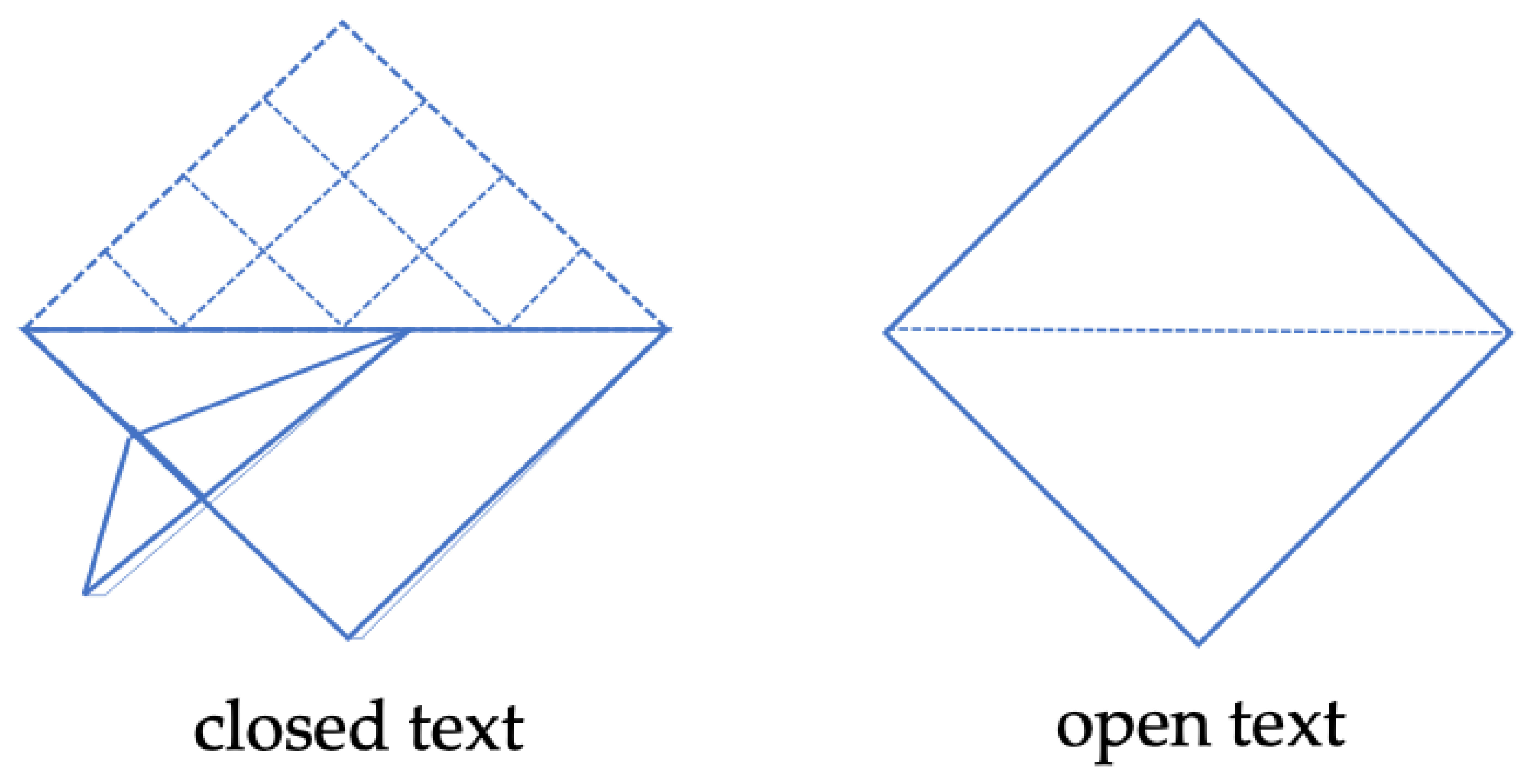
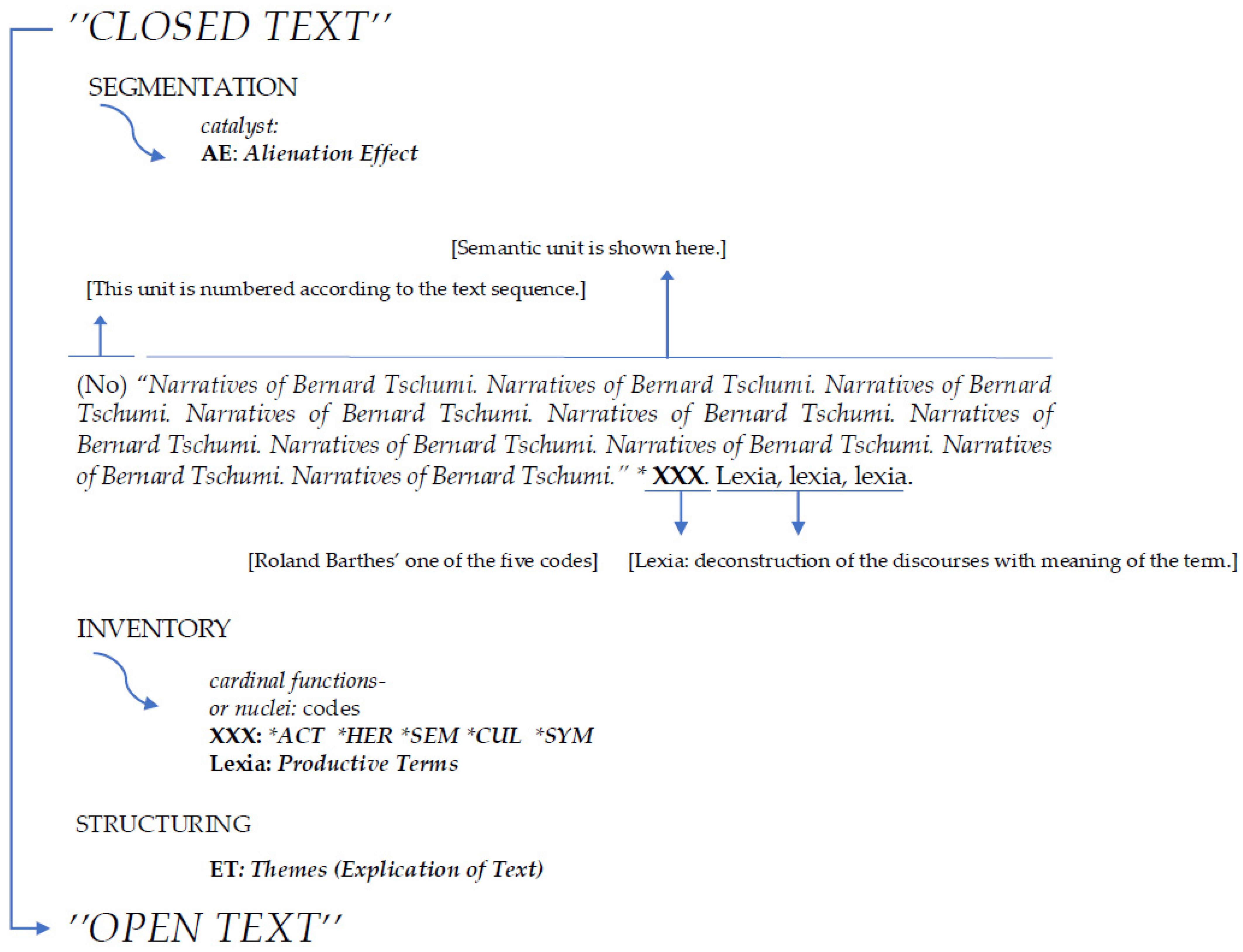
This study is constructed through the trace of the three structural analytic operations employed in Barthes’s semiological approach [11]. Accordingly, Architecture and Disjunction, selected as a ‘closed text,’ is ‘unfolded into its layers’ (Fr. explication) through theatrical ‘catalyst’ and semantic ‘cardinal functions-or nuclei,’ with Parc de la Villette serving as the site of analysis, [2] (pp. 204–253), [9,109] (p. 88) in Figure 2. It is an “open-text” system that relocates architecture from its authorial producer to the active user, extracting it from the delimited boundaries of a “closed text” and transforming it into a continuous narrative chain in which meaning is reproduced each time anew.
Figure 2. Abstraction of explication (relation between closed and open text) [110].
A qualitative research method and a phenomenological research design grounded on a “reality-oriented subjective assumption” were employed to operationalize the from “closed-text” to “open-text” trajectory [82,111,112,113,114,115]. The study combined thematic content analysis and thematic discourse analysis. Thematic content analysis investigates the architectural text within Architecture and Disjunction, asking the question “What does the text say?,” while thematic discourse analysis operates at the level of statements, examining “How does the text say it?”, coding meaning within discourse to derive themes [113]. The procedural stages of the method are presented in Table 5, which details the implementation steps.
Table 5. Methodological Phases.
The research strategy encompasses the processes of selecting, constructing, and analyzing the datasets within the phenomenological design of qualitative research, through which themes emerge. The core research strategy is to identify overarching spatial configurations and themes by examining the discourses within an architectural book authored by an architect who is also a designer. This strategy further aims to generate new inferences and possibilities regarding the meaning of architecture through these identified themes, ultimately demonstrating that architecture functions as a knowledge-producing domain.

2.2. Dataset and Data Collection

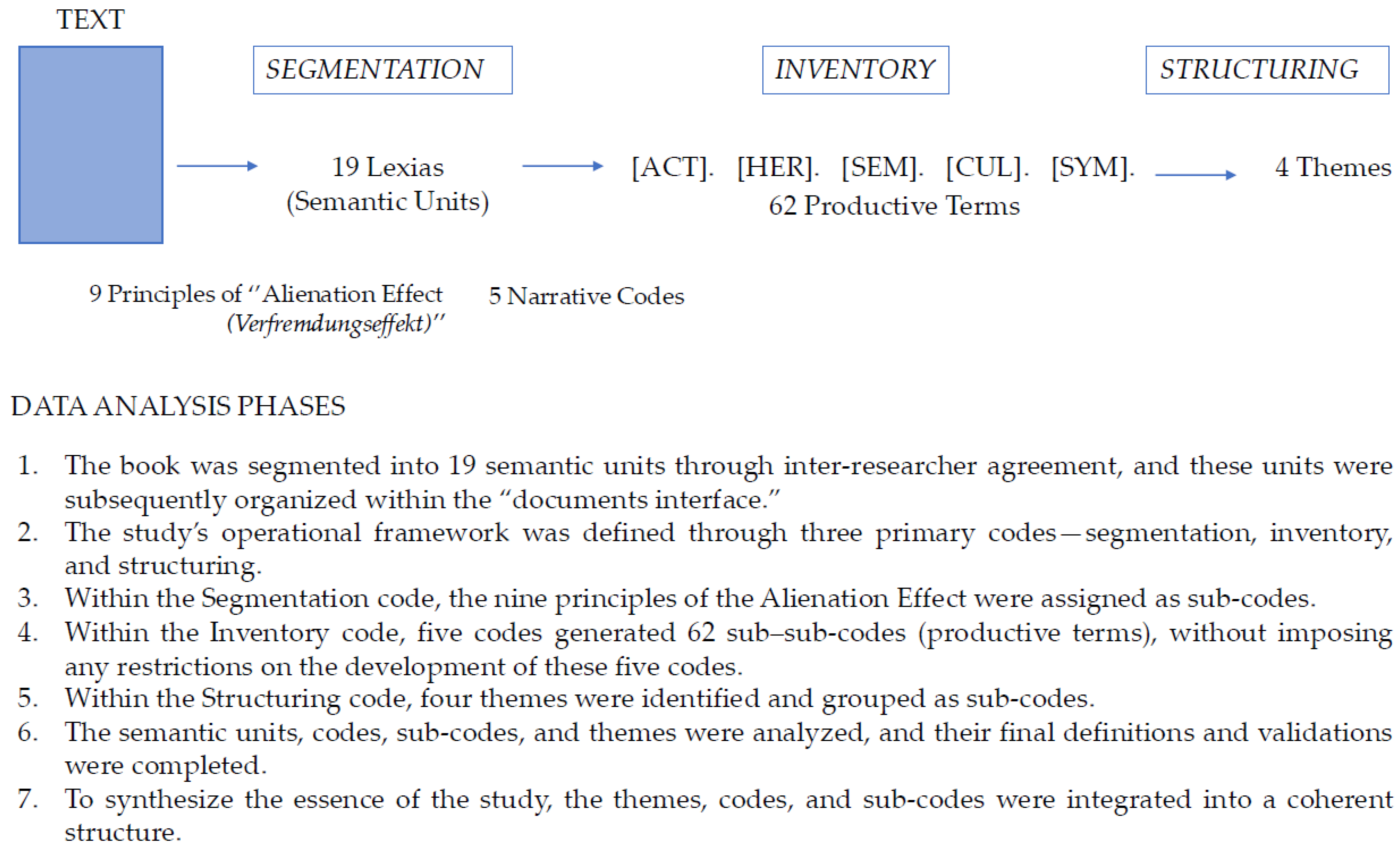
Dataset 1: “Alienation effect (Verfremdungseffekt)” of Brecht’s Epic Theatre functions as an auxiliary tool (catalyst) for deconstructing the ‘closed text’ and encompasses a classification based on nine principles. The article’s first author read Tschumi’s book three times, and the second author read it twice, jointly enabling a holistic classification of the data set. The initial analytical dataset is structured through nine principles derived from Brecht’s Epic Theatre theory of the “Alienation effect (Verfremdungseffekt).” In alignment with these nine principles, the book was reread in full, and the text was segmented into a total of 19 semantic units through thematic content analysis, based on consensus-driven evaluations conducted by both authors. These nine principles are defined below:
  • Alienation as apprehension: Alienation allows the audience to approach the staged events with a critical distance, so that the receiver comprehends what is presented on stage not as natural or inevitable, but as a socially constructed reality.
  • Transformation of quantities and qualities until the realisation of the action: Brecht’s dialectical theater emphasizes that events do not develop statically, but in constant change and transformation.
  • The unique version of the event: Each scene is unique not only in terms of the meaning it represents but also in the way it is staged.
  • Transformation of emotions: criticism and identification: By limiting the audience’s identification with the characters, Brecht aims to transform emotions not only empathically but also critically. In this way, emotional participation merges with critical consciousness and serves social analysis.
  • Self-contradiction: The internal contradictions of characters and events make dialectical thinking visible on stage.
  • The intelligibility of one object with Other: Everything becomes intelligible not only through itself, but also through its relation to its opposite or different.
  • Saltation (saltus naturae): Sudden breaks in the dramatic structure and discontinuities in the narrative function directly as alienation, preventing the audience from getting used to the narrative.
  • The unity of opposites: The juxtaposition of contradictory elements within the staging allows for the establishment of a dialectical unity.
  • The practical applicability of knowledge: Brecht’s theater aims not only to produce knowledge but also to influence the social practices of the audience [7].
Dataset 2: In S/Z, Barthes sets forth five narrative codes that constitute the core of the method (cardinal functions or nuclei) employed to transform the text into an ‘open text’. The text, previously segmented into 19 semantic units, appeared a total of 62 productive terms (sub-codes) through thematic discourse analysis using Barthes’s five narrative codes. To assess coding consistency, a 15% pilot sample was tested in advance, and Cohen’s Kappa coefficient was calculated, resulting in κ = 0.83 in Supplementary Material S2. According to established thresholds in the literature, this value corresponds to a high agreement level (substantial to almost perfect) between coders [116]. The five codes are defined below:
  • Action code *ACT: This denotes the experimental voice that allows the narrative to be perceived as both a storyline and a sequence of actions.
  • Hermeneutic code *HER: This code serves as the voice of authenticity, preserving enigmas, puzzles, and ambiguities throughout the narrative.
  • Semantic code *SEM: This code conveys the mindset and perspective of the characters, thereby granting them a voice.
  • Cultural code *CUL: This code pertains to scientific discourse and domains of knowledge, functioning as the voice of science.
  • Symbolic code *SYM: This represents the symbolic voice, containing contradictions and allowing for multiple layers of metaphorical interpretation [8,117,118].

2.3. Data Analysis

Given that this study investigated the segmentation and unitization of the text into its smallest components, a Qualitative Structural Narrative Analysis approach was adopted. This approach enables multidisciplinary analysis by making the underlying narrative logic of the text visible by highlighting structural relations between theatre theory, architecture theory, and literary narratology. The analysis process followed a sequential application of the three research operations—segmentation, inventory, and structuring—and is visualized in Supplementary Material S1. In this framework, the text was first divided into its smallest meaning-producing units (segmentation), then the conceptual and discursive components of these units were systematically cataloged (inventory, i.e., coding system), and finally these components were organized under themes to construct a structural narrative system (structuring). The integration of thematic content analysis and thematic discourse analysis generated codes, sub-codes, and themes. Using Brecht’s nine principles of the “Alienation effect (Verfremdungseffekt)” as a methodological filter, the study derived 19 semantic units, 62 productive terms (sub-codes) through Barthes’s five narrative codes, and 4 themes. The inventory-based coding system ensured that data were processed consistently at all analytical stages, while recurring structural constructs and relational patterns within the discourse were systematically recorded. The repeated and coherent clustering of spatial references that emerged during analysis constituted the criteria for theme formation. The analytical procedure was adapted from Creswell’s qualitative analysis stages [111,112], and the entire process was supported using MAXQDA 24 Analytics Pro in Figure A1. The tracked implementation steps are presented in detail in Figure 3.
Figure 3. Schematic representation of the three operations (segmentation–inventory–structuring) of structural analysis [110].

2.4. Theme Development

When the text was segmented into its constituent components, it was observed that the emerging patterns also clustered into distinct analytical categories. In the analytical framework, four main themes were identified through data-driven, recurring codes and sub-codes: La Villette, three autonomous abstract spatial systems (points, lines, surfaces), the grid, and the Folies.

2.5. Data Coding

In this study, the codes were derived directly from the data after examining the text and were developed inductively using an open coding approach. No pre-defined code list was applied, and the codes emerged progressively through iterative reading and content analysis [2] (pp. 108–253). The study adopts a bottom-up inductive coding logic, offering a realistic and adaptive analytical perspective aligned with the natural variability of the data. Within this process, the theoretical contribution functions as “the voice of the data” rather than a subjective overlay. To mitigate the methodological risks associated with subjectivity, the study was conducted by two coders. Coding outputs were systematically compared, and inconsistencies were resolved through consensus meetings. Inter-coder reliability was calculated to reinforce analytical trustworthiness. The finalized codebook, refined after coder agreement, is presented in Supplementary Material S3.
Barthes discusses “The Death of the Author” when the text truly belongs to the reader. Gilbert Adair, in The Death of the Author, expands on this by stating, “I realised with disappointment that death is an inappropriate name for a linguistic category [119].” In doing so, Adair leaves significant gaps for readers. Readers’ access to implicit meanings also allows them to infer other referents beyond the visible. This positions the reader as the central actor in the meaning-making process within structural discourse analysis. While stereotypical structuralist approaches have been critiqued from a postmodern perspective, the text has been clarified through a new theoretical deconstruction. Barthes’s S/Z, written in 1970, represents a turning point in this regard. It marks the moment when Barthes shifts from discussing the concept of the ‘closed text’ to that of the ‘open text.’ The text transcends all prior texts, bending, disintegrating, and establishing a new order, as shown in Figure 4 [8,11,63,110,118].
Figure 4. Methodological framework.

3. Results

AE: Saltation (saltus naturae),
The intelligibility of one object with Other.
(1)There is no architecture without action, no architecture without events, no architecture without program. By extension, there is no architecture without violence [2] (p. 121).” * HER. Violent. ** ACT. Action sequence, event sequence. *** SEM. Imposition
ET: La Villette.
In the unit of La Villette meaning, it is necessary to discuss the hermeneutic code * HER. (violent). As this interpretation triggers the action code ** ACT. (action sequence, event sequence), there is also an imposition of an ordered sequence linked to the semantic code *** SEM. (imposition). The character’s “Saltation (saltus naturae)” in the “Alienation effect (Verfremdungseffekt)” is associated with the concept of violence in space. The fact that an object gains “The intelligibility of one object with Other” reinforces the narrative of Tschumi, who states that he can not be considered architecture (La Villette) independently of violence [7].
AE: Saltation (saltus naturae),
Self-contradiction,
The intelligibility of one object with Other.
(2)Bodies carve all sorts of new and unexpected spaces, through fluid or erratic motions [2] (p. 123).” * SYM. Body. ** HER. The body is a carving tool. *** ACT. Carving.
ET: La Villette.
In the unit of La Villette meaning, it is necessary to discuss * SYM. (body) in a metaphorical sense in the symbolic code. Then, the hermeneutic code ** HER. (the body is a carving tool) is triggered between the body and the carving tool. Because the existence of this process activates the action code, *** ACT. (carving) is instantiated in this code. The “Self-contradiction” and “Saltation (saltus naturae)” of the character in the “Alienation effect (Verfremdungseffekt)” are associated with the concept of body in the symbolic code. The fact that an object gains “the intelligibility of one object with Other” reinforces Tschumi’s narrative La Villette’s design cannot be considered independently of the concept of “body [7].”
This unit, numbered 3 among the meaning units, is detailed as a “Mini Traceable Sample Case”:
AE: The unique version of the event,
The intelligibility of one object with Other,
The unity of opposites.
(3)Remember Kuleshov’s experiment where the same shot of the actor’s impassive face is introduced into a variety of situations, and the audience reads different expressions into each successive juxtaposition. The same occurs in architecture: the event is altered by each new space. And vice versa: by ascribing to a given, supposedly “autonomous” space a contradictory program, the space attains new levels of meaning. Event and space do not merge but affect one another [2] (p. 130).” * HER. Autonomous. ** ACT. Contradictory program, event sequence.
ET: La Villette.
Meaning Unit 3 began with Kuleshov’s experiment (1910) as its primary reference. In this experimental filming method, Russian film director Lev Kuleshov aimed to manipulate a character’s expression through specific shot sequences to steer the viewer’s emotions and thoughts as intended. He segmented the character’s face into close-up micro-sequences. He then attempted to evoke the character’s emotional state in the viewer through juxtaposed event frames. If the event frame was positive and affirmed by the viewer, the character was perceived positively; if it was negative, the character was declared malicious. According to Tschumi, architecture is also entirely reformed by each unique event in its own internal logic. Even a contradictory program later attributed to an autonomous space can, in his view, transform the space to some extent. Accordingly, this paragraph was segmented as a meaning unit based on its relation to the principles shaping Brecht’s nine propositions and its intentional creation of distance between viewer and scene. The first codes catalyzing this meaning unit were “The unique version of the event,” “Self-contradiction,” and “The intelligibility of one object with Other”. The principle, “The unique version of the event,” which represents singularity and the one-time moment of character creation within “Alienation effect (Verfremdungseffekt),” is linked to the concept of autonomy. The two additional codes permitting overlap—“Self-contradiction,” and “The intelligibility of one object with Other”—reinforce the argument that the spatial meaning cannot be considered independently from the contradictory program notion embedded in the design logic of Parc de la Villette. (The authors already knew this because they read the book before coding.) Since autonomy is a recurring but context-dependent concept that acquires renewed interpretation in each encounter, this term is activated under the interpretive code: * HER. (autonomous). The condition of autonomy in the event sequence and its qualification through contradictory programs enable multiple actions and are, therefore, activated under the action code: ** ACT. (contradictory program, event sequence). The reaction primarily occurs at the Inventory phase, where it is broken down into semantic unit nuclei (cardinal functions or nuclei). It has been resolved as the La Villette Structuring theme, to which it attributes the spatial contradictions and events it calls architectural. This paragraph generated one visible analytical trace. One semantic sentence revealed three segmentation codes, two inventory codes, three productive terms (as inventory sub-codes), and one structuring theme [7].
AE: Transformation of quantities and qualities until the realisation of the action,
The intelligibility of one object with Other,
The practical applicability of knowledge.
(4) “To what extent could the literary narrative shed light on the organization of events in buildings, whether called “use,” “functions,” “activities,” or “programs”? If writers could manipulate the structure of stories in the same way as they twist vocabulary and grammar, couldn’t architects do the same, organizing the program in a similarly objective, detached, or imaginative way? [2] (p. 146).” * SEM. Imposition. ** ACT. Event sequence.
ET: La Villette.
In the unit of La Villette meaning, the semantic code * SEM. (imposition) is triggered due to the questions posed by Tschumi with a questioning manner. As this process unfolds sequentially, the action code is triggered, whereas ** ACT. (event sequence) was incorporated into this code. “The intelligibility of one object with Other,” which describes the relationship between the sequence of events in the “Alienation effect (Verfremdungseffekt),” is associated with the (Event sequence) in the action code. “The intelligibility of one object with Other” and “The practical applicability of knowledge,” the terms (imposition) of (event sequence) produced for the design of La Villette, are parallel to Tschumi’s narrative [7].
AE: Alienation as apprehension
Self-contradiction
The unity of opposites
(5)…Conventional organizations of spaces can be matched to the most surrealistically absurd sets of activities. Or vice versa: the most intricate and perverse organization of spaces could accommodate the everyday life of an average suburban family… [2] (pp. 146–147).” * SYM. Vice versa ** HER. Perverse space. *** CUL. Everyday life.
ET: La Villette.
In the meaning unit La Villette, the advice given to the spatial organizations mentioned in the symbolic code triggers the concept of * SYM. (vice versa) as a symbol of non-relations. The idea of ** HER. (perverse space) is activated in the hermeneutic code because the idea of space being perverse is an interpretative concept. Bacause the existence of this operation is defined as a syntactic code, the action code is triggered, and the operation *** CUL. (everyday life) occcurs in this code. Looking at the principles in the “Alienation effect (Verfremdungseffekt),” “Alienation as apprehension’ describes the surreal space-time disassociation, “Self-contradiction,” and “The unity of opposites” parallels Tschumi’s narrative as the counterpart of this disassociation in both self and other [7].
AE: Transformation of quantities and qualities until the realisation of the action,
Transformation of emotions: criticism and identification.
(6)From our work in the early days, when event, movement, and spaces were analytically juxtaposed in mutual tension, the work moved toward an increasingly synthetic attitude. We had begun with a critique of the city, had gone back to basics: to simple body movements, walking in a straight line, dancing; to short scenarios [2] (p. 149).” * HER. Criticism. ** ACT. Event sequence. *** CUL. Early days.
ET: La Villette.
In the unit of La Villette meaning, the temporal comparison of the (Event sequences) mentioned in the hermeneutic code triggers the * HER. (criticism), the syntactic code activates the cultural code *** CUL. (early days), all of which trigger the action code ** ACT. (event sequence). When we take a look at the principles in the “Alienation effect (Verfremdungseffekt),” the accumulation of non-relationships parallels Tschumi’s narrative, linked to the understanding of the principle “Transformation of quantities and qualities until the realisation of the action” and the existence of opposing relations with the principle “Transformation of emotions: criticism and identification [7].”
AE: Alienation as apprehension,
Self-contradiction,
The unity of opposites.
(7)And we gradually increased the complexity by introducing literary parallels and sequences of events, placing these programs within existing urban contexts. Within the worldwide megalopolis, new programs are placed in new urban situations. The process has gone full circle: it started by deconstructing the city today it explores new codes of assemblage [2] (p. 149).” * HER. Assemblage. ** ACT. Event sequence. *** SYM. Process. **** CUL. Today.
ET: La Villette.
In the unit of La Villette meaning, the idea of applying programs of event sequences is mentioned in the hermeneutic code * HER. (assemblage) to existing cities triggers the action code ** ACT. (event sequence). The comparison of past and present activates syntactic code and creates the cultural code **** CUL. (today). This process activates the symbolic code *** SYM. (process) as it is used metaphorically. When the principles in “Alienation effect (Verfremdungseffekt)” are examined, Tschumi’s discourse parallels Tschumi’s narrative with the understanding of “Alienation as apprehension,” “Self-contradiction,” and “The unity of opposites” in terms of being composed of opposites and alienating oneself as it contradicts itself [7].”
AE: The transformation of quantities and qualities until the realisation of the action,
The unique version of the event,
Self-contradiction,
The unity of opposites.
(8)Yet architecture is inhabited: sequences of events, use, activities, incidents are always superimposed on those fixed, spatial sequences. These are the programmatic sequences that suggest secret maps and impossible fictions, rambling collections of events all strung along a collection of spaces frame after frame, room after room, episode after episode [2] (p. 157).” * HER. Superimposition. ** ACT. Event sequence. *** SYM. Frame after frame.
ET: The Folies.
In the unit of The Folies meaning, * HER. (superimposition), activating dependency in the hermeneutic code and triggering the action code ** ACT. (event sequence), with the succession of the event sequences mentioned. In symbolic code, *** SYM. (frame after frame) is used for architecture that evokes the unity of opposites. When the principles in the “Alienation effect (Verfremdungseffekt)” are examined, it is seen that Tschumi’s narrative is parallel to the understanding of “The transformation of quantities and qualities until the realisation of the action,” the understanding of “Self-contradiction” and “The unity of opposites” as it consists of opposites and alienates itself because it contradicts itself, and the understanding of “The unique version of the event,” referring to the uniqueness of events in this process [7].
AE: Alienation as apprehension,
Self-contradiction,
The unity of opposites.
(9)Indifference: sequences of events and sequences of spaces can be largely independent of one another-say, assortments of exotic stalls among the regular calumniation of the 1851 Crystal Palace. One then observes a strategy of indifference in which formal considerations do not depend on utilitarian ones (The battalion marches on the fields) [2] (p. 159).” * HER. Superimposition. ** CUL. 1851 Crystal Palace. *** ACT. Event sequence. **** SYM. Battalion.
ET: The Folies.
In the unit of The Folies meaning, * HER. (superimposition), which, despite their indifference, come together and trigger a hermeneutic code. A historical comparison of the event in question triggers the cultural code ** CUL. (1851 Crystal Palace), and the succession of its sequences activates the action code *** ACT. (event sequence). Symbolic code includes the **** SYM. (Battalion) as a metaphor that evokes the unity of opposites. When the principles of the “Alienation effect (Verfremdungseffekt)” are considered, the principles “Alienation as apprehension,” “Self-contradiction,” and also “The unity of opposites” parallel Tschumi’s narrative because of the contradictions in the design of the spatial configuration (column and separator) [7].
AE: The intelligibility of one object with Other,
The unique version of the event.
(10)Reciprocity: Sequences of spaces and sequences of events can, of course, become totally interdependent and fully condition each other’s existence—say “machines a habiter,” ideal Werkbund kitchens, space-age vessels where each action, each movement is designed, programmed. One then observes a strategy of reciprocity in which each sequence actually reinforces the other—the sort of architectural tautology favored by functionalist doctrines (The skater skates on the skating rink) [2] (p. 159–160).” * HER. Independent. ** ACT. Event sequence, space sequence.
ET: The Folies.
In the unit of The Folies meaning, * HER. (independent), triggering the hermeneutic code a combination of events, programs, and movements, which mutually form the space. This activates the action code ** ACT. (event sequence, space sequence) with the succession of the sequences of the mentioned event. Looking at the principles in the “Alienation effect (Verfremdungseffekt),” the principles “The unique version of the event,” pointing to the singular of time even if the spatial configuration is in harmony, and “The intelligibility of one object with Other,” organizing the mediations that support each other, are parallel to Tschumi’s narratives [7].
AE: Alienation as apprehension,
Transformation of quantities and qualities until the realisation of the action,
The unique version of the event,
Transformation of emotions: criticism and identification,
The unity of opposites.
(11)Conflict: sequences of events and spaces occasionally clash and contradict each other. One then observes a strategy of conflict in which each sequence constantly transgresses the other’s internal logic (The battalion skates on the tightrope) [2] (p. 160).” * ACT. Event sequence, space sequence. ** HER. Dependent. *** SYM. Battalion, skating, tightrope.
ET: The Folies.
In the unit of The Folies meaning, activating the hermeneutic code ** HER. (dependent) by the random collision of space sequences and event sequences. With the succession of the mentioned space and event sequences, the action code is triggered by * ACT. (event sequence, space sequence). Symbolic code includes the concept of *** SYM. (battalion, skating, tightrope) as a metaphor evoking the unity of opposites. Looking at the principles of the “Alienation effect (Verfremdungseffekt)”, representing the principles “The unity of opposites” and “Transformation of emotions: criticism and identification,” representing the unity and transformation of opposites. The accumulation of the disassociation of alien actions and situations parallels Tschumi’s narrative through the principles “Alienation as apprehension,” “Transformation of quantities and qualities until the realisation of the action,” and “The unique version of the event [7].”
AE: The unique version of the event,
The intelligibility of one object with Other.
(12)            S            E            M
             Space         Event        Movement
The final meaning of any sequence is dependent on the relation space/event/movement. By extension, the meaning of any architectural situation depends on the relation S E M. The composite sequence SEM breaks the linearity of the elementary sequence, whether S, E, or M [2] (p. 162–163).” * ACT. Action sequence. ** SEM. Imposition. *** SYM. S E M.
ET: La Villette.
In the unit of La Villette meaning, the continuous correlation of space, event, and movement sequences triggers the action code * ACT. (action Sequence). The existence of a maintained relationship activates the semantic code ** SEM. (imposition). Symbolic code includes the concept of *** SYM. (S E M) as a metaphor with ‘a word/sound game.’ Looking at the principle+s of the “Alienation effect (Verfremdungseffekt),” “The intelligibility of one object with Other,” as a representation of continuity and unity, and “The unique version of the event,” as they trigger each other, is also in parallel with Tschumi’s narrative [7].
AE: The intelligibility of one object with Other,
The unique version of the event.
(13)The point grid is a strategic tool of the La Villette project. It both articulates space and activates it. While refusing all hierarchies and “compositions,” it plays a political role, rejecting the ideological a priori of the masterplans of the past. The Urban Park at La Villette offers the possibility of a restructuring of a dissociated world through an intermediary space—folies—in which the grafts of transference can take hold [2] (p. 179).” * HER. Strategic. ** CUL. Political. *** SYM. Contamination.
ET: The grid and The Folies.
In the unit of The grid and The Folies, the interpretation of the importance of the grid for La Villette triggers the hermeneutic code * HER. (strategic). The fact that the grid did not conform to the hierarchy activated the cultural code ** CUL. (political). Symbolic code includes the concept of *** SYM. (contamination) due to the synthesis task. Looking at the principles of the “Alienation effect (Verfremdungseffekt),” the principle “The intelligibility of one object with Other,” is a representation of continuity and unity, and the principle “The unique version of the event,” due to the unity of the grid and the Folie, is also in parallel with Tschumi’s narrative [7].
AE: Transformation of quantities and qualities until the realisation of the action,
The unique version of the event,
Transformation of emotions: criticism and identification,
The intelligibility of one object with Other.
(14)The first possible strategy was to employ specific “texts” or architectural precedents (Central Park, Tivoli, etc.) as starting points and adapt them (in the sense of a movie adaptation of a book), to the site and the program. This strategy implied considering a preexistent spatial organization as a “model” that could either be adapted or transformed in the manner that Joyce “transformed” Homer’s Odyssey. This method had already been applied in Part I of The Manhattan Transcripts (The Park), in which Central Park acts as the original or “hypotext” for the contemporary “hypertext” of the Transcripts [2] (p. 187).” * SEM. Adaptation, imposition. ** CUL. Central Park, Tivoli, Odyssey, Manhattan Transcripts. *** SYM. Hypotext, hypertext.
ET: Three autonomous abstract systems: systems of points, lines, surfaces.
In the unit of Three autonomous abstract systems: systems of points, lines, surfaces meaning, mentioned that the text mutually constitutes the space. The fact that there is a continuous relationship triggers the semantic code * SEM. (adaptation, imposition). The relationship with another existing park activates cultural code and ** CUL. (Central Park, Tivoli, Odyssey, Manhattan Transcripts). Symbolic code includes the concept of *** SYM. (hypotext, hypertext) as a metaphor for ‘textuality.’ Examining the principles in the “Alienation effect (Verfremdungseffekt),” “Transformation of quantities and qualities until the realisation of the action,” “The unique version of the event,” “Transformation of emotions: criticism and identification,” and also “The intelligibility of one object with Other,” align with Tschumi’s narrative due to the continuity of the relation, its mutual creation, the uniqueness of this process and its contribution to the transformation of each other [7].
AE: The intelligibility of one object with Other,
The unity of opposites,
The transformation of emotions: criticism and identification.
(15)The other strategy involved ignoring built precedents so as to begin from a neutral mathematical configuration or ideal topological configurations (grids, linear or concentric systems, etc.) that could become the points of departure for future transformations. This second approach was the one selected: three autonomous abstract systems-systems of points, lines, and surfaces-were laid out. Independent, each with its own internal logic, these three systems would then begin to contaminate one another when superimposed [2] (p. 187).” * HER. Ignoring. ** CUL. Precedent. *** SYM. Contamination.
ET: Three autonomous abstract systems: systems of points, lines, surfaces.
In the unit of Three autonomous abstract systems: systems of points, lines, surfaces meaning, is interpreted with an attitude that ignores its precedents and creates its configuration, thus triggering the * SEM. (ignoring) semantic code and cultural code ** CUL. (precedent). Symbolic code incorporates the concept of *** SYM. (contamination) as metaphors. Considering the principles in the “Alienation effect (Verfremdungseffekt)”, the principles “The intelligibility of one object with Other,” and “The unity of opposites,” Three autonomous abstract systems: systems of points, lines, surfaces serve as the representation of continuity. The principle of “Transformation of emotions: criticism and identification,” as the transformation of Three autonomous abstract systems: systems of points, lines, surfaces while preserving their internal logic, aligns with Tschumi’s narrative [7].
AE: Transformation of quantities and qualities until the realisation of the action,
The transformation of emotions: criticism and identification,
Self-contradiction.
(16)La Villette, then, aims at an architecture that means nothing, an architecture of the signifier rather than the signified-one that is pure trace or play of language. In a Nietzschean manner, La Villette moves toward interpretive infinity, for the effect of refusing fixity is not insignificance but semantic plurality [2] (p. 203).” * ACT. Play of language. ** CUL. Nietzschean. *** SYM. Semantic plurality.
ET: La Villette.
In the unit of La Villette meaning, the questioning and interpretation of the architectural meaning triggers the action code * ACT. (play of language), and cultural code ** CUL. (Nietzschean). The symbolic code includes the concept of *** SYM. (semantic plurality) as a metaphor rather than a fixed meaning. Examining the principles in the “Alienation effect (Verfremdungseffekt)”, the principles of “Self-contradiction” and “Transformation of emotions: criticism and identification” as representations of contradictions and oppositions, and “Transformation of quantities and qualities until the realization of the action” as the accumulation of semantic plurality align with Tschumi’s narrative [7].
AE: The intelligibility of one object with Other,
The unity of opposites,
The transformation of emotions: criticism and identification.
(17)The Park’s three autonomous and superimposed systems and the endless combinatory possibilities of the Folies give way to a multiplicity of impressions. Each observer will project his own interpretation, resulting in an account that will again be interpreted (according to psychanalytic, sociological, or other methodologies) and so on. In consequence, there is no absolute truth to the architectural project, for whatever meaning it may have is a function of interpretation: it is not resident in the object or in the object’s materials. Hence, the truth of red Folies is not the truth of Constructivism, just as the truth of the system of points is not the truth of the system of lines. The addition of the systems’ internal coherences is not coherent. The excess of rationality is not rational. La Villette looks out on new social and historical circumstances: a dispersed and differentiated reality that marks an end to the utopia of unity [2] (p. 203–204).” * ACT. Endless combinatory. ** SYM. Non-figurative. *** SEM. Statute.
ET: Three autonomous abstract systems: systems of points, lines, surfaces, and the Folies.
In the unit of Three autonomous abstract systems: systems of points, lines, surfaces, and the Folies meaning, the infinite process of combination triggers the action code * ACT. (endless combinatory). Symbolic code includes the ** SYM. (non-figurative) as metaphors for constructivism. Social and historical situations trigger the semantic code *** SEM. (statute). Considering the principles of the “Alienation effect (Verfremdungseffekt)”, “The intelligibility of one object with Other,” and “The unity of opposites,” Three autonomous abstract systems: systems of points, lines, surfaces, and Folies as the representation of continuity and the unity of opposites, “transformation of emotions: criticism and identification,” are in parallel with Tschumi’s narrative [7].
AE: Alienation as apprehension,
Self-contradiction,
The practical applicability of knowledge.
(18)At La Villette (or anywhere else, for that matter) there is no longer any relationship possible between architecture and program, architecture and meaning. It has been suggested, in discussing La Villette, that architecture must produce a distance between itself and the program it fulfills. This is comparable to the effect of distanciation (technique of creating distance) first elaborated in the performing arts as the principle of nonidentity between actor and character. In the same way, it could be said that there must be no identification between architecture and program: a bank must not look like a bank, nor an opera house like an opera house, nor a park like a park. This distanciation can be produced either through calculated shifts in programmatic expectations or through the use of some mediating agent—an abstract parameter that acts as a distancing agent between the built realm and the user’s demands (at La Villette, this agent was the grid of Folies) [2] (p. 204).” * SYM. No identification, alienation. ** SEM. Abstraction. *** ACT. Action sequence.
ET: La Villette and The grid.
In the unit meaning of La Villette and The grid triggers the symbolic code * SYM. (no identification, alienation), describing the actor’s non-identification with the character in Brecht’s “Alienation effect (Verfremdungseffekt).” This process triggers the semantic code ** SEM. (abstraction). This process, described sequentially, triggers the action code *** ACT. (action sequence). When the principles of the “Alienation effect (Verfremdungseffekt)” are examined, the scope of the Brechtian perspective, “Alienation as apprehension,” and “Self-contradiction,” come to the fore. La Villette and The grid parallels Tschumi’s narrative linked to the principle “The practical applicability of knowledge,” as it teaches theory and theory together [7].
AE: The alienation as apprehension,
The unity of opposites,
Self-contradiction.
(19)Crossprogramming: Using a given spatial configuration for a program not intended for it, that is, using a church building for bowling. Similar to typological displacement: a town hall inside the spatial configuration of a prison or a museum inside a car park structure. Reference: crossdressing.
Transprogramming: Combining two programs, regardless of their incompatibilities, together with their respective spatial configurations. Reference: planetarium + rollercoaster.
Disprogramming: Combining two programs, whereby a required spatial configuration of program A contaminates program B and B’s possible configuration. The new program B may be extracted from the inherent contradictions contained in program A, and B’s required spatial configuration may be applied to A [2] (p. 205).” * SYM. Inconsistent. ** ACT. Action sequence. *** SEM. Non-program.
ET: La Villette.
In the unit of La Villette meaning, describing the architectural program first as a cross, then as transitive, and then as deprogramming triggers symbolic code * SYM. (inconsistent). This process, described sequentially, triggers action code ** ACT. (action sequence). The method of interpreting the program activates semantic code as *** SEM. (non-program). Considering the principles of the “Alienation effect (Verfremdungseffekt)”, the method of conveying the spatial configurations derived from the inconsistency of the program brings to the fore the principles “Alienation as apprehension,” “The unity of opposites,” and “Self-contradiction,” which are the scope of the Brechtian perspective. In this context, these principles are linked in parallel with Tschumi’s narrative [7].
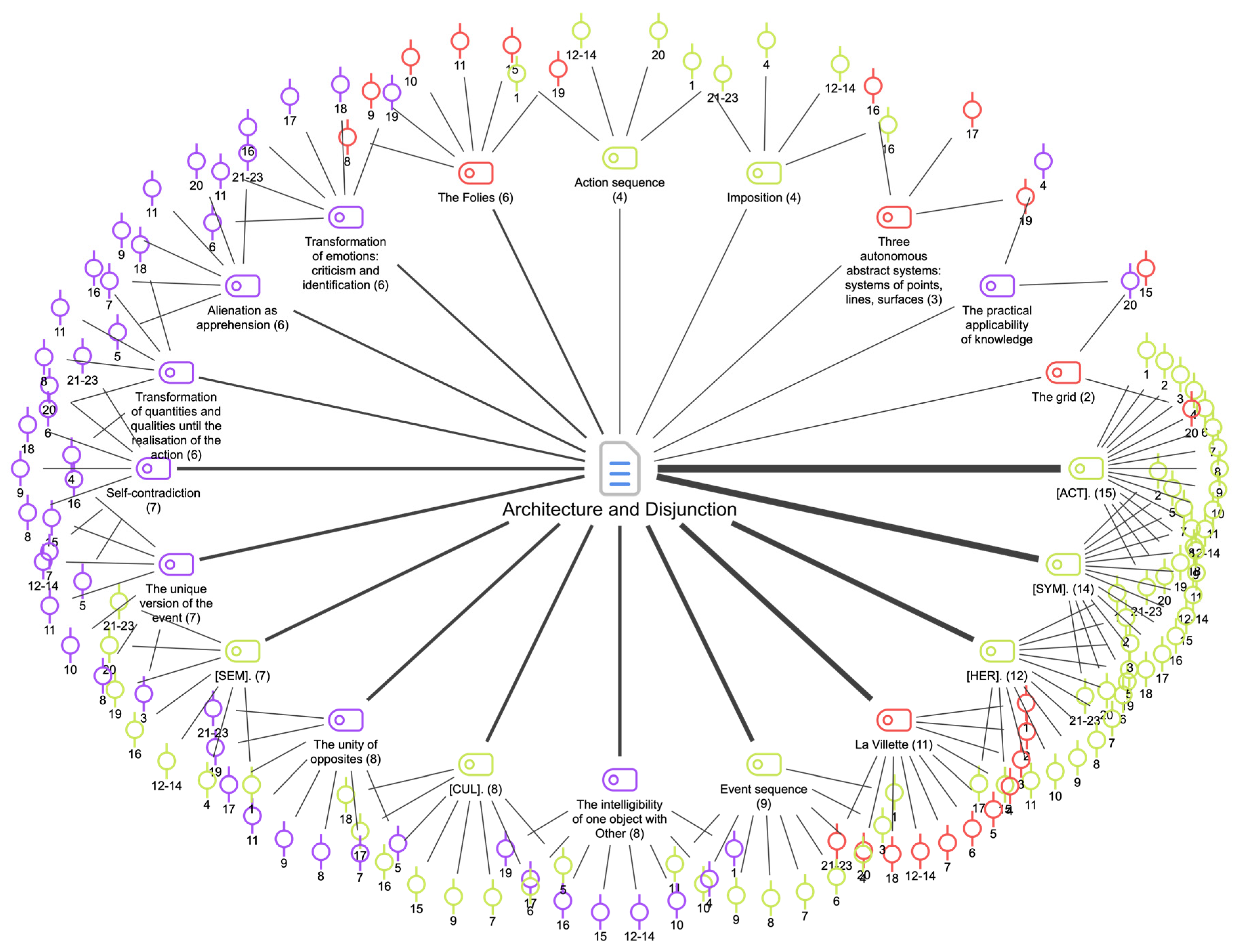
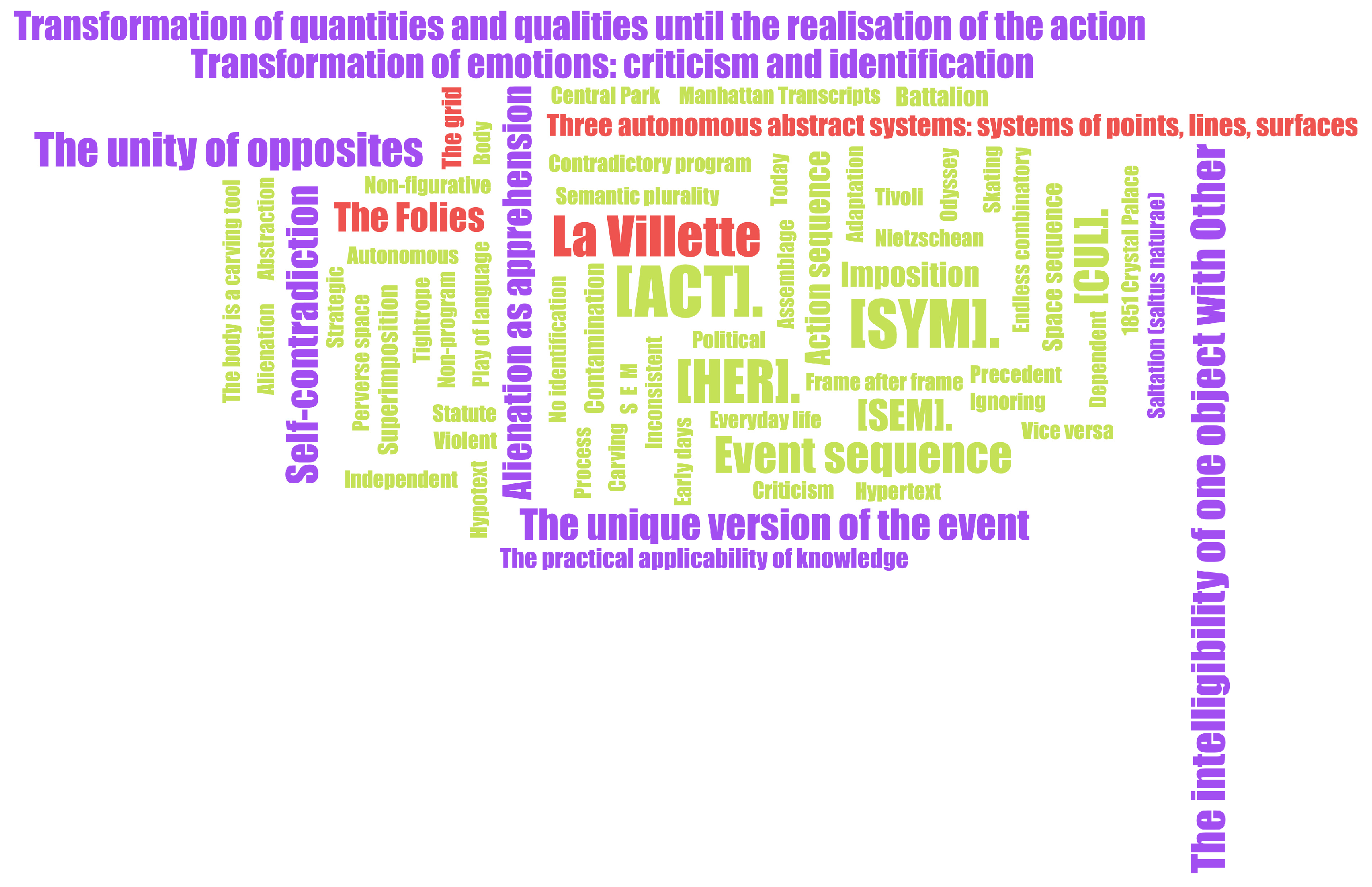
The relationships among the 19 semantic units, 62 productive terms, and 4 themes are visualized below in a Single-Case Model. The purple color represents “segmentation” and its sub-codes, the green color represents “inventory,” its sub-codes, and sub-codes’ categories, while the red color represents “structuring” and the 4 themes (Figure 5, Figure 6 and Figure 7). In this study, following the segmentation–inventory–structuring model, the segmentation operation divided the data into 19 discrete meaning units. Among these units, in accordance with Brecht’s “Alienation effect (Verfremdungseffekt)” principles, the most catalytic codes that emerged were “The intelligibility of one object with the Other” and “The unity of opposites.” The inventory operation further organized the data through Barthes’s five narrative codes, yielding 62 productive terms (sub-codes). Within the codes and sub-codes, based on Barthes’s structural discourse analysis, the most cardinal functions (nuclei) were identified respectively as Action Code, Symbolic Code, and Hermeneutic Code. The most prominent sub-code nuclei that emerged were Event Sequence, Action Sequence, and Imposition. Subsequently, La Villette, which stood out as the dominant spatial-attribute marker across the semantic units, became the most intensively emphasized theme in the study as shown in Figure 5 and Figure 6. Collectively, the model illustrates the progression from initial segmentation to analytical enrichment and finally to higher-level thematic consolidation, making visible the multilayered transformation of raw data into structured conceptual knowledge.
Figure 5. Single Case Model: Systematic representation of “segmentation–inventory–structuring” [2,4,120].
Figure 6. Frequency Relationships Among Codes, Sub-Codes, and Themes Across the Segmentation–Inventory–Structuring Clusters
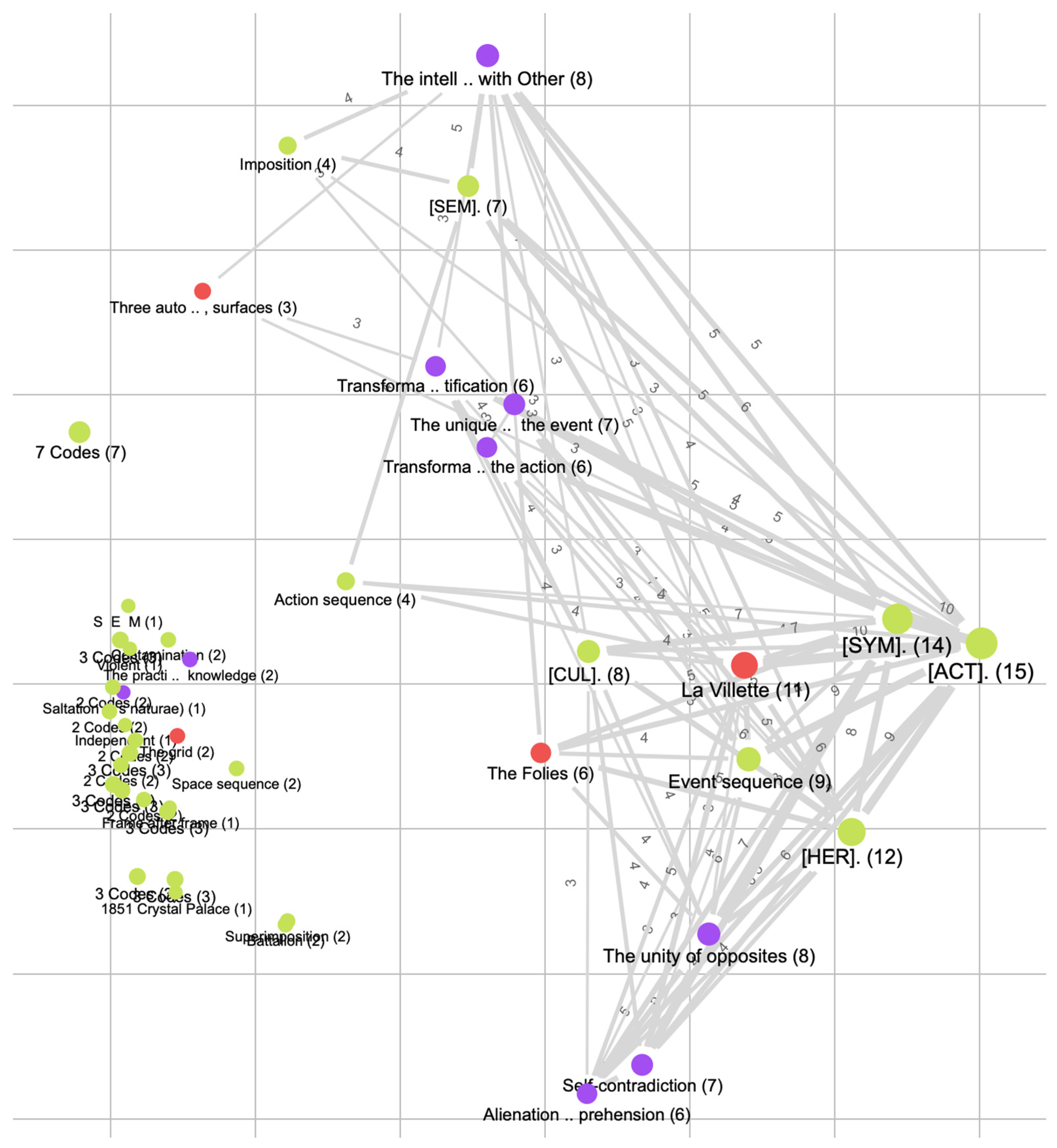
Figure 7. Relational Network Map of Codes.
The analysis indicates that the segmentation–inventory–structuring phases form three distinct clusters of codes, sub-codes, and themes in terms of frequency distribution. The concentration of Segmentation codes in the upper region reflects the semantic partitioning stage and establishes the primary epistemic rupture of the analytic framework. This distribution pattern aligns with the coding matrix generated through Brecht’s “Alienation effect (Verfremdungseffekt)” principles, which were employed here as catalytic filters. The central to center-right positioning of Inventory codes demonstrates that the most emphasized interpretive nuclei of the text emerge within this cluster, collectively supporting the notion that Action, Symbolic, and Cultural codes constitute a relational inventory network anchored by cardinal functionsor nuclei. The frequency-based clustering of these codes reinforces their role in constructing a core interpretive infrastructure for discourse analysis. In contrast, the Structuring cluster clearly reveals that the themes originate from the synthesis and spatial consolidation of codes and sub-codes generated in the preceding two stages, establishing the higher-order thematic organization at both spatial and contextual levels. Code-to-code linkages were visualized using a threshold of ≥3 co-occurrences. Finally, the central placement and high frequency of the nodal codes “The intelligibility of one object with the Other” and “The unity of opposites” demonstrate that these constructs function as integrative and transformational axes in the analytical workflow, as shown in Figure 7.
It has been established that the texts representing the architectural code of La Villette meet all the principles of the “Alienation effect (Verfremdungseffekt)”. In the conceptual background of La Villette’s design, the principles of “Self-contradiction,” “The intelligibility of one object with Other,” and “The unity of opposites” stand out in this analysis. However, it was also evaluated that the other principles provide consistent support. Furthermore, in the analysis of Barthes’ five codes, the productive terms (action sequence) and (event sequence,) derived from the action code, are identified as prominent terms. Although there is no dominant term in the hermeneutic code, it is suggested that there are productive terms that semantically represent La Villette and the contradictory structure of the architectural idea that constitutes it. The key productive term in the semantic code is (imposition). There is no semantic contradiction with the other productive terms. All productive terms in the cultural code contain temporal notion. The productive terms in the symbolic code are more numerous than those in the other codes, representing La Villette’s symbolic semantic baggage, as shown in Table 6.
Table 6. Thematic writerly: La Villette.
The texts representing the architectural code of the three autonomous abstract systems: systems of points, lines, and surfaces meet the five principles of the “Alienation effect (Verfremdungseffekt)”. In the conceptual background of the design of the three autonomous abstract systems: systems of points, lines, and surfaces, the principles of “Transformation of emotions: criticism and identification,” and “The intelligibility of one object with Other” are prominent in this analysis. However, the principle of “The unity of opposites” is also considered to provide consistent support. In addition, in the analysis of Barthes’s five codes, no dominant term is identified across all five codes. The productive terms (endless combinatory) derived from the action code and (ignoring) derived from the hermeneutic code are semantically interpreted as productive terms representing the notion of negation in three autonomous abstract systems: systems of points, lines, and surfaces. The key productive term in the semantic code is (imposition). There is no semantic contradiction with other productive terms. The productive terms in the cultural code are more numerous than those in other codes, and them contain a temporal notion related to spatial concepts. Textuality stands out in the productive terms of symbolic code is considered to be it. This represents the textuality of the symbolic semantic load of the Three autonomous abstract systems: systems of points, lines, and surfaces, as shown in Table 7.
Table 7. Thematic writerly—Three autonomous abstract systems: systems of points, lines, surfaces.
It has been shown that texts representing the architectural code of the grid meet the five principles of the “Alienation effect (Verfremdungseffekt)”. In the conceptual background of the grid’s design, the principles of “The unique version of the event,” “The intelligibility of one object with Other,” “The practical applicability of knowledge,” “Self-contradiction,” and “Alienation as apprehension” are consistently observed in this analysis. Furthermore, in the analysis of Barthes’s five codes, no dominant term emerged across all five codes. The productive terms (action sequence) derived from the action code, (strategic) derived from the hermeneutic code, (abstraction) derived from the semantic code, (political) derived from the cultural code, and finally (contamination, no identification, alienation) derived from the symbolic code are interpreted as being semantically aligned with the notion of neutral in the grid. In particular, when compared to the five codes of the grid, it is evident that some of the productive terms form similar clusters. This led to the conclusion that the grid borrowed these concepts from the productive terms of another architectural code, the grid, as shown in Table 8.
Table 8. Thematic writerly: The grid.
It has been established that the texts representing the Folies architectural code meet eight principles of the “Alienation effect (Verfremdungseffekt)”. In the conceptual background of the design of the Folies, the principles “The unique version of the event” and “The unity of opposites” stand out in this analysis. The other principles provided consistent support. Additionally, in the analysis of Barthes’s five codes, the productive terms (event sequence,) and (space sequence,) derived from the action code, are identified as prominent terms. Although there is no dominant term in the hermeneutic code, it is interpreted that there are productive terms that semantically represent the Folies and the contradictory structure of the architectural idea that constitutes them, similar to La Villette. The productive term of the semantic code is identified as (Statute). All productive terms in cultural code contain a temporal notion with reference to the past. The prominent productive terms of the symbolic code are more significant than those of the other codes, with (contamination) and (non-figurative) referring to the three autonomous abstract systems: systems of points, lines, surfaces, and the grid. This represents the symbolic semantic load of Folies on the three autonomous abstract systems: systems of points, lines, surfaces, and the grid, as shown in Table 9.
Table 9. Thematic writerly: The Folies.
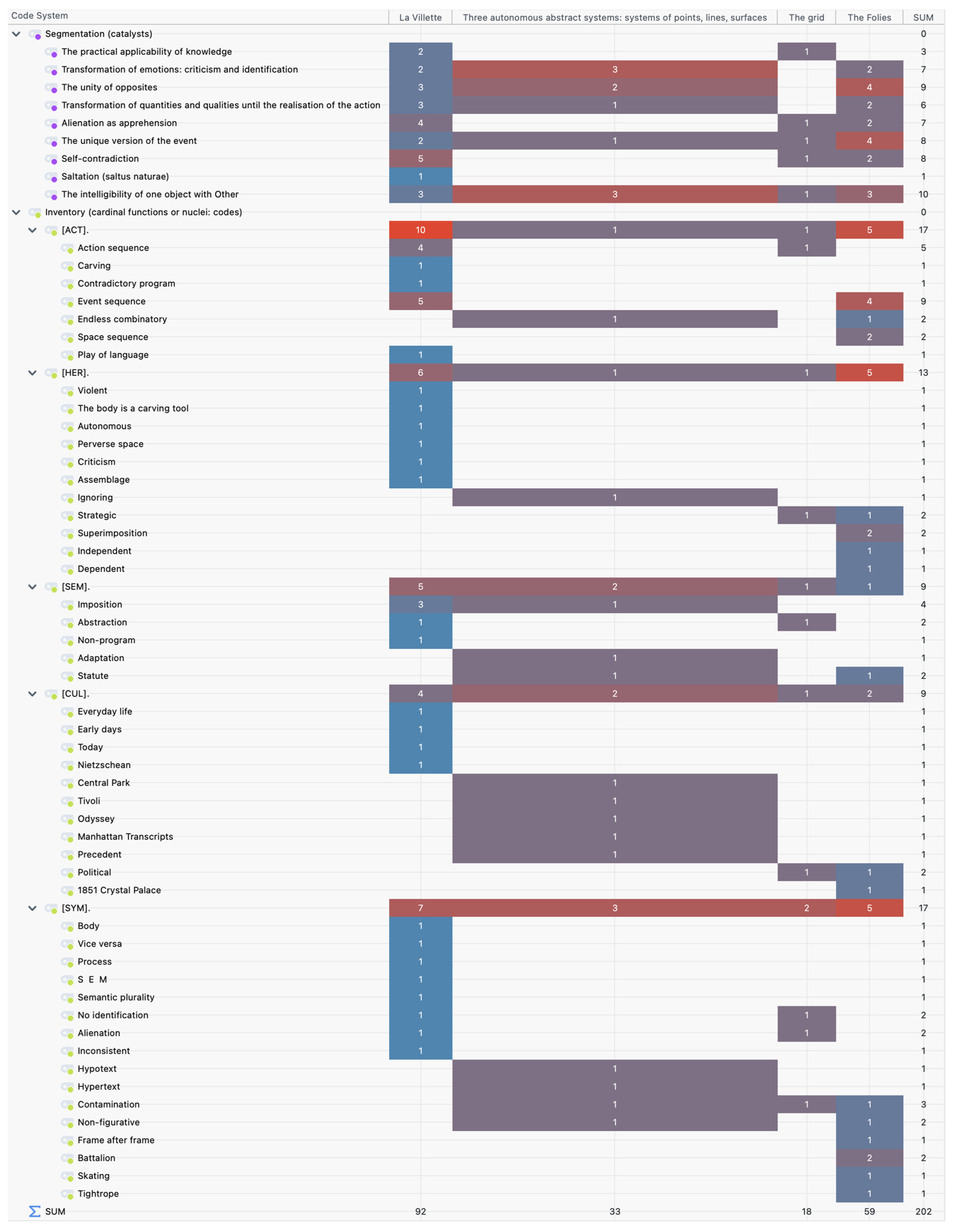
Comparisons grounded in the Segmentation and Inventory sub-category themes, aligned with the four themes of the Structuring cluster, are presented in Figure 8. The most prominent themes observed in the Segmentation cluster are La Villette and The Folies. In the development of La Villette, the most active sub-codes were self-contradiction and alienation as apprehension, while the emergence of The Folies is primarily catalyzed by the sub-codes “The intelligibility of one object with the Other” and “The unity of opposites.” The Inventory cluster likewise foregrounds La Villette and The Folies as dominant themes. In the development of both La Villette and The Folies, the most emphasized codes were Action code, Symbolic code, and Hermeneutic code. The most active sub-codes for La Villette are (event sequence) and (action sequence), whereas The Folies activate (event sequence) as the sole sub-code nucleus in this cluster. For the themes, The grid and Three autonomous abstract systems: systems of points, lines, surfaces, a more balanced coding pattern is observed overall. However, within the Segmentation cluster, theme Three autonomous abstract systems: systems of points, lines, surfaces is comparatively associated with the sub-codes “The intelligibility of one object with the Other,” and a relatively active subset including “Transformation of emotions: criticism and identification.” Despite these differences, all four themes intersect at shared sub-codes, notably Action code and Symbolic code.
Figure 8. Code-based and sub-code-based comparison at four themes.

4. Discussion

It has been observed that the analyses conducted on Parc de la Villette, where Tschumi created performative spatial narratives and performative architecture, were formed through a strong connection with the theoretical approaches of Barthes and Brecht. This multidisciplinary architectural productivity is expected to reflect theatricality and the textual relationship of multiple meanings in future studies, in contrast to other works in the literature. The narrative discussed in the book Architecture and Disjunction, regarding La Villette, does not follow a progression from general to specific; in fact, thematic leaps beyond La Villette are also observed. When Barthes analyzed Balzac’s Sarrasine using five narrative codes, he discovered deceptive enigmas within the story. Similarly, Tschumi does not propose a strictly sequential structure to the reader, nor does he confine the experience within a temporal reading system. This aligns with Brecht’s understanding of the cycle of events as being independent of time, as seen in his notion of the “Alienation effect (Verfremdungseffekt).”
The 25 productive terms of La Villette include those that prioritize and connect with the concepts of “body” and “movement.” While relaying Tara Short’s description of La Villette as a spatial text, she also examined the paradigmatic construction of the “body” [65]. Additionally, terms such as body and movement form the structural components of the “event” architecture within the park’s design [120]. Furthermore, the “event” corresponds to the form of communication between the built environment and human beings, which Nigel Coates claims the space itself inherently requires [59]. It is observed that temporal elements are evaluated in reference to the “present.” The relationship of the park to the period in which it was built reveals its influence on the historical stage. This aligns with Mathis Stock’s assertion that the park possesses a multi-dimensional identity and culture [45].
Among the 14 productive terms of the three autonomous abstract systems (point, line, and surface), it is inferred that meaning precedes form. Concepts that imply “space, movement, and time,” such as infinity and spatiality, often come to the forefront. Lodewijk Baljon’s reference to spatiality as a series of continuous experiential scenes for harmony with nature indicates a conceptual alignment with these produced terms [27]. Furthermore, just as the Tower of Babel—symbolizing incompleteness for Derrida—represents a deconstructivist perspective, the infinite and spatial relationship of these three abstract systems is essentially aligned with the deconstructivist approach [53]. The system, which also appears to involve the concept of “imposition” in related to the city, is emphasized as a textual symbol. Meyer’s view that Tschumi’s conceptual strategy does not place him within the avant-garde contradicts the results of this study based on Tschumi’s search for meaning [39].
Within the seven productive terms of the grid, the concept of “abstraction” is emphasized, and its balance on the axial plane is considered to express a political stance. The claim by Salahaddin Yasin Baper and Zhiman Khairi Ismael that the park contains abstract and geometric design inputs appears to be validated [35]. This interpretation is also supported by the grid’s strategy of generating spatial traces from scratch and detaching from the past, thus aligning with Brecht’s elements of the “Alienation effect (Verfremdungseffekt) [7].”
It is concluded that the 16 productive terms of the Folies assume the concept of “movement,” and that “space” is formed through integrative variations of movement. Moreover, the experientially created forms mentioned by Albert Fekete and van den Toorn Martin are associated with the spatial existence of the Folies [20]. Representing “madness” and integrating “movement” with the past in a cultural context, the Folies reinforce the contextless and autonomous nature of the park, according to Vincent Berdoulay and Bernard Debarbieux [21,22]. This autonomy also reflects traces of “alienation” [7]. The notion of intertextuality connecting literature, art, and architecture in Graham Allen’s work supports all textual processes within the park, and the Folies can also be considered an intertextual production in conceptual terms [34].
When the quantitative repetition of productive terms is classified, the sequences of Movement, Event, and Space come to the forefront. These repetitions suggest the prominence of the concept of “Event” frequently emphasized by Tschumi, along with its associated subcomponents. Additionally, the term “imposition” is also observed as the most repeated secondary-level concept. Given an examination of the four themes of the park, the prominence of this term is unsurprising.

5. Conclusions

In this study, the performative components of a space have been deconstructed through Barthesian codes to comprehend its “boundaries,” and the transdiscursive relationship between Brecht’s “Alienation effect (Verfremdungseffekt)” and Tschumi’s spatial teachings has been emphasized. From a quantitative perspective, 49 of the 62 productive terms are unique, while 13 are recurring. Among the 49 unique terms, 6 are in the Action Code, 11 in the Hermeneutic Code, 5 in the Semantic Code, 11 in the Cultural Code, and 16 in the Symbolic Code. Furthermore, all nine principles of Brecht were observed in the Park itself, in the three autonomous abstract systems (point, line, and surface), in Grid 5, and in 8 of the Folies. From a qualitative perspective, the fact that the number of recurring terms is less than half of the unique terms indicates the presence of “permeable boundaries” among each of the architectural codes. The most unique terms are found in the Symbolic Code, while the fewest are in the Semantic Code. The Symbolic Code, which supports productivity through the rejection of belonging via No identification, Alienation, Contamination, and Non-figurative, is the most productive one and demonstrates the book’s “openness” to multilayered meanings.
This study is important in that it breaks down the theoretical framework presented by performative and textual architecture into layers within an interdisciplinary structure. It has been found that architecture and theater—two distinct disciplines involving the collaborative creation of text and action—are inherently open to contributing to one another. In this context, as Barthes states in The Death of the Author, the present study, from the moment it is read, will be re-produced by the reader. In this way, with each newly generated term, the study will open new layers of “the other” and, through these new meanings, will contribute to both architectural literature and theater from a new perspective.
However, as with any methodological approach, this study also contains limitations and, in light of its potential, requires a separate evaluation—or reading—for future research. The limitations of the study and its future projections have been explained in two points.

5.1. Limitations of the Study

This study, which was analyzed through a Barthesian textual intervention at the intersection of architecture and theater, contains certain limitations. The study immediately reveals its proximity to the technique of “staging” in that it analyzes the performative aspects of an architectural work with a text. However, it should be noted that not every owner of an architectural work can write about their own work. Furthermore, Tschumi’s statement that “every architectural work can be evaluated using Barthes’ structural analysis method” has been considered an optimistic approach by the authors. The analysis of the text and its reading as a sign differ relatively in terms of consistency from the reading of an architectural work as a sign. In the study, one of the two datasets served as an auxiliary (catalyst), while the other was used as a method to analyze the text (cardinal functions—or nuclei). This dataset used in the study may have certain limitations, as it analyzes a single text. The number of case studies can be increased, and the empirical level can be developed with a comparative observational analysis.
Additionally, the model does not aim to treat datasets as fixed or pre-established structures; rather, it seeks to evolve into a dynamic and adaptive methodology that can be iteratively tested and expanded by integrating diverse texts, spatial alternatives, and contemporary theatrical and theoretical approaches. In this study, the epistemological goal of the method is not a final, singular depiction of reality, but the continual production of new spatial narratives and knowledge constructs through reproducible semantic operations (segmentation–inventory–structuring).

5.2. Future Research Projections

The segmentation–inventory–structuring model closely corresponds to the following domains of application.
  • Pedagogical Alignment: When applied in architecture studios—particularly within design-driven, program-based learning outputs—this model can function as an adaptable, logic-oriented method that advances design decisions through justification rather than aesthetic preference. In this framework, the model supports reflective design practices grounded in Schön’s reflective practice model, Problem-Based Learning (PBL), and Design Thinking, specifically encouraging reasoning-based spatial cognition instead of taste-based validation. Here, instructors shift evaluative emphasis from subjective appreciation to systemic coherence, enabling them to assess and strengthen students’ design cognition by aligning studio deliverables with consistency-based design reasoning.
  • Interdisciplinary Flexibility: Since the method operates as a transdisciplinary analytic framework connecting architecture, theatre, and narratology, it extends beyond architecture and can be re-implemented across other art and spatial narrative disciplines. This model provides structural and conceptual support for spatial interpretation provisions grounded in semantics, symbolism, and performativity. In this context, it can also follow potential narrative strata for a theatre director arranging kinetic stage compositions, a curator structuring an exhibition space, or a performance artist developing spatial rewritings, articulation the analytic readjustment and interdisciplinary reproducibility of narrative-space constructs.
  • Digital Integration: When employing thematic content analysis and thematic discourse analysis, this model constructs themes through spatial clustering, code dispersion patterns, relational co-occurrence matrices, and pattern recognition features enabled via inductive coding. It can operate in parallel with digital analytic instruments, including network analysis, digital simulations, AI-driven prompt structures, eye-tracking tests, and computational pattern recognition models. In AI-prompt logic, the model first processes discourse by generating analytical output, then amplifies interpretive diversity through narrative sequencing, and finally consolidates it under a structural synthesis. Similarly, network analysis reveals and visualizes complex relational nodes, pattern infrastructures, and spatial semantic potentials; accordingly, the SIS model can be computationally transformed, simulated, tested, or integrated into broader digital workflows for spatial-narrative analytics.
  • Contribution to Quantitative Methods: This model does not function solely through mathematical pattern measurement; instead, it further integrates qualitative user-experience strata into spatial configuration. Also, it complements quantitative methods such as space syntax by adding multimodal meaning-making filters, movement analytics, semantic dispersion layers, and performance-based spatial-narrative mapping. In this context, spatial configurations are not only computational but also meaning-bearing, synthesized through sensory, textual, semantic, and performative spatial-coding mechanisms.
Implementation Medium:
  • Urban Planning, Smart City Systems, and Intelligent Building Automation: Spatial performance measurement and interactive design procedures are receiving increasing emphasis in urban planning, smart city applications, and intelligent building automation systems. Integrating qualitative user experience into these domains enables the generation of lived-space behavioral observation models, semantic spatial-narrative chains, and experiential spatial-cognition patterns. The data patterns derived here contribute to developing systemic extensions of multi-criteria decision support infrastructures, post-occupancy evaluation (POE) traces, behavioral spatial-performance layers, everyday spatial rewritings, and meaning-centered, life-centric, design-reasoning models. In addition, it complements digital simulations by grounding design decisions on narrative–semantic spatial dispersion and relational spatial analytics.
  • Theatre-Based Adaptability and Kinetic Stage Systems: This model can be re-implemented in theatre studio practices, adding a computational performance analytic layer for contemporary stage production and spatial narrative articulation. In addition to inclusion in static stage constructs using catalysts such as Chongqing 1949 Grand Theatre and House of Dancing Water Theatre, the model can be methodologically applied in kinetic stage systems by following sequence-driven spatial transformations comparable to multi-nuclei, narrative-based spatial rewritings, and meaning-bearing, configuration-driven spatial-coding layers.

Supplementary Materials

The following supporting information can be downloaded at: https://www.mdpi.com/article/10.3390/land14122391/s1, Supplementary Material S1: Code Theory Models (Segmentation–Inventory–Structuring); Supplementary Material S2: Coder; Supplementary Material S3: Codebook.

Author Contributions

Conceptualization, E.Y. and M.T.A.; Methodology, E.Y.; Validation, E.Y. and M.T.A.; Formal analysis, E.Y. and M.T.A.; Investigation, E.Y. and M.T.A.; Resources, E.Y. and M.T.A.; Data curation, E.Y. and M.T.A.; Writing—original draft, E.Y.; Writing—review & editing, E.Y. and M.T.A.; Visualization, E.Y.; Supervision, M.T.A. All authors have read and agreed to the published version of the manuscript.

Funding

This research was funded by SCIENTIFIC RESEARCH PROJECTS, grant number FDK-2022-4848 and The APC was funded by SCIENTIFIC RESEARCH PROJECTS.

Data Availability Statement

The original contributions presented in the study are included in the article/Supplementary Material. Further inquiries can be directed to the corresponding author.

Acknowledgments

This study was supported by Yıldız Technical University Scientific Research Projects Coordination Department through grant 4848 within the scope of the doctoral dissertation project. I sincerely thank my doctoral dissertation supervisor and co-author, Muzaffer Tolga Akbulut, for his invaluable guidance, and my colleagues for their constructive feedback. We dedicate this work to the memory of Robert Wilson, a choreographer, performer, painter, sculptor, video artist, and sound and lighting designer who recently passed away and served as an inspiration for it.

Conflicts of Interest

The authors declare no conflicts of interest. The funders had no role in the design of the study; in the collection, analyses, or interpretation of data; in the writing of the manuscript; or in the decision to publish the results.

Appendix A

Figure A1. MAXQDA 24 Analytics Pro and the research coding.

Notes

1
The French philosopher Jacques Derrida is regarded as one of the key figures of post-structuralism, a movement that emerged in the 1970s in opposition to structuralism. Post-structuralism rejected the structuralist pursuit of a “science of signs” and instead emphasized deconstruction as an alternative to construction (structure) [1] (pp. 914–916).
2
Originally called Verfremdungseffekt, the “Alienation effect (Verfremdungseffekt)” is a critical staging technique that forms the core of Brecht’s epic theater theory and interrupts the audience’s identification with the play by creating distance between them and the performance. Detailed information about the “Alienation effect (Verfremdungseffekt),” and its coding principles, along with its hierarchical counterpart, is defined in the MAXQDA code book within the dataset and analysis section. Within the text, this concept will also be referred to as “AE” for the sake of analytical flow [7].
3
According to Habermas (1934), “The post-avant-garde is also defined as a transition to post-modernity [13].”
4
Under the influence of theorists such as Marx, Sartre, Brecht, Saussure, Kjelmslev, Jakobson, Greimas, Barthes defines his own “shadow” times [63].
5
Barthes states that when he wrote his critical work S/Z, he found himself and was now “out in the open [8].”
6
Semantic units are defined as dividing a text into parts according to the flow of meaning and obtaining the smallest and most expressive narrative sequences that are self-sufficient [8]. Before coding, two researchers completed the segmentation protocol to establish consistent unit boundaries.

References

  1. Cevizci, A. Felsefe Sözlüğü; Paradigma Yayıncılık: İstanbul, Turkey, 1999. [Google Scholar]
  2. Tschumi, B. Architecture and Disjunction; MIT Press: London, UK, 1996. [Google Scholar]
  3. Tschumi, B. The place, the stage, the hall, the town, dramatic art, scenography and architecture at the end of the XXth century in Europe. In Personal Communication; University of Nevada, Reno: Reno, NV, USA, 1997. [Google Scholar]
  4. Bernard Tschumi Official Website. Available online: https://www.tschumi.com/ (accessed on 28 December 2024).
  5. Eisenman, P. Post/El Cards: A Reply to Jacques Derrida. Assemblage 1990, 12, 14–17. [Google Scholar] [CrossRef]
  6. Eisenman, P. Architecture as a Second Language: The Texts of Between. In Eisenman Inside Out: Selected Writings 1963–1988; Yale University Press: London, UK, 1988. [Google Scholar]
  7. Brecht, B. Über Epiches Theater, 1st ed.; Şipal, K., Ed.; Agora Kitaplığı: İstanbul, Turkey, 1967. [Google Scholar]
  8. Barthes, R. S/Z; Miller, R., Ed.; Farrar, Straus & Giroux: New York, NY, USA, 1974. [Google Scholar]
  9. Barthes, R.; Duisit, L. On Narrative and Narratives. New Lit. Hist. 1975, 6, 237–272. [Google Scholar] [CrossRef]
  10. Barthes, R. Writing the Image After Roland Barthes; University of Pennsylvania Press: Pennsylvania, PA, USA, 1997. [Google Scholar]
  11. Barthes, R. Göstergebilimsel Serüven; Rifat, M.R., Rifat, S., Eds.; Yapı Kredi Yayınları: İstanbul, Turkey, 2005. [Google Scholar]
  12. Barthes, R. Yazı ve Yorum; Yücel, T., Ed.; Metis: İstanbul, Turkey, 2015. [Google Scholar]
  13. Habermas, J. Postmodernizm; Zeka, N., Ed.; Kıyı Yayınları: İstanbul, Turkey, 1994. [Google Scholar]
  14. Harrison, C.; Wood, P. Art in Theory 1900–2000: An Anthology of Changing Ideas; Daldeniz, E., Ed.; Blackwell Publishing: Oxford, UK, 2003. [Google Scholar]
  15. Wocke, B. Derrida at Villette: (An)aesthetic of Space. Univ. Tor. Q. 2014, 83, 739–755. [Google Scholar] [CrossRef]
  16. Zivanovic, I.; Malesevic, M. Concept of Inter(con)textuality in Architectural Discourse and Production: Case Study: New Acropolis Museum. Prostor 2015, 23, 395–403. [Google Scholar]
  17. Monserrat-Gauchi, J.; Manuel Novo-Domínguez, R. Interrelations between the Media and Architecture: Contribution to Sustainable Development and the Conservation of Urban Spaces. Sustainability 2019, 11, 5631. [Google Scholar] [CrossRef]
  18. Bailly, A. La Perception de L’espace Urbain: Les Concepts, les Méthodes D’étude, Leur Utilisation Dans la Recherche Urbanistique; Centre de Recherche d’Urbanisme: Paris, France, 1977. [Google Scholar]
  19. Bailly, A. La Ville: Espace Vécu; Anthropos: Paris, France, 1996; pp. 159–165. [Google Scholar]
  20. Fekete, A.; van den Toorn, M. Teaching Fieldwork in Landscape Architecture in European Context; Some Backgrounds and Organisation. Land 2021, 10, 237. [Google Scholar] [CrossRef]
  21. Berdoulay, V. Place, Meaning, and Discourse in French Language Geography. In The Power of Place (RLE Social & Cultural Geography), 1st ed.; Agnew, J., Duncan, J., Eds.; Routledge: London, UK, 1989; pp. 124–139. [Google Scholar]
  22. Debarbieux, B. Le lieu, le territoire et trois figures de rhétorique. L’Espace Géogr. 1995, 24, 97–112. [Google Scholar] [CrossRef]
  23. Turner, T. Landscape Urbanism: Definitions and History. Landscape Architects Association. 2015. Available online: https://www.landscapearchitecture.org.uk/landscape-urbanism-definitions-and-history/ (accessed on 21 August 2023).
  24. McHarg, I.L. Design with Nature; The Natural History Press: New York, NY, USA, 1969. [Google Scholar]
  25. Tschumi, B.; Derrida, J.; Vidler, A. Tschumi Parc de La Villette; Artifice Press: London, UK, 2014. [Google Scholar]
  26. Canter, D.V. The Psychology of Place; Architectural Press: Oxford, UK, 1977. [Google Scholar]
  27. Baljon, L. Designing Parks: An Examination of Contemporary Approaches to Design in Landscape Architecture, Based on a Comparative Design Analysis of Entries for the Concours International: Parc De La Villette, Paris, 1982–1983; Wageningen University and Research/ProQuest Dissertations & Theses: Paris, France, 1992. [Google Scholar]
  28. Cruz, E.; Blanco, E.; Aujard, F.; Raskin, K. Has Biomimicry in Architecture Arrived in France? Diversity of Challenges and Opportunities for a Paradigm Shift. Biomimetics 2022, 7, 212. [Google Scholar] [CrossRef]
  29. López-Arquillo, J.D.; Ciborro Víctor, C.; Oliveira, C.; Penelas, J.L.E.; de Alba, F.; Arteaga Orozco, M.B. Ecological Design for Urban Regeneration in Industrial Metropolitan Areas: The Santa Cruz Refinery Case. Urban Sci. 2024, 8, 114. [Google Scholar] [CrossRef]
  30. Candito, C.; Meloni, A. Revelations of Folies through Geometric Transformations. Nexus Netw. J. 2023, 25, 269–276. [Google Scholar] [CrossRef]
  31. Hatipoglu, O. Performing Objects: Folies in Bernard Tschumi’s Parc de la Villette. Fr. Stud. Bull. 2014, 35, 23–25. [Google Scholar] [CrossRef]
  32. Martin Dominguez, G. Between Autonomy and Heteronomy: A Critical Inquiry into the Grid of Folies at Parc de La Villette. In Proceedings of the CRITIC-ALL: II International Conference on Architectural Design and Criticism, Madrid, Spain, 20–22 June 2016. [Google Scholar]
  33. Diomand, B. Landscape Cubism: Parks that Break the Pictorial Frame. J. Landsc. Archit. 2011, 6, 20–33. [Google Scholar] [CrossRef]
  34. Allen, G. Intertextuality; Routledge: London, UK, 2000. [Google Scholar]
  35. Baper, S.Y.; Ismael, Z.K. The Impact of Site Contexts in Increasing the Diversity of Architectural Concepts: Using an Interactive Architectural Approach. Buildings 2024, 14, 2567. [Google Scholar] [CrossRef]
  36. Kandinsky, W. Point and Line to Plane; Solomon, R., Ed.; Guggenheim Foundation: New York, NY, USA, 1947. [Google Scholar]
  37. Quan’an, C.; Junbo, L. Certainty and Uncertainty: The ‘Point, Line and Surface’ of Parc de La Villette in Paris. In Advances in Social Science, Education and Humanities Research; Atlantis Press: Amsterdam, The Netherlands, 2021. [Google Scholar]
  38. Eisenschmidt, A. Importing the City into Architecture: An Interview with Bernard Tschumi. Archit. Des. 2012, 82, 130–135. [Google Scholar] [CrossRef]
  39. Meyer, E.K. The Public Park as Avant-Garde (Landscape) Architecture: A Comparative Interpretation of Two Parisian Parks, Parc de la Villette (1983–1990) and Parc des Buttes-Chaumont (1864–1867). Landsc. J. 1991, 10, 16–26. [Google Scholar] [CrossRef]
  40. Crosta, P.P. Il Territorio “è L’uso Che se ne fa”; FrancoAngeli: Milano, Italy, 2010. [Google Scholar]
  41. A.R. Group. Complex Buildings, Generators, Linkers, Mixers & Storyteller; A+T Architecture Publishers: Vitoria-Gasteiz, Spain, 2017; Volume 48. [Google Scholar]
  42. A.R. Group. This Is Hybrid. In An Analysis of Mixed-Use Buildings; A+T Architecture Publishers: Vitoria-Gasteiz, Spain, 2014. [Google Scholar]
  43. Picon, A.; Rogers, R.G.; Piano, R. Du Plateau Beaubourg au Centre Georges Pompidou/Renzo Piano, Richard Rogers; Entretien Avec Antoine Picon; Association des Amis du Centre Pompidou: Paris, France, 1987. [Google Scholar]
  44. Price, C. Cedric Price: The Square Book; Academy Editions: Chichester, UK, 2003. [Google Scholar]
  45. Stock, M. Construire l’identité par la pratique des lieux. In Chez nous. Territoires et Identités dans les Mondes Contemporains; De Biase, A., Alessandro, C., Eds.; Éditions de la Villette: Paris, France, 2006; pp. 142–159. [Google Scholar]
  46. McEvilley, T. Art and Discontent: Theory at the Millennium (Documentext); McPherson & Co. Publishers: New York, NY, USA, 1998. [Google Scholar]
  47. Alhefnawi, M.A.M. Sustainability in Deconstructivism: A Flexibility Approach. Arab. J. Sci. Eng. 2018, 43, 5091–5099. [Google Scholar] [CrossRef]
  48. Barry, P. Beginning Theory; Manchester University Press: Manchester, UK, 1995. [Google Scholar]
  49. Wigley, M. The Architecture of Deconstruction: Derrida’s Haunt; MIT Press: Cambridge, MA, USA, 1993; pp. 41–42. [Google Scholar]
  50. Halland, I. The Unstable Object: Glifo, Blow and Sacco at MoMA, 1972. J. Des. Hist. 2020, 33, 329–345. [Google Scholar] [CrossRef]
  51. Derrida, J. Of Grammatology; The Johns Hopkins University Press: Maryland, MD, USA, 1967. [Google Scholar]
  52. Tošić, J. Deconstruction in Architecture–Continuous Translation through an Open Project. AM J. Art Media Stud. 2017, 12, 99–107. [Google Scholar] [CrossRef]
  53. Hegzi, Y.S.; Abdel-Fatah, N.A. Quantifying Students’ Perception for Deconstruction Architecture. Ain Shams Eng. J. 2018, 9, 2745–2754. [Google Scholar] [CrossRef]
  54. Fontana-Giusti, G.K. The Landscape of the Mind: A Conversation with Bernard Tschumi. Archit. Cult. 2016, 4, 263–280. [Google Scholar] [CrossRef]
  55. Conye, R. Derrida for Architects; Routledge: Milton Park, UK, 2011. [Google Scholar]
  56. Maslikova, I.; Svitlana, S. The Visualisation of Cosmological Ideas in Contemporary Architecture. Philos. Cosmol. 2022, 29, 26–39. [Google Scholar] [CrossRef]
  57. Ferrero, G.; Cotti, C.; Rossi, M.; Tedeschi, C. Geometries of Imaginary Space: Architectural Developments of the Ideas of M. C. Escher and Buckminster Fuller. Nexus Netw. J. 2009, 11, 305–316. [Google Scholar] [CrossRef]
  58. Bourriaud, N. Radicant; Sternberg Press: London, UK, 2009. [Google Scholar]
  59. Coates, N. Narrative Architecture; Wiley: New York, NY, USA, 2012. [Google Scholar]
  60. Eisenman, P. House III: To Adolf Loos and Bertolt Brecht. Prog. Archit. 1974, 55, 99. [Google Scholar]
  61. Tait, P. Introduction: Analysing Emotion and Theorising Affect. Humanities 2016, 5, 70. [Google Scholar] [CrossRef]
  62. Classen, A. Humanities—To Be or Not To Be, That Is the Question. Humanities 2012, 1, 54–61. [Google Scholar] [CrossRef]
  63. Barthes, R. Roland Barthes; Éditions du Seuil: Paris, France, 1975. [Google Scholar]
  64. Jamieson, C. ‘Wake/Up/And/Dream/For/The/Eighties’: Nigel Coates 1975–1982. J. Archit. 2015, 20, 122–151. [Google Scholar] [CrossRef]
  65. Short, T. Of Mice and Madness: Questions of Occupation Interpreted through Disneyland and Parc de la Villette. J. Archit. 2011, 3, 147–169. [Google Scholar] [CrossRef]
  66. Vidler, A. Architecture After the Rain. Archit. Des. 2018, 88, 16–23. [Google Scholar] [CrossRef]
  67. Clarivate—Web of Science (YTU Library). Available online: https://yordam.yildiz.edu.tr/vetisbt/?p=1&dil=tr (accessed on 2 February 2025).
  68. Bonicco-Donato, C. Philosophical deconstruction and architectural deconstructivism. Arch. Philos. 2020, 83, 125–144. [Google Scholar] [CrossRef]
  69. Atkin, A.; Albert, N. Peirce’s Theory of Signs; Cambridge University Press: Cambridge, UK, 2020. [Google Scholar]
  70. Liszka, J.J. A General Introduction to the Semiotic of Charles Sanders Peirce; Indiana University Press: Indiana, IN, USA, 2021. [Google Scholar]
  71. Peirce, C.S. The Essential Peirce. Selected Philosophical Writings; Indiana University Press: Bloomington, IN, USA, 1998; Volume 2. [Google Scholar]
  72. Eco, U. The Open Work; Cancogni, A., Ed.; Harvard University Press: Cambridge, MA, USA, 1989. [Google Scholar]
  73. Codeluppi, V. The Open Work Revisited; Springer: Berlin/Heidelberg, Germany, 2022. [Google Scholar]
  74. Gottdiener, M.; Mark, N. Postmodern Semiotics: Material Culture and the Forms of Postmodern Life; Palgrave Macmillan: London, UK, 2019. [Google Scholar]
  75. Vihma, S.; Susann, N. Design Semiotics in Use; Aalto University Press: Helsinki, Finland, 2010. [Google Scholar]
  76. Zumthor, P. Atmospheres: Architectural Environments—Surrounding Objects; Birkhauser Publishers for Architecture: Basel, Switzerland, 2006. [Google Scholar]
  77. Pallasmaa, J. The Eyes of the Skin; John Wiley & Sons: New Jersey, NJ, USA, 2020. [Google Scholar]
  78. Deleuze, G.; Guattari, F. A Thousand Plateaus: Capitalism and Schizophrenia; University of Minnesota Press: Minnesota, MN, USA, 1987. [Google Scholar]
  79. Rajchman, J. The Deleuze Connections; MIT Press: Cambridge, MA, USA, 2000. [Google Scholar]
  80. Armstrong, H. Urban Narratives and Spatial Storytelling; Routledge: London, UK, 2021. [Google Scholar]
  81. Franck, K.; Stevens, Q. Loose Space: Possibility and Diversity in Urban Life; Routledge: London, UK, 2007. [Google Scholar]
  82. Groat, L.; Wang, D. Architectural Research Methods; Wiley: Hoboken, NJ, USA, 2020. [Google Scholar]
  83. Goodman, N. Ways of Worldmaking; Hackett Publishing: Massachusetts, MA, USA, 1978. [Google Scholar]
  84. Fischer-Lichte, E. The Routledge Introduction to Theatre and Performance Studies; Routledge: London, UK, 2014. [Google Scholar]
  85. Lefebvre, H. Rhythmanalysis: Space, Time and Everyday Life; Continuum: London, UK, 2004. [Google Scholar]
  86. Rendell, J. Art and Architecture: A Place Between; I.B. Tauris: London, UK, 2010. [Google Scholar]
  87. Rendell, J. Critical Spatial Practice: An Essay; Sternberg Press: London, UK, 2018. [Google Scholar]
  88. Chase, J.; Crawford, M.; Kaliski, J. Everyday Urbanism; Monacelli Press: New York, NY, USA, 2008. [Google Scholar]
  89. Hillier, B.; Hanson, J. The Social Logic of Space; Cambridge University Press: Cambridge, UK, 1984. [Google Scholar]
  90. Hillier, B. Space is the Machine: A Configurational Theory of Architecture, revised ed.; Space Syntax Laboratory: London, UK, 2021. [Google Scholar]
  91. Batty, M. The New Science of Cities; MIT Press: Cambridge, MA, USA, 2013. [Google Scholar]
  92. Batty, M. Inventing Future Cities; MIT Press: Cambridge, MA, USA, 2019. [Google Scholar]
  93. Goffman, E. The Presentation of Self in Everyday Life; Anchor Books: Harpswell, ME, USA, 1959. [Google Scholar]
  94. McAuley, G. Space in Performance: Making Meaning in the Theatre; University of Michigan Press: Michigan, MI, USA, 2000. [Google Scholar]
  95. Kipnis, J. Towards a New Architecture; ANY Magazine/Anyone Corporation: New York, NY, USA, 1993. [Google Scholar]
  96. Schumacher, P. The Autopoiesis of Architecture; Wiley: New Jersey, NJ, USA, 2011. [Google Scholar]
  97. Tschumi, B. The Manhattan Transcripts; St. Martin’s Press: New York, NY, USA, 1981. [Google Scholar]
  98. Tschumi, B. Event-Cities; MIT Press: Cambridge, MA, USA, 1999. [Google Scholar]
  99. Cupers, K. Use Matters: An Alternative History of Architecture; Routledge: London, UK, 2013. [Google Scholar]
  100. Carpo, M. The Second Digital Turn: Design Beyond Intelligence; MIT Press: Cambridge, MA, USA, 2017. [Google Scholar]
  101. Oxman, N. Material Ecology. Des. Stud. 2017, 58, 1–21. [Google Scholar] [CrossRef]
  102. Picon, A. Smart Cities: A Spatialised Intelligence; Wiley: New Jersey, NJ, USA, 2018. [Google Scholar]
  103. Kim, J.; Nam, S.-T. Exodus as Intermediation between the Berlin Wall and Manhattan Grid: Disjunction, Subdivision and Programmatization of Void. J. Asian Archit. Build. Eng. 2025, 24, 4742–4757. [Google Scholar] [CrossRef]
  104. Kutay Karaçor, E.; Uzun Yüksel, K.; Şenik, B. Modernity vs. Postmodernity: Assessing the Design Quality of Urban Parks by AHP. Sanat Ve Tasarım Derg. 2021, 11, 63–72. [Google Scholar] [CrossRef]
  105. Canclini, A. Counterpoint to the Parc de la Villette. Aut Aut 2015, 368, 183–196. [Google Scholar]
  106. Jovanovic, V.; Baumann, C. The ‘versatile monument’ question: Parc de la Villette as managed reality. J. Landsc. Archit. 2015, 10, 78–89. [Google Scholar] [CrossRef]
  107. Šćitaroci, B.B.O.; Matuhina, N. Landscape Urbanism: New Spatial Paradigm. Prostor 2012, 20, 106–117. [Google Scholar]
  108. Tao, H.; Wen, Y.; Liu, M.; Wu, Y. Industrial Heritage Protection from the Perspective of Spatial Narrative. Land 2025, 14, 1105. [Google Scholar] [CrossRef]
  109. Deleuze, G. Kıvrım (Leibniz ve Barok); Yücefer, Ç.H., Ed.; Bağlam Yayınları: İstanbul, Turkey, 2006. [Google Scholar]
  110. Barthes, R. Eleştirel Denemeler; Özdoğan, Ç.E., Ed.; Yapı Kredi Yayınları: İstanbul, Turkey, 2018. [Google Scholar]
  111. Creswell, J.W. Qualitative Inquiry and Research Design: Choosing Among Five Approaches; Sage: Thousand Oaks, CA, USA, 2007. [Google Scholar]
  112. Creswell, J.W.; Creswell, J.D. Research Design: Qualitative, Quantitative, and Mixed Methods Approaches; Sage: Thousand Oaks, CA, USA, 2017. [Google Scholar]
  113. Braun, V.; Clarke, V. Using thematic analysis in psychology. Qual. Res. Psychol. 2006, 3, 77–101. [Google Scholar] [CrossRef]
  114. Scharp, K.M.; Sanders, M.L. What is a theme? Teaching thematic analysis in qualitative communication research methods. Commun. Teach. 2019, 33, 117–121. [Google Scholar] [CrossRef]
  115. Kuckartz, U.; Stefan, R. Using MAXQDA for Mixed Methods Research; Johnson, B.R., Onwuegbuzie, A.J., Eds.; Routledge: New York, NY, USA, 2021; pp. 305–318. [Google Scholar]
  116. Landis, J.R.; Koch, G.G. The measurement of observer agreement for categorical data. Biometrics 1977, 33, 159–174. [Google Scholar] [CrossRef]
  117. Barthes, R. Introduction to the Structural Analysis of Narratives. In Image, Music, Text; Hill and Wang: New York, NY, USA, 1977. [Google Scholar]
  118. Barthes, R. Image Music Text; Fontana Press: London, UK, 1977. [Google Scholar]
  119. Thomson, D. Gilbert Adair: Novelist, Critic and Screenwriter Whose Work Shone with Wit and Playfulness. Available online: https://www.independent.co.uk/news/obituaries/gilbert-adair-novelist-critic-and-screenwriter-whose-work-shone-with-wit-and-playfulness-6276065.html (accessed on 1 December 2025).
  120. Tschumi, B. Architecture Concepts: Red is Not a Color; Rizzoli: New York, NY, USA, 2012. [Google Scholar]
Disclaimer/Publisher’s Note: The statements, opinions and data contained in all publications are solely those of the individual author(s) and contributor(s) and not of MDPI and/or the editor(s). MDPI and/or the editor(s) disclaim responsibility for any injury to people or property resulting from any ideas, methods, instructions or products referred to in the content.

Article Metrics

Citations

Article Access Statistics

Multiple requests from the same IP address are counted as one view.