Measuring the Degree of Residents’ Integration in Heritage Site Conservation and Utilization—A Case Study of Han Chang’an City Heritage Area

 , , , ,
Abstract
1. Introduction
2. Literature Review
2.1. International Research on Resident Integration
2.2. Research on Resident Participation in China
3. Integration of Residents into Heritage Conservation and Utilization
3.1. Integration Degree
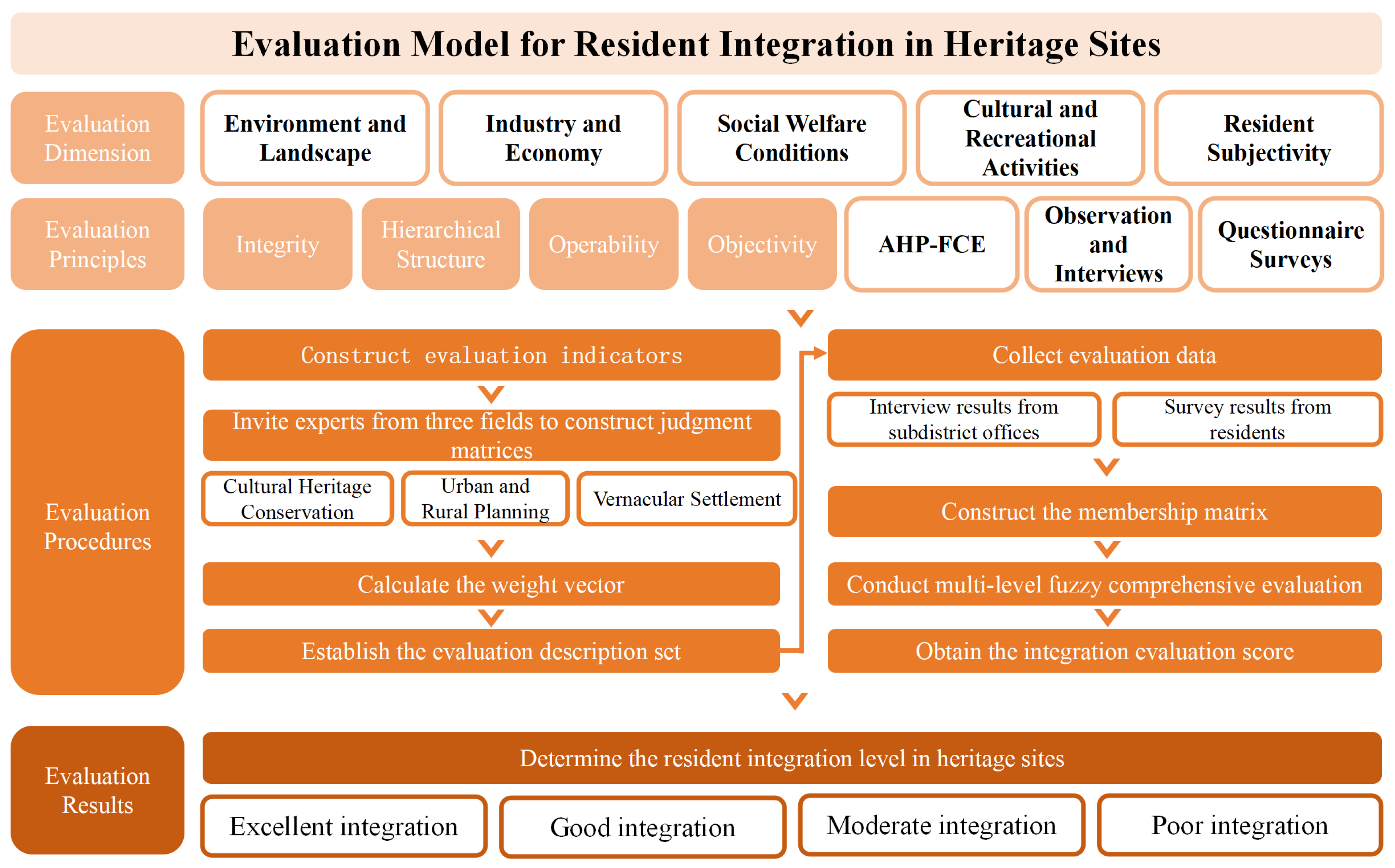
3.2. Evaluation Framework
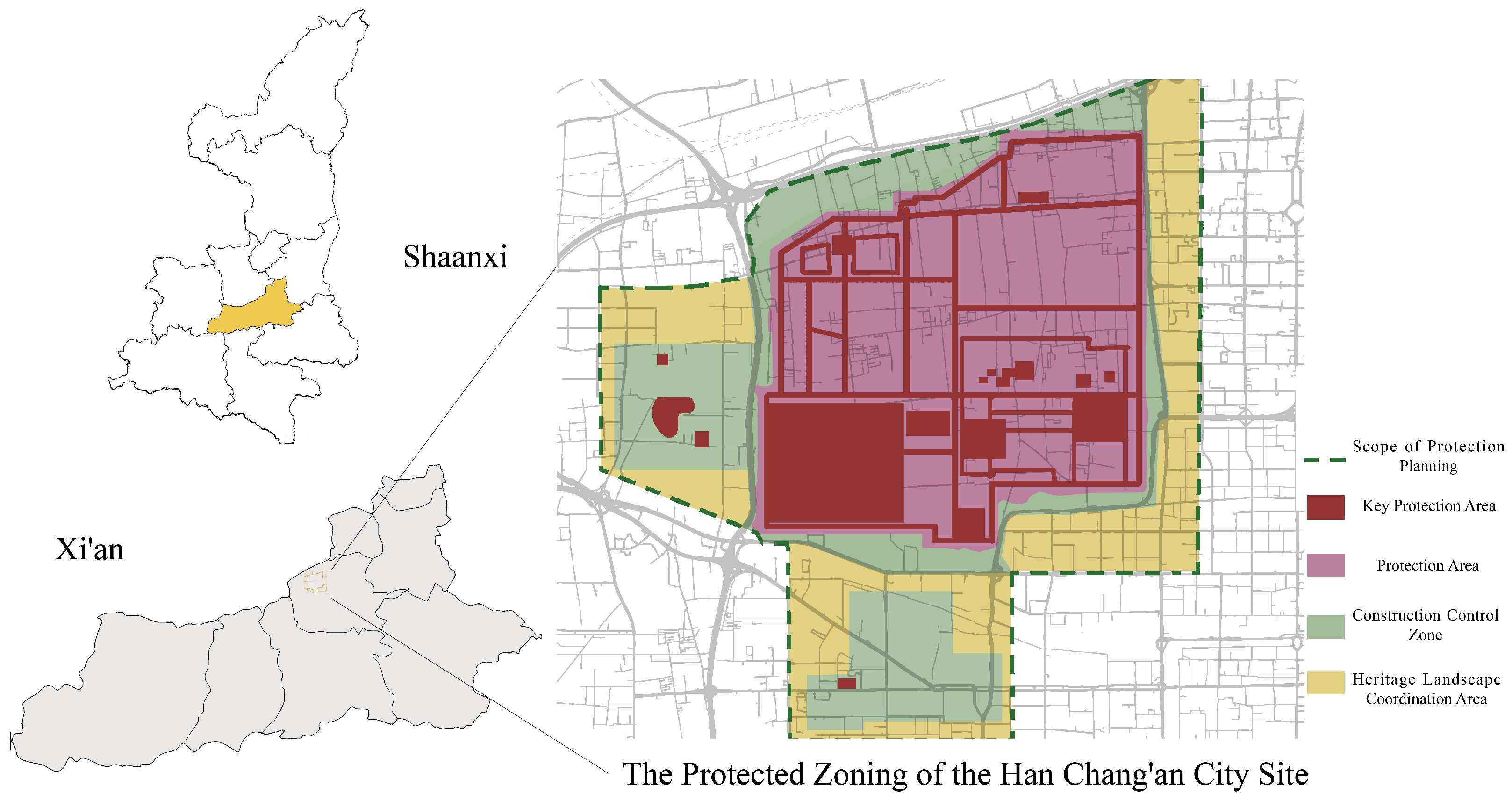
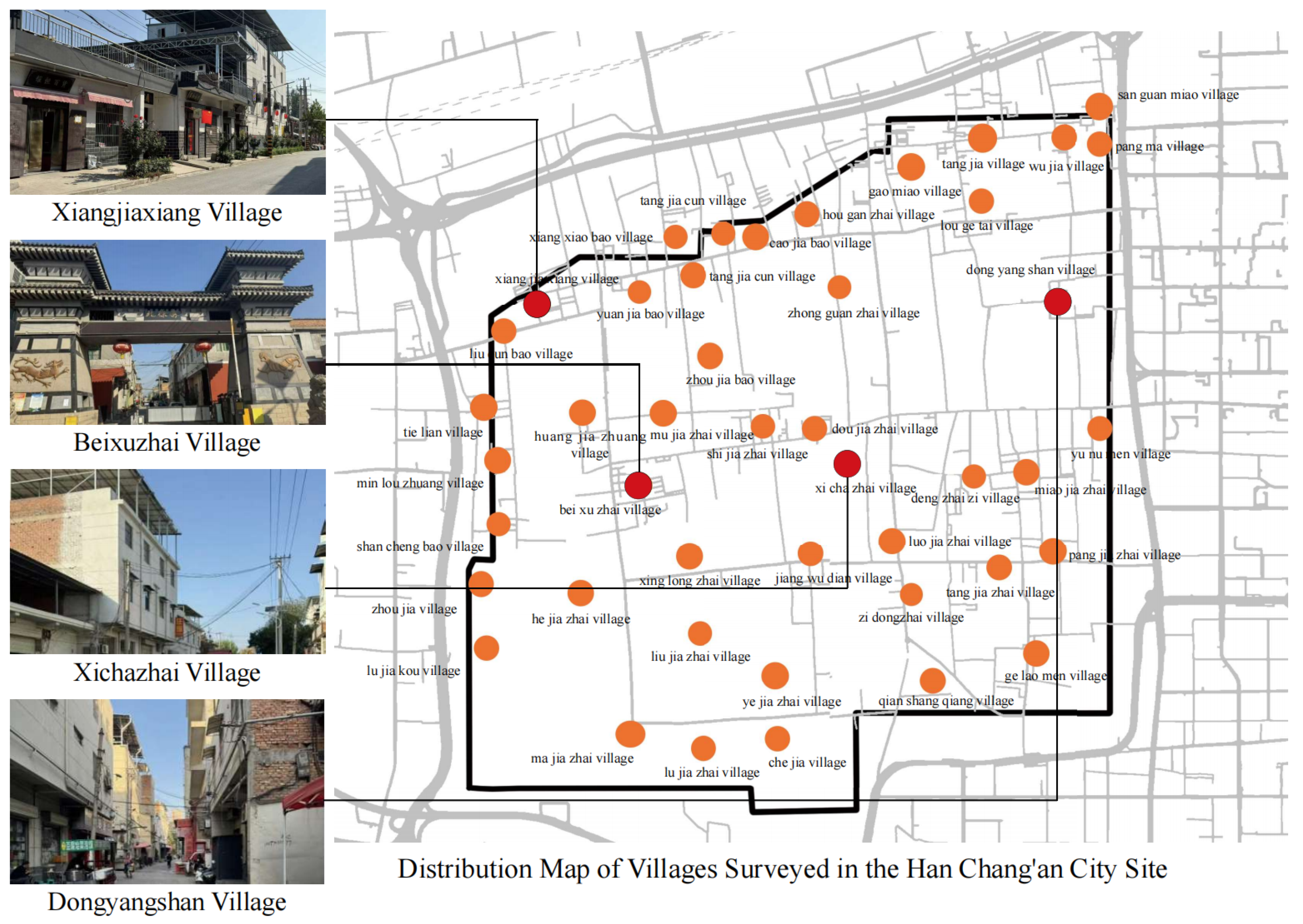
3.3. Case Selection: Han Chang’an City Heritage Area
3.4. Data Processing
4. Results and Analysis
4.1. Integration Calculation
4.2. Problem Analysis
5. Discussion
5.1. Findings
- Environment and Landscape dimension
- Industry and Economy dimension
- Social Welfare dimension
- Culture and Leisure dimension
- Resident subjective consciousness dimension
5.2. Comparison with Other Research
5.3. Limitations
6. Conclusions
Author Contributions
Funding
Data Availability Statement
Acknowledgments
Conflicts of Interest
Appendix A

| Indicator Layer (C) | Indicator Definition |
|---|---|
| Satisfaction with Residential and Landscape Environment (C1) | Residents’ satisfaction with improvements in living conditions and landscape environment resulting from site conservation and utilization efforts |
| Resident Environmental Participation Rate (C2) | Proportion of residents participating in environmental protection activities at the site (e.g., tree planting, waste cleanup) relative to the total resident population at the site |
| Employment Rate in Industries Related to Site Preservation and Utilization (C3) | Percentage of residents employed in industries related to site conservation and utilization out of the total labor force in the site |
| Revenue Share from Heritage Preservation and Utilization Industries (C4) | Proportion of household income derived from industries related to heritage site conservation and utilization |
| Beneficiary rate of residents from newly added educational resources due to site preservation and utilization (C5) | Percentage of residents (households) benefiting from educational resources created by site preservation and utilization relative to the total number of residents in the site |
| Satisfaction with Medical Facility Improvements from Site Preservation and Utilization (C6) | Residents’ satisfaction level with the improvement of medical facilities resulting from the preservation and utilization of the site |
| Heritage site cultural transmission penetration rate (C7) | Percentage of households in the heritage site participating in cultural heritage activities |
| Frequency of Resident Participation in Site-Related Cultural Activities (C8) | The number of times residents participate annually in cultural events such as festivals and folk performances held at the site |
| Level of Importance Attached to Site Preservation (C9) | The residents’ level of importance placed on site preservation |
| Strength of Willingness to Participate in Preservation (C10) | Residents’ Willingness to Participate in Site Preservation and Utilization Efforts |
| Residents’ Self-Management Capabilities (C11) | Percentage of residents consciously protecting the site |
| Proportion of residents aware of effective feedback channels (C12) | Percentage of residents who know and can clearly name at least one effective feedback channel for matters related to site preservation and utilization, relative to the total resident population of the site |
| Frequency of feedback channel usage (C13) | Average number of times residents used various feedback channels within a year to provide feedback (including opinions, suggestions, questions, etc.) on matters related to site preservation and utilization |
| Feedback Response Satisfaction (C14) | Residents’ satisfaction with the response to their feedback (including timeliness and effectiveness of responses) |
| Resident Representative Participation in Decision-Making Meetings (C15) | Whether resident representatives participate in decision-making meetings related to site preservation and utilization (e.g., meetings on site development planning, formulation of preservation measures, etc.) |
| Residents’ effective decision-making proposals (C16) | Whether suggestions made by residents during participation in decision-making related to site preservation and utilization were adopted or seriously considered (as determined by the decision-making department) |
| Residents’ awareness rate of decision outcomes (C17) | Percentage of residents in the site who are aware of decisions related to site preservation and utilization (e.g., final plan content, preservation measures, implementation details) relative to the total resident population |
References
- UNESCO. Operational Guidelines for the Implementation of the World Heritage Convention; UNESCO: Paris, France, 2024. [Google Scholar]
- Liu, S. Authenticity and Integrity as World Heritage Qualifying Conditions: Evolutions, Challenges, and Prospects. Ph.D. Thesis, University of Cincinnati, Cincinnati, OH, USA, 2024. [Google Scholar]
- ICOMOS. International Charter on the Conservation and Restoration of Monuments and Sites (The Venice Charter); ICOMOS: Paris, France, 1964. [Google Scholar]
- ICOMOS. Charter on the Conservation of Historic Towns and Urban Areas (The Washington Charter); ICOMOS: Washington, DC, USA, 1987. [Google Scholar]
- Desto, A. Cultural Heritage Protection in the People’s Republic of China: The Import and Export of Cultural Relics. J. Cult. Herit. Manag. 2021, 15, 123–135. [Google Scholar]
- Shin, H.B. Urban Conservation and Revalorisation of Dilapidated Historic Quarters: The Case of Nanluoguxiang in Beijing. Cities 2010, 27 (Suppl. S1), S43–S54. [Google Scholar] [CrossRef]
- Zhang, Y. Steering towards Growth: Symbolic Urban Preservation in Beijing, 1990–2005. Town Plan. Rev. 2008, 79, 187–208. [Google Scholar] [CrossRef]
- Zhao, Y.; Jin, K.; Zhang, D.; Liu, H. Transforming Urban Landscapes: Reuse of Heritage Sites through Multi-Value Interpretations in Xi’an, China. Land 2024, 13, 948. [Google Scholar] [CrossRef]
- Sun, H.; Wang, J.X.; Zhao, R.; Li, T. Roundtable Discussion: Protection, Management, and Revitalization of Large Heritage Sites under the Archaeological Site Park Model. China Cult. Herit. 2022, 4, 4–15. [Google Scholar]
- Ruan, H.; Chen, J.; Wang, C.; Xu, W.; Tang, J. Social network, sense of responsibility, and resident participation in China’s rural environmental governance. Int. J. Environ. Res. Public Health 2022, 19, 6371. [Google Scholar] [CrossRef]
- Wu, J.; Li, W.; Xu, W.; Yuan, L. Measuring resident participation in the renewal of older residential communities in China under policy change. Sustainability 2023, 15, 2751. [Google Scholar] [CrossRef]
- Lengerer, F.; Steinführer, A.; Haartsen, T. To participate, or not to participate–That is the question.(Non-) participation of older residents in rural communities. J. Rural Stud. 2022, 91, 47–57. [Google Scholar] [CrossRef]
- Fan, P.; Ren, L.; Zeng, X. Resident participation in environmental governance of sustainable tourism in rural destination. Sustainability 2024, 16, 8173. [Google Scholar] [CrossRef]
- Kim, S.; Kang, Y.; Park, J.H.; Kang, S.E. The impact of residents’ participation on their support for tourism development at a community level destination. Sustainability 2021, 13, 4789. [Google Scholar] [CrossRef]
- Khater, M.; Zouair, N.; Saad, M.A.; Ali, R. Reviving Heritage through Regenerative Tourism and Community Empowerment for Sustainable Futures. Soc. Sci. Humanit. Open 2025, 12, 102004. [Google Scholar] [CrossRef]
- Auclair, E.; Fairclough, G. Living between Past and Future: An Introduction to Heritage and Cultural Sustainability. In Theory and Practice in Heritage and Sustainability; Routledge: London, UK, 2015; pp. 1–22. [Google Scholar]
- Li, J.; Wang, J.; Li, X. Heritage Value Assessment and Landscape Preservation of Traditional Chinese Villages Based on the Daily Lives of Local Residents: A Study of Tangfang Village in China and the UNESCO HUL Approach. Land 2024, 13, 1535. [Google Scholar] [CrossRef]
- Abdul Aziz, N.A.; Mohd Ariffin, N.F.; Ismail, N.A.; Rahman, N.A. Community Participation in the Importance of Living Heritage Conservation and Its Relationships with the Community-Based Education Model. Sustainability 2023, 15, 1935. [Google Scholar] [CrossRef]
- Robinson, C.; Macdonald, J.; Perry, J.; Wilson, K. Coproduction Mechanisms to Weave Indigenous Knowledge, Artificial Intelligence, and Technical Data for Indigenous-Led Adaptive Decision Making. Ecol. Soc. 2022, 27, 36. [Google Scholar] [CrossRef]
- Aida, A.H. Cultural Heritage Preservation in the Digital Age: Balancing Tradition and Innovation in Mediterranean Smart Cities. In Proceedings of the 2024 Mediterranean Smart Cities Conference (MSCC), Martil-Tetuan, Morocco, 2–4 May 2024; pp. 1–6. [Google Scholar]
- Hernandez, C.; Valenzuela Gómez, A. Well-being in the Context of Indigenous Heritage Management: A Hach Winik Perspective from Metzabok, Chiapas, Mexico. Econ. Anthropol. 2024, 11, 187–197. [Google Scholar] [CrossRef]
- Rasoolimanesh, S.M.; Taheri, B.; Gannon, M.; Vafaei-Zadeh, A. Does Living in the Vicinity of Heritage Tourism Sites Influence Residents’ Perceptions and Attitudes? J. Sustain. Tour. 2019, 27, 1–18. [Google Scholar] [CrossRef]
- Gill, G. Heritage and Entrepreneurial Urbanism: Unequal Economies, Social Exclusion, and Conservative Cultures. Urban Res. Pract. 2024, 18, 196–216. [Google Scholar] [CrossRef]
- Hubbard, P.; Lilley, K. Selling the past: Heritage-tourism and place identity in Stratford-upon-Avon. Geography 2000, 85, 221–232. [Google Scholar] [CrossRef]
- El-Basha, M.S. Urban interventions in historic districts as an approach to upgrade the local communities. HBRC J. 2021, 17, 329–364. [Google Scholar] [CrossRef]
- Rezaei, N.; Khouadja, A. Living heritage sites in the M’zab valley (Algeria): Community and continuity. J. Cult. Herit. Manag. Sustain. Dev. 2025, 15, 233–253. [Google Scholar] [CrossRef]
- Zhang, R. Spatial Form, Urban Governance, and People’s Experience: A Study on the Regeneration of Historic Environments in China from a Public Value Perspective (2000–2020). Urban Stud. 2025, 62, 267. [Google Scholar] [CrossRef]
- Liu, H.; Zhao, B.; Liu, J.; Li, Y. Land-Use Evolution and Driving Forces in Urban Fringe Archaeological Sites: A Case Study of the Western Han Imperial Mausoleums. Land 2025, 14, 1554. [Google Scholar] [CrossRef]
- Wang, S.; Zhang, J.; Wang, F.; Liu, T. How to Achieve a Balance between Functional Improvement and Heritage Conservation? A Case Study on the Renewal of Old Beijing City. Sustain. Cities Soc. 2023, 98, 104790. [Google Scholar] [CrossRef]
- Guo, Z.; Sun, L. The Planning, Development and Management of Tourism: The Case of Dangjia, an Ancient Village in China. Tour. Manag. 2016, 56, 52–62. [Google Scholar] [CrossRef]
- Kaiwei, L.Y.U.; Srithong, S. The Potential Development of Jiuquan Homestay, China. J. China Tour. Res. 2024, 20, 45–58. [Google Scholar]
- Shen, J.; Chou, R.J.; Zhu, R.; Liu, H. Experience of Community Resilience in Rural Areas around Heritage Sites in Quanzhou under Transition to a Knowledge Economy. Land 2022, 11, 2155. [Google Scholar] [CrossRef]
- Fu, D.; Chen, T.; Lang, W. Evolutionary Patterns and Mechanism Optimization of Public Participation in Community Regeneration Planning: A Case Study of Guangzhou. Land 2025, 14, 1394. [Google Scholar] [CrossRef]
- Wang, J. An Investigation on Public Participation of Cultural Heritage Protection in China’s Small Cities. Master’s Thesis, Bath Spa University, Bath, UK, 2023. [Google Scholar]
- Zhong, X.; Leung, H.H. Exploring Participatory Microregeneration as Sustainable Renewal of Built Heritage Community: Two Case Studies in Shanghai. Sustainability 2019, 11, 1617. [Google Scholar] [CrossRef]
- Wang, Q. Research on Informal Space Pattern Language and Its Application in Nanhuaxi Historic District from the Perspective of Organic Renewal. Master’s Thesis, Politecnico di Torino, Turin, Italy, 2025. [Google Scholar]
- Li, T. Discussion on Resident Issues in Large-Scale Heritage Site Protection: The Case of Han Chang’an City. Cult. Relics 2015, 99–101. [Google Scholar] [CrossRef]
- Hu, B.; He, F.; Hu, L. Community Empowerment Under Powerful Government: A Sustainable Tourism Development Path for Cultural Heritage Sites. Front. Psychol. 2022, 13, 752051. [Google Scholar] [CrossRef]
- Wang, X.; Aoki, N. Paradox between Neoliberal Urban Redevelopment, Heritage Conservation, and Community Needs: Case Study of a Historic Neighbourhood in Tianjin, China. Cities 2019, 85, 156–169. [Google Scholar] [CrossRef]
- Shan, C.; Feng, J.; Xi, Z. Study on Sustainable Development and Public Participation in Conservation and Utilization of Large-Scale Archaeological Sites. Herit. Spect. 2024, 15, 45–53. [Google Scholar]
- Liu, J.R.; Chen, W.L. An Exploration of the Development Model of Heritage Communities Based on Social Conflict Theory: A Case Study of the Jiangwudian Community within the Han Chang’an City. China Cult. Herit. Sci. Res. 2019, 16, 193–195. [Google Scholar] [CrossRef]
- Zhang, Y.L.; Li, K. Analysis of the Relationship between Large-scale Cultural Heritage Protection and Local Residents from an Ethical Perspective. Cent. Plains Cult. Res. 2022, 10, 85–90. [Google Scholar] [CrossRef]
- Nop, S.; Thornton, A. Community Participation in Contemporary Urban Planning in Cambodia: The Examples of Khmuonh and Kouk Roka Neighborhoods in Phnom Penh. Cities 2020, 103, 102770. [Google Scholar] [CrossRef]
- Liu, J.M.; Zhao, B.X. Research on the Protection and Utilization of Urban Large Historical Sites from the Perspective of Organic Renewal: A Case Study of the Han Chang’an City Ruins. China Anc. City 2023, 37, 24–32. [Google Scholar] [CrossRef]
- Zhao, R.; Wu, Z. A Study of Cultural Heritage Protection and Urban Renewal Strategy: The City of Xi’an as an Example. J. Zhejiang Univ. Humanit. Soc. Sci. 2023, 53, 5–15. [Google Scholar]
- Smith, L.; Waterton, E. Community-Centred Heritage Governance and the Politics of Value. Int. J. Herit. Stud. 2022, 28, 355–372. [Google Scholar]
- Naili, K.; Dahmani, K. The importance of social sustainability for conserving cultural heritage in southern Algeria: A case study of the M’Zab Valley. Geography 2024, 15, 577–586. [Google Scholar] [CrossRef]


| Objective Layer (A) | Criteria Layer (B) | Indicator Layer (C) | Data Source |
|---|---|---|---|
| Overall Level of Resident Integration into Heritage Conservation and Utilization at Han Chang’an City Heritage area in the Context of Rural Revitalization (A) | Environment and Landscape (B1) | Satisfaction with Residential and Landscape Environment (C1) | Resident Questionnaire Survey |
| Resident Environmental Participation Rate (C2) | Provided by local subdistrict offices | ||
| Industry and Economy (B2) | Employment Rate in Industries Related to Site Preservation and Utilization (C3) | Provided by local subdistrict offices | |
| Revenue Share from Heritage Preservation and Utilization Industries (C4) | Resident Questionnaire Survey | ||
| Social welfare (B3) | Beneficiary rate of residents from newly added educational resources due to site preservation and utilization (C5) | Provided by local subdistrict offices | |
| Satisfaction with Medical Facility Improvements from Site Preservation and Utilization (C6) | Resident Questionnaire Survey | ||
| Culture and Leisure (B4) | Heritage site cultural transmission penetration rate (C7) | Provided by local subdistrict offices | |
| Frequency of Resident Participation in Site-Related Cultural Activities (C8) | Resident Questionnaire Survey | ||
| Residents’ sense of ownership (B5) | Level of Importance Attached to Site Preservation (C9) | Resident Questionnaire Survey | |
| Strength of Willingness to Participate in Preservation (C10) | Resident Questionnaire Survey | ||
| Residents’ Self-Management Capabilities (C11) | Resident Questionnaire Survey | ||
| Residents’ Self-Management Capabilities (C11) | Resident Questionnaire Survey | ||
| Proportion of residents aware of effective feedback channels (C12) | Resident Questionnaire Survey | ||
| Frequency of feedback channel usage (C13) | Resident Questionnaire Survey | ||
| Feedback Response Satisfaction (C14) | Resident Questionnaire Survey | ||
| Resident Representative Participation in Decision-Making Meetings (C15) | Resident Questionnaire Survey | ||
| Residents’ effective decision-making proposals (C16) | Resident Questionnaire Survey | ||
| Residents’ awareness rate of decision outcomes (C17) | Resident Questionnaire Survey |
| Indicators Type | Excellent | Good | Average | Poor |
|---|---|---|---|---|
| Satisfaction-related indicators (points) | 80–100 | 60–79 | 40–59 | 0–39 |
| Awareness rate indicators (%) | 60–100 | 40–59 | 20–39 | 0–19 |
| Frequency indicators (times) | ≥3 | 2 | 1 | 0 |
| Corresponding integration level (points) | 85–100 | 70–84 | 55–69 | 0–54 |
| Village Name | Location | Affiliated Subdistrict |
|---|---|---|
| Xichazhai Village | Within the core area of the site, north of Changle Palace, with overlapping layers of Changle Palace walls | Hanchengy |
| Dongyangshan Village | Surrounding the site, east of Mingguang Palace, overlapping with the section of the city wall from Xuanping Gate to Qingming Gate | Hanchengy |
| Beixuzhai Village | Site Core Area, North Gate Enclosure, Between Gui Palace and North Palace | Liucunbao |
| Xiangjiaxiang Village | Site periphery, north of the Western Market, overlapping with the section of the city wall from Yongmen to Hengmen | Liucunbao |
| Target (A) | Weight | Score | Indicator Layer (B) | Weight | Score | Indicator Layer (C) | Weight | Score |
|---|---|---|---|---|---|---|---|---|
| A1 | 1 | 64.31 | B1 | 0.2130 | 69.77 | C1 | 0.6584 | 73.80 |
| C2 | 0.3416 | 62.00 | ||||||
| B2 | 0.2614 | 72.54 | C3 | 0.5373 | 77.00 | |||
| C4 | 0.4627 | 67.36 | ||||||
| B3 | 0.2039 | 46.46 | C5 | 0.5359 | 27.00 | |||
| C6 | 0.4641 | 68.94 | ||||||
| B4 | 0.1479 | 77.72 | C7 | 0.4163 | 62.00 | |||
| C8 | 0.5837 | 88.94 | ||||||
| B5 | 0.1738 | 54.78 | C9 | 0.1680 | 50.24 | |||
| C10 | 0.1655 | 55.52 | ||||||
| C11 | 0.0973 | 77.00 | ||||||
| C12 | 0.0942 | 48.39 | ||||||
| C13 | 0.1004 | 72.06 | ||||||
| C14 | 0.0908 | 50.23 | ||||||
| C15 | 0.1027 | 47.96 | ||||||
| C16 | 0.0872 | 47.31 | ||||||
| C17 | 0.0939 | 45.28 |
| Dimension | Han Chang’an City | Stratford Upon Avon | Al-Hafsia District | M’zab Valley |
|---|---|---|---|---|
| Environment and Landscape (B1) | Average | Well-developed | General-developed | Well-developed |
| Industry and Economy (B2) | Average | Well-developed | General-developed | Backward-developed |
| Social Welfare (B3) | Poor | General-developed | Poor | Backward-developed |
| Culture and Leisure (B4) | Good | Well-developed | Well-developed | General-developed |
| Resident Agency (B5) | Poor | General-developed | General-developed | Well-developed |
Disclaimer/Publisher’s Note: The statements, opinions and data contained in all publications are solely those of the individual author(s) and contributor(s) and not of MDPI and/or the editor(s). MDPI and/or the editor(s) disclaim responsibility for any injury to people or property resulting from any ideas, methods, instructions or products referred to in the content. |
© 2025 by the authors. Licensee MDPI, Basel, Switzerland. This article is an open access article distributed under the terms and conditions of the Creative Commons Attribution (CC BY) license (https://creativecommons.org/licenses/by/4.0/).
Share and Cite
Wu, J.; Zhang, D.; Wang, Y.; Ji, J.; Li, Y.; Zhao, Y.; Qi, Y.; Ma, D.; Ying, J. Measuring the Degree of Residents’ Integration in Heritage Site Conservation and Utilization—A Case Study of Han Chang’an City Heritage Area. Land 2025, 14, 2351. https://doi.org/10.3390/land14122351
Wu J, Zhang D, Wang Y, Ji J, Li Y, Zhao Y, Qi Y, Ma D, Ying J. Measuring the Degree of Residents’ Integration in Heritage Site Conservation and Utilization—A Case Study of Han Chang’an City Heritage Area. Land. 2025; 14(12):2351. https://doi.org/10.3390/land14122351
Chicago/Turabian StyleWu, Jingxuan, Dingqing Zhang, Yilin Wang, Jieru Ji, Yufei Li, Yiqing Zhao, Yingtao Qi, Ding Ma, and Jing Ying. 2025. "Measuring the Degree of Residents’ Integration in Heritage Site Conservation and Utilization—A Case Study of Han Chang’an City Heritage Area" Land 14, no. 12: 2351. https://doi.org/10.3390/land14122351
APA StyleWu, J., Zhang, D., Wang, Y., Ji, J., Li, Y., Zhao, Y., Qi, Y., Ma, D., & Ying, J. (2025). Measuring the Degree of Residents’ Integration in Heritage Site Conservation and Utilization—A Case Study of Han Chang’an City Heritage Area. Land, 14(12), 2351. https://doi.org/10.3390/land14122351