


Arable Land Abandonment and Land Use/Land Cover Change in Southeastern South Africa


Abstract
1. Introduction
2. Materials and Methods
2.1. Study Areas
2.2. Data Collection
2.3. Data Analysis
- I.
- Satellite Imagery Preparation
- II.
- Study Area Definition
- III.
- Training Data Preparation
- IV.
- Classification
- V.
- Ground Truth Data Collection
- VI.
- Accuracy Assessment
3. Results
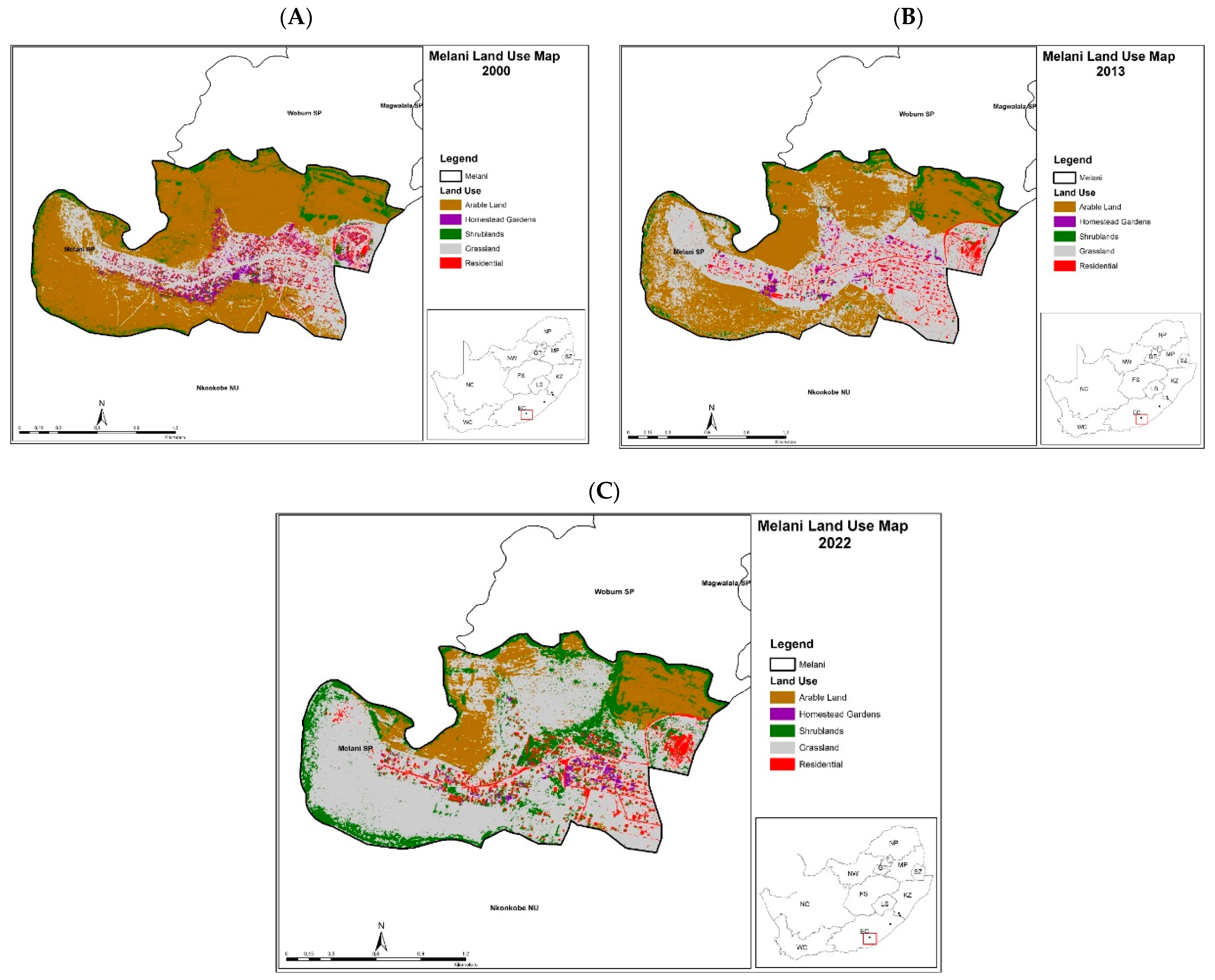
3.1. LULC in the Four Villages
3.2. Proportion of LULC Transition
3.3. Household Demographics and Impact of Field Abandonment on Household Economic Status
3.4. Effects on Social Relations, Culture, and Identity
4. Discussion
4.1. Abandonment of Arable Fields and Home Gardens
4.2. Expansion of Grasslands
4.3. Expansion of Shrublands
4.4. Expansion of Residential Areas
4.5. Household Economic Status in the Absence of Field Cultivation
Dependence on Social Grants
4.6. Social Consequences Within Households
4.6.1. Social Connections Between Households
4.6.2. Cultural Consequences
5. Conclusions
Author Contributions
Funding
Data Availability Statement
Acknowledgments
Conflicts of Interest
References
- Leal Filho, W.; Mandel, M.; Al-Amin, A.Q.; Feher, A.; Chiappetta Jabbour, C.J. An assessment of the causes and consequences of agricultural land abandonment in Europe. Int. J. Sustain. Dev. World Ecol. 2017, 24, 554–560. [Google Scholar] [CrossRef] [Scilit]
- Rajpar, H.; Zhang, A.; Razzaq, A.; Mehmood, K.; Pirzado, M.B.; Hu, W. Agricultural Land Abandonment and Farmers’ Perceptions of Land Use Change in the Indus Plains of Pakistan: A Case Study of Sindh Province. Sustainability 2019, 11, 4663. [Google Scholar] [CrossRef] [Scilit]
- Li, S.; Li, X. Global understanding of farmland abandonment: A review and prospects. J. Geogr. Sci. 2017, 27, 1123–1150. [Google Scholar] [CrossRef] [Scilit]
- Levers, C.; Schneider, M.; Prishchepov, A.V.; Estel, S.; Kuemmerle, T. Spatial variation in determinants of agricultural land abandonment in Europe. Sci. Total Environ. 2018, 644, 95–111. [Google Scholar] [CrossRef] [Scilit]
- Blair, D.; Shackleton, C.M.; Mograbi, P.J. Cropland abandonment in South African smallholder Communal fields: Land cover change (1950–2010) and farmer perceptions of contributing factors. Land 2018, 7, 121. [Google Scholar] [CrossRef] [Scilit]
- Shackleton, C.M.; Mograbi, P.J.; Drimie, S.; Fay, D.; Hebinck, P.; Hoffman, M.T.; Maciejewski, K.; Twine, W. Deactivation of field cultivation in communal areas of South Africa: Patterns, drivers and socio-economic and ecological consequences. Land Use Policy 2019, 82, 686–699. [Google Scholar] [CrossRef] [Scilit]
- Goga, T.; Feranec, J.; Bucha, T.; Rusnák, M.; Sačkov, I.; Barka, I.; Kopecká, M.; Papčo, J.; Oťaheľ, J.; Szatmári, D.; et al. A review of the application of remote sensing data for abandoned agricultural land identification with focus on Central and Eastern Europe. J. Remote Sens. 2019, 11, 2759. [Google Scholar] [CrossRef] [Scilit]
- Castillo, C.P.; Jacobs-Crisioni, C.; Diogo, V.; Lavalle, C. Modelling agricultural land abandonment in a fine spatial resolution multi-level land-use model: An application for the EU. Environ. Model. Softw. 2021, 136, 1364–8152. [Google Scholar] [CrossRef] [Scilit]
- Prishchepov, A.V.; Schierhorn, F.; Low, F. Unraveling the diversity of trajectories and drivers of global agricultural land abandonment. Land 2021, 10, 97. [Google Scholar] [CrossRef] [Scilit]
- Keenleyside, C.; Tucker, G.M. Farmland Abandonment in the EU: An Assessment of Trends and Prospects. Report Prepared for WWF; Institute for European Environmental Policy: London, UK, 2010. [Google Scholar]
- Lana-Renault, N.; Nadal-Romero, E.; Cammeraat, E.; Llorente, J.Á. Critical Environmental Issues Confirm the Relevance of Abandoned Agricultural Land. Water 2020, 12, 1119. [Google Scholar] [CrossRef] [Scilit]
- Chaudhary, S.; Wang, Y.; Dixit, A.M.; Khanal, N.R.; Xu, P.; Fu, B.; Yan, K.; Liu, Q.; Lu, Y.; Li, M. A Synopsis of Farmland Abandonment and Its Driving Factors in Nepal. Land 2020, 9, 84. [Google Scholar] [CrossRef] [Scilit]
- Xie, Y.; Spawn-Lee, S.A.; Radeloff, V.C.; Yin, H.; Robertson, G.P.; Lark, T.J. Cropland abandonment between 1986 and 2018 across the United States: Spatiotemporal patterns and current land uses. Environ. Res. Lett. 2024, 19, 044009. [Google Scholar] [CrossRef] [Scilit]
- Ortyl, B.; Kasprzyk, I.; Jadczyszyn, J. Trends and drivers of land abandonment in Poland under Common Agricultural Policy. Land Use Policy 2024, 147, 107353. [Google Scholar] [CrossRef] [Scilit]
- Moyo, B.; Ravhuhali, K.E. Abandoned croplands: Drivers and secondary succession trajectories under livestock grazing in communal areas of South Africa. Sustainability 2022, 14, 6168. [Google Scholar] [CrossRef] [Scilit]
- Shackleton, C.; Ntshudu, M. Declines in livestock numbers accompany cropping deagrarianisation processes in the Eastern Cape, South Africa. Land 2023, 12, 1735. [Google Scholar] [CrossRef] [Scilit]
- Shackleton, R.; Shackleton, C.; Shackleton, S.; Gambiza, J. Deagrarianisation and forest revegetation in a biodiversity hotspot on the Wild Coast, South Africa. PLoS ONE 2013, 8, e100463. [Google Scholar] [CrossRef] [Scilit]
- Quintas-Soriano, C.; Buerkert, A.; Plieninger, T. Effects of land abandonment on nature contributions to people and good quality of life components in the Mediterranean region: A review. Land Use Policy 2022, 116, 106053. [Google Scholar] [CrossRef] [Scilit]
- Winkler, K.; Fuchs, R.; Rounsevell, M.; Herold, M. Global land use changes are four times greater than previously estimated. Nat. Commun. 2021, 12, 2501. [Google Scholar] [CrossRef] [Scilit]
- Kgaphola, M.J.; Ramoelo, A.; Odindi, J.; Mwenge Kahinda, J.M.; Seetal, A.R.; Musvoto, C. Impact of land use and land cover change on land degradation in rural semi-arid South Africa: Case of the Greater Sekhukhune District Municipality. Environ. Monit. Assess. 2023, 195, 710. [Google Scholar] [CrossRef] [Scilit]
- Huang, Y.; Li, F.; Xie, H. A scientometrics review on farmland abandonment research. Land 2020, 9, 263. [Google Scholar] [CrossRef] [Scilit]
- Plieninger, T.; Draux, H.; Fagerholm, N.; Bieling, C.; Burgi, M.; Kizos, T.; Kuemmerle, T.; Primdahl, J.; Verburg, P.H. The driving forces of landscape change in Europe: A systematic review of the evidence. Land Use Policy 2016, 57, 204–214. [Google Scholar] [CrossRef] [Scilit]
- Zhou, T.; Koomen, E.; Ke, X. Determinants of farmland abandonment on the urban-rural fringe. J. Environ. Manag. 2020, 65, 369–384. [Google Scholar] [CrossRef] [Scilit]
- Meyfroidt, P.; Schierhorn, F.; Prishchepov, A.; Müller, D.; Kuemmerle, T. Drivers, constraints and trade-offs associated with recultivating abandoned cropland in Russia, Ukraine and Kazakhstan. Glob. Environ. Change 2016, 37, 1–15. [Google Scholar] [CrossRef] [Scilit]
- Renwick, A.; Jansson, T.; Verburg, P.H.; Revoredo-Giha, C.; Britz, W.; Gocht, A.; McCracken, D. Policy reform and agricultural land abandonment in the EU. Land Use Policy 2013, 30, 446–457. [Google Scholar] [CrossRef] [Scilit]
- Palmer, K.; Sender, J. Prospects for on-farm self-employment and poverty reduction: An analysis of the South African income and expenditure survey 2000. J. Contemp. Afr. Stud. 2006, 24, 347–376. [Google Scholar] [CrossRef] [Scilit]
- Van der Zanden, E.; Verburg, P.; Schulp, C.; Verkerk, P. Trade-offs of European agricultural abandonment. Land Use Policy 2016, 62, 290–301. [Google Scholar] [CrossRef] [Scilit]
- Hong, C.; Prishchepov, A.V.; Jin, X.; Han, B.; Lin, J.; Liu, J.; Ren, J.; Zhou, Y. The role of harmonized Landsat Sentinel-2 (HLS) products to reveal multiple trajectories and determinants of cropland abandonment in subtropical mountainous areas. J. Environ. Manag. 2023, 336, 117621. [Google Scholar] [CrossRef] [Scilit]
- Lidzhegu, Z.; Kabanda, T. Declining land for subsistence and small-scale farming in South Africa: A case study of Thulamela local municipality. Land Use Policy 2022, 119, 106170. [Google Scholar] [CrossRef] [Scilit]
- Errea, M.P.; Cortijos-López, M.; Llena, M.; Nadal-Romero, E.; Zabalza-Martínez, J.; Lasanta, T. From the local landscape organization to land abandonment: An analysis of landscape changes (1956–2017) in the Aísa Valley (Spanish Pyrenees). Landsc. Ecol. 2023, 38, 3443–3462. [Google Scholar] [CrossRef] [Scilit]
- Roy, P.S.; Roy, A. Land use and land cover change in India: A remote sensing and GIS perspective. Indian J. Sci. 2010, 90, 489–501. [Google Scholar]
- Shoukat, A.S.; Kiran, M. A GIS-based technique analysis of land use and land cover change detection in taluka Mirpur Mathelo: A case study in district Ghotki, Pakistan. Int. Adv. Res. Eng. J. 2021, 5, 231–239. [Google Scholar] [CrossRef] [Scilit]
- Mucina, L.; Rutherford, M.C. The Vegetation of South Africa, Lesotho and Swaziland; South African National Biodiversity Institute: Pretoria, South Africa, 2006; pp. 348–437. [Google Scholar]
- StatsSA (Statistics South Africa). Population Census; South African Government: Pretoria, South Africa, 2011.
- StatsSA (Statistics South Africa). Community Survey 2016: Statistical Release P0301; Statistics South Africa: Pretoria, South Africa, 2016. [Google Scholar]
- Umuziwabantu. Integrated Development Plan Review. Umuziwabantu Local Municipality, Harding, South Africa: Umuziwabantu Local Municipality, 2019/20. Available online: https://www.umuziwabantu.gov.za/wp-content/uploads/2022/01/201920-IDP-Review.pdf (accessed on 6 February 2025).
- Umzimkhulu Spatial Development Framework. Umzimkhulu Local Municipality, uMzimkhulu, South Africa: Umzimkhulu Local Municipality, 2021/2022. Available online: https://umzimkhululm.gov.za/wp-content/uploads/2021/04/DRAFT-SDF_2021_2022.pdf (accessed on 6 February 2025).
- Musetsho, K.D.; Chitakira, M.; Nel, W. Mapping land-use/land-cover change in a critical biodiversity area of South Africa. Int. J. Environ. Res. Public Health 2021, 18, 10164. [Google Scholar] [CrossRef] [Scilit] [PubMed]
- Meshesha, T.W.; Tripathi, S.K.; Khare, D. Analyses of land use and land cover change dynamics using GIS and remote sensing during 1984 and 2015 in the Beressa Watershed Northern Central Highland of Ethiopia. Model. Earth Syst. Environ. 2016, 2, 1–12. [Google Scholar] [CrossRef] [Scilit]
- Kabadayi, M.E.; Ettehadi Osgouei, P.; Sertel, E. Agricultural land abandonment in Bulgaria: A long-term remote sensing perspective, 1950–1980. Land 2022, 11, 1855. [Google Scholar] [CrossRef] [Scilit]
- Fonji, S.F.; Taff, G.N. Using satellite data to monitor land-use land-cover change in North-eastern Latvia. SpringerPlus 2014, 3, 61. [Google Scholar] [CrossRef] [Scilit]
- Meyer, M.A.; Früh-Müller, A. Patterns and drivers of recent agricultural land-use change in Southern Germany. Land Use Policy 2020, 99, 104959. [Google Scholar] [CrossRef] [Scilit]
- Nadal-Romero, E.; Khorchani, M.; Gaspar, L.; Arnáez, J.; Cammeraat, E.; Navas, A.; Lasanta, T. How do land use and land cover changes after farmland abandonment affect soil properties and soil nutrients in Mediterranean mountain agroecosystems? CATENA 2023, 226, 107062. [Google Scholar] [CrossRef] [Scilit]
- Kyriazopoulos, A.P.; Skre, O.; Sarkki, S.; Wielgolaski, F.E.; Abraham, E.M.; Ficko, A. Human–environment dynamics in European treeline ecosystems: A synthesis based on the DPSIR framework. Clim. Res. 2017, 73, 17–29. [Google Scholar] [CrossRef] [Scilit]
- Hatna, E.; Bakker, M.M. Abandonment and expansion of arable land in Europe. Ecosystems 2011, 14, 720–731. [Google Scholar] [CrossRef] [Scilit]
- Yussif, K.; Dompreh, E.B.; Gasparatos, A. Sustainability of urban expansion in Africa: A systematic literature review using the Drivers–Pressures–State–Impact–Responses (DPSIR) framework. Sustain. Sci. 2023, 18, 1459–1479. [Google Scholar] [CrossRef] [Scilit]
- Hebinck, P. Investigating rural livelihoods and landscapes in Guquka and Koloni: An introduction. In Livelihoods and Landscapes: The People of Guquka and Koloni and Their Resources; Hebinck, P., Lent, P.C., Eds.; Brill Press: Leiden, The Netherlands, 2007; pp. 1–32. [Google Scholar]
- Agnoletti, M. Rural landscape, nature conservation and culture: Some notes on research trends and management approaches from a southern European perspective. Landsc. Urban Plan 2014, 126, 66–73. [Google Scholar] [CrossRef] [Scilit]
- Van Dijk, G.A.; Zelanowicz, A.; Blokziljil, R. Land abandonment, biodiversity and the CAP: Land abandonment and biodiversity in relation to the 1st and 2nd pillars of the EU’s Common Agricultural Policy. In Proceedings of the International Seminar: Government Service for Land and Water Management, Sigulda, Latvia, 7–8 October 2004. [Google Scholar]
- Grove, A.O.; Rackham, O. The Nature of Mediterranean Europe: An Ecological History; Yale University Press: New Haven, CT, USA, 2000; p. 384. [Google Scholar]
- MacDonald, D.; Crabtree, J.R.; Wiesinger, G.; Dax, T.; Stamou, N.; Fleury, P.; Gutiérrez-Lazpita, J.; Gibon, A. Agricultural abandonment in mountain areas of Europe: Environmental consequences and policy response. J. Environ. Manag. 2000, 59, 47–69. [Google Scholar] [CrossRef] [Scilit]
- Serra, P.; Pons, X.; Saurí, D. Land-cover and land-use change in a Mediterranean landscape: A spatial analysis of driving forces integrating biophysical and human factors. Appl. Geogr. 2008, 28, 189–209. [Google Scholar] [CrossRef] [Scilit]
- García-Ruiz, J.M.; Lana-Renault, N. Hydrological and erosive consequences of farmland abandonment in Europe, with special reference to the Mediterranean region: A review. Agric. Ecosyst. Environ. 2011, 140, 317–338. [Google Scholar] [CrossRef] [Scilit]
- Rounsevell, M.; Reginster, I.; Araújo, M.; Carter, T.; Dendoncker, N.; Ewert, F.; House, J.; Kankaanpää, S.; Leemans, R.; Metzger, M.; et al. A coherent set of future land use change scenarios for Europe. Agric. Ecosyst. Environ. 2006, 114, 57–68. [Google Scholar] [CrossRef] [Scilit]
- Pointereau, P.; Coulon, F.; Girard, P.; Lambotte, M.; Stuczynski, T.; Sánchez Ortega, V.; Del Rio, A. Analysis of Farmland Abandonment and the Extent and Location of Agricultural Areas That Are Actually Abandoned or Are at Risk of Being Abandoned; JRC Scientific and Technical Reports; OPOCE: Luxembourg, 2008. [Google Scholar]
- Hebinck, P.; Mtati, N.; Shackleton, C. More than just fields: Reframing deagrarianisation in landscapes and livelihoods. J. Rural Stud. 2018, 61, 323–334. [Google Scholar] [CrossRef] [Scilit]
- Fay, D. Land tenure, land use and land reform at Dwesa-Cwebe, South Africa: Local transformations and the limits of the state. World Dev. 2009, 37, 1422–1433. [Google Scholar] [CrossRef] [Scilit]
- Fay, D. Cultivators in action, Siyazondla inaction: Trends and potentials in homestead cultivation. In In the Shadow of Policy: Everyday Practices in Land and Agrarian Reform in South Africa; Hebinck, P., Cousins, B., Eds.; Wits University Press: Johannesburg, South Africa, 2013; pp. 247–263. [Google Scholar]
- Shackleton, S.E.; Hebinck, P. Through the ‘thick and thin’ of farming on the Wild Coast, South Africa. J. Rural Stud. 2018, 61, 277–289. [Google Scholar] [CrossRef] [Scilit]
- Pagan, J.M.; Pryor, R.; Deepa, J.M.; Grace, O., III; Mbuya, R.; Taylor, J.O.; Dickson, V.; Ibeanusi, A.; Chauhan, G.; Chen, A. Sustainable development tool using meta-analysis and DPSIR framework-application to Savannah River Basin, U.S. Am. J. Water Resour. 2020, 56, 1059–1082. [Google Scholar] [CrossRef] [Scilit]
- Lasanta, T.; Nadal-Romero, E.; Arnáez, J. Managing abandoned farmland to control the impact of re-vegetation on the environment. The state of the art in Europe. Environ. Sci. Policy 2015, 52, 99–109. [Google Scholar] [CrossRef] [Scilit]
- Sluiter, R.; De Jong, S.M. Spatial patterns of Mediterranean land abandonment and related land cover transition. Landsc. Ecol. 2007, 22, 559–576. [Google Scholar] [CrossRef] [Scilit]
- Wakshum, S.; Sebsebe, D.; Tamrat, B. Ecology of soil seed banks: Implications for conservation and restoration of natural vegetation: A review. Int. J. Biodivers. Conserv. 2018, 10, 380–393. [Google Scholar] [CrossRef] [Scilit]
- Chalmers, N.; Fabricius, C. Expert and generalist local knowledge about land-cover change on South Africa’s Wild Coast: Can local ecological knowledge add value to science. Ecol. Soc. 2007, 12, 10. [Google Scholar] [CrossRef] [Scilit]
- Poyatos, R.; Latron, J.; Llorens, P. Land use and land cover change after agricultural abandonment: The case of a Mediterranean Mountain area. Mt. Res. Dev. 2003, 23, 362–368. [Google Scholar] [CrossRef] [Scilit]
- Riadi, B. Strategy to maintain food security in the area of flood hazard in Karawang Regency. IOP Conf. Ser. Earth Environ. Sci. 2018, 165, 012029. [Google Scholar] [CrossRef] [Scilit]
- Putri, R.F.; Naufal, M.; Nandini, M.; Dwiputra, D.S.; Wibirama, S.; Sumantyo, J.T.S. The impact of population pressure on agricultural land towards food sufficiency (Case in West Kalimantan Province, Indonesia). IOP Conf. Ser. Earth Environ. Sci. 2019, 256, 012050. [Google Scholar] [CrossRef] [Scilit]
- Alawamy, J.S.; Balasundram, S.K.; Hanif, A.H.M.; Sung, C.T.B. Detecting and analysing land use and land cover changes in the region of Al-Jabal Al-Akhdar, Libya using timeseries Landsat data from 1985 to 2017. Sustainability 2020, 12, 4490. [Google Scholar] [CrossRef] [Scilit]
- Akinyemi, F.O.; Speranza, C.I. Agricultural landscape change impact on the quality of land: An African continent-wide assessment in gained and displaced agricultural lands. Int. J. Appl. Earth Obs. Geoinf. 2022, 106, 102644. [Google Scholar] [CrossRef] [Scilit]
- Creutzig, F.; Bren d’Amour, C.; Weddige, U.; Fuss, S.; Beringer, T.; Gläser, A.; Kalkuhl, M.; Steckel, J.C.; Radebach, A.; Edenhofer, O. Assessing human and environmental pressures of global land-use change 2000–2010. Int. J. Glob. Sustain. 2018, 2, 1–17. [Google Scholar] [CrossRef] [Scilit]
- Li, Y.; Li, X.; Tan, M.; Wang, X.; Xin, L. The impact of cultivated land spatial shift on food crop production in China, 1990–2010. Land Degrad. Dev. 2018, 29, 1652–1659. [Google Scholar] [CrossRef] [Scilit]
- Toth, G. Impact of land-take on the land resource base for crop production in the European Union. Sci. Total Environ. 2012, 435, 75–81. [Google Scholar] [CrossRef] [Scilit]
- Jayne, T.S.; Chamberlin, J.; Headey, D.D. Land pressures, the evolution of farming systems, and development strategies in Africa: A synthesis. Food Policy 2014, 48, 1–17. [Google Scholar] [CrossRef] [Scilit]
- Munthali, M.G.; Davis, N.; Adeola, A.M.; Botai, J.O.; Kamwi, J.M.; Chisale, H.L.W.; Orimoogunje, O.O.I. Local perception of drivers of land-use and land-cover change dynamics across Dedza District, Central Malawi Region. Sustainability 2019, 11, 832. [Google Scholar] [CrossRef] [Scilit]
- Ramankutty, N.; Mehrabi, Z.; Waha, K.; Jarvis, L.; Kremen, C.; Herrero, M.; Rieseberg, L.H. Trends in global agricultural land use: Implications for environmental health and food security. Annu. Rev. Plant Biol. 2018, 69, 789–815. [Google Scholar] [CrossRef] [Scilit]
- Appiah, D.O.; Asante, F.; Nketiah, B. Perspectives on agricultural land use conversion and food security in rural Ghana. Science 2019, 1, 14. [Google Scholar] [CrossRef]
- Pawlewicz, A.; Pawlewicz, K. The risk of agricultural land abandonment as a socioeconomic challenge for the development of agriculture in the European Union. Sustainability 2023, 15, 3233. [Google Scholar] [CrossRef] [Scilit]
- Zhang, Z.; Ghazali, S.; Miceikienė, A.; Zejak, D.; Choobchian, S.; Pietrzykowski, M.; Azadi, H. Socio-economic impacts of agricultural land conversion: A meta-analysis. Land Use Policy 2023, 132, 106831. [Google Scholar] [CrossRef] [Scilit]
- Khanal, U. Why are farmers keeping cultivatable lands fallow even though there is food scarcity in Nepal? Food Secur. 2018, 10, 603–614. [Google Scholar] [CrossRef] [Scilit]
- Schierhorn, F.; Kastner, T.; Kuemmerle, T.; Meyfroidt, P.; Kurganova, I.; Prishchepov, A.V.; Erb, K.H.; Houghton, R.A.; Müller, D. Large greenhouse gas savings due to changes in the post-Soviet food systems. Environ. Res. Lett. 2019, 14, 065009. [Google Scholar] [CrossRef] [Scilit]
- Hajdu, F.; Neves, D.; Granlund, S. Changing livelihoods in rural Eastern Cape, South Africa (2002–2016): Diminishing employment and expanding social protection. J. S. Afr. Stud. 2020, 46, 743–772. [Google Scholar] [CrossRef] [Scilit]
- Rickebusch, S.; Gellrich, M.; Lischke, H.; Guisan, A.; Zimmermann, N.E. Combining probabilistic land-use change and tree population dynamics modelling to simulate responses in mountain forests. Ecol. Model. 2007, 209, 157–168. [Google Scholar] [CrossRef] [Scilit]
- Terres, J.M.; Nisini Scacchiafichi, L.N.; Wania, A.; Ambar, M.; Anguiano, E.; Buckwell, A.; Coppola, A.; Gocht, A.; Källström, H.N.; Pointereau, P.; et al. Farmland abandonment in Europe: Identification of drivers and indicators, and development of a composite indicator of risk. Land Use Policy 2015, 49, 20–34. [Google Scholar] [CrossRef] [Scilit]
- Chakona, G.; Shackleton, C. Minimum dietary diversity scores for women indicate micronutrient adequacy and food insecurity status in South African Towns. Nutrients 2017, 9, 812. [Google Scholar] [CrossRef] [Scilit] [PubMed]
- Appelt, J.L.; Garcia Rojas, D.C.; Verburg, P.H.; van Vliet, J. Socioeconomic outcomes of agricultural land use change in Southeast Asia. Ambio 2022, 51, 1094–1109. [Google Scholar] [CrossRef] [Scilit]
- Ehrensperger, A.; de Bremond, A.; Providoli, I.; Messerli, P. Land system science and the 2030 agenda: Exploring knowledge that supports sustainability transformation. Curr. Opin. Environ. Sustain. 2019, 38, 68–76. [Google Scholar] [CrossRef] [Scilit]
- Abraham, M.; Pingali, P.L. Transforming smallholder agriculture to achieve the SDGs. In The Role of Smallholder Farms in Food and Nutrition Security; Gomez y Paloma, S., Riesgo, L., Louhichi, K., Eds.; Springer Nature: New York, NY, USA, 2020; pp. 173–209. [Google Scholar]
- Shackleton, S.; Luckert, M. Changing livelihoods and landscapes in the rural Eastern Cape, South Africa: Past influences and future trajectories. Land 2015, 4, 1060–1089. [Google Scholar] [CrossRef] [Scilit]
- Chakona, G.; Shackleton, C.M. Food insecurity in South Africa: To what extent can social grants and consumption of wild foods eradicate hunger? World Dev. Perspect. 2019, 13, 87–94. [Google Scholar] [CrossRef] [Scilit]
- Hendriks, S.L.; Viljoen, A.; Marais, D.; Wenhold, F.A.M.; McIntyre, A.M.; Ngidi, M.S.; Annandale, J.G.; Kalaba, M.; Stewart, D. Considerations for the design of nutrition-sensitive production programmes in rural South Africa. BMC Public Health 2020, 20, 1383. [Google Scholar] [CrossRef] [Scilit] [PubMed]
- Dubbeld, B. How social security becomes social insecurity: Unsettled households, crisis talk and the value of grants in a KwaZulu-Natal village. Marriage Land Cust. 2013, 2013, 197–217. [Google Scholar]
- Mulia, R.; Simelton, E.; Nguyen, T.Q.; Jirström, M. Non-farm activities and impacts beyond the economy of rural households in Vietnam: A review and link to policies. Sustainability 2021, 13, 10182. [Google Scholar] [CrossRef] [Scilit]
- De la Hey, M.; Beinart, W. Why have South African smallholders largely abandoned arable production in fields: A case study. J. S. Afr. Stud. 2017, 43, 753–770. [Google Scholar] [CrossRef] [Scilit]
- Tuyen, T.Q. Income sources and inequality among ethnic minorities in the Northwest region, Vietnam. Environ. Dev. Sustain. 2016, 18, 1239–1254. [Google Scholar] [CrossRef] [Scilit]
- Singhal, S.; Beck, U. Ethnic disadvantage: Evidence using panel data. In Growth, Structural Transformation, and Rural Change in Viet Nam: A Rising Dragon on the Move; Tarp, F., Ed.; Oxford University Press: Helsinki, Finland, 2017; pp. 256–275. [Google Scholar]
- Fischer, K.; Johnson, E.; Visser, V.; Shackleton, S. Social drivers and differentiated effects of deagrarianisation: A longitudinal study of smallholder farming in South Africa’s Eastern Cape province. J. Rural Stud. 2024, 106, 103200. [Google Scholar] [CrossRef] [Scilit]
- Khanal, N.R.; Watanabe, T. Abandonment of agricultural land and its consequences. Mt. Res. Dev. 2006, 26, 32–40. [Google Scholar] [CrossRef] [Scilit]
- Chaudhary, S.; Wang, Y.; Khanal, N.R.; Xu, P.; Fu, B.; Dixit, A.M.; Yan, K.; Liu, Q.; Lu, Y. Social impact of farmland abandonment and its eco-environmental vulnerability in the high mountain region of Nepal: A case study of Dordi River Basin. Sustainability 2018, 10, 2331. [Google Scholar] [CrossRef] [Scilit]
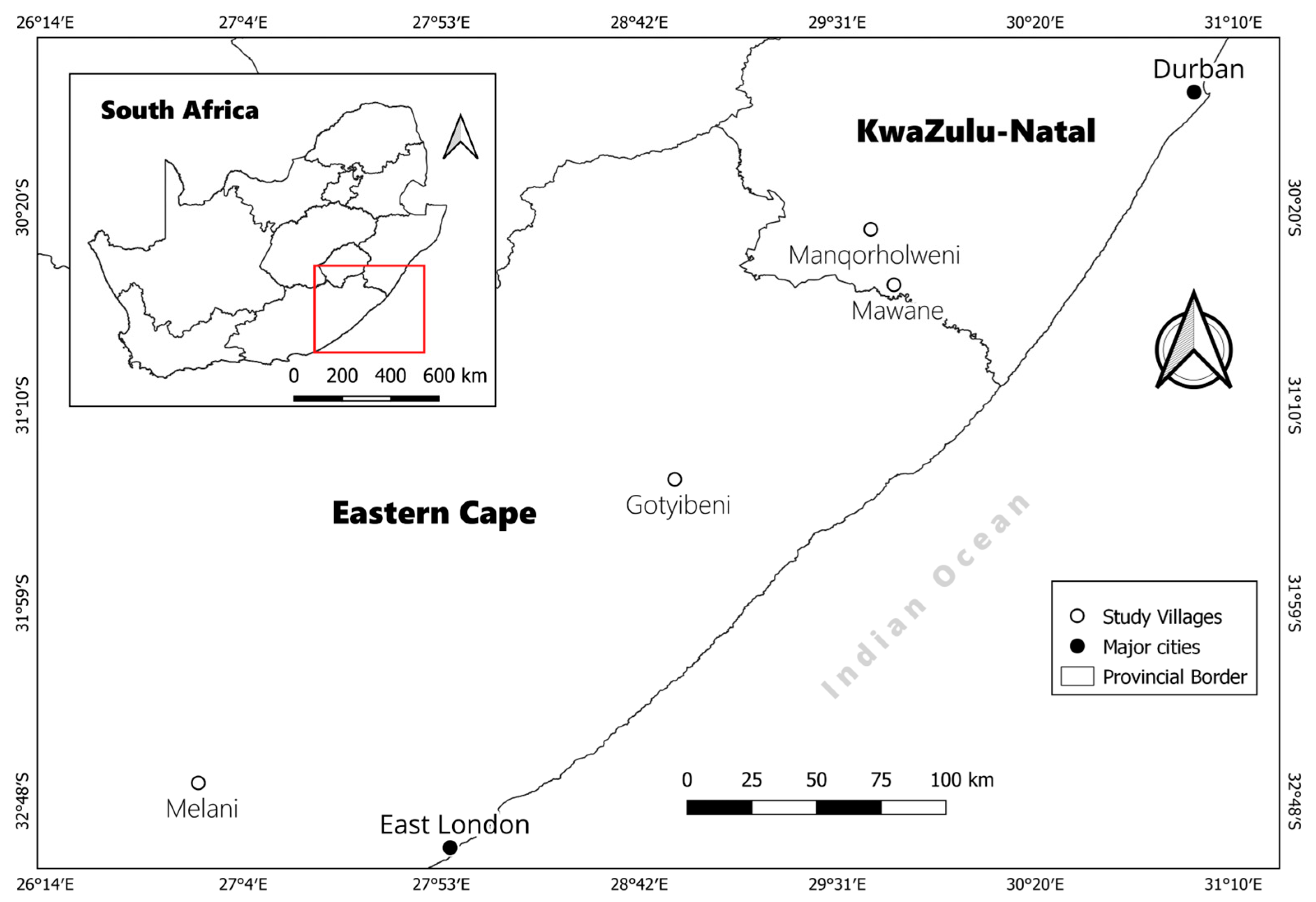
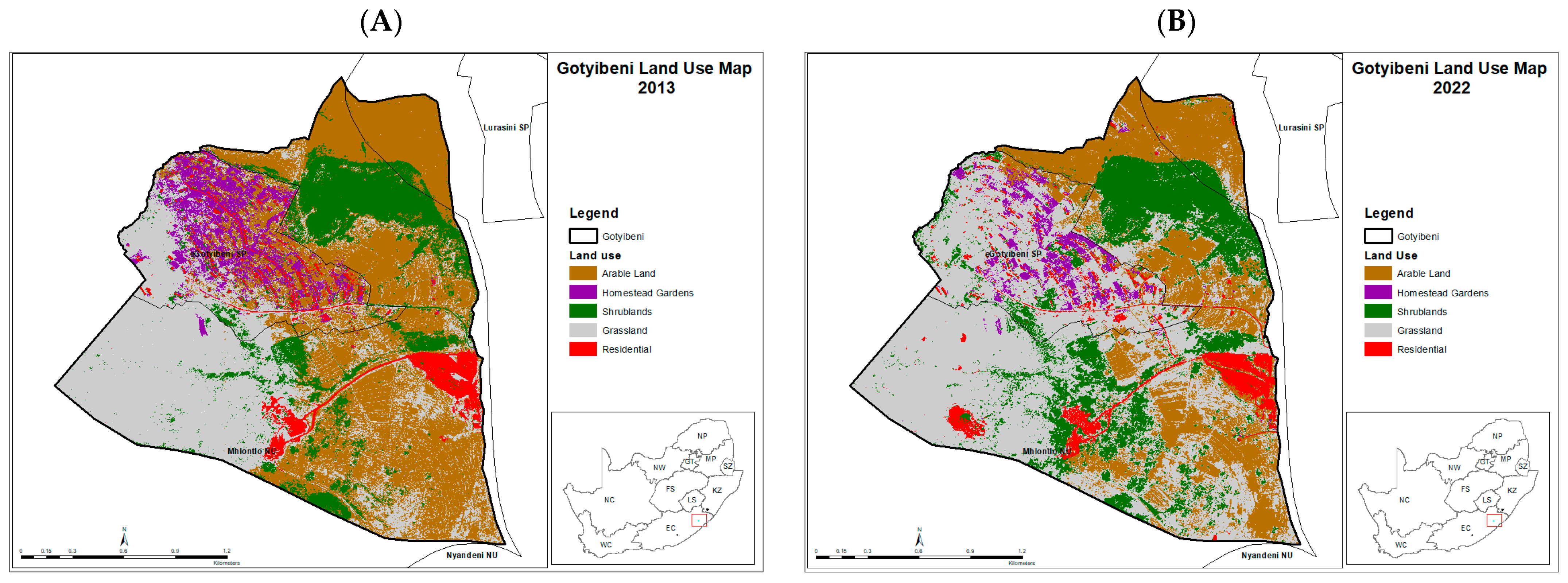
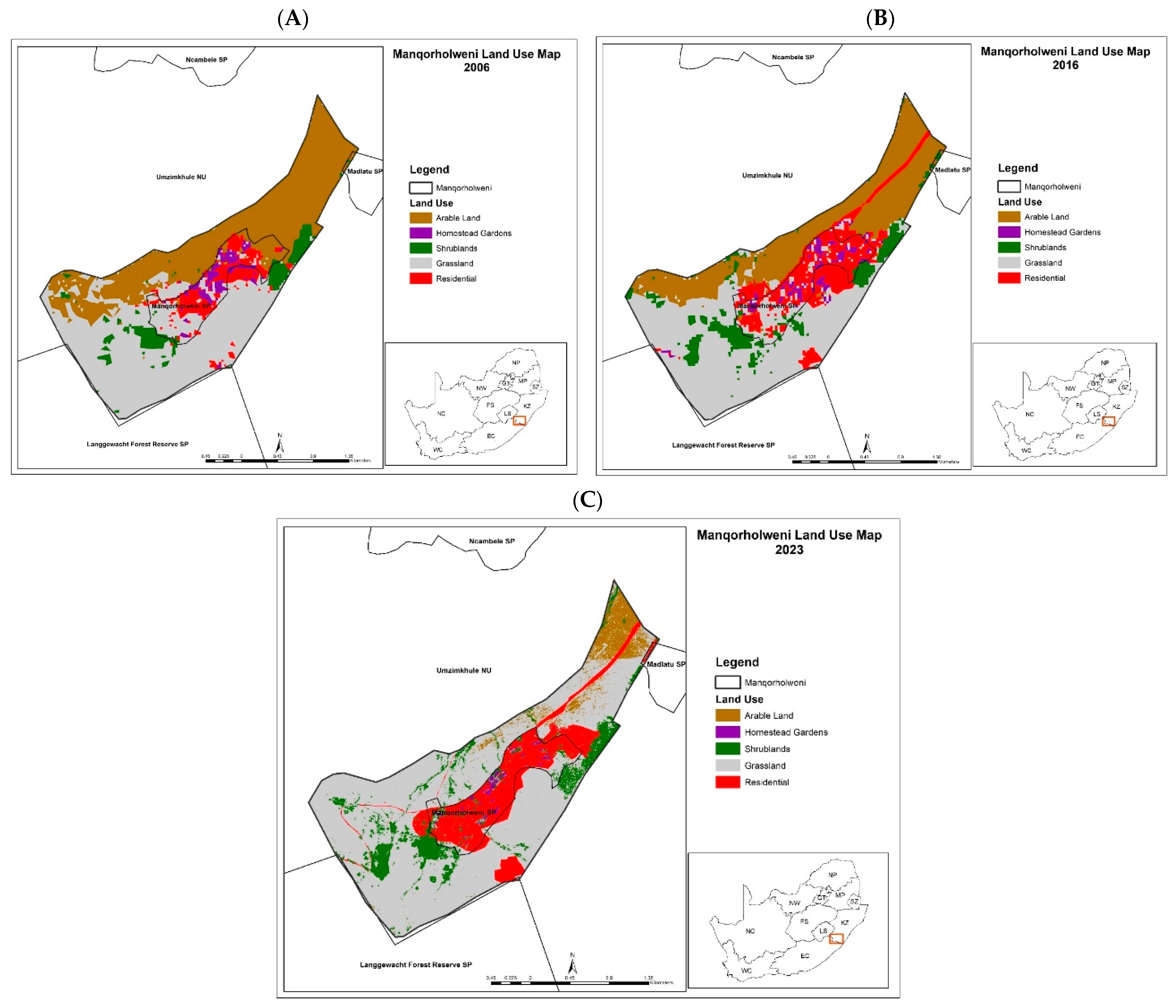
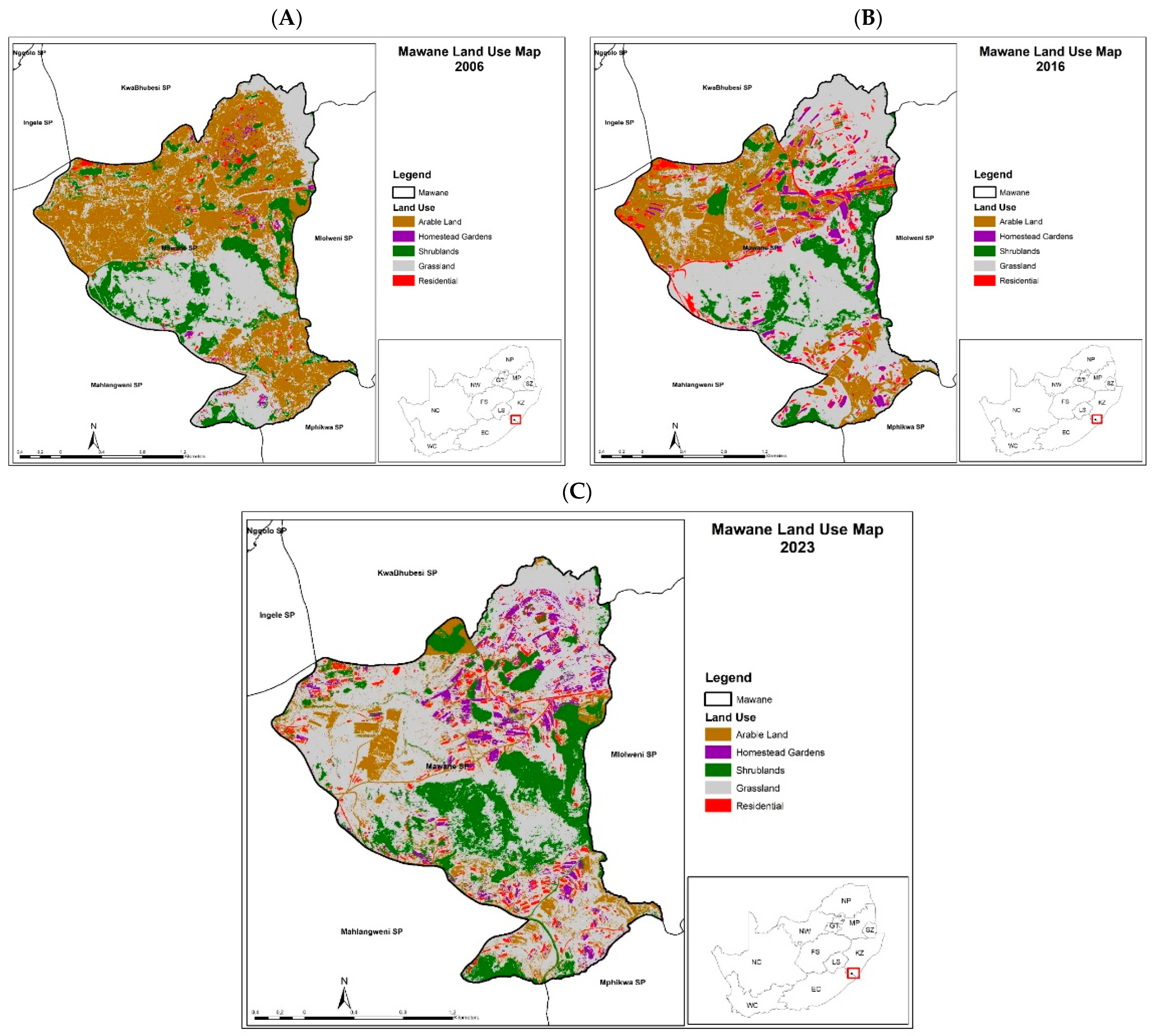

| Variable | Gotyib | Manqor | Mawane | Melani |
|---|---|---|---|---|
| Latitude | −31.467715° | −30.437159° | −30.661973° | −32.722392° |
| Longitude | 28.850192° | 29.651365° | 29.754546° | 26.869953° |
| Altitude (m) | 984 | 1169 | 904 | 601 |
| Village area (ha) | 369.1 | 573.8 | 556.5 | 241.0 |
| Village population | 753 2 | 608 2 | 1090 2 | 783 2 |
| Number of households | 155 | 111 | 220 | 279 |
| Population group | Black African 2 | Black African 2 | Black African 2 | Black African 2 |
| First language spoken | IsiXhosa 3 | IsiZulu 3 | IsiZulu 3 | IsiXhosa 3 |
| Average household size (persons) | 4.2 | 4.4 | 4.5 | 3.9 |
| Unemployment rate (%) | 46 | 63 | 56 | 59 |
| Mean temp | ||||
| Max (°C) | 20 1 | 18 5 | 25 4 | 23 1 |
| Min (°C) | 13 1 | −1 5 | 0.6 4 | 10.97 1 |
| Mean Annual rainfall (mm) | 1044 1 | 850 5 | 800 4 | 500 1 |
| Vegetation | Themeda triandra grassland 1 | Grassland with scattered areas of scarp forest 1. | Drakensberg foothill grassland 1 | Open savannas dominated by Vachellia bush clumps or individuals 1 |
| Village | Imagery Date | Path | Row | SPACECRAFT_ID |
|---|---|---|---|---|
| Gotyibeni | 06/05/2013 | 169 | 82 | L7_ETM |
| 17/05/2022 | 169 | 82 | LANDSAT_8 | |
| Manqorholweni | 27/05/2006 | 169 | 81 | L5_TM |
| 21/10/2016 | 169 | 81 | L7_ETM | |
| 08/03/2023 | 169 | 81 | LANDSAT_9 | |
| Mawane | 25/09/2006 | 168 | 81 | L5_TM |
| 21/10/2016 | 168 | 81 | L7_ETM | |
| 18/10/2023 | 168 | 81 | LANDSAT_9 | |
| Melani | 12/12/2000 | 170 | 83 | L5_TM |
| 27/04/2013 | 170 | 83 | L7_ETM | |
| 10/04/2023 | 170 | 83 | LANDSAT_9 |
| Village | Year | User_Accuracy (%) | Kappa Coefficient (%) |
|---|---|---|---|
| Gotyibeni | 2013 | 89 | 86 |
| 2022 | 96 | 95 | |
| Manqorholweni | 2006 | 89 | 84 |
| 2016 | 85 | 79 | |
| 2023 | 85 | 75 | |
| Mawane | 2006 | 91 | 88 |
| 2016 | 90 | 87 | |
| 2023 | 90 | 87 | |
| Melani | 2000 | 87 | 81 |
| 2013 | 89 | 85 | |
| 2022 | 99 | 98 |
| Gotyibeni | Manqorholweni | Mawane | Melani | ||||||||||||||||||
|---|---|---|---|---|---|---|---|---|---|---|---|---|---|---|---|---|---|---|---|---|---|
| LULC Class | 2013 (ha) | 2022 (ha) | Change (ha) | 2006 (ha) | 2016 (ha) | 2023 (ha) | Change (2006–2016) (ha) | Change (2016–2023) (ha) | Change (2006–2023) (ha) | 2006 (ha) | 2016 (ha) | 2023 (ha) | Change (2006–2016) (ha) | Change (2016–2023) (ha) | Change (2006–2023) (ha) | 2000 (ha) | 2013 (ha) | 2022 (ha) | Change (2000–2013) (ha) | Change (2013–2022) (ha) | Change (2000–2022) (ha) |
| Arable fields | 142.9 | 98.9 | −44.0 | 225.5 | 173.6 | 36.9 | −51.9 | −136.7 | −188.6 | 238.6 | 132.8 | 64.5 | −105.8 | −68.4 | −174.1 | 161.7 | 141.1 | 58.3 | −20.6 | −82.8 | −103.4 |
| Residential | 10.4 | 18.0 | 7.6 | 37.1 | 69.9 | 73.0 | 32.8 | 3.1 | 35.9 | 6.9 | 31.5 | 40.8 | 24.6 | 9.3 | 33.9 | 8.7 | 9.8 | 10.1 | 1.1 | 0.3 | 1.4 |
| Homestead gardens | 23.8 | 12.0 | −11.8 | 16.6 | 14.0 | 10.1 | −2.6 | −3.8 | −6.5 | 5.9 | 21.6 | 28.2 | 15.6 | 6.6 | 22.3 | 8.2 | 2.1 | 1.3 | −6.1 | −0.8 | −6.9 |
| Grasslands | 137.9 | 170.5 | 32.6 | 261.8 | 266.4 | 390.6 | 4.7 | 124.2 | 128.8 | 226.4 | 298.9 | 320.7 | 60.3 | 21.8 | 94.3 | 50.8 | 66.7 | 127.2 | 15.9 | 60.5 | 76.4 |
| Shrubs | 54.1 | 69.7 | 15.6 | 32.8 | 49.9 | 63.1 | 17.1 | 13.2 | 30.3 | 78.6 | 71.8 | 102.4 | −6.8 | 30.7 | 23.8 | 11.6 | 21.3 | 44.1 | 9.7 | 22.8 | 32.5 |
| Gotyibeni | Manqorholweni | Mawane | Melani | ||||||||||||||||||
|---|---|---|---|---|---|---|---|---|---|---|---|---|---|---|---|---|---|---|---|---|---|
| LULC Class | 2013 (%) | 2022 (%) | Change (%) | 2006 (%) | 2016 (%) | 2023 (%) | Change (2006–2016) (%) | Change (2016–2023) (%) | Change (2006–2023) (%) | 2006 (%) | 2016 (%) | 2023 (%) | Change (2006–2016) (%) | Change (2016–2023) (%) | Change (2006–2023) (%) | 2000 (%) | 2013 (%) | 2022 (%) | Change (2000–2013) (%) | Change (2013–2022) (%) | Change (2000–2022) (%) |
| Arable fields | 39 | 27 | −12 | 39 | 30 | 6 | −9 | −29 | −33 | 43 | 24 | 12 | −19 | −12 | −31 | 67 | 59 | 24 | −9 | −34 | 43 |
| Residential | 3 | 5 | 2 | 7 | 12 | 13 | 5 | 0.5 | 6 | 1 | 6 | 7 | 4 | 2 | 6 | 4 | 4 | 4 | 0.5 | 0.1 | 0.6 |
| Homestead gardens | 6 | 3 | −3 | 3 | 2 | 2 | −0.5 | −0.7 | −1 | 1 | 4 | 5 | 3 | 1 | 4 | 3 | 1 | 1 | −3 | −0.3 | 3 |
| Grasslands | 37 | 46 | 9 | 46 | 47 | 68 | 0.8 | 22 | 22 | 41 | 54 | 58 | 11 | 4 | 17 | 21 | 27 | 53 | 7 | 25 | 32 |
| Shrubs | 15 | 19 | 4 | 5 | 9 | 11 | 6 | 2 | 5 | 14 | 12 | 18 | −1 | 6 | 4 | 5 | 9 | 18 | 4 | 9 | 13 |
| Gotyibeni | Manqorholweni | Mawane | Melani | |||||||||||||||||
|---|---|---|---|---|---|---|---|---|---|---|---|---|---|---|---|---|---|---|---|---|
| R∆ (2013–2022) | R∆ (2006–2016) | R∆ (2016–2023) | R∆ (2006–2023) | R∆ (2006–2016) | R∆ (2016–2023) | R∆ (2006–2023) | R∆ (2000–2013) | R∆ (2013–2022) | R∆ (2000–2022) | |||||||||||
| LULC Class | ha/year | %/year | ha/year | %/year | ha/year | %/year | ha/year | %/year | ha/year | %/year | ha/year | %/year | ha/year | %/year | ha/year | %/year | ha/year | %/year | ha/year | %/year |
| Arable fields | −4.9 | −1.3 | −5.2 | −0.9 | −19.5 | −4.1 | −11.1 | −1.9 | −10.6 | −1.9 | −9.8 | −1.7 | −10.2 | −1.8 | −1.6 | 0.7 | −9.2 | −3.8 | −4.7 | −2.0 |
| Residential | 0.8 | 0.2 | 3.3 | 0.5 | 0.4 | 0.1 | 2.1 | 0.4 | 2.5 | 0.4 | 1.4 | 0.3 | 2 | 0.4 | 0.1 | 0.03 | 0.03 | 0.01 | 0.1 | 0.03 |
| Homestead gardens | −1.3 | −0.3 | −0.3 | −0.1 | −0.5 | −0.1 | −0.4 | −0.1 | 1.6 | 0.3 | 0.9 | 0.1 | 1.3 | 0.2 | −0.5 | 0.2 | −0.08 | −0.03 | −0.3 | 0.1 |
| Grasslands | 3.6 | 1 | 0.5 | 0.1 | 17.7 | 3.1 | 7.6 | 1.3 | 6.0 | 1.1 | 3.1 | 0.6 | 5.5 | 1 | 1.2 | 0.5 | 6.72 | 2.8 | 3.4 | 1.5 |
| Shrublands | −3.9 | 0.4 | 1.7 | 0.6 | 1.9 | 0.3 | 1.8 | 0.1 | −0.7 | −0.1 | 4.4 | 0.9 | 1.4 | 0.2 | 0.8 | 0.3 | 2.53 | 1 | 1.5 | 0.6 |
| LULC Class | Gotyibeni | Manqorholweni | Mawane | Melani | |||
|---|---|---|---|---|---|---|---|
| Change Period | 2013–2023 | 2006–2016 | 2016–2023 | 2006–2016 | 2016–2023 | 2000–2013 | 2013–2022 |
| Unchanged arable land | 39 | 88 | 53 | 63 | 67 | 77 | 24 |
| Arable land to residential | 2 | 6 | 2 | 6 | 13 | 0 | 2 |
| Arable land to gardens | 0 | 0 | 0 | 0 | 10 | 0 | 0 |
| Arable land to grasslands | 24 | 5 | 42 | 23 | 15 | 23 | 48 |
| Arable land to shrubland | 35 | 1 | 3 | 8 | 10 | 0 | 26 |
| Proportion of Respondents per Village % | ||||||
|---|---|---|---|---|---|---|
| Attribute | Non-Cropping Households | |||||
| Gotyib (n = 21) | Manqor (n = 28) | Mawane (n = 25) | Melani (n = 23) | Mean | ||
| Gender | Male | 48 | 21 | 12 | 35 | 29 |
| Female | 52 | 79 | 88 | 65 | 71 | |
| Age category (Years) | ≤25 | 14 | 7 | 0 | 4 | 6 |
| 26–35 | 10 | 7 | 16 | 4 | 9 | |
| 36–45 | 0 | 7 | 16 | 22 | 11 | |
| 46–55 | 19 | 25 | 32 | 13 | 23 | |
| >55 | 57 | 54 | 36 | 57 | 51 | |
| Highest education | None | 10 | 0 | 20 | 0 | 8 |
| Primary | 24 | 64 | 56 | 44 | 47 | |
| Secondary | 64 | 32 | 24 | 48 | 42 | |
| Tertiary | 2 | 4 | 0 | 8 | 3 | |
| Employment status | Unemployment | 46 | 63 | 56 | 59 | 56 |
| Off-farm | 90 | 79 | 92 | 92 | 88 | |
| On-farm | 10 | 21 | 8 | 8 | 12 | |
| HH main source of income | Social grants | 60 a | 80 a | 87 a | 70 a | 74 |
| Off-farm employment | 35 a | 8 b | 13 b | 13 b | 17 | |
| Remittances | 5 a | 8 a | 0 a | 0 a | 3 | |
| Off-farm self-employment | 0 a | 0 a | 0 a | 13 a | 3 | |
| Household cash income enough | No | 95 b | 93 b | 96 b | 91 b | 94 |
| HH economic status after field abandonment | Less stable | 95 a | 96 a | 100 a | 96 a | 97 |
| Stable | 0 a | 4 a | 0 a | 0 a | 1 | |
| More stable | 5 a | 0 a | 0 a | 4 a | 2 | |
| Home garden cultivation | Has a garden | 86 a | 79 a | 80 a | 61 a | 77 |
| Variable | Proportion of Respondent’s Responses (%) | |||||
|---|---|---|---|---|---|---|
| Gotyib (n = 21) | Manqor (n = 28) | Mawane (n = 25) | Melani (n = 23) | Mean | SD | |
| Has field abandonment affected social relations within-household | 86 a | 86 a | 84 a | 70 a | 82 | 7.7 |
| Has field abandonment affected power relations within households | 67 a | 57 a | 64 a | 91 b | 70 | 14.8 |
| Has field abandonment affected social relations between-households | 81 a | 57 b | 64 b | 78 a | 70 | 11.4 |
| Has field abandonment affected membership in community groups | 86 a,b | 68 b | 72 a,b | 96 a | 81 | 12.9 |
| Has field abandonment affected cultivation as part of culture and identity | 91 a | 78 a | 80 a | 87 a | 84 | 5.9 |
| Has field abandonment affected people’s connection to the land | 57 a | 64 a | 60 a | 78 a | 65 | 9.3 |
Disclaimer/Publisher’s Note: The statements, opinions and data contained in all publications are solely those of the individual author(s) and contributor(s) and not of MDPI and/or the editor(s). MDPI and/or the editor(s) disclaim responsibility for any injury to people or property resulting from any ideas, methods, instructions or products referred to in the content. |
© 2025 by the authors. Licensee MDPI, Basel, Switzerland. This article is an open access article distributed under the terms and conditions of the Creative Commons Attribution (CC BY) license (https://creativecommons.org/licenses/by/4.0/).
Share and Cite
Pokwana, S.; Shackleton, C.M. Arable Land Abandonment and Land Use/Land Cover Change in Southeastern South Africa. Land 2025, 14, 2156. https://doi.org/10.3390/land14112156
Pokwana S, Shackleton CM. Arable Land Abandonment and Land Use/Land Cover Change in Southeastern South Africa. Land. 2025; 14(11):2156. https://doi.org/10.3390/land14112156
Chicago/Turabian StylePokwana, Sihle, and Charlie M. Shackleton. 2025. "Arable Land Abandonment and Land Use/Land Cover Change in Southeastern South Africa" Land 14, no. 11: 2156. https://doi.org/10.3390/land14112156
APA StylePokwana, S., & Shackleton, C. M. (2025). Arable Land Abandonment and Land Use/Land Cover Change in Southeastern South Africa. Land, 14(11), 2156. https://doi.org/10.3390/land14112156



