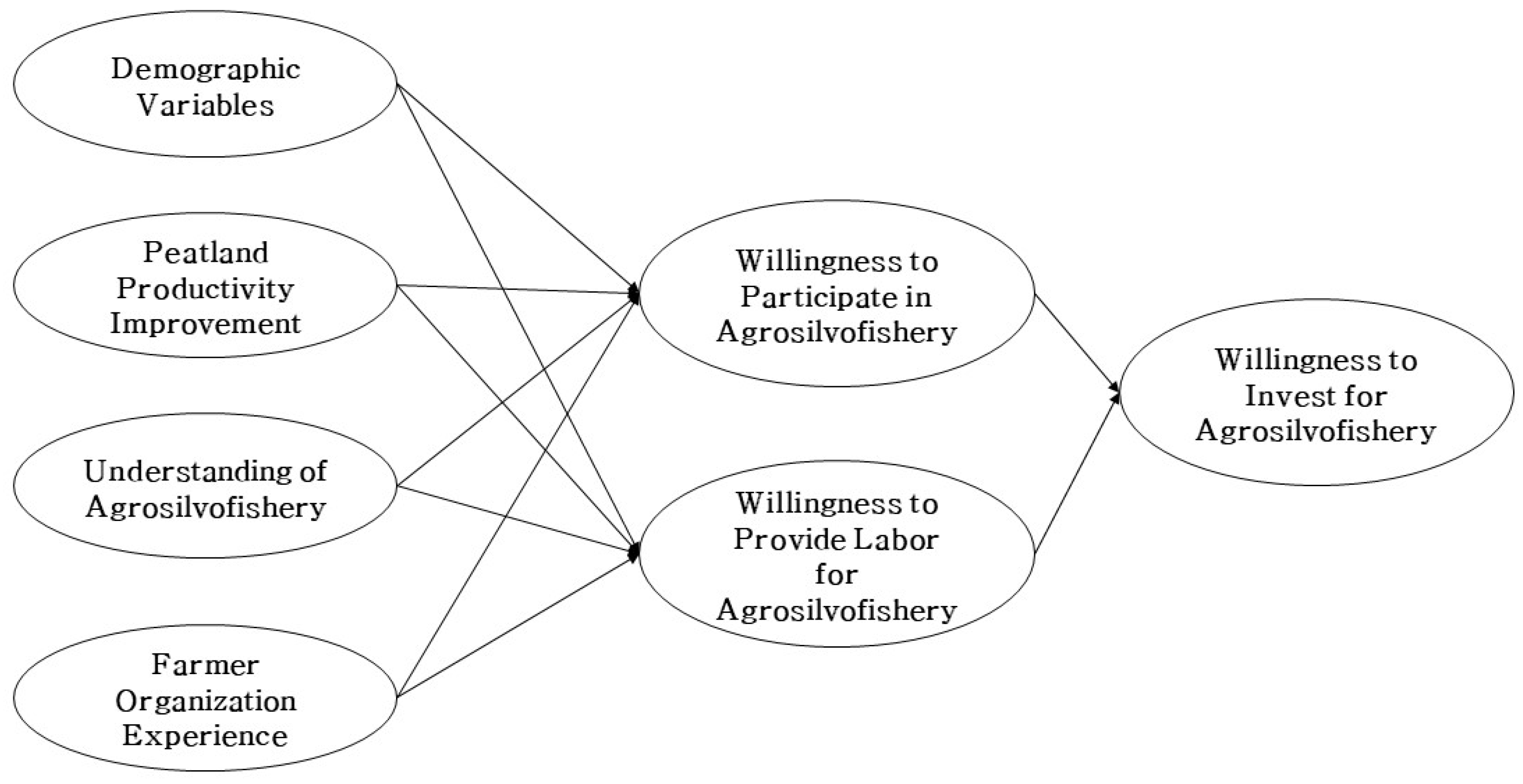
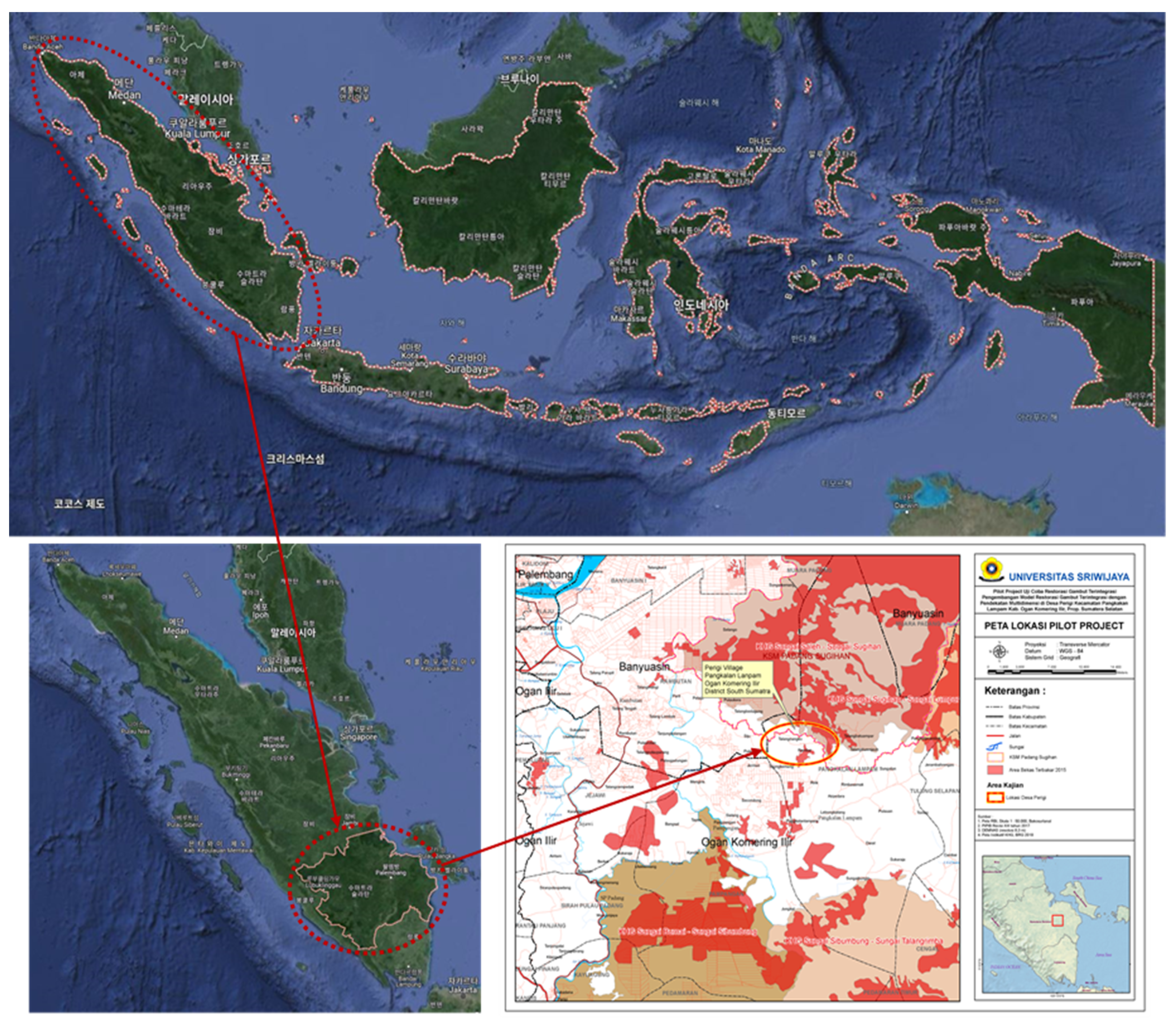
Local Perspectives on Agrosilvofishery in Peatlands: A Case Study of Perigi Village, South Sumatra, Indonesia


 , and
, and
Abstract
1. Introduction
2. Scope and Methods
2.1. Selection of Study Site
2.2. Status of Perigi Village
2.3. Survey Design and Analysis Methods
2.3.1. Designing and Conducting Survey
2.3.2. Analysis Methods
3. Results
3.1. Perceptions of Peatland Productivity
3.1.1. Peatland Crop Status
3.1.2. Peatland Productivity Issues
3.2. Existing Peatland Restoration Projects
3.3. Perception Survey of Agrosilvofishery
3.4. Comparison of Farmer and Non-Farmer Groups
3.4.1. Frequency of Farmer and Non-Farmer Groups
3.4.2. Logit Model Result
3.4.3. Analysis of the Effects of Willingness to Participate in, Provide Labor for, and Pay for Agrosilvofishery
4. Discussion
4.1. Local Perspectives on Sustainable Agrosilvofishery in Peatlands
4.2. Implications and Limitations
5. Conclusions
Author Contributions
Funding
Data Availability Statement
Acknowledgments
Conflicts of Interest
References
- Dargie, G.C.; Lewis, S.L.; Lawson, I.T.; Mitchard, E.T.A.; Page, S.E.; Bocko, Y.E.; Ifo, S.A. Age, extent and carbon storage of the central Congo Basin peatland complex. Nature 2017, 542, 86–90. [Google Scholar] [CrossRef] [PubMed]
- Agus, F.; Subiksa, I.G.M. Lahan Gambut: Potensi untuk Pertanian dan Aspek Lingkungan; Balai Penelitian Tanah dan World Agroforestry Centre (ICRAF): Bogor, Indonesia, 2008; ISBN 978-602-8039-10-9. [Google Scholar]
- Dohong, A.; Aziz, A.A.; Dargusch, P. A review of the drivers of tropical peatland degradation in South-East Asia. Land. Use Policy 2017, 69, 349–360. [Google Scholar] [CrossRef]
- Page, S.E.; Rieley, J.O.; Banks, C.J. Global and regional importance of the tropical peatland carbon pool. Glob. Chang. Biol. 2011, 17, 798–818. [Google Scholar] [CrossRef]
- Medrilzam, M.; Dargusch, P.; Herbohn, J.; Smith, C. The socio-ecological drivers of forest degradation in part of the tropical peatlands of Central Kalimantan, Indonesia. For. Int. J. For. Res. 2014, 87, 335–345. [Google Scholar] [CrossRef]
- Atkinson, C.L.; Alibašić, H. Prospects for governance and climate change resilience in peatland management in Indonesia. Sustainability 2023, 15, 1839. [Google Scholar] [CrossRef]
- Hein, L.; Sumarga, E.; Quiñones, M.; Suwarno, A. Effects of soil subsidence on plantation agriculture in Indonesian peatlands. Reg. Environ. Change 2022, 22, 121. [Google Scholar] [CrossRef]
- Cahya, M.; Suwignyo, R.A.; Sodikin, E.; Baral, H. Increasing rice productivity in degraded peatlands using improved planting methods and rice varieties. Biovalentia Biol. Res. J. 2022, 8, 69–82. [Google Scholar] [CrossRef]
- Afentina, A.; Yanarita, Y.; Indrayanti, L.; Rontinsulu, J.; Hidayat, N.; Sianipar, J. The Potential of Agroforestry in Supporting Food Security for Peatland Community—A Case Study in the Kalampangan Village, Central Kalimantan. J. Ecol. Eng. 2021, 22, 123–130. [Google Scholar] [CrossRef] [PubMed]
- Syahza, A.; Suwondo; Bakce, D.; Nasrul, B.; Mustofa, R. Utilization of Peatlands Based on Local Wisdom and Community Welfare in Riau Province, Indonesia. Int. J. Sustain. Dev. Plan. 2020, 15, 1119–1126. [Google Scholar] [CrossRef]
- Hairani, A.; Noor, M. Water management on peatland for food crop and horticulture production: Research review in Kalimantan. IOP Conf. Ser. Earth Environ. Sci. 2020, 499, 012006. [Google Scholar] [CrossRef]
- Pusvita, E.; Mulyana, A.; Adriani, D.; Antoni, M. Farmers’ interest and economics model of agrosilvofishery restoration on degraded peatland in OKI Regency South Sumatra Indonesia. J. Smart Agric. Environ. Technol. 2023, 1, 99–111. [Google Scholar]
- Minayeva, T.Y.; Bragg, O.; Sirin, A.A. Towards ecosystem-based restoration of peatland biodiversity. Mires Peat 2017, 19, 1–36. [Google Scholar] [CrossRef]
- Ariyanto, D.P.; Sumarno; Supriyono; Yunus, A.; Pudjiasmanto, B.; Rahayu; Widijanto, H.; Suntoro. The productivity increasing of peatlands on community land by multi-cropping model in Riau Indonesia. IOP Conf. Ser. Earth Environ. Sci. 2019, 393, 012103. [Google Scholar] [CrossRef]
- Ifansyah, N.; Junaidah, J. Peatland management in Liang Anggang Protected Forest by Sukamaju Peat Care Society (PCS), South Kalimantan. J. Galam 2020, 1, 1–14. [Google Scholar] [CrossRef]
- Suwignyo, R.A. Climate-Smart Agrosilvofishery Approach of Peatland Restoration in South Sumatra; Center of Excellence on Peatland Research, International Symposium on Restoration of Degraded Peatlands, Sriwijaya University: Palembang, Indonesia, 2022. [Google Scholar]
- Applegate, G.; Freeman, B.; Tular, B.; Sitadevi, L.; Jessup, T.C. Application of agroforestry business models to topical peatland restoration. Ambio 2022, 51, 863–874. [Google Scholar] [CrossRef] [PubMed]
- Sakuntaladewi, N.; Rachmanadi, D.; Mendham, D.; Yuwati, T.W.; Winarno, B.; Premono, B.T.; Lestari, S.; Ardhana, A.; Ramawati; Bundiningish, K.; et al. Can We Simultaneously Restore Peatlands and Improve Livelihoods? Exploring Community Home Yard Innovations in Utilizing Degraded Peatland. Land 2022, 11, 150. [Google Scholar] [CrossRef]
- Ministry of Environment and Forests (MoEF); Nomor, P.P. Tahun 2016 Tentang Perubahan PPE Gambut-Direktorat Pengendalian Kerusakan Gambut; MoEF: New Delhi, India, 2016; p. 57. Available online: https://gambut.oirto.com/pp-nomor-57-tahun-2016-tentang-perubahan-ppe-gambut/ (accessed on 20 September 2023).
- Nurlia, A.; Waluyo, E.A.; Martin, E. Efektivitas Kebijakan Pembukaan Lahan Tanpa Bakar dalam Mengurangi Kejadian Kebakaran di Lahan Gambut (Kasus di Rengas Merah, Kabupaten OKI, Sumatera Selatan). In Merawat Asa Restorasi Gambut Pencegahan Kebakaran dan Peningkatan Kesejahteraan Masyarakat; Palembang, Indonesia. 2018. Available online: https://www.researchgate.net/publication/332555398_EfektivitasKebijakanPembukaanLahanTanpaBakar_dalamMengurangiKejadian_Kebakaran_di_Lahan_Gambut_Kasus_di_Rengas_Merah_Kabupaten_OKI_Sumatera_Selatan (accessed on 20 October 2023).
- Nurlia, A.; Rahmat, M.; Waluyo, E.A.; Purnama, D.H.; Sabaruddin. Gender role in farmers’ livelihood strategies at peatland area of fire-prone in Ogan Komering Ilir Regency South Sumatra Province. IOP Conf. Ser. Earth Environ. Sci. 2021, 801, 012028. [Google Scholar] [CrossRef]
- Nurhayati, A.D.; Saharjo, B.H.; Sundawati, L.; Syartinilia; Vetrita, Y. Perilaku dan persepi masyarakat terhadap terjadinya kebakaran gambut di Kabupaten Ogan Komering Ilir Provinsi Sumatera Selatan. J. Nat. Resour. Environ. Manag. 2020, 10, 568–583. [Google Scholar] [CrossRef]
- Rohadi, D. Zero-Burning Policy Hurts Small Farmers—A Flexible Approach Is Needed. The Conversation, 12 September 2017. Available online: https://theconversation.com/zero-burning-policy-hurts-small-farmers-a-flexible-approach-is-needed-77969 (accessed on 12 September 2023).
- Menard, S. Applied Logistic Regression Analysis, 2nd ed.; SAGE Publication and Inc.: Newcastle upon Tyne, UK, 2002; ISBN 97800761922087. [Google Scholar]
- Lee, H. SPSS 10.0 Manual-Statistical Analysis Methods and Commentary; BobMunSa: Paju, Republic of Korea, 2001; ISBN 978-891-812-654-8. [Google Scholar]
- Field, H. I—What is the normative role of logic? Aristot. Soc. Suppl. Vol. 2009, 83, 251–268. [Google Scholar] [CrossRef]
- Hair, J.F.; Gabriel, M.L.D.S.; Patel, V.K. AMOS covariance-based structural equation modeling (CB-SEM): Guidelines on its application as a marketing research tool. ReMark—Rev. Bras. Market. 2014, 13, 44–55. [Google Scholar] [CrossRef]
- Kang, M.; Lee, S.; Cho, N. A Prediction Modeling for the Commercialization of Urban Residential Area; Architectural Press Institute of Korea: Seoul, Republic of Korea, 2002; Volume 169, pp. 197–208. [Google Scholar]
- Wildayana, E.; Armanto, M.E.; Zahri, I.; Adriani, D.; Syakina, B. Socio economic factors causing rapid peatlands degradation in South Sumatra. Sriwij. J. Environ. 2019, 3, 87–95. [Google Scholar] [CrossRef]
- Meiwanda, G.; Lubis, E.E.; Nasution, M.S.; Habibie, D.K. Peatland management based on Education for Sustainable Development (ESD). J. Phys. Conf. Ser. 2020, 1655, 012142. [Google Scholar]
- Medrilzam, M.; Smith, C.; Aziz, A.A.; Herbohn, J.; Dargusch, P. Smallholder farmers and the dynamics of degradation of peatland ecosystems in Central Kalimantan, Indonesia. Ecol. Econ. 2017, 136, 101–113. [Google Scholar] [CrossRef]
- Surahman, A.; Shivakoti, G.; Soni, P. Prospect of sustainable peatland agriculture for supporting food security and mitigating green house gas emission in Central Kalimantan, Indonesia. Redefining Divers. Dyn. Nat. Resour. Manag. Asia 2017, 1, 291–303. [Google Scholar]
- Yuwati, T.W.; Pratiwi, D. Paludiculture: Peatland utilization for food security. IOP Conf. Ser. Earth Environ. Sci. 2022, 1107, 012075. [Google Scholar] [CrossRef]
- Wahyuni, N.S.; Artati, Y.; Komarundin, H.; Baral, H. Growth Performance of “Tamanu Tree” on Different Types of Peatland in Indonesia; Seminar on Sharing Research Results for Peatland Restoration and Strengthening Cooperation between Institutions: Seoul, Republic of Korea, 2023. [Google Scholar]
- Joosten, H.; Gaudig, G.; Tanneberger, F.; Wichmann, S.; Wichtmann, W. Paludiculture: Sustainable Productive Use of Wet and Rewetted Peatlands; Cambridge University Press: Cambridge, UK, 2016; Volume 10. [Google Scholar]
- Helmina, M.R.A.; Susilowati, P.I.M.; Misran, A. Swot analysis of peatland utilization assessment for community (case study at Banjar regency of South Kalimantan). J. Wetlands Environ. Manag. 2022, 10, 60–70. [Google Scholar] [CrossRef]
- Romadi, U.; Gunawan, G.; Mohammad, F.H. The influence of participatory technology and institutional participation of farmer groups on farmer business development. J. Penyuluhan 2023, 19, 17–24. [Google Scholar] [CrossRef]
- Wiesner, B.J.; Dargusch, P. The Social License to Restore—Perspectives on Community Involvement in Indonesian Peatland Restoration. Land 2022, 11, 1038. [Google Scholar] [CrossRef]
- FAO. Forests and Poverty Reduction; Food and Agriculture Organization: Rome, Italy, 2015; Available online: https://www.fao.org/forestry/livelihoods/en/ (accessed on 12 September 2023).
- FAO. The State of the World’s Forests 2018—Forest Pathways to Sustainable Development; Food and Agriculture Organization: Rome, Italy, 2018; p. 11. ISBN 978-92-5-130561-4. [Google Scholar]
- Fox, H.; Cundill, G. Towards increased community-engaged ecological restoration: A review of current practice and future directions. Ecol. Restor. 2018, 36, 208–218. [Google Scholar] [CrossRef]
- Alam, M.J.; Rengasamy, N.; bin Dahalan, M.P.; Halim, S.A.; Nath, T.K. Socio-economic and ecological outcomes of a community-based restoration of peatland swamp forests in peninsular Malaysia: A 5 Rs approach. Land. Use Policy 2022, 122, 106390. [Google Scholar] [CrossRef]
- Schaafsma, M.; Van Beukering, P.J.H.; Oskolokaite, I. Combining focus group discussions and choice experiments for economic valuation of peatland restoration: A case study in Central Kalimantan, Indonesia. Ecosyst. Serv. 2017, 27, 150–160. [Google Scholar] [CrossRef]
- Fleming, A.; Agrawal, S.; Fransisca, Y.; Graham, L.; Lestari, S.; Mendham, D.; O’Connell, D.; Paul, B.; Po, M.; Rawluk, A.; et al. Reflections on integrated research from community engagement in peatland restoration. Humanit. Soc. Sci. Commun. 2021, 8, 199. [Google Scholar] [CrossRef]
- Terzano, D.; Attorre, F.; Parish, F.; Moss, P.; Bresciani, F.; Cooke, R.; Dargusch, P. Community-led peatland restoration in Southeast Asia: 5Rs approach. Restor. Ecol. 2022, 30, e13642. [Google Scholar] [CrossRef]


| Region | Results |
|---|---|
| Riau, Indonesia [14] | A study on agroforestry suitable for each peatland depth was conducted. - Rubber trees, coconuts, and coffee favor survival regardless of depth, with areca palms as an additional option in shallow peatlands. Improving perceptions of sustainability by adopting environmentally friendly agricultural techniques to maintain plant diversity and diversify dependence on specific commodities, such as palm oil and rubber trees. |
| South Kalimantan, Indonesia [15] | - Agriculture: vegetables - Forestry: Samanea saman (raintree) - Fishery: Anabas testudineus Increasing peatland productivity while overcoming reduced soil fertility, flooding, and wildfire risk associated with peatland use. Farmers need intensive training, education, and counseling to participate actively. |
| Baru village, Banyuasin, South Sumatra, Indonesia [16] | - Agriculture: vegetables, corn, rice, fruit - Forestry: Melaleuca Leucadendron (Gelam), Chytopyllum fragnans (tembusu) Shorea ochrophioia (red balau) - Developing multiple sources of income - Reduced use of chemical fertilizers and pesticides Making land less susceptible to fire, improving soil fertility through the use of organic fertilizers. |
| No. | Land Categories | Land Type | Area (ha) |
|---|---|---|---|
| 1 | Wet Land | Swamp land | 2300 |
| Tidal Land | - | ||
| Peatland | 4000 | ||
| Situ/reservoir/lake | - | ||
| Sub-total | 6300 | ||
| 2 | Dry Land | Moor/Field | 40 |
| Settlements | 2000 | ||
| Plantation | 3000 | ||
| Sub-total | 5040 | ||
| Total | 11,340 | ||
| No. | Category | Type | Number | Percentage (%) |
|---|---|---|---|---|
| 1 | Biological Gender | Man | 1225 | 49.9 |
| Woman | 1232 | 50.1 | ||
| Sub-total | 2457 | 100.0 | ||
| 2 | Ethnicity | Melayu | 2292 | 90.0 |
| Javanese | 127 | 5.0 | ||
| Sundanese | 38 | 1.5 | ||
| Minang | 32 | 1.3 | ||
| Bugis | 31 | 1.2 | ||
| Others | 27 | 1.1 | ||
| Sub-total | 2547 | 100.0 | ||
| 3 | Type of Employee | Public Servant | 18 | 1.5 |
| Teacher | 11 | 0.9 | ||
| Nurse | 11 | 0.9 | ||
| Trader | 174 | 14.2 | ||
| Constructions Worker | 13 | 1.1 | ||
| Farmers | 753 | 61.6 | ||
| Farm Laborers | 121 | 9.9 | ||
| Crafter | 3 | 0.3 | ||
| Cattlemen | 6 | 0.5 | ||
| Unemployed | 112 | 9.2 | ||
| Sub-total | 1222 | 100.0 | ||
| 4 | Education | Kindergarten | 94 | 3.8 |
| Elementary School | 947 | 38.5 | ||
| Junior High School | 287 | 11.7 | ||
| Senior High School | 208 | 8.5 | ||
| Undergraduate | 41 | 1.7 | ||
| Graduate | 0 | 0.0 | ||
| No education | 880 | 35.8 | ||
| Sub-total | 2457 | 100.0 | ||
| 5 | Age | Seniors | 194 | 7.9 |
| Adult | 1407 | 57.3 | ||
| Children (0–18 years) | 856 | 34.8 | ||
| Sub-total | 2457 | 100.0 | ||
| No. | Category | Type | Range (Rp.) | |
| 6 | Income (IDR) | Public Servant | 2,800,000–4,000,000 ($178.00–$254.28) | |
| Teacher | 1,000,000–4,000,000 (<$63.57–$254.28) | |||
| Nurse | 1,000,000–6,000,000 ($63.57–$381.43) | |||
| Trader | 1,000,000–5,000,000 ($63.57–$317.85) | |||
| Construction Worker | 1,500,000–4,000,000 ($95.36–$254.28) | |||
| Farmers | 1,000,000–3,000,000 ($63.57–$190.71) | |||
| Farm Laborers | 500,000–2,000,000 ($31.79–$127.14) | |||
| Crafter | 1,000,000–5,000,000 ($63.57–$254.28) | |||
| Cattlemen | 1,000,000–5,000,000 ($63.57–$254.28) | |||
| Unemployed | 1,000,000 (< $63.57) | |||
| Classification | Item | Number | |
|---|---|---|---|
| Respondent Information | Respondent Information | Name | 8 |
| Biological Gender | |||
| Age | |||
| Tribe | |||
| Role in Family | |||
| Residence | |||
| Occupation | |||
| Family Members | Name | 8 | |
| Role in Family | |||
| Age | |||
| Birthplace | |||
| Residence | |||
| Biological Gender | |||
| Education | |||
| Occupation | |||
| Household Asset | Housing Materials | Floors | 3 |
| Walls | |||
| Roofs | |||
| Household Resources | Drinking Water Sources | 5 | |
| Clean Water Sources | |||
| Electricity Sources | |||
| Energy Sources | |||
| Fire Sources | |||
| House Size and Other House Assets | House Size | 4 | |
| Number of Houses Owned (in Perigi) | |||
| Number of Houses Owned (outside Perigi) | |||
| Household Land Asset | Productive Land Ownership | 6 | |
| Pearland Ownership | |||
| Productive Land Ownership and Cultivation | |||
| Peatland Ownership and Use Status | |||
| Land Ownership outside Perigi | |||
| Type of Land Ownership outside Perigi | |||
| Peatland Management | Peatland Management | Peatland Harvest Status | 4 |
| Peatland Productivity Awareness | |||
| Barriers to Productivity | |||
| Plan to Improve Peatland Productivity | |||
| Willingness to Invest and Possibility | Willingness to Invest for Agrosilvofishery | 10 | |
| Provision of Labor | |||
| Technical Understanding of Agrosilvofishery | |||
| Farmer Organization Experience | |||
| Benefits of Farmer Organization | |||
| Social Issues and Agrosilvofishery Preferences | Urgent Local Issues | 6 | |
| Causes of Community Issues | |||
| Previous Problem-solving Attempts | |||
| Potential Risk Factors for Agrosilvofishery | |||
| Intent to Participate in Agrosilvofishery | |||
| Potential Solution by Agrosilvofishery | |||
| Household Non-land Asset | Ownership, Number | 1 | |
| Household Income | Sustainability, Scale, and Yield | 2 | |
| Primary Source of Income | |||
| Household Expenses | Expenses | 1 | |
| Total Number of Items | 58 | ||
| Variables | Frequency (Ratio, %) | |
|---|---|---|
| Biological Gender | Male | 133 (58.3) |
| Female | 95 (41.7) | |
| Age | Below 20 | 1 (0.4) |
| 20–29 | 34 (14.9) | |
| 30–39 | 73 (32.0) | |
| 40–49 | 46 (20.2) | |
| 50–59 | 45 (19.7) | |
| 60–69 | 23 (10.1) | |
| Above 70 | 6 (2.6) | |
| Education | Elementary | 148 (64.9) |
| Secondary | 28 (12.3) | |
| High | 29 (12.7) | |
| Undergraduate | 7 (3.1) | |
| No Education | 15 (6.6) | |
| Others | 1 (0.4) | |
| Role in Family | Household Leader | 161 (70.6) |
| Spouse | 61 (26.8) | |
| Daughter, Son, Relative | 3 (1.3) | |
| Parent | 3 (1.3) | |
| Occupation * | Housewife | 3 (1.3) |
| Civil Servant | 4 (1.7) | |
| Non-civil Servant | 5 (2.1) | |
| Farmer | 168 (70.0) | |
| Entrepreneur | 31 (12.9) | |
| Unemployed | 19 (7.9) | |
| Others | 10 (4.2) | |
| Total | 228 (100.0) | |
| First Stage | |||
| Variable | Description | ||
| Dependent Variable | Participate in Agrosilvofishery | Willingness to participate in agrosilvofishery (1: yes, 0: no) | |
| Perceive Labor | Willingness to provide labor for agrosilvofishery (1: yes, 0: no) | ||
| Independent Variable | Demographic Variables | Biological Gender | Biological Gender (0: female, 1: male) |
| Age | Age (1: 20–29, 2: 30–39. 3: 40–49, 4: 50–59, 5: 60–69, 6: above 70) | ||
| Role in Family | Role in family (1: leader, 2: spouse, 3: daughter/son, 4: parent, 5: daughter/son-in-law, 0: other) | ||
| Birthplace | Birthplace (1: Perigi, 0: other) | ||
| Education | Level of education (1: no formal education, 2: elementary school, 3: secondary school, 4: high school, 5: diploma, 6: undergraduate, 7: masters, 8: doctoral, 0: other) | ||
| Income | Income (Unit: 10,000 IDR, 1: under 100, 2: 100–199, 3: 200–299, 4: 300–399, 5: 400–499, 6: 500–599, 7: above 600) | ||
| Expense | Expense (Unit: 10,000 IDR, 1: under 100, 2: 100–199, 3: 200–299, 4: 300–399, 5: 400–499, 6: 500–599, 7: 600–699, 8: 700–799, 9: above 800) | ||
| Peatland Productivity Improvement | Productive Land | Productive land ownership (1: yes, 0: no) | |
| Plan to Improve | Plan to improve peatland productivity (1: yes, 0: no) | ||
| Perceived Peatland Productivity | Perceived peatland productivity (1: low, 2: medium, 3: high, 0: do not know) | ||
| Technical Understanding of Agrosilvofishery | Technical Understanding | Technical understanding of agrosilvofishery (1: yes, 0: no) | |
| Further Information | Further information to learn (1: yes, 0: no) | ||
| Potential Solution | Expectation for a potential solution to existing issues by agrosilvofishery (1: yes, 0: no) | ||
| Farmer Organization Experience | Farmer Organization | Farmer organization experience (1: yes, 0: no) | |
| Second Stage | |||
| Variable | Description | ||
| Dependent Variable | Willingness to Pay | Willingness to pay for agrosilvofishery in peatlands (1: yes, 0: no) | |
| Independent Variable | Participate in Agrosilvofishery | Willingness to participate in agrosilvofishery (1: yes, 0: no) | |
| Perceive Labor | Willingness to provide labor for agrosilvofishery (1: yes, 0: no) | ||
| Variable | Frequency (Ratio, %) | |
|---|---|---|
| Productive Land | Agriculture for Crop (Oryza sativa, Zea mays, Glycine max, others) | 5 (8.3) |
| Plantation | 45 (75.0) | |
| Agroforestry * | 9 (15.0) | |
| Others | 1 (1.7) | |
| Total | 60 (100.0) | |
| Peatland | Fishing | 1 (2.1) |
| Paddy Production | 42 (87.5) | |
| Others | 5 (10.4) | |
| Total | 48 (100.0) | |
| Major Societal Challenge | Low Income | Food Security | Degraded Peatland | Effect of Climate Change | Total | |
|---|---|---|---|---|---|---|
| Cause | Low Productivity | 19 (12.9%) | 2 (20.0%) | 0 | 0 | 21 |
| Social Structure | 0 | 0 | 1 (100.0%) | 0 | 1 | |
| Land Management Problems | 61 (41.5%) | 3 (30.0%) | 0 | 1 (50.0%) | 65 | |
| More Frequent Natural Disasters | 1 (0.7%) | 0 (0%) | 0 | 0 | 1 | |
| Absence of Latest Technology | 19 (12.9%) | 3 (30.0%) | 0 | 0 | 22 | |
| Low Accessibility to Education | 0 (0%) | 1 (10.0%) | 0 | 0 | 1 | |
| Financial Problems | 46 (31.3%) | 1 (10.0%) | 0 | 1 (50.0%) | 48 | |
| Others | 1 (0.7%) | 0 (0.0%) | 0 | 0 | 1 | |
| Total | 147 (91.9%) | 10 (6.3%) | 1 (0.6%) | 2 (1.2%) | 160 | |
| Variable | Frequency (Ratio, %) |
|---|---|
| Peatland Fire | 4 (2.5) |
| Animals Disturbance | 72 (45.6) |
| Lower Productivity than Expected | 5 (3.2) |
| Change in Precipitation | 43 (27.2) |
| Wet/Dry Season | 28 (18.4) |
| Other | 5 (3.2) |
| Total | 158 (100.0) |
| Variable | Perceived | Total | ||
|---|---|---|---|---|
| Low | Medium | |||
| Cause | Fire | 3 (1.6%) | 2 (22.2%) | 5 (2.6%) |
| Flooding | 102 (55.1%) | 2 (22.2%) | 104 (53.6%) | |
| Low Maintenance | 5 (2.7%) | 1 (11.1%) | 6 (3.1%) | |
| Peatland Degradation | 36 (19.5%) | 0 (0%) | 36 (18.6%) | |
| Planting Technology | 24 (13%) | 3 (33.3%) | 27 (13.9%) | |
| Other | 15 (8.1%) | 1 (11.1%) | 16 (8.2%) | |
| Total | 185 (95.4%) | 9 (4.6%) | 194 (100.0%) | |
| Variable | Frequency (Ratio, %) |
|---|---|
| Lack of Cohesion | 29 (26.2) |
| Untimely Government Support | 14 (12.6) |
| Participation by Only Certain Groups | 37 (33.3) |
| Lack of Peatland Management Knowledge | 15 (13.5) |
| Absence of Leadership (Driving Force) | 11 (9.9) |
| Uncertain Resource Management | 2 (1.8) |
| Other | 3 (2.7) |
| Total | 111 (100.0) |
| Willingness to Participate in Agrosilvofishery | ||
| Variable | Frequency (Ratio, %) | |
| Yes | Use of Peatland (Productivity Improvement) | 37 (42.6) |
| Need for Government Support | 7 (8.0) | |
| Challenges for a New Agricultural System | 2 (2.3) | |
| Long-term Investment | 12 (13.8) | |
| Increased Yield (Income) | 25 (28.7) | |
| Need for Peatland Management Training and Guidelines | 2 (2.3) | |
| Increased Employment | 2 (2.3) | |
| Total | 87 (100.0) | |
| No | Risk of Income Reduction | 7 (16.3) |
| Need for Capital * | 33 (76.7) | |
| Other | 3 (7.0) | |
| Total | 43 (100.0) | |
| Potential Solution by Agrosilvofishery | ||
| Variable | Frequency (Ratio, %) | |
| Yes | Increased Income | 28 (50.9) |
| New Sources of Income | 17 (30.9) | |
| Access to New Tools and Materials | 1 (1.8) | |
| Long-term Investment | 6 (10.9) | |
| Other | 3 (5.5) | |
| Total | 55 (100.0) | |
| No | Lack of Labor | 1 (14.3) |
| Lack of Capital | 4 (57.1) | |
| Low Profit | 1 (14.3) | |
| Lack of Cohesion | 1 (14.3) | |
| Total | 7 (100.0) | |
| Variable | Farmer | Non-Farmer | Total | |
|---|---|---|---|---|
| Participate | Yes | 61 (36.7%) | 18 (36.0%) | 79 |
| No | 105 (63.3%) | 32 (64.0%) | 137 | |
| Total | 166 | 50 | 216 | |
| Labor | Yes | 92 (46.7%) | 24 (42.9%) | 116 |
| No | 105 (53.3%) | 32 (57.1%) | 137 | |
| Total | 197 | 56 | 253 | |
| Willing to Invest | Yes | 105 (76.6%) | 14 (30.4%) | 119 |
| No | 32 (23.4%) | 32 (69.6%) | 64 | |
| Total | 137 | 46 | 183 | |
| Variable | Participate in Agrosilvofishery | Provide Labor | ||||
|---|---|---|---|---|---|---|
| Coefficient | Wald | Exp(B) | Coefficient | Wald | Exp(B) | |
| Biological Gender | 0.576 | 2.656 | 1.177 | 0.417 | 1.607 | 1.517 |
| Age | 0.314 | 5.605 | 1.369 | 0.266 | 4.406 | 1.305 |
| Role in Family | 0.331 | 0.859 | 0.718 | 0.066 | 0.837 | 0.936 |
| Birthplace | 20.600 | 0.000 | 80.124 | 20.849 | 0.000 | 11.342 |
| Education | 0.348 | 1.805 | 0.706 | 0.692 | 6.578 | 0.500 |
| Income | 0.415 | 6.764 * | 1.515 | 0.145 | 1.099 | 1.147 |
| Expense | 1.394 | 29.183 *** | 4.030 | 1.227 | 25.769 *** | 3.410 |
| Productive Land | 1.372 | 4.595 | 3.943 | 1.391 | 5.933 | 4.019 |
| Plan to Improve | 3.599 | 32.901 *** | 36.574 | 3.153 | 47.309 *** | 23.413 |
| Perceived Peatland Productivity | 1.618 | 1.843 | 5.047 | 0.224 | 0.048 | 1.251 |
| Technical Understanding | 22.056 | 0.000 | 64.365 | 21.701 | 0.000 | 265.771 |
| Further Information | 4.923 | 41.396 *** | 137.417 | 4.965 | 70.034 *** | 143.35 |
| Potential Solution | 22.340 | 0.000 | 562.365 | 3.367 | 60.553 *** | 29.000 |
| Farmer Organization | 2.033 | 8.68 ** | 7.636 | 3.006 | 8.073 ** | 265.771 |
| Constant | 0.019 | 0.001 | 1.019 | 1.131 | 3.362 | 3.110 |
| Model X2 | 173.418 *** | 153.818 *** | ||||
| 2 Log Likelihood | 36.048 | 71.305 | ||||
| % Of Right Prediction | 95.8 | 92.9 | ||||
| Variable | Participate in Agrosilvofishery | Provide Labor | ||||
|---|---|---|---|---|---|---|
| Coefficient | Wald | Exp(B) | Coefficient | Wald | Exp(B) | |
| Biological Gender | 0.071 | 0.015 | 1.000 | 0.083 | 0.017 | 0.920 |
| Age | 0.110 | 0.394 | 0.896 | 0.052 | 0.071 | 0.950 |
| Role in Family | 0.947 | 5.357 | 2.577 | 0.463 | 1.412 | 1.589 |
| Birthplace | 1.006 | 0.927 | 0.366 | 0.310 | 0.067 | 0.733 |
| Education | 0.350 | 3.565 | 1.418 | 0.541 | 6.544 | 1.718 |
| Income | 0.124 | 0.039 | 1.132 | 9.941 | 0.000 | 0.000 |
| Expense | 3.107 | 12.308 *** | 22.349 | 0.788 | 7.035 * | 2.198 |
| Productive Land | 2.819 | 6.877 * | 16.762 | 2.231 | 4.236 | 9.000 |
| Plan to Improve | 5.793 | 21.148 *** | 328.000 | 21.896 | 0.000 | 32.094 |
| Perceived Peatland Productivity | 1.172 | 0.792 | 3.230 | 0.435 | 0.084 | 0.647 |
| Further Information | 4.605 | 22.927 *** | 100.000 | 22.995 | 0.000 | 98.938 |
| Potential Solution | 6.510 | 20.315 *** | 672.000 | 22.995 | 0.000 | 96.293 |
| Farmer Organization | 22.399 | 0.000 | 534.434 | 3.219 | 3.815 *** | 25.000 |
| Constant | 2.996 | 17.094 *** | 0.050 | 1.792 | 22.014 *** | 0.167 |
| Model X2 | 57.009 *** | 46.668 *** | ||||
| 2 Log Likelihood | 14.520 | 13.380 | ||||
| % Of Right Prediction | 96.7 | 93.3 | ||||
| Variable | Farmer Group | Non-Farmer Group | ||||
|---|---|---|---|---|---|---|
| B | Wald | Exp(B) | B | Wald | Exp(B) | |
| Participate | 3.016 | 28.316 *** | 20.417 | 21.085 | 0.000 | 14.359 |
| Labor | 3.280 | 37.724 *** | 26.583 | 3.135 | 11.498 *** | 23.000 |
| Constant | −3.560 | 40.983 *** | 0.028 | 21.309 | 18.843 | 0.043 |
| Model X2 | 60.686 *** | 25.285 *** | ||||
| 2 Log Likelihood | 108.552 | 21.836 | ||||
| % of Right Prediction | 81.5 | 90.0 | ||||
Disclaimer/Publisher’s Note: The statements, opinions and data contained in all publications are solely those of the individual author(s) and contributor(s) and not of MDPI and/or the editor(s). MDPI and/or the editor(s) disclaim responsibility for any injury to people or property resulting from any ideas, methods, instructions or products referred to in the content. |
© 2024 by the authors. Licensee MDPI, Basel, Switzerland. This article is an open access article distributed under the terms and conditions of the Creative Commons Attribution (CC BY) license (https://creativecommons.org/licenses/by/4.0/).
Share and Cite
Choi, E.; Jeong, J.; Artati, Y.; Yang, H.; Adriani, D.; Yang, A.-R. Local Perspectives on Agrosilvofishery in Peatlands: A Case Study of Perigi Village, South Sumatra, Indonesia. Land 2024, 13, 539. https://doi.org/10.3390/land13040539
Choi E, Jeong J, Artati Y, Yang H, Adriani D, Yang A-R. Local Perspectives on Agrosilvofishery in Peatlands: A Case Study of Perigi Village, South Sumatra, Indonesia. Land. 2024; 13(4):539. https://doi.org/10.3390/land13040539
Chicago/Turabian StyleChoi, Eunho, Jaehui Jeong, Yustina Artati, Hyunyoung Yang, Dessy Adriani, and A-Ram Yang. 2024. "Local Perspectives on Agrosilvofishery in Peatlands: A Case Study of Perigi Village, South Sumatra, Indonesia" Land 13, no. 4: 539. https://doi.org/10.3390/land13040539
APA StyleChoi, E., Jeong, J., Artati, Y., Yang, H., Adriani, D., & Yang, A.-R. (2024). Local Perspectives on Agrosilvofishery in Peatlands: A Case Study of Perigi Village, South Sumatra, Indonesia. Land, 13(4), 539. https://doi.org/10.3390/land13040539