Article

Soil OC and N Stocks in the Saline Soil of Tunisian Gataaya Oasis Eight Years after Application of Manure and Compost

1
Laboratoire Plantes, Sols et Environnement LR21ES01, Faculty of Sciences of Tunis, University of Tunis El Manar, El Manar II, Tunis 2092, Tunisia
2
Faculty of Sciences of Bizerte, University of Carthage, Jarzouna 7021, Tunisia
3
Julich Research Center, Institute of Bio-Geoscience, Agrosphere Institute (IBG-3), 52428 Julich, Germany
4
Faculty of Sciences of Gabes, University of Gabes, Gabes 6029, Tunisia
5
Eidg. Forschungsanstalt WSL Zürcherstrasse 111, CH-8903 Birmensdorf, Switzerland
6
Institute of Arid Regions, Km 22.5 Route du Djorf, Medenine 4119, Tunisia
7
School of Natural Sciences, Environment Centre Wales, Bangor University, Bangor LL57 2DG, UK
*
Author to whom correspondence should be addressed.
Land 2022, 11(3), 442; https://doi.org/10.3390/land11030442
Submission received: 12 December 2021 / Revised: 25 January 2022 / Accepted: 4 February 2022 / Published: 20 March 2022

Abstract

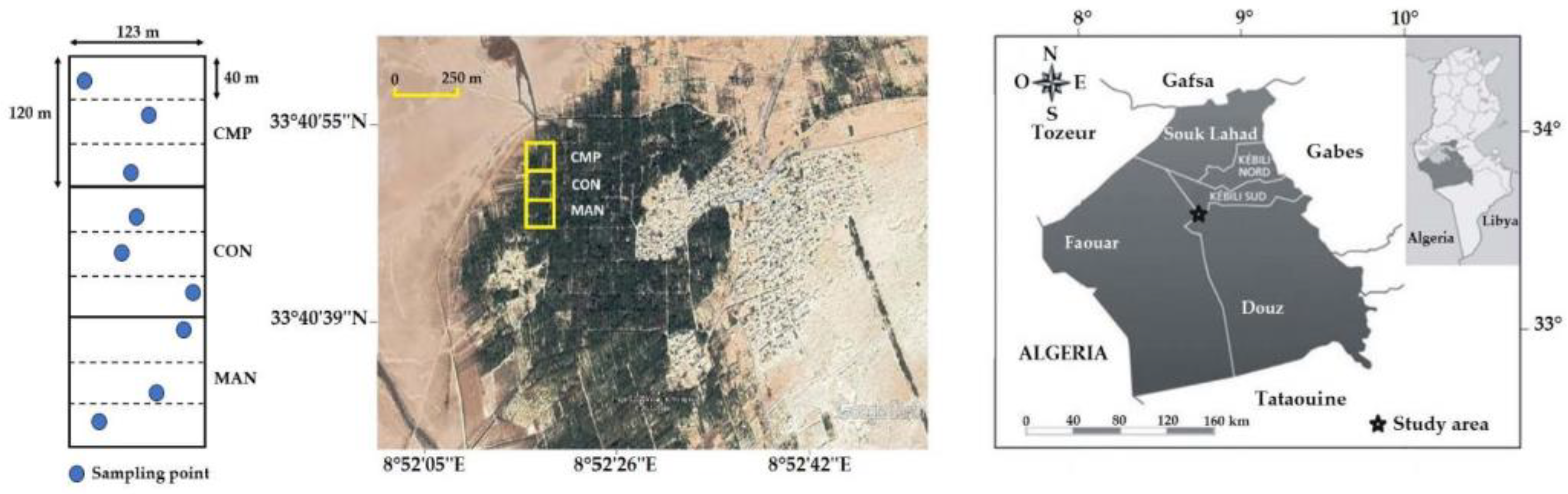
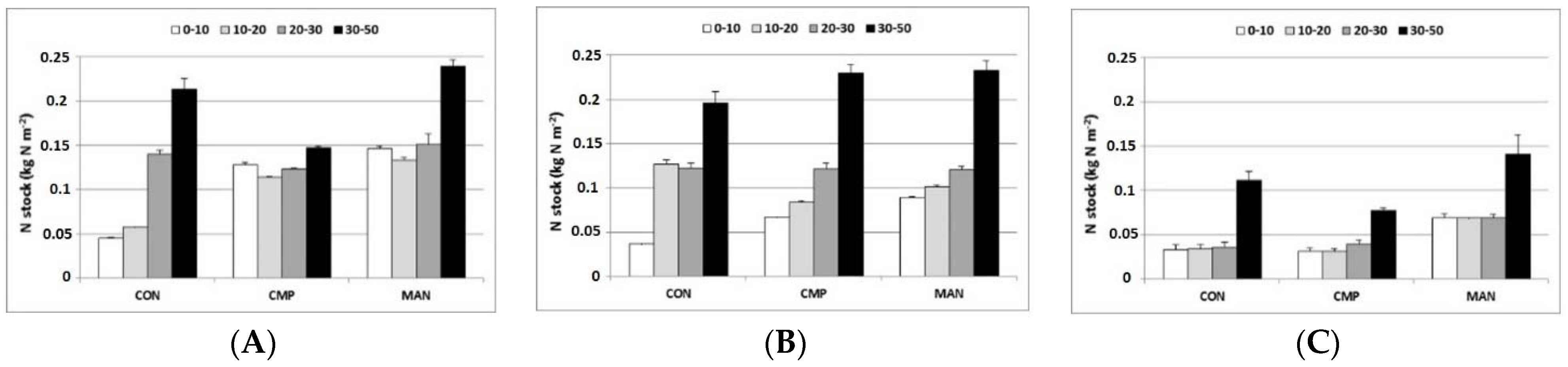
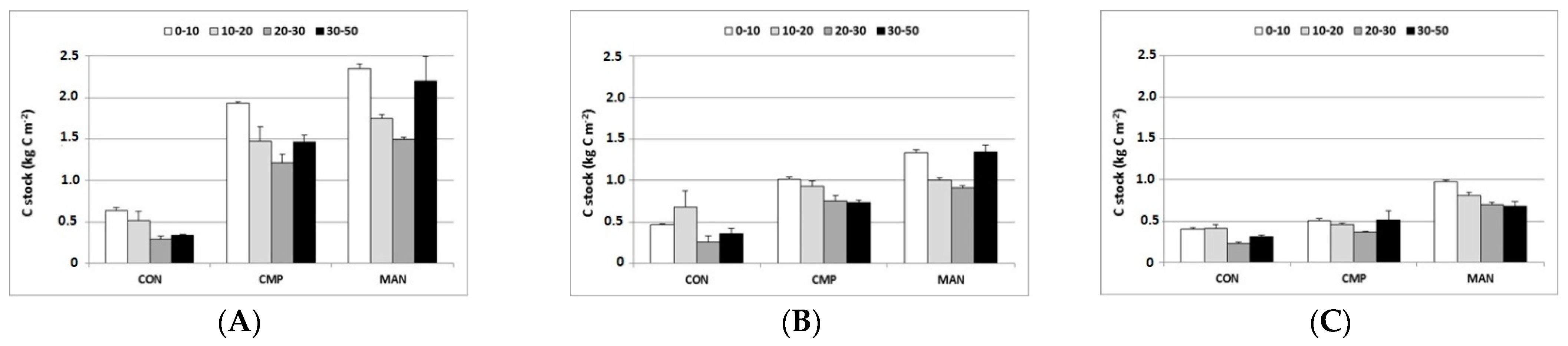
Soil organic matter plays an important role in improving soil properties, crop productivity and is a key constituent and driver of the global carbon cycle. Nevertheless, relatively limited quantitative information is available on the organic carbon (OC) stocks and the actual potentials for OC and total nitrogen (N) sequestration under arid cropping systems. In this study, we evaluated the immediate and long-term (after eight years) effects of compost or manure additions, at a rate of 100 t ha−1, on the soil OC and N stocks in the Gataaya oasis in Southern Tunisia. The oasis had been abandoned and no additions had taken place in the 10 years prior to experiment. Soil samples were taken systematically every 10 cm up to a depth of 50 cm. After adding compost (CMP) and manure (MAN) in 2013, the bulk density (BD) decreased in the surface layers, especially at the 0–10 cm soil layer where it declined from 1.53 g cm−3 to 1.38 g cm−3 under compost and 1.41 g cm−3 under manure. Soil OC and N stocks, however, increased after adding compost and manure. Manure contributed more to OC stock increase than compost, with +337 and +241%, respectively. Correspondingly, the N stock increased by + 47 and +12%, respectively, due to manure and compost. After four years, compared to 2013 stocks, the decrease in OC stock was almost identical with −43 (CMP) and −41% (MAN). However, N stock seemed more stable under compost compared to manure, with −2 and −19%, respectively. After eight years, the N stock remained higher in the deepest layer 30–50 cm compared to other layers. This suggested that high gypsum application can inhibit N mineralization. The initial enhanced OC stock after the organic amendment, both for compost and for manure, was very quickly lost and after eight years had virtually returned to the initial OC state by the end of the eight years. Therefore, these oasis ecosystems require a near annual supply of exogenous organic material to maintain OC at an enhanced level. After eight years, manure amendment was found to be better than compost for increasing soil OC (3.16 against 1.86 t/ha, respectively) and for increasing N (0.35 against 0.18 t/ha, respectively). However, the cost and availability make the amendment with compost more interesting in oasis (400 Tunisian dinars/t for compost against 1016 Tunisian dinars/t for manure).
Keywords: drylands; Anthroposols; palm date compost; OC and N stocks; continental oasis drylands; Anthroposols; palm date compost; OC and N stocks; continental oasis