Assessing Surface Water Quality Risks Under Climate Stress and Geopolitical Instability: An Information Systems Approach



Abstract
1. Introduction
- Integration of heterogeneous datasets from environmental monitoring systems, climate services, and geopolitical/strategic databases into a unified analytical dataset organized at the country–year observation level.
- Assessment of the influence of hydrological pressure and climate stress on nitrate concentrations in rivers, utilizing the WEI+ and Heat_Stress indicators.
- Investigation of the role of the geopolitical context and strategic infrastructures in shaping the vulnerability of water resource management systems, using GPR and Nuclear_State/Warheads indicators.
- Proposal of an analytical framework based on information systems capable of supporting integrated monitoring and decision-making processes for water resource management under conditions of climate stress and geopolitical uncertainty.
2. Materials and Methods
2.1. Data Series
- The dependent variable (Nitrate) is the concentration of nitrates in rivers (Nitrate), extracted from the Eurostat environmental statistics database [82]. The indicator is expressed in mg/L. In the analytical model, this variable is treated as a continuous numerical variable and represents the target for the ML algorithm.
- Hydrological Pressure: To capture the pressure on water resources, we used WEI+, which is available in the Eurostat sustainable development indicators database [83]. This indicator expresses the ratio (percentage) between the total volume of water abstracted and the available renewable freshwater resources, serving as a widely used tool in assessing hydrological stress. Within the dataset, the variable is treated as a continuous numerical variable expressed in percentages.
- Climatic Dimension: The climatic dimension is represented by the variable Heat_Stress, defined as the annual number of days characterized by thermal stress, based on data provided by the Copernicus Climate Change Service—European State of the Climate [84]. This variable reflects the intensity of extreme temperature episodes that can influence hydrological processes, evapotranspiration, and the concentration of pollutants in surface waters. The variable is treated as a discrete numerical indicator, expressed as the number of days per year.
- Geopolitical Context: The geopolitical context is captured through the GPR, developed by Caldara and Iacoviello [85]. This index measures the intensity of global geopolitical tensions based on the frequency of press articles about military conflicts, international tensions, and geopolitical risks. In the dataset [85], GPR is treated as a continuous numerical variable that reflects the level of geopolitical instability.
- Strategic Variable (Nuclear_State): The model also includes a strategic variable represented by the number of nuclear warheads, based on data provided by the Stockholm International Peace Research Institute [86] and the Federation of American Scientists [87]. This variable is used as a proxy for the presence of strategic infrastructure and the security context, which can indirectly influence environmental governance and natural resources management. The variable is treated as a discrete numerical variable, expressed as the estimated number of nuclear warheads. It does not represent a direct environmental pressure but rather a structural proxy reflecting the scale and complexity of national strategic infrastructures and their potential indirect influence on environmental governance.
- Temporal Variable (Year): In addition to the core variables, a temporal indicator (Year) was included in the analytical dataset to capture the evolution of nitrate concentration over time. This variable is treated as a discrete numerical variable. It allows the model to identify potential temporal patterns and structural changes in water quality dynamics. The inclusion of the Year enables the decision tree algorithm to detect time-dependent thresholds and shifts in the relationships between climatic stress, hydrological pressure, and nitrate concentration.
2.2. Conceptual Framework
2.3. Data Integration
- Data collection: Indicators were gathered from multiple international sources, presented in Section 2.1. The various data structures and formats necessitated a standardization process for integration into a unified analytical system.
- Harmonization of units and formats: Given that indicators from different sources often use distinct units of measurement or reporting formats, variables were standardized to ensure comparability across different states and time periods. This stage involved verifying units, converting variables where necessary, and unifying attribute names.
- Temporal alignment: As databases offer different temporal coverages, we identified the common interval where all variables were available. Observations were only retained for country–year combinations where values for all indicators in the model could be identified or estimated.
- Final Compilation: The harmonized variables were combined into an integrated country–year panel dataset. This structure allows for the simultaneous analysis of temporal variations and cross-state differences regarding the relationships between hydrological pressures, climatic stress, and the geopolitical context. The final dataset was initially structured in CSV (Comma-Separated Values) format for verification and cleaning. Subsequently, for the implementation of ML algorithms in WEKA, the dataset was converted into ARFF (Attribute–Relation File Format), the standard format used by this platform. We adopted the country-level aggregation to ensure compatibility with geopolitical and strategic indicators, which are inherently defined at the national level.
2.4. Missing Data Treatment
- For numerical variables: Missing values are replaced with the mean of the attribute.
- For nominal variables: Missing values are replaced with the mode (the most frequent category).
2.5. Decision Tree Algorithm
- Initial splitting: REPTree builds a decision tree by identifying the attribute that best splits the data. For the numerical “Nitrate” target, it uses variance reduction. The goal is to choose a split that minimizes the squared error (variance) of the values within each resulting branch.
- Handling continuous and discrete variables: Since the dataset includes both continuous and discrete variables, REPTree treats them as follows:
- ○
- Continuous: It sorts the values and tests different threshold points, creating binary splits.
- ○
- Discrete: It treats them as numerical values to identify the most significant break points in the data distribution.
- Pruning (The “REP” Component): To prevent overfitting (where the model learns “noise” in your country-year dataset), the algorithm uses Reduced Error Pruning. It holds back a portion of the data (the pruning set) to evaluate the tree. It then replaces subtrees with leaves (representing the average value) if the simplification does not increase the error on the pruning set.
- Missing values: As already noted, REPTree can handle missing values by using the distributed method (splitting the instances with missing values among the branches) or by utilizing your pre-imputed means.
- Speed: It is often faster than standard CART or M5P algorithms because it only builds the tree once and uses simple pruning logic.
- Interpretability: By pruning the tree, REPTree produces a model that is easy to visualize, allowing you to see exactly which factors lead to higher nitrate concentrations.
- Non-linearity: Unlike linear regression, REPTree can identify “threshold effects” for instance, identifying that Geopolitical Risk only impacts water quality once it passes a certain critical value.
2.6. Modeling Strategy and Analytical Design
- (i)
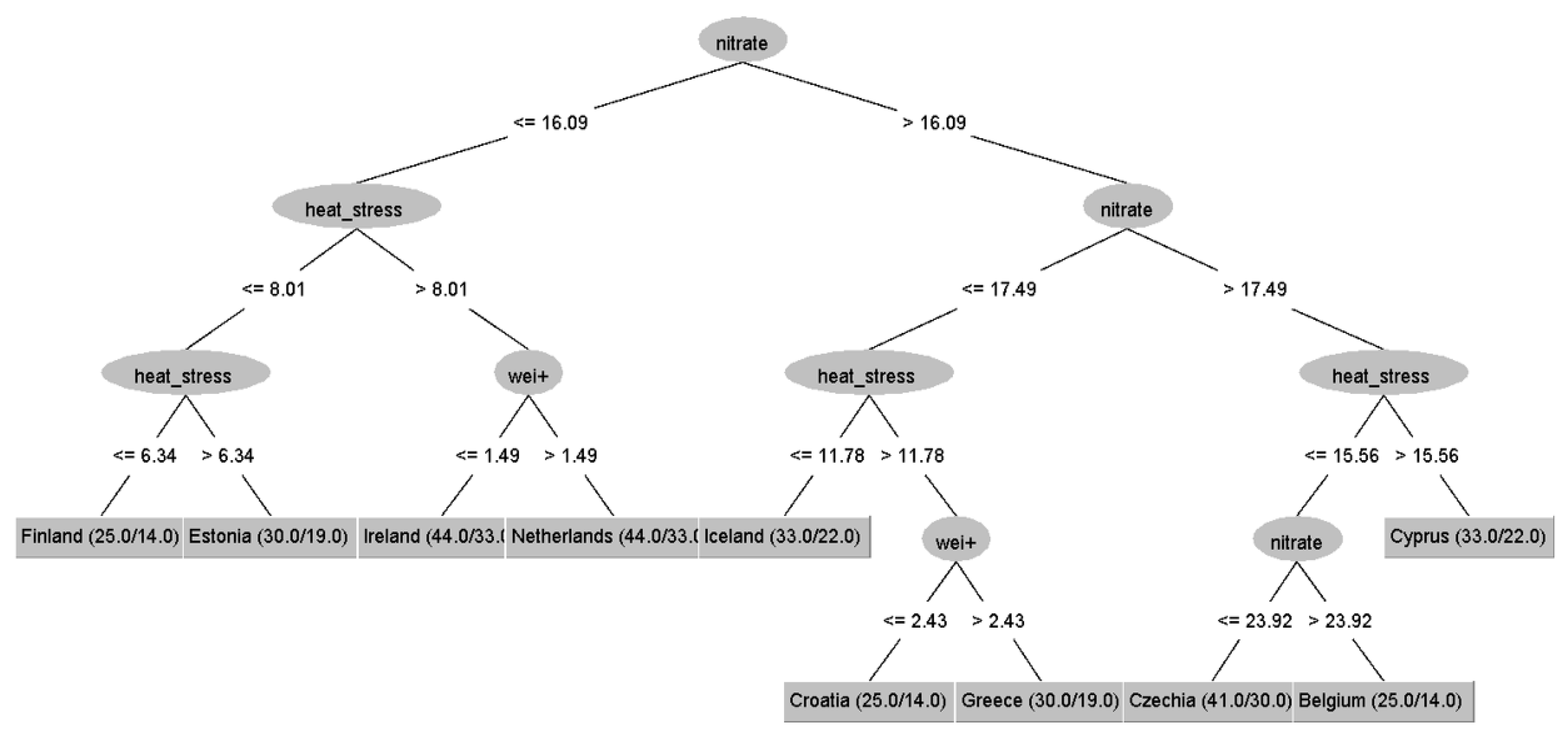
- An initial classification tree designed to identify ecological regimes of nitrate concentration based on threshold segmentation;
- (ii)
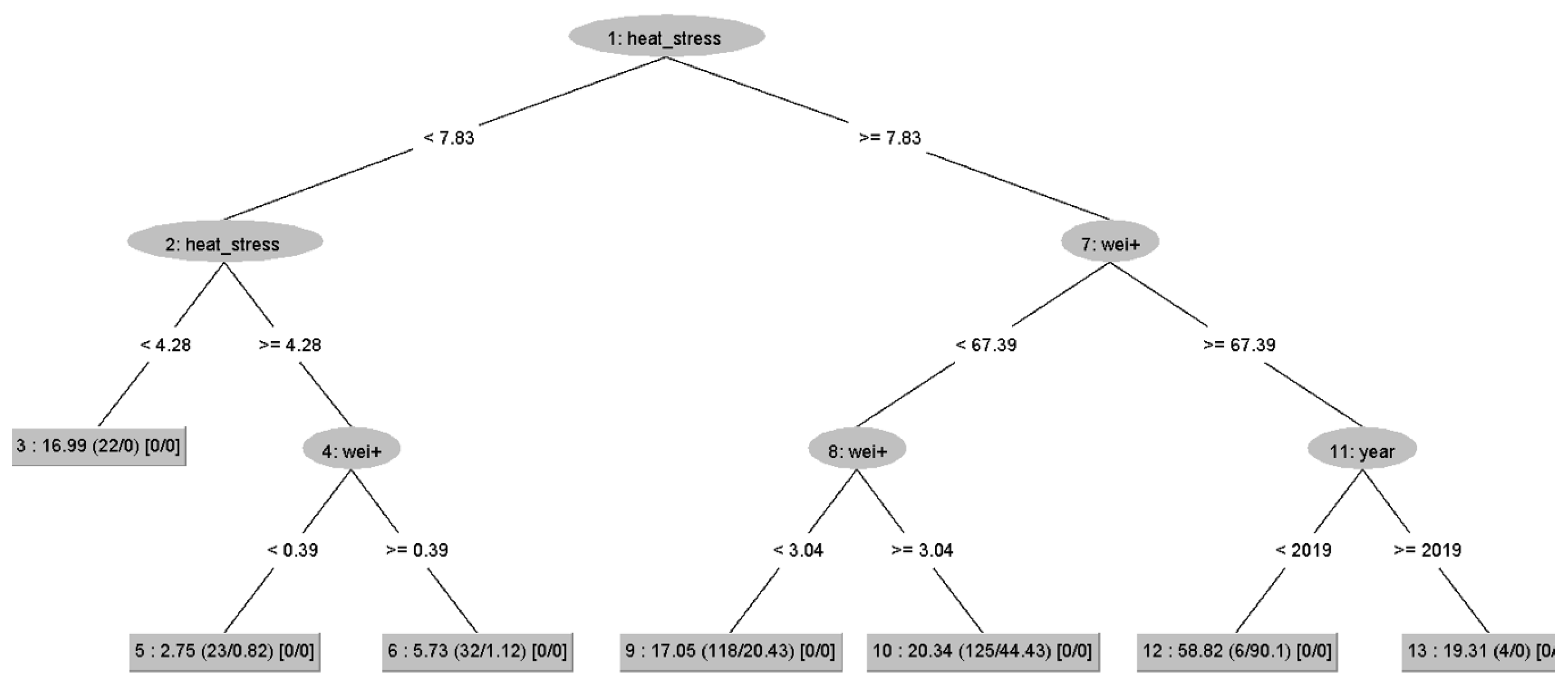
- An optimized regression tree aimed at predicting nitrate concentration as a continuous variable and identifying the hierarchy of predictors;
- (iii)
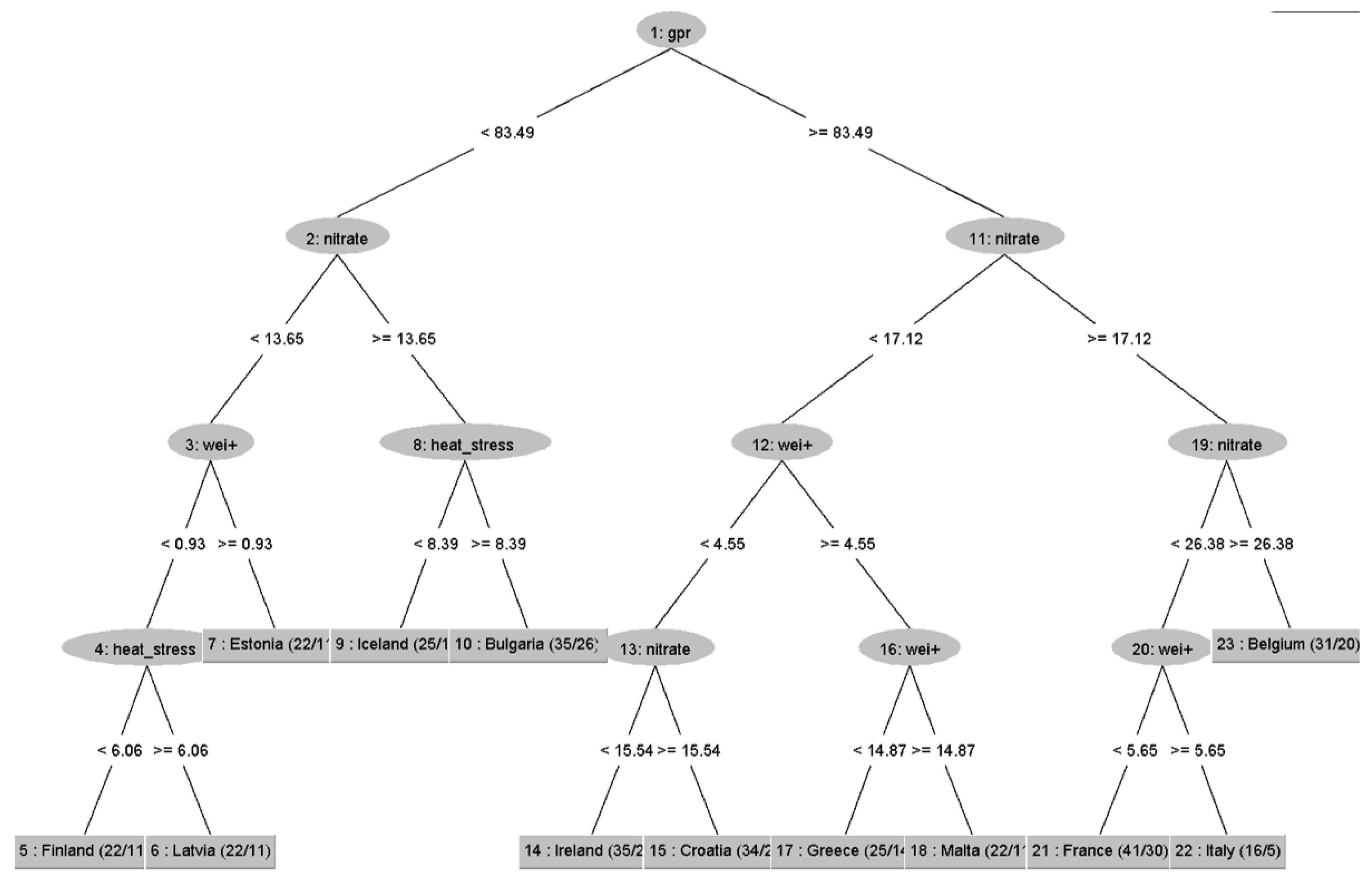
- An extended classification tree integrating geopolitical variables (GPR), used to assess the contextual influence of geopolitical instability on water quality dynamics.
2.7. Model Validation
- Mean Absolute Error (MAE): Expresses the average absolute error between observed and estimated values, providing a direct measure of prediction accuracy.
- Root Mean Squared Error (RMSE): Reflects the average magnitude of prediction errors while giving higher weight to larger errors. This is essential for understanding the model’s sensitivity to outliers.
- Correlation Coefficient: Measures the degree of association between the actual values of the dependent variable and the model’s predictions.
- Accuracy: Represents the proportion of correctly classified instances out of the total number of observations. It provides an overall measure of the model’s ability to correctly identify different classes.
- Precision: Expresses the proportion of correctly predicted positive instances out of all instances predicted as positive. It reflects the model’s ability to avoid false positive classifications.
- Recall: Measures the proportion of actual positive instances that are correctly identified by the model. It indicates the model’s ability to detect relevant cases and minimize false negatives.
- F1-score: Represents the harmonic mean of Precision and Recall, providing a balanced measure of model performance when both false positives and false negatives are important.
- ROC Area: Reflects the model’s ability to distinguish between classes across different classification thresholds. A higher value indicates better discriminative performance, with values close to 1 suggesting excellent classification capability.
3. Results
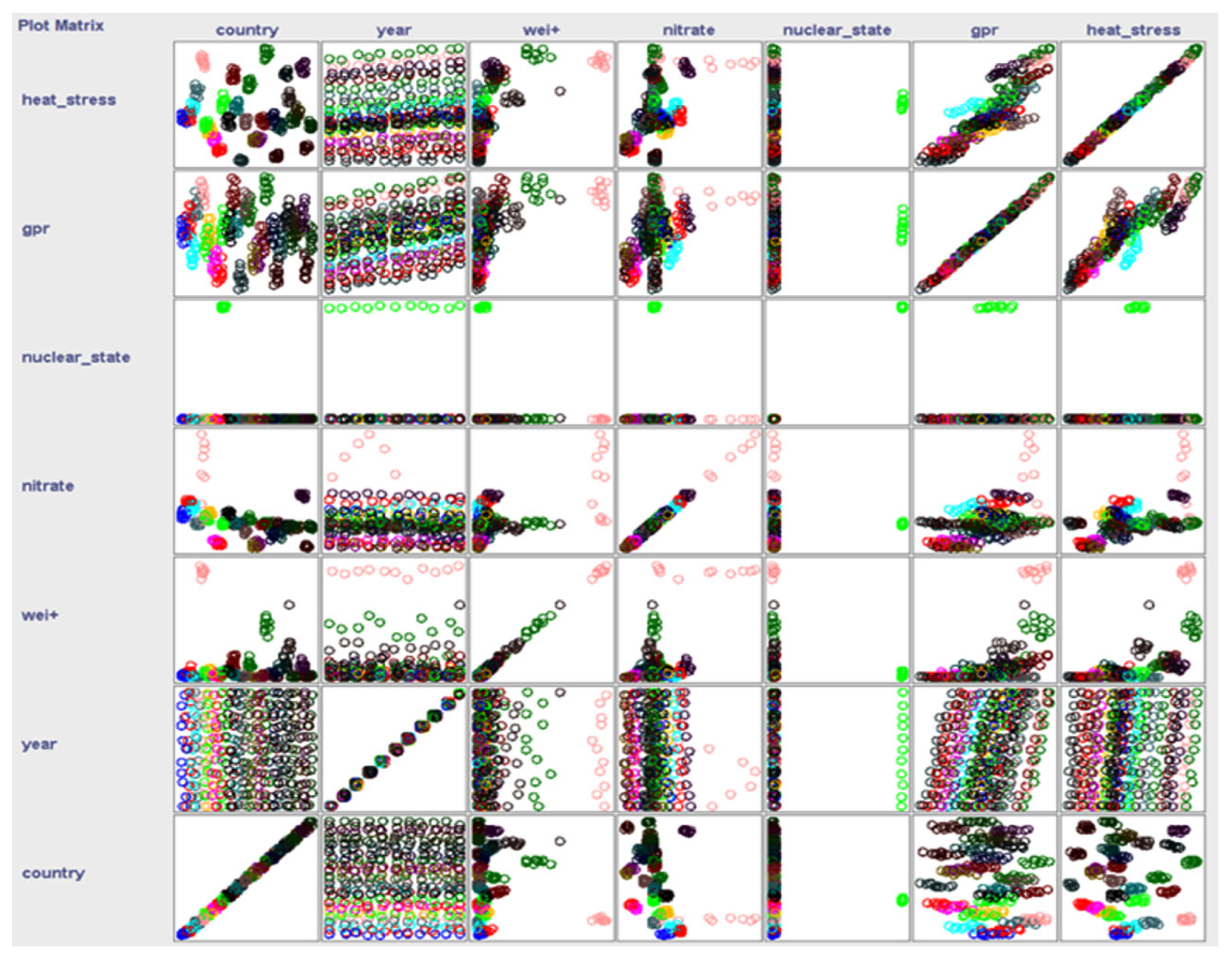
3.1. Exploratory Analysis of Variable Relationships
3.2. Initial Structure of the Decision Tree
3.3. Final Decision Tree Structure and Predictive Logic
3.4. Geopolitical and Strategic Context of Water Quality Risks
- The inclusion of Finland, Estonia, and Latvia (Northern-Baltic group) in the low GPR branch suggests that in politically stable contexts with lower water exploitation, nitrate levels are more directly a function of natural climate variability.
- The inclusion of Italy, France, and Greece (Mediterranean/Western Group) under higher GPR values indicates that in these regions, water quality is managed (or stressed) within more volatile socio-economic frameworks, where irrigation and heat stress play a compounding role.
- The inclusion of Belgium in the “very high concentration” terminal branches aligns with known data regarding high population density and intensive livestock farming, which create the “anthropogenic pressure” the model detected.
3.5. Comparative Analysis of the Decision Tree Models
4. Discussion
5. Conclusions
Author Contributions
Funding
Data Availability Statement
Conflicts of Interest
References
- World Health Organization. Strong Systems and Sound Investments: Evidence on and Key Insights into Accelerating Progress on Sanitation, Drinking-Water and Hygiene, UN-Water Global Analysis and Assessment of Sanitation and Drinking-Water (GLAAS) 2022 Report. Available online: https://www.who.int/publications/i/item/9789240065031 (accessed on 15 January 2026).
- World Health Organization. Water, Sanitation, Hygiene and Health: A Primer for Health Professionals; World Health Organization: Switzerland, Geneva, 2019; Available online: https://www.who.int/publications/i/item/WHO-CED-PHE-WSH-19.149 (accessed on 15 January 2026).
- Bărbulescu, A.; Barbes, L.; Dumitriu, C.S. Statistical assessment of the water quality using water quality indicators—Case study from India. In Water Safety, Security and Sustainability. Advanced Sciences and Technologies for Security Applications; Vaseashta, A., Maftei, C., Eds.; Springer: Cham, Switzerland; pp. 599–613.
- Nichita, C.; Voinea, S. Removal of the pharmaceutical pollutants from water using natural filter materials-experimental lab. Rom. Rep. Phys. 2024, 76, 706. [Google Scholar] [CrossRef]
- Tăban, C.I.; Sandu, A.; Oancea, S.; Stoia, M. Gross alpha/beta radioactivity of drinking water and relationships with quality parameters of water from Alba County, Romania. Rom. J. Phys. 2024, 69, 806. [Google Scholar]
- Chabuk, A.; Al-Madhlom, Q.; Al-Maliki, A.; Al-Ansari, N.; Hussain, H.; Knutsson, S. Water quality assessment along Tigris River (Iraq) using water quality index (WQI) and GIS software. Arab. J. Geosci. 2020, 13, 654. [Google Scholar] [CrossRef]
- Pueppke, S.G.; Nurtazin, S.T.; Graham, N.A.; Qi, J. Central Asia’s Ili River ecosystem as a wicked problem: Unraveling complex interrelationships at the interface of water, energy, and food. Water 2018, 10, 541. [Google Scholar] [CrossRef]
- Rosianu, A.-M.; Leru, P.M.; Stefan, S.; Iorga, G.; Marmureanu, L. Six-year monitoring of atmospheric pollen and major air pollutant concentrations in relation with meteorological factors in Bucharest, Romania. Rom. Rep. Phys. 2022, 74, 703. [Google Scholar]
- Grizzetti, B.; Bouraoui, F.; Billen, G.; van Grinsven, H.; Cardoso, A.C.; Thieu, V.; Garnier, J.; Curtis, C.; Howarth, R.; Johnes, P. Nitrogen as a threat to European water quality. In The European Nitrogen Assessment; Sutton, M.A., Ed.; Cambridge University Press: Cambridge, UK, 2011; pp. 379–404. [Google Scholar]
- Yousefi, H.; Karimi Douna, B. Risk of Nitrate Residues in Food Products and Drinking Water. Asian Pac. J. Environ. Cancer 2023, 6, 69–79. [Google Scholar] [CrossRef]
- Møller, H.; Landt, J.; Jensen, P.E.R.; Pedersen, E.; Autrup, H.; Jensen, O.L.E.M. Nitrate exposure from drinking water and diet in a Danish rural population. Int. J. Epidemiol. 1989, 18, 206–212. [Google Scholar] [CrossRef]
- Wolfe, A.H.; Patz, J.A. Reactive nitrogen and human health: Acute and long-term implications. AMBIO A J. Hum. Environ. 2002, 31, 120–125. [Google Scholar] [CrossRef]
- Comly, H.H. Cyanosis in infants caused by nitrates in well water. J. Am. Med. Assoc. 1945, 129, 112–116. [Google Scholar] [CrossRef]
- WHO. Guidelines for Drinking-Water Quality, Incorporating the First and Second Addenda, 4th ed.; World Health Organization: Switzerland, Geneva, 2022; p. 631. [Google Scholar]
- Ward, M.H.; deKok, T.M.; Levallois, P.; Brender, J.; Gulis, G.; Nolan, B.T.; VanDerslice, J. Workgroup Report: Drinking-Water Nitrate and Health─Recent Findings and Research Needs. Environ. Health Perspect. 2005, 113, 1607–1614. [Google Scholar] [CrossRef]
- Fewtrell, L. Drinking-water nitrate, methemoglobinemia, and global burden of disease: A discussion. Environ. Health Perspect. 2004, 112, 1371–1374. [Google Scholar] [CrossRef] [PubMed]
- Wang, J.; Liu, X.; Beusen, A.H.W.; Middelburg, J.J. Surface-Water Nitrate Exposure to World Populations Has Expanded and Intensified during 1970–2010. Environ. Sci. Technol. 2023, 57, 19395–19406. [Google Scholar] [CrossRef] [PubMed]
- Wanderi, E.W.; Gettel, G.M.; Singer, G.A.; Masese, F.O. Drivers of water quality in Afromontane-savanna rivers. Front. Environ. Sci. 2022, 10, 972153. [Google Scholar] [CrossRef]
- Alharbi, T.; El-Sorogy, A.S. Health Risk Assessment of Nitrate and Fluoride in the Groundwater of Central Saudi Arabia. Water 2023, 15, 2220. [Google Scholar] [CrossRef]
- Birsan, M.-V.; Sfîcă, L.; Amihăesei, V.-A.; Nita, I.-A.; Dogaru, D.; Lupu, L. Centennial Trends in Precipitation, Air Temperature, Evapotranspiration and Water Balance over Romania from Observational Data (1924–2023). Rom. J. Phys. 2025, 70, 805. [Google Scholar] [CrossRef]
- Barbulescu, A.; Maftei, C. Modeling the climate in the area of Techirghiol Lake (Romania). Rom. J. Phys. 2015, 60, 1163–1170. [Google Scholar]
- La Jeunesse, I.; Cirelli, C.; Aubin, D.; Larrue, C.; Deidda, R. Is climate change a threat for water uses in the Mediterranean region? Results from a survey at local scale. Sci. Total Environ. 2016, 543, 981–996. [Google Scholar] [CrossRef]
- Chiritescu, R.-V.; Luca, E.; Iorga, G. Observational study of major air pollutants over urban Romania in 2020 in comparison with 2019. Rom. Rep. Phys. 2024, 76, 702. [Google Scholar]
- Ene, A.; Bogdevich, O.; Culicov, A.S. Metals and natural radioactivity investigation of Danube River water in the lower sector. Rom. J. Phys. 2024, 69, 802. [Google Scholar] [CrossRef]
- Costa, D.; Sutter, C.; Shepherd, A.; Jarvie, H.; Wilson, H.; Elliott, J.; Liu, J.; Macrae, M. Impact of climate change on catchment nutrient dynamics: Insights from around the world. Environ. Rev. 2023, 31, 4–25. [Google Scholar] [CrossRef]
- Eekhout, J.P.C.; Hunink, J.E.; Terink, W.; de Vente, J. Why increased extreme precipitation under climate change negatively affects water security. Hydrol. Earth Syst. Sci. 2018, 22, 5935–5946. [Google Scholar] [CrossRef]
- Wang, Y.; Xu, H.; Zhao, X.; Kang, L.; Qiu, Y.; Paerl, H.; Zhu, G.; Li, H.; Zhu, M.; Qin, B.; et al. Rainfall impacts on nonpoint nitrogen and phosphorus dynamics in an agricultural river in subtropical montane reservoir region of southeast China. J. Environ. Sci. 2025, 149, 551–563. [Google Scholar] [CrossRef] [PubMed]
- Yang, X.; Li, T.; Hua, K.; Zhang, Y. Investigation of First Flushes in a Small Rural-Agricultural Catchment. Pol. J. Environ. Stud. 2015, 24, 381–389. [Google Scholar] [CrossRef] [PubMed]
- Krishnaswamy, U.R.; Moruzzi, R.B. Water pollution: How human activities have shaped the XXI century water crisis. In Water Resources and Environmental Sustainability; CRC Press: Boca Raton, FL, USA, 2022. [Google Scholar]
- Brears, R.C. Urban Water Security; Routledge: Abingdon, UK, 2016. [Google Scholar]
- Zhang, S.; Yan, X.; Feng, T.; Zhang, X.; Qiao, R.; Ren, Y.; Chen, Q. Unraveling nonlinear impacts of land use change on riverine water quality under future scenarios. Ecol. Indic. 2025, 179, 114258. [Google Scholar] [CrossRef]
- Khatri, N.; Tyagi, S. Influences of natural and anthropogenic factors on surface and groundwater quality in rural and urban areas. Front. Life Sci. 2015, 8, 23–39. [Google Scholar] [CrossRef]
- Best, J. Anthropogenic stresses on the world’s big rivers. Nat. Geosci. 2019, 12, 7–21. [Google Scholar] [CrossRef]
- Almeida, C.; Gonzalez, S.O.; Mallea, M.; Gonzalez, P. A recreational water quality index using chemical, physical and microbiological parameters. Environ. Sci. Pollut. Res. 2012, 19, 3400–3411. [Google Scholar] [CrossRef]
- Sutadian, A.D.; Muttil, N.; Yilmaz, A.G.; Perera, B.J.C. Development of a water quality index for rivers in West Java Province. Indonesia. Ecol. Indic. 2018, 85, 966–982. [Google Scholar] [CrossRef]
- Dojlido, J.A.N.; Raniszewski, J.; Woyciechowska, J. Water quality index applied to rivers in the Vistula River basin in Poland. Environ. Monit. Assess. 1994, 33, 33–42. [Google Scholar] [CrossRef]
- Rocchini, R.; Swain, L.G. The British Columbia Water Quality Index; Water Quality Branch, Environmental Protection Department British Columbia Ministry of Environment, Lands and Parks: Williams Lake, BC, Canada, 1995; 13p.
- Cude, C.G. Oregon water quality index: A tool for evaluating water quality management effectiveness. J. Am. Water Resour. Assoc. 2001, 37, 125–137. [Google Scholar] [CrossRef]
- Liou, S.-M.; Lo, S.-L.; Wang, S.-H. A Generalized Water Quality Index for Taiwan. Environ. Monit. Assess. 2004, 96, 35–52. [Google Scholar] [CrossRef] [PubMed]
- Uddin, M.G.; Nash, S.; Olbert, A.I. A review of water quality index models and their use for assessing surface water quality. Ecol. Indic. 2021, 122, 107218. [Google Scholar] [CrossRef]
- European Environment Agency (EEA). European Bathing Water Quality in 2024; EEA Publications: Copenhagen, Denmark, 2025. [Google Scholar]
- World Health Organization (WHO). Guidelines for Safe Recreational Water Environments. In Volume 1: Coastal and Fresh Waters; WHO: Geneva, Switzerland, 2021. [Google Scholar]
- Bărbulescu, A.; Barbeș, L. Integrated Assessment of Bathing Water Quality Along the Romanian Black Sea Coast. Water 2026, 18, 439. [Google Scholar] [CrossRef]
- du Plessis, A. Water as a source of conflict and global risk. In Freshwater Challenges of South Africa and its Upper Vaal River; du Plessis, A., Ed.; Springer: Cham, Switzerland, 2018; pp. 67–84. [Google Scholar]
- Chellaney, B. Water, Peace, and War: Confronting the Global Water Crisis; Rowman & Littlefield: Lanham, MD, USA, 2015. [Google Scholar]
- Daoudy, M.; Al-Saidi, M.; Al-Manji, A.; Ayoub, J.; Bateh, F. Troubled Waters in Conflict and a Changing Climate: Transboundary Basins Across the Middle East and North Africa. 2024. Available online: https://carnegieendowment.org/research/2025/05/troubled-waters-in-conflict-and-a-changing-climate-transboundary-basins-across-the-middle-east-and-north-africa (accessed on 10 March 2026).
- Elmotawakkil, A.; Enneya, N.; Bhagat, S.K.; Ouda, M.M.; Kumar, V. Advanced machine learning models for robust prediction of water quality index and classification. J. Hydroinform. 2025, 27, 299–319. [Google Scholar] [CrossRef]
- Pimenow, S.; Pimenowa, O.; Prus, P.; Niklas, A. The impact of artificial intelligence on the sustainability of regional ecosystems: Current challenges and future prospects. Sustainability 2025, 17, 4795. [Google Scholar] [CrossRef]
- Maldonado-Benitez, V.M.; Morales-Matamoros, O.; Hernández-Castillo, G. Towards resilient cities: Systematic review of artificial intelligence applications for water management. Water 2025, 17, 1978. [Google Scholar]
- León-Ovelar, R. Data science and public policies: Towards water security. In Smart Water Quality Monitoring: Artificial Intelligence Applications; Gutiérrez, D., Millán, P., Blasco, J., Eds.; Springer: Cham, Switzerland, 2026; pp. 1–28. [Google Scholar]
- Bărbulescu, A.; Dumitriu, C.Ș. Assessing Water Quality by Statistical Methods. Water 2021, 13, 1026. [Google Scholar] [CrossRef]
- Ahmadpour, A.; Mirhashemi, S.H.; Haghighatjou, P.; Foroughi, F. Comparison of the monthly streamflow forecasting in Maroon dam using HEC-HMS and SARIMA models. Sustain. Water Resour. Manag. 2022, 8, 158. [Google Scholar] [CrossRef]
- Barbulescu, A.; Nazzal, Y.; Howari, F. Assessing the Groundwater Quality in the Liwa Area, the United Arab Emirates. Water 2020, 12, 2816. [Google Scholar] [CrossRef]
- Bărbulescu, A.; Barbeş, L. Assessing the water quality of the Danube River (at Chiciu, Romania) by statistical methods. Environ. Earth Sci. 2020, 79, 122. [Google Scholar] [CrossRef]
- Zhang, X.; Wu, X.; Zhu, G.; Lu, X.; Wang, K. A seasonal ARIMA model based on the gravitational search algorithm (GSA) for runoff prediction. Water Supply 2022, 22, 6959–6977. [Google Scholar] [CrossRef]
- Lokman, A.; Ismail, W.Z.W.; Aziz, N.A.A. A review of water quality forecasting and classification using machine learning models and statistical analysis. Water 2025, 17, 2243. [Google Scholar] [CrossRef]
- Tyralis, H.; Papacharalampous, G.; Langousis, A. A Brief Review of Random Forests for Water Scientists and Practitioners and Their Recent History in Water Resources. Water 2019, 11, 910. [Google Scholar] [CrossRef]
- Reichstein, M.; Camps-Valls, G.; Stevens, B.; Jung, M.; Denzler, J.; Carvalhais, N.; Prabhat. Deep learning and process understanding for data-driven Earth system science. Nature 2019, 566, 195–204. [Google Scholar] [CrossRef] [PubMed]
- Schmidt, L.; Heße, F.; Attinger, S.; Kumar, R. Challenges in applying machine learning models for hydrological inference: A case study for flooding events across Germany. Water Resour. Res. 2020, 56, e2019WR025924. [Google Scholar] [CrossRef]
- Bărbulescu, A.; Zhen, L. Forecasting the River Water Discharge by Artificial Intelligence Methods. Water 2024, 16, 1248. [Google Scholar] [CrossRef]
- Yan, X.; Zhang, T.; Du, W.; Meng, Q.; Xu, X. A comprehensive review of machine learning for water quality prediction over the past five years. J. Mar. Sci. Eng. 2024, 12, 159. [Google Scholar] [CrossRef]
- Xie, Z.; Liu, W.; Chen, S.; Yao, R.; Yang, C.; Zhang, X.; Li, J.; Wang, Y.; Zhang, Y. Machine learning approaches to identify hydrochemical processes and predict drinking water quality. J. Hydrol. Reg. Stud. 2025, 58, 102227. [Google Scholar] [CrossRef]
- Simian, D.; Șerban, M.E.; Bărbulescu, A. Machine Learning-Based Multifaceted Analysis Framework for Comparing and Selecting Water Quality Indices. Water Resour. Manag. 2025, 39, 847–863. [Google Scholar] [CrossRef]
- Sit, M.; Demiray, B.Z.; Xiang, Z.; Ewing, G.J.; Sermet, Y.; Demir, I. A comprehensive review of deep learning applications in hydrology and water resources. arXiv 2020, arXiv:2007.12269. [Google Scholar] [CrossRef]
- Li, Y.; Han, F.; Zheng, Y. Artificial intelligence in surface water quality research and management: Recent progress and future directions. Ecosyst. Health Sustain. 2026, 12, 0474. [Google Scholar] [CrossRef]
- Das, A. Prediction of urban surface water quality scenarios using water quality index, multivariate techniques, and machine learning models. Earth Syst. Environ. 2025, 10, 605–641. [Google Scholar] [CrossRef]
- Dorado-Guerra, D.Y.; Corzo-Pérez, G. Machine learning models to predict nitrate concentration in a river basin. Environ. Res. Commun. 2022, 4, 125012. [Google Scholar] [CrossRef]
- He, M.; Qian, Q.; Liu, X.; Zhang, J.; Curry, J. Recent progress on surface water quality models utilizing machine learning techniques. Water 2024, 16, 3616. [Google Scholar] [CrossRef]
- Helaly, M.A.; Rady, S.; Mabrouk, M.; Aref, M. Advancements in water quality prediction: A practical review of machine learning and deep learning approaches. Clust. Comput. 2025, 28, 598. [Google Scholar] [CrossRef]
- El-Magd, A.S.; Masoud, A.M.; Brink, H.G. Groundwater vulnerability under climate change: A machine learning framework. Earth Syst. Environ. 2025. [Google Scholar] [CrossRef]
- Zhen, L.; Bărbulescu, A. Comparative Analysis of Convolutional Neural Network-Long Short-Term Memory, Sparrow Search Algorithm-Backpropagation Neural Network, and Particle Swarm Optimization-Extreme Learning Machine Models for the Water Discharge of the Buzău River, Romania. Water 2024, 16, 289. [Google Scholar] [CrossRef]
- Das, B.K.; Paul, S.; Mandal, B.; Gogoi, P.; Paul, L. Integrating machine learning models for optimizing ecosystem health assessments through prediction of nitrate-N concentrations in the lower stretch of the Ganga River. Environ. Sci. Pollut. Res. 2025, 32, 4670–4689. [Google Scholar] [CrossRef]
- Karunanidhi, D.; Raj, M.R.H.; Subramani, T.; Wu, J. Source apportionment and prediction of groundwater nitrate using hydrochemistry and machine learning approaches. Environ. Geochem. Health 2026, 48, 138. [Google Scholar] [CrossRef]
- Dragomir, F.L.; Alexandrescu, G.; Postolache, F. Tools for hierarchical security modeling. In Proceedings of the 14th International Scientific Conference eLearning and Software for Education, Bucharest, Romania, 19–20 April 2018; Volume 4, pp. 34–38. [Google Scholar]
- Dragomir-Constantin, F.-L.; Beldiman, C.M.; Zlati, M. Informational approaches in modelling social and economic relations: Study on migration and access to services in the European Union. Systems 2025, 13, 469. [Google Scholar] [CrossRef]
- Deng, Y.; Zhang, Y.; Pan, D.; Yang, S.X.; Gharabaghi, B. Review of recent advances in remote sensing and machine learning methods for lake water quality management. Remote Sens. 2024, 16, 4196. [Google Scholar] [CrossRef]
- Pan, D.; Deng, Y.; Yang, S.X.; Gharabaghi, B. Recent advances in remote sensing and artificial intelligence for river water quality forecasting. Environments 2025, 12, 158. [Google Scholar] [CrossRef]
- Pandit, A.; Golden, H.E.; Christensen, J.R.; Lane, C.R.; Husic, A. Deep learning prediction and interpretation of riverine nitrate export across the Mississippi River Basin. Water Resour. Res. 2025, 61, e2024WR039207. [Google Scholar] [CrossRef]
- Muñoz-Alegría, J.A.; Núñez, J.; Oyarzún, R.; Chávez, C. A bibliometric systematic literature review of machine learning-based water quality prediction. Water 2025, 17, 2994. [Google Scholar] [CrossRef]
- Zhang, Z.; Wang, D.; Mei, Y.; Zhu, J.; Xiao, X. Developing an explainable deep learning module based on the LSTM framework for flood prediction. Front. Water 2025, 7, 1562842. [Google Scholar] [CrossRef]
- Zounemat-Kermani, M.; Kheimi, M. Explainable Artificial Intelligence in Hydrology: A Review. Water Resour. Manag. 2026, 40, 106. [Google Scholar] [CrossRef]
- European Environment Agency. Status of Nitrates in Rivers in European Countries. Available online: https://www.eea.europa.eu/en/analysis/indicators/nutrients-in-freshwater-in-europe-1763998761/status-of-nitrates-in-rivers-in-european-countries?activeTab=570bee2d-1316-48cf-adde-4b640f92119b (accessed on 1 February 2026).
- Eurostat. Water Exploitation Index, Plus (WEI+). Available online: https://ec.europa.eu/eurostat/databrowser/view/SDG_06_60/default/table?lang=en (accessed on 1 February 2026).
- Copernicus Climate Change Service—European State of the Climate (ESOTC). Available online: https://climate.copernicus.eu/esotc/2024 (accessed on 1 February 2026).
- Caldara, D.; Iacoviello, M. Measuring Geopolitical Risk. Am. Econ. Rev. 2022, 112, 1194–1225. [Google Scholar] [CrossRef]
- SIPRI Databases. Available online: https://www.sipri.org/databases (accessed on 1 February 2026).
- Status of World Nuclear Forces. Available online: https://fas.org/initiative/status-world-nuclear-forces/ (accessed on 1 February 2026).
- Witten, I.H.; Frank, E.; Hall, M.A.; Pal, C.J. Data Mining: Practical Machine Learning Tools and Techniques, 4th ed.; Morgan Kaufmann: Cambridge, MA, USA, 2016. [Google Scholar]
- Elomaa, T.; Kaariainen, M. An Analysis of Reduced Error Pruning. J. Mach. Learn. Res. 2001, 1, 163–185. [Google Scholar] [CrossRef]
- Quinlan, J.R. Simplifying Decision Trees. Int. J. Man-Mach. Stud. 1987, 27, 221–234. [Google Scholar] [CrossRef]
- Esposito, F.; Malerba, D.; Semeraro, G. A Comparative Analysis of Methods for Pruning Decision Trees. IEEE Trans. Pattern Anal. Mach. Intell. 1997, 19, 476–493. [Google Scholar] [CrossRef]
- Bekkar, M.; Djemaa, H.K.; Alitouche, T.A. Evaluation Measures for Models Assessment over Imbalanced Data Sets. J. Inform. Eng. Appl. 2013, 3, 27–38. [Google Scholar]
- Mirumachi, N. Transboundary Water Politics in the Developing World; Routledge: London, UK, 2015. [Google Scholar]
- Zeitoun, M.; Warner, J.F. Hydro-hegemony: A framework for analysis of trans-boundary water conflicts. Water Policy 2006, 8, 435–460. [Google Scholar] [CrossRef]
- Grey, D.; Sadoff, C. Beyond the river: The benefits of cooperation on international rivers. Water Sci. Technol. 2003, 47, 91–96. [Google Scholar] [CrossRef]
- Azizi, M.A.; Leandro, J. Factors Affecting Transboundary Water Disputes: Nile, Indus, and Euphrates–Tigris River Basins. Water 2025, 17, 525. [Google Scholar] [CrossRef]
- Hecht, G. The Radiance of France: Nuclear Power and National Identity After World War II; MIT Press: Cambridge, MA, USA, 2009. [Google Scholar]
- Joerges, B.; Shinn, T. Instrumentation Between Science, State and Industry; Kluwer Academic Publishers: Dordrecht, The Netherlands, 2001. [Google Scholar]
- Dryzek, J.S. The Politics of the Earth: Environmental Discourses, 4th ed.; Oxford University Press: Oxford, UK, 2021. [Google Scholar]
- Khan, K.; Khurshid, A.; Cifuentes-Faura, J. Is geopolitics a new risk to environmental policy in the European union? J. Environ. Manag. 2023, 345, 118868. [Google Scholar] [CrossRef]
- Jensen, J.R. Remote Sensing of the Environment: An Earth Resource Perspective, 2nd ed.; Prentice Hall: Upper Saddle River, NJ, USA, 2007. [Google Scholar]
- Lillesand, T.M.; Kiefer, R.W.; Chipman, J.W. Remote Sensing and Image Interpretation, 7th ed.; Wiley: New York, NY, USA, 2015. [Google Scholar]
- Longley, P.A.; Goodchild, M.F.; Maguire, D.J.; Rhind, D.W. Geographic Information Systems and Science, 3rd ed.; Wiley: Chichester, UK, 2015. [Google Scholar]
- Maguire, D.J.; Batty, M.; Goodchild, M.F. GIS, Spatial Analysis, and Modeling; ESRI Press: Redlands, CA, USA, 2005. [Google Scholar]
- Usali, N.; Ismail, M.H. Use of Remote Sensing and GIS in Monitoring Water Quality. J. Sustain. Dev. 2010, 3, 228. [Google Scholar] [CrossRef]
- Quinlan, J.R. C4.5: Programs for Machine Learning; Morgan Kaufmann: San Mateo, CA, USA, 1993. [Google Scholar]
- Breiman, L.; Friedman, J.; Stone, C.J.; Olshen, R.A. Classification and Regression Trees; CRC Press: Boca Raton, FL, USA, 1984. [Google Scholar]
- Breiman, L. Random Forests. Mach. Learn. 2001, 45, 5–32. [Google Scholar] [CrossRef]
- Friedman, J.H. Greedy Function Approximation: A Gradient Boosting Machine. Ann. Stat. 2001, 29, 1189–1232. [Google Scholar] [CrossRef]
- Hastie, T.; Tibshirani, R.; Friedman, J. The Elements of Statistical Learning, 2nd ed.; Springer: New York, NY, USA, 2009. [Google Scholar]



| Category | Indicator | Data Type | Unit |
|---|---|---|---|
| Strategic | Nuclear warheads | Discrete numeric | Number of warheads |
| Geopolitical | GPR | Continuous | Index |
| Climatic | Heat stress days | Discrete numeric | Days/year |
| Hydrological Pressure | WEI+ | Continuous | % |
| Water Quality (Target) | Nitrate concentration in rivers | Continuous | mg/L |
| Indicator | Value |
|---|---|
| Accuracy | 85.76% |
| Kappa statistics | 0.853 |
| Precision | 0.815 |
| Recall | 0.893 |
| F1-score | 0.866 |
| ROC Area | 0.935 |
| Rule | Conditions | Nitrate (mg/L) | Interpretation |
|---|---|---|---|
| R1 | Heat_Stress < 4.28 | 16.99 | Moderate nitrate level under low climate stress conditions |
| R2 | 4.28 ≤ Heat_Stress < 7.83 and WEI+ < 0.39 | 2.75 | Very low nitrate level under low hydrological pressure conditions |
| R3 | 4.28 ≤ Heat_Stress < 7.83 and WEI+ ≥ 0.39 | 5.73 | Low nitrate level under moderate hydrological pressure conditions |
| R4 | Heat_Stress ≥ 7.83 and WEI+ < 67.39 | 17.05 | Moderate nitrate level under high climate stress |
| R5 | Heat_Stress ≥ 7.83 and WEI+ ≥ 67.39 | 20.34 | High nitrate level associated with intense hydrological pressure |
| R6 | Heat_Stress ≥ 7.83 and WEI+ ≥ 67.39 and Year < 2019 | 58.82 | Very high nitrate levels under specific temporal conditions. This temporal threshold was identified by the algorithm and may reflect structural changes in environmental or policy conditions during the analyzed period. |
| R7 | Heat_Stress ≥ 7.83 and WEI+ ≥ 67.39 and Year ≥ 2019 | 19.31 | Relative reduction in concentrations after 2019 |
| Indicator | Value |
|---|---|
| Correlation coefficient (r) | 0.976 |
| Mean Absolute Error (MAE) | 0.593 |
| Root Mean Squared Error (RMSE) | 2.046 |
| Relative Absolute Error | 9.79% |
| Relative Absolute Error | 21.72% |
| Indicator | Value |
|---|---|
| Accuracy | 86.16% |
| Kappa statistic | 0.853 |
| Precision | 0.875 |
| Recall | 0.927 |
| F1-score | 0.867 |
| ROC Area | 0.942 |
| Model | Figure No. | Tree Type | Root Variable | Main Predictors | Analytical Role |
|---|---|---|---|---|---|
| Initial environmental segmentation model | Figure 2 | Classification tree | Nitrate threshold | Heat_Stress, WEI+ | Identifies ecological regimes of water quality and clusters of countries with similar hydrological profiles |
| Optimized predictive model | Figure 3 | Regression tree | Heat_Stress | WEI+, Year | Explains variations in nitrate concentration based on climatic stress and hydrological pressure |
| Geopolitical contextual model | Figure 4 | Classification tree | GPR | Nitrate, WEI+, Heat_Stress | Integrates geopolitical risk into the analysis, highlighting how environmental processes operate within broader socio-political contexts |
Disclaimer/Publisher’s Note: The statements, opinions and data contained in all publications are solely those of the individual author(s) and contributor(s) and not of MDPI and/or the editor(s). MDPI and/or the editor(s) disclaim responsibility for any injury to people or property resulting from any ideas, methods, instructions or products referred to in the content. |
© 2026 by the authors. Licensee MDPI, Basel, Switzerland. This article is an open access article distributed under the terms and conditions of the Creative Commons Attribution (CC BY) license.
Share and Cite
Dragomir-Constantin, F.L.; Bărbulescu, A. Assessing Surface Water Quality Risks Under Climate Stress and Geopolitical Instability: An Information Systems Approach. Water 2026, 18, 996. https://doi.org/10.3390/w18090996
Dragomir-Constantin FL, Bărbulescu A. Assessing Surface Water Quality Risks Under Climate Stress and Geopolitical Instability: An Information Systems Approach. Water. 2026; 18(9):996. https://doi.org/10.3390/w18090996
Chicago/Turabian StyleDragomir-Constantin, Florentina Loredana, and Alina Bărbulescu. 2026. "Assessing Surface Water Quality Risks Under Climate Stress and Geopolitical Instability: An Information Systems Approach" Water 18, no. 9: 996. https://doi.org/10.3390/w18090996
APA StyleDragomir-Constantin, F. L., & Bărbulescu, A. (2026). Assessing Surface Water Quality Risks Under Climate Stress and Geopolitical Instability: An Information Systems Approach. Water, 18(9), 996. https://doi.org/10.3390/w18090996