Article

Hydraulic Engineering Assessment of Empirical Equations for Predicting Peak Discharge in Small Earthen Pond Failures

by
Mónica Delgado-Yánez
1,2,
Francisco-Javier Sánchez-Romero
3,*,
Frank A. Plua
1,
Modesto Pérez-Sánchez
4,* and
Helena M. Ramos
5
1
Carrera de Ingeniería Civil, Facultad de Ingeniería y Ciencias Aplicadas, Universidad Central del Ecuador, Quito 170129, Ecuador
2
PhD Programme in Water and Environmental Engineering, Universitat Politècnica de València, Camí de Vera s/n, 46022 Valencia, Spain
3
Rural and Agrifood Engineering Department, Universitat Politècnica de València, 46022 Valencia, Spain
4
Hydraulic Engineering and Environmental Department, Universitat Politècnica de València, 46022 Valencia, Spain
5
Civil Engineering Research and Innovation for Sustainability (CERIS), Instituto Superior Técnico, Department of Civil Engineering, Architecture and Environment, University of Lisbon, 1049-001 Lisbon, Portugal
*
Authors to whom correspondence should be addressed.
Water 2026, 18(5), 548; https://doi.org/10.3390/w18050548
Submission received: 30 January 2026 / Revised: 19 February 2026 / Accepted: 21 February 2026 / Published: 26 February 2026

Abstract

This study evaluates, through a comparative statistical analysis, the predictive performance of empirical equations for estimating peak discharge during earthen pond failures, using a curated dataset of 78 reliable historical failure cases covering the documented period of available records, selected from an initial international database of 1893 cases. The analysis focuses on reservoirs with storage volumes below 6 hm3, a range that remains insufficiently addressed by existing breach-outflow models despite its importance for hydraulic, mining, and agricultural infrastructures. The procedure established a key comparative evaluation between equations to define the fit volume intervals. The results indicate that predictive uncertainty and error dispersion increase significantly as reservoir volume decreases, with a critical high-variability interval identified between 3.5 and 6 hm3 for both overtopping and piping failure mechanisms. A key finding is that predictive performance is strongly dependent on stored volume segmentation, as no single empirical formulation dominates the entire volume range; instead, 10 of 63 different equations achieve optimal accuracy within 5 specific storage intervals considering the RMSE, MAD and MAE error values. These findings emphasize the necessity of volume-dependent equation selection, based on comparative performance evaluation, and the development of specialized predictive models for small earthen reservoirs to ensure reliable risk assessment.

1. Introduction

Flood risk management is a topic of growing worldwide interest and has been the subject of regulatory developments [1]. Among infrastructure requirements for dams, reservoirs, and ponds, this research focuses on earthen ponds. Ponds are small-scale water-retention structures, typically constructed outside main river channels and designed for local water storage, runoff control, or environmental purposes. In contrast, dams are large hydraulic barriers built across watercourses to create reservoirs for regional water regulation, energy production, and flood control, and therefore require comprehensive safety and breach analyses. Their location limits potential damage; however, their failure can still cause serious economic harm to the surrounding area [2]. These ponds are usually located outside the riverbed [3]. Nevertheless, a solid technical contribution capable of anticipating the associated risk has not yet been identified [4].
Globally, artificial reservoirs and dams are highly unevenly distributed among continents, with Asia hosting the largest share of documented structures. According to the widely used GOODD global dam dataset, Asia contains nearly 19,000 dams, compared to about 2760 in Europe and approximately 6359 in North America, and 6394 in South America [5]. In addition, national inventories indicate that China alone has constructed roughly 98,000 reservoirs and dams, most of which are small in storage capacity (<6 hm3), underscoring the prevalence of small reservoirs in the region and the large gap in global compilations of minor impoundments [6]. Despite this, even the most comprehensive global datasets represent only a fraction of all existing small dams and ponds; extrapolations using remote sensing suggest there may be millions of small reservoirs worldwide, far exceeding the documented totals in global dam repositories. Ref. [7] provides an estimate of the number of small and medium-sized reservoirs mapped globally from satellite data, identifying more than 71,000 small and medium-sized reservoirs for water surface monitoring. In the context of Global Dam Watch, extrapolations suggest that the total number of artificial reservoirs above very small thresholds (e.g., ≥0.001 km2; in area) may reach up to 4.4 million, and up to >27 million when even smaller reservoirs are included, highlighting the enormous underrepresentation of small reservoirs in traditional compilations [7].
The hydraulic behavior of reservoirs during failure differs significantly from that of conventional ponds, revealing a knowledge gap in the characterization of their failure mechanisms [8]. Long-term consequences also differ in terms of economic impact, infrastructure reconstruction, decontamination of affected areas, and losses in agriculture and industry [9]. In many cases, affected communities experience economic impacts that persist for years [10]. The destruction of residential and agricultural areas may force the temporary or permanent relocation of entire populations, with significant social, cultural, and economic implications. Existing studies primarily focus on dam design and have not adequately addressed key aspects of the design, construction, or supervision of earthen ponds. These aspects are often treated similarly to dams, including the evaluation of interactions between different materials in structural stability [11].
Theoretical and methodological discrepancies among researchers can be identified in areas such as failure prediction models for earth dams [12], which differ from those for dams, as well as in the effectiveness of certain rehabilitation techniques against leaks and piping [13]. This research is relevant because it provides, through the verification of calculations against actual failure cases, a mathematical formulation tested in multiple scenarios for the specific treatment of earth dams. In earth dams, failure generally occurs gradually, with overtopping and piping being the primary causes [1]; however, in the case of ponds, dedicated literature remains limited.
In the case of a pond breach, wave propagation and its consequences are determined by the urban configuration [14] and the size of the affected community [15], as well as by the existing topography and flow characteristics [16]. Identifying the type of failure is essential for defining specialized monitoring strategies [17] and optimizing the planning of maintenance or reinforcement interventions, to mitigate risks and prevent failures [18]. The incorporation of monitoring technologies [19], such as real-time pressure and seepage sensors, together with the use of computational simulations, contributes significantly to risk reduction and to strengthening response capacity to such events [20].
Failure modes of earthen ponds account for 66% of failures in hydraulic water-retaining structures [21,22]. Table 1 presents a classification of pond/dam failures by categories according to their cause, failure process, and time of occurrence. This table establishes a summary of the main failures and a description of the significant causes. These classifications allow for a better understanding of behavior under failure scenarios and facilitate the design of more effective response and mitigation strategies. The percentage of failures observed in studied cases, corresponding to structures with a height of less than 15 m during the first five years of service, obtained through a literature review, is also presented.
These studies focus on the structural and geotechnical mechanisms that lead to pond collapse and evaluate how and why failure is initiated. Failure modes can be classified as follows. Overtopping breach occurs when water overtops the pond crest due to extreme rainfall, overflow, or failure of the spillway system (Figure 1a) [38]. Failure due to piping occurs when water flow progressively erodes the basin materials until an uncontrollable internal channel is formed in the middle of the embankment (Figure 1b) or, more commonly, when the failure is associated with the structures that cross the embankment (Figure 1c), [22]. Failure due to slope instability involves loss of stability of the embankment caused by geotechnical problems, earthquakes, or soil saturation (Figure 1d) [39]. Failure due to structural deficiencies occurs when construction material deficiencies or mechanical failures in structural components are present [11]. Each failure mechanism is associated with different mathematical models for its analysis [40], such as those based on soil mechanics (e.g., Terzaghi, Bishop) or coupled hydromechanical models [41].
Many classical models are derived from conventional water dams; however, waste, mining, or agricultural ponds involve different materials, deposition rates, and saturation conditions, requiring model adaptation [42]. The need for a specific study applied to ponds/small dams stems from the fact that most available empirical expressions for estimating failure mechanisms, discharge flow rates, or derived hydraulic parameters have been formulated using databases primarily from conventional dams, whose volume scales, structural height, and loading conditions far exceed those of agricultural, mining, or regulating reservoirs [43]. This disparity means that the ranges of variables used in the original calibration, particularly the stored volume and dam height, fall outside the actual operating domain of ponds/small dams, which can introduce significant biases when extrapolating these expressions [44]. The equations of the models for predicting peak discharge were obtained for a wide range of volumes and heights, analyzing all available historical failure cases together. Ref. [45] analyzes 22 cases in a range of 0.0925–660 hm3, ref. [46] analyzes 66 cases in a range of 0.0247–660 hm3, ref. [47] analyzes 41 cases in a range of 0.0133–660 hm3. In addition, there has been a steady increase in the number of cases of failures and collapses of ponds/small dams, mainly related to seepage, internal erosion, and overflows, as well as poor design [48,49]. These new case studies have been collected in databases of historical failure cases [46,50,51,52,53], allowing for specific analysis of the adequacy of classical models for specific volume ranges with sufficient case studies of failure.
Furthermore, ponds have simpler geometries, less homogeneous materials, and hydrological regimes with greater relative variability, so their hydraulic and hydromechanical behavior under extreme events differs substantially from that observed in large-scale dams. Consequently, it is essential to comparatively evaluate which empirical expression best fits the context of the ponds/small dams through statistical, hydraulic, and sensitivity analyses, to guarantee a more faithful representation of the system’s real response and reduce uncertainty in modeling failure scenarios.
To overcome these limitations, this study proposes a novel and fully integrated evaluation framework specifically designed for peak discharge estimation in failures of small-scale earthen dams and irrigation ponds. The main novelty of the proposed approach lies in the combination of an exhaustive, practice-oriented compilation of empirical peak-discharge equations with a structured, decision-based filtering strategy that enforces their application strictly within consistent hydraulic and physical domains. Rather than assessing formulations in isolation or under generalized assumptions, the framework systematically benchmarks 63 empirical expressions across multiple failure mechanisms and reservoir scales using a harmonized historical database.
A further innovative aspect is the use of a multi-metric statistical validation scheme that jointly evaluates accuracy, bias, dispersion, and robustness, allowing for a comprehensive comparison of predictive performance beyond single-error indicators. This integrated methodology establishes a reproducible and scalable standard for the comparative assessment of empirical peak-discharge equations, thereby advancing breach-flow prediction and supporting more reliable risk assessment and emergency planning for small-scale earthen dam and irrigation pond infrastructures.

2. Materials and Methods

2.1. Methodology

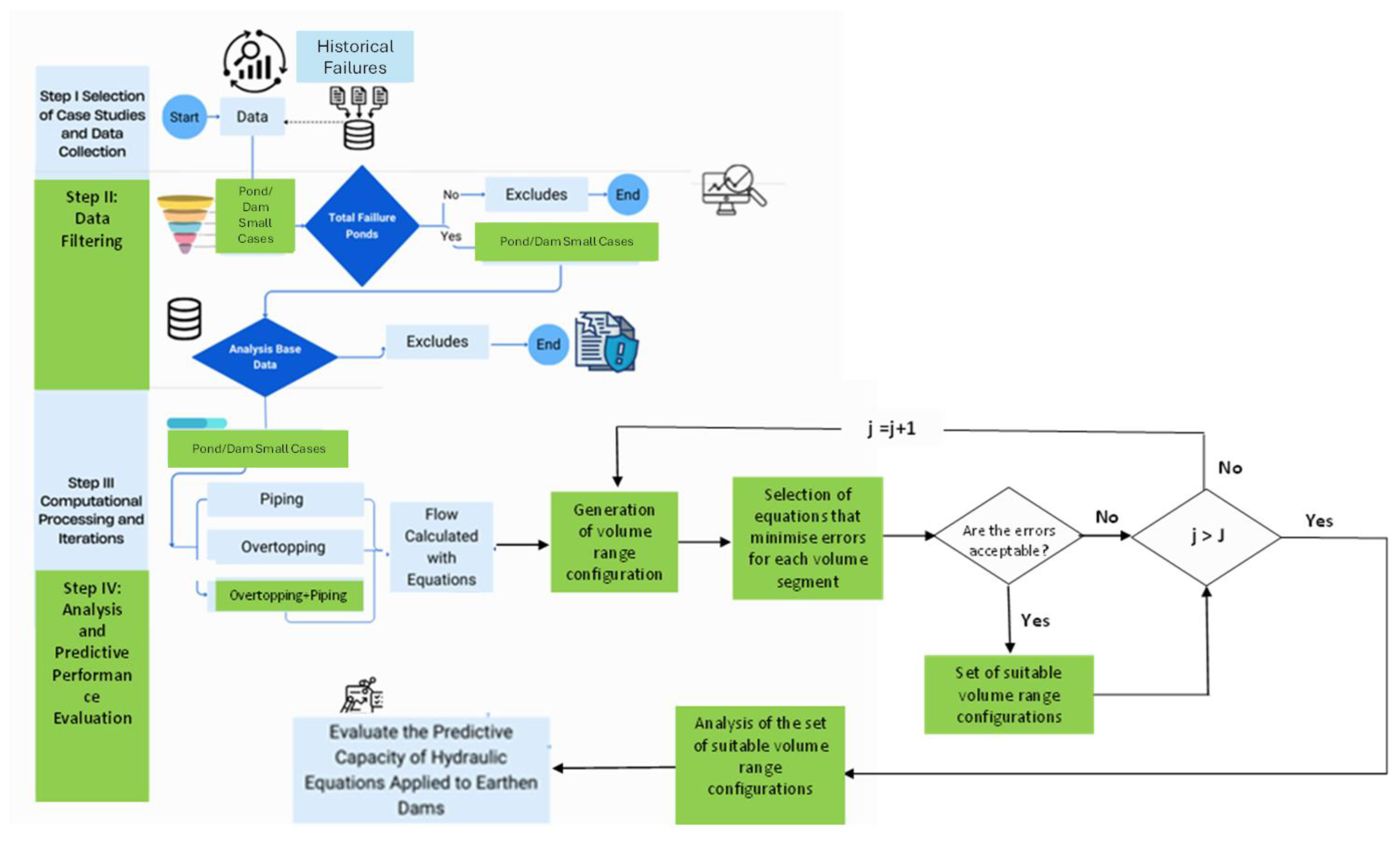
The methodological framework adopted in this study is presented in Figure 2 and is structured into four consecutive stages: (i) selection of case studies and data collection, (ii) data filtering, (iii) computational processing and iterative calculations, and (iv) analysis and predictive performance evaluation. The framework is designed to systematically assess the applicability and predictive capacity of peak flow equations used for earthen dam and pond failure analysis.

2.1.1. Step I: Selection of Case Studies and Data Collection

The first stage of the methodology involves the identification and systematic compilation of historical failure cases of earthen ponds and small dams documented in the scientific literature and technical databases. Cases are selected from published sources and include available information on reservoir geometry, storage characteristics, dam dimensions, failure mechanisms, and they were reported and observed or post-event estimated peak outflow discharges.
All collected information is standardized and consolidated into a unified database to ensure consistency, comparability, and full traceability of the sources. Special emphasis is placed on the hydraulic relevance and completeness of the recorded parameters; consequently, only failure cases providing sufficient data to enable the application of multiple empirical peak-discharge formulations are retained for subsequent analysis.

2.1.2. Step II: Data Filtering

In the second stage, the dataset is refined through the application of hydraulic criteria related to failure extent and mechanism. The analysis is restricted to total failure scenarios of ponds and small earthen dams, as partial breaches may lead to substantially different peak flow responses and are beyond the scope of this study. A decision-based filtering process is implemented to determine whether total failure can be reasonably assumed for each case. If total failure conditions are not met or cannot be confirmed based on the available information, the case is excluded from further analysis. Accepted cases are incorporated into a refined database, referred to as the analysis base data.
This dataset undergoes an additional quality control step to eliminate cases with missing key parameters, unrealistic geometric ratios or values, or ambiguous failure descriptions. The resulting database ensures homogeneity and reliability, forming a robust basis for computational processing.

2.1.3. Step III: Computational Processing and Iterative Calculations

The third stage involves the computational application of peak flow equations to the selected pond/small dam historical failure cases. Each case is classified according to the dominant failure mechanism, namely piping, overtopping, and also considering both failure mechanisms, as shown in Figure 2. This classification is essential, as different peak flow formulations are specifically developed for distinct failure processes. In Table 2, a total of 63 peak flow equations, identified through an extensive literature review, are implemented within the computational framework. These equations represent different empirical and semi-empirical formulations used to estimate peak discharge resulting from dam failure processes, with particular emphasis on overtopping and piping-induced failures. The compiled database is applied to the selected case study to evaluate the differences among the various formulations, allowing for a comparative analysis of their predicted peak flows and highlighting the dispersion and sensitivity associated with each failure mechanism.
For each failure historical case, all applicable equations are iteratively applied to compute peak discharge values. For each failure mechanism and equation, the calculated peak discharge values are archived.
In order to analyze the validity and behavior of the equations for different volume ranges, the calculated values are sorted according to the volume of the historical failure case and grouped into volume segments. Each historical failure case is classified according to predefined V w . All historical failure cases are grouped into several volume segments.
Multiple volume range configurations are generated, and a set of error indexes is applied to validate the hydraulic equations and quantify their predictive performance. The analysis of the application of each formulation by volume segments ensures that each peak flow equation is applied to the volume segment that minimizes the error indexes. These error indexes, widely used in hydrological and hydraulic modeling, enable a multidimensional evaluation of model error and provide a consistent basis for assessing the reliability of the simulations. The error indexes used are:
Root mean square error (RMSE). This index quantifies the deviation between the empirical expression and the observed data. An RMSE value of zero indicates a perfect fit. It is defined as
R M S E = i = 1 x [ P i O i ] 2 x
where P i are the estimated values for i historical case failure, O i the observed values, and x the total number of observations for the volume segment.
Median Absolute Deviation (MAD). This index measures the average magnitude of the errors in the estimated values, based on the absolute differences between estimated and observed data. The value of zero denotes a perfect fit. It is defined as
M A D = i = 1 x 1 x P i O i
Mean Relative Deviation (MRD). This index accounts for the relative error with respect to the magnitude of the variable. A value of zero corresponds to a perfect fit. It is expressed as
M R D = i = 1 x P i O i / O i x
For each configuration of volume ranges and failure mode, the weighted error is calculated as
E j , k = l = 1 L E j , k , l m · w k , l
where E j , k , l m is the minimum index error (RMSE, MAD or MRD) calculated using the equation m, for j configuration of volume ranges, for k failure mode, l volume segment; w j , l is the weight calculated as the ratio between the historical failure cases for that failure mode and volume segment, and the total failure mode cases.
The process is repeated multiple times and only the appropriate range volume configurations are retained. A preliminary analysis is carried out on the volume range configurations that present minimum values for the error indices in each failure mode by selecting the optimal configurations. For each configuration generated, the minimum error index values are compared. The configurations with the error indices closest to the minimum are chosen, discarding those in which the error index is repeated across any of the failure modes analyzed. Finally, only those configurations with non-repeated values for all error indices and failure modes analyzed are selected.
This iterative process ensures that only physically consistent and methodologically sound predictions are retained. A verification step is then performed to determine whether a final set of peak flow estimates is available for each historical failure case and volume segment. If no valid peak discharge value can be computed, the formulation is excluded. Otherwise, the computed peak flows are stored and organized for analysis.

2.1.4. Step IV: Analysis and Predictive Performance Evaluation

Step IV defines an analysis of the sensitivity and robustness of the hydraulic formulations to the volume segments considered, evaluating the predictive capacity of the formulations based on volume ranges and historical failure cases. The robustness and predictive capacity of each formulation for the volume segments considered are determined by evaluating various common indicators for the error indexes considered for each equation, such as:
Percentage of cases where the equation showed the minimum error:
P j , k , l m = n j , k , l m N k · 100
where P j , k , l m is the percentage of cases where the equation m showed the minimum error for j configuration, for k failure mode and, for l volume segment; n j , k , l m number of historical cases of failure where the equation m showed the minimum error; N k is the total number of historical cases of failure considered for k failure mode.
If all volume segments of configuration j are considered, it is defined as
P L j , k m = l = 1 L n j , k , l m N k · 100
where P L j , k m is the percentage of cases where equation m showed the minimum error for configuration j and k failure mode.
When all suitable volume range configurations are considered, the following is defined:
P L J k m = j = 1 J l = 1 L n j , k , l m j = 1 J N k · 100
The establishment of volume ranges where equations present minimal errors determines the maximum, minimum, average, and median values of the volume segments dominated by the equation. This establishment also allows us to determine in which volume zones the equations are recurring, thus determining the volume domain zones for each equation.

3. Results and Discussion

Based on this integration, a total of 1893 earth structures classified as ponds or small reservoirs were identified. Among them, 850 cases corresponded to structural failures involving complete rupture of the dam body. The database was defined through published data from [46,51,52,53] (Table 3). The data selection process allowed the exclusion of events with incomplete information and partial failures; only complete failures were considered, even in cases where partial failures exhibited severe seepage problems. Events presenting inconsistencies were also removed, resulting in a final dataset of 436 cases for analysis.
For the quantitative analysis and subsequent modeling, events were selected in which at least one hydraulic parameter was available, allowing the calculation and comparison of the maximum failure peak discharge ( Q p ) . Only structures classified as earthfill were retained. Regarding failure mechanisms, the dataset was limited to events associated with overtopping or piping (internal erosion). Cases originally classified as “Other” were reassigned to piping when the technical descriptions of the failure process supported this classification.
Given the limited size of the target dataset ( V w ≤ 6 hm3) and the specificity of the failure conditions considered, the data collection process was based on a systematic screening and classification of documented earthen dam failure cases. From an initial set of 762 identified earth dams, failure mechanisms were classified according to reported causes, resulting in 39.55% overtopping failures, 52.24% piping failures, and 8.21% attributed to other causes, including geotechnical instability, erosion, structural deficiencies, and animal activity. To ensure applicability to real small earthen reservoirs and exclude reduced-scale experimental tests and large dams, the dimensionless ratio of stored water volume to available hydraulic height, V w / h w 3 < 1000, was adopted as a filtering criterion based on geometric similarity considerations. Additionally, only cases providing complete and reliable geometric and hydraulic information defined as embankment height ( h d ), water depth ( h w ), stored water volume ( V w ), average embankment width ( W a v g ), and crest width (L)—were retained. This structured selection and validation procedure ensured internal consistency and strengthened the reliability of the dataset used for subsequent analyses. From the resulting dataset, Table 3 presents the 78 cases with complete peak discharge (Q0) information, including 65 overtopping failures (83.33%) and 13 piping failures (16%).
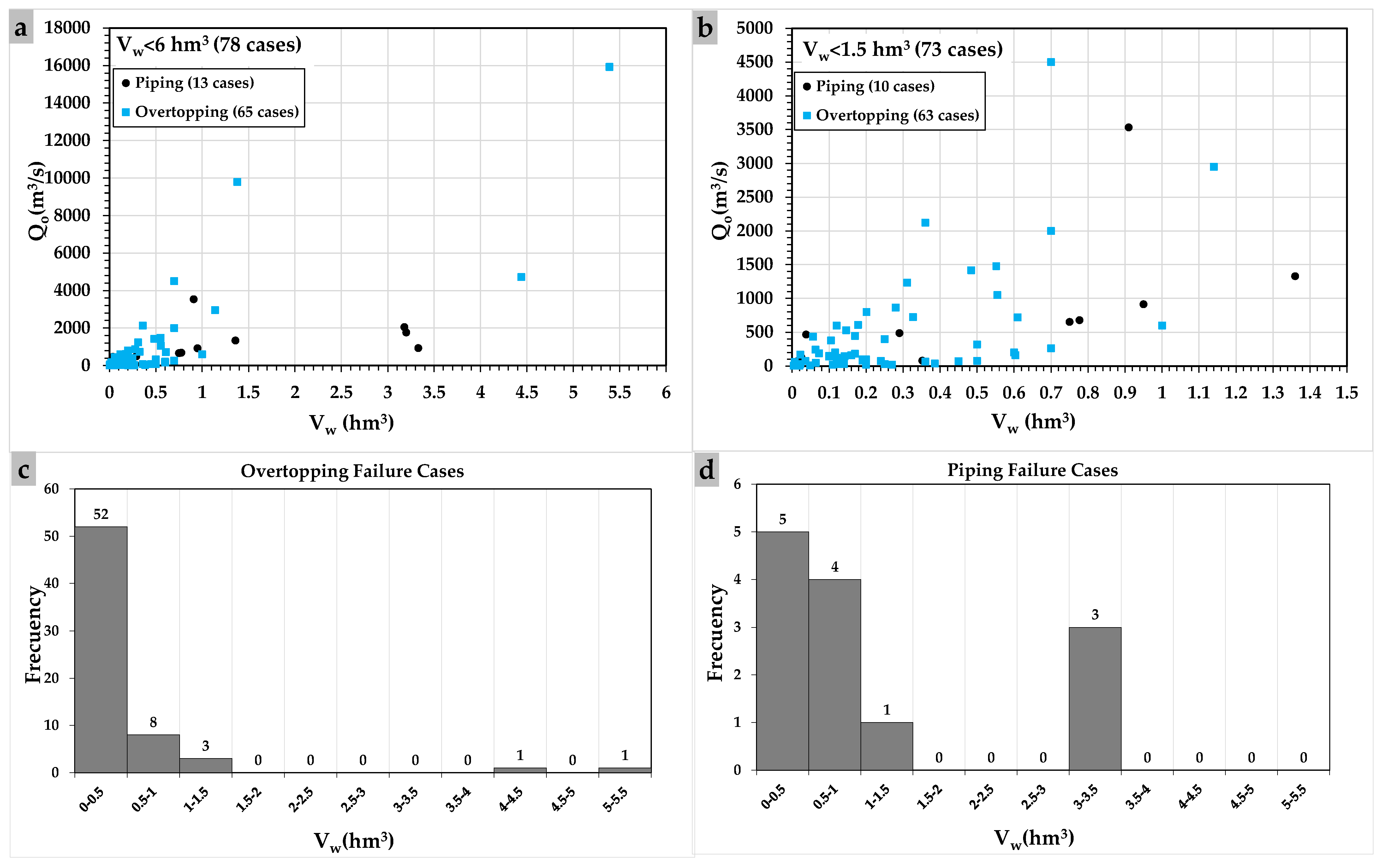
Figure 3 shows the observed flow rates grouped by volume and height ranges. Following a rigorous data-screening process included in Step II, the initial dataset was reduced to 78 cases (Figure 3a), which constitutes the basis of the analyses presented in this study. The filtering procedure aimed to ensure the representativeness of earthfill reservoirs (earthen embankments) while excluding structures and experimental configurations outside the conceptual and dimensional scope of small- to medium-sized reservoirs.
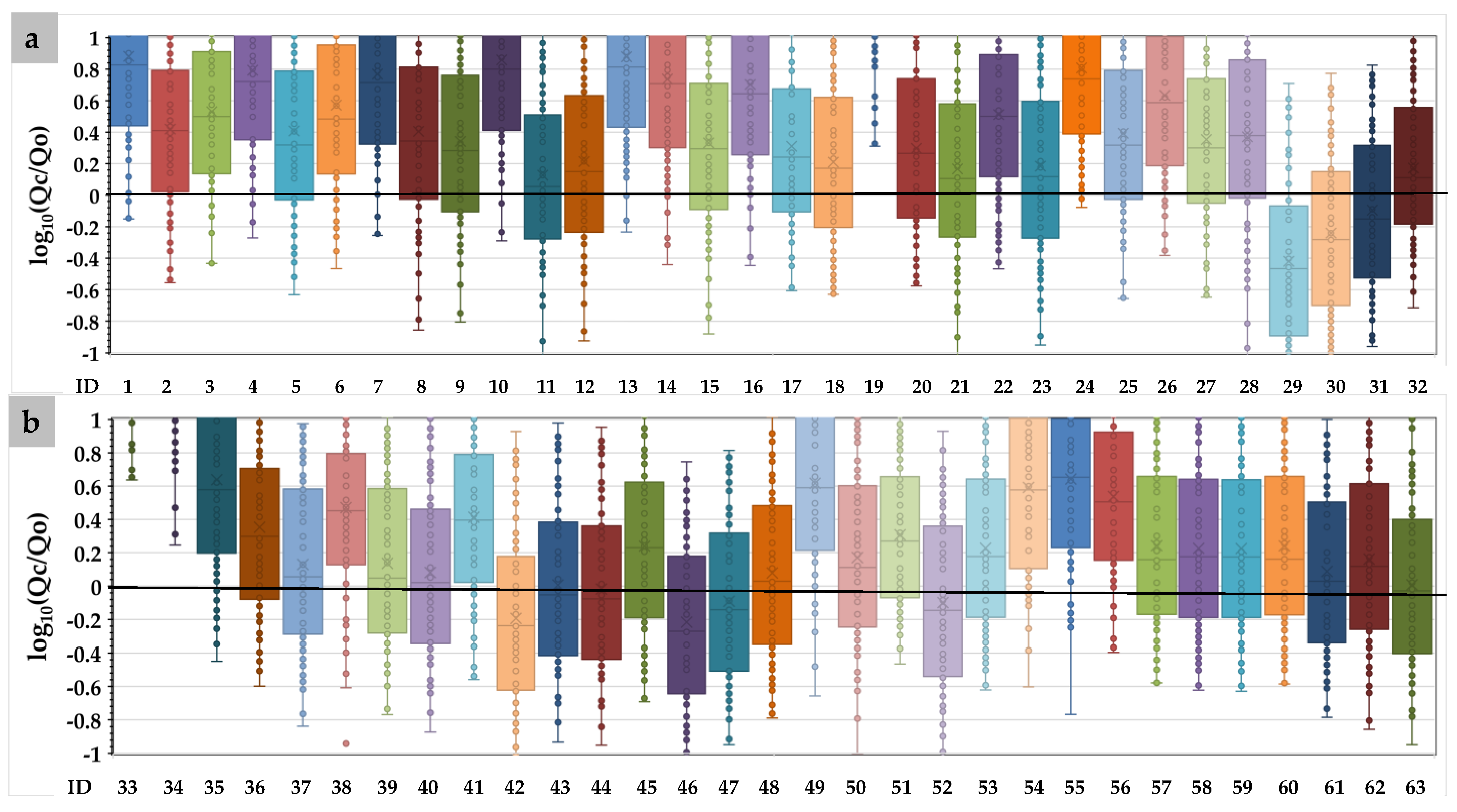
Overtopping failures predominated in 65 of these cases, with peak discharge flows under 2000 m3/s, while the 13 piping failures exhibited lower peak discharge values, also primarily below the 2000 m3/s threshold. Figure 3b focuses on 73 cases with capacities under 1.5 hm3, where overtopping remained the dominant failure mechanism in 63 instances, resulting in peak flows below 500 m3/s. As shown in the histograms in Figure 3c, most cases are concentrated within small volume ranges V W < 1 hm3), with frequency decreasing sharply as V w increases. Overall, overtopping is the prevailing failure mechanism, and while peak outflows exhibit high variability with occasional extreme values, failures are predominantly associated with small reservoirs (piping Figure 3d). For each predictive formulation, the ratio Q c / Q o was evaluated, resulting in values both greater and less than unity, thereby allowing an assessment of overestimation and underestimation tendencies. Figure 4 shows the distribution of the Q c / Q o ratios for the analyzed failure cases included in Step III of the methodology.
The comparative analysis of peak discharge models, evaluated through the distribution of the Q c / Q o ratios, reveals pronounced heterogeneity in the predictive performance of the empirical formulations considered. The observed dispersion highlights the strong sensitivity of these models to reservoir geometry and failure mechanisms. While some equations exhibit a central tendency close to unity, indicating acceptable average agreement with observed values, the presence of significant outliers exposes important limitations in their predictive reliability. From a risk management perspective, the systematic tendency toward overestimation observed in certain models may be interpreted as a conservative safety margin. Nevertheless, the overall level of uncertainty identified emphasizes the need for site-specific analyses and detailed studies tailored to individual dam characteristics.
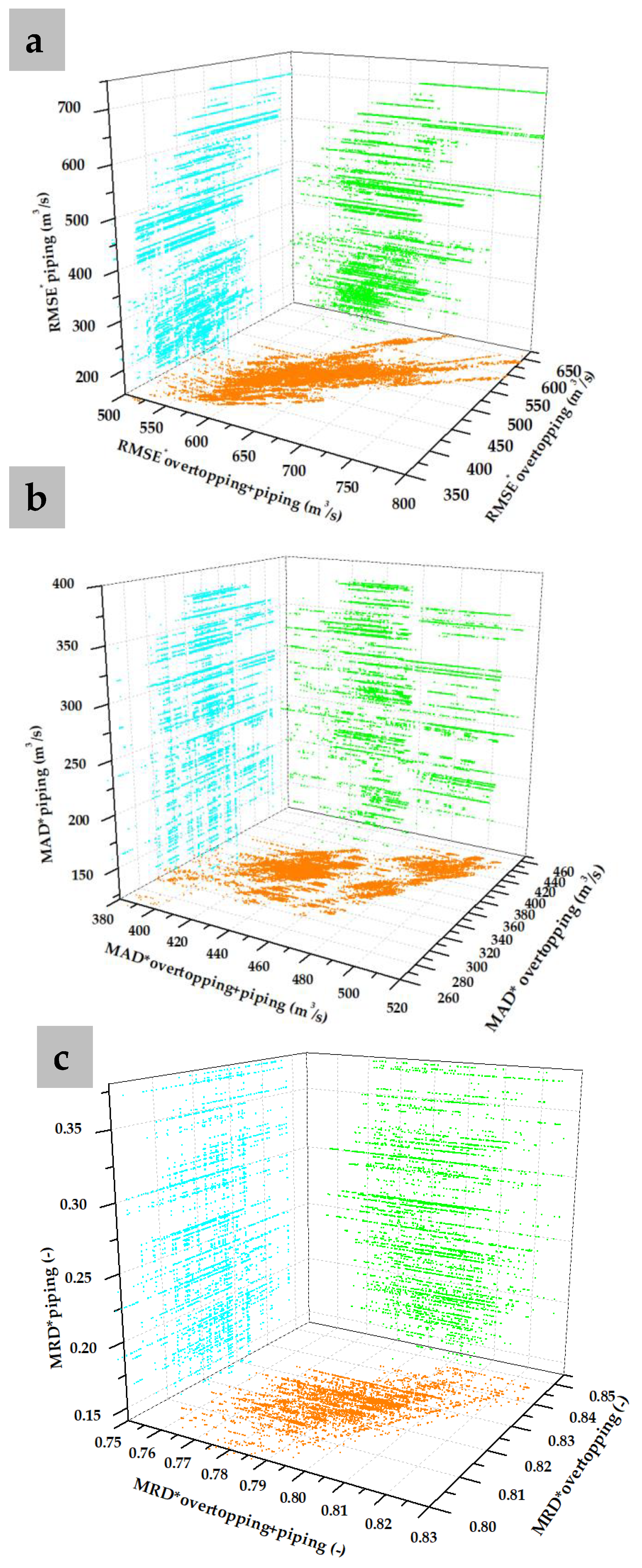
Figure 5 shows the distribution of weighted error values for overtopping, piping, and combined overtopping + piping failures using RMSE* (Figure 5a), MAD* (Figure 5b), and MRD* (Figure 5c). These subfigures are aligned with Step IV of the methodology. The results reveal a large dispersion in all metrics. For RMSE* (a), overtopping errors ranged from 350 to 650 m3/s, piping errors from 200 to 700 m3/s, and combined failures between 550 and 800 m3/s. MAD* values (Figure 4b) followed a similar trend in which the piping errors reached up to 380 m3/s, overtopping up to 460 m3/s, and combined failures around 520 m3/s. MRD* (Figure 5c) highlights relative deviations, with piping exceeding 0.35, overtopping reaching 0.85, and combined cases around 0.83. This wide scattering indicates high uncertainty in predicting different failure modes and demonstrates that the accuracy varies significantly depending on the type of failure. Overall, the figure emphasizes the challenge of reliably modeling overtopping and piping processes, particularly for extreme events.
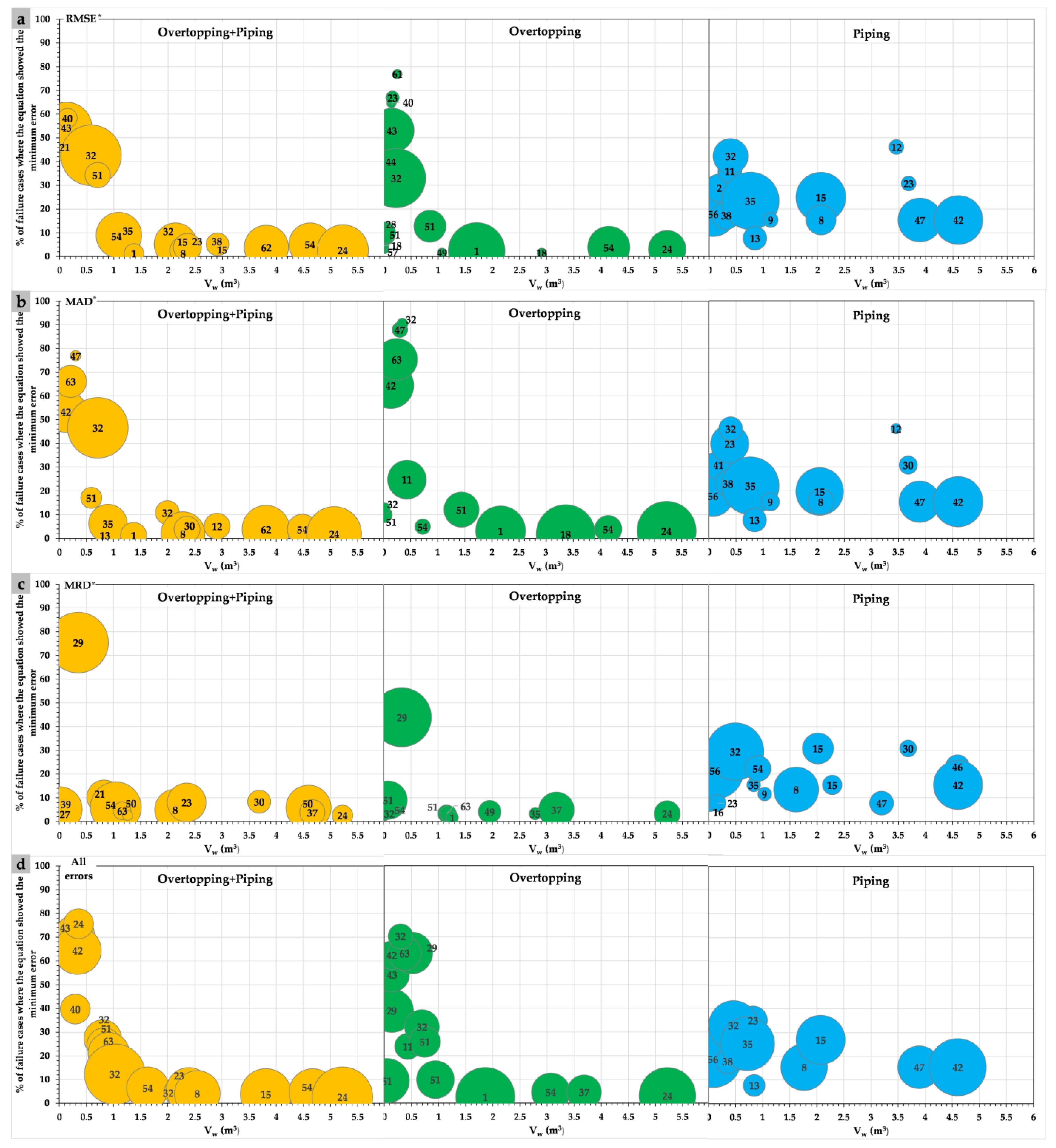
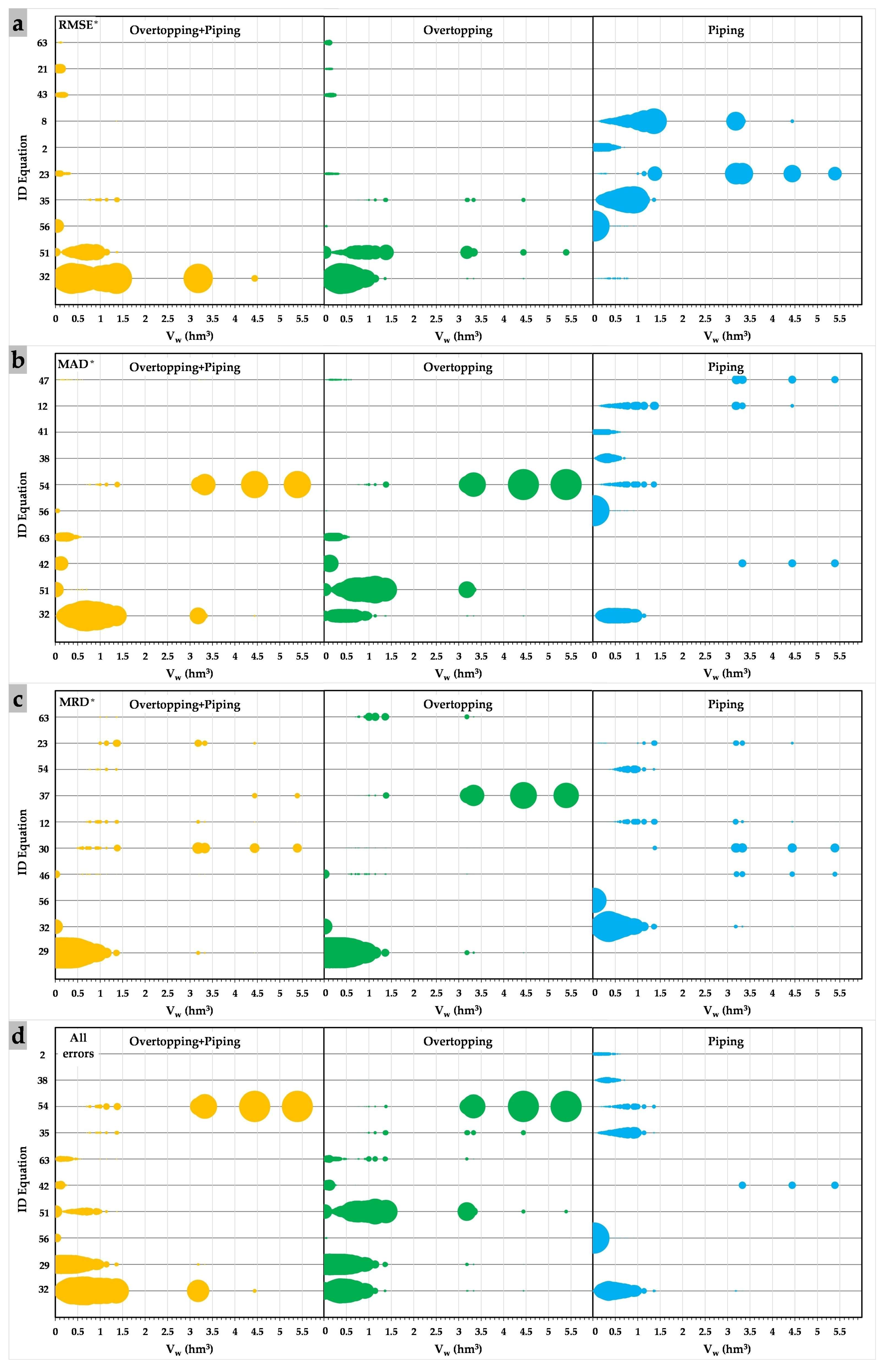
Figure 6 shows the performance of the 10 best predictive equations for error index and failure mode for all selected volume range configurations, where bubble size represents the percentage of cases dominated by a specific equation within a given volume range ( P j , k , l m ) . The analysis reveals that for piping failures, there is a greater variety of effective models, with ID32 performing best for smaller volumes and ID42 for larger ones (Figure 6a–d). In contrast, overtopping and total failure scenarios (overtopping + piping) are divided into two distinct zones: a primary zone up to 1.5 hm3, where IDs 51, 29, and 32 demonstrate the highest accuracy, and a secondary zone above 3 hm3, where ID54 and ID37 are most effective. Notably, a data gap exists between 1.5 and 3 hm3 for both overtopping and piping, as no historical cases were available for this specific range.
Figure 7a,b highlight the critical role of stored volume segmentation in determining the applicability and dominance of the governing equations across different reservoir failure modes. The recurrence of specific equation IDs within certain volume ranges, as indicated by larger bubble sizes, reinforces the importance of matching each equation to its optimal storage regime. The results show that equations dominate within well-defined volume intervals, rather than a single equation performing optimally over the entire volume range. IDs 32 and 35 appear frequently and exhibit high dominance at low storage volumes, mainly associated with overtopping + piping configurations. As the storage volume increases, IDs 42 and 24 dominate over a wider volume range, showing consistent performance in terms of both RMSE* and MAD* values. This clear segmentation confirms that stored volume acts as a key discriminator for equation validity and accuracy.
When Figure 7b is analyzed considering MAD* values, ID 42 dominates at larger storage volumes under overtopping conditions, while ID 24 appears predominantly in piping and combined overtopping–piping scenarios. ID 32 shows the best performance for low storage volumes in the overtopping–piping condition. Figure 7c (MRD*) and Figure 6d (AR) demonstrate similar trends, with ID 32 appearing frequently at low volumes in overtopping + piping analyses. In the case of overtopping alone, ID 54 exhibits more consistent performance across a wider range of volumes. For piping scenarios, IDs 32 and 35 yield the minimum errors at low storage volumes. Figure 7d, which considers all error metrics, highlights IDs 32 and 35 as the main expressions for piping at low volumes, and IDs 42 and 24 for larger volumes.
When these studies are compared, a direct comparison among breach peak outflow equations is inherently challenging, since many formulations were derived for specific ranges of reservoir volume, dam geometry, or failure mechanisms [79]. Meanwhile, others do not clearly define their domain of applicability and are instead calibrated for particular case studies [80]. This lack of uniformity complicates a consistent discussion of results and partly explains the wide dispersion and uncertainty reported in previous assessments [43]. Moreover, differences between traditional empirical approaches and more recent data-driven or machine-learning-based models further limit direct comparability [81]. Within this context, the novelty of the present work lies in the comprehensive comparison of 63 expressions and in the discretization of storage volume ranges associated with optimal performance, enabling the identification of best-fit domains and a systematic reduction in prediction errors across failure scenarios.
Overall, the figures demonstrate that segmenting the stored volume is essential for selecting the most appropriate governing equation, thereby improving predictive accuracy and ensuring robust performance under different failure mechanisms. This volume-dependent selection framework provides a practical basis for tailoring design and operational strategies in hybrid water–energy storage systems.
Table 4 presents the optimal predictive equations selected according to storage volume range and failure mechanism (overtopping + piping, overtopping, or piping). For small-scale events (0 < V w ≤ 0.5 hm3), ID 32 demonstrates high versatility, performing best for both overtopping and piping failures, while ID 42 is uniquely suited for combined overtopping + piping scenarios. As the storage volume increases to the intermediate range ( 0.5 < V w 1.5 hm3), ID 32 remains the most effective for combined failures, whereas ID 51 and ID 35 provide the highest accuracy for overtopping and piping failures, respectively.
For mid-to-high storage volumes ( 1.5 < V w 3 hm3), ID 8 shows high reliability for combined failure modes and piping failures, while ID 1 dominates under overtopping conditions. For the highest volume range ( 4.5 < V w   6 hm3), ID 24 emerges as the dominant choice for both combined and overtopping scenarios, whereas ID 42 again provides the best fit for piping failures. Overall, these results underscore the necessity of a segmented modeling approach, in which practitioners select the most appropriate predictive equation based on the expected reservoir capacity and failure mechanism to minimize errors in dam-break risk assessments.
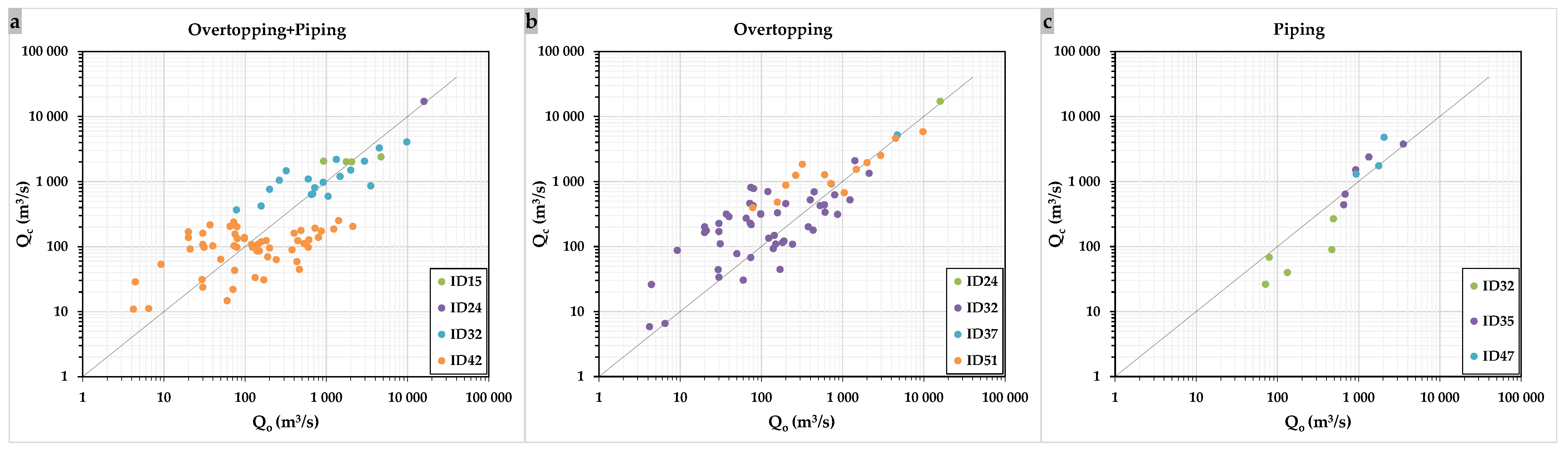
Figure 8 shows the behavioral biases among the equations, particularly regarding how they deviate from the 1:1 identity line when calculated flow and observed flows are evaluated. In the “Overtopping + Piping” category, ID 42 (orange) showed a consistent trend of overestimation, with many data points falling significantly over the identity line, especially in the lower flow range (Q < 100 m3/s). ID 15 (green) and ID 24 (purple) showed a tendency to overestimate peak flows in several mixed-mode cases, particularly as the observed discharge ( Q o ) increased. This suggests that while ID 42 might provide more conservative values, ID 24 and ID 15 are more likely to predict worst-case scenarios, which is a critical distinction for flood risk management.
For “overtopping” (Figure 8b), ID 32 (purple) showed a high degree of dispersion, often overestimating flows at lower ranges but aligning better at higher magnitudes, whereas ID 37 (blue) remained remarkably centered on the identity line, indicating a more balanced predictive nature. In Figure 8c for piping failure, ID 35 (purple) stood out for its high precision across the entire spectrum, showing minimal bias toward either extreme. ID 32 (green) shows a slight upward bias in piping scenarios, frequently predicting higher values than observed. Given the limitation to cases with complete and reliable information, the statistical results should be interpreted as representative within the defined volume ranges and failure modes summarized in Table 4. The use of 78 case studies provides a robust basis relative to many original formulations, which were derived from much smaller datasets (e.g., Table 2 showed by [20,57,63] or [64]), and supports the validity of the proposed volume discretization. Consequently, the results apply to similar cases falling within these volume intervals, while future datasets may further refine the boundaries or lead to new expressions.

4. Conclusions

The systematic assessment of 63 empirical formulations, which was compiled through a comprehensive chronological review and restricted to equations based solely on commonly available parameters, was conducted. A database of 78 documented failure events provides a robust benchmark for estimating peak discharge in small earthen ponds. Only formulations relying on readily obtainable data, such as stored volume, water depth, dam height, crest width, and dam length, were retained. Approaches requiring parameters that are rarely reported in historical records or difficult to determine in practice (e.g., breach crest area, fetch length, or detailed breach geometry), as well as machine-learning-based methodologies lacking explicit analytical expressions, were intentionally excluded. This selection ensures direct applicability in engineering practice and emergency planning.
The analysis confirms that reservoir scale and failure mechanism are the dominant factors influencing predictive performance. For storage volumes below 6 hm3, uncertainty increases markedly, with the range between 3.5 and 5 hm3 showing the greatest dispersion. This trend suggests that empirical equations originally developed for larger reservoirs lose reliability when extrapolated to small earthen ponds, even when they are based on easily accessible variables.
The results further demonstrate that segmentation by reservoir volume is essential for defining the applicability of peak-discharge formulations according to both storage capacity and failure mechanism. No single empirical expression performs adequately across the full volume range considered; instead, improved accuracy is achieved only within specific storage intervals. The proposed segmentation framework facilitates the identification of the most suitable equations for overtopping and piping failures, thereby reducing uncertainty and enhancing result consistency. These findings emphasize stored volume as a key parameter for delimiting the valid range of empirical discharge relationships in small earthen reservoirs.
Finally, the study highlights the need to develop new empirical formulations specifically tailored to small-scale ponds, capable of jointly accounting for the effects of stored volume and water depth. Many existing equations fail to represent the coupled influence of these variables, leading to increased dispersion and systematic bias when applied beyond their original calibration domains. The development of volume and water height empirical relationships, correctly calibrated with reliable historical data and constrained to parameters readily available in practice, would improve peak discharge estimation and support more effective flood risk management, emergency planning, and mitigation strategies in regions where small earthen reservoirs are critical for sustaining irrigation systems under hydric stress conditions.

Author Contributions

Conceptualization, F.-J.S.-R. and M.P.-S.; methodology, M.D.-Y. and F.-J.S.-R.; software, F.A.P., M.D.-Y. and F.-J.S.-R.; validation, F.-J.S.-R., M.P.-S. and H.M.R.; formal analysis, M.D.-Y., F.A.P. and F.-J.S.-R.; investigation, M.D.-Y., F.A.P. and F.-J.S.-R.; writing—original draft preparation, M.D.-Y., F.-J.S.-R. and M.P.-S.; writing—review and editing, F.-J.S.-R. and M.P.-S.; visualization, F.-J.S.-R., M.P.-S. and H.M.R.; supervision, F.-J.S.-R., M.P.-S. and H.M.R. funding acquisition, F.-J.S.-R. and M.P.-S. All authors have read and agreed to the published version of the manuscript.

Funding

This research received no external funding.

Data Availability Statement

The original contributions presented in this study are included in the article. Further inquiries can be directed to the corresponding authors.

Conflicts of Interest

The authors declare no conflicts of interest.

References

  1. Espejo Almodóvar, F.A. Caracterización del Funcionamiento y Control Hidráulico Frente a la Rotura de Balsas de Riego, Mediante un Marco de Trabajo Estocástico. 2017. Available online: https://gredos.usal.es/handle/10366/135790 (accessed on 12 January 2026). [CrossRef]
  2. Sánchez-Romero, F.J.; Pérez-Sánchez, M.; Redón-Santafé, M.; Torregrosa Soler, J.B.; Ferrer Gisbert, C.; Ferrán Gozálvez, J.J.; Ferrer Gisbert, A.; López-Jiménez, P.A. Estudio numérico para la elaboración de mapas de inundación considerando la hipótesis de rotura en balsas para riego. Ing. Del Agua 2019, 23, 1–18. [Google Scholar] [CrossRef]
  3. Tho Dat, T.; Quang Tri, D.; Truong, D.; Nguyen, A.; Hoa, N. The Application of Mike Flood Model in Inundation Simulation with the Dam-break Scenarios: A Case Study of DakDrinh Reservoir in Vietnam. Int. J. Earth Sci. Eng. 2019, 12, 60–70. [Google Scholar] [CrossRef]
  4. Mao, J.; Wang, S.; Ni, J.; Xi, C.; Wang, J. Management System for Dam-Break Hazard Mapping in a Complex Basin Environment. ISPRS Int. J. Geo-Inf. 2017, 6, 162. [Google Scholar] [CrossRef]
  5. Mulligan, M.; van Soesbergen, A.; Sáenz, L. GOODD, a global dataset of more than 38,000 georeferenced dams. Sci. Data 2020, 7, 31. [Google Scholar] [CrossRef]
  6. Shen, Y.; Nielsen, K.; Revel, M.; Liu, D.; Yamazaki, D. Res-CN (Reservoir dataset in China): Hydrometeorological time series and landscape attributes across 3254 Chinese reservoirs. Earth Syst. Sci. Data 2023, 15, 2781–2808. [Google Scholar] [CrossRef]
  7. Donchyts, G.; Winsemius, H.; Baart, F.; Dahm, R.; Schellekens, J.; Gorelick, N.; Iceland, C.; Schmeier, S. High-resolution surface water dynamics in Earth’s small and medium-sized reservoirs. Sci. Rep. 2022, 12, 13776. [Google Scholar] [CrossRef]
  8. Sanz-Ramos, M.; Bladé, E.; Silva-Cancino, N.; Salazar, F. Avances en Iber para la clasificación de balsas: Proyecto ACROPOLIS. Ing. Agua 2024, 28, 47–63. [Google Scholar] [CrossRef]
  9. Christopher, M. Spatial Breaching of Homogeneous and Zoned Embankment Dams Mitteilungen. Doctoral Thesis, ETH Zurich, Zurich, Switzerland, 2024. [Google Scholar]
  10. Jlassi, W.; Nadal-Romero, E.; García-Ruiz, J.M. Modernización de una nueva área de regadío en un escenario de creciente escasez de agua: De grandes embalses a pequeñas balsas. Cuad. Investig. Geogr. 2016, 42, 233–259. [Google Scholar] [CrossRef]
  11. Umaru, A.; Ogedengbe, K.; Omobowale, M.O. Structural failures of earth dams in Nigeria: A case study of Cham dam in Gombe State. J. Eng. Appl. Sci. 2010, 5, 47–52. [Google Scholar]
  12. Islam, K.; Murakami, S. Global-scale impact analysis of mine tailings dam failures: 1915–2020. Glob. Environ. Change 2021, 70, 102361. [Google Scholar] [CrossRef]
  13. Yang, M.; Cai, Q.; Li, Z.; Yang, J. Uncertainty analysis on flood routing of embankment dam breach due to overtopping failure. Sci. Rep. 2023, 13, 20151. [Google Scholar] [CrossRef]
  14. Bellos, C.V.; Sakkas, J.G. 1-D Dam-Break Flood-Wave Propagation on Dry Bed. J. Hydraul. Eng. 1987, 113, 1510–1524. [Google Scholar] [CrossRef]
  15. Liang, D.; Liang, D. Evaluating shallow water assumptions in dam-break flows. Proc. Inst. Civ. Eng.-Water Manag. 2010, 163, 227–237. [Google Scholar] [CrossRef]
  16. Sánchez-Romero, F.-J. Criterios de Seguridad en Balsas de Tierra para Riego. Doctoral Thesis, Universitat Politècnica de València, Valencia, Spain, 2014. [Google Scholar] [CrossRef]
  17. Sharif, Y.A.; Elkholy, M.; Hanif Chaudhry, M.; Imran, J. Experimental Study on the Piping Erosion Process in Earthen Embankments. J. Hydraul. Eng. 2015, 141, 04015012. [Google Scholar] [CrossRef]
  18. Cestero, J.A.F.; Imran, J.; Chaudhry, M.H. Experimental Investigation of the Effects of Soil Properties on Levee Breach by Overtopping. J. Hydraul. Eng. 2014, 141, 04014085. [Google Scholar] [CrossRef]
  19. Kanjanakaroon, P.; Ekkawatpanit, C.; Wongsa, S.; Isarangkura, U.; Kositgittiwong, D. A comparative study of embankment breach parameters in different breach locations. J. Hydro-Environ. Res. 2020, 29, 59–69. [Google Scholar] [CrossRef]
  20. Walder, J.S.; O’Connor, J.E. Methods for predicting peak discharge of floods caused by failure of natural and constructed earthen dams. Water Resour. Res. 1997, 33, 2337–2348. [Google Scholar] [CrossRef]
  21. Ahmadisharaf, E.; Kalyanapu, A.J.; Thames, B.A.; Lillywhite, J. A probabilistic framework for comparison of dam breach parameters and outflow hydrograph generated by different empirical prediction methods. Environ. Model. Softw. 2016, 86, 248–263. [Google Scholar] [CrossRef]
  22. Chen, S.-S.; Zhong, Q.-M.; Shen, G.-Z. Numerical modeling of earthen dam breach due to piping failure. Water Sci. Eng. 2019, 12, 169–178. [Google Scholar] [CrossRef]
  23. Aureli, F.; Maranzoni, A.; Petaccia, G. Review of Historical Dam-Break Events and Laboratory Tests on Real Topography for the Validation of Numerical Models. Water 2021, 13, 1968. [Google Scholar] [CrossRef]
  24. Bybordi, A.; Thampan, T.; Linhares, C.D.G.; Ponciano, J.R.; Travençolo, B.A.N.; Paiva, J.G.S.; Etemadpour, R. Canonical correlation and visual analytics for water resources analysis. Multimed. Tools Appl. 2023, 83, 32453–32473. [Google Scholar] [CrossRef]
  25. Espejo, F.; Molina, J.L.; Zazo, S.; Muñoz-Sánchez, R.; Patino-Alonso, C. Low-cost “buffer” structural measure for flooding risk reduction in irrigation reservoirs. J. Hydrol. 2024, 634, 131017. [Google Scholar] [CrossRef]
  26. Espejo, F.; Molina, J.L.; Zazo, S.; Muñoz-Sánchez, R. Innovative Risk Assessment Framework for Hydraulic Control of Irrigation Reservoirs´ Breaching. Water Resour. Manag. 2022, 36, 2161–2177. [Google Scholar] [CrossRef]
  27. Okeke, A.C.U.; Wang, F. Hydromechanical constraints on piping failure of landslide dams: An experimental investigation. Geoenviron. Disasters 2016, 3, 4. [Google Scholar] [CrossRef]
  28. Mohammadzadeh, D.; Kazemi, S.-F.; Mosavi, A. Evolutionary prediction model for fine-grained soils compression index using gene-expression programming. Preprints 2019. [Google Scholar] [CrossRef]
  29. Adinolfi, L.; Tarantino, A. A conceptual model to demonstrate the role of suction in the formation of head-cut in fine-grained embankments subjected to overflow. In Proceedings of the 17th European Conference on Soil Mechanics and Geotechnical Engineering, ECSMGE 2019-Proceedings, Reykjavik, Iceland, 1–6 September 2019; pp. 1–8. [Google Scholar] [CrossRef]
  30. Ma, J.; Xu, C.; Chen, J. Dam-breach process simulation and risk assessment of outburst flood induced by the Tangjiashan landslide-dammed lake. J. Hydrol. Reg. Stud. 2025, 57, 102164. [Google Scholar] [CrossRef]
  31. Liu, B.; Xu, Q.; Chen, J.; Xing, J.; Wang, Y. Real-time localized damage-prediction model for concrete gravity dams based on response-modal information hybrid neural network. Eng. Fail. Anal. 2025, 170, 109263. [Google Scholar] [CrossRef]
  32. Kong, L.; Liao, F.; Yang, P.; Wang, G.; Wang, H.; Ding, S.; Wang, Z.; Ai, H.; Zhou, P.; Shi, Z. Estimating groundwater discharge in the dam-affected rivers using 222Rn. J. Hydrol. 2025, 651, 132574. [Google Scholar] [CrossRef]
  33. Kang, F.; Huang, B.; Wan, G. Automated detection of underwater dam damage using remotely operated vehicles and deep learning technologies. Autom. Constr. 2025, 171, 105971. [Google Scholar] [CrossRef]
  34. Mohammadi, M.; Ershadi, M.J.; Kamyab, H. Assessment of stability of earth dams based on construction pace by fuzzy inference logic. Dams Reserv. 2024, 34, 167–176. [Google Scholar] [CrossRef]
  35. Mohammed Mahmud Alam, B.; Bhuiyan, M.A. Collocation Finite-Element Simulation of Dam-Break Flows. J. Hydraul. Eng. 1995, 121, 118–128. [Google Scholar] [CrossRef]
  36. Wu, W.; Asce, M. Simplified Physically Based Model of Earthen Embankment Breaching. J. Hydraul. Eng. 2013, 139, 837–851. [Google Scholar] [CrossRef]
  37. Froehlich, D.C.; Asce, M. Embankment Dam Breach Parameters and Their Uncertainties. J. Hydraul. Eng. 2008, 134, 1708–1721. [Google Scholar] [CrossRef]
  38. Zhong, Q.M.; Chen, S.S.; Deng, Z.; Mei, S.A. Prediction of Overtopping-Induced Breach Process of Cohesive Dams. J. Geotech. Geoenviron. Eng. 2019, 145, 04019012. [Google Scholar] [CrossRef]
  39. Liu, Y.; Li, X.; Liu, X.; Yang, Z. A combined shear strength reduction and surrogate model method for efficient reliability analysis of slopes. Comput. Geotech. 2022, 152, 105021. [Google Scholar] [CrossRef]
  40. Rea, D.; Liaw, C.-Y.; Chopra, A.K. Mathematical models for the dynamic analysis of concrete gravity dams. Earthq. Eng. Struct. Dyn. 1974, 3, 249–258. [Google Scholar] [CrossRef]
  41. Quecedo, M.; Pastor, M.; Herreros, M.I.; Fernández Merodo, J.A.; Zhang, Q. Comparison of two mathematical models for solving the dam break problem using the FEM method. Comput. Methods Appl. Mech. Eng. 2005, 194, 3984–4005. [Google Scholar] [CrossRef]
  42. Rodríguez, C.L.; Rodríguez, G.O.; Marullo, D.C.; Barreto, C.W. Dam break hydrodinamic modelling experiencies, using multidimensional software. Ágora Heterodoxias 2015, 1, 72–93. [Google Scholar]
  43. Wahl, T. Uncertainty of Predictions of Embankment Dam Breach Parameters. J. Hydraul. Eng. 2004, 130, 389–397. [Google Scholar] [CrossRef]
  44. Wahl, T.L. Evaluation of Erodibility-Based Embankment Dam Breach Equations; Hydraulic Laboratory Report HL-2014-02; US Department of the Interior Bureau of Reclamation, Technical Service Center: Denver, CO, USA, 2014; Volume 99. [Google Scholar]
  45. Froehlich, D.C. Peak Outflow from Breached Embankment Dam. J. Water Resour. Plan. Manag. 1995, 121, 90–97. [Google Scholar] [CrossRef]
  46. Xu, Y.; Zhang, L.M. Breaching Parameters for Earth and Rockfill Dams. J. Geotech. Geoenviron. Eng. 2009, 135, 1957–1970. [Google Scholar] [CrossRef]
  47. Froehlich, D.C. Predicting Peak Discharge from Gradually Breached Embankment Dam. J. Hydrol. Eng. 2016, 21, 4016041. [Google Scholar] [CrossRef]
  48. Umukiza, E.; Abagale, K.F.; Adongo, T.A. A Review on A review on significance and failure causes of small-scale irrigation dams in arid and semi-arid lands. J. Infrastruct. Plan. Eng. 2023, 2, 1–9. [Google Scholar] [CrossRef]
  49. Yoo, C.; Jun, C.; Zhu, J.; Na, W. Evaluation of dam water-supply capacity in Korea using the water-shortage index. Water 2021, 13, 956. [Google Scholar] [CrossRef]
  50. Yassin, M.; Ahmed, A.; McFarlane, V.; Liu, F. A Filtered Database of Embankment Dam Breach Characteristics; University of Alberta: Edmonton, AB, Canada, 2024. [Google Scholar] [CrossRef]
  51. Bernard-Garcia, M.; Mahdi, T.-F. A Worldwide Historical Dam Failure’s Database. 2024. Available online: https://borealisdata.ca/dataset.xhtml?persistentId=doi:10.5683/SP2/E7Z09B (accessed on 12 January 2026). [CrossRef]
  52. Zhang, L.; Xu, Y.; Jia, J.S. Analysis of earth dam failures: A database approach. Georisk 2009, 3, 184–189. [Google Scholar] [CrossRef]
  53. Dhiman, S.; Kanhu Charan, P. Evaluation of Empirical Equations for Dam Breach Parameters and Its Application in Indian Dam Failure Cases. 2017. Available online: https://www.iahr.org/library/infor?pid=2732 (accessed on 12 January 2026).
  54. UBO Reclamation. Guidelines for defining inundated areas downstream from Bureau of Reclamation dams. Reclam. Plan. Instr. 1982, 11. [Google Scholar]
  55. Kirkpatrick, G.W. Guidelines for evaluating spillway capacity. Water Power Dam Constr. 1977, 29, 29–33. [Google Scholar]
  56. S.C.S. (SCS). Simplified Dam-Breach Routing Procedure, Tech. Release No. 66, Rev. 1. 1981. Available online: https://damsafety.org/content/simplified-dam-breach-routing-procedure (accessed on 12 January 2026).
  57. Hagen, V.K. Re-evaluation of design floods and dam safety: Fourteenth ICOLD Congress. In Proceedings of the 14th Congress of Int. Commission on Large Dams; International Commission on Large Dams: Paris, France, 1982. [Google Scholar]
  58. Singh, K.P.; Snorrason, A. Sensitivity of Outflow Peaks and Flood Stages to the Selection of Dam Breach Parameters and Simulation Models (Dam Safety Program). ISWS Contract Report CR 289. 1982. Available online: https://www.isws.illinois.edu/pubdoc/cr/iswscr-289.pdf (accessed on 12 January 2026).
  59. Westoby, M.J.; Glasser, N.F.; Brasington, J.; Hambrey, M.J.; Quincey, D.J.; Reynolds, J.M. Modelling outburst floods from moraine-dammed glacial lakes. Earth-Sci. Rev. 2014, 134, 137–159. [Google Scholar] [CrossRef]
  60. Te Chow, V. Open Channel Hydraulics; McGraw-Hill Book Company, Inc.: New York, NY, USA, 1959. [Google Scholar]
  61. Costa, J.E. Floods from Dam Failures; US Geological Survey: Reston, VA, USA, 1985; Volume 85.
  62. Evans, S.G. The maximum discharge of outburst floods caused by the breaching of man-made and natural dams. Can. Geotech. J. 1986, 23, 385–387. [Google Scholar] [CrossRef]
  63. COSTA, J.E.; SCHUSTER, R.L. The formation and failure of natural dams. GSA Bull. 1988, 100, 1054–1068. [Google Scholar] [CrossRef]
  64. Webby, M.G. Discussion of “Peak outflow from breached embankment dam” by David C. Froehlich. J. Water Resour. Plan. Manag. 1996, 122, 316–317. [Google Scholar] [CrossRef]
  65. Broich, K. Mathematical modelling of dam-break erosion caused by overtopping. In Proceedings of the CADAM Meeting at Universität der Bunderswehr München, Munich, Germany, 8–9 October 1998. [Google Scholar]
  66. Barros Martinez, J.F.; Toro Botero, F.M. Ecuaciones de Caudal pico Resultante de un Rompimiento de Presa. Escuela de Geociencias y Medio Ambiente 2004. Available online: https://bffrepositorio.unal.edu.co/server/api/core/bitstreams/23f17536-91ea-4f67-a482-2061f9d1d5e3/content (accessed on 12 January 2026).
  67. Pierce, M.W.; Thornton, C.I.; Abt, S.R. Predicting peak outflow from breached embankment dams. J. Hydrol. Eng. 2010, 15, 338–349. [Google Scholar] [CrossRef]
  68. Thornton, C.I.; Pierce, M.W.; Abt, S.R. Enhanced Predictions for Peak Outflow from Breached Embankment Dams. J. Hydrol. Eng. 2011, 16, 81–88. [Google Scholar] [CrossRef]
  69. Peng, M.; Zhang, L.M. Breaching parameters of landslide dams. Landslides 2012, 9, 13–31. [Google Scholar] [CrossRef]
  70. Gupta, S.K.; Singh, V.P. Discussion of “enhanced predictions for peak outflow from breached embankment dams” by Christopher I. Thornton, Michael W. Pierce, and Steven R. Abt. J. Hydrol. Eng. 2012, 17, 463–466. [Google Scholar] [CrossRef]
  71. Gianluca, D.L.; Francesco, M. Formulas for the Peak Discharge from Breached Earthfill Dams. J. Hydraul. Eng. 2014, 140, 56–67. [Google Scholar] [CrossRef]
  72. Hooshyaripor, F.; Tahershamsi, A.; Golian, S. Application of copula method and neural networks for predicting peak outflow from breached embankments. J. Hydro-Environ. Res. 2014, 8, 292–303. [Google Scholar] [CrossRef]
  73. Azimi, R.; Vatankhah, A.R.; Kouchakzadeh, S. Predicting peak discharge from breached embankment dams. In Proceedings of the 36th IAHR World Congress, The Hague, The Netherlands, 28 June–3 July 2015. [Google Scholar]
  74. Muñoz, J.M.S. Análisis de regresión lineal multivariable para la obtención del caudal pico de descarga en rotura de presas. Pensam. Matemático 2016, 6, 65–91. [Google Scholar]
  75. Ashraf, M.; Soliman, A.H.; El-Ghorab, E.; El Zawahry, A. Assessment of embankment dams breaching using large scale physical modeling and statistical methods. Water Sci. 2018, 32, 362–379. [Google Scholar] [CrossRef]
  76. Wang, B.; Chen, Y.; Wu, C.; Peng, Y.; Song, J.; Liu, W.; Liu, X. Empirical and semi-analytical models for predicting peak outflows caused by embankment dam failures. J. Hydrol. 2018, 562, 692–702. [Google Scholar] [CrossRef]
  77. Rong, G.; Wang, X.; Xu, H.; Xiao, B. Multifactor Regression Analysis for Predicting Embankment Dam Breaching Parameters. J. Hydraul. Eng. 2019, 146, 04019051. [Google Scholar] [CrossRef]
  78. Qiming, Z.; Shengshui, C.; Zhongzhi, F.; Yibo, S. New Empirical Model for Breaching of Earth-Rock Dams. Nat. Hazards Rev. 2020, 21, 6020002. [Google Scholar] [CrossRef]
  79. Wang, L.; Wu, C.; Tang, L.; Zhang, W.; Lacasse, S.; Liu, H.; Gao, L. Efficient reliability analysis of earth dam slope stability using extreme gradient boosting method. Acta Geotech. 2020, 15, 3135–3150. [Google Scholar] [CrossRef]
  80. Breaching, A.T.C. on D. Earthen Embankment Breaching. J. Hydraul. Eng. 2011, 137, 1549–1564. [Google Scholar] [CrossRef]
  81. Khosravi, K.; Sheikh Khozani, Z.; Hatamiafkoueieh, J. Prediction of embankments dam break peak outflow: A comparison between empirical equations and ensemble-based machine learning algorithms. Nat. Hazards 2023, 118, 1989–2018. [Google Scholar] [CrossRef]
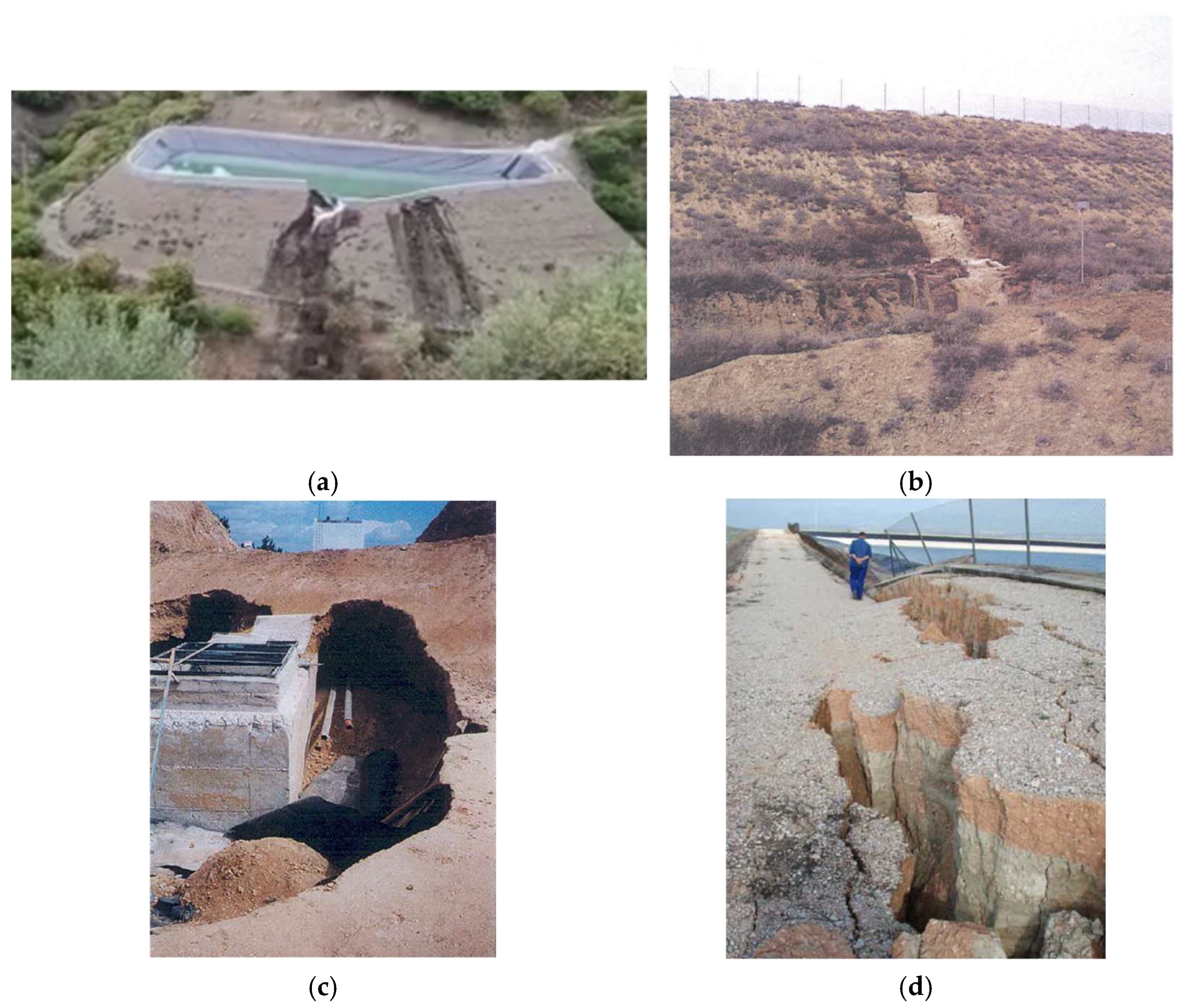
Figure 1. (a) Overtopping failure. (b) Pipping failure in clay earth pond; (c) view of failure due to piping associated with structures crossing the pond embankment; (d) slope failure due to sliding. Credits: Authors.
Water 18 00548 g001
Figure 2. Methodological flowchart; V w = volume of water stored above breach invert at failure (m3).
Water 18 00548 g002
Figure 3. Observed flow rates by volume and height range. (a) Cases study with volume lower than 1.5 hm3; (b) Cases study with volume lower than 6 hm3; (c) Frequency of overtopping failure cases; (d) Frequency of piping failure case.
Water 18 00548 g003
Figure 4. Q c / Q o for historical cases of failure. (a) ID between 1 and 32; (b) ID between 33 and 63.
Water 18 00548 g004
Figure 5. Error values for overtopping, piping and overtopping + piping failures (a) RMSE*; (b) MAD*; (c) MRD*.
Water 18 00548 g005
Figure 6. Error values as a function of storage volume (a) RMSE*; (b) MAD*; (c) MRD*; (d) all combined.
Water 18 00548 g006
Figure 7. Volume configuration according to error index values as a function of storage volume (a) RMSE*; (b) MAD*; (c) MRD*; (d) all combined.
Water 18 00548 g007
Figure 8. Calculated vs. observed flow according to ID: (a) overtopping + piping; (b) overtopping; (c) piping.
Water 18 00548 g008
Table 1. Failure modes of an earthen pond/dam.
Failure
Cause
Failure
Description
Origin and Failure
Process of Earthen Pond/Dam
Consequence,
Time of Failure
% in Studied Cases of Failure, H < 15 mRefs.
Overtopping (also considered external erosion)Overstresses in both the pond/dam body and foundation groundMaterial composition and loose material. Erosive phenomena (external and internal erosion). Overtopping occurs when the crest elevation is insufficient and flood levels exceed it.Sudden collapse, Volume exceeds the material’s capacity Flooding and economic damage41%[23,24,25,26]
Piping or internal erosionIncreased permeability and soil structure deterioration (considered internal erosion)Four internal erosion mechanisms can occur: concentrated seepage, backward erosion, contact erosion, and suffusion, allowing water to create internal pathways within the pond/dam body or its base, generating internal erosion that weakens the structure. This can occur due to construction defects, unsuitable materials, or rodent activity. The drainage system prevents hydrostatic pressure buildup within the dam. If this system fails or becomes obstructed, internal pressure may destabilize the structure.Internal water flow carries away soil particles, creating voids that expand until material collapse occurs, leading to dam failure. This can cause rapid and severe failures. Collapse over time, not easily detectable but potentially catastrophic. Due to accumulated pressure, the structure may fail due to shear stresses or core tension. This failure is often progressive and can be prevented with proper monitoring.64.3%[26,27,28,29]
OthersFailure due to explosion or sudden eventExternal or intentional event compromising the pond/dam’s structural integrity.Explosion causes an immediate loss of structural strength, potentially triggering complete failure. The failure is sudden and can be catastrophic due to the lack of time for emergency measures.4.5%[30,31,32,33]
Failure due to design or construction defectsFailure occurs due to design errors, such as underestimating expected loads or using low-quality materials, or due to construction errors.The dam is unable to withstand the projected load level. This type of failure is typically progressive but can accelerate under high-load conditions such as extreme rainfall.7%[20,34]
Inadequate construction characteristics, spillway qualityVariability of mechanical properties along its axis. The pond/dam structure cannot withstand external or internal loads, due to inadequate design, material aging, differential settlements, or even seismic movements.Total structure failure. The pond/dam loses stability and collapses due to lack of structural strength. This failure may occur suddenly and is common in pond/dams with poor-quality materials or in seismic-prone areas.7%[24]
Slope failure, structural failures, technical deficienciesReduction in shear strength of pond/dam materials under flood conditionsCollapse can be predicted in advance, but with high economic cost41.5%[24]
Foundation failureIncorrect foundation design or defective construction. Geological problems, including low-load-bearing soils, subsurface seepage, or foundation design failures.Total structure failure. Weak foundation shifts or collapses, compromising pond/dam stability. Failures can be sudden or progressive, especially in structures built on unconsolidated soils. [24]
SeepageDestruction of pond/dam materialIncreased drowning risk in irrigation reservoirs, structural damage [35]
Hydraulic fracture or overloadHydraulic loading effect on loose material occurs when the pond/dam’s storage or discharge capacity is exceeded due to water level rise, commonly caused by intense rainfall, floods, or flow control errors.Failure Process: Water overtops the pond/dam, eroding the crest and dam faces, progressively weakening it and potentially leading to total failure. Characteristics: This type of failure is typically progressive and can be identified before complete collapse. [26,36,37]
Table 2. Empirical models for predicting peak breach flow—provides a review of empirical equations used to calculate peak breach flow.
IDReferencePrediction Equation (m3/s)Cases Studied
1USBR, 1982 [54] Q p = 19.1 h w 1.85 18
2Kirkpatrick, 1977 [55] Q p = 1.268 h w + 0.3 2.5 19
3SCS, 1981 [56] Q p = 16.68 h w 1.85     h w 31.4   m 13
Q p = m a x ( 0.00042 1 V w h w W a v g h d 1.35 ] , [ 1.77 h w 2.5 ) h w < 31.4   m
4Hagen, 1982 [57] Q p = 1.205 ( V w h w ) 0.48 6
5 Q p = 0.37 S h d 0.5
6 Q p = 0.54 S h d 0.5
7Singh and Snorrason, 1982 [58] Q p = 13.4 h d 1.89 8
8Westoby et al., 2014 [59] Q p = 1.776 S 0.47 8
9McDonald and Langridge-
Monopolis 1984 [60]
Q p = 1.154 V w h w 0.412 23
10 Q p = 3.85 V w h w 0.411
11Costa, 1985 [61] Q P = 6.3 h d 1.59 10
12 Q p = 0.763 V w h w 0.42 31
13 Q p = 2.634 S · h d 0.44 10
14 Q p = 1.122 S 0.57 10
15Evans, 1986 [62] Q p = 0.72 V w 0.53 29
16Costa and Schuster, 1988 [63] Q P = 0.063 ( ρ w g h w V w ) 0.41 12
17Froehlich, 1995 [45] Q p = 0.607 V w 0.295 h w 1.24 22
18Webby, 1996 [64] Q P = 0.0443 g 0.5 V w 0.365 h w 1.40 22
19 Q P = 0.00222   V w         V w 10 7   m 3
20Walder y O Connor, 1997 [20] Q P = 0.031 ( g ) 0.5 V w 0.47 h w 0.15 h b 0.94 18
21 Q p = 1.16 V w 0.46
22 Q p = 2.5 h d 2.34
23 Q p = 0.61 h d V w 0.43
24Broich, 1997 [65] Q p = 0.5176 h w V w 0.449 39
25 Q p = 2.113 h w V w 0.256
26Barros, 2004 [66] Q = 8.388064 h w 1.959560 45
27Pierce et al., 2010 [67] Q p = 0.784 h w 2.668 72
28 Q p = 2.325 l n   h w 6.405
29 Q p = 0.00919 V w 0.745 87
30 Q p = 0.0176 V w h w 0.606
31 Q p = 0.038 V w 0.475 H 1.09
32Xu & Zhang, 2009 [46] Q p = 0.175 g 0.5 V w 5 / 6 h d h r 0.199 V w 1 / 3 h w 1.274 e B 4 66
33Pierce et al., 2010 [67] Q p = 14.68 h w 2.685 87
34 Q p = 44.514 l n   h w 6.412
35Thornton et al., 2011 [68] Q p = 0.1202 L 1.7856 87
36 Q p = 0.863 V w 0.335 h b 1.833 W a v g 0.663
37 Q p = 0.012 V w 0.493 h b 1.205 L 0.226
38Peng and Zhang, 2012 [69] Q p = g 1 / 2 h d 1.129 V w 1 / 3 h d 1.536 e α 45
39Gupta and Singh, 2012 [70] Q p = 0.02174 V w 0.4738 h w 1.1775 W a v g + L 0.17094 35
40 Q p = 0.11769 V w 0.4814 h w 0.7567
41 Q p = 1.634269 h w 2.4213
42 Q p = 0.03514 V w 0.6780
43 Q p = 0.08652 V w 0.4879 h w 0.7801
44 Q p = 0.07754 V w 0.4908 h w 0.78781
45Lorenzo and Macchione, 2014 [71] Q p = 0.321 g 0.258 0.07 V w 0.485 h b 0.802 Overtopping14
Q p = 0.347 g 0.263 0.07 V w 0.474 h b 2.151 h w 2.992 Piping
46Hooshyaripor et al., 2014 [72] Q p = 0.0212   V w 0.5429 h w 0.8713 93
47 Q p = 0.0454   V w 0.448   h w 1.156
48Azimi et al., 2015 [73] Q p = 0.0166 g V w 0.5 h w 70
49José Manuel Sánchez Muñoz, 2016 [74] Q p = 474.85 + 137.59 h b 26
50Froehlich 2016 [47] Q p = 0.0175 k M k H g V w h w h b 2 W a v g 0.5 41
51S. Dhiman· K. C. Patra, 2017 [53] Q p = 0.0105 h d 0.272 h w 1.358 V w 0.38 e C 4 81
52Muhammad et al., 2018 [75] Q p = 0.003331 h w 0.6313 V w 0.7637 24
53Bo Wang et al., 2018 [76] Q p = 0.0370 V w h w 3 0.4262 g V w 5 / 3 40
54 Q p = 3.9031 L 1.0727
55 Q p = 0.8041 W a v g 1.0727
56 Q p = 0.1413 L 0.4675 W a v g 1.8579
57 Q p = 0.0350 V w h w 3 0.4554 L h w 0.0899 g V w 5 / 3
58 Q p = 0.0370 V w h w 3 0.4264 W a v g h w 0.0028 g V w 5 / 3
59 Q p = 0.0372 V w h w 3 0.4193 L h w 0.0266 W a v g h w 0.0256 g V w 5 / 3
60 Q p = 0.0367 V w h w 3 0.4533 L W a v g 0.1041 g V w 5 / 3
61Guiwen et al., 2019 [77] Q p = 0.0525 V w 0.474 h w 1.135 84
62 Q p = 0.0755 V w 0.444 h w 1.240 Overtopping41
Q p = 0.0556 V w 0.479 h w 0.998 Piping29
63Zhong et al., 2020 [78] Q p = V w ( h w ) 0.5 g 0.5 V w 1 / 3 h w 1.58 h w h b 0.76 ( h d ) 0.10 e 4.55 Homogenous120
Q p = V w ( h w ) 0.5 g 0.5 V w 1 / 3 h w 1.51 h w h b 1.09 ( h d ) 0.12 e 3.61 Clay Core
Note:   h w = height of water above breach invert at failure (m); h d = pond/dam height (m); h b   = breach height (m)   S = reservoir storage (m3); V w = volume of water stored above breach invert at failure (m3);   g = gravitational acceleration (9.81 m/s2);   W a v g = Average embankment width (m);   L = pond/dam length (m); Q p = peak discharge (m3/s). ID 32 B 4   =   b 3   +   b 4   +   b 5 , where b 3 = 0.503 ,   0.591   a n d 0.649 for dams with core walls, concrete-faced dams, and homogenous/zoned-fill dams, respectively; b 4   = 0.705   a n d 1.039 for overtopping and piping, respectively; and b 5 = 0.007 , 0.375   a n d 1.362 for high, medium, and low dam erodibility, respectively; h r = 15   m . ID 38 α = 1.236 , 0.80   a n d 1.615 for high, medium and low erodibility, respectively. ID 50 k M = 1.85 , 1 for overtopping and non-overtopping failure mode, respectively;   k H = 1 for h b h s and k H = ( h b / h s ) 1 / 8 for h b > h s ; h s = 6.1   m , ID 51 C 4   =   b 1   +   b 2   +   b 3 , b 1 = 0.176 , 0.033 for Composite dam, for Homogenous dam and Zoned filled dam respectively; b 2 = 0.75 for overtopping;   b 3 = 1.52 , 1.06 for High erodibility and Medium erodibility, respectively.
Table 3. Characteristics of breached earthfill pond/dams.
IdPond/Dam NameDam
Type
(*)
Erodibility
(**)
Failure
Type
(***)
Water Volume Stored
VW
(m3)
Pond/Dam Height
hd
(m)
Height of Water
hw
(m)
Average Embankment Width
Wavg
(m)
Dam Crest Length
L
(m)
Peak Discharge
Qp
(m3/s)
1USDA-ARS Test #7OMO47702.132.135.538124.2
2USDA-ARS Test #1OMO49002.292.295.9547.36.5
3Otto Run DamHFMO74005.795.815.05486.8560
4Seminary Hill Reservoir No.3HFMP13,3336.15.510.191.570.79
5Porter HillHFMO15,0005.851212030
6Peter GreenOMO19,7003.963.9610.29659.44.42
7Field Test 3-3OHO22,0004.34.311.1864.5170
8North Branch Tributary HFMO22,2005.495.514.27482.3529.4
9Rito ManzanaresHFHP24,7007.324.5713.473.152132.40
10Field Test 2-2OHO35,90055137574
11Ivex Of Ohio Upper Lake Dam IIHFHP38,0007.57.523.8185466
12Break Neck Run IiOMO49,2007718.230.59.2
13Sandy RunHFHO56,7008.538.5322.178127.95435
14Field Test 1-3OHO63,0005.95.915.3488.5242
15HoulinziHFMO64,0006615.69050
16Field Test 1-1OHO73,0006.16.115.8691.5190
17AozibeiHFMO100,0006.66.717.1699150
18WenzanHFMO100,0006615.690140
19Potato Hill, N. C.HFHO105,0007.777.7715.690378.70
20YushuilingHFMO110,0009923.413521
21WachanggouHFMO116,00016.91743.94253.5200
22Owl Creek (SCS Site 07)HFMO120,0006.46.416.649631.15
23DawushanCWHO120,000121231.2180600
24DulangHFMO120,000161641.624079
25ShazitangHFMO120,0006.87.417.68102123
26CangshanHFMO130,00023.424.460.8435174
27HoucaoHFMO130,0001010.32615073
28XigouHFMO130,000121231.218040
29XifengnianHFMO140,00010102615030
30YoucaikouCWMO140,0002020.3352300120
31Site Y-30-95 (SCS 1986)OMO142,0007.477.4719.422112.05144.42
32XiaomeigangCWHO146,0001111.1428.6165530
33JigongshanHFMO160,0001212.531.2180158
34DaligouHFMO170,0006615.690182
35DashuijingHFMO170,0002020.352300446
36NibazhaiHFMO178,0001212.331.2180609
37DachongshanHFMO190,00011.211.529.1216898
38NanliushuiCWMO190,00020205230080
39ChaoyangHFMO200,00077.318.210520
40YangbaogouHFMO200,0001111.528.616598
41YankouHFMO201,000181846.8270800
42LizhutangHFMO240,00088.420.812075
43Frias Dam/Presa FriasCFMO250,00015153960400
44QingshengkouduiHFMO250,0007718.210530
45YiheaoHFMO270,0007.57.719.5112.520
46ShuixiangHFHO280,0008820.8120866
47Bila Desna DamHFMP290,0001810.723.2244487.8
48Coedty, U. K.HFHO311,000111142.85194.51233.48
49Bilberry DamZFMO327,0002020.662.5145725
50FrankfurtHFLP352,0009.758.2325.3512079
51Boydstown ICMFMO360,0007.48.9619.249365.13
52HuangtukanHFHO360,0002020523002123
53Site Y-31 A-5 (SCS 1986)OMO386,0009.459.4524.57141.7536.98
54ShediHFMO450,00011.211.829.1216872
55Buffalo Creek Dam No.1HFMO484,0003232.0283.21071420
56DalinbuligeHFMO500,00099.923.413578
57HeiniugouHFMO500,000252565375320
58ZhaolixiHFHO552,0001616.641.62401479
59Laurel Run/LakeHFMO555,00012.813.240.5189.91050
60HaojiataiHFMO600,0001415.436.4210200
61Lower ReservoirCWMO604,0009.69.624.96144157.44
62PuddingstoneHFMO610,00015.215.839.3256720
63QielinggouHFHO700,000181846.82702000
64HazhuangHFMO700,00017.818.246.28267264
65ShibalongHFHO700,0002930.9875.44354500
66Fred BurrHFMP750,0001615.830.899654
67Kelly Barnes DamHFHP777,00011.612.519.4122680
68Sheep Creek DamHFHP910,00017.114.0244.463303533.94
69Baldwin Hills Reservoir DamHFHP950,0007112.259.6198915
70Noppikoski DamHFMO1,000,35316.45921746.3175600.32
71Lijiaju = Lijiazui Dam?HFMO1,140,0002525653752950
72Little Deer CreekHFHP1,360,00026.223.9749663.12551330
73BaiyunjiCWHO1,380,0002727.7570.24059790
74Gouhou DamCFLP3,180,0007167184.610652050
75Bradfield Dam (Dale Dike)ZFMP3,200,0002928763821760
76Sinker CreekHFMP3,330,0002021.3449.6335926
77Schaeffer ReservoirHFHO4,440,00030.531.980.83354715
78Taum Sauk (Upper) ZFHO5,390,00028.95631.4646.8210015923
Note: (*) HF—homogenous fill; CW—core wall; ZF—zoned filled; CF—concrete-faced; CMF—composite fill; O—other; (**) H—high; M—medium; L—low; (***) O—overtopping; P—piping.
Table 4. ID Equation chosen according to volume range.
Volume RangeOvertopping + PipingOvertoppingPiping
0   <   V w     0.5   h m 3 423232
0.5   < V w     1.5   h m 3 325135
1.5 <   V w     3   h m 3 818
3 <   V w     4.5   h m 3 153747
4.5 <   V w     6   h m 3 242442
Disclaimer/Publisher’s Note: The statements, opinions and data contained in all publications are solely those of the individual author(s) and contributor(s) and not of MDPI and/or the editor(s). MDPI and/or the editor(s) disclaim responsibility for any injury to people or property resulting from any ideas, methods, instructions or products referred to in the content.