Review

Antibiotic Resistance in South African Wastewater Treatment Plants: A Narrative Review of WHO-Listed Critical Priority Enteric Bacteria


by
Prosperit Mafunise
,
Leonard Owino Kachienga
*,
Mpumelelo Casper Rikhotso
,
Afsatou Ndama Traore
and
Natasha Potgieter
Department of Biochemistry and Microbiology, Faculty of Sciences, Engineering & Agriculture, University of Venda, Thohoyandou 0950, Limpopo, South Africa
*
Author to whom correspondence should be addressed.
Water 2026, 18(4), 523; https://doi.org/10.3390/w18040523
Submission received: 22 December 2025 / Revised: 31 January 2026 / Accepted: 19 February 2026 / Published: 22 February 2026
(This article belongs to the Section Water and One Health)

Abstract

The spread of antibiotic resistance is contributing to 4.95 million cases of mortality per year, and it is categorised as one of the top three threats to public health in modern society, threatening the ability to treat common infections. Wastewater treatment plants influence the dissemination and acquisition of antibiotic resistance to enteric bacteria due to the abundance of nutrients present in them. This narrative review synthesises published evidence on antibiotic resistance patterns in South African Wastewater treatment plants, with specific emphasis on WHO-listed critical priority enteric pathogens. This review is the first to provide a temporal analysis (2009–2024) of antibiotic resistance trends in South African Wastewater treatment plants before and after the WHO’s 2017 Bacterial Priority Pathogen List (BPPL), revealing a 20–50% increase in resistance to critical antibiotics, such as vancomycin and carbapenems, across Escherichia coli, Klebsiella pneumoniae, Enterococcus spp., Salmonella spp., and Campylobacter spp. Inconsistent monitoring methods, provincial disparities, and limited molecular investigations hinder a comprehensive national assessment. This review fills a critical geographic gap by focusing on South Africa, a low-middle-income country with unique socio-economic and environmental challenges and integrates local data with WHO’s global health priorities. By synthesising 24 studies and employing statistical analysis, it identifies region-specific resistance patterns and proposes a novel framework for enhanced monitoring using metagenomics and predictive modelling, advancing beyond existing African wastewater resistome studies.

1. Introduction

The presence of antibiotics in aquatic environments worldwide has an adverse impact on water quality, with potential implications for human health and ecological systems. Consequently, these challenges are largely attributed to the development of antibiotic-resistant bacteria [1,2]. The prevalence of bacterial strains resistant to antibiotics has increased significantly, making antibiotic resistance a critical global health crisis of the 21st century [3]. This resistance has become one of the leading causes of mortality globally, with an estimated daily death toll of around 3500 people across the globe [4]. Lancet [5] further reported that over 1.2 million fatalities in 2019 were directly attributable to infections caused by antibiotic-resistant bacteria. Low- and middle-income countries are particularly vulnerable to the antibiotic resistance crisis due to limited monitoring and diagnostic options, uncontrolled use of antibiotics by both humans and animals, overcrowding in hospitals, and poor sanitation [6]. According to Kumburu et al. [7], respiratory tract, urinary tract, bloodstream, and wound infections are among the common conditions caused by these pathogens in healthcare and community settings. In South Africa, where issues of sanitation, healthcare access, and infectious diseases intersect, the prevalence of antibiotic resistance in enteric pathogens is an alarming issue [8].
South Africa has a population of approximately 60 million; as such, the consumption of antibiotics has increased both in humans and animals, including a growing number of animals raised for food production [9,10]. The country is also facing complex challenges as it faces a triple threat of antibiotic resistance involving drug-resistant tuberculosis, HIV, and enteric bacteria [11]. According to the National Department of Health Surveillance of AMR in South Africa [11], from 2018 to 2020, the public sector in South Africa procured less than 8% of the total antibiotic quantity acquired for the country. In the public sector, the predominant antibiotic was extended-spectrum penicillin, making up 28% of the total antibiotics used in 2020 [11]. In the absence of potent antibiotics, infections such as pneumonia, gastroenteritis, urinary tract infections, tuberculosis, and sexually transmitted diseases are becoming increasingly challenging to manage [12].
Wastewater treatment plants (WWTPs) are fundamental for sustainable development and public health, as they ensure the removal of excessive organic loads and pathogens before they are discharged into the environment through receiving aquifers [13,14,15]. The South African unique environmental, socio-economic, and healthcare landscape may influence the dynamics of antibiotic resistance dissemination and transmission within WWTPs, potentially impacting public health outcomes [16]. However, for the past few years, WWTPs have drawn attention due to the increasing number of ARBs resulting in wastewater-based epidemiology studies. Several studies have been published that predict the fate of ARB in WWTPs and the acquisition of antibiotic-resistant genes (ARGs) and antibiotic inactivation genes to be conclusively established [17,18,19].
The geographic distribution of antibiotic resistance in South African wastewater systems is a significant concern, with potential hotspots identified as the pharmaceutical industries, abattoirs, medical facilities (hospitals and clinics), agriculture, and aquaculture [20]. According to the Department of Water and Sanitation SA Green Drop Report [21], there are 850 WWTPs in South Africa, located in 152 municipalities, with 334 reported to be in critical condition, meaning they fail to meet minimum operational and regulatory standards. The poor performance of these WWTPs in removing ARGs and ARB is leading to contamination of treated drinking water, surface water, and groundwater [1], as most conventional biological WWTPs were designed to remove organic carbon at mg/L concentrations rather than trace contaminants and pharmaceuticals, ARGs, and ARB occurring at ng/L to µg/L levels. The increasing prevalence of antibiotic-resistant pathogens in WWTPs is associated with most hospital-acquired infections [22].
In 2017, the WHO developed the first Bacterial Priority Pathogen List (BPPL) which is a valuable public health tool for guiding antibiotic resistance surveillance, prevention and control. The list categorises bacteria into three priority levels: critical, high, and medium, based on the urgency of the need for new antibiotics to treat these infections. The WHO Critical Priority Enteric Bacteria (CPEB) list of 2024 included Klebsiella pneumoniae, Escherichia coli, Shigella spp., Enterococcus faecium, Non-typhoidal Salmonella, Enterobacter spp., Citrobacter spp., Proteus spp., and Serratia spp. This review is the first to systematically synthesise antibiotic resistance trends in South African WWTPs before and after the WHO’s 2017 BPPL, revealing a significant 20–50% increase in resistance to critical antibiotics (e.g., carbapenems and vancomycin); furthermore, the review is vital for the following—(i) antibiotic resistance is one of the top three public health threats worldwide, with millions of deaths annually, (ii) WWTPs are key environmental hotspots for the dissemination and acquisition of resistance genes due to nutrient-rich conditions, (iii) understanding resistance profiles in WWTPs is crucial for tracking environmental reservoirs of resistance and potentially preventing spread to human populations, (iv) the focus on critical priority bacteria aligns this work with the WHO’s urgent global health priorities offering actionable insights for region-specific intervention, and (v) South Africa, like many other countries, faces socio-economic and healthcare challenges that may exacerbate antibiotic resistance—thus, localised data is vital for effective public health strategies, unlike global reviews that often overlook African data, and lastly it proposes a novel framework for enhanced monitoring using metagenomics and predictive modelling to improve early-warning systems for antibiotic resistance dissemination, advancing beyond recent African wastewater studies. In comparison to the state of the art of the recent studies, focusing on antibiotic resistance, this work provides localised empirical data from South African WWTPs, filling a geographic and contextual gap.
While several South African studies have reported antibiotic resistance patterns in enteric bacteria from influent and effluent wastewater, the available evidence remains fragmented, highly localised, and methodologically inconsistent. To date, no comprehensive narrative review has synthesised these findings across provinces or examined them in the context of WHO-listed critical priority enteric pathogens. This review, therefore, collates existing data, identifies dominant resistance trends, highlights methodological limitations, and outlines implications for environmental and public health management. In addition, this review provides perspectives on more efficient and accurate approaches for monitoring antibiotic resistance in wastewater environments, thereby supporting the development of predictive and early-warning systems for resistance dissemination, an area that remains underexplored in previous South African studies. Furthermore, the review integrates environmental, socio-economic, and healthcare-related factors that contribute to antibiotic resistance within South African WWTPs, offering a holistic understanding of the current state of resistance and its public health implications in the region.

2. Results

Literature Search Strategy and Selection Process

This narrative review employed a structured literature search to identify relevant studies. Searches were conducted in PubMed, Scopus, Web of Science, Google Scholar, and Sabinet using combinations of the following keywords: “antibiotic resistance”, “South Africa”, “wastewater treatment plants”, “enteric pathogens”, “E. coli”, “Klebsiella”, “Enterococcus”, “Salmonella”, “Campylobacter”, and “WHO critical priority bacteria”.
Inclusion criteria: Studies conducted in South Africa; reports of antibiotic resistance in wastewater, influent, effluent, sludge, or receiving waters; studies involving WHO-listed priority enteric pathogens; articles published between 2009 and 2024; and peer-reviewed primary research. Exclusion criteria: Non-South African studies; reviews; and studies with no AR data. The goal was not exhaustive systematic coverage, rather an integrated synthesis of published South African findings relevant to WHO priority pathogens.

3. Overview of Antibiotic Resistance in South African Wastewater Treatment Plants

3.1. Prevalence of WHO-Listed Critical Priority Enteric Bacteria with Antibiotic Resistance in South African WWTPs

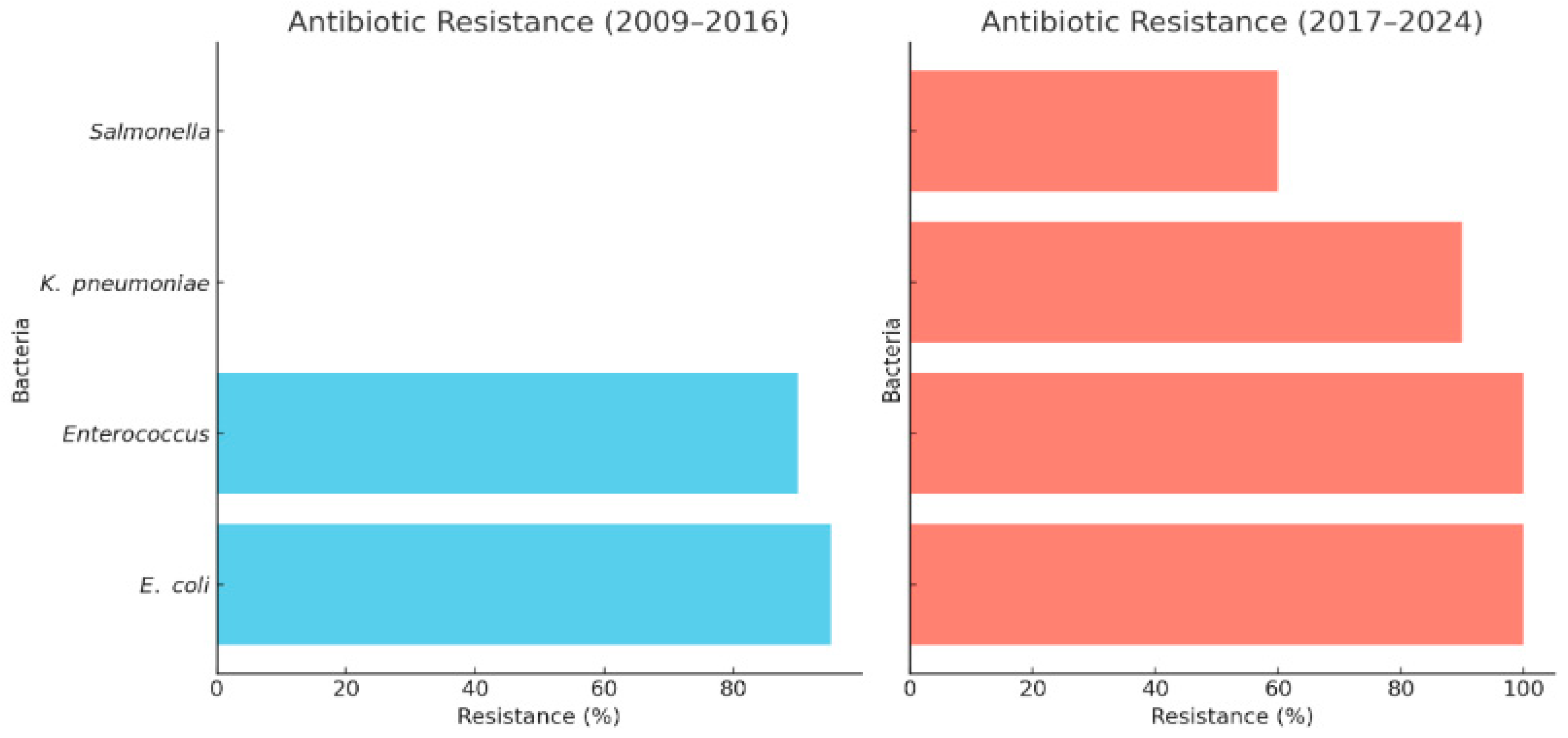
It is important to note that the occurrence of antibiotic resistance in enteric bacteria varies widely based on healthcare practices, antibiotic usage patterns, the presence of antibiotic-resistant genes (ARGs), and geographic location. In 2017, the WHO-listed enteric bacteria of critical priority, including Escherichia coli, Enterococcus faecium, Salmonella typhi, Helicobacter pylori and Campylobacter spp. [23]. After the list was published, studies in South African WWTPs showed that resistance levels increased considerably, particularly for K. pneumoniae and Enterococcus (Figure 1). Figure 1 indicates a clear increase in antibiotic resistance among all the listed enteric bacteria (Salmonella, K. pneumoniae, Enterococcus, and E. coli) in South Africa from 2009 to 2016, to 2017 to 2024. This shows that despite global awareness and intervention efforts, antibiotic resistance to these pathogens has continued to increase in the South African context.
Table 1 summarises the prevalence of antibiotic resistance among enteric bacteria isolated from South African WWTPs, comparing two periods: 2009–2016 and 2017–2024. Resistance to commonly used antibiotics such as tetracycline (TET), ampicillin (AMP), amoxicillin (AMX), ciprofloxacin (CIP), and sulfamethoxazole-trimethoprim (SXT) was consistently high across both periods, with some antibiotics (AMX, CIP, SXT, Cefpodoxime (CFX) and Streptomycin (STR)) showing increased prevalence in more recent years (2017–2024). For instance, TET resistance ranged from 56.7% to 81% between 2009 and 2016 and escalated to 43–100% between 2017 and 2024 (Table 1). Similarly, resistance to AMX increased from 18 to 55.6% to as high as 94%. The period of 2017–2024 indicates the critical emergence of resistance to critical antibiotics such as Cefixime (CFM), imipenem (IPM), vancomycin (VAN) and Fluoroquinolones (FQ), which were not reported in the period of 2009–2016 (Table 1). The recent studies (2017–2024) increasingly identified resistance genes such as blaTEM, blaCTX-M, and mcr variants, indicating not only phenotypic resistance, but also the genetic mechanisms driving it (Table 2).

3.2. Characteristics of the Studies in South Africa of Antibiotic-Resistant Bacteria

The sources of the sampling for these studies across the provinces were predominantly wastewater influents and final effluents, with a few also considered primary clarifiers of WWTPs and downstream/upstream of the adjacent rivers (Table 2). A total of 24 studies fitted the inclusion criteria as shown in the literature search strategy and selection process, with 10 studies conducted in KwaZulu-Natal, eight studies in the Eastern Cape, three studies in the Northwest, two studies in Gauteng, and one study in the Western Cape. According to these studies, E. coli was the most frequently identified organism in all five provinces (14/24; 58.3%), followed by Enterococcus (4/24; 16.7%), K. pneumoniae (4/24; 16.7%), and Salmonella (2/24; 8.3%).
Most of the studies across the provinces (Eastern Cape, Western Cape, KwaZulu-Natal, Gauteng, and Northwest) used culture-based approaches in conjunction with polymerase chain reaction (PCR) analysis for the identification of antibiotic resistance prevalence in E. coli, Enterococcus, and other enteric bacteria (Table 2). More advanced methods, such as whole genome sequencing (WGS) and MALDI-TOF mass spectrometry, were only used in two studies that were domiciled in KwaZulu-Natal (Table 2).
Pronounced regional heterogeneity in antibiotic resistance profiles was evident among selected enteric bacteria across South African provinces, with the Eastern Cape consistently emerging as a hotspot for extensive multidrug resistance (Table 2). E. coli isolates from this province exhibited complete (100%) resistance across multiple antibiotic classes, including carbapenems (MEM), macrolides (ETM, RL), penicillins (AMP, PCN), and cephalosporins (CTX, CEF). In contrast, E. coli from other provinces demonstrated only partial resistance to carbapenems, indicating that pan-carbapenem resistance remains geographically constrained rather than nationally pervasive.
A similarly severe resistance burden was observed among Enterococcus spp. in the Eastern Cape, where isolates showed 100% resistance to glycopeptides (CDM), tetracyclines (TET), and cephalosporins (CFM), alongside very high resistance to vancomycin (VAN; 91%), fluoroquinolones (CIP; 98%), and beta-lactams (CTX; 95%). These findings are of particular concern given the clinical importance of glycopeptides and fluoroquinolones as last-line therapies for enterococcal infections.
K. pneumoniae displayed consistently high resistance to beta-lactams (86.2%) and fluoroquinolones (94.1%) across provinces, suggesting widespread selective pressure against these antibiotic classes. However, resistance to carbapenems was more variable, with moderate resistance levels to meropenem (69%) and imipenem (51%) reported in the Eastern Cape, pointing to an emerging however uneven dissemination of carbapenem resistance within this high-priority pathogen.
In contrast, Salmonella spp. exhibited more localised and antibiotic-class-specific resistance patterns. Complete resistance to sulfonamides (100%) was observed in KwaZulu-Natal, whereas isolates from other provinces showed only moderate resistance to quinolones (27%) and aminoglycosides (14%), suggesting region-specific drivers of resistance selection rather than broad multidrug resistance.
Molecular analyses were reported in 62.5% of the included studies, revealing a predominance of resistance genes associated with commonly used antibiotic classes. The most frequently detected genes were blaTEM (44.4%), tetM (33.3%), and sul2 (33.3%), consistent with the widespread phenotypic resistance to beta-lactams, tetracyclines, and sulfonamides. Extended-spectrum beta-lactamase and tetracycline resistance genes (blaCTX-M, tetA–D) were identified in 22.2% of organisms, indicating ongoing horizontal gene transfer within environmental and wastewater-associated bacterial populations. Less frequently detected genes, including ermA, mcr-1, strA, and catI (each 11.1%), suggest early-stage dissemination of resistance to macrolides, colistin, aminoglycosides, and chloramphenicol.

4. WHO Critical Priority Enteric Pathogens in South African WWTPs

This review deliberately focuses on WHO-listed critical priority enteric pathogens as clinically relevant indicator organisms for assessing antibiotic resistance in South African WWTPs. While wastewater environments harbour highly diverse and dynamic microbial communities, in-depth species-specific interpretation of resistance patterns is constrained by the nature of available evidence. Most South African studies rely on culture-based approaches, infrequent sampling, and heterogeneous analytical methods, which limit detailed characterisation of resistance mechanisms, and strain diversity and microbial interactions within the wastewater ecosystem. Consequently, resistance observed in Escherichia coli, Klebsiella pneumoniae, Enterococcus spp., Salmonella spp. and Campylobacter spp. is interpreted within a broader community-level context, recognising that these pathogens act as sentinels reflecting cumulative selective pressures, horizontal gene transfer, and resistome dynamics rather than isolated biological entities. According to the WHO, critical priority pathogens are briefly discussed:

4.1. Escherichia coli (E. coli)

E. coli is one of the most studied bacteria in the world and is arguably the best understood of all model microorganisms [46]. The bacterium’s structural components play vital roles in the cell’s movement, genetic function, adaptability and resistance to antibiotics. Various studies have investigated E. coli in different provinces of South Africa in WWTPs, with a focus on antibiotic resistance patterns. These studies point out regional differences and commonalities in resistance profiles, as well as the methodologies employed (Table 2). A common trend across all provinces is the consistent resistance of E. coli to AMP and TET, two commonly used antibiotics. However, resistance to other antibiotics such as RL, GEN and third-generation cephalosporins (CTX, CFX) varies by region. KwaZulu-Natal provided broad antibiotic resistance patterns, likely due to more comprehensive methodologies (culture combined with PCR and whole genome sequencing (WGS)), whereas studies from the Western Cape report slightly lower resistance, potentially because of less advanced testing methods (Table 2). KwaZulu-Natal and the Northwest Province show significant resistance to multiple antibiotics, with variations based on the scope and methodology of the studies.
A study done by Igwaran et al. [26] in the Eastern Cape province found high levels of antibiotic resistance in E. coli with 100% resistance to CD, ETM, and MEM, alongside also showing significant resistance to AMX (94.5%), DXT (90%) and SXT (83.7%) (Table 2). Similarly, Olayinka and Anthony [27] observed 100% resistance to MEM, CTX, and GEN. Seti [30] also noted 100% resistance to PCN and ETM, consistent with the findings of Igwaran et al. [26]. However, resistance to TET (81%) was higher in this study than in that of Adefisoye and Okoh [28]. Beyond South Africa, studies in Kenya [47] and Mozambique [48] found low resistance levels of CEF (52.38%), CTX (42.86%; 11.4%) and AMX (38.6%) from supply wells and municipal water distribution systems. In contrast, Adekanmbi et al. [49] reported higher resistance/complete resistance to TET (100%) recovered from a hospital treatment plant in Nigeria, indicating the differences in geographical distribution within the African antibiotic resistance crisis. A study in India done by Gupta et al. [50] reported resistance patterns similar to those in South Africa, with 98% resistance to AMX, 88% to DXT, and 85% to SXT, reinforcing concerns that developing regions face heightened risks of antibiotic resistance due to uncontrolled antibiotic use and inadequate wastewater treatment.
The key factor in these studies is the combination of traditional culture methods with molecular techniques such as PCR and WGS. Sloots et al. [51] emphasised the role of molecular techniques in the swift identification of pathogens, which is essential for managing antibiotic resistance in clinical and environmental settings. The integration of PCR with traditional methods has been exemplified in studies focusing on specific pathogens, showcasing how molecular techniques can enhance the accuracy of traditional identification methods. Henceforth, Adefisoye and Okoh [28] found somewhat lower resistance levels to TET (60.1%), AMP (55.6%), and CFX (51.1%) using traditional culture methods and PCR, which could be likely due to variations in resistance detection depending on geographic location. Aslan et al. [52] reported high AMP (85%) E. coli resistance from the effluent in the urban community of Georgia (USA), with low TET (30%) being the least observed, using real-time PCR and the Epsilometer test.
Studies conducted in KwaZulu-Natal province provided a broader range of antibiotic resistance. A study done by Nzima et al. [37] found 100% resistance to AMP and CTX, 80% resistance to TET and 60% resistance to CIP (Table 2). Comparable resistance trends have been observed globally, for instance, in India, Akiba et al. (2016) detected a 100% resistance level to AMP, CFZ, CTX and over 80% resistance to NAL and CIP, while Praveenkumarreddy et al. [53] found over 90% resistance to AMP and CTX among E. coli isolates from sewage outlets. Mbanga et al. [34] provided a significant, comprehensive view of antibiotic resistance using whole genome sequencing (WGS) alongside traditional culture and PCR methods. The findings from Mbanga et al. [34] were consistent with those of Adegoke et al. [36], who found high resistance to AMP (63.4%), SXT (57.2%), and AMX (53.1%) in samples collected from influent, effluent, and water bodies near WWTPs (Table 2). By sampling multiple points (influent, effluent, upstream, and downstream locations), Mbanga et al. [34] and Adegoke et al. [36] provided a complete overview of understanding how resistant bacteria move through and potentially escape the treatment process. It is reported that WWTPs have an impact on the receiving bodies, with more than 90% resistance to TET (97%), NAL (97%), RL (97%) and CIP (97%) detected downstream of the receiving body in Zimbabwe [54].
Studies in the Western Cape and Northwest regions, although limited in number, have contributed to the understanding of antibiotic resistance patterns. A study by Genthe et al. [45] in the Western Cape isolated E. coli from the final effluent of oxidative ponds; the study reported 90% resistance to AMP and 100% to RL (Table 2). In comparison to other provinces, the absence of molecular methods in this study may not have fully captured the breadth of resistance patterns in E. coli. In the Northwest Province, Makuwa et al. [40] reported resistance levels of 56.67% to TET, 52.22% to SXT, and 92.22% to RL in E. coli isolates from final effluent samples. When compared to other regions, the resistance profile in the Northwest Province shares some similarities with provinces such as KwaZulu-Natal and the Eastern Cape. For instance, in KwaZulu-Natal, resistance to TET and SXT is also notably high; however, the elevated resistance to rifampicin in the Northwest Province (92.22%) was distinct, indicating localised resistance patterns that may be influenced by regional antibiotic use, especially from communities burdened by TB diseases and wastewater treatment processes.
Despite the large number of studies conducted on E. coli in South African WWTPs, the evidence base remains highly fragmented. Provinces differ widely in sampling strategies, antibiotic panels, and laboratory methods, which makes cross-study comparison extremely difficult. Only a few studies incorporate molecular approaches such as PCR or WGS, while many rely solely on culture-based identification, resulting in under-detection of resistance genes and strain diversity. Furthermore, most studies focus on single WWTPs or short sampling periods, limiting the ability to assess temporal trends or national patterns. As a result, South Africa lacks a coherent, standardised understanding of E. coli resistance dynamics across wastewater systems. This gap highlights the urgent need for harmonised surveillance frameworks and unified methodological protocols to enable nationwide comparison and early detection of emerging resistant strains.

4.2. Enterococcus faecium

E. faecium, the second most common Enterococcus spp., harbours vancomycin resistance genes [55]. In the late 1970s, opportunistic E. faecium caused a high number of mortalities in already-hospitalised patients, which led to the introduction of third-generation cephalosporin antibiotics, which, unfortunately, all enterococci were intrinsically resistant to [56]. As such, vancomycin was introduced as an alternate treatment option. However, resistance to vancomycin was reported not long after its introduction [57]. The origins of vancomycin-resistant strains of Enterococcus can be traced back to Europe, where the use of the glycopeptide avoparcin as a growth promoter for livestock facilitated their emergence [58]. Similarly, in the United States, the excessive use of vancomycin in hospitals led to a similar outcome, intensifying the selective pressure and consequently increasing the colonisation by vancomycin-resistant Enterococcus [58]. In South Africa, the outbreak of vancomycin-resistant Enterococcus was reported in 2014 at the national level by the National Institute for Communicable Diseases (NICD) [59].
In a study done by Iweriebor et al. [29], in the Eastern Cape, high resistance rates against several antibiotics were reported; the study indicated 100% resistance of TET and CDM, as well as high resistance in VAN (91%), CIP (98%) and CTX (95%). In contrast, Mbanga et al. [34] in KwaZulu-Natal reported slightly lower resistance in TET (57.7%); however, high resistance rates in different antibiotics with SXT (80%) and STR (60.1%) were observed (Table 1). Additionally, Adegoke et al. [32] found even higher resistance rates in the same region, with CIP (88.6%), VAN (83.6%), TET (90.1%), CFM (100%), STR (91.1%), DXT (88,6%), and ETM (68.3%). The study employed traditional culture methods combined with molecular techniques (PCR and MALDI-TOF MS), which provided a broader identification of resistance patterns compared to other findings that only focused on culture-based methods and PCR (Table 2). When comparing these findings on a global level, it is noted that some developed countries, such as northern Portugal, reported lower resistance levels, such as CIP (26%), TET (38%), and ETM (40%) [60]. In contrast, a developing country such as Iran battles antibiotic-resistant E. faecium, with most isolates from municipal sewage treatment plants resistant to ETM (97%) [61]. However, resistance trends in Europe appear somewhat lower, with surveillance data from the European Centre for Disease Prevention and Control [62] indicating that VAN resistance in E. faecium was present in approximately 20% of isolates, particularly in high-burden countries such as Italy and Greece. Findings from the Northwest were relatively lower compared to those observed in KwaZulu-Natal and the Eastern Cape, however, higher than Gauteng (Table 2), where Molale-Tom and Bezuidenhout [41] reported resistance rates of AMP (67%), VAN (62%), TET (58%) and PCN (52%) (Table 2). The geographical variations in resistance prevalence may be attributed to differences in antibiotic usage policies, environmental conditions, and the effectiveness of antimicrobial stewardship programmes [63].
Existing data are geographically limited, with most studies concentrated in a few provinces and relying on short sampling periods. The lack of standardised antibiotic panels and inconsistent laboratory approaches, particularly the limited use of molecular typing such as WGS, restricts the ability to compare resistance trends nationally or link environmental isolates with clinical strains. Furthermore, vancomycin-resistant enterococci (VRE) have been reported in several provinces, yet no wastewater-based surveillance system exists to track their emergence or environmental dissemination. As a result, South Africa lacks a unified understanding of the sources, movement, and ecological persistence of resistant E. faecium within wastewater systems. Addressing this gap requires harmonised monitoring frameworks, molecular-based surveillance, and longitudinal multi-site studies to evaluate the spread of VRE across environmental and clinical interfaces.

4.3. Klebsiella pneumoniae

K. pneumoniae is a third-generation cephalosporin-resistant bacterium that is part of the WHO Bacterial Priority Pathogen List (BPPL) 2024. The high estimated burden of β-lactamase-producing K. pneumoniae, especially in low-middle-income countries (LMICs) such as South Africa, leads to high rates of treatment failure and increased healthcare costs [23]. K. pneumoniae complicates first-line antibiotic treatment, leading to higher cases of neonatal sepsis associated with increased morbidity and mortality rates, particularly in LMICs [64]. In South Africa, from 2010 to 2012, 75% was isolated from the blood of hospitalised patients.
The increase in multidrug resistance in K. pneumoniae has attracted the attention of researchers around the world due to its ability to form biofilms and the presence of an efflux pump system [65] that extrudes different toxic substances out of its cells. Studies in the Eastern Cape report high resistance in K. pneumoniae isolated from effluent, with 86.2% to AMP and 69% to TET. In contrast, Gauteng shows high resistance to FQ (94.12%) and moderate resistance to TET (52.82%). In a study by Koudoum et al. [66], they detected 100% resistance levels to AMC, CTX, ATM and SXT, followed by CIP (97.62%), TET (95.23%), and lastly FOX (66.67%) from hospital influent and effluent wastewaters in Cameroon. In contrast, Karungamye et al. [67] in Tanzania reported low resistance levels of TET (54%), GEN (50%), CEF (35%) and CIP (30%). King et al. [35] reported lower resistance levels of <20% to AMC, TZP, CTX, CAZ, ETPCIP and GEN from hospitals’ WWTPs in Pietermaritzburg. While the prevalence of K. pneumoniae in wastewaters may be overlooked, other countries such as Southern Romania report effluent isolates 100% resistant to AMP, SXT and over 80% resistant to PIP, AMC, CXM, ETP, ATM and CIP [68].
Critically, few South African studies incorporate molecular characterisation to detect ESBL, AmpC, or carbapenemase-producing strains, despite their clinical and public health importance. Long-term surveillance is also lacking, preventing assessment of temporal trends or the potential spread of high-risk clones from hospital settings into wastewater and receiving environments. Consequently, the national burden, transmission dynamics, and environmental persistence of resistant K. pneumoniae remain poorly understood, underscoring the need for harmonised monitoring and genomic-based surveillance across South African WWTPs.

4.4. Campylobacter

Campylobacter are Gram-negative, microaerophilic, non-spore-forming, spiral bacilli and fastidious microorganisms (requiring specific growth conditions for cultivation) [69,70]. The bacteria are ubiquitous, although the gut mucosa of mammals and birds serves as a host or reservoir. Infections with Campylobacter are very common in developing countries, especially in rural settings with poor hygiene and sanitation, close contact with domestic animals, and poor handling of food [71]. Fluoroquinolone antibiotics such as ciprofloxacin were considered as chemotherapeutic agents against Campylobacteriosis infections. The emergence of Campylobacter resistant to fluoroquinolone was reported in Canada and the USA in 1992; consequently, in 1991, Campylobacter isolates resistant to fluoroquinolone were also reported in Africa [72]. The widespread use of fluoroquinolones in animal husbandry has been suggested as a potential factor in the selection of resistant Campylobacter strains [73]. The genetic elements responsible for antibiotic resistance mechanisms can be found either on the chromosome or on plasmids, and they consist of a mix of native and acquired genes [74].
Studies in South Africa have revealed a concerning prevalence of antibiotic-resistant Campylobacter spp. in various settings [75], found high resistance to first-line antibiotics in clinical isolates, while Samie et al. [76] reported high resistance to macrolide and quinolone antibiotics in human diarrhoeal stools. Bester and Essack [77] observed variations in resistance profiles among different poultry production systems, with high resistance to tetracycline in commercially raised chickens. Sithole et al. [78] identified relatively high resistance to antibiotics commonly used in intensive pig production, with evidence of transmission across the farm-to-fork continuum. The increasing resistance to macrolides, such as ERM and azithromycin, and fluoroquinolones, such as CIP, is particularly alarming as these are the primary drugs used to treat severe Campylobacter infections [79]. Similar resistance patterns have been observed globally, indicating a widespread issue. For instance, in China, Zhang et al. [80] reported over 80% resistance to fluoroquinolones among Campylobacter jejuni and Campylobacter coli isolates from poultry meat, a major transmission route for human infections. Additionally, studies in the United States have demonstrated an increasing resistance to CIP, with the National Antimicrobial Resistance Monitoring System (NARMS) reporting resistance rates of up to 29% in Campylobacter jejuni isolates from retail chicken meat [81]. In Europe, fluoroquinolone resistance in Campylobacter spp. has reached critical levels, with over 60% of isolates in some regions exhibiting resistance, as reported by the European Centre for Disease Prevention and Control [62]. It is worth noting that most studies focus on antibiotic-resistant Campylobacter in animals, particularly poultry and pigs, as they are primary reservoirs and major sources of human infection [79]. In contrast, few studies have examined Campylobacter in wastewater due to its fastidious nature and difficulty in isolation from complex environmental samples [82]. Recently, high antibiotic resistance rates against CHL (76.92%), TET (73.08%), and AMP (65.39%) were reported in the Eastern Cape by Oluwakoya and Okoh [83] on isolates recovered from WWTPs and household effluents in the Nelson Mandela District. These studies point out the urgent need for surveillance strategies to address the prevalence of antibiotic-resistant Campylobacter spp. in South Africa, especially in WWTPs that have limited or no information on antibiotic-resistant Campylobacter in wastewater.
The scarcity of wastewater data for Campylobacter in South Africa, compared to clinical or agricultural settings, highlights a critical research gap. This review’s focus on WWTPs suggests that Campylobacter resistance, particularly to fluoroquinolones (e.g., 94.12% in some isolates), may be underestimated in environmental reservoirs, necessitating targeted studies using advanced detection methods such as metagenomics.

4.5. Salmonella spp.

Salmonella, a genus belonging to the family Enterobacteriaceae, is a Gram-negative bacillus, a facultative anaerobe, rod-shaped bacteria and typically measures between 2 and 4 μm in length and approximately 0.6 μm in diameter [84]. Antibiotic resistance in Salmonella typhimurium began in the mid-1960s, when the bacterium became resistant to six antibiotics [85]. AR in Salmonella is mediated by several mechanisms, such as drug inactivation, reduction in its membrane permeability, thus preventing drug entry and the ability to pump out drugs [86]. According to the WHO [87], fluoroquinolone-resistant Salmonella typhi species is categorised as a high-priority pathogen posing a substantial burden in developing countries.
Salmonella typhi caused an estimated 10 million cases of typhoid fever and 116,800 deaths annually [88]. Fluoroquinolone-resistant non-typhoidal Salmonella that causes gastroenteritis is also included in the high-priority category, and these pathogens are a major global concern as they are the leading cause of foodborne diarrhoeal infections [87]. Mafu et al. [31] in the Eastern Cape region reported high resistance in Salmonella to RL (92.5%) and DXT (57.5%), whereas Odjadjare et al. [39] in KwaZulu-Natal detected high resistance in RL (100%); however, lower resistance for NAL (27%) and STR (14%) was reported. Furthermore, international comparisons reveal similar trends in developing countries. In Morocco, Oubrim et al. [89] reported high resistance levels to SXT (91.6%) and AMP (70.8%); however, lower STR and CHL resistance (50%) was observed. Mhongole et al. [90] in Tanzania reported RL (94%) and STR (61%), with lower resistance detected to TET (22%), NAL (17%), and SXT (11%), aligning with the findings in KwaZulu-Natal. However, European studies, such as the one reported by Jäger [91] in Germany, have reported significantly lower resistance to RL (35%) and STR (10%), suggesting that antibiotic stewardship and stricter regulations contribute to reduced resistance levels. The difference in resistance patterns is likely due to the more detailed resistance profiling in KwaZulu-Natal, where both culture and molecular methods were used, whereas the Eastern Cape study’s methodology details were less specific (Table 2). The limited methodological details, such as unclear antibiotic selection criteria, testing concentrations, or quality controls, may affect the resistance rates reported. According to Adefisoye and Okoh [28], some AMR studies in South Africa lack standardisation in antibiotic panels and susceptibility testing methods, making it difficult to compare results across regions.
The limited data on Salmonella in South African WWTPs, compared to clinical or food-related studies, underscores a need for expanded environmental surveillance. This review’s analysis suggests that Salmonella’s high resistance to SXT (100% in KwaZulu-Natal) in WWTPs could contribute to downstream contamination, a risk not fully addressed in prior African wastewater studies.

5. High-Priority ARGs in South African WWTPs

In South African WWTPs, the blaNDM-1-a gene, which is responsible for carbapenem resistance, has been frequently detected in purified effluent samples [32,33,34]. This prevalence is concerning given the region’s limited access to advanced treatment technologies, which may facilitate the spread of such genes into surrounding water bodies and agricultural systems. While mecA is predominantly associated with methicillin resistance in Staphylococcus spp., its occasional detection in enteric bacteria such as E. coli within WWTPs may suggest horizontal gene transfer facilitated by environmental conditions unique to wastewater systems [92].
Efflux pumps, a common resistance mechanism encoded by ARGs such as mcr-1, enable bacteria to survive in high concentrations of antibiotics often present in WWTP influent [93]. Recent studies using metagenomics have revealed the presence of rare ARGs, including blaCTX-M-15, which were previously undetected in traditional culture-based approaches. These findings suggest that the resistome (complete set of antimicrobial resistance genes present in a microbial community) in WWTPs may be more diverse and dynamic than previously understood. The detection of ARGs such as blaNDM-1 in effluent indicates the urgent need to develop advanced treatment technologies capable of targeting genetic material, rather than just microbial cells.

6. Comparison with Global Trends

South African AR patterns are broadly consistent with global observations, but the local context amplifies certain risks and knowledge gaps. First, the global burden of bacterial AMR is large and rising; resistant infections already cause substantial mortality worldwide, and the highest burdens are predicted in low- and middle-income regions. This global burden underscores why environmental reservoirs such as WWTPs deserve urgent attention [93].
Second, wastewater treatment plants are recognised internationally as important reservoirs and mixing grounds for ARB and ARGs: they concentrate diverse inputs (clinical, domestic, and agricultural), provide nutrient-rich conditions favourable to horizontal gene transfer, and frequently release partially treated ARB/ARGs into receiving waters. The role of WWTPs observed in South Africa (persistence of MDR organisms in effluent and detection of WHO priority pathogens in sludge) therefore reflects a widely reported global pattern [19].
Third, global sewage metagenomic surveys show systematic geographic differences in the abundance and diversity of resistance genes, with higher AMR gene burdens and different resistome compositions in many African and Asian cities compared with much of Europe/North America, findings that align with the provincial heterogeneity and the elevated resistance we report in South African WWTP studies. These large-scale sewage studies support the idea that local antibiotic use, sanitation infrastructure, and population health shape wastewater resistomes [94].
Worldwide, E. coli is a leading carrier of ESBL and fluoroquinolone resistance; reports of ESBL-producing and MDR E. coli in treated effluent are common in both high- and low-resource settings. South African studies reporting frequent ampicillin/tetracycline resistance and emergent ESBL/carbapenemase markers mirror these global trends, although the relative contribution of clinical vs. community sources differs by region. Global surveillance reveals rapid increases in third-generation cephalosporin and carbapenem resistance among K. pneumoniae, particularly among hospital-linked isolates and in regions with limited infection control resources. South African detections of ESBL and carbapenemase genes in WWTP influent/effluent are therefore consistent with international reports that hospital wastewater often seeds environmental reservoirs [95].
Globally, resistance to fluoroquinolones and other first-line antibiotics, including Salmonella and Campylobacter, has increased in many regions due to intensive antibiotic use in humans and animals. South African wastewater detections of resistant Salmonella and fluoroquinolone-resistant Campylobacter reflect these international patterns, although Campylobacter is less frequently reported from environmental matrices due to its fastidious nature, which may result in an underestimation of environmental prevalence. Although the directional patterns (β-lactam and fluoroquinolone resistance, persistence of MDR in effluent, and detection of WHO priority organisms) match global trends, South Africa faces compounding local challenges: widespread informal settlements and sanitation gaps, a high burden of infectious diseases (including TB and HIV), variable WWTP performance, and constrained surveillance capacity. These context-specific factors likely increase both the input of resistant organisms into sewer systems and the difficulty of detecting and managing them, explaining why many South African studies report high, heterogeneous resistance and why standardised national surveillance is urgently needed [96].

WWTPs as Nodes in an Interconnected Aquatic-Terrestrial Antibiotic Resistance Ecosystem

WWTPs function as critical nodes connecting aquatic and terrestrial antibiotic resistance ecosystems through multiple input–transformation–output pathways. Although WWTPs reduce many contaminants, their treated effluents continue to introduce biologically active substances into aquatic environments that can disrupt ecosystem health and contribute to the spread of resistance. Treated effluent has been shown to elevate concentrations of pharmaceuticals and personal care products downstream of discharge points, altering benthic microbial communities and increasing the abundance of resistance-linked genetic elements relative to upstream reference sites, particularly in systems dominated by effluent flow [97]. Similarly, downstream river biofilms exposed to WWTPs discharge contain high levels of multiple pharmaceutical compounds and show significant increases in resistance integrons and shifts in bacterial diversity, especially to humans using water for domestic purposes [98]. A study by Masoner et al. [99] further demonstrates that compounds such as metformin at environmentally relevant concentrations can act as endocrine disruptors in fish, inducing intersex development and reduced fecundity in male minnows exposed to effluent-derived pharmaceuticals. In South Africa, Oharisi et al. [100] detected antibiotics, including doxycycline and sulfamethoxazole, in WWTP effluents and downstream rivers at levels posing ecological risks to aquatic organisms. Beyond chemical stressors, metagenomic assessments of effluent-receiving systems indicate spatial and seasonal variations in pathogen loads and antibiotic resistance profiles, suggesting that WWTP discharge can influence the prevalence of resistant pathogens in surface waters and potentially elevate microbial health risks to humans and wildlife [101]. Terrestrial environments further extend this resistance network through biosolid application to agricultural soils, effluent infiltration into groundwater, and irrigation with reclaimed water, introducing ARGs into soils where they may persist and re-enter aquatic systems through runoff and leaching [102]. Wastewater-derived contaminants entering natural ecosystems represent important exposure pathways for human populations. The environmental release of antibiotic-resistant bacteria and resistance genes creates multiple routes of human exposure, including agricultural workers who may encounter resistant bacteria through the use of reclaimed wastewater for irrigation or through contact with soils amended with wastewater-derived biosolids [103]. Additionally, direct contact may occur during recreational activities such as swimming and fishing in contaminated waters.

7. Advances in Detecting Techniques for ARB and ARGs in WWTPs

Current techniques for identifying and monitoring antibiotic resistance in WWTPs include culture-dependent methods, metagenomic sequencing, MALDI-TOF MS, fluorescence-activated cell sorting, chemical sensors, biosensors, and real-time PCR [104,105,106,107]. These methods have been used to quantify ARGs and identify ARB in wastewater and sludge to understand the spread and persistence of ARGs in WWTPs. However, there are still challenges to standardising monitoring targets, determining ARG removal, and understanding the ARG–pathogen host relationship.
Despite these challenges, these techniques have the potential to inform local monitoring approaches and prioritise future monitoring and mitigation efforts. Junaid et al. [108] reported on the development of an antibiotic stewardship program in a rural, regional hospital in South Africa, aligning with the WHO’s mandate to address antibiotic resistance. Already, available reports have shown that surveillance methods for addressing antibiotic resistance have largely focused on clinical settings while overlooking environmental sources, including wastewater and surface waters [109]. Mbelle et al. [110] conducted genomic analysis on a multidrug-resistant clinical strain, emphasising the importance of genetic surveillance in tracking antibiotic resistance. Additionally, Mtetwa et al. [111] also conducted a wastewater-based surveillance of ARGs associated with tuberculosis treatment in South Africa, and they demonstrated the potential of molecular surveillance in monitoring antibiotic resistance in communities. The current techniques used are expounded as follows:

7.1. Culture-Based Methods

Traditionally, microbial communities in WWTPs have been analysed for decades either by light microscopic observation or by cultivation-dependent techniques. Identification has been based on shape (rod, coccus, cell wall type Gram-negative or Gram-positive) and a host of biochemical tests (oxidase-positive or oxidase-negative) [112,113]. Culture methods are generally seen as antiquated and less widely applicable than newer technologies; however, according to the wastewater surveillance review, approximately 75% of studies use culture-based methods [114]. These methodologies are still considered to have high specificity and are actionable, as the detected microbes may not be viably implicated in risk; culture methods enable isolation and identification of live organisms. Culture techniques also confirm the presence of actively growing pathogens, giving an idea of the viability of contaminants that might otherwise go undetected, since molecular methods would also detect live and dead bacteria [114].
Additionally, culture methods are relatively low-cost and accessible, which makes them viable for regular monitoring, especially in resource-limited settings, as emphasised by most studies relying on them [115]. They also have a strong historical dataset, making them valuable for long-term comparisons and trends. This historical continuity allows scientists and public health officials to interpret changes in microbial quality and detect patterns over time, an advantage that more modern techniques lack due to their recent adoption. The disadvantages of culture-dependent methods are that they are laborious and time-consuming, potentially at risk of biological contamination, and require individuals with good laboratory skills for the correct quantification of ABR [19].

7.2. Whole Genome/Metagenome Sequencing (WGS)

Approximately 99% of environmental bacterial species cannot be isolated and cultivated using traditional culture methods due to several factors, such as microbial competition, growth requirements and specific nutrients, resulting in limited information on antibiotic resistance abundance in the environment [116,117]. The approach of WGS enables one to study and describe the genomes of total microbial communities in the environment, including non-culturable and culturable bacteria, without isolation and cultivation in the laboratory [118].
Whole genome sequencing can also play a significant role in the rapid and accurate differentiation of the existing and emerging ARGs, which is essential for surveillance and control of their spread, especially from the hospital wastewater effluents. Mbanga et al. [34] and Maguvu and Bezuidenhout [119] used WGS to characterise multidrug-resistant E. coli and potentially human pathogenic Enterobacter spp. isolated from South African wastewater sources, indicating the importance of understanding the resistome in environmental isolates. For instance, Makuwa et al. [40] reported 90% resistance to AMP in the final effluent using culture and PCR techniques, focusing on culturable E. coli strains. However, Mbanga et al. [34] used WGS and identified over 95% resistance to AMP, along with TET and SXT, which traditional culture methods missed. Furthermore, Eze et al. [120] reported on the genome sequence of a carbapenemase-encoding Acinetobacter baumannii isolate from hospital wastewater (South Africa), emphasising the significance of WGS in determining the resistome and phylogenetic relationships of the isolates. While WGS has proven valuable in understanding antibiotic resistance, there are challenges associated with its use. There are challenges in linking genotype to phenotype, particularly in rare or common phenotypes, which can reduce the recovery of known resistance mechanisms, and challenges remain in generating representative datasets and developing bioinformatic tools to manage and interpret the data [121,122].

7.3. Matrix-Assisted Laser Desorption Ionisation Time of Flight Mass Spectrometer (MALDI-TOF MS)

Matrix-Assisted Laser Desorption Ionisation Time of Flight Mass Spectrometer is an analytical technique used in microbial identification. It is rapid, accurate and offers species identification in minutes at low costs [123,124]. MALDI-TOF MS has the potential to predict antibiotic resistance with its role in reducing turnaround time compared to traditional methods [125]. In a study by Feucherolles et al. [126], they designed experiments to optimise MALDI-TOF MS spectrum processing parameters for enhancing the detection of antibiotic resistance in Campylobacter jejuni. In the same vein, the approach has not been fully employed in detecting antibiotic resistance in South African WWTPs, and several studies have reported on antibiotic-resistant bacterial species from clinical isolates using MALDI-TOF MS in conjunction with PCR and sequencing techniques in South Africa [127,128,129,130]. Furthermore, an additional approach of using mass spectrometry to analyse lipids of bacterial membranes has led to bacterial identification without requiring a culture-based method [131]. While MALDI-TOF MS has proven its potential to be used as a routine diagnostic tool in microbiology laboratories for bacterial species identification and antibiotic resistance detection, there are still challenges that need to be addressed. Some of the main limitations in bacterial species identification are that it requires positive bacterial cultures, it cannot differentiate between closely related bacterial species, and hence, bacterial species identification is limited to the reference spectra available within the MALDI-TOF MS database [127,132]. The lack of inclusion of certain rare species may lead to misidentification of samples; for instance, the approach cannot differentiate E. coli from Shigella [127]. The relatively high capital costs of MALDI-TOF MS instrumentation have slowed its adaptation, particularly in developing laboratories.

7.4. Fluorescence-Activated Cell Sorting (FACS)

Fluorescence-Activated Cell Sorting has been utilised in various studies to detect antibiotic resistance and evaluate cellular responses to antibiotics. This method involves using fluorescent dyes or markers associated with drug resistance mechanisms to identify resistant bacterial mutants in liquid growth media [133]. Hansen et al. [134] successfully detected tetracycline-induced green fluorescent proteins (GFP)-producing biosensors using FACS analysis, allowing for the study of interactions between antibiotic producers and target organisms in the soil. FACS has also been used to analyse and evaluate cellular invasion by Proteus mirabilis and its relationship to antibiotic sensitivity in enterocystoplasties [135]. Zhang et al. [136] further reported population cells from multiple myeloma cell lines and analysed their biological characteristics, observing intracellular fluorescence differences using Hoechst33342 staining and fluorescence microscopy. This approach can be employed in evaluating how bacterial species acquire, disseminate, and develop ARGs. In addition, Kwon et al. [137] demonstrated the utility of genetic circuit-based biosensors in detecting target metabolites and antibiotic resistance through FACS analysis. Moreover, Allegretti et al. [138] have also developed a Tyramide Signal Amplification-Fluorescent In Situ Hybridisation-FACS (TSA-FISH-FACS) protocol for characterising vancomycin-resistant bacteria in wastewater samples, which showed a relative abundance of regulating genes in positively sorted samples. A study by Baranova et al. [139] has also utilised FACS in the ultrahigh-throughput screening of antimicrobial activity against Gram-negative bacteria and the isolation of potent antibiotic-killing strains from the microbiome of soil samples. The limitations associated with FACS in detecting antibiotic resistance convey the need for further development of rapid methods for antibiotic susceptibility testing. The integration of antibiotic-resistant markers in FACS can simplify the sorting and purification of cell populations. However, there are still challenges in optimising the process [133]. The stress induced on cells during the process may cause apoptosis, affecting the viability of the cells for subsequent assays.

7.5. Chemical Sensors and Biosensors

Chemical sensors and biosensors play a crucial role in detecting antibiotic resistance in various bacterial strains. Chemical sensors are devices that react to a specific substance in a distinguishable and changeable manner, converting chemical measurements into electrical signals for analysis [140]. On the other hand, biosensors are devices that detect biological or chemical responses by producing signals that correspond to the amount of an analyte present in the reaction [141]. An E. coli biosensor capable of detecting both genotoxic and oxidative damage was developed by testing various chemical mixtures that are responsible for various stress responses [142]. Strohsahl et al. [143] introduced the Nano Lantern biosensor for the rapid detection of Methicillin-resistant Staphylococcus aureus (MRSA) by targeting the mecR gene with high specificity. Furthermore, nanoscale films on optical fibre long-period gratings have been utilised as gratings for the detection of MRSA [144]. Abeyrathne et al. [145] proposed a label-free lab-on-a-chip sensor for the rapid detection and determination of antibiotic resistance in Staphylococcus aureus. Binding strategies for capturing and growing E. coli on biosensing device surfaces indicated the minimum concentration required for growth [146]. Gowers et al. [147] have developed a minimally invasive microneedle-based biosensor for continuous monitoring of β-lactam antibiotic concentrations in vivo. Furthermore, Guliy et al. [148] have presented a sensor system for analysing biofilm sensitivity to ampicillin, emphasising the importance of evaluating biofilm resistance to antibiotics. Although these sensing tools have shown promise in detecting antibiotic resistance, they also have limitations. These include the need for new tools that are user-friendly, sensitive, specific, and inexpensive for developing laboratories [108]. It is also reported that the design of biosensors must consider factors such as ligand specificity, sensitivity, dynamic range, and ease of use [149].

7.6. Real-Time PCR

Real-time polymerase chain reaction (RT-PCR), also known as quantitative PCR, involves continuous monitoring of the PCR process as it amplifies the targeted DNA sequence. RT-PCR assesses PCR amplification through the detection of specific dual-labelled probes or fluorescent signals generated by the incorporation of dyes [150]. RT-PCR is effective in rapidly identifying antibiotic resistance in various bacterial species; the method is reproducible, sensitive, and rapid, making it a promising approach for universal antibiotic susceptibility testing [151,152]. The technique has been used in detecting ARB and ARGs in various environmental compartments, including WWTPs, due to its rapid and specific nature. The effectiveness of RT-PCR in detecting specific genetic variations associated with AR in various bacterial species highlights its value as a sensitive and specific tool for monitoring resistance mechanisms at the molecular level. For instance, a study by Martín-Peña et al. [152] evaluated the ability of real-time PCR to detect antibiotic resistance in Acinetobacter baumannii, showing concordance with traditional methods. However, despite its merits, RT-PCR also has some challenges in detecting ARB. One of them is the need for specific genetic targets for detection, as indicated by Bordin et al. [153], and in their study on Mycobacterium abscessus, they observed a highly conserved nature of rRNA genes. This poses a challenge in designing RT-PCR assays for detecting macrolide and amikacin resistance mutations. The distinction between viable and dead cells in samples is also a challenge in RT-PCR-based detection methods.

7.7. Conceptual Approaches to Antibiotic Resistance Mitigation in WWTPs

While advanced detection techniques are essential for surveillance and risk assessment, their effectiveness ultimately depends on parallel strategies that limit the persistence and dissemination of antibiotic-resistant bacteria and resistance genes during wastewater treatment. Conventional treatment processes were not specifically designed to remove ARB or ARGs, and resistance determinants may persist through biological treatment and disinfection stages. Consequently, resistance control in WWTPs is increasingly understood as a systems-level challenge rather than a single-process issue. Treatment concepts such as advanced oxidation processes (AOPs), membrane-based filtration technologies, and barriers that reduce the release of extracellular DNA are considered critical in limiting environmental dissemination. AOPs that combine UV irradiation with oxidants such as chlorine or hydrogen peroxide generate highly reactive species capable of damaging microbial cells and degrading genetic material, leading to significant ARB inactivation and ARG degradation compared with single-technology treatments; for example, integrated UV/chlorine systems have shown higher efficiencies and lower energy demands than UV or chemical oxidation alone in wastewater matrices [154]. Membrane-based filtration technologies, including ultrafiltration (UF), nanofiltration (NF), and membrane bioreactors (MBRs), provide physical barriers that retain ARB and ARGs based on size exclusion and adsorption, achieving multiple log-unit reductions in enteric pathogens and resistance determinants in treated effluents [155]. NF has been reported to remove ~99.99% of key clinically relevant ARGs such as blaKPC and qnr genes, while MBR configurations have yielded up to ~7 log removal of ARB under optimised conditions [156]. Sequential hybrid systems combining adsorption and oxidation, such as ozonation with granular activated carbon (GAC) adsorption, have demonstrated enhanced ARG attenuation and organic pollutant removal relative to individual tertiary steps [157], indicating synergistic effects when multiple mechanisms are employed. Yang et al. [158] have shown that GAC, particularly when paired with moderate ozone doses, more effectively reduces ARG abundance and associated organics than either treatment alone. Importantly, integrating resistance monitoring with treatment performance assessment enables WWTPs to serve not only as surveillance points but also as intervention nodes within the broader antibiotic resistance ecosystem.

8. Environmental, Socio-Economic, and Healthcare-Related Factors

8.1. Environmental Factors

Factors such as temperature, nutrient availability, seasonal variability and rainfall patterns are the main influencers of the survival and persistence of antibiotic-resistant bacteria in wastewater treatment systems [19,159]. Changes in these environmental conditions, driven by factors such as climate change and seasonal variations, may affect the dynamics of antibiotic resistance in wastewater and the surrounding environment. These factors also influence the survival and acquisition of genetic material that confers resistance to antibiotics by the enteric pathogens in WWTPs [19].
(i)
Temperature
Studies done by Pepi and Focardi [160], Rodriguez-Verdugo et al. [161] and McMahon et al. [162] have found that higher temperatures can lead to an increase in antibiotic resistance, with some antibiotic-resistant isolates being able to withstand concentrations 32 times higher than their baseline minimum inhibitory concentrations. This is consistent with the observation that the antibiotic resistome in WWTPs mirrors the pattern of clinical antibiotic resistance prevalence, with temperature being one of the most important factors related to resistance persistence and spread [163]. Temperature is one of the strongest drivers of bacterial reproduction, growth, and survival, as evident in a study done by Mbanga et al. [34] in a South African WWTP whereby the highest average temperatures were recorded at the effluent site (18.6–3.9 °C) and downstream sites (16–4 °C), which probably favoured the survival of antibiotic-resistant E. coli. In contrast, MacFadden et al. [164] found that an increase in temperature of 10 °C across regions of Europe was associated with an increase in antibiotic resistance of 4.2% and 2.2% for the common enteric pathogens E. coli and K. pneumoniae.
(ii)
Nutrient availability
The presence of nutrients, plasmids, integrons, and transposons in wastewater contributes to the persistence of antibiotic resistance. It is reported that the types of modifications in activated sludge WWTPs can impact the amount of ARB and ARGs in the effluent [165]. Additionally, metagenomic analysis has revealed that the persistence of ARGs and heavy metal resistance genes in WWTPs indicates that these genes may persist through treatment processes and contribute to the dissemination of resistance genes among microorganisms in the environment [50]. The detection of mecA-positive Staphylococcal spp. in a Northwest province WWTP indicated that treated wastewater may serve as reservoirs for ARB [166].
(iii)
Seasonal variability and rainfall patterns
In studies done by Genthe et al. [45] and Odjadjare et al. [39], seasonal variability and rainfall patterns are shown to play a significant role in the prevalence and spread of antibiotic resistance in wastewater systems. During periods of increased rainfall, WWTPs often experience overflow conditions, where the capacity to fully treat wastewater is compromised. Heavy rain can lead to an influx of stormwater into sewer systems, diluting wastewater and overloading treatment facilities [167]. These studies indicate that in these overflow conditions, the reduction in treatment efficacy is particularly problematic as it leads to higher concentrations of ARB entering natural water systems. This can result in untreated or partially treated wastewater being discharged directly into nearby rivers, lakes, and other surface water bodies, where ARB and ARGs may persist and spread.

8.2. Socio-Economic Factors

There are several socio-economic factors contributing to antibiotic resistance persistence in WWTPs; these include poorly operating WWTPs, lack of maintenance, and unskilled personnel at the treatment sites. It is also suggested that political interventions are associated with changes in antibiotic resistance that influence a country’s socio-economic, nutritional, and health status [168]. Liquid waste from markets, blood from abattoirs, and animal faeces are disposed of into municipal drains through surface runoff [169]. Studies done by Kinge et al. [42] and Ekwanzala et al. [43] point out unique issues of illegal discharges from both industrial and domestic sources, especially in industrialised areas. These discharges contain not just antibiotics, but also heavy metals and other contaminants, which might cause bacterial resistance through selective pressure.
Inadequate funding contributes to the challenges faced in building, operating, and maintaining municipal WWTPs [170]. Additional specialised treatment capabilities beyond fixed film or activated sludge are needed to effectively treat Active Pharmaceutical Ingredients (APIs) in WWTPs—this is an enormous financial burden that can be borne far less well in developing countries. Financial constraints on WWTP facilities are a recurring subject in studies reported by Seti [30], Adegoke et al. [32], Molale-Tom and Bezuidenhout [41], Igwaran et al. [26], Kinge et al. [42], and Makuwa et al. [40]. Many WWTPs, particularly those in low-income communities, lack the financial means to deploy advanced treatment techniques capable of effectively eliminating ARBs and ARGs. These facilities’ finances limit their capacity to build modifications such as tertiary treatment stages, disinfection units, or membrane filtration systems, all of which could improve antibiotic resistance removal efficiency. Mbanga et al. [34] and Olayinka and Anthony [27] reported that financial constraints prevent WWTPs from conducting regular maintenance, which is important for ensuring operational efficiency and preventing antibiotic resistance buildup in treated effluent. This situation is further compounded by population growth in many urban areas, which adds pressure to already overburdened facilities [33,37]. Tucker et al. [171] reported that informal settlements and wastewater influents influence the prevalence of ARB. In a study by Mbanga et al. [34], polluted runoffs from urban centres and informal settlements were some of the causes of pollution in the river system, contributing to the development of multidrug-resistant bacteria upstream of the WWTP, posing public health risks to the downstream users.

8.3. Healthcare-Related Factors

Healthcare-related factors contributing to antibiotic resistance in wastewater include the presence of resistant bacteria and ARGs in the effluents from the hospital wastewater [172,173,174]. These factors are further exacerbated by the unregulated use of antibiotics in hospitals, which leads to the acquisition of resistance in coliforms [175]. Concerns have been raised about the quality of antibiotic prescriptions in public primary care facilities throughout South Africa. This aligns with findings from a study by Chigome et al. [176], indicating the significant flaws in the prescription practices of antibiotics by doctors and nurses, conducted in a major metropolitan area. The study further indicated that 78% of patients attending public clinics and 67% visiting private general practitioners received unnecessary antibiotic prescriptions. Both public and private primary care providers were found to deviate from established evidence-based guidelines when managing uncomplicated cases of acute bronchitis [176].

9. Conclusions, Future Directions and Recommendations

This review advances beyond recent studies by providing a South Africa-specific temporal analysis of antibiotic resistance in WWTPs, a focus absent in broader African resistome reviews or global wastewater surveillance studies. Unlike Ekwanzala et al. [43], which broadly surveyed clinical and environmental ARG sharing in South Africa, this study quantifies a 20–50% resistance increase post-2017 BPPL, offering a temporal perspective critical for policy timing. Compared to global reviews [107], it emphasises South Africa’s unique socio-economic challenges (e.g., 334/850 WWTPs in critical condition per Green Drop Report [21]) and integrates WHO BPPL frameworks, aligning local data with global priorities. Oluwakoya and Okoh [83] focused on Campylobacter in SA WWTPs; however, they lacked the comprehensive pathogen scope of this review. By proposing a metagenomics-based early-warning system, this study addresses a gap in predictive modelling underexplored in prior African studies, enhancing environmental surveillance capabilities.
Antibiotic-resistant enteric bacteria from South African WWTPs pose both a major concern and a potential for public health improvement, if there is sufficient investment of resources made to adequately equip WWTPs to treat the problem. Wastewater is an important reservoir and transmission vector for antibiotic-resistant pathogens, especially when untreated or inadequately treated wastewater is discharged. From these studies, South African WWTPs frequently struggle to remove or reduce the ARB and ARGs, owing to antiquated equipment, low resources, and substantial variation in treatment efficiencies across plants. The presence of common intestinal bacteria, including E. coli, Enterococcus spp. and K. pneumoniae, are resistant to several essential medications, hampering efforts to prevent bacterial infections. This review’s novelty lies in its systematic temporal analysis, revealing a 20–50% increase in resistance to critical antibiotics post-2017, filling a geographic and contextual gap in African wastewater resistome research. It advances beyond prior studies by integrating local data with WHO’s global priorities and proposing a metagenomics-based framework for predictive surveillance, critical for region-specific interventions in South Africa’s resource-constrained setting.
Addressing antibiotic resistance in WWTPs necessitates the implementation of comprehensive strategies, including the advancement of wastewater treatment technologies (need to emphasise the essential role of investment to provide the technologies needed to treat wastewater), proper antibiotic use and disposal practices, enhanced surveillance of antibiotic resistance, public health education, and the establishment of robust regulatory measures. Understanding the mechanisms through which bacteria acquire and disseminate ARGs is crucial for developing new interventions. Significant data gaps, particularly in regions with inadequate surveillance systems, hinder the accurate evaluation of pathogens concerning mortality rates, incidence, non-fatal burdens, and resistance trends. Systematic reporting of infections caused by antibiotic-resistant enteric bacteria is imperative, and updated systematic reviews are needed to inform the assessment of prevalent enteric pathogens such as Shigella, Proteus, Enterobacter, and Yersinia, tailoring disease burden assessments.
A “One Health” approach, which considers the interconnectedness of human, animal, and environmental health, is critical in combating antibiotic resistance in WWTPs. This integrated perspective supports the development of targeted interventions, enhancing our capacity to manage and reduce resistance spread across the One Health spectrum. Integrating the WHO Bacterial Pathogen Priority List (BPPL) into One Health antimicrobial resistance policy frameworks can provide essential guidance for surveillance, research, and interventions, thereby bolstering efforts to mitigate the threat of antibiotic resistance. Increased basic research is necessary to enhance our understanding of the transmission dynamics of resistance within the One Health continuum, facilitating the design of more effective strategies to manage antibiotic resistance at human, animal, and environmental health interfaces. The vital novelty of this is that WWTPs are not just passive treatment facilities but active sites influencing antibiotic resistance spread, linking environmental factors with clinical public health concerns in region-specific surveillance, such as South Africa.
Future directions include: (i) implementing routine metagenomic sequencing in WWTPs to detect rare ARGs (e.g., blaCTX-M-15), (ii) developing predictive models using machine learning to forecast ARG dissemination based on influent characteristics and climate data, (iii) expanding surveillance to underrepresented provinces (Limpopo, Mpumalanga, Free State, and Northern Cape) through targeted sampling campaigns, and (iv) integrating real-time PCR and biosensors for rapid ARB detection. Recommendations include integrating various technologies, especially in the tertiary stage of the WWTPs, and these include UV disinfection, advanced oxidation, and membrane filtration to reduce ARG discharge, enforcing stricter antibiotic stewardship in hospitals and establishing national surveillance networks to monitor WWTP effluents, especially for WHO priority pathogens. These steps, grounded in this review’s findings, will enhance South Africa’s capacity to mitigate AMR risks.

10. Limitations

The data reveals notable gaps in antibiotic resistance monitoring across several South African provinces, specifically Limpopo, Mpumalanga, Free State, and Northern Cape, as they lack reported findings in this dataset. The absence of data from these regions raises concerns regarding the comprehensive understanding of antibiotic resistance distribution nationwide, as unmonitored areas may also harbour significant antibiotic resistance profiles due to local antibiotic usage patterns, environmental conditions, and wastewater treatment processes. Without this data, assessing the full scope of antibiotic resistance across the country remains challenging, limiting the ability to track the trends of antibiotic resistance effectively across all regions. The lack of a formal meta-analysis due to heterogeneous study designs and the reliance on narrative synthesis may limit quantitative precision. The absence of data on Campylobacter and Salmonella in WWTPs compared to clinical settings underlines the need for targeted environmental studies.

Author Contributions

P.M., L.O.K., M.C.R. and N.P. were involved in the conception, planning, writing of the original draft, review, and editing. P.M. was involved in critically reviewing the literature articles, and L.O.K., M.C.R., A.N.T. and N.P. were involved in the supervision, planning, critical review, and editing of the article. All authors have read and agreed to the published version of the manuscript.

Funding

This research was funded by the South African Water Research Commission, grant number C2022-2023-00991.

Data Availability Statement

The original contributions presented in this study are included in the article. Further inquiries can be directed to the corresponding author.

Acknowledgments

The authors would like to thank all who contributed to enriching this manuscript.

Conflicts of Interest

The authors declare there are no conflicts.

References

  1. Ngqwala, N.P.; Muchesa, P. Occurrence of pharmaceuticals in aquatic environments: A review and potential impacts in South Africa. S. Afr. J. Sci. 2020, 116, 1–7. [Google Scholar] [CrossRef] [Scilit]
  2. Kock, A.; Glanville, H.C.; Law, A.C.; Stanton, T.; Carter, L.J.; Taylor, J.C. Emerging challenges of the impacts of pharmaceuticals on aquatic ecosystems: A diatom perspective. Sci. Total Environ. 2023, 878, 162939. [Google Scholar] [CrossRef] [Scilit]
  3. Coque, T.M.; Cantón, R.; Pérez-Cobas, A.E.; Fernández-de-Bobadilla, M.D.; Baquero, F. Antimicrobial Resistance in the Global Health Network: Known Unknowns and Challenges for Efficient Responses in the 21st Century. Microorganisms 2023, 11, 1050. [Google Scholar] [CrossRef] [Scilit]
  4. Rahman, M.M.; Alam Tumpa, M.A.; Zehravi, M.; Sarker, M.T.; Yamin, M.; Islam, M.R.; Harun-Or-Rashid, M.; Ahmed, M.; Ramproshad, S.; Mondal, B.; et al. An overview of antimicrobial stewardship optimisation: The use of antibiotics in humans and animals to prevent resistance. Antibiotics 2022, 11, 667. [Google Scholar] [CrossRef] [Scilit]
  5. Murray, C.J.; Ikuta, K.S.; Sharara, F.; Swetschinski, L.; Aguilar, G.R.; Gray, A.; Han, C.; Bisignano, C.; Rao, P.; Wool, E.; et al. Global burden of bacterial antimicrobial resistance in 2019: A systematic analysis. The lancet 2022, 399, 629–655. [Google Scholar] [CrossRef] [Scilit]
  6. Larsson, D.J.; Flach, C.F. Antibiotic resistance in the environment. Nat. Rev. Microbiol. 2022, 20, 257–269. [Google Scholar] [CrossRef] [Scilit] [PubMed]
  7. Kumburu, H.H.; Sonda, T.; Mmbaga, B.T.; Alifrangis, M.; Lundm, O.; Kibiki, G.; Aarestrup, F.M. Patterns of infections, aetiological agents and antimicrobial resistance at a tertiary care hospital in northern Tanzania. Trop. Med. Int. Health 2017, 22, 454–464. [Google Scholar] [CrossRef] [Scilit]
  8. Engler, D.; Meyer, J.C.; Schellack, N.; Kurdi, A.; Godman, B. Compliance with South Africa’s antimicrobial resistance national strategy framework: Are we there yet? J. Chem. 2020, 33, 21–31. [Google Scholar] [CrossRef] [Scilit] [PubMed]
  9. van den Honert, M.S.; Gouws, P.A.; Hoffman, L.C. Importance and implications of antibiotic resistance development in livestock and wildlife farming in South Africa: A Review. S. Afr. J. Anim. Sci. 2018, 48, 401–412. [Google Scholar] [CrossRef] [Scilit]
  10. Van, T.T.H.; Yidana, Z.; Smooker, P.M.; Coloe, P.J. Antibiotic use in food animals worldwide, with a focus on Africa: Pluses and minuses. J. Glob. Antimicrob. Resist. 2020, 20, 170–177. [Google Scholar] [CrossRef] [Scilit]
  11. National Department of Health, South Africa. Surveillance for Antimicrobial Resistance and Consumption of Antimicrobials in South Africa; Department of Health: Pretoria, South Africa, 2021. Available online: https://www.health.gov.za (accessed on 9 November 2025).
  12. SA Government. Antimicrobial Resistance: The Silent Pandemic; Government of South Africa: Pretoria, South Africa, 2021. Available online: https://www.gov.za (accessed on 12 November 2024).
  13. Henze, M.; Van Loosdrecht, M.C.; Ekama, G.A.; Brdjanovic, D. Biological Wastewater Treatment; IWA Publishing: London, UK, 2008; Available online: https://www.groundup.org.za/media (accessed on 13 November 2024).
  14. Wang, R.; Ji, M.; Zhai, H.; Guo, Y.; Liu, Y. Occurrence of antibiotics and antibiotic resistance genes in WWTP effluent-receiving water bodies and reclaimed wastewater treatment plants. Sci. Total Environ. 2021, 796, 148919. [Google Scholar] [CrossRef] [Scilit]
  15. Gao, Y.; Li, X.; Fan, X.; Zhao, J.; Zhang, Z. Wastewater treatment plants as reservoirs and sources for antibiotic resistance genes: A review on occurrence, transmission and removal. J. Water Process Eng. 2022, 46, 102539. [Google Scholar] [CrossRef] [Scilit]
  16. Hernando-Amado, S.; Coque, T.M.; Baquero, F.; Martínez, J.L. Defining and combating antibiotic resistance from One Health and Global Health perspectives. Nat. Microbiol. 2019, 4, 1432–1442. [Google Scholar] [CrossRef] [Scilit]
  17. Nnadozie, C.F.; Kumari, S.; Bux, F. Status of pathogens, antibiotic resistance genes and antibiotic residues in wastewater treatment systems. Rev. Environ. Sci. Bio/Technol. 2017, 16, 491–515. [Google Scholar] [CrossRef] [Scilit]
  18. Ekwanzala, M.D.; Dewar, J.B.; Kamika, I.; Momba, M.N.B. Systematic review in South Africa reveals antibiotic resistance genes shared between clinical and environmental settings. Infect. Drug Resist. 2018, 11, 1907–1920. [Google Scholar] [CrossRef] [Scilit] [PubMed]
  19. Manaia, C.M.; Rocha, J.; Scaccia, N.; Marano, R.; Radu, E.; Biancullo, F.; Cerqueira, F.; Fortunato, G.; Iakovides, I.C.; Zammit, I.; et al. Antibiotic resistance in wastewater treatment plants: Tackling the black box. Environ. Int. 2018, 115, 312–324. [Google Scholar] [CrossRef] [Scilit] [PubMed]
  20. Gwenzi, W.; Musiyiwa, K.; Mangori, L. Sources, behaviour and health risks of antimicrobial resistance genes in wastewaters: A hotspot reservoir. J. Environ. Chem. Eng. 2020, 8, 102220. [Google Scholar] [CrossRef] [Scilit]
  21. Department of Water and Sanitation. Green DropWatch Report. Available online: https://ws.dws.gov.za/iris/releases/GDPAT_2023_Report.pdf (accessed on 30 November 2025).
  22. Mapipa, Q. Distribution of Virulence Determinants in Some Members of the ESKAPE Pathogens Isolated from Selected Hospital Wastewater Effluents in the Eastern Cape, South Africa. Master’s Thesis, Fort Hare University, Alice, South Africa, 2019. [Google Scholar]
  23. World Health Organization (WHO). Antimicrobial Resistance. 2020. Available online: https://www.who.int/news-room/fact-sheets/detail/antimicrobial-resistance (accessed on 12 November 2025).
  24. Okafor, J.U.; Nwodo, U.U. Molecular Characterization of Antibiotic Resistance Determinants in Klebsiella pneumoniae Isolates Recovered from Hospital Effluents in the Eastern Cape Province, South Africa. Antibiotics 2023, 12, 1139. [Google Scholar] [CrossRef] [Scilit]
  25. Ebomah, K.E.; Okoh, A.I. Detection of carbapenem-resistance genes in Klebsiella species recovered from selected environmental niches in the Eastern Cape Province, South Africa. Antibiotics 2020, 9, 425. [Google Scholar] [CrossRef] [Scilit]
  26. Igwaran, A.; Iweriebor, B.C.; Okoh, A.I. Molecular characterization and antimicrobial resistance pattern of Escherichia coli recovered from wastewater treatment plants in Eastern Cape, South Africa. Int. J. Environ. Res. Public Health 2018, 15, 1237. [Google Scholar] [CrossRef] [Scilit]
  27. Olayinka, O.; Anthony, O. Detection and antibiotic susceptibility of pathogenic Escherichia coli isolated from the final effluent of two wastewater treatment Plants in the Eastern Cape Province, South Africa. bioRxiv 2017, bioRxiv:160697. [Google Scholar] [CrossRef] [Scilit]
  28. Adefisoye, M.A.; Okoh, A.I. Identification and antimicrobial resistance prevalence of pathogenic Escherichia coli strains from treated wastewater effluents in Eastern Cape, South Africa. Microbiol. Open 2016, 5, 143–151. [Google Scholar] [CrossRef] [Scilit]
  29. Iweriebor, B.C.; Gaqavu, S.; Obi, L.C.; Nwodo, U.U.; Okoh, A.I. Antibiotic susceptibilities of Enterococcus species isolated from hospital and domestic wastewater effluents in Alice, Eastern Cape Province of South Africa. Int. J. Environ. Res. Public Health 2015, 12, 4231–4246. [Google Scholar] [CrossRef] [Scilit] [PubMed]
  30. Seti, N.Z. Prevalence of Pathogenic Escherichia coli Strains in the Final Effluents of Four Wastewater Treatment Plants in the Eastern Cape Province of South Africa. Doctoral Dissertation, University of Fort Hare, Alice, South Africa, 2014. [Google Scholar]
  31. Mafu, N.C.; Pironcheva, G.; Okoh, A.I. Genetic diversity and in vitro antibiotic susceptibility profile of Salmonella species isolated from domestic water and wastewater sources in the Eastern Cape Province of South Africa. Afr. J. Biotechnol. 2009, 8, 1263–1269. [Google Scholar]
  32. Adegoke, A.A.; Madu, C.E.; Reddy, P.; Stenström, T.A.; Okoh, A.I. Prevalence of vancomycin-resistant Enterococcus in wastewater treatment plants and their recipients for reuse using PCR and MALDI-ToF MS. Front. Environ. Sci. 2022, 9, 797992. [Google Scholar] [CrossRef] [Scilit]
  33. Gumede, S.N.; Abia, A.L.; Amoako, D.G.; Essack, S.Y. Analysis of wastewater reveals the spread of diverse extended-spectrum β-lactamase-producing E. coli strains in uMgungundlovu District, South Africa. Antibiotics 2021, 10, 860. [Google Scholar] [CrossRef] [Scilit]
  34. Mbanga, J.; Abia, A.L.K.; Amoako, D.G.; Essack, S.Y. Longitudinal surveillance of antibiotic resistance in Escherichia coli and Enterococcus spp. from a wastewater treatment plant and its associated waters in KwaZulu-Natal, South Africa. Microb. Drug Resist. 2021, 27, 904–918. [Google Scholar] [CrossRef] [Scilit]
  35. King, T.L.; Schmidt, S.; Essack, S.Y. Antibiotic-resistant Klebsiella spp. from a hospital, hospital effluents and wastewater treatment plants in the uMgungundlovu District, KwaZulu-Natal, South Africa. Sci. Total Environ. 2020, 712, 135550. [Google Scholar] [CrossRef] [Scilit]
  36. Adegoke, A.A.; Madu, C.E.; Aiyegoro, O.A.; Stenström, T.A.; Okoh, A.I. Antibiogram and beta-lactamase genes among cefotaxime-resistant E. coli from the wastewater treatment plant. Antimicrob. Resist. Infect. Control 2020, 9, 46. [Google Scholar] [CrossRef] [Scilit]
  37. Nzima, B.; Adegoke, A.A.; Ofon, U.A.; Al-Dahmoshi, H.O.M.; Saki, M.; Ndubuisi-Nnaji, U.U.; Inyang, C.U. Resistotyping and extended-spectrum beta-lactamase genes among Escherichia coli from wastewater treatment plants and recipient surface water for reuse in South Africa. New Microbes New Infect. 2020, 38, 100803. [Google Scholar] [CrossRef] [Scilit]
  38. Pillay, L.; Olaniran, A.O. Assessment of physicochemical parameters and prevalence of virulent and multiple-antibiotic-resistant Escherichia coli in treated effluent of two wastewater treatment plants and receiving aquatic milieu in Durban, South Africa. Environ. Monit. Assess. 2016, 188, 260. [Google Scholar] [CrossRef] [Scilit] [PubMed]
  39. Odjadjare, E.C.; Olaniran, A.O. Prevalence of antimicrobial-resistant and virulent Salmonella spp. in treated effluent and receiving aquatic milieu of wastewater treatment plants in Durban, South Africa. Int. J. Environ. Res. Public Health 2015, 12, 9692–9713. [Google Scholar] [CrossRef] [Scilit]
  40. Makuwa, S.; Green, E.; Fosso-Kankeu, E.; Moroaswi, V.; Tlou, M. A Snapshot of the Influent and Effluent Bacterial Populations in a Wastewater Treatment Plant in the North-West Province, South Africa. Appl. Microbiol. 2023, 3, 764–773. [Google Scholar] [CrossRef] [Scilit]
  41. Molale-Tom, L.G.; Bezuidenhout, C.C. Prevalence, antibiotic resistance and virulence of Enterococcus spp. from wastewater treatment plant effluent and receiving waters in South Africa. J. Water Health 2020, 18, 753–765. [Google Scholar] [CrossRef] [Scilit]
  42. Kinge, C.N.W.; Ateba, C.N.; Kawadza, D.T. Antibiotic resistance profiles of Escherichia coli isolated from different water sources in the Mmabatho locality, North-West Province, South Africa. S. Afr. J. Sci. 2010, 106, 44–49. [Google Scholar] [CrossRef] [Scilit]
  43. Ekwanzala, M.D.; Dewar, J.B.; Kamika, I.; Momba, M.N.B. Tracking the environmental dissemination of carbapenem-resistant Klebsiella pneumoniae using whole genome sequencing. Sci. Total Environ. 2019, 691, 80–92. [Google Scholar] [CrossRef] [Scilit]
  44. Hamiwe, T.; Kock, M.M.; Magwira, C.A.; Antiabong, J.F.; Ehlers, M.M. Occurrence of enterococci harbouring clinically important antibiotic resistance genes in the aquatic environment in Gauteng, South Africa. Environ. Pollut. 2019, 245, 1041–1049. [Google Scholar] [CrossRef] [Scilit]
  45. Genthe, B.; Ndlela, L.; Madlala, T. Antimicrobial resistance screening and profiles: A glimpse from the South African perspective. J. Water Health 2020, 18, 925–936. [Google Scholar] [CrossRef] [Scilit]
  46. Poirel, L.; Madec, J.Y.; Lupo, A.; Schink, A.K.; Kieffer, N.; Nordmann, P.; Schwarz, S. Antimicrobial resistance in Escherichia coli. Microbiol. Spectr. 2018, 6, 10–1128. [Google Scholar] [CrossRef] [Scilit] [PubMed]
  47. Ombuya, J.N. Evaluation of Antimicrobial Susceptibility of Escherichia coli and Salmonella spp. Isolated from Contaminated Areas of Majengo Slum in Meru County, Kenya. Doctoral Dissertation, Meru University of Science and Technology, Meru, Kenya, 2023. [Google Scholar]
  48. Salamandane, A.; Vila-Boa, F.; Malfeito-Ferreira, M.; Brito, L. High faecal contamination and high levels of antibiotic-resistant Enterobacteriaceae in water consumed in the city of Maputo, Mozambique. Biology 2021, 10, 558. [Google Scholar] [CrossRef] [Scilit] [PubMed]
  49. Adekanmbi, A.O.; Akinpelu, M.O.; Olaposi, A.V.; Oyelade, A.A. Extended-spectrum beta-lactamase encoding gene-fingerprints in multidrug-resistant Escherichia coli isolated from wastewater and sludge of a hospital treatment plant in Nigeria. Int. J. Environ. Stud. 2021, 78, 140–150. [Google Scholar] [CrossRef] [Scilit]
  50. Gupta, S.K.; Shin, H.; Han, D.; Hur, H.G.; Unno, T. Metagenomic analysis reveals the prevalence and persistence of antibiotic-and heavy metal-resistance genes in wastewater treatment plants. J. Microbiol. 2018, 56, 408–415. [Google Scholar] [CrossRef] [Scilit]
  51. Sloots, T.P.; Nissen, M.D.; Ginn, A.N.; Iredell, J.R. Rapid identification of pathogens using molecular techniques. Pathol.-J. RCPA 2015, 47, 191–198. [Google Scholar] [CrossRef] [Scilit]
  52. Aslan, A.; Cole, Z.; Bhattacharya, A.; Oyibo, O. Presence of antibiotic-resistant Escherichia coli in wastewater treatment plant effluents utilized as water reuse for irrigation. Water 2018, 10, 805. [Google Scholar] [CrossRef] [Scilit]
  53. Praveenkumarreddy, Y.; Akiba, M.; Guruge, K.S.; Balakrishna, K.; Vandana, K.E.; Kumar, V. Occurrence of antimicrobial-resistant Escherichia coli in sewage treatment plants of South India. J. Water Sanit. Hyg. Dev. 2020, 10, 48–55. [Google Scholar] [CrossRef] [Scilit]
  54. Takawira, H.; Manga, J. Occurrence of multidrug-resistant Escherichia coli and antibiotic resistance genes in a wastewater treatment plant and its associated river water in Harare, Zimbabwe. Water SA 2023, 49, 396–403. [Google Scholar] [CrossRef] [Scilit]
  55. Ch’ng, J.H.; Chong, K.K.; Lam, L.N.; Wong, J.J.; Kline, K.A. Biofilm-associated infection by enterococci. Nat. Rev. Microbiol. 2019, 17, 82–94. [Google Scholar] [CrossRef] [Scilit]
  56. Lee, T.; Pang, S.; Abraham, S.; Coombs, G.W. Antimicrobial-resistant CC17 Enterococcus faecium: The past, the present and the future. J. Glob. Antimicrob. Resist. 2019, 16, 36–47. [Google Scholar] [CrossRef] [Scilit]
  57. Krawczyk, B.; Wityk, P.; Gałęcka, M.; Michalik, M. The many faces of Enterococcus spp.—Commensal, probiotic and opportunistic pathogen. Microorganisms 2021, 9, 1900. [Google Scholar] [CrossRef] [Scilit]
  58. Stewart, G.C. Streptococcus and Enterococcus. In Veterinary Microbiology; Wiley: Hoboken, NJ, USA, 2022; pp. 240–251. [Google Scholar] [CrossRef] [Scilit]
  59. Top, M.M. The South African antimicrobial resistance strategy framework. AMR Control 2015, 54. [Google Scholar]
  60. Da Silva, M.F.; Tiago, I.; Veríssimo, A.; Boaventura, R.A.; Nunes, O.C.; Manaia, C.M. Antibiotic resistance of enterococci and related bacteria in an urban wastewater treatment plant. FEMS Microbiol. Ecol. 2006, 55, 322–329. [Google Scholar] [CrossRef] [Scilit] [PubMed]
  61. Saifi, M.; Dallal, M.S.; Pourshafie, M.R.; Eshraghian, M.R.; Pourmand, M.R.; Salari, M.H.; Shirazi, M.H. High-level resistance of Enterococcus faecium and E. faecalis isolates from municipal sewage treatment plants to gentamicin. Iran. J. Public Health 2008, 37, 103–107. [Google Scholar]
  62. ECDC (European Centre for Disease Prevention and Control). Surveillance of Antimicrobial Resistance in Europe. 2020. Available online: https://www.ecdc.europa.eu/en/antimicrobial-resistance (accessed on 4 November 2025).
  63. Tacconelli, E.; Carrara, E.; Savoldi, A.; Harbarth, S.; Mendelson, M.; Monnet, D.L.; Pulcini, C.; Kahlmeter, G.; Kluytmans, J.; Carmeli, Y.; et al. Discovery, research, and development of new antibiotics: The WHO priority list of antibiotic-resistant bacteria and tuberculosis. Lancet Infect. Dis. 2018, 18, 318–327. [Google Scholar] [CrossRef] [Scilit] [PubMed]
  64. Russell, N.J.; Kirby, A.; Cooke, F.J.; Heath, P.T. The global burden of neonatal sepsis due to Klebsiella pneumoniae and implications for vaccine development. Lancet Infect. Dis. 2023, 23, 15–27. [Google Scholar]
  65. Yoon, E.J.; Oh, Y.; Jeong, S.H. Development of tigecycline resistance in carbapenemase-producing Klebsiella pneumoniae sequence type 147 via AcrAB overproduction mediated by replacement of the ramA promoter. Ann. Lab. Med. 2020, 40, 15. [Google Scholar] [CrossRef] [Scilit]
  66. Koudoum, P.L.; Founou, R.C.; Founou, L.L.; Foueyem, M.D.; Guemkam, G.W.; Deuguen, R.; Nke, G.A.; Gonsu, H.K.; Choukem, S.P. Plasmid-mediated quinolone resistance among extended-spectrum β-lactamase-producing Escherichia coli and Klebsiella pneumoniae isolated from hospitalized patients, hospital environment and wastewaters in Cameroon. Sci. Rep. 2025, 15, 36526. [Google Scholar] [CrossRef] [Scilit]
  67. Karungamye, P.; Rugaika, A.; Mtei, K.; Machunda, R. Antibiotic resistance patterns of Escherichia coli, Klebsiella pneumoniae, and Pseudomonas aeruginosa isolated from hospital wastewater. Appl. Microbiol. 2023, 3, 867–882. [Google Scholar] [CrossRef] [Scilit]
  68. Surleac, M.; Czobor Barbu, I.; Paraschiv, S.; Popa, L.I.; Gheorghe, I.; Marutescu, L.; Popa, M.; Sarbu, I.; Talapan, D.; Nita, M.; et al. Whole genome sequencing snapshot of multi-drug resistant Klebsiella pneumoniae strains from hospitals and receiving wastewater treatment plants in Southern Romania. PLoS ONE 2020, 15, 0228079. [Google Scholar] [CrossRef] [Scilit]
  69. Moore, J.; Corcoran, D.; Dooley, J.; Fanning, S.; Lucey, B.; Matsuda, M.; Mcdowell, D.; Mégraud, F.; Millar, B.C.; O’Mahony, R.; et al. Campylobacter. Vet. Res. 2005, 36, 351–382. [Google Scholar] [CrossRef] [Scilit]
  70. Fitzgerald, C. Campylobacter. Clin. Lab. Med. 2015, 35, 289–298. [Google Scholar] [CrossRef] [Scilit]
  71. Samuel, S.O.; Aboderin, A.O.; Akanbi, A.A.; Adegboro, B.; Smith, S.I.; Coker, A.O. Campylobacter enteritis in Ilorin, Nigeria. East Afr. Med. J. 2006, 83, 478–484. [Google Scholar] [CrossRef] [Scilit]
  72. Rautelin, H.I.L.P.I.; Renkonen, O.V.; Kosunen, T.U. Emergence of fluoroquinolone resistance in Campylobacter jejuni and Campylobacter coli in subjects from Finland. Antimicrob. Agents Chemother. 1991, 35, 2065–2069. [Google Scholar] [CrossRef] [Scilit] [PubMed]
  73. Piddock, L.J. Quinolone resistance and Campylobacter spp. J. Antimicrob. Chemother. 1995, 36, 891–898. [Google Scholar] [CrossRef] [Scilit] [PubMed]
  74. Iovine, N.M. Resistance mechanisms in Campylobacter jejuni. Virulence 2013, 4, 230–240. [Google Scholar] [CrossRef] [Scilit]
  75. Shobo, C.O.; Bester, L.A.; Baijnath, S.; Somboro, A.M.; Peer, A.K.; Essack, S.Y. Antibiotic resistance profiles of Campylobacter species in the South Africa private health care sector. J. Infect. Dev. Ctries. 2016, 10, 1214–1221. [Google Scholar] [CrossRef] [Scilit]
  76. Samie, A.; Ramalivhana, J.; Igumbor, E.O.; Obi, C.L. Prevalence, haemolytic and haemagglutination activities and antibiotic susceptibility profiles of Campylobacter spp. isolated from human diarrhoeal stools in Vhembe District, South Africa. J. Health Popul. Nutr. 2007, 25, 406. [Google Scholar] [PubMed]
  77. Bester, L.A.; Essack, S.Y. Observational Study of the Prevalence and Antibiotic Resistance of Campylobacter spp., from Different Poultry Production Systems in KwaZulu-Natal, South Africa. J. Food Prot. 2012, 75, 154–159. [Google Scholar] [CrossRef] [Scilit]
  78. Sithole, V.; Amoako, D.G.; Abia, A.L.K.; Perrett, K.; Bester, L.A.; Essack, S.Y. Occurrence, antimicrobial resistance, and molecular characterisation of Campylobacter spp. in intensive pig production in South Africa. Pathogens 2021, 10, 439. [Google Scholar] [CrossRef] [Scilit]
  79. Wieczorek, K.; Osek, J. Antimicrobial resistance mechanisms among Campylobacter. BioMed Res. Int. 2013, 2013, 340605. [Google Scholar] [CrossRef] [Scilit]
  80. Zhang, A.; Song, L.; Liang, H.; Gu, Y.; Tang, H. High prevalence of fluoroquinolone-resistant Campylobacter spp. in retail poultry meat in China. Front. Microbiol. 2020, 11, 1268. [Google Scholar] [CrossRef] [Scilit]
  81. Karp, B.E.; Tate, H.; Plumblee, J.R.; Dessai, U.; Whichard, J.M.; Thacker, E.L.; Hale, K.R.; Wilson, W.; Friedman, C.R.; Griffin, P.M.; et al. National antimicrobial resistance monitoring system: Two decades of advancing public health through integrated surveillance of antimicrobial resistance. Foodborne Pathog. Dis. 2027, 14, 545–557. [Google Scholar] [CrossRef] [Scilit]
  82. Bolton, D.J. Campylobacter virulence and survival factors. Food Microbiol. 2015, 48, 99–108. [Google Scholar] [CrossRef] [Scilit]
  83. Oluwakoya, O.M.; Okoh, A.I. Prevalence of multidrug-resistant Campylobacter species in wastewater effluents: A menace of environmental and public health concern. Helicobacter 2024, 29, 13095. [Google Scholar] [CrossRef] [Scilit]
  84. Giannella, R.A.; Washington, O.; Gemski, P.; Formal, S.B. Invasion of HeLa cells by Salmonella typhimurium: A model for the study of invasiveness of Salmonella. J. Infect. Dis. 1973, 128, 69–75. [Google Scholar] [CrossRef] [Scilit]
  85. Anderson, E.S. Drug resistance in Salmonella typhimurium and its implications. Br. Med. J. 1968, 3, 333–339. [Google Scholar] [CrossRef] [Scilit] [PubMed]
  86. Castro-Vargas, R.E.; Herrera-Sánchez, M.P.; Rodríguez-Hernández, R.; Rondón-Barragán, I.S. Antibiotic resistance in Salmonella spp. Isolated from poultry: A global overview. Vet. World 2020, 13, 2070. [Google Scholar] [CrossRef] [Scilit] [PubMed]
  87. World Health Organisation. Global Antimicrobial Resistance and Surveillance System (GLASS). 2021. Available online: https://www.who.int/publications/i/item/9789240062702 (accessed on 12 December 2025).
  88. Stanaway, J.D.; Reiner, R.C.; Blacker, B.F.; Goldberg, E.M.; Khalil, I.A.; Troeger, C.E.; Andrews, J.R.; Bhutta, Z.A.; Crump, J.A.; Im, J.; et al. The global burden of typhoid and paratyphoid fevers: A systematic analysis for the Global Burden of Disease Study 2017. Lancet Infect. Dis. 2019, 19, 369–381. [Google Scholar] [CrossRef] [Scilit]
  89. Oubrim, N.; Ennaji, M.M.; Badri, S.; Cohen, N. Removal of antibiotic-resistant Salmonella in sewage water from wastewater treatment plants in Settat and Soualem, Morocco. Eur. J. Sci. Res. Rev. 2012, 68, 565–573. [Google Scholar]
  90. Mhongole, O.J.; Mdegela, R.H.; Kusiluka, L.J.; Forslund, A.; Dalsgaard, A. Characterization of Salmonella spp. from wastewater used for food production in Morogoro, Tanzania. World J. Microbiol. Biotechnol. 2017, 33, 42. [Google Scholar] [CrossRef] [Scilit]
  91. Jäger, T. Monitoring of Facultative Pathogenic Bacteria and the Antibiotic Resistance Situation in Waters from Wastewater Treatment Plants with and Without Advanced Treatment Processes and in Wastewater-Influenced Environmental Compartments. Doctoral Dissertation, Karlsruhe Institute of Technology (KIT), Karlsruhe, Germany, 2021. [Google Scholar]
  92. Marutescu, L.G.; Popa, M.; Gheorghe-Barbu, I.; Barbu, I.C.; Rodríguez-Molina, D.; Berglund, F.; Blaak, H.; Flach, C.F.; Kemper, M.A.; Spießberger, B.; et al. Wastewater treatment plants, an “escape gate” for ESCAPE pathogens. Front. Microbiol. 2023, 14, 1193907. [Google Scholar] [CrossRef] [Scilit]
  93. Uluseker, C.; Kaster, K.M.; Thorsen, K.; Basiry, D.; Shobana, S.; Jain, M.; Kumar, G.; Kommedal, R.; Pala-Ozkok, I. A review on occurrence and spread of antibiotic resistance in wastewaters and in wastewater treatment plants: Mechanisms and perspectives. Front. Microbiol. 2021, 12, 717809. [Google Scholar] [CrossRef] [Scilit]
  94. Hendriksen, R.S.; Munk, P.; Njage, P.; Van Bunnik, B.; McNally, L.; Lukjancenko, O.; Röder, T.; Nieuwenhuijse, D.; Pedersen, S.K.; Kjeldgaard, J.; et al. Global monitoring of antimicrobial resistance based on metagenomics analyses of urban sewage. Nat. Commun. 2019, 10, 1124. [Google Scholar] [CrossRef] [Scilit]
  95. World Health Organization. WHO Bacterial Priority Pathogens List. 2024. Available online: https://www.who.int/publications/i/item/9789240093461 (accessed on 8 December 2025).
  96. Holton, E.; Louw, C.; Archer, E.; Louw, T.; Wolfaardt, G.; Kasprzyk-Hordern, B. Quantifying community-wide antibiotic usage via urban water fingerprinting: Focus on contrasting resource settings in South Africa. Water Res. 2023, 240, 120110. [Google Scholar] [CrossRef] [Scilit]
  97. Lorentz, B.; Rauhauser, M.; Krantz, R.T.; Snow, D.D.; Kelly, J.J. Treated wastewater effluent increases pharmaceutical concentrations and alters benthic microbial communities in streams. Front. Microbiol. 2025, 16, 1649739. [Google Scholar] [CrossRef] [Scilit]
  98. Aubertheau, E.; Stalder, T.; Mondamert, L.; Ploy, M.C.; Dagot, C.; Labanowski, J. Impact of wastewater treatment plant discharge on the contamination of river biofilms by pharmaceuticals and antibiotic resistance. Sci. Total Environ. 2017, 579, 1387–1398. [Google Scholar] [CrossRef] [Scilit] [PubMed]
  99. Masoner, J.R.; Kolpin, D.W.; Cozzarelli, I.M.; Bradley, P.M.; Arnall, B.B.; Forshay, K.J.; Gray, J.L.; Groves, J.F.; Hladik, M.L.; Hubbard, L.E.; et al. Contaminant exposure and transport from three potential reuse waters within a single watershed. Environ. Sci. Technol. 2023, 57, 1353–1365. [Google Scholar] [CrossRef] [Scilit] [PubMed]
  100. Oharisi, O.O.L.; Ncube, S.; Nyoni, H.; Madikizela, M.L.; Olowoyo, O.J.; Maseko, B.R. Occurrence and prevalence of antibiotics in wastewater treatment plants and effluent receiving rivers in South Africa using UHPLC-MS determination. J. Environ. Manag. 2023, 345, 118621. [Google Scholar] [CrossRef] [Scilit] [PubMed]
  101. Xiao, Z.; Qin, Y.; Han, L.; Liu, Y.; Wang, Z.; Huang, Y.; Ma, Y.; Zou, Y. Effects of wastewater treatment plant effluent on microbial risks of pathogens and their antibiotic resistance in the receiving river. Environ. Pollut. 2024, 345, 123461. [Google Scholar] [CrossRef] [Scilit]
  102. Bakon, S.K.; Mohamad, Z.A. Flushed and Forgotten: Antimicrobial Resistance from Wastewater Perspective. In Antimicrobial Resistance—New Insights; IntechOpen: London, UK, 2025. [Google Scholar] [CrossRef] [Scilit]
  103. Moazeni, M.; Nikaeen, M.; Hadi, M.; Moghim, S.; Mouhebat, L.; Hatamzadeh, M.; Hassanzadeh, A. Estimation of health risks caused by exposure to enteroviruses from agricultural application of wastewater effluents. Water Res. 2017, 125, 104–113. [Google Scholar] [CrossRef] [Scilit]
  104. Osińska, A.; Korzeniewska, E.; Harnisz, M.; Niestępski, S. Quantitative occurrence of antibiotic resistance genes among bacterial populations from wastewater treatment plants using activated sludge. Appl. Sci. 2019, 9, 387. [Google Scholar] [CrossRef] [Scilit]
  105. Majeed, H.J.; Riquelme, M.V.; Davis, B.C.; Gupta, S.; Angeles, L.; Aga, D.S.; Garner, E.; Pruden, A.; Vikesland, P.J. Evaluation of metagenomic-enabled antibiotic resistance surveillance at a conventional wastewater treatment plant. Front. Microbiol. 2021, 12, 657954. [Google Scholar] [CrossRef] [Scilit]
  106. Nguyen, A.Q.; Vu, H.P.; Nguyen, L.N.; Wang, Q.; Djordjevic, S.P.; Donner, E.; Yin, H.; Nghiem, L.D. Monitoring antibiotic resistance genes in wastewater treatment: Current strategies and future challenges. Sci. Total Environ. 2021, 783, 146964. [Google Scholar] [CrossRef] [Scilit]
  107. Reynoso, E.C.; Laschi, S.; Palchetti, I.; Torres, E. Advances in antimicrobial resistance monitoring using sensors and biosensors: A review. Chemosensors 2021, 9, 232. [Google Scholar] [CrossRef] [Scilit]
  108. Junaid, E.; Jenkins, L.; Swanepoel, H.; North, Z.; Gould, T. Antimicrobial stewardship in a rural regional hospital–growing a positive culture. S. Afr. Med. J. 2018, 108, 546–550. [Google Scholar] [CrossRef] [Scilit] [PubMed]
  109. Delpy, L.; Astbury, C.C.; Aenishaenslin, C.; Ruckert, A.; Penney, T.L.; Wiktorowicz, M.; Ciss, M.; Benko, R.; Bordier, M. Integrated surveillance systems for antibiotic resistance in a One Health context: A scoping review. BMC Public Health 2024, 24, 1717. [Google Scholar] [CrossRef] [Scilit]
  110. Mbelle, N.M.; Feldman, C.; Sekyere, J.O.; Maningi, N.E.; Modipane, L.; Essack, S.Y. Pathogenomics and evolutionary epidemiology of multi-drug resistant clinical Klebsiella pneumoniae isolated from Pretoria, South Africa. Sci. Rep. 2020, 10, 1232. [Google Scholar] [CrossRef] [Scilit] [PubMed]
  111. Mtetwa, H.N.; Amoah, I.D.; Kumari, S.; Bux, F.; Reddy, P. Wastewater-based surveillance of antibiotic resistance genes associated with tuberculosis treatment regimen in Kwa Zulu Natal, South Africa. Antibiotics 2021, 10, 1362. [Google Scholar] [CrossRef] [Scilit] [PubMed]
  112. Yan, S.; Subramanian, B.; Surampalli, R.Y.; Narasiah, S.; Tyagi, R.D. Isolation, charactrization, and identification of bacteria from activated sludge and soluble microbial products in wastewater treatment systems. Pract. Period. Hazard. Toxic Radioact. Waste Manag. 2007, 11, 240–258. [Google Scholar] [CrossRef] [Scilit]
  113. Pepper, I.L.; Gerba, C.P. Cultural methods. In Environmental Microbiology; Wiley: Hoboken, NJ, USA, 2015; pp. 195–212. [Google Scholar] [CrossRef] [Scilit]
  114. Tiwari, A.; Kurittu, P.; Al-Mustapha, A.I.; Heljanko, V.; Johansson, V.; Thakali, O.; Mishra, S.K.; Lehto, K.M.; Lipponen, A.; Oikarinen, S.; et al. Wastewater surveillance of antibiotic-resistant bacterial pathogens: A systematic review. Front. Microbiol. 2022, 13, 977106. [Google Scholar] [CrossRef] [Scilit]
  115. Rodrigues, C.; Desai, N.; Fernandes, H. Molecular diagnosis in resource-limited settings. Clin. Microbiol. Newsl. 2016, 38, 51–56. [Google Scholar] [CrossRef] [Scilit]
  116. Schmieder, R.; Edwards, R. Insights into antibiotic resistance through metagenomic approaches. Future Microbiol. 2012, 7, 73–89. [Google Scholar] [CrossRef] [Scilit]
  117. Lagier, J.C.; Armougom, F.; Million, M.; Hugon, P.; Pagnier, I.; Robert, C.; Bittar, F.; Fournous, G.; Gimenez, G.; Maraninchi, M.J.C.M.; et al. Microbial culturomics: Paradigm shift in the human gut microbiome study. Clin. Microbiol. Infect. 2012, 18, 1185–1193. [Google Scholar] [CrossRef] [Scilit]
  118. Eze, E.C.; El Zowalaty, M.E.; Falgenhauer, L.; Pillay, M. Genome sequence of a carbapenemase-encoding Acinetobacter baumannii isolate of the sequence type 231 isolated from hospital wastewater in South Africa. J. Glob. Antimicrob. Resist. 2022, 29, 150–154. [Google Scholar] [CrossRef] [Scilit]
  119. Maguvu, T.E.; Bezuidenhout, C.C. Whole genome sequencing based taxonomic classification, and comparative genomic analysis of potentially human pathogenic Enterobacter spp. isolated from chlorinated wastewater in the North-West Province, South Africa. Microorganisms 2021, 9, 1928. [Google Scholar] [CrossRef] [Scilit]
  120. Aanensen, D.M.; Feil, E.J.; Holden, M.T.; Dordel, J.; Yeats, C.A.; Fedosejev, A.; Goater, R.; Castillo-Ramírez, S.; Corander, J.; Colijn, C.; et al. Whole-genome sequencing for routine pathogen surveillance in public health: A population snapshot of invasive Staphylococcus aureus in Europe. mBio 2016, 7, e00444-16. [Google Scholar] [CrossRef] [Scilit]
  121. Wheeler, N.E.; Reuter, S.; Chewapreecha, C.; Lees, J.A.; Blane, B.; Horner, C.; Enoch, D.; Brown, N.M.; Estée Török, M.; Aanensen, D.M.; et al. Contrasting approaches to genome-wide association studies impact the detection of resistance mechanisms in Staphylococcus aureus. BioRxiv 2019, BioRxiv:758144. [Google Scholar] [CrossRef] [Scilit]
  122. Lay, J., Jr. MALDI-TOF mass spectrometry of bacteria. Mass Spectrom. Rev. 2001, 20, 172–194. [Google Scholar] [CrossRef]
  123. Rijal, N. MALDI-TOF Mass Spectrometry: Principle, Applications in Microbiology, Microbe Online. 2023. Available online: https://microbeonline.com/maldi-tof-ms-principle-applications-microbiology (accessed on 20 November 2025).
  124. Charretier, Y.; Schrenzel, J. Mass spectrometry methods for predicting antibiotic resistance. Proteom.–Clin. Appl. 2016, 10, 964–981. [Google Scholar] [CrossRef] [Scilit] [PubMed]
  125. Feucherolles, M.; Nennig, M.; Becker, S.L.; Martiny, D.; Losch, S.; Penny, C.; Cauchie, H.M.; Ragimbeau, C. Investigation of MALDI-TOF mass spectrometry for assessing the molecular diversity of Campylobacter jejuni and comparison with MLST and cgMLST: A luxembourg one-health study. Diagnostics 2021, 11, 1949. [Google Scholar] [CrossRef] [Scilit] [PubMed]
  126. Rychert, J. Benefits and limitations of MALDI-TOF mass spectrometry for the identification of microorganisms. J. Infect. Epidemiol. 2019, 2, 1–5. [Google Scholar] [CrossRef] [Scilit]
  127. Thwala, T.; Madoroba, E.; Maliehe, T.S.; Magwedere, K.; Basson, A.K.; Butaye, P. Antimicrobial resistance, enterotoxin and mec Gene Profiles of Staphylococcus aureus associated with beef-based protein sources from KwaZulu-Natal province, South Africa. Microorganisms 2022, 10, 1211. [Google Scholar] [CrossRef] [Scilit]
  128. Topić Popović, N.; Kazazić, S.P.; Bojanić, K.; Strunjak-Perović, I.; Čož-Rakovac, R. Sample preparation and culture condition effects on MALDI-TOF MS identification of bacteria: A review. Mass Spectrom. Rev. 2023, 42, 1589–1603. [Google Scholar] [CrossRef] [Scilit]
  129. Khasapane, N.G.; Koos, M.; Nkhebenyane, S.J.; Khumalo, Z.T.; Ramatla, T.; Thekisoe, O. Detection of Staphylococcus isolates and their antimicrobial resistance profiles and virulence genes from subclinical mastitis cattle milk using MALDI-TOF MS, PCR and sequencing in Free State Province, South Africa. Animals 2024, 14, 154. [Google Scholar] [CrossRef] [Scilit]
  130. Leung, L.M.; Fondrie, W.E.; Doi, Y.; Johnson, J.K.; Strickland, D.K.; Ernst, R.K.; Goodlett, D.R. Identification of the ESKAPE pathogens by mass spectrometric analysis of microbial membrane glycolipids. Sci. Rep. 2017, 7, 6403. [Google Scholar] [CrossRef] [Scilit]
  131. Haider, A.; Ringer, M.; Kotroczó, Z.; Mohácsi-Farkas, C.; Kocsis, T. The current level of MALDI-TOF MS applications in the detection of microorganisms: A short review of benefits and limitations. Microbiol. Res. 2023, 14, 80–90. [Google Scholar] [CrossRef] [Scilit]
  132. Ambriz-Aviña, V.; Contreras-Garduño, J.A.; Pedraza-Reyes, M. Applications of flow cytometry to characterize bacterial physiological responses. BioMed. Res. Int. 2014, 2014, 1–14. [Google Scholar] [CrossRef] [Scilit] [PubMed]
  133. Hansen, L.H.; Ferriera, S.; Jensen, L.E.; Leser, T.D.; Sørensen, S.J. Use of whole-cell biosensors to detect tetracycline in soil bacterial communities. Appl. Environ. Microbiol. 2001, 67, 704–709. [Google Scholar] [CrossRef] [Scilit]
  134. Mathoera, R.B.; Kok, D.J.; Verduin, C.M.; Nijman, R.J. Pathological and therapeutic significance of cellular invasion by Proteus mirabilis in an enterocystoplasty infection stone model. Infect. Immun. 2002, 70, 7022–7032. [Google Scholar] [CrossRef] [Scilit]
  135. Zhang, X.; Zhang, L.; Huang, H.; Ding, R.; Shi, W.; Xu, R.; Yu, X.; Jiang, S. Sorting of side population cells from multiple myeloma cell lines and analysis of their biological characteristics. Eur. PMC 2014, 22, 747–752. [Google Scholar] [CrossRef] [Scilit]
  136. Kwon, K.K.; Lee, D.H.; Kim, S.J.; Choi, S.L.; Rha, E.; Yeom, S.J.; Subhadra, B.; Lee, J.; Jeong, K.J.; Lee, S.G. Evolution of enzymes with new specificity by high-throughput screening using DmpR-based genetic circuits and multiple flow cytometry rounds. Sci. Rep. 2018, 8, 2659. [Google Scholar] [CrossRef] [Scilit]
  137. Gallego, S.; Barkay, T.; Fahrenfeld, N.L. Tagging the vanA gene in wastewater microbial communities for cell sorting and taxonomy of vanA carrying cells. Sci. Total Environ. 2020, 732, 138865. [Google Scholar] [CrossRef] [Scilit] [PubMed]
  138. Baranova, M.N.; Babikova, P.A.; Kudzhaev, A.M.; Mokrushina, Y.A.; Belozerova, O.A.; Yunin, M.A.; Kovalchuk, S.; Gabibov, A.G.; Smirnov, I.V.; Terekhov, S.S. Live biosensors for ultrahigh-throughput screening of antimicrobial activity against Gram-negative bacteria. Antibiotics 2021, 10, 1161. [Google Scholar] [CrossRef] [Scilit] [PubMed]
  139. Abedalwafa, M.A.; Li, Y.; Ni, C.; Wang, L. Colorimetric sensor arrays for the detection and identification of antibiotics. Anal. Methods 2019, 11, 2836–2854. [Google Scholar] [CrossRef] [Scilit]
  140. Tetyana, P.; Shumbula, P.M.; Njengele-Tetyana, Z. Biosensors: Design, development and applications. In Nanopores; IntechOpen: London, UK, 2021. [Google Scholar] [CrossRef] [Scilit]
  141. Mitchell, R.E.; Gu, M.B.; Sayler, G.S. A whole-cell biosensor for bioavailable genotoxic agents. Environ. Toxicol. Chem. 2003, 22, 1905–1910. [Google Scholar]
  142. Strohsahl, C.M.; Miller, B.L.; Krauss, T.D. Detection of methicillin-resistant Staphylococcus aureus (MRSA) using the Nano Lantern Biosensor. In Frontiers in Pathogen Detection: From Nanosensors to Systems; International Society for Optics and Photonics: Bellingham, DC, USA, 2009; Volume 7167, pp. 193–205. [Google Scholar] [CrossRef] [Scilit]
  143. Bandara, A.B.; Zuo, Z.; Ramachandran, S.; Ritter, A.; Heflin, J.R.; Inzana, T.J. Detection of methicillin-resistant staphylococci by biosensor assay consisting of nanoscale films on optical fiber long-period gratings. Biosens. Bioelectron. 2015, 70, 433–440. [Google Scholar] [CrossRef] [Scilit]
  144. Abeyrathne, C.D.; Huynh, D.H.; Mcintire, T.W.; Nguyen, T.C.; Nasr, B.; Zantomio, D.; Chana, G.; Abbott, I.; Choong, P.; Catton, M.; et al. Lab on a chip sensor for rapid detection and antibiotic resistance determination of Staphylococcus aureus. Analyst 2016, 141, 1922–1929. [Google Scholar] [CrossRef] [Scilit]
  145. Choinière, S.; Frost, E.H.; Dubowski, J.J. Binding strategies for capturing and growing Escherichia coli on surfaces of biosensing devices. Talanta 2019, 192, 270–277. [Google Scholar] [CrossRef] [Scilit]
  146. Gowers, S.A.; Freeman, D.M.; Rawson, T.M.; Rogers, M.L.; Wilson, R.C.; Holmes, A.H.; Cass, A.E.; O’Hare, D. Development of a minimally invasive microneedle-based sensor for continuous monitoring of β-lactam antibiotic concentrations in vivo. ACS Sens. 2019, 4, 1072–1080. [Google Scholar] [CrossRef] [Scilit]
  147. Guliy, O.I.; Evstigneeva, S.S.; Shirokov, A.A.; Bunin, V.D. Sensor system for analysis of biofilm sensitivity to ampicillin. Appl. Microbiol. Biotechnol. 2024, 108, 172. [Google Scholar] [CrossRef] [Scilit]
  148. Carpenter, A.C.; Paulsen, I.T.; Williams, T.C. Blueprints for biosensors: Design, limitations, and applications. Genes 2018, 9, 375. [Google Scholar] [CrossRef] [Scilit] [PubMed]
  149. Zhang, S.; Li, X.; Wu, J.; Coin, L.; O’brien, J.; Hai, F.; Jiang, G. Molecular methods for pathogenic bacteria detection and recent advances in wastewater analysis. Water 2021, 13, 3551. [Google Scholar] [CrossRef] [Scilit]
  150. Rolain, J.M.; Mallet, M.N.; Fournier, P.E.; Raoult, D. Real-time PCR for universal antibiotic susceptibility testing. J. Antimicrob. Chemother. 2004, 54, 538–541. [Google Scholar] [CrossRef] [Scilit] [PubMed]
  151. Martín-Peña, R.; Blanco, A.R.; García-Castillo, M.; Morosini, M.I.; Cantón, R. Evaluation of a real-time PCR assay for rapid detection of antibiotic resistance genes in clinical isolates. J. Clin. Microbiol. 2013, 51, 1073–1076. [Google Scholar] [CrossRef] [Scilit]
  152. Bordin, E.R.; Frumi Camargo, A.; Stefanski, F.S.; Scapini, T.; Bonatto, C.; Zanivan, J.; Preczeski, K.; Modkovski, T.A.; Reichert Junior, F.; Mossi, A.J.; et al. Current production of bioherbicides: Mechanisms of action and technical and scientific challenges to improve food and environmental security. Biocatal. Biotransform. 2021, 39, 346–359. [Google Scholar] [CrossRef] [Scilit]
  153. Han, J.; Li, W.; Yang, Y.; Zhang, X.; Bao, S.; Zhang, X.; Zhang, T.; Leung, K.M.Y. UV-based advanced oxidation processes for antibiotic resistance control: Efficiency, influencing factors, and energy consumption. Engineering 2024, 37, 27–39. [Google Scholar] [CrossRef] [Scilit]
  154. Cheng, H.; Hong, P.Y. Removal of antibiotic-resistant bacteria and antibiotic resistance genes affected by varying degrees of fouling on anaerobic microfiltration membranes. Environ. Sci. Technol. 2017, 51, 12200–12209. [Google Scholar] [CrossRef] [Scilit]
  155. Kalli, M.; Noutsopoulos, C.; Mamais, D. The fate and occurrence of antibiotic-resistant bacteria and antibiotic resistance genes during advanced wastewater treatment and disinfection: A review. Water 2023, 15, 2084. [Google Scholar] [CrossRef] [Scilit]
  156. Slipko, K.; Reif, D.; Schaar, H.; Saracevic, E.; Klinger, A.; Wallmann, L.; Krampe, J.; Woegerbauer, M.; Hufnagl, P.; Kreuzinger, N. Advanced wastewater treatment with ozonation and granular activated carbon filtration: Inactivation of antibiotic resistance targets in a long-term pilot study. J. Hazard. Mater. 2022, 438, 129396. [Google Scholar] [CrossRef] [Scilit]
  157. Yang, L.; Wen, Q.; Chen, Z.; Duan, R.; Yang, P. Impacts of advanced treatment processes on elimination of antibiotic resistance genes in a municipal wastewater treatment plant. Front. Environ. Sci. Eng. 2019, 13, 32. [Google Scholar] [CrossRef] [Scilit]
  158. Almakki, A.; Jumas-Bilak, E.; Marchandin, H.; Licznar-Fajardo, P. Antibiotic resistance in urban runoff. Sci. Total Environ. 2019, 667, 64–76. [Google Scholar] [CrossRef] [Scilit]
  159. Pepi, M.; Focardi, S. Antibiotic-resistant bacteria in aquaculture and climate change: A challenge for health in the Mediterranean area. Int. J. Environ. Res. Public Health 2021, 18, 5723. [Google Scholar] [CrossRef] [Scilit]
  160. Rodríguez-Verdugo, A.; Lozano-Huntelman, N.; Cruz-Loya, M.; Savage, V.; Yeh, P. Compounding effects of climate warming and antibiotic resistance. iScience 2020, 23, 101024. [Google Scholar] [CrossRef] [Scilit]
  161. McMahon, M.A.S.; Xu, J.; Moore, J.E.; Blair, I.S.; McDowell, D.A. Environmental stress and antibiotic resistance in food-related pathogens. Appl. Environ. Microbiol. 2007, 73, 211–217. [Google Scholar] [CrossRef] [Scilit]
  162. Pärnänen, K.M.; Narciso-da-Rocha, C.; Kneis, D.; Berendonk, T.U.; Cacace, D.; Do, T.T.; Elpers, C.; Fatta-Kassinos, D.; Henriques, I.; Jaeger, T.; et al. Antibiotic resistance in European wastewater treatment plants mirrors the pattern of clinical antibiotic resistance prevalence. Sci. Adv. 2019, 5, 9124. [Google Scholar] [CrossRef] [Scilit]
  163. MacFadden, D.R.; McGough, S.F.; Fisman, D.; Santillana, M.; Brownstein, J.S. Antibiotic resistance increases with local temperature. Nat. Clim. Change 2018, 8, 510–514. [Google Scholar] [CrossRef] [Scilit] [PubMed]
  164. Korzeniewska, E.; Harnisz, M. Relationship between modification of activated sludge wastewater treatment and changes in antibiotic resistance of bacteria. Sci. Total Environ. 2018, 639, 304–315. [Google Scholar] [CrossRef] [Scilit]
  165. Oladipo, A.O.; Oladipo, O.G.; Bezuidenhout, C.C. Detection of mecA-positive Staphylococcal species in a wastewater treatment plant in South Africa. Environ. Sci. Pollut. Res. 2023, 30, 117165–117178. [Google Scholar] [CrossRef] [Scilit] [PubMed]
  166. Sobieraj, J.; Bryx, M.; Metelski, D. Stormwater management in the City of Warsaw: A review and evaluation of technical solutions and strategies to improve the capacity of the combined sewer system. Water 2022, 14, 2109. [Google Scholar] [CrossRef] [Scilit]
  167. Njage, P.M.K.; van Bunnik, B.; Munk, P.; Marques, A.R.P.; Aarestrup, F.M. Association of health, nutrition, and socioeconomic variables with global antimicrobial resistance: A modelling study. Lancet Planet. Health 2023, 7, e888–e899. [Google Scholar] [CrossRef] [Scilit]
  168. Rousham, E.K.; Unicomb, L.; Islam, M.A. Human, animal and environmental contributors to antibiotic resistance in low-resource settings: Integrating behavioural, epidemiological and One Health approaches. Proc. R. Soc. B Biol. Sci. 2018, 285, 20180332. [Google Scholar] [CrossRef] [Scilit]
  169. Tempelhoff, J.W. Emfuleni’s wastewater crisis, 2018-2021: The history of a Vaal sub-catchment problem. New Contree 2022, 2021, 27–54. [Google Scholar] [CrossRef] [Scilit]
  170. Tucker, K.; Mageiros, L.; Carstens, A.; Bröcker, L.; Archer, E.; Smith, K.; Mourkas, E.; Pascoe, B.; Nel, D.; Meric, G.; et al. Spatiotemporal investigation of antibiotic resistance in the urban water cycle influenced by environmental and anthropogenic activity. Microbiol. Spectr. 2022, 10, e0247322. [Google Scholar] [CrossRef] [Scilit]
  171. Elmanama, A.A.; ElKichaoui, A.Y.; Mohsin, M.M. Contribution of hospital wastewater to the spread of antibiotic resistance in comparison to non-healthcare. J. Al-Aqsa Univ. 2006, 10, 108–121. [Google Scholar]
  172. Al Salah, D.M.M.; Ngweme, G.N.; Laffite, A.; Otamonga, J.P.; Mulaji, C.; Poté, J. Hospital wastewaters: A reservoir and source of clinically relevant bacteria and antibiotic-resistant genes dissemination in urban river under tropical conditions. Ecotoxicol. Environ. Saf. 2020, 200, 110767. [Google Scholar] [CrossRef] [Scilit]
  173. Hassoun-Kheir, N.; Stabholz, Y.; Kreft, J.U.; De La Cruz, R.; Romalde, J.L.; Nesme, J.; Sørensen, S.J.; Smets, B.F.; Graham, D.; Paul, M. Comparison of antibiotic-resistant bacteria and antibiotic resistance genes abundance in hospital and community wastewater: A systematic review. Sci. Total Environ. 2020, 743, 140804. [Google Scholar] [CrossRef] [Scilit] [PubMed]
  174. Mohd, S.; Malik, A. Prevalence of antibiotic and heavy metals resistance in coliforms isolated from hospital wastewater. J. Pure Appl. Microbiol. 2018, 12, 1011–1017. [Google Scholar] [CrossRef] [Scilit]
  175. Chigome, A.; Ramdas, N.; Skosana, P.; Cook, A.; Schellack, N.; Campbell, S.; Lorenzetti, G.; Saleem, Z.; Godman, B.; Meyer, J.C. A narrative review of antibiotic prescribing practices in primary care settings in South Africa and potential ways forward to reduce antimicrobial resistance. Antibiotics 2023, 12, 1540. [Google Scholar] [CrossRef] [Scilit] [PubMed]
  176. Fernandez, G. Turning the juggernaut. Lancet Planet. Health 2022, 6, E75. [Google Scholar] [CrossRef] [Scilit]
Figure 1. Trends in antibiotic resistance of enteric pathogens across two time periods identified in WWTPs in South Africa: from 2009 to 2016 and from 2017 to 2024 [Data compiled from 24 peer-reviewed studies (Table 1)].
Water 18 00523 g001
Table 1. Antibiotic resistance prevalence in South African WWTPs (2009–2024).
Antibiotic2009–2016 (Resistance %)2017–2024 (Resistance %)
Tetracycline (TET)56.7–81%43–100%
Ampicillin (AMP)30–63.4%67–94%
Amoxicillin (AMX)18–55.6%35–94%
Ciprofloxacin (CIP)27–60.3%47.1–98.6%
Sulfamethoxazole-Trimethoprim (SXT)52.2–83.7%41–100%
Chloramphenicol (CHL)35–50%Not reported
Gentamicin (GEN)52.2%7.75–87.5%
Cefotaxime (CTX)48–100%8.75–100%
Cefuroxime (CXM)63–64.8%Not reported
Cefixime (CFM)Not reported55–100%
Ceftriaxone (CEF)66–66.7%Not reported
Cefpodoxime (CFX)39–51.1%68%
Nalidixic Acid (NAL)27–50%<27%
Vancomycin (VAN)Not reported62–93.6%
Macrolides (ETM, ERY)42.8–100%48–95%
Doxycycline (DXT)31–90%56.6–88.6%
Streptomycin (STR)14–60.1%40–91.1%
Meropenem (MEM)48.6–100%69%
Imipenem (IPM)Not reported51%
Cloxacillin (OX)60.3%Not reported
Ceftazidime (CAZ)3.75–41%Not reported
Fluoroquinolones (FQ)Not reported94.12%
Penicillin (PCN)87.5–100%52%
Table 2. Prevalence of antibiotic resistance in various enteric bacteria across South African WWTPs. [Data compiled from 24 peer-reviewed studies].
ProvinceEnteric Bacteria DetectedAntibiotic ResistanceResistance Genes UsedSource of the SampleThe Method Used in the Study Participated inReference
Eastern CapeK. pneumoniaeAMP (86.2%), TET (69%), DXT (56.6%), CTX (48%), CAZ (41%), SXT (41%)tetA, tetD, tetM, tetK, tetB, tetC, laTEM, sul1–sul11, blaSHVWWTP final effluentCulture and molecular (PCR)[24]
K. pneumoniaeMEM (69%), IPM (51%)blaNDM-1, blaKPCWWTP final effluentCulture and molecular (PCR)[25]
E. coliCD (100%), ETM (100%), AMX (94.5%), DXT (90%), SXT (83.7%), CXM (64.8%), OX (60.3%), CIP (60.3%), CS (58.51%), GEN (52.2%), MEM (48.6%)ermA and mcr-1WWTP final effluentCulture and molecular (PCR)[26]
E. coliMEM (100%), CTX (100%) GEN (100%), TET (76%), AMP (74.1%), CEF (66.7%),Not specifiedWWTP final effluentCulture and molecular (PCR)[27]
E. coliTET (60.1%), AMP (55.6%), CFX (51.1%)strA, aadA, cat I, cmlA1), blaTEM, tetA, tetB, tetC, tetD, tetK, and tetM.WWTP final effluentCulture and molecular (PCR)[28]
EnterococcusVAN (91%), CDM (100%), CIP (98%), TET (100%), CTX (95%), ace, efaA, gelE, esp, cyl, hylA, erm(B), vanB, vanC1, van C2/3WWTP influent and final effluentCulture and molecular (PCR)[29]
E. coliPCN (100%), ETM (100%), RL (100%), TET (81%), CHL (35%), AMX (18%)Not specifiedWWTP final effluentCulture and molecular (PCR)[30]
SalmonellaDXT (57.5%), SFM (92.5%)Not specified Not indicatedCulture and molecular (PCR)[31]
Kwazulu-NatalEnterococcusCIP (88.6%), VAN (93.6%), TET (90.1%) CFM (100%), STR (91.1%), DXT (88,6%), ETM (68.3%), Q-D (45%), AMP (43.3%)Van A, B, C1, C2/3Influent effluent, upstream and downstreamCulture and molecular (PCR, MALDI-TOF MS)[32]
E. coliAMP (94%), AMX (88%), CFX (68%), CEF (66%), CXM (63%), CFM (55%), CTX (56%)CTX-M, SHV-28, TEMInfluent, primary clarifier tank and final effluentCulture methods, molecular methods (PCR)[33]
E. coliAMP (63.4%), SXT (57.2%), AMX (53.1%), FOX (36.4%), CFX (39%), TET (46.7%)Not specified Influent, effluent, downstream and upstreamCulture and molecular (PCR)[34]
E. coliAMP (83.3%), SXT (75%), TET (66.7%)blaTEM1B, aph(3‴)-Ib, aph(6)-Id, aadA1, aadA5, mcr-9, et(A), tet(M), tet(B), sul1, sul2, frA1, dfrA14, dfrA17, mdf (A), mph(A), qnrB19, blaCTXInfluent, effluent, upstream and downstreamCulture and whole genome sequencing[34]
EnterococcusSXT (80%), STR (60.1%), TET (57.7%), Q-D (81.3%), ETM (42.8)Not specifiedInfluent, effluent, downstream and upstreamCulture and molecular (PCR)[34]
K. pneumoniaeAMC (11.75%), TZP (5.25%), CTX (8.75%), CAZ (3.75%), CIP (15.5%), GEN (7.75%) Not specifiedInfluent effluent, upstream and downstreamCulture (microscopic characterisation and API20E identification)[35]
E. coliAMX (76.5%), GEN (87.5%), CIP (47.1%), blaCTX-M, blaTEM, blaKPC-2, blaOXA-1, blaNDM-1 WWWTP influent and final effluentCulture and molecular (PCR)[36]
E. coliAMP (100%), TET (70%), CTX (100%), CIP (60%), SXT (52.3%), PCN (87.5%)blaTEM, blaCTX-MInfluent, biofilter, effluent, upstream and downstreamCulture and molecular (PCR)[37]
E. coliTET (70.59%), AMP (62.75%), AMX (35%) DXT (31%), NAL (27%)hly, flic, stx1, stx2, rfbE, eaeInfluent, effluent, downstream and upstreamCulture and molecular (PCR)[38]
SalmonellaSXT (100%), NAL (27%), STR (14%).spiC, misL, orfL, pipDInfluent, final effluent, upstream and downstreamCulture and molecular (PCR)[39]
NorthwestE. coliTET (56.67%), SFM (92.22%), SXT (52.22%), NAL (41.11%), STR (40%), AMX (40%), Not specified WWTP final effluentCulture and molecular (PCR)[40]
EnterococcusAMP (67%), VAN (62%), TET (58%), PCN (52%), ETM (51%),esp, hyl, gelE cylA, asal, cylA,WWTP final effluent, downstreamCulture and molecular (16S rRNA sequencing, PCR)[41]
E. coliCHL (50%), NOR (50%), TET (65%), AMP (30%), ETM (95%)Not specifiedInfluent, primary, secondary, tertiary digesters and final effluentMolecular methods[42]
GautengK. pneumoniaeTET (52.82%), FQ (94.12%), SXT (58.82%)tet(A), tet(D), Sul, sul2, dfrA14, 15, 27, 30Influent effluent, sewage sludgeCulture and molecular (WGS)[43]
EnterococcusTET (43%), Van (8%), Macrolides (48%), Aminoglycosides (27%)ermB, tetM, tetL, aph(3-IIIa, aac(6)-Ie-aph(2)-Ia, vanCWWTP influent and final effluent, downstreamCulture and molecular (PCR)[44]
Western CapeE. coliAMP (90%), RL (100%), NAL (50%)Not specified Final effluent from oxidative pondsCulture[45]
RL/SFM = sulphamethoxazole, CDM = Clindamycin, ETM = Erythromycin, AMX = Amoxicillin, DXT = Doxycline, SXT = Trimethoprim, TET = Tetracycline, AMP = Ampicillin, CFX = Cephalexin, MEM = Meropenem, CTX = Cefotaxime, GEN = Gentamicin, PCN = Penicillin, CIP = Ciprofloxacin, STR = Streptomycin, VAN = Vancomycin, CFM = Cefixime, IPM = Imipenem, FQ = Fluoroquinolone, NAL = Nalidixic acid, Q-D = quinupristin-dalfopristin.
Disclaimer/Publisher’s Note: The statements, opinions and data contained in all publications are solely those of the individual author(s) and contributor(s) and not of MDPI and/or the editor(s). MDPI and/or the editor(s) disclaim responsibility for any injury to people or property resulting from any ideas, methods, instructions or products referred to in the content.