Article

Benthic–Pelagic Coupling Mediated by a Native Freshwater Mussel (Diplodon chilensis) in a Southern South American Lake


1
Faculty of Environmental Sciences and EULA Center, Universidad de Concepción, Concepcion 4070386, Chile
2
Institute of Marine and Limnological Sciences, Universidad Austral de Chile, Valdivia 5110566, Chile
3
Núcleo Milenio de Salmones Invasores (INVASAL), Concepcion 4070386, Chile
*
Author to whom correspondence should be addressed.
Water 2026, 18(4), 473; https://doi.org/10.3390/w18040473
Submission received: 20 January 2026 / Revised: 29 January 2026 / Accepted: 10 February 2026 / Published: 12 February 2026
(This article belongs to the Section Biodiversity and Functionality of Aquatic Ecosystems)

Abstract

Freshwater bivalves influence ecosystem functioning by transferring pelagic material to the benthos through filtration and biodeposition, yet quantitative multiscale evidence remains scarce for South American lakes. We assessed the role of the native mussel Diplodon chilensis in Laguna Chica de San Pedro (southern Chile) by integrating laboratory measurements, seasonal in situ mesocosm experiments, and lake-scale estimates. Individual filtration rates were quantified under contrasting temperature and phytoplankton biomass conditions, while field experiments evaluated mussel effects on sediment biogeochemistry and zoobenthic assemblages. Filtration increased strongly with temperature, whereas food availability exerted a detectable effect only at lower temperatures. Live mussels consistently enhanced sediment organic matter and total nitrogen, while total phosphorus responses were weak and variable. Macroinvertebrate richness and abundance increased in association with mussel presence, whereas meiofaunal responses were weaker and inconsistent. When scaled to the lake level using bathymetric population distribution and seasonal deposition rates, D. chilensis accounted for substantial annual fluxes of organic matter and nitrogen to surface sediments, largely driven by shallow and intermediate depths. These results demonstrate that native freshwater mussels mediate a persistent downward component of benthic–pelagic coupling in clear-water temperate lakes of southern South America.

1. Introduction

Benthic–pelagic coupling links pelagic primary production with benthic organic matter (OM) accumulation, nutrient transformation, and secondary production and represents a core process structuring aquatic ecosystems [1,2]. In lakes, this coupling arises from physical mechanisms such as sedimentation and mixing, as well as from biological pathways that transfer particulate material from the water column to the sediment [3,4,5]. Suspension-feeding organisms contribute directly to this transfer by removing seston and releasing it as feces and pseudofeces, generating a measurable downward flux of particulate matter [5,6].
Freshwater bivalves are among the most effective biological agents mediating this downward transfer. Through filtration and biodeposition, they modify sediment OM content, alter nutrient availability at the sediment–water interface, and change benthic habitat conditions, thereby linking individual physiological processes to ecosystem-level effects [1,2,7,8]. Although bivalves have traditionally been treated as obligate suspension feeders, recent studies indicate that some native unionoids may also exploit sediment-associated OM, particularly under low seston availability [9]. In these taxa, however, suspension feeding remains the dominant trophic pathway, and the transfer of organic matter to the benthos is primarily mediated by filtration and subsequent biodeposition in the form of feces and pseudofeces. Most quantitative evidence for bivalve-mediated benthic–pelagic coupling derives from invasive dreissenids or highly productive systems in the Northern Hemisphere [1,6,7]. In contrast, the functional role of native freshwater mussels in oligotrophic to mesotrophic lakes, especially in the Southern Hemisphere, remains insufficiently quantified. Comparative studies indicate that native and invasive bivalves can exhibit similar filtration rates but differ in food selectivity, biodeposition patterns, and nutrient effects, indicating that ecosystem impacts cannot be inferred from filtration capacity alone [10,11].
Temperate lakes of southern South America are characterized by high water transparency, low phytoplankton biomass, and frequent phosphorus limitation [12,13]. Under these conditions, filtration efficiency and biodeposition are constrained by food quantity, particle quality, and seasonality, suggesting that ecosystem-level effects depend more on population biomass and spatial aggregation than on maximal individual performance [14]. Native unionoid mussels are common in these systems, yet their contribution to whole-lake particulate and nutrient fluxes has rarely been evaluated.
In southern South America, unionoid mussels of the genus Diplodon (Hyriidae) dominate the native freshwater bivalve fauna and represent some of the most widespread and persistent benthic macroinvertebrates in lakes and rivers of Chile and Argentina [15,16,17]. Diplodon chilensis is characterized by a wide regional distribution across southern Chile and Argentina (Figure 1a), high longevity, and large body size, allowing populations to accumulate substantial benthic biomass and persist over decadal timescales in both lentic and lotic systems [15,16]. Field surveys indicate that this species commonly forms dense, spatially aggregated assemblages in shallow and intermediate depth zones rather than uniform distributions, creating localized areas of elevated filtration and biodeposition potential [15,16,17]. Taken together, these traits support its capacity to act as an ecosystem engineer by modifying near-bottom resources and habitat conditions, particularly in clear-water systems where biologically mediated particulate fluxes can represent a large share of pelagic-to-benthic transfer [16,17,18]. Moreover, experimental and field studies have directly documented filtration and biodeposition by D. chilensis [19,20,21], yet quantitative links across scales, from individual rates to sedimentary responses, benthic community structure, and whole-lake fluxes, remain comparatively scarce. For this reason, most of the available evidence has been interpreted in terms of distribution, population structure, or conservation status, while ecosystem-scale benthic–pelagic coupling has often remained implicit rather than explicitly tested [15,16,17]. Here, we assess the role of D. chilensis in mediating the downward component of benthic–pelagic coupling in a temperate South American lake by integrating laboratory measurements of filtration rates, seasonal in situ mesocosm experiments, and whole-lake scaling based on bathymetric population distribution in Laguna Chica de San Pedro (central Chile). Specifically, we test whether sustained filtration and biodeposition increase sediment OM and nitrogen, produce size-structured benthic community responses, and generate measurable ecosystem-scale fluxes driven by population size and spatial distribution rather than extreme per capita rates. We further examine whether sedimentary phosphorus responses remain weak and variable in this phosphorus-limited system, consistent with rapid internal recycling and low net retention [22,23,24]. Although benthic–pelagic coupling involves bidirectional exchanges, this study focuses exclusively on the downward, pelagic-to-benthic pathway.

2. Materials and Methods

2.1. Study Area

The study was conducted in Laguna Chica de San Pedro (LSP), a shallow mesotrophic lake (maximum depth 20 m (Z0); Figure 1b) located in south-central Chile (36°50′57″ S; 73°05′04″ W) [25,26]. The lake has a surface area of 0.82 km2, a drainage basin of 4.5 km2, and a water volume of 0.0086 km3, and it lies at 5 m a.s.l [27]. LSP exhibits thermal stratification during the austral summer (December–March) and complete mixing during autumn and winter [28]. LSP is subject to recreational and urban pressure, and environmental degradation has been documented in previous studies [29,30]. Population estimates of Diplodon chilensis were conducted across the entire lake. In situ mesocosm experiments were installed in the northeastern sector of the lake, between the 6–7 m isobaths, where the highest mussel densities have been recorded. This sector shows relatively low local disturbance and supports littoral habitats dominated by native vegetation. Benthic conditions at this depth range are representative of lake-bottom environments elsewhere in LSP, as indicated by previous sedimentological and benthic surveys conducted across the lake basin [25,28,29,30], allowing system-scale extrapolation of experimental results.
The limnological characteristics of LSP are comparable to those of many small temperate lakes in south-central Chile, where moderate depth, high transparency, and persistent unionoid populations are common, making this system representative of regional lake conditions under which native mussel populations remain functionally relevant [28,30].

2.2. Field Mesocosm Experiments

In situ mesocosm experiments with a duration of 60 days were conducted seasonally between winter 2023 (July) and spring 2024 (October), yielding a total of six experimental deployments. This duration was defined based on preliminary pilot experiments conducted prior to the main study and was sufficient to detect mussel-mediated changes in sediment properties and associated benthic colonization under comparable environmental conditions.
The experimental design followed established approaches for benthic ecosystem engineers [2,31,32] and included three treatments: trays containing sand and five live bivalves (D. chilensis; Treatment, Tr), trays containing sand only (abiotic control, C1), and trays containing sand and shells of five dead bivalves (structural control, C2). The structural control allowed separation of physical effects associated with shell presence (e.g., surface complexity and hydrodynamic alteration) from biological effects driven by live mussels, including filtration, excretion, and bioturbation. Accordingly, comparisons between Tr and C2 quantified net biological effects, whereas comparisons between C2 and C1 isolated structural effects [2,31,33].
All treatments were implemented using identical experimental trays, and differences among treatments were exclusively related to the biological or structural components introduced, while tray dimensions, sediment characteristics, installation depth, and deployment procedures were standardized across treatments, as described below.
For each seasonal experiment, 36 plastic trays (15 × 15 × 10 cm) were deployed. Trays were filled with fine lake sand (grain size 0.125–0.250 mm; 800 g dry weight) to a depth of 30 mm, allowing bivalve burial while maintaining a free margin to minimize lateral sediment loss. Prior to use, the sand was rinsed with tap water followed by deionized water to remove residual organic matter (OM) and nutrients and to standardize grain size. Initial concentrations of OM, total nitrogen (TN), and total phosphorus (TP) in the prepared sand were analytically confirmed to be below method detection limits using the same procedures applied to experimental sediment samples.
The experimental density of five individuals per tray in treatments Tr and C2 was defined based on field observations across the 4–12 m depth range, which encompasses the highest densities recorded for D. chilensis (up to 326 ind·m−2). Individual size was standardized by selecting bivalves with shell lengths between 6.0 and 7.5 cm, corresponding to the dominant size classes at that depth. Live bivalves and empty shells were collected manually in shallow areas (<3 m depth). For the structural control (C2), intact shells were cleaned, dried, filled with fine sand, sealed with non-toxic silicone, and positioned to mimic natural orientation. Live bivalves and shells were brushed immediately before deployment to remove attached material. At the end of each experiment, live individuals were returned to the lake.
Each tray was covered with a nylon mesh (0.2 mm mesh size) to prevent loss of individuals and predation by the decapod Aegla laevis. Trays were installed directly on the lake bottom at 6–7 m depth and anchored using nylon lines connected to surface buoys, allowing precise positioning, recovery from a boat, and consistent deployment depth across all experimental units. Sediment weight was sufficient to prevent displacement by currents. The experimental layout followed a randomized complete block design. Four independent experimental blocks were distributed along an approximately 700 m transect in the northeastern sector of the lake, located between the 6 and 7 m isobaths (M1–M4; Figure 1). Each block included the three treatments (Tr, C1, and C2), each replicated three times, yielding nine trays per block. Tray positions within blocks were assigned randomly. Trays within a block were treated as pseudoreplicates [34], whereas blocks represented independent spatial replicates, allowing the quantification of treatment effects while accounting for spatial heterogeneity at the lake scale. Trays were left undisturbed for the 60-day duration of each experiment. No structural damage or mesh clogging was observed. Partial mortality of D. chilensis occurred in a small number of trays and remained low (<3% per tray). Trays with mortality were inspected to confirm the absence of sediment disturbance or atypical biodeposition. Mortality was therefore considered negligible for data interpretation. Any observed mortality was explicitly incorporated into the calculation of individual and areal deposition rates by prorating estimates according to the number of surviving individuals in each experimental unit. Experimental parameters were defined based on preliminary pilot trials that evaluated logistical feasibility and design reproducibility.

2.3. Sediment and Benthic Invertebrate Sampling and Analyses

At the end of each seasonal experiment, trays were retrieved and sediment was sampled immediately. Two sediment cores per tray (6.67 cm2 and 20 cm3 volume each) were randomly collected using a 60 mL plastic syringe with the tip removed, sampling the upper ~3 cm of sediment to ensure complete recovery of the biodeposited surface layer, excluding the first centimeter adjacent to the tray walls to minimize edge effects. The two cores were pooled to obtain a single composite sample per tray for the determination of OM (ash-free dry mass), TN, and TP. Samples were stored at 4 °C until laboratory processing. Chemical analyses were conducted at the EULA Environmental Sciences Center (Universidad de Concepción), accredited by the International Accreditation Service (IAS; TL-812). OM content was determined by loss on ignition (LOI) using 5–10 g of dried, sieved sediment (<2 mm). Samples were dried at 105 ± 5 °C for 2 h in a drying oven (Ecocell MM, MMM Medcenter Einrichtungen GmbH, Planegg, Germany) and subsequently combusted at 550 °C for 2 h in a muffle furnace (Thermo Scientific™ Thermolyne™, Thermo Fisher Scientific Inc., Waltham, MA, USA) [35]. TN was quantified from approximately 2 g of sediment after sulfuric acid digestion with potassium sulfate and copper sulfate catalysts (K2SO4/CuSO4), followed by alkaline distillation and ammonium determination using an ion-selective electrode system (Orion Star™ A214 benchtop meter and ammonia gas-sensing electrode NH3 9512HPBNWP, Thermo Fisher Scientific Inc., Waltham, MA, USA) (Standard Methods 4500-NH3-D) [36]; TP was measured from approximately 0.5 g of sediment after wet digestion in an autoclave (OPPICI S.r.l., Modena, Italy) (100 °C, 30 min) using sulfuric acid (30%) and potassium persulfate (K2S2O8), followed by colorimetric determination with the molybdenum blue method at 890 nm using a UV-Vis spectrophotometer (PerkinElmer Lambda 365, PerkinElmer Inc., Waltham, MA, USA) (Standard Methods 4500-P E) [36]. All analytical batches included procedural blanks, duplicate samples, and certified reference materials. Method detection limits were 0.1% for OM and 0.001 mg·g−1 (dry weight) for TN and TP. Analytical accuracy and traceability were verified using the certified reference material SOCO14-100G (Nutrients in Soil; Sigma-Aldrich, St. Louis, MO, USA). All measured concentrations were at least two orders of magnitude above their respective detection limits.
For benthic fauna analyses, three additional sediment cores (each 6.67 cm2 in surface area) were collected from each tray, pooled into a single composite sample (total volume: 80 cm3), and preserved in 70% ethanol. Zoobenthic samples were processed by wet sieving: macrofauna (>500 μm) were retained on a 500 μm mesh, while the finer fraction was decanted and passed through a 45 μm sieve to retain meiofauna (45–500 μm). The retained material was adjusted to a final volume of 300 mL, homogenized, and subsampled; at least four 10 mL subsamples were examined per sample. The remaining inorganic residue was inspected to recover additional organisms. Macrofauna and meiofauna were stained with Rose Bengal and identified under a stereomicroscope (ZEISS Stemi 2000-C, Carl Zeiss AG, Oberkochen, Germany). Macrofauna were identified to the lowest feasible taxonomic level (generally species or genus, with some exceptions at higher taxonomic ranks), whereas meiofauna were identified at least to order level, except for Nematoda. Abundances were expressed as individuals per 20 cm2, equivalent to individuals per 80 cm3 of sediment.

2.4. Environmental Monitoring During Experiments

Environmental conditions in LSP were characterized seasonally during the experimental period using water quality measurements. Sampling was conducted on the day each experiment was initiated at the lake’s maximum depth (20 m; Figure 1), which was used as a representative limnological reference. In small lakes, vertical profiles obtained at the deepest point are commonly used as an integrative reference for whole-lake pelagic conditions, as they capture the main physical and chemical gradients of the water column. Vertical profiles of temperature, electrical conductivity, pH, dissolved oxygen (DO), and chlorophyll-a (Chl-a) were obtained with a Hydrolab DS5 multiparameter probe (Hach Environmental, Loveland, CO, USA), and water transparency was measured using a Secchi disk. Discrete water samples were collected with a Ruttner bottle at 0, 7, and 16 m depth for the determination of total TN and TP. Samples were stored at 4 °C and analyzed within 24 h following the same laboratory procedures and accreditation described above. TN and TP were determined after persulfate digestion using standard colorimetric methods (Standard Methods 4500-N C and 4500-P E [36]). Trophic status was estimated for each experimental period using the Carlson Trophic State Index (CTSI) [37]. The CTSI was calculated based on its standard components, including Secchi disk depth, chlorophyll-a concentration, and total phosphorus. For each sampling date, measurements obtained at 0, 7, and 16 m depth were averaged to represent water-column conditions, and the composite CTSI was calculated as the mean of its individual components. The resulting CTSI values were used as an integrative descriptor of trophic conditions and their temporal variability across the six experiments. Because phytoplankton biomass (expressed as Chl-a) represents the primary food resource for D. chilensis, trophic status was included as an environmental variable linking pelagic productivity with filtration activity and biodeposition processes.

2.5. Statistical Analyses

Treatment effects within the hierarchical block design were evaluated using the nonparametric Quade test [38], which is appropriate for randomized complete block designs with paired treatments when assumptions of normality and homoscedasticity are not met. This choice was supported by inspection of residual distributions and by Shapiro–Wilk and Levene tests [39]. Relative to the Friedman test, the Quade test provides higher statistical power by weighting ranks according to within-block variability, making it suitable for designs with internal heterogeneity among blocks [40]. For each block × treatment combination, three experimental replicates were obtained and treated as subsamples nested within each experimental unit rather than as independent observations. Treatment means calculated at the block level were therefore used as the unit of analysis to avoid pseudoreplication and to maintain independence among blocks [34]. Because the number of blocks was limited (n = 4), no formal post hoc tests were conducted. Pairwise comparisons were explored descriptively using the Wilcoxon signed-rank test applied to block-level means. Effect sizes were calculated as the correlation coefficient r, derived from the Z statistic of the Wilcoxon test [41], and interpreted using conventional thresholds (small: 0.1; moderate: 0.3; large: 0.5 or greater) [42,43,44]. All statistical analyses were performed in Python v3.11 using standard scientific libraries (pandas, numpy, scipy, and statsmodels). Percentage change (% change) was calculated for each variable and experiment as the relative difference between the live mussel treatment (Tr) and the mean of the two control treatments (C1 and C2).

2.6. Lake-Scale Upscaling

2.6.1. Deposition Rate Estimation

Deposition rates of OM, TN, and TP associated with D. chilensis were estimated from the net masses accumulated in the sediment during six seasonal in situ experiments. For each experiment, the net biogenic effect was calculated as the difference between the treatment with live bivalves (Tr) and the mean of the two controls (C1: sand; C2: sand + shells), thereby isolating the contribution attributable to filtration and biodeposition. Net masses were normalized by the number of individuals per experimental unit and by experiment duration, yielding individual deposition rates expressed as g·ind−1·day−1. Each experiment was treated as an independent temporal estimate under distinct environmental conditions. Seasonal variability was integrated by calculating an annual mean rate as the arithmetic mean of individual seasonal rates, and an empirical range was defined from the observed minimum and maximum values to represent conservative and upper-bound scenarios.

2.6.2. Spatial Scaling

Lake-scale upscaling was performed by integrating the spatial and bathymetric distribution of D. chilensis across LSP (Figure 1b). Bivalve abundance was estimated using a stratified random sampling design comprising 88 sites distributed throughout the lake basin. At each site, three replicate samples were collected with a Petite–Ponar grab (0.0225 m2), resulting in a total of 264 benthic samples. Samples were sieved in the field using a 1 mm mesh, and retained individuals were counted and measured before being returned alive. Geographic position and water depth were recorded at each station using an integrated GPS–echosounder unit (Garmin GPSMAP 585, Garmin Ltd., Olathe, KS, USA). Based on the lake’s existing bathymetric map [27], four non-overlapping depth strata (0–4 m, >4–12 m, >12–16 m, and >16 m) were defined to account for the heterogeneous depth distribution of D. chilensis. Stratum areas and spatial integration of bivalve densities were determined using GIS analyses. Densities (ind·m−2) were calculated from grab counts standardized by sampling area and averaged across replicates and sites within each stratum. For each stratum, mean density, standard deviation, and 95% confidence intervals were estimated from site-level means using Student’s t distribution [40]. Total population size per stratum was calculated by multiplying mean density by stratum area, and lake-scale abundance was obtained by summing stratified estimates. Stratum-specific deposition of OM, TN, and TP was estimated by combining experimentally derived individual deposition rates (annual mean, minimum, and maximum) with mean bivalve density and stratum area. Lake-scale fluxes are reported as central estimates accompanied by empirical ranges reflecting seasonal variability in individual-level deposition processes.

2.7. Laboratory Filtration Rates and Biological Turnover Estimation

Experiments were performed under two temperature treatments (10 °C and 23 °C), representative of the in situ thermal range during the study period, and two phytoplankton biomass levels expressed as Chl-a: low (2.3 ± 0.2 µg·L−1) and intermediate (5.9 ± 0.6 µg·L−1), representative of oligotrophic and mesotrophic conditions, respectively.
No high (eutrophic) phytoplankton treatment was included, as the experimental design aimed to reproduce the natural trophic conditions observed in Laguna Chica de San Pedro rather than explore responses beyond the lake’s environmental range.
The low Chl-a level corresponds to approximately the 85th percentile of observed values and represents oligotrophic conditions, whereas the medium level (5.9 µg·L−1), corresponding to the maximum concentration measured in the study area, reflects a mesotrophic condition according to the CTSI. Trials were conducted in 5 L aquaria containing 4 L of algal culture, with four bivalves per aquarium and five replicate aquaria per treatment. Control aquaria without bivalves were included. Prior to each trial, individuals were starved for 24 h and gently cleaned to remove attached periphyton.
Filtration rates were estimated using the clearance method [21,45], with the microalga Raphidocelis subcapitata, used as food. FRs (L·ind−1·h−1) were derived from the exponential decrease in Chl-a concentration measured in vivo by fluorometry using a 10-AU fluorometer (Turner Designs Inc., San Jose, CA, USA). To avoid food depletion effects and maintain algal concentrations within an operational range, phytoplankton cultures were replenished periodically during the experiments. At 10 °C, for both low and medium Chl-a levels, algal replenishment was performed three times at 90 min intervals, resulting in a total experimental duration of 270 min. At 23 °C, for both Chl-a levels, replenishment was performed three times at 45 min intervals, yielding a total experimental duration of 135 min. Filtration rate was calculated as FR = aV/n, where V is the water volume, n is the number of individuals, and a is the slope of the semi-logarithmic regression of Chl-a concentration over time.
Filtration rates were analyzed using a two-way analysis of variance (ANOVA) to evaluate the effects of temperature, phytoplankton biomass, and their interaction. The aquarium was treated as the experimental unit, and mean FR per aquarium was used in the analyses. Assumptions of normality and homogeneity of variances were evaluated by inspection of residuals and tested using the Shapiro–Wilk and Levene tests [39,40]. No data transformation was required. When significant effects were detected, pairwise comparisons were performed using Tukey’s honestly significant difference (HSD) test. Filtration rates were additionally normalized by dry tissue mass (gDW) to account for residual size-related variability. All analyses were conducted in Python v3.11 using the statsmodels and scipy libraries, with statistical significance assessed at α = 0.05. Filtration rates obtained from these experiments were subsequently used to estimate population-level filtration capacity and to support lake-scale upscaling of benthic–pelagic coupling mediated by D. chilensis.
Individual FRs were upscaled to estimate an equivalent biological turnover time (EBTT), defined as the time required for the D. chilensis population to filter a volume of water equivalent to the lake volume. Lake-scale filtration capacity (Q, L·d−1) was calculated as Q = N × F R × H , where FR is the mean individual filtration rate (L·ind−1·h−1), N is population size (individuals), and H is the effective daily filtration time (h·d−1), using an effective daily filtration time of H = 14 h·d−1 based on direct aquarium observations and reported diel variability. EBTT was calculated using the treatment-specific FR values, with a range bounded by the minimum and maximum observed FRs (0.124–0.376 L·ind−1·h−1). EBTT was then computed as EBITT = V l a k e / Q , after converting lake volume to liters ( V l a k e = 8.6 × 10⁻³ km3) [28]. Population size (N) was conservatively estimated from depth-stratified densities using the lower 95% confidence bound, yielding 2.99 × 10⁷ individuals).

3. Results

3.1. Water-Column Quality During the Experimental Period

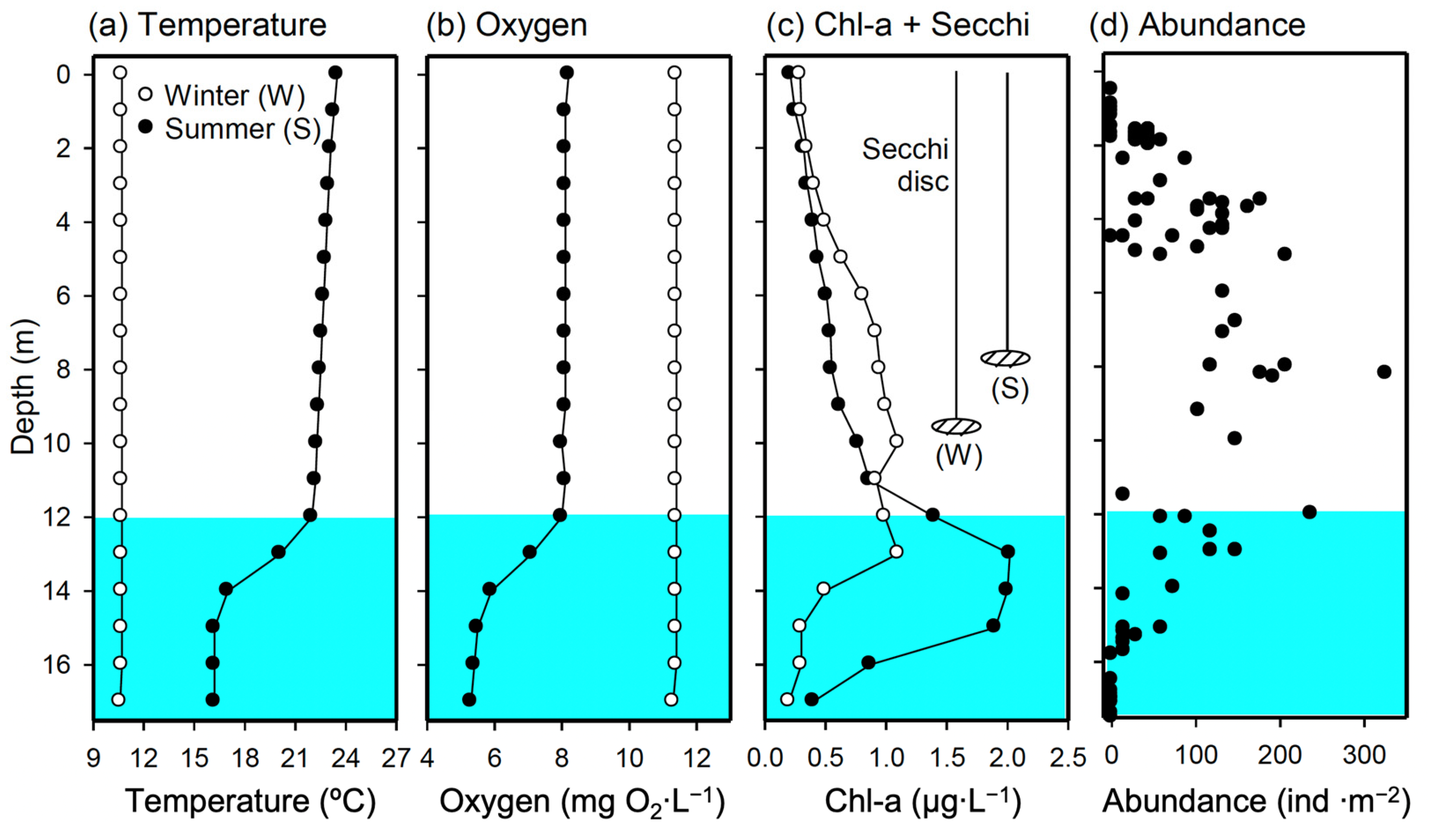
Water-column conditions during the six experimental periods exhibited clear seasonal variation associated with winter mixing and summer thermal stratification (Table 1; Figure 2). During winter experiments (1 and 5), the water column of Laguna Chica de San Pedro (LSP) was thermally and chemically homogeneous. In contrast, the summer experiment (3) and, to a lesser extent, the spring experiments (2 and 6) showed stratified conditions. Water temperature ranged from 10.6–10.7 °C in winter to 20.5 °C in summer, with a thermocline consistently located at approximately 12 m depth during stratification (Figure 2a). Under stratified conditions, dissolved oxygen decreased with depth but remained above hypoxic thresholds throughout the water column, reaching a minimum of approximately 5.4 mg·L−1 (Figure 2b). Chl-a profiles consistently exhibited subsurface maxima at depths of ~10–14 m under both mixed and stratified conditions (Figure 2c). Water transparency, expressed as Secchi depth, ranged from 5.2 to 9.6 m among experiments (Figure 2c), while TN and total TP concentrations remained within low to moderate ranges throughout the study period (Table 1). Consistently, the Carlson Trophic State Index (CTSI) [37] indicated low mesotrophic conditions, with a mean value of 32.5 ± 1.8, close to the oligotrophic–mesotrophic threshold (Table 1). Seasonal contrasts were consistent and pronounced across variables, and are therefore presented descriptively rather than through formal statistical comparisons. Additional vertically integrated physicochemical measurements are reported in Table S1 (Supplementary Material).

3.2. Sediment Biogeochemistry: Effects of Diplodon chilensis

Across the six seasonal experiments, sediments associated with live D. chilensis showed higher concentrations of organic matter (OM) and total nitrogen (TN) than the control treatments, whereas responses of total phosphorus (TP) were weaker and less consistent.

3.2.1. Organic Matter

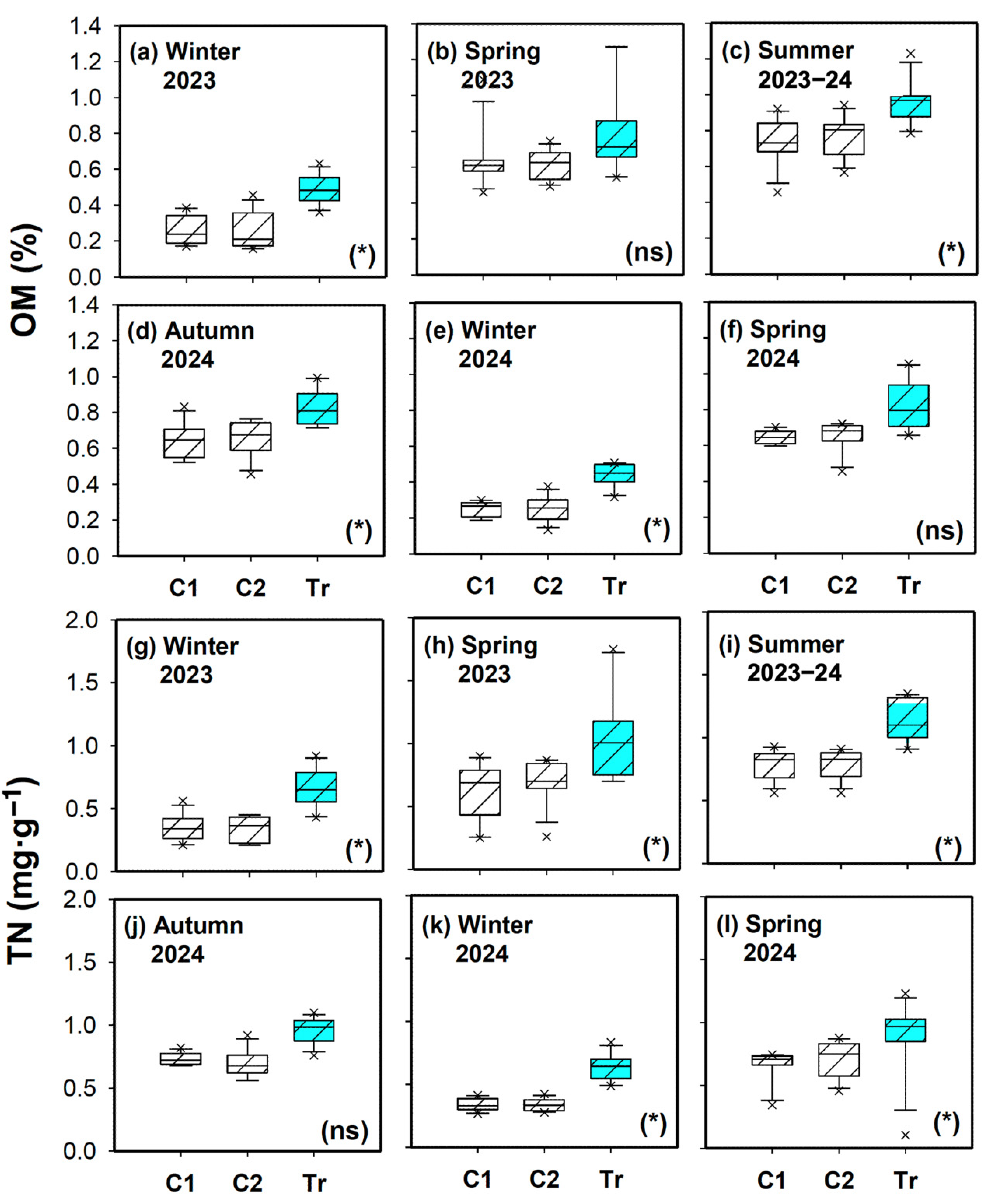
Sediment OM concentrations were higher in the live-mussel treatment (Tr) than in both control treatments in all six seasonal experiments, with relative increases ranging from approximately 24% to 90% (Figure 3a–f; Table 2). Statistically significant treatment effects were detected in four experiments (Quade test, p < 0.05). Wilcoxon effect sizes for the Tr vs. C1 comparison indicated strong responses of the live-mussel treatment in these cases (Table 2). Complete pairwise comparisons are reported in Table S2 (Supplementary Material). Absolute OM concentrations in control sediments displayed a seasonal pattern, with lower values during winter and higher values during spring and summer. The proportional magnitude of OM enrichment in the Tr treatment varied among seasons, with higher relative increases during winter experiments and lower increases during warmer periods.

3.2.2. Total Nitrogen

Sediment TN concentrations followed a pattern similar to that observed for OM. Across the six experiments, TN levels in the live-mussel treatment exceeded those of the controls, with relative increases ranging from approximately 33% to 92% (Table 2; Figure 3g–l). Statistically significant treatment effects were detected in five experiments (Quade test, p < 0.05). Wilcoxon effect sizes for the Tr vs. C1 comparison consistently indicated strong treatment responses in these experiments (Table 2), with full pairwise results provided in Table S2. Absolute TN concentrations in control sediments varied seasonally, with lower values during winter and higher values during spring and summer.

3.2.3. Total Phosphorus

In contrast to OM and TN, sediment TP exhibited weaker and less consistent responses to the presence of live mussels (Table 2). Across the six experiments, TP concentrations in the live-mussel treatment generally overlapped with those observed in the control treatments, with relative changes including both increases and decreases. Statistically significant treatment effects were detected in only one experiment (winter 2024; Exp. 5; Quade test, p < 0.05). In this case, the Wilcoxon effect size for the Tr vs. C1 comparison was moderate, whereas effect sizes were low and inconsistent in the remaining experiments (Table 2; Table S2). Absolute TP concentrations showed comparatively low seasonal variability and did not exhibit a consistent seasonal trend. Seasonal TP distributions are presented in Figure S1 (Supplementary Material).

3.3. Zoobenthic Responses to D. chilensis

3.3.1. Macrofaunal Richness

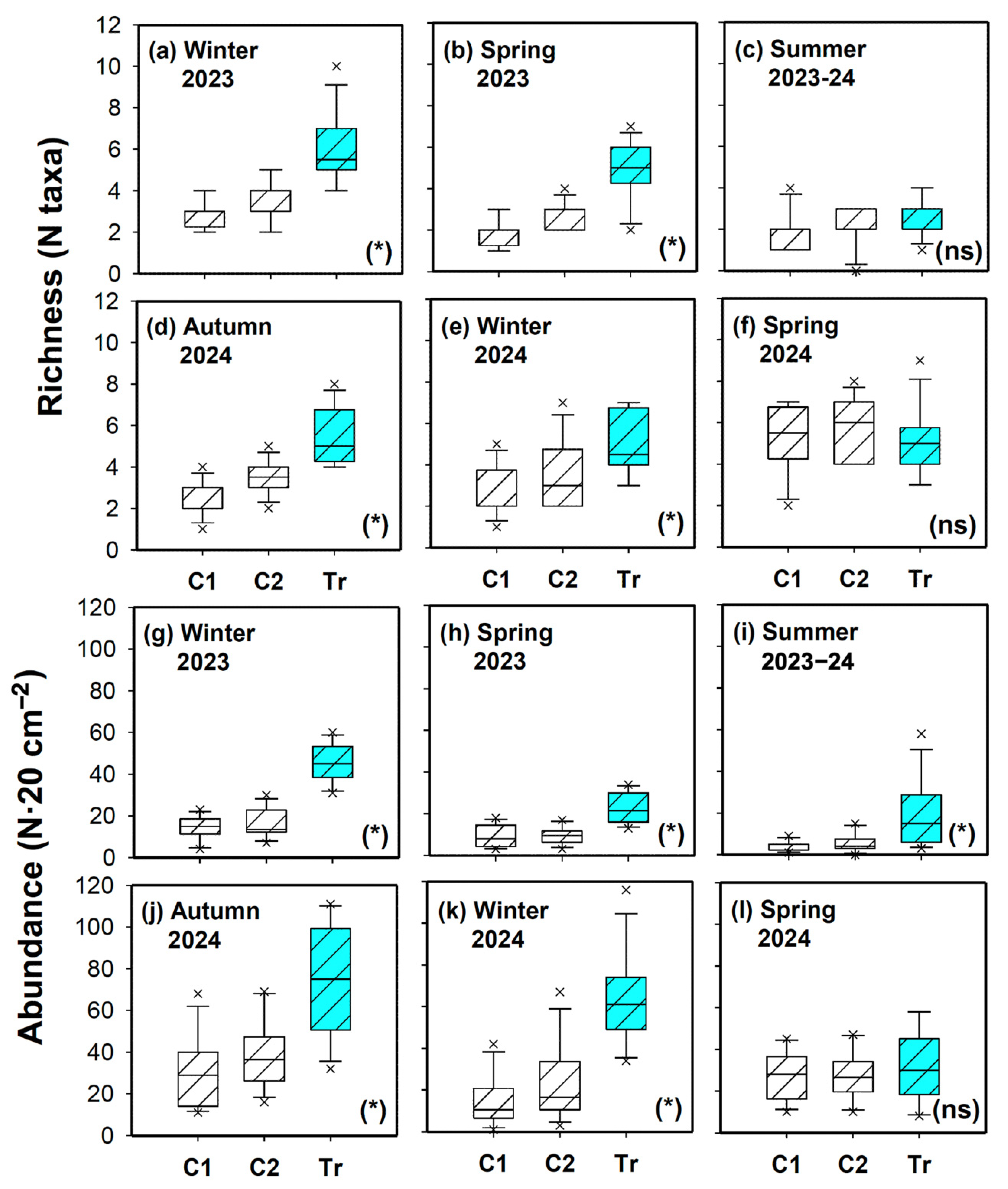
Benthic macrofaunal richness was higher in the live-bivalve treatment (Tr) than in both control treatments (C1 and C2) across most of the six seasonal experiments (Table 3; Figure 4). Relative differences between Tr and the mean of the controls ranged from 33.5% to 122.6%. Statistically significant treatment effects were detected in four experiments (Exp. 1, 2, 4, and 5; Quade test, p < 0.05), with Wilcoxon effect sizes for the Tr vs. C1 comparison indicating intermediate to strong responses (Table 3). Comparisons between the two control treatments yielded consistently low effect sizes. Macrofaunal richness in control sediments varied seasonally, with lower values observed in spring 2023 and higher values in winter 2024 (Table 3; Figure 4). The magnitude and direction of differences between Tr and controls differed among seasons. In spring 2023 and autumn 2024, relative differences exceeded 80%, whereas in spring 2024 richness in Tr was slightly lower than in the controls (−9.1%), and the treatment effect was not statistically significant. For consistency with sediment biogeochemical results, only Wilcoxon effect sizes for the Tr vs. C1 comparison are reported in the main text and Table 3. Complete pairwise comparisons are provided in Table S3 (Supplementary Material).
Across all experiments, macrofaunal assemblages were strongly dominated by a limited number of taxa. Chironomidae (Diptera), particularly indeterminate Chironomidae and Tanypodinae larvae, accounted for the largest proportion of total abundance, together representing more than 70% of individuals. Oligochaeta (Naididae, Tubifex tubifex and Nais sp.) constituted the second most important group, followed by gastropods (e.g., Chilina dombeayana, Physa chilensis, Lymnaea viator, Uncancylus gayanus) and amphipods (Hyalella chiloensis), each contributing smaller but consistent fractions of the assemblage. Less abundant taxa included Porifera (Eunapius fragilis), bivalves (Sphaeriidae), and decapods (Aegla laevis). This taxonomic structure was consistent across treatments and seasons, indicating that observed differences in richness and abundance primarily reflected changes in dominance patterns within a relatively stable species pool rather than wholesale species turnover. A complete list of macrofaunal taxa and their relative abundances is provided in Table S4 (Supplementary Material).

3.3.2. Macrofaunal Abundance

Macrofaunal abundance differed among treatments across the six seasonal experiments (Table 3; Figure 4g–l). Relative differences in Tr compared to the mean of the control treatments ranged from 15.5% to 278.0%. Statistically significant treatment effects were detected in five experiments (Exp. 1–5; Quade test, p < 0.05), with Wilcoxon effect sizes for the Tr vs. C1 comparison consistently indicating strong responses (Table 3). Abundance values in the two control treatments were similar across seasons. Absolute macrofaunal abundance in control sediments exhibited pronounced seasonal variability, with lower values in spring 2023 and higher values in autumn 2024 (Table 3; Figure 4). The magnitude of differences between Tr and controls varied among experiments. Larger relative differences were observed during summer 2023–24 and winter 2024, whereas in spring 2024 the difference between Tr and controls was smaller (15.5%) and not statistically significant. As for richness, only Wilcoxon effect sizes for the Tr vs. C1 comparison are presented in the main text and Table 3, while full pairwise results are reported in Table S3.

3.3.3. Meiofaunal Abundance

Meiofaunal abundance exhibited a different response pattern compared to macrofauna (Table 3). Across the seasonal experiments, relative differences in the live-mussel treatment compared to the mean of the controls ranged from 7.9% to −62.3%. Statistically significant treatment effects were detected in two experiments (winter 2023 and summer 2023–2024; Quade test, p < 0.05), whereas treatment effects were not significant in the remaining seasons. Wilcoxon effect sizes for the Tr vs. C1 comparison varied among experiments and were large in those cases where statistical significance was detected (Table 3). Abundance values in the two control treatments were similar across seasons. Across all experiments, meiofaunal assemblages were consistently dominated by Nematoda and Harpacticoida Canthocamptidae (Cletocamptus sp.), which together accounted for the majority of individuals in all treatments (Table S4). Consequently, the observed decreases in total meiofaunal abundance during the significant experiments were primarily driven by reductions in these dominant groups, while less abundant taxa contributed marginally to overall variation. Given the higher variability of meiofaunal responses, only overall treatment effects and Tr vs. C1 effect sizes are summarized in the main text and Table 3. Complete pairwise Wilcoxon effect sizes and detailed seasonal distributions are provided in Table S3 and Figure S2.

3.4. Individual Filtration Rates Under Controlled Conditions

Individual filtration rates (FRs) of D. chilensis measured under controlled laboratory conditions varied among treatments defined by temperature (10 and 23 °C) and phytoplankton biomass (low vs. medium Chl-a concentration; Table 4). At 10 °C, considering both phytoplankton biomass levels, mean FR values ranged from 0.124 to 0.199 L·ind−1·h−1, whereas at 23 °C, values increased to between 0.337 and 0.376 L·ind−1·h−1. After standardization by dry tissue mass, the same temperature-related pattern was evident (Table 4). In all treatments containing live mussels, phytoplankton biomass declined relative to control aquaria without bivalves, regardless of temperature or initial biomass level (p < 0.005 in all cases). Two-way ANOVA indicated significant main effects of temperature and phytoplankton biomass on individual FRs, as well as a significant interaction between both factors (temperature × biomass; p < 0.001; Table 5). Differences between biomass treatments were evident at 10 °C, whereas FR values at 23 °C overlapped between low and medium phytoplankton biomass levels.

3.5. Biodeposition and Filtration Capacity at the Lake Scale

Bathymetric distribution, population density, and experimentally derived individual filtration and biodeposition rates were integrated to upscale D. chilensis–mediated processes to the lake scale in LSP. Stratified sampling across 88 sites covering the full lake basin and depth gradient (Figure 1b) yielded a total population size of approximately 44.9 × 10⁶ individuals when estimated from stratum-specific mean densities. Mussels were unevenly distributed with depth, with highest densities occurring in shallow and intermediate strata (0–12 m) and no individuals recorded below 16 m (Table 6). This pattern is also evident in the vertical abundance profile derived from all sampled sites, which shows a pronounced decline in mean abundance below ~12 m depth (Figure 2d).
Population size and associated filtration capacity were calculated using stratum-specific densities derived from site-level sampling, thereby accounting for bathymetric heterogeneity (Table 6). Because site-level densities showed high within-stratum variance consistent with a strongly aggregated spatial distribution of D. chilensis, lake-scale upscaling of filtration and biodeposition processes was conservatively based on the lower bound of the 95% confidence interval of population abundance (29.9 × 10⁶ individuals; Table 6).
Scaling individual filtration rates to this conservative population estimate and assuming 14 h·d−1 of active filtration yielded biological turnover values equivalent to 2.2–6.7 yr−1, based on a total lake volume of 8.6 × 10⁻³ km3. These estimates indicate lower turnover under winter-like conditions and higher turnover during summer, consistent with seasonal contrasts in temperature and phytoplankton availability.
Lake-scale biodeposition fluxes were estimated by scaling experimentally derived mean individual deposition rates to the conservative population size. This approach yielded annual deposition fluxes of approximately 54.5 t·yr−1 of organic matter (OM) and 8.8 t·yr−1 of total nitrogen (TN) (Table 7). Variability in individual biodeposition rates reflects differences among the six independent in situ experiments, whereas lake-scale fluxes are reported as conservative point estimates constrained by population abundance. In contrast, total phosphorus (TP) did not exhibit a consistent net signal at the annual scale. Individual TP deposition rates were low and highly variable, including both positive and negative values, resulting in near-zero net balances when integrated at the population level (see Section 3.2.3). Accordingly, TP was excluded from Table 7, which summarizes variables showing consistent and directionally robust net fluxes at the lake scale.

4. Discussion

4.1. Diplodon chilensis as a Multiscale Driver of Downward Benthic–Pelagic Coupling

A central contribution of this study is the explicit scaling of individual-level filtration and biodeposition to population- and lake-scale material fluxes. Filtration rates measured under controlled conditions (approximately 0.1–0.5 L·ind−1·h−1) fall within the range commonly reported for D. chilensis and other hyriid and unionoid mussels and are not exceptional per se [6,19,46]. Rather than reflecting unusually high per capita performance, their ecological relevance in Laguna Chica de San Pedro (LSP) emerges from integration across a large, persistent, and spatially structured population, estimated at approximately 44.9 million individuals concentrated primarily above 12 m depth. For all lake-scale flux and turnover estimates, calculations were conservatively scaled using the lower bound of the 95% confidence interval of population abundance (29.9 × 10⁶ individuals; Table 6). Comparable individual filtration capacities have been reported for other Diplodon species under laboratory conditions. For example, experiments with Diplodon parallelopipedon document filtration rates of 0.17–0.48 L·ind−1·h−1, with temperature exerting a dominant control, while food availability did not significantly affect individual filtration rates within the tested Chl-a range [21]. In contrast, the same study reported significant effects on phytoplankton biomass, which were interpreted as emergent, population-level responses rather than as a consequence of enhanced per capita filtration. The close agreement between these values and those measured here supports the interpretation that lake-scale effects arise from population size and spatial aggregation, rather than from unusually high individual filtration rates.
When scaled using conservative population estimates and empirically supported activity periods (14 h·d−1), these individual rates yield equivalent biological turnover times of 2.2–6.7 yr−1, indicating repeated, lake-scale biological processing rather than physical hydrodynamic mixing. Because LSP is fully mixed for much of the year, this turnover is best interpreted as applying to the mixed water column during mixing periods; during summer stratification, it primarily reflects the epilimnion (and metalimnion) and should not be extrapolated to the isolated hypolimnion. These values should be interpreted as conservative, order-of-magnitude estimates, with proportional sensitivity to assumed activity time, implying persistent benthic–pelagic coupling that weakens in winter and intensifies during warmer, more productive periods [47,48].
Independent field-based scaling exercises provide a critical external benchmark for the plausibility of the lake-wide fluxes estimated here. In littoral zones of large oligotrophic Patagonian lakes in Chile (e.g., Lake Llanquihue), D. chilensis densities ranging from 50 to 200 ind·m−2 have been reported, and individual biodeposit production was quantified as a function of phytoplankton biomass (1.312 + 0.023 × Chl-a, μg·L−1), corresponding to approximately 1.38 mg·ind−1·d−1 at 3 μg·Chl-a·L−1 [19]. Extrapolation of these values yielded particulate fluxes of 329 kg·d−1, equivalent to 175.8 t·yr−1, transferred to surface sediments at the bay scale. Despite pronounced differences in hydrodynamic setting and trophic context, these values fall within the same order of magnitude as the annual organic matter fluxes estimated for LSP (Table 7), providing strong empirical support for the realism of the present scaling. Comparable ecosystem-level fluxes have also been reported for lotic systems. Population-level biodeposition by hyriid mussels in an Australian river reached daily fluxes of 4.8 ± 1.7 kg OM·d−1 and 137 ± 48 g N·d−1, whereas phosphorus fluxes remained low at 19 ± 7 g P·d−1 [32,33]. Although expressed on a linear spatial scale, these estimates demonstrate that sustained biodeposition by dense mussel assemblages can generate ecosystem-level transfers of organic matter and nitrogen comparable in magnitude to those inferred here when integrated over space and time in lentic systems.
Additional support for the importance of spatial aggregation and bathymetric confinement comes from shallow lake systems, where unionoid mussel densities exceeding 200 ind·m−2 can generate population-level filtration rates sufficient to process the overlying water column within approximately one day [49]. Together, these observations underscore spatial aggregation and depth-restricted distributions as primary controls on ecosystem-scale fluxes, even under moderate per capita filtration rates. Element-specific scaling reveals a clear asymmetry among nutrients. While OM- and TN-associated fluxes scale coherently from individual filtration to sedimentary enrichment and lake-wide estimates, TP does not. Near-zero annual TP burial in LSP reflects limited long-term retention under low-TP conditions rather than the absence of phosphorus processing, consistent with phosphorus-limited systems dominated by rapid internal recycling [17,19,50]. This asymmetry is consistent with physiological evidence indicating relatively high nitrogen excretion but low and weakly responsive phosphorus excretion in hyriid mussels [21] and establishes a functional constraint that frames the interpretation of lake-scale fluxes developed in subsequent sections.

4.2. Biodeposition as a Driver of Element-Specific Sediment Enrichment

Across six independent seasonal mesocosm experiments, filtration by D. chilensis produced strong and directionally consistent sedimentary enrichment beneath live mussels, confirming biodeposition as the dominant pathway transferring particulate material from the water column to the benthos under field-relevant conditions, primarily through the production and deposition of feces and pseudofeces that aggregate filtered particles into rapidly settling biodeposits, a well-established mechanism in freshwater bivalves [1,2]. Sediment organic matter (OM) increased by 24.2–89.2% and total nitrogen (TN) by 32.5–91.6% relative to controls, with consistently large effect sizes across seasons. In contrast, differences among control treatments (sand alone versus sand plus empty shells) were weak and inconsistent, indicating that enrichment was driven primarily by biological activity rather than by physical structure [51]. Even when formal statistical significance was not achieved, the recurrence and magnitude of effect sizes support sustained, chronic biodeposition rather than episodic enrichment, consistent with experimental and field evidence for unionoid mussels in other freshwater systems [52,53,54].
The element-specific nature of sediment enrichment observed beneath live D. chilensis is consistent with well-documented physiological constraints in other hyriid mussels. Laboratory experiments with Diplodon parallelopipedon show a strong temperature dependence of nitrogen excretion (5.4–28.0 μg·TN·h−1 between 10 and 30 °C), whereas phosphorus excretion remains comparatively low (0.98–2.37 μg·TP·h−1) and largely insensitive to food availability [33]. This physiological imbalance provides a mechanistic basis for the decoupling between nitrogen and phosphorus observed at the sediment scale. Consistent ecosystem-level patterns have been reported in lotic systems, where total biodeposition rates reached 70.9 ± 3.2 mg·ind−1·h−1 (dry mass), of which 9.9 mg·ind−1·h−1 corresponded to organic matter, resulting in an average ~30% increase in sediment organic matter beneath live mussels, a positive trend in sedimentary total nitrogen, and no significant change in sedimentary total phosphorus (TP) [33].
Together, these independent studies provide a coherent physiological and ecosystem-level framework explaining why biodeposition by D. chilensis in LSP generates strong enrichment of sedimentary OM and TN while producing weak and inconsistent TP responses. In phosphorus-limited lake systems, sedimentary TP dynamics are governed primarily by adsorption–desorption equilibria, redox-sensitive binding, and rapid internal recycling rather than by particulate transfer alone [17,19,55]. Similar decoupling between nitrogen enrichment and phosphorus retention has been reported in other mussel-dominated systems, where enhanced nitrogen availability does not translate into proportional TP accumulation [24,56]. By preferentially enriching nitrogen relative to phosphorus, mussel-mediated biodeposition alters sediment stoichiometry at the sediment–water interface, with potential implications for microbial mineralization pathways, benthic primary production, and nutrient retention under conditions of low phytoplankton biomass and limited nutrient supply [57,58]. Given the weak and variable TP signal, interpretations of phosphorus dynamics in LSP should remain conservative and clearly subordinate to the robust OM and TN responses documented here.

4.3. Size-Structured Benthic Responses: Macroinvertebrates vs. Meiofauna

Benthic responses to D. chilensis were consistently size-structured across all seasonal mesocosm experiments. Rather than generating a generalized increase in benthic diversity, mussel-mediated benthic–pelagic coupling produced a predictable reorganization of the benthos along body-size gradients, reflecting differential sensitivity of benthic groups to chronic enrichment of sedimentary organic matter and total nitrogen [6,59]. Macroinvertebrate assemblages responded positively and consistently to the presence of live mussels, with species richness increasing by 33.5–122.6% and total abundance by 114–278% relative to controls. These responses coincided with strong enrichment of sedimentary organic matter and nitrogen beneath mussel treatments and indicate that sustained biodeposition enhanced food availability and habitat suitability for larger-bodied taxa without inducing sedimentary degradation, consistent with evidence from other freshwater systems where moderate organic enrichment and biogenic habitat modification promote macrofaunal production and secondary productivity [2,52,59,60]. Similar size-dependent shifts toward larger-bodied and predatory taxa have been reported for dense hyriid mussel beds in Brazilian ecosystems [61].
In contrast, meiofaunal assemblages declined consistently under live mussel treatments, with total abundance reduced by 16.6–62.3% relative to controls. Although this pattern differs from positive meiofaunal responses reported for hyriid mussels in low-flow riverine environments [32], it aligns with experimental and field evidence indicating that moderate organic enrichment can disadvantage meiofauna by increasing microbial respiration, reducing sediment permeability, and generating microscale redox heterogeneity, even in non-eutrophic systems [53,62]. In addition, the negative response of meiofauna may reflect non-exclusive mechanisms associated with mussel activity, including physical disturbance of surface sediments caused by mussel movement and biodeposition, as well as indirect biotic effects such as increased macrofaunal activity and predation pressure in mussel-modified sediments. This response contrasts with recent evidence from lotic systems, where hyriid mussels increased meiofaunal densities through localized organic matter accumulation [32]. The discrepancy suggests strong context dependence: in lentic systems such as LSP, hydrodynamic redistribution and oxygen dynamics may offset localized biodeposition effects, potentially constraining meiofaunal responses despite high filtration capacity. Together, these contrasting responses demonstrate that D. chilensis functions as a benthic ecosystem engineer that redistributes benthic resources unevenly, favoring macroinvertebrate production while constraining meiofaunal densities. This size-dependent restructuring underscores that mussel-mediated benthic–pelagic coupling alters pathways of secondary production rather than increasing benthic diversity uniformly under the oligotrophic to low-mesotrophic conditions characteristic of LSP.

4.4. Environmental Context and Boundary Conditions

Mussel-mediated effects in LSP operate within a clear-water, low-mesotrophic environmental context characterized by low phytoplankton biomass, high water transparency, and limited phosphorus availability. This combination of conditions favors efficient interception of suspended particulate material and supports persistent downward benthic–pelagic coupling mediated by D. chilensis. Independent population-level evidence is consistent with this interpretation. Across Chilean lakes spanning a broad trophic gradient, D. chilensis exhibits annual shell growth rates of 5.0–10.0 mm·a−1, with LSP falling within the intermediate range typical of oligotrophic–mesotrophic systems [17]. In contrast, populations decline or disappear under low-transparency conditions (Secchi < 3 m), defining a clear environmental boundary beyond which effective filtration and ecosystem-level coupling are unlikely to be sustained.
Paleolimnological records further indicate that modern sedimentation rates in LSP (1.8–2.2 mm·a−1) are approximately three times higher than pre-Hispanic values (0.6–0.8 mm·a−1), accompanied by a marked increase in sediment organic matter content from 3–5% to 8–12% dry weight [25]. Against this depositional background, mussel-mediated enrichment of sedimentary OM and TN is strong and persistent, whereas sedimentary TP responses remain weak and highly variable. This pattern reflects limited long-term TP retention rather than the absence of phosphorus processing at the sediment–water interface, as TP dynamics in phosphorus-limited lake systems are dominated by rapid internal recycling, adsorption–desorption equilibria, and redox-sensitive binding rather than by particulate burial [17,19,55,63]. Similar decoupling between TN enrichment and TP retention has been documented in other mussel-dominated systems [24,56]. Physical structure of the water column further constrains where these processes operate: during summer stratification, a thermocline develops at approximately 12 m depth (Figure 2a) and Chl-a exhibits subsurface maxima near this layer (10–14 m; Figure 2c), consistent with the observed concentration of D. chilensis above ~12 m depth and its absence below ~16 m. As a result, effective benthic–pelagic coupling is vertically restricted but ecologically relevant. Notably, the inverse vertical patterns observed between D. chilensis abundance and Chl-a concentrations do not, by themselves, demonstrate a causal filtering effect on surface phytoplankton. Reduced Chl-a values in the upper water column may also reflect photoinhibition or light-related physiological constraints typical of clear-water systems. However, given the high population density and filtration capacity of D. chilensis within the depth range overlapping subsurface Chl-a maxima, a contributory role of benthic filtration cannot be excluded. Disentangling the relative influence of biological removal versus photophysiological controls on vertical Chl-a structure will require targeted process-based studies explicitly designed to resolve these mechanisms.
These findings are therefore most applicable to clear-water systems with low to moderate phytoplankton biomass, whereas in eutrophic or highly turbid lakes (>10–20 μg·Chl-a·L−1 or elevated suspended solids) filtration efficiency, biodeposition pathways, and ecosystem responses may become non-linear, weakening coupling strength [19,64]. Accordingly, lake-scale fluxes estimated here should be interpreted as conservative, order-of-magnitude estimates rather than complete mass balances, consistent with established approaches to ecosystem-level inference [1,6], while remaining robust within oligotrophic to low-mesotrophic, low-TP systems [13,65].

4.5. Implications for Ecosystem Functioning and Conservation

The ecosystem role of D. chilensis in LSP is expressed through sustained, moderate-intensity benthic–pelagic coupling rather than episodic high filtration events. Under oligotrophic to low-mesotrophic conditions, continuous filtration and biodeposition promote persistent enrichment of sedimentary organic matter and total nitrogen, accompanied by predictable, size-structured benthic responses. In contrast, total phosphorus burial remains weak and variable, reflecting low ambient availability and rapid internal recycling typical of phosphorus-limited lake systems [23,24]. Together, these results indicate that organism-mediated downward fluxes of particulate material are sufficient to generate persistent sedimentary and community-level effects, even in systems characterized by low phytoplankton biomass.
Although quantified in a single lake, the processes documented here operate under limnological conditions common to many small, clear-water temperate lakes of south-central Chile, characterized by high water transparency, low phytoplankton biomass, frequent phosphorus limitation, and predominantly mixed water columns with only short periods of summer stratification, where unionoid mussels remain widespread and water transparency is high. Within this environmental context, the scaling relationships observed in LSP are likely to be transferable, while acknowledging that coupling strength may weaken or become non-linear under higher turbidity or nutrient enrichment. From a conservation perspective, the decline or loss of D. chilensis populations would therefore entail not only reductions in benthic biodiversity but also the erosion of ecosystem functions linked to nutrient redistribution and benthic secondary production, as reflected by changes in functional indicators such as sediment organic matter accumulation rates, nitrogen deposition fluxes, and macrofaunal abundance-to-biomass ratios, supporting the inclusion of functional indicators in conservation and management frameworks [49,54,57].

5. Conclusions

The results show that Diplodon chilensis contributes to benthic–pelagic coupling in Laguna Chica de San Pedro through sustained filtration and biodeposition under clear-water, oligotrophic to mesotrophic conditions. When individual filtration rates are integrated across a dense, shallow population, they generate ecologically relevant downward fluxes of particulate material. Biodeposition consistently increased sedimentary organic matter and nitrogen, whereas phosphorus burial remained weak and variable, consistent with low ambient availability and rapid internal recycling. Benthic responses were clearly size-structured, with enhanced macroinvertebrate assemblages and reduced meiofaunal abundance beneath live mussels. Together, these patterns identify D. chilensis as a native ecosystem engineer whose effects are persistent but strongly conditioned by lake trophic state and transparency.

Supplementary Materials

The following supporting information can be downloaded at: https://www.mdpi.com/article/10.3390/w18040473/s1, Table S1 Water-column physicochemical variables and Carlson Trophic State Index (CTSI); Table S2 Effects of Diplodon chilensis on sediment biogeochemistry; Table S3 Effects of Diplodon chilensis on benthic communities; Table S4 Taxonomic composition and relative abundance (%) of macrofaunal (a) and meiofaunal (b) assemblages; Figure S1 Seasonal boxplots of sediment total phosphorus; Figure S2 Seasonal boxplots of meiofaunal abundance.

Author Contributions

Conceptualization, C.V. and P.F.; methodology, C.V. and D.B.; formal analysis, C.V.; investigation, D.B., E.V. and G.B.; writing—original draft preparation, C.V.; writing—review and editing, P.F., and D.B.; funding acquisition, C.V. and P.F.; All authors have read and agreed to the published version of the manuscript.

Funding

This research was funded by FONDECYT grant 1231089.

Data Availability Statement

The data presented in this study are available on request from the corresponding author.

Acknowledgments

We thank Waldo San Martín, Mayerlic Salinas, Catalina Barbontín, and Arturo Retamal for their valuable support during fieldwork. We also acknowledge Campos Deportivos Llacolén and the Chilean Navy (Maritime Authority of San Pedro de la Paz) for the logistical support and facilities provided during this study. During the preparation of this manuscript/study the author(s) used ChatGPT (OpenAI, GPT-5.2) for language editing. The authors have reviewed and edited the output and take fully responsible for the content of this publication.

Conflicts of Interest

The funders had no role in the design of the study; in the collection, analyses, or interpretation of data; in the writing of the manuscript; or in the decision to publish the results.

Abbreviations

The following abbreviations are used in this manuscript:
Chl-aChlorophyll-a
CTSICarlson Trophic State Index
CondElectrical conductivity
DODissolved oxygen
FRFiltration rate
LSPLaguna Chica de San Pedro
OMOrganic matter
TPTotal phosphorus
TempTemperature
TNTotal nitrogen

References

  1. Strayer, D.L.; Caraco, N.F.; Cole, J.J.; Findlay, S.; Pace, M.L. Transformation of Freshwater Ecosystems by Bivalves: A case study of zebra mussels in the Hudson River. BioScience 1999, 49, 19–27. [Google Scholar] [CrossRef]
  2. Vaughn, C.C.; Hakenkamp, C.C. The functional role of burrowing bivalves in freshwater ecosystems. Freshw. Biol. 2001, 46, 1431–1446. [Google Scholar] [CrossRef]
  3. Cloern, J.E. Does the benthos control phytoplankton biomass in South San Francisco Bay? Mar. Ecol. Prog. Ser. 1982, 9, 191–202. [Google Scholar] [CrossRef]
  4. Dame, R.F. Ecology of Marine Bivalves: An Ecosystem Approach; CRC Press: Boca Raton, FL, USA, 2012. [Google Scholar] [CrossRef]
  5. Hamann, L.; Blanke, A. Suspension feeders: Diversity, principles of particle separation and biomimetic potential. J. R. Soc. Interface 2022, 19, 20210741. [Google Scholar] [CrossRef]
  6. Vaughn, C.C.; Nichols, S.J.; Spooner, D.E. Community and foodweb ecology of freshwater mussels. J. N. Am. Benthol. Soc. 2008, 27, 409–423. [Google Scholar] [CrossRef]
  7. Vaughn, C.C. Ecosystem services provided by freshwater mussels. Hydrobiologia 2018, 810, 15–27. [Google Scholar] [CrossRef]
  8. Zieritz, A.; Sousa, R.; Aldridge, D.C.; Douda, K.; Esteves, E.; Ferreira-Rodríguez, N.; Mageroy, J.H.; Nizzoli, D.; Osterling, M.; Reis, J.; et al. A global synthesis of ecosystem services provided and disrupted by freshwater bivalve molluscs. Biol. Rev. 2022, 97, 1967–1998. [Google Scholar] [CrossRef]
  9. Marroni, S.; Stábile, F.; González-Bergonzoni, I.; de Mello, F.T.; Mazzeo, N.; Iglesias, C. Filtration and pe-dal-feeding contribution to the biomass of the freshwater bivalve D. parallelopipedon: Evidence from stable isotopes analysis. Hydrobiologia 2026, 853, 559–569. [Google Scholar] [CrossRef]
  10. Atkinson, C.L.; First, M.R.; Covich, A.P.; Opsahl, S.P.; Golladay, S.W. Suspended material availability and filtra-tion–biodeposition processes performed by a native and invasive bivalve species in streams. Hydrobiologia 2011, 667, 191–204. [Google Scholar] [CrossRef]
  11. Prestes, J.G.; Pedroso, C.R.; de Siqueira Pereira, H.; Miiller, N.O.; Rennó Braga, R.; Vitule, J.R. Filtration, ingestion, and food selectivity in the freshwater bivalves D. parodizi (native) and Corbicula fluminea (invasive). Hydrobiologia 2025. [Google Scholar] [CrossRef]
  12. Steinhart, G.S.; Likens, G.E.; Soto, D. Physiological indicators of nutrient deficiency in phytoplankton in southern Chilean lakes. Hydrobiologia 2002, 489, 21–27. [Google Scholar] [CrossRef]
  13. Wetzel, R.G. Limnology: Lake and River Ecosystems, 3rd ed.; Academic Press: Cambridge, MA, USA, 2001. [Google Scholar]
  14. Marescaux, J.; Falisse, E.; Lorquet, J.; Doninck, K.V.; Beisel, J.; Descy, J. Assessing filtration rates of exotic bivalves: Dependence on algae concentration and seasonal factors. Hydrobiologia 2016, 777, 67–78. [Google Scholar] [CrossRef]
  15. Parada, E.; Peredo, S.; Lara, G.; Valdebenito, I. Growth, age and life span of D. chilensis. Arch. Hydrobiol. 1989, 115, 563–573. [Google Scholar] [CrossRef]
  16. Semenas, L.; Brugni, N. Características poblacionales y ciclo de vida de D. chilensis (d’Orbigny, 1835) (Hyriidae, Bivalvia) en el lago Gutiérrez (Patagonia, Argentina). Ecol. Austral 2002, 12, 29–40. [Google Scholar]
  17. Valdovinos, C.; Pedreros, P. Geographic variations in shell growth rates of the mussel D. chilensis from tem-perate lakes of Chile: Implications for biodiversity conservation. Limnologica 2007, 37, 63–75. [Google Scholar] [CrossRef][Green Version]
  18. Jones, C.G.; Lawton, J.H.; Shachak, M. Organisms as ecosystem engineers. Oikos 1994, 69, 373–386. [Google Scholar] [CrossRef]
  19. Soto, D.; Mena, G. Filter feeding by the freshwater mussel D. chilensis as a biocontrol of salmon farming eutrophication. Aquaculture 1999, 171, 65–81. [Google Scholar] [CrossRef]
  20. Rocchetta, I.; Lomovasky, B.; Yusseppone, M.S.; Sabatini, S.; Bieczynski, F.; Ríos de Molina, M.C.; Luquet, C. Growth, abundance, morphometric and metabolic parameters of three populations of D. chilensis subject to different levels of natural and anthropogenic organic matter input in a glacial lake of North Patagonia. Limnologica 2014, 44, 72–80. [Google Scholar] [CrossRef]
  21. Marroni, S.; Mazzeo, N.; Iglesias, C. Effects of temperature and food availability on the filtration and excretion rates of D. parallelopipedon (Hyriidae). Int. Rev. Hydrobiol. 2021, 106, 249–258. [Google Scholar] [CrossRef]
  22. Sterner, R.W.; Elser, J.J. Ecological Stoichiometry; Princeton University Press: Princeton, NJ, USA, 2002. [Google Scholar] [CrossRef]
  23. Vanni, M.J. Nutrient cycling by animals in freshwater ecosystems. Annu. Rev. Ecol. Syst. 2002, 33, 341–370. [Google Scholar] [CrossRef]
  24. Zieritz, A.; Chan, W.N.; McGowan, S.; Gibbins, C.N. High rates of biodeposition and N-excretion indicate strong functional effects of mussels (Bivalvia: Unionida) in certain anthropogenic tropical freshwater habitats. Hydrobiologia 2020, 848, 3153–3166. [Google Scholar] [CrossRef]
  25. Urrutia, R.; Sabbe, K.; Cruces, F.; Pozo, K.; Becerra, J.; Araneda, A.; Vyverman, W.; Parra, O. Paleolimnological studies of Laguna Chica of San Pedro (VIII Region): Diatoms, hydrocarbons and fatty acid records. Rev. Chil. Hist. Nat. 2000, 73, 717–728. [Google Scholar] [CrossRef]
  26. Centro EULA-Chile. Diagnóstico ambiental de las lagunas de San Pedro; Technical report; Universidad de Concepción: Concepción, Chile, 2021. [Google Scholar]
  27. Urrutia, R.; Cisternas, M.; Araneda, A.; Retamal, O.; Mardones, M. Caracterización morfométrica y sedimentológica de cinco lagos costeros de la VIII Región, Chile. Rev. Geogr. Chile Terra Aust. 2000, 45, 7–24. [Google Scholar]
  28. Parra, O.; Valdovinos, C.; Urrutia, R.; Cisternas, M.; Habit, E.; Mardones, M. Caracterización y tendencias tróficas de cinco lagos costeros de Chile Central. Limnética 2003, 22, 51–83. [Google Scholar] [CrossRef]
  29. Cisternas, M.; Torres, L.; Urrutia, R.; Araneda, A.; Parra, O. Environmental comparison, through sedimentary records, between pre-Hispanic and current conditions of a lacustrine system. Rev. Chil. Hist. Nat. 2000, 73, 151–162. [Google Scholar] [CrossRef]
  30. Valdovinos, C.; Balboa, C. Cercarial dermatitis and lake eutrophication in south-central Chile. Epidemiol. Infect. 2007, 136, 391–394. [Google Scholar] [CrossRef]
  31. Spooner, D.E.; Vaughn, C.C. Context-dependent effects of freshwater mussels on stream benthic communities. Freshw. Biol. 2006, 51, 1016–1024. [Google Scholar] [CrossRef]
  32. McCasker, N.; Humphries, P. Hyriid mussels (Unionoida) enhance benthic organic matter and meiofauna densities in a temperate Australian river. Freshw. Biol. 2021, 66, 936–948. [Google Scholar] [CrossRef]
  33. Gutiérrez, J.L.; Jones, C.G.; Strayer, D.L.; Iribarne, O.O. Mollusks as ecosystem engineers: The role of shell production in aquatic habitats. Oikos 2003, 101, 79–90. [Google Scholar] [CrossRef]
  34. Hurlbert, S.H. Pseudoreplication and the design of ecological field experiments. Ecol. Monogr. 1984, 54, 187–211. [Google Scholar] [CrossRef]
  35. Jackson, M.L. Soil Chemical Analysis: Advanced Course, 2nd ed.; UW–Madison Libraries Parallel Press: Madison, WI, USA, 2005. [Google Scholar]
  36. American Public Health Association (APHA); American Water Works Association (AWWA); Water Environment Federation (WEF). Standard Methods for the Examination of Water and Wastewater, 24th ed.; APHA Press: Washington, DC, USA, 2023. [Google Scholar]
  37. Carlson, R.E. A trophic state index for lakes. Limnol. Oceanogr. 1977, 22, 361–369. [Google Scholar] [CrossRef]
  38. Quade, D. Using Weighted Rankings in the Analysis of Complete Blocks with Additive Block Effects. J. Am. Stat. Assoc. 1979, 74, 680–683. [Google Scholar] [CrossRef]
  39. Quinn, G.P.; Keough, M.J. Experimental Design and Data Analysis for Biologists; Cambridge University Press: Cambridge, UK, 2002. [Google Scholar]
  40. Zar, J.H. Biostatistical Analysis, 4th ed.; Prentice Hall: Hoboken, NJ, USA, 1999. [Google Scholar]
  41. Rosenthal, R. Meta-Analytic Procedures for Social Research, 2nd ed.; Sage: Thousand Oaks, CA, USA, 1991. [Google Scholar]
  42. Cohen, J. Statistical Power Analysis for the Behavioral Sciences, 2nd ed.; Lawrence Erlbaum Associates: Mahwah, NJ, USA, 1988. [Google Scholar]
  43. Fritz, C.O.; Morris, P.E.; Richler, J.J. Effect size estimates: Current use, calculations, and interpretation. J. Exp. Psychol. Genera 2012, 141, 2–18. [Google Scholar] [CrossRef]
  44. Lakens, D. Calculating and reporting effect sizes to facilitate cumulative science: A practical primer for t-tests and ANOVAs. Front. Psychol. 2013, 4, 863. [Google Scholar] [CrossRef] [PubMed]
  45. Riisgård, H.U. On measurement of filtration rates in bivalves—The stony road to reliable data. Mar. Ecol. Prog. Ser. 2001, 211, 275–291. [Google Scholar] [CrossRef]
  46. Brouwer, S.; Humphries, P.; Holland, A.; McCasker, N. Effect of suspended sediment concentration on the clearance and biodeposition rates of an Australian freshwater mussel (Hyriidae). Freshw. Biol. 2023, 68, 243–257. [Google Scholar] [CrossRef]
  47. Fuentealba, C.; Henríquez, O. Rol de las poblaciones de Diplodon chilensis (Gray, 1828) (Bivalvia: Hyriidae) en el estado trófico de la Laguna Chica de San Pedro (Chile). Comunic. Soc. Malacol. Urug 2009, 9, 195–200. [Google Scholar]
  48. Kohlberg, G.; Herbst, A.; Niedzwiedz, G.; Woelfl, S.; Nimptsch, J.; Schories, D. Time lapse photography with two different camera systems for in situ observation of the bivalve Diplodon chilensis (Gray, 1828) in a southern Chilean lake. Gayana 2019, 83, 21–32. [Google Scholar] [CrossRef]
  49. Lopes-Lima, M.; Burlakova, L.E.; Karatayev, A.Y.; Mehler, K.; Seddon, M.; Sousa, R. Conservation of freshwater bivalves at the global scale. Hydrobiologia 2018, 810, 1–14. [Google Scholar] [CrossRef]
  50. Atkinson, C.L.; Vaughn, C.C. Biogeochemical hotspots: Temporal and spatial scaling of the impact of freshwater mussels on ecosystem function. Freshw. Biol. 2015, 60, 563–574. [Google Scholar] [CrossRef]
  51. Kautsky, N.; Evans, S. Role of biodeposition by Mytilus edulis in the circulation of matter and nutrients in a Baltic coastal ecosystem. Mar. Ecol. Prog. Ser. 1987, 38, 201–212. [Google Scholar] [CrossRef]
  52. Giles, H.; Pilditch, C.A. Effects of mussel (Perna canaliculus) biodeposition on benthic respiration and nutrient fluxes. Mar. Ecol. Prog. Ser. 2006, 150, 261–271. [Google Scholar] [CrossRef]
  53. McKindsey, C.W.; Archambault, P.; Callier, M.D.; Olivier, F. Influence of suspended and off-bottom mussel culture on the sea bottom and benthic habitats: A review. Can. J. Zool. 2011, 89, 622–646. [Google Scholar] [CrossRef]
  54. Haag, W.R.; Williams, J.D. Biodiversity on the brink: An assessment of conservation strategies for North American freshwater mussels. Hydrobiologia 2014, 735, 45–60. [Google Scholar] [CrossRef]
  55. Prins, T.C.; Smaal, A.C. The role of the blue mussel Mytilus edulis in the cycling of nutrients in the Oosterschelde estuary. Hydrobiologia 1994, 282, 413–429. [Google Scholar] [CrossRef]
  56. Buelow, C.A.; Waltham, N.J. Restoring tropical coastal wetland water quality: Ecosystem service provisioning by a native freshwater bivalve. Aquat. Sci. 2020, 82, 77. [Google Scholar] [CrossRef]
  57. Atkinson, C.L.; Capps, K.A.; Rugenski, A.T.; Vanni, M.J. Consumer-driven nutrient dynamics in freshwater ecosystems: From individuals to ecosystems. Biol. Rev. 2017, 92, 2003–2023. [Google Scholar] [CrossRef]
  58. Elser, J.J.; Dobberfuhl, D.R.; MacKay, N.A.; Schampel, J.H. Organism size, life history, and N:P stoichiometry. BioScience 1996, 46, 674–684. [Google Scholar] [CrossRef]
  59. Pearson, T.H.; Rosenberg, R. Macrobenthic succession in relation to organic enrichment and pollution of the marine environment. Oceanogr. Mar. Biol. Annu. Rev. 1978, 16, 229–311. [Google Scholar]
  60. Howard, J.K.; Cuffey, K.M. The functional role of native freshwater mussels in the fluvial benthic environment. Freshw. Biol. 2006, 51, 460–474. [Google Scholar] [CrossRef]
  61. Simeone, D.; Tagliaro, C.H.; Beasley, C.R. Filter and deposit: A potential role of freshwater mussels in ecosystem functioning associated with enhanced macroinvertebrate assemblage structure in a Neotropical river. Hydrobiologia 2021, 848, 4211–4223. [Google Scholar] [CrossRef]
  62. Giere, O. Meiobenthology: The Microscopic Motile Fauna of Aquatic Sediments, 2nd ed.; Springer: Berlin/Heidelberg, Germany, 2009. [Google Scholar] [CrossRef]
  63. Orihel, D.M.; BauLaguna Chica de San Pedro, H.M.; Casson, N.J.; North, R.L.; Parsons, C.T.; Seckar, D.C.M.; Venkiteswaran, J.J. Internal phosphorus loading in Canadian fresh waters: A critical review and data analysis. Can. J. Fish. Aquat. Sci. 2017, 74, 2005–2029. [Google Scholar] [CrossRef]
  64. Chowdhury, G.W.; Zieritz, A.; Aldridge, D.C. Ecosystem engineering by mussels supports biodiversity and water clarity in a heavily polluted lake in Dhaka, Bangladesh. Freshw. Sci. 2016, 35, 188–199. [Google Scholar] [CrossRef]
  65. Dodds, W.K.; Smith, V.H. Nitrogen, phosphorus, and eutrophication in streams. Inland Waters 2016, 6, 155–164. [Google Scholar] [CrossRef]
Figure 1. Study area and sampling design in Laguna Chica de San Pedro (LSP), south-central Chile. (a) Geographic distribution of Diplodon chilensis and location of LSP; (b) sampling sites, where circle size indicates mussel abundance and crosses indicate absence records, together with the location of the four experimental mesocosm blocks (M1–M4). Z0 denotes the maximum lake depth and the site where the limnological vertical profiles were obtained.
Water 18 00473 g001
Figure 2. Representative vertical profiles of water temperature (a), dissolved oxygen (b), chlorophyll-a (Chl-a) and Secchi disk depth (c), and Diplodon chilensis abundance (d) in Laguna Chica de San Pedro under contrasting summer (S; January 2024) and winter (W; July 2024) conditions. Profiles were obtained at site Z0 (shown in Figure 1b); abundance values represent the mean of three replicates per depth, and the light-blue shaded area indicates the hypolimnion formed during the summer period.
Water 18 00473 g002
Figure 3. Seasonal boxplots of sediment organic matter (OM, %) and total nitrogen (TN, mg·g−1). Treatments: C1 = sand control; C2 = sand plus shells of dead mussels; Tr = sand plus live mussels (blue-shaded boxes). Panels (af) show OM, and panels (gl) show TN, corresponding to seasonal experiments conducted between winter 2023 and spring 2024, each lasting two months. Boxes represent interquartile ranges with medians; whiskers indicate data range; and crosses (×) denote outliers. Each boxplot is based on n = 12 observations per treatment. Statistical results are presented in Table 2. ns = not significant; * p < 0.05.
Water 18 00473 g003
Figure 4. Seasonal boxplots of macrofaunal abundance (N·20 cm−2; panels (af)) and macrofaunal richness (N taxa; panels (gl)) under different experimental treatments. Treatments include sand control (C1), sand plus shells of dead mussels (C2), and sand plus live mussels (Tr; blue-shaded boxes). Panels correspond to seasonal experiments conducted between winter 2023 and spring 2024, each lasting two months. Boxes represent interquartile ranges with medians, whiskers indicate data range, and crosses (×) denote outliers. Each boxplot is based on n = 12 observations per treatment. Statistical results are summarized in Table 3; ns = not significant; * p < 0.05.
Water 18 00473 g004
Table 1. Seasonal variation in water quality and integrated Carlson Trophic State Index (CTSI) [37] during the experimental period in Laguna Chica de San Pedro. Values correspond to means ± SD derived from vertically integrated water-column profiles for each experiment (Exp). Reported variables include Secchi depth (Secchi), water temperature (Temp), dissolved oxygen (DO), pH, electrical conductivity (Cond), total nitrogen (TN), total phosphorus (TP), chlorophyll-a (Chl-a), and CTSI. Sample size was n = 3 for TN and TP and n = 17 for the remaining variables.
Experiment Number (and Season)Secchi
(m)
Temp
(°C)
DO
(mg·L−1)
pHCond
(µS·cm−1)
TN
(mg·L−1)
TP
(mg·L−1)
Chl-a
(µg·L−1)
CTSI
1 (W23)9.610.6 ± 0.011.2 ± 0.06.9 ± 0.089.0 ± 0.20.10 ± 0.020.024 ± 0.0270.65 ± 0.3634.7
2 (Sp23)8.815.5 ± 1.89.5 ± 0.47.3 ± 0.390.6 ± 4.20.19 ± 0.020.006 ± 0.0001.22 ± 0.8030.4
3 (Su23–24)7.920.5 ± 3.07.7 ± 1.16.9 ± 0.5103.3 ± 9.00.09 ± 0.020.009 ± 0.0040.80 ± 0.6031.7
4 (A24)5.215.5 ± 1.99.5 ± 0.67.5 ± 0.191.1 ± 4.30.16 ± 0.030.006 ± 0.0001.15 ± 0.8032.7
5 (W24)9.610.7 ± 0.011.4 ± 0.06.9 ± 0.089.1 ± 0.20.10 ± 0.020.024 ± 0.0240.64 ± 0.3334.6
6 (Sp024)8.315.6 ± 2.29.7 ± 0.57.7 ± 0.390.9 ± 4.40.16 ± 0.030.007 ± 0.0011.08 ± 0.8031.0
Table 2. Results of in situ experiments testing the effects of Diplodon chilensis on sediment biogeochemistry in Laguna Chica de San Pedro. Treatments included sand control (C1), sand plus shells of dead mussels (C2), and sand plus live mussels (Tr). Values are means ± SD across four blocks. Overall treatment effects were assessed using Quade tests, with statistically significant p-values (p < 0.05) shown in bold. Effect size (r) represents the magnitude of the Tr effect relative to the sand control (Tr vs. C1). Percentage change (% Change) indicates the relative difference in Tr with respect to the mean of both controls. Experiments were conducted seasonally between winter 2023 and spring 2024.
ExperimentC1C2TrFpEffect Size (r) (Tr vs. C1)% Change
OM (%)
10.261 ± 0.0800.256 ± 0.1000.490 ± 0.0806.710.0300.91389.6
20.635 ± 0.1530.612 ± 0.0850.775 ± 0.2332.400.1720.91324.3
30.737 ± 0.1250.769 ± 0.1080.959 ± 0.1176.370.0330.91327.4
40.643 ± 0.0970.662 ± 0.0990.827 ± 0.1016.070.0360.91326.7
50.251 ± 0.0420.254 ± 0.0690.441 ± 0.0656.170.0350.91374.7
60.645 ± 0.0370.650 ± 0.0810.818 ± 0.1364.210.0720.91326.3
TN (mg·g−1)
10.349 ± 0.1070.343 ± 0.0960.663 ± 0.1536.040.0370.91391.6
20.635 ± 0.2210.695 ± 0.1631.052 ± 0.3555.720.0410.91358.2
30.787 ± 0.1130.792 ± 0.1101.135 ± 0.1675.670.0410.91343.8
40.731 ± 0.0480.696 ± 0.1060.962 ± 0.0995.100.0510.91334.8
50.339 ± 0.0520.336 ± 0.0480.633 ± 0.10524.910.0010.91387.5
60.658 ± 0.1240.702 ± 0.1390.901 ± 0.27912.180.0080.91332.5
TP (mg·g−1)
10.258 ± 0.0410.277 ± 0.0350.304 ± 0.0714.280.0670.73013.6
20.397 ± 0.0330.386 ± 0.0170.389 ± 0.0360.250.7880.182–0.6
30.422 ± 0.0490.428 ± 0.0520.461 ± 0.0351.110.3930.0918.4
40.385 ± 0.0220.368 ± 0.0360.414 ± 0.0491.810.2380.09110.2
50.234 ± 0.0610.254 ± 0.0430.295 ± 0.0456.370.0320.50020.9
60.410 ± 0.0420.407 ± 0.0440.354 ± 0.0843.860.0820.500–13.6
Table 3. Results of in situ experiments testing the effects of Diplodon chilensis on benthic fauna in Laguna Chica de San Pedro. Response variables include macrofaunal richness, macrofaunal abundance, and meiofaunal abundance. Treatments included sand control (C1), sand plus shells of dead mussels (C2), and sand plus live mussels (Tr). Values are means ± SD across four blocks. Overall treatment effects were assessed using Quade tests, with statistically significant p-values (p < 0.05) shown in bold. Effect size (r) represents the magnitude of the Tr effect relative to the mean of both controls. Percentage change (% Change) indicates the relative difference in Tr with respect to the controls. Experiments were conducted seasonally between winter 2023 and spring 2024.
ExperimentC1C2TrFpEffect size (r) (Tr vs. C1)% Change
Macrofaunal richness (N taxa)
12.92 ± 0.673.58 ± 1.005.92 ± 1.6810.690.0110.50082.2
21.92 ± 0.672.50 ± 0.674.92 ± 1.389.910.0130.500122.6
31.92 ± 0.902.08 ± 0.902.67 ± 0.890.870.4640.25033.5
42.58 ± 0.793.50 ± 0.805.50 ± 1.316.400.0310.50080.9
52.58 ± 1.163.42 ± 1.565.00 ± 1.5410.810.0110.50066.7
65.25 ± 1.605.58 ± 1.514.92 ± 1.624.250.0670.250−9.1
Macrofaunal abundance (ind·20 cm−2)
114.33 ± 5.5016.75 ± 6.8646.33 ± 9.8832.83<0.0010.750198.1
29.25 ± 5.229.58 ± 3.9222.42 ± 7.3230.02<0.0010.750138.1
34.33 ± 2.155.50 ± 4.2718.58 ± 15.9810.670.0110.750278.0
430.08 ± 17.4838.42 ± 16.4273.33 ± 26.538.220.0200.750114.1
514.42 ± 11.8023.17 ± 17.8662.42 ± 21.469.310.0140.750232.1
627.17 ± 11.3927.08 ± 11.4531.33 ± 16.701.060.3960.25015.5
Meiofaunal abundance (ind·20 cm−2)
1346.75 ± 113.66363.50 ± 94.39208.67 ± 72.745.780.0400.913−41.2
2106.33 ± 23.41112.08 ± 26.73117.83 ± 34.880.330.7290.3707.9
393.92 ± 22.5296.83 ± 27.7345.25 ± 24.915.550.0430.913−52.6
4118.33 ± 53.73137.50 ± 34.8499.67 ± 26.672.290.1820.550−22.1
5356.08 ± 76.05354.50 ± 61.46134.08 ± 24.365.000.0530.913−62.3
6228.00 ± 147.92126.33 ± 140.75147.83 ± 80.962.070.2070.913−16.6
Table 4. Individual filtration rates (FRs) of Diplodon chilensis measured under controlled laboratory conditions using the clearance method. Filtration rates are reported as individual-based FRs (L·ind−1·h−1) and as dry-mass–standardized FRs (L·gDW−1·h−1), normalized by dry tissue weight (DW). Experiments were conducted at two temperatures (10 and 23 °C), representative of winter and summer conditions, and under two levels of phytoplankton biomass expressed as chlorophyll-a (Chl-a): Low (2.3 ± 0.2 μg·L−1) and Medium (5.9 ± 0.6 μg·L−1). Values are means ± SD based on n = 5 individuals per treatment.
Temperature (°C)Phytoplankton Biomass (Chl-a)Individual FR
(L·ind−1·h−1)
Mass-Standardized FR
(L·gDW−1·h−1)
10Low0.199 ± 0.0050.650 ± 0.016
10Medium0.124 ± 0.0060.405 ± 0.020
23Low0.337 ± 0.0141.100 ± 0.046
23Medium0.376 ± 0.0171.228 ± 0.056
Table 5. Two-way ANOVA results for individual filtration rates (FRs, L ind−1 h−1) of Diplodon chilensis measured under controlled laboratory conditions. Fixed factors were temperature (10 and 23 °C) and phytoplankton biomass level (low and medium Chl-a concentrations, defined in Table 4). The analysis tested for main effects and their interaction on individual filtration activity. Significant p-values (p < 0.05) indicate statistically supported effects.
Source of VariationdfFp-Value
Temperature11479.94<0.001
Phytoplankton biomass (Chl-a level)111.91<0.001
Temperature × Phytoplankton Biomass1126.77<0.001
Residual16
Table 6. Bathymetric distribution and population structure of Diplodon chilensis in Laguna Chica de San Pedro, used to estimate population-level filtration capacity by scaling site-level densities across depth strata. Bathymetric strata are defined based on the sampling sites shown in Figure 1b, with the number of sites per stratum indicated as N.
Bathymetric Stratum (m)/Sites (N)Area (m2)Mean Density
(ind·m−2)
95% CI (ind·m−2)Total Abundance (ind.)Proportion (%)
0–4 (36)201,90048.6 ± 48.532.1–65.09,803,21721.9
4–12 (23)201,500123.7 ± 80.189.0–158.324,917,31555.5
12–16 (16)192,14052.8 ± 45.928.3–77.210,139,70822.6
16–19 (13)227,1200.0 ± 0.00.0–0.000.0
Whole lake (88) 822,660n.a.n.a.44,860,240100.0
Note: Mean densities are expressed as mean ± SD; CI, 95% confidence interval. Total abundance was estimated as mean density × stratum area. For conservative lake-scale flux calculations, the population abundance used for the whole lake was 29.9 × 10⁶ individuals, derived by multiplying the lower bound of the 95% confidence interval of density by stratum area and summing across all bathymetric strata. n.a., not applicable.
Table 7. Mean (±SD) individual biodeposition rates and conservative lake-scale annual fluxes of organic matter (OM) and total nitrogen (TN) mediated by Diplodon chilensis in Laguna Chica de San Pedro. Δ concentration was calculated for each of six in situ experiments as the difference between treatment and the mean of the two controls (C1 and C2) using data from Table 2, and averaged across experiments (n = 6). Individual rates (mean ± SD) were obtained by scaling Δ concentration to the total dry sediment mass per tray (800 g) and normalizing by the number of individuals (n = 5) and experiment duration (60 days). Lake-scale annual fluxes are conservative point estimates derived by scaling individual daily mean rates to the lower bound of the 95% confidence interval of the stratified population abundance (29.9 × 10⁶ individuals; Table 6), assuming continuous annual activity.
VariableΔ Concentration (Tr − Mean Controls)Individual Biodeposition Rate (g·ind−1·d−1)Lake-Scale Annual Flux (t·yr−1)
OM0.187 ± 0.029%0.0050 ± 0.0007854.5
TN0.302 ± 0.062 mg·g−10.00081 ± 0.000178.8
Disclaimer/Publisher’s Note: The statements, opinions and data contained in all publications are solely those of the individual author(s) and contributor(s) and not of MDPI and/or the editor(s). MDPI and/or the editor(s) disclaim responsibility for any injury to people or property resulting from any ideas, methods, instructions or products referred to in the content.