Review

Integrated Passive Cooling Techniques for Energy-Efficient Greenhouses in Hot–Arid Environments: Evidence from a Systematic Review


1
Advanced Systems Engineering Laboratory, Ibn Tofail University, Kenitra 14000, Morocco
2
LaMCScI, CNRST-URL-17, Faculty of Sciences, BP 1014 RP, Mohammed V University in Rabat, Rabat 10000, Morocco
*
Author to whom correspondence should be addressed.
Water 2026, 18(4), 463; https://doi.org/10.3390/w18040463
Submission received: 13 December 2025 / Revised: 6 January 2026 / Accepted: 13 January 2026 / Published: 11 February 2026

Abstract

This systematic review synthesizes passive and passive-first cooling strategies for greenhouses in hot–arid climates, organizing evidence across four domains: Airflow & Ventilation, Shading & Radiative Control, Thermal Storage & Ground Coupling, and Structural Design & Geometry. Drawing on the project corpus, we analyze 10–13 distinct techniques including ridge and side natural ventilation, windcatchers and solar chimneys, external shade nets, NIR-selective and transparent radiative-cooling films, and dynamic PV shading; earth-to-air heat exchangers (EAHE/GAHT), rock-bed sensible storage, phase-change materials (PCMs), and sunken or buried envelopes; as well as roof slope and shape, span number, and orientation. Across studies, cooling outcomes are reported as peak or daytime indoor air temperature reductions, defined relative either to outdoor conditions or to a control greenhouse, with the reference frame and temporal aggregation specified in the synthesis. Typical outcomes include ≈3–7 °C daytime reduction for optimized ventilation, ≈2–4 °C for shading and spectral covers while preserving PAR, ≈5–7 °C intake cooling for EAHE with winter pre-heating, and up to ≈14 °C peak attenuation for rock-bed storage under favorable conditions. Structural choices consistently amplify these effects by sustaining pressure head and limiting thermal heterogeneity. Performance is strongly context-dependent—governed by wind regime, diurnal amplitude, dust and UV exposure, and crop-specific light and temperature thresholds—and the most robust results arise from stacked, site-specific designs that combine skin-level radiative rejection, buoyancy-supportive geometry, and ground or latent buffering with minimal active backup. Smart controllers that modulate vents, shading, and targeted fogging or fans based on VPD or temperature differentials improve stability and reduce water and energy use by engaging actuation only when passive capacity is exceeded. We recommend standardized composite metrics encompassing temperature moderation, humidity stability, PAR availability, and water and energy use per unit yield to enable fair cross-study comparison, multi-season validation, and policy adoption. Collectively, the synthesized techniques provide a practical palette for improved greenhouse climate management under hot and arid conditions.

1. Introduction

Greenhouse cultivation in hot and arid climates faces a basic constraint: strong solar gains, low humidity, and wide diurnal swings can quickly push canopy temperature and vapor-pressure deficit beyond crop tolerance if the climate is not actively managed [1]. The passive or “passive-first” idea is straightforward exploit form, materials, buoyancy, and ground coupling before turning to energy- and water-intensive machines but its actual performance is highly context-dependent and hinges on how these elements are combined and operated. Natural ventilation remains the main workhorse: suitably sized roof and side openings can control sensible heat and humidity without external power [2]. Simulations and field trials show that vent placement, span number, and chimney-like buoyancy can reshape flow patterns and cut overheating [3], but effectiveness drops rapidly under low-wind conditions, nudging designs toward hybrid solutions with low-energy assists.
Wind-driven devices extend this logic. Windcatchers use pressure and buoyancy to drive exchange and can be paired with evaporative elements at the inlets [4]; designs with solar-heated absorber arrays or tall vertical towers often report higher air-change rates and noticeable indoor temperature depression, sometimes at the cost of reduced photosynthetically active radiation (PAR) at canopy level [5]. Shading provides the obvious complement: fixed or seasonal screens, whitewash, and spectrum-selective films reduce solar gains while transmitting most PAR [6]. Work in bioclimatic buildings on surface color, emittance control, radiative-cooling films, and simple evaporative layers likewise points to measurable temperature reductions in hot, dry trials [7]. Adaptive-comfort research suggests that rigid thermal setpoints are not always agronomically necessary [8].
Despite several promising case studies, uptake of passive-first designs remains uneven [1]. Growers face variable winds, insect-screen drag, site-specific geometry, and the absence of shared benchmarks that link ΔT, comfort hours, water and energy productivity, and yield into decision-ready indicators [9]. In practice, many of the more successful examples rely on carefully tuned hybrids: low-energy evaporative aids, predictive vent and screen actuation, and spectrum-selective covers that stabilize the worst hours while keeping inputs modest [5]. Recent developments such as transparent radiative-cooling films that pass PAR but reject NIR, spectrum-splitting PV/optical layers, and dynamic agrivoltaic shading further expand this toolkit and are being tested under greenhouse-relevant conditions [10,11,12]. Earth-coupled systems (EAHE, semi-buried envelopes) continue to show reliable diurnal modulation in hot regions [13], and early standardized reporting plus multi-objective frameworks that combine thermal, agronomic, water, energy, and economic metrics are starting to appear [14].
These technological options sit within a broader environmental and agronomic paradox. Hot–arid protected cultivation benefits from abundant radiation that could, in principle, support year-round production, yet thermal stress and high VPD quickly depress yield and quality [15]. In deserts and semi-arid belts, heat waves shorten the growing window and drive up irrigation demand [16]. Greenhouses buffer crops from wind, dust, and leaf desiccation and stabilize microclimate, but conventional active cooling (pad–fan, mechanical refrigeration) raises operating costs and dependence on external energy [17]. Where irrigation water is desalinated or pumped over long distances, evaporative cooling can also intensify basin-level water stress and cost exposure [18].
Shading is therefore often the first passive response: seasonal whitewash and internal or external screens reduce peak leaf temperature and VPD while keeping acceptable light levels, provided optical properties and density are tuned to crop stage and latitude [19]. The main risk is overshooting—too much shading suppresses photosynthesis and delays phenology—so dynamic shading, agrivoltaics, and diffuse-light covers that distribute light more evenly are attracting attention [20]. Insect-proof screens improve biosecurity but increase flow resistance and heat build-up, making vent area, geometry, and local wind statistics central design variables [9].
Ground coupling and thermal storage provide another lever. Earth-to-air heat exchangers (EAHE/GAHT) use subsoil inertia to cool intake air by day and pre-warm it at night, while semi-buried structures and rock-bed stores smooth extremes with limited maintenance [21]. Because performance depends strongly on sizing (pipe length and diameter, depth, airflow) and on condensation and soil-moisture management, many studies advocate a “passive-first with minimal active backup” strategy in mid-tech contexts, combining predictive vent and screen control, intermittent fogging triggered by VPD thresholds, and PV-powered actuation for key components [22,23]. Even then, passive measures alone rarely guarantee acceptable conditions year-round. Active cooling becomes a safety net, holding setpoints largely independent of outdoor conditions but at the cost of higher electricity use, greater carbon intensity, and added layout and maintenance burdens when retrofitted into existing frames. It is also least efficient when the envelope admits too much heat, so equipment is often oversized merely to chase setpoints that a better passive design might approach more naturally [24,25]. Fan–pad and high-pressure fogging systems can deliver strong ΔT reductions but require water volumes often incompatible with arid-region scarcity [26]. and maintenance and skill shortages further erode performance; by contrast, EAHE and rock-bed systems generally have fewer moving parts and lower long-term needs [27]. Fixed temperature targets can erase diurnal swings that are agronomically neutral or even beneficial, so rigid control may consume resources without yield gains [28], while poorly tuned hybrid systems can induce cycling that negates passive gains through unnecessary on–off operation [29].
These realities shift attention toward envelopes and controls that minimize mechanical intervention. This trend aligns with a broader “passive-first” paradigm in which buoyancy, wind, radiative exchange, and thermal inertia do most of the work and active devices act as occasional safeguards. Prototypes that combine radiative-cooling materials with buoyancy ventilation already show notable cooling-demand reductions using relatively simple materials [30]. Integrated water-harvesting plus radiative cooling and spectrum-selective covers aim to co-optimize climate control and resource flows, pushing toward near-zero freshwater input and reduced peak loads [31]. Photovoltaic combined cooling/heating supply (PV-CCHS) and PVT-PCM modules recycle waste heat for nights while generating electricity for targeted assistance [32].
Evaporative mechanisms can be “passive-lean” when coupled with smart airflow. Intermittent fogging triggered by VPD, operated alongside optimized vents and shading, achieves meaningful temperature depression at a fraction of the water/energy of continuous pad–fan operation [33]. Structural decisions orientation, roof shape, vent geometry, double-layer PMMA/PC, diffuse or NIR-blocking films predetermine the magnitude of mechanical help required across a greenhouse’s life cycle [34]. Methodologically, many studies still upgrade a single element without co-modeling coupled heat and mass exchanges under realistic weather [35], but multi-objective frameworks that weigh ΔT, comfort hours, water and energy productivity, yield, and life-cycle economics are now emerging [36].
Within the academic literature, existing reviews cover parts of this landscape but leave gaps for hot-climate passive design. Soussi et al. (2022) survey active and passive cooling in arid greenhouses but do not break passive options into detailed typologies or link them systematically to microclimate outcomes [37]. Ghaderi et al. (2023) emphasize integrated HVAC and heat recovery rather than fully passive envelopes [38], Mihalakakou et al. (2021) and Koshlak et al. (2025) focus on EAHE [39,40]; and Al-Shamkhee et al. (2022) and Jilani et al. (2024) treat ventilation or EAHE in isolation, without systematic comparison to other low-energy strategies [41,42].
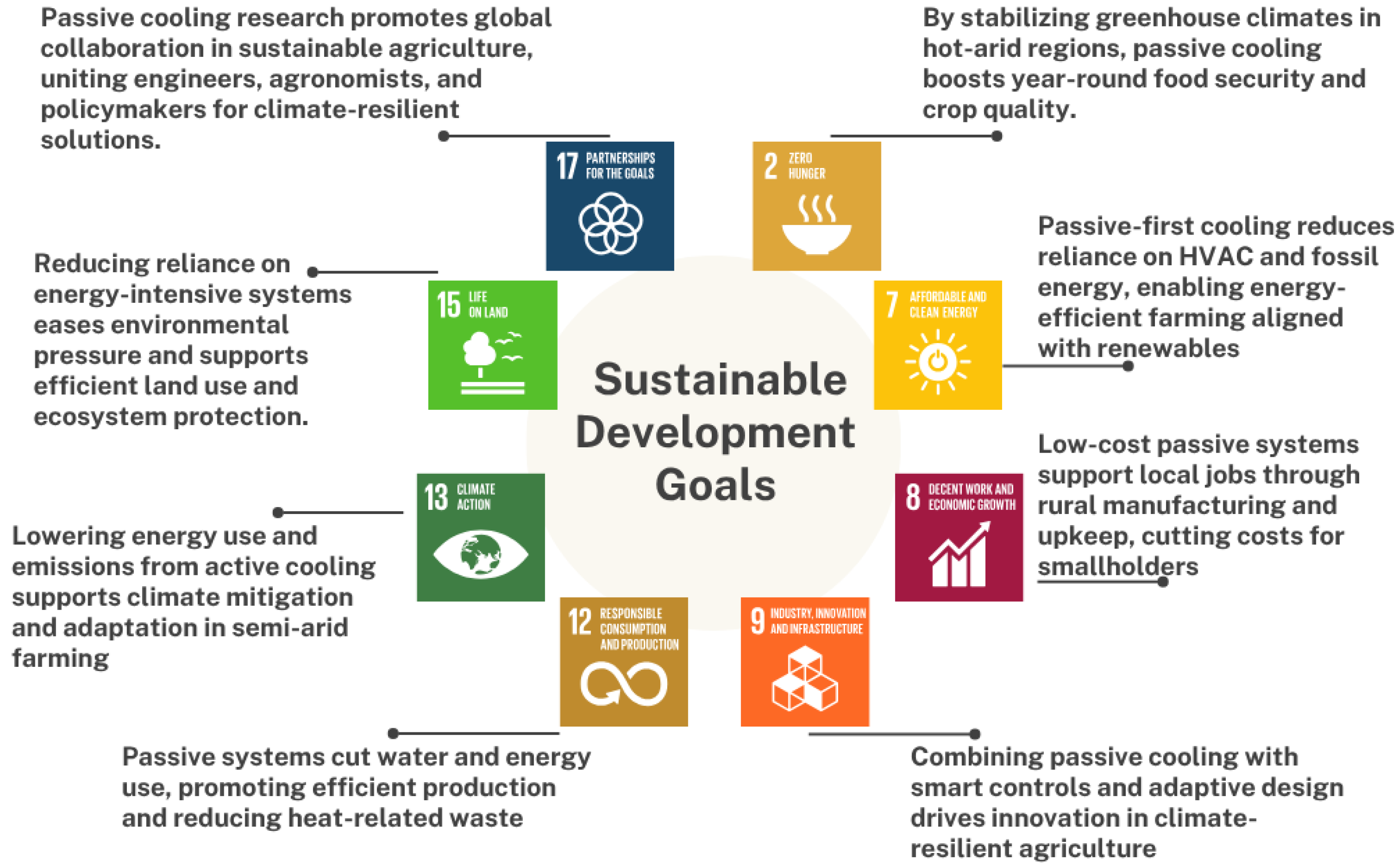
To our knowledge, no existing synthesis has brought together spectrum-selective films, radiative layers, earth–air systems, buoyancy-driven ventilation, and thermal storage within a single climate-focused framework. Figure 1 responds to this gap by mapping the main cooling pathways into four functional groups—airflow and ventilation, shading and radiative control, thermal storage and ground coupling, and structural design and geometry—that structure the rest of this review. The analysis adopts a passive-first perspective, in which cooling is primarily provided by natural energy flows, while limited active assistance is considered only intermittently under extreme conditions and explicitly identified when present. In line with the United Nations Sustainable Development Goal 7 (Affordable and Clean Energy), the analysis emphasizes low-energy, climate-resilient greenhouse designs tailored to hot–arid regions (Figure 2).

2. Research Methodology

2.1. Systematic Review Approach

This review followed PRISMA 2020 guidelines to ensure a transparent and reproducible process, using a PICOS framework to structure the search and selection. The population considered was agricultural greenhouses in hot–arid, semi-arid, or Mediterranean climates. Interventions focused on passive and “passive-first” cooling strategies, including natural ventilation, shading and whitewashing, thermal or spectral screens, radiative-cooling films, photovoltaic and spectral-splitting covers, earth–air heat exchangers, phase change materials, rock-bed storage, sunken or semi-buried structures, and geometry-related modifications. Comparators included conventional greenhouses without these measures, alternative passive options, or active systems such as pad–fan and fogging. Primary outcomes were thermal behaviour temperature reduction, indoor–outdoor depression, relative humidity, VPD, and ventilation rate while secondary outcomes covered water and energy use, crop yield and physiology, and basic economic indicators like payback time and life-cycle costs. When required, reported outcomes were converted to comparable units for qualitative synthesis. Results were synthesized narratively due to the heterogeneity of study designs, interventions, and outcome measures. Studies were grouped by type of passive cooling strategy (airflow and ventilation, shading and radiative control, thermal storage and ground coupling, structural design and geometry) using the PICOS framework to facilitate structured comparison and thematic synthesis. Eligible study designs comprised field experiments, pilot demonstrations, validated simulations or CFD models, and mixed approaches, allowing us to link biophysical cooling effects with resource efficiency and agronomic performance under demanding climates. Reporting bias was considered by including multiple databases, Google Scholar, and expert recommendations. Certainty of evidence was assessed qualitatively based on study design, methodological rigor, and outcome completeness. Two reviewers independently extracted data using a standardized form; discrepancies were resolved by discussion. No automation tools were used, and study authors were contacted only if clarification was needed.

2.1.1. Database Selection and Search Strategy

A comprehensive literature search was performed across multidisciplinary databases to capture the broad scope of greenhouse engineering and agronomic research. The following databases were used: Scopus, Web of Science Core Collection, Taylor & Francis, Sciencedirect. To minimize publication bias, additional searches were conducted in Google Scholar (first 200 hits per query).
Search strategies combined three conceptual blocks with Boolean operators:
  • Greenhouse context: (“greenhouse” OR “solar greenhouse” OR “Cooling greenhouse” OR “multi-span” OR “Venlo” OR “tunnel” OR “Quonset” OR “sunken greenhouse”).
  • Passive cooling interventions: (“natural ventilation” OR “solar chimney” OR “windcatcher” OR “PDEC” OR “shading” OR “whitewashing” OR “thermal screen” OR “spectral film” OR “radiative cooling” OR “EAHE” OR “PCM” OR “rock bed” OR “ground-coupled”).
  • Climate descriptors: (“arid” OR “semi-arid” OR “Mediterranean” OR “hot-dry” OR “desert” or “hot”).
The search was limited to studies published between 2010 and 2025 in English, with full-text availability. Search strings were adapted to each database syntax, and results were exported in RIS/BibTeX formats for deduplication and screening.

2.1.2. Inclusion and Exclusion Criteria

This review includes only original research studies focusing on agricultural greenhouses, either located in or simulated for hot–arid, semi-arid, Mediterranean climates, or other regions characterized by hot summers. Eligible studies were required to evaluate passive or “passive-first” cooling systems as defined in the PICOS framework and to report at least one quantitative outcome. We included field or pilot experiments, numerical or CFD simulations, and hybrid designs that combined measurements with modeling. Only full-text articles written in English were retained.
We excluded studies centered on high-tech greenhouses that depend almost entirely on mechanical HVAC cooling. Work dealing only with heating or dehumidification, without any assessment of summer cooling performance, was also set aside. Non-greenhouse applications (e.g., residential or commercial buildings) were not considered unless the authors explicitly framed them as transferable to agricultural greenhouses. Review papers, conference abstracts without complete datasets, editorials, patents, and studies lacking extractable data were excluded as well. Finally, research conducted in climates unrelated to hot–arid, semi-arid, Mediterranean, or hot-summer conditions did not meet the inclusion criteria.

2.1.3. Screening and Selection Process

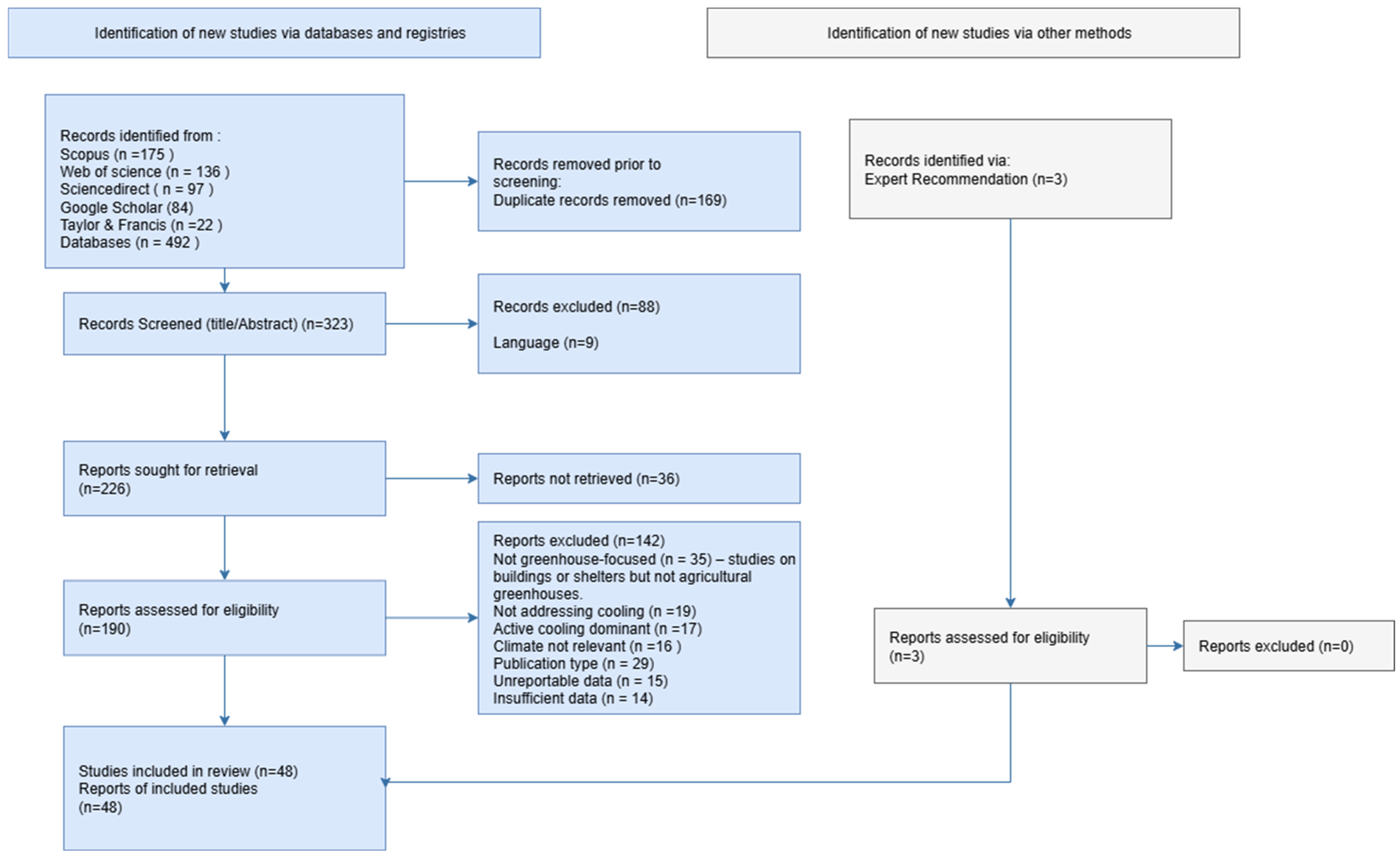
The initial search identified 492 records across Scopus, Web of Science, ScienceDirect, Google Scholar, and Taylor & Francis. After removing 169 duplicates, 323 records were screened on title and abstract, leading to the exclusion of 88 items (including 9 for language). Full text was sought for 226 records; 36 could not be retrieved, leaving 190 articles for eligibility assessment. Of these, 142 were excluded for reasons such as non-greenhouse focus, absence of cooling interventions, predominately active systems, unsuitable climates, non-eligible publication types, or insufficient or unreportable data. Three additional studies were identified through expert recommendation and passed the same criteria. In total, 48 studies were included. Screening was conducted by two independent reviewers using predefined criteria and the PICOS framework, with a third reviewer consulted when needed. The PRISMA flow diagram (Figure 3) summarizes this process, and all included studies were tabulated with key bibliographic, climatic, technical, and performance details.

3. Thematic Analysis of Passive Cooling Strategies in Greenhouses

Passive cooling options for greenhouses in hot, semi-arid, and Mediterranean climates can be usefully organized into four themes: airflow and ventilation, shading and radiative control, thermal storage and ground coupling, and structural design and geometry. Each group gathers techniques that lean on natural physical processes to cut internal heat loads, aiming to limit dependence on energy-intensive mechanical systems.

3.1. Airflow and Ventilation

3.1.1. Natural Ventilation Strategies

Natural ventilation removes heat by steering airflow through openings, using pressure differences and buoyancy to flush warm indoor air while pulling in cooler outdoor air [3]. On paper this is straightforward; in real greenhouses it becomes quite delicate. Actual performance is shaped by wind fluctuations, vent geometry (size, position, opening angle), insect-screen resistance, and internal thermal stratification that shifts over the course of the day.
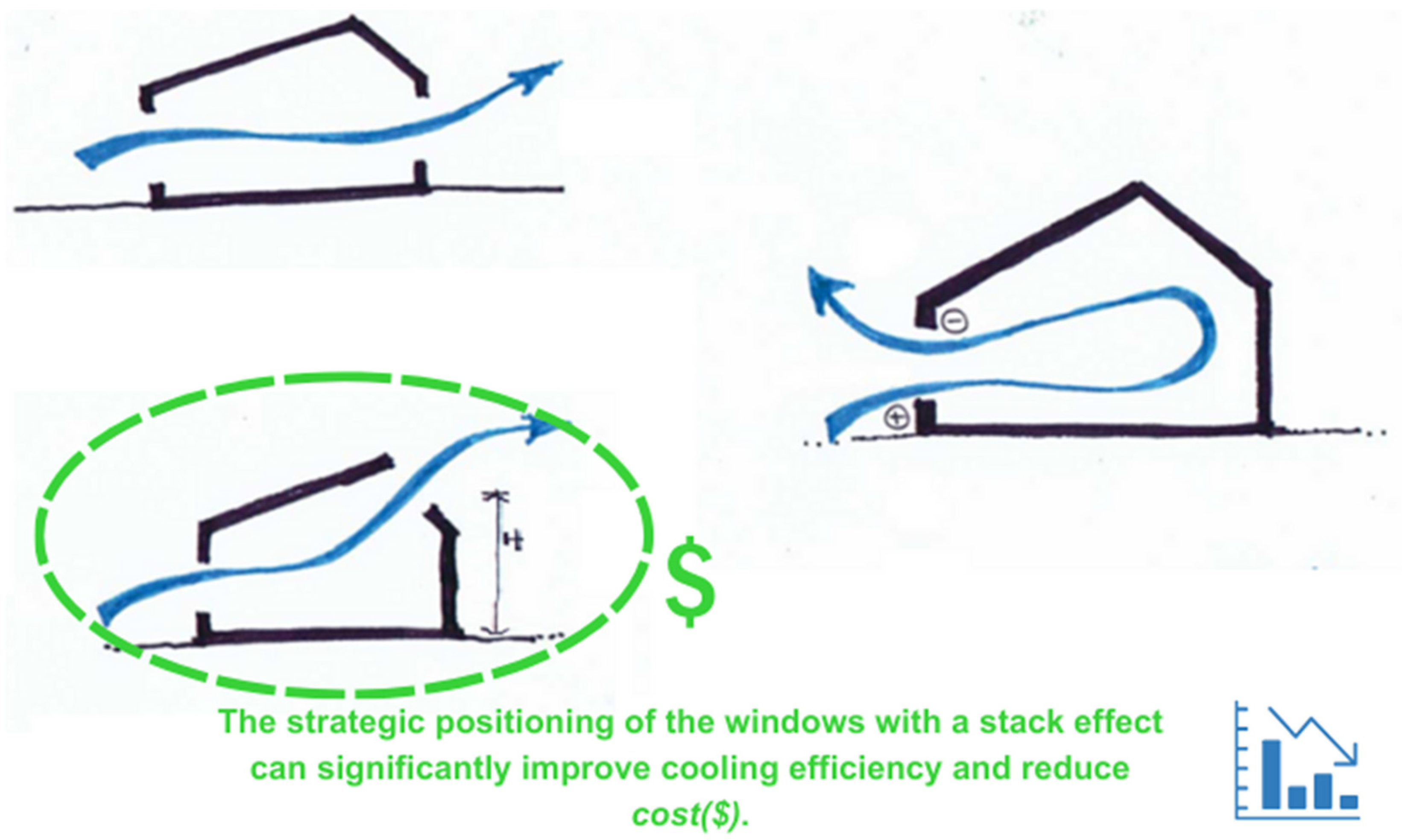
Both field measurements and simulation studies tend to agree on a key point: well-positioned roof and side vents that exploit the stack effect can provide substantial cooling during midday peaks, when the indoor–outdoor temperature gap is largest (Figure 4) [3]. Yet, this is not guaranteed. Calm conditions or weak temperature differences can drop airflow below what is needed to protect sensitive crops. As a result, designers are always trading off: larger openings improve air exchange but may weaken the structure or compromise pest exclusion. Configurations that combine upwind inlets with leeward exhaust vents generally appear to enhance air capture and promote smoother removal of hot air [5].
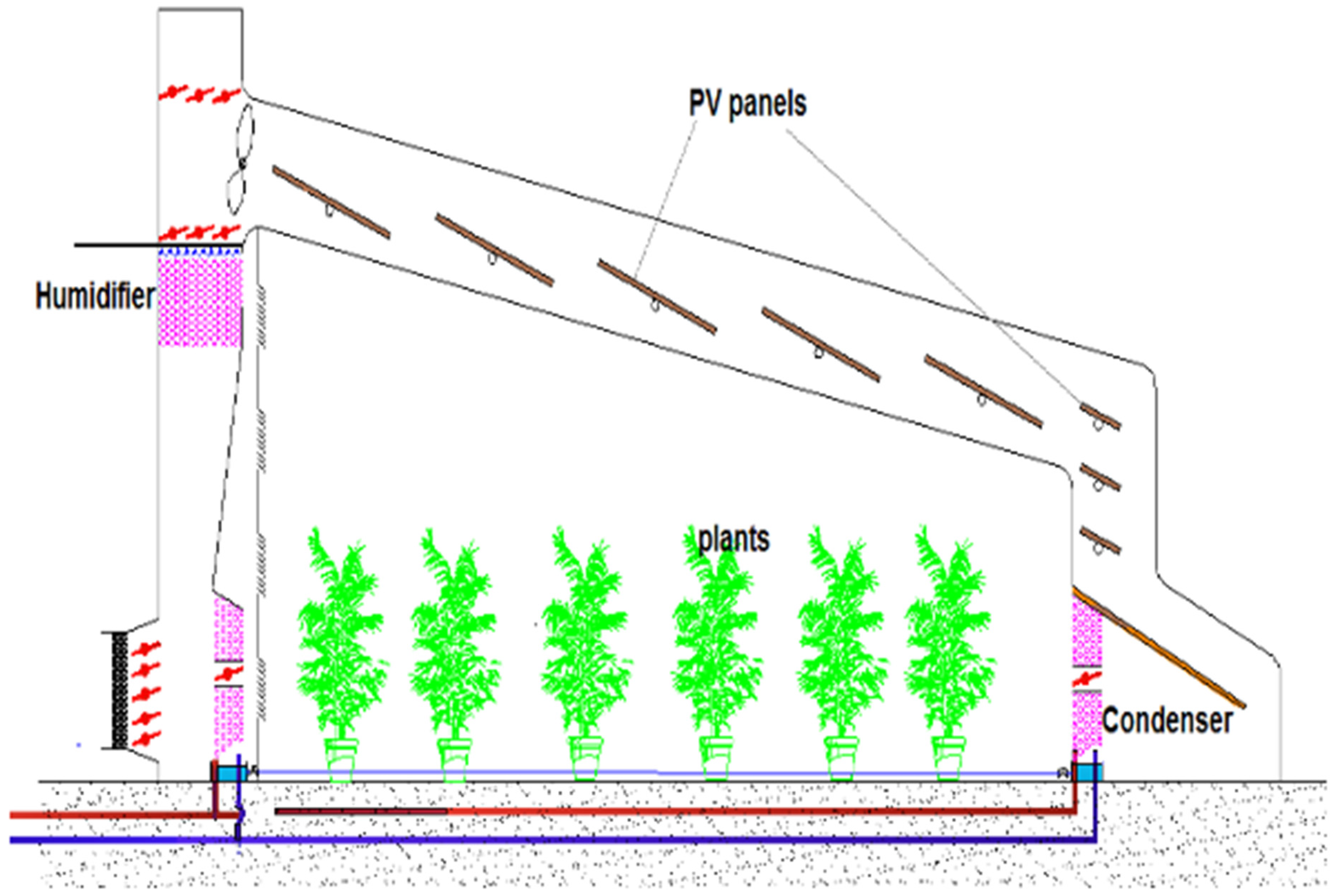
Solar chimneys extend buoyancy-driven extraction during calm hours, stabilizing natural ventilation when wind is intermittent; gains are strongest when chimneys are paired with optimized ridge/side vents or low-energy evaporative inlets [43]. To cope with unstable wind directions, some growers use staggered vent-opening schedules that selectively activate inlets and outlets based on real-time wind vectors [44]. This kind of adaptive management looks promising but assumes both monitoring capability and active oversight. Ventilation is also best seen as one layer in a broader passive “stack” rather than a stand-alone solution. Shading, for instance, can indirectly enhance ventilation effectiveness by limiting plant water stress and reducing extreme peaks [6], At the same time, heavy shading weakens buoyancy forces and may lower the very temperature gradients that drive airflow under calm conditions. Pairing roof vents with low-energy evaporative elements—such as wetted meshes near inlets—can pre-cool incoming air and improve canopy comfort, but humidity must be managed carefully to avoid disease pressure [45]. When winds are weak, solar chimneys provide extra buoyancy, reinforcing upward extraction and extending the operating range of natural ventilation [5].
Flow resistance is another critical piece. Insect-proof nets add drag at openings and can substantially reduce airflow under moderate winds unless designers compensate with larger vent areas, adjusted mesh characteristics, or lower-resistance screens [1]. This trade-off illustrates why geometric optimization cannot be separated from biosecurity constraints and day-to-day management realities in arid agriculture.
CFD and zonal-model studies consistently suggest that effective natural ventilation depends on vent layouts that combine vertical stack effects with cross-flow potential [46]. Single-span greenhouses often benefit from continuous ridge vents, whereas multi-span structures may experience disrupted airflow due to structural discontinuities. A CFD study on a standalone greenhouse in Egypt, for example, found that pairing low windward inlets with leeward or ridge exhausts strengthened cross-flow and buoyancy-driven ventilation, reducing hot spots and stabilizing airflow at canopy level [47]. Among 27 scenarios, those with low inlets and continuous ridge vents showed the most favorable cooling and uniformity, while fine insect screens and poorly balanced openings tended to increase internal temperatures.
Maintaining a passive-first strategy can be supported by fine-tuning the inlet–outlet balance, using low-energy fans as flow “equalizers,” and integrating thermal mass to extend cooling effects over time [48]. These results point toward site-specific design tools, rather than generic vent-sizing rules, as a more realistic way to align ventilation concepts with local wind patterns and climate conditions [47].
Figure 5 sketches a conceptual model of such optimized natural ventilation, highlighting inlet and outlet configurations that favor effective airflow [47].

3.1.2. Wind-Driven Ventilation Design

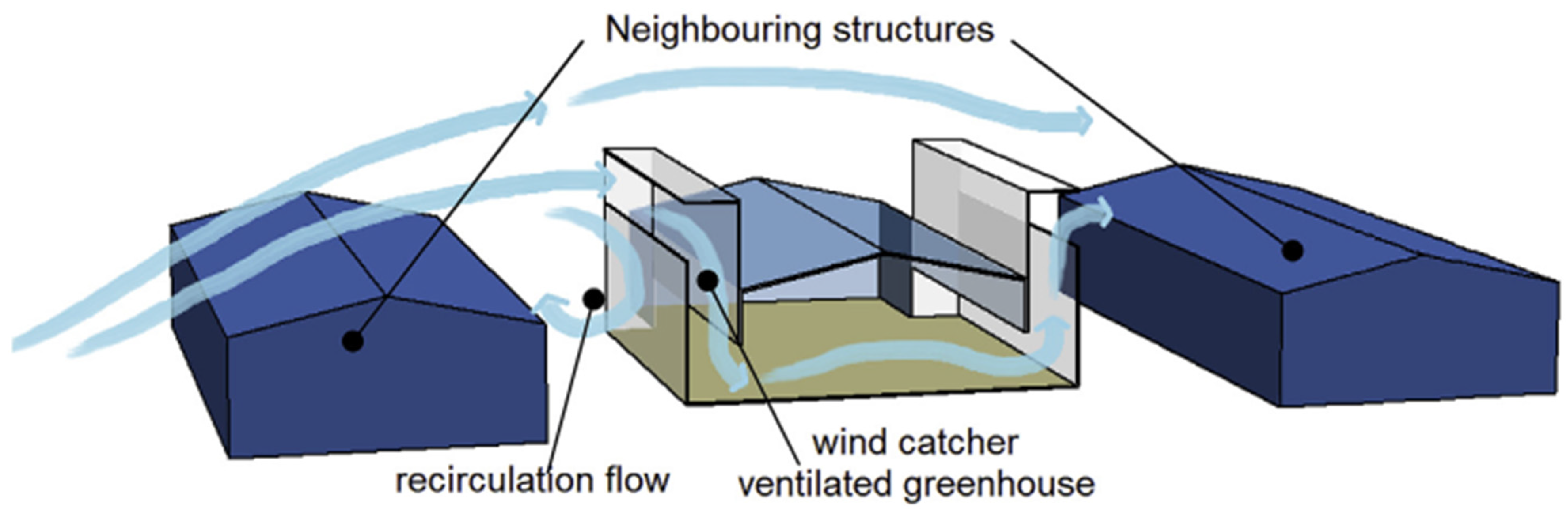
Wind-driven strategies tap outdoor kinetic energy to drive air exchange, complementing buoyancy when vertical temperature stratification is weak or when winds are reliably available. Elevated intake structures especially windcatchers take advantage of higher roof-level wind speeds and channel air from above the roofline down to the crop zone [50]. In many measurements, roof-level wind speeds exceed those at 2 m height by factors of up to ~2.6 during the hottest hours, so airflow availability tends to coincide with maximum thermal load [51]. Turning that potential into consistent cooling, however, depends on details: aerodynamically shaped inlets to raise entry velocity and internal diffusion elements (deflectors, collars) to avoid narrow jets that create hot and cold spots. Figure 6 sketches a typical windcatcher-ventilated greenhouse, calling out the main design features and its interaction with neighboring structures [52].
Orientation also plays a clear role. Modeling work suggests that aligning openings within roughly 0–45° of the prevailing wind direction improves exchange, with flow increasing almost linearly up to about 5 m·s−1 before internal turbulence starts to erode distribution quality [4]. With directional cowls or vanes, the same opening can alternate between intake and exhaust as the wind shifts, which may smooth diurnal variability when combined with simple sensors and low-power actuators [53]. In some prototypes, wind capture is combined with pre-cooling at the intake—wetted meshes, for example—to shave a few degrees off incoming air under strong breezes, though this extra water demand is a non-trivial concern in arid settings [54].
Wind towers designed for greenhouses diverge from domestic versions: they typically need taller profiles to generate stronger pressure differences and multi-directional inlets to widen the capture sector [54]. Inside the tower, channel shaping to prevent dead zones is critical if one wants uniform distribution rather than a few over-ventilated corridors. A distributed inlet concept (ground-level plus roof-level entries) increases the chances of intercepting variable winds across seasons [4]. Finally, sand and dust conditions push designers toward specific materials and filters; finer meshes strengthen pest exclusion but also raise aerodynamic resistance, reinforcing the airflow–biosecurity trade-off already noted for insect screens [55]. Lastly, wind-driven designs integrate well with solar chimneys that guarantee a baseline buoyancy exhaust on still mornings, lowering overheating risk while keeping active backup minimal [43].

3.2. Shading and Radiative Control

3.2.1. External Shading Structures

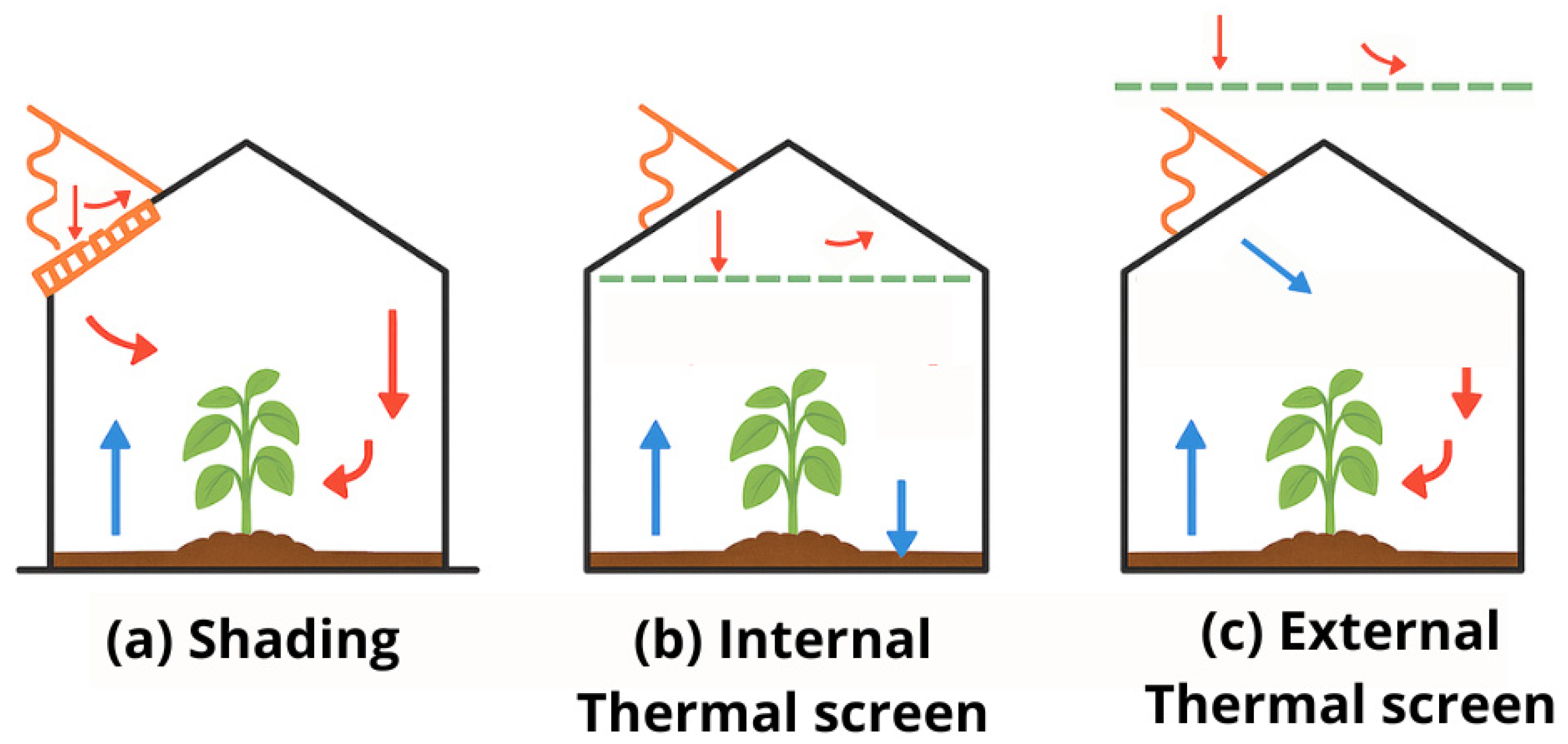
External shading blocks solar gains before radiation enters the envelope, lowering both shortwave ingress and subsequent convective/conductive loads in the air mass below. Trials in hot–arid conditions report that ~50% roof-level external shading reduces indoor air temperatures notably during afternoon peaks, trimming cooling demand when crops are most stressed. As illustrated in Figure 7, external thermal screens intercept solar radiation before it heats the greenhouse structure and internal air mass, offering superior performance compared to internal screens or basic shading. Materials matter: high-reflectivity white nets, sometimes layered with darker meshes for selective filtering, can preserve PAR while cutting NIR more aggressively [56]. External shading often outperforms under-roof screens because it intercepts heat before it warms structural and plant surfaces.
Photovoltaic dynamic shading via rotating PV panels or PV-integrated roofs—adds controllable solar rejection while co-generating electricity. Proper control preserves PAR for target crops and offsets actuator/fog energy, though fouling and seasonal angle tuning are critical in dusty, high-insolation sites [57]. Aerodynamic effects are non-trivial. Nets that overlap vent zones add drag and can throttle wind-driven flow [58]. Consequently, designers must balance shading density with the ventilation strategy. NIR-filtering films and photo-selective plastics offer another pathway, reducing NIR while retaining much of the visible band: trials show cooler canopies, improved water status during peak phenology, and better diffuse light for lower leaves [59]. However, durability under high UV and dust abrasion is a practical concern; optics degrade without maintenance [60]. Some studies note leaf temperature reductions up to ~5 °C under shaded zones and yield/quality improvements in Mediterranean tomato when shading is applied during late summer [61]. Yet, overshading risks photosynthetic depression outside the peak-stress window; dynamic or seasonal deployment is preferred.
Operational integration matters. External shading improves evaporative pad performance by lowering incident heat at the pad face (cooler wetted surface → higher latent exchange efficiency) [45]. Hybrids like white roof paint + black external nets have been tested to combine high albedo with deep shading for extreme summers [37]. Dust and infrequent, intense storms in desert belts impose maintenance and anchoring requirements; design must anticipate cleaning logistics and wind loads [62].
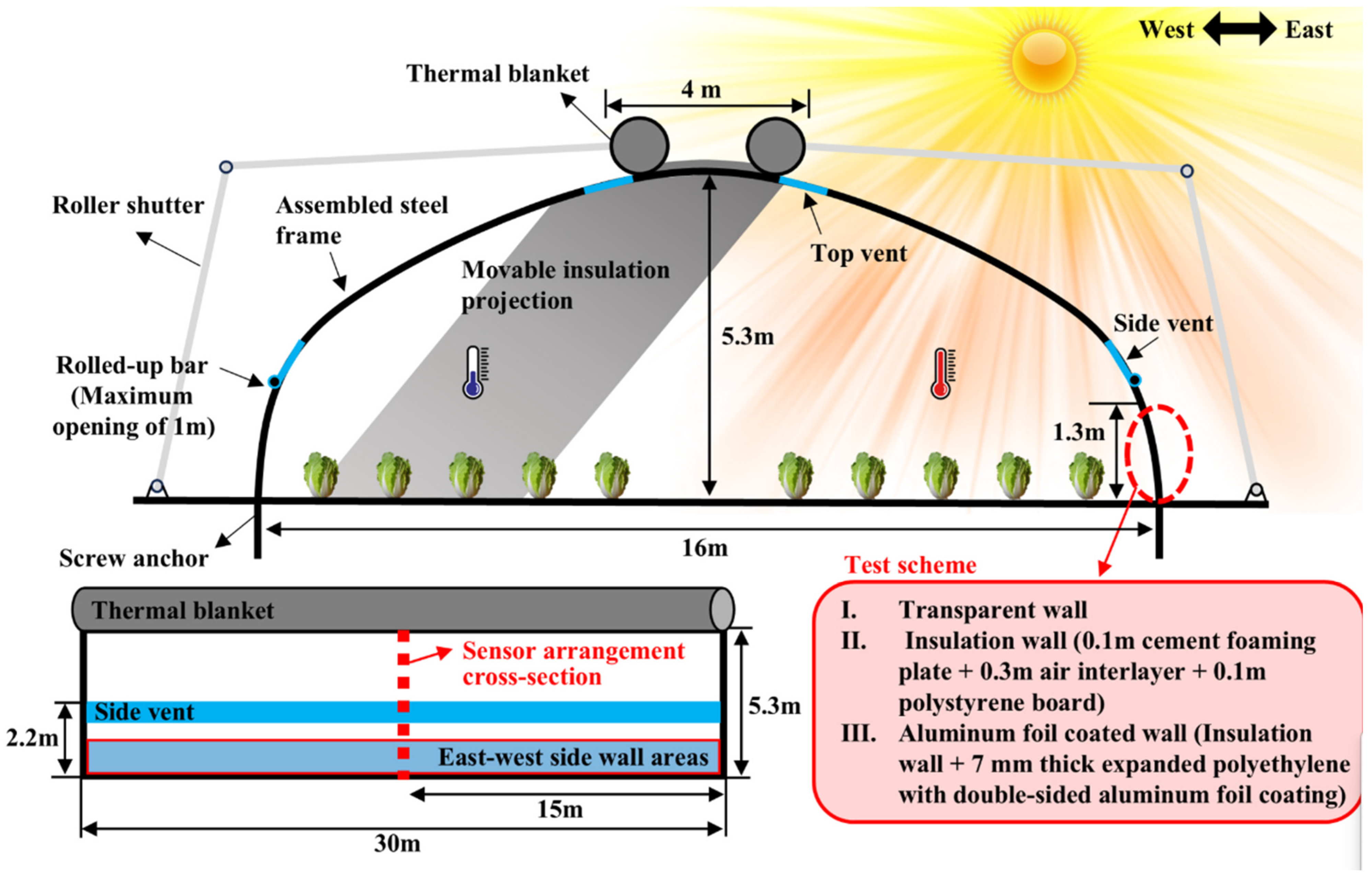
Figure 8 illustrates a multi-layered passive insulation strategy designed to stabilize greenhouse conditions under hot and arid climates. A thermal blanket installed beneath the roof can limit nocturnal radiative losses and provide targeted shading during heatwaves, while still allowing airflow through side and roof vents. In this configuration, a movable insulation curtain works together with reflective surfaces and side openings to adjust internal temperature in response to weather conditions. The envelope is typically tested under three wall setups: fully transparent walls, insulated walls (cement foam + air gap + polystyrene), and aluminum-foil-coated walls that increase thermal resistance. These arrangements aim to cut heat transfer through the east–west façades without sacrificing useful light to the crop. In practice, such envelope upgrades tend to perform best when paired with coherent ventilation design (top and side vents), reflective elements, and simple weather-based control logic.

3.2.2. Spectrum-Selective and Reflective Covers

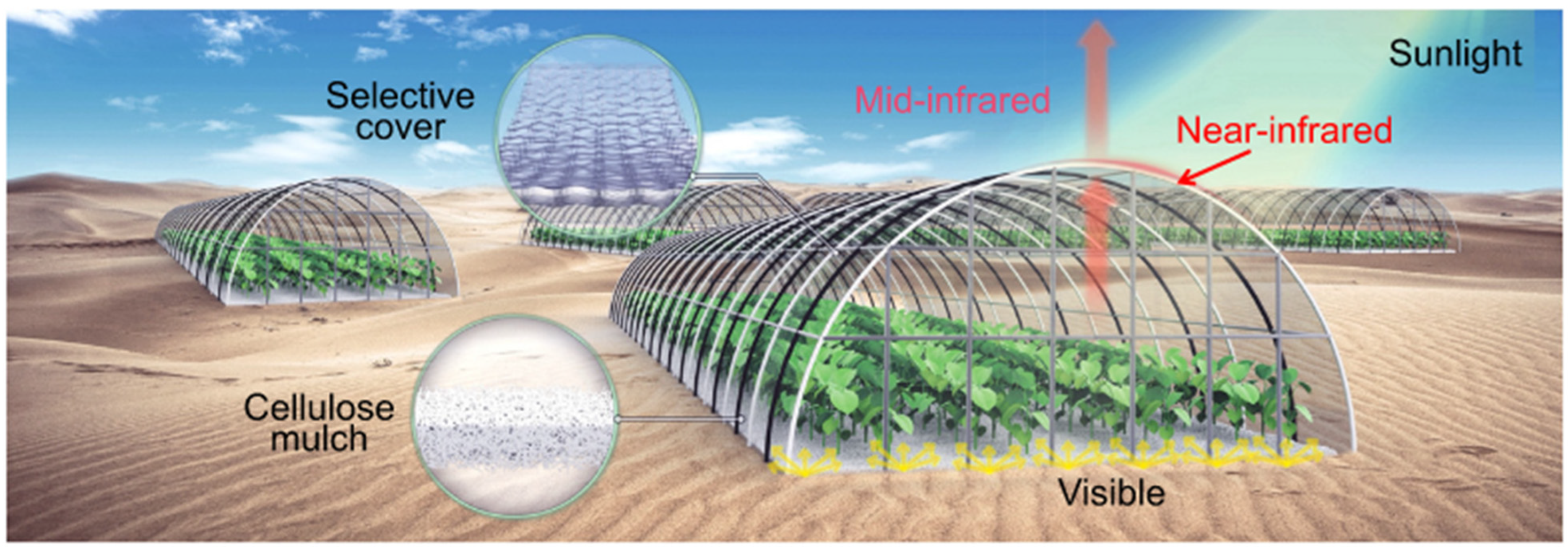
Unlike coarse shading, spectrum-selective covers manipulate the spectral content so that PAR (400–700 nm) passes while NIR (≈760–2500 nm) which mostly heats gets reflected/blocked [12]. Field trials in harsh climates report up to ~5 °C daytime air temperature reductions and ~8% cooling energy savings for certain NIR-blocking films, with limited PAR penalties when materials are well designed. Seasonal trade-offs exist: excessive NIR blocking in winter can raise heating demand unless the solution is retractable or switchable [37]. Figure 9 illustrates how photonic engineering of greenhouse covers and ground films can be used to achieve passive thermal regulation in extremely hot regions.
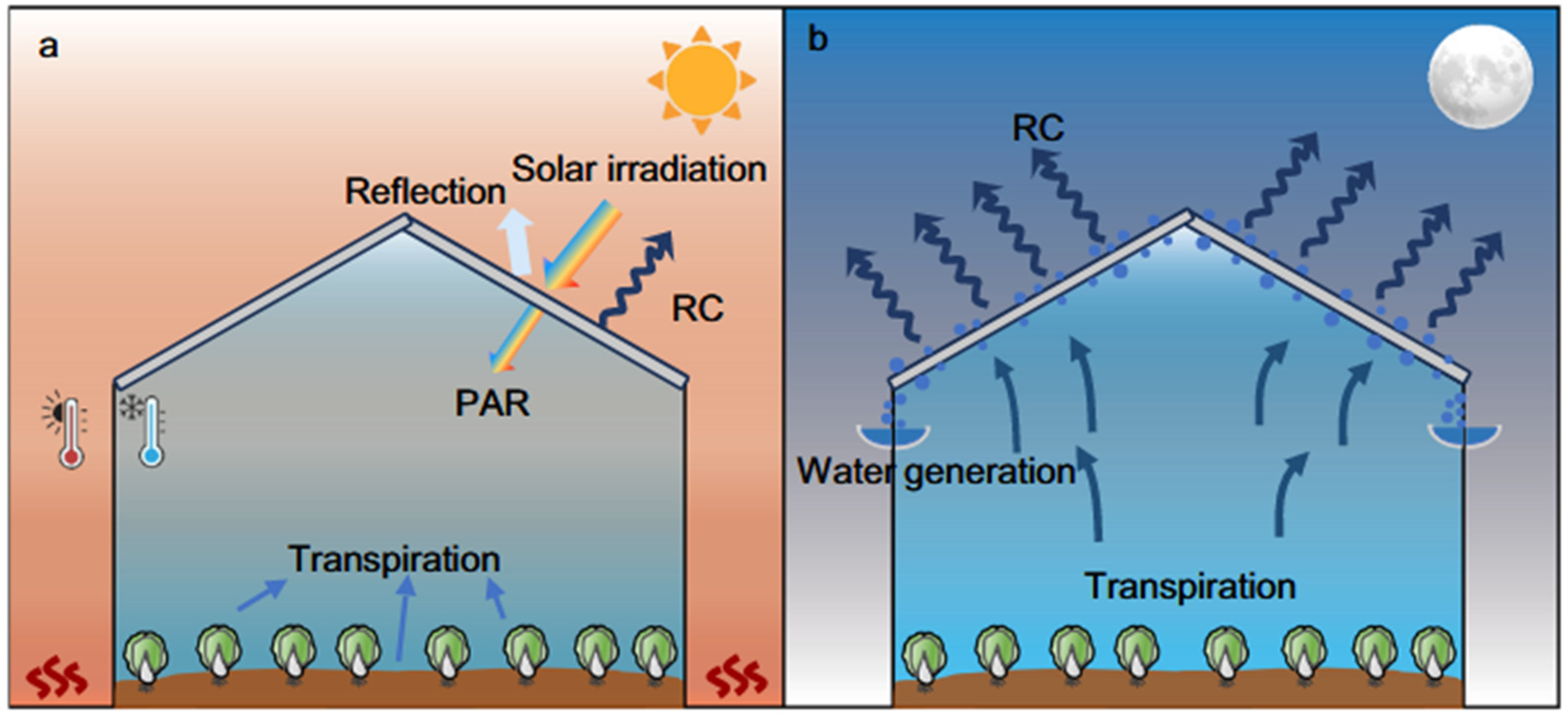
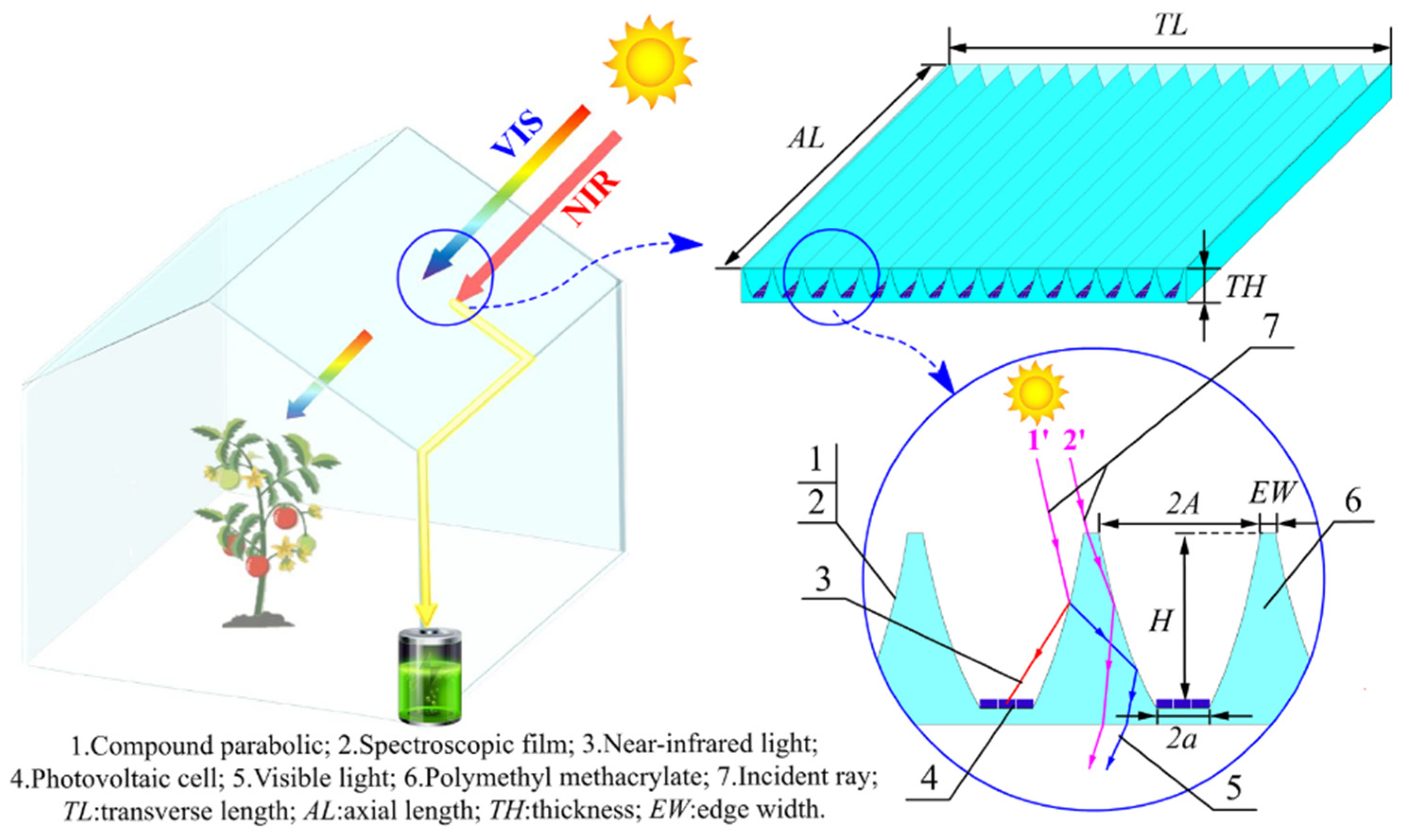
Reflective coatings (e.g., MgO) and radiative-cooling films add a complementary mechanism: high solar reflectance plus high mid-IR emissivity (8–13 µm) enhance net radiative heat loss to the sky, assisting nocturnal cooldown while maintaining daylight PAR transmission—especially in new “transparent radiative-cooling” (T-RC) films [30]. As shown in Figure 10, RC films can also contribute to water savings by lowering internal temperatures and reducing evapotranspiration demands. Agrivoltaic approaches (OPV or selective PV layers) divert non-PAR wavelengths to generate electricity while transmitting much of PAR [65]. These can co-supply power for actuators or small fans but bring CAPEX, durability, and PAR-transmission trade-offs. The working principle of spectrum-selective covers (SSC), including wavelength targeting and energy rejection mechanisms, is summarized in Figure 11.
Multi-wall PC/polymer panels and bubble films further reduce conductive/convective heat transfer and can be engineered for spectral selectivity [1]. Over time, UV-yellowing and dust fouling degrade optics; careful cleaning that avoids scratching is needed [66]. Objective comparison requires spectral transmittance/reflectance data (τ_λ, ρ_λ, α_λ) and reporting of PAR, NIR, MIR properties alongside agronomic outcomes [56].
Figure 10. (a) Daytime radiative cooling and water-saving function of radiative cooling (RC) films in greenhouses. (b) Nighttime radiative cooling–driven atmospheric water harvesting using RC films [67].
Water 18 00463 g010
Figure 11. Working principle of SSC [68].
Water 18 00463 g011

3.3. Thermal Storage and Ground Coupling

3.3.1. Phase Change Materials (PCMs)

PCMs store/release latent heat near a set transition temperature, buffering daytime peaks and releasing warmth at night [69]. They can be embedded in walls or integrated under PV/T modules; in greenhouses they dampen diurnal swings, stabilize panel efficiency (when used under PV), and reduce reliance on active heating/cooling [70]. The melting/freezing point must match the local climate and crop comfort band; poor conductivity is a challenge and often addressed with fins or conductive additives [53]. Multi-PCM layering targets different diurnal phases (higher-Tmelt for peak harvest; lower-Tmelt for night release). As illustrated in Figure 12, PCM walls can serve as passive thermal buffers absorbing excess heat during the day and releasing it during cooler night-time periods thereby improving thermal stability inside greenhouses.
Coupling PCMs with ventilation is powerful: PCM surfaces near inlets temper intake air spikes by day and smooth drafts at night. Designs should report charging/discharging power (e.g., via cp·ṁ·ΔT equivalents) under realistic cycles [71]. PCMs add minimal water use and can pair with low-energy evaporative pads if humidity is acceptable; in very dry climates, radiative night cooling can help “recharge” PCMs passively.

3.3.2. Earth–Air Heat Exchangers (EAHEs)

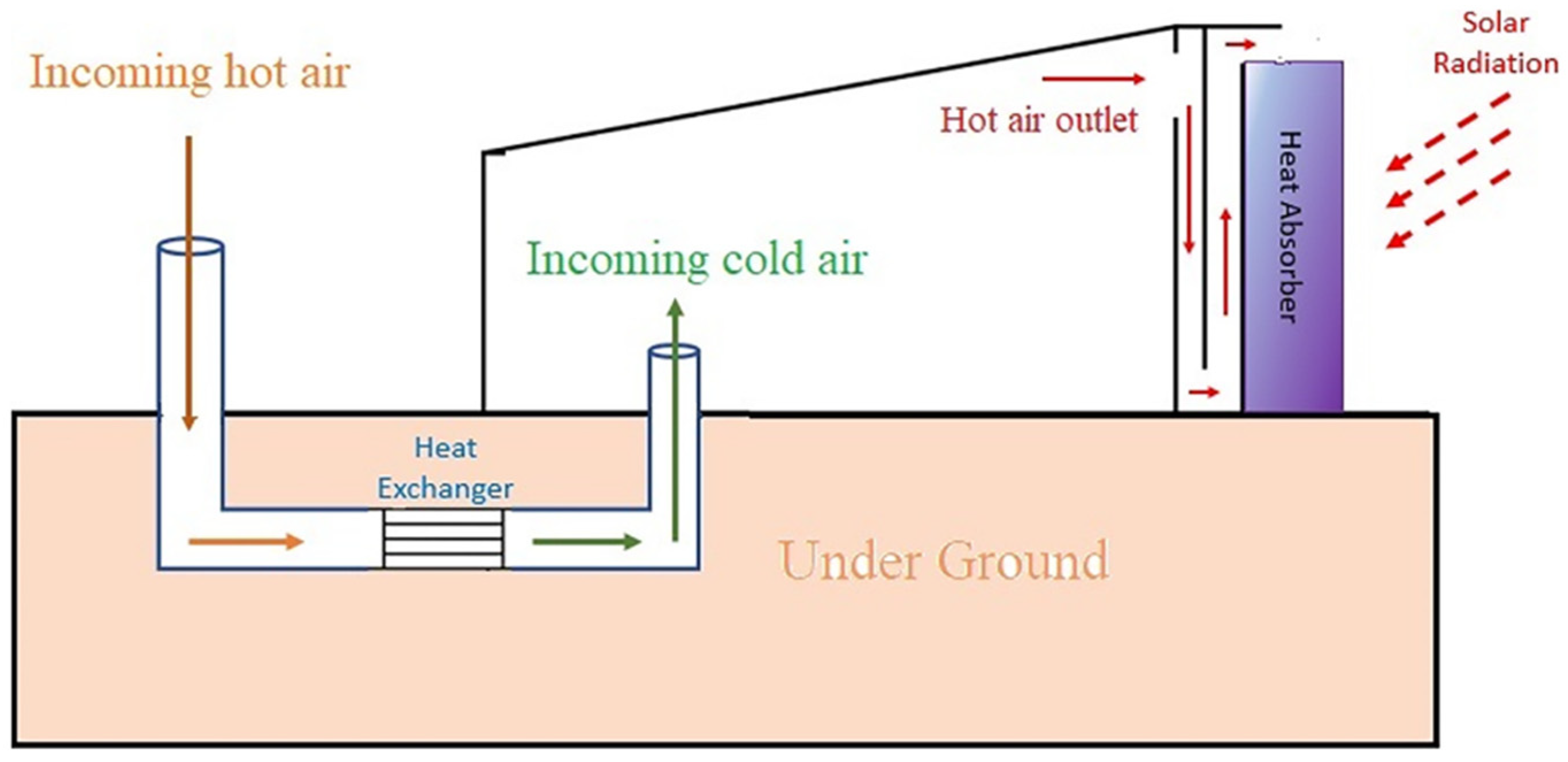
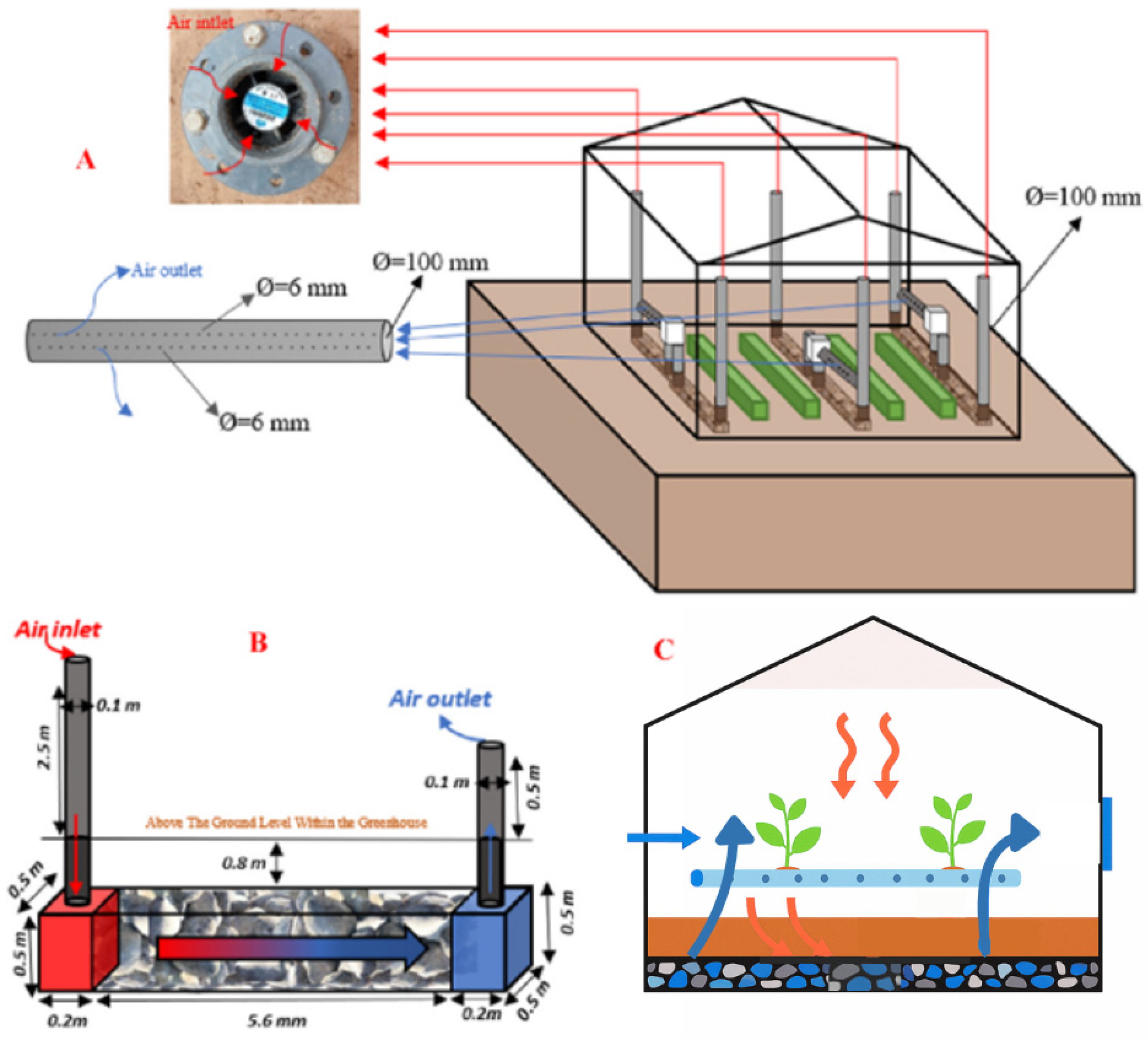
EAHEs route intake air through buried ducts exchanging heat with relatively stable soil, providing passive cooling by day and passive pre-heating by night/winter [72]. Performance depends on soil thermal properties (especially moisture), pipe material/diameter, length, burial depth (~0.8–4 m), and airflow rate [73]. Temperature approaches the subsoil baseline quickly along the first 10–20 m before returns diminish; oversizing beyond ~40–50 m offers little gain if local soil warms with prolonged operation [74]. Careful control of mass flow is crucial: if air moves too fast, it may not stay in the ground long enough to cool effectively; if it moves too slowly, ventilation becomes inadequate. Designs also have to account for condensation risk. Interestingly, some systems operated through very hot summers with high dew points without reaching saturation, so internal wetting did not occur despite the cooling effect [75]. Figure 13 outlines a typical EAHE configuration, showing the main components and the subsoil heat-exchange pathway.
EAHEs pair well with Trombe or green walls, solar chimneys, and reflective barrier systems, with several studies reporting notable annual thermal-energy savings relative to mechanically cooled baselines [1,68,69]. Their water use is essentially negligible—aside from occasional cleaning and maintenance—which is a clear advantage over evaporative approaches [76]. On the practical side, designers must handle dust ingress, biofouling risks, and site-specific test loops to verify subsoil temperatures against crop requirements before committing to large-scale deployment. Prioritizing high-value crops along EAHE-conditioned intake zones can further concentrate the benefits while keeping infrastructure demands manageable [70].
Figure 13. Schematic of the proposed model of EAHE [77].
Water 18 00463 g013

3.3.3. Sanken Greenhouse with Buried Design and Rock Bed System

Sunken or partially buried greenhouses draw on ground thermal inertia to shave daytime peaks and retain heat at night, with relatively low operation and maintenance needs. They tend to pair well with EAHE systems and night-time insulation screens under strongly diurnal hot–arid conditions [54].
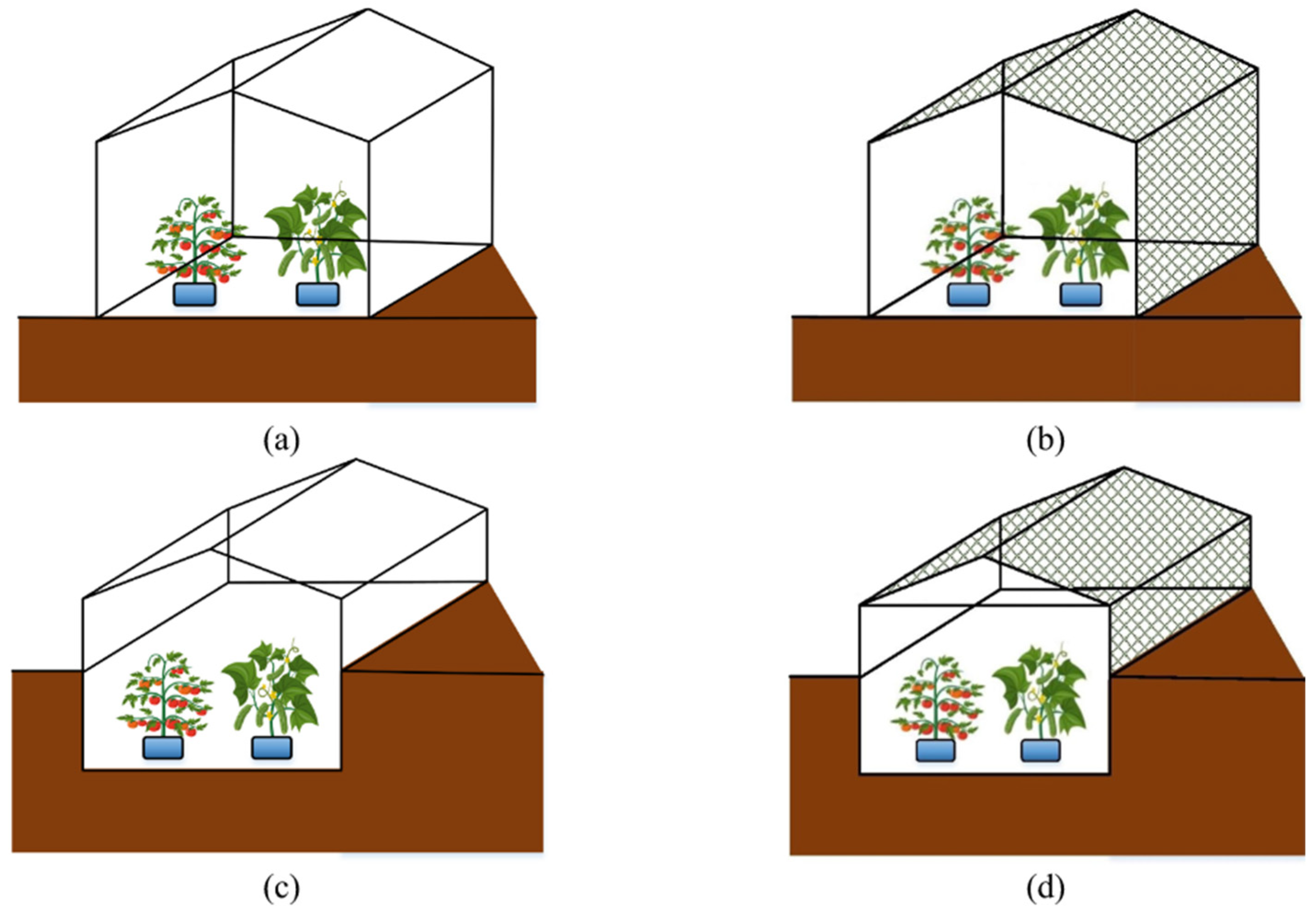
Four envelope archetypes—CGH, SGH, BGH, and BSGH—are frequently examined and are sketched in Figure 14, each with distinct structural features and passive climate-moderation strategies [35]. CGH (closed greenhouse) relies on a largely sealed envelope with carefully controlled openings, while SGH (shaded greenhouse) uses external screens or selective covers to cut incoming solar radiation while still admitting useful light; BGH (buried greenhouse) places the crop zone partially or fully below ground level to enable thermal coupling with the soil; and BSGH (buried + shaded greenhouse) combines subgrade thermal interaction with external shading to enhance passive moderation.
The rock-bed (RB) cooling system is a closed-air sensible heat storage approach that uses a buried porous bed of pebbles or gravel to help stabilize greenhouse temperature. During hot hours, warm air from the upper zone is drawn through the bed, where it gives up heat to the stones by convection and conduction before returning, tempered, to the crop zone. At night or in cooler periods, the flow rate and direction can be adjusted so that the bed gradually releases the stored heat, softening diurnal temperature swings rather than letting them reach the plants directly.
Figure 15 illustrates the RB layout, including a real Canarian greenhouse example, the operating principle, and how the bed is geometrically integrated with the structure. The system runs without water and relies entirely on dry thermal mass, which makes it an appealing passive cooling option in water-scarce settings [78].

3.4. Structural Design and Geometry

3.4.1. Roof Shape and Slope Effects

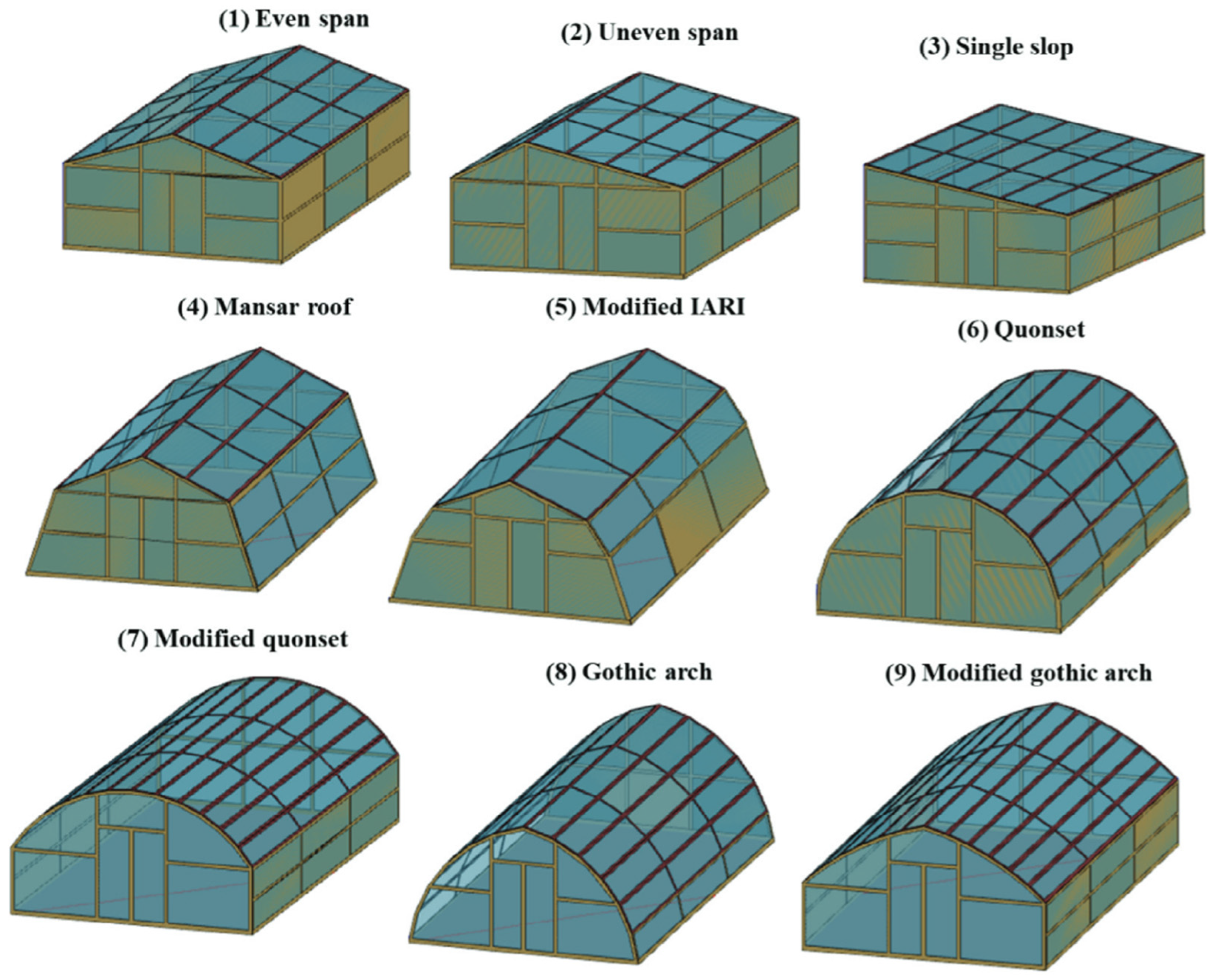
Roof geometry does double duty, shaping both solar gains and how well the greenhouse breathes. In hot–arid settings, roof slope is usually tuned to cut summer irradiance while still admitting useful winter sun; steeper slopes tend to reduce high-sun exposure but may also trim winter gains more than desired [79]. Curved multi-span roofs handle structural loads efficiently but create more complex patterns of internal light, whereas gable roofs make it easier to install continuous ridge vents that strengthen buoyancy-driven ventilation and heat removal [80]. Sawtooth profiles can take advantage of prevailing winds if oriented carefully, but they also introduce more surfaces where dust can accumulate and demand more maintenance. Figure 16 shows the greenhouse model used for testing different roof shapes, including variations in span number and slope configuration.
Slope influences cleanability and optical performance (steeper pitches shed dust/rain better), vent stack height (steeper roofs → larger vertical head for buoyancy), and external aerodynamics (flow attachment/separation patterns). TRNSYS comparisons show shallower roofs risk overheating unless compensated by increased vent ratios or added reflectance; steeper roofs may lower annual cooling loads but can reduce light availability during shoulder seasons unless paired with diffusing panels [79]. Night-time radiative losses also interact with slope and emissivity, sometimes beneficially enhancing post-sunset cooling, sometimes excessively dropping temperatures if not moderated by insulation screens or latent buffers [81].
Figure 16. Examples of greenhouse roof shapes and span configurations [82].
Water 18 00463 g016
Optimization of geometry, including span number and roof shapes (gothic, round, quonset, even-span; multi-span corridors) pre-condition pressure fields and solar gains, often improving stack/cross-flow paths and reducing hotspots when paired with well-placed vents and diffuse/selective covers [66,79].
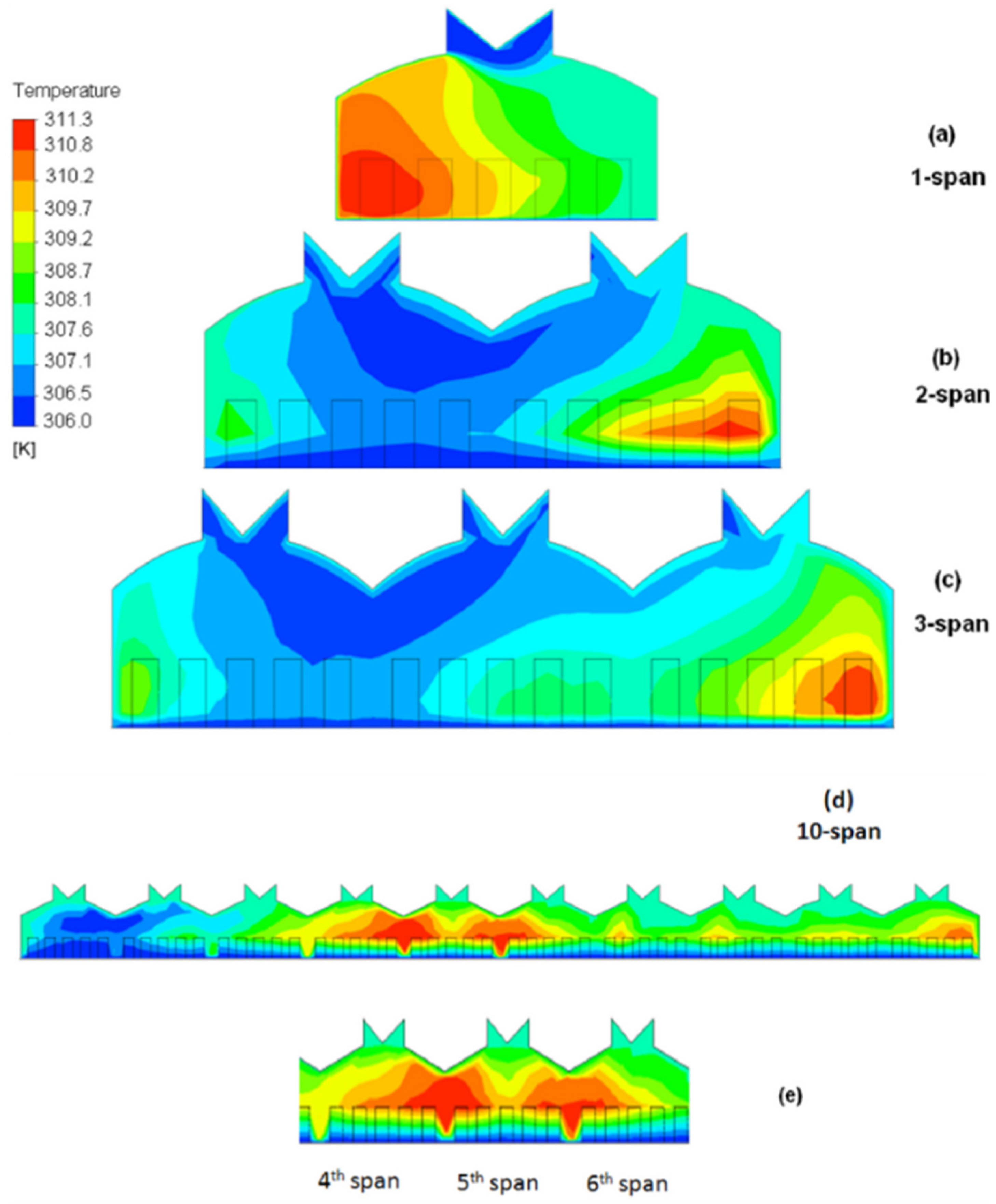
Span number (multi-span effect). Increasing the number of spans generally improves microclimate uniformity and reduces peak air temperatures by smoothing airflow paths across bays; CFD and field studies report markedly more homogeneous conditions in ≥10-span layouts compared with mono/bi-span houses (e.g., reduced hot spots and smaller ΔT at canopy level). Figure 17 illustrates this effect, showing air temperature distributions for different span configurations, including detailed temperature fields in the middle spans of a 10-span greenhouse. However, poorly arranged openings can create recirculation cells in mid-spans, so vent orientation/continuity and leeward–windward balancing are essential to avoid trapped warm zones. Beyond a threshold, gains diminish and structural volume increases can raise heating demand in cool seasons, so span multiplication should be paired with optimized ridge/side vents and night screens [83].

3.4.2. Orientation and Spatial Layout

Orientation sets daily/seasonal exposure. E–W houses can experience sharp midday wall-driven gains; N–S layouts distribute exposure more evenly but still require careful glazing selection [63]. Inside, the alignment of rows and aisles relative to vents and prevailing winds can either facilitate or obstruct airflow; multi-span complexes may need staggered vent arrays to counter shared-wall blockages. Externally, partial wind breaks help mitigate dust without sacrificing all wind-driven potential.
Inter-greenhouse spacing creates microclimatic interactions; downwind units may gain small temperature reductions (~1 °C) from upstream shading during peak hours [9,74]. In semi-arid climates, night flushing timed with local night-time breezes can pay off [84], but it really depends on the site—wind roses from a nearby airport are rarely enough, so proper site-specific wind analysis is usually needed [85]. Spatial zoning by crop tolerance also helps: placing the most heat-sensitive varieties near the coolest intake zones can lift overall performance without forcing a perfectly uniform microclimate. Land slope can be an ally here, offering buoyancy-assisted drainage of hot air, but it may also create stagnant pockets if internal circulation is not planned carefully. Reflective roofs add another wrinkle: they can bounce light and heat onto neighboring structures when spacing is tight, a problem that can be eased with buffer distances or vegetation belts [37].
Orientation, in turn, shapes where facade-targeted shading is most effective. Prioritizing west-facing walls in late afternoon, for example, can pre-cool incoming air and improve evaporative system efficiency [86]. Some growers even rotate crops across differently oriented bays over the year to match crop physiology with shifting solar paths—a management step that is more complex but potentially quite powerful. Under growing climate variability, modular vents and adjustable shading angles offer a bit of insurance, making long-term orientation decisions less rigid and easier to adapt over time [57].
A study-level risk-of-bias appraisal was conducted using a domain-based approach. Overall, most studies showed some concerns, mainly due to incomplete reporting of measurement protocols and limited control of confounding; simulation-only papers more often lacked clear boundary conditions and experimental validation. These assessments were used to qualify the confidence of the narrative synthesis.

4. Synthesis and Critical Integration of Passive Cooling Approaches

Passive greenhouse cooling options can be grouped into four broad families: Airflow & Ventilation, Shading & Radiative Control, Thermal Storage & Ground Coupling, and Structural Design & Geometry. Together they tap wind, buoyancy, shading and thermal mass to trim indoor temperatures—typically by about 3–7 °C—without active cooling [3,4,87,88]. That 3–7 °C peak reduction [89] is best read as a context-dependent range, since outside humidity, diurnal swing and local wind patterns strongly condition performance. In practice, several measures are usually combined, with a small active “backup” used only in extreme conditions to tune cooling to the local climate and crop sensitivity [90].
Natural ventilation relies on pressure differences and buoyancy to flush hot air and draw in cooler outdoor air. Large continuous roof vents paired with side openings can cut daytime peaks by roughly 3–7 °C when winds and temperature gradients are favorable [3,87]. Solar chimneys and high-level windcatchers can reinforce ventilation under low-wind conditions by inducing thermal draft and capturing faster roof-level breezes, increasing passive airflow rates [91] (Table 1). Insect screens are a major constraint: fine meshes can cut airflow by up to 50%, reducing cooling by several degrees [92]. Designers typically compensate by enlarging vent areas, using coarser meshes where acceptable, or both, to balance biosecurity with air throughput. Even so, natural ventilation works best when outside air is cooler or when steady winds are present; during still or hot–humid periods, small fans or automatic actuators may be needed to keep air moving with modest energy input, while broadly respecting a passive-first philosophy [93]. In dusty or sandy semi-arid sites, vents and louvers also need regular cleaning, and openings must be positioned to limit dust entry. Overall, natural ventilation is most effective as part of a hybrid package combined with shading, thermal storage and low-power mechanical assists rather than as a standalone solution.
To improve cross-study interpretability of cooling outcomes, we added a standardized tag at the start of each “Key Performance Results” cell. The format [IO/IC/NR; Pk/Day/24 h/Night/NR] specifies the temperature comparator (indoor–outdoor, control/baseline, or not reported) and the time basis (peak, daytime, 24 h, night, or not reported). This prevents mixing non-equivalent ΔT definitions and helps readers assess the comparability of cooling magnitudes across studies.
Passive shading and radiative control act directly on solar heat gains. External shade nets of roughly 30–40% density and spectrally selective films can cut peak indoor temperatures by about 2–4 °C under strong sun, often with limited loss of useful light [59,97]. By intercepting radiation before it enters, they protect foliage and keep air temperatures lower. Spectral filters that block near-infrared (NIR) while transmitting most photosynthetically active radiation are especially useful because they trim heat without directly penalizing photosynthesis [98]. Fixed elements, however, can overshoot in winter or overcast periods, so retractable or seasonal shading is generally preferable in variable climates [88]. High-emissivity radiative-cooling roof films can shave off another couple of degrees at night under clear skies [30]. All of these options are nearly dry (no water) and low-energy, which is particularly attractive in sunny, arid regions where reducing solar gain directly eases plant heat stress and irrigation demand [59]. In locations with frequent cloud cover, adjustable shading movable screens or other dynamic shields helps avoid over-shading on mild days [12]. Shading also interacts positively with other cooling methods; for example, shading an evaporative pad intake can improve pad efficiency and lower water use [45].
Surface shading and high-albedo treatments, such as unpruned shade trees near façades or 50% shade nets, can cut incident radiation by up to about half, dropping peaks from roughly 890 W m−2 to 400–560 W m−2. The trade-offs are not negligible: daylight reductions may trigger a need for supplemental lighting, deciduous shade can conflict with winter heating needs, and poorly ventilated solid structures may trap heat rather than remove it. Reflective coatings and films lose effectiveness as dust accumulates, radiative-cooling surfaces are sensitive to soiling and humidity, shading fabrics degrade under UV, and vegetative shade demands irrigation—hard to justify in water-scarce settings. Many studies still emphasize peak summer temperature reductions while giving less attention to annual energy performance or comfort across mixed weather, and interactions with other strategies (for example, how shading affects thermal-mass charging or night-time roof cooling) must be handled carefully for genuinely optimal performance (Table 2).
Thermal storage and ground-coupling techniques buffer heat by storing and slowly releasing it. Earth–air heat exchangers (EAHE) and rock-bed systems, which route air through soil or rock, typically cool intake air by around 5–7 °C, with rock beds reaching about 10–14 °C in favorable cases [1,78,99]. They exploit ground or material inertia, using only small fans and no water. Their performance is largely set at the design stage through choices such as duct diameter, length and layout, burial depth, material properties, soil thermal and moisture conditions, drainage and filtration provisions, and the availability of bypass options to avoid over-cooling or hygiene issues. In operation, effectiveness depends mainly on adjustable levers such as airflow rate, scheduling (daytime cooling versus night flushing), and control logic that routes air through the ground loop only when beneficial; similar distinctions apply to rock-bed storage, where bed volume, rock size and porosity, duct arrangement, insulation, and pressure-drop management define capacity, while charge–discharge timing and airflow direction govern operation. Common implementation challenges include dust clogging, condensation management, biofouling risks, and the need for periodic inspection and cleaning, and reported ΔT performance therefore varies across simulation-only studies, short-term trials, and full-season operation. Phase-change materials (PCMs) integrated into walls or ceilings similarly absorb heat during the day and release it at night, narrowing temperature swings by a few degrees [100]. These approaches are most powerful where day–night temperature ranges are large and water for evaporative cooling is scarce. Very dry soils are less effective conductors, so designs may compensate with longer pipes or higher airflow [78]. In practice, storage is often paired with ventilation or minor active inputs for example, an EAHE providing base cooling, with a small fan boost on the hottest afternoons to maintain stable conditions efficiently (Table 3) [70].
Thermal storage is most effective when combined with strategies like ventilation and shading. For example, a shaded, insulated roof with PCM delays heat gain, but overly sealed buildings may still need mechanical cooling. EAHE systems also need balanced ventilation—too much leakage reduces effectiveness, too little causes stagnant air. Pairing EAHE with night ventilation, such as turbo vents, can improve performance by removing heat daily.
Table 2. Shading & Radiative Control—Performance summary of cover-based cooling methods.
System Characteristics
(Intervention)
YearStudy DesignGreenhouse TypeCropClimateKey Performance Results
Thermal screen (47% energy saving, 36% shading) [101]2024Field trial3-span multi-tunnel (24 × 30 m), E–WSweet pepperMediterranean[NR;NR] −8% water use, +35% WUE, +25–38% yield gain, +16% biomass
Whitewashing, white/black nets at different positions [56]2019Pilot greenhouseCrop-free tunnelsN/AArid[IC;NR] Black nets (20 cm above) reduced T by up to 8 °C; white nets ~3.2 °C; contact shading less effective
Black/white nets above/below roof and sidewalls [60]2015Pilot greenhouseTunnel GHs (165 m2)N/AArid[NR;Night] External roof shading reduced T and radiation (day: −21%, night: −15%)
External nets (30–50%) [86]2019Pilot greenhouseSingle-span (160 m2)TomatoSemi-arid[IC;Pk] Max T drop: 3–5 °C; 40% shading gave optimal RH and lower stress
Low walls, side vents, aluminum film, thermal blanket [63]2025Field trialLarge-span insulated (16 × 60 m)Cabbage, pepperSemi-humid/arid[IC; Night] Temp. fluctuations –5.3 °C, better RH (−8%), condensation reduced
External + internal aluminized screens [102]2013CFD SimulationMultispan (3 × 240 m2), E–WN/AMediterranean[IC; Night] +2–3.7 °C night T, better thermal retention, reduced radiative loss
Dynamic shading (0–78%) + ventilation [103]2016Pilot greenhousePV greenhouseN/AMediterranean[IO;NR] Solar gains cut by 63%, overheating risk reduced; vent losses ↑
Reflective mulch, screens, vents, whitewash [104]2021Pilot greenhouseEven-span (151 m2)Tomato/PepperMediterranean[IC;NR] −2 to −5 °C cooling, +25–35% energy savings vs. fan-pad; fast ROI
SSC (NIR filter + PV) [68]2022Lab testRoof prototypeN/ATemperate[NR;NR] Blocks ~78% NIR; visible light ≥ 40%; PV output: 133 W/m2 peak
NIR film + PV/T receiver [105]2010Thermal-optical yield modelingAsymmetric solar GHN/ATemperate[IC;NR] Electrical: 24–30 W/m2, Thermal: 121 W/m2; reduced NIR heat gain
PV-CCHS system (COP = 3.1) [28]2025Pilot greenhouseStrawberry GH (24.5 m2)StrawberrySubtrop. highland[IC;Pk] +36% COP vs. baseline, +49% energy use, 23% exergy efficiency
T-RC film (high PAR, NIR block, MIR emissive) [12]2023Pilot greenhouseTwo polytunnels (15 × 8 m)Chinese cabbageHumid-subtrop.[IC;NR] Max T drop: −18.6 °C (no vent), −6 °C (with vent); PAR adequate
T-RC film, mulches, HPPs [67]2025Numerical ModelingGeneric GHN/AArid/hot[IC;NR] T drop: −18.6 °C (air), –10 °C (soil); ~65% water savings
Spectrum-selective fluids (ATO-WO3 best) [65]2024Numerical ModelingRoof-integrated fluid loopTomatoHot–arid−23% cooling demand vs. water; LCOP ↓ 14.2%; ATO-WO3 most cost-efficient
Notes: N/A = Not available. ↑ = Increase or improvement. ↓ = Decrease or reduction.
Table 3. Thermal Storage & Ground Coupling—Cooling contributions of mass storage systems.
System Characteristics
(Intervention)
YearStudy DesignGreenhouse TypeCropClimateKey Performance Results
EAHE + Rock Bed Storage (RBS) [78]2025ExperimentalCanarian-style (3 × 165 m2)Lettuce (Sucrette F1)Semi-arid Mediterranean[IC;Day] T ↓ ~8 °C, RH ↑ (55–75%), irrigation needs ↓, yield ↑
EAHE (open loop), 18 m steel pipe at 4 m depth [106]2014Experimental3 plastic GHs (9–27 m2)N/ASemi-arid[IC;NR] T ↓ ~8–10 °C; Max 9.6 °C for 9 m2 GH; COP ≈ 3.67
GAHT + natural ventilation + misting fan [107]2021Numerical ModelingMulti-span arched (8 × 10 × 40 m)TomatoVarious (4 climates)[IO;NR] Cooling energy ↓ 65%, water use ↓ 52%, fan demand ↑ 45% in extreme heat
EAHE + PV (736 W blower, 0.9 kW PV) [108]2011Numerical ModelingSolar GH (~48.5 m2)N/AMediterranean/Aegean[IO;NR] T ↓ ~8 °C, RH ↑ (39% → 57%), PV covered 31–57% of blower energy
Closed-loop EAHE, optimized for burial & volume flow [109]2022Pilot trialSemi-closed GHN/AHot arid (Riyadh)[IO;NR] Max summer cooling ~890 MJ/m3/day at 3 m burial
PVT-PCM module (CaCl2·6H2O, 100 W PV) [70]2024Lab testGlass-roof GH (~55 m2)Chamomile (potted)Hot–dry[NR;NR] T ↓ 1.5 °C (33.6 → 32.1), RH ↑ (60.5% → 63.1%), stable operation via PCM
EAHE (50 m PVC pipe, 4 m deep, 2 m/s airflow) [74]2023Numerical ModelingNew Delta GHsN/AHot arid[IC;NR] Passive pre-cooling via stable subsoil temps (~1.5 °C annual variance)
Notes: N/A = Not available. ↑ = Increase or improvement. ↓ = Decrease or reduction.
Greenhouse form and geometry shape all passive systems by controlling solar exposure and airflow. For example, a steeper roof pitch can reduce direct solar incidence around midday and strengthen buoyancy-driven roof ventilation (stack effect), helping keep the structure cooler in summer [79]. If the slope is too steep, though, low-angle winter sun is reduced and night-time radiative losses may over-cool the house unless the roof is insulated or screened [81]. Vent sizing is equally important: a high vent-to-floor area ratio, with continuous ridge vents and generous side openings, supports rapid air exchange and limits heat buildup, particularly in multi-span structures [3]. Undersized or poorly distributed vents, by contrast, leave stagnant hot pockets; aligning openings with prevailing winds and spacing them uniformly helps avoid this problem [63]. Multi-span greenhouses naturally damp rapid temperature fluctuations thanks to their larger volume, but they need well-organized internal airflow to prevent local overheating. Intermediate vents or convection shafts in very wide spans have been shown to alleviate such stratification issues [83,91]. Orientation and site layout add another layer: north–south ridge alignment tends to distribute solar gains more evenly over the day, while adequate spacing between structures allows wind to penetrate and assist cooling. In practice, thoughtful structural design that limits unnecessary solar gains, supports effective natural ventilation, and integrates shading from the outset can substantially reduce the size and runtime of active cooling equipment over the greenhouse life cycle [110,111] (Table 4).
Geometry affects comfort: courtyards reduce temperature (~3–5 °C) but limit space/privacy; high ceilings or stepped roofs enhance stack effect but can trap warm air without vents. Urban context (neighboring buildings) may block airflow or shade. Thermal mass (mudbrick, stone) needs sun/sand protection. Overhangs and adjustable shading cut heat but affect light and ventilation. Effective integration of ventilation and shading is essential.
In practice, passive cooling strategies are almost never used one by one. The most effective greenhouse designs mix ventilation, shading, thermal mass, and radiative cooling, tailoring the combination to the local climate and the crop’s tolerance. When these levers are coordinated, growers can cut peak temperatures, smooth daily temperature swings, and lean less on energy- or water-intensive systems. Such blended approaches often outperform single-method setups, especially when paired with simple smart controls or small active backups to handle heat waves. Table 5 summarizes typical combined strategies from the literature, detailing their main components, climatic “sweet spots,” usual performance ranges, and main benefits. Taken together, they suggest that climate-responsive design can improve sustainability, protect crops, and keep operating costs in check across a range of greenhouse contexts.
Trade-offs, however, are unavoidable. Each passive strategy is tuned—implicitly or explicitly—to certain climates, and no single solution works best everywhere [114]. In hot–dry regions, evaporative pads or fogging can deliver strong cooling [61] but at a high water cost [97], so designers often favor ground coupling or high thermal mass when water conservation is a priority [115]. In humid conditions where evaporative cooling is constrained by high ambient humidity, spectral shading and radiative cooling become more crucial to limit heat gain without adding moisture [96]. Multi-pronged solutions are thus common: several passive measures combined with a minimal active backup reserved for the most extreme periods. For example, combining an external shade net with a fan-and-pad system can achieve similar internal temperatures with roughly half the fan runtime and water use compared to an unshaded setup [116]. Automating these hybrid controls helps avoid unnecessary operation of active devices and keeps efficiency from drifting over time [117]. In essence, designs that start from airflow, shading, thermal mass, and envelope strategy and only then layer active cooling where absolutely needed tend to use fewer resources while keeping conditions within acceptable bounds, particularly when smart controls ensure passive options are fully exploited before any active system is switched on [118].
Table 5. Combined Passive Cooling Strategies in Greenhouses: Key Components, Climate Suitability, and Performance Metrics.
System Characteristics
(Intervention)
YearStudy DesignGreenhouse TypeCropClimateKey Performance Results
Vents, shading screen (Ph-77), orientation, cover types [119]2020Field experiments with TRNSYS SimulationMulti-span VenloN/ATemperate hot summer[IC;NR] Wide-span: −35% cooling load vs. Venlo. Shading: −21–25%. Ventilation: −50% cooling load. PE best for cooling.
Evaporative cooling + vents; whitewash shading [120]2018Pilot greenhouse3-span PE, E–WCucumberMediterranean[IC;NR] Whitewash: lower water use, ~1.4 °C warmer than pads. Better WUE than cooling pads.
Fogging, fixed/mobile shading [121]2011Field trialMulti-tunnel PETomatoMediterranean[IO;Day] Fogging & mobile shading reduced temps ~30 °C. Fog used more water; mobile shading best for light/photosynthesis.
Chimney, shading nets, fog system [93]2018Numerical ModelingSolar chimney circularN/AHot & arid[IO;Pk] −4–6 °C vs. ambient; ventilation 0.6–0.75 ACH.
HEAHE, roof insulation, diffuser lenses [81]2024CFD SimulationSunken box, Fresnel lensN/AHot desert (BWh)[IC; NR] −85% cooling load, −86% energy use, LCC −68%. Good light despite shading.
Multi-zone airflow, pad-fan cooling [122]2025Numerical ModelingVenlo, climate-zonedTomatoHot arid[NR; NR] Cooling demand ~0.56 kWh/m2/day; 100% water recovered; PV/solar thermal area defined.
Evaporative towers + ground coupling [54]2024CFD SimulationSunken arch + wind towersN/AHot arid[IO; NR] −11.7 °C vs. ambient; RH 66–85%; cooling pads 55–92% efficient.
Rack orientation/spacing, ventilation layout [123]2022Field experiments with CFD SimulationSolar mushroom GHMushroomCold-temperate[NR; NR] Best airflow with N–S racks, 0.8–1.2 m spacing; ~1.26 m/s airspeed.
Spectral film (blocks NIR), reflective mulch [64]2025Lab testPE trial chambersChinese cabbageHot desert[IC; NR] −23.3 °C air, −25.1 °C soil temps vs. standard covers.
EAHE, shading, fogging [124]2022Numerical ModelingGeneral GHTomatoHot arid[IC; NR] −4–6 °C vs. pad-fan; −30–40% water use; stable RH.
EAHE + thin-film PV [125]2024Numerical ModelingQuonset GiTPVN/AHot tropical semi-arid[IO; NR] −17 °C summer, +5 °C winter; COP > 8 (cooling).
Fixed 35–50% shading + ventilation [126]2012Field trialArched, PE-EVACucumberMediterranean[IC; NR] 35% shade: −1.8 °C + higher yield; 50% shade: lower light, yield.
NV + shading + buried structure [34]2023Numerical ModelingPolycarbonate, 1.5 m buriedN/AHot arid[IC;Day] −2–6 °C daytime temps, −26–46% water use, 76–93 MWh/y energy saved.
Passive envelopes + shading [127]2023Numerical ModelingCGH/SGH/BGH/BSGHN/ASubtropical hot–arid[IC;Day] BSGH: −58% cooling load, −34% evapotranspiration, LCC savings.
Solar chimney + EAHE [77]2025Numerical ModelingLarge-span GHN/AHot arid/semi-arid[IC;Day] −3–5 °C temp, −38% cooling demand.
CNV, shape, orientation, cover type [82]2023Numerical ModelingResearch GHN/AMed.–Hot arid[IC;NR] Gothic arch + BPE: −23–27% AC energy; CNV: −10–22% cooling load.
Note: N/A = Not available.

5. Conclusions and Recommendations

Passive-first cooling strategies can reduce reliance on energy-intensive mechanical systems in hot, arid regions by combining natural ventilation, radiative control (selective shading and spectral-filtering covers), thermal storage, and ground coupling (e.g., earth-to-air heat exchangers) to moderate temperature and humidity with lower water and energy demand. Field evidence shows that well-matched envelope and control choices can sometimes deliver substantial temperature reductions with no additional resource input [1]. Yet, these outcomes are not universal: performance varies with ambient climate, greenhouse geometry, crop physiology, and day-to-day management, so solutions that succeed in one site may underperform elsewhere [64]. This context dependency also points to a gap in transferable design guidance that explicitly links climate class, crop type, and greenhouse scale.
In practice, stable microclimates usually require stacked passive levers. Ventilation can be effective when wind and gradients cooperate, but hot spots still occur under calm conditions or suboptimal vent orientation [1]. Shading and spectrum-selective materials can reduce heat gain while preserving PAR, with NIR-reflective coatings offering stronger thermal rejection without major light penalties [1]. However, shading must remain adjustable to avoid constraining light and airflow. Thermal storage (e.g., phase-change materials) and ground coupling add buffering against day–night swings, but neither eliminates overheating risk during extreme events; in the harshest climates, passive bundles often still need limited active backup [64].
Accordingly, hybrid passive-first systems increasingly use minimal active support—small fans, localized foggers, or compact evaporative devices—only when passive capacity is exceeded. Climate-responsive control schemes that coordinate vents, shading, and targeted active interventions can reduce water and electricity use while improving stability [95]. A persistent barrier, however, is measurement: inconsistent baselines and heterogeneous definitions of ΔT and analysis windows limit cross-study comparability. Recent proposals for unified, multi-variable indices (e.g., Comprehensive Evaluation Index) reinforce the need for standardized evaluation protocols that capture temperature, humidity, light, and resource use in a consistent framework [95,128].
Long-term deployment also hinges on durability and maintenance. Optical coatings can lose performance under UV exposure, and earth-tube networks require periodic cleaning to avoid clogging and hygiene issues. For many growers, a stepwise pathway is realistic: begin with low-cost ventilation and shading upgrades, then add thermal buffering and automation as resources allow.
Overall, passive and hybrid cooling strategies offer a credible route to climate-resilient greenhouse production in hot, dry regions. Best outcomes tend to occur when complementary measures are mapped to local climate and crop needs, with controls ensuring passive options are fully exploited before active systems engage. Case studies indicate that productive operation through peak summer with near-zero cooling energy input is achievable in specific desert contexts [64], while simulations suggest large resource savings from climate-responsive control approaches [64]. Moving forward, progress will depend on harmonized performance reporting, multi-site and multi-season validation under real production conditions, tighter linkage between climate metrics and agronomic/economic outcomes, and more transferable hierarchical “passive-to-active” control frameworks supported by forecasting and digital tools [129]. As standardization improves, quantitative meta-analyses should become feasible to estimate average effects, variability, and key drivers across cooling pathways, translating scattered evidence into actionable design and operation guidance under intensifying heat and water stress.

Supplementary Materials

The following supporting information can be downloaded at: https://www.mdpi.com/article/10.3390/w18040463/s1, PRISMA 2020 Checklist for systematic reviews [130].

Author Contributions

H.B.: Writing—original draft, Writing—review & editing, Visualization, Validation, Software, Method ology, Investigation, Data curation, Conceptualization. H.L.: Writing—review & editing, Validation, Methodology, Formal analysis. I.E.A. and A.S.: Writing—review & editing, Formal analysis. K.B.: Writing—review & editing, Software. Y.A.: Writing—review & editing, Software, Investigation, Formal analysis, Data curation. D.Z.: Investigation, Formal analysis, Validation. R.E.B.: Supervision, Validation. All authors have read and agreed to the published version of the manuscript.

Funding

This research received no external funding.

Data Availability Statement

The original contributions presented in this study are included in the article/Supplementary Materials. Further inquiries can be directed to the corresponding author.

Acknowledgments

We would like to thank the Moroccan Ministry of Higher Education, Scientific Research and Innovation, the OCP Foundation, the UM6P, and the CNRST who supported this work through the APRD research program. During the preparation of this work, the authors used CHATGPT 5 in order to rephrase certain sentences to improve clarity and readability. After using this tool, the authors reviewed and edited the content as needed and takes full responsibility for the content of the published article.

Conflicts of Interest

The authors declare no conflicts of interest.

Nomenclature

TTemperature
RHRelative Humidity
VPDVapour pressure deficit
PARPhotosynthetically active radiation
IRInfrared radiation
NIRNear-infrared (≈760–2500 nm)
MIRMid-infrared
UVUltraviolet radiation
CO2Carbon dioxide concentration
GHGreenhouse
CGHClosed greenhouse
SGHShaded greenhouse
BGHBuried greenhouse
BSGHBuried + shaded greenhouse
NVNatural ventilation
CNVControlled natural ventilation
ACHAir changes per hour
PDECPassive downdraft evaporative cooling
EAHEEarth-to-air heat exchanger (earth tubes)
GAHTGround-to-air heat transfer (climate battery concept)
RBSRock-bed storage (thermal storage medium)
PCMPhase change material
CFDComputational fluid dynamics
PVPhotovoltaic
PVTPhotovoltaic–thermal (hybrid PV/thermal collector)
PVT-PCMPhotovoltaic–thermal integrated with phase change material
SSCSpectral-Selective Cover (optical filtering, often coupled with PV)
RCRadiative cooling
T-RCTransparent radiative-cooling (film/cover)
CCHSCombined cooling/heating supply
PV-CCHSPhotovoltaic-driven combined cooling/heating supply
ATO-WO3 Antimony Tin Oxide—Tungsten Oxide
LCOPLevelized Cost of Production
COPCoefficient of performance
WUEWater use efficiency
PEPolyethylene
LCCLife-cycle cost
CAPEXCapital expenditure
VVFRVariable ventilation–fogging rate control
CFRConstant fogging rate control
HPP/HPPsHigh-pressure pump(s)
SDG/SDGsUnited Nations Sustainable Development Goal(s)
IOIndoor–outdoor comparator
ICIndoor–control/baseline comparator
NRNot reported
PkPeak hottest period (hottest hours)
DayDaytime mean/period
24h24-hour mean/period
NightNight period

References

  1. Castro, R.P.; da Silva, P.D.; Pires, L.C.C. Advances in Solutions to Improve the Energy Performance of Agricultural Greenhouses: A Comprehensive Review. Appl. Sci. 2024, 14, 6158. [Google Scholar] [CrossRef]
  2. Abbas, F.; Sultan, M.; Shahzad, M.W.; Farooq, M.; Raza, H.M.U.; Mahmood, M.H.; Sajjad, U.; Zhang, Z. Comprehensive Review on Evaporative Cooling and Desiccant Dehumidification Technologies for Agricultural Greenhouses. AgriEngineering 2025, 7, 222. [Google Scholar] [CrossRef]
  3. Benzzine, H.; Labrim, H.; Saad, A.; Achour, Y.; Zejli, D.; El Bouayadi, R. Energy Design and Optimization of Greenhouse by Natural Convection. Fluid Dyn. Mater. Process. 2024, 20, 1903–1913. [Google Scholar] [CrossRef]
  4. Ma, Q.; Qian, G.; Yu, M.; Li, L.; Wei, X. Performance of Windcatchers in Improving Indoor Air Quality, Thermal Comfort, and Energy Efficiency: A Review. Sustainability 2024, 16, 9039. [Google Scholar] [CrossRef]
  5. Khanal, R.; Lei, C. Solar chimney—A passive strategy for natural ventilation. Energy Build. 2011, 43, 1811–1819. [Google Scholar] [CrossRef]
  6. Ghoulem, M.; El Moueddeb, K.; Nehdi, E.; Boukhanouf, R.; Calautit, J.K. Greenhouse design and cooling technologies for sustainable food cultivation in hot climates: Review of current practice and future status. Biosyst. Eng. 2019, 183, 121–150. [Google Scholar] [CrossRef]
  7. Chávez, J.R.G.; Melchor, F.F. Application of Combined Passive Cooling and Passive Heating Techniques to Achieve Thermal Comfort in a Hot Dry Climate. Energy Procedia 2014, 57, 1669–1676. [Google Scholar] [CrossRef]
  8. Mahar, W.A.; Verbeeck, G.; Reiter, S.; Attia, S. Sensitivity analysis of passive design strategies for residential buildings in cold semi-arid climates. Sustainability 2020, 12, 1091. [Google Scholar] [CrossRef]
  9. Mahmood, A.; Hu, Y.; Tanny, J.; Asante, E.A. Effects of shading and insect-proof screens on crop microclimate and production: A review of recent advances. Sci. Hortic. 2018, 241, 241–251. [Google Scholar] [CrossRef]
  10. Stallknecht, E.J.; Herrera, C.K.; Sharkey, T.D.; Lunt, R.R.; Runkle, E.S. Growth of Snapdragon Under Simulated Transparent Photovoltaic Panels for Greenhouse Applications. 2023. Available online: https://jeh.kglmeridian.com/view/journals/jenh/41/4/article-p170.xml?utm_source=chatgpt.com (accessed on 26 September 2025).
  11. Dang, S.; Wang, X.; Ye, H. An Ultrathin Transparent Radiative Cooling Photonic Structure with a High NIR Reflection. Adv. Mater. Interfaces 2022, 9, 2201050. [Google Scholar] [CrossRef]
  12. Zou, H.; Wang, C.; Yu, J.; Huang, D.; Yang, R.; Wang, R. Eliminating greenhouse heat stress with transparent radiative cooling film. Cell Rep. Phys. Sci. 2023, 4, 101539. [Google Scholar] [CrossRef]
  13. Bisoniya, T.S.; Kumar, A.; Baredar, P. Experimental and analytical studies of earth–air heat exchanger (EAHE) systems in India: A review. Renew. Sustain. Energy Rev. 2013, 19, 238–246. [Google Scholar] [CrossRef]
  14. Behroozeh, S.; Hayati, D.; Karami, E.; Nassiri, S.M.; Rezaei-Moghaddam, K. Evaluation and comparison of energy use efficiency among cucumber greenhouses. Front. Sustain. Food Syst. 2024, 8, 1427530. [Google Scholar] [CrossRef]
  15. Rabbi, B.; Chen, Z.-H.; Sethuvenkatraman, S. Protected Cropping in Warm Climates: A Review of Humidity Control and Cooling Methods. Energies 2019, 12, 2737. [Google Scholar] [CrossRef]
  16. Kheiri, M.; Deihimfard, R.; Kambouzia, J.; Moghaddam, S.M.; Rahimi-Moghaddam, S.; Azadi, H. Impact of Heat Stress on Rainfed Wheat Growth and Yield Under Semi-arid, Semi-humid and Mediterranean Climates in Iran Condition. Int. J. Plant Prod. 2022, 16, 29–40. [Google Scholar] [CrossRef]
  17. Goddek, S.; Körner, O.; Keesman, K.J.; Tester, M.A.; Lefers, R.; Fleskens, L.; Joyce, A.; van Os, E.; Gross, A.; Leemans, R. How greenhouse horticulture in arid regions can contribute to climate-resilient and sustainable food security. Glob. Food Secur. 2023, 38, 100701. [Google Scholar] [CrossRef]
  18. Abdullah, A. Experimental study of natural materials for an evaporative cooling design in hot-arid climate. Build. Environ. 2022, 207, 108564. [Google Scholar] [CrossRef]
  19. López-Díaz, G.; Carreño-Ortega, A.; Fatnassi, H.; Poncet, C.; Díaz-Pérez, M. The Effect of Different Levels of Shading in a Photovoltaic Greenhouse with a North–South Orientation. Appl. Sci. 2020, 10, 882. [Google Scholar] [CrossRef]
  20. Gnayem, N.; Magadley, E.; Haj-Yahya, A.; Masalha, S.; Kabha, R.; Abasi, A.; Barhom, H.; Matar, M.; Attrash, M.; Yehia, I. Examining the effect of different photovoltaic modules on cucumber crops in a greenhouse agrivoltaic system: A case study. Biosyst. Eng. 2024, 241, 83–94. [Google Scholar] [CrossRef]
  21. Zietoun, W.; Lin, J.; Siroux, M. Energetic and Exergetic Analyses of an Experimental Earth–Air Heat Exchanger in the Northeast of France. Energies 2023, 16, 1542. [Google Scholar] [CrossRef]
  22. Laknizi, A.; Mahdaoui, M.; Anoune, K.; Bakhouya, M.; Abdellah, A.B.; Oussous, H. Parametric Study and Energy Performance of an Earth-Air Heat Exchanger for a Poultry House in Morocco. Int. J. Renew. Energy Res. IJRER 2018, 8, 2047–2056. [Google Scholar]
  23. Mahach, H.; Benhamou, B. Extensive Parametric Study of Cooling Performance of an Earth-to-Air Heat Exchanger in Hot Semi-Arid Climate. J. Therm. Sci. Eng. Appl. 2020, 13, 031006. [Google Scholar] [CrossRef]
  24. Pardo-Pina, S.; Ferrández-Pastor, J.; Rodríguez, F.; Cámara-Zapata, J.M. Analysis of an Evaporative Cooling Pad Connected to an Air Distribution System of Perforated Polyethylene Tubes in a Greenhouse. Agronomy 2024, 14, 1187. [Google Scholar] [CrossRef]
  25. Al-Helal, I.; Al-Abbadi, N.; Al-Ibrahim, A. A Study of Evaporative Cooling Pad Performance for a Photovoltaic Powered Greenhouse. Acta Hortic. 2006, 710, 153–164. [Google Scholar] [CrossRef]
  26. Sabeh, N.C.; Giacomelli, G.A.; Kubota, C. Water Use in a Greenhouse in a Semi-Arid Climate. Trans. ASABE 2011, 54, 1069–1077. [Google Scholar] [CrossRef]
  27. Zamen, M.; Kahani, M.; Zarei, G. Seawater Greenhouse Equipped with a Novel Solar Humidification-Dehumidification Desalination Unit in MAKRAN Coast: Fabrication and Experimental Study. Water 2023, 15, 539. [Google Scholar] [CrossRef]
  28. Zhou, X.; Li, M.; Zhang, Y.; Wang, Y.; Li, G.; Zhang, Y.; Guan, X.; Xing, T. Research on the annual performance and regulation of solar greenhouses for integrated cold-heat-electricity utilization under dynamic operating conditions. Renew. Energy 2025, 250, 123381. [Google Scholar] [CrossRef]
  29. Belkadi, A.; Sghaier, N.; Hassine, I.B.; Mezghani, D.; Mami, A. Comparative study for enhanced temperature control in smart greenhouses. Discov. Electron. 2024, 1, 2. [Google Scholar] [CrossRef]
  30. Mohsenpour, M.; Salimi, M.; Kermani, A.; Amidpour, M. Enhanced ensemble learning-based uncertainty and sensitivity analysis of ventilation rate in a novel radiative cooling building. Heliyon 2025, 11, e41572. [Google Scholar] [CrossRef]
  31. Thakur, A.K.; Ahsan, T.M.A.; Islam, M.S.; Ahamed, M.S. Spectrally engineered greenhouse cool cover for energy and water efficiency in diverse climates. Agric. Environ. Sci. Res. 2025, 8, 202500217. [Google Scholar] [CrossRef]
  32. Alktranee, M.; Bencs, P. Experimental comparative study on using different cooling techniques with photovoltaic modules. J. Therm. Anal. Calorim. 2023, 148, 3805–3817. [Google Scholar] [CrossRef]
  33. Sase, S. Greenhouse Energy and Resource Use ¿ Cooling in Semiarid Greenhouses. Acta Hortic. 2008, 797, 299–306. [Google Scholar] [CrossRef]
  34. Abedrabboh, O.; Koç, M.; Biçer, Y. Sustainable food development for societies in hot arid regions: Thermoeconomic assessment of passive-cooled soil-based and hydroponic greenhouses. J. Clean. Prod. 2023, 412, 137250. [Google Scholar] [CrossRef]
  35. Akrami, M.; Salah, A.H.; Javadi, A.A.; Fath, H.E.S.; Hassanein, M.J.; Farmani, R.; Dibaj, M. Towards a sustainable greenhouse: Review of trends and emerging practices in analysing greenhouse ventilation requirements to sustain maximum agricultural yield. Sustainability 2020, 12, 2794. [Google Scholar] [CrossRef]
  36. Fereidani, N.A.; Rodrigues, E.; Gaspar, A.R. A review of the energy implications of passive building design and active measures under climate change in the Middle East. J. Clean. Prod. 2021, 305, 127152. [Google Scholar] [CrossRef]
  37. Soussi, M.; Chaibi, M.T.; Buchholz, M.; Saghrouni, Z. Comprehensive Review on Climate Control and Cooling Systems in Greenhouses under Hot and Arid Conditions. Agronomy 2022, 12, 626. [Google Scholar] [CrossRef]
  38. Ghaderi, M.; Reddick, C.; Sorin, M. A Systematic Heat Recovery Approach for Designing Integrated Heating, Cooling, and Ventilation Systems for Greenhouses. Energies 2023, 16, 5493. [Google Scholar] [CrossRef]
  39. Mihalakakou, G.; Souliotis, M.; Papadaki, M.; Halkos, G.; Paravantis, J.; Makridis, S.; Papaefthimiou, S. Applications of Earth-to-Air Heat Exchangers: A Holistic Review. Renew. Sustain. Energy Rev. 2022, 155, 111921. [Google Scholar] [CrossRef]
  40. Koshlak, H. A Review of Earth-Air Heat Exchangers: From Fundamental Principles to Hybrid Systems with Renewable Energy Integration. Energies 2025, 18, 1017. [Google Scholar] [CrossRef]
  41. Al-Shamkhee, D.; Al-Aasam, A.B.; Al-Waeli, A.H.A.; Abusaibaa, G.Y.; Moria, H. Passive cooling techniques for ventilation: An updated review. Renew. Energy Environ. Sustain. 2022, 7, 23. [Google Scholar] [CrossRef]
  42. Jilani, M.N.H.; Mohapatra, P.K. Computational fluid dynamics simulation of earth air heat exchanger combined with the Quonset type greenhouse to develop a sustainable controlled environment. Geothermics 2024, 116, 102845. [Google Scholar] [CrossRef]
  43. Yue, S.; Ge, Z.; Xu, J.; Xie, J.; Xie, Z.; Zhang, S.; Li, J. Analysis of the Ventilation Performance of a Solar Chimney Coupled to an Outdoor Wind and Indoor Heat Source. Appl. Sci. 2023, 13, 2585. [Google Scholar] [CrossRef]
  44. Camara-Zapata, J.M.; Sanchez-Molina, J.A.; Wang, H.; Carreno-Ortega, A.; Rodriguez, F. Evaluation of an Adapted Greenhouse Cooling System with Pre-Chamber and Inflatable Air Ducts for Semi-Arid Regions in Warm Conditions. Agronomy 2020, 10, 752. [Google Scholar] [CrossRef]
  45. Allali, F.E.; Fatnassi, H.; Demrati, H.; Aiz, F.D.M.; Gourdo, L.; Errami, Y.; Wifaya, A.; Aharoune, A. Cfd-based optimization of Direct evaporative cooling systems for canarian greenhouses in Semi-Arid regions. Energy Build. 2024, 323, 114767. [Google Scholar] [CrossRef]
  46. Villagrán, E.A.; Romero, E.J.B.; Bojacá, C.R. Transient CFD analysis of the natural ventilation of three types of greenhouses used for agricultural production in a tropical mountain climate. Biosyst. Eng. 2019, 188, 288–304. [Google Scholar] [CrossRef]
  47. Katsoulas, N.; Sapounas, A.; De Zwart, F.; Dieleman, J.A.; Stanghellini, C. Reducing ventilation requirements in semi-closed greenhouses increases water use efficiency. Agric. Water Manag. 2015, 156, 90–99. [Google Scholar] [CrossRef]
  48. Mao, Q.; Li, H. Comparison and optimization of ventilation schemes in multi-span greenhouse under natural ventilation. Int. J. Vent. 2025, 24, 353–376. [Google Scholar] [CrossRef]
  49. Akrami, M.; Mutlum, C.D.; Javadi, A.A.; Salah, A.H.; Fath, H.E.S.; Dibaj, M.; Farmani, R.; Mohammed, R.H.; Negm, A. Analysis of Inlet Configurations on the Microclimate Conditions of a Novel Standalone Agricultural Greenhouse for Egypt Using Computational Fluid Dynamics. Sustainability 2021, 13, 1446. [Google Scholar] [CrossRef]
  50. Ghoulem, M.; El Moueddeb, K.; Nehdi, E.; Zhong, F.; Calautit, J. Design of a Passive Downdraught Evaporative Cooling Windcatcher (PDEC-WC) System for Greenhouses in Hot Climates. Energies 2020, 13, 2934. [Google Scholar] [CrossRef]
  51. Muñoz-Liesa, J.; Royapoor, M.; López-Capel, E.; Cuerva, E.; Rufí-Salís, M.; Gassó-Domingo, S.; Josa, A. Quantifying energy symbiosis of building-integrated agriculture in a mediterranean rooftop greenhouse. Renew. Energy 2020, 156, 696–709. [Google Scholar] [CrossRef]
  52. Ghoulem, M.; El Moueddeb, K.; Nehdi, E.; Zhong, F.; Calautit, J. Analysis of passive downdraught evaporative cooling windcatcher for greenhouses in hot climatic conditions: Parametric study and impact of neighbouring structures. Biosyst. Eng. 2020, 197, 105–121. [Google Scholar] [CrossRef]
  53. O’Connor, D.; Calautit, J.K.S.; Hughes, B.R. A review of heat recovery technology for passive ventilation applications. Renew. Sustain. Energy Rev. 2016, 54, 1481–1493. [Google Scholar] [CrossRef]
  54. Abedrabboh, O.; Sajid, M.U.; Koç, M.; Biçer, Y. Computational analysis of wind tower-equipped sunken greenhouse for optimum microclimate control in hot arid regions. Energy Convers. Manag. X 2024, 24, 100812. [Google Scholar] [CrossRef]
  55. Teitel, M.; Wenger, E. Improving Airflow Through Insect-Proof Screens. Acta Hortic. 2014, 1015, 201–207. [Google Scholar] [CrossRef]
  56. Abdel-Ghany, A.; Al-Helal, I.; Alkoaik, F.; Alsadon, A.; Shady, M.; Ibrahim, A. Predicting the cooling potential of different shading methods for greenhouses in arid regions. Energies 2019, 12, 4716. [Google Scholar] [CrossRef]
  57. Moretti, S.; Marucci, A. A Photovoltaic Greenhouse with Variable Shading for the Optimization of Agricultural and Energy Production. Energies 2019, 12, 2589. [Google Scholar] [CrossRef]
  58. Fatnassi, H.; Boulard, T.; Bouirden, L.; Sappe, G. Ventilation Performances of a Large Canarian Type Greenhouse Equipped with Insect-Proof Nets. Acta Hortic. 2002, 578, 79–88. [Google Scholar] [CrossRef]
  59. Gruda, N.; Bisbis, M.; Tanny, J. Influence of climate change on protected cultivation: Impacts and sustainable adaptation strategies—A review. J. Clean. Prod. 2019, 225, 481–495. [Google Scholar] [CrossRef]
  60. Abdel-Ghany, A.M.; Picuno, P.; Al-Helal, I.; Alsadon, A.; Ibrahim, A.; Shady, M. Radiometric characterization, solar and thermal radiation in a greenhouse as affected by shading configuration in an arid climate. Energies 2015, 8, 13928–13937. [Google Scholar] [CrossRef]
  61. Sharaf-Eldin, M.A.; Yaseen, Z.M.; Elmetwalli, A.H.; Elsayed, S.; Scholz, M.; Al-Khafaji, Z.; Omar, G.F. Modifying Walk-In Tunnels through Solar Energy, Fogging, and Evaporative Cooling to Mitigate Heat Stress on Tomato. Horticulturae 2023, 9, 77. [Google Scholar] [CrossRef]
  62. Ahmed, H.A.; Tong, Y.-X.; Yang, Q.-C.; Al-Faraj, A.A.; Abdel-Ghany, A.M. Spatial distribution of air temperature and relative humidity in the greenhouse as affected by external shading in arid climates. J. Integr. Agric. 2019, 18, 2869–2882. [Google Scholar] [CrossRef]
  63. Li, H.; Zong, C.; Lu, J.; Zhao, S.; Yang, D.; Song, W. Experimental study on spatiotemporal variation patterns of thermal environment in the large-span insulated greenhouse. Appl. Therm. Eng. 2025, 264, 125530. [Google Scholar] [CrossRef]
  64. Tian, Y.; Lei, Y.; Zeng, S.; He, Y.; Feng, C.; Li, Q.; Waller, R.; Gan, Q. Passive cooling of greenhouses in extreme climates through spectral control film. Nexus 2025, 2, 100058. [Google Scholar] [CrossRef]
  65. Sajid, M.U.; Mahmood, F.; Bicer, Y.; Al-Ansari, T. Cost analysis of agricultural greenhouse yield production using spectrum selective fluids. Sol. Energy 2024, 275, 112607. [Google Scholar] [CrossRef]
  66. Al-Helal, I.; Picuno, P.; Alsadon, A.A.; Ibrahim, A.; Shady, M.; Abdel-Ghany, A.M. Effect of Shape, Orientation and Aging of a Plastic Greenhouse Cover on the Degradation Rate of the Optical Properties in Arid Climates. Appl. Sci. 2022, 12, 2709. [Google Scholar] [CrossRef]
  67. Zou, H.; Wang, F.; Zeng, Z.; Zhu, J.; Zha, L.; Huang, D.; Li, J.; Wang, R. Next-generation water-saving strategies for greenhouses using a nexus approach with modern technologies. Nat. Commun. 2025, 16, 2091. [Google Scholar] [CrossRef]
  68. Ma, Q.; Zhang, Y.; Wu, G.; Yang, Q.; Yuan, Y.; Cheng, R.; Tong, Y.; Fang, H. Photovoltaic/spectrum performance analysis of a multifunctional solid spectral splitting covering for passive solar greenhouse roof. Energy Convers. Manag. 2022, 251, 114955. [Google Scholar] [CrossRef]
  69. Hussein, M.K. Improvements of building envelope using passive cooling techniques to reduce the cooling load in hot-dry regions. Heat Transf.—Asian Res. 2019, 48, 3831–3842. [Google Scholar] [CrossRef]
  70. Fakhraei, O.; Gorjian, S.; Ghobadian, B.; Najafi, G. Experimental performance evaluation of a dual-purpose photovoltaic-thermal system with phase change material for passive heating and cooling. J. Build. Eng. 2024, 98, 111494. [Google Scholar] [CrossRef]
  71. Lu, S.; Liang, B.; Li, X.; Kong, X.; Jia, W.; Wang, L. Performance Analysis of PCM Ceiling Coupling with Earth-Air Heat Exchanger for Building Cooling. Materials 2020, 13, 2890. [Google Scholar] [CrossRef]
  72. Shukla, A.K.; Yadav, A.K.; Prakash, R. Active and passive methods for cooling load reduction in a tropical building: A case study. Energy Convers. Manag. 2023, 293, 117490. [Google Scholar] [CrossRef]
  73. Kouki, N.; D’Agostino, D.; Vityi, A. Properties of Earth-to-Air Heat Exchangers (EAHE): Insights and Perspectives Based on System Performance. Energies 2025, 18, 1759. [Google Scholar] [CrossRef]
  74. Hegazy, A.; Mohamed, S.Z. Unlocking geothermal energy for sustainable greenhouse farming in arid regions: A remote-sensed assessment in Egypt’s New Delta. Sci. Rep. 2023, 13, 22043. [Google Scholar] [CrossRef]
  75. Lattieff, F.A.; Atiya, M.A.; Lateef, R.A.; Dulaimi, A.; Jweeg, M.J.; Abed, A.M.; Mahdi, J.M.; Talebizadehsardari, P. Thermal analysis of horizontal earth-air heat exchangers in a subtropical climate: An experimental study. Front. Built Environ. 2022, 8, 981946. [Google Scholar] [CrossRef]
  76. Li, H.; Yu, Y.; Niu, F.; Shafik, M.; Chen, B. Performance of a coupled cooling system with earth-to-air heat exchanger and solar chimney. Renew. Energy 2014, 62, 468–477. [Google Scholar] [CrossRef]
  77. Jahangir, M.H.; Tabrizi, A. Thermal modeling of a solar chimney–earth air heat exchanger system for cooling demand reduction in a greenhouse via natural ventilation under hot climate conditions. Appl. Therm. Eng. 2025, 279, 127443. [Google Scholar] [CrossRef]
  78. Allali, F.E.; Fatnassi, H.; Demrati, H.; Wifaya, A.; Aharoune, A. Performance assessment of sustainable cooling strategies in canarian Greenhouses: Evaluating earth-to-air heat exchanger and rock-bed systems. Case Stud. Therm. Eng. 2025, 72, 106402. [Google Scholar] [CrossRef]
  79. Choab, N.; Allouhi, A.; Maakoul, A.E.; Kousksou, T.; Saadeddine, S.; Jamil, A. Effect of Greenhouse Design Parameters on the Heating and Cooling Requirement of Greenhouses in Moroccan Climatic Conditions. IEEE Access 2021, 9, 2986–3003. [Google Scholar] [CrossRef]
  80. Espinoza, K.; López, A.; Valera, D.L.; Molina-Aiz, F.D.; Torres, J.A.; Peña, A. Effects of ventilator configuration on the flow pattern of a naturally-ventilated three-span Mediterranean greenhouse. Biosyst. Eng. 2017, 164, 13–30. [Google Scholar] [CrossRef]
  81. Abedrabboh, O.; Koç, M.; Biçer, Y. Computational modeling and assessment of novel irradiation-controlled geothermally cooled greenhouse in hot arid climates. Sol. Energy 2024, 277, 112735. [Google Scholar] [CrossRef]
  82. Chahidi, L.O.; Mechaqrane, A. Energy and economic analysis for the selection of optimal greenhouse design: A case study of the six Morocco’s climatic zones. Energy Build. 2023, 289, 113060. [Google Scholar] [CrossRef]
  83. Fatnassi, H.; Boulard, T.; Benamara, H.; Roy, J.C.; Suay, R.; Poncet, C. Increasing the height and multiplying the number of spans of greenhouse: How far can we go? Acta Hortic. 2017, 1170, 137–144. [Google Scholar] [CrossRef]
  84. Mesmoudi, K.; Meguallati, K.; Bournet, P. Effect of the greenhouse design on the thermal behavior and microclimate distribution in greenhouses installed under semi-arid climate. Heat Transf.—Asian Res. 2017, 46, 1294–1311. [Google Scholar] [CrossRef]
  85. Mesmoudi, K.; Bougoul, S.; Bournet, P.E. Thermal Performance of an Unheated Greenhouse Under Semi-Arid Conditions During the Night. Acta Hortic. 2012, 952, 417–424. [Google Scholar] [CrossRef]
  86. Al Jallad, K.; Fishel, E.; Khalil, A.; Al Fakih, M. Review on greenhouse microclimate and application: Design parameters, thermal modeling and simulation, climate controlling technologies. Sol. Energy 2019, 191, 109–137. [Google Scholar] [CrossRef]
  87. Liu, C.-H.; Ay, C.; Tsai, C.-Y.; Lee, M.-T. The Application of Passive Radiative Cooling in Greenhouses. Sustainability 2019, 11, 6703. [Google Scholar] [CrossRef]
  88. Liu, C.-H.; Ay, C.; Kan, J.-C.; Lee, M.-T. The Effect of Radiative Cooling on Reducing the Temperature of Greenhouses. Materials 2018, 11, 1166. [Google Scholar] [CrossRef]
  89. Shi, J.; Wang, H.; Wang, J. CFD Simulation Study on the Cooling Characteristics of Shading and Natural Ventilation in Greenhouse of a Botanical Garden in Shanghai. Sustainability 2023, 15, 3056. [Google Scholar] [CrossRef]
  90. Marcolini, M.; Almeida, R.M.S.F.; Barreira, E. Evaluation of the Effect of Passive Cooling Techniques on Thermal Comfort Using Test Cells in the Northern Region of Brazil. Appl. Sci. 2022, 12, 1546. [Google Scholar] [CrossRef]
  91. Kim, H.-K. Evaluating the Ventilation Performance of Single-Span Plastic Greenhouses with Continuous Screened Side Openings. Agronomy 2024, 14, 1447. [Google Scholar] [CrossRef]
  92. Katsoulas, N.; Bartzanas, T.; Boulard, T.; Mermier, M.; Kittas, C. Effect of Vent Openings and Insect Screens on Greenhouse Ventilation. Biosyst. Eng. 2006, 93, 427–436. [Google Scholar] [CrossRef]
  93. Misra, D.; Ghosh, S. Thermal modelling and performance assessment of a circular greenhouse with solar chimney assisted ventilation and fog cooling. Agric. Eng. Int. CIGR J. 2018, 20, 108–118. [Google Scholar]
  94. He, K.; Chen, D.; Sun, L.; Liu, Z.; Huang, Z. The effect of vent openings on the microclimate inside multi-span greenhouses during summer and winter seasons. Eng. Appl. Comput. Fluid Mech. 2015, 9, 399–410. [Google Scholar] [CrossRef]
  95. Villarreal-Guerrero, F.; Kacira, M.; Fitz-Rodríguez, E.; Linker, R.; Kubota, C.; Giacomelli, G.A.; Arbel, A. Simulated performance of a greenhouse cooling control strategy with natural ventilation and fog cooling. Biosyst. Eng. 2012, 111, 217–228. [Google Scholar] [CrossRef]
  96. Tsafaras, I.; Campen, J.B.; Stanghellini, C.; de Zwart, H.F.; Voogt, W.; Scheffers, K.; Al Harbi, A.; Al Assaf, K. Intelligent greenhouse design decreases water use for evaporative cooling in arid regions. Agric. Water Manag. 2021, 250, 106807. [Google Scholar] [CrossRef]
  97. Ahemd, H.A.; Al-Faraj, A.A.; Abdel-Ghany, A.M. Shading greenhouses to improve the microclimate, energy and water saving in hot regions: A review. Sci. Hortic. 2016, 201, 36–45. [Google Scholar] [CrossRef]
  98. Zhang, S.; Chen, Z.; Cao, C.; Gao, Y. Near-Infrared Reflective Greenhouse Covering: A Novel Strategy for Electricity-Free Cooling. ACS Agric. Sci. Technol. 2024, 4, 51–56. [Google Scholar] [CrossRef]
  99. Hamdane, S.; Pires, L.C.C.; Silva, P.D.; Gaspar, P.D. Evaluating the Thermal Performance and Environmental Impact of Agricultural Greenhouses Using Earth-to-Air Heat Exchanger: An Experimental Study. Appl. Sci. 2023, 13, 1119. [Google Scholar] [CrossRef]
  100. Akeiber, H.; Nejat, P.; Majid, M.Z.A.; Wahid, M.A.; Jomehzadeh, F.; Famileh, I.Z.; Calautit, J.K.; Hughes, B.R.; Zaki, S.A. A review on phase change material (PCM) for sustainable passive cooling in building envelopes. Renew. Sustain. Energy Rev. 2016, 60, 1470–1497. [Google Scholar] [CrossRef]
  101. Lorenzo, P.; Reyes, R.; Medrano, E.; Granados, R.; Bonachela, S.; Hernández, J.; López, J.C.; Magán, J.J.; del Amor, F.M.; Sánchez-Guerrero, M.C. Hybrid passive cooling and heating system for Mediterranean greenhouses. Microclimate and sweet pepper crop response. Agric. Water Manag. 2024, 301, 108937. [Google Scholar] [CrossRef]
  102. Montero, J.I.; Munoz, P.; Sanchez-Guerrero, M.C.; Medrano, E.; Piscia, D.; Lorenzo, P. Shading screens for the improvement of the night-time climate of unheated greenhouses. Span. J. Agric. Res. 2013, 11, 32–46. [Google Scholar] [CrossRef]
  103. Marucci, A.; Cappuccini, A. Dynamic photovoltaic greenhouse: Energy balance in completely clear sky condition during the hot period. Energy 2016, 102, 302–312. [Google Scholar] [CrossRef]
  104. Chahidi, L.O.; Fossa, M.; Priarone, A.; Mechaqrane, A. Energy saving strategies in sustainable greenhouse cultivation in the mediterranean climate—A case study. Appl. Energy 2021, 282, 116156. [Google Scholar] [CrossRef]
  105. Sonneueld, P.J.; Swinkels, G.L.A.M.; Campen, J.; van Tuijl, B.A.J.; Janssen, H.J.J.; Bot, G.P.A. Performance results of a solar greenhouse combining electrical and thermal energy production. Biosyst. Eng. 2010, 106, 48–57. [Google Scholar] [CrossRef]
  106. Mogharreb, M.M.; Abbaspour-Fard, M.H.; Goldani, M.; Emadi, B. The effect of greenhouse vegetation coverage and area on the performance of an earth-to-air heat exchanger for heating and cooling modes. Int. J. Sustain. Eng. 2014, 7, 245–252. [Google Scholar] [CrossRef]
  107. Tahery, D.; Roshandel, R.; Avami, A. An integrated dynamic model for evaluating the influence of ground to air heat transfer system on heating, cooling and CO2 supply in Greenhouses: Considering crop transpiration. Renew. Energy 2021, 173, 42–56. [Google Scholar] [CrossRef]
  108. Yildiz, A.; Ozgener, O.; Ozgener, L. Exergetic performance assessment of solar photovoltaic cell (PV) assisted earth to air heat exchanger (EAHE) system for solar greenhouse cooling. Energy Build. 2011, 43, 3154–3160. [Google Scholar] [CrossRef]
  109. Al-helal, I.; Alsadon, A.; Marey, S.; Ibrahim, A.; Shady, M.; Abdel-Ghany, A. Geothermal Energy Potential for Cooling/Heating Greenhouses in Hot Arid Regions. Atmosphere 2022, 13, 105. [Google Scholar] [CrossRef]
  110. Chu, C.-R.; Lan, T.-W. Effectiveness of ridge vent to wind-driven natural ventilation in monoslope multi-span greenhouses. Biosyst. Eng. 2019, 186, 279–292. [Google Scholar] [CrossRef]
  111. Boulard, T.; Baille, A. Modelling of Air Exchange Rate in a Greenhouse Equipped with Continuous Roof Vents. J. Agric. Eng. Res. 1995, 61, 37–47. [Google Scholar] [CrossRef]
  112. He, K.; Chen, D.; Sun, L.; Huang, Z.; Liu, Z. Effects of Vent Configuration and Span Number on Greenhouse Microclimate under Summer Conditions in Eastern China. Int. J. Vent. 2015, 13, 381–396. [Google Scholar] [CrossRef]
  113. Rasheed, A.; Lee, J.W.; Lee, H.W. Development and optimization of a building energy simulation model to study the effect of greenhouse design parameters. Energies 2018, 11, 2001. [Google Scholar] [CrossRef]
  114. Misra, D.; Ghosh, S. Evaporative cooling technologies for greenhouses: A comprehensive review. Agric. Eng. Int. CIGR J. 2018, 20, 1–15. [Google Scholar]
  115. Chen, J.; Cai, Y.; Xu, F.; Hu, H.; Ai, Q. Analysis and Optimization of the Fan-Pad Evaporative Cooling System for Greenhouse Based on CFD. Adv. Mech. Eng. 2014, 6, 712740. [Google Scholar] [CrossRef]
  116. He, A.; Wu, X.; Jiang, X.; Maimaitituxun, R.; Entemark, A.; Xu, H. A Study on the Impact of Different Cooling Methods on the Indoor Environment of Greenhouses Used for Lentinula Edodes during Summer. Agriculture 2023, 13, 1560. [Google Scholar] [CrossRef]
  117. Moreno-Teruel, M.Á.; Molina-Aiz, F.D.; López-Martínez, A.; Marín-Membrive, P.; Peña-Fernández, A.; Valera-Martínez, D.L. The Influence of Different Cooling Systems on the Microclimate, Photosynthetic Activity and Yield of a Tomato Crops (Lycopersicum esculentum Mill.) in Mediterranean Greenhouses. Agronomy 2022, 12, 524. [Google Scholar] [CrossRef]
  118. Tawalbeh, M.; Aljaghoub, H.; Alami, A.H.; Olabi, A.G. Selection criteria of cooling technologies for sustainable greenhouses: A comprehensive review. Thermal Sci. Eng. Prog. 2023, 38, 101666. [Google Scholar] [CrossRef]
  119. Rasheed, A.; Kwak, C.S.; Kim, H.T.; Lee, H.W. Building energy an simulation model for analyzing energy saving options of multi-span greenhouses. Appl. Sci. 2020, 10, 6884. [Google Scholar] [CrossRef]
  120. Nikolaou, G.; Neocleous, D.; Katsoulas, N.; Kittas, C. Dynamic assessment of whitewash shading and evaporative cooling on the greenhouse microclimate and cucumber growth in a mediterranean climate. Ital. J. Agrometeorol. 2018, 2, 15–26. [Google Scholar] [CrossRef]
  121. García, M.L.; Medrano, E.; Sánchez-Guerrero, M.C.; Lorenzo, P. Climatic effects of two cooling systems in greenhouses in the Mediterranean area: External mobile shading and fog system. Biosyst. Eng. 2011, 108, 133–143. [Google Scholar] [CrossRef]
  122. Zhu, Z.; Yogev, U.; Gross, A.; Keesman, K.J. Environmental assessment of industrial aquaponics in arid zones using an integrated dynamic model. Inf. Process. Agric. 2025, 12, 260–277. [Google Scholar] [CrossRef]
  123. Li, Y.; Sun, F.; Shi, W.; Liu, X.; Li, T. Numerical Simulation of Ventilation Performance in Mushroom Solar Greenhouse Design. Energies 2022, 15, 5899. [Google Scholar] [CrossRef]
  124. Hegazy, A.; Farid, M.; Subiantoro, A.; Norris, S. Sustainable cooling strategies to minimize water consumption in a greenhouse in a hot arid region. Agric. Water Manag. 2022, 274, 107960. [Google Scholar] [CrossRef]
  125. Jilani, M.N.H. Improving sustainability: Exergy, energy analysis and CO2 mitigation of greenhouse integrated with thin-film photovoltaic and earth-to-air heat exchanger. Renew. Energy 2024, 237, 121662. [Google Scholar] [CrossRef]
  126. Kitta, E.; Katsoulas, N.; Savvas, D. Shading effects on greenhouse microclimate and crop transpiration in a cucumber crop grown under mediterranean conditions. Appl. Eng. Agric. 2012, 28, 129–140. [Google Scholar] [CrossRef]
  127. Abedrabboh, O.; Koç, M.; Biçer, Y. Comparative thermoeconomic assessment of renewable-driven hybrid-cooled sustainable greenhouses for subtropical regions. Energy Convers. Manag. 2024, 300, 117990. [Google Scholar] [CrossRef]
  128. Liu, H.; Zhao, H.; Tian, Y.; Liu, S.; Li, W.; Wang, Y.; Sun, D.; Wang, T.; Zhu, N.; Tao, Y.; et al. From First Frost to Last Snow: Tracking the Microclimate Evolution of Greenhouses Across North China’s Winter Spectrum. Agronomy 2025, 15, 1663. [Google Scholar] [CrossRef]
  129. Benzzine, H.; Labrim, H.; El Aouni, I.; Bajit, A.; Saad, A.; Zejli, R. Greenhouse Climate Control at the Food–Water–Energy Nexus: An Analytic Hierarchy Process–Model Predictive Control (AHP–MPC) Approach. Energies 2025, 18, 6219. [Google Scholar] [CrossRef]
  130. Page, M.J.; McKenzie, J.E.; Bossuyt, P.M.; Boutron, I.; Hoffmann, T.C.; Mulrow, C.D.; Shamseer, L.; Tetzlaff, J.M.; Akl, E.A.; Brennan, S.E.; et al. The PRISMA 2020 statement: An updated guideline for reporting systematic reviews. BMJ 2021, 372, n71. [Google Scholar] [CrossRef]
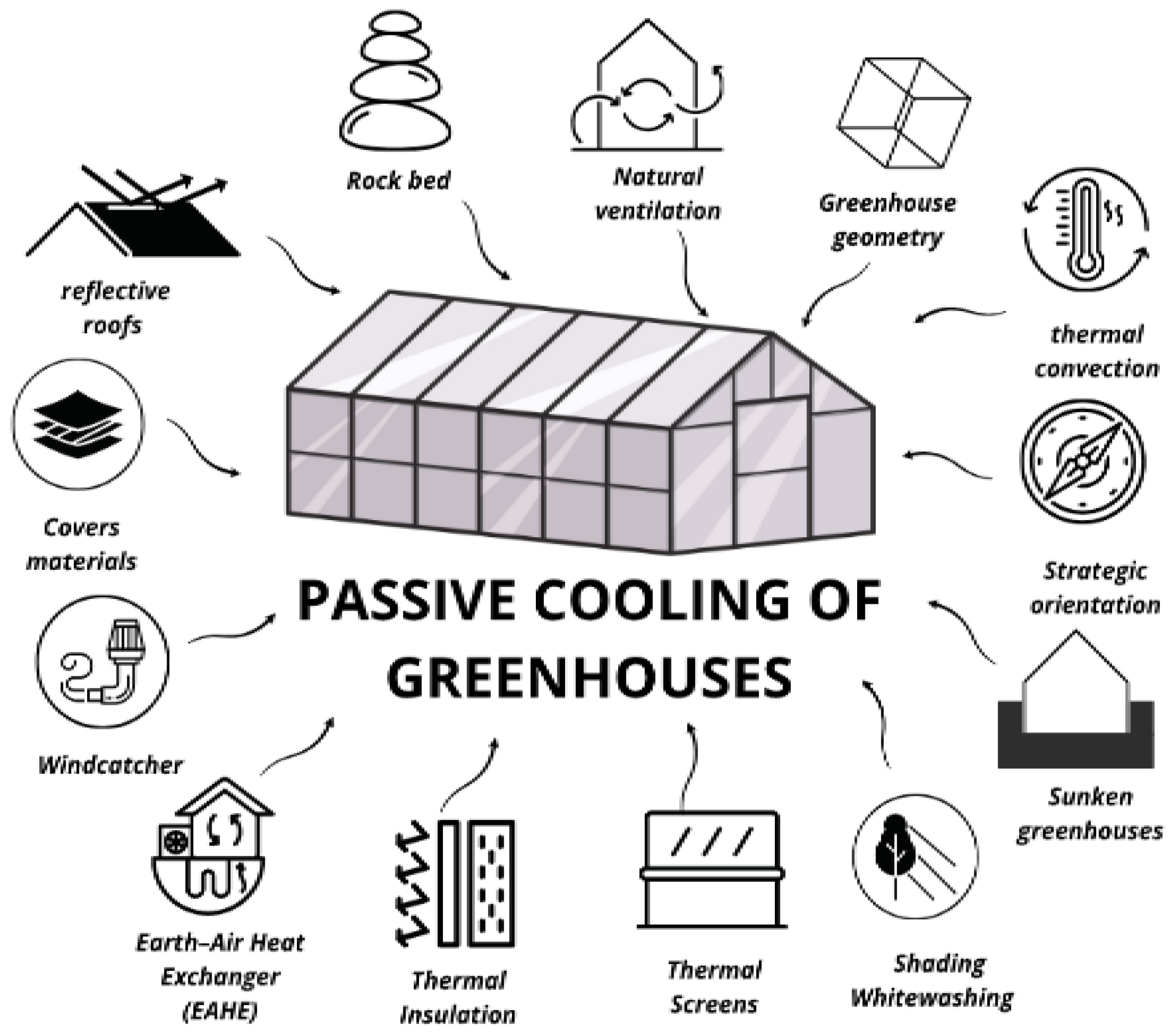
Figure 1. Overview of passive and passive-first greenhouse cooling strategies relevant to hot and arid climates.
Water 18 00463 g001
Figure 2. Alignment of passive greenhouse cooling strategies with the United Nations Sustainable Development Goals (SDGs).
Water 18 00463 g002
Figure 3. PRISMA flow diagram of study selection process.
Water 18 00463 g003
Figure 4. Strategic positioning of the windows in the greenhouses to enhance natural ventilation. Blue arrows indicate airflow direction, plus (+) and minus (−) signs represent pressure differences, and the dashed green ellipse highlights the zone benefiting from the stack effect [3].
Water 18 00463 g004
Figure 5. Conceptual model of an optimized naturally ventilated greenhouse, showing airflow paths, humidification and condensation zones, water recovery circuits, and roof-mounted solar stills and PV panels [49].
Water 18 00463 g005
Figure 6. Schematic of a windcatcher-ventilated greenhouse situated close to adjacent greenhouses [52].
Water 18 00463 g006
Figure 7. Comparison of shading, internal, and external thermal screens, showing solar radiation (orange), warm air circulation (red), cooler airflow (blue), and the position of the thermal screen (green dashed line).
Water 18 00463 g007
Figure 8. Schematic of a thermally optimized greenhouse integrating insulation blankets, reflective facades, and controlled ventilation [63].
Water 18 00463 g008
Figure 9. Photonic design of greenhouse covers and ground films for passive thermal regulation in extremely hot regions [64].
Water 18 00463 g009
Figure 12. PCM walls for daytime passive cooling and nighttime heat release; red arrows indicate heat transfer and blue arrows indicate ventilation airflow.
Water 18 00463 g012
Figure 14. Schematic diagrams of the hybrid-cooled greenhouses examined: (a) CGH, (b) SGH, (c) BGH, (d) BSGH [35].
Water 18 00463 g014
Figure 15. Rock-Bed System, (A) installation in a Canarian greenhouse, (B) operating principle of the rock-bed cooling system, and (C) functioning of the system in a passive greenhouse [78].
Water 18 00463 g015
Figure 17. Air temperature fields in greenhouses with different span numbers: (a) 1-span, (b) 2-span, (c) 3-span, (d) 10-span, and (e) 4th–6th spans of the multi-span greenhouse [83].
Water 18 00463 g017
Table 1. Airflow & ventilation—key performance metrics for passive ventilation strategies.
System Characteristics
(Intervention)
YearStudy DesignGreenhouse TypeCropClimateKey Performance Results
Natural convection; optimized orientation and vent placement [3]2024Numerical Modeling Coupling TRNSYS-CONTAMEven-spanN/AMediterranean[IC;Pk] Small, well-placed vents (0.8 m2) outperformed larger, unoptimized ones for cooling.
Various vent sizes and types (roof, side, combined) [94]2015Field experiments with CFDMulti-span plasticLettuceSubtropical (China)[IC;Pk] Combined roof + side vents gave best cooling and humidity control—up to 6.4× better than side-only.
PDEC via windcatcher + 8 nozzles [52]2020CFD SimulationsCross-flow, 20 × 8 × 4 mN/AHot–dry[IO;NR] ΔT up to 17 °C; RH rose from 54–96%; seasonal water use ~254 m3/trimester.
Variable fog + natural ventilation; VVFR vs. CFR control [95]2012Field trialSingle-span, 270 m2TomatoHot, dry (Arizona)[IC;NR] VVFR kept T/VPD near setpoints, cut water use by ~24–49% and electricity by ~17–42%.
Evap. pad–fan system + pre-chamber; shading & vent combinations [44]2020Pilot greenhouseGothic, 2 baysPepperSemi-arid Mediterranean[IO;NR] Cooling improved from 3.5 °C (pads only) to 6.2 °C with shading; efficiency dropped with rising RH.
High-mounted fans, multi-span, efficient pads [96]2021Field trialTunnel vs. VenloTomatoArid desert[IO;Pk] Modified Venlo saved ~42% water; kept T ~14 °C below ambient; seasonal water use: 4435 vs. 6443 L/m2.
Roof solar stills + variable vent configs
[47]
2021CFD simulationStandalone, passiveN/AHot arid/semi-arid[NR;NR] Lower vent only gave best T uniformity (27–33 °C); combined vents caused vortices and heat buildup.
Note: N/A = Not available.
Table 4. Structural Design & Geometry—Influence of design parameters on passive cooling.
System Characteristics
(Intervention)
YearStudy DesignGreenhouse TypeCropClimateKey Performance Results
Studied span number and vent configurations (roof, side, both) [112]2015Field experiments with CFD11-span plastic GHLettuceSummer, Eastern China[IO;24h] Best cooling: 2–3 spans with roof + side vents. ΔT ↓, RH uniformity ↑ (ΔRH −4.1%), air T ↑ ~1.2 K with plants.
Studied natural vent sizing, orientation, materials, and roof shape [113]2018Pilot greenhouse with TRNSYS SimulationSingle-span, double-layer PEN/ATemperate (hot summers)[IC;NR] Ventilation ↓ T by 2–11 °C; side vents most effective (~11 °C). Gothic roof saved ~2–8% annual energy vs. others.
Tested geometry (arc, Quonset, even-span), orientation (E–W vs. N–S), materials (PE, PMMA, etc.) [79]2021TRNSYS SimulationModel greenhouse with transparent coverTomatoSemi-arid Mediterranean[NR;NR] Best cooling: Quonset + PE cover, E–W orientation. E–W ↓ HVAC cost by ~9.3%; PE had lowest energy use (~134 MJ/m2/yr).
Notes: N/A = Not available, ↑ = Increase or improvement. ↓ = Decrease or reduction.
Disclaimer/Publisher’s Note: The statements, opinions and data contained in all publications are solely those of the individual author(s) and contributor(s) and not of MDPI and/or the editor(s). MDPI and/or the editor(s) disclaim responsibility for any injury to people or property resulting from any ideas, methods, instructions or products referred to in the content.