Article

A Circular Economy Approach to Landfill Leachate Biotransformation: Application of Microalgae and Cyanobacteria for Environmental Sustainability and Value-Added Products


by
Antonio Zuorro
1,*,
Maria D. Ortiz-Alvarez
2,
Roberto Lavecchia
1,
Crisostomo Barajas-Ferreira
3,
Janet B. García-Martínez
2 and
Andrés F. Barajas-Solano
2
1
Department of Chemical Engineering, Materials, and Environment, Sapienza University, Via Eudossiana 18, 00184 Roma, Italy
2
Department of Environmental Sciences, Universidad Francisco de Paula Santander, Av. Gran Colombia No. 12E-96, Cucuta 540003, Colombia
3
Program of Chemical Engineering, Research Center for Sustainable Development in Industry and Energy, Universidad Industrial de Santander, Bucaramanga 680003, Colombia
*
Author to whom correspondence should be addressed.
Water 2026, 18(4), 462; https://doi.org/10.3390/w18040462
Submission received: 10 January 2026 / Revised: 5 February 2026 / Accepted: 7 February 2026 / Published: 10 February 2026

Abstract

Landfill leachate is a complex pollutant that contains high levels of nitrogenous compounds, heavy metals, and organic contaminants, posing serious environmental risks. This study presents an innovative and sustainable strategy for leachate biotransformation using the microalgae Chlorella sp. (UFPS_016, 017) and the cyanobacteria Oscillatoria sp. (UFPS_004) and Potamosiphon sp. (UFPS_008), integrating circular economy and Blue Economy principles. Strains were cultivated in 5% and 10% leachate under optimized photoperiods, LED illumination, and controlled CO2 supplementation. The best performance was achieved by Oscillatoria sp. (UFPS_004) with biomass productivity of 0.3923 g L−1 and carbohydrate accumulation up to 64.97% w/w, while Potamosiphon sp. (UFPS_008) achieved the highest PHB content (19.7% w/w). Chlorella sp. strains exhibited greater lipid accumulation, reaching 14.96% w/w, and produced phytohormones (Indole-3-acetic acid) with potential for agricultural applications. 20 L reactors validated scalability, maintaining productivity like that of small-scale systems. This dual-purpose bioprocess simultaneously detoxifies leachate and produces valuable bioproducts, including bioplastics, biofertilizers, and biofuels. The results demonstrate a feasible, low-cost, and eco-efficient biotechnology for landfill leachate management, contributing to waste valorization and environmental sustainability.

1. Introduction

Landfill leachate is a global environmental challenge, particularly in developing countries where limited infrastructure and weak regulatory enforcement can lead to inadequate waste management and insufficient containment of contaminant releases. Leachates typically contain a complex mixture of inorganic ions and recalcitrant organic matter, including ammonium and nitrates, as well as potentially toxic elements such as lead (Pb), manganese (Mn), and iron (Fe) [1]. Field investigations across landfill operational phases consistently report elevated chemical oxygen demand (COD) and biological oxygen demand (BOD), reflecting high organic loading that can degrade adjacent soils and water bodies when uncontrolled releases occur [2]. In Brazil, the high proportion of recalcitrant organic matter in large-scale landfill leachates has been highlighted as a key barrier for conventional treatments (e.g., coagulation and microfiltration), which may not achieve comprehensive contaminant removal [3].
The consequences for the environment and human health are profound, as leachate can infiltrate soils and groundwater, affecting both protected ecosystems and surrounding communities [4]. A systematic review in Bangladesh reported contamination of groundwater and crops near landfills with elevated levels of Pb and Cd, increasing the potential risks of cancer and chronic diseases in exposed communities [5]. Moreover, the composition varies with landfill age, waste type, and climatic conditions; in Poland, dissolved solids and Ni were significantly higher in leachates from active landfills than from closed landfills [6]. Recent synthesis studies emphasize that leachate heterogeneity is intrinsic to landfill evolution and climatic forcing, generating substantial temporal and spatial variability in COD fractions, ammoniacal nitrogen, salinity, and toxicity—factors that directly condition the stability and interpretability of biological treatment outcomes [7,8].
Considering the drawbacks of conventional methods—such as advanced oxidation and electrocoagulation—which require significant energy and chemical inputs and can become economically ineffective, alternative solutions that are both efficient and affordable have been investigated. In China and other countries with stringent discharge regulations, the high cost of managing leachate has driven the adoption of advanced technologies such as nanofiltration and membrane bioreactors to achieve higher removal efficiency; however, these approaches are not always viable in developing countries due to high capital and operational costs [9]. Therefore, there is a practical need for treatment concepts that remain robust across variable influent compositions while reducing operational complexity and costs.
On this basis, microalgae and cyanobacteria are promising alternatives for biotransforming landfill leachate. These microorganisms can assimilate leachate-derived nutrients into biomass rich in lipids, carbohydrates, and proteins [10,11,12]. Microalgae, in contrast with conventional systems, can not only mitigate pollutant loads but also generate valuable bioproducts during cultivation [13,14,15,16]. Franco-Morgado et al. [17] emphasized the relevance of microalgae and cyanobacteria for nutrient recycling and wastewater revalorization. However, cultivation in raw leachate is frequently constrained by inhibitory factors such as high ammoniacal nitrogen/free ammonia, salinity, color/turbidity, and complex organics; accordingly, controlled dilution is widely used as a conditioning step to expand the operable window for growth and nutrient uptake [8]. This rationale is supported by controlled experiments showing that landfill leachate diluted to 5%, 10%, and 15% (v/v) produced the strongest biomass growth and nutrient removal at 10% (v/v). In contrast, higher fractions increased inhibition, demonstrating that dilution is an evidence-based operational decision [18].
From a process perspective, dilution improves reproducibility and comparability during strain screening by moderating inhibitory drivers while preserving sufficient nutrient levels for photosynthetic growth, thereby enabling systematic assessment of cultivation factors such as pH, temperature, and light intensity on productivity and metabolite formation [7,18]. Consistent with this approach, recent studies using stabilized leachate indicate that reduced or no dilution can be feasible only under specific conditions (e.g., leachate maturity and adequate operational control), reinforcing dilution as a defensible baseline for robust cultivation studies and for defining scalable operating domains [19].
This biotransformation approach involving microalgae and cyanobacteria not only provides an eco-friendly process but can also be economically beneficial. Using leachate nutrients as a nutrient source can reduce the demand for synthetic cultivation media and improve cost-effectiveness. Brazilian studies have demonstrated that maximizing lipid and metabolite production can be achieved under controlled temperature and light conditions, supporting the optimization of commercial value and the promotion of sustainable biomass for bioenergy applications [3]. Further, both microalgae and cyanobacteria provide the potential to produce valuable compounds, including polyhydroxybutyrate (PHB), a renewable biopolymer that can serve as an alternative to petroleum-based plastics [20]. Nevertheless, defensible “waste-to-value” claims require linking biomass and product outcomes to controlled operational factors and to leachate conditioning, since leachate-inhibitory load can shift carbon allocation between growth and storage products [8,19].
Moreover, under controlled light, temperature, and pH conditions, these microorganisms can be used to optimize the production of other bioactive compounds, including phytohormones [21]. In this context, the light regime is a relevant operational lever: cyanobacteria exhibit acclimation strategies to variable irradiance and spectral quality (including chromatic acclimation), which is pertinent for turbid and colored leachate-based cultures where the internal light field differs substantially from incident light [22].
In parallel, the circular-economy relevance of algal–leachate systems has been strengthened by recent resource-recovery syntheses that treat municipal solid waste leachate as a concentrated stream of recoverable nitrogen and phosphorus and explicitly include microalgae cultivation among the main recovery pathways, alongside physicochemical options [23]. This framing supports leachate valorization as a nutrient-recycling feedstock, if process limitations are transparently addressed and experimental conclusions remain consistent with the measured or referenced leachate context [7,8].
The rapid proliferation of solid and liquid waste streams globally poses a significant challenge to sustainable development, particularly in urban areas where resource use, energy requirements, and environmental degradation are intricately interconnected. Addressing these issues requires not only innovative treatment technologies but also robust optimization and decision-support frameworks that operate within complex systems characterized by numerous variables and real-world constraints. Vallati et al. [24,25,26] have consistently demonstrated that integrating model-based optimization, predictive modeling, and experimental validation significantly enhances the efficiency, energy performance, and long-term sustainability of resource-intensive infrastructures. Recent contributions highlight the imperative of data-driven strategies and optimization-focused methodologies to reduce uncertainty, enable scalable solutions, and guide technology selection in contexts characterized by considerable variability and limited resources, such as social housing and energy refurbishment initiatives [27,28]. These methodological principles are pertinent to waste management systems, including landfill leachate treatment, where biological processes are profoundly influenced by operational parameters, matrix heterogeneity, and scale-up effects, highlighting the need for structured optimization frameworks rather than relying solely on empirical methods.
Particularly in developing countries where established leachate treatment systems are economically unfeasible, microalgae- and cyanobacteria-based systems can serve as viable alternatives. Improper leachate management in Nigeria, for instance, has increased water- and soil-borne illnesses due to increased pollution, highlighting the need for affordable biological technologies [29].
Although evidence shows that microalgae and cyanobacteria can grow in diluted landfill leachate, the literature still lacks systematic datasets that connect controllable operational variables with biomass productivity and metabolite accumulation in a matrix as complex and potentially inhibitory as leachate [18,23]. In this context, the present study evaluates the response of thermotolerant microalgae and cyanobacteria, cultivated in diluted leachate. It aims to define an appropriate leachate dilution and determine the optimal photoperiod, LED lighting regime, and strain, framing the process as a biotransformation and valorization strategy aligned with the circular economy to produce lipids, carbohydrates, IAA, and PHB.

2. Materials and Methods

2.1. Leachate: Sampling and Characterization

The leachate used in this study was collected at the Parque Tecnológico Ambiental Guayabal (rural area of Cúcuta, road corridor toward Puerto Santander; Veolia Colombia) using a composite sampling strategy across four leachate ponds. In each pond, sub-samples were taken at three locations (one central point and two edge points) and, at each location, at three depths (surface, 1.5 m, and 3.0 m). Subsamples were combined to obtain a single representative sample per pond. Subsequently, the four representative pond samples were mixed in equal proportions to produce the final composite sample. The sample was stored in sterilized polyethylene containers and transported to the laboratory at 4 °C, maintaining the cold chain until analysis. During sampling, in situ meteorological conditions were 33 °C, 61% relative humidity, and no precipitation at the time of collection.
Leachate was characterized prior to use following the Standard Methods for the Examination of Water and Wastewater [30]. Parameters included BOD5, COD, phosphates, nitrates, nitrites, ammoniacal nitrogen, sulfates, Fe, turbidity, color, conductivity and pH.

2.2. Strains

Two microalgal strains, Chlorella sp. (UFPS_16) and Chlorella sp. (UFPS_17), and two cyanobacterial strains, Oscillatoria sp. (UFPS_04) and Potamosiphon sp. (UFPS_08) were isolated from thermal springs in Bochalema (Norte de Santander, Colombia). Isolation was performed by direct surface plating from environmental samples using Bold’s Basal Medium (BBM) for microalgae and BG-11 medium for cyanobacteria [31]. Plates were incubated at 24 ± 2 °C for 15 days. After incubation, individual colonies (microalgae) and discrete filamentous growth (cyanobacteria) were selected and purified by colony picking, followed by streak plating on the corresponding medium, until unialgal/unicyanobacterial cultures were obtained. Isolation was verified by optical microscopy. The codes correspond to the internal consecutive numbering assigned upon deposition in the INValgae collection (Universidad Francisco de Paula Santander, Colombia).
Strains were maintained in the INValgae collection on agar slants using solid BBM for Chlorella and solid BG-11 for cyanobacteria, under a 12:12 h photoperiod at 60 µmol m−2 s−1 and 27 ± 1 °C.
For inoculum preparation, each strain was cultivated in 2 L tubular glass flasks (GL45) containing 1.3 L of liquid medium (BBM for microalgae and BG-11 for cyanobacteria). Mixing was ensured by injecting filtered air supplemented with 1% (v/v) CO2 at a flow rate of 0.78 Lair/min, under a 12:12 h photoperiod and 100 µmol m−2 s−1 light intensity, for 20 days.

2.3. Sensitivity Analysis of the Strains to Landfill Leachate

Sensitivity tests were performed in 500 mL tubular glass flasks (GL45) with a 200 mL working volume using unsterilized landfill leachate diluted in distilled water to 5% or 10% (v/v). These dilution levels were selected as screening conditions reported in the literature for microalgae/cyanobacteria cultivation in leachate to evaluate initial tolerance and performance under a moderate matrix load [32,33]. For each assay, 10% (v/v) inoculum from 20-day-old cultures of each strain was used. Operational conditions were: 27 ± 1 °C, constant aeration at 0.12 L/min, light intensity of 100 µmol m−2 s−1 supplied by cool white LED lamps, and a 12:12 h photoperiod, with controlled addition of 1% (v/v) filtered CO2 into the inlet gas. Cultures were maintained for 15 days, during which parameters associated with growth and metabolite production were monitored. All assays were performed in triplicate.

2.4. Analytical Methods

2.4.1. Biomass (Dry Weight)

Biomass was quantified by dry weight. At the end of cultivation, 20 mL aliquots were filtered through conditioned Whatman GF/C filters heated to 100 °C for 1 h. Filters were then dried at 100 °C for 1 h and equilibrated in a desiccator for 12 h, and the cycle was repeated until constant weight was achieved. Biomass concentration (g/L) was calculated from the difference in filter mass before and after filtration, normalized by the filtered volume [17].
dry   weight   g L = m f m i V
where (mf) is the mass of the filter with dried biomass (g), (mi) is the mass of the preconditioned filter (g), and (V) is the filtered volume (L).

2.4.2. Biomass Preparation for Metabolite Analyses

For metabolite determinations, biomass was recovered by centrifugation at 2054× g (20 °C, 20 min) using a ROTINA 420 R centrifuge (Hettich, Tuttlingen, Germany). The pellet was lyophilized and stored at 4 °C until analysis. All analytical determinations were performed in triplicate.

2.4.3. Total Carbohydrates

Total carbohydrates were determined according to [34] A 5 mg portion of lyophilized biomass was transferred into 15 mL test tubes, mixed with 5 mL of 1 M H2SO4, and vortexed (Multi Reax, Heidolph, Schwabach, Germany) at 1500 rpm for 10 min. The mixture was incubated at 100 °C for 60 min, cooled to room temperature, and centrifuged at 2876× g for 20 min. Then, 2 mL of supernatant was mixed with 1 mL of phenol solution (5% w/v) and 5 mL of concentrated H2SO4; after cooling, absorbance was measured at 485 nm.

2.4.4. Total Lipids

Total lipids were quantified using the method described by [35]. A 5 mg portion of dried biomass was mixed with 2 mL of concentrated H2SO4 and vortexed at 1500 rpm for 5 min. The mixture was incubated at 100 °C for 10 min and cooled in an ice bath for 5 min. Next, 5 mL of fresh phospho-vanillin reagent was added, and the mixture was incubated at 37 °C for 15 min. The mixture was centrifuged at 2876× g for 20 min, and the absorbance of the supernatant was measured at 530 nm.

2.4.5. Indole-3-Acetic Acid (IAA)

Indole-3-acetic acid (IAA) was quantified as follows. A 5 mg portion of dried biomass was mixed with cold phosphate buffer (K2HPO4/KH2PO4, 0.05 M, pH 6.8) and vortexed at 1500 rpm for 10 min. The mixture was centrifuged at 2054× g (20 °C, 20 min). Then, 1 mL of supernatant was mixed with 4 mL of Salkowski reagent (60% methanol, 25% CHCl3, 10% HCOOH, and 5% H2O) [36] and incubated at room temperature for 30 min. Absorbance was measured at 540 nm, and IAA concentration was calculated from an external calibration curve (0–30 µg/mL; R2 = 0.994).

2.4.6. Poly(3-hydroxybutyrate) (PHB)

PHB content was determined as described by Getachew & Woldesenbet [37]. A 10 mg portion of dried biomass was placed in a 15 mL Falcon tube, mixed with 10 mL of sodium hypochlorite, and incubated at 30 °C for 2 h with agitation to lyse cells and release the polymer. The mixture was centrifuged at 2054× g (20 °C, 20 min), and the supernatant was discarded. The pellet was washed twice with 10 mL of distilled water, then with 10 mL of acetone, and finally with 10 mL of methanol, centrifuging after each wash (2054× g, 20 °C, 20 min). The residue was air-dried at room temperature in a fume hood. The dried solid was transferred to a glass tube, and 5 mL of preheated chloroform (40 °C) was added, keeping the mixture at ≤50 °C until complete dissolution. After cooling to ~30 °C, 2 mL were transferred to a quartz cuvette, and absorbance was measured at 240 nm using a UV–Vis spectrophotometer. PHB concentration (mg/mL) was calculated using the corresponding equation derived from absorbance at 240 nm.
PHB   m g m L = O D 240 n m + 0.06292 5.289

2.5. Design of Experiments

To optimize biomass and metabolite production, an I-optimal response surface design was implemented using Design-Expert® v22.0.2 (Stat-Ease, Inc., Minneapolis, MN, USA). The design included 28 experimental runs, with three additional replicates, distributed across five blocks (Table 1). Three factors were considered: photoperiod (10–24 h), LED type (red:blue 3:1 and white), and strain group (microalgae and cyanobacteria). Operating conditions were maintained at 27 ± 1 °C, constant aeration at 0.12 L/min, light intensity of 100 µmol m−2 s−1, and controlled addition of 1% (v/v) filtered CO2. Response variables were total carbohydrates, total lipids, IAA, and PHB (expressed as % w/w relative to dry biomass). Each experimental run was performed in triplicate.
Model fitting and statistical evaluation were performed using ANOVA in Design-Expert® at α = 0.05. Model adequacy was verified through lack-of-fit testing and residual analysis (normality and homoscedasticity). Optimal conditions were identified using a desirability function to simultaneously maximize the selected responses.

2.6. Optimization

At this stage, the optimal conditions identified in the experimental design were implemented in pilot-scale 30 L conical reactors operating at a 20 L volume and equipped with sparger columns. This design ensures adequate mixing and gas transfer, thereby enhancing the physical conditions for the growth of microalgae and cyanobacteria. The aim was to evaluate the scalability of the defined conditions at larger scales and to compare biomass and metabolite production in a system more predictive of industrial scale. The biomass productivity, hence, was calculated considering Equation (3) as follows:
P b = ( X f X i ) / t t 0
At this stage, the optimal conditions identified in the experimental design were tested in 30 L column reactors with a working volume of 20 L (Synoxis algae, Nantes, France). The aim was to evaluate the scalability of the defined conditions and to compare biomass and metabolite production in larger volumes. The results (observed) were statistically analyzed against the predicted values from the experimental design (expected). The biomass productivity, hence, was calculated considering Equation (3) as follows:
Where
  • Pb = the biomass productivity (g L−1 d−1);
  • Xi = initial biomass concentration (g/L) at time t0;
  • Xf = final biomass concentration (g/L) at time t;
  • t0 and t = initial and final times, respectively (in days).
Conversely, the specific metabolite productivity (g L−1 d−1) was calculated using Equation (3), which considers the relationship between biomass productivity and the final metabolite content. This indicator is crucial for understanding the efficiency of the culture in producing target compounds:
Metabolite   Productivity   =   P b   ×     C f
where
  • Pb = biomass productivity (g L−1 d−1), as calculated in Equation (1);
  • Cf = final metabolite content, expressed as a weight percentage relative to the dry biomass (% w/w).
Equations (3) and (4) were adapted from methodologies previously reported by [38], who described their use in similar systems for evaluating productivity in microalgal cultures. This approach enabled the assessment of strain performance at scale without external interference with measurements.

3. Results

3.1. Leachate Physicochemical Profile

The physicochemical profile of the composite landfill leachate was determined and reported by analytical categories. Table 2 summarizes the values for organic load, nutrients/inorganics, Fe, and general physicochemical/optical descriptors of the leachate used.

3.2. Biomass Production and Metabolites Concentration

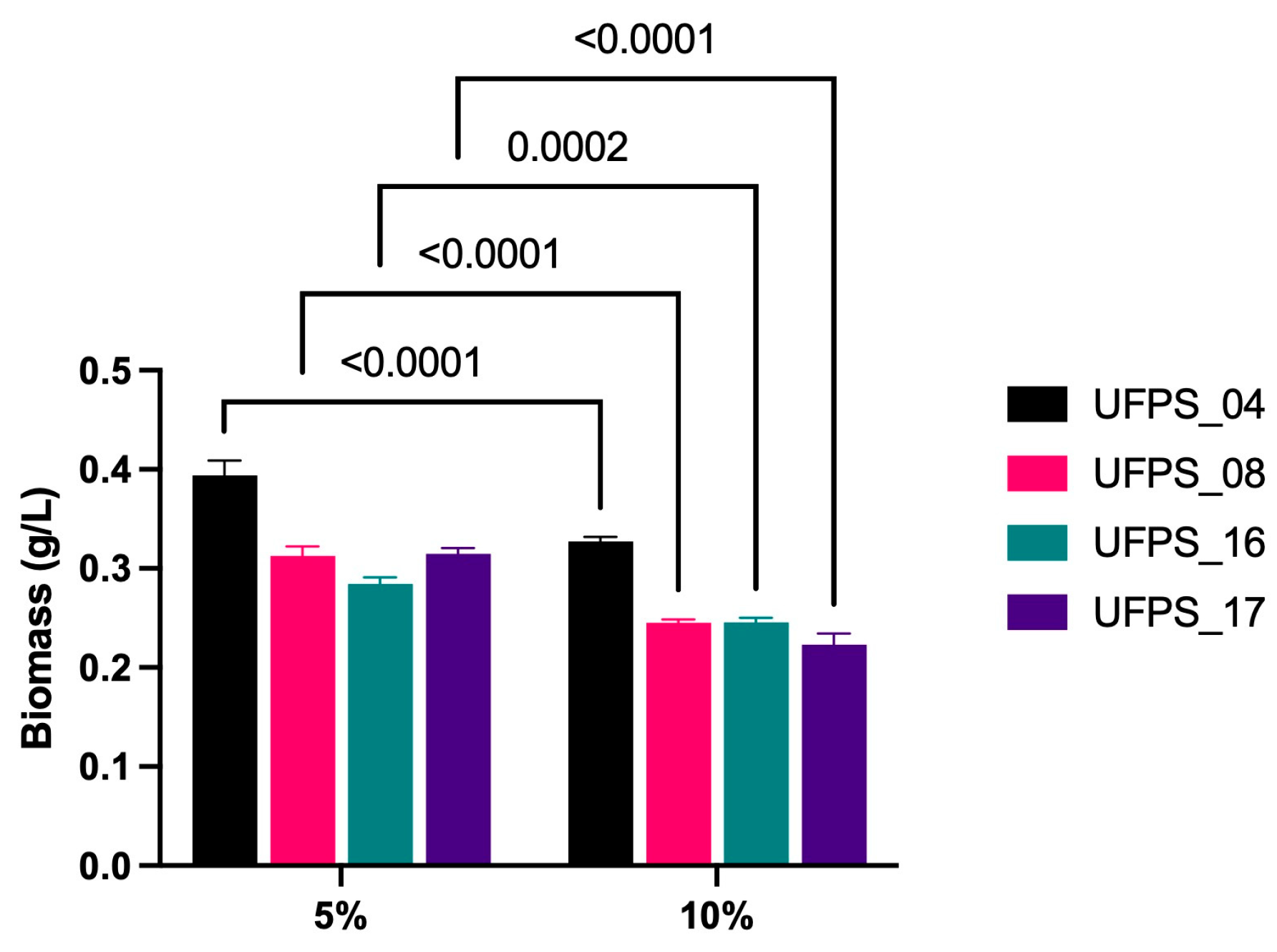
The sensitivity of the selected strains to two concentrations of landfill leachate is presented in Figure 1. At a leachate concentration of 10%, biomass concentration was lower than at 5% (Figure 1). In the 5% leachate treatment, the highest biomass values were observed for strains Oscillatoria sp. UFPS_04 (0.3923 g/L) and Potamosiphon sp. UFPS_08 (0.3130 g/L). Chlorella sp. UFPS_16 presented a biomass of 0.2777 g/L, and Chlorella sp. UFPS_17 displayed a biomass of 0.3137 g/L, suggesting that each microalgae studied may respond differently. At a 10% leachate concentration, biomass production decreased significantly, indicating that all tested strains are sensitive to changes in medium composition.
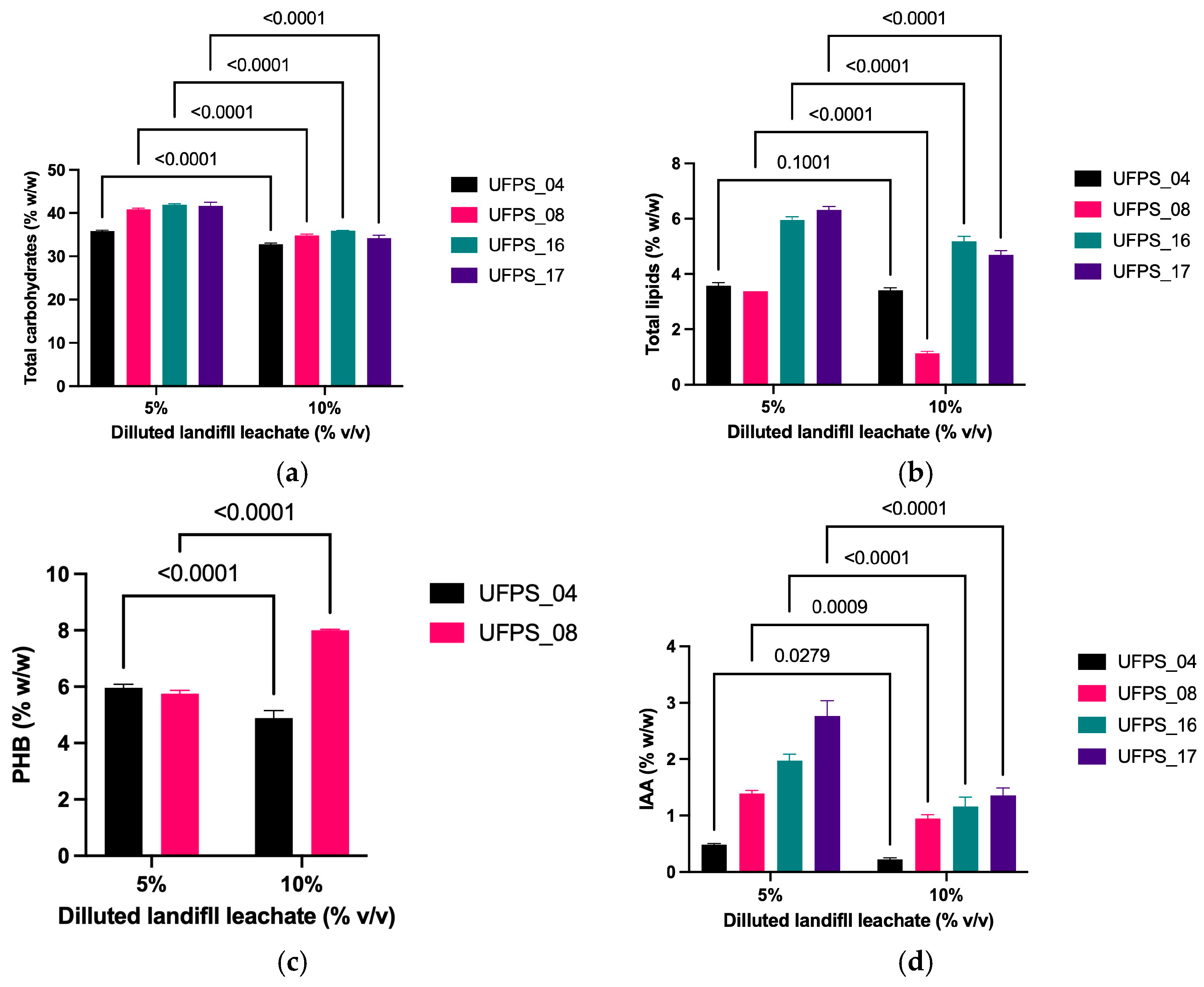
The percentage of total carbohydrate content (% w/w) varied by strain and decreased as the landfill leachate was diluted further (Figure 2a). At a concentration of 5% (v/v) leachate, carbohydrates were low in Oscillatoria sp. UFPS_04 (35.80 ± 0.26) and very high in Potamosiphon sp. UFPS_08 (40.88 ± 0.27), Chlorella sp. UFPS_16 (41.90 ± 0.28), and Chlorella sp. UFPS_17 (41.64 ± 0.88). When leachate was raised to 10% (v/v), the amount of carbohydrates in all strains dropped to 32.79 ± 0.30 (Oscillatoria sp. UFPS_04), 34.85 ± 0.28 (Potamosiphon sp. UFPS_08), 35.91 ± 0.13 (Chlorella sp. UFPS_16), and 34.18 ± 0.71 (Chlorella sp. UFPS_17). This was a drop of about 3.0–7.5 percentage points (w/w). Two-way ANOVA (GraphPad Prism version 10.6.1 for Mac) showed that the drop from 5% to 10% was statistically significant across strains (all p < 0.0001).
Both the strain type and the dilution of landfill leachate influenced the lipid concentration (% w/w) (Figure 2b). At a concentration of 5% (v/v) leachate, Chlorella sp. UFPS_17 and Chlorella sp. UFPS_16 exhibited the highest lipid concentrations (6.32 ± 0.12 and 5.96 ± 0.11, respectively), whereas Oscillatoria sp. UFPS_04 and Potamosiphon sp. UFPS_08 demonstrated markedly lower levels (3.58 ± 0.10 and 3.38 ± 0.00). The multiple-comparison results shown in the figure show that Chlorella sp. UFPS_16/Chlorella sp. UFPS_17 had a significant increase compared to Oscillatoria sp. UFPS_04/Potamosiphon sp. UFPS_08 (p < 0.0001). However, Oscillatoria sp. UFPS_04 and Potamosiphon sp. UFPS_08 did not change at the 5% level (p = 0.1001). Raising the leachate concentration to 10% (v/v) reduced lipid accumulation overall, especially in Potamosiphon sp. UFPS_08 (1.13 ± 0.08). However, Chlorella sp. UFPS_16 (5.18 ± 0.18) and Chlorella sp. UFPS_17 (4.69 ± 0.15) still had relatively high lipid content, whereas Oscillatoria sp. UFPS_04 changed only slightly (3.42 ± 0.09).
The accumulation of PHB (% w/w) was significantly influenced by both the strain and the dilution of landfill leachate (Figure 2c). At a 5% (v/v) concentration of leachate, Oscillatoria sp. UFPS_04 and Potamosiphon sp. UFPS_08 displayed comparable PHB values (5.96 ± 0.13 and 5.76 ± 0.11, respectively). When leachate was raised to 10% (v/v), the strains reacted differently: Oscillatoria sp. UFPS_04 dropped to 4.89 ± 0.27, while Potamosiphon sp. UFPS_08 rose sharply to 8.00 ± 0.03.
Finally, both the strain and the dilution of landfill leachate significantly affected the amount of IAA produced (Figure 2d). At a 5% (v/v) leachate concentration, the average IAA increased progressively from Oscillatoria sp. UFPS_04 (0.485 ± 0.020) to Potamosiphon sp. UFPS_08 (1.393 ± 0.051) and Chlorella sp. UFPS_16 (1.967 ± 0.122), reaching a peak at Chlorella sp. UFPS_17 (2.763 ± 0.276). Raising the leachate concentration to 10% (v/v) lowered IAA levels in all strains, resulting in 0.220 ± 0.026 (Oscillatoria sp. UFPS_04), 0.949 ± 0.066 (Potamosiphon sp. UFPS_08), 1.156 ± 0.168 (Chlorella sp. UFPS_16), and 1.359 ± 0.129 (Chlorella sp. UFPS_17). A two-way ANOVA revealed significant effects of dilution, strain, and their interaction (all p < 0.001), demonstrating that strains differed in total IAA production and their sensitivity to increased leachate concentration.
With this data, the optimal landfill concentration for enhancing biomass and metab-olite production was 5% (v/v). This concentration was further analyzed in the experimental design.

3.3. DoE and Optimization of Biomass and Metabolites Production

The statistical analysis of biomass production under the influence of light type, photoperiod, and strain is presented in Table 2. According to ANOVA, the evaluated factors did not have a significant effect on biomass concentration (Table 3). Under all light conditions tested, the strains exhibited similar biomass values, with no statistically significant differences, suggesting that growth was not affected by variations in the light spectrum. The p-value (p = 0.2050) for lack of fit indicates that the observed differences in biomass are more attributable to biological variability among the strains than to the applied treatments. Moreover, the mean values obtained remained within a narrow range, reflecting stability in the growth response of the evaluated microorganisms.
For carbohydrate production, ANOVA revealed that the quadratic model was highly significant (F = 24.30, p < 0.0001), indicating that the evaluated factors and their interactions significantly affect the response. Table 3 shows that all individual variables (A Photoperiod, B LED, and C Strain) and their interactions (AB, AC, BC, A2) were significant (p < 0.05). The coefficient of determination, R2, is 0.9693, indicating that the model accounts for approximately 96.93% of the response variability. Additionally, the adjusted R2 and predicted R2 differ by less than 0.2, which shows that the model remains reliable and predictable. In addition, the lack-of-fit analysis yielded p = 0.8505, confirming that the lack of fit is not significant and that the model fits the experimental data well. Moreover, the residual and pure errors are 0.1445 and 0.1055, respectively, indicating little variability among the treatments.
For lipids, ANOVA showed that the fitted linear model is significant (F-value = 17.29, p < 0.0001), indicating that at least one of the evaluated variables exerts a substantial influence on the response. However, not all analyzed variables were significant. Additionally, photoperiod did not play a relevant role in lipid accumulation (A, p = 0.6025), while light type (B, F = 8.25, p = 0.0101) and strain used (C, F = 24.77, p < 0.0001) (Table 4). The model had an R2 (coefficient of determination) of 0.8277, indicating that it explained 82.77% of the variability in lipid production. On the other hand, because the adjusted R2 was 0.7798 and the predicted R2 was 0.5901, the difference was moderate, indicating that although the model was acceptable, its predictive capacity was inadequate. The lack-of-fit analysis, which provides insight into the model’s predictive capabilities, yielded a p-value of 0.6614; hence, the model sufficiently describes the experimental data, and the observed variability is chiefly due to residual error.
In the case of IAA, according to ANOVA, the model that described the production of this metabolite was a quadratic model (F-value = 28.43, p < 0.0001), suggesting that the factors evaluated have a significant effect on the response. As seen in Table 4, the photoperiod (A, F-value = 73.49, p < 0.0001) and the strain used (C, F-value = 62.99, p < 0.0001) were found to be the most decisive variables in IAA production. In contrast, the light type (B, p = 0.1262) did not show a significant effect. Additionally, the interaction between factors (AB, AC, BC, A2) also had a significant p-value (p < 0.05), suggesting that IAA production is not solely dependent on one factor, but on specific combinations of photoperiod, strain, and light type. The coefficient of determination (R2) was 0.9737, and the difference between the adjusted R2 (0.9394) and the predicted R2 (0.8237) was <0.2; thus, the model has adequate predictive capability. In addition, the lack-of-fit results (p = 0.9359) showed that our model adequately described the experimental data and that the differences observed were primarily due to residual error.
Finally, the ANOVA confirmed a highly significant linear model for polyhydroxybutyrate (PHB) production (F-value = 318.50, p < 0.0001), indicating that at least one variable significantly affected the response (Table 5). Of all the proposed factors, this is the only statistically significant factor affecting PHB accumulation: the strain employed (C, F-value = 523.71, p < 0.0001), while photoperiod (A, p = 0.4527) and light type (B, p = 0.6917) did not represent a relevant factor for biopolymer production. The model presented a coefficient of determination (R2) of 0.9888, reflecting a high level of explanatory power for the data variability. Similarly, the adjusted R2 (0.9857) and predicted R2 (0.9713) showed minimal difference, supporting the model’s robustness. However, the lack-of-fit result was significant (p = 0.0280), suggesting that other factors not included in the model may be influencing PHB production.
Optimizing cultivation parameters using the desirability function enabled the identification of precise combinations of light cycle, light type, and strain that maximize production of key metabolites. Each variable showed a distinct response to these environmental factors, underscoring the need for strain- and metabolite-specific optimization strategies (Table 6).

3.4. Conditions Confirmation

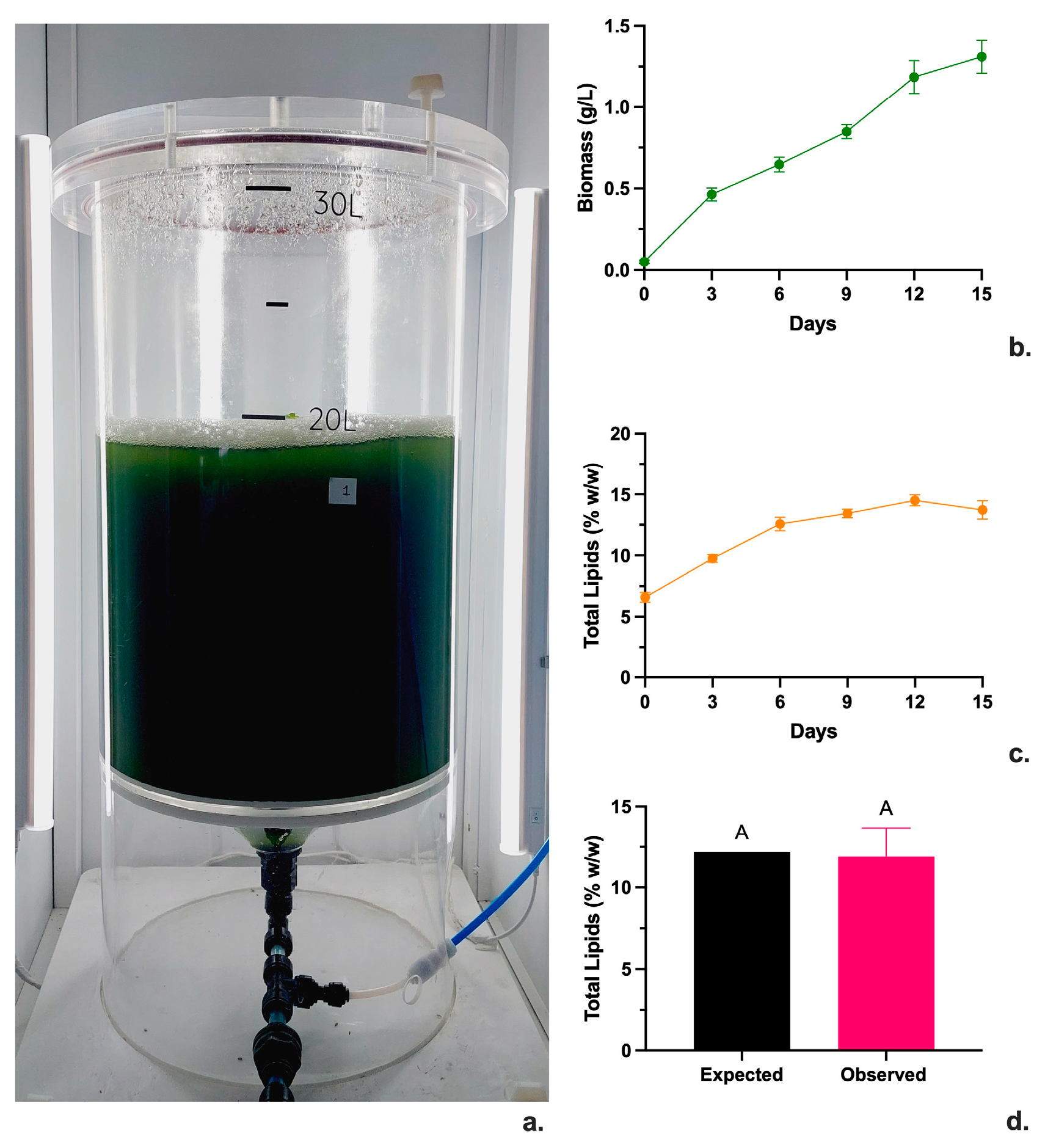
In the 30 L column reactors, biomass growth increased on a day-by-day basis until day 9, sharply increasing from 0 to 1.331 g/L, followed by a decline of biomass concentration to 0.865 g/L by day 12 and a slight increase to 0.875 g/L on day 15 (Figure 3a). Moreover, during the exponential phase, the specific growth rate (μ) was found to be 0.054 g/L·day, while the transition to the stationary phase occurred between days 9 and 12. For lipid production, there was a slow increase in relative lipid content with the sedimentation from day 0 to day 15 (6.595% w/w–14.956% w/w) (Figure 3b), and the lipid accumulation rate was 0.008 g/L·day. As confirmed by the data, lipid accumulation paralleled cell growth and reached its maximum in the stationary growth phase. Moreover, a comparative analysis between the observed and expected values based on the desirability criteria revealed no significant differences (p > 0.05) (Figure 3c).
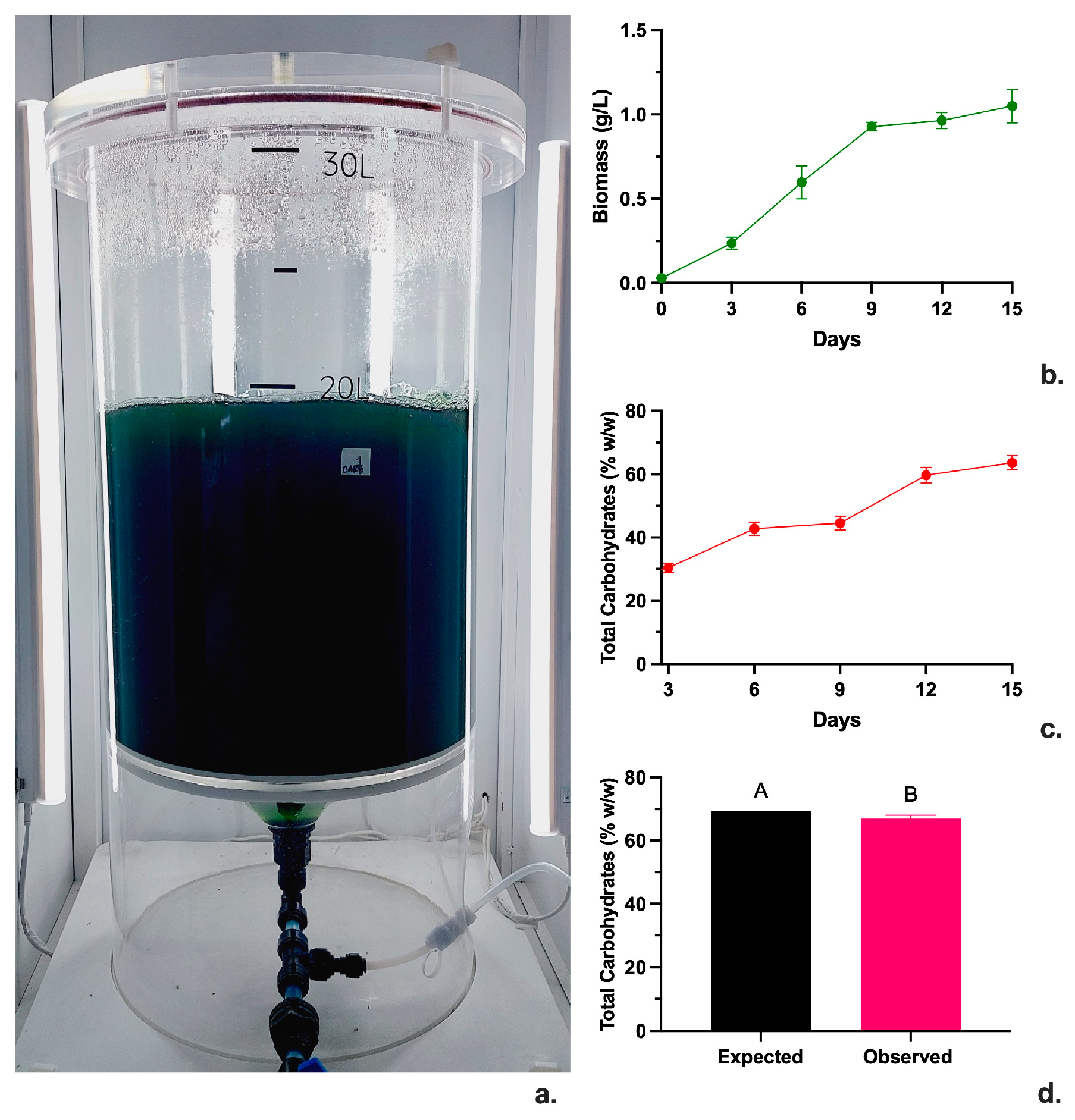
In the case of carbohydrate production, biomass growth steadily increased until day 9, when it reached 0.3515 g/L, after which biomass stabilized with 12- and 15-day readings of, respectively, 0.3765 g/L and 0.452 g/L (Figure 4a). This trend suggests that the first nine days comprised the exponential growth phase, followed by a stabilization phase with reduced biomass production. For carbohydrate production: The starting value was 24.523% w/w on day 0; initiation occurred progressively, reaching 30.259% w/w on day 3, 42.294% w/w on day 6, and 45.543% w/w on day 9. A statistically significant increase was observed from day 12, where 60.007% w/w and 64.974% w/w were achieved on day 15 (Figure 4b). Regarding concentration, carbohydrates increased to 0.294 g/L by day 15. The analysis of observed versus expected values based on the desirability criteria indicated no significant differences (p > 0.05) (Figure 4c).
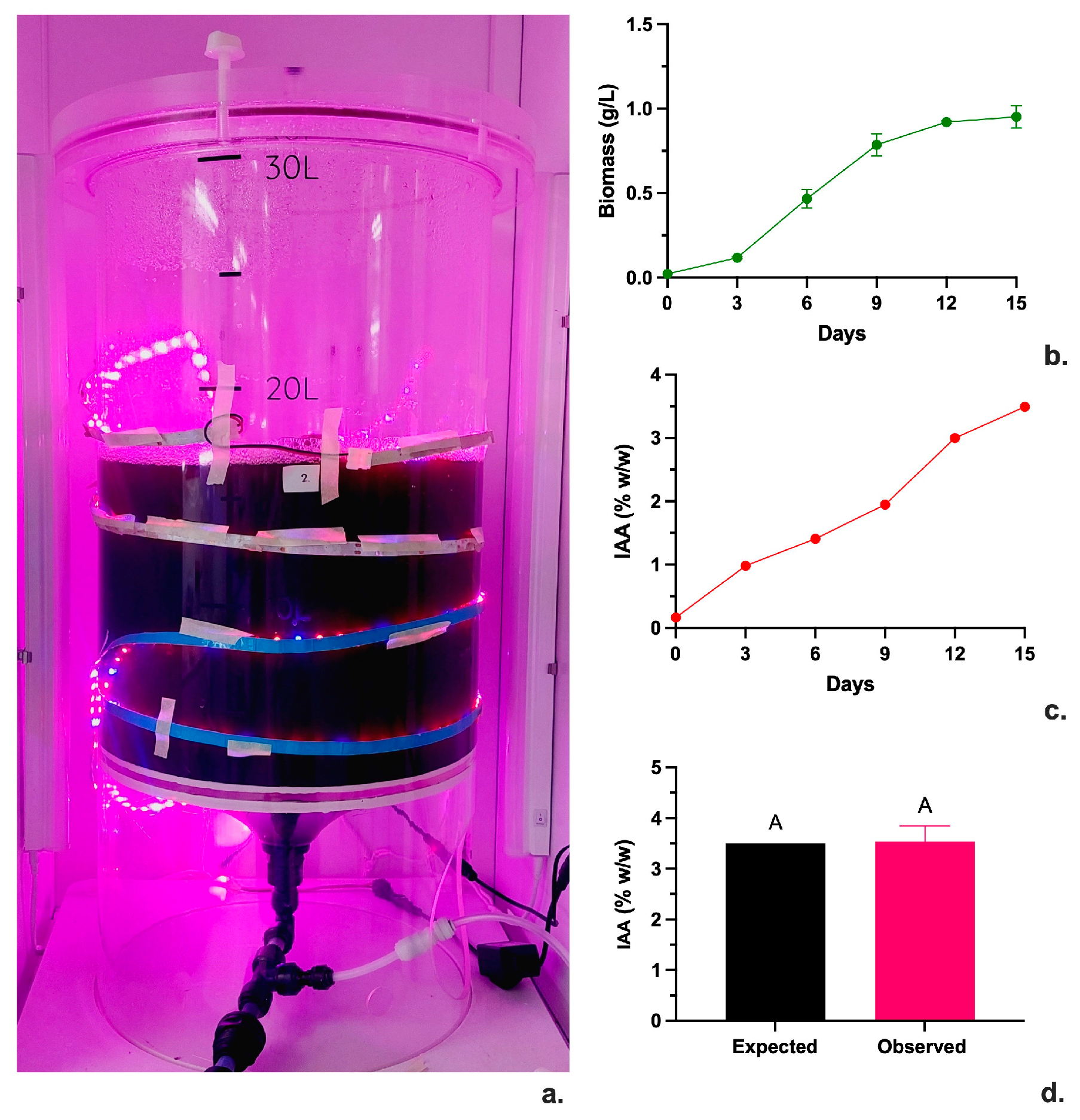
In IAA, the analysis of biomass growth in the 30 L reactor indicated an initial exponential phase of growth, with peak biomass on day 6 (0.147 ± 0.005 g/L). Declining biomass after this peak suggests that the culture entered the stationary phase on day 9 (Figure 5a). To produce phytohormone, the quantity of IAA showed an increasing trend, with the maximum value of 3.5% w/w observed on the fifteenth day (Figure 5b). An analysis of expected vs. realized values based on the desirability criteria revealed no significant difference in IAA accumulation between the small-scale (0.3 L) systems and the 20 L reactor, affirming the suitability of the process for replication at larger volumes. However, slight temporal variability in IAA production was observed, suggesting that additional factors may modulate phytohormone biosynthesis within the system (Figure 5c).
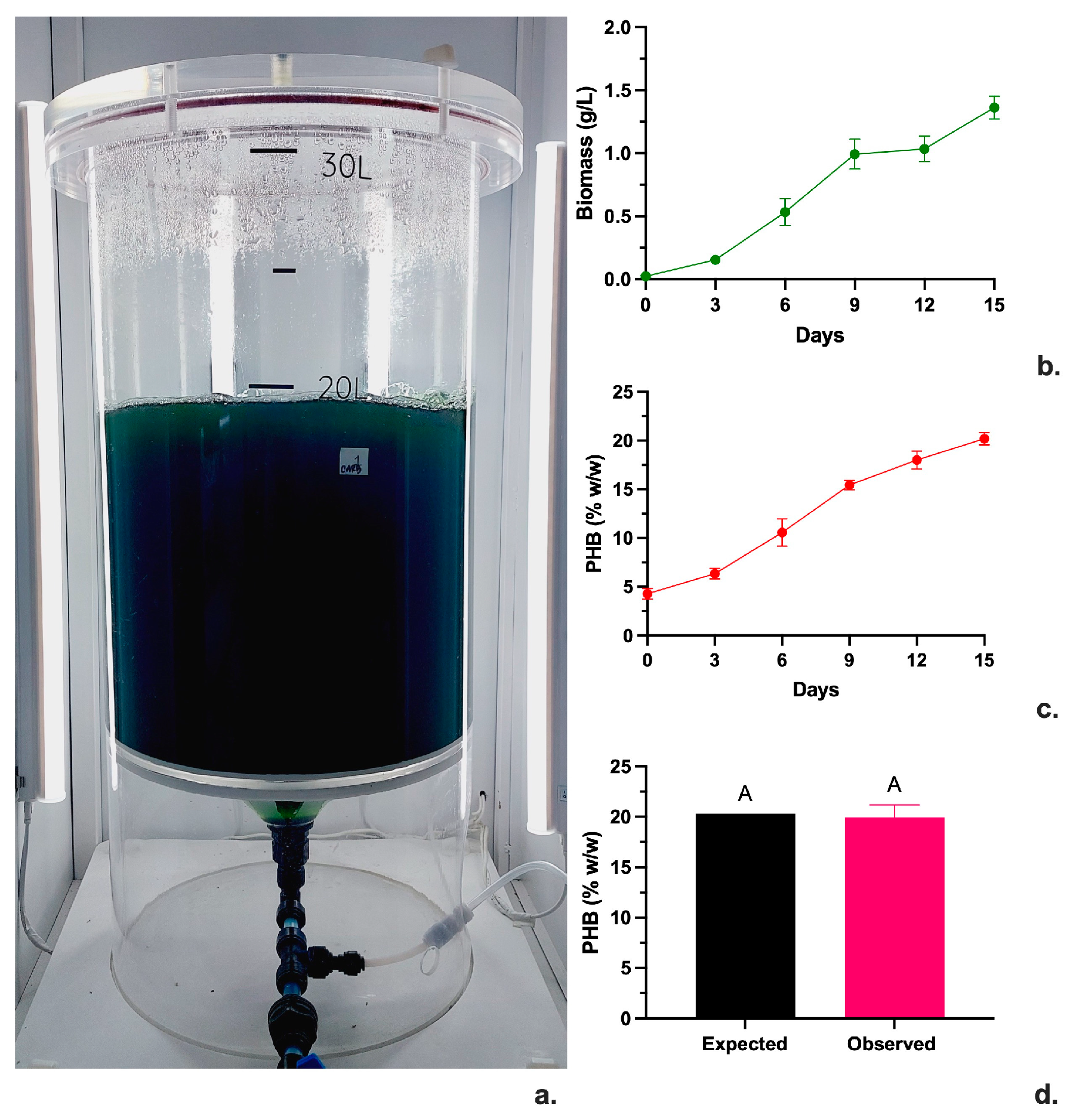
Finally, in the case of PHB, biomass growth in the 30 L reactor followed an upward trend, reaching a peak on day 15 at 0.402 ± 0.01 g/L (Figure 6a). Similarly, PHB accumulation increased over time, attaining its highest content of 19.7 ± 0.4% w/w on the same day (Figure 6b). A comparison of expected and observed values based on the desirability criterion indicated no significant differences, supporting the scalability of the process (Figure 6c).

4. Discussion

4.1. Physicochemical Characterization of Leachate

An alkaline–saline baseline was observed (pH 8.8; conductivity 32 mS/cm), which is relevant because these conditions define the starting matrix from which the 5% and 10% (v/v) dilutions were prepared and can already impose osmotic pressure and pH-dependent shifts in nitrogen speciation before any biological response is considered. In ammonium-rich systems, elevated pH promotes the NH4+ ⇌ NH3 equilibrium toward unionized ammonia (NH3), a well-documented inhibitory species for photosynthetic microorganisms that can impair growth and photosynthetic performance, depending on pH–temperature–ionic strength interactions [39]. In parallel, the substantial optical load (color 2450 UPC; turbidity 52.6 NTU) implies substantial light attenuation and spectral filtering inside the culture, so that even at constant external irradiance the effective photon flux and wavelength distribution experienced by cells can decline, which has been identified as a practical limitation in leachate-based photobio processes and other dark, chromophore-rich waste matrices [39]. Consistently, landfill-leachate dissolved organic matter is often enriched in light-absorbing/aromatic fractions (chromophoric DOM), whose absorbance characteristics (commonly tracked via UV–Vis indices) are directly linked to color and can dominate optical screening effects; this mechanism supports interpreting the measured color/turbidity as more than “aesthetic” descriptors, but as operational constraints on phototrophic productivity [40]. From an organic-matter standpoint, COD (5024 mg/L O2) and BOD5 (3114 mg/L O2) yielded a BOD5/COD ratio of 0.61, indicating that a substantial fraction of the organic load is biodegradable, yet still embedded within a chemically complex DOM background typical of landfill leachates, where biodegradable substrates may coexist with chromophoric and potentially inhibitory constituents that shape stress–storage tradeoffs (e.g., shifting carbon allocation toward carbohydrates/lipids/PHB rather than maximizing growth) [39]. The nutrient/inorganic profile (N–NH4+ 1056 mg/L; N–NO3 641.2 mg/L; PO43− 152.3 mg/L; SO42− 241 mg/L) and Fe (8.7 mg/L) suggests that macronutrients are not necessarily scarce at the undiluted level, so responses across 5–10% (v/v) treatments can reasonably be interpreted as being driven jointly by ionic/optical constraints and pH-mediated nitrogen chemistry, rather than by nutrient limitation alone [39].

4.2. Sensitivity Analysis of the Strains

The reduction in carbohydrate accumulation at higher leachate concentrations can be explained by decreased photosynthetic efficiency in the evaluated strains. Previous studies have indicated that a reduction in light availability resulting from medium darkening caused by compounds present in the leachates may reduce photosynthesis by 47–62% and, at elevated concentrations, by up to 80% [41]. This inhibition may correlate with the reduced carbohydrate synthesis observed in Oscillatoria sp. UFPS_04 and Potamosiphon sp. UFPS_08, cyanobacteria that rely heavily on light capture for their metabolism. Moreover, PHB formation in cyanobacteria under stressful conditions suggests that this process may serve as a response mechanism to nitrogen and phosphorus limitation. These data corroborate the findings of [42], who reported that cyanobacteria can increase their PHB content in response to nutrient limitations. This observation aligns with the variability observed in Potamosiphon sp. UFPS_08. Importantly, given the alkaline pH of the leachate (8.8) and the elevated ammoniacal nitrogen, part of the response at higher leachate fractions may also reflect an increasing inhibitory pressure from ammonia speciation and ionic strength rather than nutrient scarcity per se; this is consistent with recent syntheses describing ammonium as simultaneously a preferred nitrogen source and a potential inhibitor depending on physicochemical context [43].
Regarding the production of phytohormones, it was observed that these compounds are sensitive to leachate conditions, as their presence could not be detected at concentrations exceeding 5%. These results align with research conducted by [44,45], which indicated that auxin production in photosynthetic microorganisms may be favored in media containing moderate amounts of organic matter, without reaching a saturation level that inhibits metabolic activity. Evidently, this indicates possible metabolic inhibition of phytohormone biosynthesis under leachate conditions below 10%. However, cellular stress in the tested strains could be due to contaminants in the leachate, including microcontaminants (e.g., phenols, phthalates, and heavy metals) [46]. These compounds have been shown to negatively affect the viability of microalgae and cyanobacteria by disrupting main metabolic processes, including lipid and carbohydrate synthesis [47]. Moreover, the quality of light is a key factor influencing the regulation of photosynthesis and metabolite production in microalgal culture systems [48], underscoring the need to optimize illumination for future biotechnological applications. Finally, also proposed that controlled CO2 injection promotes a more stable system, as previous studies indicate that CO2 capture in cyanobacterial cultures enhances biomass production and the synthesis of molecules such as proteins, carbohydrates, and lipids, with productivities of 4.9, 6.7, and 1.6 mg/L/day, respectively, at an initial CO2 concentration of 10% [49]. Given the intended industrial use of the biomass, an additional operational consideration is the potential presence of petroleum-derived hydrocarbons in landfill leachate. At the same time, these were not quantified in the present leachate dataset; screening for total petroleum hydrocarbons and/or PAH markers would strengthen downstream quality assurance when biomass is targeted for value-added applications, particularly where regulatory thresholds or product specifications require contaminant control.
The consistent biomass under the light regime indicates that the selected strains can photosynthetically adapt to a broader spectrum of light, thereby increasing their efficiency. Similar behavior has been observed in other studies, where some species of microalgae and cyanobacteria have adapted their photosynthetic type to harvest more light energy and maintain their metabolism [50]. Additionally, it has been shown that light availability can alter the efficiency of carbon fixation and the enzymatic activities of photosynthesis, potentially affecting the observed stability [51].
On the other hand, the lack of fit of the model (p = 0.2050) indicates that the observed data variability cannot be attributed to the studied factors, but rather to the inherent variability of the strains. A non-significant lack of fit suggests that the experimental data reasonably conform to the proposed model and that the dispersion in biomass values is more attributable to uncontrolled biological variations than to the evaluated lighting conditions [52]. Similarly, analysis of the residual error and pure error reinforces this interpretation. The residual sum of squares (0.2745) and the pure error value (0.0316) indicate that most of the variability in the data originates from differences between experimental replicates rather than from treatment-induced differences. This implies that, while the strains’ biomass responses are consistent within each treatment, minor fluctuations arise from factors not accounted for in the experimental design. Previous studies have demonstrated that, in such cases, environmental factors such as nutrient availability and medium composition can have a greater impact on biomass than lighting conditions [53].
Changes in light quality can induce metabolic redistribution toward certain compounds, instead of an increase in biomass, as recurrently described in studies with different microalgae strains. Dozens of studies have shown that some species may assimilate more photosynthetic pigments, lipids, or carbohydrates at the expense of cellular growth when exposed to light-spectrum variation [54]. This indicates that although overall biomass remains constant, cellular metabolism may respond to light in a more complex and distinctive manner, thereby enabling better optimization of cultivation conditions for biotechnological applications.
The results indicate that photoperiod, LED lighting, and a selected strain of microalgae significantly affected carbohydrate production, with light availability as the most influential factor. The considerable impact of photoperiod (F = 100.54, p < 0.0001) further supports the view that light exposure controls photosynthesis and carbon reserve accumulation, a well-known phenomenon in the literature [55]. Furthermore, the type of lighting (F = 18.13, p = 0.0017) is an essential factor that can offset energy conversion efficiency, as demonstrated by its effects on altering the metabolic pathway used for carbohydrate synthesis in plants [56]. Moreover, the results from the interactions (AB, AC, and BC) suggest that the effects of each variable are not independent from one another but instead act synergistically to enhance carbohydrate production. This finding is consistent with previous studies showing that the combination of photoperiod and light quality can optimize carbon fixation and reserve biomolecule production in controlled cultivation systems [51]. Moreover, the differential response among strains suggests that genetic regulation influences carbohydrate storage capacity, in agreement with earlier findings in microalgae and cyanobacteria [53]. Finally, the non-significant lack-of-fit statistic (p = 0.8505) indicates that the adjusted model adequately describes the experimental data, thereby supporting the validity of the obtained predictions. Previous research has demonstrated that models with a high R2 and a non-significant lack of fit can be employed to optimize cultivation conditions in industrial applications [57].
Lipid production in microalgae and cyanobacteria is a metabolically regulated process in which light quality and the strain’s genetic identity play determining roles. The results confirm that the type of light significantly influences lipid accumulation (F = 8.25, p = 0.0101), which is consistent with previous studies demonstrating that the light spectrum can modulate the expression of genes involved in lipid biosynthesis [58]. It has been reported that red light promotes triglyceride accumulation in various microalgal species. In contrast, blue light can enhance the synthesis of unsaturated fatty acids [59]. On the other hand, the strain factor (F = 24.77, p < 0.0001) indicates that specific metabolic differences exist among the organisms studied. Different species and strains possess distinct lipid-storage metabolic pathways, regulated by genetic factors and the availability of metabolic precursors [54]. This reinforces the notion that selecting specific strains is a key factor in optimizing bioprocesses for producing high-energy-value lipids [60]. The analysis of the non-significant lack-of-fit (p = 0.6614) indicates that the adjusted model reasonably describes the experimental data. However, the difference between the adjusted R2 and the predicted R2 (0.7798 vs. 0.5901) suggests that its predictive capacity could be improved. This implies that other factors, such as nitrogen and phosphorus availability and light intensity, could be determinants of lipid accumulation [61]. From an applied perspective, these results have important implications for the design of optimized cultivation systems for biofuel production. Recent studies have demonstrated that manipulating the light spectrum and selecting strains with high lipid efficiency can significantly enhance the profitability of bioprocesses [62]. In this regard, artificial lighting with controlled-spectrum LEDs has been proposed as a viable strategy to maximize lipid accumulation in photobioreactors [63].
Phytohormone production was most strongly influenced by strain and photoperiod, indicating that the regulation of their biosynthesis was tightly linkedto light availability and the genetic traits of each microorganism. The importance of the photoperiod (F = 73.49, p < 0.0001) is consistent with previously established findings that the length of the light cycle is decisive in activating metabolic pathways associated with auxin production in microalgae [64]. Light also governs the expression of genes implicated in phytohormone biosynthesis and modulates photosynthetic events related to secondary metabolite accumulation [65]. Likewise, the difference between strains (F = 62.99, p < 0.0001) indicates that IAA production is a genetically encoded trait, as supported by findings that auxin production by various species of microalgae and cyanobacteria can differ considerably under different environmental conditions [66]. Additionally, the specific photoperiod-straininteraction indicates that some species can maximize IAA production under certain lighting conditions, suggesting that we may be able to select strains with greater efficiency in the biosynthesis of these phytohormones for biotechnological applications [67].
On the other hand, the lack of a significant effect of the type of light (p = 0.1262) is in contrast with previous work in which spectral quality was found to alter auxin accumulation (species and metabolic context-dependent) [68]. Interactions with other environmental traits, e.g., nutrients and light, together regulate phytohormone production in microalgae [69], which might explain this discrepancy. The non-significant lack of fit of the model (p = 0.9359) confirms its validity to represent IAA production under the evaluated conditions; however, the difference between the adjusted R2 and the predicted R2 indicates that new variables, such as interactions with carbon sources or macronutrient balance in the medium, could be incorporated to enhance its accuracy [70]. Therefore, these factors highlight the need to continue investigating optimization strategies for microalgal cultures to maximize their biotechnological potential for the production of phytohormones of both agricultural and environmental interest.
The production of PHB is not solely determined by the strain used to accumulate it, indicating that genetic regulation is a key factor driving PHB output. In the previous report [71], it was extensively documented that allelic diversity among different strains could be responsible for the differential expression of ob214BS and ob214G in PHB biosynthesis. PHB accumulation is also related to the availability of carbon in the medium, as its synthesis is favored under nutritional stress, when nitrogen or phosphorus limitation leads to a metabolic shift towards biopolymer accumulation [72]. In conclusion, the lack of a robust effect on PHB generation under either photoperiod or light type further supports the observation that PHB biosynthesis is not strongly driven by photosynthetic activity but instead by carbon flux control. External carbon sources have been shown to substantially augment PHB accumulation by decreasing dependence on photosynthetic carbon fixation, for example, by infusing glucose or glycerol. The significant lack of fit (p = 0.0280) suggests that other factors not considered in the model affect PHB production. Previous studies have shown that culture medium type, salinity, and temperature can play essential roles in the accumulation of this biopolymer. The interplay of these factors with carbon availability could explain the variability observed in the experimental data, suggesting that future research should adopt a broader approach that considers multiple variables [63].
The application of the desirability function enabled integration of multiple variables to determine optimal conditions for each metabolite, highlighting the importance of interactions among the light cycle, lighting type, and the strain used. In this context, the obtained values are consistent with previous studies that have evaluated the impact of these factors on biomolecule production [73]. For example, the analysis revealed that extended light cycles favor carbohydrate synthesis, consistent with studies on Chlorella sp. and Scenedesmus sp., which reported increased accumulation of carbon reserves under prolonged light regimes [74]. However, it has been noted that in some cyanobacteria, such as those of the genus Arthrospira, the response to photoperiod may differ, favoring a greater accumulation of proteins and other secondary metabolites rather than carbohydrates. This suggests that the responses observed in strains Potamosiphon sp. UFPS_08 and Oscillatoria sp. UFPS_04 may be determined by the specific regulation of their photosynthetic and storage metabolism [75].
Regarding lipids, although the initial statistical model did not reveal a direct relationship with light duration, the optimization indicated that specific lighting conditions can enhance lipid accumulation. This agrees with studies assessing the impact of light on microalgae lipid biosynthesis, which found that both the light spectrum and photoperiod regulate the expression of lipid biosynthesis-associated genes [76]. In addition, the combination of red and blue light showed the best stimulation of phytohormone synthesis in strain UFPS_17, corroborating studies showing that these light spectra activate metabolic pathways correlated with auxin and other growth regulator production in cyanobacteria and microalgae [77]. This result underscores the importance of lighting in metabolite accumulation of agricultural and biotechnological interest. Additionally, recent investigations have demonstrated that modulating the light–dark cycle in conjunction with different wavelengths can enhance photosynthetic efficiency and the synthesis of bioactive compounds in cyanobacteria, thereby validating the utility of similar optimization strategies [78]. Finally, PHB production showed an optimal relationship with a 10-h light cycle in strain Potamosiphon sp. UFPS_08, suggesting that shorter light exposure may induce greater PHB accumulation under nutritional stress. This finding aligns with studies showing that certain cyanobacteria accumulate more PHB in response to variations in light and nitrogen availability [61].

4.3. Evaluation of Optimal Conditions at 20 L PBR

The biomass growth observed in the 20 L reactor exhibits the characteristic pattern of phototrophic cultivation systems, where the exponential phase is maintained until factors such as nutrient limitation or the accumulation of secondary metabolites impair photosynthetic efficiency. Previous studies have reported that in microalgae and cyanobacteria cultures, the decline in growth rate following the maximum peak can be attributed to reduced availability of nitrogen and phosphorus, as well as to dissolved oxygen accumulation and shifts in the medium’s pH [73]. Furthermore, the decrease in biomass after day 9 suggests that the cell density may have reached a critical point at which light transfer is compromised, a factor identified as limiting in larger-scale cultivation systems [76].
Conversely, lipid accumulation during the stationary phase is a well-documented phenomenon in microalgae, in which nutrient depletion induces a metabolic shift toward the storage of energy compounds. It has been demonstrated that nitrogen deprivation activates metabolic pathways involved in triglyceride biosynthesis, thereby favoring increased lipid accumulation in strains of genera such as Chlorella and Nannochloropsis sp. [77]. However, the lipid accumulation rate observed in this study was lower than that reported in systems with tighter control of aeration and CO2 supply, suggesting that these factors could be optimized to improve lipid conversion from biomass [79]. At the scale-up level, the comparison between observed and expected values based on desirability criteria shows that the process optimized in 0.3 L reactors can be successfully applied in 20 L reactors without a significant loss in production efficiency. Nonetheless, previous research has identified that as culture volume increases, factors such as heterogeneity in light distribution and mixing efficiency may affect system productivity, a critical aspect at industrial scales [78]. Therefore, additional optimization strategies, such as improving light distribution and implementing dynamic control of the medium composition, could further enhance performance in larger-volume systems.
The results demonstrate a correlation between biomass accumulation and carbohydrate production, with an increase observed during the later cultivation phases. Previous investigations have indicated that the stabilization of cell growth after day 9 may be due to reduced availability of macronutrients, such as nitrogen and phosphorus, as well as to increased cell density, which limits light penetration in the medium [74]. This phenomenon is consistent with observations from other studies evaluating the relationship between light transfer and cell growth in larger-scale photobioreactors [21]. Regarding carbohydrate accumulation, the highest values were recorded during the stationary phase of growth. This finding aligns with the scientific literature, which shows that carbohydrate accumulation intensifies under stress conditions, particularly when nitrogen and phosphorus are limited [80]. Comparisons with studies in smaller-scale systems suggest that the increase in carbohydrate accumulation could be influenced by carbon availability in the medium and by the light–dark phase ratio, a key factor in regulating storage metabolism [38].
The biomass growth behavior in the 20 L reactor showed an acceleration phase until day 6, followed by a progressive decline until stability was reached. This pattern is like that observed in cultivation systems experiencing nutrient limitations, in which the accumulation of secondary metabolites, such as phytohormones, occurs during the stationary phase as cells regulate their metabolism to optimize resource utilization. The progressive increase in IAA (indole-3-acetic acid) content up to day 15 suggests that the cultivation conditions favored the activation of metabolic pathways involved in its biosynthesis. Previous research has demonstrated that light intensity and carbon availability are critical factors in IAA accumulation in microalgae, as they affect the expression of genes involved in auxin synthesis [45]. The comparison between observed and expected values based on the desirability criteria confirms that IAA production in the 20 L reactor aligned with the model predictions. This finding reinforces the applicability of the process at larger scales. However, the slight variability observed suggests that factors such as nutrient concentrations and interactions with heterotrophic microorganisms may influence system stability. Recent studies have shown that the presence of plant growth-promoting bacteria in mixed microalgae cultures can enhance auxin production, suggesting this as a strategy to consider for future biotechnological applications [81].
The sustained increase in both biomass and PHB (polyhydroxybutyrate) accumulation in the 20 L reactor is consistent with studies indicating that nutrient limitation stress promotes the synthesis of this polymer in cyanobacteria and microalgae [82]. PHB production has been associated with the accumulation of carbon reserves under conditions of phosphorus and nitrogen restriction, which drives a metabolic shift toward biopolymer synthesis rather than cellular growth [83]. Furthermore, it has been demonstrated that PHB production can be enhanced through strategies that optimize carbon source utilization. In this regard, recent studies have reported that using CO2 as the sole carbon source in cyanobacteria such as Synechococcus elongatus has achieved productivities of up to 420 mg/L, with yields significantly higher than those of wild-type strains [84]. However, this study did not evaluate strategies involving organic carbon supplementation, leaving open the possibility of improving yield by incorporating additional sources, such as glycerol or acetate, which have been shown to significantly boost PHB accumulation [81]. Another determining factor in PHB accumulation is light intensity and photoperiod. Research has indicated that alternating light and dark cycles, combined with controlled nutrient availability, can optimize biopolymer production in cyanobacteria and microalgae [85]. In this case, the lighting applied in the 20 L reactor reached intensities of 100 µmol m−2 s−1, which may have favored the activation of specific metabolic pathways for PHB accumulation. Future studies should evaluate the impact of different lighting effects on process efficiency.

5. Conclusions

This study confirmed the feasibility of using microalgae and cyanobacteria to convert landfill leachate into commercially valuable bioproducts, including lipids, carbohydrates, IAA, and PHB. The ability of Chlorella sp. UFPS_16 and UFPS_17 and the cyanobacteria Oscillatoria sp. UFPS_04 and Potamosiphon sp. UFPS_08 to grow in leachate concentrations of 5% and 10% was identified. Carbohydrates were the predominant metabolites, reaching up to 63.7% w/w in strain UFPS_16 under controlled conditions with added CO2.
The experimental design evaluated light type, light cycle, and strain selection, yielding a significant model for lipid, carbohydrate, IAA, and PHB production. Furthermore, biomass concentration was unaffected by the variables studied, indicating that these strains can grow in 5% leachate under both light conditions. In 20 L pilot cultures, the results were favorable, especially in lipid production, exceeding expectations compared to 0.3 L cultures. This study represents one of the first pilot evaluations in Colombia to identify IAA and PHB production, laying the groundwork for the development of integrated microalgae/cyanobacteria and leachate treatment systems. The findings support the sustainable transformation of these residues into industrial bioproducts, promoting their reintegration into the production chain. However, given the variability in landfill leachate composition and the intended industrial use of the biomass, incorporating routine analyses of petroleum-derived hydrocarbons (e.g., TPH and/or PAH markers) into future research would strengthen product quality.

Author Contributions

Conceptualization, A.Z., A.F.B.-S. and M.D.O.-A.; methodology, A.Z., J.B.G.-M. and M.D.O.-A.; software, R.L., A.Z. and C.B.-F.; validation, A.Z. and A.F.B.-S.; formal analysis, A.Z. and C.B.-F.; investigation, J.B.G.-M. and C.B.-F.; resources, A.Z. and A.F.B.-S.; data curation, A.Z. and R.L.; writing—original draft preparation, A.Z. and C.B.-F.; writing—review and editing, J.B.G.-M. and A.F.B.-S.; visualization, A.F.B.-S., A.Z. and C.B.-F.; supervision, A.Z. and M.D.O.-A.; project administration, R.L. and A.F.B.-S.; funding acquisition, A.Z. and A.F.B.-S. All authors have read and agreed to the published version of the manuscript.

Funding

This study received financial support through grants from Sapienza University for Academic Mid Projects 2021 (Grant No. RM12117A8B58023A). Also, funding was received by NeWater project through WATER4ALL Partnership. Additionally, funding was provided by Universidad Francisco de Paula Santander (Colombia) (FINU 001-2025), the Ministry of Science and Technology of Colombia, and the Colombian Institute of Educational Credit and Technical Studies Abroad (MINCIENCIAS-ICETEX) under the project titled “FOTOLIX” with the ID 2023-0686.

Data Availability Statement

The original contributions presented in this study are included in the article. Further inquiries can be directed to the corresponding author.

Acknowledgments

We would like to express our sincere gratitude to Sapienza University of Rome and Universidad Francisco de Paula Santander (Colombia) for providing the equipment for this research. We also thank the Colombian Ministry of Science, Technology, and Innovation, MINCIENCIAS for supporting national Ph.D. Doctorates through the Francisco José de Caldas scholarship program.

Conflicts of Interest

The authors declare no conflicts of interest.

References

  1. Negi, P.; Mor, S.; Ravindra, K. Impact of Landfill Leachate on the Groundwater Quality in Three Cities of North India and Health Risk Assessment. Environ. Dev. Sustain. 2020, 22, 1455–1474. [Google Scholar] [CrossRef]
  2. Mai, S.; Barampouti, E.; Koumalas, A.; Dounavis, A. Leachates from Landfill Sites in Thessaloniki, Greece: Effect of Aging. Environ. Res. Eng. Manag. 2019, 75, 30–39. [Google Scholar] [CrossRef]
  3. Costa, A.M.; de Souza Marotta Alfaia, R.G.; Campos, J.C. Landfill Leachate Treatment in Brazil—An Overview. J. Environ. Manag. 2019, 232, 110–116. [Google Scholar] [CrossRef]
  4. Fan, Z.; Qin, L.; Zheng, W.; Meng, Q.; Shen, C.; Zhang, G. Oscillating Membrane Photoreactor Combined with Salt-Tolerated Chlorella Pyrenoidosa for Landfill Leachates Treatment. Bioresour. Technol. 2018, 269, 134–142. [Google Scholar] [CrossRef]
  5. Parvin, F.; Tareq, S.M. Impact of Landfill Leachate Contamination on Surface and Groundwater of Bangladesh: A Systematic Review and Possible Public Health Risks Assessment. Appl. Water Sci. 2021, 11, 100. [Google Scholar] [CrossRef]
  6. Wdowczyk, A.; Szymańska-Pulikowska, A. Differences in the Composition of Leachate from Active and Non-Operational Municipal Waste Landfills in Poland. Water 2020, 12, 3129. [Google Scholar] [CrossRef]
  7. Sossou, K.; Bala Prasad, S.; Agbotsou, K.E.; Saidou Souley, H.; Mudigandla, R. Characteristics of Landfill Leachate and Leachate Treatment by Biological and Advanced Coagulation Process: Feasibility and Effectiveness—An Overview. Waste Manag. Bull. 2024, 2, 181–198. [Google Scholar] [CrossRef]
  8. Wang, J.; Qiao, Z. A Comprehensive Review of Landfill Leachate Treatment Technologies. Front. Environ. Sci. 2024, 12, 1439128. [Google Scholar] [CrossRef]
  9. Shi, L.; Chen, H.; Meng, H.; Cheng, R.; Dai, J.; Zheng, X.; Zhang, Z. How Environmental Policy Impacts Technology Adoption: A Case of Landfill Leachate. J. Clean. Prod. 2021, 310, 127484. [Google Scholar] [CrossRef]
  10. Castellanos-Estupiñan, M.; Carrillo-Botello, A.; Rozo-Granados, L.; Becerra-Moreno, D.; García-Martínez, J.; Urbina-Suarez, N.; López-Barrera, G.; Barajas-Solano, A.; Bryan, S.; Zuorro, A. Removal of Nutrients and Pesticides from Agricultural Runoff Using Microalgae and Cyanobacteria. Water 2022, 14, 558. [Google Scholar] [CrossRef]
  11. Goswami, R.K.; Mehariya, S.; Verma, P.; Lavecchia, R.; Zuorro, A. Microalgae-Based Biorefineries for Sustainable Resource Recovery from Wastewater. J. Water Process Eng. 2021, 40, 101747. [Google Scholar] [CrossRef]
  12. Zuorro, A.; García-Martínez, J.B.; Barajas-Solano, A.F. The Application of Catalytic Processes on the Production of Algae-Based Biofuels: A Review. Catalysts 2021, 11, 22. [Google Scholar] [CrossRef]
  13. García, D.; Rangel-Basto, Y.; Barajas-Solano, A.; Muñoz-Peñalosa, Y.; Urbina-Suarez, N. Towards the Production of Microalgae Biofuels: The Effect of the Culture Medium on Lipid Deposition. BioTechnologia 2019, 100, 273–278. [Google Scholar] [CrossRef]
  14. García-Martínez, J.B.; Urbina-Suarez, N.A.; Zuorro, A.; Barajas-Solano, A.F.; Kafarov, V. Fisheries Wastewater as a Sustainable Media for the Production of Algae-Based Products. Chem. Eng. Trans. 2019, 76, 1339–1344. [Google Scholar] [CrossRef]
  15. Urbina-Suarez, N.A.; Ayala-González, D.D.; Rivera-Amaya, J.D.; Barajas-Solano, A.F.; Machuca-Martínez, F. Evaluation of the Light/Dark Cycle and Concentration of Tannery Wastewater in the Production of Biomass and Metabolites of Industrial Interest from Microalgae and Cyanobacteria. Water 2022, 14, 346. [Google Scholar] [CrossRef]
  16. Urbina-Suarez, N.A.; Barajas-Solano, A.F.; Garcia-Martinez, J.B.; Lopez-Barrera, G.L.; Gonzalez-Delgado, A.D. Cultivation of Chlorella Sp. for Biodiesel Production Using Two Farming Wastewaters in Eastern Colombia. J. Water Land Dev. 2021, 50, 141–149. [Google Scholar] [CrossRef]
  17. Franco-Morgado, M.; Amador-Espejo, G.G.; Pérez-Cortés, M.; Gutiérrez-Uribe, J.A. Microalgae and Cyanobacteria Polysaccharides: Important Link for Nutrient Recycling and Revalorization of Agro-Industrial Wastewater. Appl. Food Res. 2023, 3, 100296. [Google Scholar] [CrossRef]
  18. Hu, D.; Zhang, J.; Chu, R.; Yin, Z.; Hu, J.; Kristianto Nugroho, Y.; Li, Z.; Zhu, L. Microalgae Chlorella Vulgaris and Scenedesmus Dimorphus Co-Cultivation with Landfill Leachate for Pollutant Removal and Lipid Production. Bioresour. Technol. 2021, 342, 126003. [Google Scholar] [CrossRef]
  19. Liew, L.W.; Bashir, M.J.; Toh, P.Y.; Alazaiza, M.Y.D.; Amr, S.S.A.; Khoo, K.S.; Raksasat, R.; Lim, J.W. Microalgae Cultivation in Stabilized Landfill Leachate for Simultaneous Treatment and Biomass Production. J. Taiwan Inst. Chem. Eng. 2025, 166, 105068. [Google Scholar] [CrossRef]
  20. García, G.; Sosa-Hernández, J.E.; Rodas-Zuluaga, L.I.; Castillo-Zacarías, C.; Iqbal, H.; Parra-Saldívar, R. Accumulation of PHA in the Microalgae Scenedesmus Sp. under Nutrient-Deficient Conditions. Polymers 2020, 13, 131. [Google Scholar] [CrossRef]
  21. Hernández-García, A.; Velásquez-Orta, S.B.; Novelo, E.; Yáñez-Noguez, I.; Monje-Ramírez, I.; Orta Ledesma, M.T. Wastewater-Leachate Treatment by Microalgae: Biomass, Carbohydrate and Lipid Production. Ecotoxicol. Environ. Saf. 2019, 174, 435–444. [Google Scholar] [CrossRef] [PubMed]
  22. Gupta, A.; Pandey, P.; Gupta, R.; Tiwari, S.; Singh, S.P. Responding to Light Signals: A Comprehensive Update on Photomorphogenesis in Cyanobacteria. Physiol. Mol. Biol. Plants 2023, 29, 1915–1930. [Google Scholar] [CrossRef] [PubMed]
  23. Ersahin, M.E.; Cicekalan, B.; Cengiz, A.I.; Zhang, X.; Ozgun, H. Nutrient Recovery from Municipal Solid Waste Leachate in the Scope of Circular Economy: Recent Developments and Future Perspectives. J. Environ. Manag. 2023, 335, 117518. [Google Scholar] [CrossRef]
  24. Vallati, A.; De Lieto Vollaro, R.; Tallini, A.; Cedola, L. Photovoltaics Noise Barrier: Acoustic and Energetic Study. Energy Procedia 2015, 82, 716–723. [Google Scholar] [CrossRef]
  25. Vallati, A.; Fiorini, C.V.; Grignaffini, S.; Ocłoń, P.; Di Matteo, M.; Kobylarczyk, J. Energy Retrofit Optimization for Social Building in Temperate Climate Zone. Energy Build. 2023, 282, 112771. [Google Scholar] [CrossRef]
  26. Vallati, A.; Di Matteo, M.; Sundararajan, M.; Muzi, F.; Fiorini, C.V. Development and Optimization of an Energy Saving Strategy for Social Housing Applications by Water Source-Heat Pump Integrating Photovoltaic-Thermal Panels. Energy 2024, 301, 131531. [Google Scholar] [CrossRef]
  27. Pedone, L.; Molaioni, F.; Vallati, A.; Pampanin, S. Energy Refurbishment Planning of Italian School Buildings Using Data-Driven Predictive Models. Appl. Energy 2023, 350, 121730. [Google Scholar] [CrossRef]
  28. Ali Yildirim, M.; Bartyzel, F.; Vallati, A.; Woźniak, M.K.; Ocłoń, P. Efficient Energy Storage in Residential Buildings Integrated with RESHeat System. Appl Energy 2023, 335, 120752. [Google Scholar] [CrossRef]
  29. Ishaq, A.; Said, M.I.M.; Azman, S.; Abdulwahab, M.F.; Alfa, M.I. Impact, Mitigation Strategies, and Future Possibilities of Nigerian Municipal Solid Waste Leachate Management Practices: A Review. Niger. J. Technol. Dev. 2022, 19, 181–194. [Google Scholar] [CrossRef]
  30. American Public Health Association; American Water Works Association; Water Environment Federation. Standard Methods for the Examination of Water and Wastewater, 24th ed.; Lipps, W.C., Braun-Howland, E.B., Baxter, T.E., Eds.; APHA Press: Washington, DC, USA, 2023. [Google Scholar]
  31. Andersen, R.; Berges, J.; Harrison, P.; Watanabe, M. Recipes for Freshwater and Seawater Media. In Algal Culture Techniques; Elsevier Academic Press: London, UK, 2005. [Google Scholar]
  32. Shaari, A.L.; Che Sa, S.N.; Surif, M.; Zolkarnain, N.; Ghazali, R. Growth of Marine Microalgae in Landfill Leachate and Their Ability as Pollutants Removal. Trop. Life Sci. Res. 2021, 32, 133–146. [Google Scholar] [CrossRef] [PubMed]
  33. Kholomyeva, M.; Vurm, R.; Tajnaiová, L.; Šír, M.; Maslova, M.; Kočí, V. Phycoremediation of Landfill Leachate with Desmodesmus Subspicatus: A Pre-Treatment for Reverse Osmosis. Water 2020, 12, 1755. [Google Scholar] [CrossRef]
  34. Moheimani, N.R.; Borowitzka, M.A.; Isdepsky, A.; Sing, S.F. Standard Methods for Measuring Growth of Algae and Their Composition. In Algae for Biofuels and Energy; Springer: Dordrecht, The Netherlands, 2013; pp. 265–284. [Google Scholar]
  35. Mishra, S.K.; Suh, W.I.; Farooq, W.; Moon, M.; Shrivastav, A.; Park, M.S.; Yang, J.-W. Rapid Quantification of Microalgal Lipids in Aqueous Medium by a Simple Colorimetric Method. Bioresour. Technol. 2014, 155, 330–333. [Google Scholar] [CrossRef] [PubMed]
  36. Gang, S.; Sharma, S.; Saraf, M.; Buck, M.; Schumacher, J. Analysis of Indole-3-Acetic Acid (IAA) Production in Klebsiella by LC-MS/MS and the Salkowski Method. Bio. Protoc. 2019, 9, e3230. [Google Scholar] [CrossRef]
  37. Getachew, A.; Woldesenbet, F. Production of Biodegradable Plastic by Polyhydroxybutyrate (PHB) Accumulating Bacteria Using Low Cost Agricultural Waste Material. BMC Res. Notes 2016, 9, 509. [Google Scholar] [CrossRef]
  38. Tighiri, H.O.; Erkurt, E.A. Biotreatment of Landfill Leachate by Microalgae-Bacteria Consortium in Sequencing Batch Mode and Product Utilization. Bioresour. Technol. 2019, 286, 121396. [Google Scholar] [CrossRef]
  39. Fichot, C.G.; Benner, R. The Spectral Slope Coefficient of Chromophoric Dissolved Organic Matter (S275–S295) as a Tracer of Terrigenous Dissolved Organic Carbon in River-Influenced Ocean Margins. Limnol. Oceanogr. 2012, 57, 1453–1466. [Google Scholar] [CrossRef]
  40. Mallick, S.P.; Patel, H.V.; Gawande, S.; Wadee, A.; Chen, H.; McKenna, A.M.; Brazil, B.; Yu, W.; Zhao, R. Using Landfill Leachate to Indicate the Chemical and Biochemical Activities in Elevated Temperature Landfills. J. Environ. Manag. 2024, 351, 119719. [Google Scholar] [CrossRef]
  41. Okurowska, K.; Karunakaran, E.; Al-Farttoosy, A.; Couto, N.; Pandhal, J. Adapting the Algal Microbiome for Growth on Domestic Landfill Leachate. Bioresour. Technol. 2021, 319, 124246. [Google Scholar] [CrossRef]
  42. Liu, R.; Li, S.; Tu, Y.; Hao, X.; Qiu, F. Recovery of Value-Added Products by Mining Microalgae. J. Environ. Manag. 2022, 307, 114512. [Google Scholar] [CrossRef]
  43. Salbitani, G.; Carfagna, S. Ammonium Utilization in Microalgae: A Sustainable Method for Wastewater Treatment. Sustainability 2021, 13, 956. [Google Scholar] [CrossRef]
  44. Braun, J.C.A.; Colla, L.M. Use of Microalgae for the Development of Biofertilizers and Biostimulants. Bioenergy Res. 2023, 16, 289–310. [Google Scholar] [CrossRef]
  45. Zapata, D.; Arroyave, C.; Cardona, L.; Aristizábal, A.; Poschenrieder, C.; Llugany, M. Phytohormone Production and Morphology of Spirulina Platensis Grown in Dairy Wastewaters. Algal Res. 2021, 59, 102469. [Google Scholar] [CrossRef]
  46. Kanyatrakul, A.; Prakhongsak, A.; Honda, R.; Phanwilai, S.; Treesubsuntorn, C.; Boonnorat, J. Effect of Leachate Effluent from Activated Sludge and Membrane Bioreactor Systems with Acclimatized Sludge on Plant Seed Germination. Sci. Total Environ. 2020, 724, 138275. [Google Scholar] [CrossRef]
  47. Porto, B.; Gonçalves, A.L.; Esteves, A.F.; de Souza, S.M.A.G.U.; de Souza, A.A.U.; Vilar, V.J.P.; Pires, J.C.M. Assessing the Potential of Microalgae for Nutrients Removal from a Landfill Leachate Using an Innovative Tubular Photobioreactor. Chem. Eng. J. 2021, 413, 127546. [Google Scholar] [CrossRef]
  48. Wang, H.; Wu, B.; Liu, J.; Jiang, N.; Zhou, H.; Liu, J.; Zhao, Y.; Xu, J.; Wang, H. Simultaneous Purification of Anaerobic Digestion Slurry and Enhancement in Produced Biogas Using Different Microalgae-Based Technologies under a Variety of Mixed Light Wavelengths and Photoperiods. Energy 2023, 273, 127313. [Google Scholar] [CrossRef]
  49. Upendar, G.; Singh, S.; Chakrabarty, J.; Chandra Ghanta, K.; Dutta, S.; Dutta, A. Sequestration of Carbon Dioxide and Production of Biomolecules Using Cyanobacteria. J. Environ. Manag. 2018, 218, 234–244. [Google Scholar] [CrossRef]
  50. McGee, D.; Archer, L.; Fleming, G.T.A.; Gillespie, E.; Touzet, N. Influence of Spectral Intensity and Quality of LED Lighting on Photoacclimation, Carbon Allocation and High-Value Pigments in Microalgae. Photosynth. Res. 2020, 143, 67–80. [Google Scholar] [CrossRef] [PubMed]
  51. Guzmán-Palomino, A.; Aguilera-Vázquez, L.; Hernández-Escoto, H.; García-Vite, P.M.; Martínez-Salazar, A.L. Dynamical Simulation, Sensitivity, and Productivity Analysis of a Light-Photoacclimation Model for Microalgae-Based Carbohydrate Production in Continuous Photobioreactors. Processes 2023, 11, 1866. [Google Scholar] [CrossRef]
  52. Bahman, M.; Aghanoori, M.; Jalili, H.; Bozorg, A.; Danaee, S.; Bidhendi, M.E.; Amrane, A. Effect of Light Intensity and Wavelength on Nitrogen and Phosphate Removal from Municipal Wastewater by Microalgae under Semi-Batch Cultivation. Environ. Technol. 2022, 43, 1352–1358. [Google Scholar] [CrossRef]
  53. Nzayisenga, J.C.; Farge, X.; Groll, S.L.; Sellstedt, A. Effects of Light Intensity on Growth and Lipid Production in Microalgae Grown in Wastewater. Biotechnol. Biofuels 2020, 13, 4. [Google Scholar] [CrossRef] [PubMed]
  54. Ljubic, A.; Holdt, S.L.; Jakobsen, J.; Bysted, A.; Jacobsen, C. Fatty Acids, Carotenoids, and Tocopherols from Microalgae: Targeting the Accumulation by Manipulating the Light during Growth. J. Appl. Phycol. 2021, 33, 2783–2793. [Google Scholar] [CrossRef]
  55. Seijas Velásquez, S.; Seijas Bernabé, N.S.; Seijas Bernabé, P.A. Cultivo de Arthrospira Jenneri En Fotobiorreactor Multitubular Para Captura de CO de Gases de Combustion. UCV-SCIENTIA 2020, 11, 23–27. [Google Scholar] [CrossRef]
  56. Bravo Montesdeoca, M.G.; Lodeiros Seijo, C.; Zapata Vívenes, E.; Alió Mingo, J.J. Efecto de Luces LED y Fluorescentes Sobre El Crecimiento y La Biomasa de Thalassiosira Pseudonana (Cleve, 1873). Téc. Rev. Agrocienc. 2020, 10. [Google Scholar] [CrossRef]
  57. Porras-Mahecha, D.; Garzón-Castro, C.L.; Hurtado, X.; Gómez, F. Control of the Intensity of Light in a Photobioreactor for Cultivation of Microalgae. In Proceedings of the 2019 IEEE 39th Central America and Panama Convention (CONCAPAN XXXIX); IEEE: New York, NY, USA, 2019; pp. 1–5. [Google Scholar]
  58. Yuan, H.; Zhang, X.; Jiang, Z.; Wang, X.; Wang, Y.; Cao, L.; Zhang, X. Effect of Light Spectra on Microalgal Biofilm: Cell Growth, Photosynthetic Property, and Main Organic Composition. Renew. Energy 2020, 157, 83–89. [Google Scholar] [CrossRef]
  59. Zhang, H.; Chen, A.; Huang, L.; Zhang, C.; Gao, B. Transcriptomic Analysis Unravels the Modulating Mechanisms of the Biomass and Value-Added Bioproducts Accumulation by Light Spectrum in Eustigmatos Cf. Polyphem (Eustigmatophyceae). Bioresour. Technol. 2021, 338, 125523. [Google Scholar] [CrossRef]
  60. Ren, H.-Y.; Dai, Y.-Q.; Kong, F.; Xing, D.; Zhao, L.; Ren, N.-Q.; Ma, J.; Liu, B.-F. Enhanced Microalgal Growth and Lipid Accumulation by Addition of Different Nanoparticles under Xenon Lamp Illumination. Bioresour. Technol. 2020, 297, 122409. [Google Scholar] [CrossRef]
  61. Maltsev, Y.; Maltseva, K.; Kulikovskiy, M.; Maltseva, S. Influence of Light Conditions on Microalgae Growth and Content of Lipids, Carotenoids, and Fatty Acid Composition. Biology 2021, 10, 1060. [Google Scholar] [CrossRef]
  62. Rearte, T.A.; Celis-Pla, P.S.M.; Abdala-Díaz, R.; Castro-Varela, P.; Marsili, S.N.; García, C.; Cerón-García, M.C.; Figueroa, F.L. Increase in Polyunsaturated Fatty Acids and Carotenoid Accumulation in the Microalga Golenkinia brevispicula (Chlorophyceae) by Manipulating Spectral Irradiance and Salinity. Biotechnol. Bioeng. 2024, 121, 3715–3727. [Google Scholar] [CrossRef]
  63. Sun, Y.; Liao, Q.; Huang, Y.; Xia, A.; Fu, Q.; Zhu, X.; Fu, J.; Li, J. Application of Growth-Phase Based Light-Feeding Strategies to Simultaneously Enhance Chlorella vulgaris Growth and Lipid Accumulation. Bioresour. Technol. 2018, 256, 421–430. [Google Scholar] [CrossRef]
  64. Frank, M.; Cortleven, A.; Pěnčík, A.; Novak, O.; Schmülling, T. The Photoperiod Stress Response in Arabidopsis thaliana Depends on Auxin Acting as an Antagonist to the Protectant Cytokinin. Int. J. Mol. Sci. 2022, 23, 2936. [Google Scholar] [CrossRef]
  65. Van Do, T.C.; Tran, D.T.; Le, T.G.; Nguyen, Q.T. Characterization of Endogenous Auxins and Gibberellins Produced by Chlorella sorokiniana TH01 under Phototrophic and Mixtrophic Cultivation Modes toward Applications in Microalgal Biorefinery and Crop Research. J. Chem. 2020, 2020, 4910621. [Google Scholar] [CrossRef]
  66. Lin, H.; Li, Y.; Hill, R.T. Microalgal and Bacterial Auxin Biosynthesis: Implications for Algal Biotechnology. Curr. Opin. Biotechnol. 2022, 73, 300–307. [Google Scholar] [CrossRef]
  67. Vendruscolo, R.G.; Fagundes, M.B.; Maroneze, M.M.; do Nascimento, T.C.; de Menezes, C.R.; Barin, J.S.; Zepka, L.Q.; Jacob-Lopes, E.; Wagner, R. Scenedesmus obliquus Metabolomics: Effect of Photoperiods and Cell Growth Phases. Bioprocess Biosyst. Eng. 2019, 42, 727–739. [Google Scholar] [CrossRef]
  68. Zhang, X.; Yuan, H.; Guan, L.; Wang, X.; Wang, Y.; Jiang, Z.; Cao, L.; Zhang, X. Influence of Photoperiods on Microalgae Biofilm: Photosynthetic Performance, Biomass Yield, and Cellular Composition. Energies 2019, 12, 3724. [Google Scholar] [CrossRef]
  69. Arcila, J.S.; Céspedes, D.; Buitrón, G. Influence of Wavelength Photoperiods and N/P Ratio on Wastewater Treatment with Microalgae–Bacteria. Water Sci. Technol. 2021, 84, 712–724. [Google Scholar] [CrossRef]
  70. Smith, R.T.; Gilmour, D.J. The Influence of Exogenous Organic Carbon Assimilation and Photoperiod on the Carbon and Lipid Metabolism of Chlamydomonas reinhardtii. Algal Res. 2018, 31, 122–137. [Google Scholar] [CrossRef]
  71. Samadhiya, K.; Ghosh, A.; Nogueira, R.; Bala, K. Newly Isolated Native Microalgal Strains Producing Polyhydroxybutyrate and Energy Storage Precursors Simultaneously: Targeting Microalgal Biorefinery. Algal Res. 2022, 62, 102625. [Google Scholar] [CrossRef]
  72. Kumar, A.N.; Katakojwala, R.; Amulya, K.; Mohan, S.V. Polyhydroxybutyrate Production from Dark-Fermentative Effluent and Composite Grafting with Bagasse Derived α-Cellulose in a Biorefinery Approach. Chemosphere 2021, 279, 130563. [Google Scholar] [CrossRef]
  73. Zakir Hossain, S.M.; Sultana, N.; Hossain, M.M.; Razzak, S.A. Optimization of Microalgal Biomass and Lipid Productivities for Bioenergy Production Using Central Composite Design with Desirability Function. Int. J. Energy Res. 2021, 45, 17342–17357. [Google Scholar] [CrossRef]
  74. Beigbeder, J.-B.; Lavoie, J.-M. Effect of Photoperiods and CO2 Concentrations on the Cultivation of Carbohydrate-Rich P. Kessleri Microalgae for the Sustainable Production of Bioethanol. J. CO2 Util. 2022, 58, 101934. [Google Scholar] [CrossRef]
  75. Satya, A.; Chrismadha, T.; Satya, I.A. Irradiance Optimation for Growing Spirulina Fusiformis: Biomass, Phycocyanin, and Protein Production. Indones. J. Limnol. 2021, 2, 76–85. [Google Scholar] [CrossRef]
  76. Lei, Y.; Wang, J.; Wu, J. Optimization of Tubular Microalgal Photobioreactors with Spiral Ribs under Single-Sided and Double-Sided Illuminations. Processes 2019, 7, 619. [Google Scholar] [CrossRef]
  77. Sohani, E.; Pajoum Shariati, F.; Pajoum Shariati, S.R. Assessment of Various Colored Lights on the Growth Pattern and Secondary Metabolites Synthesis in Spirulina platensis. Prep. Biochem. Biotechnol. 2023, 53, 412–423. [Google Scholar] [CrossRef]
  78. Werner, A.; Broeckling, C.D.; Prasad, A.; Peebles, C.A.M. A Comprehensive Time-course Metabolite Profiling of the Model cyanobacterium Synechocystis Sp. PCC 6803 under Diurnal Light:Dark Cycles. Plant J. 2019, 99, 379–388. [Google Scholar] [CrossRef]
  79. Montano, C.J.; Seger Pereira Mercedes, S.; PR Campos, T. Issues on the Optimization of Bioreactors of Microalgae and Cyanobacteria Crops for Hydrogen and Bioproduct Productions. Int. J. Innov. Educ. Res. 2020, 8, 276–293. [Google Scholar] [CrossRef]
  80. Paiva, A.L.P.; Gonçalves da Fonseca Silva, D.; Couto, E. Recycling of Landfill Leachate Nutrients from Microalgae and Potential Applications for Biomass Valorization. J. Environ. Chem. Eng. 2021, 9, 105952. [Google Scholar] [CrossRef]
  81. Wang, L.; Liu, Y.; Ni, H.; Zuo, W.; Shi, H.; Liao, W.; Liu, H.; Chen, J.; Bai, Y.; Yue, H.; et al. Systematic Characterization of Plant-Associated Bacteria That Can Degrade Indole-3-Acetic Acid. PLoS Biol. 2024, 22, e3002921. [Google Scholar] [CrossRef]
  82. Koch, M.; Berendzen, K.W.; Forchhammer, K. On the Role and Production of Polyhydroxybutyrate (PHB) in the Cyanobacterium Synechocystis Sp. PCC 6803. Life 2020, 10, 47. [Google Scholar] [CrossRef] [PubMed]
  83. Simonazzi, M.; Pezzolesi, L.; Galletti, P.; Gualandi, C.; Pistocchi, R.; De Marco, N.; Paganelli, Z.; Samorì, C. Production of Polyhydroxybutyrate by the Cyanobacterium Cf. Anabaena Sp. Int. J. Biol. Macromol. 2021, 191, 92–99. [Google Scholar] [CrossRef] [PubMed]
  84. Roh, H.; Lee, J.S.; Choi, H.I.; Sung, Y.J.; Choi, S.Y.; Woo, H.M.; Sim, S.J. Improved CO2-Derived Polyhydroxybutyrate (PHB) Production by Engineering Fast-Growing Cyanobacterium Synechococcus Elongatus UTEX 2973 for Potential Utilization of Flue Gas. Bioresour. Technol. 2021, 327, 124789. [Google Scholar] [CrossRef] [PubMed]
  85. Carpine, R.; Olivieri, G.; Hellingwerf, K.J.; Pollio, A.; Pinto, G.; Marzocchella, A. Photoautotrophic production of poly-.-hydroxybutyrate (phb) from cyanobacteria: Nitrate effects and screening of strains. Environ. Eng. Manag. J. 2019, 18, 1337–1346. [Google Scholar] [CrossRef]
Figure 1. Biomass produced (g/L, dry weight) as a function of landfill leachate dilution (5% and 10% v/v).
Water 18 00462 g001
Figure 2. Effect of landfill leachate dilution (5% and 10% v/v) on metabolite profiles of Oscillatoria sp. UFPS_04, Potamosiphon sp. UFPS_08, Chlorella sp. UFPS_16, and Chlorella sp. UFPS_17. (a) Total carbohydrates (% w/w), (b) Total lipids (% w/w), (c) Poly(3-hydroxybutyrate (PHB) (% w/w) and (d) indole-3-acetic acid (IAA) (% w/w).
Water 18 00462 g002
Figure 3. Experimental confirmation at 20 L under lipid-optimized conditions using Chlorella sp. UFPS_16. (a) Biomass production in 30 L PBR, (b) Biomass concentration (g/L), (c) lipid content (% w/w), and (d) comparison of expected vs. observed results based on desirability criteria. Values are mean ± SD (n = 3).
Water 18 00462 g003
Figure 4. Experimental confirmation at 30 L under carbohydrate-optimized conditions using Potamosiphon sp. UFPS_08. (a) Biomass production in 30 L PBR, (b) Biomass concentration (g/L), (c) carbohydrate content (% w/w), and (d) comparison of expected vs. observed results based on desirability criteria. Values are mean ± SD (n = 3).
Water 18 00462 g004
Figure 5. Experimental confirmation at 30 L under IAA-optimized conditions using Chlorella sp. UFPS_17. (a) Biomass production in 30 L PBR, (b) Biomass concentration (g/L), (c) IAA content (% w/w), and (d) comparison of expected vs. observed results based on desirability criteria. Values are mean ± SD (n = 3).
Water 18 00462 g005
Figure 6. Experimental confirmation at 30 L under PHB-optimized conditions using Potamosiphon sp. UFPS_08. (a) Biomass production in 30 L PBR, (b) Biomass concentration (g/L), (c) PHB content (% w/w), and (d) comparison of expected vs. observed results based on desirability criteria. Values are mean ± SD (n = 3).
Water 18 00462 g006
Table 1. Experimental factors considered.
FactorNameUnitsTypeMinimumMaximum
APhotoperiodhNumeric10.0024.00
BLEDWavelengthCategoricalRed:Blue 3:1White
CStrain-CategoricalMicroalgae1Cyano2
Table 2. Physicochemical characterization of the composite landfill leachate.
CategoryParameterUnitValue
General descriptorspHpH units8.8
ConductivitymS/cm32
Physical/optical propertiesColorUPC2450
TurbidityNTU52.6
Organic loadCODmg/L O25024
BOD5mg/L O23114
Derived indicatorBOD5/COD0.61
Nutrients/InorganicsAmmoniacal nitrogen (N–NH4+)mg/L1056
Nitrates (N–NO3)mg/L641.2
Nitrites (N–NO2)mg/L2.6
Phosphates (PO43−)mg/L152.3
Sulfates (SO42−)mg/L241
MetalIron (Fe)mg/L8.7
Table 3. ANOVA analysis of biomass production.
SourceSum of SquaresdfMean SquareF-Valuep-Value
Block0.243140.0608
Model0.00000
Residual0.2745230.0119
Lack of Fit0.2429180.01352.140.2050 **
Pure Error0.031650.0063
Cor Total0.517627
Note(s): ** Not significant.
Table 4. ANOVA analysis for carbohydrates and lipid production.
ResponseSourceSum of SquaresdfMean SquareF-Valuep-Value
Total Carbohydrates (% w/w)Block1.2040.3011
Model4.57130.351224.30<0.0001 *
A-Photoperiod1.4511.45100.54<0.0001 *
B-LED0.262010.262018.130.0017 *
C-Strain1.2730.424929.40<0.0001 *
AB0.127010.12708.790.0142 *
AC1.0230.338423.41<0.0001 *
BC0.562830.187612.980.0009 *
A20.195710.195713.540.0042 *
Residual0.1445100.0145
Lack of Fit0.039050.00780.36980.8505 **
Pure Error0.105550.0211
Cor Total5.9127
R20.9693Adeq
Precision
24.3007C.V. %3.21
Adjusted R20.9294Std. Dev.0.1202
Predicted R20.7924Mean3.75
Total Lipids (% w/w)Block111.89427.97
Model133.09526.6217.29<0.0001 *
A-Photoperiod0.432710.43270.28110.6025 **
B-LED12.70112.708.250.0101 *
C-Strain114.41338.1424.77<0.0001 *
Residual27.71181.54
Lack of Fit18.67131.440.79460.6614 **
Pure Error9.0451.81
Cor Total272.6927
R20.8277Adeq Precision15.6191C.V. %18.01
Adjusted R20.7798Std. Dev.1.24
Predicted R20.5901Mean6.89
Note(s): * Significant, ** Not significant.
Table 5. ANOVA analysis for IAA and PHB production.
ResponseSourceSum of SquaresdfMean SquareF-Valuep-Value
IAAs (% w/w)Block3.2940.8236
Model27.94132.1528.43<0.0001 *
A-Photoperiod5.5515.5573.49<0.0001 *
B-LED0.210310.21032.780.1262 **
C-Strain14.2834.7662.99<0.0001 *
AB1.5311.5320.180.0012 *
AC1.7330.57807.650.0060 *
BC3.3931.1314.940.0005 *
A23.6413.6448.21<0.0001 *
Residual0.7559100.0756
Lack of Fit0.139350.02790.22590.9359 **
Pure Error0.616650.1233
Cor Total31.9927
R20.9737Adeq Precision16.1872C.V. %16.17
Adjusted R20.9394Std. Dev.0.2749
Predicted R20.8237Mean1.70
PHB (% w/w)Block210.50452.62
Model347.80569.56318.50<0.0001 *
A-Photoperiod0.128710.12870.58910.4527 **
B-LED0.035510.03550.16250.6917 **
C-Strain343.143114.38523.71<0.0001 *
Residual3.93180.2184
Lack of Fit3.70130.28466.150.280 **
Pure Error0.231350.0463
Cor Total562.2327
R20.9888Adeq Precision34.4179C.V. %34.77
Adjusted R20.9857Std. Dev.0.4673
Predicted R20.9713Mean1.34
Note(s): * Significant, ** Not significant.
Table 6. Conditions for maximizing metabolite production.
ResponseExpected Value
(% w/w)
VariablesUnitsValue
Total carbohydrates69.3Photoperiodh23.54
LED--Cool white
Strain--UFPS_08
Total lipids12.2Photoperiodh24
LED--Cool white
Strain--UFPS_16
IAA3.5Photoperiodh23.82
LED--Red:Blue
Strain--UFPS_17
PHB20.3Photoperiodh10
LED--Cool white
Strain--UFPS_08
Disclaimer/Publisher’s Note: The statements, opinions and data contained in all publications are solely those of the individual author(s) and contributor(s) and not of MDPI and/or the editor(s). MDPI and/or the editor(s) disclaim responsibility for any injury to people or property resulting from any ideas, methods, instructions or products referred to in the content.