A Systematic Analysis of Factors Influencing Life Cycle Assessment Outcomes in Aquaponics

 ,
,  ,
,  ,
, 
Abstract
1. Introduction
2. LCA Methodology for Aquaponics Systems
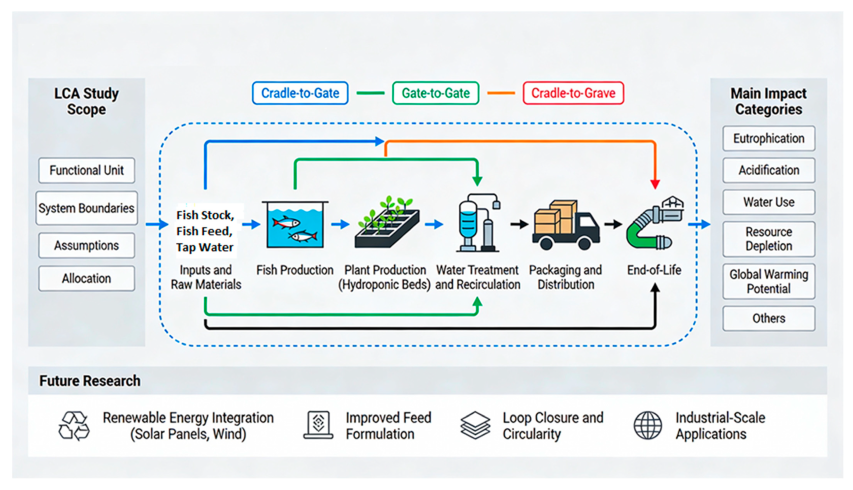
2.1. Functional Units and System Boundaries (Cradle-to-Gate)
- Mass vs. economic allocation: Mass allocation generally reallocates a greater portion of environmental impacts towards plant production, as vegetables are cultivated in significantly larger physical volumes compared to fish, often leading to crops being perceived as more impact-intensive. Conversely, economic allocation places a heavier burden on fish due to their elevated market value, which can considerably amplify the apparent environmental footprint associated with aquaculture elements. Consequently, the perceived sustainability ranking of fish relative to plant outputs, and even among various aquaponic designs, can vary significantly based on the allocation method employed.
- Nutrient or content allocation: These approaches are derived from specific content metrics (e.g., protein levels or nutritional nitrogen/phosphorus concentrations in outputs). Ref. [17] implemented a nutrient-based allocation for common carp and lettuce, indicating that fish and plants fulfill distinct nutritional functions [17].
- System expansion or displacement: This strategy compensates the aquaponic system for balancing effects in different systems, rather than allocating. Ref. [18] added prevented fertilizer output (fish waste substituting synthetic plant fertilizer). System growth shows integration’s net advantage but requires the description of analogous alternatives [18].
- Combined functional unit (no allocation): Some studies define the functional unit as a fixed bundle of fish and vegetables produced together to prevent allocation. An FU may be “production of X kg fish and Y kg vegetables”. This method was used by [11,19], a small-scale Canadian aquaponics study. This method approaches the system as a single joint service, but it complicates comparisons to single-output systems like fish farming [11,19].
2.2. Impact Assessment Categories and Methods
- Global Warming Potential (GWP): Nearly all studies present GWP (carbon footprint) in kilograms of CO2-equivalent [2]. GWP is a crucial metric due to the energy consumption and CO2 emissions linked to aquaponics. It facilitates comparison with other food systems for climate effect objectives.
- Energy Use/Cumulative Energy Demand (CED): Aquaponics needs ongoing energy inputs (such as pumps, aerators, and lights); hence, cumulative energy consumption or a corresponding fossil fuel depletion indicator is often evaluated [21].
- Eutrophication Potential: Both freshwater and marine eutrophication potentials, arising from nutrient outputs such as nitrogen and phosphorus, are essential since aquaponics seeks to mitigate nutrient runoff. Numerous studies measure the extent of nutrient contamination (in phosphate or nitrogen equivalents) that is generated or mitigated [24,27].
- Land Use: Being intense and perhaps urban/vertical, aquaponics is said to save land. While energy and water are more commonly cited as limiting factors, some studies do take land occupancy implications into account [28].
- Resource Depletion (Abiotic): Metrics for the depletion of mineral and fossil resources can be calculated when accounting for materials and energy [4].
- Marine Resources and Biodiversity: The utilization of marine resources highlights the strain that aquaponic systems exert on ocean-sourced inputs like fishmeal, fish oil, and marine fertilizers. In contrast, the impact on biodiversity indicates the possible repercussions on ecosystems resulting from feed sourcing, land and water consumption, and indirect alterations to habitats. Incorporating these impact categories into the LCA of aquaponics is crucial to prevent burden shifting, uncover concealed trade-offs between “sustainable” food production and ecosystem preservation, and offer a more comprehensive evaluation of the genuine environmental sustainability of aquaponic systems, extending beyond metrics focused solely on climate and energy.
3. Environmental Performance and Hotspots of Aquaponics (Cradle-to-Gate)
3.1. Key Hotspots: Energy and Fish Feed
3.2. Advantages in Water and Nutrient Management
- Water Use: Aquaponics often decreases water usage by 90–95% relative to soil agriculture for comparable yields [18]. Water is constantly recirculated, with just a little portion lost to evapotranspiration. For instance, hydroponic or aquaponic lettuce requires just a few liters of water per kilogram, in contrast to the tens or hundreds of liters utilized in conventional open-field agriculture. LCA studies frequently indicate that water depletion effects for aquaponics are minor, except for the limited top-up water, which has an inconsequential impact on shortage in many areas. Aquaponics is very advantageous in dry areas or locations with restricted freshwater availability. Aquaponics has been identified as a crucial factor for its potential advantages in dry and urban regions, facilitating food production with little water usage [29].
- Eutrophication and Nutrient Emissions: In recirculating aquaponics, nutrient-rich fish water is not released into the environment; rather, nutrients are absorbed by plants. This significantly minimizes the risk of nitrate or phosphate contamination when compared to solo aquaculture. Many LCAs show that aquaponic systems have a lower eutrophication potential per unit output than comparable fish or agricultural systems that emit waste streams [41]. Aquaponics solves one of aquaculture’s most pressing environmental issues by avoiding direct wastewater discharge. Any remaining sludge or concentrate can be further handled (e.g., compost or biofertilizer), thereby ending the cycle. Aquaponics is sometimes credited with near-zero nutrient outflow, with the exception of what is embedded in the final biomass. For example, one study found that aquaponics “minimizes nutrient-loaded water effluents,” which have a detrimental impact on traditional aquaculture [42].
- Reduced Synthetic Fertilizer Use: Aquaponics utilizes fish waste as fertilizer, hence diminishing or negating the necessity for synthetic fertilizers in the plant component. The manufacture of chemical fertilizers, particularly nitrogen through the energy-intensive Haber–Bosch process, has a considerable carbon and energy footprint. Aquaponics LCAs recognize this advantage through either a direct decrease in fertilizer usage or through system expansion credits, as demonstrated by [37]. The outcome is a reduction in fossil fuel use and greenhouse gas emissions linked to fertilizer. Ref. [25] ascribed a portion of aquaponics’ 45% reduced effect compared to hydroponics to the necessity of industrial fertilizer solutions in hydroponics, which aquaponics does not require. Ref. [11] also emphasizes nutrient recycling as a significant benefit of aquaponics in alleviating environmental pressures.
- Land-Use Intensity: Aquaponics’ high production per unit area reduces land pressure for the same output, but not always quantifiably. If expanded up, urban and vertical aquaponics may produce food in small spaces, saving natural ecosystems from agriculture. Ref. [29] used a land occupation metric and favored aquaponics, depending on yield assumptions. High aquaponic vegetable yields reduce land occupation per kilogram (typically the greenhouse footprint is the limiting factor). Aquaponics in non-arable areas (e.g., roofs, warehouses, deserts) increases food supply without extending agricultural land.
3.3. Trade-Offs: Energy and Climate Impacts
- Greenhouse Gas Emissions: Aquaponic systems may have a larger GHG effect (CO2-equivalent) per kg of yield compared to land agriculture, especially if fossil energy or heating is employed. In a Central European LCA on lettuce and fish production, open-field lettuce had a lower carbon footprint than aquaponic lettuce cultivated in a heated greenhouse, despite its water and nutritional benefits. Winter heating in hydroponic and aquaponic systems in cold areas can considerably increase CO2 emissions. Ref. [17] found that if an aquaponic greenhouse’s heating is powered by fossil fuels, its climate change effect per kg of lettuce can exceed that of outdoor farming, even if other impacts (water, eutrophication) are lower. Consequently, context is significant; in areas with temperate weather or renewable energy sources, the greenhouse gas performance of aquaponics is substantially enhanced, but in coal-dependent grids or frigid places, the greenhouse gas implications may be detrimental. Ref. [25] concisely stated, “The environmental impacts of controlled agriculture (hydroponics and aquaponics) are affected by geographic location, climate, and lighting,” indicating that tropical regions use less energy than temperate ones.
- Acidification/Smog: Air emissions are linked to fuel combustion and electricity generation. Aquaponics may produce more acidification and pollution (NOx, SO2) than typical farms if energy is generated by coal or diesel generators. Energy-related emissions meant that hydroponic/aquaponic systems acidify the soil more than field systems in several LCAs; clean energy reduces the impact in these categories [42].
- Manufacturing Impacts: Building elements like PVC pipelines and stainless steel tanks have industrial implications not found in soil farming. Ref. [15] shows that aquaponics can increase ecotoxicity or human toxicity. Eventually, recycling may amortize these consequences, but they are still a cost. Soil farming uses the ecosystem’s “free” infrastructure (soil, rivers) but depletes and pollutes it if not managed sustainably, which is outside the scope of conventional LCA unless land-use change or agrochemical ecotoxicity is considered.
- Complexity and Operational Impacts: An aquaponic system is complicated and may have several points of possible effect. This complexity is not a “impact category” in and of itself, but it might indirectly increase resource consumption (redundancies, controls), which LCAs would identify as additional impacts [15].
4. Towards Sustainable Aquaponics
4.1. Synthesis of Findings
4.2. Improvement Opportunities
- Research Gaps and Future LCA Considerations: Aquaponics is a nascent discipline, and the quantity of thorough LCA studies remains restricted; this analysis highlights various gaps and the need for further research.
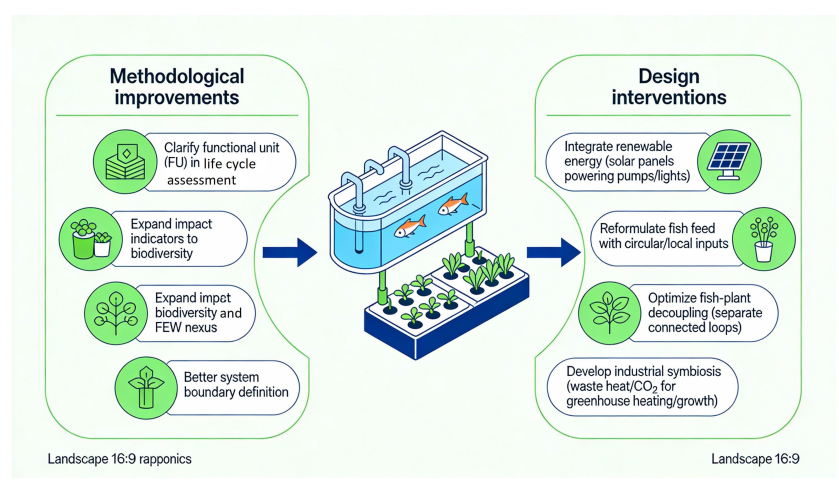
- Standardization of LCA Method: The absence of a standardized functional unit or allocation method complicates direct comparisons among research. Future research may propose a suggested approach, potentially involving the reporting of findings for both a combined follow-up and distinct assigned follow-ups, to ensure comprehensive coverage. A standardized structure, similar to Product Category Rules for other items, would enhance comparability. The harmonization research conducted by [49] advanced this objective regarding GWP. Enhancing efforts to standardize not only GWP but also additional impacts and assumptions (e.g., system longevity, co-product management) would advance the discipline.
- Dynamic and Life Cycle Costing (LCC) Integration: The majority of LCAs conducted to date are static, with a limited number including economic analysis. The feasibility of aquaponics is closely associated with economic factors. Recent studies, such as those by [11], have quantified environmental implications, while others advocate for the integration of LCA with techno-economic analysis. Implementing a combined LCA and LCC, or even a Life Cycle Sustainability Assessment that incorporates social metrics, might yield a comprehensive perspective on the sustainability of aquaponics, revealing synergistic opportunities or trade-offs between environmental objectives and economic viability.
- Scale and Real-World Data: Numerous early LCAs were conducted on pilot or research systems, often less than 100 m2. Data from fully running commercial farms is limited. With the emergence of further commercial aquaponics systems, it is essential to collect authentic operational data (energy consumption, yields, maintenance) to substantiate LCA models. Extensive systems may realize efficiencies absent in pilot studies or face novel challenges; hence, empirical LCA on a commercial scale (e.g., >1000 m2 facilities) is a research imperative. The research identified only a limited number of genuine commercial-scale evaluations (e.g., [51] in Florida, [21] in Sweden, and one in the UAE by [52]), highlighting a necessity for more studies.
- Geographic Diversity: Most LCA investigations have been in Europe and North America, with a handful in Asia–Pacific. Climate, energy systems, and fish/crop choices in Africa, South Asia, and South America may affect LCA results [30]. Aquaponics might improve food security in developing nations’ cities, but these cities’ infrastructure may not sustain energy-intensive production without renewable solutions. Studying aquaponics in these environments (possibly with low-tech designs) might increase its worldwide applicability [18].
- Impact Category Extension: The focus has been on conventional environmental consequences. Future LCAs may include biodiversity impacts (land spared, escaped non-native species, etc.), social impacts (job creation, community benefits), and nutrition-based functional units. Using new impact assessment approaches like circularity or ecosystem services might better capture aquaponics’ advantages (such avoiding polluting rivers).
- End-of-Life and Downstream: The emphasis has been on cradle-to-gate assessment, although comprehensive cradle-to-grave analysis (including distribution, retail, consumption, and waste disposal) is necessary for a complete comparison with traditional food supply chains. If aquaponics produce is locally consumed and undergoes less spoiling because to its freshness, this might represent an additional advantage; however, energy consumption for home storage and cooking may be comparable to that of any other produce [18]. Currently, studies expressly omit downstream stages for convenience; nonetheless, a comprehensive investigation of the food system would provide valuable insights, particularly within the context of urban metabolism.
5. Conclusions
Author Contributions
Funding
Data Availability Statement
Acknowledgments
Conflicts of Interest
Abbreviations
| LCA | Life cycle assessment |
| FU | Functional unit |
| GWP | Global warming potential |
| FCR | Feed conversion ratio |
| LCC | Life cycle costing |
| CED | Cumulative energy demand |
| GHG | Greenhouse gases |
| LED | Light-emitting diode |
| FEW | Food–energy–water |
| Kg | Kilogram |
References
- Department of Economic. World Population Prospects 2024: Summary of Results; United Nations Department of Economic and Social Affairs: New York, NY, USA, 2024; ISBN 978-92-1-106937-2. [Google Scholar]
- Ravani, M.; Chatzigeorgiou, I.; Monokrousos, N.; Giantsis, I.A.; Ntinas, G.K. Life Cycle Assessment of a High-Tech Vertical Decoupled Aquaponic System for Sustainable Greenhouse Production. Front. Sustain. 2024, 5, 1422200. [Google Scholar] [CrossRef]
- Campanati, C.; Willer, D.; Schubert, J.; Aldridge, D.C. Sustainable Intensification of Aquaculture through Nutrient Recycling and Circular Economies: More Fish, Less Waste, Blue Growth. Rev. Fish. Sci. Aquac. 2022, 30, 143–169. [Google Scholar] [CrossRef]
- Henriksson, E.F.; Elnour, M.; Martin, M. Environmental Life Cycle Assessment of a Commercial Aquaponic System. Clean. Environ. Syst. 2025, 17, 100282. [Google Scholar] [CrossRef]
- Delshad, A.B. Community Gardens:An Investment in Social Cohesion, Public Health, Economic Sustainability, and the Urban Environment. Urban. For. Urban. Green. 2022, 70, 127549. [Google Scholar] [CrossRef]
- Martin, M.; Elnour, M.; Siñol, A.C. Environmental Life Cycle Assessment of a Large-Scale Commercial Vertical Farm. Sustain. Prod. Consum. 2023, 40, 182–193. [Google Scholar] [CrossRef]
- Mehdi, S.E.H.; Amen, R.; Ali, A.; Anjum, H.; Mahmood, A.; Mubashir, M.; Mukhtar, A.; Ullah, S.; Al-Sehemi, A.G.; Ibrahim, M.; et al. Sources, Chemistry, Bioremediation and Social Aspects of Arsenic-Contaminated Waters: A Review. Environ. Chem. Lett. 2021, 19, 3859–3886. [Google Scholar] [CrossRef]
- Ertle, J.; Kubota, C. Reduced Daily Light Integral at the End of Production Can Delay Tipburn Incidence with a Yield Penalty in Indoor Lettuce Production. HortScience 2023, 58, 1217–1224. [Google Scholar] [CrossRef]
- Pomoni, D.I.; Koukou, M.K.; Vrachopoulos , M.G.; Vasiliadis, L. A Review of Hydroponics and Conventional Agriculture Based on Energy and Water Consumption, Environmental Impact, and Land Use. Energies 2023, 16, 1690. [Google Scholar] [CrossRef]
- Michiels, F.; Hubo, L.; Geeraerd, A. Why Mass Allocation with Representative Allocation Factor Is Preferential in LCA When Using Residual Livestock Products as Organic Fertilizers. J. Environ. Manag. 2021, 297, 113337. [Google Scholar] [CrossRef]
- Greenfeld, A.; Becker, N.; Bornman, J.F.; Spatari, S.; Angel, D.L. Monetizing Environmental Impact of Integrated Aquaponic Farming Compared to Separate Systems. Sci. Total Environ. 2021, 792, 148459. [Google Scholar] [CrossRef]
- Kozai, T.; Niu, G.; Masabni, J. (Eds.) Aquaponics. In Plant Factory Basics, Applications and Advances; Academic Press: Cambridge, MA, USA, 2022; pp. 167–180. [Google Scholar]
- Guan, Y.; Liu, L.; Chen, Y.; Liu, L. Life Cycle Assessment of an Industrial Aquaponics System in Chongqing, China: Environmental Performance and Optimization Strategies. Sustainability 2025, 17, 8254. [Google Scholar] [CrossRef]
- Kalvakaalva, R.; Smith, M.; Prior, S.A.; Runion, G.B.; Ayipio, E.; Blanchard, C.; Wells, D.; Blersch, D.; Adhikari, S.; Prasad, R.; et al. Life Cycle Assessment of a Decoupled Biofloc Aquaponics Facility across Seasons. J. Clean. Prod. 2023, 429, 139356. [Google Scholar] [CrossRef]
- Ghamkhar, R.; Hartleb, C.; Wu, F.; Hicks, A. Life Cycle Assessment of a Cold Weather Aquaponic Food Production System. J. Clean. Prod. 2020, 244, 118767. [Google Scholar] [CrossRef]
- Gavhane, K.P.; Hasan, M.; Singh, D.K.; Kumar, S.N.; Sahoo, R.N.; Alam, W. Determination of Optimal Daily Light Integral (DLI) for Indoor Cultivation of Iceberg Lettuce in an Indigenous Vertical Hydroponic System. Sci. Rep. 2023, 13, 10923. [Google Scholar] [CrossRef] [PubMed]
- Jaeger, C.; Foucard, P.; Tocqueville, A.; Nahon, S.; Aubin, J. Mass Balanced Based LCA of a Common Carp-Lettuce Aquaponics System. Aquac. Eng. 2019, 84, 29–41. [Google Scholar] [CrossRef]
- Behr, L.M.; Hu, A.H.; Heck, P. Assessing the Environmental Impact and Advantages of a Commercial Aquaponic System in Taiwan through Life Cycle Assessment. Aquaculture 2025, 595, 741589. [Google Scholar] [CrossRef]
- Valappil, G. Environmental and Economic Implications of Small-Scale Canadian Aquaponics: A Life Cycle Study. Ph.D. Thesis, University of Waterloo, Waterloo, ON, Canada, 2021. [Google Scholar]
- Wu, F.; Ghamkhar, R.; Ashton, W.; Hicks, A.L. Sustainable Seafood and Vegetable Production: Aquaponics as a Potential Opportunity in Urban Areas. Integr. Environ. Assess. Manag. 2019, 15, 832–843. [Google Scholar] [CrossRef]
- Frontiers|Life Cycle Assessment of a Retail Store Aquaponic System in a Cold-Weather Region. Available online: https://www.frontiersin.org/journals/sustainability/articles/10.3389/frsus.2022.1051091/full (accessed on 12 January 2026).
- Bordignon, F.; Sturaro, E.; Trocino, A.; Birolo, M.; Xiccato, G.; Berton, M. Comparative Life Cycle Assessment of Rainbow Trout (Oncorhynchus Mykiss) Farming at Two Stocking Densities in a Low-Tech Aquaponic System. Aquaculture 2022, 556, 738264. [Google Scholar] [CrossRef]
- Bordignon, F.; Trocino, A.; Gasco, L.; Oddon, S.B.; Xiccato, G.; Berton, M. Towards Circularity in Aquaculture Systems: Environmental Impact of Hermetia Illucens Meal Inclusion in Diets for Rainbow Trout Reared in Aquaponics. J. Clean. Prod. 2024, 466, 142901. [Google Scholar] [CrossRef]
- Zoli, M.; Rossi, L.; Bacenetti, J.; Aubin, J. Upscaling and Environmental Impact Assessment of an Innovative Integrated Multi-Trophic Aquaponic System. J. Environ. Manag. 2024, 369, 122327. [Google Scholar] [CrossRef]
- Chen, P.; Zhu, G.; Kim, H.-J.; Brown, P.B.; Huang, J.-Y. Comparative Life Cycle Assessment of Aquaponics and Hydroponics in the Midwestern United States. J. Clean. Prod. 2020, 275, 122888. [Google Scholar] [CrossRef]
- Subah, Z.; Ryu, J.H.; Mirkouei, A. Comparative Study on Aquaponic and Hydroponic Systems for Sustainable Hemp Production in a Controlled Environment. Horticulturae 2025, 11, 588. [Google Scholar] [CrossRef]
- Yang, T.; Kim, H.-J. Comparisons of Nitrogen and Phosphorus Mass Balance for Tomato-, Basil-, and Lettuce-Based Aquaponic and Hydroponic Systems. J. Clean. Prod. 2020, 274, 122619. [Google Scholar] [CrossRef]
- Nair, C.S.; Manoharan, R.; Nishanth, D.; Subramanian, R.; Neumann, E.; Jaleel, A. Recent Advancements in Aquaponics with Special Emphasis on Its Sustainability. J. World Aquac. Soc. 2025, 56, e13116. [Google Scholar] [CrossRef]
- Korbee, N.; Bautista, B.; García-Sánchez, M.; Cobos, P.; Ferres-García, J.L.; Figueroa, F.L.; Medrano, E. Evaluating Hydroponics and Aquaponics: Comparative Insights into Sustainability and Strawberry Quality. Agric. Water Manag. 2025, 312, 109412. [Google Scholar] [CrossRef]
- Analysis of the Aquaponic System Sustainability via System Dynamics Modelling—FEW Nexus Approach|Circular Economy and Sustainability. Available online: https://link.springer.com/article/10.1007/s43615-024-00408-z (accessed on 12 January 2026).
- Yang, H.; Niu, S.; Guo, M.; Xue, Y. A Critical Review of the Ecotoxic Effects of Microplastics on Aquatic, Soil and Atmospheric Ecosystems and Current Research Challenges. Environ. Res. 2025, 274, 121361. [Google Scholar] [CrossRef]
- Omidoyin, K.C.; Jho, E.H. Environmental Occurrence and Ecotoxicological Risks of Plastic Leachates in Aquatic and Terrestrial Environments. Sci. Total Environ. 2024, 954, 176728. [Google Scholar] [CrossRef]
- Arbour, A.J.; Chu, Y.-T.; Brown, P.B.; Huang, J.-Y. Life Cycle Assessment on Marine Aquaponic Production of Shrimp, Red Orache, Minutina and Okahajiki. J. Environ. Manag. 2024, 353, 120208. [Google Scholar] [CrossRef]
- van Zelm, R.; Hennequin, T.; Huijbregts, M.A.J. Performing Life Cycle Impact Assessment with the Midpoint and Endpoint Method ReCiPe. Nat. Protoc. 2025, 20, 3400–3411. [Google Scholar] [CrossRef]
- Ntinas, G.K.; Dannehl, D.; Schuch, I.; Rocksch, T.; Schmidt, U. Sustainable Greenhouse Production with Minimised Carbon Footprint by Energy Export. Biosyst. Eng. 2020, 189, 164–178. [Google Scholar] [CrossRef]
- Zhang, Z.; Liu, H.; Jin, J.; Zhu, X.; Han, D.; Xie, S. Towards a Low-Carbon Footprint: Current Status and Prospects for Aquaculture. Water Biol. Secur. 2024, 3, 100290. [Google Scholar] [CrossRef]
- Zhao, W.; Liu, C.; Li, D.; Zheng, Y. Energy-Saving Techniques in Urban Aquaponics Farms by Optimizing Equipment Operating Scheme. Aquaculture 2024, 587, 740873. [Google Scholar] [CrossRef]
- Bohnes, F.A.; Laurent, A. Environmental Impacts of Existing and Future Aquaculture Production: Comparison of Technologies and Feed Options in Singapore. Aquaculture 2021, 532, 736001. [Google Scholar] [CrossRef]
- Ianchenko, A.; Proksch, G. Urban Food Systems: Applying Life Cycle Assessment in Built Environments and Aquaponics. Build. Technol. Educ. Soc. 2019, 2019, 29. [Google Scholar] [CrossRef]
- Maucieri, C.; Nicoletto, C.; Junge, R.; Schmautz, Z.; Sambo, P.; Borin, M. Hydroponic Systems and Water Management in Aquaponics: A Review. Ital. J. Agron. 2018, 13, 1012. [Google Scholar] [CrossRef]
- Al Tawaha, A.R.; Megat Wahab, P.E.; Jaafar, H.Z. Optimizing Nutrient Availability in Decoupled Recirculating Aquaponic Systems for Enhanced Plant Productivity: A Mini Review. Nitrogen 2025, 6, 3. [Google Scholar] [CrossRef]
- Drogeanu, R.; Balan, M.; Petrea, S.-M.; Neculita, M.; Cristea, D. Improving the Sustainability of Blue Economy through Emerging Aquaponics Techniques and Technologies. Risk Contemp. Econ. 2021, 1, 465–474. [Google Scholar] [CrossRef]
- Mishra, S.J.; Rout, D.; Sahoo, D. Analysing the Economic Viability of Hydroponic Farming: A Comparative Cost-Benefit Analysis. Int. J. Progress. Res. Eng. Manag. Sci. 2024, 4, 1806–1811. [Google Scholar]
- Ganesan, A.R.; Mohan, K.; Kandasamy, S.; Surendran, R.P.; Kumar, R.; Rajan, D.K.; Rajarajeswaran, J. Food Waste-Derived Black Soldier Fly (Hermetia Illucens) Larval Resource Recovery: A Circular Bioeconomy Approach. Process Saf. Environ. Prot. 2024, 184, 170–189. [Google Scholar] [CrossRef]
- Akowuah, C.F.; Pan, Y.; Shi, Z.; Liu, X.; He, R.; Lü, P. Revolutionizing Aquaculture Feeds: Insights into Black Soldier Fly Utilization. Aquac. Eng. 2025, 111, 102612. [Google Scholar] [CrossRef]
- Seaweed Fly Larvae Cultivated on Macroalgae Side Streams: A Novel Marine Protein and Omega-3 Source for Rainbow Trout—Warwas—2024—Aquaculture Nutrition—Wiley Online Library. Available online: https://onlinelibrary.wiley.com/doi/full/10.1155/2024/4221883 (accessed on 12 January 2026).
- Aslanidou, M.; Elvanidi, A.; Mourantian, A.; Levizou, E.; Mente, E.; Katsoulas, N. Evaluation of Productivity and Efficiency of a Large-Scale Coupled or Decoupled Aquaponic System. Sci. Hortic. 2024, 337, 113552. [Google Scholar] [CrossRef]
- Pinho, S.; Leal, M.M.; Shaw, C.; Baganz, D.; Baganz, G.; Staaks, G.; Kloas, W.; Körner, O.; Monsees, H. Insect-Based Fish Feed in Decoupled Aquaponic Systems: Effect on Lettuce Production and Resource Use. PLoS ONE 2024, 19, e0295811. [Google Scholar] [CrossRef]
- Breitenstein, M.; Hicks, A. Review and Harmonization of the Life Cycle Global Warming Impact of Five United States Aquaponics Systems. Aquac. Eng. 2022, 96, 102224. [Google Scholar] [CrossRef]
- Ghamkhar, R.; Hartleb, C.; Rabas, Z.; Hicks, A. Evaluation of Environmental and Economic Implications of a Cold-weather Aquaponic Food Production System Using Life Cycle Assessment and Economic Analysis. J. Ind. Ecol. 2022, 26, 862–874. [Google Scholar] [CrossRef]
- Boxman, S.E.; Zhang, Q.; Bailey, D.; Trotz, M.A. Life Cycle Assessment of a Commercial-Scale Freshwater Aquaponic System. Environ. Eng. Sci. 2017, 34, 299–311. [Google Scholar] [CrossRef]
- Mohamed, A.-M.O.; Paleologos, E.K.; Howari, F. Pollution Assessment for Sustainable Practices in Applied Sciences and Engineering; Butterworth-Heinemann: Kidlington, UK, 2020; ISBN 978-0-08-101057-0. [Google Scholar]



| Study (Location) | System Boundary | System/Scale FU/Allocation | Impact Method | Key Outcomes and Hotspots | Future Suggestions Reported |
|---|---|---|---|---|---|
| [21]; Sweden | Cradle-to-gate (farm/retail gate) | Atlantic salmon → tomato and cucumber; FU = 1 kg fresh product bundle; mass and economic allocation | ReCiPe 2016; 8 categories | Electricity, CO2 enrichment, and heating dominate across categories; local aquaponics favorable vs. importing comparable volumes when waste heat/CO2 symbiosis used | Industrial symbiosis (waste heat/CO2), renewable electricity, lighting optimization |
| [4]; Sweden | Cradle-to-gate | Commercial trout–leafy greens system; FU per kg of product; scenarios include insect-based feed | Multi-category (ISO-aligned) | Results sensitive to electricity mix; insect-based feed scenarios reduce several categories but depend on modeling choices for food-waste burdens | Decarbonize grid or add on-site PV; clarify burden assumptions for insect-feed; expand biodiversity metrics |
| [18]; Taiwan | Gate-to-gate and cradle-to-gate | Commercial APS; varying fish density; FU per kg of fish | CML-IA/multi-category | Higher fish density lowered impacts per kg; electricity was dominant contributor (up to ~90% of some categories); feed relevant in GWP and water-depletion | Energy efficiency + renewables; load-factor management; feed reformulation |
| [22]; Italy | Gate-to-gate and cradle-to-gate | Rainbow trout → lettuce, low-tech APS; FU = 1 kg trout gain; allocation to plants | CML-IA | Power use = primary GWP hotspot; feed ≈ 10% of GWP and ≈20% of water-depletion; stocking density matters | Improve energy mix; optimize densities; report paired gate-to-gate + cradle-to-gate |
| [23]; Italy | Cradle-to-gate (scenario/ex-ante) | Trout diets with Hermetia illucens in aquaponics | CML-IA | Electricity often >50% of impacts; insect meal reduces reliance on marine resources with trade-offs depending on allocation | Scale real-world insect-meal trials; include marine resource and biodiversity indicators |
| [2]; Greece | Cradle-to-gate | High-tech vertical decoupled APS; trout → baby lettuce/rocket; FU = 1 kg of vegetables; mass allocation for fish | CML-IA; 11 midpoints | Electricity (oxygenation pump) is top hotspot; greenhouse infrastructure drives ADP and toxicity; PV scenario cut GWP ~50% and eutrophication up to 86% | Replace grid power with PV; optimize oxygenation hardware; report sensitivity to FU/allocations |
| [24]; Italy | Cradle-to-gate (ex-ante) | Marine IMTA–aquaponics (seabass/seabream → halophytes; +detritivore loop); FU = 100 kcal and 1 kg of protein | Multi-category | Electricity > 50% of impacts; nutrient recycling mitigates eutrophication vs. conventional aquaculture; highlights scale-up uncertainty | Real-scale validation; include circularity/food–energy–water (FEW) nexus indicators; low-carbon energy |
| [25]; USA | Cradle-to-gate | Tilapia/basil-style comparisons of APS vs. hydroponics; FU per kg | ReCiPe/TRACI | APS often lower than hydroponics in several midpoints; outcomes hinge on energy source | Pair LCA with energy-mix scenarios; define common FU for cross-system comparison |
| [14]; USA | Cradle-to-grave | Decoupled biofloc APS across seasons; FU per kg of fish; avoided burden vs. allocation tested | Multi-category; includes direct GHG | Electricity (∼40%), heating fuel (~22%), and feed (~24%) dominate GWP; decoupling raised eutrophication vs. coupled APS due to nutrient-rich discharge; PV could reduce GWP > 40% | Balance fish/plant flows to minimize discharge; reuse post-plant effluent; switch to renewables |
| [13]; China | Cradle-to-gate | Large-scale IAS (largemouth bass → mixed veg); FU = 1 kg of fish; veg credited by allocation | CML-IA; 10 midpoints | Feed = largest driver overall, electricity second; wind/solar scenarios markedly cut GWP/acidification; plant-forward feeds cut several categories 30–50% with land-use trade-offs | |
| [26]; USA | Cradle-to-gate | APS vs. hydroponics for hemp leaves; FU per kg of leaves | Midpoints + endpoints | APS shows 22% lower midpoint and 15% lower endpoint impacts vs. hydroponics under test conditions |
| Boundary | Inclusion/Exclusion | Systems Covered | Common Hotspots and Impacts | Typical Findings/Outcomes | Actions to Improve |
|---|---|---|---|---|---|
| Gate-to-gate | Day-to-day farm ops only; excludes upstream (materials, feeds manufacturing) and downstream | Operational studies of commercial APSs; stocking-density trials; process optimization | Electricity (pumps, aeration, oxygenation), heating/cooling, CO2 dosing; direct emissions if measured | Pinpoints operational levers (load management, equipment efficiency); underestimates embodied burdens | Exact metering period and seasonality; equipment nameplate vs. measured loads; FU choice; co-product allocation and/or no-allocation bundle |
| Cradle-to-gate | Upstream extraction → farm gate; excludes retail, cooking, end-of-life | Most APS LCA case studies (tilapia/carp/trout with leafy greens/tomato/cucumber; coupled or decoupled) | Energy dominates climate/air categories; feed drives eutrophication, toxicity, resource use; infrastructure affects ADP/HT | APSs often beat hydroponics or imports where energy is low-carbon and industrial symbiosis exists; otherwise, energy can negate benefits [21] | Pair with gate-to-gate boundary; disclose electricity mix; show two allocations (mass/economic) or no-allocation bundle; include infrastructure lifetimes |
| Cradle-to-grave | Adds distribution, retail, consumer use and waste | Fewer studies; emerging for decoupled/biofloc or regional supply-chain questions | Same as above plus refrigeration/transport/cooking burdens; nutrient discharge in decoupled flows | Hotspots shift downstream in some food systems; for decoupled APSs, discharge can raise eutrophication if reuse is absent [14] | Report cold-chain, distance, spoilage assumptions; include direct GHG (CO2/CH2/N2O) if measured; scenario analysis for local vs. imported |
| Factors | Significance | Practical Actions |
|---|---|---|
| Decarbonize energy | Electricity/heat are dominant in GWP, acidification, smog; PV/wind show 40–50%+ GWP cuts in scenarios [2]. | Add PV/heat-pump scenarios; disclose grid mix; load-shifting and oxygenation hardware optimization [2] |
| Feed reformulation and circular inputs | Feed drives eutrophication, toxicity, resource use; insect meals and plant-forward feeds can reduce pressures with trade-offs [23]. | Report fishmeal/oil fractions; test insect-meal scenarios with clear burden rules for food-waste inputs [4] |
| Balance fish ↔ plant and close loops (esp. decoupled) | Under-sized plant sinks in decoupled/biofloc systems raise nutrient discharge and eutrophication [14]. | Model effluent reuse/mineralization; track N and P balances; include direct GHG from unit ops [14] |
| Industrial symbiosis | Waste heat and concentrated CO2 can flip comparisons in cold grids and reduce CO2 dosing burdens [21]. | Quantify heat/CO2 credits; sensitivity vs. no-symbiosis case; document distances and reliability [21] |
| Transparency in FU and allocation | Co-product handling drives results and comparability. | Always report at least two allocations (mass/economic) or fixed no-allocation bundle; keep FU constant across gate-to-gate vs. cradle-to-gate tables |
| Extend indicators | Biodiversity/marine resource use and circularity are under-reported. | Add marine resource, land-sparing/biodiversity, and FEW nexus metrics; cite ReCiPe 2025 endpoints for transparency |
Disclaimer/Publisher’s Note: The statements, opinions and data contained in all publications are solely those of the individual author(s) and contributor(s) and not of MDPI and/or the editor(s). MDPI and/or the editor(s) disclaim responsibility for any injury to people or property resulting from any ideas, methods, instructions or products referred to in the content. |
© 2026 by the authors. Licensee MDPI, Basel, Switzerland. This article is an open access article distributed under the terms and conditions of the Creative Commons Attribution (CC BY) license.
Share and Cite
Mehdi, S.E.H.; Sharma, A.; Shahzad, S.; Pandey, S.; Hussain, F.; Kang, W.; Oh, S.-E. A Systematic Analysis of Factors Influencing Life Cycle Assessment Outcomes in Aquaponics. Water 2026, 18, 301. https://doi.org/10.3390/w18030301
Mehdi SEH, Sharma A, Shahzad S, Pandey S, Hussain F, Kang W, Oh S-E. A Systematic Analysis of Factors Influencing Life Cycle Assessment Outcomes in Aquaponics. Water. 2026; 18(3):301. https://doi.org/10.3390/w18030301
Chicago/Turabian StyleMehdi, Syed Ejaz Hussain, Aparna Sharma, Suleman Shahzad, Sandesh Pandey, Fida Hussain, Woochang Kang, and Sang-Eun Oh. 2026. "A Systematic Analysis of Factors Influencing Life Cycle Assessment Outcomes in Aquaponics" Water 18, no. 3: 301. https://doi.org/10.3390/w18030301
APA StyleMehdi, S. E. H., Sharma, A., Shahzad, S., Pandey, S., Hussain, F., Kang, W., & Oh, S.-E. (2026). A Systematic Analysis of Factors Influencing Life Cycle Assessment Outcomes in Aquaponics. Water, 18(3), 301. https://doi.org/10.3390/w18030301