Sustainable Recirculating Aquaculture Systems (RAS): Development and Challenges

 ,
, 
 , ,
, , 
Abstract
1. Introduction
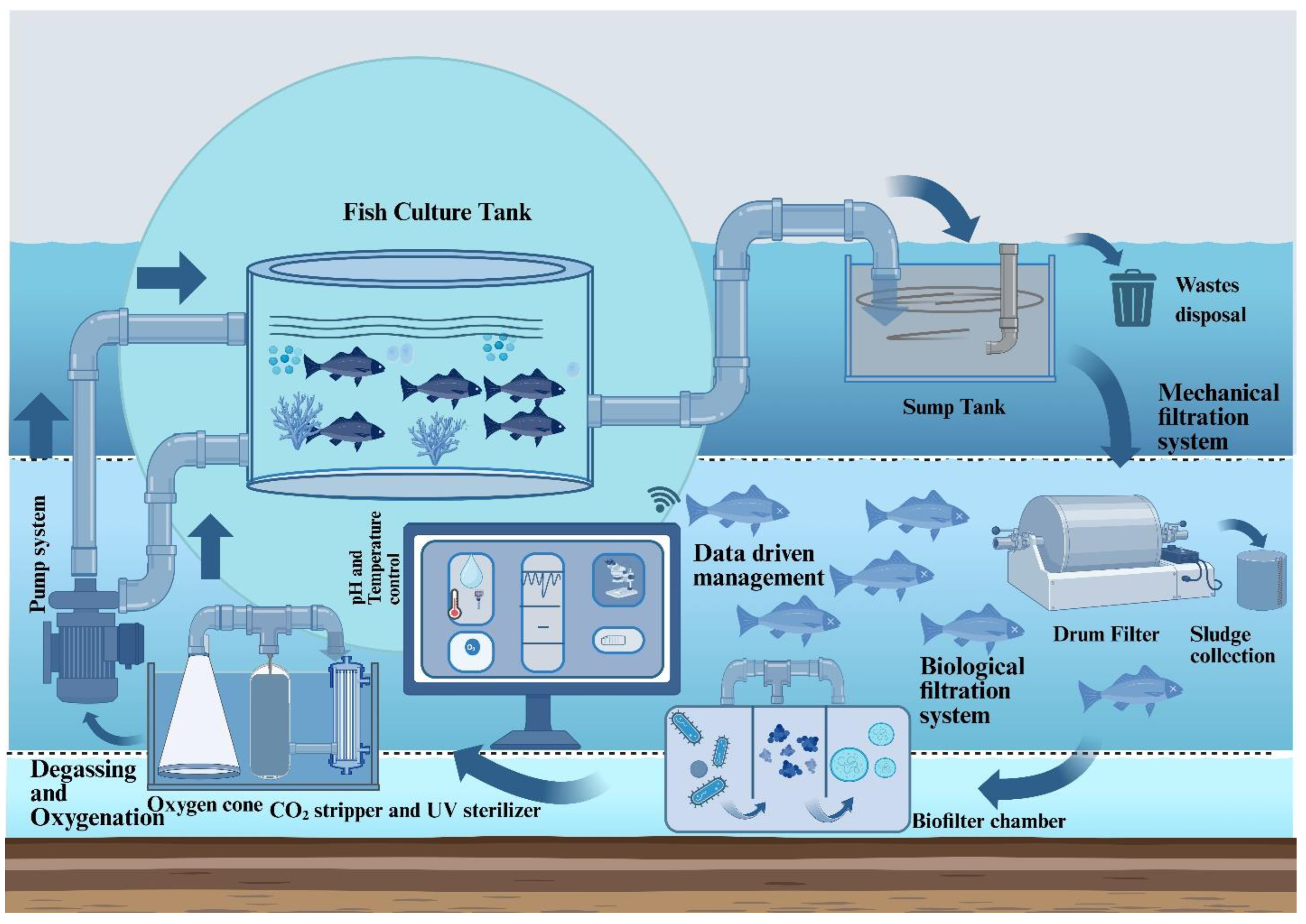
2. Mechanistic Framework of RAS: From Principles to Components
Advantages of Recirculating Aquaculture System
3. Recent Development of RAS
3.1. Historical Development
3.2. Technological Advancements
3.2.1. Denitrification Reactors
3.2.2. Sludge Thickening Technologies
3.2.3. Ozone and Ultraviolet Irradiation
3.2.4. CO2 Utilization in Recirculating Aquaculture System
3.3. Membrane Technologies
3.4. Recycling of Nutrients Through Integrated Farming
3.4.1. Constructed Wetlands
3.4.2. Microalgae-Based Water Treatment
3.4.3. Mechanism of Microalgae-Based Biomass Production
3.5. Innovative Systems: The RAS-PHB System
4. Integration with Automation and Artificial Intelligence
4.1. Intelligent Water Quality Management
4.2. Optimized Aeration Strategies
4.3. Smart Feeding Algorithms
4.4. Comprehensive Environmental Monitoring and Control
4.5. Variable-Flow Water Regulation
4.6. Advanced Fish Monitoring
5. RAS Foundations and the Readiness Gap
5.1. RRL Framework for RAS Technologies
The RAS Readiness Level (RRL) Framework
5.2. RRL Assessment of Core Technological Domains
6. Welfare in RAS
7. Challenges in RAS Development
7.1. Water Quality Monitoring and Management
7.2. Technological and Operational Hurdles
7.3. Feed Formulation and Waste Production
7.4. Biological and Pathogen Management
7.5. Economic and Environmental Sustainability
7.6. Chemical Use and Residuals
7.7. Biosecurity and Disease Occurrence in RAS
7.8. Phosphorus Management and Nutrient Recovery
8. Future Perspectives and Innovations in RAS
8.1. Digitalization and Smart RAS
8.2. Advanced Genetic Selection
8.3. Integrated and Specialized System Designs
8.4. Next-Generation Water Treatment Technologies
8.5. Waste-to-Value and Circular Economy
8.6. Enhancing Biosecurity and Fish Health
8.7. Improving Economic and Environmental Footprint
9. Conclusions
Author Contributions
Funding
Data Availability Statement
Conflicts of Interest
References
- Riechers, M.; Fanini, L.; Apicella, A.; Galván, C.B.; Blondel, E.; Espiña, B.; Kefer, S.; Keroullé, T.; Klun, K.; Pereira, T.R. Plastics in our ocean as transdisciplinary challenge. Mar. Pollut. Bull. 2021, 164, 112051. [Google Scholar] [CrossRef]
- Béné, C.; Arthur, R.; Norbury, H.; Allison, E.H.; Beveridge, M.; Bush, S.; Campling, L.; Leschen, W.; Little, D.; Squires, D. Contribution of fisheries and aquaculture to food security and poverty reduction: Assessing the current evidence. World Dev. 2016, 79, 177–196. [Google Scholar] [CrossRef]
- Ahmed, N.; Thompson, S.; Glaser, M. Global aquaculture productivity, environmental sustainability, and climate change adaptability. Environ. Manag. 2019, 63, 159–172. [Google Scholar] [CrossRef]
- Ende, S.; Henjes, J.; Spiller, M.; Elshobary, M.; Hanelt, D.; Abomohra, A. Recent advances in recirculating aquaculture systems and role of microalgae to close system loop. Bioresour. Technol. 2024, 407, 131107. [Google Scholar] [CrossRef]
- Ilkhas, E.; Babaei, A.A.; Roomiani, L.; Yengejeh, R.J.; Varshosaz, K. Enhancing aquaculture management: Utilizing cu-doped ZnO/graphene nanocomposite for effective reduction of antibiotics and antibiotic-resistant Bacteria in shrimp culturing ponds. Aquaculture 2024, 586, 740797. [Google Scholar] [CrossRef]
- Ahmed, N.; Turchini, G.M. Recirculating aquaculture systems (RAS): Environmental solution and climate change adaptation. J. Clean. Prod. 2021, 297, 126604. [Google Scholar] [CrossRef]
- Roy, S.M.; Choi, H.; Kim, T. Review of state-of-the-art improvements in recirculating aquaculture systems: Insights into design, operation, and statistical modeling approaches. Aquaculture 2025, 605, 742545. [Google Scholar] [CrossRef]
- Steven, S.; Mulyono, M.; Yustisia, A.; Soekotjo, E.S.A.; Otivriyanti, G.; Wardani, M.L.D.; Murti, Z.; Sinaga, R.Y.H.; Laili, N.S.; Suantika, G.; et al. Perspectives and research direction on polymeric membrane integration for sustainable aquaculture industries. J. Environ. Chem. Eng. 2024, 12, 111691. [Google Scholar] [CrossRef]
- de Morais Carvalho Ananias, I.; dos Santos Silva, S.; de Sena Souza, A.; dos Santos, F.A.C.; Magalhães, T.B.; de Freitas Martins, W.J.; Favero, G.C.; Luz, R.K. Effects of Stocking Densities on the Growth Performance and Physiology of Juvenile Piaractus brachypomus in Recirculating Aquaculture System. Fishes 2025, 10, 171. [Google Scholar] [CrossRef]
- Assis, Y.P.A.S.; Amorim, M.P.S.; de Assis Porto, L.; de Oliveira, P.E.C.M.; Santos, C.A.; Reis, G.P.A.; Luz, R.K.; Favero, G.C. Effect of Feeding Frequency and Restriction on the Growth Performance, Physiology, and Intestinal Histomorphometry of Colossoma macropomum in a Recirculating Aquaculture System. Fishes 2025, 10, 148. [Google Scholar] [CrossRef]
- da Rocha, G.H.; Povh, J.A.; Spica, L.N.; de Oliveira Brasileiro, L.; de Salve, L.V.; Melo, M.L.; Sousa, R.M.; Cleveland, H.P.K.; Ferreira, R.M.; Corrêa Filho, R.A. Comparative evaluation of Biofloc technology (BFT) and RAS (recirculation aquaculture system) on growth performance, water quality, and innate immune response in Pacu (Piaractus mesopotamicus) juveniles. Aquaculture 2025, 602, 742325. [Google Scholar] [CrossRef]
- Badran, M.F.; Ali, M.A.; Yusuf, M.S. The growth performance, haematological parameters and serum biochemistry of the flathead grey mullet Mugil cephalus under recirculating aquaculture system and traditional culture systems. J. Anim. Physiol. Anim. Nutr. 2025, 109, 449–455. [Google Scholar] [CrossRef]
- Badiola, M.; Mendiola, D.; Bostock, J. Recirculating Aquaculture Systems (RAS) analysis: Main issues on management and future challenges. Aquac. Eng. 2012, 51, 26–35. [Google Scholar] [CrossRef]
- Moretto, J.A.; Freitas, P.N.; Souza, J.P.; Oliveira, T.M.; Brites, I.; Pinto, E. Off-flavors in aquacultured fish: Origins and implications for consumers. Fishes 2022, 7, 34. [Google Scholar] [CrossRef]
- Andreotti, V.; Solimeno, A.; Rossi, S.; Ficara, E.; Marazzi, F.; Mezzanotte, V.; García, J. Bioremediation of aquaculture wastewater with the microalgae Tetraselmis suecica: Semi-continuous experiments, simulation and photo-respirometric tests. Sci. Total Environ. 2020, 738, 139859. [Google Scholar] [CrossRef] [PubMed]
- Schleyken, J.; Gumpert, F.; Tränckner, S.; Palm, H.; Tränckner, J. Enhanced chemical recovery of phosphorus from residues of recirculating aquaculture systems (RAS). Int. J. Environ. Sci. Technol. 2024, 21, 3775–3788. [Google Scholar] [CrossRef]
- Gupta, S.; Makridis, P.; Henry, I.; Velle-George, M.; Ribicic, D.; Bhatnagar, A.; Skalska-Tuomi, K.; Daneshvar, E.; Ciani, E.; Persson, D. Recent developments in recirculating aquaculture systems: A review. Aquac. Res. 2024, 2024, 6096671. [Google Scholar] [CrossRef]
- Pfeiffer, T.J.; Summerfelt, S.T.; Watten, B.J. Comparative performance of CO2 measuring methods: Marine aquaculture recirculation system application. Aquac. Eng. 2011, 44, 1–9. [Google Scholar] [CrossRef]
- Martins, C.; Eding, E.H.; Verdegem, M.C.; Heinsbroek, L.T.; Schneider, O.; Blancheton, J.-P.; d’Orbcastel, E.R.; Verreth, J. New developments in recirculating aquaculture systems in Europe: A perspective on environmental sustainability. Aquac. Eng. 2010, 43, 83–93. [Google Scholar] [CrossRef]
- Murray, F.; Bostock, J.; Fletcher, D. Review of Recirculation Aquaculture System Technologies and Their Commercial Application. 2014. Available online: https://dspace.stir.ac.uk/handle/1893/21109 (accessed on 28 April 2026).
- Hashmi, Z.; Metali, F.; Amin, M.; Abu Bakar, M.S.; Wibisono, Y.; Nugroho, W.A.; Bilad, M.R. Recirculating aquaculture systems: Advances, impacts, and integrated pathways for sustainable growth. Bioresour. Technol. Rep. 2025, 32, 102340. [Google Scholar] [CrossRef]
- Cupp, A.; Fritts, A.; Brey, M.; Woodley, C.; Smith, D.; Cornish, M.; McGovern, A.; Simmonds, R.; Jackson, N. Application of the Technology Readiness Levels Framework to Natural Resource Management Tools; Oxford University Press: Oxford, UK, 2023; Volume 48, pp. 474–479. [Google Scholar]
- Aich, N.; Nama, S.; Biswal, A.; Paul, T. A review on recirculating aquaculture systems: Challenges and opportunities for sustainable aquaculture. Innov. Farming 2020, 5, 17–24. [Google Scholar]
- Ranjan, R.; Sampath, K.; Raju, S.N.; Bathina, C.; Avadhanula, R.K. Recirculating Aquaculture System engineering: Design, components and construction. In Training Manual on Nursery Rearing of Indian Pompano in Recirculating Aquaculture System; ICAR-Central Marine Fisheries Research Institute: Visakhapatnam, Andhra Pradesh, 2022. [Google Scholar]
- Ebeling, J.M.; Timmons, M.B. Recirculating aquaculture systems. In Aquaculture Production Systems; World Aquaculture Society: Baton Rouge, LA, USA, 2012; pp. 245–277. [Google Scholar] [CrossRef]
- Fernandes, P.M.; Fiksdal, L.W.F.; Rojas-Tirado, P.; Stenhaug, S.R.; Khadka, S.; Calabrese, S.; Powell, M.D.; Dahle, H.; Bakke, I.; Hess-Erga, O.-K. Biofilter performance, water quality, and microbial dynamics in RAS operated under high or low suspended solids load. Aquaculture 2025, 614, 743559. [Google Scholar] [CrossRef]
- Sarosh, S.; Ramaswami, S. A Study of Reactor and System Dynamics in a Simulated Freshwater Recirculating Aquaculture System for Achieving Efficient High-Rate Nitrification using Packed-Bed Biofilm Reactor. Adv. Sustain. Syst. 2025, 9, e00714. [Google Scholar] [CrossRef]
- Malone, R. Recirculating Aquaculture Tank Production Systems: A Review of Current Design Practice. 2013. Available online: https://shellfish.ifas.ufl.edu/wp-content/uploads/Handout-3_SRAC_0453_Review-of-Current-Design-Practices_Recirculating-Aquaculture-Systems.pdf (accessed on 28 April 2026).
- Good, C.; Davidson, J.; Iwanowicz, L.; Meyer, M.; Dietze, J.; Kolpin, D.W.; Marancik, D.; Birkett, J.; Williams, C.; Summerfelt, S. Investigating the influence of nitrate nitrogen on post-smolt Atlantic salmon Salmo salar reproductive physiology in freshwater recirculation aquaculture systems. Aquac. Eng. 2017, 78, 2–8. [Google Scholar] [CrossRef]
- Roalkvam, I.; Drønen, K.; Dahle, H.; Wergeland, H.I. A case study of biofilter activation and microbial nitrification in a marine recirculation aquaculture system for rearing Atlantic salmon (Salmo salar L.). Aquac. Res. 2021, 52, 94–104. [Google Scholar] [CrossRef]
- Davidson, J.; Good, C.; Barrows, F.T.; Welsh, C.; Kenney, P.B.; Summerfelt, S.T. Comparing the effects of feeding a grain-or a fish meal-based diet on water quality, waste production, and rainbow trout Oncorhynchus mykiss performance within low exchange water recirculating aquaculture systems. Aquac. Eng. 2013, 52, 45–57. [Google Scholar] [CrossRef]
- Grandez-Yoplac, D.E.; Pachas-Caycho, M.; Cristobal, J.; Chapa-Gonza, S.; Mori-Zabarburú, R.C.; Guadalupe, G.A. Recirculating Aquaculture Systems (RAS) for Cultivating Oncorhynchus mykiss and the Potential for IoT Integration: A Systematic Review and Bibliometric Analysis. Sustainability 2025, 17, 6729. [Google Scholar] [CrossRef]
- Badiola, M.; Albaum, B.; Curtin, R.; Gartzia, I.; Mendiola, D. Land based on-growing of Atlantic cod (Gadus morhua) using Recirculating Aquaculture Systems; a case study from the Basque region (Northern Spain). Aquaculture 2017, 468, 428–441. [Google Scholar] [CrossRef]
- Lal, J.; Vaishnav, A.; Deb, S.; Gautam, P.; Pavankalyan, M.; Kumari, K.; Verma, D.K. Re-Circulatory Aquaculture Systems: A Pathway to Sustainable Fish Farming. Arch. Curr. Res. Int. 2024, 24, 799–810. [Google Scholar] [CrossRef]
- Summerfelt, S.T.; Wilton, G.; Roberts, D.; Rimmer, T.; Fonkalsrud, K. Developments in recirculating systems for Arctic char culture in North America. Aquac. Eng. 2004, 30, 31–71. [Google Scholar] [CrossRef]
- Szczepkowski, M.; Szczepkowska, B.; Krzywosz, T. The impact of water temperature on selected rearing indices of juvenile whitefish (Coregonus lavaretus (L.)) in a recirculating system. Fish. Aquat. Life 2006, 14, 95–104. [Google Scholar]
- Aidos, L.; Vasconi, M.; Abbate, F.; Valente, L.M.; Lanfranchi, M.; Di Giancamillo, A. Effects of stocking density on reared Siberian sturgeon (Acipenser baerii) larval growth, muscle development and fatty acids composition in a recirculating aquaculture system. Aquac. Res. 2019, 50, 588–598. [Google Scholar] [CrossRef]
- Long, L.; Zhang, H.; Ni, Q.; Liu, H.; Wu, F.; Wang, X. Effects of stocking density on growth, stress, and immune responses of juvenile Chinese sturgeon (Acipenser sinensis) in a recirculating aquaculture system. Comp. Biochem. Physiol. Part C Toxicol. Pharmacol. 2019, 219, 25–34. [Google Scholar] [CrossRef] [PubMed]
- Pyanov, D.; Delmukhametov, A.; Khrustalev, E. Pike-perch farming in recirculating aquaculture systems (RAS) in the Kaliningrad region. In Proceedings of 9th Baltic Conference on Food Science and Technology “Food for Consumer Well-Being” FOODBALT 2014 Conference Proceedings; LLU: Jelgava, Latvia, 2014; pp. 315–317. [Google Scholar]
- Kozłowski, M.; Piotrowska, I. Effect of stocking density on growth, survival and cannibalism of juvenile pikeperch, Sander lucioperca (L.), in a recirculating aquaculture system. Aquac. Int. 2024, 32, 3587–3595. [Google Scholar] [CrossRef]
- Hermelink, B.; Wuertz, S.; Trubiroha, A.; Rennert, B.; Kloas, W.; Schulz, C. Influence of temperature on puberty and maturation of pikeperch, Sander lucioperca. Gen. Comp. Endocrinol. 2011, 172, 282–292. [Google Scholar] [CrossRef]
- Zhang, Q.; Guo, R.; Zhang, Y.; Zhang, X.; Mostafizur, R.M.; Liu, P.; Shi, S.; Liu, Y. Study on florfenicol-contained feeds delivery in Dicentrarchus labrax seawater recirculating and flowing aquaculture systems. Aquaculture 2020, 526, 735326. [Google Scholar] [CrossRef]
- Besson, M.; Rombout, N.; Salou, G.; Vergnet, A.; Cariou, S.; Bruant, J.-S.; Izquierdo, M.; Bestin, A.; Clota, F.; Haffray, P. Potential for genomic selection on feed efficiency in gilthead sea bream (Sparus aurata), based on individual feed conversion ratio, carcass and lipid traits. Aquac. Rep. 2022, 24, 101132. [Google Scholar] [CrossRef]
- Krom, M.; David, A.B.; Ingall, E.; Benning, L.G.; Clerici, S.; Bottrell, S.; Davies, C.; Potts, N.; Mortimer, R.; Van Rijn, J. Bacterially mediated removal of phosphorus and cycling of nitrate and sulfate in the waste stream of a “zero-discharge” recirculating mariculture system. Water Res. 2014, 56, 109–121. [Google Scholar] [CrossRef]
- Mota, V.C.; Martins, C.I.; Eding, E.H.; Canário, A.V.; Verreth, J.A. Steroids accumulate in the rearing water of commercial recirculating aquaculture systems. Aquac. Eng. 2014, 62, 9–16. [Google Scholar] [CrossRef]
- Orellana, J.; Waller, U.; Wecker, B. Culture of yellowtail kingfish (Seriola lalandi) in a marine recirculating aquaculture system (RAS) with artificial seawater. Aquac. Eng. 2014, 58, 20–28. [Google Scholar] [CrossRef]
- Murashita, K.; Hashimoto, H.; Takashi, T.; Eba, T.; Kumon, K.; Matsunari, H.; Soma, S.; Oku, H.; Furuita, H.; Yoshinaga, H. Characterization of digestive physiology in Pacific bluefin tuna Thunnus orientalis juveniles fed a raw fish feed and a commercial diet. Aquaculture 2021, 538, 736562. [Google Scholar] [CrossRef]
- de la Gándara, F.; Ortega, A.; Buentello, A. Tuna aquaculture in Europe. In Advances in Tuna Aquaculture; Elsevier: Amsterdam, The Netherlands, 2016; pp. 115–157. [Google Scholar] [CrossRef]
- Li, X.; Liu, Y.; Blancheton, J.-P. Effect of stocking density on performances of juvenile turbot (Scophthalmus maximus) in recirculating aquaculture systems. Chin. J. Oceanol. Limnol. 2013, 31, 514–522. [Google Scholar] [CrossRef]
- Stiller, K.T.; Vanselow, K.H.; Moran, D.; Bojens, G.; Voigt, W.; Meyer, S.; Schulz, C. The effect of carbon dioxide on growth and metabolism in juvenile turbot Scophthalmus maximus L. Aquaculture 2015, 444, 143–150. [Google Scholar] [CrossRef]
- Schram, E.; Van der Heul, J.; Kamstra, A.; Verdegem, M. Stocking density-dependent growth of Dover sole (Solea solea). Aquaculture 2006, 252, 339–347. [Google Scholar] [CrossRef]
- Mas-Muñoz, J.; Komen, H.; Schneider, O.; Visch, S.W.; Schrama, J.W. Feeding behaviour, swimming activity and boldness explain variation in feed intake and growth of sole (Solea solea) reared in captivity. PLoS ONE 2011, 6, e21393. [Google Scholar] [CrossRef]
- Qu, Y.; Yin, Z.; Fan, X.; Hu, H.; Cui, H.; Cui, Z.; Qu, K.; Li, H. A comparative analysis of growth and nutritional quality of the hybrid grouper (Epinephelus fuscoguttatus ♀ × Epinephelus lanceolatus ♂) in a simulated pond system and a recirculating aquaculture system. Front. Mar. Sci. 2024, 11, 1378735. [Google Scholar] [CrossRef]
- Samad, A.P.A.; Hua, N.F.; Chou, L.M. Effects of stocking density on growth and feed utilization of grouper (Epinephelus coioides) reared in recirculation and flow-through water system. Afr. J. Agric. Res. 2014, 9, 812–822. [Google Scholar] [CrossRef]
- Mota, V.C.; Limbu, P.; Martins, C.I.; Eding, E.H.; Verreth, J.A. The effect of nearly closed RAS on the feed intake and growth of Nile tilapia (Oreochromis niloticus), African catfish (Clarias gariepinus) and European eel (Anguilla anguilla). Aquac. Eng. 2015, 68, 1–5. [Google Scholar] [CrossRef]
- Van Chu, C.; Thi Vo, D.; Allan Bristow, G. Parasites of wild glass eels and cultured elvers of the giant mottled eel (Anguilla marmorata Quoy and Gaimard, 1824) in Vietnam. Int. J. Aquat. Sci. 2014, 5, 145–153. [Google Scholar]
- Enache, I.; Cristea, V.; Ionescu, T.; Ion, S. The influence of stocking density on the growth of common carp, Cyprinus carpio, in a recirculating aquaculture system. Aquac. Aquar. Conserv. Legis. 2011, 4, 146–153. [Google Scholar]
- Irhayyim, T.; Beliczky, G.; Havasi, M.; Bercsényi, M. Impacts of magnetic water treatment on water quality, feeding efficiency and growth performance of common carp in integrated recirculating aquaculture systems. J. Cent. Eur. Agric. 2020, 21, 246–255. [Google Scholar] [CrossRef]
- Strauch, S.M.; Wenzel, L.C.; Bischoff, A.; Dellwig, O.; Klein, J.; Schüch, A.; Wasenitz, B.; Palm, H.W. Commercial African catfish (Clarias gariepinus) recirculating aquaculture systems: Assessment of element and energy pathways with special focus on the phosphorus cycle. Sustainability 2018, 10, 1805. [Google Scholar] [CrossRef]
- Pai, M.; Verma, A.K.; Krishnani, K.K.; Varghese, T.; Hittinahalli, C.M.; Verma, M.K. Stocking density optimization and its impact on growth and physiological responses of Nile tilapia (Oreochromis niloticus) reared in hybrid biofloc-RAS culture system. Aquaculture 2024, 588, 740920. [Google Scholar] [CrossRef]
- Oktavia, A.N.; Hastuti, S.; Harwanto, D. The role of filter with different media compositions on water quality and survival of Pangasius (Pangasius sp.) in recirculation aquaculture system. Omni-Akuatika 2021, 17, 8–18. [Google Scholar] [CrossRef]
- Nguyen, N.; Van, H.N.; Bosma, R.; Eding, E.; Verreth, J.; Verdegem, M. Waste production from pangasius (Pangasianodon hypophthalmus) raised in ponds, flow-through and recirculating aquaculture systems. In Proceedings of the Asian-Pacific Aquaculture 2013, Ho Chi Minh City, Vietnam, 10–13 December 2013; Available online: https://edepot.wur.nl/292769 (accessed on 28 April 2026).
- Stejskal, V.; Kouřil, J.; Valentová, O.; Hamáčková, J.; Policar, T. Size-related oxygen consumption and ammonia excretion of Eurasian perch (Perca fluviatilis L.) reared in a recirculating system. Aquac. Res. 2009, 41, 135–142. [Google Scholar] [CrossRef]
- Kozłowski, M.; Szczepkowski, M.; Piotrowska, I.; Wunderlich, K.; Szczerbowski, A. Effect of various feed rations on the growth parameters of European perch, Perca fluviatilis (L.), reared in a recirculating aquaculture system. Fish. Aquat. Life 2013, 21, 283–291. [Google Scholar]
- Díaz-Muñoz, D.N.; Díaz, N.; Torres, O.; Leiva, J.C.; Palacios, H.; Romero, F.; Benetti, D. Culture of cobia Rachycentron canadum in a recirculation aquaculture system in northern Chile. Lat. Am. J. Aquat. Res. 2019, 47, 733–742. [Google Scholar] [CrossRef]
- Fotedar, R. Water quality, growth and stress responses of juvenile barramundi (Lates calcarifer Bloch), reared at four different densities in integrated recirculating aquaculture systems. Aquaculture 2016, 458, 113–120. [Google Scholar] [CrossRef]
- Glencross, B. The nutritional management of barramundi, Lates calcarifer—A review. Aquac. Nutr. 2006, 12, 291–309. [Google Scholar] [CrossRef]
- Saengsuk, N.; Boonanuntanasarn, S.; Boonchuen, P.; Phonsiri, K.; Kingwascharapong, P.; Petsong, K.; Pongsetkul, J. Microbiota differences of giant river prawn (Macrobrachium rosenbergii) cultured in a recirculating aquaculture system (RAS)—A prototype vertical farming and traditional pond cultured system and their impact on autolysis rate and textural characteristics. Aquaculture 2024, 588, 740959. [Google Scholar] [CrossRef]
- Seemann, U.B.; Lorkowski, K.; Slater, M.J.; Buchholz, F.; Buck, B.H. Growth performance of Noble Crayfish Astacus astacus in recirculating aquaculture systems. Aquac. Int. 2015, 23, 997–1012. [Google Scholar] [CrossRef]
- Suantika, G.; Situmorang, M.L.; Kurniawan, J.B.; Pratiwi, S.A.; Aditiawati, P.; Astuti, D.I.; Azizah, F.F.N.; Djohan, Y.A.; Zuhri, U.; Simatupang, T.M. Development of a zero water discharge (ZWD)—Recirculating aquaculture system (RAS) hybrid system for super intensive white shrimp (Litopenaeus vannamei) culture under low salinity conditions and its industrial trial in commercial shrimp urban farming in Gresik, East Java, Indonesia. Aquac. Eng. 2018, 82, 12–24. [Google Scholar] [CrossRef]
- Pedrazzani, A.S.; Cozer, N.; Quintiliano, M.H.; Tavares, C.P.d.S.; da Silva, U.d.A.T.; Ostrensky, A. Non-invasive methods for assessing the welfare of farmed white-leg shrimp (Penaeus vannamei). Animals 2023, 13, 807. [Google Scholar] [CrossRef] [PubMed]
- Pantjara, B.; Novriadi, R.; Hendrajat, E.A.; Herlinah, H.; Reynalta, R.; Prihadi, T.H.; Kristanto, A.H.; Syah, R.; Subagja, J.; Widyastuti, Y.R. Juvenile production technology for tiger shrimp, Penaeus monodon, through different stocking density using a recirculation system. J. World Aquac. Soc. 2024, 55, e13055. [Google Scholar] [CrossRef]
- Drengstig, A.; Bergheim, A. Commercial land-based farming of European lobster (Homarus gammarus L.) in recirculating aquaculture system (RAS) using a single cage approach. Aquac. Eng. 2013, 53, 14–18. [Google Scholar] [CrossRef]
- Spitznagel, M.I.; Small, H.J.; Lively, J.A.; Shields, J.D.; Schott, E.J. Investigating risk factors for mortality and reovirus infection in aquaculture production of soft-shell blue crabs (Callinectes sapidus). Aquaculture 2019, 502, 289–295. [Google Scholar] [CrossRef]
- Yuan, Q.; Qian, J.; Ren, Y.; Zhang, T.; Li, Z.; Liu, J. Effects of stocking density and water temperature on survival and growth of the juvenile Chinese mitten crab, Eriocheir sinensis, reared under laboratory conditions. Aquaculture 2018, 495, 631–636. [Google Scholar] [CrossRef]
- Sousa, J.; Félix, P.M.; Brito, A.C.; Venâncio, E.; Azevedo e Silva, F.; Simões, T.; Raposo, A.; Neves, M.; Narciso, L.; Melo, R. The effects of stocking density on physiological traits in Holothuria forskali broodstock. Aquac. Res. 2021, 52, 1548–1560. [Google Scholar] [CrossRef]
- Baião, L.F.; Rocha, F.; Costa, M.; Sá, T.; Oliveira, A.; Maia, M.R.; Fonseca, A.J.; Pintado, M.; Valente, L.M. Effect of protein and lipid levels in diets for adult sea urchin Paracentrotus lividus (Lamarck, 1816). Aquaculture 2019, 506, 127–138. [Google Scholar] [CrossRef]
- Lindholm-Lehto, P. Water quality monitoring in recirculating aquaculture systems. Aquac. Fish Fish. 2023, 3, 113–131. [Google Scholar] [CrossRef]
- Lieke, T.; Meinelt, T.; Hoseinifar, S.H.; Pan, B.; Straus, D.L.; Steinberg, C.E. Sustainable aquaculture requires environmental-friendly treatment strategies for fish diseases. Rev. Aquac. 2020, 12, 943–965. [Google Scholar] [CrossRef]
- Mongirdas, V.; Žibienė, G.; Žibas, A. Waste and Its Characterization In Closed Recirculating Aquaculture Systems—A Review. J. Water Secur. 2017, 3, 1–8. [Google Scholar] [CrossRef][Green Version]
- Van Rijn, J. Waste treatment in recirculating aquaculture systems. Aquac. Eng. 2013, 53, 49–56. [Google Scholar] [CrossRef]
- Midilli, A.; Kucuk, H.; Dincer, I. Environmental and sustainability aspects of a recirculating aquaculture system. Environ. Prog. Sustain. Energy 2012, 31, 604–611. [Google Scholar] [CrossRef]
- Penloglou, G.; Pavlou, A.; Kiparissides, C. Recent advancements in photo-bioreactors for microalgae cultivation: A brief overview. Processes 2024, 12, 1104. [Google Scholar] [CrossRef]
- Yadav, D.K.; Singh, A.; Agrawal, V.; Yadav, N. Algal Biomass. In Bioprospecting of Plant Biodiversity for Industrial Molecules; John Wiley & Sons Ltd.: Hoboken, NJ, USA, 2021; Chapter 15; pp. 303–334. [Google Scholar] [CrossRef]
- Calderini, M.L.; Stevčić, Č.; Taipale, S.; Pulkkinen, K. Filtration of Nordic recirculating aquaculture system wastewater: Effects on microalgal growth, nutrient removal, and nutritional value. Algal Res. 2021, 60, 102486. [Google Scholar] [CrossRef]
- European Parliament and Council. Directive 2000/60/EC of the European Parliament and of the Council of 23 October 2000 establishing a framework for Community action in the field of water policy. Off. J. Eur. Communities 2000, L 327, 1–73. [Google Scholar]
- Cahyady, B.; Alfian, Z.; Zuhra, C.F.; Lenny, S.; Taufik, M. Chitosan Addition Effect in H3PO4 Activated Papermill-Sludge Waste Carbon-Based Composites for Cadmium (II) Ions Removal. Hypertension 2025, 18, 390–399. [Google Scholar] [CrossRef]
- Ropicki, A.; Garlock, T.; Farzad, R.; Hazell, J.E. Recirculating aquaculture system-based production as a pathway to increase aquaculture in developed countries: The case of United States aquaculture. Aquac. Econ. Manag. 2024, 28, 515–536, Correction in Aquac. Econ. Manag. 2024, 28, I–II.. [Google Scholar] [CrossRef]
- Martins, C.I.; Eding, E.H.; Verreth, J.A. The effect of recirculating aquaculture systems on the concentrations of heavy metals in culture water and tissues of Nile tilapia Oreochromis niloticus. Food Chem. 2011, 126, 1001–1005. [Google Scholar] [CrossRef]
- Letelier-Gordo, C.O.; Seow, C.; Pons, J.; Hernandez, L. Innovative End-of-Pipe Treatment Technologies for Nitrogen, Phosphorous and Organic Matter from RAS (Inno-Tek); DTU Aqua: Hirtshals, Denmark, 2025. [Google Scholar] [CrossRef]
- Qiu, T.; Liu, L.; Gao, M.; Zhang, L.; Tursun, H.; Wang, X. Effects of solid-phase denitrification on the nitrate removal and bacterial community structure in recirculating aquaculture system. Biodegradation 2016, 27, 165–178. [Google Scholar] [CrossRef]
- Netshivhumbe, R.; Faloye, F.; Tolessa, A.; Görgens, J.; Goosen, N. Anaerobic co-digestion of fish sludge originating from a recirculating aquaculture system. Waste Biomass Valorization 2024, 15, 5589–5605. [Google Scholar] [CrossRef]
- Yuan, S.; Zhang, S.; Tang, X. Research progress on flocculation-based technology for the enhancement of sludge dewatering: A review. Sep. Sci. Technol. 2024, 59, 1183–1201. [Google Scholar] [CrossRef]
- Zhanga, H.; Gaoa, Y.; Liua, J.; Lina, Z.; Leeb, C.T.; Hashimb, H.; Wuc, W.-M.; Lia, C. Recovery of nutrients from fish sludge as liquid fertilizer to enhance sustainability of aquaponics: A review. Chem. Eng. 2021, 83, 55–60. [Google Scholar]
- Li, H.; Cui, Z.; Cui, H.; Bai, Y.; Yin, Z.; Qu, K. A review of influencing factors on a recirculating aquaculture system: Environmental conditions, feeding strategies, and disinfection methods. J. World Aquac. Soc. 2023, 54, 566–602. [Google Scholar] [CrossRef]
- Gonçalves, A.A.; Gagnon, G.A. Ozone application in recirculating aquaculture system: An overview. Ozone Sci. Eng. 2011, 33, 345–367. [Google Scholar] [CrossRef]
- Teitge, F.; Peppler, C.; Steinhagen, D.; Jung-Schroers, V. Water disinfection by ozonation has advantages over UV irradiation in a brackish water recirculation aquaculture system for Pacific white shrimp (Litopenaeus vannamei). J. Fish Dis. 2020, 43, 1259–1285. [Google Scholar] [CrossRef]
- English, N.J. Electric Field-Based Ozone Nanobubbles in Tandem with Reduced Ultraviolet Light Exposure for Water Purification and Treatment: Aquaculture and Beyond. Environments 2024, 11, 292. [Google Scholar] [CrossRef]
- Kanipriya, R.; Udhayasuryan, G. Estimation of Ozone Dosage and Residual Ozone for Effective Wastewater Treatment. I-Manag. J. Future Eng. Technol. 2025, 20, 25. [Google Scholar] [CrossRef]
- Maquiné, A.B.; Leal, R.M.; da Silva Farias, C.T.; da Cunha Ferreira, A.; da Silva, G.M.; Pereira, T.M.; Cavero, B.A.S. Ozonização e radiação UV: Ferramentas de tratamento da água para criação de tambaqui em sistema de recirculação para aquicultura (RAS). Obs. Econ. Latinoam. 2024, 22, e4067. [Google Scholar] [CrossRef]
- Hu, Y.; Ni, Q.; Wu, Y.; Zhang, Y.; Guan, C. Study on CO2 removal method in recirculating aquaculture waters. Procedia Eng. 2011, 15, 4780–4789. [Google Scholar] [CrossRef]
- Aslam, S.N.; Navada, S.; Bye, G.R.; Mota, V.C.; Terjesen, B.F.; Mikkelsen, Ø. Effect of CO2 on elemental concentrations in recirculating aquaculture system tanks. Aquaculture 2019, 511, 734254. [Google Scholar] [CrossRef]
- Sucunthowong, K.; Lee, J.H.; Powtongsook, S.; Nootong, K. Simultaneous utilization of CO2 and nitrate wastes from compact recirculating aquaculture system for improving algal biomass (Scenedesmus armatus) production. Algal Res. 2023, 74, 103224. [Google Scholar] [CrossRef]
- Ng, L.Y.; Ng, C.Y.; Mahmoudi, E.; Ong, C.B.; Mohammad, A.W. A review of the management of inflow water, wastewater and water reuse by membrane technology for a sustainable production in shrimp farming. J. Water Process Eng. 2018, 23, 27–44. [Google Scholar] [CrossRef]
- Widiasa, I.; Susanto, H.; Ting, Y.; Suantika, G.; Steven, S.; Khoiruddin, K.; Wenten, I. Membrane-based recirculating aquaculture system: Opportunities and challenges in shrimp farming. Aquaculture 2024, 579, 740224. [Google Scholar] [CrossRef]
- Akinyemi, B.; Ogundele, O.; Afolabi, A. Advancements in sustainable membrane technologies for enhanced remediation and wastewater treatment: A comprehensive review. Acadlore Trans. Geosci. 2023, 2, 196–207. [Google Scholar] [CrossRef]
- Widiasa, I.N.; Harvianto, G.R.; Susanto, H.; Istirokhatun, T.; Agustini, T.W. Searching for ultrafiltration membrane molecular weight cut-off for water treatment in recirculating aquaculture system. J. Water Process Eng. 2018, 21, 133–142. [Google Scholar] [CrossRef]
- Hasby, A.R.; Fadhlurrahman, F.; Nugrahardo, H.A.; Assiddiqi, T.D.; Astuti, A.D.; Kurniawan, A. Assessing Permeate Water Quality in Recirculating Aquaculture Systems Using Nanofiltration Membrane Technology and Various Pre-Treatment Configurations. BIO Web Conf. 2024, 123, 04001. [Google Scholar] [CrossRef]
- Ali, N.a.; Hanid, N.A.; Jusoh, A. The potential of a polysulfone (PSF) nanofiltration membrane as the end stage treatment technology of aquaculture wastewater. Desalin. Water Treat. 2011, 32, 242–247. [Google Scholar] [CrossRef]
- Almeida, J.C.R.; Bega, J.M.M.; Leite, L.d.S.; de Oliveira, J.N.; Albertin, L.L.; Matsumoto, T. Membrane aerated biofilm reactor in recirculating aquaculture system for effluent treatment. Environ. Technol. 2023, 44, 4071–4083. [Google Scholar] [CrossRef]
- Ahmad, A.L.; Chin, J.Y.; Harun, M.H.Z.M.; Low, S.C. Environmental impacts and imperative technologies towards sustainable treatment of aquaculture wastewater: A review. J. Water Process Eng. 2022, 46, 102553. [Google Scholar] [CrossRef]
- Preena, P.G.; Rejish Kumar, V.J.; Singh, I.S.B. Nitrification and denitrification in recirculating aquaculture systems: The processes and players. Rev. Aquac. 2021, 13, 2053–2075. [Google Scholar] [CrossRef]
- Benner, P.; Meier, L.; Pfeffer, A.; Krüger, K.; Oropeza Vargas, J.E.; Weuster-Botz, D. Lab-scale photobioreactor systems: Principles, applications, and scalability. Bioprocess Biosyst. Eng. 2022, 45, 791–813. [Google Scholar] [CrossRef]
- Zhan, M.-m.; Liu, P.-r.; Liu, X.-y.; Hong, Y.; Xie, X. Inactivation and removal technologies for algal-bloom control: Advances and challenges. Curr. Pollut. Rep. 2021, 7, 392–406. [Google Scholar] [CrossRef]
- Vymazal, J. The use constructed wetlands with horizontal sub-surface flow for various types of wastewater. Ecol. Eng. 2009, 35, 1–17. [Google Scholar] [CrossRef]
- Oktaviyani, D.; Pratiwi, N.T.M.; Krisanti, M.; Chrismada, T.; Susanti, E. The potential of floating treatment wetlands for pollutant removal in the recirculating aquaculture system of catfish. J. Ecol. Eng. 2024, 25, 111–118. [Google Scholar] [CrossRef] [PubMed]
- Wang, Y.; Hu, M.; Chen, J.; Cui, H.; Zhu, S.; Jin, T.; Qu, K.; Cui, Z. Purification of seawater aquaculture using constructed wetlands in a recirculating aquaculture system for Pacific white shrimp (Litopenaeus vannamei) and analysis of microbial community structure. J. Water Process Eng. 2024, 66, 105959. [Google Scholar] [CrossRef]
- Buřič, M.; Blahovec, J.; Kouřil, J. Back to the roots: The integration of a constructed wetland into a recirculating hatchery—A case study. PLoS ONE 2015, 10, e0123577. [Google Scholar] [CrossRef][Green Version]
- Rodríguez-Leal, S.; Silva-Acosta, J.; Marzialetti, T.; Gallardo-Rodríguez, J.J. Lab-and pilot-scale photo-biofilter performance with algal–bacterial beads in a recirculation aquaculture system for rearing rainbow trout. J. Appl. Phycol. 2023, 35, 1673–1683. [Google Scholar] [CrossRef]
- Villar-Navarro, E.; Garrido-Pérez, C.; Perales, J.A. The potential of different marine microalgae species to recycle nutrients from recirculating aquaculture systems (RAS) fish farms and produce feed additives. Algal Res. 2021, 58, 102389. [Google Scholar] [CrossRef]
- Ramli, N.M.; Verreth, J.; Yusoff, F.M.; Nurulhuda, K.; Nagao, N.; Verdegem, M.C. Integration of algae to improve nitrogenous waste management in recirculating aquaculture systems: A review. Front. Bioeng. Biotechnol. 2020, 8, 1004. [Google Scholar] [CrossRef]
- Ahmad, A.; Hassan, S.; Banat, F. An overview of microalgae biomass as a sustainable aquaculture feed ingredient: Food security and circular economy. Bioengineered 2022, 13, 9521–9547. [Google Scholar] [CrossRef] [PubMed]
- Xia, Y.; Liu, Y.; Zhang, K.; Sun, J.; Wang, G.; Li, Z.; Tian, J.; Gong, W.; Li, H.; Xie, W. Microorganism-mediated denitrogenation of aquaculture systems provoked by poly-β-hydroxybutyrate (PHB). npj Clean Water 2024, 7, 43. [Google Scholar] [CrossRef]
- Asiri, F.; Chu, K.-H. A novel recirculating aquaculture system for sustainable aquaculture: Enabling wastewater reuse and conversion of waste-to-immune-stimulating fish feed. ACS Sustain. Chem. Eng. 2020, 8, 18094–18105. [Google Scholar] [CrossRef]
- Ben-Asher, R.; Gendel, Y.; Lahav, O. Electrochemical applications in RAS: A review. Rev. Aquac. 2024, 16, 86–105. [Google Scholar] [CrossRef]
- Shi, P.; Kuang, L.; Yuan, L.; Wang, Q.; Li, G.; Yuan, Y.; Zhang, Y.; Huang, G. Dissolved oxygen prediction using regularized extreme learning machine with clustering mechanism in a black bass aquaculture pond. Aquac. Eng. 2024, 105, 102408. [Google Scholar] [CrossRef]
- Roy, D.; Padhiary, M.; Roy, P.; Barbhuiya, J.A. Artificial Intelligence-Driven Smart Aquaculture: Revolutionizing Sustainability through Automation and Machine Learning. LatIA 2024, 2, 116. [Google Scholar] [CrossRef]
- Gladju, J.; Kamalam, B.S.; Kanagaraj, A. Applications of data mining and machine learning framework in aquaculture and fisheries: A review. Smart Agric. Technol. 2022, 2, 100061. [Google Scholar] [CrossRef]
- Aoueileyine, M.O.-E.; Hamzaoui, M.; Bouallegue, R. Water Quality Management Using Artificial Intelligence. In The Convergence of Self-Sustaining Systems with AI and IoT; IGI Global Scientific Publishing: Hershey, PA, USA, 2024; pp. 351–360. [Google Scholar] [CrossRef]
- Yang, J.; Zhou, Y.; Guo, Z.; Zhou, Y.; Shen, Y. Deep learning-based intelligent precise aeration strategy for factory recirculating aquaculture systems. Artif. Intell. Agric. 2024, 12, 57–71. [Google Scholar] [CrossRef]
- Wu, F.-T.; Chen, J.-L.; Li, C.-A.; Chen, C.-Y. AIoT-based smart aerator system for aquaculture. In IET International Conference on Engineering Technologies and Applications (ICETA 2024); IET: Stevenage, UK, 2024; pp. 9–10. [Google Scholar] [CrossRef]
- Chen, F.; Sun, M.; Du, Y.; Xu, J.; Zhou, L.; Qiu, T.; Sun, J. Intelligent feeding technique based on predicting shrimp growth in recirculating aquaculture system. Aquac. Res. 2022, 53, 4401–4413. [Google Scholar] [CrossRef]
- Taha, M.F.; ElMasry, G.; Gouda, M.; Zhou, L.; Liang, N.; Abdalla, A.; Rousseau, D.; Qiu, Z. Recent advances of smart systems and internet of things (iot) for aquaponics automation: A comprehensive overview. Chemosensors 2022, 10, 303. [Google Scholar] [CrossRef]
- Huang, Y.-P.; Khabusi, S.P. AIoT Advances in Aquaculture: A Review. Preprints 2024. [Google Scholar] [CrossRef]
- Selvaganesh, M.; Jeevagan, A.; Kishore, B.; Prithiviraj, S. Iot based real-time prototype design for smart aquaculture ecosystem monitoring using esp32. In 2024 Second International Conference on Intelligent Cyber Physical Systems and Internet of Things (ICoICI); IEEE: Piscataway, NJ, USA, 2024; pp. 303–310. [Google Scholar] [CrossRef]
- Chen, F.; Du, Y.; Qiu, T.; Xu, Z.; Zhou, L.; Xu, J.; Sun, M.; Li, Y.; Sun, J. Design of an intelligent variable-flow recirculating aquaculture system based on machine learning methods. Appl. Sci. 2021, 11, 6546. [Google Scholar] [CrossRef]
- Jie, C.; Yingying, S.; Junhui, W.; Yusheng, W.; Huiping, S.; Kaiyan, L. Intelligent control and management system for recirculating aquaculture. In 2019 IEEE 2nd International Conference on Electronics and Communication Engineering (ICECE); IEEE: Piscataway, NJ, USA, 2019; pp. 438–443. [Google Scholar] [CrossRef]
- Bergstedt, J.H.; Skov, P.V. Acute hydrogen sulfide exposure in post-smolt Atlantic salmon (Salmo salar): Critical levels and recovery. Aquaculture 2023, 570, 739405. [Google Scholar] [CrossRef]
- Lim, L.W.K. Implementation of artificial intelligence in aquaculture and fisheries: Deep learning, machine vision, big data, internet of things, robots and beyond. J. Comput. Cogn. Eng. 2024, 3, 112–118. [Google Scholar] [CrossRef]
- Persons, T.M.; Mackin, M. Technology Readiness Assessment Guide: Best Practices for Evaluating the Readiness of Technology for Use in Acquisition Programs and Projects. 2020. Available online: https://apps.dtic.mil/sti/html/tr/AD1105846/ (accessed on 28 April 2026).
- Barber, E.; Berg, L.M.; Gallagher, J.; Garrison, D.C.; Lofthouse, R.M., Jr. Analysis of Process, Product, and Context in Military Acquisitions. 2021. Available online: https://apps.dtic.mil/sti/html/trecms/AD1150817/ (accessed on 28 April 2026).
- Bregnballe, J. A Guide to Recirculation Aquaculture: An Introduction to the New Environmentally Friendly and Highly Productive Closed Fish Farming Systems; Food & Agriculture Organization: Rome, Italy, 2022; Available online: https://openknowledge.fao.org/handle/20.500.14283/i4626e.
- Fanizza, C. Design of Sustainable Aquafeed for Freshwater and Marine Recirculating Aquaculture Systems. 2025. Available online: https://www.research.unipd.it/handle/11577/3559958 (accessed on 28 April 2026).
- Santos, F.A.; Boaventura, T.P.; da Costa Julio, G.S.; Cortezzi, P.P.; Figueiredo, L.G.; Favero, G.C.; Palheta, G.D.A.; de Melo, N.F.A.C.; Luz, R.K. Growth performance and physiological parameters of Colossoma macropomum in a recirculating aquaculture system (RAS): Importance of stocking density and classification. Aquaculture 2021, 534, 736274. [Google Scholar] [CrossRef]
- Pungrasmi, W.; Phinitthanaphak, P.; Powtongsook, S. Nitrogen removal from a recirculating aquaculture system using a pumice bottom substrate nitrification-denitrification tank. Ecol. Eng. 2016, 95, 357–363. [Google Scholar] [CrossRef]
- Indriastuti, C.E.; Ratnawati, B.; Budiharto, I.W. Survival and growth performance the catfish Clarias gariepinus in high density nurseries using recirculating aquaculture system (RAS). In Proceedings of E3S Web of Conferences; EDP Sciences: Les Ulis, France, 2022; p. 00013. [Google Scholar] [CrossRef]
- Banerjee, P.; Garai, P.; Saha, N.; Saha, S.; Sharma, P.; Maiti, A. A critical review on the effect of nitrate pollution in aquatic invertebrates and fish. Water Air Soil. Pollut. 2023, 234, 333. [Google Scholar] [CrossRef]
- Li, H.; Cui, Z.; Cui, H.; Bai, Y.; Yin, Z.; Qu, K. Hazardous substances and their removal in recirculating aquaculture systems: A review. Aquaculture 2023, 569, 739399. [Google Scholar] [CrossRef]
- Gorito, A.M.; Ribeiro, A.R.L.; Rodrigues, P.; Pereira, M.F.R.; Guimarães, L.; Almeida, C.M.R.; Silva, A.M. Antibiotics removal from aquaculture effluents by ozonation: Chemical and toxicity descriptors. Water Res. 2022, 218, 118497. [Google Scholar] [CrossRef]
- Rojas-Tirado, P.A. Microbial Water Quality within Recirculating Aquaculture Systems. Ph.D. Thesis, Technical University of Denmark, National Institute of Aquatic Resources, Copenhagen, Denmark, 2018. Available online: https://findit.dtu.dk/en/catalog/5ae051bc5010df6d082b2068 (accessed on 28 April 2026).
- Zorzi, V.; Bertini, A.; Robertson, A.; Berardinelli, A.; Palmisano, L.; Parrino, F. The application of advanced oxidation processes including photocatalysis-based ones for the off-flavours removal (GSM and MIB) in recirculating aquaculture systems. Mol. Catal. 2023, 551, 113616. [Google Scholar] [CrossRef]
- Su, X.; Sutarlie, L.; Loh, X.J. Sensors, biosensors, and analytical technologies for aquaculture water quality. Research 2020, 2020, 8272705. [Google Scholar] [CrossRef]
- Mortensen, H.S.; Jacobsen, E.; Kolarevic, J.; Vang, A. Exposing atlantic salmon post-smolts to fluctuating sublethal nitrite concentrations in a commercial recirculating aquaculture system (RAS) may have negative consequences. Front. Anim. Sci. 2022, 3, 886071, Erratum in Front. Anim. Sci. 2022, 3, 1034525.. [Google Scholar] [CrossRef]
- Campanati, C.; Willer, D.; Schubert, J.; Aldridge, D.C. Sustainable intensification of aquaculture through nutrient recycling and circular economies: More fish, less waste, blue growth. Rev. Fish. Sci. Aquac. 2022, 30, 143–169. [Google Scholar] [CrossRef]
- Rojas-Tirado, P.; Aalto, S.L.; Åtland, Å.; Letelier-Gordo, C. Biofilters are potential hotspots for H2S production in brackish and marine water RAS. Aquaculture 2021, 536, 736490. [Google Scholar] [CrossRef]
- Zhang, R.; Chen, T.; Wang, Y.; Short, M. Systems approaches for sustainable fisheries: A comprehensive review and future perspectives. Sustain. Prod. Consum. 2023, 41, 242–252. [Google Scholar] [CrossRef]
- Jafari, L.; Montjourides, M.A.; Hosfeld, C.D.; Attramadal, K.; Fivelstad, S.; Dahle, H. Biofilter and degasser performance at different alkalinity levels in a brackish water pilot scale recirculating aquaculture system (RAS) for post-smolt Atlantic salmon. Aquac. Eng. 2024, 106, 102407. [Google Scholar] [CrossRef]
- Wei, L.; Su, Z.; Yue, Q.; Huang, X.; Wei, M.; Wang, J. Microplastics, heavy metals, antibiotics, and antibiotic resistance genes in recirculating aquaculture systems. TrAC Trends Anal. Chem. 2024, 172, 117564. [Google Scholar] [CrossRef]
- Ganthavee, V.; Trzcinski, A.P. Artificial intelligence and machine learning for the optimization of pharmaceutical wastewater treatment systems: A review. Environ. Chem. Lett. 2024, 22, 2293–2318. [Google Scholar] [CrossRef]
- Aas, T.; Terjesen, B.; Sigholt, T.; Hillestad, M.; Holm, J.; Refstie, S.; Baeverfjord, G.; Rørvik, K.a.; Sørensen, M.; Oehme, M. Nutritional responses in rainbow trout (Oncorhynchus mykiss) fed diets with different physical qualities at stable or variable environmental conditions. Aquac. Nutr. 2011, 17, 657–670. [Google Scholar] [CrossRef]
- Sørensen, M. A review of the effects of ingredient composition and processing conditions on the physical qualities of extruded high-energy fish feed as measured by prevailing methods. Aquac. Nutr. 2012, 18, 233–248. [Google Scholar] [CrossRef]
- Taj, S.; Han, Q.; Wu, X.; Yin, H.; Tian, L.; Yang, H.; Liu, Y.; Huang, J. Effects of Dietary Protein-to-Energy Ratios on Growth, Immune Response, Antioxidative Capacity, Liver and Intestinal Histology, and Growth-Related Gene Expression in Hybrid Yellow Catfish (Pelteobagrus fulvidraco ♀ × Pelteobagrus vachelli ♂). Aquac. Nutr. 2023, 2023, 9106332. [Google Scholar] [CrossRef] [PubMed]
- Horstmann, P.; Maas, R.M.; Kals, J.; Prakash, S.; Staessen, T.W.; Kokou, F.; Schrama, J.W. Dietary starch level affects nutrient digestibility, faecal waste production and characteristics in yellowtail kingfish (Seriola lalandi) depending on the level of fish meal replacement. Aquaculture 2023, 577, 739915. [Google Scholar] [CrossRef]
- Borghesi, R.; Portz, L.; Oetterer, M.; Cyrino, J.E.P. Apparent digestibility coefficient of protein and amino acids of acid, biological and enzymatic silage for Nile tilapia (Oreochromis niloticus). Aquac. Nutr. 2008, 14, 242–248. [Google Scholar] [CrossRef]
- Horstmann, P.; Maas, R.M.; de Boer, X.V.; de Jong, T.M.; Staessen, T.W.; Kokou, F.; Schrama, J.W. Effect of dietary protein source and ingredient grinding size on fish performance, faecal waste production and characteristics of yellowtail kingfish (Seriola lalandi) fed restrictively and to apparent satiation. Aquaculture 2023, 562, 738875. [Google Scholar] [CrossRef]
- Pulkkinen, J.T.; Ronkanen, A.-K.; Pasanen, A.; Kiani, S.; Kiuru, T.; Koskela, J.; Lindholm-Lehto, P.; Lindroos, A.-J.; Muniruzzaman, M.; Solismaa, L. Start-up of a “zero-discharge” recirculating aquaculture system using woodchip denitrification, constructed wetland, and sand infiltration. Aquac. Eng. 2021, 93, 102161. [Google Scholar] [CrossRef]
- Liu, W.; Yang, Y.; Lu, Z.; Li, X.; Ning, M.; He, H. Innovative approaches for enhanced nutrient (N and P) removal and biosecurity in marine recirculating aquaculture systems using biofloc and ultrafiltration combined systems. Sep. Purif. Technol. 2025, 356, 129766. [Google Scholar] [CrossRef]
- Xu, W.; Xu, Y.; Su, H.; Hu, X.; Yang, K.; Wen, G.; Cao, Y. Characteristics of ammonia removal and nitrifying microbial communities in a hybrid biofloc-ras for intensive Litopenaeus vannamei culture: A pilot-scale study. Water 2020, 12, 3000. [Google Scholar] [CrossRef]
- Xue, W.; Zhang, C.; Zhou, D. Positive and negative effects of recirculating aquaculture water advanced oxidation: O3 and O3/UV treatments improved water quality but increased antibiotic resistance genes. Water Res. 2023, 235, 119835. [Google Scholar] [CrossRef]
- Zhang, W.; Liu, B.; Sun, Z.; Wang, T.; Tan, S.; Fan, X.; Zou, D.; Zhuang, Y.; Liu, X.; Wang, Y. Comparision of nitrogen removal characteristic and microbial community in freshwater and marine recirculating aquaculture systems. Sci. Total Environ. 2023, 878, 162870. [Google Scholar] [CrossRef]
- Badiola, M.; Basurko, O.C.; Gabiña, G.; Mendiola, D. Integration of energy audits in the Life Cycle Assessment methodology to improve the environmental performance assessment of Recirculating Aquaculture Systems. J. Clean. Prod. 2017, 157, 155–166. [Google Scholar] [CrossRef]
- Badiola, M.; Basurko, O.C.; Piedrahita, R.; Hundley, P.; Mendiola, D. Energy use in recirculating aquaculture systems (RAS): A review. Aquac. Eng. 2018, 81, 57–70. [Google Scholar] [CrossRef]
- Ngoc, P.T.A.; Meuwissen, M.P.; Cong Tru, L.; Bosma, R.H.; Verreth, J.; Lansink, A.O. Economic feasibility of recirculating aquaculture systems in pangasius farming. Aquac. Econ. Manag. 2016, 20, 185–200. [Google Scholar] [CrossRef]
- MacLeod, M.J.; Hasan, M.R.; Robb, D.H.; Mamun-Ur-Rashid, M. Quantifying greenhouse gas emissions from global aquaculture. Sci. Rep. 2020, 10, 11679. [Google Scholar] [CrossRef] [PubMed]
- Liu, Y.; Rosten, T.W.; Henriksen, K.; Hognes, E.S.; Summerfelt, S.; Vinci, B. Comparative economic performance and carbon footprint of two farming models for producing Atlantic salmon (Salmo salar): Land-based closed containment system in freshwater and open net pen in seawater. Aquac. Eng. 2016, 71, 1–12. [Google Scholar] [CrossRef]
- Zhang, R.; Chen, T.; Wang, Y.; Short, M. An optimisation approach for the design and operation of recirculating aquaculture systems integrated with sustainable hybrid energy systems. J. Clean. Prod. 2024, 477, 143860. [Google Scholar] [CrossRef]
- Vasquez-Mejia, C.M.; Shrivastava, S.; Gudjónsdóttir, M.; Manzardo, A.; Ögmundarson, Ó. Current status and future research needs on the quantitative water use of finfish aquaculture using Life Cycle Assessment: A systematic literature review. J. Clean. Prod. 2023, 425, 139009. [Google Scholar] [CrossRef]
- Ebeling, J.M.; Timmons, M.B. Recirculating Aquaculture; Cayuga Aqua Ventures: Ithaca, NY, USA, 2010. [Google Scholar]
- Einarsdottir, T.; Guttormsdottir, G.; Connaghan, D.; Hjartardottir, S. Longitudinal survey of Flavobacterium species in Icelandic salmonid fish farms. Dis. Aquat. Org. 2020, 141, 15–24. [Google Scholar] [CrossRef]
- Good, C.; Davidson, J.; Straus, D.L.; Harper, S.; Marancik, D.; Welch, T.; Peterson, B.; Pedersen, L.F.; Lepine, C.; Redman, N. Assessing peracetic acid for controlling post-vaccination Saprolegnia spp.-associated mortality in juvenile Atlantic salmon Salmo salar in freshwater recirculation aquaculture systems. Aquac. Res. 2020, 51, 2624–2627. [Google Scholar] [CrossRef]
- Powell, A.; Scolding, J.W. Direct application of ozone in aquaculture systems. Rev. Aquac. 2018, 10, 424–438. [Google Scholar] [CrossRef]
- Mota, V.C.; Striberny, A.; Verstege, G.C.; Difford, G.F.; Lazado, C.C. Evaluation of a recirculating aquaculture system research facility designed to address current knowledge needs in Atlantic salmon production. Front. Anim. Sci. 2022, 3, 876504. [Google Scholar] [CrossRef]
- Almeida, D. Modelling Biofilm Microbial Community to Optimize Water Quality and Fish Health in a Marine Recirculating Aquaculture System. Ph.D. Thesis, Universidade do Porto, Porto, Portugal, 2022. Available online: https://hdl.handle.net/10216/144614.
- Qi, W.; Skov, P.V.; de Jesus Gregersen, K.J.; Mousavi, S.; Pedersen, L.-F.; Mota, V.C. Estimating biofilm activity on biofilter elements in recirculating aquaculture systems (RAS) for rearing Atlantic salmon parr (Salmo salar) during operation with ozone and peracetic acid. Aquaculture 2025, 594, 741381. [Google Scholar] [CrossRef]
- Zhang, J.; Eggen, M.; Peruzzi, S.; Klokkerengen, R.; Sundfør, E.; Odei, D.K.; Timmerhaus, G.; Asimakopoulos, A.G.; Flaten, T.P.; Lazado, C.C. Effects of prolonged application of peracetic acid-based disinfectant on recirculating aquaculture systems stocked with Atlantic salmon parr. Sci. Total Environ. 2024, 942, 173762. [Google Scholar] [CrossRef]
- Kloas, W.; Groß, R.; Baganz, D.; Graupner, J.; Monsees, H.; Schmidt, U.; Staaks, G.; Suhl, J.; Tschirner, M.; Wittstock, B. A new concept for aquaponic systems to improve sustainability, increase productivity, and reduce environmental impacts. Aquac. Environ. Interact. 2015, 7, 179–192. [Google Scholar] [CrossRef]
- Nederlof, M.A.; Verdegem, M.C.; Smaal, A.C.; Jansen, H.M. Nutrient retention efficiencies in integrated multi-trophic aquaculture. Rev. Aquac. 2022, 14, 1194–1212. [Google Scholar] [CrossRef]
- Lee, J.; Angani, A.; Thalluri, T.; jae Shin, K. Realization of water process control for smart fish farm. In Proceedings of 2020 International Conference on Electronics, Information, and Communication (ICEIC); IEEE: Piscataway, NJ, USA, 2020; pp. 1–5. [Google Scholar] [CrossRef]
- Fanizza, C.; Trocino, A.; Stejskal, V.; Prokešová, M.D.; Zare, M.; Tran, H.Q.; Brambilla, F.; Xiccato, G.; Bordignon, F. Practical low-fishmeal diets for rainbow trout (Oncorhynchus mykiss) reared in RAS: Effects of protein meals on fish growth, nutrient digestibility, feed physical quality, and faecal particle size. Aquac. Rep. 2023, 28, 101435. [Google Scholar] [CrossRef]
- Arredondo-Figueroa, J.L.; Armendáriz-Sáenz, N.I.; Núñez-García, L.G.; Ponce-Palafox, J.T.; Barriga-Sosa, I.D.L.A. Evaluation of Growth Performance of a Genetically Characterized F1 Rainbow Trout, Oncorhynchus mykiss in a Recirculating Aquaculture System. Agric. Sci. 2017, 8, 716–728. [Google Scholar] [CrossRef]
- Vandeputte, M.; Corraze, G.; Doerflinger, J.; Enez, F.; Clota, F.; Terrier, F.; Horat, M.; Larroquet, L.; Petit, V.; Haffray, P. Realised genetic gains on growth, survival, feed conversion ratio and quality traits after ten generations of multi-trait selection in rainbow trout Oncorhynchus mykiss, fed a standard diet or a “future” fish-free and soy-free diet. Aquac. Rep. 2022, 27, 101363. [Google Scholar] [CrossRef]
- Neto, A.C.; de Alvarenga, É.R.; Toral, F.L.B.; Leite, N.R.; da Costa, F.F.B.; Goulart, L.Q.; Correa, R.D.S.; da Silva, M.A.; dos Santos, B.D.; Fernandes, A.F.A. Impact of selection for growth and stocking density on Nile tilapia production in the biofloc system. Aquaculture 2023, 577, 739908. [Google Scholar] [CrossRef]
- Lillehammer, M.; Robinson, N.; Jones, D.; Massault, C.; Loughnan, S.; Cate, H.; Harrison, P.; Strugnell, J.; Zenger, K.; Jerry, D. 583. Comparison of genomic selection barramundi breeding schemes for multiple environments with strong G × E. In Proceedings of the 12th World Congress on Genetics Applied to Livestock Production (WCGALP), Rotterdam, The Netherlands, 3–8 July 2022. [Google Scholar] [CrossRef]
- Ben-Asher, R.; Zohar, Y.; Stromberg, M.; Lahav, O. A new approach for eliminating off-flavors from RAS fish, as part of the normal grow-out period. Water Res. 2024, 249, 121015. [Google Scholar] [CrossRef]
- Deng, M.; Dai, Z.; Song, K.; Wang, Y.; He, X. Integrating microbial protein production and harvest systems into pilot-scale recirculating aquaculture systems for sustainable resource recovery: Linking nitrogen recovery to microbial communities. Environ. Sci. Technol. 2021, 55, 16735–16746. [Google Scholar] [CrossRef]



| Species | Culture System | Key Advantage | Main Challenge/Need | |
|---|---|---|---|---|
| Fishes | Atlantic salmon [29,30] | Freshwater/marine RAS (Cold) | Excellent feed efficiency; high market value | Susceptible to parasites; needs robust water filtration |
| Rainbow trout [31,32] | Freshwater/marine RAS (Cold) | Highly adaptable; strong market presence | Stress-prone at high density; needs precise diets | |
| Atlantic cod [33,34] | Marine RAS (Cold) | Premium market value; suits cold-water RAS | Very sensitive to crowding; long production cycle | |
| Arctic charr [17,35] | Freshwater/marine RAS (Cold) | Premium product for niche markets; cold-adapted | Slow growth; sensitive to water quality swings | |
| Whitefishes [17,36] | Freshwater/marine RAS (Cold) | Performs well in cool water; adaptable | Slow growth; highly sensitive to handling | |
| Sturgeons [37,38] | Freshwater RAS (Cold) | Exceptional product value (caviar); tolerant | Very long ROI (7–15 yrs); high capital/operational costs | |
| Pikeperch [39,40,41] | Freshwater/marine RAS (Warm) | Fast growth; high market demand | Stress-sensitive; needs expensive, protein-rich feed; requires economic cooling for reproductive control | |
| European seabass [34,42] | Marine RAS (Cold-Warm) | High EU demand; adaptable to salinity | Disease-prone; high feed costs | |
| Gilthead seabream [43,44] | Marine RAS (Warm) | Robust, established protocols; euryhaline | Performance drops at high density; needs specific feeds | |
| Yellowtails [45,46] | Marine RAS (Warm) | High sushi/sashimi value; wide salinity tolerance | High feed costs; needs stable water quality | |
| Tunas [47,48] | Marine RAS (Warm-bodied) | Exceptional market value; rapid growth | Extremely high operational costs; complex husbandry | |
| Turbot [49,50] | Marine RAS (Cold) | High-value flatfish; rapid, efficient growth | Needs precise environmental control; handling-sensitive | |
| Sole [51,52] | Marine RAS (Warm) | High market value; good RAS adaptability | Slow growth; sensitive to environmental changes | |
| Groupers [53,54] | Marine RAS (Warm) | High demand for live fish; rapid growth | Handling-sensitive; needs high-quality feed & biosecurity | |
| Eels [55,56] | Marine RAS (Temperate) | High market value; tolerant of high density | Relies on wild juveniles; high early mortality | |
| Common carp [57,58] | Freshwater RAS | Extremely tolerant; grows on low-protein diets | Disease-prone at high density; low value in west | |
| Catfishes [55,59] | Freshwater RAS (Warm) | Very resilient; excellent growth & feed efficiency | High disease pressure; prone to off-flavors | |
| Tilapia [55,60] | Freshwater RAS (Warm) | Robust, fast growth on low-protein feed | Uncontrolled breeding; vulnerable to pathogens | |
| Pangasius [61,62] | Freshwater RAS (Hot) | Rapid growth on low-protein diets; tolerant | Disease-prone; handling-sensitive | |
| Perch [63,64] | Freshwater RAS (Cool) | High market value; good RAS fit | Stress-sensitive; slow growth | |
| Cobia [65] | Marine RAS (Warm) | Exceptionally fast growth; high market value | Handling-sensitive; needs high-protein feed | |
| Barramundi [66,67] | Freshwater/marine RAS (Warm) | Fast growth; high demand; versatile salinity | Sensitive to water quality; needs specific conditions | |
| Crustaceans | Freshwater prawn [68] | Freshwater RAS (Warm) | High demand/value; environmentally tolerant | Disease/parasite susceptibility; needs careful feeding |
| Crayfish [69] | Freshwater RAS (Cold) | High culinary value; suited to polyculture | Susceptible to plague; slow growth/cannibalism | |
| Pacific white shrimp [70,71] | Marine RAS (Warm) | Superior growth; global market dominance | High biosafety/disease risk; needs stable water quality and rearing welfare assessment | |
| Marine prawns [72] | Marine RAS (Warm) | High demand; high-density potential | Extremely stress/disease-sensitive; needs intensive management | |
| Lobsters [73] | Marine RAS (Cold) | Exceptional live market value; takes formulated feed | Extremely slow growth; sensitive to water quality & handling | |
| Crabs [74,75] | Marine RAS (Warm) | High demand/price; adaptable feeders | High cannibalism during molt; sensitive to water quality | |
| Echinoderms | Sea cucumber [76] | Marine RAS (Warm/Temperate) | High luxury market value; low feeding cost | Disease-prone at high density; very slow growth |
| Sea urchin [77] | Marine RAS (Cold/Warm) | High value for roe (‘uni’); seaweed-based diet | Slow growth; sensitive to environmental changes |
| RRL | Stage Name | Description |
|---|---|---|
| 1 | Basic Principles Observed | Scientific principles are reported. No experimental proof in an aquaculture context (e.g., a novel metabolic pathway is described). |
| 2 | Technology Concept Formulated | A practical application for RAS is postulated. A conceptual design or process flow is proposed. |
| 3 | Experimental Proof of Concept | Critical function is validated in a controlled, small-scale lab setup (e.g., benchtop reactor). |
| 4 | Technology Validated in Lab/Pilot | Core components are integrated and tested in a simulated RAS environment (e.g., a pilot tank system at a research facility). Performance is measured against key benchmarks. |
| 5 | Technology Validated in Relevant Environment | Prototype is tested in an integrated pilot-scale RAS, facing more realistic operational challenges (e.g., variable loading, water matrix effects). Preliminary techno-economic data is gathered. |
| 6 | Technology Demonstrated in Relevant Pilot Environment | A representative prototype operates in a near-commercial pilot RAS for an extended period (>6 months), demonstrating reliability and generating operational cost data. |
| 7 | System Prototype in Operational Environment | A full-scale prototype is successfully demonstrated in an actual commercial RAS facility. The technology performs its intended function in the real-world production chain. |
| 8 | System Complete and Qualified | The technology is proven and adopted by multiple commercial operators. Its performance, costs, and benefits are well-documented in the industry literature. |
| 9 | Actual System Proven in Commercial Operation | The technology is the industry standard for its application. It is competitively available with reliable supply chains and has a definitive return-on-investment model. |
| Technology Domain | Primary Function | Assessed RRL | Evidence Synthesis for RRL Score | Critical Barrier |
|---|---|---|---|---|
| AI & IoT Predictive Management | Data-driven optimization of feeding, water quality, and health monitoring | RRL 4 | Moderate. Pilot-scale algorithms demonstrate efficacy [127,128,130,132]; commercial-scale longitudinal data absent [78]. | No long-term commercial trials, Sensor durability under biofouling unproven, ROI models lacking |
| PHB-Denitrification Systems | Advanced biofiltration converting waste nitrogen into biodegradable polymer | RRL 5 | Moderate. Pilot validation: 99.65% nitrate removal [123]; 56% cost reduction [124]; optimization incomplete [91]. | High production cost, Uncompetitive with conventional carbon sources |
| Membrane Bioreactors (MBRs) | High-efficiency solids separation and biological treatment | RRL 7 | Strong. Commercial deployment documented: 50% turbidity, 40.5% COD, 35% ammonia removal across species [105,110,111]. | Membrane fouling, High operational costs |
| Ozone–UV Hybrid Disinfection | Pathogen control and oxidation of dissolved organic matter | RRL 8 | Strong. Standard commercial RAS component validated across salmon, shrimp, and marine systems [95,96,97,98]. | Toxic byproduct formation in saline water, High energy demand |
| Constructed Wetland Integration | Nature-based, passive polishing of effluent and nutrient recovery | RRL 6 | Moderate–strong. Consistent pilot performance: 61.5–91.9% removal of BOD, TSS, nitrogen [116,117,118]. | Large land footprint, Seasonal performance variability |
| Microalgae Nutrient Recovery | Bioremediation of wastewater with concurrent biomass production | RRL 4 | Moderate. Nutrient assimilation proven in pilot photobioreactors [4,85,119]; scaling constrained by surface area and harvesting costs [121]. | High harvesting cost, Energy-intensive dewatering |
Disclaimer/Publisher’s Note: The statements, opinions and data contained in all publications are solely those of the individual author(s) and contributor(s) and not of MDPI and/or the editor(s). MDPI and/or the editor(s) disclaim responsibility for any injury to people or property resulting from any ideas, methods, instructions or products referred to in the content. |
© 2026 by the authors. Licensee MDPI, Basel, Switzerland. This article is an open access article distributed under the terms and conditions of the Creative Commons Attribution (CC BY) license.
Share and Cite
Kabir, A.; Shitu, A.; Ye, Z.; Li, X.; Ma, H.; Liu, G.; Zhu, S.; Zou, J.; Liu, Y.; Liu, D. Sustainable Recirculating Aquaculture Systems (RAS): Development and Challenges. Water 2026, 18, 1093. https://doi.org/10.3390/w18091093
Kabir A, Shitu A, Ye Z, Li X, Ma H, Liu G, Zhu S, Zou J, Liu Y, Liu D. Sustainable Recirculating Aquaculture Systems (RAS): Development and Challenges. Water. 2026; 18(9):1093. https://doi.org/10.3390/w18091093
Chicago/Turabian StyleKabir, Ayesha, Abubakar Shitu, Zhangying Ye, Xian Li, He Ma, Gang Liu, Songming Zhu, Jing Zou, Ying Liu, and Dezhao Liu. 2026. "Sustainable Recirculating Aquaculture Systems (RAS): Development and Challenges" Water 18, no. 9: 1093. https://doi.org/10.3390/w18091093
APA StyleKabir, A., Shitu, A., Ye, Z., Li, X., Ma, H., Liu, G., Zhu, S., Zou, J., Liu, Y., & Liu, D. (2026). Sustainable Recirculating Aquaculture Systems (RAS): Development and Challenges. Water, 18(9), 1093. https://doi.org/10.3390/w18091093