Review

Adsorption and Removal of Emerging Pollutants from Water by Activated Carbon and Its Composites: Research Hotspots, Recent Advances, and Future Prospects

1
Guangxi Key Laboratory of Theory and Technology for Environmental Pollution Control, Guilin University of Technology, Guilin 541006, China
2
Engineering Research Center of Watershed Protection and Green Development, Guilin University of Technology, Guilin 541006, China
3
Key Laboratory of Carbon Emission and Pollutant Collaborative Control, Education Department of Guangxi Zhuang Autonomous Region, Guilin University of Technology, Guilin 541006, China
4
Institute of Marine Biology and Pharmacology, Ocean College, Zhejiang University, Zhoushan 316021, China
*
Author to whom correspondence should be addressed.
Water 2026, 18(3), 300; https://doi.org/10.3390/w18030300
Submission received: 30 December 2025 / Revised: 18 January 2026 / Accepted: 22 January 2026 / Published: 23 January 2026
(This article belongs to the Special Issue Water Treatment Technology for Emerging Contaminants, 2nd Edition)

Abstract

The continuous detection of emerging pollutants (EPs) in water poses potential threats to aquatic environmental safety and human health, and their efficient removal is a frontier in environmental engineering research. This review systematically summarizes research progress from 2005 to 2025 on the application of activated carbon (AC) and its composites for removing EPs from water and analyzes the development trends in this field using bibliometric methods. The results indicate that research has evolved from the traditional use of AC for adsorption to the design of novel materials through physical and chemical modifications, as well as composites with metal oxides, carbon-based nanomaterials, and other functional components, achieving high adsorption capacity, selective recognition, and catalytic degradation capabilities. Although AC-based materials demonstrate considerable potential, their large-scale application still faces challenges such as cost control, adaptability to complex water matrices, material regeneration, and potential environmental risks. Future research should focus on precise material design, process integration, and comprehensive life-cycle sustainability assessment to advance this technology toward highly efficient, economical, and safe solutions, thereby providing practical strategies for safeguarding water resources.

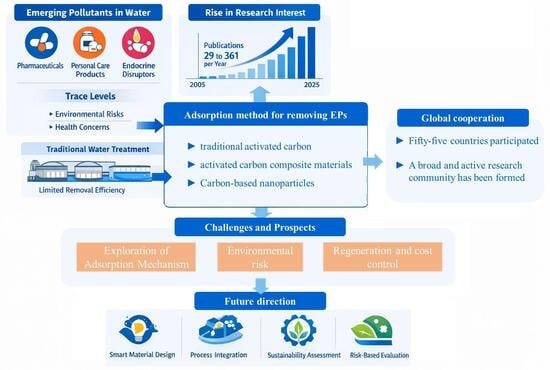
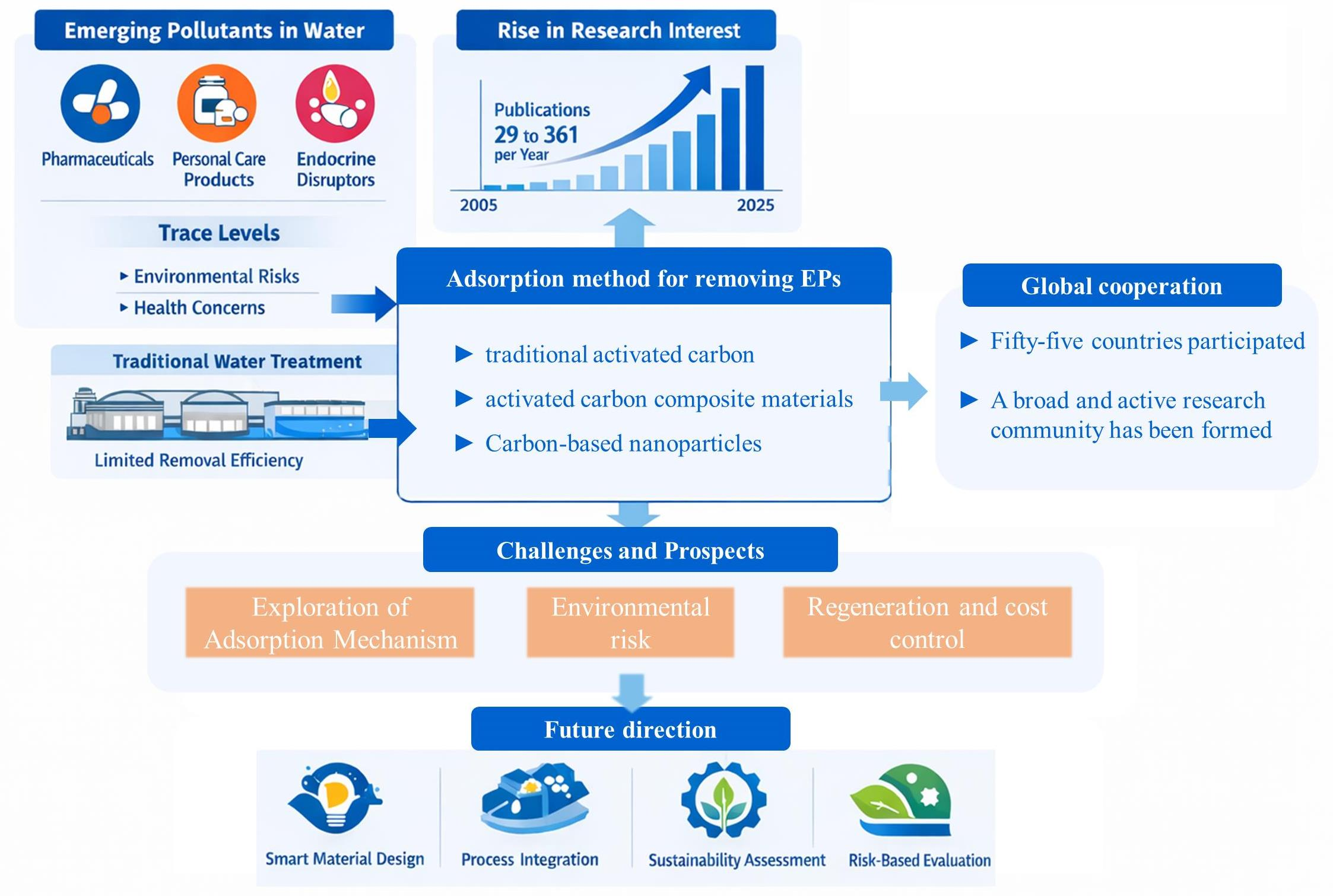
Graphical Abstract

1. Introduction

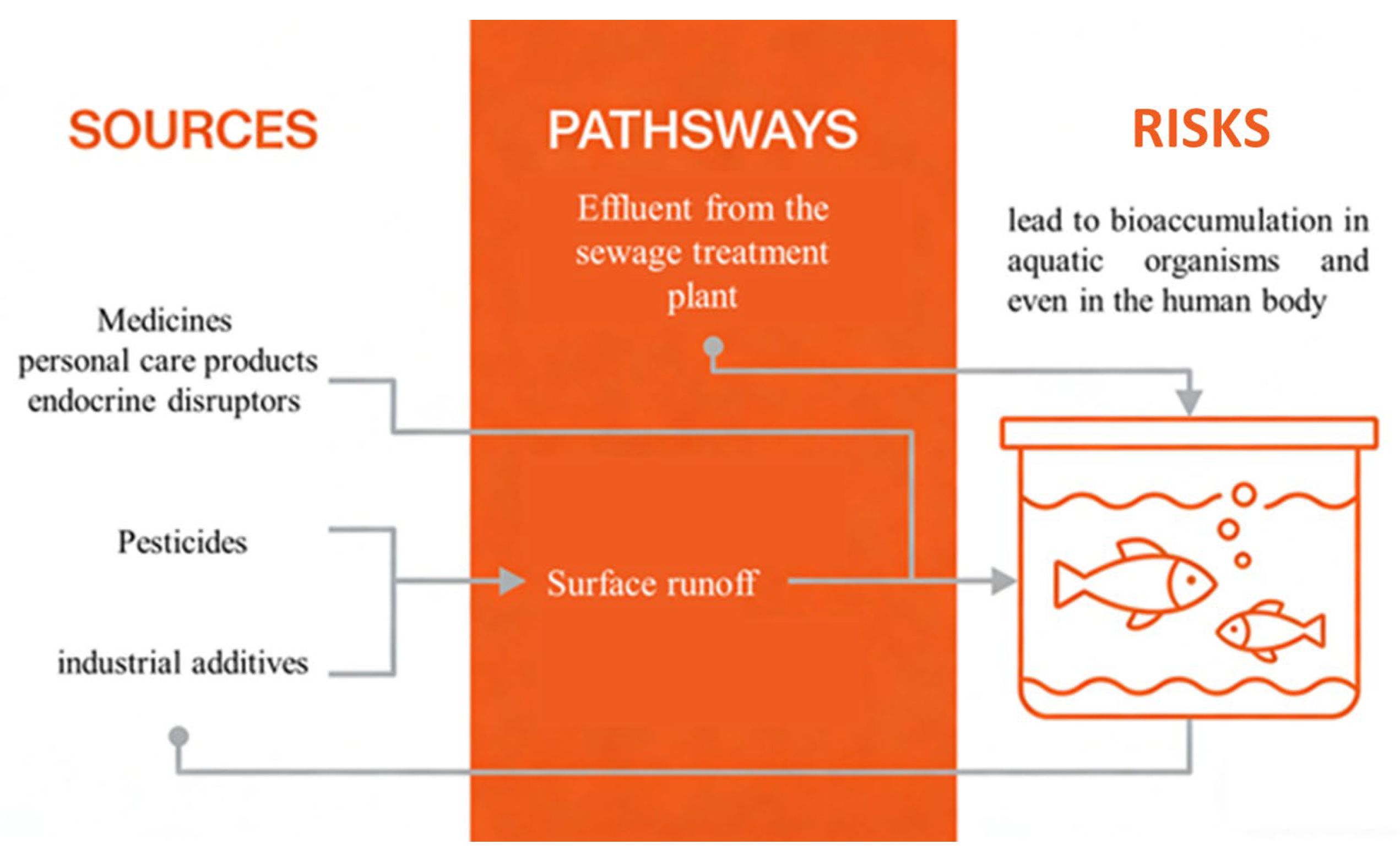
Water quality security is a fundamental pillar supporting ecosystem integrity and sustainable human development. Traditionally, water quality research and management have focused primarily on nutrients, microorganisms, heavy metals, and a limited number of priority pollutants. However, with the rapid advancement of analytical and detection technologies, a wide array of previously unidentified or insufficiently monitored organic compounds has been increasingly detected in diverse aquatic environments, typically at concentrations ranging from nanograms to micrograms per liter [1,2,3]. These substances are collectively referred to as emerging pollutants (EPs), broadly defined as chemicals that are ubiquitous in the environment, have historically escaped routine monitoring, and are known or suspected to exert adverse effects on organisms and ecosystems [4,5]. EPs originate from diverse sources, including pharmaceuticals and personal care products, endocrine-disrupting compounds, pesticides, and industrial additives [6,7,8,9]. They continuously enter aquatic systems through wastewater treatment plant effluents, agricultural runoff, and other pathways. Because conventional natural attenuation processes and standard treatment technologies are often ineffective at removing these compounds, some EPs can bioaccumulate in aquatic organisms and even in humans, posing potential long-term ecological and health risks [10,11] (Figure 1). If existing treatment processes fail to sufficiently reduce trace-level EPs, these biologically active chemicals may give rise to so-called “pseudo-persistent” exposure during water circulation and undergo bioaccumulation and biomagnification along food webs, ultimately leading to unpredictable long-term ecological consequences and public health concerns [12].
Among the various advanced water treatment and purification technologies, adsorption has attracted considerable attention due to its conceptual simplicity, operational flexibility, relatively low energy demand, and strong potential for removing organic contaminants [13]. Carbon-based porous adsorbents, particularly AC, have long played a central role in drinking water treatment, odor control, and industrial wastewater purification owing to their high specific surface area, well-developed pore structure (dominated by micropores with contributions from meso- and macropores), and abundant surface functional groups such as carboxyl, hydroxyl, and carbonyl moieties [14,15]. The removal of organic contaminants by AC is primarily governed by hydrophobic interactions, π–π interactions, van der Waals forces, and electrostatic interactions [16,17,18]. Nevertheless, when confronted with the chemical diversity and complexity of EPs, the limitations of conventional AC have become increasingly evident. First, its adsorption affinity toward highly polar or hydrophilic compounds, such as certain antibiotics and artificial sweeteners, is often insufficient. Second, in complex water matrices rich in natural organic matter, strong competitive adsorption can markedly reduce selectivity toward target EPs. Third, regeneration of spent AC is frequently inefficient and costly, and regeneration processes may damage the pore structure, thereby compromising long-term performance [19,20,21]. To overcome these challenges, advances in materials science have injected renewed momentum into adsorption-based technologies. In recent years, research efforts have shifted from the use of pristine AC toward the rational design of composite materials with tailored structures and functionalities. By integrating AC with metal or metal oxide nanoparticles (e.g., iron- or manganese-based oxides to introduce catalytic oxidation or specific binding sites), other carbonaceous materials (such as carbon nanotubes or graphene to enhance mass transfer or construct conductive networks), magnetic components (e.g., Fe3O4 for rapid magnetic separation), or functional polymers, a range of high-performance AC-based composite adsorbents has been developed [22,23,24,25]. These materials not only preserve the intrinsic advantages of AC but also exploit synergistic effects among multiple components, enabling a transition from simple “adsorptive enrichment” toward more advanced functionalities, including “adsorption–catalysis coupling,” “selective capture,” and even “in situ degradation.” As a result, the removal efficiency, kinetics, and environmental adaptability toward EPs are substantially enhanced, representing an important frontier in the field.
Therefore, this work combines bibliometric analysis and information visualization to comprehensively elucidate the research hotspots, frontier developments, and future directions of activated carbon and its composite materials in the adsorption and removal of emerging contaminants from water, with the aim of supporting their further development and real-world application.

2. Materials and Methods

2.1. Data Source

To ensure the comprehensiveness, authority, and validity of the study, the literature was retrieved from the Web of Science Core Collection (WoSCC) online database on 4 May 2025. The WoS database, which has been indexing abstracts since 1991, provides rich and authoritative bibliometric data. The search terms were set as “AC removes EPs from water,” “Carbon composite materials remove EPs from water,” and “Carbon-based materials remove EPs from water,” supplemented with relevant synonyms as topic terms. The search was limited to publications between 2005 and 2025, in English, and restricted to articles as the document type. To ensure relevance, records were manually screened based on titles, abstracts, methods, and results, with unrelated studies excluded. Ultimately, 3071 articles were selected, forming a bibliometric database. The full records and cited references were exported in plain text format for further analysis.

2.2. Statistical Analysis and Visualization

CiteSpace (6.4.3) is a scientometric software developed by Professor Chaomei Chen based on the Java environment. It employs citation analysis, network algorithms, and other techniques to mine, analyze, and visualize information contained in bibliometric data, thereby revealing development trends in a given research field [26]. In this study, the time slicing was set from 2005 to 2025 with a slice length of one year. Node types were selected according to the analysis objectives, and the G-index, Top N, and Top N% thresholds were set at 10, 20, and 50, respectively, while other parameters were left at their default values.
VOSviewer (1.6.19), developed by Leiden University in the Netherlands, is a software tool that visualizes bibliometric data based on distance, where more closely related terms appear closer to the center in the visual display [27]. In this study, VOSviewer was used to construct a co-occurrence network of keywords, providing insights into the current status, hotspots, and research trends within the field.
Bibliometric results were used to map dominant research patterns rather than to define the intrinsic importance of individual topics.

3. Bibliometric Mapping and Research Landscape of Carbon-Based Adsorption for EP Removal

3.1. Temporal Evolution of Publications and Journals (2005–2025)

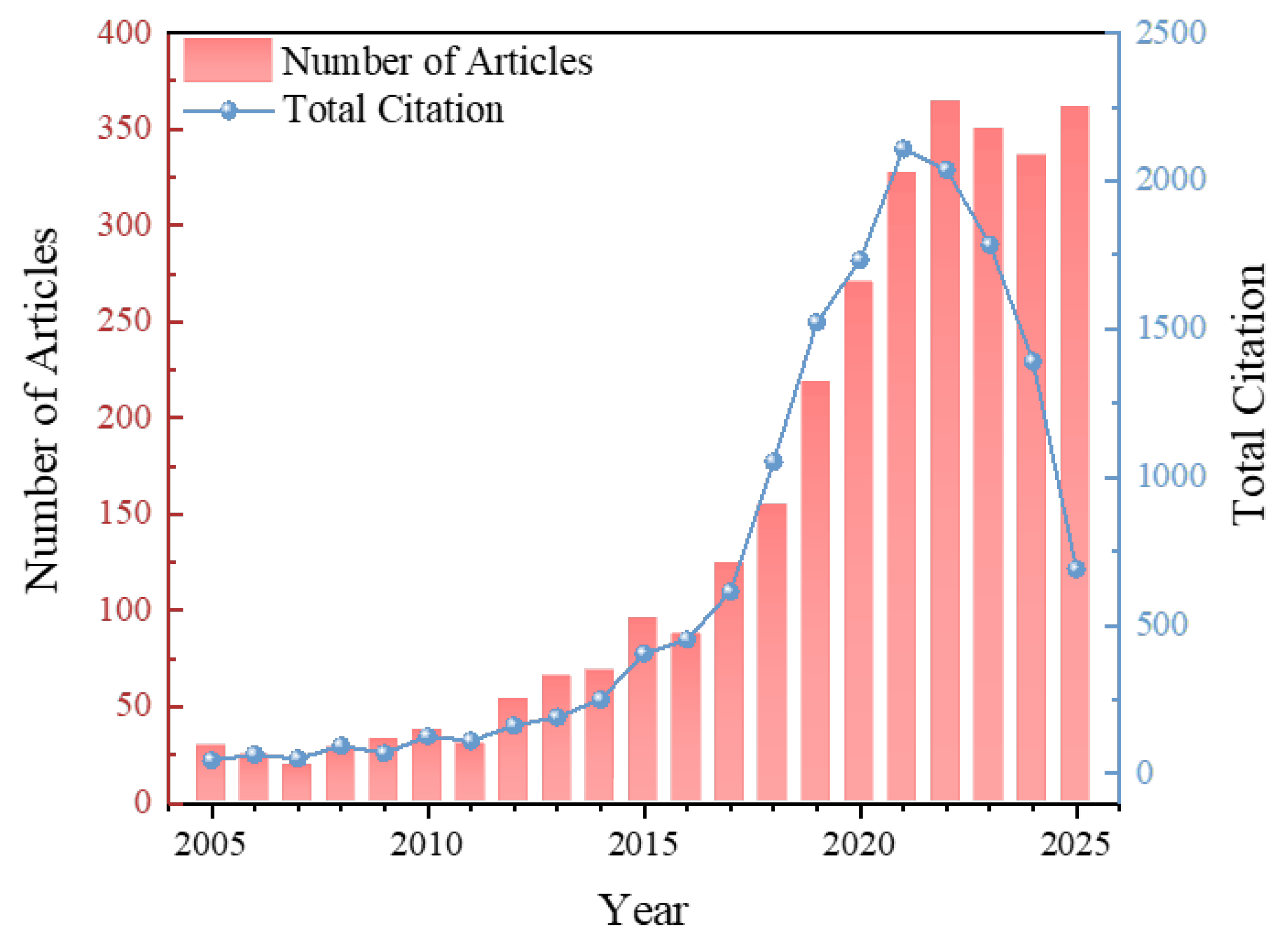
To contextualize the subsequent technical review, a bibliometric analysis was first conducted to map the temporal evolution and disciplinary structure of the field. As shown in Figure 2, the annual publication output from 2005 to 2025 exhibits a pronounced overall increase, rising from 29 to 361 articles, indicating sustained and growing research attention to the use of activated carbon-based materials for the adsorption and removal of emerging contaminants from water. The accelerated growth observed during 2016–2020 coincides with heightened regulatory concern over micropollutants, rapid advances in functional carbon-based materials, and increased publication activity in high-impact environmental journals (Science of the Total Environment, Chemosphere, Water Researd). In contrast, the relatively stable output prior to 2011 reflects an early exploratory phase, while the apparent slowdown after 2021 is likely influenced by database indexing delays and shorter citation windows for recent publications. Overall, the long-term trend underscores the increasing importance of emerging contaminant treatment in response to tightening water quality standards and growing demands for water reuse.
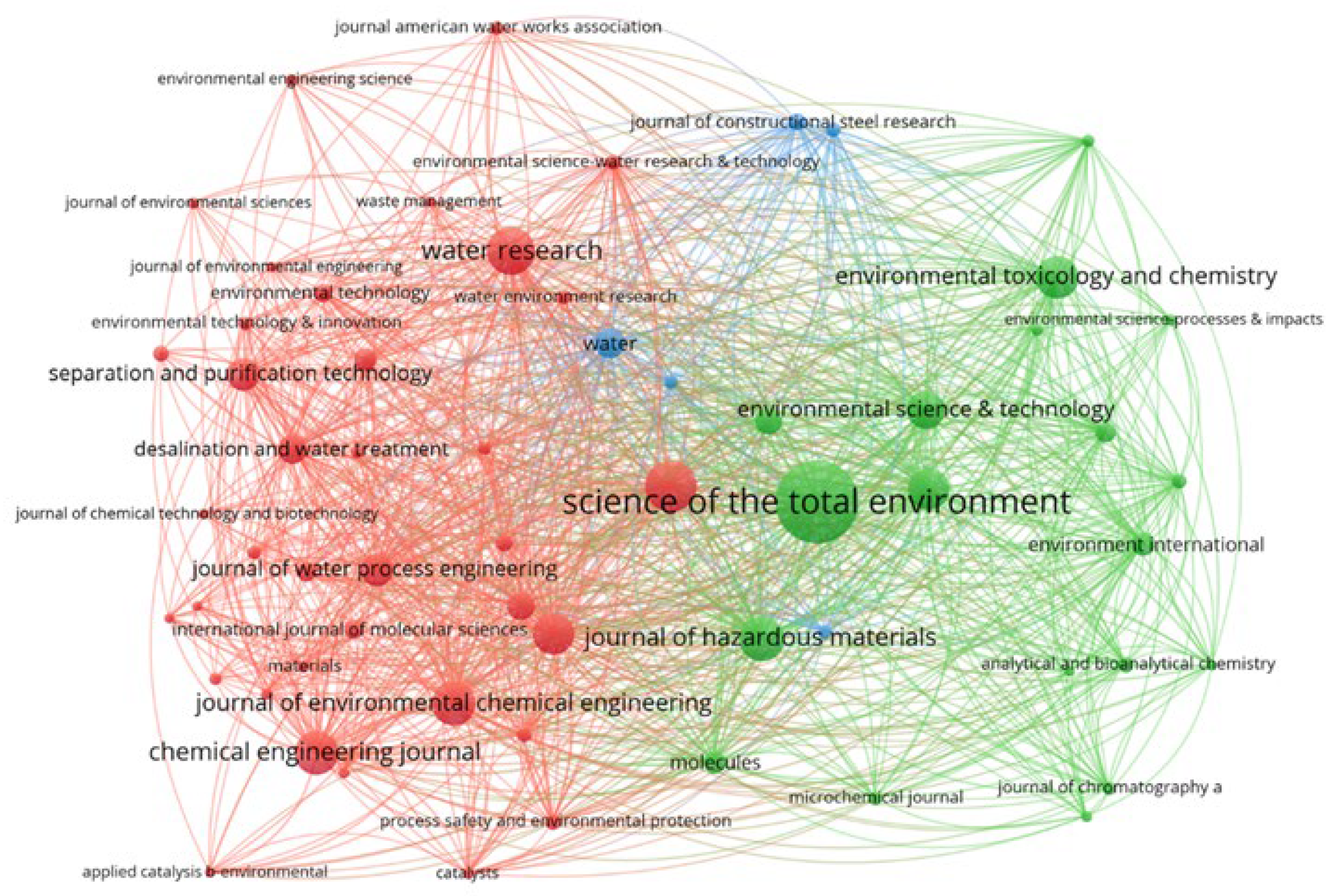
Figure 3 presents the journal coupling network, which reveals the distribution of highly productive and influential journals in this research domain and underscores the existence of a distinctly interdisciplinary knowledge production landscape. The corresponding total link strengths of the top 20 coupled journals are listed in Table 1. Leading comprehensive environmental journals dominate the network, including Science of the Total Environment (292 publications, total link strength (TLS) = 72,419), Chemosphere (134 publications, TLS = 28,861), Environmental Pollution (91 publications, TLS = 18,448), Water Research (121 publications, TLS = 27,076), and Environmental Science & Technology (79 publications, TLS = 16,956). This dominance indicates that the core motivation of this research field lies in addressing environmental challenges, with material development and engineering applications ultimately aimed at understanding contaminant behavior, assessing environmental risks, and achieving effective water purification. The strong presence of Chemical Engineering Journal (103 publications, TLS = 18,944) and Journal of Hazardous Materials (106 publications, TLS = 25,015) further suggests that the research has progressed beyond laboratory-scale observations toward process engineering and risk control. These journals emphasize adsorption and catalytic kinetics, thermodynamics, reactor design, scalable material synthesis, and techno-economic assessment, thereby serving as critical bridges between materials science and practical implementation. In addition, the appearance of journals such as ACS Applied Materials & Interfaces and Colloids and Surfaces A reflects an increasing focus on molecular- and interface-level investigations, including functional material design, surface modification, structure–performance relationships, and mechanistic elucidation of interfacial processes such as adsorption and catalysis. Such fundamental insights provide the theoretical and material basis for achieving high removal efficiency. Meanwhile, the active contribution of application-oriented journals, including Journal of Environmental Chemical Engineering (100 publications, TLS = 20,905), Desalination (18 publications, TLS = 771), Separation and Purification Technology (64 publications, TLS = 6753), and Journal of Water Process Engineering (64 publications, TLS = 10,781), highlights a strong translational emphasis on integrating carbon-based materials into practical water treatment units or process trains.
This deep level of disciplinary integration represents a key driving force enabling the field to continuously generate high-quality research and to rapidly advance toward real-world applications. Looking ahead, further convergence with data science and artificial intelligence is expected to enable more intelligent material design and more optimized treatment processes.

3.2. International Collaboration Patterns and Research Networks

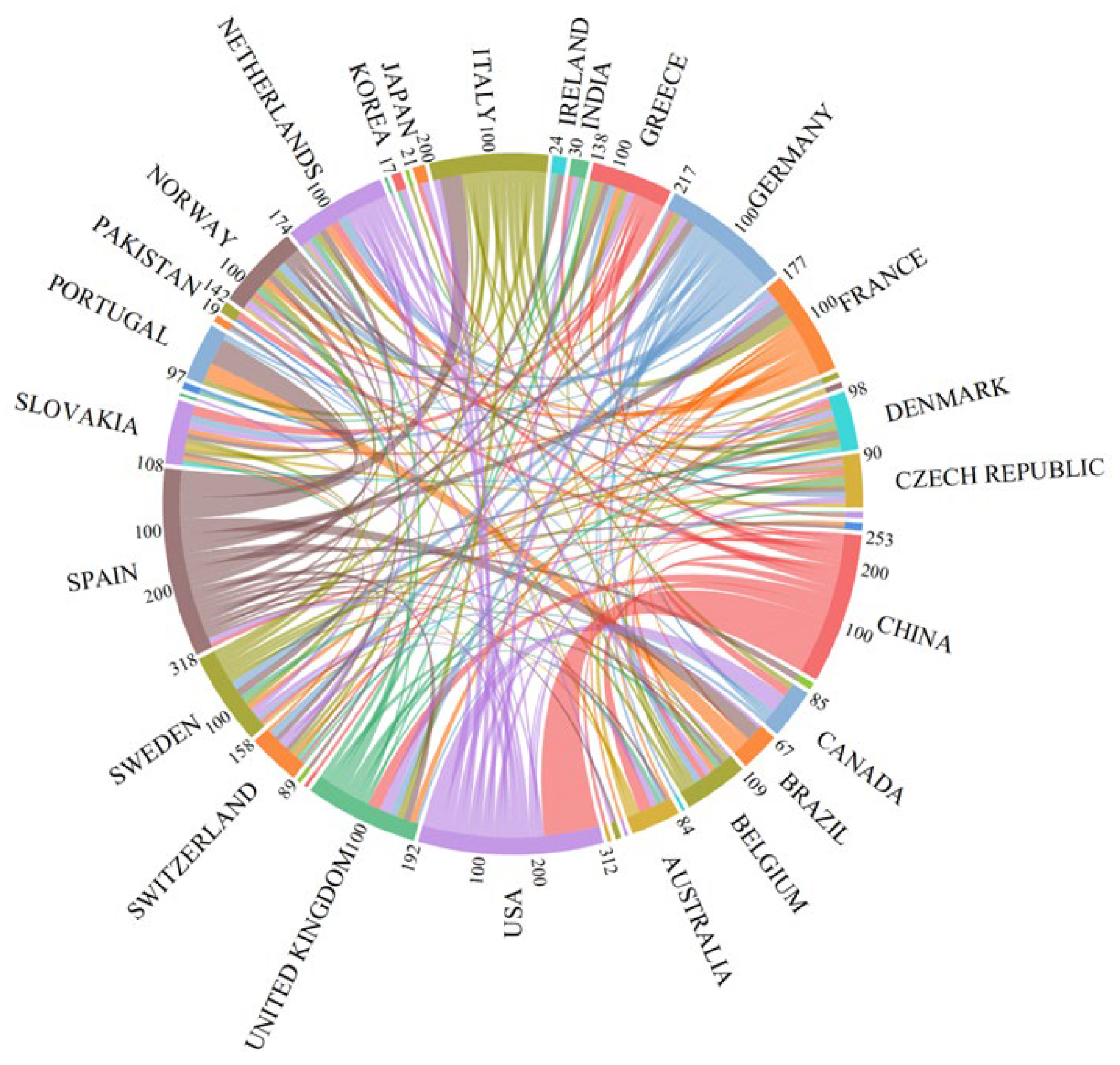
As shown in Figure 4, international collaboration in this field exhibits a clear hierarchical structure, with a China–United States core, a densely interconnected European network, and supplementary contributions from other regions. China–US collaboration (98 occurrences) far exceeds that of any other country pair, indicating that these two countries function as the primary hubs of knowledge production and exchange. This exceptionally strong linkage can be attributed to several interrelated factors. Over recent decades, extensive academic mobility of Chinese scholars to the United States for graduate education, postdoctoral training, and visiting research has fostered shared research paradigms, a common scientific language, and durable professional networks. These networks facilitate joint projects, personnel exchange, and co-supervision. Moreover, the dominance of English in scientific communication and the central role of the United States in high-impact publishing create a strong collaborative pull. For Chinese researchers aiming to disseminate their findings in leading international journals, collaboration with US counterparts offers advantages not only in accessing cutting-edge research perspectives but also in aligning research design, argumentation, and presentation with prevailing international standards. Furthermore, many national and international funding agencies, including the National Natural Science Foundation of China and the US National Science Foundation, explicitly encourage or support international collaboration through dedicated programs and bilateral funding schemes. Such mechanisms provide direct resources that further reinforce collaborative ties between Chinese and US research teams.
China is among the most highly connected nodes in the collaboration network, maintaining frequent partnerships with a wide range of countries, including the United States, the United Kingdom, Australia, Canada, the Netherlands, Belgium, Germany, Japan, and Pakistan. This extensive connectivity highlights China’s strong capacity for international research outreach and integration. The United States, while similarly central, exhibits a more diversified and balanced collaboration profile, with stable connections spanning Europe (e.g., Germany, France, Italy, the Netherlands, and Sweden), North America (Canada), and Asia (China, Japan, South Korea, and India).
European countries form an exceptionally dense internal collaboration network, reflecting the integrated nature of research under the European Union framework. High-intensity collaborations are observed among Germany, France, the Netherlands, the United Kingdom, Sweden, Norway, Belgium, Greece, the Czech Republic, Slovakia, and Switzerland, with collaboration frequencies typically ranging from 5 to 18. Germany, in particular, collaborates extensively with nearly all major European countries and functions as a central node within the European subnetwork. Several bilateral partnerships stand out, including France–Italy (21 instances), Spain–Italy (39 instances), and Spain–Portugal (47 instances), which may be facilitated by geographical proximity, shared cultural or linguistic backgrounds, or targeted joint research programs. Notably, the relatively high collaboration frequency between Greece and Slovakia (18 instances) suggests the presence of an active research consortium or a focused collaborative initiative.
Beyond these core regions, additional collaboration patterns further enrich the global network. Strong ties between Brazil and Portugal (29 instances), Spain and Brazil (27 instances), and Spain and Chile or Colombia highlight the role of shared linguistic and cultural communities in shaping scientific cooperation. Australia demonstrates extensive international engagement with partners such as China, the United States, the United Kingdom, France, and Germany, underscoring its role as a key research hub in the Asia–Pacific region. Meanwhile, collaborations between Saudi Arabia and Pakistan (6 instances), as well as between India and Saudi Arabia (6 instances), reflect region-specific research linkages across the Islamic world and South Asia.

3.3. Keyword Co-Occurrence and Thematic Clusters

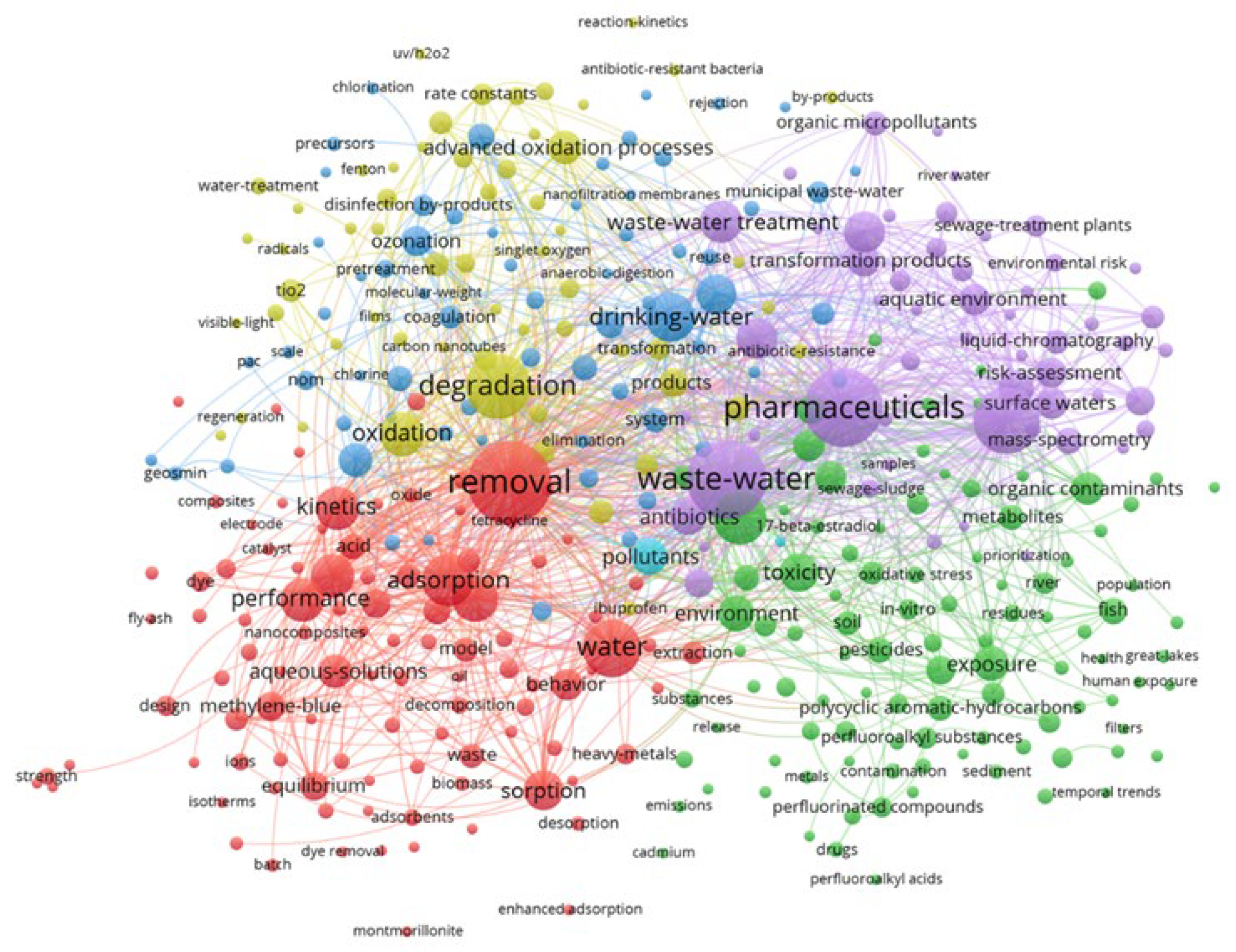
The most frequently occurring keywords directly reflect the fundamental objectives of this research field (Figure 5), namely “removal” (591 occurrences) and “degradation” (356 occurrences). These terms also exhibit the highest total link strengths (3171 and 2007, respectively), indicating that most studies are strongly interconnected around these core goals across diverse technologies, contaminants, and treatment processes. As the dominant removal strategy, “adsorption” (227 occurrences) and “sorption” (139 occurrences) appear with high frequency, confirming the central role of adsorption-based technologies. Within this category, AC—including powdered and granular forms—constitutes the unequivocal research focus, with its exceptionally high total link strength highlighting its role as a key hub linking target contaminants, water matrices, and performance evaluation metrics.
Keyword analysis further reveals that research efforts concentrate on several major classes of EPs characterized by high detection frequencies and significant environmental risks. Pharmaceuticals and personal care products represent the most intensively studied category, with “pharmaceuticals” (523 occurrences) and “personal care products” (374 occurrences) showing strong network connectivity [28,29]. Specific compounds such as antibiotics (110 occurrences), carbamazepine (50 occurrences), and diclofenac (41 occurrences) are widely employed as model contaminants in adsorption and removal studies [30,31,32]. Endocrine-disrupting compounds form another prominent cluster, with bisphenol A (86 occurrences) emerging as a representative target pollutant [33,34]. In addition, keywords related to perfluoroalkyl substances (40 occurrences), pesticides (54 occurrences), and illicit drugs (45 occurrences) indicate increasing concern over persistent and recalcitrant pollutants in aquatic environments [35,36,37].
Keywords associated with performance enhancement highlight several major research directions. Beyond the dominance of AC, the frequent occurrence of “nanoparticles” (73 occurrences), “carbon” (67 occurrences), and “composite” (33 occurrences) reflects growing interest in nanostructured carbon materials and composite systems that combine AC with complementary materials, such as metal oxides or carbon nanomaterials, to achieve synergistic effects and enhanced removal efficiency [25,38,39]. Performance evaluation-related keywords, including “kinetics” (161 occurrences), “equilibrium” (74 occurrences), “isotherm” (15 occurrences), and “capacity” (22 occurrences), indicate that quantitative description and standardized assessment of adsorption processes remain central research components [40,41]. Meanwhile, the presence of “competitive adsorption” (22 occurrences) and “mechanism” (51 occurrences) suggests increasing attention to realistic adsorption behavior in complex water matrices and to underlying interaction mechanisms, such as π–π interactions, electrostatic forces, and hydrogen bonding [42,43]. The frequent appearance of “behavior” (86 occurrences) further reflects efforts to capture the dynamic fate of contaminants in environmental and treatment systems [44].
Beyond contaminant removal alone, the research scope has expanded to encompass the environmental behavior and risk implications of EPs. Keywords such as “transformation” (41 occurrences) and “transformation products” (94 occurrences) indicate growing attention to contaminant structural changes during treatment and in environmental media [45,46]. The co-occurrence of “exposure” (108 occurrences), “toxicity” (132 occurrences), and “risk assessment” (80 occurrences) highlights an increasing emphasis on evaluating whether treatment technologies effectively reduce overall environmental and public health risks [47,48,49]. High frequencies of “wastewater” (538 occurrences), “drinking water” (206 occurrences), and “treatment plants” (147 occurrences) further emphasize the strong application orientation of this field, particularly toward municipal wastewater and drinking water treatment facilities [50,51,52]. Finally, the frequent appearance of analytical keywords—including “identification” (87 occurrences), “mass spectrometry” (59 occurrences), and “liquid chromatography” (49 occurrences)—underscores the indispensable role of high-resolution analytical techniques in enabling the detection and characterization of trace-level EPs, which form the technical foundation of this research field [53].

4. Activated Carbon-Based Materials for EP Removal: Performance and Mechanisms

4.1. Removal of Emerging Pollutants by Conventional Activated Carbon

Traditional AC refers to carbonaceous adsorbents, the removal performance of which is governed primarily by intrinsic pore structure and surface chemistry, without the intentional incorporation of secondary functional phases [54,55]. Owing to their high specific surface area, abundant microporosity, and relatively low cost, conventional AC materials remain the most widely applied adsorbents for the removal of EPs in drinking water and wastewater treatment [56].
A substantial body of research demonstrates that high-performance AC can be produced from low-cost and abundant biomass-derived wastes, providing an effective strategy for contaminant removal while simultaneously valorizing agricultural residues. Biomass-derived ACs prepared from macadamia nutshells, lignin, olive pomace, sugarcane bagasse, cassava peels, orange peels, and woody biomass typically exhibit surface areas ranging from several hundred to approximately 1000 m2 g−1 [57,58,59,60,61,62]. These materials display strong adsorption affinities toward pharmaceuticals and personal care products, with reported adsorption capacities for representative compounds—such as carbamazepine, diclofenac, caffeine, acetaminophen, ciprofloxacin, and amoxicillin—spanning from tens to several hundred milligrams per gram, depending on pore size distribution, surface functional groups, and operating conditions.
Marcela Andrea Espina de Franco et al. [63] employed activated carbon as an adsorbent in a fixed-bed column for diclofenac adsorption experiments. The results indicated that within the fixed-bed column, a higher initial concentration and a lower flow rate prolonged the breakthrough time, whereas the amount of adsorbent used showed no significant influence. The ratio of adsorption capacity to feed quantity increased with both higher initial concentration and flow rate but decreased with a greater amount of activated carbon. These findings suggest that the adsorption process is more efficient under such conditions.
On the other hand, concerning actual wastewater, A.B. Hernández-Abreu et al. [64] investigated the effect of different aqueous matrices—such as hospital wastewater, wastewater treatment plant effluent, and river water—on the removal efficiency of bisphenol A (BPA) using various carbonaceous materials, including synthetic carbon gel (RFX), chemically activated carbon derived from Eucalyptus globulus lignin (KLP), and commercial activated carbon (F400). Their adsorption tests revealed significant competition for active sites between the target compound (BPA) and the natural organic matter (NOM) present in the matrices, leading to a marked reduction in the adsorption removal efficiency of BPA.
Collectively, these studies highlight the critical role of precursor selection and activation strategy in governing adsorption performance [65]. Conventional AC generally exhibits high removal efficiency for hydrophobic and aromatic contaminants through pore filling and π–π interactions. However, its adsorption affinity toward highly polar or hydrophilic compounds is often limited, and performance can be significantly reduced in complex water matrices containing natural organic matter. In addition, repeated regeneration may gradually deteriorate pore structure and adsorption capacity. These inherent limitations provide the primary motivation for developing modified and composite AC materials, as discussed below.

4.2. Functionalized and Composite Activated Carbon Materials

To overcome the intrinsic limitations of traditional AC, extensive research efforts have focused on the development of AC composites and functionalized materials, in which AC is combined with additional components or deliberately modified to introduce new functionalities. These strategies aim to enhance adsorption capacity, improve selectivity, facilitate regeneration, or enable coupled adsorption–degradation processes.
One major class of AC composites involves the incorporation of metal or metal oxide nanoparticles, such as Nb2O5, TiO2, tungsten-containing oxides, and iron oxides, onto AC surfaces. These materials often exhibit synergistic effects arising from the coexistence of adsorption and catalytic or photocatalytic functions, enabling partial degradation of contaminants or in situ regeneration of adsorption sites. For example, Leandro G. Gutierrez et al. [66] synthesized Nb2O5 nanoparticle-decorated AC derived from waste polyethylene terephthalate (PET) bottles via K2CO3 chemical activation, yielding a micro-mesoporous carbon with a high BET surface area of 989 m2 g−1. The resulting catalyst exhibited significantly enhanced activity, achieving approximately 60% removal of phenol, tetracycline, and ciprofloxacin in batch reactor tests when loaded with 10 wt% Nb; Velma Beri Kimbi Yaah et al. [67] synthesized TiO2- and W-containing carbon-based composites from palm kernel shells via hydrothermal carbonization and activation under N2 at 400 °C. Under UV-B irradiation, the composites achieved up to 74% diclofenac removal and demonstrated complete recovery of adsorption capacity after photocatalytic regeneration, indicating their potential for self-regenerating water treatment materials. Aswin Kumar Ilango et al. [68] employed AZFC, the activated derivative of ZIF-8, to remove a mixture of 11 PFAS (each at 10 µg/L in ultrapure water). The material achieved removal efficiencies of 85–99% for most PFAS compounds. Moreover, in addition to its high adsorption capacity and tolerance to complex water matrices, AZFC could be regenerated and reused for at least four cycles.
Magnetic AC composites further offer practical advantages by allowing rapid separation and recovery from treated water via external magnetic fields. F.C. Urruchua et al. [69] produced magnetized AC from yerba mate waste through iron oxide nucleation. The resulting magnetic composites exhibited higher adsorption efficiencies than pristine AC due to increased surface area and modified surface properties, while their magnetic behavior enabled facile recovery via magnetic separation, offering practical advantages for water treatment applications.
Another important modification strategy involves heteroatom doping and surface functionalization. Nitrogen-doped ACs, enzyme-immobilized ACs, and chemically functionalized mesoporous ACs have demonstrated enhanced adsorption performance toward specific pharmaceuticals through strengthened electrostatic interactions, hydrogen bonding, or biocatalytic transformation. For example, Yupawan Maneewong et al. [70] investigated nitrogen-doped coconut shell-based AC prepared via carbonization, CO2 activation, and subsequent modification with urea and KOH. The nitrogen-doped AC exhibited the highest surface area (538 m2 g−1) and acetaminophen adsorption capacity (up to 357.1 mg g−1). Although nitrogen doping led to greater capacity loss after regeneration, cost analysis revealed that the nitrogen-doped AC provided the lowest cost per unit mass of acetaminophen removed, underscoring its economic competitiveness; Jeniffer Blair-González et al. [71] developed a sustainable catalytic system for the removal of oxytetracycline by immobilizing enzymes onto functionalized mesoporous AC. The AC surface was modified using hydrochloric acid, glutaraldehyde, or carbodiimide to obtain different enzyme carriers, among which AC-HCl exhibited the best performance. The optimized biocatalyst achieved a specific activity of 168 ± 52 U g−1 and a protein loading capacity of 13.48 ± 0.90 mg g−1, enabling complete (100%) antibiotic removal, outperforming free enzymes. Although these approaches can substantially improve removal efficiency and selectivity, they may also introduce trade-offs related to increased synthesis complexity, higher material costs, reduced regeneration stability, and potential secondary environmental risks.
Overall, AC-based composites represent a clear transition from single-mechanism adsorption toward multifunctional materials designed for complex and realistic water treatment scenarios. Nevertheless, large-scale implementation remains constrained by economic feasibility, synthesis scalability, and long-term environmental safety, underscoring the need for balanced and application-oriented material design.

4.3. Carbon-Based Nanostructured Materials Beyond Conventional AC

Beyond AC and its composites, a distinct research stream has emerged focusing on carbon-based nanomaterials, the removal performance of which is governed primarily by nanoscale structure rather than conventional AC porosity. These materials include carbon nanofibers (CNFs), AC nanofibers (ACNFs), and other nanostructured carbon architectures.
Carbon nanofibers typically exhibit one-dimensional morphologies with high surface area, excellent chemical and thermal stability, and tunable surface chemistry [72]. Functionalization with metal oxides or other active phases can further enhance their adsorption performance toward antibiotics and other pharmaceutical contaminants. ACNFs produced via electrospinning and subsequent activation combine the advantages of nanoscale fiber networks and developed porosity, often exhibiting rapid adsorption kinetics and high adsorption capacities for representative contaminants such as bisphenol A [73]. Chaba and Nomngongo [74] investigated V2O5–ZnO-coated CNFs for the adsorption of the antibiotics cinoxacin and ciprofloxacin. Using a Box–Behnken design combined with response surface methodology, key operational parameters—including adsorbent dosage, initial pH, and contact time—were optimized. The maximum adsorption capacities were approximately 71 mg g−1 for cinoxacin and 88 mg g−1 for ciprofloxacin. Under optimized conditions, ZnO-coated CNFs exhibited high adsorption efficiency and applicability.
Compared to traditional granular or powdered activated carbon, carbon-based nanomaterials generally possess superior mass transfer properties and highly controllable surface characteristics. However, their practical application is currently limited by high production costs and challenges in large-scale fabrication. Nonetheless, some researchers [75] have studied the use of two potassium-based alkaline compounds, KOH and K2CO3, as catalysts for the pyrolysis of bituminous coal to directly synthesize carbon nanotubes (CNTs), with the final product being a mixture of activated carbon and CNTs. This method fundamentally transforms the composition of traditional coal-based activated carbon and offers a new pathway for the cost-effective, large-scale production of high-value CNTs. Therefore, these materials are generally regarded as promising candidates for niche or high-value-added applications rather than as immediate substitutes for traditional activated carbon in large-scale water treatment systems.

4.4. Comparative Perspective on Carbon-Based Adsorption Systems

Overall, the studies reviewed in this section reveal clear performance trade-offs among different carbon-based adsorption systems (Table 2). Conventional activated carbon remains the most mature and practically viable option, owing to its well-established adsorption performance, proven regeneration strategies, and demonstrated scalability in large-scale water treatment applications [21,56,64]. Its main limitation lies in the reduced adsorption efficiency observed for certain emerging contaminants under competitive adsorption conditions or in complex water matrices [76].
Functionalized and composite activated carbons generally exhibit enhanced adsorption capacity and selectivity as a result of tailored surface chemistry, increased numbers of active sites, or synergistic effects introduced by functional components [77]. However, these performance gains are often accompanied by increased material complexity, higher production costs, and uncertainties regarding long-term stability and regenerability, which may constrain their deployment at scale.
By contrast, carbon-based nanostructured materials and highly engineered carbon composites represent a research frontier at the laboratory scale, showing exceptional adsorption kinetics and tunable interactions with specific target pollutants [78]. Despite these advantages, their practical applicability is still limited by challenges related to scalable synthesis, material recovery, potential environmental risks, and insufficient evaluation under realistic operating conditions.
In purely adsorptive systems, emerging contaminants are removed primarily through physical and chemical interactions with carbon surfaces, resulting in pollutant retention rather than degradation. Such systems are characterized by operational simplicity, high controllability, and relatively low environmental risk, which explains their widespread use in drinking water treatment and advanced purification processes. In contrast, catalytic adsorption systems integrate adsorption with chemical transformation, in which carbon materials serve not only as adsorbents but also as catalyst supports or reaction promoters. In these systems, adsorption concentrates contaminants near reactive sites, thereby enhancing catalytic degradation. For example, Leandro G. Gutierrez et al. [66] reported that micro-mesoporous activated carbon modified with Nb2O5 nanoparticles increased the removal efficiencies of tetracycline and ciprofloxacin by 36% and 23.6%, respectively, while similar enhancements have been observed in other catalyst-loaded activated carbon systems [69]. Nevertheless, the introduction of catalytic components also increases the risks of metal leaching, secondary pollution, and potential ecotoxicological impacts, particularly under long-term operation or variable water quality conditions [79]. Consequently, performance improvements achieved through catalytic pathways must be carefully weighed against the associated environmental and operational risks.

5. Discussion

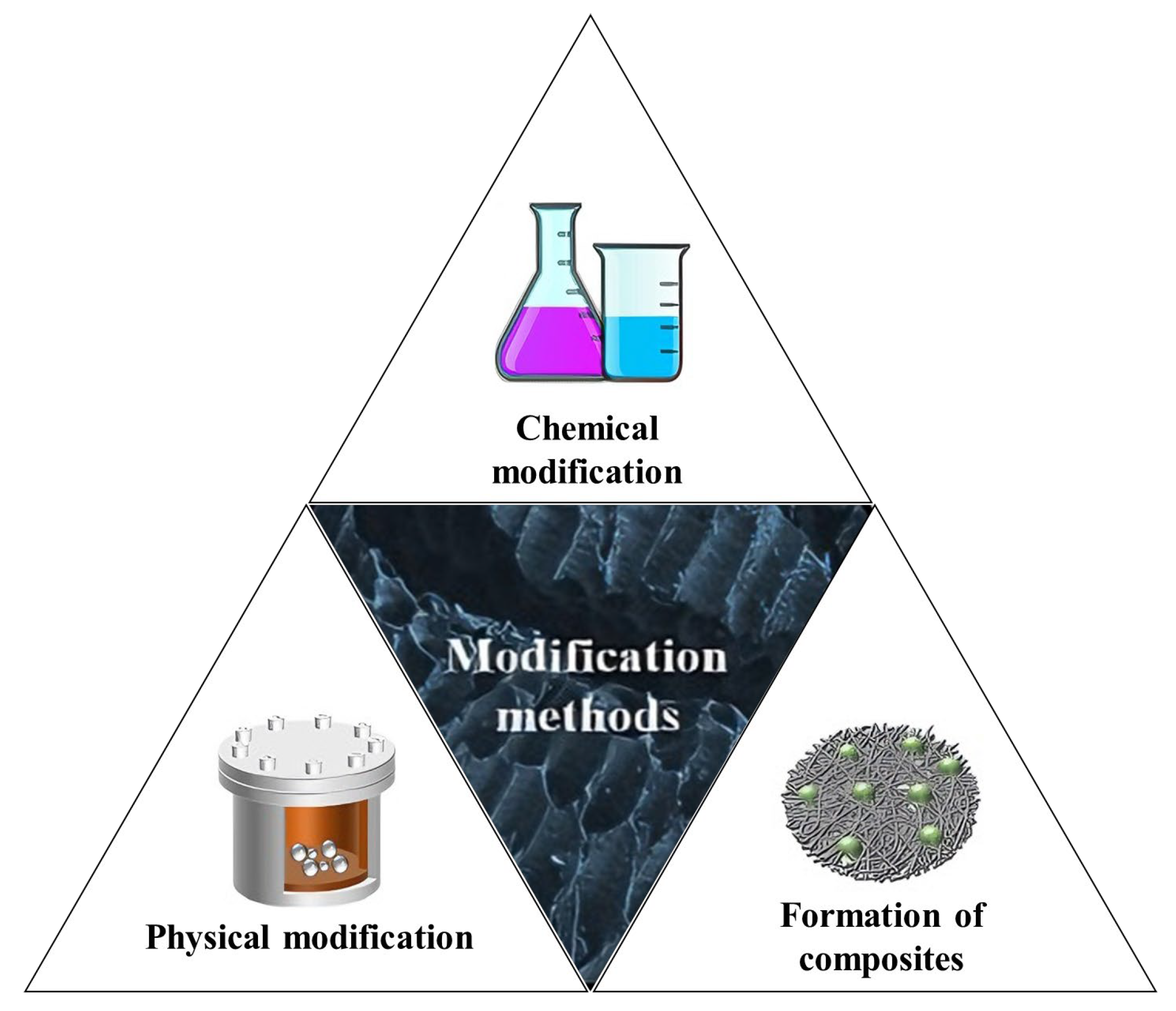
In recent decades, various AC-based adsorbents and their composites have been modified or engineered to achieve high-efficiency removal of environmental contaminants, particularly EPs (Figure 6). Despite substantial progress in this field, fully addressing the challenges posed by EPs requires further research efforts. This section provides an overview of the challenges and prospects associated with the removal of EPs using AC and its composites and highlights key perspectives for future development.

5.1. Cost, Regeneration, and Practical Feasibility

One of the key factors contributing to the widespread use of AC is its low cost (Table 3). Although the raw materials for AC production vary widely, most are derived from solid waste or agricultural residues, making the production process a form of waste valorization and pollutant recycling [80,81]. However, various modification strategies have been employed to enhance the adsorption performance of AC, often involving diverse reagents and treatments, which can result in significant cost differences among modified AC materials. In some cases, expensive modifications may not achieve the desired pollutant removal efficiency. Moreover, certain modification methods can generate harmful by-products or secondary pollution, and the associated control costs should also be taken into consideration [82].
Regeneration capacity is another critical criterion for evaluating the practical applicability of AC materials. Desorption methods, such as chemical treatment, can restore the adsorption performance of used materials. Numerous studies have assessed the regeneration potential of AC, and most modified ACs maintain satisfactory adsorption performance over 3–5 regeneration cycles [83]. The combination of high adsorption efficiency and good regenerability renders modified ACs highly promising for various environmental applications. For practical implementation, it is recommended that future studies evaluate AC regeneration over extended periods (e.g., several months) and under diverse operational conditions, including temperature, coexisting pollutants, and hydraulic regimes.

5.2. Adsorption Mechanisms Under Realistic Water Matrices

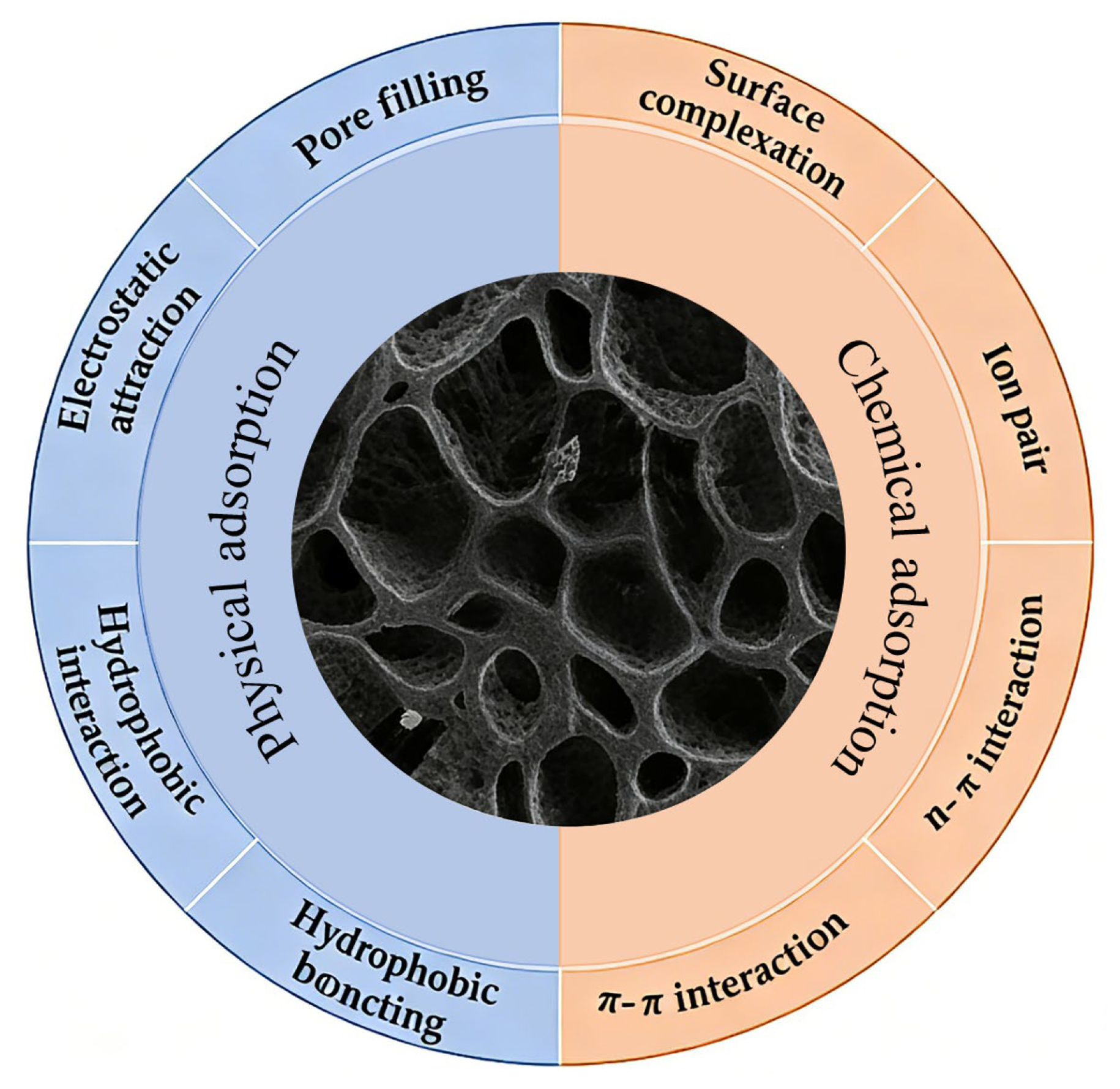
The adsorption behavior of EPs on AC and its composites is closely associated with their surface characteristics, including specific surface area, surface charge, functional groups, pore volume, and pore size distribution [84]. The adsorption mechanisms of EPs largely depend on the physicochemical properties of AC, such as surface area, functional groups, and the intrinsic properties of the carbon precursor. Modified ACs can exhibit both physical adsorption and chemical adsorption during the removal process, yet the dominant adsorption mechanism may vary depending on the specific pollutant. Generally, strong electron donor–acceptor interactions occur between π-electron-donor aromatic rings on the AC surface and π-protonated adsorbates. In addition, other interactions, including electrostatic interactions, hydrogen bonding, surface complexation, cation exchange, and non-specific van der Waals forces, may also contribute to the overall adsorption process (Figure 7).
π–π interactions, which are weak interactions commonly observed between aromatic rings, play a dominant role in the adsorption of many pollutants on carbon-based materials. Typical contaminants influenced by this mechanism include tetracyclines, ciprofloxacin, sulfonamide antibiotics, endocrine-disrupting compounds, and carbamazepine [85]. Functional groups, defined as specific atoms or groups of atoms that determine the chemical properties of organic molecules, can interact with each other and, in some cases, form hydrogen bonds [86]. Extensive studies have shown that environmental hormones, such as estradiol (E2), ethinylestradiol (EE2), bisphenol A (BPA), and nonylphenol, are particularly sensitive to adsorption mediated by functional group interactions.
Therefore, a comprehensive understanding of the adsorption mechanisms can guide the targeted enhancement of AC and its composites, enabling more efficient and effective removal of EPs from environmental matrices in future applications.

5.3. Environmental Risks and Life-Cycle Considerations

When activated carbon and its composites used for the removal of emerging contaminants lose their adsorption capacity after multiple cycles, the management and disposal of spent activated carbon become a new challenge [87]. This issue has been frequently overlooked in many existing studies.
For composite and catalyst-loaded carbon materials, a major concern is component leaching, particularly the release of metal ions or nanoparticles during adsorption, regeneration, or long-term operation. Multiple studies have reported detectable leaching of metal species (e.g., Fe, Cu, Mn, and Ag) from carbon-supported materials [88,89,90]. This phenomenon is especially pronounced under acidic conditions or in complex water matrices containing natural organic matter and competing ions. Such leaching not only compromises the long-term stability and reusability of the absorbents but may also introduce additional contaminants into the treated water, thereby offsetting the intended environmental benefits.
Beyond metal leaching, the release of carbon-based nanoparticles represents another potential pathway for secondary pollution. Nanostructured materials, such as carbon nanotubes and graphene-derived composites, may detach from the supporting matrix under hydraulic shear or during regeneration processes. Once released into the environment, these nanoparticles could constitute a new source of nanomaterial pollution. In addition, many activated carbons have been reported to induce the generation of reactive oxygen species (ROS), which may impart a certain degree of biological toxicity [91]. Although the reported ecotoxicological effects vary widely depending on material properties and exposure conditions, the limited and often inconsistent data underscore the need for cautious and systematic evaluation.
The regeneration and disposal of spent carbon-based adsorbents also raise concerns regarding secondary pollution. Thermal regeneration, chemical washing, or advanced oxidation processes may result in incomplete removal or transformation of adsorbed contaminants, potentially generating unknown by-products or facilitating pollutant re-release [92]. Therefore, in the development of activated carbon and its composites, improving material stability and minimizing environmental risks are as critical as enhancing adsorption performance.

5.4. PFAS as a Critical Yet Underrepresented Class of Emerging Pollutants

Although PFAS-related keywords appear with relatively low frequency in bibliometric analyses compared with pharmaceuticals or personal care products, their environmental relevance and regulatory priority are disproportionately high. In particular, PFAS contamination of drinking water sources has emerged as one of the most critical challenges for adsorption-based treatment technologies worldwide [93]. Therefore, low bibliometric prominence should not be interpreted as limited research need, but rather as an indication of technical complexity and the difficulty of effective removal.
Granular activated carbon (GAC) remains one of the most mature and widely applied technologies for PFAS removal, especially in drinking water and groundwater treatment systems. Full-scale and pilot-scale studies have demonstrated effective adsorption of long-chain PFAS, such as perfluorooctane sulfonate (PFOS) and perfluorooctanoic acid (PFOA), primarily through hydrophobic interactions and electrostatic attraction [94,95]. However, the adsorption efficiency of conventional activated carbon decreases markedly with decreasing PFAS chain length, making short-chain PFAS (e.g., PFBS and PFHxA) particularly challenging to remove [96].
To overcome these limitations, recent research has focused on modified activated carbon and carbon-based composite materials with tailored surface chemistry and pore structure. Strategies such as heteroatom doping, surface functionalization with positively charged groups, and hybridization with ion-exchange or catalytic components have shown potential to enhance PFAS adsorption, especially under competitive conditions [97,98]. Nevertheless, these approaches often increase material complexity and introduce additional uncertainties related to stability, regeneration, and environmental safety.
From a practical perspective, several unresolved challenges hinder the large-scale application of carbon-based PFAS adsorption. Adsorption performance is strongly influenced by real water matrices, where natural organic matter and competing ions can substantially suppress PFAS uptake compared with idealized laboratory conditions [99]. In addition, regeneration of PFAS-saturated activated carbon is energy-intensive and may lead to incomplete desorption or secondary emissions, raising concerns regarding lifecycle sustainability [100]. For composite and catalytic carbon materials, risks associated with catalyst leaching and ecotoxicity further complicate their practical deployment.
Future research should prioritize systematic evaluation of PFAS adsorption under realistic water matrices and continuous-flow column conditions, improved understanding of short-chain PFAS adsorption mechanisms, and regeneration strategies that minimize secondary pollution. Addressing these challenges is essential for translating laboratory-scale advances in carbon-based materials into reliable and sustainable PFAS treatment technologies.

6. Conclusions

Through bibliometric analysis, this review systematically examined the research progress on functionalized carbon-based materials for the removal of EPs from water between 2005 and 2025, revealing a rapidly growing field and a well-established international collaboration network.
The studies indicate that conventional AC, due to its high specific surface area and abundant porous structure, remains the fundamental adsorbent for the removal of EPs. However, its inherent limitations—such as weak adsorption for highly hydrophilic pollutants, low selectivity, and poor regenerability—have driven the innovation of material design. High-performance AC composites, developed through physical activation, chemical modification, or integration with metal oxides, carbon nanomaterials, magnetic components, or functional polymers, have achieved substantial performance improvements. These materials not only enhance adsorption capacity and kinetics but also introduce advanced functionalities, including catalytic degradation, selective recognition, and magnetic recovery, demonstrating a trend from simple “adsorptive enrichment” toward “adsorption–catalysis synergy” and “targeted removal.”
Despite their promising prospects, practical applications of these technologies still face significant challenges. These include cost control in large-scale material production, competitive adsorption in complex water matrices, efficient regeneration and safe disposal of saturated adsorbents, and potential secondary environmental risks associated with nanocomposite materials. Addressing these issues remains critical for the future development and deployment of carbon-based adsorbents in water treatment.

Author Contributions

Conceptualization, H.C. and Q.H.; methodology, H.C.; software, Q.H.; validation, H.C., Y.J., H.H. and C.Z.; formal analysis, Y.J.; investigation, W.Z.; resources, L.C.; data curation, H.C.; writing—original draft preparation, H.C.; writing—review and editing, H.C. and W.Z.; visualization, H.C. and W.Z.; supervision, W.Z.; project administration, W.Z.; funding acquisition, W.Z. All authors have read and agreed to the published version of the manuscript.

Funding

This research was supported by Fangchenggang City Science and Technology Program Project (Fangke AB24002017), Guangxi Science and Technology Program [grant number guikeAB24010091]; Guilin Agricultural Water and Soil Resources and Environment Observation and Research Station of Guangxi, Guilin University of Technology, Guilin, 541006, China; Collaborative Innovation Center for Water Pollution Control and Water Safety in Karst Area, Guilin University of Technology, Guilin, 541006, China; and Guilin Lijiang River Ecology and Environment Observation and Research Station of Guangxi, Guilin University of Technology, Guilin, 541006, China.

Data Availability Statement

No new data were created or analyzed in this study.

Acknowledgments

During the preparation of this manuscript, the authors used DeepSeek, V3.1 for the purpose of refining the English language and expression. The authors have reviewed and edited the output and take full responsibility for the content of this publication.

Conflicts of Interest

The authors declare no conflicts of interest.

References

  1. Zhang, M.; Sun, Y.; Xun, B.; Liu, B. Analysis of the Spatial Distribution Characteristics of Emerging Pollutants in China. Water 2023, 15, 3782. [Google Scholar] [CrossRef]
  2. Schwesig, D.; Borchers, U.; Chancerelle, L.; Dulio, V.; Eriksson, U.; Farré, M.; Goksoyr, A.; Lamoree, M.; Leonards, P.; Wegener, J.-W.; et al. A harmonized European framework for method validation to support research on emerging pollutants. TrAC Trends Anal. Chem. 2011, 30, 1233–1242. [Google Scholar] [CrossRef]
  3. Krishnakumar, S.; Singh, D.S.H.; Godson, P.S.; Thanga, S.G. Emerging pollutants: Impact on environment, management, and challenges. Environ. Sci. Pollut. Res. 2022, 29, 72309–72311. [Google Scholar] [CrossRef] [PubMed]
  4. Zhang, H.R.; Shen, N.; Li, Y.F.; Hu, C.; Yuan, P. Source, transport, and toxicity of emerging contaminants in aquatic environments: A review on recent studies. Environ. Sci. Pollut. Res. 2023, 30, 121420–121437. [Google Scholar] [CrossRef]
  5. Zhao, F.; Liu, Z.Y.; Wu, Y.H.; Wang, J.; Xia, Y.Y.; Cheng, S.Q.; Jiang, X.J.; Zhang, J.; Zou, Z.; Chen, C.Z.; et al. Interactions between gut microbiota and emerging contaminants exposure: New and profound implications for human health. Environ. Res. Commun. 2024, 6, 072001. [Google Scholar] [CrossRef]
  6. Ma, L.P. Understanding the Distribution, Sources and Risks of Antibiotic Resistance Contamination in Drinking Water Systems: Research Needs to Reduce Emerging Pollutants and Mitigate Public Health Risks. Environ. Sci. Technol. Lett. 2025, 12, 248–250. [Google Scholar] [CrossRef]
  7. Priya, A.K.; Gnanasekaran, L.; Rajendran, S.; Qin, J.; Vasseghian, Y. Occurrences and removal of pharmaceutical and personal care products from aquatic systems using advanced treatment—A review. Environ. Res. 2022, 204, 112298. [Google Scholar] [CrossRef]
  8. Bedoya-Ríos, D.F.; Lara-Borrero, J.A.; Duque-Pardo, V.; Madera-Parra, C.A.; Jimenez, E.M.; Toro, A.F. Study of the occurrence and ecosystem danger of selected endocrine disruptors in the urban water cycle of the city of Bogota, Colombia. J. Environ. Sci. Health Part A-Toxic/Hazard. Subst. Environ. Eng. 2018, 53, 317–325. [Google Scholar] [CrossRef]
  9. Meffe, R.; de Bustamante, I. Emerging organic contaminants in surface water and groundwater: A first overview of the situation in Italy. Sci. Total Environ. 2014, 481, 280–295. [Google Scholar] [CrossRef] [PubMed]
  10. Silva, D.C.C.; Marques, J.C.; Gonçalves, A.M.M. Polycyclic aromatic hydrocarbons in commercial marine bivalves: Abundance, main impacts of single and combined exposure and potential impacts for human health. Mar. Pollut. Bull. 2024, 209, 117295. [Google Scholar] [CrossRef]
  11. Impellitteri, F.; Multisanti, C.R.; Rusanova, P.; Piccione, G.; Falco, F.; Faggio, C. Exploring the Impact of Contaminants of Emerging Concern on Fish and Invertebrates Physiology in the Mediterranean Sea. Biology 2023, 12, 767. [Google Scholar] [CrossRef]
  12. Yin, L.C.; Wang, X.L.; Xu, H.; Yin, B.; Wang, X.S.; Zhang, Y.L.; Li, X.Y.; Luo, Y.; Chen, Z.Y. Unrecognized risk of perfluorooctane sulfonate in promoting conjugative transfers of bacterial antibiotic resistance genes. Appl. Environ. Microbiol. 2023, 89, e00533-23. [Google Scholar] [CrossRef]
  13. Baaloudj, O.; Chiron, S.; Zizzamia, A.R.; Trotta, V.; Buono, D.D.; Puglia, D.; Rallini, M.; Brienza, M. Efficient biochar regeneration for a circular economy: Removing emerging contaminants for sustainable water treatment. Colloids Surf. A Physicochem. Eng. Asp. 2025, 705, 135730. [Google Scholar] [CrossRef]
  14. Jeirani, Z.; Niu, C.H.; Soltan, J. Adsorption of emerging pollutants on activated carbon. Rev. Chem. Eng. 2017, 33, 491–522. [Google Scholar] [CrossRef]
  15. Delgado, N.; Capparelli, A.; Navarro, A.; Marino, D. Pharmaceutical emerging pollutants removal from water using powdered activated carbon: Study of kinetics and adsorption equilibrium. J. Environ. Manag. 2019, 236, 301–308. [Google Scholar] [CrossRef] [PubMed]
  16. Wang, Y.Z.; Wu, A.X. π-π interaction in aromatic supramolecular system. Chin. J. Org. Chem. 2008, 28, 997–1011. [Google Scholar]
  17. Peiris, C.; Gunatilake, S.R.; Mlsna, T.E.; Mohan, D.; Vithanage, M. Biochar based removal of antibiotic sulfonamides and tetracyclines in aquatic environments: A critical review. Bioresour. Technol. 2017, 246, 150–159. [Google Scholar] [CrossRef]
  18. Chen, T.W.; Luo, L.; Deng, S.H.; Shi, G.Z.; Zhang, S.R.; Zhang, Y.Z.; Deng, O.P.; Wang, L.L.; Zhang, J.; Wei, L.Y. Sorption of tetracycline on H3PO4 modified biochar derived from rice straw and swine manure. Bioresour. Technol. 2018, 267, 431–437. [Google Scholar] [CrossRef]
  19. Dong, X.W.; He, L.Z.; Hu, H.; Liu, N.; Gao, S.; Piao, Y.X. Removal of 17β-estradiol by using highly adsorptive magnetic biochar nanoparticles from aqueous solution. Chem. Eng. J. 2018, 352, 371–379. [Google Scholar] [CrossRef]
  20. Selmi, T.; Gentil, S.; Fierro, V.; Celzard, A. Key factors in the selection, functionalization and regeneration of activated carbon for the removal of the most common micropollutants in drinking water. J. Environ. Chem. Eng. 2024, 12, 113105. [Google Scholar] [CrossRef]
  21. Wang, Y.K.; Wu, G.; Zhang, Y.W.; Su, Y.H.; Zhang, H.Y. The deactivation mechanisms, regeneration methods and devices of activated carbon in applications. J. Clean. Prod. 2024, 476, 143751. [Google Scholar] [CrossRef]
  22. Santamaría, L.; Korili, S.A.; Gil, A. Solketal Removal from Aqueous Solutions Using Activated Carbon and a Metal-Organic Framework as Adsorbents. Materials 2021, 14, 6852. [Google Scholar] [CrossRef]
  23. Longchar, I.T.; Umdor, R.S.; Sharma, S.; Sinha, D. Synthesis, characterization, and adsorption applications of graphene oxide/activated carbon composites for emerging contaminants in water: A comprehensive review. Inorg. Chem. Commun. 2026, 183, 115856. [Google Scholar] [CrossRef]
  24. Barasarathi, J.; Abdullah, P.S.; Uche, E.C. Application of magnetic carbon nanocomposite from agro-waste for the removal of pollutants from water and wastewater. Chemosphere 2022, 305, 135384. [Google Scholar] [CrossRef]
  25. Nabgan, W.; Jalil, A.A.; Nabgan, B.; Ikram, M.; Ali, M.W.; Kumar, A.; Lakshminarayana, P. A state of the art overview of carbon-based composites applications for detecting and eliminating pharmaceuticals containing wastewater. Chemosphere 2022, 288, 132535. [Google Scholar] [CrossRef]
  26. Chen, C.M.; Ibekwe-SanJuan, F.; Hou, J.H. The Structure and Dynamics of Cocitation Clusters: A Multiple-Perspective Cocitation Analysis. J. Am. Soc. Inf. Sci. Technol. 2010, 61, 1386–1409. [Google Scholar] [CrossRef]
  27. van Eck, N.J.; Waltman, L. Software survey: VOSviewer, a computer program for bibliometric mapping. Scientometrics 2010, 84, 523–538. [Google Scholar] [CrossRef] [PubMed]
  28. Bustos, E.B.; Sandoval-González, A.; Martínez-Sánchez, C. Detection and Treatment of Persistent Pollutants in Water: General Review of Pharmaceutical Products. Chemelectrochem 2022, 9, e202200188. [Google Scholar] [CrossRef]
  29. Gao, C.Z.; Liao, H.L.; Wang, Y.B.; Zheng, Y.; Zheng, C.M.; Qiu, W.H. Research Progress of Ecotoxicology of PPCP Pollutants. Prog. Chem. 2024, 36, 1363–1379. [Google Scholar] [CrossRef]
  30. Priya, S.S.; Radha, K.V. A Review on the Adsorption Studies of Tetracycline onto Various Types of Adsorbents. Chem. Eng. Commun. 2017, 204, 821–839. [Google Scholar] [CrossRef]
  31. Adeyanju, C.A.; Ogunniyi, S.; Selvasembian, R.; Oniye, M.M.; Ajala, O.J.; Adeniyi, A.G.; Igwegbe, C.A.; Ighalo, J.O. Recent Advances on the Aqueous Phase Adsorption of Carbamazepine. ChemBioEng Rev. 2022, 9, 231–247. [Google Scholar] [CrossRef]
  32. Ighalo, J.O.; Adeniyi, A.G. Mitigation of Diclofenac Pollution in Aqueous Media by Adsorption. ChemBioEng Rev. 2020, 7, 50–64. [Google Scholar] [CrossRef]
  33. Ruhí, A.; Acuña, V.; Barceló, D.; Huerta, B.; Mor, J.R.; Rodríguez-Mozaz, S.; Sabater, S. Bioaccumulation and trophic magnification of pharmaceuticals and endocrine disruptors in a Mediterranean river food web. Sci. Total Environ. 2016, 540, 250–259. [Google Scholar] [CrossRef]
  34. Molina-López, A.M.; Bujalance-Reyes, F.; Ayala-Soldado, N.; Mora-Medina, R.; Lora-Benítez, A.; Moyano-Salvago, R. An Overview of the Health Effects of Bisphenol A from a One Health Perspective. Animals 2023, 13, 2439. [Google Scholar] [CrossRef] [PubMed]
  35. Binetti, R.; Calza, P.; Costantino, G.; Morgillo, S.; Papagiannaki, D. Perfluoroalkyl Substance Assessment in Turin Metropolitan Area and Correlation with Potential Sources of Pollution According to the Water Safety Plan Risk Management Approach. Separations 2019, 6, 17. [Google Scholar] [CrossRef]
  36. Cuevas, N.; Martins, M.; Costa, P.M. Risk assessment of pesticides in estuaries: A review addressing the persistence of an old problem in complex environments. Ecotoxicology 2018, 27, 1008–1018. [Google Scholar] [CrossRef]
  37. Parolini, M.; Bini, L.; Magni, S.; Rizzo, A.; Ghilardi, A.; Landi, C.; Armini, A.; Del Giacco, L.; Binelli, A. Exposure to cocaine and its main metabolites altered the protein profile of zebrafish embryos. Environ. Pollut. 2018, 232, 603–614. [Google Scholar] [CrossRef] [PubMed]
  38. González-González, R.B.; Rodríguez-Hernández, J.A.; Araújo, R.G.; Sharma, P.; Parra-Saldívar, R.; Ramirez-Mendoza, R.A.; Bilal, M.; Iqbal, H.M.N. Prospecting carbon-based nanomaterials for the treatment and degradation of endocrine-disrupting pollutants. Chemosphere 2022, 297, 134172. [Google Scholar] [CrossRef] [PubMed]
  39. Rasheed, T.; Rizwan, K.; Bilal, M.; Sher, F.; Iqbal, H.M.N. Tailored functional materials as robust candidates to mitigate pesticides in aqueous matrices-a review. Chemosphere 2021, 282, 131056. [Google Scholar] [CrossRef]
  40. Xiang, Y.J.; Xu, Z.Y.; Wei, Y.Y.; Zhou, Y.Y.; Yang, X.; Yang, Y.; Yang, J.; Zhang, J.C.; Luo, L.; Zhou, Z. Carbon-based materials as adsorbent for antibiotics removal: Mechanisms and influencing factors. J. Environ. Manag. 2019, 237, 128–138. [Google Scholar] [CrossRef]
  41. Gayathiri, M.; Pulingam, T.; Lee, K.T.; Sudesh, K. Activated carbon from biomass waste precursors: Factors affecting production and adsorption mechanism. Chemosphere 2022, 294, 133764. [Google Scholar] [CrossRef] [PubMed]
  42. Jin, R.T.; Zhao, C.L.; Song, Y.X.; Qiu, X.J.; Li, C.X.; Zhao, Y.X. Competitive adsorption of sulfamethoxazole and bisphenol A on magnetic biochar: Mechanism and site energy distribution. Environ. Pollut. 2023, 329, 121662. [Google Scholar] [CrossRef]
  43. Gil, A.; Taoufik, N.; García, A.M.; Korili, S.A. Comparative removal of emerging contaminants from aqueous solution by adsorption on an activated carbon. Environ. Technol. 2019, 40, 3017–3030. [Google Scholar] [CrossRef]
  44. Siwach, S.; Bharti, M.; Yadav, S.; Dolkar, P.; Modeel, S.; Yadav, P.; Negi, T.; Negi, R.K. Unveiling the ecotoxicological impact of microplastics on organisms—The persistent organic pollutant (POP): A comprehensive review. J. Contam. Hydrol. 2024, 266, 104397. [Google Scholar] [CrossRef]
  45. Mallika, B.; Nagaraja, K.; Arunpandian, M.; Oh, T.H. Enhanced photocatalytic detoxification of emerging carcinogenic pollutants using bael gum-stabilized CuO@ZnO nanoparticles for antibacterial activity and environmental risk evaluation. Colloids Surf. A-Physicochem. Eng. Asp. 2025, 725, 137624. [Google Scholar] [CrossRef]
  46. Assis, G.C.; Antonelli, R.; Dantas, A.O.S.; Teixeira, A. Microplastics as hazardous pollutants: Occurrence, effects, removal and mitigation by using plastic waste as adsorbents and supports for photocatalysts. J. Environ. Chem. Eng. 2023, 11, 111107. [Google Scholar] [CrossRef]
  47. Souza, M.C.O.; Rocha, B.A.; Adeyemi, J.A.; Nadal, M.; Domingo, J.L.; Barbosa, F., Jr. Legacy and emerging pollutants in Latin America: A critical review of occurrence and levels in environmental and food samples. Sci. Total Environ. 2022, 848, 157774. [Google Scholar] [CrossRef]
  48. Zhuang, S.T.; Wang, J.L. Interaction between antibiotics and microplastics: Recent advances and perspective. Sci. Total Environ. 2023, 897, 165414. [Google Scholar] [CrossRef] [PubMed]
  49. Zhao, W.X.; Wang, B.; Yu, G. Addressing the Uncertainties in the Environmental Analysis, Modeling, Source and Risk Assessment of Emerging Contaminants. Water 2025, 17, 215. [Google Scholar] [CrossRef]
  50. Zhuang, S.T.; Zhu, X.; Wang, J.L. Adsorptive removal of plasticizer (dimethyl phthalate) and antibiotic (sulfamethazine) from municipal wastewater by magnetic carbon nanotubes. J. Mol. Liq. 2020, 319, 114267. [Google Scholar] [CrossRef]
  51. Bueno, M.; Boluda-Botella, N.; Rico, D.P. Removal of emerging pollutants in water treatment plants: Adsorption of methyl and propylparaben onto powdered activated carbon. Adsorpt.-J. Int. Adsorpt. Soc. 2019, 25, 983–999. [Google Scholar] [CrossRef]
  52. Wang, J.; Huang, M.T.; Li, B.L.; Mohamed, H.I.; Song, H.J.; Li, G.Z.; Yu, Y.; Zhang, H.; Xie, W.M. Distribution characteristics and removal rate of antibiotics and antibiotic resistance genes in different treatment processes of two drinking water plants. Front. Environ. Sci. Eng. 2024, 18, 117. [Google Scholar] [CrossRef]
  53. Boro, D.; Chirania, M.; Verma, A.K.; Chettri, D.; Verma, A.K. Comprehensive approaches to managing emerging contaminants in wastewater: Identification, sources, monitoring and remediation. Environ. Monit. Assess. 2025, 197, 456. [Google Scholar] [CrossRef]
  54. Hesas, R.H.; Daud, W.; Sahu, J.N.; Arami-Niya, A. The effects of a microwave heating method on the production of activated carbon from agricultural waste: A review. J. Anal. Appl. Pyrolysis 2013, 100, 1–11. [Google Scholar] [CrossRef]
  55. Pezoti, O.; Cazetta, A.L.; Bedin, K.C.; Souza, L.S.; Martins, A.C.; Silva, T.L.; Santos Júnior, O.O.; Visentainer, J.V.; Almeida, V.C. NaOH-activated carbon of high surface area produced from guava seeds as a high-efficiency adsorbent for amoxicillin removal: Kinetic, isotherm and thermodynamic studies. Chem. Eng. J. 2016, 288, 778–788. [Google Scholar] [CrossRef]
  56. Flores-Cano, J.V.; Sánchez-Polo, M.; Messoud, J.; Velo-Gala, I.; Ocampo-Pérez, R.; Rivera-Utrilla, J. Overall adsorption rate of metronidazole, dimetridazole and diatrizoate on activated carbons prepared from coffee residues and almond shells. J. Environ. Manag. 2016, 169, 116–125. [Google Scholar] [CrossRef] [PubMed]
  57. Gutiérrez, M.d.C.; García-Mateos, F.J.; Ruiz-Rosas, R.; Rosas, J.M.; Rodríguez-Mirasol, J.; Cordero, T. Evaluation of acetanilide and antipyrine adsorption on lignin-derived activated carbons. Environ. Res. 2024, 252, 118918. [Google Scholar] [CrossRef] [PubMed]
  58. Raupp, I.N.; Valério, A.; Arim, A.L.; Muniz, A.R.C.; da Rosa, G.S. Development and Characterization of Activated Carbon from Olive Pomace: Experimental Design, Kinetic and Equilibrium Studies in Nimesulide Adsorption. Materials 2021, 14, 6820. [Google Scholar] [CrossRef]
  59. Correa-Navarro, Y.M.; Moreno-Piraján, J.C.; Giraldo, L. Processing of fique bagasse waste into modified biochars for adsorption of caffeine and sodium diclofenac. Braz. J. Chem. Eng. 2022, 39, 933–948. [Google Scholar] [CrossRef]
  60. Kayiwa, R.; Kasedde, H.; Lubwama, M.; Kirabira, J.B. Active Pharmaceutical Ingredients Sequestrated from Water Using Novel Mesoporous Activated Carbon Optimally Prepared from Cassava Peels. Water 2022, 14, 3371. [Google Scholar] [CrossRef]
  61. Saied, M.E.; Shaban, S.A.; Mostafa, M.S.; Naga, A.O.A.E. Efficient adsorption of acetaminophen from the aqueous phase using low-cost and renewable adsorbent derived from orange peels. Biomass Convers. Biorefinery 2024, 14, 2155–2172. [Google Scholar] [CrossRef]
  62. Chandrasekaran, A.; Patra, C.; Narayanasamy, S.; Subbiah, S. Adsorptive removal of Ciprofloxacin and Amoxicillin from single and binary aqueous systems using acid-activated carbon from Prosopis juliflora. Environ. Res. 2020, 188, 109825. [Google Scholar] [CrossRef]
  63. de Franco, M.A.E.; de Carvalho, C.B.; Bonetto, M.M.; de Pelegrini Soares, R.; Féris, L.A. Diclofenac removal from water by adsorption using activated carbon in batch mode and fixed-bed column: Isotherms, thermodynamic study and breakthrough curves modeling. J. Clean. Prod. 2018, 181, 145–154. [Google Scholar] [CrossRef]
  64. Hernández-Abreu, A.B.; Álvarez-Torrellas, S.; Águeda, V.I.; Larriba, M.; Delgado, J.A.; Calvo, P.A.; García, J. Enhanced removal of the endocrine disruptor compound Bisphenol A by adsorption onto green-carbon materials. Effect of real effluents on the adsorption process. J. Environ. Manag. 2020, 266, 110604. [Google Scholar] [CrossRef] [PubMed]
  65. Torrellas, S.Á.; García Lovera, R.; Escalona, N.; Sepúlveda, C.; Sotelo, J.L.; García, J. Chemical-activated carbons from peach stones for the adsorption of emerging contaminants in aqueous solutions. Chem. Eng. J. 2015, 279, 788–798. [Google Scholar] [CrossRef]
  66. Gutierrez, L.G.; Oliveira, C.C.; Eid, J.G.; da Mota, E.G.; González, P.J.; Oliveira, L.C.A.; E Vaillard, S.; Ferretti, C.A. Heterogeneous oxidation catalysis by Nb dispersed on PET waste activated carbon: Versatile materials for degradation of emerging organic contaminants. Chem. Eng. Sci. 2026, 322, 123097. [Google Scholar] [CrossRef]
  67. Kimbi Yaah, V.B.; Ojala, S.; Khallok, H.; Laitinen, T.; Selent, M.; Zhao, H.; Sliz, R.; de Oliveira, S.B. Development and Characterization of Composite Carbon Adsorbents with Photocatalytic Regeneration Ability: Application to Diclofenac Removal from Water. Catalysts 2021, 11, 173. [Google Scholar] [CrossRef]
  68. Ilango, A.K.; Mekkat, R.; Jeyalakshmi, V.; Pervez, M.N.; Jiang, T.; Chand, P.; Kumaran, Y.; Efstathiadis, H.; Sukalingum, D.; Soos, M.; et al. Enhanced removal of PFAS in water using activated ZIF-8 carbons: High adsorption efficiency, repeatable regenerability and reusability. Chem. Eng. J. 2025, 507, 160192. [Google Scholar] [CrossRef]
  69. Urruchua, F.C.; Fernández, M.A.; Jaworski, M.; Mendoza Zelis, P.; Olivelli, M.S.; Montes, M.L. Yerba mate waste: Transformation to magnetic composites for the adsorption of chemically diverse pollutants. J. Environ. Chem. Eng. 2023, 11, 110824. [Google Scholar] [CrossRef]
  70. Maneewong, Y.; Chaemchuen, S.; Verpoort, F.; Klomkliang, N. Paracetamol removal from water using N-doped activated carbon derived from coconut shell: Kinetics, equilibrium, cost analysis, heat contributions, and molecular-level insight. Chem. Eng. Res. Des. 2022, 185, 163–175. [Google Scholar] [CrossRef]
  71. Blair-González, J.; Contreras-Villacura, E.; Carvajal Guevara, A.; Palma Toloza, C. Oxytetracycline removal by biological/chemical activated mesoporous carbon. Microporous Mesoporous Mater. 2021, 327, 111384. [Google Scholar] [CrossRef]
  72. Kamath, S.V.; Mruthunjayappa, M.H.; Mondal, D.; Kotrappanavar, N.S. Nanocomposite-based high-performance adsorptive water filters: Recent advances, limitations, nanotoxicity and environmental implications. Environ. Sci.-Nano 2022, 9, 2320–2341. [Google Scholar] [CrossRef]
  73. Hao, W.M.; Vadas, T.M.; McCutcheon, J.R. Chemically activated carbon nanofibers for adsorptive removal of bisphenol-A: Batch adsorption and breakthrough curve study. Chin. J. Chem. Eng. 2023, 61, 248–259. [Google Scholar] [CrossRef]
  74. Chaba, J.M.; Nomngongo, P.N. Preparation of V2O5-ZnO coated carbon nanofibers: Application for removal of selected antibiotics in environmental matrices. J. Water Process Eng. 2018, 23, 50–60. [Google Scholar] [CrossRef]
  75. Zhang, T.; Wang, Q. Preparation and Formation Mechanism of Carbon Nanotubes via Coal Pyrolysis Using Alkaline Potassium Catalysts. Nanomaterials 2025, 15, 1691. [Google Scholar] [CrossRef]
  76. Hu, J.Y.; Shang, R.; Frolova, M.; Heijman, B.; Rietveld, L. Pharmaceutical adsorption from the primary and secondary effluents of a wastewater treatment plant by powdered activated carbon. Desalination Water Treat. 2016, 57, 21304–21313. [Google Scholar] [CrossRef]
  77. Pego, M.; Carvalho, J.; Guedes, D. Surface modifications of activated carbon and its impact on application. Surf. Rev. Lett. 2019, 26, 1830006. [Google Scholar] [CrossRef]
  78. Liu, Z.X.; Yang, Q.Z.; Cao, L.; Li, S.; Zeng, X.C.; Zhou, W.B.; Zhang, C. Synthesis and Application of Porous Carbon Nanomaterials from Pomelo Peels: A Review. Molecules 2023, 28, 4429. [Google Scholar] [CrossRef]
  79. Pérez, H.; García, O.J.Q.; Allieri, M.A.A.; Vázquez, R.R. Nanotechnology as an efficient and effective alternative for wastewater treatment: An overview. Water Sci. Technol. 2023, 87, 2971–3001. [Google Scholar] [CrossRef]
  80. Anastopoulos, I.; Pashalidis, I.; Orfanos, A.G.; Manariotis, I.D.; Tatarchuk, T.; Sellaoui, L.; Bonilla-Petriciolet, A.; Mittal, A.; Núñez-Delgado, A. Removal of caffeine, nicotine and amoxicillin from (waste)waters by various adsorbents. A review. J. Environ. Manag. 2020, 261, 110236. [Google Scholar] [CrossRef]
  81. Lukic, D.; Vasic, V.; Zivancev, J.; Antic, I.; Panic, S.; Petronijevic, M.; Durisic-Mladenovic, N. Adsorption Performance Assessment of Agro-Waste-Based Biochar for the Removal of Emerging Pollutants from Municipal WWTP Effluent. Molecules 2025, 30, 4803. [Google Scholar] [CrossRef]
  82. Zhang, J.Q.; Chen, Z.J.; Liu, Y.W.; Wei, W.; Ni, B.J. Removal of emerging contaminants (ECs) from aqueous solutions by modified biochar: A review. Chem. Eng. J. 2024, 479, 147615. [Google Scholar] [CrossRef]
  83. Amusat, S.O.; Kebede, T.G.; Dube, S.; Nindi, M.M. Ball-milling synthesis of biochar and biochar–based nanocomposites and prospects for removal of emerging contaminants: A review. J. Water Process Eng. 2021, 41, 101993. [Google Scholar] [CrossRef]
  84. Zhang, C.; Liu, L.; Zhao, M.; Rong, H.; Xu, Y. The environmental characteristics and applications of biochar. Environ. Sci. Pollut. Res. 2018, 25, 21525–21534. [Google Scholar] [CrossRef] [PubMed]
  85. Liu, J.L.; Zhou, B.Q.; Zhang, H.; Ma, J.; Mu, B.; Zhang, W.B. A novel Biochar modified by Chitosan-Fe/S for tetracycline adsorption and studies on site energy distribution. Bioresour. Technol. 2019, 294, 122152. [Google Scholar] [CrossRef] [PubMed]
  86. Vijay, D.; Zipse, H.; Sastry, G.N. On the cooperativity of cation-π and hydrogen bonding interactions. J. Phys. Chem. B 2008, 112, 8863–8867. [Google Scholar] [CrossRef]
  87. Márquez, P.; Benítez, A.; Caballero, A.; Siles, J.A.; Martín, M.A. Integral evaluation of granular activated carbon at four stages of a full-scale WWTP deodorization system. Sci. Total Environ. 2021, 754, 142237. [Google Scholar] [CrossRef]
  88. Lobato-Peralta, D.R.; Duque-Brito, E.; Ayala-Cortés, A.; Arias, D.M.; Longoria, A.; Cuentas-Gallegos, A.K.; Sebastian, P.J.; Okoye, P.U. Advances in activated carbon modification, surface heteroatom configuration, reactor strategies, and regeneration methods for enhanced wastewater treatment. J. Environ. Chem. Eng. 2021, 9, 105626. [Google Scholar] [CrossRef]
  89. Zhu, Y.; Liu, X.L.; Hu, Y.L.; Wang, R.; Chen, M.; Wu, J.H.; Wang, Y.Y.; Kang, S.; Sun, Y.; Zhu, M.X. Behavior, remediation effect and toxicity of nanomaterials in water environments. Environ. Res. 2019, 174, 54–60. [Google Scholar] [CrossRef]
  90. Peng, Z.; Liu, X.J.; Zhang, W.; Zeng, Z.T.; Liu, Z.F.; Zhang, C.; Liu, Y.; Shao, B.B.; Liang, Q.H.; Tang, W.W.; et al. Advances in the application, toxicity and degradation of carbon nanomaterials in environment: A review. Environ. Int. 2020, 134, 105298. [Google Scholar] [CrossRef] [PubMed]
  91. Yuan, X.; Zhang, X.X.; Sun, L.; Wei, Y.Q.; Wei, X.W. Cellular Toxicity and Immunological Effects of Carbon-based Nanomaterials. Part. Fibre Toxicol. 2019, 16, 18. [Google Scholar] [CrossRef]
  92. Salvador, F.; Martin-Sanchez, N.; Sanchez-Hernandez, R.; Sanchez-Montero, M.J.; Izquierdo, C. Regeneration of carbonaceous adsorbents. Part I: Thermal Regeneration. Microporous Mesoporous Mater. 2015, 202, 259–276. [Google Scholar] [CrossRef]
  93. Mohd Jais, F.; Ibrahim, M.S.I.; El-Shafie, A.; Choong, C.E.; Kim, M.; Yoon, Y.; Jang, M. Updated review on current approaches and challenges for poly- and perfluoroalkyl substances removal using activated carbon-based adsorbents. J. Water Process Eng. 2024, 64, 105625. [Google Scholar] [CrossRef]
  94. Park, M.; Wu, S.M.; Lopez, I.J.; Chang, J.Y.; Karanfil, T.; Snyder, S.A. Adsorption of perfluoroalkyl substances (PFAS) in groundwater by granular activated carbons: Roles of hydrophobicity of PFAS and carbon characteristics. Water Res. 2020, 170, 115364. [Google Scholar] [CrossRef]
  95. Wu, C.Y.; Klemes, M.J.; Trang, B.; Dichtel, W.R.; Helbling, D.E. Exploring the factors that influence the adsorption of anionic PFAS on conventional and emerging adsorbents in aquatic matrices. Water Res. 2020, 182, 115950. [Google Scholar] [CrossRef]
  96. Murray, C.C.; Marshall, R.E.; Liu, C.J.; Vatankhah, H.; Bellona, C.L. PFAS treatment with granular activated carbon and ion exchange resin: Comparing chain length, empty bed contact time, and cost. J. Water Process Eng. 2021, 44, 102342. [Google Scholar] [CrossRef]
  97. Meng, P.P.; Fang, X.L.; Maimaiti, A.; Yu, G.; Deng, S.B. Efficient removal of perfluorinated compounds from water using a regenerable magnetic activated carbon. Chemosphere 2019, 224, 187–194. [Google Scholar] [CrossRef]
  98. Karbassiyazdi, E.; Kasula, M.; Modak, S.; Pala, J.; Kalantari, M.; Altaee, A.; Esfahani, M.R.; Razmjou, A. A juxtaposed review on adsorptive removal of PFAS by metal-organic frameworks (MOFs) with carbon-based materials, ion exchange resins, and polymer adsorbents. Chemosphere 2023, 311, 136933. [Google Scholar] [CrossRef] [PubMed]
  99. Nakazawa, Y.; Kosaka, K.; Yoshida, N.; Asami, M.; Matsui, Y. Long-term removal of perfluoroalkyl substances via activated carbon process for general advanced treatment purposes. Water Res. 2023, 245, 120559. [Google Scholar] [CrossRef]
  100. Zanella, O.; Tessaro, I.C.; Féris, L.A. Desorption- and Decomposition-Based Techniques for the Regeneration of Activated Carbon. Chem. Eng. Technol. 2014, 37, 1447–1459. [Google Scholar] [CrossRef]
Figure 1. The sources, pathways and risks of EPs.
Water 18 00300 g001
Figure 2. Annual number of published articles and total citations.
Water 18 00300 g002
Figure 3. Journal bibliographic coupling emergent diagram.
Water 18 00300 g003
Figure 4. International cooperation string chart.
Water 18 00300 g004
Figure 5. Key word emergent image.
Water 18 00300 g005
Figure 6. The modification methods of AC.
Water 18 00300 g006
Figure 7. Research on the Adsorption Mechanism of AC and Its Composite Materials for EPs in Water.
Water 18 00300 g007
Table 1. Top 20 coupled Journal Bibliographies.
JournalDocumentsCitationsTotal Link Strength
Science of the Total Environment29210,93272,419
Chemosphere134686528,861
Water Research121650727,076
Journal of Hazardous Materials106451825,015
Journal of Environmental Chemical Engineering100245920,905
Environmental Science and Pollution Research93193919,928
Chemical Engineering Journal103479018,944
Environmental Pollution91353918,448
Environmental Toxicology and Chemistry99232817,986
Environmental Science & Technology79447416,956
Water5462711,126
Environment International38146511,117
Journal of Environmental Management49173810,857
Journal of Water Process Engineering6478810,781
Environmental Research45137510,056
Marine Pollution Bulletin299396993
Desalination and Water Treatment515926837
Separation and Purification Technology6416416753
Environmental Science-Water Research & Technology173006322
Molecules333036298
Table 2. Comparison of adsorption performance of activated carbon and carbon-based materials for emerging pollutants in water.
Raw MaterialEPsModification MethodpHPyrolysis Temperature (°C)Adsorption Capacity (mg/g)Removal Rate References
ACsApH3PO4770056.4 [57]
ACsACTH3PO47700121.2 [57]
olive pomaceNIMZinc chloride calcium hydroxide2550353.27 [58]
fique bagasseCAFCO2 85080.65 [59]
fique bagasseDCFCO2 85057.13 [59]
cassava peelCBZNaOH1378025.90786.00%[60]
cassava peelCLNNaOH1378084.03458.00%[60]
cassava peelTRMNaOH137801.48768.50%[60]
orange peelsAPAPZnCl2150011895.5%[61]
Prosopis juliflora woodCIPH3PO42600250 [62]
Prosopis juliflora woodAMXH3PO42600714.29 [62]
PETCIPK2CO311800 72%[66]
PETTCYK2CO311800 51%[66]
Table 3. Common AC Types and International Market Cost Estimation.
Type of ACCommon FormCost Range (USD/Ton)Notes
Coal-based Granular CarbonGranules, Pellets700–1700The most common and cost-effective type for large-scale water treatment globally.
Coal-based Powdered CarbonPowder550–1400Lower unit cost but typically for single-use, non-recoverable applications.
Wood-based Granular/Powdered CarbonGranules, Powder1100–3500Coconut shell-based carbon is usually at the higher end of this range.
Coconut Shell ACGranules, Crushed Granules1700–5500+High-performance grades for vapor adsorption are more expensive, depending on specifications.
Synthetic/Polymer-based CarbonGranules, Fibers, Spheres50–500+/kgA specialty carbon: cost is orders of magnitude higher than conventional carbons.
AC Fiber (ACF)Felt, Cloth, Paper20,000–70,000+High-performance functional material with high manufacturing costs.
Disclaimer/Publisher’s Note: The statements, opinions and data contained in all publications are solely those of the individual author(s) and contributor(s) and not of MDPI and/or the editor(s). MDPI and/or the editor(s) disclaim responsibility for any injury to people or property resulting from any ideas, methods, instructions or products referred to in the content.