Article

Hypolimnetic Aeration Versus Predatory Fish Stocking to Address Water Quality Parameters: A Case Study from Four Czech Reservoirs


1
Institute of Hydrobiology, Biology Centre of the Czech Academy of Sciences, Na Sádkách 7, 37005 České Budějovice, Czech Republic
2
Faculty of Science, University of South Bohemia in České Budějovice, Branišovská 1760, 37005 České Budějovice, Czech Republic
3
Morava River Authority, State Enterprise, Dřevařská 11, 60200 Brno, Czech Republic
*
Author to whom correspondence should be addressed.
Water 2026, 18(2), 170; https://doi.org/10.3390/w18020170
Submission received: 1 December 2025 / Revised: 2 January 2026 / Accepted: 5 January 2026 / Published: 8 January 2026
(This article belongs to the Section Biodiversity and Functionality of Aquatic Ecosystems)

Abstract

Limnological parameters were monitored in four highland reservoirs in the Czech Republic from 2022 to 2024 to evaluate the effects of management practices on water quality. Although the reservoirs share similar morphometry and all serve as drinking water sources, they differ in trophic status and management: Hubenov (HU, eutrophic) is stocked with piscivores, Nová Říše (NŘ, mesotrophic) undergoes hypolimnetic aeration, and Landštejn (LA, meso-oligotrophic) and Mostiště (MO, eutrophic) receive no targeted management interventions. Limnological data were collected monthly from April to October along vertical profiles in dam parts of the reservoirs. Comparisons were performed using graphical presentation and linear mixed-effects models. Analyses of abiotic (thermal, oxygen, and pH stratification, transparency, total phosphorus (TP) and nitrogen (TN) concentrations) and biotic (algae chlorophyll-a, cyanobacterial pigments, zooplankton density and composition) variables revealed that HU and MO exhibited the lowest transparency (on average 1.9 m in both in contrast to 2.2 m and 2.8 m in NŘ and LA, respectively) and highest seasonal algae chlorophyll-a concentrations (11.4 µg/L in HU and 15.1 µg/L in MO in contrast to 6.4 µg/L in NŘ and 5.5 µg/L in LA), indicating negligible improvement from biomanipulation. In contrast, NŘ demonstrated nutrient and chlorophyll-a levels comparable to LA (TP: 0.010 mg/L and 0.009 mg/L, TN: 1.591 mg/L and 0.419 mg/L, in NŘ and LA, respectively), despite higher nutrient input, and achieved the second highest transparency. Zooplankton densities were similar across reservoirs, supporting the hypothesis of bottom-up control or insufficient piscivore impact. These findings highlight the importance of reducing nutrient inputs to preserve water quality. Hypolimnetic aeration, which enhances sediment nutrient retention, appears more effective at mitigating eutrophication and controlling algal proliferation than fish stocking, a commonly applied biomanipulation approach.

1. Introduction

Water quality is a key factor influencing ecosystem functioning and the suitability of water bodies for various human uses. It is strongly affected by nutrient concentrations and physical parameters. Elevated levels of nitrogen and phosphorus, for example, can promote algal blooms, reflected in an increase in chlorophyll-a concentrations, which impair recreational value and other uses [1,2]. Low levels of dissolved oxygen can critically affect aquatic organisms and may even lead to the death of fish. Water temperature and resulting stratification regimes influence the majority of physical, biological, and chemical processes in the aquatic environment. Changes in water temperature affect dissolved oxygen concentrations, the occurrence of algal blooms, and the solubility of metals and other toxins [3]. The pH of a water body can be influenced by underlying geology, organic matter, biological activity, nutrient levels, and temperature. Zooplanktons play a crucial role in aquatic food webs and include many species that serve as bioindicators of water quality and ecosystem health [4]. Their community structure appears to be shaped by trophic state, phytoplankton abundance, water temperature, dissolved oxygen and nutrient loading [5]. Factors influencing water quality are strongly interconnected, and monitoring a broad range of these parameters is essential for a comprehensive assessment.
The majority of standing waters in the Czech Republic are found in reservoirs, most of which were constructed during the second half of the 20th century [6]. These reservoirs serve multiple functions, including water storage, energy production, irrigation, navigation, flow regulation, flood mitigation, and fish farming. These functions are often combined and prioritized according to their relative importance [7]. As a result of resource depletion and limitations in groundwater exploitation, reservoirs and lakes have become significant sources of drinking water, ensuring human prosperity and social sustainability [8]. Compared with natural lakes, reservoirs tend to have shorter water retention times and larger catchment areas, resulting in a greater input of eroded particles and external pollutants [9]. In canyon-shaped reservoirs, it is common to observe a longitudinal nutrient gradient, with concentrations decreasing from riverine to lacustrine zones behind the dam wall [10,11]. Depending on the size of the reservoir, its use, and annual drawdown cycle, these riverine and lacustrine zones can move significant distances spatially and thus present a fluctuating dynamic system [12]. When depth and morphology limit wind-driven mixing, reservoirs undergo thermal stratification during summer and often in winter too. In summer, this results in a vertical temperature profile consisting of a warm epilimnion, a thermally distinct metalimnion, and a cooler, homogeneous hypolimnion. In winter, inverse stratification develops beneath the ice, with the coldest water near the surface and a stable hypolimnion at depth [13]. Environmental gradients necessitate a comprehensive approach to reservoirs, including the stressors affecting them.
Reservoirs face numerous anthropogenic stressors, of which cultural eutrophication is one of the most serious that negatively affects water quality [14] and which has prompted the development of various bioassessment, biomonitoring, and restoration programs aimed at mitigating or even reversing the negative consequences [15,16,17]. Since the 1990s, eutrophication has also become a serious concern in the Czech Republic [18,19] as eutrophic conditions are often associated with the excessive proliferation of potentially toxic cyanobacteria, leading to high turbidity, reduced biodiversity, and increased health risks for humans. Improving water quality, particularly in reservoirs used for potable water supply and recreation, has become a critical issue for water management authorities, as the availability and quality of water are among the fundamental needs of human society [20]. In Europe, the pursuit of high surface water quality led to the adoption of the Water Framework Directive, through which European Union member states committed to achieving at least a “good” ecological status of surface waters by 2027 [21]. However, most reservoirs in the Czech Republic currently fall below the threshold [22], highlighting the need for urgent and effective remediation measures. Initial efforts have focused on reducing external nutrient loading, primarily through improved wastewater treatment and the diversion of nutrient-rich inflows [23]. Despite reductions in external phosphorus inputs, improvements in water quality may remain unsatisfactory, as chemical and biological inertia within the reservoir can hinder or delay ecological recovery [17]. An ecosystem-based management approach is therefore essential to achieve conservation goals [24]. A proper evaluation of mitigation measures, including the long-term monitoring of target water bodies and nearby control(s) with similar characteristics, will be necessary.
Anaerobic conditions in sediments, driven by microbial decomposition, can lead to the release of large quantities of phosphate [25,26], as phosphate–iron binding is disrupted under anoxic conditions. Hypolimnetic aeration helps maintain oxidized conditions above the sediment, thereby preventing phosphate release [27] and contributing to internal phosphorus load reduction, which is essential for effective lake or reservoir restoration [28]. Artificial mixing or circulation aims to disrupt thermal stratification and influence phytoplankton dynamics by altering the reservoir’s physical conditions. Manipulating the thermal structure through artificial mixing can result in changes in phytoplankton composition and/or biomass. Additionally, such interventions often target the reduction in algal and cyanobacterial blooms, particularly in reservoirs used for drinking water supply or recreation [29].
Moreover, since the stocking of piscivorous fish is considered a promising biomanipulation technique to reduce nutrient recycling by promoting a shift from planktivorous to piscivorous foraging, this approach can potentially drive eutrophic lakes from a turbid, phytoplankton-dominated state toward a clear-water state dominated by aquatic macrophytes and a well-developed community of large-bodied zooplankton [30,31]. According to the trophic cascade theory, the influence of top predators cascades down the food web (so-called top-down control), causing alternating negative and positive effects on lower trophic levels [30,32]. Such a manipulation of food webs, referred to as biomanipulation, has become a widely applied technique for restoring eutrophic lakes and reservoirs [33]. The central goal of biomanipulation is to increase the abundance of large-bodied herbivorous zooplankton by reducing planktivorous fish populations. This results in greater grazing pressure on phytoplankton and, consequently, increased water transparency [23,34]. Biomanipulation can yield short-term improvements in water quality, but its long-term success is contingent on reducing both external and internal nutrient loads, establishing stable macrophyte communities, repeating fish removal as needed, avoiding ineffective stocking practices, and considering lake-specific ecological dynamics [35,36,37].
This study focuses on the comparative analysis of fundamental limnological parameters in four Czech reservoirs to identify differences in water quality potentially linked to different management approaches including aeration and trophic cascades via the stocking of piscivores. These reservoirs are situated in the same region and are similar in morphometric characteristics but differ in terms of reservoir management, specifically, artificial hypolimnetic aeration in Nová Říše Reservoir, the intensive stocking of predatory fish in Hubenov Reservoir, and no management in Landštejn and Mostiště Reservoirs (controls). All reservoirs have one main inflow and regulated subsurface outflow. The stream below reservoirs mainly carries hypolimnetic water (from a reservoir depth > 10 m), which can be manipulated to metalimnetic layers. By comparing thermal and oxygen stratification, water transparency, pH, algal and cyanobacterial chlorophyll-a concentrations, zooplankton density, and phosphorus and nitrogen concentrations across the reservoirs, we hypothesized that the reservoir with artificial hypolimnetic aeration would exhibit reduced phosphorus release from the sediment into the water column, resulting in lower nutrient availability for primary production and consequently better water quality compared to reservoirs without such an intervention. We further hypothesized that the reservoir with an active predatory fish stocking program would have higher water transparency, lower chlorophyll-a concentrations, and greater zooplankton density in comparison with a reservoir with similar nutrient supply and without the support of predatory fish.

2. Materials and Methods

2.1. Study Areas

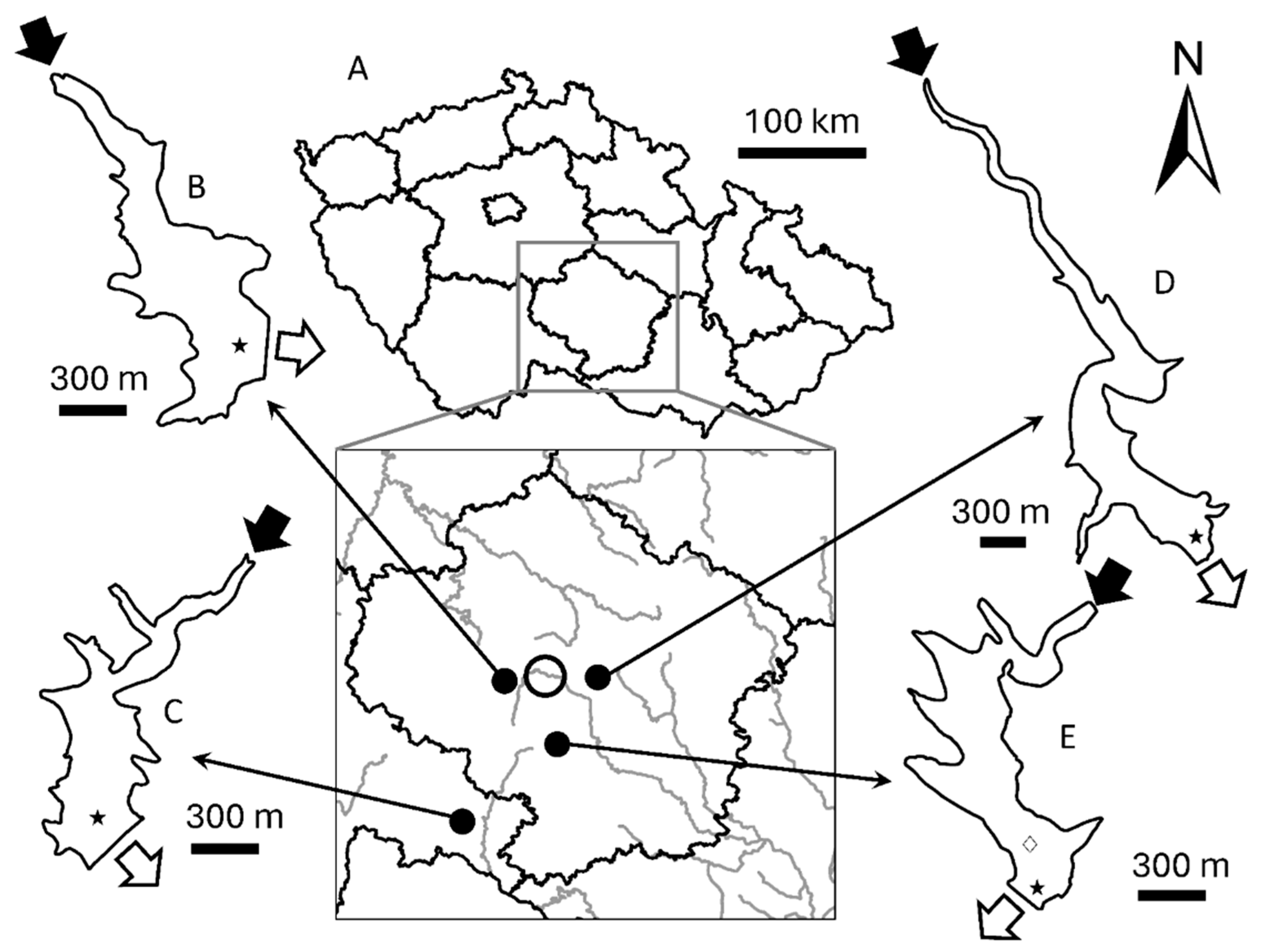
Limnological data were collected over the period 2022–2024 from four reservoirs belonging to the same Morava River catchment area located in the highland region in the Czech Republic (Figure 1). The main characteristics of these reservoirs were partly adapted from Adámek et al. [38], and mean inflow and outflow concentrations of total phosphorus (TP) and nitrogen (TN) measured monthly by the Morava River Authority are also displayed (Table 1).
Hubenov Reservoir (HU; 55 ha, 49°23′40″ N, 15°29′7″ E, 520 m a.s.l.; Figure 1) is a eutrophic reservoir situated approximately 7.5 km west of the town of Jihlava. Constructed in 1972, it serves as a drinking water supply for Jihlava and its surroundings. The catchment is mostly covered by agricultural land (56%) and forest (37%). The reservoir features a relatively homogeneous littoral zone with gently sloping banks and sandy or muddy bottoms. In addition to supplying water, it also regulates the flow by releasing a minimum stream flow downstream of the dam during dry seasons and contributes to local flood prevention during periods of heavy rainfall [39]. An intensive pikeperch (Sander lucioperca) stocking program was carried out in 2023–2024, during which more than 50,000 juveniles (approximately 900 inds/ha) were introduced into the reservoir during spring and autumn 2023 and again in spring 2024 (Table 2). Estimates of the post-stocking survival of juvenile pikeperch until their recapture (summer 2023 and 2024) were taken from previously published studies conducted in the same system [40,41]. These published survival estimates were used for contextual and derived calculations in the present study.
Nová Říše Reservoir (NR; 54 ha, 49°9′19″ N, 15°32′40″ E, 555 m a.s.l.; Figure 1) is a mesotrophic reservoir located approximately 35 km south of Jihlava. It provides drinking water for the town of Telč and nearby towns and also serves to stabilize downstream river discharge. The catchment is mostly covered by forest (69%) and agricultural land (29%). No significant predatory fish have been stocked in the reservoir since 2016. Since 1998, from May to October, hypolimnetic aeration in the dam area has been in operation at a depth of 9 m, i.e., 6 m above the bottom. The aerator consists of two floating parts. Air is supplied to the bottom of the inlet tube at a rate of 150–200 m3 per hour. Here, it is blown into the water by a system of nozzles. The air rising through the inlet tube oxygenates the water and pushes it upwards. The water flows through the open tube into the outlet tube, from the bottom of which it flows into the reservoir [42].
Landštejn Reservoir (LA; 40.5 ha, 49°1′28″ N, 15°14′28″ E, 570 m a.s.l.; Figure 1) is a meso-oligotrophic reservoir situated about 40 km southwest of the town of Jihlava. It supplies drinking water to the towns of Dačice, Slavonice, and Nová Bystřice and also functions to stabilize downstream river discharge. The catchment is dominated by forest (91%) with a small part of agricultural land (7%). No significant predatory fish stocking has been conducted in the reservoir since 2016, and no artificial mixing of the water column has been performed.
Mostiště Reservoir (MO; 93.0 ha, 49°23′56″ N, 16°0′29″ E, 459 m a.s.l.; Figure 1) is a eutrophic reservoir located approximately 35 km east of Jihlava. The reservoir serves as a drinking water source for the Třebíč region and supports flood protection by optimizing the discharge during the summer months. The catchment is, similarly to HU, mostly covered by agricultural land (60%) and forest (35%). Similarly to LA, no significant predatory fish stocking has occurred since 2016, and no artificial aeration of the sediment has been conducted.
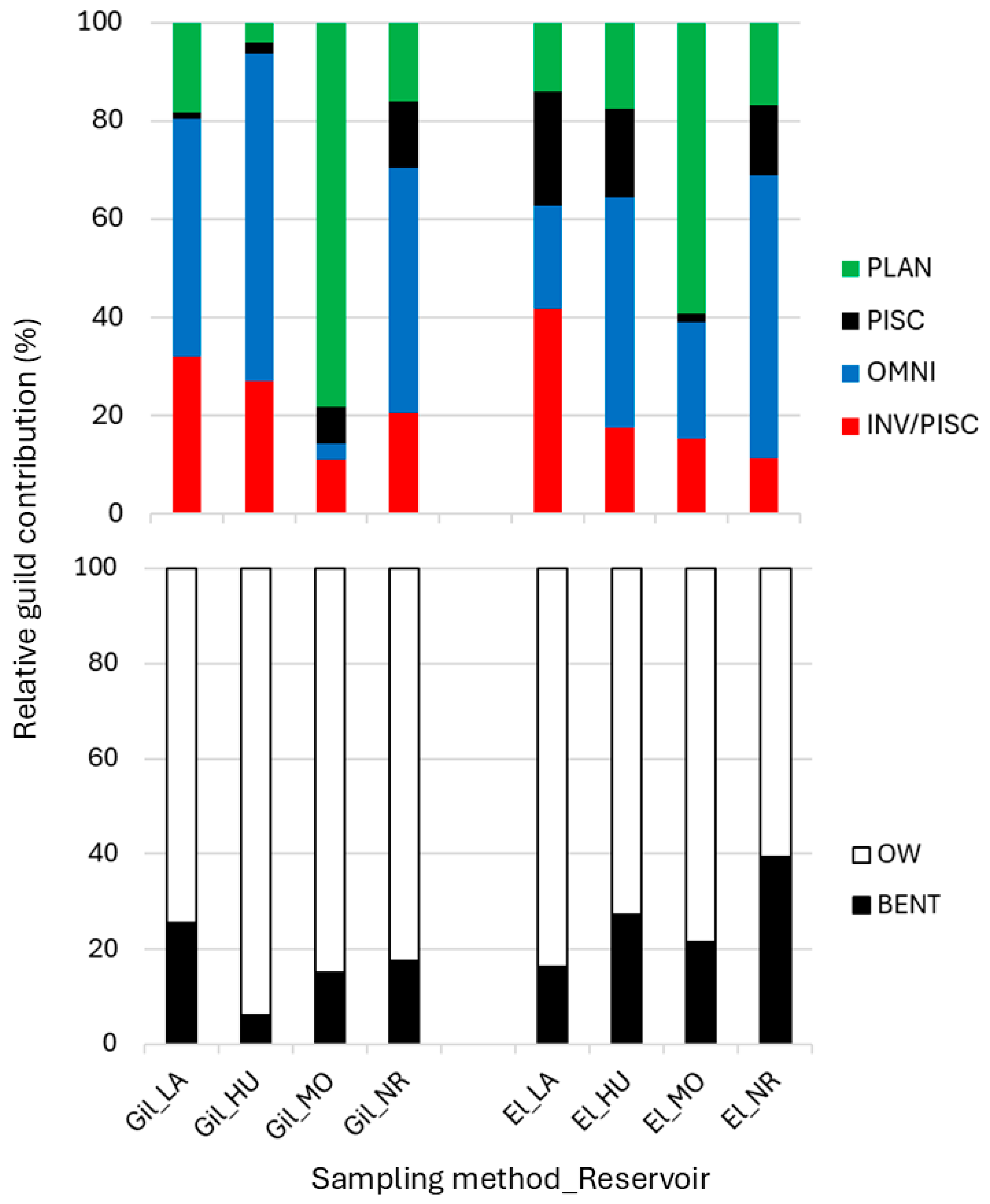
Within the period 2018 to 2023, the summer inventory monitoring of fish communities was carried out twice on each reservoir using benthic gillnets (always 2 or 3 nets in repetition in depths 0–3 m and 3–6 m [43]) and day-time boat electrofishing (500 to 6000 m) [44]. To standardize the sampling effort, the catch was expressed as the average representation of the species in the community sampled by the two methods. The species were categorized into trophic and food habitat guilds [45] (Table A1 in Appendix A) showing similarities of the fish community (Figure 2).

2.2. Limnological Data Sampling

All measurements and analyses were performed by the accredited laboratory of the Morava River Authority in Brno. Limnological parameters were measured, and samples for chemical and biological analyses were taken monthly from April to October in 2022, 2023, and 2024 along the vertical profile in the dam parts of the reservoirs from a boat fixed to a permanent buoy. The sampling depth varied among reservoirs according to their maximum depth (HU—13 m, NR—17 m, LA—17 m, MO—21 m). Temperature, pH, dissolved oxygen concentrations, and algal and cyanobacterial (phycocyanin signal) chlorophyll concentrations were measured at 1 m intervals along the vertical profile using a multiparametric Manta +35 probe (Eureka Water Probes, Austin, Texas, USA). Additionally, point samples of water were taken at selected depths for subsequent chemical analysis in the laboratory (TP and TN concentration). At the same place and time as the limnological parameters, a Friedingler sampler was used for taking point samples from depths 0 m, 5 m, and 10 m and the maximum depth (HU—13 m, NR—17 m, LA—17 m, MO—21 m). Water samples were subsequently protected against light and high temperatures in a thermobox in 100 mL (TN) or 50 mL (TP) polyethylene sample containers and processed immediately after transport to the laboratory. The evaluation of TN concentration was carried out automatically using a measuring and evaluation program based on a calibration curve, and the concentration of TP was measured using the ICP MS method (inductively coupled plasma mass spectrometer [46]). Water transparency (SD) was assessed using a Secchi disk (30 cm diameter). Zooplankton was analyzed following the method of Přikryl [47]. Zooplankton was taken in the dam part with a single vertical tow using a plankton net (mesh size 80 µm, circular mouth with a diameter 20 or 25 cm mounted on an Apstein attachment) from a depth of 0–4 m (covering the epilimnion layer throughout the whole study period) and preserved in formalin (4%) in a polyethylene bottle. In the laboratory, the sample was concentrated to 40–100 mL, of which 2 mL was transferred to the counting chamber. Zooplankton in one chamber, or in the case of highly abundant samples, half of the chamber (Sedgwick–Rafter, 34 fields in total), was identified at the species level and counted under a microscope (100× magnification). When large species (e.g., Chaoborus, Leptodora) were found, the entire sample was examined (using a binocular magnifying glass). Zooplankton density was expressed as individuals per dm2 (ind/dm2). The processing procedure was typically completed within one year after sampling. Average seasonal values of the measured limnological parameters are presented in Table A2 in Appendix A.

2.3. Trophic State Index

We calculated Carlson’s trophic state index (TSI [48]) for the periods from April to October for each reservoir to compare water quality data (TP, CHL and SD [48] and TN [49]) to determine if systems were limited by nutrients or light. We used the following equations to calculate TSI:
TSI (CHL) = 10 × [6 − (2.04 − 0.68 lnCHL)/ln2]
TSI (TP) = 10 × [6 − ln(48/TP)/ln2]
TSI (SD) = 10 × [6 − lnSD/ln2]
TSI (TN) = 10 × [6 − ln(1.47/TN) ln2]
If TSI (CHL) << TSI (TP), a factor other than phosphorus is interfering to limit algal growth. TSI (CHL) << TSI (SD) indicates that seston is dominated by very small (abiotic) particles and that light may be the limiting factor. Conversely, if TSI (CHL) << TSI (TP) but TSI (CHL) >> TSI (SD), this suggests that light attenuation is caused by large particles (e.g., large filaments or colonies of algae), and that phytoplankton may be limited by zooplankton grazing [50].

2.4. Statistical Analyses

A linear mixed-effects model (LMM) was used to test differences in measured water quality parameters (temperature, oxygen concentration, pH, algal and cyanobacterial chlorophyll, TP and TN concentrations, and zooplankton density) in the surface layer among reservoirs (categorical variable), sampling month and year (continuous variables). The water quality parameters, month and year were used as fixed effects and month/year as a random effect to account for temporal correlation and repeated measures.
LMM formula in R-environment:
lmer(measured_variable ~ reservoir + month + year + (1 | month:year))
Any significant differences were further explored with post hoc Tukey HSD comparisons using mixed models. The models were implemented in R (version 4.5.2 [51]) using the „lme4” package to fit the models [52], „lmerTest” to compute Kenward–Roger’s approximations for degrees of freedom and p-values [53] and “emmeans” package to compute the post hoc Tukey HSD test [54]. In the case of water transparency measured in one-week intervals, the LMM was applied with reservoir as a fixed effect and the sampling date used as a random effect. Figures showing the values of measured water quality parameters and TSI were created using the package „ggplot2” [55]. The ranges were set for each parameter separately and for all reservoirs together based on measured values. Principal component analysis (PCA [56]) was used to describe the main sources of variation in the zooplankton communities within the studied reservoirs and years. Species data were log-transformed, centred, and standardized by norm. The analysis was performed using species data, but for graphical presentation, only the 30 best-fitting species were shown. PCAs were performed using Canoco 5 software [56].

3. Results

3.1. Abiotic Factors

3.1.1. Temperature, Oxygen, and pH Stratification

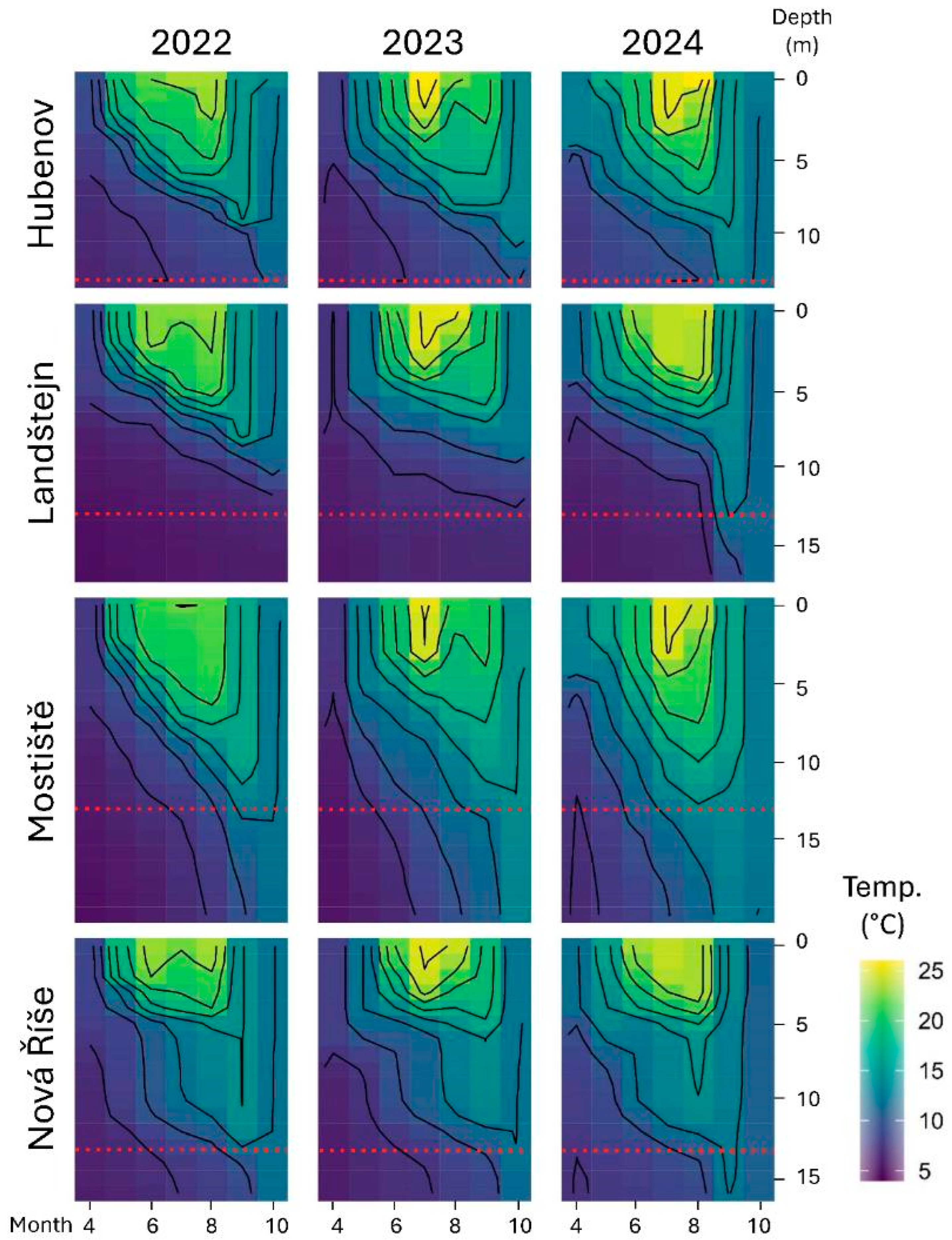
Thermal conditions followed a similar pattern in all reservoirs over the years investigated (Figure 3). Thermal stratification began in May, and autumn mixing, accompanied by the destratification of the water column, occurred consistently in October in all reservoirs. The strongest stratification, with surface temperatures approaching 25 °C, was recorded in July and August, and the typical thermocline depth ranged from 4 to 5 m, depending on the reservoir and the year. Summer thermal stratification was also present in NR, despite the artificial aeration of the hypolimnion. In 2022, a deeper thermocline and weaker stratification were recorded in all reservoirs. Water temperature during the growing season at the surface water level did not differ significantly among reservoirs (LMM, F3,60 = 1.52, p = 0.218), months (LMM, F1,18 = 0.64, p = 0.436), or years (LMM, F1,18 = 0.03, p = 0.877).
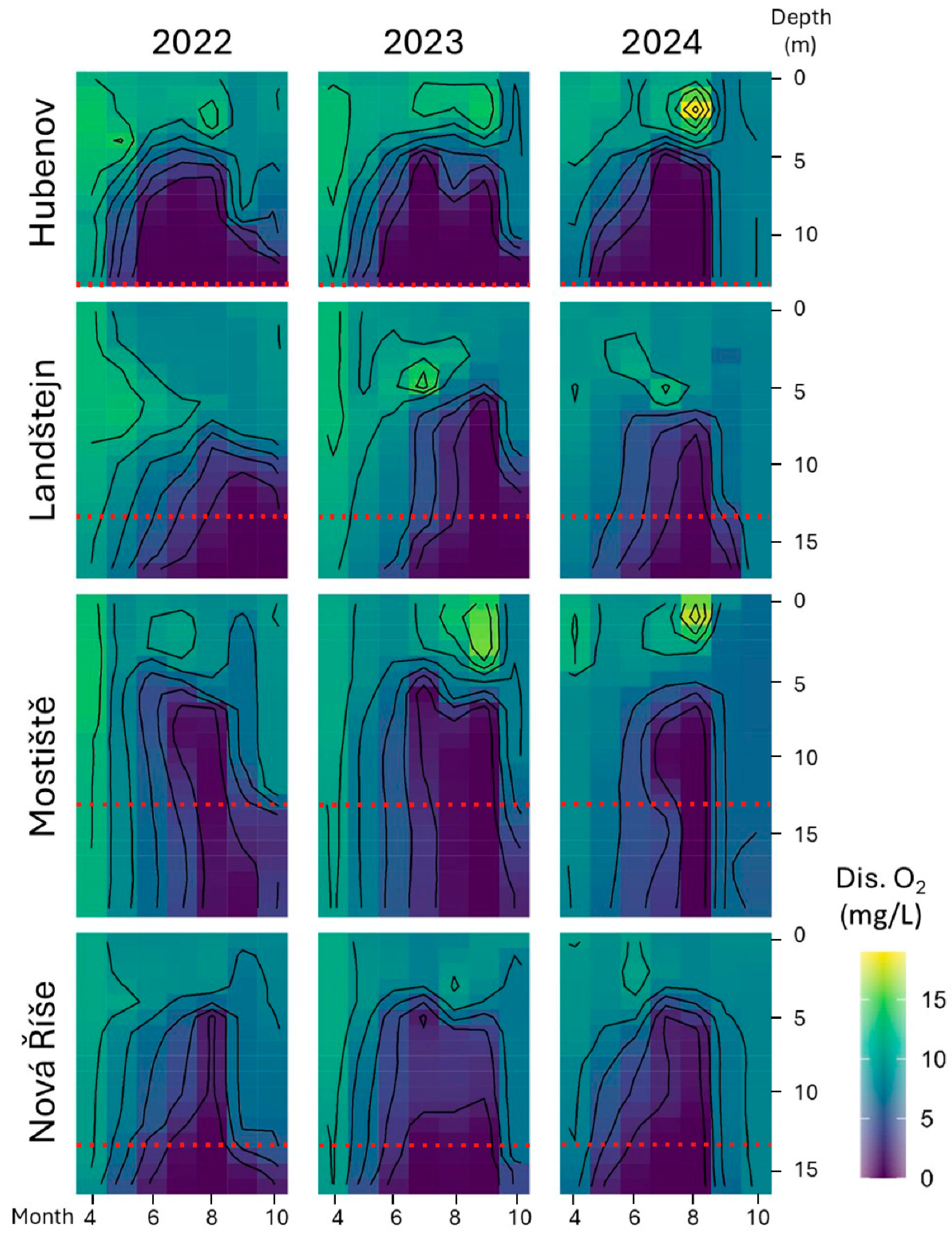
The temporal depth distribution of dissolved oxygen closely followed the temperature pattern (Figure 4). In April, oxygen concentrations of 11–12 mg/L were homogeneously distributed throughout the water column in all reservoirs. From May onward, oxygen deficits developed in deeper layers, while the epilimnion remained well oxygenated or supersaturated (Figure 4). The longest and most pronounced oxygen deficits in the deeper layers were observed in HU throughout the study period. Notably, in 2024, both HU and MO exhibited high oxygen concentrations of nearly 20 mg/L that occurred at approximately 3 m depth, just above the thermocline in August (Figure 4). In NR, oxygen deficits also occurred in deeper layers across all years; however, epilimnetic concentrations were the lowest among all the studied reservoirs (8–9 mg/L). In general, oxygen concentration during the growing season at the surface water level was statistically significant among reservoirs (LMM, F3,60 = 5.01, p < 0.01) and months (LMM, F1,18 = 9.08, p < 0.01) but not between years (LMM, F1,18 = 0.03, p = 0.868). The only statistical differences in oxygen concentration were found between LA and HU (Tukey HSD, t = −2.78, df = 60, p < 0.05) and NR and HU (Tukey HSD, t = −3.17, df = 60, p < 0.05).
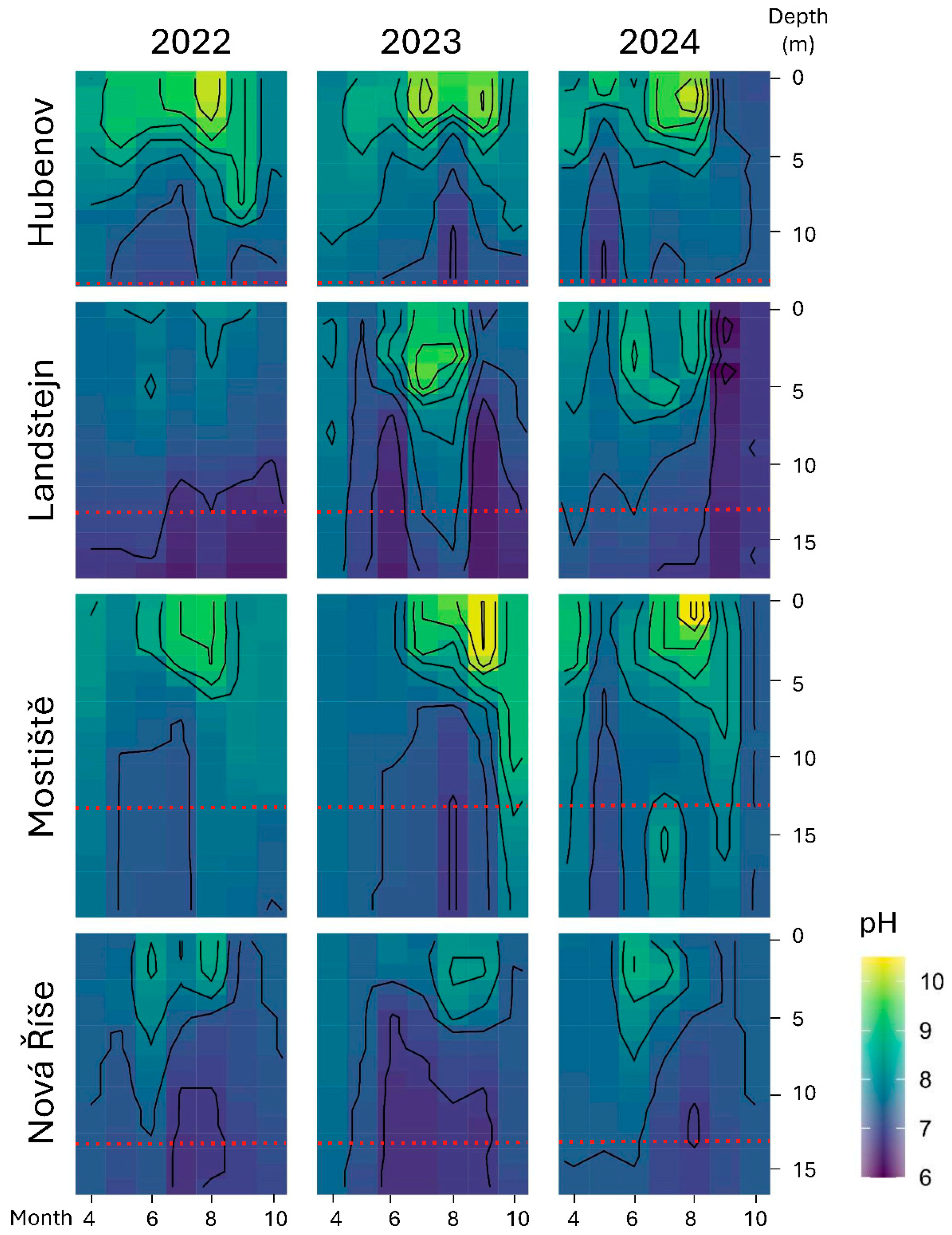
Differences in pH among reservoirs were statistically significant (LMM, F3,60 = 19.28, p < 0.001) in comparison to differences between months (LMM, F1,18 = 0.001, p = 0.971) and years (LMM, F1,18 = 0.23, p = 0.638, Figure 5). In HU and MO, pH in the epilimnetic layer reached almost 10 during the summer of all investigated years (Figure 5), and pH did not differ between these two reservoirs (Tukey HSD, t = −1.09, df = 60, p > 0.05). In LA, a significant increase in pH was observed only during summer 2023, whereas in 2022 and 2024, and across all years in NR, pH values did not exceed 8. No significant differences in pH values were found between LA and NR (Tukey HSD, t = −0.73, df = 60, p > 0.05). The differences in pH among LA and HU, NR and HU, MO and LA and NR and MO were statistically significant (Tukey HSD, LA-HU: t = −5.48, df = 60, p < 0.001; NR-HU: t = −6.21, df = 60, p < 0.001; MO-LA: t = 4.39, df = 60, p < 0.001; NR-MO: t = −5.12, df = 60, p < 0.001). During summer stratification, pH values below the thermocline exhibited minimal variability, consistently ranging between 7.0 and 8.0. In winter and during periods of thermal destratification, this pH stability was observed throughout the entire water column across all reservoirs and years of study.

3.1.2. Water Transparency

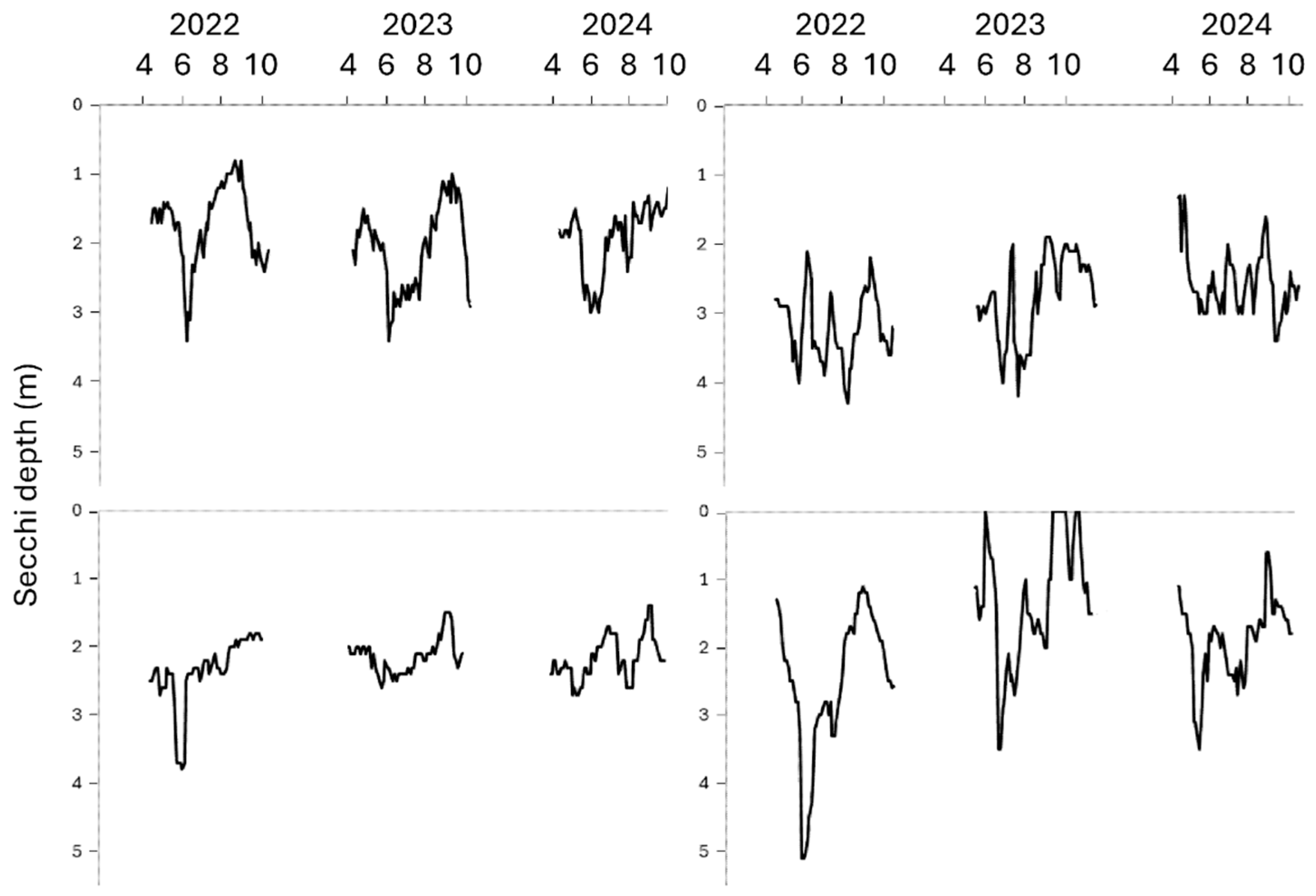
The lowest interannual variability in water transparency was observed in HU and NR (HU—approximately 1.9 m seasonal average, more than 3 m in spring, and less than 1 m in summer, and NR—approximately 2.1 m seasonal average, with a maximum in spring 2022 (almost 4 m) and usual water transparency about 2 m in summers of all years; Figure 6). Higher interannual variability in water transparency was found in LA and MO (LA—2.8 m seasonal average and relatively variable water transparency throughout the season, without a clear trend of the highest water transparency in spring and the lowest in summer, and MO—approximately 1.9 m in seasonal average and the highest transparency in spring reaching 5 m in spring 2022 and 3 m in spring 2023 and 2024, with the lowest values < 1 m in summer months (Figure 6)). Water transparency was significantly different among reservoirs (LMM, F3,549 = 110.7, p < 0.001). The only insignificant difference in water transparency was found between MO and HU (Tukey HSD, t = −0.13, df = 549, p = 0.99). Statistically significant differences were found among the remaining reservoir pairs (Tukey HSD, LA-HU: t = 15.72, df = 549, p < 0.001; NR-HU: t = 5.37, df = 549, p < 0.001; MO-LA: t = −15.85, df = 549, p < 0.001; NR-LA: t = −10.34, df = 549, p < 0.001; NR-MO: t = 5.50, df = 549, p < 0.001).

3.1.3. Total Phosphorus and Nitrogen Concentrations

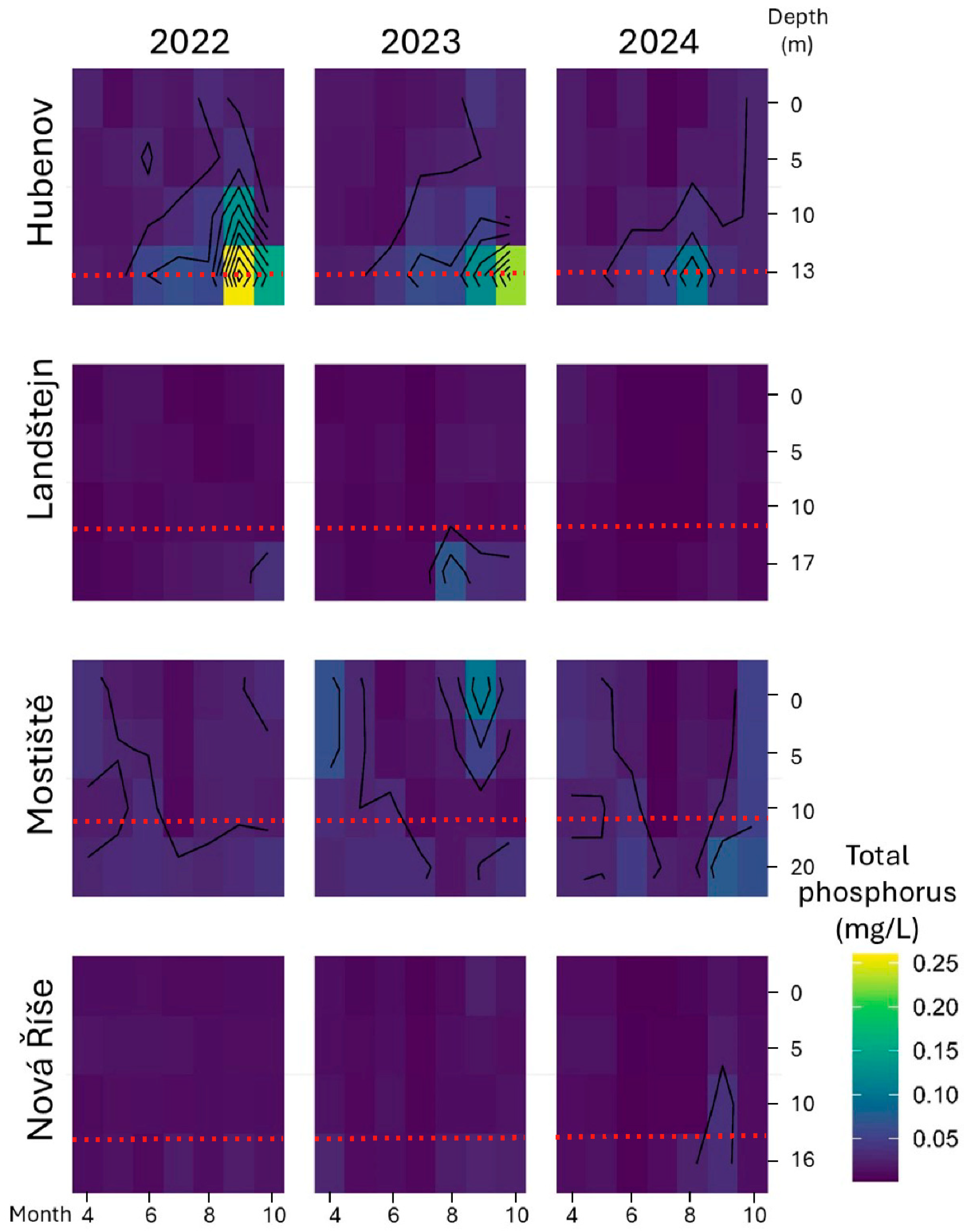
The highest TP concentrations (based on the average across the entire water column and all investigated years) were found in HU (0.035 mg/L on average, 0.043 mg/L in 2022, 0.037 mg/L in 2023, and 0.025 mg/L in 2024) and in MO (0.028 mg/L on average, 0.026 in 2022, 0.031 mg/L in 2023, and 0.029 mg/L in 2024). Lower TP concentrations were recorded in NR (0.012 mg/L on average, 0.013 mg/L in 2022 and 2023, and 0.011 in 2024) and in LA (0.011 mg/L on average, 0.011 mg/L in 2022, 0.013 mg/L in 2023, and 0.008 mg/L in 2024). Total phosphorus concentrations were generally below 0.05 mg/L across all reservoirs, depths, and seasons (Figure 7). The elevated TP levels in HU were primarily due to the hypolimnetic TP maxima observed each year in autumn, with extreme values reaching 0.25 mg/L in September 2022 and October 2023 (Figure 7). Similarly, in the second most eutrophic reservoir, MO, TP concentrations exceeded 0.10 m/L in September 2023 (Figure 7). In contrast, LA and NR never recorded TP concentrations exceeding 0.04 mg/L, and values were generally below 0.02 mg/L across all years, seasons, and depths in both reservoirs. The differences in TP concentrations were significant among reservoirs (LMM, F3,60 = 18.74, p < 0.001), but not between months (LMM, F1,18 = 0.70, p = 0.414) or years (LMM, F1,18 = 0.27, p = 0.609). Insignificant differences in TP concentrations were found only between NR and LA (Tukey HSD, t = 0.47, df = 60, p = 0.97). Statistically significant differences were found between the remaining reservoir pairs (Tukey HSD, LA-HU: t = −3.50, df = 60, p < 0.001; MO-HU: t = 3.11, df = 60, p = 0.01; NR-HU: t = −3.01, df = 60, p = 0.02; MO-LA: t = 6.60, df = 60, p < 0.001; NR-MO: t = −6.13, df = 60, p < 0.001).
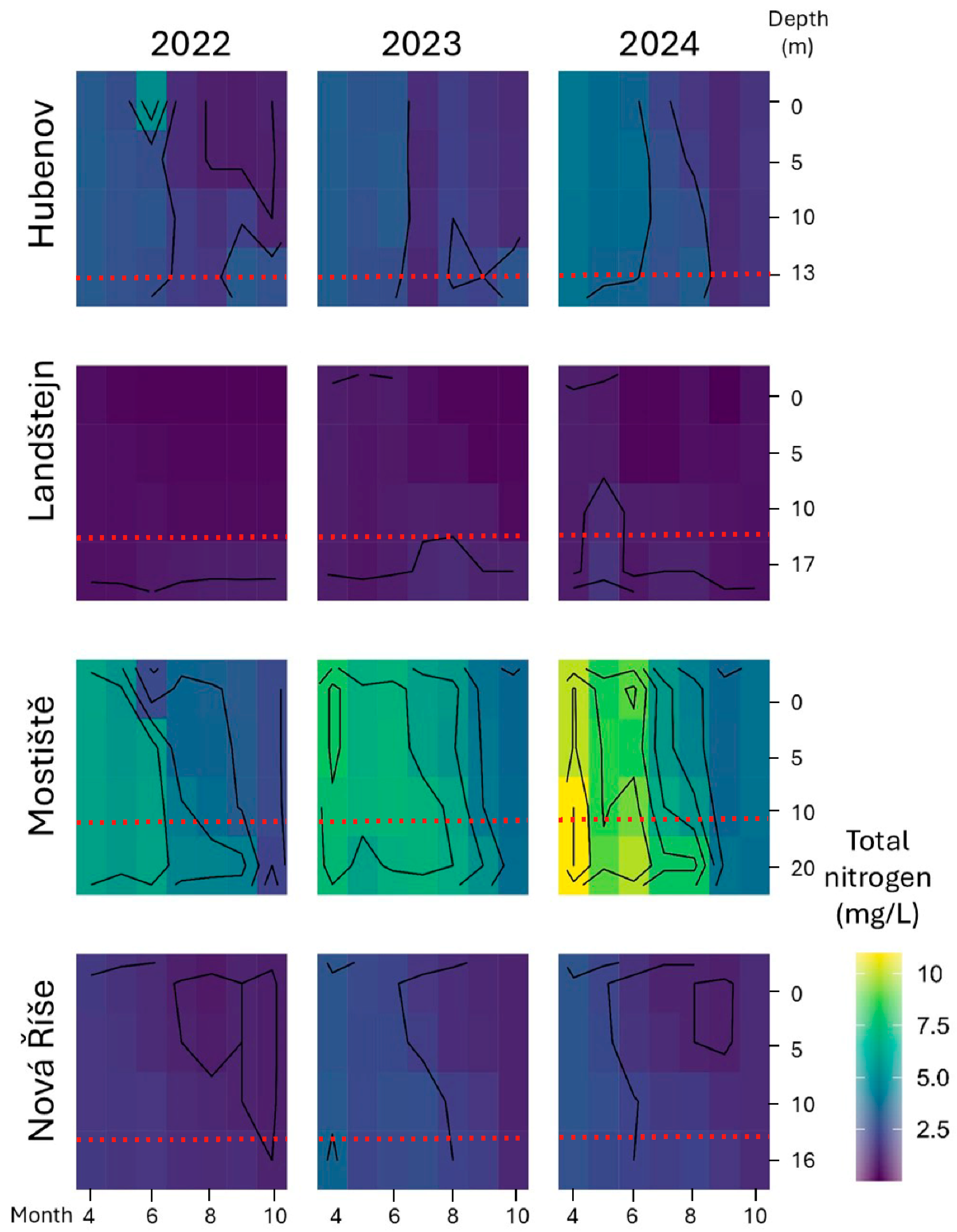
The highest TN concentrations (based on the average across the entire water column and all investigated years) were found in MO (5.81 mg/L on average, 4.46 mg/L in 2022, 6.05 mg/L in 2023, and 6.92 mg/L in 2024) and in HU (2.43 mg/L on average, 2.2 mg/L in 2022, 2.3 mg/L in 2023, and 2.8 mg/L in 2024). Lower TN concentrations were recorded in NR (1.79 mg/L on average, 1.38 mg/L in 2022, 2.1 mg/L in 2023, and 1.9 mg/L in 2024), and the lowest values were found in LA (0.65 mg/L on average, 0.47 mg/L in 2022, 0.74 mg/L in 2023, and 0.73 mg/L in 2024). In both LA and NR, which recorded the lowest TN levels, TN concentrations were homogeneously distributed throughout the water column and consistently stable across the growing season from spring to autumn (Figure 8). In HU, a slight increase in TN concentration was observed during the early part of the growing season (April–June). In MO, where TN concentrations were the highest overall, peak values were observed in April, particularly in 2024, when TN concentrations exceeded 10 mg/L, especially in the deeper water layers (Figure 8). The differences in TN concentrations were significant among reservoirs (LMM, F3,60 = 107.21, p < 0.001), and TN concentrations changed significantly over months (LMM, F1,18 = 58.16, p < 0.001) and years (LMM, F1,18 = 13.34, p < 0.001). Insignificant differences in TN concentrations were found only between NR and HU (Tukey HSD, t = −2.51, df = 60, p > 0.05). Statistically significant differences were found between the remaining reservoir pairs (Tukey HSD, LA-HU: t = −6.29, df = 60, p < 0.001; MO-HU: t = 9.83, df = 60, p < 0.001; MO-LA: t = 16.12, df = 60, p < 0.001; NR-LA: t = 3.77, df = 60, p < 0.01; NR-MO: t = −12.34, df = 60, p < 0.001).

3.2. Biotic Factors

3.2.1. Algal Chlorophyll-a Concentration

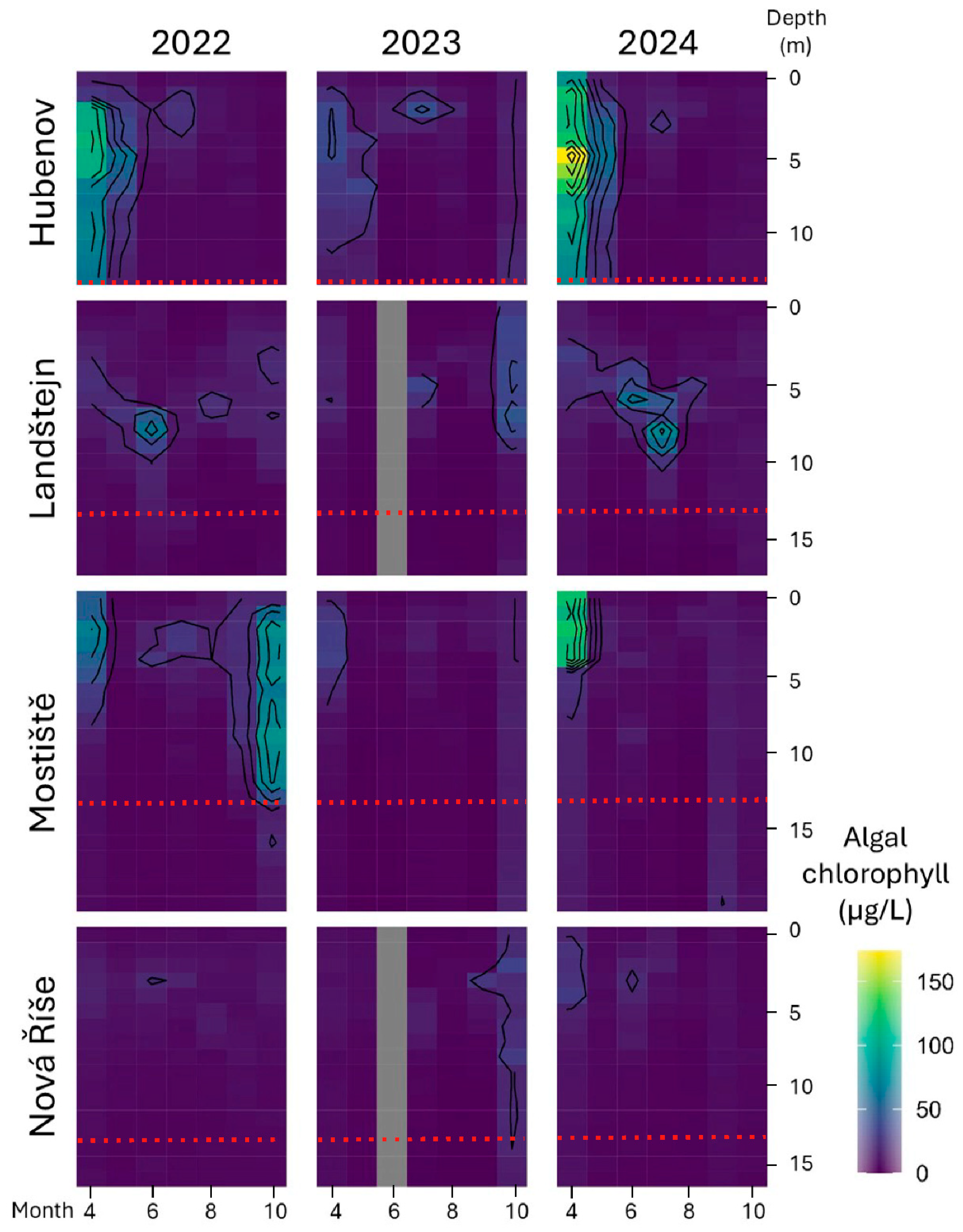
The highest algal chlorophyll-a concentrations (based on the average across the entire water column and all investigated years) were found in HU (20.2 µg/L on average, 20.1 µg/L in 2022, 13.6 µg/L in 2023, 26.8 µg/L in 2024). Lower concentrations were observed in MO (12.1 µg/L on average, 16.4 µg/L in 2022, 8 µg/L in 2023, and 12 µg/L in 2024) and in LA (11.2 µg/L on average, 10.4 µg/L in 2022, 11.7 µg/L in 2023, and 11.4 µg/L in 2024). The lowest values were recorded in NR (7.5 µg/L on average, 6.7 µg/L in 2022, 9 µg/L in 2023, and 6.9 µg/L in 2024). The differences in algal chlorophyll-a concentrations were not significant among reservoirs (LMM, F3,60 = 2.68, p = 0.055), months (LMM, F1,18 = 2.42, p = 0.138) or years (LMM, F1,18 = 0.596, p = 0.450). In NR, where the lowest algal chlorophyll-a concentrations were found, values remained consistently low across all years, depths, and throughout the seasons (Figure 9). In LA, localized algal chlorophyll-a maxima were observed around 6 m depth, particularly in June 2022 and July 2024. In MO, and especially in HU, the highest seasonal average concentrations were driven by elevated values in April 2024, reaching approximately 150 µg/L in HU and 115 µg/L in MO. In MO, an additional peak occurred in autumn 2023, with concentrations approaching 100 µg/L (Figure 9).

3.2.2. Cyanobacterial Chlorophyll Concentrations

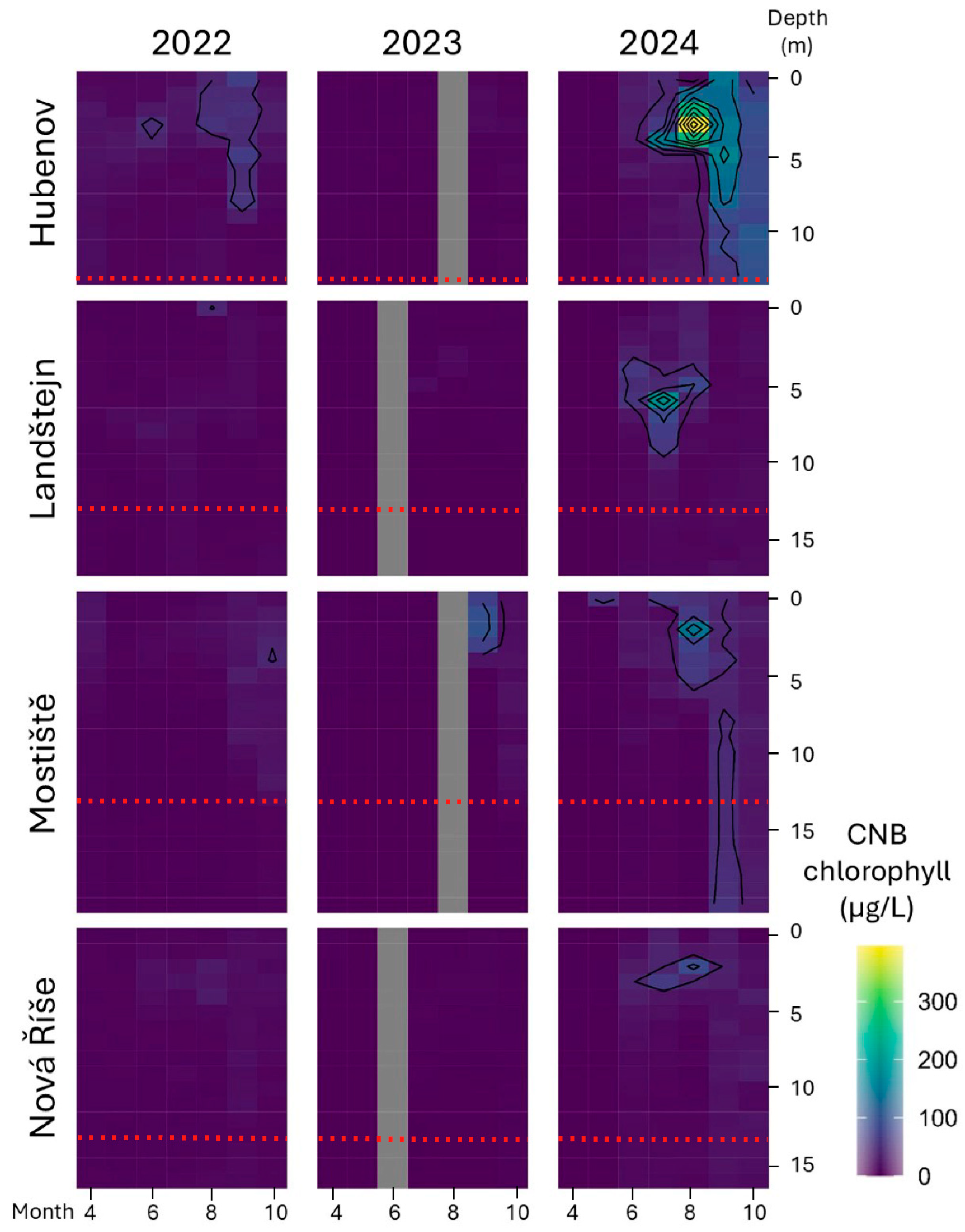
The highest cyanobacterial chlorophyll concentrations (based on the average across the entire water column and all investigated years) were found in HU (26.2 µg/L on average, 19.3 µg/L in 2022, 4.6 µg/L in 2023, and 54.7 µg/L in 2024). Lower concentrations were observed in MO (14.4 µg/L on average, 8.9 µg/L in 2022, 11.9 µg/L in 2023, and 21.3 µg/L in 2024), while the lowest cyanobacterial chlorophyll concentrations were recorded in LA (9.7 µg/L on average, 7 µg/L in 2022, 2.33 µg/L in 2023, and 19.9 µg/L in 2024) and in NR (9.1 µg/L on average, 8.1 µg/L in 2022, 3.8 µg/L in 2023, and 15.1 µg/L in 2024). Differences in cyanobacterial chlorophyll were significant between reservoirs (LMM, F3,60 = 4.63, p < 0.01) and months (LMM, F1,18 = 6.52, p < 0.05) but not between years (LMM, F1,18 = 3.12, p = 0.095). Significant differences in cyanobacterial chlorophyll concentrations were found between LA and HU (Tukey HSD, t = −2.85, df = 60, p < 0.05) and between NR and HU (Tukey HSD, t = −2.83, df = 60, p < 0.05). In NR and LA, where concentrations were lowest, cyanobacteria were typically evenly distributed across the growing seasons and depth profiles, with relatively low concentrations of approximately 10 mg/L (Figure 10). An exception was observed in LA in July 2024, when a localized increase in cyanobacterial concentration occurred at a depth of 5–8 m, with values approaching 100 µg/L (Figure 10). The highest average cyanobacterial concentrations were observed in HU, primarily due to a substantial increase during the summer and autumn of 2024, when concentrations reached almost 400 µg/L in August at a depth of 3 m (Figure 10).

3.2.3. Zooplankton Density and Species Composition

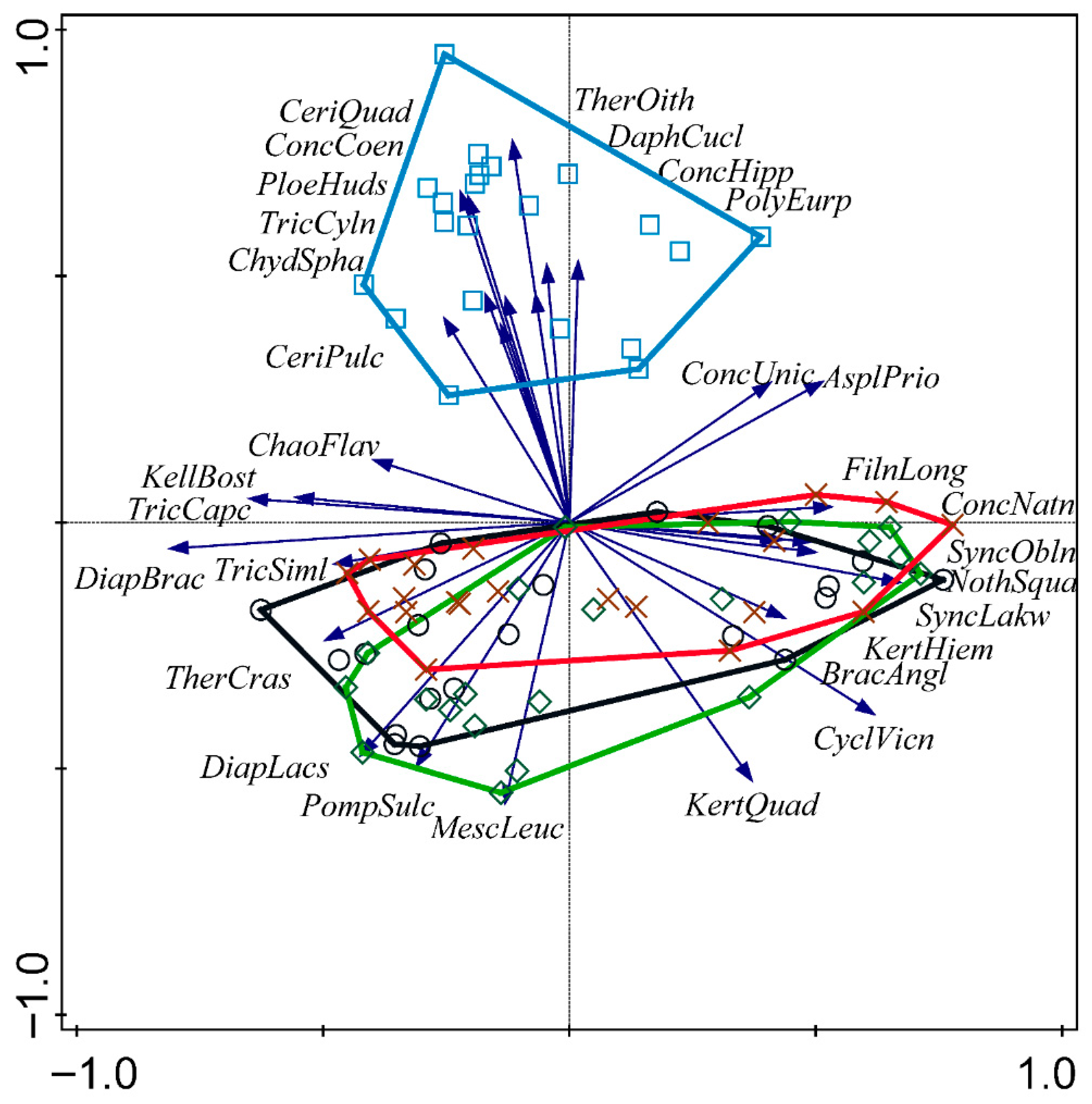
The highest zooplankton density (based on the average of all investigated years) was found in MO (17,645 ind/dm2 on average, 23,776 ind/dm2 in 2022, 11,696 ind/dm2 in 2023, and 17,461 ind/dm2 in 2024). Relatively similar zooplankton densities were found in NR (13,951 ind/dm2 on average, 10,321 ind /dm2 in 2022, 10,288 ind/dm2 in 2023, and 21,248 ind/dm2 in 2024) and HU (13,430 ind/dm2 on average, 12,881 ind/dm2 in 2022, 16,824 ind/dm2 in 2023, and 10,585 ind/dm2 in 2024). The lowest zooplankton density was found in LA (11,427 ind/dm2 on average, 11,971 ind/dm2 in 2022, 6197 ind/dm2 in 2023, and 16,113 ind/dm2 in 2024). The differences in zooplankton density were not significant among reservoirs (LMM, F3,60 = 1.45, p = 0.237) but were significant between months (LMM, F1,18 = 5.14, p < 0.05) and not between years (LMM, F1,18 = 0.17, p = 0.685). PCA analysis of species composition clearly separated LA from the rest of reservoirs (Figure 11). The first two axes explained 14.55% and 11.13% of the species composition data. In LA crustacean zooplankton was dominated by Ceriodaphnia quadrangula, Chydorus sphaericus, Thermocyclops oithonoides, and Daphnia cucullata, phylum Rotifera was represented by Conochiloides coenobasis, Ploesoma hudsoni, Trichocerca cylindrica, and Polyarthra euryptera. In the remaining reservoirs, crustacean zooplankton was represented especially by Thermocyclops crassus, Diaphanozoma lacustris, Mesocyclops leucarti, and Cyclops vicinus, dominant Rotifers were Pompholyx sulsata, Keratella quadrata, Brachionus angularis, Notholca squamula, and Synchaeta oblonga (Figure 11).

3.2.4. Predatory Fish Stocking Success

Based on previously published post-stocking survival estimates [40,41], the survival of stocked juvenile pikeperch varied among cohorts. For the first cohort of 10,000 juveniles, survival until recapture was up to approximately 7% (~700 individuals). The survival of the remaining juveniles was lower, around 0–1%, corresponding to up to ~400 additional survivors. Overall, roughly 1100 individuals were expected to have survived the early post-stocking period.

3.3. Trophic State Index

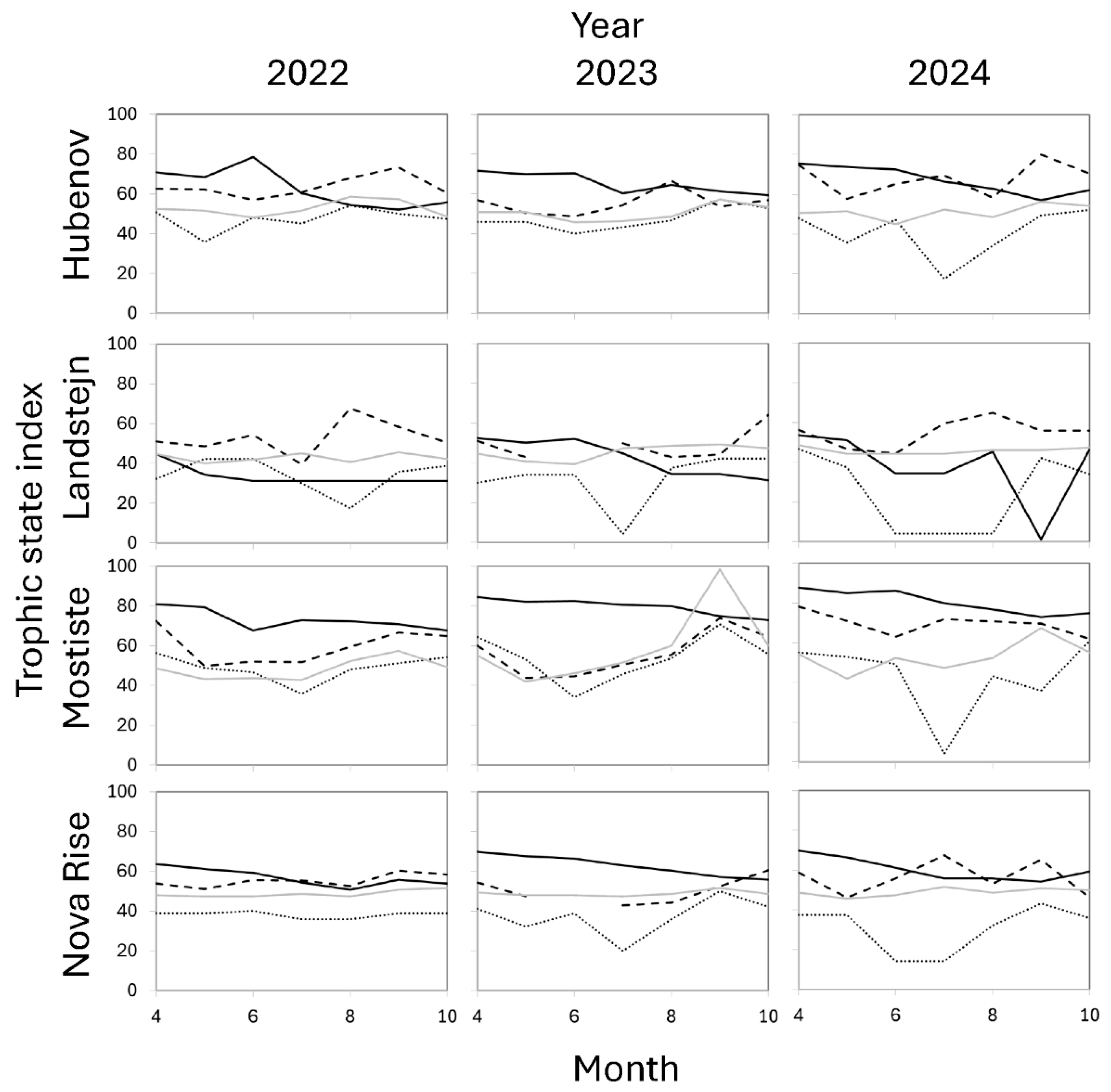
Comparisons of TSI values derived from different water quality parameters showed very similar trends across all reservoirs and years (Figure 12). TSI values remained consistent throughout the entire season across all reservoirs and years, usually ranging from 40 to 80 for CHL, SD, TN, and TP (Figure 12).

4. Discussion

Thermal stratification plays a critical role in shaping reservoir water quality, as it leads to an uneven vertical distribution of key parameters such as dissolved oxygen and nutrients during the stratified season. Typically, thermocline and chemocline characteristics vary across reservoirs depending on their morphology and management strategies [57]. In this study, we compared the vertical stratification of various biotic and abiotic parameters in four reservoirs of similar morphology located within the same region. Because of the regular seasonal succession of plankton [58], seven time points were sampled throughout the vegetative season when the strongest influence on water quality was expected. In HU, the large-scale stocking of predatory fish juveniles and, in NR, artificial hypolimnetic aeration were implemented as internal anti-eutrophication measures.
In our study, we observed very similar vertical patterns of temperature and oxygen concentrations across all reservoirs, with the thermocline typically occurring at depths of 4–5 m during the summer peak. This finding is consistent with findings from other reservoirs in the Czech Republic [59,60]. As noted above, artificial mixing is a strategy used to destratify the water column of reservoirs during summer to maintain well-oxygenated bottom layers. In drinking water supply reservoirs, hypolimnetic anoxia can degrade raw water quality, requiring costly treatment upgrades and posing challenges for meeting drinking water quality standards [61]. Two distinct approaches are commonly used for engineered aeration in drinking water reservoirs: (1) maintaining thermal stratification by delivering oxygen directly into the hypolimnion through hypolimnetic aeration and (2) disrupting stratification to promote vertical mixing, allowing oxygen-rich surface water to reach the reservoir sediments through destratification aeration [61]. The latter approach, which employs powerful aerators to mix the entire water column and eliminate thermal stratification (approach 2), has been implemented, for example, in the Petrusplaat, Honderd en Dertig, and De Gijster Reservoirs in Biesbosch National Park (the Netherlands), where the reservoirs remained fully thermally and oxygen destratified throughout the summer [62]. NR was the only reservoir among those investigated to apply approach 1, using hypolimnetic aeration with an aerator positioned near the dam. Our data clearly showed that summer thermal stratification developed in NR, and the patterns of temperature and oxygen stratification were comparable to those observed in the non-aerated reservoirs. Oxygen concentration profiles were also similar, with oxygen deficits in the deeper layers during summer, including in NR. Nevertheless, the hypolimnetic aeration system in NR elevated dissolved oxygen concentrations directly above the sediment from 0 to 2 mg/L [42], which is generally sufficient to minimize nutrient release from the sediment into the water column (the threshold value for phosphorus released is 0.5 mg/L, [63]). Despite a threefold higher phosphorus supply to NR compared to LA (Table 1), phosphorus concentration and biotic indicators of water quality were similar between these two reservoirs. This suggests that a portion of the nutrients in NR remained bound in the sediment due to oxic conditions maintained by bottom sediment oxidation and therefore remained unavailable for primary production.
LA, which has the smallest catchment area and lowest nutrient supply, exhibited favorable water quality, with values of transparency, nutrient concentrations, and chlorophyll levels comparable to those observed in NR. In contrast, MO, with a catchment area approximately ten times larger than the other reservoirs, had an only slightly higher nutrient supply compared to HU (Table 1). Water quality parameters were similar to or even slightly better in MO than those in HU. In HU, juvenile pikeperch were stocked in spring and autumn 2023 and again in spring 2024. The limited impact of this biomanipulation strategy may be influenced by several factors. First, although a substantial number of pikeperch were introduced into a relatively small reservoir, their release in spring 2023 might have been too recent for the intended effects to become fully evident. In contrast, by 2024, individuals stocked the previous year may have grown large enough to prey on juvenile fish species that consume significant amounts of zooplankton [64]. Larger fish may escape predation pressure and produce a new generation, thereby increasing their impact on zooplankton. Second, the high post-release mortality of juvenile pikeperch (93–100%; [42]) most probably reduced their potential to limit zooplanktivorous fish populations [40]. Finally, the nutrient load of the reservoir, particularly total phosphorus and nitrogen concentrations, remains a key factor. Lowering nutrient input from the catchment is an essential condition for successful biomanipulation [65]. Jeppesen et al. [66] suggested that an in-lake phosphorus concentration of approximately 0.1 mg/L is a threshold below which long-term biomanipulation effects can be achieved in shallow lakes. In the case of deep lakes and reservoirs, where the phosphorus binding effect of submerged macrophytes is limited, the critical threshold of phosphorus concentration for successful biomanipulation is 0.020–0.050 mg/L [67,68]. Although phosphorus concentrations in HU and MO fall into this range, stocking juvenile pikeperch alone appears to be insufficient to significantly improve water quality. As these fish grow and mature, their biomanipulation potential may gradually increase, and they may eventually reduce the abundance of planktivorous fish, but a longer period is likely required for these effects to become evident.
This study clearly demonstrated that reservoirs located in the same region and with relatively similar morphometric characteristics exhibit comparable patterns of temperature and oxygen stratification. The lowest concentrations of chlorophyll and nutrients, along with the highest water transparency, were observed in NR and LA. In contrast, the worst water quality parameters and highest nutrient concentrations were recorded in HU and MO. MO, with the largest catchment area, has a similar phosphorus supply to HU but chlorophyll concentrations (both algal and cyanobacterial) were higher in HU regardless of predatory fish stocking there. The theory that bottom-up control primarily determines water quality parameters in the investigated reservoirs was also supported by zooplankton data. No differences in zooplankton density were observed among reservoirs in this study, and HU, NR and MO also have a very similar species composition. Zooplankton is the main grazer of phytoplankton [69], and in the case of top-down control, reservoirs with lower algal chlorophyll-a concentrations should host higher densities of zooplankton, and vice versa. Relatively similar zooplankton densities in all reservoirs and similar species composition (except for the most oligotrophic reservoir, LA) indicate that this factor is not the main driver influencing phytoplankton density. It should be noted that the sampling depth was fixed (0–4 m) to cover the epilimnion within the whole study period and deep-dwelling taxa could have been overlooked, especially in NŘ and LA. Future studies including deeper layers could provide a more comprehensive understanding of the zooplankton community composition [70].
The seasonal progression of TSI values was surprisingly consistent across reservoirs and years, with very similar values observed for TP, CHL, TN, and SD. In the corresponding TSI of TP and TN, on the one hand, and CHL or SD, on the other hand, indicate that the amount of chlorophyll and transparency correspond to the phosphorus load of the reservoirs. Binding even a small portion of the available phosphorus in sediments, such as through aeration, can enhance phosphorus limitation in the system and subsequently improve water quality. Reducing nutrient inputs from catchments (optimized fertilizer management, riparian buffer establishment, erosion control, wetland restoration, and advanced wastewater treatment) and internal loads (calcium release, aluminum or iron salts to bind phosphorus, selective water withdrawal, and sediment dredging) should be combined to effectively improve water quality. In the context of global environmental change and the increased risk of surface water eutrophication, bottom aeration emerges as a promising and sustainable method for maintaining good water quality. While biomanipulation through stocking juvenile predatory fish may still offer benefits, particularly over longer time frames, our study did not detect any immediate improvements in water quality following the short-term stocking of juvenile pikeperch. The proportion of different fish guilds was relatively similar among reservoirs with a similar invertivorous–piscivorous fish ratio and proportion of piscivores. Therefore, the results of this study are unlikely to be influenced by major differences in fish stock composition among reservoirs.
Compared to natural lakes, dam reservoirs have their own specific characteristics. The water inflow for the waterworks and the outflow through the turbine into the stream are usually located in hypolimnion. The heated water accumulates in the epilimnion, which supports its warming and the stability of stratification, but it may also cause a decrease in nutrients along the longitudinal gradient as they are incorporated into the food chain. Due to water level fluctuations and often steeper banks, phytoplankton are the primary producers, and macrophytes absorb the minimum amount of nutrients. Therefore, monitoring multiple profiles along the longitudinal gradient and collecting data on the hydrodynamics in the reservoir would be useful in future studies. On the other hand, the dam part is the most accessible, occupies the largest volume, water is withdrawn from here for further use and the self-cleaning ability of the given reservoir is integrated here. Further improvement could be in supplementing the lower levels of the food web, especially microorganisms, and assessing the highest trophic links—the detailed composition of the fish community. Moreover, monitoring iron forms (Fe2+ vs. Fe3+) will be informative, as iron’s redox-dependent interactions with phosphate govern phosphorus mobility and concentration, thereby influencing nutrient cycling and eutrophication dynamics [71]. Monitoring nutrient decrease due to particles settling and depth morphology can help understand the mechanism of nutrients in reservoirs [72]. Despite certain limitations, this study yields robust results that are important for effective management in the era of climate change.
This study demonstrates that reservoir water quality is strongly associated with nutrient dynamics and management interventions. Hypolimnetic aeration in NR effectively limited internal phosphorus release, maintaining low chlorophyll concentrations despite higher external nutrient inputs. In contrast, intensive pikeperch stocking in HU did not yield immediate improvements in transparency or algal biomass, indicating that biomanipulation alone cannot compensate for high nutrient loads or overcome initial survival constraints. Across all reservoirs, similar zooplankton densities and species composition indicate that bottom-up control driven by nutrient supply predominates over top-down effects. These findings reinforce the interconnected nature of physical, chemical, and biological processes and emphasize that successful restoration requires integrated strategies combining external nutrient reduction, internal load management, and long-term biomanipulation efforts.

Author Contributions

Conceptualization, P.B. and T.J.; methodology, P.B., D.K., R.N., L.J. and T.J.; formal analysis, P.B.; investigation, P.B., Z.S., M.H., D.K., R.N., L.J. and T.J.; resources, T.J.; data curation, D.K. and L.J.; writing—original draft preparation, T.J.; writing—review and editing, P.B., Z.S., M.H., D.K., R.N. and L.J.; visualization, P.B. and Z.S. All authors have read and agreed to the published version of the manuscript.

Funding

This study was supported by project no. QK23020002 “Pikeperch fry production, their adaptability and optimalization of their stocking into open waters” of the National Agency for Agricultural Research MZe.

Data Availability Statement

The data presented in this study are available on request from the corresponding author due to legal reasons.

Acknowledgments

We thank Fish Ecology Unit (FishEcU) members for their help during pikeperch stocking, Morava River Authority for providing abiotic and biotic data from the investigated reservoirs, especially the former head of the Fisheries department Ivo Krechler, and Chris Steer for careful reading and English language correction.

Conflicts of Interest

Authors Dušan Kosour, Roman Němec, and Lukáš Jurek were employed by the company Morava River Authority, State Enterprise. The remaining authors declare that this research was conducted in the absence of any commercial or financial relationships that could be construed as potential conflicts of interest.

Appendix A

Table A1. Relative contribution of fish species abundance based on gillnet (before slash) and electrofishing (after slash) samplings in the studied reservoirs and guild classification. Trophic guilds: INV/PISC—invertivorous–piscivorous, OMNI—omnivorous, PISC—piscivorous, PLAN—planktivorous; food habitat: BENT—benthic, OW—open water.
Scientific NameCommon NameLandštejnHubenovMostoštěNová ŘíšeTrophic GuildFood Habitat
Leuciscus aspiusAsp 2.1/2.07.6/1.61.5/7.0PISCBENT
Sander luciopercaPikeperch 0/0.70.9/00/1.4INV/PISCOW
Abramis bramaCommon bream18.2/14.04.2/17.67.1/19.216.2/16.9PLANBENT
Gymnocephalus cernuaRuffe3.9/00/1.20.4/0 OMNIBENT
Cyprinus carpioCommon carp2.8/2.30/6.40/0.8 OMNIBENT
Tinca tincaTench0.6/0 OMNIBENT
Perca fluviatilisEuropean perch32.2/41.927.1/16.910.3/15.320.6/9.9INV/PISCOW
Alburnus alburnusBleak 71.0/39.9 PLANOW
Scardinius erythrophthalmusRudd0.6/047.8/19.40/0.311.8/5.6OMNIOW
Rutilus rutilusRoach40.5/18.618.8/17.92.7/22.538.2/36.6OMNIOW
Esox luciusNorthern pike0.6/23.30/9.90/0.18.8/2.9PISCOW
Silurus glanisEuropean catfish0.6/00/6.00/0.22.9/4.2PISCOW
Squalius cephalusChub 0/2.00/0.1 OMNIOW
Cobitis elongatoidesSpined loach 0/15.5OMNIBENT
Table A2. Average seasonal values of measured limnological parameters across the entire water column and all investigated years except water transparency measured by Secchi disk and zooplankton density determined in 0–4 m layer.
ParameterTemperatureDissolved OxygenpHWater TransparencyTotal PhosphorusTotal NitrogenAlgal Chlorophyll-aCyanobacterial ChlorophyllZooplankton Density
Unit/Reservoirs°Cmg/L mmg/Lmg/Lµg/Lµg/Lind/dm2
Hubenov13.07.58.01.890.0352.43020.226.213,430
Landštejn10.97.47.32.840.0110.64611.29.711,427
Mostiště12.56.77.81.880.0285.81112.114.417,645
Nová Říše12.16.47.32.220.0121.7887.59.113,951

References

  1. Tigli, M.; Bak, M.P.; Janse, J.H.; Strokal, M.; Janssen, A.B.G. The future of algal blooms in lakes globally is in our hands. Water Res. 2025, 268, 122533. [Google Scholar] [CrossRef]
  2. Schindler, D.W. Recent advances in the understanding and management of eutrophication. Limnol. Oceanogr. 2006, 51, 356–363. [Google Scholar] [CrossRef]
  3. Khaliq, I.; Chollet Ramampiandra, E.; Vorburger, C.; Narwani, A.; Schuwirth, N. The effect of water temperature changes on biological water quality assessment. Ecol. Indic. 2024, 159, 111652. [Google Scholar] [CrossRef]
  4. Jeppesen, E.; Nõges, P.; Davidson, T.A.; Haberman, J.; Nõges, T.; Blank, K.; Lauridsen, T.L.; Søndergaard, M.; Sayer, C.; Laugaste, R.; et al. Zooplankton as indicators in lakes: A scientific-based plea for including zooplankton in the ecological quality assessment of lakes according to the European Water Framework Directive (WFD). Hydrobiologia 2011, 676, 279–297. [Google Scholar] [CrossRef]
  5. Guermazi, W.; El-khateeb, M.; Abu-Dalo, M.; Sallemi, I.; Al-Rahahleh, B.; Rekik, A.; Belmonte, G.; Ayadi, H.; Annabi-Trabelsi, N. Assessment of the Zooplankton Community and Water Quality in an Artificial Freshwater Lake from a Semi-Arid Area (Irbid, Jordan). Water 2023, 15, 2796. [Google Scholar] [CrossRef]
  6. Havlíček, M.; Dostál, I.; Pavelková, R. Water Reservoirs as a Driver of Anthropogenic Changes in Landscape and Transport Networks: The Czech Republic Experience. Water 2022, 14, 1870. [Google Scholar] [CrossRef]
  7. Siegmund-Schultze, M.; Do Carmo Sobral, M.; Alcoforado De Moraes, M.M.G.; Almeida-Cortez, J.S.; Azevedo, J.R.G.; Candeias, A.L.; Cierjacks, A.; Gomes, E.T.A.; Gunkel, G.; Hartje, V.; et al. The legacy of large dams and their effects on the water-land nexus. Reg. Environ. Change 2018, 18, 1883–1888. [Google Scholar] [CrossRef]
  8. Zhang, H.; Shi, Y.; Huang, T.; Zong, R.; Zhao, Z.; Ma, B.; Li, N.; Yang, S.; Liu, M. NirS-type denitrifying bacteria in aerobic water layers of two drinking water reservoirs: Insights into the abundance, community diversity and co-existence model. J. Environ. Sci. 2023, 124, 215–226. [Google Scholar] [CrossRef]
  9. Jones, I.D.; Smol, J.P. (Eds.) Wetzel’s Limnology; Elsevier: Amsterdam, The Netherlands, 2024; Available online: https://linkinghub.elsevier.com/retrieve/pii/C20190044123 (accessed on 26 November 2025).
  10. Rychtecký, P.; Znachor, P. Spatial heterogeneity and seasonal succession of phytoplankton along the longitudinal gradient in a eutrophic reservoir. Hydrobiologia 2011, 663, 175–186. [Google Scholar] [CrossRef]
  11. Sulzbacher, R.; Salvador, G.N.; Alves, C.B.M.; Formagio, P.S.; Hughes, R.M.; Pompeu, P.S. The longitudinal gradient prevails over local characteristics in shaping fish species distributions in a large neotropical reservoir. Water Biol. Secur. 2025, 5, 100425. [Google Scholar] [CrossRef]
  12. Kolding, J.; Van Zwieten, P.A.M. Relative lake level fluctuations and their influence on productivity and resilience in tropical lakes and reservoirs. Fish. Res. 2012, 115–116, 99–109. [Google Scholar] [CrossRef]
  13. Strakraba, M. Reservoirs and Other Artificial Water Bodies. In The Lakes Handbook, Volume 2; O’Sullivan, P.E., Reynolds, C.S., Eds.; Blackwell Science Ltd.: Oxford, UK, 2004; pp. 300–327. [Google Scholar] [CrossRef]
  14. Smith, V.H. Eutrophication of freshwater and coastal marine ecosystems a global problem. Environ. Sci. Pollut. Res. 2003, 10, 126–139. [Google Scholar] [CrossRef]
  15. Carpenter, S.R.; Ludwig, D.; Brock, W.A. Management of eutrophication for lakes subject to potentially irreversible change. Ecol. Appl. 1999, 9, 751–771. [Google Scholar] [CrossRef]
  16. Cooke, G.D.; Welch, E.B.; Peterson, S.; Nichols, S.A. Restoration and Management of Lakes and Reservoirs; CRC Press: Boca Raton, FL, USA, 2016; Available online: https://www.taylorfrancis.com/books/9781420032109 (accessed on 26 November 2025).
  17. Jeppesen, E.; Søndergaard, M.; Lauridsen, T.L.; Davidson, T.A.; Liu, Z.; Mazzeo, N.; Trochine, C.; Özkan, K.; Jensen, H.S.; Trolle, D.; et al. Biomanipulation as a Restoration Tool to Combat Eutrophication. In Advances in Ecological Research; Elsevier: Amsterdam, The Netherlands, 2012; pp. 411–488. Available online: https://linkinghub.elsevier.com/retrieve/pii/B9780123983152000065 (accessed on 26 November 2025).
  18. Znachor, P.; Jurczak, T.; Komárková, J.; Jezberová, J.; Mankiewicz, J.; Kaštovská, K.; Zapomělová, E. Summer changes in cyanobacterial bloom composition and microcystin concentration in eutrophic Czech reservoirs. Environ. Toxicol. 2006, 21, 236–243. [Google Scholar] [CrossRef]
  19. Bláha, L.; Bláhová, L.; Kohoutek, J.; Adamovský, O.; Babica, P.; Marsálek, B. Temporal and spatial variability of cyanobacterial toxins microcystins in three interconnected freshwater reservoirs. J. Serbian Chem. Soc. 2010, 75, 1303–1312. [Google Scholar] [CrossRef]
  20. Naceradska, J.; Pivokonsky, M.; Pivokonska, L.; Baresova, M.; Henderson, R.K.; Zamyadi, A.; Janda, V. The impact of pre-oxidation with potassium permanganate on cyanobacterial organic matter removal by coagulation. Water Res. 2017, 114, 42–49. [Google Scholar] [CrossRef]
  21. Van Kats, N.; Dieperink, C.; Van Rijswick, M.; De Senerpont Domis, L. Towards a Good Ecological Status? The Prospects for the Third Implementation Cycle of the EU Water Framework Directive in The Netherlands. Water 2022, 14, 486. [Google Scholar] [CrossRef]
  22. Blabolil, P.; Říha, M.; Ricard, D.; Peterka, J.; Prchalová, M.; Vašek, M.; Čech, M.; Frouzová, J.; Jůza, T.; Muška, M.; et al. A simple fish-based approach to assess the ecological quality of freshwater reservoirs in Central Europe. Knowl. Manag. Aquat. Ecosyst. 2017, 418, 53. [Google Scholar] [CrossRef]
  23. Vašek, M.; Prchalová, M.; Peterka, J.; Ketelaars, H.A.M.; Wagenvoort, A.J.; Čech, M.; Draštík, V.; Říha, M.; Jůza, T.; Kratochvíl, M.; et al. The utility of predatory fish in biomanipulation of deep reservoirs. Ecol. Eng. 2013, 52, 104–111. [Google Scholar] [CrossRef]
  24. Radinger, J.; Matern, S.; Klefoth, T.; Wolter, C.; Feldhege, F.; Monk, C.T.; Arlinghaus, R. Ecosystem-based management outperforms species-focused stocking for enhancing fish populations. Science 2023, 379, 946–951. [Google Scholar] [CrossRef]
  25. Nürnberg, G.K. Lake Functioning: Internal Phosphorus Loading, Cyanobacteria, and Climate Change; CRC Press: Boca Raton, FL, USA, 2024; Available online: https://www.taylorfrancis.com/books/9781003301592 (accessed on 26 November 2025).
  26. Lehman, J.T. Nuisance cyanobacteria in an urbanized impoundment: Interacting internal phosphorus loading, nitrogen metabolism, and polymixis. Hydrobiologia 2011, 661, 277–287. [Google Scholar] [CrossRef]
  27. Ashley, K.I. Hypolimnetic Aeration of a Naturally Eutrophic Lake: Physical and Chemical Effects. Can. J. Fish Aquat. Sci. 1983, 40, 1343–1359. [Google Scholar] [CrossRef]
  28. Bormans, M.; Maršálek, B.; Jančula, D. Controlling internal phosphorus loading in lakes by physical methods to reduce cyanobacterial blooms: A review. Aquat. Ecol. 2016, 50, 407–422. [Google Scholar] [CrossRef]
  29. Visser, P.M.; Ibelings, B.W.; Bormans, M.; Huisman, J. Artificial mixing to control cyanobacterial blooms: A review. Aquat. Ecol. 2016, 50, 423–441. [Google Scholar] [CrossRef]
  30. Carpenter, S.R.; Kitchell, J.F.; Hodgson, J.R. Cascading Trophic Interactions and Lake Productivity. BioScience 1985, 35, 634–639. [Google Scholar] [CrossRef]
  31. Scheffer, M.; Carpenter, S.; Foley, J.A.; Folke, C.; Walker, B. Catastrophic shifts in ecosystems. Nature 2001, 413, 591–596. [Google Scholar] [CrossRef]
  32. Shapiro, J. Biomanipulation: The next phase—Making it stable. Hydrobiologia 1990, 200, 13–27. [Google Scholar] [CrossRef]
  33. Mehner, T.; Benndorf, J.; Kasprzak, P.; Koschel, R. Biomanipulation of lake ecosystems: Successful applications and expanding complexity in the underlying science. Freshw. Biol. 2002, 47, 2453–2465. [Google Scholar] [CrossRef]
  34. Benndorf, J. Possibilities and Limits for Controlling Eutrophication by Biomanipulation. Int. Rev. Gesamten Hydrobiol. Hydrogr. 1995, 80, 519–534. [Google Scholar] [CrossRef]
  35. Søndergaard, M.; Jeppesen, E.; Lauridsen, T.L.; Skov, C.; Van Nes, E.H.; Roijackers, R.; Lammens, E.; Portielje, R. Lake restoration: Successes, failures and long-term effects. J. Appl. Ecol. 2007, 44, 1095–1105. [Google Scholar] [CrossRef]
  36. Hühn, D.; Lübke, K.; Skov, C.; Arlinghaus, R. Natural recruitment, density-dependent juvenile survival, and the potential for additive effects of stock enhancement: An experimental evaluation of stocking northern pike (Esox lucius) fry. Can. J. Fish. Aquat. Sci. 2014, 71, 1508–1519. [Google Scholar] [CrossRef]
  37. Bernes, C.; Carpenter, S.R.; Gårdmark, A.; Larsson, P.; Persson, L.; Skov, C.; Speed, J.D.; Van Donk, E. What is the influence of a reduction of planktivorous and benthivorous fish on water quality in temperate eutrophic lakes? A systematic review. Environ. Evid. 2015, 4, 7. [Google Scholar] [CrossRef]
  38. Adámek, Z.; Mikl, L.; Šlapanský, L.; Jurajda, P.; Halačka, K. The diet of predatory fish in drinking water reservoirs—How can they contribute to biomanipulation efforts? Folia Zool. 2019, 68, 215. [Google Scholar] [CrossRef]
  39. Jelínková, E.; Krechler, I.; Jurajda, P.; Papežíková, I.; Navrátil, S.; Marková, Z.; Palíková, M. Relationship between seasonal dynamics in zooplankton density and Ergasilus infection in two reservoirs. Acta Vet. Brno 2018, 87, 91–98. [Google Scholar] [CrossRef]
  40. Jůza, T.; Blabolil, P.; Čech, M.; Draštík, V.; Holubová, M.; Kočvara, L.; Kubečka, J.; Malinovskyi, O.; Policar, T.; Rychtecký, P.; et al. Assessing the efficacy of spring stocking of pikeperch (Sander lucioperca) into a eutrophic reservoir. Lake Reserv. Manag. 2024, 40, 196–204. [Google Scholar] [CrossRef]
  41. Holubová, M.; Blabolil, P.; Čech, M.; Draštík, V.; Frouzová, J.; Kočvara, L.; Kubečka, J.; Kučera, V.; Malinovskyi, O.; Muška, M.; et al. Factors Influencing the Stocking of Juvenile Pikeperch (Sander lucioperca). Fish. Manag. Ecol. 2025, in press. [Google Scholar] [CrossRef]
  42. Staňková, B.; Beníček, Z.; Geriš, R. Operation of the hypolimnia aerator at the drinking-water reservoir Nová Říše. In Sborník konference Vodárenská biologie; Říhová Ambrožová, J., Ed.; Vodní zdroje EKOMONITOR: Chrudim, Czech Republic, 2007; pp. 76–81. ISBN 978-80-86832-23-4. Available online: https://www.ekomonitor.cz/ (accessed on 30 November 2024). (In Czech)
  43. CEN. 14757; Water Quality—Sampling of Fish with Multi-Mesh Gillnets. European Committee for Standardization: Brussels, Belgium, 2015.
  44. CEN. 14011; Water Quality—Sampling of Fish with Electricity. European Committee for Standardization: Brussels, Belgium, 2023.
  45. Blabolil, P.; Logez, M.; Ricard, D.; Prchalová, M.; Říha, M.; Sagouis, A.; Peterka, J.; Kubečka, J.; Argillier, C. An assessment of the ecological potential of Central and Western European reservoirs based on fish communities. Fish. Res. 2016, 173, 80–87. [Google Scholar] [CrossRef]
  46. Cantarero, A.; López, M.B.; Mahía, J.; Maestro, M.A.; Paz, A. Determination of total and dissolved phosphorus in agricultural runoff samples by inductively coupled plasma mass spectrometry. Commun. Soil Sci. Plant Anal. 2002, 33, 3431–3436. [Google Scholar] [CrossRef]
  47. Přikryl, I. Methodology for Sampling and Processing Zooplankton Samples from Stagnant Waters; T. G. Masaryk Water Research Institute: Prague, Czech Republic, 2006; p. 14. Available online: https://mzp.gov.cz/system/files/2024-11/OOV-stojate_zooplankton-20061001.pdf (accessed on 30 November 2024). (In Czech)
  48. Carlson, R.E. A trophic state index for lakes 1. Limnol. Oceanogr. 1977, 22, 361–369. [Google Scholar] [CrossRef]
  49. Kratzer, C.R.; Brezonik, P.L. A Carlson-type trophic state index for nitrogen in Florida lakes1. J. Am. Water Resour. Assoc. 1981, 17, 713–715. [Google Scholar] [CrossRef]
  50. Havens, K.E. Using trophic state index (TSI) values to draw inferences regarding phytoplankton limiting factors and seston composition from routine water quality monitoring data. Korean J. Limnol. 2000, 33, 187–196. [Google Scholar]
  51. R Core Team. R: A Language and Environment for Statistical Computing; R Foundation for Statistical Computing: Vienna, Austria, 2025; Available online: https://www.R-project.org/ (accessed on 6 June 2025).
  52. Bates, D.; Mächler, M.; Bolker, B.; Walker, S. Fitting Linear Mixed-Effects Models Using lme4. J. Stat. Softw. 2015, 67, 1–48. [Google Scholar] [CrossRef]
  53. Kuznetsova, A.; Brockhoff, P.B.; Christensen, R.H.B. lmerTest Package: Tests in Linear Mixed Effects Models. J. Stat. Softw. 2017, 82, 1–26. [Google Scholar] [CrossRef]
  54. Lenth, R.V.; Piaskowski, J.; Banfai, B.; Bolker, B.; Buerkner, P.; Giné-Vázquez, I.; Hervé, M.; Jung, M.; Love, J.; Miguez, F.; et al. Emmeans: Estimated Marginal Means, aka Least-Squares Means. 2025. Available online: https://CRAN.R-project.org/package=emmeans (accessed on 6 June 2025).
  55. Wickham, H. ggplot2: Elegant Graphics for Data Analysis; Springer: New York, NY, USA, 2016; Available online: https://ggplot2.tidyverse.org (accessed on 6 June 2025).
  56. Šmilauer, P.; Lepš, J. Multivariate Analysis of Ecological Data Using CANOCO 5, 2nd ed.; Cambridge University Press: Cambridge, UK, 2014; Available online: https://www.cambridge.org/core/product/identifier/9781139627061/type/book (accessed on 27 November 2025).
  57. Shi, J.; Wang, L.; Yang, Y.; Huang, T. A case study of thermal and chemical stratification in a drinking water reservoir. Sci. Total Environ. 2022, 848, 157787. [Google Scholar] [CrossRef]
  58. Sommer, U.; Adrian, R.; De Senerpont Domis, L.; Elser, J.J.; Gaedke, U.; Ibelings, B.; Jeppesen, E.; Lürling, M.; Molinero, J.C.; Mooij, W.M.; et al. Beyond the Plankton Ecology Group (PEG) Model: Mechanisms Driving Plankton Succession. Annu. Rev. Ecol. Evol. Syst. 2012, 43, 429–448. [Google Scholar] [CrossRef]
  59. Jůza, T.; Vašek, M.; Kubečka, J.; Seďa, J.; Matěna, J.; Prchalová, M.; Peterka, J.; Říha, M.; Jarolím, O.; Tušer, M.; et al. Pelagic underyearling communities in a canyon-shaped reservoir in late summer. J. Limnol. 2009, 68, 304. [Google Scholar] [CrossRef]
  60. Blabolil, P.; Boukal, D.S.; Ricard, D.; Kubečka, J.; Říha, M.; Vašek, M.; Prchalová, M.; Čech, M.; Frouzová, J.; Jůza, T.; et al. Optimal gillnet sampling design for the estimation of fish community indicators in heterogeneous freshwater ecosystems. Ecol. Indic. 2017, 77, 368–376. [Google Scholar] [CrossRef]
  61. Bryant, L.D.; Brockbank, N.; Austin, D. To mix or not to mix? A holistic approach to stratification-preserving and destratification aeration of drinking-water supply reservoirs. Water Res. 2024, 261, 121974. [Google Scholar] [CrossRef]
  62. Jůza, T.; Blabolil, P.; Baran, R.; Bartoň, D.; Čech, M.; Draštík, V.; Frouzová, J.; Holubová, M.; Ketelaars, H.A.; Kočvara, L.; et al. Collapse of the native ruffe (Gymnocephalus cernua) population in the Biesbosch lakes (the Netherlands) owing to round goby (Neogobius melanostomus) invasion. Biol. Invasions 2018, 20, 1523–1535. [Google Scholar] [CrossRef]
  63. Ruban, V.; Demare, D. Sediment phosphorus and internal phosphate flux in the hydroelectric reservoir of Bort-les-Orgues, France. Hydrobiologia 1998, 373, 349–359. [Google Scholar] [CrossRef]
  64. Romare, P.; Bergman, E. Juvenile fish expansion following biomanipulation and its effect on zooplankton. Hydrobiologia 1999, 404, 89–97. [Google Scholar] [CrossRef]
  65. Benndorf, J. Food web manipulation without nutrient control: A useful strategy in lake restoration? Swiss J. Hydrol. 1987, 49, 237–248. [Google Scholar] [CrossRef]
  66. Jeppesen, E.; Kristensen, P.; Jensen, J.P.; Søndergaard, M.; Mortensen, E.; Lauridsen, T.L. Recovery resilience following a reduction in external phosphorus loading of shallow, eutrophic Danish lakes: Duration, regulating factors and methods for overcoming resilience. Mem. Dell’istituto Ital. Idrobiol. 1991, 48, 127–148. [Google Scholar]
  67. Perrow, M.R.; Davy, A.J. (Eds.) Handbook of Ecological Restoration: Volume 2, Restoration in Practice; Cambridge University Press: Cambridge, UK, 2008; p. 618. Available online: https://www.amazon.com/Handbook-Ecological-Restoration-Martin-Perrow/dp/0521047757 (accessed on 2 January 2026).
  68. Mehner, T.; Arlinghaus, R.; Berg, S.; Dörner, H.; Jacobsen, L.; Kasprzak, P.; Koschel, R.; Schulz, T.; Skov, C.; Wolter, C.; et al. How to link biomanipulation and sustainable fisheries management: A step by step guideline for lakes of the European temperate zone. Fish. Manag. Ecol. 2004, 11, 261–275. [Google Scholar] [CrossRef]
  69. Kalinowska, K.; Napiórkowska-Krzebietke, A.; Bogacka-Kapusta, E.; Stawecki, K.; Traczuk, P.; Ulikowski, D. Algae–zooplankton relationships during the year-round cyanobacterial blooms in a shallow lake. Hydrobiologia 2024, 851, 2025–2040. [Google Scholar] [CrossRef]
  70. Pawlowski, M.B.; Sierszen, M.E. A lake-wide approach for large lake zooplankton monitoring: Results from the 2006–2016 Lake Superior Cooperative Science and Monitoring Initiative surveys. J. Great Lakes Res. 2020, 46, 1015–1027. [Google Scholar] [CrossRef]
  71. Zhu, D.; Hang, X.; Xu, M.; You, X.; Wang, X.; Zhou, L.; Wang, Y. Interactions between iron and sulfur on the release and dynamics of phosphorus in eutrophic lake sediments. J. Soils Sediments 2024, 25, 313–327. [Google Scholar] [CrossRef]
  72. Miranda, L.E.; Habrat, M.D.; Miyazono, S. Longitudinal Gradients along a Reservoir Cascade. Trans. Am. Fish. Soc. 2024, 137, 1851–1865. [Google Scholar] [CrossRef]
Figure 1. A—A map of the Czech Republic divided into administrative regions with a focus on the highlighted region, locations of the studied reservoirs (black dots), Jihlava town (empty circle) and main rivers (in grey). Shapes of reservoirs (B—Hubenov, C—Landštejn, D—Mostiště, E—Nová Říše) with the location of sampling places (black star), main inflows (black arrow), outflow (white arrow) and aeration station in Nová Říše (empty diamond).
Water 18 00170 g001
Figure 2. Relative contribution of fish abundance across trophic (INV/PISC—invertivorous–piscivorous, OMNI—omnivorous, PISC—piscivorous, PLAN—planktivorous) and food habitat (BENT—benthic, OW—open water) guilds in Landštejn (LA), Hubenov (HU), Mostiště (MO) and Nová Říše (NR) reservoirs sampled by gillnets (Gil) and electrofishing (El) in period 2018 to 2023.
Water 18 00170 g002
Figure 3. Thermal stratification throughout the growing seasons of 2022, 2023 and 2024 in the four investigated reservoirs. Black contour lines represent identical values in 10 equal steps within the common range. The red dashed line indicates a depth of 13 m.
Water 18 00170 g003
Figure 4. The stratification of dissolved oxygen throughout the growing seasons of 2022, 2023 and 2024 in the four investigated reservoirs. Black contour lines represent identical values in 10 equal steps within the common range. The red dashed line indicates a depth of 13 m.
Water 18 00170 g004
Figure 5. The stratification of pH throughout the growing seasons of 2022, 2023 and 2024 in the four investigated reservoirs. Black contour lines represent identical values in 10 equal steps within the common range. The red dashed line indicates a depth of 13 m.
Water 18 00170 g005
Figure 6. Water transparency throughout the growing seasons of 2022, 2023 and 2024 in the four investigated reservoirs (Hubenov—left upper, Landštejn—right upper, Nová Říše—lower left, Mostiště—lower right).
Water 18 00170 g006
Figure 7. The stratification of total phosphorus concentration throughout the growing seasons of 2022, 2023 and 2024 in the four investigated reservoirs. Black contour lines represent identical values in 10 equal steps within the common range. The red dashed line indicates a depth of 13 m.
Water 18 00170 g007
Figure 8. The stratification of total nitrogen concentration throughout the growing seasons of 2022, 2023 and 2024 in the four investigated reservoirs. Black contour lines represent identical values in 10 equal steps within the common range. The red dashed line indicates a depth of 13 m.
Water 18 00170 g008
Figure 9. The stratification of algal chlorophyll-a concentration throughout the growing seasons of 2022, 2023 and 2024 in the four investigated reservoirs. Black contour lines represent identical values in 10 equal steps within the common range. The red dashed line indicates a depth of 13 m. Grey lines indicate missing values.
Water 18 00170 g009
Figure 10. The stratification of cyanobacterial chlorophyll-a concentration throughout the growing seasons of 2022, 2023 and 2024 in the four investigated reservoirs. Black contour lines represent identical values in 10 equal steps within the common range. The red dashed line indicates a depth of 13 m. Grey lines indicate missing values.
Water 18 00170 g010
Figure 11. Biplot of zooplankton species in reservoirs created by principal component analysis with polygons around samples from different reservoirs (blue—Landštejn, green—Mostiště, black—Hubenov, red—Nová Říše). Species abbreviations: CeriQuadCeriodaphnia quadrangula, ConccoenConochiloides coenobasis, PloeHudsPloesoma hudsoni, TricCylnTrichocerca cylindrica, ChydSphaChydorus sphaericus, CeriPulcCeriodaphnia pulchella, ChaoFlavChaoborus flavicans, KellBostKellicotia bostoniensis, TricCapcTrichocerca capucina, DiapBracDiaphanosoma brachyurum, TricSimlTrichocerca similis, TherCrasThermocyclops crassus, DiapLacsDiaphanosoma lacustris, PompSulcPomholyx sulsata, MescLeucMesocyclops leucarti, KertQuadKeratella guadrata, CyclVicnCyclops vicinus, BracAnglBrachionus angularis, KertHiemKeratella hiemalis, SyncLakwSynchaeta lakowitziana, NothSquaNotholca squamula, SyncOblnSynchaeta oblonga, ConcNatnConochiloides natans, FilnLongFilinia longiseta, ConcUnicConochilus unicornis, AsplPrioAsplanchna priodonta, PolyEurpPolyarthra euryptera, ConcHippConochilus hippocrepis, DaphCuclDaphnia cucullata, TherOithThermocyclops oithonoides.
Water 18 00170 g011
Figure 12. Trophic state indexes of total nitrogen, total phosphorus, chlorophyll and Secchi depth throughout the growing seasons of 2022, 2023 and 2024 in the four investigated reservoirs (total nitrogen—black solid line, total phosphorus—black dotted line, chlorophyll—dashed black line, Secchi depth—grey solid line).
Water 18 00170 g012
Table 1. Main characteristics of the studied drinking water reservoirs. The concentrations of total phosphorus (TP) and total nitrogen (TN) are expressed as mean ± standard deviation measured from April to October in 2022, 2023 and 2024.
ReservoirHubenovNová ŘíšeLandštejnMostiště
AbbreviationHUNRLAMO
Operation since1972198519731960
Volume (106 m3)3.3853.0903.26611.937
Catchment area (km2)19.921.312.7222.9
Altitude (m a.s.l.)520555570459
Max. depth (m)19202331
Average depth (m)6.25.88.912.8
Area (ha)55.053.540.593.0
Inflow concentration of TP (mg/L) 0.102 ± 0.0810.031 ± 0.0180.042 ± 0.0220.135 ± 0.039
Outflow concentration of TP (mg/L)0.077 ± 0.0310.023 ± 0.0140.030 ± 0.0170.043 ± 0.020
Inflow concentration of TN (mg/L)2.775 ± 1.4611.722 ± 0.1600.748 ± 0.2945.895 ± 1.639
Outflow concentration of TN (mg/L)2.089 ± 0.5871.454 ± 0.6160.700 ± 0.2942.955 ± 1.604
Flow rate (m3/s)0.107 ± 0.1080.117 ± 0.2800.042 ± 0.0630.821 ± 1.408
Table 2. Number of stocked juvenile pikeperch of different origin (POND—pond origin, RAS—recirculating aquaculture system origin) in spring 2023, autumn 2023 and spring 2024. Average standard lengths (SL, mm) and weights (W, g) together with standard deviations (SD) for these values are displayed.
Spring 2023Autumn 2023Spring 2024
OriginPONDRASPONDRASPONDRAS
Numbers 10,65310,00010,00010,00027039531
SL ± SD91.6 ± 10.9139.4 ± 10.464.0 ± 5.8111.6 ± 8.069.3 ± 9.4162.8 ± 22.8
W ± SD8.7 ± 3.527.6 ± 5.42.9 ± 1.016.5 ± 3.94.8 ± 3.748.6 ± 19.4
Disclaimer/Publisher’s Note: The statements, opinions and data contained in all publications are solely those of the individual author(s) and contributor(s) and not of MDPI and/or the editor(s). MDPI and/or the editor(s) disclaim responsibility for any injury to people or property resulting from any ideas, methods, instructions or products referred to in the content.