1. Introduction
Per- and polyfluoroalkyl substances (PFASs), commonly known as forever chemicals, are a large family of man-made fluorinated organic compounds whose widespread use and recalcitrant nature have led to their frequent detection in the environment, causing growing concerns over their impact on human health [
1,
2]. The sonolytic process, driven by acoustic waves and the generation of cavitation bubbles in liquids, has shown considerable promise for PFAS degradation in previous studies. However, optimizing reactor operating conditions to maximize cavitation activity and energy efficiency remains an important challenge for improving reactor performance. This technology was validated [
3] and upscaled from a laboratory 10 L reactor to a 100 L field reactor and a field demonstration was conducted at a US air force base in Nebraska [
4].
Ultrasound, the energy source for sonochemical degradation, refers to sound waves with frequencies above the upper limit of human hearing (>20 kHz), and this form of acoustic energy can propagate through liquids, solids, or gases to produce a range of physical and chemical effects [
5]. Ultrasonic technology has been widely applied in chemistry, materials processing, manufacturing, and environmental engineering due to its ability to efficiently transfer energy through a medium [
5,
6,
7]. When high-intensity ultrasound propagates through a liquid medium, it produces alternating compression and rarefaction cycles that lead to the formation of micro- or nano-scale gas or vapor bubbles, a phenomenon known as acoustic cavitation [
8,
9,
10]. In addition to the nanobubbles formed during the transmission of acoustic energy to the system, nanobubbles containing selected gas can be artificially added to the reactor to enhance the sonochemical degradation [
11]. Acoustic cavitation typically occurs in three stages, including bubble nucleation, bubble growth, and the implosive collapse of the bubble when unstable conditions are reached [
8,
12]. During the collapse of cavitation bubbles, extreme localized conditions are generated, including temperatures of several thousand Kelvin and very high pressures within the bubble core [
13,
14].
These extreme conditions create highly reactive environments that initiate both sonophysical effects, such as microjets, shock waves, and microstreaming, and sonochemical reactions, including pyrolysis and radical formation [
8]. As a result, sonochemical reactors have attracted significant attention as systems capable of promoting chemical transformations in aqueous environments [
13]. The efficiency of a sonochemical reactor is strongly influenced by operational parameters such as ultrasonic frequency, acoustic power, reactor geometry, and bubble dynamics (bubble type, size, concentration, and zeta potential), which collectively determine the intensity of cavitation activity and energy transfer within the liquid medium. Understanding how these parameters govern cavitation behavior is essential for optimizing reactor performance and establishing operating conditions for future PFAS degradation studies [
8].
Among these parameters, ultrasound frequency plays a critical role because it determines the oscillation cycle of acoustic waves and directly affects the formation, growth, and collapse behavior of cavitation bubbles [
13]. Higher ultrasonic frequencies generally produce a larger number of smaller bubbles, whereas lower frequencies generate fewer but larger bubbles with more violent collapse events [
13]. Another important parameter is power density, which represents the amount of acoustic power delivered per unit volume of liquid and governs the number of active cavitation bubbles formed in the system [
13]. Increasing power density generally enhances cavitation activity and reaction rates by promoting stronger bubble collapse and higher localized temperatures and pressures inside cavitation cavities [
13]. In addition to frequency and power density, reactor design and geometry significantly influence the distribution of ultrasonic energy within the liquid medium. Factors such as transducer configuration, liquid volume, and wave propagation distance affect the spatial distribution of cavitation within the reactor [
8]. Finally, bubble dynamics, including bubble type, size, concentration and zeta potential, and bubble growth rate, and bubble collapse, determine the intensity of sonochemical reactions occurring within the reactor [
13]. Despite the significant progress in understanding sonochemical processes, the optimization of ultrasonic reactor performance remains challenging because cavitation behavior is highly sensitive to operating conditions such as ultrasonic frequency, power input, and bubble dynamics [
15]. In particular, variations in ultrasonic frequency can significantly alter bubble oscillation, collapse intensity, and cavitation distribution, ultimately affecting energy transfer efficiency and PFAS destruction within the reactor [
8,
13].
In recent years, nanobubbles (NBs) have attracted increasing attention across multiple scientific and engineering fields due to their distinctive physicochemical properties and their potential to enhance conventional water and wastewater treatment processes [
16,
17,
18]. According to the International Organization for Standardization (ISO), nanobubbles, also referred to as ultrafine bubbles, are defined as gas-filled cavities with diameters smaller than 1 μm [
19,
20,
21]. Inert gas nanobubbles such as argon nanobubbles (ArNBs) have been shown to enhance cavitation intensity and radical formation due to their high polytropic ratio and reduced thermal conductivity, which can lead to more energetic bubble collapse [
11,
22]. Unlike larger bubbles that rapidly rise and collapse, nanobubbles exhibit remarkable stability and can persist in aqueous environments for extended periods ranging from several hours to even months [
23,
24]. This unusual stability is attributed to their small size, low buoyancy, and negative surface charge. In addition, nanobubbles possess several unique physicochemical characteristics, including a high surface-area-to-volume ratio, negative zeta potential, and the ability to generate reactive radicals under certain conditions [
18,
25,
26]. These properties make nanobubbles particularly attractive for enhancing interfacial reactions and advanced oxidation processes in water treatment systems [
27,
28,
29].
Per- and polyfluoroalkyl substances (PFASs), such as perfluorooctanoic acid (PFOA), are a class of persistent and bioaccumulative contaminants that are highly resistant to conventional treatment processes due to the strength of the carbon–fluorine bond [
30,
31,
32,
33,
34]. Recent studies have shown that the degradation of PFAS in sonochemical systems is strongly influenced by interfacial phenomena occurring at the gas–liquid boundary of cavitation bubbles [
35,
36]. Due to their amphiphilic structure, PFAS molecules preferentially accumulate at bubble interfaces, where the hydrophobic fluorinated tail associates with the gas phase and the hydrophilic headgroup remains in the aqueous phase. This interfacial reaction plays a critical role in enhancing PFAS degradation, as reactive species generated during bubble collapse, such as hydroxyl radicals and pyrolytic conditions, are concentrated near the interface. The presence of externally added nanobubbles may further enhance these interfacial processes by increasing available surface area and providing additional adsorption sites for PFAS molecules [
37,
38]. PFOA was selected as the target PFAS compound for this study because it is one of the most extensively studied and environmentally regulated PFAS and has been the focus of prior sonochemical degradation work by our group, providing a direct basis for linking the present reactor-characterization findings to future PFOA treatment studies.
While previous studies have examined ultrasonic frequency effects or cavitation behavior independently, a comprehensive evaluation linking cavitation activity, energy efficiency, and bubble interfacial characteristics under varying ultrasonic frequencies, power densities, and reactor scales remains limited, particularly for intermediate-scale systems. Understanding the relationship between ultrasound frequency, cavitation intensity, and bubble dynamics is essential for improving the efficiency and design of sonochemical reactors used in chemical and environmental applications. Previous studies from our group primarily focused on PFAS degradation performance and reactor scale-up. In contrast, the present study provides a systematic comparison of cavitation activity, calorimetric efficiency, nanobubble characteristics, and interfacial properties across multiple ultrasonic frequencies within the same reactor platform. This integrated reactor-characterization approach provides mechanistic insight into the relationships among cavitation activity, energy efficiency, and bubble dynamics, thereby establishing a foundation for future studies evaluating PFAS degradation and other sonochemical treatment processes. Therefore, this study systematically characterizes an intermediate scale sonochemical reactor by investigating the coupled effects of ultrasound frequency, cavitation activity, energy efficiency, and bubble dynamics, including bubble type, size, concentration, and zeta potential, to improve the understanding of reactor performance and provide guidance for future PFAS degradation studies. Rather than assuming that a single ultrasonic frequency would simultaneously optimize every performance metric, the objective of this study is to systematically investigate how ultrasonic frequency influences cavitation activity, calorimetric efficiency, nanobubble characteristics, and interfacial properties, and to identify relationships among these variables that can guide future PFAS degradation studies rather than directly optimize PFAS destruction.
2. Materials and Methods
2.1. Sonochemical Reactor Configuration
A custom intermediate-scale ultrasonic reactor with a working volume of 10 L was used in this study. The reactor design and operational configuration developed within our group have been described previously in detail by Kewalramani et al. and Marsh et al. [
39,
40]. This 10 L working volume also represented the maximum liquid volume evaluated in this study; the reduced liquid volumes of 5.0 L and 2.5 L used to increase power density (
Table 1) correspond to the same reactor vessel operated with a correspondingly larger gas headspace above the liquid surface. The reactor was fabricated from electropolished AISI 316 stainless steel and equipped with replaceable ultrasonic transducer plates mounted on the reactor walls. The system also included ¼-inch stainless steel cooling coils connected to a recirculating chiller (Endocal RT-100, Thermo Scientific, Newington, NH, USA) to regulate the temperature during ultrasonic operation. Each transducer plate consisted of six piezoelectric elements (6 in × 1 in) arranged into two arrays containing three elements each. Electrical power was supplied to the piezoelectric elements using PCT 6000 series radio-frequency generators (PCT Systems, Fremont, CA, USA), which operated the transducers in multiplex mode. In this configuration, electrical power was sequentially supplied to individual piezoelectric elements within each array for approximately one second before switching to the next element, ensuring uniform distribution of ultrasonic energy within the reactor [
3]. This reactor was further modified to artificially add argon nanobubbles [
11]. The propagation of ultrasonic waves through the liquid medium produced acoustic cavitation, generating localized zones of extreme temperature and pressure associated with bubble collapse. These cavitation events drive the sonophysical and sonochemical processes occurring within the reactor. Experiments were conducted at different liquid volumes (2.5 L, 5.0 L, and 10.0 L) to evaluate the influence of operating conditions on cavitation activity and energy transfer within the reactor. Except during calorimetry experiments, where cooling water circulation was intentionally disabled to allow accurate measurement of the temperature rise (
Section 2.4), the recirculating chiller was operated continuously during ultrasonic experiments to maintain reactor temperature.
2.2. Ultrasound Frequency Configuration
The ultrasonic reactor was equipped with interchangeable transducer plates operating at different frequencies to investigate the influence of ultrasonic frequency on cavitation and energy transfer within the reactor. Three transducer configurations were evaluated in this study: 680 kHz, 850 kHz, and 950 kHz. Each plate contained six piezoelectric elements arranged in two arrays and operated at its respective resonant frequency when powered by the radio-frequency generator. The use of multiple ultrasonic frequencies enabled a systematic evaluation of how frequency influences cavitation intensity, bubble formation, and energy distribution within the sonochemical reactor. The different frequency and liquid volume combinations used in the experiments are summarized in
Table 1. The 680 kHz transducer delivered a lower rated acoustic power output than the 850 kHz and 950 kHz transducers; consequently, the 680 kHz experiments were conducted at reduced liquid volumes (2.5 L and 5.0 L) so that the resulting power densities matched those achieved at 5.0 L and 10.0 L for the 850 kHz and 950 kHz transducers, respectively (
Table 2), enabling comparison of cavitation behavior across frequencies at similar power densities.
2.3. Potassium Iodide Dosimetry
Potassium iodide (KI) dosimetry was used to quantify cavitation activity within the ultrasonic reactor. This method is based on the oxidation of iodide ions during acoustic cavitation [
8,
41]. When ultrasound is applied to an aqueous KI solution, the collapse of cavitation bubbles generates highly reactive oxidizing species, such as hydroxyl radicals (•OH) and hydrogen peroxide. These oxidants convert iodide ions (I
−) into molecular iodine (I
2). The iodine subsequently reacts with excess I
− present in the solution to form triiodide ions (I
3−). Triiodide exhibits a characteristic absorption peak at a wavelength of 350 nm, which can be quantified using an ultraviolet–visible (UV–Vis) spectrophotometer [
8,
42]. Sonochemical efficiency (SE) is defined as the amount of chemical reaction produced, expressed as the moles of product formed (or reactant degraded), per unit of ultrasonic energy (J) delivered to the system [
8,
42]. In this study, SE was calculated based on the amount of triiodide generated during sonication of the KI solution using the following equation:
where
m (mol) is the amount of I
3− produced,
(J) is the ultrasonic energy delivered to the solution,
is the measured absorbance,
(L) is the liquid volume,
(cm) is the optical path length,
ε (L mol
−1 cm
−1) is the molar absorptivity coefficient for triiodide (26,303 L mol
−1 cm
−1),
is the ultrasonic power, and
(s) is the sonication time.
For the KI dosimetry experiments, a 10 g/L KI solution was prepared and used as the working solution. Prior to sonication, the solution was aerated for 30 min to ensure consistent dissolved gas conditions. The sonication time for each experiment was 10 min. Approximately 10 mL samples were collected from two different locations within the reactor using disposable droppers, one from the bottom of the tank and the other from the top, to evaluate spatial variation in cavitation activity within a single reactor run. Samples were collected at both the beginning and the end of the sonication period. The collected samples were allowed to cool to room temperature before measuring absorbance at 350 nm using a UV–Vis spectrophotometer. The reported values represent the average of the top and bottom samples collected during a single reactor run. These samples were collected solely to evaluate spatial variability within the reactor and were not considered independent experimental replicates. Consequently, the reported error bars reflect spatial variation within a single reactor run rather than experimental variability between replicate experiments.
KI dosimetry was selected for this study because it provides a practical, indirect measure of oxidative cavitation activity that is suitable for comparing cavitation behavior across different ultrasonic frequencies, power densities, and liquid volumes under consistent reactor conditions. The method is experimentally straightforward and reproducible, which makes it appropriate for the comparative reactor characterization performed in this study. Other techniques, such as terephthalic-acid dosimetry and luminol chemiluminescence, measure related but not identical aspects of cavitation activity, including different radical species or reaction pathways, and have been used in prior work to complement or cross-validate iodide dosimetry measurements [
41]. KI dosimetry does not directly measure all cavitation phenomena, nor does it measure PFAS degradation; rather, it provides a comparative, oxidation-based index of cavitation activity under the operating conditions tested.
2.4. Calorimetry Method
Calorimetry method was used to determine the ultrasonic power delivered to the liquid medium. In this method, the thermal energy transferred to the solution during ultrasonic irradiation is calculated from the rate of temperature increase over time [
8]. The ultrasonic power was determined using the following equation:
where
is the ultrasonic power,
is the mass of the liquid,
is the specific heat capacity of the liquid, and
represents the rate of temperature change with respect to time. By measuring the temperature increase during sonication, the actual ultrasonic power delivered to the liquid can be estimated. The ratio of the measured ultrasonic power to the electrical power supplied to the system is defined as the calorimetric efficiency of the reactor. For the calorimetry experiments, Milli-Q water was used as the working liquid. The solution was aerated for 30 min prior to testing, and the sonication time was set to 10 min for all experiments. During calorimetry measurements, cooling water circulation in the reactor coils was turned off to prevent heat dissipation and allow accurate determination of the temperature rise. Temperature changes were measured at both the center and mid-depth of the reactor. Electrical current and voltage values were recorded directly from the power meter connected to the radio-frequency generator to determine the electrical power consumption.
The calorimetric method estimates the fraction of the supplied electrical energy that appears as measurable sensible heat in the liquid; the measured temperature rise therefore represents only the net sensible heat accumulated in the liquid rather than the complete energy balance of the reactor. In addition to this measurable heating, the supplied electrical energy is also distributed through heat transfer to the reactor walls and surrounding environment, acoustic attenuation within the liquid, heating of the reactor structure and transducer assembly, fluid motion and acoustic streaming, and cavitation-related processes including bubble nucleation, oscillation, growth, and collapse. Although the cooling coils were turned off during calorimetry, heat exchange with the reactor walls and surrounding environment could not be eliminated. Accordingly, the calculated calorimetric efficiency should be interpreted as an apparent (net) thermal-energy-transfer efficiency, rather than a complete reactor energy balance.
2.5. Bubble Dynamics: Bubble Type, Bubble Size, Bubble Concentration and Zeta Potential
The size distribution and zeta potential of cavitation bubbles were measured using a Zetasizer Nano ZS (Malvern Instruments, Malvern, UK) based on dynamic light scattering (DLS) and electrophoretic light scattering (ELS) techniques. In DLS, particle size is determined by analyzing fluctuations in scattered light intensity caused by the Brownian motion of particles in suspension, enabling the estimation of hydrodynamic diameter distributions. Zeta potential was measured using ELS, where an applied electric field induces particle motion, and the electrophoretic mobility is determined from the Doppler shift of scattered light. The zeta potential was calculated from the electrophoretic mobility using the Smoluchowski approximation. The concentration of nanobubbles was determined using nanoparticle tracking analysis (NTA) with a ViewSizer™ 3000 instrument (Horiba Scientific, Irvine, CA, USA). In this technique, individual particles are visualized and tracked under a microscope, and their Brownian motion is used to calculate particle size and concentration. For each measurement, samples were transferred using a clean pipette into a clean quartz cuvette. Measurements were performed at 22 ± 1 °C, and three replicate 60-s videos were recorded for each sample to ensure reproducibility.
Before sample analysis, instrument performance was verified. Zeta potential measurements were verified using a certified zeta potential standard. DLS particle-size measurements were verified using a certified 100 nm polystyrene nanoparticle standard. NTA concentration measurements were checked using serial dilutions of a certified polystyrene nanoparticle suspension to evaluate measurement accuracy and reproducibility.
To minimize cross-contamination between samples, the cuvette was rinsed with DI water, cleaned using Micro-90 detergent, and rinsed again with DI water between measurements. The cuvette was then visually inspected and checked using a DI-water blank before measuring the next sample.
It should be noted that NTA detects light-scattering particles undergoing Brownian motion and therefore cannot independently distinguish gas-filled nanobubbles from similarly sized solid particles. Accordingly, the bubble concentrations reported in this study should be interpreted together with the validation procedures, background (DI-water blank) measurements, and complementary DLS results described above.
To evaluate the influence of solution chemistry, nanobubble presence, and ultrasonic operating conditions on cavitation behavior and interfacial properties, a series of controlled experiments were conducted using perfluorooctanoic acid (PFOA), argon nanobubbles (ArNB), and ultrasound (US) under different conditions. PFOA was used at a concentration of 36 ppm in system. Argon nanobubbles were generated by diffusing argon gas through a porous alumina ceramic membrane (pore size ≈ 100 nm; porosity ≈ 35%) and introduced into the solution prior to testing. The experimental systems included PFOA solution subjected to 850 kHz ultrasound for 15 min under both non-vacuum and vacuum conditions; PFOA solution with ArNB; and PFOA solution with ArNB subjected to prolonged 850 kHz ultrasound for 12 h. These conditions were designed to evaluate the individual and combined effects of ultrasound, dissolved gas conditions, and nanobubbles on bubble dynamics and interfacial properties in PFAS-containing systems.
3. Test Results
3.1. Cavitation Activity (KI Dosimetry Results)
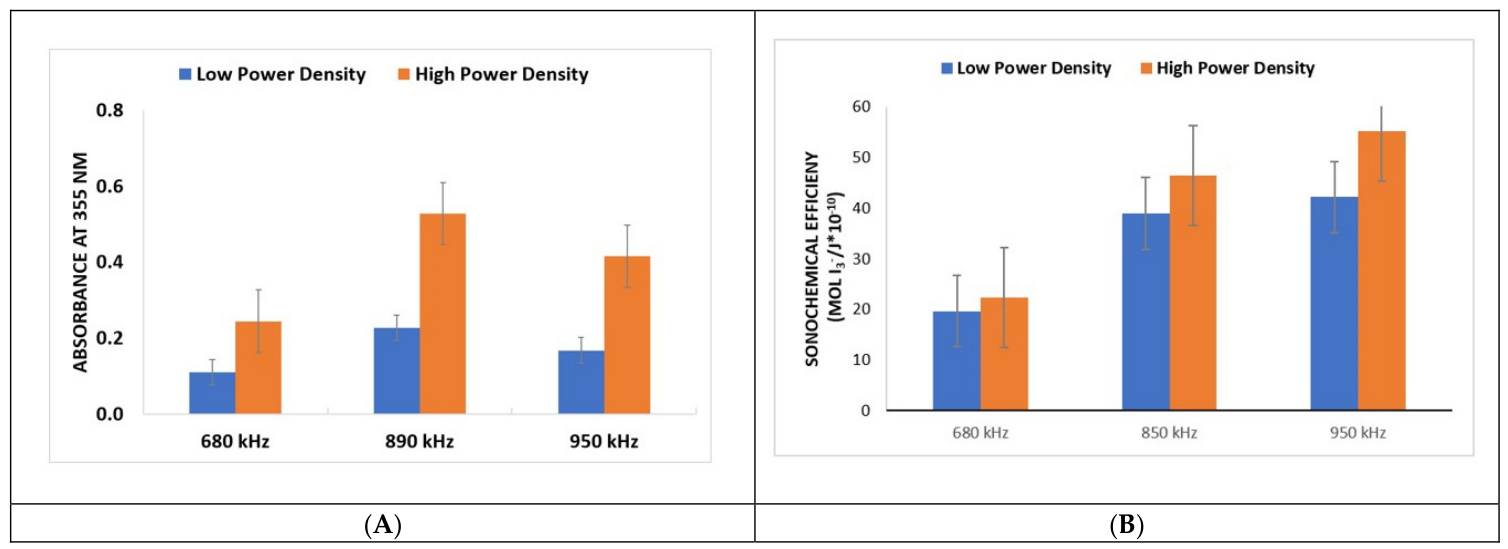
Cavitation activity generated by the ultrasonic transducers was quantified using KI dosimetry. Each transducer was operated in single-frequency mode and evaluated under two power densities. The higher power density was achieved by reducing the liquid volume in the reactor from 10 L to 5 L, and 5 L to 2.5 L effectively doubling the applied power density relative to the low-power level. The KI dosimetry results are presented in
Figure 1. As shown in
Figure 1A, the absorbance measured at 350 nm corresponding to the formation of triiodide (I
3−) increased with power density for all tested frequencies, confirming enhanced cavitation activity under higher energy input. Among the evaluated conditions, the 850 kHz transducer exhibited the highest measured cavitation activity, followed by the 950 kHz system, while the 680 kHz transducer produced the lowest observed activity. Since independent replicate experiments were not performed, the statistical significance of the difference between the 850 kHz and 950 kHz conditions could not be established from the available data, and these results should be interpreted as the highest measured mean absorbance under the tested conditions rather than a statistically confirmed difference. These results indicate that cavitation intensity is strongly dependent on ultrasonic frequency, with the highest cavitation activity observed at 850 kHz under the tested reactor configuration. This frequency-dependent behavior is consistent with previous studies, where cavitation characteristics are governed by the balance between bubble population and collapse conditions, which varies with ultrasonic frequency [
8,
43,
44]. This finding is consistent with our group’s earlier evaluation of the same 10 L reactor platform, which tested transducers operating at 700 and 950 kHz individually and reported a synergistic increase in cavitation activity when both frequencies were applied together; the present results extend this prior work by identifying 850 kHz, a frequency not previously tested on that platform, as the point of maximum cavitation activity within this range [
8].
The peak in cavitation activity observed at 850 kHz may reflect a balance between bubble population and collapse intensity under the tested reactor configuration. At 680 kHz, the longer acoustic cycle allows greater bubble growth and more energetic individual bubble collapse; however, fewer cavitation events may occur per unit time. In contrast, 950 kHz produces a larger population of smaller bubbles because of shorter acoustic cycles, but the reduced bubble growth time may limit the intensity of individual collapse events. Consequently, the intermediate frequency of 850 kHz may provide a favorable balance between bubble population and collapse intensity, resulting in the highest measured cavitation activity under the tested conditions. This behavior may also be influenced by reactor geometry, liquid height, acoustic attenuation, and transducer configuration, which collectively affect ultrasonic energy distribution within the reactor. This mechanistic interpretation is further supported by the corresponding calorimetric results, where the elevated temperature rise at 850 kHz coincided with its highest measured cavitation activity, reinforcing the role of bubble population and collapse-intensity balance in governing overall energy transfer within the reactor.
To further assess cavitation efficiency, the absorbance values were normalized with respect to the applied power density, as shown in
Figure 1B. The normalized results demonstrate that the higher power density condition still yielded greater cavitation activity, suggesting more effective conversion of acoustic energy into chemical effects. However, consistent with previous studies from our group, increased cavitation intensity does not necessarily translate into proportional gains in sonochemical efficiency, highlighting a trade-off between cavitation intensity and energy utilization. This behavior has been widely reported in sonochemical systems, where increasing acoustic energy can lead to competing effects such as bubble interactions and energy dissipation, limiting overall efficiency [
39,
44].
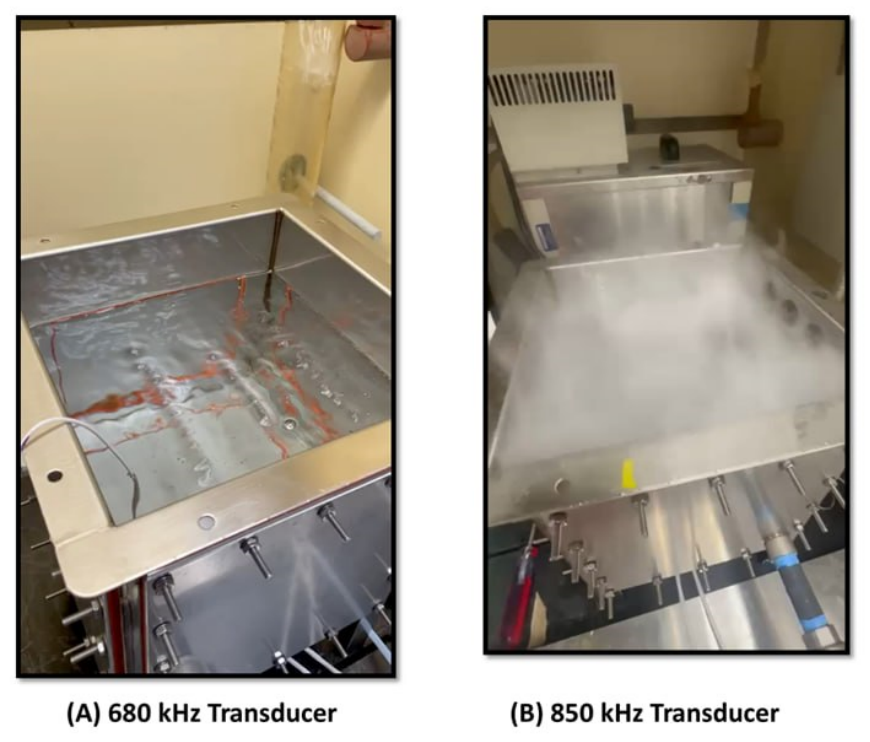
A qualitative comparison of cavitation behavior is provided in
Figure 2, which shows images of the reactor surface under 680 kHz and 850 kHz operation. The 850 kHz system exhibits significantly more vigorous surface agitation and visible mist formation compared to that for 680 kHz, providing visual confirmation of the enhanced cavitation activity observed in the KI dosimetry results. The observed differences between power density can be attributed to variations in liquid height within the reactor. Under low-power-density (higher liquid volume), ultrasonic waves must propagate over a longer distance, resulting in increased attenuation and reduced acoustic intensity, particularly in the upper regions of the reactor. In contrast, the reduced liquid height at higher power density minimizes attenuation effects, allowing more efficient energy transmission and promoting stronger and more uniformly distributed cavitation throughout the system. This observation agrees with previous studies demonstrating that liquid height and reactor geometry significantly influence acoustic energy distribution and cavitation uniformity [
8]. Under these conditions, intermediate frequencies (e.g., 850 kHz) appear to provide more effective cavitation due to improved energy distribution within the reactor.
3.2. Energy Transfer and Calorimetric Efficiency
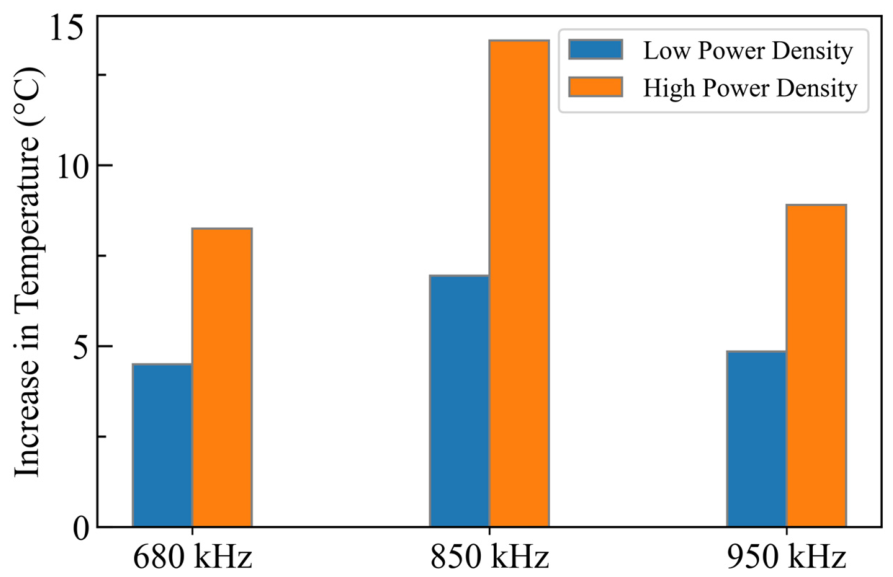
Calorimetry experiments were conducted to evaluate the thermal energy transferred to the liquid during ultrasonic irradiation. Like the KI dosimetry experiments, six trials were performed using three transducer frequencies (680, 850, and 950 kHz) under two power density conditions. The temperature increase in the liquid during sonication was monitored as an indicator of energy transfer efficiency. As shown in
Figure 3, the temperature rise increased consistently with power density for all tested frequencies, confirming that higher energy input leads to greater thermal energy accumulation in the reactor. Error bars are omitted for clarity because repeated experiments showed minimal variation in temperature rise. Under high power density, the temperature increase was significantly higher than that observed under low power density, indicating more effective energy delivery per unit volume.
Among the tested frequencies, the 850 kHz transducer produced the largest temperature increase, followed by the 950 kHz system, while the 680 kHz transducer exhibited the lowest temperature rise. This trend is consistent with the cavitation activity observed in the KI dosimetry results, where the 850 kHz frequency also demonstrated the highest cavitation intensity. The agreement between calorimetric and dosimetry results suggests that stronger cavitation activity contributes to enhanced energy transfer within the system. The observed differences can be attributed to the combined effects of acoustic wave propagation and cavitation dynamics. At higher power density, the reduced liquid volume decreases acoustic attenuation and allows more efficient transmission of ultrasonic energy to the reactor. This results in stronger bubble oscillation and collapse, which enhances localized heating and overall temperature rise. In contrast, at lower power density (larger liquid volume), increased attenuation of energy propagation, leading to reduced thermal energy. This behavior is consistent with previous studies showing that calorimetric energy transfer in sonochemical systems is strongly influenced by cavitation intensity and bubble collapse dynamics, where a portion of the acoustic energy is converted into heat during bubble oscillation and implosion [
8,
44]. However, it has also been reported that increased thermal energy does not necessarily indicate improved sonochemical performance, as a significant fraction of the input energy may be dissipated as heat rather than contributing to radical formation and chemical reactions [
44,
45]. The results demonstrate that both ultrasonic frequency and power density play critical roles in governing energy transfer, with 850 kHz provided the highest cavitation activity and temperature rise under the tested conditions, whereas 950 kHz exhibited higher energy efficiency. This trend agrees with prior sonochemical studies, where intermediate frequencies often provided a balance between efficient energy transfer and effective cavitation activity, while higher frequencies may favor energy conversion efficiency but not necessarily maximum chemical reactivity [
8,
45].
From an energy-balance perspective, the electrical energy supplied to the transducers is distributed among measurable heating of the liquid, heat transfer to the reactor structure and surroundings, acoustic propagation and attenuation, and cavitation-related processes. Energy consumed in bubble nucleation, oscillation, growth, and collapse should not be regarded solely as an energy loss, since these processes generate the physical and chemical effects responsible for cavitation; however, these pathways cannot be separately quantified using the present calorimetric measurements. Consequently, a larger bulk temperature rise does not necessarily indicate greater sonochemical effectiveness, because a larger fraction of the supplied energy may simply be converted into heat rather than useful chemical effects. Because acoustic attenuation reduces the amount of ultrasonic energy reaching different regions of the reactor, as discussed above, it influences both the measured temperature rise and the spatial distribution of cavitation activity. These trends are consistent with previous studies indicating that calorimetric efficiency in sonochemical reactors depends on ultrasonic frequency, reactor geometry, liquid volume, and power density. Taken together, these considerations indicate that the calorimetric values reported here represent an apparent (net) thermal-energy-transfer efficiency rather than a complete reactor energy balance.
3.3. Effect of Ultrasonic Frequency on Bubble Size and Zeta Potential
The size distribution and surface charge characteristics of cavitation-generated nanobubbles are summarized in
Table 2. The measured zeta potential values were consistently small and negative across all experimental conditions. This behavior is expected because the experiments were conducted with deionized water under near-neutral pH conditions, where the absence of dissolved ions limits the development of significant surface charge on the bubble interface.
A clear trend was observed between ultrasonic frequency and bubble size. As the operating frequency increased, the average bubble size decreased. This behavior is consistent with cavitation theory, where bubble dynamics are governed by acoustic oscillation cycles, and higher frequencies limit bubble growth due to shorter expansion times before collapse [
45,
46]. Additionally, variations in power density and liquid volume influenced both bubble size and zeta potential. At higher power densities, slightly larger bubbles and more negative zeta potentials were observed, likely due to enhanced cavitation intensity and increased interfacial activity. In contrast, lower power densities and larger liquid volumes resulted in smaller bubbles with zero zeta potential. These results indicate that ultrasonic frequency is the dominant parameter controlling bubble size, while solution chemistry and operating conditions may play secondary role in determining surface charge and will be discussed later in the manuscript. The relatively low magnitude of zeta potential suggests limited electrostatic stabilization; however, even weak negative charges may contribute to the observed persistence of nanobubbles in the system. This behavior is consistent with previous studies reporting that nanobubbles in low-ionic-strength systems typically exhibit weakly negative zeta potentials due to interfacial charge development at the gas–liquid interface, even in the absence of significant dissolved electrolytes [
44]. The observed decrease in bubble size with increasing ultrasonic frequency also agrees with established cavitation theory, where shorter acoustic cycles at higher frequencies limit bubble growth time, resulting in the formation of smaller and more stable bubbles [
44,
45]. Furthermore, prior studies have shown that while ultrasonic frequency primarily governs bubble size distribution, parameters such as power density and liquid volume influence bubble–bubble interactions and interfacial dynamics, which can slightly modify both bubble size and surface charge [
8,
15]. The relatively weak surface charge observed in this study suggests that nanobubble stability is not solely governed by electrostatic repulsion but may also involve additional mechanisms such as interfacial structuring of water and gas oversaturation, which have been reported to contribute to the long-term stability of nanobubbles in aqueous systems [
23,
26].
3.4. Surface Charge Characteristics of Cavitation Bubbles Under Different Chemical and Operating Conditions
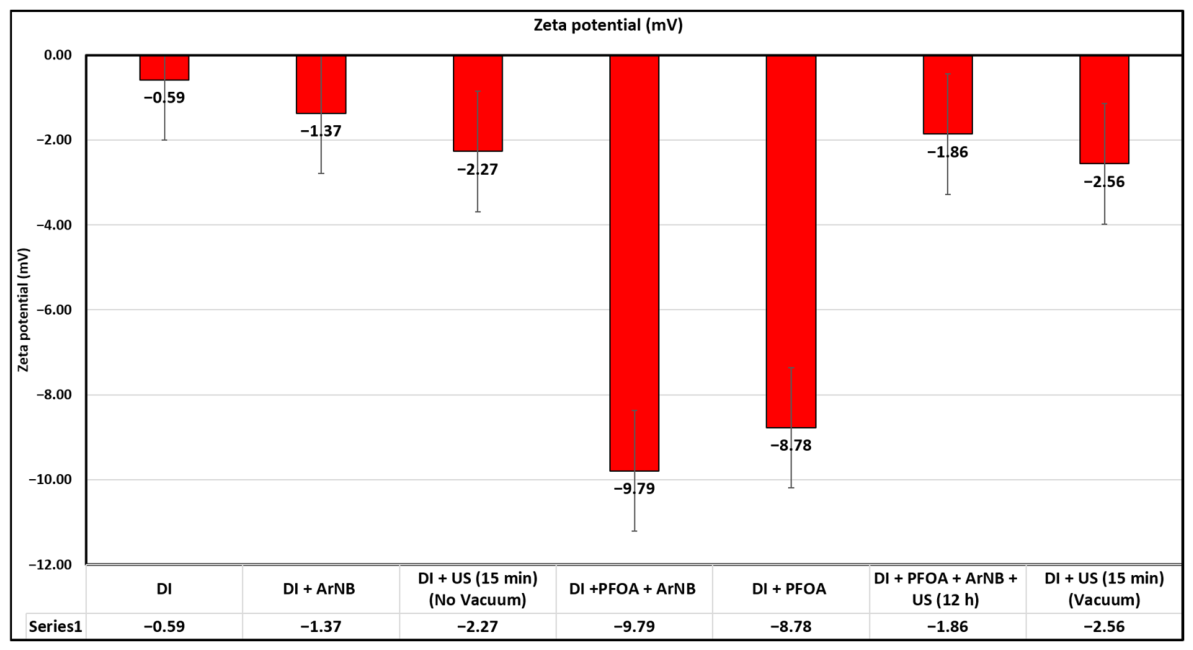
The surface charge behavior of cavitation-generated bubbles was further investigated to evaluate the influence of solution chemistry, nanobubble presence, and operating conditions on interfacial properties. The Zeta potential measurements obtained under different experimental scenarios are presented in
Figure 4. Across all conditions, the measured zeta potential values were negative, indicating that cavitation bubbles in aqueous systems inherently possess a net negative surface charge. In deionized (DI) water, the zeta potential was extremely low and hence not reported here. The introduction of argon nanobubbles (ArNB) slightly increased the magnitude of the negative charge (−1.37 mV), suggesting that nanobubbles enhance interfacial area and contribute additional charged gas–liquid interfaces within the system.
The application of ultrasound further influenced the surface charges. Under ultrasonic irradiation without vacuum conditions, the zeta potential became more negative (−2.27 mV), indicating that acoustic cavitation promoted charge separation and interfacial polarization. This behavior can be attributed to the dynamic formation and collapse of bubbles, which enhance the adsorption of charged species and facilitate the accumulation of ions at the gas–liquid interface. When vacuum conditions were applied during ultrasound, a comparable zeta potential value (−2.56 mV) was observed, suggesting that while dissolved gas content influences cavitation dynamics, it does not significantly alter the overall surface charge compared to ultrasound alone.
A markedly different behavior was observed in the presence of PFOA. The addition of PFOA significantly increased the magnitude of the negative zeta potential (−8.78 mV), which is consistent with, but does not directly confirm, interfacial association of PFAS molecules at the bubble interface. This can be attributed to the amphiphilic nature of PFOA, where the hydrophobic fluorinated tail preferentially associates with the gas phase while the hydrophilic carboxylate headgroup remains in the aqueous phase, a pattern that would be consistent with the accumulation of negatively charged species at the interface. The presence of argon nanobubbles further amplified this effect, resulting in the most negative zeta potential observed in this study (−9.79 mV), which may indicate an additional interaction between PFAS and nanobubble interfaces, although the present measurements cannot distinguish direct molecular adsorption from other electrostatic or physical effects. This greater change in zeta potential suggests that PFAS-nanobubble interactions may increase the likelihood of PFAS molecules being exposed to cavitation-induced reactions; however, direct PFAS degradation was not evaluated in this study.
Interestingly, prolonged ultrasonic treatment (12 h) in the presence of both PFOA and ArNB led to a substantial reduction in the magnitude of the zeta potential (−1.86 mV). This decrease indicates that the interfacial composition evolved during prolonged treatment. Several mechanisms may contribute to this response. Repeated bubble growth and collapse may promote desorption or redistribution of PFOA and other surface-active species. Prolonged sonication may also restructure the interfacial layer or alter the balance between bubble fragmentation, coalescence, and surface coverage. In addition, sonochemical transformation of PFOA or the formation of intermediate products could modify the interfacial charge. However, because PFOA degradation products and fluorine mass balance were not measured, the relative contribution of these mechanisms cannot be determined from the present data.
These results demonstrate that while ultrasound and nanobubbles moderately influence the surface charge of cavitation bubbles, the presence of PFAS is associated with the most pronounced changes in interfacial electrochemical behavior. The more negative zeta potential observed in the presence of PFAS is consistent with possible interfacial accumulation of PFAS molecules at the gas–liquid interface and could plausibly influence bubble stability, interfacial reactions, and radical formation pathways; however, these mechanisms were not directly measured in this study. This highlights the potential importance of interfacial chemistry in sonochemical systems and provides insight into interfacial phenomena that may influence PFAS treatment in ultrasonic reactors. These observations are consistent with previous studies reporting that cavitation bubbles and nanobubbles in aqueous systems typically exhibit a negative surface charge due to the preferential adsorption of hydroxyl ions (OH
−) at the gas–liquid interface, even in low-ionic-strength water [
23,
24]. The relatively low magnitude of zeta potential in DI water observed in this study further supports the role of solution chemistry in limiting interfacial charge development in the absence of surface-active species [
23,
24]. The significant increase in negative zeta potential in the presence of PFOA agrees with prior work demonstrating that PFAS compounds strongly adsorb at air–water interfaces due to their amphiphilic structure, leading to enhanced surface charge and modified interfacial properties [
47,
48]. In terms of magnitude, the zeta potentials measured in this study (approximately −2 to −10 mV) are smaller than the ~−35 mV reported by Takahashi for air microbubbles in distilled water, a difference that may reflect the smaller bubble size, gas type, and lower dissolved-ion content of the cavitation-generated nanobubbles examined here relative to the microbubble system characterized in that study [
49].
3.5. Nanobubble Characteristics Under Different Chemical Environments and Operating Conditions
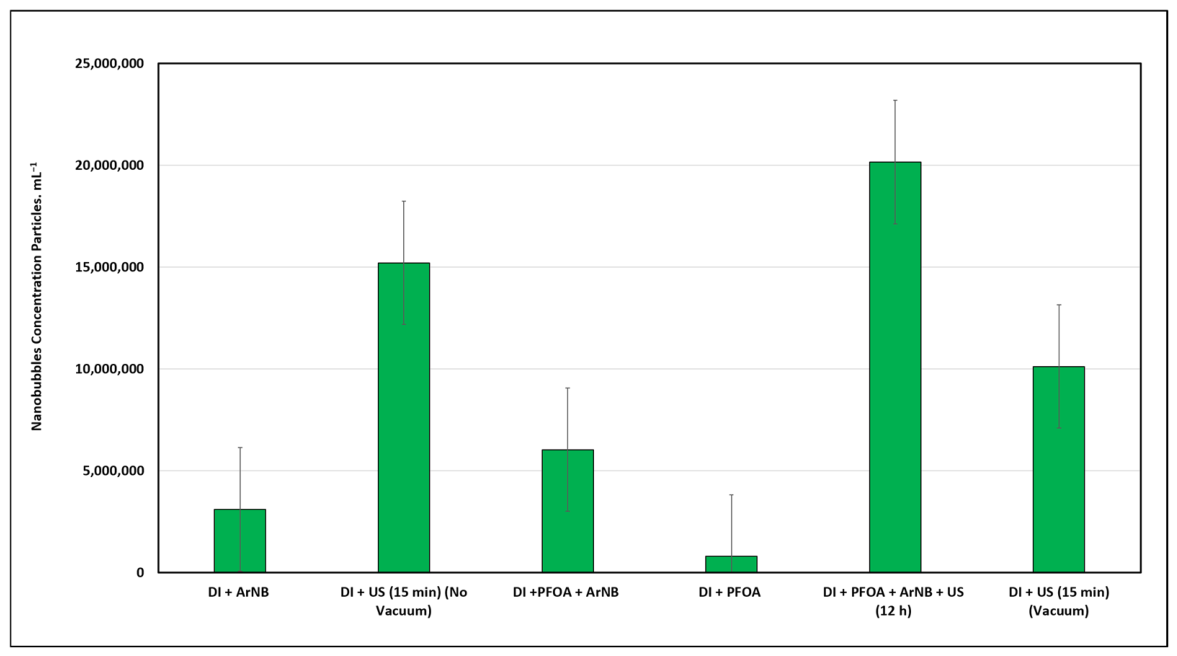
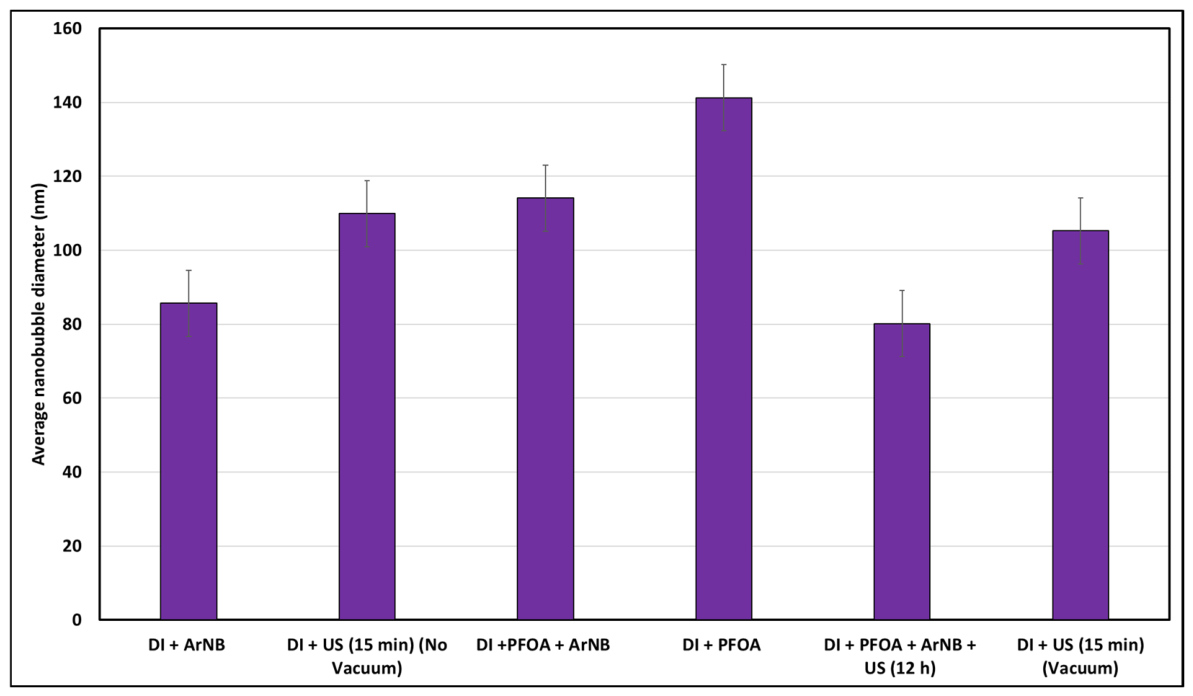
The characteristics of nanobubbles, including their concentration and size distribution, were further evaluated under different chemical environments and operating conditions to better understand their role under cavitation. The results are presented in
Figure 5 and
Figure 6. The observed increase in nanobubble concentration under ultrasonic irradiation can be attributed to the well-established mechanism of acoustic cavitation, where repeated bubble nucleation, growth, and collapse cycles generate a large population of smaller bubbles through fragmentation processes. This phenomenon has been widely reported in test using sonochemical reactors, where bubble fragmentation and rectified diffusion contribute to the formation of stable nanobubbles [
50,
51]. A significant variation in nanobubble concentration was observed across the tested conditions (
Figure 5). In DI water, the nanobubble concentration was almost zero and hence was not reported here. The introduction of ArNBs produced substantial bubble concentration, consistent with successful generation and stabilization of nanobubbles under the experimental conditions. The reduction in nanobubble concentration under vacuum further highlights the critical role of dissolved gases in sustaining cavitation activity. Previous studies have shown that gas availability strongly influences bubble nucleation and stability, as dissolved gases serve as nuclei for cavitation and support bubble growth through mass transfer processes [
52,
53]. The application of ultrasound resulted in a substantial increase in nanobubble concentration, particularly without vacuum, where concentrations reached on the order of 10
7 bubbles mL
−1. As noted in
Section 2.5, NTA detects light-scattering particles undergoing Brownian motion and cannot independently distinguish gas-filled nanobubbles from similarly sized solid particles; the concentrations reported here should therefore be interpreted together with the validation and background (DI-water blank) measurements described in the Methods, rather than as a direct, independently confirmed count of nanobubbles alone.
The presence of PFOA significantly influenced nanobubble concentration. The observed decrease in nanobubble concentration in PFOA-containing systems under short-term sonication is consistent with studies indicating that surface-active compounds can alter bubble–bubble interactions and promote coalescence or restructuring of interfacial layers, thereby reducing the total number of bubbles [
49,
50,
54]. However, when PFOA was combined with ArNB and prolonged ultrasound treatment (12 h), the nanobubble concentration reached the highest values observed in this study (~10
7–10
8 particles mL
−1). The behavior suggests that PFAS molecules may act as stabilizing agents under prolonged cavitation by forming structured interfacial layers that inhibit bubble coalescence and suppress gas diffusion out of bubbles. Similar stabilization mechanisms have been reported for surfactant-covered bubbles, where adsorption at the gas–liquid interface reduced bubble coalescence and altered bubble growth dynamics, thereby enhancing bubble persistence and stability [
55,
56,
57,
58].
The size distribution of nanobubbles also varied significantly with experimental variables (
Figure 6). In DI water, nanobubbles size could not be measured and hence not reported here. The addition of ArNBs showed an average size of ~85 nm confirming the 100 nm pores produce similar sized nanobubbles, indicating the presence of pre-generated bubbles with a broader size distribution. Ultrasound treatment resulted in a noticeable increase in bubble size (~110 nm), likely due to enhanced bubble growth and coalescence during acoustic oscillation. A similar trend was observed under vacuum conditions, although the average size remained slightly lower than in non-vacuum conditions, further highlighting the influence of dissolved gas content on bubble dynamics. These measured sizes are broadly consistent with the approximately 100–400 nm range commonly reported for bulk nanobubbles in the literature, although the ArNB-only bubbles (~85 nm) fall slightly below this range, likely reflecting their generation via a fixed 100 nm membrane pore rather than acoustic cavitation [
26].
The increase in nanobubble size under the application of ultrasound can be explained by the competing effects of bubble coalescence and growth during acoustic oscillation. While cavitation promotes fragmentation, it can also enhance bubble–bubble collisions, leading to temporary growth in average bubble size [
55,
59]. In contrast, the presence of PFOA led to the formation of larger nanobubbles (~140 nm). This observation is consistent with previous studies demonstrating that surfactants and amphiphilic compounds adsorb at the gas–liquid interface, reduce surface tension, and form interfacial layers that inhibit bubble collapse and promote bubble growth and stability [
23,
55,
56]. Interestingly, prolonged ultrasound treatment in the presence of PFOA and ArNB resulted in reduction in average bubble size (~80 nm). This reduction indicates a transition toward a dynamic steady state, where continuous cavitation-induced fragmentation dominates over coalescence, leading to a higher population of smaller, stabilized nanobubbles. Similar behavior has been reported in long-duration sonication systems, where equilibrium between bubble breakup and growth determines the final size distribution [
50,
55,
59,
60]. These results demonstrate that nanobubble characteristics are strongly influenced by both operating conditions and solution chemistry. Overall, the combined effects of cavitation intensity, supply of ArNBs, and interfacial adsorption govern nanobubble generation and stability. These factors are particularly important in PFAS-containing systems, where enhanced interfacial accumulation may promote localized reactions at bubble surfaces, thereby influencing degradation pathways and overall treatment efficiency.
4. Discussion of Test Results
Our results demonstrate that cavitation activity, energy transfer, and bubble interfacial properties in a sonochemical reactor are strongly interdependent and governed primarily by ultrasonic frequency, with additional modulation by power density and solution chemistry. Rather than behaving as independent variables, these parameters collectively define the efficiency of acoustic energy conversion into chemical and physical effects potentially relevant to sonochemical reactor performance.
KI dosimetry results show a non-linear dependence of cavitation activity on ultrasonic frequency, peaking at 850 kHz due to an apparent balance between bubble population and collapse intensity; lower frequencies (680 kHz) yield stronger but fewer collapses, while higher frequencies (950 kHz) produce more bubbles with weaker collapse. Because the reported error bars represent spatial variation between samples collected from the top and bottom of a single reactor run rather than independent experimental replication, the observed differences should be interpreted as trends in reactor behavior rather than statistically significant differences. Calorimetric results showed similar trends, with maximum temperature rise at 850 kHz, though cavitation intensity and energy efficiency are not directly proportional, as increased power density enhanced cavitation but also increased thermal losses. Higher frequencies favor uniform bulk heating, whereas intermediate frequencies concentrate energy within collapsing bubbles, potentially enhancing sonochemical reactions. Power density also affected acoustic attenuation, where smaller volumes improved energy distribution and uniformity of cavitation, while larger volumes reduce effectiveness, particularly at higher frequencies, emphasizing the role of reactor design in scale-up. Although bubble size decreased with increasing frequency, cavitation performance depended on the combined effects of bubble size, bubble concentration, and collapse dynamics. Zeta potential results further show a more negative surface charge in the presence of PFAS (e.g., PFOA), which is consistent with possible PFAS accumulation at the bubble interface and may contribute to localized reaction environments, although direct interfacial adsorption was not measured in this study.
In addition to the balance between bubble population and collapse intensity, the maximum cavitation activity observed at 850 kHz may also reflect resonance effects between the applied ultrasonic frequency, cavitation bubble dynamics, and the acoustic field within the reactor. Under resonance conditions, acoustic energy transfer to the liquid medium can be enhanced, potentially promoting more efficient bubble oscillation and collapse. However, because bubble resonance frequency and reactor acoustic field characteristics were not directly measured in this study, this resonance-related explanation should be regarded as a possible contributing mechanism rather than a confirmed conclusion.
The presence of argon nanobubbles further amplifies these interfacial effects by increasing the available surface area for adsorption. The combined presence of PFAS and nanobubbles produces the most negative zeta potentials, which may indicate an additional or combined effect of PFAS and nanobubbles on interfacial charge; however, the present data cannot confirm a specific synergistic mechanism. The increased magnitude of negative surface charge under these conditions may enhance electrostatic repulsion between bubbles, thereby reducing bubble coalescence and contributing to nanobubble stability; this behavior is consistent with, but does not independently confirm, interfacial association of PFOA or other surface-active species at the gas–liquid interface. However, prolonged ultrasonic treatment led to a reduction in magnitude of zeta potential, suggesting dynamic changes in interfacial composition due to adsorption/desorption processes and redistribution of surface-active species. This indicates that interfacial chemistry evolves over time and is closely coupled with ongoing sonochemical reactions. The amphiphilic structure of PFOA, comprising a hydrophobic fluorinated tail and a hydrophilic head group, may favor its association with the gas–liquid interface of cavitation bubbles. This interfacial association is consistent with the observed increase in negative zeta potential and may also contribute to reduced bubble coalescence, resulting in greater nanobubble stability. Greater bubble stability may, in turn, prolong the persistence of reactive gas–liquid interfaces and could potentially influence radical-mediated reactions occurring at these interfaces. These mechanisms are proposed based on the observed zeta-potential behavior and prior literature on surfactant behavior at gas–liquid interfaces; they were not directly measured in the present study.
Our nanobubble characterization results revealed that ultrasound significantly increased nanobubble concentration through continuous nucleation and fragmentation processes, while dissolved gas availability played a key role in sustaining bubble populations. The presence of PFAS alters nanobubble behaviour by promoting larger bubble sizes and enhanced stability, likely due to surface adsorption and reduced surface tension. This stabilization effect can inhibit bubble coalescence and collapse, thereby modifying cavitation dynamics. However, extended sonication led to fragmentation of stabilized bubbles, reducing their size and indicating a dynamic equilibrium between bubble growth and breakup. These findings suggest that nanobubbles are not passive entities but actively participate in cavitation processes by influencing both interfacial reactions and energy distribution.
The combined results provide mechanistic insights into cavitation and interfacial phenomena that are believed to influence PFAS degradation in sonochemical systems. Previous studies have reported that PFAS molecules can preferentially accumulate at the gas–liquid interface because of their amphiphilic structure, where they may be exposed to the localized high temperatures, pressures, and reactive radical species generated during bubble collapse. The more negative zeta potential observed in the presence of PFOA in this study is consistent with possible interfacial association of PFOA molecules with the bubble interface; however, direct adsorption at the bubble interface was not measured. The increased gas–liquid interfacial area provided by nanobubbles may increase the probability of PFAS molecules being exposed to cavitation-induced reactions. Consequently, PFAS treatment performance may be influenced by the extent of interfacial cavitation activity.
Overall, the findings demonstrate that ultrasonic frequency serves as a primary control parameter governing cavitation behavior, energy transfer, and bubble dynamics, while power density and solution chemistry provide additional tuning mechanisms. Under the tested conditions, 850 kHz exhibited the highest measured cavitation activity, whereas 950 kHz demonstrated the highest energy efficiency. These findings highlight the importance of considering multiple performance metrics when evaluating sonochemical reactor operation and provide insight into the relationships among cavitation behavior, energy utilization, and bubble interfacial properties.
A limitation of this study is that independent replicate experiments were not performed for each operating condition. Consequently, the reported error bars represent spatial variation within a single reactor run rather than experimental replication, and formal statistical analyses (e.g., ANOVA or t-tests) were not conducted. Therefore, the observed differences among operating conditions should be interpreted as mechanistic trends in reactor behavior rather than statistically validated differences. Future studies should include independent replicate experiments to enable rigorous statistical evaluation of reactor performance.
Based on the measured cavitation activity, calorimetric efficiency, and bubble interfacial properties, the combination of 850 kHz operation, higher power density, and ArNB addition exhibited the most favorable reactor-characterization metrics under the conditions investigated. However, because PFAS degradation, defluorination, and fluorine mass balance were not directly measured, these results should not be interpreted as evidence of optimal PFAS treatment performance. Rather, they identify operating conditions that warrant further investigation in future PFAS degradation studies incorporating independent experimental replication, statistical analysis, and direct measurements of PFAS degradation, defluorination, transformation products, and fluorine mass balance.
These reactor-characterization findings can also be considered alongside the broader body of sonochemical PFAS treatment research. Meegoda et al. previously demonstrated ultrasonic degradation of complex, multi-component PFAS mixtures, providing context for how sonochemical treatment performance observed at the laboratory scale relates to more environmentally representative PFAS matrices [
3]. Building on this work, Jurisingani et al. reported a field demonstration of a high-frequency ultrasonic treatment reactor for PFAS destruction in contaminated groundwater, illustrating how cavitation-based treatment, similar in principle to that characterized in the present intermediate-scale reactor, can be translated toward intermediate- and field-scale ultrasonic systems [
4]. More broadly, Tasca et al. reviewed the pathways, chemistry, and operational variables governing PFAS removal by ultrasound irradiation, highlighting how parameters such as frequency, power density, and reactor configuration, the same variables characterized in this study, govern sonochemical degradation efficiency [
35]. Awoyemi et al. further discussed recent advancements in ultrasonic PFAS degradation, including hybrid treatment approaches that couple ultrasound with complementary oxidation processes, suggesting potential directions for building on the reactor operating conditions identified in this study [
36]. Collectively, these studies support the relevance of the cavitation activity, energy transfer, and interfacial characterization results presented here to the broader sonochemical PFAS treatment literature; however, because PFAS degradation and defluorination were not directly measured in the present study, the relationship between the reactor operating conditions identified here and actual PFAS treatment performance remains to be established in future work.
From a practical standpoint, these findings highlight the importance of characterizing reactor performance before conducting PFAS degradation experiments in ultrasonic systems. Selecting an appropriate ultrasonic frequency, informed by combined cavitation activity, energy transfer, and bubble interfacial measurements, can improve cavitation activity and energy utilization within a given reactor configuration, while further optimization of operating conditions such as power density and liquid volume may improve future reactor performance. More broadly, understanding cavitation behavior and nanobubble dynamics in an intermediate-scale reactor, as characterized in this study, provides useful guidance for scaling sonochemical systems toward larger volumes, where factors such as acoustic attenuation and energy distribution become increasingly important. Taken together, these results provide a foundation for future studies evaluating PFAS degradation and should be interpreted as reactor-characterization findings rather than evidence that PFAS degradation was achieved in this work. The reactor characterization results obtained in this study may help inform the design of future pilot- and full-scale ultrasonic reactors for PFAS treatment. Practical considerations for scale-up include ultrasonic frequency selection to balance cavitation intensity and energy efficiency, power density required to sustain effective cavitation without excessive thermal losses, reactor geometry and transducer arrangement to promote uniform energy distribution, liquid height, which influences acoustic attenuation and cavitation distribution within the reactor, and overall energy efficiency, which affects the practicality of larger-scale operation. The operating conditions identified in this study may guide the optimization of future pilot-scale reactor designs; however, they should not be interpreted as universally optimal conditions for PFAS treatment, as scale-up performance will depend on additional factors specific to each reactor configuration.
5. Conclusions
This study systematically evaluated the coupled effects of ultrasound frequency, cavitation activity, energy efficiency, and bubble dynamics in a sonochemical reactor. The results demonstrate that ultrasonic frequency is the dominant parameter governing cavitation behavior, energy transfer, and bubble dynamics. Among the tested conditions, 850 kHz produced the highest cavitation activity, while 950 kHz exhibited the greatest calorimetric efficiency, indicating a trade-off between cavitation intensity and energy utilization. Increasing power density enhanced cavitation activity but also led to higher thermal losses, highlighting the importance of carefully selecting operating conditions for efficient reactor performance. Bubble characterization revealed that higher frequencies generate smaller bubbles, while surface charge remained weakly negative under most conditions. However, the presence of PFOA and argon nanobubbles significantly increased the magnitude of the negative zeta potential, indicating strong interfacial adsorption and enhanced bubble–contaminant interactions. Nanobubble concentration and size were strongly influenced by both ultrasound and solution chemistry, with ultrasound promoting bubble generation and PFAS affecting bubble stability and growth.
Furthermore, the results suggest that both externally added nanobubbles and those generated during ultrasonic operation, can influence cavitation behavior and interfacial properties, highlighting an additional design parameter for optimizing reactor performance. The findings highlight the strong interdependence between cavitation activity, energy efficiency, and interfacial bubble properties. This work provides important insights for optimizing sonochemical reactor design and demonstrates the critical role of interfacial phenomena in enhancing processes such as PFAS degradation and advanced oxidation.
A limitation of this study is that changes in liquid volume also altered liquid height, acoustic attenuation, and cavitation distribution within the reactor. Therefore, the observed trends reflect the combined effects of ultrasonic frequency, power density, and reactor operating conditions rather than the isolated influence of a single parameter. It should be noted that this study did not directly quantify PFAS degradation, defluorination, transformation products, or fluorine mass balance. Therefore, the conclusions are limited to reactor characterization, cavitation behavior, energy efficiency, and bubble interfacial properties. The identified operating conditions are expected to be favorable for PFAS treatment; however, direct PFAS degradation experiments are required to confirm treatment performance. The primary limitation of this study is that direct PFAS degradation and defluorination were not measured. Consequently, the reactor-characterization metrics identified here, including cavitation activity, calorimetric efficiency, bubble dynamics, and interfacial properties, cannot yet be directly correlated with PFAS destruction performance. Future work should correlate these metrics with PFAS degradation, defluorination, and fluorine mass balance to validate the operating conditions identified in the present reactor-characterization study.