Article

Biomass-Derived Hydrochar Functionalized with Mg–Fe Layered Double Hydroxide for Bicomponent Cd(II)/Zn(II) Adsorption in Aqueous Systems


by
Jipson Joel Avila-Carranza
1,
Luis Ángel Zambrano-Intriago
1,2,
Alejandro Josué García-Guerrero
1,3,
Kevin Jhon Fernández-Andrade
1,
Lisdelys González-Rodríguez
4,
Iris B. Pérez-Almeida
5 and
Joan Manuel Rodríguez-Díaz
1,3,*
1
Laboratorio de Análisis Químicos y Biotecnológicos, Instituto de Investigación, Universidad Técnica de Manabí, S/N, Avenida Urbina y Che Guevara, Portoviejo 130105, Manabí, Ecuador
2
Departamento de Ciencias Biológicas, Facultad de Ciencias de la Salud, Universidad Técnica de Manabí, Portoviejo 130105, Manabí, Ecuador
3
Departamento de Procesos Químicos, Facultad de Ciencias Matemáticas, Físicas y Químicas, Universidad Técnica de Manabí, Portoviejo 130105, Manabí, Ecuador
4
Centro de Modelación Ambiental y Dinámica de Sistemas (CEMADIS), Universidad de Las Américas, Santiago, Chile
5
Center for Sustainable Development Studies (CEDS), Ecotec University, Samborondón 09230, Guayas, Ecuador
*
Author to whom correspondence should be addressed.
Water 2026, 18(14), 1658; https://doi.org/10.3390/w18141658 (registering DOI)
Submission received: 30 May 2026 / Revised: 2 July 2026 / Accepted: 4 July 2026 / Published: 8 July 2026
(This article belongs to the Special Issue Physical–Chemical Wastewater Treatment Technologies, 2nd Edition)

Abstract

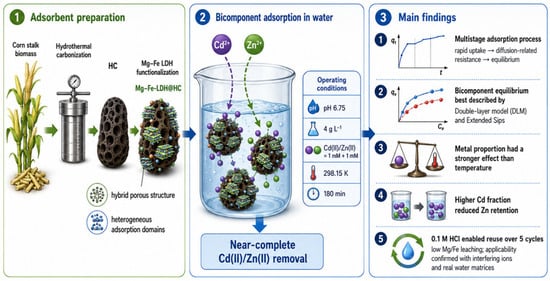
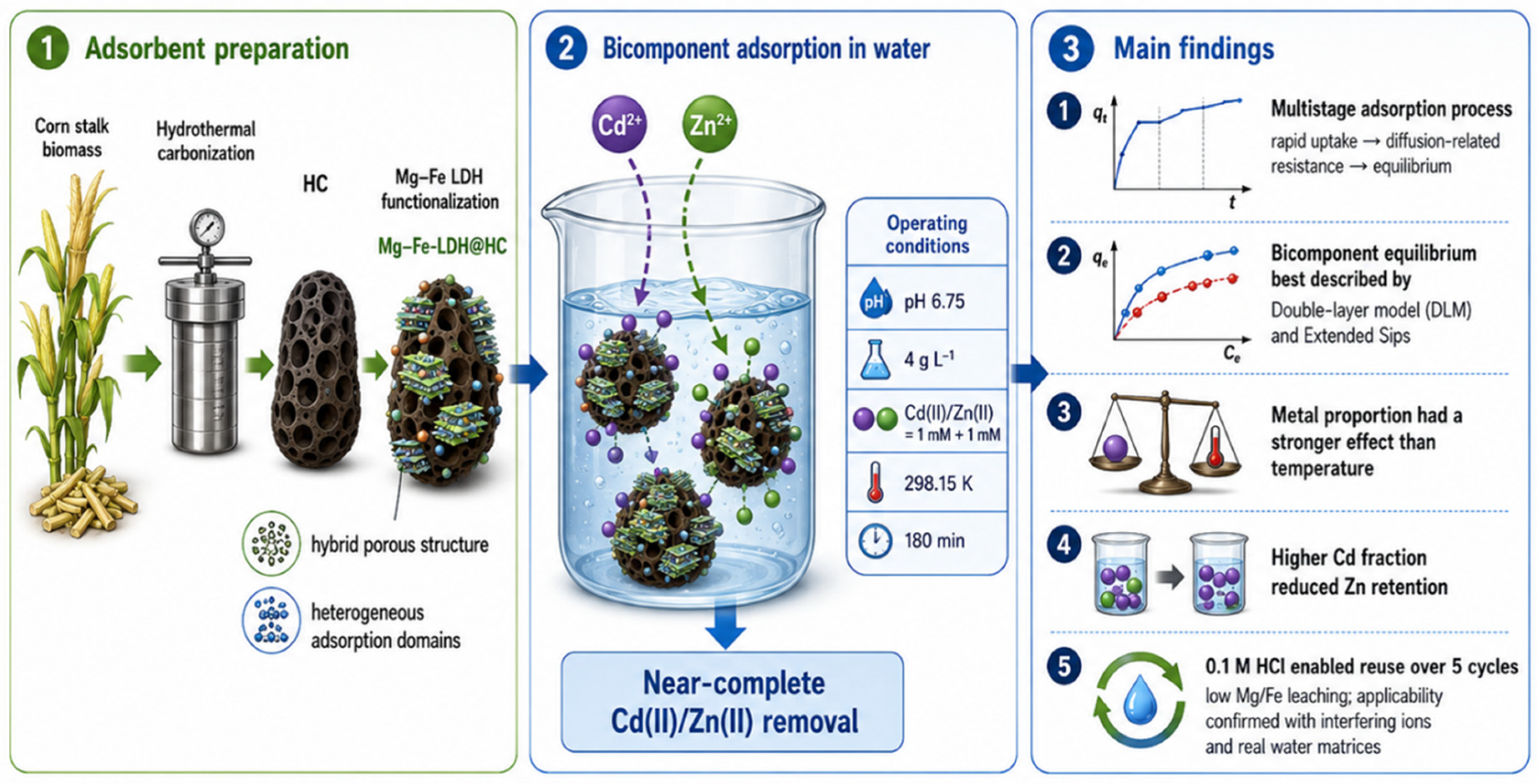
Toxic metal contamination in aquatic systems commonly occurs as multicomponent mixtures, making competitive adsorption assessment essential for realistic adsorbent evaluation. This study investigated corn stalk-derived hydrochar functionalized with Mg-Fe layered double hydroxide (Mg–Fe-LDH@HC) for simultaneous Cd(II) and Zn(II) adsorption in aqueous bicomponent systems. The material was evaluated through pH and dosage optimization, kinetic assays, bicomponent equilibrium modeling, thermodynamic assessment, mixture-design experiments, regeneration tests, and applicability assays with interfering ions and real water matrices. Under the selected conditions, pH 6.75, 4 g L−1 Mg–Fe-LDH@HC, 1 mM equimolar Cd(II)/Zn(II), 298.15 K, and 180 min, near-complete removal of both metals was achieved. Kinetic analysis showed rapid initial uptake followed by a slower approach to equilibrium. Bangham, Elovich, and Weber-Morris analyses supported a multistage adsorption process involving external surface uptake, diffusion-related resistance, and heterogeneous surface interactions, although intraparticle diffusion was not the sole rate-controlling step. Bicomponent equilibrium was better described by heterogeneous models, particularly the double-layer model and Extended Sips, indicating non-equivalent adsorption domains. Thermodynamic parameters showed favorable and mildly endothermic adsorption with limited temperature dependence. Mixture-design experiments demonstrated that metal proportion influenced adsorption more strongly than temperature, with increasing Cd(II) fractions reducing Zn(II) retention. Overall, Mg–Fe-LDH@HC showed promising performance for Cd(II)/Zn(II) removal under competitive conditions, although the adsorption pathway should be interpreted as an evidence-supported combined process rather than individually confirmed mechanisms.

Graphical Abstract

1. Introduction

Toxic metal ion contamination in aquatic environments remains a persistent concern because dissolved metal species are non-biodegradable, can remain mobile under changing physicochemical conditions, and may accumulate through food chains [1,2]. Industrial activities associated with mining, smelting, electroplating, metallurgy, battery production, and agroindustrial processing frequently discharge effluents containing multiple metal species rather than isolated contaminants [3,4]. Among these pollutants, Cd(II) is particularly critical because it is a non-essential element with recognized toxicity even at low concentrations, whereas Zn(II), although an essential micronutrient, may become harmful when present above acceptable environmental levels. The Cd(II)/Zn(II) system was selected because both ions may coexist in industrial and agroindustrial aqueous matrices and because Zn(II), as a common divalent coexisting metal, can interfere with the retention of more toxic trace metals such as Cd(II). From a mechanistic perspective, this binary system is also relevant because Cd(II) and Zn(II) share the same formal charge but differ in hydrated ionic radius, hydration behavior, hydrolysis tendency, and affinity toward oxygenated or hydroxylated adsorption sites. Therefore, their coexistence in aqueous matrices provides a suitable model to evaluate competitive adsorption and selectivity on engineered sorbents [5,6].
Metal removal has been addressed using precipitation, coagulation-flocculation, ion exchange, electrochemical processes, membrane filtration, reverse osmosis, and adsorption [7,8]. Although these technologies can reduce dissolved metal concentrations, their application may be constrained by chemical consumption, secondary sludge generation, energy demand, or reduced selectivity in complex matrices [7,9]. Adsorption is therefore considered a practical alternative because it is operationally simple, adaptable to different concentration ranges, and compatible with sorbents obtained from residual biomass [10]. However, adsorption efficiency depends strongly on surface charge, porosity, functional group density, mineral phases, active-site accessibility, and affinity toward competing ions [11].
Hydrochar (HC), obtained through hydrothermal carbonization of lignocellulosic residues, is an attractive carbonaceous platform for water remediation because the aqueous conversion pathway can preserve oxygen-containing functionalities involved in metal binding [12,13]. Nevertheless, pristine HC commonly requires surface modification to improve adsorption capacity, selectivity, active-site density, and separation behavior in aqueous systems [12]. Hybrid HC-based materials are therefore relevant because they can combine the structural contribution of a biomass-derived matrix with inorganic phases that provide more chemically specific adsorption domains [13].
Layered double hydroxides (LDHs) are hydrotalcite-like materials composed of positively charged metal hydroxide layers and charge-compensating interlayer anions, which gives them tunable composition, hydroxyl-rich lamellae, and ion-exchange ability [7,8]. These features can contribute to metal retention through surface complexation, electrostatic interactions, ion exchange, and precipitation-related pathways [9]. However, pristine LDH particles may undergo aggregation and compact layer stacking, which limits active-site accessibility and practical performance as dispersed powder adsorbents [7]. Integrating LDHs with carbonaceous supports can improve particle dispersion, facilitate mass transfer, and generate hybrid interfaces where oxygenated groups and hydroxylated lamellae may jointly contribute to metal retention [14,15].
Competitive adsorption cannot be fully interpreted from single-metal systems because the adsorption of each ion may depend on hydrated ionic radius, electronegativity, hydrolysis tendency, mass-to-charge ratio, and affinity toward oxygenated or hydroxylated sites [5,12]. In multicomponent solutions, one metal ion may alter the availability or reactivity of adsorption domains for another, affecting both adsorption capacity and selectivity [16,17]. Recent studies confirm that LDH-functionalized hydrochar and biochar adsorbents are increasingly used for toxic metal remediation, including LDH/hydrochar and LDH/biochar systems applied to monometallic and multicomponent metal matrices [18,19,20,21]. In this context, the use of Mg–Fe-LDH@HC is relevant because HC provides biomass-derived support with oxygenated surface groups, while the Mg–Fe-LDH phase provides hydroxylated sheets, metal-associated surface domains, and interlaminar regions that can enhance metal retention. Thus, the hybrid structure can offer more diverse adsorption environments than pristine HC or LDH not supported separately.
Although LDH-carbonaceous materials have been investigated for several metal combinations, including systems involving highly toxic metals such as Pb(II) and Cd(II), the specific competition between Cd(II) and Zn(II) on Mg–Fe-LDH-functionalized HC remains insufficiently clarified [22,23,24]. This gap is relevant because the Cd(II)/Zn(II) pair does not simply represent the simultaneous removal of two divalent ions, but rather a competitive system involving a highly toxic non-essential element and an essential micronutrient that may act as a major coexisting interferent. Compared with Pb(II)/Cd(II) systems, where Pb(II) may dominate adsorption due to its strong affinity for oxygenated and mineral surface domains, Cd(II)/Zn(II) competition allows a more specific evaluation of how subtle differences between divalent cations affect site occupation, adsorption selectivity, and metal-ratio-dependent removal in LDH-functionalized hydrochar.
Therefore, this study evaluates a corn stalk-derived HC functionalized with Mg-Fe layered double hydroxide (Mg–Fe-LDH@HC) for Cd(II) and Zn(II) adsorption in aqueous bicomponent systems. The HC matrix provides a biomass-derived carbonaceous support, whereas Mg–Fe-LDH functionalization is expected to introduce hydroxylated lamellar domains, Mg/Fe-associated active sites, and carbonate-containing regions that may contribute to metal retention. The main contribution of this work is not limited to the preparation of a hydrochar-LDH hybrid, but to the systematic assessment of Cd(II)/Zn(II) competitive adsorption through pH and dosage effects, kinetic and multicomponent equilibrium modeling, mixture-design analysis at variable Cd(II)/Zn(II) ratios, and mechanistic interpretation. This approach aims to clarify how Mg–Fe-LDH functionalization modifies HC performance and selectivity toward divalent metal ions under competitive aqueous conditions.

2. Materials and Methods

2.1. Materials and Reagents

Corn stalk biomass was collected from a local crop in Manabí, Ecuador. Magnesium chloride hexahydrate [MgCl2·6H2O, CAS No. 7791-18-6], iron(III) chloride hexahydrate [FeCl3·6H2O, CAS No. 10025-77-1], cadmium nitrate tetrahydrate [Cd(NO3)2·4H2O, CAS No. 10022-68-1], zinc nitrate hexahydrate [Zn(NO3)2·6H2O, CAS No. 10196-18-6], hydrochloric acid [HCl, CAS No. 7647-01-0], and sodium chloride [NaCl, CAS No. 7647-14-5] were supplied by LOBA CHEMIE PVT. LTD., Mumbai, India.
Sodium hydroxide [NaOH, CAS No. 1310-73-2] was purchased from EMSURE (Darmstadt, Germany), whereas sodium carbonate [Na2CO3, CAS No. 497-19-8] was obtained from J.T. Baker (Phillipsburg, NJ, USA). Ultrapure water [H2O, CAS No. 7732-18-5; resistivity: 18.2 MΩ·cm] was obtained using a Thermo Scientific Barnstead EasyPure water purification system (Thermo Fisher Scientific, Waltham, MA, USA). All reagents were of analytical grade and used without further purification.

2.2. Preparation of HC, Mg–Fe-LDH, and Mg–Fe-LDH@HC

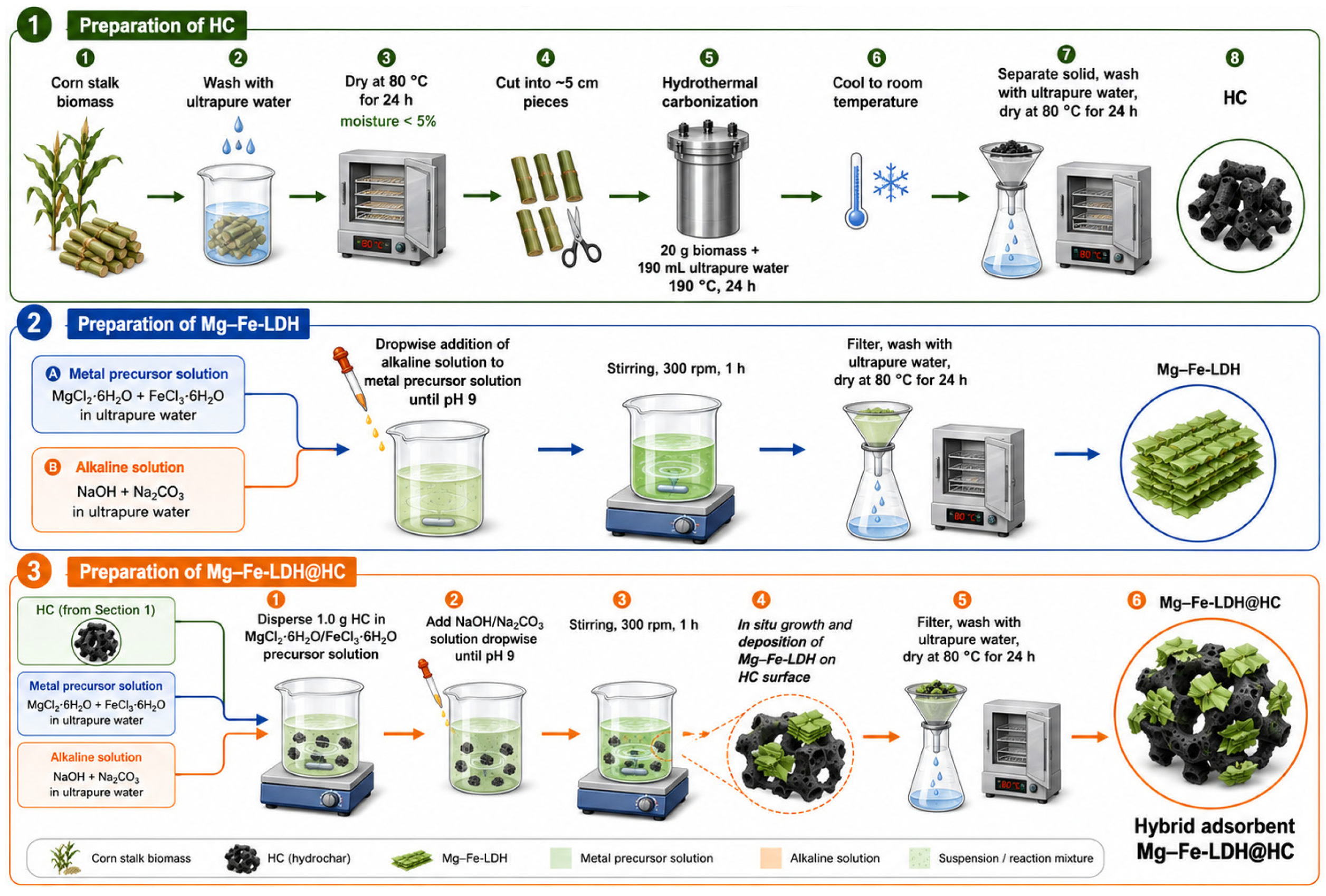
The preparation of HC, Mg–Fe-LDH, and Mg–Fe-LDH@HC was carried out following the procedure previously reported in the literature [25], using corn stalk biomass as the lignocellulosic precursor. Prior to hydrothermal carbonization, the biomass was naturally dried for 24 h and milled to a particle size of approximately 250 μm. Then, 17.12 g of the prepared biomass and 150 mL of ultrapure water were transferred into a 200 mL Teflon-lined stainless-steel reactor. The reactor was sealed and heated at 190 °C for 24 h. After cooling to room temperature, the solid fraction was recovered, washed with ultrapure water, and dried at 80 °C for 24 h. The obtained material was labeled as HC.
Mg–Fe-LDH@HC was synthesized by alkaline coprecipitation in the presence of HC. Briefly, 1.55 g of HC was dispersed in 90 mL of distilled water under magnetic stirring at 400 rpm for 60 min. Subsequently, 2.5 g of MgCl2·6H2O and 1.1 g of FeCl3·6H2O were added to the suspension as Mg(II) and Fe(III) precursors, respectively. The mixture was stirred for an additional 30 min to promote precursor dispersion. The pH was then adjusted to 9–10 by dropwise addition of an alkaline solution containing NaOH and Na2CO3, favoring the coprecipitation of the Mg–Fe-LDH phase onto the HC surface. The resulting suspension was centrifuged at 5000 rpm for 5 min, and the recovered solid was washed with ultrapure water and dried at 80 °C for 24 h. The final hybrid material was labeled as Mg–Fe-LDH@HC.
For comparison, Mg–Fe-LDH was synthesized using the same coprecipitation procedure but in the absence of HC. This control material was prepared to distinguish the contribution of the inorganic LDH phase from that of the HC-supported hybrid. The schematic representation of the synthesis route for HC, Mg–Fe-LDH, and Mg–Fe-LDH@HC is shown in Figure 1.

2.3. Characterization of HC, Mg–Fe-LDH and Mg–Fe-LDH@HC

The HC, Mg–Fe-LDH, and Mg–Fe-LDH@HC materials used in this work corresponded to the same hybrid system previously synthesized and characterized by our research group. Therefore, the structural, morphological, textural, and surface properties of the materials were described based on previously reported characterization data obtained for the same material system [26].
The characterization considered scanning electron microscopy coupled with energy-dispersive X-ray spectroscopy (SEM-EDS), X-ray diffraction (XRD), Fourier-transform infrared spectroscopy (FTIR), transmission electron microscopy (TEM), Brunauer-Emmett-Teller surface area analysis (BET), X-ray photoelectron spectroscopy (XPS), thermogravimetric analysis (TGA), and pH at the point of zero charge (pHPZC). The pHPZC of Mg–Fe-LDH@HC was determined by the pH drift method. To do this, ultrapure water solutions were adjusted to initial pH values between 2 and 10 using dilute HCl or NaOH solutions. Then, 20 mg of Mg–Fe-LDH@HC was added to 20 mL of each solution, corresponding to a solid/liquid ratio of 1 g L−1. The suspensions were stirred at room temperature until equilibrium was reached, after which the final pH was measured. The pHPZC was obtained from the graph of ΔpH = initial pH − final pH as a function of the initial pH and was identified as the point where ΔpH = 0.
SEM-EDS was used to evaluate the morphology and elemental distribution of the HC support, the Mg–Fe-LDH phase, and the Mg–Fe-LDH@HC hybrid. XRD was considered to assess the coexistence of the carbonaceous HC matrix and the hydrotalcite-like Mg–Fe-LDH structure. FTIR was used to identify the main surface functional groups associated with oxygenated HC domains, hydroxylated LDH layers, carbonate species, and metal-oxygen vibrations. Additional characterizations by BET, XPS, and TGA were used as complementary evidence of the dispersion of the LDH phase over the HC surface, the textural properties of the hybrid, the chemical interaction between oxygenated HC groups and Mg/Fe species, and the thermal stability of the material. These characterization data were not treated as new measurements generated in the present study. Instead, they were used to support the interpretation of Cd(II) and Zn(II) adsorption on Mg–Fe-LDH@HC.

2.4. Adsorption Experiments and Cd(II)/Zn(II) Quantification

Batch adsorption experiments were performed to assess the simultaneous adsorption of Cd(II) and Zn(II) onto Mg–Fe-LDH@HC under aqueous bicomponent conditions. The experimental design included pH evaluation, adsorbent dosage optimization, kinetic assays, bicomponent equilibrium studies, and competitive adsorption tests conducted at different Cd(II)/Zn(II) ratios and temperatures.
All adsorption experiments were performed in Erlenmeyer flasks containing 50 mL of Cd(II)/Zn(II) aqueous solution under constant agitation at 300 rpm. The effect of solution pH was first evaluated because pH controls both the surface charge of Mg–Fe-LDH@HC and the aqueous speciation of Cd(II) and Zn(II). Initial pH values of 2, 4, 6, and 6.75 were adjusted using 0.1 mol L−1 HCl or 0.1 mol L−1 NaOH and measured with a Fisher Scientific Accumet AB150 benchtop pH meter (Thermo Fisher Scientific, Waltham, MA, USA). The selected pH range was established considering the pH at the pHPZC of Mg–Fe-LDH@HC and the precipitation tendency of Cd(II) and Zn(II), to reduce the contribution of metal hydroxide precipitation and better isolate the adsorption process. After 180 min of contact at 298.15 K and 300 rpm, the suspensions were separated from the solid phase, and the residual metal concentrations were quantified. Based on this evaluation, pH 6.75 was selected for the subsequent adsorption assays.
The adsorbent dosage study was then conducted at pH 6.75, 298.15 K, and 300 rpm for 180 min using an equimolar bicomponent solution of 1 mM, corresponding to 66.56 mg L−1 Zn(II) and 111.8 mg L−1 Cd(II). Mg–Fe-LDH@HC masses of 0.001, 0.005, 0.01, 0.02, 0.04, 0.08, 0.12, 0.16, and 0.2 g were evaluated to determine the adsorbent amount required to maximize metal removal while maintaining an adequate adsorption capacity.
Kinetic adsorption experiments were performed at the selected pH and adsorbent dosage using equimolar Cd(II)/Zn(II) solutions with initial concentrations of 0.25, 0.5, 0.75, 1, 1.25 and 1.5 mM. Samples were collected at predetermined contact times of 0, 1, 5, 10, 20, 40, 60, 90, 120, and 180 min. The residual concentrations of Cd(II) and Zn(II) were determined at each sampling time, and the experimental data were subsequently used for kinetic modeling. The adsorption kinetic data were analyzed using mathematical models commonly applied to solid-liquid adsorption systems. The kinetic profiles of Cd(II) and Zn(II) were fitted to the pseudo-first-order (PFO), pseudo-second-order (PSO), Bangham, Elovich and Weber-Morris models, whose linearized equations are provided in the Supplementary Materials as Equations (S1)–(S5).
Bicomponent equilibrium studies were performed under the selected adsorption conditions to evaluate the simultaneous adsorption behavior of Cd(II) and Zn(II) onto Mg–Fe-LDH@HC. The assays were conducted at pH 6.75 using an adsorbent dosage of 4 g L−1 and equimolar Cd(II)/Zn(II) solutions with initial concentrations of 0.25, 0.5, 0.75, 1.0, 1.25, and 1.5 mM. The experiments were carried out at 288.15, 298.15, 313.15, and 328.15 K to evaluate the effect of temperature on the bicomponent equilibrium response. After the equilibrium contact time selected from the kinetic assays, the suspensions were separated from the solid phase and the residual concentrations of Cd(II) and Zn(II) were quantified by ICP-OES. The equilibrium adsorption capacity of each metal was calculated using the corresponding equilibrium concentration.
The bicomponent equilibrium data were fitted using extended isotherm models commonly applied to multicomponent adsorption systems. Extended Langmuir, Extended Freundlich, Extended Sips, and double-layer model (DLM) equations (Equations (S6)–(S9)) were used to describe the simultaneous adsorption of Cd(II) and Zn(II). The equations are provided in the Supplementary Materials as Equations (S6)–(S9). The calculated adsorption capacities obtained from each model were compared with the experimental values to evaluate the descriptive performance of the models. Model fitting was assessed using R2, root mean square error (RMSE), chi-square error (χ2), and Marquardt’s percent standard deviation (MPSD). These statistical indicators were used together to avoid selecting the best model based only on R2.
An apparent thermodynamic assessment was also performed using the equilibrium data obtained at different temperatures. The apparent equilibrium constant was estimated from the distribution of each metal between the adsorbed phase and the aqueous phase. The apparent Gibbs free energy change was calculated using ΔG° = −RT ln Kapp, where R is the universal gas constant, T is the absolute temperature, and Kapp is the apparent equilibrium constant. The apparent enthalpy change and entropy change were estimated from the Van’t Hoff relationship, ln Kapp = ΔS°/R − ΔH°/RT, using the slope and intercept of the linear plot of ln Kapp versus 1/T. The thermodynamic parameters were interpreted as apparent descriptors of temperature dependence of adsorption and not as direct evidence of individual adsorption mechanisms.
Competitive adsorption experiments were conducted using a mixture design at different Cd(II)/Zn(II) molar ratios and temperatures. The evaluated Cd(II):Zn(II) ratios were 0:100, 25:75, 50:50, 75:25, and 100:0, with individual metal concentration levels of 0, 0.375, 0.75, 1.125, and 1.5 mM. The total metal concentration was kept at 1.5 mM. The experiments were performed at 288.15, 298.15, 313.15, and 328.15 K to assess the influence of temperature and metal proportion on the adsorption response. These assays allowed the competitive behavior between Cd(II) and Zn(II) to be evaluated under controlled bicomponent conditions.
The filtrates were collected in acid-washed polypropylene tubes and analyzed for Cd(II) and Zn(II) by inductively coupled plasma optical emission spectrometry (ICP-OES) using a Thermo Scientific iCAP 6500 Series instrument (Thermo Fisher Scientific, Waltham, MA, USA). Before analysis, the samples were acidified with HNO3 to obtain an acid concentration of approximately 2% v/v and were diluted when necessary to ensure that the measured concentrations remained within the linear calibration range. The ICP-OES system was operated under standard aqueous sample analysis conditions using argon as the plasma gas. The operating parameters were set as follows: RF power, 1150 W; plasma gas flow, 12.5 L min−1; auxiliary gas flow, 0.5 L min−1; nebulizer gas flow, 0.55 L min−1; pump speed, 45 rpm; glass concentric nebulizer; glass cyclonic spray chamber; quartz center tube, 2.0 mm; axial observation mode; uptake time, 45 s; rinse time, 30 s; and three instrumental readings per sample. A 2% v/v HNO3 solution was used as the rinse solution between measurements to minimize carryover.
Cd(II) and Zn(II) were quantified using the emission lines Cd II 214.438 nm and Zn II 213.856 nm, respectively. Calibration curves were prepared by serial dilution of certified Cd and Zn standard solutions in 2% v/v HNO3. Analytical blanks and calibration standards were measured under the same instrumental conditions as the samples. The quality of the calibration was verified before sample quantification, and only calibration curves with adequate linearity were used for concentration determination. Initial metal solutions and filtrates from the adsorption assays were analyzed to determine the initial, residual, and equilibrium concentrations of each metal. When dilution was required, the corresponding dilution factor was applied before calculating adsorption capacity and removal efficiency. The adsorption capacity at time t and the removal efficiency were calculated using Equations (S10) and (S11), respectively.
The regeneration and reuse of Mg–Fe-LDH@HC were evaluated by adsorption-desorption assays. After adsorption, the metal-laden adsorbent was separated from the solution and treated with HCl as a regenerating agent to promote the desorption of Cd(II) and Zn(II). To select a suitable regeneration condition, different concentrations of HCl were evaluated, specifically 0.1, 0.5, 1, 1.5, and 2 M. After acid treatment, the regenerated solid was washed several times with ultrapure water until it reached a pH close to neutrality, dried, and reused for adsorption. Subsequently, five adsorption-desorption cycles were performed under the optimized adsorption conditions. After each cycle, the residual Cd(II) and Zn(II) concentrations were quantified to calculate the retained adsorption capacity. In parallel, the liquid phase recovered after each reuse cycle was analyzed by ICP-OES to quantify possible Mg2+ and Fe3+ leaching from Mg–Fe-LDH@HC. This evaluation was included to assess the structural stability of the LDH-containing domains during repeated adsorption and acid regeneration. FTIR analysis was performed for pristine Mg–Fe-LDH@HC, Mg–Fe-LDH@HC after the fifth adsorption cycle, and regenerated Mg–Fe-LDH@HC to evaluate changes in major surface functional groups and LDH-associated domains after repeated use and acid regeneration.
The applicability of Mg–Fe-LDH@HC was evaluated through two complementary assays. First, the effect of representative interfering ions was investigated using synthetic aqueous solutions containing 10 mM of selected sodium salts. NaCl, Na2SO4, Na2CO3, and Na3PO4 were used as sources of Cl, SO42−, CO32−, and PO42−, respectively. The adsorption experiments were conducted under the optimized adsorption conditions using the Cd(II)/Zn(II) bicomponent solution, while ultrapure water without added interfering ions was used as the control. After adsorption, the residual concentrations of Cd(II) and Zn(II) were determined, and the adsorption capacity was calculated to evaluate the influence of each anion on metal retention.
Second, adsorption experiments were performed using real water matrices, including surface water, groundwater, and hospital effluent. Before the adsorption tests, the real water samples were characterized in terms of pH, electrical conductivity, turbidity, total dissolved solids, chemical oxygen demand, total organic carbon, hardness, alkalinity, and major inorganic ions. The physicochemical characteristics of these matrices are summarized in Table S6. For the adsorption assays, each real water sample was spiked with Cd(II) and Zn(II) to obtain the same initial metal concentration used in the optimized bicomponent experiments. The adsorption tests were then carried out under the same operational conditions used for the control system. Ultrapure water spiked with Cd(II)/Zn(II) was used as the reference matrix. The residual metal concentrations were measured after adsorption, and the resulting adsorption capacities were compared to assess the effect of matrix composition on the performance of Mg–Fe-LDH@HC.
All adsorption experiments were performed in triplicate under the same experimental conditions. The results are expressed as mean values ± standard deviation. Standard deviations were calculated from the three independent experimental replicates and were used to represent the variability of the adsorption data.

2.5. Use of Generative Artificial Intelligence for Scientific Illustrations

Generative artificial intelligence (GenAI) tools were used exclusively for the preparation of the graphical abstract and schematic illustrations included in the manuscript. Specifically, OpenAI ChatGPT, using the GPT-4o image-generation model was employed to assist in the visualization of the synthesis route of Mg–Fe-LDH@HC, the conceptual representation of the proposed adsorption mechanism, and the graphical summary of the study. The generated illustrations were subsequently reviewed, scientifically validated, modified, and edited by the authors to ensure consistency with the experimental procedures, characterization results, adsorption experiments, and mechanistic interpretation presented in this study. No artificial intelligence tools were used to generate experimental data, perform instrumental measurements, conduct statistical fitting, or replace the authors’ scientific interpretation.

3. Results

3.1. Morphology and Elemental Distribution of Mg–Fe-LDH@HC

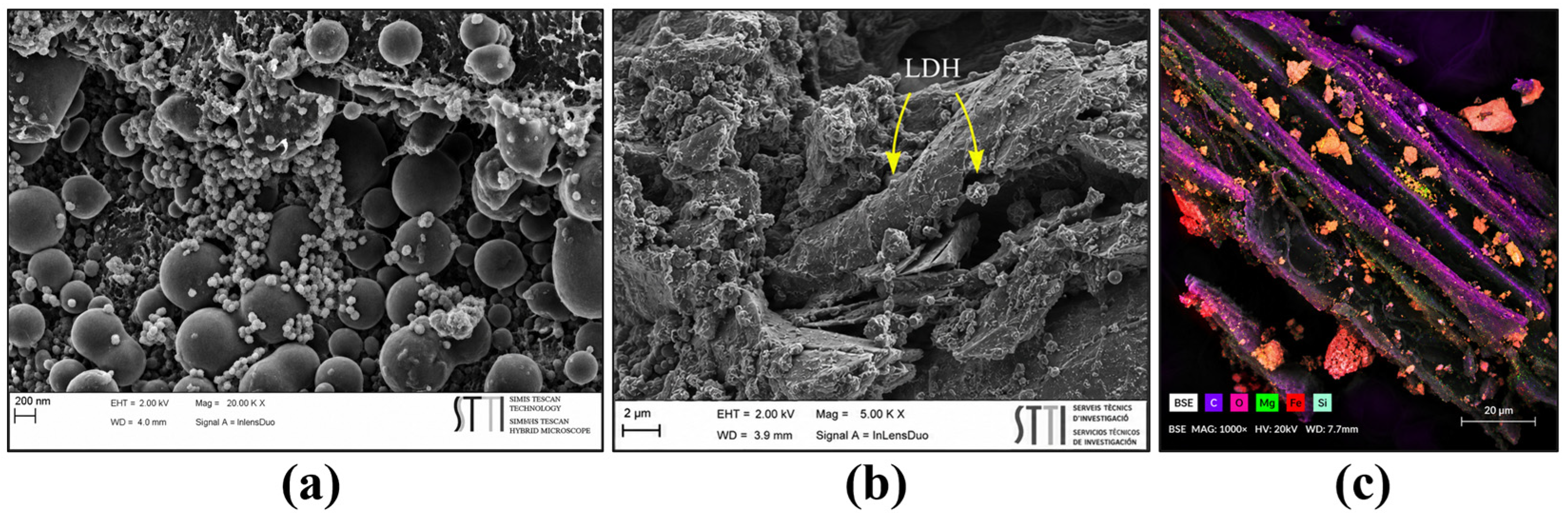
The SEM analysis evidenced the morphological evolution from the HC support to the hybrid functionalized with Mg–Fe-LDH. The HC precursor showed a heterogeneous carbonaceous surface composed of spherical particles, filamentous domains, and irregular aggregates, which is consistent with the hydrothermal transformation of the lignocellulosic precursor (Figure 2a). These characteristics indicate that HC provides rough and structurally diverse support that can favor the deposition of inorganic domains.
After LDH functionalization, the Mg–Fe-LDH@HC material exhibited a rougher and more compact surface, with LDH-like aggregates deposited on the HC matrix (Figure 2b). These deposits were observed as clustered and irregular domains attached to the carbonaceous surface, indicating that the HC acted as a support for the growth and dispersal of the inorganic phase. Compared to the rose-like morphology commonly observed for unsupported Mg–Fe-LDH particles (Figure S1), the hybrid showed a more distributed arrangement of LDH domains on the HC surface. This behavior suggests that the interaction between the oxygenated groups of the HC and the Mg/Fe-containing phase helped to reduce extensive LDH agglomeration and promoted the formation of a supported hybrid interface.
SEM-EDS elemental mapping additionally supported the successful incorporation of the Mg–Fe-LDH phase into the HC (Figure 2c). The distribution of C and O was associated with the carbonaceous matrix, while the signals of Mg and Fe confirmed the presence of the LDH phase on the surface of the hybrid. The Si signal can be attributed to inorganic residues from the biomass precursor. The simultaneous distribution of C, O, Mg, Fe, and Si indicates that the inorganic phase is not isolated from the HC matrix, but spatially associated with the carbonaceous support. This morphology and elemental distribution are relevant for the adsorption of Cd(II) and Zn(II), as they indicate the coexistence of oxygenated carbonaceous domains and hydroxylated sites associated with Mg/Fe that could act as accessible surface regions for metal retention.

3.2. Structural and Surface-Chemical Characterization of Mg–Fe-LDH@HC

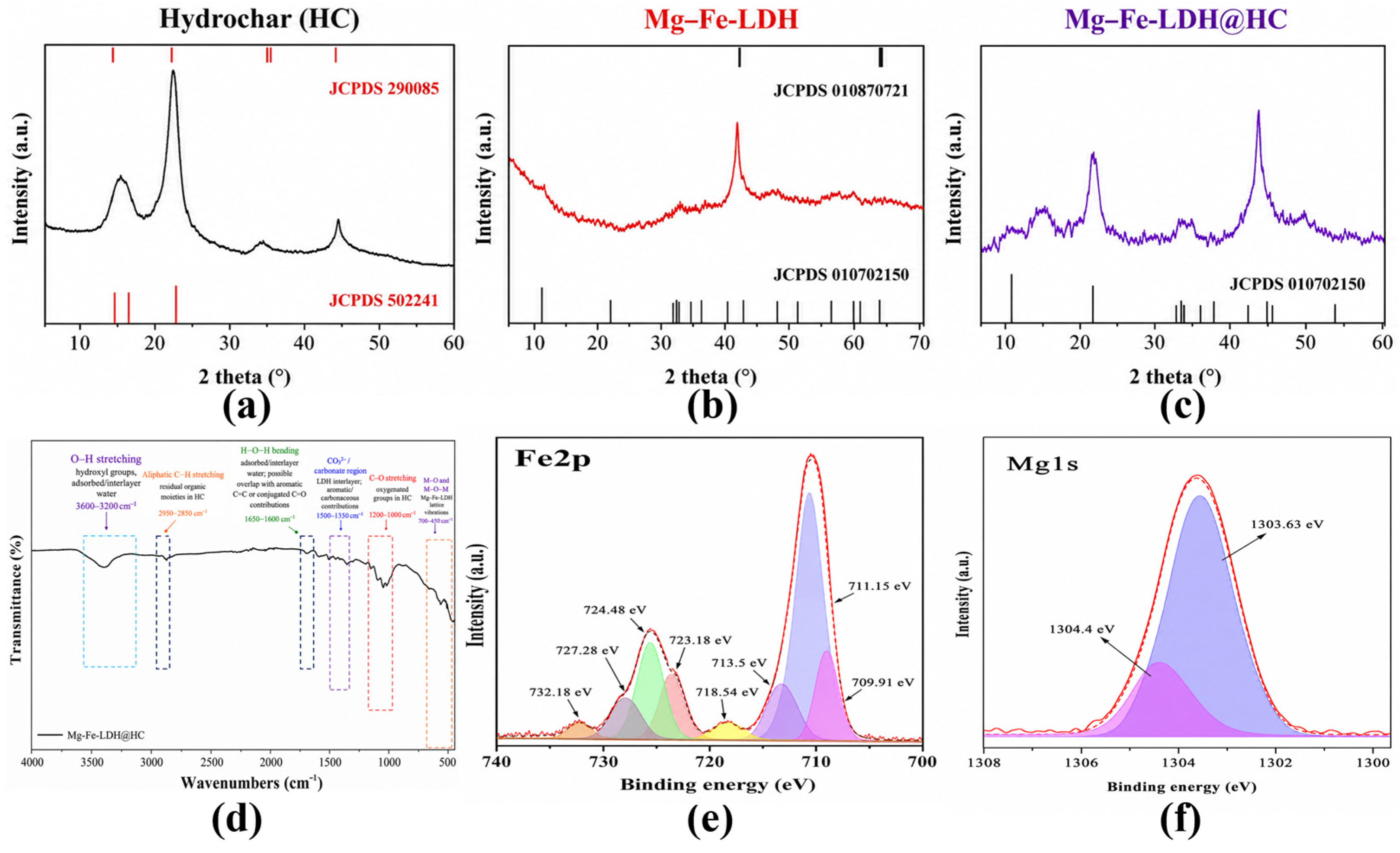
The structural and surface chemical characteristics of Mg–Fe-LDH@HC were evaluated by XRD, FTIR and XPS analysis (Figure 3 and Figure S2). The HC XRD pattern showed broad reflections in the 2θ regions of 15–17° and 22–23°, along with additional signals near 35° and 44°, which can be associated with residual crystalline domains of the biomass-derived carbonaceous matrix and with silica-related inorganic contributions. The Mg–Fe-LDH pattern presented faint reflections characteristic of a low-crystallinity hydrotalcite-like phase, including signals in regions commonly associated with basal and non-basal planes of LDH. The low intensity and broadening of these reflections suggest a limited long-range ordering, consistent with the absence of a prolonged stage of aging and with the formation of an amorphous or weakly laminated Mg–Fe-LDH phase.
In the Mg–Fe-LDH@HC hybrid, the diffraction pattern retained contributions from both the HC support and the LDH phase. The persistence of HC-associated reflections, together with the presence of LDH-linked signals, supports the coexistence of the carbonaceous matrix and Mg–Fe-LDH domains within the same material. The attenuation and widening of some reflections suggest that LDH growth occurred on the heterogeneous surface of HC, rather than as a separate, completely crystalline phase. This structural arrangement is relevant for adsorption because it indicates that the material combines oxygenated carbonaceous domains of HC with hydroxylated and carbonated inorganic domains of Mg–Fe-LDH.
The FTIR spectrum of Mg–Fe-LDH@HC confirmed the presence of functional groups associated with both components of the hybrid material. The wide band between 3600 and 3200 cm−1 was assigned to O-H stretch vibrations of hydroxyl groups and adsorbed or interlaminar water. Weak signals in the 2950–2850 cm−1 region were related to aliphatic C-H stretch vibrations of residual organic fractions in the HC. The band located between 1650 and 1600 cm−1 was mainly attributed to the H-O-H bending of adsorbed or interlaminar water, with possible overlapping contributions of aromatic C=C and conjugated C=O of the carbonaceous phase. The region between 1500 and 1350 cm−1 was associated with carbonate species of the LDH interlayer region and with aromatic or carbonaceous contributions of the HC. The wide region between 1200 and 1000 cm−1 was assigned to C-O stretch vibrations of HC oxygenated groups, while the low wavenumber bands, between approximately 700 and 450 cm−1, were attributed to M-O and M-O-M lattice vibrations of the Mg–Fe-LDH phase. These assignments confirm the coexistence of hydroxylated, hydrated, carbonated, oxygenated carbonaceous and metal-oxygen domains in the hybrid structure.
The XPS analysis provided complementary evidence on the surface chemical composition of Mg–Fe-LDH@HC. The Fe2p spectrum showed several contributions in the 709–733 eV region, consistent with Fe species in oxide- or hydroxide-like environments associated with the LDH phase. The Mg 1s spectrum showed two components centered around 1304.4 and 1303.63 eV, which can be related to oxygenated environments containing Mg, including Mg-O and Mg-OH type contributions. These signals support the presence of exposed Mg/Fe-associated inorganic domains on the surface of the hybrid.
The high-resolution O 1s and C 1s spectra shown in Figure S2 provide additional information on the oxygenated and carbonaceous surface chemistry of Mg–Fe-LDH@HC. The O1s spectrum showed assignable contributions to oxygen-metal, hydroxyl groups, carbonyl/carboxyl and adsorbed water or oxygenated carbonaceous environments. Similarly, the C 1s spectrum included components associated with C-C/C=C, C-O, C=O, and O-C-O. These results indicate that the HC matrix provides oxygenated carbonaceous functionalities, while the Mg–Fe-LDH phase provides metal-oxygen and metal-hydroxyl environments. Therefore, the XPS analysis supports the chemical coupling between the carbonaceous support and the inorganic LDH phase.

3.3. Textural Properties and Surface Charge of Mg–Fe-LDH@HC

The precursor HC showed low N2 adsorption over most of the relative pressure range, followed by a pronounced increase to high P/P0 values, close to 1 (Figure S3a). This profile is consistent with a carbonaceous material with a low surface area and poorly developed internal porosity, although with the contribution of interparticular voids or larger pores that favor gas adsorption at high relative pressures. Therefore, the HC acts primarily as a structural support rather than as a highly porous adsorbent phase.
In contrast, Mg–Fe-LDH had a considerably higher adsorption capacity than HC, with rapid uptake at low relative pressure and a progressive increase in the intermediate and high regions of P/P0 (Figure S3b). This behavior indicates the presence of accessible surface domains and mesoporous regions associated with the laminar structure of LDH. The hysteresis cycle observed between the adsorption and desorption branches suggests the contribution of mesoporosity and interparticular spaces formed by the aggregation of LDH-type lamellar particles. These textural characteristics are relevant because they can favor the exposure of hydroxylated sites associated with Mg/Fe during adsorption processes in an aqueous medium.
The Mg–Fe-LDH@HC hybrid showed an intermediate adsorption capacity with respect to the individual precursors (Figure S3c). Although its N2 uptake was lower than that of pristine Mg–Fe-LDH, it was clearly superior to that of HC, confirming that LDH functionalization improved the textural properties of the carbonaceous support. The shape of the isotherm and the presence of hysteresis indicate that the hybrid retained mesoporous and interparticular domains. This result supports the role of HC as a structuring matrix for LDH dispersion, while Mg–Fe-LDH provides additional surface domains. From the adsorption perspective, this configuration is favorable because it combines the structural stability and carbonaceous surface of HC with the hydroxylated inorganic domains of Mg–Fe-LDH.
The BET analysis allowed quantifying these textural differences. The HC had a very low surface area, close to 3 m2 g−1, which confirms that the unactivated hydrochar has a poorly developed structure from the microporous point of view. On the other hand, Mg–Fe-LDH showed a considerably larger surface area, approximately 285 m2 g−1, associated with its laminar nature and with the greater availability of external surface. After functionalization, the Mg–Fe-LDH@HC hybrid presented an intermediate surface area of approximately 93 m2 g−1. Although this value is lower than that of pristine Mg–Fe-LDH, it represents a significant improvement over HC and confirms that the incorporation of LDH increased the accessible surface area of the carbonaceous support. This combination of moderate surface area, mesoporous domains, and hybrid interface can favor contact between Cd(II)/Zn(II) and the functional sites available in Mg–Fe-LDH@HC.
The pHPZC curve of Mg–Fe-LDH@HC showed the relationship between the initial pH and the final pH after contact with the material (Figure S3d). The point of intersection indicates the pHPZC of the hybrid surface. This parameter is important because it defines the pH region in which the surface of the material tends to be predominantly protonated or deprotonated. At pH values below pHPZC, the surface is expected to have a greater positive charge contribution, while at pH values above pHPZC, the deprotonation of surface groups is favored. Therefore, the pHPZC provides a useful reference for interpreting the pH-dependent adsorption behavior of Cd(II) and Zn(II).

3.4. Surface Charge, pH Effect, and Adsorbent Dosage on Cd(II)/Zn(II) Adsorption

The initial adsorption behavior of Mg–Fe-LDH@HC was evaluated by considering surface charge, solution pH, and adsorbent dosage. These parameters are closely related because they regulate the protonation state of surface functional groups, the aqueous speciation of metal ions, the availability of active sites, and the balance between removal efficiency and Qe [27].
The pH at the pHPZC of Mg–Fe-LDH@HC was approximately 4.3 (Figure S3d). This value indicates that the adsorbent surface is expected to be predominantly positively charged below pHPZC and negatively charged above this value. Therefore, under conditions above pHPZC, the deprotonation of hydroxyl and oxygen-containing groups from the HC matrix and Mg–Fe-LDH domains may favor the electrostatic attraction of Cd(II) and Zn(II), provided that both metals remain mainly in soluble cationic forms within the evaluated pH range [28].
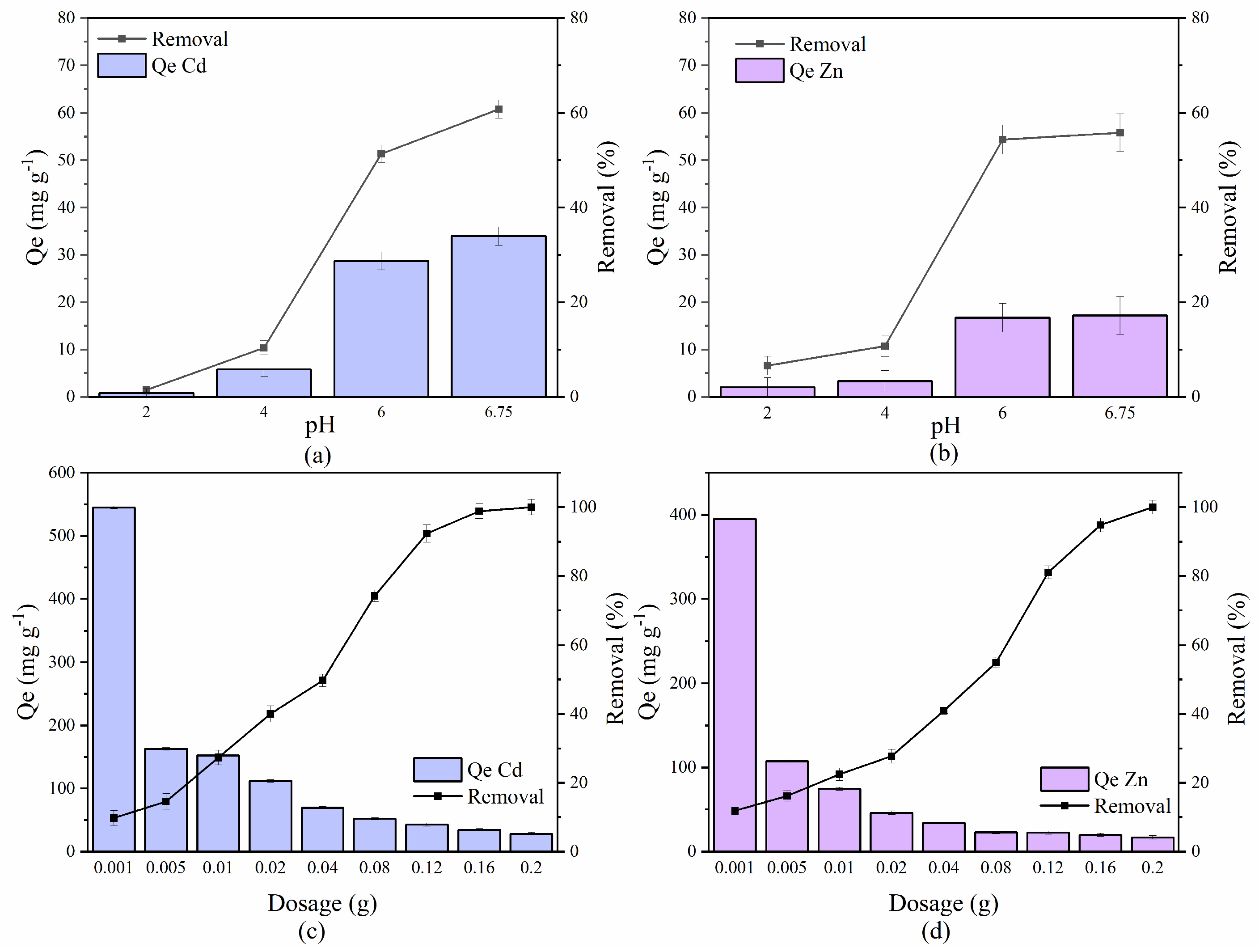
The pH effect showed limited adsorption under strongly acidic conditions, particularly at pH 2 and 4 (Figure 4a,b). This behavior can be attributed to the protonation of oxygenated and hydroxylated surface groups, which reduces the availability of negatively charged sites for Cd(II) and Zn(II) binding. In addition, the high H+ concentration under acidic conditions may compete with metal cations for active sites, decreasing the contribution of electrostatic attraction and other possible surface interactions.
A marked increase in Cd(II) and Zn(II) adsorption was observed at pH 6 and 6.75. At these pH values, the Mg–Fe-LDH@HC surface is above the pHPZC, which favors cation retention through electrostatic interactions with deprotonated surface groups. The enhanced adsorption may also be associated with the contribution of hydroxylated Mg/Fe sites and carbonate-containing domains from the LDH phase, although additional surface evidence would be required to confirm their specific role. The pH value of 6.75 was selected for subsequent adsorption assays because it provided the highest adsorption response while remaining below the pH range where Cd(II) and Zn(II) hydroxide precipitation could become dominant. This distinction is important because alkaline pH conditions may increase apparent removal through precipitation, making it necessary to distinguish adsorption-driven removal from uncontrolled precipitation in the bulk solution [29].
Under the selected conditions, near-complete removal of Cd(II) and Zn(II) was achieved using an equimolar Cd(II)/Zn(II) solution of 1 mM, pH 6.75, 4 g L−1 Mg–Fe-LDH@HC, 298.15 K, and 180 min of contact time. This result should be interpreted within the evaluated experimental conditions because removal efficiency strongly depends on the initial metal concentration, adsorbent dosage, pH, contact time, and metal ratio. Therefore, the high removal percentage obtained at 1 mM should not be extrapolated directly to substantially higher metal concentrations or to more complex aqueous matrices without additional validation.
To distinguish adsorption from possible metal precipitation at the selected working pH, an equilibrium hydrolysis speciation analysis was performed for Cd(II) and Zn(II) at 1 mM and 25 °C over the pH range of 0-14 (Figure S4). The results showed that, at pH 6.75, both metals remained predominantly as dissolved divalent species. Hydrolyzed species became more relevant only at higher pH values, particularly for Zn(II), which showed a greater tendency toward hydrolysis than Cd(II). Therefore, under the selected experimental conditions, bulk hydroxide precipitation is not expected to be the dominant removal pathway. The removal of Cd(II) and Zn(II) at pH 6.75 is mainly discussed as an adsorption-driven process associated with the interaction of dissolved metal ions with the Mg–Fe-LDH@HC surface. This interpretation is supported by the surface charge behavior, the presence of hydroxylated and oxygenated domains identified by FTIR and XPS, and the kinetic and equilibrium modeling results. However, specific pathways such as surface complexation, ion exchange, or localized surface-assisted precipitation should be interpreted as possible contributions rather than individually confirmed mechanisms, since post-adsorption XPS and direct quantification of exchanged interlayer species were not performed.
After defining the working pH, the influence of adsorbent dosage was evaluated using an equimolar Cd(II)/Zn(II) solution at 298.15 K. Increasing the Mg–Fe-LDH@HC mass from 0.001 to 0.2 g in 50 mL progressively enhanced the removal percentage of both metals. This trend is consistent with the greater number of available adsorption sites at higher solid loadings. At low adsorbent masses, the limited number of active sites restricts total metal removal, even if each gram of adsorbent is exposed to a larger amount of dissolved metal.
Qe decreased as the adsorbent dosage increased (Figure 4c,d). This trend does not necessarily indicate poorer adsorbent performance; rather, it reflects the mathematical dependence of Qe on adsorbent mass and the partial underutilization of available sites at high solid loadings. At very low doses, each gram of adsorbent interacts with a larger amount of dissolved metal, increasing the apparent Qe. Conversely, at higher doses, the number of binding sites exceeds the available Cd(II) and Zn(II) in solution, leading to lower Qe values but higher overall removal [30].
These results show the typical trade-off between adsorption capacity and removal efficiency. From an application-oriented perspective, the working dose should not be selected solely based on the maximum value of Qe, but on the condition that provides high removal efficiency, stable performance, and rational use of the adsorbent under two-component conditions. In this study, 0.2 g of Mg–Fe-LDH@HC in 50 mL, equivalent to 4 g L−1, was selected as the working dose because it allowed an almost complete removal of Zn(II) and Cd(II) under the conditions evaluated.
From a technical perspective, increasing the adsorbent dose provides more available surface sites and improves the probability of interaction between Cd(II)/Zn(II) species and the Mg–Fe-LDH@HC surface. However, once the number of available adsorption sites exceeds the number of dissolved metal ions, additional dose increments can generate only marginal improvements in removal efficiency. This behavior can be associated with underutilization of active sites, potential particle aggregation, and reduced effective accessibility of adsorption domains to higher solid loads [31]. Similar trends have been reported for biomass-based adsorbents, where excessive dosage may increase overall removal, but decrease adsorption capacity per unit mass due to site underutilization and aggregation effects [32,33].
From an economic and operational perspective, the use of doses greater than 4 g L−1 would increase adsorbent consumption, handling requirements, and solid-liquid separation demands, without a commensurate improvement in removal performance. Therefore, 4 g L−1 was selected as a practical optimal dose because it provided efficient removal of Cd(II)/Zn(II), avoiding unnecessary excess material. The simultaneous presence of Cd(II) and Zn(II) should also be considered when interpreting the selected pH and dose conditions, as ions in multicomponent systems compete for accessible binding domains and may exhibit different affinities towards the same surface sites. Thus, pH 6.75 and 4 g L−1 Mg–Fe-LDH@HC were used in the subsequent kinetic, equilibrium, and competitive adsorption studies.

3.5. Contact Time Effect and Adsorption Kinetics of Cd(II) and Zn(II)

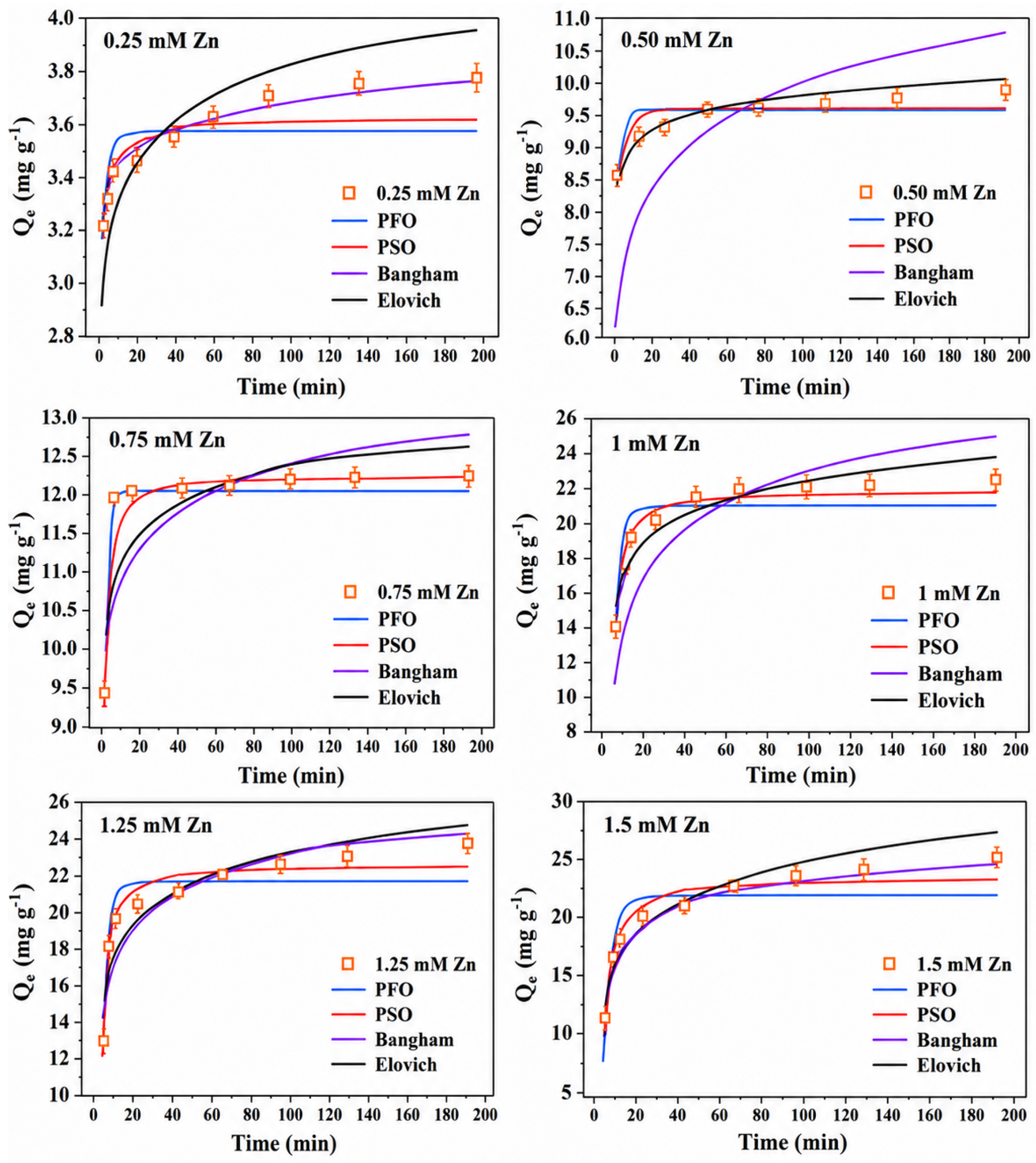
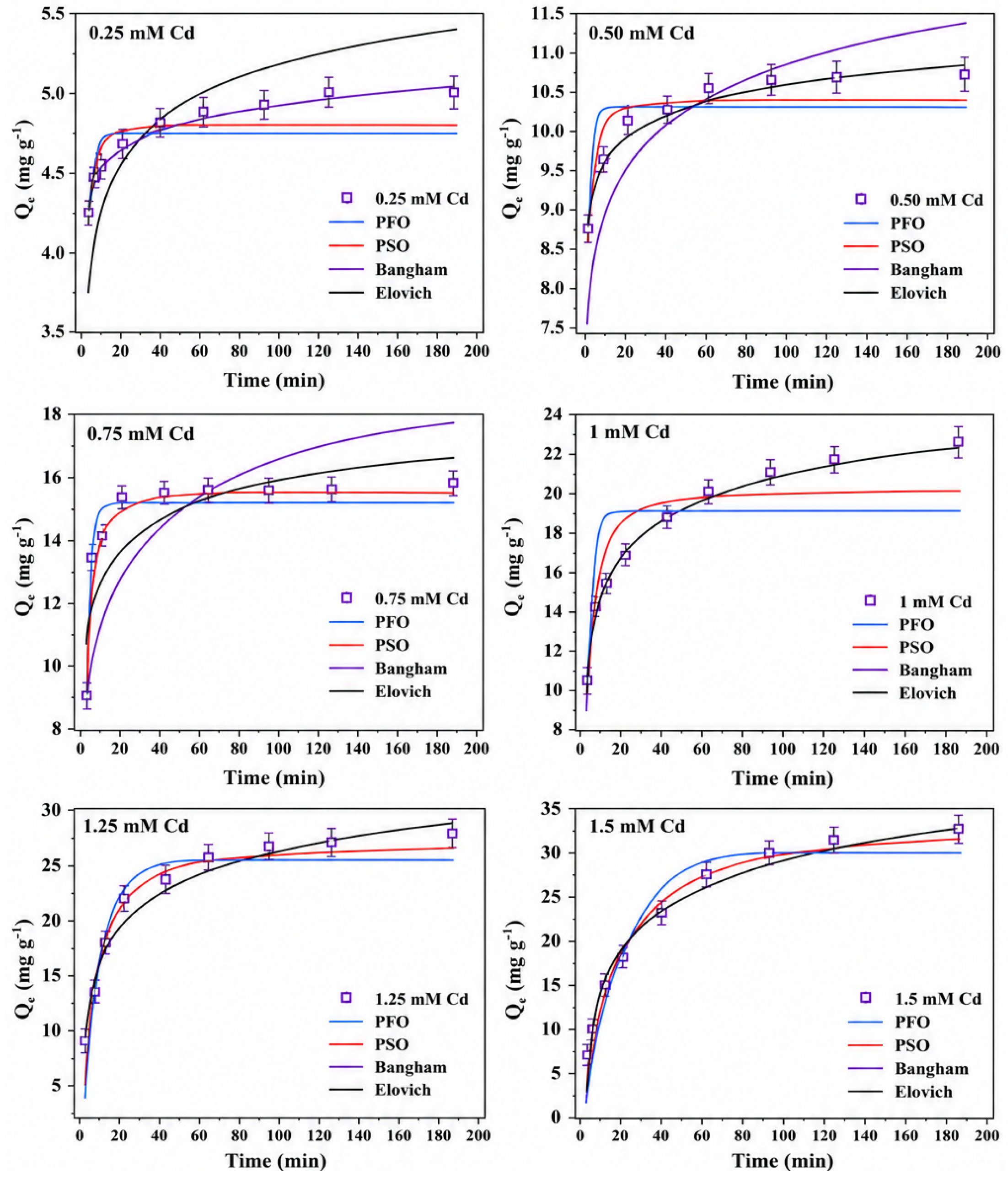
The effect of contact time was evaluated to describe the adsorption rate of Cd(II) and Zn(II) onto Mg–Fe-LDH@HC and to define the equilibrium time required for the subsequent bicomponent equilibrium studies. The kinetic assays were performed using equimolar Cd(II)/Zn(II) solutions with initial concentrations of 0.25, 0.5, 0.75, 1, 1.25 and 1.5 mM, under the previously selected conditions of pH 6.75 and 4 g L−1 adsorbent dosage. The adsorption profiles showed a similar trend for both metals, with a rapid adsorption stage during the first minutes of contact followed by a slower approach to equilibrium.
For Zn(II) (Figure 5), adsorption increased sharply within the first 20 min for all initial concentrations. This initial stage can be associated with the abundance of accessible adsorption sites on the Mg–Fe-LDH@HC surface, including hydroxylated Mg/Fe domains, oxygenated groups from HC, and carbonate-containing LDH regions. During this period, the concentration gradient between the aqueous phase and the adsorbent surface was high, favoring rapid mass transfer and occupation of the most accessible sites. After this stage, the adsorption rate decreased progressively, suggesting that the process became increasingly influenced by surface occupation and diffusion toward less accessible domains.
A comparable kinetic profile was observed for Cd(II) (Figure 6). Adsorption increased rapidly during the initial contact period and then gradually approached equilibrium. For both metals, the kinetic curves tended to stabilize after approximately 90 min, with only moderate increases between 90 and 180 min. Therefore, 120 min was selected as a representative equilibrium time for the subsequent adsorption studies, providing a practical balance between near-equilibrium conditions and operational efficiency. The different kinetic profiles observed for Cd(II) and Zn(II) reinforce the need to evaluate both ions under bicomponent conditions rather than extrapolating from single-metal adsorption behavior.
Qe increased with the initial metal concentration for both Cd(II) and Zn(II). For Zn(II), Qe increased from the lowest value obtained at 0.25 mM to the highest value observed at 1.5 mM after 180 min. A similar trend was observed for Cd(II), confirming that higher initial concentrations increased the driving force for mass transfer and the probability of interaction between dissolved metal ions and available adsorption sites. However, the higher Qe values expressed in mg g−1 for Cd(II) should be interpreted with caution because, under equimolar conditions, Cd(II) represents a higher mass concentration than Zn(II). Therefore, the apparent difference in mg g−1 should not be considered direct evidence of higher Cd(II) affinity. Selectivity must be interpreted together with the bicomponent equilibrium and mixture-design results.
The kinetic profiles of Cd(II) and Zn(II) were fitted using the pseudo-first-order (PFO), pseudo-second-order (PSO), Bangham, and Elovich models, and the corresponding parameters are presented in Tables S1 and S2. Overall, PFO and PSO showed less consistent fitting performance across the evaluated concentration range, indicating that the adsorption kinetics cannot be adequately interpreted only through simple first-order or second-order empirical descriptions. This behavior is reasonable considering the heterogeneous nature of Mg–Fe-LDH@HC, which contains oxygenated groups from the HC matrix, hydroxylated Mg/Fe domains, carbonate-containing LDH regions, mesoporous/interparticle domains, and structurally non-uniform adsorption sites.
Among the evaluated kinetic models, Bangham and Elovich provided the most consistent descriptive fitting performance according to the R2 values reported in Tables S1 and S2. These values were used as goodness-of-fit indicators for the linearized kinetic equations, rather than as statistical evidence of significant differences between models. Since the evaluated kinetic models have different mathematical structures and linear transformations, R2 was considered an appropriate comparative parameter for describing the agreement between the fitted equations and the experimental kinetic profiles. However, the model comparison was interpreted cautiously and was not used as definitive proof of a single adsorption mechanism.
The Weber-Morris plots showed multilinearity for both metals (Tables S3 and S4), confirming that adsorption proceeded through several consecutive stages rather than through a single rate-controlling mechanism. The first region showed the highest (kid) values and is associated with rapid external mass transfer and occupation of readily accessible surface sites. The second region showed lower slopes, indicating the contribution of diffusion-related resistance or progressive access to less accessible hybrid domains. The third region presented the lowest slopes and corresponds to the final approach to equilibrium. Since none of the fitted lines passed through the origin and all C values were different from zero, intraparticle diffusion cannot be considered the sole rate-limiting step. Therefore, the rate-limiting behavior is better described as a combined process involving rapid external surface uptake followed by diffusion-related resistance and heterogeneous surface interactions.

3.6. Bicomponent Equilibrium Isotherms and Thermodynamic Assessment

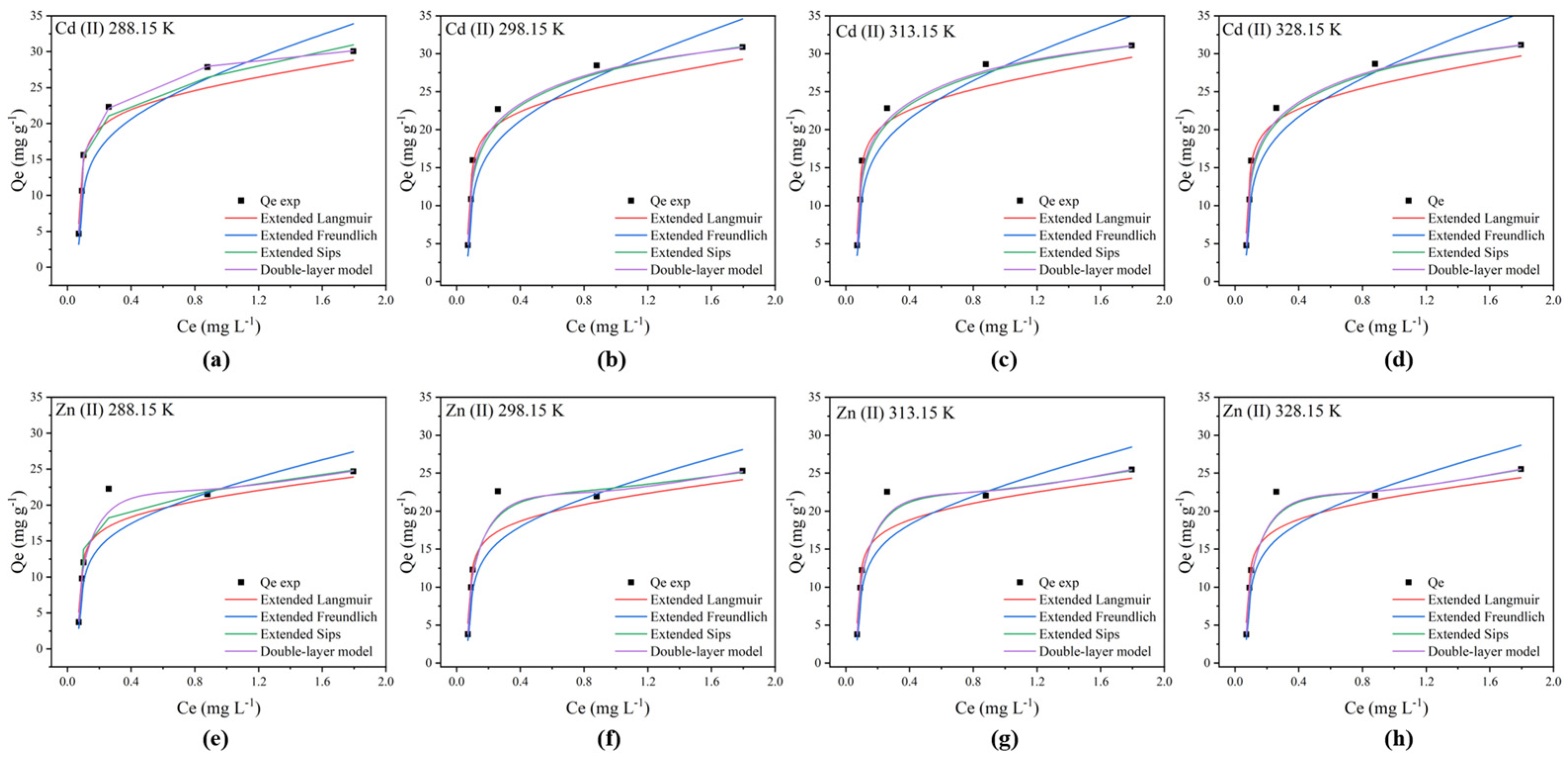
The bicomponent equilibrium adsorption of Cd(II) and Zn(II) onto Mg–Fe-LDH@HC was evaluated at different temperatures to describe the simultaneous distribution of both metal ions between the aqueous phase and the adsorbent surface. Unlike single-solute systems, bicomponent adsorption involves competition for accessible adsorption domains, which can modify the apparent affinity and adsorption capacity of each metal. Therefore, equilibrium interpretation should consider not only the individual metal concentration, but also the simultaneous presence of the competing ion [34].
The equilibrium data showed that Qe increased with the initial metal concentration for both Zn(II) and Cd(II) (Figure 7), confirming that a higher concentration gradient enhanced the driving force for mass transfer from the aqueous phase to the adsorbent surface. However, because both metals were present simultaneously, the adsorption response was governed by competitive occupation of partially shared adsorption domains. This behavior agrees with recent analyses of multicomponent adsorption systems, where the uptake of one metal can be affected by the presence of another species through competition for common surface sites, steric effects, ionic affinity, and differences in hydration behavior [34,35].
The extended isotherm models provided useful information on the equilibrium behavior of Cd(II) and Zn(II) under bicomponent conditions. The Extended Langmuir model showed the weakest overall fitting performance, suggesting that the system was not adequately described by the assumptions of homogeneous equivalent sites and ideal competitive monolayer adsorption. This does not mean that competition for shared sites was absent. Rather, it indicates that site competition alone, when represented through a homogeneous Langmuir-type framework, was insufficient to describe the non-ideal equilibrium response of the Cd(II)/Zn(II) mixture.
In contrast, the heterogeneous models provided better descriptions of the experimental data. For both Zn(II) and Cd(II), the DLM showed the highest R2 values and the lowest MPSD, RMSE, and χ2 values among the evaluated models (Table S5). Extended Sips also provided a satisfactory fit, followed by Extended Freundlich. However, the improved performance of DLM should be interpreted cautiously because this model includes greater mathematical flexibility than the Extended Langmuir model. Therefore, DLM was considered the best empirical descriptor of the bicomponent equilibrium data, but not as direct evidence of two physically separated adsorption layers.
For Zn(II), the DLM produced the best fit, with R2 = 0.974, MPSD = 8.120%, RMSE = 1.214, and χ2 = 0.421. The Extended Sips model also showed a satisfactory fit, with R2 = 0.968 and MPSD = 10.952%. For Cd(II), the same trend was observed. The DLM showed the best statistical performance, with R2 = 0.962, MPSD = 14.854%, RMSE = 1.625, and χ2 = 0.692, while Extended Sips provided the second-best fit. These results support the interpretation that Mg–Fe-LDH@HC contains non-equivalent adsorption domains, probably associated with oxygenated groups from HC, hydroxylated Mg/Fe regions, carbonate-containing LDH domains, and interparticle or mesoporous regions [36]. Therefore, the fitted models should be interpreted as empirical descriptors of heterogeneous bicomponent equilibrium rather than direct proof of a single adsorption mechanism [37].
The simultaneous decrease in these error functions for DLM, together with its higher R2, indicates that this model provided the most adequate empirical description of the bicomponent equilibrium data. This approach is consistent with recent recommendations indicating that adsorption models should be evaluated using multiple statistical indicators rather than relying only on correlation coefficients.
The thermodynamic parameters were calculated to evaluate temperature dependence of Cd(II) and Zn(II) adsorption (Table 1). The negative ΔG° values obtained for both metals at all temperatures indicate that the adsorption process was thermodynamically favorable under the evaluated conditions. For Zn(II), ΔG° decreased from −11.35 to −15.44 kJ mol−1 when temperature increased from 288.15 to 328.15 K. For Cd(II), ΔG° decreased from −9.45 to −13.62 kJ mol−1 over the same temperature range [38]. This trend suggests that adsorption became slightly more favorable at higher temperature, although the variation in Qe remained limited.
The positive ΔH° values obtained for Zn(II) and Cd(II), 18.42 and 21.15 kJ mol−1, respectively, indicate an apparent endothermic contribution. However, the relatively low magnitude of ΔH° suggests that the adsorption process was not dominated by strong chemical bonding. Values within this range are commonly interpreted as compatible with weak interactions, physical adsorption contributions, or mixed adsorption processes where electrostatic attraction, hydration-shell rearrangement, and weak surface interactions participate. Therefore, the thermodynamic results support a predominantly weak-interaction-controlled adsorption contribution, although specific interactions with heterogeneous surface domains cannot be completely discarded.
The positive ΔS° values, 101.45 J mol−1 K−1 for Zn(II) and 105.12 J mol−1 K−1 for Cd(II), indicate increased randomness at the solid-liquid interface during adsorption. This behavior can be associated with the release of water molecules from the hydration shells of Cd(II) and Zn(II), as well as from hydrated surface domains of Mg–Fe-LDH@HC during metal retention [39]. The high linearity of the Van’t Hoff plots, with R2 values of 0.994 for Zn(II) and 0.992 for Cd(II), supports the internal consistency of the thermodynamic estimation within the evaluated temperature range.

3.7. Competitive Adsorption Behavior in Cd(II)/Zn(II) Mixtures

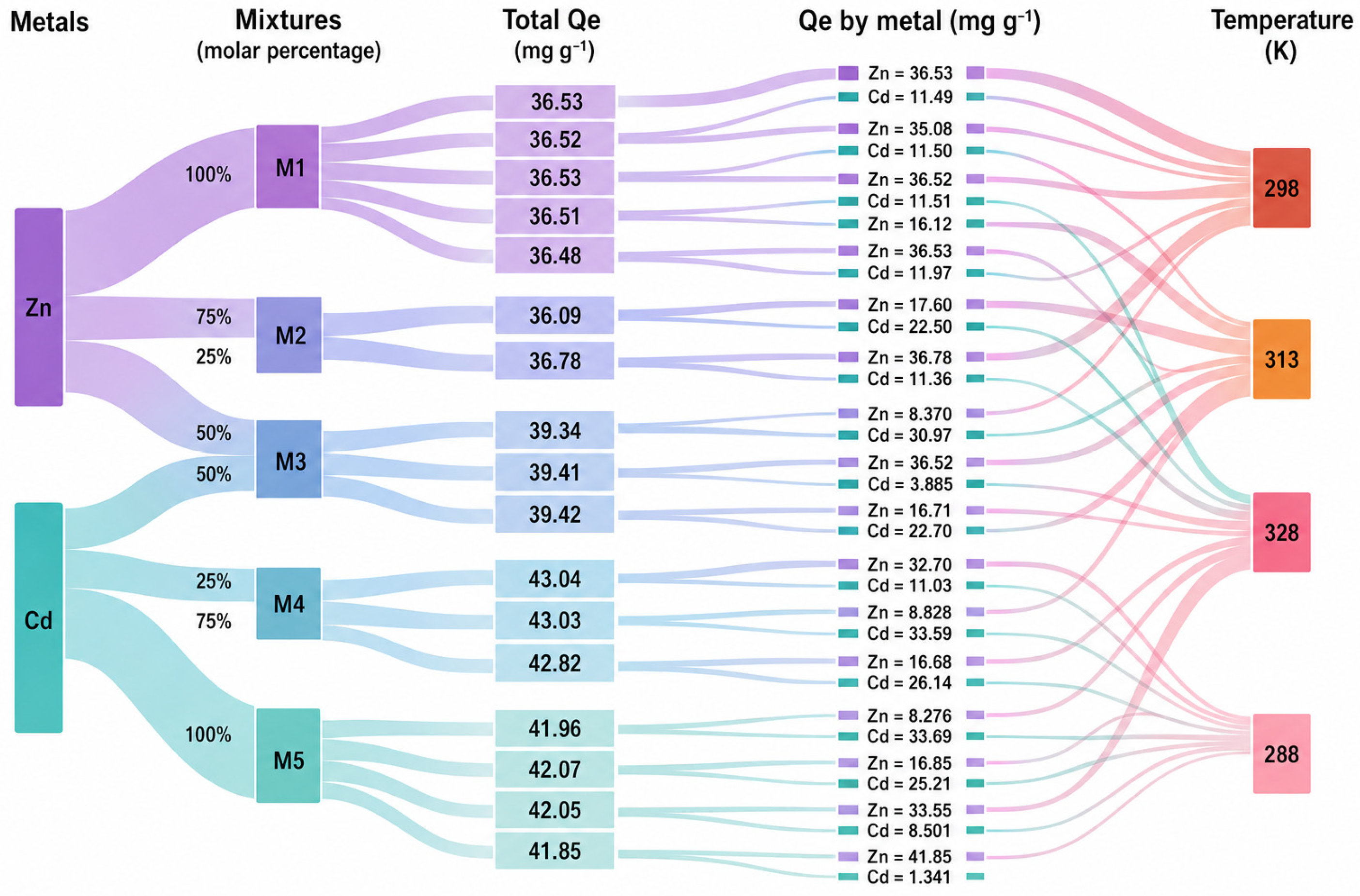
The competitive adsorption behavior of Cd(II) and Zn(II) onto Mg–Fe-LDH@HC was evaluated through mixture experiments at different metal proportions and temperatures. This approach was necessary because the previous bicomponent equilibrium assays were conducted under equimolar conditions, whereas real aqueous effluents rarely contain metals at identical concentrations. Therefore, the mixture design allowed the adsorption response of Mg–Fe-LDH@HC to be assessed under variable Cd(II)/Zn(II) ratios and provided additional evidence on the interaction between both adsorbates during simultaneous adsorption.
The results of the mixture design showed that the adsorption response was mainly controlled by the relative proportion of Cd(II) and Zn(II) (Figure 8), while temperature produced minor changes within the evaluated range. This behavior is consistent with the thermodynamic evaluation, where moderate values of ΔH° and limited variation in Qe indicated that adsorption was not strongly governed by temperature. Thus, the competitive distribution of both metals over the available adsorption domains was more relevant than the thermal variation between 288.15 and 328.15 K.
The limited effect of temperature suggests that Mg–Fe-LDH@HC maintained a relatively stable adsorption behavior under moderate thermal variations. From an operational perspective, this result is favorable because water treatment systems can operate under varying ambient temperatures. However, the slight improvement observed at higher temperatures should not be overinterpreted as evidence of a strongly endothermic mechanism. Rather, it indicates that the adsorption process was thermodynamically favorable and weakly temperature-dependent, in accordance with the apparent thermodynamic parameters discussed above.
In contrast, the molar Cd(II)/Zn(II) ratio had a clear effect on the adsorption response. The most relevant trend was the progressive decrease in Zn(II) adsorption as the fraction of Cd(II) in the mixture increased. This behavior indicates that both divalent cations competed for partially shared adsorption domains on Mg–Fe-LDH@HC. These domains may include deprotonated oxygenated groups of the HC matrix, hydroxylated Mg/Fe regions, carbonate domains associated with the LDH phase, and interparticular or mesoporous regions. However, these surface contributions should be interpreted as possible adsorption domains and not as individually confirmed mechanistic pathways.
The larger competitive effect of Cd(II) on Zn(II) adsorption suggests an antagonistic interaction between the two metals. In an antagonistic two-component system, the presence of one solute reduces the adsorption of the other because both species compete for common or partially overlapping sites. Although Cd(II) and Zn(II) have the same formal charge, their adsorption behavior may differ due to differences in hydrated ionic radius, hydration energy, polarizability, tendency to hydrolysis, and affinity towards oxygenated or hydroxylated surface domains. These differences can modify the effective accessibility of adsorption sites and lead to uneven retention under competitive conditions.
The apparent preferential retention of Cd(II) over Zn(II) should be interpreted with caution, since the values of Qe expressed in mg g−1 are influenced by the different atomic masses of Cd and Zn. Therefore, a higher adsorption capacity of Cd(II) in units of mass should not be considered by itself as direct evidence of intrinsic selectivity. The competitive response should be interpreted from the combined evidence of molar-basis mixture design, bicomponent equilibrium modeling, and changes in Zn(II) retention by increasing the Cd(II) fraction. Under this approach, the results indicate that Cd(II) interfered more strongly with Zn(II) adsorption than the reverse effect.
These findings are consistent with the modeling of two-component isotherms. The lower performance of the extended Langmuir model indicates that the system was not adequately described by a homogeneous surface with equivalent adsorption sites. In contrast, the improved performance of heterogeneous models, particularly DLM and Extended Sips, supports the presence of non-equivalent adsorption domains and non-ideal competitive interactions. Therefore, the results of the mixture design reinforce the interpretation that Mg–Fe-LDH@HC behaves as a heterogeneous adsorbent, in which Cd(II) and Zn(II) compete for adsorption domains with different apparent affinities.
Mixing experiments also provide practical information that cannot be obtained from monometallic or equimolar systems alone. Under equimolar conditions, both metals are supplied at the same molar concentration, which is useful for comparing their simultaneous adsorption under controlled conditions. However, experiments with variable ratios reveal how the adsorbent responds when one of the metals becomes dominant in the mixture. In this study, increasing the Cd(II) fraction progressively reduced Zn(II) retention, confirming that the metal ratio is a critical factor controlling the apparent performance of Mg–Fe-LDH@HC.

3.8. Operational Stability and Applicability Assessment of Mg–Fe-LDH@HC

The effect of HCl concentration on the recovered adsorption capacity of Mg–Fe-LDH@HC is shown in Figure S5. The highest values of recovered Qe for Zn(II) and Cd(II) were obtained when 0.1 M HCl was used as a regenerating agent. Increasing HCl concentration from 0.1 to 2 M progressively reduced subsequent adsorption capacity, indicating that stronger acidic conditions did not improve practical adsorbent recovery. Although acidic solutions can promote metallic desorption by protonation of surface functional groups and weakening metal-surface interactions, increased acid strength can also modify oxygenated groups, disturb LDH-associated domains, or affect the accessibility of active sites. This behavior is consistent with previous studies indicating that chemical regeneration can reactivate depleted biochar-based adsorbents, but its performance depends on the adsorption mechanism, surface functional groups, porous structure, and potential changes in active sites during regeneration [40]. Other studies in heavy metal adsorbents have also reported that HCl may be effective for metal desorption, although repeated or intense acid treatment may reduce subsequent adsorption capacity due to changes in active adsorption sites [41].
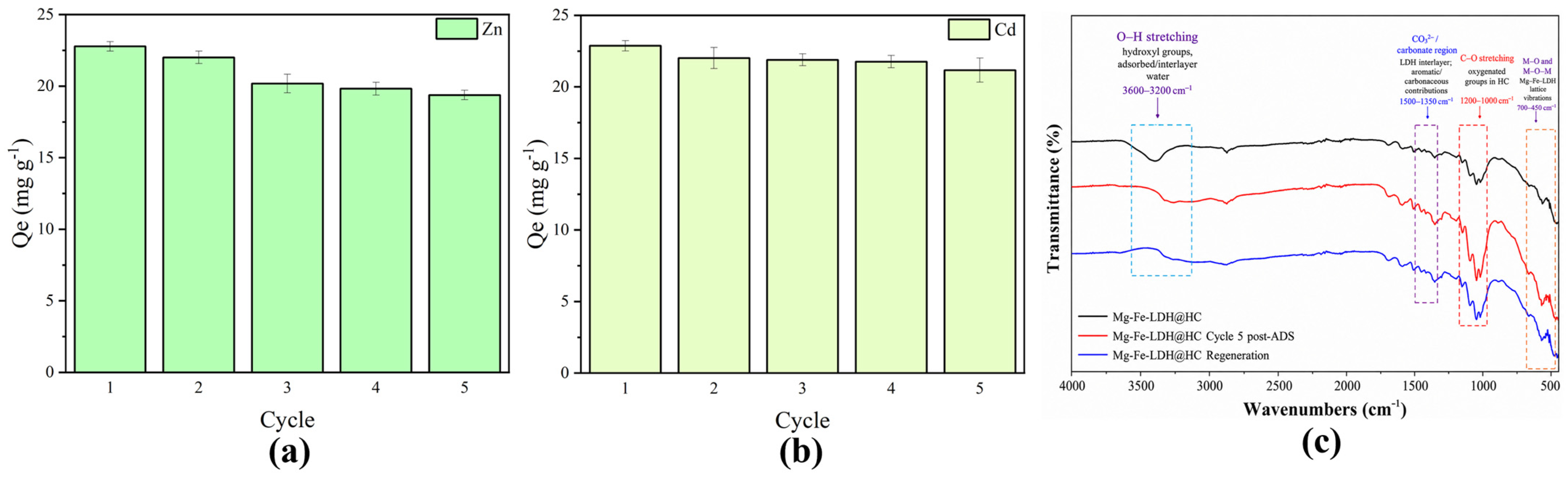
Based on these results, 0.1 M HCl was selected for the reuse assay over five cycles, as it provided the best balance between metallic desorption and preservation of adsorption capacity. As shown in Figure 9a,b Mg–Fe-LDH@HC maintained a considerable fraction of its initial performance after five consecutive adsorption-desorption cycles. For Zn(II), Qe gradually decreased from about 22 mg g−1 in the first cycle to about 19.3 mg g−1 in the fifth cycle. For Cd(II), the decrease was more pronounced, from approximately 23 to 21 mg g−1. These results suggest that the material can be reused with a moderate loss of performance, which is important for the practical application of adsorption-based water treatment systems. Regeneration is a key factor in improving the economic feasibility of adsorbents, as it allows their repeated use and reduces the need for replacement with fresh material.
The structural stability of the material was also evaluated by monitoring Mg2+ and Fe3+ leaching after each reuse cycle (Figure S6). The leached concentrations were considerably low and decreased progressively with the number of cycles. Mg2+ release was higher than Fe3+ release, suggesting that Mg-associated domains were comparatively more labile, whereas Fe-containing domains remained more stable. From the third cycle onward, leaching became negligible, supporting the structural stability of Mg–Fe-LDH@HC under the selected operating pH. These results suggest that the material can be reused with moderate performance loss and limited metal leaching, which is important for the practical application and economic feasibility of adsorption-based water treatment systems.
FTIR spectra (Figure 9c) additionally support the reuse results. After the fifth adsorption cycle, changes were observed in the OH stretch region, the carbonate-associated region, the C-O stretch interval and the M-O/M-O-M vibration region, suggesting the participation of hydroxylated groups, interlaminar carbonate species, oxygenated groups and metal-oxygen domains associated with LDH in the retention of Cd(II)/Zn(II). After regeneration with 0.1 M HCl, the main absorption bands were preserved, indicating that the hybrid structure was largely maintained. However, the regenerated spectrum did not fully recover the profile of the pristine material, suggesting that the regeneration was effective, but not completely restorative. This partial recovery is consistent with the gradual decrease in Qe during reuse and may be associated with incomplete desorption, residual site occupation, surface protonation, or partial disturbance of LDH-related adsorption domains.
To further evaluate the applicability of Mg–Fe-LDH@HC, adsorption tests were performed in the presence of representative interfering ions and real water matrices. As shown in Figure S7, Cl produced only a slight decrease in Qe for both Zn(II) and Cd(II), while SO42− caused a more noticeable reduction, probably due to increased ionic strength and competition near hydroxylated or positively charged sites. The strongest decreases were observed with CO32− and PO42−, suggesting that multivalent oxyanions can more strongly affect Cd(II)/Zn(II) retention by modifying metal speciation, competing for LDH-related domains, or interacting with hydroxylated and interlayer regions. Similar effects of coexisting ions on heavy-metal adsorption and electrostatic interactions have been reported for LDH-based and mineral adsorbents [42,43,44].
The performance of Mg–Fe-LDH@HC was also assessed in real water matrices. As shown in Figure S8, Qe decreased in surface water, groundwater, and hospital effluent compared with the control test. This reduction can be attributed to the presence of competing ions, bicarbonate, hardness-related species, dissolved organic matter, salts, pharmaceuticals, surfactants, and other coexisting contaminants that may block active sites or alter metal speciation (Table S6). The stronger effect observed in the hospital effluent reflects the greater complexity of this matrix. Overall, Mg–Fe-LDH@HC maintained relevant adsorption performance under interfering-ion and real-water conditions, although the decrease in Qe confirms that matrix composition must be considered for practical water treatment applications [45].

3.9. Proposed Adsorption Mechanism

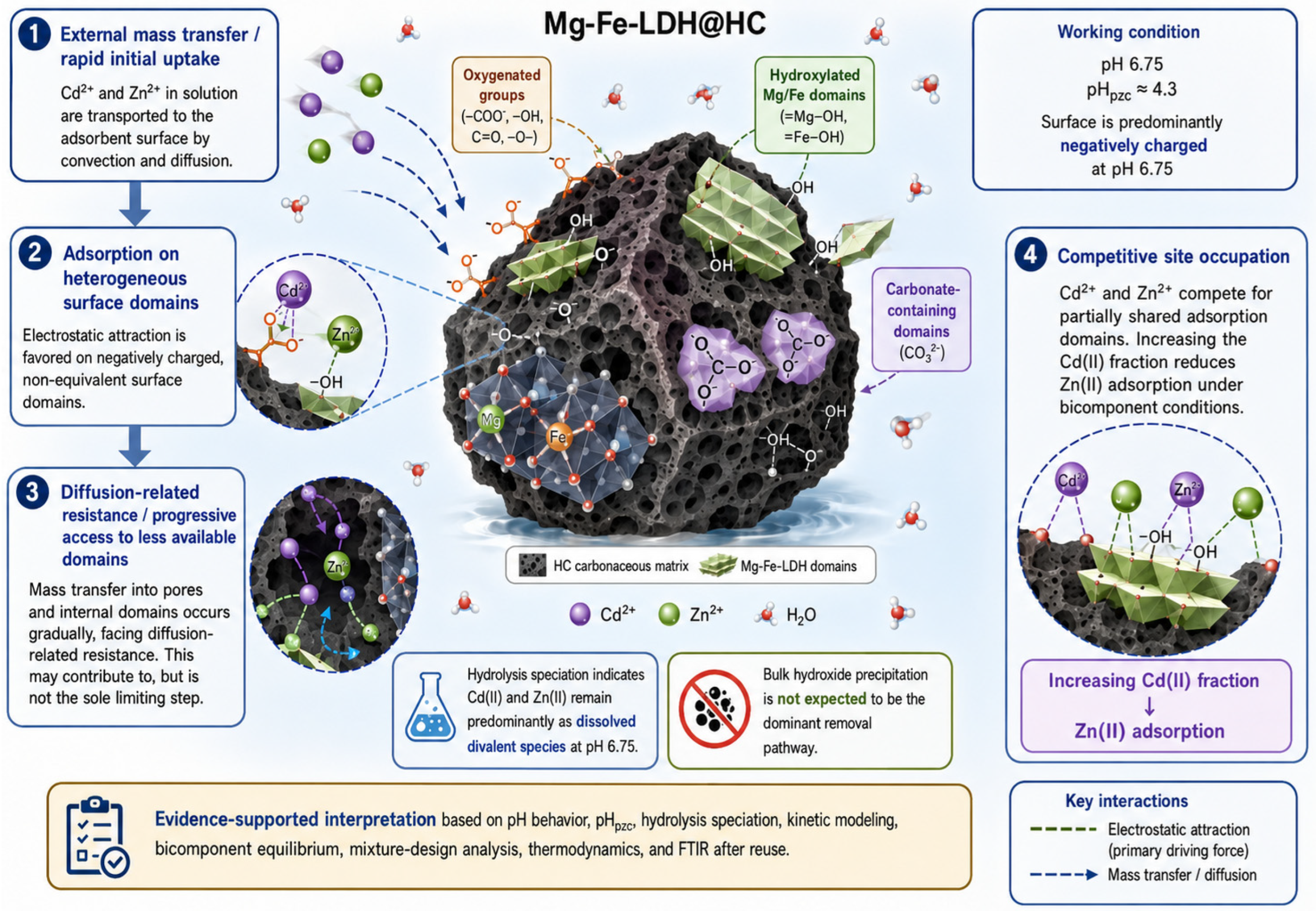
The adsorption pathway of Cd(II) and Zn(II) onto Mg–Fe-LDH@HC was interpreted from the combined evidence obtained from pH-dependent adsorption, surface charge behavior, hydrolysis speciation, kinetic modeling, bicomponent equilibrium analysis, competitive mixture experiments, thermodynamic assessment, and FTIR analysis after adsorption-regeneration cycles (Figure 10). Therefore, the mechanism discussed here should be understood as an evidence-supported interpretation of the adsorption behavior rather than as the direct confirmation of individual elementary mechanisms.
At pH 6.75, Mg–Fe-LDH@HC is above its pHPZC, which favors the deprotonation of hydroxylated and oxygenated surface groups. Under these conditions, hydrolysis speciation analysis indicated that Cd(II) and Zn(II) remain predominantly as dissolved divalent species. Therefore, massive hydroxide precipitation is not expected to be the dominant removal route.
The characterization of Mg–Fe-LDH@HC supports the presence of chemically diverse surface domains. The HC matrix provides oxygenated functionalities, while the Mg–Fe-LDH phase provides hydroxylated Mg/Fe regions, carbonate domains, and metal-oxygen environments. These domains can provide non-equivalent interaction regions for metal retention. In LDH-based adsorbents and LDH-carbonaceous composites, the participation of hydroxylated, oxygenated, carbonate, and metal-oxygen domains in the retention of toxic metals has been reported [36,39,46,47]. However, in the present study, specific pathways such as surface complexation and ion exchange cannot be affirmed as confirmed mechanisms, since no post-adsorption XPS or direct quantification of exchanged interlayer species was performed.
The kinetic results indicate that the adsorption of Cd(II) and Zn(II) occurred through a multistage process. Rapid initial uptake can be associated with external mass transfer and occupation of easily accessible surface sites. The subsequent slower stage indicates the contribution of diffusion-associated resistance or progressive access to less available adsorption domains. However, the Weber-Morris analysis showed a multilinear behavior and the adjusted lines did not pass through the origin. Therefore, intraparticle diffusion cannot be considered the only rate-controlling step and the data do not allow confirmation of intraparticle diffusion as an independent control mechanism. Kinetic behavior is best described as a combined process involving external surface uptake, diffusion-associated resistance, and heterogeneous surface interactions.
The results of bicomponent equilibrium and mixture design also showed that Cd(II) and Zn(II) did not behave as independent solutes. The better performance of heterogeneous equilibrium models, particularly DLM and Extended Sips, indicates that adsorption occurred on non-equivalent domains and not on a homogeneous surface with identical sites. In addition, the mixing experiments showed that increasing the Cd(II) fraction progressively reduced the adsorption of Zn(II), indicating an antagonistic competition between both divalent cations for partially shared adsorption domains. This competitive response was more relevant than temperature within the evaluated range, which is consistent with the limited variation in Qe and with the moderate apparent thermodynamic parameters.
Thermodynamic evaluation indicated that adsorption was favorable and weakly temperature-dependent. The negative values of ΔG° showed that the adsorption of Cd(II) and Zn(II) was thermodynamically favorable under the conditions evaluated. Positive but moderate values of ΔH° indicated an apparent endothermic contribution, although its relatively low magnitude and small variation in Qe with temperature suggest that the process was not dominated by strong temperature-dependent chemical bonding. Therefore, the thermodynamic results are more consistent with weak surface interactions and heterogeneous adsorption contributions than with a route controlled only by strong chemisorption.
Localized contributions associated with the LDH phase may also play a role, since Mg–Fe-LDH@HC contains hydroxylated and carbonate regions. However, neither ion exchange nor surface precipitation can be considered confirmed mechanisms in this study. Ion exchange would require direct evidence, such as quantification of released interlayer anions or exchanged species, while surface precipitation would require post-adsorption evidence of crystalline or amorphous precipitated phases. Since these analyses were not performed, these contributions are discussed only as possible secondary contributions associated with the surface environment containing LDH.
FTIR analysis after adsorption and regeneration provides supporting evidence that major surface domains were affected during Cd(II)/Zn(II) retention. Changes in the O-H region, carbonate-associated bands, C-O stretch interval and the M-O/M-O-M vibration region suggest the involvement of hydroxylated, oxygenated, carbonate and LDH-associated domains. However, FTIR alone does not allow for the confirmation of specific coordination, ion exchange, or precipitation reactions. Therefore, FTIR was used as supplementary evidence of surface involvement, and not as direct evidence of individual adsorption mechanisms.

4. Conclusions

This study demonstrated that Mg–Fe-LDH@HC is a promising hybrid adsorbent for the simultaneous removal of Cd(II) and Zn(II) from aqueous bicomponent systems. The selected operating conditions, pH 6.75 and 4 g L−1 adsorbent dosage, provided high removal efficiency while limiting the contribution of uncontrolled bulk hydroxide precipitation. The pH-dependent behavior and hydrolysis speciation analysis indicated that adsorption-driven retention at the solid-liquid interface was the dominant removal route under the evaluated conditions.
Kinetic results showed that Cd(II) and Zn(II) adsorption occurred through a multistage process. The rapid initial uptake was associated with external mass transfer and occupation of accessible surface domains, followed by a slower stage related to diffusion-related resistance and progressive access to less available adsorption regions. The Weber-Morris analysis showed multilinear behavior and non-zero intercepts, confirming that intraparticle diffusion was not the sole rate-controlling step. Therefore, the kinetic behavior should be interpreted as the result of combined transport and heterogeneous surface interactions rather than a single controlling mechanism.
Bicomponent equilibrium modeling confirmed the heterogeneous nature of Mg–Fe-LDH@HC. The Extended Langmuir model showed a weaker fit, whereas DLM and Extended Sips better described the experimental data for both metals. This behavior indicates that Cd(II) and Zn(II) adsorption occurred on non-equivalent domains rather than on a homogeneous surface with identical sites. The apparent thermodynamic parameters showed negative ΔG° values and moderate positive ΔH° values, indicating favorable and mildly endothermic adsorption with limited temperature dependence.
The competitive mixture experiments confirmed that metal proportion was more influential than temperature in controlling adsorption performance. Increasing the Cd(II) fraction progressively reduced Zn(II) retention, revealing an antagonistic interaction between both divalent cations for partially shared adsorption domains. This finding highlights the importance of evaluating adsorbents under variable multicomponent compositions, since single-metal or equimolar systems alone may not adequately represent competitive aqueous matrices.
The proposed adsorption pathway involves electrostatic attraction, external mass transfer, adsorption on heterogeneous surface domains, diffusion-related resistance, and competitive site occupation. However, specific contributions such as surface complexation, ion exchange, and surface precipitation were not individually confirmed because post-adsorption XPS, quantification of exchanged species, and direct identification of precipitated phases were not performed. Therefore, these processes should only be considered possible secondary contributions. Overall, Mg–Fe-LDH@HC showed stable and relevant adsorption performance under bicomponent conditions, but future studies should include direct post-adsorption surface characterization, expanded real-matrix validation, and continuous-flow assays to better assess its practical application in mixed-metal wastewater treatment. The reuse, leaching, interfering-ion, and real-matrix assays further showed that Mg–Fe-LDH@HC maintained relevant performance under more demanding conditions, although matrix composition and long-term stability should be further evaluated before practical implementation. In addition, batch-to-batch material variability without fresh structural validation should be considered a potential limitation for large-scale upscaling of Mg–Fe-LDH@HC.

Supplementary Materials

The following supporting information can be downloaded at: https://www.mdpi.com/article/10.3390/w18141658/s1, Figure S1: SEM image of Mg–Fe-LDH; Figure S2: High-resolution XPS spectra of O 1s and C 1s for Mg–Fe-LDH@HC; Figure S3: Textural properties and surface charge behavior of HC, Mg–Fe-LDH, and Mg–Fe-LDH@HC; Figure S4: Approximate hydrolysis speciation diagrams of Cd(II) and Zn(II) as a function of pH; Figure S5: Effect of HCl concentration as regenerating agent; Figure S6: Leaching stability of Mg–Fe-LDH@HC during consecutive adsorption-desorption cycles; Figure S7: Effect of representative interfering ions on Zn(II) and Cd(II) adsorption; Figure S8: Adsorption performance of Mg–Fe-LDH@HC in different water matrices; Table S1: Parameters of the kinetic models used to describe Zn(II) adsorption; Table S2: Parameters of the kinetic models used to describe Cd(II) adsorption; Table S3: Weber-Morris intraparticle diffusion parameters for Zn(II) adsorption; Table S4: Weber-Morris intraparticle diffusion parameters for Cd(II) adsorption; Table S5: Parameters of the bicomponent adsorption equilibrium isotherms for Zn(II) and Cd(II); Table S6: Physicochemical characteristics of the real water matrices used in the adsorption assays.

Author Contributions

Conceptualization, J.J.A.-C. and J.M.R.-D.; methodology, J.J.A.-C., L.Á.Z.-I., A.J.G.-G. and J.M.R.-D.; data curation, J.J.A.-C., L.Á.Z.-I., A.J.G.-G. and K.J.F.-A.; investigation, J.J.A.-C., L.Á.Z.-I. and K.J.F.-A.; formal analysis, J.J.A.-C., L.Á.Z.-I., A.J.G.-G. and J.M.R.-D.; validation, A.J.G.-G., L.G.-R., I.B.P.-A. and J.M.R.-D.; writing—original draft preparation, J.J.A.-C., A.J.G.-G. and L.Á.Z.-I.; writing—review and editing, K.J.F.-A., L.G.-R., I.B.P.-A. and J.M.R.-D.; visualization, J.J.A.-C., A.J.G.-G. and K.J.F.-A.; resources, I.B.P.-A. and J.M.R.-D.; supervision, L.G.-R. and J.M.R.-D.; project administration, J.M.R.-D. All authors have read and agreed to the published version of the manuscript.

Funding

This research was funded by Universidad ECOTEC through the project “Valorization of agricultural residues for the development of sustainable hybrid nanomaterials applied to water treatment: removal and degradation of emerging contaminants” (Project code: 2026IAITFIACN-007).

Data Availability Statement

The data supporting the findings of this study are included within the article and its Supplementary Materials. Additional information related to the datasets used and analyzed during the current study may be obtained from the corresponding author upon reasonable request.

Acknowledgments

The authors acknowledge the Laboratorio de Análisis Químicos y Biotecnológicos of the Universidad Técnica de Manabí for the technical and instrumental support provided during the development of this study. During the preparation of this manuscript, the authors used OpenAI ChatGPT, using the GPT-4o image-generation model, for the development of the graphical abstract and the schematic illustrations included in the manuscript. The authors reviewed and edited the generated content and assume full responsibility for the final content of this publication.

Conflicts of Interest

The authors declare no conflicts of interest.

Abbreviations

The following abbreviations are used in this manuscript:
HCHydrochar
LDHLayered double hydroxide
Mg–Fe-LDHMagnesium-iron layered double hydroxide
Mg–Fe-LDH@HCHydrochar functionalized with magnesium-iron layered double hydroxide
Cd(II)Cadmium ion
Zn(II)Zinc ion
SEMScanning electron microscopy
EDSEnergy-dispersive X-ray spectroscopy
SEM-EDSScanning electron microscopy coupled with energy-dispersive X-ray spectroscopy
XRDX-ray diffraction
FTIRFourier-transform infrared spectroscopy
TEMTransmission electron microscopy
BETBrunauer-Emmett-Teller surface area analysis
XPSX-ray photoelectron spectroscopy
TGAThermogravimetric analysis
pHPZCpH at the point of zero charge
ICP-OESInductively coupled plasma optical emission spectrometry
PFOPseudo-first-order
PSOPseudo-second-order
DLMDouble-layer model

References

  1. Singh, V.; Ahmed, G.; Vedika, S.; Kumar, P.; Chaturvedi, S.K.; Rai, S.N.; Vamanu, E.; Kumar, A. Toxic heavy metal ions contamination in water and their sustainable reduction by eco-friendly methods: Isotherms, thermodynamics and kinetics study. Sci. Rep. 2024, 14, 7595. [Google Scholar] [CrossRef] [PubMed]
  2. Xu, W.; Jin, Y.; Zeng, G. Introduction of heavy metals contamination in the water and soil: A review on source, toxicity and remediation methods. Green Chem. Lett. Rev. 2024, 17, 2404235. [Google Scholar] [CrossRef]
  3. Thomas, M.; Melichová, Z.; Šuránek, M.; Kuc, J.; Więckol-Ryk, A.; Lochyński, P. Removal of Zinc from Concentrated Galvanic Wastewater by Sodium Trithiocarbonate: Process Optimization and Toxicity Assessment. Molecules 2023, 28, 546. [Google Scholar] [CrossRef] [PubMed]
  4. Lee, Y.J.; Lee, C.G.; Min, K.J.; Park, S.J. Efficient cadmium removal from industrial wastewater generated from smelter using chemical precipitation and oxidation assistance. Water Environ. Res. 2024, 96, e11059. [Google Scholar] [CrossRef] [PubMed]
  5. Mo, W.; He, C.; Yang, Y.; Cheng, B.; Yang, J.; Huang, Y. Adsorption behavior of Mg-Al layered double hydroxide on Pb (II), Zn (II), Cd (II), and As (V) coexisting in aqueous solution. Mater. Today Sustain. 2024, 27, 100861. [Google Scholar]
  6. Noorbakhsh, Y.; Bozorgghomi, S.; Ghaemi, A. Simulation and optimization of copper, nickel, cadmium, and zinc removal from industrial wastewater using Aspen adsorption and RSM. Sci. Rep. 2025, 15, 40606. [Google Scholar] [CrossRef] [PubMed]
  7. Feng, X.; Long, R.; Wang, L.; Liu, C.; Bai, Z.; Liu, X. A review on heavy metal ions adsorption from water by layered double hydroxide and its composites. Sep. Purif. Technol. 2022, 284, 120099. [Google Scholar] [CrossRef]
  8. Guan, X.; Yuan, X.; Zhao, Y.; Bai, J.; Li, Y.; Cao, Y.; Chen, Y.; Xiong, T. Adsorption behaviors and mechanisms of Fe/Mg layered double hydroxide loaded on bentonite on Cd (II) and Pb (II) removal. J. Colloid Interface Sci. 2022, 612, 572–583. [Google Scholar] [CrossRef] [PubMed]
  9. Liu, W.; Liu, Y.; Yuan, Z.; Lu, C. Recent advances in the detection and removal of heavy metal ions using functionalized layered double hydroxides: A review. Ind. Chem. Mater. 2023, 1, 79–92. [Google Scholar]
  10. Ahuja, R.; Kalia, A.; Sikka, R.; P, C. Nano modifications of biochar to enhance heavy metal adsorption from wastewaters: A review. ACS Omega 2022, 7, 45825–45836. [Google Scholar] [CrossRef] [PubMed]
  11. Wang, Y.; Li, J.; Xu, L.; Wu, D.; Li, Q.; Ai, Y.; Liu, W.; Li, D.; Zhou, Y.; Zhang, B. EDTA functionalized Mg/Al hydroxides modified biochar for Pb (II) and Cd (II) removal: Adsorption performance and mechanism. Sep. Purif. Technol. 2024, 335, 126199. [Google Scholar]
  12. Elshishini, H.M.; Elsubruiti, G.M.; Ghatass, Z.F.; Eltaweil, A.S. Microwave-assisted synthesis of Zn-Fe LDH modified with magnetic oxidized hydrochar for Pb (II) removal: Insights into stability, performance and mechanism. J. Solid State Chem. 2024, 335, 124689. [Google Scholar]
  13. Meng, H.; Chen, Z.; Wei, W.; Xu, J.; Duan, H.; Zheng, M.; Ni, B.-J. Magnetic hydrochar for sustainable wastewater management. npj Mater. Sustain. 2025, 3, 7. [Google Scholar] [CrossRef]
  14. Liao, W.; Zhang, X.; Shao, J.; Yang, H.; Zhang, S.; Chen, H. Simultaneous removal of cadmium and lead by biochar modified with layered double hydroxide. Fuel Process. Technol. 2022, 235, 107389. [Google Scholar] [CrossRef]
  15. Hameed, R.; Abbas, A.; Lou, J.; Khattak, W.A.; Roha, B.; Iqbal, B.; Li, G.; Zhang, Q.; Zhao, X. Synthesis of biochar-ZnAl-layered double hydroxide composite for effective heavy metal adsorption: Exploring mechanisms and structural transformations. J. Environ. Chem. Eng. 2024, 12, 112687. [Google Scholar]
  16. Khooni, M.A.K.; Davardoostmanesh, M.; Ahmadzadeh, H. Simultaneous Removal of Some Heavy Metal Ions From Aqueous Solutions by Magnetic Mg-Al Layered Double Hydroxide Modified With Microalgae. Water Environ. Res. 2025, 97, e70216. [Google Scholar] [CrossRef] [PubMed]
  17. Li, L.; Wang, Z.; Wang, G.; Zhang, X.; Deng, N. MoS42−-Intercalated MgFe-LDH/Biochar Hybrid for Efficient and Simultaneous Removal of Pb (II) and Cd (II) in Aqueous Solution: Insights into Adsorption Performance and Mechanisms. Water Air Soil Pollut. 2026, 237, 696. [Google Scholar]
  18. Normah, N.; Lesbani, A. Comparison of LDH-Organic/Inorganic Compound Modified Materials as Adsorbents for Heavy Metal Adsorption: Characteristic Structure and Adsorption Mechanism. Bull. Chem. React. Eng. Catal. 2024, 19, 327–339. [Google Scholar] [CrossRef]
  19. Gedha, H.S.L.; Abudi, Z.N. Heavy Metals Removal from Synthetic Wastewater Through Layered Double Hydroxide (LDH)(Mg-Al)-Hydrochar. Iran. J. Chem. Chem. Eng. 2025, 44, 112–126. [Google Scholar]
  20. Sharma, S.; Sharma, N.; Somvanshi, A.; Alsayari, A.; Wahab, S.; Kumar, A.; Pathania, D.; Thakur, A.; Jasrotia, R.; Sharma, A.; et al. Waste citrus pseudolimon peels derived biochar assisted magnetic Zn + Al (LDH) nanocomposites for As (III) adsorption. Sci. Rep. 2026, 16, 11645. [Google Scholar] [CrossRef] [PubMed]
  21. Amin, M.T.; Alazba, A.A.; Shafiq, M.; Khan, A.A.; Rahman, M.M. Ca-Mg-Al LDH-modified wheat straw biochar for efficient lead chemisorption from aqueous solution: Insights from isotherm and kinetic analyses. Soil Water Res. 2026, 21, 52–65. [Google Scholar]
  22. Deng, H.; Zhang, S.; Li, Q.; Li, A.; Gan, W.; Hu, L. Efficient removal of lead, cadmium, and zinc from water and soil by MgFe layered double hydroxide: Adsorption properties and mechanisms. Sustainability 2024, 16, 11037. [Google Scholar] [CrossRef]
  23. Pan, X.; Kuang, S.; Wang, X.; Ullah, H.; Rao, Z.; Ali, E.F.; Abbas, Q.; Lee, S.S.; Shaheen, S.M. Functionalization of sawdust biochar using Mg–Fe-LDH and sodium dodecyl sulfonate enhanced its stability and immobilization capacity for Cd and Pb in contaminated water and soil. Biochar 2025, 7, 16. [Google Scholar] [CrossRef]
  24. Wibowo, Y.G.; Safitri, H.; Kusumawati; Aini, W.D.; Farantino, R.; Ginting, S.B.; Rinovian, A.; Kurniawan, S.B.; Khairurrijal, K.; Taher, T. Biochar MMT ZnAl LDH composite materials derived from solid waste for heavy metal removal in artificial acid mine drainage. Sci. Rep. 2025, 15, 14914. [Google Scholar] [CrossRef] [PubMed]
  25. Cedeño-Muñoz, J.S.; Zumarraga-Valencia, B.J.; Cevallos-Mendoza, J.E.; Rivadeneira-Mendoza, B.F.; Pérez-Almeida, I.B.; Yadav, K.K.; Saquete, M.D.; Boluda-Botella, N.; Rodríguez-Díaz, J.M. Hydrochar supported Mg-Fe layered double hydroxide hybrid for efficient and reusable removal of tetracyclines from water. Emerg. Contam. 2026, 12, 100623. [Google Scholar] [CrossRef]
  26. Jarre-Vera, G.R.; Rivadeneira-Mendoza, B.F.; Fernández-Andrade, K.J.; Yadav, K.K.; Pérez-Almeida, I.B.; Saquete, M.D.; Boluda-Botella, N.; Rodríguez-Díaz, J.M. Structured design of a hydrochar-supported LDH/MOF composite for improved photocatalytic applications. Results Eng. 2024, 24, 103424. [Google Scholar] [CrossRef]
  27. Ávila, F.G.; Cabrera-Sumba, J.; Valdez-Pilataxi, S.; Villalta-Chungata, J.; Valdiviezo-Gonzales, L.; Alegria-Arnedo, C. Removal of heavy metals in industrial wastewater using adsorption technology: Efficiency and influencing factors. Clean. Eng. Technol. 2025, 24, 100879. [Google Scholar] [CrossRef]
  28. Azeez, N.R.; Salih, S.S.; Kadhom, M.; Mohammed, H.N.; Ghosh, T.K. Enhanced termination of zinc and cadmium ions from wastewater employing plain and chitosan-modified mxenes: Synthesis, characterization, and adsorption performance. Green Chem. Eng. 2024, 5, 339–347. [Google Scholar] [CrossRef]
  29. Shah, A.; Zakharova, J.; Batool, M.; Coley, M.P.; Arjunan, A.; Hawkins, A.J.; Bolarinwa, T.; Devi, S.; Thumma, A.; Williams, C. Removal of cadmium and zinc from water using sewage sludge-derived biochar. Sustain. Chem. Environ. 2024, 6, 100118. [Google Scholar] [CrossRef]
  30. Khosravi, A.; Habibpour, R.; Ranjbar, M. Enhanced adsorption and removal of Cd (II) from aqueous solution by amino-functionalized ZIF-8. Sci. Rep. 2024, 14, 10736. [Google Scholar] [CrossRef] [PubMed]
  31. Küçük, M.E.; Makarava, I.; Kinnarinen, T.; Häkkinen, A. Simultaneous adsorption of Cu (II), Zn (II), Cd (II) and Pb (II) from synthetic wastewater using NaP and LTA zeolites prepared from biomass fly ash. Heliyon 2023, 9, e20253. [Google Scholar] [CrossRef] [PubMed]
  32. Sui, C.; Xie, W.; Bian, Y.; Li, X. Recent Progress in Adsorption Removal of Heavy Metal Ions from Wastewater Using Biomass-Based Materials. Gels 2026, 12, 311. [Google Scholar] [CrossRef] [PubMed]
  33. Rasheed, A.; Muhammad, H.; Jakada, Y.; Salahudeen, N. Effect of Adsorbent Dosage on the Kinetics and Isotherms of Lead (II) Removal from Aqueous Solution Using Corn Husk. Arid. Zone J. Eng. Technol. Environ. 2025, 21, 702–716. [Google Scholar] [CrossRef]
  34. Bayuo, J.; Rwiza, M.J.; Sillanpää, M.; Mtei, K.M. Removal of heavy metals from binary and multicomponent adsorption systems using various adsorbents-a systematic review. RSC Adv. 2023, 13, 13052–13093. [Google Scholar] [CrossRef] [PubMed]
  35. Petrović, J.; Koprivica, M.; Ercegović, M.; Simić, M.; Dimitrijević, J.; Bugarčić, M.; Trifunović, S. Synthesis and application of FeMg-modified hydrochar for efficient removal of lead ions from aqueous solution. Processes 2025, 13, 2060. [Google Scholar]
  36. Amin, M.; Alazba, A.; Shafiq, M.; Khan, A. Enhanced Performance of the Composite of FeMgAl-Layered Double Hydroxide and Rice Husk Biochar to Adsorb Heavy Metal Ions of Lead and Cadmium in Aqueous Solutions. J. Chem. 2024, 2024, 4155126. [Google Scholar]
  37. Hu, Q.; Hao, L.; Pei, Q.; Zhang, Y. A state-of-the-art review of explicit multicomponent isotherm models for the modeling of equilibrium data: From fundamentals to applications. Sep. Purif. Technol. 2025, 363, 132202. [Google Scholar] [CrossRef]
  38. Liang, X.; Su, Y.; Wang, X.; Liang, C.; Tang, C.; Wei, J.; Liu, K.; Ma, J.; Yu, F.; Li, Y. Insights into the heavy metal adsorption and immobilization mechanisms of CaFe-layered double hydroxide corn straw biochar: Synthesis and application in a combined heavy metal-contaminated environment. Chemosphere 2023, 313, 137467. [Google Scholar] [CrossRef] [PubMed]
  39. Brahma, D.; Barman, M.P.; Basak, D.; Saikia, H. Prospects of layered double hydroxide (LDH)-based adsorbents for the remediation of environmental inorganic pollutants from wastewater: A critical review. Environ. Sci. Water Res. Technol. 2025, 11, 830–875. [Google Scholar] [CrossRef]
  40. Alsawy, T.; Rashad, E.; El-Qelish, M.; Mohammed, R.H. A comprehensive review on the chemical regeneration of biochar adsorbent for sustainable wastewater treatment. npj Clean Water 2022, 5, 29. [Google Scholar] [CrossRef]
  41. Bhran, A.A.; Tadepalli, S.; Murthy, K.S.R.; AlGhamdi, A.A. Biosorption and Regeneration Studies for Cu (II) and Cd (II) Removal from Industrial Effluents Using Orange Peel and Composite Adsorbents. Processes 2025, 13, 1972. [Google Scholar] [CrossRef]
  42. Alagha, O.; Manzar, M.S.; Zubair, M.; Anil, I.; Mu’azu, N.D.; Qureshi, A. Comparative Adsorptive Removal of Phosphate and Nitrate from Wastewater Using Biochar-MgAl LDH Nanocomposites: Coexisting Anions Effect and Mechanistic Studies. Nanomaterials 2020, 10, 336. [Google Scholar] [CrossRef] [PubMed]
  43. Guo, X.; Fu, H.; Gao, X.; Zhao, Z.; Hu, Z. Study on the adsorption of Zn(II) and Cu(II) in acid mine drainage by fly ash loaded nano-FeS. Sci. Rep. 2024, 14, 9927. [Google Scholar] [CrossRef] [PubMed]
  44. Tan, Y.; Yin, X.; Wang, C.; Sun, H.; Ma, A.; Zhang, G.; Wang, N. Sorption of cadmium onto Mg-Fe Layered Double Hydroxide (LDH)-Kiwi branch biochar. Environ. Pollut. Bioavailab. 2019, 31, 189–197. [Google Scholar] [CrossRef]
  45. Phogole, R.R.; Mpungose, P.P.; Nyaba, L.; Mnguni, M.; Nomngongo, P.N. Ternary Fe-Zn-Al layered double-hydroxides for interactive removal of cd and pb from aqueous solutions: Isotherms, kinetics and application to real samples. J. Hazard. Mater. Adv. 2025, 20, 100876. [Google Scholar] [CrossRef]
  46. Zhang, D.; Zhong, Z.; Liu, Z.; He, S.; Lin, J.; Lv, Y.; Lü, T.; Pan, Y.; Shi, H.; Zhao, H. Sorption of cadmium by layered double hydroxides: Performance, structure-related mechanisms, and sequestration stability assessment. Chemosphere 2024, 352, 141399. [Google Scholar] [CrossRef] [PubMed]
  47. Huang, Y.; Liu, C.; Qin, L.; Xie, M.; Xu, Z.; Yu, Y. Efficient adsorption capacity of MgFe-layered double hydroxide loaded on pomelo peel biochar for Cd (II) from aqueous solutions: Adsorption behaviour and mechanism. Molecules 2023, 28, 4538. [Google Scholar] [CrossRef] [PubMed]
Figure 1. Schematic representation of the synthesis process for HC, Mg–Fe-LDH, and Mg–Fe-LDH@HC.
Water 18 01658 g001
Figure 2. Physicochemical characterization of Mg–Fe-LDH@HC and its precursor materials: (a) SEM image of HC and (b) Mg–Fe-LDH@HC showing LDH aggregates deposited on the HC surface; (c) SEM-EDS elemental mapping of Mg–Fe-LDH@HC. Adapted from Ref. [25].
Water 18 01658 g002
Figure 3. Structural and surface-chemical characterization of Mg–Fe-LDH@HC and its precursor materials. XRD patterns of (a) HC, (b) Mg–Fe-LDH, and (c) Mg–Fe-LDH@HC. (d) FTIR spectrum of Mg–Fe-LDH@HC. High-resolution XPS spectra of (e) Fe 2p and (f) Mg 1s for Mg–Fe-LDH@HC. In panel (d), the solid line represents the FTIR spectrum, while the dashed lines indicate the main vibrational regions assigned to surface functional groups. In panels (e) and (f), the solid colored curves correspond to deconvoluted fitting components, and the dashed red line represents the overall fitted envelope. Adapted from Refs. [25,26].
Water 18 01658 g003
Figure 4. Effect of initial pH and adsorbent dosage on Cd(II) and Zn(II) adsorption by Mg–Fe-LDH@HC: (a) effect of pH on Cd(II) adsorption; (b) effect of pH on Zn(II) adsorption; (c) effect of adsorbent dosage on Cd(II) adsorption; and (d) effect of adsorbent dosage on Zn(II) adsorption.
Water 18 01658 g004
Figure 5. Contact time effect and kinetic modeling of Zn(II) adsorption onto Mg–Fe-LDH@HC at different initial concentrations: 0.25 mM, 0.5 mM, 0.75 mM, 1 mM, 1.25 mM and 1.5 mM. Experimental data were fitted using the PFO, PSO, Bangham, and Elovich models.
Water 18 01658 g005
Figure 6. Contact time effect and kinetic modeling of Cd(II) adsorption onto Mg–Fe-LDH@HC at different initial concentrations: 0.25 mM, 0.5 mM, 0.75 mM, 1 mM, 1.25 mM and 1.5 mM. Experimental data were fitted using the PFO, PSO, Bangham, and Elovich models.
Water 18 01658 g006
Figure 7. Bicomponent adsorption equilibrium and isotherm modeling of Cd(II) and Zn(II) onto Mg–Fe-LDH@HC. Cd(II) adsorption at (a) 288.15 K, (b) 298.15 K, (c) 313.15 K, and (d) 328.15 K. Zn(II) adsorption at (e) 288.15 K, (f) 298.15 K, (g) 313.15 K, and (h) 328.15 K. Experimental data were fitted using the Extended Langmuir, Extended Freundlich, Extended Sips, and double-layer model (DLM).
Water 18 01658 g007
Figure 8. Competitive adsorption study of Cd(II) and Zn(II) onto Mg–Fe-LDH@HC under different molar ratios and temperatures. The color gradient represents the adsorption response, with warmer colors indicating higher adsorption values and cooler colors indicating lower adsorption values.
Water 18 01658 g008
Figure 9. Reusability and structural stability of Mg–Fe-LDH@HC after adsorption-desorption cycles. Adsorption capacity of Mg–Fe-LDH@HC for (a) Zn(II) and (b) Cd(II) over five consecutive reuse cycles. (c) FTIR spectra of Mg–Fe-LDH@HC, Mg–Fe-LDH@HC after the fifth adsorption cycle, and regenerated Mg–Fe-LDH@HC.
Water 18 01658 g009
Figure 10. Proposed adsorption pathway for Cd(II) and Zn(II) on Mg–Fe-LDH@HC under bicomponent conditions, including external mass transfer, adsorption on heterogeneous surface domains, diffusion-associated resistance, competitive site occupation and possible secondary contributions associated with the LDH phase.
Water 18 01658 g010
Table 1. Thermodynamic parameters for Zn(II) and Cd(II) adsorption.
MetalTemperature (K)ΔG° (kJ mol−1)ΔH° (kJ mol−1)ΔS° (J mol−1 K−1)
Zn(II)288.15−11.3518.42101.45
298.15−12.42
313.15−13.88
328.15−15.44
Cd(II)288.15−9.4521.15105.12
298.15−10.54
313.15−12.10
328.15−13.62
Disclaimer/Publisher’s Note: The statements, opinions and data contained in all publications are solely those of the individual author(s) and contributor(s) and not of MDPI and/or the editor(s). MDPI and/or the editor(s) disclaim responsibility for any injury to people or property resulting from any ideas, methods, instructions or products referred to in the content.