Article

Spatiotemporal Evolution and Multi-Factor Association Analysis of Comprehensive Drought in China’s Ten Major River Basins from GRACE Observations

1
Key Laboratory of Agricultural Soil and Water Engineering in Arid and Semiarid Areas, Ministry of Education, Northwest A&F University, Xianyang 712100, China
2
State Key Laboratory of Water Resources Engineering and Management, Wuhan University, Wuhan 430072, China
3
College of Water Resources and Architectural Engineering, Northwest A&F University, Xianyang 712100, China
*
Author to whom correspondence should be addressed.
Water 2026, 18(12), 1474; https://doi.org/10.3390/w18121474 (registering DOI)
Submission received: 30 March 2026 / Revised: 29 May 2026 / Accepted: 3 June 2026 / Published: 15 June 2026

Abstract

Drought is a widespread natural hazard in China that can sequentially trigger meteorological, hydrological, agricultural, and socio-economic drought types, yet traditional drought indices typically focus on a single hydrologic component and cannot capture integrated water deficits across multiple compartments. This study aims to systematically characterize the spatiotemporal evolution of comprehensive drought across China’s ten major river basins and to identify and quantify the main natural and anthropogenic factors associated with drought dynamics. We utilized the Gravity Recovery and Climate Experiment (GRACE) Mascon dataset spanning the entire mission period (April 2002–June 2017), which provides a continuous 15-year observation window suitable for detecting decadal-scale trends and inter-annual variability. Given the documented asynchrony between precipitation and terrestrial water storage changes, a zoned index framework was applied: the Combined Climatologic Deviation Index (CCDI) for arid basins and the Drought Severity Index (DSI) for humid basins. The Theil–Sen estimator and Mann–Kendall test, both non-parametric and robust to outliers, were employed for trend detection, and Pearson correlation analysis was used to evaluate statistical associations between drought indices and potential influencing factors. The results reveal a clear “dry gets drier, wet gets wetter” pattern during 2002–2017: severe drought episodes in humid basins (e.g., the Yangtze) were concentrated in 2002–2006, whereas those in arid basins (e.g., the Haihe) occurred mainly in 2013–2017. Groundwater storage anomaly (GWSA) constituted the primary component of total water storage changes in most basins, with the most rapid depletion rate of −45 mm yr−1 in the northern arid basins. Land use/cover change, especially urban expansion, showed a significant statistical association with drought intensification in arid regions, with its standardized contribution being comparable to that of natural factors such as runoff. This study provides a systematic cross-basin assessment and offers scientific insights for differentiated drought mitigation strategies and water resources management.

1. Introduction

As a global natural hazard, drought is one of the most common, persistent, and widespread climatic extremes worldwide [1]. The prolonged water deficit caused by drought can sequentially trigger meteorological, hydrological, agricultural, and socio-economic drought types, posing severe threats to regional food security, ecological stability, and socio-economic development [2]. Under the influence of the East Asian monsoon, China has a highly heterogeneous spatiotemporal distribution of precipitation, making it a global hotspot for drought events. Drought events occur frequently in both northern and southern river basins [2]. To effectively prevent and mitigate drought events and achieve sustainable water resource management, it is critical to elucidate the spatiotemporal evolution and driving mechanisms of drought in China’s major river basins [3].
A suite of traditional drought indices has been developed for drought monitoring and assessment. The Standardized Precipitation Index (SPI) [4] and the Standardized Precipitation Evapotranspiration Index (SPEI) [5] are the standard metrics for meteorological drought. For agricultural drought, the Palmer Drought Severity Index (PDSI) [6] and the Normalized Difference Vegetation Index (NDVI) [7] are widely applied, while the Standardized Runoff Index (SRI) [8] characterizes hydrological drought. Although extensively used, these indices focus on individual components of the hydrologic cycle and cannot fully capture compound water deficits across surface water, soil moisture, and groundwater, which limits their ability to represent comprehensive drought events, particularly the deep storage depletion during prolonged droughts [9].
The Gravity Recovery and Climate Experiment (GRACE) satellite mission, jointly launched by NASA and the German Aerospace Center (DLR) in March 2002, enabled comprehensive drought assessment by measuring temporal variations in Earth’s gravity field [10,11]. GRACE provides Terrestrial Water Storage Anomaly (TWSA) data that encompass the full spectrum of terrestrial water storage variations, from groundwater and soil moisture to surface water, snow, ice, and canopy water content, thereby addressing the key limitation of conventional single-component drought indices. The GRACE mission and its successor GRACE Follow-On (GRACE-FO), launched in 2018, have since revolutionized the monitoring of large-scale water storage changes, enabling the detection of deep groundwater depletion that traditional indices cannot capture [10,11,12].
Using GRACE-derived TWSA data, the academic community has developed a series of specialized indices for integrated drought monitoring. Among these, the Drought Severity Index (DSI) and the Combined Climatologic Deviation Index (CCDI) are the two most widely used. Zhao et al. [9] developed the DSI based on the standardization of GRACE-derived TWSA and constructed a global monthly gridded drought dataset. Their study verified that the DSI can effectively capture major global drought events and outperforms traditional indices in responding to long-term groundwater depletion. Liu et al. [3] applied DSI to drought research in China’s major river basins, finding that this index can more comprehensively reflect basin-scale comprehensive drought conditions and accurately identified the intensifying drought trend in northern Chinese river basins from 2002 to 2017. Sinha et al. [13] first proposed the CCDI, which integrates Precipitation Anomaly and water storage anomaly information. This index balances the triggering effect of meteorological drought with the cumulative effect of water storage changes. Its application in four major basins in India confirmed its effectiveness in capturing various drought types—meteorological, agricultural, hydrological, and anthropogenic—as well as its superiority over a single water storage index during drought recovery. Yang et al. [14] applied CCDI to drought identification in Central Asian basins, confirming its strong performance for arid and semi-arid conditions. Xu et al. [15] further introduced this index in China to evaluate drought conditions, confirming its superior drought monitoring performance compared to indices based solely on TWSA in northern Chinese basins with intense human activities. Regarding the applicability of these two indices in China’s ten major river basins, Wu et al. [16] confirmed that precipitation and TWSA variations are asynchronous in arid basins, making the CCDI more applicable; by contrast, the two variables are highly synchronized in humid basins, making the DSI more suitable. This conclusion provides a reliable basis for the index selection scheme for basin-specific drought monitoring adopted in this study.
While GRACE-based drought research has been widely applied in multiple regions and river basins of China, two critical research gaps remain to be addressed.
Regarding the investigation of spatiotemporal drought evolution, most existing studies focus on a single region or individual extreme drought event. Nie et al. [17] carried out exploration on the temporal variation characteristics and attribution of water storage changes in the Yangtze River Basin. Ran et al. [18] analyzed the extreme drought that occurred in the middle and lower reaches of the Yangtze River in 2019 using GRACE-FO gravity satellites. Deng et al. [19] assessed drought variation characteristics only at the national scale in China. These studies mostly focus on individual river basins or specific extreme drought events, and lack a systematic comparative analysis of the spatiotemporal evolution of drought across China’s ten major river basins. They provide insufficient insight into the differentiation patterns of drought evolution between dry and wet basins, and no systematic comparative research findings covering all ten major river basins have yet been formed.
Regarding the analysis of drought-driving mechanisms, existing attribution studies generally adopt a single-dimensional analytical perspective. For example, Zhong et al. [20] quantified climate- and human-related factors’ contributions to water storage variations only in the Haihe River Basin. Zhu and Zhang [21] compared the driving factors related to groundwater drought within the two largest catchments in China. Existing research mostly conducts attribution analysis from a single perspective, lacking multi-dimensional systematic quantitative studies. Few studies have simultaneously explored the interactive effects of natural and anthropogenic factors on drought evolution from the dual perspectives of water storage components and basin-scale water balance. Therefore, the regional differences in drought-driving mechanisms across China’s river basins remain to be further explored.
It should be noted that recent studies have begun to address some aspects of the regional differentiation in drought-driving mechanisms across China. Qi et al. [22] investigated the spatiotemporal patterns and driving mechanisms of terrestrial ecological drought in China using 1982–2022 data, identifying evapotranspiration as the dominant univariate driver and further revealing the synergistic effects among evapotranspiration, soil moisture, and air humidity. Cheng et al. [23] employed a random forest-based machine learning framework integrated with the CCDI to analyze spatially distinct drought patterns and influencing factors across China. While these studies provide valuable insights into the regional heterogeneity of drought drivers, they typically rely on a single analytical framework—either focusing on a specific drought type or employing a single attribution methodology. The present study differentiates itself from these recent works by simultaneously examining drought attribution from two complementary perspectives—water storage component decomposition and basin-scale water balance—and by systematically comparing all ten major river basins. This multi-perspective approach allows for a more comprehensive understanding of how both natural and anthropogenic factors interact to drive drought evolution across China’s diverse climatic regions.
To address the aforementioned research gaps, this study focuses on China’s ten major river basins and uses the 2002–2017 GRACE Mascon dataset together with multi-source datasets including meteorological and hydrological records, land surface model outputs, and land use data. A zoned index selection framework is adopted, prioritizing the CCDI for arid basins and the DSI for humid basins. The specific objectives are as follows: to reveal the spatiotemporal evolution characteristics of comprehensive drought across China’s ten major river basins during the study period; to identify and quantify the dominant natural and anthropogenic factors associated with drought dynamics and their relative contributions from the dual perspectives of water storage component changes and basin-scale water balance; and to elucidate the regional heterogeneity of drought-driving mechanisms across different climatic regimes. This study fills a critical gap in the systematic cross-basin comparative assessment of integrated drought across China’s ten major river basins. It provides a scientific basis for the development of basin-specific targeted drought prevention and mitigation strategies, as well as the optimal management of water resources.

2. Materials and Methods

2.1. Study Area

As shown in Figure 1, this study investigates ten main river basins: Songhua (SRB), Liao (LRB), Haihe–Luanhe (HLRB), Huai (HRB), Yellow River (YRB), Yangtze River (YZRB), Southeast Rivers (SERB), Pearl River (PRB), Southwest Rivers (SWRB), and Inland Rivers (IRB). This study covers only the main inland territory of China and does not include the South China Sea islands. All ten river basins are located within China, a country with a total land area of approximately 9.6 million km2. China is located in eastern Eurasia, spanning a longitudinal range of 73°33′ E to 135°05′ E and a latitudinal range of 3°51′ N to 53°33′ N. Accordingly, the climatic and hydrothermal conditions across these basins exhibit significant spatial heterogeneity. LRB, HLRB, YRB, and IRB are mostly dry with limited water; HRB, PRB, SERB, and SWRB are wet with abundant rainfall; SRB is cold but still gets plenty of rain; and the YZRB is vast, with wet conditions in the south and dry in the north. The demarcation between arid and humid basins is based on the aridity index, with the Huai River Basin (HRB), whose northern part exhibits semi-humid characteristics and southern part is more humid, situated in the climatic transitional zone between the northern arid and southern humid regions. The terrain elevation of China shows an overall descending trend from west to east, while annual precipitation exhibits a gradual decreasing trend from southeast to northwest [24].

2.2. Data

2.2.1. GRACE Satellite Data

The GRACE Terrestrial Water Storage Anomaly (TWSA) data used in this study are the RL06 Mascon solutions provided by the Center for Space Research (CSR) at the University of Texas at Austin (http://www2.csr.utexas.edu/grace, accessed on 1 March 2025) [25]. The dataset has been preprocessed with C20 term replacement, first-degree term correction, and Glacial Isostatic Adjustment (GIA) correction. Anomalies were calculated relative to the mean baseline of January 2004 to December 2009. Compared with the spherical harmonic approach, the Mascon-derived TWSA features high spatial resolution, high signal-to-noise ratio, and low leakage error [26]. The dataset has a spatial resolution of 0.25° × 0.25° and covers the period from April 2002 to June 2017. To construct a complete time series for further analysis, linear interpolation was applied using the mean values of adjacent months to fill the 20 months with missing data [27,28].

2.2.2. Meteorological and Hydrological Variables

We obtained precipitation, evaporation, and runoff data from the ERA5-Land dataset of the European Centre for Medium-Range Weather Forecasts (ECMWF, https://cds.climate.copernicus.eu, accessed on 10 March 2025). This dataset has a 0.1° × 0.1° spatial resolution and benefits from advanced physical models and data assimilation methods [24]. In addition, the 0.5° × 0.5° gridded precipitation dataset from the Climatic Research Unit (CRU) at the University of East Anglia (https://crudata.uea.ac.uk/cru/data/hrg/, accessed on 10 March 2025) was selected. The applicability of this CRU dataset has been verified across China, and it was used to examine the correlation between precipitation and GRACE Terrestrial Water Storage Anomaly (TWSA) and to support the development of drought indices. The consistency between the ERA5-Land and CRU precipitation datasets was checked across all ten basins, and the two datasets showed satisfactory agreement, confirming the reliability of the precipitation data used in this study.

2.2.3. Combined Climatologic Deviation Index (CCDI) and Drought Severity Index (DSI)

CCDI is a drought index that integrates terrestrial water storage status and atmospheric water surplus/deficit. Following the definition of Sinha et al. (2017) [13], CCDI is calculated by standardizing the combined TWSA residuals with precipitation residuals. The Precipitation Anomaly (PA) is given by Equation (1), where P i represents the precipitation in month i and P ¯ is the long-term mean precipitation over the study period.
P A i = P i P ¯
To eliminate seasonal effects, monthly climatological averages (i.e., multi-year monthly means) are computed for PA and TWSA respectively, as shown in Equations (2) and (3), where j indexes the calendar month (January through December) and N denotes the number of occurrences of that calendar month in the record. The residual anomalies are then obtained by subtracting the climatological values, as expressed in Equations (4) and (5), where P A i r e s and T W S A i r e s denote the residual anomalies of precipitation and terrestrial water storage in month i , respectively.
P A j c l i m = j = 1 12 P A i , j N
T W S A j c l i m = j = 1 12 T W S A i , j N
P A i r e s = P A i P A i , j c l i m
T W S A i r e s = T W S A i T W S A i , j c l i m
The two residuals are added to obtain the combined residual C D , as shown in Equation (6). Finally, C D is standardized to derive C C D I using Equation (7), where C D ¯ and s t d ( C D ) are the mean and standard deviation of the combined residual series, respectively.
C D i = P A i r e s + T W S A i r e s
C C D I i = C D i C D ¯ s t d ( C D )
The Drought Severity Index (DSI) is defined as the standardization of monthly TWSA residuals [9,14], given by Equation (8), where T W S A r e s ¯ and s t d ( T W S A r e s ) denote the mean and standard deviation of the TWSA residual series, respectively.
D S I i = T W S A i r e s T W S A r e s ¯ s t d ( T W S A r e s )
Both Equations (7) and (8) make use of the Z-score standardization method. In this method, the average value of the variable is first subtracted from each data point, then the result is scaled by its standard deviation. Based on the cumulative relative frequency thresholds (2%, 5%, 10%, 20%, 30%) established by the U.S. Drought Monitor (USDM), both CCDI and DSI are divided into five grades of drought (wetness).

2.2.4. Normalized Difference Vegetation Index (NDVI)

The Normalized Difference Vegetation Index (NDVI) is a widely used metric for characterizing vegetation cover and vegetation growth status. It assesses vegetation condition through the difference between visible red reflectance and near-infrared reflectance. NDVI values range from −1 to 1, with positive values indicating the presence of vegetation cover. Owing to its high sensitivity to vegetation dynamics, NDVI is widely applied for drought monitoring and tracking [7]. For this study, monthly NDVI data with a spatial resolution of 1 km were sourced from the National Earth System Science Data Center (http://www.geodata.cn, accessed on 15 March 2025). The dataset covers the period from 2001 to 2022. Data quality control included removing pixels with negative NDVI values, which generally correspond to non-vegetated surfaces such as water bodies, snow, or clouds.

2.2.5. Other Data

In addition to the aforementioned datasets, three types of supplementary datasets are employed in this study. First, land surface hydrological datasets from the Noah v2.1 land surface model of the Global Land Data Assimilation System (GLDAS, jointly developed by NASA and NOAA; https://disc.gsfc.nasa.gov/datasets?keywords=GLDAS, accessed on 20 March 2025) were adopted [29]. The monthly dataset consists of anomalies for soil water storage, overland water storage, canopy interception water storage, and snowpack water equivalent. The spatial resolution of this dataset is 0.25° × 0.25°. To ensure consistency with the GRACE reference baseline, all variables were processed into anomaly form by subtracting the monthly mean values of the 2004–2009 reference period. Subsequently, these data were used to isolate groundwater storage anomaly from the Terrestrial Water Storage Anomaly (TWSA) derived from GRACE observations [30,31]. Second, traditional drought indices were included to validate the performance of the GRACE-based drought indices. They are composed of the self-calibrating Palmer Drought Severity Index (sc-PDSI) sourced from the Climatic Research Unit (CRU) dataset (https://crudata.uea.ac.uk/cru/data/drought/, accessed on 20 March 2025), as well as the 6-month Standardized Precipitation Evapotranspiration Index (SPEI) alongside the Standardized Precipitation Index (SPI), which are both retrieved from the Spanish National Research Council (CSIC) Global SPEI database (https://spei.csic.es/database.html, accessed on 31 March 2025) [4,5,6]. Third, a land use/land cover (LULC) dataset was employed, which is derived from the annual China Land Cover Dataset (CLCD) developed by Yang and Huang [32]. This dataset covers the period 1985–2022 with a spatial resolution of 30 m, including nine land cover categories such as cultivated land and forested land. During the study period (2002–2017), China experienced rapid urbanization and large-scale ecological restoration programs (e.g., the Grain for Green Program), driving substantial LULC change [33]. The CLCD, which captures these changes, thus serves as a comprehensive proxy reflecting the spatial imprint of multiple anthropogenic activities, and was applied for analyzing how such activities are statistically associated with drought dynamics. In addition to the above, monthly teleconnection indices—including the Multivariate ENSO Index (MEI), the Pacific Decadal Oscillation (PDO), the North Atlantic Oscillation (NAO), and the Arctic Oscillation (AO)—were obtained from the Physical Sciences Laboratory of the National Oceanic and Atmospheric Administration (NOAA, https://psl.noaa.gov, accessed on 31 March 2025). These indices were standardized to match the temporal resolution of the drought indices, and were used to examine the potential influence of large-scale climate variability on drought dynamics across the basins [34,35].

2.3. Methods

2.3.1. Calculation of Natural Variable Residuals

To capture the deficit or surplus state of natural factors (precipitation, evaporation, runoff, and NDVI) relative to their monthly average (normal conditions), a concept analogous to that used for TWSA residuals is adopted, using the following formulas:
V a r j c l i m = j = 1 12 V a r i , j N
V a r _ A n o m a l y i = V a r i V a r j c l i m
where V a r i , j represents natural factors: precipitation, evaporation, runoff, and NDVI. i represents the i -th month since April 2002; i.e., i ranges from 1 to 183. j refers to the months across the January–December period. V a r j c l i m is the monthly climatological value of V a r i , j , i.e., the monthly average. The average monthly climate data is by people regarded as a representation of “typical” situations. The variable N is representing the number of months which lie inside the identical calendar month. V a r _ A n o m a l y i represents the residual value of precipitation, evaporation, runoff, and NDVI, denoted as PA (Precipitation Anomaly), EA (Evaporation Anomaly), RA (Runoff Anomaly), and NA (NDVI Anomaly) respectively. If the value of V a r _ A n o m a l y i is greater than zero, it means a surplus state. If it is less than zero, it means a deficit state. If it is equal to zero, it means a normal state.

2.3.2. Theil–Sen Trend Analysis and Mann–Kendall Trend Test

To carry out measurement of natural variable trends, terrestrial water storage abnormal conditions, and drought indication indexes across the ten basins, we apply the Theil–Sen estimator [36]. This non-parametric approach calculates the median slope of a series and remains unaffected by outliers, making it particularly suitable for hydrological time series that may contain non-normally distributed values or extreme events. Its calculation formula is presented as the following:
β = m e d i a n ( x j x i j i ) ,         j > i
Here, x i and x j are values in sequential order. β > 0 signals a rising trend, while β < 0 signals a falling one.
The Mann–Kendall (MK) trend test is a World Meteorological Organization-approved method for assessing the significance of monotonic trends, and it is unaffected by missing values or outliers [37]. Its basic calculation formulas are
S = i = 1 n 1 i = i + 1 n sgn X j X i
sign x j x i = 1 , x j x i < 0 0 , x j x i = 0 + 1 , x j x i > 0
V a r S = n n 1 2 n + 5 k = 1 m t k ( t k 1 ) ( 2 t k + 5 ) 18
Z = S + 1 V a r S ,   S < 0 0                       , S = 0 S 1 V a r S , S > 0
n denotes sample size; m is tied groups count; and t k is the size of the k-th tied group. When Z < Z 1 α / 2 , accept H 0 (trend not significant); when Z > Z 1 α / 2 , reject H 0 (trend significant). When Z ≥ 1.96 or ≥2.58, it indicates a significant or highly significant trend, respectively.

2.3.3. Land Use Transition Matrix Analysis

The land use transition matrix adopted in this study is constructed based on the Markov model. This model is a classic method widely used to quantify land use/cover change (LUCC) dynamics [27]. It is a two-dimensional matrix that shows how different land use types change over time. The general form is
S i j = S 11 S 12 S 1 x S 21 S 22 S 2 x S x 1 S x 2 S x x
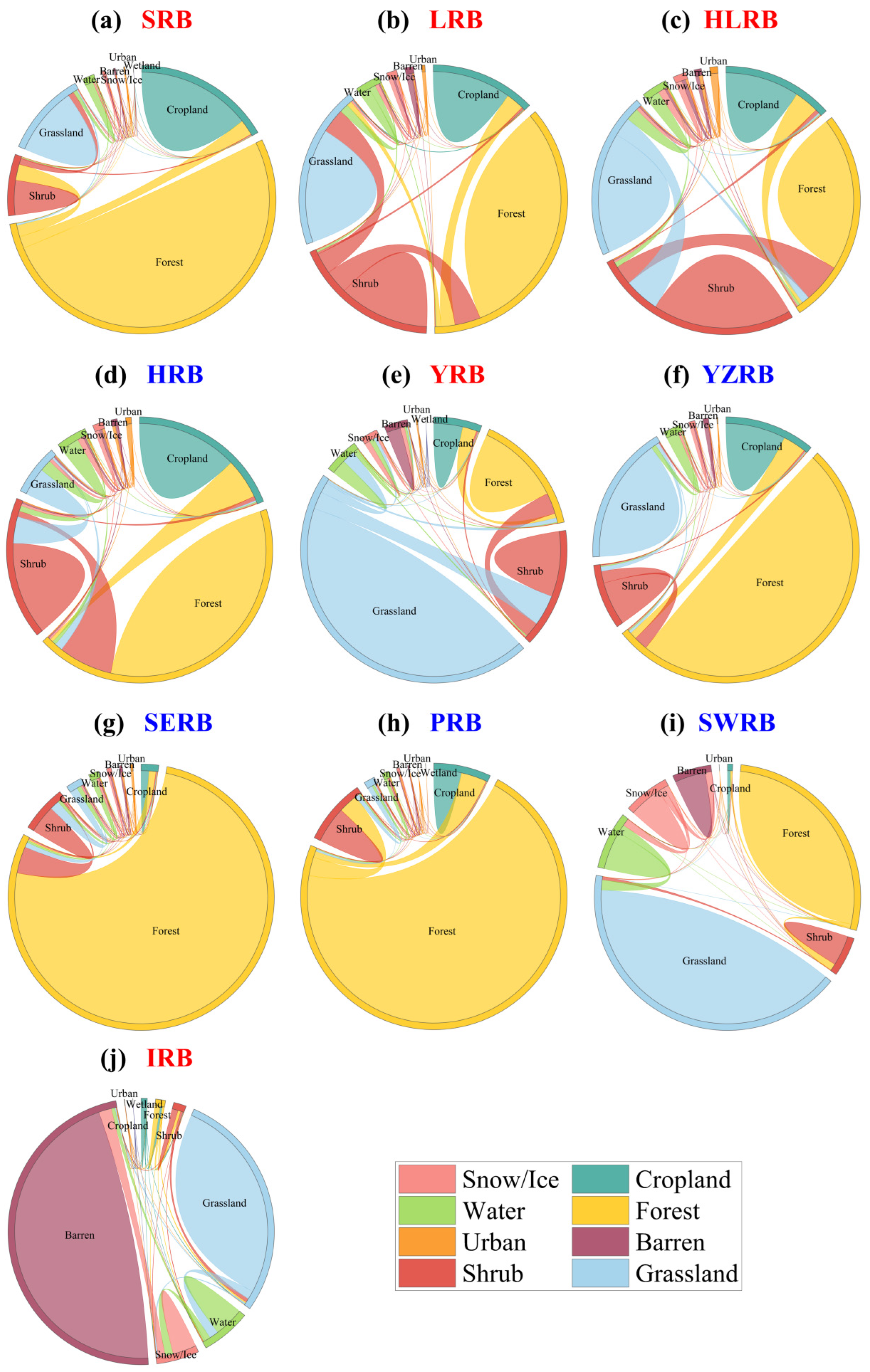
In this matrix, the element S i j represents the area transfer proportion between land use categories. In this study, the total number of land use categories is nine; thus, the value of x is set to nine. The symbols i and j correspond to codes for land use categories at the start and end of the study period. In this study, the 2002 and 2017 China Land Cover Dataset (CLCD) were used to construct a separate land use transition matrix for each of China’s ten major river basins. The conversion relationships between different land use categories were then visualized using proportional chord diagrams.

2.3.4. Computation of Groundwater Storage Variations

To maintain alignment with the GRACE baseline, monthly averages spanning January 2004 to December 2009 were first deducted from all storage components, yielding anomaly values. Groundwater storage anomalies (GWSA) were subsequently derived by excluding the contributions of soil water storage anomalies (SMSA), snowpack water equivalent anomalies (SWEA), canopy interception water storage anomalies (CWSA), and overland surface water storage anomalies (SWSA) from GRACE-derived Terrestrial Water Storage Anomaly (TWSA) products, while biospheric storage effects were considered negligible [30]. The specific calculation is shown in Equation (17). All water storage variations are measured in millimeters. It should be noted that the accuracy of GWSA estimates is subject to the combined uncertainties in the individual GLDAS-derived storage components, and this uncertainty was taken into consideration when interpreting the groundwater depletion rates in this study.
G W S A = T W S A S M S A S W E A C W S A S W S A
All water storage variations are measured by millimeters.

2.3.5. Pearson Correlation Combined with Standardized Linear Contribution Calculation

This research makes use of Pearson correlation analysis to undertake an investigation into linear association relations. Specifically, it carries out examination related to the connections between precipitation and terrestrial water storage irregularities, between drought indices coming from GRACE data and conventional drought indices, and between various natural and human-caused factors and drought. In the statistics domain, Pearson correlation is the covariance between two sets divided by their standard deviations multiplied together [38].
r = c o v X , Y σ X σ Y = i = 1 n x i x - y i y - i = 1 n x i x - 2 i = 1 n y i y - 2
The value of r falls between −1 and 1. A value of 1 or −1 indicates a completely positive or negative relationship between the two variables. When r is equal to zero, it demonstrates that a linear relationship does not exist. The correlation strengthens as the absolute value of r increases. In addition, significance level p is determined by a T-test. Thus, when the p-value is below 0.01 or 0.05, people consider the significance test as successful.
In accordance with hydrological time series standards, |r| > 0.1 was set as the threshold for significant driving factors. Existing studies have shown that this threshold can distinguish random fluctuations from real driving relationships in long-term hydrological drought analysis, effectively identify weak groundwater-climate correlations, and capture lagged effects of large-scale climate signals such as ENSO and PDO [34,38,39]. The standardized absolute correlation coefficient proportion method was used to calculate relative contributions:
C o n t r i b u t i o n i ( % ) = | r i | j = 1 k | r j | × 100 %
where positive values indicate drought alleviation and negative values indicate drought intensification. It is important to note that this method measures linear statistical association, and the contributions derived in this manner reflect the relative strength of linear associations and should be interpreted accordingly.

3. Results

3.1. Spatiotemporal Evolution Characteristics of Drought

Drought occurrence and evolution are driven by the combined effects of multiple factors. For example, variations in precipitation, evapotranspiration, and runoff directly affect the regional water balance, which forms the fundamental prerequisite for drought initiation. Meanwhile, anthropogenic activities, especially land use changes, can either mitigate or exacerbate drought by modifying the hydrological processes of the underlying surface. In this section, we first investigate the spatiotemporal evolution characteristics of natural factors (including precipitation, evapotranspiration, runoff, and the Normalized Difference Vegetation Index, NDVI) and anthropogenic factors, specifically land use changes. The core objective of this analysis is to develop a comprehensive understanding of the spatial and temporal differentiation of drought evolution patterns across China’s ten major river basins. Subsequently, we investigate the spatiotemporal patterns and driving mechanisms of different drought types.

3.1.1. Spatiotemporal Evolution Characteristics of Natural Factors

(1)
Evolution Characteristics of Precipitation
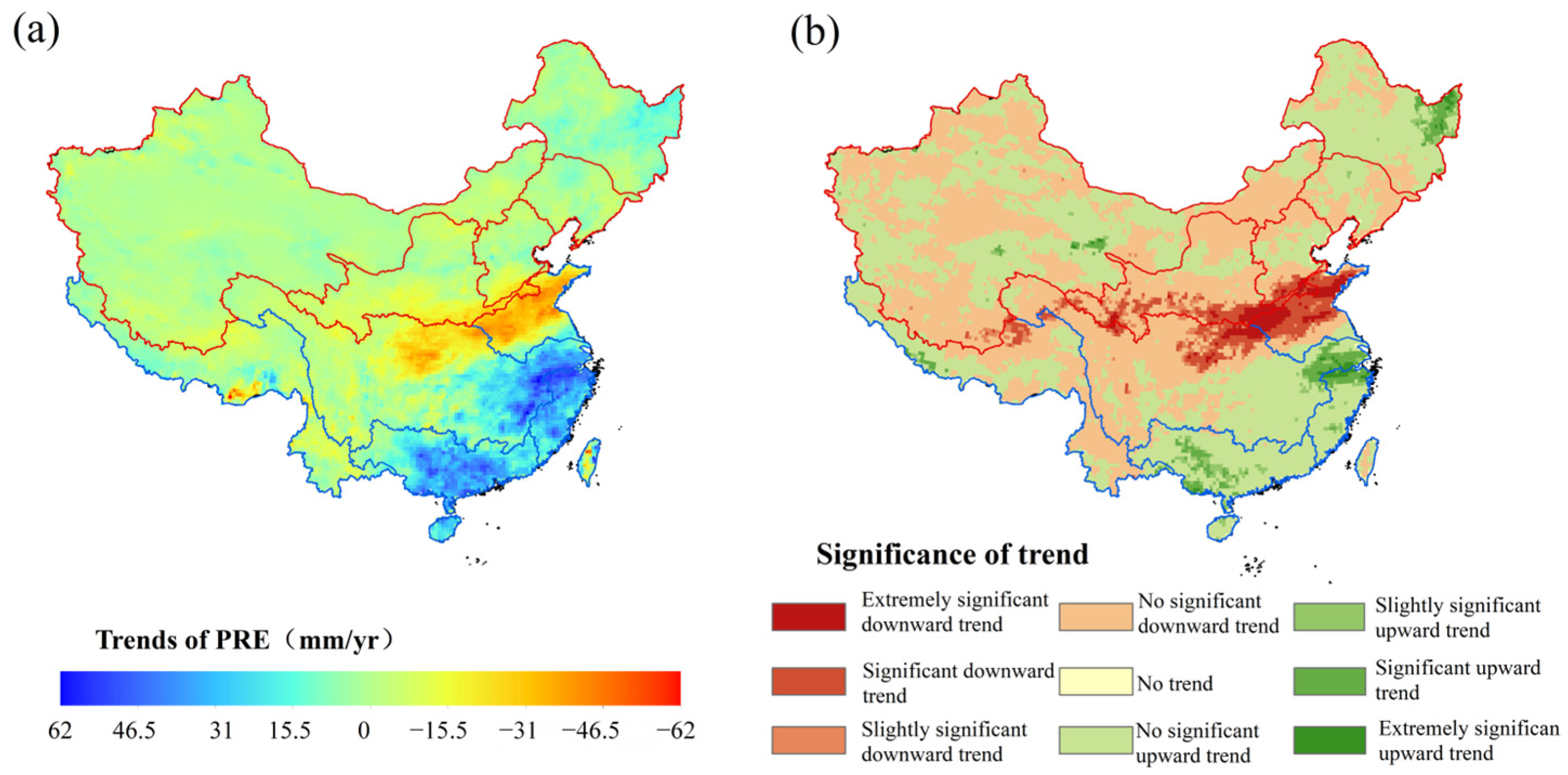
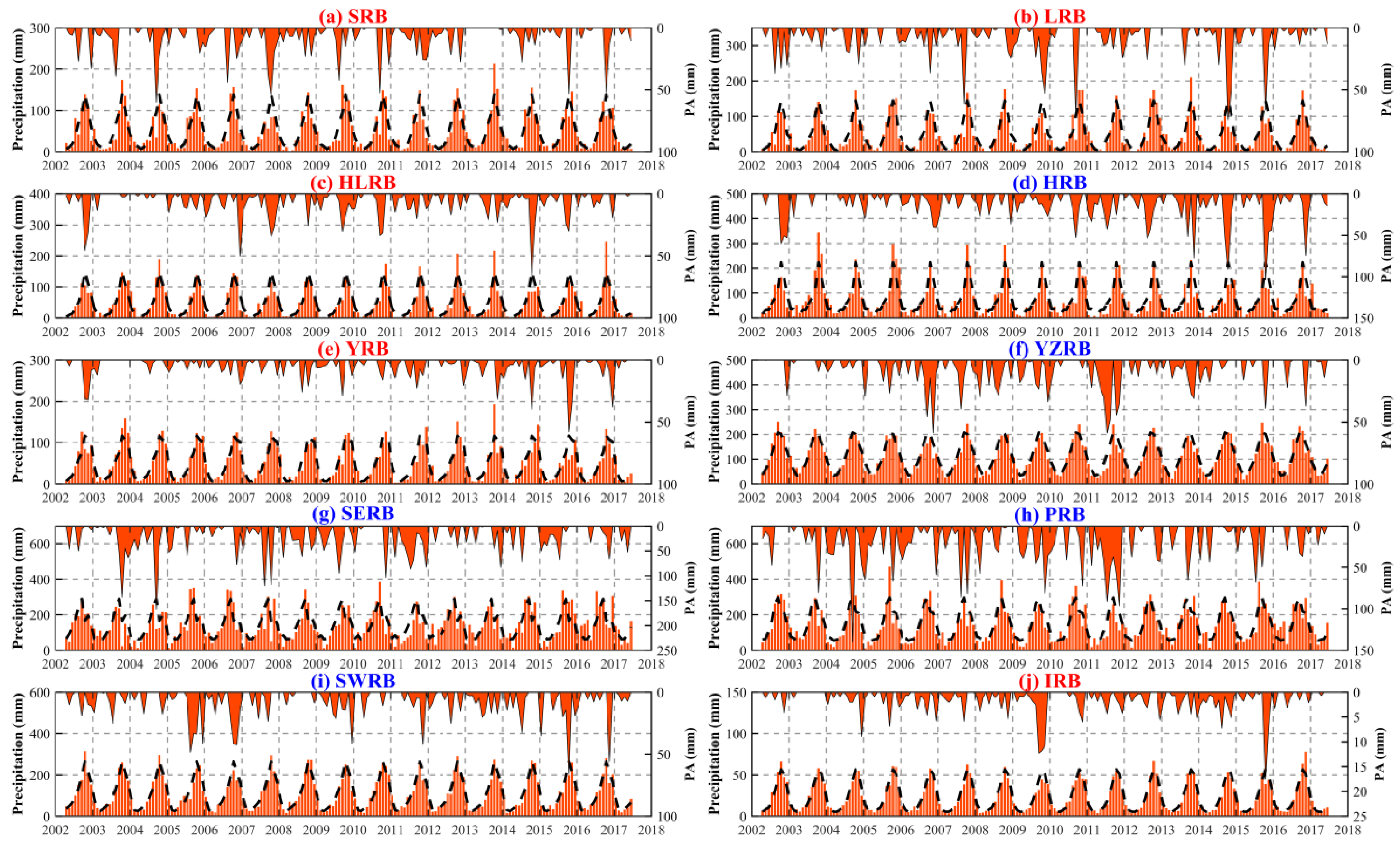
Figure 2 and Figure 3 show the change trend and deficit state of precipitation, respectively. The precipitation change trend shows that most northern basins show insignificant change or no change; humid basins YZRB northeast, SERB north, PRB central, and arid basin SRB northeast show significant increasing trends, with some areas having highly significant increasing rates of 46.5–62 mm/yr; and humid basins HRB and YZRB north show notable declines, with the zone where the three basins meet experiencing a highly significant decrease of 46.5–62 mm/yr.
The analysis of precipitation residuals (PA < 0 indicates deficit) shows that SERB experienced deficits of 68.39–168 mm during six periods including October 2003 and September 2004; PRB experienced deficits of 67.7–140 mm during four periods including September 2004; YZRB experienced deficits of 31–58.81 mm during three periods including November 2006; and HRB experienced deficits of 40.25–103.56 mm during six periods including October 2002. Overall, the results align with the trend analysis, and the distribution of deficit periods reflects an overall increasing trend in precipitation. In general, the results in Figure 3 are consistent with those in Figure 2.
(2)
Evolution Characteristics of Evaporation
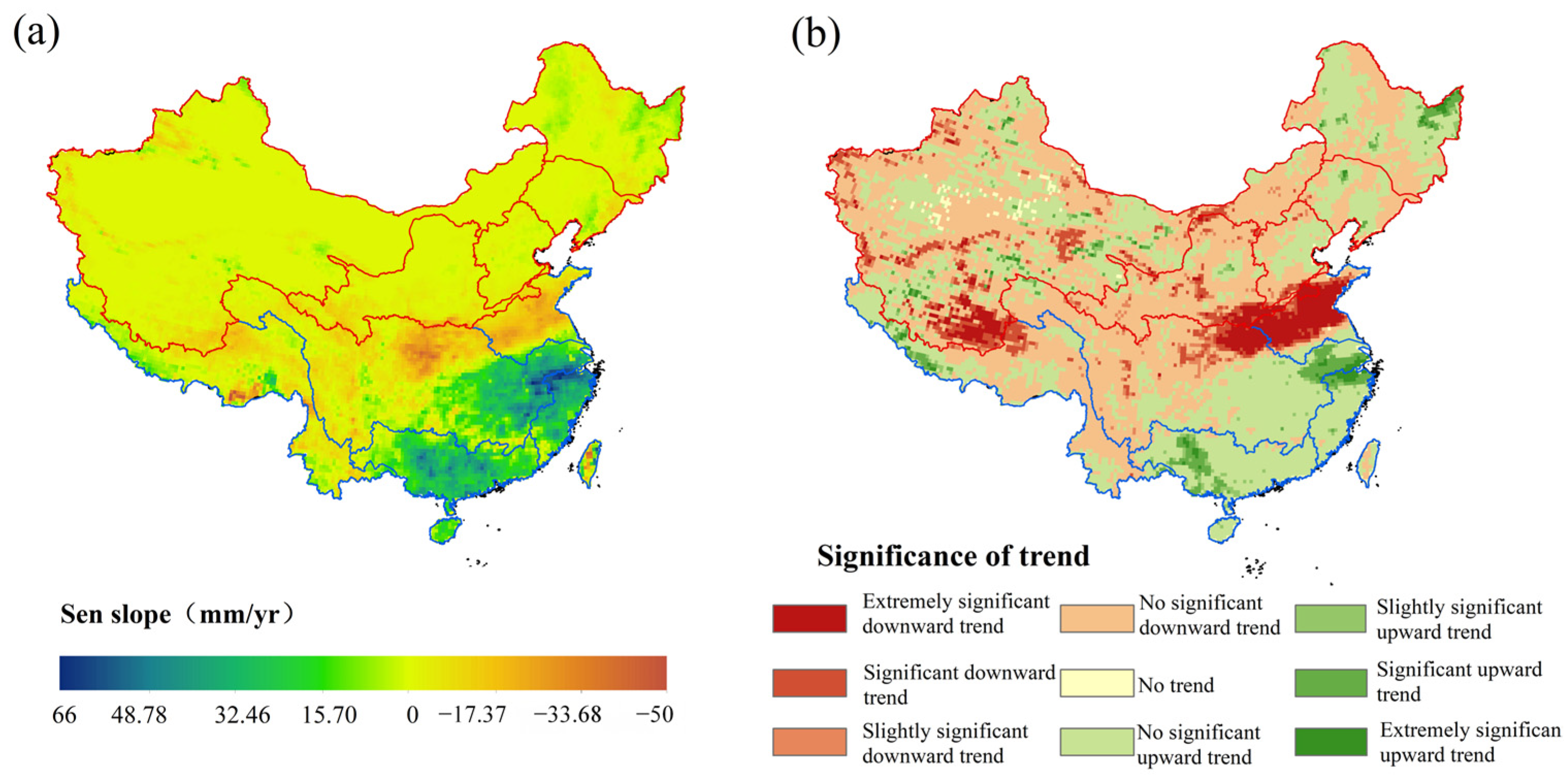
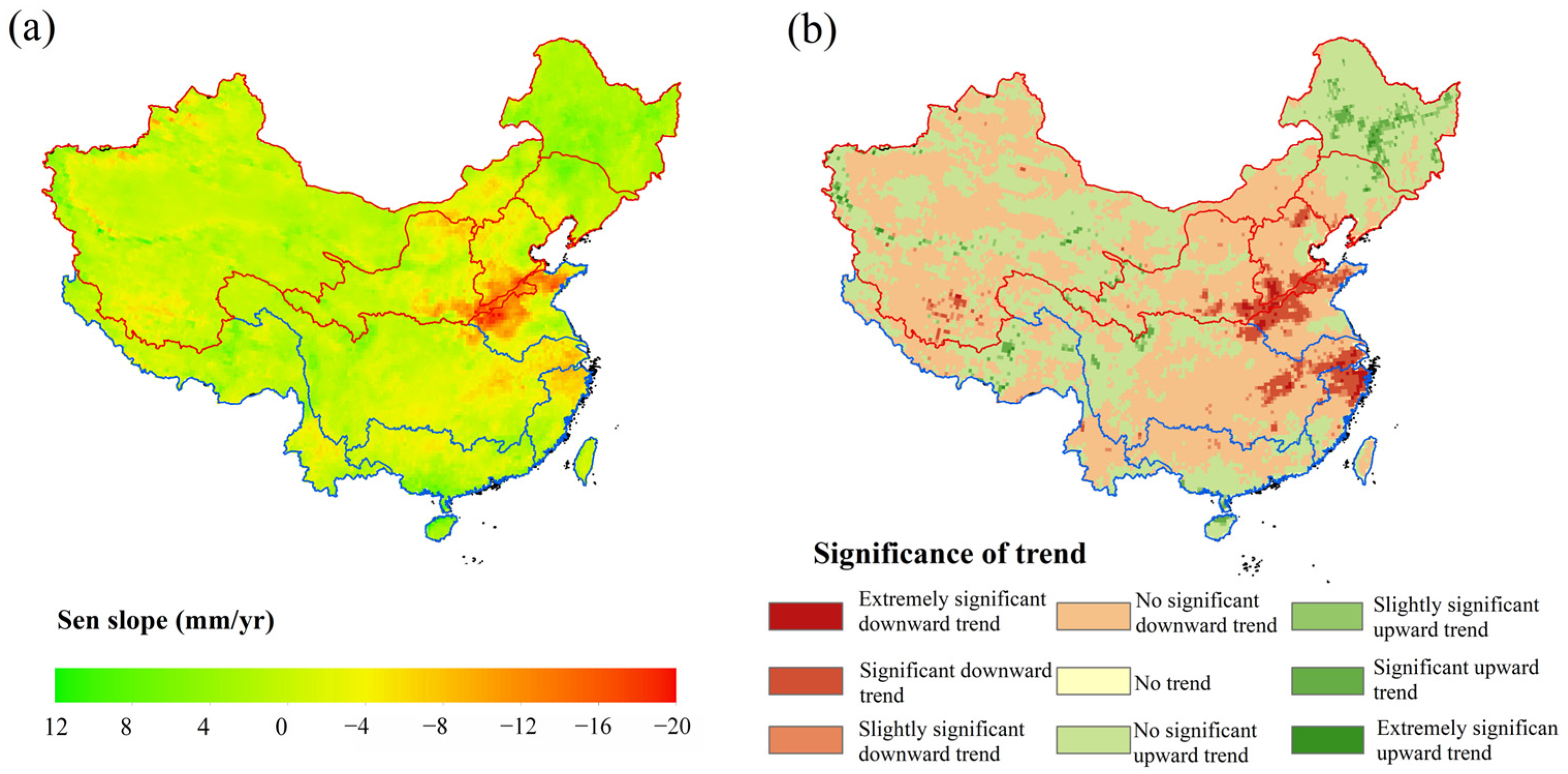
Figure 4 and Figure 5 show the change trend and surplus state of evaporation, respectively. In the evaporation change trend, except for parts of HRB, SERB, YZRB, and HLRB, most basins show insignificant increase/decrease or no change; humid basins HRB northwest, SERB north, and YZRB east, and arid basin HLRB south show significant decreasing trends, with some areas having highly significant decreasing rates of 12–20 mm/yr; and SRB central parts show a highly significant increasing rate of 8–12 mm/yr.
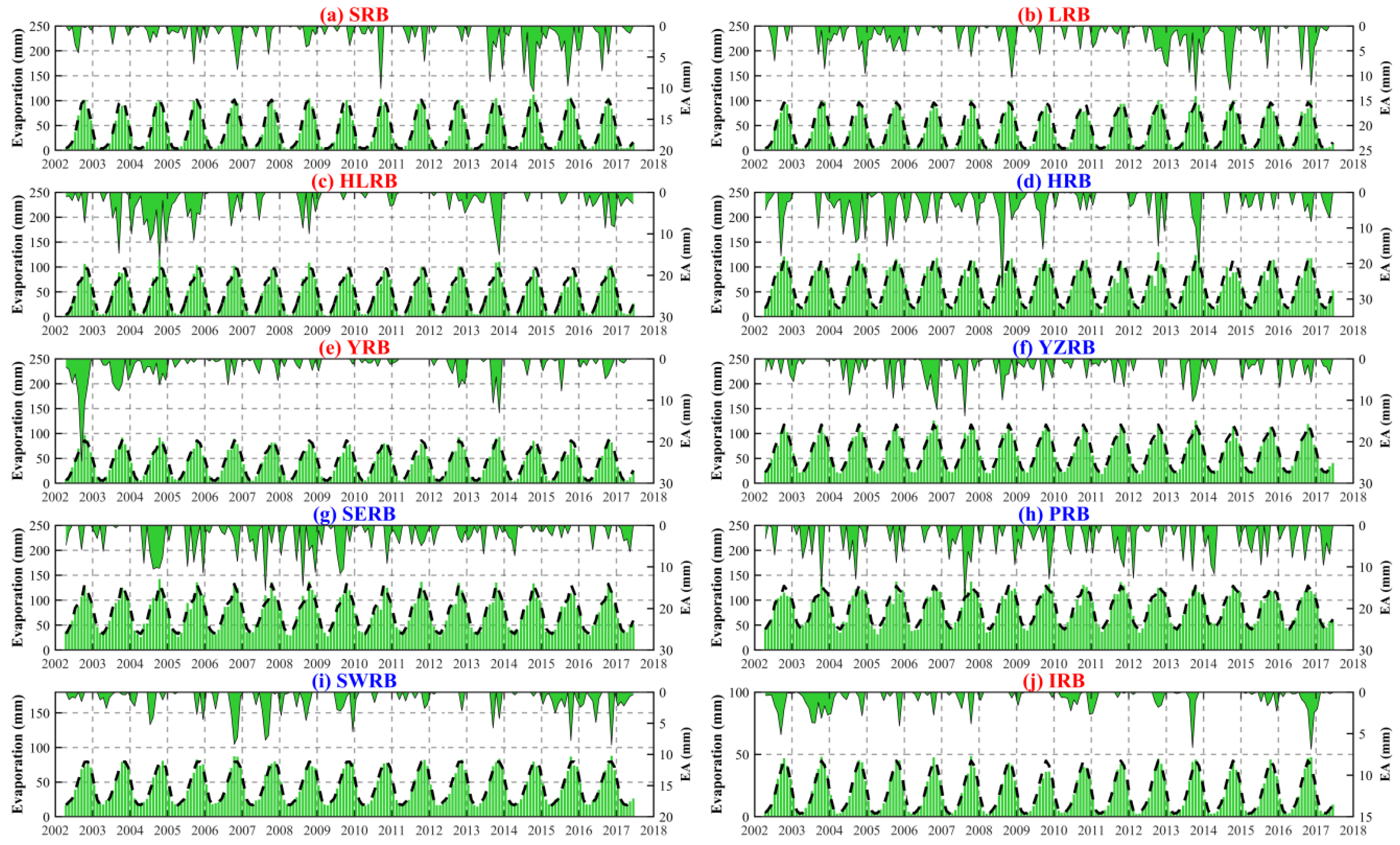
Evaporation residuals (EA > 0 indicates surplus) show that HRB evaporation had surpluses of 26.69, 15.90, 19.86, and 8.26 mm in August 2008, September 2009, December 2013, and November 2016, respectively, indicating a continuous decrease in evaporation. SERB evaporation had surpluses of 15.65, 14.62, 11.66, 9.20, and 7.30 mm in August 2007, August 2008, August 2009, November 2010, and April 2014, respectively, indicating a continuous decrease. YZRB evaporation had surpluses of 13.82, 9.42, 10.3, and 6.88 mm in September 2007, August 2008, September 2013, and December 2015, respectively, indicating a continuous decrease. However, SRB evaporation had surpluses of 7.03, 10.08, and 10.55 mm in October 2006, August 2010, and September 2014, respectively, indicating a slow continuous increase. Overall, the results in Figure 3 and Figure 4 are similar to those in Figure 4.
(3)
Evolution Characteristics of Runoff
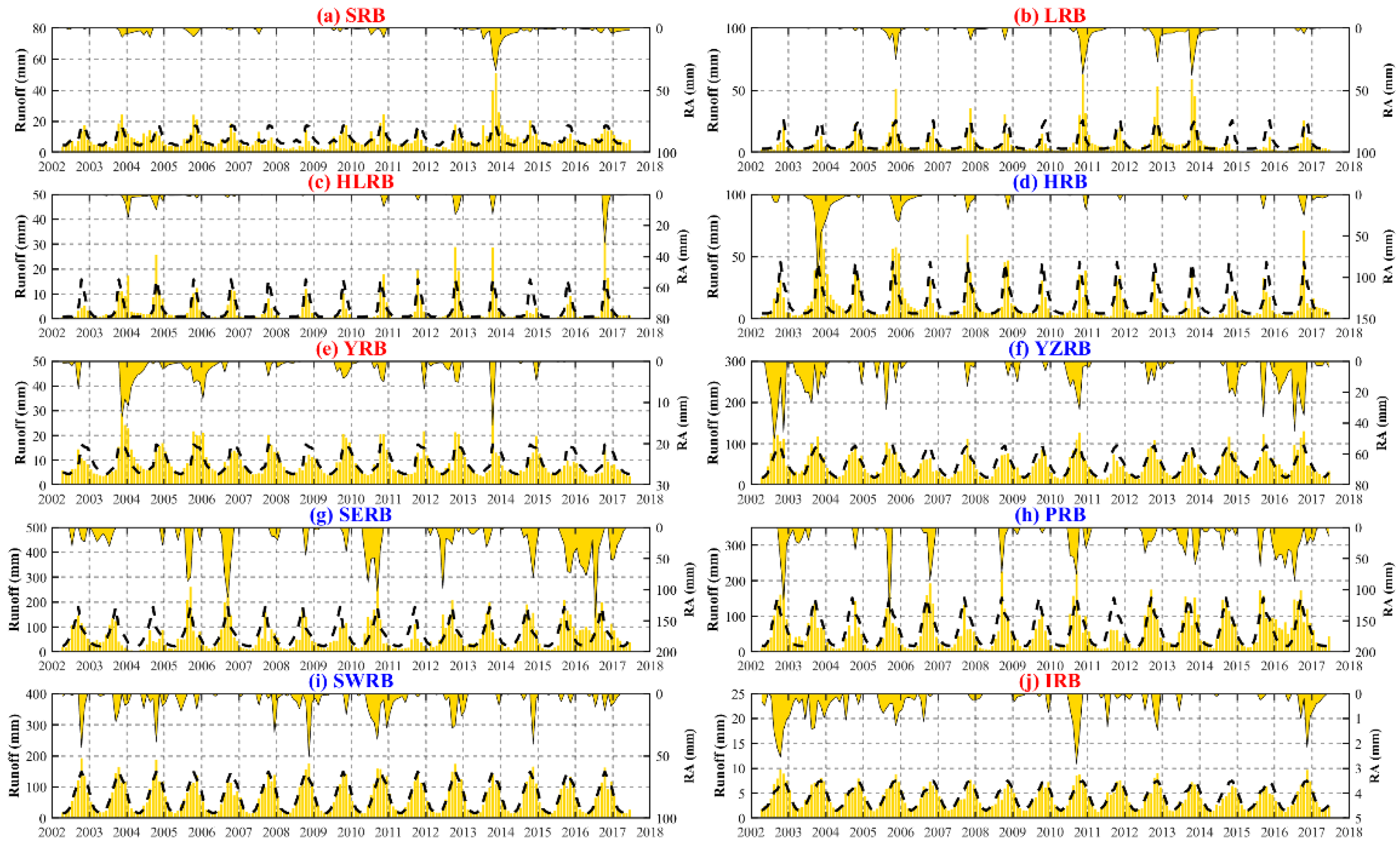
Figure 6 and Figure 7 show the change trend and surplus state of runoff, respectively. In the runoff change trend, most areas show insignificant change or no change; humid basins HRB and YZRB north show significant decreasing trends, with most areas having highly significant decreasing rates of 33.68–50 mm/yr; small parts of arid basin IRB south also show highly significant decreasing trends in this rate range; and small areas at the junction of YZRB northeast and SERB north, and small areas in PRB central show highly significant increasing rates of 32.46–66 mm/yr.
Runoff residuals (RA > 0 indicates surplus) show that HRB runoff had surpluses of 95.90, 33.17, and 22.02 mm in October 2003, December 2005, and October 2008, respectively, indicating a continuous decrease. IRB runoff had surpluses of 2.55, 1.44, 1.30, and 1.48 mm in October 2002, May 2003, November 2005, and November 2012, respectively, indicating a continuous decrease. SERB runoff had surpluses of 86.92, 112.92, and 145.13 mm in May 2005, September 2006, and May 2016, respectively, indicating a continuous increase. The results are consistent with the trend analysis, reflecting the differences in runoff increase/decrease across different basins.
(4)
Evolution Characteristics of NDVI
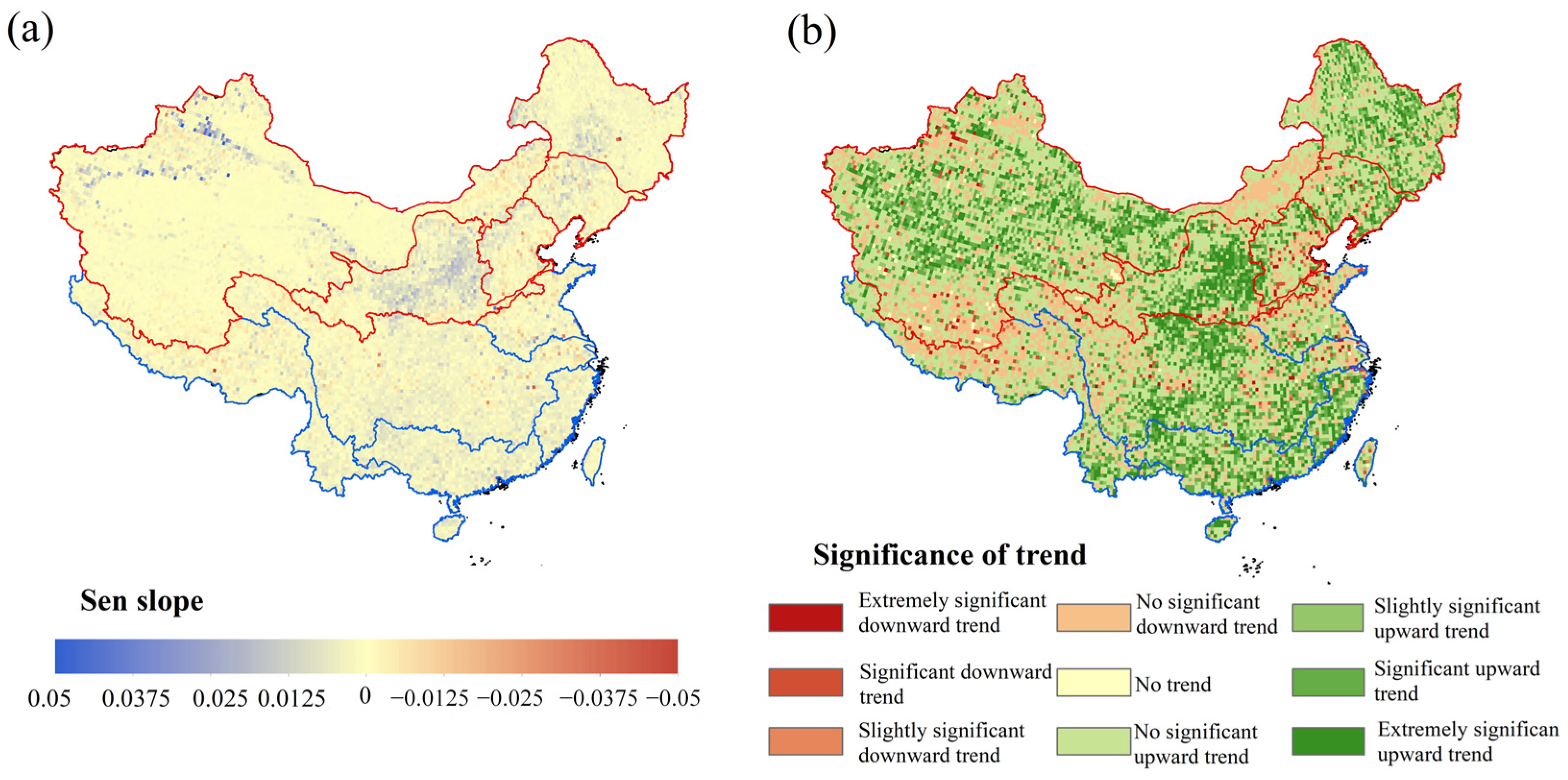
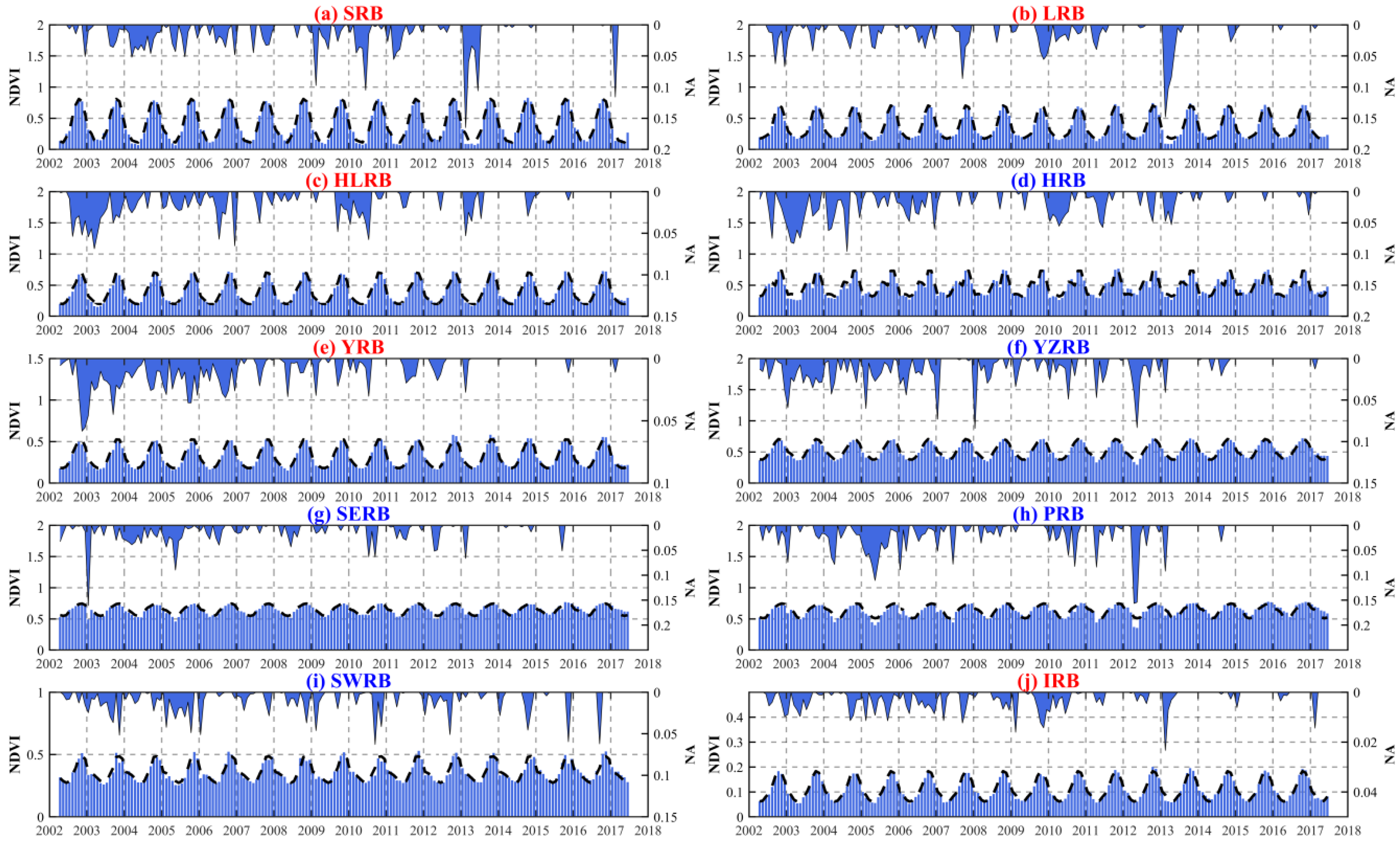
Figure 8 and Figure 9 show the change trend and deficit state of NDVI. The NDVI change trend shows that arid basins SRB, LRB, IRB, and YRB in most areas, and humid basins YZRB central, SWRB south, SERB and PRB show increases of 0.025–0.05 mm/yr; IRB east, HLRB north, HRB north, and SWRB north show decreases of −0.05 to −0.025 mm/yr.
NDVI residuals (NA < 0 indicates deficit) show that the deficit values for NDVI in SRB, LRB, IRB, YRB, and SERB continuously decrease, indicating increasing vegetation coverage; the deficit values in HLRB and HRB continuously increase, indicating decreasing vegetation coverage, consistent with the trend analysis results.

3.1.2. Spatiotemporal Evolution Characteristics of Anthropogenic Factors

By altering surface runoff and plant evapotranspiration, shifts in land use and land cover can affect hydrological processes, thus serving as key human-induced factors that indirectly affect drought conditions. This research conducts a full-scale analysis on the changes in land use within China’s ten major river basins from the year 2002 to the year 2017, with the goal that it may describe the development of human-related elements. The main characteristics are as follows:
In humid basins, the HRB, YZRB, SERB, PRB, and SWRB all exhibit absent or scarce wetlands, with forests generally dominating the landscape. Specifically, the HRB has no wetlands, and forest is the largest land type; cropland decreased most significantly, shrinking by 20,177 km2 (6.23%) from 2002 to 2017, primarily converting to forest, while forest still decreased overall by 11,651 km2, mainly converting to shrubland. In YZRB, forest covers about 50% of the basin, and there are no wetlands. Land types showed six increases and two decreases. Forest area went up by 22,798 km2 (1.27%), but cropland dropped the most, by 47,018 km2 (2.61%). Most of this cropland was turned into forest. In SERB, forest is absolutely dominant but its area declined, accompanied by a concurrent reduction in cropland; other types such as shrubland, grassland, and water bodies all increased to varying degrees. In PRB, forest area continued to increase, reaching 82.88% in 2017; cropland and shrubland decreased significantly, while other types like urban areas and bare land showed increasing trends. SWRB has no wetlands; forest and snow/ice areas increased, grassland decreased the most, followed by water bodies, shrubland, and cropland in descending order of reduction, while urban areas showed no conversion.
In arid basins, SRB, LRB, HLRB, YRB, and IRB exhibit diverse land cover change trends, with wetlands generally being scarce. In SRB, forest is the dominant land type, with a slight area increase; water bodies, snow/ice, urban areas, and bare land all increased, while shrubland, cropland, and grassland showed decreasing trends. In LRB, only grassland and cropland areas decreased; all other types increased to varying degrees, with shrubland experiencing the largest increase. HLRB has no wetlands; cropland decrease was the most prominent, with forest and shrubland also declining, while other types showed increasing trends. In YRB, grassland is the dominant land type, with its proportion significantly increasing; the newly added area mainly originated from shrubland conversion, while cropland, shrubland, and bare land all decreased notably. In IRB, bare land and grassland experienced the largest reductions; cropland, forest, and water bodies all increased significantly, and wetland area also saw a slight increase, making it one of the few arid basins containing wetlands.
Figure 10 presents a proportional chord diagram of the land use transfer matrix, visually illustrating the intensity of various type conversions, where the thickness of the chords reflects the magnitude of transfer [26]. The core transfer relationships are consistent with the aforementioned basin characteristics, reflecting the influence of such activities as urbanization and ecological engineering.

3.1.3. Spatiotemporal Evolution Traits of Comprehensive Drought Relying on GRACE and Conventional Indices

GRACE satellite offers data on Terrestrial Water Storage Deviation (TWSD), which shares the same traits as Terrestrial Water Storage Anomaly (TWSA). This data serves as a key indicator for tracking shifts in water resources, reflecting how natural factors and human activities shape the water cycle. In the present research, drought indexes that were obtained from the GRACE satellite (CCDI and DSI) were integrated with conventional drought indexes (scPDSI, SPEI, and SPI). Therefore, analyses are implemented from three dimensions: Terrestrial Water Storage Anomalies, change trends of drought indices, and percentage of drought-stricken regions. Accordingly, this method systematically discloses the space–time evolution rules of overall drought in the main river drainage basins of China.
(1)
Spatiotemporal Evolution Traits of Terrestrial Water Storage Anomaly
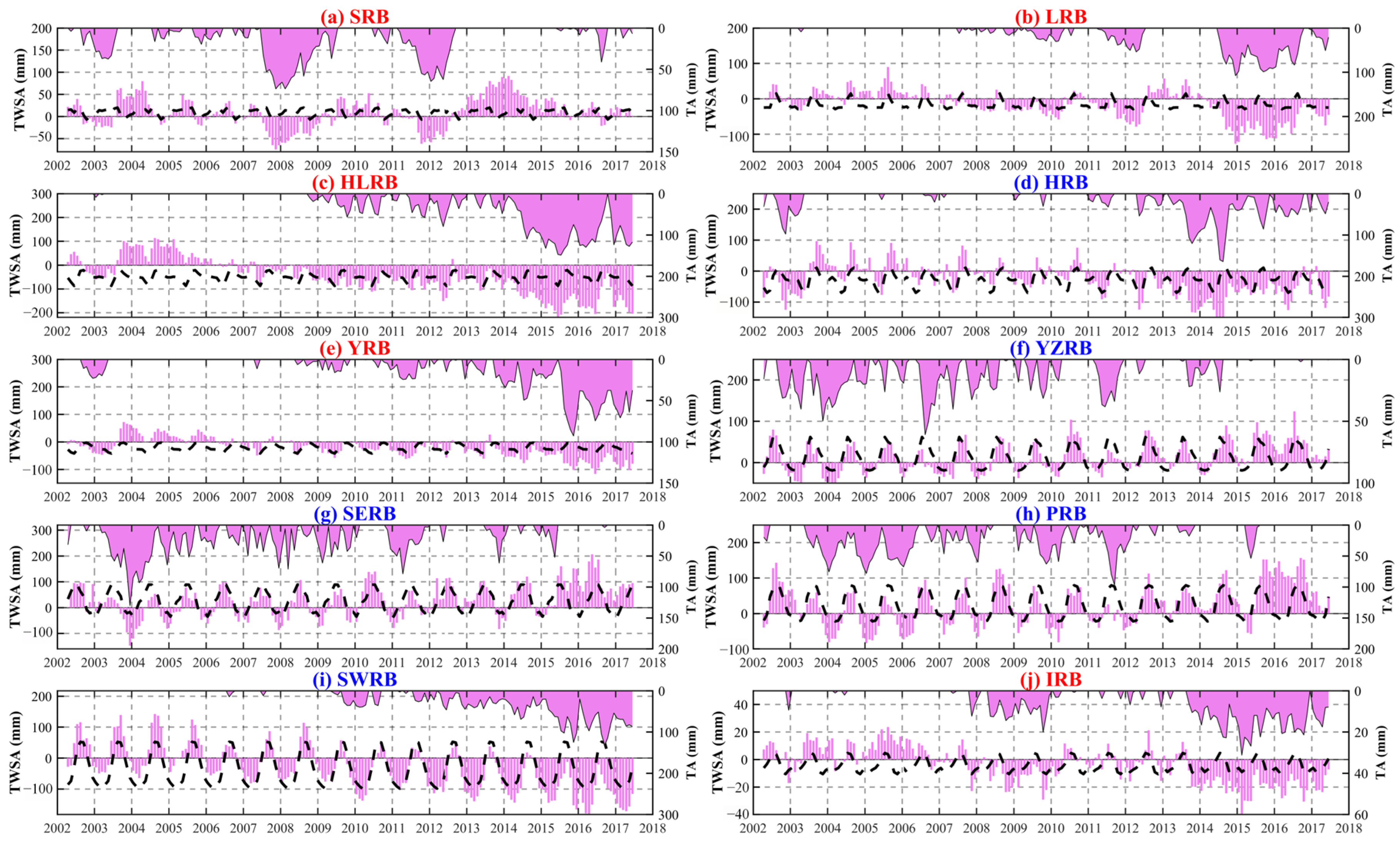
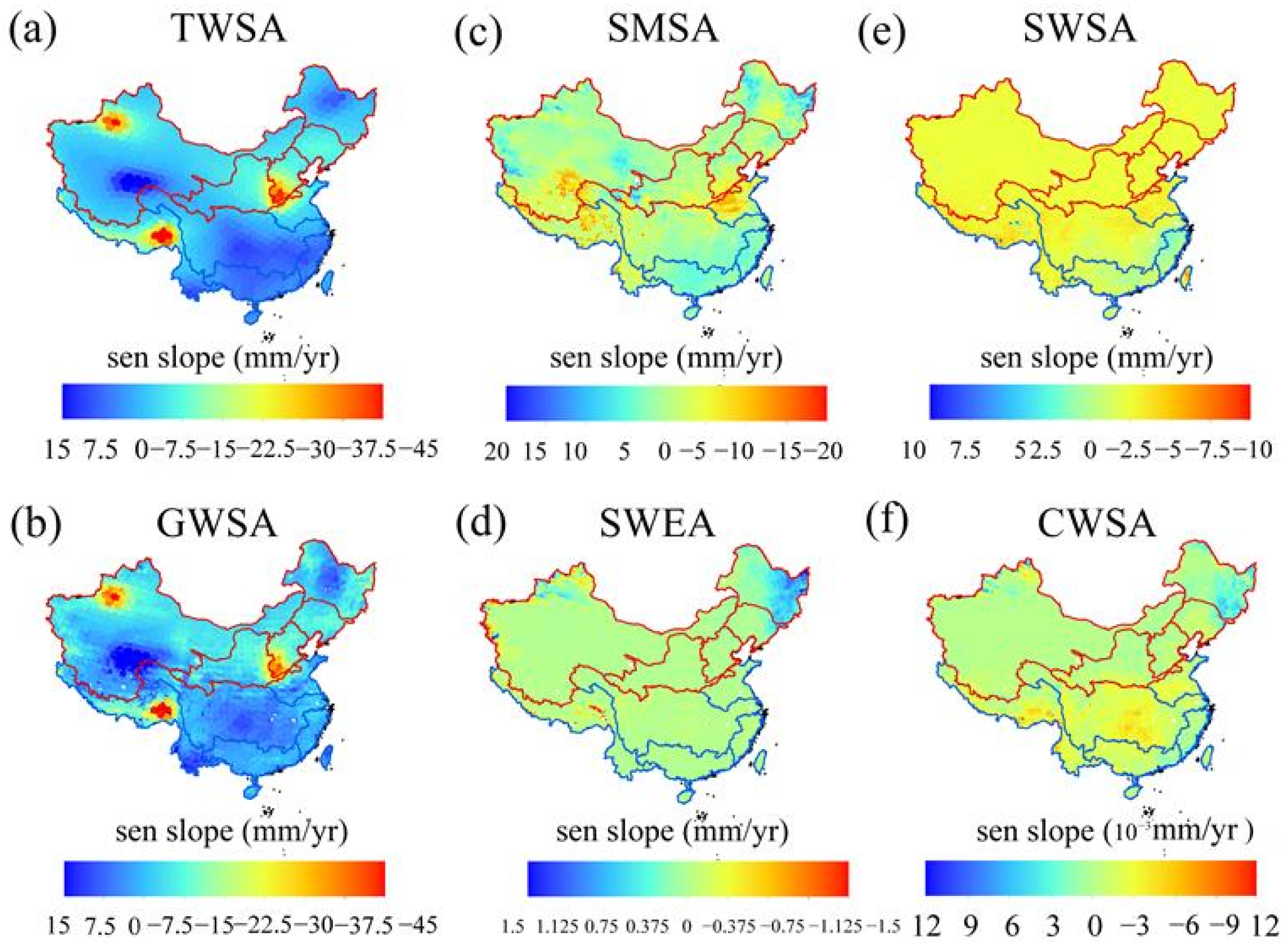
Figure 11 and Figure 12 show the change trend and deficit state of TWSA. The TWSA change trend shows that arid basins LRB, HLRB, YRB, and IRB north, and humid basins HRB and SWRB north exhibit highly significant decreasing trends (rate 7.5–45 mm/yr); humid basins YZRB, SERB, and PRB, and arid basin IRB central exhibit highly significant increasing trends (rate 7.5–15 mm/yr).
The TWSA deficit state shows that deficits in decreasing trend areas are mainly concentrated in 2013–2017. The maximum deficit values for LRB, HLRB, HRB, YRB, IRB, and SWRB are 107.7 mm, 147.3 mm, 164.49 mm, 92.8 mm, 31.2 mm, and 132.25 mm, respectively. Deficits in increasing trend areas are mainly concentrated in 2002–2006. The maximum deficit value for PRB is 96.82 mm, and for SERB is 130.13 mm. SRB shows insignificant change, with a maximum deficit of 73.73 mm (November 2007). These characteristics align with those from GRACE drought indices.
(2)
Drought Change Trends
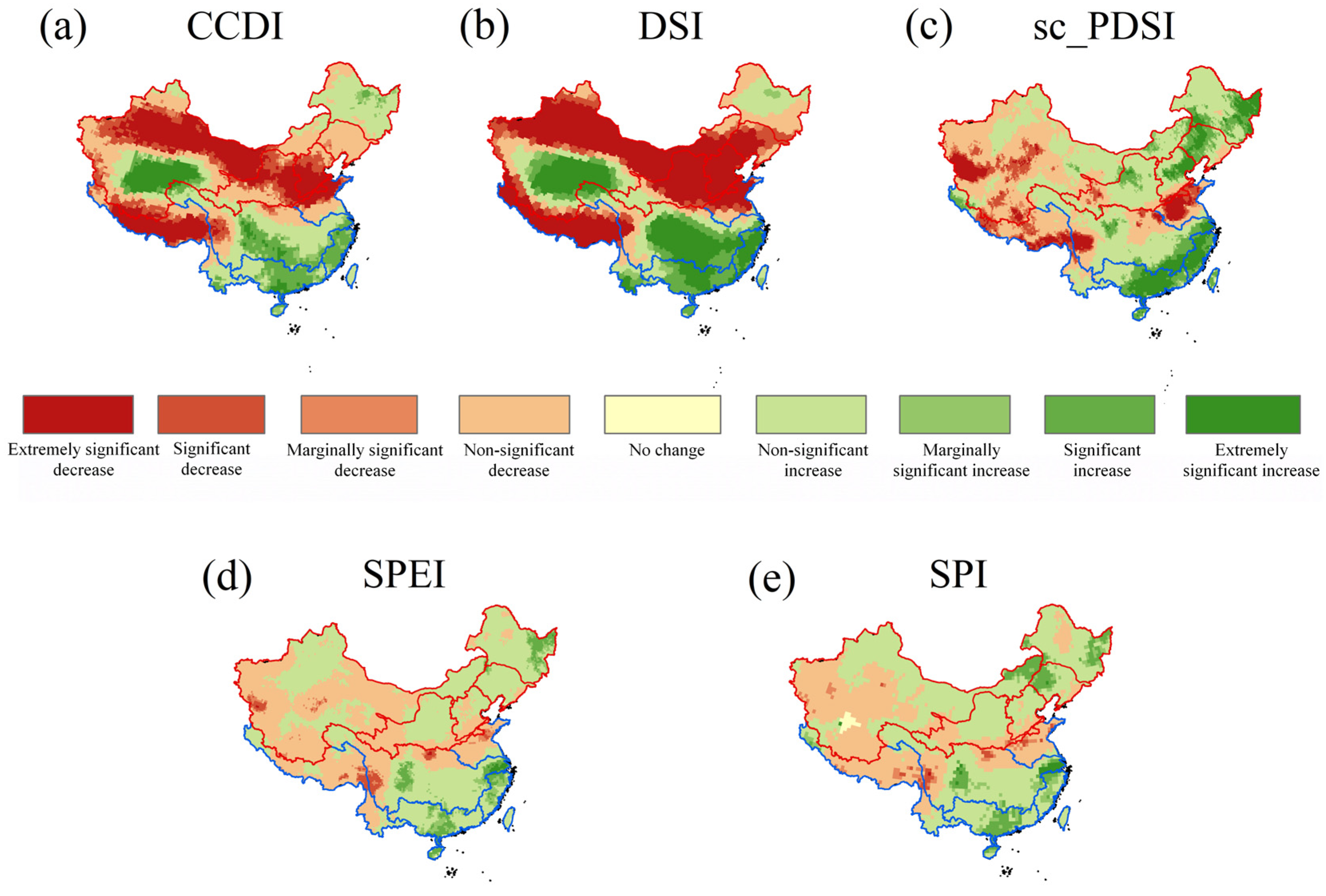
The change trends of different drought indices are analyzed in Figure 12 and Figure 13 based on Theil–Sen trend analysis and the Mann–Kendall trend test.
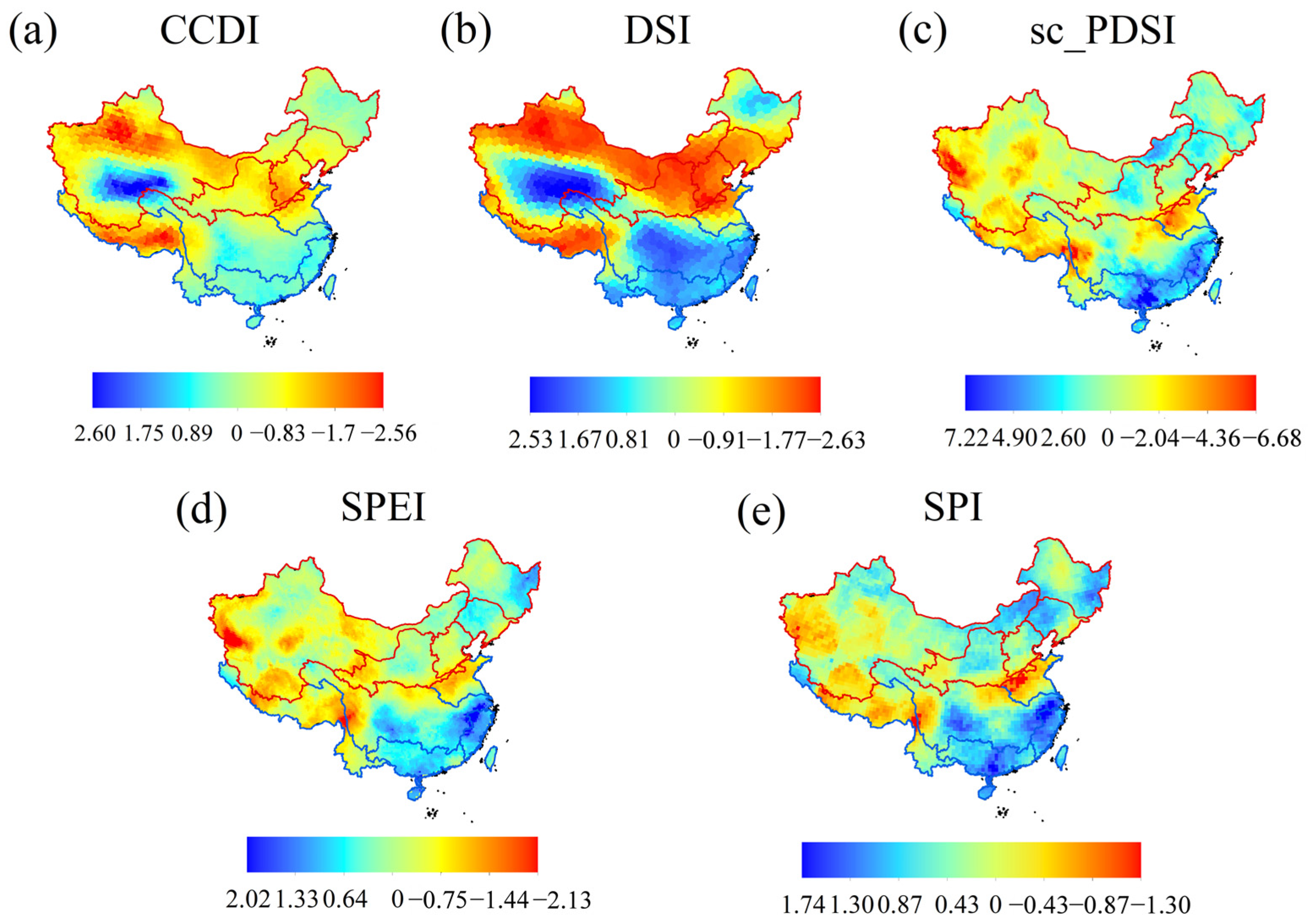
In areas showing a decreasing trend (LRB, HLRB, YRB, IRB north, HRB, and SWRB north), CCDI and DSI show significant decreases (rate 0.83–2.63 yr−1), indicating intensifying comprehensive and hydrological drought; except for YRB, scPDSI (rate 2.04–6.68 yr−1), SPEI (rate 0.75–2.13 yr−1), and SPI (rate 0.43–1.30 yr−1) show significant decreases, indicating intensifying agricultural and meteorological drought, but the affected area is smaller than for comprehensive and hydrological drought [10]. In areas showing an increasing trend (YZRB, SERB, PRB, and IRB central), CCDI and DSI show significant increases (rate 0.81–2.60 yr−1), indicating the alleviation of comprehensive and hydrological drought; except for YZRB north and west, scPDSI (rate 2.60–7.22 yr−1), SPEI (rate 0.64–2.02 yr−1), and SPI (rate 0.87–1.74 yr−1) show significant increases, indicating the alleviation of agricultural and meteorological drought, but the alleviation area is smaller than for comprehensive and hydrological drought.
It is notable that while the trends of traditional drought indices (scPDSI, SPEI, and SPI) are consistent with those of GRACE-based drought indices in basins such as LRB, HLRB, YRB, and IRB, the spatial coverage of traditional indices is significantly smaller than that of the GRACE indices in some regions (e.g., the Yellow River Basin), despite their high rates of decline. Traditional indices use only meteorological data, so they cannot fully show the comprehensive drought that comes from overall water storage deficits. But CCDI includes precipitation information, and its trend is smoother than the DSI. This means it can better capture comprehensive drought [13,16].
In general, from 2002 to 2017, drought across China’s ten major river basins showed a clear pattern. Humid areas became more humid, and arid areas became more arid. The main drought periods in humid and dry basins also occurred at different times. The GRACE-based drought indices (CCDI/DSI) captured long-term deep water storage depletion processes that traditional indices such as scPDSI, SPEI, and SPI do not reflect, owing to their reliance on meteorological data alone. The consistency between TWSA variations and the drought evolution trends observed in this study provides a basis for the subsequent association analysis of factors related to drought dynamics.

3.2. Multi-Angle Association Analysis of Drought Factors in Major Chinese River Basins

A comprehensive understanding of the fundamental mechanisms governing drought evolution is critical for the sustainable management of water resources. Based on the optimized basin-specific integrated drought index, this study quantitatively analyzed the key factors associated with drought evolution across China’s ten major river basins. This analysis was conducted from two complementary perspectives: water storage components and basin-scale water balance.

3.2.1. Analysis Based on Water Storage Components

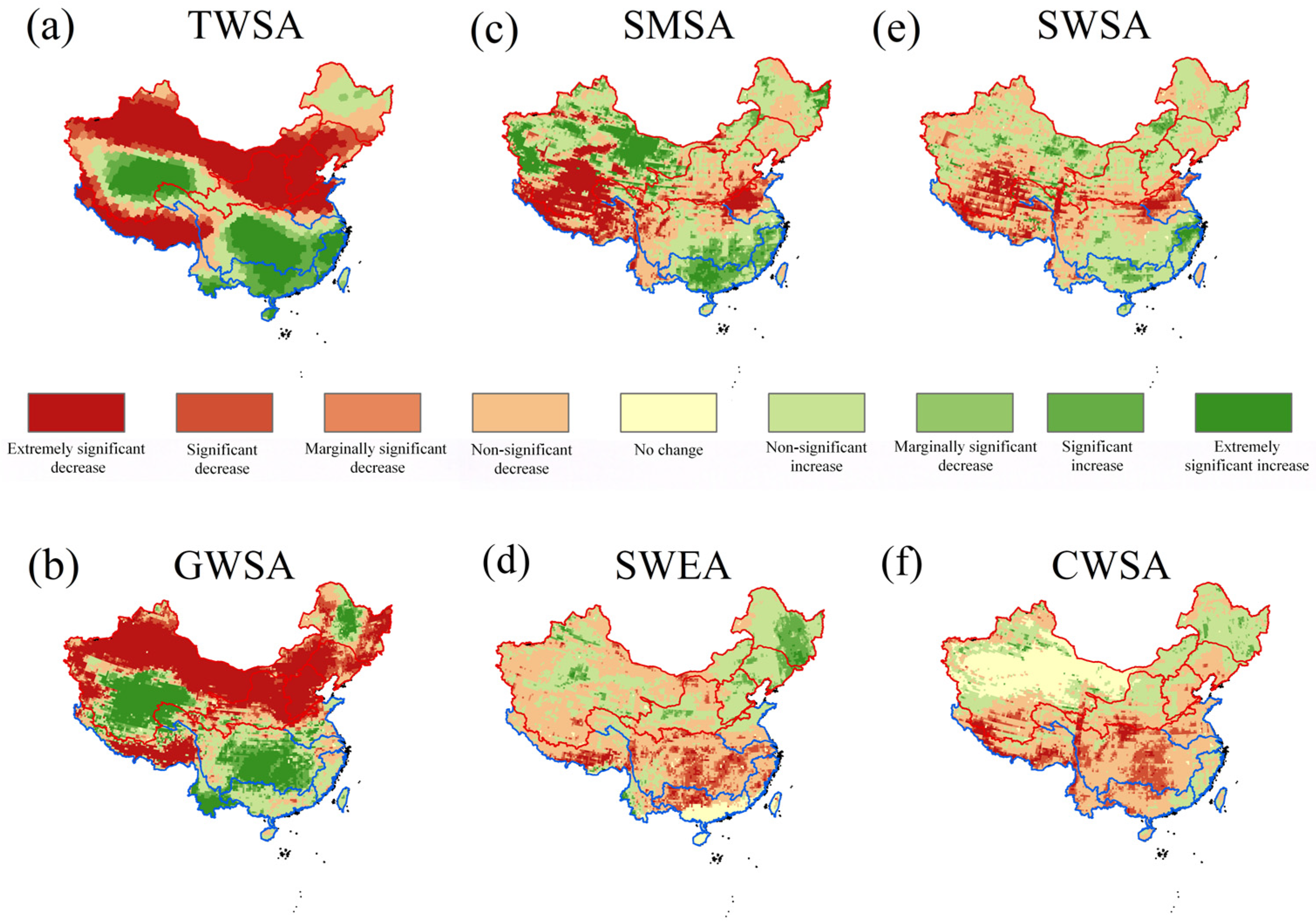
Using the calculation formula (Section 2.3.4), the groundwater storage anomaly (GWSA) was calculated. As is shown in Figure 14 and Figure 15, in most arid river basins, for example Liaohe, Haihe, Huaihe, Yellow River, Southwestern Rivers, and Inland Rivers basins, an obvious downward tendency was presented by the GWSA. Therefore, the largest decreasing speed arrived at −45 mm/yr, and this condition closely corresponds to the downward trend of TWSA. Hence, groundwater depletion was identified as the primary factor associated with the worsening drought conditions across these basins [40,41]. As a quite obvious drop in underground water levels, this situation is especially clear for example in the North China Plain, the southeastern part of the Qinghai–Tibet Plateau, and the Tianshan Mountains. On the opposite side, across much of the Yangtze River and the southwestern Inland Rivers region, GWSA showed an upward trend. This upward direction movement has effectively alleviated the drought-caused stress.
Different river basins have differences in the main water storage parts. In Southeastern Rivers basins and Pearl River basin, changes in the groundwater storage anomaly were not obvious. However, the soil moisture storage anomaly experienced a large increase, with a speed of 1.596 mm each year, and the surface water storage anomaly also experienced an increase of between 0.860 and 2.16 mm per year. These two increases were the primary factors associated with the rising trend in total water storage anomaly. The Yangtze River Basin sees its total water storage anomaly growth hindered by the marked decreases in both the snow water equivalent anomaly and canopy water storage anomaly. Thus, across various basins, different components exerted either promoting or inhibiting effects, jointly influencing the evolution of the total water storage anomaly.

3.2.2. Analysis Based on Water Balance

According to the principle of terrestrial water cycle balance, TWSA comprehensively reflects the interaction among natural elements including precipitation, evapotranspiration, and runoff, as well as human-related factors such as water resource exploitation and utilization. Abnormal TWSA variations are a core indicator of extreme hydrological events, including droughts. In this study, we selected precipitation, evapotranspiration, runoff, teleconnection factors, and NDVI as natural factors, and land use and land cover (LULC) change as the primary anthropogenic factor. The Pearson correlation analysis and its derived standardized linear contribution calculation described in Section 2.3.5 were adopted to quantify the direction and magnitude of each factor’s statistical association with drought [38].
Section 3.1.2 results show that the Yellow River Basin (YRB), a typical arid basin, saw increased grassland and urban land area, decreased cropland area, and stable forest area, with a significant drying trend across most of the basin. Contribution results (Table 1, YRB column) show that urban land expansion exhibited a negative association with the drought index, contributing −20.8% to drought intensification, while cropland reduction exhibited a positive association, contributing +7.6% to drought alleviation. Among natural factors in the YRB, runoff was the dominant natural factor, contributing +14.7% to drought alleviation [39]. For other arid basins including LRB, HLRB and IRB, the Section 3.1.2 results show a continuous increase in urban land area. Contribution analysis (Table 1) reveals that urban expansion was the core anthropogenic factor associated with aridification in these basins, with contributions ranging from −23.5% to −28.9%, exceeding the contributions of most natural factors.
For the Yangtze River Basin (YZRB), a typical humid basin, Section 3.1.2’s land use analysis shows increased urban and forest area, significantly decreased cultivated land area, and an overall wetting trend. The contribution results (Table 1, YZRB column) indicate that cropland reduction was associated with drought intensification (−14.8%), while urban expansion (+9.2%) and forest growth (+16.2%) were associated with wetting, resulting in a net anthropogenic contribution of +24.1%. Among the natural factors, runoff contributed +18.9% to drought alleviation [34,35].
Section 3.1.2’s results also show an increasing trend in urban construction land area in other humid basins including SERB and PRB. Contribution analysis (Table 1) shows that urban construction land coverage in these basins is positively correlated with the DSI, contributing +11.6% in SERB and +9.8% in PRB, indicating that urban expansion is associated with wetter conditions in these basins, and the net wetting trend results from the combined effects of land use changes, where cultivated land reduction plays a dominant role. Natural factors dominate drought evolution in these basins, with total contributions of +74.8% in the SERB and +82.7% in the PRB.
In general, LULC change exhibited statistical associations with drought that were comparable in magnitude to those of natural factors. In northern basins such as SRB and HLRB, the total anthropogenic contributions reached −66.0% and −84.8%, respectively, exceeding those of some individual natural factors. Runoff and teleconnection factors were the dominant natural factors, especially in southern humid basins [40,41]. By integrating the Pearson correlation results with the spatiotemporal evolution patterns, we clarified the linear association between each factor and the drought index, revealing the spatial heterogeneity across basins.

4. Discussion

The spatiotemporal patterns identified in this study demonstrate that major drought events across China’s ten major river basins exhibited significant temporal differentiation during the 2002–2017 study period. This spatial differentiation pattern, marked by “wet gets wetter and dry gets drier”, is consistent with results of prior GRACE-based drought assessments in China [3,16]. Specifically, Liu et al. [3] reported an intensifying drought trend in northern China’s river basins during the same study period, while Wu et al. [16] verified the asynchronous characteristics of precipitation and TWSA variations between arid and humid basins. At the global scale, our observations are consistent with post-2012 studies that have documented intensified drought events in Central Asia. However, the GRACE dataset used in this study only covers the 2002–2017 period. Progress on this front has been made with the GRACE Follow-On mission and global data assimilation systems [12,42], which enable continued monitoring of large-scale water storage changes.
Regarding the driving mechanisms, the net drought effect is the comprehensive result of the combined associations of multiple factors [20,21]. The analysis of water storage components revealed that groundwater storage anomaly (GWSA) was the dominant component in terrestrial water storage variations in most of China’s major river basins. These findings are consistent with previous studies on groundwater depletion driven by intensive agricultural and urban water extraction [30,34]. In terms of land surface dynamics, Yang and Huang [32] developed the annual China Land Cover Dataset (CLCD) that underpins the LULC analysis in this study. Urbanization, characterized by urban land expansion [33], was identified as a key anthropogenic factor. In arid basins, urban land cover exhibited a consistent negative correlation with the CCDI [33,34], suggesting that urbanization is statistically associated with drought intensification.
Teleconnection patterns including the Pacific Decadal Oscillation (PDO) and El Niño Southern Oscillation (ENSO) were identified as key factors associated with these drought variations [34,35]. Meanwhile, the concentrated drought period in humid basins (2002–2006) corresponds to a significant reduction in precipitation. In terms of long-term groundwater trends in the Northern China Plain and West Liaohe River Basin, our results are consistent with previous findings [43,44]. The dominant contributions of water storage components also exhibited significant spatial heterogeneity across basins. In the humid southern basins, soil water and surface water were the dominant components associated with drought mitigation. Strategies to manage these resources are crucial [34,35]. For northern arid basins, controlling groundwater over-extraction is paramount, a key conclusion that has also been reached by other water balance analyses in the Yellow River Basin [40,41,45].
It should be noted that the precipitation regime in China has undergone notable changes since 2020, with the increased precipitation observed in northern China leading to a documented “northward shift” of the rain belt and record-breaking extreme precipitation events [46,47,48]. Looking ahead, the integration of the GRACE Follow-On dataset is a critical step in order to provide more robust and reliable results in future studies [49]. For arid basins, implementing artificial groundwater recharge in addition to extraction controls is imperative, as quantitative studies on the Grain for Green program have shown [50].
Furthermore, anthropogenic warming has been shown to increase the frequency of hot droughts in China [51], which may further complicate the drought dynamics observed in this study. The analysis of water balance also reveals that the performance of the indices may vary across different drought types (e.g., flash droughts versus persistent droughts). Future drought assessments could benefit from aggregated drought indices and machine learning approaches, as proposed by Barua et al. [52]. However, this study only considered LULC change as the proxy of anthropogenic activities and did not incorporate direct anthropogenic water use, such as inter-basin water transfer [35].
On the methodological side, the Pearson correlation-based standardized linear contribution method adopted in this study can only characterize linear statistical associations. It cannot fully capture the complex non-linear interactions or establish causal relationships between variables. Thus, advanced quantitative methods including structural equation modeling and causal inference should be applied in the future, as suggested by Yin et al. [53] in their projection of droughts based on Terrestrial Water Storage Anomalies. Furthermore, while the GRACE-based drought indices used in this study effectively captured deep storage depletion processes, the reliability of drought characterization could be further strengthened through validation against independent drought impact records and in situ groundwater measurements, which would provide additional empirical support for the statistical associations identified here.

5. Conclusions

GRACE Mascon datasets spanning April 2002 to June 2017 were employed in this study, together with meteorological and hydrological datasets, land surface model outputs, and land use datasets. For arid basins, the Combined Climatologic Deviation Index (CCDI) was adopted as the core indicator, while for humid basins, the Drought Severity Index (DSI) was used. This zoned framework allowed for a systematic investigation of the spatiotemporal evolution characteristics of comprehensive drought across the ten basins. Furthermore, the factors associated with drought were analyzed from two complementary perspectives: water storage components and basin-scale water balance. The main conclusions are presented below.
First, the GRACE-based drought indices selected in this study captured the long-term depletion of deep groundwater storage that traditional indices fail to detect, thereby providing a more comprehensive characterization of drought events involving water deficits across multiple hydrological components. Their variation characteristics were generally consistent with those of traditional meteorological and agricultural drought indices.
Second, drought conditions across China’s ten major river basins exhibited a significant spatial differentiation pattern consistent with the classic “wet gets wetter, dry gets drier” paradigm. Humid regions showed an overall wetting trend, while arid regions exhibited a significant drying trend. The severe drought episodes in humid basins were concentrated in 2002–2006, whereas those in arid basins occurred mainly in 2013–2017.
Third, groundwater storage anomaly (GWSA) variations constituted the dominant component of TWSA variations in most basins. In the arid basins of northern China, significant groundwater storage depletion was closely associated with the intensification of drought, with depletion rates reaching −45 mm yr−1 [40,41]. In the humid basins of southern China, the alleviation of drought was mainly associated with increments in soil moisture and surface water storage [34,35].
Fourth, the factors associated with drought exhibited significant spatial heterogeneity across different river basins. In the humid basins of southern China, runoff was the dominant natural factor associated with drought variations [34,35], while the El Niño Southern Oscillation (ENSO) also showed notable statistical associations with drought dynamics. In the arid basins of northern China, teleconnection patterns including the Pacific Decadal Oscillation (PDO) showed significant statistical associations with the interannual variations in drought [46,47]. Land use/cover change (LUCC), especially urban expansion, exhibited statistical associations with drought that were comparable in magnitude to those of natural factors, and was identified as a key anthropogenic factor associated with drought intensification in the arid basins of northern China. In the humid basins of southern China, the trends associated with anthropogenic activities were largely offset by those of other factors, resulting in an overall wetting trend.
This study systematically characterized the spatiotemporal evolution of comprehensive drought and the factors associated with it across China’s ten major river basins. However, several limitations should be acknowledged. The temporal coverage of the GRACE dataset is limited to 2002–2017, and the recent changes in precipitation patterns in northern China since 2020 [46] highlight the need to integrate GRACE Follow-On data [49] in future research. The Pearson correlation-based analytical framework adopted in this study characterizes linear statistical associations rather than causal relationships. Future studies should incorporate direct anthropogenic water use data and employ advanced causal inference methods to further elucidate the complex interactions between natural and anthropogenic factors affecting drought dynamics.

Author Contributions

Conceptualization, C.C.; Methodology, J.C.; Formal analysis, J.C.; Investigation, J.C.; Data curation, J.C.; Writing—Original Draft, J.C.; Visualization, J.C. and R.W.; Writing—Review and Editing, C.C.; Supervision, C.C. All authors have read and agreed to the published version of the manuscript.

Funding

This research was funded by the National Natural Science Foundation of China (General Program), grant number 52079114, under the project “Mechanisms and impact assessment of wheat and maize yield reduction caused by spatiotemporal variability of drought in the Loess Plateau”.

Data Availability Statement

The original contributions presented in this study are included in the article. Further inquiries can be directed to the corresponding author.

Conflicts of Interest

The authors declare no conflicts of interest.

References

  1. Mishra, A.K.; Singh, V.P. A review of drought concepts. J. Hydrol. 2010, 391, 202–216. [Google Scholar] [CrossRef]
  2. Su, X.; Zhang, G.; Feng, K. Research progress and prospect of drought indices. J. Water Resour. Archit. Eng. 2019, 17, 9–18. [Google Scholar] [CrossRef]
  3. Liu, X.; Feng, X.; Ciais, P.; Fu, B.; Hu, B.; Sun, Z. GRACE satellite-based drought index indicating increased impact of drought over major basins in China during 2002–2017. Agric. For. Meteorol. 2020, 291, 108057. [Google Scholar] [CrossRef]
  4. McKee, T.B.; Doesken, N.J.; Kleist, J. The relationship of drought frequency and duration to time scales. In Proceedings of the 8th Conference on Applied Climatology, Anaheim, CA, USA, 17–22 January 1993; pp. 17–22. Available online: https://climate.colostate.edu/pdfs/relationshipofdroughtfrequency.pdf (accessed on 31 March 2025).
  5. Vicente-Serrano, S.M.; Begueria, S.; Lopez-Moreno, J.I. A multiscalar drought index sensitive to global warming: The standardized precipitation evapotranspiration index. J. Clim. 2010, 23, 1696–1718. [Google Scholar] [CrossRef]
  6. Palmer, W.C. Meteorological Drought; Research Paper No. 45; U.S. Department of Commerce, Weather Bureau: Washington, DC, USA, 1965. [Google Scholar]
  7. Gu, Y.; Brown, J.F.; Verdin, J.P.; Wardlow, B. A five-year analysis of MODIS NDVI and NDWI for grassland drought assessment over the central Great Plains of the United States. Geophys. Res. Lett. 2007, 34, L06407. [Google Scholar] [CrossRef]
  8. Shukla, S.; Wood, A.W. Use of a standardized runoff index for characterizing hydrologic drought. Geophys. Res. Lett. 2008, 35, L02405. [Google Scholar] [CrossRef]
  9. Zhao, M.; Geruo, A.; Velicogna, I.; Kimball, J.S. A global gridded dataset of GRACE drought severity index for 2002–14: Comparison with PDSI and SPEI and a case study of the Australia millennium drought. J. Hydrometeorol. 2017, 18, 2117–2129. [Google Scholar] [CrossRef]
  10. Wahr, J.; Molenaar, M.; Bryan, F. Time variability of the Earth’s gravity field: Hydrological and oceanic effects and their possible detection using GRACE. J. Geophys. Res. Solid Earth 1998, 103, 30205–30229. [Google Scholar] [CrossRef]
  11. Tapley, B.D.; Bettadpur, S.; Watkins, M.; Reigber, C. The gravity recovery and climate experiment: Mission overview and early results. Geophys. Res. Lett. 2004, 31, L09607. [Google Scholar] [CrossRef]
  12. Tapley, B.D.; Watkins, M.M.; Flechtner, F.; Reigber, C.; Bettadpur, S.; Rodell, M.; Sasgen, I.; Famiglietti, J.S.; Landerer, F.W.; Chambers, D.P.; et al. Contributions of GRACE to understanding climate change. Nat. Clim. Change 2019, 9, 358–369. [Google Scholar] [CrossRef]
  13. Sinha, D.; Syed, T.H.; Famiglietti, J.S.; Reager, J.T.; Thomas, R.C. Characterizing drought in India using GRACE observations of terrestrial water storage deficit. J. Hydrometeorol. 2017, 18, 381–396. [Google Scholar] [CrossRef]
  14. Yang, P.; Zhang, Y.; Xia, J.; Sun, S. Identification of drought events in the major basins of Central Asia based on a combined climatological deviation index from GRACE measurements. Atmos. Res. 2020, 244, 105105. [Google Scholar] [CrossRef]
  15. Xu, Y.; Zhu, X.; Cheng, X.; Gun, Z.; Lin, J.; Zhao, J.; Yao, L.; Zhou, C. Drought assessment of China in 2002–2017 based on a comprehensive drought index. Agric. For. Meteorol. 2022, 319, 108922. [Google Scholar] [CrossRef]
  16. Wu, R.; Wang, Z.; Cui, C.; Li, Y.; Tang, M.; Chu, J.; Xv, R.; Zhu, C.; Wang, S.; Li, Y.; et al. Applicability analysis of comprehensive drought index based on GRACE data in ten major river basins in China. J. Hydrol. 2024, 645, 132275. [Google Scholar] [CrossRef]
  17. Nie, N.; Zhang, W.; Chen, H.; Zhao, D.; Liu, M. Temporal variation characteristics and attribution analysis of water storage changes in the Yangtze River basin. Adv. Water Sci. 2021, 32, 396–407. [Google Scholar] [CrossRef]
  18. Ran, Y.; Zhong, M.; Chen, W.; Zhong, Y.; Feng, W. Detecting the extreme drought in the middle and lower reaches of the Yangtze River in 2019 using GRACE-FO gravity satellites. Sci. Bull. 2021, 66, 107–117. [Google Scholar]
  19. Deng, S.; Liu, S.; Mo, X. Assessment and attribution of China’s droughts using an integrated drought index derived from GRACE and GRACE-FO data. J. Hydrol. 2021, 603, 127170. [Google Scholar] [CrossRef]
  20. Zhong, Y.; Feng, W.; Humphrey, V.; Zhong, M. Human-Induced and Climate-Driven contributions to water storage variations in the Haihe River Basin, China. Remote Sens. 2019, 11, 3050. [Google Scholar] [CrossRef]
  21. Zhu, Q.; Zhang, H. Groundwater drought characteristics and its influencing factors with corresponding quantitative contribution over the two largest catchments in China. J. Hydrol. 2022, 609, 127759. [Google Scholar] [CrossRef]
  22. Qi, Q.; Men, R.; Wang, F.; Du, M.; Yu, W.; Lai, H.; Feng, K.; Li, Y.; Huang, S.; Yang, H. Spatiotemporal Patterns, Driving Mechanisms, and Response to Meteorological Drought of Terrestrial Ecological Drought in China. Agronomy 2025, 15, 2044. [Google Scholar] [CrossRef]
  23. Cheng, Y.; An, Q.; Liu, L.; Li, H.; Huang, G. Spatially distinct drought patterns and influencing factors across China: A machine learning approach with a comprehensive index. Ecol. Indic. 2025, 179, 114170. [Google Scholar] [CrossRef]
  24. Hersbach, H.; Bell, B.; Berrisford, P.; Hirahara, S.; Horanyi, A.; Muñoz-Sabater, J.; Nicolas, J.; Peubey, C.; Radu, R.; Schepers, D.; et al. The ERA5 global reanalysis. Q. J. R. Meteorol. Soc. 2020, 146, 1999–2049. [Google Scholar] [CrossRef]
  25. Save, H.; Bettadpur, S.; Tapley, B.D. High-resolution CSR GRACE RL05 mascons. J. Geophys. Res. Solid Earth 2016, 121, 7547–7569. [Google Scholar] [CrossRef]
  26. Landerer, F.W.; Swenson, S.C. Accuracy of scaled GRACE terrestrial water storage estimates. Water Resour. Res. 2012, 48, W04531. [Google Scholar] [CrossRef]
  27. Long, D.; Longuevergne, L.; Scanlon, B.R. Global analysis of approaches for deriving total water storage changes from GRACE satellites. Water Resour. Res. 2015, 51, 2574–2594. [Google Scholar] [CrossRef]
  28. Yang, P.; Xia, J.; Zhan, C.; Qiao, Y.; Wang, Y. Monitoring the spatio-temporal changes of terrestrial water storage using GRACE data in the Tarim River basin between 2002 and 2015. Sci. Total Environ. 2017, 595, 218–228. [Google Scholar] [CrossRef]
  29. Rodell, M.; Houser, P.R.; Jambor, U.; Gottschalk, J.; Mitchell, K.; Meng, C.J.; Arsenault, K.; Cosgrove, B.; Radakovich, J.; Bosilovich, M.; et al. The global land data assimilation system. Bull. Am. Meteorol. Soc. 2004, 85, 381–394. [Google Scholar] [CrossRef]
  30. Longuevergne, L.; Wilson, C.R.; Scanlon, B.R.; Crétaux, J.F. GRACE water storage estimates for the Middle East and other regions with significant reservoir and lake storage. Hydrol. Earth Syst. Sci. 2013, 17, 4817–4830. [Google Scholar] [CrossRef]
  31. Wang, F.; Wang, Z.; Yang, H.; Di, D.; Zhao, Y.; Liang, Q. Utilizing GRACE-based groundwater drought index for drought characterization and teleconnection factors analysis in the North China Plain. J. Hydrol. 2020, 585, 124849. [Google Scholar] [CrossRef]
  32. Yang, J.; Huang, X. The 30 m annual land cover dataset and its dynamics in China from 1990 to 2019. Earth Syst. Sci. Data 2021, 13, 3907–3925. [Google Scholar] [CrossRef]
  33. Kuang, W. National urban land-use/cover change since the beginning of the 21st century and its policy implications in China. Land Use Policy 2020, 97, 104747. [Google Scholar] [CrossRef]
  34. Zhang, Z.; Chao, B.; Chen, J.; Wilson, C. Terrestrial water storage anomalies of Yangtze River Basin droughts observed by GRACE and connections with ENSO. Glob. Planet. Change 2015, 126, 35–45. [Google Scholar] [CrossRef]
  35. Chen, W.; Zhong, M.; Feng, W.; Zhong, Y.; Xu, H. Satellite gravity observations of the impacts of two strong ENSO events during 2005–2017 on terrestrial water storage changes in China. Chin. J. Geophys. 2020, 63, 141–154. [Google Scholar]
  36. Sen, P.K. Estimates of the regression coefficient based on Kendall’s tau. J. Am. Stat. Assoc. 1968, 63, 1379–1389. [Google Scholar] [CrossRef]
  37. Mann, H.B. Nonparametric tests against trend. Econometrica 1945, 13, 245–259. [Google Scholar] [CrossRef]
  38. Ashraf, M.S.; Shahid, M.; Waseem, M.; Azam, M.; Rahman, K.U. Assessment of variability in hydrological droughts using the improved Innovative Trend Analysis Method. Sustainability 2023, 15, 9065. [Google Scholar] [CrossRef]
  39. Wang, F.; Lai, H.; Li, Y.; Feng, K.; Tian, Q.; Guo, W.; Qu, Y.; Yang, H. Spatio-temporal evolution and teleconnection factor analysis of groundwater drought based on the GRACE mascon model in the Yellow River Basin. J. Hydrol. 2023, 626, 130349. [Google Scholar] [CrossRef]
  40. Wang, H.; Chen, Y.; Pan, Y.; Li, W. Spatial and temporal variability of drought in the arid region of China and its relationships to teleconnection indices. J. Hydrol. 2015, 523, 283–296. [Google Scholar] [CrossRef]
  41. Ma, F.; Ye, A.; You, J.; Duan, Q. 2015–16 floods and droughts in China, and its response to the strong El Niño. Sci. Total Environ. 2018, 627, 1473–1484. [Google Scholar] [CrossRef]
  42. Li, B.; Rodell, M.; Kumar, S.; Beaudoing, H.K.; Getirana, A.; Zaitchik, B.F.; De Goncalves, L.G.; Cossetin, C.; Bhanja, S.; Mukherjee, A.; et al. Global GRACE Data Assimilation for Groundwater and Drought Monitoring: Advances and challenges. Water Resour. Res. 2019, 55, 7564–7586. [Google Scholar] [CrossRef]
  43. Feng, W.; Zhong, M.; Lemoine, J.; Biancale, R.; Hsu, H.; Xia, J. Evaluation of groundwater depletion in North China using the Gravity Recovery and Climate Experiment (GRACE) data and ground-based measurements. Water Resour. Res. 2013, 49, 2110–2118. [Google Scholar] [CrossRef]
  44. Zhong, Y.; Zhong, M.; Feng, W.; Zhang, Z.; Shen, Y.; Wu, D. Groundwater depletion in the West Liaohe River Basin, China and its implications revealed by GRACE and in situ measurements. Remote Sens. 2018, 10, 493. [Google Scholar] [CrossRef]
  45. Xie, J.; Xu, Y.; Wang, Y.; Gu, H.; Wang, F.; Pan, S. Influences of climatic variability and human activities on terrestrial water storage variations across the Yellow River basin in the recent decade. J. Hydrol. 2019, 579, 124218. [Google Scholar] [CrossRef]
  46. Zhao, Y.; Wang, Q.; Liu, Y.; He, G.; Mei, C.; Huang, Y.; Gui, Y.; Tan, W.; Lu, Y. “Northward shift of rain belt” in China and its water security risk responses. China Water Resour. 2026, 1–12. [Google Scholar] [CrossRef]
  47. Song, G.; Sun, Y. Human enhanced moisture transport exacerbated the extreme precipitation in Northern China. Geophys. Res. Lett. 2025, 52, e2024GL113900. [Google Scholar] [CrossRef]
  48. Zhi, R.; Gao, H.; Sun, L. Characteristics and possible causes of climate anomalies over China in summer 2023. Meteorol. Mon. 2024, 50, 115–125. [Google Scholar] [CrossRef]
  49. Xiong, J.; Yin, J.; Guo, S.; Slater, L. Continuity of terrestrial water storage variability and trends across mainland China monitored by the GRACE and GRACE-Follow on satellites. J. Hydrol. 2021, 599, 126308. [Google Scholar] [CrossRef]
  50. Lv, M.; Ma, Z.; Li, M.; Zheng, Z. Quantitative analysis of terrestrial water storage changes under the Grain for Green Program in the Yellow River Basin. J. Geophys. Res. Atmos. 2019, 124, 1336–1351. [Google Scholar] [CrossRef]
  51. Chen, H.; Sun, J. Anthropogenic warming has caused hot droughts more frequently in China. J. Hydrol. 2017, 544, 306–318. [Google Scholar] [CrossRef]
  52. Barua, S.; Perera, B.J.C.; Ng, A.W.M.; Tran, D. Drought forecasting using an aggregated drought index and artificial neural network. J. Water Clim. Change 2010, 1, 193–206. [Google Scholar] [CrossRef]
  53. Yin, J.; Guo, S.; Yang, Y.; Chen, J.; Gu, L.; Wang, J.; He, S.; Wu, B.; Xiong, J. Projection of droughts and their socioeconomic exposures based on terrestrial water storage anomaly over China. Sci. China Earth Sci. 2022, 65, 1772–1787. [Google Scholar] [CrossRef]
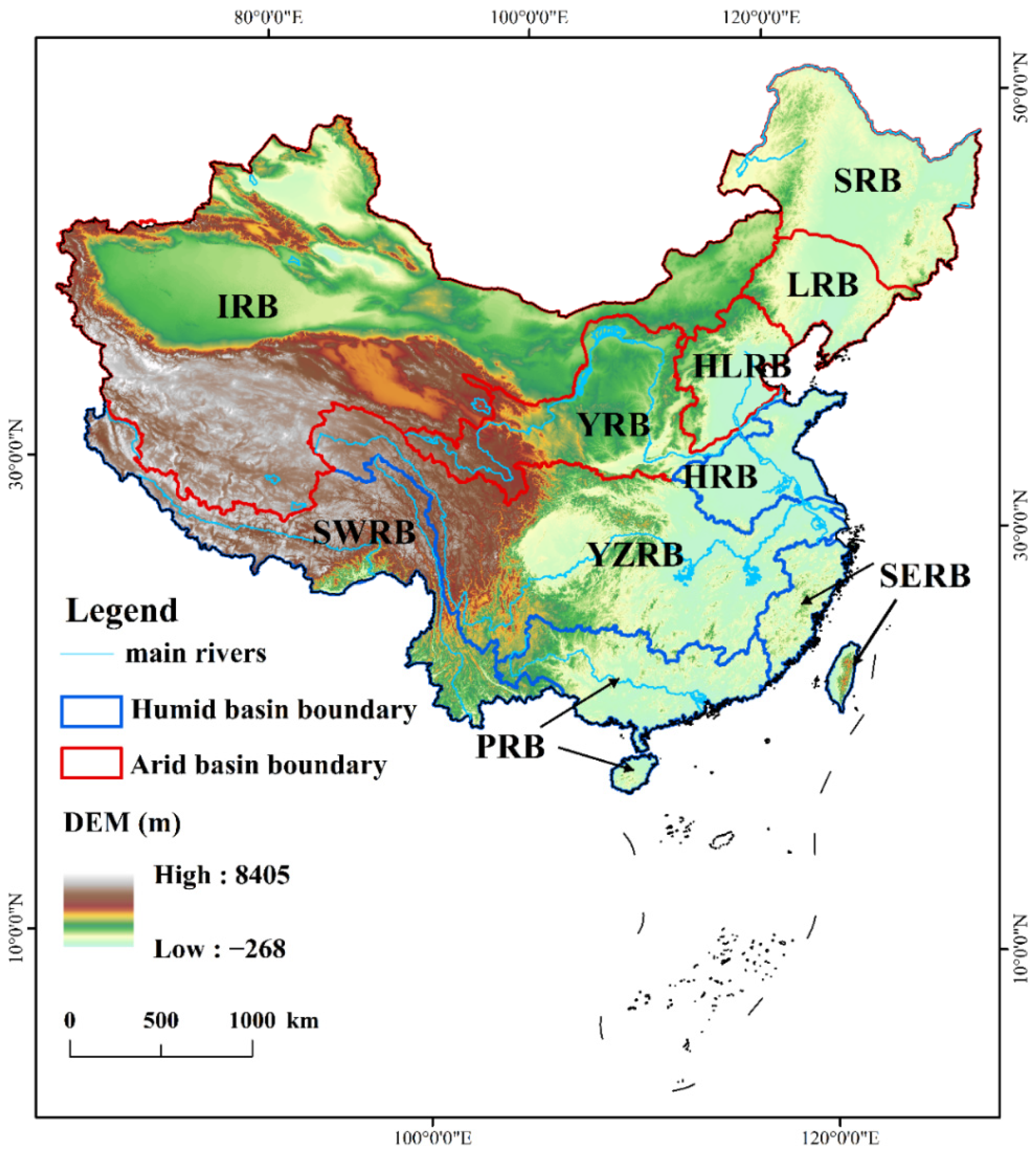
Figure 1. The locale and topography of China’s main river basins (red and blue lines mark arid and humid basins; same below).
Water 18 01474 g001
Figure 2. Trends and slopes of precipitation across China’s major river basins (2002–2017). (a) Sen’s slope of precipitation trends, where blue indicates upward trends, red downward trends, ranging from −62 to 62 mm/yr; (b) Mann-Kendall trend significance, where red tones denote downward trends, green tones upward trends.
Water 18 01474 g002
Figure 3. Time series of precipitation and Precipitation Anomaly (PA) for China’s major river basins (2002–2017). The bars represent monthly precipitation values, and the black dashed line represents the trend line of precipitation. Red and blue font colors for basins’ names highlight arid and humid basins respectively.
Water 18 01474 g003
Figure 4. Trends and slopes of evapotranspiration across China’s major river basins (2002–2017). (a) Sen’s slope of evapotranspiration trends, where green indicates upward trends, red downward trends, ranging from −20 to 12 mm/yr; (b) Mann-Kendall trend significance, where red tones denote downward trends, green tones upward trends.
Water 18 01474 g004
Figure 5. Time series of evapotranspiration and evapotranspiration anomaly (EA) across China’s major river basins (2002–2017). The bars represent monthly evapotranspiration values, and the black dashed line represents the trend line of evapotranspiration. Red and blue font colors for basins’ names highlight arid and humid basins respectively.
Water 18 01474 g005
Figure 6. Trends and slopes of runoff across China’s major river basins (2002–2017). (a) Sen’s slope of runoff trends, where blue indicates upward trends, red downward trends, ranging from −50 to 66 mm/yr; (b) Mann-Kendall trend significance, where red tones denote downward trends, green tones upward trends.
Water 18 01474 g006
Figure 7. Time series of runoff and runoff anomaly (RA) for China’s major river basins (2002–2017). The bars represent monthly runoff values, and the black dashed line represents the trend line of runoff. Red and blue font colors for basins’ names highlight arid and humid basins respectively.
Water 18 01474 g007
Figure 8. Trends and slopes of NDVI across China’s major river basins (2002–2017). (a) Sen’s slope of NDVI trends, where blue indicates upward trends, red downward trends, ranging from −0.05 to 0.05; (b) Mann-Kendall trend significance, where red tones denote downward trends, green tones upward trends.
Water 18 01474 g008
Figure 9. Time series of NDVI and NDVI anomaly (NA) across China’s major basins (2002–2017). The bars represent monthly NDVI values, and the black dashed line represents the trend line of NDVI. Red and blue font colors for basins’ names highlight arid and humid basins respectively.
Water 18 01474 g009
Figure 10. Proportional chord diagrams of land use transition matrix across China’s ten major river basins (2002–2017).
Water 18 01474 g010
Figure 11. Time series of TWSA and its residual (TA) across China’s major basins (2002–2017). The bars represent monthly TWSA values, and the black dashed line represents the trend line of TWSA. Red and blue font colors for basins’ names highlight arid and humid basins respectively.
Water 18 01474 g011
Figure 12. Sen slope estimates for various drought indices across China’s major basins (2002–2017).
Water 18 01474 g012
Figure 13. Trends in various drought indices across China’s major basins (2002–2017).
Water 18 01474 g013
Figure 14. Spatial distribution of slope in different water storage components of major river basins in China.
Water 18 01474 g014
Figure 15. Spatial distribution of trends in different water storage components of major river basins in China.
Water 18 01474 g015
Table 1. Relative contributions of drought-driving factors across China’s ten major river basins (2002–2017). Positive values indicate drought alleviation, negative values indicate drought intensification, and zero indicates the absolute value of Pearson correlation coefficient |r| ≤ 0.1, which is statistically insignificant.
Factor CategoryDriving FactorSRBLRBHLRBHRBYRBYZRBSERBPRBSWRBIRB
MeteorologicalPrecipitation (PRE)0.000.000.0010.100.008.1019.8012.800.000.00
Evapotranspiration (ET)0.000.000.000.000.000.000.000.000.000.00
Runoff18.5021.506.3016.8014.7018.9027.9022.700.003.70
NDVI0.000.000.000.000.000.0011.0014.300.000.00
LULCCropland0.000.0011.200.007.60−14.800.000.00−5.50−15.90
Forest0.000.000.00−17.200.0016.20−2.103.205.50−13.70
Shrubland−22.3026.8012.7015.9016.90−1.10−0.80−2.40−0.3022.70
Grassland−19.200.000.000.00−13.20−0.80−0.70−1.900.100.00
Water body0.000.000.000.00−13.802.300.000.000.100.00
Snow/Ice14.400.000.000.000.000.000.000.0012.10−15.10
Barren land−20.10−4.502.900.003.500.000.000.00−0.100.00
Urban land0.00−23.50−28.90−19.70−20.809.2011.609.80−4.70−25.60
Wetland0.000.00−29.100.000.0012.300.000.00−56.900.00
TeleconnectionENSO9.700.000.00−9.600.006.3014.7015.60−8.100.00
PDO5.80−23.708.90−10.705.3010.8011.4017.30−6.703.00
NAO0.000.000.000.000.000.000.000.000.000.00
Arctic Oscillation (AO)0.000.000.000.000.000.000.000.000.000.00
Total Natural Factors-34.00−2.2015.206.6020.0044.1074.8082.70−2.706.70
Total Anthropogenic Factors-−66.00−1.20−84.80−21.00−19.8024.108.008.70−61.80−31.60
Net Drought Effect-−32.00−3.40−69.60−14.400.2068.2082.8091.40−64.50−24.90
Disclaimer/Publisher’s Note: The statements, opinions and data contained in all publications are solely those of the individual author(s) and contributor(s) and not of MDPI and/or the editor(s). MDPI and/or the editor(s) disclaim responsibility for any injury to people or property resulting from any ideas, methods, instructions or products referred to in the content.