Article

Disruption of Aquatic Ecosystem Biodiversity by Intense Pollution—A Study on Zooplankton from the Tietê River Basin (São Paulo, Brazil)


by
Gabriel Mariano
,
Arthur Padial Mota
and
Marcos Gomes Nogueira
*
Institute of Biosciences, São Paulo State University (UNESP), Botucatu 18618-689, SP, Brazil
*
Author to whom correspondence should be addressed.
Water 2026, 18(12), 1473; https://doi.org/10.3390/w18121473 (registering DOI)
Submission received: 12 May 2026 / Revised: 3 June 2026 / Accepted: 9 June 2026 / Published: 15 June 2026
(This article belongs to the Section Biodiversity and Functionality of Aquatic Ecosystems)

Abstract

The Tietê River, heavily polluted by the largest Brazilian city (São Paulo), has significant ecological and socioeconomic importance. The effects of water-quality degradation on zooplankton diversity (taxonomic and functional) and limnological variables were evaluated through a comparison of the Tietê River’s main channel, one of its marginal lagoons and a low-impacted tributary. Samplings covered both a rainy and a dry season. Environmental conditions are distinctive, with the main river and lagoon classified as hypereutrophic and the tributary as oligo-mesotrophic. The zooplankton, an essential community for aquatic ecosystem functioning, also exhibited remarkable spatial variation. Richness varied between six (lagoon/dry) and 43 (tributary/rainy). There was a much higher abundance in the lagoon (mean = 6.5 × 10⁵), followed by the Tietê River (mean = 4.0 × 10⁴) and tributary (mean = 2.5 × 10³), and a higher taxonomic diversity (Shannon mean = 2.98) and functional richness (mean = 0.66) in the tributary, contrasting with the intermediate values in the Tietê River (means of 1.7 and 0.31, respectively) and lower in the lagoon (1.49 and 0.01). Zooplankton from the Tietê River and the lagoon positively correlated with pH, total solids, chlorophyll and phosphorus. Negative pollution’s effects on the zooplankton community were intensified by the lagoon’s lentic hydrodynamics. The low-impacted tributary seems to act as a refuge for the regional zooplankton biodiversity, taxonomically and functionally, which is restricted to highly tolerant species in the main river.

1. Introduction

Worldwide, freshwater ecosystems are facing strong pressure regarding all types of pollution. Rivers, essential for the historical development of human civilizations, are under serious stress because of the direct and indirect impacts of anthropogenic activities, such as agricultural runoff, waste disposal, domestic and industrial discharges and many others [1]. In addition to the inputs that cause classic nutrient enrichment, by both point and non-point sources [2,3,4,5,6], a myriad of other substances can be introduced into river systems, such as toxic chemicals, heavy metals, persistent organic pollutants and microplastics [7,8,9,10,11,12]. Pollution can lead to several negative effects on freshwater environments, such as eutrophication and bioaccumulation/biomagnification of deleterious elements. This pervasive process directly affects the fauna and flora, resulting in mass mortality events, local extinction and generalized biodiversity loss, which can be intensified by the present scenario of climate change [13,14,15].
Zooplankton is an important component of aquatic biodiversity, with a key influence on the functioning of entire aquatic ecosystems. These small animals structure food chains, transferring mass and energy from primary producers and consumers to higher trophic levels. They also respond quickly to environmental changes, being considered good bioindicators [16,17,18,19,20,21].
High levels of nitrogen and phosphorus and changes in water pH are associated with a decrease in zooplankton richness and the dominance of tolerant species of certain groups, such as ciliated protozoa and rotifers [22,23,24]. Recurrent oxygen depletion promotes a shift in species composition, favoring those with a smaller body size via a reduction in the community biomass [25]. The high frequency of harmful algae blooms, common in eutrophic aquatic ecosystems, are also a negative pressure on zooplankton community health [26,27].
Our research aimed to evaluate pollution in the Tietê River’s middle basin and its effects on the zooplankton on a local scale. This is the main large river (1136 km) entirely located in São Paulo State, the most populous and industrialized of Brazil, and it receives most of the sewage and irregularly disposed solid wastes from the city of São Paulo (about twenty-two million inhabitants living in the metropolitan area), located in its upstream stretch. The downstream transportation of this huge pollution load, in addition to the intensive agricultural soil use (middle and lower stretches), has caused historical eutrophication problems along the river’s course [28,29,30]. Recent studies within the Tietê River’s middle basin have shown impressive contamination with microplastics and remarkable effects on fish biota, with the river acting as a chemical barrier to species distribution [31,32].
In this context, our study aimed to evaluate the effects of severe pollution on zooplankton structure and environmental variables, from the middle Tietê River basin. Specifically, we compared the following: (i) the highly polluted Tietê River with a low-impacted tributary (the Peixe River), a regional reference of unpolluted waters, to assess the impacts of severe pollution on regional lotic systems; (ii) the Tietê River with an adjacent marginal lagoon (unnamed), to understand the effects of the increased water retention time on highly polluted waters; and (iii) the effects of seasonality, rainy versus dry periods.
Given the regional scale of the study and the intrinsic high dispersion capacity of the zooplankton, there would be expected to be species redundancy among the environments, despite differences in size (main river vs. tributary) and hydrodynamics (main river vs. lagoon). However, our assumption is that severe water-quality degradation should disrupt this ecological pattern. Therefore, we tested the following hypotheses: (i) compared to the Peixe River, the Tietê River will exhibit reduced diversity and a dominance of tolerant taxa; (ii) due to restricted hydrodynamics, as well as the naturally better developed zooplankton in lentic habitats, the lagoon will support a higher abundance than the main river, dominated by pollution-tolerant taxa; and (iii) seasonal variation will significantly shape the communities, with the low-flow period (dry season) exacerbating poor water-quality conditions and negatively impacting the zooplankton.

2. Materials and Methods

2.1. Sampling

The sampling area is located in the municipality of Anhembi, 160 km downstream the São Paulo megalopolis area, in a straight line, or 350 km following the river’s meanders. Fieldwork was carried out during the following two distinct periods: ends of the rainy season (April 2021) and dry season (August 2021), with cumulative rainfall in the three months prior samplings of 588.4 mm and 141.4 mm, respectively (https://bdmep.inmet.gov.br, accessed in 21 February 2023).
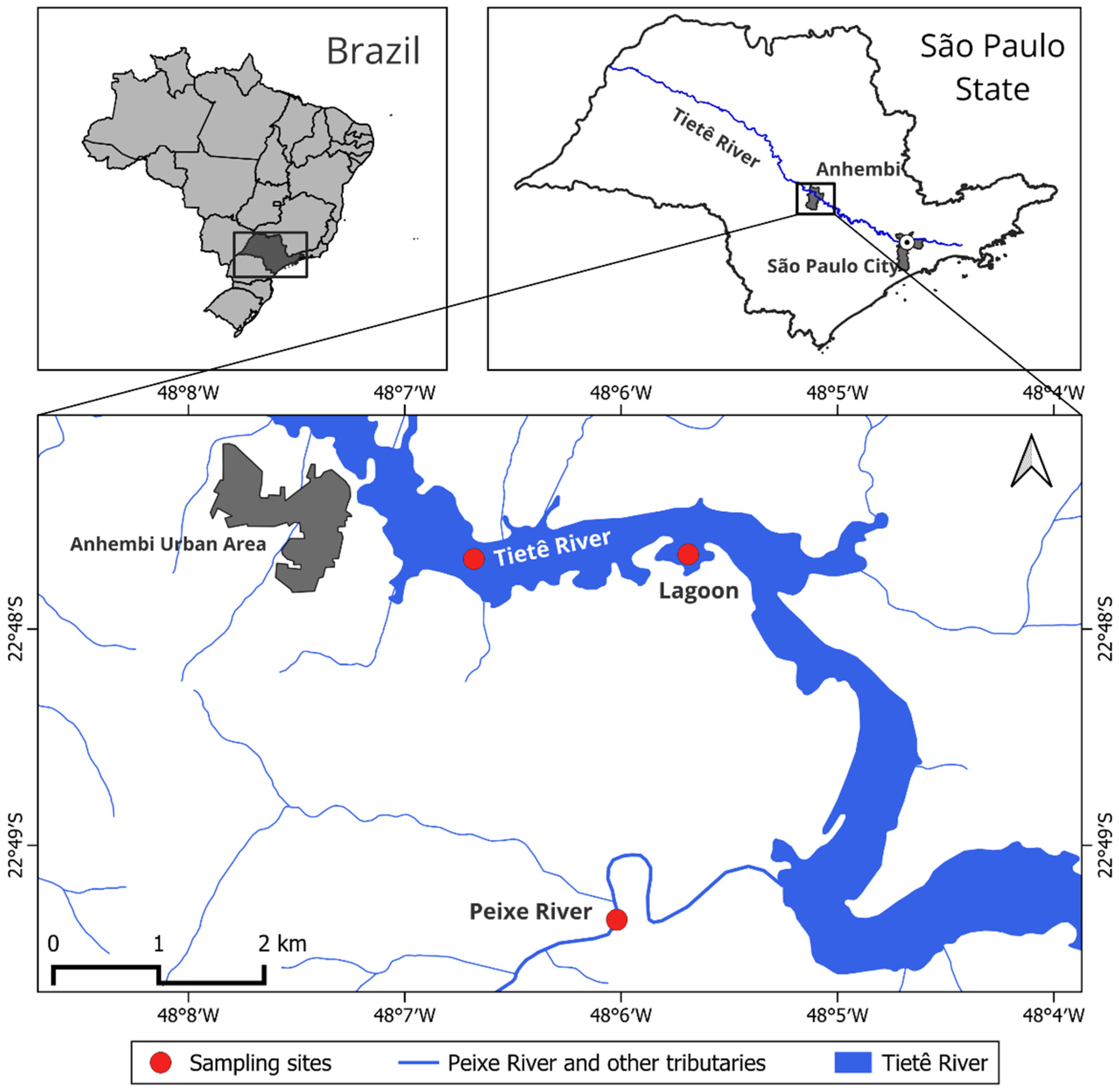
Longitudinal transects of 1 km each were established across three distinct environments (sites) from the middle Tietê River basin: the main channel of Tietê River (22°47′37.56″ S, 48°7′14.99″ W); a marginal lagoon (22°47′41.79″ S, 48°6′24.02″ W), which is narrowly (~10 m aperture) connected with Tietê, and the lower stretch of Peixe River (22°49′32.35″ S, 48°5′34.85″ W), an important regional tributary little affected by urban areas (Figure 1).

2.2. Environmental Variables

Water’s in situ parameters were always measured during daytime (between 10 am to 15 pm) using a HORIBA U-52 multiparameter probe (HORIBA Advanced Techno, Co., Ltd., Kyoto, Japan), at three points equidistantly distributed in a transect, one per site (n = 18). Vertical profiles were determined, with readings at every meter of depth for temperature (Temp; °C), pH, oxidation-reduction potential (ORP; mV), electrical conductivity (Cond; μS/cm), turbidity (Turb; NTU), dissolved oxygen (DO; mg/L), and total dissolved solids (TDS; g/L). Water samples were collected to analyze (following [33]) nutrient concentrations—total nitrogen (TN; mg/L; Method 4500N-C) and total phosphorus (TP; mg/L; Method 4500P-E), chlorophyll a (Chl; µg/L; Method 10200H), biochemical oxygen demand (BOD; mg/L; Method 5210B) and total solids (TS; mg/L; Method 2540B).
Carlson’s original Trophic State Index (TSI), designed to estimate algal biomass in temperate lakes, is usually adapted for different ecosystems to prevent misclassification [34]. In Brazil, modified versions are utilized to account for the nutrient dynamics in tropical and subtropical waters. These regional adaptations maintain the same premises but adjust the calculations, the number of variables, and their respective weights [35]. Based on these assumptions, we calculated the TSI adjusted for tropical/subtropical regions based on the official São Paulo State Environmental Agency, CETESB (Companhia Ambiental do Estado de São Paulo, in Portuguese) [30].

2.3. Zooplankton Sampling and Analysis

Zooplankton was collected at the same three sites (n = 18) along each transect using a conical plankton net with 68 µm mesh size. In the Tietê River, depths varied between seven and eight meters, allowing for samplings through vertical hauls of the entire water column. Only one haul per point filtered nearly 560 L, a volume that captures enough individuals to permit representative countings. On the Peixe River, depths were between two and four meters, and as less abundance was expected, two to three vertical hauls were performed at each sampling point, reaching a total of roughly 420 L filtered. On the marginal lagoon, depths were inferior to 1.5 m. To avoid bottom sediments getting into the net, horizontal hauls were performed on this site. The plankton net was thrown from the boat in a straight line of six meters and pulled back into the boat’s direction. This procedure resulted in a filtered volume per sample of approximately 420 L. At all sites, the plankton net was slowly hauled through the water to avoid clogging/reflux and allow for filtration of the whole column. Samples were immediately fixed with formaldehyde (final concentration of 4%).
Rotifers and microcrustaceans (Cladocera and Copepoda; Crustacea) were analyzed using a stereomicroscope (Zeiss Discovery V20; Carl Zeiss CMP GmbH, Göttingen, Germany) and an optical microscope (Zeiss Axiostar; Carl Zeiss CMP GmbH, Göttingen, Germany). Identification reaching the lowest possible taxonomic level, genus/species, was performed using specialized literature [36,37,38,39,40,41]. However, Bdelloidea (Eurotatoria, Rotifera) were identified according to the class level; Chydoridae (Anomopoda, Crustacea) to the family level; and juvenile stages of Copepoda (nauplii and copepodites) were identified only to the order level (see Supplementary Files, Table S1, for a complete taxonomical list).
Through sub-samplings, at least 100 organisms were counted per sample in acrylic counting chambers under a stereomicroscope and in a Sedgewick–Rafter chamber under an optical microscope. To determine individual densities and standardize them among sampling sites, extrapolations per cubic meter were calculated based on (1) the total counted volume, (2) the sample volume concentrated in the vial and (3) the total volume collected from the sampling sites (calculated from the distance the net was towed through the water and net opening diameter—cylinder volume formula).

2.4. Functional Diversity

Six functional traits were chosen for the functional diversity analysis, as follows: body size group (small < 500 µm, 501 µm < medium < 1 mm and big > 1 mm), trophic group (omnivorous, herbivorous and carnivores), feeding type (Filtration-B for Bosminidae, Filtration-D for Daphniidae, Filtration-I for Illyocriptidae, Filtration-C for Chydoridae, Filtration-S for Sididae, Filtration-R for rotifers, Filtration-Cop for copepods, Raptorial-Cop for copepods, Raptorial-R for rotifers and Suction-R for rotifers), habitat (Littoral, Pelagic and Benthonic), reproduction (sexual and asexual) and life span (long, intermediate and short). The complete table with all species and their functional traits can be found in the Supplementary Files (Table S2). Traits for each taxa were obtained from the literature [21,42,43,44,45,46,47,48,49].

2.5. Data Analysis

All statistical analyses and graphical representations were performed in the R (version 4.3.1) environment [50]. Data visualization, including ordination biplots and triplots, were made using the ggplot2 [51] and ggrepel [52] packages. The environments were characterized using three spatial replicates collected per site (along the transects) during each period for both limnological variables and individual zooplankton samples.
A combination of distinct statistical approaches was employed to reach our objectives, which required evaluating data at different analytical scales: univariate tests were used to assess specific spatiotemporal differences in local metrics, while multivariate techniques were applied to model the complex responses of the entire community to environmental drivers. Prior to hypothesis testing, data were subjected to assumption checks: normality and homoscedasticity were evaluated using the Shapiro–Wilk and Levene’s tests, respectively.
Depending on whether parametric assumptions were met, appropriate comparative tests (t-test, Kruskal–Wallis, ANOVA, and Mann–Whitney) were used to verify the relationships and differences between the studied sites and periods for both limnological variables and species abundance. A principal component analysis (PCA) was performed with water variables to discriminate the limnological differences among the sites.
The diversity indices of Shannon–Wiener (H′), Simpson (1-D) and Pielou Evenness (J) were calculated using the vegan package [53]. A rarefaction based on samples analyses was also performed for richness and diversity (H′ and 1-D) using the package iNEXT [54] to compare the zooplankton assemblages among the studied environments. Non-metric multidimensional scaling (NMDS) was performed to distinguish community composition across their respective localities and the impact of environmental variables in differentiating these communities. To reinforce the NMDS results, abundance data were transformed into a Bray–Curtis dissimilarity matrix and a permutational multivariate analysis of variance (PERMANOVA), followed by a permutational analysis of multivariate dispersions (PERMDISP), were conducted to assess community differences and if they were due dispersion or location.
The following four functional diversity indices were determined: functional richness (FRic, which represents the total volume of the functional space filled), functional evenness (FEve, which represents the evenness of abundance distribution in a functional trait space), functional divergence (FDiv, which represents how abundance is distributed within the volume of functional trait space occupied by species) and functional dispersion (FDis, which represents the mean distance of individual species to the centroid of all species in the community), as well as the community-weighted mean (CWM) of the traits. Indices were calculated using the FD package [55]. To assess the variation in the functional structure, spatial and temporal differences in the functional indices were tested using a two-way ANOVA, followed by Tukey’s HSD post hoc test for multiple comparisons.
To explore the grouping of functional traits across the studied environments and their relationship with the environmental variables, a redundancy analysis (RDA) was applied to the CWM matrix using the vegan package. Prior to the RDA, environmental variables were standardized (z-scores) to eliminate discrepancies in measurement scales. To address potential multicollinearity among the environmental predictors, we calculated the variance inflation factor (VIF) for the initial RDA model. Variables exhibiting a VIF greater than 10 were considered highly collinear and were sequentially removed to yield a parsimonious final model. The six selected variables were Temp, pH, Turb, OD, TS and TP. Although this selection mathematically makes sense, their ecological significance does not. The limnological dynamics of the river–lagoon system are complex, and variables showing biologically negligible variations for driving zooplankton niche structuring, such as water temperature (with a reported amplitude of only 2.5 °C between sampling periods and sites), were selected by the algorithm. Furthermore, metrics such as Turb and TS also indicated unreal situations, as the higher observed values (notably in the lentic environment) were driven by dense phytoplankton blooms rather than suspended inorganic matter. Using these variables would lead to a false-positive assumption. To avoid this, a selection of more ecologically appropriate variables was made, including a VIF check to avoid multicollinearity. Chlorophyll was retained as the true predictor of food resource availability, while TDS served as a robust proxy for the system’s pollution, free from algal biomass bias. The complete structural model also included pH, DO, TP and BOD. These are classical representative drivers of eutrophication, organic stress, and aquatic metabolism. This hypothesis-driven approach mitigated multicollinearity and overfitting, ensuring that the models reflected genuine environmental filtering. The statistical significance of the global RDA model and the selected individual axes and terms were tested through permutation tests (999 permutations).
Data processing and visualization scripts were supported by generative artificial intelligence (Gemini version 3.1 Pro; Google LLC, Mountain View, CA, USA). Specifically, the AI tool was used to assist in writing and troubleshooting R scripts for some of the abovementioned analysis, as well as generating the associated graphics. The authors reviewed and verified all generated code and assume full responsibility for the accuracy and integrity of the final content.

3. Results

3.1. Environmental Variables

All sites were very different considering water variables (Table 1). Temperature, despite statistically different, had an amplitude lower than 2.5 °C, even among seasons. Near-zero oxygen concentrations were common in the Tietê River, and total nitrogen and total phosphorus were magnitudes higher in the main river and the lagoon in comparison to the tributary. The three environments exhibited significant statistical differences (p < 0.05) for all variables, including nitrogen.
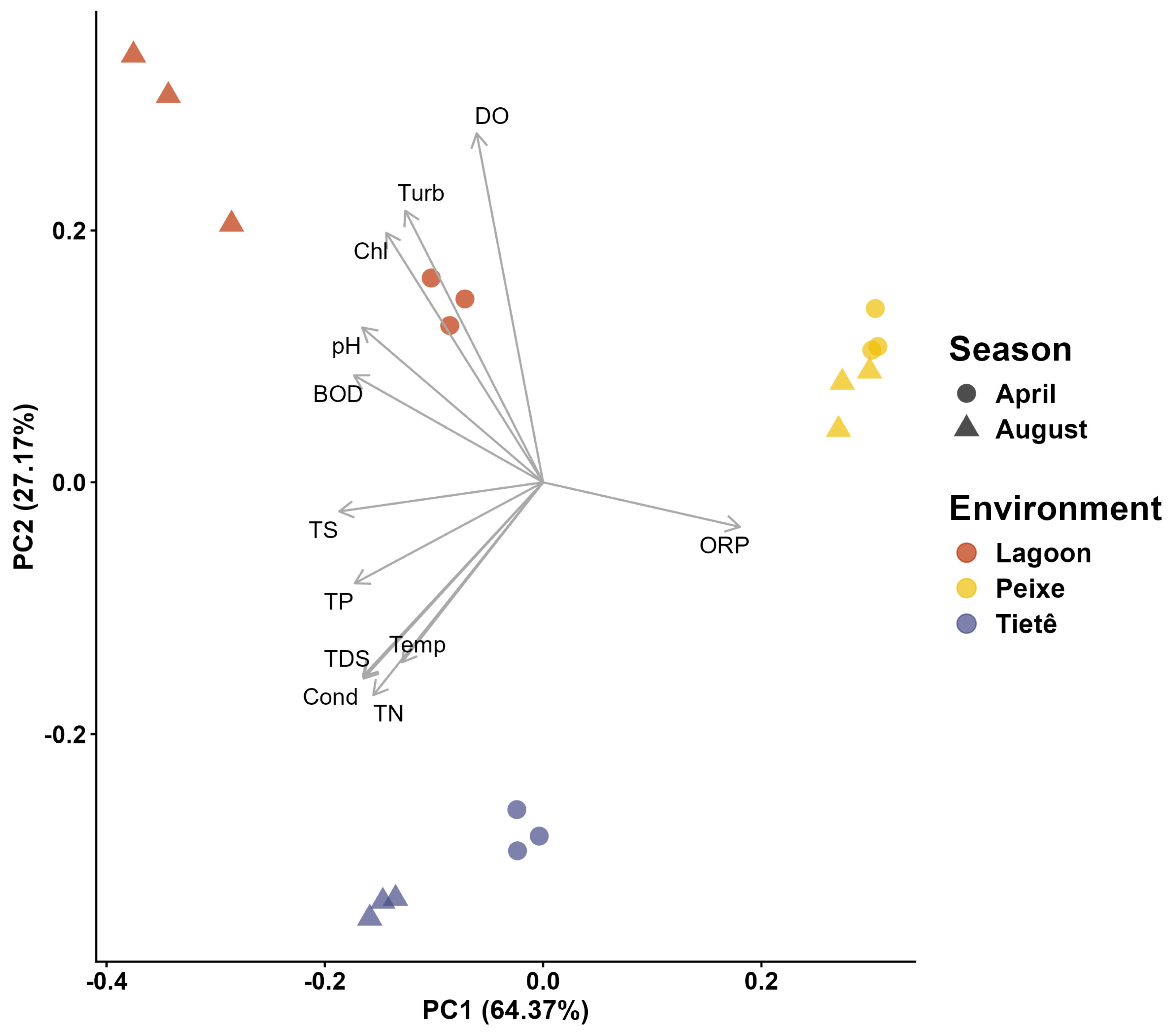
The PCA exhibited a high explicability of data variance (91.54%) considering only the first two axes (PC1 and PC2), showing a clear separation between the three environments (Figure 2). The first axis separated the Peixe River and was positively related with ORP values. Conversely, the Tietê River and the marginal lagoon were associated negatively with this axis (higher values of TS, TDS, TP, Cond, BOD, and pH). Nevertheless, both sites were clearly separated in relation to the second axis, with the Tietê in the inferior quadrant (>TN, Temp, Cond) and the lagoon in the superior quadrant (>OD, Chl). For the Tietê and lagoon, the conditions in the dry season seem to be even worse. See Supplementary Files for the PCA correlations values (Table S3).
According to the trophic state index, the Peixe River was classified as oligotrophic and mesotrophic during dry and rainy periods, respectively. The Tietê River and the marginal lagoon were classified as hypereutrophic during both seasons.

3.2. Zooplankton Taxonomic Diversity

A total of sixty-six taxa were identified in the three environments, with eight Copepoda species, sixteen Cladocera and forty-one Rotifera (Table S1). Nauplii and copepodite of Cyclopoida were the only taxa found in all environments during both seasons.
In April, the Peixe River recorded a richness of 43 species (mean H′ = 2.987, 1-D = 0.928, and J = 0.884). During the same period, the Tietê River showed a richness of 23 species (mean H′ = 1.566, 1-D = 0.717 and J = 0.564). The marginal lagoon had 13 species (mean H′ = 1.493, 1-D = 0.673 and J = 0.596).
Richness was lower in August in the three environments, with 22 species in the Peixe River (mean H′ = 2.225, 1-D = 0.869, and J = 0.855), 20 in the Tietê River (mean H′ = 1.717, 1-D = 0.742, and J = 0.606), and only 6 in the marginal lagoon (mean H′ = 0.97, 1-D = 0.508, and J = 0.603).
The rarefaction showed that the Peixe River had higher values of richness (q = 0), Shannon diversity (q = 1) and Simpson diversity (q = 2). Lower values occurred in the lagoon and intermediate in the Tietê River (Supplementary Files, Figure S1).
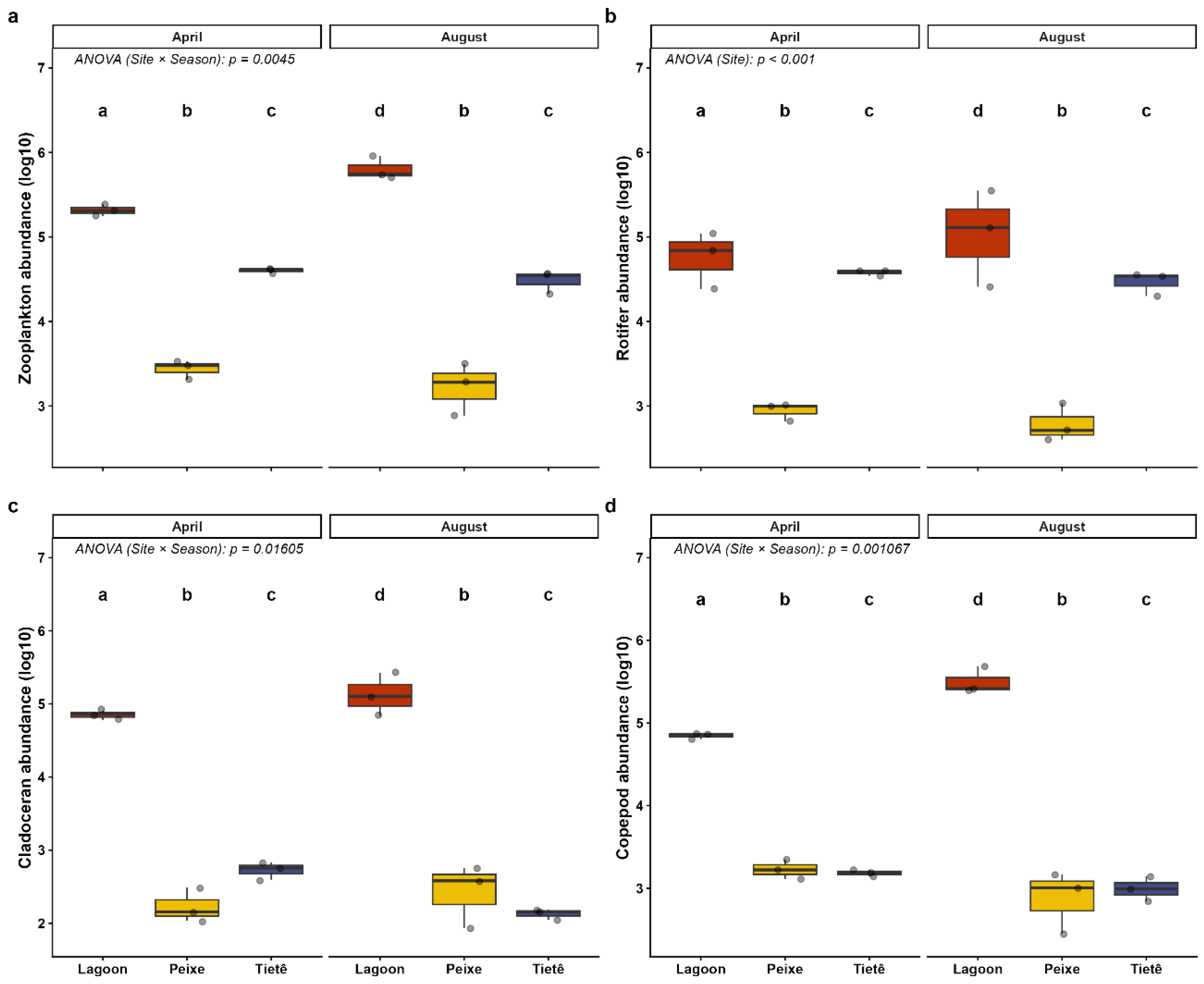
The marginal lagoon exhibited higher values of abundance for total zooplankton (means of 209,316 ind/m3 in April and 655,827 ind/m3 in August), Cladocera and Copepoda (Figure 3a,c,d). For rotifers, abundance was statistically similar between the lagoon and Tietê River (Figure 3b). The Tietê River and the Peixe River had similar abundances of cladocerans and copepods (Figure 3c,d) but different values for rotifers and total zooplankton (Figure 3a,b). The lowest abundance of zooplankton was observed in the Peixe River, with a mean of 1893 ind/m3. Seasonally, there was an increase in total zooplankton and copepod, from April to August, in lagoon samples (Figure 3a,b,d).
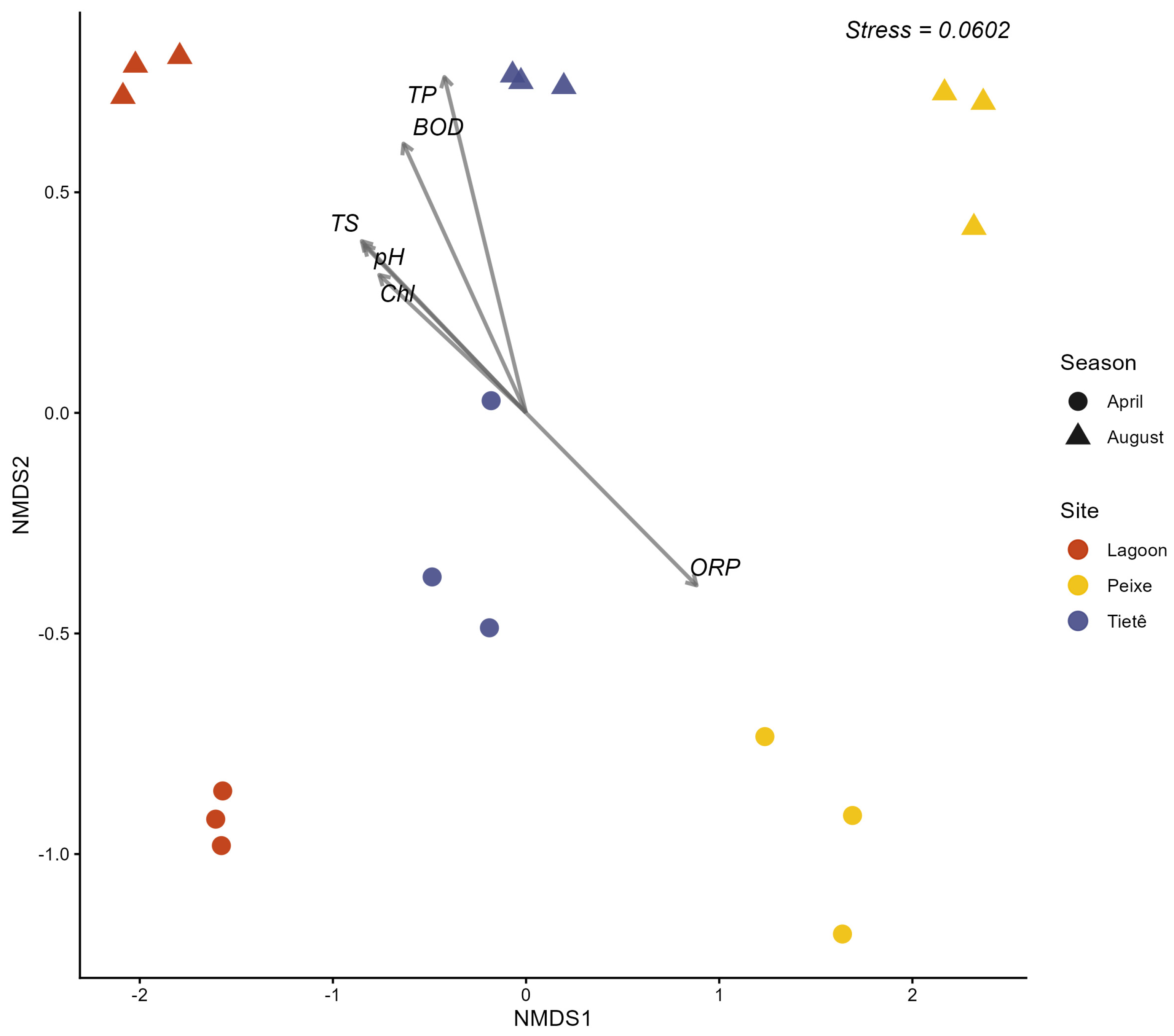
The NMDS analysis demonstrated the separation among the samples from all environments (stress value = 0.0602068). The vectors with significant values explaining the ordination are pH, ORP, TS, Chl, TP and BOD (p = 0.001). The Peixe River is positively related to ORP but negatively with the other vectors. The Tietê River and marginal lagoon communities were correlated with pH, TS, Chl, TP and BOD (Supplementary Files, Table S4). The difference among seasons is also observable for all of the environments in the NMDS analysis (Figure 4).
As the initial PERMDISP test indicated significant differences in dispersion from the April and August data, we opted to analyze the spatial differences among communities separately for each season. The PERMANOVA results revealed significant differences among the three communities in April (DF = 2; R2 = 0.9225; F = 35.711; p = 0.003) and in August (DF = 2; R2 = 0.9235; F = 36.202; p = 0.006). Both periods exhibited homogeneity of multivariate dispersions (PERMDISP p > 0.05). Furthermore, the combined community composition differed between April and August (PERMANOVA DF = 1; R2 = 0.13025; F = 2.3961; p = 0.048), with PERMDISP indicating that the temporal dispersion did not vary significantly (p = 0.877).

3.3. Zooplankton Functional Diversity

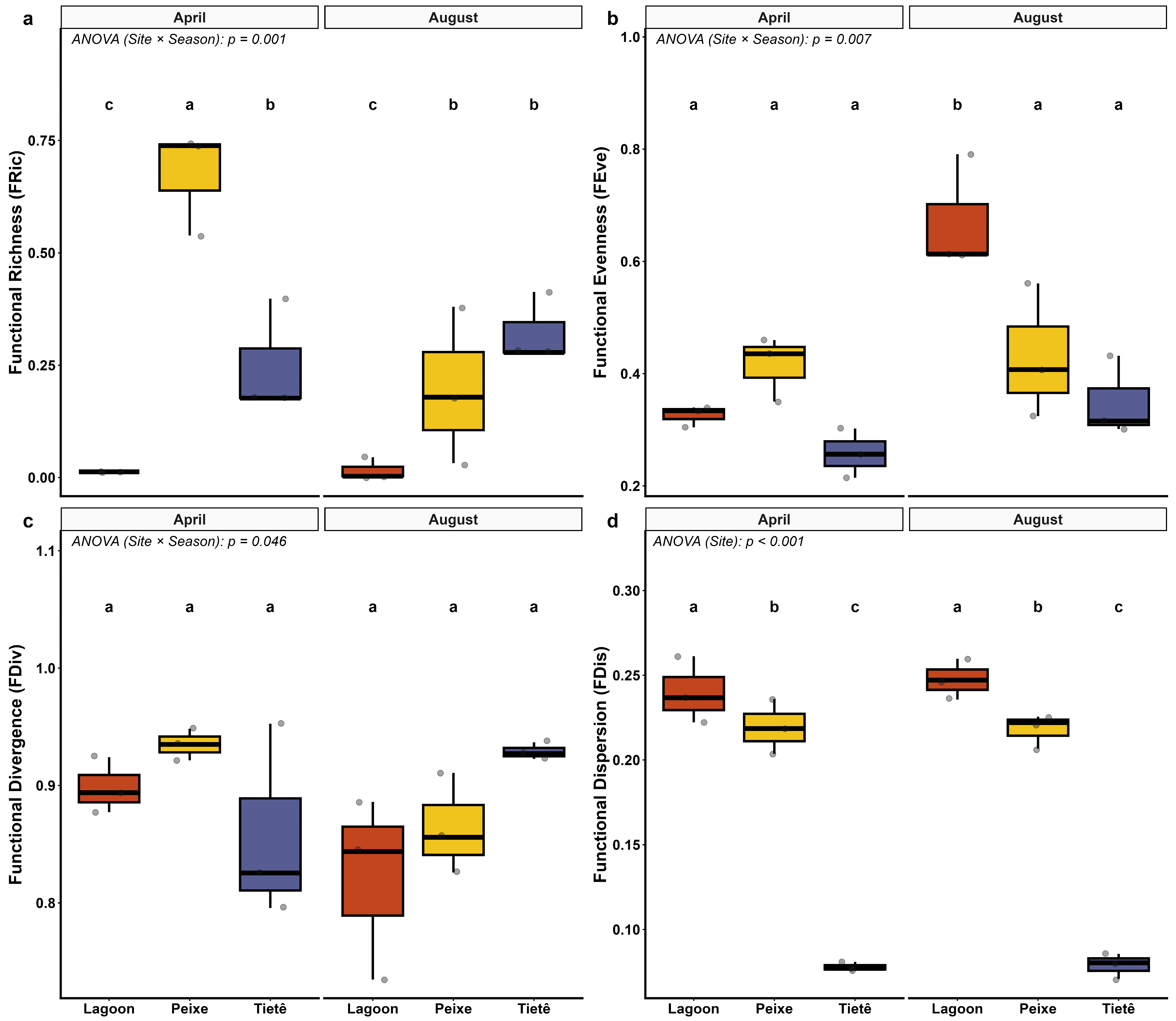
For each sampling point, we calculated and compared functional diversity indices (FRic, FEve, FDiv and FDis). FRic, FEve and FDiv differed when comparing the interaction between sites and seasons, but FDis only differed between the sites (Figure 5). Although ANOVA evidenced a lower p-value for FDiv interaction, no specific pair of data was different according to Tukey’s test (Figure 5c). Despite not being different, the FDiv values are high (mean of 0.9), considering that the index amplitude is 0 to 1 [56].
Focusing on the distinct environments, the Peixe River showed the highest FRic (p = 0.0014), in April, and the marginal lagoon the lowest functional richness values (p = 0.0364), both in April and August (Figure 5a). The highest values of FEve were found in the lagoon, in August (p = 0.0014). In April, the three environments exhibited similar functional evenness (Figure 5b).
The functional dispersion index differs significantly among the three environments (p < 0.001; Figure 5d), with the lower values in Tietê, intermediate in Peixe and higher in the lagoon.
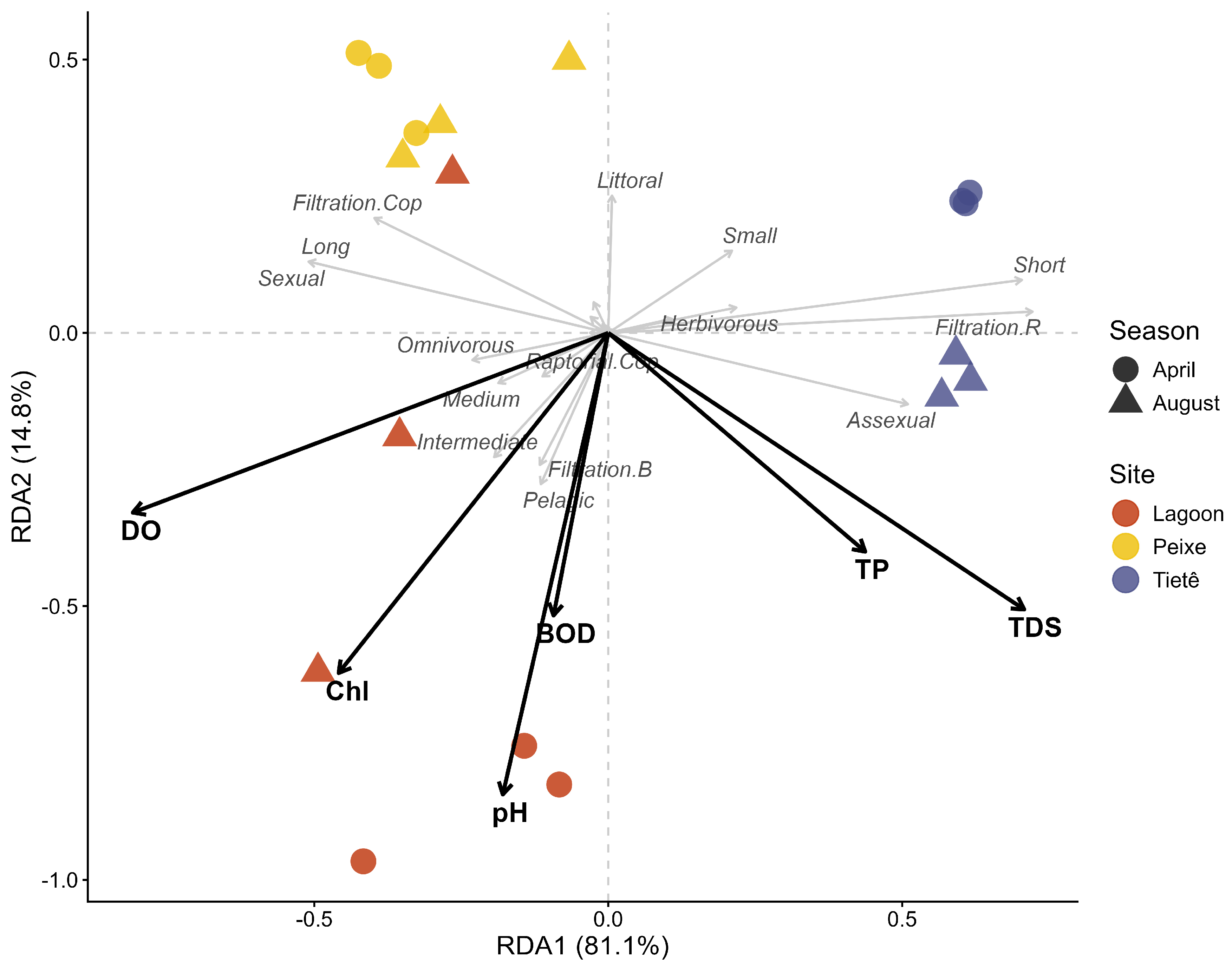
The three environments were clearly separate in terms of RDA (R2 adjusted = 0.792, F = 11.786, p = 0.001; Supplementary Files, Table S5), especially the points corresponding to the Tietê River (Figure 6). To avoid overlap, only the most influential functional traits were retained in the analysis. Copepod traits benefit from higher Turb and Chl. Rotifers were associated with higher TDS and TP, independently of the DO variations. Cladocerans seem to be widely distributed, with some traits depending on the families and others with no strong correlation with environmental variables.

4. Discussion

Our study corroborates previous descriptions of the Tietê River’s severe state of degradation [28,29,57,58]. The water-quality indicators for the Tietê River, such as excessively high values of phosphorus, nitrogen, electric conductivity and very low dissolved oxygen, contrast with the much better condition of the tributary Peixe River, as clearly showed by the PCA. The Peixe River is a tributary of the Tietê River’s middle stretch, and as it does not have the same source of pollution (a metropolitan region upstream), it has better water quality.
The marginal lagoon exhibited a similar pattern of environmental degradation as the main river, with both environments classified as hypereutrophic in rainy and dry periods. Despite the lagoon being fed exclusively by Tietê waters, a conspicuous difference was observed for DO values, much lower in the river. Seasonal means of only 0.7 and 0.6 mg/L in the river, compared to 9.3 and 12.6 mg/L in the lagoon, determined distinctive positioning in the PCA, with the same trend for the pH. This remarkable difference is directly associated with the phytoplankton metabolism [59]. The river–lagoon connection is very narrow, less than 10 m, which limits the hydrodynamics (water exchanges) and favors the intensive growth of algae/cyanobacteria inside the lagoon. In the studied dry period, chlorophyll a was 28 times higher in the lentic environment compared to the lotic one (818 µg/L and 29 µg/L, respectively). It is important to highlight this observed limnological trend, since there is a recurrent proposal for dam construction (especially for navigation purpose) along this Tietê River stretch by governmental authorities.
Among the three analyzed environments of the middle Tietê basin, better water quality was seen in the Peixe River, classified as mesotrophic in April and oligotrophic in August. Different from the Tietê, which is strongly affected by the São Paulo megalopolis, the tributary’s drainage is predominantly rural, under the direct influence of only one small municipality (Bofete, 10,460 inhabitants), located 35 km (in a straight line) upstream of the sampling point. Zooplankton data validated our first hypothesis, with higher diversity in the Peixe River, being less exposed to anthropogenic actions. A maximum richness of 43 taxa was found in this river during the rainy period, as well as a series of exclusive genera and species (e.g., Euchlanis spp., Trichocerca spp., Macrochaetus spp. and Lepadella spp.). A similar pattern was observed for fishes, with the polluted Tietê acting as a chemical barrier for species distribution on a regional scale, with tributaries sustaining more diversity [31]. In the context of large dammed river basins in the Neotropics, it was also demonstrated the importance of tributaries as a source of biodiversity conservation [60].
Another even better proved pattern is that marginal lagoons have a fundamental role in biodiversity maintenance in Neotropical fluvial ecosystems [61,62,63,64]. However, this seems not to apply to the Tietê River basin. In our study, the Tietê marginal lagoon was the environment with the lowest zooplankton diversity indices and richness, with only six species occurring during the dry period. This result evidences that severe environmental filters select the species more tolerant to eutrophication [19,65,66,67].
An inverse richness–abundance relationship is expected when primary productivity is extreme [68]. Few highly tolerant zooplankton species, including some rotifers and cyclopoids, have the capability to explore the available food resources, i.e., the selected primary producers (e.g., cyanobacteria), including the associated detritus and microorganisms, which can grow in hypereutrophic conditions [57,69]. This assumption is evidenced in our study, as the zooplankton abundance in the lagoon was significantly higher for both sampling periods. In April, the community was represented mainly by cyclopoids, with nauplii, copepodites and adult Acanthocyclops robustus and Metacyclops mendocinus, Bosmina hagmanni and Brachionus calyciflorus. In August, in addition to species loss (13 to 6), an interesting change is that B. calyciflorus was totally replaced by Brachionus angularis, keeping the high abundance. The much higher availability of organic compounds in the main river and in the marginal lagoon, resulting from a long-term eutrophication process, benefit the ones fit to explore it.
Zooplankton composition of the Tietê River reflects its degraded water-quality condition, where smaller species are expected to dominate [70]. Rotifer accounted for more than 90% of the abundance. Very few Cyclopoida were found there and almost no Calanoida. Most rotifer species belonged to the Brachionidae family, considered to be more tolerant to variation in water quality and to more polluted waters [71,72]. This family also represented four of the five species of rotifers found in the marginal lagoon during both seasons. In addition to the Brachionidae rotifers, the copepod Thermocyclops decipiens, common in more eutrophic waters, was found in the Tietê River and its marginal lagoon, while T. inversus, an indicator of mesotrophic waters, only occurred in the Peixe River [73,74].
Our results on the community’s composition highlight the importance of zooplankton as good water-quality bioindicators and why biomonitoring for conservation efforts should also take them into consideration [69,75,76,77].
The functional richness indices showed a similar pattern compared to the taxonomic ones. FRic was higher in the tributary during the rainy season (April). In August, some functions were lost, making the Peixe River comparable to the Tietê River; however, this was not reflected in the taxonomic richness, which is indicative of a functional redundancy among the distinct species [78]. Conversely, for both sampling periods, the lagoon was the poorest environment. Functional evenness was higher in the lagoon during the dry period (August), because there was no need to compete for the abundant food resources accessible, even if only among a few species present in the habitat [45,79]. The Tietê exhibited a lower functional dispersion (FDis), which can be associated with the dominance of opportunistic rotifers [21], making it more homogeneous than the other environments, showing the negative impact of pollution on the functional diversity, as seen in previous works [43,80]. The functional divergence was not different among environments/periods, even though all sites had high values, indicating that the most abundant species had very different traits among them.
The main functional traits present in the Tietê River samples—short lifespan, asexual reproduction, small body size and the rotifer filtration type—are all characteristics of rotifers, which agrees with the abundance and taxonomic diversity findings. These traits were highly correlated with water-quality degradation, high TDS and total phosphorus, as well as low oxygen concentration [25,69].
Medium body size, intermediate lifespan, pelagic habitat, and Bosmina-type filtration traits were more common in the lagoon, which corresponds to the presence of cladocerans and copepodites. However, within the lagoon’s zooplankton community, larger (adult copepods) and smaller (copepod nauplii and a few rotifer species) organisms, tolerant of eutrophic waters [81], were also common.
A more oxygenated oligo/mesotrophic Peixe River allows for more functional traits to thrive, such as large body size, long lifespan, sexual reproduction and Copepod-filtration type, without excluding rotifers, as seen with the taxonomic diversity. In addition, the littoral habitat and omnivorous trophic group are important traits in this environment, due to the diversity of cladocerans and rotifers exclusively found in this river. Peixe River did not have any positive correlations with the environmental variables due to its neutral or lower values, as seen in its very low nutrients, conductivity, total solids and average values of pH and oxygen. The only metric it had the highest values of was ORP, which was not retained by the variable selection for the RDA.
Recent comprehensive syntheses emphasize that the frequency and intensity of harmful algal blooms are escalating globally, particularly in developing regions subject to rapid urbanization and agricultural expansion [82]. In heavily modified systems like the Tietê River basin, the continuous input of untreated wastewater and nutrient runoff creates a hypereutrophic baseline. These conditions likely disrupt energy transfer across trophic levels. The replacement of diverse phytoplankton assemblages by dominant cyanobacterial blooms offers poor-quality resources, affecting the food web and suppressing sensitive zooplankton functional traits, reducing the overall community richness [27,83], as seen in the lagoon. The dominance of cyanobacteria structurally alters the ecosystem by acting as a strong environmental filter, where mechanical unpalatability and toxicity (e.g., microcystins) actively suppress the occurrence of diverse zooplankton traits [26,27,84].
The biodiversity loss and functional simplification observed in the polluted areas are characteristic responses of freshwater food webs to eutrophication [85,86]. While the impacts of pollution on freshwater zooplankton are well-documented in lakes, riverine systems remain comparatively understudied. Lotic environments are of equal ecological importance; however, harmful algal blooms occur less frequently in these systems due to continuous water flow [87,88]. Consequently, distinct environmental filters likely drive community structure in rivers, highlighting the need for further research to elucidate these specific dynamics.
Comparison between the studied environments shows that the Peixe River is taxonomically and functionally more diverse, probably acting as a refugee for the regional diversity [89,90]. Pollution associated variables are the main factors responsible for the zooplankton community differences, mainly between the two lotic environments. Hydrodynamic also play a significant role by intensifying the eutrophication effects, making the Tietê River and the marginal lagoon very distinct habitats.

5. Conclusions

Even within the same river basin stretch, with relatively short distances, zooplankton communities exhibited remarkable spatial heterogeneity. While multiple environmental drivers, including river magnitude and lotic versus lentic conditions, contributed to these differences, they seem to be amplified by external pollution-induced stressors. Water pollution remains a critical disruptor of aquatic ecosystems’ integrity. The low-impacted tributary results suggest it may serve as a refuge for zooplankton biodiversity, taxonomically and functionally. Therefore, regional efforts must prioritize its conservation, as well as of other similar rivers—protecting from new point- and non-point-source pollution discharges and hydrological alterations, such as damming. This management strategy is particularly important in heavily degraded river systems, such as the Tietê River basin.

Supplementary Materials

The following supporting information can be downloaded at: https://www.mdpi.com/article/10.3390/w18121473/s1, Figure S1: Rarefaction analysis of richness (q = 0), Shannon (q = 1) and Simpson (q = 2) in the three studies environments. Middle Tietê River basin (São Paulo, Brazil); Table S1: Taxonomic list with presence and absence of each taxa in each site/season. A “x” indicates presence and a “–“ indicates absence. Their abundance can be found in the Supporting Information abundance data Excel spreadsheet; Table S2: Functional traits attributed to each taxa. Complete species names can be found in Table S1; Table S3: Principal Components Analysis (PCA) first two ordination values; Table S4: Non-metric Multidimensional Scaling (NMDS) environmental variables fitness; Table S5: RDA scores for environmental variables and functional traits.

Author Contributions

Conceptualization, G.M. and M.G.N.; methodology, G.M. and M.G.N.; software, G.M. and A.P.M.; validation, G.M., A.P.M., and M.G.N.; formal analysis, G.M. and A.P.M.; investigation, G.M. and M.G.N.; resources, M.G.N.; data curation, G.M.; writing—original draft preparation, G.M. and A.P.M.; writing—review and editing, G.M., A.P.M., and M.G.N.; visualization, G.M. and A.P.M.; supervision, G.M. and M.G.N.; project administration, G.M.; funding acquisition, MGN. All authors have read and agreed to the published version of the manuscript.

Funding

This research was funded by the CAPES (Coordenação de Aperfeiçoamento do Ensino Superior) and FAPESP (Fundação de Amparo à Pesquisa do Estado de São Paulo) scholarships received by the first and second authors, respectively (processes: 88887.826893/2023-00 and 2025/27948-1).

Data Availability Statement

The original contributions presented in this study are included in the article and Supplementary Materials. Further inquiries can be directed to the corresponding author.

Acknowledgments

To Camila Magro and Bruna Quirici Urbanski for the field work support and to Limnética Consultancy for the logistical support and equipment provided for data collection. During the preparation of this manuscript, the authors used Gemini 3.1 Pro to help with scripts on R. The authors have reviewed and edited the output and take full responsibility for the content of this publication.

Conflicts of Interest

The authors declare no conflicts of interest.

Abbreviations

The following abbreviations are used in this manuscript:
TempTemperature
ORPOxidation-reduction potential
CondElectrical conductivity
TurbTurbidity
DODissolved oxygen
TDSTotal dissolved solids
TNTotal nitrogen
TPTotal phosphorus
ChlChlorophyll a
BODBiochemical oxygen demand
TSTotal solids
TSITrophic state index
PCAPrincipal component analysis
RDARedundancy analysis
ANOVAAnalysis of variance
NMDSNon-metric multidimensional scaling
H′Shannon–Wiener index
JPielou eveness
1-DSimpson index
FRicFunctional richness
FEveFunctional evenness
FDivFunctional divergence
FDisFunctional dispersion
CWMCommunity-weighted mean
PERMANOVAPermutational multivariate analysis of variance
PERMDISPPermutational analysis of multivariate dispersions

References

  1. Vörösmarty, C.J.; McIntyre, P.B.; Gessner, M.O.; Dudgeon, D.; Prusevich, A.; Green, P.; Glidden, S.; Bunn, S.E.; Sullivan, C.A.; Liermann, C.R.; et al. Global threats to human water security and river biodiversity. Nature 2010, 467, 555–561. [Google Scholar] [CrossRef]
  2. Smith, V.H. Eutrophication of freshwater and coastal marine ecosystems a global problem. Environ. Sci. Pollut. Res. 2003, 10, 126–139. [Google Scholar] [CrossRef]
  3. Hilton, J.; O’Hare, M.; Bowes, M.J.; Jones, J.I. How green is my river? A new paradigm of eutrophication in rivers. Sci. Total Environ. 2006, 365, 66–83. [Google Scholar] [CrossRef] [PubMed]
  4. Carpenter, S.R. Phosphorus control is critical to mitigating eutrophication. Proc. Natl. Acad. Sci. USA 2008, 105, 11039–11040. [Google Scholar] [CrossRef] [PubMed]
  5. Ansari, A.A.; Gill, S.G. Eutrophication: Causes, Consequences and Control; Springer: Dordrecht, The Netherlands, 2014; Volume 2. [Google Scholar] [CrossRef]
  6. Madjar, R.M.; Scăețeanu, G.V.; Sandu, M.A. Nutrient water pollution from unsustainable patterns of agricultural systems, effects and measures of integrated farming. Water 2024, 16, 3146. [Google Scholar] [CrossRef]
  7. Sousa, D.N.R.; Mozeto, A.A.; Carneiro, R.L.; Fadini, P.S. Electrical conductivity and emerging contaminant as markers of surface freshwater contamination by wastewater. Sci. Total Environ. 2014, 484, 19–26. [Google Scholar] [CrossRef]
  8. Hung, Y.; Aziz, H.A.; Yusoff, M.S.; Kamaruddin, M.A.; Yeh, R.L.-Y.; Liu, L.-H.; Huhnke, C.R.; Fu, Y.-P. Chemical waste and allied products. Water Environ. Res. 2015, 87, 1312–1359. [Google Scholar] [CrossRef]
  9. Sevin, S.; Kuzukiran, O.; Yurdakok-Dikmen, B.; Tutun, H.; Aydin, F.G.; Filazi, A. Selected persistent organic pollutants levels in the Ankara River by months. Environ. Monit. Assess. 2018, 190, 705. [Google Scholar] [CrossRef]
  10. Bhatt, V.; Chauhan, J.S. Microplastic in freshwater ecosystem: Bioaccumulation, trophic transfer, and biomagnification. Environ. Sci. Pollut. Res. 2022, 30, 9389–9400. [Google Scholar] [CrossRef] [PubMed]
  11. An, X.; Wang, Y.; Adnan, M.; Li, W.; Zhang, Y. Natural factors of microplastics distribution and migration in water: A review. Water 2024, 16, 1595. [Google Scholar] [CrossRef]
  12. Xu, W.; Jin, Y.; Zeng, G. Introduction of heavy metals contamination in the water and soil: A review on source, toxicity and remediation methods. Green Chem. Lett. Rev. 2024, 17, 2404235. [Google Scholar] [CrossRef]
  13. Moss, B. Allied attack: Climate change and eutrophication. Inland Waters 2011, 1, 101–105. [Google Scholar] [CrossRef]
  14. Meerhoff, M.; Audet, J.; Davidson, T.A.; De Meester, L.; Hilt, S.; Kosten, S.; Liu, Z.; Mazzeo, N.; Paerl, H.; Scheffer, M.; et al. Feedback between Climate change and eutrophication: Revisiting the allied attack concept and how to strike back. Inland Waters 2022, 12, 187–204. [Google Scholar] [CrossRef]
  15. Gao, Q.; Zhang, Q.; Zeng, J.; Yin, Z.; Liu, J.; Liu, G.; Peng, M. Macroinvertebrate community structure, pollution tolerance, diversity and feeding functional groups in polluted urban rivers under different black and odorous levels. Ecol. Indic. 2023, 156, 111148. [Google Scholar] [CrossRef]
  16. Marquis, E.; Niquil, N.; Vézina, A.F.; Petitgas, P.; Dupuy, C. Influence of planktonic foodweb structure on a system’s capacity to support pelagic production: An inverse analysis approach. ICES J. Mar. Sci. 2011, 68, 803–812. [Google Scholar] [CrossRef]
  17. Gao, X.; Chen, H.; Govaert, L.; Wang, W.; Yang, J. Responses of zooplankton body size and community trophic structure to temperature change in a subtropical reservoir. Ecol. Evol. 2019, 9, 12544–12555. [Google Scholar] [CrossRef]
  18. Ogorelec, Z.; Wunsch, C.; Kunzmann, A.J.; Octorina, P.; Navarro, J.I. Large daphniids are keystone species that link fish predation and phytoplankton in trophic cascades. Fundam. Appl. Limnol. 2021, 194, 297–309. [Google Scholar] [CrossRef]
  19. Perbiche-Neves, G.; Saito, V.S.; Simões, N.R.; Debastiani-Júnior, J.R.; Oliveira Naliato, D.A.O.; Nogueira, M.G. Distinct responses of Copepoda and Cladocera diversity to climatic, environmental, and geographic filters in the La Plata River Basin. Hydrobiologia 2019, 826, 113–127. [Google Scholar] [CrossRef]
  20. Shen, J.; Qin, G.; Gu, X.; Liu, Y.; An, S.; Liu, R.; Leng, X.; Wan, Y. Effects of seasonal hydrological regulation of cascade dams on the functional diversity of zooplankton: Implications for the management of massive reservoirs and dams. J. Hydrol. 2022, 610, 127825. [Google Scholar] [CrossRef]
  21. Santos, R.M.A.; Santos-Wisniewski, M.J.; Rocha, O. Distribution of zooplankton functional groups in a tropical reservoir and their relationship with the trophic state index. Limnologica 2025, 113, 126264. [Google Scholar] [CrossRef]
  22. Du, X.; Feng, W.; Li, W.; Ye, S.; Liu, J.; Zhang, T.; Li, Z. Response of rotifer community to environmental changes in five shallow lakes in the Middle Reach of Changjiang River, China. Chin. J. Oceanol. Limnol. 2014, 32, 1083–1091. [Google Scholar] [CrossRef]
  23. Melo, R.R.R.; Coelho, P.N.; Santos-Wisniewski, M.J.; Wisniewski, C.; Magalhães, C.S. Morphological abnormalities in cladocerans related to eutrophication of a tropical reservoir. J. Limnol. 2017, 76, 94–102. [Google Scholar] [CrossRef]
  24. Xiong, W.; Ni, P.; Chen, Y.; Gao, Y.; Li, S.; Zhan, A. Biological consequences of environmental pollution in running water ecosystems: A case study in zooplankton. Environ. Pollut. 2019, 252, 1483–1490. [Google Scholar] [CrossRef]
  25. Karpowicz, M.; Ejsmont-Karabin, J.; Kozłowska, J.; Feniova, I.; Dzialowski, A.R. Zooplankton community responses to oxygen stress. Water 2020, 12, 706. [Google Scholar] [CrossRef]
  26. Paes, T.A.S.V.; Costa, I.A.S.; Silva, A.P.C.; Eskinazi-Sant’Anna, E.M. Can microcystins affect zooplankton structure community in tropical eutrophic reservoirs? Braz. J. Biol. 2016, 76, 450–460. [Google Scholar] [CrossRef] [PubMed]
  27. Moustaka-Gouni, M.; Sommer, U. Effects of Harmful Blooms of Large-Sized and Colonial Cyanobacteria on Aquatic Food Webs. Water 2020, 12, 1587. [Google Scholar] [CrossRef]
  28. Tundisi, J.G.; Matsumura-Tundisi, T.; Abe, D.S. The ecological dynamics of Barra Bonita (Tietê River, SP, Brazil) reservoir: Implications for its biodiversity. Braz. J. Biol. 2008, 68, 1079–1098. [Google Scholar] [CrossRef]
  29. Buckeridge, M.; Ribeiro, W.C. Livro Branco da água. A Crise Hídrica na Região Metropolitana de São Paulo em 2013–2015: Origens, Impactos e Soluções; Instituto de Estudos Avançados: São Paulo, Brazil, 2018. [Google Scholar] [CrossRef]
  30. CETESB—Companhia de Tecnologia de Saneamento Ambiental. Qualidade das Águas Interiores no Estado de São Paulo. 2024. Available online: https://www.cetesb.sp.gov.br/dx/api/dam/v1/collections/209ffdf6-880f-49a5-81e9-6a62f251f83f/items/9848f6a9-0a2d-466c-bafc-d8902862ef5b/renditions/7c2467b6-332a-42e8-ab9a-8b90d596a347?binary=true (accessed on 23 April 2026).
  31. Urbanski, B.Q.; Nogueira, M.G. Excessive eutrophication as a chemical barrier for fish fauna dispersion: A case study in the emblematic Tietê River (São Paulo, Brazil). Water 2024, 16, 1383. [Google Scholar] [CrossRef]
  32. Mariano, G.; Magro, C.; Urbanski, B.Q.; Nogueira, M.G. Microplastic contamination in the highly polluted Tietê River (São Paulo, Brazil): An unsustainable human-nature relationship. Environ. Monit. Assess. 2025, 197, 387. [Google Scholar] [CrossRef]
  33. APHA. Standard Methods for the Examination of Water and Wastewater, 23rd ed.; American Public Health Association: Washington DC, USA, 2017. [Google Scholar]
  34. Carlson, R.E. A trophic state index for lakes. Limnol. Oceanogr. 1977, 22, 361–369. [Google Scholar] [CrossRef]
  35. Cunha, D.G.F.; Calijuri, M.C.; Lamparelli, M.C. A trophic state index for tropical/subtropical reservoirs (TSItsr). Ecol. Eng. 2013, 60, 126–134. [Google Scholar] [CrossRef]
  36. Elmoor-Loureiro, L.M.A. Manual de Identificação de Cladóceros Límnicos do Brasil; Editora Universa: Brasília, Brazil, 1997. [Google Scholar]
  37. Koste, W. Rotatoria die Radertiere Mitteleuropas Uberordnung Monogononta ein Bestimmungswerk; Gebrüder Borntraeger: Stuttgart, Germany, 1978. [Google Scholar]
  38. Perbiche-Neves, G.; Corgosinho, P.H.C.; Previattelli, D.; Suárez-Morales, E.; Nogueira, M.G.; Rocha, C.E.F. Catalogue for identification of the most common lacustrine and riverine cyclopoid copepod (Crustacea) species in plankton of La Plata Basin, South America. Zoologia 2025, 42, e24023. [Google Scholar] [CrossRef]
  39. Reid, J.W. Chave de identificação e lista de referências bibliográficas para as espécies continentais sulamericanas de vida livre da ordem Cyclopoida (Crustacea, Copepoda). Bol. Zool. 1985, 9, 17. [Google Scholar] [CrossRef]
  40. Sousa, F.D.R.; Elmoor-Loureiro, L.M.A. Identification key for the Brazilian species and subspecies of the family Ilyocryptidae (Crustacea, Branchiopoda, Anomopoda). Pap. Avulsos Zool. 2019, 59, e20195923. [Google Scholar] [CrossRef]
  41. Suárez-Morales, E.; Gutiérrez-Aguirre, M.A.; Gómez, S.; Perbiche-Neves, G.; Previattelli, D.; dos Santos-Silva, E.N.; da Rocha, C.E.F.; Mercado-Salas, N.F.; Marques, T.M.; Cruz-Quintana, Y.; et al. Class Copepoda. In Thorp and Covich’s Freshwater Invertebrates, Volume 5: Keys to Neotropical and Antarctic Fauna, Fourth Edition, 4th ed.; Rogers, D.C., Damborenea, C., Thorp, J., Eds.; Elsevier: London, UK, 2020; pp. 663–796. [Google Scholar] [CrossRef]
  42. Braghin, L.S.M.; Almeida, B.A.; Amaral, D.C.; Canella, T.F.; Gimenez, B.C.G.; Bonecker, C.C. Effects of dams decrease zooplankton functional β-diversity in river-associated lakes. Freshw. Biol. 2018, 63, 721–730. [Google Scholar] [CrossRef]
  43. Gutierrez, M.F.; Simões, N.R.; Frau, D.; Saigo, M.; Licursi, M. Responses of stream zooplankton diversitggavril metrics to eutrophication and temporal environmental variability in agricultural catchments. Environ. Monit. Assess. 2020, 192, 792. [Google Scholar] [CrossRef]
  44. Deosti, S.; Bomfim, F.F.; Lansac-Tôha, F.M.; Quirino, B.A.; Bonecker, C.C.; Lansac-Tôha, F.A. Zooplankton taxonomic and functional structure is determined by macrophytes and fish predation in a neotropical river. Hydrobiologia 2021, 848, 1475–1490. [Google Scholar] [CrossRef]
  45. Duré, G.A.V.; Simões, N.R.; Braghin, L.S.M.; Ribeiro, S.M.M.S. Effect of eutrophication on the functional diversity of zooplankton in shallow ponds in Northeast Brazil. J. Plankton Res. 2021, 43, 894–907. [Google Scholar] [CrossRef]
  46. Gavrilko, D.E.; Shurganova, G.V.; Kudrin, I.A.; Yakimov, B.N. Identification of freshwater zooplankton functional groups based on the functional traits of species. Biol. Bull. 2021, 48, 1849–1856. [Google Scholar] [CrossRef]
  47. Josué, I.I.P.; Sodré, E.O.; Setubal, R.B.; Cardoso, S.J.; Roland, F.; Figueiredo-Barros, M.P.; Bozelli, R.L. Zooplankton functional diversity as an indicator of a long-term aquatic restoration in an Amazonian lake. Restor. Ecol. 2021, 29, e13365. [Google Scholar] [CrossRef]
  48. Amaral, D.C.; Bomfim, F.F.; Lansac-Tôha, F.A. Drivers of zooplankton functional and taxonomic β-diversity in two neotropical floodplains: Implications for conservation. Biodivers. Conserv. 2024, 33, 3905–3922. [Google Scholar] [CrossRef]
  49. Flores-Mendez, D.N.; Mayora, G.; Schneider, B.; Gutierrez, M.F. Zooplankton structure and its contribution to open water diversity is driven by macrophyte patch attributes in floodplain lakes. Inland Waters 2025, 15, 2513430. [Google Scholar] [CrossRef]
  50. R Core Team. R: A Language and Environment for Statistical Computing. r Foundation for Statistical Computing. 2023. Available online: https://www.R-project.org/ (accessed on 8 May 2026).
  51. Wickham, H. Ggplot2: Elegant Graphics for Data Analysis; Springer: New York, NY, USA, 2016; Available online: https://ggplot2.tidyverse.org (accessed on 8 May 2026).
  52. Slowikowski, K. Ggrepel: Automatically Position Non-Overlapping Text Labels With ‘ggplot2’, Version 0.9.8. 2026. Available online: https://cran.r-project.org/web/packages/ggrepel/index.html (accessed on 8 May 2026).
  53. Oksanen, J.; Simpson, G.L.; Blanchet, F.G.; Kindt, R.; Legendre, P.; Minchin, P.R.; O’Hara, R.B.; Solymos, P.; Stevens, M.H.M.; Szoecs, E.; et al. Vegan: Community Ecology Package, Version 2.7-3. 2026. Available online: https://cran.r-project.org/web/packages/vegan/index.html (accessed on 8 May 2026).
  54. Chao, A.; Gotelli, N.J.; Hsieh, T.C.; Sander, E.L.; Ma, K.H.; Colwell, R.K.; Ellison, A.M. Rarefaction and extrapolation with hill numbers: A framework for sampling and estimation in species diversity studies. Ecol. Monogr. 2014, 84, 45–67. [Google Scholar] [CrossRef]
  55. Laliberté, E.; Legendre, P. A distance-based framework for measuring functional diversity from multiple traits. Ecology 2010, 91, 299–305. [Google Scholar] [CrossRef]
  56. Villéger, S.; Mason, N.W.H.; Mouillot, D. New multidimensional functional diversity indices for a multifaceted framework in functional ecology. Ecology 2008, 89, 2290–2301. [Google Scholar] [CrossRef] [PubMed]
  57. Barrella, W.; Petrere, M. Fish community alterations due to pollution and damming in tietê and paranapanema rivers (Brazil). River Res. Appl. 2003, 19, 59–76. [Google Scholar] [CrossRef]
  58. Rodgher, S.; Espíndola, E.L.G.; Rocha, O.; Fracácio, R.; Pereira, R.H.G.; Rodrigues, M.H.S. Limnological and ecotoxicological studies in the cascade of reservoirs in the Tietê River (São Paulo, Brazil). Braz. J. Biol. 2005, 65, 697–710. [Google Scholar] [CrossRef]
  59. Amorim, C.A.; Moura, A.N. Ecological impacts of freshwater algal blooms on water quality, plankton biodiversity, structure, and ecosystem functioning. Sci. Total Environ. 2021, 758, 143605. [Google Scholar] [CrossRef]
  60. Marques, H.; Dias, J.H.P.; Perbiche-Neves, G.; Kashiwaqui, E.A.L.; Ramos, I.P. Importance of dam-free tributaries for conserving fish biodiversity in neotropical reservoirs. Biol. Conserv. 2018, 224, 347–354. [Google Scholar] [CrossRef]
  61. Rocha, R.; Thomaz, S.; Carvalho, P.; Gomes, L. Modeling chlorophyll-a and dissolved oxygen concentration in tropical floodplain lakes (Paraná River, Brazil). Braz. J. Biol. 2009, 69, 491–500. [Google Scholar] [CrossRef]
  62. Ferrareze, M.; Nogueira, M.G. Importance of lateral lagoons for the ichthyofauna in a large tropical reservoir. Braz. J. Biol. 2011, 71, 807–820. [Google Scholar] [CrossRef]
  63. Braghin, L.S.M.; Figueiredo, B.R.S.; Meurer, T.; Michelan, T.S.; Simões, N.R.; Bonecker, C.C. Zooplankton diversity in a dammed river basin is maintained by preserved tributaries in a tropical floodplain. Aquat. Ecol. 2015, 49, 175–187. [Google Scholar] [CrossRef]
  64. Melo, B.F.; Sato, Y.; Foresti, F.; Oliveira, C. The Roles of marginal lagoons in the maintenance of genetic diversity in the Brazilian migratory fishes Prochilodus Argenteus and P. Costatus. Neotrop. Ichthyol. 2013, 11, 625–636. [Google Scholar] [CrossRef]
  65. Ivanova, M.B.; Kazantseva, T.I. Effect of water pH and total dissolved solids on the species diversity of pelagic zooplankton in lakes: A statistical analysis. Russ. J. Ecol. 2006, 37, 264–270. [Google Scholar] [CrossRef]
  66. Xiong, W.; Li, J.; Chen, Y.; Shan, B.; Wang, W.; Zhan, A. Determinants of community structure of zooplankton in heavily polluted river ecosystems. Sci. Rep. 2016, 6, 22043. [Google Scholar] [CrossRef]
  67. Zhao, K.; Song, K.; Pan, Y.; Wang, L.; Da, L.; Wang, Q. Metacommunity structure of zooplankton in river networks: Roles of environmental and spatial factors. Ecol. Indic. 2017, 73, 96–104. [Google Scholar] [CrossRef]
  68. Dodson, S.I.; Arnott, S.E.; Cottingham, K.L. The relationship in lake communities between primary productivity and species richness. Ecology 2000, 81, 2662–2679. [Google Scholar] [CrossRef]
  69. Matsuzaki, S.S.; Suzuki, K.; Kadoya, T.; Nakagawa, M.; Takamura, N. Bottom-up linkages between primary production, zooplankton, and fish in a shallow, hypereutrophic lake. Ecology 2018, 99, 2025–2036. [Google Scholar] [CrossRef]
  70. Jeppesen, E.; Nõges, P.; Davidson, T.A.; Haberman, J.; Nõges, T.; Blank, K.; Lauridsen, T.L.; Søndergaard, M.; Sayer, C.; Laugaste, R.; et al. Zooplankton as indicators in lakes: A scientific-based plea for including zooplankton in the ecological quality assessment of lakes according to the european water framework directive (WFD). Hydrobiologia 2011, 676, 279–297. [Google Scholar] [CrossRef]
  71. Shiel, R.J. The genus Brachionus (Rotifera: Brachionidae) in Australia, with a description of a new species. Proc. R. Soc. Vic. 1983, 95, 33–37. [Google Scholar]
  72. Gao, Y.; Lai, Z.; Wang, C.; Li, H.; Mai, Y. Population characteristics of Brachionus calyciflorus and their potential application for evaluating river health in the Pearl River Delta, China. Water 2021, 13, 749. [Google Scholar] [CrossRef]
  73. Silva, W.M. Potential use of Cyclopoida (Crustacea, Copepoda) as trophic state indicators in tropical reservoirs. Oecol. Aust. 2011, 15, 511–521. [Google Scholar] [CrossRef]
  74. Perbiche-Neves, G.; Pomari, J.; Serafim-Júnior, M.; Nogueira, M.G. cyclopoid copepods as indicators of trophic level in South American reservoirs: A new perspective at species level based on a wide spatial-temporal scale. Ecol. Indic. 2021, 127, 107744. [Google Scholar] [CrossRef]
  75. Gazonato Neto, A.J.; Silva, L.C.; Saggio, A.A.; Rocha, O. Zooplankton communities as eutrophication bioindicators in tropical reservoirs. Biota Neotrop. 2014, 14, e20140018. [Google Scholar] [CrossRef]
  76. García-Chicote, J.; Armengol, X.; Rojo, C. Zooplankton abundance: A neglected key element in the evaluation of reservoir water quality. Limnologica 2018, 69, 46–54. [Google Scholar] [CrossRef]
  77. Goździejewska, A.M.; Cymes, I.; Glińska-Lewczuk, K. Zooplankton functional diversity as a bioindicator of freshwater ecosystem health across land use gradient. Sci. Rep. 2024, 14, 18456. [Google Scholar] [CrossRef] [PubMed]
  78. Rosenfeld, J.S. Functional redundancy in ecology and conservation. Oikos 2002, 98, 156–162. [Google Scholar] [CrossRef]
  79. Mason, N.W.H.; Mouillot, D.; Lee, W.G.; Wilson, J.B. Functional richness, functional evenness and functional divergence: The primary components of functional diversity. Oikos 2005, 111, 112–118. [Google Scholar] [CrossRef]
  80. Zhang, Y.; Cheng, L.; Li, K.; Zhang, L.; Cai, Y.; Wang, X.; Heino, J. Nutrient enrichment homogenizes taxonomic and functional diversity of benthic macroinvertebrate assemblages in shallow lakes. Limnol. Oceanogr. 2019, 64, 1047–1058. [Google Scholar] [CrossRef]
  81. Adamczuk, M.; Mieczan, T.; Tarkowska-Kukuryk, M.; Demetraki-Paleolog, A. Rotatoria–Cladocera–Copepoda relations in the long-term monitoring of water quality in lakes with trophic variation (E. Poland). Environ. Earth Sci. 2015, 73, 8189–8196. [Google Scholar] [CrossRef]
  82. Feng, L.; Wang, Y.; Hou, X.; Qin, B.; Kutser, T.; Qu, F.; Chen, N.; Paerl, H.W.; Zheng, C. Harmful algal blooms in inland waters. Nat. Rev. Earth Environ. 2024, 5, 631–644. [Google Scholar] [CrossRef]
  83. Ives, J.T.; McMeans, B.C.; McCann, K.S. Food-web structure and ecosystem function in the Laurentian Great Lakes—Toward a conceptual model. Freshw. Biol. 2019, 64, 1–23. [Google Scholar] [CrossRef]
  84. Nandini, S.; Sarma, S.S.S. Experimental Studies on Zooplankton-Toxic Cyanobacteria Interactions: A Review. Toxics 2023, 11, 176. [Google Scholar] [CrossRef] [PubMed]
  85. Ludsin, S.A.; Collingsworth, P.D.; Currie, W.J.S.; Hoffman, J.C.; Munawar, M.; Fite, K.; Abbuhl, K.; Fitzpatrick, M.A.; Bowen, K.L.; Manubolu, M.; et al. Harmful algal bloom impacts on foodweb structure in western Lake Erie. Aquat. Ecosyst. Health Manag. 2025, 28, 5–33. [Google Scholar] [CrossRef]
  86. Marin, V.; Colas, F.; Boulêtreau, S.; Cucherousset, J. Relative Effects of Eutrophication and Warming on Freshwater Ecosystems Across Ecological Levels. Glob. Change Biol. 2025, 31, e70410. [Google Scholar] [CrossRef]
  87. Li, H.M.; Tang, H.J.; Shi, X.Y.; Zhang, C.S.; Wang, X.L. Increased nutrient loads from the Changjiang (Yangtze) River have led to increased harmful algal blooms. Harmful Algae 2014, 39, 92–101. [Google Scholar] [CrossRef]
  88. Xin, X.; Zhang, H.; Lei, P.; Tang, W.; Yin, W.; Li, J.; Zhong, H.; Li, K. Algal blooms in the middle and lower Han River: Characteristics, early warning and prevention. Sci. Total Environ. 2020, 706, 135293. [Google Scholar] [CrossRef] [PubMed]
  89. Davis, J.; Pavlova, A.; Thompson, R.; Sunnucks, P. Evolutionary refugia and ecological refuges: Key concepts for conserving Australian arid zone freshwater biodiversity under climate change. Glob. Change Biol. 2013, 19, 1970–1984. [Google Scholar] [CrossRef]
  90. Selwood, K.E.; Zimmer, H.C. Refuges for biodiversity conservation: A review of the evidence. Biol. Conserv. 2020, 245, 108502. [Google Scholar] [CrossRef]
Figure 1. Map of the study area showing the three sampling sites (red dots). Middle Tietê River (São Paulo State, Brazil).
Water 18 01473 g001
Figure 2. Principal components analysis (PCA) based on the environmental variables measured in the studied environments of the middle Tietê River basin (São Paulo, Brazil).
Water 18 01473 g002
Figure 3. Zooplankton abundance (log10 transformed) in the three studied environments and two seasons: (a) total zooplankton abundance; (b) Rotifera abundance; (c) Cladocera abundance; (d) Copepoda abundance. Middle Tietê River basin (São Paulo, Brazil). The representation of significant differences in the boxplots is: a ≠ b ≠ c ≠ d.
Water 18 01473 g003
Figure 4. NMDS for the zooplankton communities and environmental data. Middle Tietê River basin (São Paulo, Brazil).
Water 18 01473 g004
Figure 5. Functional diversity index: (a) functional richness; (b) functional evenness; (c) functional divergence; (d) functional dispersion. Middle Tietê River basin (São Paulo, Brazil). The representation of significant differences in the boxplots is: a ≠ b ≠ c.
Water 18 01473 g005
Figure 6. Redundancy analysis (RDA) applied to the CWM matrix with the physical–chemical variables as vectors. Middle Tietê River basin (São Paulo, Brazil).
Water 18 01473 g006
Table 1. Means and standard deviation for environmental variables measured at the three sites during both periods.
VariablesAprilAugust
LagoonPeixeTietêLagoonPeixeTietê
Temperature (°C)22.94 ± 0.1321.34 ± 0.1323.86 ± 0.0823.22 ± 0.3622.34 ± 1.2223.45 ± 0.24
pH9.33 ± 0.136.14 ± 0.257.31 ± 0.119.89 ± 0.1666.85 ± 0.267.65 ± 0.16
ORP (mV)196.76± 10.07326.38± 14.22232.83 ± 8.38168.52 ± 9.56310.73 ± 18.56239.90 ± 8.51
Conductivity (µS/cm)364.69 ± 5.1342.11 ± 0.56490.45 ± 1.65450.77 ± 8.8063.99 ± 0.45622.34 ± 2.04
Turbidity (NTU)74.42 ± 5.2839.32 ± 1.2013.79 ± 1.66190.90 ± 26.1229.67 ± 10.6021.64 ± 7.37
Dissolved oxygen (mg/L)9.28 ± 1.205.57 ± 0.900.73 ± 1.6612.61 ± 2.075.54 ± 0.560.57 ± 0.07
Total dissolved solids (g/L)0.235 ± 0.0010.027 ± 0.0010.319 ± 0.0010.296 ± 0.0010.0420.397 ± 0.001
Total solids (mg/L)267.43 ± 16.74112.43 ± 7.16257.50 ± 37.35371.29 ± 9.7839.50 ± 5310.50 ± 9.49
Chlorophyll a (µg/L)423.67 ± 28.923.17 ± 0.5125.51 ± 1.81818.08 ± 56.031.48 ± 0.2428.95 ± 6.40
Total nitrogen (mg/L)6.25 ± 1.110.65 ± 0.1011.39 ± 1.9911.84 ± 2.760.59 ± 0.0517.67 ± 2.65
Total phosphorus (mg/L)0.54 ± 0.050.06 ± 0.010.73 ± 0.031.72 ± 0.390.03 ± 0.011.84 ± 0.44
Biochemical oxygen demand (mg/L)17.33 ± 3.058.00 ± 18.33 ± 1.5237.33 ± 3.212.0021.67 ± 3.05
Disclaimer/Publisher’s Note: The statements, opinions and data contained in all publications are solely those of the individual author(s) and contributor(s) and not of MDPI and/or the editor(s). MDPI and/or the editor(s) disclaim responsibility for any injury to people or property resulting from any ideas, methods, instructions or products referred to in the content.