Article

Machine Learning-Based Mapping of Irrigated Farmland Dynamics in the Lower Yellow River Basin

1
School of Water Conservation, North China University of Water Resources and Electric Power, Zhengzhou 450045, China
2
Engineering Investigation & Design Research Institute of China National Nonferrous Metals Industry Co., Ltd., Xi’an 710054, China
3
Henan Water Investment Capital Management Co., Ltd., Zhengzhou 450045, China
*
Author to whom correspondence should be addressed.
Water 2026, 18(10), 1233; https://doi.org/10.3390/w18101233
Submission received: 26 March 2026 / Revised: 9 May 2026 / Accepted: 15 May 2026 / Published: 20 May 2026

Abstract

Accurate, high-resolution irrigation-related spatial information is paramount to diverse applications, including water resources management, food security, and agricultural planning. To address this need, our study leveraged machine learning algorithms and integrated multi-source data to extract and analyze land use types and spatiotemporal dynamics of irrigated farmland across provinces in the lower reaches of the Yellow River Basin over the 2008–2022 period. The results indicate that cultivated land remained dominant and largely stable, although localized losses occurred in peri-urban areas due to urban expansion. Construction land increased significantly, particularly in Shandong where it expanded by more than 15%, while forest and grassland areas grew under national ecological programs. The Random Forest (RF) algorithm achieved robust performance in identifying irrigated farmland, with overall accuracy exceeding 85% and regression with statistical irrigation data yielding R2 values above 0.9 over the past 15 years at the city level. Spatiotemporal analysis showed strong variability in Henan, with irrigated area declining by 8–12% during drought years and recovering in wetter years, while Shandong experienced relative stability but a gradual 5% decline since 2015, driven by groundwater depletion and stricter regulation. The findings suggest irrigation expansion has reached near-saturation, given stable cultivated land and continuous improvements in water use efficiency. Future strategies should prioritize water use efficiency, water saving technologies, and equitable allocation to ensure sustainable agricultural development.

1. Introduction

As a core pillar of global food production, the precise identification and dynamic monitoring of irrigated farmland serve as a critical foundation for addressing global climate change, optimizing regional water resource allocation, and ensuring national food security. According to statistics from the Food and Agriculture Organization of the United Nations (FAO), irrigated farmland, which accounts for only about 18% of global farmland, contributes to approximately 40% of global grain production [1]. However, climate variability, agricultural structural adjustments, and land use change have made the distribution of irrigated farmland increasingly dynamic. Notably, the expansion and intensity of irrigation are not only driven by food production demands but also by a growing imbalance between rising crop water requirements (e.g., increasing evapotranspiration, ET) and declining rainfall, which further exacerbates pressure on water resources [2]. For example, global extreme drought events increased by 35% in 2023 compared to 2000 [3], while the planting area of high-efficiency water-saving crops grew at an average annual rate of 5% [4]. At the same time, urbanization reduced irrigation areas by an average of 0.3% annually [5,6].
Henan and Shandong Provinces, located in the lower reaches of the Yellow River Basin (YRB), are one of the core “grain barns” of China. The spatial distribution and dynamic evolution of irrigated farmland in these two provinces directly affected the regional food security, water resource allocation, and ecological sustainable development. According to statistical data from the 2023 Yellow River Basin Water Resources Bulletin, irrigation areas in the lower reaches account for 42% of the total irrigated area in the YRB. However, the boundaries, scale, and types of irrigated farmland exhibited significant spatiotemporal heterogeneity influence by various factors, such as the monsoon climate fluctuations, regulation of water diversion from the Yellow River, agricultural structural adjustment [7,8,9]. From an agronomic perspective, changes in cropping systems (e.g., maize-wheat double cropping) and shifts in planting patterns toward higher water-demanding varieties have significantly altered irrigation schedules and water consumption patterns, adding complexity to mapping and understanding irrigation dynamics [10]. Hence, precisely mapping the distribution of irrigated farmland is significant for revealing the evolutionary patterns of agricultural water use, supporting the modernization of irrigation areas, and formulating the Yellow River water allocation plan.
Traditional irrigation farmland identification is mainly based on the field statistics method, which has significant limitations. First, there is a strong reliance on manual experience, with a prominent contradiction between efficiency and accuracy. Early studies mostly obtained samples through visual interpretation and delineation by experts or field surveys. Limited by human and time costs, they could only cover a small-scale region (e.g., a county), and subjective interpretation errors could reach 10–15% [11,12]. Moreover, traditional methods for predicting irrigation area based on mathematical models have limitations such as poor timeliness, incomplete regional coverage, and difficulty in handling massive, long-term sequential data. For example, early methods based on statistical reports or single remote sensing images fail to meet the needs for multi-year, multi-scale dynamic analysis [13,14]. In addition, pure mathematical prediction models have limited accuracy due to their lack of real-time response to complex surface changes [15]. These limitations have hindered dynamic and multi-scale analysis of irrigation changes.
In recent years, the integration of remote sensing cloud computing and machine learning technology has provided a new path to address this issue. As a globally leading remote sensing big data processing cloud platform, Google Earth Engine (GEE) integrates multi-source satellite imagery such as MODIS, Landsat, and Sentinel, as well as auxiliary data including meteorological and topographic information [16,17]. It boasts PB-level data storage and parallel computing capabilities, enabling efficient processing of long-term sequential remote sensing data. Meanwhile, machine learning algorithms (e.g., random forest algorithm, convolutional neural networks) excel in feature extraction and classification tasks, significantly enhancing the identification accuracy of complex land features (e.g., irrigated vs. non-irrigated areas) [18,19]. However, most existing GEE-based irrigation mapping studies are limited to static, single-year maps or focus on small regions, leaving long-term, multi-year dynamics in key grain-producing regions understudied. The combination of GEE platform and machine learning algorithm can break through the bottlenecks of traditional methods in data processing efficiency and classification accuracy, enabling dynamic and high-precision identification of irrigation areas in Henan and Shandong provinces.
In the identification of farmland irrigation areas, the Random Forest (RF) algorithm has become one of the most commonly used machine learning methods due to its strong multi-feature processing capability and overfitting resistance. By constructing multiple decision trees and integrating their prediction results, RF algorithm can not only capture the complex nonlinear relationships in multi-spectral and multi-temporal remote sensing data, but also reduce the model’s sensitivity to noise through Bootstrap sampling and random feature selection, making it particularly suitable for scenarios with ambiguous boundaries between irrigated and non-irrigated areas. Currently, the RF algorithm has been widely applied in studies on the identification of irrigated farmland across different regions worldwide. For example, Zhang et al. [18] developed annual irrigated cropland maps across China using MODIS data based on RF algorithm, with the accuracies ranging from 77.2% to 85.9%. In the North China Plain, the identification accuracy of irrigated areas by RF algorithm generally reaches over 85% based on Sentinel-2 or Landsat time-series data [20]. Based on these advances, this study further optimizes the RF model through refined training sample selection and multi-dimensional feature engineering, representing a methodological improvement over previous regional applications.
This study focused on the lower reaches of the YRB, identified the irrigation areas of farmland in Henan and Shandong provinces over the past 15 years, integrated multi-source remote sensing data based on the GEE platform, and combined machine learning algorithms to develop a dynamic identification model. The main objectives were: (1) to validate the applicability of the random forest algorithm combined with optimized training samples in Henan and Shandong provinces, (2) to reveal the spatiotemporal evolution patterns of irrigation areas, which can provide a scientific basis for regional agricultural water resource management, drought resistance decision-making, and high-standard farmland construction.

2. Data and Methodology

2.1. Study Area

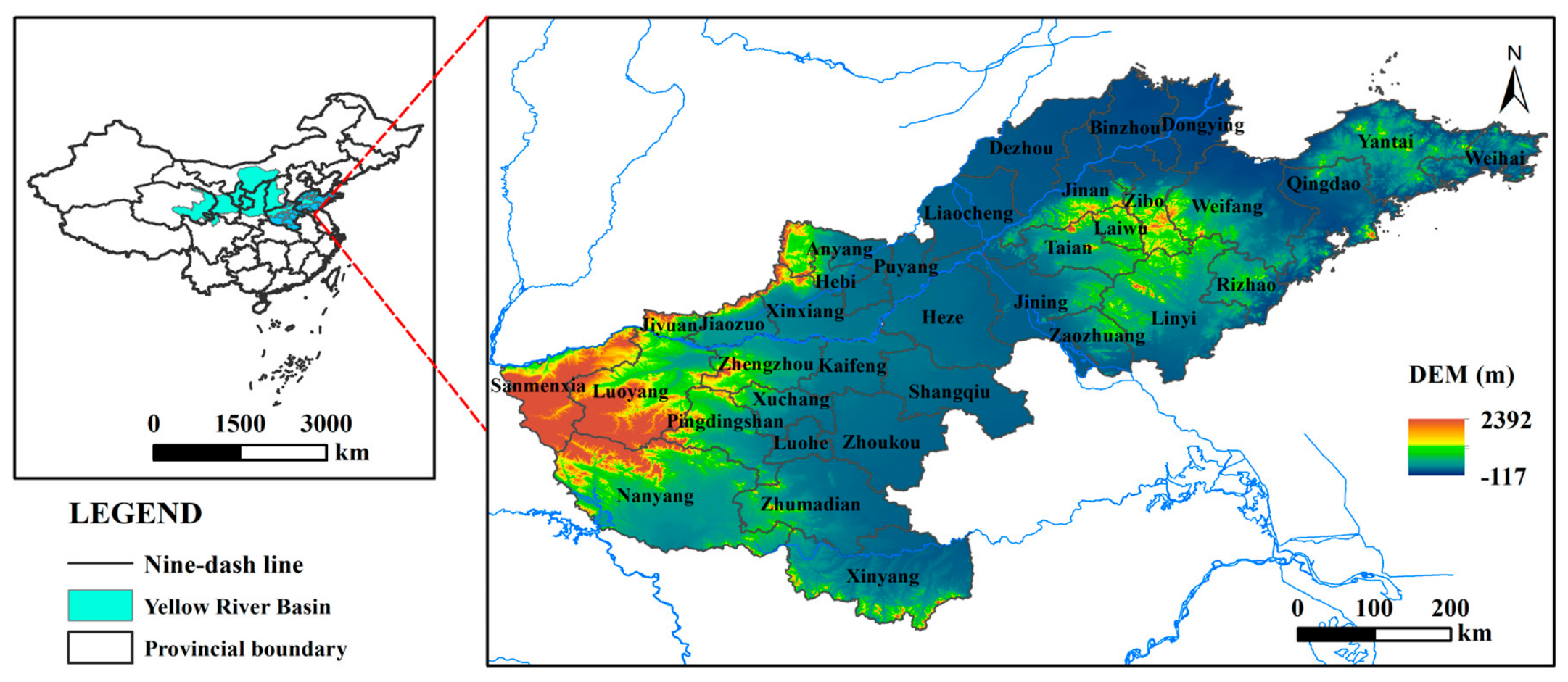
The Yellow River Basin, covering a total area of approximately 7.95 × 10⁵ km2, is situated between 95 °E–119 °E and 32 °N–42 °N. Figure 1 illustrates the geographic location and digital elevation model (DEM) of the lower reaches of the YRB, where Henan and Shandong Provinces are situated in the Huang–Huai–Hai Plain and serve as core administrative regions of this reach. Both provinces exhibit distinct seasonal variations characterized by synchronous rainfall and heat patterns. The average annual temperatures range between 11 °C and 16 °C, while precipitation falls between 700–1200 mm, characterizing a typical warm–temperate monsoon climate [21,22]. Agriculture production has an important position in Henan and Shandong provinces, with the cultivated land accounting for more than 11.44% of the total cultivated land area in China. Considering terrain constraints, irrigated farmland in these two provinces is mainly distributed on cultivated land with slopes below 25°. To meet crop water requirements, it is necessary to divert water from the Yellow River or extract groundwater for irrigation. In addition, there are many irrigation districts in Henan and Shandong provinces, such as Renmin Shengli Canal irrigation district, Zhaokou Yellow River Diversion irrigation district and Weishan irrigation district [23].

2.2. Data and Preprocessing

2.2.1. Remote Sensing Data

MODIS (Moderate-Resolution Imaging Spectroradiometer), a key spaceborne remote sensing instrument developed by NASA (National Aeronautics and Space Administration), has revolutionized Earth observation since its deployment. The MODIS sensor is primarily carried on the Terra (launched 1999) and Aqua (launched 2002) satellites. This multispectral sensor features 36 discrete spectral bands spanning from visible (0.4 μm) to thermal infrared (14.4 μm) wavelengths, enabling comprehensive monitoring of land, ocean, and atmospheric dynamics [19,24]. The MODIS data sensor includes calibrated data products, land data products, ocean data products, and atmospheric data products, with its data undergoing five levels of processing ranging from raw radiometric correction to atmospheric correction and geolocation.
Because of the advantages of high data quality, high update frequency, wide spectral range and easy accessibility, global researchers have widely used MODIS remote sensing products in recent years [25,26,27,28]. In this study, multiple MODIS remote sensing data products were used to estimate the irrigated area of the farmland in the lower reaches of YRB (Including Henan and Shandong Provinces), including MCD12Q1, MOD13Q1, MOD09A1, MOD11A2 and MOD16A2. MCD12Q1 was used for land cover classification and cultivated land extraction; MOD13Q1 provided time-series NDVI data to capture vegetation growth dynamics; MOD09A1 offered surface reflectance for spectral feature analysis; MOD11A2 supplied land surface temperature data to reflect surface thermal conditions; MOD16A2 provided evapotranspiration products for analyzing crop water consumption and irrigation characteristics.
CHIRPS (Climate Hazards Group InfraRed Precipitation with Station data) is a global precipitation dataset developed by the Climate Hazards Group at the University of California, Santa Barbara [29]. CHIRPS provided high-resolution precipitation data on a global scale to support climate change research and disaster risk management. This dataset combines satellite remote sensing data with ground-based meteorological station observation data, significantly improving the accuracy and spatial resolution of precipitation estimation, and has had a profound impact on the fields of climate science and disaster prevention. In this study, CHIRPS daily precipitation data over 2010–2023 for Henan and Shandong Provinces were obtained from the GEE computing platform dataset.
Moreover, the SRTM (Shuttle Radar Topography Mission) digital elevation data were provided by NASA and the National Geospatial Intelligence Agency (NGA), with a resolution of 30 m [30]. In this study, SRTM digital elevation data for Henan and Shandong Provinces were obtained from the GEE computing platform dataset.
The detailed information of MODIS products, CHIRPS dataset and SRTM digital elevation dataset can be found in Table 1. The spatial resolutions of these dataset products were various. To facilitate research, the low-resolution data products were resampled to a uniform spatial resolution of 250 m in this research.

2.2.2. Statistical Data

The statistical dataset of irrigation area for cities in Henan and Shandong Provinces during the period 2008–2022 was obtained from the official statistical yearbooks of the two provinces, which are authoritative and publicly available data sources issued annually by the Provincial Bureau of Statistics of Henan and Shandong, respectively. Specifically, the Henan Provincial Statistical Yearbook (2009–2023) and Shandong Provincial Statistical Yearbook (2009–2023) were used to extract the irrigation area data, covering a total of 33 prefecture-level cities (17 cities in Henan Province and 16 cities in Shandong Province). The irrigation area data included in the dataset mainly refers to the actual area of farmland that received artificial irrigation each year, which is statistically counted by the local agricultural and water conservancy departments.

2.3. Research Framework and Methodology

2.3.1. Research Implementation Procedures

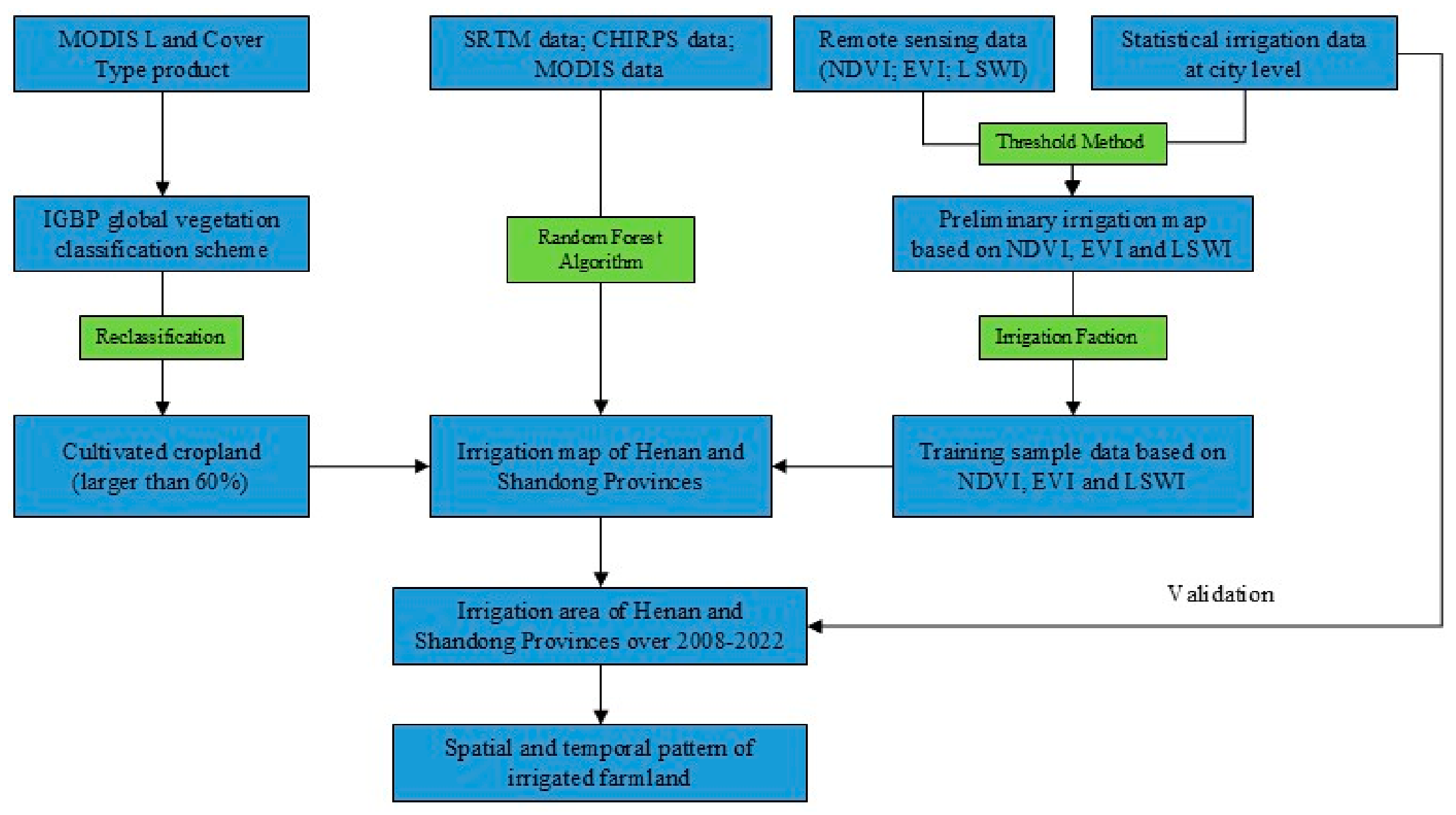
The technical route adopted of this research was shown in Figure 2. Firstly, to eliminate the influence of non-farmland areas, MODIS land cover type dataset was used to obtain the farmland distribution of Henan and Shandong Provinces. Secondly, remote sensing index data (NDVI, EVI, Land Surface Water Index (LSWI)) and city-level statistical irrigation area data based on threshold method were used to generate preliminary irrigation maps in the farmland of Henan and Shandong Provinces. The threshold of NDVI, EVI and LSWI were shown in Figures S1–S3. Based on these preliminary irrigation maps, irrigation scores were assigned to pixels to generate training sample data. Then, vegetation index data, precipitation data, surface temperature, terrain data and terrain slope data (less than 25 degrees) were used as input features, and random forest algorithm was used to predict the irrigated farmland in Henan and Shandong Provinces from 2018 to 2021. Finally, the accuracy of the results is verified using validation samples and statistical data of irrigation area, and the identification results of irrigated farmland in Henan and Shandong Provinces were analyzed. Moreover, the temporal and spatial distribution characteristics of irrigated farmland in Henan and Shandong Provinces were analyzed.

2.3.2. Random Forest Algorithm

The Random Forest (RF) algorithm, proposed by Breiman [31], is a powerful machine learning method for both regression and classification. It not only combines both data prediction and analytical functions but also integrates multiple classification trees or regression trees into a composite model through innovative optimization [32]. Its unique ensemble learning mechanism enables accurate prediction via a majority voting strategy and uses accuracy metrics to evaluate prediction performance quantitatively. As an ensemble algorithm with decision trees as its basic components, each subtree performs data partitioning based on feature variables and ultimately determines the optimal classification scheme through a collective decision-making mechanism. The RF algorithm possesses randomness, high accuracy, and resistance to overfitting, and can handle high-dimensional and multicollinear variables [33]. This method has been widely applied in irrigated farmland identification in recent years [8,9,18,34].
In this research, the RF algorithm was used to conduct classification for irrigated farmland identification in Henan and Shandong Provinces over the past 15 years. The training and validation samples were automatically derived from high-quality farmland masks within the study area, further constrained to slopes ≤ 25° to match the actual distribution of irrigated land in the region. The training and validation samples were automatically derived from high-quality farmland masks within the study area. Based on the MODIS-derived remote sensing indices including EVI, NDVI, and LSWI, typical irrigation and non-irrigation pixels were identified and extracted as sample points. A total of 1000 samples were generated, comprising 500 irrigation samples and 500 non-irrigation samples, which were spatially stratified and uniformly distributed across the study area to ensure representativeness.
These samples were then randomly split into a training set and a validation set at a ratio of 7:3. Specifically, 70% (700 samples) were used to train the RF classifier, which was configured with study-specific parameters: 150 decision trees (ntree), a minimum node size (minLeafPopulation) of 5, and the number of features considered at each split (mtry) set to the square root of the total number of input features. The remaining 30% (300 samples) served as an independent validation set to objectively assess classification accuracy. This transparent and standardized sampling scheme ensures the reliability, repeatability, and interpretability of the model results.

2.3.3. Accuracy Evaluation

To verify the accuracy of the RF algorithm, overall accuracy (OA), producer’s accuracy (PA), user’s accuracy (UA), and Kappa coefficient (Kappa) were used for accuracy assessment in this research. The values of OA, PA, UA, and Kappa range from 0 to 1. The larger OA, PA, UA, and Kappa, the higher the classification accuracy of the RF algorithm. Moreover, these indices can be able to identify errors of the RF algorithm, which can help to reveal misjudgments caused by spectral confusion and environmental interference, thereby improving the reliability and interpretability of irrigation mapping. This error-oriented evaluation strategy has been widely verified in relevant studies. For instance, Al-Kilani et al. [35] adopted a similar approach in drought detection using remote sensing data, which focused on correct identification, false alarms, and missed detections to enhance the credibility. The equations of these four indicators can be found as follows:
O A = T P + T N T P + F P + T N + F N
P A = T P T P + F P
U A = T P T P + F N
K a p p a = O A P e 1 P e
where TP represents the correct identification of irrigated farmland, FP represents the misidentification of irrigated farmland, TN represents the correct identification of non-irrigated farmland, FN represents the misidentification of non-irrigated farmland. R represents the rate of correct identification of irrigated farmland. Pe represents the probability of irrigated farmland being correctly classified under the random classification.

3. Results and Discussion

3.1. Changing Patterns of Land Use Types

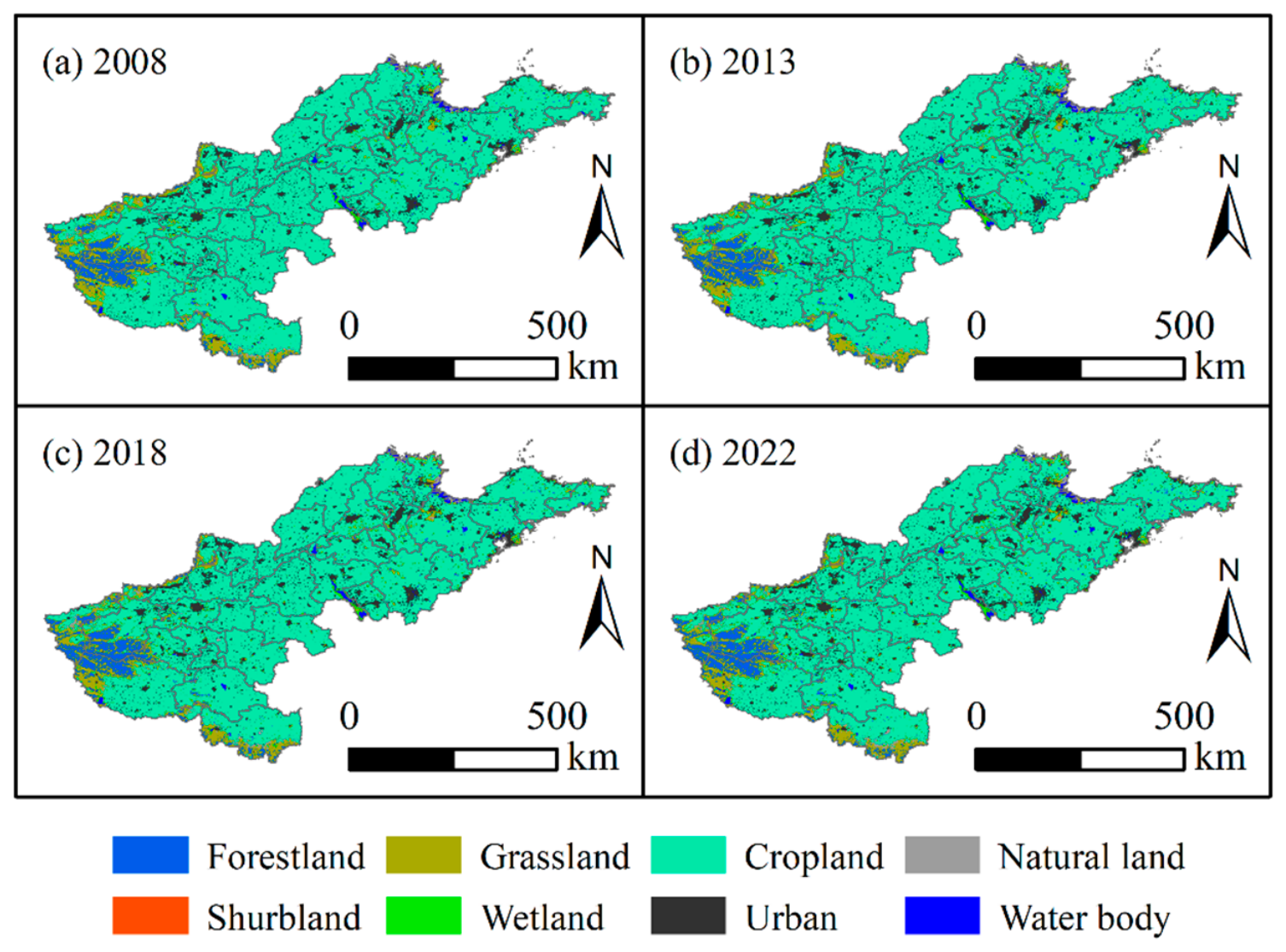
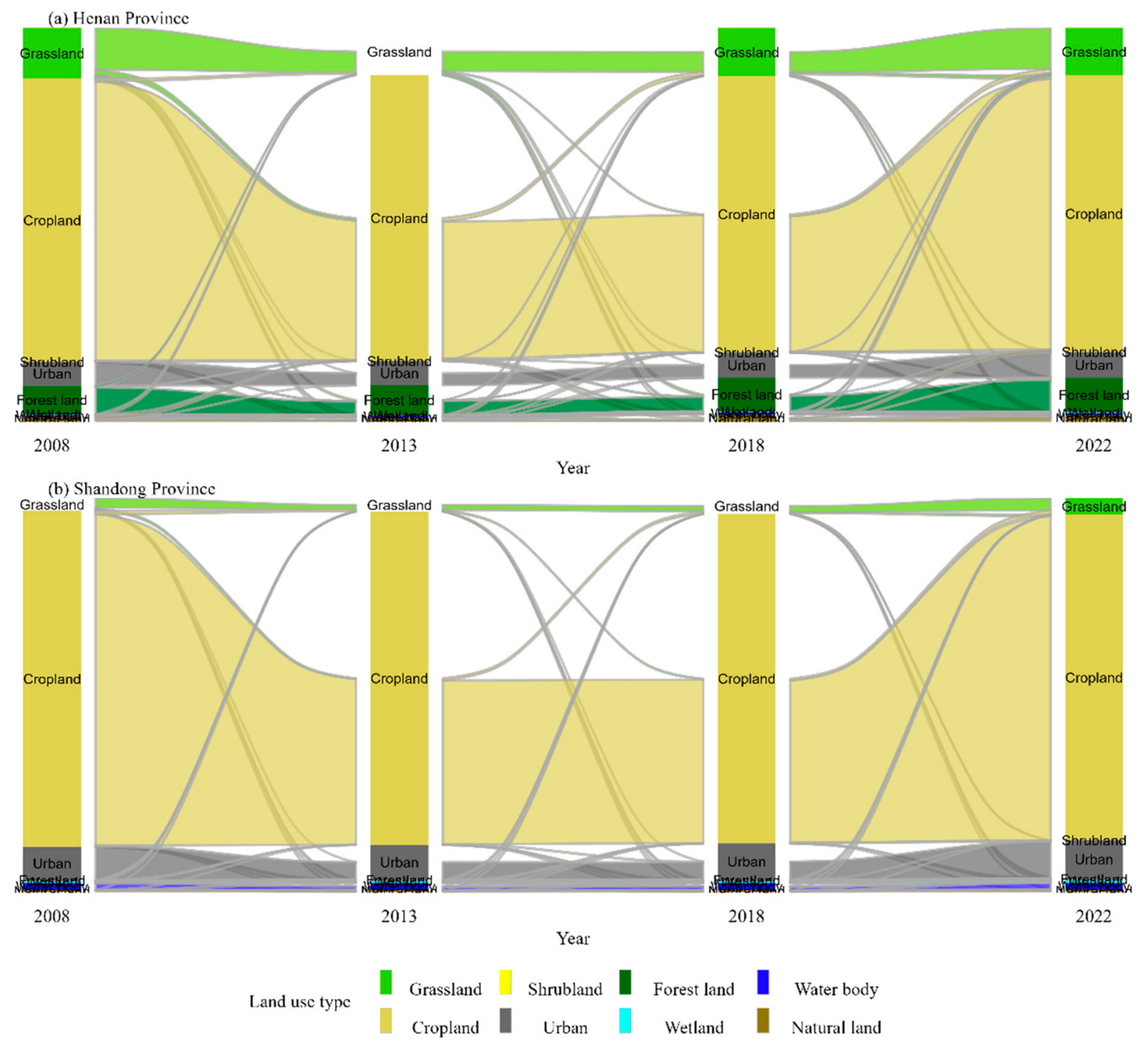
The analysis presented here is based on land use classification maps derived from the MODIS land cover dataset (MCD12Q1, 500 m resolution) processed in this study, as well as official provincial land use statistics. Between 2008 and 2022, the overall land use structure of Henan and Shandong Provinces showed both continuity and transformation. Figure 3 and Figure 4 clearly illustrate the dominant role of cultivated land in both provinces. Cultivated land accounted for the majority of total land use throughout the study period, but subtle shifts reveal important dynamics. In Henan, cultivated land area declined slightly (less than 2% over 15 years), suggesting a general stability supported by farmland protection policies. However, localized decreases were evident in peri-urban regions such as Zhengzhou, Kaifeng, and Luoyang, where rapid urban expansion and infrastructure development converted high-quality farmland into construction land. Conversely, in southern and central Henan, localized increases in cultivated land were observed, largely the result of land consolidation and reclamation projects under national farmland protection programs. Similar processes have been observed in the North China Plain [36], where urban expansion coexists with farmland consolidation and ecological restoration programs.
In Shandong, the change of cultivated land was more pronounced. Over the same 15-year period, cultivated land in Shandong declined by approximately 4.8%, a substantially larger reduction than in Henan. Western Shandong maintained its agricultural base relatively well, but in the eastern coastal zone, cities such as Jinan and Qingdao experienced significant expansion, leading to a decline in farmland. By 2022, construction land in Shandong had expanded by over 15% compared to 2008, with most of the expansion occurring at the expense of farmland and grassland. This reflects the influence of industrial corridors and coastal economic development zones in driving land conversion. Ji et al. [37] has also reached a similar conclusion that the more and more cultivated land has been occupied due to the accelerated urbanization in northern China.
Meanwhile, ecological land categories showed modest but steady gains, as observed in the land use classification results from the MODIS dataset (MCD12Q1) used in this study. Forest and grassland areas expanded in both provinces, consistent with the implementation of national ecological restoration policies such as the Grain-for-Green Program and regional afforestation projects over the past two decades [38]. In Henan, forest cover increased, especially in mountainous areas in the west and south, while in Shandong, afforestation efforts in the Yimeng Mountain region contributed to forest expansion. Water bodies exhibited contrasting dynamics between the two provinces. In Henan, large-scale reservoir expansion and ecological water diversion projects resulted in slight increases in water area of approximately 1.2% over the study period. In contrast, Shandong Province experienced a net decrease in water area of about 0.8%.

3.2. Irrigation Area Prediction Accuracy Evaluation

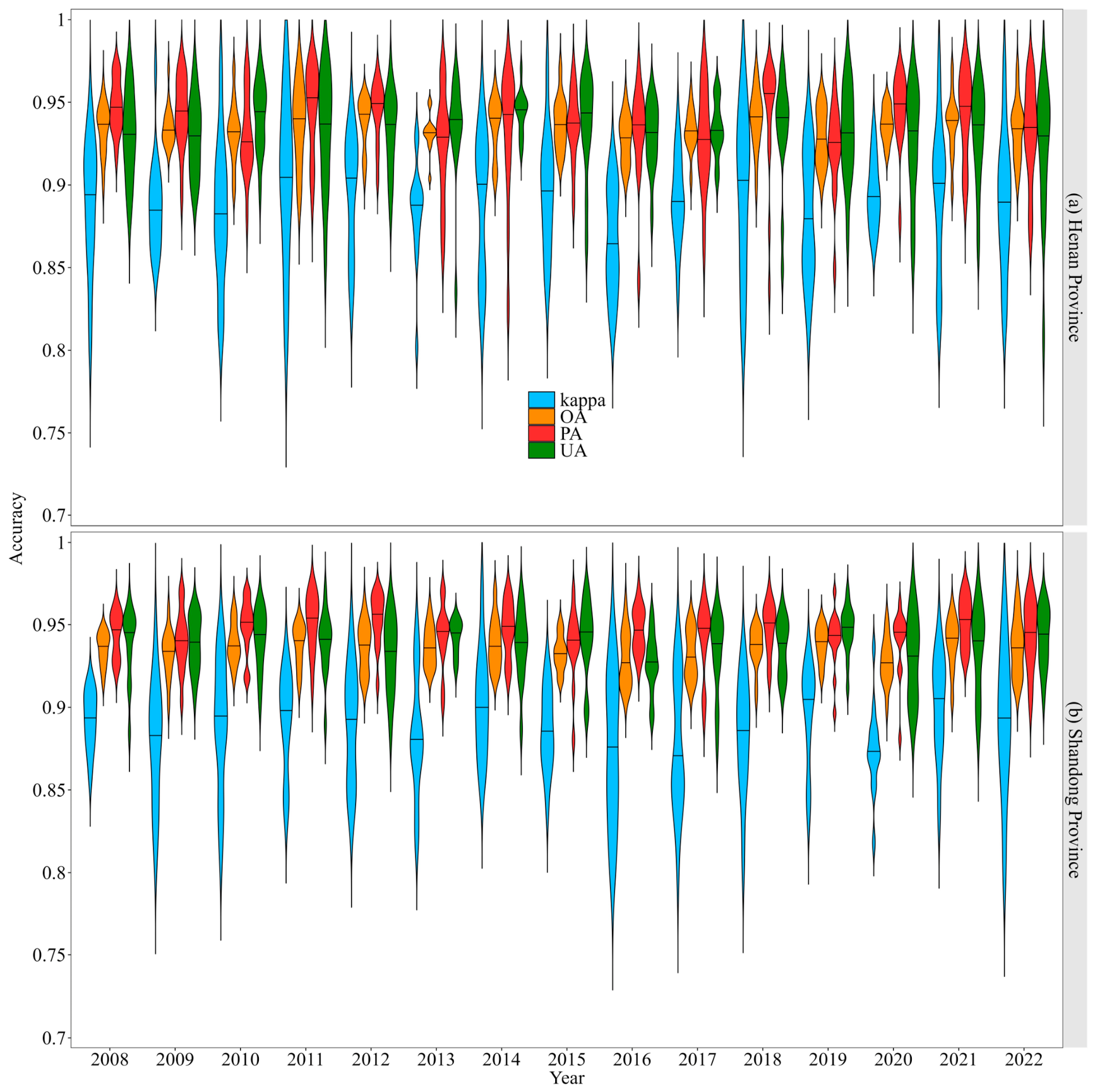
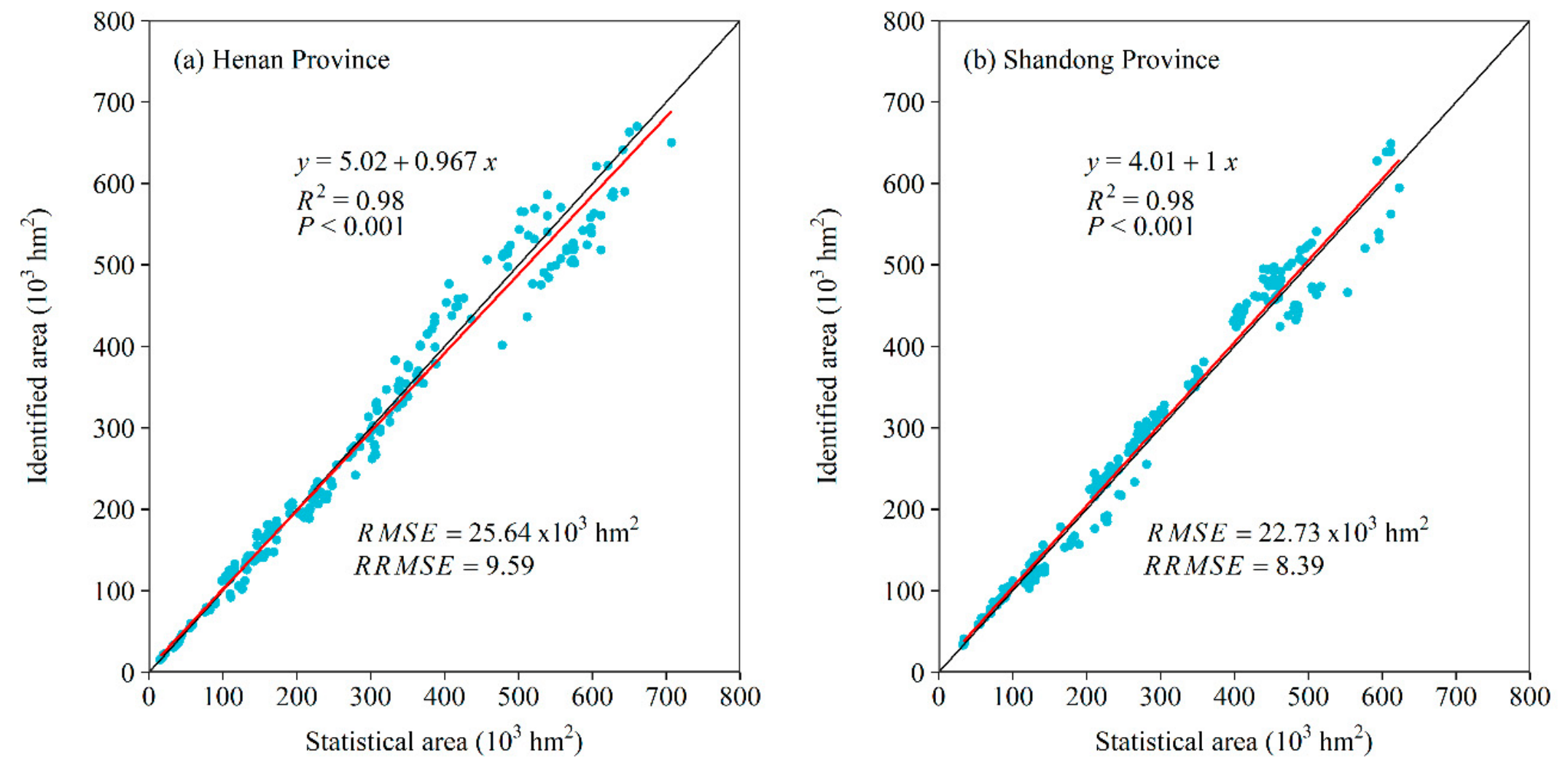
The evaluation of irrigated farmland identification accuracy is a critical component of this study, as it determines the reliability of subsequent spatiotemporal analyses. Figure 5 and Figure 6 provide clear evidence of the Random Forest (RF) algorithm’s performance in Henan and Shandong between 2008 and 2022.
Across the study period, the classification accuracy of the RF algorithm was consistently high over the 15 years. Overall accuracy for identifying irrigated farmland exceeded 85% in most years and surpassed 90% in several years (Figure 5). This demonstrates the ability of RF to discriminate irrigated from non-irrigated fields by leveraging multi-temporal vegetation indices and spectral variability. The model’s overall accuracy stayed above 85% in these years, showing no significant drop in performance. This robustness is attributed to the inclusion of complementary water-related indices (e.g., LSWI) and multi-temporal features, which reduced the model’s sensitivity to short-term vegetation stress (Figure S3). The algorithm performed robustly across both provinces, although Henan showed slightly higher year-to-year variability due to the fragmented nature of farmland in some counties [39].
Validation against city-level statistical irrigation data confirmed the reliability of RF estimates (Figure 6). Regression analysis between RF-derived irrigated area and official statistics yielded strong correlations, with coefficients of determination (R2) consistently greater than 0.9. The regression slopes were close to unity, indicating little systematic bias in the predictions. For example, in 2015, the correlation achieved an R2 of 0.92 and a slope of 0.98, confirming the algorithm’s robustness and predictive accuracy. The narrow residual distribution suggests that the model performs consistently across samples.
Based on the confusion matrix derived from validation samples, the model achieved an average PA of 0.96 and an average UA of 0.95 across all years. These values translate to a false negative rate (1-PA) of approximately 4% and a false positive rate (1-UA) of approximately 5%, indicating that the RF algorithm rarely missed actual irrigated areas or incorrectly classified non-irrigated areas as irrigated. The small proportion of false negatives is mainly attributed to smallholder-managed plots with intermittent irrigation or supplementary watering, which may not coincide with satellite overpass times and thus fail to exhibit the expected spectral signature of irrigation. False positives, on the other hand, were mostly associated with high soil moisture conditions in rainfed fields during wet years, leading to spectral confusion with actual irrigated areas. These quantitative results confirm that the model maintains high reliability in distinguishing irrigated from non-irrigated farmland, with only minor errors that are consistent with the inherent challenges of reconciling ground-reported data with remote-sensing-derived observations.
Nevertheless, some discrepancies emerged in specific counties and years. In certain cases, RF predicted lower irrigated areas than reported statistically. These differences are largely explained by definitional inconsistencies: statistical datasets often record “irrigation-equipped area”, which includes all land with irrigation infrastructure regardless of whether water was actually applied in a given year [40]. RF, in contrast, detects actual irrigation practices. In addition, irrigation practices such as intermittent irrigation or supplementary watering, particularly in smallholder-managed plots, may not coincide with satellite overpass times, leading to underestimation [8,16,18]. The mismatch speaks to the persistent gap between physical ground-truth and the interpretative nature of remote-sensing data.
The accuracy achieved in this study aligns well with other research using RF for irrigation detection. Xiong et al. [41] applied RF in northern China and reported accuracies between 82% and 88%, similar to our findings. Gumma et al. [42] found comparable results in South Asia, with R2 values above 0.85 when comparing remote sensing-derived irrigation with census data. Compared with these cases, the consistently higher R2 values in Henan and Shandong (>0.9) indicate the algorithm’s suitability for relatively homogenous, large-scale agricultural landscapes with established irrigation systems. However, the challenges observed in fragmented areas echo those reported by Weitkamp et al. [43] in sub-Saharan Africa, where irregular irrigation practices and smallholder fragmentation reduced classification accuracy.
This evaluation suggests that integrating remote sensing with ground-based and statistical data is important for improving the robustness of the analysis. While RF provides a robust framework for long-term monitoring, improvements could come from fusing RF with higher-temporal-resolution data sources (e.g., Sentinel-2 or Planet imagery) or incorporating in situ irrigation logs. Moreover, integrating phenological models may further enhance the detection of crop-specific irrigation timing. Overall, the high accuracy achieved demonstrates that RF is a powerful tool for irrigation monitoring in large-scale agricultural systems, providing a solid foundation for subsequent analyses of irrigation dynamics.

3.3. Spatiotemporal Pattern of Irrigated Farmland Changes

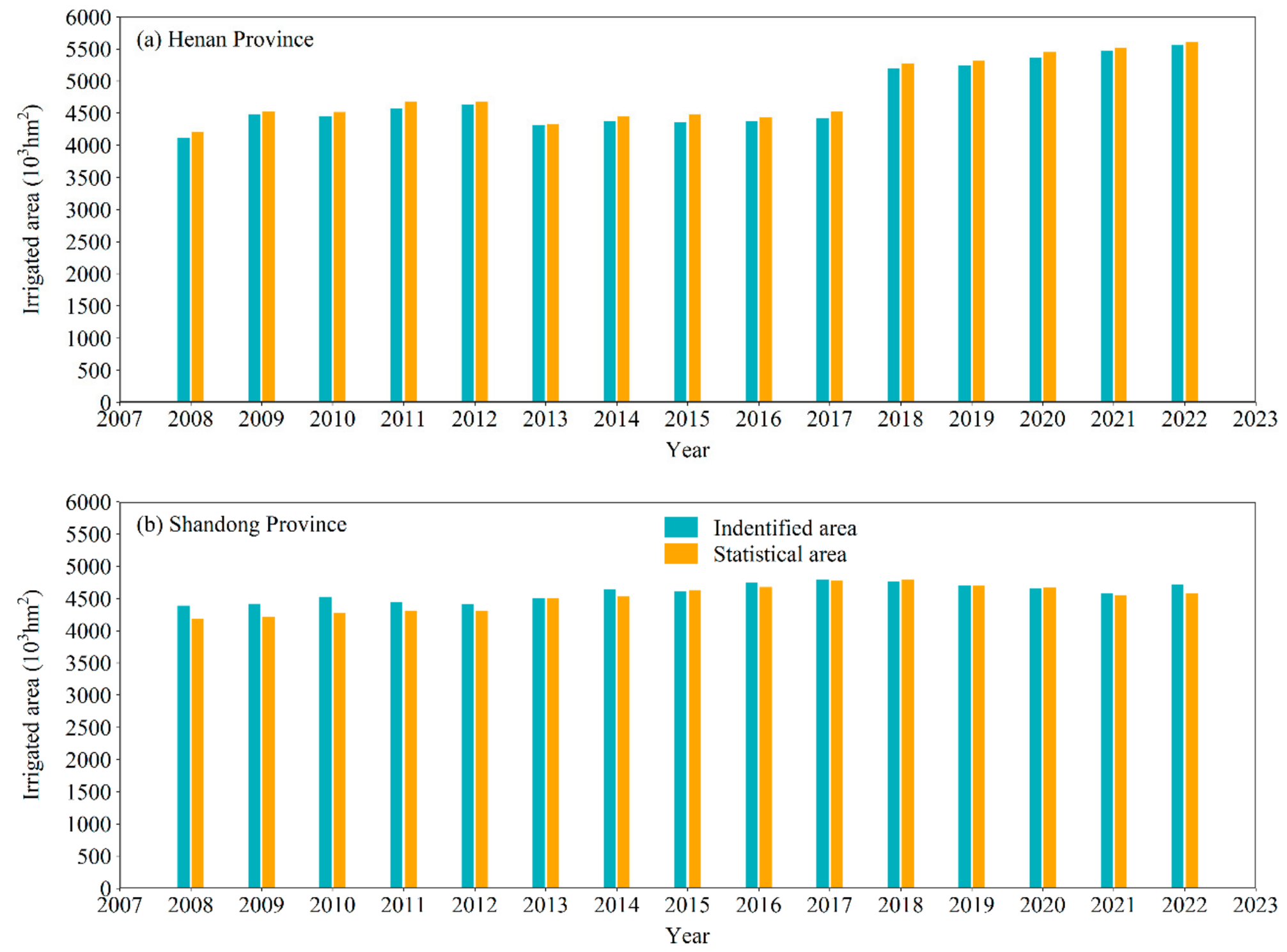
Figure 7 and Figure 8 provide insight into the temporal variability and spatial distribution of irrigated farmland in Henan and Shandong Provinces. Temporally, irrigated farmland in Henan showed significant interannual fluctuations (Figure 7). During drought years, defined by both low annual precipitation (Figure S5) and negative SPEI values (Figure S6), such as 2012 and 2019, irrigated area declined by approximately 8–12% compared with normal years. These reductions reflect limited surface water availability from the Yellow River and groundwater depletion, but they are also influenced by agronomic factors, including crop choice and rotation patterns. For example, in regions dominated by maize–wheat double cropping, irrigation is concentrated in key growth stages rather than applied continuously, while farmers adopting diverse rotations with less water-intensive crops may reduce irrigation frequency during dry years as a risk management strategy. By contrast, in wetter years, characterized by high monthly and annual precipitation (Figures S4 and S5) and positive SPEI values (Figure S6), such as 2020, irrigated areas recovered, demonstrating the direct sensitivity of irrigation to hydrological conditions, alongside adjustments in planting patterns that favor higher water-demanding crops when water supplies are stable. By contrast, irrigated farmland in Shandong was more stable but displayed a gradual downward trend after 2015. Between 2015 and 2022, irrigated area declined by about 5%, coinciding with groundwater depletion and stricter extraction regulations. This highlights the role of institutional water governance in shaping irrigation dynamics in addition to climatic variability and agronomic practices.
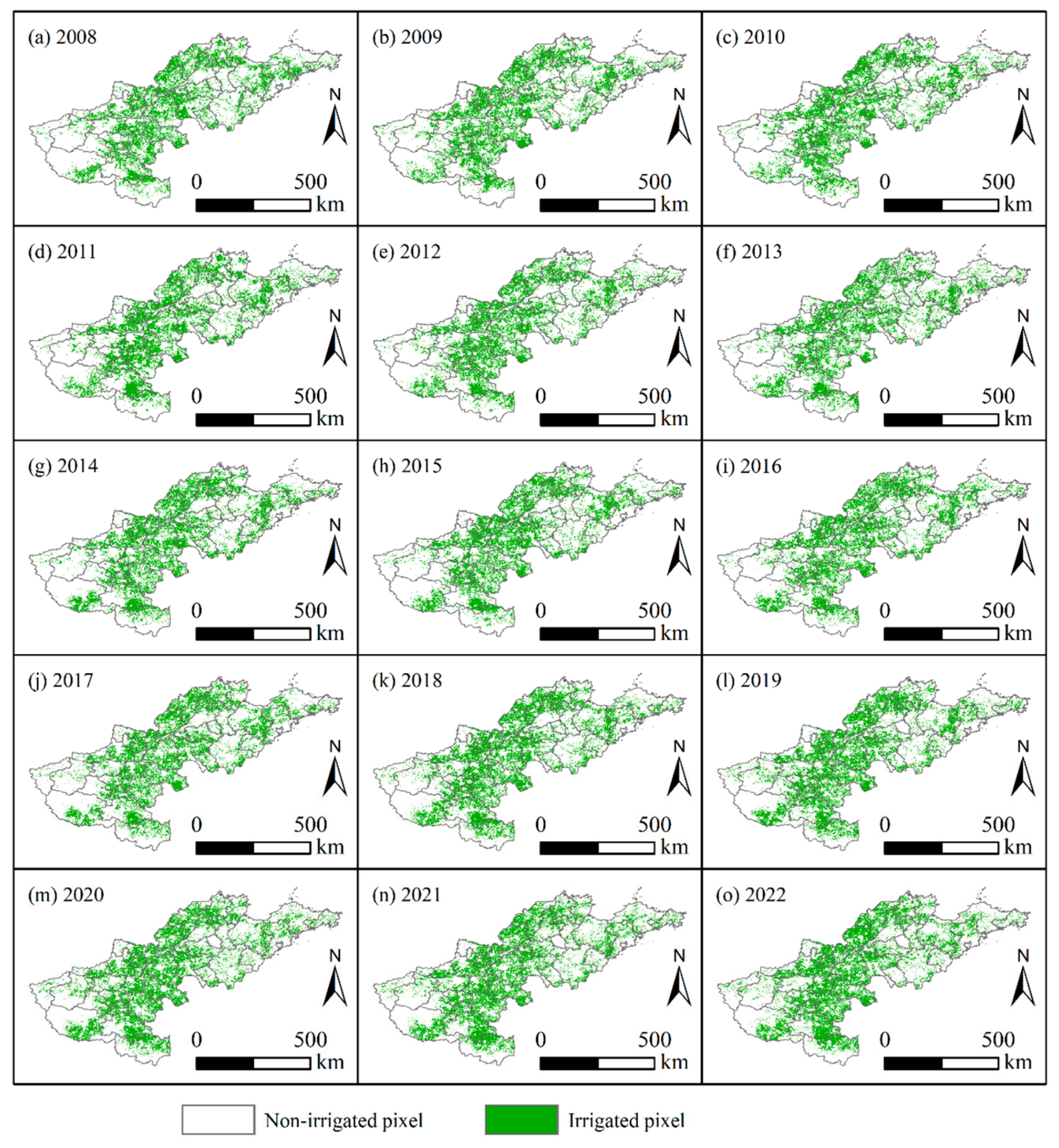
Spatially, irrigated farmland in both provinces was concentrated in fertile plains near water resources, forming a core irrigation belt (Figure 8). In Henan, irrigation density was highest in the Yellow River alluvial plain, while non-irrigated farmland dominated the western and southern uplands. In Shandong, irrigation was concentrated in central and western plains, with density declining toward the coastal and hilly peripheries. Overall, the spatial distribution pattern characterized by concentration along rivers has formed. Water accessibility and infrastructure availability clearly influenced the spatial distribution of irrigated farmland [18].
The spatiotemporal dynamics observed in this study were consistent with evidence from other regions. Liu et al. [44] reported that irrigation variability across the North China Plain was closely associated with both precipitation anomalies and groundwater availability, highlighting the sensitivity of agricultural water use to hydrological conditions. Similarly, Siebert et al. [45] demonstrated at the global scale that irrigated areas expanded or contracted in direct response to drought and wet periods, a pattern that resonates with the interannual dynamics observed in Henan. The downward trend observed in Shandong is consistent with studies on the North China Plain [46], where groundwater depletion has necessitated restrictions on irrigation expansion. Similar patterns have been observed globally: in the United States High Plains Aquifer, over-extraction of groundwater has led to long-term declines in irrigated extents despite persistent agricultural demand [47]. The spatial clustering of irrigation along river corridors is also a globally observed phenomenon. Ambika et al. [48] reported irrigation concentration along the Ganges River in India, while peripheral regions remained predominantly rainfed.
These comparative findings highlight both the universality and specificity of irrigation dynamics. Universally, irrigation extent is constrained by hydrological variability and water governance, yielding convergent patterns across diverse regions. For example, Döll et al. [49] demonstrated that across multiple regions, the extent of irrigation is closely linked to water availability, with droughts leading to significant reductions in irrigated areas. The specificity lies in the details of local contexts: Henan’s high interannual variability reflects its dual reliance on Yellow River water and groundwater, as noted by Cai et al. [50], while Shandong’s gradual decline attests to the consequences of groundwater over-extraction and policy intervention, as observed by Wang et al. [51]. Their study analyzed the comprehensive treatment of over-exploited groundwater in Shandong province, forecasting water demand, supply, and savings, highlighting the challenges and policy responses in the region.
The findings carry substantial implications for agricultural sustainability governance. Studies have shown that the cultivated land area in Henan and Shandong has remained largely stable over the past 15 years. Groundwater extraction has been subject to strict regulation, while a series of water saving policies have been implemented. As a result, the expansion of irrigated farmland in the two provinces has slowed markedly and gradually leveled off. Moreover, traditional flood irrigation and canal irrigation remain the dominant irrigation practices across most plain areas of Henan and Shandong provinces. These conventional methods are characterized by low water use efficiency and high evapotranspiration loss, which pose challenges to regional water conservation and sustainable agricultural development. Accordingly, future advancement necessitates a strategic pivot toward efficiency enhancement. Pivotal strategies encompass the deployment of water-efficient irrigation technologies (e.g., drip and sprinkler systems), precision agricultural management, and crop portfolio optimization aligned with regional water endowments.

4. Conclusions

This study investigated land use change, irrigation mapping accuracy, and the spatiotemporal dynamics of irrigated farmland in Henan and Shandong Provinces from 2008 to 2022. The results revealed that cultivated land remained the dominant land use type, largely stable in total area due to farmland protection policies, but subject to localized losses in peri-urban zones as a consequence of rapid urban expansion. Simultaneously, construction land increased markedly, particularly in Shandong, where it grew by more than 15% during the study period, while ecological land categories such as forest and grassland expanded under national restoration programs. The RF algorithm performed strongly in irrigation mapping, achieving overall classification accuracy above 85% in most years and regression with statistical data yielding R2 values consistently greater than 0.9, underscoring its robustness for long-term monitoring. Nevertheless, discrepancies between RF predictions and statistical irrigation area were noted, especially in fragmented smallholder landscapes, reflecting definitional differences and the irregular timing of irrigation. The spatiotemporal analysis showed that irrigated farmland in Henan was highly sensitive to hydrological variability, declining by 8–12% in drought years such as 2012 and 2019, while recovering in wetter years. In contrast, Shandong exhibited relative stability but a gradual decline of approximately 5% since 2015, reflecting groundwater depletion and stricter extraction controls. Moreover, irrigated farmland has shown no meaningful net growth since 2015. Henan’s irrigated area fluctuated within a narrow range around a stable baseline, while Shandong experienced a gradual decline of approximately 5%. In addition, groundwater depletion and stricter extraction controls in Shandong, together with the high drought sensitivity in Henan, could partly reflect the constraints on further potential expansion. Future strategies should therefore emphasize efficiency improvement rather than further expansion, prioritizing precision irrigation, adoption of water saving technologies, crop structural adjustments, and equity in water allocation. These measures will be essential to safeguard food security and ensure sustainable agricultural development under conditions of climate variability and water scarcity.

Supplementary Materials

The following supporting information can be downloaded at: https://www.mdpi.com/article/10.3390/w18101233/s1, Figure S1: The threshold of NDVI for the preliminary irrigation map of Henan and Shandong Provinces at the city level. Figure S2. The threshold of EVI for the preliminary irrigation map of Henan and Shandong Provinces at the city level. Figure S3. The threshold of LSWI for the preliminary irrigation map of Henan and Shandong Provinces at the city level. Figure S4. Temporal variations of monthly precipitation in Henan and Shandong Provinces during 2005–2020. Figure S5. Temporal variations of annual precipitation in Henan and Shandong Provinces during 2005–2020. Figure S6. Temporal variations of Standardized Precipitation Evapotranspiration Index (SPEI) at 1-month, 3-month and 6-month timescales in Henan and Shandong Provinces during 2005–2020.

Author Contributions

Y.F.: Conceptualization, Methodology, Data curation, Formal analysis, Writing—original draft. H.Y.: Data curation, Formal analysis, Validation, Visualization. X.C.: Resources, Investigation, Writing—review and editing. S.J.: Resources, Investigation, Methodology support. N.J.: Validation, Data preprocessing, Writing—review and editing. Y.D.: Formal analysis, Visualization, Software application. X.G.: Validation, Statistical analysis, Writing—review and editing. S.W.: Conceptualization, Supervision, Funding acquisition, Project administration, Writing—review and editing. All authors have read and agreed to the published version of the manuscript.

Funding

This study was financially supported by the National Natural Science Foundation of China (no. 52309066), the Key Science and Technology Project of Henan Province (no. 262102320234), and the Key Scientific Research Project of Colleges and Universities in Henan Province (no. 25A570004).

Data Availability Statement

The original contributions presented in the study are included in the article; further inquiries can be directed to the corresponding author.

Conflicts of Interest

Author Shijie Jin is employed by China National Nonferrous Metals Industry Co., Ltd. Author Na Jiao is employed by Henan Water Investment Capital Management Co., Ltd. The remaining authors declare that the research was conducted in the absence of any commercial or financial relationships that could be construed as potential conflicts of interest.

References

  1. Food and Agriculture Organization (FAO). World Food and Agriculture—Statistical Yearbook 2023; FAO: Rome, Italy, 2023; ISBN 978-92-5-138262-2. [Google Scholar]
  2. Li, X.; Wang, P.; Mu, J.; Mu, D.; Sun, C.; Li, Z.; Ren, D.; Huo, Z.; Xu, X. Unraveling long-term water consumption changes and agro-ecological responses to agricultural practices in arid irrigation districts of the upper Yellow River basin (2000–2021). J. Hydrol. 2025, 658, 133222. [Google Scholar] [CrossRef]
  3. Zhang, W.; Clark, R.; Zhou, T.; Li, L.; Li, C.; Rivera, J.; Zhang, L.; Gui, K.; Zhang, T.; Li, L.; et al. 2023: Weather and climate extremes hitting the globe with emerging features. Adv. Atmos. Sci. 2024, 41, 1001–1016. [Google Scholar] [CrossRef]
  4. Xu, H.; Yang, R.; Song, J. Water rights reform and water-saving irrigation: Evidence from China. Water Sci. Technol. 2023, 88, 2779–2792. [Google Scholar] [CrossRef] [PubMed]
  5. Schaldach, R.; Koch, J.; Aus Der Beek, T.; Kynast, E.; Flörke, M. Current and future irrigation water requirements in pan-Europe: An integrated analysis of socio-economic and climate scenarios. Glob. Planet. Change 2012, 94–95, 33–45. [Google Scholar] [CrossRef]
  6. Zhou, X.; Zhang, Y.; Sheng, Z.; Manevski, K.; Andersen, M.N.; Han, S.; Li, H.; Yang, Y. Did water-saving irrigation protect water resources over the past 40 years? A global analysis based on water accounting framework. Agric. Water Manag. 2021, 249, 106793. [Google Scholar] [CrossRef]
  7. Deines, J.M.; Kendall, A.D.; Hyndman, D.W. Annual irrigation dynamics in the U.S. Northern High Plains derived from Landsat satellite data. Geophys. Res. Lett. 2017, 44, 9350–9360. [Google Scholar] [CrossRef]
  8. Zhu, X.; Zhu, W.; Zhang, J.; Pan, Y. Mapping irrigated areas in China from remote sensing and statistical data. IEEE J. Sel. Top. Appl. Earth Obs. Remote Sens. 2014, 7, 4490–4504. [Google Scholar] [CrossRef]
  9. Zhang, C.; Dong, J.; Xie, Y.; Zhang, X.; Ge, Q. Mapping irrigated croplands in China using a synergetic training sample generating method, machine learning classifier, and Google Earth Engine. Int. J. Appl. Earth Obs. Geoinf. 2022, 112, 102888. [Google Scholar] [CrossRef]
  10. Al-Bakri, J.T.; Aljarrah, A.; Al-Kilani, M.R. Modeling climate change impacts on crop water requirement and yield under irrigated and rainfed conditions in Jordan’s Mediterranean Highlands. Potato Res. 2026, 69, 56. [Google Scholar] [CrossRef]
  11. Thenkabail, P.S.; Biradar, C.M.; Noojipady, P.; Dheeravath, V.; Li, Y.; Velpuri, M.; Gumma, M.; Gangalakunta, O.R.P.; Turral, H.; Cai, X.; et al. Global irrigated area map (GIAM), derived from remote sensing, for the end of the last millennium. Int. J. Remote Sens. 2009, 30, 3679–3733. [Google Scholar] [CrossRef]
  12. Xie, Y.; Lark, T.J.; Brown, J.F.; Gibbs, H.K. Mapping irrigated cropland extent across the conterminous United States at 30 m resolution using a semi-automatic training approach on Google Earth Engine. ISPRS J. Photogramm. Remote Sens. 2019, 155, 136–149. [Google Scholar] [CrossRef]
  13. Hu, Y.; Li, H.; Wang, W.; Li, Q. Application of remote sensing in monitoring the soil moisture of the irrigation area in the lower Yellow River coastal area. J. Coast. Res. 2019, 94, 96. [Google Scholar] [CrossRef]
  14. Ozdogan, M.; Yang, Y.; Allez, G.; Cervantes, C. Remote sensing of irrigated agriculture: Opportunities and challenges. Remote Sens. 2010, 2, 2274–2304. [Google Scholar] [CrossRef]
  15. Zhang, Z.; Hörmann, G.; Huang, J.; Fohrer, N. A random forest-based CA-Markov model to examine the dynamics of land use/cover change aided with remote sensing and GIS. Remote Sens. 2023, 15, 2128. [Google Scholar] [CrossRef]
  16. Deines, J.M.; Kendall, A.D.; Crowley, M.A.; Rapp, J.; Cardille, J.A.; Hyndman, D.W. Mapping three decades of annual irrigation across the US High Plains Aquifer using Landsat and Google Earth Engine. Remote Sens. Environ. 2019, 233, 111400. [Google Scholar] [CrossRef]
  17. Gorelick, N.; Hancher, M.; Dixon, M.; Ilyushchenko, S.; Thau, D.; Moore, R. Google Earth Engine: Planetary-scale geospatial analysis for everyone. Remote Sens. Environ. 2017, 202, 18–27. [Google Scholar] [CrossRef]
  18. Zhang, C.; Dong, J.; Ge, Q. IrriMap_CN: Annual irrigation maps across China in 2000–2019 based on satellite observations, environmental variables, and machine learning. Remote Sens. Environ. 2022, 280, 113184. [Google Scholar] [CrossRef]
  19. Pervez, M.S.; Brown, J.F. Mapping irrigated lands at 250-m scale by merging MODIS data and national agricultural statistics. Remote Sens. 2010, 2, 2388–2412. [Google Scholar] [CrossRef]
  20. Yu, L.; Xie, H.; Xu, Y.; Li, Q.; Jiang, Y.; Tao, H.; Aihemaiti, M. Identification and monitoring of irrigated areas in arid areas based on Sentinel-2 time-series data and a machine learning algorithm. Agriculture 2024, 14, 1693. [Google Scholar] [CrossRef]
  21. Hong, S.; Lou, Y.; Chen, X.; Huang, Q.; Yang, Q.; Zhang, X.; Li, H.; Huang, G. Identification and analysis of long-term land use and planting structure dynamics in the lower Yellow River basin. Remote Sens. 2024, 16, 2274. [Google Scholar] [CrossRef]
  22. Yin, L.; Feng, X.; Fu, B.; Wang, S.; Wang, X.; Chen, Y.; Tao, F.; Hu, J. A coupled human-natural system analysis of water yield in the Yellow River basin, China. Sci. Total Environ. 2021, 762, 143141. [Google Scholar] [CrossRef] [PubMed]
  23. Fan, X.; Qin, J.; Lv, M.; Jiang, M. An evaluation system of the modernization level of irrigation districts with an analysis of obstacle factors: A case study for North China. Agronomy 2024, 14, 538. [Google Scholar] [CrossRef]
  24. Hassan, Q.K.; Bourque, C.P.-A.; Meng, F.-R.; Cox, R.M. A wetness index using terrain-corrected surface temperature and normalized difference vegetation index derived from standard MODIS products: An evaluation of its use in a humid forest-dominated region of eastern Canada. Sensors 2007, 7, 2028–2048. [Google Scholar] [CrossRef] [PubMed]
  25. Wardlow, B.D.; Egbert, S.L. Large-area crop mapping using time-series MODIS 250 m NDVI data: An assessment for the U.S. Central Great Plains. Remote Sens. Environ. 2008, 112, 1096–1116. [Google Scholar] [CrossRef]
  26. Xu, C.; Zhang, X.; Zhang, J.; Chen, Y.; Yami, T.L.; Hong, Y. Estimation of crop water requirement based on planting structure extraction from multi-temporal MODIS EVI. Water Resour. Manag. 2021, 35, 2231–2247. [Google Scholar] [CrossRef]
  27. Guindin-Garcia, N.; Gitelson, A.A.; Arkebauer, T.J.; Shanahan, J.; Weiss, A. An evaluation of MODIS 8- and 16-day composite products for monitoring maize green leaf area index. Agric. For. Meteorol. 2012, 161, 15–25. [Google Scholar] [CrossRef]
  28. Mu, Q.; Zhao, M.; Running, S.W. Improvements to a MODIS global terrestrial evapotranspiration algorithm. Remote Sens. Environ. 2011, 115, 1781–1800. [Google Scholar] [CrossRef]
  29. Funk, C.; Peterson, P.; Landsfeld, M.; Pedreros, D.; Verdin, J.; Shukla, S.; Husak, G.; Rowland, J.; Harrison, L.; Hoell, A.; et al. The climate hazards infrared precipitation with stations—A new environmental record for monitoring extremes. Sci. Data 2015, 2, 150066. [Google Scholar] [CrossRef]
  30. Farr, T.G.; Rosen, P.A.; Caro, E.; Crippen, R.; Duren, R.; Hensley, S.; Kobrick, M.; Paller, M.; Rodriguez, E.; Roth, L.; et al. The Shuttle Radar Topography Mission. Rev. Geophys. 2007, 45, 2005RG000183. [Google Scholar] [CrossRef]
  31. Breiman, L. Random forests. Mach. Learn. 2001, 45, 5–32. [Google Scholar] [CrossRef]
  32. Ishwaran, H.; Malley, J.D. Synthetic learning machines. BioData Min. 2014, 7, 28. [Google Scholar] [CrossRef]
  33. Hao, P.; Di, L.; Guo, L. Estimation of crop evapotranspiration from MODIS data by combining random forest and trapezoidal models. Agric. Water Manag. 2022, 259, 107249. [Google Scholar] [CrossRef]
  34. Sun, Y.T.; Yu, Y.N.; Ge, B.Y.; Zhang, J.H.; Bai, Y.; Wu, X.F.; Yang, S.S.; Zhang, S. Integration of remote sensing and machine learning for identifying irrigated farmland in Shandong Province of China using optimized training samples. Trans. Chin. Soc. Agric. Eng. 2025, 41, 154–164. [Google Scholar] [CrossRef]
  35. Al-Kilani, M.R.; Rahbeh, M.; Al-Bakri, J.; Tadesse, T.; Knutson, C. Evaluation of remotely sensed precipitation estimates from the NASA POWER project for drought detection over Jordan. Earth Syst. Environ. 2021, 5, 561–573. [Google Scholar] [CrossRef]
  36. Zhang, Y.; Qi, Y.; Shen, Y.; Wang, H.; Pan, X. Mapping the agricultural land use of the North China Plain in 2002 and 2012. J. Geogr. Sci. 2019, 29, 909–921. [Google Scholar] [CrossRef]
  37. Ji, Q.; Liang, W.; Fu, B.; Zhang, W.; Yan, J.; Lü, Y.; Yue, C.; Jin, Z.; Lan, Z.; Li, S.; et al. Mapping land use/cover dynamics of the Yellow River basin from 1986 to 2018 supported by Google Earth Engine. Remote Sens. 2021, 13, 1299. [Google Scholar] [CrossRef]
  38. Li, B.V.; Wu, S.; Hua, F.; Mi, X. The past and future of ecosystem restoration in China. Curr. Biol. 2024, 34, R379–R387. [Google Scholar] [CrossRef]
  39. Liu, Y.; Long, H. Land use transitions and their dynamic mechanism: The case of the Huang-Huai-Hai Plain. J. Geogr. Sci. 2016, 26, 515–530. [Google Scholar] [CrossRef]
  40. Chen, X.; Huang, Q.; Xiong, Y.; Yang, Q.; Li, H.; Hou, Z.; Huang, G. Tracking the spatio-temporal change of the main food crop planting structure in the Yellow River basin over 2001–2020. Comput. Electron. Agric. 2023, 212, 108102. [Google Scholar] [CrossRef]
  41. Li, L.; Liu, K.; Wang, S.; Li, H.; Bo, Y.; Li, X. Mapping irrigated cropland at 30 m spatial resolution in northern China over the past three decades. GISci. Remote Sens. 2025, 62, 2563394. [Google Scholar] [CrossRef]
  42. Manjunath, K.R.; More, R.S.; Jain, N.K.; Panigrahy, S.; Parihar, J.S. Mapping of rice-cropping pattern and cultural type using remote-sensing and ancillary data: A case study for South and Southeast Asian countries. Int. J. Remote Sens. 2015, 36, 6008–6030. [Google Scholar] [CrossRef]
  43. Weitkamp, T.; Jan Veldwisch, G.; Karimi, P.; De Fraiture, C. Mapping irrigated agriculture in fragmented landscapes of sub-Saharan Africa: An examination of algorithm and composite length effectiveness. Int. J. Appl. Earth Obs. Geoinf. 2023, 122, 103418. [Google Scholar] [CrossRef]
  44. Liu, J.; Yang, H.; Gosling, S.N.; Kummu, M.; Flörke, M.; Pfister, S.; Hanasaki, N.; Wada, Y.; Zhang, X.; Zheng, C.; et al. Water scarcity assessments in the past, present, and future. Earth’s Future 2017, 5, 545–559. [Google Scholar] [CrossRef]
  45. Siebert, S.; Burke, J.; Faures, J.M.; Frenken, K.; Hoogeveen, J.; Döll, P.; Portmann, F.T. Groundwater use for irrigation—A global inventory. Hydrol. Earth Syst. Sci. 2010, 14, 1863–1880. [Google Scholar] [CrossRef]
  46. Du, J.; Laghari, Y.; Wei, Y.-C.; Wu, L.; He, A.-L.; Liu, G.-Y.; Yang, H.-H.; Guo, Z.-Y.; Leghari, S.J. Groundwater depletion and degradation in the North China Plain: Challenges and mitigation options. Water 2024, 16, 354. [Google Scholar] [CrossRef]
  47. Haacker, E.M.K.; Kendall, A.D.; Hyndman, D.W. Water level declines in the High Plains Aquifer: Predevelopment to resource senescence. Groundwater 2016, 54, 231–242. [Google Scholar] [CrossRef]
  48. Ambika, A.K.; Wardlow, B.; Mishra, V. Remotely sensed high resolution irrigated area mapping in India for 2000 to 2015. Sci. Data 2016, 3, 160118. [Google Scholar] [CrossRef]
  49. Döll, P.; Kaspar, F.; Lehner, B. A global hydrological model for deriving water availability indicators: Model tuning and validation. J. Hydrol. 2003, 270, 105–134. [Google Scholar] [CrossRef]
  50. Cai, P.; Li, R.; Guo, J.; Xiao, Z.; Fu, H.; Guo, T.; Wang, T.; Zhang, X.; Song, X. Spatiotemporal dynamics of groundwater in Henan Province, Central China and their driving factors. Ecol. Indic. 2024, 166, 112372. [Google Scholar] [CrossRef]
  51. Wang, K.; Chen, H.; Fu, S.; Li, F.; Wu, Z.; Xu, D. Analysis of exploitation control in typical groundwater over-exploited area in North China Plain. Hydrol. Sci. J. 2021, 66, 851–861. [Google Scholar] [CrossRef]
Figure 1. Geographic location and the digital elevation model (DEM) in the lower reaches of the Yellow River Basin.
Water 18 01233 g001
Figure 2. Workflow of this study.
Water 18 01233 g002
Figure 3. The spatial distribution of land use types from 2008 to 2022 in Henan and Shandong Provinces.
Water 18 01233 g003
Figure 4. The variation in land use type from 2008 to 2022 of Henan and Shandong Provinces.
Water 18 01233 g004
Figure 5. Identification accuracy of irrigated farmland by RF algorithm of Henan and Shandong Provinces from 2008 to 2022.
Water 18 01233 g005
Figure 6. Comparison of the irrigated area identified by RF algorithm and statistical irrigated area at city level.
Water 18 01233 g006
Figure 7. The inter-annual variations of irrigated area in provinces of the lower reaches of the Yellow River Basin (Henan and Shandong Provinces) from 2008 to 2022.
Water 18 01233 g007
Figure 8. The spatial distribution of irrigated and non-irrigated pixel cultivated land in provinces of the lower reaches of the Yellow River Basin (Henan and Shandong Provinces) from 2008 to 2022.
Water 18 01233 g008
Table 1. Detail information of MODIS products, CHIRPS dataset and SRTM digital elevation dataset. All of these were obtained in the GEE computing platform, used in this research.
Product NameType of ProductParameterResolutionStart TimeOther
Information
Spatial Resolution (m)Temporal Resolution (Day)
MCD12Q1Land Data Product-500-2001Annual IGBP classification
MOD13Q1Land Data ProductVegetation Index250162000Including Normalized Difference Vegetation Index (NDVI) and Enhanced Vegetation Index (EVI)
MOD09A1Land Data ProductSurface Spectral Reflectance50082000Including seven reflectance bands
MOD11A2Land Data ProductLand Surface Temperature100082002-
MOD16A2Land Data ProductTotal potential evapotranspiration50082001Including total evapotranspiration and total potential evapotranspiration
CHIRPS-Precipitation556611981-
SRTM digital elevationSRTM V3 ProductDigital Elevation30-2000-
Disclaimer/Publisher’s Note: The statements, opinions and data contained in all publications are solely those of the individual author(s) and contributor(s) and not of MDPI and/or the editor(s). MDPI and/or the editor(s) disclaim responsibility for any injury to people or property resulting from any ideas, methods, instructions or products referred to in the content.