Article

A Feature Fusion Method for Pump Unit Fault Signals Based on Composite Index-Optimized HHO-VMD and SDP


School of Electrical and Power Engineering, Hohai University, Nanjing 211100, China
*
Author to whom correspondence should be addressed.
Water 2026, 18(12), 1456; https://doi.org/10.3390/w18121456 (registering DOI)
Submission received: 11 May 2026 / Revised: 6 June 2026 / Accepted: 9 June 2026 / Published: 12 June 2026
(This article belongs to the Section Hydraulics and Hydrodynamics)

Abstract

Background: Pump unit vibration signals are typically characterized by non-stationarity and nonlinearity, which makes direct extraction of fault-related information from raw one-dimensional signals difficult, especially under small-sample conditions. Methods: To address this issue, a fault diagnosis method is proposed based on Harris Hawks Optimization for Variational Mode Decomposition, composite-index selection, Symmetric Dot Pattern representation, and deep fusion classification. First, the minimum envelope entropy is used as the fitness function, and HHO is employed to optimize VMD parameters for better decomposition. Then, a composite index CI is constructed to rank and select representative modes for reconstruction. The reconstructed modal signals are mapped into two-dimensional images by SDP, and the representation parameters are optimized using SSIM to enhance structural differences among fault states. Results: Experimental results on the bearing dataset and the pump unit fault dataset show that the proposed method outperforms GADF, GASF, and the original SDP method, achieving diagnosis accuracies of 92.69% and 88.94%, respectively. Conclusions: These results indicate that the proposed framework can effectively improve the clarity, stability, and separability of fault features for small-sample fault diagnosis of pump units.

1. Introduction

The stable operation of pumping units is crucial for ensuring the safety of power systems. However, long-term operation under complex working conditions makes these units prone to various mechanical faults, posing threats to production safety. As an important carrier of unit operating states, vibration signals contain abundant fault characteristic information [1,2,3,4]. However, due to various factors such as hydraulic and fluid pulsation excitation in pipelines, the vibration signals of pump units typically exhibit pronounced non-stationarity and strong noise characteristics, posing significant challenges for fault diagnosis methods [5,6]. However, when dealing with complex vibration signals of hydropower units, traditional methods often struggle to achieve precise fault feature extraction and separation, thereby affecting diagnostic accuracy and reliability.
Traditional diagnostic approaches mainly rely on time–frequency analysis and signal decomposition techniques, including Short-time Fourier Transform (STFT) [7,8,9], Wavelet Transform [10,11], Empirical Mode Decomposition (EMD) [12,13], and their improved algorithms [14,15,16]. Song Yuan et al. [17] demonstrated that the feature extraction method combining wavelet packet transform and sample entropy exhibits good discrimination capability for different vibration states of pump units. In recent years, more advanced adaptive mode decomposition techniques have been introduced to improve the analysis of complex non-stationary signals. Pan et al. [18] demonstrated that SGMD exhibits strong robustness and favorable decomposition performance in rotating machinery fault diagnosis. Although these methods provide valuable alternatives for adaptive mode decomposition, their practical application still faces challenges such as reconstruction complexity, sensitivity to decomposition strategy, and limited interpretability in subsequent feature representation.
To address these limitations, Dragomiretskiy et al. [19] proposed the variational mode decomposition (VMD) method. VMD can adaptively decompose a signal into multiple intrinsic mode functions (IMFs) with specific center frequencies, effectively suppressing mode mixing. However, the decomposition performance of VMD is highly dependent on the selection of the number of modes and the penalty factor. Inappropriate parameter settings may lead to under-decomposition or over-decomposition, adversely affecting fault feature extraction [20]. In recent years, metaheuristic algorithms have demonstrated great potential in addressing this issue [21,22]. Jiang et al. [23] proposed a dual-channel CNN fault diagnosis method integrating sparrow search algorithm-optimized variational mode decomposition (SSA-VMD) and symmetric dot pattern (SDP). By jointly learning one-dimensional reconstructed features and two-dimensional SDP image features, the method achieved high-accuracy identification of bearing fault types. Patil et al. [24] proposed an enhanced Aquila optimizer-based VMD framework that improves decomposition quality and fault feature preservation, demonstrating strong potential for real-time condition monitoring and predictive maintenance. HU et al. [25] proposed a multi-condition fault diagnosis method integrating WOA-VMD-based feature extraction and DRSN-based fault identification, in which VMD parameters are optimized, permutation entropy features are extracted, and noise interference is adaptively suppressed by the deep residual shrinkage network, thereby achieving high-accuracy gear fault diagnosis under diverse operating conditions. Despite these advances, most existing VMD-based methods rely on a single fitness function and lack a systematic strategy for optimizing the subsequent image transformation stage. Moreover, they typically select a single IMF for reconstruction or convert a single signal into SDP images using fixed parameters, which limits the fusion of multi-band complementary fault information and fails to fully exploit the discriminative potential of visual features. The Harris hawks optimization (HHO) algorithm [26], proposed by Heidari, Mirjalili, and others, is a novel bio-inspired optimization algorithm. Compared with other optimization algorithms, HHO has advantages such as fewer parameters, fast convergence, and high optimization accuracy [27,28,29]. Employing HHO to adaptively optimize VMD parameters is expected to yield more accurate and stable signal decomposition results, laying a solid foundation for subsequent feature extraction.
After obtaining high-quality IMF components, how to effectively represent these features becomes a key factor in improving diagnostic performance. In recent years, transforming one-dimensional signals into two-dimensional images and then using deep learning models for classification has become a research hotspot. Common image representation methods include Gramian angular fields (GAFs) [30] and Gramian angular summation fields [31]. Li et al. [32] proposed a parallel convolutional neural network model integrating Gramian angular summation fields with an improved coati optimization algorithm. Zhao et al. [33] proposed a rolling bearing fault diagnosis method based on GAF and an SE-ResNeXt network, which effectively extracted fault features and demonstrated strong robustness. However, the images generated by these methods often lack clear physical interpretability and have limited discriminative ability for different fault modes.
To address the above issues, this paper proposes a fault feature fusion framework for pump units by integrating HHO-optimized VMD with parameter-optimized SDP. HHO-VMD can adaptively decompose non-stationary signals into a series of intrinsic mode components with specific frequency-band ranges, thereby effectively extracting critical frequency information embedded in the signal. In contrast, SDP maps one-dimensional time-series signals into two-dimensional geometric images through polar coordinate transformation, enabling a more intuitive representation of the amplitude variation and temporal structural characteristics of the signal. By combining these two methods, complementary exploitation of time-domain and frequency-domain features can be achieved, providing clear and highly discriminative input features for data augmentation and classification of pump unit fault signals.

2. Method

2.1. VMD Method Optimized by HHO

2.1.1. VMD Model

Variational mode decomposition is an adaptive decomposition method suitable for the analysis of non-stationary signals, which can decompose complex vibration signals into a series of intrinsic mode function components with finite bandwidths. Compared with empirical mode decomposition, VMD exhibits certain advantages in suppressing mode mixing and alleviating end effects, and is therefore well suited for use as the front-end signal decomposition tool in this study.
Its core idea is to minimize the sum of the bandwidths of all IMFs within a variational constraint framework while ensuring that the superposition of all components can reconstruct the original signal. Subsequently, the Alternating Direction Method of Multipliers (ADMM) is employed to iteratively update the parameters, thereby achieving effective separation of each modal component and its associated parameters. The specific steps are as follows:
The components decomposed by the variational mode decomposition method, namely the intrinsic mode functions [19], are defined as shown in Equation (1):
u k ( t ) = A k ( t ) cos [ ϕ k ( t ) ]
where A k ( t ) denotes the instantaneous amplitude of u k ( t ) , and ϕ k ( t ) denotes the phase of the signal.
By applying the Hilbert transform, the corresponding analytic signal and one-sided spectrum can be further obtained:
S u = σ ( t ) + j π t u k ( t )
The estimated center frequency band is then shifted to the baseband by means of an exponential function e j w k t :
A u = S u e j w k t
Equation (3) is demodulated to calculate the bandwidth of each mode function. To minimize the sum of the bandwidths of all components, a constrained variational model is established, as shown in Equation (4) [34]:
min u k , ω k k t σ ( t ) + j π t u k ( t ) e j w k t 2 2 s . t . k u k ( t ) = f
where σ ( t ) denotes the Dirac delta function, j denotes the imaginary unit, represents the convolution operator, and t denotes the partial derivative with respect to time.
To obtain the optimal solution of Equation (4), a penalty factor and a Lagrange multiplier are introduced to transform the constrained variational problem into an unconstrained one. Accordingly, the augmented Lagrangian function shown in Equation (5) is obtained:
L u k , ω k , λ = α k t σ t + j π t u k t e j w k t 2 2 k + f ( t ) k u k ( t ) 2 2 + λ t , f t k u k t
The Alternating Direction Method of Multipliers (ADMM) is then employed to update the center frequency and bandwidth of each IMF until Equation (5) reaches the “saddle point”, which corresponds to the solution of Equation (4). The variable update expressions are as follows:
u ^ k n + 1 ( ω ) = f ^ ( ω ) i = 1 k 1 u ^ i n + 1 ( ω ) i = k + 1 K u ^ i n ( ω ) + λ ^ n ( ω ) 2 1 + 2 α ( ω ω k n ) 2
ω k n + 1 = 0 ω u ^ k n + 1 ( ω ) 2 d ω 0 u ^ k n + 1 ( ω ) 2 d ω
λ ^ n + 1 ( ω ) = λ ^ n ( ω ) + τ f ^ ( ω ) k = 1 K u ^ k n + 1 ( ω )
where denotes the Fourier transform, n is the iteration index, and τ denotes the fidelity coefficient.
During the iterative solution of the variational model, the center frequency and bandwidth of each IMF component are continuously updated until the stopping criterion k = 1 K u ^ k n + 1 ( ω ) u ^ k n ( ω ) 2 2 / u ^ k n ( ω ) 2 2 < ε is satisfied. The iteration is then terminated, and the corresponding components and center frequencies are obtained, thereby achieving adaptive segmentation of the signal frequency band. Finally, the segmented frequency-domain components are transformed into time-domain IMF components through the inverse Fourier transform.

2.1.2. Adaptive Parameter Optimization Using HHO

The number of intrinsic mode functions K and the penalty factor α are two key parameters that have a significant influence on the decomposition performance of VMD; therefore, their values must be preset in advance. Studies reported in the literature [35] indicate that an excessively large K may lead to over-decomposition and the generation of spurious modes, whereas an excessively small K may result in under-decomposition and cause mode mixing. The penalty factor α determines the bandwidth of each IMF component: a smaller α corresponds to a wider bandwidth, while a larger α leads to a narrower bandwidth. Consequently, determining appropriate values of K and α is crucial for achieving effective VMD. To optimize the parameter settings of VMD, the HHO algorithm is introduced in this study to adaptively search for the optimal combination of the two parameters, thereby improving the performance of VMD. HHO simulates the hunting behavior of Harris hawks to perform parameter search, and its position update can be summarized as Equation (9):
X ( t + 1 ) = X r a n d ( t ) r 1 | X r a n d ( t ) 2 r 2 X ( t ) | ,       q 0.5 , ( X r a b b i t ( t ) X m ( t ) ) r 3 ( L B + r 4 ( U B L B ) ) ,   q < 0.5
where X ( t ) denotes the current hawk position, X r a b b i t ( t ) is the current optimal solution, E is the escaping energy, and J is the random jump strength. The escaping energy decreases with iterations, as shown in Equation (10):
E = 2 E 0 ( 1 t T )
When E 1 , global exploration is performed; when E < 1 , local exploitation is conducted through soft/hard besiege and Levy-flight-based position updating.
To evaluate the decomposition quality under different parameter combinations, envelope entropy is introduced as the fitness function. The minimization of envelope entropy is adopted as the objective of parameter optimization in order to determine the VMD parameter combination that is more suitable for fault feature extraction. Envelope entropy [36] can be used to evaluate signal sparsity. When an IMF component contains a large amount of non-periodic noise, the envelope entropy value is relatively high; conversely, when periodic fault features are prominent, the entropy value is relatively low. The calculation of envelope entropy is given in Equation (11):
E p = j = 1 N p j lg p j p j = a ( j ) / j = 1 N a ( j )
where E p denotes the envelope entropy, p j is the normalized form of the envelope amplitude, a ( j ) represents the envelope signal obtained from the original signal via the Hilbert transform, and N is the number of zero-mean signal samples.
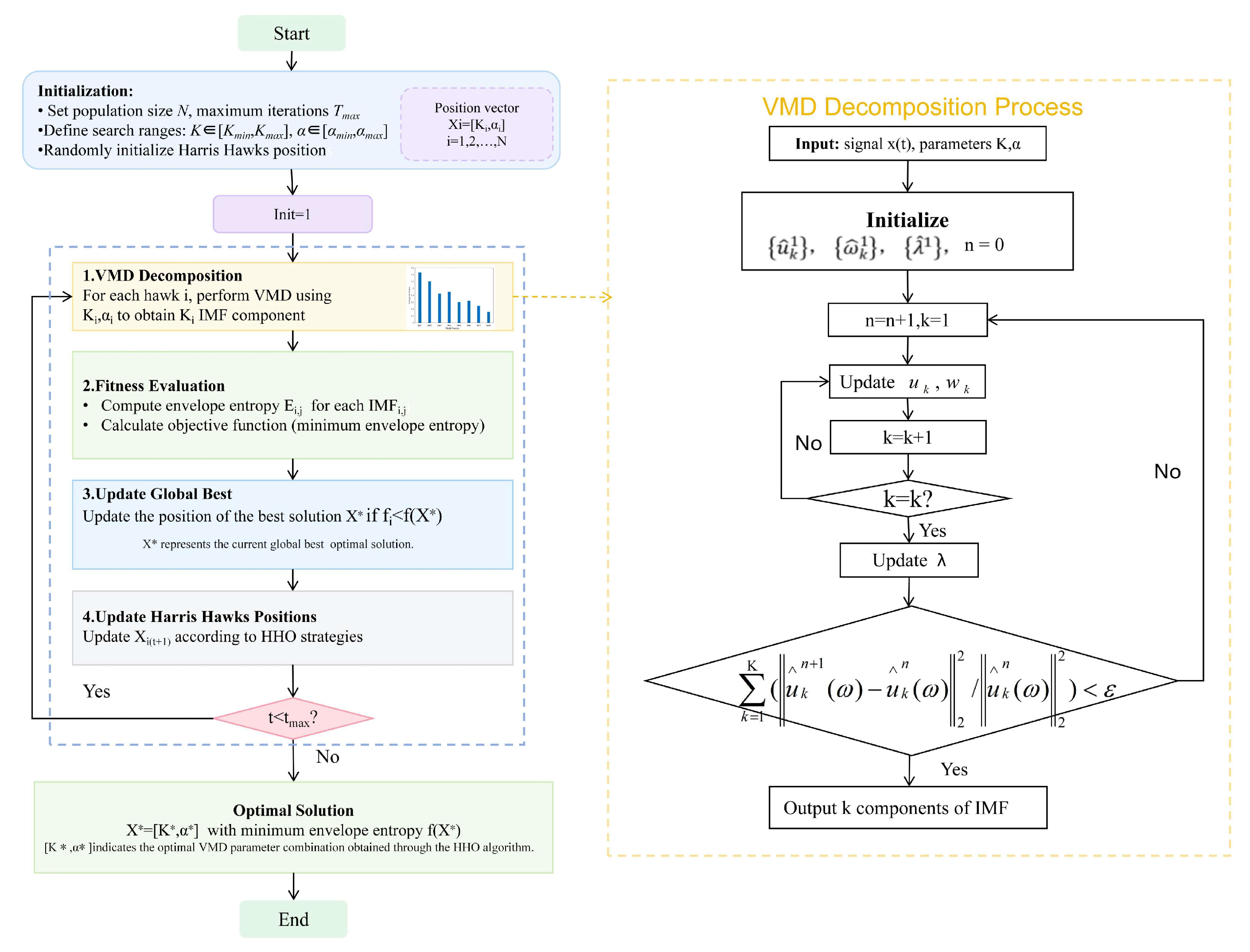
The flowchart of HHO-VMD is shown in Figure 1.

2.1.3. Selection of Representative IMF Components

After HHO-VMD, the original vibration signal is represented by multiple IMF components. In this study, a composite evaluation index is constructed based on the kurtosis factor and the Pearson correlation coefficient to rank the IMF components comprehensively. The kurtosis factor characterizes the prominence of impulsive components in the signal and is particularly sensitive to abnormal peaks induced by faults. Its expression is given in Equation (12). The Pearson correlation coefficient is used to quantify the degree of correlation between each IMF component and the original signal, and its expression is given in Equation (13).
K F = E ( x μ ) 4 σ 4
r = Cov ( X , Y ) σ X σ Y = i = 1 n ( X i X ¯ ) ( Y i Y ¯ ) i = 1 n ( X i X ¯ ) 2 i = 1 n ( Y i Y ¯ ) 2
where x denotes the vibration signal, μ is the mean of the signal, σ is the standard deviation of the signal, and E ( · ) denotes the expectation operator. Cov ( X , Y ) denotes the covariance between X and Y, σ X and σ Y denote the standard deviations of X and Y, respectively, X ¯ and Y ¯ represent the sample means of X and Y, respectively, KF denotes the kurtosis factor of the K-th IMF component, and r denotes the correlation coefficient between the K-th IMF component and the original signal.
The kurtosis factor only considers the distribution density of impulsive components in the signal, which may ignore high-amplitude signal components with relatively scattered distributions, leading to an incomplete evaluation. Although the correlation coefficient can measure the similarity between an IMF and the original signal, it is susceptible to noise interference. Therefore, this study introduces a composite index for IMF selection to comprehensively distinguish effective modes from interference components. The kurtosis factor and correlation coefficient are normalized. The composite index, denoted as CI, is further constructed, and its expression is given in Equation (16).
KF = K F K F min K F max K F min
r = r r min r max r min
C I = K F r
According to the ranking results of the composite index, the three IMF components with the highest CI values are selected as the inputs for the subsequent SDP transformation [36].

2.2. Two-Dimensional Feature Construction and Fusion Based on Parameter-Optimized SDP

2.2.1. SDP Feature Mapping

After obtaining the representative IMF components, it is necessary to construct two-dimensional images that can effectively characterize the differences among fault conditions. In this study, the symmetrized dot pattern (SDP) is adopted as a two-dimensional mapping approach for one-dimensional vibration signals. By means of polar coordinate transformation, SDP converts time-series signals into snowflake-like symmetric images, whose morphology is directly associated with the amplitude variation, local fluctuations, and temporal structure of the original signal. Compared with generic signal-to-image conversion methods, SDP places greater emphasis on the geometric patterns formed by time-domain amplitudes and temporal structures, making it more suitable for subsequent fault pattern identification.
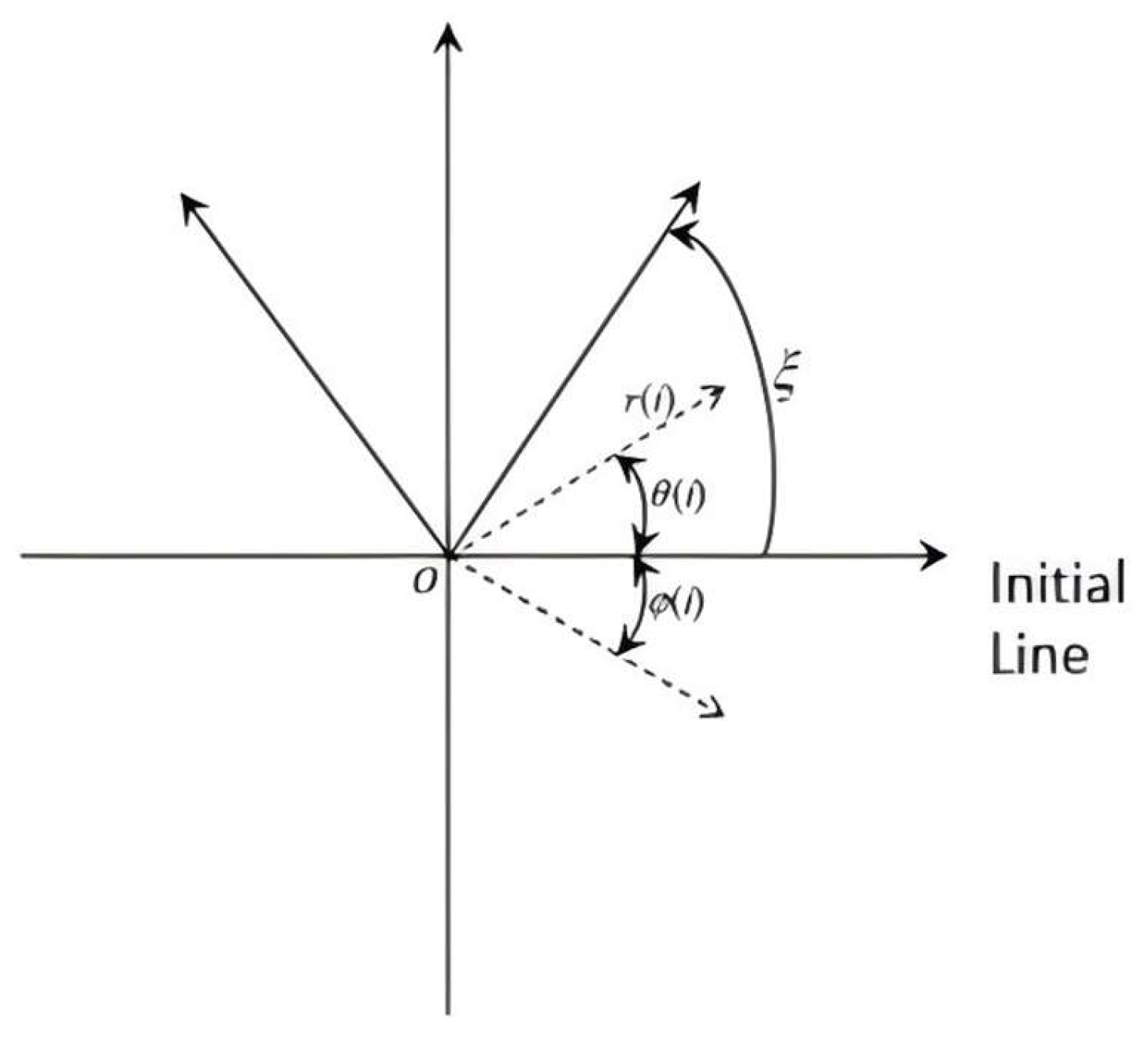
Figure 2 illustrates the principle of the SDP transformation.

2.2.2. Parameter Optimization Based on SSIM

From the mathematical expression derived by the SDP method, the radius in polar coordinates and the deflection angle exhibit a strong correlation with three parameters: θ , l and ζ . θ is usually set to π/3, which results in an image with a six-petal symmetric structure. l reflects the thickness of the per-petal image, meaning that larger l values indicate greater thickness; ζ controls the curvature, and increasing its value enhances the bending of the petal arms. By systematically optimizing the combination of l and ζ , the discriminability of images generated by different signal sources can be effectively enhanced, thereby improving the accuracy of fault diagnosis.
To verify the influence of parameters l and ζ on the SDP image transformation, a sinusoidal simulation signal with a frequency of 100 Hz was constructed, with θ set to π/3. By continuously adjusting the values of l and ζ , different SDP images were generated. The transformation results are shown in Table 1.
From Table 1, it can be seen that as parameter l increases, the petals of the SDP image gradually become fuller, and the thickness increases. Similarly, as ζ increases, the curvature of the petals intensifies. Therefore, a judicious selection of l and ζ helps enhance fine signal features and improve image discriminability.
Since the values of l and ζ depend on the specific signal, this paper adopts the Structural Similarity Index Measure (SSIM) [37] as the image difference metric to maximize the difference between the SDP images generated by different fault signals. SSIM comprehensively considers brightness, contrast, and structural information. Its value range is [−1,1], where a value closer to 1 indicates greater image similarity, and a value closer to 0 or −1 indicates a greater difference. Its expression is given in Equation (17):
S S I M ( x , y ) = ( 2 μ x μ y + C 1 ) ( 2 σ x y + C 2 ) ( μ x 2 + μ y 2 + C 1 ) ( σ x 2 + σ y 2 + C 2 )
where μ x and μ y represent the mean values of the pixel intensity for images x and y, respectively; σ x and σ y represent the standard deviation of the pixel intensity for images x and y, respectively; and σ x y represents the covariance of the pixel intensity between images x and y. C 1 and C 2 are stabilizing constants used to prevent a zero value in the denominator.
By using SSIM as an indicator to measure image differences, the two SDP parameters, l and ζ , are selected by calculating the SSIM values between different images.
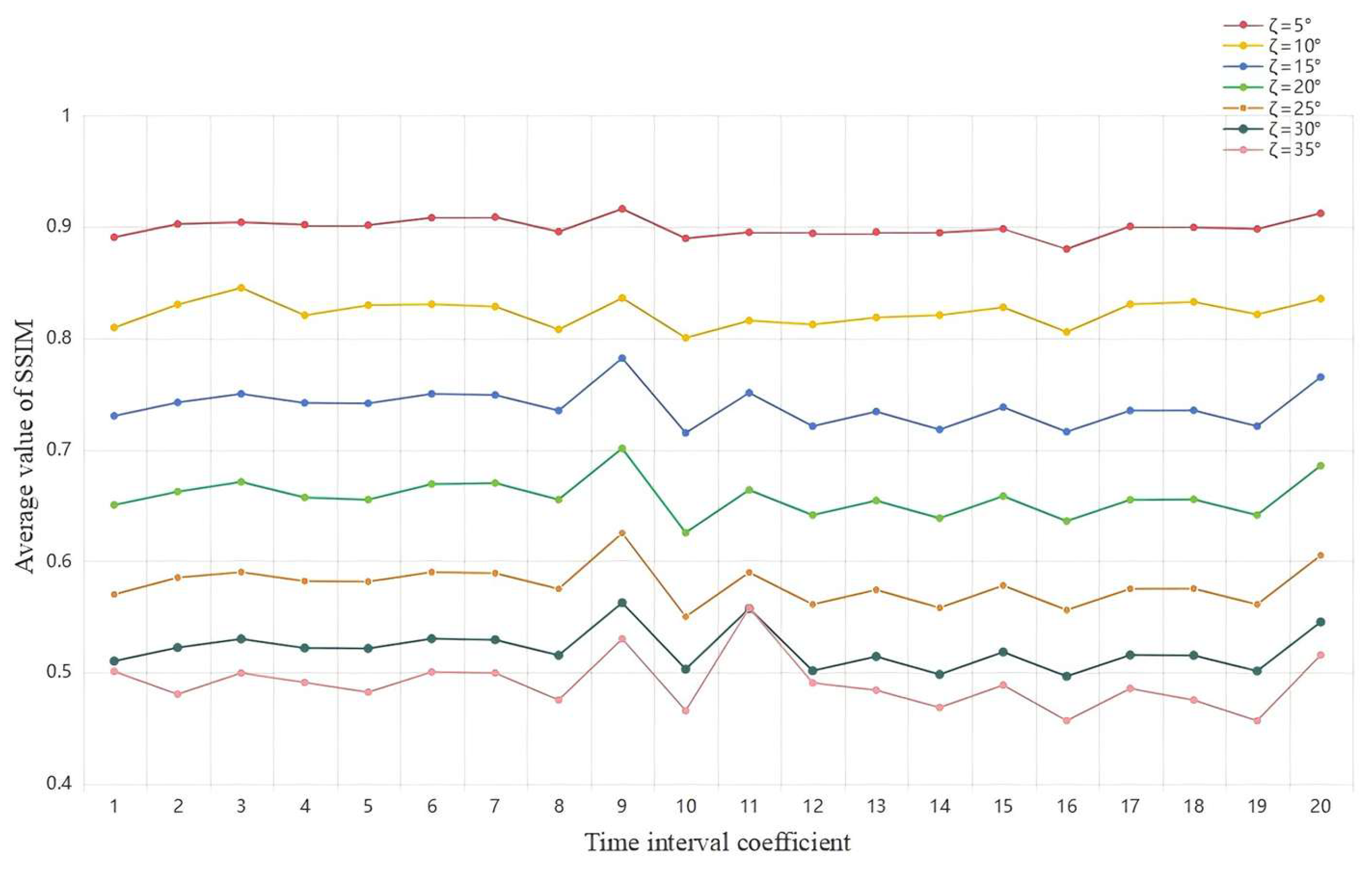
The smaller the SSIM value, the greater the difference between the images. Therefore, the parameter combination ( l , ζ ) corresponding to the minimum SSIM value is chosen as the optimal parameter set for the SDP transformation.
The specific steps are as follows:
  • Select Fault Signal Samples: Select a sample set of vibration signals for different fault types, assuming the total number of fault types is K.
  • Set Parameter Ranges: Set the parameter ranges for l as l 0 ~ l max and ζ as ζ 0 ~ ζ max , respectively. Based on preliminary experiments, the range for ζ is set between 5 ~ 35 and the range for l is set between 1~20, with their respective step sizes set as s t e p 1 = 5 and s t e p 2 = 1 .
  • Generate SDP Images: For each parameter combination ( l , ζ ), perform SDP transformation on each fault signal type to generate the corresponding SDP image.
  • Calculate Mean SSIM: Pairwise combine the SDP images of all fault types, calculate their SSIM values, and further compute the average SSIM value of all combinations.
  • Determine Optimal Parameters: Select the parameter combination ( l , ζ ) that minimizes the mean SSIM value as the optimal parameters for the SDP transformation.

2.3. Signal Feature Fusion Method Based on Parameter-Optimized VMD and SDP

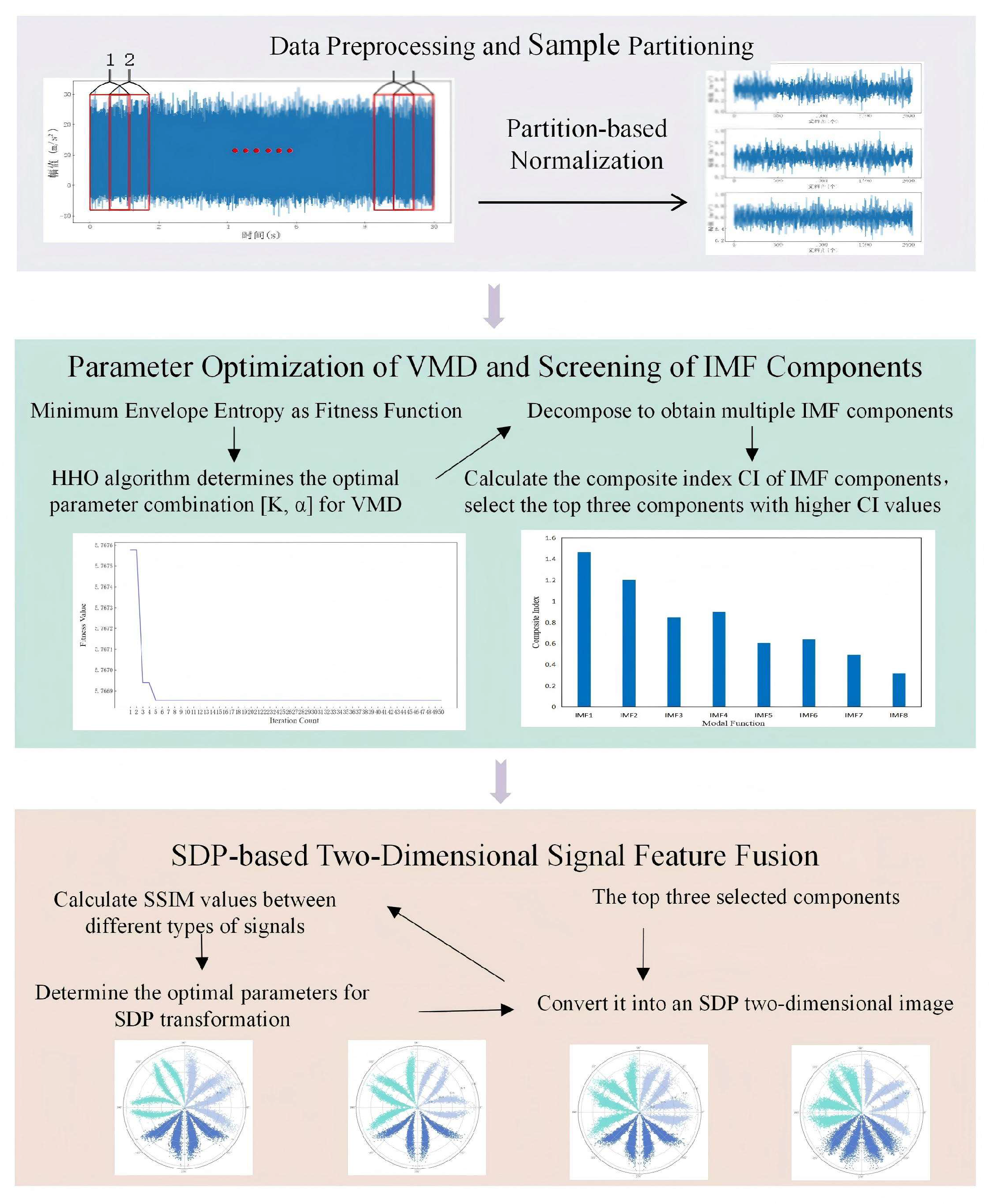
In summary, a signal feature fusion framework consisting of modal enhancement, representative component selection, image parameter optimization, and multi-component fusion is established in this study, as illustrated in Figure 3. Rather than representing a simple concatenation of VMD, HHO, and SDP, this framework constitutes a coordinated processing pipeline designed to address the dispersed fault characteristics, modal redundancy, and insufficient image discriminability of hydro-generator vibration signals.
First, HHO is employed to jointly optimize the mode number and penalty factor of VMD, enabling the adaptive decomposition of the original vibration signal and improving the adaptability of modal partitioning to different fault characteristics. Next, a composite evaluation index is introduced to screen the decomposed IMF components, so that representative modes with stronger fault relevance are retained while the interference of redundant information in subsequent feature construction is reduced. On this basis, the representative IMF components are mapped into two-dimensional images using SDP, and the SDP parameters are further optimized via SSIM to enhance the structural differences among fault categories in the image domain. Finally, the image representations derived from multiple representative IMF components are fused, allowing complementary fault information distributed across different frequency bands to be jointly expressed.
Through the above procedure, the proposed method achieves progressive construction of highly discriminative two-dimensional fault features from the original vibration signals, thereby providing clearer, more stable, and more distinguishable input features for subsequent small-sample data augmentation and fault classification. The specific flowchart is shown in Figure 3.

3. Case Analysis

3.1. HUST-Bearing-Dataset Analysis

In this paper, the bearing dataset (HUST-bearing-dataset) collected by Huazhong University of Science and Technology [38,39] is used for experimental verification and analysis.

3.1.1. Introduction to the Bearing Dataset

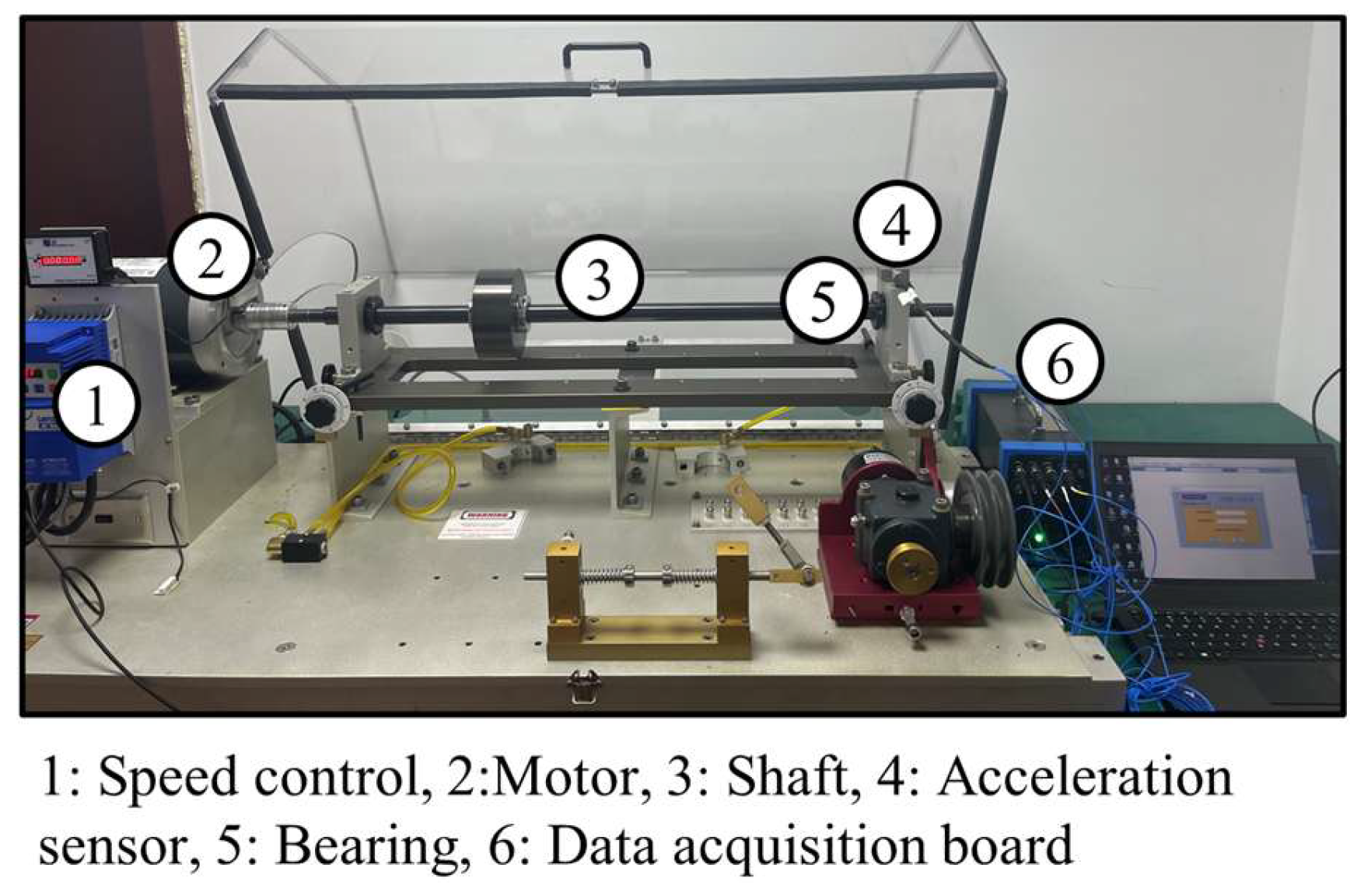
The HUST-bearing-dataset is built and collected by the laboratory of Huazhong University of Science and Technology, which is mainly used for the simulation experiment research of aviation generator bearings under high-speed rotation. HUST-bearing data set test bench is shown in Figure 4. The type of tested bearing is ER-16K, and the detailed parameters are shown in Table 2.

3.1.2. Interpretation

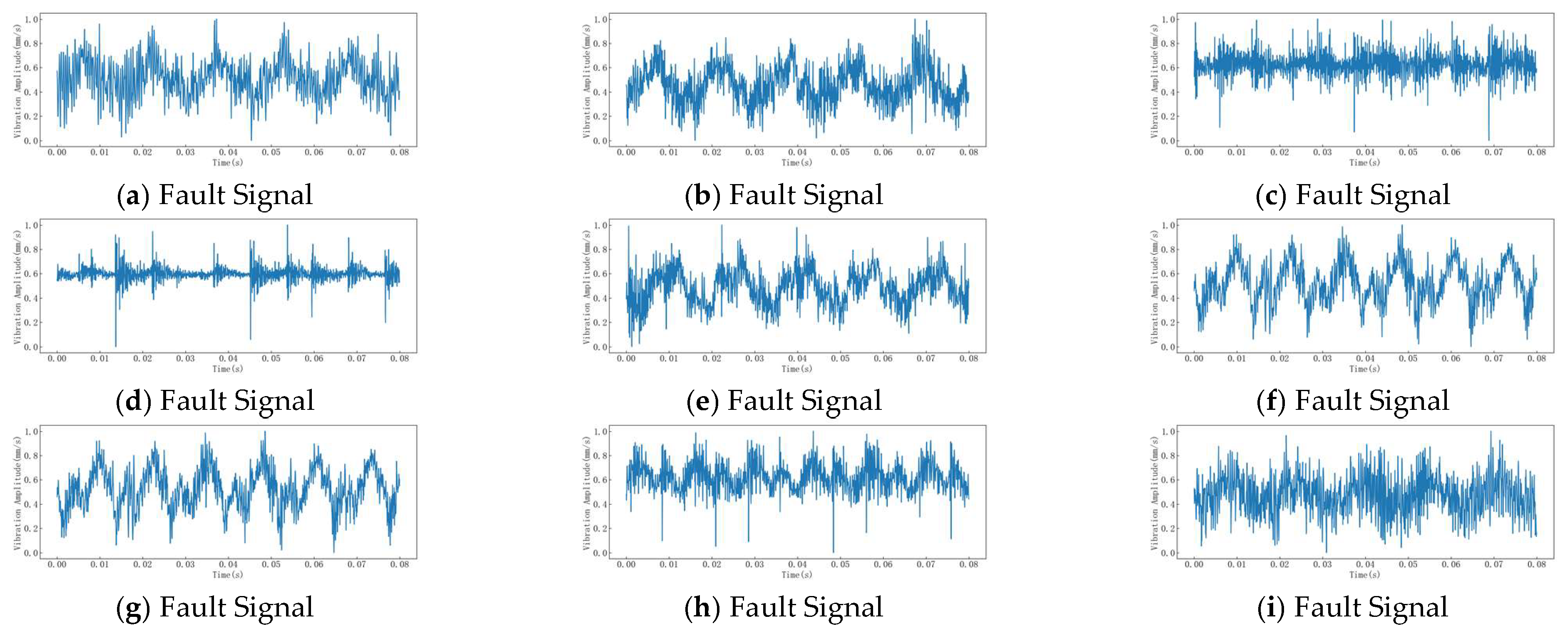
HUST-bearing-dataset contains one normal data sample and eight different types of fault data samples, with a sampling frequency of 25.6 kHz. The sampling process recorded a total of 262,144 data points (equivalent to 10.2 s). The experiment established four distinct rotational speed conditions: 65 Hz (3900 rpm), 70 Hz (4200 rpm), 75 Hz (4500 rpm), and 80 Hz (4800 rpm). The analysis was conducted under normal sample conditions and nine scenarios operating at 65 Hz speed. A value of a represents no damage, while b to i indicate different fault levels.
To ensure the comparability of data partitioning among different fault conditions, the raw data under each fault condition were divided at the original signal level into training and test sets. The first 70% of the time-series data for each condition were assigned to the training set, while the remaining 30% were assigned to the test set. This partitioning was performed before sliding-window segmentation; therefore, the raw data intervals corresponding to the training and test sets were mutually exclusive. Sliding-window sampling was conducted independently within the training and test sets. Each sample consisted of 2048 consecutive sampling points. A 50% overlap was adopted between adjacent windows to increase the number of samples while maintaining temporal continuity. It should be noted that window overlap occurred only within the same subset. In this way, all training and test samples were generated from completely independent raw signal segments, with no overlapping samples between the two sets, thereby preventing data leakage. The time-domain waveforms corresponding to the four fault conditions are shown in Figure 5.
(1)
Parameter optimization of VMD and IMF component selection
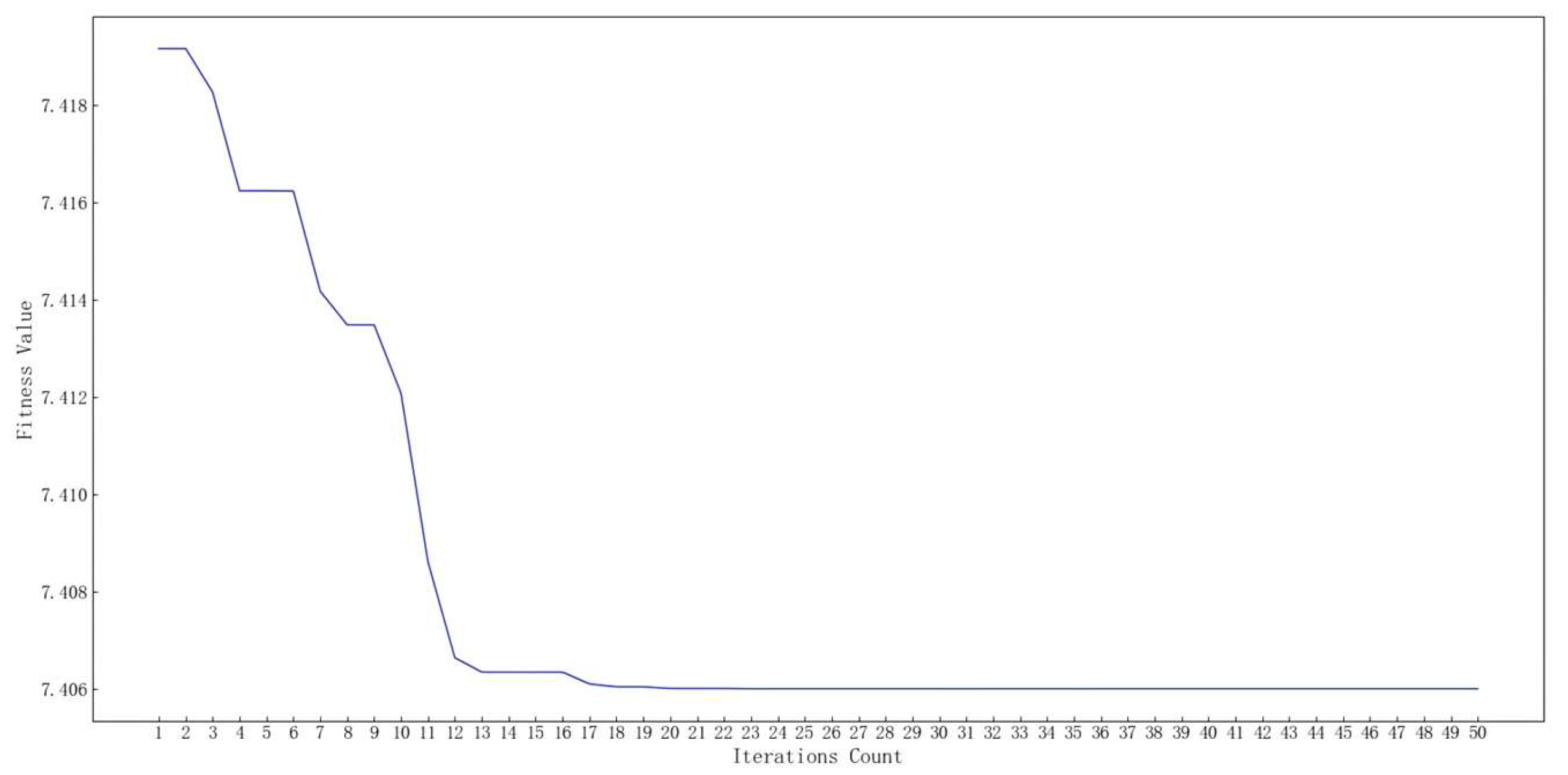
This section analyzes fault types with moderate rolling element failures under 65 Hz operating conditions, specifically focusing on samples labeled as b. The HHO algorithm is first employed to optimize the parameters of the VMD algorithm, including the number of IMF components (K) and penalty factor α , enabling adaptive decomposition of bearing vibration signals. Using minimum envelope entropy as the fitness function, the algorithm’s configuration parameters are detailed in Table 3. Key settings include: N (population size), T (maximum iterations), K (number of IMF components), α (noise tolerance), and tol (convergence threshold). The fitness function convergence curve is illustrated in Figure 6.
The HHO algorithm was used to optimize the VMD parameters. As shown in Figure 6, the optimal value was reached in the fifth iteration, with the optimal fitness value of 7.4196, and the best parameter combination obtained was [2585,8]. The vibration signals were decomposed using VMD with the optimized parameters, as shown in Figure 7.
To identify characteristic input components for subsequent SDP optimization, we calculated the Composite Index (CI) of the obtained IMF components. As illustrated in Figure 8, IMF2, IMF3, and IMF5 ranked as the top three components in terms of CI evaluation.
(2)
SDP two-dimensional signal feature fusion
After converting nine types of vibration signals into images using the SDP method, we calculated the SSIM values between pairwise images and ultimately computed the mean SSIM value. This process yielded seven sets of data, with the results shown in Figure 9. The analysis reveals that the optimal combination of parameters is [10,35].
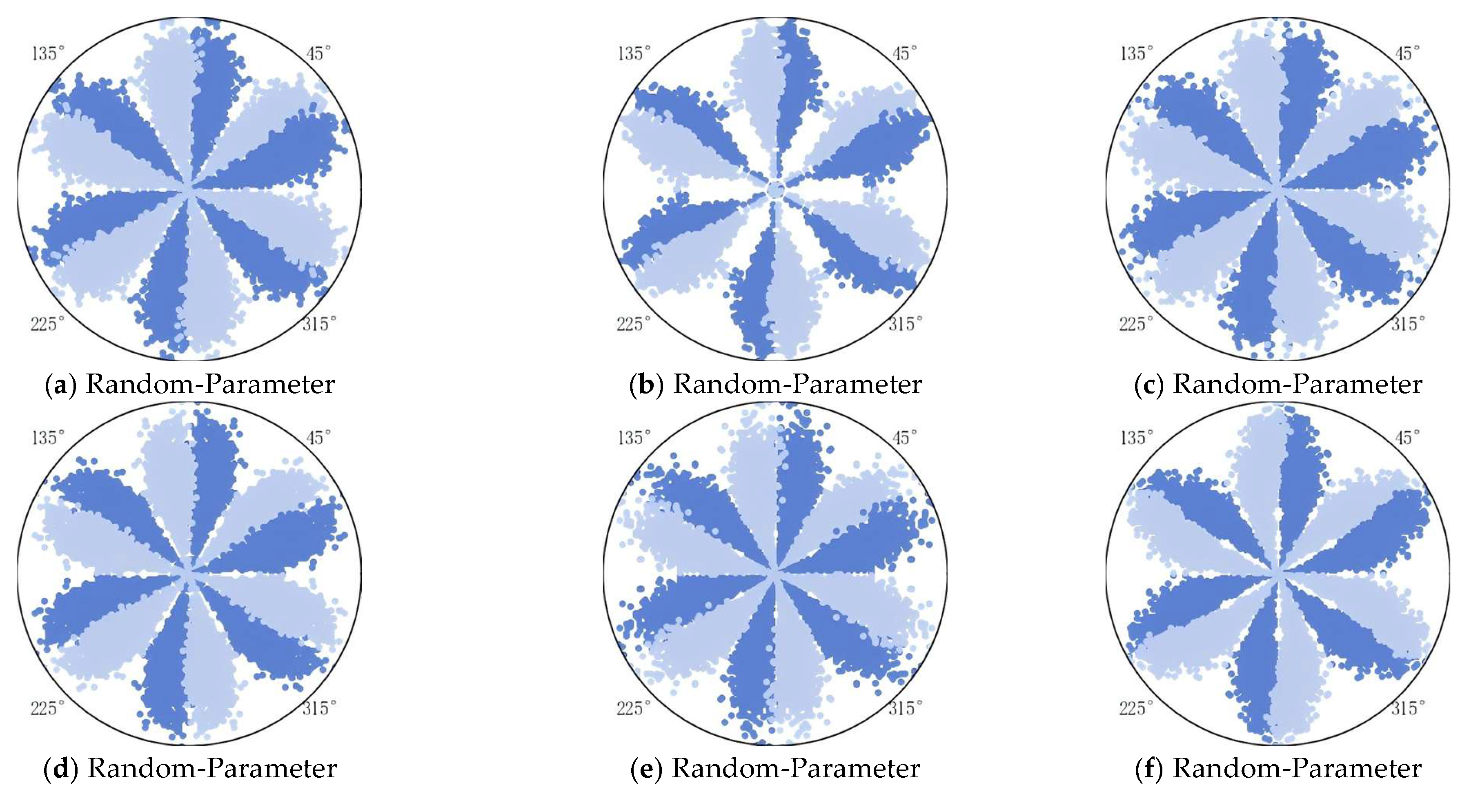
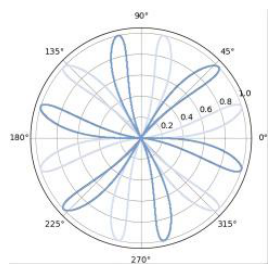
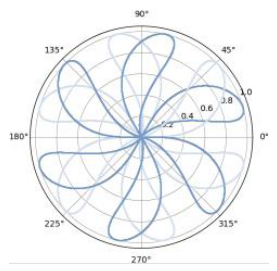
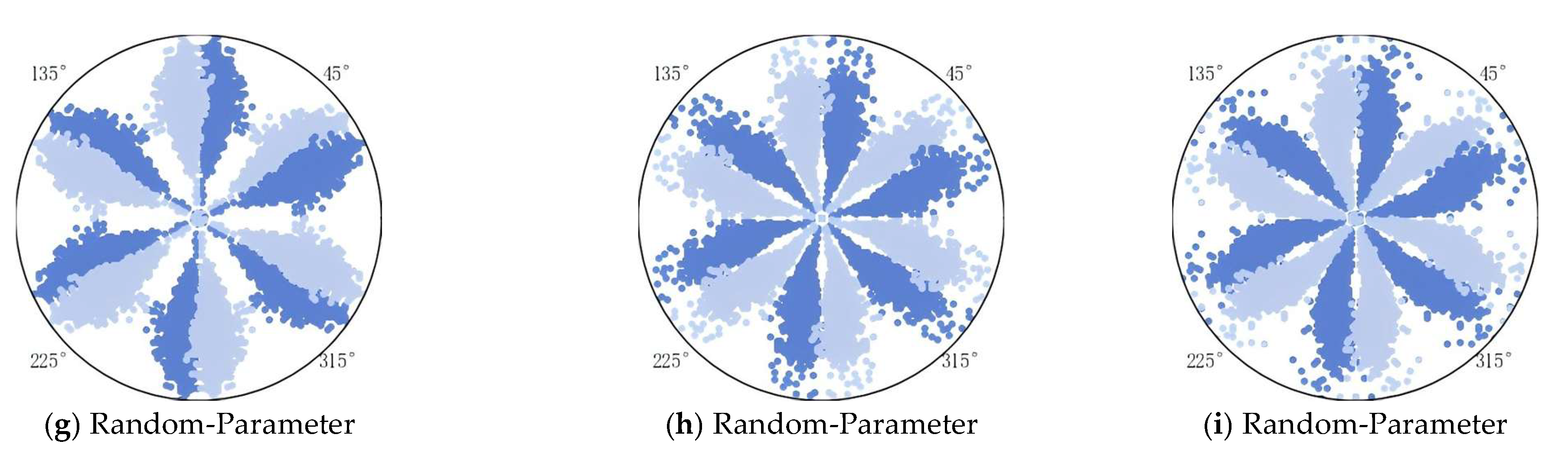
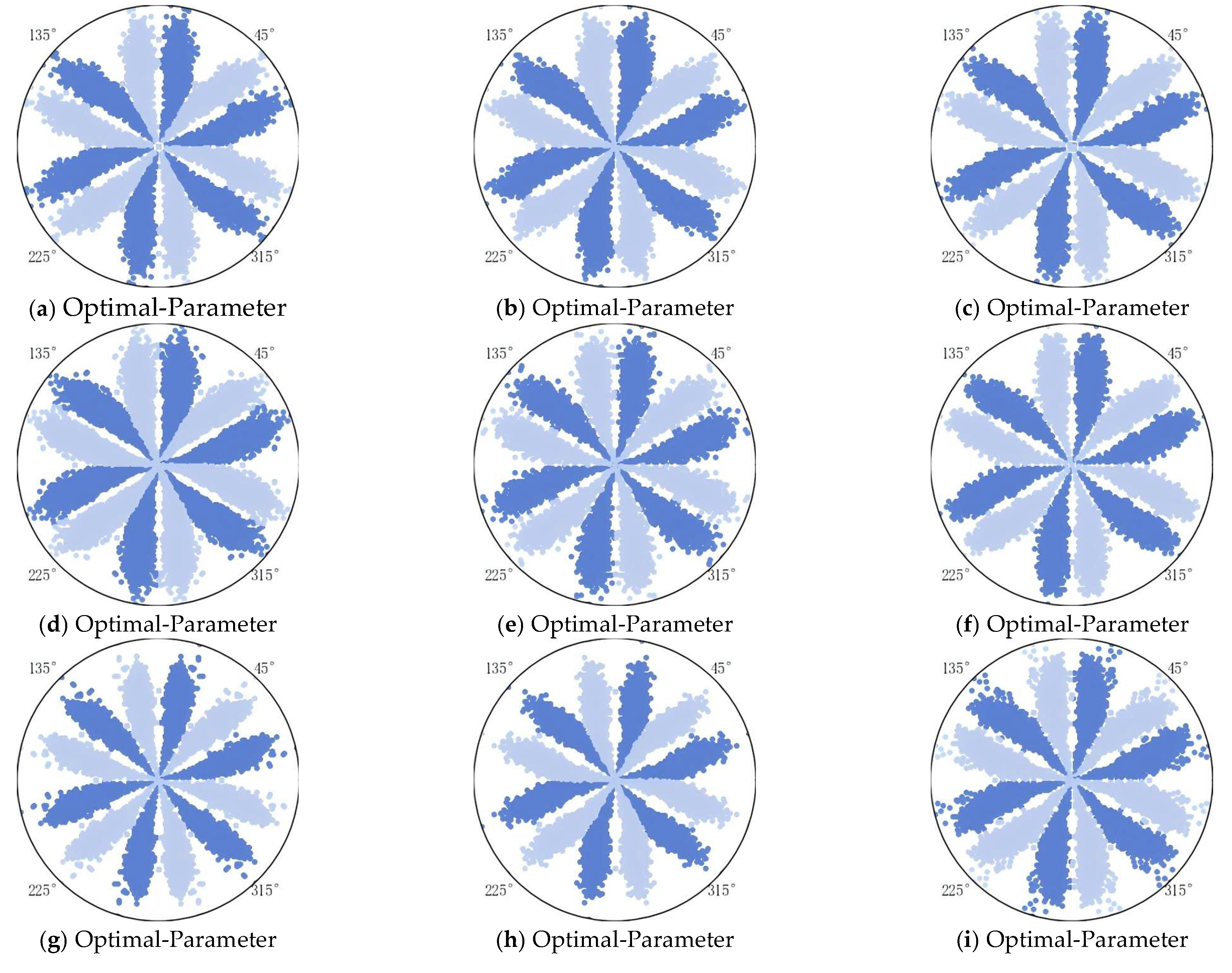
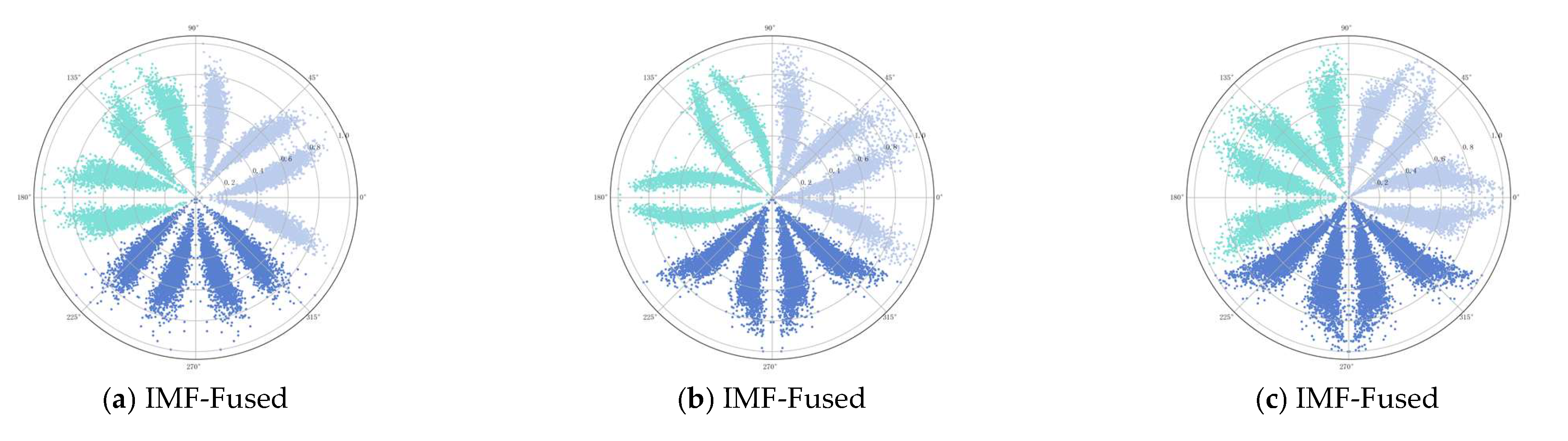
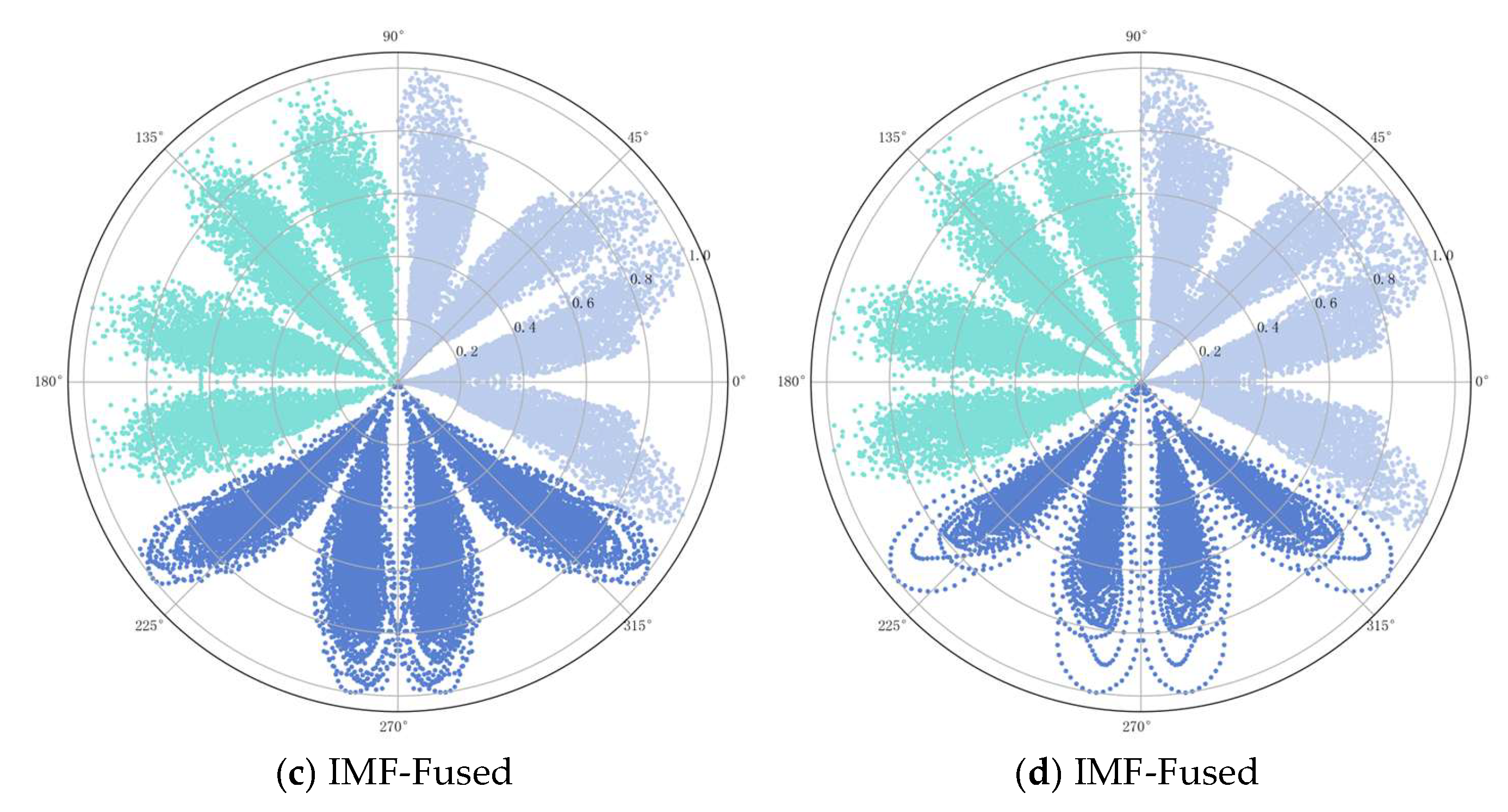
To clearly demonstrate the performance of the proposed method, Figure 10, Figure 11 and Figure 12 compare the SDP images generated with randomly selected parameters [10,45] with the optimal parameter combination [10,35] and with the proposed method.
As shown in Figure 11, the SDP images generated from the IMF components after HHO-VMD and fusion exhibit clearer feature representation. Compared to SDP images directly generated from raw signals, the fused images contain more differential information, making differences between various image types more pronounced. This improvement enhances the separability of fault classification and strengthens the discriminative capabilities of the classification model.

3.1.3. Compare with Other Algorithms

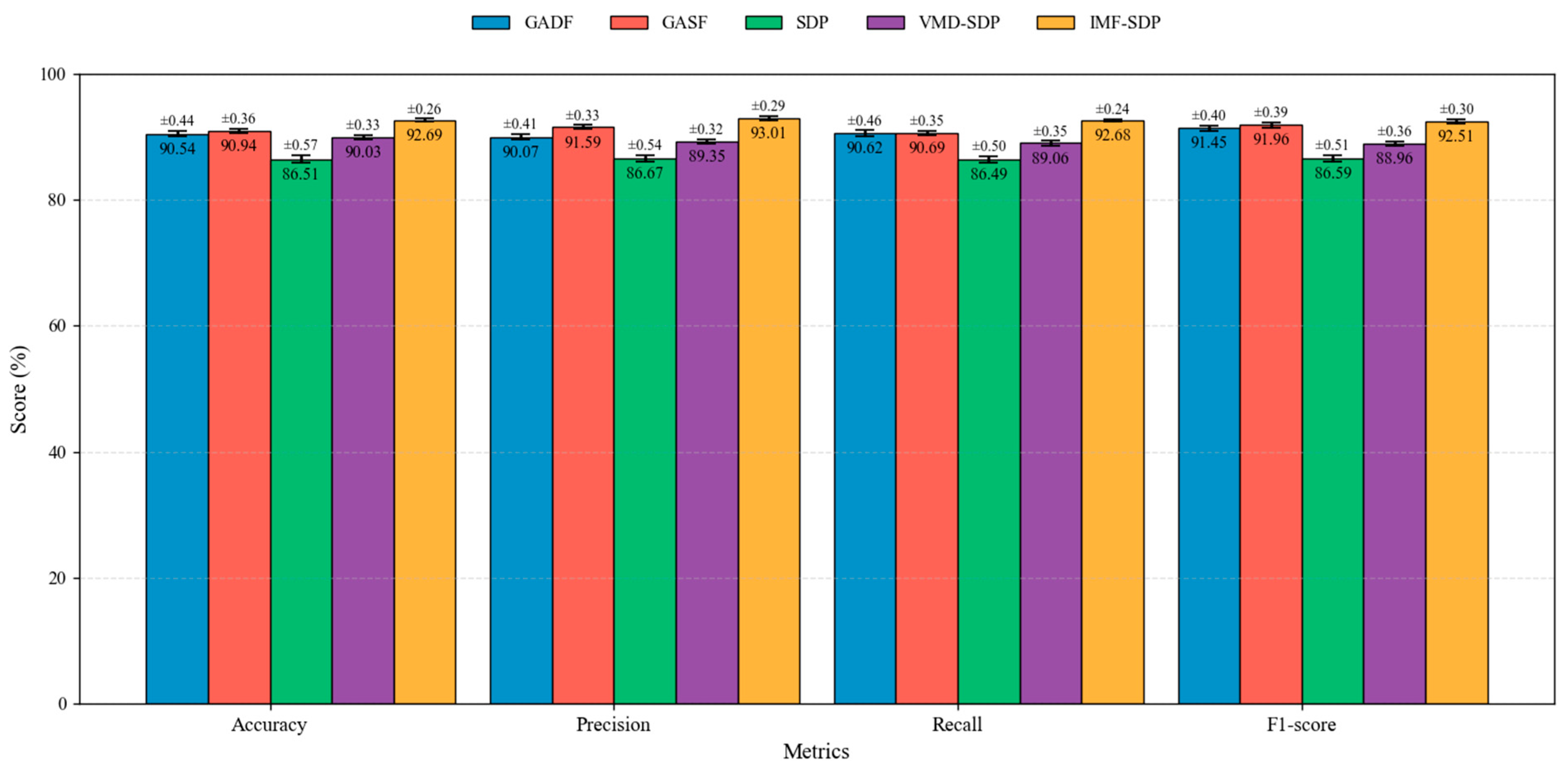
To validate the effectiveness, four image representation techniques were compared: Gramian Angular Difference Field (GADF) [31], Gramian Angular Summation Field (GASF) [32], the VMD-SDP image conversion method and the original SDP method. The raw time series signals were converted into two-dimensional images, and the ResNet18 model [40] was employed to conduct fault diagnosis experiments for verification. The dataset was partitioned into training, validation, and test sets in a ratio of 0.7:0.15:0.15, respectively. The ResNet18 network model was configured with the following parameters: batch size (16), epochs (50), initial learning rate (0.00001), Adam optimizer, and cosine annealing scheduler for gradient updates. All models were trained 10 times, and the averaged results and standard deviations are shown in Figure 13 and Table 4.
Accuracy, Precision, Recall and F1-score were taken as evaluation indicators. Their expressions are as follows:
A c c u r a c y = T P + T N T P + F N + F P + T N × 100 %
P r e c i s i o n = T P T P + F P × 100 %
R e c a l l = T P T P + F N × 100 %
F 1 S c o r e = 2 × P r e c i s i o n × R e c a l l P r e c i s i o n + R e c a l l
Here, TP denotes the number of true positive samples correctly classified as positive; TN represents the number of true negative samples correctly classified as negative; FP refers to negative samples incorrectly classified as positive; and FN denotes true positive samples that are not correctly identified.
Analysis of the experimental results in Table 3 demonstrates that the IMF-SDP image representation method proposed in this study achieves a diagnostic accuracy rate of 92.69%, with higher precision, recall, and F1 values compared to the other three methods. This indicates that SDP images optimized through IMF decomposition can more effectively extract and represent fault characteristics embedded in bearing vibration signals, providing diagnostic models with more distinctive image inputs.

3.2. Case Study on Pump Fault Vibration Signals

3.2.1. Introduction to the Dataset

For further verifying the applicability and robustness of the proposed method across different engineering objects, this study analyzes vibration signal data collected from a pump unit under different fault conditions. The original experimental platform was a centrifugal pump system driven by an induction motor [41]. The vibration signals were collected by 5 Wilcoxon 786B-10 single-axis accelerometers installed at the bearing positions of the motor and pump, with a sampling frequency of 20 kHz. Each measurement lasted 60 s, and the measurement interval was 5 min. All data were collected under steady-state operating conditions, which ensures good repeatability. In addition to vibration signals, the original dataset also includes current and voltage signals; however, only vibration signals are used in this study. Four representative fault conditions are selected from the dataset for analysis, namely foundation bolt looseness of the pump casing, imbalance fault, stator short circuit, and impeller damage, as listed in Table 5.

3.2.2. Interpretation

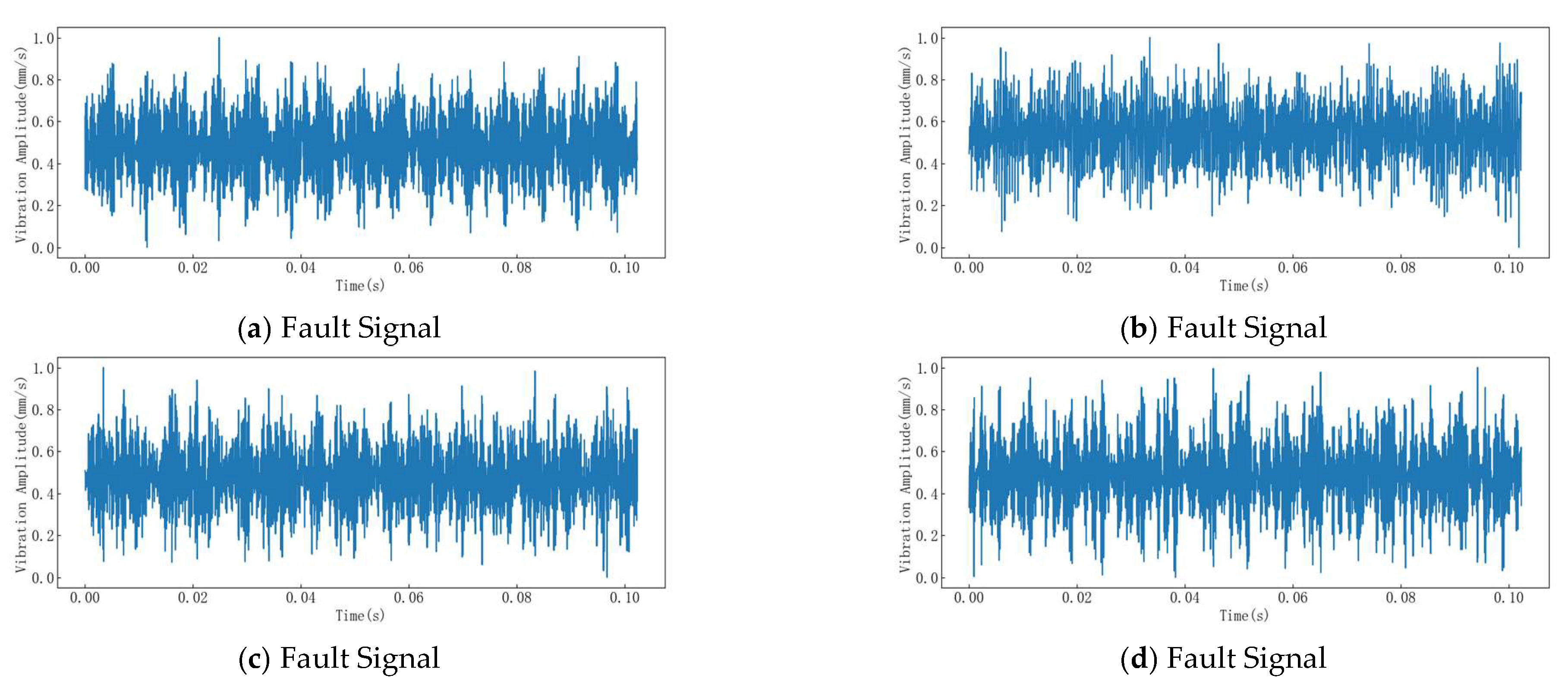
To ensure comparability, the dataset sampling method described in Section 3.1.2 was adopted. The raw data under each condition were first split into training and test sets at the original signal level, after which sliding-window sampling was performed independently within each subset. Each sample consisted of 2048 consecutive sampling points, and a 50% overlap was applied between adjacent windows to augment the sample size. Since the sliding-window segmentation was conducted after the data split and separately for the training and test sets, no overlapping samples were shared between them, thus avoiding data leakage. The time-domain waveforms corresponding to the four fault conditions are shown in Figure 14.
As in the previous analysis, the minimum envelope entropy is adopted as the fitness function, and HHO is used to search for the optimal combination of the VMD parameters K and α. Considering that the frequency-band distribution of pump fault signals differs from that of previously studied data, the search ranges of K and α were determined according to the complexity of the pump vibration signals, preliminary decomposition results, and commonly used VMD parameter settings in related studies. Specifically, the search ranges of K and α were set to [3,10] and [100,2500], respectively, while the remaining parameters were kept the same as those listed in Table 3. The resulting optimal parameter combinations for different fault conditions are presented in Table 6. It can be seen that the optimal parameters vary across fault conditions, indicating that fixed empirical parameters are insufficient to accommodate multiple fault signal types, whereas HHO-driven adaptive parameter optimization enables more targeted modal partitioning according to the specific characteristics of each signal.
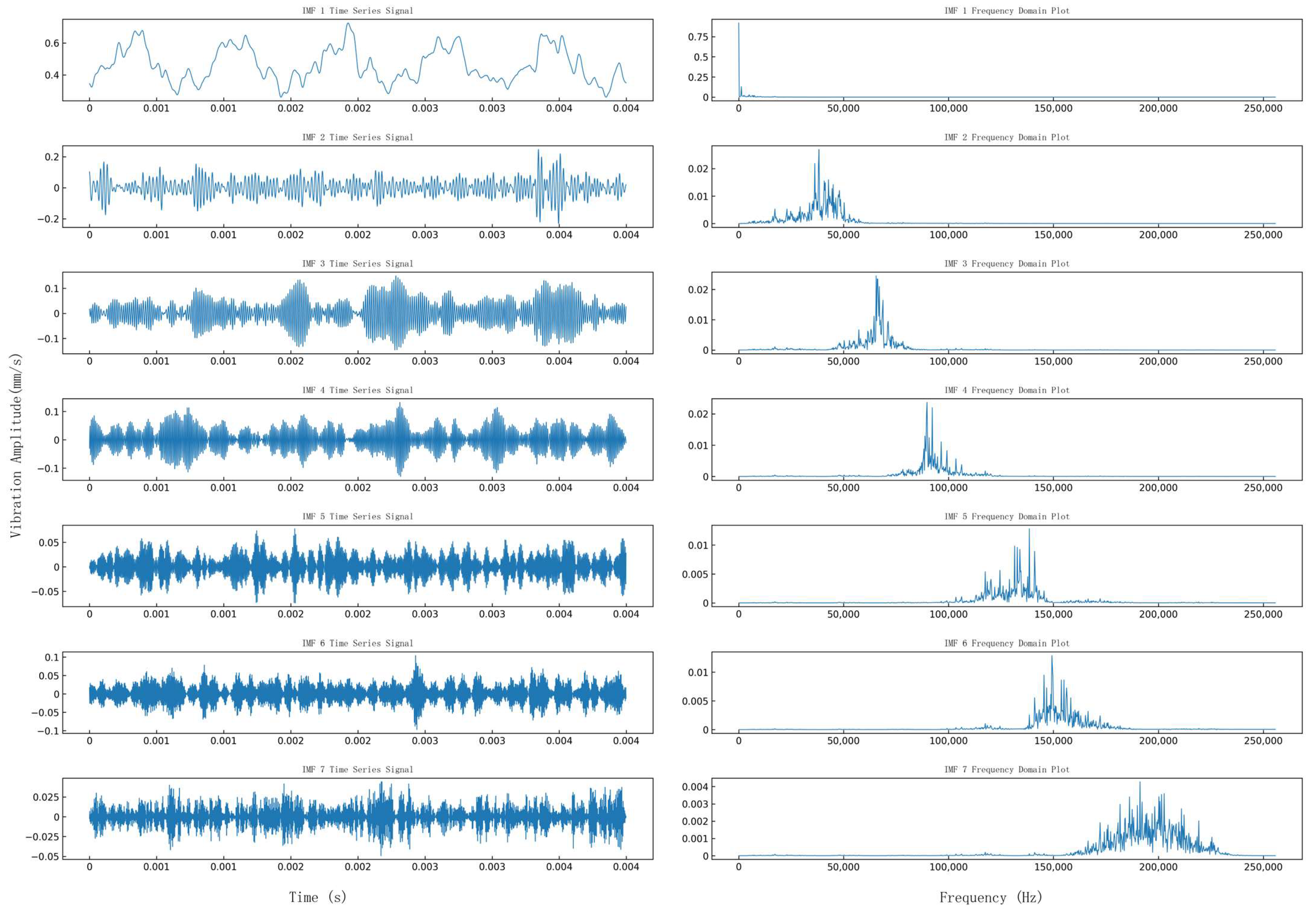
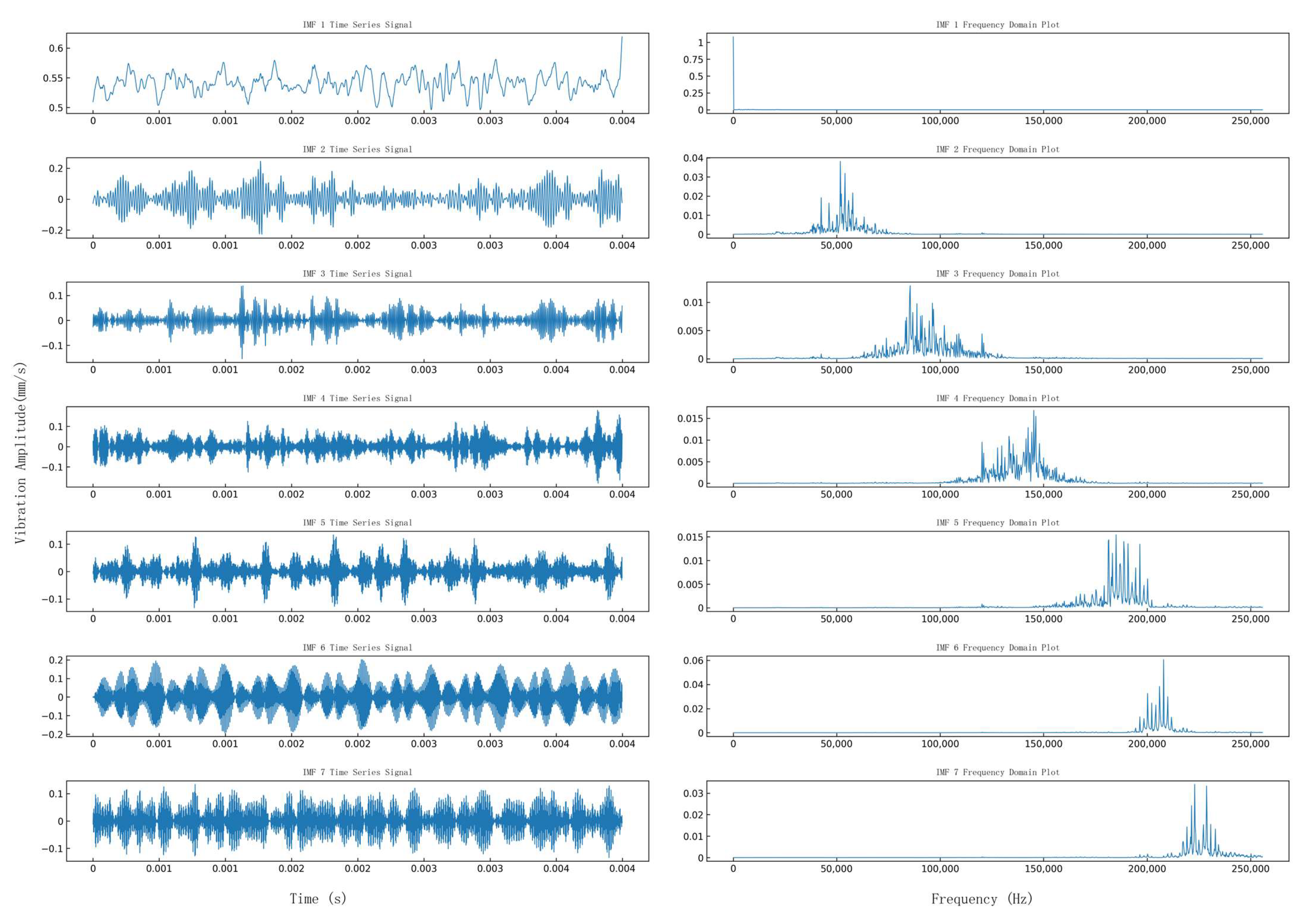
To visually demonstrate the decomposition performance, fault condition b is taken as an example. The optimal parameter combination is substituted into the VMD algorithm to decompose the pump fault vibration signal, yielding seven IMF components together with their corresponding time-domain and frequency-domain representations, as shown in Figure 15. It can be observed that, after VMD with optimized parameters, the original complex vibration signal is separated into a series of modal components distributed from low frequency to high frequency. These components exhibit clear separation in both the time and frequency domains, and mode mixing is effectively suppressed. This result indicates that the adaptively optimized parameter combination obtained by HHO can more effectively reveal the multi-scale characteristics of pump fault signals, thereby providing a clear modal basis for subsequent representative component selection.
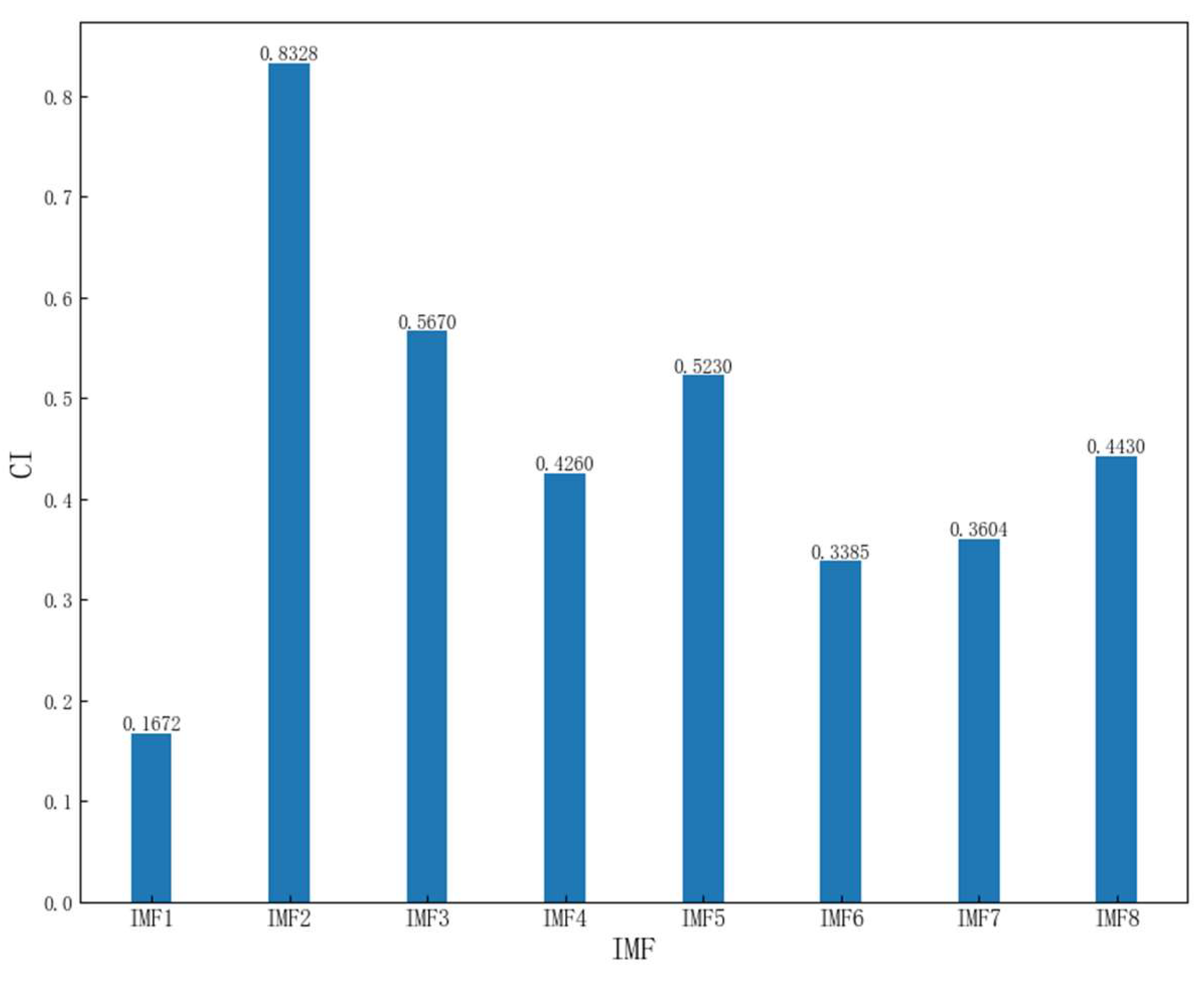
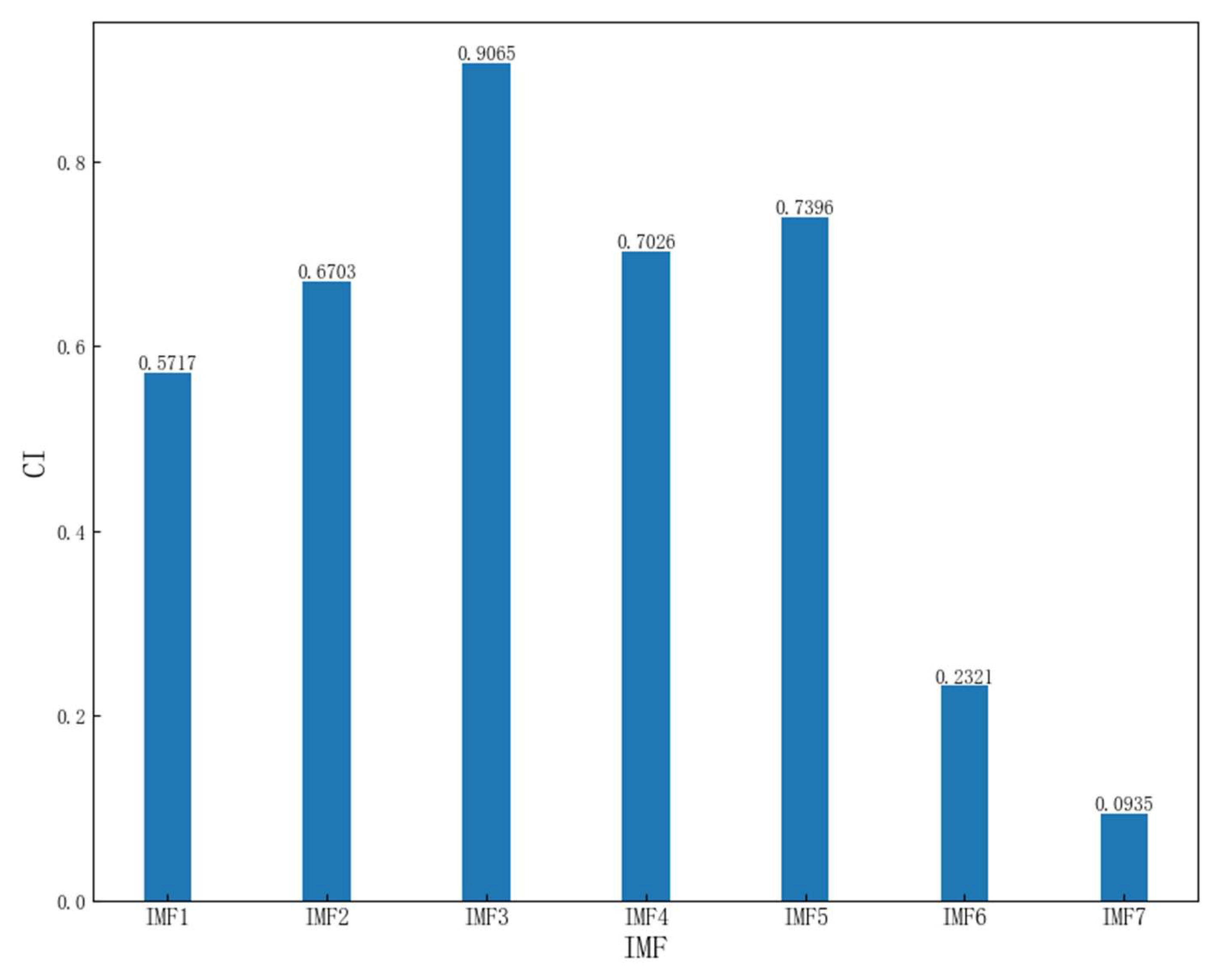
Based on the modal decomposition results, the composite index CI is further employed to screen the IMF components so as to emphasize the modes more strongly associated with fault information. The corresponding CI values of all IMF components are shown in Figure 16. It can be seen that the three components with the highest CI values are IMF3, IMF4, and IMF5, which are therefore selected as the input signals for subsequent SDP image transformation.
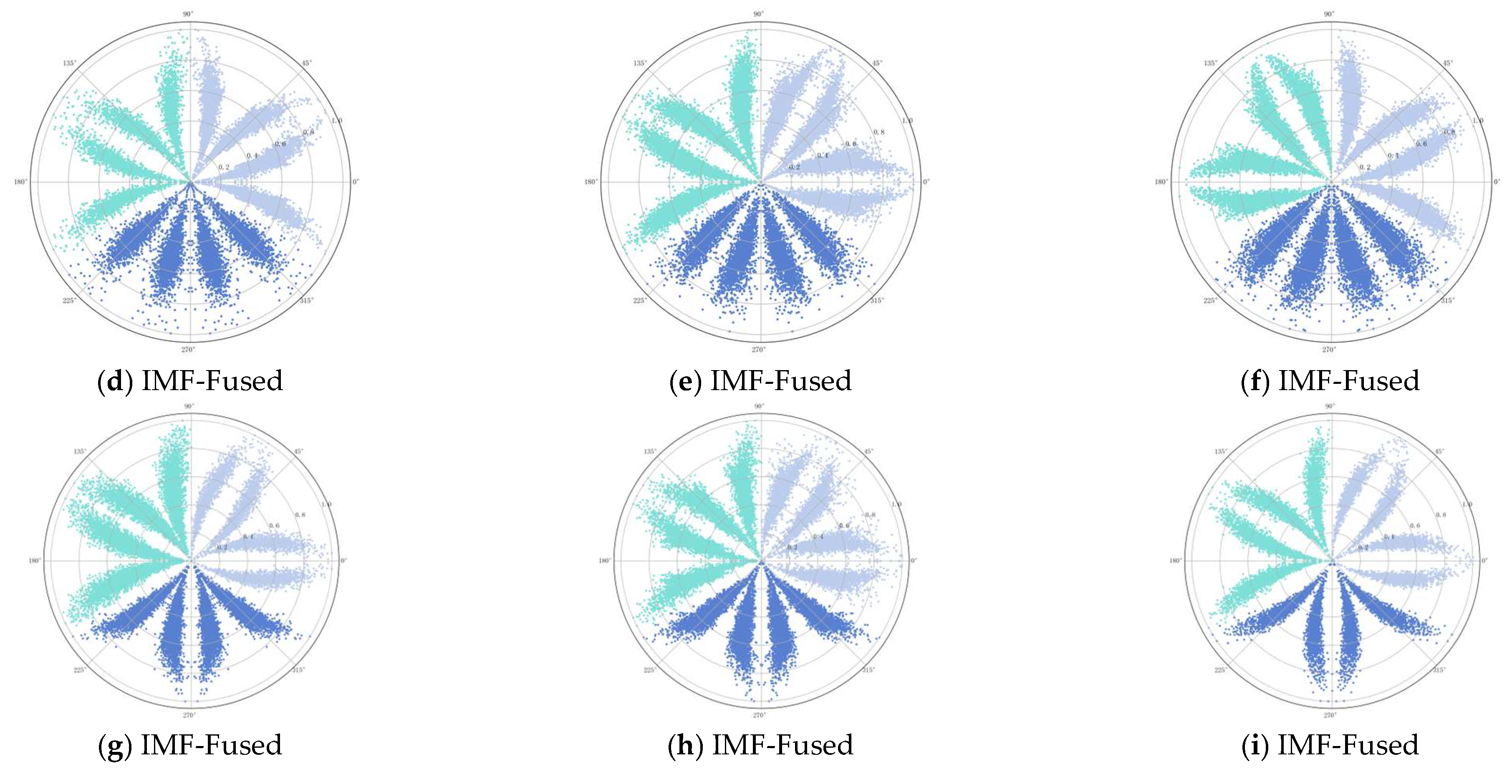
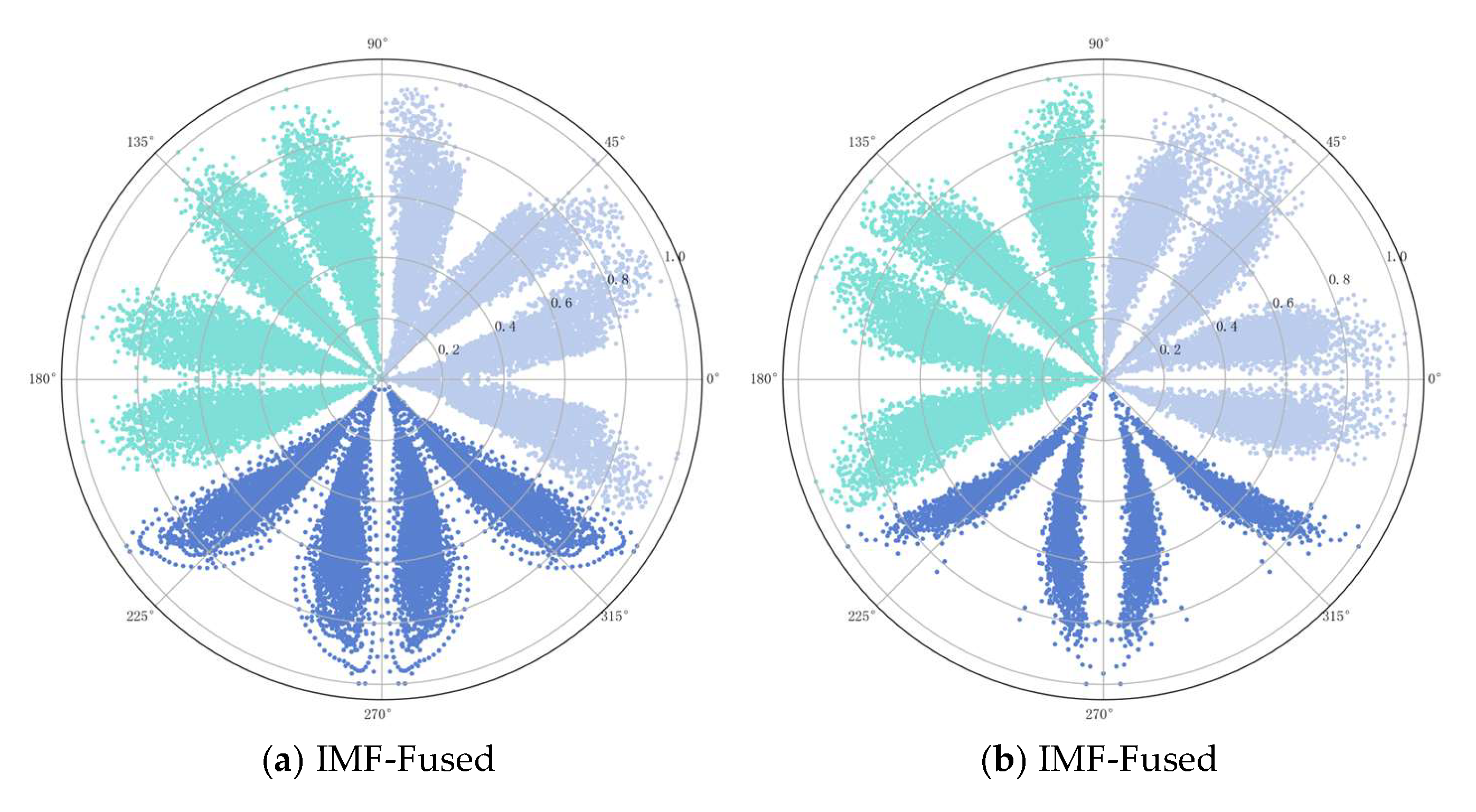
Subsequently, the representative IMF components obtained through HHO-VMD and screening are fused to generate SDP-based two-dimensional snowflake feature images. Under the optimal SDP parameter combination, the resulting fused images for different fault conditions are shown in Figure 17.
In summary, the results obtained from the vibration signals of the pump fault indicate that the proposed method, which integrates HHO-VMD optimization, CI-based IMF screening, and SSIM-guided SDP image generation, is capable not only of achieving effective signal decomposition and representative mode extraction, but also of producing more pronounced structural differences in the two-dimensional image domain. This provides more informative input features for subsequent fault classification. Although the offline process requires nearly one hour on a laptop equipped with an 11th Gen Intel Core i5-1135G7 processor, this offline procedure only needs to be performed once for each fault type. Once the optimal parameters are determined, the measured online execution time is approximately 12.2013 s per sample, which is acceptable for offline-trained models and periodic condition monitoring in practical pump systems.

3.2.3. Compare with Other Algorithms

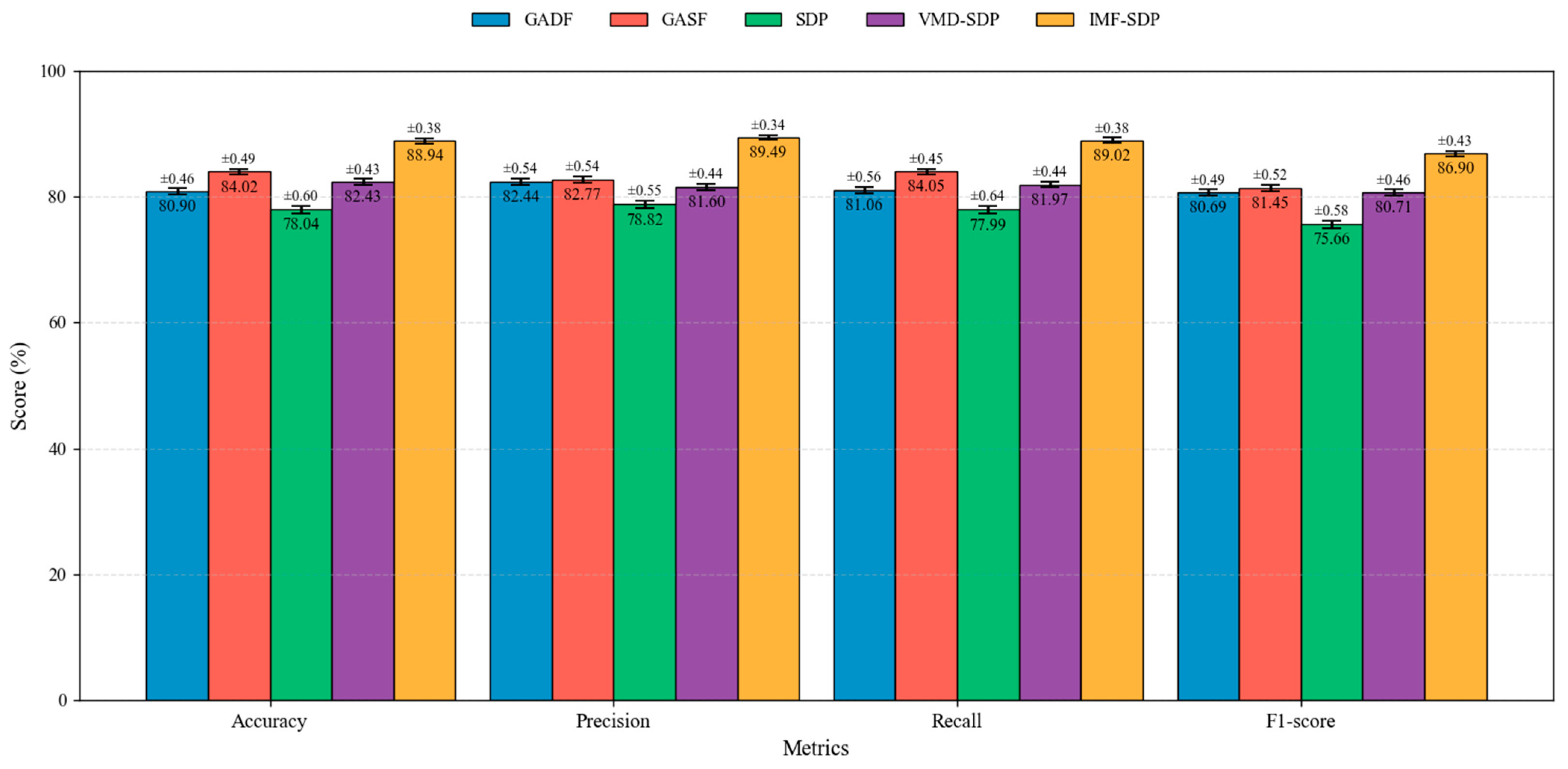
To further evaluate the effect of different image representation methods on fault identification performance, the pump fault vibration signals are converted into GADF, GASF, original SDP, VMD-SDP images and IMF-SDP images, respectively, and then classified using the ResNet18 network. Following the same partitioning ratio as that adopted for the bearing dataset, the samples are divided into training, validation, and test sets. The network is trained with a batch size of 8 and 50 epochs. Adam is used as the optimizer, and cosine annealing is adopted for learning rate decay. The performance is evaluated using Accuracy, Precision, Recall, and F1-score. All models were trained 10 times, and the averaged results and standard deviations are shown in Figure 18 and Table 7.
As shown in Table 7, the classification performance differs substantially across the image representation methods. The original SDP method without IMF decomposition yields the worst performance, with an accuracy of only 78.04%, indicating that directly transforming the raw pump fault signal into an SDP image is insufficient to extract discriminative fault-related features from complex vibration signals. The performance of the VMD-SDP method is improved, with an accuracy of 82.43%. The accuracies of GADF and GASF are 80.90% and 84.02%, respectively. Although three methods improve the classification performance compared with the original SDP, they still show a clear gap relative to the IMF-SDP method. In contrast, the proposed IMF-SDP method achieves the best performance in all evaluation metrics, namely Accuracy, Precision, Recall, and F1-score, with an accuracy of 88.94%, representing improvements of 4.92, 8.04,6.15 and 10.90 percentage points over GASF, GADF, and VMD-SDP methods and the original SDP, respectively. These results demonstrate that the two-dimensional feature images generated through HHO-VMD, composite-index-driven component selection, and multi-IMF fusion can more effectively characterize the discriminative information embedded in pump fault vibration signals, thereby significantly improving the subsequent classification performance.
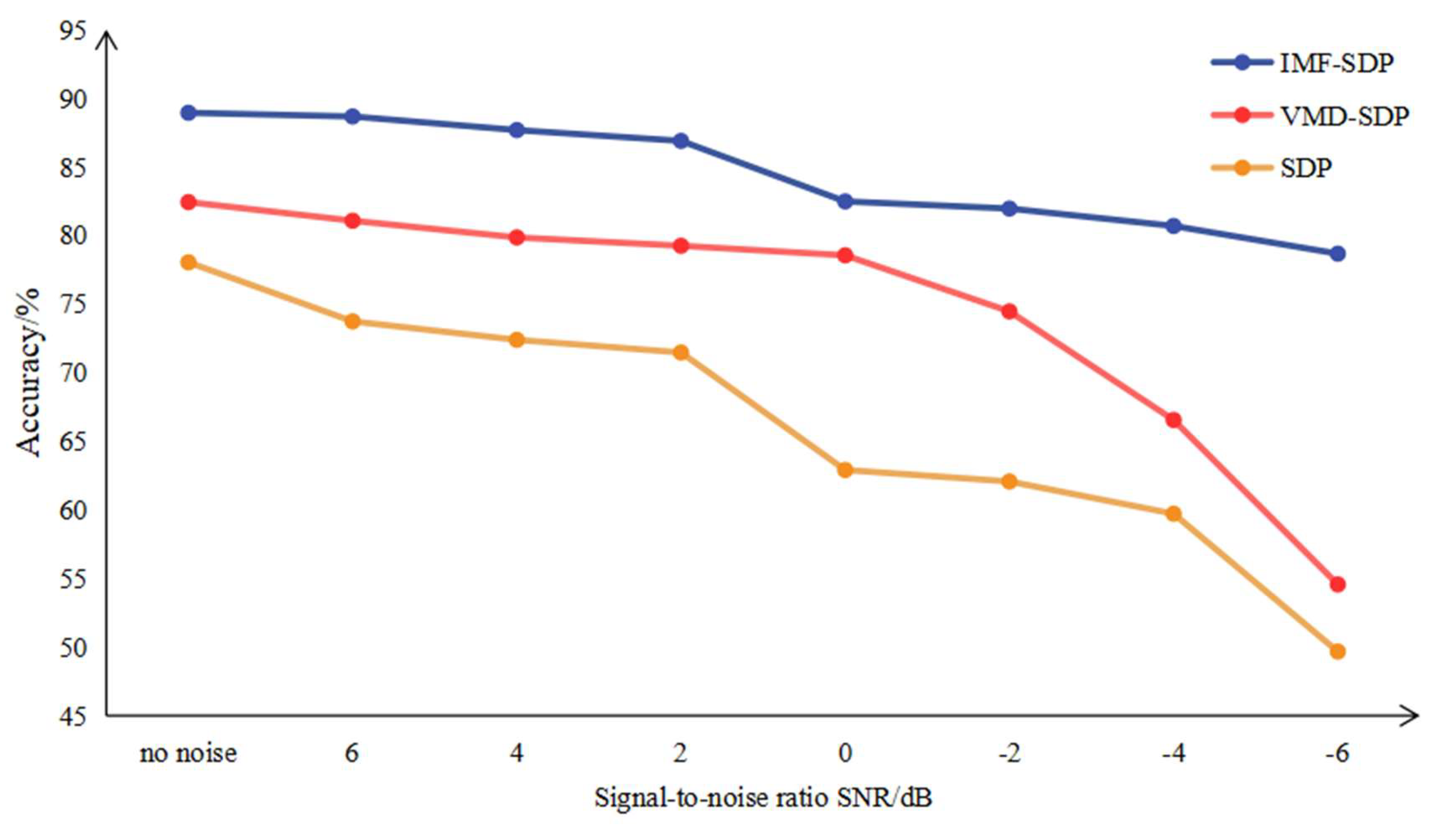
To highlight the superior noise robustness of the proposed IMF-SDP method under strong background noise, noise with signal-to-noise ratios (SNRs) ranging from −6 dB to 6 dB was added to the pump dataset described in Section 3.2, following Ref. [42]. The strongly noise-contaminated data were then input into the original SDP, VMD-SDP, and IMF-SDP models for comparative fault diagnosis. The final results were obtained by averaging the outcomes of 10 independent experiments, as shown in Figure 19.
Among the three methods, the proposed IMF-SDP method consistently achieves the highest accuracy under all noise conditions. As the noise intensity increases, the accuracy of the original SDP method decreases significantly, dropping to about 50% at an SNR of −6 dB. The VMD-SDP method exhibits better robustness than SDP, but its accuracy also decreases sharply under strong noise interference, especially when the SNR is lower than −2 dB. In contrast, the IMF-SDP method maintains relatively stable performance, with an accuracy of approximately 79% even at −6 dB. These results demonstrate that the proposed IMF-SDP method has superior anti-noise capability and stronger robustness in fault diagnosis under strong background noise. This indicates that the effective decomposition and feature enhancement capability of IMF-based signal processing helps suppress noise interference and preserve discriminative fault information. Therefore, the IMF-SDP method is more suitable for fault diagnosis tasks in complex industrial environments with severe noise contamination.
Overall, the case study presented in this section shows that the proposed IMF-SDP feature fusion method is effective for pump fault vibration signals, where it exhibits strong feature extraction and fault discrimination capabilities. From the perspective of a different engineering object, these findings further verify the applicability and robustness of the proposed method in the analysis of complex fault vibration signals. They also confirm that the coordinated design of HHO-based parameter optimization, representative IMF component selection, and multi-IMF image fusion can effectively enhance both the separability and representational quality of fault features in the image domain.

4. Conclusions

This article addresses the limitations of single-dimensional time series signals in accurately representing hydropower unit characteristics, proposing a parameter-optimized VMD and SDP-based signal feature fusion method. Through experimental studies on the bearing dataset and pump fault vibration signals, the following conclusions can be drawn:
(1) The adaptive optimization of variational mode decomposition parameters using the Harris Hawks Optimization with minimum envelope entropy as the fitness function effectively eliminates subjective and uncertain manual parameter adjustments, significantly improving decomposition quality and fault feature extraction.
(2) The proposed composite index (CI), which combines kurtosis factor and Pearson correlation coefficient, provides a more comprehensive criterion for selecting representative intrinsic mode functions (IMFs). It retains fault-sensitive modes while suppressing redundant or noise-dominated components, thereby enhancing the reliability of subsequent feature representation.
(3) By transforming the selected IMF components into two-dimensional SDP images and optimizing the SDP parameters via the Structural Similarity Index Measure (SSIM) to minimize the average SSIM among different fault categories, the proposed method produces snowflake-like images with significantly enhanced structural discriminability. Furthermore, fusing images from multiple representative IMFs allows complementary fault information across different frequency bands to be jointly expressed.
When tested on ResNet18 network for image classification, the proposed fusion method achieved the highest accuracy rates (92.69% and 88.94%) across two datasets compared to other 2D representation methods. Experimental results demonstrate that this approach efficiently extracts and expresses inherent signal features, providing more discriminative input samples for small-sample data augmentation in hydropower units. This significantly improves generated data quality and enhances model generalization capabilities.
Although the proposed method shows promising performance in pump fault diagnosis, several issues remain for further investigation. The main computational burden comes from the offline HHO-based optimization of VMD parameters and the SSIM-guided SDP generation process. Future work will focus on improving computational efficiency by adopting simpler optimization strategies, reducing the search space, and introducing parallel or GPU-accelerated implementations. In addition, lightweight neural architectures, such as MobileNet or ShuffleNet, will be considered to reduce online inference costs and enhance the feasibility of deployment on edge-computing platforms. The robustness of the proposed method under few-shot learning scenarios also warrants further evaluation. More stringent experimental settings, for example, using only 5~20 training samples per fault category, will be designed to assess its diagnostic stability under severely limited labeled data. Furthermore, data augmentation, transfer learning, and meta-learning strategies may be incorporated to improve generalization capability in data-scarce conditions. From an engineering application perspective, future studies will investigate the adaptability of VMD and SDP parameters under varying operating conditions and establish reusable parameter libraries to support practical deployment. Moreover, since pumps in industrial applications typically operate within coupled pump–pipeline systems rather than as isolated units, the effects of fluid pulsation, pressure fluctuation, and pipeline-induced vibration disturbances should be further examined. This will facilitate the extension of the proposed framework to more realistic industrial monitoring scenarios.

Author Contributions

Software, M.Y. and X.M.; writing—original draft, M.Y. and Z.R.; writing—review and editing, H.P. and Y.Z.; data curation, Z.C. and Y.W. All authors have read and agreed to the published version of the manuscript.

Funding

This research was funded by National Natural Science Fund of China (52339006) and Jiangsu Provincial Innovation Support Program for International Scientific and Technological Cooperation (BZ2023047).

Data Availability Statement

Data are contained within the article.

Conflicts of Interest

All authors declare that the research was conducted in the absence of any commercial or financial relationships that could be construed as a potential conflict of interest.

References

  1. Guo, X.; Gao, P.; Ma, H.; Li, H.; Wang, B.; Han, Q.; Wen, B. Vibration characteristics analysis of fluid-conveying pipes concurrently subjected to base excitation and pulsation excitation. Mech. Syst. Signal Process. 2023, 189, 110086. [Google Scholar] [CrossRef]
  2. Qin, L. Research on fault diagnosis and maintenance technology of water pump mechanical equipment. Mech. Manag. Dev. 2025, 40, 76–78. [Google Scholar] [CrossRef]
  3. Huang, W.; Bi, H.; Ye, Y.; Zhang, S.; Yi, X.; Huang, X.; Wang, Z.; Jin, Z. Study on hydraulic characteristics during startup of pump-turbines. J. Hydroelectr. Eng. 2023, 42, 97–104. [Google Scholar]
  4. Guo, X.; Ma, H.; Ge, H.; Chen, S.; Wen, B. Vibration transmission characteristics analysis of a flexible casing-multiple pipes system. Mech. Syst. Signal Process. 2024, 217, 111536. [Google Scholar] [CrossRef]
  5. Fei, H.; Zhang, C.; Wu, L.; Xu, S.; Zhang, J. Weak fault signal denoising and impact feature enhancement method based on VMD-MCKD. J. Mech. Electr. Eng. 2025, 42, 237–246. [Google Scholar]
  6. Fu, S.; Lin, L.; Wang, Y.; Zhao, M.; Guo, F.; Zhong, S.; Liu, Y. High imbalance fault diagnosis of aviation hydraulic pump based on data augmentation via local wavelet similarity fusion. Mech. Syst. Signal Process. 2024, 209, 111115. [Google Scholar] [CrossRef]
  7. Xie, M.; Meng, Q.; Li, B.; Lu, J.; Li, Y.; Yang, Z. Idler fault diagnosis method fusing short-time Fourier transform and convolutional neural network. Chin. J. Eng. Des. 2024, 31, 565–574. [Google Scholar]
  8. Yuan, X.; Sun, F. Fault diagnosis method of rolling bearing based on short-time Fourier transform and improved Vision Transformer. Hoisting Conveying Mach. 2024, 70–75. Available online: https://kns.cnki.net/kcms2/article/abstract?v=yLAonKG4u-S1u3qerl1MzNE545oZclPu4YzQH5SOAg4JmvRd8O0tvCSt1M-zQi_c-MzmfZj_yYSHfaWIjdst1Dy6QKNjM40_O94PtE4lw_lZebTysKVbvgC-8lTaG6ogfvJy8CMnrR1cx8xq8X4AeBaAbwdBkN7Pa38TZaW9_Bg69CmsoIM0yoOSyzUmSZh0&uniplatform=NZKPT&language=CHS (accessed on 10 May 2026).
  9. Liu, Y.; Xu, Z.; Guo, P.; Sun, L. Abnormal sound diagnosis for Kaplan hydroelectric generating units based on continuous wavelet transform and transfer learning. Sensors 2024, 24, 7441. [Google Scholar] [CrossRef] [PubMed]
  10. Fang, D.; Yun, Z.; Jing, Q. A novel denoising method for hydro-turbine runner fault signals based on WT-EEMD. Measurement 2023, 219, 113306. [Google Scholar] [CrossRef]
  11. Lu, S.; Wei, J.; Bao, H.; Xue, Y.; Ye, W. The dynamic hydropower troubleshooting information based on EMD multi-scale feature entropy extraction. Int. J. Mob. Commun. 2017, 15, 677–692. [Google Scholar] [CrossRef]
  12. Zhang, W. Research and Application of Fault Diagnosistechnology of Hydropower Unit Based Onoscillating Signal. Master’s Thesis, Xihua University, Chengdu, China, 2024. [Google Scholar] [CrossRef]
  13. Li, X. Research on Vibration Fault Diagnosis and Prediction Methods for Hydropower Units Based on Multi-Strategy Improved Algorithms. Ph.D. Thesis, Kunming University of Science and Technology, Kunming, China, 2025. [Google Scholar] [CrossRef]
  14. Xiao, B.; Zeng, Y.; Dao, F.; Zhou, Y.; Li, X.; Bai, S. Voiceprint recognition model of hydropower unit rub-impact faults based on integrated EEMD-CNN. J. Hydroelectr. Eng. 2024, 43, 59–69. [Google Scholar]
  15. Chen, X.; Xiao, Y.; Xiao, F.; Wang, Y.; Xiao, Z. Early Warning of Hydropower Unit Faults based on Vibration Signal Analysis with Ensemble Empirical Mode Decomposition and Standard Deviation. Hydropower New Energy 2023, 37, 1–5. [Google Scholar] [CrossRef]
  16. Wei, X.; Ji, S.; Liu, Z.; Lu, M.; Xu, K.; Xiao, L.; Li, C. Fault Diagnosis of Hydroelectric Unit Based on STFT-SE-CNN with Multi-Channel Feature Fusion. Water Resour. Power 2025, 43, 187–191. [Google Scholar] [CrossRef]
  17. Song, Y.; Peng, L.; Lai, G.; Zhang, J.; Xiao, Z.; Song, L. Vibration feature extraction of water pump units based on wavelet packet and sample entropy. China Rural Water Hydropower 2017, 146–152. Available online: https://kns.cnki.net/kcms2/article/abstract?v=yLAonKG4u-TRg9Jgk3iwsQ6vPnz9dooDtnnYm1aQNf6dszGDVmsUOeMRjuMQ2ryLgNBDv7HxZX1BxRaST_8l7NAQN6sJxEzADlRyu0CvKIwV2OFFAa0RS59mwtIqtdfjnU4NlgMBlJIw5HZB0simv-hqadeEG_4IKFNa_wAMh6PkVY1MEuv15Q==&uniplatform=NZKPT&language=CHS (accessed on 10 May 2026).
  18. Pan, H.; Yang, Y.; Li, X.; Zheng, J.; Cheng, J. Symplectic geometry mode decomposition and its application to rotating machinery compound fault diagnosis. Mech. Syst. Signal Process. 2019, 114, 189–211. [Google Scholar] [CrossRef]
  19. Dragomiretskiy, K.; Zosso, D. Variational mode decomposition. IEEE Trans. Signal Process. 2014, 62, 531–544. [Google Scholar] [CrossRef]
  20. Xu, Z. Research on Intelligent Fault Diagnosis and Vibration Trend Prediction of Hydropower Units. Master’s Thesis, Northwest A&F University, Yangling, China, 2024. [Google Scholar] [CrossRef]
  21. Mao, G.; Sun, Y. A rolling bearing fault diagnosis method based on improved sparrow search algorithm-optimized VMD and multi-scale convolutional neural networks. J. Electron. Inf. Sci. 2025, 10, 82–89. [Google Scholar] [CrossRef]
  22. Wang, E.; Wang, H.; Lei, H.; Zeng, H.; Qu, Z.; Pang, T. ARAIM-related fault subset optimization algorithm based on sparrow search algorithm. J. Beihang Univ. 2024, 50, 2066–2073. [Google Scholar] [CrossRef]
  23. Jiang, L.Y.; Gao, M.Y.; Li, H. Fault identification method for bearings based on dual channel CNN using SSA-VMD and SDP. J. Mech. Electr. Eng. 2026, 42, 257–266. [Google Scholar]
  24. Patil, S.S.; Salunkhe, V.G.; Jadhav, P.S.; Desavale, S.R.; Shinde, V.V.; Desavale, R.G. Intelligent fault diagnosis based on the EAO-VMD in dual-rotor cylindrical roller bearings. J. Tribol. 2025, 148, 014302. [Google Scholar] [CrossRef]
  25. Hu, H.; Jiang, A.; Wu, X.; An, Z.; Zhang, S. Multi-condition fault diagnosis method for rotating machinery based on whale optimization variational mode decomposition algorithm and deep residual network. Meas. Sci. Technol. 2025, 36, 076118. [Google Scholar] [CrossRef]
  26. Heidari, A.A.; Mirjalili, S.; Faris, H.; Aljarah, I.; Mafarja, M.; Chen, H. Harris hawks optimization: Algorithm and applications. Future Gener. Comput. Syst. 2019, 97, 849–872. [Google Scholar] [CrossRef]
  27. Li, Y.; Lin, X.; Liu, J. Multi-strategy Integrated Harris Hawk Algorithm to Solve Global Optimization Problems. Oper. Res. Manag. Sci. 2024, 33, 28–34. [Google Scholar]
  28. Ren, X.; Nie, Q.; Jiang, Y.; He, Q. Improved Harris hawk algorithm for solving workflow task scheduling of cloud computing. Comput. Eng. Des. 2024, 45, 3360–3367. [Google Scholar] [CrossRef]
  29. Wang, Z.; Wang, L.; Liu, M. Harris Hawks optimization algorithm based on craziness and adaptiveness. J. Harbin Eng. Univ. 2024, 45, 1791–1799. [Google Scholar]
  30. Xu, Y.; Yang, X.; Xu, G.; Yang, S.; Duan, G. Transformer Fault Identification Method Based on Gramian Angle Difference Field and CNN-BiGRU. Electron. Sci. Technol. 2024, 38, 73–79. [Google Scholar] [CrossRef]
  31. Fang, H.; Wei, Y.; Zhang, Z.; Zhang, K. Fault Line Selection Method for Distribution Network Based on Gramian Angular Summation Field and Improved DenseNet. Proc. CSU-EPSA 2024, 37, 109–118. [Google Scholar] [CrossRef]
  32. Li, X.; Zhang, J.; Xiao, B.; Zeng, Y.; Lv, S.; Qian, J.; Du, Z. Fault diagnosis of hydropower units based on Gramian angular summation field and parallel CNN. Energies 2024, 17, 3084. [Google Scholar] [CrossRef]
  33. Zhao, G.; Zeng, J. Fault diagnosis of the rolling bearing based on GAF and SE-ResNeXt. Mach. Des. Manuf. Eng. 2025, 54, 63–67. [Google Scholar]
  34. Gai, J.; Shen, J.; Hu, Y.; Wang, H. An integrated method based on hybrid grey wolf optimizer improved variational mode decomposition and deep neural network for fault diagnosis of rolling bearing. Measurement 2020, 162, 107901. [Google Scholar] [CrossRef]
  35. Liu, J.; Quan, H.; Yu, X.; He, K.; Li, Z. Rolling Bearing Fault Diagnosis Based on Parameter OptimizationVMD and Sample Entropy. Acta Autom. Sin. 2022, 48, 808–819. [Google Scholar] [CrossRef]
  36. Yang, Y. A Feature Extraction Method Using VMD and Improved Envelope Spectrum Entropy for Rolling Bearing Fault Diagnosis. IEEE Sens. J. 2023, 23, 3848–3858. [Google Scholar] [CrossRef]
  37. Zhang, K.; Chen, W.; Zhao, T.; Wang, Z. Structural Similarity in Deep Features: Unified Image Quality Assessment Robust to Geometrically Disparate Reference. IEEE Trans. Pattern Anal. Mach. Intell. 2025, 48, 2581–2595. [Google Scholar] [CrossRef]
  38. Luo, W.; Yan, C.; Yang, J.; Liu, Y.; Wu, L. Vibration response of defect-ball-defect of rolling bearing with compound defects on both inner and outer races. In Proceedings of the IOP Conference Series: Materials Science and Engineering; IOP Publishing: Bristol, UK, 2021; Volume 1207, p. 012006. [Google Scholar] [CrossRef]
  39. Mishra, C.; Samantaray, A.K.; Chakraborty, G. Ball bearing defect models: A study of simulated and experimental fault signatures. J. Sound Vib. 2017, 400, 86–112. [Google Scholar] [CrossRef]
  40. Sun, Y.; Zhang, Z.; Liu, X. Fault diagnosis of wind turbine gearbox based on ResNet-ELM and transfer learning. J. Mech. Electr. Eng. 2023, 40, 978–987+1078. [Google Scholar]
  41. Bruinsma, S.; Geertsma, R.; Loendersloot, R.; Tinga, T. Motor current and vibration monitoring dataset for various faults in an E-motor-driven centrifugal pump. Data Br. 2024, 52, 109987. [Google Scholar] [CrossRef] [PubMed]
  42. Wang, H.; Guo, Y.; Shi, L. Rolling bearing fault diagnosis method based on SC-ResNeSt and frequency domain gram angle field. Comput. Integr. Manuf. Syst. 2023, 31, 1272–1286. [Google Scholar] [CrossRef]
Figure 1. Flowchart of VMD Parameter Optimization using HHO Algorithm.
Water 18 01456 g001
Figure 2. Schematic diagram of the SDP transformation principle.
Water 18 01456 g002
Figure 3. Framework of the Signal Feature Fusion Method Based on Parameter-Optimized VMD and SDP.
Water 18 01456 g003
Figure 4. HUST bearing data set test bench.
Water 18 01456 g004
Figure 5. (ai) Bearing vibration signal time-domain diagrams.
Water 18 01456 g005
Figure 6. Convergence curve of fitness function of HHO-VMD algorithm.
Water 18 01456 g006
Figure 7. Decomposition results of HHO-VMD algorithm.
Water 18 01456 g007
Figure 8. Results of the IMF composite index CI.
Water 18 01456 g008
Figure 9. Mean SSIM under different parameter combinations.
Water 18 01456 g009
Figure 10. SDP images generated with randomly selected parameters.
Water 18 01456 g010aWater 18 01456 g010b
Figure 11. SDP image under the optimal parameter combination.
Water 18 01456 g011
Figure 12. SDP image with IMF component fusion.
Water 18 01456 g012aWater 18 01456 g012b
Figure 13. Diagnostic results of different image representation methods.
Water 18 01456 g013
Figure 14. Time-domain diagrams for different pump failure conditions.
Water 18 01456 g014
Figure 15. Time-domain and frequency-domain plots of the IMF component in pump fault vibration signals.
Water 18 01456 g015
Figure 16. Composite Index CI Results of IMF Components for pump fault vibration signals.
Water 18 01456 g016
Figure 17. SDP image of IMF component fusion for pump fault vibration signals.
Water 18 01456 g017aWater 18 01456 g017b
Figure 18. Diagnostic results of different image representation methods.
Water 18 01456 g018
Figure 19. Fault classification accuracy of the model under different noise conditions.
Water 18 01456 g019
Table 1. Results of SDP image conversion for a 100 Hz sine wave simulation signal.
l = 5l = 10l = 15l = 20
ζ = 20°Water 18 01456 i001Water 18 01456 i002Water 18 01456 i003Water 18 01456 i004
ζ = 30°Water 18 01456 i005Water 18 01456 i006Water 18 01456 i007Water 18 01456 i008
ζ = 40°Water 18 01456 i009Water 18 01456 i010Water 18 01456 i011Water 18 01456 i012
ζ = 50°Water 18 01456 i013Water 18 01456 i014Water 18 01456 i015Water 18 01456 i016
ζ = 60°Water 18 01456 i017Water 18 01456 i018Water 18 01456 i019Water 18 01456 i020
Table 2. Geometric parameters of HUST bearings.
Type of BearingBearing Performance Parameters
Pitch Diameter (mm)Rolling Body Diameter
(mm)
Contact Angle ɸ(°)Rolling Element ZInner Diameter
(mm)
Outer Circle Diameter
(mm)
ER-16K39.657.940930.5946.47
Table 3. Parameter Settings of HHO-VMD algorithm.
NTKαtautol
5030[3,15][100,4000]11 × 10−6
Table 4. Diagnostic results of different image representation methods.
Image Representation MethodsAccuracyPrecisionRecallF1-Score
GADF90.54%90.07%90.62%0.9145
GASF90.94%91.59%90.69%0.9196
SDP86.51%86.67%86.49%0.8659
VMD-SDP90.03%89.35%89.06%0.8896
IMF-SDP92.69%93.01%92.68%0.9251
Table 5. Pump failure data set.
Fault TagFault Type
anamely foundation bolt looseness of the pump casing
bimbalance fault
cstator short circuit
dimpeller damage
Table 6. Optimal parameters for VMD under different operating conditions.
Operating ModeKαOptimal Fitness Value
a821657.3341
b715087.3154
c82597.4075
d813927.4112
Table 7. Diagnostic results of different image representation methods for pump fault vibration signals.
Image Representation MethodsAccuracyPrecisionRecallF1-Score
GADF80.90%82.44%81.06%0.8069
GASF84.02%82.77%84.05%0.8145
SDP78.04%78.82%77.99%0.7566
VMD-SDP82.43%81.60%81.97%0.8071
IMF-SDP88.94%89.49%89.02%0.8690
Disclaimer/Publisher’s Note: The statements, opinions and data contained in all publications are solely those of the individual author(s) and contributor(s) and not of MDPI and/or the editor(s). MDPI and/or the editor(s) disclaim responsibility for any injury to people or property resulting from any ideas, methods, instructions or products referred to in the content.