Article

Divergent Lag-Response Time Scales of Pelagic and Benthic Communities in Shallow Yangtze-Floodplain Lakes

1
Hubei Water Resources Research Institute, Wuhan 430072, China
2
Hubei Water Resources and Hydropower Science and Technology Information Center, Wuhan 430072, China
3
School of Environmental Studies, China University of Geosciences, Wuhan 430074, China
*
Author to whom correspondence should be addressed.
These authors contributed equally to this work.
Water 2026, 18(12), 1457; https://doi.org/10.3390/w18121457 (registering DOI)
Submission received: 19 May 2026 / Revised: 7 June 2026 / Accepted: 10 June 2026 / Published: 13 June 2026
(This article belongs to the Special Issue Biological and Ecological Protection in the Freshwater Ecosystems)

Abstract

Shallow eutrophic lakes recover from nutrient loading on time scales ranging from less than one year to many decades, yet whether this range is set by the lake or by the biological response group has rarely been quantified within a single monitoring framework. We assembled a five-year (2020–2025) quarterly monitoring panel from three shallow Yangtze-floodplain lakes (Lake Changhu, Lake Liangzihu, and Lake Honghu; 15 stations, 21 quarters) and applied a panel mixed-effect distributed lag model (PME-DLM) to estimate the lag-response windows of phytoplankton and benthic macroinvertebrate densities against five water-quality drivers. Cross-lake consistency was tested with a station-resampled bootstrap, and the contributions of water quality, season, and lake identity to community variation were resolved by three-table variation partitioning. The PME-DLM resolved a 3-month temperature window for phytoplankton and 9–15 month chlorophyll a and temperature windows for benthic communities, while total nitrogen and total phosphorus were non-significant in either group. Cross-lake bootstrap intervals on window width overlapped substantially across the three lakes, whereas cross-group differences in window centre and shape were an order of magnitude greater. Variation partitioning further showed a mirror-image structure in which phytoplankton variation was dominated by the pure water-quality fraction (12.2%) and benthic variation by the water-quality × season joint fraction (5.8%). Within the resolution of this five-year, three-lake panel, group-level differences in lag-response time scale were more apparent than lake-level differences and provide a quantitative basis for matching restoration assessment cadence to pelagic versus benthic recovery.

1. Introduction

Freshwater lakes and reservoirs cover approximately 2.3% of the Earth’s surface yet support at least 9.5% of described animal species [1]. This concentration of biodiversity is under sustained pressure from anthropogenic nutrient loading, with eutrophication remaining one of the most pervasive threats to freshwater ecosystems worldwide [2]. Shallow lakes are especially susceptible because their large sediment–water interface facilitates internal nutrient recycling, their polymictic mixing regimes promote sediment resuspension, and their low thermal inertia amplifies the effects of climatic variability on nutrient dynamics and primary production [3,4]. Eutrophication reduces aquatic biodiversity, disrupts food–web structure, and weakens ecosystem resilience, with invertebrate communities showing particular sensitivity to excess nutrient concentrations [5,6,7].
The middle and lower reaches of the Yangtze River harbour one of the world’s largest concentrations of shallow floodplain lakes, many of which have experienced pronounced aquatic environmental change over recent decades. Sedimentary pigment records from six Yangtze floodplain lakes documented marked increases in algal and cyanobacterial HAB (harmful algal bloom) over the past 70 years, driven primarily by agricultural nitrogen and urban phosphorus inputs [8]. Satellite-based analyses of 34 years of imagery revealed that 33.6% of lakes on the Yangtze Plain underwent significant submerged vegetation loss, and the number of lakes affected by algal blooms rose from 2 in 1989 to 20 in 2023 [9]. Palaeoecological reconstructions in shallow lakes of this plain also confirmed regime shifts from macrophyte-dominated clear-water states to phytoplankton-dominated turbid states, with the timing and intensity of these transitions varying along urban–rural gradients [10,11]. Within this regional context, Lake Changhu, Lake Liangzihu, and Lake Honghu in the Yangtze River Basin span a range of morphometric conditions, hydrological connectivity, and trophic histories, yet have received limited synchronous investigation.
Biological communities do not respond instantaneously to changes in water quality. Time lags between nutrient reduction and ecological recovery have been documented at scales ranging from years to decades across temperate and subtropical lake systems. In Lake Fure, Denmark, phosphorus concentrations exhibited decade-long delays in response to both rising and declining inputs, and macrophyte species richness required approximately 45 years of re-oligotrophication to approach pre-disturbance levels [12]. A global meta-analysis of 89 recovery studies found that lakes achieved only 34% of baseline conditions decades after nutrient reductions, with implied recovery times varying from less than one year to nearly a century, depending on the response variable examined [13]. These delays arise from multiple reinforcing mechanisms, including legacy phosphorus stored in sediments, internal nutrient recycling, and ecosystem memory embedded in biogeochemical feedbacks [14,15].
The magnitude and duration of these lags differ among biological groups. Phytoplankton, with generation times of days to weeks and direct dependence on water–column nutrient and light availability, typically track environmental variation on seasonal to annual time scales (the best indicator for short-term changes) [16,17]. Their compositional turnover rate is strongly coupled to temperature seasonality and nutrient pulses [17,18]. Benthic macroinvertebrates, by contrast, depend on sediment habitat quality, have life cycles spanning months to years, and integrate environmental conditions through detrital pathways with inherent processing delays. In a 15-year monitoring study of Lake Taihu, macroinvertebrate communities showed spatial and temporal homogenisation under sustained eutrophication, with the community structure responding at different rates depending on habitat type and trophic stage [19,20]. Multi-decadal monitoring of Swedish lakes further demonstrated that phytoplankton and benthic macroinvertebrate assemblages tracked the same climatic drivers but showed contrasting trend directions and magnitudes, confirming that organisms occupying different habitats and trophic positions filter the same environmental signal, potentially through distinct temporal patterns [21].
Despite the practical consequences of these differential response rates for lake management, quantitative comparisons of lag windows between fast-responding and slow-responding biological groups within the same lake system remain scarce. Here, fast and slow denote relative turnover rather than fixed cut-offs. A group is fast-responding when its characteristic lag lies within a single growing season (weeks to a few months), as expected for phytoplankton, whose generation times of days to weeks allow them to track seasonal-to-annual variation [22,23]. It is slow-responding when its characteristic lag approaches a year or more, as expected for benthic macroinvertebrates, whose life cycles of months to years and detrital processing impose longer delays [20,24]. Existing lag-effect studies have focused predominantly on single taxonomic groups, most commonly phytoplankton in relation to total phosphorus or water temperature, and have inferred sediment cores or meta-analysis rather than from continuous multi-year monitoring [13,14,25]. Simultaneous quantification of lag windows for phytoplankton and benthic macroinvertebrates in a single monitoring framework has, to our knowledge, not been reported. Furthermore, whether lake-specific attributes such as depth, surface area, and watershed connectivity systematically alter the length of these lag windows has not been tested across multiple lakes.
In this study, we used a five-year (2020–2025) synchronous water quality and biological monitoring dataset from three shallow Yangtze floodplain lakes in Hubei Province, China, to compare the distributed lag response windows of phytoplankton (a fast-turnover pelagic group) and benthic macroinvertebrates (a slow-turnover sediment-dwelling group) against five water quality drivers. The three lakes (Lake Changhu, Lake Liangzihu, and Lake Honghu) differ in mean depth, surface area, and watershed affiliation but share a common subtropical monsoon climate and agricultural land-use context. To overcome the statistical limitations imposed by the 21-quarter temporal resolution, we applied a panel mixed-effect distributed lag model (PME-DLM) that pools lag functions across 15 monitoring stations, expanding the effective sample size from 21 time points per station to 315 panel observations. The specific objectives were (1) to determine whether phytoplankton and benthic macroinvertebrates differ systematically in their dominant lag drivers, peak-lag positions, effect magnitudes, and response shapes when exposed to the same set of water quality variables; (2) to test whether lag-window widths differ among the three lakes; and (3) to quantify the relative contributions of water quality, seasonality, and lake identity to the compositional variation within each biological group. By providing an explicit temporal framework that links water quality trajectories to the pace of biological change across trophic levels, this study contributes to the evidence base needed for setting realistic recovery timelines in eutrophic shallow lakes of the middle Yangtze floodplain.

2. Materials and Methods

2.1. Study Area and Sampling Design

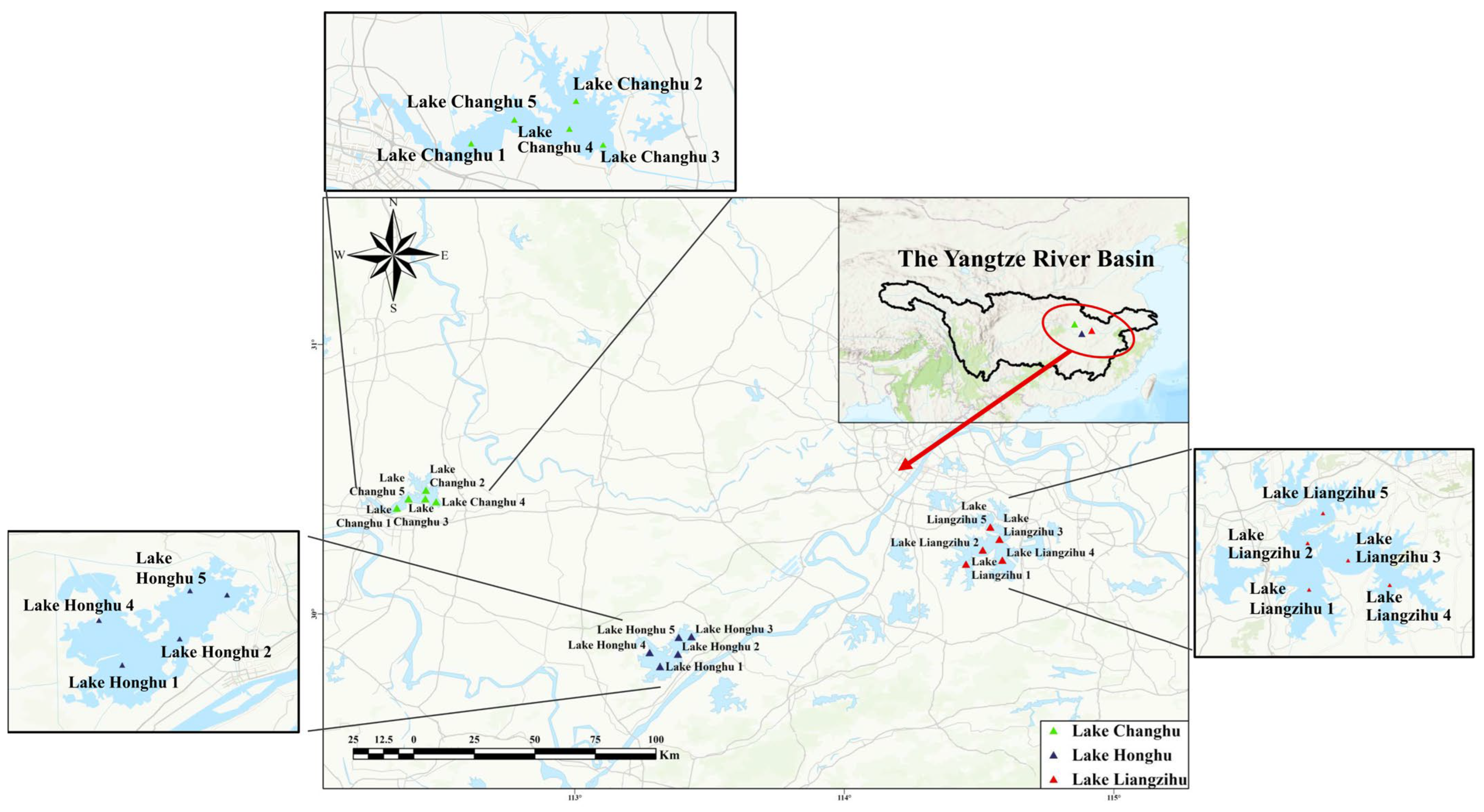
The study was conducted in three shallow lakes of the middle Yangtze River floodplain in Hubei Province, China: Lake Changhu (122.5 km2; mean depth 2.5 m), Lake Liangzihu (340.0 km2; mean depth 4.16 m), and Lake Honghu (348.3 km2; mean depth 1.35 m). The three lakes share a north-subtropical monsoon climate, a common regional precipitation regime, and a long history of aquaculture and agricultural land use. They differ, however, along three geomorphic and hydrological axes that are external to the dataset analysed here. First, the lakes span a depth contrast that nonetheless remains within the shallow range: shallow lakes have a mean depth below 3 m and deep, seasonally stratifying lakes above 10 m [26], so Lake Honghu (1.35 m) and Lake Changhu (2.5 m) are shallow, and Lake Liangzihu (4.16 m) only slightly exceeds the shallow threshold without approaching that of deep, stratifying lakes. Second, surface area ranges from medium (Lake Changhu, the third largest in Hubei) to large (Lake Liangzihu and Lake Honghu, respectively the second and first largest). Third, the three lakes belong to two hydrological systems. Lake Changhu and Lake Honghu both drain into the Sihu Basin and are connected through the Neijing River, with Lake Changhu in the upper reach and Lake Honghu in the lower reach of a cascaded system. Lake Liangzihu belongs to an independent watershed and has no surface hydrological connection to the other two. The three-lake design, therefore, combines a depth contrast, an area contrast, and a paired contrast between hydrologically connected and independent basins, all of which are independent of the response variables.
Five fixed monitoring stations were established in each lake (15 stations in total; Figure 1), distributed to capture the main bathymetric and shoreline-use gradients within each basin. Each station was sampled repeatedly between October 2020 and November 2025, yielding a five-year temporal record. Sampling frequency followed a two-phase schedule. From October 2020 to December 2022, surveys were conducted bimonthly or quarterly, generating approximately 16 sampling occasions per station. From January 2023 to November 2025, the sampling frequency was increased to monthly, generating approximately 35 occasions per station. All five stations within each lake were visited on the same field campaign to control for short-term meteorological variability. Sampling, fixation, transport, and laboratory processing were performed by a single team and followed the same protocols throughout the study period.

2.2. Environmental Measurements

Water samples and in situ measurements were collected at each station from a boat, following the water quality guidance on sampling techniques [27]. Surface water (about 0.5 m depth) was collected with a 5 L horizontal Van Dorn sampler. Water temperature, dissolved oxygen (DO), pH, electrical conductivity, oxidation–reduction potential (ORP), and turbidity were measured in situ with a calibrated multiparameter sonde (YSI ProDSS; YSI Inc., Yellow Springs, OH, USA). Secchi depth (SD) was measured with a standard 30 cm white disc. Filtered and unfiltered subsamples were transported to the laboratory at 4 °C in the dark and processed within 48 h [28].
Laboratory analyses followed the national standards of the Ministry of Ecology and Environment of the People’s Republic of China. Total nitrogen (TN) was determined by alkaline potassium persulfate digestion–UV spectrophotometry [29], total phosphorus (TP) by ammonium molybdate spectrophotometry [30], ammonia nitrogen (NH4+-N) by Nessler reagent spectrophotometry [31], permanganate index (CODMn) by acidic potassium permanganate titration, and five-day biochemical oxygen demand (BOD5) by the dilution and seeding method [28,32,33]. Chlorophyll a (Chl-a) was determined spectrophotometrically after hot ethanol (90%, 80 °C, 5 min) extraction of material retained on Whatman GF/C filters (1.2 µm pore size, 47 mm; from Cytiva, Maidstone, UK), with absorbance read at 665 and 750 nm before and after acidification (1 mol L−1 HCl) [28]. Quality control included reagent blanks, duplicate sample analysis at a frequency of 10%, and certified reference materials inserted in every analytical batch.
Surface sediments were collected with a stainless-steel Peterson grab and stored at −20 °C until analysis. Sediment TN, TP, total organic carbon (TOC), water content, and loss on ignition (LOI) were quantified following the corresponding national standards [34,35,36]. Sediment variables were retained as supporting descriptors and are not central to the response analyses below.

2.3. Biological Sampling

A quantitative phytoplankton sample was collected at each station from the near-surface layer (about 0.5 m depth) using a 5 L horizontal Van Dorn water sampler (Beijing Purity Instrument Co., Ltd., Beijing, China) [28]. A 1 L subsample was decanted into an amber polyethylene bottle and fixed in the field with acidified Lugol’s iodine solution to a final concentration of approximately 1.5% (v/v) [28]. A qualitative companion sample was collected at each station by slowly towing a No. 25 plankton net (64 µm mesh) through the surface layer (0–0.5 m) in a repeated figure-of-eight pattern at 20–30 cm s−1 for 1–3 min, and the net concentrate was then fixed in the field with acidified Lugol’s iodine solution (1.0–1.5% v/v). All samples were transported to the laboratory in coolers maintained at 4 °C in the dark and were processed within 72 h of collection. In the laboratory, the 1 L fixed sample was transferred to a graduated sedimentation cylinder and allowed to settle for at least 48 h. The supernatant was removed by gentle syphoning with a fine pipette until the concentrated volume reached 30 mL, which was then homogenised by inversion. A 0.1 mL aliquot was loaded into a 0.1 mL phytoplankton counting frame and examined under an Olympus CX31 biological microscope (Olympus Corporation, Tokyo, Japan) at 400× magnification, following the Utermöhl sedimentation method. Cells, colonies, and filaments were enumerated as individual cells; filamentous and colonial forms were counted by direct cell tally, where morphology permitted [28]. A minimum of 500 individuals or 100 fields of view, whichever was reached first, was counted per slide. Total counts were rescaled to the original 1 L sample volume and expressed as cells L−1. Taxonomic identification was carried out to the species level whenever morphological characters were resolvable at 400× magnification, and to the genus level otherwise. Taxonomy followed Hongjun and Yinxin (2006, 1st edition) for Chinese freshwater algae [37].
Benthic macroinvertebrates were sampled with a Peterson grab (0.03125 m2) at each station [38]. At each station and visit, two to four grab casts were taken and combined into a single composite sample before sieving. The composite was washed on site through a 40-mesh sieve (approximately 0.45 mm), with a 60-mesh sieve (approximately 0.25 mm) nested where Tubificidae and Naididae were present, until only sieve-retained material remained. Densities were standardised to individuals m−2 using the total area sampled at each station. The retained residue was transferred to a labelled wide-mouth polyethylene jar and fixed to a final concentration of 10% buffered formalin for 48 h, then transferred to 75% ethanol for long-term storage [38]. Specimens were identified to the lowest practical taxonomic level (species or genus) under an Olympus SZX7 (Olympus Corporation, Tokyo, Japan) stereomicroscope using standard regional and international keys [28,39,40,41,42]. Densities were expressed as individuals m−2. Functional feeding groups (FFG: collector-gatherer, collector–filterer, scraper, predator, shredder) were assigned for every taxon according to Wang (2002) and Barbour et al. (1999) [39,43].

2.4. Statistical Analyses

To obtain a common temporal resolution across the bimonthly-to-monthly survey schedule, all variables were aggregated to a quarterly grid spanning 2020Q4 to 2025Q4 (21 quarters). Within each station–quarter–variable combination, a representative month was selected first to preserve seasonal phenology, with priority given to months January, March, May, July, September, and October when more than one observation per quarter was available; the mean across all valid observations of the selected month was then used as the quarterly value. Quality flags assigned during data curation were used to retain observations marked as “ok” or “unit_inconsistent”, with the remaining records set to missing. The resulting panel comprised 15 stations × 21 quarters = 315 station–quarter records, with 12 core water-quality variables and two biological response variables per record.

2.4.1. Water-Quality Trends and Changepoints

For each lake and each of 12 core water-quality variables (TN, TP, Chl-a, water temperature, SD, DO, pH, electrical conductivity, NH4+-N, CODMn, CODCr, and turbidity), the station-averaged quarterly time series was tested for monotonic change using the Mann–Kendall test, with the magnitude of change estimated by Sen’s slope. Series shorter than six valid quarters were excluded. Two complementary changepoint procedures were applied to each lake–variable series: the non-parametric Pettitt test, which identifies a single shift in distribution without assuming a specific functional form, and a segmented linear regression with one breakpoint estimated by the iterative procedure. Both procedures returned the quarter of the most likely changepoint and an associated p-value or standard error. Breakpoints were retained for further interpretation when the Pettitt p-value was below 0.05 or when the segmented model converged with a finite breakpoint standard error.

2.4.2. Community Structure and Functional Composition

Alpha diversity was summarised at the station–quarter level by species richness (S), the Shannon–Wiener index (H′ = −Σ pi ln pi), the Simpson index (1 − D = 1 − Σ pi2), and Pielou’s evenness (J′ = H′/ln S). Bray–Curtis dissimilarity matrices were ordinated by non-metric multidimensional scaling (NMDS) using metaMDS with k = 2 and 50 random starts [44]. For phytoplankton, the species matrix was Hellinger-transformed and restricted to taxa occurring in at least 10% of station–quarters (62 of 109 species retained; the single unassigned taxon among the 110 recorded was excluded), which reduced the stress value from 0.292 to 0.236. The default metaMDS autotransformation was retained for the benthic matrix, for which the stress (0.086) was already in the “good” range. Five station–quarters with anomalous benthic densities, identified as interquartile-range outliers, were excluded from ordination plots but retained in all multivariate tests.
Compositional structuring by lake identity, season (Q1–Q4), and year was assessed by permutational multivariate analysis of variance (PERMANOVA, adonis2 in vegan, marginal sums of squares, 999 permutations), with Bray–Curtis distance computed on the same matrices used for NMDS [45]. Indicator-species analysis (999 permutations) was used to identify taxa associated with individual lakes; species with adjusted p < 0.05 were reported [46]. The functional structure of the benthic assemblage was summarised as the quarterly relative abundance of each functional feeding group at each lake.

2.4.3. Panel Mixed-Effect Distributed Lag Models

Lag-response windows linking water-quality drivers to biological response variables were estimated with a panel mixed-effect distributed lag model (PME-DLM), which extends the standard distributed lag non-linear modelling framework of Gasparrini et al. (2010, 2017) to a multi-site panel [47,48]. The model was fitted separately for phytoplankton and benthic total density (both log10-transformed) against each of five drivers: TN, TP, Chl-a, water temperature, and SD. Each driver was z-standardised across the full panel so that the lag-specific coefficients represent the change in log10 density per one standard-deviation increase in the driver, allowing direct comparison across drivers with different physical units. Within each station, missing driver values were filled by linear interpolation with extension by the nearest valid value.
A cross-basis was constructed at each station, using a linear function for the exposure–response dimension and a natural cubic spline with four internal degrees of freedom for the lag dimension, spanning lags 0–6 quarters (0–18 months). The station-specific cross-bases were column-aligned by basis index and stacked into a single panel. Fixed effects were the cross-basis terms, season as a categorical factor (Q1–Q4), and a natural cubic spline of time (df = 4) to absorb residual long-term trends. Random intercepts were specified as station nested within lake.
Models were fitted by maximum likelihood under a Gaussian family. When the default optimiser produced a singular variance–covariance matrix, the model was refitted in sequence with (i) the BFGS optimiser, (ii) a simplified random structure with station as the only grouping factor, and (iii) a fixed-effects-only formulation with lake and station entered as factors and estimated by ordinary least squares. The first specification that returned a finite variance–covariance matrix was retained, and the fallback level was logged for every model.
Lag-specific coefficients on the natural scale were reconstructed by multiplying the basis matrix evaluated at integer lags 0–6 by the fitted cross-basis coefficients, and 95% confidence intervals were derived from the corresponding variance–covariance submatrix. A lag was deemed significant when its 95% confidence interval excluded zero. Two summary statistics were derived from each lag-response curve: the window width w (the number of significant lag steps) and the peak lag (the lag at which the absolute effect was maximal among the significant steps).
For all lag-specific results, lag positions are reported in months (1 lag step = 1 quarter = 3 months), while window width w is reported as the number of significant lag steps (0–7 possible values for a lag basis spanning 0–6 quarters). Robustness of the lag-specific inferences was verified by Benjamini–Hochberg multiple-testing correction across the 70-test family (Tables S1 and S2), bootstrap convergence checks (Table S3), panel-level residual diagnostics (Table S4), and validation of the linear-interpolation scheme against listwise deletion (Tables S5 and S6), which confirmed agreement to within ±1 lag step for nine of ten driver-response combinations.

2.4.4. Variation Partitioning and Lake-Stratified Bootstrap

Constrained ordination of the Hellinger-transformed community matrices against the in situ environmental conditions was carried out by redundancy analysis. The full model included TN, TP, Chl-a, water temperature, SD, and DO as continuous predictors and season and lake identity as factors. Marginal permutation tests (999 permutations) were used to identify individually significant predictors. The contribution of water quality, season, and lake identity to community variation was partitioned by three-table variation partitioning, with the water-quality table comprising TN, TP, Chl-a, water temperature, SD, DO, and CODMn, the seasonal table comprising dummy-coded quarters, and the lake table comprising dummy-coded lake identity. Adjusted R2 values are reported for all individual and joint fractions.
Cross-lake differences in lag-window width were assessed with a station-resampled bootstrap. For each lake, response group and driver, 200 bootstrap replicates were generated by resampling that lake’s five monitoring stations with replacement (within a replicate a station may be drawn more than once or omitted, while the number of stations drawn is held at five), and a simplified PME-DLM (random intercept for station only, natural cubic spline of time with df = 3) was refitted on each replicate [49]. The window width was recomputed on every replicate and summarised as a median and a 95% percentile interval. Differences in window width among lakes were evaluated by comparing these intervals against the joint PME-DLM estimate. Lake-level attributes (mean depth, log-transformed surface area, and watershed identity) together with the multi-year mean and standard deviation of each driver were regressed against window width by ordinary least squares.
All analyses were performed in R version 4.5 [50]. Statistical significance was assessed at α = 0.05 unless stated otherwise, and 999 permutations were used for all permutation-based tests.

3. Results

3.1. Water Quality Trends and Perturbation Window

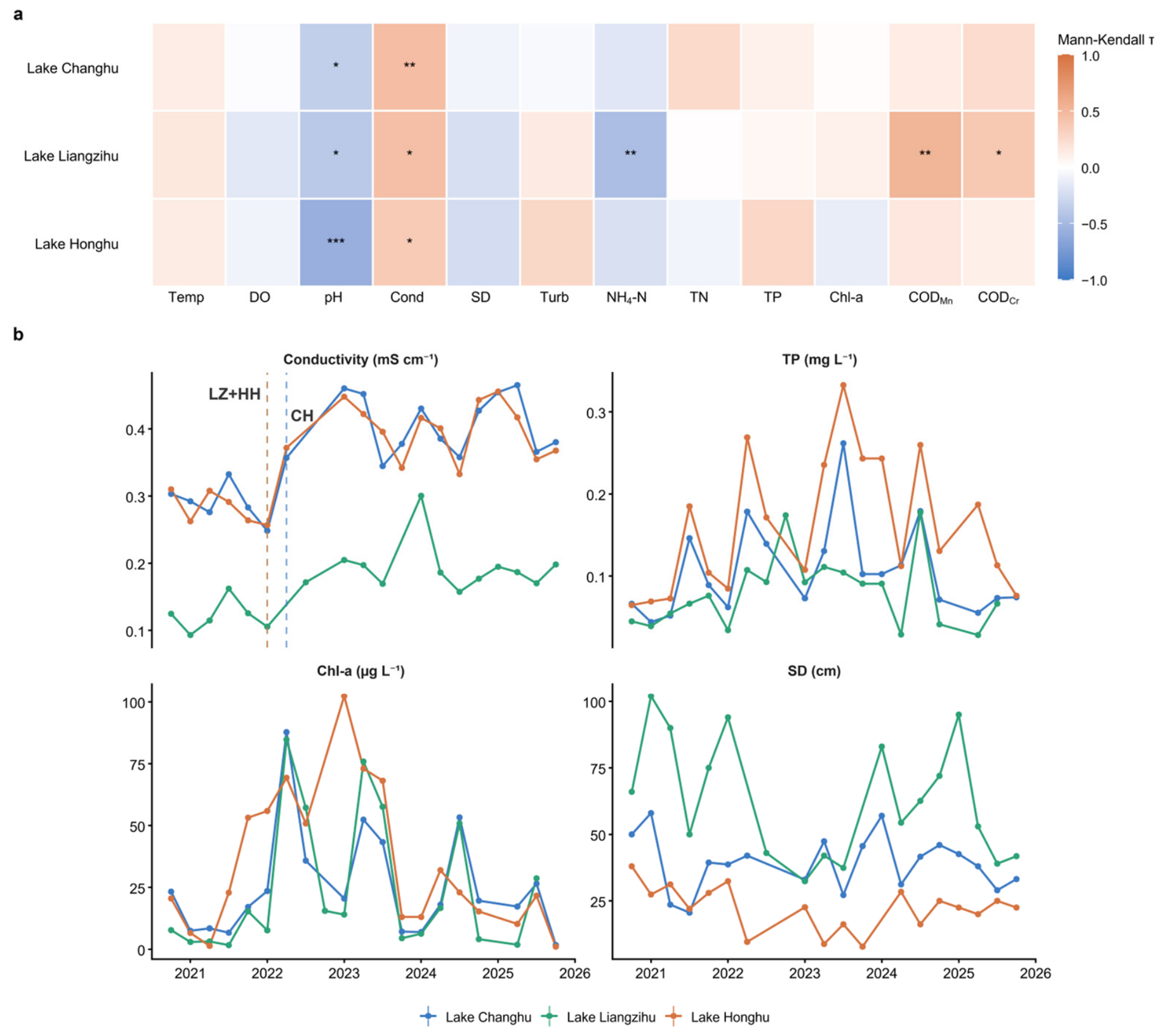
Across all three lakes, two water-quality variables changed monotonically and in the same direction (Figure 2a): pH declined (Lake Changhu, τ = −0.35, p < 0.05; Lake Liangzihu, τ = −0.39, p < 0.05; Lake Honghu, τ = −0.58, p < 0.05), while conductivity increased in all three (τ = 0.37–0.46, all p < 0.05; self-referential baseline). This concurrent pH decline and conductivity rise was the only signal common to all three basins. No other parameter changed significantly in Lake Changhu over the 5-year record. The remaining two basins exhibited additional lake-specific signals (Figure 2a). Lake Liangzihu showed rising organic-matter loads (CODCr, τ = 0.38, p < 0.05; CODMn, τ = 0.53, p < 0.01) and a decline in NH4-N (τ = −0.47, p < 0.01). Total nitrogen, total phosphorus, chlorophyll a (Chl-a), SD, turbidity, temperature, and dissolved oxygen showed no significant 5-year monotonic trend in any lake.
The Pettitt test detected significant conductivity change points in 2022 in all three lakes (Figure 2b). Lake Liangzihu and Lake Honghu broke at 2022Q1, and Lake Changhu at 2022Q2 (all p < 0.05). The two 2022Q1 breakpoints fell on the same quarter and overlapped as a single dashed line in the figure. TP, chlorophyll a, and Secchi depth produced no significant Pettitt breakpoint in any lake (TP, p = 0.08–0.40; chlorophyll a, p = 0.25–0.68; Secchi depth, p = 0.09–0.85), and the corresponding panels are shown without overlaid lines.
The timing of peak values in the three focal water-quality variables was heterogeneous and did not coincide tightly with the conductivity changepoint (Figure 2b). Chlorophyll a reached its five-year lake-mean maximum at 2022Q2 in Lake Changhu (87.8 µg L−1) and Lake Liangzihu (84.8 µg L−1), coinciding with the conductivity breakpoint window, whereas the Lake Honghu maximum (102 µg L−1) occurred at 2023Q1, three quarters later. TP maxima were displaced further in time, all falling between 2023Q3 and 2024Q3 (Lake Changhu, 0.262 mg L−1 at 2023Q3; Lake Honghu, 0.333 mg L−1 at 2023Q3; Lake Liangzihu, 0.177 mg L−1 at 2024Q3). Secchi-depth minima also differed among basins, with Lake Changhu reaching its minimum at 2021Q3 (20.6 cm), Lake Liangzihu at 2023Q1 (32.4 cm), and Lake Honghu at 2023Q4 (7.8 cm). Mean Secchi depth across the record ranked Lake Liangzihu (62.9 cm) > Lake Changhu (39.2 cm) > Lake Honghu (22.4 cm), consistent with the morphometric and turbidity contrasts among the three basins.

3.2. Assemblage Structure and Functional Composition

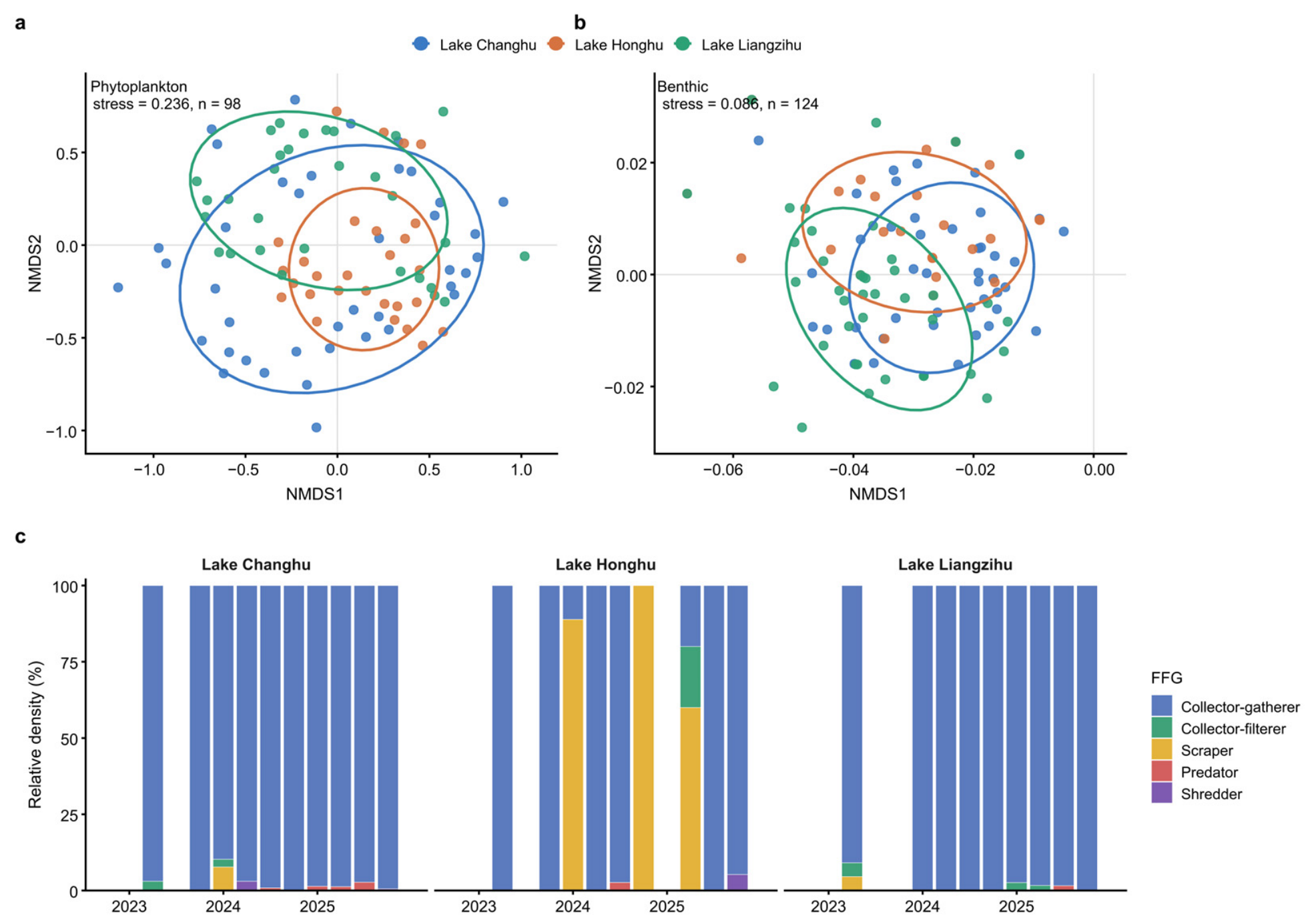
The species-resolved survey recorded 110 phytoplankton taxa (seven divisions, Cyanophyta-dominated) and 28 benthic taxa (three phyla, dominated by chironomids and oligochaetes), with phytoplankton diversity increasing from Lake Changhu to Lake Honghu (Tables S10–S14). Both community types exhibited significant compositional structuring by lake, season, and year (PERMANOVA, all p < 0.01), although the relative contributions of these terms differed between groups. For phytoplankton, season (R2 = 12.5%) and year (R2 = 10.8%) each explained more compositional variance than lake identity (R2 = 8.9%), and residual variance reached 67.8%. For benthic communities, season remained the leading term (R2 = 8.2%), but lake identity (R2 = 6.4%) and year (R2 = 3.8%) explained less, and residual variance rose to 80.9%. Phytoplankton composition was therefore more responsive to seasonal and interannual variation, whereas benthic composition retained a larger unexplained fraction.
NMDS ordinations (Figure 3a,b) recovered comparable lake-level signals on the second axis (lake identity R2 on NMDS2: phytoplankton 12.9%, benthic 11.3%), although the two ordinations yielded markedly different stress values. The phytoplankton ordination (stress = 0.236, n = 98) and the benthic ordination (stress = 0.086, n = 124) were well-fitting. This difference in stress reflects the higher dimensionality of phytoplankton assemblage variation rather than weaker lake structuring. Lake-level ellipses overlapped substantially in both panels, consistent with the modest PERMANOVA R2 values for lake identity.
Benthic functional feeding groups (FFG) were dominated by collector-gatherers (CG) across all three lakes throughout 2023Q2–2025Q4 (Figure 3c). Non-CG occurrences were sparse and largely confined to the species-level detection floor. Scrapers reached 89% relative abundance at Lake Honghu in 2024Q1, 100% in 2024Q4, and 60% in 2025Q2. In each of these quarters, CG density had fallen to a single detected individual or none, against 10,240–39,936 individuals m−2 in the other six quarters, and total benthic density was among the three lowest of the nine-quarter record (5120–9216 individuals m−2). Across the nine quarters, scraper relative abundance was negatively related to CG density (Spearman ρ = −0.84; Pearson r2 = 0.54). These peaks therefore reflect intermittent CG absence in a sparse assemblage, since SC density itself remained low (3072–8192 individuals m−2). Functional composition was a stable CG-dominated baseline interrupted by these detection-floor artefacts at Lake Honghu.

3.3. Distributed Lag Windows Difference

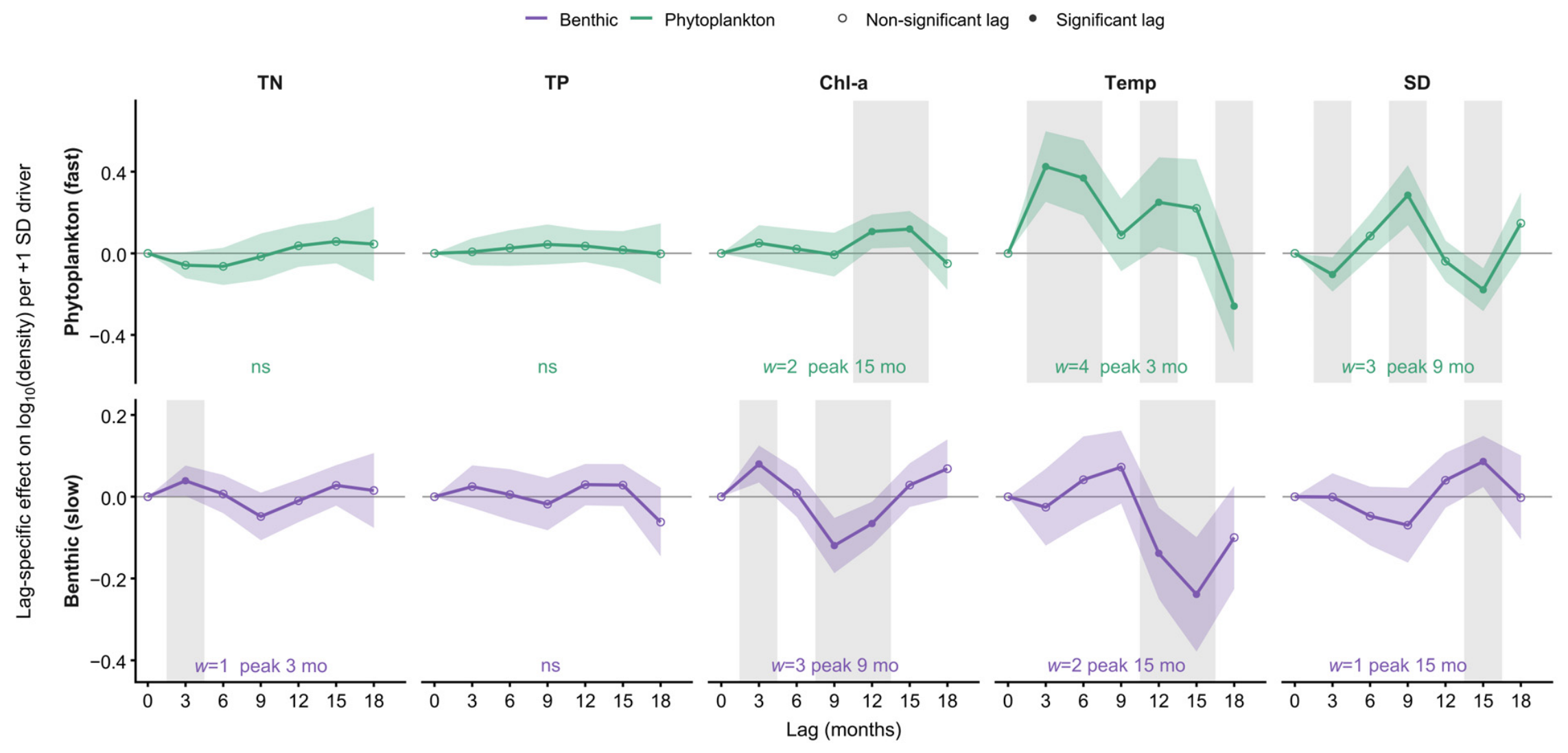
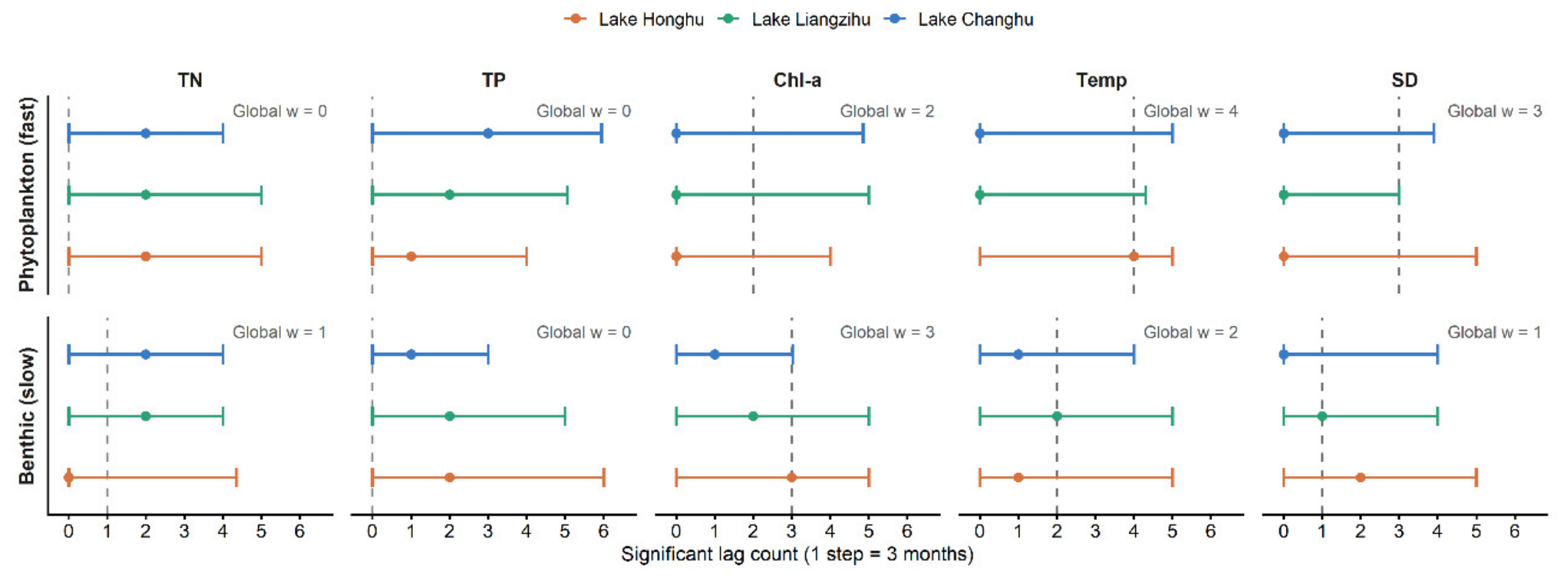
The joint PME-DLM yielded distinct lag profiles for the two response groups (Figure 4). For phytoplankton, significant windows were detected for four of five drivers. Temperature produced the largest peak effect (approximately +0.43 log10(cells L−1) per +1 SD increase, peaking at a 3-month lag), with significant lag-specific effects at 3 months (+0.43), 6 months (+0.37), 12 months (+0.25), and 18 months (−0.26) (window width w = 4 significant lag steps, equivalent to four non-contiguous quarters between 3 and 18 months, including a sign reversal at the 18-month boundary). Chl-a produced a positive window between 12 and 15 months (w = 2; peak +0.12 at 15 months). SD showed an oscillatory pattern (w = 3): negative at 3 months (−0.10), positive at 9 months (+0.29), and negative at 15 months (−0.18), consistent with alternating suppression and promotion. Total nitrogen produced no significant lag (w = 0). Total phosphorus also returned no significant lags after convergence correction (w = 0).
Benthic windows shifted toward longer lags and different driver associations (Figure 4, lower row). Chl-a produced a sign-reversing window (w = 3): positive at 3 months (+0.08), negative at 9 months (−0.12), and 12 months (−0.07), peaking at 9 months. Temperature showed a negative window between 12 and 15 months (w = 2, peak −0.24 at 15 months). SD and TN each showed a single significant lag step (SD at 15 months, w = 1, peak +0.09; TN at 3 months, w = 1, +0.04), but neither survived the Benjamini–Hochberg correction across the full 70-test family (Table S2) and so is not interpreted here as a robust window. TP returned no significant benthic lags (w = 0). Combined, phytoplankton windows spanned 3–18 months and benthic windows 3–15 months, but benthic responses were characterised by smaller peak effects and non-monotonic shapes. Phytoplankton, therefore, appeared to track contemporaneous water-quality variation on a quarterly time scale, whereas benthic communities showed more complex, multi-lag integration of environmental signals. Under the Benjamini–Hochberg correction at q = 0.05 across the full family of 70 lag tests, the dominant phytoplankton–temperature window and the benthic chlorophyll a window remained significant (Table S2).

3.4. Variation Partitioning and Bootstrap Windows

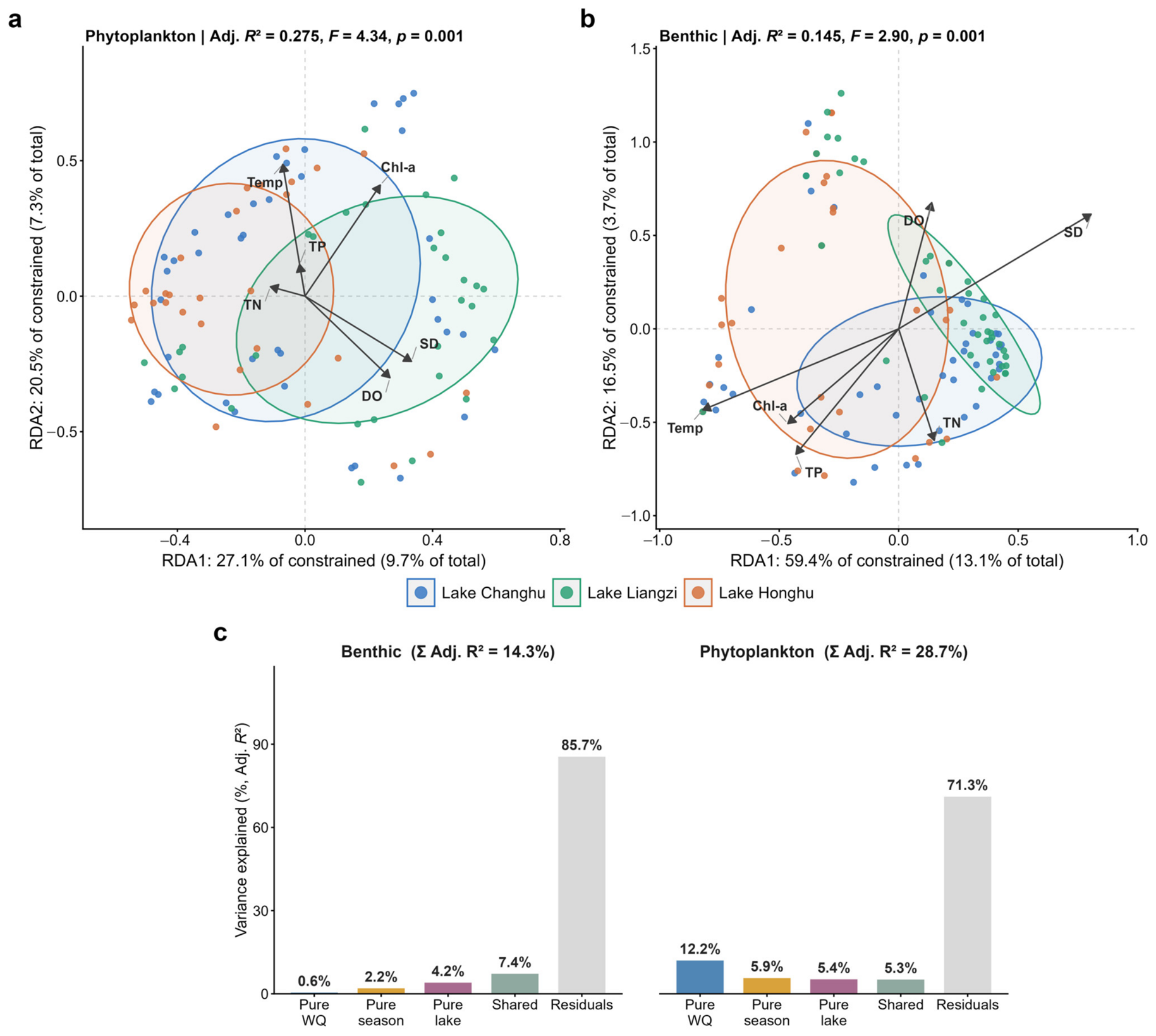
Constrained ordination (RDA) was significant for both groups (Figure 5). For phytoplankton, the model explained Adj. R2 = 0.275 (F = 4.34, p < 0.05), a modest but characteristic value for species-level ordination, in which model significance is established by permutation rather than by the magnitude of R2 [51,52]. The first two axes accounted for 47.6% of the constrained variance (RDA1 = 27.1%, RDA2 = 20.5%; or 9.7% and 7.3% of total inertia). The three lake-level ellipses overlapped extensively, although Lake Liangzihu was displaced toward the SD/DO end of RDA1 and Lake Honghu toward the TP/TN end. By-term permutation tests identified Chl-a, water temperature, SD, and DO as individually significant predictors for phytoplankton (all p < 0.05). For benthic communities, the model explained Adj. R2 = 0.145 (F = 2.90, p < 0.05) and was dominated by the first axis (RDA1 = 59.4% constrained, 13.1% total; RDA2 = 16.5% constrained, 3.7% total). Water temperature, DO, season, and lake identity were the individually significant benthic predictors (all p < 0.05). The unconstrained NMDS ordinations in Figure 3 indicated that lake identity contributed comparable and modest structuring in both groups (PERMANOVA lake R2 = 6.4% for benthic versus 8.9% for phytoplankton).
Three-table variation partitioning (Figure 5c) yielded two contrasting profiles. For phytoplankton, pure water quality was the dominant fraction (Adj. R2 = 12.2%), followed by pure season (5.9%), pure lake (5.4%), and a shared joint fraction of 5.3%, totalling 28.7% explained. For benthic communities, pure lake identity was the largest pure fraction (Adj. R2 = 4.2%), but the shared joint fraction (7.4%) exceeded each pure component (pure WQ = 0.6%, pure season = 2.2%), with a total of 14.3% explained. Phytoplankton variation was therefore concentrated in the pure water-quality component, whereas benthic variation was concentrated in the shared joint overlap, indicating that benthic community structure was shaped by the combined rather than independent action of water quality and seasonality.
Lake-stratified bootstrapping tested whether lag-window widths differed among lakes (Figure 6). For all five drivers and both response groups, the bootstrap 95% confidence intervals on window widths overlapped substantially across the three lakes, and the bootstrap medians clustered near the joint PME-DLM reference (vertical dashed line). At the present resampling resolution, cross-lake differences in window width were not statistically resolvable, and lag-window length appeared to be determined primarily by the response group rather than by the individual lake.

4. Discussion

4.1. Trophic-Specific Lag Timescales

The joint panel mixed-effect distributed lag model revealed two contrasts (Figure 4). Phytoplankton effects clustered at short horizons, peaking at a 3-month temperature lag, whereas benthic effects shifted toward intermediate-to-long horizons, with peaks between 9 and 15 months. The two assemblages appear to integrate the same water-quality signal through pathways of different intrinsic timescales, consistent with previously reported divergent response trajectories under shared environmental forcing [21]. Total nitrogen and total phosphorus produced no significant lag in either group, whereas chlorophyll a, water temperature, and Secchi depth entered significant windows in both. Because dissolved nitrogen and phosphorus remained persistently high and without a monotonic trend over the record (Section 3.1), their between-quarter variation fell within a non-limiting range and produced no resolvable lag, whereas chlorophyll a, water temperature, and Secchi depth track the food supply, metabolic rate, and light that the organisms experience directly. Under the regional eutrophic state, dissolved nutrients thus appear to act on the biota indirectly via bloom-derived and physical proxies rather than as direct drivers.
The 3-month temperature lag for phytoplankton spans several phytoplankton generations under seasonal warming [53]. In an 18-year daily record from Lake Balaton, seasonal temperature and the integrated departure from normal seasonal temperature over two to three generations were the relevant drivers, whereas short-term temperature variation was not [54]. Long-term satellite observations of column-integrated algal biomass in Lake Chaohu show that biomass tracks temperature change at monthly to annual scales but redistributes spatially on shorter scales under wind forcing [55]. Geostationary observations at Lake Taihu further confirm that air temperature dominates intra-daily variation in cyanobacterial bloom intensity, while phosphorus explains monthly variation [56]. The present 3-month window is therefore at the expected coupling timescale: long enough for several phytoplankton generations to translate a thermal anomaly into a population response, but short relative to the multi-year accumulation reported for lakes where warming and nutrient loading act jointly [57]. The absence of a significant total nitrogen or total phosphorus window likely reflects regional nutrient saturation rather than insensitive primary producers. Mesocosm experiments show that phytoplankton biovolume responds to combined nitrogen and phosphorus enrichment within days and declines within 20 days after enrichment ceases [58]. The dissolved-nutrient pool in the three study lakes therefore appears to lie above the threshold at which between-quarter variation carries an ecological signal.
The benthic 9–15 month centre and the sign-reversing chlorophyll a window are consistent with an indirect transmission pathway from the water column to the sediment layer. Sediment porewater soluble reactive phosphorus and phosphorus fluxes at Lake Taihu were about five and eight times larger in summer than in winter, respectively, and correlated with chlorophyll a in the overlying water [59]. At the same lake, bloom-induced internal phosphorus release exceeded storm-induced external loading on short timescales, indicating that algal biomass can outrun its own external nutrient signal [60]. These observations help explain why chlorophyll a, rather than dissolved total phosphorus, appears as the leading lagged signal for benthic density here: chlorophyll a integrates external loading, internal loading, and biological uptake into a single proxy that is more proximate to benthic exposure. This control may operate largely through sedimentation. The pelagic algal biomass indexed by chlorophyll a settles to the bed as phytodetritus, and the benthic response may therefore lag by the time required for that material to be deposited and then processed at the sediment surface, both as a food resource and through the oxygen demand of its decomposition. Stable-isotope evidence from a regime-shift shallow lake further shows that benthic invertebrates transport pelagic carbon into the sediment zone [61], providing a trophic mechanism for the multi-month delay between an algal pulse and a measurable benthic response. The bimodal chlorophyll a window, positive at a 3-month lag and negative at 9 months, fits a two-phase response in which fresh phytodetritus first stimulates collector-gatherer densities (the dominant benthic functional group in all three lakes), while accumulated organic matter subsequently raises sediment oxygen demand and depresses their density. Macroinvertebrate sensitivity to oxygen at the sediment–water interface supports this mechanism, and internal loading is a recognised primary driver of delayed benthic recovery in shallow eutrophic lakes [62].
Within the current panel, benthic communities exhibited a sign-reversing response window for chlorophyll a (positive at lag 1, negative at lags 3–4), whereas no robust benthic window was observed for total nitrogen. A 15-year series, by contrast, at Lake Taihu attributed benthic variation primarily to nutrients (total nitrogen, ammonium) and habitat factors (sediment substrate, macrophyte biomass) and reported that benthic invertebrates were more sensitive to environmental improvement than the pelagic community [20]. The divergence suggests that in lakes where the dissolved nitrogen pool is persistently saturating (as in the three shallow lakes), the temporal signal-to-noise ratio of nutrient concentrations is too low for benthic recovery dynamics to be resolved, and the proximate driver shifts to bloom and clarity proxies. A similar decoupling has been reported from hypereutrophic lakes in the Yungui Plateau, where water-quality improvement does not scale directly with bloom control when internal loading and warming co-occur [63].

4.2. Convergence of Lag Widths Across Lakes

The lake-stratified bootstrap analysis showed that the 95% confidence intervals on lag-window widths overlapped substantially across the three lakes for all five drivers and both response groups, and the bootstrap medians clustered around the joint panel reference. At the present resampling resolution, cross-lake differences in lag-window width are not statistically resolvable. This null result on the temporal property of the response does not imply an absence of cross-lake structure on the spatial property. PERMANOVA retained significant lake-identity terms for both groups (lake R2 = 8.9% for phytoplankton, 6.4% for benthos), and the constrained ordinations placed Lake Liangzihu toward the Secchi depth and dissolved oxygen end of the gradient and Lake Honghu toward the total phosphorus and temperature end.
Two non-exclusive interpretations are consistent with this pattern, and the first is methodological. With 21 quarterly time points per station and 15 stations resampled within lake strata, the bootstrap intervals on window width remain wide. Cross-lake differences on the order of one to two lag steps may exist but fall below the resolvable threshold of the present panel. The second interpretation is biological. Lag-window length appears to be set primarily by the response group rather than by the lake. This grouping may reflect intrinsic differences in life history. Phytoplankton are short-lived and suspended directly in the water column and may therefore track a driver within a single quarter, whereas benthic macroinvertebrates are longer-lived and coupled to the water column only indirectly through sedimentation and may integrate the same forcing over many months. Where the present panel detected fast (3-month) phytoplankton windows and slow (9–15-month) benthic windows in all three lakes, the variation across lakes was an order of magnitude smaller than the variation between groups. The three lakes share a north-subtropical monsoon climate, are exposed to comparable regional warming, and span a moderate-to-severe eutrophic range. Within this shared context, the depth contrast, the area contrast, and the watershed contrast are apparently too modest to produce a directional shift in lag-window width at quarterly resolution.
Larger regional panels of Yangtze-floodplain lakes provide context for both interpretations. In a 30-lake mollusc survey, species richness was lower in hydrologically disconnected lakes than in connected lakes and decreased with increasing water eutrophication [64]. In a 19-lake survey along the middle and lower Yangtze, water nutrients were positively correlated with light attenuation, and submerged macrophyte richness was identified as a regulator of water clarity and quality [65]. A four-lake comparison covering Dongting, Poyang, Taihu, and Chaohu reported that gate-controlled lakes had higher eutrophication than river-connected lakes during the wet season, with surface runoff and non-point sources as the dominant pollution sources for both types [66]. These observations indicate that cross-lake differences in community state, water clarity, and pigment composition can be resolved at the regional scale (tens of lakes) and at the multi-decadal scale (sediment records). Detecting cross-lake differences in the temporal response window itself would require a larger spatial replicate count or a longer time series than the present three-lake, five-year panel can provide.
A second contextual consideration is that the timescale of cross-lake divergence in shallow lakes may exceed five years. Palaeolimnological and long-term observations of macrophyte-to-phytoplankton regime shifts report that compositional and biogeochemical reorganisations unfold over decades rather than quarters and that anthropogenic forcing tends to dominate over hydrological variability in driving abrupt change [67]. Long-term zooplankton monitoring at Lake Taihu further suggests that top-down regulators may be more important than bottom-up nutrient gradients in shaping community trends [68]. The null cross-lake result on lag-window width, therefore, reflects a property of the analysed time horizon rather than functional equivalence among the three lakes. Within this five-year three-lake panel of shallow Yangtze-floodplain lakes, lag-window length depends more on the biological group than on the lake of origin, which reinforces the inference advanced in Section 4.1.

4.3. Additive Versus Interactive Environmental Signals

The two community matrices yielded a mirror-image variation partitioning pattern (Figure 5c). For phytoplankton, pure water quality was the largest single component (adj. R2 = 12.2%), and the WQ × Season joint fraction was small (3.4%). For benthic communities, the structure inverted: pure water quality dropped to 0.6%, pure season to 2.2%, and the WQ × Season joint fraction (5.8%) exceeded any pure component. The total variance explained also differed substantially (28.7% for phytoplankton vs. 14.3% for benthic). The contrast lies less in how much community variation is environmentally explainable than in whether the environmental signal is additive or conditional on the season in which it is observed.
A plausible mechanistic interpretation is that benthic species express life-cycle stages with strong seasonal phenology so that the effect of a given water-quality variable on benthic density depends on which stage of the cycle is exposed to it. Latitudinal analyses of aquatic insect emergence show that temperate-zone communities exhibit substantial between-month variation, with temperature as the dominant climatic driver of these phenological cycles [69]. Long-term eDNA monitoring of macroinvertebrate communities further documents a cyclic “seasonal clock” of community turnover, with most taxa peaking in spring and merolimnic species emerging in summer [70]. In the Yangtze floodplain, the seasonal switching of dominant macroinvertebrate drivers has been documented directly: hydrological parameters (flow velocity, water depth) governed macroinvertebrate assemblages in spring and summer at Lake Dongting, whereas water nutrients (chlorophyll a, total dissolved phosphorus) became the leading drivers in autumn and winter [71]. Within a multi-year monitoring panel, such a seasonal switch loads variance onto the WQ × Season interaction rather than onto either main effect, consistent with the present finding. Seasonal energy-source switching at the level of individual taxa provides a further microhabitat mechanism, as shown by systematically higher methane-derived carbon contributions to Chironomus plumosus and to oligochaete biomass in summer and autumn than in winter and spring at a shallow eutrophic polymictic lake [72].
For phytoplankton, by contrast, continuous reproduction and direct coupling to bulk water–column conditions allow the same water-quality variable to act in a similar direction across the year, so that its effect can be recovered as a pure additive fraction. Modelling work shows that seasonal compositional variability in phytoplankton can be enhanced jointly by temperature, nutrient ratios, and species pool size, although temporal variability in nutrient loads alone is sufficient to enhance compositional variability [73]. In hyper-eutrophic zones of large shallow Chinese lakes, the interaction between nutrients and climate has been reported to become synergistic rather than additive [74], which suggests that the additive pattern recovered here for phytoplankton may itself be state-dependent and could shift toward an interactive structure under stronger climatic forcing.
The benthic side of the mirror also has a habitat dimension that is partially absorbed into the pure-lake fraction (4.2%, the largest pure component in the benthic partitioning). A regional comparison across Yangtze floodplain lakes spanning macrophyte-, transition-, and phytoplankton-dominated states found that functional richness and macrophyte coverage explained more macroinvertebrate biomass variation than dissolved-nutrient gradients [75]. The benthic structure recovered here, with pure lake identity relatively prominent and pure water quality near zero, is therefore consistent with a system in which physical and biotic habitat factors (sediment and macrophyte stand structure) constrain the local pool of benthic taxa, and the water-quality signal acts on this constrained pool only through its seasonal phasing. Regression and ordination models for benthic communities in shallow Yangtze lakes should consequently retain a season-by-driver interaction term rather than assume additivity, and the standard distributed lag formulation can accordingly be extended to a season-stratified or seasonally interacting variant. By the same reasoning, snapshot or annual-mean monitoring schemes will systematically under-represent the benthic signal because the WQ × Season joint fraction is averaged out under temporal aggregation.

4.4. Regional Climatic Perturbation

The Mann–Kendall analysis flagged conductivity as the only water-quality variable that increased significantly and monotonically (all p < 0.05) across all three lakes over the five-year record (Figure 2a). The corresponding Pettitt test resolved the rise into concurrent breakpoints at 2022Q1 in Lake Liangzihu (p < 0.05) and Lake Honghu (p < 0.05), and at 2022Q2 in Lake Changhu (p < 0.01) (Figure 2b, Conductivity panel). Because Lake Liangzihu belongs to an independent watershed and shares no surface hydrological connection with the Sihu basin pair (Lake Changhu and Honghu), the synchronous conductivity rise cannot be attributed to a single watershed-scale loading event and is more parsimoniously explained by a regional climatic driver acting on all three basins concurrently.
The same hydrological independence offers a parsimonious explanation for the much lower baseline conductivity of Lake Liangzihu relative to the Sihu pair (record means of 0.16 mS cm−1 versus 0.34 and 0.36 mS cm−1 at Lake Honghu and Lake Changhu), a difference corroborated by total dissolved solids (0.10 versus 0.24 and 0.22 g L−1). Lying in a separate watershed, Lake Liangzihu does not receive the concentrated agricultural return flow that the Neijing River delivers to the connected Changhu–Honghu system, and its greater mean depth (4.16 m) gives it the largest water volume of the three basins, which would further dilute any dissolved-solute input. Nutrient concentrations, chlorophyll, and temperature differ less among the lakes because they track a shared hyper-eutrophic and climatic background rather than basin-specific ionic loading.
The candidate driver is the 2022 compound heatwave-drought event that affected the Chinese Eastern Plains ecoregion. A multi-lake survey of 40 large shallow lakes (>50 km2) across the Chinese Eastern Plains documented a 2022 compound heatwave-drought event in which the chlorophyll a response of each lake depended on its hydrological flushing rate, with long-retention lakes showing chlorophyll a declines attributable to reduced external nutrient inputs from decreased rainfall [76]. The three lakes are all long-retention systems, yet chlorophyll a peaked rather than declined in 2022Q2 at both Lake Changhu (87.8 µg L−1) and Lake Liangzihu (84.8 µg L−1) (Figure 2b). This direction of response is consistent with their hyper-eutrophic baseline, in which internal phosphorus loading and warming-driven cyanobacterial proliferation can override the chlorophyll a decline expected under reduced external loading alone. A geographically closer case from Lake Shengjin in the middle of the Yangtze River, where sustained 2022 heatwaves drove a shift toward cyanobacterial dominance, and water temperature accounted for 38.7% of phytoplankton compositional variation [77], provides a positive analogue for the chlorophyll a peak observed here. The simultaneous conductivity rise may reflect the same precipitation deficit. When precipitation is low, reduced inflow and a shift in the precipitation-evaporation balance draw down water levels and concentrate dissolved solutes through evaporation, a mechanism documented for lakes during drought periods [78].
The lake–mean trajectories also reveal a temporal cascade in the biogeochemical response that mirrors the cross-sectional fast-versus-slow contrast resolved by the joint PME-DLM in Section 4.1. Chlorophyll a peaked at 2022Q2 in Lake Changhu and Lake Liangzihu and three quarters later at Lake Honghu (102 µg L−1 at 2023Q1). The rapid chlorophyll a peak at Lakes Changhu and Liangzihu matches the 3-month temperature response of phytoplankton (Figure 4). Total phosphorus peaked five to ten quarters after the conductivity changepoint in every lake (Lake Changhu and Lake Honghu at 2023Q3, with maxima of 0.262 and 0.333 mg L−1; Lake Liangzihu at 2024Q3, with a maximum of 0.177 mg L−1), a delay of 15–30 months, longer than the 9–15-month benthic lag windows for chlorophyll a and temperature and of the same slow order, consistent with a slow sediment-influenced or legacy-phosphorus pathway rather than a direct biological lag (Figure 4). A two-stage temporal partition of comparable form has been recovered for a temperate eutrophic lake (Lake Mendota) through coupled biogeochemical modelling, in which water–column variables such as clarity and algal biomass responded within years of external load change while sediment-mediated variables responded over decades [14]. The agreement between the above pattern, the cross-sectional PME-DLM windows in the present panel, and the longitudinal cascade following the 2022 event strengthens the inference in Section 4.2.
The slower TP response invites a mechanistic discussion grounded in sediment phosphorus dynamics. Within individual lakes and reservoirs, sediment P fluxes across the sediment–water interface have been documented to vary substantially in space and time, with brief intervals of elevated flux produced when aerobic or anaerobic processes mobilise different sediment P pools [79]. Our own sediment record corroborates this only in part: surface–sediment TP forms a substantial reservoir in all three lakes (0.38–0.56 mg g−1, largest in Lake Liangzihu; Table S7) but did not increase over the study period (Table S8, Figure S1) and was weakly coupled to water–column TP (Table S9). The possibility offers one candidate explanation for the year-scale offset between the TP maxima at Lake Changhu and Lake Honghu (both 2023Q3) and at Lake Liangzihu (2024Q3). A separate line of evidence from a more deeply stratified North American lake (Lake Wilcox, Ontario) shows that a multi-decade increase in dissolved–solute concentrations, caused by progressive salinization from deicing salts, can shift the dominant source of bioavailable P from the external watershed to internal sediment release by strengthening summer stratification and intensifying hypolimnetic hypoxia [80]. The broader implication that perturbations in the dissolved–solute regime can alter the relative contribution of external and internal P sources remains a plausible but unconfirmed contributor to the temporal cascade from the 2022Q1–Q2 conductivity rise to the TP maxima recorded one to two years later; a contribution from catchment legacy-phosphorus delivery or hydrological lag cannot be excluded.

4.5. Management Implications

Our analyses yield several conclusions with direct management relevance for shallow eutrophic lakes in the middle and lower Yangtze River basin, and by extension for comparable shallow eutrophic systems in which pelagic and benthic communities are evaluated jointly. The fast and slow lag windows resolved by the PME-DLM, a 3-month phytoplankton window centred on temperature and 9–15 month benthic windows centred on chlorophyll a and temperature, are determined more strongly by the response group than by lake identity and persist across three lakes that span depth, area, and contrasting hydrological connectivity (Figure 4 and Figure 6). The 2022 regional conductivity perturbation then propagated through these three otherwise independent or semi-independent basins with a clear two-tier temporal cascade: phytoplankton chlorophyll a peaked within the same year, while total phosphorus maxima arrived five to ten quarters later (Figure 2). Reconfiguring monitoring along the time scale of the biological response is therefore likely to deliver more interpretable assessments than uniform sampling indexed on a single calendar, and no single biological group or water–column variable can stand alone as a sufficient indicator of restoration success.
Taken together, these findings point to three actionable management priorities. (1) Restoration-effect evaluation should adopt a two-tier temporal framework that distinguishes pelagic and benthic recovery. The dominant pelagic response may be captured within roughly a year because the phytoplankton response peaked at a 3-month temperature lag, and its main significant lags fell within twelve months. Benthic recovery generally requires a longer horizon, on the order of eighteen months, since the benthic windows extended to 15 months, and a margin is needed to capture the full response. The two trajectories should be reported separately rather than combined into a single composite curve. (2) Long-term monitoring should transition from a TN/TP-centred chemical assessment to a multi-proxy programme that pairs the conventional nutrient indicators with bloom-derived and clarity proxies and retains quarterly stratification for benthic surveys. Current programmes tend to underweight the ecological signal during periods in which the dissolved-nutrient pool is saturated, and the proximate biological drivers have shifted to chlorophyll a, water temperature, and Secchi depth. For benthic surveys in particular, collapsing seasonally distributed samples into annual means averages out the WQ × Season joint fraction and systematically attenuates the variance attributable to environmental forcing. (3) Cross-basin coordination should be established for shallow eutrophic lakes that share a regional climatic envelope, jointly mobilising monitoring and response capacity during compound heatwave–drought events and similar regional perturbations. The 2022 synchronous conductivity step across three hydrologically independent or semi-independent lakes (Figure 2a,b) shows that the spatial reach of regional perturbations consistent with the documented 2022 Yangtze-basin heatwave–drought exceeds the boundaries of any single basin-level management unit, and a coordinated regional surveillance network would shorten the lead time between perturbation onset and intervention.

4.6. Limitations

Several features of the design bound these inferences. The quarterly record spans only five years and resolves lag windows of up to 18 months, a span shorter than the multi-year to decadal scales on which sediment-mediated and hysteretic recovery operates; the slow total-phosphorus cascade described in Section 4.4 is therefore observed only in part. Because the three study lakes show a similar eutrophic status, the trophic contrast available to the lake-level analysis is narrow, and its statistical power is limited, so the absence of a resolvable lake effect reflects this narrow contrast and the small number of basins rather than a general absence of lake influence. The climatic interpretation also rests on published regional evidence for the 2022 heatwave and drought rather than on in situ measurements of precipitation, water level, and inflow and outflow, which leaves the link between the synchronous conductivity rise and regional climate indirect. Longer records, a wider trophic gradient across additional lakes, and on-site hydrometeorological monitoring would allow these inferences to be tested directly.

5. Conclusions

This study demonstrated that, in three shallow eutrophic lakes of the middle Yangtze floodplain, lag responses of pelagic and benthic communities to water-quality forcing are structured predominantly by response-group pathway rather than by lake identity. Joint panel mixed-effect distributed lag modelling resolved a 3-month phytoplankton window centred on temperature and 9–15 month benthic windows centred on chlorophyll a and temperature, while total nitrogen and total phosphorus were non-significant in either group under the regionally saturated nutrient background. Cross-lake differences in window width were not statistically resolvable across three lakes spanning contrasts in depth, area, and hydrological connectivity, whereas cross-group differences in window centre and shape remained substantially larger. Variation partitioning further revealed a mirror-image pattern in which phytoplankton variation was dominated by the pure water-quality fraction (12.2%) while benthic variation was dominated by the water-quality × season joint fraction (5.8%). Within the resolution of this five-year, three-lake panel, group-level differences in lag-response time scale were more apparent than lake-level differences and provide a quantitative basis for matching restoration assessment cadence to the time scale of pelagic versus benthic recovery.

Supplementary Materials

The following supporting information can be downloaded at: https://www.mdpi.com/article/10.3390/w18121457/s1, Figure S1: Quarterly lake-mean surface-sediment total nitrogen, total phosphorus, total organic carbon, water content and loss on ignition for Lake Changhu, Lake Liangzihu and Lake Honghu (2020Q4–2025Q4); Table S1: Lag-specific PME-DLM tests with raw and BH-FDR-corrected p-values; Table S2: Number of significant lags under four decision rules; Table S3: Bootstrap convergence diagnostics for cross-lake window width; Table S4: PME-DLM residual diagnostics; Table S5: Missing-data pattern per lake × driver; Table S6: Validation of the within-station linear-interpolation scheme against listwise deletion; Table S7: Five-year sediment nutrient summary by lake (2020Q4–2025Q4); Table S8: Trend and changepoint statistics for sediment variables (quarterly lake-mean series); Table S9: Correlation between sediment TP and water-column TP (station–quarter); Table S10: Phytoplankton taxonomic inventory by division; Table S11: Benthic macroinvertebrate taxonomic inventory by phylum; Table S12: Dominant and indicator taxa (mean relative density, %); Table S13: Alpha diversity (mean ± SD, station–quarter, 2023Q2–2025Q4); Table S14: PERMANOVA of community composition (Bray–Curtis, 999 permutations, marginal).

Author Contributions

Conceptualization: C.Z., J.W. and L.Z.; Data curation: J.W., T.M. and L.Z.; Methodology: L.Z. and L.S.; Formal Analysis: Y.H. and N.Z.; Investigation: J.W., L.Z. and C.H.; Writing—original draft: J.W. and L.Z.; Writing—review and editing: T.M. and C.Z.; Project administration: H.Z., Y.Z. and C.Z. All authors have read and agreed to the published version of the manuscript.

Funding

This research was supported by the Research On The Coupling Relationship And Early Warning of Mutation Factors in The Honghu Lake Ecosystem (the Scientific Research Projects of Provincial Government Departments In Hubei Province; 420000-2024-218-006-001), the Key Research and Development Program of Hubei Province, China (2025BCB045), the Key Scientific Research Projects of Water Resources in Hubei Province (HBSLKY202402, HBSLKY202502), the Major Scientific Research Projects Of Hubei Water Resources (420000-2023-09011).

Institutional Review Board Statement

Ethical review and approval were waived for this study because the research involved only non-invasive field sampling of phytoplankton and benthic macroinvertebrates, conducted in accordance with the Laboratory Animal—Guideline for Ethical Review of Animal Welfare (GB/T 35892-2018) of China [81]. The research subjects are wild aquatic microalgae and invertebrates, which fall outside the scope of laboratory animals regulated by national legislation. No invasive or harmful experimental operations were involved in the study, and thus ethical review and approval from an Institutional Review Board are not required for this study.

Data Availability Statement

The data presented in this study are available upon request from the corresponding authors due to privacy reasons.

Acknowledgments

We would like to express our sincere gratitude to all individuals who provided assistance throughout the implementation of this study.

Conflicts of Interest

The authors declare no conflicts of interest.

References

  1. Reid, A.J.; Carlson, A.K.; Creed, I.F.; Eliason, E.J.; Gell, P.A.; Johnson, P.T.J.; Kidd, K.A.; MacCormack, T.J.; Olden, J.D.; Ormerod, S.J.; et al. Emerging Threats and Persistent Conservation Challenges for Freshwater Biodiversity. Biol. Rev. 2019, 94, 849–873. [Google Scholar] [CrossRef]
  2. Meerhoff, M.; Audet, J.; Davidson, T.A.; De Meester, L.; Hilt, S.; Kosten, S.; Liu, Z.; Mazzeo, N.; Paerl, H.; Scheffer, M.; et al. Feedback between Climate Change and Eutrophication: Revisiting the Allied Attack Concept and How to Strike Back. Inland Waters 2022, 12, 187–204. [Google Scholar] [CrossRef]
  3. Qin, B.; Zhang, Y.; Zhu, G.; Gao, G. Eutrophication Control of Large Shallow Lakes in China. Sci. Total Environ. 2023, 881, 163494. [Google Scholar]
  4. Naderian, D.; Noori, R.; Kim, D.; Jun, C.; Bateni, S.M.; Woolway, R.I.; Sharma, S.; Shi, K.; Qin, B.; Zhang, Y.; et al. Environmental Controls on the Conversion of Nutrients to Chlorophyll in Lakes. Water Res. 2025, 274, 123094. [Google Scholar] [CrossRef]
  5. Wang, H.; García Molinos, J.; Heino, J.; Zhang, H.; Zhang, P.; Xu, J. Eutrophication Causes Invertebrate Biodiversity Loss and Decreases Cross-Taxon Congruence across Anthropogenically-Disturbed Lakes. Environ. Int. 2021, 153, 106494. [Google Scholar] [CrossRef]
  6. Bini, L.M.; Landeiro, V.L.; Padial, A.A.; Siqueira, T.; Heino, J. Nutrient Enrichment Is Related to Two Facets of Beta Diversity for Stream Invertebrates across the United States. Ecology 2014, 95, 1569–1578. [Google Scholar] [CrossRef]
  7. Azevêdo, D.J.S.; Barbosa, J.E.L.; Gomes, W.I.A.; Porto, D.E.; Marques, J.C.; Molozzi, J. Diversity Measures in Macroinvertebrate and Zooplankton Communities Related to the Trophic Status of Subtropical Reservoirs: Contradictory or Complementary Responses? Ecol. Indic. 2015, 50, 135–149. [Google Scholar] [CrossRef]
  8. Zeng, L.; Swann, G.E.A.; Leng, M.J.; Chen, X.; Ji, J.; Huang, X.; McGowan, S. Ecosystem Deterioration in the Middle Yangtze Floodplain Lakes over the Last Two Centuries: Evidence from Sedimentary Pigments. Quat. Sci. Rev. 2023, 302, 107954. [Google Scholar] [CrossRef]
  9. Xu, Y.; Luo, J.; Duan, H.; Qin, H.; Xin, Y.; Xiao, Q.; Zhang, Y. Satellite-Based Risk Assessment: Shifting from Macrophyte- to Phytoplankton-Dominated States in Lakes of Yangtze Plain. Ecol. Indic. 2025, 178, 114096. [Google Scholar]
  10. Cao, Y.; Langdon, P.; Chen, X.; Huang, C.; Yan, Y.; Yang, J.; Zeng, L. Regime Shifts in Shallow Lake Ecosystems along an Urban-Rural Gradient in Central China. Sci. Total Environ. 2020, 733, 139309. [Google Scholar]
  11. Su, H.; Wang, R.; Feng, Y.; Li, Y.; Li, Y.; Chen, J.; Xu, C.; Wang, S.; Fang, J.; Xie, P. Long-Term Empirical Evidence, Early Warning Signals and Multiple Drivers of Regime Shifts in a Lake Ecosystem. J. Ecol. 2021, 109, 3182–3194. [Google Scholar] [CrossRef]
  12. Sand-Jensen, K.; Bruun, H.H.; Baastrup-Spohr, L. Decade-Long Time Delays in Nutrient and Plant Species Dynamics during Eutrophication and Re-Oligotrophication of Lake Fure 1900–2015. J. Ecol. 2017, 105, 691–700. [Google Scholar] [CrossRef]
  13. McCrackin, M.L.; Jones, H.P.; Jones, P.C.; Moreno-Mateos, D. Recovery of Lakes and Coastal Marine Ecosystems from Eutrophication: A Global Meta-Analysis. Limnol. Oceanogr. 2017, 62, 507–518. [Google Scholar] [CrossRef]
  14. Hanson, P.C.; Ladwig, R.; Buelo, C.; Albright, E.A.; Delany, A.D.; Carey, C.C. Legacy Phosphorus and Ecosystem Memory Control Future Water Quality in a Eutrophic Lake. J. Geophys. Res. Biogeosci. 2023, 128, e2023JG007620. [Google Scholar] [CrossRef]
  15. Abell, J.M.; Özkundakci, D.; Hamilton, D.P.; Reeves, P. Restoring Shallow Lakes Impaired by Eutrophication: Approaches, Outcomes, and Challenges. Crit. Rev. Environ. Sci. Technol. 2022, 52, 1199–1246. [Google Scholar] [CrossRef]
  16. Cellamare, M.; Morin, S.; Coste, M.; Haury, J. Ecological Assessment of French Atlantic Lakes Based on Phytoplankton, Phytobenthos and Macrophytes. Environ. Monit. Assess. 2012, 184, 4685–4708. [Google Scholar] [CrossRef]
  17. Wentzky, V.C.; Tittel, J.; Jäger, C.G.; Bruggeman, J.; Rinke, K. Seasonal Succession of Functional Traits in Phytoplankton Communities and Their Interaction with Trophic State. J. Ecol. 2020, 108, 1649–1663. [Google Scholar] [CrossRef]
  18. Zhang, M.; Shi, X.; Chen, F.; Yang, Z.; Yu, Y. The Underlying Causes and Effects of Phytoplankton Seasonal Turnover on Resource Use Efficiency in Freshwater Lakes. Ecol. Evol. 2021, 11, 8897–8909. [Google Scholar] [CrossRef]
  19. Dong, R.; Peng, K.; Zhang, Q.; Heino, J.; Cai, Y.; Gong, Z. Spatial and Temporal Variation in Lake Macroinvertebrate Communities Is Decreased by Eutrophication. Environ. Res. 2024, 243, 117872. [Google Scholar] [CrossRef]
  20. Mao, Z.; Cao, Y.; Gu, X.; Cai, Y.; Chen, H.; Zeng, Q.; Jeppesen, E. Effects of Nutrient Reduction and Habitat Heterogeneity on Benthic Macroinvertebrate Assemblages in a Large Shallow Eutrophic Lake. Sci. Total Environ. 2023, 867, 161538. [Google Scholar] [CrossRef] [PubMed]
  21. Johnson, R.K.; Goedkoop, W.; Lau, D.C.P. Multi-Decadal Trends in Northern Lakes Show Contrasting Responses of Phytoplankton and Benthic Macroinvertebrates to Climate Change. Glob. Change Biol. 2025, 31, e70274. [Google Scholar] [CrossRef]
  22. Boyce, D.G.; Petrie, B.; Frank, K.T.; Worm, B.; Leggett, W.C. Environmental Structuring of Marine Plankton Phenology. Nat. Ecol. Evol. 2017, 1, 1484–1494. [Google Scholar] [CrossRef]
  23. Naselli-Flores, L.; Padisák, J. Phytoplankton Does It Faster (Though Smaller): An Analysis of the Conflict between the Temporal/Spatial Scales of Phytoplankton and Phytoplankton Ecologists. Hydrobiologia 2026. [Google Scholar] [CrossRef]
  24. Bonacina, L.; Fasano, F.; Mezzanotte, V.; Fornaroli, R. Effects of Water Temperature on Freshwater Macroinvertebrates: A Systematic Review. Biol. Rev. Camb. Philos. Soc. 2023, 98, 191–221. [Google Scholar] [CrossRef]
  25. Eigemann, F.; Mischke, U.; Hupfer, M.; Schaumburg, J.; Hilt, S. Biological Indicators Track Differential Responses of Pelagic and Littoral Areas to Nutrient Load Reductions in German Lakes. Ecol. Indic. 2016, 61, 905–910. [Google Scholar] [CrossRef]
  26. Stroom, J.M.; Kardinaal, W.E.A. How to Combat Cyanobacterial Blooms: Strategy toward Preventive Lake Restoration and Reactive Control Measures. Aquat. Ecol. 2016, 50, 541–576. [Google Scholar] [CrossRef]
  27. HJ 494–2009; Water Quality—Guidance on Sampling Techniques. Ministry of Environmental Protection of the People’s Republic of China: Beijing, China, 2009.
  28. Shen, L.; Miao, T.; Ye, Y.; He, C.; Wang, J.; Zhang, Y.; Zhang, H.; Hu, Y.; Zhou, N.; Zhou, C. Cascade Dam Development Restructures Multi-Trophic Aquatic Communities through Environmental Filtering in the Hanjiang River, the Largest Tributary of the Yangtze, China. Sustainability 2026, 18, 3731. [Google Scholar] [CrossRef]
  29. HJ 636—2012; Water Quality-Determination of Total Nitrogen-Alkaline Potassium Persulfate Digestion UV Spectrophotometric method. Ministry of Ecology and Environment of the People’s Republic of China: Beijing, China, 2012.
  30. GB 11893-89; Water Quality-Determination of Total Phosphorus-Ammonium Molybdate Spectrophotometric Method. Ministry of Ecology and Environment of the People’s Republic of China: Beijing, China, 1990.
  31. HJ 535—2009; Water Quality—Determination of Ammonia Nitrogen—Nessler’s Reagent Spectrophotometry. Ministry of Ecology and Environment of the People’s Republic of China: Beijing, China, 2009.
  32. GB 11892-89; Water Quality-Determination of Permanganate Index. Ministry of Ecology and Environment of the People’s Republic of China: Beijing, China, 1990.
  33. HJ 505—2009; Water Quality—Determination of Biochemical Oxygen Demand After 5 Days (BOD5) for Dilution and Seeding Method. Ministry of Ecology and Environment of the People’s Republic of China: Beijing, China, 2009.
  34. HJ 717—2014; Soil Quality—Determination of Total Nitrogen—Modified Kjeldahl Method. Ministry of Ecology and Environment of the People’s Republic of China: Beijing, China, 2014.
  35. HJ 632-2011; Soil-Determination of Total Phosphorus by Alkali Fusion–Mo-Sb Anti Spectrophotometric Method. Ministry of Ecology and Environment of the People’s Republic of China: Beijing, China, 2012.
  36. HJ 695-2014; Soil—Determination of Organic Carbon—Combustion Oxidation Nondispersive Infrared Absorption Method. Ministry of Ecology and Environment of the People’s Republic of China: Beijing, China, 2014.
  37. Hongjun, H.; Yinxin, W. The Freshwater Algae of China: Systematics, Taxonomy and Ecology; Science Press: Beijing, China, 2006. [Google Scholar]
  38. HJ 710.8—2014; Technical Guidelines for Biodiversity Monitoring—Freshwater Benthic Macroinvertebrates. Ministry of Ecology and Environment of the People’s Republic of China: Beijing, China, 2014.
  39. Wang, H. Studies on Taxonomy, Distribution and Ecology of Microdrile Oligochaetes of China, with Descriptions of Two New Species from the Vicinity of the Great Wall Station of China Antarctica; Higher Education Press: Beijing, China, 2002. [Google Scholar]
  40. Morse, J.C.; Yang, L.; Tian, L. Aquatic Insects of China Useful for Monitoring Water Quality; Hohai University Press: Nanjing, China, 1994. [Google Scholar]
  41. Liu, Y.; Zhang, W.; Wang, Y.; Wang, E. Economic Fauna Sinica of China, Freshwater Mollusca; Science Press: Beijing, China, 1979. [Google Scholar]
  42. Wang, J.; Wang, X. Chironomid Larvae in Northern China; China Truth Publishing House: Beijing, China, 2011. [Google Scholar]
  43. Barbour, M.T. Rapid Bioassessment Protocols for Use in Wadeable Streams and Rivers: Periphyton, Benthic Macroinvertebrates and Fish; U.S. Environmental Protection Agency, Office of Water: Washington, DC, USA, 1999.
  44. Legendre, P.; Legendre, L. Numerical Ecology; Elsevier Science: Amsterdam, The Netherlands, 2012. [Google Scholar]
  45. Anderson, M.J. A New Method for Non-Parametric Multivariate Analysis of Variance. Austral Ecol. 2001, 26, 32–46. [Google Scholar]
  46. Cáceres, M.D.; Legendre, P. Associations between Species and Groups of Sites: Indices and Statistical Inference. Ecology 2009, 90, 3566–3574. [Google Scholar] [CrossRef]
  47. Gasparrini, A.; Scheipl, F.; Armstrong, B.; Kenward, M.G. A Penalized Framework for Distributed Lag Non-Linear Models. Biometrics 2017, 73, 938–948. [Google Scholar] [CrossRef]
  48. Gasparrini, A.; Armstrong, B.; Kenward, M.G. Distributed Lag Non-linear Models. Stat. Med. 2010, 29, 2224–2234. [Google Scholar] [CrossRef] [PubMed]
  49. Davison, A.C.; Hinkley, D.V. Bootstrap Methods and Their Application; Cambridge University Press: Cambridge, UK, 1997. [Google Scholar]
  50. R Core Team. R: A Language and Environment for Statistical Computing; R Foundation for Statistical Computing: Vienna, Austria, 2025. [Google Scholar]
  51. Legendre, P.; Oksanen, J.; ter Braak, C.J.F. Testing the Significance of Canonical Axes in Redundancy Analysis. Methods Ecol. Evol. 2011, 2, 269–277. [Google Scholar] [CrossRef]
  52. Peres-Neto, P.R.; Legendre, P.; Dray, S.; Borcard, D. Variation Partitioning of Species Data Matrices: Estimation and Comparison of Fractions. Ecology 2006, 87, 2614–2625. [Google Scholar] [CrossRef]
  53. Reynolds, C.S. The Ecology of Phytoplankton; Ecology, Biodiversity and Conservation; Cambridge University Press: Cambridge, UK, 2006. [Google Scholar]
  54. Istvánovics, V.; Honti, M. Stochastic Simulation of Phytoplankton Biomass Using Eighteen Years of Daily Data—Predictability of Phytoplankton Growth in a Large, Shallow Lake. Sci. Total Environ. 2021, 764, 143636. [Google Scholar] [CrossRef]
  55. Zhang, Y.; Hu, M.; Shi, K.; Zhang, M.; Han, T.; Lai, L.; Zhan, P. Sensitivity of Phytoplankton to Climatic Factors in a Large Shallow Lake Revealed by Column-Integrated Algal Biomass from Long-Term Satellite Observations. Water Res. 2021, 207, 117786. [Google Scholar] [CrossRef]
  56. Li, J.; Li, Y.; Dong, X.; Wang, H.; Cai, X.; Zhu, Y.; Lyu, H.; Zeng, S.; Bi, S.; Wang, G. Contributions of Meteorology and Nutrient to the Surface Cyanobacterial Blooms at Different Timescales in the Shallow Eutrophic Lake Taihu. Sci. Total Environ. 2023, 894, 165064. [Google Scholar] [CrossRef] [PubMed]
  57. Cao, J.; Hou, Z.-Y.; Li, Z.-K.; Zheng, B.-H.; Chu, Z.-S. Spatiotemporal Dynamics of Phytoplankton Biomass and Community Succession for Driving Factors in a Meso-Eutrophic Lake. J. Environ. Manag. 2023, 345, 118693. [Google Scholar] [CrossRef] [PubMed]
  58. Rodrigues Dos Santos, T.; Tristão-Silva, L.; Ferragut, C. Contrasting Responses of Phytoplankton, Epiphyton, and Epipelon to Enrichment and Its Interruption in a Shallow Lake Mesocosm Experiment. Int. J. Limnol. 2025, 61, 12. [Google Scholar] [CrossRef]
  59. Yin, H.; Yin, P.; Yang, Z. Seasonal Sediment Phosphorus Release across Sediment-Water Interface and Its Potential Role in Supporting Algal Blooms in a Large Shallow Eutrophic Lake (Lake Taihu, China). Sci. Total Environ. 2023, 896, 165252. [Google Scholar] [CrossRef]
  60. Kang, L.; Zhu, G.; Zhu, M.; Xu, H.; Zou, W.; Xiao, M.; Zhang, Y.; Qin, B. Bloom-Induced Internal Release Controlling Phosphorus Dynamics in Large Shallow Eutrophic Lake Taihu, China. Environ. Res. 2023, 231, 116251. [Google Scholar] [CrossRef]
  61. Mao, Z.; Gu, X.; Cao, Y.; Luo, J.; Zeng, Q.; Chen, H.; Jeppesen, E. Pelagic Energy Flow Supports the Food Web of a Shallow Lake Following a Dramatic Regime Shift Driven by Water Level Changes. Sci. Total Environ. 2021, 756, 143642. [Google Scholar] [CrossRef] [PubMed]
  62. Peng, K.; Dong, R.; Qin, B.; Cai, Y.; Deng, J.; Gong, Z. Macroinvertebrate Response to Internal Nutrient Loading Increases in Shallow Eutrophic Lakes. Biology 2023, 12, 1247. [Google Scholar] [CrossRef]
  63. Cao, J.; Wu, Y.; Li, Z.; Hou, Z.; Wu, T.; Chu, Z.; Zheng, B.; Yang, P.; Yang, Y.; Li, C.; et al. Dependence of Evolution of Cyanobacteria Superiority on Temperature and Nutrient Use Efficiency in a Meso-Eutrophic Plateau Lake. Sci. Total Environ. 2024, 927, 172338. [Google Scholar] [CrossRef]
  64. Jiang, X.; Li, Z.; Shu, F.; Chen, J. Effects of River-Lake Disconnection and Eutrophication on Freshwater Mollusc Assemblages in Floodplain Lakes: Loss of Congeneric Species Leads to Changes in Both Assemblage Composition and Taxonomic Relatedness. Environ. Pollut. 2022, 292, 118330. [Google Scholar] [CrossRef]
  65. Liu, H.; Zhou, W.; Li, X.; Chu, Q.; Tang, N.; Shu, B.; Liu, G.; Xing, W. How Many Submerged Macrophyte Species Are Needed to Improve Water Clarity and Quality in Yangtze Floodplain Lakes? Sci. Total Environ. 2020, 724, 138267. [Google Scholar] [CrossRef]
  66. Bai, Y.; Wang, Y.; Wu, D.; Zhu, J.; Zou, B.; Ma, Z.; Xu, J.; Li, L. Identify the Seasonal Differences in Water Quality and Pollution Sources between River-Connected and Gate-Controlled Lakes in the Yangtze River Basin. Mar. Pollut. Bull. 2024, 206, 116760. [Google Scholar] [CrossRef]
  67. King, L.; Devey, M.; Leavitt, P.R.; Power, M.J.; Brothers, S.; Brahney, J. Anthropogenic Forcing Leads to an Abrupt Shift to Phytoplankton Dominance in a Shallow Eutrophic Lake. Freshw. Biol. 2024, 69, 335–350. [Google Scholar] [CrossRef]
  68. Mao, Z.; Cao, Y.; Gu, X.; Zeng, Q.; Chen, H.; Jeppesen, E. Response of Zooplankton to Nutrient Reduction and Enhanced Fish Predation in a Shallow Eutrophic Lake. Ecol. Appl. 2023, 33, e2750. [Google Scholar] [CrossRef]
  69. Nash, L.N.; Zorzetti, L.W.; Antiqueira, P.A.P.; Carbone, C.; Romero, G.Q.; Kratina, P. Latitudinal Patterns of Aquatic Insect Emergence Driven by Climate. Glob. Ecol. Biogeogr. 2023, 32, 1323–1335. [Google Scholar] [CrossRef]
  70. Sander, M.; Beermann, A.J.; Buchner, D.; Madge Pimentel, I.; Sinclair, J.S.; Weiss, M.; Haase, P.; Leese, F. Environmental DNA Time Series Analysis of a Temperate Stream Reveals Distinct Seasonal Community and Functional Shifts. River Res. Appl. 2024, 40, 851–862. [Google Scholar] [CrossRef]
  71. Pan, B.; Wang, H.; Li, Z.; Ban, X.; Liang, X.; Wang, H. Macroinvertebrate Assemblages in Relation to Environments in the Dongting Lake, with Implications for Ecological Management of River-connected Lakes Affected by Dam Construction. Environ. Prog. Sustain. Energy 2017, 36, 914–920. [Google Scholar] [CrossRef]
  72. Tsuchiya, K.; Komatsu, K.; Shinohara, R.; Imai, A.; Matsuzaki, S.S.; Ueno, R.; Kuwahara, V.S.; Kohzu, A. Variability of Benthic Methane-Derived Carbon along Seasonal, Biological, and Sedimentary Gradients in a Polymictic Lake. Limnol. Oceanogr. 2020, 65, 3017–3031. [Google Scholar] [CrossRef]
  73. Pálffy, K.; Smeti, E. Combined Effect of Warming, Nutrients, and Species Pool Size on the Seasonal Variability of Phytoplankton Composition: A Modeling Perspective. Limnol. Oceanogr. 2024, 69, 1056–1069. [Google Scholar] [CrossRef]
  74. Lin, Q.; Zhang, K.; McGowan, S.; Capo, E.; Shen, J. Synergistic Impacts of Nutrient Enrichment and Climate Change on Long-term Water Quality and Ecological Dynamics in Contrasting Shallow-lake Zones. Limnol. Oceanogr. 2021, 66, 3271–3286. [Google Scholar] [CrossRef]
  75. Cai, Y.; Dong, R.; Kattel, G.; Zhang, Y.; Peng, K.; Gong, Z. Macroinvertebrate Diversity and Ecosystem Functioning across the Eutrophication Gradients of the Middle and Lower Reaches of Yangtze River Lakes (China). Ecol. Evol. 2023, 13, e9751. [Google Scholar] [CrossRef]
  76. Zou, W.; Cao, Z.; Wang, X.; Huang, Q.; Xu, H.; Zhu, M.; Zhang, Y.; Qin, B.; Zhu, G. The Hydrological and Nutrient Conditions Mediate Algal Biomass Response to Compound Heatwave and Drought Events in Large Shallow Lakes. Freshw. Biol. 2025, 70, e70061. [Google Scholar] [CrossRef]
  77. Jiang, L.; Sun, M.; Zhou, Z.; Wang, Y. Sustained Heatwaves Reshape the Phytoplankton–Zooplankton Community Structure in Freshwater Ecosystems: A Case Study of Shengjin Lake. Ecol. Evol. 2025, 15, e72460. [Google Scholar] [CrossRef]
  78. Dugan, H.A.; Rock, L.A. The Slow and Steady Salinization of Sparkling Lake, Wisconsin. Limnol. Oceanogr. Lett. 2023, 8, 74–82. [Google Scholar] [CrossRef]
  79. Albright, E.A.; Wilkinson, G.M. Sediment Phosphorus Composition Controls Hot Spots and Hot Moments of Internal Loading in a Temperate Reservoir. Ecosphere 2022, 13, e4201. [Google Scholar] [CrossRef]
  80. Slowinski, S.; Radosavljevic, J.; Graham, A.; Ippolito, I.; Thomas, K.; Rezanezhad, F.; Shafii, M.; Parsons, C.T.; Basu, N.B.; Wiklund, J.; et al. Contrasting Impacts of Agricultural Intensification and Urbanization on Lake Phosphorus Cycling and Implications for Managing Eutrophication. J. Geophys. Res. Biogeosci. 2023, 128, e2023JG007558. [Google Scholar] [CrossRef]
  81. GB/T 35892-2018; Laboratory Animal—Guideline for Ethical Review of Animal Welfare. General Administration of Quality Supervision, Inspection and Quarantine of the People’s Republic of China: Beijing, China; Standardization Administration of China: Beijing, China, 2018.
Figure 1. Distribution of sampling sites across Lake Changhu, Lake Liangzihu, and Lake Honghu in the middle and lower reaches of the Yangtze River Basin, China.
Water 18 01457 g001
Figure 2. Long-term water quality trends and conductivity changepoint in three Yangtze-floodplain lakes (2020Q4–2025Q4). (a) Heatmap of Mann–Kendall trend statistics (τ) for 12 water-quality parameters in each lake (n = 18–19 quarters). Red and blue cells indicate increasing and decreasing trends, respectively; asterisks mark significance (* p < 0.05; ** p < 0.01; *** p < 0.001). (b) Quarterly lake-mean time series of conductivity, total phosphorus (TP), chlorophyll a (Chl-a), and Secchi depth (SD) in each lake. Vertical dashed lines in the Conductivity panel mark the Pettitt-test breakpoints (Lake Liangzihu and Lake Honghu, both 2022Q1 (labelled “LZ+HH”); Lake Changhu, 2022Q2 (labelled “CH”); all p < 0.05). The TP, Chl-a, and SD panels yielded no significant Pettitt breakpoint in any lake.
Water 18 01457 g002
Figure 3. Assemblage structure and benthic functional composition. (a) Bray–Curtis NMDS ordination of phytoplankton communities (stress = 0.236, n = 98); the species matrix was Hellinger-transformed and restricted to species occurring in ≥10% of station-quarters (62 of 109 species retained; the single unassigned taxon among the 110 recorded was excluded) to reduce rare-species noise. (b) Bray–Curtis NMDS ordination of benthic communities with default metaMDS autotransformation. Ellipses delineate the 70% data envelope for each lake; both panels share the same lake colour key. (c) Quarterly relative abundance (100% stacked) of benthic functional feeding groups (FFG) by lake. Empty positions indicate quarters in which species-level samples were not collected. CG = collector-gatherer, CF = collector-filterer, SC = scraper, PR = predator, SH = shredder.
Water 18 01457 g003
Figure 4. Distributed lag response windows from the joint panel mixed-effect distributed lag model (PME-DLM). Lag-specific effect of a +1 SD increment of each driver on log10 density in standardised units. Solid lines = lag-response curves; shaded ribbons = 95% confidence bands. Filled circles denote significant lags, defined as lag steps at which the 95% CI of the lag-specific effect excluded zero; open circles denote non-significant lags. Grey bands span contiguous runs of significant lags. The annotation in each panel reports the window width w (number of significant lag steps) and the peak lag in months.
Water 18 01457 g004
Figure 5. Constrained ordination (RDA) and variation partitioning for phytoplankton and benthic communities. (a,b) Redundancy analysis (RDA) on Hellinger-transformed species matrices (transformation-based RDA) constrained by six water-quality variables (TN, TP, Chl-a, water temperature, SD, and DO), season (Q1–Q4), and lake identity. Ellipses are 60% concentration ellipses around each lake. (c) Adjusted R2 of pure water quality, pure season, pure lake, combined joint fractions (‘Shared’; aggregating all pairwise and three-way overlaps: WQ × Season, WQ × Lake, Season × Lake, and WQ × Season × Lake), and residuals, for benthic and phytoplankton communities. The WQ × Season pairwise component discussed in the text accounts for 3.4% (phytoplankton) and 5.8% (benthic) of the respective ‘Shared’ totals.
Water 18 01457 g005
Figure 6. Bootstrap 95% confidence intervals on lake-specific lag-window widths. A lake-stratified PME-DLM was refitted on 200 station-resampled datasets per lake. Points = bootstrap median; horizontal bars = 95% percentile interval. Rows: response (phytoplankton and benthic). Columns: driver (TN, TP, Chl-a, Temp, and SD). The vertical dashed line marks the lag-window width estimated from the joint PME-DLM (Figure 4). Lakes are colour-coded as in earlier panels.
Water 18 01457 g006
Disclaimer/Publisher’s Note: The statements, opinions and data contained in all publications are solely those of the individual author(s) and contributor(s) and not of MDPI and/or the editor(s). MDPI and/or the editor(s) disclaim responsibility for any injury to people or property resulting from any ideas, methods, instructions or products referred to in the content.